Now more than ever, simple gestures are our best protection to fight the virus. Maintain physical distancing Wear a mask Wash your hands regularly Avoid travel to other regions and non-essential trips Get tested promptly if you have symptoms Follow self-isolation guidelines
Let’s continue to protect ourselves properly.
Québec.ca/coronavirus 1 877 644-4545
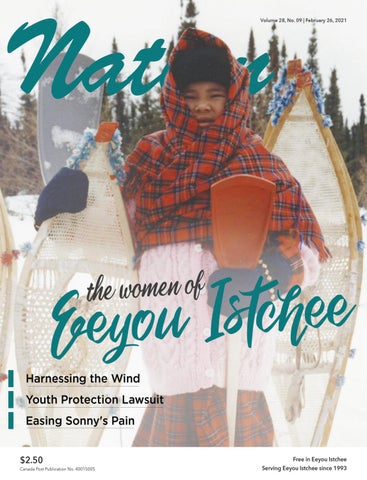
CONTENTS 10 Celebrating International Women’s Day The Nation interviews five prominent women from the Cree nation.
EDITORIAL Outside in the cold
4
NEWS Second wave ebbs
5
Blowing in the wind
6
IN BRIEF
9
FEATURES Choose to challenge
10
Child-welfare lawsuit proceeds
28
PUZZLES REZ NOTES
32
The mysterious Dr. Ho
33
T&B One day looks like the next
Politics
28
Child-welfare lawsuit proceeds
Photo from the Nation archives
34
Editorial
This story is an updated re-print from issue 28-08, which was not correctly printed due to a printing error
Outside in the cold by Will Nicholls
C
ree culture has always been about sharing and taking care of each other. Sometimes we forget other peoples have the same values as what we see doesn’t always show that. It seems there is a difference between community and political actions to help those less fortunate. At first, Quebec Premier François Legault repeatedly maintained that homeless people wouldn’t be exempt from Quebec’s 8 pm-to-5 am curfew. We should thank Quebec Superior Court Judge Chantal Masse for overturning that political judgment. It was too late, though, for Raphaël André, an Innu homeless man, who froze to death in a chemical toilet January 17. The Native Women’s Shelter, which runs Resilience Montreal, wanted to create a warming tent in Cabot Square. Even though the homeless don’t now have to worry about being ticketed, Nakuset, the shelter’s executive director, said they still need a place to get warm in the cold nights. Nakuset hoped the warming tent would be approved and it was. At the time, Montreal temperatures are forecasted to drop. “There’s nowhere to go in this area, especially on the weekends, to keep warm. Even at Resilience, because of the Covid outbreak, our services are limited. They can come in and get something to eat, but they have to leave. So, the idea of a warming tent is really important because the people in this area are cold all the time,” Nakuset said. Then Kahnawake’s Host Hotel pledged $25,000. “We’re bringing in generators and gas and donations for the tent,” said Mary Goodleaf, one of the owners.
Photos provided by the Native Women’s shelter
Warming tent in Cabot Square
“Hopefully, it gives people a warm place to rest their head for the next few weeks and maybe by luck, somebody else will want to contribute.” About $100,000 has been raised to pay for supplies, and rooms and salaries for workers. A family member said it’s worth doing “if it saves one person’s life or helps out someone in a small or huge way.” Nakuset praised Kahnawake, saying there has been an outpouring of support from the community, including people donating knitted socks. The city of Montreal offered to pay for rental costs, but initially said the tent had to be taken down after only two weeks – in mid-February, one of the coldest
months of the year – leaving many to wonder why the homeless would once again be left out in the cold. But Nakuset was hoping that people would pressure the city to grant an extension. And that is exactly what happened. It will stay up until April. For those willing to help, go to the Native Women’s Shelter website or see the GoFundMe section of Resilience Montreal. The warming tent is for everyone and was created by both Indigenous and non-Indigenous people. Being homeless doesn’t recognize race. Let’s help those left outside in the cold. It’s the human thing to do.
the Nation is published every two weeks by Beesum Communications EDITORIAL BOARD L. Stewart, W. Nicholls, M. Siberok, Mr. N. Diamond, E. Webb EDITOR IN CHIEF Will Nicholls DIRECTOR OF FINANCES Linda Ludwick EDITORS Lyle Stewart, Martin Siberok PRODUCTION COORDINATOR AND MANAGING EDITOR Randy Mayer CONTRIBUTING WRITERS M. Labrecque-Saganash, S. Orr, P. Quinn, B. Powless DESIGN Matthew Dessner SALES AND ADVERTISING Danielle Valade, Donna Malthouse THANKS TO: Air Creebec CONTACT US: The Nation, 4529 CLARK, #403, Montreal, QC., H2T 2T3 EDITORIAL & ADS: Tel.: 514-272-3077, Fax: 514-278-9914 HEAD OFFICE: P.O. Box 151, Chisasibi, QC. J0M 1E0 www. nationnews.ca EDITORIAL: will@nationnews.ca news@nationnews.ca ADS: Danielle Valade: ads@nationnews.ca; Donna Malthouse: donna@beesum.com SUBSCRIPTIONS: $60 plus taxes, US: $90, Abroad: $110, Payable to beesum communications, all rights reserved, publication mail #40015005, issn #1206-2642 The Nation is a member of: The James Bay Cree Communications Society, Circle Of Aboriginal Controlled Publishers, Magazines Canada Quebec Community Newspaper Assn. Canadian Newspapers Assn. Les Hebdos Sélect Du Québec. Funded [in part] by the Government of Canada. | www.nationnews.ca | facebook.com/NATIONnewsmagazine | Twitter: @creenation_news
4 the Nation February 26, 2021 www.nationnews.ca
CMCA AUDITED
C O V I D - 1 9 U P D AT E
by Ben Powless
Second wave ebbs
Most Cree have received their vaccine, but worries about variants grow
A
s Covid cases continue to steadily decline across here and across Canada, the Cree Health Board (CHB) urges continued caution as new strains of the virus have been detected in the Abitibi and Montreal regions. The new variants are more infectious, raising fears of a third wave and new lockdowns, but the vaccine is understood to still be effective against them. That’s good news, as more than 72% of the eligible Cree population in Eeyou Istchee have received the first dose of the vaccine. Nonetheless, public health officials have opted to maintain restrictions on non-essential inter-community travel until early March, except for residents returning home or transportation of children under 18 to their parents. The CHB says all cases from the January outbreak have been resolved, with only two active cases remaining in the region. That brought the total number of infected since the start of the pandemic to 117. “The solidarity and caring that the people of Eeyou Istchee showed one another to help put an end to the recent outbreaks was incredible,” the CHB said in a statement. “Arriving at a checkpoint, answering honestly and accepting the consequences if one is required to self-isolate is the greatest demonstration of love and sacrifice one can make for their people.” The CHB is preparing to administer the second dose of the vaccine, encouraging those eligible people who haven’t received the first dose to make appointments at clinics. CHB Vice-Chair Christine Petawabano said in a statement that post-secondary students studying outside of Eeyou Istchee would be able to get the vaccine with an appointment when they returned home. The CHB is developing an attestation of vaccination, as governments and airlines around the world are increasingly demanding proof of inoculation. All regions of Ontario and Quebec were still considered high-risk, requiring mandatory 14 days of self-isolation, with
Months ago, we promised a total of six million doses from all candidates before end of March, that’s exactly what we are going to deliver - Prime Minister Justin Trudeau
the exceptions of Region 10 (Nord-duQuébec), Region 17 (Nunavik) and Region 18 (Eeyou Istchee). Regions 10, 8 (Abitibi-Témiscamingue) and 2 (Saguenay Lac Saint-Jean) were moved into the provincial Orange Zone, which involves a curfew from 9:30 pm to 5 am, a prohibition on all gatherings, businesses allowed to open allowing one person per household, restaurants open for dining with a maximum of two adults per group, while bars stayed closed. The rest of Quebec is still in the Red Zone, with an 8 pm-5 am curfew, a prohibition on all gatherings, and bars and restaurants closed. Mistissini and Ouje-Bougoumou moved back to Phase 2 of deconfinement, allowing for outdoor gatherings of two households, indoor gatherings of the same two households, and offices allowed to stay open. The rest of the Cree communities were in Phase 3, allowing for outdoor gatherings of 75 people or 10 households, indoor gatherings of 25 people or three households – including sporting events – and offices allowed to stay open. In Mistissini, primary and secondary school students continued online learning, and prepared for their return to in-class instruction on February 22. All other communities returned to in-class learning following Scenario B measures. Laptops were distributed for high school students in Mistissini, Waskaganish, Chisasibi, Nemaska and Ouje-Bougoumou. Eeyoueducation.ca posted resources for students and par-
ents who needed assistance setting up Microsoft Office accounts and applications including Teams and Outlook. Sabtuan Adult Services is reviewing a plan for students to return to the Sabtuan Regional Vocational Training Centre in Waswanipi, while all other vocational training programs had resumed. PostSecondary Student Services is working with the CHB to help students return home during March Break. Across Quebec, new daily cases fell to their lowest levels since October, while nearly 300,000 doses of the vaccine have now been administered. Nationally, the country saw its lowest levels of new cases since September, as nearly 1.3 million people had received the vaccine. After concerns about delays to Moderna vaccine deliveries, which are being used across the Cree communities, the federal government announced it will receive 1.3 million doses in March. The other leading vaccine manufactured by Pfizer was facing delays due to snowstorms affecting large parts of the United States, though the company committed to sending four million vaccine doses by the end of March. “Months ago, we promised a total of six million doses from all candidates before end of March, that’s exactly what we are going to deliver. The ramp-up phase in April will feature many more millions of doses,” Prime Minister Justin Trudeau said in a statement February 16.
www.nationnews.ca February 26, 2021
the Nation 5
A
new wind energy project in Whapmagoostui-Kuujjuaraapik is launching environmental and social impact assessments for the twin communities’ Cree and Inuit populations.
If you need more information or have additional questions, contact our office in Val-d”Or. By phone: 819-874-2600 By email: justicevaldor@cngov.ca
6 the Nation February 26, 2021 www.nationnews.ca
Community consultations that began February 16 will determine the social acceptability of the project, which proposes to partly replace the use of diesel-powered electricity with renewable energy. “This project is important for the community in that it will help reduce greenhouse gas emissions that contribute to global climate change,” said Anthony Ittoshat, mayor of Kuujjuaraapik and vice-president of the newly created Kuujjuaraapik-Whapmagoostui Renewable Energy Corporation (KWREC). When Hydro-Québec notified the two villages of plans to upgrade the existing diesel powerhouse in 2011, they mobilized to pursue a sustainable energy alternative. Nimschu Iskudow, a subsidiary of Whapmagoostui Cree Nation, was created to join Kuujjuaraapik’s Sakkuq Landholding Corporation in studying solar, biomass and other energy alternatives – eventually opting for wind. On a trip in 2014 to China, the world leader in wind-power generation, they found two companies willing to invest in the project. Stalled negotiations with Hydro-Québec led to interventions from the Quebec Energy Board, which directed the crown corporation to collaborate with both communities. “We’re producing energy and Hydro-Québec has agreed to buy that power,” KWREC president Matthew Mukash told the Nation. “We brought up the blackout issue in our community – 20 a year, especially in wintertime. One time the powerhouse caught on fire. We’re negotiating the power-purchasing agreement, which will be concluded in March.” With diesel’s pollution and rising costs, KWREC hopes to eventually relegate the old power plant built by the Canadian Army in the 1950s to an emergency backup supply. The proposed wind turbines will generate approximately six gigawatt-hours of electricity annually over the project’s esti-
News
Blowing in the wind Whapmagoostui’s path to a future of clean renewable energy by Patrick Quinn mated 25-year lifespan, contributing about 40% of the community’s energy needs. “We wanted to displace the most electricity possible, which will require a big battery installed by Hydro-Québec, because some days you have wind and some you don’t,” said Jean Schiettekatte, Nimschu Iskudow’s technical advisor. “It will be the largest big battery installed in northern Canada. The quantity of CO2 this is replacing is the equivalent of the consumption of 4,000 cars per year.” As the “first northern green multi-energy off-grid power plant,” KWREC intends to send power from the diesel generator, wind turbines and battery storage system to a central control unit. With the battery capable of providing nearly an hour of community electricity needs, Schiettekatte expects power outages will become a thing of the past. “People will probably see improvements in the quality of service,” said Schiettekatte. “Over the last years, we did some technical studies. We looked at where we have the most wind, also at constraints like the airport and bird issues – we don’t want to install the turbine by the coast where there is a bird-migration corridor.” The recommended sites are in mountains seven km from the community where high volumes of wind are registered and environmental impact is minimized. The project originally identified three potential sites, but early consultation with hunters
raised concerns about one, so two turbines are currently proposed. “The only thing we’ll lose is that beautiful scene we had on the ridge,” Mukash remarked. “Geese would be impacted – we’d like to hear from the hunters what they think about that. As with any largescale project, the affected community must be well informed and have a say to make an informed decision regarding the proposed project.” Consultations with various community groups began in December and a large assembly is planned for Crees March 4, depending on pandemic restrictions. Environmental impact consulting company Pesca is managing the assessment under Section 22 of the JBNQA. It is expected to conclude by the end of March. Completing this assessment before signing an agreement with Hydro-Québec is a significant difference from previous projects imposed on communities. Decreasing costs are giving wind power a higher profile in Quebec’s energy strategy, with existing hydroelectric infrastructure capable of becoming power storage systems. Building on KWREC’s pilot project, Tarquti Energy Corporation was created between Makivik and the Inuit co-ops to develop similar installations in other Nunavik villages. Although Covid has delayed implementation, Tarquti is currently at the wind-measurement stage.
“Our communities may be the example for other northern communities,” suggested Mukash. “There’s already two wind turbines at the Raglan Mine northAlliance of us. Illustration from La Grande Wind development is very much alive in Scandinavian countries, so we know they’re good for this type of weather.” Selected turbines are expected to have blade-heating systems to prevent ice damage, particularly during periods of freezing rain. While extensive research has determined the optimal turbine model and installation site, the consultation sessions will play a critical role in confirming the final designs. “You have to compensate [the turbine location] with the cost of doing the line and access road,” Schiettekatte asserted. “An interconnection line in the north is about a million dollars a kilometre. The cost of doing roads in that area is very expensive so it might be a nice site to eventually have a tourism area. The idea is to create local jobs.” As the expanding community prepares to welcome wind energy by 2024, the incoming road may stimulate other development aligned with the region’s burgeoning tourism industry, especially since the proposed site is an optimal viewpoint for watching the northern lights. “We’re an isolated community so if there’s a road for sure you’ll see big traffic because people like to drive out,” Mukash added.
www.nationnews.ca February 26, 2021
the Nation 7
Air Creebec is operating by respecting and exceeding the rules with extensive cleaning and disinfecting of the aircraft, social distancing on board and at all service counters. We encourage everyone to respect the rules and to stay safe.
For the latest Air Creebec updates, please visit aircreebec.ca/covid19 Déclaration d’intention de dissolution
Declaration of Intention of Dissolution
The CMEB Aims to • Assist the Crees in accessing mineral exploration opportunities. • Facilitate the development of mineral exploration enterprises with Cree entrepreneurship. • Help encourage the Crees and Cree enterprises to benefit from Quebec’s regular funding programs as well as other provincial assistance allocated to mineral exploration activities. • Act as the main intermediary between offers and demands of services made to Cree enterprises in matters relating to mineral exploration. THE CREE MINERAL EXPLORATION BOARD 21 Hilltop, P.O. Box 150 Wemindji, QC J0M 1L0 T: 819-978-0264 x327
cmeb.org 8 the Nation February 26, 2021 www.nationnews.ca
In Brief Musician speaks out against racism Jarrid Poitras is speaking out after saying he was hurt by a colleague’s comments about there not being a category for Indigenous Artist of the Year at the Saskatchewan Country Music Association’s (SCMA) annual music awards. Poitras is a second vice-president for the association, and said that his colleague Reg Wilke, who also sits on the SCMA board of directors and awards committee, made the comment, “Why should we give them an award when they’re just going to pawn it off anyway?” Poitras later sent an email to express his frustration to other executive members. Wes LeBrash, president of the SCMA, said that Wilke has apologized and left the board and awards committee. Regina community radio station CJTRFM announced that it has removed Wilke’s program from its schedule. SCMA members created an inclusivity committee in the wake of the controversy, a move welcomed by Poitras, who performs under the stage name Jarrid Lee. The committee aims to involve members of the Indigenous community and LQBT community.
Feds resist human rights tribunal rulings The First Nations Child and Family Caring Society (FNCFCS) has filed its ninth motion arguing Canada is not compliant with a Canadian Human Rights Tribunal (CHRT) ruling which states First Nations families on reserve and in the Yukon are not being provided equitable child welfare services. According to FNCFCS executive director Cindy Blackstock, the federal government has repeatedly failed to act on the order, which came from the 2016 ruling. That original ruling highlighted discrepancies in funding on and off reserve. Blackstock says that Canada has “aggressively” fought against the order since then. The new motion states that Ottawa has not changed its funding agreement with provinces and territories adequately to reflect the CHRT ruling. Blackstock has said that a lot of the overrepresentation of First Nations children in the child-welfare system could be dealt with if the children received equitable funding. The feds are responsible for funding prevention and
protection services through its First Nations Child and Family Services program.
Assailant faces sentencing for 2017 attack Barbara Kentner was a 34-year-old mother from Wabigoon Lake Ojibway First Nation who died after having a metal trailer hitch thrown at her from a passing vehicle in Thunder Bay in January 2017. She passed away in July 2017 from complications arising from her injuries and an unrelated disease. The assailant, Brayden Bushby, was found guilty in December 2020 of one count of manslaughter. Crown prosecutors are asking for an 8-to-12-year sentence, while lawyers for Bushby are asking for a four-year sentence. Bushby is scheduled to return to court May 4 for sentencing. Prosecutors argued that Kentner was unaware the unprovoked assault was going to happen, as it took place at night from a passing vehicle. Bushby was heard to yell, “I got one,” after striking the woman with the trailer hitch. Kentner had been walking with her sister along a residential road in Thunder
Bay before being struck in the abdomen from the passing vehicle.
In Brief
Disciplinary hearings over 2015 death Stacy DeBungee, an Indigenous man from Rainy River First Nations, was found dead in the McIntryre River in Thunder Bay on October 19, 2015. While the Thunder Bay Police Service initially declared his death non-criminal, a complaint by DeBungee’s family in 2016 opened an investigation into how the police handled the case. Now, three officers involved in the initial investigation are to face disciplinary hearings. The investigative report, completed by the Office of the Independent Police Review Director (OIPRD), found that officers in the case had either ignored or neglected crucial leads and that racism may have been a factor in the investigation. They found “probable ground to support an allegation of neglect of duty.” The adjudicator who issued the decision, Lee Ferrier, also noted that the case came as part of a larger controversy surrounding police interactions with Indigenous peoples in Thunder Bay.
www.nationnews.ca February 26, 2021
the Nation 9
Features
10 the Nation February 26, 2021 www.nationnews.ca
the Nation celebrates International Women’s Day
Choose to Challenge Intro by Lyle Stewart
Feautres by Patrick Quinn & Ben Powless
I
nternational Women’s Day celebrates the social, economic, cultural and political achievements of women every March 8. It is a call for gender parity across the globe. The IWD grew out of a socialist labour campaign in New York City in 1908, when 15,000 working women marched for shorter hours, better pay and the right to vote. A year later, the Socialist Party of America marked the first annual National Women’s Day. The first International Women’s Day was observed two years later, in 1911. This year’s campaign theme is “Choose to Challenge.” According to the IWD website, “a challenged world is an alert world... We can all choose to challenge and call out gender bias and inequality. We can all choose to seek out and celebrate women’s achievements. Collectively, we can all help create an inclusive world.” The Nation salutes and celebrates the women of Eeyou Istchee. Your work for the Cree Nation enriches our lives.
www.nationnews.ca February 26, 2021
the Nation 11
Mandy Gull, Deputy Grand Chief
“As a female leader, I have to remind people that quality of life, family and the impacts of relationships play a large role in the decisions we make”
W
hen Deputy Grand Chief Mandy Gull was growing up in Waswanipi, she remembers hanging out after school at the band office where her mother worked, thinking one day she’d like to work there. After having children very young, she did find employment in that office as a secretary at the age of 18. “When I was secretary, I was so inspired by Violet Pachano,” Gull recalled. “When she became the Deputy Grand Chief, I thought wow, this is going to open doors for other women. I never at that time thought I would go into politics. I find that ironic now that I was the second person to go in the door right after her.” Gull worked in several departments first under former Waswanipi Chief Paul Gull, who had a big influence on her career. To learn more about administration, she studied political science and public affairs before returning home to work with her re-elected mentor. “My late mom really wanted me to try my hand at politics, so I decided to try it and it worked,” Gull told the Nation. “In a
room dominated by men, I thought there’s so much opportunity for women to present their views. As a female leader, I have to remind people that quality of life, family and the impacts of relationships play a large role in the decisions we make.” Gull encountered her fair share of obstacles, occasionally feeling judged by men questioning her place and her command of the Cree language. As she didn’t speak much Cree growing up, she initially resisted running for elections. “If you want to get into a leadership role, work hard on your language,” Gull advised. “I’m not a perfect Cree speaker but I’m pleased with where I’ve come today. You have to trust yourself that your Cree will flow, even if you’re not completely fluent. You’re doing your best and people will recognize that.” After being elected, Gull was told that she couldn’t go wrong if she listened to the people. She has focused on three key priorities – completing the protected areas network, building a relationship with women throughout Eeyou Istchee and better understanding the youth.
12 the Nation February 26, 2021 www.nationnews.ca
“This past December, it brought me a lot of joy to see those protected area targets reached,” said Gull. “Elders have such a deep compassion for their traplines and hunting territory – I hope that gets transmitted to the youth. They have a responsibility to take over protecting our culture and heritage, and that begins in having a drive to care for it like our ancestors did.” Visiting Indigenous peoples around the world, Gull is grateful that the Cree Nation can sustain itself through harvesting activities while remaining fully involved with developing the territory. A memorable moment was travelling with Youth Grand Chief Kaitlynn Hester Moses to Finland in 2018 to stand in solidarity with the Sámi. “It was my first time travelling overseas,” shared Gull. “To see Kaitlynn go through that experience as a new leader, as a Youth Grand Chief, helped shape her, and to watch her grow as a leader is something I will not forget.” With demographics suggesting that the Cree Nation facing a booming demand
the Nation celebrates International Women’s Day
for services, homes and community programs, Gull believes that encouraging entrepreneurship will help develop a self-driven economy. “I encourage anyone to not only pursue the types of employment known now – working in the band office, becoming a nurse or teacher – but also alternative employment paths that interest them,” Gull recommended. “We’re going to have a lot of demands from a new and evolving younger generation.” Gull also wants people to consider how the territory will develop in the future.
Existing government structures need to be re-evaluated to ensure that future needs will be met. “We talk about developing our territory – we have to do the same thing in looking at our institutions, ensuring all of these good entities that were created from our agreement also reflect the realities of what our population is going to need in the future,” Gull said. “In five to 10 years, things are going to be very different in the Cree world.” Gull encourages any woman in a leadership role to mentor a young woman just
as others have supported her journey. She said one of her best experiences was being honoured by the Chisasibi Women’s Association with an outfit. “I thought it was such a beautiful experience to have a leader be recognized by other women, especially women who didn’t really know me,” Gull exclaimed. “It is so rewarding to help younger women pursue a path and give them the encouragement they need to become strong and successful. We have to continue to support and push one another.”
Daisy House, Chief of Chisasibi
“Leadership is about listening to understand, and not listening to respond”
W
hen Daisy House was elected Chief of Chisasibi last August, it seemed a logical next step for the respected community leader who had served as Deputy Chief for the previous 13 years. However, she says she got into politics by accident, having dreamed of being a teacher or a nurse growing up. Calling herself the shyest person in high school, House tries to maintain a private life
despite her public office. She spoke with the Nation on a rare day off. “People keep reminding me it’s not a sprint,” House shared. “I really have to take that to heart and take care of myself because no one else will. That’s another reminder I’ve been getting a lot lately. Leadership is about listening to understand, and not listening to respond.” Growing up on Fort George Island until Grade 2, House credits her mother and
late stepfather for teaching her a strong work ethic and to take responsibility for her actions. She was told to live with the decisions she made and to keep learning from them. “That’s why I have no regrets about my childhood,” said House. “It wasn’t an easy one, but it has made me who I am today. As I continue to grow as a person, I learn from everyone I meet day in and day out. We never stop learning.”
www.nationnews.ca February 26, 2021
the Nation 13
Education is a lifelong priority, which continues as she completes an online master’s degree in Education Leadership. All this while balancing her busy work and family time. Before working for the band council, House worked as daycare director, student affairs technician, teacher and academic advisor. When asked to run for council in 2007, she was enjoying maternity leave with her second son. She agreed but was surprised to win the highest number of votes, which in those days meant becoming Deputy Chief. Initially reluctant to assume that responsibility, persistent community members convinced her to take the position. “Not many people know I ran for chief in 2015,” said House. “I got sick to my stomach and really didn’t want it. Davey [Bobbish] got in and I was so happy. That’s when I told myself no one will ever force me to run again. It’s got to come from me.” She remained true to her vow by turning down a nomination to run as Deputy Grand Chief a few years later. Besides preferring to focus on local issues, House was also concerned the job’s travel requirements would rob her of valuable family time. She’s thankful for her husband’s support over the years, learning to cook and staying at home when their children were babies. Still, she’s proud that she could breastfeed her son for 27 months. “I have two boys and a husband – a house full of men,” said House. “Tell them if you have an assignment to complete, ask for help. It’s tough being a working mom, hockey mom – both my sons are playing high-level hockey – and online courses. That’s the balancing act of being a mom.” While the workload is higher than ever as Chief, she continues to meticulously read band council meeting minutes, adding her own comments and questions. “When you’re in leadership you don’t rely on anybody else,” House asserted. “You have to know what you’re signing and approving. We ask what’s working, what’s not working and how else can it be. Every chance I get on local radio, which is pretty big in Chisasibi, I do the Covid
“I have two boys and a husband – a house full of men... It’s tough being a working mom, hockey mom – both my sons are playing high-level hockey – and online courses. That’s the balancing act of being a mom.”
update in Cree as much as possible and add a little tidbit about social issues.” House tries to create space for common concerns, discussing issues like couples’ therapy, budgeting and substance abuse. “We can’t solve the world’s problems, but as individuals, as a family and as entities we all have a part,” House suggested. “Some have the mentality that it’s one person, or the police or the health board. At the last general meeting, Eddie Pash said, ‘The Chief cannot lift a heavy rock by herself. We have to help lift that rock with her’.” Although House knows some don’t attend general meetings, she values that opportunity for citizens to respectfully raise their concerns without fearing repercussions. She recalls that Elders
14 the Nation February 26, 2021 www.nationnews.ca
would often have heated arguments at these meetings, but all would be forgiven in friendly encounters the following day. With women historically elected as both Chief and Deputy Chief in Chisasibi, she advises girls with similar aspirations to keep watching and observing, learning from both the successes and shortcomings of others. She recommends educating oneself as much as possible, acquiring wisdom from both schools and the land. “We have to know where we came from to know where we want to go,” House said. “Our values and traditions become our ammunition for our future, to get something for the people. One former Chief said there’s nothing wrong with being an educated hunter so you can have the best of both worlds. It’s medicine for the soul being out on the land.”
the Nation celebrates International Women’s Day
Stella Masty, President of CWEIA
“You have to know when to be soft spoken and when to be outspoken”
C
ree culture has always been a passion for Stella Masty, president of the Cree Women of Eeyou Istchee Association (CWEIA). It has been a constant for her as a business leader and while working alongside pioneers of the Cree Nation. “You have to know when to be soft-spoken and when to be outspoken,” Masty told the Nation. “I’m a strong alpha female – I’ve taught my children to be independent. Your career path doesn’t matter if you’re true to your passion and honest with the work you do. If you’re not honest, you’re always going to live with regrets.” Living most of her early childhood on the land, Masty was 13 when Phase 2 of the Great Whale hydroelectric project was announced. She convinced her principal in Whapmagoostui to let her participate in an essay contest for Secondary 5 students about protecting the river, even though she was four years younger. “I was the last one to present,” Masty recalled. “I won the contest and was so happy I cried. It allowed me to be the voice for the caravan that went to New York for Earth Day. I was already persistent, determined I would defend my culture and land, to speak for what could not speak.”
As the famous Odeyak expedition took their protest south, Masty made speeches at universities and community halls along the way to a huge Earth Day concert in Times Square in April 1990. Support from then-New York City mayor David Dinkins for the Grand Council eventually helped lead to the project’s cancellation. Masty’s life took a tragic turn as she prepared for nursing studies. A house fire claimed the lives of her grandfather, aunt and six-year-old sister. She stepped back from everything to support her family. She finally returned to postsecondary education three or four years later at Concordia University’s John Molson School of Business. “When I was there acing most of my subjects. I thought maybe this is my new role,” said Masty. “After graduating, we started our construction company. I took an opportunity because there was a company that had gone bankrupt. The assets were liquidated, and we purchased everything.” Saskounan Excavation became the only Cree company at the Eleonore mine, which led to other large partnerships. With her husband Keith Bearskin, they pursued local contracts back in Chisasibi and were recognized by the Commission
de la construction du Québec (CCQ) as the highest employer of Indigenous people. “We hired people who nobody would want to hire,” shared Masty. “They were considered alcoholics, not reliable. It was a different approach for me than it would have been for a man. When I was able to build that trust, they ended up being my best workers. They were really motivated because we took care of them, made sure they would have a pension.” Masty is proud she learned to hold her own in a boardroom, to make arguments without holding grudges. While business is often numbers-based, she strives to focus on the human aspect and keep calm – something learned from working with the Nishiiyuu Council of Elders. “It could be a mountain, but they see a molehill and simplify it for me,” said Masty. “When everyone’s in a panic mode, just breathe and think, ‘This is going to work out.’ When you come into a situation like that it changes how everybody reacts.” Masty considers herself lucky to have had great role models, beginning with her hardworking parents – both teachers who nurtured her Cree fluency. Working alongside Billy Diamond and Violet Pachano enriched her life immensely. Diamond became Grand Chief with the Elders by his
www.nationnews.ca February 26, 2021
the Nation 15
For ALL WOMEN who are 50-69 years old
ᐋᒋᔦ ᓃᒋᓴᓂᔅᐧᑫᒻ
Wachiyeh Niichisaniskwem! ᐐᐱᒡ ᒋ ᑳ ᐹᐱᐦᔮᐅᒡ ᑭᓓᕌ ᐳᔅ ᑭᔮᐦ ᓲᕕ ᐁᕌ ᐃᐦᑖᐎᓐᐦ ᒋ ᑳ ᓈᓂᑐᒋᔅᒑᔨᒫᑲᓅᐎᒡ ᐃᔅᒀᐆᐦᒡ ᐅᑑᑑᔑᒻᐦ ᑳ ᒧᐎᐙᒡ ᐋᐦᑯᓯᐎᓐ ᐎᔨᒡ wîpich chi kâ pâpihyâuch kilerâ pus kiyâh sûvi erâ ihtâwinh chi kâ nânituchischâyimâkanûwich iskwâûhch utûtûshimh kâ muwiwâch âhkusiwin wiyich
or
! will be coming soon
to offer breast cancer screening in Eastmain, Wemindji, Chisasibi, and Whapmagoostui You will receive a letter from the Public Health Department
ᒌᔨ ᐋᐹᔨᑯᔒᓐ ᒋ ᑳ ᐎᔮᔨᐦᑎᒻ ᒑ ᒋ ᓈᓂᑐᒋᔅᒑᔨᒫᑲᐐᔨᓐ ᑳ ᒧᐎᐙᒡ ᐋᐦᑯᓯᐎᓐ ᐐᔨᒡ chîyi âpâyikushîn chi kâ wiyâyihtim châ chi nânituchischâyimâkawîyin kâ muwiwâch âhkusiwin wîyich
GETTING SCREENED FOR BREAST CANCER IS YOUR CHOICE! For women aged 35-49 years old
If you have a biological family history of breast or ovarian cancer, check with your doctor for more information about the best time to get screened.
&
Tour Dates
Mistissini + Oujé-Bougoumou +Waswanipi: Planned to start in June 2021 / Waskaganish + Nemaska: Planned for Fall 2021
EASTMAIN
WEMINDJI
CHISASIBI
WHAPMAGOOSTUI
Monday, March 8 to Thursday, March 11
Friday, March 12 to Wednesday, March 17
Thursday, March 18 to Thursday, April 1
Dates to be determined
CMC: (819) 977 0241 Edna Mark Stewart, CHR Ext. 24201
CMC: (819) 978-0225 Laurie Ann Georgekish, CHR, Ext. 23202
CMC: (819) 855-2744 Doris Duff, Ext. 22212
CMC: (819) 929-3269 Emilyanne Fleming
For more information: Cheryl Swallow, CHR #22710 Patricia Bobbish #22709 Stephanie Ratt #22055
For more information: Shannon Natachequan, CHR
To learn more : creehealth.org/services/breast-cancer-screening Facebook: Cree Health - Breast Cancer Screening
16 the Nation February 26, 2021 www.nationnews.ca
By CBHSSJB Public Health Chishaayiyuu Department
Should I be screened for breast cancer? Clara Bus, which brings a mobile mammogram machine to Eeyou Istchee, will be coming in March to visit Eastmain, Wemindji, and Chisasibi to offer breast cancer screening. The mobile mammogram machine travels to Whapmagoostui by the Sophie Air plane. Every 2 years, women aged 50 – 69 receive a letter from the Public Health Department of Cree Health Board, inviting them to be screened for breast cancer. Some of you ladies may be wondering:
What is breast cancer screening and why might it be important for me? Breast cancer screening is a test that checks for hidden signs of breast cancer before any symptoms – like a lump in the breast - appear. A mammogram machine takes X-ray images of different angles of your breast. A radiologist will look at these images and determine if you need follow up testing.
possible. 1 in 4 women who have regular mammograms will need follow up testing that is not necessary. These false alarms can lead to unnecessary travel, tests, stress and anxiety. This happened to Nancy Voyageur, from Mistissini, who needed to take sick leave from work due to stress while waiting for her results. On the other hand, Georgina McLeod from Mistissini was able to detect breast cancer early, before she had any signs or symptoms, by getting screened. Her cancer was then treated successfully. When looking at both pros and cons, experts agree that breast cancer screening is a good choice for women between 50-69 years old. The Public Health Department of the Cree Health Board recommends that all women between ages 50-69 be screened. If you are between the ages of 35 and 49 and have a family history of breast cancer or ovarian cancer, ask your doctor about the best screening options for you.
If the doctor decides that follow up is needed, you will be sent to Val-D’Or Hospital for a few days for more testing. These tests may include another mammogram, an ultrasound, or an invasive biopsy (sample of tissue) to determine if cancer is really there.
If you would like to be screened but will be out of town or unable to make your appointment with Clara Bus or Sophie Air, please inform your local Chishaayiyuu CHR to make other arrangements.
Deciding to participate in breast cancer screening is a personal choice and it’s important to have all the information you need to make the right decision for you.
For more information, contact your Chishaayiyuu CHR, follow us on Facebook, or check out our website on breast cancer screening. On our webpage, you can watch video testimonials from Nancy and Georgina to learn more about their experiences with screening.
Screening can reduce your chances of dying from breast cancer since it allows you to start treatment as soon as possible. It does this by catching breast cancer early enough before it has a chance to get worse.
Please be assured that we will follow all precautionary measures for COVID-19 to keep you and ourselves safe!
There are also cons to breast cancer screening that are important for you to know. The mammogram images are not 100% conclusive, meaning that a false alarm is
www.nationnews.ca February 26, 2021
the Nation 17
We all want to know more about COVID-19 vaccination COVID-19 vaccination in Québec began in December 2020 as part of a massive effort to prevent serious complications and deaths related to COVID-19, and stop the virus from spreading. Through vaccination, we hope to protect our healthcare system and allow things to return to normal.
A VACCINATION OVERVIEW Why get vaccinated at all? There are many reasons to get vaccinated (all of them good), including protecting ourselves from health complications and the dangers stemming from infectious diseases, as well as making sure they don’t resurface.
How effective is vaccination? Vaccination is one of medicine’s greatest success stories and the cornerstone of an efficient healthcare system. That said, as with any medication, no vaccine is 100% effective. The efficacy of a vaccine depends on several factors, including:
The age of the person being vaccinated Their physical condition and/or state of health, such as a weakened immune system
THE IMPACT OF VACCINES AT A GLANCE The World Health Organization (WHO) estimates that vaccination helps prevent over 2 million deaths every year, worldwide. Since the introduction of vaccination programs in Canada in 1920, polio has been wiped out across the country and several other illnesses (such as diphtheria, tetanus and rubella) have virtually disappeared. Smallpox has been eradicated throughout the world. The main bacteria responsible for bacterial meningitis in children–Haemophilus influenzae type B–has become much rarer. Hepatitis B has for all intents and purposes disappeared in young people, due to their having been vaccinated in childhood.
COVID-19 VACCINES Are the vaccines safe? Definitely. COVID-19 vaccines have been tested for quality and efficacy on a large scale and passed all necessary analysis before being approved for public use. All required steps in the vaccine approval process were stringently followed, some simultaneously, which explains why the process went so fast. Health Canada always conducts an extensive investigation of vaccines before approving and releasing them, paying particular attention to evaluating their safety and efficacy.
Who should be vaccinated against COVID-19? We aim to vaccinate the entire population against COVID-19. However, stocks are limited for now, which is why people from groups with a higher risk of developing complications if they are infected will be vaccinated first.
Can we stop applying sanitary measures once the vaccine has been administered? No. Several months will have to go by before a sufficient percentage of the population is vaccinated and protected. The beginning of the vaccination campaign does not signal the end of the need for health measures. Two-metre physical distancing, wearing a mask or face covering, and frequent hand-washing are all important habits to maintain until the public health authorities say otherwise.
On what basis are priority groups determined?
Can I catch COVID-19 even after I get vaccinated?
The vaccine will first be given to people who are at higher risk of developing complications or dying from COVID-19, in particular vulnerable individuals and people with a significant loss of autonomy who live in a CHSLD, healthcare providers who work with them, people who live in private seniors’ homes, and people 70 years of age and older.
The vaccines used can’t cause COVID-19 because they don’t contain the SARS-CoV-2 virus that’s responsible for the disease. However, people who come into contact with the virus in the days leading up to their vaccination or in the 14 days following it could still develop COVID-19.
As vaccine availability increases in Canada, more groups will be added to the list.
Order of priority for COVID-19 vaccination 1
Vulnerable people and people with a significant loss of autonomy who live in residential and long-term care centres (CHSLDs) or in intermediate and family-type resources (RI-RTFs).
2
Workers in the health and social services network who have contact with users.
3
Autonomous or semi-autonomous people who live in private seniors’ homes (RPAs) or in certain closed residential facilities for older adults.
4
Isolated and remote communities.
5
Everyone at least 80 years of age.
6
People aged 70–79.
7
People aged 60–69.
8
Adults under the age of 60 with a chronic disease or health issue that increases the risk of complications from COVID-19.
9
Adults under the age of 60 with no chronic disease or healthcare issues that increase the risk of complications but who provide essential services and have contact with users.
10
Everyone else in the general population at least 16 years of age.
Is COVID-19 vaccination mandatory? No. Vaccination is not mandatory here in Québec. However, COVID-19 vaccination is highly recommended.
Is vaccination free of charge? The COVID-19 vaccine is free. It is only administered administered under under the Québec the Québec Immunization Immunization Program and is not available from private sources.
Do I need to be vaccinated if I already had COVID-19? YES. Vaccination is indicated for everyone who was diagnosed with COVID-19 in order to ensure their long-term protection. Nonetheless, given the current limited availability of the vaccine, people that contracted COVID-19 should wait 90 days from when they were diagnosed before being vaccinated.
Québec.ca/COVIDvaccine 1 877 644-4545
side, and she would arrive at work early just to hear his stories. As the first female Chief and Deputy Grand Chief, Pachano is an inspiration for many in the Cree Nation. Masty respects her for questioning everything and always speaking her mind. More recently, Masty has been inspired by Janie Pachano to explore the Cree cultural aspect of femininity, which she believes was distorted by religious influences. Before becoming president of the CWEIA, Masty was busy with a second construction company, a consulting firm and work with the health and school boards. She also expanded her horizons by working for the Native Women’s Association of Canada.
“That helped me empower women from across Canada, developing a lot of friendships and some partnerships,” Masty explained. “I’ve put my consulting company on the shelf for now – I had to prioritize myself. When asked if I could run [for CWEIA], I felt it was a fitting time because I’ve already done so much.” Shifting between projects throughout her career, Masty remained rooted in her beliefs as she let some doors close to allow others to open. She’s working on helping women trust themselves in assuming their role as “the heartbeat of the family”. “We’re an evolving culture,” Masty said. “You have to find a way to adapt to that culture without compromising your
own human value. If you don’t find that acceptance, maybe it’s not meant for you. Let things play out without holding onto them and trust the process.” While addressing important issues with the CWEIA, Masty is working on selfcare and enjoying being a grandmother. She was recently nominated as one of the 100 most powerful women in Canada and apparently made it to the last round. “If a girl can see I made it that far, maybe they can see the possibility in themselves,” Masty asserted. “Everything I do is to inspire young girls and women to be their possibility in life. We don’t have enough Cree role models. If I can do that for one girl, I’m happy. I’m not done yet – I still have a lot of work to do.”
“You have to find a way to adapt to that culture without compromising your own human value.
20 the Nation February 26, 2021 www.nationnews.ca
the Nation celebrates International Women’s Day
Sarah Pash, Cree School Board Chairperson
“If we focus on strength and empowerment, we’re going to see the results in the future that we’re building together” The Nation: Can you tell us a bit about what your life was like growing up? Sarah Pash: My brother and I were born when my dad was going to Trent University, so we spent our early years going back and forth between Peterborough and Fort George. We also spent some summers at Caniapiscau Island because my dad was part of the research team employed by the Cree before the flooding. After he finished, he became a teacher and we moved to Moosonee. When the Cree School Board took over schools, my parents were offered positions, so we moved to Wemindji. I love the community and connections I had. It was a wonderful time growing up there. When Fort George relocated, we were offered a house in Chisasibi. I was still in elementary school when my mom became a teacher in Chisasibi. We started at James Bay Eeyou School, and I finished high school a year early in Toronto, when I was 16 or 17, because I had done an enriched program. My first degree was in arts. I started in economics but decided to switch to drama and English. When I finished my Bachelor
of Arts, I tried to figure out what I would do as a career. My mom suggested teaching. I had done some supply teaching, coming home on breaks and replacing teachers in classrooms at different times. I had enjoyed it, so I decided to do a Bachelor of Education degree at the University of Toronto. I met my husband at the University of Toronto. His goal was to become a teacher too. He was a couple years behind me, and when I finished my Bachelor of Education, I told him that I felt like I’d been away from home long enough. I was homesick and I felt like I needed to get back to my community, family and friends. We moved back to Chisasibi, I taught at the high school a few years. Then I decided to do a Master’s in Education at Lakehead University. My husband finished his bachelor’s degree at the same time. We brought our two children with us, and our third child was born there. That was an amazing experience – I gave birth about two weeks before finishing my master’s. That was a little challenging, but we made it through. After I finished my courses, we moved back to Chisasibi. My husband started
teaching again and I finished my master’s while working full-time. Then I worked for a couple years before pursuing a PhD in education. While working on my PhD, I started to become ill. I didn’t know what was wrong with me. I was in pain all the time with migraines and nerve pain. I couldn’t get a diagnosis from the hospital. I reached a point where I just couldn’t do it. I felt like a failure because my health problems were getting worse. At that time, I started working at the cultural institute in Ouje-Bougoumou. My symptoms got so bad one day I went to emergency and said I couldn’t function. They ordered a scan, and I was diagnosed with a brain tumour. It was a terrifying moment. The tumour was almost the size of a golf ball. They said it was too large for anything other than surgery. It was going to be a long surgery, and there could be nerve damage. I was worried for my kids. I was worried for my mom and husband, my support system. They were also worried and scared. And I was also worried because I thought I wouldn’t finish my PhD or reach
www.nationnews.ca February 26, 2021
the Nation 21
my goals – that maybe this was the end of my career. Then I had this realization that everything was going to be okay. We were going to get through this together. I realized the strength I had, a lot from the support around me, but also because I had been given this sacred space to understand the strength we inherit. The strength we inherit from our ancestors is passed down because of what we’ve experienced as a people and a nation and in the history of our families. I had the surgery and recovered. My family spent a lot of time helping me through that recovery, even my kids took me out on walks and helped me get back on track. I went back to work and finished my PhD. I ended up graduating in 2014 – it took me nine years because of the illness instead of four, but I did it. TN: How important was education to you growing up? SP: I didn’t grow up speaking Cree fluently. A lot of that has to do with moving around, but also my dad’s residential school experience. It was hard on him and affected our family life quite a lot. Not being able to speak Cree in the way I should was difficult growing up. I couldn’t communicate with my grandparents the way I wanted. I also had to deal with bullying growing up. School was a refuge, which became a way of healing. I could set goals and really enjoy learning. When I went away for post-secondary studies, I looked at the experiences we’ve had as Indigenous people. Building an understanding of the situations in our communities and families – because of history, because of colonial actions, residential schools, all these things that really impacted my own family. My PhD was about what young people need from us in the education system to best support them. Education has given me a way to give back and contribute to our future. TN: How did you decide to embark on your current career? SP: It was humbling to be nominated to run for chairperson; it was also a little
“The opportunity to focus on making a difference is a gift. There’s not a moment I take for granted”
scary. I’m not a politician. I didn’t know how to go about it. Even if I hadn’t been elected, it was a good chance to talk about our education system and how we’re schooling our young people, about the importance of language, culture, learning our own history, and helping young people build their own identity. I ran because I felt those things needed to be discussed. These issues are so important that I felt I needed to put myself out there. TN: Can you tell us about a high point in your career? SP: I think this period is the real high point in my career. This is the most challenging position I’ve had, but also the most rewarding. I work with an amazing group of elected officials from all the communities. The opportunity to focus on making a difference is a gift. There’s not a moment I take for granted because I know it’s only temporary position. Sometimes there are difficult decisions to be made and difficult truths to be acknowledged, like our difficulty with
22 the Nation February 26, 2021 www.nationnews.ca
attendance and graduation. There are huge opportunities, too. If we’re going to make a difference in our education systems, we have to be brave enough to acknowledge what is happening out there. TN: What do you think has changed for women and girls coming up today? SP: We’ve come into a time where we really know that anything is possible. I think back to when I was a young girl. There were a lot of things I wouldn’t have thought were possible. Now we know that women can do anything. We have women who are doctors, pilots, working outside of traditional women’s career fields like teaching and nursing, and doing wonderful jobs in those fields. I’m seeing young women do traditional activities that would have normally been done by young men. Many young women are engaging in cultural activities, learning from Elders. The future is wide open and if we focus on strength and empowerment, we’re going to see the results in the future that we’re building together.
the Nation celebrates International Women’s Day
Bella Petawabano, former Chairperson, Cree Board of Health and Social Services of James Bay
“If you have it in you to dream, then go for it.” The Nation: Can you tell us a bit about what your life was like growing up? Bella Petawabano: I grew up on the land for the first 10 years of my life. March 2 is my birthday; it was that time of the year when it was the end of the fur-hunting season. This is when men would go hunt for bigger animals like moose and caribou. It was during that time when I was born, only the women and children were left behind at the camp. My mom went into labour after a full day’s work outdoors. My mom would tell me stories of how easy it was. They say women gave birth very fast, they said the snow didn’t have time to melt – can you imagine? We lived on the land 10 months of the year, and we only returned early in the summertime. We went back on the land sometime in mid-August before schools opened for the kids who stayed in the village, but I always missed that. When I returned in mid-June I would always go back to school, but I’m not sure what I learned. But in any case, it was good to be back, reconnected with my friends. I knew it would only be a few weeks, so I made the most of it. We travelled from the village to the hunting ground by canoe and portage in spring and fall. I always remember
my mom had a child on top of her load, always a toddler walking in front or beside her, that’s how I remember her. That was my life, the first 10 years. After that, I considered myself one of the lucky children, if I can say that, to have gone to residential school after 10. I’m not sure how that happened, I’m sure it had a lot to do with my parents going on the land in mid-August so we missed when they would come and scoop up all the kids. Maybe that was my father’s strategy – to keep us home as long as we could until we started to receive threats that our family allowance would be cut off. I spent six years in residential school, and there were good times and bad times. I can only speak for myself, what helped me was being with my friends from the same community. It was important for me to make the best of it knowing my friends were there and we were in it together. But the worst part of it was being taken away from our tight-knit family and the punishments. There’s that other aspect we didn’t talk about – the abuse. Whatever kind of abuse – mental, psychological, physical, sexual – we didn’t talk about that. We didn’t know how to name it. Even at that age, we all knew what we had to do to survive, so that’s probably where I got all my resilience to meet
the challenges in my lifetime. One of the things, as young as I was to have faith in a higher being. If you want to call it God or Creator, I knew there was a higher being which kept me going, it came with the hope that it can only get better. That’s probably what got me through all of this. When I was there, I lost a sister in an accident, she died a few days before going home for the summer. It was devastating for my parents. My mother went into a deep depression. Today when we talk about people attempting suicide, at that age, I can say that I did experience that. It was just because it was so difficult, not knowing who to talk to, feeling alone. But it was a turning point in my life too, where I decided that living a non-Cree way of life was easier, so I decided to stay in school much to the disappointment of my parents. TN: How important was education to you growing up? BP: Education for me was very important. My father talked about how life would be different for us, would be different from the life he lived, we would have to prepare ourselves for when times will change, so one of the best ways was to get educated. The land will be there, keep the skills you
www.nationnews.ca February 26, 2021
the Nation 23
have, continue to learn traditional skills when you have the chance. He was a visionary, he could see the future of what was coming, he prepared us for that. I knew because of my father’s teachings – telling us we needed to learn another way of life, for me learning a new way of life is about education. Learning a new culture, a new way of doing things, because I did stay in school, I knew what I wanted to do since quite young was work in the health field.
“People maybe think I’m too old, but the day I consider myself old is the day I’m not able to walk. I have to keep my brain ticking”
TN: How did you decide to embark on your current career? BP: It was in early 1979 when I took on my first job in Mistissini for the Cree Health Board. I had worked with a social worker in Chibougamau, so that was my job, when the CHB took over I did that for a number of years. There were still lots of people on the land, kids weren’t going to residential schools but boarding homes, and more people started to stay in the community – you could see the problems that were emerging from all of this, that’s when I realized I wasn’t skilled to do the job of community worker. I was looking for that magic wand, I didn’t find it. I went to Montreal, moved with my three kids, and I attended McGill University for social work. When I was ready to come back, there were no positions for professional social workers. Mistissini welcomed me, so I became a public health officer in the agency. TN: Can you tell us about a high point in your career? BP: A high point of my career I would say was coming out of my comfort zone. That’s always moved me from one phase of my life to another, and that’s evolved. I felt like a pioneer, I feel like in all of my career, I was a pioneer. I went into places nobody had been before. I was never really given a job where I could say this is what somebody did before me, take it from there and move on. Around 2001, I became the interim Executive Director of the Cree Health Board and I sat for almost a year, 10 months while they were recruiting for an Executive Director. That was quite the experience to have done that. I continued
to work for the Cree Health Board for 10 years, that’s when I decided to run for chair of the Cree Health Board. So that’s what I did, I did that for eight years. And I was ready to go another four years! People maybe think I’m too old, but the day I consider myself old is the day I’m not able to walk. I have to keep my brain ticking. TN: What advice would you give to girls and women growing up today? BP: This is something I learned from my mother and father. In my mother’s teachings, she would watch me do something that normally a man would do, she would say you know that’s one of the great qualities you have,
24 the Nation February 26, 2021 www.nationnews.ca
when you have it in your mind that you can do something, and you go ahead and do it, that’s going to take you places, that’s going to take you far. If you have it in you to dream, then go for it. My father’s teachings were that when my brothers were being taught to hunt and other manly activities, my father used to say you know if you’re going to pursue education, that other way of life, then go ahead and do it. Do what it takes to do it, because you never know what life has in store for you. Today there’s so many separations with children being involved, more reason why women have to get what they need to function on their own and be successful.
the Nation celebrates International Women’s Day
www.nationnews.ca February 26, 2021 the Nation 25
26 the Nation
Your Northern Airline of Choice
Air Creebec is operating by respecting and exceeding the rules with extensive cleaning and disinfecting of the aircraft, social distancing on board and at all service counters. We encourage everyone to respect the rules and to stay safe.
For the latest Air Creebec updates, please visit aircreebec.ca/covid19
Politics
Child-welfare lawsuit proceeds Action over decades of child abuse in youth homes includes Cree members by Ben Powless
A
new class-action lawsuit alleges decades of abuse against girls and boys throughout Quebec’s child-welfare system. Filed on behalf of those who attended reception centres for boys and girls over the past 30 years, the lawsuit alleges the Quebec government was aware of the abuse but did nothing to address it. The Cree Board of Health and Social Services of James Bay is named as one of the administrative institutions in the lawsuit. According to Lev Alexeev, the lead lawyer behind the case, the suit could potentially involve tens of thousands of victims. He is seeking $500,000 in damages from the province, in addition to punitive damage compensation. Alexeev says that the main objective of the lawsuit is to stop these practices from continuing. The lead plaintiff, Eleanor Lindsay, met other people who had attended the reception centres on social media and discussed the harm they had suffered as kids. They then approached Novalex, which initially filed the lawsuit in October 2019. Christopher Stephen, of Waskaganish, attended a group home in Chibougamou and ended up in a reform school in Vald’Or. “I was institutionalized at a younger age, locked up in a room, sent for reclusion every time I was in trouble. I would spend days, maybe weeks there,” Stephen told the Nation. “It was a form
of abusing children, locking them up and throwing away the key.” Stephen, the oldest son of Chief Billy Diamond, said he spent half of his teenage years in such institutions in the mid1980s before being released at 18. He said one of the administrators told him he should be sent to prison, and that he didn’t belong in society. He says that there were Cree youth, both boys and girls, as well as Inuit youth placed together, with francophone youth held in another area. Stephen says he
28 the Nation February 26, 2021 www.nationnews.ca
tried to run away twice from the institution. “They always used to lock me up, when I was sleeping in my own room,” he said. “I was never really allowed to do anything, there was always a form of authority, they always put a tag on me, telling me I’m just a number.” Beyond compensation, Stephen hopes that people will find healing from the “trauma and wounds” of reform schools. “Before reform school there was residential school which became reform schools
after they closed. They still abused people, abused children, telling them it’s the kids’ fault,” Stephen said. He says it’s time that the Cree who attended tell their stories, and that many Cree and Inuit children would be happy to see someone standing up for them. “It was not a place to call home. You were just a child.” Leith Hamilton also went through the child-welfare system and went on to get a master’s degree and work in youth protection, where he saw firsthand the impact the child-welfare system was having on young people. He began advocating back in the 1970s against the abuse in the system and speaking out to the media. While Hamilton says that he was personally lucky to find a way to deal with his own anger and other issues, many others he knew were not so lucky. “A lot of the kids I know end up in adult penitentiary systems, or in addictions, or are abused,” he observed. Hamilton says the lawsuit “kicks the government in the balls,” noting that if it succeeds, it will force the government to acknowledge negligence. He sees this is the main way to force the government to change its actions. Hamilton says that there are still a disproportionate number of Black and Indigenous kids in these institutions, and that they tend to stay in the system with worse outcomes than other youth. “The impact of the child-welfare system is that you’re taken away from your community, your family and friends, similar to what happened to the Indigenous community. When you go back home, you’re a stranger to family, friends and community,” he said. “You’re ashamed, you carry that shame around, that secret, and you don’t tell anyone.” Hamilton says he hopes to raise awareness of how people can use their power to create change. Alexeev says the lawsuit could last several years if it is contested all the way to the Supreme Court. “Ideally, what we want is the government to accept responsibility and to accept the harm and negotiate a fair compensation for the members,” Alexeev said. The law firm will answer any questions or hear from anyone who may want to be included in the case at Novalex.co.
“The impact of the child-welfare system is that you’re taken away from your community, your family and friends,similar to what happened to the Indigenous community. When you go back home, you’re a stranger to family, friends and community” - Leith Hamilton
GUNSMITH ON LOCATION IN MATAGAMI
www.nationnews.ca February 26, 2021
the Nation 29
ARE YOU A
SMALL BUSINESS
NEEDING TO
INCREASE YOUR
VISIBILITY? We have exactly what you need.... THE NATION MARKETPLACE A new concept in advertising for small businesses. Enough punch to be seen without breaking the bank! A great deal to be seen by the whole Cree nation and beyond...
The deal is you take 10 ads in a row (Yes, 5 months of visibility) The size: 1.75” x 1.75”
The price is
$396
for the whole package of 10 ads!
That’s only
$39.60
Since 1946, the Key Tag Service has been protecting your keys and supporting our essential programs for amputees. I am a longtime supporter of The War Amps, and they have returned two sets of keys I had lost. A wonderful organization and a terrific public service that really works. – Peter
years
per issue
You can also combine two spaces for your ad for more info. It’s $792 for a double space package of 10 ads. Only $79.20 per issue.
Order key tags online – free.
For more information, please contact:
ads@nationnews.ca | 514.272.3077
1 800 250-3030 • waramps.ca
info@beesum.com www.beesum.com 514-272-3077
Puzzles Crossword
H
ere’s another edition of the Nation’s puzzle page. Try your hand at Sudoku or Str8ts or our Crossword, or better yet, solve all three and send us a photo!* As always, the answers from last issue are here for you to check your work. Happy hunting.
PREVIOUS SOLUTION: T A S T E
H O O H A
S L O P
P A V E
U N D E R C O V E R
A H E M
R O D E
I R I S
S E A M E V L I I L A R H O P U A S S E T A
P A S S I M P A U L T B A
E N T O M B
A N O N
R I N G W D O O R I G M N G T O F E E G R E R A D A K E L E R
L E E F L A I W N A T Y D H A O N N A E S T
C O R A L O V E N D R U M
O P U S
L E I S
A L T O
G R A N D P I A N O
A I M S
L O P E
U N F I T
B E T T E
by Margie E. Burke
1 2 3 4 ACROSS 1 Boat's berth 14 2 Part of a repair 17 18 bill 10 Skewed view 20 14 Multinational 23 money 15 Come about 26 27 28 16 A while ago 17 Flashcards 33 subject 37 38 19 Kind of ID 20 Renter 42 41 21 Courting music 44 45 23 Put up, as a picture 49 25 Flinch, say 52 53 26 Varied 30 Biased against 59 seniors 33 Bird feeder filler 62 34 Small sample 65 36 80's group who sang "Take On Me" 37 Melville setting 63 Now or _____ 38 Talk like Porky 64 Edit menu choice Pig 65 Gives the 40 Slot machine heave-ho icon 66 WTO's concern 41 Pop-ups, e.g. 67 Pound sound 42 Cheyenne shelter DOWN 43 Ticklish Muppet 1 Close, as an 44 Navy clerk envelope 46 Tactful 2 Tackle box item 49 Koontz creation 3 Blue flower 51 Within earshot 4 Cheap insult 52 Ivory tower 5 Sing the blues inhabitant 6 You-here link 55 Etsy wares 7 Tiny amounts 59 Piercing site 8 Willow for 60 Assessment basketmaking 62 Chutzpah
5
6
7
8
9
10
15
11
12
13
31
32
57
58
16 19 21 24
22 25
29 34
30 35
36
39
40 43 46 50
47 51
54 60
48
55
56
61
63
64
66
67
Copyright 2021 by The Puzzle Syndicate
9 10 11 12 13 18 22 24 26 27 28 29 31 32 35
Craft anew Pep in one's step Impossible to fill Got an A+ on Parched Try, as a case Raring to go ____ and go Test, as ore Glove leather Like some temperatures Old-fashioned Cause of a red face Medium's card Oktoberfest souvenir
38 Forestall, with "off" 39 Urban housing 43 Mistake in print 45 Runway figures 47 Safe from hackers 48 "Fame" singer 50 Fare with onions 52 Aquatic plant 53 TV cable, for short 54 Spanish sparkling wine 56 Monetary penalty 57 Type of list 58 Winter coat? 61 Conducted
*Stay tuned next week for Str8ts and Sudoku
ᐅᕙᓂ ᐱᒋᐊᕐᐳᖅ ᓄᓇᕕᒃ Nunavik Starts Here 32 the Nation February 26, 2021 www.nationnews.ca
ᐃᓂᓕᐅᕐᓃᑦ RESERVATIONS 1 800 361-2965
ᖃᖓᑦᑕᔫᓂᒃ ᐊᑦᑕᑐᐊᖃᕐᓂᖅ CHARTERS 1 800 661-5850
Rez Notes
The mysterious Dr. Ho
by Sonny Orr
A
nother two weeks have passed, but I haven’t yet sprouted wings from the rumoured side effects of the Moderna vaccine. I can’t claim that I am an archangel, nor even a minion. Hopefully, the second shot will stop that nasty virus from making me use my backlog of sick leave time that I’ve earned with my empty roster of illnesses. Nope, all that plagues me now is a smoker’s hack, and cold-to-hot air sniffles. The usual stuff. Recently, I tried out a TENs machine – a “transcutaneous electrical nerve stimulation” device worn on the body as an alternative to painkillers – also widely known as the Dr. Ho system. It had sat in its box since early December before I decided, what the heck, let’s do it. After a few minutes of muscle-jerking electric pulses coursing through my feet, I discovered that I could control these spasms with the small wheel knob that had been set on high. To make a long story short, I felt a lot better afterwards.
I was able to get my mojo back after 40 years of hobbitwalking
Dr. Ho on HSN tv
After closer examination, I learned that I could control my finger with these little jerks. It’s just the thing for those online gambling sites on which you must continuously tap a button. You could do this in your sleep! A nice way to while away the hours in isolation. Another goofy thing was making my eyebrows jerk around. I have to say that this is a little weird when your hair sticks out and your ears flatten back. After that, I tried it on my jaw and discovered that at a fast pace I could gnaw through a beaver bone in no time flat. All in good fun. I finally went to bed and slept like a snoring giant for a record time. For me, it was quite the relief to sleep so deeply. The next morning, I was elated and wondering if I should take it to work and kill two birds with one stone. But I waited until just before I hit the sack and, lo and behold, I was off to slumberland in no time flat. On night three, I was thinking of treating my achy lower back. And, whoa! It’s rejuvenating to have no real pains! It makes quite a difference in this cranky old body of mine. No wonder Dr. Frankenstein
managed to bring his chop-shop monster to life. I wonder if it’s good on pimples, just shake it all off! But all laughs aside, I think I made a good deal. A few treatments a day should get me back into marathon shape. At least my feet will make the grade. For me, this machine helps me with a long-term injury going back four decades. A large cut in my foot from a shard of glass had left a few small pieces in my foot. The way I compensated walking was with the improper use of my feet spread to all other mechanical things in my legs and back. Finally, a kind doctor sliced out the last piece of glass from the bottom of my foot. At last, the pain of the cut was gone, and it was just a matter of readjusting to a normal walk. With modern medicine developed a couple thousand years ago I was able to get my mojo back after 40 years of hobbit-walking. Thankfully, the Dr. Ho cure has no real side effects, but it does make my feet feel like they do have wings.
www.nationnews.ca February 26, 2021
the Nation 33
&B
T
Bannock & One day looks like the next Tea
by Maïtée Labrecque-Saganash
F
lying back from a trip a year ago, we disembarked at the same time as passengers from a plane coming from Beijing. The crew and all passengers were wearing masks. I remember telling my friend how dystopian it looked, and we cracked some jokes about it. At that time, the world knew very little about Covid-19. The country I visited had perhaps one reported case. I thought it would be like Ebola and that the outbreaks abroad would be contained quickly. The second scenario I had envisioned was similar to what happened during H1N1. I was in high school when it happened, but we were still allowed to go to class, and life remained relatively normal. They had set up a massive vaccination clinic in a mall, my school took us there to get our vaccine, and that was it. The first few months of staying home last year were great. We had Tiger King, cute social media content about solidarity and everyone was baking bread. I was holding on to the thought that the vaccine would end the crisis quickly, just like with H1N1. But no. A year later, I’m still at home away from family members and wondering when this is all going to be under control. I sit at home watching the same stuff that allowed this pandemic to happen and I can’t do anything about it. The most insulting part when you’re working in the healthcare system during a pandemic is seeing people constantly testing the limits of the system. Not too
The only thing I can do right now is to practice self-compassion. You should too. long ago, Air Canada paid influencers to travel to countries where the healthcare system is already saturated to show that it’s “safe”. Then, when the Cree Board of Health and Social Services launched its vaccination campaign, many were saying that the vaccine just protects you and not your whole community. While it is true that the vaccine mostly prevents you from developing a severe form of Covid-19, the more people we vaccinate the fewer will end up in the care of the CBHSSJB. That means employees don’t have to work 12 hours a day and seven days a week. The massive outbreak we had in Eeyou Istchee pushed me to the edge of a burnout. Some coun-
tries will wait months if not weeks to get vaccines and here we are not meeting our vaccination rate goals. I have been working unsustainably and this pandemic greatly affected my medical follow-ups. I work from home; health authorities constantly tell me to stay at home and I’m supposed to relax in the same house I’m working myself to the bone. The only thing I can do right now is to practice self-compassion. You should too. We’re all struggling right now. The whole world is struggling. It’s normal to feel this way. But hang in there. I’m right there with you.
We have been present since 1939. All members of the large Deshaies' family are by your side today and will also be for the better days to come.
34 the Nation February 26, 2021 www.nationnews.ca
FROM JANUARY 23 TO MARCH 27, 2021
CREEHEALTH.ORG/WINTERACTIVE
Be
WINTER ACTIVE Let’s Build a Strong and Healthy Cree Nation
MAKE PHYSICAL ACTIVITY PART OF YOUR DAILY LIFE Outdoor activities in fresh air help us face the challenges of the COVID-19 pandemic. THIS WINTER, LET'S GET OUTSIDE.
For more information on activities in your community, contact: WALLY RABBITSKIN, PPRO Physical Activity, Public Health (CBHSSJB) 418-923-3355(42365) Cell: 418-770-3975 wrabbitskin@ssss.gouv.qc.ca
Message on International Women’s Day 2021 This year, on March 8, we mark International Women’s Day with the theme, “Women in leadership: Achieving an equal future in a COVID-19 world”. The past year has been unprecedented in its challenges for all of us. When faced with the uncertainties of this past year, our communities and our families came together to help protect our loved ones and keep Eeyou Istchee safe and healthy. We can be proud of the strength and the resilience of the Cree Nation, including the important role of our Cree women, as we have deliberated and taken the bold steps needed to protect us. As the entire world has struggled to respond to the pandemic, the Cree Nation came together to show that our unity —our commitment to engage all of our people in this struggle —remains the source of our achievements —for our health initiatives, and indeed for all our major initiatives. We are thankful to all the Cree women who stood at the front lines as health care workers and caregivers, as community organizers and leaders, whose strength and determination were vital to the Cree Nation in our response to the pandemic. Nowhere has the role of Cree women —as keepers of our traditional medicines, as healers and as the backbone of our families —been more evident than in the way in which we have been able to address the COVID-19 pandemic and in the way in which we have kept our people safe. As we reflect on the theme of “achieving an equal future” in light of the pandemic, we commit to supporting our women and girls so they can stay safe and so they can achieve their full potential. By continuing to encourage our women, and by continuing to keep our communities safe and healthy, we have plenty to look forward to together.
ᐧᐃᐦᑎᒫᒑᐧᐃᓐ ᐆ ᐅᑎᐦ ᒥᓯᐦᑖᔅᑭᒥᒡ ᐄᔅᐧᑳᐅᒡ ᐅᒋᔑᑳᒧᐧᐋᐤ 2021 ᐊᓅᐦᒡ ᐆ ᒫᐧᑳᒡ ᐧᐹᐳᐦᒡ, ᐅ ᒥᒋᓯᐤ ᐲᓯᒻ 8, ᐊᑯᑎᐦ ᑳ ᒋᐦᒋᓂᐧᐋᒋᐦᑖᑭᓂᐅᒡ ᒥᓯᐦᑖᔅᑭᒥᒡ ᐄᔅᐧᑳᐅᒡ ᐅᒋᓯᑳᒥᐧᐋᐤ ᐋᐅᒄ ᐆ ᐋ ᐃᔑ ᐧᐃᔮᔨᐦᑖᑭᓂᐅᒡ “ᐄᔅᐧᑳᐅᒡ ᐊᓃᑳᓂᔅᑭᐦᒡ: ᐊ ᐱᑯᐦᑖᑭᓂᐅᒡ ᐋᑳ ᐱᐦᑳᓐ ᒑ ᒌ ᐃᑖᔨᒫᑭᓂᐧᐃᒡ ᑯᑎᑭᒡ ᐆ ᒫᐧᑳᒡ ᐋ ᐃᔑ ᓂᒋᔅᑭᒥᐦᒄ ᐊᔅᒌᐦᒡ ᔮᐦᔮᐦᐧᐋᔅᐱᓈᐧᐃᓐ COVID-19 ᑳ ᐃᑎᓯᓈᑖᒡ”᙮ ᐅᑎᐦ ᐆ ᑳ ᐸᒋ ᐱᐳᐦᒡ ᓂᒧᐃ ᐅᐦᒋ ᒑᔅᑎᓈᑎᔅᑖᐤ ᐊᓐ ᑳ ᐃᔑ ᓂᒋᔅᑭᒥᐦᒄ ᑭᔮᐦ ᐊᔅᒋᐋᔨᒥᐦᐄᑯᓈᓂᐤ ᒥᓯᐧᐋ ᐊᐦᑎᓯᔨᐦᒄ᙮ ᓈᒋᔅᑮᒥᐦᒄ ᒫᒃ ᐋᑳ ᓈᔥᒡ ᐅᐦᒋ ᒋᔅᒑᔨᐦᑎᒥᐦᒄ ᒑ ᐃᔑ ᑳᐳᔅᑎᒥᐦᒄ ᒫᓐ ᐆ ᑳ ᐸᒋ ᐱᐳᐦᒡ, ᐊᔅᑎᐦᑖᐧᐃᓂᐤ ᑭᔮᐦ ᐊᓂᑎᐦ ᐋᐹᔨᑯᑖᐅᓯᔨᐦᒄ ᒋᒋᒫᒨᑳᐳᓈᓂᐤ ᒑ ᒌ ᒥᓈᒋᐦᐃᑯᒡ ᐋ ᐧᐃᑭᓂᐧᐋᔨᒥᐦᒄ ᐊᓂᒌ ᑳᓵᒋᐦᐄᑯᐦᒡ ᑭᔮᐦ ᐆ ᐄᔨᔨᐤ ᐊᔥᒌ ᒑ ᒌ ᒥᓈᒋᐦᑖᔨᐦᒄ ᒥᔪᐱᒫᑎᐧᐃᓯᓂᐦᒡ ᐋ ᓂᔅᑖᒥᔅᑖᔨᐦᒄ᙮ ᒋᑭ ᒋ ᒥᒥᐦᑖᑯᓯᓈᓂᐤ ᒋᒥᔅᑭᓯᐧᐃᓈᐦᒡ ᑭᔮᐦ ᐊᓂᔮᔨᐤ ᐆ ᒋᔮᓂᐤ ᐄᔨᔨᐤ ᐋ ᐃᑎᔅᑳᓈᓯᔨᐦᒄ ᐋ ᒌ ᓲᐦᒋᑳᐳᐧᐃᔅᑎᒥᐦᒃ, ᐊᔅᒡ ᒫᒃ ᑭᔮᐦ ᐊᔅᐱᐦ ᒋᔅᑎᒫᐅᓂᔨᒡ ᐄᔨᔨᐤ ᐄᔅᐧᑳᐅᒡ ᐅᑎ ᐄᐦᑎᐧᐃᓂᐧᐋᐤ, ᐊᓂᔮᐦ ᑳ ᐃᔑ ᐊᔨᒥᔅᑖᑭᓂᐅᒡ ᑳ ᐃᔑ ᑐᑖᑭᓂᐅᒡ ᐋ ᐧᐃᒥᓈᒋᐦᐄᑯᐧᐃᔨᐦᒄ᙮ ᐅᑎᐦ ᒫᒃ ᐆ ᒥᓯᐦᑖᔅᑭᒥᒡ ᑳ ᐃᔑ ᑳᐳᔅᑖᑭᓂᐅᒡ ᐆ ᐋ ᐃᔑ ᐅᑎᐦᑎᑯᔨᐦᒄ, ᐅᒌ ᐄᔨᔨᐤ ᐋ ᐃᑎᔅᑳᓈᓯᔨᐦᒄ ᒋᒋᒫᒨᑳᐳᓈᓂᐤ ᐊᓅᑯᐦᑖᔨᐦᒄ ᒋᐹᔨᑯᑖᐅᓯᐧᐃᓂᐤ - ᑳ ᐃᔑ ᐧᐃᔮᔨᐦᑖᑭᓂᐅᒡ ᒑ ᒌ ᐧᐃᒋᐦᐄᐧᐋᒡ ᒋᑎ ᐄᔨᔨᒥᓂᐅᒡ ᐅᑎᐦ ᐆ ᒫᐧᑳᒡ ᐋ ᐊᔨᒥᐦᐄᑯᔨᐦᒄ - ᐊᑯᑎᐦ ᓅᑯᐦᒡ ᐊᓐ ᑳ ᐃᔑ ᐱᑯᐦᐧᑖᓱᔨᐦᒄ ᑳ ᐃᔑ ᐱᑯᓵᔨᐦᑎᒥᐦᒄ ᒥᔪᐱᒫᑎᐧᐃᓯᓂᐦᒡ ᒑ ᐃᔑ ᐧᐃᒋᐦᐄᐧᐋᒡ, ᑭᔮᐦ ᒫᒃ ᒥᓯᐧᐋ ᒑ ᒌ ᐃᔑ ᐧᐃᒋᐦᐄᐧᐋᐱᒡ ᓂᓈᐦᑭᐤ᙮ ᒋᓂᔅᑯᒫᓂᐅᒡ ᒥᓯᐧᐋ ᐄᔨᔨᐤ ᐄᔅᐧᑳᐅᒡ ᓂᔅᑖᒥᐦᒡ ᑳ ᓂᐳᐧᐃᒡ ᐊᓂᒌ ᒥᔪᐱᒫᑎᓯᐧᐃᓂᐦᒡ ᑳ ᐋᐱᑎᓯᒡ ᑭᔮᐦ ᐊᓂᒌ ᑳ ᐋᐱᑎᓯᔅᑎᐧᐋᒡ ᑳ ᐋᐦᑯᓯᔨᒡ, ᑭᔮᐦ ᐊᓂᒌ ᑳ ᐅᐧᐋᔨᐱᐦᑖᒡ ᐄᐦᑖᐧᐃᓂᐦᒡ ᑭᔮᐦ ᒫᒃ ᐊᓂᒌ ᑳ ᓂᑳᓂᔅᑭᐦᒡ, ᐅᒥᔅᑯᓯᐧᐃᓂᐧᐋᐤ ᑭᔮᐦ ᐅᓲᐦᒑᔨᒧᐧᐃᓂᐧᐋᐤ ᓈᔥᒡ ᐋ ᒋᐦᑳᓈᑯᓂᔨᒡ ᐅᑎ ᐄᔨᔨᐤ ᐋ ᐃᑎᔅᑳᓈᓯᔨᒡ ᐅ ᑳ ᐃᔑ ᑳᐳᔅᑖᑭᓂᐅᒡ ᐋ ᐃᔑ ᐅᑎᐦᑎᑯᔨᐦᒄ᙮ ᓂᒧᐃ ᒥᓐ ᑎᑯᓂᒑ ᐊᔨᐦᒡ ᐅᔮᔨᐤ ᑳ ᐃᔑ ᑳᐳᔅᑎᐦᒡ ᐄᔨᔨᐤ ᐄᔅᐧᑳᐅᒡ - ᐧᐃᔨᐧᐋᐤ ᑭᔮᐦ ᐊᑭᓂᐧᐋᔨᐦᑎᐦᒡ ᐄᔨᔨᐤ ᓂᑐᐦᑯᔨᓂᔨᐤ, ᐋ ᒥᓂᐧᐋᒋᐦᐄᐧᐋᒡ ᑭᔮᐦ ᐧᐃᔨᐧᐋᐤ ᐋᐧᐋᐅᑭᓂᐧᐃᒡ ᐊᓂᑎᐦ ᐅᐹᔨᑯᑖᐅᓯᐧᐃᓂᐧᐋᐦᒡ - ᓇᔥᒡ ᒋᐦᑳᓈᑯᓐ ᐊᓐ ᑳ ᐃᔑ ᑳᐴᔅᑖᑭᓂᐅᒡ ᐆ ᑳ ᐃᔑ ᐅᑎᐦᒋᐱᔨᐦᑯᔨᐦᒄ ᔮᐦᔮᐧᐋᔅᐱᓈᐧᐃᓐ COVID-19 ᑭᔮᐦ ᒫᒃ ᐊᓂᔮᔨᐤ ᑳ ᐃᔑ ᓈᑭᑎᐧᐋᔨᒥᐦᑯᒡ ᒋᑎ ᐄᔨᔨᒥᓂᐅᒡ᙮ ᑳᓂᐧᐋᐱᐦᑎᒥᐦᒄ ᒫᒃ ᐊᓐ ᑳ ᐃᔑ ᒋᐦᒋᓂᐧᐋᒋᐦᑖᑭᓂᐅᒡ “ᐋ ᐱᑯᐦᐧᑖᓱᔨᐦᒄ ᐹᔨᑯᓂᐦᒡ ᒑ ᒌ ᐃᔑ ᑭᓂᐧᐋᐱᒥᑯᐧᐃᔨᐦᒄ ᐅᑖᐦ ᐃᔑ ᓂᔅᑖᒥᐦᒡ” ᐊᑭᓂᐧᐋᐱᐦᑖᑭᓂᐅᒡ ᐆ ᐋ ᐃᔑ ᐅᑎᐦᑎᑯᔨᐦᒄ, ᒋᐱᒋᔅᑎᓂᓱᓈᓂᐤ ᒑ ᒌ ᓯᑐᔅᑭᐅᐦᒄ ᒋᑏᔅᐧᑳᒥᓂᐅᒡ ᑭᔮᐦ ᐄᐧᔅᑳᓯᓴᒡ ᒑ ᒌ ᒥᐧᔮᔨᒧᒡ ᒑ ᒌ ᑎᐱᑐᑎᐦᒡ ᒫᒃ ᐊᓂᔮᔨᐤ ᑳ ᐃᔑ ᐱᑯᓵᔨᐦᑎᒡ ᒑ ᒌ ᑐᑎᐦᒡ᙮ ᐋᑳ ᐳᓂᔨᐦᒄ ᐋ ᐊᔨᐦᑭᒥᐦᑯᒡ ᒫᒃ ᒋᑎ ᐄᔅᐧᑳᒥᓂᐅᒡ ᑭᔮᐦ ᐃᔮᐱᒡ ᐋᑳ ᐳᓂᔨᐦᒄ ᐋ ᓈᑭᑎᐧᐋᔨᐦᑎᒥᐦᒄ ᐊᔅᑎᐦᑖᐧᐃᓂᐤ ᒥᔪᐱᒫᑎᓯᐧᐃᓂᐦᒡ, ᓈᔥᒡ ᐃᔮᒻ ᐃᑖᔨᐦᑖᑯᓐ ᐊᔅᑯ ᒑ ᐹᐧᓵᔨᐦᑎᒥᐦᒄ ᐅᑖᐦ ᐃᔑ ᓂᔅᑖᒥᐦᒡ ᒫᒨ ᒋᔮᓂᐤ ᐊᐦᑎᓯᔨᐦᒄ᙮
Dr. Abel Bosum Grand Chief/Chairperson ᐊᔨᐱᓪ ᐳᔑᒻ ᒋᔖᐅᒋᒫᐦᑳᓐ/ᑖᐦᑎᐳᐧᐃᓐ ᐅᒋᒫᐤ
Mandy Gull Deputy Grand Chief/Vice-Chairperson ᒪᓂᑏ ᐧᑳᓪ ᒋᔖᐅᒋᒫᐦᑳᓐ ᑎᔮᐦᒋᔅᑯᐧᐋᑦ/ᑖᐦᑎᐳᐧᐃᓐ ᐅᒋᒫᐤ ᑎᔮᐦᒋᔅᑯᐧᐋᑦ