The ABCs of going back to school safely Québec.ca/back-to-school
septième production
Montréal (Québec) H3G 1X1
client :
CSPQ - MCE
format PAP :
100 % @ 300 d
description :
Rentrée Scolaire
trim fermé :
2,33" x 2,25"
pièce :
Post-It EN
trim ouvert :
N/A
visible :
N/A
bleed :
,125"
2110, rue Drummond, 3 e étage
09/08/20_10:03 Nº 111167522-3
version : infographiste :
EV
nom fichier :
111167522-3_MCE_RentreeScolaire_Post_It_EN_2,33x2,25.indd
couleur
C
M
J
N
PMS 2002
PMS 2002
PMS 2002
Check
List √
Les sorties laser ne reflètent pas fidèlemen sur le produit fini. Cette épreuve est utilisée
www.nationnews.ca August 28, 2020 the Nation 1
Need a medical consultation?
Don’t wait.
If you need an appointment with a healthcare professional and have no symptoms of the flu, gastroenteritis or COVID-19, contact: - your doctor - your medical clinic - your family medicine group - or Info-Santé 811 if you don’t have a doctor to get a consultation over the phone or, if needed, in person. A mask must be worn for in-person consultations.
Let’s continue to protect ourselves properly. Québec.ca/coronavirus 1 877 644-4545 2 the Nation August 28, 2020 www.nationnews.ca
CONTENTS EDITORIAL Evolution?
4
NEWS
5
Phase 4 Deconfinement
Phased, trained and informed
5
Talk-sick communications
6
IN BRIEF FEATURES
9
Life lessons
10
Camp quarantine
14
Reeling in the tears
18
Stronger together
20
Environmental diplomacy 24 Keeping kids safe
14 Safe Haven
10
Traditional paddling
Politics
18
Angling Eeyou Istchee
20
26
PUZZLES REZ NOTES
28
Shelving the rare items
29
T&B The wonder of it all
30
Politics
The CNG AGA
24
Cree led conservation
Photo by Maggie Neeposhm
www.nationnews.ca August 28, 2020 the the Nation Nation 3 3
Editorial
Evolution? by Will Nicholls
Editorial
I
n the past, as now, it was easy to know as a First Nations person when you were subject to racism and discrimination. Residential school survivors can tell you what they experienced both in school and later in life. Looking at more recent examples, it seems obvious that things haven’t changed. One mayor complained that the Cree now have better vehicles than most of the people in his town. First Nations people still get followed in stores. They have a difficult time finding housing in Val-d’Or and other places. In Montreal, it was said that the police were more likely to stop a Black or First Nations person than anyone else. The list goes on but there might be hope. The Assembly of First Nations of Quebec-Labrador (AFNQL) hired Léger Marketing to conduct a survey among non-Aboriginal Quebecers concerning First Nations in the province, which produced some interesting results. A lot of Quebecers (58%) admitted they have little or no knowledge of either issues or realities facing First Nations but think that relations are bad (53%). In fact, 92% of Quebecers think First Nations people and their communities are subject to racism and discrimination. While that certainly covers the concept of bad, it shows that the people and their government don’t agree with each other. Premier François Legault says he doesn’t believe that systematic rac-
A lot of Quebecers (58%) admitted they have little or no knowledge of either issues or realities facing First Nations
ism exists in Quebec. However, he assembled a group to look at ways to counter racism in most of the province’s services at the same time. Is this an example of the “forked tongue” some Aboriginals in the past referred to? Incredibly, around 30% of Quebecers questioned admitted to having been prejudiced against First Nations. In addition, 31% said they have heard people around them make racist or discriminatory remarks about First Nations people. Another 16% have witnessed it. Does the average Quebecer believe that racism exists in their institutions? The answer is yes. Most obvious is the relationship that police have with First Nations. A poor turnout for our boys in blue, as 73% think cops here do not treat Indigenous people equitably. As for the rest, 70%
feel First Nations don’t get the same level of service as other in Quebec’s institutions such as justice, health and schools. These attitudes are a far cry from the amount of racism displayed during the 1990 Oka Crisis. During those days we saw people lining up at what was known as the Whiskey Trench to stone vehicles carrying women, children and Elders from Kahnawake. So yes, as AFNQL chief Ghislain Picard said, the results from the survey is “good news”. “I feel the public opinion is more aware of our situations and realities, and the kind of challenges that we have and obstacles that we have when dealing with governments,” said Picard. One of the main challenges will be getting the Legault government to recognize that their public state-
ments do not reflect voters’ opinions today. There is still more work to be done. Quebec media was also found wanting. A majority (60%) of Quebecers feel media does not pay enough attention to First Nations issues and realities. Even when they do, 53% say they don’t represent First Nations in a fair manner. In the end, perhaps the evolution of relations and the desire for harmony between First Nations and Quebecers shows an improvement that most wouldn’t have expected. However, governments seem to have a problem evolving in the same way. While governments should reflect the opinions and desires of the voters to a certain extent, between elections they continue to lag behind their electorate.
the Nation is published every two weeks by Beesum Communications EDITORIAL BOARD L. Stewart, W. Nicholls, M. Siberok, Mr. N. Diamond, E. Webb EDITOR IN CHIEF Will Nicholls DIRECTOR OF FINANCES Linda Ludwick EDITORS Lyle Stewart, Martin Siberok PRODUCTION COORDINATOR AND MANAGING EDITOR Dan Isaac CONTRIBUTING WRITERS X. Kataquapit, S. Orr, P. Quinn, B. Powless, E. Webb, A. Simoneau DESIGN Matthew Dessner SALES AND ADVERTISING Danielle Valade, Donna Malthouse, Melissa Juliette THANKS TO: Air Creebec CONTACT US: The Nation, 4529 CLARK, #403, Montreal, QC., H2T 2T3 EDITORIAL & ADS: Tel.: 514-272-3077, Fax: 514-278-9914 HEAD OFFICE: P.O. Box 151, Chisasibi, QC. J0M 1E0 www.nationnews.ca EDITORIAL: will@nationnews.ca news@ nationnews.ca ADS: Danielle Valade: ads@nationnews.ca; Donna Malthouse: donna@beesum.com SUBSCRIPTIONS: $60 plus taxes, US: $90, Abroad: $110, Payable to beesum communications, all rights reserved, publication mail #40015005, issn #1206-2642 The Nation is a member of: The James Bay Cree Communications Society, Circle Of Aboriginal Controlled Publishers, Magazines Canada Quebec Community Newspaper Assn. Canadian Newspapers Assn. Les Hebdos Sélect Du Québec. Funded [in part] by the Government of Canada. | www.nationnews.ca |
facebook.com/NATIONnewsmagazine | Twitter: @creenation_news
4 the Nation August 28, 2020 www.nationnews.ca
CMCA AUDITED
News
Phased, trained and informed
Eeyou Istchee moves into Phase 4 of deconfinement by Ben Powless
C
ree health authorities announced August 18 that the successful efforts to prevent the spread of Covid-19 in Eeyou Istchee has enabled communities to move into Phase 4 of deconfinement. This relaxes the remaining restrictions on gatherings, allowing for events such as weddings and graduation ceremonies to take place. Indoor gatherings of 50 people, and outdoor gatherings of 150 people, are now allowed. Physical distancing of two metres and other precautionary and hygienic measures must still be maintained. However, the Cree Board of Health and Social Services of James Bay (CBHSSJB) observed that many jurisdictions across Canada and the world continue to struggle with containing the virus. Even though most of Quebec was doing well with the coronavirus, the board observed, Montreal remains a hotspot. The news comes a week before schools across Eeyou Istchee open for a physical return of students to classrooms. The CBHSSJB now deems travel to Regions 1-5, 7-12, 17 and 18 as safe, meaning self-isolation upon return to Eeyou Istchee is no longer required. Only travelers to Regions 6 (Montreal), 13 (Laval), 14 (Lanaudière), 15 (Laurentians) and 16 (Montérégie) still require self-isolation of 14 days.
Only travelers to Regions 6 (Montreal), 13 (Laval), 14 (Lanaudière), 15 (Laurentians) and 16 (Montérégie) still require self-isolation of 14 days Workers visiting any HydroQuébec site, forestry site or mining site also require self-isolation, with the exception of Osisko Mining’s Windfall Lake site on presentation of proper documentation. Training and information sessions for Eeyou Eenou Police Force members are in full swing, as well as an evaluation of resources such as personal protective equipment that may be needed for a second wave. July only saw three files opened for violations of the self-confinement law, which the CHBSSJB said showed that most were following proper health procedures. Across the communities, 803 tests have been administered, with 782 coming back negative, and 11 awaiting results. An additional 980 screening tests have been conducted, with 972 coming back negative, and eight awaiting results. The CHBSSJB cautioned, however, that even though false positives were not common, false negatives were known to be possible. That
means that up to a third of individuals who have no symptoms and test negative may actually be infected by the virus. The health agency pledged to keep up on testing. As many governments across the world struggle to get this first wave of infections under control, it serves as a reminder that many of these measures may have to continue until a viable vaccine can be found. Across the world, more than 165 vaccines are currently in development by different pharmaceutical companies and governments. Typical vaccine development often takes years, involving significant research and testing and may involve lengthy and costly permits from governments. As governments rush to develop a vaccine, many of those processes are being expedited. The first human trials for a Covid19 vaccine began in March, and many more are currently in human trials. Many pharmaceutical companies are racing to try and meet a White House demand for a vaccine before the US
election in November, but it is expected that most vaccines wouldn’t be ready until early next year. The US’s Food and Drug Administration has said that it considers a vaccine that prevents 50% or more infections to be effective. Across Canada, over 118,000 cases of Covid-19 have been confirmed, with 60,000 of those cases in Quebec alone. So far 9,000 people have died from the disease, including 5,700 in Quebec. In the US, over 5.5 million people have been infected, with 170,000 dead from the disease. According to the New York Times, however, an analysis of “excess deaths” shows that over 200,000 people have likely died in the pandemic. Globally, over 18.5 million have contracted the disease, with over 700,000 deaths. The US, Brazil and India remain hotspots, each reporting tens of thousands of new cases every day.
www.nationnews.ca August 28, 2020 the Nation 5
CISSS wants to improve English-language health service in Abitibi-Témiscamingue
T
he Centre intégré de santé et de services sociaux (CISSS) in Abitibi-Témiscamingue is consulting its population to determine how to improve its Englishlanguage health and social services. The region is an important healthcare hub for Cree patients. “We have to get better as an organization,” said Marie-Élaine Lemay, community relations officer for CISSS Abitibi-Témiscamingue. “When you don’t have access to services in your own language, there are so many poor health results. It’s not acceptable to let people have poorer health just because they can’t communicate.” This development follows numerous recommendations in the Viens Commission report to improve communications with Indigenous communities in English and Indigenous languages. A provincial government study last year likewise found that a significant number of English-speaking Quebecers “face language barriers in their daily lives” when accessing healthcare. “We are doing what’s called the access program, which aims to make a range of health and social services available in English that is as comprehensive and close as possible to the living environment of the people,” Lemay told the Nation. “The Viens Commission is like leverage for me. I can always say we have to do this because it’s a call to action – we have to act.” During the consultation process, the region’s 14 health direc-
6 the Nation August 28, 2020 www.nationnews.ca
tors each completed an analysis of the accessibility of their services while a local anglophone committee led focus groups. An online survey is available until August 28 on their website and associated Facebook pages. “For Cree people who receive services from our organization, each client receives a written invitation to complete the survey at the Val-d’Or Wiichihiituwin,” Lemay explained. “If they need assistance, there is an interpreter who can do it with or for them. Some Anishinaabe communities wanted to have hard copies so the Elders could complete them.” While the survey results are not yet known, Lemay is aware that English-speaking clients are concerned that voice messages and most documents are available only in French. The region’s Anishinaabe population, which is spread between Ontario and Quebec, would prefer to be able to consult in either province without affecting the continuity of services. “It’s complicated for us because we would have to have agreements to do that,” responded Lemay. “Anglophone First Nations sometimes feel they experience double discrimination because when they’re not treated well, they don’t know if it’s because they’re Indigenous or speaking English.” While language access is often a heated political issue, Lemay argues that healthcare communication is a basic need that must be answered. Miscommunication can
Talk-sick communications by Patrick Quinn
lead to poor diagnosis, medical errors and an unnecessary exposure to risk. “When people can’t communicate, they don’t come to the emergency room when needed and when they come their problems are way worse,” said Lemay. “You don’t feel at ease speaking with the person, so you wait. When you go it’s worse and harder to treat.” In Abitibi-Témiscamingue, 3.1% of the population’s mother tongue is English, which is significantly lower than the provincial average of 7.6%. However, each Quebec region has referral centres or “corridors of care” depending on the healthcare procedure; orthopaedics patients, for example, must travel to Amos, where English is nearly non-existent. “I’ve had patients come to me over the years saying they didn’t understand what a specialist said,” noted Dr. Darlene Kitty, Quebec’s only Cree doctor who has been Chisasibi’s family physician since 2006. “The
language barrier definitely poses a problem for their understanding of what treatment they might need. It’s important to understand what’s going on with their body or condition.” With many Elders fluent only in Cree, interpreters generally accompany patients traveling south for services. Yet language barriers remain as they translate between Cree and English. Lemay said there are FrenchEnglish liaison agents who can be called by the hospital or CLSC in some communities but not currently in Val-d’Or, which receives most Cree patients in the region. “Language is an important part of culturally safe care,” Kitty told the Nation. “If the patient feels safe in an interaction with the health professional, they’re partners in the health of that patient. The professional appreciates their community’s political and social history, and recognizes what support that patient might need,
from minor surgery to mental health issues to ongoing follow-up.” Kitty wants professionals to learn more about Cree cultural realities, such as the impact of residential schools. While the CISSS currently offers employee training on cultural safety and English, it isn’t mandatory. In addition, Bill 101 prohibits them from requiring bilingualism during recruitment. While certain treatments will always require Cree patients to travel south, Chisasibi’s coming hospital and other healthcare advances will help keep more patients in Eeyou Istchee. Integrating emerging services with cultural safety is a key priority for the Cree Health Board. “I was sitting on the board of directors, recognizing the needs of the population for the next 25 years and how the hospital will help to achieve that,” said Kitty. “We’re already making changes in health projects and programs to better help
patients by appreciating the challenges they face. We have to be prepared for a diverse population and provide resources as needed.” Besides providing more interpreters, Kitty suggested there could be more proactive communication and collaboration between the CISSS and the Cree Health Board, rather than merely “putting out fires” when problems arise. As a doctor herself, she understands that medical terminology can be another language barrier for patients to overcome. “If the doctor says ‘MRA’, they don’t know what that is – even if they say, ‘magnetic resonance angiography’, they still don’t know what it means,” Kitty said with a laugh. “Doctors can be guilty of that. If patients are given the opportunity to ask questions and spend a little more time with them, they’d have more clarity and compliance.”
www.nationnews.ca August 28, 2020 the Nation 7
HAPPY NEW SCHOOL YEAR for students, teachers, specialists and principals.
Denis Lamothe MNA for Ungava 418 748-6046 (Chibougamau) 819 755-2506 (Lebel-sur-Quévillon) denis.lamothe.unga@assnat.qc.ca
H u n t i n g - F i s h i n g - Fu r n i t u re - G e n e ra l S to re
ᐅᕙᓂ ᐱᒋᐊᕐᐳᖅ ᓄᓇᕕᒃ Nunavik Starts Here
The best brand of hunting gear at affordable prices! Unable to visit us? Call or Email your requests… We ship to Eeyou Istchee, even C.O.D.
Gunsmith on location at Nord-Select! Matagami – 4 rue Nottaway | 819-739-3883 alexandre@nord-select.qc.ca | DELIVERY TO JAMES BAY – C.O.D.
ᐃᓂᓕᐅᕐᓃᑦ RESERVATIONS 1 800 361-2965
ᖃᖓᑦᑕᔫᓂᒃ ᐊᑦᑕᑐᐊᖃᕐᓂᖅ CHARTERS 1 800 661-5850
In Brief Resuming flights After grounding flights in March and reducing its workforce by half due to the Covid-19 pandemic, Air Creebec is finally resuming passenger flights to the communities of Eeyou Istchee starting August 24. The Cree-owned airline said its return to service would begin with three flights a week from Montreal to the Cree communities as well as a regular flight to Val-d’Or. “After discussions with the Cree Health Board and Public Health, Air Creebec recognizes that there is some essential travel required, such as other medical personnel, workers for urgent community needs and, in some instances, families reuniting,” the airline stated in a press release. Masks and physical distancing will be mandatory on board and there will be increased sanitizing protocols on aircraft and at airline offices.
Joe Norton passes away It’s hard to imagine Kahnawake without Joe Norton. For almost three decades, Joseph Tokwiro Norton embodied the politics and struggles of the Mohawk community south of Montreal. The long-time Grand Chief of the Mohawk Council of Kahnawake passed away suddenly August 14 following a fall in his home. He was 70 at the time of his death.
First elected in 1982, Norton won 11 consecutive elections before retiring temporarily in 2004. He returned to politics in 2015 to win the position of Grand Chief twice more. He is remembered as a key figure in the 1990 Oka Crisis, where he was an important negotiator during the conflict. In 2002, Norton was awarded the National Aboriginal Achievement Award for community development. “Under his leadership, Kahnawà:ke saw unprecedented growth in many areas, particularly in economic development and the battle to restore and expand Kahnawà:ke’s jurisdiction,” the Mohawk Council of Kahnawake wrote in a statement. “The community’s direction did not always mesh with that of the provincial and federal governments – something that Mr. Norton took great pride in.” Following his death, tributes poured in from leaders of every level of government. Montreal Mayor Valérie Plante, AFN National Chief Perry Bellegarde, and Prime Minister Justin Trudeau all tweeted on the passing of this Mohawk statesman. Norton passed away in hospital beside his family. He is survived by his adult children and grandchildren.
‘Land Back’ protest For almost a month, the 1492 Land Back Lane protest camp has occupied a proposed housing development
on the outskirts of Caledonia, Ontario. The developers are set to build 218 homes on close to 25 acres of land next to the Six Nations Mohawk community. The protestors insist that the land is unceded Mohawk territory and the development is being built without community consent, despite an agreement between one of the development companies and the elected council of Six Nations of the Grand River. On July 31, a court injunction was served to the protest camp. On August 5, Ontario Provincial Police officers enforced the injunction, arresting nine protestors. Despite the arrests and a heavy police presence, the Land Back camp remains on the territory and negotiations are ongoing between the community’s elected council, the Haudenosaunee Confederacy Chiefs Council and the protestors.
Systemic racism A recent online survey commissioned by the Assembly of First Nations Quebec-Labrador (AFNQL) shows that 91% of the 1,002 non-Indigenous Quebecers polled believe racism and discrimination is a problem for the province’s First Nations communities. However, the same poll shows that 61% of respondents believe they have never made racist comments or been
prejudiced towards First Nations people. AFNQL chief Ghislain Picard is encouraged by the results. The AFNQL is now in the process of creating of its own action plan to combat racism in the province as it believes the action group set up by Quebec Premier François Legault in June is inadequate.
Rumble nominated for Emmy Rezolution Pictures’ feature documentary, Rumble: The Indians Who Rocked the World, has been nominated for an Emmy – an American award that recognizes excellence in the television industry. The announcement was made August 6 by the National Academy of Television Arts and Sciences. The Cree/Canadian doc is nominated for the award in the Arts and Culture Documentary category through the PBS program, The Independent Lens. It will be going up against An American Masters Special Presentation, Toni Morrison: The Pieces I Am (VOD), It’s A Hard Truth, Ain’t It? (HBO), ReMastered: The Lion’s Share (Netflix), and United Skates (HBO) for the award. “It’s certainly a great honour to have Rumble nominated for an Emmy,” said executive producer Ernest Webb. “It’s great recognition for the work and effort of our team and all the other people who helped get Rumble out there. It also recognizes the artists whose music we featured and that brought magic to all our lives.” The 41st annual News and Documentary Emmys will be awarded via live-streamed ceremonies September 21 (News) and 22 (Documentary) at 8 pm EDT.
www.nationnews.ca August 28, 2020 the Nation 9
Features
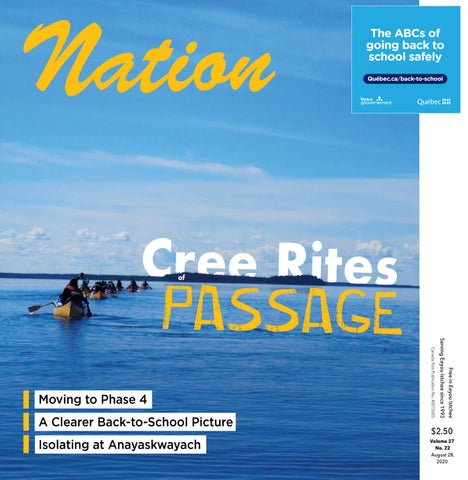
life lessons Youth learn traditional skills and to overcome challenges while paddling for weeks by Ben Powless | Photos by Maggie Neeposh
10 the Nation August 28, 2020 www.nationnews.ca
F
or some of the youth embarking on the fourweek canoe trip, it would be their first time ever paddling a canoe. For others, it would be their first time leaving the community.
Trudy-Lynn Mattawashish, 13, from Mistissini, was in the former group – never having paddled before. But after leaving on July 6 to paddle two weeks up Lake Mistassini to Osprey Lodge, and returning on July 31, she knows it won’t be her last time. “It was a trip that changed my life,” Mattawashish told the Nation. Growing up in Gatineau, she had never spent much time in the bush learning traditional skills. That’s changed after she joined 17 other youth in learning how to paddle, fish, cut wood, make a fire, prepare and cook fish and geese, make nightlines and to sew, among other survival skills. “I feel more confident now, and happy because I know what I can do if I ever get lost in the woods,” she said. Still, the journey wasn’t easy. “We did 17 kilometres of paddling in one day – that was one of the biggest challenges.” Mattawashish describes getting up in the morning, having a breakfast of pancakes, eggs or cereal, and leaving by 10 am for 10 hours of paddling, with a few well-earned breaks for snacks and drinks. Soup and sandwiches were normal for lunch, with goose being a special lunch and dinner. Other dinners included fish, chicken, mashed potatoes and baloney – and once, poutine, a reward for catching fish on the nightline. Most days only involved three or four hours on the water, she said, leaving time to set up camps and go swimming or play games like hide-and-seek before heading to bed. Days not paddling were spent fishing, swimming or doing other group activities. Mattawashish said she would definitely go again. “I had a great time, making friends and paddling a lot. After I got back, I just wanted to paddle again. My dad and I even went boat riding to the same camps we stayed at.” Charlene Awashish, who coordinated the trip on behalf of the Mistissini Youth Office, said this year’s trip had to be changed to accommodate the pandemic. Instead of a large community feast for the victorious paddlers, the youth had individual feasts, with catered food. Awards – for things like best bannock maker and best cook – were later delivered individually. On the trip, the youth were isolated together and didn’t have to practice specific distancing measures. The only exceptions were when food and supplies were dropped off and had to be cleaned. The 18 youth were joined by two head guides and two assistant guides as they progressed up the length of Mistissini Lake, making their camps along the shoreline. After they reached Osprey, they camped on an island across from Osprey for a
www.nationnews.ca August 28, 2020 the Nation 11
few days for traditional teachings, learning skills like sewing and having sharing circles. One of the highlights of the trip was a fishing derby, won by Everes Gunner, 13. “Me and my friend were fishing on the lake with the canoe. We were trolling and suddenly caught a fish and it seemed big. It was a huge pike!” Gunner enthused. She describes that as the highlight of the adventure. But the 17-km paddling day was her biggest challenge. “It got a bit windy and my muscles were very sore,” she recounted. “I had to switch partners, but after that we were much faster.” Gunner would also do the trip again. “It was very fun, and there was a lot of people to make friends with.” The only thing she would change would be to bring her twin brother – who applied but wasn’t accepted this time. Audrey Shecapio from Gatineau was another canoe rookie. She described being very confused at first. “They just put me in the canoe,” she marvelled. “I didn’t know how to steer at first, but I quickly figured it out.” Her first night camping also nearly ended in frustration, as she mistakenly put up the fly of the tent instead of the tent itself. Same with her fishing, which resulted in her rod breaking in half and falling in the water. “Let’s just say it was my first time, so I had no idea what to do,” she laughed. Then, another disaster struck: Shecapio dropped her phone in the
water. “I tried to jump in after it, but my canoe partner wouldn’t let me. I just watched it sink.” By the end, though, she had learned a lot about her culture, how to make a teepee, prepare fish, make bannock, and to cook a variety of foods. It also made her more confident. Describing herself as antisocial, Shecapio said the most important part of the trip was learning how to
came back, I said to everyone – see, I can survive without you!” For Nicole Longchap, 15, it was also her first time canoeing and being outside of the community. One highlight was seeing her friends flip over their canoe, though one friend lost his fishing rod. But they remained in good spirits and were laughing about it at the time. Longchap also had to deal with homesickness. She shared how she
“It was challenging, but when I finished the expedition, I had a great sense of pride and accomplishment that I did it” - Betsy Hughboy
communicate with others and work together. “When you’re in a canoe you can’t do it by yourself or you’ll zigzag,” she said. “So you have to work as a team with the other person.” At first, Shecapio felt homesick, only knowing one other girl. By the end, she had made many friends and even bragged to her family. “When I
12 the Nation August 28, 2020 www.nationnews.ca
felt with friends and they told her not to give up – which she did. Awashish sees the program as a healing journey. For a lot of the youth, this might be their first time learning cultural and survival skills. For young people aged 13-15 who want to apply in the future, they can find applications at the youth centre in the summer.
In Wemindji, another group of 15 youth took part in a 10-day canoe expedition that covered a traditional route along five different campsites to Old Factory Lake. It’s the 26th year the event has been organized. Betsy Hughboy, the trip coordinator for the Wemindji Youth Office, said the journey is an important one for young people to “learn our history, practice our traditional way of life, how our ancestors used to travel by canoes, fishing, cleaning and prepping the food they caught that day, respecting the land.” She said the trip took on extra significance this year, with the youth “distancing themselves from what we’re experiencing right now. Life is kind of stressful in town, there’s a real peacefulness to the land.” For Hughboy, a similar canoe trip as a youth helped her feel proud and accomplished. “When I signed up, I didn’t know what I was getting myself into. It was challenging, but when I finished the expedition, I had a great sense of pride and accomplishment that I did it.” She noted that many youth express similar sentiments after finishing their voyage. For Wemindji youth from 13-30 who want to apply in future years, Hughboy said they should contact her office. They also sometimes take adults if there’s space. “It doesn’t matter if you have canoe skills or not – the guides will teach the youth at the lake.”
“We did 17 kilometres of paddling in one day – that was one of the biggest challenges.” - Trudy-Lynn Mattawashish
www.nationnews.ca August 28, 2020 the Nation 13
The best way to keep our family safe was to head to our coastal camp and completely isolate ourselves from everyone - Louie Rene Kanatewat
P
recautions for Covid-19 took on many forms for people as guidelines and measures came into place. For most it has involved social distancing, wearing masks or working from home. But s of Chisasibi took it to a new dimension. On April 3, Kanatewat moved his family to Anayaskwayach, their coastal spring hunting area 67 kilometres south of Chisasibi. He took his wife Marlene Shecapio and their five children – Amber (11), Theodore (10), Kaylee (5), Samuel (3) and Talitha (8 months). His father Louie Kanatewat
initially escorted and guided them there. Before the outbreak, Kanatewat said he and his wife were just following their regular routine. “Taking the kids to school and daycare, working, exercising, taking the kids to their extracurricular activities, supper, bed – and then repeat.” Once the pandemic hit, the decision to isolate the family at Anayaskwayach was an easy one – their son Samuel has special needs. “When the travel restrictions and school closures happened, we real-
14 the Nation August 28, 2020 www.nationnews.ca
ized how serious things were getting and decided to move,” Kanatewat said. “The best way to keep our family safe was to head to our coastal camp and completely isolate ourselves from everyone. Samuel has a rare genetic disorder called Trisomy 18 that puts him at a high risk of severe respiratory problems if he gets sick from Covid-19.” Samuel, under normal circumstances, would easily catch a cold or the flu from his siblings so Kanatewat’s extended family was very supportive of their move to Anayaskwayach.
The logistics of staying for a long period of time and the distance from Chisasibi requires support from his father, friends and other family members, who supply them with food and fuel every couple of weeks. The Cree Trappers’ Association also contributed fuel and transport under their hunter support initiative. Kanatewat has a generator that helps keep the camp lit and electrified as Samuel needs a CPAP breathing machine to sleep. The camp is close enough to Wemindji to catch a mobile signal so
Cree family finds safe haven on the land for immune-compromised son
Camp
quarantine
by Ernest Webb | Photos by Louie-Rene Kanatewat
they can stay in touch. “We are connected to Wemindji’s service using a cellphone booster,” he noted. “We’ve been keeping a Facebook journal for later memories and to keep people posted on how we are doing.” Kanatewat said his children had no problem adapting to their new lifestyle when they first moved to Anayaskwayach. But when their cousins came to visit, his children started to yearn for Chisasibi. “When we first got here, it was a honeymoon period for them. But
when my brother Greg brought his kids that’s when they sort of wanted to go back.” As for returning to Chisasibi, Kanatewat said, “There are no plans whatsoever right now. We are monitoring the situation and will see what happens.” Meanwhile, plans to take Samuel to a dinosaur-fossil museum for his 10th birthday and a vacation to Sydney, Australia, to celebrate their wedding anniversary will have to wait.
The camp at sunset
www.nationnews.ca August 28, 2020 the Nation 15
The ABCs of going back to school safely From assigning one classroom per group and handwashing to solutions to ensure all subjects are taught and increased support for students, we’ve adopted measures for a safe and successful school year.
See the FAQs
QuĂŠbec.ca/back-to-school
tea
Reeling in the
rs
Emotions run high as derby competitors get their fish on despite social-distancing measures
18 the Nation August 28, 2020 www.nationnews.ca
F
by André Simoneau
or Jeremy Jolly, winning the $20,000 walleye competition in the Waswanipi fishing derby on August 10 was a moment charged with emotions, as the date also happens to be his late mother’s birthday.
“Winning it on my mom’s birthday is something,” Jolly said with emotion. “The parade in my community to my house and my dad standing there waiting for me, was something unbelievable.” The Waswanipi local also netted the title for biggest walleye of the competition with a catch of just over eight pounds. For Jolly – at 36 already a veteran of the local derbies – winning at home was a lifelong goal. “This one means a lot,” said Jolly, who first competed in the Waswanipi derby 22 years ago at the age of 14. “It’s a dream come true. I always wanted to win since I was a kid. I came in second place twice, a couple of pounds or points short of winning. It took 22 years to win.” Waswanipi and Mistissini both held fishing derbies in early August, all while respecting social distancing and isolation measures put in place to contain the spread of Covid-19. The Mistissini Family Fishing Derby was presented by the Home of Peace and Endurance (HOPE) of Mistissini on August 1-2 and was open only to residents of Mistissini. Top prizes in the pike and walleye category were $1,000 each, and other prizes included a two-night stay at Camp Osprey and fishing equipment. Elizabeth Ashamock and Simon P. Metabie of the Health and Wellness office in the Mistissini Health and Social Development Department were responsible for organizing the event. “It was our first time, but we had help from a colleague, Mary Matoush, who had experience in organizing a
derby,” said Ashamock. “The motivation was to promote some quality family time, to do a family activity together.” The free event hosted 106 teams of up to four people, for a total of 385 attendees. In Waswanipi, the Old Post Fishing Derby has taken place for nearly 25 years – first as a local fishing derby held during the Chiiwetau Event every summer, then in 2009, with permission from Chief and Council, as an open competition for both Crees and nonCrees.
members and your communities so as not to spread the virus. “We thank you for your understanding and we will see others again as the pandemic subsides and we hope that we will be able to host a full-size derby in 2021.” Waswanipi Director Steven Blacksmith was part of the team that organized the event and considers it a success despite the preventive measures in place. “We decided to install more measuring stations – three at Chiiwetau Boat Landing, two at Old Post, and
“I came in second place twice, a couple of pounds or points short of winning. It took twenty-two years to win” - Jeremy Jolly
This year, only those living or self-isolating within the nine Cree communities were allowed to participate, and they must not have traveled outside Eeyou Istchee to any highrisk locations identified by the Cree Board of Health and Social Services of James Bay for 14 days prior to the competition. “These are unprecedented times in the world,” organizers posted on their Facebook page. “We apologize for those that cannot attend but the precautions taken are for your safety and the safety of our community
one at Middle weight station. That meant hiring more staff. We encouraged people to wear masks and wash their hands, and to obey social distancing,” said Blacksmith. “In the end, there was little to no line-ups and everyone seemed to have a safe and fun derby. We were satisfied how well the event went.” Over $120,000 in cash and prizes was distributed among winners in the walleye and pike categories, as well as for the biggest fish of the day. Winners in the walleye category were determined by the cumula-
tive weight of four fish caught over the two days of competition, while the pike category was judged on the weight of the single biggest fish. Norman Neeposh took first place in the pike category with a massive 22-pounder. Terry Tanoush and Nigel Gull Chum rounded out the top 3 in the walleye category, and Paul Salt and Darwin Shecapio took second and third in the pike category. As for Jeremy Jolly, he almost didn’t make it to the competition this year, because his brother and boating partner was required to stay in isolation because he works in a mine. After posting on Facebook that he needed a partner, Jolly ended up pairing with his boss, Michael Ratté. “This derby is really big nowadays,” Jolly observed. “A lot of fishermen know the spot. They’re all good fishermen in Cree nations, so I had to get a partner with a fast boat to get there before everyone catches all the fish.” Then he added, “I was a very lucky man.” With this latest win under his belt, Jolly is enthusiastic about his chances in future derbies, and is quick to emphasize the benefits of fishing, on a personal level as well as a communal one. “I would like to thank the community of Waswanipi for keeping our traditional fishing activities at Giiwautau. That’s where I was born to be a fisherman. And to all parents, keep taking your kids out on water and find peace and keep them out of trouble. It will be worth it in the future.”
www.nationnews.ca August 28, 2020 the Nation 19
Politics
Stronger together Cree leaders gather from a distance at the 2020 AGA by Patrick Quinn
W
hile this year’s Annual General Assembly (AGA) looked much different due to precautionary distancing related to the ongoing Covid pandemic, the Cree Nation Government’s impressive progress on numerous issues demonstrated the event’s theme: “We are stronger together.”
Grand Chief Abel Bosum hosted the online assembly from Nemaska as other leaders connected from their home communities. Nearly 80 participants joined the videoconference on August 4-5, including local leadership, delegates and some CNG staff. It marked the 43rd CNG and 46th Grand Council of the Crees anniversary of the event. “It was certainly different!” Bosum told the Nation by email. “It is always a highlight of the summer to see everyone during the AGA event and this was no different. We have always been able to adapt to the ever-changing environment we live in – this was another example of adaptation in order to accomplish what needs to be done.” Reflecting on a challenging fiscal year, Bosum highlighted the effectiveness with which the CNG has managed its increasing governance maturity while following Cree cultural values. This approach was particularly relevant to its successful
“We have been able to create a safe haven for our people, protect our Elders, find ways to entertain and support our students” - Grand Chief Abel Bosum
Covid-19 response, which required close collaboration with all entities and communities. “We have been able to create a safe haven for our people, protect our Elders, find ways to entertain and support our students, and make sure that everyone had what they needed,” said Bosum. “People have also found a way to be with family,
20 the Nation August 28, 2020 www.nationnews.ca
connect with neighbours and spend a little more time on the land. It has been comforting to see this happening across Eeyou Istchee.” The Grand Chief commended local leadership, the Cree School Board and the Cree Board of Health and Social Services of James Bay for their exemplary efforts since March. He said communication and trans-
parency has been central to this success, providing the space for questions and ideas that reflect a wide range of opinions that can then be reflected in various initiatives. “Cree citizens should be proud and happy on the Covid suppression strategy invoked early by the Cree leadership that has worked to date,” CNG Executive Director Bill
Namagoose told the Nation. “Even without being able to gather, the Cree delegates were still able to be informed and give their feedback in a virtual setting. The resolution to change the name of James Bay Highway to Chief Billy Diamond Highway is a great honour to him.” The Grand Council of the Crees passed the resolution at the AGA to commemorate the late grand chief, one of the lead negotiators of the James Bay and Northern Quebec Agreement (JBNQA) and a founder of companies like Air Creebec. If the province approves the requested name change, it will be unveiled in November, which marks the 45th anniversary of the JBNQA. The relationship with Quebec has grown significantly since the Paix des Braves agreement in 2002, Bosum said. He says the CNG has built on agreements to gain more autonomy, expand resources and provide communities with better infrastructure and services. In February, the CNG signed a memorandum of understanding with the province called La Grande Alliance, which mandates a series of feasibility studies in relation to transportation, communications, energy distribution and protected areas. “The objective is to provide predictability in the development of the territory and allow us to be drivers instead of an afterthought,” explained Bosum. “Predictability and stability are important vectors to allowing proper land-use planning that ensures hunters and trappers can continue occupying the territory as they always have. La Grande Alliance allows us to be at the drawing board from the start and provides us with the opportunity to prioritize areas for development.” A cornerstone for its implementation is the network of protected areas that Deputy Grand Chief Mandy Gull hopes to complete by the end of 2020. She appreciates the support the Grand Chief has shown to the process and
said it’s a testament to what Crees can do when working together with a common goal. “The AGA went very well,” Gull told the Nation. “Our directors were able to ensure our operations were ongoing during this time when everything is so challenging. I missed the human interaction – seeing the delegates, shaking their hands, and getting that feedback from them.” Looking back on the many conferences and initiatives of the past year before the pandemic’s interruption, Bosum singled out the Cree housing strategy as an accomplishment he is particularly proud of. “Bringing home our graduates so they can pitch in to building our nation with our own people remains a priority,” said Bosum. “The housing initiative is meant to respond to the housing shortage graduates unfortunately are confronted with when they return home from their studies. We also want to be able to support families, which in turn will help free local social housing units for others who may need it.” Private home ownership had previously been prevented by Indian Act provisions. Bosum said building one’s own home and owning the land it is on enables residents to join the housing market, which can increase in value for generations to come. Looking ahead to the coming year, he emphasized the importance of remaining vigilant and prudent, mindful of the pandemic’s continued presence. “The next few months ahead of us continue to be critical as we closely monitor the situation around us,” stated Bosum. “I would like to take the opportunity to thank everyone for your dedication and service to the Cree Nation during this very challenging time. The generous sacrifice of individuals who have placed the health and safety of their fellow community members as a priority is highly commendable. Mista mikwec.”
Wasamac Gold Mine Project Participant Funding Available August 12, 2020 — The Impact Assessment Agency of Canada (the Agency) is making funding available through its Participant Funding Program to assist the participation of the public and Indigenous peoples in the federal impact assessment for the proposed Wasamac Gold Mine Project, located in the Abitibi-Témiscamingue region, in Quebec. Funding is available for eligible individuals and groups to assist their participation in the upcoming steps of the impact assessment’s planning phase, specifically for reviewing and providing comments on the draft Tailored Impact Statement Guidelines and the draft Public Participation Plan. Once this phase is complete, the public and Indigenous peoples will have another opportunity to apply for funding to assist their participation in the other phases of the impact assessment process. Applications received by September 9, 2020, will be considered. The Agency recognizes that it is more challenging to undertake meaningful public engagement and Indigenous consultation in light of the circumstances arising from COVID-19. The Agency continues to assess the situation, make adjustments to consultation activities, and is providing flexibility as needed in order to prioritize the health and safety of all Canadians, while fulfilling its responsibility to conduct meaningful engagement with interested groups. The Agency will determine if a federal impact assessment is required for the project and if one is required, recipients and the amount of funding allocated will be announced at a later date. If the Agency determines a federal impact assessment is not required, no funds will be allocated and there will be no further opportunity to apply for funding for this project. To apply for funding, complete the Application Form for the Planning Phase available on the Agency's website at canada.ca/iaac under Funding Programs. For more information, contact the Participant Funding Program by writing to iaac.FP-PAF.aeic@canada.ca, or by calling 1-866-582-1884. Follow us on Twitter: @IAAC_AEIC #Wasamac The Proposed Project Monarch Gold Corporation is proposing the construction, operation, decommissioning and abandonment of an underground gold mine located in the Abitibi-Témiscamingue region, approximately 15 kilometres from downtown Rouyn-Noranda, Quebec. As proposed, the Wasamac Gold Mine Project would have a mine life of 11 years and an ore production capacity of 6053 tonnes per day. The project would include the operation of an underground mine, the construction of an ore processing plant and related infrastructures, and the development of underground infrastructures for ore and waste rock transportation as well as waste rock, tailings and overburden accumulation areas. The proponent is considering the possibility for transporting the ore by rail to process it at a plant in Ontario, as an alternative to the construction of a processing plant in Quebec. More information on this project is available on the Canadian Impact Assessment Registry website, Registry reference number 80879.
WELCOME BACK STUDENTS
The back to school season is always an exciting time - a time to reunite with friends, get to know teachers, and start learning new things. Although some things may look different this year, we hope this continues to be a joyful and motivating time of year for Cree School Board students, families, and staff. These past months have shown us that our communities are resilient, our staff are dedicated, and our students are eager to learn. We have worked hand-in-hand with public health and our communities to prepare for students' safe return. We wel come everyone back and look forward to supporting our Youth, Adults, and Post-Secondary students in the next chapter of their learning journey.
To a safe, healthy, and successful schhl yee! Dr. Sarah Pash, Chairperson Abraham Jolly, Director General
ᓂᑐᐦᑯᔨᓐ ᓵᕌᐦ ᐹᔥ, ᑖᐦᑎᐱᐅᓐ ᐅᒋᒫᐤ ᐊᐱᕐᐦᐋᒻ ᐧᒑᓖ, ᓈᑳᓂᓰᑦ ᐊᐱᑎᓰᐤ ᐅᒋᒫᐤ
215, 3eme Avenue, Val-d’Or, Quebec valdorchrysler.ca
PAC IFIC A
819-825-0880
Toll-free: 1-888-250-7081
THE MOST INNOVATIVE
SEATING AND STORAGE IN ITS CLASS!
Come visit us in full confidence We have taken measures to offer a safe environment. We are happy to welcome you back!
Outstanding power 3.6L Pentastar V6 “Canada’s Best-selling engine” Unsurpassed Fuel Economy and 8.4 L/100 km
WORKING TOGETHER FOR SAFER AND ENGAGED COMMUNITIES
You have a project that could help make your community a better place?
Apply now CREE JUSTICE FUNDS
YOUTH ENGAGEMENT FUND
CRIME PREVENTION FUND
Through these funds, the DOJCS (Department of Justice and Correctional Services) provides financial assistance to community members willing to implement initiatives that facilitate and improve the administration of justice for the Crees across Eeyou Istchee.
Be engaged.
Make a difference.
DOJCS – Department of Justice and Correctional Services creejusticefunds.ca T: 418-923-2661 www.nationnews.ca August 28, 2020 the Nation 23
Politics
Environmental diplomacy Crees take lead on northern conservation efforts by Patrick Quinn
A
s federal and provincial governments struggle to meet promised conservation targets, the Cree Nation is filling the void by proposing areas protected from development in Eeyou Istchee. It reflects a growing recognition that conservation efforts are frequently more effective when led by Indigenous peoples. After more than a century of a “fortress” model of conservation, in which Indigenous people and their territorial rights were removed in the creation of national parks like Banff, last year Canada allocated $2.5 million to bring together Indigenous groups with academics to better protect traditional lands and waters while pursuing UN biodiversity commitments. “There are a lot of misconceptions about protected areas, that we need to let them sit there and nobody is allowed to go,” said Deputy Grand Chief Mandy Gull, who leads many CNG environmental files. “It’s actually quite the opposite. These are areas we want to keep pristine while carrying out cultural activities and being a baseline for monitoring changes in the Cree community.” The pandemic has slowed negotiations on Quebec’s Grand Alliance agreement to protect 20% of its territory north of the 49th parallel under
the Plan Nord development strategy. But Gull is confident that including the protected areas file in the process will help Quebec meet its goal before the agreement’s deadline at the end of 2020. The Cree proposal identifies 30% of Eeyou Istchee for conservation, a result of years of analysis and consultation with local communities and tallymen. CNG Protected Areas Coordinator Chantal Otter Tétreault collaborated with the Nature Conservancy of Canada using an advanced computer model that layered cultural information with various
24 the Nation August 28, 2020 www.nationnews.ca
watershed, geological, climate and wildlife data. “This model allowed us to incorporate so many types of data, reflecting our needs and different impacts projected up to 300 years into the future,” Gull told the Nation. “We wanted to make sure the areas selected were protected from environmental changes and had high levels of cultural significance.” Gull promotes this work in exchanges throughout North America and in forums such as the United Nations Climate Summit, gaining insights from other First Nations
and vital funding resources along the way. She says the dialogue produced key proponents for their successful proposal to the Canada Nature Fund. “Our team gained national recognition for work carried out in the Cree territory,” Gull enthused. “It was recognized as one of the most viable proposals submitted and we took 50% of what was distributed in Quebec.” Gull and others insist that collaborative initiatives must be led by Indigenous groups. Environmental groups increasingly realize that
strengthening relationships with First Nations is crucial. “If we are going to be successful in conservation, we have to unreservedly support Indigenous nations that are interested in protecting land and water,” said Megan Leslie, head of World Wildlife Fund Canada. “We look at where we can achieve our goals by helping a community achieve their goals.” WWF Canada is increasingly focused on supporting Indigenous conservation efforts. A recent project led by the Wemindji Youth Department is a baseline study of the community’s key freshwater sources, which will then become an annual activity. “We just signed an agreement with Mushkegowuk Council in southern James Bay,” Leslie said. “This is their work, but we can bring some particular mapping expertise and demonstrate why carbon locked in those lands should be protected.” In the Broadback Forest, Cree conservationists are working to protect the forest’s endangered woodland caribou population by building community awareness – while collaborating with universities on population studies and range plans. To slow the herd’s declining population, the CNG closed sports hunting in 2008. It also developed a harvesting understanding with the Naskapi, whose hunters are also accustomed to accessing these animals. “We wanted to make sure the herd was abundant enough to undertake such sharing agreements,” said Nadia
Saganash, CNG wildlife management administrator. “Migration patterns can change so next year they could end up in another part of the territory. If Cree want to hunt in the Naskapi area,
“We wanted to make sure the areas selected were protected from environmental changes and had high levels of cultural significance.” - Deputy Grand Chief Mandy Gull
they would have the same protocol to respect – when we go to someone’s house you don’t want to offend them.” While Saganash is also concerned about the region’s moose population, the fact it hasn’t been declared a species at risk makes funding for an aerial
survey difficult to obtain. However, the federal government was quick to intervene when lake sturgeon were recently listed as a “species of special concern”. “We are defining a collaborative agreement with [Fisheries and Oceans Canada], so Cree will be leading the management plan in the territory,” Saganash told the Nation. “If you want to talk about fish, we’ve also collaborated with Concordia and Laval [universities] to develop a research project defining where populations come from to better protect important river habitats.” To this end, a video on the CNG website details best practices for fishing derbies, including the importance of boat-washing stations to prevent the spread of invasive species from other lakes. As well, a new Land Keepers program will further empower conservation efforts. The CNG plans to hire 19 wildlife protection assistants as “eyes on the ground” to monitor ecological health, report suspicious activities and promote cultural awareness. “Throughout the years, a lot of what we’ve done to protect the land and wildlife populations is thanks to our trappers present in the territory,” Saganash observed. “Land Keepers provides a career opportunity for tallymen and land users to continue practicing traditional activities and protect the land at the same time. Hopefully this will lead to more governance over wildlife in the territory.”
“Land Keepers provides a career opportunity for tallymen and land users to continue practicing traditional activities and protect the land” - Nadia Saganash, CNG wildlife management administrator
www.nationnews.ca August 28, 2020 the Nation 25
Community
Keeping kids safe Cree School Board updates school opening plans
by Ben Powless| Photos provide by the CSB
A
variety of Cree School Board (CSB) officials detailed their plans to safely welcome youth, post-secondary and adult education students and staff back to schools this month during an online address August 18. The CSB, said Deputy Director General Elma Moses, is working from the principle that students should be in school as much as possible, while it continues to develop procedures to deal with low-, medium- and high-risk scenarios. School Operations Director Kim Quinn outlined the litany of changes that would impact students and school operations after the reopening scheduled for August 27-28 in communities considered low-to-medium risk. Under a high-risk scenario, there will be no in-person education and schools will close. Perhaps the biggest change will be an effort to keep classes under 15 people, up to a maximum of 20 if necessary. Students will stay in the same classroom, with only teachers moving between rooms. Where possible, outdoor activities will be encouraged
for homeroom or specialized classes such as gym or Cree language. There will also be staggered timetables – student groups will have different arrival, departure and recess times. On buses, students can sit with members of that group or members of their household, but must keep the same seat, and stay two metres from the driver. No social distancing will be required for students once in the classroom. However, students from Grade 5 to Secondary 5 will be required to wear masks in all common areas, such as hallways. Parents of children under Grade 5 will have to make the decision whether their child is to wear a mask or not. Teachers will be asked to maintain two-metre physical distancing or wear a mask if approaching individual students. A hygiene regime includes cleaning common surfaces after any group has used them, buses to be cleaned between each group or trip, teaching hygiene and handwashing to younger children, and an increased focus on proper handwashing.
26 the Nation August 28, 2020 www.nationnews.ca
In larger communities, the CSB will be looking to find additional class spaces. There will be extra training days and professional development days for teachers as well. Students will also be asked to complete a daily health questionnaire, either online or in person, confirming their temperature, whether they have symptoms or whether they’ve had contact with anyone who tested positive. In the case of schools being shut and students being forced to rely on online learning, Quinn acknowledged that not every family has access to laptops to facilitate online learning, and that the CSB planned a survey to determine what materials are required. Quinn said that over 80% of Secondary 4 and 5 students were able to access online learning in the spring, but that a “more robust plan” is needed to ensure the needs of all students and parents are met. The CSB focussed on providing laptops to students in Secondary 4-5 to ensure they didn’t fall behind, according to Jolly, but will now also
support students in Secondary 1, 2 and 3. The CSB was already supporting post-secondary students and adult learners with credit for laptop purchases before the pandemic. Quinn encouraged parents to register in a new section of the Eeyou education homepage. She still encouraged parents who prefer to keep their children home to sign up online so that the CSB could answer concerns about attending in person or work to support an education plan. Pauline Trapper-Hester, Director of Post-Secondary Student Services, noted that 602 post-secondary students had indicated that they were returning to study this fall. Based on a survey sent to all students, fewer than 1% of students decided to cancel their fall studies. About 61% were expecting to work fully online, while 4% expected to return to studies on-campus. The remaining 35% anticipating a mixture of online and on-campus education. Around 80% said they had received information from their schools to help them prepare for the fall.
Students will stay in the same classroom, with only teachers moving between rooms
Trapper-Hester said that all students will be given financial support whether studying in person or online, and that students in community with active leases will be sponsored for living and lodging. For students in Montreal or Ottawa/Gatineau, post-secondary offices will be open, but schedules will be put in place to use the student lounge, library and computer rooms. Additionally, any students who did not pass the Winter 2020 semester will not be placed on academic probation this year, as would normally happen. Jolly clarified that any decision to close schools would go through public health officials, principally Dr. Faisca Richer, Director of Public Health at the Cree Health Board and Social Services of James Bay. More questions will be answered on a FAQ section of the Eeyou education website, in addition to local virtual community information sessions planned for August 24-25. The information session is supposed to
be archived and available from the website. CSB Director General Abraham Jolly acknowledged that there is still anxiety over the reopening. “Learning that Eeyou Istchee has been Covid-free for 100 days gives us room to feel a bit more assured that we can enter into this realm of reopening schools,” Jolly told the Nation. “There’s some comfort in that, but we will be taking strong measures to ensure the health and safety of students and staff.” Finally, CSB Chairperson Sarah Pash underlined the board’s gratitude to employees for their work since March to ensure the health and safety of students, staff and community members. “We saw principals delivering schoolwork and packages to students’ homes, teachers reading to students from their driveways, and school teams driving around cheering up students, trying hard to maintain engagement and connection,” Pash explained.
Distributor of petroleum products and lubricants in the James Bay Territory, and Abitibi-Temiscamingue
www.nationnews.ca August 28, 2020 the Nation 27
September 2020 - Issue 1
Puzzles
Crossword
H
ere’s another edition of the Nation’s puzzle page. Try your hand at Sudoku or Str8ts or our Crossword, or better yet, solve all three and send us a photo! As always, the answers from last issue are here for you to check your work. Happy hunting.
SUDOKU Easy
5 7 4 8 2 6 9 3 1
6 2 8 6 3
3 1 4 2 5
5
1 8 8
1 9 7 6
6
– ngle number can r column. But... are divided by black artments. These with numbers that t’. A straight is a set gaps but can be in ,5]. Clues in black umber as an option umn, and are not part nce at the solution to The solutions will be published here in the next issue. are formed.
9
8 7 2 5 1 3 9 2 3 7 5 1 2
3 2 9 5 4 1 8 7 6
6 8 1 3 7 9 2 5 4
9 4 6 2 5 3 1 8 7
8 3 2 7 1 4 6 9 5
1 5 7 9 6 8 3 4 2
7 6 8 4 9 2 5 1 3
2 9 5 1 3 7 4 6 8
4 1 3 6 8 5 7 2 9
To complete Sudoku, fill the board by entering numbers 1 to 9 such that each row, column and 3x3 box contains every number uniquely. For many strategies, hints and tips, visit www.sudokuwiki.org If you like Str8ts check out our books, iPhone/iPad Apps and much more on our store.
STR8TS
SUDOKU
No. 259
Tough
6
Previous solution - Medium
1
6 5
3 7 6
2
7 8
3
3
9 1 8
1 7 3
1 2 3 4 5 6 7 8 9 10 11 12 13 ACROSS 1 Impudent talk 14 15 16 5 Creditor's con17 18 19 cern 9 Lowest-pitched 20 21 22 singer 14 Aid and ____ 23 24 25 26 15 Square feet, eg. 27 28 29 30 16 Worrier's risk 17 Sign of sorrow 31 32 33 34 35 36 18 Spectators' area 37 38 39 40 20 Island near Corsica 44 41 42 43 21 Overcharge, big 45 46 47 time 22 Threat ending 51 48 49 50 23 Stair part 53 54 55 56 57 58 25 It's more than a 52 job 59 60 61 27 First act 62 63 64 29 Tiny bit 31 Bakery item 65 66 67 32 Horoscope writers Copyright 2020 by The Puzzle Syndicate 37 Open, as a jacket 62 Film part 8 Sharp taste 36 Token taker 39 Order between 63 Similar (to) 9 Clear the tables 38 Soon to land "ready" and 64 Small change 10 Clark Kent, to 42 Painter's plaster "fire" 65 Durable fabric Superman 43 Army camp 40 True-blue 66 Lady's man, 11 Bathroom item dwellings 41 Shorthandbriefly 12 Common thing? 47 Dennis of comwriting 67 "-zoic" things 13 Military command ics, for one 44 It may be inflated 19 Model stick-on 48 Not quite right 45 Words to live by 24 Cruise stop 49 Knight's weapon 46 Ultimate DOWN 26 Priest's helper 50 Giblets part 48 Gives out 1 Fill to excess 27 Creative work 51 Lustrous fabric 51 Prepare, as tea 2 Son of Adam 28 Pub purchase 54 Rugged rock 52 Seriously injure 3 Beachy cocktail 29 Group of three 55 Gardener's tool 53 "Get lost!" 4 Back problem 30 Cavort 57 Kournikova of Previous solution Very Hard No. 259 Easy 56 Semimonthly tide 5 Swordlike 33 Scale deduction tennis 5 3 revela6 9 8 1 58 7 Guinea 2 4 59 Give life to weapons 34 Startling pigs, 7 2 8 4 3 5 6 9 1 61 2017-19 series, 6 Trial partner tion maybe 4 9 1 6 2 7 8 5 3 "____ with an E" 7 Steady guy 35 Tattered duds 60 Ten C-notes
9
You can find more help, tips and hints at www.str8ts.com
5 3 7 6 4 8 9 2 1
4 3 5 2 1 2 8 7 4 7 6 5 9 3 1 5 6 3 4 2
6 4 5 9 3 2
7 9 8 3 4 2 1 8 2 5 4 3 8 6 7 7 5 6
8 7 3 1 4 2 5
6 2 8
6 3 5
1 8
8
1 9 7 6
6
9
How to beat Str8ts – Like Sudoku, no single number can repeat in any row or column. But... rows and columns are divided by black squares into compartments. These PREVIOUS need to be filled in with numbers that complete a ‘straight’. A straight is a set SOLUTION: of numbers with no gaps but can be in any order, eg [4,2,3,5]. Clues in black cells remove that number as an option in that row and column, and are not part of any straight. Glance at the solution to The solutions will be published here in the next issue. see how ‘straights’ are formed.
28 the Nation August 28, 2020 www.nationnews.ca
8 2 6 9 3 1
8 7 2 5 1 3 9 2 3 7 5 1 2
© 2020 Syndicated Puzzles
8 7
Previous solution - Very Hard
© 2020 Syndicated Puzzles
7 9 8 3 4 2 1 8 2 5 4 3 6 7 5 6
No. 259
© 2020 Syndicated Puzzles
Medium
by Margie E. Burke
5 4 1 8 7 6
3 7 9 2 5 4
2 5 3 1 8 7
7 1 4 6 9 5
9 6 8 3 4 2
4 9 2 5 1 3
1 3 7 4 6 8
6 8 5 7 2 9
To complete Sudoku, fill the board by entering numbers 1 to 9 such that each row, column and 3x3 box contains every number uniquely. For many strategies, hints and tips, visit www.sudokuwiki.org If you like Str8ts check out our books, iPhone/iPad Apps and much more on our store.
Rez Notes
Shelving the rare items by Sonny Orr
L
ately, the resurgences of the old urges – travelling, shopping, getting away – are starting to claw at our need to escape. In many communities, people have snuck off to the land and many are rediscovering the urge to get away. Urges like picking berries for one. Berry picking is therapy for me, as each handful gets me closer to that jam, or pancake, or my mouth. The sheer size of this year’s bounty seems to be pointing at the need to fatten up for a long cold winter. The weather these days isn’t the same as the last few decades, because the planet has had some reprieve from the pollution that was killing it. Thus, converting quickly back to the good old cold days before climate change due to our ceaseless pumping of greenhouse gases into the atmosphere. If I were an earth scientist, I would be happy about that. But for many people around the world, this type of escape just isn’t in their agenda, simply due to not being able to survive an economic shakedown. I wonder when the financial gods shake the trees with its golden apples, will there be any bounty to harvest? Maybe, just like the berries, money is plentiful and easier to make
and it’s just fattening us up for a long economic drought. Maybe I’m right or wrong, but it’s just a gut feeling. If you haven’t noticed, a lot of imported goods aren’t available, like the special coconut water that I so relish. Nope, just domestically grown products, which are very good, I must proudly add. Do coconuts grow in Canada? No? So, we go back to the land, which is chock-full of nutritious goodies, already ripening for our harvest. One family has done just that, returned to the land for what seems to be an epic but comfortable lifestyle, waiting for the world to heal, perhaps waiting for an inoculation of some sort to rid us of the Covid-19
scourge. I’m hoping that one day it will all go away, just as quickly as it appeared, so we can go back to all the urges we had in the recent past. I know that many people are enjoying this familial closeness and dealing with isolation and time lost but still savoured. I don’t know about others, but it seems like spring and summer were rather enjoyable and now that we are back at our place of employment, even work seems enjoyable. It’s the mask thing – Is it on or off? Where did I put it down? – and all that other stuff we must endure in public places. But when on the land, where no one is in contact with you except mosquitoes and blackflies, life is back
to normal. That’s where we all carry out our urges to escape and live the life that we strove hard to maintain in this modern world. But for me, I still have an urge for a large hamburger with a side order of skinny fries and a watered-down coke, or an espresso that kicks you back onto your feet at any hour of the day, or the gritty fresh bagel, and the all-you-can-eat buffets. Maybe a movie or two and some gambling to end an evening with some luck. Naw, those urges are slowly fading. Time to shelve those cravings forever it seems – I’ll be better off in the long run. Who needs high cholesterol salted meat slices slathered in artificial flavouring anyways?
Naw, those urges are slowly fading. Time to shelve those cravings forever it seems
www.nationnews.ca August 28, 2020 the Nation 29
Under the Northern Sky
UTNS
www.underthenorthernsky.com
The wonder of it all by Xavier Kataquapit
W
hile visiting a northern cottage recently I was able to sit outside and contemplate the night-time sky. This is usually impossible in the summer as either the weather is not favourable, the bugs are too numerous, or a full or partial moon throws too much light to see many stars clearly. On this night, all the conditions were perfect as there was no moon, the sky was completely clear, and the biting insects had miraculously disappeared. I reclined in a lounge chair until I was completely prone and stared out at the endless expanse of shimmering stars. A pair of binoculars helped me get a better look, and to lose myself in an infinite view. At this time of the year in North America, the Milky Way galaxy appears as a wide dim stream of dark and pale cloudy light across the sky. Here in the night sky, with little light pollution, I could easily view the majestic Milky Way. True to its name, it felt as though I was staring into a vast ocean of dark that sparkles with a huge whirl of wispy, faint white light. My father Marius taught us that the stars on clear nights guided trav-
If you have a moment once the sun has gone down, step away from your devices for a moment and go outside when the sky is clear ellers across the land. He didn’t teach me any constellations, but he showed my brothers and I how the formation of what is known as the Big Dipper provides a way of pointing to the north. He always reminded me that, no matter the season, this formation of stars would always help me find my way home. While growing up in Attawapiskat, we had many opportunities to view the night-time sky. There is little light pollution up the James Bay coast and when we headed out on the land we were swallowed by darkness. In the chaos and dysfunction of growing up in the community, the eerie darkness of the night and the light of so many stars helped us forget our worries and made us wonder about the wider world above our heads. At my cottage, those days came back to me. Once again, the starry night sky came to comfort me. I forgot about the current global crisis. The
idea of seeing so many distant points of light made my mind wander from the worries of the world, the dread of a pandemic and the never-ending stream of depressing news headlines filling our televisions, computers and smartphones. I did some astrophotography with the bit of camera equipment I had on hand. My set-up, although not sophisticated, was enough to capture some long exposure images of the galaxy overhead. On one of my images, I was happy to discover that I could see the faint outline of Andromeda, the nearest galaxy to our own at 2.5 million light years away. I could also see it as a dim, hazy, almond-shaped cloud through my binoculars. I am always amazed at this image in the sky because it means I am looking at light that left that galaxy two and a half million years ago. There is nothing like staring at the heavens to
remind you of how insignificant we are as humans. If you have a moment once the sun has gone down, step away from your devices for a moment and go outside when the sky is clear or even partially clear. Find a spot to sit or lie down away from artificial light. Take a moment to adjust your vision to the dark, then find the milky band of cloudy light that is in fact an illumination of billions of stars within our own galaxy. Even if you don’t know your constellations, important stars or the location of galaxies, clusters, nebula or other heavenly bodies, just realize that every point of light you are viewing is often tens, hundreds or thousands of light years away. I really believe that troubled times and worried minds fade away when we take the opportunity to look up and connect to a greater reality and the wonder of it all.
We have been present since 1939. All members of the large Deshaies' family are by your side today and will also be for the better days to come.
30 the Nation August 28, 2020 www.nationnews.ca
For more info...
Jordan’s Principle Office Cree Board of Health and Social Services of James Bay (CBHSSJB) 418-923-3355 x42186 18tcr.jordans.principle@ssss.gouv.qc.ca creehealth.org/jp
Individual Applications for Eeyou Istchee
The legacy of Jordan River Anderson
Is your child eligible for
Jordan was born in Norway House Cree Nation, Manitoba in 1999, with multiple disabilities and stayed in the hospital from birth. When he was 2 years old, doctors said he could move to a special home for his medical needs. However, the federal and provincial governments could not agree on who should pay for his home-based care. Jordan passed away in the hospital at the age of 5.
Jordan’s Principle?
Current eligibility criteria under Jordan’s Principle are: • 0 to 18 years old • Must have a band number (or parents’ band number, if not yet assigned)
24-hour Jordan’s Principle Helpline
In 2007, the House of Commons passed Jordan’s Principle in memory of Jordan. Today, Jordan’s Principle is a legal obligation, which means it has no end date—it will support First Nations children for generations to come.
1-855-572-4453 Your child does not have to have a disability to be covered under Jordan’s Principle.
General Category
1st place: $1,500 2nd place: $1,000 3rd place: $500 Prosepector Category
One prize of
$2,000
NAME PHONE ADDRESS COMMUNITY SIGNATURE Send to: CMEB
RoCk CoMpEtItIoN - LeArN FrOm ThE LaNd! The Cree Mineral Exploration Board's Rock Competition Requirements: New discovery Sample must be the size of a fist Sample must be located on a map Complete the application form
Deadline and shipping: CMEB assumes the analysis expenses of the participating samples The contest ends on October 31 Shipping is at participant's expense
Hints on the ground: look for rusty surfaces Hints after breaking: sample metallic minerals
Do not forget:
SAMPLE LOCATION PLACE NAME MAP GPS COORDINATES SAMPLE COLLECTED FROM Stream Bank
River Bank
21 Hilltop, P.O. 150, Wemindji, QC, Canada JOM 1LO Tel: 819-978-0264 ext. 327
Lake Side
Fax: 819-978-3834
E Shore Line Mountain
N Island Other
E-mail: youceflarbi@creenet.com
Your Northern Airline of Choice
Air Creebec is operating by respecting and exceeding the rules with extensive cleaning and disinfecting of the aircraft, social distancing on board and at all service counters. We encourage everyone to respect the rules and to stay safe.
For the latest Air Creebec updates, please visit aircreebec.ca/covid19