Wear a mask Keep your distance QuĂŠbec.ca/coronavirus 1 877 644-4545
www.nationnews.ca July 31, 2020 the Nation 1
Wearing a mask is now mandatory in enclosed or partially enclosed public spaces and on public transit such as: supermarkets, shopping centres, stores, movie theatres, restaurants, bars,
buses, the metro, trains, ferries, taxis, and carpools.
Let’s continue to protect ourselves properly.
QuĂŠbec.ca/mask 1 877 644-4545 2 the Nation July 31, 2020 www.nationnews.ca
CONTENTS EDITORIAL Water wars
4
NEWS
5 Pushing phase 4
Viral resilience
5
Tackling the trash
6
IN BRIEF
9
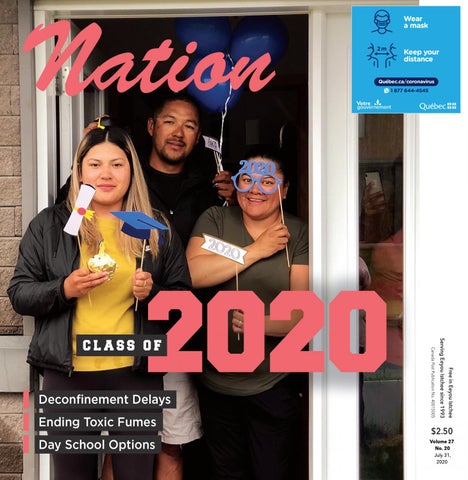
FEATURES A graduation apart
10
Profiling prohibited
18
Film faux pas
23
Breaking through bureaucracy
24
PUZZLES REZ NOTES
28 29
School’s back
UTNS
6
Whapmagoostui trash burning
10
Pandemic be damned
Graduates in a dangerous time
30 We can gradually restart normal activities while protecting ourselves! Information and advice inside.
Politics
Arts
Photo provided by CSB
18
Montreal police checks
23
Options for day school survivors
24
Reconsidering ‘sauvage’
www.nationnews.ca July 31, 2020 the the Nation Nation 3 3
Editorial
Water wars by Will Nicholls
Editorial
O
f all the countries in the world, Canada has the largest supply of fresh water. Having clean water is something most Canadians take for granted. If you live in one of dozens of First Nations communities that live with long-term water advisories, however, it’s more like the line in the famous poem, The Rime of the Ancient Mariner, by Samuel Coleridge Taylor: “Water, water everywhere / nor any drop to drink.” When Justin Trudeau was leading his first election campaign as federal Liberal leader back in 2015, he raised hopes in First Nations communities by solemnly promising that none would be under a water advisory by March 2021. After years of inaction amid worsening conditions by the Conservative government of Stephen Harper, it was like finding a lake in a desert after nearly dying of thirst. Unfortunately, that lake turned out to be a mirage, as it’s painfully obvious that Trudeau’s promise is nowhere near being met. Eight months away from Trudeau’s own deadline, people in 61 First Nations communities still cannot drink the water that comes out of their taps. We now know that this was a choice by his government. Funds to the tune of $2 billion were allocated in the 2016 federal budget to address the water-quality problem, but to date two-thirds of the fund is still sitting in government accounts. And in 2018, former Indigenous Services
It’s painfully obvious that Trudeau’s promise is nowhere near being met
Minister Jane Philpot promised that an additional $4 billion earmarked for Indigenous infrastructure could be tapped to honour the Liberal promise. Tired of listening to empty words, three First Nations in Manitoba hired lawyers and went to court. On July 21, Manitoba Court of Queen’s Bench Chief Justice Glenn Joyal ruled that their legal challenge can proceed as a class action suit. This means that any First Nations community in Canada that has been under a water advisory that lasted at least a year at any point from November 8, 1995, to present can join in. The lawsuit is seeking $1 billion in damages for the breach of Charter rights, $1 billion for negligence of fiduciary duty and $100 million in punitive damages. The lawsuit aims
to have the government immediately construct appropriate water systems for the class members or fund and approve the construction of the water systems. The lawsuit claims that Canada has violated the Charter of Rights for decades by failing to provide clean and safe drinking water for First Nations peoples. As lawyer Michael Rosenburg observed, “Access to clean drinking water is a fundamental right.” That is a truth that is self-evident and one that continues to be ignored by the Canadian government. The court decision is encouraging but what does it really mean? The case will take on other First Nations with a few exceptions. There are five First Nations who are currently in court looking for clean drinking water
for their members. Because these are active cases, they will not be allowed to join the class action suit. As for those who can join, each new class member will be adding reams of paper detailing their situation. That will mean the court will have to take time to ensure the validity of their claims. We can expect government lawyers will be contesting every comma and colon in the written submissions. Whether Liberal or Conservative, Canadian governments have made a tradition of fighting to the bitter end every attempt by First Nations to enjoy the same quality of life that Canadians take for granted. Such as the ability to drink a glass of tap water.
the Nation is published every two weeks by Beesum Communications EDITORIAL BOARD L. Stewart, W. Nicholls, M. Siberok, Mr. N. Diamond, E. Webb EDITOR IN CHIEF Will Nicholls DIRECTOR OF FINANCES Linda Ludwick EDITORS Lyle Stewart, Martin Siberok PRODUCTION COORDINATOR AND MANAGING EDITOR Dan Isaac CONTRIBUTING WRITERS X. Kataquapit, S. Orr, P. Quinn, B. Powless DESIGN Matthew Dessner SALES AND ADVERTISING Danielle Valade, Donna Malthouse, Melissa Juliette THANKS TO: Air Creebec CONTACT US: The Nation, 4529 CLARK, #403, Montreal, QC., H2T 2T3 EDITORIAL & ADS: Tel.: 514-272-3077, Fax: 514-278-9914 HEAD OFFICE: P.O. Box 151, Chisasibi, QC. J0M 1E0 www.nationnews.ca EDITORIAL: will@nationnews.ca news@ nationnews.ca ADS: Danielle Valade: ads@nationnews.ca; Donna Malthouse: donna@beesum.com SUBSCRIPTIONS: $60 plus taxes, US: $90, Abroad: $110, Payable to beesum communications, all rights reserved, publication mail #40015005, issn #1206-2642 The Nation is a member of: The James Bay Cree Communications Society, Circle Of Aboriginal Controlled Publishers, Magazines Canada Quebec Community Newspaper Assn. Canadian Newspapers Assn. Les Hebdos Sélect Du Québec. Funded [in part] by the Government of Canada. | www.nationnews.ca |
facebook.com/NATIONnewsmagazine | Twitter: @creenation_news
4 the Nation July 31, 2020 www.nationnews.ca
CMCA AUDITED
News
Viral resilience Uptick in new Covid-19 cases delays Phase 4 as CSB releases plans for in-class and virtual learning by Ben Powless
W
hile Cree communities continue without any new cases of Covid-19, Cree health authorities are pushing back plans to move to Phase 4 of deconfinement as cases rise across Quebec. In a radio address on July 21, Cree Board Of Health And Social Services Of James Bay (CBHSSJB) ViceChairperson Christine Petawabano said that Cree leadership would wait another two weeks to evaluate whether it was appropriate to move into Phase 4, which would allow for larger indoor and outdoor gatherings. That news comes as Quebec begins to see a rise again in cases, including in the Abitibi region, with the majority in Montreal. This uptick in cases follows the Quebec government’s move to reopen a number of establishments, including bars and nightclubs. In Region 2-Saguenay-Lac-StJean, 13 cases were detected since July 14th, with the region moved to one of mandatory self-isolation for travellers. The CBHSSJB stated that it was concerned about the recent spike in transmission across Quebec. Eeyou Istchee remains free of active cases, with 670 tests of community members returning 650 negative results, with 10 awaiting results
and 10 cases recovered. 763 screening tests have also been done, returning 749 negative results and 14 more awaiting results. Cree health authorities also issued a change to Phase 5 deconfinement plans. Instead of dismantling community checkpoints, they now say that such checkpoints may have to stay up, as cases may still be out of control across Quebec or Canada as Eeyou Istchee gets ready for things to return to normal. Authorities also underscored that there will forever exist a risk from travel down south, until a vaccine is developed. They urged Cree who travel to communities considered safe to continue to exercise caution and avoid places where transmission could be a problem, such as bars and restaurants. The Cree School Board also announced a number of different scenarios for the return to school on Thursday, August 27th. In their low risk scenario, students would return to classes, with some modifications. Those include daily health questionnaires, increased hygiene measures, distancing scenarios, and possible class size restrictions.
In their medium risk scenario, all the above restrictions would be in place, with increased distancing requirements and modified school operations. In a scenario where there is a high risk of Covid-19 transmission, no classroom instruction would be permitted. Instead, all learning would take place at home and online, with interactive virtual support from teachers. Petawabano also noted that classes may be held in different locations than normal, including outside. Summer school classes began on July 13. Cree School Board offices in Montreal and Ottawa remain closed with staff working remotely, however the head office in Mistissini will reopen for employees only, working in small rotating groups. Post-secondary students registered for the winter term are set to receive an extra allowance for August to support them during the pandemic. This will include all students studying online. Across Quebec, the provincial government has mandated masks be worn in any enclosed spaces. The Cree leadership stated that they sup-
ported this position, but would leave local communities to decide whether to implement such a requirement in each community. Bella Moses Petawabano, CBHSSJB Chairperson noted that Cree Health Board guidelines on masks are to put a mask on with clean hands, ensuring that it is covering the nose and mouth; that masks should be replaced if they become moist; and that masks should be washed after every use in a washing machine. Christine Petawabano also noted that the Wiichihiituwin charter was repeatedly suffering from a number of “no shows,” which has a negative impact on others who want to use the service. She urged individuals to call Wiichihiituwin if they decide not to take the charter. Outside of Quebec, Ontario and Alberta have also seen increases in Covid-19 cases, as Canada passes 111,000 cases. Cases continue to be out of control in most of the United States, which has more than 3.8 million cases. The US-Canada border is expected to stay closed to non-essential travel for the foreseeable future.
www.nationnews.ca July 31, 2020 the Nation 5
PUBLIC NOTICE Public Consultation on Forestry Activities
From August 3 to 28, 2020, the Ministère des Forêts, de la Faune et des Parcs (MFFP) invites the members of the general public to express their opinions on the harvesting and forestry activities set out in the 2018-2023 integrated operational forest management plans (PAFIO) for the Norddu-Québec region. Various forestry operations will be carried out in the coming years. The integrated forest management plans clearly show the sectors where harvesting, land preparation, reforestation, clearing and other operations might be carried out. Also, roads and infrastructures will have to be built or upgraded to access the work sites. Professionals from the MFFP would like to hear the concerns of forest users on the proposed forest activities. During the consultation period, you can access the operational plans and submit your comments online via the website of the MFFP (https://mffp.gouv.qc.ca/consultation-plansdamenagement-forestier-integre/). You can also go to the regional office of the MFFP (by appointment only) Monday to Friday (except holidays) from 8 : 30 a.m. to 12 p.m. and from 1 p.m. to 4 : 30 p.m.; our staff will be able to answer your questions and respond to your concerns regarding potential work sites. Unité de gestion de Chibougamau 624, 3e Rue Chibougamau (Québec) G8P 1P1 Telephone : 418 748-2647 Fax : 418 748-3359 IMPORTANT : If you would like to receive information on future public consultations held by the MFFP in the Nord-du-Québec region, please write to christine.morin@mffp.gouv.qc.ca; make sure to write the following in the subject line : Request for inclusion on the mailing list.
THE NATION
6 the Nation July 31, 2020 www.nationnews.ca
by Patrick Quinn
Tackling the trash A
t the mouth of the Great Whale River, the Cree community of Whapmagoostui shares several services with the neighbouring Inuit village of Kuujjuarapik, including a controversial landfill site at the edge of town. A new online petition demanding that community leaders find an urgent solution to the toxic smoke coming from this dump had amassed nearly 2,000 signatures at press time. “The morning I started the petition, I was lying in bed and my whole room stunk of garbage,” recalled Vivianne Sheshamush. “It just made me so frustrated feeling like I was helpless, that the air coming into my house was filled with toxic smoke and that my children were sleeping and also smelling it. That was when I decided it was enough.” Community members have complained of the dump smoke for many years and expressed concerns that waste from the site has been blowing into nearby Hudson Bay. The site’s proximity with residential areas is an ongoing public health issue. Its proximity to the airport, the community’s only access point for most of the year,
has also been identified as a safety issue due to collisions between birds and planes. “I know families have talked of their loved ones who suffer with asthma having a harder time breathing on those days when they light the fire,” Sheshamush told the Nation. “The dump is currently 750 metres away from the nearest house, a house that has a child in there. The mother said it was so bad that sometimes she sees ash and she doesn’t let her son play outside.” The Cree Health Board issued a public health advisory in 2017 reminding residents with heart or lung disease, Elders, children and pregnant women to limit their exposure to dump fire smoke by staying indoors with doors and windows closed, and air exchangers turned off. These recommendations are proving challenging to follow in the summertime heat.\ “It’s been really hot up here and a lot of people don’t have air conditioners or fans,” said Sheshamush. “They open their windows to try to get a breeze in their house. The whole town has no choice but to breathe in all this toxic air.
Photo provided by Vivianne Sheshamush
Petition demands an end to Whapmagoostui dump site’s toxic fumes They light it three times a week yearround.” The landfill site, built by the Canadian Army in the 1950s, is owned and operated by Kuujjuarapik as it is located on Category 1 Inuit land. According to documents from the Kativik Environmental Quality Commission, a project to relocate the dump was first launched over 20 years ago when the threshold of airborne toxicity had already been exceeded. Whapmagoostui began site selection for a new landfill in 2010, in collaboration with engineering consultants Stantec. The Cree Nation Government mandated Stantec to conduct a field investigation on the chosen site in 2017 located 5 km north of community limits in Category 1A Cree land, which would be connected to the main road via a proposed access road. “We’re very glad that the gravel will commence next year in order to make our new dump site,” said Marty Visitor from the Kuujjuarapik municipal office. “There’s been a bunch of federal and provincial roadblocks. It’s always been Quebec and Canada duking it out with land issues and we face the consequences.”
As the new access road crosses both Cree and Inuit territory, there had been a longstanding conflict about which costs would be covered by the federal or provincial governments, Visitor explained. Construction on the access road will commence in 2021 with the new landfill expected to be ready for operation in the following year. Although Sheshamush alleged that the area’s
Kuujjuarapik will be responsible for closure of the existing site, which is near capacity. It is commonly referred to as “Canadian Tire” by both communities because its bulky waste platform makes it easy for citizens to salvage hardware and other materials they may be seeking. “A lot of people get goods there,” said Reggie Tomatuk, the Cree Health Board’s environmental health program officer. “A couple of friends
“We’ve been in collaboration with the Crees... they will be running the new landfill” - Marty Visitor, Kuujjuarapik municipal office
Cree and Inuit sides often fail to collaborate on common issues, Visitor insisted they are working together to resolve this one. “We’ve been in collaboration with the Crees, working together on this file,” said Visitor. “They will be running the new landfill. We would like the issue to be fixed as soon as possible.”
collected wood and made a huge cabin not far from the community. We discourage people from collecting garbage. We have to reduce the amount we create.” Tomatuk said the community is working to reduce garbage by bringing in large recycling boxes with existing programs to recycle batteries and chemicals. While the cur-
rent site divides waste into separate sections, he believes there is much room for improvement with the new dump and cites Wemindji as a model to emulate. “We need to work as one community together with education so we can help recycle all the community’s waste,” Tomatuk told the Nation. “We have to find a better way. Dumps are slowly improving from the way it was done in the past. I can’t wait to see the new dump site – it will be all subdivided for different products.” Designating the new site as a “northern landfill” means garbage burning will continue, which expands its lifespan and improves pest control. As Whapmagoostui recognizes that open burning results in the release of hazardous compounds, they are planning to introduce waste diversion programs that will allow burning to be phased out. “Are people still going to have no choice but to breathe in these fumes?” Sheshamush responded. “What other alternatives can there be to stop us from putting all these pollutants into our environment? They’re doing temporary solutions that turn into a long-term thing. We’ve been promised change for years now.”
www.nationnews.ca July 31, 2020 the Nation 7
I WISH YOU A GREAT SUMMER while still following these instructions.
Denis Lamothe MNA for Ungava 418 748-6046 (Chibougamau) 819 755-2506 (Lebel-sur-Quévillon) denis.lamothe.unga@assnat.qc.ca
General Category
1st place: $1,500 2nd place: $1,000 3rd place: $500 Prosepector Category
One prize of
$2,000
NAME PHONE ADDRESS COMMUNITY SIGNATURE Send to: CMEB
RoCk CoMpEtItIoN - LeArN FrOm ThE LaNd! The Cree Mineral Exploration Board's Rock Competition Requirements: New discovery Sample must be the size of a fist Sample must be located on a map Complete the application form
Deadline and shipping: CMEB assumes the analysis expenses of the participating samples The contest ends on October 31 Shipping is at participant's expense
Hints on the ground: look for rusty surfaces Hints after breaking: sample metallic minerals
Do not forget:
SAMPLE LOCATION PLACE NAME MAP GPS COORDINATES SAMPLE COLLECTED FROM Stream Bank
River Bank
21 Hilltop, P.O. 150, Wemindji, QC, Canada JOM 1LO Tel: 819-978-0264 ext. 327
Lake Side
Fax: 819-978-3834
E Shore Line Mountain
N Island Other
E-mail: youceflarbi@creenet.com
In Brief Eskimos put on ice Facing growing pressure from the public and sponsors, Edmonton’s Canadian Football League franchise has made the decision to drop the word “Eskimos” from their name. The team made the official announcement July 21. The news came just one week after Washington’s National Football League franchise announced it would be dropping “Redskins” from its name and merchandise after an internal review. But, timing aside, Edmonton wasn’t exactly quick to follow suit. It appeared the team would be digging in and staying the course in the weeks before TSN broke the story on July 16 of an internal decision to change the name. On July 3, the team’s Twitter account referenced a “research and engagement program” that showed “significant support” from the Inuit community in keeping the name. The engagement program filed its report last February 14. According to that report, 45% of Inuit people surveyed said the team should change its name. However, the team was also unwilling to release the data to the public. Then, on July 8, CFL sponsor Belairdirect, an insurance company that also sponsors Edmonton’s 50/50 draw, said it would drop its sponsorship if the team did not change its
name. On July 15, Sports Interaction, the franchise’s exclusive online casino and sports gaming partner, officially requested the a name change As in Washington’s case, the threat of losing sponsors proved to be the ultimate motivating factor in dropping the name. The word Eskimo is said to translate to “raw meat eater” and is largely viewed as a derogatory term towards Inuit people.
Indigenous policing Heightened focus on police brutality towards minorities has led for calls to defund police forces across North America. However, often underfunded Indigenous police forces have been doing more with less for decades in Indigenous communities. Since its creation in 1994, the Nishnawbe Aski Police Service (NAPS) has had no case in which an officer shot and killed a person, nor has an officer been killed in the line of duty. Its untarnished record comes despite the service being chronically underfunded and responsible for over 38,000 people spread across 34 northern Ontario communities. Now retired, former NAPS Chief Terry Armstrong recently told The Globe and Mail that most people would be shocked to find out just how underfunded Indigenous police services are across Canada. And while the NAPS has been highlighted by the media recently,
Bill Namagoose, Executive Director of the Cree Nation Government, was quick to remind people via Twitter that the Eeyou Eenou Police Force (EEPF) record is every bit as impressive – and is 10 years older. “[The] Cree Nation police force have never shot at anyone in 36 years of policing. The 110 constables serve nine communities with a population of 20,000. All incidents are deescalated,” wrote Namagoose. He later clarified that there has been one incident where an EEPF officer had shot a person while in the line of duty, but that the wound was not life-threatening. Part of each police force’s success comes from hiring their own. The NAPS currently employs 203 officers and, according to Armstrong, around 60% of them are Indigenous. On the EEPF’s side, William MacLeod was recently named Chairperson of the Cree Nation Police Commission.
NB language law A bill that would make it mandatory to teach Indigenous languages in New Brunswick public schools passed through a committee of MLAs unopposed by all four parties July 14. The bill, introduced by Green Party MLA Megan Mitton, isn’t necessarily intended to create fluent speakers, but to create awareness and appreciation of Indigenous languages in students. It would strengthen a bill
passed in 2017 that requires the New Brunswick public schools to teach Indigenous history and culture. However, Andrea Bear-Nicholas, professor emeritus at St. Thomas University, worries the bill may take valuable resources away from Indigenous language immersion programs in the communities. “The plan to require Indigenous language in all public schools may actually draw away the resources we need, financial and human, into doing the immersion kind of project that is desperately needed before our language is going to be gone,” BearNicholas told the CBC. But the bill’s sponsor believes its implementation will ultimately be driven by First Nations through consultations. “The department would need to work on the curriculum... while doing consultation with First Nations,” said Mitton. “There are different ways this could look.” The bill will be voted on by members of the NB legislature this fall.
Telefilm inclusion plan Canada’s federal agency dedicated to the audio-visual industry, Telefilm, has announced a new Equity and Representation Action Plan. The Crown Corporation says it’s the first step towards creating a more equitable and inclusive industry. The document includes seven strategies that include expanding financing programs for creators from underrepresented communities; a new development streams for filmmakers from visible minorities; creating four new positions for Black, Indigenous and other people of colour; as well as promising that 50% of its new employees and 30% of new management hires will be from “underrepresented identities” by 2023.
www.nationnews.ca July 31, 2020 the Nation 9
Features
10 10 the the Nation Nation July 31, 2020 www.nationnews.ca
Pictured left: Ryan Campbell-Coonishish
A graduation Cree School Board celebrates the 2020 graduates who overcame a global crisis by Patrick Quinn | Photos provided by VMHS & CSB
apart
W
hile the Cree School Board (CSB) knew they would face unprecedented challenges when the pandemic struck, what it would mean for this year’s graduating class was difficult to imagine. Despite the difficulties of finishing the year without in-class teaching, however, they are now celebrating one of Eeyou Istchee’s largest-ever graduating classes. In addition to the 172 grads as of the end of June, many more are currently completing course requirements in summer school. Graduation ceremonies are expected to be held in each community in late August after these summer classes are finished, in accordance with established public health protocols. “We’re going to see different types of graduation celebrations this year, but I think they’ll be even more meaningful because of what our students have been through,” said CSB chairperson Sarah Pash. “This year we’re not just recognizing that students have graduated but also the resilience and determination they possess. I know they’re coming out of this stronger and empowered and it means great things for all of us in the future.” When classes were halted in mid-March, the CSB immediately began developing an online learning platform that enabled students at all levels to resume their studies just a few weeks later. These new digital resources were supplemented by support from teachers and other school staff to give students every possible tool to succeed. “It shows us when we are hit with these types of situations that we have the resources within the Cree School Board and our communities to come up with effective solutions very quickly,” Pash told the Nation. “These efforts at the local level are key to student success and engagement. Moving forward, we’ve learned we really need to value those local partnerships and ways of supporting our students from outside of our schools.” Soon after classes were disrupted, each Secondary 5 student was contacted by their school with specific requirements and a plan of study to guide them to graduation using the online platform. Although most students adapted well to submitting their assignments by email, the CSB also supported those who didn’t fully engage with digital learning. “When the deadline to complete was coming up, we worked with public health to bring students struggling with the online learning environment back to the schools so they could receive in-person support from teachers and mentors,” Pash explained. “It made a huge difference for them. We have to acknowledge that students need different modes of teaching presented to them.” Since last year, the CSB has offered summer school in all communities to encourage more students to complete their studies. The same model will be applied this year, aug-
www.nationnews.ca July 31, 2020 the Nation 11
mented with the online learning platform and some in-person instruction. Tutors from the Elephant Thoughts organization are assisting students in five communities. “I’m rooting for my classmates so they can graduate too,” said Reshawn Metabie-Matoush, who completed his Sec 5 studies in Mistissini this year. “It was tough at the beginning, not knowing what to do, so I messaged my teacher for help with the online platform. I have seven siblings at home, so it was challenging – I’m happy and excited.” Metabie-Matoush announced his graduation to his family by baking a cake, just one creative example of how these achievements are being celebrated. Mistissini’s school principal and leadership team toured the community in a “gradmobile”, presenting treats and congratulatory signs at grads’ homes or workplaces. “Everyone was overjoyed to see their family member graduate and rallied around them,” said Kim Quinn, CSB’s director of school operations. “It was amazing to pull up and see them looking out the window because they didn’t know what was happening at first. I thought that was really special, just personal touches every school leader brought to their students.” The sense of emotion and relief is palpable when speaking with some of these graduates. Many had to overcome significant personal obstacles to reach this point, in some cases balancing studies with being a teenaged single mother as the pandemic turned their world upside-down. “I thought the real world was fake,” shared Anna-Jade Napash, a new mother in Chisasibi. “I paused all my work for almost three months, but I finished it all and somehow I still graduated. It feels amazing – I feel free. The next step is college in Montreal. I’d like to be a biomedical scientist and a writer.” With post-secondary institutions offering mostly online or hybrid programs in the coming semester, the CSB recently changed policy to allow sponsorship of students pursuing these programs, whether they remain in their communities or live in their locales of study. They also approved increased financial support for post-secondary students, who have received compensation since May, in part so they didn’t have to return to their home communities and risk transmitting the virus. “We’re working hard to support students in that way to help them enter the next school year in a position where they’re not in financial trouble,” said Pash. “It’s very difficult for a lot of our post-secondary students and Sec 5 graduates to get the types of summer employment they would normally access.” As the CSB considers various contingency plans for whatever the coming year brings, they’re taking a fresh look at current policies and surveying students to determine future needs. There’s little doubt that online programming will become a more prominent part of the CSB’s future, alongside individualized in-person instruction. “Our students do respond to this learning platform and I think they’ve risen to this challenge,” Quinn commented. “They’ve had to overcome more challenges than any of us have ever experienced in high school and persevered through all of that. They’re a testament to what is really possible.”
12 the Nation July 31, 2020 www.nationnews.ca
“It was amazing to pull up and see them looking out the window because they didn’t know what was happening at first. I thought that was really special, just personal touches every school leader brought to their students”
Graduates left-top to bottom-right: Reshawn Metabie-Matoush, Haleigh Trapper, Darius Trapper Mianscum, Anna-Jade Napash, Marcia Mark Gunner, Fatma Abdalla-Muhammed, Kylene George, Jonathan Mattawashish
the Nation 13
Congrat Whapmagoostui 1. 2. 3. 4. 5. 6.
Joni Boudrias-Masty Kylene George Trinity Masty Willianna Masty Wes Masty Roussel Priscilla-Ann Sandy
Chisasibi 1. 2. 3. 4. 5. 6. 7. 8. 9. 10. 11. 12. 13. 14. 15. 16. 17. 18.
Richard Angatookaluk Martina Bellefleur-Sam Katie-Lyn Bobbish Neil Bobbish Misty Bobbish-Shisheesh Colwyn Chewanish-Sam Ajoline Chiskamish Juwanna Duff Jana-Joyce Gull Darius House Lakeisha House Jordan Iserhoff Joey Jimiken Darcy Jolly Kaylin Kanatewat Matthew Kanatewat Darla Lameboy Dominic Lameboy
19. Charlotte Matthew 20. Robin Matthew 21. Tyler Monias 22. Anna-Jade Napash 23. Mayala Napash 24. Anthony Napash-House 25. Angel Napash-Iserhoff 26. Adora Pachano 27. David Pashagumeskum 28. Emma Pepabano 29. Frank Pepabano 30. Gerald Pepabano-House 31. Jasmine Petawabano 32. Derek Ratt 33. James Rupert 34. Joanna Rupert 35. Nancy Sam 36. Jesse Scipio 37. Isaac Sealhunter 38. Louisa Sealhunter 39. Jason Sealhunter-Sam 40. Kianna Snowboy 41. Sabrina Spencer 42. Faith Stewart 43. Janelle Stewart 44. Carlos Sutherland 45. Crystal Swallow 46. Dylan Swallow 47. Hannah Swallow-Gilpin
14 the Nation July 31, 2020 www.nationnews.ca
48. Skye Tapiatic 49. Kaylene Trapper 50. Emma Joyce Visitor 51. River Wapachee 52. Jarrett Wadden 53. John Washipabano Wemindji 1. 2. 3. 4. 5. 6. 7. 8. 9.
Bailey Hughboy Clayton Gilpin Kurtis Mark-Ottereyes Alyssa Mistacheesick Leah Mistacheesick Kendrianna Otter Delma Shanush Nicole Vaillancourt Kristy-Ann Mark
Eastmain 1. 2. 3. 4. 5. 6. 7. 8.
Merlin Cheezo Lily-Ann Cookish Ethan Corston Kobe Gilpin Mario Gilpin Julianna Matacham Antoine Mayappo Brady Mayappo
9. 10. 11. 12. 13. 14. 15.
Nicole Mayappo Joni Moses Tsnabin Moses-Dixon Jayden-Jarrett Snowboy Brayden Tomatuk Jamal Tomatuk Michael WeapenicappoOttereyes 16. Chenille Whiskeychan Waskaganish 1. 2. 3. 4. 5. 6. 7. 8. 9. 10. 11. 12. 13.
Denzel Berryman Titus Blueboy-Weistche Carissa Diamond Clint Diamond Truman Diamond Jaclyn Erless Bailey Hester Craydon Hester Lance Hester Lylas Hester Reginald Hester Aaron Katapatuk Hester Linden-Lee KatapatukHester 14. Jovanna Mianscum 15. Sylvester Moar 16. Lewis Polson
tulations
to all the 2019-2020 High School Graduates!
17. Lukas Polson 18. Travis Shecapio 19. Deshawn Whiskeychan 20. Kaylissa Whiskeychan 21. Roslyn Whiskeychan 22. Tyler Frank Blackned Nemaska 1. 2. 3. 4. 5. 6. 7. 8. 9. 10. 11. 12. 13. 14.
Wastuskun Capassisit Naomi Cheezo Makalya Jolly Tyra-Lynn Jolly Sipu Mateles Martin Tapit Hubert Martin Jerry Mianscum Myrandy Minister Alicia Tanoush Coon Keisha Tent Randal Wapachee Dylan Cheezo Daniel Neeposh Ronnie Jolly
Mistissini 1. Fatma-Ehab Abdalla Mohamed 2. Ryan Campbell
3. Hannah Coon 4. Tatiana Iserhoff 5. Tanner Jutras-Petawabano 6. Abigail Loon 7. Hallie-Jade Loon Neacappo 8. Ethan MacLeod 9. Tiyara Macleod 10. Marcia Mark-Gunner 11. Clyde Matoush 12. Jonathan Mattawashish 13. Reshawn Metabie-Matoush 14. Daniel Neeposh 15. Kaylynn Neeposh 16. Chenille Neeposh-Blacksmith 17. Emma-Lee Petawabano 18. Lawrence Petawabano Jr. 19. Liam Quinn 20. Kerisha Shecapio 21. April Trapper 22. Haleigh Trapper 23. Darius Trapper-Mianscum 24. Shaylnn Neeposh 25. Angelie Shecapio 26. Gabriel Shecapio 27. Tasheena Shecapio 28. Anna-Lysia Swallow 29. Gayle Voyageur 30. Joshua Voyageur
Waswanipi 1. 2. 3. 4. 5. 6. 7. 8. 9. 10. 11. 12. 13. 14. 15.
Abbygail Blacksmith Jarius Blacksmith Michaela Blacksmith Iverson Bowen-Snowboy Destiny Cooper-Grant Denzel Gull Benson Jolly Saganash Hope Metabie Isaiah Peter Neeposh Blacksmith Vanessa Langdon Jewel Moar Meeyah Albert Daphne Ottereyes Aimélie Ratté Glorianna Hunter-Picard
Ouje-Bougoumou 1. 2. 3. 4. 5. 6. 7. 8.
Ashley Bosum-Alook Raven Capassisit Tyra Capassisit Jabez Diamond Kailee Diamond Rahiem Mianscum Holly Mianscum-Etapp Philip Neeposh
Total 6 53 9 16 22 14 30 15 8 173
Community Whapmagoostui Chisasibi Wemindji Eastmain Waskaganish Nemaska Mistissini Waswanipi Oujé-Bougoumou Total
Wishing all the graduates continued success in their next journey! www.nationnews.ca July 31, 2020 the Nation 15
Wear a mask
Wash your hands
Keep your distance
The virus is primarily transmitted from person to person by contact with contaminated droplets released into the air when an infected person talks, coughs or sneezes. These contaminated droplets can travel up to two metres and reach people nearby.
The virus can also be spread by contact with contaminated surfaces or objects. Droplets expelled by an infected person can land on surfaces, and the virus can survive there anywhere from several hours to several days. An infected person can also contaminate their hands by touching their face, thereby increasing the risk of contaminating surfaces they touch. Other people who touch these surfaces or objects can contaminate their hands. And if they then bring them to their face, they can infect themselves. By staying two metres away from others at all times, washing your hands often and wearing a mask, we can reduce the risk of contamination.
Let’s continue to protect ourselves. QuÊbec.ca/coronavirus 1 877 644-4545
M
ontreal cops announced a sweeping change July 8 to their much-criticized policy on police checks that many said unfairly targeted Indigenous and other racialized people. But critics say the Service de police de la Ville de Montréal (SPVM) are timid and fall far short of the police reforms that are needed. The changes come after a series of commissions, consultations, reports and recommendations that clearly demonstrated that police perform street checks to a large degree based on a person’s racial profile. The process began with a 2017 commission into racial and social profiling, which was followed up by a report in October 2019 that confirmed what critics have been saying for years: that the SPVM is four to five times more likely to perform street checks on Indigenous and Black people compared to the general population, and 11 times more likely to stop and question Indigenous women.
The report culminated in a new policy that seeks to ensure that any police checks must be done with ample reason and not be discriminatory. Starting in the fall, officers will be required to inform individuals of the reason for a street check. Police will have to record whether they were the ones who initiated the check, or whether it came as a result of a complaint from another person or police officer. Police will also be required to record the race of people undergoing police checks to help them determine if there are still disparities in how different groups are treated. The policy now explicitly prohibits the police from conducting checks solely based on “ethnocultural identity, religion or social status.” Starting in September, police will also have street check coaches to advise officers on proper conduct. But the much-anticipated policy changes disappointed Jessica Quijano, the Iskweu Project
18 the Nation July 31, 2020 www.nationnews.ca
Coordinator for the Native Women’s Shelter of Montreal. “We had specifically asked [the police] to stop street checks altogether,” Quijano commented in a written statement to the Nation. Instead, she called for the police to be defunded, and for the city to reinvest in communities. “I do not think that this will really have much impact in the lives of Indigenous women who were stopped 11 times more by the police,” Quijano added. “The policy is vague and there is no consequence if it is not applied correctly.” A statement released by the SPVM noted that, “Non-compliance, as with any other policy, is punishable by disciplinary action. We will evaluate new procedures and tools for dealing with individual ethnocultural profiling behaviours.” Montreal City Councillor Marvin Rotrand also said the new policy falls short at a press conference following the policy’s announcement.
Profiling prohibited But critics say new Montreal police reforms don’t go far
enough
by Ben Powless Photo CC by the SPVM
Rotrand later told the Nation that he wants to see police agencies admit to disproportionately targeting visible minorities and Indigenous peoples and to issue an apology. He called for an internal mechanism to allow police management to determine if officers were disproportionately targeting minorities, as well as body cameras for all frontline officers. This information, he added, would be released in annual report on street checks, at which time police officials would answer questions from city councillors. The SPVM did say that the force is not opposed to body cameras, but that such a decision should come from the city and province. The policy change came a day after a coalition of dozens of Montreal groups, including the Native Women’s Shelter, called for the SPVM budget to be cut in half – approximately $665 million – with the savings redirected to Black, Indigenous and other “oppressed” communities.
They also called for disarming the Montreal police, decriminalizing sex work and drugs, and eliminating street checks entirely. The coalition’s demands echo similar demands across North America for police defunding and restructuring that were sparked by the May 25 killing of George Floyd, a Black man, by police in Minneapolis. The officer involved was later charged with murder. Cree artist Geoffrey Pranteau, who goes by the stage name Daybi, was at the coalition’s press conference. He said that he’s had experience dealing with the police, who he said, “can get nasty pretty quickly,” depending on the officer. “We need to defund the police,” Pranteau told the Nation. He said there needed to be better options than having armed police respond to mental health crises, for instance. “I’m hopeful and working with diligent people to make them more accountable, but we don’t expect things to change overnight.”
“I’m hopeful and working with diligent people to make them more accountable, but we don’t expect things to change overnight”
www.nationnews.ca July 31, 2020 the Nation 19
ᐅᕙᓂ ᐱᒋᐊᕐᐳᖅ ᓄᓇᕕᒃ Nunavik Starts Here
ᐃᓂᓕᐅᕐᓃᑦ RESERVATIONS 1 800 361-2965
ᖃᖓᑦᑕᔫᓂᒃ ᐊᑦᑕᑐᐊᖃᕐᓂᖅ CHARTERS 1 800 661-5850
Visit our facebook page at Chisasibi Business & Development Group Inc. To view the COO posting and details regarding the main responsibilities, employment requirements and conditions.
If you need more information or have additional questions, contact our office in Val-d”Or.
By phone: 819-874-2600 By email: justicevaldor@cngov.ca
For more inquiries, please contact Wabigwan Polson, Director of Human Resources at (819) 855-2977 ext. 349 or by email at wabigwan.polson@cbdgi.ca
WORKING TOGETHER FOR SAFER AND ENGAGED COMMUNITIES
You have a project that could help make your community a better place?
Apply now CREE JUSTICE FUNDS
YOUTH ENGAGEMENT FUND
CRIME PREVENTION FUND
Through these funds, the DOJCS (Department of Justice and Correctional Services) provides financial assistance to community members willing to implement initiatives that facilitate and improve the administration of justice for the Crees across Eeyou Istchee.
Be engaged.
Make a difference.
DOJCS – Department of Justice and Correctional Services creejusticefunds.ca T: 418-923-2661 www.nationnews.ca July 31, 2020 the Nation 21
HOW TO MAKE A MASK
WANT SOMETHING STURDIER?
CU
STO
N
Follow the instructions below to make your own DIY face covering from home!
M D
IG S E
WE CREATE HIGH QUALITY, CUSTOMIZED MASKS (LARGE + SMALL QUANTITIES) CONTACT US TODAY FOR A FREE QUOTE 22 the Nation July 31, 2020 www.nationnews.ca
514-272-3077 info@beesum.com
Arts
Film faux pas Montreal-based artist Daybi quits video project over the use of the word ‘sauvage’ by Ben Powless | Photo provided by Daybi
W
hen Cree musician, artist, actor and activist Daybi was offered a role in a Health Canada promotional video about Covid-19, he figured it would be a chance to get back to work and spread a good message.
Instead, he ended up passing on the opportunity because of the use of a French term – “sauvage” – in production documents and getting Health Canada and the production company they contracted to change their policies. Daybi, whose real name is Geoffrey Pranteau, is originally from Winnipeg, with family from Grand Rapids, Manitoba. He’s been living in Montreal for the past several years, where he’s been working on harm-reduction projects with Native youth and doing street outreach in addition to his artistic pursuits. With fewer work opportunities after the pandemic hit, Pranteau thought the role would be a good change of pace. Then he read the documents on the project. “Looking at the contract, it said ‘casting sauvage’, which just sealed it.” Pranteau explained to the Nation. “It was too much for me.” The term casting sauvage is frequently used to refer to the English
equivalent of “open casting” or “cattle calls”, but the term “sauvage” (meaning wild, unspoiled and savage) is also widely used as a slur against Indigenous people in French. Pranteau says the word “sauvage” is akin to the N-word used to disparage Black people, and is used informally to disparage Indigenous people in Quebec. “I couldn’t sleep, it was bothering me. My experiences have always been positive with these things, but all these red flags went up,” said Pranteau. In part, he explained, it was the fact that the production company which sent the contract to a group of Indigenous actors didn’t see anything wrong with the phrase. He also stated that he discovered the company wanted to use only one bus to transport all the actors to the filming location – something he felt uncomfortable with in the context of Covid-19.
The following day, Pranteau contacted a friend who had sent him the casting call. The friend confirmed she also hadn’t had a great experience with the producers. After explaining that he wouldn’t be participating in the video, his story spread. Eventually, Health Canada issued a statement apologizing to Pranteau and others offended by the term. “The term used in the contract’s file name is offensive and inappropriate. We were not aware of this situation and are grateful that this has been brought to our attention,” Health Canada stated. “We have instructed Cossette, our creative agency, to immediately address the issue with their subcontractor. In the future, we will instruct any agency we work with to use the term – and to require their subcontractors to use the term – ‘open casting’ or ‘audition publique’ for any call outs related to our contracts.”
Éloi Beauchamps, the owner of Productions l’Éloi, which was contracted by Health Canada to create the video, also issued an apology to Pranteau in an interview with CBC and said they would not use the term in the future. Productions l’Éloi did not respond to an interview request. French fashion company Dior also recently pulled a promotional video featuring Johnny Depp for their “Sauvage” cologne. Pranteau says he didn’t expect any of this to come out of his actions, but he does hope others will take the time to look at the history behind offensive terms and learn about the broader issues. “Take the time to explore the ideas behind this motion – for people to analyze who they are, why these things are happening around us. These people have been raised with this way of doing things, I’m not here to judge it,” Pranteau said. “But we have to be diligent and move forward humbly.”
www.nationnews.ca July 31, 2020 the Nation 23
Politics
Breaking through bureaucracy Day school survivors now able to have individual legal representation in class action settlement by Patrick Quinn | Photo CC by Saforrest, GFDL/CC-by-SA 3.0
A
June 17 Federal Court order means that that day school survivors will now be able to access legal advice from a lawyer of their choice when obtaining compensation in the federal class action settlement. The settlement process has been criticized for confusing and re-traumatizing claimants.
“I knew through my experience in representing residential school survivors how important it is for survivors to have a connection with their lawyer and the presence of someone to witness their stories of abuse,” said Saskatoon lawyer Nicholas Racine. “For many survivors, having a call centre staffed with non-lawyers and people without years of experience counselling victims of childhood abuse made it impossible to disclose.” Legal action regarding the forced attendance of Indigenous students at Indian day schools was launched by the late Garry McLean in 2009. After reaching a settlement agreement last year, the claims process began in January to offer former students a range of compensation between $10,000 and $200,000, based on the extent of abuse suffered. Free legal advice on settlement claims is offered by Gowling WLG, the law firm handling the settlement. While claimants can apply for the
lowest compensation without additional documentation, wording in the settlement forms has been called misleading, which could result in many not receiving the compensation they are due. “The process makes it easier to
set up to allow them personal access to trauma-informed legal counsel.” Before Racine filed this recent motion on behalf of his client Mary Rose Naytowhow, many lawyers were reluctant to get involved because they had no assurance their services would be paid for. Under the
“It’s important that every claimant, whether they need it or not, at least has the option for this type of legal service” - Nicholas Racine, Saskatoon Lawyer
make a claim for less serious abuse,” Racine told the Nation. “It was a real worry of mine that many thousands of claimants across the country who suffered serious abuse are not going to get the compensation they deserve because this process was initially not
24 the Nation July 31, 2020 www.nationnews.ca
new agreement, theclaims administrator is forced to communicate with independent lawyers, who can receive payments judged reasonable by courts in trust on behalf of clients. While more independent lawyers have since become involved in the
settlement, survivors must be aware that free legal services are available from Gowling before engaging other counsel. Retaining non-class counsel releases Gowling from any ongoing responsibilities to them, and all lawyer fees and money transfers must still be approved by the court. The revised protocols are intended to avoid common problems encountered during the Indian Residential School settlement, in which hundreds of lawyers were found to have overcharged or misrepresented survivors. Some claimants believe the extra cost is a small price to pay for the personal communication and attention an independent lawyer can provide. “I was traumatized, and I have to relive it now,” Naytowhow, a residential and day school survivor from Sturgeon Lake First Nation, told the CBC. “Having to work with somebody that I never met is not something that I want to do, and I’d sooner work with
“These are not insurance claims – these are claims for childhood physical and sexual abuse”
a lawyer face to face. I would recommend that to my relatives too.” Naytowhow also expressed concern about the lack of mental-health supports provided throughout this process. Nearly 700 day schools operated across Canada from the 1860s until the late 20th century, which aimed to assimilate approximately 200,000 Indigenous children while eradicating their language and culture. “There’s a tremendous burden on the individual client and that’s been forced onto communities,” asserted Racine. “A lot of communities already have scarce resources and now they’re expected to support the additional levels of trauma that this process has inflicted on its members? These are not insurance claims – these are claims for childhood physical and sexual abuse.” Racine said some of the claim form’s language is unclear even to him. It essentially asks claimants to self-diagnose harms from physical abuse and even whether they’ve been mentally impaired. In addition to these numerous grey areas, the documents supposedly required to claim higher compensation are not in fact mandatory – only a sworn declaration must be signed and witnessed. Seeking clarification by calling the claims administrator results in being put on hold for half an hour, only to reach a call centre employee who lacks answers if taken off their script, Racine claimed. He said they never return his calls and have no names attached to emails, demonstrating a troubling lack of accountability. “This process was sold to the court as being easy and user-friendly
and I think in the six months since this started it’s proven to be anything but,” Racine said. “Victims are expected to either represent themselves or receive advice from a call centre employee – it’s a heartless process that has caused unnecessary trauma.” Racine has had clients who didn’t want to receive their payments directly because their mailboxes were being broken into, there were concerns with Elder abuse, transient clients who didn’t have a home address, and clients who lived in multi-family homes who didn’t trust the people they lived with. “Last week I spoke with a class member who said he could not fill out the claims form on his own because he cannot read or write very well, could not disclose abuse over the phone and would only disclose in-person to a male,” Racine recounted. “So I made a four-hour round trip to his house, sat where he was comfortable to disclose and I bore witness to the horrendous abuse he was subjected to.” From this meeting, Racine advised him where his story might fit within the rules and they completed the claim form together. The client now has assurance that Racine will obtain the necessary records, file his claim and resolve any issues with the administrator. “It’s important that every claimant, whether they need it or not, at least has the option for this type of legal service,” said Racine. “I want to encourage people to continue to speak out so hopefully before the claims process ends improvements will be made.”
The Best affordable fishing gear around! Cannot come visit us? Call or Email your requests. We ship to Eeyou Istchee, even C.O.D.
info@beesum.com www.beesum.com 514-272-3077
www.nationnews.ca July 31, 2020 the Nation 25
new frequency
Distributor of petroleum products and lubricants in the James Bay Territory, and Abitibi-Temiscamingue
Winschgaoug WEEKDAYS 8-9AM AND 4-5PM Eyou Dipajimoon WEEKDAYS 12NOON-1PM
CHISASIBI WASKAGANISH
WEMINDJI WASWANIPI
MISTISSINI
For more info... Jordan’s Principle Office Cree Board of Health and Social Services of James Bay (CBHSSJB) 418-923-3355 x42186 18tcr.jordans.principle@ssss.gouv.qc.ca creehealth.org/jp
Individual Applications for Eeyou Istchee
The legacy of Jordan River Anderson
Jordan was born in Norway House Cree Nation, Manitoba in 1999, with multiple disabilities and stayed in the hospital from birth. When he was 2 years old, doctors said he could move to a special home for his medical needs. However, the federal and provincial governments could not agree on who should pay for his home-based care. Jordan passed away in the hospital at the age of 5. In 2007, the House of Commons passed Jordan’s Principle in memory of Jordan. Today, Jordan’s Principle is a legal obligation, which means it has no end date—it will support First Nations children for generations to come.
Is your child eligible for Jordan’s Principle? Current eligibility criteria under Jordan’s Principle are: • 0 to 18 years old • Must have a band number (or parents’ band number, if not yet assigned)
24-hour Jordan’s Principle Helpline
1-855-572-4453 Your child does not have to have a disability to be covered under Jordan’s Principle.
Puzzles
Crossword
H
ere’s another edition of the Nation’s puzzle page. Try your hand at Sudoku or Str8ts or our Crossword, or better yet, solve all three and send us a photo! As always, the answers from last issue are here for you to check your work. Happy hunting.
SUDOKU No. 257
Tough
4
are divided by black
with numbers that is a set gaps but can be in ,5]. Clues in black umber as an option umn, and are not part nce at the solution to
3 6 9 2 1 5 7 8 4
1 3 6 5 4
9
3 1 6 3 2 8 7 3 4 6 1 2 3 8 6 2 4 3 7 6
© 2020 Syndicated Puzzles
2
Previous solution - Medium
The solutions will be published here in the next issue.
2 1 8 7 6 4 3 5 9
5 4 7 3 9 8 2 6 1
4 9 1 8 2 7 6 3 5
6 3 2 4 5 1 9 7 8
7 8 5 9 3 6 4 1 2
8 5 3 6 4 2 1 9 7
9 7 4 1 8 3 5 2 6
1 2 6 5 7 9 8 4 3
To complete Sudoku, fill the board by entering numbers 1 to 9 such that each row, column and 3x3 box contains every number uniquely. For many strategies, hints and tips, visit www.sudokuwiki.org If you like Str8ts check out our books, iPhone/iPad Apps and much more on our store.
STR8TS No. 257
Easy
4 7 6
6 1 9 5
4
8 9 5 4 2 3
7 8 9 5 3 4 6 1 1 2
5 6 8 7 6 8 8 9 1 3 7 3 2 4
You can find more help, tips and hints at www.str8ts.com
© 2020 Syndicated Puzzles
1
Previous solution - Medium
9 4 7 1 5 8 7 6 6 7 1 4 2 5 1 5 2 3 2 8 4 3
1 3 2 2 4 3 2 4 8 1 7 9 8 6 8 7 3 9 4 6 5 9 5 6
3 2
1 2 3 4 ACROSS 1 Fair-minded 14 5 Follow as a 17 result 10 Q-Tip 20 21 14 Catch sight of 23 15 Spa feature 16 Bear's lair 26 27 28 17 Have a hunch 18 Checkout device 34 35 20 Like some 39 chickens 22 Prevent, as 43 disaster 47 48 23 Faucet flaw 24 Clear the slate 52 26 Nothing at all 56 57 58 28 Cozumel coin 30 French house63 hold 34 Some Japanese 66 films 69 36 Details, briefly 38 Like a sad sack 39 Farmer's guide 41 Religious self68 Word on a towel denier 69 Penn of films 43 Genesis son 70 Contract details 44 Word of assent 71 Uno + dos 46 Popped up 47 Crushing snake DOWN 49 For fear that 1 Bridges in the 51 "Holy cow!" movies 52 Perpendicular to 2 End ___ the keel 3 Highway sign 54 ___ mortals 4 Aerosmith 56 Take to the frontman soapbox 5 Break out 59 Math function 6 Tandoori bread No. 257 63 California gold 7 Scalpel wielder seeker 8 Below the 65 Indian butter surface 66 Bitty biter 9 Corn serving 67 For all to see
9 8 7
How to beat Str8ts – Like Sudoku, no single number can repeat in any row or column. But... rows and columns are divided by black squares into compartments. These need to be filled in with numbers that PREVIOUS complete a ‘straight’. A straight is a set SOLUTION: of numbers with no gaps but can be in any order, eg [4,2,3,5]. Clues in black cells remove that number as an option in that row and column, and are not part of any straight. Glance at the solution to The solutions will be published here in the next issue. see how ‘straights’ are formed.
28 the Nation July 31, 2020 www.nationnews.ca
by Margie E. Burke 5
6
7
8
9
10
15
11
12
13
31
32
33
61
62
16
18
19 22 24
25
29
30
36
37
40
38
41
44
42
45
46
49
50
53 59
54
51 55
60
64
65
67
68
70
71
Copyright 2020 by The Puzzle Syndicate
10 Type of hunt 11 Boggs of baseball 12 Declare firmly 13 Ernie's pal 19 Ill at ___ 21 Turn red, maybe 25 "Famous" cookie maker 26 Civil rights org. 27 Mosaic technique 29 Down with something 31 Thoroughly 32 False front 33 Run the show 35 UN headquarters locale
37 Jack's "Chinatown" costar 40 First-rate 42 Feed a party 45 One who distributes charity 48 Follow orders 50 Intelligence, slangily 53 ____ and well 55 One way to turn 56 Slays, in slang 57 Part, in pictures 58 Kind of code 60 Bug's beginning? 61 Roll-call reply 62 State of disorder 64 Part of DNR
Rez Notes
School’s back by Sonny Orr
M
y granddaughter jumps up with joy: “Yay! We’re going back to school!” The excitement was inspired by a short little comment from an iffy source, but it sure lit up her life. I almost forgot what it took some days to get her to school on time. Or how the need to learn is such an important part of her young life, something that we as parents, grandparents or guardians need to always keep as a priority. To be part of anyone’s life is important and much needed for society in general, because society isn’t made of individuals. It’s made of individuals with a lot in common with each other. That’s why the black sheep, the crazy cousin, the funny auntie, the forgotten sibling – you know who I mean, the ones who don’t fit – are more memorable than the wallpaper people. And really, does everyone have to fit in a norm? Not according to many kids who always point out the differences but naturally accept them. Later on in life, we tend to learn from others the differences in each other and the collective agreement in those
differences, separating people into groups of interests. Eventually the numbers show that that’s what they want and it’s justifiably so because numbers talk. I think that if collective thought is acted upon and, let’s say, a large crowd or demonstration is dictating the situation, then the lynch mobs, the witch hunts and Dracula slayers eliminate the ones who don’t fit. Stability returns to acceptable levels. Ahhh, society and its many levels, I could go on and on about this, but today, it’s not people in charge. It’s a tiny little virus that is now in control. My granddaughter’s innocence comprehends that the need to stay safe is now institutionalized and that they will be survivors of something that will be right up there with measles, chicken pox, mumps and all the other childhood diseases. They understand that this will be our way life for some time, until someone figures out a way to fix it and heal our psyche. Other than that, I just celebrated another year of living, so that’s a plus. The area is certainly Covid-free
for now, though I would recommend testing everyone just to be safe. I know that it’s a matter of economics too, so let the experts do their thing and await positive news. Other than that, school is back on and some semblance of reconnecting to what was always taken for granted can be savoured in this abnormal life. Hopefully we stay strong with our commitment to battle this enemy we cannot defeat without working together. (And in isolation, pun intended). On a positive note, I haven’t heard of too many people catching colds or other symptoms, so all this washing
and stuff seems to help fight other common ailments. The common cold has no cure, and everyone is susceptible. I guess we should have washed our hands more often in the past and saved a lot more lives… But hey! It’s not only me saying this. Listen to the medical experts and to the leaders who listen to the medical experts. Wash up, wear masks, read lips, express yourself without saying anything. I’m signing off from behind my mask, where I look like everyone else awaiting surgery. I wish I had a happy face mask, I mumble in my muffled voice.
Wash up. Wear masks, read lips, express yourself without saying anything
www.nationnews.ca July 31, 2020 the Nation 29
Under the Northern Sky
UTNS
www.underthenorthernsky.com
Pandemic be damned by Xavier Kataquapit
I
come from a large family with eight siblings. My mom Susan and my dad Marius certainly had a lot of challenges in caring for such a large group of children. These days, as I find myself with more time during this pandemic, I drift back to when I was a child in Attawapiskat and think about all the work my parents had to do to raise us. Life for my parents when they were growing up was hard as they lived mostly on the land, with little education that came with the trauma of attending the residential school system and living at home in conditions that were less than perfect. Mom worked for many years in the kitchen of the local hospital and she learned some skills that made her a great cook. Dad was always a hard worker and although he had ventured out from the community for a time here and there working mostly on the railroad and in forestry, his love was doing his own thing. He was always coming up with a new project as part
of his work in building, fixing, transportation and construction. I have enough trouble caring for myself so I can’t imagine what a huge job it was for my parents to provide for such a large family. I recall mom washing clothes every day. We had an enormous home-built hamper in the house, and it was always full of our dirty laundry. I rarely saw the bottom of that hamper as mom worked every day to do the washing and keep us in clean clothes. She also had to cook all our meals, clean the house, shop for supplies and make sure we behaved. She was a supermom, no doubt about that. I wonder what she and dad would have thought if they had lived long enough to experience this pandemic. It occurs to me that disease, discomfort, critical life challenges and hardship was something they were very accustomed to and they might see this pandemic as just another turn in the trail of life. Somehow, even with all the hard work and challenges my parents had to face, I know that most
of the time they were happy. They felt they had a purpose in life, and they went to work every day to provide for their family and to be good friends and neighbours. Many of us complain about having to deal with the dangers of Covid19 and the daily challenges we live through. We are upset about wearing masks in public. We don’t want to understand that we need to stay two metres from others. We are fed up with washing our hands and not being able to move about freely. However, at the same time our governments are helping us financially, we are mostly in the comfort of our homes, we have devices we can use to communicate with others and we can be entertained by vast media choices 24 hours a day. Most of us in Canada are eating well, staying employed to a great degree and we know that if we do get sick with this virus that we have a healthcare system that is open to us all. I think that if my mom and dad were still living, they would advise us
to take this pandemic seriously, follow the rules set out by expert virologists and keep our family and friends safe. They would remind us to be thankful for all that we have and for the fact that we are living in a free and democratic country. I am sure they would give anything to be able to come back and enjoy life no matter what the challenges are. They would love to see their children, grandchildren, family and friends and to breathe the fresh northern air. To be alive and well, to wake to the sounds of birds and enjoy a good breakfast would be just fine with them even with the challenge of the pandemic. My parents understood how precious life was and how short it could be. I remember their teachings on being aware of this and to be thankful for every day, even with all the challenges that come along. Soon many of us will be gone and this magic we call life will be no more. It is us up us to remember how wonderful life is while we are in this world. Pandemic be damned.
We have been present since 1939. All members of the large Deshaies' family are by your side today and will also be for the better days to come.
30 the Nation July 31, 2020 www.nationnews.ca
Your Northern Airline of Choice
Air Creebec is operating by respecting and exceeding the rules with extensive cleaning and disinfecting of the aircraft, social distancing on board and at all service counters. We encourage everyone to respect the rules and to stay safe.
For the latest Air Creebec updates, please visit aircreebec.ca/covid19