DAIRY MARKET REPORT
1/22/2026
OVERVIEW
Strong milk production remains the central driver of milk markets, with Sept.-Nov. 2025 production up 4 percent year-over-year on a liquid basis and 4.9 percent on a milk solids basis. The abundance is driving increased product production, which is outpacing domestic demand. Butter, anhydrous milk fat (AMF) and cheese export growth are providing some relief, but excess supply continues to weigh on producer prices. As milk prices fall, feed costs are rising, leading NMPF to anticipate that DMC payments to fall below the $9.50/cwt coverage level in December and continue at lower levels into 2026.
The Consumer Price Index held steady at 2.7 percent annually in December, with grocery prices rising 2.4 percent, meanwhile, retail dairy product prices moved in the opposite direction, falling slightly in December compared to a year ago. However, commercial use of most dairy products fell slightly year-over year as food service foot traffic falls and retail gains fail to bridge the gap.
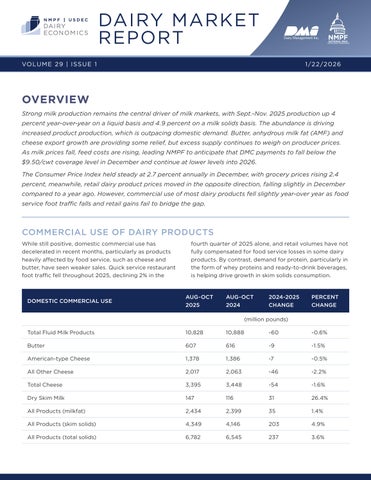
COMMERCIAL USE OF DAIRY PRODUCTS
While still positive, domestic commercial use has decelerated in recent months, particularly as products heavily affected by food service, such as cheese and butter, have seen weaker sales. Quick service restaurant foot traffic fell throughout 2025, declining 2% in the fourth quarter of 2025 alone, and retail volumes have not fully compensated for food service losses in some dairy products. By contrast, demand for protein, particularly in the form of whey proteins and ready-to-drink beverages, is helping drive growth in skim solids consumption.
U.S. DAIRY TRADE
U.S. dairy exports on a total milk solids basis increased 3% in Aug.-Oct. compared to 2024 levels. U.S. cheese exports continue to soar, up 27% year-over-year and poised to set a new annual record for the third time in the last four years. Additionally, bolstered by high milkfat availability at home, whole milk powder, butter and AMF continued to build on their export gains. Declines in nonfat dry milk and dry whey
continued due to limited supplies. Imports fell across the board as ample domestic supply lessened the need for foreign products. Dry skim milk bucked the trend as it easily topped particularly low import levels in 2024 and as imports rose due to lower domestic availability and volumes remain miniscule.
MILK PRODUCTION
Milk production kept surging through November, and strong component growth further intensified the amount of milk solids in the market. While liquid milk production increased 4% year-over-year and milk solids production increased by almost 5% as milkfat composition increased 5.5%. USDA data showed that the current expansion may
be losing momentum, as milking cow numbers stabilized in October and November after 9 consecutive months of gains. Still, even as the milking cow numbers stabilize, the United States still had 211,000 more head in November than one year prior.
DAIRY PRODUCTS
With plenty of milk, new capacity online and a strong demand pull for whey protein, U.S. cheese production continued to climb in November. Butter also saw significant growth as high milkfat production and ample cream
supplies kept churns busy. Skim milk powder production, by contrast, fell 13.3%as protein went toward higher value uses, including milk protein concentrates and ultrafiltered milk.
DAIRY PRODUCT INVENTORIES
Butter, cheese, and dry skim milk all show only small deviations from 2024 inventory levels, even as inventories were drawn down ahead of the holiday baking season. There remains a disconnect between U.S. imports of butter and EU exports of butter destined for the U.S., suggesting official
butter inventories may be understating volumes to some extent. November inventories of dry whey and whey protein concentrate increased compared to October but remain historically tight.
DAIRY PRODUCT AND FEDERAL ORDER CLASS PRICES
NDPSR prices softened in December except for dry whey, which found support as whey solids focused on higher protein uses. As a result, Federal Order Class Prices fell across the board, with Class IV falling the most due to depressed butter prices. December retail prices
rise slightly from November but still sit below prior year levels with cheddar cheese as the lone exception.
MILK AND FEED PRICES
Producers faced tightening margins in November as the allmilk price fell slightly and feed costs increased. DMC margins for November fell by $0.48/cwt compared to October as dairy commodity prices eased, and the price paid for
soybeans climbed. Futures markets imply a DMC margin of $8.91/cwt for December 2025, falling below the highest coverage level of $9.50/cwt and potentially providing payments to dairy farmers early in the new year.
*DMC calculations are not revised
LOOKING AHEAD
NMPF continues to forecast increasing milk production here in the U.S. and around the world. That abundant supply is being met with underwhelming demand, which will likely continue to weigh on prices in the near term. The second half of the year is more likely to see a price rebound, as consumers return to restaurants and milk supplies likely slow, but such a rebound is far from guaranteed.
At the same time, positive signals for producers and processers include U.S. exports of cheese, which have set new records virtually every month; domestic protein demand that’s helping keep nonfat dry milk and dry whey prices supported as skim and whey solids go towards higher value uses; and the signing of the Whole Milk for Healthy Kids Act, which should help build demand for U.S. milkfat even as adoption will take time.
Peter
Dairy Management Inc.™ and state, regional, and international organizations work together to drive demand for dairy products on behalf of America’s dairy farmers, through the programs of the American Dairy Association®, the National Dairy Council ® , and the U.S. Dairy Export Council ®
The National Milk Producers Federation (NMPF) develops and carries out policies that advance dairy producers and the cooperatives they own. NMPF’s member cooperatives produce more than two-thirds of U.S. milk, making NMPF dairy’s voice on Capitol Hill and with government agencies.
Vitaliano, National Milk Producers Federation pvitaliano@nmpf.org www.nmpf.org