We fought, we won! Members’ action saves more than 100 jobs. See page 8.
Anti-racism in early years
A maintained nursery leader on her school’s approach. See page 25.
‘Virtual’ failure Strikes force trust to drop online teacher. See page 16.
March/ April 2026
Your magazine from the National Education Union
‘Why
I’m voting YES’ Members fight back against triple attack on pay, hours and funding p30-35
• Earn free seeds, books and vouchers
• Develop new skills for life
• Improve young people’s mental health and wellbeing
• Increase environmental awareness and nature connectedness
• Celebrate growing success
rhs.org.uk/schoolgardening/awards
Educate
March/April 2026
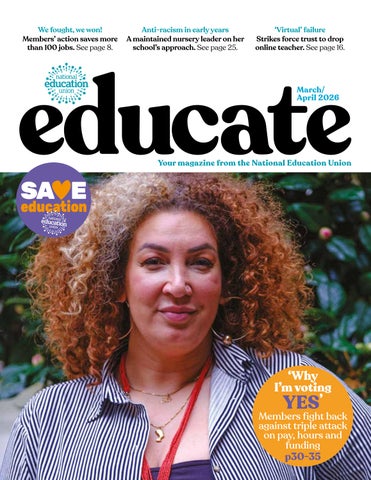
Nadia Mostafa, head of performing and creative arts at The Green School for Girls, Twickenham.
Photo by Jess Hurd hurdjess
NEU president
Ed Harlow
NEU general secretary
Daniel Kebede
Editor Max Watson
Editorial assistant Frankie Faccion
Journalists
Sally Gillen, Emily Jenkins & Sarah Thompson
Newsdesk
t: 020 7380 4768 e: educate@neu.org.uk
Production editor/design Amanda Ellis
Design & subbing Melissa Harteam Moore
neu.org.uk
linktr.ee/shareneu
TO ADVERTISE IN EDUCATE
Display adverts
t: 020 7880 7614
e: educate-magazine@redactive.co.uk
Recruitment adverts
t: 020 7880 8542
e: educate-jobs@redactive.co.uk
Except
STARTING the year on a high is always nice. So reporting on not one, but two big wins by members is extra cause for celebration.
At schools across the West Midlands, educators employed at the Arthur Terry Learning Partnership forced the multi-academy trust (MAT) to drop plans to cut more than 100 jobs. The MAT is millions of pounds in debt after years of mismanagement, and has twice been bailed out by the Department for Education. Rightly, members refused to pay the price for their employer’s poor spending decisions. Read about their victory on page 8.
One hundred miles north, members at The Valley Leadership Academy in Lancashire have also won their dispute over the introduction of a ‘virtual’ maths teacher (see page 16). If the MAT ever wavers in its commitment to stop using the Devon-based teacher for top-set maths, it may want to reflect on what one of its pupils Maisie Reeves has to say (see page 50).
So, two big wins to start the year. Disputes are, of course, often resolved without the need for strike action; some are settled at the ballot stage when the powers that be realise just how strongly staff feel. Educate regularly reports on U-turns following a strong ballot result. It can be a wake-up call.
That’s worth remembering as the union’s England-wide indicative ballots of teachers and support staff open on 28 February.
The NEU is urging teacher members to vote to reject the crummy 6.5 per cent pay award over three years, and for industrial action to win better funding for schools, a fair pay offer and protection of directed time (see pages 7 and 11).
Our education system is in a dire state, and the government isn’t doing what it promised: to repair it.
In fact, it’s making things worse. It now appears to be inching towards scrapping the one protection teachers have on their working hours: the 1,265 hours of directed time.
Education secretary Bridget Phillipson’s description of it as “unusual”, and “potentially creating a constraint on schools’ deployment of teachers”, has a euphemistic whiff about it.
Does she really mean inconvenient? If so, how much more does she think teachers, who already work more overtime than any other professionals, can give?
Things are getting worse, not better. Use your vote and vote YES. Sound that alarm. It’s time.
Max Watson Editor, Educate
PHOTOS by Jess Hurd, Kois Miah and Matt Wilkinson
PHOTO by Rehan Jamil
the Free School Meals for All campaign in their city.
The meeting was one of a number planned across the country as the NEU looks to deepen politicians’ commitment to ensuring every child gets the hot, healthy, free school meal they need to thrive in school.
NI deal
‘a step forward’ but more to be done
TEACHERS in Northern Ireland (NI) have accepted a pay increase of four per cent for 2025-26, backdated to 1 September 2025.
The Northern Ireland Teachers’ Council (NITC), of which the NEU is a member, said the offer was “the best achievable outcome on pay for this year” and matched the rise given to teachers in England and Wales.
NEU NI president Tanya Wakeley said the award was “a step forward after years of uncertainty” but more needed to be done to tackle underfunding.
While the pay award was welcome, it did not resolve the deep-rooted challenges facing education in NI. Recruitment and retention remain critical concerns, workloads are unsustainable, and too many staff are being stretched to breaking point.
“Our work is far from done, and we will not be complacent,” she said.
“Education staff and the pupils they serve deserve so much more: proper investment, manageable workloads, and a long-term commitment to valuing education and those who deliver it.”
Having committed to extending free school meals to all children growing up in families receiving universal credit, the government has taken a big step in the right direction – but it’s up to us to ensure they don’t stop until no child is left behind.
n Sign up to the No Child Left Behind WhatsApp community at tinyurl.com/whatsapp-NCLB
n Sign our petition at freeschoolmealsforall.org.uk/take-action
72% say no funds for books, IT or leaky roofs
NEARLY three quarters (72 per cent) of teachers say their school is “running on empty,” an NEU survey has found.
The depth of the funding crisis was laid bare in the poll of 2,000 teacher members. They reported schools being unable to afford pens and pencils, books, IT equipment and building repairs. An early years educator said they had picked toys out of skips and relied on parents donating items.
In response to a question asking what they would expect their school to be able to provide, one teacher said: “A roof that doesn’t leak, adequate heating in winter, cool classrooms in the summer.”
The situation is most severe in primary and special schools. The findings show that 78 per cent cannot afford basic provision, and neither can 65 per cent of secondary schools.
“My school’s budget is so tight that we’re
discussing no longer having whiteboards due to the cost of replacing whiteboard pens,” one teacher said.
Seventy-two per cent of teachers also reported that the classes they teach are too big, and 81 per cent said staff who had left had not been replaced.
NEU general secretary Daniel Kebede said underfunding was “taking a heavy toll on teachers, pupils and their parents, and the effects are high workload for teachers and burnout leading to staff shortages”.
The survey results, he said, provided overwhelming evidence that the government needed to look again at its failure to prioritise education: “For parents, it is a failure of government to ensure that schools can deliver the most ‘basic provision’ for their children. Too many schools are scraping by, and one third are nowhere near being able to pay for the basics.”
n Visit tinyurl.com/teachersurvey26
SUNDERLAND NEU members (pictured above) joined local community groups, housing association representatives, charity workers and activists to take forward
How else can I get involved?
Please spread the word among your colleagues and go to neuactivate.com to volunteer to help us.
Educators: vote YES to Save Education
TEACHERS and support staff at state-maintained schools in England will be balloted on whether they would be prepared to take industrial action if the government doesn’t increase pay and funding for schools.
Voting in the online indicative ballot will start on 28 February and end on 17 April, with the union urging members to vote YES
Teachers and support staff will be balloted separately but over the same period (see the questions, right), as part of the union’s three-year Save Education campaign.
The government’s failure to boost money for education and educators, following 14 years of Tory austerity, has left the union with no choice but to consider balloting for strike action (NEU general secretary Daniel Kebede sets out the arguments on page 11).
Per-pupil funding is at its lowest level since 2010. The government has recommended a paltry 6.5 per cent pay rise
for teachers over three years, and support staff jobs continue to be cut by schools trying to make savings as they struggle with years of underfunding.
The NEU’s survey of members found most are in schools that cannot afford the basics – pens, paper and glue sticks (see page 6). In workplaces across the country, broken toilets remain out of order for months, roofs continue to leak and broken resources and furniture aren’t replaced.
Angry members are dismayed by the government’s recommended below-inflation pay award and the new threat to their working hours, signalled by the review of the 1,265 hours of directed time announced by education secretary Bridget Phillipson.
“This 6.5 per cent pay offer is the government trying to get away with giving us the least it possibly can,” says primary school teacher Lisa Freeman.
“It thinks by giving it over three years it will avoid three years of us saying ‘hang on, this isn’t fair’. But it isn’t fair. We need to be able to live, to pay our bills, to support our families.”
n Read the full interview with Lisa and other members who plan to vote YES in the NEU ballot on page 30
What will I be voting for?
TEACHERS
We are asking you to vote YES to both questions in the ballot:
n Do you reject the proposal of an unfunded 6.5 per cent increase over three years for teacher pay?
n Are you prepared to take industrial action to win sufficient funding to secure an above-inflation pay increase, reduce workload and defend existing directed time provisions, including the 1,265-hour limit?
SUPPORT STAFF
n Do you agree that the defence of support staff jobs is essential to Save Education?
n Are you prepared to take industrial action to win sufficient funding to secure an above-inflation pay increase, reduce workload and prevent redundancies?
If, by Monday 9 March, you have still not received your voting link in your email inbox, please email ballotenquiries@neu.org.uk
Ahead of an imminent change in the law covering formal ballots for strike action, we are asking members to check and update the contact details the union holds for them.
Any members who currently use a work email address, and reps and officers who use an NEU email address, must add a personal email and personal mobile number to their membership record at my.neu.org.uk
This is to prepare for the use of electronic balloting for formal industrial action ballots. The draft code of practice on e-balloting states that the email addresses used by members for the purposes of receiving ballots must not be an email provided, controlled or accessible by an employer, or a union.
PHOTO by Kois Miah
Strength in numbers
n Huge picket lines were held outside ATLP schools across the West Midlands, and members held demonstrations and marches, with more than 1,000 staff, parents and pupils coming together in Birmingham city centre to protest.
n A parent-led petition in January issuing a vote of no confidence in ATLP’s chief executive has collected more than 3,200 signatures.
n On 27 January, members, parents and pupils delivered a letter to the Department for Education in London, expressing their concern over the financial mismanagement of ATLP.
n The NEU has almost doubled its membership at ATLP – from 460 to 870 – during the dispute.
‘Top slicing’ scandal
HUNDREDS of members at a financially troubled multi-academy trust that runs 24 schools are celebrating after their nine days of strike action saved more than 100 jobs at risk of redundancy.
The Arthur Terry Learning Partnership (ATLP), in the West Midlands, dropped plans to cut jobs and downgrade others after industrial action by members, which was strongly supported by parents. Chief executive Richard Gill, who had led the trust for ten years, has resigned.
From the Midlands to the DfE
Dozens of members travelled to London (pictured right) on 27 January to deliver a letter to the Department for Education (DfE) detailing “rampant and unchecked spending at the centre of the trust”. Two days later the trust settled the dispute, agreeing to all members’ demands.
“We stood up for what was right and for our members,” said Rob Gaudin, joint rep at The Arthur Terry School in Sutton Coldfield. “You have to stand up and fight.”
New supply framework will help schools, but not teachers
“I was earning £154 a day. Now I get £110 on supply.”
CAPS on the fees agencies can charge schools –to be introduced in June – will do nothing to ensure individual supply teachers are paid a fair daily rate, says the NEU.
A new Department for Education framework will, it claims, support schools to
“save millions”. But while there will be limits on what agencies can charge schools, there will be no minimum day rate for teachers.
Schools will also be expected to use ‘approved’ agency providers.
The NEU’s Stop the Agency Rip Off campaign has exposed the huge profits made by supply agencies. Schools spent £1.25 billion on supply teaching in the financial year 2022-23, more than 80 per cent of which went to agencies.
Fee negotiations will be unique to the
individual employer, which could see larger multi-academy trusts (MATs) reducing costs, but smaller schools or MATs unable to, creating huge variability for schools and supply workers.
A positive development is that schools can transfer an agency worker to a permanent role at no extra cost after they have been in post for 12 weeks.
n Contact your MP and query the new framework using our suggested parliamentary questions. Visit neu.org.uk/stop-agency-rip
28 February: special support staff conference
Deciding how support staff will be represented by the union in future.
100+ ATLP jobs saved
ATLP, which is £9 million in debt, announced job cuts and plans to introduce term-time only contracts for support staff, as part of saving plans put forward between September and November 2025. It cited “significant overstaffing” and falling pupil numbers.
Head teachers were later told to reduce staff costs by 68 per cent, through a mixture of compulsory redundancies, removal of teaching and learning responsibility (TLR) payments, reduction in hours and role downgrading.
But members said schools were not overstaffed, and the proposed cuts followed years of financial mismanagement at the trust, including spending millions on 11,000 iPads.
Not overstaffed; using PPA to cover lessons Aimee Cass, also a rep at The Arthur Terry School, said: “How can we be overstaffed when members are being asked to use their planning, preparation and assessment (PPA) time to cover lessons?
“The trust massively underestimated the parental support staff would get for our strike action.”
ATLP has been issued with two financial notices to improve by the DfE, which has also loaned it £4.5 million.
Members said the scale of “top-slicing”, or central spend, was 20 per cent, well above the average 5.5 per cent for a trust the size of ATLP.
NEU president Ed Harlow said: “For too long educators have had to make do and mend while dwindling funding has been siphoned off to the centre of trusts with no accountability. But the brave reps and members from ATLP have shown that it is possible to beat this.
Join our campaign to stop social media stealing childhoods.
Photos by Kois Miah
What members won
n As well as retaining jobs, the trust has agreed that all TLR payments will be saved.
n Proposals for term-time contracts for support staff have been scrapped, and all contractual changes stopped.
n Regular meetings will be held between the NEU and the trust’s leadership.
“They have shown that by standing firm, defending each other and their schools, it is possible to beat the worst excesses of this broken academisation system.
“This is how we will save education for members, our communities and the children we educate.”
n The strike mandate has been extended until September 2026 so staff can hold management accountable if changes aren’t implemented.
House of Lords votes to ban social media for under-16s
campaign to raise
social media from 13 to 16 – Big Tech’s Little Victims – is gaining ground.
A cross-party amendment to the children’s wellbeing and schools bill, tabled by Conservative peer John Nash in the House of Lords, was voted through in January.
MPs are now debating the clause, which calls on the government to implement
regulations forcing social media companies to put in place “highly effective age assurance measures to prevent children under the age of 16 from becoming or being users”.
It is “a landmark step towards finally putting children’s wellbeing ahead of big tech’s interests,” said NEU general secretary Daniel Kebede. “This vote reflects the strength of feeling across the country. Now is the time for swift action. We must continue to put pressure on parliament to drive this through to law. Children cannot afford delay.”
The government has announced a consultation – A safer digital childhood – as well as a ban on phones in schools, with an instruction to Ofsted to check school mobile phone policies as part of its inspections.
Daniel said schools needed more support and asking Ofsted to police their policies was “really not the answer”.
n Visit bigtech littlevictims.org
Join our campaign to stop social media stealing childhoods.
We must all work together to save education
NEU general secretary
Daniel Kebede urges members to vote in favour of strike action over pay, funding and workload in the upcoming indicative ballot.
AS educators, you’re more than prepared to put in the hours because the reward – changing the lives of children every day – is worth it.
But the work just keeps getting harder, the classes bigger, the hours longer.
We all know teachers who’ve left because they weren’t able to spend quality time with their family, or support staff who found another, less stressful job that pays the bills.
When you are doing your best to support pupils, it isn’t unreasonable to want to be paid fairly or for schools to be funded adequately.
In a profession made up mainly of women, it isn’t unreasonable to want the job to be compatible with having a family life.
This isn’t what any of you signed up for.
A chronic problem
I believe we are at a critical point – with the very future of our education system at risk.
That is why the NEU has launched Save Education: a three-year campaign to win improved funding for our schools, fair pay for educators and a better deal for our pupils.
And, as the first stage in that campaign, we are holding an online indicative ballot of teachers and support staff in state-maintained schools in England – from 28 February to 17 April – on industrial action over pay, funding and workload.
The government’s recommendation on pay to the School Teachers’ Review Body is for teachers to receive a 6.5 per cent pay rise spread over three years. Official estimates for inflation suggest this will represent a significant real-terms pay cut.
Worse, leaders will be expected to fund any pay award from their already stretched school budgets through ‘efficiencies’. Without guaranteed funding for pay rises, heads will be forced to make cuts. And we know where cuts usually fall: support staff redundancies.
To add insult to injury, the government has indicated that the rules around what
Our schools are in crisis, our children deserve better. An unfunded teacher pay award will make things worse.
In 2026, NEU members in this school will save education
counts towards the 1,265 hours per year that a teacher can be directed to work in school should be relaxed. With workload already sky high and the working day intense, this will make a chronic problem worse, and drive more committed teachers from the profession.
Get ready to vote to save education
Children will continue to lose out. Their parents, and communities, of course want and expect well-resourced schools staffed by teachers who will stay.
#SaveEducation
Schools at breaking point
When the Labour government was elected, most of us wanted to give it a chance to repair the 14 years of damage inflicted on education by the previous Tory governments. But we all know our schools are at breaking point.
In an NEU member survey carried out at the start of January, 72 per cent of respondents said their school does not have enough funding to meet basic provision for pupils. Not luxury items, but pens, exercise books, glue sticks and even toilet seats. Things that parents expect schools to provide as standard.
Comments given by members shed further light on the problem – telling of leaking roofs, pupils learning in coats because the heating is broken, early years learning resources picked out of skips.
If this government refuses to give the funding needed to pay for educator pay rises, most schools will need to make further cuts.
So we will also be working with parents to unify the message that enough is enough. If government is unable to deliver the most basic provision for children, and has the nerve to suggest that schools can deliver more with less, then something has to give.
This is why we must all work collectively as one union to save education.
Our online indicative ballot will ask you and your colleagues to vote in favour of moving to a formal strike ballot to secure better pay, more funding for schools, to resist attacks on the 1,265 hours and to prevent support staff redundancies. I would rather we avoid strike action – but this situation is urgent.
For more information
It is vitally important that we secure the biggest possible turnout in the indicative ballot, so we can send a clear message to government that unless it changes course we are prepared to act – together – to force it.
Get ready to vote. Talk to your colleagues and make sure they do too.
With schools and colleges running on empty, it is time to save education.
MEMBERS at a Birmingham primary school have taken strike action after teachers were denied progression to the upper pay scale (UPS) because they would not take on additional responsibilities, such as being a subject lead.
Staff at Colebourne Primary School are calling for the school to overturn the decisions and implement Birmingham council’s model pay policy, which states progression is automatic unless the teacher is subject to capability procedures. As Educate went to press, members had taken 11 days of strike action and announced a further 11 dates to take place in the second half of term.
The head, who was responsible for changing the policy, claims she has now reinstated the original, but members say they are still being held back. NEU rep Stacey Grocott said: “This dispute is about fair pay, fair treatment and ensuring eligible teachers are not wrongly denied progression. We hope this can be resolved quickly so we can return to doing the job we love.”
NEU and UCU unite for post-16 pay rally
NEU members at three post-16 colleges joined forces with University and College Union (UCU) colleagues, taking strike action from 14-16 January in a dispute over pay and working conditions.
The three days ended in a national rally at the Emmanuel Centre, in Westminster, where members from both unions shared their experiences of how underfunding and low pay had impacted them and their workplaces.
In October, the Association of Colleges (AoC) recommended a four per cent pay award for 2025-26 for post-16 college lecturers. However, it was an unfunded offer, leaving many colleges – which set their own pay rates – arguing that it was unaffordable from their existing budgets.
Teachers in further education (FE) colleges earn nearly 23 per cent (around £9,000) less than teachers in schools and sixth form colleges (SFC). Sky-high workloads have added to the high numbers leaving the sector; almost half of FE teachers leave within three years.
UCU member action ‘an inspiration’ Speaking at the rally, NEU executive member Duncan Blackie said it was “a real inspiration” to see UCU members taking action, adding it was “a fight that we need right across education”. He said the government had shown it didn’t care about FE and that the three-year, below-inflation pay offer was “a disgrace”. Duncan added: “It affects not just our members, but every child in the land. The disappointment we have with this Labour government is next level.”
UCU general secretary Jo Grady, who also spoke, said industrial action was a last resort, but staff had been left with no choice.
NEU members from Sixth Form Angel, north London – part of the Capital City College (CCC) group – were at the rally. They took 19 days of action in their dispute with CCC, which refused to honour the nationally agreed 4.3 per cent pay rise awarded to sixth form teachers last year. They received cheers of support from UCU colleagues.
NEU joint rep Pippa Dowswell said: “The UCU and NEU have always worked alongside one another in our college. We’re asking for our national pay agreement, and UCU is fighting for better pay because their [members’] pay has been eroded since they were taken out of national bargaining.”
Ninety-one per cent of UCU members voted for strike action, and there were pickets at 17 colleges. NEU members at Paston College, Norwich and City of Portsmouth College also have individual, ongoing disputes.
Three days after the rally, members at Sixth Form Angel voted to accept a new offer,
ending their dispute. Teachers received a four per cent pay rise for 2025, in line with other SFC teachers, and three per cent since January.
NEU joint rep Nick Lawson said: “Our 19 days of strike action showed the resolve and determination of our members to defend their living standards and the principle of fair pay.
“In restoring our wage levels to the national SFC rate we have overcome the injustice of the past 12 months.”
(Above) NEU and UCU members at the joint national rally in Westminster PHOTOS by Lee Thomas
Duncan Blackie and the UCU’s Jo Grady
‘Climate of fear’ prompts further strike action by hospital school staff
TEACHERS at Great Ormond Street and UCL Hospital School are continuing strike action after four members – one a union rep – were suspended when they raised concerns about a bullying management culture.
Members, who took 14 days of action at the end of last year, went on strike for the first week of February. Eighty per cent had voted for more action, on a turnout of 92 per cent, described as an “outstanding result” by NEU regional officer Chloe Tomlinson. “It shows members will not sit back quietly while four of their highly respected, long-serving colleagues are unfairly sacked.”
One teacher said: “The suspension of our colleagues, whose skills and professionalism
are missed every day, has had a hugely negative impact on staff, pupils and parents. We desperately want the school’s governors to hear our concerns and engage fully with our union.”
‘Chaotic, bullying management’
The four members, three of them senior leaders, have been off work on full pay for four months or longer. All have unblemished careers and between them have dedicated 40 years to working at the school.
In 2024, they began to raise concerns about the new head teacher’s “chaotic, bullying and unacceptable” management, including slamming her fist on the table during meetings and accusing those who disagreed with her of being “barriers to change”.
One change introduced by the head,
without consultation, was around therapy for teachers to help them manage the emotional impact of their role. It had been optional, with the choice to undertake it in a one-to-one or group setting, but the new head made it mandatory, group based and outside directed time.
Members say the head has created a “climate of fear”.
Fifteen of them submitted a collective grievance about poor management practices in October, but no action has been taken.
A wellbeing survey of staff at the school, carried out by Camden NEU, found all were experiencing workplace stress.
A petition, calling for the four members to be reinstated and an end to union victimisation, had more than 1,400 signatures as Educate went to press.
MEMBERS at Wombourne High School in Staffordshire, part of Invictus Education Trust, have taken 16 days of strike action since December 2025 following changes to working practices that they believe have resulted in directed time exceeding the 1,265-hour limit.
Teachers’ timetables increased from 25 to 28 sessions per week, with the additional sessions forming part of an enhanced curriculum, which staff say was introduced without meaningful consultation. Staff have also reported having to arrive earlier, having their break times reduced, and staying later to deliver enrichment sessions.
The strike action also relates to management practices affecting workload and wellbeing, including changes to sickness reporting procedures. Unwell staff are now expected to contact the head teacher directly, provide an estimate of the length of their absence and set cover work. The NEU says this is inconsistent with the trust’s own policy.
NEU general secretary Daniel Kebede on the GOSH picket line in December
PHOTO by Jess Hurd
‘Reading squeezed out of the school day’
HIGH-stakes assessment, an overloaded curriculum and underfunding have contributed to a significant drop in the number of children reading for pleasure, the NEU has told MPs.
In evidence to the education select committee, which is investigating the worrying decline, the union says reading is being squeezed out of the school day.
A survey by the National Literacy Trust (NLT) found only one in three children aged eight to 18 read in their spare time –the lowest level since the annual survey was introduced in 2005. Children say they would read more if they had the freedom to choose books and texts.
The NEU’s submission to the inquiry – which coincides with the National Year of Reading – says members work tirelessly to provide reading for pleasure opportunities but “among a crowded curriculum, this time can be viewed as a luxury”.
Phonics and a primary curriculum dominated by maths and English take time away from reading, but if all statutory testing was scrapped teachers could “plan and deliver exciting and engaging reading opportunities for children, free from government constraint”.
And the proposed year 8 reading test is “beyond belief”, says the union. “Young people being churned through test after test after
“A broad, balanced curriculum taught by teachers who are empowered.”
test does not automatically equate to high standards or enjoyment of reading.
“To ensure high standards, young people need a broad and balanced curriculum taught by teachers who are trusted and empowered to support them – this test will only work to achieve the opposite.”
One in seven have no library space
Funding cuts mean one in seven primary schools no longer has as a library or library space,
NLT research has found, and the NEU says the £10 million needed to ensure every primary in England has a library by 2029 should only be a start. Figures show 62 per cent of primary schools do not have a designated library budget, which rises to 70 per cent in secondaries. Almost a quarter don’t have a designated member of staff.
The expert work of librarians – essential to sustaining a reading culture in schools – is being done by other staff, the NEU tells MPs, which also increases their workload. “Reading cultures are dependent on the workforce, but staff are exhausted and overworked.”
The inquiry will also be holding in-person evidence sessions and will hear from children. n Read the NEU’s submitted evidence at tinyurl.com/NEU-reading n Turn to page 41 for Jon Biddle’s column on reading for pleasure.
World Book Day 5 March
The NEU has jointly produced resources with charity Speech and Language UK to help educators supporting children from early years to secondary develop their language and communication skills. neu.org.uk/supporting-language-development
Breaking the Mould is a series of NEU resources for those working in primary schools and nurseries. neu.org.uk/breaking-mould
Recruitment and retention like filling a bucket with a hole in
INCREASING teachers’ non-contact time would help retain them in the profession, NEU general secretary Daniel Kebede told an influential group of MPs.
Giving evidence to the education select committee, which is carrying out an inquiry into the teacher shortage, Daniel said increasing planning, preparation and assessment time (PPA) to 20 per cent would make a “real material difference”.
Still a dire problem with retention
There had been some “green shoots” of improvement in teacher recruitment, but there was still a “dire” problem with retention, said Daniel. “Even if current recruitment levels were sustained, it is like trying to fill a bucket that has a hole in it with water.”
He went on to say that there needed to be a correction in teacher pay, and rises had to be fully funded: “What unites all teachers around the country is the disappointment in school funding generally, and the partial funding of pay awards is an issue.”
Constantly doing a bit more with less Daniel added: “Every teacher recognises that when there is a partially funded pay award, they might see an increase in their pay but that is going to make their job harder at the same time.
“Teachers are saying the job is as hard as it has ever been. That is because there have been a series of unfunded or partially funded pay awards in which every year they are being asked to do that bit more with a little less, and
we are now in a crisis.” He gave an example of a teacher who had stopped drinking water at work because the toilet next to the classroom had been broken for months.
Make 1,265 limit legally enforceable
The NEU also had concerns about the government-ordered review of directed time, said Daniel, adding that the union wanted to see 1,265 hours made legally enforceable.
“Teachers should be compensated when they go over this limit. This is what happens in Scotland, Iceland and Portugal, and they have better teacher wellbeing and lower attrition,” he said. “Teaching is a professional endeavour and yet teachers are taking jobs where they are being expected to do an untold amount of overtime.”
Bigger picture
YEAR 7 pupil Millie Childs has won a national engineering award for her inspired idea to make reading easier for people with dyslexia.
The 11-year-old developed Rainbow Glasses, which have adjustable coloured lenses that can help reduce the stress of reading, when she was a pupil at Light Oaks Junior School in Salford.
As someone with dyslexia she had always found reading a challenge, so decided to invent something that could make it easier. Her design was developed into a working prototype by engineers and, as well as now winning the Primary Engineer MacRobert Medal, the glasses have attracted the interest of the NHS.
“Seeing the engineers turn my idea into real glasses has been incredible,”
said Millie, whose granddad was an engineer. “The thought that they might one day help other people is something I’m really proud of.”
Her teacher at Light Oaks, Rob Entwistle, said: “Millie’s idea stood out from the moment she presented it. She wanted to help others who faced the same challenges she did. Watching her idea grow from a drawing into a working prototype has been inspiring.”
Valley strikes off as ‘virtual’ teacher out
MEMBERS at Valley Leadership Academy in Lancashire have paused strike action in their dispute over the introduction of a “virtual” maths teacher.
Star Academies, the multi-academy trust (MAT) that runs Valley, which is in Bacup, appointed the virtual teacher – who is based around 300 miles away, in Devon – in September, citing recruitment problems.
Staff at the school took three days of strike action before Christmas, but further planned days have been put on hold following a commitment from the MAT to remove the virtual teacher as soon as possible, and by the end of the academic year at the latest. The trust has also said it will work with the union to review its recruitment practices.
Lancashire branch secretary Ian Watkinson said: “This is a result of the campaign and strike action organised and taken by NEU reps and members. While the dispute is not yet concluded, and the strike mandate remains live until the summer term, we hope that the constructive nature of ongoing talks will lead to a final resolution.”
The trust has 36 schools across the country. It has brought in “virtual” teachers at a school in Bradford and another in Blackpool. n See Final word, page 50
by
NEU survey reveals scale of workload stress
WORKLOAD is the leading cause of stress for 69 per cent of members, the NEU’s annual stress survey 2024-25 has found.
It also showed 67 per cent of educators feel unable to complete their workload within an acceptable number of working hours, a figure that rose to 72 per cent among those in primary schools.
The survey, whose findings show long hours and excessive workload are leading some to consider quitting, comes as a threat to remove the 1,265 hours of directed time looms.
A government review that could see changes introduced from April is underway, after education secretary Bridget Phillipson described directed time as an “unusual
contractual provision” that potentially constrains schools’ deployment of teachers.
The union will fight any attempts to remove the limit on working hours. On 28 February, the NEU will launch an online ballot asking members to take industrial action to fend off an attack on limiting the hours they work (see page 7).
An ‘unmanageable’ job
One member surveyed said: “I don’t see a future in this job as I tend to work some or most of every weekend. I want a family and I don’t see this job as compatible with that.”
Another echoed: “When ten-hour days in work, plus work at home, is not enough to do the job, it is becoming unmanageable and there is very little job satisfaction.”
As well as long hours, Ofsted inspections, staffing shortages and violent or disruptive pupils were also strong contributors to stress. Disruptive pupils were dealt with by 72 per cent of those who completed the survey, while 38 per cent said they often have to deal with violent students.
For support staff, feeling undervalued and overlooked were significant causes of stress. One member said support staff views were never sought and their voices never heard in schools.
“Staff leave for various reasons, but for the majority it is due to the lack of respect given for the work being expected,” they said. n Find the NEU’s workload audit at tinyurl.com/NEUworkload n Visit tinyurl.com/NEU-stress-survey
PHOTO
Paul Currie for
Paul Greenwood Photography
Standing up for what’s right
Jody Cook is pastoral lead at Stoke Park Primary School, part of the Cathedral Schools Trust (CST), in Bristol. She is also the school’s NEU rep.
What do you love about your job?
Stoke Park is my local school. I went there as a child and both my children did. I feel incredibly proud to be part of this community; I love to give back to our young people and support them in becoming amazing humans.
I love that every day is different. Yes, it can be hard, but it’s mostly full of joy. Having worked at Stoke Park for 16 years, I’ve seen so many changes and watched so many children grow up. I really enjoy walking around the neighbourhood and bumping into former pupils and catching up with them.
Plus, my colleagues are the best. It sounds cheesy, but they really are my friends – so supportive and such good fun.
What do you love about being in the union?
Growing up in a working-class area, I was raised with a strong belief in fairness, equality and standing up for what is right. Being in the NEU aligns perfectly with those values. It’s about having the collective strength and support to challenge things that aren’t right.
What have you been up to lately?
We had a very intense autumn term standing up to CST for what we believe is right. Support staff weren’t receiving their April pay rises until the following September, with no back-pay included. While the trust was legally within its rights, morally it was wrong – as the lowest-paid members of staff, we were missing out.
We made the difficult decision to go on strike. None of us wanted to because we didn’t want to feel we were letting our pupils or families down, but we knew it was necessary. With the union’s support, we took four days of action across nine of the CST’s 12 schools, and in November we won. We will now receive a settlement payment.
What’s important to you right now? In school, the staff are playing a giant game
Jody on the picket line – NEU members took four days of action and won a settlement payment in November
“While CST was legally within its rights, it was morally wrong.”
of The Traitors. My main priority is staying in the game and hunting those traitors down. On a more serious note, what’s always important to me is ensuring our young people feel safe and giving them the tools they need to be the very best they can be.
What do you do on your day off?
I love going for walks, hitting the gym, and catching up on The Real Housewives. I also love going to the theatre. One of my favourite things is heading into the woods with friends to sit by a fire, have a few drinks, and put the world to rights.
Tell us something we don’t know. Drama is a massive passion of mine, and I run a drama group in my local community. At Christmas, I rewrote The Snow Queen and put together a full community pantomime. I did audition for TV soap Hollyoaks a very long time ago, but obviously I didn’t get the part.
Reform threat warning at LGBT+ conference
“IT’S not just bigotry that we have to fear from the far right, it is their determination to smash trade unions and silence teachers.”
That was the warning by NEU general secretary Daniel Kebede at the union’s annual LGBT+ conference in February.
Addressing around 300 members at the event in Birmingham, Daniel said “conservative narratives” were back in mainstream politics.
The threat posed by Reform UK was not hypothetical, he said, nor was it distant: the party’s campaigners had described the Pride flag as “degenerate”, and its leader Nigel Farage – tipped to be our next prime minister – wants to end “woke ideology” in schools.
“We cannot afford to be complacent about the risk Reform poses to all of us,” said Daniel. “Reform makes no secret of the fact that it’s coming for trade unions, for teachers, for equality legislation, for immigrants, and for LGBT+ people.”
He went on to celebrate the pioneering work of the NEU’s LGBT+ members, whose
projects included Right to choose, a new model policy about coming out at work.
“We need to get this policy in every school, college and trust and we need you to make that happen,” he said.
Spotlight on LGBT+ scientists and innovators
FEBRUARY is LGBT+ History Month, set up by charity Schools OUT to shine a light on the contributions and achievements of LGBT+ people throughout history.
This year’s theme is Science and Innovation, and the organisation has chosen to highlight five key figures to help support inclusion and promote visibility of LGBT+ people in schools.
They include Barbara Burford, a medical researcher and champion of equality and diversity in the NHS; Jemma Redmond, a biotechnologist who developed the first 10-material 3D bioprinter capable of using live human cells to create tissues and organs; and Robert Boyle, a pioneering chemist and founder member of the Royal Society.
n Visit lgbtplushistorymonth.co.uk
n Our Histories provides teaching ideas across five equality and cultural events, including LGBT+ History Month. neu.org.uk/our-histories
n Every Child, Every Family introduces inclusive families and identities neu.org.uk/every-child
n The union’s LGBT+ Inclusion Charter neu.org.uk/lgbt-inclusion
‘Diversity of identities and experiences’ PORTRAITS of seven LGBT+ educators that celebrate their activism and contribution to the NEU have gone on permanent display in the East Midlands regional office.
The region’s LGBT+ organising forum commissioned science, technology, engineering and maths (STEM) educator and artist Gaz Lawrence to create the series. He interviewed each sitter about their role in education and the union as he photographed them and combined red, green and blue filtered exposures to create full-colour images. The result is a layered effect that captures the sitter’s subtle shifts in movement and expression, reflecting the diversity of identities and lived experiences among LGBT+ educators.
All those photographed are based in the East Midlands and their portrait is accompanied by a quote from the interview, adding context to the image.
Urging NEU members to stand united, Daniel added: “We must be at the forefront of the fightback… Our trade union is the embodiment of hope, resistance and solidarity.”
One of the sitters, NEU rep Graham Ward-Tipping, said the images are “a celebration of LGBT+ educators’ impact on the union, their colleagues and students”. East Midlands LGBT+ educator George
by
Daniel Kebede speaking at the conference
PHOTO by Jess Hurd
PHOTO
Gaz Lawrence
Our model?
What we need is more discipline in schools We need to draw up a clear set of rules. It doesn’t have to be terribly long An indicator of what’s right, what’s wrong.
Obviously, we can’t steal from one another; not even from someone like your brother. We mustn’t cause anyone bodily harm; we mustn’t use a weapon or a firearm.
We need everyone to understand fully There’s no room here for the gangster or bully; nor anyone with illegal secrets to hide, nor the cheat who didn’t succeed, but tried.
Are there people who don’t do these things? Perhaps our rulers? Princes and kings? The people who occupy the top spot? A president, surely? Or… perhaps not.
So if we tell children these people are a model Would we be talking a load of old twaddle?
Words by Michael Rosen Illustration by Dan Berry
Join NEU indy council
ARE you working at an independent school and keen to help shape the union’s work with your sector?
Join the NEU’s independent national council and have your say.
Vacancies need to be filled in London (4), northern (2), Yorkshire & Humber (3), north west (2), West Midlands (1), East Midlands (3) eastern (1), south east (1) and south west (2).
n Contact your regional office or email independent@neu.org.uk
Climate and nature education festival
A CLIMATE and nature education festival will be held on Saturday 14 March at Regent High School in London. The free event, hosted by the NEU and partner organisations, will bring together educators and activists to discuss climate change, sustainability and justice in education.
n Register at tickettailor.com/ events/ministryofecoeducation
A DIGITAL platform designed to revolutionise how Shakespeare is taught is “a remarkable gift” for English and drama teachers, NEU deputy general secretary Sarah Kilpatrick has told Educate.
Teachers and pupils at state and special schools can access thousands of resources for free on the Shakespeare Curriculum, including lesson plans, extracts from Royal Shakespeare Company (RSC) performances, revision bundles and videos of RSC actors discussing plays in rehearsals.
Macbeth, the Shakespeare play most studied in schools, is the first to be added. Romeo and Juliet will be added this year, with another eight plays to be uploaded by 2030.
Speaking at the launch, actor Sir Ian McKellen said: “The RSC has come up with a practical way for teachers to lead students to an appreciation of the plays, not just as written texts but as a starting place to explore the excitement of live theatre.”
n Visit rsc.org.uk/learn/shakespeare-curriculum
n Next issue: read our feature on how one school is using the Shakespeare Curriculum.
Nursery educators share grim reality of funding crisis
A GROUP of maintained nursery school (MNS) leaders and teachers (pictured right) have met chair of the education select committee Helen Hayes MP to brief her on the funding crisis.
At the meeting in Parliament, the members told her MNS were often in the most disadvantaged areas of country and the “jewel in the crown” of education.
But decades of underfunding had led to the closure of 36 per cent of MNS since 1987 and 33 per cent were now in deficit.
Challenges described by members included the requirement to provide free school meals, but with no extra funding. Business rates had to be paid by some MNS, but not others.
They pointed to the situation in Hayes’ constituency, Dulwich and West Norwood, in south
London, where one primary school’s business rates were £30,566, compared with the Dulwich Wood Nursery School bill of £89,292, in 2019. Since then, the primary had not been expected to pay, but in 2025 the nursery school was billed £93,150.
It was “completely unjust,” said members, that children from the poorest families were only given 15 nursery hours once
they turn three, while those from families with higher incomes were eligible for 30.
Nicci Burton, executive head teacher of Atherstone and Bedworth Heath MNS in Warwickshire, said: “We will continue to build support by engaging with MPs, inviting them into our settings, and demonstrating the impact MNS have in their own constituencies.”
25 years on, academies a law unto themselves
Warwick Mansell is a freelance education journalist and founder/writer of educationuncovered. co.uk
TWENTY-FIVE years after the inception of the academies sector – seemingly now an irreversible aspect of English education –weaknesses in its policy continue to make my jaw drop.
I was reminded of this recently when within a single reporting week, problems around academy transparency and accountability came up repeatedly.
The accounts of a large academy trust, GLF Schools, showed that in 2024-25 it had paid one member of staff £250,000 – the highest salary in its history. One assumes this was its chief executive, Julian Drinkall, who left the post three-quarters of the way through the year.
If Mr Drinkall had been paid at this rate for the whole of 2024-25, this would equate
to £330,000 for the full year – a development which seemed to raise questions about the use of taxpayers’ money.
However, accounting rules mean trusts only have to say which individuals received high pay when they happen to serve as trustees. So, while accounts must provide statistics on pay numbers within £10,000 bands, the identity and positions of those receiving it can be hidden.
There is no requirement to provide details of any bonus or pay-off, either. In contrast, local authorities are required to disclose this information. And GLF would not provide further details. This means the public is in the dark about why the remuneration of GLF’s highest-paid person shot up in recent years.
Second, I was staggered to learn that a single academy trust, running the Aylesford School in Warwick, had applied to the Department for Education (DfE) to join another trust without telling parents.
That is, trustees had developed a proposal essentially to end their board’s existence as an independent entity, without telling their community. And, because the DfE takes decisions on schools’ futures in private, no details
were available on the outcome of its decisionmaking meeting, a month after it had happened.
Finally, I investigated the case of Londonbased trust the Mossbourne Federation, which had seen a highly critical safeguarding review published on one of its schools in December. This had raised concerns about the impact of “no excuses” behaviour policies on some pupils, at a school which had issued 77,000 detentions in less than four years.
More than a month on, and nearly two months since a report it itself had commissioned into safeguarding and its handling of parental complaints, I wondered how the federation had responded to recommendations which had been set out in both of these documents.
At the time of writing, there was no evidence of any concrete action. Also, the trust appeared to have no elected parents serving as governors or trustees, despite this being required by the government and by its own constitution.
The academies policy can thus seem desperately lacking on transparency, on answerability to local communities and even on basic rule-following. Reform of much of this would be simple. But will it ever come?
Cartoon by Tim Sanders
DON’T PANIC! GOT THE CALL?
Use the Ofsted risk assessment to protect yourself and your colleagues from the inspectorate’s harmful fallout –before, during and after inspection.
Scan here to find out more!
‘My life has been shattered’
Long Covid rendered teacher Emily Mason unable to work. Now she is campaigning for compensation from the government. She tells Zofia Niemtus why she’s making sure ‘we aren’t forgotten’.
“WE’VE been hung out to dry,” says NEU member Emily Mason, who was a primary school teacher for 15 years before her career was ended by long Covid.
“We were told to keep society going, to make sure the children were OK, which we did – and now our lives have been devastated and our careers are over,” she adds. “My life has been shattered. I wanted to be a fun, upbeat mum, but now my daughter, who was four when I got Covid in 2020, has known me longer with this illness than she hasn’t.”
Emily was diagnosed with long Covid a year after contracting the virus. For more than three years, she continued to work while struggling with symptoms including extreme fatigue, brain fog, painful joints and muscles and memory problems.
“I was pushing through and just getting worse,” she explains. “I was just living to go to work. I wasn’t able to do jobs at home. I couldn’t take my children to their clubs.”
Eventually, she was forced to leave her job and can no longer work.
‘Reckless and irresponsible’
Emily now leads Long Covid Educators for Justice (LCEJ). What began as a small group of teachers has grown into a coalition of almost 1,000 staff who have launched a legal campaign for financial compensation for loss of past and future earnings, and what will be reduced pensions, from the government.
The LCEJ rejects the then government’s claim that throughout 2020 and 2021 schools were safe.
“Its actions were reckless and irresponsible and are directly responsible for the situation we now find ourselves in,” argues Emily. “We were working in unsafe environments. Our classrooms are not designed for 35 children and two adults with no air filters. Some classrooms didn’t even have windows.”
Many educators who have joined the LCEJ are NEU or NASUWT members. The
unions are working with the LCEJ to identify a possible personal injury test case against the government, given the findings of the public inquiry into the Covid pandemic.
In November, the inquiry published a damning report into the previous government’s catastrophic failures, including the delay in closing schools.
“I caught Covid on 19 March, and schools closed the next day,” says Emily. “I feel really strongly that if we had closed earlier, I wouldn’t have caught it.”
Staff left picking up the pieces
Many LCEJ members have had their applications for ill-health retirement rejected. They are too ill to teach yet are unable to access their pensions.
The NEU has supported many individuals in pursuing applications for illhealth retirement but one of the difficulties with accessing the Teachers’ Pension Scheme early is having to prove permanent incapacity, especially for those teachers in their 30s or 40s.
The LCEJ’s membership continues to grow – and its demands have crystallised into a clear manifesto with four key aims (see box, below).
“It’s not about going after individual schools: it’s the Conservative government and its failings. It can’t just leave us to pick up the pieces. We want to make sure this doesn’t go away and that we aren’t forgotten,” says Emily. n Visit longcovideducatorsforjustice.co.uk and neu.org.uk/management-long-covid
Long Covid Educators for Justice Key manifesto points
n To raise awareness of long Covid and the life-changing impact it has had.
n To support education staff in remaining employed in schools.
n To campaign for teachers and support staff who are not able to remain in employment due to ill health and look at means of support such as ill-health retirement benefits, compensation or personal injury payments.
n To promote extended phased returns and reasonable adjustments to support educators in a successful return to work.
Emily Mason leads Long Covid Educators for Justice
in’
‘Make anti-racism the water you swim
Two early years experts – a teacher and an academic – tell Emily Jenkins why children are never too young to understand belonging, identity, fairness and justice.
“FOR me, an anti-racist approach to education is about making every child feel they belong, right from the beginning, because if you feel like you belong, you’re able to learn, trust and bring your full self to school.”
Lucy Cox is deputy head teacher at Granville Plus Nursery School in the north-west London borough of Brent, one of the most ethnically diverse areas of the country. The 2021 census shows 85 per cent of Brent’s population are non-white British.
“We have children from all over the world,” says Lucy. “Last year we didn’t have more than two children from any one ethnic group.” continued on page 26
Photos by Rehan Jamil
Signing up for the Anti-Racist School Award, developed in 2020 by the Centre for Race, Education and Decoloniality (CRED) at Leeds Beckett University was, she adds, a “no brainer”.
continued from page 25 local authority launched the Brent schools race equality programme, designed to help all schools adopt anti-racist policies, reduce disproportionate exclusions, raise attainment for under-performing groups and ensure curricula and school environments reflect Brent’s diverse communities.
Whole-school approach
The two-year programme sets out a whole-school approach to becoming actively anti-racist, providing a framework for creating inclusive policies and promoting a diverse curriculum.
Workshops, training and mentorship support are offered to educators, and they are put in touch with other schools so they can share best practice. Schools are awarded a bronze, silver or gold award.
In Brent, the local authority meets the £500 cost of the award for nurseries and schools, including academies, that want to sign up. It’s part of a wider strategy to embed anti-racism in schools. In 2024, the
Useful resources
n The NEU runs an early years reference group. Register to join at tinyurl.com/EYwhatsapp
n NEU anti-racism charter neu.org.uk/anti-racism-charter
n Leeds Beckett University’s Centre for Race, Education and Decoloniality tinyurl.com/Leeds-Beckett-CRED
n Show Racism the Red Card theredcard.org
n Halo Collective school hair policy halocollective.co.uk/halo-school
n Schools of Sanctuary, a network of over 1,000 primary and secondary schools committed to creating inclusive school settings for refugee children. schools.cityofsanctuary.org
NEU anti-racism charter
At Granville, staff began working towards the award in September 2024. Starting with a policy audit, Lucy discovered there wasn’t a document on anti-racism so, using the NEU’s anti-racism charter, she wrote one.
It includes a model framework for her staff on how to respond to racist incidents in class or between adults, outlines different types of discrimination, and provides links to further resources and information.
“We want to create an atmosphere where race is openly spoken about and feeds into all policies and work,” explains Lucy.
‘A global village’ Understanding of and empathy to others
TO celebrate the end of autumn term 2025, Lucy invited Laura Henry-Allain MBE (pictured below) in to read to the children.
A storyteller, producer and creator of JoJo and Gran Gran, an animated
TV show on CBeebies, Laura’s bestselling children’s books, such as My Skin Your Skin, support young children in understanding concepts of race, identity and empowerment and include diverse characters.
“It was a pleasure to deliver a story session at Granville. Exposing children in their early years to diverse and inclusive books is incredibly important and gives them an understanding of how they are part of a global village,” she says.
Her new book, Maya and Marley and the Great Big Tidy Up, includes references to cornmeal porridge, a popular Caribbean breakfast dish.
“I want children to see themselves in Maya and Marley, and to enable non-Caribbean heritage children to be curious, become informed, and develop an understanding of and empathy to others,” Laura says.
“People say little kids don’t notice race and difference, but it’s not true.”
Lucy Cox
“It’s about making anti-racism the water you swim in.”
Some might question whether very young children – those at Granville are aged between six months and four years – are too young to be having discussions about race, but Lucy would disagree.
“People say little kids don’t notice race and difference, but it’s not true,” she says, adding that they often point out differences in skin colour or hair type.
Inclusive conversations about hair
Hair discrimination is addressed in a new policy, which also sets out Granville’s inclusive approach and supports staff in having conversations with children about hair.
“When children comment on each other’s hair we model using descriptive language. If the children are very interested in hair, we can set up a barber or hairdressing role play with pictures of people with different hair and different styles to provoke discussion. It allows them to explore their interest and ideas more deeply,” explains Lucy.
Pride in Brent’s local heroes
She says some pupils are refugees or immigrants, so staff use stories about travelling, maps and different family relationships to create a sense of belonging. A more diverse range of books is now included in the curriculum, and children also learn about local heroes such as award-winning author Zadie Smith and Premier League and former England national team footballer Raheem Sterling, who both grew up in Brent.
“Our borough has a very strong history of migration and people making their homes here. We are very proud of the Brent sons and daughters who do well.
“Our children are so young, some of them look at the pictures, point and say ‘that’s daddy’ or ‘that’s mummy’, and that’s the point – they see people who look like their family doing important things and being successful,” says Lucy.
“The children now also learn more local and Black history and stories of protest and resistance, about people sticking up for themselves and fighting back. We want our children to grow up feeling they have the confidence to stand up for themselves, to feel belonging and to feel prepared to defend that right to belong.”
Level
of bias from a very young age
Early years consultant Dr Shaddai Tembo, a specialist in anti-racist practice, believes early years is the perfect time to begin supporting children in understanding belonging, identity and issues of fairness and justice.
He references the famous doll test, a series of experiments conducted in the 1940s by African-American psychologists Drs Kenneth and Mamie Clark. Children aged three to seven were given the choice of a Black or white doll. Almost all the children, irrespective of race, chose the white doll and attributed more positive characteristics to it: it was “nice” and “pretty”, while the Black doll was “ugly” and “bad”.
Shaddai says: “It points to an implicit or pre-conscious level of bias that children develop from a young age, as a result of the broader societal context,” adding that the idea that educators shouldn’t be talking about race in early years conveniently ignores or overlooks the extent to which we are all part of a system in which racism affects our daily lives.
Today’s divisive political climate, with the rise of the far right, is something even
Tackling the adultification of Black girls in education
Black girls are too often seen as older, less innocent and more culpable than their peers.
Recognise how adultification bias manifests in schools and how this impacts Black girls’ wellbeing, attainment and disciplinary outcomes.
Wednesday, 25 March 3.45-5pm
Book at neu.org.uk/CPD-adultification
Developing a culturally responsive pedagogy in our everyday teaching practice
Educators will explore how to embrace a more inclusive, anti-racist, culturally responsive philosophy of teaching, to incorporate pupils’ cultural, linguistic, ethnic and religious identities within the curriculum.
Wednesday, 29 April 3.45-5pm
Book at neu.org.uk/CPD-cultural-pedagogy
Scan the QR code to find out more and to book webinars neu.org.uk/courses/national-cpd
continued from page 27 young children pick up on, he says. Recently he spoke to an educator working at a nursery in a racially diverse and multicultural community who described the shock parents felt when they arrived with their children one day and saw that a large England flag had been hung opposite the nursery.
Rather than ignore it, staff chose to invite parents in for a discussion, which was an opportunity to reassert the nursery’s values of tolerance and inclusion.
Pedagogically sound approaches
Shaddai acknowledges, though, that educators often feel ill-equipped for discussions about issues such as racism.
In 2018, he set up Critical Early Years, an organisation to support educators in tackling these issues, and is now writing a book, Social Justice in the Early Years: A Toolkit for Educators (see Shaddai’s top 5 tips, below). It will be published in the summer.
“I want to give educators the confidence to have these conversations and really foreground the need to incorporate these topics from an early age,” he says. “Practitioners are frequently left uncertain about how to approach issues such as
racism, gender inequality, disability or class in developmentally appropriate and pedagogically sound ways.”
Staff become more racially literate Lucy agrees that initiating these conversations can make educators nervous.
“Once I stuck my head above the parapet and started talking about it, most parents were really supportive,” she says, and adds that over the last year staff have become more racially literate. They are also more comfortable and confident talking about racism and how to oppose it.
Shaddai says: “Early years educators are juggling so many things, and asking them to do social justice work is an additional responsibility, but it is necessary.”
Although he wishes there was more support for this work through government policy, it isn’t a “silver bullet”, he suggests, and grassroots work will always deliver more radical change.
“We need to take the initiative and advocate for change among our communities. Early years can feel very siloed, but if educators are able to share what anti-racism might look like in their context and what they’re doing, then other colleagues can learn from that.”
Shaddai’s top 5 tips
n BEGIN WITH YOURSELF We bring our full selves, our histories, values and assumptions, into our work every day. By noticing how these shape our interactions, we can engage more intentionally and ethically with the children and communities we serve.
n WORK COLLABORATIVELY Inclusive practice is strengthened when educators think and act together. Collaboration helps us share responsibility for change.
n WORK SLOWLY Working slowly allows inclusive practice to grow thoughtfully, rather than being reduced to quick fixes or tick-box actions.
n READ, LISTEN AND LEARN Treat learning as an ongoing commitment, especially from voices and communities different from your own.
n TUNE IN TO CHILDREN Attuned practice means observing closely, listening deeply and responding sensitively to how children express themselves, relate to others and play with power. When we tune in slowly and thoughtfully, we create space for each child’s identity, agency and meaning-making to flourish.
“Grassroots work will always deliver more radical change.”
Shaddai Tembo
PHOTO by Kois Miah
NEU4157/0126
‘No room left for
Buildings falling apart; under-resourced SEND; Overstretched, underpaid teachers and support
NEU4157/0126
“Our computers are ancient.”
“We need a pay increase that’s in line with inflation, and it needs to be fully funded.
“We’re so far away from where we should be – pay is more affected than ever before because of the cost-of-living crisis. I’m an experienced teacher with teaching and learning responsibilities (TLRs), but there is no way I’m going to be able to get onto the property ladder, especially in London.
“The government’s expectations of teachers without paying us sufficiently is exploitative. We spend our breaks and time after school supporting students, as well
as absorbing a lot of administrative tasks: phone calls home, checking attendance. We do so much out of goodwill.
“We’re lucky if we get more than one or two applicants when we have a vacancy. I think people look at the profession and think, ‘it’s not worth it’.
“We don’t have enough teaching assistants or technician support for practical subjects. We need to ensure students can do creative subjects safely, so they have full access to the curriculum, but it’s unthinkable to request a full-time technician for resistant materials, design technology or food technology because there’s no money.
“Building repairs are an issue. Our facilities team works really hard, but there aren’t enough of them. The plumbing doesn’t always work and there are so many broken chairs in our classrooms. It’s sad.
“Our computers are ancient and the IT system doesn’t work brilliantly. Working in an all-girls school, I feel this feeds into a narrative that girls don’t have a role in IT, technology or engineering. There is so much more we could do to ensure we put them on a fair playing field, with the skills and knowledge to compete in a male-dominated industry, but we can’t afford the infrastructure to push them.”
Nadia Mostafa is head of performing and creative arts at The Green School for Girls, in Twickenham.
PHOTO by Jess Hurd
for unfunded pay rises’
unsafe workloads; endless budget cuts leading to job losses. staff tell Educate why they will be voting YES in our indicative ballot.
Rosie Hesketh is a geography teacher, head of year 10 and NEU rep at Alder Grange School in Lancashire, where she has worked for ten years.
“Teaching is a stressful job. Planning, marking, parental expectations, Ofsted, worrying about the kid with the shirt that’s not been washed, bringing in breakfast for them because you know they haven’t eaten anything.
“But if you’re not worrying about things at home, like money, you can cope with that stress. My head teacher said recently that she has never experienced so much staff absence.
“Our school is falling apart. There are holes in the roof. In the maths room, rain leaks onto the computers, and in one of our geography rooms, we’ve had to move the teacher’s desk away from the wall because of a leak. It’s terrible. We’re told we’re first on the list for repairs, but we’ll have to see. At the end of term, we were using paper because there was no money to get new exercise books. And glue sticks are non-existent.
“Teachers aren’t paid anywhere near the same as other graduates, so are leaving the profession. We had a brilliant maths teacher who left to become an accountant where she’s earning loads more money. We’re also struggling to get lunchtime staff because Asda will pay more than working in a school for similar hours.
“Our special educational needs (SEN) department is really stretched. Sixty of the school’s 750 pupils have education, health and care plans, and there are nowhere near enough teaching assistants to support them. Our SEN staff are exceptionally good, but at some point, they will crack because they can’t keep up with the demand. Leadership is saving money by not recruiting the teaching assistants they need, but re-assigning people. Some office staff have taken on pastoral roles.
“We are due a visit from Ofsted and staff are panicking because the framework has changed and it’s not clear what is expected.”
“Our school is falling apart.”
by Matt Wilkinson
PHOTO
Interview Feature
continued from page 31
“Educators do a phenomenal job.”
Lisa Freeman is a primary school teacher and sits on the NEU disabled members’ organising forum, West Midlands.
“Education and the educators who provide it need to be valued. We do a phenomenal job.
“This pay offer is the government trying to get away with giving us the least it possibly can. And it thinks by doing it over three years, it will avoid three years of us saying, ‘hang on, this isn’t fair’, but it isn’t fair.
“We also need to live, to pay our bills, to support our families. It should be an embarrassment to the government
that teachers and support staff are having to access food banks to feed their families.
“Teachers provide clothes for their pupils, treatment for headlice, so many things. We go above and beyond because we know what a difference it makes to our children.
“If pay was in line with inflation, it would make such a difference. We’re all being pinched. When you look at the cost of things – like milk – it does bring home how much things have gone up in price.
But what we get paid doesn’t equate with that. You still have to feed a family but with less money.
“If the government changes directed time, more tasks will get pushed onto us.
“I began as a teaching assistant (TA), and then higher-level teaching assistant, before becoming a teacher six years ago. TA jobs are being lost as budgets are squeezed and squeezed.
“Our union is a strong union and strongest when we act together. If we stand together, we can make a difference.”
PHOTO by Kois Miah
Richard Vaughan is NEU rep and a grounds person at Sandbach School in Cheshire, where he has worked for four years.
“When we voted a Labour government in, we didn’t expect this.
“I’m voting YES to strike action because if the government doesn’t offer a fully funded, fair pay award, schools will have to make redundancies. And support staff are always the first to go. We’re running on a shoestring as it is.
“Support staff aren’t only teaching assistants and higher-level teaching assistants. We’re office staff, cleaners, the site team. We’re the lifeblood of the school. If support staff are cut, who is going to keep the school clean and fed?
“My members are worried about the cost of living. I know people who have left to become delivery drivers or work in supermarkets, which pay above national living wage. You see adverts and think, ‘I could do that’. The school can’t recruit because people can get a better-paid job elsewhere.
“But more than the money, it’s the workload that makes people leave. The pressure can be immense. And because support staff have been cut already – and aren’t being replaced – the workload increases. It’s horrible to see people buckling under the pressure. I’ve seen support staff in tears.
“Our school looks like Hogwarts; it’s got a magnificent facade. But we’ve got reinforced autoclaved aerated concrete (RAAC) and have had scaffolding covering the building for two years. The site team does its best, but there are leaks and buckets in corners. And it just becomes commonplace. In September, there’s a huge rebuild starting, which is well overdue.
“It’s the lack of investment from government. We wouldn’t be striking for ourselves, we’d be doing it for the school and for education.”
“Who is going to keep the school clean and fed?”
PHOTO by Matt Wilkinson
“Directed time helps leaders protect staff.”
Nicci Burton is executive head teacher of two maintained nursery schools in Warwickshire, employing six teachers and 45 people in non-teaching roles.
“I’m voting YES because, as a leader, I need to stand up and show my staff that a 6.5 per cent pay rise over three years is awful.
“It says we aren’t at all valued by the government, and teachers now feel very undervalued because of so many years of poor pay rises. They are doing more and being paid less. It just isn’t fair.
“I see the impact on the wellbeing of staff, the stress of balancing mortgage repayments, paying rising electricity and gas bills, having to be so mindful of the food they buy in their weekly shop. Some of my staff have had to take second jobs.
“Having to find money for pay rises would push my schools further into deficit, and staff feel it’s not OK for their pay rise to come from our budget because it means even less money for children, for early intervention and work with our families.
“I attended a workshop recently run by a company brought in by the Department for Education to help schools manage their budgets. It made me so sad. The advice was basically to cut teaching assistant (TA) hours, so they leave at the same time as the children. It was about not giving TAs time for all the prep work, to set up the environment so it’s ready for children when they arrive in the morning.
“These sorts of cuts are superficial. They may look good on paper, but the implications for staff workload are huge. Teachers will stay longer to do the work TAs were doing, or the TA will stay and do it for free, which is wrong.
“My worry is, yes, there’s a plan to help us manage our budgets as leaders, but it’s all about cutting, which puts more stress on staff and the children get less.
“The review of directed time worries me, too. Having the 1,265 is helpful in terms of managing staff workload and wellbeing, and it helps leaders who may need to push back against wider initiatives that want more from teachers. Directed time helps leaders protect staff.”
PHOTO by Jess Hurd
Darragh Briscomb is an IT technician, workplace rep and support staff officer in Hounslow, and sits on the London region LGBT+ organising forum.
“I’m voting YES to strike action because schools can’t cope. There is no room left for unfunded pay increases.
“Whenever funding is in question support staff, like me, are at risk of losing their jobs. Our pay is atrocious. The hours aren’t full time and because a lot of support staff are paid for term-time only, that drop in wage means you have to do loads of extra hours or work another job. It exhausts people, burns them out. It’s especially hard for families on a single income.
“We are always the first to go and the first to be put into barebones teams. Members are worried about unsafe workloads and about the students. There’s a real high need for SEND provision and there isn’t the funding for support staff. People are working beyond their job roles to try to keep children safe.
“Lots of teachers and support staff members try to make their school look nice, using their own money to buy things for displays, even though they can’t afford to. It’s devastating that people in education put their heart and soul into the career and they just get nothing back. It’s always take, take, take, and nothing is given back in response.
“The government needs to listen to support staff members in the NEU. There’s a lot of us and we should all have a voice. It needs to value education and realise that support staff are its backbone. Without us, teachers can’t do the job they are trained to do. And then teachers have to take on additional workloads themselves.
“Valuing support staff would make a massive difference to how education is looked at in the UK.”
“Our pay is atrocious.”
PHOTO by Jess Hurd
A class act
‘Singing is a kind way to get pupils’ attention’
Lucy Lee (pictured) is a reception teacher at Reay Primary School in Stockwell, south London, where she has worked for ten years. Sarah Thompson visited to find out what makes her a class act.
AS you enter Lucy’s classroom, the wall is covered with pictures by her reception class, revealing what they dream of: Rukaya wants to draw; Lonny wants to be a chef; Jonah wants to be a big dragon with fiery breath.
This term, they have been reading a book by Nathan Bryon, Look Up!, which tells the story of a young girl who wants to be an astronaut, and Lucy has used it as springboard for discovering more about the children and to help her plan the term’s curriculum.
“The topic – Look up – is really broad, so within it, I can just follow their interests,” she smiles.
This year, her class were all very keen to learn more about space and have been creating artwork and stories around that theme. Last year, she discovered the children were really interested in birds, so they did lots of learning based on that.
Lucy feels lucky to work in a school where she and her colleagues are trusted to know what will work best for the class. “It’s
a hands-off approach. We have a curriculum, but I’m able to choose how we cover it.”
At the heart of the curriculum is play. The classroom is set up to give children the freedom to choose what to do and where to go from the moment they arrive.
“We begin the day with a soft start, which means they don’t have to sit down or do anything specific. They can come in and see what’s on offer, start playing, explore a bit. Everything in the classroom is self-access,” Lucy explains.
She is committed to the importance of play, and certain it’s how children learn best, but admits that she can feel a pressure to do more formal learning.
“The children decide who plays what, and when. It’s lovely to see the power they feel.”
A member of an online forum for reception teachers, Lucy regularly sees posts seeking advice on how to squeeze phonics, maths and handwriting into the curriculum.
“I just think, ‘why are you doing all this?’ and I think it’s pressure from leadership. Children should be playing the whole time,” she insists.
A passion for music
Music and drama are used a lot in Lucy’s teaching. Both have always been big passions. At one time, her ambition had been to become a musical theatre star, and she worked in a theatre for a year to save for university.
Discovering she particularly enjoyed working with children in the youth theatre, she then decided to do a postgraduate certificate in education after completing her history degree.
Initially she saw her future in secondary education, but following a compulsory twoweek placement in a primary school, she was left in no doubt that was the phase in which she wanted to work.
In 2018, Lucy enrolled on the NEU’s Mantle of the Expert programme, which involves children taking on the role of experts in an imaginary world and, as a team, working to tackle a problem they have been
A class act
‘commissioned’ to solve. This could be anything from being sent to a secret island to study a colony of creatures thought to be extinct, to being cast as a team of archaeologists to excavate an Egyptian tomb, or becoming mountain rangers with responsibility to encourage safe climbing and hiking.
Mantle of the Expert encourages teamwork, communication skills and decision making, says Lucy, but unlike traditional drama techniques, children are never put on the spot, and they are aware that they are in a fictional world. “It’s very inclusive. If a child wants to sit and watch, that’s totally acceptable. It is about creating a story together, so being a reader or an observer of that story is absolutely respected.”
Puppet power
Music is a key part of Lucy’s lessons and something she uses as a tool for classroom management.
During an Ofsted inspection, her class – at that time year 5 – were asked what she
“I never clap for attention. I just sing everything, all the commands. I think it’s less abrasive.”
acknowledges was a leading question: whether Lucy ever shouted at them.
“The children told the inspector, ‘No, she never shouts, because she sings. And when she’s really cross, she whispers.’”
Lucy says: “I never clap for attention. I just sing everything, all the commands. I think it’s less abrasive in terms of the general ambience of the class. It’s a kinder way of bringing their attention to you.”
At the moment, her class is enjoying getting to know Holst’s The Planets suite.
“Mainly Mars; they just love it. We’ve done loads of music and movement sessions, getting to know the piece, being able to drum the rhythm, creating our own versions and conducting.”
Helping with these sessions – and making regular appearances in the classroom – is Lucy’s hand puppet Chocolate Chocolate Button. Children use her to illustrate the dynamics or speed of a piece, telling other children when to start playing, or drop out.
“They’re deciding who plays what, and when. It’s lovely to see the power they feel,” says Lucy.
Chocolate Chocolate Button, named by a year 4 child, is a pretty big deal, she laughs. During the 2020 lockdown, Lucy created videos using the puppet to connect with her class online, and she says children still ask about her as they move up through the school.
When asked about the main challenges of being a teacher, Lucy, unsurprisingly, cites underfunding.
Do you know a class act?
Email educate@neu.org.uk
PHOTOS by Lee Thomas
Ask the union
Taking on extra admin tasks
I’M a class teacher and have been told I must track and create attendance support plans, which will be followed up by the attendance officer. This will generate a lot of extra work. Any guidance on this?
The school teachers’ pay and conditions document (STPCD) clearly states that teachers and school leaders should not be instructed to carry out activities that do not require their professional skills or judgement. The list of 24 administrative tasks they should not be expected to carry out includes producing and collating analyses of attendance figures, and investigating a pupil’s absence.
Therefore, you can refuse to undertake these duties. It is likely other colleagues are being asked to undertake similar tasks too, so we suggest you raise this as a collective issue with your workplace rep.
Working while pregnant
I’M a teaching assistant in a primary school and 28 weeks pregnant. I was moved to the nursery this year and am struggling – there is lots of getting up and down off the floor, changing nappies, lifting and bending. What can I do?
As soon as you notified your employer that you were pregnant, a risk assessment should have been carried out to mitigate the risks to your health and that of your unborn baby caused by your working arrangements. This is a legal requirement and it must be regularly reviewed during pregnancy. Your employer has so far failed in its duty to you but must now urgently undertake a risk assessment, in consultation with you and your union rep. From what you describe, it was not a sensible decision to move you to the nursery when you were already pregnant.
Until you start your maternity leave, you may wish to work with a different year group or may feel that there are steps your school could reasonably take to enable you to stay in the nursery, but without the lifting and bending and getting up and down off the floor. These discussions should form part of the risk assessment. If your doctor or midwife has any specific medical recommendations, these must be taken into account.
It is also a legal requirement that all pregnant women have a suitable place to rest and, if necessary, lie down, so if this is not being provided at your school, you should raise
this as part of the risk assessment discussion.
n Read about risk assessments at tinyurl.com/HSE-mothers-risk-assess n Visit neu.org.uk/being-pregnant-work
Sick pay while on probation
I’M on my probation period and have had some sick leave. My contract states that the school’s absence management policy does not apply to me. Does that mean I’m not entitled to sick pay?
A school absence management policy may or may not include information about sick pay. It may simply explain the procedure to be followed when somebody is off sick.
The starting point for your sick pay entitlement will be your contract of employment and (if you are a teacher) whether you are employed subject to a document called conditions of service for school teachers in England and Wales, also known as the Burgundy Book.
If you are subject to Burgundy Book conditions, and have previous service as a teacher in local authority schools, then this service is usually counted towards sick pay entitlement, regardless of whether or not your school’s absence management policy applies to you.
At the very least, you will be entitled to statutory sick pay, as most employees are after three working days, although the rate is low – £118.75 per week – compared with salaries in the education sector.
Raising hope for children in crisis
IN 2025, a staggering one in 11 children required humanitarian assistance – that’s more children in need of lifesaving support than at any other time since World War II.
In Afghanistan, the Caribbean, Palestine, Sudan, Ukraine, Yemen and elsewhere in the world, children are facing a perfect storm of conflict, hunger and climate disasters. Yet, cuts or the ending of overseas aid by western powers mean the closure of vital projects – leaving millions of children without the support they desperately need.
An estimated 2.2 million children are set to lose out on schooling because of the decision by the UK government to slash the overseas aid budget to its lowest level in nearly 30 years.
Standing with children
The union has joined forces with charity Save the Children to launch a fundraising appeal, Raising Hope for Children in Crisis, to support children caught up in conflict and crises around the world.
When a crisis strikes, Save the Children is always one of the first organisations to act. Its emergency fund means it can anticipate
and respond within hours of a sudden disaster or humanitarian crisis.
n £12 could provide a birth kit to help a woman in Sudan deliver her baby safely.
n £30 could provide a teacher in Afghanistan with an education in emergencies kit that includes pens, pencils and books.
n £60 could provide a family in Gaza with a food parcel of canned beans, hummus, tinned chicken and tuna, and sweet pastries.
How NEU members can help
n Ask your district for a donation – use the model motion from the NEU website.
n If you’d like to make a donation to the appeal, or ask family and friends to do so, donate via our JustGiving page.
n Details for making a donation via BACS are available on the NEU website.
n Run the appeal in your school – this is a great way to raise money while teaching about the lives of children around the world.
n Bake sales are a fun way to celebrate international food traditions among the families in your school alongside raising funds.
n Members could host a fundraising event and an assembly to mark an upcoming international day, such as International
Women’s Day on 8 March to highlight the impact of crises on women and girls.
n Talk to students about a conflict or emergency affecting children. For example, share Amira’s story (see boxout, below).
Your support is vital
Since 2021, the NEU has raised over £370,000 for Save the Children to support children in emergencies. Our previous fundraising appeal to support its work in Gaza helped reach 1.66 million people over the last two years. With your support, we can once again raise hope for children in the world’s toughest places.
n Find out more at neu.org.uk/raising-hope
n More fundraising ideas from Save the Children at tinyurl.com/STC-schoolfundraising
n Get a fundraising pack by emailing fundraising@ savethechildren.org.uk
Amira’s story Children get to play, make friends and learn
Amira* from Sudan and her family, including her twin cousins, Aba* and Nura*, fled their home in Khartoum after it was bombed.
They eventually made their way to a camp in South Sudan – but without Amira’s father, who they haven’t heard from for months since he became separated from them. At the camp, Save the Children has supported Amira’s family with essentials like blankets, water containers, soap, sandals, clothes and sanitary towels. Save the Children runs a safe space where children get to play, make friends and learn.
Amira says: “My sisters and my brothers used to cry because of hunger and thinking about our father. But when the teacher came to us and started taking us to nursery, they started playing and could forget about other things.”
Save the Children supports girls and boys around the world, like Amira and her family, so they can start to be children again – and believe in the future. *Names have been changed
Amira (middle), 14, with her twin cousins and young sister at the transit centre, Renk County, in South Sudan
Reviews
Supporting Early Mathematical Development
A HIGHLY recommended resource for early childhood educators. It provides a clear account of the interwoven aspects of mathematical thinking and how these can be cultivated through play-based learning, emphasising the central role of children’s thinking skills.
Caroline McGrath’s depth of knowledge is evident throughout. Her clear and logical approach demystifies mathematics and makes it accessible to educators. This is an impressive and valuable contribution to the literature.
Pete Moorhouse
Supporting Early Mathematical Development: Practical Approaches to Play-Based Learning by Caroline McGrath. Routledge. £26.99.
Little Owl’s Book of Thinking: An Introduction to Thinking Skills
IAN Gilbert’s innovative book is a humorous story about Benny, a curious owlet, and his father. Through their conversations, seven key life lessons unfold to help readers improve their thinking skills. Examples include the value of being unique, and discovering your own learning style and strengths.
This engaging read is ideal for discussion, problem solving and building self-esteem. The story-based approach makes thinking skills accessible and enjoyable for children.
Cindy Shanks
Little Owl’s Book of Thinking: An Introduction to Thinking Skills by Ian Gilbert. Illustrated by Virginia Mayo. Crown House Publishing. £9.99.
Read a book that other educators might find useful?
Send us your 100-word review to educate@neu.org.uk with a link to the book, plus your membership number, and your review could be published.
Patience
THIS book introduces scientific ideas and terminology in an accessible way, without diminishing its appeal to young readers.
It contains many surprising facts, even for adults, while the vibrant illustrations invite curiosity and close observation.
Subtle environmental messages are woven throughout – for example, showing that rainforests can recover within 60 years and coral reefs in just 25. This is a thoughtful and durable book and is well suited to primary school libraries, classrooms and homes, encouraging patience and wonder in observing the natural world.
Mike Follows
Patience by Rachel Williams. Illustrated by Leonie Lord. Magic Cat Publishing. £17.99.
Queer Kids and Social Violence: The Limits of Bullying
THIS collection of essays reframes bullying as social, rather than anti-social, behaviour. Homophobic bullying is described as “a tool for the preservation of the status quo”.
This shift in focus highlights that the causes of, and responses to, bullying of LGBT+ students are – and should be – distinct. Each essay explores how this understanding can inform policy and practice in schools and concludes with a summary of the implications for educators. The volume also includes comprehensive bibliographies.
This is a challenging read, but one that can help bring about positive change for LGBT+ young people.
Graham Ward-Tipping
Queer Kids and Social Violence, edited by Elizabeth Payne and Melissa J. Smith. University of Minnesota Press. £26.
The Strategic SENCo
THIS is the book special educational needs co-ordinators (SENCos) have been waiting for. Longtime inclusion advocate Kenny Wheeler draws on over 25 years’ experience in education, sharing his insights in this empowering and practical read.
Wheeler encourages SENCos to take time to reflect, with interactive sections in each chapter that support this process. It is, however, Wheeler’s voice
that makes the book truly compelling. Kind and open-minded, he offers wisdom by the bucketload and invites readers to learn from his experience. This is a book for all SENCos: practical, reassuring and inspiring. It provides guidance and support, helping them feel less alone in their vital role. Paul Wade
The Strategic SENCo by Kenny Wheeler. Bloomsbury Education. £22.99.
Giving pupils chapter and verse
Jon Biddle, English lead and NEU rep at Moorlands Primary in Norfolk, is passionate about fostering a love of reading for pleasure.
WITH the National Year of Reading now well underway, I hope pupils are being exposed to a wide variety of texts on a regular basis.
Until about a decade ago, the only verse novel I’d ever read with a class was Cloud Busting by Malorie Blackman, which is rightly regarded as a classic. More recently, my pupils have enjoyed significantly more, with us normally getting through at least four or five together during an academic year.
For anyone unfamiliar with the term, a verse novel uses connected poems instead of prose to tell a story, blending narrative structure with a range of poetic devices.
Although narrative poems have been around for a very long time (The Iliad and The Odyssey, for example), verse novels written specifically for children now have a higher profile in schools than previously At a time when the number of children choosing to read is in decline, they offer an alternative route into reading for pupils and staff.
Making reading feel possible
Recent books such as Fia and the Last Snow Deer by Eilish Fisher and The Final Year by Matt Goodfellow are incredibly popular with primary pupils. For secondary readers, Wild East by Ashley Hickson-Lovence and Run, Rebel by Manjeet Mann provide thought-provoking, engaging experiences.
Verse novels look different on the page, with the text appearing far less intimidating. There’s white space, breathing room, time to think. For many children, the reduced amount of text makes reading feel possible. At last, here’s a book I might be able to finish!
A few years ago, I taught a boy who would often give up on books after a couple of chapters. One day, he picked up Zombierella by Joseph Coelho – which had somehow magically appeared at his desk during lunchtime – as it “didn’t look too long”. Within a week, he’d finished the book and was asking for the next in the series.
A fresh perspective
Verse novels are also very powerful when read aloud, which is one of the reasons why we get through so many. The rhythm of the words lends itself to performance and allows teachers to model fluency and expression. My pupils understand why I might pause, emphasise certain words or read at a different volume or tempo. Seeing the text can quickly help build confidence around reading aloud.
The fact that verse novels contain fewer words certainly doesn’t make them easier texts. They can contain a huge range of emotions and demand that readers – or listeners – pause, think and infer.
The conversations we had about The Crossover by Kwame Alexander last year were incredibly thoughtful. One of my pupils even said, after a tragic event in the book, that “there was more to talk about in that poem than some stories have in a whole chapter”. As the year goes on, there’s an increased shared understanding that one line, sometimes even one word, can mean many different things, and this regularly provokes passionate debate.
The majority of verse novels are written in the first person, often from perspectives that are under-represented in children’s books, and encourage reflection. For pupils developing empathy and exploring their own identity, this can help them realise that they’re not alone and that others share similar
worries and fears. They are also valuable from a writing perspective, showing pupils that writing doesn’t have to be long to be effective. Precision and word choice matter.
‘A lovely feeling’
Marie Zarro, English lead at St Joseph’s Catholic Primary School in Droitwich, Worcestershire, and a passionate advocate of verse novels, recently said: “Verse novels can make reading feel easy, with the narrative momentum of a novel and the imagery, rhythm and emotional depth of poetry.
“Children can have the satisfaction of finishing a whole book while still keeping up with the complexities of the plot. It’s a lovely feeling to read a book from cover to cover and to feel the deep emotional journey of a character.”
A healthy reading diet is about balance. For me, verse novels sit alongside picturebooks, graphic novels and prose texts, each offering something unique. It’s worth trying to find at least one verse novel to share with your class this year. They really come alive when they’re heard and offer children something different and exciting, a new way to think about the impact of a story and the power of words.
Verse novels can feel less intimidating, their use of white space giving breathing room and time to reflect
The wide-ranging impacts of big tech
I AM grateful to see national movement on the effects of big tech, but this issue goes beyond children. Doesn’t the entire education sector need to be protected from big tech?
As a teacher, I feel morally undermined and threatened by the pressure to bring big tech into teaching and learning. I am constantly encouraged to use artificial intelligence (AI) to prepare resources, mark work and reply to emails.
Yet big tech threatens the future of our planet. AI undermines energy, water and food security, while accelerating climate breakdown and biodiversity loss. As teachers, we are expected to promote the United Nations’ 17 sustainable development goals as part of updated occupational standards, yet this pressure makes me feel like a hypocrite.
I care deeply about sustainability and make a moral choice to use AI as little as
UK Government, protect children from Big Tech
possible. However, workload pressures are increasingly expected to be offset by AI, for example for lesson planning, meaning that my moral choice places additional pressure on me as a teacher.
As the gov.uk website states: “AI has the potential to reduce the amount of time teachers spend doing administrative tasks, so they can focus on what they do best – teaching and supporting their students.” But what about teachers’ choice?
It feels like we are repeating the mistakes made with social media, failing to reflect critically on the impact of new technologies on both the planet and the classroom. Despite my
reservations, I have trialled digital activities such as online quizzes, research and writing. Yet these often leave students distracted and irritable, undermining learning and increasing behaviour issues.
Similarly, AI does not know my learners and cannot meet their specific needs. The pressure to use it to plan lessons therefore threatens teachers’ creativity and students’ success.
Finally, at a time of severe education underfunding, the push for new technologies appears to divert resources away from essentials such as textbooks and teacher recruitment.
As education policy continues to drive digitisation, and as resource-hungry technologies undermine teachers’ autonomy and professional judgement, should we not be campaigning to protect our whole sector from big tech?
Name and location withheld
Exam feedback
I AM writing in response to Resit students need constructive feedback, by Barbara Connor from North Wales (Educate, January/February, page 43).
Members might want to know that Edexcel/Pearson offers a free access to scripts (ATS) service. Students can request a free PDF copy of their examination paper, which includes the marks awarded for each question and sub-question. At our school, this is arranged via the exams officer, and we usually receive the script on the same day.
Teachers, including myself, often use ATS to determine whether it is worth paying for a review of marking once the mark schemes are published after results day, or to provide students with more constructive and targeted feedback.
Name and location withheld
Regional officer for NEU Northern Ireland
FROM November 2024 to June 2025, I was fortunate to work part time as a regional officer for NEU Northern Ireland (NI) alongside my role as a teacher in a special school, where I have taught for 18 years. My school was very accommodating, allowing me to continue teaching my year 11 class while working in the Belfast office two days a week.
Teacher’s pet GG and Candy
GG and Candy are the guinea pigs of Charlotte Irias, a business studies teacher in Essex.
Charlotte says: “I often talk about GG and Candy in my lessons. I use the idea of a guinea pig farm,
where students with exam anxiety can come and pet them.
“I always return to this example, linking it to topics like budgeting and quality control. Students always remember this example because of GG and Candy.”
If you have a treasured pet you’d like to show off, email a high-resolution photo with 50 words about what makes them so special to educate@neu.org.uk
Please write The editor welcomes your letters but reserves the right to edit them. Write to Letters, Educate, NEU, Hamilton House, Mabledon Place, London WC1H 9BD or email
Although I had prior experience as a school rep and committee member, working as a staff member gave me a deeper understanding of the dedication involved in supporting members. The role was incredibly varied, from representing members and handling casework, to providing advice on pay, workload, pensions and maternity issues, supporting recruitment and organising, contributing to Educate and the NI website, and supporting the delivery of campaigns and CPD. During this time, the pay and workload campaign was ongoing, culminating in our hard-won five per cent pay rise.
One of my highlights was visiting schools and attending members’ meetings across NI, particularly in special educational needs settings, which reinforced the shared challenges teachers face. I also enjoyed helping to organise the summer school in Ballycastle, as well as bringing my year 11 class to Belfast City Hall and the NEU office.
I am extremely grateful to the team – Pauline Buchanan, Danielle Black, Simon Salter, Donal Lyons, Pamela Cosgrove and all the officers – for their support. It was a rewarding and eye-opening experience that I will always value.
Denise Moore
educate@neu.org.uk
Please note we cannot print letters sent in without a name and postal address (or NEU membership number), although we can withhold details from publication if you wish.
Star letter
Another feminist hero
MANY thanks for the prize you awarded me for nominating Mary Seacole in the feminist heroes competition (Educate, January/ February, page 41). The book will be donated to the school where I am a governor.
Another amazing woman from history is Gerda Taro (pictured right). She was one of the first war photographers alongside her partner, Robert Capa. She was also certainly the first to be killed on the battlefield, in Spain during the Spanish Civil War. Her funeral in Paris in 1937 attracted many thousands, and she was buried at the Cimetière du Père-Lachaise, on what would have been her 27th birthday. She could take photos others couldn’t, as she was trusted by the men fighting, partly because she shared their dangers, meals and
conditions. It is gratifying to learn that she is being recognised more nowadays. Two streets in Madrid and Paris are now named after her.
She was a remarkable woman who, despite dying young, was a pioneer in her field. Peter Ryerson, Middlesex
Million Women Rise: join us on Saturday 7 March in London
FOR International Women’s Day (IWD), the NEU will be joining the annual Million Women Rise march and rally, which is led by women of colour and calls for an end to all forms of male violence against women and girls.
District branch secretary of Sutton NEU Rosie Kelly-Smith, a member of London women’s organising forum, said: “Last year the atmosphere was electric as we marched behind the NEU banner – led by our Black sisters and driven by the powerful drum beats of the Samba Sisters Collective.” Join us again this year in London, to march in sisterhood and solidarity.
n Visit millionwomenrise.com for full details.
NEU members and officers at last year’s Million Women Rise march PHOTO by Isabel Infantes
Located N Devon coast in an area of outstanding natural beauty. Well equipped holiday cottages sleeping 2-8. Pets welcome. 01237441311 www.pattard.co.uk
Loved by School Groups
Multi Award Winning 4* Hotel overlooking the sea in Bournemouth 01202 552111 www.marshamcourthotel.co.uk
SHROPSHIRE
Cottage sleeps 4 in rural village near Ludlow. Adventures or peaceful tranquility
www.stmilburgachapel.co.uk
Lovely self-catering converted railway wagons.
www.thewagons.co.uk
Llyn Peninsula, North Wales. Quaint, rural, 2 bed luxury
www.glansoch.co.uk 01758 712565
RECRUITMENT
Host & teach international students General, Business or Academic English, adults & teenagers. Flexible work, good rates and support info@livingenglish.com
Sicily, Italy
Modern, spacious 3 bed house, bright interior & comfortable living spaces. Peaceful private garden. 10 mins from the beach. Located in Ragusa province, close to historical sites & Montalbano locations. casapipituna@proton.me
Walking Therapy in Nature
Stone In
This three-day retreat, provides personal therapy amidst nature, contemplative sessions and the opportunity
Overlooking the shores of Derwent Water and led by two experienced counsellors - with a combined 25 years’ experience in education - we offer a supportive, therapeutic space where you can:
• Decompress
• Deepen self-awareness
• Find Strength
• Gain Direction
Get in-touch today to reserve your place 07860 804793 www.stoneinmyboot.co.uk
610003 or 07941 661796
BALTIC STATES, SCANDINAVIA & EASTERN EUROPE
Specialists in tailor-made private tours & small group tours www.balticholidays.com 0161 818 7140
WALKING THERAPY
My Boot offers a gentle therapeutic walking programme, set against the breathtaking beauty of the Lake District.
The Boy at the Back of the Class
A FREE education pack has been commissioned by the Children’s Theatre Partnership.
The pack accompanies Nick Ahad’s stage adaptation of Onjali Q Raúf’s award-winning book The Boy at the Back of the Class and includes information on the characters,
The
Superpower of Looking
EDUCATION charity Art UK has created free teaching resources aimed at providing children aged seven to 11 years old with the ‘superpower’ to critically observe, question and interpret visually, using the world of art as a springboard.
The resources include images, guidance on ‘looking’ and a series of original films with celebrities including Paralympian and television presenter Ade Adepitan and musician YolanDa Brown discussing artworks such as Vincent van Gogh’s Self-Portrait with Bandaged Ear.
A short training video for teachers introduces the resources and offers ideas about how to use them in the classroom.
n The resources can be found at artuk.org/learn/the-superpower-of-looking
language, suggestions for discussion points and cross-curricular learning.
It will support educators in exploring the themes of friendship, migration, social activism and empathy.
The play is on tour around the UK until 23 May.
n Visit childrenstheatrepartnership.co.uk
Making maths relatable
BRING maths to life for key stage 3 pupils with free teaching resources created by the Royal Institute of British Architects (RIBA).
Over four one-hour lessons, students will discover the real-world value of mathematics in creating the spaces in which we live, work and play. They will use their maths skills to develop a design solution for fictional town Greater Towncaster, working alongside fictional architects Sophie and Tomas.
The resource includes teacher notes to support delivery of the lesson, activity sheets and a PowerPoint deck.
n Visit tinyurl.com/riba-school-resources
Bringing the past to life
THE Historical Association’s (HA) annual writing competition is open for entries.
Budding young writers aged nine to 14 are invited to submit a story of between 400 and 3,500 words. Judges are looking for a story that is historically accurate, has interesting characters and a gripping plot.
Entries should be received by 7 June and will be judged in two age groups: years 5-6 and years 7-9. Winners will receive a £25 book token and a commemorative notebook for writing future stories, and schools will receive a year’s free subscription to the HA.
n Visit history.org.uk
ARE YOU BALLOT READY?
Have your membership details changed?
Have you moved house since you joined the NEU? Or perhaps you have a new job at the same workplace? Or moved to a completely new workplace? Have you previously opted out of receiving communications from us and want to opt back in? Or are you about to go on maternity leave?
It’s important that your union has the correct details for you. If your details are out of date, you could find that you’re:
Checking and updating your membership details is easy at my.neu.org.uk
If you have difficulty accessing myNEU or you have a more complex query, email the membership team at membership@neu.org.uk
Please note: changes to subscriptions, including fee holidays during maternity, shared parental and adoption leave, can only be processed in the current subscription year (1 September 202531 August 2026). We are unable to backdate requests for previous subscription years.
Photo opportunity
Send us your photo to win a £20 book token
THIS photo was taken by Tanya Frois, a primary school teacher in Croydon.
Tanya says: “In Botswana and Namibia, I saw the most breathtaking beauty.
“Across vast, untamed landscapes, wildlife roamed freely: elephants traced ancient paths and antelope danced across open plains.
IT’S vital that the NEU has up-to-date details for all its members. You may be eligible for reduced subscriptions – for example, if you work part-time, are about to take maternity leave or retire.
It’s important that we have the correct address for you for balloting purposes so, if you have moved, make sure you tell us your new home or workplace address.
“Watching these animals go about their daily lives was a quiet reminder of the earth’s wonder and the simplicity of existence.”
Why not send a picture to us at educate@neu.org.uk? It should be large and high resolution, accompanied by 50 words about its subject. We send a £20 book token to each featured so don’t forget to include your address in the email too.
The easiest way to update your details is by logging on to myNEU. Go to my.neu.org.uk to manage your membership, including updating your address, workplace and equality information. Alternatively: n call us on 0345 811 8111 (Monday to Friday, 9am-5pm) n email membership@neu.org.uk
n or write to Membership & Subscriptions, NEU, Hamilton House, Mabledon Place, London WC1H 9BD.
Access myRewards today
myNEU is also a portal to accessing hundreds of exclusive discounts available to members through myRewards. From savings on your weekly shop to holidays and special treats, you could save up to £1,000 a year.
Visit neu.org.uk/neu-rewards
Quick crossword
Across
1 Capital city of Bosnia and Herzegovina (8)
5 Rainbow-hued gemstone (4)
9 Alfred ___ : Swedish chemist who invented dynamite (5)
10 Henrik ___ : Norwegian playwright (5)
11 Scottish football manager (5,5)
14 Famous South American river (6)
15 Historical period of sustained cold (3,3)
17 Wellington is the capital of this country (3,7)
20 Halley’s ___ : famous celestial object (5)
21 Mammal of the giraffe family (5)
22 Sicilian volcano (4)
23 Horse of a reddishbrown colour (8)
Down
1 What a beach contains (4)
2 Precious stone that is a variety of corundum (4)
3 US actress in Pretty Woman (5,7)
4 Ancient Roman poet who wrote the Aeneid (6)
6 The ___ Dolls: US girl group (8)
7 Edwin ___ : English painter of animals (8)
8 US tennis player who won Wimbledon twice (5,7)
12 ___ goose: bird with a white face (8)
13 Film starring Halle
Berry in the title role (8)
16 ___ Wood: played
Frodo Baggins in The Lord of the Rings (6)
18 Firstborn son of Adam and Eve (4)
19 Brad ___ : Hollywood superstar (4)
Across
1 - Capital city of Bosnia and Herzegovina (8)
5 - Gemstone (4)
9 - Alfred ___ : Swedish chemist who invented dynamite (5)
10 - Henrik ___ : Norwegian playwright (5)
11 - Scottish football manager (5,5)
14 - Famous South American river (6)
15 - Historical period of sustained cold (3-3)
17 - Wellington is the capital of this country (3,7)
20 - Halley's ___ : famous celestial object (5)
21 - Mammal of the giraffe family (5)
22 - Sicilian volcano (4)
23 - Horse of a reddish-brown colour (8)
Answers at bottom of page 49
Down
1 - What a beach contains (4)
Sudoku Easy Medium Difficult
Sudoku solutions will feature on this page next issue.
2 - Precious stone that is a variety of corundum (4)
3 - US actress in Pretty Woman (5,7)
4 - Ancient Roman poet who wrote the Aeneid (6)
6 - The ___ Dolls: US girl group (8)
7 - Edwin ___ : English painter of animals (8)
8 - US tennis player who won Wimbledon twice (5,7)
12 - ___ goose: bird with a white face (8)
13 - Film starring Halle Berry in the title role (8)
16 - ___ Wood: Frodo Baggins in The Lord of the
18 - Son of Adam and Eve (4)
19 - Brad ___ : Hollywood superstar (4)
Last issue’s (Jan/Feb 2026) sudoku solution
(from left: Easy, Medium and Difficult)
Prize crossword
A £50 Marks & Spencer voucher
Across 1 Unruly mob seizes new work by Oscar, keen reader (8)
5 Suit on display in the art school (6)
9 These make cuts – possibly head of science is cross (8)
10 & 16 down Children soon prepared for their midday meal? (6,6)
12 Healthy source of water? (4)
13 Dad mixes syrup to make ancient paper (7)
17 Mistakenly let in media, so excluded from further participation (10)
19 Old sailor in solitary confinement (3)
21 His egg naturally starts with this bird (3)
22 Informal talk with Miss Paige about being mistress of the house? (10)
24 I tried rewriting Romeo, but got muckier! (7)
25 Beer with creamy head – Guinness, for example? (4)
28 Chef, oddly, has genuine breakfast food (6)
30 Pause indecisively, and the tea is ruined! (8)
31 Accounts book has left border before right (6)
32 Your girl sees Changing of the Guard (8)
Down
1 Voice that begins Bizet aria somewhat strongly (4)
2 Pandemic doesn’t start with Roman poet (4)
3 Wins a bet with rewrite, but full of rubbish! (5,3)
4 Regularly fraud really comes from the countryside (5)
6 Get away to find peace, perhaps, with music centre (6)
7 Part of curious South American city (3)
8 Printing technique produces unusual likeness with cyan and red initially (4-6)
11 Cheerful and optimistic, but PE a disaster! (6)
14 Maybe earn it, and keep possession of it (6)
15 Transform me to a child, systematic and orderly! (10)
16 See 10 across
18 Stick small advertisement in this location (6)
20 Unusually neat girl is changing (8)
23 Geraniums developing without sun? An illusion! (6)
29 Used by an angler, it’s far too rigid at the end (3)
Send your completed crossword, with your contact details, to: March/April crossword, Educate, NEU, Hamilton House, Mabledon Place, London WC1H 9BD, or email a photographed copy to crossword@neu.org.uk. Closing date: 31 March.
This issue’s quick crossword solution (p48)
‘Virtual teacher a risky experiment in year 11’
Fact file
Maisie Reeves is a year 11 pupil at The Valley Leadership Academy in Bacup, Lancashire. Her mum, Kelly, is pictured right.
NEU members at Maisie’s school took strike action over the introduction of a virtual maths teacher in December (see Educate, January/February, page 7). Maisie, who was upset about losing her in-person teacher, moved down a set. In January, the trust said it would stop using the virtual teacher, a victory for teacher, parent and pupil protests, but maybe not until the end of the academic year. Although glad the trust listened, Maisie says its decision doesn’t help her or other year 11s, and she wishes a virtual teacher had never been considered in the first place.
LAST July, when I was in year 10, me and the rest of my maths class were informed we were going to be taught by a virtual teacher in year 11. I was angry.
Introducing such a drastic change in year 11 seemed unnecessary, as there were maths teachers in school capable of teaching a top-set class.
Desperate measure during Covid Virtual teaching was one of the things I hated most during the Covid pandemic. It’s common knowledge that the teaching methods used then were from desperation and turned out to be not as effective as classroom learning with a physical teacher present.
Teachers who are in the classroom can monitor students’ work individually, instead of it all being on their screen, and to quietly help if a more introverted student is struggling. Online, it’s impossible for a student who isn’t very confident to alert the teacher to the fact they need help. They will likely continue to struggle as they’re too nervous to speak up.
They could fall behind in their learning and may get a lower grade.
In practice, virtual teaching feels less effective than my school described it would be when we were told about it, as teaching is more than just educating students. It’s also about forming bonds.
Personal bonds are so important
That is more important to students than some might think. If you have a good relationship with a teacher, it means you’re motivated to pay attention and contribute to a lesson.
Not knowing a teacher well enough causes students without as much confidence to shy away from answering questions as they’re unsure how the teacher will respond to wrong answers.
Online, it’s practically impossible to form a bond with a teacher. After class, the virtual teacher is gone for the rest of the day – not hosting clubs or staying behind with students to chat – so creating a relationship between teacher and student is much more difficult.
Experimenting in year 11 very risky
Furthermore, experimenting on pupils in year 11 with a virtual teacher was quite risky, and to experiment with a core subject is just senseless. If the virtual teacher ends up damaging grades rather than helping them, then the experiment has sabotaged the GCSE grades of 30 kids, who are fully capable of passing.
Moreover, a student can’t ask for help outside of the classroom with a virtual teacher, as the teacher isn’t in school. If the student is struggling with homework, they can’t find the teacher in school for assistance. This could push them to cheat on their homework, which will stunt their learning as they don’t use the skills taught in lessons because they don’t understand them.
I can’t speak for my whole year group, but if the virtual teacher was never introduced, I would likely be getting a higher maths grade. I only moved down a set because I wanted a proper teacher instead of one on a screen.
PHOTO by Paul Currie for Paul Greenwood Photography