
ISOLASTIC
Latex additive to impart elasticity to cementitious adhesives
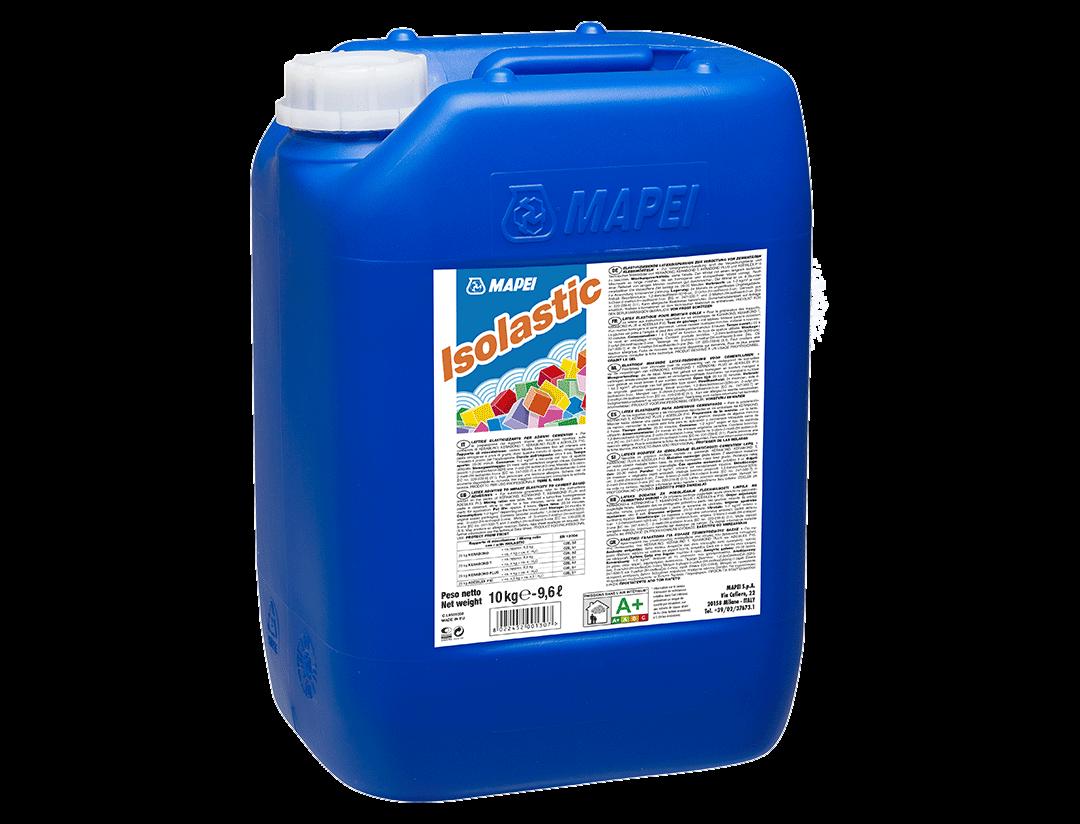
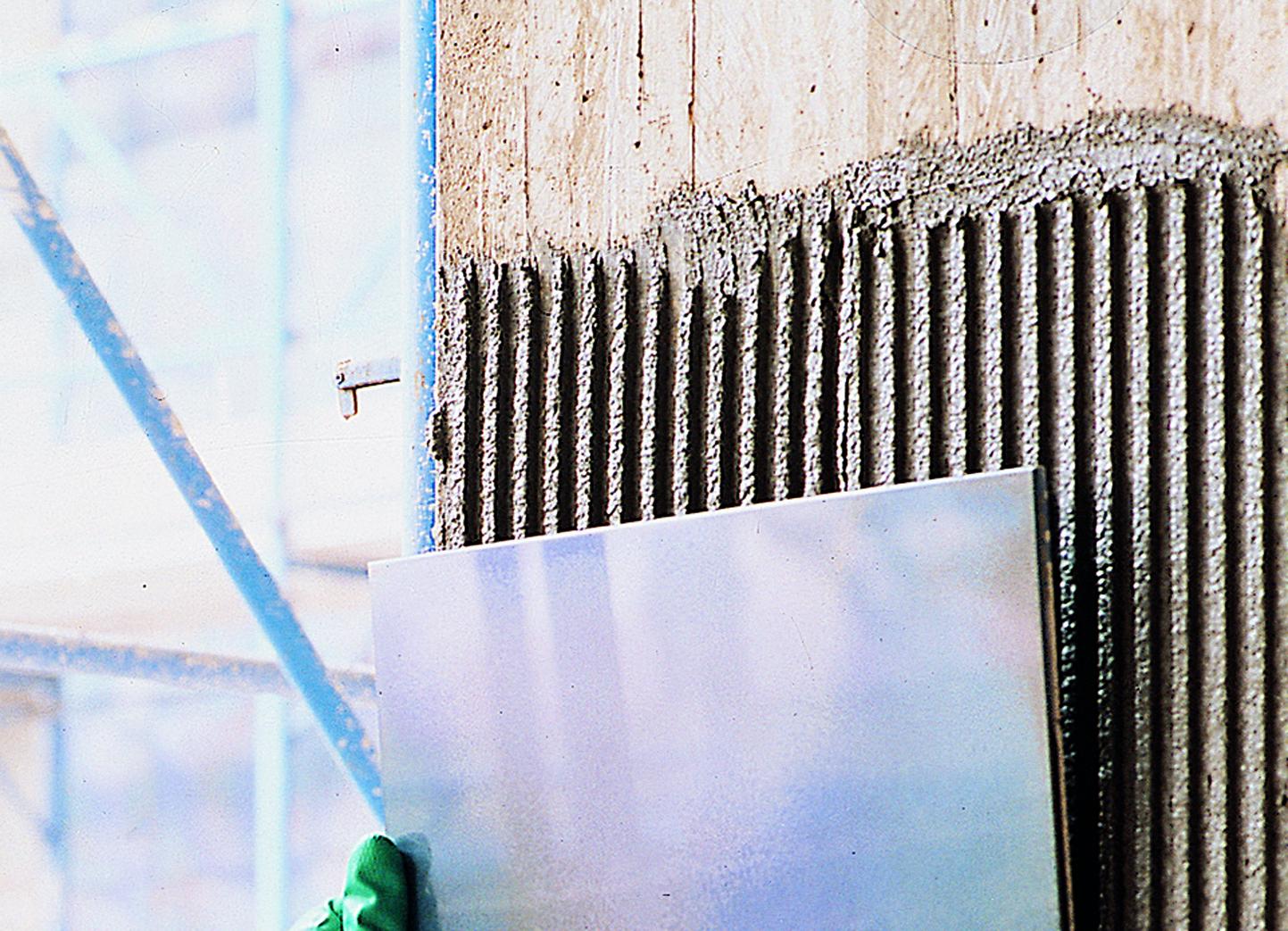
Isolastic is a type of latex mixed with Kerabond, Kerabond T, Kerabond Plus and Adesilex P10, undiluted or diluted 1 : 1 with water, in order to meet the requirements dened in EN 12004 for the following classications:
Product
Classication according to EN 12004
Kerabond + Isolastic C2ES2
Kerabond + Isolastic diluted 1:1 with water C2ES1
Kerabond T + Isolastic C2ES2
Kerabond T + Isolastic diluted 1:1 with water
C2ES1
Kerabond Plus + Isolastic C2ES2
Kerabond Plus + Isolastic diluted 1:1 with water
C2ES1
Adesilex P10 + Isolastic diluted 1:1 with water C2ES1
WHERE TO USE
Description
High-performance, highly deformable cementitious adhesive with extended open time
High-performance, deformable cementitious adhesive with extended open time
High-performance, highly deformable cementitious adhesive with extended open time
High-performance, deformable cementitious adhesive with extended open time
High-performance, highly deformable cementitious adhesive with extended open time
High-performance, deformable cementitious adhesive with extended open time
High-performance, deformable cementitious adhesive with extended open time
ISOLASTIC + KERABOND, KERABOND T and KERABOND PLUS
For interior and exterior bonding of: ceramic tiles of every type (double red, single red, grès, klinker, glass mosaic, porcelain tiles, etc ); stone material as long as it is dimensionally stable.
ISOLASTIC DILUTED 1 : 1 WITH WATER + ADESILEX P10
Bonding on internal and external oors or vertical surfaces of glass or ceramic mosaic on paper or mesh backings, even heavy ones
Some application examples
ISOLASTIC + KERABOND, KERABOND T or KERABOND PLUS
· Ceramic tiles over underoor heating installations
Ceramic tiles and stone material for exteriors (swimming pools, balconies, terraces)
All types of ceramic tiles, including slim tiles, on façades
Ceramic tiles on precast concrete walls (load-bearing panels, precast bathrooms, walls in “tunnel” systems, etc )
Ceramic tiles on old ooring (ceramic, marble, terrazzo, wood, etc )
Ceramic tiles on asphalt screeds or substrates
· Ceramic tiles on deformable substrates (gypsum-board panels, reinforced concrete, bre-cement board, etc )
Large-sized tiles
Ceramic tiles on surfaces waterproofed with products from the Mapelastic range
ISOLASTIC DILUTED 1 : 1 WITH WATER + ADESILEX P10
Laying glass or ceramic mosaic on non-absorbent surfaces (Mapelastic, Mapegum WPS, tiles, etc )
Laying glass or ceramic mosaic in swimming pools, storage tanks, etc , even on absorbent surfaces
Laying glass or ceramic mosaic on deformable surfaces (plasterboard panels, reinforced cement, cement bre, wood or derived materials, provided they are well fastened)
TECHNICAL CHARACTERISTICS
Isolastic is a very uid, pinkish-white liquid composed of a water dispersion of an extremely elastic polymer, which, when mixed with cementitious adhesives, improves adhesion to all substrates, deformability and impermeability, once hydration has taken place
RECOMMENDATIONS
Kerabond, Kerabond T, Kerabond Plus or Adesilex P10 mixed with Isolastic must never be used for: installing stone slabs subject to moisture movement; installing marble or natural stone subject to eforescence or staining from moisture; installing tiles in reservoirs, swimming pools or refrigeration rooms that need to be put into service quickly; installation on metal, rubber, PVC, and linoleum surfaces; · at temperatures lower than +5°C or higher than +40°C In dry, hot climates, the open time of the adhesive made by mixing Isolastic into Kerabond, Kerabond T, Kerabond Plus or Adesilex P10 is shorter. A skin may form on the surface, which must then be removed and fresh adhesive applied.
APPLICATION PROCEDURE
Preparing the substrates
All substrates receiving Kerabond, Kerabond T, Kerabond Plus or Adesilex P10 + Isolastic must be at, mechanically strong, free from loose parts, grease, oil, paint, wax, etc. Precast concrete elements or in situ concrete must be cured for at least 3 months in favourable weather conditions Cementitious substrates must not be subject to shrinkage once the tiles have been installed, therefore in warm weather renders should be cured at least one week per centimetre of thickness. Cementitious screeds must have an overall cure of at least 28 days unless they have been made with the special MAPEI binders for screeds such as Mapecem, Mapecem Pronto, Topcem or Topcem Pronto Surfaces that are too hot due to exposure to direct sunlight should be cooled by dampening them with water Gypsum substrates and anhydrite screeds must be perfectly dry (maximum residual humidity 0.5%, 0.3% in case of heated screeds) sufciently hard and free from dust They must always be treated with Primer G or Eco Prim T Areas subject to extreme damp must be primed with Primer S On existing oors, remove any traces of grease, wax, dirt, etc by using specic products or by abrading the surface with a power tool
As a general rule, refer to the relative MAPEI technical documentation about substrate preparation before repairing cracks in substrates, consolidating rapid-drying screeds and levelling off installation surfaces
Mixing ratio
The mixing ratio is determinated by the degree of deformability required of the adhesive: use Isolastic as a complete substitute for water when a highly deformable adhesive (class S2 according to EN 12004) is required, e g for substrates subject to strong size variations such as concrete structures with less than 6 months curing, for large-sized tiles or slabs or for those subject to considerable sudden temperature changes.
Isolastic diluted 1 : 1 with water may be used when a deformable adhesive is required (class S1 according to EN 12004), for example on moderately unstable substrates, cured concrete substrates, etc
Mixing ratios:
Product
Kerabond + Isolastic
Kerabond + Isolastic diluted 1 : 1 with water
Kerabond T + Isolastic
Mixing ratio
Parts in weight Kg
Kerabond : Isolastic = 100 : 33 8 5 kg of Isolastic per 25 kg bag of Kerabond
Kerabond : Isolastic : water = 100 : 16 : 16 4 kg of Isolastic + 4 kg of water per 25 kg bag of Kerabond
Kerabond T : Isolastic = 100 : 33 8.5 kg of Isolastic per 25 kg bag of Kerabond T
Kerabond T + Isolastic diluted 1 : 1 with water
Kerabond Plus + Isolastic
Kerabond Plus + Isolastic diluted 1 : 1 with water
Adesilex P10 + Isolastic diluted 1 : 1 with water
Preparing the mix
Kerabond T : Isolastic : water = 100 : 16 : 16
4 kg of Isolastic + 4 kg of water per 25 kg bag of Kerabond T
Kerabond Plus : Isolastic = 100 : 33 8 5 kg of Isolastic per 25 kg bag of Kerabond Plus
Kerabond Plus : Isolastic : water = 100 : 16 : 16
Adesilex P10 : Isolastic : water = 100 : 18 : 18
4 kg of Isolastic + 4 kg of water per 25 kg bag of Kerabond Plus
4 5 kg of Isolastic + 4 5 kg of water per 25 kg bag of Adesilex P10
When Isolastic is used in dilution with water, thoroughly blend part of Isolastic with a small amount of clean water rst Pour the powder into the liquid and continuously stir the mix with a slow-speed mechanical mixer until it becomes a smooth paste free of lumps Let the mix stand for a few minutes and, after further stirring, proceed with the application
Spreading the mix
Apply the adhesive on the substrate using a notched trowel Use a trowel with a notch size which guarantees adequate buttering To get good adhesion, spread an initial thin layer of the adhesive mix on the substrate using the smooth side of the trowel, then immediately apply another layer of adhesive to the thickness required using the notched part of the trowel Use a trowel suitable for the type and format of the tiles to guarantee that the backs of the tiles are adequately buttered Use the double-buttering technique and spread the adhesive also on the back of the tiles to ensure complete wetting and the absence of gaps, in the following cases: external installations, when installing large-sized tiles, thin tiles, tiles with reliefs on their back, ooring to be polished after installation or subject to high static or dynamic loads, heated oors or storage tanks and swimming pools
Installing the tiles
Follow the recommendations shown in the technical data sheet of the adhesive with which Isolastic is mixed However, greater attention should be paid to the open time which, in the equivalent relative temperature and humidity conditions, will be slightly shorter than the open time of the basic product
GROUTING AND SEALING
Wall joints can be grouted after 4-8 hours and oor joints after 24-36 hours with the special MAPEI cementitious or epoxy grouts, available in different colours. Expansion joints must be sealed with the special MAPEI sealants
SET TO LIGHT FOOT TRAFFIC
Floors are set to light foot trafc after 24-36 hours
READY FOR USE
Surfaces are ready for use after approximately 14 days Basins and swimming pools can be lled after 4 weeks
Cleaning
Tools can be cleaned using plenty of water before the adhesive begins to set. After setting, cleaning becomes very difcult, but can be helped with a solvent such as white spirit
CONSUMPTION (kg/m²)
Mosaic and small tiles
Kerabond/Kerabond T/ Kerabond Plus + Isolastic 2-3
Kerabond/Kerabond T/ Kerabond Plus/Adesilex P10 + Isolastic diluted 1 : 1 with water
Medium-sized tiles
Large-sized tiles
Kerabond/Kerabond T/Kerabond Plus + Isolastic 4-5 1 3-1 7
Kerabond/Kerabond T/Kerabond Plus/Adesilex P10 + Isolastic diluted 1 : 1 with water 4-5 0 6-0 9 0 6-0 9
Kerabond/Kerabond T/Kerabond Plus + Isolastic > 6 > 2 –
Kerabond/Kerabond T/ Kerabond Plus/Adesilex P10 + Isolastic diluted 1 : 1 with water > 6 > 1 > 1
PACKAGING
25 and 5 kg drums and 1 kg packs
SAFETY INSTRUCTIONS FOR PREPARATION AND APPLICATION
Instructions for the safe use of our products can be found on the latest version of the Safety Data Sheet, available from our website www mapei com PRODUCT FOR PROFESSIONAL USE
TECHNICAL DATA (typical values)
Complies with the following standards: – European EN 12004 C2ES2 (Kerabond/Kerabond T/ Kerabond Plus + Isolastic) and C2ES1 (Kerabond/Kerabond T/Kerabond Plus/Adesilex P10 + Isolastic diluted 1 : 1 with water) -ISO 13007-1 C2ES2 (Kerabond/Kerabond T/ Kerabond Plus + Isolastic) and C2ES1 (Kerabond/Kerabond T/Kerabond Plus/Adesilex P10 + Isolastic diluted 1 : 1 with water)
PRODUCT IDENTITY
Consistency: uid liquid
Colour: pinkish white
Dry solids content (%):
Brookeld viscosity (mPa·s): 40
EMICODE: EC1 Plus - very low emission
APPLICATION DATA (at +23°C - 50% R.H.)
Mixing ratio:
Kerabond or Kerabond Plus or Kerabond T + Isolastic
100 : 33
Adesilex P10 + Isolastic diluted 1 : 1
100 : 36 (18 parts of water and 18 parts of Isolastic)
Consistency of mix: very pasty very creamy
Colour: grey/white
pH of mix: over 12
Pot life: 8 hours
Application temperature range: from +5°C to +40°C
Open time: 20-30 minutes 30 minutes
Adjustability time: approx 45 minutes 45 minutes
Grouting wall joints: after 4-8 hours after 4-8 hours
Grouting oor joints: after 24 hours after 24 hours
Set to light foot trafc: 24
Ready for use: 14 days 14 days
FINAL PERFORMANCE
Tensile adhesion strength (N/mm²): – initial (after 28 days):
– after heating: – after water immersion: – after freezethaw cycles:
Kerabond or Kerabond Plus or Kerabond T + Isolastic
Resistance to alkalis: excellent
Resistance to oils: excellent (poor to vegetable oils)
Resistance to solvents: excellent
Temperature when in use: from –30°C to +90°C
Deformability according to EN 12004: >
WARNING
Adesilex P10 + Isolastic diluted 1 : 1
Although the technical details and recommendations contained in this product data sheet correspond to the best of our knowledge and experience, all the above information must, in every case, be taken as merely indicative and subject to conrmation after long-term practical application; for this reason, anyone who intends to use the product must ensure beforehand that it is suitable for the envisaged application In every case, the user alone is fully responsible for any consequences deriving from the use of the product
Please refer to the current version of the Technical Data Sheet, available from our website www.mapei.com
LEGAL NOTICE
The contents of this Technical Data Sheet (“TDS”) may be copied into another project-related document, but the resulting document shall not supplement or replace requirements per the TDS in force at the time of the MAPEI product installation.
The most up-to-date TDS can be downloaded from our website www mapei com ANY ALTERATION TO THE WORDING OR REQUIREMENTS CONTAINED OR DERIVED FROM THIS TDS EXCLUDES THE RESPONSIBILITY OF MAPEI.
STORAGE
Isolastic can be stored for 24 months in the original packing Protect from frost

112-11-2020-gb
Any reproduction of texts, photos and illustrations published here is prohibited and subject to prosecution