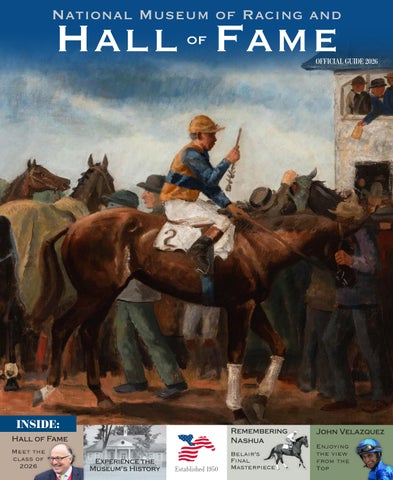
National Museum of Racing and
Hall Fame OF
OFFICIAL GUIDE 2026
INSIDE:
Remembering Nashua
Hall of Fame Meet the class of 2026
Experience the Museum's History
Established 1950
Belair's Final Masterpiece
John Velazquez Enjoying the view from the Top
THE CUP IS
Fresh air. Bluegrass. Dozens of contenders charging toward glory. Witness unforgettable moments at the World Championships in a city where Thoroughbred heritage runs deep.
LIMITED TICKETS REMAIN BreedersCup.com/Tickets
KEENELAND L E X I N G TO N , K Y 3
O CTO B E R 3 0 - 31
NATIONAL MUSEUM OF RACING AND HALL OF FAME 2026 OFFICIAL GUIDE
2026
We are proud to extend congratulations to all of the Hall of Fame inductees. Thank you for all that you do to support the equine industry.
2026 INDUCTEES HORSES Gulch Mongo Kona Gold TRAINER Christophe Clement John A. Shirreffs David A. Whiteley
PILLARS OF THE TURF Prince Khalid bin Abdullah Dr. Robert Copelan Seth W. Hancock G. Watts Humphrey, Jr. Joseph E. Widener
AdirondackTrust.com
INVESTMENT AND INSURANCE PRODUCTS ARE: NOT FDIC INSURED, NOT A DEPOSIT, NOT BANK GUARANTEED, NOT INSURED BY ANY FEDERAL OR STATE GOVERNMENT AGENCY, MAY GO DOWN IN VALUE.
Amsureins.com
Adirondack Trust Company
5
NATIONAL MUSEUM OF RACING AND HALL OF FAME 2026 OFFICIAL GUIDE
2026
National Museum of Racing and
Hall Fame of
Executive Editor: Brien Bouyea Creative Director: Debi Gustafson Contributing Editor: Michael Veitch Writers: Brien Bouyea, Jennifer Kelly, Joe Raucci, Nicole Russo Advertising: Brien Bouyea, Cate Masterson, Aidan Shephard
National Museum of Racing and Hall of Fame 191 Union Avenue Saratoga Springs, NY 12866 (518) 584-0400 racingmuseum.org
Museum Staff Cate Masterson, Director Brien Bouyea, Hall of Fame and Communications Director Madeleine Egger, Development and Membership Manager Nick Goulet, Facilities Manager Debi Gustafson, Graphic Designer and Photographer Cathi Jackson, Office Manager Leanza Kopa, Education Program Coordinator Maureen Pasco, Development Director Jennifer Rickman, Operations Manager Eric Ross, Museum Educator Aidan Shephard, Advertising, Marketing and Social Media Manager Michael Veitch, Museum Historian
Board of Trustees Officers Charlotte C. Weber, Chair Louis A. Cella, Vice Chair Gretchen Jackson, Vice Chair Debby Oxley, Vice Chair Richard Palmer, Vice Chair Mike Rogers, Vice Chair Beverly R. Steinman, Vice Chair George Strawbridge, Vice Chair Stella F. Thayer, Vice Chair Lisa Troutt, Vice Chair Jeffrey Amling, Treasurer Walter Borisenok, Secretary Museum Trustees Shannon Arvin, H. Christopher Boehning, Ramon Dominguez, Tom Durkin, C. Kenneth Grayson, Mary Jane Hunt, Elizabeth Loftus-Imperio, Sarah Jeffords, Susan Naylor, David O’Rourke, Andrew Richards, Charles V. Wait, Aron Wellman Advisory Trustees Chris Baker, Barbara Banke, Charles J. Cella, Julia Chlopecki, Joe Clancy, Robert N. Clay, Richard C. Colton, Donald R. Dizney, Bob Edwards, William S. Farish, Terrence Finley, Aaron T. Gryder, Dell Hancock, A. Douglas Henderson, G. D. Hieronymus, Maureen Lewi, Cathleen T. Marino, Leverett Miller, Penelope Miller, Charles Noell, Josh Pons, Charlotte Radcliffe, Sarge Reynolds, Suart Siegel, Daniel G. Van Clief, Carolyn Wilson 6
NATIONAL MUSEUM OF RACING AND HALL OF FAME 2026 OFFICIAL GUIDE
2026
Gambling Problem? Call 1-800-GAMBLER
JOIN THE FUN! LIVE RACING
NOV 27, 2026 THRU MAY 1, 2027 Oaklawn.com for Details 7
NATIONAL MUSEUM OF RACING AND HALL OF FAME 2026 OFFICIAL GUIDE
2026
UHY brings a winning mindset to your business. From tax strategy to advisory services, we help you stay ahead by navigating every turn with confidence. • Audit & assurance • Backoffice transformation • Business valuation • Consulting • Cybersecurity
• Estate planning • Mergers & acquisitions • Tax compliance • Tax planning • Tax structuring
9
NATIONAL MUSEUM OF RACING AND HALL OF FAME 2026 OFFICIAL GUIDE
2026
10
NATIONAL MUSEUM OF RACING AND HALL OF FAME 2026 OFFICIAL GUIDE
2026
TABLE OF CONTENTS 20 Welcome to the National Museum of Racing and Hall of Fame 28 History of the National Museum of Racing and Hall of Fame 36 Hall of Fame Horses Roster 44 Hall of Fame Jockeys Roster 48 Hall of Fame Trainers Roster 52 Hall of Fame Pillars of the Turf Roster 56 Hall of Fame Class of 2026: Christophe Clement 64 Hall of Fame Class of 2026: John A. Shirreffs 72 Hall of Fame Class of 2026: David A. Whiteley 78 Hall of Fame Class of 2026: Gulch 82 Hall of Fame Class of 2026: Kona Gold 88 Hall of Fame Class of 2026: Mongo 94 Hall of Fame Class of 2026: Prince Khalid bin Abdullah 100 Hall of Fame Class of 2026: Dr. Robert Copelan 106 Hall of Fame Class of 2026: Seth W. Hancock ON THE COVER 112 Hall of Fame Class of 2026: G. Watts Humphrey, Jr. 118 Hall of Fame Class of 2026: Joseph E. Widener 124 Hall of Fame Profile: John Velazquez, Class of 2012 132 Hall of Fame Profile: Tod Sloan, Class of 1955 138 Hall of Fame Profile: Nashua, Class of 1965 146 Hall of Fame Profile: Kingston, Class of 1955 Saluting the Stewards By Lee Townsend Oil on canvas Current special exhibitions 152 Gift of Robert Spiegel 1983.3.1 Photo Finish: Selections from the Museum’s 154 2025 juried photo exhibition BY BRIEN BOUYEA
BY BRIEN BOUYEA
BY JENNIFER KELLY
BY BRIEN BOUYEA
BY BRIEN BOUYEA BY BRIEN BOUYEA
BY BRIEN BOUYEA
BY BRIEN BOUYEA
BY BRIEN BOUYEA
BY BRIEN BOUYEA
BY JENNIFER KELLY
BY BRIEN BOUYEA
BY NICOLE RUSSO
BY BRIEN BOUYEA
BY JOE RAUCCI
BY BRIEN BOUYEA
racingmuseum.org
NATIONAL MUSEUM OF RACING AND HALL OF FAME 2026 OFFICIAL GUIDE
11
13
NATIONAL MUSEUM OF RACING AND HALL OF FAME 2026 OFFICIAL GUIDE
2026
W E L C O M E T O T H E N AT I O N A L M U S E U M O F R A C I N G A N D H A L L O F FA M E
L
ocated in Saratoga Springs, New York, home of historic Saratoga Race Course, the National Museum of Racing and Hall of Fame has chronicled and promoted the rich history of thoroughbred racing for more than 75 years. Established in 1950, the Museum was initially housed within the Canfield Casino in Congress Park before moving to its permanent home on Union Avenue in 1955. Throughout its history, the Museum has preserved and interpreted the full spectrum of thoroughbred racing in America and honored the sport’s greatest achievers with racing’s most
14
coveted and prestigious honor — enshrinement in the Hall of Fame. The Museum features arguably the world’s finest collection of equine art, numerous comprehensive historical exhibits emphasizing prestigious trophies and artifacts, and a variety of interactive displays that convey the excitement of thoroughbred racing and educate fans of all ages. A state-of-the-art Hall of Fame featuring the immersive signature film “What It Takes: Journey to the Hall of Fame” opened to the public in 2020. As of Hall of Fame Induction Day 2026, the Museum’s Hall
NATIONAL MUSEUM OF RACING AND HALL OF FAME 2026 OFFICIAL GUIDE
2026
The Doncaster Gold Cup, 1828 John Frederick Herring, Sr. (British, 1795-1865) Oil on canvas, 1828 Charles H. Thieriot Collection 2000.104.5
of Fame Gallery includes the interactive plaques and details the tremendous accomplishments of 233 thoroughbreds, 112 jockeys, 105 trainers, and 55 Pillars of the Turf. This year, the Hall of Fame will induct the racehorses Gulch, Kona Gold, and Mongo; trainers Christophe Clement, John A. Shirreffs, and David A. Whiteley; and Pillars of the Turf Prince Khalid bin Abdullah, Dr. Robert Copelan, Seth W. Hancock, G. Watts Humphrey, Jr., and Joseph E. Widener. The 2026 induction ceremony will be held at the Fasig-Tipton Sales Pavilion on Friday, Aug. 7. For more information on the racingmuseum.org
ceremony, please visit racingmuseum.org. We also invite you to experience the Museum’s newest exhibitions: Racing at the Dawn of the United States (Link Gallery, through December 2026); A Discerning Eye: The Art of Sir Alfred Munnings (selections from a private collection, von Stade Gallery, through Sept. 13, 2026); and Capturing and Preserving Greatness: A Life’s Passion — The Photography and Historic Collections of Barbara D. Livingston, presented by Daily Racing Form (Peter McBean Gallery, through December 2026). We look forward to seeing you at the Museum.
NATIONAL MUSEUM OF RACING AND HALL OF FAME 2026 OFFICIAL GUIDE
15
We Honor the Pillars of the Turf. We are proud that four of the newly elected Pillars were also honored by the Thoroughbred Club at its annual Testimonial dinner.
Joseph E. Widener – 1933 –
Seth Hancock
Dr. Robert Copelan
G. Watts Humphrey, Jr.
Bill Straus photo
Bill Straus photo
Bill Straus photo
– 2000 –
– 2007 –
The Thoroughbred Club of America
3555 Rice Road | Lexington, KY 40510 | 859.254.4282 | thethoroughbredclub.com
– 2017 –
MEMORIES THAT LAST A LIFETIME partners, we experience “AstheCentennial thrills of racing with a great team and wonderful people. ”
– Peter Horvitz, Margaret O’Meara, and the Horvitz family PARTNERS SINCE 1988
“Thanks to Centennial Farms’ partnerships
for allowing me to participate in horse racing at its highest level successfully for over a decade.
”
– Tony Coppola
PARTNER SINCE 2008
do we invest in every Centennial horse? We “Why trust the team to allow us and a small group of like-minded partners to actively participate with a chance for a thrill of a lifetime!
”
– Jeff and Diane Campbell PARTNERS SINCE 2017
Farms….racing with integrity. “Centennial Transforming dreams into reality. ”
– Tom and Kathleen Carr PARTNERS SINCE 2018
G1 Stakes Winner ANTIQUARIAN ➤
Exciting Opportunities Currently Available
17
Thoroughbred Partnerships For Over 40 Years Donald V. Little Jr., President (617) 816-0153 centennialfarms.com NATIONAL MUSEUM OF RACING AND HALL OF FAME 2026 OFFICIAL GUIDE
2026
THOROUGHBRED BREEDING FARM | RACING STABLE | WINERY | DISTILLERY | FLOWER FARM
Founded in 2016 and inspired by the 1800s tavern that once graced the property, Old Tavern Farm is a boutique thoroughbred breeding farm overlooking Saratoga Lake, on the former site of Palmer’s Maple Shade Farm. Now a thriving winery, distillery, and flower farm too, we are committed to our responsibility as stewards and storytellers, in honoring our land and its history, and continuing its legacy through an unwavering respect to craft. We welcome you to celebrate these stories with us, and hope you’ll join us in writing the next chapter.
www.oldtavernfarms.com
@OLDTAVFARM
@oldtavernfarmwinery
@oldtavernfarmdistillery
@oldtavernFLOWERFARM
O L D TAV E R N F L O W E R FA R M OFFERING F RE SH C U T AR R A N G E ME NTS FLO R AL WO R KSH O P S S EA S O NAL S U B S CR IP TIO NS H A ND M AD E G IF TS A ND M O R E
LEAR N M ORE , A ND VIEW UP CO MIN G WORKSHOP S & EV E NTS AT
O LDTAVE R N FA R M S .com
Offering private events and tastings on our farm, flower patio, and at The Granary, our distillery tasting room. Visit OldTavernFarms.com to join the wine club, and to buy our latest vintages, special releases and more!
Custom Made Aerodynamic Jockey Silks Cut and Sewn in Saratoga Springs
HIGH QUALITY. FAST TURNAROUND. info@saratogasilksco.com 518.587.4046
THE GRANARY, OUR RICK HOUSE AND TASTING ROOM, IS NOW OPEN WEEKLY FOR WHISKEY TASTINGS AND MORE!
SARATOGASILKSCO.com
VISIT OLDTAVERNFARMS.COM FOR HOURS & INFO.
H I S T O RY O F T H E N AT I O N A L M U S E U M O F R A C I N G A N D H A L L O F FA M E
RACING’S GRAND SHOWCASE The National Museum of Racing and Hall of Fame has been preserving American racing’s remarkable history since 1950 By Brien Bouyea
Hall of Fame and Communications Director
T
horoughbred racing in America experienced a banner year in 1950. Some of the sport’s most significant headlines occurred during the Triple Crown series that spring with King Ranch’s Middleground sandwiching victories in the Kentucky Derby and Belmont Stakes around an impressive Preakness Stakes win by Horse of the Year and future Hall of Fame inductee Hill Prince. Middleground’s classic victories were accentuated by the remarkable story of his jockey, a 16-year-old 20
apprentice named Bill Boland, who also won that year’s Kentucky Oaks to kick off his Hall of Fame career. Meanwhile, in Saratoga Springs, New York, plans were being conceptualized for a national site to permanently exhibit and honor the grand history of American racing — a Cooperstown for the thoroughbred sport. Led by Cornelius Vanderbilt Whitney, a group of prominent
NATIONAL MUSEUM OF RACING AND HALL OF FAME 2026 OFFICIAL GUIDE
2026
A SketchFold of the National Museum of Racing and Hall of Fame, ca. 1950s
racing leaders developed a game plan for what became the National Museum of Racing. The Museum’s location of Saratoga Springs — home of the oldest active thoroughbred racetrack in America both then and now — proved to be an ideal setting. The following summer, amid a great deal of fanfare, the Museum made its public debut in a temporary location at the Canfield Casino in Congress Park on Aug. 6, 1951. Whitney was voted the Museum’s first president. racingmuseum.org
“The long-range purpose,” Whitney said at the opening in the famous old casino, originally opened by Saratoga racing founder John Morrissey in 1870, “is to build a permanent home for the important memorabilia for the sport whose beginnings in this country antedate by 100 years or more the United States of America.” Joining Whitney in the founding group that signed the charter
NATIONAL MUSEUM OF RACING AND HALL OF FAME 2026 OFFICIAL GUIDE
21
Above: Museum scenes, ca. 1950s.
22
NATIONAL MUSEUM OF RACING AND HALL OF FAME 2026 OFFICIAL GUIDE
2026
Above: Ground was broken on the Museum’s Union Avenue home in Saratoga Springs, New York, in November 1954, and the cornerstone was laid the following April.
for the Museum were Carleton F. Burke, Kenneth K. Burke, John C. Clark, Nelson Dunstan, Donald P. Ross, F. Skiddy von Stade, John Hay Whitney, and George D. Widener, Jr. Also recognized as organizers of the Museum were Francis Dorsey, Spencer Eddy, Howell E. Jackson, Walter M. Jeffords, Robert F. Kelley, Paul Kerr, Addison Mallery, Denis Mansfield, Dr. Charles H. Strub, and Bryce Wing. The first gift for the Museum project was $5,000 from the Saratoga Association, which owned and operated Saratoga Race Course. Harold O. Vosburgh, a steward for the Saratoga Association, donated the first piece of memorabilia, a shoe from
racingmuseum.org
the legendary horse Lexington. The National Museum of Racing was popular from the beginning. During its first year at the Canfield Casino in 1951, the Museum attracted more than 8,000 visitors. At the end of 1952, the register showed 11,500 names. When it was announced the Museum would move out of its original quarters in the Canfield Casino into a structure being built specifically to house it, a Saratoga citizen, James E. Benton, applauded. He sparked some of the impetus toward a Hall of Fame with a letter to journalists Nelson Dunstan and Gene Ward. He made an eloquent plea, noting that some aspects of Saratoga
NATIONAL MUSEUM OF RACING AND HALL OF FAME 2026 OFFICIAL GUIDE
23
Above: Hall of Fame jockeys Eddie Arcaro, left, and Ted Atkinson view a painting of Sun Beau with New York Gov. Averell Harriman at the Museum in 1956.
were changing — the demise of the Grand Union and United States hotels, for example — but that tradition was an important part of the area and for racing on a national level. “If a board of turf writers, for instance, were to elect annually to the Hall of Fame one or more jockeys, horses, or trainers, it would be of national importance,” Benton wrote. “An annual special award would be coveted.” Jeffords, who succeeded Whitney as the Museum’s president, announced the new building would, indeed, include a Hall of Fame. The Museum board had passed the following: “Resolved that the National Museum of Racing create and be custodian of racing’s Hall of Fame and its president be empowered to appoint a committee whose duties it will be to recommend to the board of trustees ways and means of selecting candidates.” Given that thoroughbred racing had been a part of life in America since the colonial days, a bit of catching up was needed. It was decided that the first group of Hall of Fame inductees would be comprised of horses which had raced prior to 1900 and racingmuseum.org
jockeys and trainers who were no longer active. The inaugural class of inductees in 1955 included the horses Ben Brush, Boston, Domino, Hanover, Hindoo, Kingston, Lexington, Salvator, and Sir Archy; jockeys Laverne Fator, Edward Garrison, Danny Maher, James McLaughlin, Walter Miller, Isaac Murphy, George Odom, Earl Sande, Tod Sloan, Fred Taral, Nash Turner, and George Woolf; and trainers William P. Burch, Thomas Healey, Sam Hildreth, A. J. Joyner, John Rogers, and James Rowe, Sr. Ground was broken for the Museum’s permanent home in late November 1954. The following August, as construction of the new facility moved along briskly, New York Gov. W. Averell Harriman presided over the institution’s formal dedication during the Saratoga racing season. “Racing must remain as a sport,” Gov. Harriman said to the large crowd gathered along Union Avenue, “and not as a commercial enterprise. We must maintain the traditions of racing, and Saratoga is rich in such traditions.”
NATIONAL MUSEUM OF RACING AND HALL OF FAME 2026 OFFICIAL GUIDE
25
McMahon of Saratoga Thoroughbreds Celebrating of Equine Excellence
Over50Years Standing
CENTRAL BANKER PROVOCATEUR SHOWCASE SOLOMINI McMahon of Saratoga Thoroughbreds, LLC 180 Fitch Rd Saratoga Springs, NY 12866 Ph: 518-587-3426 | www.mcmahonthoroughbreds.com Inquiries to: john@mcmahonthoroughbreds.com | John 518-376-2924 or Jane 518-693-2218
Above: Guests view an exhibit during the 1950s, when the National Museum of Racing was temporarily housed in the Canfield Casino.
The new National Museum of Racing and Hall of Fame opened to the public on June 2, 1956. New York City architect Augustus Noel designed the building. The New York Times’ report on the dedication said the building cost $300,000. In 1957, the first addition, called the Patrons of the Turf Gallery, was completed. More expansion followed. A third wing was added in 1979 and became the home of the Hall of Fame.
diversified set of galleries and was open only during the summer. The Museum then began evolving into a professionally managed institution. The Board of Trustees raised $6.4 million and hired an English design team experienced with thoroughbred racing to completely renovate the building and develop historical galleries covering three centuries of racing in America. The renovation took 10 months, and the building reopened on July 14, 1988.
Until the mid-l980s, the Museum functioned primarily as a
Between 1999 and 2000, a major renovation and a 10,000
racingmuseum.org
NATIONAL MUSEUM OF RACING AND HALL OF FAME 2026 OFFICIAL GUIDE
27
For more than 50 years, the New York Thoroughbred Breeding and Development Fund has been using monetary incentives to promote the responsible breeding of quality
Thoroughbred racehorses, in keeping with the founding legislation to preserve New York’s irreplaceable farmland. Our state-wide program has strong ties to the Saratoga community. “We are proud to honor racing’s finest as they are recognized for their industry achievements, and invite breeders and owners to get with the best program by buying, breeding and racing registered NY-breds.” - Tracy Egan, Executive Director NYTBDF
For more information on becoming an owner or breeder of a NY-bred racehorse visit our website or call 518.886-1013.
Above: Located on Union Avenue in Saratoga Springs, New York, the National Museum of Racing and Hall of Fame celebrated its 75th anniversary in 2025.
square-foot expansion of the physical plant costing $18 million improved collections storage and created a changing exhibition space, a curatorial workroom, and a children’s gallery. The storyline of the semi-permanent historical galleries also expanded to include 20th century history and current events in racing. Extensive audio and video presentations, as well as interactive exhibits for all ages, were added throughout the Museum. The expansion pushed the Museum’s footprint to more than 45,000 square feet. The Museum has evolved with the times while staying true to its core concepts — preserving and promoting the history of thoroughbred racing in America and honoring its most accomplished participants with induction into the Hall of Fame. Another major project was completed in 2020, when a dynamic new Hall of Fame and RaceDay Gallery opened to the public. The modernized Hall of Fame includes the immersive signature film “What It Takes: Journey to the Hall of Fame,” which is narrated racingmuseum.org
by iconic broadcaster Bob Costas. The reimagined Hall also features state-of-the-art interactive plaques for every Hall of Fame inductee that include a variety of multimedia content. The Museum has benefitted from outstanding leadership since its inception. C. V. Whitney served as the institution’s first president from 1950 to 1953. He was followed by Jeffords, 1953 to 1960; Widener, 1960 to 1968; John W. Hanes, 1968 to 1970; Gerard S. Smith, 1970 to 1974; Charles E. Mather II, 1974 to 1982; Whitney Tower, 1982 to 1989; John T. von Stade, 1989 to 2005; Stella F. Thayer, 2005 to 2014; Gretchen Jackson, 2014 to 2017; John F. Hendrickson, 2017 to 2024; and Charlotte C. Weber, 2024 to present. The reimagined Hall of Fame has been one of many areas in which the Museum has evolved in the 21st century, including many major exhibitions that have drawn fans from around the world. The unique horse racing simulator was developed and opened to the public in 2006; a new interactive Steeplechase Gallery opened
NATIONAL MUSEUM OF RACING AND HALL OF FAME 2026 OFFICIAL GUIDE
29
30
NATIONAL MUSEUM OF RACING AND HALL OF FAME 2026 OFFICIAL GUIDE
2026
Above: The Museum underwent a significant renovation in 2020, including the installation of an interactive Hall of Fame (top) and a reconfigured and reimagined Race Day Gallery (above).
in 2012; the Museum celebrated 150 years of racing at Saratoga with a two-year exhibit that opened in June 2013; in 2016, the Museum opened the Edward P. Evans Gallery, which displays some of the most coveted and prestigious trophies in the history of racing; in 2018, the Museum unveiled its renovated interior courtyard, named in honor of C. V. Whitney; in 2023, the Museum celebrated the 50th anniversary of Secretariat’s Triple Crown sweep with both traveling and on-site exhibitions; and a variety
racingmuseum.org
of special exhibitions and commemorative events highlighted the Museum’s 75th anniversary celebration throughout 2025. Now in its eighth decade — with a state-of-the-art Hall of Fame centerpiece experience to inspire current racing fans and cultivate new ones — the National Museum of Racing and Hall of Fame continues to thrive as a dynamic and integral part of the sport it celebrates. — Edward L. Bowen contributed to this article
NATIONAL MUSEUM OF RACING AND HALL OF FAME 2026 OFFICIAL GUIDE
31
November through May,
We Race!
Tampa Bay Downs is where Florida’s Gulf Coast comes alive with thrilling entertainment and world-class Thoroughbred racing. Experience the excitement of one of North America’s top winter racing destinations as elite horses thunder down the track in pursuit of victory. Join us Saturday, March 6 for the prestigious Grade II, ESMARK Tampa Bay Derby— our signature racing event and a proven stepping stone to greatness, producing Kentucky Derby champions Street Sense and Super Saver. From heart-pounding finishes to unforgettable race-day energy, Tampa Bay Downs delivers excitement for every fan. General admission is FREE every Wednesday, and just $3 on Fridays, Saturdays, and Sundays.
Live it up at the Downs! R • KE O P
RACING • G OL F
EST. 1926
11225 Race Track Rd., Tampa, FL 33626 • 813-855-4401 • www.tampabaydowns.com 26-0119
COMMITTED TO YOUR SUCCESS
STALLIONS | BOARDING | SALES | TOURS
lanesend.com | t: 859.873.7300
Hall Fame OF
Hall of Fame Horses
Pages 36-43
34
Hall of Fame Jockeys
Pages 44-47
NATIONAL MUSEUM OF RACING AND HALL OF FAME 2026 OFFICIAL GUIDE
2026
INDUCTEE ROSTERS Hall of Fame Trainers
Hall of Fame Pillars of the Turf
Pages 52-53
With the induction of 11 new members in 2026, the National Museum of Racing’s Hall of Fame now includes 233 thoroughbreds, 112 jockeys, 105 trainers, and 55 Pillars of the Turf. They are the immortals of the sport, the best of the best. Their achievements and impact on the game are both rare and timeless. Pages 48-51
racingmuseum.org
NATIONAL MUSEUM OF RACING AND HALL OF FAME 2026 OFFICIAL GUIDE
35
Hall Fame OF
HORSES Boston
Aristides HORSE
Lecomte
Kentucky
GENDER
FOALED
CAREER DATES
STARTS
FIRST
SECOND
THIRD
EARNINGS
INDUCTED
Sir Archy (VA)
M
1805
1808-1809
8
5
1
1
N/A
1955
American Eclipse (NY)
M
1814
1818-1823
8
8
0
0
$25,000
1970
$51,700
1955
Foaled Prior to 1870 (13)
Boston (VA)
M
1833
1836-1843
45
40
2
1
Fashion (NJ)
F
1837
1840-1848
36
32
4
0
$41,500
1980
Lecomte (KY)
M
1850
1852-1857
17
11
4
1
$12,360
2024
Lexington (KY)
M
1850
1853-1854
7
6
1
0
$56,600
1955
Planet (VA)
M
1855
1858-1861
31
27
4
0
$69,700
2012
Kentucky (KY)
M
1861
1863-1866
22
21
0
0
$33,700
1983
Ruthless (NY)
F
1864
1866-1867
11
7
4
0
$11,000
1975
Longfellow (KY)
M
1867
1870-1872
16
13
2
0
$11,200
1971
Preakness (KY)
M
1867
1870-1876
39
18
12
2
$39,820
2018
Harry Bassett (KY)
M
1868
1870-1874
36
23
5
3
$55,920
2010
Aristides (KY)
M
1872
1874-1878
21
9
5
1
$18,325
2024
Tom Bowling (KY)
M
1870
1872-1874
17
14
3
0
$36,350
2020
Ten Broeck (KY)
M
1872
1874-1878
30
23
3
1
$27,550
1982
Tom Ochiltree (KY)
M
1872
1875-1877
33
21
5
3
$41,445
2016
Parole (PA)
M
1873
1875-1885
138
59
28
17
$82,816
1984
Duke of Magenta (KY)
M
1875
1877-1878
19
15
3
1
$45,912
2011
Luke Blackburn (TN)
M
1877
1879-1881
39
25
6
2
$49,460
1956
Hindoo (KY)
M
1878
1880-1882
35
30
3
2
$71,785
1955
Miss Woodford (KY)
F
1880
1882-1886
48
37
7
2
$118,270
1967
Firenze (KY)
F
1884
1886-1891
82
47
21
9
$112,471
1981
Foaled 1870-1879 (7)
Foaled 1880-1889 (6)
36
Hanover (KY)
M
1884
1886-1889
50
32
14
2
$118,887
1955
Kingston (KY)
M
1884
1886-1894
138
89
33
12
$140,195
1955
Emperor of Norfolk (CA)
M
1885
1887-1888
29
21
2
4
$72,400
1988
Salvator (KY)
M
1886
1888-1890
19
16
1
1
$113,240
1955
NATIONAL MUSEUM OF RACING AND HALL OF FAME 2026 OFFICIAL GUIDE
2026
Hall Fame OF
HORSES Imp
Henry of Navarre HORSE
Regret
Man o’ War
GENDER
FOALED
CAREER DATES
STARTS
FIRST
SECOND
THIRD
EARNINGS
INDUCTED
Clifford (TN)
M
1890
1892-1897
62
42
10
8
$65,143
2014
Domino (KY)
M
1891
1893-1895
25
19
2
1
$193,550
1955
$68,985
1985
Foaled 1890-1899 (8)
Henry of Navarre (NJ)
M
1891
1893-1896
42
29
8
3
Ben Brush (KY)
M
1893
1895-1897
40
25
5
5
$65,208
1955
Imp (OH)
F
1894
1896-1901
171
62
35
29
$70,069
1965
Hamburg (KY)
M
1895
1897-1898
21
16
3
2
$60,380
1986
Commando (KY)
M
1898
1900-1901
9
7
2
0
$58,196
1956
Hermis (KY)
M
1899
1901-1905
55
28
8
6
$84,155
2025
Good and Plenty (KY)
M
1900
1904-1907
21
14
4
1
$45,815
1956 (S)
Beldame (KY)
F
1901
1903-1905
31
17
6
4
$102,135
1956
Broomstick (KY)
M
1901
1903-1905
39
14
11
5
$74,730
1956
Roseben (KY)
M
1901
1903-1909
111
52
25
12
$75,110
1956
Foaled 1900-1909 (11)
Artful (KY)
F
1902
1904-1905
8
6
2
0
$81,125
1956
Sysonby (KY)
M
1902
1904-1905
15
14
0
1
$184,438
1956
Peter Pan (KY)
M
1904
1906-1907
17
10
3
1
$115,450
1956
Colin (KY)
M
1905
1907-1908
15
15
0
0
$178,110
1956
Fair Play (KY)
M
1905
1907-1909
32
10
11
3
$86,950
1956
Maskette (KY)
F
1906
1908-1910
17
12
3
0
$77,090
2001
Whisk Broom II (KY)
M
1907
1909-1913
26
10
7
1
$37,931
1979
Pan Zareta (TX)
F
1910
1912-1917
151
76
31
21
$39,082
1972
Old Rosebud (KY)
M
1911
1913-1922
80
40
13
8
$74,729
1968
Roamer (KY)
M
1911
1913-1919
98
39
26
9
$98,828
1981
Regret (NJ)
F
1912
1914-1917
11
9
1
0
$35,093
1957
Exterminator (KY)
M
1915
1917-1924
100
50
17
17
$252,996
1957
Billy Kelly (KY)
M
1916
1918-1923
69
39
14
7
$99,782
2015
Sir Barton (KY)
M
1916
1918-1920
31
13
6
5
$116,857
1957
Man o’ War (KY)
M
1917
1919-1920
21
20
1
0
$249,645
1957
Grey Lag (KY)
M
1918
1920-1931
47
25
9
6
$136,715
1957
Foaled 1910-1919 (9)
racingmuseum.org
NATIONAL MUSEUM OF RACING AND HALL OF FAME 2026 OFFICIAL GUIDE
37
Hall Fame OF
HORSES Gallant Fox
Battleship HORSE
Twenty Grand
Whirlaway
GENDER
FOALED
CAREER DATES
STARTS
FIRST
SECOND
THIRD
EARNINGS
INDUCTED
Zev (KY)
M
1920
1922-1924
43
23
8
5
$313,639
1983
Black Gold (KY)
M
1921
1923-1928
35
18
5
4
$110,553
1989
$74,075
1985 (S) 1982
Foaled 1920-1929 (15)
Fairmount (KY)
M
1921
1923-1931
22
12
5
0
Princess Doreen (KY)
F
1921
1923-1927
94
34
15
17
$174,745
Sarazen (KY)
M
1921
1923-1928
55
27
2
6
$225,000
1957
Jolly Roger (KY)
M
1922
1924-1930
49
18
9
9
$143,240
1965 (S)
Crusader (KY)
M
1923
1925-1928
42
18
8
4
$203,261
1995
Reigh Count (VA)
M
1925
1927-1929
27
12
4
0
$178,170
1978
Sun Beau (VA)
M
1925
1927-1931
74
33
12
10
$376,444
1996
Blue Larkspur (KY)
M
1926
1928-1930
16
10
3
1
$272,070
1957
Battleship (KY)
M
1927
1929-1938
55
24
6
4
$71,641
1969 (S)
Gallant Fox (KY)
M
1927
1929-1930
17
11
3
2
$328,165
1957
Equipoise (KY)
M
1928
1930-1935
51
29
10
4
$338,610
1957
Twenty Grand (KY)
M
1928
1930-1935
25
14
4
3
$261,790
1957
Top Flight (KY)
F
1929
1931-1932
16
12
0
0
$275,900
1966
Foaled 1930-1939 (17)
38
Bushranger (KY)
M
1930
1932-1936
21
11
3
1
$20,635
1967 (S)
Cavalcade (NJ)
M
1931
1933-1936
22
8
5
3
$127,165
1993
Discovery (KY)
M
1931
1933-1936
63
27
10
10
$195,287
1969
Black Helen (KY)
F
1932
1934-1935
22
15
0
2
$61,800
1991
Myrtlewood (KY)
F
1932
1934-1936
22
15
4
2
$40,620
1979
Omaha (KY)
M
1932
1934-1936
22
9
7
2
$154,755
1965
Granville (KY)
M
1933
1935-1936
18
18
4
3
$111,820
1997
Seabiscuit (KY)
M
1933
1935-1940
89
33
15
13
$437,730
1958
War Admiral (KY)
M
1934
1936-1939
26
21
3
1
$273,240
1958
Challedon (MD)
M
1936
1938-1942
44
20
7
6
$334,660
1977
Eight Thirty (KY)
M
1936
1938-1941
27
16
3
5
$155,475
1994
Johnstown (KY)
M
1936
1938-1939
21
14
0
3
$169,315
1992
Bimelech (KY)
M
1937
1939-1941
15
11
2
1
$248,745
1990
Elkridge (MD)
M
1938
1941-1951
123
31
18
15
$230,680
1966 (S)
Whirlaway (KY)
M
1938
1940-1943
60
32
15
9
$561,161
1959
Alsab (KY)
M
1939
1941-1944
51
25
11
5
$350,015
1976
Devil Diver (KY)
M
1939
1941-1945
47
22
12
3
$261,064
1980
NATIONAL MUSEUM OF RACING AND HALL OF FAME 2026 OFFICIAL GUIDE
2026
Hall Fame OF
HORSES Gallant Man
Count Fleet HORSE
Native Dancer
Neji
GENDER
FOALED
CAREER DATES
STARTS
FIRST
SECOND
THIRD
EARNINGS
INDUCTED
Count Fleet (KY)
M
1940
1942-1943
21
16
4
1
$250,300
1962
Armed (KY)
M
1941
1944-1950
81
41
20
10
$817,475
1963
$922,485
1975
Foaled 1940-1949 (17)
Stymie (TX)
M
1941
1943-1949
131
35
33
28
Twilight Tear (KY)
F
1941
1943-1945
24
18
2
2
$202,165
1963
Busher (KY)
F
1942
1944-1947
21
15
3
1
$334,035
1964
Gallorette (MD)
F
1942
1944-1948
72
21
20
13
$445,535
1962
Assault (TX)
M
1943
1945-1950
42
18
6
8
$675,470
1964
Bewitch (KY)
F
1945
1947-1951
55
20
10
11
$462,605
1977
Citation (KY)
M
1945
1947-1951
45
32
10
2
$1,085,760
1959
Coaltown (KY)
M
1945
1948-1951
39
23
6
3
$415,675
1983
*Noor (IRE)
M
1945
1947-1950
31
12
6
6
$383,968
2002
Oedipus (KY)
M
1946
1948-1954
58
14
12
9
$132,405
1978 (S)
Two Lea (KY)
F
1946
1948-1952
26
15
6
3
$309,250
1982
Bed o’ Roses (CA)
F
1947
1949-1952
46
18
8
6
$383,925
1976
Hill Prince (VA)
M
1947
1949-1952
30
17
5
4
$422,140
1991
Real Delight (KY)
F
1949
1952-1953
15
12
1
0
$261,822
1987
Tom Fool (KY)
M
1949
1951-1953
30
21
7
1
$570,165
1960
Native Dancer (KY)
M
1950
1952-1954
22
21
1
0
$785,240
1963
*Neji (ENG)
M
1950
1953-1960
49
17
11
9
$274,027
1966 (S)
Foaled 1950-1959 (22)
Nashua (KY)
M
1952
1954-1956
30
22
4
1
$1,288,565
1965
Searching (KY)
F
1952
1954-1958
89
25
14
16
$327,381
1978
Swaps (CA)
M
1952
1954-1956
25
19
2
2
$848,900
1966
Decathlon (KY)
M
1953
1955-1957
42
25
8
1
$269,530
2025
Needles (FL)
M
1953
1955-1957
21
11
3
3
$600,355
2000
Swoon’s Son (KY)
M
1953
1955-1958
51
30
10
3
$970,605
2007
Bold Ruler (KY)
M
1954
1956-1958
33
23
4
2
$764,204
1973
*Gallant Man (ENG)
M
1954
1956-1958
26
14
4
1
$510,355
1987
Round Table (KY)
M
1954
1956-1959
66
43
8
5
$1,749,869
1972
Hillsdale (IN)
M
1955
1957-1959
41
23
6
4
$646,935
2022
Tim Tam (KY)
M
1955
1957-1958
14
10
1
2
$467,475
1985
Silver Spoon (KY)
F
1956
1958-1960
27
13
3
4
$313,930
1978
Sword Dancer (VA)
M
1956
1958-1960
39
15
7
4
$829,610
1977
Jay Trump (MD)
M
1957
1959-1966
26
12
3
1
$64,425
1971 (S)
racingmuseum.org
NATIONAL MUSEUM OF RACING AND HALL OF FAME 2026 OFFICIAL GUIDE
39
Hall Fame OF
HORSES Damascus
Buckpasser
Kelso
Susan’s Girl
HORSE
GENDER
FOALED
CAREER DATES
STARTS
FIRST
SECOND
THIRD
EARNINGS
INDUCTED
Kelso (KY)
M
1957
1959-1966
63
39
12
2
$1,977,896
1967
Bowl of Flowers (KY)
F
1958
1960-1961
16
10
3
3
$398,504
2004
Carry Back (FL)
M
1958
1960-1963
61
21
11
11
$1,241,165
1975
Cicada (KY)
F
1959
1961-1964
42
23
8
6
$783,674
1967
$820,766
2026
$1,026,500
1978
Mongo (VA)
M
1959
1961-1964
46
22
10
4
Native Diver (CA)
M
1959
1961-1967
81
37
7
12
Foaled 1960-1969 (23)
40
Affectionately (KY)
F
1960
1962-1965
52
28
8
6
$546,660
1989
Bon Nouvel (VA)
M
1960
1963-1968
51
16
11
7
$176,148
1976 (S)
Gun Bow (KY)
M
1960
1963-1965
42
17
8
4
$798,722
1999
Tuscalee (MD)
M
1960
1963-1972
89
39
14
10
$130,917
2013 (S)
*Northern Dancer (CAN)
M
1961
1963-1964
18
14
2
2
$580,737
1976
Tosmah (KY)
F
1961
1963-1966
39
23
6
2
$612,588
1984
Buckpasser (KY)
M
1963
1965-1967
31
25
4
1
$1,462,014
1970
*L’Escargot (IRE)
M
1963
1969-1975
61
14
15
7
$213,765
1977 (S)
Damascus (KY)
M
1964
1966-1968
32
21
7
3
$1,176,781
1974
Dr. Fager (FL)
M
1964
1966-1968
22
18
2
1
$1,002,642
1971
Fort Marcy (VA)
M
1964
1966-1971
75
21
18
14
$1,110,791
1998
Gamely (KY)
F
1964
1967-1969
41
16
9
6
$574,961
1980
Dark Mirage (KY)
F
1965
1967-1969
27
12
3
2
$362,789
1974
Ack Ack (KY)
M
1966
1968-1971
27
19
6
0
$636,641
1986
Arts and Letters (VA)
M
1966
1968-1970
23
11
6
1
$632,404
1994
Cougar II (CHI)
M
1966
1968-1973
50
20
7
17
$1,169,058
2006
Gallant Bloom (KY)
F
1966
1968-1970
22
16
1
1
$535,739
1977
Majestic Prince (KY)
M
1966
1968-1969
10
9
1
0
$414,200
1988
Shuvee (VA)
F
1966
1968-1971
44
16
10
6
$890,445
1975
Ta Wee (FL)
F
1966
1968-1970
21
15
2
1
$284,941
1994
*Ben Nevis II (ENG)
M
1968
1976-1980
21
9
3
2
$124,199
2009 (S)
Riva Ridge (KY)
M
1969
1971-1973
30
17
3
1
$1,111,347
1998
Susan’s Girl (FL)
F
1969
1971-1975
63
29
14
11
$1,251,668
1976
NATIONAL MUSEUM OF RACING AND HALL OF FAME 2026 OFFICIAL GUIDE
2026
Hall Fame OF
HORSES Ruffian
Exceller HORSE
GENDER
FOALED
Secretariat
CAREER DATES
STARTS
Waya
FIRST
SECOND
THIRD
EARNINGS
INDUCTED
Foaled 1970-1979 (24) Ancient Title (CA)
M
1970
1972-1978
57
24
11
9
$1,252,791
2008
Café Prince (CA)
M
1970
1972-1980
52
18
5
4
$228,238
1985 (S)
Dahlia (KY)
F
1970
1972-1976
48
15
3
7
$1,489,105
1981
Desert Vixen (FL)
F
1970
1972-1975
28
13
6
3
$421,538
1979
Forego (KY)
M
1970
1973-1978
57
34
9
7
$1,938,957
1979
*La Prevoyante (CAN)
F
1970
1972-1974
39
25
5
3
$572,417
1995
Secretariat (VA)
M
1970
1972-1973
21
16
3
1
$1,316,808
1974
Chris Evert (KY)
F
1971
1973-1975
15
10
2
2
$679,475
1988
Foolish Pleasure (FL)
M
1972
1974-1976
26
16
4
3
$1,216,705
1995
My Juliet (KY)
F
1972
1974-1977
36
24
4
2
$548,859
2019
Ruffian (KY)
F
1972
1974-1975
11
10
0
0
$313,429
1976
Exceller (KY)
F
1973
1975-1979
33
15
5
6
$1,654,003
1999
Seattle Slew (KY)
M
1974
1976-1978
17
14
2
0
$1,208,726
1981
*Waya (FR)
F
1974
1977-1979
29
14
6
4
$822,948
2019
Affirmed (FL)
M
1975
1977-1979
29
22
5
1
$2,393,818
1980
Alydar (KY)
M
1975
1977-1979
26
14
9
1
$957,195
1989
John Henry (KY)
M
1975
1977-1984
83
39
15
9
$6,591,860
1990
Davona Dale (KY)
F
1976
1978-1980
18
11
2
1
$641,612
1985
Spectacular Bid (KY)
M
1976
1978-1980
30
26
2
1
$2,781,607
1982
Zaccio (KY)
M
1976
1979-1984
42
22
7
3
$288,124
1990 (S)
Bold ’n Determined (KY)
F
1977
1979-1981
20
16
2
0
$949,599
1997
Genuine Risk (KY)
F
1977
1979-1981
15
10
3
2
$646,587
1986
*All Along (FR)
F
1979
1981-1984
21
9
4
2
$3,015,764
1990
Flatterer (PA)
M
1979
1982-1987
51
24
7
5
$538,708
1994 (S)
Foaled 1980-1989 (26) Princess Rooney (KY)
F
1980
1982-1984
21
17
2
1
$1,343,339
1991
Royal Heroine (IRE)
F
1980
1982-1984
21
10
4
2
$1,229,449
2022
Slew o’ Gold (KY)
M
1980
1982-1984
20
12
5
1
$3,533,534
1992
Precisionist (FL)
M
1981
1983-1988
46
20
10
4
$3,485,398
2003
Lady’s Secret (OK)
F
1982
1984-1987
45
25
9
3
$3,021,325
1992
Mom’s Command (KY)
F
1982
1984-1985
16
11
2
1
$902,972
2007
Manila (KY)
M
1983
1985-1987
18
12
5
0
$2,692,799
2008
racingmuseum.org
NATIONAL MUSEUM OF RACING AND HALL OF FAME 2026 OFFICIAL GUIDE
41
Hall Fame OF
HORSES Personal Ensign
Easy Goer HORSE
GENDER
FOALED
CAREER DATES
Serena’s Song STARTS
FIRST
Tiznow
SECOND
THIRD
EARNINGS
INDUCTED
Gulch (KY)
M
1984
1986-1922
32
13
8
4
$3,095,521
2026
Alysheba (KY)
M
1984
1986-1988
26
11
8
2
$6,679,242
1993
*Bayakoa (ARG)
F
1984
1986-1991
39
21
9
0
$2,856,414
1998
Miesque (KY)
F
1984
1986-1988
16
12
3
1
$2,096,517
1999
Personal Ensign (KY)
F
1984
1986-1988
13
13
0
0
$1,679,880
1993
Winning Colors (KY)
F
1985
1987-1989
19
8
3
1
$1,526,837
2000
Easy Goer (KY)
M
1986
1988-1990
20
14
5
1
$4,873,770
1997
Open Mind (NJ)
F
1986
1988-1990
19
12
2
2
$1,844,372
2011
Safely Kept (MD)
F
1986
1988-1992
31
24
2
3
$2,194,206
2011
Sunday Silence (KY)
M
1986
1988-1990
14
9
5
0
$4,968,554
1996
Go for Wand (PA)
F
1987
1989-1990
13
10
2
0
$1,373,838
1996
Housebuster (KY)
M
1987
1989-1991
22
15
3
1
$1,229,696
2013
*Paseana (ARG)
F
1987
1990-1995
36
19
9
3
$3,171,203
2001
Best Pal (CA)
M
1988
1990-1996
47
18
11
4
$5,668,245
2010
*Dance Smartly (CAN)
F
1988
1990-1992
17
12
2
3
$3,263,835
2003
Flawlessly (KY)
F
1988
1990-1994
28
16
4
3
$2,572,536
2004
Lonesome Glory (KY)
M
1988
1991-1999
42
23
5
5
$1,223,669
2005 (S)
A.P. Indy (KY)
M
1989
1991-1992
11
8
0
1
$2,979,815
2000
Lure (KY)
M
1989
1991-1994
25
14
8
0
$2,515,289
2013
M
1990
1993-1996
33
19
4
5
$9,999,815
2002
Foaled 1990-1999 (15) Cigar (MD)
42
Sky Beauty (KY)
F
1990
1992-1995
21
15
2
2
$1,336,000
2011
Heavenly Prize (KY)
F
1991
1993-1996
18
9
6
3
$1,825,940
2018
Holy Bull (FL)
M
1991
1993-1995
16
13
0
0
$2,481,760
2001
Inside Information (KY)
17
14
1
2
$1,641,806
2008
F
1991
1993-1995
Serena’s Song (KY)
F
1992
1994-1996
38
18
11
3
$3,286,388
2002
Skip Away (FL)
M
1993
1995-1998
38
18
10
6
$9,616,360
2004
Kona Gold (KY)
M
1994
1998-2003
30
14
7
2
$2,293,384
2026
Silver Charm (FL)
M
1994
1996-1999
24
12
7
2
$6,943,809
2007
Silverbulletday (KY)
F
1996
1998-2000
23
15
3
1
$3,093,207
2009
McDynamo (KY)
M
1997
2000-2007
34
17
6
1
$1,354,994
2013 (S)
Tiznow (CA)
M
1997
2000-2001
15
8
4
2
$6,427,830
2009
Azeri (KY)
F
1998
2001-2004
24
17
4
0
$4,079,820
2010
Point Given (KY)
M
1998
2000-2001
13
9
3
0
$3,968,500
2010
Xtra Heat (KY)
M
1998
2000-2003
35
26
5
2
$2,389,735
2015
NATIONAL MUSEUM OF RACING AND HALL OF FAME 2026 OFFICIAL GUIDE
2026
Hall Fame OF
HORSES Curlin
California Chrome HORSE
GENDER
FOALED
Ghostzapper
CAREER DATES
STARTS
FIRST
Wise Dan SECOND
THIRD
EARNINGS
INDUCTED
Foaled 2000-2009 (12) Ghostzapper (KY)
M
2000
2002-2005
11
9
0
1
$3,446,120
2012
Ashado (KY)
F
2001
2003-2005
21
12
4
3
$3,931,440
2014
Good Night Shirt (MD)
M
2001
2004-2009
33
14
5
3
$1,041,083
2017 (S)
Lava Man (CA)
M
2001
2003-2009
47
17
8
5
$5,268,706
2015
Smarty Jones (PA)
M
2001
2003-2004
9
8
1
0
$7,613,155
2025
*Invasor (ARG)
M
2002
2004-2007
12
11
0
0
$7,804,070
2013
Curlin (KY)
M
2004
2007-2008
16
11
2
2
$10,501,800
2014
Zenyatta (KY)
F
2004
2007-2010
20
19
1
0
$7,304,580
2016
*Goldikova (IRE)
F
2005
2007-2011
27
17
6
3
$7,176,551
2017
Rachel Alexandra (KY)
F
2006
2008-2010
19
13
5
0
$3,506,730
2016
Wise Dan (KY)
M
2007
2010-2014
31
23
2
0
$7,552,920
2020
Royal Delta (KY)
F
2008
2010-2013
22
12
5
1
$4,811,126
2019
Beholder (KY)
F
2010
2012-2016
26
18
6
0
$6,156,600
2022
California Chrome (CA)
M
2011
2013-2017
27
16
4
1
$14,752,650
2023
Tepin (KY)
F
2011
2013-2016
23
13
5
1
$4,437,918
2022
American Pharoah (KY)
M
2012
2014-2015
11
9
1
0
$8,650,300
2021
Arrogate (KY)
M
2013
2016-2017
11
7
1
1
$17,422,600
2023
Gun Runner (KY)
M
2013
2015-2018
19
12
3
2
$15,988,500
2024
Songbird (KY)
F
2013
2015-2017
15
13
2
0
$4,692,000
2023
Justify (KY)
M
2015
2018
6
6
0
0
$3,798,000
2024
Foaled 2010-present (8)
(S) indicates steeplechase inductee * indicates bred outside of the United States
Where the Hall of Fame horses were bred: Kentucky: 155
Maryland: 8
England: 3
France: 2
Indiana: 1
Virginia: 13
New Jersey: 5
Argentina: 3
New York: 2
Ohio: 1
Florida: 12
Ireland: 4
Canada: 3
Tennessee: 2
Oklahoma: 1
California: 10
Pennsylvania: 4
Texas: 3
Chile: 1
Visit racingmuseum.org for more detailed information on each Hall of Fame member
racingmuseum.org
NATIONAL MUSEUM OF RACING AND HALL OF FAME 2026 OFFICIAL GUIDE
43
Hall Fame OF
JOCKEYS
Ted Atkinson
44
Calvin Borel
Steve Brooks
Javier Castellano
JOCKEY
ELECTED
CAREER
Frank D. Adams
1970
1944-1956
Eight-time leading steeplechase rider, won 301 career steeplechase races
John H. Adams
1965
1934-1958
Three-time national riding leader, won 3,270 races, including the Preakness
Joe Aitcheson, Jr.
1978
1957-1977
Seven-time leading steeplechase rider, won record 440 career steeplechase races
Chris W. Antley
2015
1983-2000
Won 3,480 races, including two editions of the Kentucky Derby, one Preakness
G. Edward Arcaro
1958
1931-1962
Six-time national riding leader, won 4,779 races, including record 17 in Triple Crown series, rode Whirlaway, Citation, Kelso
Ted F. Atkinson
1957
1937-1959
Two-time national riding leader, won 3,795 races, including Preakness and Belmont, rode Tom Fool, Nashua, Bold Ruler
Braulio Baeza
1976
1960-1976
Two-time Eclipse Award winner, won 4,013 races, including three editions of the Belmont, one Kentucky Derby
Jerry D. Bailey
SUMMARY
1995
1974-2006
Seven-time Eclipse Award winner, won 5,893 races, including 15 Breeders’ Cup races, six Triple Crown events
George Barbee
1996
1872-1884
Three-time Preakness winner, won Travers and Saratoga Cup twice each, Belmont once
Shelby “Pike” Barnes
2011
1885-1892
Two-time national riding leader, won the Belmont, Travers, Alabama, and inaugural Futurity
Carroll K. Bassett
1972
1929-1936
Won more than 100 steeplechase races, including several aboard Battleship
Russell Baze
1999
1974-2016
Won record 12,842 races, national leader in wins 13 times, George Woolf Award winner
Walter Blum
1987
1953-1975
Two-time national riding leader, won 4,382 races, including Belmont, Santa Anita Derby, Whitney
Bill Boland
2006
1949-1969
Won 2,049 races, including two editions of the Belmont, one Kentucky Derby
Calvin H. Borel
2013
1983-2026
Won 5,310 races, including three editions of the Kentucky Derby, one Preakness, Travers, Kentucky Oaks, Haskell, Alabama
George H. “Pete” Bostwick
1968
1927-1949
Six-time amateur steeplechase riding leader, later trained Neji and Oedipus
Sam Boulmetis, Sr.
1973
1948-1966
Won 2,783 races, including seven stakes aboard Tosmah, four-time riding leader at Monmouth
Steve Brooks
1963
1938-1975
Won 4,451 races, including the Kentucky Derby, riding titles at Arlington, Churchill, Monmouth
Don Brumfield
1996
1954-1989
Won 4,573 races, including the Kentucky Derby and Preakness, 16 riding titles at Churchill Downs
Thomas H. Burns
1983
1895-1913
Two-time national riding leader, won 1,333 races, including three editions of the Manhattan Handicap
James H. Butwell
1984
1907-1928
Won 1,402 races, including two editions of the Belmont, one Preakness
J. Dallett Byers
1967
1916-1932
Three-time steeplechase riding leader, won races aboard Jolly Roger and Fairmount
Javier Castellano*
2017
1997-present
Four-time Eclipse Award winner, has won more than 5,900 races, 12 Breeders’ Cup events, four Triple Crown races, record seven Travers
Steve Cauthen
1994
1976-1992
Eclipse Award winner, won 2,794 races, including Triple Crown with Affirmed, 10 English classics
Frank Coltiletti
1970
1919-1934
Won 667 races, including the Preakness, Travers, Futurity, Metropolitan Handicap
Angel Cordero, Jr.
1988
1962-1992
Three-time national riding leader, won 7,057 races, three Eclipse Awards, six Triple Crown events, 14 Saratoga riding titles
Robert H. Crawford
1973
1916-1928
Four-time leading steeplechase rider, won the American Grand National three times
Pat Day
1991
1973-2005
Four-time Eclipse Award winner, won 8,803 races, 12 Breeders’ Cup races, nine Triple Crown events, rode Easy Goer, Lady’s Secret
Edward J. Delahoussaye
1993
1967-2002
Won 6,384 races, including seven Breeders’ Cup races, five Triple Crown events, rode A.P. Indy and Princess Rooney
NATIONAL MUSEUM OF RACING AND HALL OF FAME 2026 OFFICIAL GUIDE
2026
Hall Fame OF
JOCKEYS
Mack Garner
Garrett Gomez
Bill Hartack
Julie Krone
JOCKEY
ELECTED
CAREER
Kent J. Desormeaux*
2004
1986-present
Three-time Eclipse Award winner, 6,200 wins, including seven Triple Crown events, rode Best Pal, Big Brown, Real Quiet
Ramon A. Dominguez
2016
1996-2013
Three-time Eclipse Award winner, won 4,985 races, including Saratoga record 68 in 2012, rode Havre de Grace and Gio Ponti
Lavelle “Buddy” Ensor
1962
1917-1945
Won 436 races, including Travers, Brooklyn, and Suburban, rode Exterminator and Grey Lag
Victor Espinoza*
2017
1993-present
Has won more than 3,500 races, Triple Crown with American Pharoah, Kentucky Derby and Preakness with War Emblem, California Chrome
Laverne Fator
1955
1919-1933
Two-time national riding leader, won 1,075 races, including two editions of the Travers
Earlie Fires
2001
1965-2008
Won 6,470 races, all-time leading rider at Arlington Park with 2,886 wins
Jerry Fishback
1992
1964-1987
Five-time leading steeplechase rider, won 301 career steeplechase races, rode Café Prince and Flatterer
Mack Garner
SUMMARY
1969
1914-1936
Won 1,346 races, including two editions of the Belmont, one Kentucky Derby
Edward R. “Snapper” Garrison
1955
1882-1897
Famous 19th century rider, won the Belmont, American Derby, three editions of the Jerome Handicap
Avelino Gomez
1982
1944-1980
Sovereign Award winner, won 4,081 races, including four editions of the Queen’s Plate
Garrett K. Gomez
1982
1988-2013
Four-time national riding leader, won 3,769 races, two Eclipse Awards, 13 Breeders’ Cup races, including Classic with Blame
Henry F. Griffin
1956
1891-1897
Elite 19th century rider, won 569 races, rode Henry of Navarre and Clifford, won both Preakness and Belmont in 1896
O. Eric Guerin
1972
1941-1975
Regular rider of Native Dancer, won 2,712 races, including Kentucky Derby, Preakness, two editions of the Belmont
Anthony Hamilton
2012
1881-1904
Won American Derby and Futurity, as well as Brooklyn, Suburban, and Metropolitan handicaps
William J. Hartack
1959
1952-1974
Four-time national riding leader, won 4,272 races, including nine Triple Crown events, rode Northern Dancer, Tim Tam, Ridan
Abe Hawkins
2024
1851-1866
Rode Lecomte to defeat Lexington, won the Travers, Jerome, and two editions of the Jersey Derby
Sandy Hawley
1992
1968-1998
Eclipse and Sovereign Award winner, won 6,450 races, 12 Canadian Triple Crown events, 18 Woodbine riding titles
Lloyd Hughes
2014
1872-1883
First jockey to win the Preakness three times, won the Belmont and Travers twice each, rode Duke of Magenta, Tom Ochiltree
Albert M. Johnson
1971
1917-1929
Two-time winner of both the Kentucky Derby and Belmont, rode Exterminator and Crusader
William J. Knapp
1969
1901-1919
Won 649 races, including the Kentucky Derby with Exterminator, rode Upset to defeat Man o’ War
Julie Krone
2000
1981-2004
Won 3,704 races, first woman in Hall of Fame, first to win a Triple Crown race and Breeders’ Cup race
Clarence Kummer
1972
1916-1928
Won Preakness and Belmont twice each, rode Man o’ War, Sir Barton, Exterminator, Sarazen, and Zev
Charles E. Kurtsinger
1967
1924-1939
Two-time national riding leader, won 721 races, Triple Crown with War Admiral, Kentucky Derby and Preakness with Twenty Grand
John P. Loftus
1959
1910-1919
Rode Man o’ War, Sir Barton, and Pan Zareta, won Kentucky Derby and Preakness twice each, Belmont once
John Longden
1958
1927-1966
Three-time national riding leader, won 6,032 races, including Triple Crown with Count Fleet
Daniel A. Maher
1955
1895-1915
Won 1,421 races in England and 1,771 overall, nine English classic wins, 1912 Irish Derby
Eddie Maple
2009
1965-1998
Won 4,398 races, including the Travers and Belmont twice each, seven editions of the Saranac Handicap
Darrel McHargue
2020
1972-1988
Won 2,553 races, Eclipse Award, set single-year earnings record, won Preakness, rode John Henry, My Juliet, Ancient Title
J. Linus “Pony” McAtee
1956
1914-1932
Won 930 races, including two editions of the Kentucky Derby, one Preakness
racingmuseum.org
NATIONAL MUSEUM OF RACING AND HALL OF FAME 2026 OFFICIAL GUIDE
45
Hall Fame OF
JOCKEYS
Isaac Murphy
46
Laffit Pincay, Jr.
Vincent Powers
Joel Rosario
JOCKEY
ELECTED
CAREER
Chris McCarron
1989
1974-2002
Two-time Eclipse Award winner, won 7,141 races, including eight Breeders’ Cup races, six Triple Crown events
Conn McCreary
1975
1939-1960
Won 1,263 races, including two editions of both the Kentucky Derby and Preakness
Rigan McKinney
1968
1929-1939
Four-time leading amateur steeplechase rider, won American Grand National twice
James McLaughlin
1955
1876-1892
Four-time national riding leader, won the Belmont six times, Travers four times, Kentucky Derby and Preakness once each
Walter Miller
1955
1904-1909
Two-time national riding leader, won 1,094 races, including Preakness, Travers, and Alabama, rode Colin
Isaac B. Murphy
1955
1876-1895
First three-time Kentucky Derby winner, won American Derby and Clark Handicap four times each
Corey S. Nakatani
2023
1988-2018
Won 3,909 races, including 10 Breeders’ Cup events, 10 riding titles in Southern California, rode Lava Man, Serena’s Song, Shared Belief
Ralph Neves
SUMMARY
1960
1934-1964
Won 3,772 races, including three editions of the Hollywood Derby, also won Santa Anita Derby, Santa Anita Handicap
Joe Notter
1963
1904-1918
Rode Colin, Fair Play, Maskette, Peter Pan, Regret, and Whisk Broom II
Winfield “Winnie” O’Connor
1956
1896-1923
National riding leader, won 1,229 races in America and Europe, won Futurity aboard Yankee
George M. Odom
1955
1898-1905
Won 527 races, rode and later trained a Belmont winner, trained Busher
Frank O’Neill
1956
1901-1930
Rode Beldame and Roseben before becoming an 11-time leading rider in France
Ivan H. Parke
1978
1923-1931
Two-time national riding leader, later trained Kentucky Derby winner Hoop Jr.
Gilbert W. Patrick
1970
1836-1879
Rode Boston, Lexington, Kentucky, and Ruthless, won inaugural editions of the Travers, Belmont, Saratoga Cup
Craig Perret
2018
1967-2005
Eclipse Award winner, won Kentucky Derby, Belmont, two editions of both the Travers and Queen’s Plate
Donald Pierce
2010
1954-1985
Won 3,546 races, including five editions of the Santa Anita Oaks, Santa Anita Handicap four times, Santa Anita Derby twice
Laffit Pincay, Jr.
1975
1966-2003
Seven-time national riding leader, won 9,530 races, five Eclipse Awards, seven Breeders’ Cup races, four Triple Crown events
Vincent Powers
2015
1907-1923
Two-time national riding leader, won Kentucky Derby, also leading steeplechase rider and trainer
Edgar S. Prado
2008
1986-2023
Three-time national riding leader, won 7,119 races, Eclipse Award, two editions of the Belmont, one Kentucky Derby
Samuel Purdy
1970
1800-1823
Amateur standout, rode American Eclipse to defeat Sir Henry in famous 1823 match race
John Reiff
1956
1898-1914
Won 1,016 races in America and Europe, including the Kentucky Oaks, English Derby, 2000 Guineas, French Derby, French Oaks
Alfred M. Robertson
1971
1927-1943
Won 1,856 races, including two editions of the Travers, rode Top Flight and Whirlaway
Randy P. Romero
2010
1973-1999
Won 4,294 races, including two editions of the Breeders’ Cup Distaff, rode Go for Wand and Personal Ensign
Joel Rosario*
2024
2003-present
Has won more than 3,800 races, Eclipse Award, 16 Breeders’ Cup races, Kentucky Derby, Belmont twice
John L. Rotz
1983
1953-1973
Won 2,907 races, including the Preakness and Belmont, rode Gallant Bloom, Carry Back, and Ta Wee
Earl Sande
1955
1918-1953
Three-time national riding leader, won 968 races, including nine Triple Crown races, rode Gallant Fox, Grey Lag, and Zev
Jose A. Santos
2007
1984-2007
Four-time national riding leader, won 4,083 races, Eclipse Award, seven Breeders’ Cup races, three Triple Crown events, rode Funny Cide
John Sellers
2007
1955-1977
National riding leader, won 2,797 races, Kentucky Derby and Preakness with Carry Back, Belmont with Hail To All
Carroll H. Shilling
1970
1904-1912
National riding leader, won 969 races, including Kentucky Derby, Travers, two editions of the Alabama
NATIONAL MUSEUM OF RACING AND HALL OF FAME 2026 OFFICIAL GUIDE
2026
Hall Fame OF
JOCKEYS
Bill Shoemaker
Alex Solis
Ron Turcotte
John Velazquez
JOCKEY
ELECTED
CAREER
William Shoemaker
1958
1949-1990
Ten-time national riding leader, won 8,833 races, Eclipse Award, 11 Triple Crown events, 11 editions of the Santa Anita Handicap
Willie Simms
1977
1887-1901
National riding leader, won 1,125 races, including two editions of both the Kentucky Derby and Belmont, one Preakness
Tod Sloan
1955
1889-1900
Rode both Hamburg and Clifford in America, starred in England, won Ascot Gold Cup and One Thousand Guineas
Mike E. Smith*
2003
1982-present
Two-time Eclipse Award winner, has won more than 5,800 races, record 27 Breeders’ Cup events, Triple Crown with Justify
Alfred P. “Paddy” Smithwick
1973
1947-1966
Four-time leading steeplechase rider, second all time with 398 steeplechase wins
Alex O. Solis
2014
1982-2017
Won 5,035 races, including three Breeders’ Cup races, Preakness, Dubai World Cup
Gary L. Stevens
1997
1979-2018
Eclipse Award winner, won 5,187 races, including 11 Breeders’ Cup events, nine Triple Crown races
James Stout
SUMMARY
1968
1930-1954
Won 2,056 races, including three editions of the Belmont, one Kentucky Derby, rode Granville, Johnstown
Fred Taral
1955
1883-1908
Won 1,437 races, including the Kentucky Derby, Belmont, and two editions of both the Preakness and Travers
Fernando Toro
2023
1956-1990
Won 3,555 races, including 80 graded stakes, won stakes with Royal Heroine, Ancient Title, Cougar II, Manila
Bayard Tuckerman, Jr.
1973
1910-1930
Outstanding amateur steeplechase rider, later a trainer, breeder, owner, first president of Suffolk Downs
Ron Turcotte
1979
1961-1978
Won 3,032 races, Triple Crown aboard Secretariat, Kentucky Derby and Belmont with Riva Ridge, Preakness with Tom Rolfe
Nash Turner
1955
1895-1914
Won the Belmont, Alabama, Suburban, Jerome, and Clark in America before starring in France
Robert N. Ussery
1980
1951-1974
Won 3,611 races, including two editions of the Kentucky Derby and one Preakness
Ismael Valenzuela
2008
1951-1980
Won 2,545 races, including Kentucky Derby and Preakness twice each, rode Kelso
Jacinto Vasquez
1998
1959-1996
Won 5,231 races, including two editions of the Kentucky Derby, rode Ruffian, Forego, and Genuine Risk
Jorge Velasquez
1990
1963-1997
National riding leader, won 6,795 races, including Kentucky Derby, Preakness, and Breeders’ Cup Classic
John R. Velazquez*
2012
1990-present Two-time Eclipse Award winner, has won more than 6,800 races, 22 Breeders’ Cup events, six Triple Crown races
Thomas M. Walsh
2005
1956-1967
Two-time leading steeplechase rider, won 253 career steeplechase races, including six editions of the American Grand National
Jack Westrope
2002
1933-1958
National riding leader, won 2,467 races, including Santa Anita Derby, Hollywood Derby, Hollywood Gold Cup, and Suburban Handicap
James Winkfield
2004
1898-1932
Two-time Kentucky Derby winner, also won Latonia Derby and Clark Handicap, later had success riding in France and Russia
George M. Woolf
1955
1927-1946
Won 721 races, including the Preakness and three editions of the Hollywood Gold Cup, rode Seabiscuit, Alsab, Challedon, and Whirlaway
Raymond Workman
1956
1926-1940
Two-time national riding leader, won 1,169 races, including the Preakness, rode Equipoise, Top Flight, and Discovery
Wayne D. Wright
2016
1931-1949
Two-time national riding leader, won 1,492 races, including Kentucky Derby, Preakness, Belmont, Travers, Santa Anita Handicap
Manuel Ycaza
1977
1957-1983
Won 2,367 races, including the Belmont and four editions of Kentucky Oaks, rode Dr. Fager, Damascus, Fort Marcy, and Ack Ack
*Active members
Visit racingmuseum.org for more detailed information on each Hall of Fame member
racingmuseum.org
NATIONAL MUSEUM OF RACING AND HALL OF FAME 2026 OFFICIAL GUIDE
47
Hall Fame OF
TRAINERS
Bob Baffert
George Conway
Jack Fisher
Henry Forrest
TRAINER
ELECTED
CAREER
Steven M. Asmussen*
2016
1986-present
Two-time Eclipse Award winner, has won a record 11,200-plus races, eight Breeders’ Cup wins, Preakness twice, Belmont once
Roger L. Attfield
2012
1972-2026
Eight-time Sovereign Award winner, won more than 2,038 races, including 22 Canadian Triple Crown events
Bob Baffert*
2009
1979-present
Four-time Eclipse Award winner, has won more than 3,500 races, including record 17 Triple Crown events, 21 Breeders’ Cup wins
Lazaro S. Barrera
1979
1945-1991
Four-time Eclipse Award winner, won 2,268 races, Triple Crown with Affirmed, Kentucky Derby and Belmont with Bold Forbes
H. Guy Bedwell
1971
1907-1951
Seven-time national training leader, won Triple Crown with Sir Barton, also trained Billy Kelly
Edward D. Brown
1984
1874-1903
Won the Belmont as a jockey, Kentucky Derby, two editions of the Kentucky Oaks as a trainer, conditioned Hindoo, Ben Brush
J. Elliott Burch
1980
1955-1985
National training leader, won three editions of the Belmont, trained Sword Dancer, Arts and Letters, Fort Marcy, Bowl of Flowers
Preston M. Burch
1963
1902-1957
National training leader, won 1,236 races, including Preakness, trained Flower Bowl
William P. Burch
1955
1866-1926
Won Saratoga Cup, Maryland Handicap, Saratoga Handicap, Spinaway and Withers
Fred Burlew
1973
1889-1927
Won 977 races, trained Beldame, won Kentucky Derby with Morvich
Matthew Byrnes
2011
1881-1900
Trained Parole, Salvator, and Firenze, won the Belmont with Scottish Chieftain
Mark E. Casse*
2020
1979-present
Record 17-time Sovereign Award winner, more than 4,200 wins, six Breeders’ cup victories, won Preakness and Belmont
Frank E. Childs
1968
1932-1972
Trained Kentucky Derby winner Tomy Lee, also won Kentucky Oaks, Blue Grass Stakes, Del Mar Oaks, and Hollywood Oaks
Henry S. Clark
1982
1929-1989
Won four editions of the Delaware handicap, two each of the Massachusetts and Diana handicaps, one Travers
W. Burling Cocks
1985
1941-1993
Four-time leading steeplechase trainer, won American Grand National six times, trained Zaccio
Christophe Clement
2026
1991-2025
Won 2,576 races, including 286 graded stakes, trained champion Gio Ponti, won the Belmont with Tonalist
George H. Conway
2025
1926-1938
Trained Hall of Famers War Admiral and Crusader, won Dwyer, Pimlico Oaks, Jockey Club Gold Cup, Suburban twice each, Travers
James P. Conway
1996
1946-1984
Won the Kentucky Derby and Belmont with Chateaugay, also trained Miss Request, Grecian Queen, Pucker Up
Warren A. “Jimmy” Croll, Jr.
1994
1940-2002
Won 1,909 races, trained Holy Bull and Housebuster, won the Belmont with Bet Twice
Grover G. “Bud” Delp
2002
1962-2006
Eclipse Award winner, won 3,674 races, including the Kentucky Derby and Preakness with Spectacular Bid
Neil D. Drysdale*
2000
1974-present Has won more than 1,570 races, six Breeders’ Cup races, Kentucky Derby and Belmont, trained A.P. Indy, Princess Rooney, Bold ’n Determined
William Duke
1956
1887-1925
Won the Kentucky Derby, Preakness, and Travers, as well as five editions of the French Derby
Janet Elliot
2009
1979-2024
Two-time leading steeplechase trainer, first woman trainer in the Hall of Fame, trained Census, Correggio, Flat Top, and Victorian Hill
Louis Feustel
1964
1908-1950
National training leader, conditioned Man o’ War, as well as Chance Play, Ladkin, and Rock View
Jack Fisher*
2021
1987-present
15-time leading steeplechase trainer in wins, 11-time leader in earnings, won 10 graded stakes with Hall of Famer Good Night Shirt
James “Sunny Jim” Fitzsimmons
1958
1894-1963
Five-time national training leader, won 2,275 races, Triple Crowns with Gallant Fox and Omaha, total of 13 Triple Crown race wins
Henry Forrest
2007
1938-1975
Won 1,837 races, including the Kentucky Derby and Preakness with both Forward Pass and Kauai King
Robert J. Frankel
1995
1966-2009
Five-time Eclipse Award winner, won 3,654 races, including six Breeders’ Cup races, trained Ghostzapper, won Belmont with Empire Maker
48
SUMMARY
NATIONAL MUSEUM OF RACING AND HALL OF FAME 2026 OFFICIAL GUIDE
2026
Hall Fame OF
TRAINERS
Thomas Healey
Allen Jerkens
William Lakeland
King Leatherbury
TRAINER
ELECTED
CAREER
SUMMARY
John M. Gaver, Sr.
1966
1936-1977
Two-time national training leader, won three editions of the Belmont, Kentucky Derby and Preakness once each, trained Tom Fool, Devil Diver
Carl Hanford
2006
1939-1968
Trained five-time consecutive Horse of the Year Kelso, winning 31 stakes with the immortal gelding
Thomas J. Healey
1955
1888-1941
Won the Preakness five times, the Belmont once, trained Equipoise and Top Flight
Samuel C. Hildreth
1955
1887-1929
Nine-time national training leader, won the Belmont and Brooklyn Handicap seven times each, Suburban five times, trained Grey Lag, Zev
Hubert “Sonny” Hine
2003
1948-2000
Won 1,314 races, including the Breeders’ Cup Classic and a total of 16 stakes with Horse of the Year Skip Away
Maximillian Hirsch
1959
1900-1969
Won 10 Triple Crown races, trained Triple Crown winner Assault, as well as Gallant Bloom, Grey Lag, Sarazen, Stymie
William J. “Buddy” Hirsch
1982
1932-1982
Trained Gallant Bloom, won two editions of the Santa Anita Derby, also won the Santa Anita Handicap and Hollywood Derby
Thomas Hitchcock, Sr.
1973
1895-1941
Steeplechase pioneer, won two editions of the American Grand National as a trainer/owner, trained flat standout Salvidere
Jerry Hollendorfer*
2011
1979-present
Has won 7,777 races, three editions of the Kentucky Oaks, trained Songbird, Blind Luck, Shared Belief
Hollie Hughes
1973
1914-1975
Won six editions of the American Grand National, trained Kentucky Derby winner George Smith, won the Whitney with Round View
John J. Hyland
1956
1886-1913
Two-time Belmont winner, also won three editions of the Futurity, trained Beldame and Henry of Navarre
Hirsch Jacobs
1958
1926-1970
National training leader in wins 11 times and earnings three times, won 3,596 races, trained Affectionately and Stymie
H. Allen Jerkens
1975
1950-2015
Eclipse Award winner, won 3,859 races, 14 training titles in New York, trained Sky Beauty, Beau Purple, and Onion
Philip G. Johnson
1997
1943-2004
Won 2,315 races, including Breeders’ Cup Classic with Volponi, eight training titles in New York
William R. Johnson
1986
1801-1849
America’s most prominent pre-Civil War trainer, conditioned Boston and Sir Archy
LeRoy S. Jolley
1987
1958-2017
Won the Kentucky Derby with Foolish Pleasure and Genuine Risk, also trained Manila, General Assembly, and Ridan
Benjamin A. Jones
1958
1909-1953
Four-time national training leader, won nine Triple Crown races, trained Whirlaway, Citation, Twilight Tear, Armed, Coaltown
Gary F. Jones
2014
1975-1996
Won 1,465 races, 15 training titles in Southern California, trained Best Pal and Turkoman
Horace A. “Jimmy” Jones
1959
1926-1964
Five-time national training leader, won seven Triple Crown races, trained Citation, Bewitch, Tim Tam, and Two Lea
Andrew J. “Jack” Joyner
1955
1884-1943
National training leader, won two editions of the Preakness, enjoyed considerable success training in England
Thomas J. Kelly
1993
1945-1998
Won 1,553 races, trained 65 stakes winners, including Plugged Nickle, Noble Dancer II, and King’s Bishop
William Lakeland
2018
1877-1908
Trained Domino and Hamburg, won more than 110 stakes races, including the Preakness and three editions of the Futurity
Lucien Laurin
1977
1942-1990
Eclipse Award winner, won 1,161 races, Triple Crown with Secretariat, Kentucky Derby and Belmont with Riva Ridge, Belmont with Amberoid
King T. Leatherbury
2015
1959-2023
Won 6,508 races, 52 training titles in Maryland, 26 stakes with Ben’s Cat, five graded stakes with Thirty Eight Paces
J. Howard Lewis
1969
1901-1937
Trained Bushranger and Fairmount, won the Temple Gwathmey six times and the American Grand National five times
D. Wayne Lukas
1999
1974-2025
Four-time Eclipse Award winner, won more than 4,953 races, including 20 Breeders’ Cup races, 14 Triple Crown events
Horatio A. Luro
1980
1937-1984
Won the Kentucky Derby twice, Preakness once, three editions of the Queen’s Plate, trained Northern Dancer
John E. Madden
1983
1888-1912
Won the Kentucky Derby and Travers, trained Hamburg, bred 182 stakes winners, including 14 recognized as champions
racingmuseum.org
NATIONAL MUSEUM OF RACING AND HALL OF FAME 2026 OFFICIAL GUIDE
49
Hall Fame OF
TRAINERS
Richard Mandella
Frank Martin
Bill Mott
Eddie Neloy
TRAINER
ELECTED
CAREER
James W. Maloney
1989
1935-1984
Trained 42 stakes winners, including Gamely and Lamb Chop, won the Travers, Santa Anita Derby, Hollywood Gold Cup
Richard E. Mandella*
2001
1974-present
Has won more than 2,350 races, including nine Breeders’ Cup races, trained Beholder, Pleasantly Perfect, Kotashaan
Frank “Pancho” Martin, Sr.
1981
1947-2012
National training leader, won 3,241 races, trained Outstandingly, Sham, and Autobiography
Ronald L. McAnally
1990
1956-2025
Three-time Eclipse Award winner, won 2,595 races, trained John Henry, Paseana, Bayakoa
Frank McCabe
2007
1885-1907
Won the Belmont and Travers three times each, trained Hanover, Kingston, Miss Woodford, and Tremont
Claude R. “Shug” McGaughey*
2004
1979-present
Eclipse Award winner, has won more than 2,400 races, including nine Breeders’ Cup races, Kentucky Derby, Belmont
Henry McDaniel
1956
1884-1947
Won the Kentucky Derby and Belmont, trained Exterminator, Reigh Count, Sun Beau, Sun Briar
MacKenzie “Mack” Miller
1987
1949-1995
Won 1,104 races, including the Kentucky Derby, two editions of both the Travers and Whitney, trained Sea Hero and Java Gold
Michael E. “Buster” Millerick
2010
1935-1984
Won 1,886 races, including 34 stakes with Native Diver, trained a total of 54 stakes-winning horses
William Molter
1960
1935-1960
Four-time national training leader, won 2,158 races, including the Kentucky Derby, trained Round Table and T.V. Lark
William I. Mott*
1998
1973-present
Five-time Eclipse Award winner, has won more than 5,600 races, including 16 Breeders’ Cup events, trained Cigar, Royal Delta
W. F. “Bert” Mulholland
1967
1926-1967
Won the Travers a record five times, three editions of the Hopeful, Belmont once, trained Eight Thirty and Jaipur
Carl A. Nafzger
2008
1973-2022
Won more than 1,100 races, Kentucky Derby and Travers twice each, trained Street Sense, Unbridled, Banshee Breeze
Edward A. Neloy
1983
1945-1971
Three-time national training leader, trained Buckpasser, Gun Bow, Bold Lad, Successor
John A. Nerud
1972
1935-1978
Won 1,006 races, including the Belmont, trained Dr. Fager, Gallant Man, Ta Wee, Intentionally, Fappiano
Burley E. Parke
1986
1927-1966
Defeated Citation four times with Noor, also trained Roman Brother, Raise a Native, Occupation, Occupy
Angel Penna, Sr.
1988
1950-1991
Trained Bold Reason, Private Account, Waya, Relaxing, and Allez France, won two editions of the Prix de l’Arc de Triomphe
Jacob Pincus
1988
1861-1907
Trained Iroquois, the first American-bred to win the Epsom Derby, also won the Belmont with Fenian, Travers and Jerome with Glenelg
Todd A. Pletcher*
2021
1996-present
Eight-time Eclipse Award winner, has won more than 5,900 races, Belmont four times, Kentucky Derby twice, 16 Breeders’ Cup wins
John W. Rogers
1955
1880-1907
Won the Preakness and Belmont, trained Artful, Clifford, Tanya, Burgomaster
James G. Rowe, Sr.
1955
1876-1929
Three-time national training leader, won 11 Triple Crown races, trained 10 Hall of Fame horses, including Colin, Miss Woodford, Regret
Flint S. “Scotty” Schulhofer
1992
1964-2002
Won 1,328 races, including two editions of the Belmont, trained Cryptoclearance, Lemon Drop Kid, Colonial Affair, Fly So Free
Jonathan E. Sheppard
1990
1966-2020
Won 3,426 races, led all steeplechase trainers in earnings 29 times and in wins 26 times, trained Café Prince, Flatterer
John A. Shirreffs
2026
1976-2026
Won 596 races, including 113 graded stakes, trained Zenyatta, won Kentucky Derby with Giacomo
Robert A. Smith
1976
1894-1937
Two-time national training leader, won the Kentucky Derby, Preakness, and Travers, trained Cavalcade, High Quest, Psychic Bid
Tom Smith
2001
1933-1957
Two-time national training leader, trained Seabiscuit, Kayak II, won the Kentucky Derby with Jet Pilot
D. M. “Mikey” Smithwick
1971
1952-2006
Twelve-time leading steeplechase trainer, conditioned Neji, Bon Nouvel, Jay Trump, Top Bid
Woodford C. “Woody” Stephens
1976
1936-1997
Eclipse Award winner, won 1,937 races, five consecutive editions of the Belmont, also won Kentucky Derby and Preakness
50
SUMMARY
NATIONAL MUSEUM OF RACING AND HALL OF FAME 2026 OFFICIAL GUIDE
2026
Hall Fame OF
TRAINERS
Harry Trotsek
Tom Voss
Mickey Walsh
Nick Zito
TRAINER
ELECTED
CAREER
SUMMARY
Meshach A. “Mesh” Tenney
1991
1935-1973
Two-time national training leader, won Kentucky Derby and Preakness, trained Swaps, Prove It, Candy Spots, Olden Times
H. J. “Derby Dick” Thompson
1969
1918-1937
Four-time Kentucky Derby winner, also won Preakness and Belmont, trained Blue Larkspur, Burgoo King
Harry Trotsek
1984
1931-1988
National training leader, won 1,690 races, including the Preakness, trained Moccasin, Hasty Road, Oil Capitol
Jack C. Van Berg
1985
1955-2017
Eclipse Award winner, won 6,523 races, Kentucky Derby, two editions of the Preakness, trained Alysheba
Marion Van Berg
1970
1945-1966
Fourteen-time leading owner in wins, four-time leading owner in earnings, owned most of the horses he trained
John M. Veitch
2007
1974-2003
Won 76 graded stakes, trained Alydar, Davona Dale, Sunshine Forever, Proud Truth, Our Mims, Before Dawn
Sylvester E. Veitch
1977
1946-1988
Two-time Belmont winner, trained Counterpoint, First Flight, Phalanx, Career Boy, What a Treat, Fisherman
Thomas H. Voss
2017
1974-2013
Five-time leading steeplechase trainer, conditioned Slip Away, John’s Call, Guelph, Planets Aligned, Ginz, Ironfist
R. W. Walden
1970
1872-1902
Won seven editions of the Preakness, Belmont four times, Travers twice, trained Duke of Magenta, Tom Ochiltree
Michael G. “Mickey” Walsh
1997
1941-1990
Three-time leading steeplechase trainer, won six editions of both the Carolina Cup and Saratoga Steeplechase
Sherrill W. Ward
1978
1929-1975
Eclipse Award winner, trained Forego, Summer Tan, Idun, Wise Daughter
Sidney Watters, Jr.
2005
1948-1999
Six-time leading steeplechase trainer, won 1,159 races, trained Slew o’ Gold, Hoist the Flag, Love Sign, Quick Call
Robert L. Wheeler
2012
1938-1992
Won 1,336 races, trained Silver Spoon, Bug Brush, Track Robbery, Tompion
Oscar White
2022
1940-1978
Won the Belmont twice, Travers and Alabama three times each, Saratoga Cup twice, trained One Count
David A. Whiteley
2026
1970-1995
Trained 21 graded stakes winner, including champions Just a Game, Revidere, Waya, won the Belmont with Coastal
Frank Y. Whiteley, Jr.
1978
1936-1986
Won 848 races, including two editions of the Preakness and one Belmont, trained Ruffian, Damascus, Forego, Tom Rolfe
Charles E. Whittingham
1974
1950-1999
Seven-time national training leader, won 2,534 races, three Eclipse Awards, trained five Hall of Famers, including Sunday Silence
Ansel Williamson
1998
1860-1881
Won the Kentucky Derby, Belmont, two editions of the Travers, trained Aristides, Norfolk, Asteroid, Tom Bowling
G. Carey Winfrey
1975
1917-1962
Won 940 races, trained Dedicate, Squared Away, Martyr, Son of Erin
William C. Winfrey
1971
1932-1978
National training leader, conditioned 38 stakes winners, won the Preakness and Belmont, trained Native Dancer, Bed o’ Roses, Buckpasser
Nicholas P. Zito*
2005
1972-present
Has won more than 2,075 races, including the Kentucky Derby and Belmont twice each, Preakness once
*Active members
Visit racingmuseum.org for more detailed information on each Hall of Fame member
racingmuseum.org
NATIONAL MUSEUM OF RACING AND HALL OF FAME 2026 OFFICIAL GUIDE
51
Hall Fame OF
PILLARS OF THE TURF Christopher T. Chenery
Arthur B. Hancock, Sr.
John W. Hanes II
Hal Price Headley
NAME
ELECTED
SUMMARY
Prince KhaIid bin Abdullah
2026
Founder of Juddmonte Farms, five-time Eclipse Award winner for Outstanding Breeder, four-time Outstanding owner, top horses Arrogate, Enable, Frankel
Elias J. “Lucky” Baldwin
2018
Prominent California owner/breeder, opened the original Santa Anita racetrack, campaigned four American Derby winners, Hall of Famer Emperor of Norfolk
James E. “Ted” Bassett III
2019
Longtime Keeneland president, chairman of Keeneland board, president Breeders’ Cup, Ltd., Eclipse Award of Merit 1996
August Belmont I
2018
Established Nursery Stud, influential in the creation of Jerome Park and Monmouth, as owner won the Travers twice, namesake Belmont once
August Belmont II
2013
Bred 129 stakes winners, including Man o’ War and Beldame, chairman of The Jockey Club from 1895 through 1924
Edward L. Bowen
2025
Eclipse Award-winning author of 22 books, president of the Grayson-Jockey Club Foundation, BloodHorse editor in chief, industry leader, historian
James Cox Brady
2022
NYRA chairman, leadership roles with Jockey Club and TRA, successful owner and breeder, Thoroughbred Club of America Honored Guest
Edward R. Bradley
2014
Bred 128 stakes winners, including 15 champions, won the Kentucky Derby four times as an owner
Cot Campbell
2018
Pioneer of racehorse ownership syndication with Dogwood Stables, won Preakness and Belmont, Eclipse Award of Merit 2012
Marshall Cassidy
2022
Jockey Club executive secretary, NYRA racing director, devised the modern starting gate among many innovations
Alice Headley Chandler
2020
Founder of Mill Ridge Farm, bred Epsom Derby winner Sir Ivor, Eclipse Award of Merit 2009, served as director of Breeders’ Cup, Keeneland, TOBA
Christopher T. Chenery
2019
Established Meadow Stud, key figure in the restructuring of New York racing in the 1950s, bred 43 stakes winners, including Secretariat
Penny Chenery
2018
Campaigned Triple Crown winner Secretariat, served in leadership roles with TOBA, Grayson Foundation and others, Eclipse Award of Merit 2005
Dr. Robert Copelan
2026
Pioneering veterinarian, founding member who established the American Association of Equine Practitioners (AAEP), Thoroughbred Club of America Honor Guest
J. Keene Daingerfield, Jr.
2020
Eclipse Award of Merit 1985, Jockey Club member, Kentucky Chief State Steward 1973 through 1985, association steward at 17 racetracks
Richard L. “Dick” Duchossois
2019
Purchased Arlington Park in 1983, led Arlington Million into international prominence, Special Eclipse Award 1989, Eclipse Award of Merit 2003
William S. Farish
2019
Two-time Eclipse Award winner for Outstanding Breeder, Eclipse Award of Merit 2009, has bred more than 300 stakes winners, industry leader
John R. Gaines
2017
Organized the creation of the Breeders’ Cup, established Gainesway Farm as an elite international operation, Eclipse Award of Merit 1984
John W. Galbreath
2018
Established Darby Dan Farm, first person to breed and own a Kentucky Derby and English Derby winner, Eclipse Award 1974, bred 91 stakes winners
Harry F. Guggenheim
2024
Campaigned Kentucky Derby winner Dark Star, Hall of Famer Ack Ack, bred 43 stakes winners, influential in New York racing reorganization in 1950s
James Ben Ali Haggin
2022
Campaigned Hall of Famers Firenze and Salvator, transformational breeder, won Kentucky Derby and Belmont Stakes as an owner
Arthur B. Hancock, Sr.
2018
Founded Claiborne Farm, bred 138 stakes winners, including 10 champions, leading breeder in wins eight times, earnings five times
Arthur B. “Bull” Hancock, Jr.
2016
Bred 112 stakes winners at Claiborne Farm, which was leading stud farm in America four times under his direction
Arthur B. Hancock III
2025
Established Stone Farm, which has bred more than 200 stakes winners, campaigned Hall of Famer Sunday Silence, bred and raced Gato Del Sol, Risen Star
Seth W. Hancock
2026
Led Claiborne Farm 1972-2015, farm was leading breeder 1984, campaigned Hall of Famer Lure, Derby and Belmont winner Swale, led syndication of Secretariat
John W. Hanes II
2023
Spearheaded creation of NYRA and New York racing revitalization in 1950s, Jockey Club steward, bred 19 stakes winners
Hal Price Headley
2018
One of the founders of Keeneland, track’s president from 1936 to 1951, bred 88 stakes winners, including four champions
John Hettinger
2019
Eclipse Award of Merit 2000, leading aftercare advocate, influential figure in Fasig-Tipton resurgence early 1990s, successful New York breeder/owner
Clement L. Hirsch
2024
Co-founded Oak Tree Racing Association, organized modern Del Mar management structure, Jockey Club member, Special Eclipse Award, successful owner
52
NATIONAL MUSEUM OF RACING AND HALL OF FAME 2026 OFFICIAL GUIDE
2026
Hall Fame OF
PILLARS OF THE TURF Alfred G. Vanderbilt
Helen Hay Whitney
Matt Winn
Warren Wright, Sr.
NAME
ELECTED
SUMMARY
Joe Hirsch
2024
Multiple Eclipse Award winner, Daily Racing Form 1954-2003, founder and president National Turf Writers Association, author of five books
G. Watts Humphrey, Jr.
2026
Led Shawnee Farm for almost 50 years, eight-time leading owner at Keeneland, co-bred Belmont winner Crème Fraiche, chairman of Churchill Downs
Leonard W. Jerome
2023
Influential in the creation of three major New York tracks, president of both Sheepshead Bay and Morris Park
James R. Keene
2019
Bred 113 stakes winners, including Colin, Sysonby, Kingston, Maskette, Commando, and Peter Pan, won the Belmont Stakes six times
Frank E. “Jimmy” Kilroe
2019
Revered racing secretary in both California and New York, Eclipse Awards of Merit 1979, Jockey Club member and steward
Paul R. Mellon
2013
Two-time Eclipse Award winner for Outstanding Breeder, only individual owner to win the Kentucky Derby, Epsom Derby, and Prix de l’Arc de Triomphe
John Morrissey
2018
Bare-knuckle boxing champion and later politician, established racing at Saratoga in 1863 and presided over the sport in the village until his death in 1878
Ogden Phipps
2019
Earned four Eclipse Awards, bred 108 stakes winners and 12 champions, including Buckpasser, Easy Goer, and Personal Ensign, Jockey Club chairman
Gladys Mills Phipps
2019
Established Wheatley Stable, bred 11 champions among 102 stakes winners, bred top sire Bold Ruler, leading owner by earnings 1964
Ogden Mills “Dinny” Phipps
2017
Chairman of The Jockey Club from 1983 through 2015, bred 89 stakes winners, including Inside Information, Eclipse Award of Merit 1978
Dr. Charles H. Strub
2018
Spearheaded the opening of Santa Anita Park and brought prominence to California racing, introduced the use of photo-finish cameras, electric starting gate
Edward P. Taylor
2014
Two-time Eclipse Award winner for Outstanding Breeder, bred more than 320 stakes winners worldwide, bred and owned Northern Dancer
Stella F. Thayer
2023
President of Tampa Bay Downs, has served in leadership roles with the National Museum of Racing, Thoroughbred Racing Associations, Jockey Club, etc.
Richard Ten Broeck
2025
Owned and managed Metairie Race Course, campaigned Hall of Famer Lexington, first American to win a notable race in England, admitted to English Jockey Club
Alfred G. Vanderbilt
2015
Bred and raced Hall of Famers Bed o’ Roses, Discovery, and Native Dancer, held various roles in the sport, including owner of Pimlico, NYRA chairman
Cornelius Vanderbilt Whitney
2018
Bred 176 stakes winners, including five champions, won the Travers three times, Belmont twice, founder and first president of the National Museum of Racing
Harry Payne Whitney
2018
America’s leading breeder 11 times, leading owner eight times, bred 20 champions among 191 stakes winners, including Regret, Equipoise, Top Flight
Helen Hay Whitney
2019
Established Greentree Stable, won Kentucky Derby and Belmont with homebreds Twenty Grand and Shut Out, bred 79 stakes winners
John Hay “Jock” Whitney
2015
Bred 91 stakes winners, including four champions, campaigned Tom Fool and Belmont winner Stage Door Johnny
Marylou Whitney
2019
Eclipse Award of Merit 2010, Jockey Club member, as an owner won Belmont, Kentucky Oaks, and Travers with homebreds, industry leader
William Collins Whitney
2018
Led revitalization of Saratoga racing at the start of the 20th century, bred 26 stakes winners, including four champions, leading owner in 1903
George D. Widener, Jr.
2020
Chairman of The Jockey Club 1950 through 1963, as owner won five editions of the Travers and 1962 Belmont Stakes, bred 102 stakes winners
Joseph E. Widener
2026
Bred 79 stakes winners, three-time Belmont winner, campaigned Hall of Fame steeplechasers Bushranger and Fairmount, led Belmont Park, Hialeah
Matt Winn
2017
Formed a syndicate to purchase Churchill Downs in 1902, developed the Kentucky Derby into one of the world’s premier events, industry leader
William Woodward, Sr.
2016
Bred 101 stakes winners, including seven champions, chairman of The Jockey Club 1930 through 1950, won the Triple Crown with Gallant Fox and Omaha
Warren Wright, Sr.
2019
Bred 73 stakes winners at Calumet Farm, including 10 champions and eight Hall of Famers, leading owner seven times, leading breeder six times
Visit racingmuseum.org for more detailed information on each Hall of Fame member
racingmuseum.org
NATIONAL MUSEUM OF RACING AND HALL OF FAME 2026 OFFICIAL GUIDE
53
Maryland: A Hall of Fame State Eight Hall of Fame horses were Maryland-bred. Nineteen Hall of Fame trainers called Maryland home. Six Hall of Fame jockeys started their careers in Maryland.
CHALLEDON
GALLORETTE
JAY TRUMP
ELKRIDGE
CIGAR
SAFELY KEPT
TUSCALEE
GOOD NIGHT SHIRT
We have the horses, the horsemen and the history. Maryland: A foundation of greatness, a bright future ahead. Maryland Horse Breeders Association • MarylandThoroughbred.com
55
NATIONAL MUSEUM OF RACING AND HALL OF FAME 2026 OFFICIAL GUIDE
2026
2026 H A L L O F FA M E I N D U C T E E P R O F I L E: C H R I S T O P H E C L E M E N T • T R A I N E R
Legacy of a Legend From France to the Hall of Fame, Christophe Clement’s remarkable journey in American racing was defined by success at the sport’s highest levels, achieved by a horseman who exuded class and earned the respect of his peers By Brien Bouyea
Hall of Fame and Communications Director
56
NATIONAL MUSEUM OF RACING AND HALL OF FAME 2026 OFFICIAL GUIDE
2026
Above: Christophe Clement is all smiles after Tonalist’s victory in the 2015 Jockey Club Gold Cup at Belmont Park. It was the second consecutive win in the race for the Clement trainee.
C
hristophe Clement’s impact on American thoroughbred racing was immediate, significant, consistent, and enduring.
A native of Paris, France, Clement announced his presence with authority by winning with his first starter in the United States, sending out Spectaculaire to victory in the first race at Belmont Park on Oct. 20, 1991. With fellow Frenchman Jean Cruguet in the irons, Spectaculaire, a Kentucky-bred son of Spectacular Bid, defeated What Nerve by a neck in a maiden special weight event. Clement, as the saying goes, was off and running. Throughout a career that spanned 35 years, Clement developed a reputation as a master horseman, training the winners of 2,576 races with purse earnings of $184,127,449 (No. 12 all time). He conditioned three-time Eclipse Award winner Gio
racingmuseum.org
Ponti, winner of four straight Grade 1s on the turf in 2009, as well as 2014 Belmont Stakes (G1) winner Tonalist, who also won consecutive runnings of the Jockey Club Gold Cup (G1) in 2014 and 2015. Clement’s lengthy list of accomplishments included 286 graded stakes victories. At the Grade 1 level, he won multiple editions of the Beverly D. (2001, 2007, 2008), Del Mar Oaks (2007, 2013), Diana Handicap (2003, 2015), Manhattan Handicap (2001, 2009, 2010), Man o’ War (2009, 2010), Turf Mile (2010, 2011), and Sword Dancer (1999, 2011, 2021, 2022, 2024). The 2024 Sword Dancer, won by the Clement-trained Far Bridge, was the 41st and final Grade 1 win for the trainer. The sport lost one of its most significant figures less than a year later when Clement died at the age of 59 on May 24, 2025, succumbing to metastatic uveal melanoma, a rare eye cancer.
NATIONAL MUSEUM OF RACING AND HALL OF FAME 2026 OFFICIAL GUIDE
57
58
NATIONAL MUSEUM OF RACING AND HALL OF FAME 2026 OFFICIAL GUIDE
2026
Above: Christophe Clement speaks with jockey Jose Lezcano prior to the 2013 Sands Point Stakes at Belmont Park. Lezcano rode Discreet Marq to victory in the race for Clement. Opposite page: A selection of photos of Clement at Saratoga Race Course.
In a prepared statement from Clement posted on his stable’s social media accounts following his death, the trainer said, “As I reflect on my journey, I realize I never worked a day in my life. Every morning, I woke up and did what I loved most surrounded by so much love. “This journey started with my wife, Valerie, and six horses. Being a racehorse trainer is far more than a profession; horses have brought me fulfillment, friends, and such wonderful memories.” Clement became enamored with racing by studying the methods of his father, Miguel, an accomplished trainer in Chantilly, France. After his father died in 1978, Clement furthered his knowledge of horses and the sport through the tutelage of top European trainers Francois Boutin, Luca Cumani, and Alec and
racingmuseum.org
Criquette Head. He also spent time in the United States as an assistant to Hall of Famer Shug McGaughey. It did not take long for Clement to start making an impact at the top levels of the sport. He won his first graded race in February 1992, when Passagere du Soir took the Gulfstream Park Budweiser Breeders’ Cup Handicap (G2). He won his second a month later with Sardaniya in the La Prevoyante Invitational Handicap (G2) at Calder Race Course. In 1994, Clement won his first Grade 1 with Danish in the Queen Elizabeth II Challenge Cup (G1) at Keeneland. Clement thrived as a turf conditioner. He won 34 of his 41 Grade 1 victories on the grass, including seven with Gio Ponti, who earned more than $6 million and was voted the Eclipse Award for Champion Grass Horse in 2009 and 2010 and Champion Older
NATIONAL MUSEUM OF RACING AND HALL OF FAME 2026 OFFICIAL GUIDE
59
Above: Christophe Clement is pictured at Saratoga Race Course in 1992 (left) and 2024 (right). From 1991 through 2025, Clement won 2,576 races, including 286 graded stakes. Opposite page: Clement is pictured at Saratoga with his son, Miguel, who took over as the stable’s head trainer in 2025.
Horse in 2009. Pizza Bianca, owned by celebrity chef Bobby Flay, won the 2021 Breeders’ Cup Juvenile Fillies Turf (G1) for Clement. Although best known for his prowess on the turf, Clement had several top-level wins on dirt. In 2014, he sent out Tonalist, owned by Robert S. Evans, to win the Belmont, thwarting the Triple Crown bid of future Hall of Famer California Chrome. Tonalist went on to defeat elders in the Jockey Club Gold Cup (G1) that October, repeated in the race in 2015, and added another Grade 1 on the dirt in the 2015 Cigar Mile. In total, Clement trained 24 individual Grade 1 winners and 22 horses who earned $1 million or more. The stable’s other top horses included Big Invasion, Carson’s Run, Discreet Marq, Dynever, Forbidden Apple, Gufo, Mauralanka, Pure Sensation, Relaxed Gesture, Revved Up, Rutherienne, Voodoo Dancer, and Winchester, among others. Clement’s consistency was a hallmark of his career. From 2000 through 2024, he ranked among the top 25 North American trainers by earnings in all but one year, appearing in the top 10 eight times. Clement had his best statistical year in 2024, with career-high earnings of $12,722,301, wins at 15 different tracks, 60
and 14 graded victories. Known for his meticulous attention to detail, Clement managed a large stable that featured the intimate attention of a smaller barn, which led to the loyalty of many clients who built personal relationships with Clement, his family, and staff. “So many of you have supported us since I started training and welcomed Valerie and I into this country with immense kindness,” Clement said while thanking his owners in his final message. “I am very proud that for over 30 years in this industry, we operated every single day with the highest integrity, always putting the horses’ wellbeing first.” The loss of Clement hit the sport hard. “For decades, Christophe was the embodiment of professionalism, dedication, and integrity in our industry. He earned the deep respect of his peers through consistent excellence and a record of success at the highest levels of racing,” said Eric Hamelback, CEO of the National Horsemen’s Benevolent and Protective Association. “Yet beyond achievements, it was Christophe’s genuine love for the horse that truly set him apart.
NATIONAL MUSEUM OF RACING AND HALL OF FAME 2026 OFFICIAL GUIDE
2026
He was a consummate professional and a welcoming gentleman whose demeanor was always positive, gracious, and upbeat.” Clement’s passion for racing and dedication to the sport continues to shine through his children, Miguel and Charlotte. Formerly a rising assistant for his father, Miguel Clement has successfully transitioned into a top trainer with multiple Grade 1 wins in his first year leading a stable. Charlotte Clement de Bona, meanwhile, was hired by The Jockey Club in early 2026 as the organization’s chief strategy and transformation officer. Christophe Clement’s legacy will be recognized annually by the New York Racing Association each summer at Saratoga Race Course. Beginning in 2026, the Grade 1 Sword Dancer Invitational will henceforth be known as the Christophe Clement Turf. Clement’s five wins in the Sword Dancer are the most of any trainer in the race’s 51-year history. NYRA President and CEO David O’Rourke said Clement was “a kind and generous man who made lasting contributions to the fabric of racing in New York.”
racingmuseum.org
CHRISTOPHE CLEMENT Born: Nov. 1, 1965, Paris, France
Died: May 24, 2025
Career Dates: 1991-2025 Notable: • Won 2,576 races with purse earnings of $184,127,449 (No. 12 all time) • Won 286 graded stakes, including 41 Grade 1s • Trained 24 individual grade 1 winners and 22 horses who earned $1 million or more • Trained three-time Eclipse Award winner Gio Ponti • Won the 2014 Belmont Stakes and two editions of the Jockey Club Gold Cup with Tonalist • Won the 2021 Breeders’ Cup Juvenile Fillies Turf with Pizza Bianca • Ranked in the top 10 among North American trainers in earnings eight times
NATIONAL MUSEUM OF RACING AND HALL OF FAME 2026 OFFICIAL GUIDE
61
REMEMBERING
2026
HALL OF FAMERS
TRAINERS Christophe Clement and John Shirreffs
–––––––––––––––––––––––––––––––– It was a privilege to chronicle your horses, your stories, your lives.
And cheers to horses KONA GOLD, GULCH and MONGO, trainer DAVID WHITELEY, and Pillars of the Turf PRINCE KHALID BIN ABDULLAH, DR. ROBERT COPELAN, SETH W. HANCOCK, G. WATTS HUMPHREY JR., and JOSEPH E. WIDENER
Proud to cover the past, present and future of racing.
Available all around Saratoga and online at thisishorseracing.com Photos left to right: Walter Wlodarczyk/Coglianese, Tod Marks
2026 H A L L O F FA M E I N D U C T E E P R O F I L E: J O H N A. S H I R R E F F S • T R A I N E R
The Zen of John Shirreffs Through an intuitive and patient approach, John Shirreffs won more than 100 graded stakes and developed Hall of Famer Zenyatta into one of racing’s all-time greats By Jennifer Kelly
64
NATIONAL MUSEUM OF RACING AND HALL OF FAME 2026 OFFICIAL GUIDE
2026
Opposite page: John Shirreffs shares a special moment with Zenyatta, the 2016 Hall of Fame inductee Shirreffs trained to 19 consecutive victories, including 13 Grade 1s. Above: John Shirreffs, Nov. 27, 2021.
J
ohn Shirreffs may be best known for his time with Zenyatta — and for good reason. The veteran trainer saw a puzzle to be solved, an athlete to be respected, and a symbol to be admired. His patience and guidance created in a hot-blooded, oversized filly a Hall of Famer and a legend who inspired awe wherever she went. Known for his Zenlike approach to horses and his ability to spin a yarn as wondrously as his charges performed, Shirreffs was the perfect fit for Zenyatta and numerous other horses during his remarkable and respected career. Born in Fort Leavenworth, Kansas, on June 1, 1945, John Alexander Shirreffs was the son of John and Maryjane (Ford) Shirreffs. The younger John spent his childhood going between the family’s home on Long Island, New York, and their farm in
racingmuseum.org
Newfields, New Hampshire, where he grew up around horses and racing; his father bred horses in partnership with Peter Fuller, who won the 1968 Kentucky Derby with Dancer’s Image, who was later disqualified because of a suspected medication overage. After graduating from Paul D. Schreiber High School in 1964, Shirreffs joined the United States Marine Corps, completed a tour in Vietnam, and then aspired to become a surfer in Hawaii. That ambition went by the wayside during a stop in California, where he worked on a cattle farm and learned horsemanship and training at the Loma Rica Horse Ranch in Grass Valley. He later got a job as a hotwalker for trainer Gene Cleveland and broke yearlings for owner Ed Nahem at Lakeview Thoroughbred Farm.
NATIONAL MUSEUM OF RACING AND HALL OF FAME 2026 OFFICIAL GUIDE
65
66
NATIONAL MUSEUM OF RACING AND HALL OF FAME 2026 OFFICIAL GUIDE
2026
Above: John Shirreffs with Zenyatta, left, and Life is Sweet at Hollywood Park in 2009. Opposite page: A selection of photos of Shirreffs.
Shirreffs took out his trainer’s license in 1976, his first starter a California-bred colt named Pee Wee Painter, who later became his first winner that July. He maintained his public stable until 1984, when he became an assistant to trainers Bill Spawr and Brian Mayberry, before becoming the private trainer for Ed Nahem and Marshall Naify’s 505 Farms in 1994. For that ownership group, he conditioned Bertrando, who gave Shirreffs his first graded stakes win in the 1994 Goodwood Handicap (G2) at Santa Anita Park. His partnership with them also produced graded victories with Borodislew, Radu Cool, Cliquot, and a highstrung dark bay mare named Manistique. Shirreffs had a hard time keeping weight on Manistique, a daughter of Unbridled, but persevered through sheer patience
racingmuseum.org
and decades of experience with horses. He would incentivize her with the usual treats in her feed, like carrots and apples, but sometimes he would even feed her out of his hand, using whatever tricks he could come up with to get her to eat up ahead of her next workout or race. The hard work paid off, as Manistique won multiple graded stakes races, including the Hollywood Oaks (G2), La Cañada Stakes (G2), consecutive editions of the Bayakoa Handicap (G2) in 1998 and 1999, Santa Margarita Invitational Handicap (G1), and Santa Maria Handicap (G1). After Naify’s death in April 2000, Shirreffs was down to a few horses and no major clients when he met Dottie Ingordo, the racing manager for Jerry and Ann Moss. Jerry Moss was half of A&M Records, the record label he established with Herb Alpert in
NATIONAL MUSEUM OF RACING AND HALL OF FAME 2026 OFFICIAL GUIDE
67
Above left: John Shirreffs is pictured in his office at Santa Anita Park. Top right: Shirreffs speaks at a press conference prior to the 2008 Breeders’ Cup at Santa Anita. Above right: Shirreffs is pictured at Santa Anita Park in 2015. Opposite page left: Shirreffs is pictured with Zenyatta.
1962, and worked with artists from Burt Bacharach to Styx to The Police. Moss bought his first Thoroughbred in 1970 and later got into breeding as well, racing many of his homebreds. In need of a trainer for the Mosses, Ingordo met with Shirreffs, recommended him to her bosses, and then, three years later, married the trainer. The Mosses were familiar with success at the highest level by the time they hired Shirreffs. They had won the Kentucky Oaks (G1) with Sardula in 1995 and the Santa Anita Handicap (G1) with Ruhlmann in 1990, but with Shirreffs, the Mosses reached a new level of racing success. In 2005, Shirreffs brought Giacomo, a homebred son of Hall of Famer Holy Bull named for Sting’s son, to Churchill Downs for the 131st Kentucky Derby (G1), a first for both trainer and owner. With Hall of Fame jockey Mike Smith in the saddle, the 50-1 shot lingered toward the back of the pack early, went wide off the far turn, and deftly wove through traffic to turn his late-running prowess into a half-length victory. Not only was it the Mosses’ and
68
Shirreffs’ first Derby wins, but it was Smith’s as well. They would all reunite a few years later with the great Zenyatta. Purchased for $60,000 by David Ingordo (Dottie’s son), Zenyatta got her name from The Police’s 1980 album Zenyatta Mondatta, continuing the Mosses’ tradition of naming horses for their musical connections. Topping out at 17.1 hands, the daughter of Street Cry needed the right conditioner, one with the patience and experience necessary to handle the challenges the oversized filly presented. She did not make her first start until late in her 3-year-old season, winning her debut, then the next one — and on and on and on. Under Shirreff’s tutelage, Zenyatta kept winning, going undefeated for 19 starts. She won 13 Grade 1s, including multiple editions of the Apple Blossom Handicap, Vanity Handicap, Lady’s Secret, and Clement L. Hirsch. She twice won Breeders’ Cup races, the Ladies’ Classic (G1) in 2008 at Churchill Downs and the 2009 Classic (G1) at Santa Anita. Zenyatta’s win streak plus her tendency to “dance” in the
NATIONAL MUSEUM OF RACING AND HALL OF FAME 2026 OFFICIAL GUIDE
2026
post parade earned her a legion of fans and put Shirreffs on the national stage that showcased his horsemanship as well as his generosity. Every start was a highly anticipated event, especially her 2010 Breeders’ Cup Classic try, which was her final start before retirement. Zenyatta’s dramatic loss by a head to Blame — the lone defeat of her 20-start career — shocked racing fans everywhere and led to an outpouring of love and support that had lines of people waiting for hours outside of the backstretch fence at Churchill Downs. Shirreffs thanked them for their support by allowing them access to their heroine. Fans plied her with treats, petted her with gentle hands, and posed with her for hours, Zenyatta accepting their love with the same grace and gravitas that her conditioner showed her daily. Zenyatta’s immortal career was an indelible part of Shirreffs’ legacy, alongside Giacomo’s upset in the Run for the Roses, and his intuitive methodology to all the equine athletes he worked with. Shirreffs carried that approach forward with Santa Anita Derby (G1) winners Tiago, Gormley, and Honor A.P.; Santa Anita Handicap (G1) winner Express Train; and Pennsylvania Derby (G1) winner Baeza. Shirreffs won 596 races, including 113 grades stakes, and had purse earnings of $58,581,940. He died at the age of 80, on Feb. 12, 2026. After his passing, Smith described Shirreffs as “a giant” and one of racing’s “greatest horsemen and a great man.
racingmuseum.org
JOHN A. SHIRREFFS Born: June 1, 1945, Fort Leavenworth, Kansas Died: Feb. 12, 2026, Arcadia, California Career Dates: 1976-2026 Notable: • Won 596 races with purse earnings of $58,581,916 • Trained Hall of Famer Zenyatta, winner of 19 races, including 13 Grade 1s • Won the 2005 Kentucky Derby with Giacomo • Won three Breeders’ Cup races • Won 113 graded stakes • Trained nine horses that earned $1 million or more
NATIONAL MUSEUM OF RACING AND HALL OF FAME 2026 OFFICIAL GUIDE
69
Congratulations to the 2026 Hall of Fame inductees — H. Christopher Boehning, Blue Bison Stable
2026
STALLION ROSTER
G A I N E S WAY. C O M
RYAN NOR T ON
L AKO TA GIBSON
(859) 771-2150
(859) 797-7102
THE
WISHINGSince W1936 ELL “CASUAL ELEGANCE” in the foothills of the Adirondacks a few miles north of Saratoga Springs 745 Saratoga Road, Wilton, NY 518.584.7640 wishingwellrestaurant.com
CHARGE IT DR AIN THE CLOCK K AR AKONTIE LOCKED
MUTH OLYMPIAD R AGING BULL (FR) SEIZE THE GRE Y
MCKINZIE
TAPIT TAPIT TRICE
2026 H A L L O F FA M E I N D U C T E E P R O F I L E: D AV I D A. W H I T E L E Y • T R A I N E R
Like Father, Like Son David Whiteley stepped out of his father’s shadow to carve out his own Hall of Fame career By Brien Bouyea
Hall of Fame and Communications Director
D
avid Whiteley learned how to train racehorses from one of the best to ever master the craft — his father, Hall of Fame trainer Frank Whiteley, Jr. After spending some time as his dad’s assistant, the younger Whiteley went out on his own, applied the lessons he had learned, and established himself as an elite conditioner on his own merits. Born on Oct. 21, 1944, in Easton, Maryland, Whiteley attended the University of Maryland and George Washington University, then apprenticed with his father, before beginning his
72
training career at the age of 25 in 1970. He went on to condition three champions — Revidere, Waya, and Just a Game — and won the 1979 Belmont Stakes (G1) with Coastal, denying Spectacular Bid the Triple Crown. With a relatively small stable, Whiteley won 454 races between 1970 and 1995, making trips to the winner’s circle an impressive 22 percent of the time. Whiteley played the game at the top level, as 62 of his wins were in blacktype races, including 45 graded stakes. He had career purse earnings of $11,837,823.
NATIONAL MUSEUM OF RACING AND HALL OF FAME 2026 OFFICIAL GUIDE
2026
Above: David Whiteley is pictured in 1973. Whiteley trained from 1970 to 1995, winning 454 races, including 45 graded stakes. His notable victories included the 1979 Belmont Stakes with Coastal.
Whiteley’s first significant horse was Revidere, the Eclipse Award winner for Champion 3-Year-Old Filly in 1976. A chestnut daughter of Reviewer out of the Princequillo mare Quillesian, Revidere was bred by Claiborne Farm and owned by William Haggin Perry. Unraced as a juvenile Revidere posted a record of 8-1-1 from 10 starts with earnings of $324,519 as a 3-year-old. She began her career under Whiteley’s training with seven consecutive victories. After breaking her maiden at Aqueduct and following with two allowance victories, Revidere had an accomplished summer of ’76 with graded stakes wins in the Cotillion (G3), Coaching Club American Oaks (G1), Monmouth Oaks (G1), and Gazelle Handicap (G2), before suffering her first career loss when second to multiple graded stakes winner Proud Delta in the Beldame (G1). Revidere then won the inaugural Ruffian Stakes (G1) in October and closed out her championship season by finishing third against males in the Jockey Club Gold Cup (G1). Her victory in the Ruffian was a memorable moment for Whiteley, whose father trained the race’s namesake. Revidere delivered an epic performance in the contest, racingmuseum.org
defeating the Argentine-bred Bastonera II by 14 lengths. Whiteley took over the training of the French-bred standout Waya for owners Peter M. Brant and George Strawbridge, Jr., in 1979. As a 5-year-old that year, Waya was voted the Eclipse Award for Champion Older Mare. Her victories included the Santa Ana Handicap and Santa Barabra Handicap (G1) at Santa Anita Park, the Top Flight Handicap (G1) at Aqueduct Racetrack, and the Saratoga Springs Cup and Beldame (G1) at Belmont Park. Waya carried top weight of 131 pounds in the Santa Barbara (conceding 14 pounds to the runner-up) and 128 pounds in the Top Flight (conceding eight pounds to the runner-up). She was inducted into the Hall of Fame in 2019. Whiteley enjoyed his best year as a trainer in 1979. He won 34 races from 91 starts (37 percent), including 13 graded stakes, and had career-best earnings of $1,695,515. Along with Waya, Whitely won graded races that year with Clef d’Argent, Coastal, French Colonial, Instrument Landing, and Tiller. Coastal, a chestnut son of Majestic Prince out of the
NATIONAL MUSEUM OF RACING AND HALL OF FAME 2026 OFFICIAL GUIDE
73
Above: David Whiteley is pictured with broadcaster and horsewoman Charlsie Cantey in an undated photo. Opposite page top right: Whiteley is pictured with Hall of Fame jockey Don Brumfield after Highland Blade’s victory in the 1981 Everglades Stakes at Hialeah Park.
Buckpasser mare Alluvial, had the same Claiborne Farm/William Haggin Perry breeder/owner combination as Revidere. After a pair of allowance wins in June 1979 at Aqueduct, Whiteley entered the colt in the Grade 3 Peter Pan Stakes at Belmont, which he won by 13 lengths in stakes-record time of 1:47 flat for 1 1/8 miles. The Peter Pan win prompted Whiteley and Perry to consider entering Coastal in the Belmont against Spectacular Bid, who had won the first two legs of the Triple Crown and was riding a 12-race win streak. “Running him against Spectacular Bid may be kind of foolish,” Perry said three days before the Belmont. Whiteley was also non-committal, adding, “The numbers don’t come up well. (Coastal is) an unseasoned horse, and we’d probably be pipedreaming it. … We’re getting our suit pressed, but we don’t know if we’re going to wear it. It’s always nice to be ready, but we’d
74
be asking a lot of him to try to beat Spectacular Bid. Mr. Perry is a very prudent man, with a lot of common sense. He’s been a successful owner for a long time, and he hasn’t done it by doing rash things.” Coastal, however, forced the issue for his connections the week of the Belmont with a bullet six-furlong work in 1:12 flat “on a sloppy, tiring track,” according to the New York Times. Whiteley and Perry became convinced they had a puncher’s chance. Perry decided to take a shot and put up the $20,000 supplemental fee to enter Coastal in the race to take on the mighty Spectacular Bid. The gamble paid off, as Coastal shocked the crowd of 59,073, defeating Golden Act by 3¼ lengths. Spectacular Bid, favored at 3 to 10, finished a tiring third, a neck behind Golden Act. “My horse was shortening stride at the end, but the others were not catching him,” said Whiteley, who was only 34 years old
NATIONAL MUSEUM OF RACING AND HALL OF FAME 2026 OFFICIAL GUIDE
2026
at the time. “To win it that way makes it even more exciting, and nobody deserves it more than Mr. Perry.”
Gulfstream Park. Whiteley trained into the 1990s, but his success began to wane, and he retired late in 1995.
Coastal won two more races that summer — the Dwyer (G2) and Monmouth Invitational Handicap (G1) — to extend his win streak to six, before placing in Marlboro Cup (G1), Woodward (G1), and Jockey Club Gold Cup (G1) to end his season with a record of 6-1-2 from nine starts with earnings of $468,280.
Whiteley died at his home in Camden, South Carolina, on Aug. 12, 2017, at the age of 73.
Another standout from the Whiteley barn took center stage in 1980, when Just a Game was voted the Eclipse Award for Champion Turf Female thanks to a seven-race win streak that included the Suwanee River Handicap, Orchid Handicap (G3), New York Handicap (G3), Matchmaker (G2), Diana Handicap (G2), and Flower Bowl Handicap (G2). Whiteley trained the Irishbred daughter of Tarboosh for Brant. Whiteley continued to have success into the 1980s with horses such as Highland Blade, French Colonial, Blush, Anti Lib, and Regal Flier, among others. Highland Blade won Grade 1s on both dirt and turf and earned just shy of $1 million. He defeated Hall of Famer Slew o’ Gold, Kentucky Derby (G1) winner Gato Del Sol, and Preakness (G1) winner Deputed Testamony in the 1983 Marlboro Cup (G1) at Belmont. Highland Blade also just missed giving Whiteley a second Belmont Stakes victory when he was beaten a neck in the 1981 edition by Summing. Regal Flier became Whiteley’s 21st and final graded stakes winner when he scored in the 1987 Appleton Handicap (G3) at
racingmuseum.org
“He was an excellent horseman who learned from his father, and had tremendous success in New York,” said Hall of Fame trainer John Veitch, who was a close friend. “Many people, such as Shug McGaughey, have gone on to have great success after working for David. He had great owners and had a great career, although it was relatively short.”
DAVID A. WHITELEY Born: Oct. 21, 1944, Easton, Maryland Died: Aug. 12, 2017, Camden, South Carolina Career Dates: 1970-1995 Notable: • Won 454 races, including 45 graded stakes • Trained Eclipse Award winners Revidere (1976), Waya (1979), and Just a Game (1980) • Won the 1979 Belmont Stakes with Coastal • Trained 21 graded stakes winners
NATIONAL MUSEUM OF RACING AND HALL OF FAME 2026 OFFICIAL GUIDE
75
Gulch at Old Friends farm in Georgetown, Ky. Photo by Rick Capone.
Old Friends congratulates the National Museum of Racing’s 2026 Hall of Fame class, especially our longtime resident and fan favorite Gulch, who called our Georgetown, Kentucky, farm home from 2009 to 2016. Photo credit: Candace Chavez
We look forward to seeing you at our two locations: Old Friends at Dream Chase Farm 1841 Paynes Depot Road Georgetown, Kentucky (502) 863-1775
Old Friends at Cabin Creek: The Bobby Frankel Division 483 Sandhill Road Greenfield Center, New York (518) 698-2377
GULCH
(Mr. Prospector—Jameela, by Rambunctious) April 16, 1984 - January 17, 2016
Bred and Raced by Peter M. Brant 32-13-8-4 | $3,095,521 Hall of Fame Class of 2026 Champion, Stallion, Friend
77
NATIONAL MUSEUM OF RACING AND HALL OF FAME 2026 OFFICIAL GUIDE
2026
2026 H A L L O F FA M E I N D U C T E E P R O F I L E: G U L C H • H O R S E
A Star from the Start Gulch made his mark immediately during career in which he won 11 graded stakes, an Eclipse Award, and a legion of fans By Brien Bouyea
Hall of Fame and Communications Director
D
etermined, durable, and blessed with speed he could extend beyond that of a typical sprinter, Gulch didn’t waste any time becoming a fan favorite and serving notice he was going to be a force to be reckoned with on the racetrack. Making his career debut on June 2, 1986, Gulch demonstrated his precocity with a dominant 7¾-length victory going five
78
furlongs on the dirt at Belmont Park. Four more victories in New York followed — the Tremont (G3) at Belmont, the Saratoga Special (G2) and Hopeful (G1) at Saratoga Race Course, and the Futurity (G1) back at Belmont — proving Peter Brant’s homebred had the makings of a special racehorse. Bred in Kentucky, Gulch (Mr. Prospector—Jameela, by
NATIONAL MUSEUM OF RACING AND HALL OF FAME 2026 OFFICIAL GUIDE
2026
Opposite page: Gulch is portrayed by artist Richard Stone Reeves, courtesy of Peter Brant. Above: Gulch, Angel Cordero, Jr., up, is pictured winning the 1988 Breeders’ Cup Sprint at Churchill Downs.
Rambunctious) went on to win 11 graded stakes, earned an Eclipse Award, and closed out his career with a memorable victory in the 1988 Breeders’ Cup Sprint. Competing from 1986 through 1988, the bay colt posted a record of 13-8-3 from 32 starts with earnings of $3,095,521. He won multiple Grade 1 races each year of his career, ranging in distances from six furlongs to 1 1/8 miles. Seven of his wins were in Grade 1 events. Trained by Hall of Famers LeRoy Jolley (1986 through 1987) and D. Wayne Lukas (1988) for owner Brant, Gulch was voted the Eclipse Award for Champion Sprinter in 1988. Gulch was the first of two foals produced by Maryland-bred mare Jameela, who posted a record of 27-15-6 from 58 starts and earned more than $1 million while racing from 1979 through 1982. Jameela earned Grade 1 victories at Belmont Park in the Maskette, at Aqueduct in the Ladies’ Handicap, and at Delaware Park in the Delaware Handicap. Jameela’s other foal, Big Mukora, became an allowance winner. After winning four graded stakes as a juvenile in 1986, Gulch won the Bay Shore (G2) and Wood Memorial (G1) before finishing sixth in the 1987 Kentucky Derby (G1), fourth in the Preakness (G1), and third in the Belmont (G1) as a 3-year-old. Between the Preakness and Belmont, Gulch won the Metropolitan Handicap (G1). Gulch was on a seven-race winless streak when Lukas took over his training from Jolley prior to his 4-year-old campaign. racingmuseum.org
During that championship season in 1988, Gulch won the Breeders’ Cup Sprint (G1), repeated in the Metropolitan Handicap (G1), and won the Carter Handicap (G1). He was never out of the money in 11 starts that year (at eight different tracks in six states), also placing in the Whitney Handicap (G1), Oaklawn Handicap (G1), Californian (G1), Tom Fool (G2), Iselin (G1), and Vosburgh (G1). With his repeat victory in the Met Mile, Gulch became one of only six horses to win the race multiple times, joining Hall of Famers Devil Diver (1943, 1944, 1945), Equipoise (1932, 1933), Forego (1976, 1977), and Stymie (1947, 1948), as well as standout Mad Hatter (1921, 1922). Gulch is the only horse to win the race at age 3 and repeat the following year. No horse has won the race in consecutive years since Gulch. In his final career start, Gulch rallied from off the pace and drove clear in the stretch to win the 1988 Breeders’ Cup Sprint (G1) on a sloppy track at Churchill Downs, where the event was being held for the first time. The third time proved to be the charm for Gulch, who previously was fifth in the 1986 Breeders’ Cup Juvenile (G1) and ninth in the 1987 Classic (G1). In his Sprint victory against a star-studded 13-horse field, Gulch, ridden by Hall of Famer Angel Cordero, Jr., came out between horses entering the stretch, loomed boldly near the eighth pole, and then kicked past Play the King to win by 1¾ lengths, covering the six furlongs in 1:10.40. Afleet was another length back while 1987 Sprint
NATIONAL MUSEUM OF RACING AND HALL OF FAME 2026 OFFICIAL GUIDE
79
Top: Gulch, Jose Santos up, is pictured winning the 1987 Bay Shore Stakes at Aqueduct. Above left: Gulch, Pat Day up, defeats King’s Swan by a neck in the 1987 Metropolitan Handicap at Belmont Park. Above right: Gulch is pictured in the winner’s circle after his victory in the 1988 Breeders’ Cup Sprint at Churchill Downs.
winner Very Subtle was fourth and 1985 Sprint victor and future Hall of Famer Precisionist finished fifth. Retired after his Breeders’ Cup victory, Gulch stood at stud at Lane’s End Farm near Versailles, Kentucky. He sired 680 winners, including 72 stakes winners, from 1,103 named foals, according to records from The Jockey Club. Gulch was No. 2 on the general sire list in 1995 and seventh in 2002. His top progeny included champion Thunder Gulch, winner of the Kentucky Derby (G1), Belmont Stakes (G1), and Travers Stakes (G1) in 1995; Eagle
80
Café, winner of the Japan Dirt Cup (G1) and earner of more than $4 million; Court Vision, winner of the Breeders’ Cup Mile (G1); Nayef, winner of Group 1 races in England and Dubai; Wallenda, winner of four graded stakes; and multiple graded stakes winner The Cliff’s Edge. Following his stallion career, Gulch moved to Old Friends in Georgetown, Kentucky, where he lived from 2009 through 2016. He was the farm’s oldest living horse at the time of his death at the age of 32 on Jan. 17, 2016.
NATIONAL MUSEUM OF RACING AND HALL OF FAME 2026 OFFICIAL GUIDE
2026
Top and bottom left: Gulch, Angel Cordero, Jr., up, wins the 1988 Breeders’ Cup Sprint. Right: Gulch, Cordero up, wins the 1986 Futurity at Belmont Park.
GULCH (KY) Bay colt, 1984-2016 (Mr. Prospector—Jameela, by Rambunctious) Owner: Peter M. Brant Breeder: Peter M. Brant Trainer: LeRoy Jolley, D. Wayne Lukas Notable: • Eclipse Award winner Champion Sprinter 1988 • Won 11 graded stakes, including seven Grade 1s • Won the 1988 Breeders’ Cup Sprint
racingmuseum.org
YEAR
AGE
STARTS
FIRST
SECOND
THIRD
EARNINGS
1986
2
7
5
1
0
$437,510
1987
3
14
3
3
2
$1,297,171
1988
4
11
5
4
2
$1,360,840
32
13
8
4
$3,095,521
TOTALS
NATIONAL MUSEUM OF RACING AND HALL OF FAME 2026 OFFICIAL GUIDE
81
2026 H A L L O F FA M E I N D U C T E E P R O F I L E: K O N A G O L D • H O R S E
PURE GOLD Kona Gold’s remarkable speed earned him an Eclipse Award, 10 graded stakes victories, multiple track records, and a place in the Hall of Fame By Brien Bouyea
Hall of Fame and Communications Director
A
Kentucky-bred gelding who was based in California, Kona Gold applied his ultimate weapon — blistering speed at short distances — to establish himself as one of the most accomplished sprinters in American racing history. With credentials that included an Eclipse Award, a Breeders’ Cup victory, track records at both Churchill Downs and Santa Anita, and 10 graded stakes wins, Kona Gold was a force to be
82
reckoned with en route to the Hall of Fame. Bred in Kentucky by Carlos Perez, Kona Gold was sold for $35,000 at the 1995 Keeneland September Yearling Sale. California-based trainer Bruce Headley purchased the bay son of Java Gold with partners Irwin and Andrew Molasky. High Tech Stable later joined the ownership group. “He could run faster than anybody and he stayed sound,”
NATIONAL MUSEUM OF RACING AND HALL OF FAME 2026 OFFICIAL GUIDE
2026
Above: Kona Gold is pictured with Hall of Fame jockey Alex Solis, who rode the bay gelding to all 14 of his career wins. Kona Gold was the Eclipse Award winner for Champion Sprinter in 2000. He won 10 graded stakes in his career and set two track records.
Headley told the Santa Anita publicity department in 2009. “He had real good bone structure. He was just an honest racehorse … and when he ran, he ran.” Headley prepared Kona Gold to begin his career as a 3-yearold in 1997, but a knee chip put those plans on hold until late spring the following year. After finishing second going 6½ furlongs in his career debut at Hollywood Park on May 31, 1988, Kona Gold broke his maiden with a 15-length romp at 6½ furlongs next out that July at Del Mar. With future Hall of Fame jockey Alex Solis in the irons, Kona Gold registered a 110 Beyer Speed Figure in the maiden-breaker. It was the first of 17 races in which Kona Gold earned a Beyer of 110 or higher. He won twice more in convincing style that summer at Del Mar with Solis settling in as his regular rider before ending his campaign third in the Breeders’ Cup Sprint (G1) at Churchill Downs. Kona Gold won the 1999 El Conejo Handicap at Santa Anita in his 5-year-old debut — setting a track record of 1:01.74 for 5½ furlongs — but the remainder of his season proved somewhat frustrating with four consecutive second-place finishes, including a half-length loss to Artax in the Breeders’ Cup Sprint (G1) at racingmuseum.org
Gulfstream Park. Kona Gold ran a career-best 123 Beyer in the contest, but Artax held on in a thriller, setting a track record of 1:07.89 for six furlongs with a 124 Beyer. Kona Gold was a 1999 Eclipse Award finalist in the sprint category but finished in a three-way tie for second with Forestry and Mazel Trick behind winner Artax. Coinciding with the beginning of a new century, Kona Gold found his peak form. As a 6-year-old in 2000, he won five of his six starts, including graded wins in the Palos Verdes Handicap (G2), Potrero Grande Breeders’ Cup Handicap (G2), Bing Crosby Breeders’ Cup Handicap (G2), Ancient Title Breeders’ Cup Handicap (G2), and Breeders’ Cup Sprint (G1). In winning the Sprint at Churchill Downs, Kona Gold ran six furlongs in a blazing 1:07.77, breaking the track record of 1:083/5 that had stood for 14 years and setting a new Breeders’ Cup standard for the distance. There were many magical moments for Kona Gold in 2000. He began his championship season with a two-length victory over rival Big Jag in the Palos Verdes in late January at Santa Anita. He followed that up with his lone loss of the year, a second-place effort in the seven-furlong San Carlos Handicap (G2), finishing
NATIONAL MUSEUM OF RACING AND HALL OF FAME 2026 OFFICIAL GUIDE
83
Above left: Kona Gold, Alex Solis up, wins the 2000 Breeders’ Cup Sprint at Churchill Downs, setting a track record. Above right: Kona Gold, Solis up. Opposite page: Kona Gold, Solis up, at Santa Anita Park.
a nose behind stablemate Son of a Pistol. A month later, Kona Gold won the Potrero Grande, covering the 6½-furlong distance at Santa Anita in 1:14.75 to defeat Old Topper by 4½ lengths. After an 11-week respite, Kona Gold returned in July at Del Mar to win the Bing Crosby by three-quarters of a length over Love That Red. He then defeated Regal Thunder by three lengths at Santa Anita in the Ancient Title to take a three-race win streak into the Breeders’ Cup Sprint. Kona Gold’s record-breaking run in the Sprint at Churchill Downs led to his unanimous selection as the Eclipse Award winner for Champion Sprinter. Kona Gold remained in excellent form to begin his 7-yearold season in 2001, as he stretched his win streak to seven with a victory in the San Carlos Handicap (G1) and repeat scores in the Potrero Grande (G2) and Bing Crosby (G2). Another championship season, however, was not to be. Kona Gold’s win streak came to an end when he finished second to Swept Overboard in the Ancient Title (G1). He attempted to repeat in the Breeders’ Cup Sprint (G1) at Belmont Park but was never a threat and finished seventh. Kona Gold raced once more that year after the Breeders’ Cup, a fourth-place effort in the Frank J. DeFrancis Memorial Dash (G1) at Laurel Park. Although he was unable to make it to the winner’s circle in the second half of his 7-year-old season, Kona Gold continued to produce strong speed figures and returned to race for two more years. He won the Los Angeles Handicap (G3) at Hollywood Park in 2002 as an 8-year-old with a 113 Beyer and finished fourth that year in the Breeders’ Cup Sprint (G1) at Arlington Park. As a 9-year-old in 2003, he won the El Conejo (G3) at Santa Anita by a neck on New Year’s Day for his 14th and final career victory. 84
Kona Gold was retired later in 2003 with a career record of 14-7-2 from 30 starts and earnings of $2,293,384. He was offered a residency in the Kentucky Horse Park’s Hall of Champions upon his retirement, but Headley believed it was better for the gelding to remain in California at the time. The trainer gave his champion some turnout time on his ranch and the gelding eventually became Headley’s stable pony. Five years later, Kona Gold joined the Hall of Champions at the Kentucky Horse Park, where he resided in the stall formerly occupied by the mighty John Henry and shared a field with twotime Breeders’ Cup Mile (G1) winner Da Hoss. Unfortunately, Kona Gold was euthanized in September 2009 at the age of 15 after sustaining a severe fracture to his left front leg while exercising in his paddock. “He was part of the family,” Headley told Daily Racing Form in 2009. “He was a great racehorse and had a great personality. He was a showman. You could pet him, where you couldn’t get close to some other horses.” Kona Gold was the first horse to run in five editions of the Breeders’ Cup, making five consecutive starts in the Sprint from 1998 through 2002. His legacy in California was honored by Santa Anita renaming the Potrero Grande Handicap (G2), which Kona Gold won consecutively in 2000 and 2001, in the champion’s honor. “He was a special horse. I got along with him so well,” said Solis, who won 5,035 races in his career and was inducted into the Hall of Fame in 2014. “He had such amazing speed and great determination. I’m proud to have ridden him.”
NATIONAL MUSEUM OF RACING AND HALL OF FAME 2026 OFFICIAL GUIDE
2026
KONA GOLD (KY) Bay gelding, 1994-2009 (Java Gold—Double Sunrise, by Slew o’ Gold) Owner: Bruce Headley, Irwin and Andrew Molasky, High Tech Stable Breeder: Carlos Perez Trainer: Bruce Headley Primary jockey: Alex Solis Notable: • Eclipse Award winner Champion Sprinter 2000 • Won 10 graded stakes • Won the 2000 Breeders’ Cup Sprint • Set track records at Churchill Downs and Santa Anita • First horse to compete in five Breeders’ Cup races (1998-2002)
racingmuseum.org
YEAR
AGE
STARTS
FIRST
SECOND
THIRD
EARNINGS
1998
4
6
3
1
1
$218,134
1999
5
5
1
4
0
$416,180
2000
6
6
5
1
0
$1,042,630
2001
7
6
3
1
0
$392,420
2002
8
3
1
0
0
$128,340
2003
9
4
1
0
1
$95,680
30
14
7
2
$2,293,384
TOTALS
NATIONAL MUSEUM OF RACING AND HALL OF FAME 2026 OFFICIAL GUIDE
85
2026 H A L L O F FA M E I N D U C T E E P R O F I L E: M O N G O • H O R S E
The Mighty Mongo The Virginia-bred standout won 16 stakes races, defeated legends of the sport, and became a champion By Brien Bouyea
Hall of Fame and Communications Director
O
ne of the most talented, consistent, and versatile racehorses of his era, Mongo always turned heads. Daily Racing Form’s Charles Hatton said the Virginia-bred chestnut colt “was at once a most attractive individual, perhaps the handsomest in training, and as correctly constructed as the most fastidious could wish.” And he sure could run. Bred and owned by Marion duPont Scott, Mongo (Royal
88
Charger—Accra, by Annapolis) raced from 1961 through 1964 with a record of 22-10-4 from 46 starts and earnings of $820,766. Trained by Frank Bonsal, Mongo was voted Champion Male Turf Horse in 1963. He won a total of 16 stakes races, including the prestigious Washington, D.C., International and two editions each of the United Nations Handicap, Trenton Handicap, and Diamond State Handicap. Mongo won races at nine different tracks — Aqueduct, Atlantic City, Bowie, Delaware, Garden State, Hialeah,
NATIONAL MUSEUM OF RACING AND HALL OF FAME 2026 OFFICIAL GUIDE
2026
Opposite page: Mongo, Charles Burr up, is portrayed by artist Jean Bowman, from the collection of the National Sporting Library and Museum. Top: Mongo, Burr up, wins the Ventnor Turf Handicap at Atlantic City in 1962. Above left: Mongo, on rail with Wayne Chambers up, wins the Widener Handicap at Hialeah, 1964. Above right: Mongo, undated.
Laurel, Monmouth, and Pimlico — and defeated Hall of Famers Carry Back, Gun Bow, and Kelso twice each. An impressive pedigree predicted success for Mongo. His sire, Royal Charger, was a prominent stallion and a son of the great Nearco, one of the most prolific racehorses and stallions of the 20th century. Mongo was out of Accra, duPont Scott’s foundation mare. Accra was a daughter of Annapolis, who was sired by Man o’ War. She produced 10 winners from 11 foals, including six stakes winners. Mongo is the second son of Accra to be elected to the Hall of Fame, joining steeplechase legend Neji, a 1966 inductee. racingmuseum.org
Mongo made his career debut in a five-furlong maiden special weight contest at Pimlico Race Course on May 18, 1961. He was easily the best in a six-horse field, romping by 10 lengths. Mongo’s juvenile campaign, however, didn’t have much more in the way of highlights. Moving to allowance company after his debut victory, Mongo proceeded to lose his next five races before snapping the streak with an allowance score by three-quarters of a length at Laurel Park in October. He concluded his 2-year-old season with a non-descript record of 2-3-1 from eight starts and earnings of $6,795. Better days were ahead. As a 3-year-old in 1962, Mongo won his first two starts
NATIONAL MUSEUM OF RACING AND HALL OF FAME 2026 OFFICIAL GUIDE
89
Above: Mongo, Wayne Chambers up, wins the Trenton Handicap at Garden State Park, 1964. Opposite page top left: Mongo, Charles Burr up, wins the Pilgrim Handicap at Garden State, 1962. Opposite page top right: Mongo, Larry Gilligan up, 1963. Opposite page bottom left: Mongo, Gilligan up, wins the Camden Handicap at Garden State, 1963. Opposite page bottom right: Mongo, Chambers up, in the winner’s circle after the United Nations Handicap at Atlantic City, 1963.
against allowance company at Laurel in April. After finishing second to For the Road in an allowance at Delaware Park in June, Mongo won his next three, including his first turf race, the Ventnor Turf Handicap at Atlantic City, by 10 lengths. With Charlie Burr as his regular rider, Mongo emerged as a force during the second half of his sophomore season, winning the Lexington Handicap at Aqueduct, defeating T.V. Lark in the United Nations Handicap at Atlantic City, besting Carry Back by a nose in the Trenton Handicap at Garden State, and closed his year with a five-length victory in the Pilgrim Handicap in November at Garden State. He had demonstrated his abilities on both dirt and turf and had won from six furlongs to 1¼ miles. Mongo returned as a 4-year-old in 1963 and proved himself to be one of best horses in the country — and a champion. His victories included the Bowie Handicap, Camden Handicap (at Garden State), Diamond State Handicap (at Delaware Park), Kelly-Olympic Handicap (at Delaware), and a repeat in the United Nations at Atlantic City (defeating Carry Back and Never Bend). He concluded his prolific season with a thrilling halflength win over Horse of the Year Kelso at equal weight in the D.C. International at Laurel in November to secure the title for Champion Male Turf Horse. 90
The BloodHorse headline after the D.C. International read, “MONGO GRABS GLOBAL GLORY.” Larry Shropshire’s article lauded Mongo’s performance before the crowd of 36,653 as “one of his finest,” and Mongo’s rider, Wayne Chambers, stated simply, “He ran just like Mongo.” Returning at 5 in 1964, Mongo won the John B. Campbell Handicap at Bowie (defeating Gun Bow), Monmouth Handicap (defeating Kelso and Gun Bow), Widener Handicap at Hialeah, his second Diamond State Handicap, and closed out his career with a second victory and a track record in the Trenton Handicap at Garden State. His time of 2:00 for 1¼ miles in the Trenton bested the previous track mark by a full second. Mongo ranked 11th all time in career earnings when he was retired to stud. Standing at Blue Ridge Farm near Upperville, Virginia, Mongo had modest success as a stallion, siring 168 winners, including 21 stakes winners, according to Jockey Club records. His notable progeny included Mongongo (winner of multiple stakes races, including the Salvator Mile Handicap), Bushongo (Flamingo Stakes winner), Commadore C. (Long Branch Stakes winner), and Mongo Queen (Sorority Stakes winner). Mongo died at age 24 on March 21, 1983, at Blue Ridge Farm.
NATIONAL MUSEUM OF RACING AND HALL OF FAME 2026 OFFICIAL GUIDE
2026
MONGO (VA) Chestnut colt, 1959-1983 (Royal Charger—Accra, by Annapolis) Owner: Marion duPont Scott Breeder: Marion duPont Scott Trainer: Frank A. Bonsal Notable: • Champion Male Turf Horse 1963 • Won 16 stakes races • Defeated Hall of Famers Carry Back, Gun Bow, and Kelso twice each • Won races at nine different tracks • Ranked No. 11 all time in earnings at time of retirement
racingmuseum.org
YEAR
AGE
STARTS
FIRST
SECOND
THIRD
EARNINGS
1961
2
8
2
3
1
$6,795
1962
3
11
8
2
0
$212,312
1963
4
14
6
3
3
$290,642
1964
5
13
6
2
0
$311,017
46
22
10
4
$820,766
TOTALS
NATIONAL MUSEUM OF RACING AND HALL OF FAME 2026 OFFICIAL GUIDE
91
Please join us Sunday, Aug. 23 at 1863 Club for The Tribute to Transforming Lives benefiting Building on Love and Living Resources Celebrating 32 years “Where your style is MY pleasure” Natalie A. Sillery, Owner 493 Broadway, Saratoga Springs | 518.584.3543
Saratoga Benches
2026 Travers.FINAL.3.18.InD.indd 1
3/18/26 7:11 PM
Giving Thanks - 2026 Travers
Khaki Jockey
G R E G
M O N T G O M E
Pink Hat
R
Y
w w w. G r e g M o n t g o m e r y. c o m
Spa Fine Art Gallery • 376 Broadway, Saratoga Springs, NY • (518) 587-2411 93
NATIONAL MUSEUM OF RACING AND HALL OF FAME 2026 OFFICIAL GUIDE
2026
2026 H A L L O F FA M E I N D U C T E E P R O F I L E: P R I N C E K H A L I D B I N A B D U L L A H • P I L L A R O F T H E T U R F
Racing Royalty Juddmonte Farms founder Prince Khalid bin Abdullah was a credit to thoroughbred racing as a breeder, owner, and ambassador for the sport By Brien Bouyea
Hall of Fame and Communications Director
T
horoughbred racing lost one of its titans when Prince Khalid bin Abdullah, founder of the acclaimed international powerhouse Juddmonte Farms, died in 2021. His impact on the sport as a breeder and owner reached a level of significance on a global level few individuals have ever achieved. Abdullah’s accomplishments in racing are simply staggering. Five Eclipse Awards for Outstanding Breeder. Four Eclipse Awards for Outstanding Owner. Champion horses in the United States and Europe. Classic victories. Breeders’ Cup victories. Hundreds of stakes winners. Juddmonte Farms, which Abdullah established in 1980, became an iconic brand through his visionary leadership. Under the Juddmonte banner, Abdullah won more than 500 stakes races worldwide, including 118 Grade/Group 1 victories (102 of which were with homebreds). In Europe, Abdullah’s Juddmonte runners won 21 Cartier Racing Awards, including Horse of the Year honors for Frankel (2011, 2012), Kingman (2014), and Enable (2017, 2019). Frankel concluded his career undefeated in 14 career starts; Kingman won four Group 1s during his Horse of the Year campaign; and Enable’s 11 Grade/Group 1 victories included consecutive wins in the 2017 and 2018 Prix de l’Arc de Triomphe. She also won the 2018 Breeders’ Cup Turf (G1) at Churchill Downs, making her the first horse to win the Arc and Turf in the same year. In the United States, Juddmonte bred and raced 2001 Kentucky Oaks (G1) winner Flute and 2003 Belmont Stakes (G1) winner Empire Maker, among others. Juddmonte sent out seven Breeders’ Cup winners under Abdullah’s ownership, including 94
2016 Classic (G1) winner Arrogate, who went on to be elected to the Hall of Fame. Other Breeders’ Cup winners included three in the Filly and Mare Turf (G1): Banks Hill (2001), Intercontinental (2005), and Midday (2009). In 2018, when Enable captured the Turf (G1), Juddmonte also had Mile (G1) winner Expert Eye. Rounding out the group is 2008 Filly and Mare Sprint (G1) winner Ventura. All but Arrogate were homebreds. A native of Saudi Arabia, Abdullah’s introduction to racing came on a trip to Longchamp in France with friends in 1956. The Prince, however, did not get involved with the sport in an ownership capacity until the late 1970s. His purchases of yearlings at that time heralded the start of the large-scale investment in horse racing by owners from the Middle East that transformed the sport. Abdullah earned his first win as an owner with Charming
NATIONAL MUSEUM OF RACING AND HALL OF FAME 2026 OFFICIAL GUIDE
2026
Above: Prince Khalid bin Abdullah, pictured with jockey Ryan Moore, founded Juddmonte Farms and won more than 500 stakes races worldwide, including 118 Grade/Group 1 victories.
Native at Windsor in England on May 14, 1979. A month later, Abeer provided Abdullah his first victory at Royal Ascot in the Queen Mary Stakes (G1). Abdullah paid $225,000 for Known Fact, winner of the Middle Park Stakes (G1) at Newmarket in England in 1979 and then, after Nureyev’s disqualification, the Two Thousand Guineas (G1) of 1980. Known Fact followed up that victory with a win in the Queen Elizabeth II Stakes (G1) at Ascot. His score in the Two Thousand Guineas was not only Prince Khalid’s first victory in an English Classic race but also the first by any Arab owner.
won Juddmonte’s first Epsom Derby (G1) in 1990, followed by Commander In Chief (a son of Dancing Brave) in 1993, and the fourth-generation, Juddmonte-bred Workforce, who broke the course record at Epsom with the victory in 2010. Toulon won the St. Leger (G1) of 1991 and Zafonic won the Two Thousand Guineas (G1) two years later, as did Frankel in 2011. Reams of Verse won the Epsom Oaks (G1) in 1997. Two years later, Wince won the One Thousand Guineas (G1), followed by Special Duty’s victory in the same race in 2010.
In 1982, Prince Khalid had his first homebred winner with Fine Edge at Newmarket. His Juddmonte breeding operation soon produced Warning, Europe’s champion miler in 1988. Abdullah’s horses quickly became a regular presence in many of the premier races of the world. In 1985, Rainbow Quest won the Prix de l’Arc de Triomphe (G1). The following year, Dancing Brave repeated that success and also won the Two Thousand Guineas (G1) and the King George VI and Queen Elizabeth Stakes (G1).
Juddmonte also bred a clean sweep of French Classic winners. Sanglamore, won the Prix du Jockey Club (G1) in 1990; Houseproud, Zenda, and Special Duty won the Poule d’Essai des Pouliches (G1) in 1990, 2002, and 2010, respectively; Jolypha and Nebraska Tornado won the Prix de Diane (G1) in 1992 and 2003, respectively; Raintrap and Sunshack were the winners of Prix Royal-Oak (G1) in 1993 and 1995, respectively; American Post took the Poule d’Essai des Poulains (G1) in 2004. Finally, there was victory for Rail Link in the Prix de l’Arc de Triomphe (G1) of 2006, a success repeated by Workforce in 2010 (making this horse only
Juddmonte went on to win all five British Classic races with homebred horses: Quest For Fame, sired by Rainbow Quest, racingmuseum.org
NATIONAL MUSEUM OF RACING AND HALL OF FAME 2026 OFFICIAL GUIDE
95
Above: Prince Khalid bin Abdullah’s Juddmonte Farms won seven Breeders’ Cup races, including the 2016 Classic with Hall of Fame member Arrogate. Opposite page: Abdullah is pictured with trainer Henry Cecil after Midday’s victory in the 2009 Breeders’ Cup Filly and Mare Turf at Santa Anita Park.
the sixth in history to win both the Epsom Derby and the Arc), and Enable in 2017 and 2018. Enable also won the 2018 Breeders’ Cup Turf.
the Hall of Fame. Flintshire (Champion Male Turf Horse) joined Arrogate (Champion 3-Year-Old Male) as 2016 Eclipse Award winners.
In Ireland, the list of Juddmonte-bred successes includes Irish Oaks (G1) winners Wemyss Bight and Bolas in 1993 and 1994, respectively.
Juddmonte’s success was keyed by the remarkable broodmare band Abdullah cultivated through decades of dedication and patience. Under Abdullah’s ownership, Juddmonte owned six horses honored as Broodmare of the Year in the America or England: Slightly Dangerous, dam of Commander in Chief, Warning, Yashmak, Dushyantor, and Jibe; Hasili, dam of Dansili, Banks Hill, Intercontinental, Heat Haze, Cacique, and Champs Elysees; Toussaud, dam of Empire Maker, Chester House, Honest Lady, Chiselling, and Decarchy; Arrive, dam of Visit and Promising Lead; Binche, dam of Byword and Proviso; and Concentric, dam of Enable.
Prince Khalid’s 78 winners in Britain and 58 winners in France made him the champion owner in both countries in 2003. He was British champion owner again in 2010, with 74 winners and earnings of more than £3 million. He took the British title a third time in 2011, when he had 63 winners and won more than £3.4 million. In North America, Abdullah’s Eclipse Award champion mares included Ryafan (1997), Banks Hill (2001), and Intercontinental (2005). Banks Hill and Intercontintal both won the Breeders’ Cup Filly and Mare Turf (G1), which was also won in 2009 by Midday, a three-time winner of the Nassau Stakes (G1) at Goodwood. Juddmonte’s champion Arrogate won the 2016 Travers Stakes (G1) in record time and went on to win the Breeders’ Cup Classic (G1), inaugural Pegasus World Cup (G1), and Dubai World Cup (G1) to retire with record earnings of $17,422,600 and earn induction into
96
The softspoken and reserved Abdullah rarely gave interviews, but in 2002 shed some light on his vibrant racing colors with Racing Post, stating, “I like to see my colors from a distance, and I have a problem with my eyes,” he said. “When I decided to buy horses, Lord Weinstock visited me and said, ‘You don’t need to find colors, these are your colors,’ and he pointed to the curtains — the green, and white, and pink. He chose the colors for me.”
NATIONAL MUSEUM OF RACING AND HALL OF FAME 2026 OFFICIAL GUIDE
2026
“What stands out for me is the interest he took in every detail. Nobody did anything for him without him saying, ‘Yes’ or ‘No,’” said Dr. John Chandler, president of Juddmonte’s American operation, after Abdullah died in 2021. “He took advice, but he made every decision on matings. He knew more about his horses individually than any owner I ever knew.” Garrett O’Roruke, Juddmonte’s general manager in Kentucky, added, “I have happily worked for Prince Khalid at Juddmonte for half my life, and there are many in our U.S. management hierarchy that are here longer. Our pride in working for such a gentleman was only equaled by the collective pleasure we all took from cheering his great horses over the years in some of the sport’s great races. “I always said Prince Khalid’s tastes were simple — he was satisfied with the best! He was reserved and polite, yet he had a subtle way of communicating that he expected to win. His passion for and enjoyment of the breeding and racing of thoroughbreds was unending. The standards he kept were the highest and he made it easy to revere him. We are very proud to have been allowed to be participants in his success. Our admiration of the man and his achievements will live forever with us.” Abdullah was posthumously inducted into the QIPCO British Champions Series Hall of Fame — the official Hall of Fame for British flat racing — in 2023 as a Special Contributor. He was only the second person honored in the category, following Queen Elizabeth II, who was inducted in 2021. racingmuseum.org
PRINCE KHALID BIN ABDULLAH Born: 1937, Ta’if, Saudi Arabia
Died: Jan. 12, 2021
Notable: • Eclipse Award winner for Outstanding Breeder 1995, 2001, 2002, 2003, 2009 • Eclipse Award winner for Outstanding Owner 1992, 2003, 2016, 2017 • Won 118 Grade/Group 1 races (102 with homebreds) • Owner of 21 Cartier Award-winning horses, including Horse of the Year winners Frankel, Kingman, and Enable • Owner of Eclipse Award winners Arrogate, Banks Hill, Intercontinental, Flintshire, and Ryafan • Won seven Breeders’ Cup races as an owner • Leading owner in England (2003, 2010, 2011) and France (2003)
NATIONAL MUSEUM OF RACING AND HALL OF FAME 2026 OFFICIAL GUIDE
97
Out of PURPOSE Every pairing is intentional. Every generation builds on the last. The result is a broodmare band designed to produce yearlings prepared for the long run. Out of Stonestreet.
THE WORLD IS OUR BUILDING
Let’s go beyond conventional HVAC thinking and make buildings more cost efficient and sustainable. Trane is transforming buildings with experience, innovation and a passion for making buildings better. trane.com
470 Broadway, Saratoga Springs, NY . dJoriginals.com
2026 H A L L O F FA M E I N D U C T E E P R O F I L E: D R. R O B E RT W. C O P E L A N • P I L L A R O F T H E T U R F
For the Love of the Horse Dr. Robert Copelan’s passion for the care of thoroughbreds has been a hallmark of a remarkable and diverse life in racing By Brien Bouyea
Hall of Fame and Communications Director
100
NATIONAL MUSEUM OF RACING AND HALL OF FAME 2026 OFFICIAL GUIDE
2026
Above: Dr. Robert Copelan, right, is pictured with John Thornberry at Churchill Downs on May 2, 1964. Opposite page: Dr. Copelan is pictured at his Kentucky farm in 2018.
D
r. Robert Copelan had been a veterinary school graduate for only a little more than a year when he spearheaded the creation of one of American racing’s most impactful horse care initiatives of the 20th century. In December 1954, Dr. Copelan and two colleagues organized a gathering that established the American Association of Equine Practitioners (AAEP) at the Brown Hotel in Louisville, Kentucky. Dr. Copelan was one of 11 vets in attendance at the foundational meeting. A constitution for the organization was written and adopted at the meeting — and history was made. The instituting of the AAEP proved to be a landmark event in equine veterinary science. Copelan, a Cincinnati native who graduated from The Ohio State University College of Veterinary Medicine in 1953, recalled the impact of the organization’s founding during a 2018 interview with BloodHorse magazine. “From that, each year we gained new members,” Dr. Copelan said. “Anybody who wanted to get out scientific information or wanted to discuss various treatments. Now we have 10,000 members in 50 countries. Of all the stuff I’ve been associated with, gosh, that’s a big thing.”
racingmuseum.org
Dr. Copelan’s father was a newspaper editor at the Cincinnati Times Star. After being discharged from the Army in 1945, Dr. Copelan decided to follow in his father’s footsteps and study journalism at Ohio State, but those plans changed quickly. “So on my first day in the College of Journalism, I arrived early, and right across the avenue was the College of Veterinary Medicine, and out of the window I saw them unloading a racehorse named Talked About, by The Porter, out of Lucille Wright,” Dr. Copelan told BloodHorse. “He was a Calumet castoff. I got up from my chair, went down the stairs, walked across the street, and never went back." “I watched them block that horse’s leg and fired that horse. He had no reaction to the 1,100-degree heat they were putting into his ankles, and I was mesmerized. I had to know more about how all that worked and how you did it.” Dr. Copelan found his life’s calling that day. He immediately switched gears and went on to spend the summers of his college years as an exercise rider at Beulah Park and Darby Dan Farm in Ohio. He eventually made his way to Calumet Farm in Lexington, Kentucky, where he broke yearlings and assisted the farm vet,
NATIONAL MUSEUM OF RACING AND HALL OF FAME 2026 OFFICIAL GUIDE
101
Above left: Dr. Robert Copelan is pictured in his office in 2018. Top right: Dr. Copelan is pictured wearing an Ohio State University hat. He graduated from the University’s College of Veterinary Medicine in 1953. Above right: Dr. Copelan is pictured with Federal Hill at Pimlico Race Course in 1957.
among other duties. One of the horses he worked with at Calumet was Hill Gail, who went on to win the 1952 Kentucky Derby. Dr. Copelan watched from the roof of Churchill Downs as Hill Gail won the Run for the Roses by two lengths before a record crowd of 110,000. Describing the Derby experience, Dr. Copelan said, “ … of all the things that have happened to me in my life, nothing topped that feeling.” After his graduation from Ohio State, Dr. Copelan worked as a track vet at several racetracks and opened his own practice in Paris, Kentucky. His skills as a surgeon were renowned and he became a go-to practitioner. During his career, Dr. Copelan provided veterinary care for 16 Kentucky Derby winners — including 1973 Triple Crown winner Secretariat — as well as hundreds of additional Derby starters among thousands of horses he treated. Dr. Copelan became a pioneer in equine joint surgery at his hospital at Sunnyside Farm. He developed and enhanced procedures that “enabled the veterinary profession to address and solve problems which formerly were without solution,” stated a biography about Dr. Copelan from the Thoroughbred Club of
102
America’s 76th Annual Testimonial Dinner in 2007, at which Dr. Copelan was the Honor Guest. One of Dr. Copelan’s most famous success stories was Hall of Famer Susan’s Girl, who suffered a broken sesamoid in 1974 after two championship seasons. Following surgery performed by Dr. Copelan and more than seven months of rehabilitation, Susan’s Girl made it back to the races late in 1974. She returned to top form the following year, winning the Eclipse Award for Champion Older Mare for a campaign in which she made 17 starts with a record of 7-4-4. Susan’s Girl won five graded stakes after the surgery and became the first filly or mare raced exclusively in the United States to surpass $1 million in career earnings. She was inducted into the Hall of Fame in 1976. Fred Hooper, who owned Susan’s Girl, later bred the mare to Tri Jet. The result was a bay colt that Hooper named Copelan, who won in succession the Sanford Stakes (G2), Hopeful Stakes (G1), Futurity Stakes (G1), and Champagne Stakes (G1) as a juvenile in 1982. Along with his work at racetracks and his private practice, Dr. Copelan also notably became a key bloodstock advisor to
NATIONAL MUSEUM OF RACING AND HALL OF FAME 2026 OFFICIAL GUIDE
2026
William T. Young and his Overbrook Farm breeding and racing operation. It was Dr. Copelan’s suggestion that Young hire the upand-coming D. Wayne Lukas as his trainer. For Overbrook, Lukas saddled numerous graded stakes winners, including Breeders’ Cup Classic (G1) winner Cat Thief, as well as Snow Ridge and Surfside, among others. “A lot of the decisions at Overbrook were made by committee during a weekly meeting,” Lukas recalled in the 2018 BloodHorse article. “We’d sit there and discuss different horses, breedings, who to sell, who to race, what to run in. Bill had the final vote, but there was a lot of discussion, and Bob Copelan brought stability and sensibility to the whole thing. “There was a spirited discussion about whether Cat Thief should run in the Breeders’ Cup Classic because he had run poorly in the race before. We went around and around and finally Copelan stood up and made the case in black and white, and when he sat down, the whole table went our way.” Lukas also praised Dr. Copelan for the work he did on the Overbrook colt Grindstone. Dr. Copelan and Dr. Larry Bramlage together performed arthroscopic surgery on Grindstone’s front knees and ankles in August 1995. On the first Saturday in May the following year, Grindstone became a Kentucky Derby winner. “Bob Copelan was responsible for Grindstone winning the Kentucky Derby,” Lukas said. “Never would have happened
racingmuseum.org
without him. He’s a perfectionist and remarkable in everything he does.” Claiborne Farm’s Seth Hancock, who was voted into the Hall of Fame as a Pillar of the Turf alongside Dr. Copelan in 2026, added, “Bob Copelan is one of the greatest veterinarians, horsemen, and human beings I’ve ever met. He has touched many generations and levels of the horse from the track to the farm to equine medicine. He is world renowned in his field … a true giant among horsemen.”
DR. ROBERT W. COPELAN Born: Sept. 2, 1926, Cincinnati, Ohio Notable: • Founded the American Association of Equine Practitioners (AAEP) in 1954 • Served as AAEP president 1973 • Ohio State University Distinguished Alumnus Award 1978 • Kentucky Association of Equine Practitioners Distinguished Veterinarian 2000 • Thoroughbred Club of America Honor Guest 2007
NATIONAL MUSEUM OF RACING AND HALL OF FAME 2026 OFFICIAL GUIDE
103
The leading luxury real estate brand is in downtown Saratoga Let us help you take the reigns on your real estate journey in the Saratoga region and beyond. 270 BROADWAY #103, SARATOGA SPRINGS, NY | 518.580.8500 | FourSeasonsSIR.com Each Office is Independently Owned and Operated.
105
NATIONAL MUSEUM OF RACING AND HALL OF FAME 2026 OFFICIAL GUIDE
2026
2026 H A L L O F FA M E I N D U C T E E P R O F I L E: S E T H W. H A N C O C K • P I L L A R O F T H E T U R F
Rising to the Occasion Seth Hancock took the reins at Claiborne Farm during a difficult time following his father’s death in 1972 and skillfully enhanced the farm’s rich legacy By Brien Bouyea
Hall of Fame and Communications Director
S
eth Hancock was just a few days shy of his 24th birthday when his father, Arthur B. “Bull” Hancock, Jr., died at the age of 62 on Sept. 12, 1972. Bull Hancock’s death was a devasting blow to both his family and the family business, Claiborne Farm. Seth Hancock found himself with big shoes to fill — and he proved more than up to the challenge. For more than 40 years, Hancock confirmed he was a most worthy choice to guide his family’s revered Claiborne legacy, first established by his grandfather, Arthur B. Hancock, Sr., then enhanced by Bull Hancock. Claiborne, based near Paris, Kentucky, had earned a multi-generational reputation as one of the most prominent and respected breeding farms in the world. The task placed before young Seth Hancock was a tall one. When Bull Hancock died, racing writer Peter Willett said, “Bull was the biggest man, physically speaking, in the thoroughbred industry of his day, and towered above most of his contemporaries in professional ability and the dominance of his personality.” Although he assumed the reins at Claiborne much sooner than anyone anticipated, Seth Hancock was prepared for the role and the challenges that came with it. A University of Kentucky graduate, Hancock brought an agriculture degree to what was intended as a lengthy course of working in the various divisions of the farm. He went on to lead Claiborne longer than did his father or grandfather. Hancock quickly demonstrated his horsemanship when he purchased Judger as a yearling from his father’s dispersal in 1972. The colt raced for Hancock and won the 1974 Florida Derby
106
(G1) and Blue Grass Stakes (G1). And then came Secretariat, a colt bred by the Meadow Stud of Virginian Christopher Chenery, a longtime Claiborne client. While Chenery’s daughter, Penny Tweedy, was leading the family racing stable through the transition from father to daughter, homebred 2-year-old champion Secretariat was positioned for greatness. Meadow Stud estate financial issues, however, required a cash infusion. Hancock stepped up and syndicated Secretariat for $6 million, an astounding figure at the time. Bull Hancock’s estate plans, meanwhile, called for a return to the commercial sales market, rather than distributing the annual foal crop into closely held partnerships. Seth Hancock carried out those wishes effectively. In 1976, he sold Wajima at the Keeneland July Sale for a record $600,000. He followed that up with a $1.3 million sale-topping Northern Dancer colt at the 1978 Keeneland
NATIONAL MUSEUM OF RACING AND HALL OF FAME 2026 OFFICIAL GUIDE
2026
Above: Seth Hancock participates in the trophy presentation for the inaugural Queen Elizabeth II Challenge Cup with jockey Keith Allen and Queen Elizabeth II at Keeneland Race Course, 1984.
July Sale, the second-highest price ever for a yearling to that date. Named Nureyev, the Claiborne-bred went on to racing success in Europe and later proved among the best sons of Northern Dancer at stud. Another major development on the international stallion scene was Caerleon, a Nijinsky II colt bred and sold at Keeneland July by Claiborne. Caerleon won the 1983 French Derby (G1), then embarked on a stud career during which he sired more than 100 stakes winners. He was two-time leading sire in England and Ireland.
$17,500 as a yearling, but became the first undefeated Triple Crown winner and an impactful stallion. Hancock also had a role in the breeding of Sadler’s Wells, the great Northern Dancer stallion whose dam, Fairy Bridge, was bred by Claiborne. In addition to having strong influence on the breeding of future stallions, Hancock added his own chapters to his father’s and grandfather’s knack for acquiring future stars, including Danzig, Mr. Prospector, and Unbridled. Homebreds Pulpit and Forty Niner joined the elite rosters standing at Claiborne during Hancock’s tenure.
Like his father and grandfather, Seth Hancock wielded influence in ways that did not always put his name down as a breeder. It was he who suggested to Ben Castleman that he send his mare My Charmer to the modestly priced Claiborne stallion Bold Reasoning. The result was Seattle Slew, who brought only
Claiborne reached a milestone when homebred Swale carried the stable colors to victory in the 1984 Kentucky Derby. The euphoria was short, for soon after Swale added a victory in the Belmont Stakes, he collapsed and died. Swale was voted the Eclipse Award for Outstanding 3-Year-Old Male and his earnings
racingmuseum.org
NATIONAL MUSEUM OF RACING AND HALL OF FAME 2026 OFFICIAL GUIDE
107
Top: Seth Hancock with Personal Ensign at Claiborne Farm in 2006 on the day she was pensioned from broodmare duty. Also pictured is My Flag, on left, and Storm Flag Flying. Above left: Seth Hancock is pictured with his father, Arthur B. “Bull” Hancock, Jr., 1968. Above right: Seth Hancock, 1987.
helped Claiborne reach the top spot among North American breeders with earnings of $5.5 million that season. In Hancock’s 40-plus years running the farm, he guided the operation through significant changes in the sport and industry. One was the creation of the Breeders’ Cup in 1984. Hancock gave the program an important endorsement by signing up Claiborne to provide income from stallion seasons, a key source of Breeders’ Cup funding. Claiborne homebred Lure, a Hall of Famer, was twice a Breeders’ Cup winner for the farm. 108
Another major event was the passing of William Haggin Perry in 1993, ending a prolific partnership with Claiborne. Since the mid-1990s, Adele Dilschneider has been a successful partner for Claiborne. Together they have raced several major stakes winners, including Eclipse champion and Breeders’ Cup Classic (G1) winner Blame, Grade 1 winner and top stallion Arch, and recordsetting Grade 1 winner Lea. In addition, Dilschneider was a partner with Claiborne in the filly Yell, whose victory in the 2003 Raven Run (G3) at Keeneland
NATIONAL MUSEUM OF RACING AND HALL OF FAME 2026 OFFICIAL GUIDE
2026
Above: From left, Seth Hancock, Edgar Prado, and Dell Hancock are pictured at Keeneland Race Course after Prado rode Claiborne’s Wend to victory in the 2006 Jenny Wiley Stakes.
was historic. Claiborne was awarded a one-of-a-kind Gold Bowl for the milestone win. The Gold Bowl represented the farm’s success in Keeneland’s major races and is a feat that had never been previously achieved. The Gold Bowl is the most prestigious award in a program that begins with the presentation of a gold julep cup to the winning owner of a graded stakes race at Keeneland. The program, inaugurated by the track in 1952 and revised in 1994, awards a solid-gold serving tray and pitcher for attaining success in major stakes victories. Once a gold pitcher is awarded, an owner must win eight more graded stakes at Keeneland to earn the Gold Bowl. Hancock was the Honor Guest of the Thoroughbred Club of America’s annual testimonial dinner in 2000. Ten years later, Claiborne was presented with an Eclipse Award of Merit. Hancock has also served the sport in various leadership roles, including as a Keeneland trustee and Jockey Club member. In 2015, Seth Hancock passed the leadership baton at Claiborne to his son, Seth Walker Hancock, Jr. racingmuseum.org
SETH W. HANCOCK Born: Sept. 19, 1949, Lexington, Kentucky Notable: • Leading breeder in North America (Claiborne Farm) 1984 • Won the 1984 Kentucky Derby and Belmont Stakes with Swale • Thoroughbred Club of America Honor Guest 2000 • Eclipse Award of Merit (Claiborne Farm) 2015 • Served as a Keeneland trustee • Member of The Jockey Club
NATIONAL MUSEUM OF RACING AND HALL OF FAME 2026 OFFICIAL GUIDE
109
The
EVERYTHING SARATOGA "Love it!" -Kim P. "Products are lovely" -Roberta R. "Awesome stores, friendly staff" - Bob P. "Horse racing fans, this is the shop for you!" -Rick E.
Stores
368 BROADWAY DOWNTOWN SARATOGA SPRINGS IMPRESSIONSSARATOGA.COM 518-587-0666
"My go to gift spot" -Donna R. "A touch above others" -Craig H. "Great Place for unique gifts" -Sheila W. "You can't say you've been to Saratoga without stopping in" -Awbinee
445 BROADWAY DOWNTOWN SARATOGA SPRINGS DARKHORSESARATOGA.COM 518-587-0689
BUILT WITH PURPOSE Leading Development & Preconstruction Firm High-end Construction Services
Curated racing attire, equestrian-inspired fashion, and thoughtful gifts
Oldsmokeclothing.com
Visit Our Saratoga Race Course Pop-Up! Second Floor of the Clubhouse
19 Phila Street Saratoga Springs, NY
Shop missscarlettboutique.com
(518) 587-7711
2026 H A L L O F FA M E I N D U C T E E P R O F I L E: G. WAT T S H U M P H R E Y, J R • P I L L A R O F T H E T U R F
A Legacy of Achievement and Service For more than 50 years, G. Watts Humphrey, Jr. has been a credit to American racing in various capacities By Jennifer Kelly
G.
Watts Humphrey, Jr.’s roots in thoroughbred racing run deep: his grandfather, George Magoffin Humphrey, bred racehorses on his Whileaway Farm in Lexington, Kentucky, while his aunt, Elisabeth “Miss Pansy” Ireland Poe, bred and raced horses both in Ireland and the United States. It was her Shawnee Farm that Watts Humphrey purchased and on which he built a breeding and racing enterprise with classic connections. Born on June 12, 1944, in Chagrin Falls, Ohio, Gilbert Watts Humphrey, Jr., was born to parents Gilbert and Louise, their family involved in multiple equine pursuits, including polo and fox hunting. His grandfather, George, joined President Dwight Eisenhower's Cabinet as Secretary of the Treasury in 1953, after a career which included the restructuring of M. A. Hanna Co., formulation of National Steel Company, and development of iron ore deposits in Canada. He stepped away from political life at the beginning of Eisenhower’s second term and went back to private life, which included Whileaway Farm. There, the elder Humphrey had harness and saddle horses and a broodmare band that included Dinner Partner, a stakes winner who produced multiple foals of note; Nalee, another Reine-de-Course; and Nalees Flying Flag, dam of Sachuista, 1987 Breeders’ Cup Distaff (G1) champion. The elder Humphrey willed his grandson his first broodmare
112
upon his death in 1970, as Watts Humphrey went to work for his aunt on her Shawnee Farm after his education at Yale and Harvard and a turn in the Marine Corps during the Vietnam era, where he was a decorated 1st Lieutenant-Infantry Company Commander. He also started racing in partnership with William S. Farish of Lane’s End Farm, and when his aunt passed away in 1978, Humphrey bought Shawnee from her estate and began developing his own stock, in partnership with his mother, Louise; another aunt, Pamela Firman; Farish; and Brereton Jones of Airdrie Stud. Located about 30 miles southwest of Lexington, Shawnee has a storied place within the history of the sport. The farm itself is older than the state of Kentucky and was once the Leonatus Stock Farm, owned by Col. John “Jack” Pendleton Chinn, who owned 1883 Kentucky Derby winner Leonatus. Pansy Poe bought Shawnee in 1938, and continued the tradition of breeding thoroughbreds, which her nephew and his wife, Sally, maintain to this day. Their focus on racing their fillies and selling their colts has helped them develop a series of families that have produced stakes winners, classic victors, and champions. The Humphreys maintain a broodmare band that includes multiple generations of the same family while also making the occasional purchase that brings unexpected opportunities. When Sally Humphrey wanted a mare of her own, she went
NATIONAL MUSEUM OF RACING AND HALL OF FAME 2026 OFFICIAL GUIDE
2026
Above: G. Watts Humphrey, Jr., right, is pictured with Mike Kay and his mother, Louise Humphrey, in 1980. Opposite page: Humphrey is pictured at Keeneland Race Course in an undated photo.
to the 1975 Keeneland Fall Breeding Stock Sale and picked out Virtuous, a daughter of Belmont Stakes winner Gallant Man. The following year, they sent the bay mare to Exclusive Native, whose son Affirmed would win the Triple Crown the same year that the Humphreys sent the Virtuous filly through the sales ring. The gavel fell at $32,000 for the chestnut filly; two years later, Genuine Risk would win the 1980 Kentucky Derby for Bert and Diana Firestone and then finished second in both the Preakness and Belmont Stakes, the best Triple Crown record for any filly in history. The same month that Genuine Risk make her first start, the Humphreys celebrated a win in the Grade 1 Delaware Handicap with the Terrible Tiger mare Likely Exchange. A greatgranddaughter of Strange Device, a mare that his grandfather had purchased in the 1950s, she won 23 of her 72 starts in the colors of Humphrey and his aunt Pamela Firman and then returned to Shawnee for her broodmare career. When Likely Exchange crossed the finish line in her final race racingmuseum.org
in April 1981, she was already in foal to Rich Cream, a co-holder of the world-record time of 1:19.40 for seven furlongs on dirt, which he set in the 1980 Triple Bend Handicap. The following April, she foaled a plain bay colt that Humphrey would send to the 1983 Keeneland July yearling sale, where he sold for $160,000 to Elizabeth Moran's Brushwood Stable. His unruly disposition meant that Crème Fraiche had to be gelded before his racing career started, but it turned the son of Likely Exchange into a route-running star. His victory in the 1985 Belmont Stakes gave Humphrey his second classic victory as a breeder; the gelding also notched consecutive victories in the Jockey Club Gold Cup in 1986 and 1987. Success in breeding and racing continued throughout the next two decades with homebreds like Dream Deal, winner of the Grade 1 Monmouth Oaks; her daughter Clear Mandate, a multiple Grade 1 stakes victor; and graded stakes winners Personal Diary, Centre Court, and Morticia. Humphrey has also invested in new stock through sales, including an A.P. Indy filly
NATIONAL MUSEUM OF RACING AND HALL OF FAME 2026 OFFICIAL GUIDE
113
Top left: G. Watts Humphrey, Jr. is pictured with his wife, Sally, at their Shawnee Farm in Kentucky. Top right: Humphrey and Michael Kay, 1982. Above left: G. Watts Humphrey, Jr. and Sally Humphrey at Keeneland, 1976. Above right: Humphrey and Warner Jones, Jr., undated. Opposite page: G. Watts Humphrey, Jr. and Brereton Jones at Keeneland, 1975.
he bought in partnership with Ian Banwell’s St. George Farm in 2010, Rare Event. Fond of A.P. Indy mares, he kept her after her racing career was done and paired her with City Zip to produce Improbable, who won an Eclipse for Champion Older Male Horse in 2020.
Horse Council, Breeders’ Cup, and the National Thoroughbred Racing Association. Humphrey served on the board of directors for Churchill Downs, Inc., for more than 20 years, and then as Chairman of the Board from 2016 to 2018, and also is part of the Board of Directors for Keeneland Association, Inc.
In addition to his status as breeder and owner, Humphrey has held a number of important positions within the sport. He was elected to The Jockey Club in 1976 and served multiple terms as a steward in addition to his time on the boards of the American
His work in racing comes alongside his business dealings, which include his position as chairman of GWH Holdings, Inc., a private investment company; International Plastics Equipment Group, Inc., a Pittsburgh-based company that manages plastics
114
NATIONAL MUSEUM OF RACING AND HALL OF FAME 2026 OFFICIAL GUIDE
2026
equipment manufacturers, including Conair and Thermal Care; and as a partner in the St. Louis Cardinals. Humphrey also has held the positions of Chairman, Deputy Chairman, and Director for the Federal Reserve Bank-Fourth District in Cleveland, Ohio. Humphrey married Sally Hastings Schriber in July 1966 after his graduation from Yale and hers from Briarcliffe College. They have three children: Susan H. Keller, Victoria H. Oliver, and G. Watts Humphrey III. Daughter Victoria, or Vicki, is a graded stakes-winning trainer and has conditioned several horses for her father and his partners, including homebreds Frivolous, Direct Line, and Personal Diary; and stakes winner She’s Not Here. G. Watts Humphrey, Jr. has remained a steadfast champion of the classic American owner/breeder tradition. By pairing a deep respect for pedigree history with an unwavering commitment to the welfare of the horse, his operations have served as a model of consistency and excellence at the sport’s highest levels. As the next generation carries his green and white silks forward, Humphrey’s impact remains a guiding force for the future of American racing.
racingmuseum.org
G. WATTS HUMPHREY, JR. Born: June 12, 1944, in Chagrin Falls, Ohio Notable: • Co-bred 1985 Belmont Stakes winner Crème Fraiche • Eight-time leading owner at Keeneland • Thoroughbred Club of America’s Honor Guest 2017 • Has served as chairman of the board for Churchill Downs, director of Keeneland Association, four terms as a steward of The Jockey Club, and held several senior positions with the Breeders’ Cup, among others • Has campaigned graded stakes winners Center Court, Communique, Frivolous, Morticia, Rey de Café, Romantic Vision, etc.
NATIONAL MUSEUM OF RACING AND HALL OF FAME 2026 OFFICIAL GUIDE
115
TEN FURLONGS MAGAZINE
SPECIAL ADVERTISING OFFER Seize the opportunity!
REACH THE MOST AFFLUENT AND INFLUENTIAL DECISION MAKING AUDIENCE IN HORSE RACING Special Offer for A4 Full Page advert (Print + Digital) in each of the following magazines: Dubai World Cup Gold Souvenir 2027 Saudi Cup Platinum Souvenir 2027 HH Amir Sword Festival Commemorative Souvenir 2027 (Qatar)
$2,000.00
PHONE: +971 58 554 8484 | EMAIL: PALLAVI.SHEVADE@SECRETARIATSWORLD.COM Deadline: 31 September 2027 WEB: TENFURLONGSMAGAZINE.COM st
Enhance Your Stay. Download the App.
Check out local events, nearby attractions, dining experiences and more. Scan the QR code to download the Discover Saratoga App or visit DiscoverSaratoga.org for visitor information. DiscoverSaratoga.org | Visit Saratoga County, New York
2026 H A L L O F FA M E I N D U C T E E P R O F I L E: J O S E P H E. W I D E N E R • P I L L A R O F T H E T U R F
No Ordinary Joe Joseph Widener earned a sterling reputation in American racing as a prolific owner, breeder, and leader of the sport By Brien Bouyea
Hall of Fame and Communications Director
J
oseph Early Widener’s greatest passions were fine art and thoroughbred racing. Whether it was cultivating one of the world’s most prestigious art collections or committing to racing as an owner, breeder, and visionary leader, Widener went all in, leaving behind a monumental legacy in both of his beloved pastimes. Born in Philadelphia in 1871, Widener was the sole heir of a reported $60 million fortune after his father, Peter A. B. Widener, died in 1915. The elder Widener, who started out as a butcher, began to build his wealth through a chain of meat stores and by signing a contract with the Union Army to provide troops with mutton during the Civil War. His ventures expanded to cofounding the Philadelphia Traction Co., which established electric trolly service in several major cities. Peter A. B. Widener was also heavily invested in the International Mercantile Marine Co. and U.S. Steel and held significant interests in railroads, oil, and natural gas. The Widener family endured multiple tragedies. Jospeh Widener’s oldest brother, Harry, died in 1871 of typhoid fever at the age of 11. The Wideners were later devastated in 1912 when Peter’s brother, George Dunton Widener, and his son, Harry, died in the sinking of the Titanic. As the lone heir to his father’s fortune after the deaths of his brothers and his mother in 1896, Joseph Widener inherited the Lynnewood Hall family estate near Philadelphia, as well as his father’s renowned art collection. Educated at the University of Pennsylvania and Harvard, Widener, at the age of 18, dipped his toe in thoroughbred racing with the purchase of two horses, Vendette and Radiant, neither of whom became notable runners. He proceeded to build a stable focused on steeplechasers in the 1890s and early 1900s. Coinciding with his developing equity in the sport, Widener was elected to The Jockey Club in 1909. He later became a steward and vice chair for the organization. When racing briefly shut down in New York in 1911 and 1912, Widener went to France and
118
NATIONAL MUSEUM OF RACING AND HALL OF FAME 2026 OFFICIAL GUIDE
2026
Opposite page: Portrait of Joseph E. Widener by Sir Oswald Hornby Joseph Birley, 1928, from the National Gallery of Art. Above left: An undated photograph of Widener. Above right: Widener is pictured with Mrs. Peter A. B. Widener, 1934.
established a breeding farm there known as Haras du Mesnil. He raced throughout Europe and maintained the farm in France until the outbreak of World War II. Widener’s French racing stable peaked at 75 horses in 1926. In 1923, Widener and a nephew, George D. Widener, Jr., purchased the famous Elmendorf Farm property near Lexington, Kentucky, and both men established individual breeding operations there. Joseph Widener kept the Elmendorf name — made prominent by James Ben Ali Haggin and Daniel Swigert — while George Widener named his parcel Old Kenney Farm. When August Belmont II died in 1924, Joseph Widener purchased 64 mares, 36 weanlings, and three stallions from the dispersal sale. The highlight of the sale for Widener was his $100,000 acquisition of the stallion Fair Play, who became the leading sire in North America in 1927 for the third time. Fair Play, inducted into the Hall of Fame in 1956, went on to become the top broodmare sire in 1931, 1934, and 1938. Widener campaigned numerous standouts, including three winners of the Belmont Stakes: Chance Shot (1927), who was
racingmuseum.org
sired by Fair Play; Hurryoff (1933), a homebred son of Haste; and Peace Chance (1934), a homebred son of Chance Shot. Widener’s steeplechasers, trained by Hall of Famer J. Howard Lewis, included Hall of Famers Bushranger and Fairmount, as well as standouts Arch Light, Best Play, Duettiste, and Lizard, among 12 total jump champions. Widener won three editions of the prestigious American Grand National with Relluf (1914), Arc Light (1929), and Bushranger (1936). He bred a total of 79 stakes winners, including flat champions Polynesian, who won the 1945 Preakness for Widener’s son, P. A. B. Widener II, and sired Hall of Famer Native Dancer; Stagehand, winner of the both Santa Anita Derby and Santa Anita Handicap in 1938; and Valenciennes, winner of the 1930 Thanksgiving Handicap and 1931 Havre de Grace Cup. After Belmont’s death, Widener became president of the Westchester Racing Association, which operated Belmont Park. He went on to purchase Hialeah Park in 1929 and set out on a course to make the Miami track a premier destination for winter racing. Widener quickly reimagined Hialeah, hiring architect Lester W. Geisler to design a new grandstand and clubhouse
NATIONAL MUSEUM OF RACING AND HALL OF FAME 2026 OFFICIAL GUIDE
119
Top left: Joseph Widener at the races, ca. 1930s. Top right: Widener is pictured with Mrs. August Belmont and August Belmont IV for the 1934 Belmont Stakes trophy presentation. Widener’s Peace Chance won the race. Bottom left: Widener and Matt Winn, undated. Bottom right: Widener, undated.
facilities along with landscaped gardens of native flora and fauna and a lake in the infield that Widener stocked with flamingos. With bookmakers ruled off in Florida in 1931, Widner purchased an Australian totalizer and introduced pari-mutuel wagering. The upgrades and enhanced purses enticed the best stables in the East to establish their winter bases at Hialeah. As part of his effort to maintain clean sport, Widener also introduced the first saliva test in America at Hialeah. Under Widener’s leadership, Hialeah became one of the most popular and important racetracks in the world.
120
Widener also advocated for the pari-mutuel system to be adopted in New York, which became a reality in 1940. Attendance and wagering at both Belmont and Hialeah increased as a result of Widener’s efforts. Failing health forced Widener to step down from his top roles at Belmont and Hialeah in 1939, but he remained an influential figure in the sport until his death in 1943. Prior to his death, Widener gifted to the National Gallery of Art in Washington, D.C., the greatest private collection in America, which was estimated to have a value of more than $50 million. The 101 paintings included
NATIONAL MUSEUM OF RACING AND HALL OF FAME 2026 OFFICIAL GUIDE
2026
Top left: Widener leads Chance Sun, Wayne Wright up, after winning the 1936 Futurity Stakes. Top right: Widener speaks with Payne Whitney, undated. Bottom left: Widener at Hialeah Park, undated. Bottom right: Widener leads Peace Chance, Wright up, undated.
14 Rembrandts, seven Van Dycks, and a variety of works by Degas, Donatello, El Greco, Monet, Raphael, and Titian, among others. Following Widener’s death, a fountain was installed at Hialeah in his honor featuring four simple bronze plaques with the words
“architecture,” “art,” “humanity,” and “sportsmanship.” Both the art world and thoroughbred racing had lost one of its greatest benefactors. Turf and Sport Digest described Widener as “the most conspicuous figure in the promotion of American racing.”
JOSEPH E. WIDENER Born: Aug. 19, 1871, Philadelphia, Pennsylvania Notable: • Bred 79 stakes winners • Won the Belmont Stakes with Chance Shot (1927), Hurryoff (1933), and Peace Chance (1934)
racingmuseum.org
Died: Oct. 26, 1943, Elkins Park, Pennsylvania • • •
Owned Hall of Fame steeplechasers Bushranger and Fairmount Served as president of the Westchester Racing Association Owned controlling interest in Hialeah Park
NATIONAL MUSEUM OF RACING AND HALL OF FAME 2026 OFFICIAL GUIDE
121
For eight straight years:
$14 Million Lifetime Earnings
We offer a full spectrum of accounting and tax advisory services 511 Broadway, Saratoga Springs, NY 12866 (518) 584-8179 • cpamf.com
HALL OF FAME PROFILE: JOHN VELAZQUEZ - CLASS OF 2012
The
View from the Top
Thirty-seven years into his Hall of Fame career, John Velazquez remains one of the best jockeys in the world By Nicole Russo
124
NATIONAL MUSEUM OF RACING AND HALL OF FAME 2026 OFFICIAL GUIDE
2026
Opposite page: Hall of Fame jockey John Velazquez from a portrait by artist Greg Montgomery, 2012. Above: Velazquez rides Rags to Riches to victory in the 2007 Belmont Stakes, defeating Hall of Famer Curlin, Robby Albarado up. Rags to Riches became the first filly in 102 years to win the Belmont.
O
n to the next. That’s how one could sum up the career of John Velazquez, a cool-as-ice and cerebral rider who can take an individual strategy to the more than 38,000 races he has ridden in his Hall of Fame career, but who adjusts that strategy in the split-seconds racing demands, as needed. At 54, more than a decade after his 2012 induction into the National Museum of Racing and Hall of Fame, with victories in the sport’s biggest races, multiple Eclipse Awards and other accolades to his credit, and a career of serving his community that has made him a respected leader among his peers, one would understand if “Johnny V” took a breath to rest on his laurels. But while he prioritizes quality over quantity in his mounts these days, his competitiveness and love of the sport is unwavering. Consider the month of May 2026. Velazquez rode 14 stakes during the marathon Kentucky Derby week at Churchill Downs, with victories in the Isaac Murphy Marathon on Parchment
racingmuseum.org
Party and the Grade 2 Churchill Distaff Turf Mile on Classic Q, prior to finishing 14th in the Derby aboard favored Further Ado. Undaunted, less than 24 hours later, he was back at it in New York, winning the Grade 3 Westchester Stakes aboard Antiquarian at Aqueduct. Two weeks later, Velazquez was back to ride seven stakes on Preakness weekend at Laurel Park, pulling an upset win in the Grade 3 Gallorette Stakes aboard Warming. As he hustled down the sidewalk back to the jockeys’ room, Velazquez was already turning his mind toward his upcoming mount on longshot Corona de Oro in the Preakness Stakes. Do the big days ever get old for a respected veteran? “Hell no!” Velazquez laughed. “If it gets old, you better get out of here. If it gets old, you should not be here. It’s exciting." It wasn’t meant to be for Further Ado — who Velazquez, a keen student, began paying attention to following the colt’s maiden
NATIONAL MUSEUM OF RACING AND HALL OF FAME 2026 OFFICIAL GUIDE
125
Above: John Velazquez is pictured at Saratoga Race Course in 2022. Through May 2026, Velazquez has won 6,852 races with record career purse earnings of more than $521 million. Opposite page left: Velazquez at Saratoga, 2016. Opposite page right: Velazquez and Jose Ortiz at Keeneland Race Course, 2019.
win in 2025 — or Corona de Oro, 11th in the Preakness. It was the jockey’s first race aboard both colts in their respective classic attempts, but neither trainer expressed any qualms about such a pickup mount. “I think when you leg him up in the Kentucky Derby, he knows how to get around there as well as anybody,” two-time Eclipse Award-winning trainer Brad Cox said. “You’re in great hands.” Velazquez owns six official wins in Triple Crown races, taking the Kentucky Derby with Animal Kingdom (2011), Always Dreaming (2017), and Authentic (2020). He won the Preakness Stakes with National Treasure (2023), and the Belmont Stakes with history-making filly Rags to Riches (2007) and Union Rags (2012). Indeed, with Animal Kingdom, Authentic, Rags to Riches, and Union Rags, he was riding those horses for the first time. While remaining physically fit is important, this facet of his 126
success highlights that Velazquez also has a meticulous mental approach, as well as innate feel for a horse, often to the benefit of trainers who value communication with the jockey. “It’s incredible,” Corona de Oro’s trainer Dallas Stewart said. “He’s gonna walk out there, and he’s won many Grade 1s for me, he knows I’m gonna have the horse ready. He’s gonna warm him up good, he’s gonna get a good feel for him, and I guarantee the closer he gets to the gates, the more he’s gonna feel like he can win. “He just knows,” Stewart added, recalling a win with Velazquez aboard Hoist the Gold in the Grade 2 Cigar Mile in 2023, bouncing back after finishing sixth in the Breeders’ Cup Sprint. “He rode Hoist the Gold in the Breeders’ Cup, and he said, ‘He doesn’t like the dirt in his face. At the end of the race, the race opened up, and he started running.’ I think it was like three weeks [between races], and he said, ‘Run him in the Cigar Mile.’ I did, he
NATIONAL MUSEUM OF RACING AND HALL OF FAME 2026 OFFICIAL GUIDE
2026
sent him to the lead, and he won. He knows what he's doing.” Born on Nov. 24, 1971, in Carolina, Puerto Rico, Velazquez entered that country’s famed jockey school in 1988 and earned his first official victory at El Comandante less than two years later. His talent was spotted by fellow countryman Angel Cordero, Jr., already a 1988 Hall of Fame inductee. Cordero encouraged Velazquez to try his hand in New York, and, in fact, welcomed the teenaged rider into his home. Velazquez recalls learning English by watching “The Little Mermaid” repeatedly with Cordero’s daughter, Canela, for months. Velazquez’s mentor — who, after his own retirement from riding, became his agent for several years — helped him make connections and get off on the right track. The young rider earned his first stakes win in the 1990 Ticonderoga at Aqueduct on Proud n’ Appeal, and his first graded stakes win the following year, in the Grade 2 Ohio Derby on Private Man. But times weren’t always easy. Struggling in 1992, he considered going back to Puerto Rico before meeting the late Ralph Theroux, Sr., who became his agent. “I probably was going to make the biggest mistake of my career,” Velazquez recalled in his Hall of Fame induction speed. “I was thinking of going back home. ... [Theroux] put me on the right track where I am today. So, thank you, Ralph, and I know you’re watching.” Velazquez indeed got on the right track. He won the first two Grade 1 races of his career in 1995 — the Turf Classic Invitational at Belmont aboard Turk Passer, and the Queen Elizabeth II Challenge Cup at Keeneland aboard Perfect Arc. The following year, he won nine Grade 1 races, including the Mother Goose, Alabama, Ruffian, and Beldame as the regular rider of Yanks Music, who earned an Eclipse Award divisional championship.
racingmuseum.org
She was trained by his father-in-law, Leo O’Brien, whose daughter, Leona, had married Velazquez in 1994. You know the story from there. Through May 2026, Velazquez has ridden the winners of 6,852 races, according to Equibase statistics, and his mounts have total purse earnings of a record $521,695,335. In addition to his Hall of Fame blazer, his home houses a pair of Eclipse Awards, from 2004 and 2005, as North America’s outstanding jockey. Although he, Leona, and children Lerina and Michael Patrick make their home base in New York, Velazquez’s career has taken him around the world, including a victory in the 2005 Dubai World Cup on Roses in May; and four wins at the renowned Royal Ascot meeting in England, including the Group 1 King’s Stand in 2017 aboard Lady Aurelia. Closer to home, in addition to his Triple Crown race victories, Velazquez has won a pair of editions of the Kentucky Oaks, with champions Ashado (2004) and Malathaat (2021), and 22 Breeders’ Cup races to date, including the 2004 Distaff with the aforementioned Ashado and the 2022 Distaff with Malathaat; and the richest race on the program, the Classic, with Authentic, who earned 2020 Horse of the Year honors after combining that with the Derby. As part of his mental game, Velazquez has said he tries not to change his routine or his approach heading into big races or toward career milestones. “I don’t change anything. I’ve been here way too long to start changing things,” Velazquez said. “I try to do the best that’s possible in the race that I’m riding with the horse that I’m riding. I go race by race and try to study the race and see who’s the competition and where I should be. I don’t try to push it. I ride my
NATIONAL MUSEUM OF RACING AND HALL OF FAME 2026 OFFICIAL GUIDE
127
Above left: John Velazquez with Hall of Fame trainer Bob Baffert at Santa Anita Park, 2023. Above right: Velazquez enters the paddock at Saratoga, 2019. Opposite page left: Velazquez and Hall of Fame trainer Todd Pletcher at Saratoga after winning the 2012 Personal Ensign. Opposite page right: Velazquez being presented the 2009 George Woolf Memorial Jockey Award at Santa Anita.
races and I think that’s why I’ve been successful.” Velazquez's mental fortitude can be encapsulated by the roller-coaster leading up to his first Kentucky Derby win in 2011. The jockey had been named to ride juvenile champion Uncle Mo, who was scratched the day before the race because of illness, continuing a streak in which Velazquez had lost several wellregarded Derby hopefuls the week of the race. “It was not meant to be,” Velazquez philosophically told Daily Racing Form after Uncle Mo’s scratch. Meanwhile, Robby Albarado, named to ride Animal Kingdom, suffered injuries, including a broken nose in a spill the Wednesday of Derby week at Churchill Downs, and did not ride Thursday or Friday. Fearing the rider would not be ready for a peak performance, Barry Irwin, president of owner Team Valor International, opted to take Albarado off the colt and pick up the newly-free Velazquez. The rider’s ability to learn a new horse quickly became paramount, as he spent much time in conversation with trainer Graham Motion, while simultaneously thinking of colleague Albarado. Velazquez rode Animal Kingdom to victory with ice water in his veins, then immediately pulled on a Permanently Disabled Jockeys Fund hat for the post-race ceremonies. “It’s a little strange because one of our own jockeys got hurt and that’s how I picked up the mount,” Velazquez told DRF. “You definitely feel bad. This business is a rollercoaster. I’ve been on the other end as well.” Velazquez was elected chairman of The Jockeys’ Guild in
128
November 2005 and has served on the board of the PDJF since its inception in 2006. For more than two decades, he has worked tirelessly on behalf of his fellow riders, advocating for improved safety standards such as the presence of paramedics on-site and new concussion protocols, improved economic conditions, and health support. Last year, he was among a group that traveled to Washington, D.C., to meet with members of Congress to seek support for additional resources for jockey mental health, following the launch of Onrise, a partnership between the Guild and HISA, where jockeys can call anonymously for support. In January 2026, Velazquez, who had served as co-chair with fellow Hall of Fame jockey Mike Smith since 2018, announced he would step down from his chair role at the Guild, but would remain as a board member. Fellow Hall of Famer Javier Castellano, who was elected to the co-chair vacancy, said “every single jockey is forever indebted to Johnny for where we are today.” Velazquez’s other deep relationships within the industry include trainer Todd Pletcher. The Hall of Famers teamed up for their remarkable 500th stakes win together with Antiquarian’s 2026 Westchester score. More than a decade ago, it was Pletcher who Velazquez chose to introduce him at his Hall of Fame induction ceremony. “There’s no magic number or certain amount of wins or money won or stake wins or what have you that makes someone eligible for the Hall of Fame, but whatever that magic number is, I think with Johnny’s induction today, the bar has been raised at every level,” Pletcher said. “He’s a terrific role model, a terrific
NATIONAL MUSEUM OF RACING AND HALL OF FAME 2026 OFFICIAL GUIDE
2026
husband, a caring father, and an all-around really super human being. No one deserves it more.”
JOHN R. VELAZQUEZ
Pletcher was among those Velazquez — cool in the saddle but battling his emotions for words that day as Leona joined him at the podium — thanked as “the people that have made me the Hall of Famer everybody will call me from now on.”
Born: Nov. 24, 1971, Carolina Puerto Rico
Last year, John and Leona were recognized by the New York Race Track Chaplaincy with the Marylou Whitney and John Hendrickson Award for their commitment to the New York backstretch community. In 2009, fellow jockeys voted Velazquez the winner of the prestigious George Woolf Memorial Jockey Award, presented by Santa Anita since 1950 to recognize riders whose careers and personal character earn esteem. In 2014, Velazquez was presented with the Mike Venezia Memorial Award, honoring riders who exemplify extraordinary sportsmanship and citizenship. “He’s so respected and so loved by everybody, and you know, he works tirelessly for all these kids,” said Ron Anderson, one of Velazquez’s former agents. “They’ll be talking about him 50 years from now with what he did, trying to help the Guild and everybody.”
racingmuseum.org
Career dates: 1990 - present Notable: • Has won 6,852 races with record purse earnings of $521,695,335 (through May 2026) • Eclipse Award for Outstanding Jockey 2004, 2005 • Won the Kentucky Derby 2011, 2017, 2020 • Won the Preakness Stakes 2023 • Won the Belmont Stakes 2007, 2012 • Has won 22 Breeders’ Cup races • Inducted into the Hall of Fame 2012
NATIONAL MUSEUM OF RACING AND HALL OF FAME 2026 OFFICIAL GUIDE
129
Celebrates 50 years
As the Canadian Horse Racing Hall of Fame
We Congratulate
of honoring the best in Canadian racing
the National Museum and Hall of Fame 2026 Inductees
555 Rexdale Blvd., Toronto ON M9W 5L2 | 416.417.9404 | canadianhorseracinghalloffame.com
H A L L O F FA M E P R O F I L E: T O D S LO A N - C L A S S O F 1955
The Epic Journey of Tod Sloan A rare talent in the irons, the Indiana native became one of the greatest jockeys of his era and an international celebrity before his fame and fortune diminished, leaving behind only fabled tales of glory By Brien Bouyea
Hall of Fame and Communications Director
O
n the racetrack, Tod Sloan was a dazzling combination of style and substance. Although his career as a jockey was relatively brief, Sloan made a deep imprint on the sport through his brilliance in the saddle, refining of innovative riding techniques, and showmanship. Off the track, he was regarded as a dandy who had a voracious appetite for the finer things in
132
life. Sloan’s prowess as a reinsman led to celebrity status and a large bankroll. His outsized ego, however, began to irritate the influential class in racing, which led to his abrupt banishment from the game, a slow fade into obscurity, and eventual destitution.
NATIONAL MUSEUM OF RACING AND HALL OF FAME 2026 OFFICIAL GUIDE
2026
Opposite page: Tod Sloan was featured in an 1897 Vanity Fair caricature from a series of international celebrities. Above: A painting of Sloan by an unknown artist from the collection of the National Museum of Racing and Hall of Fame.
The rise and fall of a man small in stature but a giant in his profession began in Bunker Hill, Indiana, where James Forman Sloan was born on Aug. 10, 1874. The early details of Sloan’s life are a bit murky, but he was given a variety of nicknames, including “Todhunter” and “Toad,” the latter assigned to him as an unkind moniker by his father, who spitefully poked fun at his son’s miniscule size. Sloan’s father was a Union Army soldier during the Civil War and his mother died when Sloan was five. Following his mother’s death, Sloan’s father sent him to live with a local family. Still a young boy when he struck out on his own, Sloan took jobs in the nearby gas and oil fields. He eventually made his way to Kansas City, where he gained employment with a thoroughbred trainer who pushed him to develop his
racingmuseum.org
advantageous physical traits and become a jockey. “The top of his head was less than five feet from his shoes, and his weight varied between 90 and 100 pounds,” the New York Times said of Sloan. At the age of 14, Sloan won his first official race on March 6, 1889, at Fair Grounds in New Orleans. He struggled the next few years before finding success riding in California, where he earned a reputation as an emerging talent. Sloan moved to the East Coast tracks in 1896 and became a dominant rider and fan favorite. That year, he won 128 races from 430 mounts (29.8 percent). Sloan then won 137 of 369 (37.1 percent) in 1897, and was even better in 1898, winning an incredible 166 of 362 (45.9 percent). He won the Manhattan
NATIONAL MUSEUM OF RACING AND HALL OF FAME 2026 OFFICIAL GUIDE
133
Above: Tod Sloan won 437 races from 1,161 mounts (37.2 percent) in America from 1896 through 1898. He went to win numerous stakes in England, including the Ascot Gold Cup and One Thousand Guineas. Opposite page: Sloan was well known for his personal style and was described as the “idol of London” by the New York Times.
(1896) on Belmar, the Brooklyn Handicap (1898) on Ornament, the Brighton Cup (1898), Lawrence Realization (1898), and Spring Special (1898) on Hall of Famer Hamburg, the Futurity (1900) on Ballyhoo Bey, and several stakes on Jean Bereaud. Sloan rode for many of the sport’s prominent owners, including James R. Keene, George “Pittsburgh Phil” Smith, and William C. Whitney. He quickly amassed a fortune that allowed him to purchase a yacht and build an expensive home near Sheepshead Bay in Brooklyn, New York. In 1897, Sloan made the first of many trips to compete in England. His style of riding and opulent manner of living brought him great notoriety there. English racegoers called him “Toddy.” Sloan became a tremendous success in England, winning consecutive editions of the Middle Park Stakes at Newmarket with Caiman (1898) and Democrat (1899), the One Thousand Guineas (1899) at Newmaeket aboard Sibola, and the Ascot Gold Cup (1900) at Ascot Racecourse with Merman, among others. His success followed him everywhere, as evidenced by Sloan winning five races on a trio of six-race cards in 1898 — at the Ingleside track in San Francisco, on March 21; at Gravesend in New York, on May 28; and at Newmarket, England, on Sept. 30. Sloan rode in a “forward seat” style — positioning himself on the horse’s withers and crouched forward over the neck — which
134
is now standard for jockeys but was unconventional in the 1890s. The style was quickly mimicked by the English riders. “Mr. Sloan’s influence on the posture of English jockeys marked the end of an era of Victorian horse-riding,” the Times said. “When the American rider appeared on the English scene, the native jockeys sat dignified on their mounts as if they were couriers of the King. The little American jockey galloped past them by moving up on the horse's neck, bending low and drawing up his feet from the stirrups. Soon the English jockeys were imitating him.” The result was not only a string of impressive victories for young Sloan but led to him becoming the most famous jockey in both the United States in England. Some historians argue that the style had been previously used by some earlier riders, but whether he conceptualized it or not, Sloan certainly advanced and popularized it. At the peak of his fame in 1899, Sloan was featured among a series of Vanity Fair caricatures representing international celebrities. The artwork portrays Sloan in his famous seat aboard a horse, stretched forward and low on the neck. Sloan’s notoriety later inspired George M. Cohan’s musical Little Johnny Jones (1904), which featured the patriotic tunes “(I’m a) Yankee Doodle Dandy” and “Give My Regards to Broadway.” Ernest Hemingway
NATIONAL MUSEUM OF RACING AND HALL OF FAME 2026 OFFICIAL GUIDE
2026
also developed a character based on Sloan for the short story “My Old Man.” The Times said Sloan “ … had lofty social ambitions, and during his stay in England hobnobbed with nobles, duchesses, and the very wealthy horsey set. He spent money liberally and, as the idol of London, resided in the finest hotel and changed into a different suit of clothes every hour. His retinue consisted of thirtyeight trunks of clothes, a valet, a secretary, and two men to look after his business affairs. He liked to appear in full dress in the daytime and on the street.” Sloan’s career, however, came to an abrupt and astonishing end in 1901 when the British Jockey Club refused to license him for unspecified “conduct prejudicial to the best interests of the sport.” The reality was Sloan’s brash personality and glitzy lifestyle was resented by many of the power players in English racing. Rumors of Sloan gambling on races circulated, but the charges were dubious at best and went unfounded. Unfortunately for Sloan, American racing officials upheld the English ban and his career — at the age of 26 — was finished. Resentment and envy had won. Ruled off the racetrack, Sloan attempted to maintain his celebrity in the entertainment industry. Oscar Hammerstein arranged for him to star in a one-man show in a New York vaudeville theatre, but it did not last. He moved to France for a while and converted a Paris bistro into the famous Harry’s New York Bar, but financial problems from his lavish lifestyle caught up with Sloan and he was forced to sell the bar and return to the United States. While in France, Sloan competed in several automobile races and even attempted, unsuccessfully, to enlist in the French Army. Back in America, Sloan tried his luck at acting in motion pictures, but his name was no longer what it once was. He was married twice, both times to actresses, and twice divorced. In 1907, after a courtship of three years, he married Julia Sanderson, a musical comedy star and one of the most famous women of the American stage. The couple divorced in 1913. Seven years later, Sloan married Elizabeth Saxon Malone, who had appeared in several New York theatrical productions. They divorced in 1927. Sloan died of cirrhosis in Los Angeles at the age of 59 in 1933. He had “spent his last five years free from want by the kindness of friends, living with his 10-year-old daughter, Ann, at the Hollywood home of Mrs. Michael Cudahy,” according to the Times. More than half a century after his riding career was taken from him in his prime, Sloan’s reputation was restored to its former glory by English racing historians. He was also remembered fondly in the United States, where he was one the 12 jockeys selected for induction as part of the National Museum of Racing’s inaugural Hall of Fame class in 1955.
racingmuseum.org
TOD SLOAN Born: Aug. 10, 1874, Bunker Hill, Indiana Died: Dec. 21, 1933, Los Angeles, California Career Dates: 1889-1900 Notable: • From 1896 through 1898 won 431 races from 1,161 mounts (37.2 percent) • Rode five winners on a card three times in 1898 • Rode Hall of Famers Hamburg and Clifford, as well as standouts Ballyhoo Bey, Belmar, Jean Bereaud, and Ornament • In England, won the One Thousand Guineas, Ascot Gold Cup, and two editions of the Middle Park Stakes, among others • Inducted into the Hall of Fame 1955
NATIONAL MUSEUM OF RACING AND HALL OF FAME 2026 OFFICIAL GUIDE
135
t h e a rt o f
printing At Benchemark Printing, we combine the art of applying ink on paper with the latest breakthroughs that have advanced the quality and productivity of the printing industry. We are masters at our trade and understand the complexity of printing and the critical eye needed. We are a full service commercial printer with the attention to detail that you deserve to craft your next project, big or small.
1890 Maxon Road Ext. | Schenectady, NY 12308
T: 518.393.1361 | F: 518.372.1336 | benchemark.net
SATURDAY MORNING SOCIALS Every Saturday morning during Saratoga racing season 9 a.m. to 11 a.m. Free Admission!
LABOR & EMPLOYMENT, BUSINESS, GAMING & RACING LAW SARATOGA SPRINGS, NEW YORK OFFICE 433 Broadway, Suite 301 Saratoga Springs, NY 12866 (518) 400-0677
Special events, including book signings, autograph sessions, handicapping seminars, etc.
BurgerLawGroup.com
Visit racingmuseum.org for more details
H A L L O F FA M E I N D U C T E E P R O F I L E: N A S H U A - C L A S S O F 1965
Nashua: Belair's Final Masterpiece Hall of Famer capped a remarkable racing legacy for the Woodward family By Joe Raucci
138
NATIONAL MUSEUM OF RACING AND HALL OF FAME 2026 OFFICIAL GUIDE
2026
Above: Nashua, pictured with Hall of Fame jockey Eddie Arcaro in the irons, posted a record of 22-4-1 from 30 starts and earned $1,288,565 while racing from 1954 through 1956. He was inducted into the Hall of Fame in 1965.
T
he remarkable story of Nashua begins long before he won his first start at Belmont Park in the spring of 1954. Its origins trace to the early years of the 20th century, when William Woodward, Sr. became the proprietor of the famous Belair Stud in Bowie, Maryland. As president of Hanover Bank, Woodward had the resources and foresight to take Belair to the top of the American racing scene.
and raced several of the century’s greatest racehorses. The Belair white silks with red polka dots and red cap became synonymous with racing on a grand scale.
It all began in 1926, when a syndicate led by Woodward and Claiborne Farm’s Arthur B. Hancock imported Sir Galahad III from France. The prized stallion became America’s leading sire four times and topped the broodmare sire rankings a dozen times. Gallant Fox, the 1930 Triple Crown winner, was one of four Triple Crown race winners sired by Sir Gallahad III, along with High Quest (1931 Preakness Stakes), Gallahadion (1937 Kentucky Derby), and Hoop Jr. (1942 Kentucky Derby).
Five years after Gallant Fox’s Triple Crown sweep, his son, Omaha, became Woodward’s second Triple Crown champion in 1935. Belair’s success continued throughout the 1930s. In 1936, Granville dropped jockey Jimmy Stout in the early going during the Kentucky Derby, losing the opportunity to take the roses, but he went on to win both the Belmont and Travers. His efforts were rewarded with Horse of the Year honors. In 1939, Johnstown won two-thirds of the Triple Crown, demolishing the field in both the Kentucky Derby and Belmont Stakes. Only a lackluster performance in the Preakness prevented him from being Belair’s third Triple Crown winner of the decade. Gallant Fox, Omaha, Granville, and Johnstown all earned a spot in the Hall of Fame.
During the decade of the 1930s, Woodward’s operation bred
Woodward turned much of his attention to British racing
racingmuseum.org
NATIONAL MUSEUM OF RACING AND HALL OF FAME 2026 OFFICIAL GUIDE
139
Above: A portrait of Nashua with James "Sunny Jim" Fitzsimmons and Eddie Arcaro by William Smithson Broadhead from the collection of the National Museum of Racing and Hall of Fame. Opposite page: Nashua won 18 stakes races in his career, including the Preakness and Belmont in 1955.
during the 1940s. His stable performed admirably overseas, winning some of England’s most important races, including the St. Leger Stakes, 1,000 Guineas, and Epsom Oaks. Belair raced top-level horses in America as well. The filly Vagrancy won 11 of 21 starts as a sophomore in 1942 en route to champion honors. The 1950s saw the addition of one final great thoroughbred to Belair’s roster of champions — the mighty Nashua. In 1950, Arthur Hancock purchased the prolific stallion Nasrullah to stand at Claiborne Farm. The next year, Woodward sent the mare Segula to Kentucky to be bred to Nasrullah. On April 14, 1952, Segula foaled a bay colt. It was a Woodward custom to name many of his horses after American cities. For this newborn, he chose Nashua, representing a town located on the Merrimack River in New Hampshire. William Woodward, Sr. did not have the opportunity to see his future equine star race. In 1953, the master of Belair, longtime 140
chairman of The Jockey Club, and Honorary Member of England’s Jockey Club, died at the age of 77. American horse racing had lost one of its most revered patrons. With the death of his father, William Woodward, Jr. ascended to the ownership of Belair. He had both the respect of the racing community and the knowledge necessary to continue the Belair tradition. Six months later, Nashua made his career debut on May 5, 1954, at Belmont Park. In the 4½-furlong maiden race, he was slow out of the gate but quickly gained the lead. The future champion never looked back, winning the race by three lengths. Nashua made his first stakes appearance a week later in the Juvenile at Belmont. Eddie Arcaro, who rode Nashua in 26 of his 30 career starts, had the mount for the first time. Arcaro hustled the promising colt to an early lead and held on to notch his first stakes win. That August, Nashua’s trainer, Hall of Famer James “Sunny
NATIONAL MUSEUM OF RACING AND HALL OF FAME 2026 OFFICIAL GUIDE
2026
Jim” Fitzsimmons, brought his blossoming star to Saratoga Race Course. Nashua found the place to his liking, winning the Grand Union Hotel Stakes and Hopeful Stakes a week apart in late August. Nashua returned to Belmont in the fall for the prestigious Futurity, which began in the Widener Chute, a unique feature of the Belmont track. The 6½-furlong contest was on a straightaway that cut diagonally across the infield. A week before the Futurity, Nashua was entered in a six-furlong race out of the Widener Chute and charged down the straightaway to victory in 1:08.1, matching the track record. He then took the Futurity by a head from Summer Tan, cementing his claim as Champion 2-Year-Old Male. Fitzsimmons brought Nashua out for his sophomore debut in February 1955 at Hialeah Park in Florida. In a tightener for the historic Flamingo Stakes, he won a non-betting exhibition with the Daily Racing Form comment “unruly late.” Nashua could be quirky with a tendency to loaf, which caused many of his races to be decided by narrow margins. Five days later, Nashua won the Flamingo. Then it was 15 miles up the road to Gulfstream Park for victory in the Florida Derby. Fitzsimmons set his sights north to New York and the Wood Memorial. In Jamaica Racetrack’s Kentucky Derby prep, Nashua prevailed by a neck. He accomplished a feat that no other colt has ever duplicated. Nashua had taken all three of the East Coast’s major Derby preps. He was primed and ready for Belair’s shot at a fourth victory in the Run for the Roses. On Derby day, Nashua had to contend with an emerging West Coast invader by the name of Swaps, a big chestnut who had just won the Santa Anita Derby. With Bill Shoemaker aboard, the Mesh Tenney-trained colt proved to be in top form when the gate opened. Swaps established an early lead and Nashua was
racingmuseum.org
never able to chase him down. On this day, Nashua was second best. Swaps was clear by 1½ lengths at the finish to take the 1955 Kentucky Derby. Swaps skipped the rest of the Triple Crown series and headed back to California. Nashua, meanwhile, went on to take the Preakness and crushed the field in the Belmont Stakes by nine lengths. After the Derby, Swaps set a track record and equaled another in back-to-back starts at Hollywood Park. Nashua, meanwhile, returned to his winning ways, taking the Dwyer Stakes at Aqueduct and the Arlington Classic in Chicago. The sporting world demanded a race to determine superiority between Nashua and Swaps. A clash between the two titans proved inevitable and became a reality when Washington Park offered a winner-take-all purse of $100,000 at the classic distance of a mile and a quarter. The event took place Aug. 31, 1955. When the gate opened, Arcaro hustled Nashua to the front. Three times Swaps challenged him for the lead. Three times he was denied. When they hit the top of the stretch, Swaps was spent. Nashua won easily by 6½. Tragedy struck the Woodward family shortly after the race. William Woodward, Jr. was shot and killed by his wife, Ann, when she mistook him for an intruder at their Long Island estate. The racing stock of Belair Stud was sold off at auction and the famous stable ceased to exist. A syndicate led by Leslie Combs II purchased Nashua for $1,251,200 — the largest sum ever paid for a racehorse at the time. In the color of his Spendthrift Farm, Combs would continue to race Nashua, who remained in top form by ending the year with an easy score in the two-mile Jockey Club Gold Cup at Belmont. His magnificent season earned him Horse of the Year honors.
NATIONAL MUSEUM OF RACING AND HALL OF FAME 2026 OFFICIAL GUIDE
141
After a short rest, Nashua’s final campaign began in February 1956 with a head victory in the Widener Handicap at Hialeah. After finishing off the board for the first time in his career next out in the Gulfstream Park Handicap, Fitzsimmons sent Nashua north for stakes wins at Jamaica and New Jersey’s Garden State Park. Nashua was off the board again in his next two starts, then bounced back in the summer. He took the Suburban at Belmont and followed with the Monmouth Handicap on the Jersey Shore. Next up was the third running of the Woodward Stakes, which was named in honor of William Woodward, Sr. It would have been apropos for Nashua to take home the trophy, but he finished second to Mister Gus. In the final start of his career, Nashua went out on a high note with his repeat victory Jockey Club Gold Cup. It was fitting conclusion to the career of one of America’s greatest racehorses. Nassau left the scene with a record of 22-4-1 from 30 starts and record career earnings of $1,288,565. After retiring from the racetrack, Nashua began his second career at Spendthrift Farm in Kentucky, where he sired 77 stakes winners, including Hall of Famer Shuvee and Melbourne Cup winner Beldale Ball. Nashua had done it all. The great champion died in 1982 at the age of 30. Of the many titles, accolades, and honors that Nashua received, the most significant was his 1965 induction into the Hall of Fame. His legacy is also memorialized at Spendthrift, where a bronze statue by sculptor Liza Todd commemorates the legacy of the immortal bay colt. Arcaro said Nashua “had as much raw talent as any horse that ever lived.”
142
NATIONAL MUSEUM OF RACING AND HALL OF FAME 2026 OFFICIAL GUIDE
2026
Opposite page: Nashua is pictured in his stall at Pimlico Race Course in 1955. Opposite page bottom: A ticket from Nashua’s match race victory against Swaps from Aug. 31, 1955. Above: Nashua in retirement, undated.
NASHUA (KY) Bay colt (Nasrullah—Segula, by Johnstown)
YEAR
AGE
STARTS
FIRST
SECOND
THIRD
EARNINGS
Lifespan: 1952-1982
1954
2
8
6
2
0
$192,865
Owner: Belair Stud
1955
3
12
10
1
1
$752,550
Breeder: Belair Stud
1956
4
10
6
1
0
$343,150
Trainer: James E. “Sunny Jim” Fitzsimmons
TOTALS
30
22
4
1
$1,288,565
Notable: • Won the Preakness Stakes 1955 • Won the Belmont Stakes 1955 • Won the Jockey Club Gold Cup 1955, 1956 • Won 18 stakes races • Champion 2-Year-Old Male 1955
racingmuseum.org
• • • • •
Champion 3-Year-Old Male 1956 Horse of the Year 1956 Retired with all-time earnings record of $1,288,565 Sired 77 stakes winners Inducted into the Hall of Fame 1965
NATIONAL MUSEUM OF RACING AND HALL OF FAME 2026 OFFICIAL GUIDE
143
E D U C AT I N G
T HE NE X T GENER AT ION OF T HOROUGHBRED R A CING Amplify Horse Racing connects youth to opportunities in the Thoroughbred industry through education, mentorship, and career pathways so they can discover their place in the sport and help shape its future.
Visit AmplifyHorseRacing.org to support our mission
CONGRATS TO THE CLASS OF 2026!
2501 Sandersville Rd, Ste. 130, Lexington, KY 40511
145
info@thoroughgraphics.com
859.255.7446
thoroughgraphics.com
NATIONAL MUSEUM OF RACING AND HALL OF FAME 2026 OFFICIAL GUIDE
2026
H A L L O F FA M E I N D U C T E E P R O F I L E: K I N G S T O N - C L A S S O F 1955
The Win
King
Hall of Fame racehorse Kingston won a record 89 races during his remarkable nine-year career By Brien Bouyea
Hall of Fame and Communications Director
146
NATIONAL MUSEUM OF RACING AND HALL OF FAME 2026 OFFICIAL GUIDE
2026
Opposite page: Kingston, James McLaughlin up, is depicted in a Currier & Ives print. Above: Kingston, McLaughlin up, from a Kinney Bros. print, courtesy of the Ken Grayson Collection.
T
he old sports adage that records are made to be broken doesn’t seem applicable to the remarkable legacy of Kingston, one of the most accomplished, durable, and unique American racehorses of all time. There is a rare class of extraordinary athletic achievements at the highest levels of sports that seem beyond reach. Baseball has Cal Ripken’s 2,632 consecutive games played and Cy Young’s 511 career wins. Both seem otherworldly. Basketball has Wilt Chamberlain’s 100-point game and his 50.4 points per game for a season, benchmarks that appear unapproachable. Olympian Michael Phelps won 23 gold medals. Nobody else has ever come close. Horse racing also has a set of iconic accomplishments that appear to be secure in their standing. The sport’s Mount Rushmore of renowned records includes Secretariat’s 2:24 in the 1973 Belmont Stakes, Kelso’s five consecutive Horse of the Year honors, jockey Russell Baze’s 12,842 trips to the winner’s circle, and trainer Steve Asmussen’s 11,000-plus (and counting) wins. A journey back in time — way back — brings Kingston into the conversation. In a nine-year career from 1886 through 1894,
racingmuseum.org
the brown colt (Spendthrift—Kapanga, by Victorious) won an astounding 89 races. He was retired as both the sport’s win king and earnings leader ($140,195). In 138 starts, Kingston finished outside of the top three only four times. He was the definition of durability and consistent excellence. James R. Keene, the racing titan who bred Kingston, was experiencing financial difficulties in 1884 as the result of his failed attempt to corner the wheat market. By the end of the year, Keene was $1.5 million in debt and had to sell of most of his assets. One of those assets was Kingston, who was sold to E. V. Snedeker and J. F. Cushman for $2,200. He raced as a 2-year-old in Snedeker’s colors, winning twice and finishing second four times in six starts. A member of a remarkable foal crop that included Hall of Famers Firenze and Hanover, as well as the undefeated Tremont, Kingston finished second in his first two races before breaking his maiden in the Camden Stakes at Monmouth Park on Aug. 3, 1886. In July 1887, Kingston was sold to the Dwyer Brothers Stable for $12,500 and sent to trainer Frank McCabe. He was campaigned in the iconic red and blue Dwyer colors until the partnership was dissolved in November 1890, when he was
NATIONAL MUSEUM OF RACING AND HALL OF FAME 2026 OFFICIAL GUIDE
147
Above: Kingston, James McLaughlin up, from a Currier & Ives print. Kingston is racing’s all-time leader in wins with 89. The 1955 Hall of Fame inductee was also retired as the sport’s earnings leader with $140,195.
acquired by Michael F. Dwyer outright for $30,000. Hardy Campbell, Jr. trained Kingston for the final five years of the horse’s career. Kingston put together several impressive stretches, including a run of 33 wins from 35 starts from August 1888 through May 1891, during which time his only losses were to Hall of Fame stablemate Hanover and Lucky Baldwin’s great mare Los Angeles. Consistently sound and regularly in top form, Kingston also put together a run of 104 starts in which he finished worse than third only once. Along the way, Kingston set American records of 1:27¼ for seven furlongs and 2:06½ for 1¼ miles. In an era when horses commonly raced 1½ miles or longer multiple times a week, Kingston was generally regarded as a sprinter. Only 18 of his 138 starts took place at 1¼ miles or longer. He proved proficient at the longer distances, however, winning 11 of his races at 10 furlongs or more, including a victory at 1¾ miles in the 1887 September Stakes at Sheepshead Bay. Kingston’s most notable victory took place in the 1889 First Special at Gravesend. With Hall of Famer Isaac Murphy in the irons, Kingston defeated top veteran horses Raceland and Tenny, setting a new American record for 1¼ miles.
148
By the end of 1892, Kingston had won 76 of his 104 starts. He won his 30th and final stakes race, the Flight Stakes, that September. At ages 9 and 10, Mike Dwyer sent Kingston to the track 34 more times, but never in a stakes race and never at more than a mile. Kingston won 13 of those races and finished in the top three 31 times. At 10, in 1894, he closed out his career by winning three of his final four races in an 11-day span. Although he never had the chance to race Kingston because of his financial issues a decade earlier, Keene eventually made his fortune back and re-entered the racing game. He purchased Kingston as a stallion and stood him at his new Castleton Stud in Kentucky. Kingston went on to become the leading sire in North America in both 1900 and 1910. His progeny included champion Novelty, Belmont Stakes winner Ildrim, and Futurity winner Ballyhoo Bey. Kingston died on Dec. 6, 1912, at Castleton Stud at the age of 28. Kingston, who was inducted into the National Museum of Racing and Hall of Fame as part of the inaugural 1955 class, was described by racing journalist Kent Hollingsworth as “the most durable winner racing has ever known.”
NATIONAL MUSEUM OF RACING AND HALL OF FAME 2026 OFFICIAL GUIDE
2026
KINGSTON (KY) Brown colt, 1884-1912 (Spendthrift—Kapanga, by Victorious) Owner: E. V. Snedeker, J. F. Cushman, Dwyer Brothers Stable, Castleton Stud Breeder: James R. Keene Trainer: E. V. Snedeker, Frank McCabe, Hardy Campbell, Jr. Notable: • Won a record 89 races • Retired with record earnings of $140,195 • Set American records for seven furlongs and 1¼ miles • Won 30 stakes races • Co-champion Male Handicap Horse 1889, 1890 • Leading sire in North America 1900, 1910 • Inducted into the Hall of Fame 1955
Racing Record YEAR
AGE
STARTS
FIRST
SECOND
THIRD
EARNINGS
1886
2
6
2
4
0
$11,350
1887
3
18
13
2
2
$17,850
1888
4
14
10
3
1
$17,045
1889
5
15
14
1
0
$22,520
1890
6
10
9
1
0
$16,890
1891
7
21
15
5
1
$26,815
1892
8
20
13
6
1
$17,390
1893
9
25
9
8
5
$7,660
1894
10
9
4
3
2
$2,675
138
89
33
12
$140,195
Totals
Most wins by a North American racehorse HORSE
1ST
2ND
3RD
STARTS
EARNED
YEAR FOALED
(1) Kingston
89
33
12
138
$140,195
1884
(2t) Little Minch
85
40
39
222
$58,225
1880
(2t) King Crab
85
63
52
310
$55,682
1885
(4) Hiblaze
79
73
52
406
$32,647
1935
(5) Tippity Witchet
78
52
42
266
$88,241
1915
(6) Pan Zareta
76
31
21
151
$39,082
1910
(7t) Raceland
70
25
12
130
$116,391
1885
(7t) Badge
70
47
27
167
$73,253
1885
(9) Care Free
67
36
35
227
$59,873
1918
(10) Shot One
65
65
68
360
$29,982
1941
racingmuseum.org
NATIONAL MUSEUM OF RACING AND HALL OF FAME 2026 OFFICIAL GUIDE
149
Think
BIG
for
Educate to Elevate
Building a Foundation for a Bright Future A gift of ANY size matters because when we come together, we can make a great impact on the lives of our children and their families. www.belmontchildcare.org
Barbara Livingston’s lens immortalizes what words cannot. Daily Racing Form celebrates her well-earned “Capturing Greatness” retrospective and is proud to present her iconic images. View more of Barbara’s work every day at DRF.com 151
NATIONAL MUSEUM OF RACING AND HALL OF FAME 2026 OFFICIAL GUIDE
2026
CURRENT SPECIAL EXHIBITIONS
A Discerning Eye: The Art of Sir Alfred Munnings (Selections from a Private Collection) Located in the Museum’s von Stade Gallery, A Discerning Eye: The Art of Sir Alfred Munnings (Selections from a Private Collection) features a remarkable private collection of 29 Munnings paintings. The exhibition explores a variety of subjects, demonstrating the artist’s versatility and understanding of the dynamic equine and human connection. Munnings (1878–1959) was a master of British sporting art who studied, rode, bred, and lived with horses, instilling in him an extraordinary perception of the equine form and spirit. The exhibit is guest curated by Teresa Longyear.
Exhibition on display through Sept. 13, 2026 152
NATIONAL MUSEUM OF RACING AND HALL OF FAME 2026 OFFICIAL GUIDE
2026
Capturing and Preserving Greatness: A Life’s Passion (The Photography and Historic Collections of Barbara D. Livingston, presented by Daily Racing Form) On exhibition in the Museum’s McBean Gallery, Capturing and Preserving Greatness: A Life’s Passion (The Photography and Historic Collections of Barbara D. Livingston, presented by Daily Racing Form) chronicles the remarkable photography career of Barbara D. Livingston, a six-time Eclipse Award winner, as well as several of the historic photo collections Livingston has acquired and preserved throughout her distinguished career. Livingston, the chief photographer at Daily Racing Form, co-curated the exhibit with Annie Davis, the Museum’s collections manager.
Exhibition on display through Dec. 31, 2026 racingmuseum.org
NATIONAL MUSEUM OF RACING AND HALL OF FAME 2026 OFFICIAL GUIDE
153
2025 PHOTO FINISH
Sunrise Over the Oklahoma — by Mary Eddy
S
ince 2019, the National Museum of Racing and Hall of Fame has presented Photo Finish, an annual juried photography exhibition celebrating the sport of thoroughbred racing. Amateur and professional photographers are invited to submit entries for consideration by a panel of judges chosen by the Museum’s curatorial department. Now entering its eighth year, 154
the next Photo Finish exhibition will debut in the Museum’s von Stade Gallery in time for Breeders’ Cup weekend in October 2026. We hope you enjoy these selections from the 2025 exhibition. More images from the exhibition can be found on the Museum’s website at racingmuseum.org.
NATIONAL MUSEUM OF RACING AND HALL OF FAME 2026 OFFICIAL GUIDE
2026
Strategy Session — by Joseph McVey
Richard Mitchell — by Lara Feldman
Reflections of Swan Lake — by Tim Sudduth racingmuseum.org
NATIONAL MUSEUM OF RACING AND HALL OF FAME 2026 OFFICIAL GUIDE
155
Seize the Grey in Grayscale — by Samantha Decker
Hold All Tickets — by Christine Hayden 156
NATIONAL MUSEUM OF RACING AND HALL OF FAME 2026 OFFICIAL GUIDE
2026
Kiss of Luck — by Carlos J. Calo
The Broodmare - Part II — by Elizabeth Sickler racingmuseum.org
NATIONAL MUSEUM OF RACING AND HALL OF FAME 2026 OFFICIAL GUIDE
157
Snow Day — by Connie Bush
Float Like a Butterfly — by Jetta Vaughns 158
Dead Heat in the Morning — by Gary Schwartzwald
NATIONAL MUSEUM OF RACING AND HALL OF FAME 2026 OFFICIAL GUIDE
2026
Cool as a Cucumber — by Ann Switalski
One Special Moment — by Rick Capone
Storming Down the Backstretch — by Mary Eddy racingmuseum.org
NATIONAL MUSEUM OF RACING AND HALL OF FAME 2026 OFFICIAL GUIDE
159
Speed on Old Hilltop — by Tim Sudduth
Vino Rosso — by Kendall Wucker 160
NATIONAL MUSEUM OF RACING AND HALL OF FAME 2026 OFFICIAL GUIDE
2026
Baby Love — by Samantha Decker
Top of the Market - Keeneland — by Marla Zanelli racingmuseum.org
NATIONAL MUSEUM OF RACING AND HALL OF FAME 2026 OFFICIAL GUIDE
161
Kendrick Carmouche Celebrates 4,000 Wins with Fans — by Nancy Rokos
Khe Sanh & foal — by Dennis G. Hogan
Four Wide — by Jackie Lucas 162
NATIONAL MUSEUM OF RACING AND HALL OF FAME 2026 OFFICIAL GUIDE
2026
And That’s a Wrap — by Heather Grevelis
Santa Anita Star — by Lindsay Affleck
Linda Rice wins the 2009 Saratoga Training Title — by Dennis G. Hogan racingmuseum.org
NATIONAL MUSEUM OF RACING AND HALL OF FAME 2026 OFFICIAL GUIDE
Studying — by Casey Laughter 163
Lawn Mowing | Brush Hogging | Shrub Trimming | Clean Ups | Mulching | Solar Vegetation Management
Our company not only keeps your lawn pristine but also beautifies the entire neighborhood! One yard at a time!
Follow Us on Social Media
SCAN ME to request a FREE ESTIMATE A Stress Free Process Free Estimates Customer Satisfaction Guarantee
The Will Smith Foundation is a 501(c)3 non-profit organization that is committed to providing positive life experiences for children by partnering with other non-profit organizations that are focused on children and how to make their lives better in Texas, Hawaii, Africa, and Saratoga Springs.
Call Today! 518-300-1250
TH T HE ER RA AP PE EU UT T II C CH HO OR RS SE ES SO OF F SA R SA R ATO ATO G GA A (( T TH HS S )) II S SA A5 50 011 C C3 3 NO N ON NP PR RO OF F II T TO OR RG GA AN N II Z Z AT AT II O ON N SU S UP PP PO O RT R T II N NG GS S EC EC O ON ND D CA R CA RE EE ER RS S FO FO R RR RE ET T II R RE ED D R AC R AC E EH HO OR RS S ES E S II N NL LE EA AD D II N NG G SA F SA FE EA AN ND DM ME EA AN N II N NG GF FU UL L L II V L V ES. ES.
TH T HE ES SE EH HO OR RS SE ES S II M MP PR R OV OV E ET TH HE E ME M EN N TA TA L LH HE EA A LT LT H HA AN ND D EM E M OT OT II O ON NA AL LW WE EL LL LN NE ES SS ST TH H AT AT ST R ST RE EN N GT GT H HE EN NS SO OU UR R CO C OM MM MU UN N II T TY YT TH HR RO OU UG GH H TH T HE ER RA AP PE EU UT T II C CP PR RO OG GR RA AM MM M II N NG G AN A ND DT TH HE EH HO OR RS SE E -- H HU UM MA AN N CO C ON NN N ECT ECT II O ON N .. LEARN MORE
From ASHADO to JUSTIFY it’s been an honor to stand alongside legends of the sport. Starlight Racing celebrates this year’s inductees - an exceptional group of thoroughbreds and horsemen that have helped shape our sport.
ASHADO Class of 2014
JUSTIFY Class of 2024
Mohawk operates with an eye towards the future while honoring our past, continuously pushing the boundaries of papermaking and upholding our mission to make paper more beautiful, effective, responsible, and memorable.
What will you make today? mohawkconnects.com
Not defined by limits. Defined by what’s possible.
aimservicesinc.org/go-further
THANK YOU! Thank you to the numerous sponsors and vendors who supported the 2026 Derby Party fundraiser! We were so grateful to welcome more than 400 guests to celebrate the historical 152nd running of the Kentucky Derby in the Hall of Fame. The event was a tremendous success, raising significant funds for the Museum. We thank our numerous community partners and the guests who made this event a memorable occasion.
167
MUSEUM OF RACING AND HALL OF FAME 2026 OFFICIAL GUIDE SAVE THE DATENATIONAL for next year’s Derby Party: Saturday, May 1, 2027!
2026
A RT W O R K A N D P H OTO G R A P HY C R E D I TS Courtesy Sharon Austin Whiteley — Pg. 74, David Whiteley and Charlsie Cantey; Pg. 75, David Whiteley (top right) Benoit Photo — Pg. 42, Tiznow; Pg. 43, California Chrome; Pg. 47, Alex Solis; Pg. 50, Richard Mandella; Pg. 64, John Shirreffs and Zenyatta; Pg. 66, John Shirreffs (top left and bottom left); Pg. 68, John Shirreffs (left and top right); Pg. 69, John Shirreffs and Zenyatta; Pg. 82 (Kona Gold); Pg. 83, Kona Gold; Pg. 85, Kona Gold; Pg. 129, John Velazquez (right) Sir Oswald Hornby Joseph Birley — Pg. 118, Joseph E. Widener (courtesy National Gallery of Art) Jean Bowman — Pg. 86, Mongo, Charles Burr up, at Laurel Park (courtesy National Sporting Library and Museum) Breeders’ Cup — Pg. 79, Gulch; Pg. 80, Gulch (bottom right); Pg. 81, Gulch (top left and bottom left); Pg, 84, Kona Gold (both images) BloodHorse Library — Pg. 72, David Whiteley; Pg. 75, David Whiteley (top left) Brien Bouyea — Pg. 48, Bob Baffert, Jack Fisher; Pg. 50, Bill Mott; Pg. 51, Nick Zito; Pg. 58, Christophe Clement (top left and bottom right); Pg. 60, Christophe Clement (right); Pg. 126, John Velazquez; Pg. 127, John Velazquez; John Velazquez and Jose Ortiz; Pg. 128, John Velazquez and Bob Baffert; Pg. 129, John Velazquez (bottom right) Jesse Caris — Pg. 44, Javier Castellano; Pg. 49, King Leatherbury Churchill Downs — Pg. 44, Calvin Borel; Pg. 53, Matt Winn Skip Dickstein — Pg. 56, Christophe Clement Anne M. Eberhadt — Pg. 94, Prince Khalid bin Abdullah; Pg. 100, Dr. Robert Copelan; Pg. 102, Dr. Robert Copelan (left); Pg. 103, Dr. Robert Copelan Gary Gold — Pg. 31, Hall of Fame theater Ken Grayson Collection — Pg. 147, Kingston John Frederick Herring — Pgs. 14-15, The Doncaster Gold Cup, 1828 Keeneland Library — Pg. 80, Gulch (top); Pg. 81, Gulch (right); Pg. 89, Mongo (bottom right); Pg. 96, Prince Khalid bin Abdullah; Pg. 106, Seth Hancock. Pg. 108, Seth Hancock (bottom left); Pg. 109, Seth Hancock with Edgar Prado and Dell Hancock; Pg. 112, G. Watts Humphrey, Jr.; Pg. 114, G. Watts Humphrey, Jr. (bottom left, top right, bottom right) Keeneland Library Cook Collection — Pg. 45, Mack Garner; Pg. 46, Vincet Powers; Pg. 48, George Conway; Pg. 49, Thomas Healey; Pg. 52, Arthur B. Hancock, Sr.; Pg. 119, Joseph Widener (left); Pg. 120, Joseph Widener and Matt Winn (bottom left and top right); Pg. 121, Joseph Widener (all images); Pg. 132, Tod Sloan (top left); Pg. 134, Tod Sloan (right); Pg. 149, Kingston Keeneland Library Featherston Collection — Pg. 115, G. Watts Humphrey, Jr. and Brereton Jones Keeneland Library Hemment Collection — Pg. 49, William Lakeland Keeneland Library Meadors Collection — Pg. 101, Dr. Robert Copelan Keeneland Library Mochon Collection — Pg. 73, David Whiteley Keeneland Library Morgan Collection — Pg. 44, Ted Atkinson, Steve Brooks; Pg. 45, Bill Hartack; Pg. 52,
Oklahoma Training Track Tours
Christopher Chenery, Hal Price Headley; Pg. 53, Warren Wright, Sr.; Pg. 108, Seth Hancock and Arthur B. Hancock, Jr.; Pg. 119, Joseph Widener (right) Keeneland Library Raftery Turfotos Collection — Pg. 89, Mongo (top left and bottom left); Pg. 90, Mongo; Pg. 91, Mongo (all images); Pg. 102, Dr. Robert Copelan (bottom right) Keeneland Library Wyatt Collection — Pg. 113, G. Watts Humphrey, Jr. Library of Congress — Pg. 52, John W. Hanes II; Pg. 135, Tod Sloan Barbara D. Livingston — Pg. 42, Serena’s Song; Pg. 43, Curlin; Pg. 45, Julie Krone; Pg. 49, Allen Jerkens; Pg. 60, Christophe Clemenet (left); Pg. 65, John Shirreffs; Pg. 67, John Shirreffs with Zenyatta and Life is Sweet; Pg. 68, John Shirreffs (bottom right); Pg. 107, Seth Hancock; Pg. 108, Seth Hancock (top) Tod Marks — Pg. 51, Tom Voss Bob Mayberger — Pg. 10, National Museum of Racing and Hall of Fame exterior; Pg. 29, National Museum of Racing and Hall of Fame exterior; Pg. 31, Race Day Gallery; Pg. 43, Wise Dan; Pg. 57, Christophe Clement; Pg. 58, Christophe Clement (top right and bottom left); Pg. 59, Christophe Clement; Pg. 61, Christophe and Miguel Clement; Pg. 66, John Shirreffs (top right and bottom right); Pg. 69, John Shirreffs; Pg. 95, Prince Khalid bin Abdullah; Pg. 97, Prince Khalid bin Abdullah; Pg. 128, John Velazquez (right); Pg. 129, John Velazquez and Todd Pletcher Greg Montgomery — Pg. 124, John Velazquez National Museum of Racing and Hall of Fame Collection — Pgs. 20-21, Museum SketchFold; Pg. 22, all images; Pg. 23, Museum foundation; Pg. 24, Sun Beau; Pg. 27, Canfield Casino scene; Pg. 46, Isaac Murphy; Pg. 47, Bill Shoemaker (Mochon Collection), Ron Turcotte (Mochon Collection); Pg. 48, Henry Forrest; Pg. 50, Eddie Neloy; Pg. 51, Harry Trotsek; Pg. 51, Mickey Walsh; Pg. 53, Alfred Vanderbilt, Helen Hay Whitney; Pg. 132, Tod Sloan (Vanity Fair caricature); Pg. 133, Tod Sloan (unknown artist); Pg. 134, Tod Sloan (left); Pg. 138, Nashua (Mayland Jockey Club Collection); Pg. 139 (Nashua); Pg. 141, Nashua (both images); Pg. 142, Nashua (Maryland Jockey Club Collection); Pg. 143, Nashua; Pg. 146, Kingston; Pg. 148, Kingston New York Racing Association — Pg. 42, Easy Goer, Personal Ensign; Pg. 43, Ghostzapper; Pg. 45, Garrett Gomez; Pg. 46, Laffit Pincay, Jr., Joel Rosario; Pg. 47, John Velazquez; Pg. 50, Frank Martin; Pg. 80, Gulch (bottom left); Pg. 125, John Velazquez and Rags to Riches Richard Stone Reeves — Pg. 36, Aristides; Pg. 37, Regret; Pg. 38, Twenty Grand, Whirlaway; Pg. 39, Count Fleet, Gallant Man, Native Dancer, Neji; Pg. 40, Buckpasser, Damascus, Kelso, Susan’s Girl; Pg. 41, Exceller, Ruffian, Secretariat, Waya; Pg. 78, Gulch Bobby Shiflet — Pg. 102, Dr. Robert Copelan (top right) William Smithson Broadhead — Pg. 38, Battleship; Pg. 140, Nashua Lee Thomas — Pg. 114, G. Watts Humphrey, Jr. and Sally Humphrey (left) Lee Townsend — Cover, Saluting the Stewards Yvonne Todd — Pg. 37, Henry of Navarre Edward Troye — Pg. 36, Boston, Kentucky, Lecomte Franklin Voss — Pg. 37, Man o’ War; Pg. 38, Gallant Fox
Where history Inspires
y r a n i d r Extrao events
From intimate gatherings to unforgettable celebrations, the National Museum of Racing offers a one-of-a-kind setting in the heart of Saratoga Springs. Entertain your guests surrounded by the history, tradition, and excitement of thoroughbred racing.
Available May through October Call or visit our website to book your tour! (518) 584-0400 • racingmuseum.org Oklahoma Morning -Photo by Maggie Kimmitt.
Contact Jennifer Rickman at jrickman@racingmuseum.net (518) 584-0400
E LIZABETH L OCKE J EWELRY S HOW Returns to Saratoga A portion of all sales will be donated to Grayson-Jockey Club Research Foundation
S ARATOGA R EADING ROOM 148 Union Ave • Saratoga Springs, New York
Sunday, August 9 - Tuesday, August 11 GRAYSON-JOCKEY CLUB RESEARCH FOUNDATION “Supporting the Grayson-Jockey Club Research Foundation means helping preserve the beauty, strength, and future of the horses that inspire us. Through equine research, Grayson is advancing discoveries that improve horse health, safety, and welfare across every breed and discipline. It is an honor to support research that protects these extraordinary animals and ensures their legacy continues for generations to come.” Elizabeth Locke
Final Frame
Sandy Hawley, Woodbine Racetrack, March 12, 1970 (Keeneland Library Jim Raftery Turfotos Collection)
Jockey Sandy Hawley has never been superstitious. In fact, he considers the number 13 to be lucky. “My mother was the 13th child in her family, which I think makes that number a pretty good one,” Hawley said. “I remember being asked to do a photo with a Friday the 13th theme and I said I’d be happy to. I didn’t mind the number 13 at all or the black cat (named Cleo). It was actually a lot of fun. My career turned out pretty good, so I guess it didn’t tempt fate or bring me any bad luck.” Hawley, who was 20 years old at the time of the photo, went on to win 6,450 races in his career, earned Eclipse and Sovereign awards, and was inducted into both the National Museum of Racing and Hall of Fame and the Canadian Horse Racing Hall of Fame. — Brien Bouyea
170
NATIONAL MUSEUM OF RACING AND HALL OF FAME 2026 OFFICIAL GUIDE
2026
The Oak Tree Racing Association congratulates the 2026 Hall of Fame class.