N AT I O N A L G A L L E RY O F A U S T R A L I A , C A N B E R R A
SPRING 2012 | 71
SYDNEY LONG ABSTRACT EXPRESSIONISM CAROL JERREMS DIVINE WORLDS
SPRING 2012 | 71
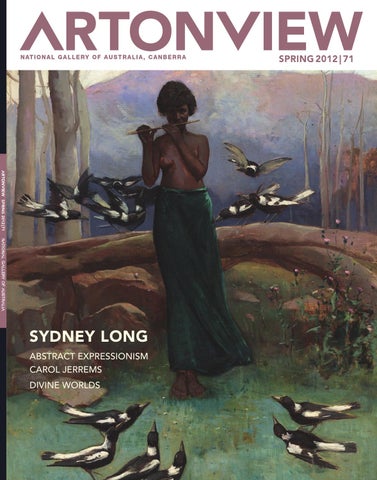
Sydney Long Fantasy c 1914 (detail), oil on canvas, 132.5 x 107 cm, Art Gallery of New South Wales, Sydney, purchased under the terms of the Florence Turner Blake Bequest, 1971. Reproduced with the kind permission of the Ophthalmic Research Institute of Australia
SPRING 2012 | 71
Published quarterly by the National Gallery of Australia, PO Box 1150, Canberra ACT 2601, Australia artonview.editor@nga.gov.au | nga.gov.au
2
© National Gallery of Australia 2012
4
Copyright of works of art is held by the artists or their estates. Apart from uses permitted under the Copyright Act 1968, no part of Artonview may be reproduced, transmitted or copied without the prior permission of the National Gallery of Australia. ENQUIRIES copyright@nga.gov.au Produced by the National Gallery of Australia Publishing Department EDITOR Eric Meredith DESIGNER Kristin Thomas PHOTOGRAPHY by the National Gallery of Australia Photography Department unless otherwise stated RIGHTS AND PERMISSIONS Nick Nicholson PRINTER Blue Star Print, Melbourne PREVIOUS ISSUES nga.gov.au/Artonview ISSN 1323-4552 PRINT POST APPROVED pp255003/00078 RRP A$9.95 | FREE TO MEMBERS MEMBERSHIP membership@nga.gov.au nga.gov.au/Members TEL (02) 6240 6528 FAX (02) 6270 6480 WARNING Artonview may contain the names and images of Aboriginal and Torres Strait Islander people now deceased.
(cover) Sydney Long The music lesson 1904 (detail) oil on canvas 71.7 x 51.4 cm Art Gallery of New South Wales, Sydney purchased 1969 Reproduced with the kind permission of the Ophthalmic Research Institute of Australia
Director’s word
EXHIBITIONS
Spirits of the land Anne Gray
10
Underbelly: the art of Henri de Toulouse-Lautrec Jane Kinsman
12
Capturing a decade, 1968–78: the photography of Carol Jerrems Gael Newton and Anne O’Hehir
14
Indian art, culture and religion: paintings from the collection Melanie Eastburn
FEATURES
18
To catch an emerald thief: analysis of green pigments Jane Wild
20
Members Acquisition Fund 2012 Jane Kinsman
22
Nolan to Tucker Deborah Hart
ACQUISITIONS
24 Reko Gwaybilla Rennie Message stick 25 Brian Robinson As the rains fell and the seas rose 26 Gareth Sansom Bill and Ted’s excellent adventure 27 Rajasthan Celestial maiden (Surasundari) 28 Julie Blyfield Tinder, vessel 29 Jeff Mincham Sea of grass 30 Huon Gulf region Mask REGULARS
31 Travelling exhibitions 32 Creative partnerships 33 News from the Foundation 34 Thank you … 36 Members news
Director’s word Visitors to the National Gallery this spring have four fabulous exhibitions to enjoy, and they could not have a greater contrast: Sydney Long’s poetic expressions of the Australian landscape, Carol Jerrems’s quintessentially 1970s urban photography, radical Abstract Expressionist paintings and exquisite Indian painting from the sixteenth to nineteenth century. Sydney Long: the Spirit of the land opened on 17 August and shows the depth of Long’s lyrical vision of the Australian bush often populated with nature sprites. This National Gallery of Australia exhibition is the first major gallery survey of his art, including not only his well‑known oils but also his lesser‑known watercolours and etchings. It is accompanied by a scholarly publication by Anne Gray and is more than timely. It confirms Long’s important place and accurate assessment within the history of Australian art. It is supported by Maddocks, one of the oldest law firms
2 ARTONVIEW
in Australia. Maddocks has a history of supporting the arts, and now, with new offices in Canberra, the firm furthers this commitment as the Gallery’s official Legal Partner. The Carol Jerrems retrospective shows works drawn entirely from our collection, the largest of Jerrems photography and film work. The collection was given to the Gallery in 1981 by the artist’s mother, Joy Jerrems, and was first showcased in our exhibition Living in the seventies: photographs of Carol Jerrems, which toured nationally in 1990. Carol Jerrems’s work has come to define the youth of Melbourne of the 1970s and interest her photography has grown significantly since her untimely death in 1980. This new exhibition will hopefully help satisfy the growing interest in the work of this remarkable Melbourne photographer. American and Australian Abstract Expressionism is one of the great strengths of the National Gallery’s collection. Indeed, our American collection is arguably the finest outside America.
Works from the national collection, as well as a select few works on loan, are currently on display in the exhibition Abstract Expressionism until 20 January 2013 in the Orde Poynton Gallery and until 24 February 2013 in the International galleries. The exhibition celebrates the centenary of the births of Jackson Pollock and Morris Louis. Highlights include Mark Rothko’s Multiform 1948, Willem de Kooning’s Woman V 1952–53, Lee Krasner magnificent Untitled 1953, Helen Frankenthaler’s Other generations 1957, Morris Louis’s Dalet zayin 1959 and, of course, Jackson Pollock’s Blue poles 1952, the most famous and recognisable work in the national collection. Notably, the exhibition includes extraordinary Australian paintings by artists such as Tony Tuckson, Peter Upward and Ralph Balson, which look strong among their American counterparts. In the next issue of Artonview, an article by Deborah Hart, Senior Curator of Australian Painting and Sculpture post‑1920, will elucidate the Australian presence in the exhibition.
Divine worlds: Indian painting is another exhibition drawn from the collection and our first exhibition of Indian painting. Dating from the fifteenth to twentieth century, the paintings in Divine worlds range from exquisite intimate miniatures to vast hunting scenes, monumental pilgrimage maps and brilliantly coloured devotional shrine hangings. Celebrating the many religious and secular traditions of India, the paintings are rich in legend, regal drama and romance. The exhibition offers a magnificent opportunity to revel in treasures from the national art collection that are rarely seen, and never before together. A number of major sculptures from the Indian subcontinent were given to the Gallery in recent years by generous benefactors such as Gavan Bromilow, John Wood and most significantly Roslyn Packer AO. Ros Packer was a member of National Gallery’s Council and is now a member of our Foundation. She has been a long‑term supporter of our Asian art collection, especially Indian art. Her most
recent contribution to this area has been to the acquisition of the marvellously sensual Rajasthani Celestial maiden (Surasundari) of the twelfth century. It is the collection’s most beautiful sculpture of a female figure. Another benefactor, Susan Armitage from Adelaide has recently given the Gallery fine works of craft, including Julie Blyfield’s Tinder, vessel 2008 and Jeff Mincham’s Sea of grass 2011. Over the last few years, she has generously assisted with the purchase of numerous South Australian contemporary prints, photographs and decorative art objects as well as Hossein Valamanesh’s large collage Lotus vault 2011. The Aboriginal and Torres Strait Islander art collection has been enhanced with a number of contemporary works, including Melbourne street artist Reko Rennie’s Message stick 2011 and three spectacular prints by Torres Strait Islander Brian Robinson, one of which is highlighted on page 25. Gareth Sansom’s striking Bill and Ted’s excellent adventure 2011 and an intriguing mask from the Huon Gulf region of Papua New Guinea were also acquired.
In October, the Gallery will celebrate thrity years since we opened. We are still the youngest national gallery in the world and yet, in our short history, we have developed Australia’s largest and most valuable art collection, valued at $4.7 billion. To mark this important occasion, I will present a National Press Club address on 10 October highlighting the achievements of the Gallery since it opened and on my vision for its future.
Ron Radford AM
Morris Louis’s Dalet zayin 1959, Ayin 1958, Beta nu 1960 and Nexus II 1959 and Helen Frankenthaler’s Cape (Provincetown) 1964 in Abstract Expressionism at the National Gallery of Australia, Canberra, until February 2013.
ARTONVIEW 3
SPIRITS Of THE laNd Sydney Long: the Spirit of the land until 11 November 2012 | nga.gov.au/Long Anna Gray shares her insight into Long’s poetic vision and artistic development,from his early poetic impressionism to the overt symbolism in his Art Nouveau paintings with the presence of myth and legend and the Australian Spirits of the bush.
Sydney Long’s distinctive poetic landscapes have become embedded in the Australian psyche. His memorable symbolist Art Nouveau landscapes are very well known. Indeed, he is one of the best known Australian artists of the 1890s, along with the legendary Australian Impressionists, Tom Roberts, Frederick McCubbin and Arthur Streeton. Many of Long’s early paintings are inhabited by Pan, the god of nature, of shepherds and flocks, and of rustic music. Pan first appeared in his paintings in disguise, in his 1894 image of the young boy playing a flute in By tranquil waters 1894. Long then painted his first symbolic work in 1895, Pastoral (‘Piping as though he would never grow old’ ), with a young man playing a pipe beneath a group of decorative trees. The painting is now lost, but we have the drawing of it that was published in the catalogue to the first exhibition of the Society of Artists. The figure might be a young shepherd; he may also be an embryonic Pan. The title comes from sixteenth‑century British
poet Sir Philip Sidney’s Arcadia, a highly idealised tale about the life of a young shepherd in Arcadia, a land of fair valleys and fertile pastures. Following this early Arcadian scene Long developed his own personal pagan vision in which he conjured up the Spirits of the bush and created another reality where harmony and beauty pervade all. It would be convenient to think that Pastoral (‘Piping as though he would never grow old’) was influenced by Aubrey Beardsley’s initial cover design for the first issue of The Studio in April 1893. Beardsley had depicted Pan seated at the base of a group of trees, but the publishers censored the cover because they believed Beardsley had shown Pan with an erection. The image was not published in The Studio until May 1898. But, if it did not influence the piping figure in Long’s 1895 Pastoral, it may have influenced Long’s 1898 painting Pan. In Pan, Long created a strong decorative Art Nouveau composition using the traditional European imagery of Pan entrancing nymphs and satyrs with his tune.
EXHIBITION | ARTONVIEW 5
There is a rising moon rather like a halo behind Pan’s head, suggesting, somewhat blasphemously, the holiness of the mythical god. The whole is set in a rosy‑purple coloured haze of twilight, before a frieze of grey eucalyptus trees. The figure of Pan may be a development of the young man in Pastoral (‘Piping as though he would never grow old’), but the subject here is without qualification the great god Pan. It is in the rhythmic forms of the dancing group and in the way Long arranged the sinewy trees into a decorative frieze‑like pattern that this work has an Art Nouveau presence. Pan was everywhere in the literature at the turn of the century, the subject of poems by writers as diverse as Elizabeth Barrett Browning, Oscar Wilde, Christopher Brennan, Hugh McCrae and EM Forster. Brennan was an admirer of Stéphane Mallarmé’s symbolist poetry, particularly his 1876 ‘L’Après‑midi d’un faune’ (‘The afternoon of a faun’). Lionel Lindsay wrote in an article in Art in Australia in 1921 that this poem had been ‘in the air’ in Sydney at the turn of the
6 ARTONVIEW | EXHIBITION
century. Lindsay himself had succumbed to the lure of Pan as early as 1899 with his woodcut Arcadian landscape; he made a etching Pan in 1910 and was still interested in the subject in 1921, creating works such as Pan and Syrinx. Lindsay’s sister, Ruby Lind also made a drawing of Pan and nymphs in 1904; and his brother Norman made Arcadian prints such as the etching Tryst in Arcadia 1930, which shows a naked man and woman meeting in a shady watery glen. This interest in Pan and Arcadia was, for many, part of a post‑Darwinian search for a new form of spirituality. In EM Forster’s short story ‘Other kingdom’, the protagonist Evelyn ‘danced to the song of a bird … away from our society and our life, back, back through the centuries’. She is transformed into a tree, a Spirit of the forest: ‘Her garment was as foliage upon her, the strength of her limbs as boughs, her throat the smooth upper branch that salutes the morning or glistens to the rain’. In the first, and arguably most significant of his overt symbolist, decorative Art
Nouveau images, The Spirit of the plains 1897, Long invented what he called a ‘special Australian brand’ of the Spirit of the bush. Here, a nature sprite pipes seductively to a group of brolgas against a cool moonlit sky. With serpentine necks and gliding wings, they perform a sensuous, majestic dance across the plain. This is an imaginative image in which Long fulfilled his aim to evoke something of ‘the lonely and primitive feeling of this country. A feeling more suggestive of some melancholy pastoral to be rendered in music’, as he described it in Art and Architecture in January 1905. The decorative arrangement of the birds sweeping across the canvas in a graceful arabesque, with the distinctive stand of stylised native trees, reflects an Art Nouveau approach. This is truly an original evocation of the Australian landscape, expressed in delicate colour harmonies. The music lesson 1904 is perhaps the most Australian of all Long’s symbolist works. It is a pastoral with a young Aboriginal girl—a real Spirit of the land—playing her
flute to an audience of magpies clustered around her. The image is a variation of The Spirit of the plains, a sprite entrancing birds with her music; and the symbolism is a variation on Pan, translated into an Australian idiom—a music‑making enchantress summoning the magpies at the bewitching hour of early morning or late evening. The title is open to interpretation: is the girl teaching the birds her traditional songs or are they teaching her their song? Or it may be, as Deborah Edwards suggested in the book accompanying Sydney Long: the Spirit of the land, ‘a lesson about what is uniquely Australian to be gleaned by the (white) viewer who responds to the strains of magpie song and Aboriginal Spirit entwined’. This is the only work in which Long definitely included an Indigenous Australian—although he may also have done so in The West Wind 1909. Certainly, like her sister in The music lesson, the Spirit of the West Wind is enchanting the nearby magpies with her music. But it is more likely that Long intended her to be
an ambiguously embodied Spirit than a specifically Indigenous Australian. In her grey gown with billowing sleeves and with the upward sweep of her skirt, she evokes the westward movement of a hot dusty Australian wind. Pan, translated into an Australian idiom as the Spirit of nature, is present in much of Long’s art, including in his early works depicting rural nurturers such as Feeding time c 1896. In this painting, the young woman feeding domestic poultry and calves is a predecessor of the sprites surrounded by birds in The music lesson and The West Wind. Pan is also present—in a milder form, as the Spirit of nature—in the shepherds and shepherdesses that inhabit many of Long’s pastoral paintings. He appears in The sheep pool 1898, where he watches over his flock from under a tree. The Spirit of nature as a shepherdess can be found as early as 1896 in Midday, where she stands beside the decoratively twisted trees listlessly minding her sheep in the heat of the day. In Summer pastoral 1908, the shepherdess
The West Wind 1909 oil on canvas 30.5 x 51 cm Art Gallery of South Australia, Adelaide AM and AR Ragless Bequest Fund, 1972
(opposite) The Spirit of the plains 1897 oil on canvas on wood 62 x 131.4 cm Queensland Art Gallery, Brisbane gift of William Howard-Smith in memory of his grandfather, Ormond Charles Smith, 1940
(page 4) Pan 1898 (detail) oil on canvas 107.5 x 178.8 cm Art Gallery of New South Wales, Sydney gift of JR McGregor, 1943 Images reproduced with the kind permission of the Ophthalmic Research Institute of Australia
EXHIBITION | ARTONVIEW 7
8 ARTONVIEW | EXHIBITION
guards not only her sheep but also the sprites of the field. Then, in The shepherdess 1909, the Spirit of nature is not just part of the image, she is the subject. Long portrayed this shepherdess both caring for nature and becoming nature itself. She is the very essence of nature, its personification. In addition to painting pastorals that show rural sprites in an idealised manner, Long created more general pastorals in which he depicted a peaceful rural harmony and the delights of the natural world. In these works, he frequently combined direct observation with a decorative treatment of trees and other features. In 1905, Long expressed his belief that ‘the artist with imagination and a complete knowledge of his materials’ should be able to ‘produce work of the most imaginative kind from his surroundings’. These more general pastorals include dreamlike watercolours such as Pastoral c 1917, with its soft, blurred edges and hovering moon, A dawn 1918, with its sense of mystery and other worldliness, and Moonrise 1919, with its diffuse effects
of twilight. Central to these pastorals was the idea that colour should be used emotively, in fine shades, and that forms should be refined. In such works, Long created truly poetic and magical images. It was Long’s ability to capture the vital energy of nature, the Spirits of the bush, in a symbolic and decorative manner that makes him a truly significant Australian artist of his time. This one‑venue, Canberra‑only exhibition of the work of Sydney Long will be on display until 11 November 2012. Such a focused presentation is the first major survey of his work for over thirty years. It includes all Long’s much‑loved paintings as well as many works that will be new to most viewers.
The sheep pool 1898 oil on canvas 82 x 140 cm Kerry Stokes Collection, Perth
(opposite) Reflections c 1908 watercolour 23.3 x 33.6 cm Queensland Art Gallery, Brisbane bequest of George Brown, 1977
A dawn 1918 watercolour 30.8 x 42.6 cm Mildura Arts Centre Hilda Elliott Bequest, 1970 Images reproduced with the kind permission of the Ophthalmic Research Institute of Australia
Anne Gray Head of Australian Art and curator of the exhibition
EXHIBITION | ARTONVIEW 9
UNdERBElly the art of Henri de Toulouse-Lautrec Toulouse-Lautrec: Paris and the Moulin Rouge 14 December 2012 – 2 April 2013 nga.gov.au/Lautrec The Paris of the later half of the nineteenth century was the most remarkable city of Europe. Its cityscapes, boulevards and gardens became the subject of Impressionist and Post Impressionist artists. It was also the city of the artist Henri de Toulouse‑Lautrec, who chose to concentrate on the underbelly of the French capital. Lautrec’s haunts were cafes, brothels, theatres, dance halls and dives, and he portrayed the personalities of these places, such as singer Aristide Bruant at the Eldorado, high‑kicking dancer Jane Avril, willowy performer Yvette Guilbert and Moulin Rouge celebrity La Goulue, who made her name provocatively dancing the cancan.
10 ARTONVIEW | EXHIBITION
Lautrec was born in 1864 and spent his early years on the substantial family estate in southern France. He loved horses and dogs and these were the subjects of his early paintings and sketches. He then moved to Paris and later studied at the Atelier Cormon, where he befriended Vincent van Gogh and Emile Bernard—two artists who were to become key figures in Post Impressionism. A growing interest in gardens in Paris, both public and private, became the subject of Impressionists. As Lautrec matured he adopted their brighter palette and the feathery brushstroke style but, for him, the figure was always paramount. He created a series of paintings in this style.
With the transformation of central Paris in the nineteenth century by Georges‑Eugène Haussmann, following earlier eighteenth‑century redesigns, the capital became a city of wide boulevards, grand open spaces and arcades. It became the place for the man about town, who would promenade to see and be seen. Many of Lautrec’s friends would be noticed as they strolled around town, and he captured their swagger perfectly. In contrast to these sauntering boulevardiers, he had a favourite model, a young modest working girl named Carmen Gaudin, whose brilliant red hair fascinated him. Sometimes he depicted her as a type, such as ‘laundress’, and at other
times he portrayed her gentle character with great tenderness. Lautrec transformed the art of the poster to the status of masterpiece: creative designs, brilliant colours and on a large scale rarely seen before. Although known in certain art circles, Lautrec made a name for himself in the broader art world when his poster Moulin Rouge: La Goulue 1891 was pasted up in the streets. Whether it was depictions of friends or the personalities from the underbelly of Paris, he had a penetrating eye for character and evocative compositions. This major exhibition of Lautrec’s paintings, drawings, posters and prints is drawn from major collections, including
the Musée d’Orsay in Paris, Musée Toulouse-Lautrec in Albi, Metropolitan Museum of Art and Museum of Modern Art in New York, National Gallery of Art in Washington, DC, El Museo de arte ThyssenBornemisza in Madrid, British Museum and Courtauld Institute of Art in London, as well as private collections abroad. It examines his abilities as an acute observer of French life, his skill as a draughtsman, his experimentation in composition and the brilliance of his technical execution in all media and their inter-relationships. Jane Kinsman Senior Curator, International Art, and curator of the exhibition
La Goulue at the Moulin Rouge 1891–92 oil on cardboard 79.4 x 59 cm The Museum of Modern Art, New York gift of Mrs David M Levy Digital image © 2002 The Museum of Modern Art, New York / Scala, Florence
The toilette (Combing her hair) 1891 oil on cardboard 58 x 46 cm The Ashmolean Museum, Oxford bequeathed by Frank Hindley Smith, 1939
(opposite) Moulin Rouge: La Goulue 1891 brush and spatter lithograph, printed in four colours on three sheets image 191 x 117 cm, overall 195 x 122 cm National Gallery of Australia, Canberra acquired through the National Gallery of Australia Foundation and the Poynton Bequest, 2010
EXHIBITION | ARTONVIEW 11
CaPTURING a dECadE, 1968–78 the photography of Carol Jerrems Carol Jerrems: photographic artist until 28 January 2013 | nga.gov.au/Jerrems From her first work from 1967 to 1970 as an art student in Melbourne, Carol Jerrems chose the new mood of social equality and personal freedom as her subject. The politics and values of her generation were symbolised by the 1960s American ‘Tribal Rock Musical’ Hair, first performed in Australia at the Metro Kings Cross in 1969, which Jerrems photographed in January 1970. In the spirit of this counterculture stage production, she turned her camera to the major issues of women’s liberation and social inclusiveness for street youths and Indigenous people in the cities. Unlike so many of her contemporaries, however, Jerrems was not a roving documentary or
12 ARTONVIEW | EXHIBITION
street photographer. She largely worked in portraying people but often directed her subjects in mysterious tableaux—as in her most famous work, Vale street 1975, a luminous image of a proud liberated woman of the 1970s. Jerrems was celebrated from her student years with awards, exhibitions and the acquisition of her photographs by various museums. Since her untimely death at the age of thirty in 1980, interest in her work has continued to grow and strike a chord with old and new audiences. In contrast to an earlier generation of internationally renowned magazine photojournalists such as David Moore, Jerrems and her
counterculture contemporaries did not seek commissioned commercial or magazine work. Instead, they took a low‑key, intimate approach with a diaristic style of imagery focused on themselves and their own, mostly urban, environments. Soon‑to‑be‑ famous musicians, writers and artists such as Red Symons, Graeme ‘Shirley’ Strachan, Anne Summers and Judy Morris appear in Jerrems’s later work, alongside Melbourne youths and urban Aboriginal communities. In 1974, Jerrems published A book about Australian women, with text by Virginia Fraser, largely championing confident and experimental young female artists, writers and filmmakers.
Outback Press 1974 left to right: Colin Talbot, writer, Alfred Milgrom, publisher, Morry Schwartz, entrepreneur, and Mark Gillespie, singer-songwriter gelatin silver photograph image 15.3 x 23 cm, sheet 20.1 x 25.1 cm gift of Mrs Joy Jerrems, 1981 © Ken Jerrems and the estate of Lance Jerrems
pages in Hair: the American tribal love rock musical 1970 gelatin silver photographs 29.1 x 23.6 cm gift of Mrs Joy Jerrems, 1981 © Ken Jerrems and the estate of Lance Jerrems
Jerrems often made use of sequences and movement and the style of moody light in film noir. She studied filmmaking at college and aspired to work in the medium, undertaking several film projects and completing one, her 16‑mm 1978 film Hangin’ about, with a grant from the Australian Film Commission. One of Jerrems’s last projects was a commission in 1978–79 to do the publicity and production stills for In search of Anna, a feature film by boyfriend Esben Storm, which resulted in some of her most sensual studies of Judy Morris, who played the title role. Jerrems promoted the cause of photography as art. As a first year student
in 1967, she had her own sans‑serif stamp with ‘carol jerrems/photographic artist’ made to put on the back of her carefully produced, titled and editioned prints. Her work was welcomed and appreciated by her contemporaries as well as by a new public audience for photography as art. Jerrems was the first contemporary Australian woman photographer to be acquired by art museums and, in 1973, to have an exhibition at the National Gallery of Victoria. The current exhibition, Carol Jerrems: photographic artist, presents Jerrems often gritty and at other times poetic, beautiful and compelling works from the collection dating from 1968 to 1978. The
Jerrems archive is extensive and will be photographed and made accessible online over time. However, the current exhibition above all has finished prints that the artist signed, titled and editioned in her distinctive printed lettering as well as work that Jerrems exhibited in her lifetime. These include her forgotten student assessment works such as her 1970 booklet on the performers in Hair, which reveals the evolution of her the early formation of her distinctive style.. Gael Newton Senior Curator and Anne O’Hehir Curator, Photography, and co-curators of the exhibition
EXHIBITION | ARTONVIEW 13
Nathdvara Rajasthan, India Krishna’s divine play (Krishna lila) for the annual pilgrimage of Vraja (Vraja yatra) c 1830 (detail) shrine hanging (pichhavai) opaque watercolour, gold and silver on cotton 279.5 x 255.5 cm National Gallery of Australia, Canberra purchased 2005
INdIaN aRT, CUlTURE aNd RElIGION paintings from the collection Divine worlds: Indian painting 1 September – 11 November 2012 | nga.gov.au/DivineWorlds
Divine worlds brings together masterpieces of Indian painting from the collection of the National Gallery of Australia. The paintings range from exquisite intimate miniatures to vast hunting scenes, monumental pilgrimage maps and brilliantly coloured devotional shrine hangings. The works of art were created between the fifteenth and twentieth centuries and celebrate the traditions of Hindu, Jain, Sikh, Islamic and secular India. Among the jewels of the collection is Australia’s finest group of spectacular large painted shrine hangings known as pichhavai. Made in dedication to Krishna, an avatar of the great Hindu god Vishnu, the paintings were used as backdrops to temple shrines. Pichhavais are changed according to the religious calendar, with each commemorating a different seasonal festival or event in Krishna’s life. To devotees, Krishna is the perfect embodiment of divinity, a magical god who also experiences human emotions and weaknesses. The pichhavais on display include a delightful image of Krishna
charming an adoring crowd of milkmaids (gopis) with his flute playing. Smaller‑scale devotional works illustrating scenes from the lives of Hinduism’s many gods and goddesses abound. Many were part of a gift in 1954 to the Commonwealth of Australia from British twins Thomas and Robert Gayer‑Anderson of over two hundred Indian paintings and drawings in various styles. The brothers collected the paintings in India and Britain in the first half of the twentieth century. Included in their gift are remarkably vibrant Kalighat paintings made in the mid to late nineteenth century as souvenirs for pilgrims to the temple dedicated to the goddess Kali in Kolkata (Calcutta). The goddess of time and change, Kali both gives and destroys life and may be revered as a violent supernatural being or a benevolent mother goddess. With protruding tongue and a severed human head in one of her four arms, the image Kali 1855–60 conveys her ferocious aspect. Adorned in jewellery, her characteristic garland of skulls is suggested by the
EXHIBITION | ARTONVIEW 15
semicircles around her neck. Her usual girdle of human arms has been similarly simplified to appear as a striped skirt. Kali embodies the brutal female energy (shakti) of the god Shiva and the concentrated energy of Hinduism’s supreme goddess Durga, slayer of the buffalo demon. The paintings created for Jainism, another of India’s religions, are equally fascinating. The Jain religion, which originated in India in the sixth century before the current era, teaches non‑violence and detachment from worldly endeavours. Jains revere twenty‑four enlightened beings known as Jinas and believe that viewing spiritual images bestows merit and insight.
16 ARTONVIEW | EXHIBITION
Jain images in Divine worlds include towering maps of sacred sites and finely painted pages from religious manuscripts. Among the earliest paintings in the exhibition are pages from The Book of Ritual, or Kalpa Sutra, created around 1465. The Kalpa Sutra recounts the lives of the Jinas. Depicted on one of the pages is Parshvanatha, the twenty‑third Jina, who is shown meditating. He can be identified by the canopy of snakes surrounding his head. Illustrated manuscripts of the Kalpa Sutra were produced in large numbers for devotees and almost always follow the same model. Although painted on paper, the pages of the Gallery’s Kalpa Sutra retain the
rectangular format of earlier manuscripts made from palm leaves. For centuries, Indian ascetics have dedicated themselves to religious teaching and worship. The subject of the portrait of a sage wearing a patchwork cloak appears to be Guru Nanak (1469–1539), founder of the Sikh religion. Artists of the Punjab region began to illustrate Sikh subjects after Maharaja Ranjit Singh (1780–1839) founded the Sikh empire in 1801. India’s Islamic Mughal and Hindu Rajput royal courts included ateliers of painters, whose role was to document the exploits of rulers, and thereby their power and importance. Commissioned for
posterity and personal enjoyment, works of art embellished in gold capture the joy of festivities, the secret worlds of lovers and the excitement of imperial hunts. One of the treasures of the Gallery’s collection is Emperor Muhammad Shah hunting, which was produced around 1720–25. Although relatively small in scale, the painting has great impact. Dramatically divided by a central zigzagging river, it shows five women hiding among the trees on the left and the Mughal emperor Muhammad Shah (1702–1748, ruled 1719–48) and two members of his hunting party on the right. The emperor’s arrival has disturbed the women’s musical gathering.
Muhammad Shah, shown with a blue horse, is hunting with falcons. All three men are dressed in hunting green, a shade that dominates the picture and emphasises the lush setting. Known as rangila, ‘the pleasure lover’, Muhammad Shah was a great patron of the arts. The richness and diversity of Indian art, culture and religion infuses every painting in Divine worlds. The exhibition offers a magnificent opportunity to revel in rarely seen treasures from the Gallery’s collection of Indian painting. Melanie Eastburn Curator, Asian Art and curator of the exhibition
Mughal dynasty (1526–1858) Delhi, India Emperor Muhammad Shah hunting 1720–25 opaque watercolour and gold on paper 26.8 x 39.8 cm purchased 1992
(opposite) Kolkata (Calcutta) West Bengal, India Kali 1855–60 (detail) watercolour, silver paint and pencil on paper 43.6 x 27.7 cm The Gayer-Anderson Gift 1954
Guler Himachal Pradesh, India A religious teacher c 1820 opaque watercolour on paper 16.8 x 10.9 cm The Gayer-Anderson Gift 1954
EXHIBITION | ARTONVIEW 17
TO CaTCH aN EmERald THIEf analysis of green pigments For hundreds of years, large painted cloths called pichhavai have been used to decorate Hindu shrines throughout India. The conservation of pichhavais is challenging due to their mostly fragile condition, which can be attributed to a lifetime of wear and worship. A comparison of the condition of fifteen pichhavai at the National Gallery revealed a specific pattern of deterioration— several exhibited numerous small areas of complete loss to the cotton substrate. Krishna’s fluting summons the entranced gopis is the largest pichhavai in the collection, measuring three square metres and depicting Krishna surrounded by 129 milkmaids (gopis). The gopis are elaborately adorned with jewellery encrusted with rubies and emeralds, but areas that once
depicted emeralds are now missing; leaving small holes scattered throughout the work. When conservators examined the areas of deterioration closely, it became apparent that the substrate fibre loss appeared to be directly associated with a particular green pigment. Several green pigment samples were taken from the forest foliage, the garments worn by the gopis and the areas neighbouring the missing emeralds, although not much of this pigment remained. A Scanning Electron Microscope with an Energy Dispersive X‑Ray attachment was one of the techniques used in the pigment analysis. Only the samples directly associated with the fibre loss showed the presence of copper. Using these findings, the green pigments that did not contain copper
were eliminated as suspects. A literature review of pigments used in pichhavai and Indian miniature painting point to one culprit, an acetate of copper, the pigment verdigris. Verdigris is notoriously unstable; it decomposes, particularly in a humid environment, to form an acetic acid by‑product, that can degrade the underlying substrate material. The information collected provided supporting evidence that verdigris is the pigment most likely responsible for the missing emerald jewels. Unfortunately, although the elusive emerald thief may have been identified, the jewels have been lost forever. Jane Wild Textile Conservator
Kota (Kotah) Rajasthan, India Krishna’s fluting summons the entranced gopis for Autumn Moon festival (Sharad purnima) c 1840 (detail) shrine hanging (pichhavai) opaque watercolour, gold and silver on cotton 291.8 x 311 cm National Gallery of Australia, Canberra purchased 2005
Detail showing a small remnant of green pigment available for sampling. Detail of the milkmaids’ jewellery with missing emeralds.
fEaTURE | ARTONVIEW 19
Henri de Toulouse-Lautrec Divan Japonais 1893 crayon, brush spatter and transferred screen lithograph printed in four colours 80.3 x 61.3 cm
mEmBERS aCqUISITION fUNd 2012–13 Henri de Toulouse-Lautrec’s Divan Japonais 1893 | nga.gov.au/Members The National Gallery of Australia invites members to contribute to the fourth annual Members Acquisition Fund. For more information on contributing to the fund, telephone (02) 6240 6408 or fill in and return the donation form in the Members Acquisition Fund 2012–13 brochure. Henri de Toulouse‑Lautrec transformed the art of the poster to the status of masterpiece—creative designs, brilliant colours, on a scale rarely seen before. Known in certain art circles, Lautrec made a name for himself in the broader art world when his posters began decorating the streets of Paris. He stunned the Parisian art world with his first poster, Moulin Rouge: La Goulue 1891, and became a consummate poster creator. Divan Japonais 1893 was created to advertise the newly refurbished cafe‑concert. The cafe was decorated in the Japanese manner, which was in fashion in Paris at the time. For his design, Lautrec embraced the Japanese style of cropped compositions, flat colouring, sinuous lines and simplified forms.
20 ARTONVIEW | fEaTURE
The composition reveals the influence of his artistic hero, Edgar Degas, who was in turn inspired by Honoré Daumier’s caricatures. Lautrec chose to depict a performance of one of his favourite models from just behind the orchestra pit, a pictorial device adopted frequently by the older French artists. The poster is radical in design, depicting the singer Yvette Guilbert from her neck down—recognisable by her signature long black gloves and willowy figure. In this composition, based on his imagination rather than in situ, the artist has placed another of his favourite models, the performer Jane Avril, at centre stage, though seated in the audience. Avril is shown in an elegant silhouette dressed in black, her remarkable red hair partially
covered by a playful hat. Next to her is Lautrec’s friend Edouard Dujardin, a noted music critic of the day. An habitué of the Parisian demimonde, Lautrec became known for his subjects of French society in the bars, cafe‑concerts, theatres and brothels. He did this with an incisive eye, which is evident in this remarkable poster. Jane Kinsman Senior Curator, International Art and curator of Toulouse-Lautrec: Paris and the Moulin Rouge
NOlaN TO TUCkER The National Gallery’s iconic Ned Kelly series by Sidney Nolan will be shown at the Irish Museum of Modern Art in Dublin in October 2012. Interest in loaning this groundbreaking, popular series began several years ago, driven in part by Nolan’s Irish ancestry and also by the remarkable nature of the 26 works. The paintings, largely set in the Australian landscape, tell aspects of the dramatic story of the nineteenth‑century rebel‑reformer and outlaw Ned Kelly, whose forebears were also Irish. Not only does this series reflect an important part of our social history but the works also represent a defining moment in Modernism and Australian art history.
22 ARTONVIEW | fEaTURE
As such, the works have been shown in recent times in a dedicated space at the National Gallery. After years of negotiation, the exhibition in Ireland represents a chance to engage in connections between Irish and Australian culture and the rich stories that we share. The loan also represents the opportunity for the Gallery to exhibit another highly significant group of works, Albert Tucker’s powerful series Images of modern evil painted in the 1940s, around same time as Nolan’s series. The Gallery is the main repository of Images of modern evil, which takes as its subject the tumult in Australia caused by the Second World War.
While Nolan’s works are set in the open landscape, Tucker’s focus on the underbelly of the streets of downtown Melbourne in wartime. Against Nolan’s bright sunlight, Tucker’s images are often of the streets at night—of artificial streetlights and trams beaming their headlights into the surrounding darkness. The atmosphere of these paintings also represents the dark night of the soul: men and women are shown as elemental, visceral, sexual beings with an emphasis on transformation and surreal ambiguity. The leitmotif of the series is the exaggerated bright‑red crescent mouth. In one instance, a biomorphic body floats over the seats in
an empty cinema. The screen is blank, the future unknown. These are highly inventive paintings. Yet, like Nolan, Tucker was deeply inspired by European Modernism. He brought this inspiration into his own locale. As with Nolan, these works also represent very real aspects of the artist’s state of mind. Tucker and Nolan were friends. They were both part of the Heide circle in Melbourne. Both gave us bodies of works that were like stage sets—poetic distillations of our place at a critical period in history. We hope that our visitors enjoy seeing Tucker’s Images of modern evil at the National Gallery, just as we hope that
many people find fresh inspiration from Nolan’s Ned Kelly series during their sojourn at Irish Museum of Modern Art in Ireland. Deborah Hart Senior Curator, Australian Painting and Sculpture post-1920
Albert Tucker Image of modern evil 9 1944 oil on cotton gauze on cardboard 51.7 x 63 cm National Gallery of Australia, Canberra gift of the artist, 1981 © Barbara Tucker. Courtesy Barbara Tucker
(opposite) Sidney Nolan The trial 1947 enamel on composition board 90.7 x 121.2 cm National Gallery of Australia, Canberra gift of Sunday Reed, 1977
fEaTURE | ARTONVIEW 23
Reko Gwaybilla Rennie Kamilaroi/Gamilaraay/Gummaroi people
Message stick 2011, textile foil, screen print on Belgium linen, bronze, painting 150 x 150 cm, sculpture 145 cm, 6 cm (diam), purchased 2012 Reko Rennie is one of a number of exciting street artists emerging from Victoria and finding their way to gallery walls and collections. His work reflects his passion for being a graffiti artist and explores weighty issues such as identity, justice, history and sense of place in an urban environment. His aesthetic draws on his Kamilaroi/ Gamilaraay/Gummaroi identity and the symbols and designs of his people. Rennie has also used neon and hypercolour metallic foils in his latest series of paintings to represent the bright neon lights of the city. Traditional Kamilaroi diamond‑shaped clan designs are evident in Message stick, in both the dynamic painting featuring a central image of a spray can and the ‘totem pole’ constructed from multiple spray cans. Rennie here explores the idea of the spray can as message stick. Message sticks were traditionally used by Aboriginal people to transport messages and to allow safe passage for the messenger
24 ARTONVIEW | aCqUISITION
through different clan country. This idea also reflects the attitudes of people who choose to deliver their messages through graffiti in today’s urban environments. However, Rennie takes it a step further in Message stick: the spray can becomes not only the central focus of the painting but also for the composition of a cultural object, the totem pole. As Rennie suggests in an artist statement, he ‘monumentalises the spray can, placing it above the role of a functional artist’s tool, imbuing it with the gravity of a modern cultural artefact’. Message stick will deliver an enduring impact when it goes on display in the Aboriginal and Torres Strait Islander galleries in mid September. It is a fine addition to the Gallery’s collection of contemporary Australian art. Tina Baum Curator, Aboriginal and Torres Strait Islander Art
Brian Robinson Kala Lagaw Ya people
As the rains fell and the seas rose 2010, linocut printed in black ink from one block, 62 x 120 cm, purchased 2012 Brian Robinson is a multi‑skilled artist who produces paintings, sculptures and prints. He grew up surrounded by his rich Kala Lagaw Ya cultural traditions in the Torres Strait. Although initially appearing like so many prints done by Torres Strait Islander artists, Robinson’s work differs. The intricate lines in his As the rains fell and the seas rose blur the boundaries of traditional and contemporary culture. Robinson’s skill as a carver is particularly evident in this work, a contemporary version of the long march to a modern‑day Noah’s ark. This biblical story is told with a contemporary twist, featuring an unusual band of travellers. Several Torres Strait Islander warriors guard the rear of the procession of the pop‑culture characters Mickey Mouse, Batman, a Teenage Mutant Ninja Turtle, Alien, Goop from Ben 10, Predator, Wall‑E and a flying Astro Boy.
The passengers, although singular and not paired, are almost camouflaged among the leaf‑like swirls and patterns, perhaps alluding to the turbulent waters to come. The incoming wave references the famous Hokusai woodblock print Under a Wave off Kanagawa c 1830–32. The central lower ark, with light shining from the windows, sets sail on calm waters; the heavens are bright with stars to help navigate the boat to unknown territories. Roman numerals pepper the work; above, the numerals one to six are paired with traditional headdresses (dhoeri or dari) from various islands in the Torres Strait. This intriguing and multi‑faceted work develops the Gallery’s collection of prints from the Torres Strait, adding Robinson’s distinctive blend of tradition and pop culture. Tina Baum Curator, Aboriginal and Torres Strait Islander Art
aCqUISITION | ARTONVIEW 25
Gareth Sansom Bill and Ted’s excellent adventure 2010, oil and enamel on canvas, 182.8 x 244.3 cm, purchased 2011 Gareth Sansom first came to prominence in the 1960s as one of Melbourne’s most provocative artists. He is now one of Australia’s foremost senior painters. Buoyed throughout his long career by a passion for experimentation, art history, literature, cinema and popular culture and for breaking the rules of art making, he has developed an intuitive and very individual practice. Sansom’s works open up an imaginative space that mirrors his own sense of daring and adventure. Bill and Ted’s excellent adventure 2010 is a large‑scale, vividly coloured escapade in enamel and oil paint. It travels rapidly between containment and explosive energy, with unexpected intersections of abstraction and figuration. Its title is a reference to the outrageous late 1980s comic science fiction film of the same name. The cult film impacted a generation and follows the story of two goofy American high school students who are given
26 ARTONVIEW | aCqUISITION
a time machine to help them to pass their final history project. They cause havoc along the way, dragging historic figures into the twentieth century. As Sansom noted in an artist statement in 2010, the work received this title after its completion, as he reflected on the composition and his approach to painting, in which ‘… a blank canvas becomes an adventure teaming with leads both figurative and abstract and historical …’ The two central silhouettes, Sansom suggested, could be interpreted as the heads of Bill and Ted facing each other, ‘baffled by the fact they have woken up in his time travel … flirting with danger and menace in a Sansom painting’. Miriam Kelly Assistant Curator, Australian Painting and Sculpture
Rajasthan India
Celestial maiden (Surasundari) 12th century, sandstone, 83 x 32.1 x 21.2 cm, purchased with the assistance of Roslyn Packer AO, 2011 The Hindu and Jain temples of medieval India are richly adorned with heavenly dancers (apsaras), mythical serpent beings (nagas), amorous couples (mithuna) and other divinities. Present around and within temples, these figures are essential components of the sacred architecture, serving to protect structures and award favour to gods and their devotees. This overtly sensuous celestial maiden (surasundari) was created as an ornate ceiling bracket and, alongside other brackets of its type, likely surrounded a lotus ceiling. The nymph’s prominent breasts and hips, tiny waist and lean limbs epitomise an ideal of female beauty, fertility and abundance in Indian art. The exaggerated bend of the torso at the waist and the combination of semi‑profile and full frontal pose were devices employed by sculptors to emphasise voluptuous curves. They also served to accommodate the angle and perspective from which the final image would be viewed. The straight, angular style of the legs is a distinctive feature of northern Indian medieval figurative sculpture. Carved from sandstone, the surasundari wears elaborate jewellery—heavy earrings, bangles, anklets, hair ornaments and a multitude of chains—to signify her heavenly status. The nymph’s only garment is the sash that cascades onto the tiny attendant kneeling at her feet. In her left hand is a manuscript ribbon, an indication of learning and courtly skills. The ribbon, which could not have been read once the sculpture was installed as a ceiling bracket, is inscribed with the words, ‘Shri Somadevaya’. The acquisition of this exquisite surasundari has been supported by Roslyn Packer AO, who has assisted in the purchase of other important works for the national art collection, especially of Indian art. The much‑loved granite sculpture The sacred bull Nandi, vehicle of Shiva from the Chola dynasty (ninth–thirteenth century) and the commanding second‑century red sandstone Buddha from Mathura in northern India were also acquired through her generosity. Melanie Eastburn Curator, Asian Art
aCqUISITION | ARTONVIEW 27
Julie Blyfield Tinder, vessel 2008, oxidised sterling silver, enamel paint, wax, 9 x 14.5 x 14.5 cm, gift of Susan Armitage, 2011 Julie Blyfield’s work explores the small details of Australia’s natural environment—plants, fungi, leaves, lichen, marine organisms, invertebrates—and interweaves parallel stories of our human interaction with this often unseen organic world. Returning to favourite places, she records minute changes in plants and organisms as research for her jewellery and objects. Blyfield was born in Melbourne in 1957 and has lived and worked in Adelaide since 1965. She was a founding member of the Adelaide jewellery studio Gray Street Workshop. Tinder, vessel 2008 is based on Blyfield’s observations of leaves on the bush floor of Kangaroo Island after bushfires in 2007. The fragile evidence of life in the blackened yet structurally intact forms, overlaid with greyish‑white ash is encapsulated in this highly accomplished work. Its use of eucalypt leaves to create a vessel makes reference to the consciously naturalistic foliate decoration in the nineteenth‑century narrative silver and gold table centrepieces and
28 ARTONVIEW | aCqUISITION
epergnes of South Australia’s German silversmiths. Such objects often commemorated the role of pastoralists in land development and clearing and, to modern eyes, the resultant susceptibility of these landscapes to drought and fire. Blyfield’s skill as a silversmith is downplayed in this work, as she oxidises and paints the silver to evoke the fiery transition of live plants to tinder and the melancholy of the observation of this process. Made in silver (even if the gleam of the precious material is hidden) with finely chased texture and applied enamel, this ‘vessel’ of leaves has become a different sort of commemorative object as it celebrates the resilience of the natural world. Robert Bell AM Senior Curator, Decorative Arts and Design
Jeff Mincham Sea of grass 2011, multi-glazed earthenware, 52 x 76 x 19 cm, gift of Susan Armitage, 2011 Jeff Mincham, one of Australia’s most experienced ceramicists, was born in 1950 in Milang in South Australia and grew up in the state’s Coorong wetlands region. He has pursued the subject of the South Australian landscape throughout his career, continually returning to the environment of his youth. This has engendered in him an enduring respect for its visual spectacle and subtle ecology, qualities he interprets though the demanding physicality of ceramics and the rigorous discipline required to explore its potential for poetic expression. Mincham taught ceramics at the South Australian School of Art from 1975 to 1978 and was head of the ceramics workshop at the Jam Factory in Adelaide from 1979 to 1983 before becoming a full‑time potter in his Cherryville studio. Working initially through the intuitive process of the Japanese raku technique of firing, Mincham developed techniques of multiple firing within the range of earthenware kiln temperatures. These
techniques allow him to build up glazes into characteristic colour orchestrations on the sculptural surfaces of his large vessel forms. Sea of grass is a powerful work showing Mincham’s strong development of abstract landscape imagery and his memory of the Coorong’s windswept grasses. The glaze emphasises its sculpted and textured surface, which is a development of the freehand sgraffito surface design of his earlier work. In its calm stance and saturated colour, this work is a contemporary interpretation of green‑glazed Japanese Oribe wares. Its form and surface, however, are strongly articulated continuations of the structural and visual narrative themes that Mincham has pursued in his ceramics for three decades. Robert Bell AM Senior Curator, Decorative Arts and Design
aCqUISITION | ARTONVIEW 29
Huon Gulf region Papua New Guinea
Mask mid to late 19th century, wood and ochres, 54 x 24 x 19 cm, purchased 2011 This ancient mask’s presence is undoubted, threatening, bordering on the spiritual. It comes from a time before there were written records in Papua New Guinea. The style of the mask, however, originates from the nausung masks from the Kilenge region of west New Britain, the easternmost part of a region that extends westward to the Huon Gulf of mainland New Guinea. This is an area of great mobility, with trade links connecting many islands. In the neighbouring Astrolabe Bay, wood figures were depicted with war rattles protruding from their mouths, but here the mouth comprises two fleshy pierced tongues joined at the tip, perhaps a physical expression of words, a concept too dreadful to utter. These were words to a boy in the midst of a major change in his life, as this type of mask was used during circumcision, when boys were taken from their mothers to become men. Only the eyes of the circumciser wearing the mask would have been visible; his body concealed by leaves, a knife in his hands. The asymmetrical appearance of the face helps create the impression that the mask is a living being. However, viewer’s eyes are continually drawn back to the mouth, with a gaping hole burnt through the teeth, and its bizarre bifurcated tongue. Michael Gunn Senior Curator, Pacific Arts
30 ARTONVIEW | aCqUISITION
Travelling exhibitions nga.gov.au/Travex Travelling exhibitions supporters
Australian portraits 1880–1960 1 September – 21 October 2012 Canberra Museum and Gallery Gallery, ACT
Fred Williams: infinite horizons until 4 November 2012 Art Gallery of South Australia, Adelaide, SA
Roy Lichtenstein: Pop remix 16 November 2012 – 20 January 2013 Araluen Arts Centre, Alice Springs, NT National Gallery of Australia Council Exhibitions Fund
Stars of the T Tokyo stage: Natori Shunsen’s kabuki actor prints Shunsen’ 1 March – 2 June 2013 Rockhampton Regional Art Gallery Gallery, Qld YULGILBAR
The Yulgilbar Foundation
Elaine and Jim W Wolfensohn Gift The Elaine and Jim W Wolfensohn Gift enables people from all around Australia to discover and handle art and has been touring schools, libraries, community centres, regional galleries and nursing homes since 1990. Visit nga.gov.au/W nga.gov olfensohn T make a booking for 2013 or 2014, please To contact travex@nga.gov.au or (02) 6240 6650 (details from top) Sali Herman The artist’s wife (Paulette) 1940 National Gallery of Australia, Canberra gift of the artist, 1969
Fred Williams Aboriginal graves I 1969 National Gallery of Australia, Canberra purchased from Gallery admission charges, 1983 © estate of Fred Williams
Roy Lichtenstein Autumnal gold: late Fall in New England 1992 National Gallery of Australia, Canberra gift of Orde Poynton Esq, CMG, 1995 © estate of Roy Lichtenstein. Represented by Viscopy
Natori Shunsen Ichikawa Sansho- V as Soga Goro- in ‘The medicine peddler’ 1926 National Gallery of Australia, Canberra gift of Jennifer Gordon, 1998
aCqUISITION | ARTONVIEW 31
Creative partnerships
A new partnership with Maddocks law firm
The Forrest Hotel and Apartments supports Indigenous leadership
The Gallery has forged an exciting partnership with Maddocks, one of the oldest Australian law firms and among the top 20 law firms in the country. Maddocks opened an office in Canberra in February this year and have established links in the capital as the official Legal Partner of the National Gallery and Exhibition Partner for Sydney Long: the Spirit of the land land, on show until 11 November 2012.
The Forrest Hotel and Apartments has again signed on as Accommodation Partner for the Indigenous Art Leadership program, a joint initiative of the National Gallery of Australia and Wesfarmers Arts. The program provides leadership training for twelve Indigenous Australians over ten days in Canberra. From 12 to 21 September, participants will learn form arts industry professionals and share their own experiences.
As the first Australian corporate sponsor for the Venice Biennale, Maddocks has supported Australian artists exhibiting at the world's premier contemporary art event since 2001 and established the Maddocks Art Prize in 2011. Maddocks has strong associations with the National Gallery of Victoria and Victorian College of the Arts and is a sponsor of the Sydney Film Festival. Sydney Long is also supported by the Ophthalmic Research Institute of Australia as Supporting Partner, Accommodation Partner The Brassey Hotel of Canberra, Media Partners The Canberra Times and WIN Television and Beverage Partners Moët Hennessy and Coopers.
Sydney Long Flamingoes c 1907, National Gallery of Australia, Canberra, acquired with the assistance of the Masterpieces for the Nation Fund 2006. Image reproduced with the kind permission of the Ophthalmic Research Institute of Australia
32 ARTONVIEW
This is the third consecutive year the Forrest Hotel and Apartments has supported the program, helping provide accommodation for the twelve participants and their support staff during the time they spend in Canberra. The Gallery is very grateful for the hotel’s ongoing contribution to this important program. If you are interested in creating ties with the Australian community through the arts, contact Nicole Short, +61 2 6240 6781 or nicole.short@nga.gov.au, or Eleanor Kirkham, +61 2 6240 6740 or eleanor.kirkham@nga.gov.au.
News from the Foundation
Your gift to the nation
Save the date
The national art collection tells the story of Australia’s evolution as a unique and sophisticated nation; it reflects the history and people of Australia, our region and the world.
This year, the Foundation Annual General Meeting will be held on Wednesday 21 November 2012. All members of the Foundation will be notified in writing and provided with the Foundation Annual Report 2011–12, which celebrates the generosity of donors and recent achievements.
By giving to the National Gallery of Australia through the Foundation, donors actively help to build the national collection for the enjoyment of visitors today and for generations to come. Donors to the Foundation who have given a cumulative total of $1000 or more become members of the Foundation. All donors are listed in the Foundation Annual Report and in Artonview unless they wish to remain anonymous, and donors of $100 000 or more are included on the Honour Boards in the Gallery’s foyer. All donations to the Foundation of $2 or more are tax deductible and donations of any amount are gratefully accepted. Benefactors may also choose to leave a bequest to the Gallery. For more information on the National Gallery of Australia’s Bequest Circle, please contact Liz Wilson on (02) 6240 6469 or liz.wilson@nga.gov.au.
Yirawala Kuninjku people Kundaagi—red plains kangaroo 1962 (detail) © estate of the artist, represented by Aboriginal Artists Agency. Focus of the Masterpieces for the Nation Fund 2012
Australia at the Royal Academy, London In September 2013, the most ambitious survey of Australian art to be held outside of Australia will open at the Royal Academy of Arts in London. The exhibition has been developed by the National Gallery of Australia in partnership with the Royal Academy. Foundation and Gallery members are invited to participate in an 8-day trip to London to view the exhibition and explore the city’s many other cultural treasures. More information on page 37. The support of donors to the Foundation is greatly appreciated. For more information on how to become involved, contact Maryanne Voyazis on (02) 6240 6691 or foundation@nga.gov.au.
Franchesca Cubillo with United States Secretary of Homeland Security Janet Napolitano and United States Ambassador HE Mr Jeffrey Bleich admiring Yirawala’s stunning Kundaagi—red plains kangaroo 1962.
ARTONVIEW 33
Thank you … Exhibitions, programs and acquisitions at the National Gallery of Australia are realised through the generous support of our partners and donors. The National Gallery of Australia would like to thank the following organisations and people:
Grants American Friends of the National Gallery of Australia, Inc, New York, made possible with the assistance of: Kenneth Tyler AO and Marabeth Cohen‑Tyler Wolfensohn Family Foundation The Aranday Foundation Gordon Darling Foundation The Lidia Perin Foundation National Gallery of Australia Council Exhibitions Fund National Gallery of Australia Foundation Board Publishing Fund Terra Foundation for American Art Thyne Reid Foundation Yulgilbar Foundation
Australian Government Department of Foreign Affairs and Trade, through: Council on Australian and Latin American Relations International Cultural Visits Program Department of Regional Australia, Local Government, Arts and Sport, through: The National Collecting Institutions Touring and Outreach Program, an Australian Government program aiming to improve access to the national collections for all Australians Visions of Australia, an Australian Government program supporting touring exhibitions by providing funding assistance for the development and touring of Australian cultural material across Australia, and through Art Indemnity Australia Australia Council for the Arts Department of Health and Ageing through the Dementia Community Grants Program Queensland Indigenous Arts Marketing and Export Agency
State and territory governments Queensland Government, through Arts Queensland New South Wales Government, through Arts NSW Northern Territory Government, through Arts NT
34 ARTONVIEW
Western Australian Government, through the Department of Culture and the Arts
Corporate partners ABC Radio ACT Government, through Australian Capital Tourism ActewAGL Aesop AGB Events The Age Hillross Avant Card The Brassey of Canberra The Canberra Times Canberra Airport Clayton Utz Coopers Brewery Cre8ive Eckersley’s Art & Craft Flash Photobition Forrest Hotel and Apartments Google Hindmarsh Hyatt Hotel Canberra JCDecaux Lazard Maddocks Manteena Mantra on Northbourne Moët Hennessy Australia Molonglo Group National Australia Bank NewActon/Nishi Nine Network Australia Novotel Canberra The Ophthalmic Research Institute of Australia Qantas Rio Tinto San Remo The Sydney Morning Herald Ten and a Half Triple J Wesfarmers WIN Television
Donations Includes donations received from 21 January to 20 April 2012
Robert Albert AO, RFD, RD, and Libby Albert
Kerry-Anne Cousins Daniel Mackenzie John Parker Jason Prowd Prof Ivan Shearer AM Susan Volker and Derek Volker Joyce Wheatley and 2 donors who wish to remain anonymous
100 Works for 100 Years Anita Luca Belgiorno Nettis Foundation Stephen Carney and Dr Barbara Carney Henry Dalrymple Jane Flecknoe Kiera Grant Richard Griffin AM and Jay Griffin Bill Guy and Kate Guy Peter J Hack Bill Hayward and Alison Hayward Prudence MacLeod Robert Maple-Brown AO and Susie Maple-Brown Adam Williamson and 1 donor who wishes to remain anonymous
25th Anniversary Gift Program Charles Curran AC and Eva Curran Rosemary Foot AO Catherine Harris AO, PSM Harold Mitchell AC and Bevelly Mitchell
Foundation Board Publishing Fund Susan Armitage
Founding Donors 2010 Marc Besen AO and Eva Besen AO Rosanna Hindmarsh John Walton AM
Foundation Fundraising Gala Dinner and Weekend 2012 John Kirby and Carolyn Kirby The Sun Foundation
Gifts Gordon H Brown Janine Burke Rosamund Dalziell Anna Eglitis
Selena Griffith John Kaldor AM and Naomi Milgrom Kaldor AO Inge King AM John Loane Dr Andrew Lu OAM Material Pleasures Robert Nelson Mike Parr The Rotary Club of Woden Ian Sleeth Frank Watters John Wood Judith Wright
Members Acquisition Fund 2011–12 Angela Compton Merrilyn Crawford Henry Dalrymple Dr Moreen Dee Peter Eddington and Joy Williams Friends of the Hawkesbury Art Community and Regional Art Gallery Reverend Bill Huff-Johnston and Rosemary Huff-Johnston Bernard Hughson Dr Anthea Hyslop Robert Laurie AM and Diana Laurie Rachael Milfull Esther Missingham Claude Neumann Elaine Paton Lyn Riddett Helene Stead Murrelia Wheatley Libby Williams and 13 donors who wish to remain anonymous
Masterpieces for the Nation Fund 2011 Anne De Salis Irvine Salter and Jocelyn Salter
Masterpieces for the Nation Fund 2012 Lenore Adamson Grant Agnew George Alexander and DyDy Alexander Jeanne Arthur Michelle Atkinson
Prof Peter Bailey Dr Lesley Baker Suzanne Baker-Dekker Ronald Bannerman Thelma Barwick Betty Beaver AM Ronald Behan Stephen Benwell Virginia Berger Judith Bibo Alan Bishop Toby Blyth and Jason Collins Brian Boland Gillian Borger Wendy Brackstone and Harry Brackstone Vera Brain Sarah Brasch Margaret Brennan and Geoffrey Brennan Toni Brewster Cheryl Bridge Margaret Brown Ian Bruce and Babilly Bruce John Bruce and Barbara Bruce Billie Burke OAM Ron Burns and Gail Burns Margaret Burt Rear Admiral David Campbell Maureen Chan Kathryn Clarke John Clements Vikki Clingan Michael Collins Persse Tony Condon and Lesley Condon Arthur Conigrave Georgia Croker Robert Crompton and Helen Crompton Henry Dalrymple Marlene Danza Dianne Davies Moreen Dee Susan Doenau and Roger Doenau Shaun Duffy and Susan Duffy Rosemary Dunlop and Ian Dunlop Rosemary Dupont Peter Eddington and Joy Eddington Robert Ellicott QC Ian Falconer and Mary Falconer Prof Norman Feather Peter Flanagan Ernest Franks and Barbara Franks
Ian Fry and Kathryn Fry Dr Peter Fullagar and Helen Topor Joseph Gani Neilma Gantner Geraldine Gibbs and William Gibbs Ann Gibson Marya Glyn-Daniel Richard Godson and Maryan Godson Sally Goodspeed June Gordon Eileen Gorst Ross Gough Elizabeth Grant and family Elsie Gregson Stephen Grieve Malcolm Hanratty and Maureen Hanratty Karen Hansen Glenys Harris John Harrison and Danielle Kluth Annette Hearne Shirley Hemmings Gordon Hill and Pamela Hill Marian Hill Rosemary Hirst Robert Hitchcock OAM Chris Howard and Mary Howard Clare Humphreys Elspeth Humphries and Graham Humphries J Hurlstone and C Hurlstone Claudia Hyles Anthea Hyslop Margaret Jennings Elaine Johnston Brian Jones Penelope Jurkiewicz Margaret Kellond Dr Peter Kenny and Pamela Kenny Robert Kenyon King O’Malley’s Sir Richard Kingsland AO, CBE, DFC, and Lady Kingsland Lou Klepac OAM and Brenda Klepac Marion Lê AM Faye Lee Lady Jodie Leonard In memory of Jim Leslie AO Diana Letts Dr Fredrick Lilley and Penelope Lilley Elizabeth Loftus Richard Longes and Elizabeth Longes Richard Mann and Mary Curtis
Jenny Manton Nicholas Marshall Diana McCarthy Margaret McCay and Ian McCay Patricia McGregor Margaret McLeod The Hon Geoffrey Miller QC and Rhonda Miller Dr Robert Miller and Mary Miller Paul Minogue and Mandy Minogue John Molvig and Beverly Molvig Dr John Morris Ruth Morschel and Alan Morschel Janet Moyle Philip Mulcare and Patricia Mulcare Janet Munro Dame Elisabeth Murdoch AC, DBE Donald Nairn Barbara Noden and Victor Noden The Hon Justice Barry Stanley John O’Keefe AM, QC, and Janette O’Keefe Ina Olsauskas Barbara Oom Kim Paterson David Pearse Johnathon W de B Persse Mary Preece Edward Punch Muriel Rafferty Ronald Raines Helene Rey Peter Richards Jeanette Richmond Lyn Riddett Kathleen Rochford-Hall Susan Rogers Alan Rose AO and Helen Rose Mary Ryan Dr Jim Sait Raoul Salpeter and Roslyn Salpeter Alison Scott Annette Searle The Sharp family Rosamond Shepherd John Skilton Spectrum Consultancy
John Spora and Frances Spora Helene Stead Susan Stratigos Wilson Charles Stuart and Gay Stuart Susan Sutton Robert Swift and Lynette Swift Lady Elizabeth Anne Synnot Richard Telford and Sue Telford Claire Truscott Janice Tynan Norma Uhlmann Jean Urquhart Maryanne Voyazis Helen White George Wilkins Shirley Wilmot Bruce Wilson and Karen Wilson Gratton Wilson AO and Marion Wilson The Hon Ian Wilson AM and Mary Wilson Liz Wilson Gwen Wilton Sheila Wood Donna Woodhill Ellen Woodward Janet Worth E Jane Wright Les Wright and Norma Wright and 77 donors who wish to remain anonymous
Nation Gallery of Australia Council Exhibitions Fund John Calvert-Jones AM Warwick Hemsley Jeanne Pratt AC
South Australian Contemporary Art Fund Susan Armitage Macquarie Group Foundation
Treasure a Textile Fund Maxine Rochester
For more information about developing creative partnerships with the National Gallery of Australia, contact: Nicole Short on +61 2 6240 6781 or nicole.short@nga.gov.au For more information about making a donation, contact: Maryanne Voyazis on +61 2 6240 6691 or maryanne.voyazis@nga.gov.au
ARTONVIEW 35
Members news
Members Acquisition Fund Members who donated to the acquisition of Margaret Olley’s Hawkesbury wildflowers and pears 1973 were invited to a talk by Director Ron Radford, followed by a special viewing and drinks, on 26 July 2012. Thank you to those generous members who contributed towards the acquisition of Olley’s striking still life, on display in the Australian galleries. If you missed the opportunity and would like to donate, the Members Acquisition Fund 2012–13 has now been launched with Henri de Toulouse-Lautrec’s Divan Japonais 1893. This vibrant lithograph will be the fourth work to be purchased through this fund. It will also be on display in the Gallery’s summer exhibition Toulouse-Lautrec: Paris and the Moulin Rouge.
Toulouse-Lautrec: Paris and the Moulin Rouge With this issue of Artonview, you will find your invitation to some of the exclusive members events associated with the major survey exhibition Toulouse-Lautrec: Paris and the Moulin Rouge. This summer exhibition traces the career of nineteenth-century French artist Henri de Toulouse-Lautrec, from his earliest works to his extraordinary depictions of the Paris social scene, and includes many of his finest paintings, drawings, posters and prints. Remember to take full advantage of your membership benefits during this time. You can book members events online and will receive priority entry to the exhibition as well as discounts on exhibition tickets and in the Members Lounge, cafes and shops.
For more information about this exciting retrospective, which opens on 14 December 2012, and Divan Japonais, see articles by exhibition curator Jane Kinsman on pages 10 and 20.
As a member, you can play your part in the life of the National Gallery and enjoy the many benefits this brings to you and the community. To become a member, go to nga.gov.au/Members or free call 1800 020 068.
Jan and Ric Smith and Ros and John Jackson at an event held to celebrate contributors to the Members Acquisition Fund, 26 July 2012.
Director Ron Radford speaking to contributors to the Members Acquisition Fund about Margaret Olley’s Hawkesbury wildflowers and pears 1973.
36 ARTONVIEW
Royal Academy The National Gallery of Australia is delighted to partner with the Royal Academy of Arts in London to present the most ambitious survey exhibition of Australian art ever to be held outside of Australia. The exhibition Australia: land and landscape will be shown in the main galleries of the Royal Academy and opens in the European autumn of 2013. The Royal Academy has an impressive track record of presenting important exhibitions that attract very large audiences in the centre of London. This partnership is a great opportunity to reveal Australia’s strong visual arts tradition, both Indigenous and non‑Indigenous, to a European audience. The exhibition focuses on interpretations of Australia’s vast land and its landscapes, drawing on 150 outstanding examples of Australian art from 1800 to today. Foundation members and Gallery members are invited to participate in a special trip to London organised by the Gallery
for early September 2013. The highlight event will be a VIP dinner with a special tour of the exhibition. The itinerary will also include visits to other galleries and key cultural attractions in London. Packages will be offered at different levels to accommodate individual travel requirements, and accommodation will be arranged for the duration of the tour. Travel and accommodation dates can also be catered to individual needs and schedules. This is a rare opportunity to celebrate the wonderful and diverse nature of Australia and the art and artists of every Australian state and territory on an international stage. We hope you will join us as ambassadors and active participants of this great venture. For more information or to register an expression of interest, please contact: Maryanne Voyazis Executive Director, National Gallery of Australia Foundation (02) 6240 6691 or maryanne.voyazis@nga.gov.au Liz Wilson Manager, Membership and Development Programs (02) 6240 6469 or liz.wilson@nga.gov.au
Arthur Streeton Golden summer, Eaglemont 1889, National Gallery of Australia, Canberra, purchased 1995
ARTONVIEW 37
CALL FOR ENTRIES fine art auction november 2012
for obligation-free appraisals, please contact Sydney 02 9287 0600
Melbourne 03 9865 6333
info@deutscherandhackett.com www.deutscherandhackett.com
Clockwise from top left. Prices include Buyer’s Premium. JOHN BRACK (1920 – 1999) WOMAN AND DUMMY, 1954 SOLD AUGUST 2011 • $630,000
EMANUEL PHILLIPS FOX (1865 – 1915) NASTURTIUMS, c1912 SOLD AUGUST 2011 • $600,000 Purchased by Art Gallery of New South Wales Record Auction price
ARTHUR STREETON (1867 – 1943) SETTLER'S CAMP, 1888 SOLD MAY 2012 • $2,520,000 Record Auction price
JEFFREY SMART (born 1921) AUTOBAHN IN THE BLACK FOREST II, 1979-80 SOLD APRIL 2011 • $1,020,000 Record Auction price
ART
GAlleRy
N SW
ART
GAlleRy
N SW
I will discover a fresh view on art A combination of style and convenience make Mantra on Northbourne the ideal accommodation choice for visitors to The National Gallery. Guests will enjoy the central location and can make use of the onsite restaurant and bar.
Call 13 15 17 or visit mantra.com.au
Books and Arts Daily 10am Weekdays
with Michael Cathcart
CANBERRA’S HOME FOR BREAKING NEWS IS NOW EVEN BETTER Go to canberratimes.com.au for all your local, national and international news and sport as it happens across the day, the best in opinion and analysis and the latest in business, entertainment, lifestyle and more.
Listen
t.au/radionatio
l
12-03790/1
Plus the all-new My Masthead feature allows you to personalise the site to suit your needs – follow stories on your favourite topics as they are published, clip articles or video to view later and join the conversation on issues that matter to you.
Proud sponsor of the National Gallery of Australia’s retrospective Fred Williams: infinite horizons
Touring in 2012 Art Gallery of South Australia, Adelaide, SA 31 August – 4 November 2012
Canberra | nga.gov.au
Fred Williams Iron ore landscape 1981, National Gallery of Victoria, Melbourne, presented through the NGV Foundation by Rio Tinto, Honorary Life Benefactor, 2001. © estate of Fred Williams
MINUTES FROM THE
LOVE LIVING
BY THE BEST.T.T LE
Wesfarmers Arts is the National Gallery of Australia’s Indigenous Art Partner.
Jirra Lulla Harvey and Glenn Iseger-Pilkington, the inaugural Wesfarmers Arts Indigenous Fellows, at the National Gallery of Australia, Canberra. Image courtesy of Andrew Sheargold, The Canberra Times
Proud supporter of the Wesfarmers Arts Indigenous Fellowship and Leadership programs and the exhibition unDisclosed: 2nd National Indigenous Art Triennial, touring nationally in 2013.
A World of Travel
Australia’s finest collection of cultural and special interest tours
Berlin State Opera Ring Cycle with Antony Ernst and Robert Mitchell AT THE SCHILLER THEATRE, BERLIN 12 – 22 April 2013 Be amongst the first to see the much acclaimed Berlin State Opera – La Scala Milan co-production of Wagner’s Ring Cycle with a stellar cast conducted by Daniel Barenboim. Plus operas and concerts at the Deutsches Oper, Komische Oper and Berlin Philharmonic. Optional 3-day tour to Leipzig and Dresden.
OPERA • BALLET • MUSIC • ART • RAIL • GARDENS
Two Bites of the Big Apple
Garden Tour of North India
Sri Lanka on the Viceroy Special
with Jonathan Biggins and Brian Ladd ART AND THEATRE IN NEW YORK 05 – 15 January 2013
with Ritu Sharma DELHI – RAJASTHAN – AGRA – SHIMLA 15 February – 07 March 2013
with Tim Fischer and Scott McGregor FROM THE COAST TO THE HIGHLANDS 9 – 21 March 2013
Explore the New York art scene from the Cloisters to Chelsea. Plus five nights of unforgettable theatre including opera at the Met, Book of Mormon and on and off-Broadway.
From the great Mughal Gardens of Delhi to the forests of the Himalayas. Designed with the garden lover in mind, this tour will equally appeal to anyone wishing to discover the highlights of Northern India.
Discover Sri Lanka and its scenic, cultural, historic and gastronomic highlights. Travel throughout by the stately private Viceroy Special – including a journey by steam!
For detailed information call 1300 727 095 or visit www.renaissancetours.com.au
art monthly AUSTRALIA
celebrating 25 years in 2012 Don’t miss an issue! ART MONTHLY
ART MONTHLY
A U S T R A L I A
A U S T R A L I A
ul ry summer i sue 246
Decemb r 2011 o
245 NOVEM ER 20 1
ebr ar y 2012
ART MONTHLY
A U S T R A L I A
2 7 M
h 2011
subscribe . advertise . trade www.artmonthly.org.au
The fine art of hospitality...
Henri de Toulouse-Lautrec Eldorado: Aristide Bruant 1892 brush and spatter lithograph, printed in five colours 141.60 x 98.55 cm National Gallery of Australia, Canberra Acquired through the National Gallery of Australia Foundation, 2010
Toulouse-Lautrec Paris & the Moulin Rouge
National Gallery of Australia | 14 December 2012 to 2 April 2013 See a major retrospective exhibition devoted to the art of French 19th century artist Henri de Toulouse-Lautrec in painting, drawing, posters and prints. Tracing Toulouse-Lautrec’s career from his earliest works to his extraordinary depictions of the Paris social scene, the dance halls, the café-concerts and theatres. Forrest Hotel & Apartments celebrate with this package:
120
$
per person twin share (Tickets on sale from the 14th September) • Overnight accommodation in a standard room • Hot buffet breakfast • Ticket to exhibition • A bottle of wine per room • Free Parking at the Forrest
Book Now 02 6203 4300 Valid from 14/12/12 to 2/4/2012 • reservations@forresthotel.com • www.forresthotel.com 30 National Circuit, Forrest ACT 2603 • Freecall 1800 676 372
Italy in style
Grand Tour of Italy April 5–22, 2013 With Dr Nicholas Gordon
Sept 26 – Oct 11, 2013 With Carolyn Andrew Follow in the footsteps of travellers past and visit the renowned sites that make Italy such a perennially popular destination. Along the way you will gain an insight into the history, art and architecture of ancient Roman, medieval and Renaissance Italy. The itinerary features three and four night stays in a small town on the Bay of Naples, Rome, a medieval village in Umbria, Florence and Venice. A highlight of the tour is a private evening viewing of the Sistine Chapel in Rome. Some excellent meals and carefully selected accommodation complement the sightseeing program. $6,500 pp, twin share (land content only) $1,700 single supplement
› Expert tour leaders › Maximum 20 in a group › Carefully planned itineraries
Sicily and the Aeolian Islands May 3–19, 2013 With Dr Estelle Lazer
Sept 27 – Oct 13, 2013 With Jeni Ryde A carefully designed journey showcasing the major attractions of the islands – Greek temples, Byzantine mosaics and Arab architecture, but also some of the lesser-known towns and natural beauty of the island. We commence with the Greek sites of Syracuse and Agrigento, before moving on to the Arab and Norman world of Palermo and the north coast. Over four days in the scenic Aeolian Islands, we explore Lipari and take a cruise to Stromboli and Panarea. The journey concludes with three nights in Taormina, in the shadows of Mount Etna, a celebrated European holiday spot for two centuries. $6,950 pp, twin share (land content only) $1,250 single supplement
For detailed day-by-day itineraries and booking information visit www.academytravel.com.au
tailored small group Journeys
Also coming up in 2013 Florence and the Italian Renaissance December 2012-January 2013 13 days ◆ $5,250 per person*
Venice: City republic and Empire March 2012 15 days ◆ $5,750 per person*
Malta and Sardinia March-April 2012 14 days ◆ $6,500 per person*
Lakes and Villas of Northern Italy April-May 2013 17 Days ◆ $7,490 per person* * Twin share, land content only
Keep in touch! Subscribe to our electronic and print mailing lists for the latest information on our tours at www.academytravel.com.au Level 1, 341 George St Sydney NSW 2000 Ph: + 61 2 9235 0023 or 1800 639 699 (outside Sydney) Fax: + 61 2 9235 0123 Email: info@academytravel.com.au Web: www.academytravel.com.au
Proudly supporting art, imagination and culture in the ACT.
cre8i cre 8ivve.com om.au .au
C•A•N•B•E•R•R•A
experience the elegance
Set in two and a half acres of lawns and gardens on the fringe of the parliamentary triangle and within walking distance of Parliament House, the National Gallery of Australia, Lake Burley Griffin and Canberra’s most elite residences, embassies, cosmopolitan restaurants, nightclubs and Manuka & Kingston shopping villages.
The Brassey of Canberra Belmore Gardens and Macquarie Street, Barton ACT 2600 Phone: 02 6273 3766 Email: info@brassey.net.au
Toll Free Telephone Bookings 1800 659 191 www.Brassey.neT.au
Canberran Owned and Operated
Canberra’s Only Heritage bOutique HOte l (est. 1927 )
ninemsn.com.au/60minutes
Synergy: wealth creation that delivers outcomes greater than the sum of its parts NAB Private Wealth is Australia’s leading private bank. And as part of one of Australia’s largest financial groups we are able to provide experience and access combined with the personalised service of a dedicated Private Client Manager. Find out more about how NAB Private Wealth can work with you to maximise and protect your wealth.
Visit nabprivatewealth.com.au
© 2012 National Australia Bank Limited ABN 12 004 044 937 AFSL 230686 86284A0112
Maddocks law firm is the proud Exhibition Partner of Sydney Long: the Spirit of the land and is the official Legal Partner of the National Gallery of Australia. Maddocks is deeply committed to supporting arts in Australia and very excited about its partnership with the National Gallery of Australia.
Sydney Long Flamingoes c 1907 (detail) oil on canvas National Gallery of Australia, Canberra, acquired with the assistance of the Masterpieces for the Nation Fund 2006 Reproduced with the kind permission of the Ophthalmic Research Institute of Australia
Reproduced with the kind permission of the Ophthalmic Research Institute of Australia