WYOMING
MAY 2020
RURAL ELECTRIC NEWS
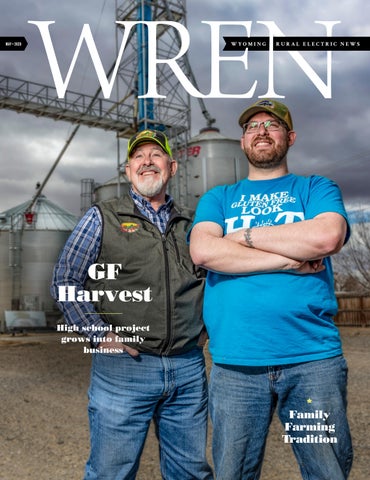
GF Harvest High school project grows into family business
Family Farming Tradition
Tough training. Safe & reliable power. Linemen play a critical role in our mission to provide reliable, affordable electricity. Tough training and a focus on safety is behind everything they do. Simulated field operations and emergency-response training are ways Basin Electric invests in their safety and in providing reliable power to you.
Your energy starts here. basinelectric.com
MAY
M
A
G
A
Z
I
N
2020
E
THE WREN MAGAZINE WYOMING RURAL ELECTRIC NEWS The official publication of the Wyoming Rural Electric Association The WREN Magazine, Wyoming Rural Electric News, volume 66, number 4, May 2020 (ISSN 1098-2876) is published monthly except for January for $12 per year by Linden Press, Inc., 214 West Lincolnway, Suite 21C, Cheyenne, WY 82001. Periodicals postage paid at Cheyenne, WY (original entry office) and at additional mailing offices. POSTMASTER – Send address changes to: The WREN Magazine, Wyoming Rural Electric News, c/o Linden Press, Inc., 223 S. Howes St., Fort Collins, CO 80521, [970] 221-3232. Include 3-digit co-op code. WREN Magazine is owned and controlled by rural electric cooperatives in the interest of the economic progress of rural areas specifically and the entire population of Wyoming and the nation generally. WREN Magazine has a total average monthly paid circulation of 40,985 for 11 months ending September 2019. WREN Magazine is delivered to rural electric member/ consumers and other subscribers throughout the entire state of Wyoming and the nation. Acceptance of advertising by WREN Magazine does not imply endorsement of the product or services advertised by the publisher or Wyoming electric cooperatives.
WREN STAFF Publisher: Linden Press, Inc. Editor: Maggie York
BOARD OF DIRECTORS
Tri-State G&T, Westminster, CO – Dick Clifton, President Garland Light & Power, Powell – Scott Smith, Vice President Deseret Power, South Jordan, UT – Gary Nix, Secretary/Treasurer Basin Electric, Bismarck, ND – Paul Baker Big Horn REC, Basin – John Joyce Bridger Valley Electric, Mountain View – Ruth Rees Carbon Power, Saratoga – Kenny Curry High Plains Power, Riverton – Hearley Dockham High West Energy, Pine Bluffs – Michael Lerwick Lower Valley Energy, Afton – Fred Brog Niobrara, Lusk – Andy Greer Powder River Energy, Sundance – Mike Lohse Wheatland REA, Wheatland – Sandra Hranchak Wyrulec, Torrington – Dewey Hageman
SEND ADDRESS CHANGES AND CORRESPONDENCE TO
ON THE COVER 16 CENTERPIECE
GF Harvest STORY BY ILENE OLSON
Cover photo: Seaton, left, and Forrest Smith stand outside the GF Harvest processing facility in Powell. PHOTO BY NICK ALLEN
Cheyenne, WY 82001, [307] 772-1968 wren@wyomingrea.org
$12 per year, Single copies $1.50 each
ADVERTISING To purchase, contact Dhara Rose: [307] 996-6552 • dhara@golinden.com
OFFICE OF WREN OWNER 2312 Carey Ave., Cheyenne, WY 82001
OFFICE OF WREN PUBLISHER Linden Press, Inc., 214 West Lincolnway, Suite 21C, Cheyenne, WY 82001
FEATURES YOUTH 06 CO-OP G A R L A N D'S
H A R T LY THORINGTON
SPOTLIGHT 22 CO-OP FA M I LY FA R M I N G TRADITION
BY ILENE OLSON PRINTED WITH VEGETABLE INK
07 GRASSROOTS NETWORK 08 THE CURRENT 10 COWBOY STATE BUZZ 32 WHAT'S HAPPENING
ESSAYS & ANECDOTES NOTES 04 WREA W H AT I F?
WREN Magazine • 214 West Lincolnway, Suite 21C
SUBSCRIPTION RATES
STATE NEWS & EVENTS
BY PENNIE HUNT
ON THE RANGE 28 HOME PRAIRIE DOGS IN W YO M I N G
BY NEVA BODIN
US 36 ENLIGHTEN HARD THINGS BY WALT GASSON
FROM OUR READERS TO PAPER 26 PEN THE LITTLE
B L A C K G O AT
COOKS 27 COUNTRY BEETS PICTURE IT 34 JUST FA R M W O R K
JUST FOR FUN CORNER 21 KIDS' W H AT D O FA R M W O R K E R S D O ?
24 BOOK REVIEW
Four books, including:
THE RIVEN C O U N T RY O F SENGA MUNRO
BY RENÉE CARRIER
30 PUZZLE CRITTERGRAM BY KENDRA SPANJER
WREA NOTES
‘I Get by With a Little Help from my Friends’ SH AW N TAY LO R
EXECUTIVE DIRECTOR
I’m almost certain that C-3PO said this to R2-D2 at some point throughout the “Star Wars” saga … maybe not but I couldn’t think of a better title for this guest column from my friend Pennie Hunt. I had planned to write about the “takeaways” from the COVID-19 pandemic and then I read Pennie’s column in the Wyoming Tribune Eagle one day and thought, “she nailed it,” so I asked if I could run it in the WREN because I think the message is perfect these days. Enjoy.
What If? BY PENNIE HUNT
This is an unusual time. I have had moments that I felt as if we are in a sci fi movie. Scenes on the news of people dressed in a wardrobe of total protection are not just frightening to children, but to all of us. Words like; isolation, social distancing, quarantine and rationing spill through every news report. Conversations all begin with, “What store has milk, bread or eggs?” or “Where can we find toilet paper?” I don’t like it. Seeing my loved ones through a computer is not the same as kissing their cheeks. Virtual game night is fun, but it is not the same as sharing the same bowl of chips. (Will we ever be able to share chips again?) I miss coffee and lunches with friends. I miss dinner and movie dates with my husband. I miss manicures and massages. I miss trips, concerts and sporting events that have been canceled. I miss running to the store just to pick up a tomato for my BLT without feeling like my life could be in danger.
4
MAY 2020
All of this feels like distant memories of a past life that becomes increasingly blurred as the days go by. I feel pressure when I hear people are using this time to clean out every closet, write a book and get in shape by working out and eating right. I am sure the new Corona Diet Plan will be out any day. That just makes me want to eat Pop Tarts – which I did before I went to bed last night. I feel fear for those in areas with the most cases of this coronavirus, the elderly and the recently unemployed. I fear the financial ramifications to the world. I feel admiration for those in the front lines of leadership trying to make the right decisions; for those serving us with formidable strength in the health care world; and for the entire chain of workers it takes to produce, transport and stock the shelves of supermarkets. When it isn’t cold and snowing, I go for walks. I cross to the other side of the street if I see someone
It felt slow. It felt quiet. It felt peaceful. It felt fresh and new. It felt different. walking towards me. I count the cars in driveways and wonder if they are having a gathering of more than 10 or if they have gathered as a family to shelter at home – together. Yesterday, I walked. It wasn’t to add steps to my fitness counter or burn as many calories as I could. I walked slow and with the intention of enjoying every step. The sun hit my face with a warmth that made 40 degrees feel like summer. I took deep breaths of clean fresh air. It felt amazing to be out of my house where the air is continually circulated through the furnace. I looked up to the bluest sky I have ever seen that was speckled with cotton white clouds. In the silence of not hearing traffic, or the noise of daily life, I heard birds. Birds singing glorious songs with their choir of friends. I saw carefree bunnies scampering through yards. You are probably thinking this sounds a bit gushy and the next thing I will say is that bluebirds appeared to tie ribbons in my hair like I was Cinderella in a Disney movie. I won’t go that far, but… It felt slow. It felt quiet. It felt peaceful. It felt fresh and new. It felt different. What if this is the message of this virus? The message to slow down. To listen. To see things again – the things we take for granted and the things we miss in our hurried life. What if the speed of which our life and world had gotten to was spinning so fast that we were heading for an implosion? What if this is it?
What if we needed a shake down? A wake-up call to be grateful for what is important. As the days go by, I realize how grateful I am for simplicity. How grateful I am for food, water and the shelter of my home. How grateful I am for the security of love from my family and friends. How grateful I am for dinner and movie dates with my husband at home with our sweet dogs snuggled next to us. I realize what I really miss. I miss smiles and hugs. I miss cheek kisses. I miss the touch of my loved ones and voices that are not muffled by technology. I miss the freedom to move in whatever direction I desire. The events, travel and manicures seem of little importance. The uncertainty of not knowing how or when this will end is nerve-racking and I don’t have the answers. I do know that the most important lessons are taught in the most difficult of times. I do know that the sky is bluer, the birds are singing louder and the world has slowed to a pace that we need to remember when this time of hunkering down ends. What if it is time to listen to the quiet? What if it is time for you to take a walk? Pennie’s life lesson: “The most important lessons are taught in the most difficult of times.” W Pennie Hunt is a Cheyenne-based author, blogger and speaker who teaches how to “Love Your Life ... NO MATTER WHAT!”
MAY 2020
5
PHOTO BY NICK ALLEN
CO-OP YOUTH
WREN: Tell us about your studies and interests. HT: I am currently majoring in elementary education but would like to get a degree in special education. I am not sure what grade level I would like to teach but I love working with kids, so I chose to major in elementary education at Northwest. My interests include being outdoors, paddleboarding, being with my family and going on adventures.
CO-OP YOUTH Wyoming’s rural electric cooperatives are proud to
WREN: How have your hometown, family and/or friends influenced you?
support our youth, giving college scholarships and lineman scholarships. In addition, our co-ops sponsor high school students on the NRECA Youth Tour in June and Youth Leadership Camp in July.
HARTLY THORINGTON
THIS MONTH: Garland Light and Power's Hartly Thorington was awarded the $1,000 Basin Electric Power college scholarship in 2019. She now attends Northwest College in Powell.
HOMETOWN: Powell HIGH SCHOOL: Powell High School YEAR OF GRADUATION: 2019 COLLEGE: Northwest College
Interested in applying for a scholarship, D.C. Youth Tour and/ or Leadership Camp? Contact your local rural electric cooperative! See the insert in the center of the magazine for contact information.
6
MAY 2020
HT: My family has influenced me the most. The reason I would like to go into special education is because my younger brother has autism. He has helped me see how special life can be. Watching him grow up and how much his teachers and paraprofessionals have impacted him made me want to help other students like my brother. Growing up in Powell gave me a sense of community. In small communities like Powell everyone supports each other. It has been great to see that growing up here.
MAJOR STUDY INTEREST: Elementary Education and Special Education
WREN: What are your plans for the future? HT: After graduating Northwest College I plan to attend Black Hills State University in Spearfish, South Dakota, to be in their K-12 Special Education program. Black Hills is such a beautiful campus and their education program is immaculate. After that I hope to become a special education teacher. Also something that I want to learn in the future is sign language.
GRASSROOTS NETWORK
New Report
AMembers Partner &Have Trusted Source a High
Opinion of Their Co-op FROM THE NRECA
Wyoming’s rural electric cooperatives Consumer-members across the country are increasingly satisfied with the are part of a much larger network of performance of their electric cooperatives and more than ever before see cooperatives that strive to provide the safest, most reliable electricity possible them as trusted information sources and partners in keeping energy costs to their members. The cooperative low.board for performance but registered their Consumer-members give co-ops high marks across the difference is that you, the members, own highest satisfaction ever with co-ops being a “partner” in controlling energy use. Change These are among the key findings of a recent nationalTotal survey your electricity provider, and your needs positive from 2018 commissioned by NRECA and conducted by Frederick Polls. drive the cooperative. Providing RELIABLE 27% 68% electric service. The National Rural Electric Cooperative Most respondents (56 percent) say their household electric bills are “about Association (NRECA) recently right” or “a bit low” versus 41 percent who say their bills are “too high.” commissioned a national telephone Fifty-seven percent say they would be loyal to their co-op even if allowed Quickly RESTORING electric 65% survey service to find whether after ancooperative outage. to choose a provider whose “price is27% slightly lower.” Even more (69 percent) members are satisfied, and engaged, would be loyal to the co-op over a competitor with no price difference. with their cooperative. During the past COMMUNICATING and keeping few months, WREN magazine published Other data showed co-ops holding members INFORMED about 47% 37% steady with prior surveys on overall job theactions survey results. This is month, the last the co-op taking. performance (93 percent positive), providing reliable service (95 percent month of the series, we’ll look at survey positive), and quickly restoring service after outages (92 percent positive). Being TRUSTED SOURCE for resultsaregarding member perception of they have a positive opinion of their co-op as a information about energy use 39%Eighty-three percent said44% electric and rates.consumer choices.
Co-op Performance on Specif-
95% +1
92% +2
84% +5 83% +5
trusted source of information about energy use and consumer choices.
Being a PARTNER in helping members control household energy use and save money.
39% Very positive
83% +10
44% Somewhat positive
PERCEPTION OF ELECTRIC RATES
More than half of survey respondents said their co-op’s rates are “about right” or “a bit low.” Right/Low
Too High
60
52%
53%
56%
59% 53%
56%
50 40 30
46%
44%
46%
43%
41%
37% Feb. 2014
March 2015
Nov. 2015
June 2016
April 2018
July 2019
83%
have a positive opinion of their co-op as a trusted source of information about energy use and consumer choices.
MAY 2020
7
THE CURRENT
Lineworker Appreciation Day Cold weather, snow and coronavirus couldn't stop Gov. Mark Gordon, left, from celebrating Lineworker Appreciation Day with Jesse Robbins, above, and Garrett Zwiebel of High West Energy on April 13.
PHOTO BY KELLY ETZEL DOUGLAS
In past years, dozens of lineworkers from around the state have attended the governor’s Lineworker Appreciation Day proclamation signing and gathered for a group photo. With the COVID-19 pandemic, and recommendations to gather in groups fewer than 10, only two lineworkers were able to attend this year.
8
MAY 2020
LINEMAN SCHOLARSHIP FUND A GOOD PROBLEM IS STILL A PROBLEM, BUT WITH YOUR HELP, OURS CAN BE FIXED. Due to its popularity and the generosity of our board, and increased interest in the trade, WREA’s Lineman Scholarship Program is in danger of running out of funding.
SCHOLARSHIPS AWARDED
WHAT IT IS The WREA Lineman Scholarship offers scholarships year-round to one or more individuals, including recent high school graduates who are interested in a career as a lineworker and plan to attend an approved regional lineworker training program.
CANDIDATES
Over the past several years the board has awarded many scholarships, donating a total of $146,540.00 since 2015.
$
$
2015
2016
14.9K 27.5K
30K 2017
$
$
45K
35K
2018
2019
FUNDING
APPRECIATION We appreciate your support!
To be considered, applicants must submit
For over a decade, the
the application form, a resumé describing
scholarship’s main source
their education and work experience, three
of funding has come
letters of recommendation and a transcript
from a fundraising golf
of grades. (If the candidate has not attended
tournament during the
During the last few months, WREA members and friends have contributed to the scholarship fund. A heartfelt “thank you” to
an educational institution in the three years
Cody Hotline School.
prior to submitting the application,
Vendors, cooperatives and
everyone who has reached out!
others who do business
the transcript is not necessary.)
with cooperatives have been Candidates must submit their scholarship
solicited for donations to
application to the Wyoming Rural Electric
the fund. It has been very
Association; they are then passed on to
successful, raising as much
the WREA board for consideration.
as $20,000 in some years.
DONATIONS CAN BE MADE BY:
$
Calling the WREA Office Manager, Robin Feezer: (307) 634-0727
But we aren’t done yet. If you haven’t already, please consider donating to the WREA Lineman Scholarship fund.
Mailing a check to the WREA Office: 2312 Carey Ave. Cheyenne, WY 82001 Make check out to WREA Lineman Scholarship MAY 2020
9
COWBOY STATE BUZZ
TRACING THE COVID-19 PANDEMIC EDITOR’S NOTE:
We are living in historic times, and we know that by the time you read these words, headlines about the COVID-19 pandemic will look dramatically different than they do as we finish this page on April 20, 2020. We have questions for our future: What has changed? What is the same? We’ve compiled the following pages to remember the history we are living right now.
WHERE TO SEEK HELP IN WYOMING CORONAVIRUS RELIEF BILL
RURAL ELECTRIC CO-OPS
The federal government began automatically issuing checks to qualifying individuals mid-April. The FBI is warning consumers that phone calls, texts or emails asking for personal or financial information to get your $1,200 federal payment are not legitimate. Call the IRS at 1-800-919-9835 or visit irs.gov to learn more.
Each of the Wyoming Rural Electric Association’s 11 utility cooperatives have a system in place to help members. While many offices are closed to visitors, we are working to keep your power on. Look to the center of this magazine to find news and contact information for your co-op.
MEDICAID
SCAMS
Individuals and families can apply for Medicaid or Kid Care CHIP by calling the Wyoming Department of Health Customer Service Center at 1-855-294-2127. Hours are Mon-Fri, 7a-6p. For more information log on to health.wyo.gov.
Beware of phone calls, texts or emails offering money or threatening utility disconnects. Never click links or give out personal information to sources you can’t verify.
NO KID HUNGRY
UNEMPLOYMENT CLAIMS AND LAYOFF AVERSION GRANTS
Wyoming First Lady Jennie Gordon’s Wyoming Hunger Initiative has compiled a list of resources by county, including school feeding programs. 307-274-0365, nohungerwyo.org. 10
MAY 2020
In order to reduce hold times for telephone filings at the Wyoming Workforce Services offices at 307-473-3789, unemployment claims will be taken on specific days,
We also know that you may be suffering from economic hardship. We’ve put together a list of agencies that are available to help, including phone numbers and websites.
based on the first letter of the claimant's last name. If your last name begins with A-M: please file your claim on Monday, Wednesday or before noon on Friday. If your last name begins with N-Z: please file your claim on Tuesday, Thursday or after noon on Friday, or file anytime online at wyui.wyo.gov/benefits/ home.do. Layoff Aversion Grants for businesses, CARES Act and other federal aid information are also available through Workforce Services.
HOW TO HELP Those who would like to help others can consider donating to trusted charity organizations, ordering takeout from local restaurants and buying gift certificates from local businesses.
USDA The Department of Agriculture (USDA) has issued an extensive resource guide with opportunities for immediate relief. Call your local office, or log on to rd.usda.gov/coronavirus for information. WYOMING 2-1-1 Dial 2-1-1 or 1-888-425-7138, Mon-Fri 8a-6p to reach a community resources specialist to find local help for everything from food and housing assistance to mental health care through both government and nonprofit agencies. Wyoming 2-1-1 is also offering reliable information on COVID-19. Online at wy211. communityos.org. WYOMING BUSINESS COUNCIL Economic development agency offers business resources. Visit wyomingbusiness.org or call 307-777-2800.
CONCERN FOR
COMMUNITY If you’re familiar with electric cooperatives you know this is one of the guiding principles in our not-for-profit business model. It’s part of who we are proud to be. During these challenging times, our cooperative family is here for you. We are responsibly doing our part to help power you through the unknown. There are a million things on your mind, making sure the lights stay on, shouldn’t be one of them. Because whatever the future holds, we’ll power it.
COWBOY STATE BUZZ
COVID-19 HOW TO PROTECT YOURSELF AND OTHERS FROM THE CENTERS FOR DISEASE CONTROL AND PREVENTION (CDC)
Know how it spreads
01
• There is currently no vaccine to prevent coronavirus disease 2019 (COVID-19). • The best way to prevent illness is to avoid being exposed to this virus. • The virus is thought to spread mainly from person to person: - Between people who are in close contact with one another (within about 6 feet). - Through respiratory droplets produced when an infected person coughs, sneezes or talks.
Everyone should 02 • Wash your hands often with soap and water for at least 20 seconds especially after you have been in a public place, or after blowing your nose, coughing or sneezing. • If soap and water are not readily available, use a hand sanitizer that contains at least 60% alcohol. • Avoid touching your eyes, nose and mouth with unwashed hands. • Avoid close contact with people who are sick. • Stay home as much as possible.
Cover your mouth and nose with a cloth face cover when around others 03 • You could spread COVID-19 to others even if you do not feel sick. • Cloth face coverings should not be placed on young children under age 2, anyone who has trouble breathing or is unconscious, incapacitated or otherwise unable to remove the mask without assistance. • The cloth face cover is meant to protect other people in case you are infected. • Do NOT use a face mask meant for a health care worker. • Continue to keep about 6 feet between yourself and others. The cloth face cover is not a substitute for social distancing.
REACHING OUT TO HELP On April 14, Cowboy State Volunteers flew private airplanes to deliver COVID-19 testing kits and equipment to 10 Wyoming communities in one day. Also on April 14, the Gillette News Record published a story on good news throughout the state, including the “Be The Light” campaign to illuminate high school football fields on Friday nights, donations of more than 1,500 hand sewn masks, local gift card donations, drive-by birthday parties and drive-by Easter egg hunts. Photos: Cowboy State Volunteers COURTESY OF THE WYOMING DEPARTMENT OF HOMELAND SECURITY
12
MAY 2020
There are so many reasons we
COVID-19
find ourselves where we do in life.
Wherever you're at and
however you got there, you're
STATE COLLECTING COVID-19 MEMORIES FROM THE WYOMING DEPARTMENT OF STATE PARKS AND CULTURAL RESOURCES
never alone. For resources on temporary housing and shelter, affordable housing, financial assistance grants, help paying
The Wyoming State Archives and State Museum, the University of Wyoming American Heritage Center (AHC), and Wyoming State Historical Society are working together to encourage you to consider how you would tell future historians about your experiences and memories of this unusual time. Do you keep a journal or a blog? Have you created your own mask for making essential trips outdoors? Are you creating artwork or craft projects to commemorate or pass the time? Are you talking on Facebook or Instagram with your friends about how this pandemic has affected your life? Preserving those memories are all ways that you can remember this time for yourself – and give future historians clues about how we coped, how we communicated – and how we memed. If you’re writing down your thoughts, please consider donating a copy to the state archives or the AHC. If you prefer to
reflect on social media, use the hashtag #Covid19WY so we can pull together all the tweets and posts later. That includes Instagram photos of empty streets or teddy bears in windows. If you’ve used your crafting skills to make masks, signs, or documented your feelings visually, the state museum is interested in hearing from you, and you may see those objects someday in an exhibit about the challenges of life in 2020. Why is it important to preserve these memories and experiences now? Partly because it is fresh in our minds, and partly because we don’t want Wyoming’s story and the lessons we learn through this crisis to go untold. You may be reading stories about the Influenza Pandemic of 1918. Historians learned about this devastating time through personal stories and photographs, as well as official accounts and newspaper articles of the time. Letters, diaries, photos, and artifacts speak volumes about the courage, fear and community support that people experienced.
HOW TO SEND YOUR DIGITAL MEMORIES
HOW TO SEND YOUR MEMORIES BY MAIL
Visit wyoarchives.wyo.gov
State Archivist
and click on the COVID-19
Wyoming State Archives
donations link. For information call 307-777-8691.
bills or for groceries, and more — dial 2-1-1 and talk to a real person who's ready to listen to and serve you.
Dial 2-1-1 or 888-425-7138 or visit www.wyoming211.org
Wills, Trusts & Probate Land Use GAY WOODHOUSE TARA NETHERCOTT HOLLI WELCH JEFF VAN FLEET
Barrett Building
2301 Central Ave.
DEBORAH RODEN JOANNE SWEENEY KATYE BROWN CHRISTOPHER BRENNAN
1912 Capitol Avenue Suite 500 Cheyenne, WY 82001 (307) 432-9399 WRNLawFirm.com
Cheyenne, WY 82002 Be sure to include your contact information.
MAY 2020
13
COWBOY STATE BUZZ CENSUS UPDATE
NEARLY 40% OF WYOMING HOUSEHOLDS HAVE RESPONDED
FROM THE U.S. CENSUS BUREAU – DALLAS REGIONAL OFFICE
Wyoming residents are generating new momentum in responding to the 2020 Census. As of April 14, the statewide response rate for Wyoming is at 39.6 percent. This represents a large increase in selfresponse for Wyoming; in fact California, Iowa, Montana, Nebraska, South Dakota and Wyoming were in a six-way tie for the highest daily total self-response rate in the nation on April 13.
For comparison, the national self-response rate is 48.6 percent. One of the biggest challenges facing response rates in Wyoming is the fact that approximately 23 percent of residents live in an area designated as “Update Leave.” Update Leave areas are part of a special operation for the Census Bureau and encompass rural locations that have city-style addresses but may use P.O. boxes to receive their mail, or it can be homes that contain rural route or highway contract route addresses. These locations have not yet received a formal 2020 Census invitation or paper questionnaire, which is contributing to the lower statewide self-response numbers.
Bank Branches Not Accessible? If you have a smartphone, you’re there with Meridian Trust! You don’t need to make a special trip into town just to deposit checks, transfer money, or pay your bills. With the free Meridian Trust Mobile App, online banking and bill pay – you can do all of that, and more, right from the comfort of your home. Branches in Cheyenne, Jackson, Lander, Rawlins, Scottsbluff, Wellington, Yellowstone NP, Casper, and Rock Springs.
1.800.726.5644 | MyMeridianTrust.com
14
MAY 2020
Your Savings Federally Insured
Does this describe your situation? You can still respond online if you live at a home with a city-style address (ex: 510 Rangeview) but use a P.O. box to get your mail. Go to my2020census.gov and click on "Start Questionnaire" and then click on the link underneath the ID field that reads, "If you do not have a Census ID, click here." The census is asking Wyoming residents with non city-style addresses, like rural routes or highway contract routes, to please wait for the census packet with ID to be dropped off at your home due to the complexity of these types of rural addresses. The Update Leave operation is currently slated to resume in mid-June 2020 but is subject to change. It is much more efficient and accurate for the Census Bureau to count residents with complex addresses when they use their Census ID to complete the questionnaire.
EVERYTHING YOU NEED TO KNOW ABOUT THE 2020 CENSUS
The census data provides monetary funds for Wyoming. Wyoming towns and counties each received about $600/person from state tax distribution based on census data in the 2019 fiscal year.
CENSUS INFORMATION IS USED IN WYOMING FOR PLANNING AND FUNDING
NEW SCHOOL CONSTRUC TION
MEDICARE DISTRIBUTION
ROADS AND BRIDGES
POLICE AND FIRE DEPARTMENT LOCATIONS
LIBR ARIES AND PUBLIC BUILDINGS
THE CENSUS IN YOUR COMMUNITY
THE CENSUS IS SAFE
The census will not be mailed to P.O. Box addresses. Instead, a
The U.S. Census Bureau is bound by law to keep your
census worker will bring a postcard or questionnaire to your home.
answers strictly confidential. Data cannot be used for law enforcement purposes or to determine personal
How to identify a census field representative:
eligibility for government benefits.
The representative must present
The representative
an I.D. badge with:
The census will NEVER ask for:
will have a letter from the director of the
THEIR PHOTOGR APH
SOCIAL SECURIT Y NUMBER S
U.S. Census Bureau and can provide the
A DEPARTMENT OF COMMERCE WATERMARK
BANK OR CREDIT CARD INFORMATION
number for the regional office for verification. Wyoming residents can
AN E XPIR ATION DATE
MONE Y
also call 211 for census information.
ANY THING REL ATED TO POLITICAL PARTIES
CENSUS TIMELINE 2010
MARCH
APRIL
MAY
JULY 31
The last census took place 10 years ago.
You will receive an invitation to participate in the 2020 census. Some households will receive a postcard, others will receive a questionnaire.
If you haven’t responded yet, you will receive a reminder letter and paper questionnaire.
Census workers begin visiting homes that haven’t responded.
Census closed.
MAKE SURE YOU COUNT!
2030 The next census will take place 10 years later.
Home visits may be delayed due to the COVID-19 pandemic.
Wyoming’s rural electric cooperatives encourage you to participate in the 2020 Census.
For more information call 211, log onto 2020census.gov or visit your local library.
Sources: Wyoming Department of Administration & Information Economic Analysis Division, Wyoming State Library.
MAY 2020
15
PHOTO BY NICK ALLEN
CENTERPIECE
GF Harvest
BY ILENE OLSON
The Smith family poses in an oat field near Powell, with Heart Mountain in the background. From left are Alyssa Smith, Seaton Smith, Forrest Smith and Jill Smith.
High school ag project grows into successful business
A
thriving agricultural business in Powell got its start as an outgrowth of a high school student’s unusual FFA project.
Forrest was diagnosed with celiac disease at the age of 2. That diagnosis meant that he could not eat grains that contained gluten. As a result, his diet was very limited. No wheat; no barley; no rye; no oats. No bread; no cake; no crackers; no cereal; no oatmeal. But, around the time he started high school, scientists began realizing that oats, when grown and processed carefully, actually contain no gluten. Forrest decided to put that theory to a test. So, for his supervised FFA agricultural experience, he obtained 50 pounds of oats grown in a field where no wheat, barley or rye had been planted for a few years, thereby preventing cross-contamination. He and his parents hand-sorted the oats, and Forrest rolled them with a small electric roller he purchased for his project. The results were promising; Forrest was able to eat the rolled oats without suffering digestive problems. The following year, Forrest’s project expanded to 500 pounds of oats, which he bought from a local farmer. After sorting and rolling the oats, he bagged and sold them to other celiac sufferers. But in Forrest’s junior year, the farmer who had supplied the oats before said he couldn’t guarantee his oat crop that year wouldn’t be contaminated. Forrest and his parents figured that was the end of his FFA project.
PHOTO BY FORREST SMITH
After growing up on a meat-and-potatoes diet, Forrest Smith wasn’t looking to raise cows, pigs or lambs. He wanted to help people who suffer from celiac disease, an immune disease in which gluten damages the small intestine.
Then, unexpectedly, “a farmer chased us down, asking us if we wanted to buy his seven acres of oats,” Forrest said. “My parents sold their camper and bought the oats, but we had to figure out how to process them. The oats have an outside shell — a hull — so we had to figure out how we were going to get that removed. Before, we just rolled the oats.” After some investigation, the Smiths found a company in another state that was willing to help them out. They loaded the oats up, hauled them to the company’s facility and processed them there. The Smith family began selling the oats in retail products in 2003. Then, in 2007, they began selling in bulk as well. As the FFA project grew into a business, it got its name: Gluten Free Oats. They continued the arrangement with the processing company for several years, but found the 100 man-hours it took each time just to clean the machines to be burdensome and expensive. But the cleaning was absolutely necessary to ensure there would be no crosscontamination from other grains that were processed in the facility.
Oat groats ripen in the summer sun near Powell.
No wheat; no barley; no rye; no oats. No bread; no cake; no crackers; no cereal; no oatmeal.
MAY 2020
17
STATE AND LOCAL INVESTMENTS The Smiths decided it was time to look into building a mill and processing facility for Gluten Free Oats. In 2009, Forrest’s father, Seaton Smith, went before the Powell City Council to ask if it would be willing to sponsor a Business Ready Community Development grant and loan to help them buy the property and pay to build the facility. “The presentation was put together really well,” said Powell’s former mayor, Scott Mangold. “Seaton already had information about the grant program. Basically, all we had to do was put together the application and send it in to the state.” The Council agreed to sponsor the grant. Seaton did another presentation for members of the Wyoming Business Council, who made a trip to Powell to learn more about Gluten Free Oats as part of the application process. The Business Council recommended that the project receive full funding from the Wyoming State Loan and Investment Board. Two grants were awarded to the city of Powell on behalf of Gluten Free Oats: a Business Committed Grant for $450,000 in January 2010, and an additional $267,795 in January 2011, when construction bids came in higher than expected. In addition, the city of Powell loaned $108,000 for the Gluten Free Oats project through the city’s economic development fund. Only the funding from the city carries interest, at 4 percent; the grant money is interest free. The city of Powell owns property and the 2,880 square-foot facility, and Gluten Free Oats leases it for $1,994 per month. Once the 30-year grant/loan is paid off, Gluten Free Oats will own the property and the building free and clear, and the money the city receives in payments will be available for future economic development projects. 18
MAY 2020
Coping with
Celiac Disease When Forrest Smith was 2 years old, he looked like the victim of a famine. His arms and legs were scrawny, his belly distended. He was sick, malnourished, and he had no energy. His parents, Jill and Seaton Smith, were desperate to find out what was wrong with their son. “We watched him fall asleep in his food,” Seaton said. “We had to hold his head up in the barbershop so they could cut his hair; he would fall asleep in the chair.” Eventually, the Smiths were referred to a gastroenterologist, who came up with a diagnosis: Forrest had celiac disease. Celiac disease is an auto-immune disorder in which eating gluten causes a person’s immune system to attack the lining of the small intestine. That prevents the intestine from absorbing nutrients, resulting in diarrhea, fatigue, malnutrition, weight loss and anemia. There was a simple solution to Forrest’s problems, the doctor said: “Take him home, feed him meat and potatoes, and you’ll have a brand-new child.” Almost immediately, Forrest gained weight and became a normal, energetic little boy. But his limited diet could be frustrating. Forrest couldn’t eat bread or cereal, cookies, cakes, crackers or sauces. He couldn’t eat school lunches, and when other students brought cupcakes to share for their birthdays, he couldn’t eat them. Two years after Forrest’s diagnosis, Jill learned she also has celiac disease. Several years after that,
Seaton was diagnosed as well, as were 15 other family members of Forrest’s extended family. Before Gluten Free Oats, Seaton said, the only flour that people with celiac disease could eat was rice or potato flour, and those don’t provide the fiber a person’s digestive system needs. When Forrest brought the idea for his gluten-free oat FFA project to his father, Seaton was supportive. “We taught him to give back to others,” Seaton said, “and this was a way for him to do that.” Giving back also was a big part of the reason the family decided to broaden the project into a business. In doing so, “We were the first company in the United States that was certified as a gluten-free processor.”
GF Harvest employees inspect an oat field and remove any plants that don’t belong. Keeping the oat crop free of contaminants ensures it is gluten-free.
PHOTOS BY FORREST SMITH
Farm trucks line up for inspection at GF Harvest in Powell prior to the oat harvest. Inspection is necessary to ensure that no barley or other grains containing gluten are present in corners or creases in the truck beds. A small amount of gluten contamination can cause big problems for people with celiac disease.
DIVERSE MARKET These days, Gluten Free Oats, now marketed as GF Harvest, is a thriving business that employs 16 people in addition to the Smiths. Seaton and Jill are co-owners; Seaton is president of the company, and Jill serves as quality assurance manager. GF Harvest offers rolled oats, oat flour, pancake mixes, steel-cut quick oats, oatmeal in microwaveable cups and ready-to-go oatmeal in small, pop-out containers. Now they’re considering going into hemp as well. In a presentation to the Powell City Council in March, Jill said the Smiths envision adding hemp to GF Harvest’s oat products to increase the protein and omega content of the foods they offer.
Seaton told the Powell Tribune in 2011 that most of the money Gluten Free Oats earns is from out of state, and much of it comes from international sales. Local farmers grow the oats, further benefitting the local economy. Forrest said last month that GF Harvest ships products to countries around the world, including Scotland, Australia, Brazil, Singapore and Taiwan. GF Harvest also provides Passovercertified oats for people of the Jewish faith who are gluten intolerant. The entire process has to be observed from
harvest to processing to certify that the oats are free from water and unleavened. “Last year, we had one rabbi and his helpers,” Forrest said. “They cannot take their eyes off the oats. Once they are harvested, they have to watch constantly to make sure there is no water, so no leavening can happen. Then we stored it, and they came back at a later date with some more rabbis, and we made it into flour. There’s a lot of headaches to it, but it’s a service to them, and they thank us for that ability so they can celebrate the Passover.” MAY 2020
19
A farmworker prepares the soil for crops near Powell in April.
“I look back and say that the good Lord put blinders on us to not see those pitfalls that could be there.”
Big-name companies have since entered the gluten-free market, and GF Harvest has more competition than it once did. But Seaton said those big companies can’t match the quality control needed to ensure GF Harvest's extremely low crosscontamination rate of 10 parts per million. That’s the equivalent of finding 10 dimes in a stack of pennies a mile high. And it’s accomplished by careful planning, cleaning and inspection, he said. “I know what seed went into the planter, who was growing it, and what the fields had in them for the last two years,” Seaton said. “We inspect it, the grower inspects it, and the Wyoming Seed Certification inspects it in the field. We inspect the combine and the trucks prior to the harvest.” Barley is harvested earlier in the season than oats. If some barley got stuck in a corner of a truck bed, that would contaminate the whole load of oats, Seaton said. After delivery to the GF Harvest processing facility, the oats are placed on a large table, where they are inspected again, and any stray grains removed. 20
MAY 2020
PHOTO BY ILENE OLSON
STAYING ON TOP
Those details might not matter as much to someone whose gluten sensitivity is low, but they’re very important to celiac sufferers who have a high sensitivity to gluten. Seaton said he realizes now that he and his family were spared serious problems that could have befallen them when creating and expanding their business.
“First Bank said, ‘Yes, I’ll walk along with you.’ Community Development said, ‘Yes, I’ll walk along with you.’ Growers said, ‘Yes, I’ll walk along with you.’ Now we look back, and we’ve built a great opportunity and a great product,” he said. Mangold, who now serves on the Powell City Council, said GF Harvest has grown from its humble beginnings as a student project into a thriving business.
“We didn’t realize how far we were on the cutting edge,” he said. “I look back and say that the good Lord put blinders on us to not see those pitfalls that could be there.”
“It’s a big success story, not only for Park County and Powell, but also for the state,” he said. He noted that state officials often point to the company as an economic development success story. W
The Smiths also were fortunate to find the support they needed to grow their business, Seaton said.
Ilene Olson is a freelance photographer, writer and editor in Powell.
KIDS CORNER
02
What do Farm and Ranch Workers do?
The Wyoming Department of Workforce Services counted more than 1,000 people working in various agricultural fields in March 2019, including working with animals such as sheep, cattle and aquacultural animals, or planting and harvesting crops. The average wage for these workers was about $14 per hour.
01
A farm and ranch worker is constantly on the move. One day he or she is driving a tractor, the next day building fence or repairing an irrigation pivot. This is an outdoor job that might involve sheep, cattle, horses and dogs.
Farm and Ranch Workers in Wyoming
01
Are you interested in becoming a farmworker? You've come to the right place!
UP
04
I WHEN
GROW
How to Become a Farm and Ranch Worker Farmworkers are needed all across the state. College education is not always necessary, but a strong work ethic is!
03
ea
to b want
I
ker
or w m r a F
04
Tools of the Trade What does a farmworker need to work every day?
Circle the correct items. 05
Farmworker Quiz Are you a cowboy or a sheepherder? What does your personality say about your job? Add up your points to find out. 1) Do you like horses or dogs the most? Horses +1 • Dogs +2
3) Do you like to stay in one place or change the scenery every day? Stay +2 • Change +1
2) Would you rather sleep in a camper or in a tent? Camper +2 • Tent +1
4) Which are cuter, lambs or calves? Calves +1 • Lambs +2 5) Do you like rodeos? Like +1 • Dislike +1
Answers: 5: You’re all cowboy! 9: You’re a sheepherder! Somewhere in between? So are we!
PHOTO BY ILENE OLSON
CO-OP SPOTLIGHT
— RIC RODRIGUEZ —
Continues Family Farming Tradition
A Rodriguez Farms employee uses an air seeder to plant barley in a field west of Powell, with the Bighorn Mountains in the background. The seeder opens a small trench, injects seed and fertilizer, and closes the trench, all in one pass of the tractor.
‘Farming is in my blood’ BY ILENE OLSON
As a third-generation farmer, Ric Rodriguez follows in the footsteps of his grandfather and his father, both of whom farmed for decades in the Powell area, served by Garland Light and Power. Ric’s grandfather was a field worker who came to Powell during the spring, summer and fall in the 1930s to work in sugar beet fields. There, he met Ric’s grandmother, who also came up to Powell with her family to work the beet fields. In the late 1930s or early ’40s, Ric’s grandfather decided to take up farming on his own southwest of Powell. There, the couple raised their six children. Ric’s father, Paul Rodriguez, served in the Korean War in the early 1950s, after which he returned to the Powell area. He began farming near Heart Mountain in 1955. Two of Paul’s brothers returned to Powell in the late 1960s, and Paul got them started in farming as well. Each brother had his own farming operation. 22
MAY 2020
After graduating from high school, Ric left Powell for a time, earning an education degree from Montana State-Billings. But in 1981, his heart led him back to Powell. He began farming on his own, with his father’s help. Paul mostly retired from farming in 2000. “At 86 years old he still comes out every day to help where he can on the farm,” Ric said. Ric’s son, Marc, and daughter, Nicole, both went to college in Montana and “kind of bounced around a bit.” But, like their father, they eventually returned to Powell. These days, Marc farms alongside Ric, making Marc the fourth-generation Rodriguez farmer. One of Ric’s uncles also farms with him part time.
Ric Rodriguez
PHOTOS BY ILENE OLSON
The machine Rodriguez Farms uses to plant barley is 32 feet wide. A tillage tool in the front tills the ground, followed by an air seeder that injects a precise amount of fertilizer along with the seeds. Then wheels on the back of the machine tamp the dirt back in, all in one pass.
A stream of barley seed pours into a hopper from an opening in the back of a semi trailer. An augur then lifts the seed and pours it into to a seeder tank. Marc Rodriguez watches the fill level of a seeder tank while an augur pours barley seed into the tank through a chute.
Ric said they grow mostly sugar beets and malt barley, throwing in some dry beans and alfalfa now and then. This year, they’re planting about 1,400 acres of sugar beets, and another 1,400 acres of barley. Working the soil and tending crops is in the Rodriguez blood. “I enjoy the work [and] being my own boss,” Ric said. “You can control your own destiny. Hopefully you can make enough money to go on a trip now and then, and maybe buy some machinery.” But pitting yourself against Mother Nature year after year isn’t easy — especially when she’s temperamental. “It’s always a challenge,” Ric said. “It seems like there’s a different challenge every year. “Last year, the weather just stuck us hard, both in the spring and the fall. We froze some beets in the spring, then had to replant. Then we had a devastating freeze in the fall and had to leave some beets in the ground.” The financial side of farming is what Ric likes least.
The tractors that pull the seeders are guided by GPS receivers, which ensure that every row is straight, with no gaps or overruns between passes. Perhaps Ric’s favorite machine is the ROPA sugar beet digger, manufactured in Germany — the only one in the state of Wyoming. “It will dig in snow or mud or whatever,” Ric said.
“As long as the markets are good, you don’t mind going to the bank, but when you’ve had a bad year, financial planning is the toughest,” Ric said.
The behemoth machine defoliates the beet plants, digs the beets, brings them up on a conveyor belt, then an auger distributes the beets throughout the ROPA’s huge storage bed. Once the storage box is full, the beets are transferred via an adjustable double-wide conveyor belt into a waiting dump truck for transportation to a beet dump station.
But, even after a bad year, “you want to go and do it again, to prove you can do it,” he said. “Overall, we’ve done well.”
Doing all that in one pass saves time, labor and fuel, but the machine has a hefty price tag.
The right machinery makes a big difference, and it makes farming very different from when Ric’s grandfather, and even his father, farmed the land. It minimizes the number of tractor passes in the field, and it maximizes yield.
“You have to have the right amount of acres to justify one,” Ric said. “But it’s freed up a couple of men from harvest to do field work.”
Unlike most farms in the Big Horn Basin, Rodriguez Farms use very little flood irrigation. Ric prefers pivot irrigation systems — very long assemblies of sprinklers that use motorized wheels to rotate the sprinklers around the pivots. He said the pivots apply the correct amount of moisture over each field and crop and save the manual labor required to run water down flood irrigation furrows.
In addition to farming, Ric also serves as the Lovell Factory District representative on the Western Sugar Cooperative’s ninemember board of directors. The growerowned cooperative, based in Colorado, owns sugar factories in Wyoming, Colorado, Montana and Nebraska. Those factories process sugar beets grown on a total of about 115,000 acres annually. W Ilene Olson is a freelance photographer, writer and editor in Powell. MAY 2020
23
BOOK REVIEW
The Riven Country of Senga Munro BY RENÉE CARRIER Riven: adjective, literary; alternate past participle of to rive. 1. torn apart 2. broken into pieces, split asunder. “My daughter would have been 29 years old this year,” begins this intergenerational story. Senga Munro still blames herself two decades after her daughter’s death. A literary novel, “The Riven Country of Senga Munro” explores the aftermath of unspeakable tragedy and what it means to be “other” in rural Wyoming: Senga sees what others can't, via the novel's thread of magical realism. An arrow shot through time by a 19th century Indian scout jolts her awake at last. Will Senga risk the relative safety of routine and finally come to terms with her purpose and life, even as she provokes the ire of a modern-day outlaw? Senga Munro, the not-so-simple herbal simpler is earning a Ph.D. in life’s mysteries. We meet Senga’s friends: Gabe Belizaire, a bull rider from Louisiana with an M.F.A in creative writing, who chooses to live in a state where his skin color is rare; Rufus and Caroline Strickland, a sympathetic, if irascible, elderly ranching couple; Francesca Albinoni, Gabe’s Italian muse; Joe Rafaela, the hardy Franciscan; and the old Berry place folks – outlaws and proverbial snakes in the garden, of the poisonous variety. Readers learn that resilience and grit triumph as the most useful antidotes in the bag as they journey through “The Riven Country of Senga Munro,” Book One in the Riven Country Series.
DESCRIPTION BY THE AUTHOR
ORDERING INFORMATION 2019 | 355p. | $16.00 paperback ISBN: 978-1734043709
WIN A
Publisher: Renée Carrier Available online and from local booksellers.
FREE
BOOK
Name:
MARCH'S BOOK WINNER:
Phone:
CAROL BROCK
Address:
OF RIVERTON ENTRIES DUE BY JUNE 10 One entry per household, please.
BOOKS
c/o WREN Magazine 214 W. Lincolnway, Ste. 21C Cheyenne, WY 82001
wyomingrea.org/wren-submissions
24
MAY 2020
If you'd like to enter to win any of the four books in the May giveaway, write "BOOKS" on the address line. To win a specific book, write the name of that book.
MORE BOOKS
Images of America Lander BY CAROL THIESSE, TRACI FOUTZ, AND JOE SPRIGGS 2010 | 128p. | $21.99 paperback ISBN: 978-0738581507 Publisher: Arcadia Publishing Available online and from local booksellers.
01
Images of America Gillette BY MARY KELLEY 2010 | 128p. | $21.99 paperback ISBN: 978-0738580265 Publisher: Arcadia Publishing Available online and from local booksellers.
The Images of America book series covers the history of the area from its beginnings to current times. Written by local experts and filled with photographs, the books tell the story of significant locations in Wyoming.
02
Images of America Fort Laramie BY STARLEY TALBOTT 2010 | 128p. | $21.99 paperback ISBN: 978-0738580531 Publisher: Arcadia Publishing
DESCRIPTION BY WREN STAFF
Available online and from local booksellers.
03 MAY 2020
25
PEN TO PAPER
The Little Black Goat
He stands there, grazing in the green pasture Sometimes alone, other times in the midst Of an antelope herd who do not mind the company of this strange immigrant. Odd bedfellows these natives and this dark Foreigner, yet they coexist without Apparent rancor or enmity. What is the secret of their accordance? Apparently, they share more in common, Overriding the insignificant Visible differences which we see And misconceive to be preeminent. Is the little black goat content – does he Feel alienated – or conflicted Because of the queer company he keeps? Is he lonely when the antelope leave? It must be that he only focuses On being a goat. Accepting all else Without regard for his forthright goatness.
WAYNE HOLYOAK
ROZET
This is a goat that I often see driving between Rozet and Gillette on Highway 51. Sometimes the goat is alone and sometimes hanging out with the antelope.
We share a selection of WREN readers’ creative writing (poems, limericks, haiku, short verse, and prose) every issue as space and content allow. To be considered for publication, please include the author’s consent to be submitted, his or her mailing address, and confirmation that the work has not been published elsewhere. If you would like us to return your work, include a self-addressed, stamped envelope.
26
MAY 2020
Put Your Pen to Paper!
Please include your name, address, and phone number. SUBMIT A PIECE
wren@wyomingrea.org | [307] 772-1968 214 W. Lincolnway Ste. 21C Cheyenne, WY 82001 wyomingrea.org/wren-submissions
COUNTRY COOKS
BEETS PICKLED BEETS 3 (16 OZ) CANS SLICED BEETS 1 CUP SUGAR 1 CUP VINEGAR 2 TBS CORNSTARCH 12 WHOLE CLOVES (OR MORE) 3 TBS CATSUP 3 TBS COOKING OIL 1 TSP VANILLA DASH SALT Drain beets, reserve 1 1/2 cup juice. Place beets in saucepan with the reserved juice and remaining ingredients. Mix well and cook for 3 minutes over medium heat, until the mixture thickens. Let cool, store in the refrigerator.
DOROTHY WOOD
B
MARINATED BEET SALAD
BEET JELLY
1 (16 OZ) CAN WHOLE BEETS 1/4 CUP WHITE SUGAR 1 TSP PREPARED MUSTARD 1/4 CUP WHITE VINEGAR 1/4 CUP DICED RED ONION
8-10 BEETS, PEELED AND SLICED 7 CUPS WATER 2 SMALL PKGS SURE JELL 1/2 CUP LEMON JUICE 8 CUPS SUGAR 2 (3 OZ) PKGS JELL-O GELATIN MIX, ANY FLAVORS
Simmer beets in water for 30 minutes until beets are tender. Strain off 6 cups of juice. Pour juice into a large pot and stir in Sure Jell and lemon juice. Bring to a boil; add sugar and JELL-O. Bring to a boil and boil 6 minutes. Remove from heat and skim. Seal in sterile jars.
NANCY DENK
RIVERTON
HULETT
Drain beets, reserving 1/4 cup beet liquid and slice beets into 1/4 to 1/2-inch slivers. Add onion and toss. In a saucepan over medium heat cook sugar, mustard and reserved 1/4 cup beet liquid until dissolved. Add vinegar and bring to a boil; remove from heat and allow to cool. Pour over the beets and onions, toss and refrigerate 4 to 6 hours. Remove from refrigerator and serve at room temperature.
NANCY DENK
Send complete recipe by June March10!10!
Please include your name, address and phone number.
JULY:
SALMON
RIVERTON
SUBMIT A RECIPE
wren@wyomingrea.org | [307] 772-1968 214 W. Lincolnway Ste. 21C Cheyenne, WY 82001 wyomingrea.org/wren-submissions MAY 2020
27
HOME ON THE RANGE Though prairie dogs are found to possess an extensive vocabulary, he said nothing about why he visited us. Nor did he turn to a fellow prairie dog to bark, “Alert! A tall, thin human wearing a blue shirt is standing in front of me!” But he could have. According to India Hayford, retired range conservationist and museum assistant at Casper College’s Werner Wildlife Museum, prairie dogs invent new “words” to describe things they’ve never seen before. They are amazing little linguists.
Prairie Dogs in Wyoming BY NEVA BODIN
“What’s that noise in the garage?” I asked my husband. “I don’t know! Go see.” I opened the door to our attached garage. “No one’s out here, must be the wind.” Some small items were knocked over on the work bench. A few days later, while working in a small shed in the backyard and feeling someone watching him, my husband checked the doorway. A small, tan prairie dog sat in the doorway studying him – the source of our mysterious noise in the garage. The small rodent was obviously misplaced. This creature’s usual home is on the range of flat Wyoming vistas rather than in a people’s town.
Northern Arizona University professor C.N. Slobodchikoff studied prairie dog language extensively. In his publication, “Prairie Dogs," coauthored by Bianca S. Perla and Jennifer L. Verdolin, he wrote that by introducing different objects into their environment and recording their calls with sophisticated sound analyzation systems, researchers discovered that prairie dogs can specify a type of predator, size, shape, danger level, color to a limited extent, speed at which it is approaching, and develop new language to describe something they have not encountered before. He found that their behavior in standing upright to observe near or away from their burrows,
or dive into their burrows immediately, depends on the announcement from the alerting animal. Slobodchikoff wrote that if a predator is approaching slowly, their calls are slower, if faster, they bark or chirp faster. If a domestic dog approaches instead of a coyote, they may stay close to but outside of their burrow longer. Chattering to each other for no apparent purpose other than to be social also seems to occur.
PRAIRIE DOGS IN WYOMING There are five types of prairie dogs: black-tailed, whitetailed, Gunnison’s, Utah and Mexican. Hayford said Wyoming sees two of the five species: white-tailed and black-tailed. Depending on altitude and environmental temperature, Gunnison’s, Utah and white-tailed species hibernate for varying lengths of time writes Kim Long in her book “Prairie Dogs: A Wildlife Handbook,” part of the Johnson Nature Series. Researchers in animal behavior have studied blacktailed and Gunnison’s prairie dogs to decode their language. Each species has complex communications skills. There can be the same language with different accents in the same species who live in different areas, said Hayford. Just as someone from Texas says things differently than someone from Minnesota although voicing the same message, so goes the language of prairie dogs.
HISTORY AND ENVIRONMENT Named by the French for their sharp little barks, prairie dogs look more like gophers or ground squirrels than dogs. During their Corps of Discovery expedition, Meriwether Lewis and William Clark encountered them in Nebraska and, fascinated, wrote long, descriptive paragraphs about them. After catching one, they sent it to President Thomas Jefferson. According to their journal, they also ate one with Lewis writing, “this little animal is frequently very fat and it's flesh is not unpleasant.”* This wasn’t an original idea. While Long writes of myths and songs by Native Americans regarding the prairie dog,
Slobodchikoff writes that Hopi and Navajo had recipes for prairie dog and prairie dog bones were found at Anasazi lodging sites. Prairie dogs are a keystone species, providing food and homes for many types of animals. Burrowing owls and mountain plovers nest in their burrows. Hawks, coyotes, bobcats, badgers, falcons, fox and snakes eat these small animals. The black-footed ferret eats prairie dogs almost exclusively. Prairie dogs eat vegetation, such as grass, roots and small seeds and insects. They provide fertilizer with their waste, eat the grass so it is shorter and becomes more
concentrated with protein, and aerate the soil with their digging. As many as 70 burrows may make up a prairie dog colony or town consisting of family groups called coteries. Prairie dog burrows contain separate rooms for eating, sleeping, storing food and elimination. Within the town are neighborhoods – groups that bond and become someone to visit, play, and socialize with. When prairie dogs who like each other greet one another, they often touch their lips, tongues or teeth together, making it look like they are kissing. This is a common picture on postcards for sale in Wyoming.
Prairie dogs may host the rat flea, which carries the bacterium for three types of plague, Bubonic being the most common. The rat flea, itself not harmed by the bacteria, transmits the disease when biting an animal such as the prairie dog, or human. The disease can be transmitted by a bite, direct contact with infected tissue, or even exposure to human coughing. Our little visitor needed to move on, and we encouraged him to do so. Hopefully he found more suitable country real estate for his new home. W
Neva Bodin is a Casper-based freelance writer, registered nurse, painter and poet.
*From July 1, 1806, lewisandclarkjournals.unl.edu
MAY 2020
29
PUZZLE
Yes, those shrill – some might even say irritating – yips and barks are actually descriptive sentences that contain nouns (e.g. human, coyote, dog) as well as adjectives (e.g. green, tall, triangular). Using sonic and behavioral analysis of prairie dog alarm barks and “jump yips” scientists have been able to decipher a vocabulary, document five species-specific languages and regional accents, and even observe individuals creating new calls to describe things they’ve never seen before. I’ll be doggone.
Unlike prairie dog language, in which each sound represents an entire word, this cryptogram pairs a sound with a letter. Use the key to keep track of letter-sound pairs as you decipher the quote. Furrowed brow? Dig up the answers on page 33.
A
B
C
N
O
P
D
E
F
G
H
I
J
K
L
M
R
S
T
U
V
W
X
Y
Z
yip Q
blaf
BY KENDRA SPANJER
Crittergram
Forget chimps, whales and dolphins. According to current research, the award for nature’s most sophisticated vocal language has gone to the dogs. Prairie dogs!
eef
W
_____
_____
_____ ,
_____
_____
’ _____
_____
_____
_____
_____ .
eef
yap
reet
reet
boof
voff
ow
voff
waf
squeep
yap
W
_____
D
_____
N
_____
_____
_____
_____
_____
_____
eef
yap
yip
art
blaf
art
voff
reet
boof
zeep
yap
_____
N
_____
_____
_____
_____ .
boof
blaf
weet
bork
art
art
_____
_____
_____
_____
_____
N
_____
_____
_____
N
ike
squeep
voff
haff
weet
blaf
boof
ow
weet
blaf
—
_____
N
_____
_____
_____
_____
_____
_____
_____.
weet
blaf
boof
haff
weet
reet
voff
art
art
D
_____ .
D
_____
_____
_____
_____
_____
_____
_____
_____
yip
waf
yip
art
art
reet
boof
voff
voff
reet
yap
Want more? Learn more about prairie dog language in the videos at conslobodchikoff.com
WHAT'S HAPPENING
WHAT'S HAPPENING REGIONAL MAP
02
03
PHOTO COURTESY OF MEETEETSE MUSEUMS
04
01
FEATURED EVENT
MAY 20 – JUNE 20
01 | SOUTHEAST CENTENNIAL JUNE 20
Centennial Valley Volunteer Fire Department Open House: Familyfriendly fundraiser with pig roast, silent auction and raffle. Noon, Centennial Fire Department, free, info 307-745-9322. ONGOING
Nici Self Museum Hours: Museum open on Memorial Day weekend, May 23, 24, 25 and 12-4p Thu-Mon to Labor Day weekend, 12-4p Sat-Sun in September. Nici Self Museum, free, info 307-742-7763, niciselfmuseum.org.
C H U G WAT E R
GUERNSEY FOURTH SUNDAYS
American Legion Riders: 2p, Crazy Tony’s Bar & Grill, info 307-575-0838.
J AY E M THROUGH SEPTEMBER
Historic Jay Em on the Rawhide: Tour historic buildings by appointment only. Info 307-735-4364, 307-322-2839.
02 | NORTHEAST B U F FA L O THURSDAYS
Bluegrass Jam Session: 6:30p, Occidental Saloon, free, info 307-684-0451.
JUNE 20
GILLETTE Chugwater Chili Cookoff: Annual JUNE 6 Due to the ongoing event with ranch Dance Through the COVID-19 pandemic, rodeo, live music, Decades: Familyevents may be postponed car/tractor show, friendly event with or canceled. Please games, vendors and dancing, silent chili to raise funds call ahead before auction and raffles to for the Chugwater attending events. benefit the Rockpile Fire Department, Museum Association’s Historical Society, FBLA paid summer internship and FFA, Community Center program. 5:30p, dinner 6p, and more. Info 307-715-9518, Campbell County Senior Center, $40, chugwaterchilicookoff@gmail.com. info 307-682-5723, assocrma@gmail. com. ENCAMPMENT
LEGEND ROCK TOUR MEETEETSE
JUNE 6 – 9A, TOUR AT 10 Annual tour includes kids’ activities and a visit from Joshua Mann of the Eastern Shoshone Tribal Historic Preservation Office. Dress for the weather, bring water and lunch. Meet at Meeteetse Museums or Legend Rock State Petroglyph Site at 9a. Tour at 10a. Free. INFO 307-868-2423 PROGRAMS@MEETEETSEMUSEUMS.ORG
ONGOING
Grand Encampment Museum: Main Gallery and GEM store most days 10a-4p, info 307-327-5308.
H A RT V I L L E JUNE 20
Sunrise Mine Tours: Three-hour mine and town tour, barbecue lunch to benefit the Western History Center. Gates open at 11:30a, tour leaves at 1p. Meet at Sunrise Mine, $20, $35 family, no credit cards. Info 307-575-2010.
TUESDAYS
Levis and Lace: Square dance club will give modern square dance lessons, 7:30p, Rockpile Community Center, free trial lessons, info 307660-7207. ONGOING
Ava Community Art Center: Info avacenter.org or 307-682-9133.
NEWCASTLE SECOND & FOURTH WEDNESDAYS
GiGi’s Closet: Providing free gentlyused clothing for the family. 9a-1p, First United Methodist Church, info 307-746-4119.
NORTHWEST MAY 2020
31
WHAT'S HAPPENING
P I N E H AV E N JUNE 20
Show and Shine: Classic car show, contest, barbecue. 9a, winners announced at 2p. Waters Park, $10 entry fee per vehicle. Info 307-756-9807.
UPTON MAY 26
Library Summer Reading Program: Sign up at Upton Branch Library, info 307-468-2324, srandall@westongov.com.
JUNE 12-14
JUNE 13
Don Scheer Memorial Packhorse Races: Calcutta at Outlaw Saloon 8a Fri, Packhorse Race 10a Sat, Ladies’ Race 10a Sun. Dubois Overlook on McKinley Dr. Info 307-455-3134, Facebook.
Fremont Area Road Tour Cycling Event: Bike routes between 15-100 miles around scenic Lander nestled up against the Wind River Mountains. Yoga cool-down at Lander City Park, 6:30a-3p, info 307-332-3394, fremontarearoadtour.com.
WEDNESDAYS IN JUNE
Kids’ Corner: Education, crafts for the younger ones. 9-10a at the Dubois Museum, 10-11a at the National Bighorn Sheep Center. $3, info 307-455-2284.
MEETEETSE JUNE 3
ETHETE
ONGOING
Upton Gun Club Events: June 2, 9, 16, 5-Stand Shotgun Course, 5p $5; June 3, 10, 17 Trap Shooting, $5, 5p; June 13 Wyoming State Youth Hunter Education Challenge, 7a, $10. 2579 State Hwy 116N, info 307281-9980, rrrothleutner@yahoo. com.
MAY 29–30
Chief Yellow Calf Memorial Club Feast and Powwow: Grand Entry times: Fri 7p, Sat 6p. Blue Sky Hall, 506 Ethete Rd. Info 307-438-0863, aldene.skypeople@yahoo.com.
HUDSON JUNE 20
ONGOING
Senior Center Activities: Lunch is served at noon Mon-Fri, $4, call for reservation before 9a. 307-4689267. Stop by Tuesday mornings for coffee and treats, with an exercise program at 9a. Seniors welcome Thu and Fri from 1-4p. Potluck at 5:30p third Mondays. Ask about medical equipment loans. 1113 2nd St., info 307-4689251.
02 | NORTHWEST CODY ONGOING
Cody Country Art League Gallery: 9a-5p Mon-Sat, 836 Sheridan Ave, info 307-587-3597.
DUBOIS JUNE 9
Five Mile Creek Tie Hack Tour: Between 1920 and 1927, tie hacks operated dozens of logging camps in the forests surrounding the base of Ramshorn Mountain. 9a, Dubois Museum, $10 advance registration required 307-455-2284.
32
MAY 20 – JUN 20
MAY 2020
Hudson Daze: Old-fashioned Western games, events, car show, skateboard demos and BBQ. 10a-3p, Gold Star Memorial Park, info 307-335-8125, bnicol@wyoming.com, Facebook.
LANDER JUNE 4
Wyoming’s Snow Chi Minh Trail: Author traces the history of I-80 and the Lander folks who helped get it built. 7p, Pioneer Museum, free, info 307-332-3339.
SUBMIT AN EVENT
Send complete information for the July issue’s events by
JUNE 10!
Please remember that events from the 20th of July to the 20th of August are included in the July issue. Be sure to include the date, title, description, time, cost, location, address and contact information for each event. Photos are always welcome.
JUNE 6
Gold Panning Day: Children will pan for gold along Baldwin Creek on the museum grounds and design a bag to store gold. 1p, Pioneer Museum, $4 advance registration required 307332-3339. JUNE 12-13
Brewfest and Golf Tournament: Brewfest features 20-plus brewers from Wyoming and surrounding states, live music, vendors 2-7p, City Park. Golf Tournament tee-off 9a-12p for 9-hole scramble, Lander Golf & Country Club. Tickets and info 307-332-3892, landerbrewfest.com, landergolfcourse.com.
Look for more events at wyomingrea.org/news.
QUESTIONS & SUBMISSIONS:
wren@
wyomingrea.org
[307] 772-1968 214 W. Lincolnway
Ste. 21C Cheyenne, WY 82001
wyomingrea.org/
wren-submissions
History of Conservation in Park County: Archivist will cover the history of conservation in Park County to set the stage for new ongoing summer seminar series “Humans and Wildlife Interactions.” 6p, Meeteetse Museums, free, info programs@meeteetsemuseums.org. JUNE 13, 20
Photography Field Trips: Visit the Double Dee Ranch June 13, Kirwin June 20 with professional photographer. 10a, Meeteetse Museums, $25, preregistration required. Information 307-868-2423, programs@ meeteetsemuseums.org.
R I V E RTO N MAY 21
Frenchie Draw History: Learn history of area and failed attempts at homesteading. 6:30p, Riverton Museum, free, info 307-856-2665. TUESDAYS JUNE 2 TO AUGUST 25
Native American Song and Dance: Guests can join the circle dance. 6-7p, Wind River Hotel & Casino, info 307-840-5805, windriverhotelcasino.com. Does not take place June 23. JUNE 12–14
Blue Sky Powwow & Expo: Wind River Hotel & Casino, info 307-8405805, windriverhotelcasino.com. JUNE 13
Dutch Oven Bread & Homemade Butter: Children’s event puts a modern twist on the cooking techniques of generations past and maybe stretching the limits of what can be cooked in a fire. 2p, Riverton Museum, $5 registration required 307-856-2665.
WHAT'S HAPPENING
JUNE 17-20
Indian National Finals Qualifying Rodeos: Over 700 contestants expected. Rodeo, youth rodeo, Indian National Finals Rodeo at Fremont County Fairgrounds. After the rodeo parties at Wind River Casino. $10, kids $5, info 307-349-1168, 307840-5191, fremontcountyfair.org, windriverhotelcasino.com. ONGOING
Library Events: May programs have been canceled. Summer Reading Program for all ages begins June 1; Safe Kids Fair is tentatively scheduled for June 3. Fremont County Library, free, info 307-856-3556.
PUZZLE ANSWERS
CRITTERGRAM
Well, it’s true. We do not live in a zoo. But Man is an animal too. — Dr. Doolittle
SHOSHONI JUNE 13
Shoshoni Day: Events all weekend include pancake breakfast at the fire hall, co-ed basketball tournament at the Shoshoni gym, ATV poker run, kids day at the park, Dutch oven dinner with a cobbler contest, dance at the fire hall, turkey shoot at the rifle range. Info 307856-1164, shoshonichamber@gmail. com, www.shoshoniwychamber.com.
PUZZLE ON PAGE 30
JUNE 13-20
Wind River Flywheelers Antique Tractor & Engine Show: 10a-5p Sat and until 2p on Sun, East Park, free, info 307856-1164.
S O U T H PA S S C I T Y SATURDAYS IN JUNE
English Tunnel Mine Tour: One-mile hike and candle tour of a real mine. Reservations required, 11a-1p, 125 South Pass Main St. $3 WY residents, $5 visitors, under 18 free. No kids under 8. Info 307-332-3684. info@southpasscity.com, southpasscity.com/tours.
THERMOPOLIS JUNE 11
Singing the good old songs again: Sing along with Jackie Davidson and Gary Brandt, 7p, Hot Springs State Park pavilion, info thermopolischamber.org. SECOND FRIDAYS
ArtStroll: Stroll on Broadway Street in Historic Downtown Thermopolis. Info 307-864-3002, gatherer@panix.com.
MAY 2020
33
01 02
01 02 03
Pivots on a hay meadow, Carole Martinez, Kaycee
04
God made a farmer, Krissy Borcher, Moorcroft
03
Bug? Anson Meagher, Wright Tools of the trade, Jana Ginter, Carpenter
04
JUST PICTURE IT
THIS MONTH:
JUL (DUE JUN 10):
AUG (DUE JUL 10):
FARM WORK
FISHING
QUARANTINE
34
MAY 2020
06 05
05 06
Brothers, Ruth Zeller, Lovell
07
Dad using our team of horses, Linda Torczon, Cody
08
Ready and waitin', Brenton Lapp, Carpenter
09
Harrowing the field with Mike and Jimmy, Carol Dewey, Carlile
10
Taylor feeding chicks, Pat Townsend, Newcastle
Recycled chute (made from old power poles), Gregg Moretti, Lyman
07
08 09 10
SUBMIT A P H OTO
wren@wyomingrea.org 214 W. Lincolnway Ste. 21C Cheyenne, WY 82001 wyomingrea.org/wren-submissions
Please submit high-quality digital files* or an original we can scan, as well as details about the artwork, the artist’s name, and the co-op. *Use the highest quality setting on your camera, or save digital artwork as a .jpg or .tif file with at least 300 dpi resolution. Don’t use Kodak Easy Share®.
Please include your name, hometown and a title.
If you would like your work returned, please include a self-addressed, stamped envelope. MAY 2020
35
ENLIGHTEN US
My sweet wife says that kids need to learn a few things when they’re young. The first is that they’re loved. That part is easy. But right behind that, and not unrelated to it, is the notion that they can do hard things. Depending on which one of our kids you talk to, you might come to believe that every waking moment of their childhood was spent weeding a garden, hauling firewood or butchering one of God’s creatures.
I’m not sure it was quite that hard, but I am sure that we managed to raise three very strong women who can handle pretty much any situation. One of the many wonderful things about Wyoming is that if you give it half a chance, it will give you the opportunity to do hard things. My grandma Harrie knew how to do hard things. Her husband Walt must have been one of the last people to die in the great pandemic. Harrie probably thought her family had dodged the bullet. But Walt fell sick at the ranch in early January of 1920. She cared for him at their home in town, knowing all the time there was only so much she could do. In the end, it was mostly a matter of keeping him comfortable, and by January 20 Walt was dead. Harrie was suddenly a 40-year-old widow with two small children. My grandma Mabel knew how to do hard things. She was 36 years old, with two kids and 6 months pregnant with my mom when her husband Gid died in October 1918. It must have been a nightmare. When little Grace was born, Mabel was too depressed to care for her. She just didn’t care if she or the baby lived another day. Mabel had three kids, no job, no training and no money in the face of a worldwide pandemic. The family went from comfortable to destitute in a month.
Hard Things BY WALT GASSON
In both these sad stories, the culprit was the same – influenza, known then as the Spanish flu. It killed 675,000 people in our country. About one-third of the entire population of the world was infected with the virus and 50 million died, including both my grandfathers. But as always, the numbers don’t tell the entire tale. They don’t tell about how Harrie’s sister-inlaw stepped in to raise my father and his sister as if they were her own. They don’t tell how the women of her church stepped up to help Mabel with every aspect of life until she could do it on her own. These were hard things indeed, but with the strength of faith and family these Wyoming women and their families made it through. Now comes another pandemic. And despite a century of medical advancement, a new virus threatens us. Along with it comes an economic downturn that will certainly affect all of us long after the virus has run its course. Hard things are upon us again. But I think Wyoming people will do the same things they’ve done before. They’ll do their best to protect themselves, their families and their communities. They’ll reach out in love to their neighbors. They’ll share the burdens that these days bring upon them just like their grandparents and great-grandparents did. They’ll work and they’ll support each other and they’ll get through these hard things. Because that’s what we do here. I pray that by the time you read this, things will be looking up. The grass will be green and there will be water in the ditch and new calves and new lambs – lots of them. I pray we won’t have to self-isolate or close businesses or avoid hugging or shaking hands. But no matter what we do, we will do it together. Because we know how to do hard things. W Walt Gasson is a fourth-generation Wyoming native and the director of endorsed businesses for Trout Unlimited.
36
MAY 2020
BURN SAFELY with the Stainless Steel
BurnCage
™
PERFECT FOR: • Sensitive financial documents • All burnable household waste* • Old leaves and branches STAINLESS STEEL is light, durable, and portable (folds for easy storage).
1600° TEMPERATURES mean more Available in 3 Sizes! thorough burning MAX XL Original with less ash. * Always check local ordinances before burning.
Go Online or Call for FREE Info Kit!
1AEA3X © 2020
PERFORATED CONSTRUCTION maximizes airflow and traps embers.
BurnCage.com TOLL FREE
888-212-8795
Renew Your Driveway… ...with the amazing DR® POWER GRADER!
SAVE MONEY. Loosen and redistribute existing material, instead of purchasing new gravel or stone. CARBIDE TEETH last 10X longer than steel on ordinary box scrapers. TOW BEHIND YOUR ATV OR UTILITY TRACTOR filling in potholes and ruts.
ALSO GREAT FOR HORSE RINGS, BALL FIELDS, AND PARKING AREAS!
6 MONTH EASY FREE SHIPPING TRIAL FINANCING SOME LIMITATIONS APPLY. GO ONLINE OR CALL FOR DETAILS.
Go Online or Call for FREE Info Kit!
DRpowergrader.com TOLL FREE
888-212-8795
1AEA4X © 2020
48" and 60" models available!
CLASSIFIEDS WREN CLASSIFIED ADS ARE $0.75 PER SIX CHARACTERS | CONTACT: SHAWNA@GOLINDEN.COM
970-221-3232 EXT 22
CATEGORIES 01.
EQUIPMENT
02. FOR SALE 03. HORSES 04. LIVESTOCK 05. POULTRY 06. REAL ESTATE 07. WANTED 08. CRAFTS 09. OPPORTUNITIES 10.
MISCELLANEOUS
11.
BUSINESS CONSULTING
12.
FOR RENT
13.
HELP WANTED
14.
DOGS
15.
EMPLOYMENT SOUGHT
16.
BUILDING SUPPLIES
17.
TRAVEL & RECREATION
18.
HEALTH
19.
PERSONAL
20. FREE
38
MAY 2020
02 | FOR SALE
07 | WANTED
Brokenbackranchqh.com 2019 AQHA, APHA and quality grade quarter horse colts/fillies. Roans, Bay, Sorrels, Tobiano, Gray. 307-272-5509. Ten Sleep, 82442.
Antique Collector Looking For Oil Company Gas Pumps, Globes And Signs. Will pay fair market value! Also looking for general antiques for our antique shop. Please go to our website FrontierAutoMuseum.com. Located in Gillette WY, our passion is to preserve Wyoming history and the nostalgia of the past, especially Parco, Sinclair, Frontier, Husky and any car dealership along with all brands. We are also always looking for WY license plates and WY highway signs and State Park signs. Please call Jeff Wandler 307-680-8647 wandlerfrontier@gmail. com or daughter Briana Brewer 307-660-2402 bbrewer@frontierauto. net.
New & Used Coal Stokers, parts, service & advice. Available for most makes. Thanks. 307-754-3757. Pre-inoculated Alfalfa seeds for sale. Ranger, Vernema, Perry, Surpass, Wrangler and TV Blend. $3.25/lb. Call Richard at 307-856-5748 or 307-851-9830. Shaver Outdoor Wood Boiler Furnace. Aermotor Windmills and parts, cylinders, pipe, rod, submersible pumps, motors, control boxes, Hastings 12 ga. bottomless stock tanks and more. In business for more than 74 years. Herren Bros., Box 187, Harrison NE. 1-308-668-2582. Surplus Equipment New and Used: Generators, air heaters, engine driven pumps, (all sizes), solar pumps, 3" and 4" polypipe, etc. A variety of types and sizes available. Call for pricing and details: Premier PowerPlants & Pumps, Farson, WY 307-273- 9591.
MOSS ROCK–Wyoming Moss Rock. We will buy your moss rock. All types, colors, and sizes are considered; the more moss the better, the more unusual the better. Call Gina for details, 307-761-1838. Want to purchase minerals & other oil/gas interests. Send details to: PO Box 13557, Denver, CO 80201.
18 | HEALTH Medicare supplement plans for 65+ seniors. Which options might be best for you? Contact Carol Maras for help guiding through the Medicare supplement process. Insurance Services, LLC, 40 years experience in the state of WY. Call (307) 686-0639, or email cjmaras@ centurylink.net.
20 | FREE Soon Church/Government uniting, suppressing “Religious Liberty” enforcing “National Sunday Law.” Be Informed! Needing Mailing address. TSBM Box 99, Lenoir City, TN 37771, thebiblesaystruth@ yahoo.com, 1-888-211-1715.
The Invention of the Year The world’s lightest and most portable mobility device Once in a lifetime, a product comes along that truly moves people. Introducing the future of personal transportation... The Zinger.
“I can now go places and do things that I wasn’t able to go or do before. It has given me a new lease on life and I am so happy I found it!” –Dana S., Texas The first thing you’ll notice about the Zinger is its unique look. It doesn’t look like a scooter. It’s sleek, lightweight yet durable frame is made with aircraft grade aluminum. It weighs only 47.2 lbs but can handle a passenger that’s up to 275 lbs! It features one-touch folding and unfolding– when folded it can be wheeled around like a suitcase and fits easily into a backseat or trunk. Then, there are the steering levers. They enable the Zinger to move forward, backward, turn on a dime and even pull right up
Available in Green, Black and Blue (shown) 10” to a table or desk. With its compact yet The Zinger folds to a mere 10 inches. powerful motor it can go up to 6 miles an hour and its rechargeable battery can go up to 8 miles on a single charge. With its low center of gravity and inflatable tires it can handle rugged terrain and is virtually tip-proof. Think about it, you can take your Zinger almost anywhere, so you don’t have to let mobility issues rule your life.
Why take our word for it. You can try the Zinger out for yourself with our exclusive home trial. Call now, and find out how you can try out a Zinger of your very own.
Zinger Chair® Call now and receive a utility basket absolutely FREE with your order.
1-888-432-8139
Please mention code 112778 when ordering.
The Zinger Chair is a personal electric vehicle and is not a medical device nor a wheelchair. Zinger is not intended for medical purposes to provide mobility to persons restricted to a sitting position. It is not covered by Medicare nor Medicaid. © 2020 firstSTREET for Boomers and Beyond, Inc.
85204
Throughout the ages, there have been many important advances in mobility. Canes, walkers, rollators, and scooters were created to help people with mobility issues get around and retain their independence. Lately, however, there haven’t been any new improvements to these existing products or developments in this field. Until now. Recently, an innovative design engineer who’s developed one of the world’s most popular products created a completely new breakthrough... a personal electric vehicle. It’s called the Zinger, and there is nothing out there quite like it.
BIKE RIDING FOR
Strong & Healthy Bodies
Riding a bike is fun for kids and parents of all shapes, sizes, and abilities. It’s an activity that benefits your kids’ development, and it’s a healthy activity that can be enjoyed together. Here’s why riding bikes is great for your kids, and for you. Don’t forget your helmet! A properly fitted helmet is the most effective way to prevent head injury resulting from a bicycle crash.
1
2
3
4
5
Exercises Muscles
Accelerates Stamina
Boosts Confidence
Builds Social Skills
Outdoor Activity
Builds and strengthens muscles slowly and steadily
Heart rate increases
Fosters independence
Encourages interacting with other kids who ride bikes
Fresh air and sunshine are rejuvenating
Helps with coordination and balance
Good for weight control
Leads to accountability and responsibility
Provides an opportunity to make friends
Pollution-free form of transport
For activities that support your kids’ strong and healthy bodies, visit wyqualitycounts.org/wren
This month’s activity
WY Quality Counts, housed in the Department of Workforce Services, helps Wyoming parents and child care providers identify and create quality learning experiences for children, thanks to the funding of the Wyoming Legislature.
7 Minute Morning Animal Workout!
All WY Quality Counts activities are supported by the Wyoming Early Learning Foundations and Guidelines, as well as the Domains of Development, which include: COMMUNICATION
SENSE OF SELF & RELATIONSHIPS
CURIOUS MINDS
STRONG & HEALTHY BODIES