


ON THE




Happy birthday, United States of America! The big 250! That’s right — two and a half centuries old, and still somehow younger than half the furniture in Europe.
I remember the 200th birthday celebration. I was in second grade, and we all got to dress up for the bicentennial. I went as Davy Crockett, complete with buckskin coat, coonskin hat, and wooden musket. Yes, you could bring toy guns to school in those days, and nobody called a press conference. I did get aggravated, though, because people kept calling me Daniel Boone. There I was, eight years old, already learning one of life’s great lessons: history is important, but apparently hats are confusing. I remember the 225th, too. I was married with two kids and in the second year of my first term as a public service commissioner. Chances are I will not be around for 275, unless medical science gets a lot better or somebody figures out how to preserve me in sweet tea.
Now, the folks in Europe may scoff at this accomplishment and say, “We have buildings twice as old as that.” Well, good for them. We have gas stations with better bathrooms. But don’t listen to them. Two hundred and fifty years ago, you were something totally different and earth changing. In a world full of kings, queens, and hereditary monarchs, no one thought that a government of the people, by the people, and for the people would ever last. I’m sure the betting lines in London had the over-under on your demise sometime before 1800. But look at you now — from humble beginnings to the greatest country in the world, with 50 states, one Constitution, and approximately 900 different opinions on how to cook barbecue.
Now, I’m not saying you are the greatest because you are the wealthiest nation or because you have the mightiest military the world has ever seen. And yes, you do have some

problems. You’ve had some rough patches, made some mistakes, and occasionally acted like a family reunion where everybody got into politics after the second helping of banana pudding. But you are still the greatest because you are the land of opportunity — the country where a person can change his or her stars. That is why people from all over the world risk life and limb to come to your shores. As Lee Greenwood once sang, “If I had to start again with just my children and my wife, I’d thank my lucky stars to be living here today, ‘cause the flag still stands for freedom, and they can’t take that away.”
So show off. Make a big production of the big 250. Shoot the fireworks, wave the flags, fire up the grill, and eat something that your doctor would probably prefer not to know about. And if the Europeans roll their eyes and remind us how old their castles are, just smile politely, mention World War II, and say, “You’re welcome.”
Happy 250th birthday, America. You may be loud, messy, stubborn, opinionated and occasionally impossible to get along with—but you are ours. And for all your flaws, you are still the place where freedom has a home, where hope still packs a suitcase, and where a second-grade Davy Crockett can grow up believing that anything is possible. So here’s to you, old girl. Happy Birthday and may God Bless the USA!!!!


by Michael Callahan
Executive Vice President/CEO Electric Cooperatives of Mississippi


Coneflowers
Graphic
The Official Publication of the Electric Cooperatives of Mississippi
Vol. 79 No. 7
OFFICERS
Brian Long - President
Shawn Edmondson - First Vice President
Brian Clark - Second Vice President
Je Bowman - Secretary/Treasurer
Michael Callahan - Executive Vice President/CEO
EDITORIAL STAFF
Lydia Walters - VP, Communications
Steven Ward - Editor
Alan Burnitt - Creative Director
Kevin Wood - Graphic Designer
Jill Sowell - Graphic Designer
Whitley Daughtry - Graphic Designer
Chris Alexander - Member Services Coordinator
Andy Tuccio - Media Solutions Director
Steve Temple - Social Media Director
Julienne Sones - Communication Assistant
EDITORIAL OFFICE & ADVERTISING – 601-605-8600
For delivery questions or issues, call your local co-op.
Acceptance of advertising by Today in Mississippi does not imply endorsement of the advertised product or services by the publisher or Mississippi’s electric power associations. Product satisfaction and delivery responsibility lie solely with the advertiser.
• National advertising representative: American MainStreet Publications, 800-626-1181
Circulation of this issue: 461,850 Non-member subscription price: $9.50 per year.
Today in Mississippi (ISSN 1052-2433) is published 12 times a year by Electric Cooperatives of Mississippi Inc., P.O. Box 3300, Ridgeland, MS 39158-3300, or 665 Highland Colony Parkway, Ridgeland, MS 39157. Phone 601-605-8600. Periodical postage paid at Ridgeland, MS, and additional o ce. The publisher (and/or its agent) reserves the right to refuse or edit all advertising. The magazine is published for members of subscribing co-ops. The magazine is a bene t of membership.

POSTMASTER: Send all UAA to CFS. (See DMM 507.1.5.2) NON-POSTAL AND MILITARY FACILITIES: Electronic address returns requested. www.facebook.com/TodayinMississippi www.todayinmississippi.com

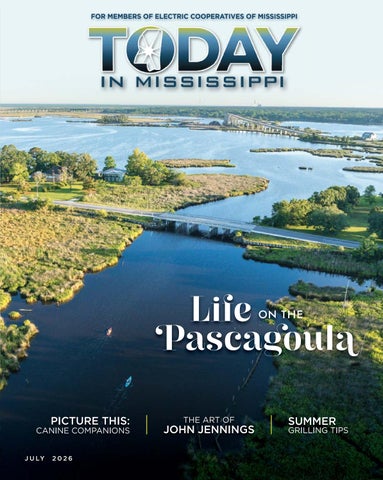
Kayakers enjoy traveling the Pascagoula River. Photo
by the Pascagoula River Audubon Center


NRECA and electric cooperative leaders joined o cials recently from the U.S. Department of Agriculture to celebrate the 90th anniversary of the Rural Electrification Act (REA), the law that helped deliver power across rural America.
The REA was a new Deal Era e ort to provide low-cost federal loans for building electric distribution systems in rural areas, part of e orts to revive America’s economy in the wake of the Great Depression.
The law drove the creation of electric cooperatives throughout the U.S. and laid the foundation for the USDA’s Rural Utilities Service (RUS), which provides financing for co-op infrastructure to this day. That support is crucial as co-ops gear up to meet growing demand while maintaining reliable, a ordable service for households and businesses.
The work of co-ops together with RUS “is the best of us, and that is what will keep America strong and the American dream available for all moving forward,” U.S. Agriculture Brooke Rollins said.
That partnership “is more important today than it’s ever been. These investments in rural America still matter greatly,” NRECA CEO Jim Matheson said. “They’re critical to promoting reliability, a ordability, economic opportunity, and quality of life in rural America.”
The REA, which was signed into law on May 20, 1936, was one of the most impactful pieces of President Franklin D. Roosevelt’s New Deal reforms.
When the REA was enacted, only 10% of U.S. farms and rural homes had electricity. Today, about 99% of the nation’s farms have electric service.
The law helped transform the Rural Electrification Administration — the forerunner to the modern-day RUS — from a relief agency to a lasting program to provide loans for rural electrification, supporting the creation and growth of co-ops.
The REA “allowed us to truly stitch our country together,” Agriculture Deputy Secretary Stephen Vaden said.
“It was our quick adoption of electric power throughout rural America that helped to create the innovation and the great economic growth that our country experienced throughout the 20th century.”
Today, over 900 electric co-ops are operating across the country and modernizing their systems to improve cost and reliability for the 42 million Americans they serve. About 200 electric co-ops are also building or operating broadband networks to deliver high-speed internet access to rural America.
In 1994, Congress reorganized the Rural Electrification Administration into RUS, which delivers on the REA’s original mission through three core programs to support electric, telecommunications, and water infrastructure.
“Investment in rural utility infrastructure is as important to rural life and the national economy today as it ever was,” said Chris McLean, assistant administrator for the RUS Electric Loan Program. “I dare say that few federal programs have been as successful as the Rural Electrification Act.”
Some co-ops have been RUS borrowers since the 1930s, but the agency is also serving first-time borrowers, including some of the newest co-ops in the country, McLean said.
“Today we not only celebrate our history; we also celebrate our bright and shining future,” he said.
Even with the strides co-ops have made to power rural America, the partnership between RUS and co-ops remains essential, attendees said at the USDA event.
The RUS electric loan program ensures co-ops can build and upgrade the infrastructure needed to power a changing rural America while keeping rates a ordable. The program is also a good deal for the federal government, with co-ops repaying the loans with interest.
“Let’s celebrate the past 90 years, but let’s also celebrate the fact that this partnership between electric co-ops and RUS is incredibly well positioned to continue this meaningful work for the future,” Matheson said. – NRECA


Certain plants earn a permanent place in gardens not just for their beauty, but for the way they show up year after year without fuss.

The yellows are bright and cheerful. Some have a clear golden hue while others are softened with hints of amber. Then there are the pinks, which can shift from a soft, blush to a richer rose color, sometimes with subtle gradients that fade toward the petal tips. These blooms feel delicate, adding a gentle contrast to the bolder shades.
The creamy whites o er a clean, refreshing look, often surrounding a golden or greenish cone that gives them a classic, daisy-like appeal.
When all these colors grow together, the e ect is dynamic, with no two clusters looking the same.
Echinacea coneflowers fall squarely into that category for me. They bring a dependable splash of color, attract pollinators by the dozens, and carry an easygoing charm that fits right in with a Southern landscape.
I’ve grown coneflowers for years, and they’ve never let me down. They stand tall and bloom with enthusiasm through heat, humidity, and the occasional dry spell. Watching their blooms sway gently while pollinators move from flower to flower is a simple pleasure that never gets old.
Among the many varieties available today, one that has truly impressed me is the Cheyenne Spirit coneflower. If you’ve never grown it, you’re missing out on a real showstopper.
This variety produces a vibrant mix of colors ranging from rich reds, warm oranges, sunny yellows, and soft pinks to creamy whites. Growing Cheyenne Spirit coneflower is like having an entire bouquet living out in the garden.
Take a closer look at those colors, and you’ll see just how much personality each bloom brings.

The deep reds are bold and velvety, often with dark, prominent cones at the center that seem to anchor the flower with a bit of drama. The oranges range from glowing tangerine to a deeper, burnt copper tone, catching the sunlight in a way that makes them appear to shimmer in the heat.
Opposite page: Cheyenne Spirit coneflower comes in a variety of colors, bringing personality to each bloom.

Another thing I appreciate about Cheyenne Spirit is its toughness. This coneflower handles our summers with ease and keeps right on blooming when other plants begin to fade. The flowers rise on sturdy stems, creating a natural, slightly wild look that feels right at home in both formal beds and more relaxed, cottage-style plantings.
Last year, I had the pleasure of watching a new generation of gardeners get their hands in the soil when the Pearl River County 4-H Junior Master Gardeners created a pollinator garden at my o ce. It was a special project full of enthusiasm and learning, and I was especially glad to see them include Cheyenne Spirit coneflowers in their design.
I’m happy to report that those coneflowers didn’t just survive, they thrived. Right now, they’re putting on a beautiful display in the pollinator garden with bright, cheerful blooms that seem to glow in the sunlight. Even better, they’re doing exactly what they were meant to do — draw in bees, butterflies and other pollinators that bring the whole garden to life.
Coneflowers like Cheyenne Spirit remind me why I garden in the first place. They’re reliable, colorful and full of life, and when you see them thriving in a space created by young hands, it makes them even more special.

by Dr. Eddie Smith
Southern Gardening columnist Dr. Eddie Smith, a gardening specialist and Pearl River County coordinator with the Mississippi State University Extension Service, is an internationally certified arborist, Produce Safety Alliance certified trainer, and one of the developers of the Mississippi Smart Landscapes program that encourages the use of native plants in the landscape.


Today, practically everyone carries a camera at all times. From the Gulf beaches to the Tennessee state line, photographers can find incredible scenery, diverse habitats, and wildlife that create fantastic photographic opportunities.
True confession, my business card says “photographer” on it, and I sell hundreds of photos each year, but I’m more of a writer who shoots pictures. I do know what a good photo should look like, so I bought a great smart camera. I compose the photos and let the camera figure out all the technical stu .
Many smart phone cameras can take excellent photos within limitations. Any quality camera can take great photos, but the lens does the real work. A mediocre camera with a high-quality lens takes much better photos than an outstanding camera with a poor lens. The lens does the work of focusing and capturing the image. To shoot great photos, buy the best lens with the highest quality glass you can a ord. The better the glass, the sharper the image.


From the Gulf beaches to the Tennessee state line, photographers can find incredible scenery, diverse habitats, and wildlife that create fantastic photographic opportunities.


With good equipment in hand, look for interesting subjects. Fill the frame with the most important elements. For example, if shooting a photo of a colorful bird on a fence, use a telephoto lens or get as close as possible to the bird without frightening it. Fill the photo with the image. Keep a portion of the fence in the photo for scale and realism. Don’t shoot a photo showing a small dot in the center that somewhat looks like a bird. Before snapping, always pay strict attention to the background. A cluttered background takes away from the subject. Shoot from an angle or zoom in to avoid unnecessary clutter or anything in the background that could distract from a good photo. Also, watch for people or animals doing inappropriate things in the background. Look for any objects in the background that could appear to be going through a person’s head.
Sometimes, the background is the most important subject, like when walking along a beautiful Mississippi beach at sunrise. The soft golden glow of early morning or before sunset makes the best light for beautiful photography. Never fight the sun. No camera flash can ever overpower the sun. Always shoot with the sun behind the camera or o to one side. When inside, don’t shoot toward windows with the sun shining through it. Compose photos so the sun illuminates the most important aspect of the subject, like a person’s face. Instead of always shooting at eye level, try di erent heights and angles with and without flash.


Perhaps the most common mistake people make, especially with smart phones — not shooting vertical subjects vertically and horizontal subjects horizontally. For instance, to photograph a tall heron standing on a post, hold the camera vertically. When shooting a duck swimming across a pond, turn the camera horizontally.
With digital equipment, photographers can shoot unlimited photos without cost. Shoot every subject or pose multiple times. Experiment with di erent camera settings. Keep the best images and delete the rest.

by John N. Felsher
John N. Felsher is a professional freelance writer, broadcaster, photographer, and editor who lives in Alabama. An avid sportsman, he’s written more than 3,300 articles for more than 170 di erent magazines on a wide variety of outdoors topics. Contact him at j.felsher@hotmail.com.


by Steven Ward
Artist and storyteller John Jennings had three library cards when he was growing up in Flora, Mississippi.
“My mother encouraged me to read a great deal. We would frequently go to multiple libraries. I fell in love with the bold images in comics; and not just superhero comics. I love the medium,” Jennings told Today in Mississippi recently.
The formative experience for Jennings stuck.
Jennings grew up to become a New York Times bestselling graphic novelist, Harvard Fellow, and Hugo and Eisner Awardwinning artist.
Jennings, who worked on Marvel Comics’ Silver Surfer series, has also had work featured at The Metropolitan Museum of Art, appeared on “CBS Sunday Morning,” and been part of multiple Marvel Comics documentaries.
Between now and March 27, 2027, Mississippi residents will have a chance to experience Jennings’ creative worlds at The Mississippi Arts + Entertainment Experience (The MAX) in Meridian.

The “John Jennings: Build Your World” exhibit opened June 20.
The exhibit uses sketches, storyboards, and finished art to demonstrate how creators of color use the medium of comics to reclaim history and design the future.
The exhibit will feature creative projects that explore how Jennings imagines richly layered settings that center Black characters and Mississippi culture.
Those four projects are “Silver Surfer: Ghost Light,” where Jennings reinvents a forgotten Black character as a cosmic guardian using African American culture; “Blue Hand Mojo: Hard Times Road,” a solo piece conceived, written, and drawn by Jennings blending history and folklore; a new coming-of-age Southern Gothic horror graphic novel called “Kenny Dreadful and the Hainted Hoodie,” and Jennings’ graphic novel take on legendary science fiction author Octavia Butler’s novel, “Kindred.”
Jennings said there’s not an art work that’s he’s been involved in that doesn’t touch on his upbringing in Mississippi.


“The e ect of Mississippi on my work is pretty immeasurable. It’s so odd that, when you’re growing up, you long to leave a place and no one tells you that home goes with you. So, my heritage and culture directly shaped not only how I move through the world as a Black southern artist; it shaped my ethos and process directly,” Jennings said.
Born in Brookhaven before moving to Flora, Jennings grew up with his mother and grandparents.
“Flora is a small agricultural town. It’s now almost become a suburb of Jackson since it’s so close. My mother was a literature major at Alcorn State University. My love for reading and art stemmed from her. She bought me my first comics. My grandmother worked as a domestic until she retired. My grandfather was a professional caretaker and would hire his services out to local landowners,” he said.
Jennings said he was curious about everything when he was a child.
“I collected insects and folklore like an anthropologist.”
Jennings graduated from Jackson State University in Jackson. He later taught at JSU and created the school’s graphic design program.
“Being a JSU alum gave me a sense of pride, belonging, and self-confidence that I didn’t know I needed. To this day, I am friends with classmates who have become something closer to family. Teaching at JSU was a honor; being able to give back to a space that helped shaped who I am…I can’t tell you how much that means to me. It’s one of the most important things that ever happened in my life. I love JSU and I still try and give my time and expertise there whenever I can,” Jennings said.
Today, Jennings is a professor of Media and Cultural Studies at the University of California at Riverside.
He is also the co-founder and organizer of the Schomburg Center’s Black Comic Book Festival in Harlem, the NorcalMLK Foundation’s Black & Brown Comix Arts Festival in San Francisco, and SÕL-CON: The Brown and Black Comix Expo at The Ohio State University.
Comics storytelling was always a powerful touchstone for Jennings.
“It sort of called to me. I’m a storyteller and I think the immediacy and power of the medium speaks to me,” he said.


ea.


To avoid power outages during bad weather, why don’t co-ops just place all the power lines underground?
When major storms hit, it’s natural to ask why all power lines aren’t placed underground. On the surface, it seems like burying power lines would prevent outages. The reality is more complex.
First, the cost. Installing underground distribution lines can cost anywhere from five to upwards of 10 times more than overhead construction. As a member-owned cooperative, we don’t have shareholders absorbing that expense. Those costs would ultimately be paid by our members through higher rates. We work hard to keep electricity a ordable while still maintaining reliability.
Second, restoration. While underground lines are protected from wind, they are not immune to damage. When an overhead line is damaged, crews can often see the problem immediately and begin repairs. When an underground line fails, many times the issue is hidden. Crews must first locate the fault using specialized equipment, then excavate, repair or replace the line, and restore the site. That process can take significantly longer. Also, it’s not uncommon for people to think that underground construction means that everything is buried. It’s not. Padmounted transformers and sectionalizing equipment are located
above ground, making them as susceptible to being damaged by vehicles as poles are. Underground cables can be susceptible to damage from nearby trees being uprooted during storms or high winds as well as from excavation activity on clear days. The cost, as well as the length of time, to repair underground cable and equipment can be significantly more than for overhead lines.
There’s also the matter of scale. At Dixie Electric, we serve over 42,000 meters across a largely rural footprint and over 5,000 miles of line. Converting an entire system to underground construction would require an extraordinary financial investment and years of construction.
That doesn’t mean underground has no place. In certain subdivisions, new developments, or specific high-density areas, underground construction can make sense. We evaluate those opportunities carefully. But systemwide, overhead construction remains the most practical and cost-e ective way to serve a rural cooperative territory.
Our responsibility is to balance reliability, a ordability, and speed of restoration. No system is storm proof, but we continuously evaluate how to strengthen ours in ways that are responsible to the members who own it.
Have a general question about the world of electric cooperatives that all members around the state would like to hear the answer to? Email your question to news@ecm.coop and look for the answer in a future issue.


Each year, as we gather with family and friends to celebrate the Fourth of July, we are reminded of the meaning of independence. It’s a time to reflect on the freedoms we enjoy, the resilience of our nation, and the communities that continue to shape who we are today.
That same spirit of independence also helped shape electric cooperatives.


Decades ago, much of rural America was left in the dark because bringing electricity to sparsely populated areas simply wasn’t profitable for large power companies. Rather than waiting and hoping someone else would solve the problem, neighbors came together to create their own solution. Communities banded together, invested in themselves, and built electric cooperatives to serve the people who called these areas home.
That determination and local spirit remain at the heart of cooperatives today.
One of the seven cooperative principles is “Autonomy and Independence.” In simple terms, that means cooperatives are locally governed and focused on serving their members rather than outside investors. At Dixie Electric, decisions are made by people who live right here in the communities we serve. Your elected board members are your neighbors, and every decision is made with our members in mind.
That local independence allows us to focus on what matters most: providing reliable service, maintaining and improving our system, supporting our schools and communities, and investing


in the future of our area. It’s what allows us to continue growing and evolving while staying true to the values that have guided cooperatives for generations.
There is something powerful about communities working together for the benefit of everyone. In many ways, that is the true meaning behind the cooperative model. While independence is often thought of as standing alone, cooperatives prove that independence can also come from people coming together with a shared purpose.
As we celebrate this Fourth of July, I hope you take time to enjoy the people and moments that matter most. From backyard cookouts and fi reworks to time spent with family and friends, summer traditions remind us how fortunate we are to live and work in communities that care for one another.
From all of us at Dixie Electric, thank you for allowing us to serve you. We are proud to continue building a stronger future together while honoring the spirit of independence that helped cooperatives begin.


by Randy Smith General Manager


We’ll


by Amanda Mills


When DE Fastlink launched, our mission was simple: provide the fast, reliable fiber internet service our communities deserved. At the time, most homes throughout our service area simply didn’t have access to true fi ber high-speed internet. We knew we could deliver the speed and reliability families needed, but we also knew internet service was about more than just speed. As technology continued to evolve, so did the needs of families who used it every day.
One request we heard time and time again from subscribers was the need for better control over their home Wi-Fi network, especially when it came to managing devices, monitoring use, and helping parents create healthy online habits for their children.
You asked, and we listened.
Today, DE Fastlink subscribers have access to the free My DE Fastlink app, giving users greater visibility and control over their home network right from their smartphone or tablet.

Through the app, subscribers can:
• Assign devices to personalized profi les
• Create people profi les for family members
• Share guest Wi-Fi networks with visitors
• Run speed tests
• Change their Wi-Fi password
• Manage connected devices throughout the home
The My DE Fastlink app also includes ProtectIQ at no additional cost for subscribers with compatible equipment. ProtectIQ helps provide an added layer of network security and peace of mind by monitoring and protecting devices connected to your home network.


For families looking for even more control, DE Fastlink also o ers ExperienceIQ with Parental Controls for just $5 per month.

ExperienceIQ allows parents and guardians to:
• Set screen time limits
• Pause internet access
• Filter content
• Manage online activity by user profi le
• Customize internet access for each member of the household
Whether it’s limiting distractions during homework time, creating healthier screen time habits, or helping protect younger users online, ExperienceIQ puts control directly into the hands of parents.
Because DE Fastlink has a variety of routers deployed throughout the system, some subscribers may require updated equipment in order to access these features. The good news is our team can quickly check your equipment compatibility and help determine if an upgrade is needed, free of charge.
Subscribers interested in adding ExperienceIQ or learning more about the My DE Fastlink app can call DE Fastlink at 833-521-3278 for assistance.
Technology continues to evolve, and so do the needs of the families we serve. At DE Fastlink, we remain committed to listening to our subscribers and providing solutions that help make life easier, safer, and more connected.
You set the rules. We’ll help you enforce them.

Dixie Electric and CoBank recently partnered through the Sharing Success program to donate a combined $20,000 to local emergency response organizations across the cooperative’s service area.
Through the annual matching grant program, volunteer fi re departments and sheri ’s departments in Jones, Wayne, Forrest, and Perry counties each received $2,500 to help support critical needs such as training, safety equipment, educational materials, and emergency response tools.
“For organizations like volunteer fi re departments and sheri ’s departments, every dollar matters,” said Randy Smith, general manager of Dixie Electric. “These men and women willingly step into di cult situations to protect our communities, often with limited resources. We’re honored to support the work they do every single day and grateful for the sacrifice and service they provide across our area.”
Now in its fi fth year participating in the Sharing Success initiative, Dixie Electric continues to use the program as a way to invest back into the communities it serves. The program allows cooperatives and other organizations to partner with CoBank to provide matching funds for local nonprofits and public service organizations that make a di erence in rural communities.
One of the things that makes cooperatives unique is our commitment to the communities we serve. Programs like Sharing Success allow us to turn that commitment into action. We know the impact volunteer fi re departments and sheri ’s departments have on rural communities, and we’re thankful for the opportunity to help support the important work they do.
Electric cooperatives are deeply rooted in the communities they serve and remain committed to improving the quality of life throughout rural Mississippi. Through partnerships like Sharing Success, Dixie Electric continues to support the organizations that help keep its communities safe, prepared, and connected.


TUESDAY, OCT. 20, 2026


17

4

Held at Dixie Electric’s office, 1863 Highway 184, Laurel, MS 39443.
Online voting begins. Make sure Dixie Electric has your valid email address, so you can vote online or use the SmartHub app.


Registration and voting 2:30 – 3:30 p.m. The meeting begins at 4 p.m.


Electronic and mail voting ends.
Official notice, absentee ballot, and proxy are mailed to members. Return your ballot or proxy in the postage-paid envelope.

Join us for the annual meeting and vote in person.
Purvis, MS - If you experience numbness or tingling in your hands, arms, legs, or feet or if you experience shooting or burning pain, this is important.
Please read this carefully.

Peripheral Neuropathy is when small blood vessels in the hands, arms, feet or legs become diseased and tiny nerves that keep the cells and muscles working properly shrivel up and die.
Early-warning symptoms include tingling and numbness, mild loss of feeling in your hands, arms, legs or feet, inability to feel your feet, which increases your risk of foot-injury and falling.
More Advanced Symptoms Include...
Loss of coordination & dexterity, which puts you at increased risk of accidents.
Inability to feel clothing like socks and gloves.
High risk of falling, which makes walking dangerous, and makes you more dependent on others.
Burning sensations in your arms, legs, hands or feet that may start mild, but as nerves and muscles die, may feel like you're being burned by a blow torch.
Ignore the early warning signals long enough and you risk progressive nerve damage leading to muscle wasting, severe pain, loss of balance and a lot of staying at home wishing you didn't hurt.
When every step is like walking on hot coals, sitting still may be the only thing you feel like doing. But there's little joy in sitting still all day long.

Now here's the scary part....
Nerve damage CAUSES cell damage. Cell damage SPEEDS UP nerve degeneration
Without treatment this can become a DOWN-WARD SPIRAL that accelerates.
The damage can get worse fast. Mild symptoms intensify. Slight tingling, numbness or lack of feeling can turn into burning pain.
Before you know it, damage can become so bad you hurt all the time.
Unless this downward spiral is stopped and nerves return to proper function - the damage to nerves and cells in the affected area can get so bad your muscles begin to die right along with the nerves and cells. And that sets the stage for weakness, loss of mobility, disability, and dependence on others.
If you have early warning signs of peripheral neuropathy, (tingling &/or numbness, loss of feeling or pain) it's CRITICAL you get proper treatment. It's critical, because with proper treatment you can improve your symptoms. Without it, you are playing Russian Roulette with your health. Once your nerve loss reaches 85%, odds are there's nothing any doctor can do to help.
The most common method your doctor may recommend to treat neuropathy is prescription drugs

Drugs like Gabapentin, Lyrica, Cymbalta, & Neurontin are often prescribed to manage the pain. But, damaged nerves and dying cells do not heal on their own.
Pain pills do not restore healthy nerve function. They just mask the pain as the nerves continue to degenerate and cells and muscle continue to die.
Taking endless drugs and suffering terrible side effects that may damage your liver & kidney and create even more problems, is not a reasonable path. You deserve better. Three things must be determined to effectively treat neuropathy. 1) What is the underlying cause? 2) How much nerve damage has been sustained? 3) How much treatment your condition will require?
With proper treatment, shriveled blood vessels grow back & nerves can return to proper function. How much treatment you may need depends on your condition.
At Purvis Chiropractic we do a complete neuropathy sensitivity exam to determine the extent of your nerve damage. The exam includes a detailed sensory evaluation, extensive peripheral vascular testing, & a detailed analysis of the findings.
Dr. Rob Acord, D.C. will be offering this complete neuropathy sensitivity exam for $47. This special offer goes away at the end of this month as we have a limited number of exam appointments available.


The longest natural, free-flowing river in the continental U.S. offers aquatic adventures year-round.


by Jim Beaugez
Only 100 miles separate the terminuses of the Mississippi and Pascagoula rivers, the watercourses framing the Mississippi Gulf Coast culturally if not politically. But they couldn’t be further apart beneath the surface.
Since the days when Mark Twain’s fictional Huck Finn would have floated it, the U.S. Army Corps of Engineers has endeavored to tame the Mississippi River with levees, locks, and spillways as it drains 40% of the continental U.S. and nearly bisects the lower 48 into halves. A mighty river, indeed.
In contrast to this massive, meticulously engineered artery, the Pascagoula River spans a modest 80 miles in length from its headwaters at the confluence of the Leaf and Chickasawhay rivers in northern George County. Its importance, instead, is measured by how untouched it remains as the longest free-flowing waterway and last unimpeded major river system between Canada and Mexico.
Eric Richards, a 72-year-old Pascagoula native, has paddled most of it over the past 20 years, camping on the sandbars of the upper river, rowing past the blu s near Vancleave, and maneuvering a paddleboard through the slow, serpentine bayous of the lower section. Today, he lives on Krebs Lake, one of many meanders encircled by marsh grasses near its mouth at the Mississippi Sound, and is still a regular on the river.
“We’ve paddled pretty much all the waterways,” Roberts said of his experiences with friends in the Pascagoula Paradise Paddlers group, a loose fraternity that has organized monthly voyages on the river — sometimes drawing as many as 100 paddlers — as well as multi-day overnight trips and competitions.
The Pascagoula River Basin covers 9,600 square miles, or 20% of the state, beginning in Kemper and Neshoba counties at its northernmost point, extending west nearly to Jackson, and pulling in streams over the Alabama state line. The watershed narrows as the river splits into the East and West Pascagoula rivers just north of Poticaw Landing, then winds into broad, wandering bayous across a marshy coastal plain ranging from four to six miles wide.
“It doesn’t look like a typical river where you go from point A to point B,” said Mary Rodgers, a master naturalist who manages the Pascagoula River Audubon Center in Moss Point. “It’s extensive and free flowing with bayous, and that creates more habitat. The area serves as an estuary for plant and animal growth.”
As a wild river, the Pascagoula is home to an ecosystem teeming with diverse flora and fauna, including more than 22 threatened and endangered species and hundreds of plant species. It’s also located on the Mississippi Flyway, a major migratory pathway used by 45% of America’s birds as they travel between the North and South American continents, using the river and its marshes as a place to rest and refuel.

“The bird life is fabulous,” Rodgers said. “We see ospreys and owls along the shoreline, cormorants and waterbirds, and also backyard birds. And because it’s a flyway, we have different birds throughout the season during spring and fall migrations.”
The bird life is fabulous. We see ospreys and owls along the shoreline, cormorants and waterbirds, and also backyard birds.
The most commonly seen bird populations include brown pelicans, great blue herons, sandhill cranes, and other shore and inland birds that frequent the Pascagoula marshlands, Rodgers said, among more than 300 species of birds that can be found here. That fact attracts birdwatchers from across the region and even overseas — she says couples from as far away as Germany are annual visitors.
For kayaks, canoers, and paddleboarders, that means every launch into the tannin-stained watercourse is a new adventure. They may see large, wading birds like herons and egrets roam the marshes looking for meals at low tide, while ospreys hover overhead and dive into the deeper channels to catch fish. Red-winged blackbirds are a highlight for birdwatchers, and Richards has also seen swallow-tailed kites on the river.
After the Deep Horizon oil spill in 2010 compromised the region’s animal and plant life both offshore and onshore, the National Audubon Society decided to place a center near the Pascagoula River that would encourage people to visit the river and learn about its importance and biodiversity. The center itself, built as a green facility, is a model of environmental stewardship.

Instead of letting the average 60 to 65 inches of rain the region gets every year wash into the bayou, a network of channels and gutters redirects a portion of the rainwater from the roof into an underground cistern every time it rains. Rodgers said that enables them to keep their raised beds hospitable for the moistureloving plants hummingbirds prefer, such as coral honeysuckle, as well as aster and blueberry bushes for larger birds. The concrete on the campus is even permeable, allowing the ground to absorb water and mitigating flood potential.
Named after the Pascagoula River, nearby Singing River Electric in Lucedale participates annually in the Renew Our Rivers cleanup of the lower portion of the river. The electric co-op has also awarded several of its Neighbors Helping Neighbors Community Grants to the Audubon Center over the years.
As the Audubon Center attracts birdwatchers and paddlers year-round for its guided kayak tours, Roberts also takes excursions on the river at all of its phases and through all four seasons, paddling past eagles, otters, alligators, and occasionally a deer swimming from one bank to the other. But if he had to pick, he says he’s partial to rowing through the cypress swamps upriver.


“The old-growth cypress trees are just phenomenal,” he said. “They’ll be 12 feet in diameter, which is 30, 40 feet in circumference. It’s an otherworldly feeling when you go through these swamps and you’ve got massive trees and thousands of cypress knees,” which grow several feet high. The autumn, he said, is his favorite time to visit them, when “everything turns copper on the cypress trees.”
But don’t overlook late summer, another ideal time to catch the magic of the river. The Pascagoula River Audubon Center’s annual Hummingbird Festival, scheduled for Sept. 25-26, welcomes birdwatchers just as thousands of the migratory birds pass through the area. Rodgers said the birds congregate around feeders and the trumpet vines covering the canopy. “We’ll see 5, 10, 20 hummingbirds at a time diving into the di erent treetops, and then they sit up there in their perch.”
The Pascagoula Paradise Paddlers will host the Pascagoula River Paddle Battle on Oct. 3. During the 10th edition of this 12-mile kayak race, paddlers will race from Little River Marina in Moss Point and end in Pascagoula at the LaPointe-Krebs House and Museum on Krebs Lake, the oldest structure in the state, built in 1757.
For Richards and many other paddlers who frequent the Pascagoula, the river’s rewards are evident throughout the seasonal shifts. “One of the appeals of kayaking or any boating, anything that takes you away from your normal life, is that you see things that are just otherworldly.”


• Rate schedule is based on your current age and is guaranteed for the life of the policy.
• Monthly rates as low as $3.49.
• Coverage is also available for your spouse and other family members.
• Benefits will NEVER be canceled or reduced for the life of the policy if premiums are paid on time. Policy Form #SRTCV/SRTCV R13 or R17, or #SRTCV90MA in MA


• Rates are based on your children’s or grandchildren’s present age and never increase for any reason.
• Monthly rates as low as $2.17.
• Benefits will NEVER be reduced or canceled if premiums are paid on time.
• Give your children a financial head start right now. Your policy builds CASH VALUE for your family’s needs.
Form #GWL2001 or GWLA001
(Offer may vary, $100,000 coverage not available in all states.) CHOOSE $5,000, $10,000, $20,000, $30,000 OR UP TO $100,000 COVERAGE


I think every season has a fragrance. Fall smells of leaf litter, bonfires, and football games; Christmas, of magic and gingerbread; spring, of freshly cut grass and rainy days. Summer — summer smells like a combination of watermelon, shimmering lake water, sun-dried beach towels, and grilled hamburgers. The air is so heavy during Mississippi summers that the fragrance of anything you cook on the grill lingers for hours after the last charcoal brisket burns out. What’s not to love? I put anything I can on the grill. I’ve even been known to throw something as simple as a couple of flour tortillas filled with nothing more than shredded cheese on the flames and call it lunch.

This month, I hope you christen your grill with things ordinary, and just a touch extraordinary. Stu a hamburger with a little bacon, a little blue cheese, and season it up well and enjoy the magic of an ordinary day. And, how about the perfect marriage of lemons and rosemary to marinate a spatchcocked chicken that’s marinated over night? If you can buy a small bird (3 pounds or so) you’ll find the chicken will have more flavor and cook much quicker. Likewise, thinner patties on your burgers also cook quicker and, in my opinion, taste better. End the meal with the simplest summer dessert in my stash of easy recipes — a trifle. Manipulate it with your choice of fillings. Just make sure you build it in a beautiful clear bowl, so your guests — should you care to share — can see that you’ve saved the best for last!

by Vicki Leach

Vicki Leach is a full-time chef/culinary instructor at Mississippi State University in the Department of Food Science, Nutrition, and Health Promotion. She teaches Science of Food Preparation, Foodservice Organization, and Quantity Food Production. She lives in a 130-year-old farmhouse that speaks to her old soul.
Makes 8 hamburgers
INGREDIENTS
4 pounds lean ground beef, chuck or round
6 slices bacon, cooked and crumbled, dripping reserved
1 large onion, and cooked in bacon drippings
Heat a grill to medium high heat. Lightly oil the grates.
Form beef into 16 patties of equal size, placing on a parchment lined baking sheet as completed. Sprinkle with salt and pepper, (and a touch of garlic and onion powder as desired).
Combine crumbled bacon, cooked onion, blue cheese and Cajun seasoning in a small mixing bowl, tossing together to combine. Place 1 tablespoon of cheese mixture onto each of 8 hamburger patties. Top each
I do these inside on a flat cast iron griddle pan if I can’t get to the grill. Before you turn them, make sure they are nicely seared, and flip once. The burgers are thick, so I usually just turn off the cooktop and cover with a lid for a few minutes to let the residual heat finish them off.
1 cup crumbled blue cheese
1 tablespoon Cajun seasoning
8 hamburger buns
patty with a remaining beef patty. Lightly pinch the edge of the burgers, sealing in the cheese mixture.
Place stuffed hamburgers onto hot grill and cook to desired temperature, 5 minutes per side, turning only once.
Remove from grill and keep hot until ready to serve. Serve with desired condiments.
Ground beef should be cooked to an internal temp of 165 degrees.

Serves 4
INGREDIENTS
1 frying chicken, ideally about 3 pounds 3 lemons, juiced 3 sprigs fresh rosemary 2 tablespoons olive oil generous dashes salt and pepper
Cut backbone out of chicken, flip and with the heel of your hand, press down on the breastbone until you have broken the breastbone; it will lie flat this way. Place chicken in a flat 9x13 glass casserole. Sprinkle chicken with salt and pepper liberally. Mix lemon juice, rosemary, and olive oil. Pour over chicken in the dish. Place a piece of plastic wrap over chicken, then weigh down with a plate topped with several heavy cans, or wrap a couple of bricks in foil and place on chicken. Marinate for several hours or overnight.
Roast at 425 degrees, or grill over direct heat to brown, then place on top rack of grill over indirect heat until completely done (165 degrees in the thigh portion).

Serves 12
Who doesn’t like a pretty dessert? A quick summer takealong, or a light addition to your summer outdoor gatherings.
INGREDIENTS
1 angel food cake

1 large box instant vanilla pudding mix
1 can pie filling — cherry, strawberry, peach, or blueberry
2-3 bananas, sliced thinly
1 large can pineapple chunks, drained
1 large tub Cool Whip, thawed (or as much as needed)
Prep your ingredients: Pinch the cake into small pieces. Make the pudding according to package directions. Slice the bananas thinly. Drain pineapple chunks.
In a pretty trifle bowl, or another glass serving bowl, layer half the cake chunks. Top with half the pudding mix spreading evenly. Plop the pie filling around the outside edges, and fill the center area with half the bananas and pineapple chunks. Top with half the Cool Whip. Repeat layers. Cover and chill for a couple of hours or overnight.
Events open to the public will be published free of charge as space allows. Submit details at least two months prior to the event date. Submissions must include a phone number with area code for publication. Email to news@ecm.coop. Events are subject to change.
Calhoun County Sacred Harp Singing Convention. Aug. 8. Vardaman. Shape note singing from the 1991 Sacred Harp Book, and also the 1911 edition. Hosted at Mt. Herman Primitive Baptist Church 132-154 Hollis Switch Rd (CR247), approximately two miles north of Highway 8. Singing will begin at 10 a.m. with potluck in the fellowship hall at noon. Singing will continue in the afternoon. Details: Text 662-507-9434.
Friends of Crosby Memorial Library Annual Book Sale. Aug 10 to Aug 15. Picayune. The book sale is the library biggest fundraiser of the year. From 9 a.m. to 6 p.m. Monday to Friday and 9 a.m. to 4 p.m. on Saturday. 900 Goodyear Blvd. The prices of the used books are very reasonable Details: 601-798-5081 or 601-798-4191.
Mississippi Sacred Harp State Singing Convention. Aug 23 and 24. Forest. Hosted at Antioch Primitive Baptist Church, 6931 Miss Hwy 21, north of Forest. Singing will begin at 10 a.m. each day with lunch in the fellowship hall at noon. Singing will continue each day after lunch. Songbooks used are the 1991 Sacred Harp, BF White Sacred Harp (Cooper revision), 2010 Christian Harmony, and the 1911 Sacred Harp. Loaner books will be available. Details: email marksdavis19@gmail.com.


Are there things you’ve heard in passing that stuck with you for no reason? People you talk to all of the time — your parents or brothers and sisters — even someone like your pastor who perhaps, of the tens of thousands of other words, said one thing that lodged in your mind?
Bobby Williamson was a friend of mine who was a pastor at Park Place Baptist in Pearl. I would video his Sunday sermon so he could replay it on cable later in the week. One morning he told a story about a lady who was upset with her pastor because he used the word “britches” in his sermon that day. She told him pants or trousers would have sounded more polite. Her pastor asked her, “Well, what did I say right before I said britches?”
She admitted she didn’t recall. “Well, what did say I say right after I said britches?” Embarrassed, she said she didn’t remember that, either. To which the preacher replied, “Then it’s a good thing I said ‘britches’ or you wouldn’t have gotten a thing out of the sermon this morning!”
I never told Bobby, but out of all of his great sermons (and he was a good preacher) that story is the only specific thing I really remember him saying.
I bring that up because as we celebrate the 250th birthday of our nation, I recall something one of my schoolteachers told us decades ago. Not to insult the teacher, but I don’t even remember who said it. But it stuck with me.
It was in the 1960s, so World War II had only ended a little over 15 years earlier. The air base was still in Greenville and our house was a “home away from home” for airmen who went to Northside Baptist Church with us. One time mama made us kids quit popping firecrackers outside. She whispered that one of our guests that day had been “shell-shocked.” Post Traumatic Stress Disorder or PTSD is what we’d call it today. The vet probably served in Korea. He was too young for World War II.
Back to my teacher, he (or she) told us that “No republic had ever lasted over 300 years.” Back then, that bothered me no more than telling me the sun won’t last but another 5 billion years. But that comment on the potential longevity of our country stuck with me.
In 1976 amidst the revelry of the Bicentennial, those words took on a little more weight because that meant we only had a 100 years left. Now, a half century later, at the nation’s 250th anniversary, if that teacher’s off-hand remark were to come to pass, our downfall could happen during the lifetimes of my grandkids and great grandkids. So now, that observation is way more than just the answer to a test question; it’s personal.
Let’s make sure our kids know what all has “come before” in our history that brought us to this day, so there will be a 300th celebration 50 years from now.

by Walt Grayson


