With its innovative design, modern comforts, and guest-focused philosophy, American Encore is not just a riverboat, it’s the finest expression of American river cruising ever built. Designed to host just 180 guests, American Encore features more square feet per guest than any other small cruise ship with the largest staterooms globally.
Ship
My Opinion
Exemplifying Cooperation among Cooperatives
Cooperation among Cooperatives is a rather simple idea. Cooperatives, even though they are privately-owned businesses, choose to work with other cooperatives to make our state and communities stronger, and when one cooperative is in need, the others are there to provide help and support.
The most recent example of this cooperation is in the aftermath of Winter Storm Fern. Electric cooperative linemen from across our state and nation, about 1,200 of them, left their families and homes to work in tough conditions for weeks to restore power to the more than 160,000 members across Mississippi, who were affected by Fern.
April is Lineman Appreciation Month. What a great time to say, “thank you,” to these brave individuals who worked long hours in cold, wet conditions to restore power. I am always proud of the linemen from Mississippi who work so hard and are willing to answer the call to help others when natural disasters strike. To all the line workers, engineers, and operations personnel across our state, thank you for your hard work and sacrifice.
Another powerful example of Cooperation among Cooperatives is our Mississippi Cooperative Youth Leaders program. The
program teaches high school juniors about the electric cooperative business model, builds their leadership skills, and allows them to experience democracy both at the state level in Jackson and the national level in Washington, D.C. High school juniors from across our state enhanced their leadership skills at our CYL Workshop in February. These 83 delegates represent 22 of our electric cooperatives in the state.
In this month’s issue, you’ll read about a lineman who has been working in electric power since the 1970s and meet the cooperative youth leaders from your local area. These are just two examples of Cooperation among Cooperatives. Today in Mississippi magazine is another great example. Enjoy!
by Michael Callahan
Executive Vice President/CEO Electric Cooperatives of Mississippi
Send us a photo of your dog.
The photos must be high-resolution JPG files of at least 1 MB in size. Please send the photo as an attachment to an email and send it to news@ecm.coop.
Each entry must be accompanied by photographer or sender’s name, address, and co-op.
SUBMISSION DEADLINE: May 22. Select photos will appear in the July 2026 issue.
Azaleas
Southern Pine’s Jimmy
Anytime
The Official Publication of the Electric Cooperatives of Mississippi
Vol. 79 No. 4
OFFICERS
Brian Long - President
Shawn Edmondson - First Vice President
Brian Clark - Second Vice President
Je Bowman - Secretary/Treasurer
Michael Callahan - Executive Vice President/CEO
EDITORIAL STAFF
Lydia Walters - VP, Communications
Steven Ward - Editor
Chad Calcote - Creative Director
Kevin Wood - Graphic Designer
Alan Burnitt - Graphic Designer
Jill Sowell - Graphic Designer
Whitley Daughtry - Graphic Designer
Chris Alexander - Member Services Coordinator
Andy Tuccio - Media Solutions Director
Steve Temple - Social Media Director
Julienne Sones - Communication Assistant
EDITORIAL OFFICE & ADVERTISING – 601-605-8600
For delivery questions or issues, call your local co-op.
Acceptance of advertising by Today in Mississippi does not imply endorsement of the advertised product or services by the publisher or Mississippi’s electric power associations. Product satisfaction and delivery responsibility lie solely with the advertiser.
• National advertising representative: American MainStreet Publications, 800-626-1181
Circulation of this issue: 457,304 Non-member subscription price: $9.50 per year.
Today in Mississippi (ISSN 1052-2433) is published 12 times a year by Electric Cooperatives of Mississippi Inc., P.O. Box 3300, Ridgeland, MS 39158-3300, or 665 Highland Colony Parkway, Ridgeland, MS 39157. Phone 601-605-8600. Periodical postage paid at Ridgeland, MS, and additional o ce. The publisher (and/or its agent) reserves the right to refuse or edit all advertising. The magazine is published for members of subscribing co-ops. The magazine is a bene t of membership.
POSTMASTER: Send all UAA to CFS. (See DMM 507.1.5.2) NON-POSTAL AND MILITARY FACILITIES: Electronic address returns requested.
www.facebook.com/TodayinMississippi
www.todayinmississippi.com
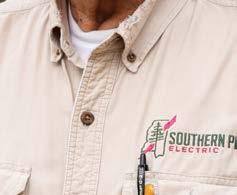
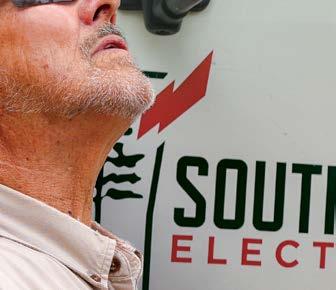
Southern Pine Electric Construction Supervisor Jimmy Mathis. Photo by Whitley Daughtry
Delegates learn leadership skills at ECM workshop
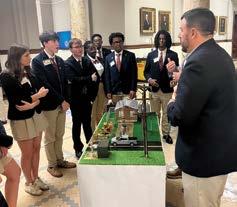
High school juniors from all over the state descended on Jackson Feb. 25 to Feb. 27 to participate in the 39th Electric Cooperatives of Mississippi (ECM) Cooperative Leaders Workshop.
The conference, held at The Westin in downtown Jackson, gave 83 high school delegates the opportunity this year to learn about leadership, community service, and state government in action.
Each student was sponsored and chosen by di erent electric cooperatives throughout the state.
The delegates also earned an all-expense paid group trip to Washington, D.C. in June.
Cooperative Day at the state capitol
Feb. 19 was Cooperative Day at the Capitol. Mississippi electric co-op general managers, senior sta , and a few linemen mingled with state lawmakers in Jackson to promote the important relationship between legislators and co-ops, which provide electric power and high-speed internet to rural Mississippians.
The co-ops set up booths and demonstrations. Key sta from the co-ops visited with lawmakers during the event to talk about the state’s important relationship with cooperatives and how their partnership works to better local communities.
During the three-day workshop, delegates met with their state lawmakers, toured the state capitol, participated in problem solving activities, and attended speeches by motivational speakers.
Pearl River Valley Electric delegate Michelle Xie was chosen at the new Youth Leadership Council Representative for the state of Mississippi. Xie will attend the NRECA Annual Meeting in San Diego next year. She also received a $1,000 scholarship from the ECM Foundation.
Secretary of State Michael Watson and political cartoonist/ storyteller Marshall Ramsey spoke to the delegates during the event.
MORE THAN FARMING — AGRIBUSINESS MEANS OPTIONS.
An agribusiness degree from Mississippi State University opens doors to careers in management, finance, marketing, and policy across the modern agricultural economy.
97% Job Placement 1,800+ Alumni Network Nationwide Internships Mississippi State University is an equal opportunity institution.
Southern Gardening
Few shrubs say “spring in Mississippi” quite like azaleas, and mine are getting ready to burst with blooms.
Azaleas thrive here so well that some gardeners get the impression you can simply stick them in the ground and walk away. Unfortunately, that is not the case.
Azaleas are well adapted to our climate, but they still have some very specific needs if you want them to look their best year after year.
First and foremost, azaleas must have excellent drainage.
These shrubs prefer organic-rich, acidic soil, and soggy conditions are a sure way to shorten their lifespan. One of the best ways to ensure proper drainage is to plant azaleas in raised beds. This allows water to move freely through the soil instead of pooling around the roots when we get heavy rains.
Because azaleas are shallow-rooted, they can dry out quickly, especially when newly planted. It is important to provide supplemental water when the plants are getting established. Mulch is essential to help conserve moisture, moderate soil temperature, and protect those surface roots.
sring blooms bring A variety of azaleas
Once established, fertilize azaleas twice a year in late winter and again in mid-summer. I prefer using fertilizers labeled specifically for azaleas and camellias. Apply this evenly across the bed.
Prune azaleas right after they bloom and only as needed. Heavy pruning after June 30 can reduce next year’s flowers, but light shaping later in the season won’t hurt.
Beyond proper planting and care, smart azalea selection can help you manage weather surprises and stretch your bloom season.
Among the most cold-hardy groups are Kurume azaleas and Girard hybrids. By mixing a few of these in with the familiar Southern Indicas, you’re hedging your bets during harsher-than-normal winters.
Late-blooming groups like the Robin Hill hybrids and Satsukis o er another advantage.
The word Satsuki means “fifth month” in Japanese, and these azaleas typically bloom from April into early May. If a late frost wipes out early flowers on other varieties, these are often still ready to make their debut. Even in mild years, they help spread azalea color over a longer period.
The Southern Indica group remains the most popular azalea variety, as they are large shrubs with a spectacular spring show. This is the George Lindley Taber variety.
Encore azaleas add yet another layer of interest.
Like an encore at a concert, these azaleas bloom again after spring. While the spring display is the most dramatic, it is not unusual to see flowers during summer and a strong show again in fall.
All Encore varieties are smaller than Southern Indicas, usually topping out around 36 to 42 inches tall. Their attractive foliage makes a great backdrop for their bright blooms.
The Southern Indica group remains the most popular, and for good reason. These are large, bold shrubs that put on a spectacular spring show. They are cold hardy to around 10 degrees on average and a favorite of gardeners and butterflies alike.
Well-known varieties include Formosa, G.G. Gerbing, Judge Solomon, George Lindley Taber, and Pride of Mobile.
No shrub delivers a photo-worthy moment quite like an azalea in full bloom.
No shrub delivers a photo-worthy moment quite like an azalea in full bloom. By preparing your flower beds properly and spreading your selections across several azalea groups, you can create a layered look in the landscape and protect your spring display from late freezes. You will also get to enjoy flowers from early spring into fall. That’s a win for both the garden and the gardener.
by Dr. Eddie Smith
Southern Gardening columnist Dr. Eddie Smith, a gardening specialist and Pearl River County coordinator with the Mississippi State University Extension Service, is an internationally certified arborist, Produce Safety Alliance certified trainer, and one of the developers of the Mississippi Smart Landscapes program that encourages the use of native plants in the landscape.
Although smaller shrubs than many traditional azaleas, these Encore azaleas bloom again after spring, typically in the summer and a strong show in fall.
This Koromo-shikibu is a hybrid azalea and one that pollinators enjoy.
Outdoors Today
Everyone wants to catch large fish, but smaller ones can also provide big action for their size. Ounce for ounce, few fish fight harder than bluegills and other small fish species collectively called “bream.”
Many people fish for bream by dangling worms, crickets, or other natural baits under floats. Of course, that technique still works very e ectively, but many anglers prefer the challenge of fishing lures rather than natural baits. One of the best bream lures on the market, a beetle spinner consists of a harness with a spinning blade attached to it.
This harness attaches to a jighead, a weight that mimics a small fish’s head with a hook attached. When moved through the water, the metal blade spins and gives o flash that imitates the scales on small fish that bream like to eat. On the hook, slip any number of soft-plastic enticements in various colors, shapes, and sizes to mimic small fish or other things bream might devour. Experiment with colors, sizes, and shapes to see what works best that day.
When temperatures warm in the spring, bream hollow out spawning beds on lake and river bottoms. Bluegills and some other bream species spawn several times a year and might stay on the beds throughout the summer until cooler weather hits in the fall. Bluegills and other bream viciously defend their nests against all intruders.
When bream spawn, throw beetle spinners around their shallow spawning beds. Toss the lure beyond the spawning beds if possible. Reel it slowly through the beds just over the bottom. Occasionally, let the lure sink down into the bed. As the lure sinks, the metal blades keep spinning and giving o fish-attracting flash.
Although many bream stay on the beds throughout the summer, the biggest bluegills frequently head to slightly deeper water, especially as water temperatures rise. During hot summer days when fish go deeper, tie on a slightly heavier jighead, so it sinks faster.
Although many bream stay on the beds throughout the summer, the biggest bluegills frequently head to slightly deeper water, especially as water temperatures rise.
Toss the beetle spinner to a good area and slowly retrieve it out toward deeper water. In deeper water, let the lure sink to the bottom. Then, raise it o the bottom a bit and slowly turn the reel handle just enough to make the blades spin. Run the bait a foot or so above the bottom.
Also work beetle spinners parallel to shorelines, weed beds, and other objects that might hold fish. Retrieval speed determines how deep the lure runs. A fast retrieve makes the lure rise. A slower retrieve allows the lure to sink. Experiment with di erent depths.
While anglers can catch bluegills and other bream species in any freshwater system throughout the Magnolia State, sometimes big fish come out of small waters. The state manages 18 public fishing lakes across Mississippi. These lakes o er some of the best fishing anywhere and provide anglers with more than 3,300 total surface acres. In addition, many state park lakes also o er good public fishing.
by John N. Felsher
John N. Felsher is a professional freelance writer, broadcaster, photographer, and editor who lives in Alabama. An avid sportsman, he’s written more than 3,300 articles for more than 170 di erent magazines on a wide variety of outdoors topics. Contact him at j.felsher@hotmail.com.
Grandmother’s backyard menagerie inspires safari park in Lamar County Grandmother’s backyard menagerie
by Lici Beveridge
Tucked away in the rolling hills of Lamar County is a wildlife wonderland, full of exotic birds, spirited equines, and captivating monkeys.
Little Creek Landing Safari Park opened in 2024, but owner Chris Thurman isn’t new to the business of caring for animals. He got the bug as a boy, when his grandmother, “Mamaw Bessie” Lee, had her own menagerie that she shared with Thurman, a Monticello native.
“The first year we had over 12,000 people,” Thurman said.
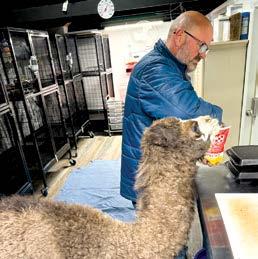
The park, which is a member of Pearl River Valley Electric, features more than 300 animals, including some you can touch and feed. A few animals, including a donkey and a couple alpaca, may be seen at the park’s entrance. A koi pond with a gently flowing water fountain, brings a feeling of serenity to those entering the main building.
Thurman’s safari park is a multi-faceted facility, with areas for guests to interact with some of the animals, and a larger area, viewed from a “people mover” where grazing animals can be seen “up close, but not too close.”
The self-guided walking area has kangaroos and wallabies, including a few albinos; several species of ducks, swans and geese;
goats, alpaca and calves; a few grey crowned cranes; tortoises and more than 100 peacocks and hens. This area is also available for touring during dinner service on Friday and Saturday nights.
“It’s hands-on,” Thurman said. “We just get you up close and personal.”
A monkey lanai is in the walkable area, with spider monkeys and marmosets. A few lemurs, which are primates but not part of the monkey family, are located nearby.
The larger part of the safari park is home to zebras, camels, bu alo, bison, llamas, antelope, ostrich, emus, and more. Thurman is working to expand the park, so he can add more animals, including gira es. This area of the park is usually closed in the evenings.
Guests can do a quick tour or take their time going through the park.
“We have people come and stay half a day,” Thurman said.
For an additional fee, guests may enjoy a visit with a lemur, kangaroo, bat-eared fox or fennec fox. Other animal encounters include feeding toucans or lorikeets or riding a mule.
Little Creek Landing also has a restaurant, where visitors may enjoy lunch or dinner, with a view of the pond. The dining area is behind the
main entrance, which includes a gift shop and the animals available for one-on-one encounters.
The restaurant is open from 11 a.m. to 2 p.m. TuesdaysSaturdays for café-style lunches and 5 p.m. to 9 p.m. Fridays and Saturdays for full-service meals. Guests can come to the park to enjoy a meal without visiting the park areas.
The lunch menu includes sandwiches, burgers, salads, chicken strip or catfish baskets and more. The dinner menu o ers a variety of steaks, a port ribeye, chicken, catfish pasta, and more. Occasional specials are o ered, including dishes like prime rib or parmesan-crusted salmon.
The park is open from 10 a.m. to 5 p.m. TuesdaysSaturdays; and 5 p.m. to 9 p.m. Fridays and Saturdays. Admission is $20 per person for ages 2 and older, which includes admission to all areas of the park. Restaurant, animal encounters, and merchandise are not included. Group rates, field trips, and special events are also available.
The park is at 222 Little Creek Road in Sumrall.
A Smart Plan for Lifetime Retirement Income
After years of saving, it’s time to make your 401(k) deliver consistent income you can depend on. Here’s an example: A client retiring at 65 had:
• $370,000 in her 401(k)
• $1,720/month from Social Security
• A $4,000 monthly income goal
Her 401(k) could fill the gap for 13.5 years — but what happens after that?
1-844-AGENT4U
1-844-AGENT4U
With a lifetime income strategy, we helped her turn part of her 401(k) into a guaranteed income stream that last a lifetime.
“Powering
Growing with purpose
Investing wisely for our members and our future
For more than 85 years, Dixie Electric has grown alongside the communities we serve. That growth brings additional responsibilities to our members and our employees.
Recently, Dixie Electric purchased property on Flynt Road in Laurel, formerly the Wayne-Sanderson headquarters. I want to take a moment to explain why this decision was made, how it benefits our members and employees, and how it positions us for the future. But before I do that, I want to take a moment to provide some historical context. Dixie Electric, then Jones County Electric Power Association, was in a small o ce on Ellisville Boulevard in Laurel from 1938 until 1943, when they moved to an o ce on South Magnolia Street. In 1949, a new headquarters was built on that same site on South Magnolia Street, which is now the site of the Laurel Police Station. They remained at that location until 1970, when the o ce and headquarters on Hwy 184 (Hwy 84 at that time) were completed. It is a solid, well-designed, and well-constructed facility that has served Dixie Electric well for more than 55 years, almost two-thirds of the life of the cooperative. By contrast, they were at the South Magnolia site for only 21 years. At the time it was built, there were fewer than 60 employees. It was built with growth in mind, but I don’t think anyone could have imagined what Dixie Electric would become. Today, we employ more than 145 employees, each playing a critical role in delivering safe, reliable, and a ordable electricity to our members, as well as reliable, high-speed internet service through DE Fastlink.
When DE Fastlink launched in 2020, our growth accelerated. We didn’t just grow in size; we grew in responsibility, services, and expectations. We did everything we could to make our existing space work. O ces became shared spaces for up to three or four employees. Conference rooms also became shared o ce space, and storage closets became o ces. We even had to rent storage space for equipment and fi les. We stretched and adapted as much as possible, but over time, it became clear we had outgrown the facility that had once served us so well.
As we began planning for the future, we considered building a new headquarters on our existing property. However, with today’s construction costs, that option would have required a very significant investment. Then, unexpectedly, another opportunity emerged: the Wayne-Sanderson facility became available.
This option allowed us to meet our needs at a much more coste ective price than building new. While the property includes more space than we currently require, that excess space also became part of the solution. By leasing unused portions of the building back
to Wayne-Sanderson, we are o setting the costs to purchase and operate the new facility and further reducing the fi nancial impact to our members.
We had a decision to make — either pursue the option that kept us in a single location but at a much higher cost or make the more financially responsible decision. With careful deliberation and guidance from our board of directors, we chose the path that best reflects our commitment to being good stewards of our members’ investment. Every decision of this magnitude is made with thoughtful consideration. This one was no di erent. Guided by our cooperative principles, particularly Members’ Economic Participation, we approach decisions with a long-term view. Much like the facility built in 1970 supported our members for decades, this decision reflects thoughtful planning and our responsibility to ensure the cooperative remains strong and well-positioned for the future. When we looked at the options, we fully believed this was the best decision for Dixie Electric and its members and employees.
As with any expense of this magnitude, members might be concerned with how it could a ect their electric bill. This purchase was fi nanced over a long period of time, so that no one generation of members absorbs all the cost. Just like the costs of substations, poles, wire, and transformers that are spread out over time, this purchase is treated exactly the same way. It plays a small part in the overall fi xed costs of the cooperative, but when spread over time, it has a minimal impact on any one member, especially when you consider that we’re leasing part of facilities back to Wayne Sanderson or other organizations in the future.
Today, we are adjusting to a new normal. Our operations and member services teams continue working out of the existing facility on Hwy 184, while administrative departments and DE Fastlinkrelated employees have transitioned to the Flynt Road location. We are excited about what’s ahead for Dixie Electric and DE Fastlink. Most importantly, we remain committed to serving you with integrity, accountability, and a long-term vision that keeps our members at the center of every decision we make.
by Randy Smith General Manager
FUTURE LEADERS TAKE ACTION IN JACKSON
A group of 83 high school juniors from across Mississippi gathered in Jackson from Feb. 25 to Feb. 27 for the 39th Electric Cooperatives of Mississippi Cooperative Leaders Workshop — three days focused on leadership, service, and civic engagement.
Designed to cultivate leadership skills and spark a heart for community involvement, the workshop gives delegates an inside look at how cooperatives and state government work together to serve Mississippi communities. Throughout the workshop, students are challenged to think critically, collaborate with peers, and consider how they can make a di erence right where they are.
Held at The Westin in downtown Jackson, the event brought together students who earned their spot through a competitive selection process sponsored by their local electric cooperatives. This summer, they will continue the experience with a seven-day Youth Leadership Tour in Washington, D.C.
Representing Dixie Electric this year were Ford Bigler, Collin Windham, and Brantlee Crager. Over the course of three days, they connected with fellow students from around the state, toured the Mississippi State Capitol, and participated in hands-on leadership and problem-solving activities. They also heard from several inspiring speakers, including political cartoonist Marshall Ramsey, who encouraged students to use their voices, talents, and opportunities to serve their communities well.
While at the Capitol, our delegates had the opportunity to meet with and learn from elected o cials who represent our area. We are especially grateful to Sen. Don Hartness and Reps. Donnie Scoggin, Charles Blackwell, and Larry Byrd for taking time out of their busy schedules to have breakfast with our delegates and personally show them around the Capitol. Opportunities like these give delegates a firsthand look at the legislative process and allow them to ask meaningful questions about leadership and public service.
Secretary of State Michael Watson also addressed the group during the workshop, sharing insights about state government and the responsibility that comes with leadership.
We are proud of Ford, Collin, and Brantlee for representing Dixie Electric and our members so well, and we look forward to seeing the impact they will continue to make in the years ahead.
I learned that you can’t be a strong leader to others if you don’t have confidence and discipline within yourself. Brantlee Crager
A. Ford Bigler, Brantlee Crager, and Collin Windham starting o the workshop with a smile.
B. (Left to right) Rep. Larry Byrd, Sen. Don Hartness, Ford, Brantlee, Collin, Rep. Donnie Scoggin, and Rep. Charles Blackwell.
behind the lines THE MEN
by Amanda Mills
Before I came to work at Dixie Electric, I appreciated having electricity, but I never grasped the depth of what that truly meant. If the lights were on, life was normal. If the power went out, I waited for it to come back. Like most people, I didn’t think much about what happened in between.
I’ve now worked at Dixie Electric for nearly 18 years, and my perspective has completely changed. From where I sit, there is no group of people more deserving of appreciation than the men who keep the lights on for our members.
Lineman Appreciation Day, held annually on April 18, gives us the opportunity to pause and recognize what I have witnessed firsthand for nearly two decades: this job is not ordinary.
It’s climbing poles in the heat of a Mississippi summer. It’s working through freezing rain and bitter wind. It’s responding at 2 a.m. while most of us are asleep. It’s operating heavy equipment in dangerous conditions with precision and focus. It’s missed t-ball games, holiday gatherings, and birthday parties. It’s carrying the responsibility of knowing that what you do matters, not just for convenience, but for safety, for medical equipment, for schools, for businesses, and for entire communities.
Storm restoration is where you truly see who they are. I’ve watched them leave their families for days, sometimes weeks, to help restore power after major weather events. I’ve seen them head out before sunrise and return long after dark with tired faces and quiet pride. What amazes me most is not just their endurance, but their attitude.
They don’t complain about the heat. They don’t complain about the cold. They don’t complain about the hours. They just keep on keeping on.
Osmose Utilities Services inspection and maintenance
Celebrating 2026 Lineman Appreciation Day this April 18
There is a level of grit in a lineman that is hard to describe unless you’ve seen it up close. They understand that every service reconnected and every pole replaced means something very real to someone waiting at home.
Thank you for your grit, your integrity, and your commitment to the members of Dixie Electric.
From my role in communications, I often get to share their stories. I get to take the photos from the field and watch them work tirelessly. I get to share the updates as outages drop, and members are restored. I read the thank-you messages from our members on social media (and they do, too). Every single time I get to do these things, I’m reminded that this is more than a job for them. It’s a calling.
Before I came to work at Dixie Electric, I respected linemen in theory. Now, after years of seeing the sacrifice, the dedication, and the heart behind the hard hats, I respect them in a way that’s di cult to put into words.
So on Lineman Appreciation Day, from my perspective and all of us at Dixie Electric, thank you.
Thank you for the long days and nights.
Thank you for the dangerous work.
Thank you for the missed dinners and family time.
Thank you for your grit, your integrity, and your commitment to the members of Dixie Electric.
You are the backbone of this cooperative, and we are stronger because of you.
Osmose Utilities Services will be performing inspection and maintenance on some of Dixie Electric Power Association’s poles during the next year, beginning in March and continuing for approximately six months. The general areas to be inspected will be Eucutta, Whistler, Shubuta, Hiwannee, Beat 4, Pleasant Grove, Strengthford, Little Rock, Clara, Salem, Hollis Creek, and Camp Eight.
This work will generally consist of excavating a hole about 18” deep around the poles to inspect them and applying a preservative and/or remedial treatment to the poles as needed. The purpose of the inspection and treatment is to identify poles that do not meet industry strength standards and to extend the useful life of all others.
All Osmose contract workers will be identifiable by their yellow and orange Osmose work vests and hard hats. Osmose vehicles should be marked with Osmose Utility decals as well as a Dixie Electric Power Association “Contractor” decals.
If you're tired of having knee pain and want to talk to a doctor that can virtually give you your life back if knee pain is an issue, call Dr. Rob Acord... as he's the only doctor in the area... who has this newly discovered knee pain reduction technology.
Reduced in Less Than 8 Minutes?" Reduced in Less Than 8 Minutes?"
If you have knee pain, can't walk because of an old injury, or you just think it's part of getting old, you might want to read this article.
Knee pain is something that disables a lot of people every single year, but most people don't know what to do about it.
What Are Your Choices?
Some people immediately opt in for surgery, then some people watch TV and end up buying something they wrap their knee with-hoping it will help, and others just follow orders and take medications which simply block the pain signals while the underlying condition often progresses.
What Works Best?
All I'm saying is this. There are a lot of ways to TREAT your knee pain, but which one will really work?
If you've done your research, you know that there are not a lot of things that really work when it comes to actually helping align the knee, taking nerve pressure off the knee, and reducing the pain and swelling.
What if there was a "real solution" that worked from DAY ONE?
Hi, I'm Dr. Rob Acord and I'm here to tell you about a new device called the K.P.R.
I stumbled onto this one-of-a-kind machine at a recent medical conference and tried it myself. THE RESULTS: My knees have never felt so good, and that was after.... just one treatment.
It virtually reduced my knee stiffness by 95%, so I am positive it'll help your knee pain, help you walk better as soon as you get your first treatment, plus help you do some things you used to do without the help of a walker, cane, or someone else helping you.
Now, don't get me wrong. I'm not guaranteeing a miracle if you haven't walked in many years.... but this just may be the answer you've been looking for.
Better late than never for sure. You should entertain this option... no matter what's happened to you in the past!
Let me be very clear; I'm here to possibly help you:
Get out of pain
Walk better
Move better
Get up and down better
Get out of chairs easier
AND...
Finally you will be able to move without relying on someone or something else
"What if my knee(s) are BONE ON BONE?"
Here's all I can tell you. If you’re bone on bone, and surgery is not an option for you, or surgery didn’t work, this may be the exact treatment you’ve been needing.
You'll find out that K.P.R. is an amazing machine when teamed up with our Class IV laser therapy.
Will This Work for YOU?
Great questions and here's the answer: We have a reputation for getting great results, but if you're like most of our patients you know that the knee problem isn't going to just go away on its own. We're also known for our personalized care. We don't promise the world, but we will do everything humanly possible to get the results you want.
"I've NEVER done this before!" I'm going to offer you a consultation, knee examination, X-Rays, and TRIAL VISIT for only
$47 $47
We'll know almost IMMEDIATELY if we can help and most importantly, YOU WILL TOO.
Take Action TODAY
As you know, it's human nature to procrastinate; this is not the time to do that... WHY?
My Trial Offer goes away at the end of this month. It's available as a hard deadline because I have a limited number of trial spots and we are already an extremely busy office. Pick up the phone and call the office now. This one call could change the way you walk, feel, and move. CALL TODAY!
Dr. Rob Acord, D.C.
Photos by Whitley Daughtry
JIMMY MATHIS’S 45-year calling
by Steven Ward
Jimmy Mathis, a Southern Pine Electric construction supervisor, sipped on a Diet Coke and ate a chocolate chip granola bar while he drove to his first job site of the day.
Mathis, 71, said he usually eats a morning sausage biscuit with his Diet Coke, but not today.
Before heading to the job, Mathis stopped at a gas station convenience store to meet with his 5-man line crew and pick up a quick breakfast.
Mathis and his crew — attached to Southern Pine’s Brandon o ce — were headed to an area just southeast of Puckett to replace a power pole.
For Mathis, the power pole replacement is something he considers “a little job.”
Mathis is, if not the longest serving Mississippi electric cooperative lineman still working today, one of the longest serving co-op linemen in the state.
Mathis started working at Southern Pine in 1977 in the right-of-way department. Then he briefly worked as a groundman. From 1980 to 1992, Mathis worked as a lineman. He became a supervisor in 1992.
April is Lineman Appreciation Month. Mathis has been on the job for more than 45 years.
Jimmy Mathis represents something you just can’t replace with a manual or a training class.
“Little jobs are boring. Most people prefer the little jobs. I like rephasing with a big crew,” Mathis said.
Still, as a construction supervisor, the job is to oversee his linemen crew on their assigned task and to ensure all the work is done safely and e ciently. Although he doesn’t climb into buckets anymore, Mathis is still the man with the plan for the line.
Years ago, Mathis was a young lineman who worked with his own supervisor.
“Jimmy Mathis represents something you just can’t replace with a manual or a training class.
When you’ve got a lineman with that many years on the line, he brings a depth of practical knowledge that only comes from seeing just about everything a storm, a pole line, or a piece of equipment can throw at you,” Drummonds McAlpin, president and CEO of Southern Pine Electric, said.
“Having someone like him on the crew means that experience is being passed down every single day, helping the next generation of linemen be safety-focused, confident, and committed to serving our members.”
Mathis, who was born and raised in Taylorsville, grew up around Southern Pine Electric and linemen.
His father, Evon, was a lineman at Southern Pine. Both his grandfathers worked at Southern Pine — one was a truck driver and the other was a groundman. He also had an uncle that was a lineman at Southern Pine.
Mathis has an 18-year-old grandson, Brante, who is thinking about becoming a lineman.
“He can’t make up his mind. My advice to him is, it’s a hard job. You have to be real committed. It’s not a 9-5 job. You always have to be ready to go,” Mathis said.
A JOB
Mathis and his crew arrived at the scene and scoped out the details.
It turned out, the existing pole, which was rickety and rotting, had a fiber or cable line and telephone line on it. That meant the crew couldn’t replace it. Instead, they installed a new power pole right next to the older pole.
Using a digger truck, a giant, corkscrew-shaped digger tool drove a hole right next to the existing pole for the new power pole.
Back when Mathis started out, linemen and groundmen dug the holes themselves with their hands and shovels.
While the five linemen worked on getting the hole and new pole ready, Mathis walked around the site and eyed everything at the location.
By the time the linemen were up high in buckets attaching the power lines to the pole, Mathis was looking up to scan what was happening.
As a supervisor, Mathis is there to answer questions.
“The younger the linemen, the more questions you get,” Mathis said.
Parker Fulton, who has been with Southern Pine for only five months, was transferred to Mathis’s crew two weeks before.
“He has so much knowledge, it’s insane. I feel safe around him. And he teaches us every little thing.” Fulton said Mathis — who almost always has a smile on his face — has a personality that is sort of “goofy.”
“He’s serious but also fun to be around,” Fulton said.
Later in the day, Mathis said of Fulton, “I think he’s going to be just fine. He’s willing to do the work.”
Cooper Turner, 26, is one of the senior members of the crew. He has worked with Mathis for five years.
“Jimmy has forgotten more about linework than most people have learned in their entire careers,” Turner said.
“Everything I know about being a lineman, I learned from Jimmy. He’s taught me to take a step back, look at the whole picture before making an important decision.”
Safety is always the No. 1 priority at a Jimmy Mathis job site, Turner said.
“As far as I know, no one on any of Jimmy’s crews has ever been injured,” Turner said.
Everything I know about being a lineman, I learned from Jimmy. He’s taught me to take a step back, look at the whole picture before making an important decision.
EXPERIENCE
Mathis said linemen have to work in tough conditions.
“You have to deal with the weather. It can be super hot or deathly cold. It’s hard work, but you can live with it,” Mathis said.
Mathis said he’d rather work in the heat.
“Man, if you’re hanging up on that pole, that wind can really get you.”
Mathis has a desk and o ce, but he hardly spends anytime inside.
“I can’t work in an o ce. After five minutes, I feel like I’m going crazy. I like to be outside and on the road.”
Even in his o time, Mathis prefers to be outside hunting, fishing, or working in the yard.
Because of his time with Southern Pine, Mathis said he’s had opportunities to move up to positions that don’t involve site work.
“Those aren’t for me. A lot of supervisors have moved up over the years. But I like what I do.”
Wes Lee, Mathis’s district supervisor, said he loves to have Mathis and his expertise in the field.
“When we are in mutual aid situations, it’s great to have Jimmy because he can get out there to make sure everything is done safely, and he can figure out whatever problems there are,” Lee said.
When asked about retirement, Mathis said he’s thought about it.
“I think about it sometimes. I don’t know. Maybe. People get bored to death after they retire,” Mathis said.
In times of economic uncertainty—when inflation rises, markets fluctuate, and long-term financial stability feels less predictable—many investors turn to gold as a dependable store of value. By holding a portion of your wealth in gold, you can help safeguard your portfolio and preserve longterm financial security, even when broader economic conditions are unclear.
Since 2015, gold has surged over 400% — outpacing both the S&P 500 and the Dow during the same period.
American Gold Reserve is releasing government-issued $5 Gold American Eagles completely free of dealer markup for only $529 each. These beautiful $5 Gold American Eagles are a perfect way to enter the gold market. Set for immediate public release, availability is limited and supplies are expected to sell out quickly.
GOVERNMENT BACKED U.S. GOLD
• Free of dealer markup.
• Gold provides protection against inflation and deflation.
• Gold offers financial cover during geopolitical and macroeconomic uncertainty.
• A strong portfolio diversifier.
1. Elizabeth DeLaughter of Brookhaven; Magnolia Electric member.
2. Willa Russell of Meridian; East Mississippi EPA member.
3. Anita Nobles of Leeville; Dixie Electric member.
4. Deloris Compston of Perkinston; Pearl River Valley Electric member.
5. Nan Cooksey of New Albany; Pontotoc Electric member.
6. Eyler Coates of Gulfport; Coast Electric member.
7. Laura Barron of Hattiesburg; Pearl River Valley Electric member.
8. Cassie Buford of Vancleave; Singing River Electric member.
9. Jodi Adams of Carthage; Central Electric member.
10. Theresa Chaney of Vicksburg; Twin County Electric member.
11. Barbara Bishop of Meridian; East Mississippi EPA member.
12. Carl Smith of Morton; Southern Pine Electric member.
13. Tim Lea of Monticello; Southern Pine Electric member.
14. Deloris Furr of Wesson; Magnolia Electric member.
David Goodwin of Columbia; Pearl River Valley Electric member.
16. Jaime Lyn Riddle of West Point; 4-County Electric member.
17. Patty Heard of Louisville; East Mississippi EPA member.
18. Becky Champion of Little Rock; Central Electric member.
19. Bruce Hutson of Bogue Chitto; Magnolia Electric member.
20. Marybelle Rosado of Gulfport; Coast Electric member.
21. Dexter Wilson of Roxie; Southwest Electric member.
A shrimp boil for anytime Plated Plated
with Rebecca Turner
A shrimp boil is a spring and summer staple that includes tender shrimp, hearty potatoes, savory sausage, and sweet corn all boiled together. Often reserved for an easy, one-pot meal to entertain a large crowd outside, shrimp boils are also fit for a simple weeknight meal or a special treat for an intimate few. Whether you’re boiling for four or 40, make sure you cook in a specific order to ensure nothing gets overcooked or mushy.
When cooking indoors, a 10- to 12- quart stockpot is ideal. For larger groups, a 24- to 60-quart pot with a strainer basket is recommended for easy, safe draining. Always choose large shrimp; look for jumbo (16/20 count) or extra-large shrimp. Keep the shells on during the boil to prevent overcooking and enhance the broth’s flavor.
The secret to a successful boil is adding ingredients in stages. The first ingredient is the water, and you want to give it time to sit, simmer, and develop a rich, flavorful broth. Start with water, plenty of salt, and halved lemons, onions, garlic, and Old Bay seasoning for aromatics. Allow your water to boil into a broth for about 10-15 minutes.
Add red potatoes first; they take the longest to cook. For smaller indoor boils, make sure your potatoes are as uniform in size as possible for cohesive cooking, or cut in half. Boil for about 10-12 minutes.
Once potatoes are nearly done, not fully fork tender, but the fork can easily pierce the skin, add the corn and smoked sausage. Corn on the cob should be halved, and try Andouille, Kielbasa, or a deer variety. Boil for 5-7 mins.
Finally, add the shrimp last. Shrimp needs about 2 to 3 minutes to turn pink and opaque. If you leave them too long, they will get tough. Check the potatoes; you want them basically done before adding the shrimp. Drain everything immediately to stop the cooking process.
Tips • Add a splash of apple cider vinegar to the boiling water to help the shrimp shells slip o more easily. Don’t toss the broth; save a cup or two and drizzle it over the platter, or use it as an au jus.
Add-ins • One can of beer to the broth. Make a homemade seafood seasoning (instead of Old Bay). Seafood such as crab, lobster, or clams can be added. Experiment with veggies, such as green beans, okra, or asparagus.
INGREDIENTS
4 quarts hot water
Serves 6
1 large yellow onion, sliced into 4 - 6 wedges
1 garlic bulb (whole head), halved horizontally
½ cup Old Bay seasoning (or homemade)
1½ teaspoons dried thyme leaves (1 ½ tablespoons fresh)
Basic Shrimp Boil Homemade Seafood Seasoning
Makes a ½ cup serving
INGREDIENTS
3 tablespoons celery salt
4 teaspoons cayenne pepper
1½ pounds medium red potatoes, cut into fourths
4 ears of corn, husked, broken into halves, or cut into fourths
14 ounces smoked sausage, sliced into 1-inch-thick pieces
1½ pounds large shrimp, deveined, shell on (head optional)
6 tablespoons unsalted butter, melted
2 tablespoons fresh lemon juice, or more to taste
2 tablespoons minced fresh parsley (garnish)
Salt and pepper to taste
4 teaspoons paprika
2 teaspoons ground thyme
1 teaspoon black pepper
½ teaspoon ground mustard
½ teaspoon ground ginger
½ teaspoon ground cloves
Fill a large pot (about 12 quarts) with 4 quarts of water. Stir in onion, garlic, Old Bay seasoning, salt (1 tablespoon), and thyme. Bring the mixture to a boil over medium-high heat.
Allow to simmer for 10 minutes.
Add potatoes. Let cook until potatoes are nearly tender, about 10-15 minutes.
Add the corn and continue cooking for 3-5 minutes. Add sausage and cook 4-6 minutes longer.
Gently stir in shrimp and cook until just opaque and pink, about 1-2 minutes.
Immediately drain mixture (reserve 1 cup of the broth for serving). Spread over an extra-large serving platter, baking sheet, or butcher paper on an outside table.
Drizzle with butter and lemon juice. Optional: sprinkle with parsley, additional Old Bay seasoning, and pepper to taste.
½ teaspoon ground cardamom
¼ teaspoon ground coriander
¼ teaspoon ground cinnamon
Stir together all the ingredients in a small bowl. Transfer to a container with a tight-fitting lid — a glass jar with a screw-top lid works spectacularly. Set aside in a cool, dark place and use within a couple of months.
by Rebecca Turner
Rebecca Turner is an author, registered dietitian, radio host, television presenter, and board-certified in Lifestyle Medicine. She is a lifelong Mississippian and a member of the Central Electric Co-op in Brandon. Find her on social media @RebeccaTurnerTalks or online at RebeccaTurnerNutrition.com.
Star Spring Festival. April 18. Star. The festival continues its long-standing mission of raising funds for St. Jude Children’s Research Hospital. The 2026 event will feature its popular car show, showcasing classic cars, big rigs, tractors, and off-road vehicles, alongside local vendor booths, family-friendly entertainment, and a variety of food options. The event will be held at 301 Mangum Dr. Details: 601-842-7947 or email starspringfestival@yahoo.com.
The Waynesboro Whistle Stop Festival. April 18. Waynesboro. The free event will be held from 10 a.m. to 4 p.m. downtown. The event includes food and arts and crafts vendors, virtual reality adventures, the Barney & Marie Memorial Car Show, children’s train rides, space jumps, and other activities. Details: 601-735-2268 or email librarywayne39367@gmail.com.
Barn Sale. May 1 and 2. Oak Grove. From 7 a.m. to 5 p.m. each day at 4799 Old Highway 11, Purvis (Oak Grove). More than 85 collectors with trailer loads of antiques and collectibles. Details: 601-818-5886.
Rummage and Bake Sale. May 2. Brandon. The free event will be held from 8 a.m. to 2 p.m. at Nativity Lutheran Church at the corner of Crossgates Boulevard and Old Brandon Road. Clothing, furniture, household goods, and baked goods will be on sale. Details: 601-825-5125 or email nativitylc@att.net.
Daylilies: A Garden Party. May 16. Hattiesburg. The free event, hosted by the Hattiesburg Area Daylily Society, will be held from 1 p.m. to 4 p.m. at the Hattiesburg Train Depot. A design division is included in the show. The plant sale begins at noon. Details: 601-466-3826 or visit hattiesburgdaylily.com.
Harrison County Gem and Mineral Society Show. May 16 and 17. Biloxi. The event will be held at the Joppa Shriners Center, 13280 Shriners Blvd., on Saturday from 9 a.m. to 5 p.m. and on Sunday from 9 a.m. to 4 p.m. There will be demonstrations, hourly door prizes, more than 20 vendors, club exhibits, displays, rounds of Stump the Geologist, and a children’s area. Details: Call 228-596-7964, 205-296-3779, or 601-947-7245.
My foolish ways
After a fruitless search for the origin of April Fool’s Day, I have concluded that it is foolish to continue looking. It’s not because there is so little information recorded about the day. Just the opposite — there is too much information in ancient history and prose and verse that could be construed as the sprout from which the wellrooted tree of April Fool’s Day sprang.
A quick scan of Google has no telling how many direct and indirect references to mentions of the day or some ceremony surrounding it. Tales of pulling pranks on some gullible victim and sending others on a “fool’s errand” on April 1 to out-and-out lies are recorded. All in fun. Well, fun for everybody except the brunt of the joke. The joke can even become funny to them after a while.
Tales of pulling pranks on some gullible victim and sending others on a “fool’s errand” on April 1 to out-and-out lies are recorded. All in fun. Well, fun for everybody except the brunt of the joke.
Mom’s way to get me out of the bed on April 1 was to tell me, “There’s a purple cow in the front yard!” I’m embarrassed to admit it worked more than once!
I ran across an article written by Jack Elliott from West Point titled “The Grave of the Moon Man of Kilgore Hills.” The story centers around a newspaper article from the1800s about a strange little creature who crashed near Big Springs and ended up being buried there. Jack included photos and told how he searched everything he could — eyewitness accounts, a copy of the old article, copies of photographs of the being, even an account of how a few of these photos are in the Local History Room at the Bryan Library in West Point.
I called Jack about it, hoping to get a picture of the grave. He admitted it was all a joke except for a few names of real people that he used to make it believable.
Speaking of a “Moon Man,” UFOs are in the news again. President Trump has ordered that everything the government has on such cosmic matters be made available to the public. Now, I don’t know if you believe in UFOs or not, but I have friends who have seen them! Here in Mississippi!
Some friends of ours were traveling with us coming back home from somewhere and the subject of UFOs came up. So, I jumped in with some jokes about the objects in general and those who have “seen” them in particular. I noticed my friend got very quiet. He then proceeded to tell us about his experience driving home from Delta State University one night. He noticed a light that followed him for a while. The light got close enough that he stopped and watched it hover silently over a cotton field for several minutes. Then, he said, it zipped off. I believe he saw what he said he saw. Now, was it from outer space? That’s another matter altogether.
Maybe we’ll have some answers when the government files are declassified. I figure we could see them about this time next year. Around April 1.
by Walt Grayson
Walt Grayson is the host of “Mississippi Roads” on Mississippi Public Broadcasting television and the author of two “Looking Around Mississippi” books and “Oh! That Reminds Me: More Mississippi Homegrown Stories.” Walt is also a reporter and 4 p.m. news anchor at WJTV in Jackson. He lives in Brandon and is a Central Electric member. Contact him at walt@waltgrayson.com.