E D I TO R’S L E T T E R
Our Co-op Linemen Deserve Their Special Day We often mention in these pages the excellent work performed by electric cooperative line personnel. In all kinds of conditions, they work tirelessly to keep your power flowing. We’re happy to report that their on-the-job and community service efforts are now getting some welldeserved national recognition. The National Rural Electric Cooperative Association (NRECA) Board has established National Lineman Appreciation Day in honor of our linemen who work so diligently. Wheatland Electric Cooperative linemen take their festivelydecorated service truck to the annual Christmas parade in the The NRECA Board has desigHamilton County community of Syracuse. nated the second Monday of each April as National Lineman Appreciation Day. In 2015, that means April 13 is a above that can cause bodily harm. We somespecial day or recognition. You can read about times become complacent about overhead power this national movement on page 14. lines. We see them every day and can forget the As the weather finally warms, it’s time to get importance of staying alert around them. A story outside and take care of some gardening, landon page 18 provides some helpful safety tips. scaping or even construction projects. But before Everyone at your local electric cooperative you do, please read an important story beginhopes you enjoy outdoor activities this spring, ning on page 12. It’s about calling 811 in advance but remember to be cautious around electricity. of commencing outdoor projects. The 811 “Call Before You Dig” number is a free, national line that was created to help prevent people from coming into contact with underground utility lines during digging projects. It’s not only what’s underground but what’s L A R RY F R E E Z E , E D I T O R
2
KANSAS COUNTRY LIVING
APRIL 2015
(ISSN 0091-9586) APRIL 2015 VOL. 65, NO. 4 © KANSAS ELECTRIC COOPERATIVES, INC., 2015 WWW.KEC.COOP
Bruce Graham
Chief Executive Officer
Doug Shepherd
Vice President, Management Consulting
Shana Read
Fun at the Kansas State Fair. See p. 32
Director of Communications
Larry Freeze Editor
APRIL
Bob Jennings
Manager of Publishing Services
Carrie Kimberlin
Communications Specialist
Makenzie Crow
Communications Intern Officers Kansas Electric Cooperatives, Inc.
Ralph Phillips President
Kathleen O’Brien
“LIKE” Kansas Country Living on Facebook to view monthly extras and submit your story ideas.
Vice President
Keith McNickle Secretary
Patrick Riley Treasurer
Cooperatives You receive Kansas C ountry Living as a communications service of these electric cooperatives: Alfalfa, Cherokee, OK Bluestem, Wamego Brown-Atchison, Horton Butler, El Dorado CMS, Meade Caney Valley, Cedar Vale DS&O, Solomon Flint Hills, Council Grove Kaw Valley, Topeka Lane-Scott, Dighton LJEC, McLouth Lyon-Coffey, Burlington Ninnescah, Pratt Pioneer, Ulysses Prairie Land, Norton Radiant, Fredonia Rolling Hills, Mankato Sedgwick County, Cheney Sumner-Cowley, Wellington Twin Valley, Altamont Victory, Dodge City Western, WaKeeney Wheatland, Scott City
12 | Dig Safely Contacting a buried line can cause injury or death.
14| We Like Linemen
D E PA RT M E N T S
2 | Editor’s Letter
These dedicated workers earn a day of recognition.
Let’s thank our linemen
4 | Around Kansas
20| Wild Grasses Many varieties and colors can be added to your yard.
Kansas Country Living (ISSN 0091-9586) is published monthly for $10 per year (tax included) by Kansas Electric Cooperatives, Inc., P.O. Box 4267, Topeka, KS 66604. Periodicals postage paid at Topeka, KS and additional entry offices. For members of Kansas rural electric systems, subscription cost is $5.70 per year. This cost is part of your electric service billing. Editorial offices: P.O. Box 4267, Topeka, KS 66604-0267. Phone 785-478-4554. Fax 785-478-4852.
Revisiting history
6 | Commentary
Focusing on key issues
14
8 | Guest Commentary Make safety a priority
10 | Cut Your Utility Bills
Increase mass and comfort
28 | Cook’s Library
Some styles don’t change
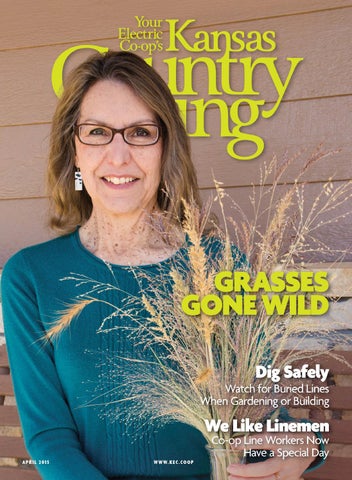
ON THE COVER Kansan Iralee Barnard has written and photographed a book on prairie grasses.
Address Changes Please report any change in address to your local electric cooperative. Postmaster Send address changes to Kansas Country Living, P.O. Box 4267, Topeka, KS 66604-0267.
Kansas Country Living assumes no responsibility for unsolicited material. Submissions must be accompanied by self-addressed envelopes with sufficient postage to be returned. The publication does not guarantee publication of material received and reserves the right to edit any material published.
P H OTO BY L A R RY F R E E Z E
20
IRALEE BARNARD
Advertisers Contact the Weiss Group, Inc.: 915-533-5394. Or see www.theweissgroupinc. com. Acceptance of advertising by Kansas Country Living does not imply endorsement by the publisher or Kansas’ electric cooperatives of the product or services advertised.
APRIL 2015
KANSAS COUNTRY LIVING
3
T H I N G S TO D O
Harvey County Museum Offers Two New Exhibits
The Harvey County Historical Museum in Newton is offering two new exhibits this year. COLORFUL KITCHEN: 100 YEARS OF PYREX and FANCY-DRESS KITCHEN: APRONS will be on display through 2015. See www. hchm.org or call 316-283-2221 to learn more. ONGOING |
Ag Technology to be Displayed in Great Bend
APR 8–10 | The latest developments in agricultural technology will be on display at the FARM & RANCH EXPO from April 8 to 10 at the Expo Complex in Great Bend. Call 620-7922750 to learn more.
HISTORY COMES TO LIFE IN GEARY COUNTY
The Geary County Historical Society will bring history to life at its annual Celebrating Past Times event on April 25 from 10 a.m. to 2 p.m. at its historical site at the corner of Spring Valley Rd. and Highway K-18 in west History will be on display in Geary County at the Junction City. There will be Celebrating Past Times event on April 25. a Fort Riley cavalry encampment typical of the late 1800s and tours of the one-room schoolhouse and the Wetzel cabin, which was the site of the first Lutheran church services in Kansas. Visitors can also take part in games that children used to play and cook hotdogs and marshmallows over an open fire. Call 785-223-6179 or email mheronemus@cox.net to learn more. APR 25 |
Benefit Trail Ride to Visit the Flint Hills
APR 11 | The ACTHA TRAIL RIDE through the Flint Hills to benefit St. Paul’s Lutheran Church Clarks Creek will take place on April 11. For a list of activities and to register, see www. ACTHA.us or call 785-482-3416 for more information.
Tree Selection, Planting Advice Offered in Wichita
The Sedgwick County Extension Education Center, 21st and Ridge Rd. in Wichita, will be the site of the annual TREE FESTIVAL on April 11 from 8 a.m. to 1 p.m. Tree care professionals will be on hand to selection and planting advice. Call 316-660-0140 to learn more.
APR 11 |
South Kansas Symphony to Host Gala Celebration
The South Kansas Symphony in Winfield will hold its CHAMBER GALA on April 11 at 7 p.m. at a location to be announced. Highlights include chocolates, hors d’oeuvres and a musical arrangement. See www. southkansassymphony.com or call 620-221-6216 to learn more. APR 11 |
4
KANSAS COUNTRY LIVING
APRIL 2015
Pair of Artists Featured at Art Museum in Pratt
APR 11–JULY 25 | The Vernon Filley Art Museum in Pratt will host a TWO PERSON EXHIBITION from April 11 to July 25. Various works of Roger Williams and Robin Laws will be featured. Call 620-933-2787 or see www.vernonfilleyartmuseum.org for more information.
Spring Czech Festival Planned in Republic County
The Republic County Czech Club will hold its SPRING CZECH FESTIVAL on April 12 at the Cuba Community Hall. There will be a princess pageant, dinner and dance. Call 785-527-5039 or 785-729-3875 for details. APR 12 |
Wind and Wheels Festival Scheduled in Leoti
The WIND & WHEELS FESTIVAL will take place in Leoti on April 18 beginning at 9 a.m. There will be a kite festival, car show, music, food and evening dance. Call 620-375-2182 or APR 18 |
see www.windandwheels.org for more information.
Parade, Display Highlight Alta Vista Tractor Show
APR 18 | The Spring Crank Up TRACTOR SHOW is planned for April 18 at Ag
Heritage Park, 103 S. Main in Alta Vista. A Parade of Power kicks off the show at 9:30 a.m., with the tractors on display at the Park from 10 a.m. to 4 p.m. For a complete schedule, see www.agheritagepark.com or call 620-767-2714.
Trio of Performers Coming to McPherson Opera House
APR 18 | The McPherson Opera House will present the COWGIRL, DIVA & SHAMELESS HUSSY on April 18 at 7:30 p.m. The trio will offer a combination of country, jazz, blues and pop songs. See www.mcphersonoperahouse.org or call 620-241-1952 for tickets.
Downs to Host Annual Storytelling Festival APR 24–25 |
The 22nd annual KANSAS
STORYTELLING FESTIVAL will unfold in Downs in Osborne County on April 24 and 25. Highlights include professional storytellers, a tall tale contest, stories of local legends and food vendors. See www. kansasstorytelling.com or call Glennys Doane at 785-454-6648 for more information.
Bird Enthusiasts Invited to Wings & Wetlands Festival
APR 24–26 | The WINGS & WETLANDS BIRDING FESTIVAL will take place along
the Wetlands & Wildlife National Scenic Byway near Great Bend April 24 through 26. Bird enthusiasts will tour Cheyenne Bottoms and Quivira National Wildlife Refuge. Call 620792-2750 to learn more.
Footloose to be Presented at Columbian Theatre APR 24–MAY 10 | The
musical production
FOOTLOOSE will be held at the
Columbian Theatre in Wamego April 24 through May 10. For more details, see www.columbiantheatre.com.
Rail Ride into History Planned in Blue Rapids
APR 25 | The Marshall County Railroad Historical Society will host its WHISTLE STOP HISTORY RIDE on April 25, starting at Blue Rapids at 9:30 a.m. Re-enactors, historical program and lunch are included. Reservations can be made by calling 785-799-4294 or 785-363-2343.
‘The Evolution of Hunting’ to be presented at Fort Larned
APR 25 | A program on THE EVOLUTION OF HUNTING AT FORT LARNED will be
presented on April 25 from 10 a.m. to 8:30 p.m. at the fort. Admission is free for various presentations during the day, but reservations are required for the evening dinner. Call Leo at 888321-7341 to learn more.
Yellow Brick Run to Connect Osborne and Downs APR 25 |
The Downs and Osborne
YELLOW BRICK RUN will get underway
on April 25 at 9 a.m. Runners, walkers and bicycle riders are invited to participate in this half-marathon from Osborne to Downs. Proceeds benefit several area causes. For more information, see www.downschamber. com or call Mandy at 785-454-6670.
Community Chamber Orchestra Plans Concert
MAY 1 | Pianist and vocalist Nancy Blockcolsky will perform with the
COMMUNITY CHAMBER ORCHESTRA on May 1 at 7 p.m. in the Morganville School. Highlights include Mozart’s 23rd piano concerto and a selection from Handel’s Messiah. Contact Dr. Anne Clark at 785-926-4725 or email bclark@diodecom.net to learn more.
feature exhibitors, food, entertainment and art. See Discover Salina Naturally on Facebook for more details.
Annual Daylily Sale on Tap at Wichita’s Botanica
MAY 10 | Botanica, at 701 N. Amidon in Wichita, will be the scene of the Prairie Winds Daylily Society’s annual DAYLILY SALE on May 10 from 11 a.m. to 4 p.m. Freshly dug daylilies from local club member gardens will be ready to purchase. There is no admission charge to attend the sale only. Call 316-263-7608 or 316-6835877 for more details. KCL
Send items for your free listing in Around Kansas to Kansas Country Living, P.O. Box 4267, Topeka, KS 66604 by the fifth of the month prior to publication. Or e-mail Lfreeze@kec.org. Please include a contact phone number.
Wamego City Park Site of Kansas Sampler Festival
MAY 2–3 | Guests are invited to discover what there is to see,so, hear, taste, buy and learn about our state at the KANSAS SAMPLER FESTIVAL on May 2 and 3 at City Park in Wamego. For more details on the 26th annual festival, see www.kansassampler.org/ festival.
Kansas Horse Council Schedules Trail Ride
MAY 2–3 | Join the Kansas Horse Council for a weekend of TRAIL RIDING at Rockhaven Park, Clinton Lake, near Lawrence. More information and registration is available at www. kansashorsecouncil.com or by calling Jim Thomas at 785-633-4761.
Family Festival Planned at Salina’s Lakewood Park
Salina’s Lakewood Park will be the scene of the DISCOVER SALINA NATURALLY festival on May 3 from 11 a.m. to 4 p.m. This family event will MAY 3 |
APRIL 2015
KANSAS COUNTRY LIVING
5
C O M M E N TA RY
Spring Brings Issues into Focus
BY B R U C E G R A H A M
Bruce Graham
A possible tax hike being considered would come monthly as part of your utility bill.
6
For some reason, focusing on a column this month was difficult. I’ll blame the excitement of spring–or the effects of springing forward for Daylight Saving Time. Whatever the cause of the distraction, in lieu of 600 words on a single subject I’ll touch on three topics. Topic Number One–The Kansas Legislature continues to twist and turn through their 90-day calendar. It’s anybody’s guess if they will adjourn on schedule–or what the school and state budget debates will produce. I personally believe we will see “revenue enhancements” of some sort. Liquor buyers in Kansas will probably have to swallow higher prices and you’ll need more nickels for that nicotine. Users could be paying more for services from government agencies, and some existing tax exemptions are targeted for elimination. If oil prices stay down, I also think a gas tax increase will be used to boost the state highway fund. All of these ideas are on the table. Another possible tax hike under consideration would come monthly as part of your utility bill. Currently, the state of Kansas does not levy sales tax on natural gas and electricity for residential use. Agriculture use is also exempt–as is the sale of propane when used for heat and light in non-commercial residential applications. Commercial interests do pay sales tax on their utility bills and some legislators see that bias as an opportunity to raise an estimated $170 million. Your non-profit electric cooperative is doing its best to control costs in the face of rising mandates. We never like to raise rates but we would be forced to add a new line item on the bill that passes along the 6.15 percent tax on your energy use. And we aren’t crazy about having to take the brunt of the outrage from members, especially those who have been working to conserve energy and become more efficient only to see those savings suddenly erased. We have communicated to legislators that our members will feel the pain of a 6.15 percent jump in their energy bills. Lawmakers also understand that this tax
KANSAS COUNTRY LIVING
APRIL 2015
is regressive, hitting low income members the hardest. Our objections create a pickle though because we need good schools in Kansas and state funded programs such as Rural Opportunity Zones provide useful economic development incentives. Topic Number Two–This time last year, the U.S. Fish and Wildlife Service (USFWS) was closing in on its decision to list the Lesser Prairie Chicken (LPC) as a threatened species. Some in the state were skeptical of our economic impact projections. But as the mitigation requirements in the five-state LPC habitat area are refined, our predictions appear to be spoton. For example, in order to avoid the predator’s perch created by an overhead pole and wire, new homeowners in some LPC habitat areas could be required to install underground electric lines, which will triple the cost of establishing service. Other economic and regulatory uncertainties related to this ruling remain, and so we need the USFWS to delay enforcement for at least a couple of years. That will give us all some time to develop reasonable rules that balance the shared desire to see the species thrive while assuring that the economy of western Kansas does not become extinct. And finally, Topic Number Three–I mentioned my struggle with Daylight Saving Time earlier, but I wouldn’t trade my Timex for the patchwork of hourly rules that existed before the federal government passed the Uniform Time Act in 1966. I know the mandate has some fans and some foes, but it used to be that Iowa had 23 different pairs of start and end dates for Daylight Saving Time. St. Paul, MN, began its daylight saving two weeks before its twin city, Minneapolis. On a 35-mile bus ride from Steubenville, OH, to Moundsville, WV, passengers endured seven time changes. I question whether the new Apple watch would even be able to keep up with that clock chaos. KCL BRUCE GRAHAM is Chief Executive Officer of Kansas Electric Cooperatives (KEC), Inc., Topeka.
G U E S T TA L K
Safety is our Top Priority
Phil Irwin
Contacting a buried line with a shovel or other tool can severely injure or kill you.
BY P H I L I RW I N
Power lines bring electricity from generating plants to our homes, schools and businesses. The energy that is delivered has become a vital part of our daily lives. However, it often disappears into the background as one of those luxuries we simply take for granted. Rural electric cooperatives work very hard to ensure that your electric service is reliable and is delivered in a safe manner. Unfortunately, the poles, lines and pad-mounted transformers can, at times, fade from our view and create a bit of complacency that could become dangerous if some simple safety rules are not followed. We need to assume always that power lines are live and stay away. This applies to lines on poles, to lines in ground-mounted boxes and to the lines entering your home. Here are some basic rules about safety around power lines: ffLook up and live: Look up for power lines whenever you are doing anything outside, especially when trees are nearby. The branches and leaves of a tree can hide power lines from view. ffNever climb power poles or transmission towers: A typical overhead distribution line has 7,200 volts per wire. Voltages on transmission lines exceed 69,000 volts. Both can deliver a deadly shock. ffNever climb trees near power lines: Never
climb or attempt to trim trees near power lines and ensure that children follow these same rules. Contact your electric cooperative with any questions or concerns about removing trees or limbs near power lines. ffStay away from downed power lines: Always assume that a downed power line is live and life-threatening. Keep children and pets away from downed lines. Do not attempt to remove a person or animal that is caught in power lines. Instead, call 911. Do not attempt to remove tree limbs or any other object from a downed line. If
8
KANSAS COUNTRY LIVING
APRIL 2015
you see a downed line, call your electric cooperative or 911 to have the downed line barricaded until it can be repaired. Warn others to stay away. ffNever drive over a downed line or under a low-hanging line: Beware of downed lines touching a vehicle. Stay away from the vehicle and the line. If a power line hits your car while you’re inside, stay in the vehicle and wait for help. If the car catches fire, jump clear of the car keeping both feet close together being careful not to touch metal and the ground at the same time. Once you have jumped clear of the car, shuffle away keeping both feet on the ground. ffKeep ladders, antennas, kites and poles away from power lines: Never position a ladder near power lines, and never fly kites near power lines. When working on ladders, keep all tools and materials at least 10 feet from all power lines. ffExcavating: Before beginning any excavation in the vicinity of underground power lines, call 811 to request an underground locate of the area. Whether you are planting a tree, building a fence or laying a foundation, contacting a buried line with a shovel or other tool can damage the line and severely injure or kill you.
Federated Rural Electric Insurance Exchange is the leading provider of property and casualty insurance for electric cooperatives in 42 states. Safety is our number one priority and we applaud cooperative CEOs who have embraced safety as a core value across the country. Please share this material with your family. By making others aware of this information, you can help ensure the safety and well being of those you love. KCL is president and CEO of Federated Rural Electric Insurance Exchange, headquartered in Lenexa.
PHIL IRWIN
C U T YO U R U T I L I T Y B I L L S
Improve Comfort by Increasing Thermal Mass BY J A M E S D U L L E Y
Dear Jim: We are plan-
Dear Sharon: Increasing the thermal mass means increasing the ability of materials to retain heat energy. This can be done anytime, but it is ideal Use synthetic stone trim on walls to increase the indoor thermal mass, especially near a fireplace. when remodeling. Increasing the thermal mass does not significantly higher, particularly during the not require a “Fred Flintstonesque” decor with summer. a pile of rocks in the center of every room. There are several ways thermal mass can Actually, most of these improvements are quite save energy in your home. By reducing the attractive. indoor temperature swings during winter The concept of increasing thermal mass months, less heat is lost through the walls and means having the house structure and interior windows. This is particularly true in rooms objects absorb and hold as much heat energy as possible. The heavier the items in your home, the more mass it has to better absorb heat. As the outdoor temperature changes, thermal mass helps moderate indoor temperature swings to improve comfort and efficiency. It is comparable to the way a heavy, high “physical” mass automobile provides a smoother ride by absorbing the energy from bumps. Old-fashioned solid log and heavy timberframed houses used this thermal mass concept. Even though a log house has a small amount of actual insulation R-value when compared to a typical framed house, its utility bills are often
The concept of increasing thermal mass means having the house structure and interior objects absorb and hold as much heat energy as possible. 10
KANSAS COUNTRY LIVING
APRIL 2015
JAMES DULLEY
QUICK TIP
ELDORADO STONE
ning to remodel our older home, and I’ve read that increasing thermal mass can improve energy efficiency. What exactly does this mean, and how do we incorporate it into our home?–Sharon T.
A large pot of damp soil for indoor plants also functions as thermal mass.
Increasing the thermal mass means increasing the ability of materials to retain heat energy. 18 to 36 depending upon type. Their natural thermal properties, in addition to their densities, determine the above relative numbers. Installing a dark, ceramic-tile flooring near a door or window is an excellent source of thermal mass. Decorative walls using solid bricks work well in a room with a fireplace or large windows. Heavy granite or slate countertops in a kitchen are effective. Wooden floors can also be a good source for thermal mass. Remember, the idea is to replace lighter materials with heavier materials. The damp soil in large potted plants can store much heat, and the plants naturally purify the indoor air. For emergencies, storing old milk jugs full of water under cabinets and near your heating system increase thermal mass. KCL Send inquiries to James Dulley, Kansas Country Living, 6906 Royalgreen Dr., Cincinnati, OH 45244 or visit www. dulley.com.
This Brazilian Brown high-mass countertop is made of 93 percent quartz particles and resins to bind them together.
APRIL 2015
COSENTINO
where heat is generated, such as the kitchen or bathroom, or rooms with large south-facing windows. During summer months, the mass will help keep rooms cooler and delay the use of air conditioning. In winter months, during the day, heat produced by the HVAC system is absorbed by the home’s thermal mass. At night, heat is released to warm the home. The greater the mass, the more it will keep the home comfortable. During the summer, high thermal mass delays the need for the air conditioner to kick on in the morning and throughout the daytime. Unless high humidity is an issue, opening windows at night and running a whole-house or window fan allows the thermal mass to lose the heat stored from the daytime. Close the windows in the morning and the cooled thermal mass absorbs heat coming in without causing the room temperature to rise as fast. The thermal mass of air is extremely low, so the cold outdoor air quickly absorbs heat from the indoor thermal mass. Increase the thermal mass in your house by selecting proper high mass, or heavier, materials. They should be located throughout the home, but concentrate on rooms that generate heat or tend to overheat during the summer. When building a house or adding rooms, use heavy foam insulating sheathing on the outside of the wall framing. This allows the framing lumber to become part of the interior thermal mass. The thermal mass of various materials is rated by heat capacity properties. Water has a high relative heat capacity of 62.4 per cubic foot compared to drywall at only 1.3 per cubic foot. Wet soil rates about 55, concrete is about 31, brick is about 27, and stone/tile ranges from
KANSAS COUNTRY LIVING
11
12
KANSAS COUNTRY LIVING
APRIL 2015
Dig Safely A Successful Backyard Project Begins by Calling 811
From planting shrubs to building a fence, many outdoor projects require digging. This spring, Kansas’ electric cooperatives and the Safe Electricity program remind you to call 811 before the shoveling begins. This simple step could prevent serious injury or even save your life. “Outdoor projects take planning and preparation,” says Molly Hall, executive director of the Energy Education Council and its Safe Electricity program. “Part of that preparation is planning to avoid underground utilities, and 811 helps both consumers and contractors to do this.” The 811 “Call Before You Dig” number is a free, national line that was created to help prevent people from coming into contact with underground utility lines during digging projects. When you call, 811 routes you to your local electric co-op’s locating service. Make sure to tell the operator where you plan to dig and what type of work you will be doing. From there, it takes a few business days for a professional to come mark your public utilities with flags or spray paint.
If you are in a rush to complete a project, a few days might seem like a long wait. However, a small waiting period can spare you an injury that could take years of recovery. Even digging professionals can run into trouble with buried power lines. Tom Dickey, a contractor for an underground utility provider in Auburn, Ill., learned the dangers of underground electricity years ago when he was on the job. Dickey was asked to add a small task at the end of the workday–after his safety gear was already headed back to his shop in another truck. He made a decision that put time and efficiency above safety. With one accidental slip, he came in contact with lethal levels of electricity. Fortunately, Dickey survived, but even years later he still copes with the pain. Even if you previously had utilities located by calling 811, it is best to call before every digging project. Underground utility lines can shift, and it is important to be certain of where they are. We care about our members’ safety and urge you to start all outdoor digging projects the safe way–by calling 811. For more information about 811 and electrical safety, visit www.call811.com and www.SafeElectricity.org. KCL Safe Electricity is the safety outreach program of the Energy Education Council, a non-profit organization with more than 400 electric cooperative members and many others who share the mission of educating the public about electrical safety and energy efficiency. APRIL 2015
KANSAS COUNTRY LIVING
13
On the Line for
YOU It may not mean a day off from school or a chance to
Co-op Linemen Earn a Day of Recognition
14
KANSAS COUNTRY LIVING
APRIL 2015
exchange gifts. But, in the utility world an important date has suddenly emerged on the April calendar. There is now a day set aside to celebrate the accomplishments of the linemen whose devotion to duty is at the heart of electric cooperatives. The National Rural Electric Cooperative Association (NRECA) Board has established National Lineman Appreciation Day in honor of linemen who work to keep the lights on. The NRECA Board has designated the second Monday of each April as National Lineman Appreciation Day. In 2015, that means April 13 will represent an opportunity for co-ops to recognize the men and women who keep the lights on. “Our linemen do an incredible job for us every day in all types of weather,” said Darrin Lynch, manager of
#Thank a Lineman
APRIL 13 National Lineman Appreciation Day
The full text of the resolution, which the National Rural Electric Cooperative Association board adopted unanimously to honor the nation’s linemen: “Whereas linemen leave their families and put their lives on the line every day to keep the power on; Whereas linemen work 365 days a year under dangerous conditions to build, maintain and repair the electric infrastructure; Western Cooperative Electric Association in WaKeeney. “Honoring them with a special day is the least we can do to show our appreciation.” The resolution represented the first time the NRECA Board has formally recognized a day in honor of linemen. There have been on-again, off-again attempts at a linemen appreciation day at the state and federal levels. Several states held a day of appreciation earlier this year, though the date differed from March to June, depending on the state. In 2013, the U.S. Senate passed a resolution designating April 18 as National Lineman Appreciation Day. In 2014, only a House resolution to mark the day was introduced. The NRECA Board resolution calls on the association to provide information and other support to help co-ops across the country celebrate their linemen. KCL
Whereas linemen are the first responders of the electric cooperative family, getting power back on and making things safe for all after storms and accidents; and Whereas there would be no electric cooperatives without the brave men and women who comprise our corps of linemen; Therefore be it resolved that NRECA recognize the Second Monday of April of each year as National Lineman Appreciation Day and make available to electric cooperatives, materials and support to recognize the contributions of these valuable men and women to America’s Electric Cooperatives.”
APRIL 2015
KANSAS COUNTRY LIVING
15
Home
Energy Networks
BY B R I A N S L O B O DA LAURA MOOREFIELD P E T E R M AY - O S T E N D O R P
There are New Tools for Energy Management Nearly three quarters of U.S. households
subscribe to high-speed, broadband Internet service, and most of them are blanketed in Wi-Fi networks. Most households, in other words, are already high-speed Internet gateways, and Americans are increasingly filling them with more connected devices, expanding the universe of products–smart appliances, streaming media players, smart thermostats, and “traditional” networked devices like computers and mobile devices–that can communicate with each other and the Internet. Homeowners use networks for a variety of purposes, including security, productivity and entertainment, but as network connectivity and control expand to large residential end uses like appliances, heating,
air conditioning, lighting and electronics, these networks can increasingly be leveraged for energy monitoring. These home energy networks connect energy-using devices to provide services related to the consumption of energy. At their most basic, home energy networks provide information on energy use and control over connected devices. Forget to turn off the lights or turn down the thermostat before going on vacation? Need to see how much money you’re spending to run laundry equipment? With home energy networks, there’s an app for that. Advanced home energy networks can analyze use trends, suggest behavior changes, automate/optimize the setup of certain devices and frequently provide mobile apps to centralize settings and controls. A well-known example is the Nest Learning Thermostat, which users train to recognize their temperature preferences and away-from-home schedules. The more complicated the network and the greater number of connected devices, the deeper the potential energy savings and the more sophisticated these “orchestrations” become. In the most advanced systems, homeowners can create scenarios that effectively provide a “sleep” or “standby” mode for the entire house. Home energy networks require a lot more than a smartphone and software wizardry. There can be significant hardware investments. Often systems cannot effectively communicate between manufacturers. Of course, some Continued on page 17
16
KANSAS COUNTRY LIVING
APRIL 2015
Home Energy Networks Continued from page 16
systems will be difficult to set up and configure. But some can be up and running in under two minutes. The combinations of systems are almost endless, and the array of options can be confusing. New players are constantly entering the market offering the killer app to solve all of your home networking problems. Anyone looking to automate their home or monitor their home remotely should first ask what one or two things they really want to use–not what is trendy, but what is practical and useful. If your schedule is unpredictable, then a smart thermostat may be the best option. It will help you to make your home comfortable when you arrive while saving money when you are away. If you entertain a lot, then one of the smart lighting systems may be the best bet. They allow you to change the light output and color based on how you are using the room. They can help you make the room more romantic for that special someone or set the right light level for watching a movie. Big box stores are devoting prominent shelf space to a plethora of home energy network systems and devices. The challenge for consumers will be to find systems that perform a useful function and can be installed without having to consult customer support–or a third grader. KCL BRIAN SLOBODA is a senior program manager specializing in energy efficiency for the Cooperative Research Network (CRN), a service of the Arlington, VAbased National Rural Electric Cooperative Association.
is the founder Moorefield Research & Consulting, LLC in 2013. She currently resides in Durango, CO, and is a member of La Plata Electric Association.
LAURA MOOREFIELD
PETER MAY-OSTENDORP is the founder of Xergy Consulting in Durango, CO, and is a member of La Plata Electric Association.
APRIL 2015
KANSAS COUNTRY LIVING
17
Look Up, Stay Alert
During Outdoor Work & Play
Power Lines Deserve our Constant Respect This month’s issue of Kansas Country Living reminds readers
to use caution when initiating a digging project. But, while looking down, don’t forget to look up. As the weather warms up, kids and adults alike will head outside to perform winter clean-up and play. Parents, remind your children to be alert for power lines and other electrical hazards, the best way to stay safe from electrocution—and even death. “Using proper procedures and safety measures is a matter of life and death,” explains Kevin Heptig, Director of Member Services at Bluestem Electric Cooperative “We take safety seriously at home, too. Accidents happen, but if we educate ourselves and our children, we can keep them to a minimum.”
For Kids
ffNever fly a kite on a rainy day or anywhere but an open space. A high point in the sky makes a kite a grounding point for lightning, and kites could easily become tangled in power lines. ffDon’t climb trees that are near power lines and poles–evergreens can
18
KANSAS COUNTRY LIVING
APRIL 2015
disguise dangers this time of year; leaves during the spring and summer. ffStay far away from power lines lying on the ground. You can’t tell if electricity is still flowing through them. If there’s water nearby, don’t go in it. Water is the best conductor of electricity. ffObey signs that say “danger” and “keep out” around large electrical equipment, like substations. These signs aren’t warnings; they’re commands to keep you safe. ffNever climb a power pole.
For Adults
Winter and spring storms can bring down power lines and poles. When outdoor activities begin, remember to stay away from downed lines; you can’t tell if electricity is still flowing through them.
ffIf power lines run through your trees, call your local electric cooperative. Professional tree trimmers with proper protective equipment can trim branches safely. ffRemember that power lines and other utilities run underground, too. Call 811 to have utility lines marked before you start digging. ffStarting that winter cleanup yard work? Sweep dried leaves and debris from outdoor receptacles. ffIf they’re not already, consider upgrading your outdoor receptacles–or any outlets that could come in contact with water–to ground fault circuit interrupters (GFCIs). GFCIs immediately interrupt power flow when a pluggedin device comes in contact with water. Regardless, keep your outlets and cords dry and covered outside. ffUse only weather-resistant, heavyduty extension cords marked for outdoor use. ffDon’t leave outdoor power tools unattended for curious children or animals to find. For more safety tips and information, visit SafeElectricity.org. KCL APRIL 2015
KANSAS COUNTRY LIVING
19
Grasses Gone Wild They May be More Extraordinary than You Think It is hard to miss the wildflowers when driving down country roads, especially in the fall. It is then that many varieties of showy sunflowers are blooming, along with purple gayfeathers, yellow goldenrods, tall and waving blue sage, and many colors of asters. Fall is also when the native grasses are at their peak–such as big and little bluestem, switchgrass, purple lovegrass, and Indiangrass. But even now, as the brown fields and prairies of winter are finally giving way to green and other colors of spring there are many wild plants to enjoy. The early show really begins in May and June, when blue wild indigo, spiderworts, evening primroses, prairie larkspur, a variety of penstemons and others can be seen. Also in May and June porcupinegrass, wildrye, and the iconic buffalograss are in their prime. It is this proliferation of colors and varieties that prompted rural Dickinson County resident Iralee Barnard to write and publish her own book about grasses–Field Guide to the Common Grasses of Oklahoma, Kansas, and Nebraska. The 264-page paperback is filled with 415 clear and detailed grass photographs, 57 maps and non-technical descriptions, as well as interesting facts about grasses. The book took three years to complete. Barnard is a retired botanist who worked with the
Iralee Barnard, a retired botanist, has written and photographed a book on Kansas grasses. Buffalo grass (above) only grows about five inches tall.
20
KANSAS COUNTRY LIVING
APRIL 2015
National Park Service at the Tallgrass Prairie National Preserve in Chase County. Despite her background, authorship was not a clear-cut plan. “I never thought I’d be the author of a book on grasses,” she said. “My first introduction to the prairie grasses was in 1972 when my husband and I moved to our home in Dickinson County. The prairie was right outside our door. It was not long before I was listing all the plants I could find within walking range. Through this book, I simply want to share their beauty with others.” Grasses can be found in all sorts of habitats, both in the country and in the city. The season for grasses is never ending, she adds, since they maintain graceful shapes in shades of gold and red hues even through the winter months. Also, extensive digging isn’t necessary since grasses can be planted from seed. “Of all groups of flowering plants, none is of greater importance to humans, or more widespread than grasses,” she said. “By weight, 70 percent of all crops are grasses. We are very dependent on grasses as food. Think about all the grasses you have eaten today–corn, oats, wheat, rice, and cane sugar are staples of the American diet, with one or several grass products found in most foods on grocery shelves.” Wild grasses also provide meat for your table. Before the coming of the railroad in the late 1800s, great cattle drives brought Texas cattle to Kansas to fatten on the variety of nutritious grasses found growing here. Large numbers of cattle are still brought up from Texas, now by truck, to feed all summer on Kansas’ rich, native prairie grasses. Grasses are the world’s most universally distributed flowering plants. It is estimated that grasses compose 30 percent of the land vegetation of our planet. In Kansas, wild grasses are the dominant plants of native prairies, comprising 80 percent of the ground cover. “Learning about grasses is interesting and fun,” Barnard said. “For instance, some are used to make musical instruments and others are butterfly host plants. Some grass seeds possess awns
Seventy percent of the ground cover on Kansas prairies is grass (below). A common Kansas grass is Big Bluestem (left).
that actually bury the seeds deep in the soil by twisting and untwisting in response to moisture changes. A few grasses cause hay fever in sensitive people.” Even though wild grasses are so common, people tend to overlook them. Grasses even seem a bit mysterious. They have their own terminology, and simple references for grasses can be hard to find. However, interest in grasses for ornamental landscaping, restoration projects, and by naturalists and leaders of youth groups, and ranchers and home owners has increased over the last few years. “Wildflowers get lots of attention, but the grasses are special in their own way,” she said. “Enjoying the grasses is free, and you don’t have to be an expert to appreciate their beauty. They truly represent our prairie state and can be easily enjoyed in any season.” KCL Field Guide to the Common Grasses of Oklahoma, Kansas, and Nebraska is available for $24.95 from the University Press of Kansas. Call 785-864-4155 or see www.kansaspress. ku.edu for details. APRIL 2015
KANSAS COUNTRY LIVING
21
Gardening
Birds
K AY H O M E P R O D U C T S
for the
Common Backyard Species Can Use our Help BY K R I ST E N H A N N U M
Gardening with an eye to attracting birds, plus the butterflies and bees that come along with them, means gardening with a completely different mindset than we’re used to. So why do it?
22
KANSAS COUNTRY LIVING
APRIL 2015
The joy of creating a lively home for a wide variety of colorful, lively birds turns out to be reason enough for most gardeners. But there’s more: gardeners report that an amazing satisfaction comes with doing something to help threatened birds. The Audubon Society and the U.S. Department of the Interior say there’s been a 70 percent decline in populations of common backyard birds since 1967. If everyone made just a corner of their yard more bird friendly, that could help turn those declines around. “So many problems seem beyond individual action,” says Dr. Stephen Kress, vice president of bird conservation for the Audubon Society. “But we can make a difference for birds.” The best place to start, says Dr. Kress, is in your own backyard. It’s not difficult. Simply think in terms of being a good host, making sure that your little guests have refuge, food and water, and that you
don’t accidentally poison them with pesticides or herbicides.
Bird’s Eye View
A birdfeeder is a good beginning, a first hop toward seeing your property from a bird’s point of view. The busy little birds at the feeders near a window are undeniably entertaining. Birdfeeders can also help wintering birds make it through the coldest days. Birdfeeders, however, are perhaps a bit more for us than for the birds. Both Dr. Kress and George Adams, author of Gardening for the Birds, How To Create a Bird-Friendly Backyard, say it’s far better to landscape with a variety of native shrubs, trees, flowers and grasses that provide a year-round supply of food for the birds. “Birdfeeders tend to attract the noisiest and bossiest birds, birds that attack or chase away the beautiful, small songbirds,” says Adams. Birds’ names can be a guide to what to plant for them. Cedar
Caterpillar Baby Food
Native shrubs area also important because they host native insects. We’ve all become accustomed to thinking that insects need to be wiped out, but that’s completely wrong from a bird’s point of view. Caterpillars are the major source of protein for many nestlings, making the native plants that host caterpillars especially important for baby birds. (Not to mention butterflies!) Those native plants are the ones that birds depend upon for food, refuge, and homemaking. Again, says Adams, the birds’ names sometimes tell you what to plant. The little cactus wren depends on cactus thorns to discourage predators from reaching its nest. Pine warblers usually build their nest in pines, binding pine needles together to make a cup-shaped nest. When native trees aren’t available, birds are forced to live in exotic trees. That makes them and their nests more vulnerable to predators. Birds do not thrive amidst endless acres of chemically treated lawns, which are dangerous, unprotected food deserts that provide neither food or shelter.
Location, Location, Location
Suitable nest boxes can be one of the simplest things you can do to increase the variety of birds on your property, although just putting out a nest box and forgetting about it isn’t helpful. Just like teenagers’ bedrooms, nest boxes need to be thoroughly cleaned out at least once a year. Don’t choose a birdhouse by its cuteness scale. That darling Victorian may be completely wrong for the birds you’re hoping to attract. Bluebirds, for instance, need doors that are one and a half inches in diameter. That discourages larger birds, namely aggressive starlings, from moving in and taking over. Another feature to look for in a birdhouse
is a hinged roof. Once you’ve tried to clean out a birdhouse that doesn’t have a hinged roof, you’ll find yourself a convert to that type. Dr. Kress says that just as in the human real estate market, location is key to successful birdhouses. For bluebirds, that means out in open habitat, so that pushy little house sparrows don’t take it over. Gardeners in rural areas are especially well equipped to help birds because so many of them also favor rural life. Nestwatch.org gives great advice on birdhouses, and the Audubon Birdhouse Book: Building, Placing, and Maintaining Great Homes for Great Birds is another excellent resource.
Bird-Size Puddles
Birdbaths really are for bathing. Cleanliness is key to staying warm, cooling off and flying right if you’re a bird. A birdbath is an easy and often beautiful addition to the garden. Buy a pedestal type and put it near protective shrubbery to keep the birds safer from cats. Birdbaths are especially important in arid areas, but even if you live near a lake a puddle-sized birdbath will attract visitors. “Puddles are more their size,” Dr. Kress says. Water with a dripping action is especially popular. Adams urges gardeners to take on the difficult challenge of providing thawed water for birds in the winter. Winter sun may do the trick, but he advises going for guaranteed results by installing a stock tank de-icer or heating element especially designed for birdbaths.
The Magic of Doing Good
Keeping fresh water in birdbaths and putting in native plants may sound like work, but it’s satisfying work. “I know a lot of people who started out with sterile backyards and transformed them into great bird habitats,” says Dr. Kress. “They talk about how much fun it is.” One of Adams’s readers reported how easy it was to change their boring backyard into a bird haven. “The result was almost magical,” that gardener wrote in a review on Amazon. “The more things I planted the more birds showed up.” KCL KRISTEN HANNUM
ster, CO.
MARIE RE AD, GARDENING FOR THE BIRDS
waxwings love the little berries on red cedars; that is, eastern junipers. Pinyon jays will seek out piñon pines for their delicious little nuts. Yellow-rumped warblers used to be called myrtle warblers because of their taste for wax myrtle berries. Adams’ book has a guide to regional plants and birds, with specific advice for different species. Your state Audubon Society can also help with specifics. Plan a garden that will produce seeds and berries for the birds year round.
is a freelance writer in Westmin-
APRIL 2015
KANSAS COUNTRY LIVING
23
The Possibility of Community Progress Consider Four Steps to Restore Your Town’s Vitality BY L A N C E W O O D B U RY
Lance Woodbury
Leadership is an activity, not a position.
24
Recently, I was speaking with a rural community resident, and his outlook on the future was bleak. His community, he felt, lacked a sense of vision about its future. Residents focused too much on their school and health care rivalry with a neighboring town. They lacked consensus about how to bring young people back or how to better integrate Hispanic families. The larger community in the region pulled shoppers away from local businesses, and previous ballot initiatives to invest in the town’s infrastructure had failed. He felt, in a word, defeated. Sound familiar? At Public Square Communities, we are often asked to help. And while we have some ability to serve as a catalyst for change, the real opportunity for change is found not in experts, but in the process of coming together as a community. Consider these four areas when you are ready to make things better. ffGather the right people. The citizen mentioned earlier is not the only one feeling defeated. But he lacks, as do others in his town, a way to go beyond the coffee shop and talk about the issues in a way that leads to positive momentum. Find a network of similarly concerned residents who intend to do something, not just whine from their booth at the C-store. Even a small group of four or five residents committed to positive interaction can spark the rest of the community. ffNetwork with other communities. Do some research on communities who appear to have solved some of the problems you face. Reach out and go visit them. Organize a dinner meeting
KANSAS COUNTRY LIVING
APRIL 2015
with their leaders. The same solution they used may not work in your community, but it will likely inspire you to modify or adapt an idea to fit your local dynamics. It will also give you confidence to begin the journey. ffLook beyond institutions for leadership. We often look to the same people for involvement in community initiatives: A few business owners, the school superintendent, hospital CEO and elected leaders. Leadership, however, is an activity, not a position. Broaden the lenses used to evaluate who might serve. Think about young people. Consider newcomers to the community. Look inside churches, invite school faculty, call mid-level managers in businesses and hospitals. Go beyond the regulars to include new faces and discover a fresh source of energy. ffKeep the process going. Do you ever finish trying to make a community better? It’s an ongoing process, and the momentum to keep it going is based on recognizing your progress. Commit not just to regular meetings and planning, but start those meetings by acknowledging the progress–however small–you are making. Celebrating the wins provides the fuel to tackle bigger challenges. Improving a community is hard work, and much of it involves volunteer labor. Surround yourself with the right people, network with other communities, cast a wide net for participants, and keep at it. Those ingredients are the best for moving toward triumph in your town. KCL LANCE WOODBURY is a Public Square Communities colleague and family business consultant.
WHERE
Would You Like to Advertise?
For advertising information call:
(785) 478-4554 (in Kansas)
(915) 533-5394 (outside Kansas)
TO S H O P
Change of Address?
Don’t miss a month of Kansas Country Living. Report your new address to your electric cooperative.
APRIL 2015
KANSAS COUNTRY LIVING
25
WHERE
TO S H O P
Moooving?
Report your new address to your local electric cooperative.
$6,440 $6,250 30’ x 50’ x 10’..................$7,126 $9,399 $9,049 40’ x 60’ x 12’..................$10,287 $13,693 $13,000 50’ x 75’ x 14’..................$15,196 $33,000 $32,000 80’ x 120’ x 16’................$36,874 $11,610 $11,000
Acceptance of advertising by Kansas Country Living does not imply endorsement by the publisher or Kansas’ electric cooperatives of the product or services advertised.
26
KANSAS COUNTRY LIVING
APRIL 2015
Moving?
Don’t miss a month of Kansas Country Living. Report your new address to your electric cooperative. APRIL 2015
KANSAS COUNTRY LIVING
27
C O O K ’ S L I B R A RY
Some Styles Change; Others Don’t
BY PAT SY T E R R E L L
Many women love to shop. I am not one
Patsy Terrell
of those women. It’s something I find necessary, but it is not a leisure activity. The idea of trying on clothes sounds like torture to me, not fun. I’m sure part of the reason is that I’ve never had a perfect body to drape them on, but I also just don’t like the environment and process. That said, I find myself noticing clothes more these days. Maybe it’s because as I write this we are suffering through what has seemed an interminable winter, and I’m just eager to see anything other than coats and boots. I certainly hope by the time this reaches print that we are past that for this year. One of my favorite shows these days is “Downton Abbey,” and I confess I’m infatuated with their clothes. Now that they’re into the 1920s and there are so many sparkles and beads, the clothes are enticing. I’ve been collecting vintage rhinestone pins since I was in my 20s, so I’m very fond of sparkly things. I recently watched the movie Frida and was taken with her clothes as well. I declared to friends that I needed more blouses with embroidery and ruffles, flouncy skirts, and for
PECAN PIE BARS ff 1 cup corn syrup ff 2 cups flour ff 1 cup brown sugar ff 1/2 cup butter ff 5 eggs
ff 1/2 cup margarine ff 3/4 cup sugar ff Dash of salt ff 1 tsp. vanilla ff 1 cup broken pecans
people to sing to me randomly. As I thought about it, I realized I have a lot of embroidery and ruffles in my wardrobe already. I’ll have to work on flouncy skirts. I suppose being randomly serenaded is really up to others. It is curious how styles change. I’ve heard experts say we tend to get “stuck” in the era of our lives where we were most comfortable. So, people who are still wearing Farrah Fawcett’s hair probably had their best days in the 1970s. I seem to be stuck in an era before I was alive, so I’m not sure what that says about me. Maybe I’m just waiting for it to be fashionable yet again. They say everything comes around again. I’ll be prepared! Food is much the same–things are “in fashion” for a while and then gone. I’m guessing few people have eaten anything in aspic since 1958. Fondue has enjoyed a comeback in recent years, but fondue pots were on the shelf for a few decades in between. But some things are always in fashion–those recipes are the ones that are passed from one generation to the next. We’re fortunate that many of these end up in compilation cookbooks. Our cookbook this month is Favorite Recipes from the Cimarron Church of Nazarene. It is a small binder and has more than 500 recipes. It’s $18, and that includes shipping and handling. Order from Cimarron Church of Nazarene, P.O. Box 667, Cimarron, KS 67835. KCL
Preheat oven to 350 degrees. In a large bowl, combine flour and brown sugar. Cut in butter and margarine with two knives until mixture resembles coarse crumbs. Press into a 9x13-inch pan. Bake 10 minutes or until brown. While crust is baking, combine eggs, corn syrup, sugar, salt and vanilla. Blend well and stir in pecans. Pour filling over hot crust. Reduce oven temperature to 275 degrees and bake 50 minutes or until center is set. Cool in pan or on wire racks before cutting into bars.
28
KANSAS COUNTRY LIVING
APRIL 2015
If you would like to feature your cookbook here, please send a non-returnable copy for consideration to Patsy Terrell, 906 E. Ave. A, Hutchinson, KS 67501-3007. Send e-mails to: patsy@patsyterrell.com or see www.patsyterrell.com. Provide ordering information and cost, including shipping and handling charges.
APRIL 2015
KANSAS COUNTRY LIVING
29
Italian Sausage Rigatoni
Cinnamon Chocolate Popcorn
KANS AS COUNTRY LIVING, APRIL 2015
Tangy sausage and peppers team up to form a classic Italian combination.
KANS AS COUNTRY LIVING, APRIL 2015
Here’s a fun way to add unique flavor to that next bowl of popcorn.
Easy Sausage Pizza
Buffalo Ranch Popcorn
KAN S AS COU N T RY L IVIN G, APR IL 201 5
A ready-made crust makes this pizza creation a breeze.
KAN S AS COU N T RY L IVIN G, APR IL 201 5
Tired of ho-hum popcorn? This recipe provides an extra kick.
Buffalo Ranch Popcorn mix (from 1-oz. pkg.)
ff 1 tbs. ranch dressing or dip ff 1 tbs. seafood spice mix (or celery salt) ff 1 tsp. garlic powder ff 1 tsp. sugar
ff 1/8 tsp. cayenne pepper ff 1/4 tsp. vegetable oil ff 6 qts. popped popcorn ff Cooking spray (optional)
ff 1-1/4 cups (5 oz.) shredded mozzarella cheese, divided ff 1/2 cup chopped green pepper
COURTESY P OP CORN BOARD
In small bowl, blend ranch dressing mix, spice mix, garlic powder, sugar and cayenne pepper. Sprinkle with vegetable oil and blend until well incorporated. Place popcorn in serving bowl and spray lightly with cooking spray. Sprinkle seasoning mix over popcorn to taste and toss. Store leftover seasoning mix in airtight container for future use. Yield: 6 quarts, plus leftover seasoning mix.
Easy Sausage Pizza shell crust (12 inches)
ff 1/2 lb. Italian sausage links ff 1 cup pizza sauce ff 1 pre-baked Italian bread
Cook Italian sausage links per package directions. Coin slice and reserve. Spread sauce over crust; sprinkle with 1 cup mozzarella cheese. Add sausage slices and green pepper. Top with the remaining cheese. Bake according to crust package directions and until cheese is melted. Makes 4 servings.
COURTESY JOHNSONVILLE
Cinnamon Chocolate Popcorn ened with sugar or sugar substitute)
ff 3 qts. popped popcorn ff Butter-flavored cooking spray ff 9 tbs. powdered cocoa mix (cocoa sweetff 3 tsp. cinnamon
ff 1 large red pepper, chunked ff 1 (16-oz.) jar pasta sauce ff 2 tbs. parsley, chopped
CO URTESY P OP CORN BOA RD
Put popcorn in large bowl and lightly spray with cooking spray. Sprinkle cocoa mix and cinnamon on popcorn. Toss to coat evenly. Spray and toss again until mixture is well coated. Serve immediately. Yield: 3 quarts.
Italian Sausage Rigatoni ff 1 (19.76-oz.) pkg. Italian sausage links ff 1 (16-oz.) pkg. rigatoni pasta ff 3 tbs. olive oil ff 2 cloves garlic, minced
Cook sausage according to package directions and cut into coin slices. Keep warm. Cook rigatoni according to directions. Keep warm. In a large pan, place olive oil and garlic, sauté lightly for 30 seconds. Add peppers and cook until crisp tender. Combine cooked sausage and pasta with peppers and heat until warm. Mix with the cooked pasta or serve separately. Top with parsley. Serve warm. Makes 5 servings.
COURTESY JOHNSONVILLE
APRIL 2015
KANSAS COUNTRY LIVING
30