A PUBLICATION OF THE CALIFORNIA MUNICIPAL UTILmfcS'ASSOCIATION
v
V2 ,i-/>Uf.
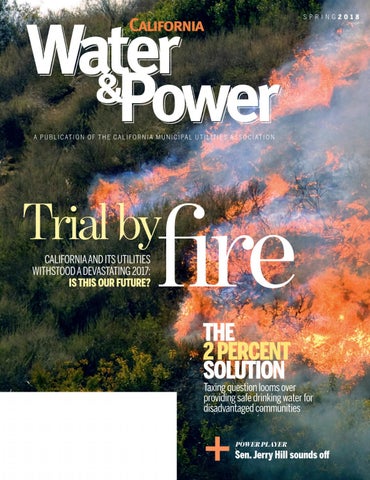
CALIFORNIAAND ITS UTILITIES WITHSTOOD A DEVASTATING 2017: IS THIS OUR FUTURE?
—■
Si» c 1 ^Sv'TTL « » ^ v
*» -V *./ ✓" V zx ^ < fr jgr
'
y
v
fSk'flS «Pvi
THE 2PERCENT SOLUTION Taxing question looms over
'r
providing safe drinking water for disadvantaged communities POWER PLAYER
Sen. Jerry Hill sounds off
The Most Innovative Vault Reinforcing System
The
patented
LWS
is
the
underground and
ideal, vault
exceed
laminated
AVR
low
cost
ceilings.
HS-20
wood
Adjustable
solution
The
loading
posts,
Vault
AVR
Reinforcement® for
shoring
system
requirements.
beams
and
decking
up
is
system
deteriorating
designed
The
system
with
from
to
meet
incorporates
adjustable
steel
hardware.
Since the AVR units are completely adjustable, the system is easily modified in the field to accommodate vault size and equipment configurations. Heavy duty tongue and groove decking reinforces the vault ceiling and prevents further debris from falling. The AVR system can be safely installed by a crew of three in less than two days. * : Contact LWS today with your vault dimensions and configuration to ' receive a quote.
www.lwsinc.com 800-949-3526
Adjustable Vault Reinforcement® . *V - »•: • * . .»* •.. .r
• 4, ■« •
U.S. Ratent No. 9,822,530
Laminated Wood Systems, Inc. Seward, Nebraska
Contents POWER
On the Front Line California’s unprecedented2017fire season left the state searching for answers and a path forward —
WATER
The 2 Percent Solution Providing safe drinking water to disadvantaged communities is important, but finding common ground on funding has been elusive
LEADERSHIP MATTERS
The Change-Maker CEO A conversation with CMUA President Arlen Orchard
departments
First Word | Power Playe | Bright Bites | Innovative Communities | Big Picture
California Municipal Utilities Association Executive Director Barry Moline Communications Manager Matt Williams Director for Water Danielle Blacet Legislative Director for Energy Patrick Welch Regulatory Advocate Jonathan Young Event & Membership Manager Christine Chapman Office Manager Teresa Rexrode
COPYRIGHT All editorial and advertising contents are ©2018 by Rurallte Services,Inc. Reproduction or use In any form of editorial, news, photo or advertising content In whole or part without permission of Rurallte Services, Inc. Is prohibited.
Ruralite Services, Inc. CEO Michael Shepard Editor Leon Espinoza Assistant Editors Jennifer Brown, Brandon Pomrenke Graphic Designer Bill Murray Communications and Marketing Director Kathi VanderZanden Display Advertising Inquiries American MainStreet Publications 611 S. Congress Ave., Suite 504 Austin, TX 78704 (800) 626-1181 or (512) 441-5200
California
(jDCMUA
CALIFORNIA MUNICIPAL UTILITIES
SPRING 2018 (
CALIFORNIA WATER& POWER ISA PUBLICATION OF CMUA IN ASSOCIATION WITH RURALITE SERVICES, INC.
WATER & POWER 3
RrstWord Our Vision Explore Every Idea with Eyes Wide Open —
woke up one morning a few years you have?” I had a foam pillow, a little hard near the ago and squinted at my alarm edges. clock. It was 6:43 a.m. My eyes “How do you sleep?” he asked. “On your adjusted to the morning light and I looked through a window across back, on your side?” His diagnosis was a “reshaped cornea” the room. Focusing on the house caused by sleeping with the side of my face—at across the street, it looked like it the eye—on the edge of my hard foam pillow. would be a sunny day. Much like when you squint, a reshaped cornea I plunked back on my pillow and became allows someone with poor vision to improve concerned. I could see the house across the it slightly. The doctor thought my improved street, a good 50 yards away, and I could see it clearly. Problem is, I have bad vision. I eyesight would last a few days until the cornea went back to its original shape, which it did five needed glasses or contacts to see what I was days later. seeing. I’ve been thinking a lot about this strange I have fallen asleep with my contacts in my situation, and my doctor’s persistent evaluation, eyes before, so I thought I’d done it again. “This will be painful,” I thought, imagining since moving out West. California, I’ve learned, is a state of progress. removing a dry contact from my eye. Our legislators and regulators like to solve I looked closely in the mirror. There was problems by making bold proposals that no contact in either eye. I frowned. I looked sometimes appear to be based on little evidence around. I could still see everything clearly. Believing I was dreaming, I amusingly asked of prior success. Like it or not, it’s doubtful this pattern will stop. my wife if we were awake. She laughed and Rather than slow down progress, perhaps said, “C’mon, let’s walk the dogs.” a better approach is ensuring every idea, every “I have a problem,” I told her. “I can see new direction, has an evaluation component perfectly.” Now she frowned. “Put on your to show whether it works. It’s hard to know glasses,” she suggested. I did, and couldn’t see anything. It was all which great new idea will be the one that saves society—or in our world, will lead to low costs, blurry. They were too powerful. Let’s recap the situation. I had poor vision, high reliability and resource sustainability. But we can insist on full and proper evaluation of and one morning I woke up with perfect effectiveness. eyesight. I didn’t recall attending a religious In that spirit, we created California Water revival or handling snakes. Somehow, I was & Power magazine to be part of the evaluation healed. process as we explore in-depth the big ideas I went to work. It lasted. I went home. It lasted. I woke up the next day. It lasted. This within our industry. Along the way, we hope you enjoy reading our inaugural issue and was very disconcerting. I visited my eye doctor. First he laughed, as learn something new or gain perspective. We can’t guarantee 20/20 vision. But we this was something he had never seen. Then can insist on a regular checkup to help us he persisted and asked a few questions. Did you drink or smoke anything? What have you stay healthy and see clearly. As we navigate been eating? Exercise? Too much television or new ideas constantly thrown at us, let’s iPhone use? He was trying to find something commit to including a strong evaluation and feedback component. Only then will we unusual. honestly be able to know what works. Then he asked, “What kind of pillow do
I
NOTE FROM THE EXECUTIVE DIRECTOR BARRY MOLINE
WE HOPE YOU ENJOY READING OUR INAUGURAL ISSUEAND LEARN SOMETHING NEW OR GAIN PERSPECTIVE
4
WATER & POWER SPRING 2018
to the people www.spiegelmcd.com I 202.879.400C
On the T front line By Matt Williams
California’s unprecedented 2017 fire season left the state searching for answers— and a path forward
WATER & POWER
SPRING 2018
he sheer numbers from California’s 2017 fire season are staggering. More than 9,500 fires and almost 2,000 square miles burned—a total area bigger than Rhode Island—along with 10,000-plus homes and other structures destroyed. More than 40 people died, making this season deadlier than the past 10 fire seasons combined. No regions of California were spared, north or south. The Tubbs Fire and other nearby wildland conflagrations swept through Napa and Sonoma counties in October, incinerating more than 5,500 homes in Santa Rosa and surrounding communities. Then, before the year was over, the Thomas Fire blew across Ventura and Santa Barbara counties, quickly becoming the largest recorded fire in California history at 281,000 acres. The loss of property and life was sudden and tragic. Despite the best efforts to prepare, California fire officials concede the state was sometimes caught off guard by the magnitude and ferocity of those firestorms. One lesson amid the rubble: Publicly owned utilities with proactive safety programs found themselves on safer ground. During a January hearing in front of state lawmakers, Cal Fire Chief Ken Pimlott said 2017 was the most challenging, destructive and costly fire season in California’s history. “Despite the rain precipitation that we had in 2016, conditions were still critically dry from five years of drought,” Pimlott said. “But I don’t think anybody could
<s>
be prepared for the conditions that surfaced in California on that night —Sunday night, October 8.” On that evening, hundreds of wildland fires across California broke out and grew rapidly, fueled by gusty, high winds. It was the start of a three-month fire response without parallel in California. Only about 1 in 10 fires in 2016 were determined to be caused by electrical power, such as lines downed by wind, according to the most recent data available from Cal Fire— typical of the five-year average. This electrical power category might also include household electrical causes—not a utility. The vast majority of wildfires are caused by burning debris, vehicles and equipment, arson, campfires and lightning strikes. A relatively significant portion of fires are started by undetermined causes. As of February, preliminary investigations attributed some of the cause of the Tubbs and Thomas fires to downed power lines or other infrastructure maintained by investorowned utilities. Fire investigators from the city of Santa Rosa reportedly determined PG&E power lines sparked at least two small fires in the city’s neighborhoods. Meanwhile, lawsuits brought against Southern California Edison blame the utility for the Thomas Fire and the subsequent mudslides that destroyed homes and businesses in Southern California, alleging improper maintenance and other deficiencies, although the state’s investigation of the fire’s cause wasn’t released as of early March. California’s publicly owned utilities avoided the brunt of last year’s fires and stood ready to respond. The fires in Santa Rosa and Napa came within about 3 miles of Healdsburg’s
service area, but the city had no outages despite experiencing similar high winds. Terry Crowley, Healdsburg’s utility director, said a heavy focus on proactive and preventative maintenance contributed to the good outcome. Healdsburg's trimming for power-line clearance is at least 48 inches—two-and-ahalf feet more than the current California Public Utilities Commission requirement. The city utility also inspects its infrastructure at regular intervals and retrofits poles above the
CPUC standards. Healdsburg asked the CPUC to include high-risk areas in its service area in a new fire threat map the state recently finalized, and is talking with POUs in Southern California to learn and adopt some of their best practices. These include additional, pre-event inspections; early completion of maintenance and tree trimming; and potentially blocking reclosers. “We answer to our community,” said Crowley. “Our feeling is our community wants to mitigate those risks to their homes and properties as much as possible, and we don’t see the cost as a huge burden to the utility customers. We actually saw these measures as a benefit to customers.”
On the T front line By Matt Williams
California’s unprecedented 2017 fire season left the state searching for answers— and a path forward
WATER & POWER
SPRING 2018
he sheer numbers from California’s 2017 fire season are staggering. More than 9,500 fires and almost 2,000 square miles burned—a total area bigger than Rhode Island—along with 10,000-plus homes and other structures destroyed. More than 40 people died, making this season deadlier than the past 10 fire seasons combined. No regions of California were spared, north or south. The Tubbs Fire and other nearby wildland conflagrations swept through Napa and Sonoma counties in October, incinerating more than 5,500 homes in Santa Rosa and surrounding communities. Then, before the year was over, the Thomas Fire blew across Ventura and Santa Barbara counties, quickly becoming the largest recorded fire in California history at 281,000 acres. The loss of property and life was sudden and tragic. Despite the best efforts to prepare, California fire officials concede the state was sometimes caught off guard by the magnitude and ferocity of those firestorms. One lesson amid the rubble: Publicly owned utilities with proactive safety programs found themselves on safer ground. During a January hearing in front of state lawmakers, Cal Fire Chief Ken Pimlott said 2017 was the most challenging, destructive and costly fire season in California’s history. “Despite the rain precipitation that we had in 2016, conditions were still critically dry from five years of drought,” Pimlott said. “But I don’t think anybody could
<s>
be prepared for the conditions that surfaced in California on that night —Sunday night, October 8.” On that evening, hundreds of wildland fires across California broke out and grew rapidly, fueled by gusty, high winds. It was the start of a three-month fire response without parallel in California. Only about 1 in 10 fires in 2016 were determined to be caused by electrical power, such as lines downed by wind, according to the most recent data available from Cal Fire— typical of the five-year average. This electrical power category might also include household electrical causes—not a utility. The vast majority of wildfires are caused by burning debris, vehicles and equipment, arson, campfires and lightning strikes. A relatively significant portion of fires are started by undetermined causes. As of February, preliminary investigations attributed some of the cause of the Tubbs and Thomas fires to downed power lines or other infrastructure maintained by investorowned utilities. Fire investigators from the city of Santa Rosa reportedly determined PG&E power lines sparked at least two small fires in the city’s neighborhoods. Meanwhile, lawsuits brought against Southern California Edison blame the utility for the Thomas Fire and the subsequent mudslides that destroyed homes and businesses in Southern California, alleging improper maintenance and other deficiencies, although the state’s investigation of the fire’s cause wasn’t released as of early March. California’s publicly owned utilities avoided the brunt of last year’s fires and stood ready to respond. The fires in Santa Rosa and Napa came within about 3 miles of Healdsburg’s
service area, but the city had no outages despite experiencing similar high winds. Terry Crowley, Healdsburg’s utility director, said a heavy focus on proactive and preventative maintenance contributed to the good outcome. Healdsburg's trimming for power-line clearance is at least 48 inches—two-and-ahalf feet more than the current California Public Utilities Commission requirement. The city utility also inspects its infrastructure at regular intervals and retrofits poles above the
CPUC standards. Healdsburg asked the CPUC to include high-risk areas in its service area in a new fire threat map the state recently finalized, and is talking with POUs in Southern California to learn and adopt some of their best practices. These include additional, pre-event inspections; early completion of maintenance and tree trimming; and potentially blocking reclosers. “We answer to our community,” said Crowley. “Our feeling is our community wants to mitigate those risks to their homes and properties as much as possible, and we don’t see the cost as a huge burden to the utility customers. We actually saw these measures as a benefit to customers.”
recloser is activated, an onsite inspection crew must verify the affected power line is safe and clear before the line is re-energized. RPU also does routine, annual patrols of all its circuits. In high-fire-threat areas, those inspections are done prior to the start of fire season. During red-flag alerts, high-risk areas get additional patrols. “Essentially, we’re leaning into the fire threat and trying to make sure the lines are clear, that any potential ignition threats are identified and removed, and any equipment that could lead to a fire is repaired on a timely basis,” said Steve Lafond, principal engineer for substation, transmission and distribution standards at RPU. RPU’s measures didn’t eliminate fires there last year. In December, smaller brush fires caused by homeless encampments still popped up in the Santa Ana River bottom during windy days. But RPU was spared the worst of what happened elsewhere in Southern California. These few examples—in Healdsburg and Riverside— are typical of how dozens of California’s publicly owned utilities are relying on proactive planning, best practices and timely response to reduce the risk of fires. “Publicly owned electric utilities and public water agencies are committed to implement proactive wildfire prevention and response strategies to protect their residents and prevent wildfires in their communities,” said Patrick Welch, CMUA legislative director for energy. “POUs are delivering on this commitment to their customers and remain vigilant for the 2018 fire season ahead.” Source: Cal Fire
Few areas in California went unscathed during the 2017 fire season. Each icon represents fires from June through December.
Risk kept rising—RPU stood ready Carbon emissions from the wildfires were massive, undermining efforts to stem climate change. Crowley suggested utilities should consider asking the state to use cap-and-trade revenue to fund hardening electric systems, and perhaps move inspections and tree trimming into the early spring to adapt to what is becoming a year-round fire season in California. “None of this stuff is earth-shattering, but if you apply some of these best practices, you can make a significant difference,” Crowley said. Similarly, Riverside Public Utilities credited its procedure during red-flag fire days for helping minimize impacts to customers during the 2017 fire season. The standardized actions, which were developed a decade ago, call for crew patrols of power lines in high-risk areas and proactive vegetation maintenance if there is an identified problem. Like some utilities, RPU uses line reclosers and monitors wind speeds at its substations. When winds reach almost 50 mph, the utility sets the reclosers to non-reclosing. If the lines trip, the power stays out. If the 8
WATER & POWER
SPRING 2018
A flurry of bills and a blueprint Lawmakers, meanwhile, are taking a keen interest in the wildfire issue. As of late February, more than 40 wildfire-related pieces of legislation had been introduced in the California Legislature. A group of legislators who represent areas impacted by the 2017 wildfires teamed up with State Insurance Commissioner Dave Jones to introduce the Wildfire Survivor Recovery Blueprint, a group of eight bills focusing on strengthening consumer protections for policyholders making insurance claims. Several bills focus on promoting prescribed burning as a method to reduce the vegetation fueling wildfires, such as AB 2585 by Assembly Member Jim Patterson (R-Fresno). The bill would protect landowners who conduct prescribed burns from liability in certain circumstances. Other wildfire-related bills seek to improve the state’s emergency alert system so Californians can receive more timely evacuation warnings and in languages other than English. Sen. Jerry Hill (D-San Mateo) introduced SB 819, which would prohibit an investor-owned utility from recovering damages from ratepayers associated with negligent practices that contribute to a wildfire. “The 2017 wildfire season was the most destructive in history, and the Legislature is taking a serious look at what can be done to protect residents from future wildfires and to enhance the state’s prevention and response efforts,”
“CMUA IS WORKING DILIGENTLYTO EDUCATE LEGISLATORS AND THEIR STAFF ABOUT POU EFFORTS TO PREVENT AND RESPOND TO WILDFIRE."
WHY WILDFIRES ALSO ARE A WATER ISSUE Placer County Water Agency (PCWA) Is a retail and wholesale supplier of drinking water and Irrigation water, and
-PATRICK WELCH, CMUA DIRECTOR FOR ENERGY
also
produces
hydroelectric
energy. PCWA operates large reservoirs at high elevation, and a natural river system feeds into its hydropower facilities downstream.
said Welch. “CMUA is working diligently to educate legislators and their staff about POU efforts to prevent and respond to wildfire. We will look for opportunities to collaborate with the Legislature and the governor to improve our state’s wildfire resiliency.” Beyond utilities, there’s growing acknowledgement—both inside Gov. Jerry Brown’s administration and far beyond—that the state’s growing wildfire threat requires a broader range of actions, from increasing funding for California’s firefighting corps to improving forest management. Utilities can’t, and shouldn’t, meet the challenge alone. Utilitycaused fires in California are only a small fraction of the total that occur. Historically, human-caused fires are much more common, followed by lightning-caused blazes. In a few rare cases, utilities might be responsible for the initial spark, but they shouldn’t be solely responsible for the overall wildfire, said Randy Howard, general manager of Northern California Power Agency. “The responsibility goes back to who’s taken action to ensure that if a fire starts, there’s not a ton of fuel source available for it to take off,” Howard said. “The second part is, who has done what to ensure we have adequate resources to extinguish them as quickly as possible before they become mega fires?” Momentum appears to be building to address both fuel sources and the state’s firefighting resources. The California Forestry Association is proposing new steps
that consider biomass derived from forests similar to solar or wind power, aiming to put power plants closer to overgrown forests where there is fuel that could be readily harvested. A recent estimate found there is a record-breaking 129 million dead trees in California due to the drought and a widespread bark beetle infestation. In his State of the State address in early 2018, Gov. Brown said Californians have to manage forests and soils more intelligently and be ready to provide whatever firefighting capability is needed. “The devastating forest fires and the mudslides are a profound and growing challenge,” Brown said. “Eight of the state’s most destructive fires have occurred in the last five years. Last year’s Thomas Fire in Ventura and Santa Barbara counties was the largest in recorded history.” The mudslides that followed were among the most lethal the state has ever encountered. “In 2017, we had the highest average summer temperatures in recorded history,” Brown said. “Over the last 40 years, California’s fire season has increased 78 days— and in some places, it is nearly yearround.” Brown’s comments confirmed what publicly owned utilities serving some of California’s most rural communities have seen on the ground for several years.
"When you have a big fire in the watershed, our greatest impact is to our hydropower operations, by far," said Andy Fecko, PCWA's director of resource development. “Water quality also is impacted because our water treatment costs go up when there’s higher turbidity. Settling basins must filter out sediment, and it shortens the lifespan of equipment at the water treatment plant.” The 2014 King Fire threatened PCWA's hydroelectric project on the American River and nearby electric transmission
lines.
The
97,000-acre
blaze was a catalyzing moment for PCWA and other local stakeholders. In the wake of that fire, PCWA, the Nature Conservancy, American River Conservancy, county of Placer and the Forest Service partnered to adopt 20,000 acres near local reservoirs and are working to get regulatory approval for a multi-year forest thinning project. Work could begin in 2019. Fecko said the joint project is a cooperative model with broad applicability to the rest of California. Private contractors will use hand tools and mechanical harvesting, as well as prescribed, low-intensity fires at the appropriate time of year, to thin the surrounding forest. The project will use both philanthropic and publicsector funds. "Our experience in the King Fire Is that having
catastrophic,
large
wildfires
in the watershed leads to millions and millions of dollars In cost in the
Big fires become the norm
long term,” Fecko said. “So doing
In Trinity County—on forested and mountainous terrain west of Redding—Trinity Public Utilities
deal for us.”
preventative maintenance is a good - Matt Williams
total emission rate go up.” Who is liable, what comes next
Marcus Yam / Copyright © 2017 Los Angeles Times, used with permission
Firefighter Mario Topete battles to keep fire from crossing Highway 29 north of Calistoga in October. District General Manager Paul Hauser has watched from his office window as air tankers drop fire retardant on a nearby forest that’s ablaze. He now calls August “the smoke month” in his community because big fires are the norm. “Pre-1990s, the amount of logging activity in the woods here meant that fires were much rarer,” Hauser said. “You just didn’t have the kind of fuel loads you have now, since they basically shut down any logging operations. In addition, if a fire did start, logging crews had an agreement with the Forest Service to put it out, and they would get reimbursed.” Now, with the heavier fuel loads and the intensifying impacts of climate change, places such as Trinity see large, catastrophic fires every year. Trinity is somewhat unique because most of its service area is on federal land. Hauser hopes the federal government will soon allow much wider rights-of-way for power lines than the current maximum standard of 20 feet. Rights-of-way can serve as an effective firebreak, and the trees cleared from those routes could add jobs—and a source of power—for the local community. So far in 2018, the Forest Service is showing more interest in the rights-of-way issue, Hauser said. 10
WATER & POWER SPRING 2018
An environmental menace, too
Howard said many Northern California POUs believe funding is inadequate for forest management and fire suppression. They are advocating for cap-and-trade money to be spent on fire mitigation projects, as well as subsidies to build or restart biomass plants near forests where there are dead trees for fuel. Overall, more needs to be done to bolster Cal Fire’s budget and create a year-round firefighting force, he said. Besides forest management and firefighting, there are numerous other issues to address. Howard said no less than California’s environmental and climate change goals are at stake. Big fires destroy ecosystems for endangered species and emit large amounts of carbon, sometimes erasing the gains toward California’s greenhouse gas reduction targets that utilities have helped achieve. “We know that the Santa Rosa Fire alone put out more emissions than all the power plants necessary to serve California over the past 25 years,” Howard said. “We’ve spent hundreds of millions of dollars recently to reduce GHGs on existing gas plants, getting out of coal plants, and putting in all these renewables—only to see California’s
Utilities across California also are keeping a close eye on how the courts and state regulators assess liability for the cause of 2017’s biggest fires. Investor-owned utilities are in the spotlight today, but POUs say they are in no way immune to fires in 2018 or beyond. There is risk everywhere. Utilities— both POUs and IOUs—are having more difficulty finding insurance carriers willing to underwrite a fire policy, and rates are skyrocketing, Howard said. The water-energy nexus during a fire emergency also is getting more attention, particularly as some California regulators and lawmakers ponder if utilities should de-energize power lines before high-wind conditions blow in. In Healdsburg, if the power had been turned off, Crowley said the local water and wastewater service would have gone offline without backup generators because they couldn’t pump. In some communities, firefighting crews need access to pump from water wells to protect structures. Despite the mounting complexity, reducing California’s fire threat while maintaining the reliability and safety of electric and water service are at the forefront. “If you can reduce the number of outages you have in a year, you’re going to reduce the fire risk,” Crowley said. “Publicly owned utilities have taken a long-term stance of providing safe and reliable power. They’ve already started on that path of reducing the risk of wildfires.” POUs across California continue to implement rigorous inspection and maintenance programs, work closely with their local fire departments to coordinate planning and response actions, and implement additional measures in high-risk areas. “The threat of wildfires is bigger than utilities, the governor’s office, Cal Fire or forest managers alone,” said Barry Moline, CMUA executive director. “It will take collective action with everyone working together, expanding on good ideas and sharing best practices.” CWP
>
WE LISTEN. WE RESPOND. WE DELIVER.
\
Terex® Works for You™ by listening, responding, and delivering innovative solutions with speed. Our team is committed to delivering you reliable equipment, innovative technology, quality service as well as parts and auger tooling. We will not hesitate to find the right solution for you.
For more information on Terex Utilities equipment or service, Call 1.844.TEREX.4U or visit online at www.terex.com/utilities
WORKS FOR voy Terex is a registered trademark of Terex Corporation in the USA and many other countries. ©2018 Terex Corporation.
r^ENCD
Expertise you can rely upon
UTILITY SERVICES
Billing & Customer Care We provide the latest in Customer Information System technology, as well as personalized service for all customer service and billing needs. We also offer call center, dispatch and other account management services.
Full Service Billing Set up and maintenance of your rates in our billing system Receipt of meter reads and upload to our billing system Customer accounting-account set up, processing of turn ons and turn offs Bill calculation Bill printing CASS certification All bill stock and envelopes Receipt of and processing all mailed in payments Set up and processing of online payments Set up and processing of over the phone payments And credit and collections support. Includes maintenance of daily control card for audit purposes
• Monthly utility bill register and other report preparation • Excludes bank processing and merchant account processing fees
Detailed Payment Auditing: Compare pay ments to accounts receivable aging; Identify potential misapplied payments before transmis sion and correct; 99.9% accuracy record • Secured File & Image Transmission: Digital Signatures; Digital Certificates; Data Encryption Standard (DES) Protocol •
Bill Printing and Mailing • Receipt of your billing file • Bill formatting and layout to your • • • • •
Call Center and Answering Services
specifications Bill printing All bill stock and envelopes Postage CASS certification Mailing of bills monthly based on your cycles
•
After hours answering services & overflow any time • We can handle start/stop service requests • Perform red flags Identity verifications
and frequency • Reports
• Assist customers with use of your Website • Provide complete after hours customer service, not just an answering service • Provide conservation counseling to customers • Make outbound pre-cut courtesy calls for past due accounts • Provide outbound calls to customers to notify of scheduled planned outages • Handle incoming outage calls and dispatch to your crews • Provide outage reporting
Dispatch and Monitoring Services
Lockbox Remittance Processing Services
• 24-Hour Operations Management Services:
• Accurate & Timely Lockbox Mailed Payment Processing • RemitPlus Electronic Check Processing:
Remote Electronic Bank Deposits & Secure Searchable Check Images
Dispatching of crews to respond to emer gency service events for electric utilities and other utilities including water and waste waster services.
Answer customer questions regarding bill and balance requests Process customer payments via your billing system or payment processing portal Take payments for reconnections and call out to service technician for restoration
Solar Generation Plant Dispatch, Monitoring & Reporting
Corporate Headquarters E-Mail comments and questions to
ENCO Utility Services
Ruby M. Irigoyen, Senior VP Customer Services
8141 E Kaiser Blvd., Suite 212
irigoyen@encous.com
Anaheim, California 92808
ENCO Customer Service Center 380 N San Jacinto Street, Hemet, CA 92543 OFFICE: (951) 925-8092 \ FAX: (951) 257-0316 SPRING 2018 <
WATER & POWER 11
California Water’s 2 Percent Solution By Pamela Martineau
Providing safe drinking water to disadvantaged communities is important, but finding common ground on funding has been elusive
12
WATER & POWER SPRING 2018
he vast majority of California’s nearly 40 million residents—about 98 percent—enjoy easy access to safe, reliable drinking water. Still, the Golden State has what some believe is a black eye on its environmental reputation: Roughly 1 million people, primarily in disadvantaged communities in the Central Valley, lack the same access to safe drinking
T
water. California’s water community has been grappling with the problem for years, and everyone agrees it needs to be fixed. “The consensus of the water community is that this is a problem that needs to be addressed,” said Gary Arant, Valley Center Municipal Water District general manager. “All people should have access to safe drinking water in California.” The sticking point in crafting an agreement to address the problem has revolved around where the money to
help these disadvantaged communities should come from. For years, stakeholders on all sides of the issue have tried to find a solution. The issue is expected to heat up this year as the California Legislature again takes up SB 623 by Sen. Bill Monning (D-Carmel). The bill, among other actions, would impose a monthly statewide 95-cent tax on residents’ water bills. Like many proposed options to address this problem, the bill is controversial. The Brown administration supports the bill, and the proposed 2018-19 budget contains appropriations for funding the state’s fee collection framework for the proposal, should it pass. A budget trailer bill to implement the framework of SB 623 was released February 1, and was recently heard in budget subcommittees. Many in the environmental justice and agricultural community also support the bill. Other stakeholder groups, however, believe the proposed tax is regressive and sticks water customers statewide with paying the tab for a problem to which they have no connection, and for which a solution should be funded at the state level. Supporters and detractors of SB 623 are lining up. They are ready to rally for their positions, hoping a workable solution can be crafted. Danielle Blacet, CMUA’s director for water, agrees CMUA members want to see a solution to the problem. “Most in the water community believe there are other funding and governance solutions that could be pursued
rather than just a single water tax,” she said. CMUA firmly opposes the imposition of a tax appearing on customers’ water bills. If a new tax were to be part of a solution, however, Blacet said many association members would prefer an approach that includes a statewide income tax. “While we support the state using general fund dollars to support this priority issue, if we are going to talk about a tax, an income tax would be a more appropriate solution,” Blacet said. “That would be more of a progressive approach, versus a water tax that’s more regressive, because that would be a fixed charge on everyone’s water bill. For many struggling families, a static fee like that would hit harder than someone who has a higher income and greater ability to pay.” The state already collects
"MOST IN THE WATER COMMUNITY BELIEVE THERE ARE OTHER FUNDING AND GOVERNANCE SOLUTIONS THAT COULD BE PURSUED RATHER THAN JUSTA SINGLE WATER TAX.” -DANIELLE BLACET, CMUA DIRECTOR FOR WATER
California Water’s 2 Percent Solution By Pamela Martineau
Providing safe drinking water to disadvantaged communities is important, but finding common ground on funding has been elusive
12
WATER & POWER SPRING 2018
he vast majority of California’s nearly 40 million residents—about 98 percent—enjoy easy access to safe, reliable drinking water. Still, the Golden State has what some believe is a black eye on its environmental reputation: Roughly 1 million people, primarily in disadvantaged communities in the Central Valley, lack the same access to safe drinking
T
water. California’s water community has been grappling with the problem for years, and everyone agrees it needs to be fixed. “The consensus of the water community is that this is a problem that needs to be addressed,” said Gary Arant, Valley Center Municipal Water District general manager. “All people should have access to safe drinking water in California.” The sticking point in crafting an agreement to address the problem has revolved around where the money to
help these disadvantaged communities should come from. For years, stakeholders on all sides of the issue have tried to find a solution. The issue is expected to heat up this year as the California Legislature again takes up SB 623 by Sen. Bill Monning (D-Carmel). The bill, among other actions, would impose a monthly statewide 95-cent tax on residents’ water bills. Like many proposed options to address this problem, the bill is controversial. The Brown administration supports the bill, and the proposed 2018-19 budget contains appropriations for funding the state’s fee collection framework for the proposal, should it pass. A budget trailer bill to implement the framework of SB 623 was released February 1, and was recently heard in budget subcommittees. Many in the environmental justice and agricultural community also support the bill. Other stakeholder groups, however, believe the proposed tax is regressive and sticks water customers statewide with paying the tab for a problem to which they have no connection, and for which a solution should be funded at the state level. Supporters and detractors of SB 623 are lining up. They are ready to rally for their positions, hoping a workable solution can be crafted. Danielle Blacet, CMUA’s director for water, agrees CMUA members want to see a solution to the problem. “Most in the water community believe there are other funding and governance solutions that could be pursued
rather than just a single water tax,” she said. CMUA firmly opposes the imposition of a tax appearing on customers’ water bills. If a new tax were to be part of a solution, however, Blacet said many association members would prefer an approach that includes a statewide income tax. “While we support the state using general fund dollars to support this priority issue, if we are going to talk about a tax, an income tax would be a more appropriate solution,” Blacet said. “That would be more of a progressive approach, versus a water tax that’s more regressive, because that would be a fixed charge on everyone’s water bill. For many struggling families, a static fee like that would hit harder than someone who has a higher income and greater ability to pay.” The state already collects
"MOST IN THE WATER COMMUNITY BELIEVE THERE ARE OTHER FUNDING AND GOVERNANCE SOLUTIONS THAT COULD BE PURSUED RATHER THAN JUSTA SINGLE WATER TAX.” -DANIELLE BLACET, CMUA DIRECTOR FOR WATER
“IT’S A STATEWIDE SOCIAL ISSUE FOR THE STATE OF CALIFORNIA AND SHOULD BE PAID FOR FROM THE GENERAL FUND.” - GARY ARANT, VCMWD GENERAL MANAGER
A BETTER SOLUTION? With a controversial proposal to place a tax on water working its way through the legislative process, another proposal addressing the root cause of failing systems throughout the state has begun to receive significant attention. AB 2050-the Small System Water Authority Act of 2018-co-sponsored by CMUA and the Eastern Municipal Water District, was recently introduced by Assemblymember Anna Caballero (D-Salinas).The legislation would help resolve the systematic failures of the more than 300 chronically noncompliant water systems in California. AB 2050 represents a legislative solution that will promote accountability and establish a permanent solution to safe drinking-water needs. Most noncompliant systems serve small customer bases and lack the resources necessary to provide safe and reliable service. AB 2050 would enable the formation of Small System Water Authorities as independent special districts, which would then have the financial and technical resources available to remedy system failures and reach compliance with state safe drinkingwater requirements for public water systems. These end goals—providing safe and reliable water service to every Californian—would be accomplished without the need for a water tax, and would promote responsible, transparent governance solutions to address this complex problem.
14 CALIFORNIA WATER & POWER SPRING 2018
income tax, so this additional element of the tax would not require a new collection system that originates with water agencies, she added. Given the estimated needs, CMUA believes support from the general fund—and existing funds from the federal government and statewide bond measures—would be the best option, Blacet said. Arant said it makes sense that state general fund money should be a large part of the funding stream. “It’s a statewide social issue for California and should be paid for from the general fund,” Arant explained. Some local water systems find it challenging to pay for upgrades because of a smaller customer base over which to spread costs to improve infrastructure. But Arant points out that he and others in the water community see no direct connection between drinking water problems in other communities with water quality concerns and the local ratepayers in water districts such as his, who would have to fund the solutions to those problems. “There is no nexus between a water customer here in Valley Center and a water quality problem in a place like Tulare in the Central Valley,” Arant said. Arant believes if local ratepayers were asked to pay to fix problems elsewhere, it would only be a matter of time before there wouldn’t be sufficient funds in their own districts to pay for needed system improvements.
“You are going to spread the problem farther than it is now,” Arant said. For small rural systems that lack safe drinking water, the crux of the funding issue is a limitation on operations of operations and maintenance funds, known as O&M funds. While federally funded drinking water state revolving fund loans, called SRF funds, can be used for infrastructure, they cannot be used for operations and maintenance. In most cases, bond monies also cannot be used for O&M, hence the funding gap. Jonathan Nelson, policy director for Community Water Center—a sponsor of SB 623—believes the bill is fair to all parties, and would provide an ongoing, reliable funding source to address this critical problem. “We need to create a sustainable funding source,” Nelson said. “And this fee is really, really modest, which we think is appropriate.” Critics of the fee say it would hit low-income people the hardest, to which Nelson says people at or below 200 percent of the poverty line could apply for an exemption. Others argue the exemption wouldn’t help working families that earn slightly above 200 percent of the poverty line—those who often struggle to pay basic bills and are not eligible for rate assistance and other types of help. Nelson said the lack of safe drinking water in some communities throughout the state tarnishes California’s much-cherished
frock GPS Fleet Management Solutions Affordable Private Powerful Flexible w_L-*ar
\_
Track Star AVLS GPS Fleet Management Solutions have been serving customers in the Utility, Municipal and Public Safety sectors since 2000. Track Star AVLS is the value proposition leader in the field of GPS fleet management technology and we are ready to provide your fleet with truly cost effective management of your vehicles, equipment and personnel. Our innovative solutions offer the greatest degree of flexibility, interoperability with other systems and full range of features at price points well below those of other solutions. The unique architecture of our solution provides complete system privacy and in-house retention of data to meet all of your operational needs without ala-carte feature pricing. We are happy to provide a live, on-line demonstration of the system and we offer a free 30-day trial of the product. Call or visit our website today to learn more.
Track Star International, Inc. 8801 J.M. Keynes Drive, Suite 260, Charlotte, NC 28262 1-800-661-3515 www.trackstar.com
Danielle Blacet
Dave Puglia
Jonathan Nelson
Gary Arant
16
WATER & POWER
SPRING 2018
environmental reputation. “California has been a national leader for a very long time when it comes to protecting our environment and safeguarding public health,” Nelson said. “We take pride in that. (This problem) is a stain on all of our consciences.” SB 623 is the result of more than a year of discussion and negotiation among various stakeholders, including agriculture. One element of the legislation is a new fee on nitrate-based fertilizers, which is supported by many in the agricultural community. The fee, according to Dave Puglia, executive vice president of the Western Growers Association, was agreed to because the State Water Resources Control Board was looking to issue cleanup and abatement orders to growers in the Central Valley due to nitrate contamination. “The threat was quite clear: Either you come to an agreement or we will pursue cleanup and abatement orders against you,” Puglia said. However, the nitrate provisions in the bill could be seen as giving polluters a pass if the bill becomes law, thereby making the legislation patently unfair, Arant said. Puglia said the lack of safe drinking water in some communities is part of California’s larger problem of not keeping up with infrastructure and other improvements to the state’s various resource systems. “We find ourselves in this position not just with water quality, but with basic infrastructure like highways and roads because California has been neglectful of its basic infrastructure needs for a long time,” Puglia said. A solution to the lack of safe drinking water for some communities must come from a combination of different strategies and policy approaches, Puglia said. It also is dependent upon what will garner needed votes in the Legislature and with the voters, he added. The composition in the state’s Legislature has changed, and the Democrats no longer hold a supermajority, which is needed to pass SB 623 because it contains a tax. Therefore, for the bill to pass, some Republicans will have to vote for it. This is a difficult prospect,
“CALIFORNIA HAS BEEN A NATIONAL LEADER FORA VERY LONG TIME WHEN IT COMES TO PROTECTING OUR ENVIRONMENT AND SAFEGUARDING PUBLIC HEALTH." - JONATHAN NELSON, COMMUNITY WATER CENTER POLICY DIRECTOR given Republicans traditionally avoid approving new taxes. Puglia also is wary of the proposal to use the general fund to address the problem. “The problem is the general fund is very fickle,” he said. “The money can be given and taken away very quickly.” Blacet points out that voluntary consolidations and mergers of water systems also could play a big role in addressing the issue. Consolidations need not necessarily be “pipe-to-pipe” conjoining of districts. They also can be administrative, where districts share managers and other personnel to reduce overhead costs. “We need to ask how we can look at governance to create economies of scale that will create sustainable systems, rather than just say, ‘Here’s a tax handout,”’ Blacet said. As the 2018 Legislative session heats up, Blacet said she hopes all stakeholders in the issue will continue to look at a full slate of options to find a solution. “I hope the advocates of SB 623 and the budget trailer bill are willing to take into consideration some other perspectives and proposals,” Blacet said. CWP Pamela Martineau is a freelance writer based in Davis, Calif.
We power progress together by providing more and cleaner energy solutions #makethefuture
LEADERSHIP MATTERS
signals that technology advances and declining costs will allow distributed energy resources to meet some of the energy infrastructure needs of utilities in the future. As prices continue to fall, consumers and businesses will increase their investments in DERs—distributed energy resources—to either meet their sustainability goals or create more control over their energy future. As utilities, we will need to manage all the new DERs on our system in a way that ensures reliability and fairly allocates the costs and benefits among the utility, customers and third parties.
Change-Maker
A
s CEO and general manager of the SMUD—the Sacramento Municipal Utility District—Arlen Orchard leads the sixth largest communityowned electric utility in the nation, serving 1.4 million residents across Sacramento County and surrounding communities. Under his leadership the past four years, SMUD has pursued several innovative initiatives, such as partnering with Valley Clean Energy Alliance to provide Community Choice Aggregator services, and the launch of a new online marketplace offering SMUD customers energy-related and smart-home products and services. Orchard joined SMUD in 1990 as a staff attorney and became the utility’s general counsel in 2001. He was named CEO in 2014. He is president of the California Municipal Utilities Association Board of Governors. California Water & Power asked Orchard to weigh in on the rapidly evolving electric utility industry.
18
WATER & POWER SPRING 2018
CEO
A conversation with CMUA President Arlen Orchard California Water & Power: It’s a time of great change and opportunity for publicly owned utilities in California. Where do you see the future of our industry headed? Clearly, California is on the leading edge of change in our industry. That change is driven partly by policy decisions, but more importantly, in my mind, by technology innovation. It also isn’t surprising many advances occur first in California, given we lead the world in terms of technology innovation. I think three big trends will drive the future of our industry. I call them the three Ds: digitalization, decarbonization and decentralization. They’re reshaping our investment decisions, our customers’ expectations of utilities as service providers, and how we think about our business. The digital revolution is fueled by the advent of cloud computing, social technology, data analytics, mobile and the “internet of things.” In the next five to 10 years, these technologies will integrate to create
layers of connected intelligence that will vastly improve the efficiency and operation of the grid, and help utilities and third parties better meet the diverse needs of our customers. It opens a new world of possibilities in providing customers with the information and tools when, where and how they want them. Decarbonization is reshaping our energy supply, again partly driven by policy mandates and increasingly driven by customer awareness and expectations. During the past several years, we’ve found more and more of our business customers adopting aggressive sustainability goals with a focus on lowering their carbon footprint. Likewise, an increasing number of our residential customers are interested in SMUD providing a greener energy supply at a reasonable cost. In the long run, I believe it’s in SMUD’s best interest to develop new, financially viable products and services to help our customers meet their goals. If we don’t meet the demand, my customers will rightfully look to others to provide the solution. The final “D,” decentralization,
#
CWP: What is SMUD doing under your leadership to provide effective service to customers who increasingly are embracing electric vehicles, rooftop solar, battery storage and other emerging technologies? Our jumping-off point was to develop a five-year roadmap for DERs. The roadmap considered drivers and trends, and then analyzed each DER in relationship to our system, market potential by customer segment and expected cost curves. We then developed tactics and goals around each of the DERs during the next five years. We are in the process of implementing pilots and customer programs around each of the DERs. Some we are rushing to support, such as electric transportation. For others, such as storage, we are implementing pilots and programs to better understand how our customers and SMUD can share the benefits associated with battery storage. In parallel, we are taking two other important steps. The first was to proactively look at distribution planning from the customer level and consider reliability, locational potential for DERs, where DERs are likely to occur and likely penetration based on customer adoption, and where DERs may benefit the system. It’s a first step toward achieving the level of analytics required to integrate a lot more DERs. The second step begins in 2018 as we start implementing the foundational technologies—Advanced Distributed Management System and Distributed Energy Resources Management System—necessary to provide greater visibility into our
LEADERSHIP MATTERS
signals that technology advances and declining costs will allow distributed energy resources to meet some of the energy infrastructure needs of utilities in the future. As prices continue to fall, consumers and businesses will increase their investments in DERs—distributed energy resources—to either meet their sustainability goals or create more control over their energy future. As utilities, we will need to manage all the new DERs on our system in a way that ensures reliability and fairly allocates the costs and benefits among the utility, customers and third parties.
Change-Maker
A
s CEO and general manager of the SMUD—the Sacramento Municipal Utility District—Arlen Orchard leads the sixth largest communityowned electric utility in the nation, serving 1.4 million residents across Sacramento County and surrounding communities. Under his leadership the past four years, SMUD has pursued several innovative initiatives, such as partnering with Valley Clean Energy Alliance to provide Community Choice Aggregator services, and the launch of a new online marketplace offering SMUD customers energy-related and smart-home products and services. Orchard joined SMUD in 1990 as a staff attorney and became the utility’s general counsel in 2001. He was named CEO in 2014. He is president of the California Municipal Utilities Association Board of Governors. California Water & Power asked Orchard to weigh in on the rapidly evolving electric utility industry.
18
WATER & POWER SPRING 2018
CEO
A conversation with CMUA President Arlen Orchard California Water & Power: It’s a time of great change and opportunity for publicly owned utilities in California. Where do you see the future of our industry headed? Clearly, California is on the leading edge of change in our industry. That change is driven partly by policy decisions, but more importantly, in my mind, by technology innovation. It also isn’t surprising many advances occur first in California, given we lead the world in terms of technology innovation. I think three big trends will drive the future of our industry. I call them the three Ds: digitalization, decarbonization and decentralization. They’re reshaping our investment decisions, our customers’ expectations of utilities as service providers, and how we think about our business. The digital revolution is fueled by the advent of cloud computing, social technology, data analytics, mobile and the “internet of things.” In the next five to 10 years, these technologies will integrate to create
layers of connected intelligence that will vastly improve the efficiency and operation of the grid, and help utilities and third parties better meet the diverse needs of our customers. It opens a new world of possibilities in providing customers with the information and tools when, where and how they want them. Decarbonization is reshaping our energy supply, again partly driven by policy mandates and increasingly driven by customer awareness and expectations. During the past several years, we’ve found more and more of our business customers adopting aggressive sustainability goals with a focus on lowering their carbon footprint. Likewise, an increasing number of our residential customers are interested in SMUD providing a greener energy supply at a reasonable cost. In the long run, I believe it’s in SMUD’s best interest to develop new, financially viable products and services to help our customers meet their goals. If we don’t meet the demand, my customers will rightfully look to others to provide the solution. The final “D,” decentralization,
#
CWP: What is SMUD doing under your leadership to provide effective service to customers who increasingly are embracing electric vehicles, rooftop solar, battery storage and other emerging technologies? Our jumping-off point was to develop a five-year roadmap for DERs. The roadmap considered drivers and trends, and then analyzed each DER in relationship to our system, market potential by customer segment and expected cost curves. We then developed tactics and goals around each of the DERs during the next five years. We are in the process of implementing pilots and customer programs around each of the DERs. Some we are rushing to support, such as electric transportation. For others, such as storage, we are implementing pilots and programs to better understand how our customers and SMUD can share the benefits associated with battery storage. In parallel, we are taking two other important steps. The first was to proactively look at distribution planning from the customer level and consider reliability, locational potential for DERs, where DERs are likely to occur and likely penetration based on customer adoption, and where DERs may benefit the system. It’s a first step toward achieving the level of analytics required to integrate a lot more DERs. The second step begins in 2018 as we start implementing the foundational technologies—Advanced Distributed Management System and Distributed Energy Resources Management System—necessary to provide greater visibility into our
LEADERSHIP MATTERS
distribution system and, long term, allow us to optimize the value of DERs to benefit our customers and SMUD. CWP: As SMUD continues to evolve the services it provides, how has your leadership style and philosophy evolved since you took the helm in 2014? As I consider the scope and rate of change in our business environment, it has caused me to rethink everything we do as a utility. I think the old way of doing business simply isn’t sustainable, as technology remakes our customers’ expectations, provides more options and erodes our monopoly status. At the risk of offending a whole lot of folks, many monopolies tend to be very risk averse, resistant to change, slow to innovate, ponderous in their decision making and less cost conscious. Many do provide excellent service, but they find it difficult to adjust their thinking
SMUD AND OUR INDUSTRY ARE IN ASTATE OF ACCELERATING CHANGETHATTOUCHES EVERY PART OF OUR BUSINESS. and service model in the face of dramatic change. So my leadership during the past four years has really been focused on breaking through the monopoly mindset to remake SMUD’s culture with a laser focus on accountability, collaboration, innovation, and rightsizing decision making and risk management. We have made a specific push in leadership development and executing business operations, with a goal of significantly lowering our cost to deliver external and internal services while improving quality and expanding the services we provide our customers. In my office is a banner that reads, “There’s a better way to do everything.
Find it!” It really sums up my approach to leadership and the CEO job. CWP: CMUA is unique because it brings together electric utilities, water agencies and combined utilities under one association, forming a literal water-energy nexus of members. What do you see as the challenges and strengths of CMUA’s structure? As president of CMUA, what is your top priority or priorities for the year? CMUAs strength aligns around the membership’s common interest in providing value to the communities we serve and in the shared recognition that our influence is magnified when
The Energy, Community Choice Aggregation and Regulatory Experts EES
Consulting
provides
economic,
environmental,
and
solutions for clients throughout the U.S. and Canada.
Strategic and Utility Financial Planning
1
Rates and Cost of Service Studies Expert Witness and Litigation Support Services
Merger and Acquisition Analysis
20
WATER & POWER SPRING 2018
Community Choice Aggregation and Operational
• Hydroelectric Engineering
Studies and Analysis
•
Engineering and Construction Management
Dam Safety Inspections and FERC Compliance
•
* Control and Protection System Engineering
Regulatory
Compliance
and
Project
Planning
- Relaying Upgrades and Changeouts
• Environmental Project Management
1
Smart Grid Infrastructure Engineering
•
1
Equipment Condition Assessment and Capital Planning
Forecasting and Load Profiling Owner's Engineer Services
www.eesconsulting.com
* Substation and Switchyard Planning, Cost Estimating,
Integrated Resource Planning Conservation and Demand Response
Consulting, Inc.
engineering
Mitigation Negotiation
Plan
Development
and
we speak with one voice on policy matters. Historically, I think it is fair to say the association has been more reactive in addressing key legislative and regulatory challenges and opportunities. I believe this is changing. Our executive director is building a strong bench of talented employees with a focus on building relationships and proactively getting out ahead of policy issues. As a board, we are asking more of staff, from policy development to advocacy to communications to membership outreach. One of my priorities is to ensure CMUA has the necessary resources to meet the membership’s expectations, and this includes revising our dues structure to ensure CMUA’s long-term financial viability. The second priority is clearly demonstrating CMUA’s value to the water members and growing the water membership.
CWP: You are active on boards, associations and groups—both inside and outside the energy
industry—on the local, state and national levels. How do you think your broad community involvement helps make you a more effective leader? By intent, SMUD has a high profile in the communities we serve. I am a strong believer in visible, meaningful corporate citizenship to build awareness of the benefits SMUD brings as a community partner and service provider. It’s an important tool for building long term customer loyalty as we face an increasingly competitive future. At a local level, my board memberships allow SMUD to have a voice at the table on important policy and community initiatives—things such as economic development, education, workforce development and innovation. It creates forums for me to advance SMUD’s agenda while also ensuring SMUD is aligning with and supporting regional priorities. At the state and national level, board service allows me to elevate SMUD’s profile, reputation and influence. These boards are a
great forum for me to engage with leaders in energy, technology and other industries to share thoughts, challenges and opportunities. I learn a lot from these interactions and I’m always looking for that new idea or innovation I can bring back or incorporate into my own approach to leadership.
CWP: As you look forward each day, what gets you going in the morning? Two things work-wise really excite me. The first is, SMUD and our industry are in a state of accelerating change that touches every part of our business. To a large degree, we are in uncharted waters. I like change, and I like a challenge. I like thinking about how we navigate this new business paradigm. And I am passionate about SMUD’s long-term success. The second is that I get to work with a group of incredibly talented, innovative and committed people every day. It’s inspiring, motivating and doesn’t get any better than that. CWP
s> When you really need to know, trust
©CALIFORNIA ENERGY MARKETS the definitive weekly news source for • Sharp, focused, independent reporting from skilled journalists who know the region, the issues, the players and the questions to ask. • Timely, accurate, balanced reports on key energy policy, regulatory, market, utility, resource and legal developments—actionable info to better plan your strategy, your week or your next contact. • Understanding the dynamics shaping the Golden State and Southwest electric and natural gas sectors. Build your energy information infrastructure on the common frame of reference:
California Energy Markets
See for yourself:
newsdata.com/sample SPRING 2018 (
WATER & POWER 21
POWER PLAYER
Safety
Above All Else
State Sen. Jerry Hill sounds off on issues surrounding California utilities
Photo courtesy of Jerry h
22
WATER & POWER SPRING 2018
By Matt Williams
S
tate Sen. Jerry Hill, a Democrat representing San Mateo and Santa Clara counties, is known to have many pursuits. He is a small business owner, private pilot and magician.
He has a black belt in karate and once subdued a burglar in the garage of his own home. Look around his office at the state Capitol, and you’ll see photos of the Tiananmen Square “tank man,” art depicting the Founding Fathers, and many other mementos from a long career in public service that began more than 25 years ago. Hill served as a city council member and mayor of the city of San Mateo, and then as a county supervisor for San Mateo County. A history major at UC Berkeley, Hill admits he was not interested in electricity and energy. That changed with the 2010 explosion of a PG&E gas line that killed eight people and injured dozens of others in San Bruno, a San Francisco suburb. Last year, a court fined PG&E $3 million and found the utility guilty of felony criminal charges. In 2015, the California Public Utilities Commission also levied $1.6 billion in financial remedies against PG&E. Around the same time, a separate investigation by the state auditor examined the inner workings and culture of the CPUC. Hill said the findings made him emotional and mad. “That's when utilities and energy became important to me, because we didn't—I didn't—want to see that ever happen again anywhere,” said Hill. “Then we started working to try and change that [regulatory and safety culture], and I think we've been fairly successful. I think PG&E now has a very good gas system. It's a lot safer.” As a powerful reminder, he keeps a framed list of the San Bruno victims in front of him prominently on his desk. Now, as a Senate Energy, Utilities and Communications Committee member and chair of the Subcommittee on
meters
<mÊÊmm
Safety is number one,
World’s Leader in High Voltage Test Equipment and Highest Quality Grounding and Jumper Assemblies BIERER METERS is a manufacturer of High Voltage Metering and Phasing Test Equipment, founded in 1985, located in Blythewood, SC. Providing the absolute value and performance state-of-the-art portable test equipment for the Electric Utilities, Contractors and Industrial/Commercial use worldwide. Bierer takes pride in establishing personal and professional relationships with our Customers. We ensure product accuracy, efficiency, reliability, factory support, and most importantly...Safety! Check out our full product line at BiererMeters.com or call our Customer Service at 803-786-4839 and someone will assist you in determining which Bierer Meter appropriately fits your specific requirements.
Electric, Gas and Transportation Safety, Hill said he continues to focus on a variety of safety issues, including those brought to light during California’s unprecedented 2017 fire season. “My top priority in everything that I've done there has been related to safety, and electric and gas safety will always be my top energy priority,” said Hill. “We've examined a not-insignificant number of these destructive wildfires that arise from utility infrastructure. Some of these wildfires resulted from utility negligence, and some of them by an act of nature such as the wind events we've seen. The problem is how do we prioritize safety in the electric sector without punishing utilities for events they cannot foresee and prevent?” Hill said inverse condemnation is one of the critical issues likely to be
no role in 20 years, and gas-fired power plants are similarly phased out. Increasingly, reliability of the grid can be bolstered instead with energy storage technology, he explained. Still, Hill added California must be sensitive to the stranded costs some utilities have tied up in power plants currently in use, and also aware of the potential costs to customers. Whether there is a 33 percent, 50 percent or 100 percent carbon-free energy procurement target in California, those goals are in some senses artificial, he said. “I think we have to be sensitive to the utility to make sure that we can maintain the proper cost for ratepayers and to make sure that the system exists and can continue operating,” Hill said. That pragmatic sensibility has guided Hill since he came to the Assembly in 2008 and later the Senate in 2012, and helped launch his career in local government many years ago. He started as the president of his homeowners’ association and ascended to become a councilmember. A self-JERRY HILL city described “normal guy” who fell into politics in part by accident, Hill said his views have gradually widened throughout the IOUs in California. But Hill said he also years. worries the “exit charges” CCAs will be “I think early on I was probably required to pay to offset the electrical more opinionated and less inclined to contracts investor-owned utilities look for a solution outside, and a lot already have signed could become high enough that CCAs won’t be able to exist of that has to do with this [Capitol] building because you can't do anything in the long run. on your own, and you need to build a “The CCAs work hard,” he said. broader coalition in order to accomplish “They've created a lot of opportunity— something,” he said. “I think knowing some obviously with greater renewable that and understanding it has helped energy at lower cost—but I'm afraid me succeed.” at the end of the day, they may not be Even so, Hill said his passion about the in business a year from now when the issues — energy and an array of others — PUC and those charges are worked is what continues to drive him. out.” “I get mad at things, and that's Hill also weighed in on other energywhat makes me fight harder, do better, related issues. He supports allowing the I think, and want to make the change,” free market to dictate the trajectory Hill said. “That started when I first ran of California’s growing electric vehicle for office. We were mad about a number market, with legislators providing of things that happened in my city, and a push where it’s needed. Hill said I ran to change that. That has been kind the utilities’ role in the EV market of an inspiration as I've gone on. I get should be to ensure there is sufficient mad about something, then it becomes infrastructure and enough power at the a personal issue and I want to make the right times of day to support customers change that I think is necessary. That's who buy EVs. where the passion comes from.” CWP Hill said he hopes fossil fuels have he said. “Now, I've become a big fan of municipal and public utilities, and much less of IOUs, almost to questioning whether they should exist as profitmaking companies because of the work they do and its critical nature.” Hill also calls himself a strong supporter of Community Choice Aggregators operating in California, including one located in his Senate district, Peninsula Clean Energy. Managed by locally appointed governing boards, CCAs procure renewable energy and power supply for participating customers but the incumbent utility continues to provide transmission and distribution services to the CCA customers. Hill is among the proponents watching to see if CCAs will be successful enough to replace some of the services historically provided by
"THE PROBLEM IS HOW DO WE PRIORITIZE SAFETY IN THE ELECTRIC SECTOR WITHOUT PUNISHING UTILITIES FOR EVENTS THEY CANNOT FORESEE AND PREVENT?
discussed this year. As it pertains to utilities, generally speaking, inverse condemnation is a legal term for compensation paid to property owners in the event of a fire or other destructive event. Some analysts believe PG&E could be held liable for billions of dollars in damages from last year’s Santa Rosa fires alone. “That should be a shared responsibility by everyone who uses the electrical system, but when [utilities] are negligent or when they have not been prudent or reasonable in their [operations and maintenance] of the system, then their shareholders should be responsible and they should not be allowed to pass that [cost] to ratepayers,” said Hill. “That is really the big question this year that the utilities and the committee and I will be wrestling with.” Complex questions such as this have prompted Hill to consider the merits of public power as a whole. “I didn't have a clue about a municipal utility or a public utility,” 24 CALIFORN WATER & POWER SPRING 2018
General Pacific, Inc.
General Pacific’s FR apparel program: the easy way to outfit your
GenPac's managed FR apparel program features: j* Reliably short lead times • Responsive, personalized customer service <• Carhartt, Bulwark, DragonWear, and others • Hassle-free returns • A modern, web-based platform 1-800-547-9744
sales@GenPacApparel.com www.GenPacApparel.com
Brig Bites REPORTS FROM THE FIELD Photo courtesy: PCWA
CMUA RECOMMENDS PRINCIPLES FOR CALIFORNIA ENERGY MARKET REGIONALIZATION Discussions are resuming in 2018 about a complicated proposal that could expand the Western energy market and regionalize the California Independent System Operator. Done properly, regionalization could lead to a more efficient and costeffective electric market. CMUA, in a publicly released white paper available on CMUA.org, spells out its preferred approach for building out such a regional market, centering on building upon success of the existing Western energy imbalance market, protecting consumers, and improving governance and stakeholder processes.
PLACER COUNTY WATER AGENCY STARTS NEW ERA FOR HYDROPOWER PLANT When the calendar turned to 2018, Placer County Water Agency’s Middle Fork Project (MFP) facility marked a milestone more than five decades in the making: The agency, at long last, took over power generation at the hydroelectric facility. Placer County residents voted in 1961 to finance construction of the MFP, in an arrangement under which PG&E received all power generated, but paid all of the project operating costs and construction debt. Control room responsibilities now belong to the Northern California Power Agency in Roseville, and PCWA is the scheduling coordinator. “All our long-term obligations are fulfilled, and the vision of PCWA’s forefathers for the MFP has come full circle,” Board Chairman Joshua Alpine said.
VARIABLE ELECTRIC RATES ON THE WAY FOR SOME CALIFORNIA CUSTOMERS SOUTHERN CALIFORNIA UTILITIES HOST COMMUNITY ELECTRIC VEHICLE DRIVE EVENT Glendale Water & Power, Pasadena Water & Power and Burbank Water & Power are on track to jointly host their second tri-city electric vehicle drive event. The first one in late 2017 drew more than 500 attendees who were able to take test drives with car owners and ask them questions. The strong turnout is another indication of the future of electrification on California’s roadways.
26 CALI WATER & POWER SPRING 2018
With permission from regulators, PG&E expects to move 150,000 of its customers in California to variable time-of-use rates in April. The move, which experts say could become a trend, is designed to help reduce demand for power during peak periods, such as the late afternoon when rates likely would be higher, and incentivize customers to use more electricity during evening off-peak times and midday when solar generation is abundant. PG&E customers can opt out of the variable rates.
KARLA NEMETH APPOINTED DEPARTMENT OF WATER RESOURCES DIRECTOR California Gov. Jerry Brown made a change at the top of the Department of Water Resources in January when the administration tapped Karla Nemeth to lead the department. Nemeth worked at the California Natural Resources Agency as Brown’s deputy secretary and senior adviser for water policy since 2014. Nemeth replaced Grant Davis, who left after a seven-month stint on the job to return as general manager at Sonoma County Water Agency.
t; 'i '
:
.a .ASh'AT Sjrt
1 i Ml â– 1 ĂŽ
:
ii
'2
M yp II
RAPID RESPONSE, WHEN YOU NEED IT MOST Asplundh Construction has the line construction resources and responsiveness you need to stay on top of your emergency restoration plan. Mobilizing skilled teams is what we do, and working safely to preserve or restore power is what we do best
Our emergency restoration services include:
Rapid response 24/7 Logistics support Real-time GPS fleet tracking
We employ innovative electronic tools to improve efficiency and communication on every project. With the recent addition of tablet computers and 4G LTE Wi-Fi hot spots in many of our crew vehicles, real-time communication and data keeps projects on track and employees safe.
Storm damage assessment and patrolling Pre-planning assistance
AsplundhConstruction.com Find us on facebook
BRIGHT BITES
GOV. BROWN DOWNSIZES PROPOSAL TO ONE DELTA TUNNEL
Photo courtesy: KQED
SCPPA CLOSES ITS ONLY COAL-FIRED STATION The Southern California Public Power Authority recently shuttered its only coal-fired generation facility, Unit 3 at the San Juan Generating Station in New Mexico, of which SCPPA owned a percentage. SCPPA’s interest in the station was held on behalf of the electric utilities of Azusa, Banning, Colton, Glendale and the Imperial Irrigation District. “This move is an important step toward SCPPA and its members' goal of developing a greener portfolio of generation assets," said Mike Webster, executive director of SCPPA.
Photo courtesy: SMUD
SMUD CREWS HELP RESTORE SERVICE IN PUERTO RICO In January, SMUD shipped 15 utility trucks to Lake Charles, Louisiana, where they were loaded onto a barge for a 10-day voyage to Ponce, Puerto Rico. More than a dozen SMUD lineworkers flew to the U.S. territory to aid recovery efforts from September’s Hurricane Maria.
$10.7 BILLION - What state officials expect it will cost to build one tunnel rather than two as officials continue to seek statewide consensus on WaterFix, an ambitious and controversial plan that would re-plumb California's complicated water delivery system to improve reliability and environmental conditions.
Photo courtesy: LADWP
- The tariff the Trump administration put on imported solar panels and other imported solar technology Source: San Jose Mercury News
28
WATER & POWER SPRING 2018
NEW GROUNDWATER TREATMENT PROJECT WILL REDUCE L.A. DEPENDENCE ON IMPORTED WATER Los Angeles Mayor Eric Garcetti, center, general manager of the Los Angeles Department of Water & Power David Wright, far left, and other Los Angeles Department of Water & Power officials broke ground in January on the $92 million North Hollywood West Groundwater Treatment Project, which will provide drinking water to customers in the San Fernando Valley. LADWP was recently awarded a $44.5 million Prop. 1 grant from the State Water Quality Control Board to help fund construction for the North Hollywood site. The utility is applying for nearly $200 million more to build three additional remediation projects.
Communities A
ROUNDUP
OF
RECENT
CALIFORNIA
UTILITY
ACCOMPLISHMENTS
Alameda Municipal Power launched a new program that provides local residents, businesses and public agencies with substantial rebates on electric vehicle chargers. Eas Hemet has 10 schools with the wall-mounted fill stations and Menifee has nine. The City of Healdsburg launched Sonoma County’s first bike-share program—one that will provide community members, city workers and the public a convenient, healthy and affordable way to get around town. Th which will be used to serve approximately 15,000 low-income electric customers under the district’s eGreen program. Lodi Electric now offers residential electric customers a rebate incentive for high-efficiency replacement windows. Metropolitan Water District started generating solar power at its Jensen Water Treatment Plant in Granada Hills, producing 2.3 million kilowatt-hours of renewable energy per year. M career with Southern California Gas Company and San Diego Gas & Electric. Northern California Power Agency finalized an agreement to provide wholesale energy services to East Bay Community Energy, a community choice aggregator with customers in unincorporated Alameda County and 11 cities. P water districts in Northern and Southern California, and was a director at San Diego County Water Authority. from the Northern California Regional Water Authority. Redding Electric Utility customers can expect to have lower electric rates in 2018 and 2019 than they did in 2014. The city council approved cancellation of a proposed rate increase and removal of service reconnection and transfer fees. The Sacramento City Council approved funding and leases to kickstart the transformation of a shuttered PG&E power plant into a regional science center for children and adults, and funded in large part by SMUD. The City of Sacramento adopted its Electric Vehicle Strategy Plan, believed to be a first-ever action for a major U.S. city. SMUD says its credit rating is the strongest it’s been in more than 30 years, thanks to improved finances, solid fundamentals, competitive rates and a diverse energy portfolio. Sou conservation and collecting additional operating revenue. The San Francisco Public Utilities Commission approved increasing a grant program budget enabling reimbursements up to $100,000 to eligible property owners for improvements to structures that help protect against flooding. San Vicente Reservoir near Lakeside. Silicon Valley Power seeks input from the public and its community as it begins to develop a new strategic plan that will guide Santa Clara's electric utility for the next five to 10 years. Truckee Donner Public Utility District and a local telecommunications company are teaming up to bring much-needed broadband service to the local community. The agreement will use Truckee Dormer's existing fiber-optic infrastructure and facilities. S with public policy, education, outreach and other matters affecting children and the water district. Western SPRING 2018 CAUF0RNI WATER & POWER 29
Picture
CMUA gets view from the top In January, CMUA staff and members toured the Oroville Dam. At 770 feet, it is the tallest dam in the United States. The dam's main spillway was destroyed in February 2017 during the middle of the rainy season. California Department of Water Resources personnel showed CMUA the failure of the concrete spillway and subsequent failure of the emergency spillway, the ongoing repairs, and impacts of the incident from the bottom of the spillway and the top of the dam.
A
I The view from the top of the dam, joking down at the repaired spillway. The yellow pile driver to the far right is stabilizing the hillside below the emergency spillway.
CMUA's Jonathan Young, Danielle Blacet and Patrick
Photos courtcsy of Barry Molinc/CMUA
Our team has extensive experience in all facets of the industry. We are employeeowned and independent, which gives you confidence that we are motivated to satisfy your needs and represent your business interests.
Forward-Thinking Business â– Infrastructure â– Technology
SOLUTIONS
Power System Engineering, Inc. Serving the industry since 1974
Visit our website for information on all of our services:
www.powersystem.org or call 866-825-8895
the
Energy
Coalition Challenged by the complex and changing energy landscape? Let The Energy Coalition be your guide to a dean, safe and resilient energy future.
1
Program Education & Marketing Policy Design & Workforce Outreach & Advocacy & Implementation Development Engagement Planning
"?'■ . ■ ? : v v l ■ ¿ - • " j W p . / I - ™ " • - < * • J.-/4 v .vi L
ft ::‘X'"
i
As a mission-driven non-profit, The Energy Coalition (TEC) guides you through today's dynamic energy landscape to create new opportunities for a sustainable energy future. With over 45 years of proven experience, TEC is a trusted leader in creating actionable energy solutions and accountable energy communities.
Clients & Partners APU, CEC, EPA, Clean Power Alliance, County of Los Angeles, LADWP, PG&E, Port of San Diego, SCE, SDG&E, SMUD, SoCalGas, 300+ Schools & School Districts and 100+ Public Agencies
Statewide Offices Irvine I Los Angeles I Oakland I San Diego
www.energycoalition.org