National Science Open
(GUOJIA KEXUE JINZHAN)
Contents
Special Topic: Intelligent Materials and Devices
GUEST
EDITORIAL
Materials Science
20250086 Intelligent materials and devices: Shaping adaptive technologies for sustainable and intelligent futures Pan Li, Xianhu Liu, Xiang Lu, Shifeng Zhou & Guangming Tao
COMMENTARY
Materials Science
20250079 Standardization as the catalyst for radiative cooling technology deployment Shuang Lu, Guangming Tao & Yanqing Lu
PERSPECTIVE
Materials Science
20250045 Dynamic radiative thermal management materials for sustainable development and carbon neutrality Jin Zhang, Hexiang Han, Weirong Xie, Di Zhang & Han Zhou
20250038 Nonlocal metasurfaces for next-generation flat optics
Shige Tang & Yaoguang Ma
20250061 Artificial intelligence reforges intelligent fibers
Shengnan Min, Jianing Yue, Jiachao Ji, Mengru Shi, Miaoyi Xu, Shendong Yao & Yuanlong Shao
RESEARCH ARTICLE
Materials Science
20250063 Polypyrrole-modified PVDF-HFP coaxial electrospun composite membranes for intelligent thermal management and electromagnetic interference shielding
Rongjun Wei, Bingqing Quan, Muyi Han, Xinpeng Hu & Xiang Lu
20250046 Multi-scale regulation of structure and material for visible-infrared-LiDAR multispectral camouflage
Xinpeng Jiang, Jie Nong, Wenhao Yuan, Xin Li, Junxiang Zeng, Xinye Liao, Qi Jiang, Jianjing Zhao, Zhaojian Zhang, Sha Huang, Huan Chen, Xin He, Jiagui Wu, Peiguang Yan & Junbo Yang
20250065 Ultrafast control of terahertz harmonic generation by optically modulating carrier dynamics in nonlinear metasurfaces
Zhehao Ye, Yongzheng Wen, Chen Wang, Yong Tan, Renfei Zhang, Fuli Zhang, Yuancheng Fan & Ji Zhou
20250078 A high-accuracy Braille recognizing sensing device bio-inspired by human touch sensation based on microstructure-based sensor and machine learning method
Lihong Wang, Zhou Zhang, Xindi An, Jiaxu Liu, Lijun Qu, Junyang Li, Mingwei Tian & Qi Wen
20250048 Real-time cross-domain monitoring of multi-UAV-multi-USV systems via efficient block sparse Bayesian learning
REVIEW
Yaozhong Zheng, Hai-Tao Zhang, Jiajie Huang, Bowen Xu & Jianing Ding
Materials Science
20250052 Dynamic radiation thermal management: Mechanism, multi-band, multimode, and application
Yanrong Jiao, Zhongshao Li, Aibin Huang, Xiaowei Ji, Ping Jin, Hongjie Luo & Xun Cao
20250051 Fiber-shaped aqueous battery: Design, advancements, and perspectives
Lijie Han, Ying Ling, Fan Liu & Qichong Zhang
20250049 Advancements in hollow-core anti-resonant fiber for gas sensing applications
Jing Cheng, Hao Wang, Lei Zhang, Yonggang Huang, Peng Jiao, Haitao Guo, Yantao Xu, Yinsheng Xu & Xianghua Zhang
National Science Open
Editor-in-Chief
Yue Zhang, China
Executive Editors-in-Chief
Weihua Wang, China (Physics)
Jin Zhang, China (Chemistry)
Anming Meng, China (Life Sciences & Medicine)
Jinren Ni, China (Earth & Environmental Sciences)
Yue Zhang, China (Materials Science)
Yaling He, China (Engineering)
Deren Yang, China (Information Sciences)
PHYSICS
Deputy Editors
Ke Chen, China
Pengfei Guan, China
Yuliang Jin, China
Jan Schroers, USA
Yonghao Sun, China
Bart Van Tigglen, France
Associate Editors
Marco Baity-Jesi, Switzerland
Jeff ZY Chen, Canada
Yilong Han, China
Xinzheng Li, China
Ran Ni, Singapore
Hajime Tanaka, Japan
Suhuai Wei, China
Ning Xu, China
CHEMISTRY
Deputy Editors
Chunying Chen, China
Jun Li, China
Su-Yuan Xie, China
Shu-Li You, China
Lin Zhuang, China
Associate Editors
Peng Chen, China
Lingling Chu, China
Chun-An Fan, China
Gang Fu, China
Xin Hong, China
Lin Jiang, China
Bingling Li, China
Xin-Yuan Liu, China
Xinjun Luan, China
Ding Ma, China
Jie Song, China
Di Sun, China
Yu Tang, China
Shuangyin Wang, China
Jian Zhang, China
Junlong Zhang, China
Lihua Zhang, China
Xiaobing Zhang, China
Gengfeng Zheng, China
LIFE SCIENCES & MEDICINE
Deputy Editors
Haifan Lin, USA
Baoliang Song, China
Erwei Song, China
Wei Xie, China
Li Yu, China
Associate Editors
Giacomo Cavalli, France
Ta Yuan Chang, USA
Yajin Chen, China
Russell DeBose-Boyd, USA
Vojo Deretic, USA
Chen Dong, China
Bernard A. Fox, USA
Wen G. Jiang, UK
Jack Keene, USA
Jinsong Li, China
Guanghui Liu, China
Harald Stenmark, Norway
Wen Wang, China
Chenqi Xu, China
Wei Yan, USA
Hongyuan Yang, Australia
Zemin Zhang, China
Bing Zhu, China
EARTH & ENVIRONMENTAL SCIENCES
Deputy Editors
Jiubin Chen, China
Yinguang Chen, China
Maofa Ge, China
Guohe Huang, Canada
Meiping Tong, China
Associate Editors
Alistar Borthwick, UK
Ye Deng, China
Yang Gao, China
Huaming Guo, China
Jianhua Guo, Australia
Brigitte Helmreich, Germany
Katayama Hiroyuki, Japan
Fangbai Li, China
Jianbao Liu, China
Sitong Liu, China
Wen Liu, China
Xiaofeng Liu, USA
Xuejun Liu, China
Liang Mao, China
Chiyuan Miao, China
Satoshi Okabe, Japan
Haiyan Pei, China
Lin Tang, China
Shaowen Wang, USA
Xu Wang, China
Zongguo Wen, China
Shijie You, China
Sihui Zhan, China
Wei Zhang, USA
Dan Zhu, China
Xiuping Zhu, USA
MATERIALS SCIENCE
Deputy Editors
Lidong Chen, China
Yanfeng Chen, China
Ning Gu, China
Yichun Liu, China
Lei Lu, China
Zikang Tang, China
Di Zhang, China
Associate Editors
Yongsheng Chen, China
Xin Guo, China
Yuguo Guo, China
Xiaodong Han, China
Jun He, China
Wenbin Hu, China
Yongsheng Hu, China
Yunhui Huang, China
Chengbao Jiang, China
Zhuo Kang, China
Zhaosheng Li, China
Laifeng Li, China
Yuanhua Lin, China
Bingbing Liu, China
Jing Liu, China
Zhuang Liu, China
Liqiang Mai, China
Guowen Meng, China
Anlian Pan, China
Guodong Qian, China
Zhiwei Shan, China
Zhiyong Tang, China
Chengxin Wang, China
Dan Wang, China
Feng Wang, China
Ning Wang, China
Limin Wu, China
Xiaolei Wu, China
Qihua Xiong, China
Wei Zhai, China
Hua Zhang, China
Wenqing Zhang, China
Liang Zhen, China
Min Zhu, China
Ruqiang Zou, China
ENGINEERING
Deputy Editors
Guangming Tao, China
Zixiang Tong, China
INFORMATION SCIENCES
Deputy Editors
Cailian Chen, China
Ming Li, China
Gang Pan, China
Xinran Wang, China
Mengdao Xing, China
Associate Editors
Yang Chai, China
Hongwei Chen, China
Yang Cong, China
Nai Ding, China
Zhengtao Ding, UK
Xiwang Dong, China
Xuhan Guo, China
Genquan Han, China
Wangzhe Li, China
Hua Lu, Denmark
Renmin Ma, China
Luis Romero Cortés, Spain
Huajin Tang, China
Huaqiang Wu, China
Yongle Wu, China
Xianggen Xia, USA
Mingliang Xu, China
Ye Yuan, China
Peng Zhou, China
NationalScienceOpen 5:20250086,2026
https://doi.org/10.1360/nso/20250086
SpecialTopic:IntelligentMaterialsandDevices
Intelligentmaterialsanddevices:Shapingadaptivetechnologies forsustainableandintelligentfutures
PanLi1,XianhuLiu2,XiangLu3,ShifengZhou4 &GuangmingTao1,5,*
1CenterforIntelligentHealthInterdisciplinaryScience,CentralChinaNormalUniversity,Wuhan430079,China;
2StateKeyLaboratoryofStructuralAnalysis,OptimizationandCAESoftwareforIndustrialEquipment,NationalEngineeringResearch CenterforAdvancedPolymerProcessingTechnology,ZhengzhouUniversity,Zhengzhou450001,China;
3KeyLaboratoryofMaterialChemistryforEnergyConversionandStorage,MinistryofEducation,SchoolofChemistryandChemical Engineering,HuazhongUniversityofScienceandTechnology,Wuhan430074,China;
4StateKeyLaboratoryofLuminescentMaterialsandDevices,SchoolofMaterialsScienceandEngineering,SouthChinaUniversityof Technology,Guangzhou510641,China;
5ResearchCenterforIntelligentFiberDevicesandEquipment,WuhanNationalLaboratoryforOptoelectronics,SchoolofMaterialsScience andEngineering,SchoolofPhysicalEducation,HuazhongUniversityofScienceandTechnology,Wuhan430074,China
*Correspondingauthor(email:tao@ccnu.edu.cn)
Received30December2025;Accepted1January2026;Publishedonline4January2026
Thedawnoftheintelligenterahasdrivenaparadigmshiftinmaterialsscience,whereintelligence,defined byadaptiveresponsiveness,artificialintelligence(AI)integration,andmultifunctionalsynergy,hasbecome thecorebenchmarkforadvancedfunctionalsystems.Unliketraditionalmaterials,intelligentmaterialsand deviceshavetheinherentabilitytoperceiveexternalstimuli(e.g.,light,heat,force,electricity,andmagnetism),initiatedynamicresponses,andevenself-optimizetheirperformance.Thisenablestransformative breakthroughsinwearableelectronics,intelligentmonitoringsystems,andpersonalhealthmanagement. RangingfromAI-enhancedfibersthatcaninteractwiththehumanbodytoreconfigurableopticalmetasurfacesandadaptivethermalmanagementdevices,thisfieldisredefiningtheinteractionamongmaterials, devices,andtheenvironment.
Intelligentmaterialsserveasthefundamentalbuildingblocksofnext-generationsmartsystems,anddevice integrationsignificantlyenhancestheirfunctionalpotential.Thecombinationofmaterialinnovationand intelligentdesignhasovercomethelimitationsofsingle-functionalityandpassivity.Topresenttherecent advancements,challenges,andapplicationsinthisrapidlyevolvingfield,wehaveorganizedaspecialtopic on“IntelligentMaterialsandDevices”in NationalScienceOpen.Thiscollectionincludesonecommentary, threeperspectives,threereviews,andfiveresearcharticles,coveringfrontierdirectionssuchasadaptive thermalregulation,reconfigurableoptics,AI-enabledfiberdesign,multispectralintelligentcamouflage, cross-domainintelligentmonitoring,highprecisionsensing,andsmartenergystorage.
NatlSciOpen,2026,Vol.5,20250086
Intelligentthermalregulationandenergystoragematerials
Thermalmanagementandenergystoragearefoundationaltointelligentsystems,demandingadaptiveperformanceandsynergisticfunctionality.Tao etal.[1]emphasizedthecrucialroleofstandardizationinthe radiativecoolingtechnologydeployment,identifiedthepitfallsofnon-standardmeasurements,andadvocatedforabalancebetweenperformancestandardizationandpracticalitytoadvancetheindustrialization ofthepassivecoolingtechnology.Zhou etal.[2]presentedaperspectiveonstimuli-responsivedynamic radiativethermalmanagementmaterials,highlightingtheirintelligentpassivetemperatureregulationcapabilitiesandsignificantpotentialtoreducebuildingenergyconsumptionforcarbonneutrality.Cao etal.[3] systematicallyreviewedtheunderlyingmechanismsandmulti-bandregulatoryprinciplesofdynamicradiationthermalmanagementintermsofvisible,near-infrared,andmid-infraredspectrummodulation.They highlighteditstransformativepotentialinenhancingenergyefficiencyandadaptivethermalcomfortandin advancingsustainablebuildingandsmartwindowapplications.Insmartenergystorage,Zhang etal.[4] comprehensivelyreviewedthedesignprinciples,mechanisticinsights,materialchallenges,andmultifunctionalintegrationstrategiesoffiber-shapedaqueousbatteries,andprovidedreferencesfortheindustrializationoffiber-shapedaqueousbatteriesandthedevelopmentofnext-generationflexibleenergy storagetechnologies.Lu etal.[5]fabricatedpolypyrrole-modifiedPVDF-HFPcoaxialcompositemembranesviaelectrospinning,integratingintelligentphasechangeenergystorage,jouleheating,photothermal conversion,andelectromagneticinterference,shieldingaparadigmofmultifunctionalintelligentmaterials forwearablethermalmanagement.
Reconfigurableopticalmaterialsandintelligentstructure
Intelligentopticsandstructuraldesignareadvancingtowardondemandmodulationandminiaturized integration.Ma etal.[6]clarifiedthedefinitionofnonlocalmetasurfacesbycontrastingthemwithlocal counterpartsfromrealandmomentumspaceperspectives,elaboratingoncoremechanismssuchascollective resonancesandnear-fieldcoupling,andhighlightingtheirpivotalroleindevelopingnext-generationmultifunctionalintelligentflatopticalsystems.Yang etal.[7]proposedasimplifiedmulti-scaledesignstrategy foraZnS/GST/Crmetadevice,achievingintelligentindependentcontrolovervisiblestructuralcolor,nearinfraredbroadbandabsorption,andadaptivemid-infraredemissivity,enablingeffectivemultispectralcamouflageacrossvisible,infrared,andLiDARspectra,andpavingthewayforhigh-performanceintelligent stealthanddynamicdisplaytechnologies.Wen etal.[8]developedanonlinearterahertzmetasurfacethat integratesintelligentgenerationandopticalmodulationofsecondandthirdharmonicswithultrafast switchingspeeds,dynamicallymanipulatingcarrierdensityandmobilitytotuneharmonicoutputs,offering newopportunitiesforreconfigurableterahertzsourcesandadaptivenonlinearphotonicdevices.Xu etal.[9] reviewedtheadvancementsofhollow-coreanti-resonantfibersinintelligentgassensing,emphasizing structuralinnovationsandintegrationwithphotothermal,photoacoustic,andRamanspectroscopictechniquestoachievehighlysensitive,miniaturized,andintelligentdetectionsystemsforenvironmentalmonitoringandindustrialsafety.
NatlSciOpen,2026,Vol.5,20250086
AI-drivenintelligentsensorsandintegratedsystems
Intelligentsensingandcross-domainintegrationarehallmarksofnext-generationsmartdevices,requiring synergybetweenmaterialpropertiesandAIalgorithms.Tian etal.[10]developedahigh-accuracyBraille recognizingsensingdevicethatintegratesatailoredmicro-domepiezoresistivesensorandaone-dimensional convolutionalneuralnetwork,achievingarecognitionaccuracyof98.96%for26Englishletters.Thisbioinspired,sliding-modetactilesystemoffersaportableandefficientsolutionforautonomousBraillelearning. Zheng etal.[11]proposedareal-timecross-domainintelligentmonitoringschemeformulti-UAV-multiUSVsystems,utilizingpairwisematching,efficientblocksparseBayesianlearning,andanunscented Kalmanfilterfortrajectoryestimation,eliminatingUSVmotiondatadependencywithlowcomplexity, validatedbysimulationsandlakeexperiments.Shao etal.[12]envisionedtheprospectiveintegrationofAI acrossmultiscaledataacquisition,descriptoridentification,andactivelearningframeworksforintelligent fiberdesign,highlightingitspivotalroleinadvancingmultifunctional,adaptive,andcustomizablefiberbasedsystems.ThisAI-drivenparadigmpromisestoacceleratethedevelopmentofnext-generationwearable interfacesforhumanenvironmentinteraction.
Thisspecialtopicshowcasestherecentresearchprogressinintelligentmaterialsanddevices,focusingon theirfundamentalcharacteristicsofadaptability,responsiveness,andintegration.Whileitcannotcoverall emergingdirectionsinthisrapidlyexpandingfield,webelievethecollectedworkswillprovidevaluable referencesforresearchers,promoteacademicexchanges,anddriveinnovationinintelligentmaterialsand devices.Finally,weexpresssinceregratitudetoallauthorsfortheirhigh-qualitycontributions,reviewersfor theirrigorousevaluations,andtheeditorialteamfortheirmeticuloussupport.Welookforwardtocontinuous breakthroughsinintelligentmaterialsanddevicesthatpowerglobaltechnologicalinnovationandsustainable development.
References
1LuS,TaoG,LuY.Standardizationasthecatalystforradiativecoolingtechnologydeployment. NatlSciOpen 2026; 5: 20250079.
2ZhangJ,HanH,XieW, etal. Dynamicradiativethermalmanagementmaterialsforsustainabledevelopmentandcarbon neutrality. NatlSciOpen 2025; 4:20250045.
3JiaoY,LiZ,HuangA, etal. DynamicRadiationThermalManagement:Mechanism,Multiband,Multimode,and Application. NatlSciOpen 2026; 5:20250052.
4HanL,LingY,LiuF, etal. Fiber-shapedaqueousbattery:Design,advancements,andperspectives. NatlSciOpen 2025; 4:20250051.
5WeiR,QuanB,HanM, etal. Polypyrrole-modifiedPVDF-HFPcoaxialelectrospuncompositemembranesfor intelligentthermalmanagementandelectromagneticinterferenceshielding. NatlSciOpen 2026; 5:20250063.
6TangS,MaY.Nonlocalmetasurfacesfornext-generationflatoptics. NatlSciOpen 2025; 4:20250038.
7JiangX,NongJ,YuanW, etal. Multi-scaleregulationofstructureandmaterialforvisible-infrared-LiDAR multispectralcamouflage. NatlSciOpen 2025; 4:20250046.
8YeZ,WenY,WangC, etal. Ultrafastcontrolofterahertzharmonicgenerationbyopticallymodulatingcarrierdynamics innonlinearmetasurfaces. NatlSciOpen 2026; 5:20250065.
9ChengJ,WangH,ZhangL, etal. Advancementsinhollow-coreanti-resonantfiberforgassensingapplications. NatlSci Open 2025; 4:20250049.
NatlSciOpen,2026,Vol.5,20250086
10WangL,ZhangZ,AnX, etal. Ahigh-accuracyBraillerecognizingsensingdevicebio-inspiredbyhumantouch sensationbasedonmicrostructure-basedsensorandmachinelearningmethod. NatlSciOpen 2026; 5:20250078.
11ZhengY,ZhangHT,HuangJ, etal. Real-timecross-domainmonitoringofmulti-UAV-multi-USVsystemsviaefficient blocksparsebayesianlearning. NatlSciOpen 2026; 5:20250048.
12MinS,YueJ,JiJ, etal. Artificialintelligencereforgesintelligentfibers. NatlSciOpen 2025; 4:20250061.
NationalScienceOpen 5:20250079,2026
https://doi.org/10.1360/nso/20250079
SpecialTopic:IntelligentMaterialsandDevices
Standardizationasthecatalystforradiativecoolingtechnology deployment
ShuangLu1,GuangmingTao1,2,* &YanqingLu2
1CenterforIntelligentHealthInterdisciplinaryScience,CentralChinaNormalUniversity,Wuhan430079,China;
2NationalLaboratoryofSolidStateMicrostructures,CollegeofEngineeringandAppliedSciences,NanjingUniversity,Nanjing210000, China
*Correspondingauthor(email:tao@ccnu.edu.cn)
Received2December2025;Accepted11December2025;Publishedonline15December2025
Inthecontextoftheongoingfossilfuelconsumptionandhighgreenhousegasemissions,extremeclimate eventsareincreasing[1].Consequently,thedevelopmentofzero-energy,passivecoolingtechnologieshas becomeanurgentpriority.Radiativecoolingtechnology,whichachievescontinuouscoolingwithoutexternalenergyinputbyutilizingthehighsolarreflectivityandhighinfraredemissivityofmaterialsurfaces, hasrecentlydemonstratedbroadapplicationprospects[2–7].Despiteawell-establishedtheoreticalbasis [8,9],thepracticalperformanceofradiativecoolingmaterialsisconstrainedbythecouplingofmultiple environmentalvariables[9],includingsolarradiation,atmosphericconditions,andconvectiveheattransfer. Thesefactorsestablishatightcouplingbetweenthematerial’scoolingefficacyandlocalclimaticparameters [9,10],formingcomplexnonlinearresponserelationships.Non-standardizedmeasurementproceduresmay resultinerroneousexperimentalconclusions,suchasreportingspectralreflectanceexceeding100%[11]or ambientatmospherictemperaturesashighas40–50°C[12].Therefore,theestablishmentofaccurateand repeatabletestingprotocolsiscrucialforfosteringthehealthydevelopmentofradiativecoolingtechnology.
Toaddressthesechallenges,thecomprehensiveprotocolbyWang etal.[13,14]providesacritical benchmarkforradiativecoolingmaterials,representingasignificantadvancementforthefield.Thisprotocol enableshigh-precision,repeatableperformanceassessmentsthroughstandardizedoptical/thermaltesting, strictboundaryconditioncontrol,andanopen-sourcepredictivemodel,therebyminimizingsystematic errorsandperformanceoverestimation.Byintegratingtheentireworkflowfromexperimentaldesignto theoreticalmodelingandlinkingspectraldatatoactualcoolingperformance,itestablishesasystematic frameworkforrigorouscomparisonandfurtheradvancement.Consequently,thisapproachsignificantly enhancesresearchreproducibilityanddatacomparability,facilitatingthetechnology’stransitiontoindustrialization.Nevertheless,theprotocolfaceschallenges,includingthehighcostofspecializedinstrumentationandtheinherentuncontrollabilityofoutdoorenvironments.Theauthorsacknowledgethese limitationsandproposepotentialsolutions,suchascollaborativeequipment-sharingandtheoreticalcom-
©SciencePressandEDPSciences2025.PublishedbySciencePressandEDPSciences.ThisisanOpenAccessarticledistributedunderthetermsoftheCreative CommonsAttributionLicense(https://creativecommons.org/licenses/by/4.0),whichpermitsunrestricteduse,distribution,andreproductioninanymedium, providedtheoriginalworkisproperlycited.
NatlSciOpen,2026,Vol.5,20250079
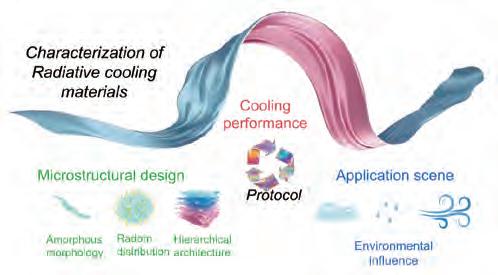
Figure1 Aframeworkforperformancecharacterizationofradiativecoolingmaterials.Theultimatecoolingperformanceofaradiative coolingmaterialisgovernedbytheinterplaybetweenitsintrinsicmicrostructureenabledspectralpropertiesandextrinsicenvironmental factors,suchassolarirradianceandambienttemperature.Consequently,establishingaunifiedandreproduciblecharacterizationstandardis crucialfortheobjectiveassessmentofdifferentmaterials.Wangandcolleaguespioneeredacomprehensiveexperimentalandtheoretical evaluationframework.Thisframeworkorchestratesacompleteevaluationworkflow,whichseamlesslylinksthecharacterizationofkey opticalproperties,controlledindoorthermaltesting,real-worldoutdoorperformancevalidation,andcross-validationwiththeoreticalmodels. Theestablishmentofthisstandardizedprotocolprovidesaquantifiableandcomparableperformancebenchmarkforthefield,significantly promotingitsscientificrigorandtechnologicaladvancement.
pensation,demonstratingacommitmenttoscientificrigor.
However,withtheestablishmentofsuchstandardizedevaluation,anotherconcerningtrendhasemerged: anexcessivepursuitofexceptionalcoolingperformance,oftenattheexpenseofmaterialdurability,aesthetics,andmechanicalstrength.Giventhecloseintegrationofradiativecoolingmaterialsintodailylife, theirdesignmustprioritizefundamentalfunctionalrequirementsovercoolingperformanceasthesole objective.Forinstance,theprimaryfunctionofasmartwindowistoensureadequatelightingandvisual comfort,withenergysavingsbeingasecondarybenefit.Similarly,inapplicationssuchasphotovoltaic thermalmanagementorpersonalcooling,anequilibriummustbeestablishedbetweenthecoolingfunction andthecorerequirementsofthedeviceorusertoensurepracticalviabilityandsustainableadoption.
Insummary,thedevelopmentaltrajectoryofradiativecoolingtechnology,fromfundamentalresearchto practicalapplication,followsaclearlogicalprogression(Figure1).Toaddresscorechallengessuchas environmentaldependencyandmeasurementinconsistencies,theestablishmentofstandardizedevaluation protocolsservesasacriticalcornerstoneforthefield’shealthyadvancement.However,inthepursuitof exceptionalperformancemetrics,theresearchcommunitymustguardagainstadeviationfrompractical applicationrequirements.Futurebreakthroughswilldependnotonlyoninnovationsinmaterialssciencebut alsoontheabilitytoco-optimizecoolingfunctionwithengineeringconstraintslikedurability,aesthetics,and cost.Therefore,acomprehensiveevaluationframeworkthatbalancesperformancestandardizationwith multifacetedpracticalitywillbetheultimatedeterminantinguidingradiativecoolingtechnologytoward successfulindustrializationandwidespreadadoption.
Funding
ThisworkwassupportedbytheNationalNaturalScienceFoundationofChina(62175082),theStateKeyLaboratoryofNew TextileMaterialsandAdvancedProcessing(FZ2025032),andtheKeyLaboratoryofAnesthesiologyandResuscitation, MinistryofEducation(2025MZFS004).G.T.acknowledgesthesupportfromtheNewCornerstoneScienceFoundation throughtheXPLORERPRIZE.
Conflictofinterest
Theauthorsdeclarenoconflictofinterest.
References
1WangZ,ZhouJ,LvQ, etal. Spectrallyselectivethermalradiationmanagementforeffectivetemperaturecontroland climateadaptation. IEEEJSelTopQuantumElectron 2025; 31:1–16.
2LiT,ZhaiY,HeS, etal. Aradiativecoolingstructuralmaterial. Science 2019; 364:760–763.
3ZengS,PianS,SuM, etal. Hierarchical-morphologymetafabricforscalablepassivedaytimeradiativecooling. Science 2021; 373:692–696.
4HsuPC,SongAY,CatryssePB, etal. Radiativehumanbodycoolingbynanoporouspolyethylenetextile. Science 2016; 353:1019–1023.
5MandalJ,FuY,OvervigAC, etal. Hierarchicallyporouspolymercoatingsforhighlyefficientpassivedaytimeradiative cooling. Science 2018; 362:315–319.
6ZhaiY,MaY,DavidSN, etal. Scalable-manufacturedrandomizedglass-polymerhybridmetamaterialfordaytime radiativecooling. Science 2017; 355:1062–1066.
7ShiNN,TsaiCC,CaminoF, etal. Keepingcool:EnhancedopticalreflectionandradiativeheatdissipationinSaharan silverants. Science 2015; 349:298–301.
8FanS,LiW.Photonicsandthermodynamicsconceptsinradiativecooling. NatPhoton 2022; 16:182–190.
9WangZ,PianS,ZhangY, etal. Fundamentalconcepts,designrulesandpotentialsinradiativecooling. RepProgPhys 2025; 88:045901.
10HuangJ,LinC,LiY, etal. Effectsofhumidity,aerosol,andcloudonsubambientradiativecooling. IntJHeatMass Transfer 2022; 186:122438.
11MaJW,ZengFR,LinXC, etal. Aphotoluminescenthydrogen-bondedbiomassaerogelforsustainableradiative cooling. Science 2024; 385:68–74.
12SuiC,HsuPC.Standardizingthethermodynamicdefinitionofdaytimesubambientradiativecooling. ACSEnergyLett 2024; 9:2997–3000.
13WangZ,PianS,MaY.Characterizationofradiativecoolingmaterials. NatProtoc 2025; 10:1038.
14WangZ.Cooling-power-of-a-solid-plane-emitter:Matlabcodeforcalculatingcoolingperformanceofasolidplane emitter. Zenodo,2025,doi:10.5281/ZENODO.17075837.
NationalScienceOpen 4:20250045,2025
https://doi.org/10.1360/nso/20250045
SpecialTopic:IntelligentMaterialsandDevices
Dynamicradiativethermalmanagementmaterialsforsustainable developmentandcarbonneutrality
JinZhang1,2,HexiangHan3,WeirongXie1,2,DiZhang1 &HanZhou1,2,*
1StateKeyLabofMetalMatrixComposites,SchoolofMaterialsScienceandEngineering,ShanghaiJiaoTongUniversity,Shanghai200240, China;
2FutureMaterialsInnovationCenter,ZhangjiangInstituteforAdvancedStudy,ShanghaiJiaoTongUniversity,Shanghai201203,China;
3ShanghaiInstituteofSpacecraftEquipment,ShanghaiAcademyofSpaceflightTechnology,Shanghai200240,China
*Correspondingauthor(email:hanzhou_81@sjtu.edu.cn)
Received11September2025;Revised10October2025;Accepted13October2025;Publishedonline14October2025
Sincetheindustrialrevolution,thegrowingglobalpopulationandrisinglivingstandardshavesubstantially increasedenergydemands.Generally,peopleusetraditionalthermalmanagementsystemssuchasair conditionerstomaintainindoorthermalcomfort,whichisaseriouscauseforatmosphericaccumulationof carbonemissionsandglobalwarming.Consequently,inordertoalignwithsustainablegoals,dynamic radiativethermalmanagement(DRTM)materials,whichcanintelligentlyregulatetemperaturebasedon inherentpropertiesofthenaturalenvironmentandexhibitminimalrelianceonenergy-intensivesystems, havegainedsignificantattentioninrecentyears[1,2].Thesematerialsenablereversibleswitchingbetween coolingandheatingmodesbytuningtheirthermalradiativepropertiesondemandinresponsetodifferent stimuli(Figure1a).Undercoolingmode,thesematerialscanreflectsunlightand/oremitinfrared(IR) radiation,whicheffectivelydispersesheatintotheskyandreducestemperaturewithouttheneedofelectricity.Underheatingmode,thesematerialsareusuallydesignedtohaveahighabsorbanceinsolarspectrum andalowemittanceinIRspectrumtoavoidheatescaping.Herein,wereviewedkeymilestonesinthe developmentofDRTMmaterials,whichwerecategorizedbytheirstimulimechanisms(Figure1b).Also,we discussedtheircontributionstosustainabilityandcarbonneutrality,alongwithexistingchallengesandfuture perspectives.
Thermo-actuatedDRTMmaterials.Accordingtodifferentweatherconditionsanduserdemands,these materialscanachievedynamicopticalmodulationbythermallyinducedphasetransitions.Vanadiumdioxide (VO2)isoneofthemostrepresentativethermo-actuatedDRTMmaterialsthattransformsfromlow-loss dielectricstatetometallicstatewhenabovephasetransitiontemperature.Wang etal.[3]demonstrateda VO2/spacer/low-EstackingFabry-Perotresonatorbyspincoating,whichcoulddynamicallymodulate longwaveIRemissivityatdifferenttemperatureconditionswithluminoustransparency.Benchmarked againstcommerciallow-emissivityglass,thisthermo-actuatedsmartwindowcouldachieveenhancedenergy savingsofupto324.6MJ/m2.Tang etal.[4]developedaflexiblecoatingbasedonWxV1 xO2 (x =1.5%).It
©TheAuthor(s)2025.PublishedbySciencePressandEDPSciences.ThisisanOpenAccessarticledistributedunderthetermsoftheCreativeCommons AttributionLicense(https://creativecommons.org/licenses/by/4.0),whichpermitsunrestricteduse,distribution,andreproductioninanymedium,providedthe originalworkisproperlycited.

Figure1 SchematicofsometypicalDRTMmaterialsandtheirapplicationfields.(a)PotentialapplicationfieldsofDRTMmaterials. (b)SeveraltypicalDRTMmaterialsclassifiedaccordingtodifferentstimuliconditions[3–10]. NatlSciOpen,2025,Vol.4,20250045
couldmodulatesky-windowemissivityfrom0.20to0.90whenthesurfacetemperatureexceeded~22°C, whichwasanextremelypracticalthresholdthatwasnotpreviouslyavailable.Thiscoatingyieldedanannual energysavingof2.64GJthroughimplementationona118m2 roofinasingle-familyhomeinBaltimore, Maryland.Althoughthermo-actuatedDRTMmaterialsrequirenoexternalenergyinputorcontrolcircuits andarestraightforwardtoimplement,theirtransitionthresholdsareinherentlydictatedbythematerialitself, resultinginlimitedmodulationflexibility.
Humidity-actuatedDRTMmaterials.Appliedinthefieldofpersonalthermalmanagement(PTM),these
Sample with RC regulation
materialscouldreducerelianceonbuildingenergyconsumption,therebyloweringcarbonemissions.They achievethermalregulationmainlybymodulatingIRemissivityaccordingtodifferentlevelsofhumidityon skinsurface.Zhang etal.[5]pioneeredtheuseofhumidity-actuatedDRTMmaterialsintextilesbyincorporatingtriacetate-cellulosebimorphfiberswithcarbonnanotubes,whichcouldachievemorethan35% IRradiationmodulationinresponsetoskinhumiditychanges.ThisdynamicIRgatingeffectoriginatedfrom distance-dependentelectromagneticcouplingbetweenadjacentcoatedfiberswithinyarns,whichcould achieveself-adaptivePTM.Li etal.[6]engineeredmultimodalhumidity-responsiveflapswithametalizednylonheterostructure,thatcouldbroadenthethermalcomfortzoneby30.7%and20.7%beyondconventionalstatictextilesandsingle-modaladaptivewearableswithoutanyenergyinput.Humidity-actuated DRTMmaterialstypicallyexhibitgoodbiocompatibilityandrelativelysimplearchitectures,buttheyoften sufferfromlimitedoperationalbandwidthandcyclingstability.
Electro-actuatedDRTMmaterials.Generally,thesematerialsmodulatesunlightreflection/absorption andIRemissivitythroughredoxreactionsoralterationsofintrinsicpropertiesunderanappliedvoltage. Typicalapproachesincludeusinginorganiccompounds(e.g.,WO3),conductivepolymers(e.g.,PEDOT), andmetalelectrodepositiontechniques.Sui etal.[7]achievedabroaddynamicmodulationofIRemissivity from0.07to0.92alongwithexceptionalcyclingstabilityover2500cyclesbyusingreversiblecopper electrodepositiontechniqueonaconductivegrapheneelectrode.Buildingenergysimulationsindicatedthat thisdesign,whendeployedasbuildingenvelopes,couldreduceannualHVAC(heating,ventilation,andair conditioning)energyusebyanaverageofupto43.1MBtuacrosstheUnitedStates.Shao etal.[8]designed anenergy-savingwindowbasedonaWO3/VO2 filmstructure,whichcouldprovidethreedifferentmodesto satisfydiverseweatherconditions.Energysavingsforthismaterial,validatedbyfieldtestsandsimulations, substantiallyexceededthoseofcommerciallow-emissivityglassinmostclimatezones,peakingat 596.7MJ/m2.Electro-actuatedDRTMmaterialstypicallyofferfastresponse-timeandprecisemodulation, buttheyalsopresentdrawbackssuchastheneedforacontinuousenergysupplyandhighsystemcomplexity. Mechanical-actuatedDRTMmaterials.Thesematerialscanreversiblytunetheiropticalpropertiesby alteringinternalmicrostructureinresponsetoexternallyappliedmechanicalforces.Thewholesystemsare oftenfabricatedbyintegratingactivematerials(e.g.,graphene,metallicfilm,andMXene)withinelastic substrateslikepolydimethylsiloxane(PDMS)orstyrene-ethylene-butylene-styrene(SEBS).Inspiredby cephalopodskin,Gorodetsky etal.[9]developedadynamicallytunableIR-reflectingplatformbypatterning wrinklesontothematerial’sactiveregion.Thissystemfeaturedvariousadvantages,suchastunablespectral range,weakangulardependence,andlongcyclingstability,whichprovidemuchinspirationforsubsequent researches.Afterthat,theyalsodevelopedacompositematerialwithtunabilityofIRopticalpropertiesby changingtheareasizethatcopperfilmcoveredpolymersubstrateunderauniaxialstrain[10].Featuringan adaptivethermalcomfortwindowofapproximately8°C,thiscompositecouldyieldbuildingenergysavings exceeding30%whenintegratedintowidelydeployedadvancedgarments.Mechanical-actuatedDRTM materialsareusuallystructurallysimple;however,theyoftenexhibitslowresponsespeedsandpoordurability.
Despitetremendousprogress,thefieldofDRTMmaterialsisstillintheearlystageofdevelopmentfor practicalapplications.Challengesstillexistandfurtheradvancesarerequiredtodevelopthispromisingfield. First,multibandcompatibilityandindependentregulationarerequiredforfurtheroptimization.Forexample, thepronouncedseasonaltemperaturedifferencesinCentralPlainsregionimposedemandingrequirements NatlSciOpen,2025,Vol.4,20250045
forcoordinatedregulationinIRandsolarspectra.Futuresystemsmaycallforaspatiallylayereddesign strategywithmulti-materialintegration.Graphene-basedmaterials,whicharecapableofdynamicmodulationinthemid-IRspectrum,couldbeusedatthetoplayer,andelectrochromicmaterialslikeWO3 could beusedasbottomlayerforsolarbandregulation.Meanwhile,artificialintelligencemaybeintegratedfor real-timemeteorologicaldataanalysisthatfurtherleadstoautonomouslyswitchingbetweendifferentmodes. Second,large-areafabricationremainsacriticalchallenge.Developingcontinuous,high-throughput,and large-scalemanufacturingtechniquessuchasroll-to-rollprocessingisessentialtoreducecostsandfacilitate commercialization.Third,materials’durabilityneedsimprovement.Metallicnanolayersarepronetooxidation,andsomepolymersmaydegradeunderultraviolet(UV)exposure,whichwillleadtoopticalperformancedecay.MaterialdesignmustthereforebeoptimizedtowithstandenvironmentalfactorssuchasUV radiation,hightemperature,humidity,oxidation,andcontaminants.Fourth,energysupplyissuesmustbe addressed.Certainactuationmethods(e.g.,electricalandmechanicaldriving)requireexternalpowerinputs, whichnotonlyrestrictapplicationscenariosbutmayalsocompromiseoverallenergy-savingperformance. IntegratingDRTMmaterialswithrenewableenergysystems(e.g.,photovoltaics)orself-poweredunits(e.g., triboelectricnanogenerators)mayofferasustainablesolution.Finally,thesynergisticeffectbetweenradiationandotherthermalmanagementmethods,suchasconductionandconvection,isalsoafactorthat needstoconsidered.Forinstance,designingradiation-convectioncoupledsurfaces,likeporousmicrostructures,cansimultaneouslyenhanceIRradiationdissipationandleveragenaturalorinducedairflowfor secondarycooling.Alternatively,integratinghighlyconductivephase-changematerialswillaccelerateheat extractionfromthesource.Suchintegratedthermalmanagementstrategiesaddresstransienthighheatfluxes andextremeenvironments,offeringon-demand,adaptivecoolingsolutionsforhigh-powerelectronicsand spacecraftwithvariablethermalprotection,therebyachievingaleapinenergyefficiency.
Inconclusion,therapiddevelopmentofDRTMmaterialsholdsimmensepromiseforreal-worldapplicationsatvariousscales.Thus,theyarepromisetocontributetosustainabledevelopmentinthefuture.For example,inthefieldofarchitecture,DRTMmaterialsappliedtofacades,roofs,orwindowscanreduce energyconsumptionforheatingandcooling.Forpersonalthermalmanagement,suchmaterialsintegratedas smartwearabletextilescanenhancethermalcomfortacrossvaryingexternalenvironmentsandreducethe correspondingenergydemand.Foraerospaceapplications,theycanprovideeffectivethermalcontroland contributetosafetyprotection.Inthefieldofenergyandoptoelectronics,DRTMmaterialsareableto facilitatetheintegrationofthermalmanagementwithenergystorage,supportinggoalsofenergyselfsufficiencyandrecycling.
Funding
ThisworkwassupportedbytheNationalNaturalScienceFoundationofChina(52172120)andtheShanghaiScienceand TechnologyDevelopmentFunds(24CL2900500).
Authorcontributions
H.Z.andJ.Z.proposedthetopicoftheperspective.J.Z.wrotethemanuscript,anddesignedthefigure.W.X.andJ.Z. discussedthemanuscript.H.H.,D.Z.andH.Z.revisedthemanuscript.Allauthorshavegivenapprovaltothefinalversionof themanuscript.
Conflictofinterest
Theauthorsdeclarenoconflictofinterest.
References
1LiS,YangE,LiY, etal. Self-adaptiveenergy-efficientwindowswithenhancedsynergisticregulationofbroadband infraredthermalradiation. NanoEnergy 2024; 129:110023.
2TuH,WangT,ChenM, etal. Isotope-drivenhydrogelsmartwindowsforself-adaptivethermoregulation. NatCommun 2025; 16:6952.
3WangS,JiangT,MengY, etal. Scalablethermochromicsmartwindowswithpassiveradiativecoolingregulation. Science 2021; 374:1501–1504.
4TangK,DongK,LiJ, etal. Temperature-adaptiveradiativecoatingforall-seasonhouseholdthermalregulation. Science 2021; 374:1504–1509.
5ZhangXA,YuS,XuB, etal. Dynamicgatingofinfraredradiationinatextile. Science 2019; 363:619–623.
6LiX,MaB,DaiJ, etal. Metalizedpolyamideheterostructureasamoisture-responsiveactuatorformultimodaladaptive personalheatmanagement. SciAdv 2021; 7:eabj7906.
7SuiC,PuJ,ChenTH, etal. Dynamicelectrochromismforall-seasonradiativethermoregulation. NatSustain 2023; 6: 428–437.
8ShaoZ,HuangA,CaoC, etal. Tri-bandelectrochromicsmartwindowforenergysavingsinbuildings. NatSustain 2024; 7:796–803.
9XuC,StiubianuGT,GorodetskyAA.Adaptiveinfrared-reflectingsystemsinspiredbycephalopods. Science 2018; 359: 1495–1500.
10LeungEM,ColoradoEscobarM,StiubianuGT, etal. Adynamicthermoregulatorymaterialinspiredbysquidskin. Nat Commun 2019; 10:1947. NatlSciOpen,2025,Vol.4,20250045
NationalScienceOpen 4:20250038,2025 https://doi.org/10.1360/nso/20250038
SpecialTopic:IntelligentMaterialsandDevices
Nonlocalmetasurfacesfornext-generationflatoptics
ShigeTang&YaoguangMa*
StateKeyLaboratoryofExtremePhotonicsandInstrumentation,CollegeofOpticalScienceandEngineering,ZJU-HangzhouGlobal ScientificandTechnologicalInnovationCenter,ZhejiangUniversity,Hangzhou310027,China
*Correspondingauthor(email:mayaoguang@zju.edu.cn)
Received7August2025;Revised29September2025;Accepted9October2025;Publishedonline11October2025
Therelentlesspursuitofminiaturized,multifunctionalphotonicdeviceshaselevatedflatopticstoacentral positionincontemporaryphotonics.Arangeofemergingtrendsisattractingsignificantresearchattention, includingtheprogressionofmetasurfacearchitecturesfromsingle-layertomultilayerconfigurations[1–3], thebroadeningoffunctionalitiesfromachiraltochiralresponses[4,5],andtheshiftfromlineartononlinear operation[6,7].Particularlynoteworthyistheexpansionofmetasurfacedesignfromlocaltononlocal regimes,whichplaysacrucialroleinshapinglightwithexceptionalflexibility.Thisadvancementhas spurrednumerousnotabledevelopmentsincriticalapplicationdomainssuchasfree-spacecompression, narrowbandfilteringandhigh-quality(high-Q)wavefrontcontrol,amongothers.
Thedefinitionofnonlocalmetasurfacescanbeelucidatedbycontrastingthemwithlocalmetasurfaces,as illustratedinFigure1a.Inlocalmetasurfaces,theelectromagneticresponseatanygivenspatialcoordinateis determinedsolelybytheincidentfieldatthatspecificlocation.Thisresultsinapoint-to-pointrelationship betweeninputandoutputfieldsinrealspace,therebyproducingauniformresponseinmomentumspace. Conversely,inanonlocalmetasurface,theresponseataparticularpointisinfluencedbytheappliedfield overanextendedspatialregion,leadingtoanon-constanttransferfunctioninmomentumspace[8].This characteristicpresentstransformativedevelopmentopportunitiesformetasurfaces.
Fromaphysicalperspective,sucharesponseinmomentumspacecorrespondstononlocalresonances,also referredtoascollectiveresonances.Thepathwaysfortheirrealizationcanbeprimarilycategorizedintotwo typesofmechanisms:guided-moderesonancesandquasi-boundstatesinthecontinuum(quasi-BIC).Differentmechanismsforgeneratingcollectiveresonancesareassociatedwithdistinctapplicationscenarios,as detailedinthesubsequentsection.Furthermore,somestudies[9,10]describetheadjacentelectromagnetic couplingbetweenmeta-atomswithinthenonlocalityregime,whichpossessessignificantapplicationvalue. Thisconceptdiffersfundamentallyfromthedefinitionprovidedinthispaperandisdiscussedanddifferentiated,alongsideanintroductiontotheassociatedbeyond-nearest-neighbourinteractions[11,12].Finally, thecurrentchallengesencounteredbynonlocalmetasurfacesareanalyzed,andthepotentialopportunities theypresentfortheadvancementofnext-generationplanaropticsaresummarized.
©TheAuthor(s)2025.PublishedbySciencePressandEDPSciences.ThisisanOpenAccessarticledistributedunderthetermsoftheCreativeCommons AttributionLicense(https://creativecommons.org/licenses/by/4.0),whichpermitsunrestricteduse,distribution,andreproductioninanymedium,providedthe originalworkisproperlycited.
Collectiveresonances:wavevector-dictatedcontrolviamomentumspace. Collectiveresonances suggestthattheoutputpointresponseofnonlocalmetasurfacesisnotisolated;rather,itresultsfromthe combinedinfluenceofanextensiveareaoftheincidentfield,enablingtheattainmentoffunctionalities distinctfromthoseoflocalmetasurfaces.Thecoreregulatorymechanismcanbebroadlycategorizedinto twotypes:guidedmoderesonancesandquasi-BICresonances.Bothtypesfacilitatethemodulationof momentumspace.
Guidedmoderesonance(GMR)isanonlocallatticeresonancephenomenonthatutilizesperiodicstructurestoinducetherequisitespatialmomentumdisplacementintheformofthelatticevectorG.This mechanismeffectivelyfacilitatesthecouplingoftransverselypropagatingwaveguidemodesintoradiation diffractionorders,therebyfundamentallyredirectingenergyflow.Thesemomentum-dependentnonlocal resonancesprovidenovelinsightsforefficientfree-spacecompression,giventhatthetransferfunctionoffree spaceisalsomomentum-dependent,acharacteristicthatcannotbereplicatedbyconventionallocalflat opticswithspace-dependenttransferfunctions[13].Forsmalltransversewavevectors kt,thedispersion relationofguidedmoderesonancecanbeapproximatedas ω(kt)= ω0 + αkt 2 (where ω0 and α representthe resonantfrequencyandthedispersioncoefficient,respectively),whichalignswiththephasedelaycharacteristicoffreespace: L L kk k k () 2 t0 0 t 2,where L denotesthelengthoffreespace.Basedonthis,Chen etal.[14]designeda10-layernonlocalmetasurface(9λ0)tosimulate45λ0 offree-spacepropagation(Figure 1b),whichhasbeenverifiedtosupportwide-angleimaging.However,anincreaseinthecompressionratio resultsinareductionoftheworkingangleandanenhancementofabsorptionlossduetostrongguidedmode localization,therebylimitingpracticalapplications.Furthermore,GMRcanbeemployedtoachievehigh-Q resonances,demonstratingsignificantpotentialforapplicationssuchasopticalsensing,spectralfiltering,and few-photonnonlinearoptics[15,16].Forexample,Fang etal.[16]havedesignedandexperimentally demonstratedamillion-scaleultrahigh-Qguidedmoderesonanceatnear-visiblewavelengthsinaresistbasedetch-freemetasurface.Undercontinuouswavelaserpumping,theyobservedanarrowingofthe linewidthassociatedwithpumppoweratroomtemperature,indicatingthepotentialoftheirmeta-optics platformforcontrollingcoherentquantumlightsources.
Boundstatesinthecontinuumrepresentanotableextensionofthenonlocalresonancemechanism, characterizedbydistinctenergyconfinementincontrasttoguidedmodes,whicharetypicallyclassifiedinto threecategoriesincludingFriedrich-WintgenBIC,symmetry-protectedBIC(SP-BIC)andaccidentalBIC. Byfinelytuningsystemparameterssuchasintroducingcontrolledsymmetrybreaking,onecangenerate quasi-BICstates,whichprovideessentialsupportfornonlocalmetasurfacesinhigh-Qlightfieldcontrol, facilitatingapplicationslikenarrowbandfiltering,high-Qwavefrontshapingandhighlyefficientphoton-pair generation.Forinstance,Yao etal.[17]designedanonlocalHuygensmetalensthatexploitsquasi-BIC inducedbystructuralasymmetrytoachieveahigh-Qresonance(Q ≈ 104),withalinewidthmaintained below0.1nmatadesignedwavelengthof1550nm(Figure1c).Anotherexampleisthemetalaserproposed byZeng etal.[18].AsdepictedinFigure1d,Si3N4 nanodiskswitheccentricaperturesgeneratequasi-BIC states,whichareamplifiedviastimulatedemissioningainmedia.Concurrently,aspecificgeometricphaseis introducedthroughtherotationangle θ,facilitatinghigh-Qwavefrontmanipulation;however,thisalso degradesthenonlocalresonantmode,consequentlyreducingtheQ-factorofthemetasurfacetosomeextent. Furthermore,Zhang etal.[19]reportedametasurfacethatsupportsnonlocalresonances,enabledbythe
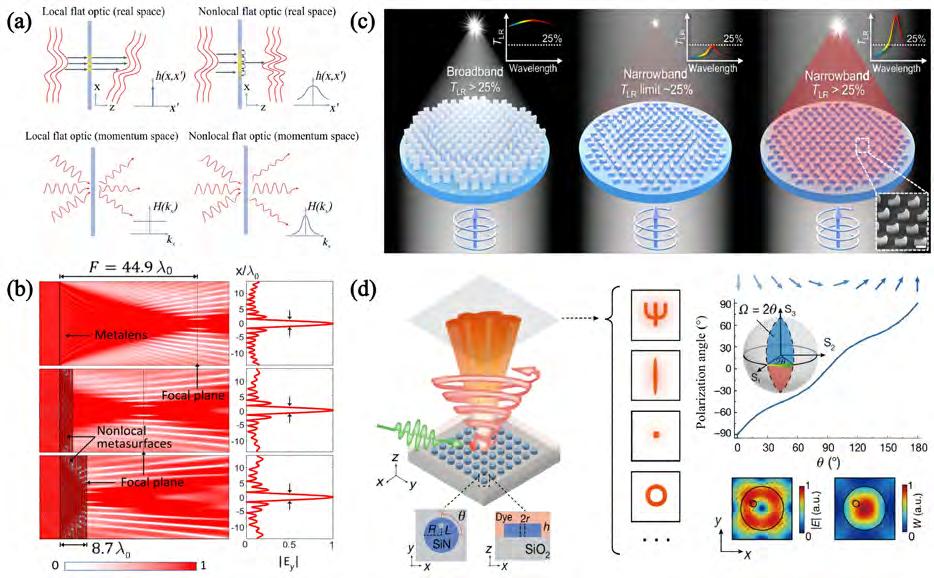
Figure1 Somemechanismsandapplicationsofnonlocaleffects.(a)Physicaldiagramoflocalandnonlocaleffect,bothinrealspaceandin momentumspace(Theseareidealizations,astheresponseisneverperfectlylocal)[8].(b)Normalizeddistributionoftheelectricfield amplitudeforthefocusingofaTE-polarizedplanewavebyalocalidealizedmetalens,andthesamemetalensfollowedbynonlocal metasurfaceswith5layersand10layers[14].(c)Localandnonlocalmeta-lensesaregenerallylimitedbybroadbandresponsesandcircular polarizationconversionefficiencyTLRof~25%,respectively.NonlocalHuygens’meta-lensescansimultaneouslyacquirenarrowband wavefrontshapingandefficiencyTLRexceeding25%[17].Inset:tiltedscanningelectronmicroscope(SEM)imageofthefabricatedsample. Thescalebaris500nm.(d)Schematicofthemetalaser.Eachunitcellisdepictedasaninset.Herethelatticesizeofaunitcellis a =360nm. TheradiusandpillarheightoftheSi3N4 nanodiskare R =135nmand h =150nm,respectively[18].Theeccentricholeispositionedat L = 60nmwitharadiusof r =20nmandvariablerotationangle θ.Withthecontroloftherotationangleofeachhole,differentlaserprofilessuch asGaussianbeam,donutbeam,focusspot,focusline,aswellashologramcanbegenerated.Thepolarizationangle θF offarfieldradiationat theresonantwavelengthasafunctionofrotationangle θ.Bottominsetsshowtheelectricfield(left)andpower(right)distributionsofquasiBICinoneunitcell.ThetopinsetillustratesthegeometricphaseacquiredbytheemissionfromeachSi3N4 nanodisk.
high-Qfactorsassociatedwithquasi-BICandotherresonantmodes.Thisconfigurationresultsinasubstantialenhancementofthephoton-pairgenerationratebyapproximately450timescomparedtounpatterned LiNbO3 films.Additionalexperimentalresultspertainingtohigh-QmetasurfacescanbefoundinTable1.
Near-fieldcoupling:nonlocalinteractionsviarealspace.Intheprecedingdescription,nonlocalityis characterisedasthemodulationofthemetasurfaceinmomentumspace;specifically,theoutputlightfieldat agivenpointinrealspaceisinfluencedbythedistributionoftheinputlightfieldacrossanextendedregion.It isimportanttohighlightthatincertaininstances,thecouplingbetweenadjacentmeta-atomsisalsoregarded asnonlocal.However,withinthecontextofthisdefinition,thiscouplingeffectdoesnotstrictlyconformto theclassificationsoflocalornonlocalmetasurfaces,asitneithersatisfiesthepoint-to-pointresponseinreal spacenorfacilitatestheregulationofmomentumspace.Amoresuitabledescriptionwouldbetorefertoitas atransitionalstatetermednonlocalinteractions[9],whichalsoplaysacrucialroleinthedesignofmetasurfaces.
Ontheonehand,thisnonlocalinteractionwillfundamentallyreducethepredictiveaccuracyofthelocal
NatlSciOpen,2025,Vol.4,20250038
Table1 Anexperimentallistofrecenthigh-Qnonlocalresonancemetasurfaces
Unitstructure ResonancetypeMaterial λ (nm) Exp. Q Ref.
Circularhole GMR ResistonSOI1551 239,000 [15]
Squarehole GMR ResistonSiN779 1,100,000 [16]
Cuboid Accidental-BIC SOI 1538 5305 [20]
T-shapeblock SP-BIC Sionquartz 1588 18,511 [21]
U-shapeblock SP-BICSionsapphire1548 3534 [22]
Shallowpair-rod SP-BIC SOI 1560 101,000 [23]
Doubleholes SP-BIC SOI 1553 36,964 [24]
IRU a SP-BIC SionSiO2 1550 10,000 [17]
NanodiskwitheccentricholeSP-BICSi3N4 onSiO2 569.9 3700 [18]
a:IRU,integrated-resonantunit.
responseapproximation(LRA)modelemployedinthedesignoflocalmetasurfaces,asthestructural characteristiclengthbecomescomparabletotheoperatingwavelength.In2018,Lepeshov etal.[25]illustratedthatthenear-fieldcouplingbetweenMie-resonantmeta-atomsalterstheirindividualmagneticresponses,contingentupontheirseparationdistances.Ontheotherhand,utilizingandenhancingthiscoupling effectexpandsthedesignfreedomtoacertainextentincludingthecouplingbetweentransverseorlongitudinalcells,whichistypicallyintegratedwithinversedesignmethods[26,27].Forexample,in2020,Cai etal.[9]harnessedthestronginteractionsamongnanoresonatorstoenhancethefocusingefficiencyof metalensesat532nmthroughaglobalevolutionaryoptimizationmethodologythataccountsforthenonlocal interactions.Theexperimentalresultsindicateimprovedefficienciesforthinnertransmissivemetalenses designedforvisiblelight.Nevertheless,itisimportanttoacknowledgethatthecapacitytoreducethe thicknessofmetalenssystemsthroughnonlocalcouplingbetweenunitcellsisnotlimitless.In2022,Liand Hsu[28]conductedatheoreticalanalysisofthefundamentaltrade-offbetweenthefieldofview(FOV)and thethicknessofmetalenssystems.TheFouriertransformdualitybetweenspaceandmomentumindicates thatanincreaseinangulardiversityrequiresagreaterdegreeofnonlocality(i.e.,thelateralspreadofincident waves),andtherebydeterminesthedevice’sminimumthickness h by
Thisfindingalignscloselywithprioroutcomesinmetalensdesign[29,30].
Recently,anemergingconceptknownasbeyond-nearest-neighbourinteraction,amechanismoriginally introducedinelasticandairborneacousticalmetamaterials[11,12],hasbeenemployedtotailorunusual dispersionrelations.Theessenceofthismechanismliesintheintroductionofphysicalstructures,which createenergytransmissionchannelsforbeyond-nearest-neighbourunitsthatdonottypicallyinteract.Utilizingthismechanism,Chen etal.[12]haverealizedroton-likeacousticaldispersionrelations,characterized bytheemergenceofaminimumvalueinthefirstBrillouinzone,byincorporatingdesignedthirdnearestneighbourinteractionsalongsidetheconventionalnearest-neighbourinteractions.Theoretically,analogous effectscanbeachievedinopticsthroughtherationalorinversedesignofnonlocalcoupling.However, achievingsuchdispersionrelationsnecessitatesasubstantialnumberofnonlocalinteractionrodsorchannels thatmustnotoverlap;otherwise,theinteractionmechanismwillbefundamentallyaltered[31],which inevitablyleadstoanincreaseinthesystemthickness[28,32].TheaforementionedworkbyChen etal.[12]
NatlSciOpen,2025,Vol.4,20250038
hasalsobeenimplementedinthree-dimensionalmetamaterials,furthersubstantiatingthelimitationsimposedbythickness.
Applicationchallengesandfutureoutlook.Despitethetransformativepotential,theutilizationof nonlocalmetasurfacesencounterssignificantchallenges,duetotheincreasedcomplexityofdesignand theoreticalmodelingaswellasthestringentrequirementsforfabricationprecision.Nonlocalresponsesare influencedbyintrinsicmaterialdispersionandstructuralparameters,suchasunitgeometryandarrangement, bothofwhichdemonstratedependenceonfrequencyandwavevector.Thissituationnecessitatesthesimultaneousoptimizationofunitgeometry,periodicarrangement,andmaterialdispersion,therebyexacerbatingtheoveralldesigncomplexity.Establishedeffectivemediummodelsforquantitativepredictionand optimizationofnonlocaleffectsremainunderdeveloped,particularlyforcomplexaperiodicstructures[32]. Furthermore,artificiallyengineerednonlocaleffects,particularlyforhigh-Qresonances,requirestringent fabricationprecisiontoensuretheirstability;evennanometre-scalevariationsinunitplacementorshapecan catastrophicallydegradecouplingprecisionanddeviceperformance.Consequently,thisimposesheightened demandsonnanofabricationtechnologies.Thereisanurgentneedforrobustinversedesignframeworksand automatedoptimizationstrategiesthatconnectnonlocaltheorieswithfabricationconstraints.
Futureadvancementsinnonlocaltheoreticalmodelingandadvancedmicro/nanofabricationaresetto unlocksignificantpotentialfornonlocalmetasurfaces.Firstly,theexploitationofnonlocalitywillfacilitate thedevelopmentofmultifunctionalorultra-compactopticalsystems,significantlyreducingthefootprintof complexopticaldevicessuchasthosetargetingnarrowbandfilteringandhigh-Qwavefrontshaping.Secondly,optimizedmetasurfacedesignswillenableprecisecontroloverthecouplingoflightfieldswhichis anticipatedtodecreaseoverallthicknessoftheimagingsystems,notwithstandingthetheoreticallimitations discussedinRef.[28].Furthermore,thesemetasurfacesarepoisedtofunctionnotmerelyascomponentsbut asfullyintegratedplatformsforquantumphotonics.Theycouldseamlesslyincorporateon-demandentangledquantumlightsources,opticalsignalmodulationelements,andphoton-pairgenerationfunctionalities.Consequently,nonlocalmetasurfacesandmetalensesarepositionedtobecomepivotaldriversof transformativeadvancesinflatoptics.Thistrajectoryeffectivelyconnectsfundamentalresearchinnanophotonicsandquantumphysicswithpracticalengineeringapplications,therebyestablishingrobustfoundationsforthenextgenerationofmultifunctionalandminiaturizedopticalinnovations.
Acknowledgements
TheauthorswouldliketoacknowledgeWeigeLv,LiyingChenandWeiWangfromtheStateKeyLaboratoryforExtreme PhotonicsandInstrumentationandCollegeofOpticalScienceandEngineering,ZhejiangUniversityfortheirassistance.
Funding
ThisworkwassupportedbytheSTI2030-MajorProjects(2021ZD0200401),theNationalNaturalScienceFoundationof China(62222511),theNaturalScienceFoundationofZhejiangProvince(LR22F050006),andtheNationalKeyResearchand DevelopmentProgramofChina(2023YFF0613000).
Authorcontributions
Y.M.proposedthetopicoftheperspective.S.T.wrotethemanuscriptanddesignedthefigures.Y.M.andS.T.reviewed,edited andrevisedthemanuscript.
NatlSciOpen,2025,Vol.4,20250038
Conflictofinterest
Theauthorsdeclarenoconflictofinterest.
References
1ArbabiA,ArbabiE,KamaliSM, etal. Miniatureopticalplanarcamerabasedonawide-anglemetasurfacedoublet correctedformonochromaticaberrations. NatCommun 2016; 7:13682.
2AvayuO,AlmeidaE,PriorY, etal. Compositefunctionalmetasurfacesformultispectralachromaticoptics. Nat Commun 2017; 8:14992.
3ZhouY,KravchenkoII,WangH, etal. Multilayernoninteractingdielectricmetasurfacesformultiwavelength metaoptics. NanoLett 2018; 18:7529–7537.
4HanZ,WangF,SunJ, etal. Recentadvancesinultrathinchiralmetasurfacesbytwistedstacking. AdvMater 2023; 35: 2206141.
5HuZ,SunY,DongH, etal. Recentadvancesindielectricchiralmetasurfaces. AdvPhysRes 2025; 4:2400187.
6KrasnokA,TymchenkoM,AlùA.Nonlinearmetasurfaces:Aparadigmshiftinnonlinearoptics. MaterToday 2018; 21: 8–21.
7FanY,LiangH,LiJ, etal. Emergingtrendinunconventionalmetasurfaces:Fromnonlinear,non-hermitianto nonclassicalmetasurfaces. ACSPhotonics 2022; 9:2872–2890.
8ShastriK,MonticoneF.Nonlocalflatoptics. NatPhoton 2023; 17:36–47.
9CaiH,SrinivasanS,CzaplewskiDA, etal. Inversedesignofmetasurfaceswithnon-localinteractions. npjComput Mater 2020; 6:116.
10IsnardE,HéronS,LanteriS, etal. Advancingwavefrontshapingwithresonantnonlocalmetasurfaces:Beyondthe limitationsoflookuptables. SciRep 2024; 14:1555.
11ChenY,FleuryR,SeppecherP, etal. Nonlocalmetamaterialsandmetasurfaces. NatRevPhys 2025; 7:299–312.
12ChenY,KadicM,WegenerM.Roton-likeacousticaldispersionrelationsin3Dmetamaterials. NatCommun 2021; 12: 3278.
13GuoC,WangH,FanS.Squeezefreespacewithnonlocalflatoptics. Optica 2020; 7:1133–1138.
14ChenA,MonticoneF.Dielectricnonlocalmetasurfacesforfullysolid-stateultrathinopticalsystems. ACSPhotonics 2021; 8:1439–1447.
15HuangL,JinR,ZhouC, etal. Ultrahigh-Qguidedmoderesonancesinanall-dielectricmetasurface. NatCommun 2023; 14:3433.
16FangJ,ChenR,SharpD, etal. Million-Qfreespacemeta-opticalresonatoratnear-visiblewavelengths. NatCommun 2024; 15:10341.
17YaoJ,LaiF,FanY, etal. Nonlocalmeta-lenswithHuygens’boundstatesinthecontinuum. NatCommun 2024; 15: 6543.
18ZengY,ShaX,ZhangC, etal. Metalaserswitharbitrarilyshapedwavefront. Nature 2025; 643:1240–1245.
19ZhangJ,MaJ,ParryM, etal. Spatiallyentangledphotonpairsfromlithiumniobatenonlocalmetasurfaces. SciAdv 2022; 8:eabq4240.
20LiZ,ZhouL,LiuZ, etal. Modifyingthequalityfactorsoftheboundstatesinthecontinuuminadielectricmetasurface bymodecoupling. ACSPhotonics 2023; 10:206–216.
21LiuZ,XuY,LinY, etal. High-Qquasiboundstatesinthecontinuumfornonlinearmetasurfaces. PhysRevLett 2019; 123:253901.
22FangCZ,YangQY,YuanQC, etal. High-Q resonancesgovernedbythequasi-boundstatesinthecontinuuminalldielectricmetasurfaces. OEA 2021; 4:200030.
23WatanabeK,NagaoT,IwanagaM.Low-contrastBICmetasurfaceswithqualityfactorsexceeding100,000. NanoLett 2025; 25:2777–2784.
NatlSciOpen,2025,Vol.4,20250038
24HuangL,LiS,ZhouC, etal. Realizingultrahigh-Qresonancesthroughharnessingsymmetry-protectedboundstatesin thecontinuum. AdvFunctMater 2024; 34:2309982.
25LepeshovS,KivsharY.Near-fieldcouplingeffectsinmie-resonantphotonicstructuresandall-dielectricmetasurfaces. ACSPhotonics 2018; 5:2888–2894.
26LiM,ZhangY,MaZ.Deep-learning-basedmetasurfacedesignmethodconsideringnear-fieldcouplings. IEEEJ MultiscaleMultiphysComputTech 2023; 8:40–48.
27MansoureeM,KwonH,ArbabiE, etal. Multifunctional2.5Dmetastructuresenabledbyadjointoptimization. Optica 2020; 7:77–84.
28LiS,HsuCW.Thicknessboundfornonlocalwide-field-of-viewmetalenses. LightSciAppl 2022; 11:338.
29LinZ,GroeverB,CapassoF, etal. Topology-optimizedmultilayeredmetaoptics. PhysRevAppl 2018; 9:044030.
30LinZ,Roques-CarmesC,ChristiansenRE, etal. Computationalinversedesignforultra-compactsingle-piece metalensesfreeofchromaticandangularaberration. ApplPhysLett 2021; 118:041104.
31WangK,ChenY,KadicM, etal. Nonlocalinteractionengineeringof2Droton-likedispersionrelationsinacousticand mechanicalmetamaterials. CommunMater 2022; 3:35.
32MonticoneF,MortensenNA,Fernández-DomínguezAI, etal. Nonlocalityinphotonicmaterialsandmetamaterials: Roadmap. OptMaterExpress 2025; 15:1544.
NationalScienceOpen 4:20250061,2025 https://doi.org/10.1360/nso/20250061
SpecialTopic:IntelligentMaterialsandDevices
Artificialintelligencereforgesintelligentfibers
ShengnanMin1,JianingYue2,JiachaoJi3,MengruShi1,MiaoyiXu3,ShendongYao2 & YuanlongShao2,3,4,*
1SchoolofMaterialsDesign&Engineering,BeijingInstituteofFashionTechnology,Beijing100029,China;
2AcademyforAdvancedInterdisciplinaryStudies,PekingUniversity,Beijing100871,China;
3SchoolofMaterialsScienceandEngineering,PekingUniversity,Beijing100871,China;
4BeijingGrapheneInstitute(BGI),Beijing100095,China
*Correspondingauthor(email:shaoyuanlong@pku.edu.cn)
Received28September2025;Revised13October2025;Accepted13October2025;Publishedonline16October2025
Intelligentfibersserveasversatilefunctionalinterfacesfacilitatingbidirectionalhuman-environmentinteractionandconstitutefoundationalelementsfornext-generationwearablecomputing/humaninteraction systems.Theseintelligentfibersandwearablesexhibitmultifunctionalcapabilities,includingperceptionor responsetoexternalstimuli,energyharvesting/storage,microclimateregulation,informationtransmission, andexpansivemultifunctionality[1–3].Thedesignofintelligentfibersentailscomplexmultiscaleparameter coupling,spanningfromnanoscalebuildingblockfeaturestomacrostructureoptimizedforwearableapplications.Theintricatemultiscalecomposition-structure-propertyrelationship,sensitivedependenceofthe fabricationparametersandunpredictableperformanceoptimizationinvariedapplicationscenarios,exceed themanagementanddecouplingcapabilityofconventionaldatasystems,computationalresources,and modelingapproaches.Artificialintelligence(AI)providesessentialmethodologiesforaddressingthese multi-scenarioandcross-scalecomplexities,enablingacompellingsynergy.Forinstance,intelligentfiber couldserveasAI-driventerminalsforsignalacquisitionandprocessing,whileconversely,AI-empowered algorithmandmodelingcouldacceleratethecross-scalestructuraldesignofintelligentfibers.Thisdualrole necessitatesaparadigmshifttowardAIforScience(AI4S)frameworksinfibermaterialsresearch[4], drivingconcertedeffortstointegrateAIthroughoutthematerialdesignanddiscoverypipeline.Figure1 illustratesthishierarchicalparadigm,showingthepossibilityofintegratingAIacrossscalesfromnano buildingblockstomacroscaleapplications,andthroughtheworkflowfromexpedientdataacquisitionto feedbackperformanceoptimization.
AI-empowereddataacquisitionandenrichment.Ahigh-quality,large-scaledatasetisaprerequisitefor trainingapowerfulAImodelformaterialdesign.Theideaofintegratinghigh-throughputexperimental agents,naturallanguageprocessing,largelanguagemodelsindescriptormappingandreal-timeexperiments, aswellasmultiscalenumericalcoupling,demonstratedthepotentialofAI-empoweredroboticsformaterial discovery[5].Forinstance,Huang etal.[6]introducedaninspiringchemicalAI-copilotroboticexplorer.
©TheAuthor(s)2025.PublishedbySciencePressandEDPSciences.ThisisanOpenAccessarticledistributedunderthetermsoftheCreativeCommons AttributionLicense(https://creativecommons.org/licenses/by/4.0),whichpermitsunrestricteduse,distribution,andreproductioninanymedium,providedthe originalworkisproperlycited.
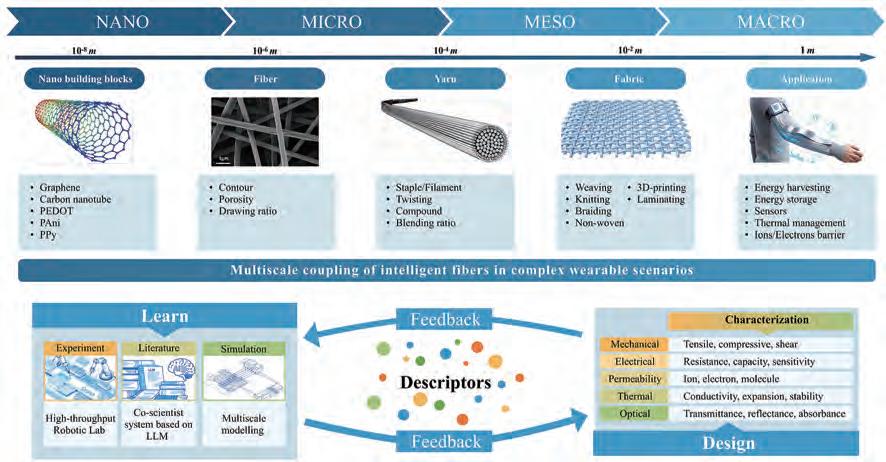
Themodularplatformcombinesnaturallanguageprocessing,syntheticliteratureminingandhumanconversationalexperimentexecutionalunitsbasedonalargelanguagemodel(LLM).Aplentyofcompounds, includingcoordinationcomplexes,metal-organicframeworks(MOFs),metallicnanoparticlesandpolyoxometalates,canbeautomaticallysynthesizedandcharacterized.Asaresult,anunreportedMn-Wpolyoxometalateclusterwasdiscoveredbythegenerativeplatform,expandingtheinorganicchemicalspacewith AIintegration.ThesynthesizedMOFsandmetallicnanoparticlesprovidepossibilitiesforthefuturedevelopmentofflexibleelectrodesandintelligentfibersforelectromagneticattenuationandthermalmanagement.Multiscalemodelingintegratesatom-leveldensityfunctionaltheory(DFT),ab-initiomolecular dynamics(AIMD),moleculardynamics(MD),andmacro-levelfiniteelementanalysis(FEA)toinvestigate andpredicttheatomic,electrochemicalandmechanicalpropertiesoftheintelligentmaterials.Theseverified simulationresultscanalsobeemployedastrainingsetstoacceleratethematerialcreations.
Descriptoridentification.Identifyingthecorrectdescriptorsforcriticaldatalabelingisnecessarybefore conductingself-drivendatascreening,noisereduction,andsubsequentmodeling[7].Takethewet-spun carbonnanotube(CNT)fiber[8]asanexample,thedualdiffusionprocessinthecoagulationbathinvolves kineticsandthermodynamicsthatcontrolsthemorphology,porosityandmechanicalpropertiesoftheproduct.Adescriptorpoolcontainingmassiveinformationcanbecollectedthroughoutthespinningdope preparation,filamentcoagulation,post-treatmentandperformancecharacterizationprocesses.Thesehighly integratedspectroscopic,imaginganddigitaldatasetscontaincriticaldescriptorsgoverningnano-building blocksolubilityanddistribution,bidirectionaldiffusiondynamicswithinthecoagulationbath,andorientationandcrystallizationofCNTfibersbyinheritingtheexcellentintrinsicpropertiesofCNT.To eliminateinvaliddatainterference,systematicscreeninganddenoisingareprerequisitesforAItreatment, whilefunctionalparametersrequirenormalizationintostructuredformatscompatiblewithmodelrecognition,followedbycorrelationandlabelingaccordingtotheirinfluenceonfiberperformance.Parameterssuch ascoagulationbathnon-solventconcentration,temperature,dopephaseconcentration,solubilityintargeted
Figure1 MultiscalecouplingandworkflowofAIempoweredintelligentfiberdesign.
solvents,diffusiontimebasedontheclassicFick’sLawofdiffusionandexperimentalfindingshelptoverify theeffectivenessoftheremainingdescriptorspropellingtheperformanceenhancementofCNTfiber-based applications,suchasbatteries,sensorsandthermalmanagementdevices.Throughautomateddataanalysis, AI-enableddigitaltwintechnologysubsequentlydecipherscomplexmicrostructural-propertyrelationships andguidesphysical-fieldoptimization.
Activestudyandfeedback.Data+Knowledge-drivenmachinelearningisasignificanttrendinmaterial discovery[9].Theultimategoalofconstructingthedatasetistosupporttheself-optimizedandcontinuously evolvingAI-drivenmaterialdesignclosed-loop.Machinelearning(ML)filtershigh-valueexperimental pointsthroughactivelearning.Whendevelopingtemperature-controlledcoatings,Bayesianoptimization dynamicallyadjuststhepriorityofparameterssuchasthephasetransitiontemperatureofmicrocapsules, reduces80%oftheexperimentalamount,andquicklyconvergestotheoptimalformula[10].However, activelearningandBayesianoptimizationrelyonthefundamentalsofsmall-sampledataandprobability prediction,whichmakesthemapplicableunderconditions.Foremergingmultifunctionalandnovelintelligentfibers,thereisalackofexistingtrainingdatatoconductreliablemodelling.Aimingatthescarcityof extremescenedata,themodelisfine-tunedwithasmallamountofdatatoimprovethepredictionreliability byusingphysicalconstrainttransferlearning.Discriminativemodelsbuilda“structure-performance” mappingtopredictkeyparameterslikethermalconductivity.Generativemodelsreversedesignthemicrostructureandhaveafeedbackclosed-loopforoptimizingthespecificthermalmanagementrequirements.For example,rewardedbythedifferencebetweentargetandbackgroundradiation,thedesignofinfraredstealth materialdynamicallyadjuststhedrivingvoltagetoadapttoenvironmentalchanges[10].Inmultiscale modeling,MLintegratesdatatobuildacross-levelmodel,feedbackcorrectionparameters,andensurethe performanceofmaterialsundermulti-fieldcoupling.
Intelligentfiberistheidealinterfaceforfutureembodiedintelligence,whichisanimportantcarrierforAI toperceive,adaptandtransformthephysicalworld.Futureintelligentfiberdesignisacomprehensivehybrid ofthecutting-edgetechnologies,enhancedcomputingpowerandstoragemedium,revolutionaryalgorithms andinformationprocessingnetworks.AdvancedAIenablesthecustomizationofthefibermicrostructure, processparameteroptimization,predictiveenhancement,andmulti-functionalityintegration.Deeplearning couldfacilitatenoisesuppressionandfeatureextractionfrommulti-sourcesensingsignals,whilehighperformancecomputingempowersareal-timeresponsesystemtoimproveanti-interferenceabilityand decision-makingaccuracyincomplexenvironments.DespitethetransformativepotentialofAI4S,thereare concernsaboutalgorithmictrustworthiness,epistemologicalgapsinmultiscalefiberstructuremodeling. Currently,mostAImodelsformaterialdesignresembleblack-boxsystems,whichareunmanageableto troubleshootwhentheactualperformancedeviatesfromtheprediction.Itisalsothecaseforthemultiscale modelingofintelligentfiberswhenexplainingthephysicalmechanismofcross-scaleperformanceregulation.Combinephysicallawswithdata-drivenmodelstoconstrainthescale-bridgingmodeloutputwithin physicallyreasonableranges,highlightingthecontributionweightofcriticaldescriptorstoperformance, whichwillcontributetoreducingtheprobabilityofunphysicalpredictions.Strategicimplementationof FAIR(findable,accessible,interoperable,reusable)principles,coupledwithstandardizeddatacuration protocols,willpromotethereliabilityofapplyingAIinintelligentfiberdevelopmentformission-critical intelligentapplications. NatlSciOpen,2025,Vol.4,20250061
Funding
ThisworkwassupportedbytheNationalKeyResearchandDevelopmentProgramofChina(2022YFA1203302, 2022YFA1203304),theNationalNaturalScienceFoundationofChina(52472039,T2188101),theJointResearchProjectof theShijiazhuang-PekingUniversityCooperationProgram,andtheBeijingMunicipalEducationCommissionunderthe BeijingHigherEducationYoungEliteTeacherProject(BPHR202203063).
Authorcontributions
Y.S.supervisedtheproject.S.M.andY.S.wrotethemanuscript.M.S.editedthefigure,J.Y.,J.J.,M.X.andS.Y.discussedand revisedthemanuscript.Allauthorsreviewedandeditedthemanuscript.
Conflictofinterest
Theauthorsdeclarenoconflictofinterest.
References
1DangC,WangZ,Hughes-RileyT, etal. Fibres—threadsofintelligence—enableanewgenerationofwearablesystems. ChemSocRev 2024; 53:8790–8846.
2ChenC,FengJ,LiJ, etal. Functionalfibermaterialstosmartfiberdevices. ChemRev 2023; 123:613–662.
3ZhuS,HuangY,FangB.Progressandprospectforconductingpolymerfibers. AdvMater 2025;e04071.
4JiangX,XueD,BaiY, etal. AI4Materials:Transformingthelandscapeofmaterialsscienceandenigneering. RevMater Res 2025; 1:100010.
5JiangX,WangW,TianS, etal. Applicationsofnaturallanguageprocessingandlargelanguagemodelsinmaterials discovery. npjComputMater 2025; 11:79.
6HuangL,ZhangC,FuY, etal. Natural-language-interfacedroboticsynthesisforAI-copilot-assistedexplorationof inorganicmaterials. JAmChemSoc 2025; 147:23014–23025.
7GeW,DeSilvaR,FanY, etal. Machinelearninginpolymerresearch. AdvMater 2025; 37:2413695.
8YangZ,YangY,HuangY, etal. Wet-spinningofcarbonnanotubefibers:Dispersion,processingandproperties. NatlSci Rev 2024; 11:nwae203.
9JiangX,FuH,BaiY, etal. Interpretablemachinelearningapplications:ApromisingprospectofAIformaterials. Adv FunctMater 2025; 35:2507734.
10ZhangH,HeQ,ZhangF, etal. Biomimeticintelligentthermalmanagementmaterials:Fromnature-inspireddesignto machine-learning-drivendiscovery. AdvMater 2025; 37:2503140.
NationalScienceOpen 5:20250063,2026
https://doi.org/10.1360/nso/20250063
SpecialTopic:IntelligentMaterialsandDevices
Polypyrrole-modifiedPVDF-HFPcoaxialelectrospuncomposite membranesforintelligentthermalmanagementand electromagneticinterferenceshielding RongjunWei1,2,3,BingqingQuan1,2,3,MuyiHan4,XinpengHu1,2,3,* &XiangLu1,2,3,*
1KeyLaboratoryofMaterialChemistryforEnergyConversionandStorage,HuazhongUniversityofScienceandTechnology,Ministryof Education,Wuhan430074,China;
2HubeiEngineeringResearchCenterforBiomaterialsandMedicalProtectiveMaterials,HuazhongUniversityofScienceandTechnology, Wuhan430074,China;
3HubeiKeyLaboratoryofMaterialChemistryandServiceFailure,SchoolofChemistryandChemicalEngineering,HuazhongUniversityof ScienceandTechnology,Wuhan430074,China;
4DepartmentofMaterialsScienceandEngineering,NationalUniversityofSingapore,Singapore117575,Singapore
*Correspondingauthors(emails:hxpbest@outlook.com(XinpengHu);luxiang@hust.edu.cn,luxiang_1028@163.com(XiangLu))
Received1October2025;Revised25November2025;Accepted3December2025;Publishedonline4December2025
Abstract: Theincreasingprevalenceofextremeenvironmentsandthegrowingseverityofelectromagneticpollutionmakeit urgenttodevelopcompositesthatcombinedynamicthermalmanagementwithelectromagneticinterference(EMI)shielding capabilities.However,itischallengingtointegratealltheseperformancesintoasingledevicethroughastraightforward method.ThisstudyreportsanovelcompositemembranethatcombinesoutstandingthermalmanagementcapabilitiesandEMI shieldingperformance.Thefibremembrane,withadistinctcore-shellstructure,maintainsathermalstoragecapacity (82.84J/g)andanti-leakageproperties.The in-situ polymerisedpolypyrrole(PPy)endowsitwithactivethermalmanagement capabilities,includingJouleheatingandsolar-to-thermalconversionproperties.AsatisfactoryEMIshieldingperformancewas alsoachieved,andtheshieldingeffectivenesscanbeenhancedthroughasimpleorigamitechnique.Moreover,thecomposite exhibitsdesirablethermalstabilityandcyclereliability.Inbrief,thismultifunctionalcompositefilmdemonstratessignificant applicationpotentialinwearabletextilesforthermalmanagementandEMIshielding.
Keywords: coaxialelectrospinning,phasechangeenergystorage,Jouleheating,photothermalconversion,electromagnetic interferenceshielding
INTRODUCTION
Theincreasingfrequencyofextremeweathereventshasposedsignificantriskstohumanhealthandsafety, highlightingtheurgentneedforeffectivethermalmanagementsolutions.Fibers,asfundamentalmaterials forregulatinghumanthermalcomfort,havelongattractedinterest[1–3].However,pristinefiberslack thermalbufferingcapacityandcannotmaintainstabletemperaturesunderfluctuatingconditions,which significantlyrestrictsitspracticalapplicationsandfurtherdevelopment[4,5].
©TheAuthor(s)2025.PublishedbySciencePressandEDPSciences.ThisisanOpenAccessarticledistributedunderthetermsoftheCreativeCommons AttributionLicense(https://creativecommons.org/licenses/by/4.0),whichpermitsunrestricteduse,distribution,andreproductioninanymedium,providedthe originalworkisproperlycited.
Toovercomethislimitation,phasechangematerials(PCMs)havebeenincorporatedintofabricsto regulatetemperaturebystoringandreleasinglatentheatduringphasetransitions[6–8].Forexample, Xu etal.[9]constructedacore-sheathfibercomprisingthermoplasticpolyurethane(TPU)encapsulating polyethyleneglycol(PEG)viaacoaxialwet-spinningandphoto-crosslinkingstrategy.Thissolid-solidphase changefiberachievesathermalenergystoragedensityof122.5J/g,makingitsuitableforwearablethermal management.Inanotherstudy,Wang etal.[10]fabricatedacoaxialelectrospuncompositefibrewitha dodecanolcoreandapolyacrylatesheath,whichexhibitshighlatentheat(106.9J/g)andexcellentcycling stability.Whiletheseapproachesimprovepassivethermalregulation,conventionalPCMssufferfrompoor flexibility,andfabric-basedcompositesoftenlackmulti-modethermalmanagementfunctionstofulfillthe varyingrequirementsofpracticalconditions[11].SincerelyingsolelyonPCMsisofteninsufficienttomeet thedemands,incorporatingthermalmanagementstrategiessuchassolar-to-thermalandelectro-to-thermal conversioncapabilitiesintoflexiblefabric/PCMsystemsthereforerepresentsapromisingroutetoenhance thermalcomfortandexpandtheirapplicationpotential[12,13].
Inadditiontothermalregulation,effectiveelectromagneticinterference(EMI)shieldingperformancein textilecompositesremainsanunresolvedchallenge,particularlyduetothegrowingprevalenceofelectromagneticpollutionassociatedwiththewidespreadadoptionof5Gcommunicationtechnologiesandthe expandinguseofportableelectronicdevices[14].High-frequencyelectromagneticradiationnotonlycauses signaldistortionbutmayalsoposeseriousthreatstohumanhealthaswellasotherpotentialdangers[15,16]. Therefore,mitigatingtheinterferenceofelectromagneticwaves(EMWs)throughwearabletextilesisof importanceformaintainingnormaldailyroutines.ThecriticaldependenceofefficientEMIshieldingon continuousconductivenetworkshasdrivensubstantialresearchinterestinmaterialslikemetals[17], MXenes[18],andcarbon-basedcomposites[19,20]inrecentyears.Forinstance,amultifunctionaland symmetricallystructuredcompositefilmwasfabricated,whichexhibitsintegratedEMIshielding(70.2dB), efficientthermalmanagement,androbustmechanicalproperties.Thisfilmwasconstructedwithapolypyrrole(PPy)modifiedaramidnanofibre(ANF)framework,followedbythesequentialdepositionoftannic acid-treatedMXeneandsilvernanowires(AgNWs)viavacuum-assistedfiltration[21].Similarly,aleatherbasedcomposite(LMSN)thatsimultaneouslyprovidesimpactresistance,EMIshielding,andthermal managementwasfabricatedbyinfiltratingMXeneintothehierarchicalfiberscaffoldofleatherandsubsequentlylaminatingshear-stiffeninggelandnonwovenfabriclayers,offeringaversatileplatformfornextgenerationwearableprotectiveelectronics[21].Thehighelectricalconductivityacrossthesesystemsfacilitatessimultaneousmultipleinternalreflectionsandefficientabsorption,therebymaximizingtheattenuationofincidentEMWs[22–24].Althoughsignificantachievements,thecomplicatedfabrication processandsingle-modethermalmanagementapproachrenderitdifficulttomeetpracticaldemands. Moreover,MXeneexhibitsdrawbackssuchassusceptibilitytoflakingandenvironmentaloxidation,which cancompromisetheperformanceandlimititslong-termapplicationinlightweight,foldable,andwearable systems[25,26].Todate,theintegrationofEMIshieldingcapabilityintoflexiblefabric/PCMcomposites thatalsopossesssolar-to-thermalandelectro-to-thermalfunctionsremainsasignificantchallenge.
Inthisstudy,wepresentamultifunctionalphasechangecompositematerialthatcombinespassiveand activethermalregulationwithEMIshieldingperformance(Scheme1).Ourdesignemploysaninterfacial engineeringstrategyinwhichparaffinwax(PW)servesasthePCMcore,encapsulatedbypoly(vinylidene fluoride-co-hexafluoropropylene)(PVDF-HFP)coaxialelectrospunfibers,andfurthermodifiedwithPPy
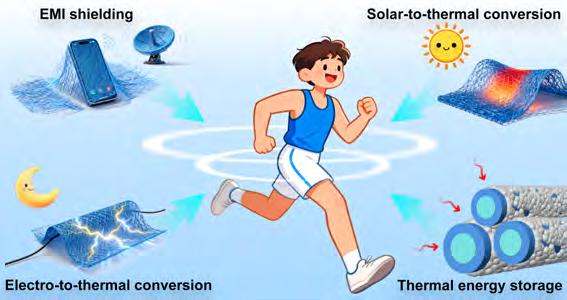
andEMIshielding.
nanoparticles.PPyisanattractiveconductivepolymerowingtoitsintrinsicconductivityandbroadspectral absorption[27].Intheproposedcomposite,PPyimpartsefficientelectricalconductivityforEMIshielding andJouleheating,aswellasexcellentsolarabsorption(~94%)forsolar-to-thermalconversion.Theresulting PVDF-PW@PPyfibermembraneislightweight,flexible,andexhibitsafavourablethermalstoragecapacity (82.84J/g).Moreover,itsEMIshieldingeffectiveness(SE)canbefurtherenhancedthroughasimple origami-inspiredstructuraldesign.Overall,thismultifunctionalcompositefilmdemonstratesconsiderable potentialforapplicationsinthermalmanagementandEMIshielding,providingimportantinsightsforthe developmentoflightweight,flexible,andsustainablewearabletextiles.
RESULTSANDDISCUSSION
Inthispaper,aphasechangecompositefilmwithexcellentthermalmanagementpropertiesandEMI shieldingperformancewasconstructedbasedoninterfacialengineeringstrategies.Wefirstprepareda PVDF-PWfibremembranethroughcoaxialelectrospinningtechnologywithPWforthecorematerialand PVDF-HFPfortheshellmaterial.Thisfibremembranecombinesleakageresistancewithphasechange energystoragecapabilitieswithoutcompromisingflexibility.Subsequently,PPywaspolymerisedonthe surfaceofPVDF-PWtoobtainthePVDF-PW@PPycompositefilm(Figure1a).TheaggregatedPPy exhibitsexcellentelectricalconductivityandlightabsorptioncapacity,endowingthecompositefilmwith outstandingJouleheatingcharacteristics,photothermalconversionperformance,andEMWsresistance capabilities.
TheconstructioneffectofPVDF-PW@PPycanbeinitiallyassessedthroughtheirmacro-andmicrostructures(Figure1b).TheobtainedPVDF-PWmembraneiswhiteincolour,withasmoothsurfaceandan averagefibrediameterof2–6μm.Thesefibresintertwinewitheachotherandoverlaptoformathreedimensionalmeshstructure.Transmissionelectronmicroscopy(TEM)testingshowsthatPWwasencapsulatedperfectlyinside,formingadistinct‘core-shell’structure.Thisdistinctcore-shellstructureis criticalforconfiningthePWmolecularchainsduringmelting,therebyendowingthecompositemembrane withexcellentanti-leakageproperties.Toverifythis,wesubjectthesamplestoa70°Cenvironmentfor2h.
Scheme1 SchematicillustrationofPVDF-PW@PPycompositefilmbasedoninterfacialengineeringstrategiesforthermalmanagement
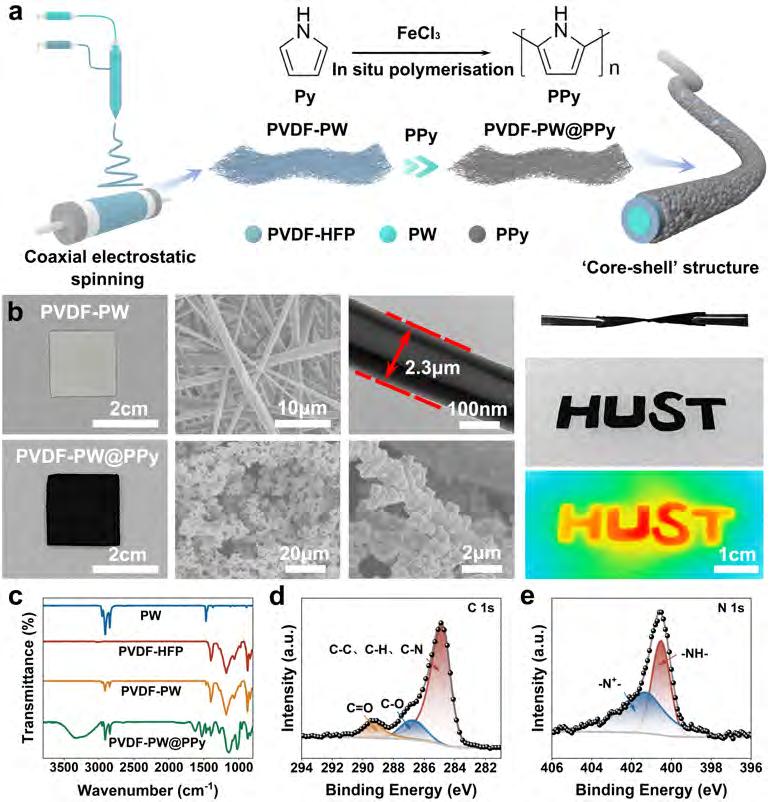
Figure1 FabricationprocessandpreparationeffectofPVDF-PW@PPycompositefilm.(a)PreparationprocessdiagramofPVDFPW@PPy.(b)Macro-andmicrostructuresofthesample.(c)FT-IRcurve.(d)High-resolutionC1scurveand(e)N1scurveofPVDFPW@PPy. NatlSciOpen,2026,Vol.5,20250063
AsshowninFigureS1,whilepurePWexhibitssevereleakage,boththePVDF-PWandPVDF-PW@PPy compositefilmsretaintheirstructuralintegritywithoutanyleakage,confirmingtheeffectiveencapsulation providedbythePVDF-HFPshell.AfterPPypolymerisation,thePVDF-PW@PPycompositemembrane exhibitsamorepronouncedblackappearance.PVDF-PW@PPycompositefilmspreparedwithdifferent polymerizationtimesexhibitednodiscerniblecolorvariation(FigureS2).Excellentcompatibilitywas observedbetweenthePPycoatingandthePVDF-PWsubstrate.Ascanbeseenfromthescanningelectron microscopy(SEM)imagesthatnumerousnanoscalePPyparticleswereuniformlyformedonthesurfaceof PVDF-PW.Theseparticlesinterconnectedseamlessly,envelopingthefibroussubstratetoconstitutea continuousandroughouterlayer.
ThepolymerizationtimesignificantlyinfluencesthemicrostructureofPVDF-PW@PPy.Extendingthe durationofpolymerizationresultsinincreasinglydenseandcompactconnectionsamongthePPynanoparticles.Atashorterpolymerizationtime(2h),PPyonlypartiallycoversthePVDF-PWsurface,with
discerniblegapspresent.Incontrast,prolongedpolymerization(6h)leadstoexcessiveaggregationof nanoparticles(FigureS3).Whenthepolymerizationtimewasmaintainedatanintermediatedurationof4h,a continuousanduniformnanoparticlelayerwasformed,achievingcompletecoverageofthePVDF-PW membrane.ThepreparedPVDF-PW@PPycompositefilmwasapproximately960μminthickness.Energy dispersiveX-rayspectroscopy(EDS)resultsindicatethatthemaincharacteristicelementsCandNofPPy wereuniformlydistributedonthesurfaceofthefibremembraneafter insitu polymerisation.Onlyasmall amountofFelementsfromPVDF-HFPcanbeobserved,whichinitiallydemonstratesthatthePVDFPW@PPycompositefilmwassuccessfullyconstructed(FigureS4).TheobtainedPVDF-PW@PPycompositefilmexhibitsexcellentflexibility.Itcouldbeeasilytwisted,folded,andbentwithoutcausingany damage(FigureS5).Thefilmcouldalsobecarefullytailoredinto‘HUST’patterns,demonstratingoutstandingmanipulability.ThestackedPPynanoparticlesendowthemembranewithexceptionalphotothermal conversioncapacity,enablingrapidtransformationofsolarenergyintothermalenergyunderillumination,as willbeillustratedindetailbelow(Figure1b).
ThesuccessfulsynthesisofthePVDF-PW@PPycompositemembranecanalsobedemonstratedthrougha seriesofchemicalcharacterisationmethods,includingFouriertransforminfraredspectroscopy(FT-IR),Xraydiffraction(XRD)andX-rayphotoelectronspectroscopy(XPS)spectra.AsshowninFigure1c,the strongandsharppeaksat2911and2847cm 1 intheFT-IRspectrumareattributedtotheasymmetric stretchingvibrationandsymmetricstretchingvibrationofmethylene,respectively,whilethepeakat 1468cm 1 isattributedtothebendingvibrationofC–HinPW[28–30].ThecharacteristicpeakofPVDFHFPat1400cm 1 belongstothebendingvibrationof–CH2.Thepeakat1177cm 1 isattributedtothe asymmetricstretchingvibrationof–CF2,whilethepeakat872cm 1 correspondstothesymmetricstretching ofCF2 andC–C[31,32].AfterPPypolymerisationreaction,thepresenceofthepyrroleskeletonwas confirmedbytheappearanceofnewpeaksat3330cm 1 (N–Hstretchingvibration),1536and1468cm 1 (C=Cstretchingvibration),and1326cm 1 (C–Nstretchingvibration)[33,34].Inaddition,abroadandlarge characteristicpeakappearsataround1145cm 1,indicatingthatthepolymerisedPPyexhibitsaconductive state.TheaboveresultsindicatethatPywaspolymerisedonthePVDF-PWsurfaceundertheeffectofFeCl3 solution.
IntheXRDpatternofPW,severalintensediffractionpeaksareobservedat2θ =7.11°,10.60°,14.07°,and 23.46°[35].PVDF-HFPexhibitsthreediffractionpeaksat2θ =18.33°,19.77°,and26.68°,correspondingto the(100),(110),and(021)crystalplanesoftheα-phase,respectively[36].ThepresenceofpolymerizedPPy hasanegligibleinfluenceontheXRDpatternofthecompositemembrane,whichcanbeattributedtothe amorphousnatureofPPy(FigureS6).AsevidencedbytheFT-IRandXRDspectra,allcharacteristicpeaks ofPVDF-PWandPPycouldbeseeninthecurvesofPVDF-PW@PPycompositeandnonewpeakswere generated,indicatingthatthesetwocomponentswerecombinedonlythroughphysicalmethods.
ThesuccessfulpolymerisationofPPycanalsobeconfirmedbyXPSanalysis(FigureS7).InthehighresolutionC1sspectrumofPVDF-PW@PPycompositefilm,theobtainedspectrumcanbefittedintothree peakslocatedat289.30,286.80,and284.80eV,correspondingtotheelectronicpeaksofC=O,C–O,and C–C/C–H/C–Ninthecomposites(Figure1d).The–N+–(401.31eV)and–NH–(400.52eV)peaksobtained fromthefittedN1sspectrumcorrespondtotheNelementsonthepyrroleunitswithinPPy(Figure1e) [37,38].Additionally,PPysignificantlyinfluencedthesurfacepropertiesofthecompositefilm.Thewater contactangle(WCA)ofPVDF-PWwas124°whenleavingfor30s.Incontrast,theWCAofthePVDFNatlSciOpen,2026,Vol.5,20250063
PW@PPycompositefilmdecreasedsharplyto36°withinjust1s.Thewaterdropletssubsequentlyspread andabsorbedrapidlyonthecompositesurface,indicatingthatthepolymerizedPPyeffectivelytransformed thematerialfromhydrophobictohydrophilic(FigureS8).Hence,itcanbeinferredfromtheaboveresults thatPPywassuccessfullypolymerisedonthesurfaceofPVDF-PWfibres.
ThecontentofPWsignificantlyinfluencestheenergystorageperformanceofthecompositefilmasitacts astheprimaryPCMs,whiletheremainingPVDF-HFPandpolymerisedPPyserveasphysicalsupport materialsandfunctionalmodifiers.Hence,theenthalpyandphasechangetemperaturesofPVDF-PW@PPy compositefilmswithdifferentpolymerisationtimesweretested.ItcanbeseenthatpurePWexhibitssuitable thermalenergystoragecapacityandphasechangetemperatures.Themeltingandcoolingenthalpies(ΔHm/ ΔHc)weremeasuredtobe229.33and232.98J/g,respectively,whilethecorrespondingphasechange temperaturesduringmeltingandcooling(Tm/Tc)were37.72and30.52°C,respectively(FigureS9).The valuesofΔHm andΔHc forthePVDF-PWfibremembranedecreasedto111.11and111.74J/g,respectively, whilethephasechangetemperaturesremainedlargelyunchanged.AfterPPypolymerisation,thedifferential scanningcalorimetry(DSC)curvesofPVDF-PW@PPycompositefilmsunderdifferenttreatmenttimes wereessentiallythesame(FigureS10).TheheatstoragecapacityofPWwasinheritedbyPVDF-PW@PPy. ThevaluesofΔHm andΔHc wererangedbetween86.43–76.50and86.78–76.62J/g,respectively.Bothof themdecreasedwithextendedpolymerisationtime(FigureS11),whileonlythevaluesof Tm and Tc remained relativelystable(FigureS12).Hence,theaggregatedPPyhaslittleeffectonthemeltingandcooling processesofthePVDF-PW@PPycompositefilm,whichisbeneficialforachievingfavourablethermal performance.
ThethermalstabilityofPVDF-PW@PPycompositefilmswastested(FigureS13).BothpurePWand PVDF-HFPundergoone-stepdegradation,withmaximumdegradationtemperaturesof227.97and 461.20°C,respectively[39,40].ThePVDF-PWmembranepreparedbycoaxialelectrospinningundergoes twoprocessesofdegradation,correspondingtothethermaldecompositionofPW(200.03°C)andPVDFHFP(449.60°C).ThedegradationprocessofPVDF-PW@PPycompositefilmwaschangedslightlyafter PPytreatment,withthemaximumdegradationtemperaturerisingto466.18°C.Inaddition,theresidual carbonrateofPVDF-PW@PPy(27.59%)wasslightlyhigherthanthatofPVDF-PW(11.63%)within 600°C.ItindicatesthatthepolymerisedPPyslightlyimprovedthethermalstabilityofthePVDF-PW@PPy compositemembrane.Besides,therewasnoobviousthermaldecompositionorweightlosswithin100°C, whichmeansthatthepreparedPVDF-PW@PPycankeepstableperformanceintheworkingtemperature range.
ConductivitydeterminesbothJouleheatingcapacityandEMIshieldingefficacy.Asatypicalconductive polymer,PPyformscontinuousconductivepathwaysonthesurfaceofPVDF-PWfibremembranes,andthe polymerizationtimesignificantlyinfluencestheformationofthesepathways.Inordertoensuresuperior outputperformance,theconductivityofthecompositefilmsunderdifferentpolymerisationtimeswastested. ItcanbeseenthattheconductivityofthePVDF-PW@PPycompositefilmsrangedfrom0.74to1.35S/cm. Withincreasingpolymerizationtime,theconductivityinitiallyincreasedandsubsequentlydecreased, reachingamaximumvalueafter4hofpolymerization(Figure2a).Hence,thesubsequentdiscussionwill onlyfocusonthePVDF-PW@PPycompositefilmwithpolymerisationtimeof4hbasedontheresultsof microstructuralanalysis,thermalenergystoragecapacity,andelectricalconductivitytesting.
Wetheninvestigatedtheresistancecharacteristicsofthecompositefilm,whichiscrucialforJouleheating
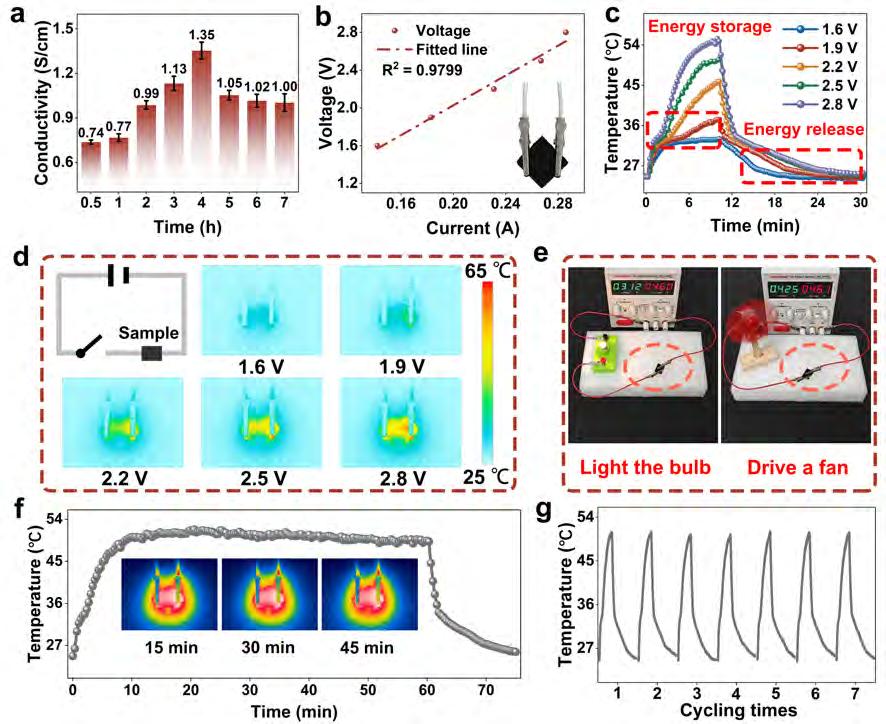
Figure2 Electro-to-thermalconversiontestingofPVDF-PW@PPycompositefilms.(a)Electricalconductivityofthecompositefilmat differentpolymerisationtimes.(b)Voltage-current(V-I)curveofthecompositefilm.(c)Temperatureofthecompositefilmatdifferenttest voltages.(d)Principleoftheelectro-to-thermalconversiontestandarepresentativeinfraredthermalimagecapturedat10minafterapplying avoltageof2.5V.(e)Imagesofcompositefilmilluminatingabulbordrivingasmallfanwithinaclosedcircuit.(f)Temperaturecurveofthe compositefilmduringlong-timetesting.(g)Temperaturecurveofthecompositefilmduringsevencontinuoustestsat2.5V.
properties.ThevoltageatthetwoendsofPVDF-PW@PPycompositefilmwasproportionaltothecurrent passingthrough(R2 =0.98)undertestingvoltageof1.6–2.8V,demonstratingexcellentohmiccharacteristics (Figure2b).Furthermore,whenincorporatedintoanelectricalcircuit,thecompositefilmcanilluminatea bulbordriveafan,confirmingitsexcellentconductivityandthepotentialforelectrical-to-thermalconversion(Figure2e).Basedonthischaracteristic,thesurfacetemperatureofthecompositefilmatdifferent voltageswasrecorded.Therelevanttestcircuitandsomeinfraredthermalimagingdiagramsareshownin Figure2d.Whenthecircuitwasconnected,thesurfacetemperatureroserapidlyastheelectricalenergy providedbythepowersourcecouldbepromptlyconvertedintothethermalenergyofPVDF-PW@PPy, whilethetemperaturedroppedsharplywhenthecircuitwasdisconnected(Figure2c).Itcanbeobservedthat oncethepowerswitchwasturnedon,thetemperaturecanriserapidlywithinafewseconds,demonstrating excellenttemperatureresponsecapability.Atdifferenttestvoltages,therecordedmaximumtemperatures within10minwere33.1,37.4,45.8,50.7,and55.2°C,respectively.Itshowsthattheintendedtemperature canbeadjustedthroughappropriateinputvoltageandchargingtime,makingthePVDF-PW@PPycomposite
filmapotentialalternativeforspecificthermaltherapyrequirements[41].Notably,distinctphasechange plateauswereobservedduringbothheatingandcoolingprocesses,correspondingtothesolid-liquidand liquid-solidtransitionsofthePW,respectively.Inaddition,thecompositefilmalsofeaturesastableelectrical-to-thermalconversioncapability,whosetemperaturesremainedlargelyunchangedthroughoutaprolongedone-hourtest(Figure2f).Evenaftersevenconsecutiveoperationalcyclesat2.5V,itstillachieves stableoutputperformance,demonstratingexcellentcyclingreliability(Figure2g).
Thecompositefilmalsoexhibitsimpressivesolar-to-thermalconversioncapability.Benefitedfromthe stronglight-trappingabilityofPPy,theabsorbanceofPVDF-PW@PPywasincreasedfrom7.46%to95.47% withinthesolarspectrum(AM1.5)afterPPypolymerisation(Figure3a).Toevaluatetheactualsolar-tothermalconversionperformanceofthePVDF-PW@PPy,atestapparatuswasconstructed(Figure3b).When thesimulatedXenonlampwasturnedon,thetemperatureofthecompositefilmrosesharplyduetothelight energywasconvertedintothethermalenergyofPVDF-PW@PPy,andthetemperaturedroppedrapidly whentheXenonlampwasturnedoff(Figure3c).Figure3dshowsapartialinfrared(IR)thermalimageofthe sampleunder1.0sun(1.0kW/m2)radiation.Themaximumtemperaturesofthecompositefilmunder10min illuminationat0.6–1.0sunwere39.1,42.5,44.7,47.5,and50.2°C,respectively.Duringtheheatingprocess, adistinctphasechangeplateauwasalsoobservedinthetemperaturerangeof32–40°C,indicatingthatthe PWinsidePVDF-PW@PPycaneffectivelystorethesolarenergyintheformoflatentheat.Duringthe coolingprocess,thecoolingratesignificantlydecreasesbelow30°C,whichisattributedtothereleaseof heatstoredwithinPW.Incontrast,themaximumtemperatureofPVDF-PWreachedonly28.9°Cunderthe samelightintensityandexposuretime.Evenwhenthelightintensityincreasedto2.0sun,theelevated temperaturewasstillfarbehindthatofthePVDF-PW@PPycompositefilm(Figure3eandf).Itcanbe attributedtothePVDF-HFPcoatingonthesurfaceofPVDF-PW,whichexhibitsstrongreflectivityand significantlyimpedestheeffectiveabsorptionandconversionofsolarenergy.WhenPPynanoparticleswere loaded,thelight-absorbingcapacityofPVDF-PWcompositefilmwasgreatlyenhanced.Thesolar-tothermalconversionefficiency(η)ofthecompositecanbeobtainedusingthefollowingformula[6,42,43]:
mH
PStt = × ××( ) m 21
ThespecificparametersareshowninTableS1.Itcouldbeseenthatthe η wasincreasedwithlightintensity sincetheheatprovidedbythesolarenergycouldbetransformedintothethermalenergyofPVDF-PW@PPy compositefilmintime.After10minofirradiationat0.6sunlightintensity,theenergyabsorbedbythe compositefilmwasinsufficienttosupportthecompletephasetransitionofPWwithinthefilmfromsolidto liquidstate.Acompletedphasetransitionprocesscanbeachievedoncethelightintensityexceeds0.6sun. Hence,thevalueof η wasincreasedfrom62.02%to93.95%whenthelightintensityrosefrom0.7sunto1.0 sun(Figure3g).Evenduringtencontinuoustests,thetemperaturerisecurvesandpeaktemperatures remainedlargelythesame,confirmingthestablesolar-to-thermalconversioncapabilityofPVDF-PW@PPy (Figure3h).
Thesolar-to-thermalconversionmechanismofPVDF-PW@PPycanbeexplainedbyFigure3i.First,the PVDF-PWmembranewascomposedofnumerousinterlacedfibres.Thespecificsurfaceareaoftheprepared PVDF-PW@PPycompositefilmwasgreatlyenhancedafterpolymerisationofanumberofnanoscalePPy molecules.Moreover,thecompositefilmalsoexhibitsnumerousporestructuresatmicro-andnanoscale levels.ThesehierarchicalporousstructurescaneffectivelyenhancetheinteractionbetweenlightandPVDF-
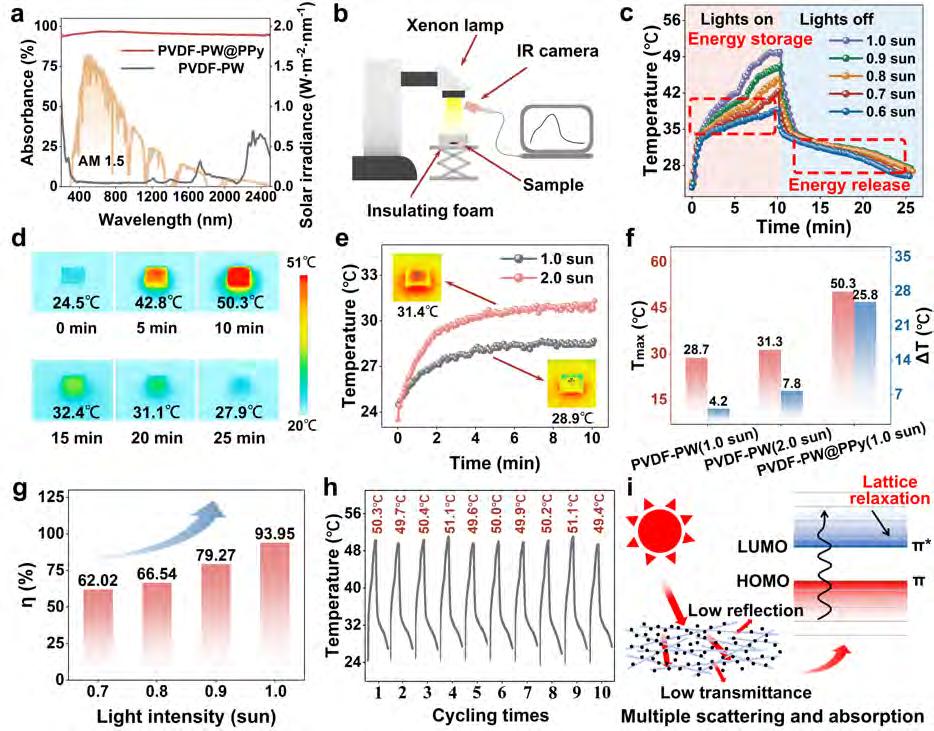
Figure3 Solar-to-thermalconversiontestingofPVDF-PW@PPy.(a)Absorbanceofthecompositefilm.(b)Schematicdiagramofthe solar-to-thermalconversiontestingdevice.(c)TemperaturecurvesofPVDF-PW@PPyunderdifferentlightintensities.(d)Partialinfrared thermalimagingduringtesting.(e)Temperaturecurvesunder1.0and2.0sunlightintensities.(f)Maximumtemperatureandtemperature differenceunderdifferenttestconditions.(g)Solar-to-thermalconversionefficiencyunderdifferentlightintensities.(h)Temperaturecurves ofthecompositefilmundertencontinuousphotothermalconversiontests.(i)Solar-to-thermalconversionmechanism.
PW@PPythroughlightcaptureeffectsandextendthelightpath[44,45].Asaresult,mostofthelightcanbe effectivelyabsorbed,whileonlyasmallportionisdissipatedthroughreflectionandtransmission.Inaddition, thepyrroleringofPPyfeaturesasubstantialnumberofhighlyconjugatedπelectronsystems,whichhelpsto reducetheenergydifferencebetweenthehighestoccupiedmolecularorbital(HOMO)andthelowest unoccupiedmolecularorbital(LUMO)[46].TheconjugateddoublebondsinsidePPyaremorelikelyto undergoatransitionfromπtoπ*undersolarradiation[47,48].OncethePVDF-PW@PPycompositefilm wasexposedtotheenergythatcouldtriggerelectrontransitions,theabsorbedlightwouldexciteelectrons fromthegroundstatetoahigherenergyorbit.Theseexcitedelectronswouldthenreturntothegroundstate throughintenselatticerelaxationandconvertsolarenergyintoheatenergy[49].Hence,thepreparedPVDFPW@PPycompositefilmhasanexcellentsolar-to-thermalconversionability,whichisbeneficialforefficientsolarenergycaptureandutilisation.
Inadditiontoactivethermalmanagementcapabilities,EMIshieldingpresentsanothercriticalchallenge forbothhumanhealthandelectronicdevices[50].InordertoevaluatetheEMIshieldingcapabilityofthe
PVDF-PW@PPy,thevaluesofEMISEweretested(Figure4a).PurePVDF-PWfilmexhibitsnegligibleSE. Incontrast,thePVDF-PW@PPycompositemembraneachievesanaverageSEof20.43dBatadensityof 0.26g/cm3,satisfyingcommercialrequirementsof20dB[51].ItindicatesthattheaggregatedPPyhasa significantinfluenceontheEMIshieldingperformance.Additionally,thePVDF-PW@PPycompositefilm canbefoldedintomulti-layerstructuresviaasimpleorigamitechniqueowingtothesuperiormechanical flexibility.TheSEofthecompositefilmreached23.29and29.71dBafterone-timeandtwo-timefolding, respectively.AccordingtoSchelkunoff’stheory,thetotalSE(SET)canbedividedintotheabsorption efficiency(SEA)andthereflectionefficiency(SER)whenSET exceeds15dB.TofurtheranalysetheEMI shieldingpropertiesofPVDF-PW@PPy,SEA andSER werecalculated.ThevaluesofSER remainednearly unchangedacrossdifferentfoldingcounts(4.93–7.15dB).Incontrast,theSEA increasedfrom15.25to 24.78dBwhenthefoldingnumberwastwo(Figure4b).Moreover,theratioofSEA toSER indifferentlayer membranesrangedfrom2.3to5.0(Figure4c).
TheEMIshieldingmechanismofPVDF-PW@PPyisillustratedinFigure4d.TheaggregatedPPyformsa conductivelayeralongwiththePVDF-PWcoaxialelectrospunfibres.ThisresultsintheincidentEMWs beingpartiallyreflectedbackintotheenvironmentuponencounteringthecompositefilmsurfaceduetothe severeimpedancemismatchbetweenthecompositefilmandthesurroundingair[52].TheresidualEMWs penetrateintotheporousPVDF-PW@PPy,whereaportioninteractswiththedepositedPPyandattenuatesto generateohmiclosses[53].AccordingtotheMaxwell-Wagner-Sillarsinterfacepolarisationprinciple,the highlyconductivenetworkstructureofPPyprovidesanamplesupplyofmobilechargecarriersatthe membranesurface.Thisenhancesthepolarisationeffectattheinterfacebetweenthefibreandair,thereby promotingthedissipationofEMWs[54].Moreover,theroughfibrestructureeffectivelyextendsthepropagationpathofEMWs,facilitatingtheirgradualattenuationthroughmultiplereflectionandscattering processeswithintheinterstitialspacesofthecompositemembrane[19].Consequently,themajorityofthem wereultimatelyabsorbedandconvertedintothermalenergy,withonlyasmallfractiontransmittingthrough thecompositemembrane.Hence,theenhancementofSET throughfoldingcanbeprimarilyattributedtoa significantincreaseinSEA.Theorigami-inspiredfoldingprocesscreatesamulti-layerstructurewithadditionalair-materialinterfacesandmoreintricateinternalconductivenetworks.WhenincidentEMWspenetratethislayeredassembly,theyundergorepeatedreflectionandscatteringbetweentheinternalinterfaces andtheconductivePPylayers.ThisprocesseffectivelyprolongsthepropagationpathoftheEMWswithin thematerial,allowingformoreefficientenergydissipationthroughohmicandpolarizationlosses.Consequently,theSEA risesmarkedly,asobservedinFigure4b,whiletheSER remainsrelativelyconstant.This absorption-dominantshieldingmechanismishighlydesirable,asitminimizessecondaryelectromagnetic pollution[55,56].
WealsoverifiedtheactualEMIshieldingperformanceofPVDF-PW@PPythroughasimpledevice,as showninFigure4e.Whentheswitchofthedevicewasturnedon,awirelesslight-emittingdiode(LED) positionedneartheTeslacoilcouldbeilluminatedduetothepresenceoftheelectromagneticfield.Whenthe PVDF-PWmembranewasinsertedbetweentheLEDandtheTeslacoil,thebrightnessofthebulbremained unaffected.Bycontrast,thebulbwasextinguishedwhenthePVDF-PW@PPycompositemembranewas inserted,astheelectromagneticsignalsgeneratedbytheTeslacoilwereisolatedordisrupted.Oncethe compositefilmwasremoved,theLEDcouldreturntoitsoriginalbrightnessrapidly.Hence,itfurther demonstratesthatthepreparedPVDF-PW@PPycompositefilmexhibitsexcellentEMIshieldingperfor-
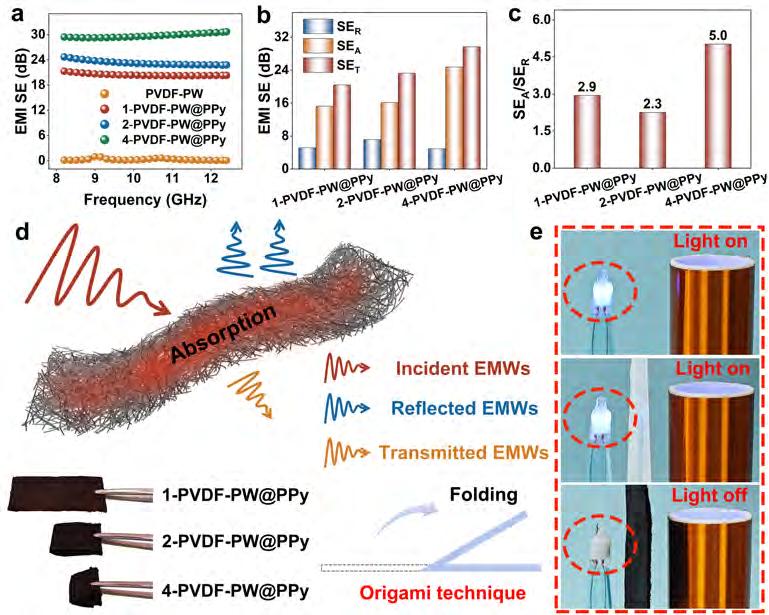
Figure4 EMIshieldingperformancetestingofPVDF-PW@PPy.(a)EMIvaluesofthecompositefilmatdifferentfrequencies.(b)SER, SEA,andSET valuesofthecompositefilm.(c)RatioofSEA toSER.(d)EMIshieldingmechanism.(e)PracticalapplicationofEMIshielding.
mance.
Inaddition,thePVDF-PW@PPycompositefilmalsofeaturesafavourablethermalreliability.Wesubjecteditto100thermalcyclesbetweenroomtemperatureand70°Candcomparedtheperformancebefore andaftertesting.TheFT-IRandopticalabsorptionpropertiesofthecompositefilmremainedbasically unchanged(FigureS14),whiletheabsorbancedecreasedslightlyby2.25%(FigureS15).AlltheDSC curves,enthalpyvalues,andphasechangetemperaturesofthesampleswerenearlyconsistentbeforeand aftertesting,indicatingthatthePVDF-PW@PPycompositefilmcanmaintainstablethermalproperties duringmultipleheatingandcoolingcycles(FigureS16).Thestablephasechangeenergystoragecapability andthermalreliabilityensureamorecomprehensiveroleforPVDF-PW@PPyinthefieldofthermal management.
CONCLUSIONS
Insummary,anadvancedcompositefilmintegratingpassiveandactivethermalmanagementcapabilities withEMIshieldingperformancewaspresentedinthisstudybasedoninterfacialengineeringstrategies.The compositefilmobtainedviacoaxialelectrospinningexhibitsexcellentflexibilityandphasechangeenergy storagecapacity(82.84J/g).Subsequently,the insitu polymerisedPPynanoparticlesformedcontinuous
NatlSciOpen,2026,Vol.5,20250063
electronicconductionpathwaysalongthefibres,endowingthecompositemembranewithactivethermal managementcapabilities,includingbothJouleheatingandsolar-to-thermalconversionfunctions.Sucha membraneachievesasolar-to-thermalconversionefficiencyof93.95%under1.0sunirradiation.Moreover, itexhibitssatisfactoryEMIshieldingperformance,andtheEMISEcanbeenhancedto29.71dBthrougha simpleorigamitechnique.Insummary,thepreparedPVDF-PW@PPyexhibitsbroadapplicationinboth thermalmanagementandEMIshieldingareas,providingsignificantinsightsfortheconstructionoflightweight,flexibleandsustainablemultifunctionalwearabletextiles.
METHODS
DetailedmaterialsandmethodsareavailableintheSupplementaryinformationonline.
Dataavailability
Theoriginaldataareavailablefromcorrespondingauthorsuponreasonablerequest.
Funding
ThisworkwassupportedbytheNationalNaturalScienceFoundationofChina(52473033).
Authorcontributions
X.H.andX.L.designedtheexperiments.R.W.,B.Q.andM.H.carriedouttheexperiments.R.W.andX.H.analyzedthedata andwrotethemanuscript.R.W.,X.H.andX.L.discussedtheresultsandcommentedonthemanuscript.
Conflictofinterest
Theauthorsdeclarenoconflictofinterest.
Supplementaryinformation
Thesupportinginformationisavailableonlineathttps://doi.org/10.1360/nso/20250063.Thesupportingmaterialsare publishedassubmitted,withouttypesettingorediting.Theresponsibilityforscientificaccuracyandcontentremainsentirely withtheauthors.
References
1LiuL,YuanD,HuX, etal. Wind-proofandmoisturepermeabilityaerogel-functionalizedtextileasall-seasonalpassive thermalregulators. AdvFunctMater 2024; 34:2411551.
2YangP,JuY,HeJ, etal. AdvancedJanusmembranewithdirectionalsweattransportandintegratedpassivecoolingfor personalthermalandmoisturemanagement. AdvFiberMater 2024; 6:1765–1776.
3LiuH,XiaoY,ShenY, etal. Self-adaptiverapidthermalconductivefabricsbasedonhygroscopicshrinkageresponse forpersonalcoolinganddrying. ACSApplMaterInterfaces 2024; 16:7917–7926.
4DangC,WangZ,Hughes-RileyT, etal. Fibres—threadsofintelligence—enableanewgenerationofwearablesystems. ChemSocRev 2024; 53:8790–8846.
5NiuP,MaoH,LimKH, etal. Nanocellulose-basedhollowfibersforadvancedwaterandmoisturemanagement. ACS Nano 2023; 17:14686–14694.
NatlSciOpen,2026,Vol.5,20250063
6NiuZ,YuanW.Smartnanocompositenonwovenwearablefabricsembeddingphasechangematerialsforhighly efficientenergyconversion-storageanduseasastretchableconductor. ACSApplMaterInterfaces 2021; 13:4508–4518.
7GuB,LiG,ZhangQ, etal. Anovelmethodforincreasingphase-changemicrocapsulesinnanofibertextilethrough electrospinning. AdvFunctMater 2024; 35:2412089.
8LiX,ShengX,FangY, etal. WearableJanus-typefilmwithintegratedall-seasonactive/passivethermalmanagement, thermalcamouflage,andultra-highelectromagneticshieldingefficiencytunablebyorigamiprocess. AdvFunctMater 2023; 33:2212776.
9XuF,ZhangT,XuZ, etal. Solid-solidphasechangefiberswithenhancedenergystoragedensityfortemperature management. JEnergyStorage 2024; 79:110190.
10WangY,HuJ,JiaY, etal. Nano-structuredmulticores-sheaththermoregulationtextilewithroomtemperaturephase changepointviacoaxialelectrospinning. JEnergyStorage 2024; 100:113639.
11LinY,JiaY,AlvaG, etal. Reviewonthermalconductivityenhancement,thermalpropertiesandapplicationsofphase changematerialsinthermalenergystorage. RenewSustainEnergyRev 2018; 82:2730–2742.
12GuoD,MuC,LiuQ, etal. Aramidnanofiber/polypyrrolecompositefilmsforbroadbandEMIshielding,wearable electronics,Jouleheating,andphotothermalconversion. ACSApplNanoMater 2023; 6:15108–15118.
13YangD,ZhouB,HanG, etal. Flexibletransparentpolypyrrole-decoratedMXene-basedfilmwithexcellent photothermalenergyconversionperformance. ACSApplMaterInterfaces 2021; 13:8909–8918.
14GongX,XiangL,QiX, etal. Improvedpolarizationlossandimpedancematchinginducedbycarbonpaper-based magneticheterostructuredcompositesforlightweightandstrongmicrowaveabsorption. AdvComposHybridMater 2024; 7:216.
15JiangH,SunH,ZhangS, etal. Lightweightandhigh-performancecarbonnanotubefabricsforelectromagnetic interferenceshielding. SciChinaMater 2025; 68:2071–2078.
16JiaT,HaoY,QiX, etal. Interfaceengineeringandimpedancematchingstrategytodevelopcore@shellurchin-like NiO/Ni@carbonnanotubesnanocompositesformicrowaveabsorption. JMaterSciTech 2024; 176:1–12.
17WangZL,WangM,LiLX, etal. Permeationbehavioroflow-melting-pointSn–Bialloyinthefiberchannelofpine wood. MaterDes 2020; 196:109068.
18KimJ,HongM,LeeD, etal. Mechanicallyrobustphase-changemultiscale-architectedmetastructuresintegrating asymmetricMXene/T-CNFaerogelforthermalenergystorageandelectromagneticinterferenceshielding. AdvFunct Mater 2025;e14180.
19CaoY,ZhaoZ,ZengX, etal. High-performancepolyimide/polypyrrole-CNTs@PEGcompositesforintegratedthermal managementandenhancedelectromagneticwaveabsorption. AdvComposHybridMater 2025; 8:104.
20WangH,XiaoJ,QiX, etal. Microstructuraloptimizationandnon-metallicdopingstrategytodevelopmesoporousNdopedcarbonhollownanospheresforstrongandbroadbandmicrowaveabsorption. JMaterSciTech 2026; 247:55–63.
21ChuG,NieZ,PengY, etal. Spin-coatingANFbasedmultilayersymmetriccompositefilmsforenhanced electromagneticinterferenceshieldingandthermalmanagement. JColloidInterfaceSci 2025; 679:521–530.
22ZhangX,LiJ,GaoQ, etal. Nerve-fiber-inspiredconstructionof3Dgraphene“Tracks”supportedbywoodfibersfor multifunctionalbiocompositewithmetal-levelthermalconductivity. AdvFunctMater 2023; 33:2213274.
23ZhaoY,ChenH,QiaoS, etal. Hierarchicallyporouspolyimide/grapheneaerogelswithsuperiorcompressibilityand electromagneticinterferenceshieldingperformance. JMaterChemA 2025; 13:22613–22620.
24SinghAK,ShishkinA,KoppelT, etal. Areviewofporouslightweightcompositematerialsforelectromagnetic interferenceshielding. ComposPartB-Eng 2018; 149:188–197.
25DuJ,LiT,LiJ, etal. DesignofflexibleMXene/graphene-basedfiberfabricsforbroadbandelectromagneticwave absorption. AdvFiberMater 2025; 7:811–826.
26IqbalA,SambyalP,KooCM.2DMXenesforelectromagneticshielding:Areview. AdvFunctMater 2020; 30: 2000883.
NatlSciOpen,2026,Vol.5,20250063
27GaoC,LiY,LanL, etal. Bioinspiredasymmetricpolypyrrolemembraneswithenhancedphotothermalconversionfor highlyefficientsolarevaporation. AdvSci 2023; 11:2306833.
28WuH,ChenR,ShaoY, etal. Novelflexiblephasechangematerialswithmussel-inspiredmodificationofmelamine foamforsimultaneouslight-actuatedshapememoryandlight-to-thermalenergystoragecapability. ACSSustainChem Eng 2019; 7:13532–13542.
29LiY,DiaoX,LiP, etal. AdvancedmultifunctionalCo/Nco-dopedcarbonfoam-basedphasechangematerialsfor wearablethermalmanagement. ChemEngJ 2024; 485:149858.
30WuH,LiS,ShaoY, etal. Melaminefoam/reducedgrapheneoxidesupportedform-stablephasechangematerialswith simultaneousshapememorypropertyandlight-to-thermalenergystoragecapability. ChemEngJ 2020; 379:122373.
31ChenZ,LiJ,ZhouJ, etal. PhotothermalJanusPPy-SiO2@PAN/F-SiO2@PVDF-HFPmembraneforhigh-efficient,low energyandstabledesalinationthroughsolarmembranedistillation. ChemEngJ 2023; 451:138473.
32LiuJZ,JiangW,ZhuoS, etal. Large-arearadiation-modulatedthermoelectricfabricsforhigh-performancethermal managementandelectricitygeneration. SciAdv 2025; 11:eadr2158.
33WangT,YangY,WeiR, etal. High-performanceandanti-leakagepolypyrrole-modifiedwood-basedcompositephase changematerialwithsuperiorphotothermalconversioncapability. JEnergyStorage 2025; 113:115696.
34GuoT,LiX,ZhouH, etal. Effectoflarge-sizedhydrophilicpolypyrroleonelectrochemicalpropertiesofMXenefilms. JPowerSources 2024; 593:233978.
35DaiH,YuanJ,KongX, etal. Shape-memoryphasechangematerialenhancedbyMWCNTforsolarphotothermal conversion. SolEnergyMaterSolCells 2024; 269:112756.
36LeiD,HuN,WuL, etal. ImprovementofthepiezoelectricityofPVDF-HFPbyCoFe2O4 nanoparticles. NanoMater Sci 2024; 6:201–210.
37LiY,ShanM,PengJ, etal. Ahighlystretchableandconductivecontinuouscompositefilamentwithbuckled polypyrrolecoatingforstretchyelectronictextiles. ApplSurfSci 2023; 610:155515.
38GanW,ChenC,GirouxM, etal. Conductivewoodforhigh-performancestructuralelectromagneticinterference shielding. ChemMater 2020; 32:5280–5289.
39KongL,LiYJ,KongX, etal. Anovelflexibleandfluoride-freesuperhydrophobicthermalenergystoragecoatingfor photothermalenergyconversion. ComposPartB-Eng 2022; 232:109588.
40HuY,WangT,ChengC, etal. SkeletonofPVDF-HFP/PEOforhigh-performancelithium-sulfurbatterycathode. J EnergyStorage 2024; 100:113631.
41WuY,DongL,TangS, etal. Aninnovativeazobenzene-basedphotothermalfabricwithexcellentheatrelease performanceforwearablethermalmanagementdevice. Small 2024; 20:2404310.
42HouM,ChenH,LiS, etal. ATri-modephotothermal,phase-change,andradiative-coolingfilmforall-day thermoelectricgeneration. AdvMater 2025; 37:2505601.
43YangJ,TangLS,BaoRY, etal. Largelyenhancedthermalconductivityofpoly(ethyleneglycol)/boronnitride compositephasechangematerialsforsolar-thermal-electricenergyconversionandstoragewithverylowcontentof graphenenanoplatelets. ChemEngJ 2017; 315:481–490.
44ChaiZ,FangM,MinX.Compositephase-changematerialsforphoto-thermalconversionandenergystorage:Areview. NanoEnergy 2024; 124:109437.
45ZhouM,ZhangL,ZhongL, etal. Robustphotothermalicephobicsurfacewithmechanicaldurabilityofmultibioinspiredstructures. AdvMater 2023; 36:2305322.
46HouL,LiS,QiY, etal. Advancingefficiencyinsolar-driveninterfacialevaporation:Strategiesandapplications. ACS Nano 2025; 19:9636–9683.
47LiS,ZhangN,ChenH, etal. Encapsulatingphasechangematerialsintomelamineformaldehydespongeassembled withpolypyrrolemodifiedhalloysitenanotubeforeffectivesolar-thermalenergystorageandsolar-thermal-electric conversion. JColloidInterfaceSci 2025; 682:423–435.
48HeJ,LiuF,XiaoC, etal. Fe3O4/PPy-coatedsuperhydrophilicpolymerporousfoam:Adoublelayeredphotothermal
NatlSciOpen,2026,Vol.5,20250063
materialwithasynergisticlight-to-thermalconversioneffecttowarddesalination. Langmuir 2021; 37:12397–12408.
49LiuP,HuangM,ChenX, etal. Polypyrrole-boostedphotothermalenergystorageinMOF-basedphasechange materials. InterdiscipMater 2023; 2:423–433.
50LiangQ,HeM,ZhanB, etal. Yolk-shellCoNi@N-dopedcarbon-CoNi@CNTsforenhancedmicrowaveabsorption, photothermal,anti-corrosion,andantimicrobialproperties. Nano-MicroLett 2025; 17:167.
51ZhangY,KongJ,GuJ.Newgenerationelectromagneticmaterials:Harvestinginsteadofdissipationsolo. SciBull 2022; 67:1413–1415.
52ZhouM,WangJ,ZhaoY, etal. Hierarchicallyporouswood-derivedcarbonscaffoldembeddedphasechangematerials forintegratedthermalenergymanagement,electromagneticinterferenceshieldingandmultifunctionalapplication. Carbon 2021; 183:515–524.
53ZhangX,YangY,YangG, etal. RobustPIcompositeswithhigh-connectedAgNPsformultifunctionalelectromagnetic interferenceshieldinginharshenvironment. ComposPartB-Eng 2025; 305:112735.
54LeeS,NguyenNK,KimM, etal. Conductivity-controlledpolyvinylidenefluoridenanofiberstackforabsorptiondominantelectromagneticinterferenceshieldingmaterials. ACSApplMaterInterfaces 2023; 15:33180–33189.
55ChenY,MengY,ZhangJ, etal. Leakageproof,flame-retardant,andelectromagneticshieldwoodmorphologygenetic compositephasechangematerialsforsolarthermalenergyharvesting. Nano-MicroLett 2024; 16:196.
56XiaoJ,ZhanB,HeM, etal. Mechanicallyrobustandthermalinsulatingnanofiberelastomerforhydrophobic, corrosion-resistant,andflexiblemultifunctionalelectromagneticwaveabsorbers. AdvFunctMater 2025; 35:2419266.
NationalScienceOpen 4:20250046,2025
https://doi.org/10.1360/nso/20250046
MaterialsScience
SpecialTopic:IntelligentMaterialsandDevices
Multi-scaleregulationofstructureandmaterialfor visible-infrared-LiDARmultispectralcamouflage
XinpengJiang1,#,JieNong1,#,WenhaoYuan2,#,XinLi1,JunxiangZeng1,XinyeLiao1,QiJiang1, JianjingZhao1,ZhaojianZhang1,*,ShaHuang1,HuanChen1,*,XinHe1,JiaguiWu3,PeiguangYan2 & JunboYang1,*
1CollegeofSciences,NationalUniversityofDefenseTechnology,Changsha410073,China;
2CollegeofPhysicsandOptoelectronicEngineering,ShenzhenUniversity,Shenzhen518060,China;
3SchoolofPhysicalScienceandTechnology,SouthwestUniversity,Chongqing400715,China
#Contributedequallytothiswork.
*Correspondingauthors(emails:zhangzhaojian@nudt.edu.cn(ZhaojianZhang);chenhuan11@nudt.edu.cn(HuanChen);yangjunbo@nudt.edu.cn(JunboYang)) Received12September2025;Revised25October2025;Accepted27October2025;Publishedonline29October2025
Abstract: Thedevelopmentofdetectiontechnologieshasdrivenanurgentneedformultispectralcamouflagecapabilities. However,therequirementformultispectralcamouflage,includingcoloredvisible(VIS)camouflage,adaptiveinfraredcamouflage,andmulti-bandlightdetectionandranging(LiDAR)camouflage,challengesconventionalsingle-designapproaches fromdesigntofabrication.Here,weproposeasimplifieddesignstrategythatenablesdecouplingbetweenmaterialand structuralregulation,therebyenhancingmultibandmodulationperformance.Fromvisibletonear-infrared(NIR)bands,thinfilmFabry-PérotcavitiesfacilitatesimultaneousvisiblestructuralcolorandNIRlaserbandabsorption.ThecalculatedVIS resultsareinexcellentconcordancewithexperimentalones( E <6).Experimentalmeasurementsfurtherdemonstrate broadband(900–1550nm)ultra-highabsorption(A >90%)intheNIRband.Theorders-of-magnitudedifferenceinwavelengthsenablesstructuraldimensionsdecoupling,effectivelyseparatingtheinfluenceofthearchitectureonvisibleandmidinfrared(MIR)performance.IntheMIRregion,themetadevicerealizesadaptiveinfraredthermalcamouflage(Δε8–14μm = 0.46)withLiDARcamouflagebasedonphase-changematerial.Especially,thepeakabsorptionreaches99.2%nearthe wavelengthof10.6μm(A10.6μm =92.1%).Moreover,themetadeviceexhibitsindependenttriple-banddisplayincludingVIS, laserandMIRbands.Ourstudyprovidesatheoreticalframeworkformulti-scaleopticalmodulationanddemonstratesbroad potentialforapplicationsinmultispectralcamouflage,multi-banddisplays,informationencryption,andradiativecooling.
Keywords: phasechangematerials,visible,infraredcamouflage,display,encryption
INTRODUCTION
Multispectralmanipulationtechnologyseekstoachieveelectromagneticwavesregulationcoveringmultiple ordersofmagnitudeinwavelength[1–4].Thiscapabilitycreatesnewopportunitiesforoptoelectronic devicesandpromisesbroadapplicationsacrossscienceandtechnology,suchasmaterialsscience[5–7], thermodynamics[8–10],informationscience[11,12],andmilitaryapplications[13–15].Inparticular,
©TheAuthor(s)2025.PublishedbySciencePressandEDPSciences.ThisisanOpenAccessarticledistributedunderthetermsoftheCreativeCommons AttributionLicense(https://creativecommons.org/licenses/by/4.0),whichpermitsunrestricteduse,distribution,andreproductioninanymedium,providedthe originalworkisproperlycited.
militaryapplicationsincreasinglyrelyondetectionsystemsthatcombinemultiplespectralsensingmodalities—includingvisiblesurveillance,lightdetectionandranging(LiDAR),andinfrared(IR)thermal imaging[16–18].Theevolutionofmultispectraldetectionmethodsintroducessignificantnewchallengesfor visible-infrared-LiDAR(VIS-IR-LiDAR)multispectralcamouflagetechnologies[19].
Recently,multispectralcamouflagehasincreasinglyconcentratedonopticalstructuredesigntoachieve desiredperformance.Cho etal.[20]developedlayeredmetamaterialscapableofsimultaneousinfraredand microwavecamouflage.Hahn etal.[21]utilizedametal-semiconductor-metal(MSM)metamaterialto integratevisibleandinfraredcamouflagefunctionalities.Nevertheless,thewidespreadadoptionofsuch micro-andnanostructuresishamperedbycomplexitiesinfabrication.Inaddition,multispectralstrategies constrainedbystructurallimitationslackadaptabilityincomplexandvariedenvironments.Meanwhile, material-basedapproacheshaveshownenhancedversatilityinmultispectralmanipulation.Kocabas etal. [22]introducedagraphene-basedoptoelectronicplatformthatsupportsmultispectralmodulationfrom visibletomicrowavefrequencies.Li etal.[23]demonstratedmultispectralmanipulationinthevisibleand microwaverangesusingvanadiumdioxide(VO2).However,theuniformityofthemodulatingmaterial resultsinsimultaneousresponseacrosstheentirespectrum,whichrestrictsitsapplicabilityincamouflage anddisplaytechnologies.Thus,neitherasinglestructuralapproachnorastandalonematerialmethodcan meetthegrowingdemandformultispectralmodulation.
Inourpreviouswork[24],independentbicolorinfraredregulationwasdemonstratedsuccessfullyusinga hybridofmultiplephase-changematerials,includingVO2,Ge2Sb2Te5 (GST),andIn3SbTe2.However, systematicinvestigationintoband-extendedfunctionalityhasremainedscarce.Here,weintroduceasimplifieddesignstrategybasedonmulti-scalestructuralandmaterialmanipulationtoachievemultispectral compatibilityacrossVIS,IR,andLiDARcamouflagebands.BasedonthenonvolatilityofGST[25]andthe widebandgapcharacteristicsofZnS[26],amultilayerthin-filmstructurecomposedofZnS/GST/Crwas designedandfabricated.Leveragingthin-filmarchitectureswithdistinctdimensionalfeatures,wavelengthselectiveregulationwaseffectivelyrealized.Byexaminingthespectralsensitivityofthematerials,we elucidatedtheunderlyingmechanismbehindband-specificmodulation.Theproposedmetadeviceexhibits severalkeyadvantages:richstructuralcolorinthevisiblespectrum,ultrabroadband(~650nm)andhighperformancecontinuousabsorption(A >90%)inthenear-infrared(NIR)region,andhighmodulation (Δε8–14μm =0.46)ofinfraredemissivitytogetherwithhigh-performanceabsorption(A10.6μm =92.1%)at 10.6μminthemid-infrared(MIR)band.Additionally,thedevicedemonstratesindependentinformation displaycapacityacrossdifferentbands—VIS,NIR,andMIR—eachrevealingdistinctpatterns.Thiswork establishesanewtheoreticalframeworkformultispectralmodulationandsuggestspromisingpotentialin multispectralcamouflage,radiativecooling,andadvanceddisplaytechnologies.
DISCUSSION
Fundamentaldesign
TheessentialcriteriaforVIS-IR-LiDARmultispectralcamouflagetechnologyinclude:(1)tunablecolor presentationwithintheVISband;(2)strongandbroadbandabsorptionintheNIRregiontosuppresslaser reflection;(3)adaptiveMIRemissivitycoupledwithhighlaserabsorptionat10.6μm.Toaddressthese
,2025,Vol.4,20250046
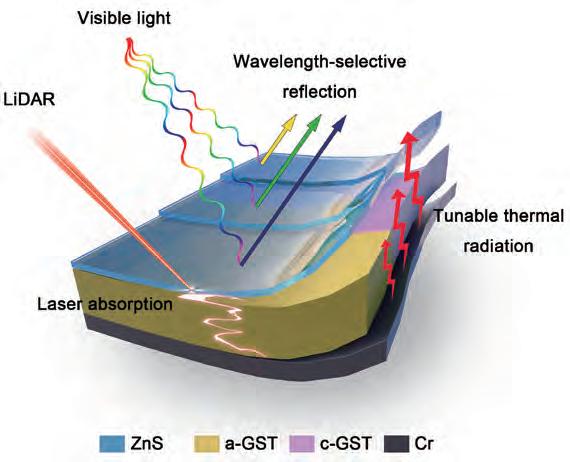
Figure1 TheschematicofVIS-IR-LiDARmultispectralcamouflagerealizedbysimplifieddesignformulti-scaleregulationofstructure andmaterial.
requirements,thefundamentalconceptofmulti-scaleregulationbasedoncombinedmaterialandstructural designisintroduced.AsillustratedinFigure1,wedesignedasimplifiedopticalmetadevice,comprisingatrilayerconfigurationofZnS,GST,andCr.Multispectralcompatibilityisachievedviastructuralmodulation andcoordinatedmaterialacrossdifferentscales.Specifically,theZnSlayerprovidesopticalcharacteristics suitablefromtheVIStoNIRbands,whiletheGSTlayerofoffersfunctionalitywithintheMIRband.A sufficientlythickCrlayerservesasareflectivemirror,effectivelyblockingbackpropagationofelectromagneticwaveacrossmultiplespectralbands.
Conventionalsingle-targetdesignsfaceconsiderabledifficultyinconcurrentlycontrollingbothvisibleand MIRspectralproperties,asthisnecessitatestwodecoupledmodulationmechanisms.Someresearchershave predominantlyfocusedonsinglebandmodulationthattargetsonespectralbandwhilemaintainingtheother steady-stateconditions,suchastransparentthermalradiationmodulation[27,28],microwavescatteringwith thermalmodulation[29],andcoloredradiativecooling[30,31].Theorders-of-magnitudedifferencein wavelengthsbetweenthevisibleandinfraredregimesallowsmetamaterialstomanipulatethesebands independently[32].Specifically,adjustingthethicknessofthetopdielectriclayerenablesmodulationof visibleandNIRreflectance,facilitatingbothvividstructuralcolorformationandbroadbandultra-high absorptionintheNIRband.Thereductionofreflectivityeffectivelysuppresseslaserechosignals,enhancing evasionagainstlaserdetection.Additionally,anopticalmicrocavitycomposedofaGSTlayerwitha thicknessmatchingtheMIRresonanceandametalmirrorallowsforprecisemodulationofMIRemissivity andhighlyefficientabsorptionwithintheMIRlaserband.
VIS-NIRregulationtechnology
Asatypicalwide-bandgapmaterial,ZnSexhibitshightransparencyacrosstheVIS,NIR,andMIRregions
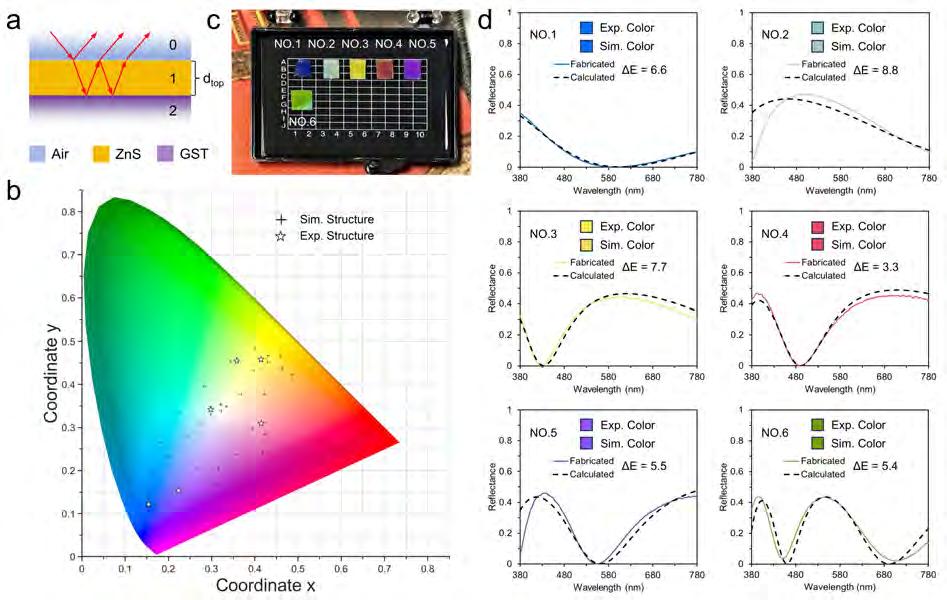
Figure2 (a)Opticaltransmissionbehaviorinthin-filmstructure.(b)Colorrangeanddistributionofdesignedandexperimentalstructurein CIE1931colorspace.(c)Photographsshowcasingthefabricatedstructureswithdifferentthicknesses(NO.1:65nm;NO.2:85nm;NO.3: 120nm;NO.4:145nm;NO.5:180nm;NO.6:240nm).(d)Experimental(Exp.,solidline)andsimulated(Sim.,dottedline)reflectivity spectraofsixstructureswithinthevisiblewavebandwithcolordifference( E ).
[26].WithintheVIStoNIRrange,varyingthethicknessofZnSmodulatesthephaseoflighttransmission andreflection,therebyshiftingtheresonancepeakpositionsinthevisiblespectrum.Toachieveadiverse structuralcolorpalette,thevisiblereflectancespectraofasingle-layerZnSfilmwereanalyzed(Figure2a).
Thecorrespondingspectraldataforthesevariationsinthicknesses(10to300nm)werethenconvertedinto theCIE1931chromaticitydiagram(Figure2b)[15].ThedetailsoftherelationshipbetweentheVIS reflectancespectrumandperceivedcolorarediscussedinSupplementaryNote1.Subsequently,ZnSlayers withthicknessesof65,85,120,145,180,and240nmweredepositedonaGST/Aulayer,asillustratedin Figure2c.ThepositionoftheexperimentalresultsisalsomarkedbystarsinFigure2b.Theoreticalresults indicatethatvaryingthethicknessenablescoverageofmosttargetcolors.Furthermore,experimentalresults showgoodagreementwiththeoreticallysimulatedvisiblespectraaspresentedinFigure2d,withtheaverage colordifference( E )betweenexperimentalandtheoreticalCommissionInternationaldel’Eclairage(CIE) valuesbeinglessthan6(seeSupplementaryNoteS1andFigureS1).
Themulti-orderinterferencepeaksgeneratedbyZnSarenearlyequallyspacedinfrequencyfromVISto NIRbands.Asaresult,resonancepeaksinthelowerfrequencyregion(NIR)exhibitbroaderbandwidth comparedtothoseathigherfrequencies(VIS).Experimentalmeasurementsfordifferentthicknessesofthe ZnSlayer,undercrystallineGST(c-GST)andamorphousGST(a-GST)interlayersrespectively,arepresentedinFigure3a,b.AtaZnSlayerthicknessof120nm,themetadeviceachievesalow-reflectance

Figure3 ReflectancespectrawithdifferentthicknessesofZnSlayerundercrystalline(a)andamorphous(b)GSTinterlayers.(c)Electric fielddistributionofdesignedstructure(NO.3)withmarkedskindepthsattheresonantwavelengthof428and1064nm.(d)Lossdistribution ofdesignedstructure(NO.3)attheresonantwavelength.
(R <20%)bandwidthofupto830nmintheNIRrange,incorporatingoutstandingabsorptionperformanceat keylaserwavelengths(A905nm =87.7%, A1064nm =98.6%, A1310nm =97.6%, A1550nm =90.1%).Thishigh absorptioneffectivelyminimizeslaserecho,significantlyreducingtheriskofLiDARdetection.However, increasingtheZnSthicknessgraduallydegradesthebroadbandcharacteristicduetotheemergenceof additionalinterferencepeakswithinthesamebandthatsatisfyinterferenceconditions.
Notably,theinfluenceofGSTthicknessontheresonantcavityhasnotbeenaddressedinthisanalysis,as GSTfunctionsasanabsorbingmaterialthroughoutthevisibletoNIRrange,regardlessofitscrystallineor amorphousstate.Asaresult,theGST-CrinterfacedoesnotparticipateinthereflectionofVIS-NIRlight.To elucidatethisbehavior,theelectricfielddistributionsattheVIS(λ =428nm)andNIR(λ =1064nm) resonancepeaksareprovidedinFigure3cfortheproposedmetadevicewithaZnSlayersizeof120nm.Itis evidentthattheelectricfielddoesnotpropagatetotheGST-Crinterface.Withinthiscavity,theskindepthsof electricfieldintensityatboththeVISandNIRresonancepeaksareapproximately20and40nm,asmarked inFigure3c.ThelossofelectricfieldsinopaquemediacanbeexpressedbytheimpedanceJouleheatinglaw [33,34].
c E == 2 Im(), (1) e0 2 where c isthelightvelocityinavacuum, λ isthetargetwavelength, ε0 and ε arethevacuumpermittivityand thematerialpermittivity,and E istheintensityoftheelectricfield.
Therefore,thethin-filmstructurecanbeconsideredeffectivelyasaZnSlayerwithaGSTsubstrateinthe
VISandNIRbands.Thisphenomenoncanbeanalyzedfurtherusingthetransmissionmatrixmethod.Since theelectricfieldisimpermeable,thematrixtakestheformas[35,36]
where n1 and n2 correspondtotherefractiveindicesofZnSandGST,respectively, δ1 representsthe transmissionphaseprovidedbytheZnSlayer,and Nd = 2 cos kkkk .Reflectancecanbeexpressedas
AsindicatedbyEq.(3),theresonancepeakpositiondependsexclusivelyonthetransmissionphase(δ1) introducedbytheZnSlayerthicknessandremainsunaffectedbyvariationsineitherthethicknessorstateof GST.Tovalidatethisfinding,theexperimentalreflectionspectrumunderdifferentstatesofGSTwas examined(FigureS2).TheresultsconfirmthattheinterferencepeaklocationisdeterminedsolelybytheZnS thickness,therebycorroboratingtheeffectivenessoftheconfigurationpresentedinFigure2a.
ThedecouplingphenomenonbetweentheVIS-NIRandMIRbandsisattributedtothespectralsensitivity ofthematerials.Specifically,high-frequency(VIS-NIR)photonsaresubjectedtointerferenceeffectslocalizedsolelyintheZnSlayerwithultra-thinskindepthsintheGSTlayer.Conversely,low-frequency(MIR) electromagneticwave,possessinglosspropagation,interactwiththeunderlyingmetalmirror(Cr).Inthis scenario,thelosswhichisgovernedbythestateoftheGSTlayer,ispivotalfortailoringthespectralbehavior intheMIRband.Giventhattheopticalresponsesinthehigh-andlow-frequencyregionsaregovernedby structureandmaterial,theycanbetreatedasdecoupledmodulation.
Mid-infraredbandregulationtechnology
TheMIRregioncanbemodulatedviatheGSTmaterial,enablingmulti-scalemanipulation.Toachieve tunableemissivity,aresonatorcomposedofcrystallineGSTandAuwasutilizedforMIRabsorption.The broadbandpropertiesofZnSallowittointroduceatransmissionphaseintheMIRregion.Apredetermined ZnSthicknessappliedinsimulationsoffersMIRphasecompensation.Figure4aillustratestherelationship betweenthethicknessofc-GSTandtheMIRemissionspectrumwithafixedZnSthicknessof120nm.The calculatedresultsshowthatincreasingtheGSTfilmthicknesscausesaredshiftintheresonantpeakofthe MIRcavitymode.Tomaximizeabsorptionatthewavelengthof10.6μm,thethicknessoftheGSTlayerwas optimizedto420nm.Figure4bshowstheabsorptionspectrafortheZnS/GST/Crmultilayerstructurewith thicknessesof120,420,and200nm,respectively.Theresultdemonstratesthehighperformanceofthe proposedmetadeviceforMIRLiDARcamouflage(A10.6μm =92%).Figure4cdemonstratesthattheelectric fielddistributionachievesidealreflectionphasematchingattheresonantwavelengthof10.6μmforthe combined120nmZnSand420nmGSTlayers.AccordingtoEq.(1),theelectromagneticlossdistributionat theresonantwavelengthof10.6μmconfirmsstrongenergylocalizationwithintheGSTlayersowingto interferenceeffects.ThesynergisticabsorptioneffectbetweentheGSTandCrlayersisresponsibleforthe
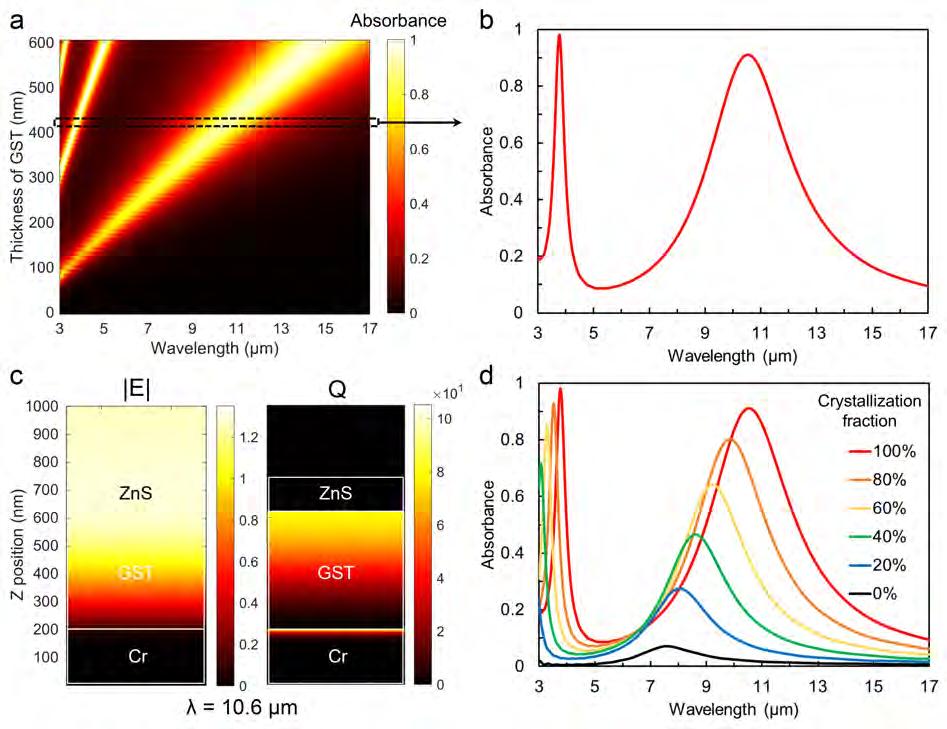
Figure4 (a)AbsorbancespectrumwithdifferentthicknessesofGSTlayerundercrystallinestate.(b)Thecalculatedabsorbancespectrum oftheproposedmetadevice.(c)Electricfielddistribution(left)andlossdistribution(right)ofdesignedstructureattheresonantwavelength (10.6μm).(d)RealizationofadaptivethermalcamouflagebymodulatingthephasestateofGST.
perfectabsorption.TheslightshiftoftheMIRresonancepeakduetodifferenttransmissionphasecausedby changesinZnSthicknessisfurtheranalyzed(FigureS3).Additionally,adaptivethermalcamouflagerealized bymodulatingthephasestateofGST[37]enableseffectivemanipulationoverMIRemissivityasshownin Figure4d,whichcantheoreticallybetunedfrom0.1to0.7.
Asakeyindicatorofmultibandcompatiblecamouflage,thecalculatedabsorptivityversuswavelengthand incidentangle(0°–80°)fortheP-andS-polarizedlightisshowninFigureS4.Withhighangleincidentlight (60°),themetadevicewithc-GSTexhibitrobustperformanceincludinghighpeakabsorptionaverageLWIR emission.WiththeP-polarizedlightandtheS-polarizedlightincidence,thedevicedemonstratesthepeak LWIRabsorptivityintheLWIRbandexceeding80%.
TheproposedmetadeviceofZnS/GST/Crwithrespectivethicknessesof120,420,and400nmwas fabricatedasshowninFigure5a.ThemodulationprocessintheMIRreflectancespectrumoftheproposed metadeviceunderdifferentheatingsteady-statetemperaturesisshowninFigure5b.Owingtothesufficient thicknessoftheCrlayertopreventIRtransmission,theabsorptionatspecificwavelengthscanbegivenby reflectancemeasurements.Theexperimentalresultsdemonstrateamaximumlong-waveinfrared(LWIR,
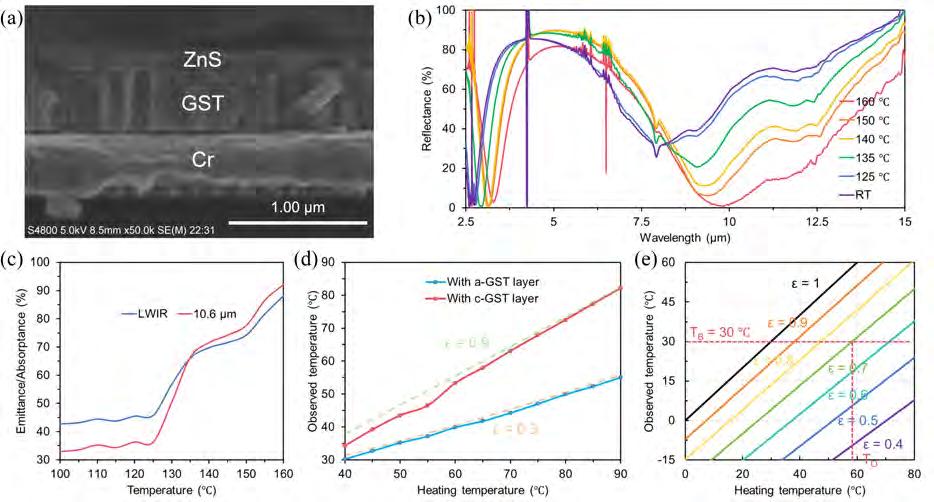
Figure5 (a)SEMphotographofthefabricatedmetadevice.(b)Themeasuredreflectancespectrumoftheproposedmetadevicewith differentstableheatingtemperatures.(c)Recordingemittance(absorbance)ofaverageemissivityintheLWIRbandandCO2 laserwavelengthof10.6μm.(d)Relationshipbetweenheattemperatureandobservedtemperaturewithreferenceofgrey-bodywithaverageemissionof 0.3and0.9,respectively.(e)Outdooranalysisofobservedtemperaturewithversusheatingtemperatureandaverageemission.
8–14μm)emissivityof88%,anLWIRmodulationdepthof0.46,andapeakabsorptionof99.2%attheCO2 laserwavelength.Figure5crecordstheevolutionofbothLWIRemissivityandabsorptionat10.6μmthat wasmonitoredthroughoutthethermalprocess.Themodulationonsetisobservedat125°Candreaches completionat160°C.
AccordingtoPlanck’sblackbodyradiationlaw,theapparentradiantpowerofanobjectcanbeexpressedas thesumofitsownemittedelectromagneticenergyandthereflectedbackgroundradiationelectromagnetic energy[38]:
PP TP T IT IT =(,)+(,,)=()()+[1 ()]()(), (4) radddrefdaadBBd daBBa
where εd and εa representtheemissivityofthedeviceandthebackgroundemissivity,respectively, Td and Ta denotethedevicetemperatureandbackgroundtemperature.Thermalimagingofadetectorcanbeunderstoodastheinversetemperaturecalculationofthereceivedradiantenergythroughtheblackbodyradiation law.
TP T =(,), (5) r 1 IR
where εIR istheemissivitywithinthedetector’soperationalwavelengthrangeand εIR =1undernormal circumstances.Figure5dshowstheexperimentalperformanceoftheproposedmetadeviceinbothcrystalline andamorphousstatesofGSTunderindoorconditionswithabackgroundtemperatureof25°C.Emissivity referencecurvesof0.3and0.9arealsoincludedasdashedlinesforcomparison.Remarkably,at90°C,the maximumapparenttemperaturedifferencebasedonmaterialphasetransitionregulationreaches27°C. Thesefindingsfurtherdemonstratethepotentialofthemetadeviceforadaptiveinfraredcamouflageapplications.
Then,weanalyzetherelationshipbetweenapparenttemperatureanddevicetemperatureunderclear, cloudlessoutdoorconditions.Accordingtoradiationcoolingtheory,theenergycontributionfromthecoldspacebackgroundat3Kcanbeneglected(Pref ≈ 0).Figure5erevealstherelationshipamongapparent temperature,heatingtemperature,andemissivityunderoutdoorconditions.Itcanbeseenthatachieving adaptiveinfraredcamouflagerequireseffectiveresponsestodifferenttemperaturescenarios.Asshownby theredcurveinFigure5e,fora60°Cobjecttoachievethermalcamouflageagainsta30°Cbackground blackbodyreferenceinanoutdoorenvironment,itsemissivityshouldbe0.7.
Performanceevaluation
ToevaluatetheVISandIRcamouflageperformanceoftheproposedmetadevice,bothvarioustypesof naturalleavesandthefabricatedmetadevicewereobservedunderanopticalcameraandathermalimager.As showninFigure6a,themetadevicemimicsthecolorofnaturalleavesinthevisiblespectrumthrough adjustmentsinthetop-layerthickness.Meanwhile,Figure6brevealsthatthemetadeviceandleavesexhibit closelymatchedapparenttemperaturesinthermalimages,withatemperaturedifferencebelow1°C.In contrast,humanskin,anearlyidealblackbodyemitter,displaysanapparenttemperatureconsistentwithits actualtemperature.
ToevaluatetheLiDARcamouflageperformanceoftheproposedmetadevice,reflectancemeasurements wereconductedundervaryingirradiationpowerlevelsusingadual-bandinfraredlasertransmittancereflectancepowercorrelationmeasurementsystem[19].AsillustratedinFigure6c,themetadeviceexhibits significantlyenhancedlaserabsorption(93.7%)withlaserreflectancereducedto8.85%(a10.5dBreduction)comparedtotheGST/AustructurewithoutaZnSmatchinglayer.Furthermore,themodulationofMIR laserabsorptionbetweenthecrystallineandamorphousstateswasexamined.Figure6drevealsthatthe absorptionoftheCO2 MIRlasercanbetunedoverarangeof2–15dB(correspondingto3%–62.5% absorption).Themetadevicewithc-GSTachievesrecord-highMIRabsorptioncapacity—surpassingthatof quartz(FigureS5),resultinginsignificantlyreducedreflectanceatawavelengthof10.6μm.Asshownin TableS1,theproposedmetadeviceshowssuperiorityinmeetingcertainrequirementsincludingVIScamouflage,LiDARcamouflage,andMIRcamouflageandadvantageinminimizinglayernumber.
Wefurtherinvestigatetheapplicationofthemetadeviceformultispectraldisplayfunctions,asshownin Figure6e.Ametadevicefeaturing“wolf”and“star”patternswasfabricated,withan85nm-thickZnSfilm servingasthebackground(NO.2).The“star”(NO.3)and“wolf”patternswererealizedusingZnSlayers withthicknessesof120and205nm,respectively.ThesamplewascharacterizedusingaVIScamera,active NIRdetection,andanMIRthermalcamera.The“star”patterndisplaysstrongcontrastintheVISrange (CIE1931:Blue(0.30,0.34),Yellow(0.41,0.46)),whileshowingareflectanceofonly6%similartothe backgroundintheNIRanddemonstratinglowerreflectancebehavior.Onthecontrary,the“wolf”pattern exhibitsabluehueconsistentwiththebackgroundwithintheVISrange,butstrongcontrastintheNIRband (“wolf”pattern, R1064nm =25%).Additionally,underinfraredthermalimaging,thesepatternedfeaturesofthe proposedmetadeviceremainexpectedlyundetectable,duetotheuniformlylowemissivityofthedevicewith a-GSTlayer,whichcausestheirthermalsignaturetoblendseamlesslyintothebackground.Comparingwith thestate-of-the-artwavelength-divisionmultiplexingdisplays(TableS2),ourmetadeviceshowssignificant improvementsinmulti-bandcompatibilityincludingVIS,NIR,andMIR. NatlSciOpen,2025,Vol.4,20250046
NatlSciOpen,2025,Vol.4,20250046
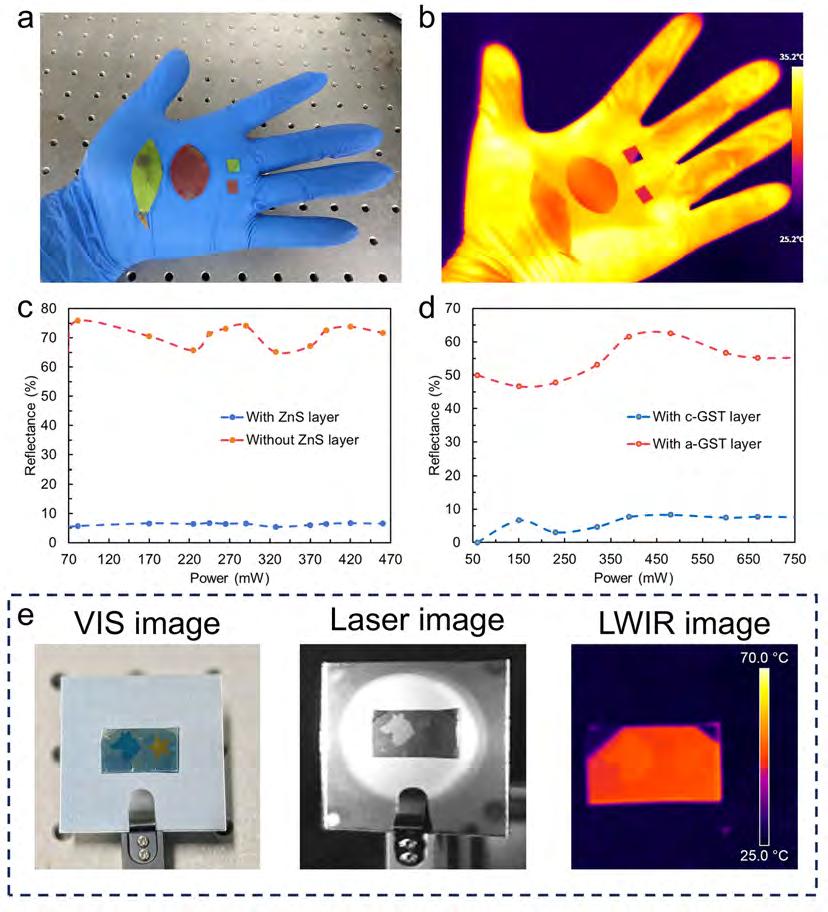
Figure6 (a)VIScamouflageevaluationand(b)MIRthermalcamouflageevaluationoftheproposedmetadevice(NO.4andNO.6)with referencesofdifferentkindsofleaves.(c,d)LiDARcamouflageevaluationoftheproposedmetadeviceforthedifferentwavelengthesof 1.06μm(NO.3andwithoutZnSlayersample)and10.6μm(NO.5witha-GSTandc-GST).(e)Multispectraldisplaywithdifferentbands versionofVIScamera,laserdetection,andMIRthermalcamera.
CONCLUSIONS
Thisresearchdemonstratesasuccessfulimplementationofmulti-scalestructure-materialco-designto achievemultifunctionalcompatibilityacrossVIS,NIR,andMIRbands.AZnS/GST/Crmultilayerthin-film metadevicewasdevelopedtoenabletunablestructuralcolorpresentationintheVISregion,broadbandhigh absorptionintheNIRspectrumforlaserechosuppression,anddynamicallyswitchableinfraredemissivity viatheGSTphasetransition,togetherwithhighlaserabsorptionintheMIRband.Experimentalresults demonstrateoutstandingperformanceinVIS-IR-LiDARcamouflageandwavelength-selectiveindependent
display.Theproposedstrategyoffersaviablepathwaytowardovercomingthechallengesofmultispectral camouflageandadaptivedisplayintegration,withpromisingapplicationsextendingbeyondmilitarycamouflagetofutureintelligentopticalsystems,thermalmanagementcoatings,energy-efficientdisplays,and multisensorycompatibledevices.
METHOD
Simulations
TheVIS-IRspectraundernormalunpolarizedincidenceweresimulatedusingthecommercialsoftware FDTDSolutions(LumericalSolutions,Canada)with2Dmodel.The2DVIS-IRplanewavespropagatedto theproposeddevicealongthe yz-direction.Periodicboundaryconditionswereappliedin x-directions.The upperandlowerboundaryconditionsinthe z-directionperfectlymatchedlayers,andthemeshsizewas1nm.
TheIRabsorbance(A)spectrawereobtainedusingthetransmittance(T)andreflectance(R)as A = 1 R T.TherefractiveindicesofGSTwereobtainedfrompreviousstudies[39].Theopticalconstantsof ZnSandCrwereavailableinthehandbookbyPalik[40].Theeffectivemediumtheories(EMT)wereusedto modelthecontinuousstateofVO2 fromadielectric-likestatetoametallicstateandweredescribedas[37]
Theeffectivepermittivity εEMT representstheintermediatestateofGST;while ε1 and ε2 denotethe permittivityofa-GSTandc-GST,respectively.TheconstantCrepresentsthemetallicfractionofc-GSTand rangesfrom0to1.
Fabrications
Theproposeddeviceswerefabricatedonasingleside-polished<100>crystallinesiliconsubstrates.Electron beamevaporationwasusedtopreparethefilmcoatingofZnSandCrunderavacuumchamberpressureof 5×10 4 Pa.ThedepositionspeedsofZnSandCrwere0.5and1nm/s,respectively.TheGSTlayerofthe proposedmetadevicewasdepositedusingamagnetronsputteringsystem(Nordiko).TheGSTstoichiometric targetshadahighpurityof99.99%.
Opticalmeasurements
TheVIS-NIRreflectancespectrawerecharacterizedbyaspectrophotometer(HitachiU4100)intheworking bandof0.3to2.5μm.Adiffuse-reflectanceintegratingspheremadeofpolytetrafluoroethylenewasusedas thereflectionreference.
TheMIRreflectanceandtransmittancespectrawereacquiredbyaFouriertransforminfrared(FTIR) micro-areaspectrometer(NicoletContinuum)andamercury-cadmium-telluride(MCT)detectorwithliquid nitrogencoolinginthewavelengthrangeof2.5–15μm.
TheLWIRimageswererecordedusingIRcamerasoperatingintherange7.5–14μm(GuidePS600,with emittancesof1).Theroomtemperaturewasmaintainedatapproximately25°C.
NatlSciOpen,2025,Vol.4,20250046
Dataavailability
Theoriginaldataareavailablefromcorrespondingauthorsuponreasonablerequest.
Acknowledgements
TheauthorsthankProf.HexiuXu(AirForceEngineeringUniversity)forthehelpfuldiscussion.WegratefullythankYifei Xiao(Xi’anUniversityofArchitectureandTechnology)forherhelpwiththeschematicsoftheconfigurations.
Funding
ThisworkwassupportedbytheNationalKeyR&DProgramofChina(2022YFF0706005),theNationalNaturalScience FoundationofChina(12272407,62275269,62275271and62305387),theFoundationofNationalUniversityofDefense Technology(NUDT)(ZK23-03),andtheHunanProvincialNaturalScienceFoundationofChina(2022JJ40552and 2023JJ40683).
Authorcontributions
J.Y.andX.J.conceivedtheideaandmadefurtherinnovations.J.Y.supervisedtheworkandguidedtheproject.X.J.,J.N.and W.Y.didtheexperimentsandcharacterizations.X.L.,J.Z.,X.Y.L.,Q.J.andJ.Z.performedsomeexperiments.J.N.andX.J. wrotethemanuscript.J.W.,X.H.,P.Y.,H.C.,Z.ZandS.H.modifiedthemanuscript.Alltheauthorsdiscussedtheresultsand commentedonthemanuscript.
Conflictofinterest
Theauthorsdeclarenoconflictofinterest.
Supplementaryinformation
Thesupportinginformationisavailableonlineathttps://doi.org/10.1360/nso/20250046.Thesupportingmaterialsare publishedassubmitted,withouttypesettingorediting.Theresponsibilityforscientificaccuracyandcontentremainsentirely withtheauthors.
References
1ChengC,LiuJ,WangF, etal. Photonicstructuresinmultispectralcamouflage:Fromstatictodynamictechnologies. MaterToday 2025; 85:253–281.
2WuY,TanS,ZhaoY, etal. Broadbandmultispectralcompatibleabsorbersforradar,infraredandvisiblestealth application. ProgMaterSci 2023; 135:101088.
3LiuT,GuoC,LiW, etal. Thermalphotonicswithbrokensymmetries. eLight 2022; 2:25.
4HuR,XiW,LiuY, etal. Thermalcamouflagingmetamaterials. MaterToday 2021; 45:120–141.
5ZhaoT,XieP,WanH, etal. UltrathinMXeneassembliesapproachtheintrinsicabsorptionlimitinthe0.5–10THz band. NatPhoton 2023; 17:622–628.
6MaD,JiM,YiH, etal. Pushingthethinnesslimitofsilverfilmsforflexibleoptoelectronicdevicesviaion-beam thinning-backprocess. NatCommun 2024; 15:2248.
7Ho-BaillieAWY,SullivanHGJ,BannermanTA, etal. Deploymentopportunitiesforspacephotovoltaicsandthe prospectsforperovskitesolarcells. AdvMaterTechnologies 2022; 7:2101059.
8LiY,LiW,HanT, etal. Transformingheattransferwiththermalmetamaterialsanddevices. NatRevMater 2021; 6: 488–507.
9LiuY,SongJ,ZhaoW, etal. Dynamicthermalcamouflageviaaliquid-crystal-basedradiativemetasurface. Nanophotonics 2020; 9:855–863.
NatlSciOpen,2025,Vol.4,20250046
10ZhangJ,HuangS,HuR.Adaptiveradiativethermalcamouflageviasynchronousheatconduction. ChinPhysLett 2021; 38:010502.
11WangJ,YuF,ChenJ, etal. Continuous-spectrum-polarizationrecombinantopticalencryptionwithadielectric metasurface. AdvMater 2023; 35:2304161.
12ChenQ,HuangX,JuZ, etal. Atribandmetasurfacecoveringvisible,midwaveinfrared,andlong-waveinfraredfor opticalsecurity. NanoLett 2025; 25:4459–4466.
13ChandraS,FranklinD,CozartJ, etal. Adaptivemultispectralinfraredcamouflage. ACSPhotonics 2018; 5:4513–4519.
14ZhuR,ZhuH,QinB, etal. Digitalcamouflageencompassingopticalhyperspectraandthermalinfrared-terahertzmicrowavetri-bands. NatCommun 2025; 16:8112.
15XiW,LeeYJ,YuS, etal. Ultrahigh-efficientmaterialinformaticsinversedesignofthermalmetamaterialsforvisibleinfrared-compatiblecamouflage. NatCommun 2023; 14:4694.
16KumarN,DixitA. NanotechnologyforDefenceApplications.Singapore:Springer,2019.
17HuangY,ZhuH,ZhouY, etal. Adaptivevisible-infraredcamouflagewithwide-rangeradiationcontrolforextreme ambienttemperatures. PhotoniX 2025; 6:25.
18ZhangL,ZhangC,ZhangL, etal. Adual-modeLiDARsystemenabledbymechanicallytunablehybridcascaded metasurfaces. LightSciAppl 2025; 14:287.
19JiangX,NongJ,LiX, etal. Laser-adaptiveinverse-designmetamaterialsfordurableregulationfromvisible-infraredlidarcompatiblecamouflagetoopticallimiter. LaserPhotoRev 2025;e00883.
20KimT,BaeJ,LeeN, etal. Hierarchicalmetamaterialsformultispectralcamouflageofinfraredandmicrowaves. Adv FunctMater 2019; 29:1807319.
21KimJ,ParkC,HahnJW.Metal-semiconductor-metalmetasurfaceformultibandinfraredstealthtechnologyusing camouflagecolorpatterninvisiblerange. AdvOptMater 2022; 10:2101930.
22ErgoktasMS,BakanG,KovalskaE, etal. Multispectralgraphene-basedelectro-opticalsurfaceswithreversible tunabilityfromvisibletomicrowavewavelengths. NatPhoton 2021; 15:493–498.
23WeiH,GuJ,ZhaoT, etal. TunableVO2 cavityenablesmultispectralmanipulationfromvisibletomicrowave frequencies. LightSciAppl 2024; 13:54.
24JiangX,WangX,NongJ, etal. Bicolorregulationofanultrathinabsorberinthemid-waveinfraredandlong-wave infraredregimes. ACSPhotonics 2024; 11:218–229.
25LokeD,LeeTH,WangWJ, etal. Breakingthespeedlimitsofphase-changememory. Science 2012; 336:1566–1569.
26AmotchkinaT,TrubetskovM,HahnerD, etal. Characterizationofe-beamevaporatedGe,YbF3,ZnS,andLaF3 thin filmsforlaser-orientedcoatings. ApplOpt 2019; 59:A40–7.
27JiaY,LiuD,ChenD, etal. Transparentdynamicinfraredemissivityregulators. NatCommun 2023; 14:5087.
28WangS,JiangT,MengY, etal. Scalablethermochromicsmartwindowswithpassiveradiativecoolingregulation. Science 2021; 374:1501–1504.
29MengZ,LiuD,PangY, etal. Multispectralmetal-basedelectro-opticalmetadeviceswithinfraredreversibletunability andmicrowavescatteringreduction. Nanophotonics 2024; 13:3165–3174.
30XiW,LiuY,ZhaoW, etal. Coloredradiativecooling:Howtobalancecolordisplayandradiativecoolingperformance. IntJThermSci 2021; 170:107172.
31XieB,LiuY,XiW, etal. Coloredradiativecooling:Progressandprospects. MaterTodayEnergy 2023; 34:101302.
32HuangJ,YangJ,ChenD, etal. Implementationofon-chipmulti-channelfocusingwavelengthdemultiplexerwith regularizeddigitalmetamaterials. Nanophotonics 2020; 9:159–166.
33JacksonJD. ClassicalElectrodynamics.NewYork:Wiley,1999.
34YuJ,QinR,YingY, etal. Asymmetricdirectionalcontrolofthermalemission. AdvMater 2023; 35:2302478.
35HeavensO.Thin-filmopticalfilters. OpticaActa:InternatJOptics 1986; 33:1336–1336.
36ZhaoJ,QiuM,YuX, etal. Definingdeep-subwavelength-resolution,wide-color-gamut,andlarge-viewing-angle flexiblesubtractivecolorswithanultrathinasymmetricfabry-perotlossycavity. AdvOptMater 2019; 7:1900646.
NatlSciOpen,2025,Vol.4,20250046
37XuZ,LuoH,ZhuH, etal. Nonvolatileopticallyreconfigurableradiativemetasurfacewithvisibletunabilityfor anticounterfeiting. NanoLett 2021; 21:5269–5276.
38JiangX,ZhangZ,MaH, etal. Tunablemid-infraredselectiveemitterbasedoninversedesignmetasurfaceforinfrared stealthwiththermalmanagement. OptExpress 2022; 30:18250.
39ShportkoK,KremersS,WodaM, etal. Resonantbondingincrystallinephase-changematerials. NatMater 2008; 7: 653–658.
40PalikED. HandbookofOpticalConstantsofSolids.Orlando:AcademicPress,1998.
NationalScienceOpen 5:20250065,2026
https://doi.org/10.1360/nso/20250065
SpecialTopic:IntelligentMaterialsandDevices
Ultrafastcontrolofterahertzharmonicgenerationbyoptically modulatingcarrierdynamicsinnonlinearmetasurfaces
ZhehaoYe2,YongzhengWen1,*,ChenWang1,YongTan1,RenfeiZhang3,FuliZhang2,*, YuanchengFan2 &JiZhou1,*
1StateKeyLaboratoryofNewCeramicMaterials,SchoolofMaterialsScienceandEngineering,TsinghuaUniversity,Beijing100084,China;
2MOEKeyLaboratoryofMaterialPhysicsandChemistryunderExtraordinaryConditions,SchoolofPhysicalScienceandTechnology, NorthwesternPolytechnicalUniversity,Xi’an710129,China;
3ResearchCenterforMetamaterials,WuzhenLaboratory,Jiaxing314500,China
*Correspondingauthors(emails:wenyzheng@tsinghua.edu.cn(YongzhengWen);fuli.zhang@nwpu.edu.cn(FuliZhang);zhouji@tsinghua.edu.cn(JiZhou))
Received9October2025;Revised25November2025;Accepted1December2025;Publishedonline5December2025
Abstract: Thedevelopmentofterahertz(THz)sourceswithwidespectralcoverageanddynamiccontroliscriticalfor advancinghigh-speedcommunication,high-resolutionimaging,andreconfigurablephotonics.However,conventionalnonlinearmaterialsexhibitweakharmonicresponsesandlimitedtunabilityatroomtemperature.Here,weproposeanonlinearTHz metasurfacethatsimultaneouslyenablesthegenerationandopticalmodulationofbothsecondandthirdharmonicswith ultrafastswitchingspeeds.ThemetasurfacelocallyenhancesTHzmagneticandelectricfields,whichdrivephotoinduced carriersintoanharmonicoscillationsandproduceharmonicemissions.Owingtotherapidexcitationsoffreecarriers,we achievethemodulationofSHGandTHGwithswitchingtimesof4.31and3.98ps,respectively,andtheirextinctionratios exceed1000.Moreover,tuningtheopticalpumpfluenceenablesamplitudemodulationofharmonicoutputsbydynamically manipulatingcarrierdensityandmobility.Thissingle-deviceapproachdemonstratesaunifiedplatformforgenerating,enhancing,anddynamicallycontrollingmultipleTHzharmonics,offeringnewopportunitiesforreconfigurableTHzsourcesand adaptivenonlinearphotonicdevices.
Keywords: terahertz,nonlinearmetasurface,harmonicgeneration,opticalmodulation,ultrafastcontrol
INTRODUCTION
Overthepastdecade,terahertz(THz)technologyhasundergonerapiddevelopment,demonstratingremarkableapplicationpotentialinnumerousfieldssuchasnon-destructivedetection[1,2],next-generation wirelesscommunications[3,4],andintelligentsensing[5–10].Centraltothesetechnologiesisthedevelopmentofcompact,efficient,andtunableTHzsources.Inparticular,theabilitytogenerateandmanipulate multipleharmonicfrequencieswithinasingledeviceenablesversatilefunctionalitiessuchasmulti-band operation,frequencymultiplexing,andwaveformsynthesis,whicharecriticalfordevelopingreconfigurable andbroadbandTHzsystems.Forinstance,achievinghigh-resolutionradarimagingrequiressourcesoperatingathigherfrequencies,whilehigh-speedTHzwirelesslinksdemandsourceswithbroadspectralcov-
©TheAuthor(s)2025.PublishedbySciencePressandEDPSciences.ThisisanOpenAccessarticledistributedunderthetermsoftheCreativeCommons AttributionLicense(https://creativecommons.org/licenses/by/4.0),whichpermitsunrestricteduse,distribution,andreproductioninanymedium,providedthe originalworkisproperlycited. MaterialsScience
erageandrapidmodulationcapability[11,12].
Harmonicgenerationisaneffectivewaytoextendtheoperatingfrequencybandwidthforradiationsources. Whileeffectiveharmonicconversioncanbeachievedinthemicrowaveandopticalbandsusingnonlinear materials[13–17],thecoexistenceofelectronicandphotoniceffectsintheTHzbandmakesitchallengingto obtainsignificantharmonicconversionwithconventionalnonlinearmaterials.PioneeringstudieshavedemonstratedTHzharmonicgenerationinadvancedmaterialplatforms.Forexample,grapheneandtopological insulatorscanproduceodd-orderTHzharmonicsunderhigh-powerTHzpumping[18–20].Symmetry-broken superconductorscanachievethegenerationofTHzeven-orderharmonicsatthecryogenictemperatures[21]. However,theseplatformssufferfromcomplexfabrication,limiteddesignability,ornon-ambientoperating conditions,hinderingtheirintegrationintopracticaldevices.Moreover,theirharmonicresponsesareoften fixedbyintrinsicproperties,makingdynamicmodulationsextremelychallengingtoachieve.
Metamaterials,composedofsubwavelengthartificialunitcells,enableunprecedentedmanipulationsofelectromagneticpropertiesbeyondnaturalmaterials.Theirtwo-dimensionalcounterpart,metasurfaces,hasfacilitated awiderangeoflow-loss,easilyintegratedfunctionaldevices[22–30].Byrelaxingphase-matchingconstraints, enablingmonolithicintegration,andofferingtunablebandwidth,metasurfacesprovideapromisingplatformfor nonlinearopticsacrossmicrowave[31,32],visible[33,34],andinfraredfrequencies[35].Introducingactive controlfurtherexpandsfunctionality.Comparedwithelectrical,thermal,ormechanicaltuning,opticalpumping affordsnon-contact,spatiallyselective,andultrafastmodulation[36,37].PreviousstudiesonreconfigurableTHz metasurfaceshavedemonstratedthatopticalpumpingenableshigh-speedandefficientcontroloflinearresponses [38,39].Morerecently,leveragingthestrategicallydesignedfieldcouplingandenhancementsinthesemiconductor-basedmetasurfaces,theefficientsecondandthirdharmonicgeneration(SHGandTHG)attheTHz frequencieshasbeenrealizedatroomtemperature[40–42].Despitetheseadvances,simultaneousgenerationand ultrafastmodulationofmultipleTHzharmonicswithinasinglemetasurfaceremainsanopenchallenge.The synergisticcombinationofmetasurface-inducedfieldenhancementandopticalcontrolofcarrierdynamicsoffers apowerfulstrategyforrealizingdynamic,room-temperatureTHznonlinearsources.Itbecomespossibleto designfunctionalmetasurfacescapableofgenerating,controlling,andswitchingmulti-orderharmonicradiation onpicosecondtimescales,pavingthewayforadaptiveTHzphotonicsystemsandhigh-speedsignalprocessing.
Inthiswork,weproposeandexperimentallydemonstrateanonlinearTHzmetasurfacecapableofsimultaneouslygeneratingandultrafastopticallymodulatingsecondandthirdharmonicsatroomtemperature. Themetasurface,composedofgoldsplit-ringresonators(SRRs)onasemiconductorsubstrate,leverages stronglocalelectromagneticfieldenhancementtodrivetheanharmonicmotionofphotoinducedcarriers, resultinginefficientSHGandTHG.Opticalpumpingdynamicallytailorsthecarrierdensityandmobility, allowingprecisecontrolofharmonicamplitudeandtemporalresponse,withpicosecond-levelswitching timesandveryhighextinctionratios.Thisworkestablishesaunifiedplatformforgenerating,enhancing,and dynamicallytuningTHznonlinearprocesses,offeringapromisingroutetowardreconfigurableTHzsources andadaptivenonlinearphotonicsystems.
RESULTS
Figure1aillustratestheconceptoftheproposednonlinearTHzmetasurfacethatenablesopticallytunable
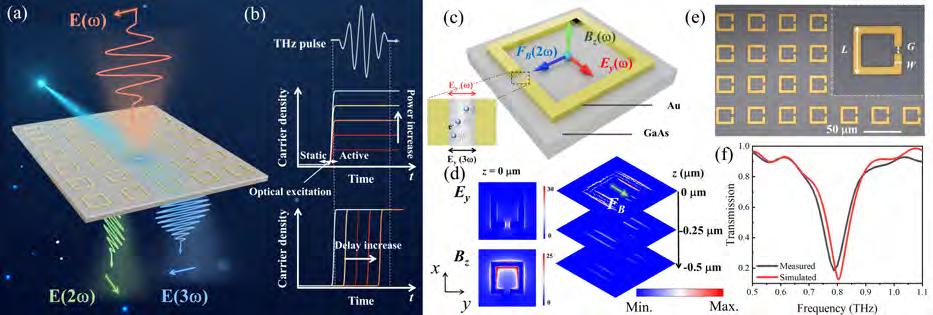
Figure1 PrincipleoftheTHznonlinearmetasurfaceandresonancecharacterization.(a)Schematicofthedesignedmetasurface. (b)Schematicofdynamicallycontrollingcarrierdynamicsduringaterahertzpulsebytuningopticalpumpfluenceandtimedelay.Theoptical excitationdefinesthetransitionfromthestatictotheactivestate.(c)Illustrationoforientationsofthelocalelectricfield Ey(ω),magneticfield Bz(ω),theLorentzforce FB(2ω),andthecarrierdriftinthepumpedGaAsdrivenbythelocalelectromagneticfield.(d)Thecurrent disturbance(whitearrow),thelocalenhancementofmagneticfieldinthe z-axis Bz(ω),thelocalenhancementofelectricfieldinthe y-axis (Ey(ω)),andthenormalizeddistributionoftheLorentzforce FB(2ω).(e)Photomicrographofthefabricatedmetasurface,wheretheinsert showstheunitcellofthemetasurface: W =4μm, G =4μm, L =24μm,andtheperiodoftheunitcellis42μm.(f)Simulatedandmeasured transmissionspectrumofthemetasurface.
harmonicgeneration.ThedeviceconsistsofaperiodicarrayofgoldSRRspatternedonanintrinsicGaAs substrate.ThechoiceofGaAsismotivatedbyitsdirectbandgapandsuperiorcarriermobility,whichare crucialforefficientopticalmodulationandultrafastswitchingatthepumpwavelength.Inthestaticstate, withoutopticalexcitation,neithergoldnorintrinsicGaAsexhibitssignificantTHznonlinearresponses, regardlessofresonance,andthemetasurfaceisnotexpectedtogenerateSHGorTHG.Onceilluminatedby theopticalexcitationwhosephotonenergyexceedsthebandgapofintrinsicGaAs,freecarriersaregenerated quasi-instantaneously[43],transformingthemetasurfaceintoanactivestate,asshowninFigure1b.This processestablishesthefoundationforopticalmodulationofcarrierdynamics,asthedensityandmobilityof carrierscanbepreciselycontrolledthroughtheopticalpumpfluenceanddelay,therebytuningthenonlinear responseonapicosecondtimescale.
Specifically,theunderlyingmechanismsofSHGandTHGareshownschematicallyinFigure1c.Whenthe incidentTHzfielddrivestheSRRsattheinductive-capacitive(LC)resonance,astronglocaldynamic magneticfieldalongthe z-axis(Bz(ω))andelectricfieldalongthe y-axis(Ey(ω))areproduced,asshownin Figure1d.ThephotoinducedcarriersinthepumpedGaAs,positionedwithintheenhancedelectromagnetic fieldoftheSRRs,aredrivenbythelocalelectricfieldtomovealongthe y directionwithadriftvelocity vy, oscillatingwithfrequency ω.Simultaneously,themagneticfieldcomponent Bz(ω)exertsaLorentzforce FB = qvy × Bz onthephotoinducedcarrierswithafrequency-doubledcomponentperpendiculartoboth Bz(ω)and Ey(ω)[44].Thismagnetoelectriccouplinginducesananharmoniccarriermotionalongthecross-polarization (x-axis)withdoubledfrequency2ω,therebygeneratingsecondharmonicradiation.
Simultaneously,theTHGoriginatesfromtheintrinsicthird-ordernonlinearityofthephotoexcitedGaAs [45].WithintheSRRgap,thestronglyenhancedlocalelectricfieldinducesnonlinearcarriertransport, governedbyfield-dependentmobilityandscatteringrates,whichcollectivelygiverisetoamacroscopic nonlinearcurrentdensitycoupledtothelocalfieldthroughacubicdependence[45,46].Giventheeffective isotropyoftheGaAssubstrateandthedesignedSRRstructure,ensuringthelocaldrivingfieldpolarization
remainsparalleltotheincidentTHzfield,theresultingTHzTHGmaintainsaco-polarized(y-axis)state relativetothefundamentalexcitation.Thus,thepolarizationdistinctionbetweenSHGandTHGstemsfrom theirfundamentallydifferentmicroscopicorigins.TheformerfromLorentz-force-inducedcross-axismotion,andthelatterfromfield-drivennonlineartransportalongtheprimarypolarization(detailsofthe theoreticalmodelsandsimulatedresultsareprovidedinSectionsS1andS2oftheSupplementaryinformation).
Becausebothprocessesrelyonthetransientbehaviorofphotoinducedcarriers,thenonlinearemissioncan bedynamicallytunedthroughtheopticalexcitation.Theamplitudeofthisnonlinearresponseisintrinsically governedbymaterialparameters,includingthecarrierconcentration,carriermobility,andlocalfieldenhancementwithintheSRR[40,47].Varyingtheopticalpumpfluencemodulatesthecarrierdensityand mobility,whereasadjustingthepump-THzdelaycontrolstheirtemporalevolution.Thesefactorscollectively determinetheharmonicemissionstrength,formingthephysicalfoundationfortheultrafastopticalmodulationdemonstratedbelow.Toverifythismechanism,wefabricatedaproof-of-principlemetasurfacewith thefundamentalfrequencyof0.8THz,showninFigure1e.Theresonancecharacteristicofthemetamaterial sampleisshowninFigure1f(detailsoflinearspectrameasurementareprovidedinSectionExperimental setups).Apronouncedtransmissiondipobservedat0.8THzconfirmstheresonantfrequency,consistent withsimulatedpredictions.Theslightdiscrepancybetweenthesimulatedandmeasuredresultscanbe attributedtomachininginaccuraciesinthefabricatedsamples.
UltrafastcontrolofSHGandTHGwasexperimentallydemonstratedusingatime-resolvedopticalpumpTHzprobesystemwiththefemtosecondopticalexcitationatthewavelengthof800nm.TheincidentTHz pulse,centeredat0.8THzwithapeakfieldof20kV/cm,excitesthemetasurface(detailsoftheexperimental setupcanbeseeninSectionS3).Accordingtothetheoreticalmodel,SHGisexpectedtooccurinacrosspolarizedstaterelativetothefundamentalexcitation.Wethereforefirstexaminedthenormalizedcrosspolarizedsignalsfromthemetasurface,asshowninFigure2a.Thegraylineandredlinedenotethesignals withoutandwith800nmwavelengthopticalpumping,respectively.Withoutopticalpumping,thecrosspolarizationcomponentisobservedonlyatthe0.8THzfundamentalfrequency,indicatingthelackof intrinsicSHGinthesampleunderastrongTHzfield.Whenopticalpumpingisapplied,acharacteristicpeak appearsinthecross-polarizedspectralcomponentcenteredat1.6THz,indicatingthegenerationofthe secondharmonic.TheinsetshowsthesignalofSHGinthetimedomain.Theexperimentalresultsdemonstratethatthefreechargecarriersgeneratedbyopticalpumpingcanbeeffectivelydrivenbylocal electromagneticfieldstoemitTHzharmonicradiation.
DuetothemuchlongerdurationoftheTHzpulsecomparedwiththefemtosecondopticalpulse,thetiming ofphotoinducedcarriergenerationcanbepreciselycontrolledbyadjustingtherelativetimedelaybetween thetwopulsesastheyreachthemetasurface.Thisenablesultrafastmodulationoftheharmonicradiation throughthetemporaldynamicsofthecarriers.Therelativetimedelayisdefinedas ttt = delay800nmTHz , where t 800nm and t THz arethearrivaltimesoftheopticalpumpandtheTHzpulseatthemetasurface, respectively.Intheexperiment,the tdelay iscontrolledbyadjusting t800nm whilekeeping tTHz fixed.The experimentalresultsoftheultrafastmodulationdynamicbehavioroftheSHGareshowninFigure2b.The resultsdemonstratethatwhen tdelay <1.7ps,thedeviceremainsinits“OFF”statewithnomeasurableSHG, equivalenttothesituationwithoutopticalpumping.Asthetimedelay tdelay furtherincreases,theSHG NatlSciOpen,2026,Vol.5,20250065

Figure2 UltrafastswitchingofSHGandTHG.(a)Normalizedcross-polarizedsignalswithandwithoutopticalpumping;theinsetshows thecorrespondingtime-domainsecondharmonicsignal.(b)NormalizedSHGamplitudeversustherelativetimedelayoftheopticalpump andfundamentalTHzpulse.(c)Normalizedco-polarizedsignalswithandwithoutopticalpumping;theinsetshowsthecorrespondingtimedomainthirdharmonicsignal.(d)NormalizedTHGamplitudeversustherelativetimedelayoftheopticalpumpandfundamentalTHzpulse.
amplitudegraduallyrisesfromzerotoitsmaximumvalue.Thisbehavioroccursbecausetheopticalpump initiatesfreecarriergenerationjustbeforethetrailingedgeofthestrongTHzpulsearrives.Thesephotoinducedcarriersarethenacceleratedbytheremaininghigh-fieldportionoftheTHzpulse,resultingin strongerSHG.Beyondthemaximum,furtherincreasingthetimedelay t delay resultsinthemetasurface exhibitingapproximatelystableSHGradiation.Thissteady-stateemissionoccursbecausetheopticalpump pulseprecedestheentireTHzpulse,enablingthegenerationofalarge,stablepopulationofphotoinduced carriersintheGaAssubstratebeforetheTHzfieldarrives.Analysisoftheharmonicresponseasafunctionof timedelay,theextractedswitchingtimeis4.31ps,whichisseveralordersofmagnitudefasterthanthermal relaxation,confirmingthenon-thermaloriginofthemodulation[48],andtheextinctionratioexceeds1416, demonstratingpicosecond-scalecontrolofnonlinearconversion.
FortheTHGfromthemetasurface,thenormalizedsignalmeasuredunderco-polarizationisshownin Figure2c.Theblacklinerepresentstheco-polarizedsignalwithoutopticalpumping,whiletheblueline representstheco-polarizedsignalwithopticalpumping.Intheabsenceofopticalpumping,similartothe SHG,thereisonlyafundamentalfrequencycharacteristicpeakinthefrequencyspectrum.Thereisasmall dipnear0.8THzduetotheresonanceofthemetasurface,whichismanifestedinco-polarizationdetection. Whenthereisopticalpumping,athirdharmonicsignalpeakappearsinthespectrumoftheco-polarization, originatingfromtheanharmoniccarrieroscillationsofphotoinducedcarriersdrivenbytheintenseTHz electricfield.Atthispoint,thesmalldipofitsfundamentalfrequencydisappearsduetotheintroductionof
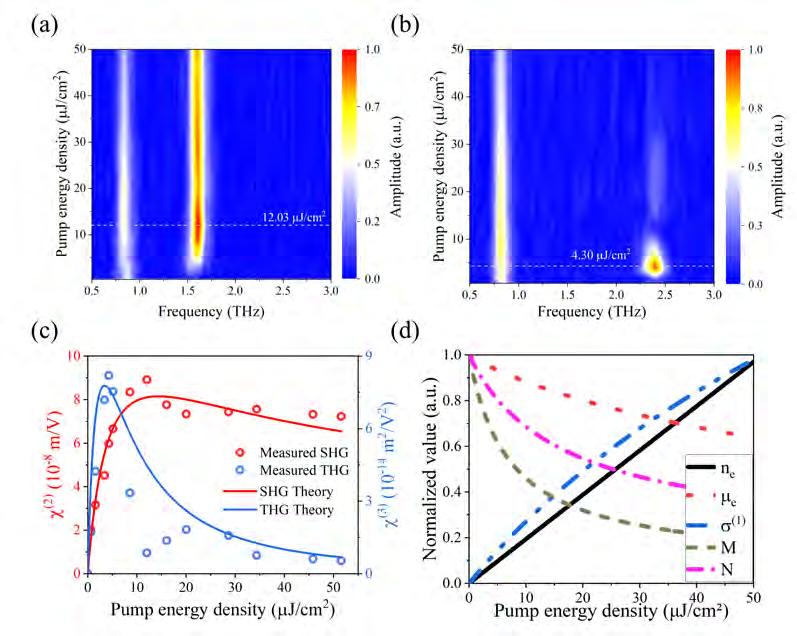
Figure3 ModulationoftheamplitudeofSHGandTHG.(a)NormalizedmeasuredTHzSHGamplitudeasafunctionoftheopticalpump energydensity.(b)NormalizedmeasuredTHzTHGamplitudeasafunctionoftheopticalpumpenergydensity.(c)Measuredandtheoretical resultsofthe χ(2) and χ(3) asafunctionofthedifferentopticalpumpenergydensity.(d)Thenormalizedvalueofthecarrierconcentration ne, mobility μe,linearconductivity (1) ,thelocalenhancementfactorsoftheelectric(M)andmagnetic(N)fields,correspondingtothepump energydensity.
chargecarriers,whichincreasestheconductivityanddegradestheresonancecharacteristicsofthemetasurface[49,50].TheultrafastmodulationoftheTHGisshowninFigure2d.Owingtothedependenceofits signalstrengthontheTHzpulsedurationinteractingwithphotoinducedcarriers,theTHGshowssimilar ultrafastmodulationcharacteristicsofSHG,includingaswitchingspeedofapproximately3.98ps.The devicealsoexhibitsaclearswitchingbehaviorforTHG.Thenormalizedharmonicintensityis~0inthe “OFF”state,resultinginahighextinctionratioofapproximately1285forTHG.
WenotethatthemodulationspeedsforbothSHGandTHGareprimarilygovernedbythecarrierdensity ratherthanthethermalorstructuraleffects.Themetasurfaceenablesultrafast,non-contactcontrolof nonlinearemissionatroomtemperature.Thesefindingsconfirmthatopticalexcitationactsasaneffective “gate”fordynamicallytuningthenonlinearTHzemissionthroughreal-timemanipulationofcarrierdynamics.
WefurtherdemonstratedynamiccontrolofbothSHGandTHGintensitiesbymodulatingtheoptical-pump intensitytovarythedensityofthephotoinducedcarriers.Toensuretheopticalpumparrivesearlierthanthe entireTHzpulse,thedeviceismaintainedinitsfully“ON”stateduringtesting.Thedynamicregulationof theharmonicviaopticalpumpintensityisshowninFigure3aandb,respectively.TheSHGandTHG intensitiesexhibitdistinctlydifferentdependenciesontheopticalpumpingenergydensity.FortheSHG
signalshowninFigure3a,astheenergydensityoftheopticalpumpincreases,itssignalstrengthbrieflyrises andreachesitsmaximumvalueat12.03μJ/cm2,andthendecreasesgradually.AsshowninFigure3b,the THGsignalamplituderisessharplyandreachesitsmaximumatalowerenergydensityof4.30μJ/cm2. However,beyondthisthreshold,itdecreasessharplywithincreasingopticalpumpenergy.Thedistinct evolutionbehaviorsofSHGandTHGinthemetasurfacecanbeattributedtothedynamicprocessofcarrier densityanditsrelatedparameters(mobilityandlocalTHzfieldstrength)underdifferentopticalpumping energydensities.Increasingopticalenergydensityincreasesthecarrierdensity,butitalsoincreasesthelinear conductivity,leadingtoresonancedampingandfieldscreeningthatreducelocalfieldstrength.Inparallel, enhancedcarrier-carrierandcarrier-phononscatteringcanreducemobility.Thecompetitionamongthese effectsresultsinanoptimalenergydensityforeachnonlinearprocess.
Accordingtothedefinitionofthesecond-ordernonlinearsusceptibility χ(2) isgivenbythemodifiedDrude model(thedetailsareprovidedinSectionsS1andS4).Duetothedefinitionof I EE = 20 2 locloc 2 ,the SHGintensityisderivedtoscaleas () InµMN MN ()(), (1)
where n e , µ e ,and (1) aretheaveragecarrierconcentration,theaveragecarriermobility,andthelinear conductivityofthepumpedGaAs,respectively.TheEq.(1)demonstratesthattheSHGintensityscales quadraticallywiththeproductofthelinearconductivity (1),thelocalenhancementfactorsoftheelectric(M) andmagnetic(N)fields.Itshouldbenotedthatthecarrierconcentrationisafunctionoftheopticalpumping energydensityandincreaseswithit,whilethecarriermobility µ e decreasesasthecarrierconcentration n e rises[51].Linearconductivityistheproductofthecarrierconcentrationandmobility.
ForTHG,thethird-ordernonlinearsusceptibility χ(3) canbederivedfromasimplifiedBoltzmanntransport equation(thedetailsareprovidedinSectionsS1andS4)[52,53].Accordingtothedefinition I EEE = 30 (3) loclocloc 2 ,theTHGintensityexhibitsadependenceas
Eq.(2)suggeststhattheintensityoftheTHGisrelatedtothesquareoflinearconductivity (1),thefourth powerofcarriermobility µ e ,andthesixthpoweroflocalelectricfieldenhancementfactor M.This indicatesthattheTHGintensityismoresensitivetothedecreaseincarriermobilitycausedbytheincreaseof opticalpumpenergydensitycomparedwiththeSHGintensity.Specifically,asthelinearconductivity increases,thelocalfieldenhancementeffectweakens(thedetailisprovidedinSectionS4).Figure3c delineatestheexperimentallymeasured χ(2) and χ(3),asafunctionoftheappliedopticalpumpenergydensity (detailsareprovidedinSectionS5).Withintheopticalpumprangefrom0.63to51.58μJ/cm2,theeffective χ(2) canbedynamicallyadjustedacrosstherangefrom2.1×10 8 to9.1×10 8 m/V,whiletheeffective χ(3) variesfrom7×10 15 to8.2×10 14 m2/V2.Toclarifythedynamicbehaviorofthephotoinducedcarriers undervaryingopticalpumpenergydensities,weperformtheoreticalfittingonthenormalizedSHGandTHG intensitiesbasedontheestablishedmodel.Theresultingtheoreticaleffectivesecond-andthird-ordersusceptibilityvariationsareplottedalongsidetheexperimentaldatainFigure3c.Thetheoreticalmodelpredicts thedependenceofeffective χ(2) and χ(3) ontheopticalpumpenergydensity,respectively.Crucially,this NatlSciOpen,2026,Vol.5,20250065
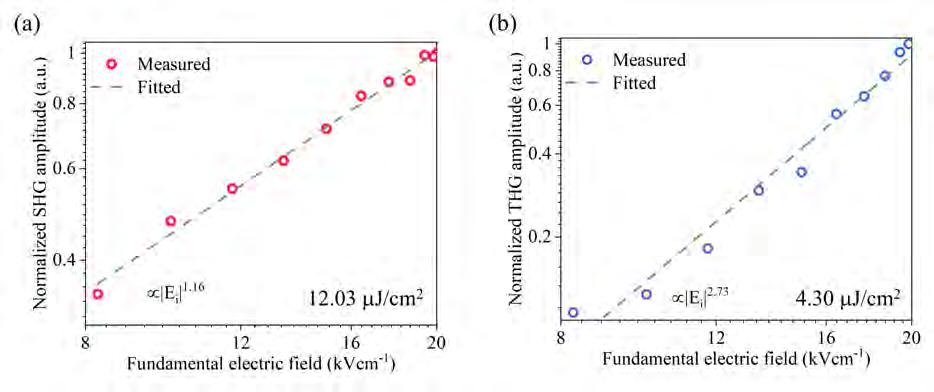
Figure4 Dependenceofnormalizedfieldintensityofthemetasurfaceonthefundamentalelectricfield,includingthefieldstrengthofSHG (a)andTHG(b). NatlSciOpen,2026,Vol.5,20250065
tunabilityenablestheprecisedynamiccontroloverthenormalizedintensityratiobetweenthesecondand thirdharmonics,whichestablishesastrongfoundationforrealizinghigh-speedcommunicationapplications.
Thephenomenacanbeexplainedtheoreticallybytheinterplaybetweenthesecompetingandsynergistic factorsofcarrierdensity,carriermobility,andthefieldenhancementeffectinFigure3d.Thelinearconductivity(theproductofcarrierdensityandmobility)increasesacrossthetestedrangeofpumpenergy density.Withinthisrange,theresultinghighconductivityofGaAssignificantlyweakensthefieldenhancementpropertiesoriginallyinducedbytheSRRs[54,55].Withrisingpumpenergydensity,thecarrier concentrationincreasesrapidly,accompaniedbyasignificantenhancementinlinearconductivityanda concurrentreductionincarriermobility,magneticfieldenhancementfactor,andelectricfieldenhancement factor.Particularly,sincetheTHGexhibitsastrongerdependenceonthefieldenhancementfactorandcarrier mobilitythantheSHG,itsoptimalpumpenergydensityislowerthanthatoftheSHG.
Astheopticalpumpenergydensitycontinuestoincreasebeyondtheoptimalpoint,thegenerationof additionalphotoinducedcarriersleadstoafurtherreductionincarriermobility.Thedecreaseincarrier mobilityandthedeclineinthefieldenhancementfactorbecomethedominantfactor.Theeffective χ(3) is especiallymoresensitivetothereductioninbothcarriermobilityandthefieldenhancementfactorcompared totheeffective χ(2).Consequently,beyondtheoptimalpumpenergydensity,theTHGintensitydecreases rapidlywithfurtherincreasesinpumpenergy,whereastheSHGintensityshowsamoregradualdecrease. Together,thesefindingsconfirmthatoptical-pumpfluenceprovidesaneffectivemeansforbroadband amplitudemodulationofTHznonlinearprocessesbypreciselycontrollingcarrierconcentrationandmobility.
Themeasuredpump-powerdependenceoftheSHGandTHGatoptimalpumpingispresentedinFigure4a andb,respectively.TheSHGandTHGintensitiesfollowpower-lawdependencieswithexponentsof1.16 and2.73,respectively,deviatingsignificantlyfromtheconventionalquadraticandcubicrelationships.The observedphenomenonisattributabletotheintervalleyscatteringeffect.Inthisexperiment,theopticalpump withphotonenergyof1.55eVisutilized,lyingbetweentheΓ-valleybandgap(~1.42eV)andtheL-valley
(kV cm-1)
(kV cm-1)
bandgap(~1.71eV)oftheGaAs.Consequently,thepumplightselectivelyexciteselectronsfromthevalence bandtotheΓ-valleyoftheconductionband,yetlackssufficientenergytodirectlyexcitethemintothe higher-energyL-valley.Underthelocalenhancementoftheelectromagneticfield,thesefreeelectronsare drivenbythestrongTHzfield,acquiringlargeponderomotiveenergy.Thisstrongdrivingforcescatters electronsfromtheΓ-valleyintotheL-valley,therebyinitiatingtheintervalleyscatteringprocess.The effectivemassesofelectronsintheΓandLvalleysare0.067m0 and0.55m0,respectively(m0 isthefree electronmass).ThelargereffectivemassinL-valleydecreasestheeffectivecarriermobility.Thisscattering eventincreasestheeffectivemassofthecarriersandsignificantlydecreasestheirmobility,leadingtoa measurablereductionofnonlinearsusceptibility[56].Thiscombinedeffecttherebycausestheobserved deviationsfromtheidealquadraticandcubicpowerdependencies,resultinginameasurablereductioninthe conversionefficiencyofbothSHGandTHG(seeSectionS6fordetails).
Wehavedevelopedametasurfacedevicethatutilizescarrierdynamicsmodulationtosimultaneously generate,enhance,anddynamicallycontrolTHznonlinearharmonics.Theproposedmechanismforboth harmonicgenerationandmodulationexhibitsbroadapplicabilityacrossawidefrequencyrange,enablingits extensiontometasurfacesoperatinginotherfrequencybandsandtodevicesresponsivetoalternative externalstimuli.Furthermore,bypreciselyengineeringthemetasurfaceunit-cellstructuresorbyintroducing complexlocalizedfielddistributionsarisingfrommultipleresonantmodes,flexiblecontroloverkeycharacteristicsoftheharmonicradiation,suchasoperatingfrequency,phase,polarization,andevenhigher-order harmonicgeneration,canbeachieved[57–60].Theproposedmechanism,basedontheultrafastmodulation ofcarrierdynamics,offeringanidealmethodforexploringandrealizingreconfigurableTHznonlinear effects,canbereadilyextendedtovarioussemiconductormaterialplatformswithsuitablebandgaps. Althoughthe800nmexcitationusedinthisworkisoptimizedforGaAs,thesameprinciplecanbeappliedto othersemiconductors.Forexample,excitationat1.03or1.55μmwouldbesuitablefornarrower-bandgap materialssuchasInAsorGe,enablingflexibleadaptationoftheapproachacrossdifferentspectralranges. TheseadvantagesareexpectedtosignificantlyadvancethedevelopmentandpracticalapplicationofhighperformanceTHzradiationsourcesandintegratedfunctionaldevices.
CONCLUSIONS
Insummary,wehavetheoreticallyandexperimentallydemonstratedanultrafastopticallyreconfigurable nonlinearmetasurfacethatrealizesefficientSHGandTHGintheTHzregimeatroomtemperature.The nonlinearemissionoriginatesfromanharmoniccarrierdynamicsinducedbystronglyenhancedlocal magneticandelectricfieldswithinthemetasurface,whiletheopticalmodulationprovidesdirectcontrolover carrierdensityandmobility,enablingdynamictuningofbothharmonicamplitudeandswitchingstate.The metasurfaceexhibitspicosecond-scaleresponsetimes(4.31psforSHGand3.98psforTHG)withextinction ratiosexceeding1000,andsupportsbroadamplitudemodulationviaopticalpumpfluence.Thesefindings provideageneralandunifiedstrategyforrealizingultrafast,tunablenonlinearresponsesinsemiconductorbasedmetasurfaces,offeringpotentialforreconfigurableTHzphotonicdevicesandTHzsources.Furthermore,theunderlyingconceptofopticallycontrolledcarrierdynamicsisnotlimitedtotheTHzbandand couldbeextendedtootherfrequencyranges,suchasthemid-infrared,withappropriatedesignofthe
metasurfacegeometryandsemiconductorproperties.
MATERIALSANDMETHODS
Samplefabrication
Themetasurfacewasfabricatedonhigh-resistivity(>100kΩcm)(001)GaAssubstrates(625μmthickness, dual-side-polished).Metasurfacepatternswerelithographicallydefinedusingultraviolet(UV)photolithography.Subsequentelectron-beamdepositionofTi/Au(30nm/200nm)bilayerswasperformed,with finalstructuresreleasedbysolvent-assistedlift-offinacetone.
Experimentalsetups
Linearspectrameasurement
ATi:sapphirefemtosecondlasersystem(centralwavelength:800nm,repetitionrate:1kHz,pulseenergy: 7mJ)wasdividedintotwobeamsusingabeamsplitter.Onebeamservedastheprobe,anditsenergywas attenuatedtobelow1μJusingavariableneutraldensityfilterbeforeenteringtheelectro-opticdetectionarm, ensuringoperationinthelinearresponseregime.Theotherpumpedacommercialopticalparametricamplifier(OPA)togenerate1550nmwavelengthpulses.AbroadbandTHzpulsewasproducedbyirradiating anorganicnonlinearcrystal,2-(3-(4-hydroxystyryl)-5,5-dimethylcyclohex-2-enylidene)malononitrile (OH1),withthe1550nmwavelengthfemtosecondlaser.Toensuremeasurementsinthelineartransmission regime,the1550nmwavelengthlaserpulseenergywasattenuatedtoapproximately0.15%ofitsoriginal intensityusingcalibratedopticalattenuatorsbeforeexcitationoftheOH1crystal.ThegeneratedTHzbeam wasfocusedbyoff-axisparabolicmirrorsontothesampleanddetectedusingastandardelectro-optic sampling(EOS)setupwitha1.0mm-thickZnTecrystal.AllexperimentswereperformedatroomtemperatureunderadryN2 purgewitharelativehumidityof<5%.ThetransmittedTHztime-domainwaveformsofthemetasurfacesampleandabareGaAssubstratewererecorded,andtheirFourier-transformed spectraweredividedtoobtaintheelectricfieldamplitudetransmissionspectrum.
Nonlinearspectrameasurement
ThesamefemtosecondlaserfromtheTi:sapphirefemtosecondlasersystemwasdividedintothreebeams. Onebeamservedastheprobe,attenuatedtobelow1μJusingavariableneutraldensityfilterbeforeentering theelectro-opticdetectionarm,ensuringoperationinthelinearresponseregime.AnotherpumpedanOPAto generate1550nmwavelengthpulses,andthethirdprovided800nmwavelengthexcitationforphotoinduced carriergenerationintheGaAssubstrate.AbroadbandTHzpulsewasproducedbyirradiatinganorganic nonlinearcrystal,OH1,withthe1550nmwavelengthfemtosecondlaser.ThegeneratedTHzbeampassed throughabandpassfiltercenteredat0.8THztosuppressresidualhigh-frequencybackground,followedby twowire-gridpolarizersforfundamental-wavecalibration.TheTHzbeamwasthenfocusedbyoff-axis parabolicmirrorsontothesample.The800nmwavelengthpumpbeamwasfocusedtoaspotsizeof approximately2mmindiameter,whichwassignificantlylargerthanthe1mmdiameterspotofthefocused
THzbeam.
Theopticalpumpintensityandrelativetimedelaywereindependentlytunedusingneutral-densityfilters andamechanicaldelayline,achievingatemporalresolutionof~0.2ps.Toisolatethenonlinearresponse, bandpassfilterstransmittingSHGorTHGwhilesuppressingthefundamentalfieldwereplacedafterthe sample.TheharmonicsignalsweredetectedusingastandardEOSsetupwitha1.0mm-thickZnTecrystal. ByrotatingtheZnTe[001]axis,bothco-andcross-polarizationharmonicelectric-fieldamplitudeswere sequentiallyrecorded.Theestimatedsteady-statetemperatureriseofthesampleunderourexperimental conditions(<60μJcm 2 pumpfluence,1kHzrepetitionrate)was0.24K,accordingtostandardheat diffusionmodels(detailsareprovidedinSectionS7).Therefore,thermalaccumulationcanbesafelyneglected.AllmeasurementswereconductedatroomtemperatureunderadryN2 atmospherewitharelative humidityof<5%(detailsareprovidedinSectionS3).
Simulationsetting
DetailsofthesimulationsetupareprovidedintheSupplementaryinformation.Thelineartransmission spectrumofthemetasurfacewasmodeledusingthefinite-differencetime-domain(FDTD)method.The high-resistivityGaAssubstratewastreatedassemi-infinite(εGaAs =12.9),andthe200nmgoldlayerwas modeledasalossymetalwithaconductivityof4.1×107 S/m.Asingleunitcellwassimulatedinthetime domainwithperiodicboundaryconditionsalongthe x and y directionsandopenboundariesalongthe propagation(z)axis.Abroadband y-polarized(perpendiculartotheSRRgap)planewaveservedasthe excitationsource.The y-componentofthetransmittedelectricfieldwasrecordedattheexitplaneofthe GaAssubstrate.AHanningwindowwasappliedtothetime-domainsignaltosuppressFabry-Perotreflectionsfromthesubstrateinterfaces.ThelineartransmissionspectracanbederivedthroughtheFourier transformationoftime-domainsignals:
where T () denotesfrequency-dependenttransmittancenormalizedtothereferencestructure. Et() sample and Et() reference arethesignalsinthetimedomainofthemetasurfaceandGaAssubstrate,respectively. Thenonlinearresponseofthemetasurfacewassimulatedinthetimedomainbythecommercialsoftware COMSOLMultiphysics,basedonthefiniteelementmethod(FEM)usingalinearlypolarizedGaussianpulse planewaveincidentfromthetop,with y-polarization.
Forthesecondharmonicgeneration,themagnetoelectriccouplingeffectinthepumpedmetasurfacecanbe describedasananisotropicconductivitytensor:
where µ B ()=()() ez , B () z denotesthelocalmagneticfieldamplitudealongthe z-axis, 0() and NatlSciOpen,2026,Vol.5,20250065
NatlSciOpen,2026,Vol.5,20250065
µ () e denotetheconductivityandatthefundamentalangularfrequency ω,respectively.
Forthethirdharmonicgeneration,thethird-ordernonlinearityresponseofthepumpedGaAslayerwas definedasfollows:
P E =, (5) y 30 (3)3 where 0 isthepermittivityoffreespace, (3) isthethird-ordernonlinearsusceptibility,and Ey isthelocalized electricfieldamplitudealongthe y-axis.
Dataavailability
Theoriginaldataareavailablefromthecorrespondingauthorsuponreasonablerequest.
Funding
ThisworkwassupportedbytheNationalKeyR&DProgramofChina(2023YFB3811400),theBasicScienceCenterProject oftheNationalNaturalScienceFoundationofChina(52388201),theNationalNaturalScienceFoundationofChina (52332006,12504387),theBeijingNaturalScienceFoundation(Z240008),andtheChinaPostdoctoralScienceFoundation (BX20250299,2025M773396).
Authorcontributions
Z.Y.conductedtheinvestigation,designedthemethodology,performedtheexperiments,curatedthedata,andwroteand revisedthemanuscript;C.W.acquiredfundingandreviewedandeditedthemanuscript;Y.T.andR.Z.performedthe experiments;Y.F.acquiredfunding;Y.W.,F.Z.andJ.Z.acquiredfundingandadministeredtheproject;Y.W.conceivedthe idea,supervisedtheresearch,providedresources,andreviewedandeditedthemanuscript.Themanuscriptreflectsthe contributionsofallauthors.
Conflictofinterest
Theauthorsdeclarenoconflictofinterest.
Supplementaryinformation
Thesupportinginformationisavailableonlineathttps://doi.org/10.1360/nso/20250065.Thesupportingmaterialsare publishedassubmitted,withouttypesettingorediting.Theresponsibilityforscientificaccuracyandcontentremainsentirely withtheauthors.
References
1WangK,SunDW,PuH.Emergingnon-destructiveterahertzspectroscopicimagingtechnique:Principleand applicationsintheagri-foodindustry. TrendsFoodSciTech 2017; 67:93–105.
2UzundalCB,FengQ,TangW, etal. Efficienton-chipterahertzgenerationanddetectionwithGaNphotoconductive emitters. LightSciAppl 2025; 14:226.
3ShenD,LanF,WangL, etal. Sub-terahertztransmissivereconfigurableintelligentsurfaceforintegratedbeamsteering andself-OOK-modulation. LightSciAppl 2025; 14:13.
4KimH,KangC,JangD, etal. Ionizingterahertzwaveswith260MV/cmfromscalableopticalrectification. LightSci Appl 2024; 13:118.
5ChenB,WangX,LiW, etal. Electricallyaddressableintegratedintelligentterahertzmetasurface. SciAdv 2022; 8: eadd1296.
NatlSciOpen,2026,Vol.5,20250065
6XiT,JiangH,LiJ, etal. Terahertzsensingbasedonthenonlinearelectrodynamicsofthetwo-dimensionalcorrelated topologicalsemimetalTaIrTe4 NatElectron 2025; 8:578–586.
7HouZ,ChenL,GaoX, etal. High-sensitivityintegratedterahertzsensorwithlargedynamicrangebasedonadjustable high-Q microringresonator. APLPhoton 2024; 9:126109.
8WangR,HaoR,LiD, etal. Multifunctionalterahertzbiodetectionenabledbyresonantmetasurfaces. AdvMater 2025; 37:2418147.
9El-HelouAJ,LiuY,ChenC, etal. Opticalmetasurfacesforthenext-generationbiosensingandbioimaging. Laser PhotonRev 2025; 19:2401715.
10BerueteM,Jáuregui-LópezI.Terahertzsensingbasedonmetasurfaces. AdvOptMater 2020; 8:1900721.
11LiuK,FengY,HanC, etal. High-speed0.22THzcommunicationsystemwith84Gbpsforreal-timeuncompressed8K videotransmissionofliveevents. NatCommun 2024; 15:8037.
12LiX,LiJ,LiY, etal. High-throughputterahertzimaging:Progressandchallenges. LightSciAppl 2023; 12:233.
13SchiedE,WeisO.Microwave-harmonicgenerationinferritesathighpower. JMagnMagnMater 1984; 45:377–381.
14PersicoF,VetriG.Theoryofsecond-harmonicgenerationatmicrowavefrequenciesbyparamagneticmaterials. Phys RevB 1973; 8:3512–3536.
15WangZY,WuX,XiongX, etal. Towardultimate-efficiencyfrequencyconversioninnonlinearopticalmicroresonators. SciAdv 2025; 11:eadu7605.
16FanQ,MaY,XuH, etal. Near-room-temperaturereversibleswitchingofquadraticopticalnonlinearitiesinaonedimensionalperovskite-likehybrid. Microstructures 2022; 2:13.
17ZhangJ,NeufeldO,Tancogne-DejeanN, etal. Enhancedhighharmonicefficiencythroughphonon-assisted photodopingeffect. npjComputMater 2024; 10:202.
18HafezHA,KovalevS,DeinertJC, etal. Extremelyefficientterahertzhigh-harmonicgenerationingraphenebyhot Diracfermions. Nature 2018; 561:507–511.
19BowlanP,Martinez-MorenoE,ReimannK, etal. Ultrafastterahertzresponseofmultilayergrapheneinthe nonperturbativeregime. PhysRevB 2014; 89:041408.
20GiorgianniF,ChiadroniE,RovereA, etal. StrongnonlinearterahertzresponseinducedbyDiracsurfacestatesinBi2Se3 topologicalinsulator. NatCommun 2016; 7:11421.
21ChengB,KandaN,IkedaTN, etal. Efficientterahertzharmonicgenerationwithcoherentaccelerationofelectronsin theDiracsemimetalCd3As2 PhysRevLett 2020; 124:117402.
22NayaniPS,MoradiM,SalamiP, etal. Passivehighlydispersivematchingnetworkenablingbroadbandelectromagnetic absorption. NatCommun 2025; 16:905.
23ZheludevNI,KivsharYS.Frommetamaterialstometadevices. NatMater 2012; 11:917–924.
24WangS,WuPC,SuVC, etal. Abroadbandachromaticmetalensinthevisible. NatNanotech 2018; 13:227–232.
25ChenX,LuoW,ZhaoR, etal. Ceramic-basedmeta-materialabsorberwithhigh-temperaturestability. RareMet 2024; 43:4433–4440.
26ZhouC,HuangL,JinR, etal. Boundstatesinthecontinuuminasymmetricdielectricmetasurfaces. LaserPhotonRev 2023; 17:2200564.
27GenevetP,CapassoF,AietaF, etal. Recentadvancesinplanaroptics:Fromplasmonictodielectricmetasurfaces. Optica 2017; 4:139.
28ZhangM,PuM,ZhangF, etal. Plasmonicmetasurfacesforswitchablephotonicspin-orbitinteractionsbasedonphase changematerials. AdvSci 2018; 5:1800835.
29YangS,HeM,HongC, etal. Engineeringelectromagneticfielddistributionandresonancequalityfactorusingslotted quasi-bicmetasurfaces. NanoLett 2022; 22:8060–8067.
30HuS,LiP,ChenH, etal. Photonicmeta-crystals. Microstructures 2025; 5:2025082.
31YangX,WenE,SievenpiperD.All-passivemicrowave-diodenonreciprocalmetasurface. CommunPhys 2023; 6:333.
32YangW,QinJ,LongJ, etal. Aself-biasednon-reciprocalmagneticmetasurfaceforbidirectionalphasemodulation. Nat
NatlSciOpen,2026,Vol.5,20250065
Electron 2023; 6:225–234.
33TripathiA,UgwuCF,AsadchyVS, etal. Nanoscaleopticalnonreciprocitywithnonlinearmetasurfaces. NatCommun 2024; 15:5077.
34CotrufoM,CordaroA,SounasDL, etal. Passivebias-freenon-reciprocalmetasurfacesbasedonthermallynonlinear quasi-boundstatesinthecontinuum. NatPhoton 2024; 18:81–90.
35DongT,LiS,ManjappaM, etal. NonlinearTHz-nanometasurfaces. AdvFunctMater 2021; 31:2100463.
36YuanJ,LuZ,XuG, etal. Pump-wavelengthselectiveall-opticalterahertzmetasurfacewithindependentamplitudeand frequencymodulations. NanoLett 2024; 24:15414–15420.
37HeW,ChengX’,HuS, etal. Colorcodedmetadevicestowardprogrammedterahertzswitching. LightSciAppl 2024; 13:142.
38ZhangJ,LouJ,WangZ, etal. Photon-inducedultrafastmultitemporalprogrammingofterahertzmetadevices. Adv Mater 2025; 37:2410671.
39KumarA,TanYJ,NavaratnaN, etal. Slowlighttopologicalphotonicswithcounter-propagatingwavesanditsactive controlonachip. NatCommun 2024; 15:926.
40WenY,GiorgianniF,IlyakovI, etal. Auniversalroutetoefficientnon-linearresponseviaThomsonscatteringinlinear solids. NatlSciRev 2023; 10:nwad136.
41WangC,TanY,WenY, etal. Nonperturbativenonlinearmetasurfacesforefficientterahertzharmonicgeneration. ACS Photon 2024; 11:1236–1243.
42DiGaspareA,SongC,SchiattarellaC, etal. CompactterahertzharmonicgenerationintheReststrahlenbandusinga graphene-embeddedmetallicsplitringresonatorarray. NatCommun 2024; 15:2312.
43RuzickaBA,WerakeLK,SamassekouH, etal. AmbipolardiffusionofphotoexcitedcarriersinbulkGaAs. ApplPhys Lett 2010; 97:262119.
44WangS,NiuW,FangYW.NonlinearHalleffectintwo-dimensionalmaterials. Microstructures 2025; 5:2025060.
45LeeK,ParkJ,KangBJ, etal. Electricallycontrollableterahertzsecond-harmonicgenerationinGaAs. AdvOptMater 2020; 8:2000359.
46BlotekjaerK.Transportequationsforelectronsintwo-valleysemiconductors. IEEETransElectronDev 1970; 17:38–47.
47MayerA,KeilmannF.Far-infrarednonlinearoptics.II. χ(3) contributionsfromthedynamicsoffreecarriersin semiconductors. PhysRevB 1986; 33:6962–6968.
48KhurginJ,BykovAY,ZayatsAV.Hot-electrondynamicsinplasmonicnanostructures:Fundamentals,applicationsand overlookedaspects. eLight 2024; 4:15.
49HuS,HeW,TongM, etal. Dual-dimensionalEITmanipulationforangle-multiplexedultrafastterahertzswitching. ACSPhoton 2023; 10:2182–2191.
50LouJ,JiaoY,YangR, etal. Calibration-free,high-precision,androbustterahertzultrafastmetasurfacesformonitoring gastriccancers. ProcNatlAcadSciUSA 2022; 119:e2209218119.
51CallanJP.Ultrafastdynamicsandphasechangesinsolidsexcitedbyfemtosecondlaserpulses.DissertationforDoctoral Degree.Cambridge:HarvardUniversity,2000.
52KuznetsovAV,StantonCJ.Theoryofcoherentphononoscillationsinsemiconductors. PhysRevLett 1994; 73:3243–3246.
53HaugH,KochSW. QuantumTheoryoftheOpticalandElectronicPropertiesofSemiconductors.Singapore:World Scientific,2009.
54SuFH,BlanchardF,SharmaG, etal. TerahertzpulseinducedintervalleyscatteringinphotoexcitedGaAs. OptExpress 2009; 17:9620.
55YangR,ZhangF,LiZ, etal. Controllableelectromagneticallyinducedtransparencyinanelectricallytunableterahertz hybridmetasurface. OptLaserTech 2023; 163:109380.
56FuS,HuangX,GaoG, etal. Unveilinghigh-mobilityhotcarriersinatwo-dimensionalconjugatedcoordination
NatlSciOpen,2026,Vol.5,20250065
polymer. NatMater 2025; 24:1457–1464.
57GradyNK,HeyesJE,ChowdhuryDR, etal. Terahertzmetamaterialsforlinearpolarizationconversionandanomalous refraction. Science 2013; 340:1304–1307.
58SongQ,OdehM,Zúñiga-PérezJ, etal. Plasmonictopologicalmetasurfacebyencirclinganexceptionalpoint. Science 2021; 373:1133–1137.
59WangC,WenY,TanY, etal. On-demandgenerationandcontrolofgiantterahertznonlinearitywithmetasurfaces. LaserPhotonRev 2025; 19:2401224.
60WangS,QinW,GuanT, etal. Flexiblegenerationofstructuredterahertzfieldsviaprogrammableexchange-biased spintronicemitters. eLight 2024; 4:11.
NationalScienceOpen 5:20250078,2026
https://doi.org/10.1360/nso/20250078
MaterialsScience
SpecialTopic:IntelligentMaterialsandDevices
Ahigh-accuracyBraillerecognizingsensingdevicebio-inspiredby humantouchsensationbasedonmicrostructure-basedsensorand machinelearningmethod
LihongWang1,#,ZhouZhang1,#,XindiAn1,JiaxuLiu2,LijunQu2,JunyangLi1,*,MingweiTian2,* & QiWen1,*
1ShandongKeyLaboratoryofIntelligentSensingChipandSystem,DepartmentofElectronicEngineering,OceanUniversityofChina, Qingdao266400,China;
2ResearchCenterforIntelligent&WearableTechnology,CollegeofTextiles&Clothing,CollaborativeInnovationCenterforEco-Textilesof ShandongProvince,QingdaoUniversity,Qingdao266071,China
#Contributedequallytothiswork.
*Correspondingauthors(emails:lijunyang@ouc.edu.cn(JunyangLi);mwtian@qdu.edu.cn(MingweiTian);wenqi@ouc.edu.cn(QiWen))
Received21November2025;Revised8December2025;Accepted11December2025;Publishedonline12December2025
Abstract: Braillelearningisessentialtocommunicateandworkforvisuallyimpairedpeople(VI).However,aconvenientand portableBraillelearningdevicehasnotbeeninvestigated.Herein,aconvenientandhigh-accuracyBraillelearning-enabled tactilesensingsystemisdevelopedtohelpVIlearningBraillethemselves.Thetactilesensingsystembasedontailored micropatternedtactilesensorthroughslidingmodeonBraille,whichisbio-inspiredbyhumantouchingsensation.Itachieveda highrecognitionaccuracyof98.96%for26EnglishlettersforBraille.Thetactilesensorwithatinysize(3mm×3mm×2mm) exhibitedahighsensitivityof0.11kPa 1,whichisbasedontwomicro-domestructureswiththesamedimensionasthedoton Braille.Thetactilesensingdeviceisfabricatedbythetailoredsensor,processcircuitandmicroprogrammedcontrolunitto recognizeBraille;thesensingdevicecanhelpVIlearningandwritingBraille.ThisworkpresentsapracticaltheoryforVI learningBraillethemselves.
Keywords: Braillelearning,bio-inspired,high-accuracyrecognition,micro-domepressuresensor
INTRODUCTION
Brailleisanessentialwayforthevisuallyimpairedpeople(VI),suchastheblindpeople,toperceiveand communicatewiththeworld[1,2].Brailleisakindofsix-dotsystemthatconsistsofthreerowsandtwo columnsofraiseddots,anddifferentcombinationsofraiseddotsareusedtorepresentdifferentcharacters[3–5].PeoplereadandlearnBraillethroughtouching.However,learningBrailleisalwaysfromteachers,which isstillachallengeformostVIbecauseofitshighcost,time-consumingandlaborious[6,7].Inrecentyears, wearableBraillerecognitiondeviceshavebeendevelopedtoassisttheVIinreadingandcommunicating. Therefore,developingahigh-accuracyandportableBraillerecognitionsystemisimportantfortheVI. Advancesinflexibleelectronicdevicesandartificialintelligence(AI)haveenablednewdirectionsto
©TheAuthor(s)2025.PublishedbySciencePressandEDPSciences.ThisisanOpenAccessarticledistributedunderthetermsoftheCreativeCommons AttributionLicense(https://creativecommons.org/licenses/by/4.0),whichpermitsunrestricteduse,distribution,andreproductioninanymedium,providedthe originalworkisproperlycited.
realizeefficientandreal-timeBraillerecognition[8–10].TherearesomeworksreportingtheAI-based Braillerecognitionwithflexibletactilesensors[1,3].Forexample,Qiao etal.[11]combinedananomeshreinforcedgraphenepressuresensorwithaconvolutionalneuralnetwork(CNN),whichcandistinguish convexBraillenumberswithanaccuracyof88%.High-performanceflexibletactilesensorisonecrucial componentforcollectingaccurateBrailletouchingsignalsintheBraillerecognitionsystem.Theideal flexibletactilesensorsrequirehighsensitivity,fastresponsetime,lowhysteresis,excellentstabilityand long-termcycledurability[12–14].Endowingmicrostructuresuchasmicro-porous[15,16],micro-pyramid [17,18],micro-pillar[19,20]andmicro-dome[21,22]toflexiblematerialsisofgreatsignificanceforthe developmentofflexibletactilesensors.Also,themicropatternedpolymerintegratedwithsensingactivelayer (suchasgraphene,MXeneandmulti-walledcarbonnanotubes)canbewidelyusedinfourtransduction mechanismsincludingpiezoelectric[23],triboelectric[24],piezoresistive[25,26],andcapacitive[27,28] flexibletactilesensors.Flexiblemicropatternedpiezoresistivetactilesensorshavebeenwidelyusedbecause ofhighsensingperformance,simpledeviceconfigurationandfabricationprocess[25,26,29,30].Besides, advancedneuralnetworktechnologyofAIistheotherimportantroleoftheBraillerecognition;machine learningalgorithmssuchassupportvectormachine[31],CNN[32],andrapidsituationlearning[33]have beenutilizedtoboostdataidentification,whichcanrecognizeBraillethroughreceivingandlearningdigital sensingsignalsofthetactilesensors.However,mostBraillerecognitionsystemsarestillcomplex,nonportableandwithalowaccuracy.
Inthispaper,wedevelopaBraillerecognitionsystembasedonatailoredpiezoresistiveflexiblemicrodomesensorandahigh-efficientAImethod.Theproposedmicro-domesensorexhibitedanefficientand stablesensingperformance,andoutputaccuratesensingsignalswhentouchingBraille,whichcouldenhance theBraillerecognitionaccuracythroughthearithmeticprocessofaone-dimensional(1D)CNN.Therefore, themicro-dometactilesensorcombinedwithaprocesscircuitandmicroprogrammedcontrolunitobtains sensingsignalsregardingfingertouch,achievingBraillerecognitionoftwenty-sixletters,withamaximum recognitionaccuracyof98.96%.TheproposedBraillerecognitionsystemwillbefavorableforthevisually impairedpeoplelearning,readingandwritingBraillebythemselves.
RESULTSANDDISCUSSION
Overalldesignandworkingmechanismofthetactilesensor
PeoplerecognizeBraillemainlythroughtouching.TohelptheVIlearningBraille,manypressuresensors weredevelopedfortransmittingthetouchingsignalstoelectricalsignals.TraditionaltactilesensorsrecognizedBraillethroughpressingontheBraillesuchasone-channelflexiblesensorsandsix-channel sensors.AsshowninFigure1,theone-channelflexiblesensorsoutputconfusedsensingsignalsandrecognizeBraillethroughacomplexmachinelearningmethod.Thenthesix-channelsensorishardforboth normalpeopleandVItopressontheBraillepointbypointcorrectly.Therefore,wedesignedatwo-channel tactilesensorbio-inspiredbyhumantouchsensation,whichrecognizesBraillethroughslidingandtouching. Thetwo-channelsensorcanbeusedmoreeasilythantheothertwokindsoftactilesensors,andgenerates clearsensingsignalstoimproverecognitionaccuracy.
Wedevelopedatailoredtactilefinger-tipsensorfortheVIlearningBraille,whichisbio-inspiredbyhuman

touchingandmovingonBraille,asshowninFigure2a.ThedevelopedtactilesensorcantouchtheBraille throughthefingertip,movingonthedotsonBrailleeasily,whichcanalsogeneratebothstableandclear sensingsignals.Thesensingpathsofthetactilesensorbasedonthetwoelectrodes(2B-sensor)onthebottom layerareshowninFigure2b,leadingtosensingsignalsfromthe2B-sensorwhenmovingonthedotsof Braille.ThedotsofBrailleturnintopressuretothe2B-sensor;therefore,the2B-sensorgeneratedtwopaths ofresistancevariationsintheprocessofrecognizingBraille.Then,thesensingsignalqualitiesareevaluated byamachinelearningmethodshowninFigure2c.TheBraillesensingsignalsof2B-sensorexhibiteda higherrecognitionaccuracyof98.96%thanflexibleone-channelsensors[11,34,35],andimagerecognition [36]torecognizeBrailleinFigure2d.
Microstructurescanbeutilizedforincreasingthesensingperformanceofpressuresensor,whichhasbeen proveninmanypreviousworks.ThetailoredtactilesensorwedesignedforBraillerecognitionwasbasedon twomicrostructureswiththesamedimensionasthedotonBraille(diameteris1mm)asshowninFigure3a, thedetailsizefordesigningthesensorwasshownintheside-viewofthesensorontheBraille.Theninorder tobetterunderstandthesensingmechanismofthedesignedtactilesensor,wetheoreticallyexplainedthe rationalityregardingsuperiorperformanceforthefabricated2B-sensorasshownintherightsideofFigure 3a,themicroscopicview,finiteelementmolding,equivalent-circuitdiagrambasedonthecontactarea changingbetweenthetopandbottom’layerunderdifferentpressures.The2B-sensorswedevelopedgeneratedeformationandresistancevariationbasedonincreasedcontactareabetweenthetopandbottom electroniclayerunderpressure,attheinitialstate,thetopandbottomlayerdidnotcontact,theinitial resistanceoftwosensingchannelswere R1 and R2 asshownintheschematicandequivalent-circuitdiagram
Figure1 Comparisonofone-channel,six-channelandtwo-channelflexibletactilesensors.
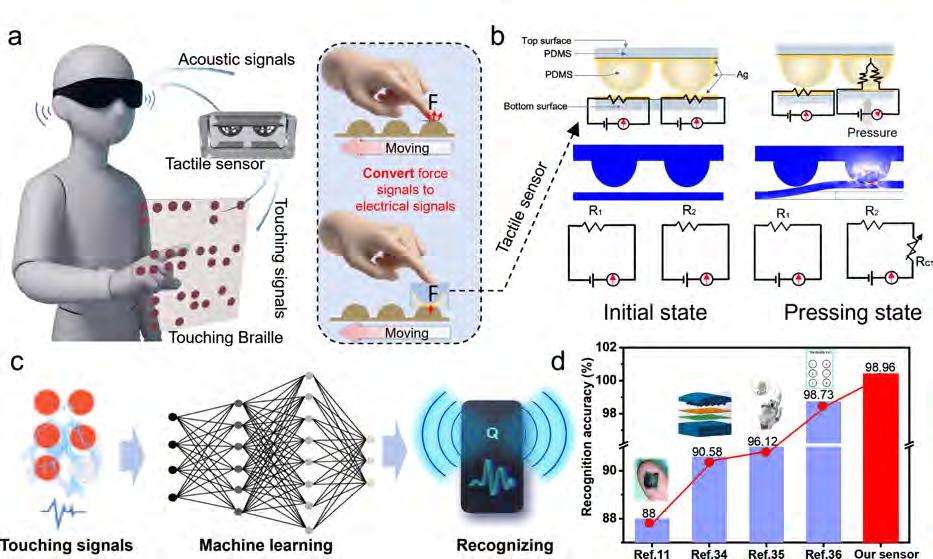
Figure2 Demonstrationoftailoredmicro-dometactilesensorsforrecognizingBraille.(a)Schematicofthevisuallyimpairedperson touchingandlearningBraillewithatactilesensorinspiredbyhumanfingermovingonthedotsoftheBraille.(b)Schematicsshowingthe resistancecompositionofthetactilesensorbeforeandafterpressure.(c)SchematicofBraillerecognitionprocessthroughamachinelearning method.(d)ComparisonoftheBraillerecognitionaccuracythroughamachinelearningmethodbasedonthisworkandpreviousreport works.
ofthe2B-sensor;afteronechannelof2B-senorunderpressure,onesideofthemicro-domecontactwiththe bottomelectrodeandgeneratesdeformationandresistancevariation,thegeneratedcontactresistancein serieswith R2 leadinganincreasingresistanceinthe R2-channel;andwhentwochannelof2B-sensorunder pressure,twosideofthemicro-domecontactwiththebottomelectrodesandgeneratedeformationand resistancevariation,thegeneratedcontactresistanceinserieswith R1 and R2 leadinganincreasingresistance inboththe R1-channeland R2-channel.Thetailored2B-sensorisspecializedusedtorecognizingBraille, thereareonlytheabovethreekindsofstresssituations.
InFigure3b,weanalyzedthedeformationandthelocalstressdistributionofdifferentmicrostructures throughANSYS,includingnomicrostructure,micro-column,micro-pyramidandmicro-dome.Thesubstrate ispolydimethylsiloxane(PDMS)film,thedistancefromthebottomlayertothetoplayeroffourkindsof sensorsareall0.2mm,threekindsofmicrostructureshavethesamelength(1mm)andheight (0.5mm).Afterpressing0.35mmonthreekindsofsensors,thestressdistributionofthesensorwithout microstructureconcentrateontheoutside,whichwillleadtotheconfusedsensingsignalsofsensingdotson Braille;thestressdistributionareaofmicro-columnsensorconcentrateonthebottomlayerarebiggerthan theothertwosensors,theextrastressdistributionwillalsoleadtotheconfusedsensingsignalsbecausetwo dotsonBraillearecloseindistance.Therefore,themicro-pyramidsensorandmicro-domesensoraremore suitableforsensingBraille,andthedeformationofmicro-domesensorislargerthanthemicro-pyramid sensor,largerdeformationwilloccuratthecontactspots,whichleadingthelargerresistancevariationof
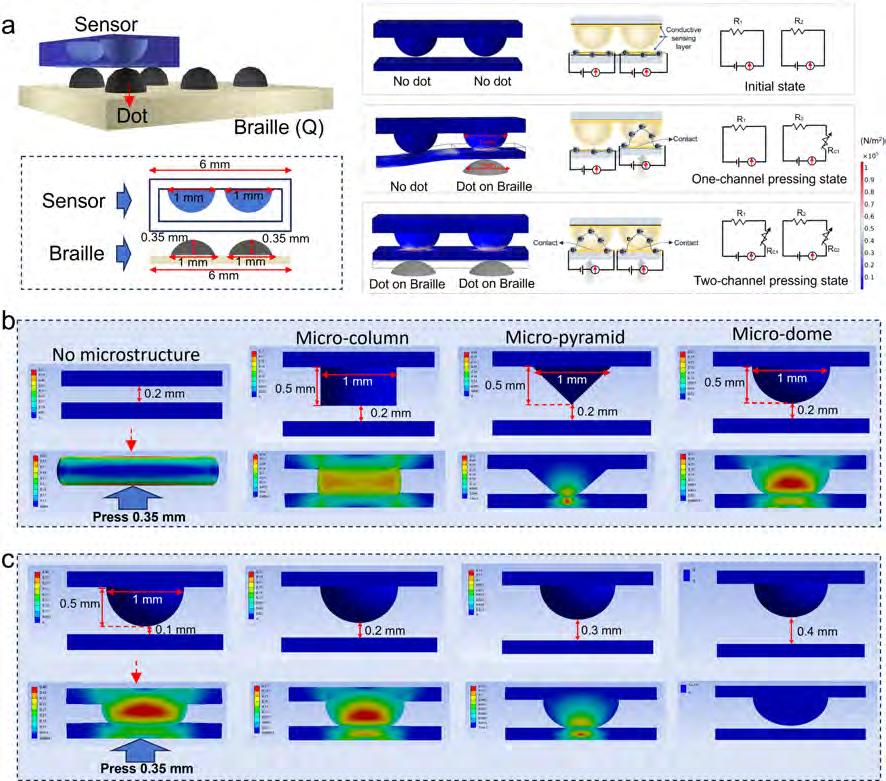
Figure3 Structuredesignandanalysisoftactilesensor.(a)IllustrationofthedimensionsofthetactilesensorandscannedBraille,and finite-elementcalculationsshowthedeformationandthelocalstressdistributionoftactilesensorwhenwithoutdotonBraille,withone-side dot,andwithtwo-sidedotsonBraille.(b)Finite-elementcalculationsshowthedeformationandthelocalstressdistributionoftactilesensor withnomicrostructure,micro-column,micro-pyramid,andmicro-sphere.(c)Finite-elementcalculationsshowthedeformationandthelocal stressdistributionofmicro-spheretactilesensorwithdifferentdistances.
piezoresistivesensorunderpressure.Inconclusion,micro-domestructurewaschosentoformtactilesensor forsensingBrailleaccurately.
Atlast,theheightofdotsonBrailleis0.35mm,thedistancefromthebottomlayerandtoplayerisanother factorwhichinfluencethesensingperformanceoftactilesensor,asshowninFigure3c,weanalyzedthe deformationandthelocalstressdistributionofmicro-domesensorwiththedistanceof0.1,0.2,0.3and 0.4mm(fromtopofmicro-dometobottomlayer)ata0.35mmdistancepressurethroughANSYS,the shorterdistanceleadtothestressdistributionconcentrateonthebottomlayer,whichleadtotheconfused sensingsignalsbecausetwodotsonBraillearecloseindistance;thelongerdistanceleadtoasmallorlittle deformationwhichexhibitedpoorsensingperformance;therefore,themicro-domesensorwith0.2mm distancewechooseforsensingBraille,whichexhibitedbothproperstressdistributionconcentrateonthe bottomlayerthansensorwith0.1mm,andexhibitedlargerdeformationthansensorwiththedistanceof0.3
NatlSciOpen,2026,Vol.5,20250078
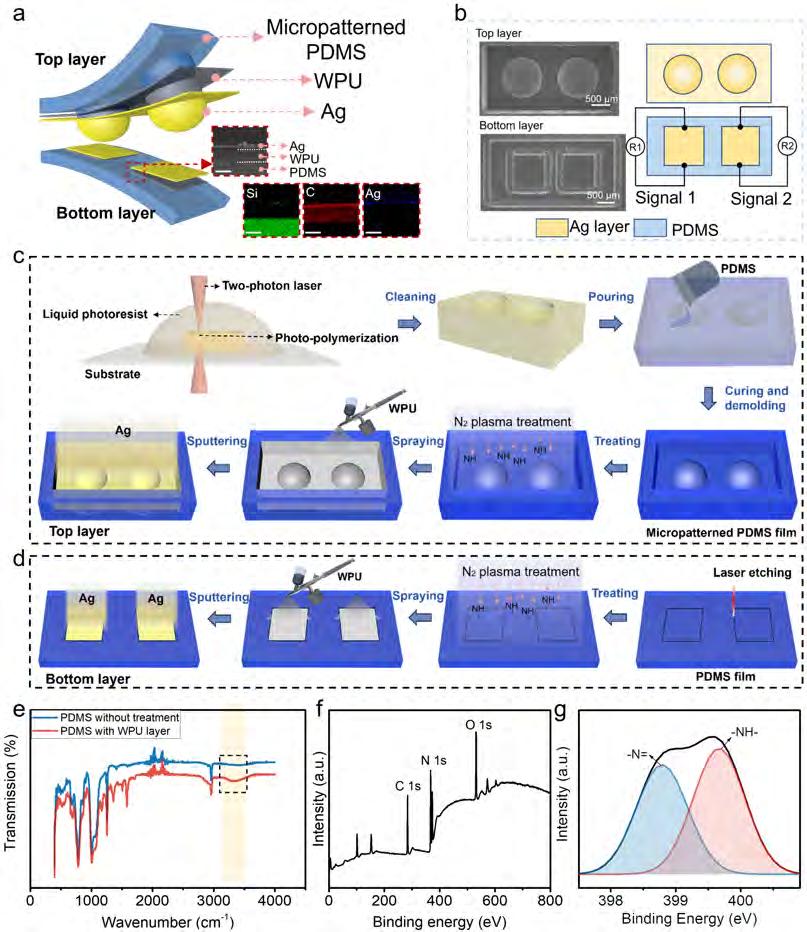
Figure4 Characterizationofthetactilesensor.(a)Explosiveviewofthemicro-spheretactilesensor(scalebaris5μm).(b)Scanning electronmicroscopy(SEM)imagesofthetopandbottomlayersofthe2B-sensorintopview,withrightsideshowingtheschematicofthetop andbottomlayers2B-sensor.(c,d)Fabricationproceduresofthetopandbottomlayersofthesensor.(e)FTIRspectraofthePDMSfilm beforeandafterN2-plasmatreatment.(f,g)XPSsurveyspectraofspectrumN1sregionofN2 plasma-treatedPDMSfilm.
and0.4mm.
Fabricationandmorphologyoftactilesensor
Thetwo-channelmicro-dometactilesensor(2B-sensor)iscomposedoftwolayersincludingthemicro-dome toplayerandtheflatbottomlayer,showninFigure4a,b.Thetoplayeriscomposedofmicro-domePDMS film,waterbornepolyurethane(WPU)filmandAglayer;thebottomlayeriscomposedofflatPDMSfilm,a
WPUfilmandAgelectrodes.ThedistributionofAglayeronthemicro-domeandflatPDMSfilmcouldbe observed,thenthesurfacemorphologyofthebottomlayerwasobservedbyscanningelectronmicroscopy (SEM)andenergydispersiveX-rayspectroscopy(EDS)mapping,inwhichAglayerisoverlaidonthePU layeradheredonthePDMSfilm,whichclearlyrevealedthedistributionofSi(fromPDMS),C(fromWPU) andAgelements,respectively.Thetop-viewSEMimagesofthetopandbottom2B-sensorwereshownin Figure4b.Figure4c,dillustratedthefabricationprocessofthe2B-sensor,thetopmicro-domePDMSfilm waspeelingofffromatwo-photonlaserwritingmicro-domemold,andthenWPUsolutionwassprayedon thetopmicro-domePDMSfilmafterplasmatreatmentinN2,followedbyAglayercoatingonbothsidesof PDMS/WPUfilmtoformtopconductivemicro-patternedPDMS/WPU/Agsubstrate;thebottomflatPDMS/ WPU/Agfilmwasfirstetchedbylasertoformtwoarea,thenplasmatreatedinN2,sprayingWPUsolution, aftercuringinoven,atlasttheAglayerwascoatedonthePDMS/WPUfilmtoobtaintwoconductive electrodes(DetaileddescriptionisintheMATERIALSANDMETHODS).Finally,thetopandbottomfilms wereassembledintothetactilesensorbytop-bottomstructureasshowninFigureS1.TheWPUlayer distributedandadheredtothePDMSstablybecausethereisalocalchangeinthematerialpropertiesatthe plasma-treatedsurfaceofPDMSfilm.TheFouriertransforminfrared(FTIR)spectraofPDMSfilmand PDMSfilmafterN2-plasmatreatmentwithWPUlayerareshowninFigure4e,indicatingthatthereisalocal changeinthematerialpropertiesattheplasma-treatedsurface.Comparedwithun-treatedPDMS,the stretchingofOHgiverisetoabroadpeakfrom3500to3000cm 1,fortheN1sspectraofanN2 plasma treatmentPDMSintheX-rayphotoelectronspectroscopy(Figure4f,g),twopeakswithbindingenergies 399.6and401.2eVcorrespondingtoaminegroup(–NH–)andamidegroup(–NH2),whichindicatedthe hydroxylandamidegroupproducingbyN2-Plasmatreatment,thus,thetreatedPDMScanprovideactive sitesforWPUlayer[37].Also,thehydroxy,aminegroupandamidegroupenhancethestabilityoftheAg layeradheringontheWPU/PDMSsurface,whichhasbeenproveninourpreviouswork[21].
Sensingperformanceoftactilesensor
Thetailoredmicro-dome2B-sensorwedevelopedforBraillerecognitionwastiny,withahighandstable sensingperformance.Thetiny2B-sensoronthefinger-tipwasshowninFigure5a.Twomicro-domes sensorswithoneelectrode(1B-senor)andtwoelectrodes(2B-sensor)wereproposedandfabricatedasshown inFigure5bandFigureS2,thenthesensitivitiesof1B-sensorand2B-sensorweremeasuredbypressingone sidemicro-domeofthesensor,thesensitivityof1B-sensorwasalittlehigherthan2B-sensorinthe0–3kPa pressure.HysteresisistherelativedifferenceintheareaunderneaththeΔR/R0 versuspressurecurvesunder loadingandunloading,whichcanbedefinedasthedegreeofhysteresis(DH).TheequationforDHisas follows:
AA A DH(%)= ×100%, (1) ReleasingLoading Loading
where ALoading and AReleasing aretheareasofthecurvesunderloadingandreleasing,respectively.The2Bsensorexhibitedalowhysteresis.Figure5cdepictstheresistancevariationofa2kPaloading-releasingcycle withamarginhysteresisof14%.Andtoevaluatethestablesensingperformanceof2B-sensor,areal-time pressureresponseofsensorswithquicklyloadinglowpressures(5,10and15Pa)andhighpressures(1,2 and3kPa)wasinvestigated(Figure5d,e).Theresultsshowthatthe2B-sensorpresentedstablesensing
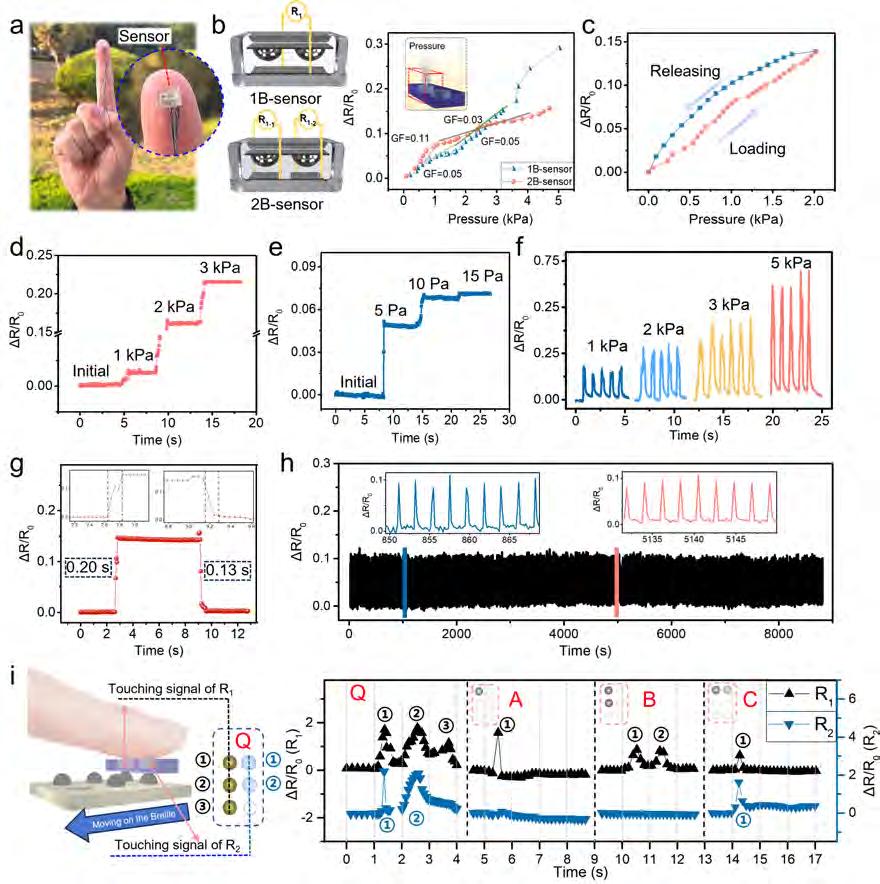
Figure5 Pressure-sensingperformanceofmicro-domesensor.(a)Photographof2B-sensoronthefingertip.(b)Schematicofone-channel (1B-sensor)andtwo-channeltactilesensor(2B-sensor),andtherelativeresistancevariationsof1B-sensorand2B-sensorunderdifferent pressures.(c)Relativeresistancevariationofthe2B-sensorduringa2kPapressureloading-releasingcycle.(d)Relativeresistancevariation of2B-sensorwithincreasingpressure(1,2and3kPa).(e)Relativeresistancevariationof2B-sensorwithincreasingsubtlepressure(5,10 and15Pa).(f)Relativeresistancevariationunderdifferentloads.(g)Responsetimeof2B-sensorunderpressure2kPa.(h)Piezoresistive repeatabilityofthe2B-sensorunderrepeatedloading/unloadingatapressureof2kPafor5000cycles.(i)Tactilesensingprocessof2BsensormovingandrecognizingBraille“Q”,andtactilesignalsdetectedbythe2B-sensorwhencompressingtheconvexBraillelettersQ,A,B andC.
performancewithhighsensitivityandrangedetection.Figure5fshowsthereal-timeresponseofthe2Bsensorforescalatingloading/unloadingpressureof1,2,3and5kPawithfivecyclesateachpressure.Then duringtheprocessofloading2kPaon2B-sensor,thecorrespondingresponsetimeandrecoverytimewas0.2 and0.13s,respectively(Figure5g).Undertheloadof2kPaofexternallyappliedpressure,therelative resistanceofsensorsignalsdidnotdeterioratesignificantlyafter5000pressureloading/releasingcyclesin 8000sinFigure5h.Thesensorexhibitedagoodsensitivity,responsetime,stabilityanddurability,whichis
properforBraillerecognition.ThenthetestercompressedconvexBraillelettersQ,A,BandCusingthe2Bsensor,thetypicaltactilesignalswereillustratedinFigure5i.Thesensingmeachismof2B-sensorwasthe generatedcompressionwhilemovingontheBraille,thesensortransformedthecompressionintoresistance variation,therefore,thedifferentBraillecanbedistinguishedbythedigitalsensingsignalsfromwaveforms. Also,the2B-sensorexhibitedagoodsensingperformancewhenunderahighpressureandinwaterenvironmentinFigureS3,indicatinggooddurabilityandwaterproofperformance.
ApplicationoftactilesensorrecognizingandlearningBraille
TheBraillecanhelptheVIreading,learning,writingandcommunicatingwiththeworld(Figure6a); therefore,itisessentialandmeaningfulfortheVIlearningBraille.AtailoredBrailleboardfortactilesensor wasdesignedasshowninFigure6b.Then,tactilesensingsignalsof2B-sensorand1B-sensortouchingon26 EnglishlettersareshowninFigure6candFigureS4.Wecollectedthedataoftactilesensorsensingsignals onBraille(26Englishletters)throughsequentialtouchingBraille,andusedalgorithmstoclassifyBraille. Here,wecomparedsixkindsofmachinelearningmethodsasshowninFigure6d.TheCNNalgorithm realizestherecognitionaccuracywith98.96%,whichishigherthantheotheralgorithms.TheAImethodof CNNwasutilizedtoboostBraillesensingdataidentificationinFigure6e.CNNisanefficientalgorithmto realizetheinformationminingandautomaticclassificationwhencombinedwithadevelopedtactilesensor, whichcontainsthree1Dconvolutionallayersandthreefullyconnectedlayers,and1DCNNhasasmaller networksizeandcomputationalload.ThedatabasesfortrainingandtestingCNNaregeneratedthrough sequentialtouchingBraille,andthedatainthedatabasesistheresistancevariationoftactilesensorduringthe sequentialtouchingprocess.Itwasobservedthatthepreciserecognitionof2B-sensoris98.96%,whichis higherthan1B-sensor(75.66%)(Figure6f,FiguresS5andS6).Also,therecognitionaccuracyof2B-sensor ishigherthanmostproposedtactilesensorsforrecognizingBraille.
IntheprocessoflearningandwritingBraille,thetactilesideoftheBrailleistheoppositesideofwriting Braille,showninFigure7a.ItishardfortheVIlearningtorecognizeandwriteBraillethemselves. Therefore,wedevelopedaBraillerecognitionsystem,whichconsistsofaglovebasedon2B-sensor,a tailoredBrailleboardandamicroprogrammedcontrolunit(MCU)processingunitconnectedtothecomputer forreceivingandanalyzingdata(Figure7a,b).TheBraillerecognitionsystemtransmitstheBrailletouching signalstoacousticsignalsthroughaprocesscircuitandaMCU.AsshowninFigure7candMovieS1,during theBraillelearningprocess,theVItouchandlearntheBrailleatfirst,thenwritetheBraille.TheBraille recognitionsystemcanbeusedtocheckthewrittenBraillethroughtransformingthetactilesignalsto acousticsignalshigh-efficiently.Therefore,thedevelopedBraillerecognitionsystembasedonhigh-accuracy 2B-sensorwillbehelpfulfortheVIlearningBraille,thenreading,writingandcommunicatingwiththe outside.
CONCLUSIONS
Insummary,aBraillerecognizingsystemwasfabricatedutilizingatailoredmicro-domesensorwithahighefficientAImethod.TheBraillerecognizingsystempossessesacontinuous,stabledurableandcost-efficient
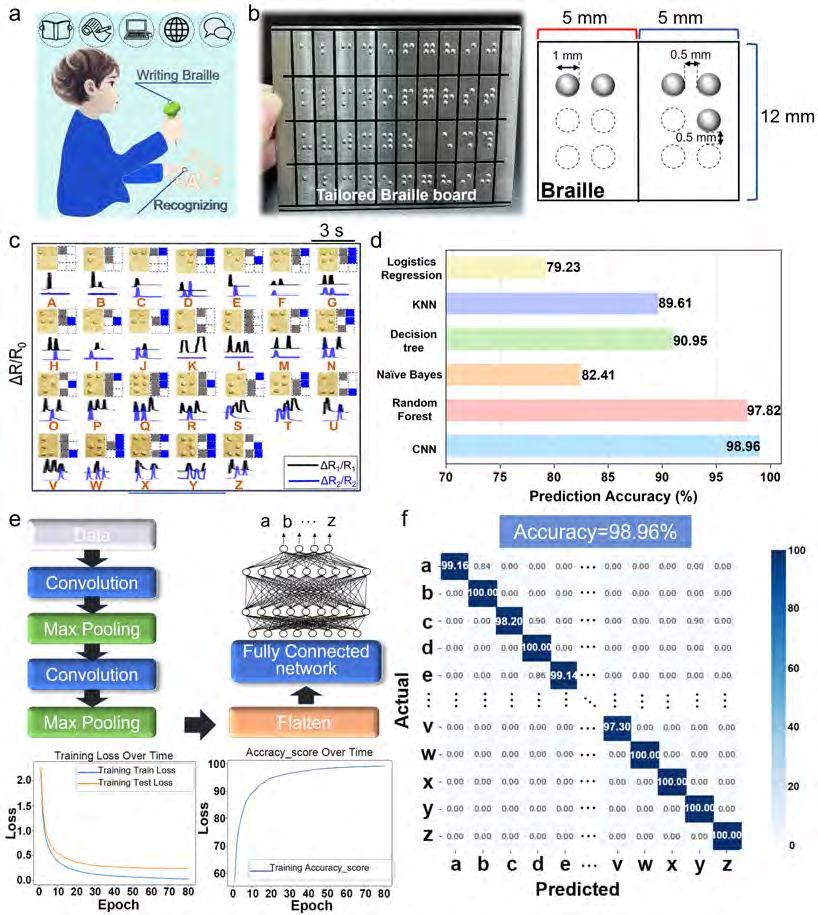
Figure6 Braillerecognizingmethodsoftactilesensor.(a)SchematicillustrationoftheBraillelearningiscrucialfortheVIreading, learningandcommunicatingwiththeworld.(b)PhotographofthetailoredBrailleboardforlearningBraillebythedevelopedsensors. (c)DigitalphotoshowingaBrailleboardwithtwenty-sixEnglishlettersandrelativeresistancechangeresponsecurveswhenslidingthe sensorunitacrosstheBrailleboardonebyonethroughthe2B-sensor.(d)EvaluationresultsofBraillerecognitionbasedonsixkindsof machinelearningmethods.(e)Processingmethodsofmachinelearning.(f)Confusionmatrixoftwenty-sixletterswithatwo-channel2Bsensor.
methodforAIlearningandrecognizingBraille.Thedevelopedmicro-dometactilesensorinteractingwith machinelearningmethod,producingstableandaccuratesensingsignalsbyslidingoverBraille.Thenthe sensingsignalsenhancestherecognitionsystem’saccuracyandalsosimplifiesdataprocessing,makingit highlycomputationallyefficient.Currently,thesystemsupports26Englishletters,withamaximumrecognitionaccuracyof98.96%,whichsurpassesmostoftheotherintelligentBraillerecognitionsystems.The proposedfabricationstrategywillbehighlyapplicabletohelptheVIperceiveandcommunicatewiththe world.
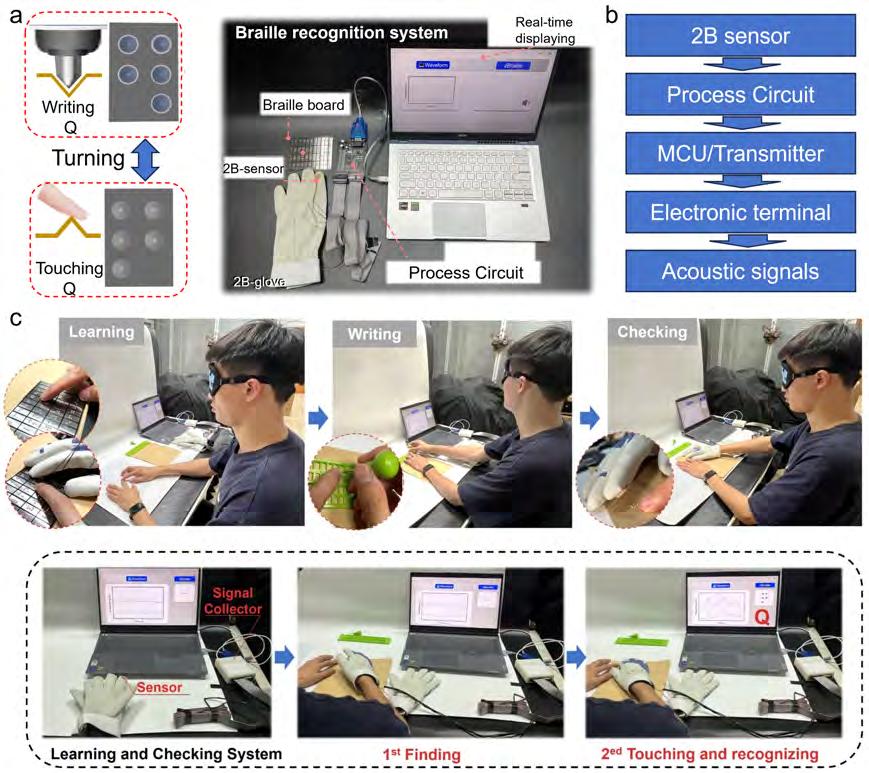
Figure7 Intelligentinteractionapplicationscenario.(a)SchematicillustrationofwritingandtouchingBraille“Q”,andthephotographof theBraillerecognitionsystemincluding2B-sensor,Brailleboard,processcircuitandMCU.(b)TheworkingprocessoftheBraille recognitionsystem.(c)Applicationsofthetwo-channel2B-gloveforlearning,writingandrecognizingBraille.
MATERIALSANDMETHODS
Fabricationoftailoredmicro-dometactilesensor
Atfirst,amicro-patternedmoldwasprintedviaatwo-photonlaserdirectwritingprocess(Nanoscribe, Germany).ThenPDMSprepolymer(DowCorning,Sylgard184)waspouredintotheprintingmold,thenget ridofgasbubblesinvacuumfor20minatroomtemperature,andcompletelycuredat75°Cfor2hinthe oven.Finally,themicropatternedPDMSfilmwasobtained.ThePDMSfilmwasslicedbyalaserdirect writingmachine(SpiritSI-60TI,GCCLaserPro,China).Then,theconductivePDMSfilmswereobtainedby nitrogengasplasmatreatment,sprayingWPUsolution(5%)andmagnetronsputteringAglayer.
Materialscharacterization
ThemorphologyofthemicropatternedsensorwasobservedviaSEM(JEOLJSM-840,Japan).Allofthe
NatlSciOpen,2026,Vol.5,20250078
sensingperformancesoftheflexiblemicro-patternedsensorswereevaluatedusingaSystemSourceMeter (Model2601B,Keithley).ThespectraweremeasuredusingaNicolet5700FTIRspectrometer(Thermo NicoletCorp,USA).ThecontactanglesofthewaterdropletsweretestedbyaContactAngleAnalyzer(JYPHb,China).Dropletsofdistilledwater,withavolumeof3μL,wereplacedgentlyontothesurfaceatroom temperatureandpressure.
Dataavailability
Theoriginaldataareavailablefromthecorrespondingauthorsuponreasonablerequest.
Funding
ThisworkwassupportedbytheNationalNaturalScienceFoundationofChina(62201537),theNaturalScienceFoundation ofShandongProvince(ZR2022QF008),theShandongProvinceScienceandTechnologySMESInnovationAbility ImprovementProject(2024TSGC1015),theQingdaoKeyTechnologyBreakthroughProjectforIndustrialCultivationand Leadership(InternationalandHongKongScienceandTechnologyCooperation)(25-1-1-gjgg-96-hz),theJointKey InnovationProjectoftheYangtzeRiverDeltaScienceandTechnologyInnovationCommunity(2023CSJZN0203),andthe ChinaPostdoctoralScienceFoundation(2025M770666).
Authorcontributions
L.W.wasresponsibleformethodology,investigation,resources,writingoriginaldraft,writingreview&editing;Z.Z.was responsibleforinvestigation,softwareandwritingoriginaldraft;X.A.wasresponsibleforsoftwareandinvestigation;J.L. wasresponsibleformethodologyanddatacuration;L.Q.wasresponsibleforresources.J.L.wasresponsibleforwriting review&editingandfundingacquisition;M.T.wasresponsibleforresources,methodology,writingreview&editing;Q.W. wasresponsibleforinvestigation,validation,resources,andfundingacquisition.
Conflictofinterest
Theauthorsdeclarenoconflictofinterest.
Supplementaryinformation
Thesupportinginformationisavailableonlineathttps://doi.org/10.1360/nso/20250078.Thesupportingmaterialsare publishedassubmitted,withouttypesettingorediting.Theresponsibilityforscientificaccuracyandcontentremainsentirely withtheauthors.
References
1LiuYH,WangJJ,WangHZ, etal. BraillerecognitionbyE-skinsystembasedonbinarymemristiveneuralnetwork. Sci Rep 2023; 13:5437.
2QuX,MaX,ShiB, etal. RefreshableBrailledisplaysystembasedontriboelectricnanogeneratoranddielectric elastomer. AdvFunctMater 2021; 31:2006612.
3LiuW,YuW,LiK, etal. Enhancingblind-dumbassistancethroughaself-poweredtactilesensor-basedBrailletyping system. NanoEnergy 2023; 116:108795.
4DaiX,HuangLB,SunZ, etal. AphonicBraillerecognitionsystembasedonaself-poweredsensorwithself-healing ability,temperatureresistance,andstretchability. MaterHoriz 2022; 9:2603–2612.
5TanakaM,MiyataK,ChonanS.AwearableBraillesensorsystemwithapostprocessing. IEEEASMETransMechatron 2007; 12:430–438.
NatlSciOpen,2026,Vol.5,20250078
6NaharL,SulaimanR,JaafarA.AninteractivemathbraillelearningapplicationtoassistblindstudentsinBangladesh. AssistiveTech 2022; 34:157–169.
7DoiK,NishimuraT,TakeiM, etal. BraillelearningmaterialsforBraillereadingnovices:Experimentaldetermination ofdotcodeprintingareaforapen-typeinterfacereadaloudfunction. UnivAccessInfSoc 2021; 20:45–56.
8ZhaoXF,HangCZ,LuHL, etal. Askin-likesensorforintelligentBraillerecognition. NanoEnergy 2020; 68:104346.
9LingY,GongS,ZhaiQ, etal. EmbeddingpinholeverticalgoldnanowireelectronicskinsforBraillerecognition. Small 2019; 15:1804853.
10NiuH,LiH,LiY, etal. Cocklebur-inspired“branch-seed-spininess”3Dhierarchicalstructurebionicelectronicskinfor intelligentperception. NanoEnergy 2023; 107:108144.
11QiaoY,JianJ,TangH, etal. Anintelligentnanomesh-reinforcedgraphenepressuresensorwithanultralargelinear range. JMaterChemA 2022; 10:4858–4869.
12LaiQ,ZhaoX,SunQ, etal. EmergingMXene-basedflexibletactilesensorsforhealthmonitoringandhaptic perception. Small 2023; 19:2300283.
13LvC,TianC,JiangJ, etal. Ultrasensitivelinearcapacitivepressuresensorwithwrinkledmicrostructuresfortactile perception. AdvSci 2023; 10:2206807.
14YuanS,BaiJ,LiS, etal. Amultifunctionalandselectiveionicflexiblesensorwithhighenvironmentalsuitabilityfor tactileperception. AdvFunctMater 2024; 34:2309626.
15DavoodiE,MontazerianH,HaghniazR, etal. 3D-printedultra-robustsurface-dopedporoussiliconesensorsfor wearablebiomonitoring. ACSNano 2020; 14:1520–1532.
16SangZ,KeK,Manas-ZloczowerI.Designstrategyforporouscompositesaimedatpressuresensorapplication. Small 2019; 15:1903487.
17YangR,DuttaA,LiB, etal. Iontronicpressuresensorwithhighsensitivityoverultra-broadlinearrangeenabledby laser-inducedgradientmicro-pyramids. NatCommun 2023; 14:2907.
18TaoK,ChenZ,YuJ, etal. Ultra-sensitive,deformable,andtransparenttriboelectrictactilesensorbasedonmicropyramidpatternedionichydrogelforinteractivehuman-machineinterfaces. AdvSci 2022; 9:2104168.
19ZhangC,LiuS,HuangX, etal. Astretchabledual-modesensorarrayformultifunctionalroboticelectronicskin. Nano Energy 2019; 62:164–170.
20MaoY,JiB,ChenG, etal. RobustandwearablepressuresensorassembledfromAgNW-coatedPDMSmicropillar sheetswithhighsensitivityandwidedetectionrange. ACSApplNanoMater 2019; 2:3196–3205.
21WangL,LiuJ,QiX, etal. Personalprotectivegloveswithobjectsrecognizingforrescuingindisaster. ChemEngJ 2023; 477:146986.
22JiB,ZhouQ,LeiM, etal. Gradientarchitecture-enabledcapacitivetactilesensorwithhighsensitivityandultrabroad linearityrange. Small 2021; 17:2103312.
23FuhYK,WangBS,TsaiCY.Self-poweredpressuresensorwithfullyencapsulated3Dprintedwavysubstrateand highly-alignedpiezoelectricfibersarray. SciRep 2017; 7:6759.
24LinC,LanJ,YuJ, etal. Cocklebur-structureddesignofplantfibersforhigh-performancetriboelectricnanogenerators andpressuresensors. MaterTodayCommun 2022; 30:103208.
25BaiX,GaiC,WuD, etal. Intelligentsensingsystemofthecarseatwithflexiblepiezoresistivesensorofdouble-layer conductivenetwork. IEEESensJ 2022; 22:3113–3121.
26ChenB,ZhangL,LiH, etal. Skin-inspiredflexibleandhigh-performanceMXene@polydimethylsiloxane piezoresistivepressuresensorforhumanmotiondetection. JColloidInterfaceSci 2022; 617:478–488.
27LiS,LiuG,WenH, etal. Askin-likepressure-andvibration-sensitivetactilesensorbasedonpolyacrylamide/silk fibroinelastomer. AdvFunctMater 2022; 32:2111747.
28KurupLA,ColeCM,ArthurJN, etal. Grapheneporousfoamsforcapacitivepressuresensing. ACSApplNanoMater 2022; 5:2973–2983.
29FuX,LiJ,LiD, etal. MXene/ZIF-67/PANnanofiberfilmforultra-sensitivepressuresensors. ACSApplMater
NatlSciOpen,2026,Vol.5,20250078
Interfaces 2022; 14:12367–12374.
30ZhengQ,LeeJ,ShenX, etal. Graphene-basedwearablepiezoresistivephysicalsensors. MaterToday 2020; 36:158–179.
31ShokatS,RiazR,RizviSS, etal. CharacterizationofEnglishBraillepatternsusingautomatedtoolsandRICAbased featureextractionmethods. Sensors 2022; 22:1836.
32BhatiaS,DeviA,AlsuwailemRI, etal. Convolutionalneuralnetworkbasedrealtimearabicspeechrecognitionto arabicBrailleforhearingandvisuallyimpaired. FrontPublicHealth 2022; 10:898355.
33KausarT,ManzoorS,KausarA, etal. DeeplearningstrategyforBraillecharacterrecognition. IEEEAccess 2021; 9: 169357–169371.
34GaoZ,ChangL,RenB, etal. Enhancedbraillerecognitionbasedonpiezoresistiveandpiezoelectricdual-modetactile sensors. SensActuatA-Phys 2024; 366:115000.
35LuY,KongD,YangG, etal. Machinelearning-enabledtactilesensordesignfordynamictouchdecoding. AdvSci 2023; 10:2303949.
36HsuBM.Braillerecognitionforreducingasymmetriccommunicationbetweentheblindandnon-blind. Symmetry 2020; 12:1069.
37TabassumR,AshfaqM,OkuH.Developmentofanefficient,one-pot,multicomponentprotocolforsynthesisof8hydroxy-4-phenyl-1,2-dihydroquinolinederivatives. JHeterocyclicChem 2021; 58:534–547.
NationalScienceOpen 5:20250048,2026
https://doi.org/10.1360/nso/20250048
Materials Science
SpecialTopic:IntelligentMaterialsandDevices
Real-timecross-domainmonitoringofmulti-UAV-multi-USV systemsviaefficientblocksparseBayesianlearning
YaozhongZheng1,2,Hai-TaoZhang1,2,*,JiajieHuang1,2,BowenXu3 &JianingDing1,2
1 SchoolofArtificialIntelligenceandAutomation,InstituteofArtificialIntelligence,EngineeringResearchCenterofAutonomousIntelligent UnmannedSystems(MinistryofEducation),HuazhongUniversityofScienceandTechnology,Wuhan430074,China;
2 GuangdongHUSTIndustrialTechnologyResearchInstitute,HuazhongUniversityofScienceandTechnology,Dongguan523808,China;
3 SchoolofArtificialIntelligence,OpticsandElectroNics(iOPEN),NorthwesternPolytechnicalUniversity,Xi’an710072,China
*Correspondingauthor(email:zht@mail.hust.edu.cn)
Received14September2025;Revised27November2025;Accepted5December2025;Publishedonline8December2025
Abstract: Despitethetremendousprogressincoordinatingmulti-unmannedsurfacevehicle(USV)fleets,persistentmonitoringremainsadilemmabecauseUSVscannotsharedatawithexternalmonitors.Practicaldeploymentsfurtherimposereal-time constraintsandlimitedonboardcalculationcapability,necessitatinglow-complexityalgorithms.ThisstudyproposesamultiUAVfleet-basedmonitoringscheme.Therein,UAVsareassignedtopairwiseUSV-UAVmatchingtoobserverelativepositions inrealtime.AnefficientblocksparseBayesianlearningalgorithm(EBSBL)isthendevelopedtoidentifythecoordinated dynamicsofUSVs,withtheoreticallyguaranteedfeasibility.Inaddition,theunscentedKalmanfilter(UKF)isemployedto facilitatemulti-UAVcoordinatedmonitoringwithreal-timepredictionandUSVtrajectoryestimation.Theeffectivenessand superiorityoftheproposedmethodaredemonstratedbybothnumericalsimulationsandreal-lakebasedmulti-UAV-multi-USV platformexperiments.
Keywords: cross-domainmonitoring,unmannedsurfacevehicles(USVs),unmannedaerialvehicles(UAVs),sparseBayesian learning(SBL)
INTRODUCTION
Recentdevelopmentsinmachinelearningalgorithmsandsensortechnologieshavefacilitatedtheintegration ofautonomoussystemsinreal-worldmarineapplications,suchasenvironmentalmonitoring[1–3],disaster response[4,5],andindustrialautomation[6,7].Unmannedsurfacevehicles(USVs)haveemergedasindispensabletools,enablingawidevarietyofmissions[8–10].Despitethetremendousprogressinmulti-USV fleetcoordination,real-timemonitoringremainsadilemmawhenUSVsarenoncooperativeanddonotshare datawithexternalmonitors.Furthermore,practicaldeploymentsimposeconstraintsonreal-timeefficiency andlimitedonboardcalculationcapability,necessitatinglow-complexityalgorithms.
Aglobalpositioningsystem(GPS)-basedtrackingcontrolsystemforwheeledmobilerobotsisintroduced insuchunmannedsystems,whichcompensatesforskiddingandslippingeffectsusingrealtimekinematic (RTK)-GPS,ensuringnavigationaltrajectorytracking[11].InRef.[12],avision-basedtargetdetectionand
c ⃝ The Author(s)2025.PublishedbySciencePressandEDPSciences.ThisisanOpenAccessarticledistributedunderthetermsoftheCreativeCommons AttributionLicense(https://creativecommons.org/licenses/by/4.0),whichpermitsunrestricteduse,distribution,andreproductioninanymedium,providedthe originalworkisproperlycited.
localizationsystemisdeveloped,utilizingacooperativeswarmcomposedofUAVsandunmannedground vehicles(UGVs),whereUAVsemployanopticalflowformotiondetectionandUGVsmakeindividual detection.InRef.[13],avehiclemonitoringsystemisdevelopedbyintegratinganArduinomicrocontrollerwithglobalsystemformobilecommunications(GSM)andGPSmodules.Aframeworkforadaptive learningnavigationwithnestedguidancelayersisintroducedinRef.[14]forUAVs,enablinghorizontal monitoringandverticaldescentinconfinedlandingzonesusingsolelyrelativepositionfeedback.However, theseschemesdependonmotioninformationdirectlyprovidedbythenon-cooperativemonitoredtargets.To addressthisissue,atarget-trackingcontrolsystemforunderactuatedautonomoussurfacevehicles(ASVs) isproposedinRef.[15],whichreliessolelyonline-of-sightrangeandanglemeasurements.Moreover, thissystemintegratesanextendedstateobserverandasinglehiddenlayerneuralnetworktoestimateboth targetdynamicsandexternaldisturbances.Amonocularcamera-basedmethodwasproposedinRef.[16], leveragingopticalflowfortargetlocalization,andintegratingitwithanextendedKalmanfilter(EKF)toestimatemotiondynamics.Furthermore,Ref.[17]establishesahierarchicalcoarse-to-finedeepreinforcement learningframeworkforUAVtracking,whereacoarsestageinitializestheboundingbox,andafinestagerefinesittohandleaspect-ratio,scale,andocclusionchanges.However,theseapproachesrelyonidealmodels, whichexhibithighcomputationalcomplexity.Toanalyzemulti-sourcedata,Ref.[18]developsaUAV-based tracking-and-recognitionsystemintegratingconsensus-basedtracking,neural-networkdetection,andgimbal stabilization,wherereal-timetrackingisachievedviamultimodalfusiontogetherwithmoving-background compensation.AtrackingsystemforUSVsistailored,utilizinganEKFandavisibility-awarecontrolstrategytoenhancetargetdetection,positioningaccuracy,andtrajectoryprediction[19].Additionally,Ref.[20] introducesatargetdetectionmethodwiththeassistanceofasingleshotmultiboxdetector,asupportvector machineclassifier,andatrackingalgorithm.Despitetheseadvancements,fewexistingstudiesaddressthe scenarioofmulti-targetcoordinatedmonitoring.
Tothisend,wedesignacooperativemethodformulti-USVsystems.TheUAVsareassignedaccording toUSV-UAVpairwisematchingtoobserverelativepositionsonline.AnefficientblocksparseBayesian learningalgorithm(EBSBL)withlowcomputationalcomplexityisproposedtoidentifythecoordinateddynamicsofthemulti-USVfleet,leveragingtheadvantagesofsparseBayesianlearning(SBL)overtraditional ℓ1 methodsforsparse,high-qualitysignalrecovery,andincorporatingstructuralinformationforimproved performance[21,22].Additionally,theunscentedKalmanfilter(UKF)isemployedtofacilitatereal-time prediction,USVtrajectoryestimation,andUAVmonitoringcoordination.Insummary,thecontributionsof thisworkaretwo-fold.
(1)Proposeareal-timecross-domainmonitoringmethodnotrequiringmotioninformationprovidedby themulti-USVfleet.
(2)ProposeanEBSBLwiththeoreticallyguaranteedfeasibility.
Theremainderofthispaperisorganizedasfollows.SectionPRELIMINARIESANDPROBLEMFORMULATIONintroducestheproblemaddressedbythepaperwithnecessarypreliminaries.SectionMETHOD developsthemonitoringscheme,whichincludesUAVsassignment,coordinateddynamicslearning,and cross-domaincoordinatedtrackingmodules.Experimentsareconductedonaself-establishedcross-domain platforminSectionNUMERICALANDEXPERIMENTALRESULTStodemonstrateboththeeffectiveness andsuperiorityoftheproposedmonitoringmethod.Finally,theconclusionisdrawninSectionCONCLUSIONS.
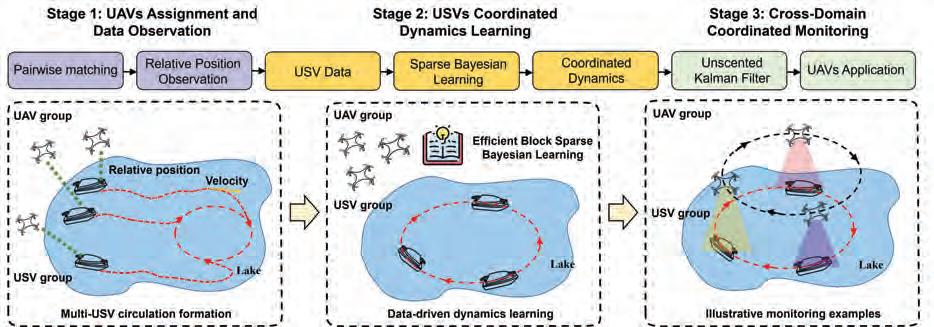
Figure1 DiagramofthealgorithmforUAVsmonitoring(ortracking)USVswithEBSBL,consistingofthreestages.Stage1:AssignUAVs toUSVsusingauctionalgorithmandmakeobservations.Stage2:IdentifyUSVdynamicsusingefficientblocksparseBayesianlearning. Stage3:MonitorUSVsincoordinationusingidentifiedresultsandUKFbyUAVs.
PRELIMINARIESANDPROBLEMFORMULATION
Consideramulti-UAV-multi-USVscenariowhere n USVsaremonitoredby n UAVs,asshowninFigure1.
Denotethepositionsofthe i-thUSV pi(t) = [pi[x](t), pi[y](t)]T , i ∈{1, 2,..., n
)and p
[
(t) representthepositionalongthe x-and y-axesofthe i-thUSV,respectively.Denotethepositionsofthe j-th UAV q j(t) = [q j[x](t), q j[y](t), q[z]]T , j ∈{1, 2,..., n},where qi[x](t)and qi[y](t)representthepositionsalongthe x-and y-axesofthe j-thUAV,respectively,and qz representsthefixedaltitude.Assumethatthedynamics ofUSVs Mi(t)isgovernedbythevelocityfunction f i(p1(t), p2(t) ..., pn(t)),whichiswidelyappliedin cooperativecontrolofUSVsasfollows[23–25]:
ThedynamicsofUSVsarerepresentedbythefollowingkinematicmodel[26]:
where G(ρi)representstherotationmatrix,and ρi, ιi,and ϱi aretheorientationangle,forwardvelocity,and transversevelocity,respectively.ThedynamicsofUAVsismodeledasfollows:
(3) where κ j(t)and u j(t)denotethevelocityandcontrolinputofthe j-thUAV,respectively.
NotethattheUSVsdonotsharetheirpositionandvelocityinformationwiththeUAVs,whichcanonly beobservedbytheUAVs.Moreprecisely,duringtheobservationperiod,eachUAVcanobserveanyUSV, ratherthanbeingrestrictedtoafixedpairwisemonitoringscheme.Definetherelativepositionofthe i-th USVobservedbythe j-thUAVattime t as rij(t) = [rij[x](t), rij[y](t)],where rij[x](t)and rij[y](t)representthe relativepositionsalongthe x-and y-axes,respectively.Denote ˜ t asthetimewhentheobservationisnot available.Theproblemaddressedbythispaperismotivatedasbelow.
Problem1: MonitortheUSVsbyidentifyingthedynamicsofUSVs Mi(t)andpredictingtheirpositions pi(t)basedontherelativeobserveddata rij(t)andthepositions q j(t)ofUAVs,i.e., pi(t) = gi(Mi(t)).
METHOD
UAVsassignmentfortrackingUSVs
ToenabletrajectoryobservationandtrackingofUSVs,eachUSVisassignedtoauniqueUAVateach observationtime th,whichinspirestothefollowingpairwisematchingoptimizationproblem:
where αij isabinaryvariableequalto1ifthe i-thUSVisassignedtothe j-thUAV,and0otherwise. Theobjectivefunction(4a)seekstominimizethetotalobservationdistance,giventhatthequalityofUAVcollecteddatadeteriorateswithincreasingdistance.Furthermore,whentheUAVisclosertothetarget,it canmorerapidlyfollowthetrajectoryofUSV.Tosolveproblem(4),theauctionalgorithm[27]isemployed, whichiterativelyalternatesbetweenabiddingphaseandanassignmentphase.Inthebiddingphase,foreach unassigned i-thUSV,i.e., ∑n j=1 αij = 0,therewardfunctionisdefinedas
where z j denotesthecurrentpriceof j-UAV,initializedas0.TheoptimalandsuboptimalUAVsforthe i-th USVaredeterminedas
Accordingly,the i-thUSVsubmitsabidto j∗-thUAVgivenby
where ϵ ∈ R+ isasmallpositiveconstant.Intheassignmentphase,eachUAVisallocatedtotheUSV offeringthehighestbid,i.e.,
thepriceofthe j-thUAVisthenupdatedas z j = oi∗ j.Ifthe j-thUAVwaspreviouslyassignedtoanotherUSV i i∗,theearlierassignmentiscanceled,i.e., αij = 0,andthenewallocationisestablishedwith αi∗ j = 1. Remark1. TheassignmentprobleminEq.(4)imposestheone-to-onematchingconstraintsinEq.(4a), whichensuresthateachUSVisassignedtoexactlyoneUAVateachobservationtime th.Whenthenumbers ofUAVsandUSVsareequal,theseconstraintsdefineamatchingbetweenthetwosets.Combinedwiththe auction-basedsolutionprocedure,whichiterativelyassignsallremainingunassignedUSVs,theproposed methodguaranteesthatallUSVsareobservedateachobservationtime[27].
Definethetotalobservationtimeas H,theobservationnumberofthe i-thUSVbythe j-thUAVas ˜ hij, H = ∑n j=1 hij.Buildingontheallocationmatrix α obtainedfromEq.(4),theestimatedpositionofthe i-th USVbyitsassignedthe j-thUAVattime th isdescribedas
pi(th) = [pi[x](th), pi[y](th)] = [rij[x](th) + q j[x](th), rij[y](th) + q j[y](th)] (9)
Natl SciOpen,2026,Vol.5,20250048
Thereby,thetrajectoryofthe i-thUSVcanbeexpressedas si = [si[x], si[y]] = [pi(t1)T , pi(t2)T ,..., pi(tH)T]T ∈ RH×2,andthevelocity vi = [vi[x], vi[y]] ∈ RH×2 isapproximatedbyusingtheEulermethod.
CoordinateddynamicswithefficientblocksparseBayesianlearning
AnEBSBLisproposedtoidentifythecoordinateddynamicsofUSVs.Toapproximatetheunknownvelocity function f i(p1(t), p2(t),..., pn(t)),webuildupthevectorofcandidatefunctions ϕ
composedofnonlinearcandidatefunctions,where g denotesthenumberoffunctions.Define Φi ∈ RH×g as follows: Φi := [ϕ(p1(t1),..., pn(t
where H denotesthecurrentobservationnumber.Definethesetoftimeobservationsassociatedwiththe j-thUAVofthe i-thUSVas Iij,thevectorofweightstobeidentifiedas
where hij denotesthecurrentobservationnumberofthe i-thUSVbythe j-thUAV.
SincetheproposedmethodindependentlyidentifiesthecoordinateddynamicsofeachUSVinboth xand y-directions,thesubscripts i,[x],and[y]areomittedforconciseness.Forthe x-and y-axesdynamics ofthe i-thUSV,definedatavector τ ∈ RH anddictionarymatrix Ψ ∈ RH×gn stackedfromall vij and Φij, respectively,asfollows:
(12) andtheelementsof Ψ jg′ ∈ Rhij×n aredefinedasfollows:
(13)
where Ψ jg′ ,pq and Φij,pg′ denotetheelementsinthe p-throwand q-thcolumnof Ψ jg′ andthe p-throwand g′-thcolumnof Φij,respectively, p ∈ {1, 2,..., hij} , q ∈ {1, 2,..., n} , g′ ∈ {1, 2,..., g}.Define w ∈ Rgn stackedfromall θij asfollows: w = [w1, w2,..., wg]T , wg′ = [θi1,g′ ,θi2,g′ ,...,θin,g′ ] ∈ Rn , (14)
where θij,g′ denotesthe g′-thelementof θij.Asaresult,onehas τ =
Blockpriorisintroducedasfollows: p (w | γ) = g ∏ g′=1 p (wg′ | γg′ ) , p (wg′ | γg′ ) = n ∏ j=1 N (wg′ , j | 0,γg′ ) , (16) where wg′ , j denotesthe j-thelementof wg
R1×n.Define anauxiliaryvariable ϖ ∈ Rgn,andthelikelihoodfunction p(τ | w,σ)canbewrittenas[28] p(τ | w,σ) = (2πσ) H 2 exp ( (2σ)( 1)∥
(17)
where p ′(τ | w,σ; ϖ):= (2πσ) H 2 exp ( (2σ)( 1)R(w, ϖ)) , R(w, ϖ
β = eig(Ψ TΨ) + ζ, ζ ∈ R+ isasmallpositiveconstant,andeig( )denoteseigenvalues.Weusethestrictlower boundfunction p′(τ | w,σ; ˆ ϖ)ofthelikelihoodfunction p(τ | w,σ)tocomputetheposteriordistributionof w,asfollows:
where ˆ ϖ istheestimatedfixedvector,andtheposteriorcovariance Σw ∈ Rgn×gn andmean µw ∈ Rgn of w are givenby
Thepurposeistoestimatetheunknownparameters ϖ, γ,and σ usingtheevidencemaximizationmethod [28],theoptimalvaluesof γ and σ areobtainedbymaximizingthemarginalizedprobabilitydensityfunction p(τ,σ, γ)asfollows:
wherethelastinequalityisobtainedbyswappingtheorderofintegrationandmaximization[28].Asaresult,
Taking 2ln( )ofEq.(22),weobtainthefollowingobjectivefunctiontobeminimized:
with n1 = gn H.FromEq.(20),onehas
Asaresult,
Notethat w⋆ = µw,onehas
Therefore,thejointobjectivefunctionisobtainedasfollows:
Notethat g(w, ϖ, γ,σ)isconvexwithrespectto {w, ϖ, γ,σ},and f (γ,σ)isconcavewithrespectto {γ,σ}.
Hence, L(w, ϖ, γ,σ)isaconvex-concaveprocedureproblem[29],whichcanbesolvedasfollows:
w(k+1) = argmin w g(w, ϖ(k) , γ(k),σ(k)), (29a) ϖ(k+1) = argmin
g(w(k+1) ,
(k),σ(k)), (29b)
,
(k+1) = argmin σ g(w(k+1) , ϖ(k+1) , γ(k),σ) + ⟨σ
γ(k+1) = argmin
(k) , ∇ f (γ(k),σ(k))⟩ , (29c)
SincetheobjectivefunctionsinEqs.(29a)–(29c)areconvex,settingthegradienttozeroyields:
Thefinal ˆ θ ∈ Rg isobtainedbyaveragingovereachblock
in ˆ w asfollows:
NotethatEq.(30a)onlyinvolvestheinversionofadiagonalmatrix,whichhasanoperationof O(n).Considerthematrixmultiplication Ψ TΨϖ inEq.(30b),theproposedEBSBLhasacomputationalcomplexity of O(n2).Incontrast,forconventionalblocksparseBayesianlearningalgorithm[30],eachiterationrequires computingtheinverseofanon-diagonalmatrix,resultingin O(n3)computationalcomplexity.Asaresult, EBSBLreducesthecomputationalcomplexityfrom O(n3)to O(n2). Then,thecoordinateddynamics f i(p1(t), p2(t),..., pn(t))ofthe i-thUSVcanbeidentifiedasfollows:
Theorem1. Thesequence {L (w(k) , ϖ(k) , γ(k),σ(k))}∞ k=0 generatedusingEBSBLisnon-increasingandlocally convergent.Moreover, {w(k) , ϖ(k) , γ(k),σ(k)} isbounded.
Proof. Definethesurrogatefunction Lk(w, ϖ, γ,σ)asfollows: Lk(w, ϖ, γ,σ):= g(w, ϖ, γ,σ) + ⟨(γ,σ) (γ(k),σ(k)) , ∇ f (γ(k),σ(k))⟩ + f (γ(k),σ(k)) . (33)
As ⟨(γ,σ) (γ(k),σ(k)) , ∇ f (γ(k),σ(k))⟩ + f (γ(k),σ(k)) isanaffinefunctionand g(w, ϖ, γ,σ)isconvex,one has
Lk (w(k+1) , ϖ(k+1) , γ(k+1),σ(k+1)) Lk (w(k+1) , ϖ(k+1) , γ(k+1),σ(k)) Lk (w(k+1) , ϖ(k+1) , γ(k),σ(k))
Lk (w(k+1) , ϖ(k) , γ(k),σ(k)) Lk (w(k) , ϖ(k) , γ(k),σ(k)) = L (w(k) , ϖ(k) , γ(k),σ(k)) . (34)
Theconcavityof f (γ,σ)leadsto
L (w(k+1) , ϖ(k+1) , γ(k+1),σ(k+1)) Lk (w(k+1) , ϖ(k+1) , γ(k+1),σ
Therefore,thesequence {L (w(k) , ϖ(k) , γ(k),σ(k))}∞ k=0 isnon-increasing.Since γ > 0, σ> 0,and R(w, ϖ) > 0, thecostfunction L (w, ϖ, γ,σ) islowerbounded.Bythemonotoneconvergencetheorem[31],thenonincreasingsequence {L (w(k) , ϖ(k) , γ(k),σ(k))}∞ k=0 islocallyconvergent.Hence,thesequence {w(k) ,
,σ
} isbounded,whichcompletestheproof.
Cross-domaincoordinatedtracking
TheUKF[32]isemployedinthissystemtopredictthepositionofUSVsbyhandlingthenonlineardynamics. UnlikeEKF,theUKFdoesnotrequirelinearization,makingitmoresuitableforcomplexsystems.UKF generatessigmapointsaroundthecurrentstateestimateandpropagatesthemthroughthenonlinearmodel, providingmoreaccuratestateandcovarianceestimates.WhiledirecttrajectoryestimationbasedonUSV dynamicsdoesnotaccountforuncertaintiessuchassensorinaccuraciesandenvironmentaldisturbances, UKFintegratesthedynamicsmodelwithmeasurementsinaprobabilisticframework.Ititerativelyupdates thetrajectoryestimateusingtherelativepositiondataobservedbyUAVs,correctingtheestimateateach timestepbasedonthenewmeasurementandthepredictedstatefromthepreviousstep.
Let ˆ pt|t ∆t and ˆ pt ∆t|t ∆t denotetheposteriorestimatedpositionandtheestimatedpositionfromtheprevious stepof i-thUSV,respectively,where ∆t representsthetimestep.Thepredictedposition ˆ pt|t ∆t ofthe i-thUSV atthecurrenttime t isobtainedfromthepreviousstateestimate
andthesystem’sdynamicmodel f i TheUKFpredictsthepositionatthecurrenttimestepasfollows:
|
UKFgeneratesasetofsigmapoints Xb toapproximatetheprobabilitydistributionofthesystemstate, whicharederivedfromthecurrentstateestimate ˆ pt|t andtheassociatedcovariancematrix,describingthe uncertaintyinthecurrentstateestimate.Thesigmapoints Xb aregeneratedandpropagatedthroughthe systemmodelasfollows:
where ξ is ascalingparameter,and Sb thecolumnvectorsofthesquarerootofthecovariancematrix P
Thepredictedstatesareyieldedasfollows:
where Xb denotesthesigmapointspropagatedthrough f i over ∆t,and W(m) b aretheweightsassociatedwith eachsigmapoint.Thepredictedcovarianceisgivenby
where W(c) b arethecovarianceweightsassociatedwitheachsigmapoint, Q ∈ R2×2 representstheexternal noisecovariance.Thenewsigmapoints ˆ Xb aregeneratedusingtheupdated ˆ pt+∆
and P
+∆t|t.Themeasurementupdatestepinvolvesgeneratingpredictedmeasurements Zi fromthepredictedsigmapoints,usingthe measurementfunction h(p
Themeasurementcovariance S andcross-covariance C aregivenby
where D ∈ R2×2 isthemeasurementnoisecovariance.TheKalmangaininUKFiscomputedas Kt+∆t = CS 1 . Thecurrentstateestimate
andupdatedcovariance P
areupdatedasfollows:
Thecontrollerforthe j-thUAVtomonitorthe i-thUSVisdesignedasfollows[33]:
(43) where
kp ∈ R+ and kd ∈ R+ aretheproportionalandderivativegains,respectively.ToavoidcollisionsamongUAVs, apotentialfield-basedcontrollerisutilizedforUAVs.Therepulsiveforce F jk(t)exertedonthe j-thUAVby k-thUAVisdefinedasfollows[34]:
where kr ∈ R+ is therepulsiveforcecoefficient.AccordingtoRef.[35],thecontroller uavoid j (t)ofthe j-th UAVis
where η ∈ R+ isapositivegainparameter.Asaresult,thecontrolinputofUAVsisasfollows:
ThecompletemonitoringproceduresaresummarizedinAlgorithm1withtheassociateddiagramshown inFigure1.
Algorithm 1 Multi-UAV-multi-USVmonitoringwithEBSBL(MUMU-EBSBL)
Input: H: totalobservationtimenumber; n:numberofUSVsandUAVs; kmax:maximumiterationsofEBSBL; ς:stoppingthresholdforEBSBL.
Output: u j:controlinputofUAVs.
1: for h = 1,..., H do
2:AssignUAVsforeachUSVbyEqs.(4)–(8)
3:ComputetheestimatedpositionandvelocityofUSVsbyEq.(9)
4: for i = 1,..., n do
5: for x-axisand y-axis do
6:Computedatavector τ anddictionarymatrix Ψ byEqs.(10)–(13)
7:Initialize ϖ(0) , γ(0),σ(0),andset k = 0
8: while k < kmax do
9: Compute Σ(k+1) w , w(k+1) , ϖ(k+1),ϱ(k+1),σ(k+1),γ(k+1) g′ byEq.(30a)–(30f)
10: Compute Γ(k+1) byEq.(20)
11: if ∥w(k+1) w(k)∥ ς then break;
12: else k = k + 1;
13: endif
14: endwhile
15:Compute ˆ θ byEq.(31)
16: endfor
17:Identifycoordinateddynamics f i(p1(t),..., pn(t))byEq.(32)
18:Generatesigmapoints {Xb} byEq.(37)
19:Computepredictedstate pt+∆t|t byEq.(38)
20:UseUKFsolving pt+∆t|t+∆t with zt+∆t byEqs.(39)–(42)
21:Compute uinit j (t)byEqs.(43)and(44)
22:Compute uavoid j (t)byEqs.(45)and(46)
23: u j(t) = uinit j (t) + uavoid j (t)
24: endfor
25: endfor
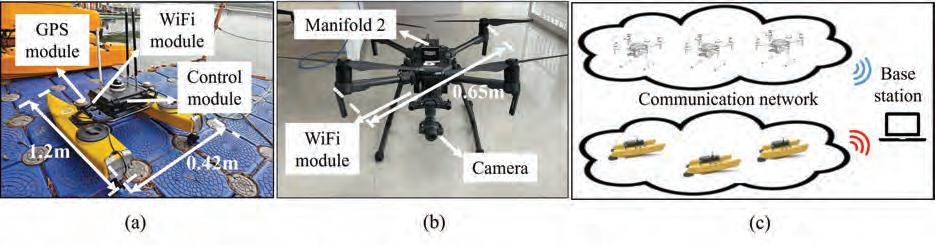
Figure2 Architectureofthereal-lakeexperimentalplatform.(a)HUSTER-12cUSV,(b)M-200UAV,andthedetailedcomponents. (c)Operationprocedureofthecross-domainmonitoringsystem,whichconsistsofthreeHUSTER-12cUSVs,threeM-200UAVs,anda WiFi5G(TP-linkTLBS520)wirelesscommunicationstation.USVsandUAVshaveindependentcommunicationnetworks,withUSVsnot sharinginformationwithUAVs.
NUMERICALANDEXPERIMENTALRESULTS
Setups
Inthissection,wedemonstratetheeffectivenessandsuperiorityoftheproposedMUMU-EBSBLbyboth numericalsimulationandreal-lakeexperiments.Forcomparison,weconstructthreevariantsbyreplacingthe EBSBLmodulewithmainstreamsystemidentificationmethods,i.e.,blockSBL(BSBL)[30],vanillaSBL (VSBL)[36],andLASSO[37],yieldingMUMU-BSBL,MUMU-VSBL,andMUMU-LASSO,respectively. TheMUMUframeworkandalltheothersettingsarekeptidenticalacrossvariants.Circularformation[25] andlineformation[8]areselectedforthecoordinateddynamicsofUSVs.
Innumericalsimulations,weconsiderfourUAVsmonitoringfourUSVs.Inreal-lakeexperiments,we introduceaself-developedcross-domainplatform,includingthreeHUSTER-12cUSVsandthreeM-200 UAVs.AsshowninFigure2(a)and(b),theHUSTER-12cUSVhasalengthof1.2mandawidthof 0.42m.ItisequippedwithtwoCA-6152AGPSantennas,anSTM32F407controlmodule,andaTP-Link TLBS520Wi-Fimodule.EachM-200UAVmeasures0.65minbothlengthandwidth,andisfittedwith aDJIMatrice200SeriesGPSmodule,aManifold2controlmodule,andthesameTP-LinkTLBS520WiFimodule.Figure2(c)showsthecoordinationworkflowofthecross-domainplatform.UAVstrackthe positionsofUSVsthroughobservationandestablishcommunicationusingaWiFi5Gnetwork,allowing themtogeneratetherequiredguidancesignalsfornavigation.Thebasestationreceivesandlogsallstates, includingpositions,trackingerrors,etc.,transmittedovertheWiFi5Gnetwork.Toquantifytheperformance ofthealgorithms,theerrormetricisdefinedas
Numerical simulationresults
Figure3showsthetrackingerrorsevolutionofnumericalsimulationswithcircularformation.Figure3(a) presentsthetrackingerrorresultsforfourUSVsundertheproposedMUMU-EBSBLalgorithm.Theerrorsdecreasesteadilyovertime,demonstratingtheeffectivenessofMUMU-EBSBL.Figure3(b)compares performanceofthefouralgorithmsat t = 5, 10, 15s.Itisobservedthatallthealgorithmsexhibitdecreasingtrackingerrors,whereastheproposedMUMU-EBSBLalwaysachievesthebestperformancewith aconsiderablemargin.For t = 15s,theerrorofMUMU-EBSBLisbelow0 5m,indicatingsatisfactory
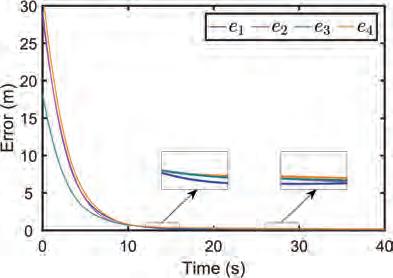
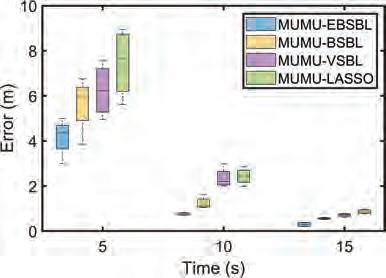
Figure3 Thetrackingerrorsevolutionofnumericalsimulationswithcircularformation.(a)ThetrackingerrorsoffourUSVsunderMUMUEBSBL.(b)TheerrorscomparisonamongMUMU-EBSBL,MUMU-BSBL,MUMU-VSBL,andMUMU-LASSOat t = 5, 10, 15s.

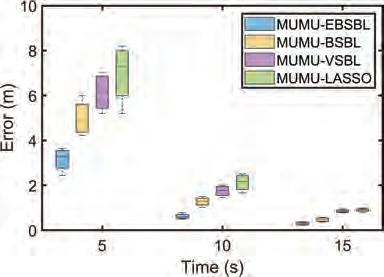
Figure4 Thetrackingerrorsevolutionofnumericalsimulationswithlineformation.(a)ThetrackingerrorsoffourUSVsunderMUMUEBSBL.(b)TheerrorscomparisonamongMUMU-EBSBL,MUMU-BSBL,MUMU-VSBL,andMUMU-LASSOat t = 5, 10, 15s.
performance.For t = 10s,theaverageerrorofMUMU-EBSBLisreducedby39.0%,67.8%,and68.6% relativetoMUMU-BSBL,MUMU-VSBL,andMUMU-LASSO,respectively.
Figure4showsthetrackingerrorsevolutionofnumericalsimulationswithlineformation,whereFigure4(a) presentstheresultsunderMUMU-EBSBL,demonstratingthatUAVssuccessfullytrackUSVs.Figure4(b) comparesperformanceofthefouralgorithmsat t = 5, 10, 15s.ItisobservedthatMUMU-EBSBLalways achievesthebestperformanceamongallthefouralgorithms.For t = 5s,theaverageerrorofMUMUEBSBLismoreaccuratethanallotheralgorithmswiththereductionof36 6%,48 6%,and54 9%,compared withMUMU-BSBL,MUMU-VSBL,andMUMU-LASSO,respectively.Theeffectivenessandsuperiority oftheproposedMUMU-EBSBLarethusverified.
Real-lakeexperimentalresults
Figure5showstheexperimentalsnapshotsandtrackingerrorsevolutionofreal-lakeexperimentswithcircularformation.Figure5(c)presentsthetrackingerrorsevolutionforthreeUSVsunderMUMU-EBSBL.It isobservedthattrackingerrorsgraduallydecrease.Figure5(d)showstrackingerrorsforthefouralgorithms at t = 10, 20, 30s.TheresultsindicatethatMUMU-EBSBLconsistentlyoutperformstheotheralgorithms.
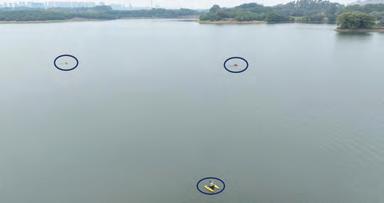
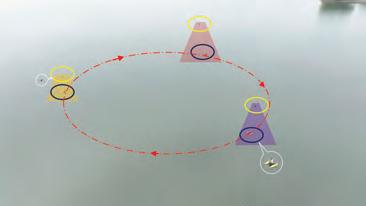
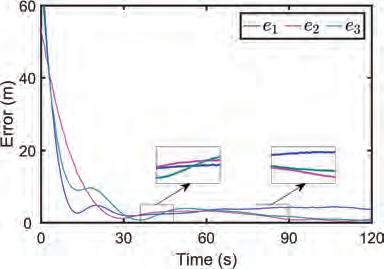

Figure5 Theexperimentalsnapshotsandthetrackingerrorsevolutionofreal-lakeexperimentswithcircularformation,wherebluecircles denoteUSVs,yellowcirclesdenoteUAVs,andredcircledenotestrajectory.(a)InitialscenewithUSVsattheirstartingpositions.(b)UAVs performingreal-timetrackingandmonitoringofthemotionofUSVs.(c)ThetrackingerrorsofthreeUSVsunderMUMU-EBSBL.(d)The trackingerrorscomparisonamongMUMU-EBSBL,MUMU-BSBL,MUMU-VSBL,andMUMU-LASSOat t = 10, 20, 30s.
At t = 20s,theerrorofMUMU-EBSBLisreducedby56.5%,67.3%,and81.2%relativetoMUMU-BSBL, MUMU-VSBL,andMUMU-LASSO,respectively.Equivalently,for t = 30s,theerrorofMUMU-EBSBL is22.6%,14.1%,and7.5%ofthatofMUMU-BSBL,MUMU-VSBL,andMUMU-LASSO,respectively.
Figure6illustratestheexperimentalsnapshotsandtrackingerrorsevolutionofreal-lakeexperimentswith lineformation,whereFigure6(c)presentstheresultsundertheproposedMUMU-EBSBL.Itisobserved thattrackingerrorsgraduallydecrease,demonstratingtheeffectivenessoftheproposedMUMU-EBSBL. Figure6(d)showsthecomparisonoftrackingerrorsamongMUMU-EBSBL,MUMU-BSBL,MUMUVSBL,andMUMU-LASSO.TheresultsindicatethatMUMU-EBSBLyieldsthebesttrackingperformance amongallfouralgorithms.For t = 10s,theerrorofMUMU-EBSBLis65.5%,46.5%,and38.6%ofthat ofMUMU-BSBL,MUMU-VSBL,andMUMU-LASSO,respectively.Inaddition,theerrorofMUMUEBSBLfor t = 30sisreducedby60.9%,86.8%,and91.5%relativetoMUMU-BSBL,MUMU-VSBL,and MUMU-LASSO,respectively.BoththeeffectivenessandsuperiorityofMUMU-EBSBLarethusdemonstrated.
CONCLUSION
Thispaperproposesareal-timecross-domainmonitoringstrategy,i.e.,MUMU-EBSBL,formulti-UAVmulti-USVfleet.UAVsarepairwisematchedtoUSVsforreal-timerelativepositioning,USVcoordinated
(a)
(b)
(c)
(d)

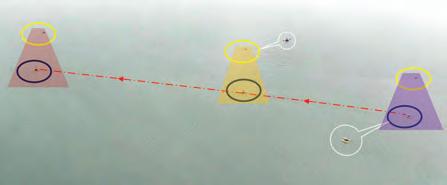
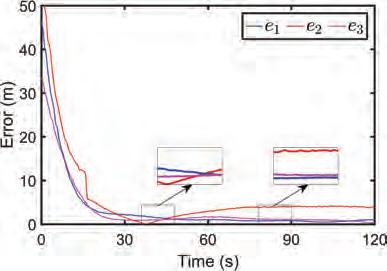
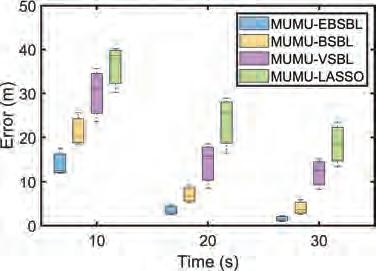
Figure6 Theexperimentalsnapshotsandthetrackingerrorsevolutionofreal-lakeexperimentswithlineformation,wherebluecircles denoteUSVs,yellowcirclesdenoteUAVs,andredlinedenotestrajectory.(a)InitialscenewithUSVsattheirstartingpositions.(b)UAVs performingreal-timetrackingandmonitoringofthemotionofUSVs.(c)ThetrackingerrorsofthreeUSVsunderMUMU-EBSBL.(d)The trackingerrorscomparisonamongMUMU-EBSBL,MUMU-BSBL,MUMU-VSBL,andMUMU-LASSOat t = 10, 20, 30s.
dynamicsareidentifiedviaaconvergence-guaranteedEBSBL,andaUKFenablesmonitoringwithreal-time predictionandtrajectoryestimation.ThevirtueoftheproposedMUMU-EBSBLliesintheeliminationof therequirementonmotioninformationofthemulti-USVfleetwhilemaintaininglowcomputationalcost. Botheffectivenessandsuperiorityaredemonstratedthroughnumericalsimulationsandreal-lakemulti-USV experiments.FutureresearchwillfocusonnoncooperativeUAVsmonitoringofUSVsthatactivelyevade sensing.
Dataavailability
Theoriginaldataareavailablefromcorrespondingauthorsuponreasonablerequest.
Funding
ThisworkwassupportedbytheNationalNaturalScienceFoundationofChina(62225306,U2141235),theNationalKeyR&D ProgramofChina(2022ZD0119601),andtheHUSTTaihuLakeInnovationFundforFutureTechnology(2024B5).
Authorcontributions
Y.Z.andH.T.Z.developedthereal-timecross-domainmonitoringalgorithms.Y.Z.andJ.H.developedthecodesandexperiments.Y.Z.,J.H.,andB.X.carriedouttheexperiments.Y.Z.,H.T.Z.,J.H.,B.X,andJ.D.participatedindesigningand discussingthestudyandwritingthepaper.
Conflictofinterest
Theauthorsdeclarenoconflictofinterest.
Natl SciOpen,2026,Vol.5,20250048
Supplementaryinformation
Thesupportinginformationisavailableonlineathttps://doi.org/10.1360/nso/20250048.Thesupportingmaterialsarepublished assubmitted,withouttypesettingorediting.Theresponsibilityforscientificaccuracyandcontentremainsentirelywiththe authors.
References
1GuanX.Networksystemcapacity:Towardsintegratingsensing,communicationandcontrol. NatSciOpen 2024; 3: 20230036.
2SuscaS,BulloF,MartinezS.Monitoringenvironmentalboundarieswitharoboticsensornetwork. IEEETransContr SystTechnol 2008; 16:288–296.
3WangG,LiuX,XiaoY, etal.Extinctionchainsrevealintermediatephasesbetweenthesafetyandcollapseinmutualistic ecosystems. Engineering 2024; 43:89–98.
4WangG,LiuX,ChenG, etal.Indirecteffectsamongbiodiversitylossofmutualisticecosystems. NatSciOpen 2022; 1:20220002.
5SavkinAV,HuangH.Range-basedreactivedeploymentofautonomousdronesforoptimalcoverageindisasterareas. IEEETransSystManCybernSyst 2021; 51:4606–4610.
6GonzalezAGC,AlvesMVS,VianaGS, etal.Supervisorycontrol-basednavigationarchitecture:Anewframeworkfor autonomousrobotsinindustry4.0environments. IEEETransIndInf 2018; 14:1732–1743.
7CzimmermannT,ChiurazziM,MilazzoM, etal.Anautonomousroboticplatformformanipulationandinspectionof metallicsurfacesinindustry4.0. IEEETransAutomatSciEng 2022; 19:1691–1706.
8LiuB,ZhangHT,MengH, etal.Scanning-chainformationcontrolformultipleunmannedsurfacevesselstopass throughwaterchannels. IEEETransCybern 2022; 52:1850–1861.
9TangC,ZhangHT,WangJ.Flexibleformationtrackingcontrolofmultipleunmannedsurfacevesselsfornavigating throughnarrowchannelswithunknowncurvatures. IEEETransIndElectron 2023; 70:2927–2938.
10CaoH,HuBB,MoX, etal.Theimmenseimpactofreverseedgesonlargehierarchicalnetworks. Engineering 2024; 36:240–249.
11ChangBoonLow,DanweiWang.GPS-basedtrackingcontrolforacar-likewheeledmobilerobotwithskiddingand slipping. IEEEASMETransMechatron 2008; 13:480–484.
12MinaeianS,LiuJ,SonYJ.Vision-basedtargetdetectionandlocalizationviaateamofcooperativeUAVandUGVs. IEEETransSystManCybernSyst 2016; 46:1005–1016.
13SunN,ZhaoJ,ShiQ, etal.Movingtargettrackingbyunmannedaerialvehicle:Asurveyandtaxonomy. IEEETrans IndInf 2024; 20:7056–7068.
14ZhangHT,HuBB,XuZ, etal.Visualnavigationandlandingcontrolofanunmannedaerialvehicleonamoving autonomoussurfacevehicleviaadaptivelearning. IEEETransNeuralNetwLearnSyst 2021; 32:5345–5355.
15LiuL,WangD,PengZ, etal.Boundedneuralnetworkcontrolfortargettrackingofunderactuatedautonomoussurface vehiclesinthepresenceofuncertaintargetdynamics. IEEETransNeuralNetwLearnSyst 2019; 30:1241–1249.
16Nabavi-ChashmiSY,AsadiD,AhmadiK.Image-basedUAVpositionandvelocityestimationusingamonocularcamera. ControlEngPract 2023; 134:105460.
17ZhangW,SongK,RongX, etal.Coarse-to-fineUAVtargettrackingwithdeepreinforcementlearning. IEEETrans AutomatSciEng 2019; 16:1522–1530.
18WangS,JiangF,ZhangB, etal.DevelopmentofUAV-basedtargettrackingandrecognitionsystems. IEEETransIntell TranspSyst 2020; 21:3409–3422.
19HuangT,XueY,XueZ, etal.USV-tracker:AnovelUSVtrackingsystemforsurfaceinvestigationwithlimited resources. OceanEng 2024; 312:119196.
20LiuY,WangQ,HuH, etal.Anovelreal-timemovingtargettrackingandpathplanningsystemforaquadrotorUAVin
Natl SciOpen,2026,Vol.5,20250048
unknownunstructuredoutdoorscenes. IEEETransSystManCybernSyst 2019; 49:2362–2372.
21WipfDP,RaoBD,NagarajanS.LatentvariableBayesianmodelsforpromotingsparsity. IEEETransInformTheor 2011; 57:6236–6255.
22BaraniukRG,CevherV,DuarteMF, etal.Model-basedcompressivesensing. IEEETransInformTheor 2010; 56: 1982–2001.
23XuZ,HeS,ZhouW, etal.Pathfollowingcontrolwithsideslipreductionforunderactuatedunmannedsurfacevehicles. IEEETransIndElectron 2024; 71:11039–11047.
24KouL,ChenZ,XiangJ.Cooperativefencingcontrolofmultiplevehiclesforamovingtargetwithanunknownvelocity. IEEETransAutomatContr 2022; 67:1008–1015.
25LiuB,ChenZ,ZhangHT, etal.Collectivedynamicsandcontrolformultipleunmannedsurfacevessels. IEEETrans ContrSystTechnol 2020; 28:2540–2547.
26HuBB,ZhangHT,ShiY.Cooperativelabel-freemovingtargetfencingforsecond-ordermulti-agentsystemswithrigid formation. Automatica 2023; 148:110788.
27BertsekasDP.Theauctionalgorithm:Adistributedrelaxationmethodfortheassignmentproblem. AnnOperRes 1988; 14:105–123.
28ZhouW,ZhangHT,WangJ.AnefficientsparseBayesianlearningalgorithmbasedonGaussian-scalemixtures. IEEE TransNeuralNetwLearnSyst 2022; 33:3065–3078.
29YuilleAL,RangarajanA.Theconcave-convexprocedure(CCCP).In:Proceedingsofthe15thInternationalConference onNeuralInformationProcessingSystems:NaturalandSynthetic.Vancouver,2002.1033–1040
30ZhangZ,RaoBD.ExtensionofSBLalgorithmsfortherecoveryofblocksparsesignalswithintra-blockcorrelation. IEEETransSignalProcess 2013; 61:2009–2015.
31BartleRG,SherbertDR. IntroductiontoRealAnalysis.NewYork:Wiley,2000
32ShenH,WenG,LvY, etal.USVparameterestimation:Adaptiveunscentedkalmanfilter-basedapproach. IEEETrans IndInf 2023; 19:7751–7761.
33ThomasJ,WeldeJ,LoiannoG, etal.Autonomousflightfordetection,localization,andtrackingofmovingtargetswith asmallquadrotor. IEEERobotAutomLett 2017; 2:1762–1769.
34WuZ,HuG,FengL, etal.Collisionavoidanceformobilerobotsbasedonartificialpotentialfieldandobstacleenvelope modelling. AssemAutom 2016; 36:318–332.
35AbeywickramaHV,JayawickramaBA,HeY,etal.Potentialfieldbasedinter-UAVcollisionavoidanceusingvirtual targetrelocation.In:Proceedingsofthe2018IEEE87thVehicularTechnologyConference.Porto,2018.1–5
36WipfDP,RaoBD.SparseBayesianlearningforbasisselection. IEEETransSignalProcess 2004; 52:2153–2164.
37TibshiraniR.Regressionshrinkageandselectionviathelasso. JRStatSocSerB-StatMeth 1996; 58:267–288.
NationalScienceOpen 5:20250052,2026 https://doi.org/10.1360/nso/20250052
SpecialTopic:IntelligentMaterialsandDevices
Dynamicradiationthermalmanagement:Mechanism, multi-band,multimode,andapplication
YanrongJiao1,2,#,ZhongshaoLi1,2,#,AibinHuang1,2,XiaoweiJi1,2,PingJin1,HongjieLuo3 & XunCao1,2,*
1StateKeyLaboratoryofHighPerformanceCeramicsandSuperfineMicrostructure,ShanghaiInstituteofCeramics,ChineseAcademyof Sciences,Shanghai200050,China;
2CollegeofMaterialsScienceandOpto-ElectronicTechnology,UniversityofChineseAcademyofSciences,Beijing100049,China;
3InstitutefortheConservationofCulturalHeritage,ShanghaiUniversity,Shanghai200444,China
#Contributedequallytothiswork.
*Correspondingauthor(email:cxun@mail.sic.ac.cn)
Received15September2025;Revised9December2025;Accepted15December2025;Publishedonline28December2025
Abstract: Amidtheglobalpopulationsurgeandescalatingenergydemands,theenergycrisishasbecomeincreasinglyurgent, highlightingtheneedforthedevelopmentofgreentechnologies.Radiativethermalmanagementenhancesenergyefficiency andreducesconsumptionbydynamicallyregulatingtheexchangeofsolarradiation(visible-nearinfrared)andinter-object radiativeheat(mid-infrared).Utilisingcertaindynamicallyresponsivesmartmaterials,visible(VIS),near-infrared(NIR),and mid-infrared(MIR)spectrumscanbedynamicallymodulatedunderexternalfieldinfluences.Thispaperreviewedtheprinciplesandadvantagesofvisible,near-infrared,andmid-infraredlightmodulationfromtheperspectivesofreflection,scattering,andabsorption.Itprovidesguidanceforoptimizingband-specificregulationandexplorescorrespondingoptical behaviormodulationinapplicationscenariosbasedonopaqueandtransparentsystems.Furthermore,itfocusesonmulti-band, multi-modeopticalbehaviorcontrolmethodsforsmartwindows,analyzestheadvantagesandchallengesoftheirfuture applications,andproposesrecommendationsforfuturedevelopment.
Keywords: optics,dynamic,radiationthermalmanagement,multi-band,multimode
INTRODUCTION
Withtherapidgrowthoftheglobalpopulation,continuousimprovementinlivingstandards,andrapid industrialdevelopment,energyconsumptionhassurgeddramatically.Thishasbroughtwithitthermal comfortissuesarisingfromcomplexandvariableclimaticconditions.Consequently,theutilisationofradiant thermalmanagementtechnologytoreduceenergyconsumptionandenhancelivingcomforthasbecomean urgentpriority[1–3].Thermalradiationconstitutesoneofthethreemodesofheattransfer.Allobjectsemit heatintheformofelectromagneticwaves,withthermalradiationspecificallydenotingthephenomenon wherebyobjectsradiateelectromagneticwavesduetopossessingatemperature.Consequently,anyobject withatemperatureaboveabsolutezerogeneratesthermalradiation;thehigherthetemperature,thegreater
©TheAuthor(s)2025.PublishedbySciencePressandEDPSciences.ThisisanOpenAccessarticledistributedunderthetermsoftheCreativeCommons AttributionLicense(https://creativecommons.org/licenses/by/4.0),whichpermitsunrestricteduse,distribution,andreproductioninanymedium,providedthe originalworkisproperlycited.
thetotalenergyradiatedandthemorepronouncedtheshort-wavecomponent.TheSunmayberegardedas themostidealandsustainableheatsource.Thesunlightitemitscontainssubstantiallightenergyspanning ultraviolet,visible,andnear-infraredwavelengths,alongsideheattransferbetweenobjectsviamid-infrared radiation.However,thelightandthermalenergydeliveredbysolarradiationdonotalwaysalignperfectly withhumanneeds.Toreduceenergyconsumption,radiativecoolingtechnologyhasconsequentlyemerged [4,5].
Staticradiativecoolingutilisesouterspaceasthecoldsourceforradiativeheatexchange,achieving coolingbypromotingradiativeheattransferthroughhighemissivityinthemid-infraredatmosphericwindow band[6].Currently,staticradiativecoolingprimarilycomprisestransparentandnon-transparentsystems. Non-transparentcoatings,utilisingoxideparticlessuchastitaniumdioxideandsilicondioxideasprimary materials,exhibithighreflectivitywithinthesolarspectrum.Thesearechieflyappliedtobuildingfacades andthesurfacesoflargeheat-generatingequipment[7–12].Transparentradiativecoolingsystems,primarily fabricatedfrompolydimethylsiloxaneandmaterialsrichinsiloxanebonds,findapplicationsinglasscurtain walls,automotivesunroofs,andintegrationwithsolarcellsandthermoelectricdevices.Forinstance,when combinedwithsolarcells,theysimultaneouslygenerateelectricitywhileloweringphotovoltaicpanel temperatures,therebyenhancingphotovoltaicconversionefficiency[13–18].Additionally,byleveraging watervaporadsorptionanddesorption,solarradiationcollection,andradiativecoolingsynergisticthermal effects,thetemperaturedifferenceisamplifiedforthermoelectricpowergenerationandatmosphericwater harvesting[19,20].However,staticradiativecoolingnotonlysuffersfromsupercoolingissuesbutalsofaces limitationsinwidespreadadoptionduetoconstraintsonsustainedcooling.Thecombinationofphasechange materialsandstaticradiativecoolingmaterialscanharvestcoldenergyfromtheuniverse,regulatingthe surpluscoldenergygeneratedbynighttimeremotecontroltocompensateforthecolddeficitduringdaytime remotecontrol[21].However,theextentofovercoolingitcancompensateremainslimited.Consequently, dynamicradiativecoolinghasbeenextensivelystudiedtobroadenitsapplicationscopeandunlockadditionalpotentialuses[22].Researchershaveobservedthatunderidealconditions,radiativecoolingmaterials canachieveapproximately100W/m2 ofradiativepowerwithintheatmosphericwindowband.However, practicalapplicationsmayyieldlowervaluesduetovariouslosses.Thepowerdensityofenergycontained withinsunlightapproaches1000W/m2.Giventheconstraintsimposedbyenergythresholdsregulatedinthe mid-infraredbands,dynamiccontrolwithinthesolarspectrum(visible-nearinfrared(VIS-NIR))iscrucial forreducingenergyconsumption[23–26].
Acrosstheentiresolarspectrum,VISlight(380–780nm)accountsfornearly43%oftheenergycontent, withapowerdensityapproaching500W/m2.Dynamicallyadjustingthevisiblelighttransmittancetoblock heatgaininsummerandretainwarmthinwintersignificantlyreducesbuildingenergyconsumption,holding greatimportanceforenergyconservation[27,28].Furthermore,dynamicallyregulatingtheproportionof differentvisiblelightcolourswithinsunlightthroughfunctionalfilmstocontrolplantgrowthofferssubstantialapplicationvalueforadvancingagriculturaltechnology[29].NIRlight(780–2500nm)constitutes nearly50%ofsolarenergy.Itsfrequencyalignsmorecloselywiththeresonantfrequenciesofmicroscopic particleswithinmaterials,conferringastrongerthermaleffect.Consequently,dynamicallyregulatingnearinfraredtransmittanceinsmartwindowapplicationsholdssubstantialsignificanceforreducingbuilding energyconsumption[30].Themid-infrared(MIR,2.5–25μm)spectrumconstitutestheprimarybandfor inter-objectheattransferviathermalradiation.Particularly,therangeof8–13μmisthetransparentwindow
bandoftheatmosphere,whichcanberegardedasanidealcoldsourceforheattransferbetweenobjectsand outerspacethroughthisband,therebyachievingcoolingeffects.Dynamicregulationofthisspectrum enablesintelligentradiativecoolingtailoredtolivingrequirements,holdingsubstantialsignificancefor reducingenergyconsumption[31–33].Consequently,dynamicallyregulatingtheVIS-NIR-MIRtri-band spectrumtointelligentlyharnessthermalradiationenergymaximisesenergysavings,holdingsubstantial implicationsforenergyconservationandsocietalsmartdevelopment.Dynamicthermalradiationmanagementistransitioningfromlaboratoryresearchtoindustrialimplementation.Itsinterdisciplinarynaturewill reshapefuturelandscapesacrossenergy,electronics,aerospaceandothersectors,establishingitasapivotal technologicalpillarforcarbonneutralitystrategies.Severalreviewshavesummarizeddynamicradiativeheat managementresearchfromperspectivesincludingmaterialsystems[34],responsemechanisms[35],and applicationscenarios[36].However,analysesfocusingontheprinciplesoflightbehaviorregulationremain scarce.
Therefore,thispapersynthesisedrecentexemplarycasesoflightbehaviourregulation,elucidatingthe principlesandadvantagesofmodulationacrossthevisible,near-infrared,andmid-infraredregionsfromthe perspectivesofscattering,reflection,andlightabsorption.Itfurtherdiscussedlightbehaviourregulation tailoredtoapplicationscenariosinbothopaqueandtransparentsystems(Figure1).Aclearunderstandingof theprinciplesgoverningdynamiccontrolacrossthevisible,near-infrared,andmid-infraredbandsenables optimisationofdeviceperformanceforeachspecificband.Thiswillfacilitatemoreeffectivematerialand structuraldesigntailoredtodefinedapplicationscenarios.Particularemphasisisplacedondynamiccontrol forsmartwindowapplicationswithintransparentsystems,analysingoptimallightbehaviourregulationand outliningboththeadvantagesandchallengesassociatedwithmulti-band,multi-modalcontrol.Insummary, thisreviewwillprovideresearchersandindustryprofessionalswithcomprehensiveandup-to-datereferences,fosteringfurtherresearchandinnovationindynamicradiativethermalmanagementtechnologies whileguidingtheirpracticalimplementationinindustrialsettings.
THEREGULATIONPRINCIPLESOFEACHBAND
Thevisible,near-infrared,andmid-infraredbandsnotonlyexhibitsignificantdifferencesinenergydistribution,buttheirmarkedlydistinctwavelengthsnecessitatefundamentallydifferentprinciplesfor achievingdynamicregulation.Theopticalphenomenaunderpinningregulationineachbandarenotsingular; typically,multiplephenomenacoexist.Primarily,principlessuchaslightreflection(Figure2a),scattering (Figure2b)andabsorption(Figure2c)areemployedtodynamicallyregulatethetransmittanceofvisibleand near-infraredlight,andtodynamicallyregulatetheemissivityofthemid-infraredband[47–49].Visiblelight servesdualfunctionsofenergytransferandinformationexchange.Forinstance,insmartwindowapplications,dynamicregulationofvisiblelighttransmittancemustconsidernotonlyenergyefficiencyand daylightingbutalsofundamentalwindowattributessuchasvisibilityandvisualcomfort[50,51].Consequently,aclearunderstandingoftheprinciplesgoverningdynamicmodulationacrossthevisible,nearinfrared,andmid-infraredbandsisparamount.Thisnotonlyenablesperformanceoptimisationofdevices tailoredtoeachbandbutalsofacilitatesmoreeffectivematerialandstructuraldesignforspecificapplication scenarios[52].Giventhatmaterialinteractionswiththelightfieldduringdynamicswitchingstatesare
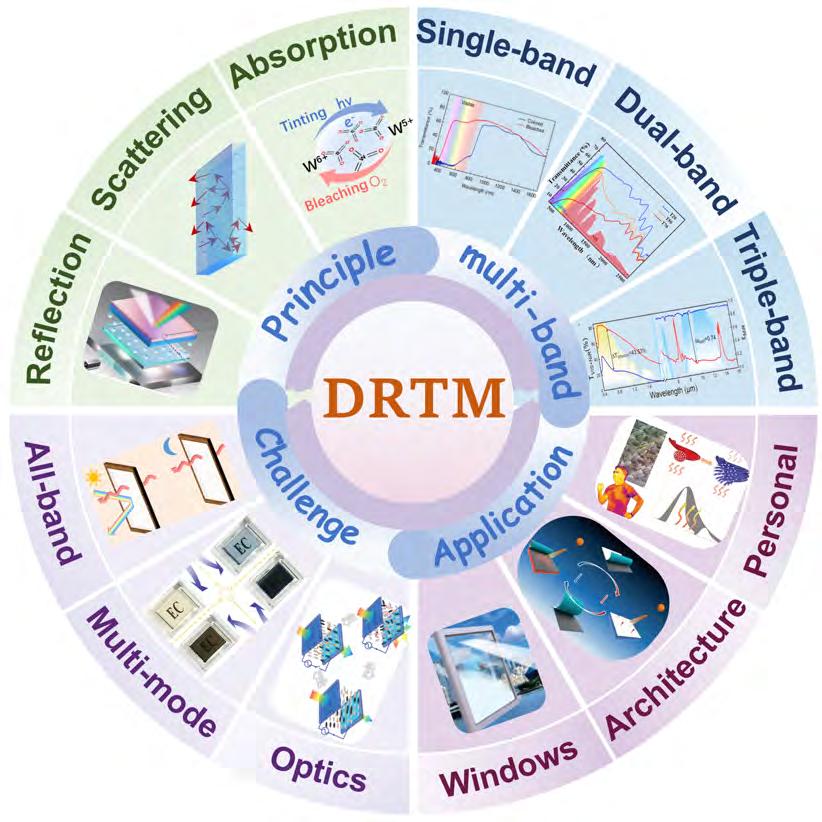
Figure1 Overviewofdynamicradiationthermalmanagement(DRTM)systems[37–46].Copyright©2025,JohnWileyandSons. Copyright©2017,SpringerNature.Copyright©2024,Elsevier.Copyright©2025,RoyalSocietyofChemistry.Copyright©2019,The AmericanAssociationfortheAdvancementofScience.Copyright©2022,SpringerNature.Copyright©2023,JohnWileyandSons. Copyright©2024,SpringerNature.Copyright©2024,JohnWileyandSons.Copyright©2022,TheAmericanAssociationfortheAdvancementofScience. NatlSciOpen,2026,Vol.5,20250052
multifaceted,weshallnowfocusonthemechanismsthatplayadominantroleinmodulation.
Dynamicregulationofvisible-light
Thecoretechnologyofdynamicallyregulatingvisiblelightliesinalteringamaterial’smicrostructureor electronicstatethroughexternalstimuli(suchasthermal,mechanical,optical,electrical,magnetic,or chemicalinputs),therebyachievingdynamicmodulationofitsmacroscopictransmittance(orreflectance) [41,53–57].Differentresponsemechanismscausevariationsinthebehaviourofincidentlight,leadingto differencesinthedevice’sresponsespeed,energyconsumption,anddurability,andcorrespondingtodistinct specificapplicationscenarios.
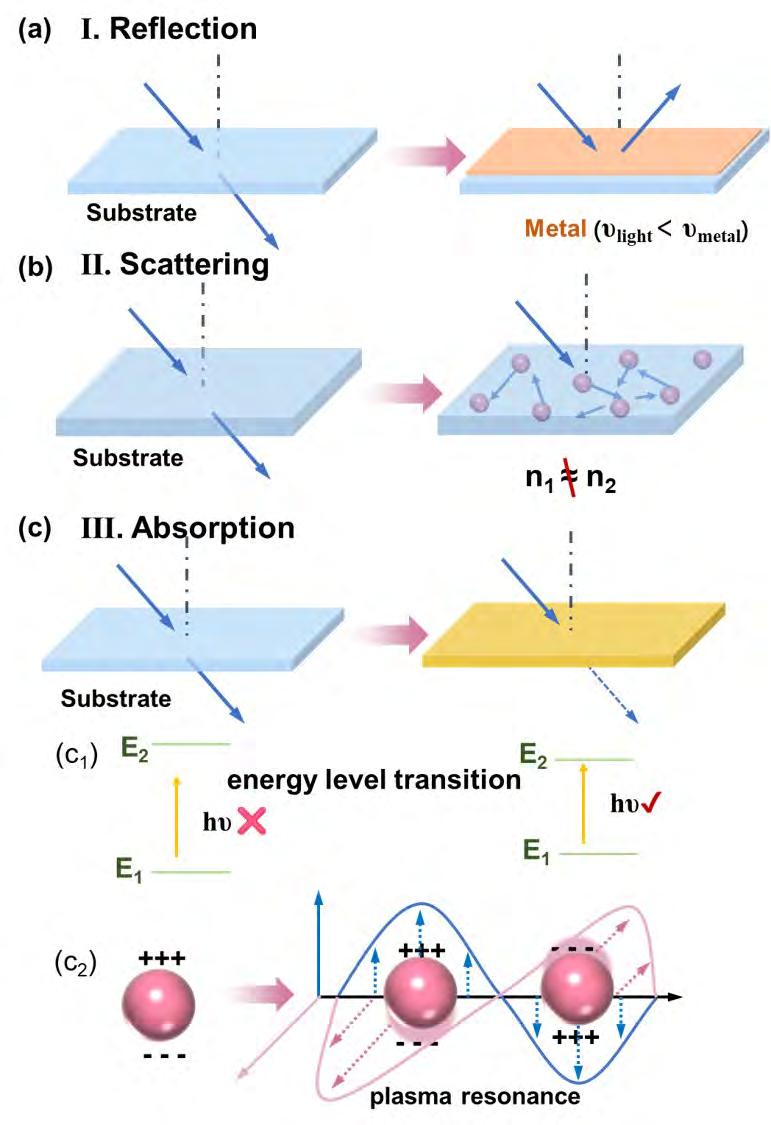
Figure2 Schematicdiagramoftheprincipleofopticalregulation.Aschematicdiagramillustratingthedynamicregulationoflight reflection(a),lightscattering(b)andlightabsorption(c).
BasedonthereflectionregulationofVIS
Structuraldesignbasedonmaterialintrinsicpropertiesenablesreversibletransformations,utilisinglight reflectionforadjustableradiativeheatmanagementapplications.Highreflectivityinthevisiblespectrum (approximately400–700nm)primarilyinvolveselectroninteractions,bandstructure,andmicrostructural design[58].Forinstance,inreversiblemetalelectrodepositionsystems,thepresenceorabsenceofametallic layeralterslightabsorptionandreflection,therebyeffectivelyregulatingtransmittance.Whenlightfrequenciesfallbelowtheplasmafrequencyofmetals,electronsrespondrapidlytoelectromagneticfield changes,leadingtohighreflectivity,asobservedinsilver(Ag)andaluminium(Al)(Figure2a)[59].
Therefore,bycontrollingthestructureoftheAglayer,lightreflectioncanbeeffectivelyregulatedto achievedynamicmodulation(Figure3a).Forinstance,visiblelightregulationisaccomplishedthroughthe reversibleelectrodepositionoftheAglayer[57].Throughsuchstructuraldesignofthereversiblesilver layer’selectrodeposition,thereflectanceinthesolarspectrum(0.3–2.5μm)dynamicallyswitchesbetween 87.9%and19.9%(Figure3b)[60].Inspiredbycephalopodskin,anadaptivemultispectralmechanical opticalsystemwasdesignedbasedonabilayeracrylicdielectricelastomer(ADE)/silvernanowire(AgNW) film.Thissystemreconfiguressurfacetopographybetweenwrinklesandcracksthroughmechanicalcontractionandstretching[61].Silvernanowiresdepositedonthetransparentelastomerupperlayerexhibita dramaticincreaseininter-wirespacingduringstretching,permittinggreaterlighttransmissionandyielding hightransmittance.Uponreleaseoftension,theupperlayersilvernanowirescontractsharplyunderelastomericaction,inducinghighreflectanceandlowtransmittance,therebyeffectivelymodulatingvisiblelight transparency.Similarly,coatingsilvernanowiresontopolydimethylsiloxane(PDMS)surfacesenablesthe fabricationofflexiblefilmswithpaper-cutoutstructures.Undertension,thesestructuresexposemacroscopic voidspermittingvisiblelighttransmission.Upontensionrelease,thesilvernanowires’highreflectivity reducestransparency,achievingdynamicswitching[62].Modulatingvisiblelighttransmittancethroughlight reflectionprimarilyinvolvesmaterialstructuraldesign,leveragingsilver’shighreflectivitytoachievedynamictransparencyswitching.Furthermore,indynamicradiativethermalmanagementapplicationswhere aestheticcolourpropertiesareconsidered,numerousmaterialsystemsemploylightreflectionprinciplesfor dynamiccolourswitching,suchasphotoniccrystals[63].Withinsmartwindowapplications,theadvantage ofmodulatingvisiblelightviareflectionliesinminimisingsolarenergyintakeduringhigh-temperature phases.Tosomeextent,thismaximisestheeffectiveutilisationofmodulatedenergywithinthermalmanagementresearch.However,thisadvantagecarriesacorrespondingdisadvantage:theintensespecular reflectionfromsilverlayersmaycontributetolightpollution.
However,dynamicregulationachievedbyexploitinglight’sdiffusereflectionbehaviourcaneffectively mitigatelightpollutionissues.Researchonusingdiffusereflectionfordynamictransparencycontrolremains scarceinthecurrentliterature.Throughsequentialstrainreleaseandmulti-stepoxygenplasmatreatment, self-similarhierarchicalwrinkleswithnanoscaleandmicrometre-scalefeaturesweregeneratedonprestrainedpolydimethylsiloxaneelastomers[56].Thelayeredwrinkledelastomerswitchedtransparencystates duringrepeatedstretchingandreleasecycles.Thisoccurredbecausethemicrometre-scalewrinklesonthe pre-strainedelastomersurfaceaggregatedintoamacroscopicallyroughsurface,causingincidentlightto undergodiffusereflectionandthusappearingopaque.Upontensileloading,thesurfacewrinkleseffectively flatten,restoringtransparencyandthusenablingthetransition.Diffusereflectionoccurswhenlightscattered fromaroughsurfacedispersesuniformlyinalldirections.ThisarisesbecausemicroscopicsurfaceirregularitiescauseincidentlighttofollowFresnelreflectionlawslocally,yetmanifestmacroscopicallyasrandom directionalscattering[64].Lightscattering,conversely,describesthedeviationoflightfromitsoriginalpath duetointeractionswithmaterialconstituentssuchasparticles,defects,ordensityvariationsduringpropagation.Thisarisesfrominteractionswithmicroscopicorsubmicroscopicstructures,encompassingboth elasticscattering(wherewavelengthremainsunchanged,e.g.,Rayleighscattering)andinelasticscattering (wherewavelengthshifts,e.g.,Ramanscattering)[65].Diffusereflectionconstitutesthestatisticalreflection behaviouroflightuponmacroscopicallyroughsurfaces,whereasscatteringarisesfromlight’sinteraction withtheinternalstructureofamedium.Bothphenomenamaycoexist,yettheirphysicaloriginsdiffer.
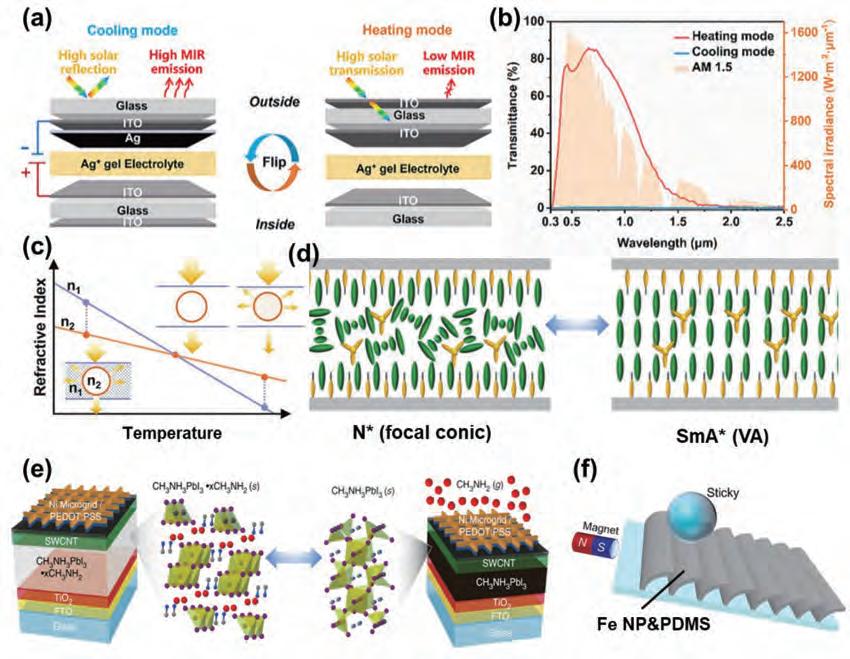
Figure3 (a)ThereversiblemetalelectrodepositionofthesilverlayerregulatesVIS[60].(b)Spectrabeforeandaftersilverlayer deposition[60].Copyright©2025,Wiley-VCHGmbH.(c)Schematicdiagramofrefractiveindexmatching[66].Copyright©2022,John WileyandSons.(d)Theliquidcrystalchangestheorientationofitsmoleculesunderanelectricfield,andtheeffectiverefractiveindexalso changes[67].Copyright©2025,JohnWileyandSons.(e)Perovskiteundergoesreversiblecoordinationwithmethylamine,dynamically generatingsubstanceswithstrongvisiblelightabsorption[37].Copyright©2017,SpringerNature.(f)ThemicroplatestructurecontainingFe particlescanbebentbymagneticfieldcontrol[68].Copyright©2023,JohnWileyandSons.
BasedonthescatteringregulationofVIS
Leveragingthecharacteristicofshorterwavelengthsinvisiblelight,opticalscatteringcaneffectivelyachieve dynamicregulationofvisiblelighttransmittance.Thisisaccomplishedbyalteringthemicroscopicstructure ofmaterialstomodifytheiropticalscatteringbehaviourbeforeandaftermodification,therebydynamically adjustingthevisiblelighttransmittanceofthinfilms.Theprimarymethodsinvolverefractiveindexmatching andcrystalplanescatteringcontrol.
Byutilisingtheprincipleofrefractiveindexmatching,thelightscatteringbehaviouriscontrolledto regulatetransmittance(Figure3c).Paraffinwax,aclassicphase-changeenergystoragematerial,hasbeen appliedindynamicradiativethermalmanagementresearchduetoitsphase-changetemperaturenearroom temperature,lowcost,andexcellentchemicalstability[69].Forinstance,whenparaffinwaxiscombined withpolyvinylalcohol,basedontheprincipleofrefractiveindexmatching,priortoparaffinwaxphase transition,itsrefractiveindexapproximatesthatofpolyvinylalcohol,yieldinghighfilmtransmittance.Upon temperatureelevation,paraffinwaxundergoesaphasetransitionfromsolidtoliquidstate,alteringits refractiveindex.Thisdiscrepancywithpolyvinylalcohol’srefractiveindexinduceshighscatteringof
shorter-wavelengthincidentlight[46].Thus,throughtemperaturecontrol,dynamicregulationofthefilm’s transmittanceisachievedbasedonlightscatteringbehaviour[70].Similarly,thephase-changematerial eicosanewasdepositedontopolyurethanenanofibresviaelectrospraytechnology.Uponreaching37°C, eicosanerapidlyundergoesphasetransition.Post-transition,itsrefractiveindexapproximatesthatofthe outerpolyurethanelayer,establishingopticaltransmissionpathwaysbetweennanofibresandpreventinglight scatteringlossatnanofibre-airinterfaces[71].Similarly,employingaone-stepemulsificationmethodto embedethyleneglycolsolutiondropletswithinpolydimethylsiloxane(PDMS)yieldedanadaptivethermoresponsivesmartwindowbasedondynamicrefractiveindex(RI)matchingbetweentwophases, achievingintelligenttemperatureresponseinPDMS[66].Theprincipleofachievingdynamicvisiblelight regulationinhydrogelmaterialsystemsisanalogous,allinvolvingcontrolthroughtheoccurrenceoflight scatteringbehaviour[55].Forinstance,poly(N-isopropylacrylamide)(PNIPAm),typicallysynthesisedvia radicalpolymerisation,exhibitsacurl-to-balltransitioninpolymerchains[72].Additionally,thermoresponsivemicellesareincorporatedintohighlytransparenthydrogelmatrices,wheremicellesundergo reversibleaggregationanddissociationinresponsetotemperaturechanges[73].Inallthesematerialsystems,externalthermalfieldstimulationinduceschangesintheinternalmicrostructure,controllinglight scatteringbehaviourtoachieveeffectivedynamicregulationofvisiblelighttransmittance.Furthermore,by applyingexternalforcefieldstostimulateitsstructuretoundergoreversiblechanges,therefractiveindexcan beregulated,therebyalteringthelightscatteringbehavior[74],suchasfabricatingawrinkledstructureon thetopsurfaceofanelastomericpolydimethylsiloxanefilm,embeddingsilicaparticleswithinthefilm substrate,therebyconstitutinganon-demandmechanicallyresponsivesmartwindow[75–77].Theprinciple governingvisiblelightregulationinvolvesthegenerationofsecondarywrinklesandnanoscalevoidsaround theparticlesduringexternalforceapplication(i.e.,stretching).Therefractivemismatchbetweenthesevoids andthesilicaparticlesinducesintenselightscatteringuponvisiblelightincidence,therebyreducingfilm transmittanceanddynamicallymodulatinglightscatteringbehaviour.
Similarly,thevisiblelighttransmittanceofdynamicallyregulatedfilmsisofteneffectivelycontrolled throughsolventstimulationbyexploitinglightscatteringbehaviour[78].Forinstance,asolvent-activated colour-changinghydrogelforself-protectivesmartwindowswasdevelopedusingthestructuraldesignof cellulose-polyacrylamidesupramolecularassemblies[41].Whenexposedtoanethanolmolecularenvironment,thisgeladsorbsethanolmolecules,inducingaconformationalchangeinitssupramolecular structure.Here,polyacrylamide(PAAm)moleculeswraparoundcellulosechainsviahydrogenbonds.As ethanolmoleculesguideincidentlightthroughthisstructure,thealcoholgelexhibitshightransmittancein thisstate.However,uponthermalvolatilisationandescapeofethanolmoleculesfromthegel,theexposed compactsupramolecularstructuretendstoscattermostincidentlight,exhibitingpurewhiteopacitywithlow transmittance.Thissolvent-inducedcolour-changingalcoholgelutiliseslightscatteringprinciplestoachieve dynamicswitchingbetweentransparentandopaquestates.Thisworksimilarlypresentedresultsformethanolandacetonestimuli,operatingonidenticalprinciples.Beyondmethanol,ethanol,andacetonemoleculesrespondingtostimuli,watermoleculeswerealsocommonlyemployedasstimulusmoleculesin currentresearch[79,80].Acrossvariouschemicalstimuli,theunderlyingmodulationprinciplefundamentallyleverageslightscatteringtoeffectivelyregulatevisiblelight.
Furthermore,regulationisachievedthroughthescatteringofcrystalplaneswithinthematerial’sinternal crystallinestructure(Figure3d).Liquidcrystalsystems,forinstance,representatypicalmaterialsystemthat
dynamicallymodulatesvisiblelighttransparencyvialightscattering.Owingtotheopticalanisotropyof liquidcrystalsandthedependenceoftheiropticalpropertiesonmolecularorientation,precisecontrolover thearrangementofliquidcrystalmoleculesisattainedbyapplyingexternalstimuli,therebyregulatingtheir opticalstate[81].Forinstance,inchiralliquidcrystals,thethree-dimensionalmolecularorientationofthe chiralliquidcrystal(LC)isadjustedviaexternalstimuli(lightorheat).Thisorientationisautonomously controlledwithinthehostliquidcrystal(HLC)throughsurfacemolecularengineeringbasedonazobenzene andbulkmolecularengineering[67].Chiralliquidcrystalsexhibittransparencyintheirinitialstateduetothe verticalalignmentofhostliquidcrystalswithinchiralmetamorphicphaseA(SmA*)monolayers.Upon intenseultravioletirradiation,photoisomerisedazobenzene-basedorderingmoleculestransformtheSmA* singledomainintorandomlydispersedmultipledomains,inducingstronglightscatteringandtransitioningto anopaquestate,therebyachievingdynamictransparencycontrol.Furthermore,anelectricfieldcandrivethe rearrangementofliquidcrystalmolecules,alteringtheirphotofield-modulationeffectsandenablingtransparencyswitching[82,83].High-temperature-inducedphasetransitionsinliquidcrystalmaterialsfromone nematicphasetoanotherresultinalterationstotextureandlight-scatteringcapability.Incholestericliquid crystals,successivecholestericLClayersshiftthroughminorrotationsofthemolecularorientationvector relativetoadjacentlayers[84].Underanelectricfield,highhazeisachievedbycontrollingthearrangement ofliquidcrystalmoleculestomodulatelightscattering,therebyregulatingtransparency.Modulatingvisible lighttransmittancethroughlightscatteringprimarilyreliesonprinciplessuchasrefractiveindexmatching, reversiblechangesinmicrostructure,andmolecularrearrangementtogeneratehighhaze[81].Insmart windowapplications,lightscatteringmodulationofferstheadvantageofstructuralsimplicity.Moreover,the generationofhighhazeenablesprivacyprotectionwhilemaintainingnormaldaylighttransmission.
BasedontheabsorptionregulationofVIS
Theessenceofvisiblelightabsorptionliesintheconversionofphotonenergyintotheexcited-stateenergyof amaterialthroughmechanismssuchaselectrontransitions(interband/intraband),plasmonresonance,or chargetransfer[85].Thespecificpathwaysarejointlydeterminedbythematerial’selectronicstructure, chemicalcomposition,andmicrostructure[86,87].Throughstructuraldesignenablingreversiblechanges, theabsorptionofvisiblelightcanbealtered,therebyachievingdynamicregulationofthermalradiationfor effectivethermalmanagement.
Firstly,lightabsorptionarisesfromenergyleveltransitions,whichdependontheintrinsicpropertiesofthe materialitself(Figure2c1).Consequently,dynamicregulationcanbeachievedbydynamicallygenerating substanceswithstrongvisiblelightabsorption(Figure3e).Forinstance,adaptivePDRCmaterialsutilising thermosensitivephasetransitionsbasedonamorphouscalciumcarbonate(ACC)andthermochromicmicroparticles(TMP)exhibitsignificantalterationsinlightabsorptionduetothereversibleformationand disruptionofconjugatedregionswithintheTMPchromophoremolecules.Specifically,thechromophore loseselectronsandopensthering,formingaconjugatedstructureandassumingacolouredstatetoefficiently storeheatatlowtemperatures.Conversely,uponelectrongain,thechromophoreclosesthelactoneringto produceawhitestate,facilitatingradiativecoolingatelevatedtemperatures[88].Perovskitematerials,for instance,havebeenextensivelydevelopedassmartwindowphotovoltaicmaterialsowingtotheir straightforward,cost-effectivesynthesisandsuperioropticalproperties[89,90].Temperaturevariations
triggerreversiblehydration/dehydrationreactions,alteringtheircrystalstructureandlightabsorptionto effectivelymodulatevisiblelighttransmittance[91].Atlowertemperatures,perovskiteexistsasadihydrate (MA4PbX6·2H2O)withaloosecrystalstructure,wherewatermoleculesareembeddedwithinthelattice.This resultsinweaklightabsorptionandatransparentstateforthematerial.Uponheatingtoacriticalpoint(e.g., 45°C),theperovskiteundergoesdehydration,losingboundwatermoleculesandtransformingintoa compactMAPbX3 crystalstructure.Thisstructuralchangesignificantlyenhancesvisiblelightabsorption, causingthematerialtoturnreddish-brown(Figure3e)[92].Beyondhydration/dehydrationregulation, perovskitesystemscanalsoundergocolourchangethroughthecomplexation/dissociationofmethylamine [37].Furthermore,byalloyingtheperovskiteandemployingdimethylsulfoxide(DMSO)asaninducerfor temperature-controlledcolouration/decolourationregulation,distinctred,yellow,andbrownhueshavebeen achieved[93].Additionally,temperaturecontrolalterstheperiodicallyarrangedstructurewithinthephotonic crystal,therebymodifyinglightabsorption.Thisenablesmulticolourationwhilesimultaneouslyfacilitating effectiveradiativethermalmanagement[94].
Mostphotochromicmaterialsgeneratenewsubstancesthroughchangesinvalencestates,bondbreaking andformation,andmolecularisomerisation,therebyexhibitingstrongvisiblelightabsorptionandenabling regulation.Examplesincludeinorganicphotochromicmaterialssuchastungstenoxide,titaniumdioxide,and silverhalides[95,96].Underintenseultravioletirradiation,tungstenoxidegeneratesabundantelectronsand holes,formingtungstenbronze(pentavalenttungsten)thatinducescolourationandstronglightabsorption [54].Similarly,titaniumdioxideoperatesonacomparableprinciple:ultravioletexcitationcreatesTi3+ defect statesthatabsorbvisiblelight[97].SilverhalidesfunctionthroughphotonenergyreducingAg+ toAgatoms (nanoclusters),wherelocalisedsurfaceplasmonresonance(LSPR)withinAgparticlesenhancesvisiblelight absorption[95].Furthermore,byimmobilisingBiOClnanosheetswithinacalciumalginate(CA)hydrogel matrix,light-triggeredoxygenvacancyaccumulationpromoteselectronlocalisationatBisites,weakening Bi–Obondstodrivephotochromism.ThismechanismalterslightabsorptionthroughBisurfaceplasmon resonance(SPR)andc-inducedbandgapnarrowing[98].Numerousstudieshavedocumentedtheapplication oforganicphotochromicmaterialsinenergy-savingsmartwindows,includingspiropyranderivativesand azobenzenecompounds[99].Photchromicmaterialssuchasspiropyranderivatives,e.g.,3′,3′-dimethyl-6nitro-spirocyclohexane,exhibitadistincttransitionfromviolettocolourlessunderillumination.Thisoccurs duetoC–ObondcleavageunderUVirradiation,leadingtomolecularplanarisation,expansionofthe conjugatedsystem,andshiftsinabsorptionpeaks,resultinginvioletcolouration[100].Beyondbond cleavage,colour-changingprinciplesinorganicphotochromicmaterialsmayalsobeachievedthrough reversiblemolecularisomerisation.Thisaltersabsorptionpeaks,enablingsimultaneouscolourationand dynamicregulationofvisiblelighttransmittance.Forinstance,azobenzenederivativesundergo cis/trans photoisomerisation,modifyingtheirvisibleabsorptionspectra[101].Owingtothephotoresponsivestability ofazobenzenederivatives,theyaretypicallyintegratedwithstaticradiativecoolingmaterialsforapplication indynamicradiativethermalmanagement[102].
Moreover,thereasonsforthestrongabsorptionofsubstancesinvisiblelightarenotsingular.Beyond absorptionarisingfromenergyleveltransitions,absorptionoftenoccursduetoplasmonresonance,whichis closelyrelatedtocarrierconcentration(Figure2c2).Forinstance,inclassictransitionmetaloxidesystems usedinelectrochromicmaterials,suchasthecathodiccolour-changinglayeroftungstenoxideandtheanodic colour-changinglayerofnickeloxide[103].Uponapplicationofanegativevoltage,electrons(e )and
cations(suchasH+,Li+,andAl3+)areinjectedintoWO3.W6+ isreducedtoW5+,formingpolaritons(W5+ ↔ W6+e ).Electronlocalisationleadstovisiblelightabsorption(blue).Underreversevoltage,cationsande aredesorbed,restoringtransparency.Foranodiccolour-changingnickeloxidelayers,themechanismis analogous.Underelectricfieldinfluence,Ni2+ oxidisestoNi3+,accompaniedbyOH deprotonation, transformingtransparentNi(OH)2 intoNiOOH(darkbrown),therebyalteringlightabsorption.Reversible metalelectrodeposition(e.g.,copper[104],zinc[105],manganesedioxide[106])enablesstrongvisiblelight absorptionbycontrollingthedissolutionanddepositionofthemetallayer,therebyallowingeffective regulationofvisiblelight.Forconductivepolymersystemslikepolyaniline,monocomponentorganic polymerpolyaniline(PANI)exhibitsphotoconversioncapability.Throughprogressiveelectrochemicalreactions,PANIfilmsdemonstrateremarkableelectrochromicpropertiesofrichcolourtransitions(yellowgreen-black).Thecolour-changingmechanisminvolvesmulti-stepoxidationstatechangesunderelectric fields,alteringπ-π*transitionenergy.DifferentoxidationstatesresultinmultiplePANIstates,concurrently alteringlightabsorptionandthusenablingcolourswitching[107].Similarly,polythiophenederivativeslike poly(3,4-ethylenedioxythiophene)achievetransparency-to-blueswitchingthroughelectrochemicaldoping/ dedoping,whichmodifiespolaritonabsorptionintheconjugatedchain.Researchindicatesthatincorporating conductiveliquidgalliumnanoparticles(GaNPs)intopoly(3,4-ethylenedioxythiophene):poly-(styrenesulfonate)(PEDOT:PSS)enhanceselectrochromicperformance.TheliquidstateofGaNPsfacilitates rapidoxidationandreductionoftheinterfacialgalliumoxidelayer.Moreover,thecrackstructurewithinthe oxidelayerenablesswiftcarrierexchangewhilepermittingefficientchargestoragewithintheoxidematrix [108].Prussianblueanalogues(MTHCF)constituteaclassofopen-frameworkcompoundsformedby‘FeII–C≡N–MT’units,withPrussianblue(FeHCF,MT=Fe)beingthemostrenownedexample.FeHCFfilms exhibitreversibleblue-to-colourlesstransitionsunderappliedvoltage.Thiscolourchangearisesfromcharge transferbetweenFe3+ andFe2+ ionsunderelectricfields,alteringtheirvalencestatesandinducingdecolourisation.Theirnon-toxicity,straightforwardpreparationprocess,andscalabilityforlarge-areafabrication havedrivenextensiveresearch[109].Beyondthis,compoundssuchasazurinesundergomulti-stepreduction reactionsaccompaniedbyradicalformationandπ-π*transitions,therebyalteringlightabsorptionand inducingcolourchangesforvisiblelightregulation[110].Electrochromicmaterialsalterlightabsorption propertiesthroughelectricfield-drivenion/electrontransfer(e.g.,polaritonformationinWO3)orredox reactions(e.g.,single-electronreductioninvioletdyes).Inorganicmaterials(WO3,NiO)offerhighstability, organicmaterials(PANI,violetdyes)providerapidresponse,whilehybridsystemscombinetheadvantages ofboth.
Furthermore,dynamicregulationisachievednotbyalteringthematerial’sintrinsiclightabsorption properties,butbydynamicallyswitchingitsmicrostructuretocontrollightabsorptionbehaviour(Figure3f). Microplatearraystructuresfabricatedfromshapememoryalloysbendupontemperaturecontrol,causingthe microplatestoobstructlighttransmissionpathways.Thisinducesstrongabsorptionofincidentlight,thereby reducingtransmittance[111,112].Alternatively,magneticfieldscontrolthemicroplatearraybyincorporatingstrongvisible-light-absorbingmagneticparticlessuchasFe[53,68],Ni[113],orFe3O4 [94]. Magneticfield-inducedbendingofthemicroplates,combinedwiththestronglightabsorptionofmetallicFe particles,enablesswitchingofvisible-lighttransparency(Figure3f)[53].One-dimensional(1D)superparamagneticFe3O4@SiO2 nanorodsexhibitavisiblelighttransmissionpathwaywhenalignedparalleltothe observationdirectionunderamagneticfield,presentingatransparentstate.Uponmagneticfieldremoval,the
randomlyorientednanorodsstronglyabsorbvisiblelight,enablingdynamicswitching[114].
Insummary,modulatingvisiblelightthroughalteredlightabsorptionofferssignificantadvantagesover scatteringandreflection.Withinsmartwindowapplications,dynamicallycontrollingvisiblelightviaabsorptionfirstreduceshazeformation,safeguardingfundamentalwindowvisibilitywhilediminishingglare andenhancingvisualcomfort.Secondly,energyharvestingthroughabsorptionenablesmultifunctional deviceintegration,suchasphotovoltaic-electrochromiccoupling;Itdeliversglare-freeenvironments, eliminatingvisualinterference.Smartdimmingtechnologybasedonlightabsorptionregulation,through dynamicsolarradiationmanagement,optimisedenergyefficiency,andenhanceduserexperience,emergesas acoresolutionforgreenbuildingsandsmartterminals.Itsfundamentaladvantageliesintransforming passivematerialsintoactivelycontrollableopticalsystems,combiningfunctionality,cost-effectiveness,and sustainability.Thispositionsitasapivotaltechnologyforfuturesmartcities.
Dynamicregulationofnear-infrared
ResearchintoachievingenergyefficiencyandthermalcomfortbymodulatingtransmittanceintheNIR (700–2500nm)bandhasprimarilyfocusedonthreemechanisms:lightreflection,scattering,andabsorption. Giventhatbothlightscatteringanddiffusereflectionexhibitstrongwavelengthdependence,themodulation efficiencyforachievingdynamiccontrolofthenear-infraredbandthroughthesemeansissignificantly inferiortothatachievableinthevisiblespectrum.Moreover,whilstdynamicallyregulatingthenear-infrared bandthroughlightscatteringanddiffusereflection,visiblelightregulationisinevitablyachievedsimultaneously,withvisiblelightregulationtakingprecedenceoverthenear-infraredband.Thisapproachseverely limitsmulti-band,multi-levelregulation.
BasedonscatteringandreflectionregulationofNIR
Theprincipleofcontrollingnear-infraredlightthroughlightscatteringregulationisidenticaltothatofvisible lightregulationdiscussedpreviously.However,duetoitsstrongwavelengthdependencyandthefactthat near-infraredwavelengthsarelongerthanvisiblelight,itexhibitsgreaterpenetrationcapabilityatthe macroscopiclevel,therebylimitingitsmodulationpotential.Forinstance,byemployingtheprincipleof refractiveindexmatching,theintensityoflightscatteringbythinfilmscanbedynamicallyalteredthrough temperaturecontrol,enablingdynamicswitchingofnear-infraredtransmittance(Figure3c)[115,116].Inthe classichydrogelmaterialsystemutilisinglightscatteringregulation,broadandintenseabsorptionbandsarise fromtheovertonesandcombinationbandsoftheO–Hbondstretchingandbendingvibrationsofwater molecules.particularlypeakingat1400–1500nmand1900–2000nm.Additionally,overtonesandcombinationbandsfromC–HbondvibrationsinthepolymernetworkcontributetoNIRabsorption,thereby limitinghydrogel’sdynamicmodulationrateinthenear-infraredspectrum[117].Similarly,theliquidcrystal systemspreviouslydescribedformodulatingvisiblelightvialightscatteringcanalsoconcurrentlyregulate thenear-infraredband.Forinstance,transparentpoly(stearoylacrylate)(poly(SA)),termedCPSA,comprisespoly(SA)andethoxylatedtrimethylolpropanetriacrylate.UVcuringatelevatedtemperaturessuppressesmicrocrystallinedomainsizetothenanometrescale,achievinghighopticaltransparencyand crystallinityatambienttemperatures.Therefractiveindexofthepoly(HEMA)phaseisadjustedtomatchthat
oftheCPSAphase,renderingtheterpolymerfilmtransparentat20°Cwithvisiblelighttransmittance reaching91.4%.Abovethetransitiontemperatureof42–46°C,meltingofCPSAcrystalscauseslight scatteringatthephaseinterface,resultinginanopaqueappearance[118].Spectralanalysisrevealsthat modulationamplitudediminisheswithincreasingwavelength.Systemsemployinglightscatteringanddiffusereflectionfordynamicregulation,suchasthoserespondingtosolventmoleculesormechanically alteringinternalmicrostructures,enableconcurrentcontrolacrossvisibleandnear-infraredwavelengths (Figure2b).
Beyondthereversibledepositionofmetalliclayerspreviouslydiscussed(Figure3a),theregulationofnearinfraredwavelengthsthroughlightreflectionprimarilyreliesontwomechanisms:plasmonresonanceand freecarriers(Figure2c).Bothfundamentallyalteramaterial’sopticalabsorptionproperties,accompaniedby changesinreflectance.First,localisedsurfaceplasmonresonance(LSPR)occurswhenfreeelectronswithin nanostructures(suchasindiumtinoxide(ITO)nanocrystalsorgoldnanorods)undergocollectiveoscillation undertheinfluenceofnear-infraredelectricfields,formingplasmonicresonance.Thisphenomenonalso inducesintensereflection/scatteringatspecificwavelengths[119].Forinstance,ananostructurecomprising ITOnanoparticlesandpolythiophenenanoparticles/polymerexhibitselectrochromicbehaviour,demonstratingpromisingcharacteristicswhereinfrared(IR)transmissionabove800nmcanbereversiblycontrolledbyapplyingmerely1.25V.[120]However,substantialabsorptionoccurswithinthevisiblespectrum, thuslimitingthissystem’stransmittancetovisiblewavelengths.Secondly,freecarriermodulationinvolves alteringtheconcentrationoffreecarriers(electrons/holes)withinthematerialviaelectricfieldsorchemical doping,therebyadjustingitsplasmonfrequency(ωp)tomodifynear-infraredreflectance.Forinstance, lithiumionintercalationintoWO3 increasesconductionbandelectronconcentration,elevatingnear-infrared reflectance[121].Additionally,reversiblemetalelectrodepositionsystemsachievedynamicregulation throughthedepositionanddissolutionofAglayers[122,123].However,thelimitednear-infraredtransmittanceoftheITO/FTO(fluorine-dopedtinoxide)electrodelayerrestrictsthemodulationrangewithinthis spectralband.Furthermore,alternatingdepositionofhigh-andlow-refractive-indexmedia(e.g.,TiO2/SiO2) createsphotonicbandgaps,inducingBraggreflectiontoselectivelyreflectnear-infraredlight.Thisis achievedbyvaryingtheinterlayerspacing[124].Nevertheless,suchapproachespredominantlyinvolve staticstructuraldesign.
BasedontheabsorptionregulationofNIR
Localisedsurfaceplasmonresonance(LSPR)maymanifestaseitherstrongscattering/reflectionorstrong absorptioninresponsetoincidentlight,withthespecificbehaviourdependentuponthematerial,size, morphology,andsurroundingdielectricenvironmentofthenanoparticles[125].LSPRconstitutesacollectiveoscillationphenomenonoffreeelectronswithinmetallicordopedsemiconductornanoparticlesunder theinfluenceofanelectricfield[48].Whentheincidentlightfrequencymatchestheintrinsicoscillation frequency(plasmonfrequency)oftheelectroncloud,aresonanceeffectoccurs,significantlyenhancing light-matterinteraction(Figure3c).WhentheLSPRfrequencyofnanostructuresfallswithinthenearinfraredregion,strongabsorptionisgenerated[126].Consequently,theLSPRpeakpositioncanbedynamicallytunedbyalteringnanoparticleshape,size,orthesurroundingdielectricenvironment(e.g.,through electrochemicalredoxprocesses)[127,128].Forinstance,inVO2 nanopowders,aphasetransitionoccurs
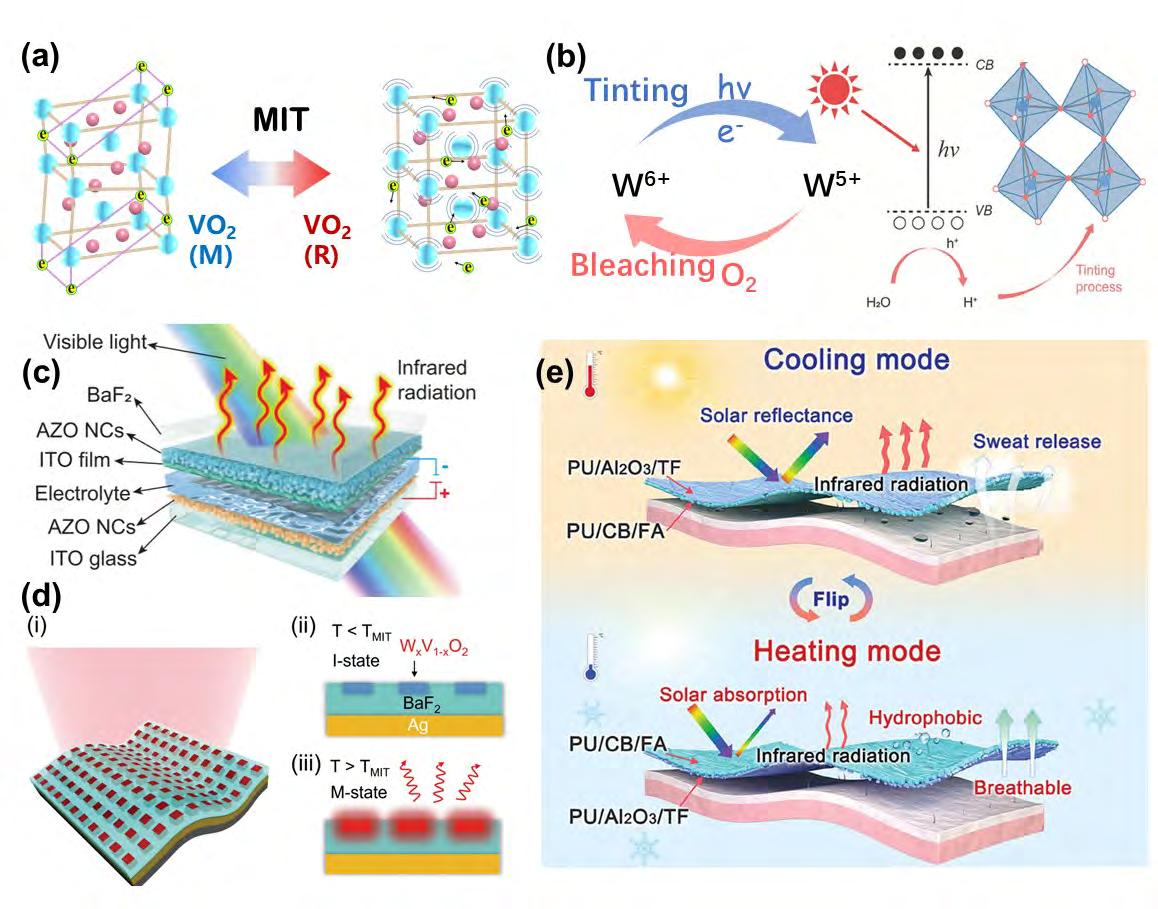
Figure4 (a)Vanadiumdioxidetemperature-controlledswitchingstructureundergoesphasetransitiontoregulatenear-infraredradiation. (b)Themechanismofregulatingthephotochromictungstenoxideundernear-infraredlight[54].Copyright©2024,JohnWileyandSons. (c)Dynamicregulationoftheemissionrateofmid-infraredinaluminum-dopedzincoxidenanocrystals(AZONCs)[132].Copyright©2023, SpringerNature.(d)Dynamicregulationofmid-infraredemissivityinF-Pcavitystructurebasedonphase-changematerialVO2 [133]. Copyright©2021,TheAmericanAssociationfortheAdvancementofScience.(e)TheJanusstructureregulatesthemid-to-longinfrared emissivitythroughmechanicalflipping[134].Copyright©2024,JohnWileyandSons.
above68°C,transformingthematerialfromaninsulatingtoametallicstatewithincreasedcarrierconcentration.ThestrongabsorptionobservedinthetransmissionspectrumofVO2 nanopowdersnear1400nm stemsfromresonanceabsorptioninducedbytheLSPReffect(Figure4a)[129].
Moreover,absorptioninthenear-infraredbandalsoreliesonfreecarrierabsorption[130].Freeelectrons withinthematerialundergocollision-dampedmotionundertheinfluenceofanear-infraredelectricfield, absorbingphotonenergyandconvertingitintoJouleheat.Forinstance,intheclassicelectrochromic tungstenoxidesystem,lithiumionsbecomeembeddedwithintheWO3 layeruponvoltageapplication.This increasestheconductionbandelectronconcentration,enhancingfreecarrierabsorptionandconsequently reducingnear-infraredtransmittance[131].Similarly,inreversiblemetalelectrodepositionsystems,suchas thoseemployingcopper[104],zinc[105],manganesedioxide[106],exhibitheightenedfreecarrierconcentrationsandenhancedabsorption.Conversely,inphotochromictungstenoxidesystems,ultravioletirradiationinduceselectron-holepairgeneration,withsomeelectronscapturedbyW6+ toformW5+.TheW5+ defectstategeneratessubbandgapabsorptioninthenear-infraredregion,therebydiminishingtransmittance inthiswavelengthband(Figure4b)[54].
TheprinciplesgoverningthedynamicregulationofVISandNIRlightabsorptionthroughlightabsorption sharecommonalitiesyetexhibitsignificantdifferences.Strongnear-infraredabsorptionprimarilyrelieson thematerial’sopticalbandgap,chargecarrierbehaviour,ormolecularvibrationalcharacteristics.Strong near-infraredabsorptionismainlyachievedthroughfreechargecarriers,narrowbandgaptransitions,or molecularvibrations,whereasvisiblelightabsorptiondependsonelectronbandgaptransitions.
Dynamicregulationofmid-infrared
Theratiooftheenergyradiatedbyamaterialataspecifictemperaturetotheenergyradiatedbyablackbody atthesametemperature(where ε =1denotesanidealblackbodyand ε =0denotesaperfectreflector)is definedasthematerial’semissivity.Kirchhoff’slawstatesthatforobjectsinthermodynamicequilibrium,the spectralemissivity(ϵλ)equalsthespectralabsorptivity(αλ): ϵλ = αλ.Thisrelationshipholdsforallwavelengths(includingthemid-infraredband)andalldirections[39].Thecoreprincipleofdynamicallyregulatingmid-infrared(5–25μm)emissivityinvolvesinducingreversiblechangesinmaterialsorstructuresto altertheirsurfaceinteractionwiththermalradiation,therebyenablingintelligentcontroloverthermalradiationdissipationorabsorption.
Theprincipleofmodulatingcarrierconcentration(plasmoniceffect)isemployedtoregulateemissivityin themid-infraredspectrum(Figure2c).Thisinvolvesalteringthematerial’sfreecarrierconcentration(n) throughexternalstimuli(electricfields,chemicaldoping),therebycontrollingitsplasmonicfrequency(ωp) andconsequentlyinfluencingmid-infraredreflectionorabsorptioncharacteristics[132,135,136].Whenthe incidentlightfrequency ω < ωp,thematerialexhibitshighreflectivity;when ω > ωp,itbehavesastransparent orabsorptive.
Aluminium-dopedzincoxide(AZO)nanocrystalsexhibitdistinctabsorptioncharacteristicsinthemidinfraredregionduetovariationsinlocalsurfaceplasmonresonanceabsorptionintensity(Figure4c).Thisis causedbyelectroninjection/extractionwithinthedepletionlayerattheAZOnanocrystalsurfaceunder electricfieldcontrol.Consequently,theirmid-infraredemissivityisdynamicallyregulated(0.51at3–5μm and0.41at7.5–13μm)[137].Followinglithium-ionintercalation,thecarrierconcentrationwithinWO3 electrochromicfilmsincreases,causingasignificantalterationinmid-infraredreflectanceandthereby modulatingthemid-infraredemissivity[138,139].ElectrodesbasedonIR-transparentgrapheneenablethe developmentofdynamicIRemissivitymodulationdevicesthroughthereversibleelectrodepositionofmetals ontographene-basedelectrodes[140].Withinreversiblemetalelectrodepositionsystems,infraredradiation canbedynamicallymodulatedthroughthereversibleelectrodepositionanddissolutionofsilverlayers[141].
Byexploitingtheprincipleofmetal-insulatorphasetransitions(abruptchangesinelectronicstructure)to modulatemid-infraredbands[142],namelythedrasticalterationinelectrondensityduringmaterialphase transitions,whichcausesareversalinmid-infraredopticalproperties(Figure4d)[143].Forinstance, employingtheclassicthermallycontrolledphase-transitionmaterialVO2,theinsulatingphase(vanadium dioxide)exhibitshighmid-infraredabsorption,whereasthemetallicphasedemonstrateshighmid-infrared reflectivity,therebyenablingemissivitymodulation[144].Similarly,hydrogen-inducedmetal-insulator transitionsinMgxNialloyfilmsenabletheiruseasvariable-emissivitymaterialsandtopconductiveelectrodes[145].Polyethyleneimine(PEI)servesastheintermediateproton-conductingelectrolytelayer,while hydrogen-tungstenbronze(HxWO3)/ITOformsthebottomionstoragelayer.Theconstructedsandwich-
structuredelectrochromicdevicesimplifiesthedevicearchitecturewhileensuringsubstantialemissivity variation.Thisintroducesanovelapproachfordynamicemissivitymodulationbasedonhydrogen-induced metal-insulatorphasetransitionsfrommetallicyttrium(oryttriumdihydride)todielectricyttriumtrihydride, utilisingyttrium/rhodiummetalfilmsandinfrared-transparentcoverlayers[146].Byalternatelyinjectinga 4%hydrogen-argonmixtureandairintothegas-chromatographicdevice,itsinfraredemissivityisdynamicallyandreversiblymodulated.Theessenceofdynamicallyregulatingmid-infraredemissivityliesin activelyalteringthematerial’s‘absorption-reflection’equilibriumforthermalradiationthroughelectronic behaviour(chargecarriers,phasetransitions),photonicstructures(metasurfaces),ormolecularvibrations.
Furthermore,studieshavereportedtheutilisationofJanussurfacestomodulatemid-infraredemissivity (Figure4e)[147–149].Materialsfeaturingupperandlowerlayerswithhighmid-infraredemissivityandhigh reflectivity(lowemissivity),respectively,enabledynamicemissioncontrolbymechanicallyflippingthe material’stoplayertofacethesky.Asreported,onesurfaceiscoatedwithahydrophobicpolymercooling layercomprisingmicro/nanoporous/particlelayeredstructures,whiletheothersurfaceiscoatedwithhydrophilicMXenenanosheetsforheating.Thecoolingsurfaceexhibitshighsolarreflectance(96.3%)and infraredemissivity(95.5%),resultinginsub-ambientradiativecoolingduringbothdayandnight.Conversely,theheatingsurfacedemonstrateshighsolarabsorptance(83.7%)andlowinfraredemissivity (15.2%)[147].Thiscontrolmechanismdoesnotinvolvesmartmaterials;instead,dynamicregulationis achievedthroughthemechanicalflippingofstaticmaterials.
THERMALMANAGEMENTAPPLICATIONSINTRANSPARENTAND NON-TRANSPARENTSYSTEMSBASEDONDTRC
HavingunderstoodtheprinciplesofdynamicallyregulatingVIS,NIR,andMIRthroughlightreflection, scattering,andabsorption,alongwithexistingresponsemechanismsandcommonlyusedmaterialsystems, wecanbetterdesign,optimise,andmodifymaterialsaccordingtoourspecificrequirements.Coupledwith theperformanceadvantagesbroughtbycurrentdeviceintegration,dynamicradiativethermalmanagementis evolvingtowardsenergyefficiency,intelligence,andhighperformance.Dynamicradiativethermalmanagementadaptstoenvironmentaltemperaturefluctuationsoroperationalrequirementsbyreal-timeregulationofamaterialorsystem’stransmittanceacrossthesolarspectrum(350–2500nm)anditsemissivity characteristicsinthemid-infraredbands.Itscoreliesinemployingdynamicallytunablematerialsor structurestoswitchtransmittancethroughthesolarspectrumandmid-infraredemissivity,therebyachieving efficientthermalcontrol.Basedonapplicationscenarios,dynamicradiativethermalmanagementbroadly fallsintotwocategories:non-transparentsystemsandtransparentsystems.Theprimarydistinctionliesin controllablehightransmittancewithinthevisiblelightspectrum.
Non-transparentsystem
Numerousstudieshavedocumentedthermalmanagementapplicationsinnon-transparentsystems,suchas radiativecoolingtechnologies.However,theirstaticspectralresponseleadstosupercoolingissues.Consequently,tofurtherreduceenergyconsumption,theapplicationofdynamicradiativethermalmanagement NatlSciOpen,2026,Vol.5,20250052
,2026,Vol.5,20250052
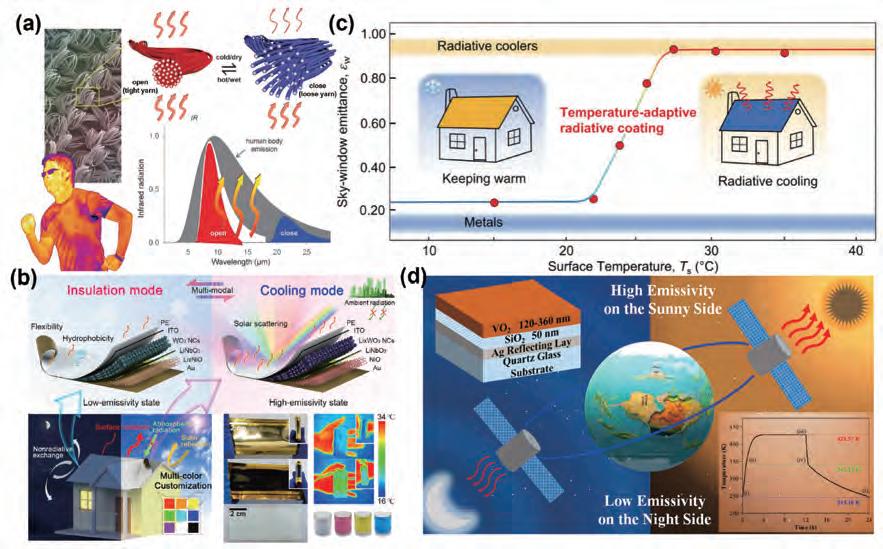
Figure5 Radiantthermalmanagementapplicationsinnon-transparentsystems,personalthermalmanagement[39](a)(Copyright©2019, TheAmericanAssociationfortheAdvancementofScience),buildingwalls((b)[138]and(c)[133])(Copyright©2025,JohnWileyandSons; Copyright©2021,TheAmericanAssociationfortheAdvancementofScience),andspacethermalmanagement[150](d)(Copyright©2022, Elsevier).
innon-transparentsystemsrequiresfurtherdevelopment.Dynamicradiativethermalmanagementfornontransparentsystemsrepresentsacross-disciplinarybreakthroughspanningthermalscience,materialsscience,andengineering.Itsapplicationspermeatescenariosfromeverydaylifetocutting-edgetechnology, encompassingsmarttextiles,electronicheatdissipation,buildingenergyefficiency,aerospace,military camouflage,andindustrialthermalcontrol(Figure5).Owingtoitssignificantenergy-savingpotential, performanceenhancements,andstrategicvalue,coupledwithadvancementsinnewmaterialsandintelligent algorithms,dynamicradiativeheatmanagementtechnologyispoisedtobecomeacoretechnologyforfuture greenenergy,high-performancecomputing,andnationaldefencesecurity.
Personalthermalmanagement
Thermalradiationconstitutestheprimarymodeofheattransferandservesasaneffectivemeansofregulatingheatexchangebetweenthehumanbodyanditsenvironment.Theappropriateandefficientapplicationofthermalradiationwithinpersonalthermalmanagementtextilesenhancesindividualthermal comfortwhileofferingsignificantbenefitsforenergyconservation.Intherealmofpersonalthermalmanagement,adaptabilityisprimarilyachievedbymodulatingtheabsorptionratewithinthesolarspectrumand theemissivityinthemid-infraredrange.Thisiscomplementedbysynergisticregulationthroughheat conduction,convection,andevaporativecoolingmechanisms[151].Consequently,withthegrowingdemand formultifunctionalhumantextilesindailylife,theresearchanddevelopmentoffunctionaltextilesholds
significantimportance[152,153].Humansarehomeothermiccreatures.Excessivelylowtemperaturesimpair enzymaticactivityandnormalmetabolicprocesses,potentiallyleadingtofataloutcomes.However,the limitedthermalregulationcapabilitiesofconventionaltextilesmakeitchallengingforindividualsexposedto outdoorenvironmentstomaintainstablebodytemperatures.Consequently,exploringnovelsmarttextilesfor dynamicthermalmanagementholdssignificantpracticalvalue[154].
Consequently,extensiveresearchhasbeenreportedonintelligenttextilesexhibitingdynamicthermal managementcapabilities[152].Forinstance,adaptivethermalmanagementintegratesbothheatingand coolingfunctionswithinasinglefabric,featuringpassivereflectivecoolingderivedfromaphotoniccrystal (PC)layerandactiveheatingviaanano-silverlayerdrivenbyvoltage[155].Theartofpersonalthermal managementliesineffectivelymitigatingthermalstressbymanipulatingthetargetobject’sspectralproperties.However,improvementsremainnecessaryindevelopingstructurescapableofseamlesslyadaptingto diversethermalenvironments.Addressingthischallenge,researchershaveengineeredJanus-surfacefabrics, which,whenmeticulouslydesigned,offeruniqueadvantagesformulti-scenarioapplications.AJanusfabric exhibiting92%solarreflectanceand94%emissivityonitsuppersurface,coupledwithaninfraredemissivity below30%onitsunderside,facilitatesadaptivethermalmanagement.Thisconfigurationenablesselfselectionoftheouterlayerbasedonambienttemperatureconditions,withtheuppersidedissipatingheatand thelowersideretainingwarmth[152].Similarly,Yin etal.’s[156]dual-modeJanus-structuredfabricoffers bothradiativecoolingandsolarheating.Thisstructuredemonstratesstrongadaptabilityacrossdiverse climaticconditions.Furthermore,scalablemanufacturingcompatibilityandoutstandingperformancepositionJanusstructuresasapromisingavenueforvariouspassivethermalmanagementscenarios.Additionally, reportshavecombineddynamicbidirectionalthermalregulationofJanusstructureswithunidirectionalsweat transporttoachievemoreefficientpersonalthermalmanagement[157–159].Forinstance,thecoolingside featuresan in-situ grownnano-ZnOlayer,achievinghighsolarreflectanceandinfraredemissivity.The heatingside,functionalisedwithPDMS@rGO(reducedgrapheneoxide)composites,exhibitssignificant solarabsorptionandunidirectionalmoisturetransportthroughhydrophilic-hydrophobicinteractions.Furthermore,integratingthermalradiationregulationwithphasechangeenergystorageenablesefficientpersonalthermalmanagement.Asexemplifiedbytheproposedtemperature-adaptiveJanusphase-change radiativecoolingfabric,electrostaticspinningintegratesaradiativecoolinglayer(PVDF-HFP)withaphasechangemateriallayer(PEG)tofabricateatemperature-adaptivephase-changeradiativecoolingtextile[160]. Theradiativecoolinglayereffectivelyreflectsandscatterstheentiresolarspectrumwhileemittingthermal radiationwithintheatmosphericwindow.Thephasechangemateriallayerdynamicallyprovidestemperature-adaptivecoolingorheatingcompensationfortheradiativecoolingeffect.
Moreover,byconstructinganinfrared-adaptivetextilecomposedofpolymerfibrescoatedwithcarbon nanotubes,theyarnitselfexpandsandcollapsesinresponsetoheatandhumidity.Thisaltersthespacing betweenfibres,therebymodifyingthetextile’sinfraredemissivity(Figure5a)[39].Similarly,byregulating theyarntwistmorphologyandcoil-helixchiralitywithinatextilemultistagestructure,a‘super-louver’fabric withmoisture-responsiveporemodulationwasdesigned,enablingall-weatherthermal-humidityregulation insmarttextiles[161].Dynamicthermalcontrolwasachievedbycontrollingtheopeningandclosingofpore channels[162].Buildingupontheprincipleofdynamicallymodulatingemissivity,researchdemonstratesthe fabricationofdynamicallytemperature-regulatingtextilesbyweavingscalableradiativeelectrochromic fibres.Drivenbylowvoltage,thesefibresexhibitmodulatedmid-infraredemissivitywithΔε≈0.35,enabling
effectivethermalmanagement[163].Alterationsinthevisiblelightabsorptionofelectrochromicfibreslay thefoundationforintegratingthermalmanagementwithcamouflage.
Currently,dynamicradiativethermalmanagementtechnologyremainsrelativelyconstrainedandinits preliminaryresearchstages,giventheapplicationrequirementsforsmarttextilessuchasflexibility,nontoxicity,washresistance,andcyclicstability.PresentapproachespredominantlyutiliseJanusstructuresfor mechanicalflippingtoachieveswitching,alongsidedynamicallyregulatingmid-infraredemissivity.Thisis achievedbycontrollingtheopeningandclosingofporechannelswithinfibresormodulatingchargecarriers inelectricallyconductivefibres.
Buildingwalls
Theapplicationofdynamicradiantthermalmanagementtechnologyinbuildingwallscansignificantly enhanceenergyefficiency,improveindoorthermalcomfort,andreducerelianceonactiveheating/cooling systems.Dynamicmaterialsrespondtoexternalenvironmentalchanges,automaticallybalancingindooroutdoorheatexchangetoaddressthetraditionalwallissueofbeing‘coldinwinterandhotinsummer’[164]. Achievingyear-roundenergysavingsinbuildingsiscrucialforcarbonneutralityandsustainability.Thisis accomplishedbypassivelydissipatingheatintothecoldouterspaceduringsummerandabsorbingheatfrom thesun’swarmthinwinter,dynamicallyregulatinginternaltemperatures[165].Similartosmarttextiles, thermalmanagementtechnologiesforbuildingwallsusingsmartmaterialsprimarilyrelyondynamically switchingbetweenhighabsorptionandhighreflectionofsolarbands,alongsideregulatinginfraredemissivitybetweentheinteriorandexterior.
Bydynamicallyregulatingthevisiblelightbandthroughtemperatureadaptation,thermalmanagementis achievedwhenappliedtobuildingroofs.Colour-adaptiveflexiblefilmsutilisethermochromicmicrocapsules todynamicallyswitchbetweenhighreflectanceandhighabsorptanceinsolarbands,enablingdynamically switchablethermalmanagementinanenergy-neutralmanner[166,167].Thisisachievedbyselectingtwo distinctcomponentsofthermochromicmicrocapsulesandfluorescentdyes,todecouplesolarreflectance modulationfromcolourdisplay[88].Thesynergisticinteractionofthesetwocolouredcomponentsyieldsthe desiredcontrollablesolarreflectancewithoutalteringthedisplayedcolour.Furthermore,anelectrically controlledstructuredynamicallymodulatesemissivitybasedoncarrierconcentration,combinedwiththinfilminterferenceeffects,todynamicallyregulatemid-infraredemissivity.Thisisappliedtobuildingroofsfor spatialthermalmanagement.Forinstance,amulti-layerthin-filmultra-thinelectrochromicdevicehasbeen meticulouslyengineeredasacolourfulsmartinfraredemissivityregulatorforall-weatherthermalmanagementinbuildings.ByalteringopticalbandgapandcarrierconcentrationthroughLi+ insertion/extraction, combinedwithsurfaceplasmonresonance(LSPR)andthin-filminterferenceeffects,itachievesmid-infrared emissivityregulation(Figure5b)[138].Theinfraredemissivityoftheregulatorcanbeelectricallycontrolled inreal-timeaccordingtoseasonalortemperaturevariations,enablingswitchingbetweencoolingandheating modes.Furthermore,anarraystructurefabricatedfromtungsten-dopedvanadiumdioxideautomatically switchesthermalemissivityfrom0.20atambienttemperaturesbelow15°Cto0.90attemperaturesabove 30°C(Figure5c)[133].
Achievingdynamiccontrolacrosstheentirevisible,near-infrared,andmid-infraredspectrumremains challenging.OwingtothesimplicityofJanusstructuresandtheirsuitabilityforlarge-scalefabrication,they
holdpromiseforspatialthermalmanagementinbuildingenvelopes.Numerousanalogousstudieshavebeen reported,suchassandwich-structuredfabricscomposedofverticallyalignedgraphene,graphene-coated glassfibrefabric,andpolyacrylonitrilenanofibres.Thesefabricsintegrateheatingandcoolingfunctionson oppositesidesthroughmulti-band,synergistic(coveringthesolarspectrumandmid-infraredrange)and asymmetricopticalmodulation,constitutingJanusstructures[168].Thesedual-functionalfabricsdemonstrateexceptionalperformanceandhighadaptabilitytodynamicenvironmentsinzero-energy-inputtemperatureregulation[169].Additionally,throughexternalintegration,motorisedpullingenablesflipping betweenthetwosides[170].Furthermore,thermallycontrolledself-curlingstructureshavebeendesignedto switchbetweenupperandlowerlayers[40].BeyondconventionalJanusstructuresforarchitecturalthermal management,electro-controlledstructuresdynamicallyregulatesolarbandreflectanceandmid-infrared emissivityviacarrierconcentrationmodulation,achievingfull-spectrumdynamiccontrol.Thissilicon-based devicecombineslithium-ionelectrochemicalreactionswithreversiblelithiation/delithiationprocessesto inducephasetransitionsanddimensionalchangesinsiliconmaterial.Thisenablesdynamicregulationof infraredemissivity,simultaneouslyprovidingradiativecoolingandsolarheatingcapabilities.Itachieves summerradiativecoolingandwinterthermalinsulationwhilepossessinghigh-capacityelectricalenergy storage[171].
Thermalcontrolcoatingsforspaceapplications
Spacetemperaturesfluctuatedramatically(from 100to150°C),necessitatingdynamicadjustmentof surfaceemissivitytomaintaininstrumentswithinanarrowertemperaturerange.Thisensuresmaterial efficacyandreliability,facilitatesnormalequipmentoperation,enhancesspacecraftreliabilityunderextreme conditions,andreducestheweightandpowerconsumptionofactivethermalcontrolsystems.Effective thermalmanagementtechnologyiscrucialformitigatingadverseeffectscausedbyextremethermalconditions[172].
Temperature-adaptivesolarcoatingsandtemperature-adaptiveradiativecoatingsrelyondynamically regulatingmid-infraredemissivity,alongsidedynamicallyswitchingbetweenhighreflectanceandhigh absorptancewithinthesolarspectrum.Theyrepresentanovel,lightweight,energy-freetemperatureregulationmethodforterrestrialobjectsexhibitingoutstandingthermalperformance(Figure5d)[150].For instance,Wu etal.[173]simulatedanddemonstratedthesignificantpotentialoftemperature-adaptivesolar coatingsandtemperature-adaptiveradiativecoatingsaspassivethermalmanagementtechnologiesforfuture spaceobjects.Utilisingtheprincipleofmetal-insulatorphasetransitions(electronicstructureabruptchanges) tomodulatemid-infraredemissivity,suchasVO2 forspacecraftthermalcontrolviaparticle-basedsmart metasurfaces.TheseconsistofVO2 particlesonanAusubstrateformingalatticearrayofhollowspheres [174].Themetasurface,featuringVO2 particleswithahighaspectratio(~10),exhibitsperfectemission acrosstheentiremid-infraredspectrum.Theemissivitytunabilityexceeds0.63.Thefundamentalmechanism underlyingthemetasurfaceisattributedtothedrasticchangeinelectrondensityduringphasetransition. Concurrentstructuraldesignsignificantlyenhancesinfraredemissivityinthemetallicstatewhileconstrainingitinthedielectricstate,therebyachievingdynamicregulation[175].Similarly,metasurfaces fabricatedfromVO2 enabledynamicemissioncontrol[176].ThisextendstomultilayerVO2-basedstructures,suchasconventionalFPcavityconfigurations[177].Consideringtheimpactofextremespaceen-
vironmentsonvanadiumdioxide,researchhasdevelopedVO2 metasurfacesincorporatingfunctionalsilicon layers.ThiseliminatestheneedforadditionalprotectivecoatingstypicallyrequiredtoshieldVO2 from environmentaldegradation,therebyenablingresponsivenesstoambienttemperaturesandpotentiallongtermstability[178].Themetasurfaceachievespassivethermalmanagementbyautonomouslyadjustingits absorptionandemissionresponsesacrossabroadbandwidthspanningvisibletomid-IRwavelengths. Furthermore,metal-insulator-semiconductor(MIS)structureswereemployed,whereinthecarrierdistributionwithinthesemiconductorlayercanbeelectricallycontrolledtomanipulatethematerial’semissivity [179].
Beyondtheaforementionedapplicationscenarios,whichencompasselectronicdevicethermalmanagementandoutdoorlarge-scaleinstrumentation,currentresearchinnon-transparentsystemsprimarilyfocuses onthermalregulationthroughmodulationofmid-infraredemissivity.Constrainedbythermalmanagement energylimitationsandoperationalconditions,switchingbetweenhighreflectivityandhighabsorptionwithin thesolarspectrumenablescoolingandheatingfunctions.Thisapproachelevatestheupperenergythreshold forthermalmanagement,maximisingenergyefficiency.However,dynamicradiativethermalmanagement fornon-transparentsystemsstillfaceschallenges,suchasapplicationsinextremeenvironments—particularlyspaceapplications—andtheneedtoelevatetheenergythresholdfordynamicregulationtobroadenits regionalapplicability.Lookingahead,advancementsinsmartmaterialslikemetamaterialsandAI-driven coatingswillfurtherexpandthescopeofdynamicradiativethermalmanagement.Thistechnologyholds promiseasacornerstoneforgreenenergysectorsandhigh-techindustries.
Transparentsystem
Thedistinctionbetweentransparentsystemsandnon-transparentsystemsindynamicradiantheatmanagementapplicationsprimarilyliesinthefactthatnon-transparentsystemsdynamicallyswitchbetweenhigh reflectanceandhighabsorptancewithinthesolarspectrum(VIS-NIR),whereastransparentsystemsdynamicallyregulatebetweenhightransmittanceandlowtransmittance.Consequently,theirheatmanagement applicationspredominantlyoccurinscenariosrequiringtransmittancecontrol,suchasbuildingwindowsor vehiclewindows.Astheprimaryconduitforthermalexchangebetweenbuildingsandtheexternalenvironment,windowsholdpivotalsignificanceingreenbuildingdesign.Servingastheprincipaldaylighting component,windowssimultaneouslyrepresenttheweakestlinkinabuildingenvelope’sthermalinsulation, resultinginlowenergyutilisationefficiency.Bydynamicallyregulatingtransmittanceinthesolarspectrum andemissivityinthemid-infraredrange,theycontroldaylightingandindoortemperatures,therebyreducing energyconsumptionforcoolingandheating[180].Consequently,extensiveresearchonsmartwindowshas beendocumented,providingclearinsightsintocontrolmethodsandcoremechanismsacrossvisible,nearinfrared,andmid-infraredbands.Furthermore,studiesonsmartwindowsencompassdynamicregulationof solartransmittanceacrossnear-infrared,visible-near-infrared,andvisible-near-infrared-mid-infraredbands, alongsidetheintelligentevolutionofdynamicresponsefrombimodaltomultimodalsystems.
Single-bandregulation
Near-infraredenergyconstitutesnearly50%ofsunlight.Moreover,asthefrequencyofnear-infraredlight
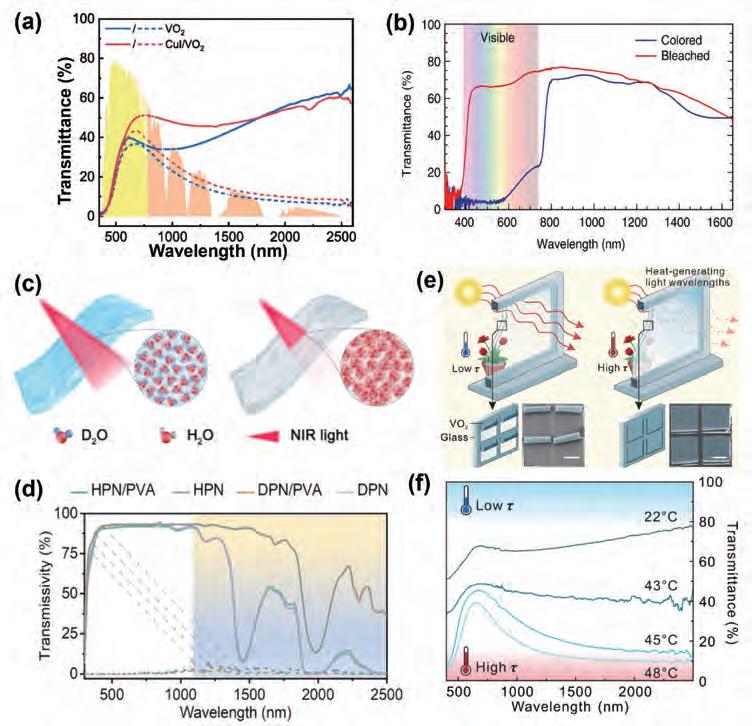
Figure6 Radiantthermalmanagementapplicationoftransparentsystems:smartwindows.(a)ThespectrumofNIRsingle-wavelength modulatedbasedonvanadiumoxide[198].Copyright©2024,Elsevier.(b)Thespectrumofvisiblelightsingle-wavelengthmodulationbased onperovskite[37].Copyright©2017,SpringerNature.(c,d)Thestructureandspectrumofthedual-bandmodulationbasedonhydrogels [206].Copyright©2025,SpringerNature.(e,f)Thestructureandspectrumofthemultimodaldual-bandmodulationbasedonvanadium dioxide[207].Copyright©2022,SpringerNature.
alignsmorecloselywiththeresonancefrequenciesofmicroscopicparticleswithinmaterials,itexhibitsa strongerthermaleffect.Consequently,regulatingthetransmittanceofnear-infraredlightthroughdynamicallyresponsivematerialscanadapttohumanlivingrequirementsandreduceenergyconsumption.Classic thermallyinducedphase-changematerialssuchasniobiumoxideandvanadiumoxide[181,182]dynamicallymodulatenear-infraredtransmittanceinresponsetotemperaturevariations(Figure6a)[183].However, niobiumoxide’sphasetransitiontemperaturefarexceedsroomtemperature[184],renderingitunsuitablefor smartwindowsrequiringtransitionsnearambientconditions.Conversely,extensiveresearchexistson vanadiumdioxideapplicationsinsmartwindows,suchasinkjet-printedvanadiumdioxidepowders achievingmodulationratesof15.31%[185]thoughthismodulationperformanceisachievedattheexpense ofthefilm’sinitialtransmittance.Moreover,vanadiumdioxideexhibitsaphasetransitiontemperatureas highas68°C.Consequently,balancingphasetransitiontemperature,initialtransmittance,andfilmmodulationefficiencyremainsapressingchallengeinresearchonvanadiumdioxideapplicationsforsmart windows[186–188].StudieshaveemployeddopingwithelementssuchasW,[189–191]Mo,[192]Co[193]
toinducelatticedistortionwhilealteringthevalencestateofvanadium,therebyreducingitsphasetransition temperaturewhilemaintainingmodulationefficiency[194].Toaddressvanadiumdioxide’ssusceptibilityto degradation,protectivelayershavebeenincorporated.Forinstance,vanadiumdioxidepowderscanbe coatedwithhydrophobicresinfilms[181]orencapsulatedwithinhybridinorganic-organiccoatingstructures suchasVO2@MgF2@PDA[195],enhancingbothswitchingspeedanddurability.Furthermore,protective layerscoveringthesurfaceofmagnetron-sputteredvanadiumdioxidefilms[196],suchasV2O3 [182],HfO2 [197],andCuI[198],enhancecyclingstabilitywhilemaintainingmodulationefficiency.Mostelectrochromicmaterialsystemsachievevisible-near-infraredco-modulation[199].However,electrochromicdevicesareconstrainedbythetransmissioncharacteristicsofelectrodessuchasITOandFTOinthenearinfraredband(wheretransmissionsharplydeclinesbeyond1500nm),limitingtheirmodulationefficiency duetorestrictedcontrolwavelengths[200].Consequently,researchintodynamicmodulationofelectrochromicmaterialssolelywithinthenear-infraredbandremainsrelativelyscarce.
Theenergyproportionwithinthevisiblelightspectrumreachesashighas43%,andgiventhelimitationsof single-bandregulationinthenear-infraredregion,certainmaterialsystemsenabledynamiccontrolof transmittanceforspecificvisiblelightwavelengths[200].Buildingupontheelectrochromicdevicesintroducedearlier,Yang etal.[201]developedan‘electrodes-free’electrochromic(EC)deviceutilisingthe reversibledepositionofMnO2 toachievecolourfadingandvisiblelightregulation,leveragingitscomplex multilayerstructure.Furthermore,theperovskitematerialsystemABX3 exhibitscrystalstructuretransformationsundertemperaturecontrol,enablingtransparencyswitching(Figure6b).However,asitsphase transitiontemperatureexceeds100°C[202],farsurpassingpracticalapplicationscenarios,subsequent researchco-embeddedmethanol(ratherthanwater)withmethylammoniumiodideandadjustedthehydrogen-bondchemistryofthereservoirphasetocontrolthetransitiontemperature.Thisreducedthephase transitiontemperaturetobelow30°C,demonstratingitspotentialforpracticalapplication[203].Subsequent studiesdevelopedsmall-molecule-responsiveperovskitesystems[89].Addressingstabilityconcernsin perovskite-basedsmartwindows,Cao etal.[92]designedamultilayerstructureinspiredbymaskarchitecture,effectivelyensuringstructuralintegrityandenhancingdevicecyclingstability.Furthermore,certain liquidcrystalsystemsincludingpolymer-dispersedliquidcrystals[81,204]andcholestericliquidcrystals [84,205],effectivelymodulatevisiblelightvialightscatteringunderelectricfieldcontrol.However,their highdrivevoltagerequirements(atleasttensofvolts)currentlylimittheirenergy-savingpotentialforsmart windowapplications.Furthermore,certainphotochromicsystems,suchasspiropyranderivatives[100],can effectivelymodulatevisiblelight.Photoisomerisationinducesacolourtransitionfromcolourlesstocoloured states,enablingcolourswitching.However,foroutdoorapplicationsinsmartwindows,thestabilityand cyclinglifetimeoforganicmoleculesremainsignificantchallenges.
Dual-bandregulationbasedondual-modalityandmulti-modality
Toenhanceenergy-savingperformance,subsequentresearchfocusedondual-moderegulationacrossthe visible-near-infraredspectrum,achievingmodulationefficienciesexceeding30%throughcontrolofonly highandlowtemperaturemodes.Forinstance,conventionalhydrogelsystemsexhibitvisiblelighttransmittanceexceeding90%whilemaintainingmodulationefficienciessurpassing60%,orevenhigher.Given theseadvantages,dual-moderegulationacrossvisible-near-infraredwavelengthsinhydrogelshasbeen
extensivelyinvestigated.Regardingphasetransitiontemperature,purePNIPAmexhibitsacriticaltransition temperatureofapproximately32°C.Guo etal.[72]modifiedPNIPAmbyemployingdifferentsolventsto reduceintermolecularforcesbetweenPNIPAmandwater,aswellaswater’ssurfacetension,therebyloweringthecriticaltransitiontemperatureto22–28°C.Furthermore,byintroducing insitu radicalpolymerisationandnon-covalentcrosslinkinginaPNIPAm-water-glycerolbinarysolventsystem,excellent freezeresistancewasmaintainedat 18°C,enhancingstability[208].Regardingresponsespeed,onestudy synthesisedasolid-liquidswitchablethermochromichydrogelbycrosslinkingPNIPAmwith3-aminopropyltriethoxysilane(AMEO)viadynamiciminebonds[209].However,thewatercomponentinhydrogels exhibitsstrongabsorptionintheNIRband,limitingmodulationefficiencyandpresentingasignificant bottleneckforfurtherperformanceenhancement.Consequently,Wu etal.[206]preparedisotope-driven D2O-hydrogelthermochromicsmartwindowsbysubstitutingordinarywaterwithheavywater(D2O)(Figure 6c).Thisreducedabsorptioninthenear-infraredbandduringtheinitialstate(Figure6d).
Toadapttovariableclimaticconditionsandhumanrequirements,diversifiedmodalitiesareincreasingly crucial.Forinstance,mostsingle-systemelectrochromicdevicesexhibitvaryingdegreesoftransmittance reductionintheirfilmsunderdifferentdrivevoltages,therebyenablingregulationofmultiplestates [201,210].Forexample,Cao etal.[211]employedNa+ pumpstoexpelH+,achievingultrafastall-solid-state WO3 electrochromiccolouration.However,thisstateprovesunstable;undersustainedlowvoltagefor sufficientlyprolongedperiods,thecolourationprocesspersists.Consequently,itdoesnotstrictlyqualifyas multimodal.Similarly,inphotochromicWO3 systems,thedegreeofcolourationvarieswithlightintensity andexposureduration[54].Thus,researchershaveinitiatedaseriesofstudiesonmultimodalregulationfor smartwindows.Forinstance,thedual-moderegulationofclassicvanadiumdioxideanditsmodulationrate intheNIRbandhaveapproachedtheirthresholds,makingfurtherbreakthroughschallenging.Inspiredby blinds,MeiandCao etal.[207]employedself-curlingtechnologytodetachstrain-inducedvanadiumdioxide filmsfromglasssubstratesandcurltheminto‘slat’arraysforsmartwindows(Figure6eandf).However,in devicescombiningNb18W16O93 andPrussianblue(PB)ascomplementaryelectrochromiclayers,thecointercalationofcationsandanionsthroughcharge-balancingdesignenablesdiversecolourandspectral modulationalongsidestablemultimodalcontrolcapabilities[212].Beyondsingle-systemregulation,studies indicatethatmulti-systemcombinationscanovercomelimitationsinmodulationratesandmulti-modality. Forinstance,co-assemblyofphotoswitchableorganiccrosslinkers(Azo-Ch)andsuperparamagneticinorganicnanoparticles(Fe3O4@SiO2)yieldsorganic-inorganicsemi-interpenetratingnetworkcompositegels, enablingorthogonalcontrolvialightandmagneticfields[94].Furthermore,combiningelectrochromic W18O49 withthermochromicW-VO2 nanowireseffectivelyenhancessunlightmodulationandthermal managementcapabilitiesinsmartwindows[213].Additionally,multifunctionalsmartwindowsintegrating light-responsivetungstenoxideparticleswiththermochromichydrogels[214],andphoto-electrodual-responsivefilmscombiningWO3,ethyleneglycol(EG),andAg,enablingsimultaneousphotochromicand electrochromicfunctionality[215],achievevisible-to-near-infraredmultimodalregulationthroughcombinedresponsemechanisms.
Furthermore,subsequentresearchonsmartwindowshasdemonstratedmulti-modalcontrolbyseparately regulatingthevisible-near-infraredspectrum.Thisisachievedthrougha‘1+1’combinationofmaterial systemswithidenticalresponsemechanisms,enablingmulti-modalband-specificregulationofvisibleand near-infraredlight.Forinstance,Cao etal.[46]employedthermochromicparaffinwaxandvanadium
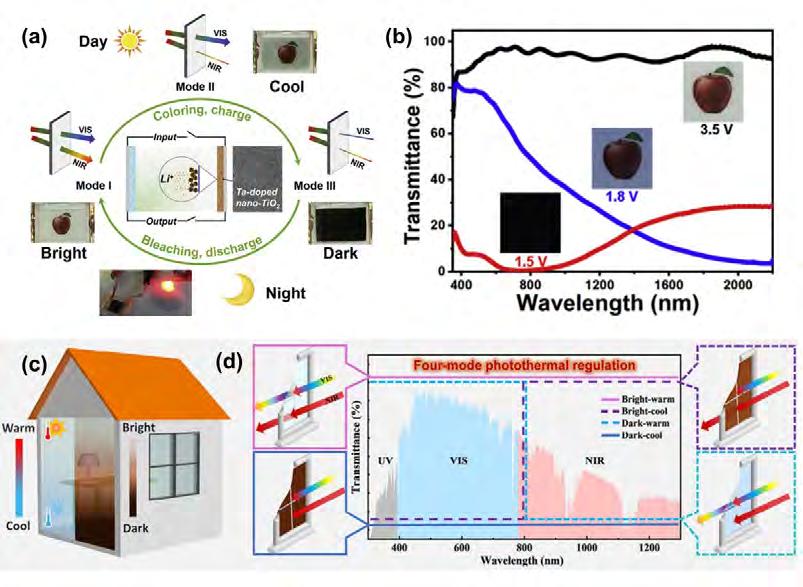
Figure7 (a,b)Theelectrochromicstructureandspectrumformultimodaldual-bandmodulation[216].Copyright©2019,Elsevier. (c,d)Idealspectrathatcanbeindependentlycontrolledinthenear-infraredband[218].Copyright©2025,JohnWileyandSons.
dioxide,utilisingtheopticalscatteringtransitionbetweenparaffinandthesubstratetoregulatevisiblelight, whilevanadiumdioxidecontrolledthenear-infraredspectrum.Thisapproachprioritisednear-infrared regulation,balancingenergyefficiencyandvisibilityinsmartwindowapplications.However,itsvisiblelight regulationreliesonopticalscattering,therebyintroducinghazeissues.Conversely,Lee etal.[216]proposed adual-frequencyelectrochromicdeviceemployingcomposition-optimisedTa-dopedTiO2 nanocrystalsas multifunctionalactivematerial.Thisenablessimultaneousprovisionofhighchargestoragecapacity,high bistability,andlong-lifetimeelectrochromicbehaviouracrossthreedistinctoperatingmodes:(1)VISand NIRtransparent‘bright’mode;(2)VIStransparentandNIRopaque‘cool’mode;(3)fullyopaque‘dark’ mode(Figure7aandb).Similarly,Long etal.[217]employedNb-dopedanataseTiO2 nanocrystals,whose productslackorganicligands,therebyreducingnear-infraredabsorption.Thisenablespreferentialnearinfraredcontrolbelow1600nm,achievingmulti-modalregulation.Moreover,itsvisible-lightregulation operatesbyenhancinglightabsorptiontoreducetransmittance,therebymitigatinghazeissues.Cai etal. [218]employedamixedelectrolytetodecouplereversibledepositionandionadsorptionin WO3/MnO2-basedsmartwindows,achievingindependentandefficientVIS-NIRregulation(Figure7cand d).Cu2+/Mn2+ ionsinthehybridelectrolyteenhanceprotonadsorptionontheWO3 surfacewhileinhibiting protoninsertion,therebyprovidingstate-of-the-artnear-infraredmodulationforWO3 electrodes.ThesynergisticinteractionbetweenprotonsandCu2+/Mn2+ ionspromotesreversibleMnO2 electrodepositiononthe electrode,triggeringindependentVISlighttuning.Li etal.[43]proposeddual-operating-modeelectrochromismthroughintegratingcomplementaryCe4W9O33/NiOdeviceswithZnanode-basedelectrochromic
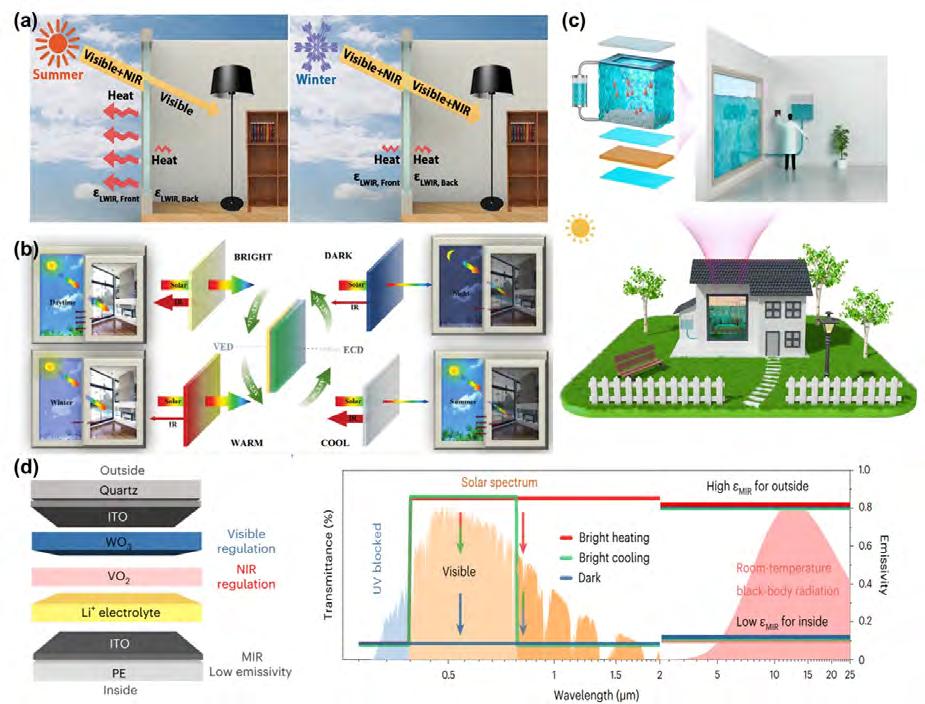
Figure8 (a)Dual-modalmodulationoftheVIS-NIR-MIRthree-bandsystem[219].Copyright©2021,TheAmericanAssociationforthe AdvancementofScience.(b)Multi-banddynamicregulationwherethesolarbandemissionrateandinfraredemissionrateareindependentof eachother[221].Copyright©2023,JohnWileyandSons.(c)Independentregulationofinfraredemissivityformulti-bandthree-modal modulation[38].Copyright©2025,RoyalSocietyofChemistry.(d)Multi-banddynamicregulationwherethesolarbandemissionrateand infraredemissionrateareindependentofeachother[222].Copyright©2024,SpringerNature.
devices(Ce4W9O33/Zn/NiOdevices),enablingmultimodalband-selectiveregulationofvisibleandnearinfraredlight.Researchonvisible-near-infraredmultimodalband-selectivecontrolprimarilyfocuseson achievingnear-infraredprioritycontrol(threemodes)andindependentvisible-near-infraredcontrol(four modes).Regardingvisiblelightcontrol,theunderlyingprincipleshiftsfromlightscatteringtolightabsorption,necessitatingapplication-specificdetermination.Forprivacyprotectionapplications,lightscatteringoffersgreateradvantages;conversely,whenenhancingenergyefficiencywhilemaintainingvisibility isrequired,lightabsorption-basedcontrolbecomesmorecompelling.
Tri-bandregulationbasedonmultimodalapproaches
Withtheadvancementofradiativecoolingtechnology,thermalradiationregulationinthemid-infrared spectrumisincreasinglybeingintegratedintosmartwindowsystems.Underidealconditions,duringperiods ofhighambienttemperatures,itisdesirableforthesky-facingexteriorsurfaceofthesmartwindowto maintainhighemissivity.Thisfacilitatesthermalradiationexchangebetweenthewindowandtheideal
coolingsourceofouterspace,therebyenhancingthecoolingeffect.Conversely,duringcoldweather,the smartwindowshouldmaintainlowemissivitytominimiseheatexchange.Consequently,buildingupon researchintodual-banddynamicregulationacrossthevisible-near-infraredspectrum,achievingtri-band dynamiccontrolacrossvisiblelight,near-infrared,andmid-infraredhasemergedasakeyresearchfocusto furtherenhanceenergy-savingperformance.Long etal.[219]pioneeredthisfieldbyproposingtheuseof VO2 asaswitchfordynamicallyregulatingemissivitywithinaFabry-Perot(F-P)cavity,therebyinitiating tri-bandregulationresearchinsmartwindows(Figure8a).Forinstance,Yang etal.[220]combinedpolymericdispersedliquidcrystalswithhighmid-infraredemissivityandlow-emissivityhydrogelPNIPAm. Theyachievedmulti-bandregulationofvisiblelight,near-infrared,andlong-waveinfraredradiationby seasonallyreversingmid-infraredcontrolandemployingelectrothermaldual-controlregulationofthesolar band(VIS-NIR).Notably,alterationsinmid-infraredemissivityoccurindependentlyofsolarbandregulation.ThisJanus-likestructure’sreversalmodifiesemissivity,differingfundamentallyfromdynamiccontrol mechanisms.Conversely,Huang etal.[44]exploitedtemperature-triggeredwatercaptureandreleaseinducedbyPNIPAmphasetransitionstoachievesimultaneoussolarbandandemissivityregulation,thereby realisingdual-modetri-bandcontrol.
Toachievemultimodalregulation,themid-infraredspectrumisfirstdecoupledfromsolarbandcontrol. Forinstance,adual-responsemechanismemploysapaper-cutstructureofflexiblethermochromicmaterials, withasurfacelayercoatedinlow-emissivitysilvernanowires.Thisconfigurationenablestemperaturecontrolledresponsetosolarradiationwhilemechanicallystretchableemissionregulation[62].Furthermore, independentmid-infraredregulationisachievedbyintegratinganall-solid-statetransparentemissivity modulatorwithasolarbandcontroldevice(Figure8b).Forinstance,Li etal.[221]integratedanall-solidstatetransparentvariableinfraredemissivitydevice(ITO/SiO2/ITO,VED)withaWO3 electrochromic device.Underdualindependentpowersources,thisconfigurationseparatelycontrolsmid-infraredemissivity andsolarbandtransmittance.ThetopandbottomITOlayersformtwomirrors,withtheintermediateSiO2 layeractingasaresonantcavity.Infraredlightofspecificwavelengthsundergoesmultiplereflectionswithin thecavity,creatingresonance-enhancedabsorption.Byapplyingpositive/negativebiastoalterthecarrier concentrationinthetopITOlayer,themid-infraredemissionismodulatedbasedontheprincipleofcarrier concentrationmodulation.Theseadjustmentmethodsresemblea‘1+1’combinationapproach,operating independentlyyetresultingincumbersomedevicestructuresandcomplexfabrication.Consequently,couplingmid-infraredemissivityregulationwithvisible-near-infrareddynamiccontrolpresentsasignificant challenge.Zhang etal.[38]achievedcompleteswitchingofMIRemissivitybetween0.19and0.93by togglingthepresence/absenceofanelectrolyte.Crucially,whilemaintaininghighemissivitywiththe electrolytepresent,theysimultaneouslyrealiseddynamiccontrolofvisible-near-infraredtransmittance, effectivelyleveragingthecoupledrelationshipforsynergisticregulation(Figure8c).Furthermore,intribanddynamicregulation,multimodalcontroloptimisingfull-spectrum(visible,near-infrared,mid-infrared) photothermalexchangeisparticularlycrucialforsmartwindowdevelopment.Consequently,Cao etal.[222] employedLi+ ionstodiffuseintothemonoclinicVO2 andWO3 layersunderdistinctappliedvoltages, inducingphasetransitionstotetragonalLixVO2 andcubicLiyWO3.Thisapproachenablesmultimodal regulationacrossboththenear-infraredbandandthevisible-near-infrareddual-bandspectrum(Figure8d). Concurrently,byintegratinghigh-andlow-emissivitylayersontheupperandlowersurfacesrespectively, emissivitycontrolisdecoupledfromthesolarspectrum,enablingtri-bandmultimodalregulation. NatlSciOpen,2026,Vol.5,20250052
SUMMARYANDOUTLOOK
Smartwindowsnotonlyprovideuserswithmorecomfortablelivingandworkingenvironmentsbutalso reduceenergyconsumptionandcarbonemissions,makingsignificantcontributionstoglobalsustainable developmentgoals.Tomaximiseenergyutilisation,bandmodulationinsmartwindowsappliedwithin transparentsystemshasevolvedfromsingle-bandtodual-bandandsubsequentlytotriple-bandmodulation. Therefore,thefuturedevelopmentofsmartwindowstowardsfull-bandmodulationisundoubtedlyimminent. Whetherahierarchicalrelationshipexistsamongthethreebandsorwhetherindependentcontrolofallthree bandsshouldbepursuedremainsamatterworthyofconsideration.Wecontendthatregulatingtheoptical behaviourwithinthevisiblespectrumisparticularlycrucial,withthetwodominantphenomenaoflight scatteringandlightabsorptionrequiringconsiderationinspecificapplicationscenarios.Consequently,under thepremiseofachievingfull-spectrumdynamicregulation,multi-modalcontrolofvisiblelightmayrepresentafuturedevelopmentaltrajectory.Atthecurrentresearchstage,near-infraredprioritisationand independentmid-infraredcontrolhavebeenachieved.However,visiblelightregulationstillfacesseveral challenges,includingdeterminingtheoptimallightcontrolmethod,achievingsynergisticregulationwith near-infraredandmid-to-far-infraredlight,andbalancingvisibilitywithenergyefficiency.Thus,thedevelopmentofsmartwindowsnecessitatesprioritisationinVIS-NIR-MIRcontrol,makingindependent regulationacrossallthreebandsanurgentresearchpriority.
Consideringtheintrinsicpropertiesofsmartwindows,suchasdaylighting,visualcomfort,andvisibility, theindependentregulationofvisiblelightbecomesincreasinglycrucial.Moreover,theseparatecontrolof NIRandMIRenablesstepwisemodulationofenergy,renderingVIS-NIR-MIRindependentregulationof paramountsignificancefortheadvancementofsmartwindows.Simultaneously,researchintoindependent controlexpandsapplicationpossibilitiesinotherdomains,suchasoutdoorvisible-infrareddual-bandcamouflage.Basedondifferentdimmingmethods,thetransmittanceofvisibleandnear-infraredbandscanbe dynamicallyregulated.Withinthevisiblespectrum,transmittanceisregulatedthroughscatteringandreflectiontoinfluencevisibility.Futureapproacheswillthusfocusondynamicallycontrollingvisiblelight transmittanceviaabsorption.Furthermore,absorption-basedregulationenablesintegrationwithotherdevices,suchassolarabsorbersandphotovoltaiccellstomaximiseenergyutilisation.
Funding
ThisworkwassupportedbytheNationalKeyResearchandDevelopmentProgramofChina(2021YFA0718900),the NationalNaturalScienceFoundationofChina(62175248,62575296andU24A2061),andtheShanghaiScienceand TechnologyFunds(23ZR1481900and25ZR1401373).
Conflictofinterest
Theauthorsdeclarenoconflictofinterest.
References
1LeskC,RowhaniP,RamankuttyN.Influenceofextremeweatherdisastersonglobalcropproduction. Nature 2016; 529:84–87.
2LeQuéréC,AndrewRM,FriedlingsteinP, etal. Globalcarbonbudget2018. EarthSystSciData 2018; 10:2141–NatlSciOpen,2026,Vol.5,20250052
2194.
3EasterlingDR,MeehlGA,ParmesanC, etal. Climateextremes:Observations,modeling,andimpacts. Science 2000; 289:2068–2074.
4LeeM,KimG,JungY, etal. Photonicstructuresinradiativecooling. LightSciAppl 2023; 12:134.
5FanS,LiW.Photonicsandthermodynamicsconceptsinradiativecooling. NatPhoton 2022; 16:182–190.
6LiangJ,WuJ,GuoJ, etal. Radiativecoolingforpassivethermalmanagementtowardssustainablecarbonneutrality. NatlSciRev 2023; 10:nwac208.
7LuG,DuF,WangZ, etal. Scalablemetasurface-enhancedsupercoolcement. SciAdv 2025; 11:eadv2820.
8LuG,SheW,TongX, etal. Radiativecoolingpotentialofcementitiouscomposites:Physicalandchemicalorigins. CementConcreteCompos 2021; 119:104004.
9NieH,HuangL,XuX, etal. Highperformanceradiativecoolingcoatingwithdensesurfacestructureviaclosed-cell microstructuresanduniformlydispersedscatterers. Small 2025; 21:2507594.
10MengX,ChenZ,QianC, etal. Durableandmechanicallyrobustsuperhydrophobicradiativecoolingcoating. Chem EngJ 2023; 478:147341.
11HuX,TaoG,ZhouH, etal. Biaxialstretchingunlocksdurable,high-performanceradiativecooling. Matter 2025; 8: 102321.
12ZengS,PianS,SuM, etal. Hierarchical-morphologymetafabricforscalablepassivedaytimeradiativecooling. Science 2021; 373:692–696.
13MousaviSAA,AghakhaniH,BaghapourB, etal. Integratingradiativecoolingandthermoelectric:Acomprehensive review. RenewSustainEnergyRev 2025; 222:115946.
14IshiiS,BourgèsC,TanjayaNK, etal. Transparentthermoelectricdeviceforsimultaneouslyharvestingradiative coolingandsolarheating. MaterToday 2024; 75:20–26.
15LeeKW,YiJ,KimMK, etal. Transparentradiativecoolingcoverwindowforflexibleandfoldableelectronic displays. NatCommun 2024; 15:4443.
16YangR,NiuD,PuJH, etal. Passiveall-dayfreshwaterharvestingthroughatransparentradiativecoolingfilm. Appl Energy 2022; 325:119801.
17JinY,JeongY,YuK.Infrared-reflectivetransparenthyperbolicmetamaterialsforuseinradiativecoolingwindows. AdvFunctMater 2023; 33:2207940.
18ZhaiY,MaY,DavidSN, etal. Scalable-manufacturedrandomizedglass-polymerhybridmetamaterialfordaytime radiativecooling. Science 2017; 355:1062–1066.
19XuJ,HuoX,YanT, etal. All-in-onehybridatmosphericwaterharvestingforall-daywaterproductionbynatural sunlightandradiativecooling. EnergyEnvironSci 2024; 17:4988–5001.
20LiT,WuM,XuJ, etal. Simultaneousatmosphericwaterproductionand24-hourpowergenerationenabledby moisture-inducedenergyharvesting. NatCommun 2022; 13:6771.
21WangS,WuM,HanH, etal. Regulatingcoldenergyfromtheuniversebybifunctionalphasechangematerialsfor sustainablecooling. AdvEnergyMater 2024; 14:2402667.
22WangZ,KimSK,HuR.Self-switchableradiativecooling. Matter 2022; 5:780–782.
23AgboEP,NkajoeU,OkonoMA, etal. TemperatureandsolarradiationinteractionsinallsixzonesofNigeria. IndJ Phys 2023; 97:655–669.
24LiJ,CuiX,YangJ.Multi-scalecorrelationanalysisbetweengeometricparametersandsolarradiationinhighdensity urbanenvironment——CasestudyinNanjing. FrontArchitecturalRes 2025; 14:248–266.
25SongJ,JeongKJ,BaikG, etal. Air-gapcontrolledsmartwindowforspectralandangularselectivemodulationofsolar radiation. EnergyConversManage 2025; 324:119237.
26ZhouZ,FangY,WangX, etal. Synergisticmodulationofsolarandthermalradiationindynamicenergy-efficient windows. NanoEnergy 2022; 93:106865.
27WeiD,WangC,ShiG, etal. Enablingself-adaptivewater-energy-balanceofphotothermalwaterdiodeevaporator: NatlSciOpen,2026,Vol.5,20250052
NatlSciOpen,2026,Vol.5,20250052
Dynamicallymaximizingenergyutilizationundertheever-changingsunlight. AdvMater 2024; 36:2309507.
28JoHJ,JangYJ,KimHD, etal. Glare-free,energy-efficientsmartwindows:Apedestrian-friendlysystemwith dynamicallytunablelightandheatregulation. ACSEnergyLett 2025; 10:2997–3004.
29LiD,KouE,LiW, etal. Oxidation-inducedquenchingmechanismofultrabrightredcarbondotsandapplicationin antioxidantRCDs/PVAfilm. ChemEngJ 2021; 425:131653.
30GhoshS,SmalyukhI.Electricalswitchingofnematicplasmonicnanocolloidsforinfraredsolargaincontrol(advanced opticalmaterials20/2022). AdvOptMater 2022; 10:2270079.
31ChenQ,HuangX,LuY, etal. Mechanicallytunabletransmittanceconvectionshieldfordynamicradiativecooling. ACSApplMaterInterfaces 2024; 16:21807–21817.
32WangJ,TanG,YangR, etal. Materials,structures,anddevicesfordynamicradiativecooling. CellRepPhysSci 2022; 3:101198.
33ZhaoB,XuanQ,XuC, etal. Considerationsofpassiveradiativecooling. RenewEnergy 2023; 219:119486.
34LiuS,ChenG,LiJ, etal. Smartskinforzeroenergybuildings:Areviewofthermoresponsivespectral-adaptive envelopes. AdvMater 2025; 8:e11392.
35XieL,WangX,BaiY, etal. Fast-developingdynamicradiativethermalmanagement:Full-scalefundamentals, switchingmethods,applications,andchallenges. Nano-MicroLett 2025; 17:146.
36XuT,YeowSeowJZ,TanS, etal. Radiativesmartfibersandtextiles:Thermalmanagementandbeyond. ACSNano 2025; 19:32995–33007.
37WheelerLM,MooreDT,IhlyR, etal. Switchablephotovoltaicwindowsenabledbyreversiblephotothermalcomplex dissociationfrommethylammoniumleadiodide. NatCommun 2017; 8:1722.
38HuangY,WuS,ZhaoS, etal. Anovelliquidflowelectrochromicsmartwindowforall-year-rounddynamic photothermalregulation. EnergyEnvironSci 2025; 18:1824–1834.
39ZhangXA,YuS,XuB, etal. Dynamicgatingofinfraredradiationinatextile. Science 2019; 363:619–623.
40ZhangQ,LvY,WangY, etal. Temperature-dependentdual-modethermalmanagementdevicewithnetzeroenergyfor year-roundenergysaving. NatCommun 2022; 13:4874.
41ChenS,JiangG,ZhouJ, etal. Robustsolvatochromicgelsforself-defensivesmartwindows. AdvFunctMater 2023; 33:2214382.
42ZhangR,SongZ,CaoW, etal. Multispectralsmartwindow:Dynamiclightmodulationandelectromagnetic microwaveshielding. LightSciAppl 2024; 13:223.
43MaD,YangT,FengX, etal. QuadruplecontrolelectrochromicdevicesutilizingCe4W9O33 electrodesforvisibleand near-infraredtransmissionintelligentmodulation. AdvSci 2024; 11:2307223.
44LinC,HurJ,ChaoCYH, etal. All-weatherthermochromicwindowsforsynchronoussolarandthermalradiation regulation. SciAdv 2022; 8:eabn7359.
45GuoJ,JiaH,JinP, etal. Transparent-to-reflectivemulticolorall-solid-stateelectrochromicdevicesfornext-generation intelligentdisplaywindows. AdvMater 2025; 37:e00350.
46JiaoY,LiZ,LiC, etal. Flexibletri-state-regulatedthermochromicsmartwindowbasedonWxV1−xO2/paraffin/PVA compositefilm. ChemEngJ 2024; 497:154578.
47LinHC,ZhangMS,ChuangWC.Liquidcrystalsmartwindowwithbistableanddynamicmodes. JMolLiquids 2023; 390:123183.
48WangL,LiD,WangZ, etal. Indoordynamiclight/thermalenvironmentofsmartwindowsusingATOnanofluidsin summer:Anexperimentalstudy. RenewEnergy 2024; 234:121210.
49AnY,FuY,DaiJG, etal. Switchableradiativecoolingtechnologiesforsmartthermalmanagement. CellRepPhysSci 2022; 3:101098.
50CannavaleA,CarlucciF,PuglieseM, etal. Low-costgel-polymerelectrolytesforsmartwindows:Effectsonyearly energyconsumptionandvisualcomfort. EnergyBuild 2023; 301:113705.
51TongSW,GohWP,HuangX, etal. Areviewoftransparent-reflectiveswitchableglasstechnologiesforbuilding
NatlSciOpen,2026,Vol.5,20250052
facades. RenewSustainEnergyRev 2021; 152:111615.
52HuangNN,GaoJ,ShengSZ, etal. Structuraldesignofintelligentreversibletwo-waystructuralcolorfilms. NanoLett 2023; 23:7389–7396.
53LeeSH,KangBS,KwakMK.Magneto-responsiveactuatingsurfaceswithcontrolledwettabilityandoptical transmittance. ACSApplMaterInterfaces 2022; 14:14721–14728.
54MengW,KragtAJJ,GaoY, etal. Scalablephotochromicfilmforsolarheatanddaylightmanagement. AdvMater 2024; 36:2304910.
55ShiK,LiuZ,YangC, etal. Novelbiocompatiblethermoresponsivepoly(N-vinylcaprolactam)/claynanocomposite hydrogelswithmacroporousstructureandimprovedmechanicalcharacteristics. ACSApplMaterInterfaces 2017; 9: 21979–21990.
56LinG,ChandrasekaranP,LvC, etal. Self-similarhierarchicalwrinklesasapotentialmultifunctionalsmartwindow withsimultaneouslytunabletransparency,structuralcolor,anddroplettransport. ACSApplMaterInterfaces 2017; 9: 26510–26517.
57XuA,JiangX,ZhangZ, etal. Theflexibleelectronicreflectionsmartwindowsforautomobilesandarchitecture. ACS ApplMaterInterfaces 2025; 17:34193–34205.
58JiZ,GaoZ,ZhangT, etal. HighlyreflectiveporousSiCwithlayerednanostructuresformedbyelectrochemical etching. ApplSurfSci 2025; 694:162797.
59ChoSM,KimS,KimY, etal. Switchableholographicdevicebasedonreversibleelectrodeposition. AdvMater Technologies 2019; 4:1800478.
60ZhaoX,ChenQ,FanF, etal. Dual-bandelectrochromicsmartwindowfordynamicswitchingbetweenradiative coolingandsolarheating. AdvSci 2025; 12:e04483.
61LiangL,YuR,OngSJH, etal. Anadaptivemultispectralmechano-opticalsystemformultipurposeapplications. ACS Nano 2023; 17:12409–12421.
62WangS,DongY,LiY, etal. Asolar/radiativecoolingdual-regulationsmartwindowbasedonshape-morphing kirigamistructures. MaterHoriz 2023; 10:4243–4250.
63MaH,TanY,CaoJ, etal. Eccentric1-Dmagneticcore-shellphotoniccrystalballs:Ingeniousfabricationand distinctiveopticalproperties. JMaterChemC 2018; 6:4531–4540.
64LoikoVA,BerdnikVV.Radiativetransferinalayeroforientedspheroidalparticleswithobliqueincidenceoflight. PartPartSystCharact 1998; 15:115–121.
65JiS,WooHJ,LeeSG, etal. Advancingnano-opticalinvestigations:MetallicanddielectricmieparticlesinSPM techniquesandtheiremergingapplications. ApplPhysRev 2025; 12:031316.
66LiJ,LuX,ZhangY, etal. Dynamicrefractiveindex-matchingforadaptivethermoresponsivesmartwindows. Small 2022; 18:2201322.
67YoonW,LimS,RimM, etal. Photo-andthermo-responsiveswitchablesmartwindowsdevelopedbythecontrolof 3Dmolecularorientationofchiralliquidcrystalswithazobenzenemolecularengineering. AdvFunctMater 2025; 35: 2425115.
68ChenC,YaoH,ChenY, etal. Ultradurableomni-liquid-repellentsmartwindowasahigh-performancewettability/ transparencymanipulatorenabledvialaser-writingmagnetism-actuatedmicroshutters. AdvFunctMater 2023; 33: 2308314.
69OtaeguiJR,Ruiz-MolinaD,HernandoJ, etal. Multistimuli-responsivesmartwindowsbasedonparaffin-polymer composites. ChemEngJ 2023; 463:142390.
70LiB,XuF,GuanT, etal. Self-adhesiveself-healingthermochromicionogelsforsmartwindowswithexcellent environmentalandmechanicalstability,solarmodulation,andantifoggingcapabilities. AdvMater 2023; 35:2211456.
71ZhaoC,LiuG,LinY, etal. Diphylleiagrayi-inspiredintelligenttemperature-responsivetransparentnanofiber membranes. Nano-MicroLett 2024; 16:65.
72DingY,DuanY,YangF, etal. High-transmittancepNIPAmgelsmartwindowswithlowerresponsetemperatureand
NatlSciOpen,2026,Vol.5,20250052
strongersolarregulation. ChemEngJ 2023; 460:141572.
73YuZ,MaY,MaoL, etal. Bidirectionalopticalresponsehydrogelwithadjustablehumancomforttemperaturefor smartwindows. MaterHoriz 2024; 11:207–216.
74ChenB,FengQ,LiuW, etal. Reviewonmechanoresponsivesmartwindows:Structuresanddrivingmodes. Materials 2023; 16:779.
75KimH,GeD,LeeE, etal. Multistateandon-demandsmartwindows. AdvMater 2018; 30:1803847.
76ZhaoF,WangM,HuangZ, etal. Bio-inspiredmechanicallyresponsivesmartwindowsforvisibleandnear-infrared multiwavelengthspectralmodulation. AdvMater 2024; 36:2408192.
77ZhanH,ChengW,LiuF, etal. Resilientandrobustmechanoresponsivepolydimethylsiloxane/SiO2 composites inducedbyinterfacialenhancement. JColloidInterfaceSci 2025; 690:137361.
78ZhuS,LiuY,GuoW, etal. Humidity-drivendynamicbasedonpolystyrene-containedgelatin(Gel-PS)andPDMS bilayerwrinklingsystem. AdvFunctMater 2023; 33:2301850.
79GuoJ,WuS,WangY, etal. Asalt-triggeredmultifunctionalsmartwindowderivedfromadynamicpolyampholyte hydrogel. MaterHoriz 2022; 9:3039–3047.
80LiuC,YangL,SunY, etal. Hydrogel-coatedpolydimethylsiloxanewithreversibletransparencyforadvancedoptical switching. ACSNano 2025; 19:9017–9028.
81QinJ,YuanB,YangY, etal. Aspectrum-tailoredpolymerdispersedliquidcrystalfilmforenergy-savingsmart windows. Small 2025; 21:2409347.
82WangJ,MengC,WangCT, etal. Afullyself-powered,ultra-stablecholestericsmartwindowtriggeredby instantaneousmechanicalstimuli. NanoEnergy 2021; 85:105976.
83LiB,ValenzuelaC,LiuY, etal. Free-standingbacterialcellulose-templatedradiativecoolingliquidcrystalfilmswith self-adaptivesolartransmittancemodulation. AdvFunctMater 2024; 34:2402124.
84LiuH,GuoZH,XuF, etal. Triboelectric-opticalresponsivecholestericliquidcrystalsforself-poweredsmartwindow, E-paperdisplayandopticalswitch. SciBull 2021; 66:1986–1993.
85ZhangH,LiuQC,ZhouCQ, etal. Photocatalyticapplicationsof2Dsurfacedecoratedboronphosphides:Adensity functionaltheoryinvestigation. ApplSurfSci 2022; 592:153236.
86RhatiganS,NolanM.ImpactofsurfacehydroxylationinMgO-/SnO-nanoclustermodifiedTiO2 anatase(101) compositesonvisiblelightabsorption,chargeseparationandreducibility. ChinChemLett 2018; 29:757–764.
87TanC,SunD,XuD, etal. TuningelectronicstructureandopticalpropertiesofZnOmonolayerbyCddoping. CeramicsInt 2016; 42:10997–11002.
88YinY,SunP,ZengY, etal. Acoloredtemperature-adaptivecloakforyear-roundbuildingenergysaving. AdvEnergy Mater 2024; 14:2402202.
89HeH,LiuS,DuY, etal. Enhancingstability:Two-dimensionalthermochromicperovskiteforsmartwindowsin buildingapplications. AdvFunctMater 2024;2417582.
90ZhangR,LiuS,AnY, etal. Ultralow-hazeandhightransparencythermochromicperovskitesmartwindowswithhigh solarmodulationability. NanoEnergy 2025; 139:110978.
91ZhangY,WangZ,HuS, etal. Robustandswiftlyreversiblethermochromicbehaviorofa2Dperovskiteof(C6H4 (CH2NH3)2)(CH3NH3)[Pb2 I7]forsmartwindowandphotovoltaicsmartwindowapplications. ACSApplMater Interfaces 2021; 13:12042–12048.
92LiuS,LiY,WangY, etal. Mask-inspiredmoisture-transmittinganddurablethermochromicperovskitesmart windows. NatCommun 2024; 15:876.
93JinJ,ZhangJ,ZhangJ, etal. Minute-levelroom-temperatureswitchingandlongcyclestabilityofthermochromic inorganicperovskitesmartwindows. AdvMater 2025; 37:2416146.
94WangM,NieC,LiuJ, etal. Organic-inorganicsemi-interpenetratingnetworkswithorthogonallight-andmagneticresponsivenessforsmartphotonicgels. NatCommun 2023; 14:1000.
95KangM,DengY,OderindeO, etal. Sunlight-drivenphotochromichydrogelbasedonsilverbromidewithantibacterial
NatlSciOpen,2026,Vol.5,20250052
propertyandnon-cytotoxicity. ChemEngJ 2019; 375:121994.
96JiaoX,LiuY,ZhaoX.AdvancementsinTiO2-basedmulti-compositephotochromicmaterials:Areview. JIndustrial EngChem 2025; 146:109–121.
97EglītisR,ŠutkaA.PhotochromicTiO2/PEGDAorganogels. PhotochemPhotobiolSci 2022; 21:545–555.
98ChengX,ZhangB,LeiG, etal. Solar-tunablereversiblephotochromicsmartwindowbasedonBiOCl/CAhydrogel. AdvOptMater 2025; 13:01228.
99ZouJ,LiaoJ,HeY, etal. Recentdevelopmentofphotochromicpolymersystems:Mechanism,materials,and applications. Research 2024; 7:0392.
100WangL,LiuY,ZhanX, etal. Photochromictransparentwoodforphoto-switchablesmartwindowapplications. J MaterChemC 2019; 7:8649–8654.
101UbeT,YoshidaM,KuriharaS, etal. Sunlight-drivensmartwindowswithawidetemperaturerangeofoptical switchingbasedonchiralnematicliquidcrystals. ACSApplMaterInterfaces 2024; 16:28638–28644.
102FanS,LamY,YangJ, etal. Developmentofphotochromicpoly(azobenzene)/PVDFfibersbywetspinningfor intelligenttextileengineering. SurfsInterfaces 2022; 34:102383.
103XieZ,LiuQ,ZhangQ, etal. Fast-switchingquasi-solidstateelectrochromicfulldevicebasedonmesoporousWO3 andNiOthinfilms. SolEnergyMaterSolCells 2019; 200:110017.
104GuoX,ChenJ,EhALS, etal. Heat-insulatingblackelectrochromicdeviceenabledbyreversiblenickel-copper electrodeposition. ACSApplMaterInterfaces 2022; 14:20237–20246.
105HuangB,WangB,ZhaoF, etal. ConstructingreversibleZn/MnO2 dual-electrodeposition-basedsmartwindowwith widemodulationrangebyaniodidemediatorinnear-neutralelectrolyte. AdvOptMater 2025; 13:e01467.
106WangJ,ZhouY,LvY, etal. AreversibleMnO2 deposition-enabledmulticolorelectrochromicdevicewithefficient tunabilityofultraviolet-visiblelight. Small 2024; 20:2310229.
107WangQ,CaoS,MengQ, etal. Robustandstabledual-bandelectrochromicsmartwindowwithmulticolortunability. MaterHoriz 2023; 10:960–966.
108ChiuSH,WidjajanaMS,Nor-AzmanNA, etal. ElectrochromicPEDOT:PSSwithembeddedliquidgallium nanoparticles. ACSApplMaterInterfaces 2025; 17:43968–43978.
109QiuM,ZhouF,SunP, etal. UnveilingtheelectrochromicmechanismofPrussianBluebyelectronictransition analysis. NanoEnergy 2020; 78:105148.
110QianC,WangP,GuoX, etal. High-contrastenergy-efficientflexibleelectrochromicdevicesbasedonviologen derivativesandtheirapplicationinsmartwindowsandelectrochromicdisplayers. SolEnergyMaterSolCells 2024; 266:112669.
111LiD,ZhouC,MengY, etal. Deformablethermo-responsivesmartwindowsbasedonashapememorypolymerfor adaptivesolarmodulations. ACSApplMaterInterfaces 2021; 13:61196–61204.
112ChenC,YaoH,GuoS, etal. Ultra-robustjoule-heatedsuperhydrophobicsmartwindow:Dually-switchingdroplets adhesionandtransparencyvia insitu electric-actuatedreconfigurableshape-memoryshutters. AdvFunctMater 2023; 33:2210495.
113ParkK,JinS,KimG.Transparentwindowfilmwithembeddednano-shadesforthermoregulation. ConstrBuildMater 2021; 269:121280.
114LiJ,LuX,ZhangY, etal. Transmittancetunablesmartwindowbasedonmagneticallyresponsive1Dnanochains. ACS ApplMaterInterfaces 2020; 12:31637–31644.
115XieY,GuanF,LiZ, etal. Aphase-changingpolymerfilmforbroadbandsmartwindowapplications. MacromolRapid Commun 2020; 41:2000290.
116LiG,JiangX,AsfahanH, etal. Humidity-controlledsmartwindowwithsynchronoussolarandthermalradiation regulation. AdvSci 2025; 12:e06980.
117DaiM,ZhaoJ,ZhangY, etal. Dual-responsivehydrogelswiththree-stageopticalmodulationforsmartwindows. ACS ApplMaterInterfaces 2022; 14:53314–53322.
NatlSciOpen,2026,Vol.5,20250052
118FanJ,WakutaT,HongHJ, etal. Atransparentsemicrystallinepolymerusedinthermallyresponsivesmartwindow application. AdvFunctMater 2025; 35:2506061.
119KhandelwalH,SchenningAPHJ,DebijeMG.Infraredregulatingsmartwindowbasedonorganicmaterials. Adv EnergyMater 2017; 7:1602209.
120BarileCJ,SlotcavageDJ,McGeheeMD.Polymer-nanoparticleelectrochromicmaterialsthatselectivelymodulate visibleandnear-infraredlight. ChemMater 2016; 28:1439–1445.
121XiaoY,ZhangX,LiZ, etal. Avisible-to-infraredbroadbandall-solid-stateelectrochromicdevicebasedLi4Ti5O12/ WO3 foropticalandthermalmanagement. SolEnergyMaterSolCells 2024; 268:112735.
122ZhouJ,HanY.Designofawidelyadjustableelectrochromicdevicebasedonthereversiblemetalelectrodepositionof Agnanocylinders. NanoRes 2023; 16:1421–1429.
123UjiS,KimuraS,NakamuraK, etal. Analysisforcolorationmechanismofreversiblesilverdeposition-based electrochromicdeviceby insitu observationofplasmonicnanoparticleswithdark-fieldmicroscopy. SolEnergyMater SolCells 2023; 251:112119.
124LiJ,JiangY,LiuJ, etal. Aphotosyntheticallyactiveradiativecoolingfilm. NatSustain 2024; 7:786–795.
125IonutBerceaA,ChampeauxC,BoulleA, etal. Adaptivegold/vanadiumdioxideperiodicarraysforinfraredoptical modulation. ApplSurfSci 2022; 585:152592.
126TangZ,LiH,LiuY, etal. AdvancedelectrochromicpropertiesofNb-dopedWO3 inverseopalfilmsinNIRregionby slowphotoneffect-assistedenhancementoflocalizedsurfaceplasmonresonance. ApplSurfSci 2023; 622:156802.
127YuN,HuY,WangX, etal. Dynamicallytuningnear-infrared-inducedphotothermalperformancesofTiO2 nanocrystalsbyNbdopingforimaging-guidedphotothermaltherapyoftumors. Nanoscale 2017; 9:9148–9159.
128DahlmanCJ,TanY,MarcusMA, etal. Spectroelectrochemicalsignaturesofcapacitivechargingandioninsertionin dopedanatasetitaniananocrystals. JAmChemSoc 2015; 137:9160–9166.
129DouS,ZhaoJ,ZhangW, etal. Auniversalapproachtoachievehighluminoustransmittanceandsolarmodulating abilitysimultaneouslyforvanadiumdioxidesmartcoatingsviadouble-sidedlocalizedsurfaceplasmonresonances. ACSApplMaterInterfaces 2020; 12:7302–7309.
130LiK,ZhangY,ZhangM, etal. AOBiX2 (A=La,Tb,Lu;X=S,Se):Afamilyof2Dnarrowbandgapsemiconductors withhighstability,broad-spectrumresponse,flexibilityandhighcarriermobility. JRareEarths 2025;doi:10.1016/j. jre.2025.08.010.
131TongX,WangJ,ZhangP, etal. Insightintothestructure-activityrelationshipinelectrochromismofWO3 withrational internalcavitiesforbroadbandtunablesmartwindows. ChemEngJ 2023; 470:144130.
132JiaY,LiuD,ChenD, etal. Transparentdynamicinfraredemissivityregulators. NatCommun 2023; 14:5087.
133TangK,DongK,LiJ, etal. Temperature-adaptiveradiativecoatingforall-seasonhouseholdthermalregulation. Science 2021; 374:1504–1509.
134ChengN,WangZ,LinY, etal. Breathabledual-modeleather-likenanotextileforefficientdaytimeradiativecooling andheating. AdvMater 2024; 36:2403223.
135WangP,WangH,SunY, etal. Transparentgrating-basedmetamaterialsfordynamicinfraredradiativeregulationsmart windows. PhysChemChemPhys 2024; 26:16253–16260.
136JiaY,LiuD,ChenD, etal. Realizingsunlight-inducedefficientlydynamicinfraredemissivitymodulationbasedon aluminum-dopedzincoxidenanocrystals. AdvSci 2024; 11:2405962.
137JiaY,LiuD,WangX, etal. Dynamicallymodulatingthemid-infraredlocalizedsurfaceplasmonresonanceofAldopedZnOnanocrystals. MaterResExpress 2023; 10:095001.
138MeiZ,DingY,WangM, etal. Acolorfulelectrochromicinfraredemissivityregulatorforall-seasonintelligentthermal managementinbuildings. AdvMater 2025; 37:2420578.
139WangY,WangM,MeiZ, etal. Intelligentinfraredthermalcontrolreflectorbasedonmulti-colorelectrochromic dynamicmodulation. SolEnergyMaterSolCells 2025; 282:113362.
140LiM,LiuD,ChengH, etal. Graphene-basedreversiblemetalelectrodepositionfordynamicinfraredmodulation. J
NatlSciOpen,2026,Vol.5,20250052
MaterChemC 2020; 8:8538–8545.
141TaoX,LiuD,LiuT, etal. Abistablevariableinfraredemissivitydevicebasedonreversiblesilverelectrodeposition. AdvFunctMater 2022; 32:2202661.
142ZhangM,WangP,LiuX, etal. Responsivemetasurfacefordirectionalcontroloflaserandthermalemissiondynamic regulation. AdvMater 2025; 37:2506061.
143LiuY,TianY,LiuX, etal. IntelligentregulationofVO2-PDMS-drivenradiativecooling. ApplPhysLett 2022; 120: 171704.
144HuangJ,ZhangX,YuX, etal. Scalableself-adaptiveradiativecoolingfilmthroughVO2-basedswitchablecore-shell particles. RenewEnergy 2024; 224:120208.
145ChengB,ChengH,JiaY, etal. Infraredelectrochromicdevicesbasedonthinmetalfilms. AdvMaterInter 2023; 10: 2202505.
146ChengB,LiuD,JiaY, etal. Infraredgasochromicdevicesbasedonmetalthinfilms. AdvOptMater 2022; 10: 2201702.
147SongZ,ZhangZ,ZhangX, etal. Hierarchicallystructured,Janusopticalnanoengineeredwastepaperforswitchable radiativecooling/heating. CarbonEnergy 2025; 7:e676.
148YangP,HeJ,JuY, etal. Dual-modeintegratedJanusfilmswithhighlyefficientNaH2PO2-enhancedinfraredradiative coolingandsolarheatingforyear-roundthermalmanagement. AdvSci 2023; 10:2206176.
149ZhangX,ZhangT,CaoY, etal. AJanusinfraredemissiondual-modesuper-fabricforsustainableefficientthermal management. ChemEngJ 2025; 503:158664.
150DuZ,LiM,XuS, etal. VO2-basedintelligentthermalcontrolcoatingforspacecraftbyregulatinginfraredemittance. JAlloysCompd 2022; 895:162679.
151FanC,ZhangY,LongZ, etal. Dynamicallytunablesubambientdaytimeradiativecoolingmetafabricwithjanus wettability. AdvFunctMater 2023; 33:2300794.
152PianS,WangZ,LuC, etal. ScalablecoloredJanusfabricschemefordynamicthermalmanagement. iScience 2024; 27:110948.
153WeiL,LinG,LiuJ, etal. Conductivestructuralcoloredcottonfabricswithnonangle-dependentcolorsanddynamic thermalmanagement. ACSApplMaterInterfaces 2025; 17:21985–21995.
154ChowL,ZhangQ,HuangX, etal. Armyantnestinspiredadaptivetextileforsmartthermalregulationandhealthcare monitoring. AdvMater 2025; 37:2406798.
155LiGX,DongT,ZhuL, etal. Microfluidic-blow-spinningfabricatedsandwichedstructuralfabricsforall-season personalthermalmanagement. ChemEngJ 2023; 453:139763.
156XueT,ChenX,WangC, etal. Dual-modecelluloseacetate@Al2O3/MWCNTsJanusfabricwithradiativecoolingand solarheatingforpersonalthermalmanagement. ChemEngJ 2024; 500:156713.
157MaR,XueT,HanT, etal. DualmodeswitchableJanusNano-ZnO/rGOcellulosefabricwithradiativeregulationand sweattransportforpersonalthermalmanagement. ChemEngJ 2025; 520:165707.
158DingC,LinY,ChengN, etal. Dual-coolingtextileenablesverticalheatdissipationandsweatevaporationforthermal andmoistureregulation. AdvFunctMater 2024; 34:2400987.
159ZhangY,FuJ,DingY, etal. Thermalandmoisturemanaginge-textilesenabledbyJanushierarchicalgradient honeycombs. AdvMater 2024; 36:2311633.
160XiaoY,ChenZ,ZhengW, etal. AJanusfabriccomposedoftemperature-adaptivephase-changingandradiative coolinglayersfordynamicpersonalthermalmanagement. ChemEngJ 2025; 521:166795.
161ZhaoZ,LiH,PengY, etal. Hierarchicallyprogrammedmeta-louverfabricforadaptivepersonalthermalmanagement. AdvFunctMater 2024; 34:2404721.
162LanC,LiangM,MengJ, etal. Humidity-responsiveactuator-basedsmartpersonalthermalmanagementfabrics achievedbysolarthermalheatingandsweat-evaporationcooling. ACSNano 2025; 19:8294–8302.
163FanQ,FanH,HanH, etal. Dynamicthermoregulatorytextileswovenfromscalable-manufacturedradiative
NatlSciOpen,2026,Vol.5,20250052
electrochromicfibers. AdvFunctMater 2024; 34:2310858.
164ZhuJ,ZhuP,SunH, etal. Dynamicallyadaptivewrinkle-structuredlight-regulatingfilmsforenergy-efficient buildings. AdvFunctMater 2025;e10262.
165ZhangX,LiH,XieN, etal. Laboratorialinvestigationonopticalandthermalpropertiesofthermochromicpavement coatingsfordynamicthermoregulationandurbanheatislandmitigation. SustainCitiesSoc 2022; 83:103950.
166ParkC,LeeW,ParkC, etal. Efficientthermalmanagementandall-seasonenergyharvestingusingadaptiveradiative coolingandathermoelectricpowergenerator. JEnergyChem 2023; 84:496–501.
167LiuB,WuJ,XueC, etal. Bioinspiredsuperhydrophobicall-in-onecoatingforadaptivethermoregulation. AdvMater 2024; 36:2400745.
168YuanH,LiuR,ChengS, etal. Scalablefabricationofdual-functionfabricforzero-energythermalenvironmental managementthroughmultiband,synergistic,andasymmetricopticalmodulations. AdvMater 2023; 35:2209897.
169FengS,YaoL,FengM, etal. Regenerationofpea-pod-likecelluloseacetatefibersasaerogel-derivedboardsfor buildingthermalregulationandcarbonreduction. AdvFiberMater 2024; 6:570–582.
170ZengS,ShenK,LiuY, etal. Dynamicthermalradiationmodulatorsviamechanicallytunablesurfaceemissivity. MaterToday 2021; 45:44–53.
171WangP,XieW,ZhangJ, etal. Dual-functionalphotonicbatteryenablingdynamicradiativethermalmanagementand powersupply. AdvMater 2025; 37:2412328.
172SongX,GongH,LiH, etal. Molecularlyandstructurallydesignedpolyimidenanofiberradiativecoolingfilmsfor spacecraftthermalmanagement. AdvFunctMater 2025; 35:2413191.
173DongK,TsengD,LiJ, etal. Reducingtemperatureswingofspaceobjectswithtemperature-adaptivesolarorradiative coating. CellRepPhysSci 2022; 3:101066.
174YangJ,LiQ,LiuS, etal. Temperature-adaptivemetasurfaceradiativecoolingdevicewithexcellentemittanceandlow solarabsorptancefordynamicthermalregulation. AdvPhoton 2024; 6:046006.
175XieB,DongJ,ZhaoJ, etal. VO2 particle-basedintelligentmetasurfacewithperfectinfraredemissionforthe spacecraftthermalcontrol. ApplOpt 2022; 61:10538.
176ChenQ,LiC,HuangX, etal. Ultrabroadbanddirectionaltunablethermalemissioncontrolbasedonvanadiumdioxide photonicstructures. AdvSci 2025; 12:2416437.
177WuB,HuangX,WuX.Transparentsmartradiationdeviceforefficientthermalmanagementofspacecraftsolarcells. CaseStudiesThermEng 2025; 71:106161.
178SinghL,QiuE,CardinAE, etal. Passiveradiativethermalmanagementusingphase-changemetasurfaces. JPhys Photonics 2025; 7:025028.
179XuD,ZhaoJ,LiuL.Near-fieldradiationassistedsmartskinforspacecraftthermalcontrol. IntJThermSci 2021; 165: 106934.
180LeeSJ,ChoiSY,SongSY.Experimentalevaluationstudyofthecomfortandenergyperformanceofsuspended particledevicesmartwindowsinaresidentialbuilding:Achievingoptimalcontrolduringthecoolingseason. JBuild Eng 2024; 98:111176.
181LiZ,ZhaoS,ShaoZ, etal. Deteriorationmechanismofvanadiumdioxidesmartcoatingsduringnaturalaging: Uncoveringtheroleofwater. ChemEngJ 2022; 447:137556.
182LiZ,CaoC,LiM, etal. Gradientvariationoxygen-contentvanadium-oxygencompositefilmswithenhanced crystallinityandexcellentdurabilityforsmartwindows. ACSApplMaterInterfaces 2023; 15:9401–9411.
183BeebeMR,KlopfJM,WangY, etal. Time-resolvedlight-inducedinsulator-metaltransitioninniobiumdioxideand vanadiumdioxidethinfilms. OptMaterExpress 2017; 7:213.
184RobinsonZR,BeckmannK,MichelsJ, etal. Measurementofthecrystallizationandphasetransitionofniobium dioxidethin-filmsusingatubefurnaceopticaltransmissionsystem. AIPAdv 2024; 14:115113.
185JiH,LiuD,ChengH, etal. Inkjetprintingofvanadiumdioxidenanoparticlesforsmartwindows. JMaterChemC 2018; 6:2424–2429.
NatlSciOpen,2026,Vol.5,20250052
186WangN,DuchampM,Dunin-BorkowskiRE, etal. Terbium-dopedVO2 thinfilms:Reducedphasetransition temperatureandlargelyenhancedluminoustransmittance. Langmuir 2016; 32:759–764.
187ZhangL,SunH,LiuH, etal. TheinvestigationofwrinkledZnOasantireflective,protective,hydrophobiclayeronthe thermochromicVO2 filmsforsmartwindows. ApplPhysA 2025; 131:222.
188JungKH,YunSJ,SlusarT, etal. Highlytransparentultrathinvanadiumdioxidefilmswithtemperature-dependent infraredreflectanceforsmartwindows. ApplSurfSci 2022; 589:152962.
189InomataN,UsudaT,YamamotoY, etal. Effectsoftemperatureanddopingconcentrationonthepiezoresistive propertyofvanadiumdioxidethinfilm. SensActuatA-Phys 2022; 346:113823.
190KoB,ChaeJY,BadloeT, etal. Multilevelabsorbersviatheintegrationofundopedandtungsten-dopedmultilayered vanadiumdioxidethinfilms. ACSApplMaterInterfaces 2022; 14:1404–1412.
191WhiteST,TaylorJR,ChukhryaevI, etal. Solid-statedewettingoftungsten-dopedvanadiumdioxidenanoparticles: Implicationsforthermochromiccoatings. ACSApplNanoMater 2025; 8:9972–9980.
192SuzukiN,XueY,HasegawaT, etal. PhasetransitionbehaviorandopticalpropertiesofF/Moco-dopedVO2 forsmart windows. SolEnergyMaterSolCells 2023; 251:112105.
193GengX,ChangT,FanJ, etal. Tuningphasetransitionandthermochromicpropertiesofvanadiumdioxidethinfilms viacobaltdoping. ACSApplMaterInterfaces 2022; 14:19736–19746.
194KochD,ChakerM.Theoriginofthethermochromicpropertychangesindopedvanadiumdioxide. ACSApplMater Interfaces 2022; 14:23928–23943.
195ZhaoS,TaoY,ChenY, etal. Room-temperaturesynthesisofinorganic-organichybridcoatedVO2 nanoparticlesfor enhanceddurabilityandflexibletemperature-responsivenear-infraredmodulatorapplication. ACSApplMater Interfaces 2019; 11:10254–10261.
196ChangT,CaoX,LiN, etal. Facileandlow-temperaturefabricationofthermochromicCr2O3/VO2 smartcoatings: Enhancedsolarmodulationability,highluminoustransmittanceandUV-shieldingfunction. ACSApplMater Interfaces 2017; 9:26029–26037.
197ChangT,CaoX,LiN, etal. Mitigatingdeteriorationofvanadiumdioxidethermochromicfilmsbyinterfacial encapsulation. Matter 2019; 1:734–744.
198WangL,LiZ,CaoC, etal. FacileanddynamicinfraredmodulationofdurableVO2/CuIfilmsforsmartwindow applications. ChemEngJ 2024; 488:150972.
199LiH,ZhangX,ZhuM, etal. All-solid-statetransparent-to-blackelectrochromicsmartwindowforbuildingenergy saving. ACSEnergyLett 2025; 10:4148–4157.
200ZhuM,CaoS,WangS, etal. Unveilingtheelectrochromicswitch:Theπspacer’spivotalroleinfluorinatedD-A copolymerforhighcolorefficiencyandenergy-savingsmartwindows. NanoEnergy 2025; 142:111240.
201JiaZ,SuiY,QianL, etal. Electrochromicwindowswithfastresponseandwidedynamicrangeforvisible-light modulationwithouttraditionalelectrodes. NatCommun 2024; 15:6110.
202NingW,ZhaoX,KlarbringJ, etal. Thermochromiclead-freehalidedoubleperovskites. AdvFunctMater 2019; 29: 1807375.
203RosalesBA,KimJ,WheelerVM, etal. Thermochromichalideperovskitewindowswithidealtransitiontemperatures. AdvEnergyMater 2023; 13:2203331.
204KamalW,LiM,LinJ, etal. Spatiallypatternedpolymerdispersedliquidcrystalsforimage-integratedsmartwindows. AdvOptMater 2022; 10:2101748.
205PathintiRS,TatipamulaAK,VallamkonduJ.ZnOnanoparticlesdispersedcholestericliquidcrystalbasedsmart windowforenergysavingapplication. JAlloysCompd 2023; 963:171198.
206TuH,WangT,ChenM, etal. Isotope-drivenhydrogelsmartwindowsforself-adaptivethermoregulation. Nat Commun 2025; 16:6952.
207LiX,CaoC,LiuC, etal. Self-rollingofvanadiumdioxidenanomembranesforenhancedmulti-levelsolarmodulation. NatCommun 2022; 13:7819.
NatlSciOpen,2026,Vol.5,20250052
208LiG,ChenJ,YanZ, etal. Physicalcrosslinkedhydrogel-derivedsmartwindows:Anti-freezingandfastthermal responsiveperformance. MaterHoriz 2023; 10:2004–2012.
209ZhuG,GangXuG,ZhangY, etal. Thermochromicsmartwindowswithultra-highsolarmodulationandultra-fast responsivespeedbasedonsolid-liquidswitchablehydrogels. Research 2024; 7:0462.
210XingC,YangL,HeR, etal. BrookiteTiO2 nanorodsaspromisingelectrochromicandenergystoragematerialsfor smartwindows. Small 2023; 19:2303639.
211ShaoZ,HuangA,MingC, etal. All-solid-stateproton-basedtandemstructuresforfast-switchingelectrochromic devices. NatElectron 2022; 5:45–52.
212SunJ,ChenZ,ZhangR, etal. Electrochromicsmartwindowswithco-intercalationofcationsandanionsformultibandregulations. NatCommun 2025; 16:6993.
213ShengSZ,WangJL,ZhaoB, etal. Nanowire-basedsmartwindowscombiningelectro-andthermochromicsfor dynamicregulationofsolarradiation. NatCommun 2023; 14:3231.
214TaoJ,TianS,LiB, etal. Photo-thermochromicW18O49/hydrogelhybridsmartwindowsforgradedanddual-band sunlightcontrol. ChemEngJ 2024; 482:149079.
215ZhangY,DingY,LanF, etal. Aphoto-andelectrochromicdual-responsivesmartwindowforfull-dayphotothermal management. Small 2025; 21:2501977.
216CaoS,ZhangS,ZhangT, etal. Avisiblelight-near-infrareddual-bandsmartwindowwithinternalenergystorage. Joule 2019; 3:1152–1162.
217LiuR,LiY,HuB, etal. Organicligand-freescalabledual-bandelectrochromicsmartwindows. AdvFunctMater 2025; 35:2409914.
218ZhouY,LvY,GuoX, etal. Electrochromicsmartwindowswithon-demandphotothermalregulationforenergy-saving buildings. AdvMater 2025; 37:2502706.
219WangS,JiangT,MengY, etal. Scalablethermochromicsmartwindowswithpassiveradiativecoolingregulation. Science 2021; 374:1501–1504.
220ZhangZ,YuM,MaC, etal. AJanussmartwindowfortemperature-adaptiveradiativecoolingandadjustablesolar transmittance. Nano-MicroLett 2025; 17:233.
221ZhangH,ZhangX,SunW, etal. All-solid-statetransparentvariableinfraredemissivitydevicesformulti-modesmart windows. AdvFunctMater 2024; 34:2307356.
222ShaoZ,HuangA,CaoC, etal. Tri-bandelectrochromicsmartwindowforenergysavingsinbuildings. NatSustain 2024; 7:796–803.
NationalScienceOpen 4:20250051,2025 https://doi.org/10.1360/nso/20250051
SpecialTopic:IntelligentMaterialsandDevices
Fiber-shapedaqueousbattery:Design,advancements,and perspectives
LijieHan,YingLing*,FanLiu* &QichongZhang*
KeyLaboratoryofMultifunctionalNanomaterialsandSmartSystems,i-Lab,SuzhouInstituteofNano-TechandNano-Bionics,Chinese AcademyofSciences,Suzhou215123,China
*Correspondingauthors(emails:yling2021@sinano.ac.cn(YingLing);fliu2021@sinano.ac.cn(FanLiu);qczhang2016@sinano.ac.cn(QichongZhang)) Received15September2025;Revised12October2025;Accepted14October2025;Publishedonline16October2025
Abstract: Tomeetthedemandforenergystoragedeviceswithhighsafety,excellentflexibility,andenvironmentalcompatibilityinwearableelectronicdevices,fiber-shapedaqueousbatteries(FABs)havebecomeakeyresearchdirectioninthefield offlexibleenergystorage.ThispapersystematicallyreviewsthelatestresearchprogressofFABs.Firstly,itelaboratesontheir coreworkingmechanisms,includingtheintercalationmechanisminvolvingreversibleinsertion/extractionofchargecarriers, theconversionmechanismcharacterizedbychangesintheoxidationstateandphaseofelectrodematerialsandthedeposition/ dissolutionmechanismofmetalions.Subsequently,itsummarizesthedesignprinciplesfromthreedimensions:electrode fabrication(surfacecoating, in-situ growth,thermaldrawing,solutionspinning),devicearchitectures(parallel,twisted,coaxial, crossing),andperformanceevaluationmetrics(energydensity,specificcapacity,long-termcyclingstability,flexibility). Additionally,thepapercombstheresearchbreakthroughsofFABsbasedonLi+/Na+,multivalentions(Zn2+/Mg2+/Ca2+/Al3+), NH4+,andalkalinesystems,andintroducestheirapplicationsinenergystorage-photoelectricresponseintegration,energy storage-sensingintegration,andmulti-devicepowersupply.Finally,itpointsoutthechallenges,suchaslowutilization efficiencyofelectrodematerialsandpoorinterfacestability,andlooksforwardtothedevelopmentdirectionsincluding intelligentmaterials,manufacturingtechnologies,andstandardizationconstruction,whichprovidesreferencesfortheindustrializationofFABsandthedevelopmentofnext-generationflexibleenergystoragetechnologies.
Keywords: flexibleenergystorage,fiber-shapedaqueousbatteries,intrinsicsafety,multifunctionalintegration,wearable electronics
INTRODUCTION
Thewidespreadproliferationofintelligentelectronicdeviceshassignificantlytransformedhumanlifestyles [1,2].Particularlyintherealmofwearableelectronics,consumersareurgentlydemandingnovelenergy storagedevicesthatintegratehighsafety,superiormechanicalflexibility,andenvironmentalsustainability [3].Thistrendhasspurredintensiveresearchintoenergystoragedevicespossessingexceptionalflexibility, tolerancetomechanicalstress,andscalabilityformassproduction[4].Althoughplanarflexiblebatteries havegarneredsignificantattentionduetotheirstraightforwardfabrication,diverseflexibleconductive materials,functionalgelelectrolytes,ultrathinsubstrates,andnano-scaleactivematerials,theirpractical
©TheAuthor(s)2025.PublishedbySciencePressandEDPSciences.ThisisanOpenAccessarticledistributedunderthetermsoftheCreativeCommons AttributionLicense(https://creativecommons.org/licenses/by/4.0),whichpermitsunrestricteduse,distribution,andreproductioninanymedium,providedthe originalworkisproperlycited.
applicationfaceslimitationsinstretchabilityandwearingcomfort[5,6].Consequently,researchershave begunexploringtheemergingtechnologyoffiber-shapedbatteries(FSBs)[7,8].FSBsprocessactive electrodematerialsintofibers,whichcanbewovenintofabricsortextiles,exhibitingoutstandingpliability andwearablecharacteristics[9].Priorto2012,researchonFSBswasvirtuallynon-existent;thepioneering workbyKim’steam[10]openednewdoorsforthisfield.Withthegradualmaturationoflithium-ionstorage mechanismsandmanufacturingstrategies,novelone-dimensional(1D)FSBshavesubsequentlyemerged, includinglithium-ionbatteries(LIBs)[11],lithium-sulfur(Li-S)batteries[12],metal-airbatteries(MABs) [13],dual-ionbatteries[14],nickel-ironbatteries[15],andzinc-ionbatteries[16].Allthesesystems,targetinghighcapacity,highsafety,andindustrial-scaleproduction,haveundergonerapiddevelopment.
Againstthisbackdrop,fiber-shapedaqueousbatteries(FABs),leveragingtheiruniqueaqueouselectrolyte systemsandfiber-likestructuraldesignconcepts,haverapidlyemergedasahighlypromisingresearch directioninthefieldofflexibleenergystorage[17–20].Theircorevalueliesinsystematicallyaddressingkey bottlenecksinwearableapplications:ononehand,thewater-basediontransportmechanismfundamentally ensurestheintrinsicsafetyandenvironmentalbenignityofthedevices,completelyavoidingtheflammability,explosivenessandtoxicityrisksassociatedwithtraditionalorganicelectrolytes;ontheotherhand, theirfiber-shapedconfigurationendowsthemwithexcellentaxialflexibility,radialweavabilityandsuperior adaptabilitytocomplexdeformations,enablingseamlessintegrationwithtextilesubstratesandlayingthe foundationforconstructingtrulywearableandweavable“energyfibers”.Consequently,earlyresearch primarilyfocusedonminiaturizingandflexibilizingtraditionalaqueousbatteries,employingcarbonfibers, metalwires,andothermaterialsascurrentcollectorsandinitiallyachievedbendableandweavablebattery structures(Figure1A)[18,21].
Benefitingfromcontinuousmaterialinnovationandmulti-scalestructuralengineeringstrategies,FABs haveconsistentlyachievedbreakthroughsinkeyperformancemetrics,significantlyenhancingvolumetric/ gravimetricenergydensity,ratecapability,andcyclingstability.ThesystemsofFABshaveexpandedfrom theinitialzinc-ionsystemstodiverseonesincludinglithium-ion,sodium-ion,aluminum-ion,nickel-iron, andnickel-bismuth(Figure1A)[22–25].Performance-wise,throughmaterialinnovationandstructural optimization,FABshaveachievedhighenergydensity,highpowerdensity,longcyclelife,andoutstanding mechanicalstability(Figure1B).Forinstance,recentlyreportedflexiblecoaxialfiber-shapedaqueouszincionbatteries(FAZBs)withhighoperatingvoltageachievedanimpressivevolumetricenergydensityof 195.39mWhcm 3,retaining93.2%capacityafter3000bendingcycles(Figure1C)[1].Furthermore,since 2018,technologiessuchasmetal-organicframework(MOF)-derivedmaterials,nanostructuredelectrodes, andgelelectrolyteshavedrivenaperformanceleapinFABs.Forexample,MOF-derivednanoarrays(e.g., NiS2,FeS2,V2O5)growndirectlyoncarbonnanotubefibershavesignificantlyenhancedelectrodereaction activityandcyclingstability,enablingFABstoalsoachievebreakthroughsinhigh-ratecharge-dischargeand ultra-longcyclelife(e.g.,acapacityretentionrateofover74%after20,000cycles)[22,26–28].These characteristicsenablethemnotonlytomeettheenergydemandsofdailywearabledevicesbutalsotoadapt tohigh-energy-consumptionandcomplexenvironmentalapplicationscenarios.Crucially,thestructural natureofFABsinherentlysupportsfunctionalexpansion,evolvingthemfrommereenergystorageunits towardsintelligentsystemplatforms.Thisevolutionrevealsimmensepotentialformultifunctionalintegration,combiningenergystoragewithsensing,display,environmentalresponse,andmore,therebysignificantlyreducingtheintegrationcomplexityoffutureintelligentsystems.Forexample,FAZBsintegrated
NatlSciOpen,2025,Vol.4,20250051
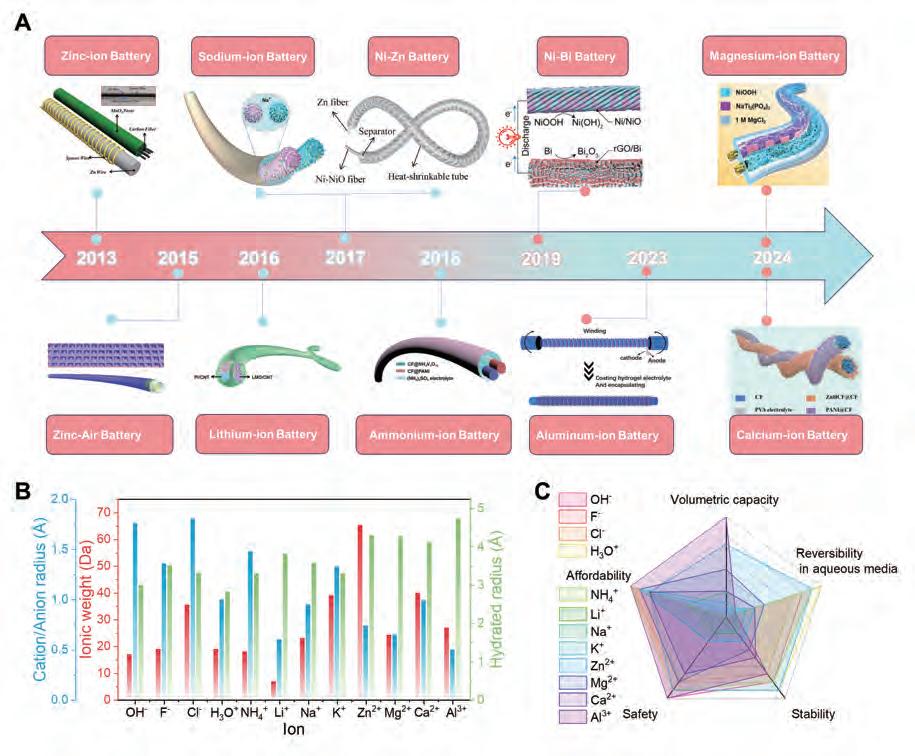
Figure1 OverviewofFABs.(A)MainprogressinFABs.(B)Basicdescriptorsofcommonaqueouschargecarriers:ionicweight(red), crystal/covalentradius(blue),andhydratedradius(green).(C)Normalized,qualitativeradarcomparisonofeachionintermsofaffordability, safety,stability,reversibilityinaqueousmedia,andvolumetriccapacity.
withstrainsensorscansimultaneouslypowerdevicesandmonitorhumanmotionstatesinreal-time.
Fromabroaderperspective,thedevelopmentofFABsprovidesnotonlyacorepowersolutionfor constructinghighlyintegrated,comfortable,andinvisiblesmarttextilesandwearablesystems,driving innovationinhealthmonitoring,human-computerinteraction,andtheInternetofThings(IoT),butalso offersavaluableplatformforfundamentalscientificresearch.Theiruniquelinearstructureandtheelectrochemicalprocessesoccurringwithinconfinedspacesfacilitatein-depthstudiesofnovelenergystorage materials,interfaceengineering,andiontransportmechanisms.Simultaneously,FABsalignwiththeprinciplesofgreenmanufacturingandthecirculareconomy.Thepotentialuseofbiodegradableorrecyclable materialswithintheaqueoussystem,coupledwiththeircompatibilitywithcontinuous,scalablemanufacturingprocesses,cansignificantlyreducetheirlifecycleenvironmentalfootprintandcost,activelysupportingglobalcarbonneutralitystrategicgoals.Insummary,FABsbysynergisticallycombiningintrinsic safety,structuralflexibility,environmentalsustainability,andfunctionalexpandability,arebecomingapivotalforceguidingthedevelopmentofnext-generationflexibleenergystoragetechnologies.They
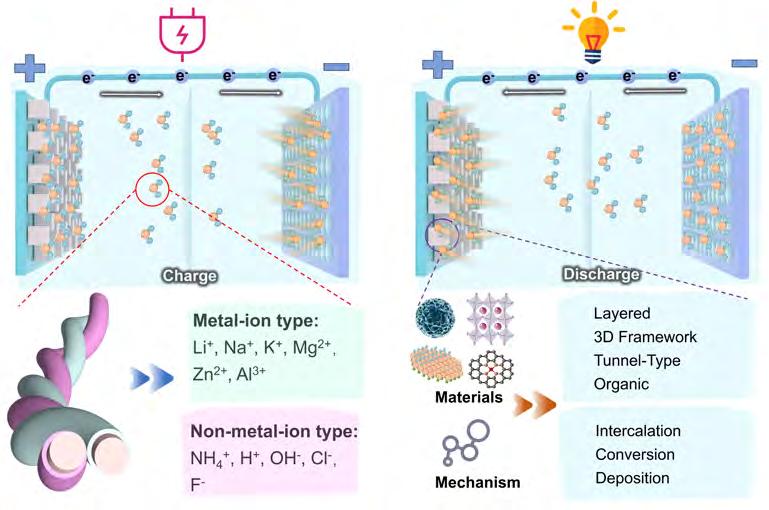
demonstrateirreplaceablestrategicvalueinmeetingcurrentwearabledeviceenergydemandsandshaping futureintelligentandsustainablesocieties.Ongoingresearchwillcontinuetofocusonenhancingtheir comprehensiveperformanceandintegrationmaturitytoacceleratetheirpracticaldeployment.
ThispapersystematicallyreviewsthelatestresearchadvancesinthefieldofFABs.Firstly,itanalyzesthe keyelectrochemicalbehaviorsandworkingmechanismswithinthisbatterysystem.Buildinguponthis,it discussesthecorestrategiesanddesignprinciplesforassemblingfiber-shapeddevices.Subsequently,it outlinestypicalfiber-shapedbatterysystemsbasedonbothmetallicandnon-metallicsubstrates,witha criticalfocusontheircurrentdevelopmentalstatus.Finally,itprospectsthevastapplicationpotentialofsuch batteriesinflexibleelectronics,leveragingtheirmultifunctionalintegrationcapabilities.
WORKINGMECHANISMOFFABS
FABsinheritthefundamentalstructuralframeworkofconventionalaqueousbatteries,consistingofa cathode,ananode,andanelectrolyte.Theirenergystoragebehaviorprimarilyreliesonthereversible migrationofchargecarriersandredoxreactionsoccurringattheelectrodeinterfaces.TheoverallelectrochemicalperformanceofFABsisgovernedbytheintrinsicphysicochemicalpropertiesoftheactivematerials,thecharacteristicsofthechargecarriers,andtheunderlyinginteractionmechanismsbetweenthem andthehoststructures.Consequently,acomprehensiveunderstandingofchargestoragemechanismsandthe correspondingion-materialinteractionsiscrucialforthesystematicdesignandperformanceenhancementof FABs.Accordingtotheunderlyingelectrochemicalreactionpathways,thesebatteriescanbegenerally classifiedintothreetypes:intercalation,conversion,anddeposition/dissolutionmechanisms(Figure2).
Figure2 SchematicillustrationoftypicalenergystoragemechanismsinFABs.
Intercalationmechanism
TheintercalationprocessisthepredominantenergystoragemethodinFABs.Itinvolvesthereversible insertionandextractionofchargecarriersintoandfromthehostcrystalstructurewithoutcausingsubstantial disturbancetotheframework.Thismechanismappliestoavarietyofcations,includingLi+,Na+,K+,Mg2+, Zn2+,Al3+,H+,andNH4+ [29–32].Forexample,inthePrussianblueanalogues’(PBAs)structure,A+ representsthechargecarrier.Duringdischarge,A insertsintothehoststructure(PBA+A+ +e →PBAA).Theprocessisreversedduringcharging.Theioniccharge,hydratedradius,andspecificinteractions betweentheionsandthehostmatrixcollectivelydeterminethekineticsanddiffusionbehaviorofthe intercalationprocess[33–39].Forinstance,Zn2+ typicallyexhibitssluggishdiffusionkineticsowingtoits substantialhydratedsizeandrobustelectrostaticinteractions,whichconstrainitsmovementinnarrow structuralchannels.Incontrast,H+ andNH4+ canformhydrogenbondswithhoststructuresandintercalate moreeasilyintoframeworkssuchasorganiccompoundsorPBAs[40–42].Theintercalationmechanismis advantageousduetoitshighstructuralreversibilityandstability,makingitsuitableforflexibledeviceswith longcyclelife.However,thelimitednumberofintercalationsitesconstrainstheachievablecapacityandthe rateperformanceisoftendependentontheintrinsicconductivityandiondiffusionpathwaysoftheelectrode material.
Conversionmechanism
Theconversionmechanisminvolvesredoxreactionsthatresultinachangeintheoxidationstateand chemicalcompositionoftheelectrodematerial,typicallyformingnewphasesduringthecharge-discharge process.Comparedtointercalation,conversionreactionsofteninvolvemultipleelectrontransfers,offering significantlyhighertheoreticalcapacities.Thismechanismisprevalentinvarioustransitionmetaloxides, sulfides,andnitrides(e.g.,Fe3O4,Co3O4,MnO2)andisalsoobservedincertainorganiccompoundsfeaturing redox-activegroupssuchascarbonylsorquinones[43–45].Forexample,inaconversion-typematerial(e.g., MX,whereMismetal,Xisanion),A+ representsthechargecarrier.Duringthedischargeprocess,the materialundergoesachemicalconversion(MX+A+ +e →M+AX).Theprocessisreversedduringthe chargingprocess.Inaddition,somePBAsmayexhibitpartialconversion-likebehavior,whereioninsertion isaccompaniedbylatticerearrangementorphasetransitions.Theconversionmechanismisattractiveforits highcapacityandstructuraltunability;however,theassociatedphasechangesoftenleadtolargevolume expansion,structuraldegradation,andunstableelectrode-electrolyteinterfaces,whichlimitcyclingstability andrateperformance.Forfiber-basedconfigurations,additionalconsiderationsmustbemadetoaccommodatemechanicaldeformationandmaintainstructuralintegrityduringrepeatedcycling.
Deposition/dissolutionmechanism
Thedeposition/dissolutionmechanismisbasedonthereversibleelectrochemicalplatingandstrippingof metalionsattheelectrode-electrolyteinterface.TypicalchargecarriersincludeZn2+,Li+,Mg2+,andAl3+, makingthismechanismsuitableformetallicanodesystems[46,47].Forexample,usingametalM(e.g.,Zn, Li,Mg,andAl)astheanode,duringcharging,Mn+ isreducedanddepositedontheelectrode(Mn+ + ne –→
M).Theprocessisreversedduringdischarging,wheremetalMdissolvesintheelectrolyte.TakingZn2+ asan example,itisreducedanddepositedasmetallicZnduringchargingandsubsequentlyoxidizedanddissolved backintotheelectrolyteduringdischarging,enablingefficientchargestorage.Thismechanismprovides exceptionallyhightheoreticalcapacityandlowoperatingpotentials,makingithighlypromisingforconstructinghigh-energy-densitymicro-scalefiberbatteries.However,challengessuchasdendriticgrowth, unevendeposition,volumetricchanges,andparasiticsidereactionssignificantlyaffectcyclingstabilityand safety.Recentstrategiesinvolvingelectrolyteengineering,surfacemodification,andcurrentdensitycontrol haveshownpromiseinmitigatingtheseissues,therebyadvancingtheapplicabilityofthismechanismin flexiblefiber-baseddevices.
DESIGNPRINCIPLESOFFABS
Toachievehigh-performance,wearableandintegrableenergystoragecapabilities,thedesignofFABs requiresaholisticconsiderationofmaterialfabrication,structuralconfiguration,andhighelectrochemical output.Thechoiceofelectrodefabricationtechniques,thearchitecturaldesignofthedevice,andthe selectionofperformanceevaluationmetricsallplaycriticalrolesindeterminingtheoverallefficiencyand practicalapplicabilityofthesesystems.Therefore,asystematicsummaryofthedesignprinciplesofFABsis essentialforguidingthecoordinatedoptimizationofmaterialsanddevices.Inthefollowingsections,we provideadetailedoverviewfromtheperspectivesofelectrodefabricationmethods,devicearchitectures,and keyperformancemetrics.
Electrodefabricationtechniques
InFABs,electrodesnotonlyserveaspathwaysforelectrontransportbutalsoactasstructuralplatformsfor hostingactivematerials,similarinfunctiontocurrentcollectorsinconventionalbatterysystems.However, duetotheone-dimensionalgeometryandlimitedsurfaceareaoffibersubstrates,achievinguniformand stableloadingofactivematerialsontheirsurfacespresentssignificantchallengescomparedtoplanar configurations,particularlywhenflexibilityandstructuralintegritymustbepreserved.Theseconstraints placegreaterdemandsonelectrodefabricationtechniques,requiringhighprecision,compatibility,and scalability.Todate,commonlyemployedstrategiesforconstructingfiberelectrodesincludesurfacecoating, insitu growth,wetspinning,andthermaldrawing,eachofferingdistinctadvantagesintermsofmaterial integrationanddeviceadaptability.Thefollowingsubsectionsprovideacomprehensiveoverviewand comparativeanalysisofthesefabricationapproaches.
In-situgrowth
In-situ growthisawidelyadoptedstrategyforconstructingfiberelectrodeswithenhancedinterfacial contact,mechanicalrobustness,andstructuralintegration[48,49].Unlikesurfacecoating,wherepre-synthesizedmaterialsareexternallyapplied, in-situ growthinvolvesthedirectformationorcrystallizationof activematerialsonthefibersubstrate,typicallythroughmethodssuchaselectrodeposition,hydrothermal/
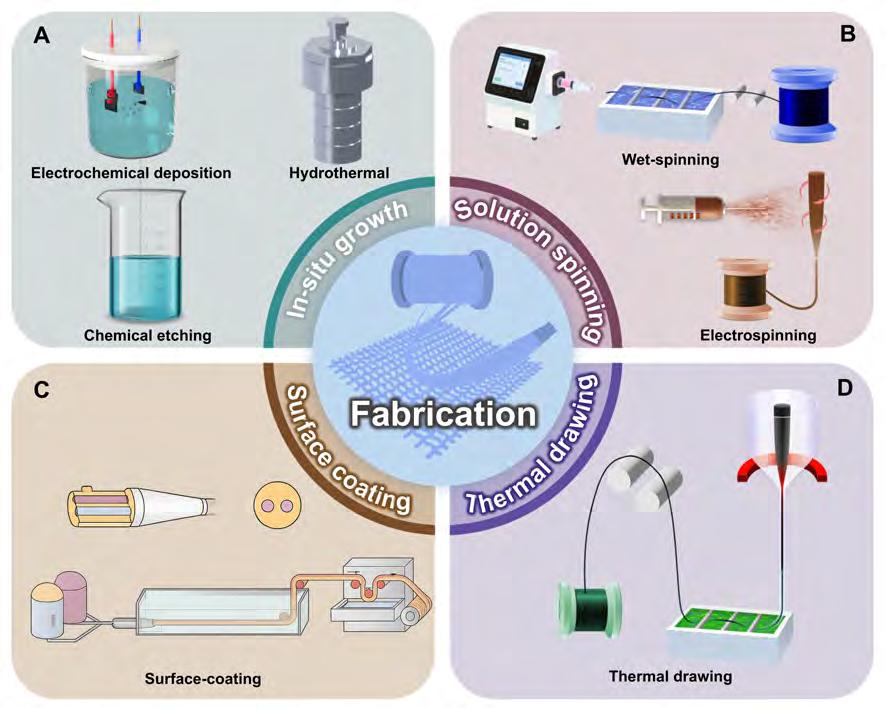
Figure3 Schematicillustrationoftypicalfabricationmethodsforfiberelectrodes.(A) Insitu growth.(B)Solutionspinning.(C)Surface coating.(D)Thermaldrawing.
solvothermalsynthesis,andchemicalbathdeposition(Figure3A).Electrodepositionenablestheconformal growthofconductiveorelectrochemicallyactivelayersonfibercurrentcollectorswithprecisecontrolover thickness,morphology,andcomposition.Hydrothermalandsolvothermaltechniquesareparticularlysuitable forthesynthesisofcrystallinetransitionmetalcompounds(e.g.,oxides,hydroxides,PBAs)withstrong substrateadhesion.Thesemethodsnotonlyimprovetheutilizationofactivematerialsbutalsoenhancethe mechanicalstabilityofthefiberelectrodeunderrepeateddeformation.However, in-situ growthmethods ofteninvolvestrictreactionconditions(e.g.,temperature,pH,time)andmaybelimitedintermsofsubstrate compatibilityorlarge-scaleuniformity.Moreover,controllingthegrowthorientationandachievinghomogeneousdepositionalonglongfiberlengthsremaintechnicalchallenges.Nonetheless,the in-situ strategyis consideredhighlypromisingfordevelopingintegratedandhigh-performancefiberelectrodes,particularly forwearableandflexibleelectrochemicaldevices.
Solutionspinning
Solutionspinning,encompassingwetspinningandelectrospinning,isaversatileapproachforconstructing fiberelectrodesbyintegratingactivematerialsintoorontofibersubstrates(Figure3B)[50,51].Thisstrategy
allowsforthecontrolledformationofflexible,porous,andelectrochemicallyactivestructures,whichare particularlyadvantageousforwearableenergystoragedevices.Inwetspinning,ahomogeneoussolutionor dispersioncontainingactivematerialsandspinnablepolymersisextrudedintoacoagulationbath,where fiberformationoccursviaphaseseparation.Theresultingcompositefiberscanservedirectlyasselfsupportingelectrodesorbewovenintotextile-basedenergysystems.Incontrast,electrospinningisprimarily employedtodepositananofiberlayercontainingelectrochemicallyactivecomponentsontothesurfaceofa conductivefibersubstrate.Drivenbyahigh-voltageelectricfield,apolymerorsol-gelsolutionisstretched intocontinuousnanofibersanddepositeddirectlyontothefibersurface,formingaporousandconformal coating.Thismethodsignificantlyincreasestheeffectivesurfaceareaandimprovesinterfacialcontact betweentheactivematerialandthefibercore.Despitetheiradvantages,solution-spunstructuresoftensuffer fromlimitedconductivityandinsufficientmassloading,particularlywhenalargeproportionofinsulating polymerisused.Therefore,post-treatmentstrategiessuchascarbonization,ioncrosslinking,andsecondary coatingarecommonlyemployedtoenhancetheirmechanicalstrengthandelectrochemicalperformance.
Surfacecoating
Surfacecoatingisoneofthemoststraightforwardandwidelyemployedtechniquesforfabricatingfiber electrodes,owingtoitssimplicity,scalability,andbroadmaterialcompatibility[52,53].AsshowninFigure 3C,pre-synthesizedactivematerialsaredepositedontofibersubstratesthroughmethodssuchasdip-coating, spray-coating,anddrop-casting.Thesetechniquesenabletheformationofuniformactivelayersonthefiber surface,providingaccessibleelectrochemicalinterfacesandfacilitatingefficientionandelectrontransport. Despiteitssimplicity,surfacecoatingfacesseveralchallengesspecifictotheone-dimensionalgeometryof fibers.Comparedtoplanarsubstrates,fibersurfacespossessasmallercontactareaandhighercurvature, whichcanhindertheuniformadhesionofactivematerialsandresultinpoormechanicalrobustnessor interfacialdelaminationduringcycling.Furthermore,coatedlayersmaycrack,peel,andsufferfromlimited massloadingduetoweakinteractionwiththefibercore,especiallyunderrepeatedmechanicaldeformation inwearableapplications.Toaddresstheseissues,recentstudieshaveexploredstrategiessuchasusing intermediateadhesionlayers,optimizingcoatingviscosityandsurfaceenergy,andintroducingconductive bindersandnanostructures(e.g.,carbonnanotubes(CNTs),graphene)toenhanceinterfacialbondingand electricalconnectivity.Surfacecoatingremainsahighlyversatilemethod,particularlysuitablefortherapid screeningofactivematerialsandthescalableintegrationofhybridormultifunctionalcomponentsontofiber substrates.
Thermaldrawing
Thermaldrawingisanemergingandhighlyintegrativefabricationtechniqueforconstructingfiber-shaped energystoragedevices[54,55].Originallydevelopedforopticalfiberproduction,thismethodhasbeen adaptedtoembedmultiplefunctionalcomponents,suchaselectrodes,electrolytes,andcurrentcollectors, intoasinglecontinuousfiberviaathermaldrawingprocess.Inatypicalprocess,amacroscopicpreformis fabricatedwithawell-definedmultilayerstructurecomposedofthermallycompatiblematerials.Upon heatingabovethesofteningtemperatureofthepolymercladding,thepreformiscontinuouslydrawninto
NatlSciOpen,2025,Vol.4,20250051
Table1 Summaryofelectrodefabricationtechniques
Fabrication technique
Surface coating
In-situ growth
ScalabilityCost
Suitableforlarge-scale andrapidprocessing Low
Restrictedbysubstrate compatibilityand reactionconditions
Solution spinning Continuousfiber productionpossible
Thermal drawing
Medium
Medium
Suitableforlarge-scale andrapidprocessing High
Performanceoptimization potential
Improveperformancevia surfacemodificationand binderoptimization
Stronginterfacialbonding, tunablemorphology,and highstructuralintegrity
Tunableporosity, flexibility,adaptableto multifunctionaldesigns
Offersprecisestructural controlandintegration potential
Advantage Limitation
Simple,versatile, compatiblewith variousmaterials
Excellentadhesion, mechanicalstability,and activematerialutilization
Enablesself-supporting, flexibleelectrodeswith controlledcomposition
Excellentintegrationof multiplefunctionallayers; suitableforscalable manufacturing
Pooradhesionand mechanicalrobustness; limitedmassloading
Strictreactionconditions; scalabilityanduniformity challengesalonglongfibers
Limitedconductivity andmassloading;often requirespost-treatments
Limitedbythermal compatibilityandactive materialloading; relativelyhighcost
meters-longmicrostructuredfibers,preservingtheoriginalcross-sectionalarchitectureatareducedscale. Thisenablestheco-integrationofelectrodeconductors,solidandgelelectrolytes,andencapsulatinglayers withinaunifiedfiberbody.Importantly,thermaldrawingprovidesapowerfulplatformforthecontinuous andscalableproductionofFSBs,makingitespeciallyattractiveforpracticalapplicationsintextile-based energysystems.Itoffersprecisecontroloverfibergeometry,materialdistribution,andmechanicaluniformity,enablingmassproductionwithexcellentrepeatability.However,thetechniqueislimitedbythe thermalcompatibilityofactivecomponentswiththedrawingtemperature,aswellastherequirementfor polymermatricesthatcanencapsulateelectrochemicalmaterialswithoutcompromisingperformance. Moreover,improvingtheloadingofactivematerialsandenhancingionic/electronicconductivitywithinthe drawnfibersremainsakeychallenge.
Toprovideaclearercomparisonamongdifferentelectrodefabricationtechniques,Table1summarizesthe keytechnicaldistinctions,highlightingtheirrespectiveadvantagesandlimitationsintermsofscalability, cost,andperformanceoptimizationpotential.
Devicearchitectures
InFABs,inadditiontoelectrodematerialsandfabricationtechniques,devicearchitecturealsoplaysapivotal roleindeterminingoverallperformance.Thestructuralconfigurationnotonlygovernsthetransportpathwaysofionsandelectronsbutalsosignificantlyaffectsinterfacialcontactarea,mechanicalflexibility,and thecompatibilitywithwearablesystems.Dependingontheassemblystrategy,fiberbatteriescanbeconstructedinseveraltypicalconfigurations,eachofferingdistinctadvantagesintermsofphysicalstructureand electrochemicalbehavior.Representativearchitecturesinclude:(i)parallelstructures,wheretwofiber electrodesarealignedside-by-sidetoformabasicenergystorageunit;(ii)twistedstructures,inwhichthe electrodesarehelicallyintertwinedtoenhanceinterfacialcontactandmechanicalstability;(iii)coaxial structures,wherethecathode,electrolyteandanodeareconcentricallyalignedtoimprovespatialutilization andchargetransportefficiency;(iv)crossedstructures,whereperpendicularlyarrangedelectrodesformgridlikearrays,offeringimprovedadaptabilityfortextileintegration.Acomprehensiveunderstandingofthese structuralconfigurationsandtheirrelationshipwithdeviceperformanceisessentialfortherationaldesign
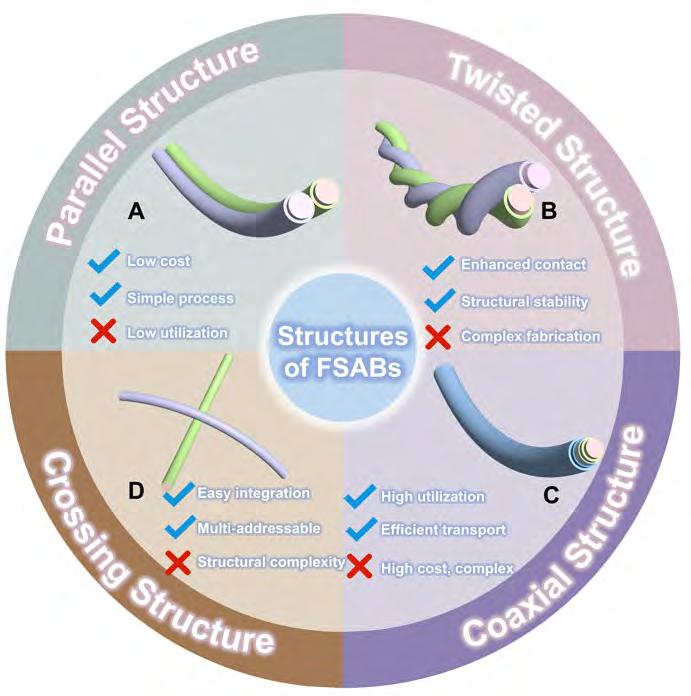
andapplication-specificoptimizationofFABs.
Parallelstructure
AsshowninFigure4A,theparallelconfigurationisoneofthemostfundamentalandwidelyapplieddevice architecturesinFABs.Inthisconfiguration,twofiberelectrodesarearrangedside-by-sideandencapsulated withinanelectrolytelayer,withoutdirectphysicalcontact.Owingtoitsstructuralsimplicityandeaseof assembly,theparallellayouthasbeenextensivelyusedinvariousFABs.Thisconfigurationisparticularly advantageousforscalablefabrication,asitrequiresminimalalignmentprecisionandiscompatiblewithrollto-roll,knitting,andweavingprocesses.Moreover,thephysicalseparationofthetwoelectrodesallowsfor independentmaterialdesignandreducestheriskofinternalmechanicalfailure.However,theabsenceof mechanicalcouplingbetweenelectrodesalsointroduceschallenges.Inliquidelectrolytes,thetwoelectrodes maymoveandcomeintocontactunderdeformationorexternalperturbations,leadingtoshort-circuitrisks. Incontrast,twistedconfigurationscanstabilizeelectrodesthroughmechanicalentanglement.Tomitigatethis issue,semisolidorsolid-stateelectrolyteswithadhesiveorencapsulatingfunctionshavebeenemployedto maintaininter-electrodespacingandimprovedevicesafety.Overall,theparallelconfigurationoffersan
Figure4 SchematicillustrationsoftypicaldevicearchitecturesforFABs.(A)Parallelstructure.(B)Twistedstructure.(C)Coaxial structure.(D)Crossingstructure.
effectivepathwayforcost-efficientandscalablemanufacturingoffiber-shapedbatteries,particularlyin scenarioswheremechanicalstrainisminimalanddevicesimplicityisprioritized.
Twistedstructure
Thetwistedconfigurationreferstoastructurewheretwoindividualfiberelectrodesarehelicallywound togetherwithadefinedpitchandangle(Figure4B).Thisconfigurationformsamechanicallyentangled structurethatenhancesflexibilityandfacilitatesrepeateddeformation,makingitparticularlysuitablefor wearableandstretchableapplications.Comparedwithcoaxialstructures,twistedfiberdevicestypically exhibitasmallereffectivecontactareabetweentheelectrodes,whichmaylimitinterfacialchargetransfer.To compensateforthis,itisessentialtocoatactivematerialsonbothfiberelectrodespriortoassembly,ensuring sufficientelectrochemicalactivity.Nonetheless,thetwistedconfigurationoffersdistinctadvantagesin fabrication:itsimplifiestheconstructionprocessofmulti-materialfiberdevices,avoidsthecomplexitiesof sequentiallayerdepositiononcurvedsurfacesandenableshigherproductionthroughput.Forexample,in fiber-basedsolarcellsorsupercapacitors,itisoftenmorefeasibletotwisttogethertwopre-treatedfibersthan tobuildcoaxialstructureswithuniformconcentriccoatings.Thehelicalnatureofthetwistedconfiguration introducesmultiplelocalizedcontactpointsbetweentheelectrodes,promotingeffectivemassandcharge transport.Thegeometryofthetwistconfiguration,particularlythepitchandangle,playsacrucialrolein determiningtheelectrochemicalperformance.Atightertwistgenerallyenhancesinterfacialcontact,thus improvingchargetransferefficiency,whileanoverlytightconfigurationmayintroducemechanicalstrainor short-circuitrisk.Therefore,optimizingthetwistingparametersiskeytobalancingperformance,reliability, andmechanicalrobustness.Duetoitsstructuralsimplicity,scalability,andcompatibilitywithtextileintegrationtechniques,thetwistedconfigurationhasbeenwidelyappliedinvariousfiber-basedenergydevices,includingsupercapacitors,solarcells,andbatteries.
Coaxialstructure
AsshowninFigure4C,thecoaxialconfigurationfeaturesaconcentriccore-shellstructureinwhichthe electrode,electrolyte,andcounterelectrodearesequentiallydepositedalongtheradialdirectionofafiber substrate.Thisgeometryallowsforcontinuousinterfacesbetweenlayersandahighlycompactarchitecture, makingitespeciallyappealingforFABswhereefficientiontransport,mechanicalstability,andintegration densityareessential.Inthisdesign,afiberelectrode,typicallyservingaseithertheanodeorcathode,isfirst preparedasthecentralcore,followedbyconformalcoatingoftheelectrolyteandtheouterelectrodelayer. Theclosephysicalcontactbetweeneachlayerfacilitatesrapidchargeandmasstransport,minimizesinternal resistance,andenhancesoverallelectrochemicalkinetics.Moreover,thecoaxiallayouteffectivelyprotects theinternallayersfrommechanicaldamageandenvironmentalexposure,improvinglong-termdurabilityand devicereliability.Thecoaxialstructuredrawsinspirationfromconventionallayeredplanarbatteriesbut adaptsthesefeaturestothecylindricalgeometryoffibers.Toensurestableoperationunderdeformation,each functionallayermustdeformcoherentlywiththeothers,whichrequiresmechanicalcompatibilityand uniformthicknessacrosstheentiredevicelength.Maintainingastableinterfaceduringbending,twisting, andstretchingremainsamajorconsideration.Avarietyoffabricationtechniques,includingdip-coating,
extrusion,and3Dprinting,havebeenemployedtorealizecoaxialfiberbatteries.However,theseprocesses faceconsiderablechallengeswhenappliedtocurvedfibersurfaces,particularlyinachievingthin,uniform, anddefect-freecoatingsoverlongdistances.Incompatibilityofmaterialproperties(e.g.,viscositymismatch orpoorinterfacialadhesion)mayresultindelaminationorlocalfailure,hinderingperformanceandscalability.Despitetheselimitations,thecoaxialconfigurationremainsoneofthemostpromisingstructural strategiesfordevelopingFABswithhighenergyefficiency,robustmechanicalperformance,andgood environmentaltolerance.
Crossingstructure
Thecrossingstructureisagrid-likearchitecturewheremultiplefiberelectrodesarearrangedorthogonally throughtextile-compatiblemethodssuchasweavingorembroidery.AsshowninFigure4D,inthisstructure, eachintersectionpointbetweenacathodeandananodefibercanserveasanindependentelectrochemical cell,enablingtheformationofmulti-nodefiberbatteryarrayswithinasinglefabric.Thisconfigurationis particularlyattractivefortheintegrationofenergystoragesystemsintoelectronictextiles.Itallowsforhigh integrationdensity,spatialprogrammability,andmodularenergysupplydesign.Bycontrollingthenumber andlayoutofelectrodeintersections,thetotaloutputvoltageandcapacityofthesystemcanbetailoredto specificapplicationneeds,offeringascalableroutetopowerdistributedormulti-functionalwearable electronics.Moreover,thediscretenatureofelectrochemicalunitsatfiberintersectionsoffersadvantagesin faulttolerance.Evenifasingleunitfails,therestofthebatterynetworkcancontinuetofunction,improving system-levelreliability.Althoughthecrossingstructurehasbeenconceptuallydemonstratedinseveraltypes offiber-basedelectronicdevices,suchasfiberphotodetectors,organicelectrochemicaltransistors,there remainfewstudiesthatspecificallyimplementandsystematicallyinvestigatethisstructureinFABs[56–59]. Thisscarcitymaybeattributedtothetechnicalchallengesassociatedwithensuringreliableelectrochemical isolationandmechanicalrobustnessattheintersectionpoints.Nevertheless,thesuccessfuldemonstrationsof crossingarchitecturesinotherfiber-optoelectronicsystemssuggestthatsimilardesignprinciplescouldbe extendedtoFABs,particularlyforscalabletextileintegrationanddistributedenergysupply.However,the performanceofcrossedfiberbatteriesreliesheavilyontheelectricalcontactqualityateachjunction.The absenceofcontinuouselectrolyteencapsulationalongthefiberlengthmayresultinincreasedcontact resistanceoruneveniondiffusionattheintersectionpoints.Toovercomethis,gelorsolid-stateelectrolytes areoftenusedtoensurestableandlocalizedionicpathwaysandmechanicalcoupling.Overall,thecrossed configurationholdsgreatpromiseforrealizingflexible,integratedandaddressablepowersourcesinsmart textiles.
Insummary,structuralconfigurationplaysavitalroleindeterminingtheelectrochemicalperformance, mechanicalflexibility,andintegrationpotentialofFABs.Parallelandtwistedconfigurationsarewidely adoptedduetotheirsimplicityandcompatibilitywithscalablefabrication.Coaxialstructures,althoughmore complextomanufacture,offersuperiorchargetransport,spaceutilization,andenvironmentalstability. Crossedarchitectures,ontheotherhand,enablemodularenergydistributionandintegrationintotextile systemswithhighaddressability.Eachconfigurationexhibitsdistincttrade-offsbetweenfabricationdifficulty,performanceoptimization,andapplicationscenarios.Movingforward,rationalselectionorhybrid integrationofthesestructures,guidedbydevicefunctionandusageconditions,willbekeytoadvancing NatlSciOpen,2025,Vol.4,20250051
high-performance,multifunctionalfiber-basedenergystoragesystems.Inparticular,futureeffortsshould focusonscalablefabricationstrategies,robustinterfaceengineering,andmechanicaladaptabilityacross configurationstofullyunleashthepotentialoffiberbatterytechnologies.
Performanceevaluationmetrics
ToassessthepracticalapplicabilityandperformancepotentialofFABs,acomprehensiveevaluationframeworkencompassingbothelectrochemicalandmechanicalmetricsisessential.Incontrasttoconventional planardevices,FABsaredefinedbytheir1Dstructure,mechanicalflexibility,andintegrationcapabilitywith wearableelectronics,allofwhichpresentuniquechallengesforperformanceevaluation.Coremetrics includeenergydensityandspecificcapacity,whichreflectthedevice’senergystoragecapability;long-term cyclingstability,whichdeterminesitsoperationaldurabilityunderrepeateduse;andmechanicalflexibility, whichgovernsitsabilitytofunctionreliablyunderdynamicdeformation.Asystematicevaluationofthese parametersiscriticalnotonlyforbenchmarkingnewmaterialsanddevicearchitecturesbutalsoforguiding futuredevelopmenttowardapplication-oriented,scalable,anddurablefiber-basedenergysystems.
Energydensity
EnergydensityisaprimarymetricthatreflectstheenergystoragecapabilityofFABs,whichistypically reportedintermsofWhg 1,Whcm 2,andWhcm 3.Gravimetricenergydensityevaluatestheenergy outputrelativetothemassofactivematerials,makingitessentialformaterial-levelcomparisons,especially withconventionalplanarbatteries.Incontrast,volumetricenergydensityconsiderstheentiredevicevolume andisparticularlyrelevantforapplicationswherespaceefficiencyiscritical,suchasinintegratedwearable orimplantableelectronics.Arealenergydensityisalsofrequentlyreported,especiallyinstudieswherethe fiberisassembledintoplanarconfigurationsorwhencross-sectionaldimensionsarewelldefined,offering anadditionalperspectiveforperformancecomparison.AchievinghighenergydensityinFABsrequiresthe synergisticdesignofhigh-capacityelectrodematerials,compactandefficientarchitectures(e.g.,coaxial, twistedandcore-sheathconfigurations)andhigh-conductivityelectrolytesthatenhanceiontransportand activematerialutilization.Giventhegrowingdemandforlightweight,miniaturized,andwearablepower sources,bothgravimetricandvolumetricenergydensitiesremaincriticalindicatorsforevaluatingand comparingFABs’performance.
Specificcapacity
Specificcapacity,typicallyexpressedinmAhg 1,mAhcm 2,andmAhcm 3 isthefundamentalelectrochemicalparameterthatquantifiestheamountofelectricchargestoredperunitmassofactivematerial.It directlyreflectstheintrinsiccharge-storagecapabilityoftheelectrodematerialsandservesasabaselinefor evaluatingtheoverallenergydensityandpoweroutputofFABs.Accuratedeterminationofspecificcapacity requiresnormalizationbythemassofactivecomponentsonly,excludingcontributionsfromcurrentcollectors,substrates,andencapsulationlayers,toensuremeaningfulcomparisonsbetweendifferentmaterial systemsanddevicearchitectures.InthecontextofFABs,achievinghighspecificcapacityisparticularly
challengingduetoconstraintsonmassloadingandgeometriclimitationsinherenttofiber-basedconfigurations.Therefore,thedevelopmentofadvancedelectrodematerialswithhightheoreticalcapacities,rapid redoxkinetics,andstructuralstabilityunderdeformationisessential.Furthermore,thefibergeometryoften necessitatesinnovativefabricationstrategiestoincreasetheeffectiveutilizationofactivematerials,suchas hierarchicalnanoarchitectures,porousstructures,anduniformcoatingsonhigh-surface-areaconductive cores.Improvementsinspecificcapacitynotonlyenhancetheenergystoragecapabilitybutalsocontributeto extendingthecyclelifeandrateperformance,whicharecrucialforthedeploymentofFABsinpractical, high-demandwearableapplications.
Long-termcyclingstability
Long-termcyclingstabilityisacriticalparameterforassessingtheoperationalreliabilityandlifespanof FABsunderrepeatedcharge-dischargeconditions.Itistypicallyevaluatedbymeasuringthecapacityretentionoverhundredstothousandsofcycles,oftenundervaryingcurrentdensitiesandmechanicalstates. Highcyclingstabilityisespeciallyimportantforwearableelectronics,wherebatteriesmaybesubjectedto frequentelectrochemicalcycling,environmentalexposure,andmechanicaldeformation.CapacitydegradationinFABscanarisefrommultiplesources,includingirreversiblestructuralchangesintheelectrode materials,dissolutionordetachmentofactivecomponents,degradationoftheelectrolyte,anddeterioration ofinterfacialcontact.Tomitigatetheseissues,advanceddesignstrategiessuchasusingchemicallystable andmechanicallyrobustelectrodematerials,introducingprotectivelayerstosuppressmaterialdissolution andengineeringflexiblecurrentcollectorswithhighadhesionstrengthareoftenemployed.Furthermore, integratingself-healingpolymersorhydrogelelectrolytescanbuffermechanicaldamageandmaintain interfacestability,therebyprolongingcyclinglife.Ahigh-capacityretentionrateafterlong-termcyclingisa hallmarkofareliableanddurablefiber-shapedenergystoragesystem.
Flexibility
FlexibilityisadefiningfeatureofFABs,enablingtheirseamlessintegrationintodeformable,wearable,and textile-basedsystems.Aflexiblebatterymustmaintainstableelectrochemicalperformanceundervarious mechanicaldeformationssuchasbending,twisting,stretching,andcompression.Flexibilityistypically evaluatedbymonitoringcapacityretention,resistancechange,andvoltagestabilityundercyclicmechanical loading,aswellasunderdynamicusageconditionsthatsimulatereal-worldapplications.Achievinghigh flexibilitywithoutcompromisingelectrochemicalperformancerequiresaholisticmaterials-to-deviceapproach.Thisincludestheuseofintrinsicallyflexiblesubstratesandcurrentcollectors(e.g.,carbonnanotube fibers,conductivepolymers,andmetallicyarns),mechanicallycompliantelectrodematerials,andstretchable orgel-basedelectrolytes.Structuralengineering,suchascoaxial,twisted,andcrossingstructure,alsoplaysa keyroleinstressdistributionandmechanicalresilience.Inaddition,ensuringstronginterfacialadhesion betweencomponentsiscriticalforavoidingdelaminationorcontactfailureduringrepeateddeformation. Ultimately,theabilityofFABstoretainfunctionalityundermechanicalstressisfundamentaltotheirrealworlddeploymentinnext-generationwearableandsmartelectronicsystems.
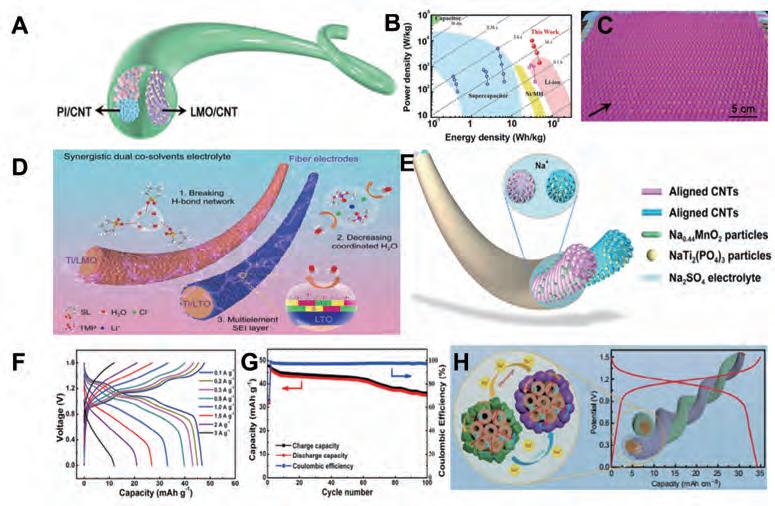
Figure5 Researchprogressoflithium-ionandsodium-ionbatteries.(A)SchematicillustrationofasimplifiedstructureoftheFALBs. (B)EnergyandpowerdensitiesoftheFALBscomparedwithpreviousenergystoragesystems.(C)EnergytextilewovenwithFALBs. (A–C)Reproducedwithpermissionfrom[17].Copyright©2016,RoyalSocietyofChemistry.(D)Schematicdiagramofthehigh-voltage flexibleaqueousfiberLIBbasedonsynergisticdualco-solventshybridelectrolyte.Reproducedwithpermissionfrom[64].Copyright©2024, Elsevier.(E)SchematicillustrationofthestructureofFASBs.(F)Galvanostaticcharge-dischargecurvesofFASBs.(G)Capacitystabilityof FASBs.(E–G)Reproducedwithpermissionfrom[65].Copyright©2017,Elsevier.(H)Schematicandcharge-dischargecurvesofFASBs. Reproducedwithpermissionfrom[24].Copyright©2019,TheAuthor(s).
RESEARCHPROGRESSONFABS
Fiber-shapedaqueouslithium-ionandsodium-ionbatteries
Withtherapiddevelopmentofwearableelectronics,smarttextiles,andflexiblesensors,energystorage devicesarerequiredtosimultaneouslydeliverlightweight,safety,bendability,andweavability[60,61]. Conventionallithium-ionbatteriesbasedonorganicelectrolytes,althoughofferinghighenergydensity, sufferfromflammabilityandleakage,makingthemunsuitableforflexibleelectronicswheresafetyis paramount.Incontrast,aqueouselectrolytesareintrinsicallysafe,cost-effectiveandenvironmentallybenign [62,63].Whenfurthercombinedwithfiber-shapedarchitectures,batteriescanbeseamlesslyintegratedwith textiles,representinganidealformatforflexibleenergysystems.Againstthisbackdrop,fiber-shapedaqueouslithium-ionbatteries(FALBs)haveemerged,couplingthehighenergydensityoflithium-ionchemistry withtheintrinsicsafetyofaqueouselectrolytes,thusofferingapromisingpowersourceforflexibleelectronicsandsmarttextiles.
In2016,Zhang etal.[17]fabricatedaFALBusingpolyimide/CNThybridfiberanodesandLiMn2O4/CNT hybridfibercathodes(Figure5A).Thedevicedeliveredaremarkablepowerdensityof10217.74Wkg 1 and anenergydensityof48.93Whkg 1 (Figure5B),comparabletothin-filmlithium-ionbatteries,while fundamentallyeliminatingthesafetyhazardsassociatedwithflammableorganicelectrolytes.Moreover,the inherentweavabilityoffiber-shapedarchitecturesfurtherbroadenedtheirapplicationscenariosinflexible
energytextiles(Figure5C).Subsequently,Dai etal.[64]proposedafluorine-free,high-voltagedualcosolventelectrolyte,whichexpandedtheelectrochemicalstabilitywindowto3.3Vandenabledexcellent electrochemicalperformanceinFALBs,highlightingthepotentialofaqueouselectrolytesforhigh-voltage energystoragedevices(Figure5D).
Nevertheless,thelimitedreserves,unevendistribution,andrisingcostoflithiumresourcesaregradually becomingbottleneckshinderingthewidespreaddeploymentofFALBs.Thishasshiftedattentiontoward sodium-basedsystems,whichsharesimilarchemicalpropertieswithlithiumbutbenefitfromabundant reserves,lowcost,andstrongsustainability,makingthemhighlyattractiveforlarge-scalestorageand wearableelectronics.Motivatedbythis,fiber-shapedaqueoussodium-ionbatteries(FASBs)haverapidly emerged,integratingsodium-basedelectrodeswithflexiblefiberarchitecturestoinherittheintrinsicsafetyof aqueoussystemswhilealleviatingtheresourceandcostconstraintsoflithium.
Guo etal.[65]employedNa0.44MnO2 asthecathodeandcarbon-coatedNaTi2(PO4)3 astheanodeto constructaFASB(Figure5E).Operatingin1MNa2SO4 electrolytewithina0–1.6Vvoltagewindow,the devicedeliveredadischargecapacityof46mAhg 1 at0.1Ag 1,retained12mAhg 1 evenat3Ag 1 and maintained76%ofitscapacityafter100cycles(Figure5F,G),demonstratingfavorableratecapabilityand cyclingstability.Further,He etal.[24]developedafacile insitu growthstrategytosynthesizeKNiFe(CN)6 nanotubecathodesandNaTi2(PO4)3 anodesdirectlyonCNTfibersubstrates,assemblingthefirsthighperformancequasi-solid-stateFASBs(Figure5H).Thedevicedeliveredahighvolumetriccapacityof34.21 mAhcm 3 andavolumetricenergydensityof39.32mWhcm 3,whilemaintainingoutstandingmechanical flexibility.Thisbinder-freefiberelectrodedesignprovidesanewtechnologicalpathwayforwearableenergy systemsandflexiblepowertextiles.
Insummary,fiber-shapedaqueousionbatteriescombinesafety,flexibility,andwearability,showingbroad prospectsinthefieldofflexibleenergystorage.FALBsofferabalanceofhighenergydensityandintrinsic safety,whileFASBsdemonstratestrongersustainabilityowingtotheirresourceabundanceandlowcost. Nevertheless,challengesremaininelectrodestructuralstability,electrolytecompatibility,andperformance retentionundermulti-stressconditions.Therefore,futureeffortsshouldfocusonthedesignofstableelectrodematerials,electrolyteengineering,andseamlessintegrationoffiberbatteriesintotextilestoadvance theirpracticalapplicationsinsmartwearableelectronics.
Fiber-shapedaqueouszinc-ionbatteries
FAZBshaveattractedsignificantattentionowingtotheiruniqueadvantages[66,67].Zincoffersseveral intrinsicmerits,includingasmallionicradius(0.74Å),alowredoxpotential(Zn2+/Zn: 0.76V)andahigh theoreticalvolumetriccapacity(5855mAhcm 3),surpassinglithium-andsodium-basedsystemsinvolumetricenergystoragecapability[68–70].Fromapracticalperspective,Znexhibitshighreversibilityin aqueousenvironments,greatlyreducingrisksofcombustionorexplosion,whileitsabundanceandlowcost furthersupportscalableapplications.InFAZBs,Zn2+ reversiblymigratesbetweentheelectrolyteand cathode,undergoingintercalation/deintercalation,sometimescoupledwithH+-drivenphasetransitions,to achievereversibleenergystorage[71].Keychallenges,however,includecathodedissolution-redeposition andstructuraldegradation,Zndendritegrowthandparasiticreactionsattheanode,aswellasinterface delaminationandiontransportlimitationsunderbendingconditions.Currently,cathodematerialsare
NatlSciOpen,2025,Vol.4,20250051
dominatedbyMn-basedcompounds[72–74],V-basedoxides[73,75,76],andPBAs[77–79],eachcritically determiningdeviceperformance.
Mn-basedmaterialsarethemostwidelyusedcathodesinFAZBsduetotheirlowcostandhighcapacity.In anearlydemonstration(2013),Yu etal.[80]reportedaflexiblefiber-typeZn-Cbatteryusingcommercial carbonfibersasthecurrentcollector,MnO2/graphiteasthecathode,aZnwireanode,andaZnCl2/NH4Cl electrolyte(Figure6A).Thedevicedeliveredadischargecapacityof158mAhg 1 (Figure6B)andwasable topoweralight-emittingdiode(LED)(Figure6C),thoughitwasnon-rechargeableandofferedlimited capacity.Later,Li etal.[81]realizedarechargeableyarnzinc-ionbattery(ZIB)byintegratingα-MnO2 cathodeswithZnanodesintocoaxialhelicalyarnelectrodesandacrosslinkedpolyacrylamide(PAM)gel electrolyte.Owingtoitshighionicconductivityandyarnarchitecture,thedevicedeliveredhighvolumetric energydensity,stablecycling,andexcellentweavability/stretchability,successfullypoweringalight-emittingtextilepanel(Figure6D).Mn-basedmaterialsofferversatileadaptabilityacrosselectrolytesandconditions,yetsufferfromMndissolutionandphasedegradationcausedbyZn2+/H+ co-intercalationand structuralreconstruction.BoostingbothenergydensityandlifetimeremainsthekeychallengeforMn-based FAZBs.
V-basedcathodesprovideanalternativewithsimplerstoragemechanismsandrapidiontransport,owingto themultiplevalencestatesofVandthestructuralflexibilityofV-Opolyhedra.VariousV-basedoxides, includingV2O5,VO2,andV2O3,havebeeninvestigated,withV2O5 beingthemoststudied.Itslayered structure,composedofcorner-andedge-sharingVO5 pyramidswithalargeinterlayerspacingof5.8Å, offersidealchannelsforreversibleZn2+ intercalation.Li etal.[82]employedmillisecondquenchingto engineerdefects,enablingmetal-iondopingandoxygenvacanciestosynergisticallytailorthelocalelectronicenvironmentofNi-V2O5 nanowires.Thisstrategyenhancedchargetransferandintroducedabundant Zn2+ storagesites,yieldingaquasi-solid-statefiber-shapedzinc-ionbattery(FAZIB)withahighvolumetric energydensityof90.3mWhcm 3 whenpairedwithaZnNSs@CNTanode(Figure6E,F).Thedevicewas furtherintegratedintomagneticallyactuatedfibersoftrobots,showcasingcombinedenergystorageand actuationcapability.Similarly,Guo etal.[83]synthesizedamorphousCa-V2O5 nanostructuresvia insitu electrochemicaloxidationofCa-dopedVO2 arrays(Figure6G).Theamorphizationeffectivelyactivated abundantZnstoragesites,achievinghighvolumetriccapacityandrapidreactionkineticsforexcellentrate capability(Figure6H).Despitetheseadvantages,V-basedmaterialsstillfacechallengessuchaslowoperatingpotentialandinterfacialsidereactions.Futureworkmayfocusonstructuraloptimization,interfacial stabilization,andthedesignofnovelvanadium-basedcompoundstoadvancetheirpracticaldeployment. PBAsstandoutfortheiropenthree-dimensionalframework,relativelyhighworkingvoltage(1.5–1.8V), lowtoxicity,andcost-effectiveness.Theyarecompatiblewithfibercurrentcollectorsandlow-temperature deposition/coatingprocesses,makingthemhighlysuitableforhigh-voltagefiberdevices.Toaddressthe risingenergydemandsoftextile-basedwearableelectronics,Zhang etal.[1]developedthefirstcoaxial-fiber aqueousrechargeablezinc-ionbattery(CARZIB)usingsphericalZnHCFasthecathode.Thedevice achievedahighvolumetriccapacityof100.2mAhcm 3 andanenergydensityof195.39mWhcm 3,while maintainingexcellentflexibility,retaining93.2%ofcapacityafter3000bendingcycles(Figure6I).When wovenintotextiles,CARZIBsdeliveredbothhighvoltageandhighcurrentoutputs,sufficientforpowering high-consumptiondevices.However,severeZndendriteformationduringstrippingandelectrode-electrolyte delaminationunderfoldingremainsmajorobstacles.Toovercometheseissues,Li etal.[27]developedan
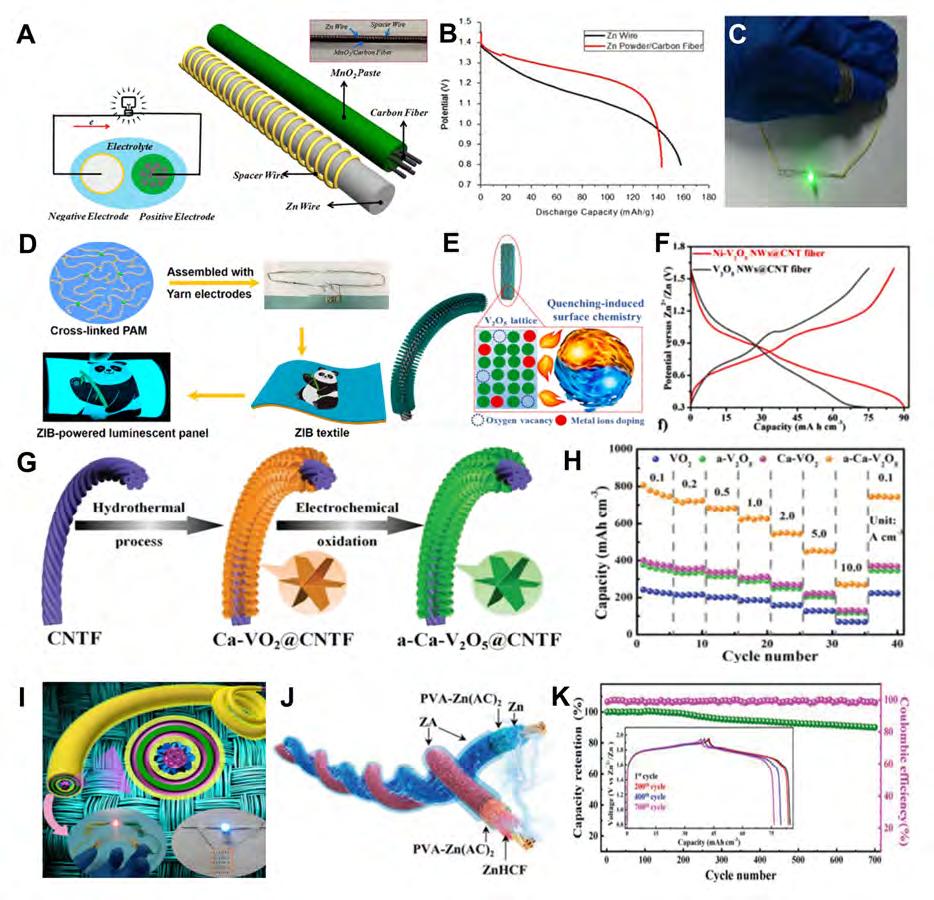
Figure6 Researchprogressofzinc-ionbatteries.(A)TheschematicillustrationofthefiberbatterybasedonZnwireandMnO2/carbon fiber.(B)ThedischargecurvesoffiberbatterywithZnwireorZnpowder/carbonfiberasnegativeelectrode.(C)Twofiberbatteries connectedinseriescontinuouslydriveacommercialgreenLEDwhenbentaroundhumanfinger.(A–C)Reproducedwithpermissionfrom [80].Copyright©2013,Elsevier.(D)SchematicoffabricationandencapsulationofyarnZIBstopowerluminescentpanel.Reproducedwith permissionfrom[81].Copyright©2018,AmericanChemicalSociety.(E)SchematicillustrationofquenchedNi-V2O5 NWs@CNTfiber electrode.(F)Galvanostaticcharge-discharge(GCD)curves.(E,F)Reproducedwithpermissionfrom[82].Copyright©2012,Elsevier. (G)Diagramofsynthesisprocedureofa-Ca-V2O5/CNTF.(H)Comparisonofrateperformance.(G,H)Reproducedwithpermissionfrom [83].Copyright©2023,Wiley-VCH.(I)Schematicofflexiblehigh-voltagecoaxialofFAZBs.Reproducedwithpermissionfrom[1]. Copyright©2019,AmericanChemicalSociety.(J)Schematicillustrationofas-fabricatedFAZIBbasedondual-layergelelectrolytewith lysine.(K)Cyclicpropertyandcoulombicefficiencyofas-assembledFAZIB.Inset:GCDsplinesatselectedcycle.(J,K)Reproducedwith permissionfrom[27].Copyright©2024,Wiley-VCH.
advanceddual-layergelelectrolytesystem,whichcomprisesapoly(vinylalcohol)/zincacetate(PVA/ Zn(OAc)2)innergelandamechanicallyrobustzinc-alginateouterlayer.Furthermore,lysinewasintroduced asanadditivetofacilitatetheformationofastablesolidelectrolyteinterphase(SEI)onthezincanode surface.TheresultingZn/ZnHCFfiberbatterydemonstratedoutstandingmechanicaldurability,retaining
97.7%ofcapacityafter500bendingcycles(Figure6J,K).Thisdual-gelelectrolytedesignestablishesa promisingfoundationforthedevelopmentoflong-lifeFAZBs.
Insummary,FAZBshaveachievedsystematicprogressacrossmaterials,architectures,electrolytes,and interfacialengineering.Withtheconvergenceofprecisematerialdesignandscalablefiber-fabrication technologies,FAZBsarepoisedtotransitionfromproof-of-conceptdemonstrationstoengineeredsolutions forhigh-powerwearableandtextile-integratedenergysystems[84,85].
Fiber-shapedaqueousmagnesium-ion,calcium-ion,andaluminum-ionbatteries
Multivalent-ionstoragesystems,leveragingmulti-electrontransferprocesses(Mg2+/Ca2+:2e ;Al3+:3e ), offersignificantlyenhancedvolumetriccapacityatequivalentredoxpotentials,resultinginintrinsicallyhigh theoreticalcapacitiesandenergydensities[86,87].Meanwhile,thenaturalabundanceofmagnesium,calcium,andaluminumintheEarth’scrust(Mg ≈ 1.94wt%,Ca ≈ 3.6wt%,Al ≈ 8.23wt%)ensureswide availability,lowcost,andstrongsustainability[88–90].Coupledwiththeintrinsicsafety,highionicconductivity,andenvironmentalbenignityofaqueouselectrolytes,fiber-shapedmultivalentaqueousbatteries emergeaspromisingcandidatesforflexible,weavable,andintegrablepowersuppliestailoredtosmart textiles,wearableelectronics,andsoftsensingsystems.
IntheMg2+ system,He etal.[91]firstshowedthatlayeredNiOOH,longusedinalkalinebatteries,can reversiblyhostMg2+ inneutralaqueouselectrolytesviaaproton-assistedmechanism,exhibitingadischarge plateauat0.57V(Figure7A).Buildingonself-supportingfibrousdesigns,theyassembledaNaTi2(PO4)3// NiOOH“rocking-chair”fiber-shapedaqueousMg-ionbatteries(FAMBs),whichsimultaneouslyachieved highenergydensityandexcellentmechanicalflexibility,enablingseamlessweavingintotextilesforpoweringoptoelectronicdevices(Figure7B,C).Ling etal.[92]furtheremployedorganic-acid-assistedcoordinationandetchingtoconstructdefect-rich,K-free,water-containingCuHCF(D-CuHCF@CNTF)arrays onCNTfibers(CNTF).Exploitinghigh-valenceactivesitesandorderedarrayarchitecture,thecathode deliveredareversiblecapacityof146.6mAhg 1,approachingthetheoreticaltwo-electronlimit(Figure7D). WhenpairedwithaNaTi2(PO4)3/CNTFanode,theresultingFAMBsdemonstratedbothhighenergydensity andmechanicalcompliance(Figure7E,F).
ForCa-ionsystems,Liu etal.[93]developedaself-supportingZnHCF@CFcathode,whereCa2+/H+ cointercalationenabledefficientstoragewithinanexpandedvoltagewindow.TheassembledZnHCF@CF// PANI@CFfiber-shapedaqueousCa-ionbatteries(FACBs)achievedavolumetricenergydensityof43.2 mWhcm 3,whilemaintainingstableperformanceundermultipledeformationmodes,underscoringtheir potentialinwearableapplications(Figure7G,H).IntheAl-iondomain,Xiong etal.[25]reporteda stretchablefiber-shapedaqueousAl-ionbatteryconsistingofamanganesehexacyanoferratecathode,a grapheneoxide-modifiedMoO3 anode,andahydrogelelectrolyte.Thedeviceretained91.6%capacityafter 100cyclesat1Acm 3,deliveringacapacityof42mAhcm 3 andanenergydensityof30.6mWhcm 3 Integratedseamlesslyintotextiles,itreliablypoweredLEDs,validatingitsapplicationinstretchableand wearablepowersystems(Figure7I).
Fiber-shapedmultivalent-ionaqueousbatteriesholdstrongpotentialforflexibleenergystoragebutface intrinsichurdles,includingsluggishiontransportfromlargehydratedcations,narrowelectrolytestability windows,andtrade-offsbetweenactiveloadingandmechanicalflexibility.Recentadvancesarebeginningto
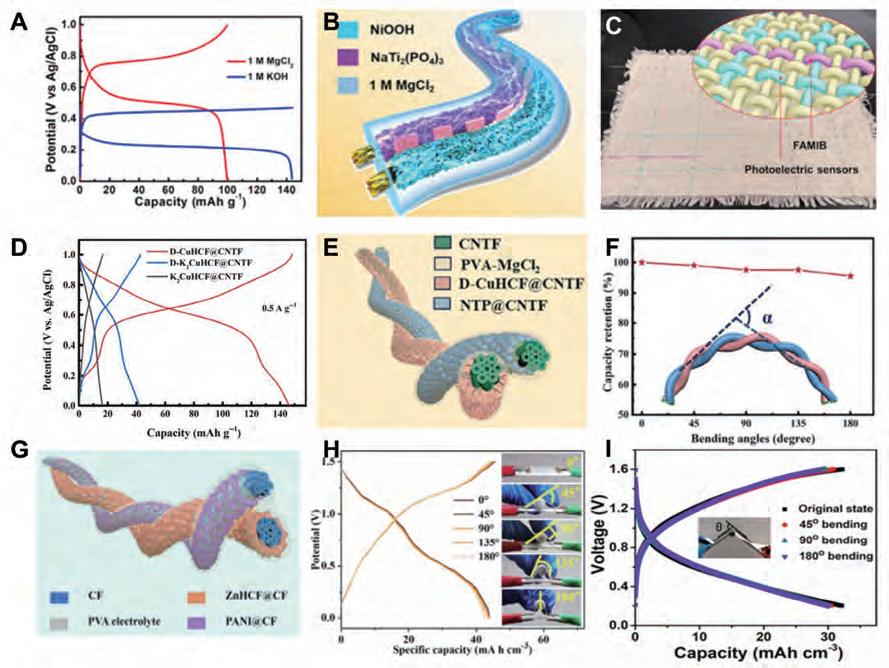
Figure7 Researchprogressofmagnesium-ion,calcium-ionandaluminum-ionbatteries.(A)GCDcurvesat8Ag 1 ofNiOOH/CNT@CC obtainedin1MMgCl2 and1MKOH.(B)Schematicdiagramoftheas-assembledFAMIBs.(C)Opticalphotoandstructuralschematicofthe self-poweredphotoelectricsensingfabric.(A–C)Reproducedwithpermissionfrom[91].Copyright©2024,TheAuthor(s).(D)ThecomparisonofGCDcurvesfromthreeelectrode.(E)SchematicdiagramoftheFAMIBs.(F)CapacityretentionofFAMIBsunderdifferent bendingangles.(D–F)Reproducedwithpermissionfrom[92].Copyright©2024,TheAuthor(s).(G)Schematicillustrationofthefull configurationofFACIBs.(H)GCDprofilesunderdifferentbendinganglesatafixedlength(2cm)andbendingradius(0.5cm)(inset: photographsforthebendingtest).(G,H)Reproducedwithpermissionfrom[93].Copyright©2024,Elsevier.(I)GCDprofilesatdifferent bendinganglesoffiberaqueousAl-ionbattery.Reproducedwithpermissionfrom[25].Copyright©2022,TheAuthor(s).
addresstheselimitationsthroughdefectandinterlayerengineeringofelectrodes,electrolyteinnovationssuch aswater-in-saltandhydratedeutecticsandoptimizedfiberarchitecturesthatenhancecapacitywhileretainingrobustness.Lookingforward,theintegrationofenergy-harvestingandfunctionalfiberspromisesthe developmentofself-sustaining,weavablesmart-textilepowersystems.Insummary,Mg-,Ca-,andAl-based FABs,withtheirsustainability,hightheoreticalcapacities,andcompatibilitywithflexibleformfactors,are emergingasstrongcandidatesfornext-generationwearableenergystorage.Futureresearchshouldemphasizesynergisticoptimizationofelectrodesandelectrolytes,aswellassystem-levelintegrationofdevice architecturesandmultifunctionality,tounlockcomprehensiveimprovementsinperformance,stability,and real-worldapplicability.
Fiber-shapedaqueousammonium-ionbatteries
Amongvariousfiber-shapedenergystoragetechnologies,fiber-shapedaqueousammonium-ionbatteries
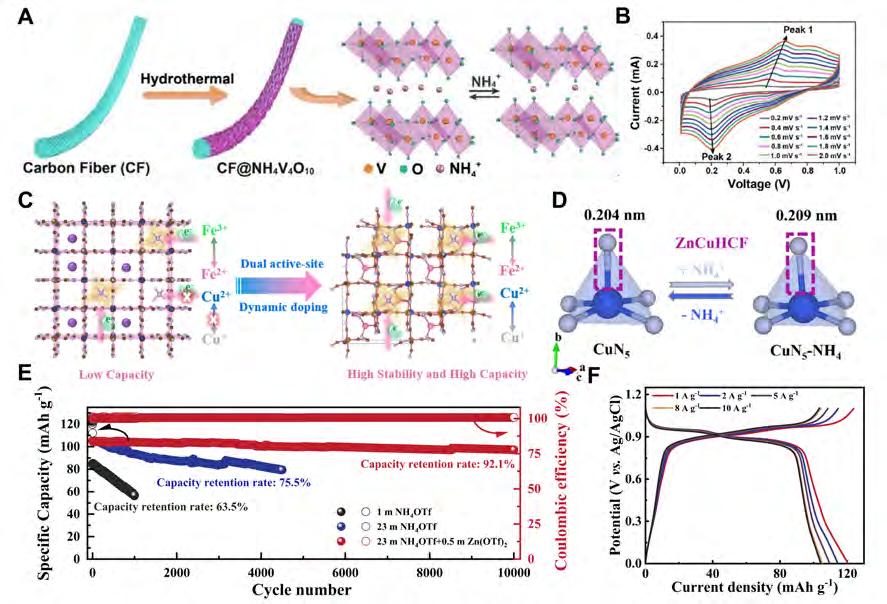
Figure8 ResearchprogressofFAABs.(A)SchematicillustrationoftheCF@urchin-likeNH4V4O10.(B)CVcurveoftheFAABs. (A,B)Reproducedwithpermissionfrom[94].Copyright©2020,Elsevier.(C)Schematicillustrationof in-situ dynamiccompensation strategy.(D)TheoreticalcalculationsofCu–Nbondlengthchangesduringammoniation/de-ammoniationprogressesinZnCuHCF. (E)CyclingperformanceoftheZnCuHCF.(F)TheGCDcurvesofZnCuHCF.(C–F)Reproducedwithpermissionfrom[95].Copyright©2025,Wiley-VCH.
(FAABs)haverecentlyemergedasapromisingalternativeduetotheiruniquechargecarriers,fastion kineticsandintrinsicsafety.Distinctfromtraditionalmetal-ionsystems,theutilizationofNH4+ ionsoffers advantagessuchassmallhydratedionicradius,highmobilityinaqueouselectrolytesandlowredoxpotential,enablingrapidchargetransportandhighpowerdensity.Thesefeatures,combinedwiththestructural advantagesoffiber-shapedarchitectures,suchasflexibility,mechanicalrobustnessandtextileintegration, createnewopportunitiesforthedevelopmentofnext-generationwearableenergystoragedevices.Inthis section,wewillfocusonrecentprogressinFAIBs,highlightingmaterialdesignstrategies,deviceconfigurationsandelectrochemicalperformance.
Li etal.[94]demonstratedanovelFAIBsfeaturinghighratecapabilityandoutstandingcyclingstability. AsillustratedinFigure8A,B,thedeviceemployedurchin-likeNH4V4O10 nanostructurescoatedontocarbon fiberasthecathodeandpolyaniline(PANI)nanorodsgrownoncarbonfiberastheanode,operatinginan (NH4)2SO4 aqueouselectrolyte.BenefitingfromthefastdiffusionkineticsofNH4+,thebatterydelivereda highspecificcapacityof167mAhg 1 at0.1Ag 1,retained54mAhg 1 evenat1Ag 1,andexhibitedan ultralongcyclelifewithexcellentcapacityretention.TheseresultshighlightthegreatpotentialofFAABsfor high-performancefiber-shapedenergystorageinwearableelectronics.However,despitethepromising performance,therelativelylowcapacityandlimitedmechanicalflexibilityofexistingNH4+ storagematerialsstillposesignificantchallengesforpracticalFAABsintegration.Amongthem,PBAsexhibithigh
operatingplateausbutoftensufferfrompoorstructuralstabilityduringcycling,whichseriouslyhampers theirpracticalapplication.Toaddresstheselimitations,Han etal.[95]designedaZn-dopeddual-active-site copperhexacyanoferrate(ZnCuHCF)asahigh-energyandultrastablecathodematerialforNH4+ storage.Via aninnovative in-situ dynamiccompensationstrategytoprepareZn-dopingdual-active-siteCuHCFcathode (Figure8C),whereZn2+ dopingsuppressesJahn-Tellerdistortionsviaorbitalfissionandstabilizesthelattice duringNH4+ intercalation.TheincorporationofZnintothestructureinitiatesatransitionintheCu–N coordinationfromhexacoordinationtopentacoordination,reducingbondlengthvariationfrom0.204to 0.209nmduringNH4+ intercalation(Figure8D),strengtheningtheZnCuHCFframeworkandthusleadingto anultralongcyclelifewitharetentionof92.1%after10,000cyclesina23mNH4OTf+0.5mZn(OTf)2 hybridelectrolyte(Figure8E).Besides,theZnCuHCF/CNTFdeliveredahighdischargepotentialof0.94V, aspecificcapacityof121.7mAhg 1 at1Ag 1 (Figure8F).
ThesestudiesunderscorethefeasibilityandpotentialofFAABsasemergingcandidatesforfiber-shaped energystorageinflexibleandwearableapplications.Theprogressmadefrommaterialdesigntodevice-level demonstrationshaslaidasolidfoundationforthisburgeoningfield.Nevertheless,realizingthefullpotential ofFAABsstillrequiresovercomingseveralcriticalchallenges.Futureeffortsshouldfocusondeveloping advancedNH4+ hostmaterialswithbothhighcapacityandmechanicalcompliance,optimizingion-conductiveyetrobustgelelectrolytes,andestablishingscalablefabricationtechniquescompatiblewithtextile integration.Withcontinuedinnovationacrossmaterials,structures,anddeviceengineering,FAABsare poisedtobecomeakeyenablingtechnologyfornext-generationsmartwearables.
Fiber-shapedalkalineaqueousbatteries
Comparedwithfiber-shapedaqueousionbatteriesthatprimarilyemployneutralormildlyacidicelectrolytes, researchonalkalinesystemsremainsintheirinfancy[96,97].Nevertheless,suchsystemsexhibitunique advantagesintermsofreactionkineticsandenergydensity.Inalkalinemedia,zincpossessesarelatively highhydrogenevolutionoverpotential,whichsuppressessidereactionsandtherebyenhancesCoulombic efficiency[98,99].Atthesametime,Co/Ni-basedoxidesandhydroxidesdemonstratesuperiorelectrochemicalactivityandstabilityinalkalineelectrolytes.Consequently,despitethelimitednumberofreports, alkalineFABsholdsignificantpotentialforhigh-energy-densityandhigh-powerflexibleenergysupply scenarios.
CurrentresearchonalkalineFABshasmainlyfocusedontworepresentativesystems:fiber-shapedzinc-air batteries(FZABs)andalkalinefiber-shapedrechargeableZn-/Ni-basedbatteries(e.g.,Zn-Co,Zn-Ni,andNiFe).FZABsoperatethroughacoupledelectrochemicalprocess,wherezincoxidationattheanode(Zn→Zn2+ +2e )ispairedwithoxygenreductionandevolutionreactions(ORR/OER)attheaircathodeduring dischargeandcharge,respectively.Thereversibleredoxprocessesoccuratthesolid-liquid-gastriple-phase interface,whichenableshightheoreticalenergydensityyetalsoimposeschallengesofsluggishreaction kineticsandinterfacialinstability.Typically,metalliczincwiresorzinc-coatedfibersserveastheanode,while carbonfilamentsorwovencarbonribbonsareemployedasairelectrodesubstrates.Thesesubstratesare furtherintegratedwithbifunctionalcatalysts(e.g.,MnOx,Co/N-dopedcarbon,Co-Feoxides,andCNT/ graphenecomposites)[100–102]toaccelerateORRandOERprocesses.Distinctfromtheirplanarcounterparts,fiberarchitecturesrequiretheairelectrodetobelightweight,flexible,andair-permeable,ensuring
efficientoxygendiffusionandstableoperationundermechanicaldeformation.Structuralinnovations,includingcoaxialarchitectures,core-sheathconfigurations,andhydrophobicmodifications,helpmaintainefficientgasdiffusionandpreventelectrolyteflooding,enablingstableoperationundermechanical deformation.TheseuniquestructuralcharacteristicsendowFZABswithexceptionaladaptabilityforintegrationintowearableandtextile-basedenergysystems,positioningthemasapivotalsubclassoffibershapedaqueousbatteries.Xu etal.[103]constructedanovelairelectrodeconsistingofdirectionallystacked porousCNTsheets,whichsimultaneouslyfunctionasagasdiffusionlayer,catalystlayer,andcurrent collector(Figure9A,B).Thisarchitecturedeliversexcellentcharge-dischargeperformanceevenathigh currentdensitiesof2Ag 1 (Figure9C)andmaintainsstableoutputunderbendingandstretching,highlightingitspromiseforportableandwearableelectronics.However,conventionalhydrogelelectrolytes rapidlyloseelasticityinstrongalkalineenvironments,therebylimitingthedevelopmentofhighlystretchable FZABs.Toaddressthischallenge,Ma etal.[104]developedanalkaline-tolerantdual-networkhydrogel electrolyte,enablingthefirstrealizationofultrastretchableFZABs(Figure9D).Thehydrogel,constructed fromsodiumpolyacrylatechainsandacellulosebackbone,retainedexcellentmechanicalpropertiesunder harshalkalineconditions.Theresultingdevicenotonlyexhibitedahigh-powerdensityof108.6mWcm 2 understaticconditionsbutalsoreached210.5mWcm 2 underextremestretching(Figure9E),while maintainingstableelectrochemicalperformanceafterseveredeformation.Thisbreakthroughlaysthe groundworkforFZABsinsmarttextilesandflexibleelectronics.
BeyondFZABssystems,alkalineZn-Cobatterieshavealsodemonstratedtheadvantagesoffiberization.Li etal.[105]addressedzincdendrite-inducedcyclingdegradationbydesigningZnO@Ccore-shellnanorods asdendrite-resistantanodes,coupledwithdendriticCo(CO3)0.5(OH)x·0.11H2O@CoMoO4 cathodes.Integratedwithagelelectrolyte,theteamsuccessfullyfabricatedahighlycustomizableall-solid-statefibershapedZn-Cobattery(Figure9F).Thedevicedeliveredanenergydensityof4.6mWhcm 3 andapeak powerdensityof0.42Wcm 3,retained82%capacityafter1600cycles,andpreservedexcellentflexibility underdiversebendingconditions(Figure9G).Despitetheirpromise,thepracticaldeploymentofZn-Ni batteriesremainshinderedbylimitedcyclingstability,arisingmainlyfromtheirreversibilityofnickel-based cathodesandthedendriticgrowthofzincanodes.Toaddressthischallenge,Zeng etal.[106]engineeredNiNiOheterostructurenanosheetsasthecathodetoconstructahighlyrechargeable,flexiblefibrousNiZn batterywithoutstandingelectrochemicalproperties(Figure9H).ThesynergisticenhancementofconductivityandelectroactivityimpartedbytheNi-NiOheterostructureenabledthedevicetodeliverhigh capacityandremarkableratecapability.Inaqueouselectrolytes,thebatteryretained96.6%ofitscapacity after10,000cycles,whileinpolymerelectrolytesitshowednegligiblecapacitydecayevenafter10,000 cyclesatacurrentdensityof22.2Ag 1,settingabenchmarkforcyclingdurability(Figure9I).Inaddition, aqueousrechargeableNi-Febatteries,withtheirultra-flatdischargeplateau,lowcost,andintrinsicsafety, holdstrongpromiseforwearableenergystorage.Yang etal.[22]engineeredS-dopedFe2O3 nanowirearrays (NWAs)growndirectlyonCNTF(S-Fe2O3 NWAs/CNTFs),whereSdopingnarrowedthebandgapofFe2O3 andmarkedlyimproveditsconductivity.CoupledwithaZn-Ni-Cooxide(ZNCO)@Ni(OH)2 NWAsheterostructurescathode(Figure9J),theresultingquasi-solid-statefiber-shapedNiCo-Febatteryachieveda capacityof0.46mAhcm 2 (Figure9K),surpassingmoststate-of-the-artfiber-shapedaqueousbatteriesand chartinganewpathfornext-generationwearableNi-Feenergystorage.
Overall,fiber-basedarchitecturegreatlyenhancesspecificsurfaceareaandshortensiondiffusionpathNatlSciOpen,2025,Vol.4,20250051
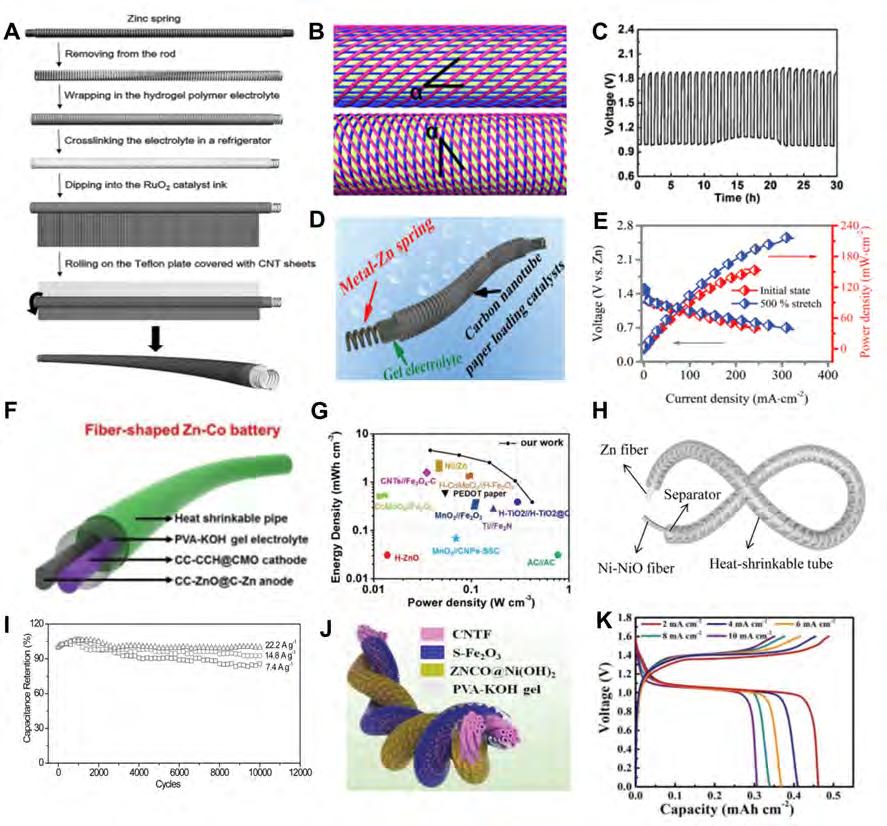
Figure9 Researchprogressofalkalineaqueousbatteries.(A)SchematicillustrationofthefabricationoftheFZABs.(B)Schematic illustrationtothestructureofthealignedCNTintheFZABs.(C)GCDcurvesofaFZABsatcurrentdensitiesof1Ag 1.(A–C)Reproduced withpermissionfrom[103].Copyright©2015,JohnWileyandSons.(D)Schematicillustrationof500%stretchable.(E)Powerdensity curvesoffiber-shapedhighlystretchableFZABsatfullyreleasedstateand500%tensilestrainwithPANa-cellulosehydrogelelectrolyte. (D,E)Reproducedwithpermissionfrom[104].Copyright©2019,JohnWileyandSons.(F)Schematicsoftheall-solid-statefiber-shapedZnCobattery.(G)Ragoneplotoftheall-solid-statefiber-shapedZn-Cobatterybasedonthevolumeofthewholeflexiblebattery. (F,G)Reproducedwithpermissionfrom[105].Copyright©2019,JohnWileyandSons.(H)Schematicdiagramoftheflexiblequasi-solidstatefiber-shapedNi-NiO//Znbattery.(I)Cyclingperformanceofthequasi-solid-statefiber-shapedNi-NiO//Znbatteryatvariouscurrent densities.(H,I)Reproducedwithpermissionfrom[106].Copyright©2017,JohnWileyandSons.(J)Schematicsofthefiber-shapedNiCo-Fe battery.(K)GCDcurvesofthefiber-shapedNiCo-Febattery.(J,K)Reproducedwithpermissionfrom[22].Copyright©2019,JohnWiley andSons.
ways,whileporouscarbonframeworksfacilitategastransportandby-productremoval.Asaresult,devices maintainhighpowerdensityandreversibilityevenunderbending,knotting,andweavingconditions. Leveragingtheweavabilityoffiberelectrodes,suchbatteriescanbeseamlesslyintegratedintotextiles, makingthemsuitableforpoweringpulsedorintermittentwearableloads.Nonetheless,alkalinesystemsface severalcriticalchallenges:(i)thecorrosivenatureandwateractivityofstrongalkalineelectrolytescompromisethechemicalstabilityofpackagingmaterials,currentcollectorsandbinders,therebyshortening
devicelifetimeandraisingsafetyconcerns;(ii)zincanodesremainsusceptibletoself-corrosionandmorphologicalevolutioninalkalineconditions,necessitatingstrategiessuchasalloying,protectiveinterfacial layersand3Dporousscaffoldstosuppressdendritegrowth;(iii)thestructuralstabilityofbifunctional catalystsandtheoxidationresistanceofcarbonsupportsrequirefurtherimprovement,whilecatalystpore distributionandhydrophobicitystronglyinfluencewatermanagementandreactionpathways;(iv)strain concentrationduringbending,stretchingandweavingcaninduceactive-layerdelaminationandinterfacial impedancegrowth,leadingtoperformancefluctuationsandefficiencyloss.Therefore,futureresearchurgentlyneedstoachievesynergisticbreakthroughsinmaterialdesign,electrolyteregulationanddevice structureoptimization.Withthecontinuedprogressofhighlystablecatalysts,solid-statealkalineelectrolytes andalkali-resistantpackagingtechnologies,alkalinefiberbatteriesareexpectedtoachievealeapforward fromlaboratoryverificationtoprototypesforsmarttextileandflexibleelectronicsapplications.
FABshaveemergedasahighlypromisingclassofenergystoragedevices,offeringdistinctiveadvantages suchasintrinsicsafety,mechanicalflexibility,andcompatibilitywithwearableandtextileelectronics.In recentyears,researcheffortshavefocusedonavarietyofchemistries,includingmonovalent-ionsystems (Li+,Na+),multivalent-ionsystems(Zn2+,Mg2+,Ca2+,Al3+),andalkalineFABs.Monovalentsystems, particularlythosebasedonlithiumandsodium,exhibitrelativelymatureelectrochemicalperformancewith well-understoodreactionmechanismsandstablecyclingbehavior.However,theirpracticaldeploymentis limitedbysafetyconcernsassociatedwithdendritegrowth,thehighcostofLi-basedmaterials,andthe restrictedenergydensityofNasystems.Incontrast,multivalent-ionsystemsprovidehighertheoretical capacityandvolumetricenergydensityduetothemultiple-electrontransferpercation,alongwithsuperior resourceabundanceandenvironmentalbenignity.Nevertheless,thestrongcoulombicinteractionsandrigid hydrationshellsofmultivalentcationsleadtosluggishiondiffusion,interfacialpolarization,andstructural degradation,whichcollectivelyrestricttheirratecapabilityandreversibility.FAABshaverecentlygained attentionowingtotheiruniquehydrogen-bond-assistedtransportmechanism,enablingfastionmobilityand highreversibilityinmildaqueousenvironments.Yet,theirrelativelylowredoxpotentialandlimitedenergy outputremainobstaclestolarge-scaleapplication.Althoughearlyindevelopment,alkalineFABsexhibit compellingadvantagesinkineticsandenergydensity,positioningthemasapromisingcomplementary strategy.Despitetheseadvances,thepracticaldevelopmentofFABsremainshinderedbyseveralcommon bottlenecks.Futureprogressinfibrousaqueousionbatterieswillthereforedependontheintegrationof materialsinnovation,electrolyteengineering,andstructuraldesign.Moreover,withcontinuousadvancesin materialsscience,electrochemistry,anddeviceintegration,FABsareexpectedtoplayapivotalrolein poweringnext-generationwearableelectronics,smarttextiles,andimplantablemedicaldevices.
ComparativeanalysisofFABssystems
TheexplorationofvariousFABssystemsrevealsadiverselandscapewhereeachchemistryispropelledby distinctadvantagesand,consequently,facesuniquedevelopmentalbottlenecks.Thiscomparativeanalysis synthesizesthecorevaluepropositionandtheprimarylimitingfactorforeachsystem,providingahigh-level perspectiveontheirrespectivedevelopmentaltrajectories(Table2).
Monovalent-ionsystems(Li+,Na+)areprimarilydevelopedasasafeandflexibletranslationofmature batterychemistry.Theirdevelopmentisconstrainednotbyfundamentalelectrochemicalunknowns,butby
NatlSciOpen,2025,Vol.4,20250051
Table2 Comparativesummaryofdevelopmentstatusandkeychallengesfordifferentfiber-shapedaqueousbatterysystems
BatterysystemKeyproperty
Li+/Na+ FABs Smallhydratedradius, fastdiffusion
Zn2+ FABsPlating/stripping
Mg2+/Ca2+/Al3+ FABs Highchargedensity, strongpolarization
NH4+ FABs (FAABs) Smallhydratedradius, formsH-bonds
AlkalineFABs Enablesspecificredox couples
Dominantreaction mechanism Coreadvantage Fundamentalbottleneck
Intercalation (rocking-chair)
Anode:deposition/ dissolution; Cathode:intercalation/ conversion
Intercalation/ conversion
Intercalation
Complex(OER/ORR inZn-air;Ni(OH)2/ NiOOHinNi-Zn)
Inheritedhighperformance& maturityfromcommercial chemistry
Highvolumetriccapacity& practicalsafety,enabling rapiddevelopment
Hightheoreticalcapacity viamulti-electron transferperion
Ultra-fastdiffusionkinetics anduniquenon-metallic sustainability
Favorablereactionkinetics& highpower/energydensity inbase
Limitedelectrolytewindow: thenarrowthermodynamic stabilitywindowofwater(~1.23V) intrinsicallycapsenergydensity.
Znanodeinterfacialinstability: dendritegrowth,hydrogenevolution, andpassivationduringcycling.
Sluggishsolid-statekinetics: Strongelectrostaticinteractions severelyhinderiondiffusionin electrodelattices.
Materialgap:scarcityof high-capacityhostmaterials, especiallyfortheanode.
Corrosiveelectrolyte: degradationofcomponents (catalysts,currentcollectors)in strongalkalinemedia.
thepracticallimitationsoftheaqueouselectrolyte’snarrowvoltagewindowand,forlithium,resource considerations.
Zinc-ionsystems(Zn2+)areattheforefrontofmultivalentFABsdevelopment,drivenbythepursuitofhigh volumetricenergydensityandexceptionalpracticality.Thecentralbottleneckforthissystemisunequivocallytheinterfacialinstabilityatthezincanode(dendrites,sidereactions)alongsidethesearchforcathode materialsthatcanwithstandsustainedZn2+ (de)intercalation.
Othermultivalent-ionsystems(Mg2+,Ca2+,Al3+)representthequestforultra-hightheoreticalcapacityand resourcesustainability.Theirdevelopmentisinitsinfancy,fundamentallyhinderedbythesluggishsolidstatediffusionkineticsofthehighlypolarizingmultivalentionswithinmosthostmaterials.
Ammonium-ionsystems(NH4+)offerapathwaytoultra-fastcharginganduniquesustainability.Asan emergingfield,itsprogressiscurrentlygatedbythelimitedlibraryofhigh-performancehostmaterials, especiallyfortheanode,whichcanleveragetheuniquechemistryoftheNH4+ ion.
Alkalinesystems(e.g.,Zn-air,Ni-Zn)areengineeredforhighpowerandenergydensityinaunique chemicalenvironment.Theirdevelopmentisuniquelychallengedbytheneedforcomponentstabilityand durabilitywithinthecorrosivealkalineelectrolyte.
Thisdifferentiationincorechallengesdictatesdivergentresearchprioritiesforeachsystem,aswillbe furtherdiscussedinthecontextoffutureprospects.
APPLICATION
FABs,leveragingtheirexcellentmechanicalproperties,sewability,diversifiedchargingmodes,andmultifunctionalintegrationcapabilities,preciselymeetthecoredemandsofwearableelectronicsandsmarttextiles formorphologicalcompatibility,self-poweredcapabilityandfunctionalsynergy,thusemergingasaresearch
hotspotinthisfield[1,28,97].Fromtheoptimizationofbasicstructure-performancerelationshipstothe integrationofcomplexmulti-systems,FABsresearchhaveconsistentlyfocusedonovercomingbottlenecks inpracticalapplicationscenarios,followingaclearprogressivedevelopmentpathwayofbasicperformanceenergysupply-functionalsynergy-miniaturizedintegration:First,itaddressesthemorphologicalcompatibilityissuethroughmaterialandstructuralinnovationstoachieveseamlessintegrationwithtextiles; second,itexpandschargingmodestobreakthelimitationsofenergysupplementationandenhanceenvironmentaladaptability;third,itrealizesenergystorage-functionalsynergyviaheterogeneousdevice couplingtoenrichtheapplicationdimensionsofsmarttextiles;finally,itmovestowardmultifunctional miniaturizedintegrationinasinglefibertopromotetheevolutionofwearabledevicestowardlightweight andunobtrusivedesigns.
Mechanicalpropertiesandsewability
Wearableelectronicsrequirelong-termconformitytodynamichumanmovementsandcompatibilitywith textileprocessing(sewing)andusage(washing)scenarios[1,27,69,107].Thisdemandsthatenergystorage devicesnotonlypossessexcellentflexibility,stretchability,andbendingresistancebutalsohighadaptability totextilemanufacturingprocesses.Throughadual-driverapproachofmaterialdesignandstructuralinnovation,FABspreciselyovercomebottlenecksinmechanicalperformance,layingamorphologicalfoundationforsubsequentmultifunctionalintegration,whichservesasthecoreprerequisiteforFABstotransition fromlaboratoryprototypestopracticaltextilecomponents.
Intermsofmaterialselection,thecombinationofflexibleconductivematerialsandhigh-toughness electrolytesiskeytoenhancingmechanicalperformance:Theintroductionofmaterialssuchascarbon nanotubes(withhighconductivityandflexibility),metal-organicframeworks(MOFs,featuringhighspecific surfaceareaandtunablestructure)[27]andconductivepolymerssignificantlyimprovesthetensileand bendingresistanceofelectrodes[108];polymergelelectrolytespreventtheleakageofliquidelectrolytes throughtheentanglementofpolymernetworks,whilesimultaneouslyenhancingtheoverallflexibilityand swellingresistanceofFABs.
Instructuraldesign,innovativeconfigurations,includingcoaxial,twisted,andcoatedstructures,further optimizethestressdistributionoffibers.Forinstance,theFABsdevelopedbyKareri etal.[109]—usinga polyaniline-basedphotoactivegelastheelectrolyteandconductivethreadsastheelectrodes—formsafiber structurebytwistingtheelectrodethreadsatadensityof10twistspercm(Figure10A).Thistwisteddesign notonlydisperseslocalstressduringdeformationbutalsoallowsthedevicetobedirectlyembeddedinto textiletextures,perfectlymeetingthedemandforunobtrusiveintegrationinwearabledevices.Inaddition,Li etal.[81]developedFABsbasedondouble-helicalstructuredelectrodesandcross-linkedpolyacrylamide electrolytes,whichexhibitoutstandingmechanicalelasticityanddeformationtolerance:thestretchability reaches300%,thecapacityretentionrateexceeds95%afternon-planardeformations,andthecapacity retentionremainsat98.5%after500cycles(Figure10B).Thesepropertiesenablestableadaptationtothe dynamicdeformationrequirementsofwearabledevices.
Notably,washabilityisoneofthekeyindicatorsforFABstoachievepracticalapplications.Traditional energystoragedevices,duetotheirwater-sensitivepackaging,cannotwithstandthemachinewashing processoftextiles.Incontrast,thesewableFABsdevelopedbyWang etal.[110],modifiedwithaswelling-
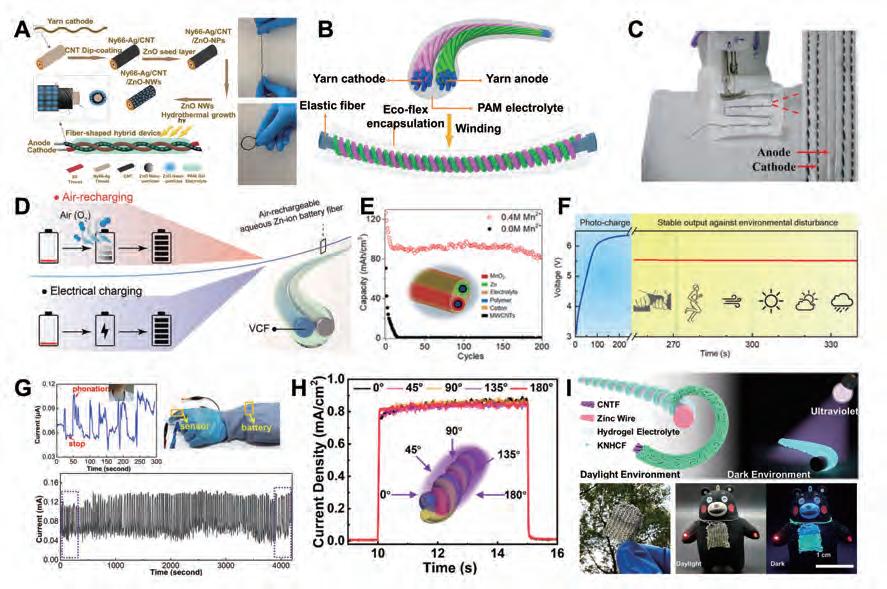
Figure10 ResearchprogressofFABs.(A)SchematicillustrationofthefabricationstepsoftheNy66-Ag/CNT/ZnO-NWsanodeelectrode andthefinaldevicestructure.Reproducedwithpermissionfrom[109].Copyright©2022,TheAuthor(s).(B)SchematicdiagramoffabricationandencapsulationofFABs.Reproducedwithpermissionfrom[81].Copyright©2018,AmericanChemicalSociety.(C)TheperformancesofsewnandwovenpowertextilesbasedontheFABs.Reproducedwithpermissionfrom[110].Copyright©2020,JohnWileyand Sons.(D)SchematicoftheFABswithair-rechargingcapabilityintegratedintomultifunctionalwearablesystems.Reproducedwithpermissionfrom[114].Copyright©2021,RoyalSocietyofchemistry.(E)CyclingperformancewithorwithoutMn2+ intheelectrolyteofFABs. (F)Thephoto-rechargeablefabricdeliveredstableelectricaloutputundervaryingenvironmentaldisturbance.(E,F)Reproducedwith permissionfrom[116].Copyright©2020,Elsevier.(G)TheperformanceofwearablesensordeviceintegratedwithFABs.Reproducedwith permissionfrom[121].Copyright©2022,Elsevier.(H) I-T curvesofthedeviceatdifferentincidenceangles.Reproducedwithpermission from[85].Copyright©2023,AmericanChemicalSociety.(I)FluorescentdisplayforFABs.Reproducedwithpermissionfrom[84]. Copyright©2023,AmericanChemicalSociety.
resistantpolymergelelectrolyteandadouble-layersealedpackagingdesign,canbedirectlywoveninto textilesasathread(Figure10C).Afterthousandsofbendingcyclesandrepeatedmachinewashes,it maintainsacapacityretentionrateofover90%withoutsignificantdegradationinpowersupplystability. Thisbreakthroughaddressestheservicedurabilitychallengeinthelarge-scaleindustrializationofFABs, whilealsoverifyingthepracticalityofZn-MOF-basedFABsinpoweringsmallwearabledevicessuchas calculatorsandelectronicwatches[1],thusprovidingareliablemorphologicalcarrierforsubsequentenergy supplyandfunctionalintegration.
Integrationofdiversifiedchargingmodes
WhileoptimizedmechanicalpropertiessolvethemorphologicalcompatibilityissueofFABswithtextiles, energysupplementationforwearabledevicesinscenarioswithoutexternalpowersources(outdooractivities, sports,andemergencies)remainsacorepainpoint[111].Traditionalwiredchargingisnotonlyinconvenient butalsolimitsthemobilityofdevices.Byintegratingnovelchargingmodessuchasair-chargingandphoto-
charging,FABsachievethegoalofenergyharvestingfromtheenvironment,significantlyexpandingtheir applicationboundariesandprovidinganenergyguaranteeforthelong-termstableoperationofmultifunctionalsystems[111–113].
Air-chargingFABsarecharacterizedbytheirstructuralsimplificationthroughtheuseofenvironmental resources:Byintroducinganaircathode,theyutilizeO2 intheairasaredox-activespecies,eliminatingthe needforadditionalenergystorageelectrodes.Thisdesignnotonlyimprovesenergydensitybutalsoreduces deviceweight.Forexample,Liao etal.[114]reportedaFABwithaV6O13/orientedcarbonnanotube compositecathode(VCF)asthecorecomponent.Airchargingisrealizedthroughthespontaneousoxidation reactionbetweenthedischargedVCFandO2 intheair(accompaniedbyZn2+ deintercalation,Figure10D).
Toaddresselectrolytevolatilizationandimpurityerosioninopenenvironments,theteamadoptedadoublelayertubularpackagingdesign(innerlayerforelectrolyteretention,outerlayerforcontaminationprevention),ensuringstableairchargingincomplexenvironmentssuchasoutdoorsettingsandhumidconditions. Thisdesigneffectivelymitigatesthepowerfailureriskofwearableelectronicsinscenarioslikeoutdoor explorationandemergencyrescue,enhancingtheenvironmentalrobustnessofdevices.
Photo-chargingFABs,ontheotherhand,focusonhigh-efficiencyenergyconversion.Byintegratinga photoelectricconversionunitintothefiberstructure,theydirectlyconvertambientlightintoelectricalenergy forstorage,enablingtheintegratedconversionandstorageoflightenergyaselectricalenergy.Xiong etal [115]developedanall-in-onephoto-poweredFABsusingaMoS2@TiO2@Ticompositecathode(MoS2 enhancesphotoelectricresponse,whileTiO2 improvesstability).Thisbatterycanbechargedbynaturallight withoutanexternalpowersource,simplifyingtheseparatecircuitofaphotovoltaiccelltoanenergystorage battery.
Furthermore,Zhang etal.[116]achieveddeepintegrationofphotovoltaiccomponentsandenergystorage batteriestodevelopaphoto-chargingtextile.ThistextileusesaZnOnanowirearray-basedbaselinephotoanodeastheenergy-harvestingunitandaZn/MnO2 FABsastheenergy-storageunit(Figure10E).Itcanbe chargedundersunlightforonlyoneminuteandthenstablydischargeatacurrentof0.1mAfor10min,with photoelectricconversionandenergystorageefficiencysignificantlysuperiortothatoftraditionalseparate systems(Figure10F).
Itisworthemphasizingthatairchargingandphotochargingmodesexhibitsignificantcomplementarity: Theformerissuitableforscenarioswithinsufficientlightbutgoodaircirculation(indoors,cloudydaysand nights),whilethelatterisapplicableforlight-abundantscenarios(outdoorsanddaytime).Thesynergistic integrationofthetwo(viaadual-cathodedesign)isexpectedtoachieveall-weatherself-powering,further reducingthedependenceofwearabledevicesonexternalpowersources.Withthegradualresolutionof morphologicalcompatibilityandenergysupplyissues,FABshavebeguntoadvancetowardthehigher-level energystorage-functionalsynergy—thatis,endowingsmarttextileswithmorepracticalfunctionsthrough heterogeneouscouplingwithsensinganddetectiondevices.
Multifunctionalintegrationandheterogeneouscoupling
Thecorevalueofwearableelectronicsliesnotonlyinenergystoragebutalsoinrealizingspecificfunctions basedonenergy.Bymeansofheterogeneousintegrationwithstrain,pressure,andphotoelectricsensing devices,FABshaveconstructedenergystorage-signalsensingintegratedsystems,promotingthetransfor-
NatlSciOpen,2025,Vol.4,20250051
mationofsmarttextilesfromsingleenergystoragecarrierstomultifunctionalsmartterminals[117].They exhibitirreplaceableapplicationpotential,especiallyinfieldssuchashealthmonitoring,human-computer interaction,andenvironmentalsensing.
Thekeytosuchintegratedsystemsliesinthesynergybetweenmaterialcompatibilityandperformance matching:Ononehand,batteriesandsensorsneedtoadoptsimilarflexiblesubstratestoensurethatthe integratedsystemstillmaintainsexcellentmechanicalproperties;ontheotherhand,theoutputvoltageand currentofbatteriesmustmatchtheoperationalrequirementsofsensorstoavoidsignaldistortioncausedby unstablepowersupply[118,119].
Intermsofmotionsignalmonitoring,theFABsdevelopedbyZhang etal.[117](withanenergydensityof 396Whkg 1 andacapacityretentionrateof80.6%after300cycles),whenintegratedwithacarbonnanotube/ PDMSstrainsensor,canbeattachedtopartssuchasthewrist,fingersandkneejointstoreal-timecapturethe bendingangleandmovementfrequencyofhumanjoints.Itshighenergydensityensureslong-termpower supplyforthesensor,whileitsexcellentflexibilityavoidsdiscomfortduringmovement.Liu etal.[93],by contrast,selectedafiber-shapedaqueousCa2+ battery(withanenergydensityof43.2mWhcm 3)for combinationwithastrainsensor.TheyutilizedthelowpolarizationpropertyofCa2+ toenhancethebattery’s stabilityunderrepeateddeformation,makingitsuitableforsignalacquisitioninlong-durationsportsscenarios suchasmarathonsandcycling.
Forsubtlephysiologicalsignalssuchaspulse,voice,andswallowing,researchersmostlychoosesupercapacitorswithhighpowerdensityastheenergyunit.Forexample,Ma etal.[120]usedanaqueousMXene fibersupercapacitor(featuringfastcharge-dischargeperformanceandhighpowerdensity)topowera pressuresensor,constructingaself-poweredmonitoringsystem.ThehighconductivityofMXeneensuresthe instantaneousresponseofthepressuresensor(capableofdetectingpressurechangesbelow1Pa),enabling thesystemtoaccuratelyidentifypulsewaveforms,laryngealvibrationduringspeechandswallowing movements—providinganewtoolforcardiovascularhealthassessmentandassisteddiagnosisofspeech disorders.
Inaddition,Li etal.[121]developedaFABwithanamorphousH0.82MoO3.26-coatedcarbonnanotubefiber cathode,whichcombineshighenergydensity,cyclingstability,andflexibility(Figure10G).Itsintegrated systemwithamultimodalsensorcansimultaneouslyrespondtolaryngealvibration(vibrationsignals)during speechandfingermovement(strainsignals),realizingdual-modehuman-computerinteractionofvoice control+gestureinteractionandfurtherexpandingtheapplicationdimensionsofsmarttextiles.
ThebreakthroughsintheseheterogeneousintegratedsystemsnotonlyverifythefeasibilityofFABsascore energysupplyunitsforwearablesbutalsopromotetheupgradeofsmarttextilesfrompassiveenergystorage toactivesensing.However,withtheincreaseinthenumberofintegrateddevices,theproblemsofvolume accumulationandcomplexwiringhavegraduallybecomeprominent.Howtorealizemorefunctionsina smallerspacehasbecomethenextcoredirectionofFABresearch.
Multifunctionalizationandminiaturizedintegrationofsinglefibers
Toachievelightweight,unobtrusive,andseamlesswearabilityofwearabledevices,researchershavebegun toexplorethetechnicalpathwayofasinglefibercarryingmultiplefunctions.Bypreciselyarranging functionalunits(suchasenergystorage,photoelectricdetection,andluminescentdisplay)insideoronthe
surfaceofasinglefiber,aminiaturizedandintegratedsmartfibersystemisconstructed—fundamentally solvingtheproblemsofvolumeredundancyandcomplexwiringinmulti-deviceintegration.Thishas becomeacutting-edgetrendinthemultifunctionalintegrationofFABs[64,112].
Thecorechallengeofmultifunctionalizationinasinglefiberliesinthecompatibleintegrationoffunctional units:Itisnecessarytorealizethecoordinatedarrangementofdifferentfunctionalmaterialsatthenanometer tomicrometerscale,whileensuringtheindependentandefficientoperationofeachunit(avoidingelectrical interferencebetweenenergystorageunitsandsensingunits).Currentresearchmainlyovercomesthis challengethroughtwostrategies:structuraldesignandmaterialderivation.
Lu etal.[85]integratedahigh-sensitivityphotoelectricdetectorandahigh-energyaqueousbatteryintoa singlefiberviaathree-strandtwistedstructure—onestrandservesasaZnO-basedphotoelectricdetection unit(withaphotoresponseperformanceof151.45mAW 1)andtheothertwostrandsactasFABsunits(with acapacityof18.75mAhcm 3,Figure10H).Thetwistedstructureseparateseachunitviaaninsulatinglayer, whichnotonlyensureselectricalindependencebutalsoenhancestheoverallflexibilitythroughclosecontact betweenfibers,enablingthedevicetosimultaneouslyrealizeambientlightintensitymonitoringandenergy storage.
Pu etal.[122]usedavanadium-basedmetal-organicframeworknanowire@carbonnanotubefiber(VMOFNWs@CNT)asthecorederivedmatrix.Throughstepwisepyrolysisandelectrochemicalmodification,theypreparedaVNNWs@CNTfibrouspiezoresistivesensorandaV-MOF-derivedFABs,respectively.Sincebotharebasedonthesamecarbonnanotubefibermatrix,theycanbedirectlyintegratedintoa singlefibertoformanenergysupply-sensingintegratedsystem.
Beyondenergysupply-sensingintegration,FABscanalsobecombinedwithdisplayunitstoexpandthe interactiondimensionsofsmarttextiles.Forexample,Liu etal.[84]introducedfluorescentcarbondotsinto anFABtoconstructanenergystorage-multicolorluminescenceintegrateddevice(Figure10I).After1500 cycles,theFABstillmaintainsacapacityretentionrateof78.9%andcanbedirectlywovenintoclothing—it notonlymeetsdailypowersupplyneedsbutalsorealizesnighttimesafetywarning,fashionabledecoration, andsimplehuman-computerinteraction(feedingbackdevicepowervialuminescentcolor).
CHALLENGESANDPROSPECTSOFFABS
Asacoreenergycomponentofflexibleelectronicdevices,FABsshowbroadapplicationprospectsdueto theirexcellentsafetyandenvironmentalcompatibility.However,theirindustrializationprocessstillfaces multi-dimensionaltechnicalbottlenecks(Figure11).In-depthanalysisofthesechallengesandexplorationof breakthroughpathsareofgreatsignificanceforpromotingtheirpracticalapplication.
Challenges
Electrodematerialutilization
ElectrodematerialutilizationisacoreparameterdeterminingtheenergydensityandcyclelifeofFABsand itsperformancedirectlydictatesthepracticalapplicationvalueofthedevices.Traditionalelectrodematerials generallyexhibitlowutilizationratesinfiberstructures,withthekeylimitingfactorsincludinguneven

Challengesoflarge-scaleindustryproductionofFABs.
distributionofactivematerialsonthefibersubstrate,blockedelectron/iontransportpathways,andcoverage ofactivesitesaswellasincreasedinterfacialimpedancecausedbybinders.Toaddressthisbottleneck, researchershavedevelopedavarietyoftargetedstrategiesinrecentyears:constructinglow-dimensional morphologiessuchasnanowires,nanorods,andnanosheetssignificantlyincreasestheexposedareaofactive materials,therebyenhancingtheircontactefficiencywithelectrolytesandreactionactivity.Furthermore, binder-free in-situ growthtechnologyeffectivelyreducestheproportionofinactivecomponentsbygrowing activematerials in-situ onthefibersubstratesurface,whiletheconstructionofheterogeneousstructures(e.g., core-shellstructures,layeredstructures)furtheroptimizeselectron/iontransportkinetics,providinganeffectiveapproachtoimprovetheoverallutilizationrateofelectrodes.However,thefurtherimprovementof materialutilizationisstillconstrainedbythesizeeffectoffibrousstructures—thesmalldiameteroffibers tendstolimittheloadingcapacityofactivematerials.Meanwhile,issuessuchaspoorinterfacialcontactand detachmentofactivematerialsduringcyclingstillrequiretargetedsolutions.Topushtheboundariesof materialutilization,emergingstrategiesarefocusingonadvancednanostructuringandcomputationaldesign. Forinstance,hierarchicalporeengineeringutilizingtechniqueslikeelectrospinningandice-templatingcan createmulti-scaleporestodrasticallyincreasetheaccessiblesurfacearea.Moreover,machinelearningdriventopologyoptimizationisbeingexploredtodesignoptimalelectrodearchitecturesthatmaximize activematerialloadingandminimizetransportbarriers,potentiallypushingutilizationratesbeyond90%. Theintegrationof2DconductiveadditiveslikeMXeneorgraphenealsoshowspromiseinenhancing electrontransferpathwaysandmitigatingactivematerialdetachmentduringdeformation.
Figure11
Interfacestability
InterfacestabilityisacriticalprerequisiteforensuringthecyclelifeandoperationalsafetyofFABs;its failurecandirectlyleadtobatterycapacityfading,internalresistanceincrease,andevenshort-circuitrisks.In aqueoussystems,theinterfaceproblemsofmetalanodessuchasZnandFeareparticularlyprominent: duringcycling,unevendepositioneasilyoccursonthemetalsurface,formingdendritestructures.Dendrite growthnotonlyconsumesactivematerialsandcausescapacitylossbutmayalsopiercetheseparatorand triggerbatteryshortcircuits.Atthesametime,sidereactionsbetweenthemetalanodeandelectrolyte(e.g., hydrogenevolutionreactionandsurfaceoxidationofZn)aswellasvolumeexpansionduringchargedischargecyclestendtocausecracksanddetachmentattheelectrode/electrolyteinterface,furtherexacerbatinginterfacefailure.Totacklethesechallenges,interfaceengineeringstrategieshavebecomearesearch focus:surfacecoatingtechnologycaneffectivelyinhibitdendritegrowthandsidereactionsbyconstructing denseprotectivelayers(e.g.,polymergels,inorganiccoatings,functionalizedcarbonmaterials)onthe surfaceofmetalanodes.Electrolyteregulationmethods(e.g.,addingionmodifiers,developinggelelectrolytes,constructingdual-solventsystems)improveinterfacestabilitybyoptimizingtheinterfacialion transportenvironment.Additionally,interfaceregulationtheoriesbasedondefectengineeringandelement doping,combinedwithdynamicmonitoringvia in-situ characterizationtechniques,canfurtherreducethe iondiffusionbarrierandenhancethereversibilityofinterfacialreactions,providingtheoreticalsupportfor theoptimizationofinterfacestability.Lookingforward,solutionsareevolvingtowardsmoreintelligentand preciseinterfacecontrol.Thedevelopmentofsmartelectrolytesystemswithstimulus-responsivecomponents(pH-sensitivehydrogels)thatcanautonomouslyreleasefunctionalionsorformprotectivebarriersat theonsetofdendriteformationrepresentsapromisingdirection.Atthemateriallevel,atomic-levelcoating techniquessuchasatomiclayerdepositioncancreateultrathin,conformal,androbustartificialsolidelectrolyteinterphaselayersforsuperiorinhibitionofsidereactions.Furthermore,couplingreal-timein-operandocharacterizationtechniqueswithmachinelearningmodelscandynamicallydiagnoseinterfacefailure mechanisms,pavingthewayforfeedback-controlledandself-adaptiveinterfaces.
Encapsulationandintegration
TheencapsulationandintegrationofFABsneedtosimultaneouslymeetfourcorerequirements:flexibility, airtightness,durability,andweavability,andthisprocessfacesmultipletechnicalcontradictionsandapplicationbottlenecks.Fromtheperspectiveofflexibilityandmechanicalproperties,traditionalmetalcurrent collectorsandrigidencapsulationmaterials(e.g.,metalfoils,rigidpolymers)aredifficulttoadapttothe dynamicapplicationscenariosofwearabledevices.Theyarepronetostructuraldamageundermechanical deformationssuchasbendingandstretching,leadingtoelectrolyteleakageorelectrodeshortcircuits.From theperspectiveofenvironmentaladaptability,batteriesneedtocopewithcomplexworkingconditionssuch aswashing,temperaturefluctuations,andhumiditychangesinpracticalapplications.Theinsufficientairtightnessandweatherresistanceoftraditionalencapsulationschemeseasilycausedeviceperformance degradationorevenfailure.Tosolvetheseproblems,novelencapsulationmaterialsandstructuraldesigns havebecomeresearchpriorities:theapplicationofflexibleconductivematerialssuchascarbonnanotube fibers,conductivepolymers,andultra-softhydrogelssignificantlyimprovesthemechanicaltoleranceof
batterieswhileensuringconductivity.Microstructuraldesignssuchascoaxialstructuresandcore-shell structureseffectivelyoptimizethespaceutilizationandstructuralstabilityofdevicesbyintegratingelectrodes,electrolytes,andencapsulationlayersintoasingleunit.Moreover,themulti-functionalintegration strategy(e.g.,combiningenergystoragewithsensing,luminescence,andenergyharvestingfunctions) providesnewideasforthesystem-levelintegrationofsmarttextiles,promotingthetransformationofFABs fromsingleenergydevicestomulti-functionalsmartcomponents.Thenextwaveofinnovationaimsfor seamlesstextilecompatibilityandmulti-functionalitythroughadvancedmanufacturing.Emergingtechnologieslikemodularandprogrammableencapsulationusingthermoplasticelastomers(TPEs)orshapememorypolymersenablecustomizableandrepairablepackagingtailoredtospecifictextileprocesses. Moreover,theadvancementofmulti-materialthermaldrawingtechniquepromisestheco-drawingof polymers,metals,andcompositesintokilometer-long,hermeticallysealedcore-shellfibers,whichisideal forscalableproductionofintegrateddevices.
Economicviability
EconomicviabilityisakeyfactorrestrictingthetransitionofFABsfromlaboratoryresearchtocommercializationandlarge-scaleapplication,withitscorecontradictionsfocusingontwoaspects:materialcosts andproductionprocesscosts.Atthemateriallevel,thepreparationprocessesofcurrenthigh-performance electrodes(e.g.,high-puritynanocarbonmaterials,noblemetal-dopedactivematerials)andelectrolytes(e.g., functionalizedionicliquids,high-puritysalts)arecomplex,withharshreactionconditions.Inaddition,some keyrawmaterials(e.g.,high-qualitygraphene,raremetalcatalysts)areexpensive,resultinginhighunit devicecosts.Attheproductionprocesslevel,thepreparationofFABshasnotyetformedaunifiedstandardizedprocess;theprocessparametersforspinning,coating,integration,andotherlinkslackstandardization.Duringmassproduction,problemssuchaspoorproductconsistencyandlowyieldeasilyoccur, furtherincreasingtheindustrializationcosts.Therefore,futureimprovementsineconomicviabilityneedto achievebreakthroughsintwoaspects:firstly,developinglow-cost,high-performancealternativematerials (e.g.,biomass-derivedcarbonmaterials,transitionmetaloxides)toreducerawmaterialcostswhileensuring performance;secondly,optimizingproductionprocesses,developingcontinuousandautomatedpreparation equipmentandestablishingstandardizedproductionprocessestoimprovetheefficiencyofmassproduction andproductqualificationrates.Concretepathwaystoenhanceeconomicviabilityarecenteredonsustainable materialsandscalablemanufacturing.Leveragingbiomass-derivedcarbons(fromlignin,cellulose)and earth-abundanttransitionmetalcompoundscanserveaslow-cost,high-performancealternatives.Onthe productionfront,implementinghigh-throughputprocesseslikeroll-to-rollproductionlinesandmicrofluidic spinningtechnologiesiskeytoreducinglaborandtimecoststhroughcontinuous,automatedfabrication. Furthermore,establishingindustryconsortiatodefinematerialspecificationsandprocessstandardscan streamlinethesupplychain,reduceoverhead,anddrivedowncostsviaeconomiesofscale.
Standardization
StandardizationisthefundamentalsupportforpromotingtheindustrializationofFABsandaprerequisitefor realizinghorizontalcomparisonoftechnicalachievementsandstandardizedmarketdevelopment.Currently,
thereisnounifiedsystemofperformanceevaluationstandards,testingmethods,andsafetyspecificationsin thisfield,resultinginpoorcomparabilityandreferencevalueofexperimentalresultsamongdifferent researchteams.Forexample,inenergydensitytesting,somestudiescalculatebasedon“electrodemass energydensity”whileothersuse“full-cellvolumeenergydensity”andthereisnounifiedstandardfor parameterssuchaswhetherelectrolytedosageandcurrentcollectormassareincluded.Incyclelifeevaluation,differencesincharge-dischargerates,cut-offvoltages,andcycleterminationconditionscanalsolead todeviationsinresults.Furthermore,thelackofmethodsandcriteriaforflexibleperformancetesting(e.g., bendingangle,stretchingrate,cyclicdeformationtimes)andsafetytesting(e.g.,short-circuittesting,extrusiontesting,electrolyteleakagetesting)furtherhindersthepromotionoftechnicalachievementsand marketapplication.Therefore,establishingamulti-dimensionalstandardsystemcoveringenergydensity, powerdensity,cyclelife,flexibility,andsafety,andclarifyingtestingmethodsandevaluationindicators,has becomeanimportantdirectionfortheindustrialdevelopmentofFABs.
Deviceperformance
ThedeviceperformanceofFABsisadirectreflectionoftheirapplicationvalue,coveringkeyindicatorssuch asenergydensity,powerdensity,cyclelife,rateperformance,flexibility,andsafety.Currently,theperformanceimprovementinthisfieldpresentsthecharacteristicof“partialbreakthroughsandlocalshortcomings”.Intermsofenergydensityandcyclelife,throughstrategiessuchasbinder-freeelectrodedesign, interfaceengineeringoptimization,andintegrationofhigh-loadingactivematerials,theperformanceofsome FABshasapproachedorevenexceededthatoftraditionalsmalllithium-ionbatteries.However,thereisstill significantroomforimprovementinhigh-rateperformanceandadaptabilitytoextremeenvironments.For instance,underhigh-ratecharge-dischargeconditions,theelectron/iontransportbottleneckoffibrous electrodeseasilyleadstoasharpdeclineincapacity.Inlow-temperature(<0°C),high-temperature(>60°C) andhigh-humidityenvironments,issuessuchasreducedionicconductivityofelectrolytesandslowelectrode reactionkineticssignificantlyaffectthestabilityofdeviceperformance.Inaddition,inpracticalwearable scenarios,batteriesneedtowithstandcomplexmechanicaldeformationssuchasrepeatedbending, stretching,andtwistingforalongtime.Thecurrentdeviceperformanceretentionrateisstilllowandthe coordinatedstabilitybetweenmechanicaldeformationandelectrochemicalperformanceisinsufficient, whichhasbecomeacoreshortcomingrestrictingitspracticalapplication.
Futureprospects
Facingthenextgenerationofflexibleelectronicapplications,thedevelopmentofFABswillfocusonthe followingdirectionstoachievetheleapfromlaboratorytoindustrialization.
Innovationofintelligentmaterialsystems
Topologyoptimizationdesigndrivenbymachinelearningwillsignificantlyenhanceelectrodeperformance. Forinstance,grapheneaerogelfibersoptimizedvianeuromorphicalgorithmscanpreciselyregulatepore distribution,enablingtheutilizationrateofactivematerialsinporouselectrodestoexceed90%.Bionic
electrolyteengineeringfocusesonstimulus-responsiveproperties—pH-sensitivehydrogelscanautomaticallyreleaseOH ionstoformaninhibitorylayerattheinitialstageofdendritegrowth,whichhasbeen verifiedby in-situ Ramanspectroscopy.Such“intelligentmaterials”willendowbatterieswithdisruptive functions,suchasself-diagnosisandself-repair.
Breakthroughsinmanufacturingtechnologies
Theintegrationofmicrofluidicspinningtechnologyenablesone-stepcontinuouspreparationofbatteryfibers withcore-shellstructures.Thekeytoachievingaproductionspeedof200mmin 1 liesintheprecise couplingofanodespinning,electrolytecoating,cathodeweaving,and in-situ packagingprocesses.The introductionof3Dprintingtechnology,whichleveragesthephasetransitionpropertiesofshapememory polymers,candynamicallyoptimizetheinterfacialcontactstatebetweenelectrodesandelectrolytes,reducinginterfaceimpedanceby65%underbendingconditions.
Constructionofmulti-functionalintegrationsystems
Theintegrateddesignofenergy-information-executionallowsfibrousbatteriestogobeyondthefunctionof mereenergystorageunits:embeddedpiezoelectricZnOnanowirescanreal-timemonitorthemechanical straindistributionduringcharginganddischarging,therebyrealizingself-perceptionofbatteryhealthstatus. Thiscross-domainintegrationpromotestheevolutionofbatteriesfrom“energycomponents”to“intelligent organs”.
Improvementofstandardizationandindustrializationpathways
Itisurgenttoestablishanexclusiveevaluationsystemforflexiblebatteries:formulatingclassification standardsforcapacitydecayrateunderdynamicbendingcycles(e.g.,acapacityretentionrateofover80% after10,000cyclesisdesignatedasGradeA)anddevelopingacceleratedagingtestprotocolstopredict performanceoveraten-yearservicelife.Fromtheperspectiveofsustainabledevelopment,thefull-lifecycle designofbiodegradablepackagingmaterials(suchaschitosan/cellulosenanocrystalcompositefilms)will addresstheissueofelectronicwaste.Aftercompletingtheirservicelife,batteriescanachievecontrolled degradationthroughenzymaticcatalysis,ultimatelyformingaclosed-loopchainof“greencreation-intelligentapplication-ecologicalrecycling”.
CONCLUSIONS
FABshaverapidlyevolvedintoapivotalbranchofflexibleenergystoragetechnologies,offeringaneffective solutiontotheurgentdemandforsafety,mechanicalcompliance,andenvironmentalcompatibilityin wearableelectronics.Overthepastdecade,continuousadvancementsinelectrodematerials,fabrication strategies,andstructuraldesignshaveenabledFABstoachievesignificantimprovementsinenergydensity, powercapability,cyclingstability,andmultifunctionalintegration.Byleveragingaqueouselectrolytesys-
NatlSciOpen,2025,Vol.4,20250051
tems,FABsintrinsicallyavoidtheflammabilityandtoxicityissuesassociatedwithorganicelectrolytes, whiletheirfiber-shapedarchitecturesensuresuperiordeformabilityandseamlesscompatibilitywithtextile platforms.Despitethesepromisingadvances,criticalchallengesremain.Lowactivematerialutilization, unstableelectrode-electrolyteinterfaces,andthelackofstandardizedperformanceevaluationsystemsstill hinderpracticaldeployment.Addressingtheseissueswillrequiresynergisticprogressinseveraldirections: (i)thedevelopmentofintelligentandmultifunctionalelectrodematerialswithhighelectrochemicalreversibilityandmechanicalrobustness;(ii)scalable,preciseandenvironmentallyfriendlymanufacturingtechniquescapableofbalancingperformancewithcostefficiency;(iii)systematiceffortsinstandardization, includingunifiedtestingprotocolsandreliabilitycriteria,toaccelerateindustrialtranslation.
Lookingforward,FABsareexpectedtoevolvebeyondtheirroleassingleenergystorageunitsinto multifunctionalplatforms,enablingtheintegrationofenergysupplywithsensing,display,andinteractive functions.Suchprogresswillnotonlydrivethenextgenerationoftrulywearable,weavable,andintelligent energyfibers,butalsocontributetotheconstructionofsustainablesmartsocieties.Withcontinuousinterdisciplinaryinnovationandcollaborativestandardization,FABsholdthepotentialtobecomeacornerstone technologyforfuturewearableelectronicsandthebroaderlandscapeofflexibleenergysystems.
Funding
ThisworkwassupportedbytheNationalNaturalScienceFoundationofChina(52473270,T2422028),theNationalKey R&DProgramofChina(2022YFA1203304),theSuzhouInstituteofNano-TechandNano-Bionics,ChineseAcademyof Sciences(start-upgrant,E1552102),theChinaPostdoctoralScienceFoundation(2024M764385,GZC20250555, GZC20250062),andtheJiangsuFundingProgramforExcellentPostdoctoralTalent(2025ZB291).
Authorcontributions
L.H.andY.L.wrotethemanuscript.F.L.andQ.Z.revisedthemanuscript.Allauthorseditedandproofreadthemanuscript.
Conflictofinterest
Theauthorsdeclarenoconflictofinterest.
References
1ZhangQ,LiC,LiQ, etal. Flexibleandhigh-voltagecoaxial-fiberaqueousrechargeablezinc-ionbattery. NanoLett 2019; 19:4035–4042.
2HeJ,LuC,JiangH, etal. Scalableproductionofhigh-performingwovenlithium-ionfibrebatteries. Nature 2021; 597: 57–63.
3JiaH,WangZ,TawiahB, etal. Recentadvancesinzincanodesforhigh-performanceaqueousZn-ionbatteries. Nano Energy 2020; 70:104523.
4WangZ,HuangW,HuaJ, etal. Ananionic-MOF-basedbifunctionalseparatorforregulatinglithiumdepositionand suppressingpolysulfidesshuttleinLi-Sbatteries. SmallMethods 2020; 4:2000082.
5YunJ,KimD,LeeG, etal. All-solid-stateflexiblemicro-supercapacitorarrayswithpatternedgraphene/MWNT electrodes. Carbon 2014; 79:156–164.
6DuanJ,XieW,YangP, etal. Toughhydrogeldiodeswithtunableinterfacialadhesionforsafeanddurablewearable batteries. NanoEnergy 2018; 48:569–574.
7ZhuB,JinY,HuX, etal. Poly(dimethylsiloxane)thinfilmasastableinterfaciallayerforhigh-performancelithium-
NatlSciOpen,2025,Vol.4,20250051
metalbatteryanodes. AdvMater 2017; 29:1603755.
8ZengY,ZhangX,MengY, etal. Achievingultrahighenergydensityandlongdurabilityinaflexiblerechargeable quasi-solid-stateZn-MnO2 battery. AdvMater 2017; 29:1700274.
9LiH,MaL,HanC, etal. Advancedrechargeablezinc-basedbatteries:Recentprogressandfutureperspectives. Nano Energy 2019; 62:550–587.
10KwonYH,WooS,JungH, etal. Cable-typeflexiblelithiumionbatterybasedonhollowmulti-helixelectrodes. Adv Mater 2012; 24:5192–5197.
11RenJ,ZhangY,BaiW, etal. Elasticandwearablewire-shapedlithium-ionbatterywithhighelectrochemical performance. AngewChemIntEd 2014; 53:7864–7869.
12FangX,WengW,RenJ, etal. Acable-shapedlithiumsulfurbattery. AdvMater 2016; 28:491–496.
13ZhouJ,LiX,YangC, etal. Aquasi-solid-stateflexiblefiber-shapedLi-CO2 batterywithlowoverpotentialandhigh energyefficiency. AdvMater 2019; 31:1804439.
14SongC,LiY,LiH, etal. Anovelflexiblefiber-shapeddual-ionbatterywithhighenergydensitybasedon omnidirectionalporousAlwireanode. NanoEnergy 2019; 60:285–293.
15YangJ,WangZ,WangZ, etal. All-metalphosphideelectrodesforhigh-performancequasi-solid-statefiber-shaped aqueousrechargeableNi-Febatteries. ACSApplMaterInterfaces 2020; 12:12801–12808.
16LiuF,LiL,XuS, etal. Cobalt-dopedMoS2·nH2Onanosheetsinducedheterogeneousphasesashigh-ratecapability andlong-termcyclabilitycathodesforwearablezinc-ionbatteries. EnergyStorageMater 2023; 55:1–11.
17ZhangY,WangY,WangL, etal. Afiber-shapedaqueouslithiumionbatterywithhighpowerdensity. JMaterChemA 2016; 4:9002–9008.
18ShiJ,LiuS,ZhangL, etal. Smarttextile-integratedmicroelectronicsystemsforwearableapplications. AdvMater 2020; 32:1901958.
19LiaoM,YeL,ZhangY, etal. Therecentadvanceinfiber-shapedenergystoragedevices. AdvElectMater 2019; 5: 1800456.
20SongWJ,LeeS,SongG, etal. Recentprogressinaqueousbasedflexibleenergystoragedevices. EnergyStorage Mater 2020; 30:260–286.
21ZhangQ,ZhouZ,PanZ, etal. All-metal-organicframework-derivedbatterymaterialsoncarbonnanotubefibersfor wearableenergy-storagedevice. AdvSci 2018; 5:1801462.
22YangJ,ZhangQ,WangZ, etal. Rationalconstructionofself-standingsulfur-dopedFe2O3 anodeswithpromoted energystoragecapabilityforwearableaqueousrechargeableNiCo-Febatteries. AdvEnergyMater 2020; 10:2001064.
23LiQ,FuJ,ZhangL, etal. Long-lifespanfibrousaqueousNi//BibatteryenabledbyBi2O3-Bi2S3 hierarchical heterostructures. ACSApplMaterInterfaces 2024; 16:36413–36422.
24HeB,ManP,ZhangQ, etal. Allbinder-freeelectrodesforhigh-performancewearableaqueousrechargeablesodiumionbatteries. Nano-MicroLett 2019; 11:101.
25XiongT,HeB,ZhouT, etal. Stretchablefiber-shapedaqueousaluminumionbatteries. EcoMat 2022; 4:e12218.
26WangH,LuY,NieZ, etal. Constructingcarbonnanotubehybridfiberelectrodeswithuniquehierarchicalmicrocrack structureforhigh-voltage,ultrahigh-rate,andultralong-lifeflexibleaqueouszincbatteries. Small 2023; 19:2206338.
27LiC,WangW,LuoJ, etal. High-fluidity/high-strengthdual-layergelelectrolytesenableultra-flexibleanddendritefreefiber-shapedaqueouszincmetalbattery. AdvMater 2024; 36:2313772.
28JiaH,LiuK,LamY, etal. Fiber-basedmaterialsforaqueouszincionbatteries. AdvFiberMater 2023; 5:36–58.
29ZhangN,WangJC,GuoYF, etal. InsightsonrationaldesignandenergystoragemechanismofMn-basedcathode materialstowardshighperformanceaqueouszinc-ionbatteries. CoordChemRev 2023; 479:215009.
30HuangY,MouJ,LiuW, etal. NovelinsightsintoenergystoragemechanismofaqueousrechargeableZn/MnO2 batterieswithparticipationofMn2+ Nano-MicroLett 2019; 11:49.
31ChenX,LiW,ReedD, etal. OnenergystoragechemistryofaqueousZn-ionbatteries:Fromcathodetoanode. ElectrochemEnergyRev 2023; 6:33.
NatlSciOpen,2025,Vol.4,20250051
32WuY,ShuangW,WangY, etal. Recentprogressinsodium-ionbatteries:Advancedmaterials,reactionmechanisms andenergyapplications. ElectrochemEnergyRev 2024; 7:17.
33WuZ,YeF,LiuQ, etal. SimultaneousincorporationofVandMnelementintopolyanionicNASICONforhigh energy-densityandlong-lifespanZn-ionstorage. AdvEnergyMater 2022; 12:2200654.
34YeF,PangR,LuC, etal. Reversibleammoniumionintercalation/de-intercalationwithcrystalwaterpromotioneffect inlayeredVOPO4·2H2O. AngewChemIntEd 2023; 62:e202303480.
35ChaoD,ZhouW,XieF, etal. Roadmapforadvancedaqueousbatteries:Fromdesignofmaterialstoapplications. Sci Adv 2020; 6:eaba4098.
36ChenZ,ZhiC.Chalcogensforhigh-energybatteries. NatRevMater 2025; 10:268–284.
37LiangY,YaoY.Designingmodernaqueousbatteries. NatRevMater 2023; 8:109–122.
38GuanK,ChenW,YangY, etal. Adualsalt/dualsolventelectrolyteenablesultrahighutilizationofzincmetalanodefor aqueousbatteries. AdvMater 2024; 36:2405889.
39LiuQ,ZhangD,YangY, etal. Encapsulationofprussianblueanalogueswithconductivepolymersforhighperformanceammonium-ionstorage. AdvEnergyMater 2025; 15:2402863.
40XuJ,LiuY,XuC, etal. Aqueousnon-metallicionbatteries:Materials,mechanismsanddesignstrategies. Coord ChemRev 2023; 474:214867.
41ZhengW,HuX,WuM, etal. Recentadvancesandperspectivesofelectrodematerialsforemergingammonium-ion storage:Frommechanisticinsightstopracticalapplications. ChemEngJ 2023; 466:143197.
42ZhengR,LiY,YuH, etal. Ammoniumionbatteries:Material,electrochemistryandstrategy. AngewChemIntEd 2023; 62:e202301629.
43MaJ,XuM,LiuF, etal. Spatially-confinedmagnetitenanoparticlesforsuperbpotassium-ionstorageperformance. J PowerSour 2024; 596:234102.
44SuQ,ZhangJ,WuY, etal. RevealingtheelectrochemicalconversionmechanismofporousCo3O4 nanoplatesin lithiumionbatteryby insitu transmissionelectronmicroscopy. NanoEnergy 2014; 9:264–272.
45XueX,LiY.AdvancingMn2+/MnO2 conversionchemistrythroughredoxmediation:Mechanisticinsightsand outlook. ACSEnergyLett 2025; 10:3275–3286.
46LiY,LiY,LiuQ, etal. Revealingthedominanceofthedissolution-depositionmechanisminaqueousZn-MnO2 batteries. AngewChem 2024; 136:e202318444.
47HuJ,WangH,WangS, etal. Electrochemicaldepositionmechanismofsodiumandpotassium. EnergyStorageMater 2021; 36:91–98.
48ZhangQ,ZhangC,YangF, etal. Highperformancefiber-shapedflexibleasymmetricsupercapacitorbasedonMnO2 nanostructurecompositedwithCuOnanowiresandcarbonnanotubes. CeramInt 2022; 48:13996–14003.
49HuangX,YangR,YinH, etal. CuO@NiCo-LDHcore-shellstructureforflexiblefiber-shapedsupercapacitor electrodematerial. JEnergyStorage 2023; 74:109319.
50WeiS,WanC,HuangQ, etal. 3DcellulosenetworkconfiningMXene/MnO2 enablesflexiblewetspinning microfibersforhigh-performancefiber-shapedZn-ioncapacitors. IntJBiolMacromol 2024; 276:134152.
51LaiH,MaX,ShangP, etal. Buildingpolyaniline:poly(styrenesulfonate)-carbonmultifunctionalskeletononaerogel likesubstrateforhighperformancegel-electrolyte-friendlyfiber-shapedhollowporouselectrode. MaterTodayChem 2024; 41:102293.
52LanX,TangT,XieH, etal. Robust,conductive,andhighloadingfiber-shapedelectrodesfabricatedby3Dactive coatingforflexibleenergystoragedevices. NanoLett 2022; 22:5795–5802.
53KimJ,YuH,JungJY, etal. 3Darchitecturingstrategyontheutmostcarbonnanotubefiberforultra-highperformance fiber-shapedsupercapacitor. AdvFunctMater 2022; 32:2113057.
54TianH,LiuC,HaoH, etal. Recentadvancesinwearableflexibleelectronicskin:Types,powersupplymethods,and developmentprospects. JBiomaterSciPolymEd 2024; 35:1455–1492.
55WangZ,WangZ,LiD, etal. High-qualitysemiconductorfibresviamechanicaldesign. Nature 2024; 626:72–78.
NatlSciOpen,2025,Vol.4,20250051
56LuG,XiQ,ShaoY, etal. Recentprogressincarbonnanomaterialsforhighlyflexiblefibrousaqueouszinc-ion batteries. NanoscaleAdv 2024; 6:6109–6122.
57ChenC,FengJ,LiJ, etal. Functionalfibermaterialstosmartfiberdevices. ChemRev 2022; 123:613–662.
58ZhouX,WangZ,XiongT, etal. Fibercrossbars:Anemergingarchitectureofsmartelectronictextiles. AdvMater 2023; 35:2300576.
59FangB,BodepudiSC,TianF, etal. Bidirectionalmid-infraredcommunicationsbetweentwoidenticalmacroscopic graphenefibres. NatCommun 2020; 11:6368.
60ZhangY,ZhaoY,RenJ, etal. Advancesinwearablefiber-shapedlithium-ionbatteries. AdvMater 2016; 28:4524–4531.
61ZhouY,WangC,LuW, etal. Recentadvancesinfiber-shapedsupercapacitorsandlithium-ionbatteries. AdvMater 2020; 32:1902779.
62LiaoM,WangC,HongY, etal. Industrialscaleproductionoffibrebatteriesbyasolution-extrusionmethod. Nat Nanotechnol 2022; 17:372–377.
63YangC,JiX,FanX, etal. FlexibleaqueousLi-ionbatterywithhighenergyandpowerdensities. AdvMater 2017; 29: 1701972.
64DaiB,ShiX,PeiX, etal. Synergisticdualco-solventshybridelectrolytedesignenablinghigh-voltageflexible aqueouslithium-ionfiberbatteries. EnergyStorageMater 2024; 66:103231.
65GuoZ,ZhaoY,DingY, etal. Multi-functionalflexibleaqueoussodium-ionbatterieswithhighsafety. Chem 2017; 3: 348–362.
66ChenX,WangL,LiH, etal. PorousV2O5 nanofibersascathodematerialsforrechargeableaqueouszinc-ionbatteries. JEnergyChem 2019; 38:20–25.
67VolkovAI,SharlaevAS,Ya.BerezinaO, etal. ElectrospunV2O5 nanofibersashigh-capacitycathodematerialsfor zinc-ionbatteries. MaterLett 2022; 308:131212.
68TianY,AnY,WeiC, etal. RecentadvancesandperspectivesofZn-metalfree“rocking-chair”-typeZn-ionbatteries. AdvEnergyMater 2021; 11:2002529.
69LuY,ZhangH,LiuH, etal. Electrolytedynamicsengineeringforflexiblefiber-shapedaqueouszinc-ionbatterywith ultralongstability. NanoLett 2021; 21:9651–9660.
70XiongT,YanX,ZhangW, etal. Recentadvancesofaqueousfiber-shapedZnionbatteries. AdvFiberMater 2025; 7: 1383–1402.
71LiuY,WangJ,ZengY, etal. InterfacialengineeringcoupledvalencetuningofMoO3 cathodeforhigh-capacityand high-ratefiber-shapedzinc-ionbatteries. Small 2020; 16:1907458.
72LiuC,LiQ,SunH, etal. MOF-derivedverticallystackedMn2O3@Cflakesforfiber-shapedzinc-ionbatteries. J MaterChemA 2020; 8:24031–24039.
73ZhuJ,TieZ,BiS, etal. Towardsmoresustainableaqueouszinc-ionbatteries. AngewChemIntEd 2024; 63: e202403712.
74XiongT,ZhangY,LeeWSV, etal. Defectengineeringinmanganese-basedoxidesforaqueousrechargeablezinc-ion batteries:Areview. AdvEnergyMater 2020; 10:2001769.
75WangZ,SongY,WangJ, etal. Vanadiumoxideswithamorphous-crystallineheterointerfacenetworkforaqueous zinc-ionbatteries. AngewChemIntEd 2023; 62:e202216290.
76ZengX,GongZ,WangC, etal. Vanadium-basedcathodesmodificationviadefectengineering:Strategiestosupport theleapfromlabtocommercializationofaqueouszinc-ionbatteries. AdvEnergyMater 2024; 14:2401704.
77ShiY,YangB,SongG, etal. Ambientsynthesisofvanadium-basedprussianblueanaloguesnanocubesforhighperformanceanddurableaqueouszinc-ionbatterieswitheutecticelectrolytes. AngewChemIntEd 2024; 63: e202411579.
78YangB,ShiY,SongG, etal. Bimetallicdesignbasedonthenucleationrateofprussianblueanaloguesforenhanced aqueouszincionbatterieswithglycerol-waterhybridelectrolytes. AngewChemIntEd 2025; 64:e202425391.
NatlSciOpen,2025,Vol.4,20250051
79ZengY,LuXF,ZhangSL, etal. ConstructionofCo-MnprussianblueanaloghollowspheresforefficientaqueousZnionbatteries. AngewChemIntEd 2021; 60:22189–22194.
80YuX,FuY,CaiX, etal. Flexiblefiber-typezinc–carbonbatterybasedoncarbonfiberelectrodes. NanoEnergy 2013; 2:1242–1248.
81LiH,LiuZ,LiangG, etal. Waterproofandtailorableelasticrechargeableyarnzincionbatteriesbyacross-linked polyacrylamideelectrolyte. ACSNano 2018; 12:3140–3148.
82LiT,XuQ,WaqarM, etal. Millisecond-induceddefectchemistryrealizeshigh-ratefiber-shapedzinc-ionbatteryasa magneticallysoftrobot. EnergyStorageMater 2023; 55:64–72.
83GuoJ,HeB,GongW, etal. EmergingamorphoustocrystallineconversionchemistryinCa-dopedVO2 cathodesfor high-capacityandlong-termwearableaqueouszinc-ionbatteries. AdvMater 2024; 36:2303906.
84LiuF,XuS,GongW, etal. Fluorescentfiber-shapedaqueouszinc-ionbatteriesforbifunctionalmulticolor-emission/ energy-storagetextiles. ACSNano 2023; 17:18494–18506.
85LuZ,ChenL,ZhouJ, etal. Integratinghigh-sensitivityphotodetectorandhigh-energyaqueousbatteryinall-in-one triple-twistedfiber. ACSNano 2023; 17:20087–20097.
86FuQ,WuX,LuoX, etal. High-voltageaqueousmg-ionbatteriesenabledbysolvationstructurereorganization. Adv FunctMater 2022; 32:2110674.
87GheytaniS,LiangY,WuF, etal. AnaqueousCa-ionbattery. AdvSci 2017; 4:1700465.
88TaoR,FuH,GaoC, etal. Tailoringinterfacetoboostthehigh-performanceaqueousAlionbatteries. AdvFunctMater 2023; 33:2303072.
89ChenL,BaoJL,DongX, etal. AqueousMg-ionbatterybasedonpolyimideanodeandprussianbluecathode. ACS EnergyLett 2017; 2:1115–1121.
90WuC,GuS,ZhangQ, etal. Electrochemicallyactivatedspinelmanganeseoxideforrechargeableaqueousaluminum battery. NatCommun 2019; 10:73.
91HeB,LingY,WangZ, etal. ModulatingselectiveinteractionofNiOOHwithMgionsforhigh-performanceaqueous batteries. eScience 2024; 4:100293.
92LingY,HeB,HanL, etal. Two-electronredoxchemistryenablespotassium-freecopperhexacyanoferrateashighcapacitycathodeforaqueousMg-ionbattery. InfoMat 2024; 6:e12549.
93LiuY,HeB,PuJ, etal. High-energyfiber-shapedcalcium-ionbatteriesenableintegratedwearableelectronicsfor humanbodymonitoring. JEnergyChem 2024; 99:661–670.
94LiH,YangJ,ChengJ, etal. Flexibleaqueousammonium-ionfullcellwithhighratecapabilityandlongcyclelife. NanoEnergy 2020; 68:104369.
95HanL,LingY,GongW, etal.In-situ dynamiccompensationstrategyenablesjahn-tellereffectsuppressioninZndopeddual-active-sitecopperhexacyanoferratecathodesforhigh-energyandultra-stableammonium-ionstorage. AngewChemIntEd 2025; 64:e202507427.
96YangJ,ChenJ,WangZ, etal. Recentadvancesandprospectsoffiber-shapedrechargeableaqueousalkalinebatteries. AdvEnergySustainRes 2021; 2:2100060.
97MoF,LiangG,HuangZ, etal. Anoverviewoffiber-shapedbatterieswithafocusonmultifunctionality,scalability, andtechnicaldifficulties. AdvMater 2020; 32:1902151.
98LuY,GoodenoughJB,KimY.Aqueouscathodefornext-generationalkali-ionbatteries. JAmChemSoc 2011; 133: 5756–5759.
99WangY,GaoY,HeJ, etal. Sphere-confinedreversibleZndepositionforstablealkalineaqueousbatteries. AdvMater 2024; 36:2307819.
100ChenC,TangZ,LiJ, etal. MnOenablinghighlyefficientandstableCo-Nx/Cforoxygenreductionreactioninboth acidicandalkalinemedia. AdvFunctMater 2023; 33:2210143.
101LiY,HuangA,ZhouL, etal. Main-groupelement-boostedoxygenelectrocatalysisofCu-N-Csitesforzinc-airbattery withcyclingover5000h. NatCommun 2024; 15:8365.
NatlSciOpen,2025,Vol.4,20250051
102WangX,OuyangT,WangL, etal. Redox-inertFe3+ ionsinoctahedralsitesofCo-Fespineloxideswithenhanced oxygencatalyticactivityforrechargeablezinc-airbatteries. AngewChem 2019; 131:13425–13430.
103XuY,ZhangY,GuoZ, etal. Flexible,stretchable,andrechargeablefiber-shapedzinc-airbatterybasedoncrossstackedcarbonnanotubesheets. AngewChemIntEd 2015; 54:15390–15394.
104MaL,ChenS,WangD, etal. Super-stretchablezinc-airbatteriesbasedonanalkaline-tolerantdual-networkhydrogel electrolyte. AdvEnergyMater 2019; 9:1803046.
105LiM,MengJ,LiQ, etal. Finelycrafted3Delectrodesfordendrite-freeandhigh-performanceflexiblefiber-shaped Zn-Cobatteries. AdvFunctMater 2018; 28:1802016.
106ZengY,MengY,LaiZ, etal. Anultrastableandhigh-performanceflexiblefiber-shapedNi-ZnbatterybasedonaNiNiOheterostructurednanosheetcathode. AdvMater 2017; 29:1702698.
107SunY,NatsukiJ,XuS, etal. High-performanceflexiblezinc-ionbattery:Slurry-coatedoncarbonfiber. MaterLett 2024; 371:136866.
108LiC,WangW,TangY, etal. Buildingmicrocrackedstructurefibrouscathodecoatedbypoly(3,4ethylenedioxythiophene):poly(styrenesulfonate)forultra-stablefiber-shapedaqueouszincionsbatteries. JColloid InterfaceSci 2025; 677:551–559.
109KareriT,HossainMS,RamMK, etal. Aflexiblefiber-shapedhybridcellwithaphotoactivegelelectrolytefor concurrentsolarenergyharvestingandchargestorage. IntlJEnergyRes 2022; 46:17084–17095.
110WangC,HeT,ChengJ, etal. Bioinspiredinterfacedesignofsewable,weavable,andwashablefiberzincbatteriesfor wearablepowertextiles. AdvFunctMater 2020; 30:2004430.
111YeL,HongY,LiaoM, etal. Recentadvancesinflexiblefiber-shapedmetal-airbatteries. EnergyStorageMater 2020; 28:364–374.
112DengC,LiY,HuangJ.Buildingsmarteraqueousbatteries. SmallMethods 2024; 8:2300832.
113GuanQ,LiY,BiX, etal. Dendrite-freeflexiblefiber-shapedZnbatterywithlongcyclelifeinwaterandair. Adv EnergyMater 2019; 9:1901434.
114LiaoM,WangJ,YeL, etal. Ahigh-capacityaqueouszinc-ionbatteryfiberwithair-rechargingcapability. JMater ChemA 2021; 9:6811–6818.
115XiongT,ZhouX,WangY, etal. Photo-poweredall-in-oneenergyharvestingandstoragefiberstowardslow-carbon smartwearables. EnergyStorageMater 2024; 65:103146.
116ZhangN,HuangF,ZhaoS, etal. Photo-rechargeablefabricsassustainableandrobustpowersourcesforwearable bioelectronics. Matter 2020; 2:1260–1269.
117ZhangH,XiongT,ZhouT, etal. Advancedfiber-shapedaqueousZnionbatteryintegratedwithstrainsensor. ACS ApplMaterInterfaces 2022; 14:41045–41052.
118ZhangQ,LiL,LiH, etal. Ultra-endurancecoaxial-fiberstretchablesensingsystemsfullypoweredbysunlight. Nano Energy 2019; 60:267–274.
119ChenL,ZhouJ,WangY, etal. Flexible,stretchable,water-/fire-prooffiber-shapedLi-CO2 batterieswithhighenergy density. AdvEnergyMater 2023; 13:2202933.
120MaJ,CuiZ,DuY, etal. Wearablefiber-basedsupercapacitorsenabledbyadditive-freeaqueousMXeneinksforselfpoweringhealthcaresensors. AdvFiberMater 2022; 4:1535–1544.
121LiY,GuanQ,ChengJ, etal. AmorphousH0.82MoO3.26 cathodesbasedlongcyclelifefiber-shapedZn-ionbatteryfor wearablesensors. EnergyStorageMater 2022; 49:227–235.
122PuJ,GaoY,CaoQ, etal. Vanadiummetal-organicframework-derivedmultifunctionalfibersforasymmetric supercapacitor,piezoresistivesensor,andelectrochemicalwatersplitting. SmartMat 2022; 3:608–618.
5:20250049,2026 https://doi.org/10.1360/nso/20250049
SpecialTopic:IntelligentMaterialsandDevices
Advancementsinhollow-coreanti-resonantfiberforgassensing applications
JingCheng1,#,HaoWang1,2,#,LeiZhang2,*,YonggangHuang3,PengJiao3,HaitaoGuo4,YantaoXu4, YinshengXu1,* &XianghuaZhang1,5
1StateKeyLaboratoryofSilicateMaterialsforArchitectures,WuhanUniversityofTechnology,Wuhan430070,China;
2StateKeyLaboratoryofOpticalFiberandCableManufactureTechnology,YangtzeOpticalFibreandCableJointStockLimitedCompany (YOFC),Wuhan430073,China;
3InstituteofSpecialGlassFiber&OptoelectronicFunctionalMaterials,ChinaBuildingMaterialsAcademy,Beijing100024,China;
4StateKeyLaboratoryofTransientOpticsandPhotonics,Xi’anInstituteofOpticsandPrecisionMechanics,ChineseAcademyofSciences (CAS),Xi’an710119,China;
5InstitutdesSciencesChimiquesdeRennes-UMRCNRS6226,UniversitédeRennes,Rennes35042,France
#Contributedequallytothiswork.
*Correspondingauthors(emails:zhanglei@yofc.com(LeiZhang);xuyinsheng@whut.edu.cn(YinshengXu)) Received15September2025;Revised30October2025;Accepted31October2025;Publishedonline5November2025
Abstract: Hollow-coreanti-resonantfibers(HC-ARFs)haveemergedasatransformativeplatformforhigh-performancegas sensing.ThisreviewsystematicallysummarizesrecentadvancesinHC-ARF-basedgassensors.Itbeginsbyelucidatingthe light-guidingprinciplesofHC-ARFs.Subsequently,keystrategiesforenhancingsensorperformancearediscussed,encompassingstructuraloptimizationofthefiber,selectionofmid-infraredsubstratematerials,femtosecondlaserfabricationof microchannelstoaccelerategasdiffusion,andsurfacemodificationwithfunctionalmaterialsforimprovedselectivity.Thecore ofthereviewanalyzesrepresentativesensingtechniquesintegratedwithHC-ARFs,includingdirectabsorptionspectroscopy (DAS)anditshighlysensitivederivatives,photothermalandphotoacousticspectroscopy,aswellasmultiplexedRaman spectroscopy.Finally,currentchallengesandfutureprospectsareoutlined,highlightingthepotentialofHC-ARFsensorsto achieveultra-sensitive,rapid,andcompactgasdetectionforvariousapplications.
Keywords: HC-ARF,fiberoptics,directabsorptionspectroscopy,laserspectroscopy,gassensing
INTRODUCTION
Recentadvancesinspecialtyopticalfiberfabricationhavesignificantlytransformedthefieldofgassensing withhollow-corefibers(HCFs).Amongthese,hollow-coreanti-resonantfibers(HC-ARFs)traplightwithin theirlow-refractive-indexaircoresthroughthecombinedeffectsoftheanti-resonantreflectingoptical waveguide(ARROW)mechanismandinhibitedcoupling(IC)theory,whichreducestheimpactoffiber materialpropertiesontransmissionperformance[1].Comparedtohollow-corephotonicbandgapfibers
©TheAuthor(s)2025.PublishedbySciencePressandEDPSciences.ThisisanOpenAccessarticledistributedunderthetermsoftheCreativeCommons AttributionLicense(https://creativecommons.org/licenses/by/4.0),whichpermitsunrestricteduse,distribution,andreproductioninanymedium,providedthe originalworkisproperlycited.
(HC-PBGFs),whichguidelightviathephotonicbandgapeffect,HC-ARFsdonotrequireaperiodic claddingstructureandprovideawidertransmissionbandwidth[2,3].Additionally,HC-ARFshavefastergas diffusionduetotheirlargercoresizeandofferseveralkeyadvantages,includinglowtransmissionloss,a largemodefieldarea,andenhancedsingle-modeperformance[4].UsingHC-ARFsasamediumforlightgasinteractionallowsefficientcouplingbetweengasmoleculesandopticalfieldsoverlongdistances.Unlike free-spaceopticalsystemsthatutilizemultipasscells(MPCs)toenhancelight-gasinteractions[5],HC-ARFbasedgassensorsachievehighersensitivitywithsmallersamplevolumes,therebysupportingsystem miniaturization[6].
Inthisreview,wesystematicallysummarizerecentprogressinHC-ARF-basedgassensing.First,thelightguidingmechanismofHC-ARFsisbrieflyintroduced.Second,strategiesforenhancingtheperformanceof HC-ARFgassensorsarediscussed.Subsequently,theoperatingprinciplesandcharacteristicsofrepresentativeHC-ARF-basedsensingtechniques,includingdirectabsorptionspectroscopy(DAS)andits derivatives,aswellasRamanspectroscopy(RS),areanalyzed.Finally,currentchallengesandprospective directionsinHC-ARFgassensingareoutlinedtoguidethedevelopmentofhigh-performancefiber-opticgas sensors.
LIGHTGUIDANCEPRINCIPLEOFHC-ARFS
Insharpcontrasttothetotalinternalreflectionmechanismofsolid-corefibers,thelight-guidingprincipleof HC-ARFsprimarilyreliesontheARROWtheory.Theessenceofthistheoryliesinthereflectionand refractionoflightattheinterfacebetweenthehollowcoreandthecladding:partofthelightisreflectedinto thecore,whiletheremainderpropagatesintothecladding.Afterenteringthecladdingtubes,therefracted lightundergoesmultiplereflectionsbetweentheinnerandouterinterfaces,formingstablemulti-beam interferencewithinthewavelength-scalethincladdinglayers.ThisprocessessentiallyconstitutesaFabryPérot(F-P)resonantcavity[7,8].
Whentheincidentwavelengthsatisfiestheanti-resonantconditionoftheF-Pcavity,thelightisrefracted backintothecore,andtheoriginallyreflectedlightundergoesin-phasesuperposition,resultinginhigh reflectivityatthecladdinginterface.Consequently,opticalenergyiseffectivelyconfinedwithinthehollow corefortransmission,correspondingtothelow-lossregioninthetransmissionspectrum(yellowregionin Figure1a).Conversely,whenthewavelengthmeetstheresonantcondition,therefractedlightresonates withinthecladding,causingtheopticalenergytoleakthroughthecladdingandleadingtoasharpincreasein transmissionlosswithinthecore.Thiscorrespondstothehigh-losspeaksinthetransmissionspectrum (orangeregion)[9].Themodesimulationofthefundamentalmode(LP01)ofHC-ARFunderbothresonant andanti-resonantconditionsisillustratedinFigure1b[10].Theanti-resonantwavelengthisexpressedby Eq.(1):
where n1 and n2 denotetherefractiveindices(RI)ofthecladdingandcore,respectively, t representsthe claddingthickness, λ representstheanti-resonantwavelength,and m isapositiveintegercorrespondingtothe anti-resonanceorder.
NatlSciOpen,2026,Vol.5,20250049
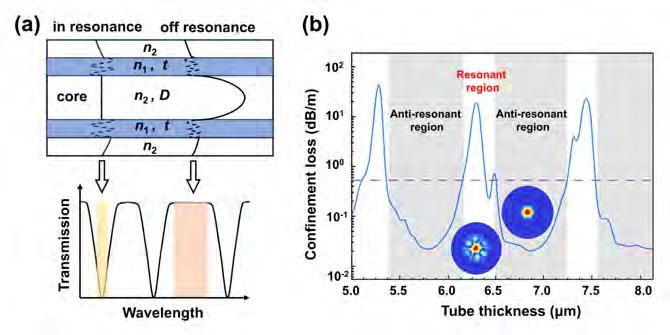
Figure1 (a)Illustrationofthelight-guidingprincipleinanHC-ARF(adaptedfromRef.[9]).(b)Modesimulationofthe LP01 modeinthe HC-ARFunderresonantandanti-resonantconditions(adaptedfromRef.[10]).
TheARROWtheoryelucidatestheformationmechanismofdiscretehigh-transmissionbandsintheoptical transmissionspectraoffibers.Itdemonstratesthatboththespectralpositionsandbandwidthsofthesebands inHC-ARFsprimarilydependonthecapillarywallthickness,theRIoftheaircore,andtheRIofthe capillarywallmaterial.Thistheoryprovidesthefundamentalframeworkforunderstandingtheoptical transmissioncharacteristicsofHC-ARFs.
Inaddition,becauseboththecoreandcladdingtubesofanHC-ARFarefilledwithairandthussharethe sameRI,stablewaveguidemodescanexistinbothregionswhentheanti-resonantconditionissatisfied. WhentheeffectiveRIofthecoreandcladding-tubemodesapproacheachother,energytransferbetween thesemodesoccurs,leadingtoleakageofcore-modeenergythroughthecladdingandaconsequentincrease inopticalloss.Figure2providesanintuitiveillustrationoftheICprinciple[11].Itcanbeobservedthatasthe diameterofthecladdingtuberinggraduallyincreases,theeffectiveRIofthecladdinglike-LP01 modealso increasescorrespondingly.WhentheeffectiveRIofthelike-LP01 modeinthecladdingtuberingandthe higher-ordercoremode(LP11)coincide,modecouplingoccurs,resultinginenergyleakageofthehigherordermode.Furthermore,basedonthevariationtrendoftheeffectiveRIofthesemodes,itisevidentthatif thetube-ringdiameterisfurtherincreased,thelike-LP01 modeinthecladdingtuberingstronglycoupleswith thecoreLP01 mode,leadingtosubstantialopticalloss.
Therefore,tominimizeenergyleakagefromthecore,thefiberdesignmustsimultaneouslysatisfytheantiresonantconditionandsuppresscouplingbetweenthefundamentalcoremodeandthecladding-tubemodes. Thiscanbeachievedbyoptimizingthecladdingtubeconfiguration,suchasreducingthecapillary-to-core diameterratioorincorporatingnestedstructures,toincreasetheeffectiveRIdifferenceandmitigatemodecouplingloss.Conversely,selectivelyenhancingthecouplingofhigher-ordercoremodesfacilitatestheir leakage,therebyimprovingthefiber’ssingle-modeperformance.
PERFORMANCEOPTIMIZATIONOFHC-ARFGASSENSORS
Fiber-opticgassensorscombineconventionalspectroscopictechniqueswithopticalfibertechnologyto

identifygasspeciesandquantifytheirconcentrationsbymonitoringvariationsinlightproperties,suchas intensity,wavelength,frequency,phase,andpolarization,inducedbylight-gasinteractions.Keyperformance metricsforthesesensorsincludesensitivity,limitofdetection(LoD),andresponsetime[12].Inpractical applications,additionalfactorssuchaslong-termstability,selectivity,andrepeatabilitymustalsobeconsidered[13].CurrentresearchonHC-ARF-basedgassensorsfocusesonenhancingmeasurementaccuracy, shorteningresponsetime,andenablingmulti-gasdetection.Toachievethesegoals,researchershavepursued performanceimprovementsthroughstructuraloptimization,materialselection,microchannelfabrication, andsurfacemodification.
Structuraloptimization
Buildingonacomprehensiveunderstandingofthelight-guidingmechanisminHC-ARFs,researchershave achievedlow-loss,single-modetransmissionoverabroadspectralrangebyrefiningthedesignandoptimizingthestructuralparametersofthefiber.
SincethefirstHC-ARFwasreported(Figure3a)[14],numerousnovelfiberstructureshavebeendesigned andfabricated.In2011,Wang etal.[15]identifiedtheshapeofthecore’sinnerwallastheprimaryfactor influencingtransmissionperformance.Byoptimizingthisgeometry,anHCFwithahypocycloid-shaped innerwall,latertermedthenegative-curvatureHCF,wasfabricatedin2012,achievingrecord-lowloss (Figure3b)[16].Inthesameyear,theintroductionofHC-ARFsfeaturinganice-cream-cone-shaped claddingextendedthetransmissionwindowfromthevisibletothemid-infrared(MIR)region(Figure3c) [17].However,inbothdesigns,“Fanoresonances”inducedbyjunctionsbetweencladdingtubesincreased transmissionloss.Node-lessHC-ARFsweresubsequentlydevelopedtosignificantlyreducebendingloss andbroadenthetransmissionbandwidth(Figure3d)[18].In2018,Gao etal.[19]successfullyfabricateda conjoined-tubeHC-ARF(Figure3e).Bypreciselycontrollingparameters,theymitigatedtheadverseeffects ofcouplingbetweencladdingandcoremodesatthenodes,therebyreducingfiberloss.Subsequently, researchersdiscoveredthatincorporatingnestedstructuresincreasestheeffectiveRIdifferencebetweenthe corefundamentalmodeandthecladdingtubemodes,whichreducesmodecouplingandenhancesoptical
Figure2 Themodalcontentsincoreandtubes[11].
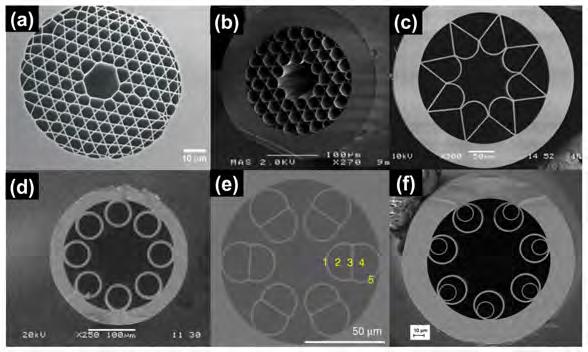
Figure3 Scanningelectronmicroscopy(SEM)imagesofHC-ARFs.(a)ThefirstKagometypefiber[14].(b)Negativecurvaturefiber [16].(c)Ice-cream-coneHC-ARF[17].(d)Node-lessHC-ARF[18].(e)ConjoinedtubeHC-ARF[19].(f)NestedHC-ARF[21].
fieldconfinement.HC-ARFswithnestedstructuresexhibitbroadertransmissionbandwidths,lowerlosses, andimprovedsingle-modetransmissionperformance(Figure3f)[20,21].
Recently,advancesinunderstandingthelight-guidingmechanismsofHC-ARFshavepromotedthediversificationandfunctionalizationoftheirstructuraldesigns.AsillustratedinFigure4,researchershave proposedvariousnovelHC-ARFconfigurationsthatachievesubstantialreductionsintransmissionloss acrossspecificwavelengthbandsthroughoptimizedopticalfieldconfinementandmodecontrol[22–29]. SomeofthesedesignshavedemonstratedpropagationlossesontheorderofdBkm 1.However,suchlowlossfibersarecurrentlyemployedmainlyinapplicationswithstringentlossrequirements,suchashighpowerlaserdeliveryandbroadbandopticalcommunications.Moreover,asstructuraldesignsbecomeincreasinglysophisticated,existingfabricationtechniquesencountergrowingchallengesandlimitations, therebyconstrainingfurtherengineeringapplicationsandperformanceoptimization.
Substratematerialselection
TheMIRspectralregion,spanning2.5–13μm,isofcriticalimportanceforgassensingbecausemanygas moleculesexhibitstrongro-vibrationaltransitionswithinthisrange,leadingtofundamentalvibrational absorptionbands.Thesefundamentalabsorptionpeaksaretypically2–3ordersofmagnitudestrongerthan thecorrespondingovertonepeaksinthenear-infrared(NIR)region(0.75–2.5μm).Consequently,extending theoperatingwindowofHC-ARFsintotheMIRregionenablesmoresensitivedetectionofabroaderrange ofgases.
Accordingtothelight-guidingprincipleofHC-ARFs,oneeffectiveapproachtoreducingtransmissionloss intheMIRbandistooptimizethegeometricdesignofthefiber,therebyminimizingtheoverlapbetweenthe coremodefieldandthemicrostructuredcladding.In2023,Belardi’steam[30]attheUniversityofLille shiftedthetransmissionwindowtowardlongerwavelengthsbyincreasingthefibercorediameterandthe wallthicknessofcladdingquartzglasstubes,achievingaminimumlossof0.22dBm 1 at4.6μminan eight-tubesingle-ringHC-ARF.In2024,Arman etal.[31]firstoptimizedthecladdingtubedimensionsand corediameterofaseven-tubesingle-ringHC-ARF,reducingtheconfinementloss(CL)ofthefiberto3.5×
NatlSciOpen,2026,Vol.5,20250049
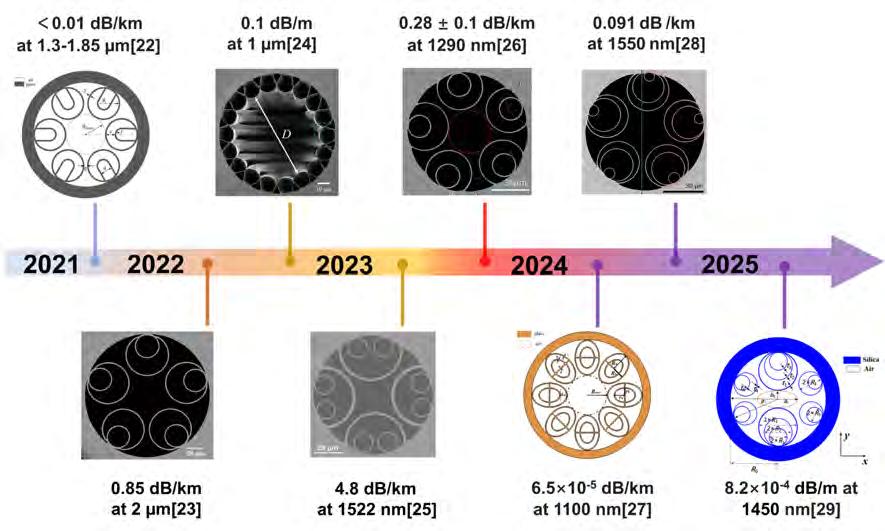
Figure4 Cross-sectionsofrecentlydevelopedlow-lossHC-ARFs[22–29].
10 2 dBm 1 at3.3μm.Theysubsequentlyintroducednestedtubeswithinthecladdingtoconstructamore efficientanti-resonantstructure,aimingtofurthersuppressleakageloss.Simulationresultsshowedthatthe CLvaluesofthesecondarystructurewithnestedelementsandthetertiarystructurewithnested-in-nested ringsweresignificantlylowerthanthoseoftheoriginalconfiguration,withrespectivelossesof3.5×10 2 , 4.76×10 3,and1.85×10 4 dBm 1.However,duetotheintrinsicabsorptionofsilica,furtherreducing transmissionlossintheMIRbandremainschallenging,makingitdifficulttoextendtheoperatingwavelengthbeyond4.5μm[32].
ChalcogenideandtelluriteglassesexhibithightransparencyandbroadtransmissionwindowsintheMIR band,thusenablingeffectiveovercomingoftheabovelimitationswhenusedasthesubstratematerials.In 2024,Zhu etal.[33]designedandfabricatedatellurite-basedHC-ARFthatexhibitsmultiplelow-loss transmissionbandsacrossthe3–6μmrange.Itstheoreticallossintheanti-resonantbandscouldbereduced to0.1dBm 1 throughfurtherstructuraloptimization.Inthefollowingyear,theyoptimizedthefabrication processthroughprecisepressurecontrol,achievingarecord-lowlossof0.3±0.02dBm 1 at4.65μmand extendingthetransmissioncapabilityupto10μm[34].In2021,Yao etal.[35]reportedaMIRabsorption spectroscopysystembasedonatelluriteHC-ARFcoupledwithaquantumcascadelaser(QCL),achieving highlysensitiveNOdetectionat5.26μm.Additionally,severallow-losschalcogenideHC-ARFshavebeen developedforbroadbandMIRoperation.He etal.[36]firstdesignedandsuccessfullyfabricatedalargemode-area,all-solidchalcogenideanti-resonantfiberoperatingintheMIRspectralrangeof4.5–7.5μm,with aminimumlossof7dBm 1 at4.8μm.Zhang etal.[37]laterdesignedaseven-holechalcogenideHC-ARF withtouchingcladdingcapillaries,fabricatedfrompurifiedAs40S60 glassusingthe“stack-and-draw” techniquecombinedwithdualgas-pathpressurecontrol,achievingameasuredfiberlossaslowas 1.29dBm 1 at4.79μm.Subsequently,byoptimizingthefiberstructureintoasix-cellnodelessHC-ARF,
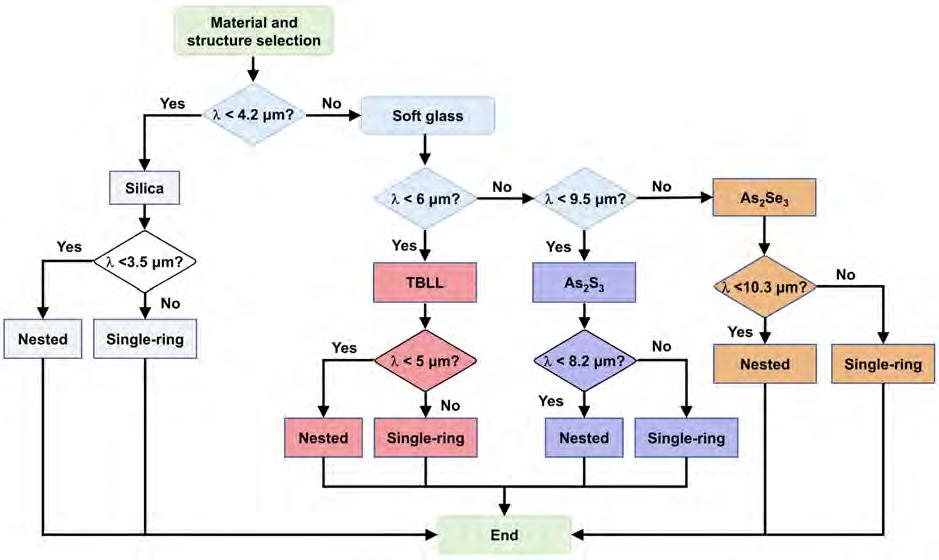
Figure5 SelectionprocessofmaterialsandcladdingstructuresforHC-ARFsacrossdifferentwavelengthregions(adaptedfromRef.[43]).
theyfurtherreducedthelossat4.79μmto0.56dBm 1 [10].However,telluritefibershavedifficulty operatingbeyond6μmduetophononenergylimitations[38].Incontrast,chalcogenideglassesexhibit excellenttransparencyacrossthe2–11μmrange,alongwithstablephysicochemicalpropertiesandstrong glass-formingability,makingthempromisingcandidatesforhigh-transmittanceopticalfibersinthelongwaveinfrared(LWIR)region[39].In2016,Gattass etal.[40]fabricatedanHC-ARFfromchalcogenide glassviaextrusionmolding,achievingalow-losswindowspanning9.5–11.5μmintheLWIRregion,witha minimumlossof2.1dBm 1 at10μm.Inasimilarvein,Hayashi etal.[41]developedachalcogenideglassbasedHC-ARF,extendingitsoperatingwavelengthto11μm.TheseadvancementsdemonstratethefeasibilityofgassensingusingHC-ARFsatultra-longwavelengths.In2023,Hu etal.[42]detectedthestrong absorptionlineofethylene(C2H4)at10.5μmusingachalcogenideHC-ARF,highlightingitspotentialasa promisingplatformforMIRgassensing.
ItisworthnotingthatZhang etal.[43]recentlyproposedananalyticalframeworkforevaluatingthetotal lossofsingle-ringandnestedtubularHC-ARFsfabricatedfromsilica,tellurite,andchalcogenideglasses. TheysystematicallyinvestigatedtheeffectsofRI,materialabsorption,andcladdingstructureonvariousloss mechanismsandpresentedadecision-makingprocessforselectingfibermaterialsandcladdingstructures basedontheoperatingwavelength,asshowninFigure5.Theresultsofferacomprehensiveguidelinefor materialselectionandstructuraloptimizationtoenhancethetransmissionperformanceofMIRHC-ARFs.
Microstructuralprocessing
AccordingtotheBeer-Lambertlaw,laser-basedgasspectroscopyreliesontheinteractionpathlength
betweenlightandtargetgasmolecules.Therefore,increasingtheopticalpathlengthistypicallyemployedto enhancesensorsensitivity.However,duetocoresizeconstraints,dependingsolelyonpassivegasdiffusion inHC-ARFsresultsinlonggas-fillingtimesforlongfiberlengths.Althoughpressure-assistedfilling significantlyreducestheresponsetime,itincreasesthecomplexityofthesensingdevice.Thedevelopment ofprecisionmachiningtechnologyenablesthefabricationofmicrochannelsonopticalfibersandoffersnovel approachestoimprovingtheresponsetimeofHC-ARF-basedsensors.Sinceopticalfibersarebrittlematerials,non-contactprocessingmethodssuchasfemtosecondlaser(FSL)orfocusedionbeam(FIB)can reducemechanicaldamageandefficientlyetchmicrochannelstructuresonthesurfaceoffibers.FIBhasthe advantagesofhighprecision,highresolution,andlowdamage,buttheetchingspeedisexceedinglyslow, andtheeffectiveprocessingrangeofFIBcanbelimitedduringhigh-precisionprocessing[44,45].Withits ultra-narrowpulsewidthandextremelyhighpeakintensity,FSLhasbecomeanimportanttoolforthe fabricationofopticalfibersensorswithnovelmicrostructures.Byfocusingthelaserbeaminsidethe material,thelasercantriggernonlinearinteractionsinthefocusingregiontofabricatespecificmicrostructures.However,certaintransmissionlossoccursduringthefabricationofmicrochannelsbyFSL,which ismainlyattributedtolocaldamageofthefiberstructureorglassdebrisgeneratedduringthelaserablation process[46,47].
In2021,Kozioł etal.[48]determinedtheoptimallaserprocessingparametersbycontrolledexperiments andprocessed25microchannels,withtheprocessresultinginonlyalowtransmissionlossof0.17dB.In 2025,thesameresearchteaminvestigatedtheinfluenceofmicrochannelsongasdiffusionratesusingalowlossmicrochannelfabricationapproach[49].Theresultsdemonstratedthatincreasingthenumberofmicrochannelssignificantlyacceleratedgasdiffusion,reducingthediffusiontimefromapproximately6hto 330swhenallmicrochannelswerefullyopened.Furtherexperimentswithdifferentinter-channelspacings (15,31,and62cm)confirmedthatshorterspacingmarkedlyenhancedthediffusionrate.Moreover,the diffusiontimewasfoundtobeindependentofthetotalfiberlengthwhentheinter-channelspacingremained constant,underscoringthegeneralapplicabilityofthemicrochanneldesign.Similarly,Liu etal.[50]employedFSLprocessingtofabricatemicroholesinHCFsforbarometricpressuresensing.Experimental resultsrevealedthattheresponsespeedoftheten-holesensorwasapproximatelytwicethatofthesingle-hole sensor.Thissignificantenhancementinresponsespeedisattributedtotheimprovedgasdiffusionpathways providedbytheFSL-fabricatedmicroporouschannels,whicheffectivelyenhancegasdiffusionefficiency.
FSLmicrochannelfabricationhasemergedasaneffectivemethodtoimprovetheresponsespeedofHCARF-basedgassensors[51–53].Figure6showsscanningelectronmicroscopy(SEM)imagesofmicrochannelsfabricatedinHC-ARFsusingFSL[49,54–56].However,themechanismsbywhichmicrochannel size,geometry,anddistributioninfluenceopticalattenuationremaintobesystematicallyclarified.Furthermore,substantialopportunitiesexisttoenhancestructuralfabricationquality,geometricprecision,and processflexibility.
Surfacemodification
Withtheadvancementofnanotechnology,thedesignstrategyoffiber-opticgassensorshasincreasingly focusedonfunctionalizationusingsensitivematerials.Two-dimensionalmaterialssuchasgraphene,transitionmetaldichalcogenides,andblackphosphoruscansignificantlyenhancetheadsorptioncapacityofgas
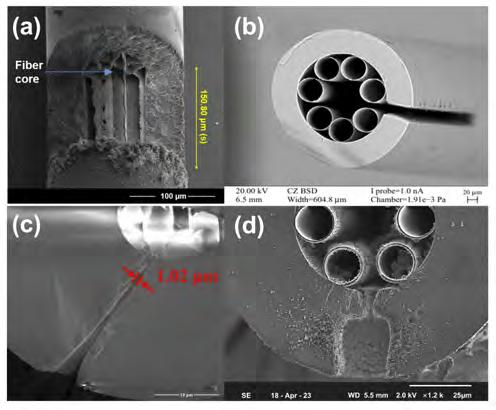
Figure6 SEMimagesofmicrochannels.(a)Aslotmachinedonthefiberwithmaterialremoveddowntothebottomsurfaceofthehollow core[54].(b)SEMimageofasinglechannelcross-section[49].(c)Thecorediameteroftheside-drilledmicrochannelonthefiberis approximately1.02μmnearthehollowcoreregion[55].(d)SEMimagesofthecleavedendofthemicro-drilledopticalfiber[56].
molecules.Whenthefunctionalizedcoatinginteractswithatargetgas,itspropertieschange,resultingina changeintheoutputopticalsignal.Thismethodofcoatingsensitivemembraneshasbeensuccessfully appliedinevanescentwavefiber-opticgassensors[57–61]andphotoniccrystalfiber(PCF)-basedgas sensors[62,63].However,withinHC-ARFs,suchfunctionalizationhasbeenprimarilyexploredforbiosensingapplications[64–66],withrelativelyfewstudiesfocusedongasdetection.In2021,Liu etal.[67] demonstratedthe insitu constructionofaZnO-Bi2O3 nanosheetheterojunctionontheinnerwallofanHCARF.ByexploitingtheRIvariationinducedbytheinteractionbetweentheheterojunctionandacetone moleculestomodulatetheopticalsignal,theyachievedhighlysensitiveandselectiveacetonedetectionat roomtemperature,demonstratingthepotentialofthisapproachforearlybreath-diagnosisapplications.
Inaddition,thesurfaceplasmonresonance(SPR)effectcanbeintroducedbymodifyingthemicrostructuredfiberswithmetallicmaterialsthroughfillingorcoating.SPRisaresonantopticalcoupling phenomenonoccurringattheinterfacebetweenametalandadielectric.Whenabeamoflightisincidentat thisinterfaceataspecificfrequencyandangle,itexcitesthefreeelectronsonthemetalsurfacetooscillate collectively,generatingsurfaceplasmons.Whentheplasmonexistsataspecificfrequency,itiscalleda surfaceplasmonwave(SPW).ResonantcouplingoccurswhenthewavevectorsoftheexternalelectromagneticwaveandtheSPWmatch,whichistheSPReffect[68].Li etal.[69]firstreportedanHC-ARF methane(CH4)sensorbasedontheSPReffect.AsillustratedinFigure7a,whenlightisincidentatthe interfacebetweenthecoreandthegold-coatedantiresonanttubes,SPWsareexcited,allowingpartofthe opticalenergytocoupleintosurfaceplasmonmodesandproduceadistinctattenuationpeak(Figure7b).The RIofthegas-sensitivelayercoveringthegoldfilmdecreaseslinearlywithincreasingCH4 concentration, therebymodifyingthephase-matchingconditionforSPRandresultinginablueshiftoftheattenuationpeak inthetransmissionspectrum(Figure7c).Bymonitoringtheresonantwavelengthshiftinrealtimewithan opticalspectrumanalyzer(OSA),highlysensitiveCH4 detectionwasachieved,exhibitingasensitivityof 5.54nm·% 1—superiortomostreportedopticalfiber-basedCH4 sensors.
NatlSciOpen,2026,Vol.5,20250049
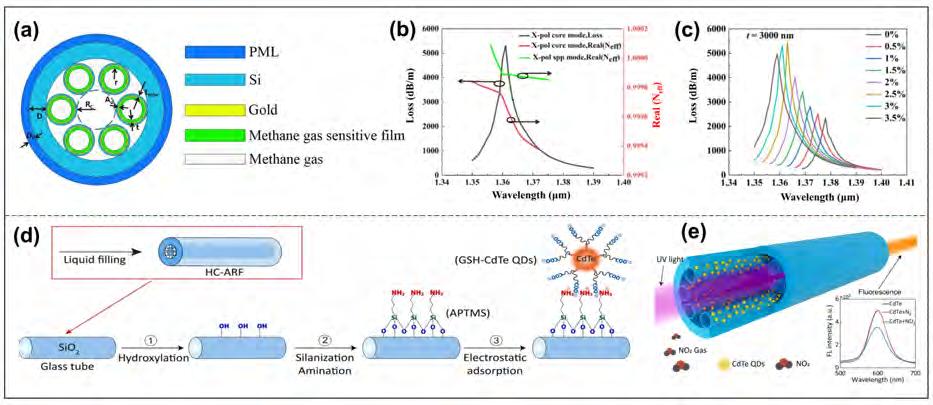
Figure7 SurfacefunctionalizationstrategiesforHC-ARFs.(a–c)SPR-basedopticalfiberCH4 gassensor[69]:(a)Cross-sectionalofthe HC-ARF;(b)X-polcoremodeseffectiveRIandlossspectrum;(c)thelossspectrumwithintherangeofCH4 concentrationfrom0to3.5%. (d,e)HC-ARFgassensorfunctionalizedwithGSH-CdTeQDs[76]:(d)immobilizationprocessofCdTeQDsinsidetheHC-ARF; (e)illustrationofNO2 gas-inducedfluorescencequenching.
Furthermore,theSPReffectservesasamajorcontributortotheelectromagneticmechanism(EM),which, togetherwiththechemicalmechanism(CM),constitutestheenhancementmechanismsofsurface-enhanced Ramanspectroscopy(SERS)[70].Whenmoleculesadsorbontothesurfaceofnoblemetalnanostructures, suchasgoldorsilver,thelocalizedsurfaceplasmonresonance(LSPR)effectgeneratesastronglyenhanced electromagneticfieldin“hotspots,”includingnanogapsorsharptips,whichconstitutestheprimarysource ofSERSenhancement(EM).Additionally,chemicalinteractionssuchaschargetransferbetweenthemetal surfaceandtheadsorbedmoleculescanalterthemolecularpolarizability,providingsupplementaryenhancement(CM)[71].ComparedwithconventionalRamanscattering,theSERStechniquecanenhancethe Ramanscatteringcross-sectionofanalytesbyupto15ordersofmagnitude,andtheRamansignaloftarget moleculescanbeintensifiedbyseveralordersofmagnitude[72].TheintegrationofSERSwithHC-ARFs allowsthehollowcoretofunctionasamicrocavityforreactionandsignalenhancement,wheretheextended interactionpathlengthimprovesthereproducibilityandreliabilityofSERSsignals.Sincethesampleflows insidethefiberandinteractsdirectlywithboththelightandtheSERSsubstrate,thisconfigurationis particularlysuitablefor insitu oronlinedetectionoffluidsamples(gasesorliquids).However,duetothelow concentrationofgasmoleculesandthelimitedcontactareabetweenanalytesandnanoparticles,theSERS signalintensityisgenerallyweakforgaseousspecies,andamatureopticalfiberSERS-basedgasdetection strategyhasnotyetbeenestablished[73].Consequently,mostcurrentapplicationsremainfocusedonliquidphasedetection[66,74,75].Notably,Gao etal.[76]proposedanovelapproachforhighlysensitivenitrogen dioxide(NO2)detectionbyfunctionalizinganHC-ARFwithquantumdots(QDs).Theyimmobilizedglutathione(GSH)-cappedCdTeQDsontheinnersurfaceofthefiberviaaself-assemblyprocess,asillustrated inFigure7d,e.Leveragingthefluorescence-quenchingeffectoftheQDs,thefluorescenceintensitychanges uponinteractionbetweenNO2 moleculesandthecappedQDs.Thissensorenablesrapidandefficient detectionofNO2 atconcentrationsaslowas0.1ppm,withasamplingtimeofonlyafewminutes,significantlyfasterthanmanynon-fiber-opticsystems.
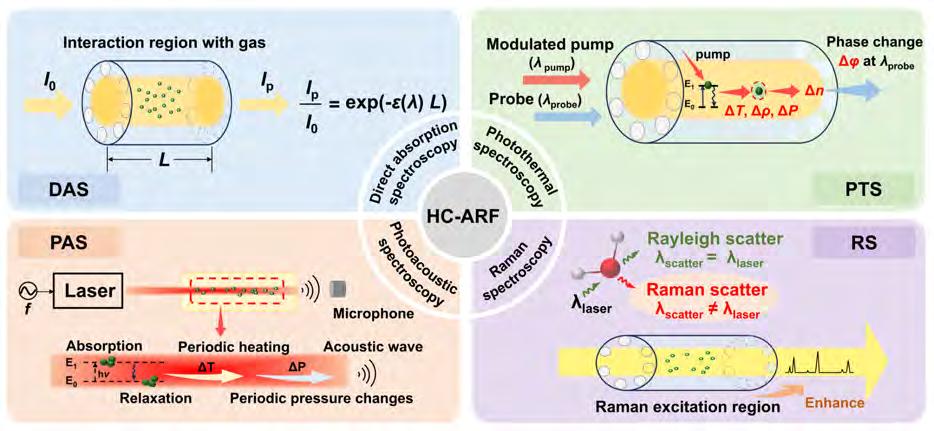
FunctionalizationofHC-ARFsbyselectivelyfillingorcoatingfunctionalizedmaterialsintoallorpartof theairholessignificantlyimprovestheselectivityandsensitivityoftheresultinggassensors.Thisapproach facilitatesthedevelopmentofsensorswithhighselectivityandhighsensitivity.However,amajortechnical challengeliesinachievingauniformandstabledistributionofnanoparticlesonthecomplexinner-wall geometryofHCFs.Currently,surface-modifiedHC-ARFgassensorsremainatanearlydevelopmental stage,andthereisstillsubstantialscopeforfurtherresearch.
ADVANCESINHC-ARFGASSENSINGRESEARCH
HC-ARFscansimultaneouslyserveasopticalwaveguidesandmicro-volumegascells,providinganefficient platformfortracegasdetection.AsillustratedinFigure8,basedontheprinciplethatlight-gasinteractions inducedistinctopticaleffects,researchershavedevelopedHC-ARF-basedsensingplatformsutilizingDAS, photothermalspectroscopy(PTS),photoacousticspectroscopy(PAS),andRSforhighlysensitivegasdetection(Figure8).Onthisbasis,wavelengthmodulationspectroscopy(WMS)andfrequencymodulation spectroscopy(FMS)canbeemployedbyapplyingwavelengthmodulationorfrequencymodulationtothe pumplaser,respectively.Utilizingthesedistinctprinciplesandtheircorrespondingmodulationtechniques, thesensorscanachievehighsensitivity,goodinterferenceresistance,andlong-termstability,offering excellentsolutionsfortracegassensinginpracticalapplications.
Directabsorptionspectroscopyanditsderivativetechniques
Laserabsorptionspectroscopy(LAS)isoneofthemostwidelyusedtechniquesinlaser-basedgassensing, withapplicationsacrossindustrial,environmental,andbiomedicalfields.Thismethodisgovernedbythe Beer-Lambertlaw(Eq.(2)),whichstatesthatselectiveabsorptionoflaserlightatspecificwavelengthsby
Figure8 SchematicofrepresentativelaserspectroscopyprinciplesbasedonHC-ARFs.
targetgasmoleculescausesattenuationofthetransmittedlightintensity[12].AmongLAStechniques, tunablediodelaserabsorptionspectroscopy(TDLAS)isparticularlyprominent,offeringhighlysensitiveand selectivegasdetectionwitharelativelysimpleandcost-effectiveopticalconfiguration[77].However, becausethisapproachreliesonmeasuringthedifferencebetweenincidentandtransmittedlightintensities, thesensor’sperformanceandaccuracyareinherentlylimited.Toaddressthislimitation,PTSandPAS,which employindirectdetectionmechanisms,havegainedincreasingresearchinterest.Insteadofdirectlymeasuringlightintensity,PTSandPASdetectthethermaloracousticresponsesgeneratedbytheabsorptionof lightenergybygasmolecules,therebyachievinghigh-sensitivitydetectionwithanalmostzerobackground [78].SubstantialprogresshasbeenachievedindevelopingHC-ARF-basedgassensorsthatintegrate TDLAS,PTS,andPAStechniques.
where Ip isthelightintensityafterpassingthroughthegassample, I0 istheincidentlightintensity, ε isthe absorptioncoefficientofthegas, λ isthewavelengthofthelightexpressedinwavenumber,and L isthelightgasinteractionpathlength.
Tunablediodelaserabsorptionspectroscopy
TDLASisahighlysensitiveandstraightforwardlaserspectroscopictechniquederivedfromDAS.Bytuning thediodelaser’stemperatureorcurrenttovaryitswavelength,thelaserscansacrossanabsorptionlineofthe targetmolecule.Theresultingabsorptionoflightproducesanabsorptionspectrumsignalproportionaltothe absorptionintensity,enablingthemeasurementofrelevantgasparameters[79,80].
DAScanbeimplementedusingasimplesetupconsistingofalaser,anopticalfiber,andaphotodetector (PD).Itenablesasimpleandintuitivevisualizationofthe“fingerprint”ofgasmolecules,i.e.,theircharacteristicabsorptionspectrum.Increasingtheopticalpathlengthforlight-gasinteractionsignificantlyimprovesthesensorsensitivity.HC-ARFiscapableofachievingstrongopticalconfinement,providingaviable approachtoachievingacompactandstablelongopticalpath.AsshowninFigure9a,Chai etal.[81] developedanall-fibergassensorthat,byusinga5-m-longHC-ARFandadistributedfeedback(DFB)laser centeredat2004.3nm,alongwithaT-shapedthree-wayvalveforgasfillingandopticalcoupling,achieveda lowestLoDattheppblevel.
Additionally,sensoraccuracycanbefurtherenhancedbyselectingMIRspectralbandswithstronger absorptionlineintensities.UtilizingatunableDFBMIRinterbandcascadelaser(ICL)operatingatoneofthe strongestabsorptiontransitionsofmethane(3057.71cm 1),Gomółka etal.[82]achievedppb-levelhighly efficientmethanedetection.However,thelightintensitysignalinDASisvulnerabletolow-frequencynoise interference,degradingtheacquiredabsorptionspectrumqualityandrestrictingdetectionsensitivity.The modulationspectroscopytechnique,developedbycombiningmodulationtechniqueswithtunablelasers,is abletosuppressnoiseandimprovethesensorperformance.
WMSemployslow-frequencylaserscanningwithasuperimposedhigh-frequencysinusoidalmodulation atafrequencyof f.Usingalock-inamplifier,thesecond-harmonic(2f)signalisextractedfromtheabsorption spectrum.This2f signalisapproximatelyproportionaltogasconcentration,enablingthedeterminationofthe targetgasconcentration.Byshiftingtheabsorptionsignaltoahigh-frequencyregion,WMSeffectively
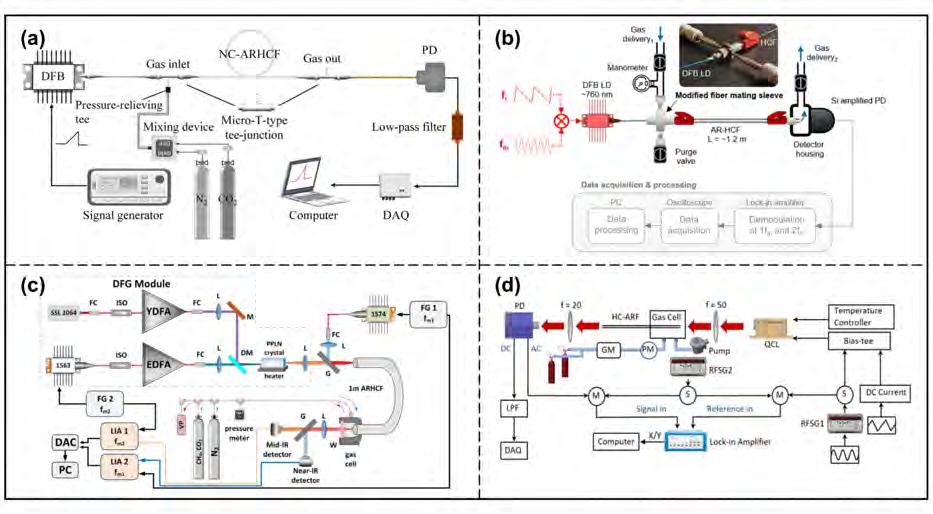
Figure9 HC-ARFgassensorsbasedonTDLAS.(a)DAS-basedCO2 sensor[81].(b)WMS-basedO2 sensor[84].(c)WMS-baseddualgassensorforCO2 andCH4 [2].(d)FMS-basedNOsensor[86]. NatlSciOpen,2026,Vol.5,20250049
suppressestheimpactoflow-frequencynoise,therebyenhancingthesignal-to-noiseratio(SNR)ofthe system[83].ThiswasdemonstratedintheworkofGomółka etal.[84]onanHC-ARF-basedoxygen(O2) sensor.AsillustratedinFigure9b,theexperimentalsetupemployedaDFBlaserdiodemodulatedbya sinusoidalwaveatafrequencyof fm =1kHz,withits2f signalextractedusingalock-inamplifier.Thestudy revealedthatDASstruggledtodistinguishweaksignalsfromthefluctuatingbaselinewhenmeasuringbroad absorptionlines.Incontrast,byoptimizingparameterssuchasmodulationdepthinWMS,aremarkableLoD of170ppmwasultimatelyachieved,significantlyenhancingthesensorperformance.In2020,Jaworski etal. [2]leveragedbroadbandandlow-lossHC-ARFscombinedwithWMStechnologytoachievedual-bandgas detectionintheNIRandMIRregions.AsshowninFigure9c,a1.574μmDFBlaseranda3.334μm differencefrequencygeneration(DFG)sourcewereemployedasexcitationsources,correspondingtothe characteristicabsorptionspectraofCO2 andCH4,respectively.Usinga1m-longfused-silicaHC-ARFwith an84μmcorediameterasthegascell,thesensorachievedminimumLoDsof24ppbforCH4 and144ppm forCO2
InWMS,ahigh-frequencysinusoidalmodulationisappliedtothelaserinjectioncurrent,enablingsmallamplitudeperiodicwavelengthscanningnearthecenteroftheabsorptionline,withmodulationfrequencies typicallyrangingfromseveralkHztotensofkHz.Incontrast,FMSprimarilyemploysdirectcurrent modulationorexternalelectro-opticmodulators(EOMs)toimposephasemodulationonthelaseratfrequenciesspanningfromhundredsofMHztoGHz.Benefitingfromitsextremelyhighmodulationfrequency, FMSeffectivelysuppresseslow-frequencynoise,pushingthesystemnoisetotheshot-noiselimitand therebysignificantlyenhancingdetectionsensitivity[85].Hu etal.[86]utilizeda35-cm-longtelluriteHCARFforFMSdetectionofNO.TheexperimentalsetupisshowninFigure9d,whereacontinuous-wave QCLservedasthelightsource.Thelasercurrentwasdirectlymodulatedbyaradiofrequency(RF)signal
generatortoachievefrequencymodulationintherangeof100–350MHz.TheRFoutputsignalfromthe detectorwassubsequentlydown-convertedto200kHzthroughsignalmixing.Theamplitudeofthein-phase FMS-1f signalwasthenobtainedbyadjustingtherelativephasedifferencebetweentheinputsignalandthe referencesignalfedintothelock-inamplifier.Thesensorexhibitedalinearresponsewithintheconcentration rangeof0–100ppm.Underamodulationdepthof13dBmandamodulationfrequencyof250MHz,the noise-equivalentconcentration(NEC)ofthesensorreached67ppb,representinga22-foldimprovement overDAS.
However,amplitude-basedsignalextractionmethodsarehighlysensitivetoparasiticfluctuationsinlight intensity,andneitherWMSnorFMScanfullyeliminateadditionalopticalsignalvariationscausedbynongaseousabsorptioneffects(e.g.,higher-ordermodeinterference,structuralnon-uniformities,andenvironmentalperturbations)[87–89].Therefore,furtherenhancementofHC-ARF-basedsensorperformancerequiresnotonlyoptimizationofthefiberstructurebutalsoimprovementofthegassensingmethodology.
Photothermalspectroscopy
PTSisaderivativeofLASthathasthepotentialtoachievehighersensitivityoverconventionalTDLAS. UnlikeDAS,PTSdoesnotdirectlymeasuretransmissionspectrumchanges,butratherdetectsthermal effectsinducedbygaslightabsorption.PTSsystemsemployapump-probedual-lightconfiguration:Alaser modulatedbyaspecific-frequencysinewavegeneratespumplightatatargetwavelength,andwhenthis pumplightcouplesintoanHC-ARFcontainingthetargetgas,thegasmoleculesundergonon-radiative relaxation,alteringtemperature,pressure,density,andotherparametersinsidethegascell[90].Theresultant temperaturevariationsinduceperiodicRIfluctuationsinthetargetgas,describedbyEq.(3)[91]:
(3)
where n and ε aretheRIandabsorptioncoefficientofthegassample,respectively, Pexc isthepumppower, T0 istheabsolutetemperature, ρ isthegasdensity, Cp isthespecificheatatconstantpressure,and f isthepump modulationfrequency.ThechangeofΔn intheRIinducesaphaseshiftintheprobelight(Eq.(4))[92]: Ln
(4)
where L denotesthegas-lightinteractionpathlength,and λ istheprobewavelength.Gasconcentration retrievalisachievedbymeasuringthephaseshiftoftheprobelight.Topreventinterferencewiththepumptargetgasinteraction,theprobewavelengthistypicallydetunedfromthetargetgasabsorptionlinecenter. Thisapproachenablestheuseofmaturecommunicationcomponents,eliminatingtheneedforexpensive MIRdetectorsrequiredinconventionalschemes.
HC-ARF-basedPTSenablesefficientpump-probe-gasinteractionswithinthehollowcore.Thisconfigurationsubstantiallyreducessystemvolumeandenhancesoperationalstabilitywhileachievinghighexcitationanddetectionefficiencies.DuetotheminuteRIchanges(∆n~10 9)inducedbyphotothermaleffects, mostPTSgassensorsemployinterferometricarchitecturestoachievehigh-sensitivitydetection.Todate, PTS-basedtracegassensingsystemsemployingvariousinterferometers,suchastheMach-Zehnderinterferometer(MZI),Fabry-Pérotinterferometer(FPI),anddual-modefiberinterferometer,havebeensuccessfullydemonstrated. NatlSciOpen,2026,Vol.5,20250049
MZIoperatesontwo-beaminterferenceprinciples.Theprobelightissplitintoagas-exposedsensingarm andanoise-compensatingreferencearm.ThephotothermaleffectcausesachangeintheRIwithinthe sensingregiontoaltertheopticalpathdifferenceandphasedifferencebetweenthearms.Gasconcentrationis retrievedbyanalyzingthechangeintheinterferencesignalafterbeamrecombination.In2019,Yao etal.[93] demonstratedthefirstHC-ARF-assistedPTSsensorforCOdetection.Thissystememployedatypicalactive homodyneMZIconfiguration,inwhichtheinterferometerwaslockedatitsquadraturepointbywindinga piezoelectrictransducer(PZT)aroundthereferencearmfiberandincorporatingafeedbackservoloop. However,thisactivephase-stabilizationschemenotonlyintroducedmechanicalvibrationnoisefromthe PZTbutalsomadethesystemhighlysusceptibletoenvironmentaldisturbances,resultinginpotentiallock lossandincreasedcomplexity.Tomitigatetheseissues,theteamdevelopedaheterodyneinterferometrybasedPTStechniquein2021[94],eliminatingtheneedforactivestabilizationinconventionalMZIs.As illustratedinFigure10a,thecoreinnovationinvolvedusinganacousto-opticmodulator(AOM)tointroduce a70MHzfrequencyshiftinthereferenceopticalpath,generatingaheterodynebeatnotebetweenthesensing andreferencebeamsatthePD.Thephasevariationinducedbythephotothermaleffectwasdirectlyencoded inthephaseofthisbeatsignalandextractedthroughcascadeddemodulationusingatwo-stagelock-in amplifier.Thisdemodulationmechanismprovidedinherentimmunitytoprobelaserpowerfluctuations. Experimentalresultsconfirmedthatthephotothermalsignalamplituderemainedstableevenwhenthe opticalpowerinthesensingarmwasattenuatedbynearly30dB.Fornitrousoxide(N2O)detectionusinga 3.6μmpumplaser,thisschemeachievedanormalizednoise-equivalentabsorption(NNEA)coefficientof 7.7×10 9 cm 1 WHz 1/2 withina120-cm-longHC-ARF.
IncontrasttoMZI-basedPTSsensors,FPI-PTSsensorsfeatureasimplerdesign,inwhichtwoparallel highlyreflectivemirrorsformafixed-lengthcavitybasedonmultiple-beaminterference.Whengassamples withinthecavityundergophotothermalexcitation,theresultingvariationsinRImodulatethephaseofthe resonatingprobelight.Typically,anHC-ARF-basedFPI-PTSsensorsandwichestheHC-ARFbetween solid-coresingle-modefibers(SMFs)toformanFPI(SMF-FPI)[95].However,thesmallmode-field diameterofSMFsoftencausesamismatchwiththatofHC-ARFs,resultinginsignificantopticalloss.To addressthisissue,Yao etal.[96]improvedthedesignbysplicingtheHC-ARFbetweenathermally expandedcore(TEC)fiberandanindiumfluoride(InF3)multimodefiber(MMF)toconstructalow-finesse F-Pcavity,wheretheflatendfacesofthesolid-corefibersserveascavitymirrors(Figure10b).Inthis configuration,themode-fielddiameteroftheTECfiberisenlargedthroughthermalexpansion,whilethe MMFnaturallypossessesasufficientlylargemode-fielddiameter,effectivelyminimizingopticallosscaused bymode-fieldmismatch.ComparedwiththeSMF-FPI,thisconfigurationincreasedthepumpopticalpower insidetheHC-ARFbyafactorof6.7.PotentialinterferenceresultingfromtheMMF’sbroadbandtransmissionandmultimodecharacteristicswasmitigatedusingopticalfiltersandprecisecouplingalignment. TheexperimentalsetupforgassensingisillustratedinFigure10c.Theprobewavelengthwasactively stabilizedatthequadraturepointoftheinterferometerviaafeedbackcontrolloop.Simultaneously,the injectioncurrentofthepumplaserwasscannedat0.1Hzandmodulatedwithasinusoidalwaveformat frequency f.Theoutputsignalfromphotodetector(PD2)wasdemodulatedatfrequency f usingalock-in amplifiertoobtainthefirstharmonicofthephotothermalinterferencesignal(PTI-1f).Experimentalresults demonstratedthatwatervaporacceleratesthevibrational-translationalrelaxationofspecificmolecules, significantlyenhancingtheamplitudeofthephotothermalsignal[93].Consequently,thesamplegaswas
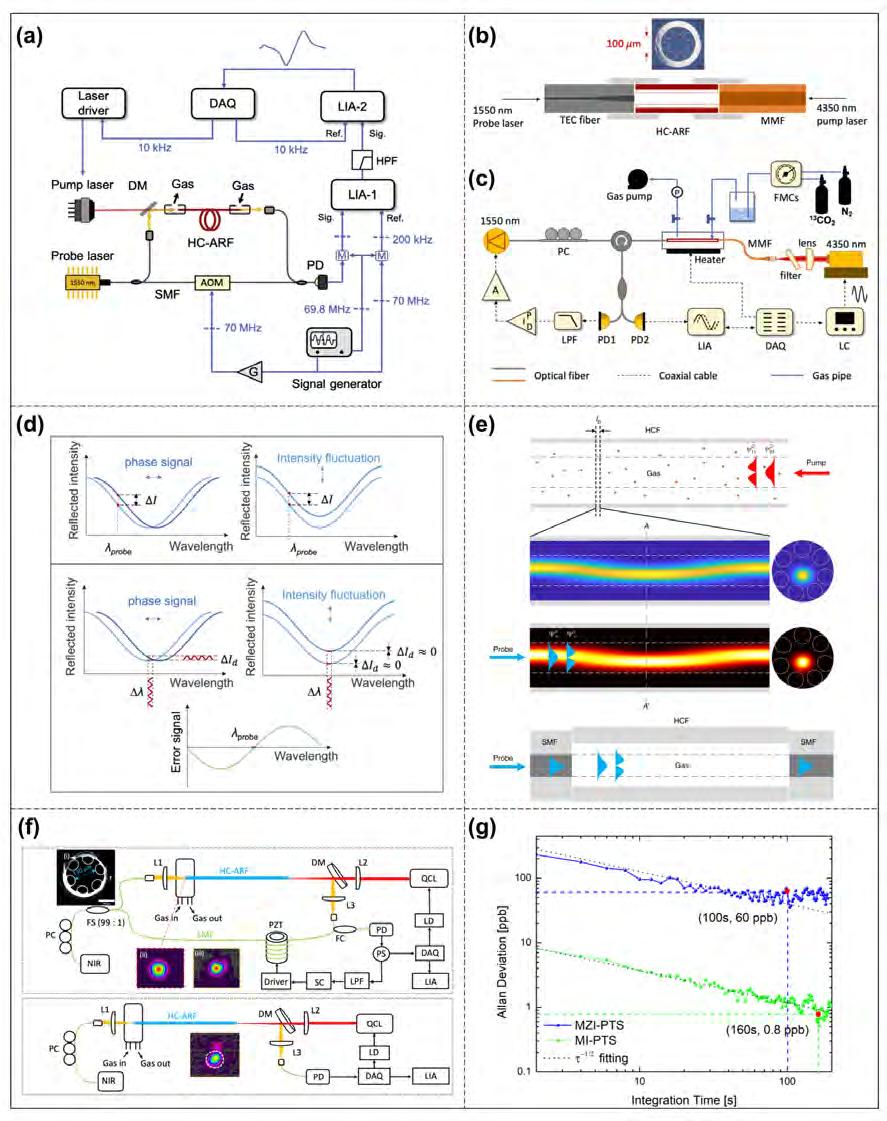
Figure10 HC-ARFgassensorsbasedonPTS.(a)ExperimentalsetupofaheterodyneinterferometricMZI-PTSgassensorbasedonaHCARF[94].(b,c)FPI-PTS-based 13CO2 gassensor[96]:(b)schematicoftheF-Pcavity;(c)schematicoftheexperimentalsetup. (d)ComparisonoftwoFPIsensingprocesses:top,atthequadraturepoint;bottom,attheresonancepointwithwavelengthdither[98]. (e)SchematicoftheMPD-PTSprinciple[51].(f,g)ComparativeexperimentonthesensingperformanceofMZI-PTSandMIPTS[100]: (f)experimentalsetupsof(top)MZI-PTSand(bottom)MI-PTS;(g)Allan-WerledeviationasafunctionofintegrationtimeforbothMZIPTSandMI-PTS.
humidifiedto100%relativehumiditytoimprovesensorsensitivity.Withanintegrationtimeof23s,the LODfor 13CO2 reached1ppb.Extendingtheintegrationtimeto240sfurtherreducedtheLODto0.4ppb, correspondingtoaNEAof1.4×10 7 cm 1.In2025,Jiang etal.[97]developedanall-fiberF-Pcavity configurationemployingfiberBragggratings(FBGs)ascavitymirrors,leveragingtheirhighreflectivityat specificwavelengths.TheHC-ARFwasmechanicallysplicedtotwoFBGsviaaTECadapter,withthefiber endfacesangledat8°tosuppressunwantedreflections.ThisdesignenhancedboththefinesseoftheF-P cavityandthephase-to-intensityconversionefficiencyoftheprobelight.Comparedwiththeconventional SMF-FPI,the1f photothermalsignalamplitudeincreasedfourfold.ForCH4 detection,thissensorachieveda NECof0.7ppmwithanintegrationtimeof100s.
Furthermore,improvingsignaldemodulationtechniquesrepresentsanothercriticalpathwayforenhancing theSNRandstabilityofPTSsystems.Yao etal.[98]departedfromtheconventionalmethodoflockingthe probelaseratthequadraturepointoftheinterferometerandintroducedalaserwavelengthdithering(LWD) lockingtechnique.Inthismethod,thelaserfrequencyislockedtoaresonancepeakoftheFPIwhileahighfrequencysinusoidalditherisappliedforfinemodulation.Theprincipleoferrorsignaldemodulationis illustratedinFigure10d,wherethephotothermalsignalisextractedbydemodulatingtheFPIoutputatthe ditherfrequency.Bycombininghigh-frequencymodulationwithnarrowbanddetection,thistechniqueeffectivelydistinguishesgenuinephasesignalsfromlow-frequencyintensityfluctuationsandexternaldisturbances,therebyprovidingthesensorwithexcellentinterferenceimmunity.InCH4 sensingexperiments, thisapproachachievedaNNEAcoefficientaslowas7.5×10 9 cm 1 WHz 1/2.Thesesensorsclearly demonstratetheadvantagesofintegratingHC-ARFswithphotothermalinterferometry,enablingzerobackgroundmeasurementsandenhancedsensitivitywithinashortenedopticalpath,andserveasavaluable referenceforthedevelopmentofcompact,stable,andhighlysensitiveMIRgassensors[99].
Mode-interferometer-basedphotothermalspectroscopy(MI-PTS)isarecentlydevelopedgassensing techniquedistinguishedbyitshighstability.Thismethod,firstproposedanddemonstratedbyZhao etal.[51] in2020,isreferredtoasmode-phase-differencephotothermalspectroscopy(MPD-PTS).Itsoperating principlereliesondetectingthephasedifferencebetweendistinctguidedmodes(LP01 andLP11)inanHCARF.AsillustratedinFigure10e,whenthepumplightisabsorbedbythetargetgas,theresultinglocalized temperatureriseandRIvariationinducephoto-inducedphasemodulationintheco-propagatingprobelight. BecausetheLP01 andLP11 modesexhibitdistinctfielddistributions,theyexperiencedifferentphaseshifts, allowinggasconcentrationtobedeterminedfromthemeasuredphasedifferencebetweenthetwomodes. TheMPD-PTStechniqueeffectivelysuppressescommon-modeinterferencefromexternalperturbations suchastemperatureandpressure,significantlyenhancestheSNR,andmaintainsalinearrelationship betweenthedetectedPTSsignalandgasconcentration.Experimentalresultsdemonstratethatthismethod achievesasub-pptdetectionlimitforacetyleneatNIRwavelengths(1532nm),alongwithawidedynamic rangeandexcellentlong-termstability.In2025,Hu etal.[100]conductedacomprehensiveinvestigationof thistechnique.Underidenticalexperimentalconditions,theysystematicallycomparedanactivelyservocontrolledMZI-PTSwithapassivelystabilizedMI-PTS,asillustratedinFigure10f.Theresultsclearly demonstratedthesuperiorperformanceofMI-PTSinbothsensitivityandlong-termstability.ForNO detection,theMI-PTSsystemachievedaNECof0.8ppb,comparedwith60ppbforMZI-PTS,representing a75-foldenhancementinsensitivity.Furthermore,theNNEAofMI-PTSwastwoordersofmagnitudebetter thanthatofMZI-PTS(Figure10g).Thisremarkableperformancedifferenceprimarilyarisesfromthe
outstandingcommon-modenoiserejectioncapabilityofMI-PTS,whichresultsinamuchlowernoisefloor thanthatofMZI-PTS,thelatterbeingmoresusceptibletoenvironmentalphaseandelectronicfeedback noise.Inaddition,thefullyfiber-integratedinterferometricarchitectureofMI-PTSeliminatestheneedfor complexopticalbeamsplittersandactivefeedbacksystems,greatlyimprovingintegrationandrobustness.In summary,byingeniouslycombininghighsensitivityandstabilitythroughadifferentialmeasurementmechanism,MI-PTSrepresentsahighlypromisingpathwaytowardthedevelopmentofnext-generation compacttracegassensors.
Photoacousticspectroscopy
TheprincipleofPASisanalogoustothatofPTS:absorptionofpumplightinducescollisionalrelaxationin gasmolecules,leadingtoperiodiclocalpressurefluctuationsthatgenerateacousticwavesatthepumplight’s modulationfrequency[101].InPAS,thephotoacousticeffectistypicallyamplifiedusinganenlarged resonantcelloramulti-passcavity.Theamplitudeofthegeneratedacousticwaves,detectedbymicrophones suchasquartztuningforks(QTFs),cantileverbeams,orfiber-opticmicrophones,correlatesdirectlywiththe gasconcentration.ThemeasuredphotoacousticsignalamplitudeisgivenbyEq.(5):
SSPcF N =+, (5) m1
where Sm isthemicrophonesensitivity, Pl isthepumpopticalpower, F isthecell-specificconstant, α isthe absorptioncoefficientofthegas, c isthetargetgasconcentration,and N representssystemnoise.InPASbasedgasdetectionsystems,acousticsignalsgeneratedbygas-lightinteractionsaremeasuredinsteadof opticalsignals.Consequently,detectorsforphotoacousticspectraexhibitnowavelengthdependence,are immunetoscatteredlighteffects,andfeaturearelativelysimplesystemstructurewithhighsensitivity.
In2021,Zhao etal.[102]demonstratedagassensingplatformbasedonphotoacousticBrillouinspectroscopy(PABS)byintegratingPASwithHC-ARFgassensing.AsillustratedinFigure11a,theHC-ARF simultaneouslyfunctionsasacompactgascellforpumplightabsorptionandacousticwavegeneration,an acousticresonator,andanacousticdetector.Gasmoleculesinsidethefibercoreabsorbthepumplight, generatingthermallyinducedacousticwavesthatareresonantlyamplifiedwithintheHC-ARF.Probelight fromanexternalcavitydiodelaser(ECDL)isco-launchedwiththepumplightintothegas-filledHC-ARF. Usingalateral-offsetcouplingtechnique,bothLP01 andLP11 modesareexcitedintheHC-ARF,forminga dual-modeinterferometerattheoutputSMFfordetectingphotoacousticallyinducedphasechangesinthe probelight.ExperimentalresultsdemonstrateaLoDof8ppbforC2H2 witha100sintegrationtime.Unlike conventionalPAS,thisPABSconfigurationeliminatestheneedforexternalmicrophones,therebyavoiding microphone-inducedacousticmodeinterferenceandenablingamorecompactandstablesystem.Moreover, thedifferentialphasedetectionapproacheffectivelysuppressesnoise,significantlyenhancingthesystem’s immunitytoenvironmentaldisturbances.
BuildingupontheelucidatedmechanismofacousticresonanceenhancementinHC-ARFs,Xu etal.[103] pioneeredthedirectutilizationofHC-ARFasaflexibleacousticresonator(Figure11b).Thiscavity maintainsastableacousticfielddistributionundervariousbendingconditions(Figure11c),establishinga novelpathwayfordevelopingcompactandflexiblePASsensorssuitableforcomplexscenarios.Concurrently,theroleofHC-ARFinPASsystemshasexpandedbeyondmeresensingelementstoencompass
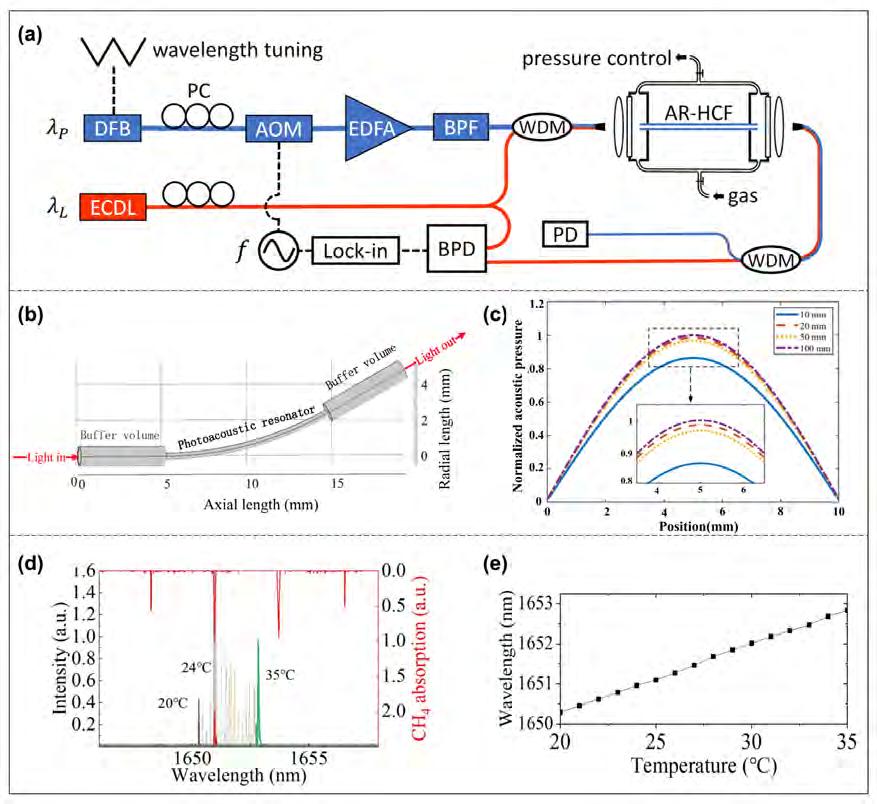
Figure11 ApplicationsofHC-ARFsinPASforgassensing.(a)ExperimentalsetupoftheHC-ARF-basedPABSsystem[102]. (b,c)FlexiblelongitudinalphotoacousticresonatorbasedonHC-ARF[103]:(b)schematicstructureoftheresonator;(c)normalizedacoustic pressureofthesecond-ordereigenmodeinsidetheresonatorunderdifferentbendingradii.(d,e)H2-filledHC-ARFusedasaPASexcitation lightsource[104]:(d)absorptionspectrumofCH4 andlaserspectraaround1650nmatdifferentlasertemperatures;(e)centralwavelengthof thesixth-orderStokeslineasafunctionoflasertemperature.
corelightsources.Recently,Zhang etal.[104]employedafrequencycomb-likeRamanlasergeneratedfrom ahydrogen(H2)-filledHC-ARFastheexcitationsourceforPASdetectionofCH4.Thesixth-orderrotational Stokeslineat1650nmexhibiteddesirablecharacteristicsofhighpulseenergyandnarrowlinewidth.As showninFigure11d,e,theprecisetunabilityofthislightsourceensuresoptimalmatchingwithCH4 absorptionlines,ultimatelyachievinganexceptionaldetectionlimitof550ppb.
However,thenarrowcoreofHCFsresultsinconsiderableacousticenergyloss.Combinedwiththe difficultiesofintegratingminiaturemicrophonesandthesusceptibilityofthesensingsystemtoenvironmentalnoise[105],PAShasseenlimitedapplicationinHCF-basedgassensingandremainsatanearly exploratorystage.Nevertheless,theaforementionedpioneeringstudieshaveestablishedafeasibledevelopmentalpathwaythatwillcontinuetodriveHC-ARF-basedPAStechnologytowardhigh-performancegas
sensing.
Ramanspectroscopy
AlthoughtechniquessuchasTDLAS,PTS,andPASenablehigh-sensitivitygasdetection,theyrequirelasers operatingatspecificwavelengthsfordifferenttargetgasesandareincapableofdetectinghomonuclear diatomicmolecules.RSisagasdetectiontechniquebasedontheRamanscatteringeffect.Bymeasuring Ramanscatteredlightfromlaser-excitedsamples,thistechniquedeterminesmolecularcompositionand concentration.SinceRSdirectlyreflectsmolecularvibrationalandrotationalstructures,itenablesthe detectionofallmoleculargasesexceptmonatomicspecies.TheprincipaladvantageofRSliesinits capabilitytosimultaneouslydetectmultiplegascomponentsusingasingleexcitationwavelength,while offeringstable,repeatable,non-destructive,non-contact,andnon-consumptivemeasurements.However, becausegasesexhibitinherentlysmallRamanscatteringcrosssections,theresultingRamansignalsare typicallyweakwithlowpeakintensities,whichlimitsthepracticalapplicationofRSingassensing[106]. TheRamansignalintensitycanbeexpressedbyEq.(6):
Pm VI , (6) 0 where P istheRamansignalintensity, m isthemoleculardensity, σ istheRamanscatteringcrosssection, V is thevolumeoflight-matterinteraction,and I0 isthelaserpower.Accordingtotheformula,Ramansignal intensitycanbesignificantlyenhancedbyincreasingthegasmoleculardensity,increasingtheRaman scatteringcrosssection,enlargingthelight-matterinteractionvolume,andutilizinghigherlaserpower.
Currently,themainapproachesforenhancingRamansignalsincludecavity-enhancedRamanspectroscopy (CERS)[107],SERS[108],andfiber-enhancedRamanspectroscopy(FERS)[109].BothCERSandSERS provideRamansignalenhancementsofseveralordersofmagnitudecomparedwithconventionalRaman scattering.However,thesemethodstypicallyrequirelargesamplevolumesandexhibitsignificantspectral interference,renderingthemunsuitableforreusableorreal-timeonlinemonitoringsystems.Incontrast, FERShasemergedasapromisingtechniqueformulticomponentgasanalysis,employingHCFsasmicrovolumegascells.Thisconfigurationsubstantiallyincreasestheeffectivelaser-gasinteractionlengthand enhancesthecollectionefficiencyofRaman-scatteredphotons[110].Furthermore,FERSrequiresonlytens ofmicrolitersofsamplegas,demonstratingstrongpotentialfortracegasdetectionapplications.
Buric etal.[111]establishedthefoundationalframeworkforHC-PBGF-basedRamangassensingsystems. Theirsetupemployedtransmission-baseddetectionwithcommerciallyavailablelow-loss(<0.4dBm 1) HC-PBGFs,achievingaStokessignalpowerenhancementofseveralhundred-foldcomparedwithconventionalfree-spacesystems.However,duringlong-term,low-concentrationmulticomponentgasdetection usingHC-PBGFs,sensingperformanceissignificantlydegradedbythesilicaRamanbackground.Unlike HC-PBGFs,HC-ARFsexhibitreducedspatialoverlapbetweenthecoremodeandthecladdingstructure, resultinginlowersusceptibilitytosilicaRamaninterference.
In2023,Wan etal.[112]developedanHC-ARF-basedRamangassensingsystemcapableofhighly sensitiveandsimultaneousmulti-componentdetectionofkeygasesgeneratedduringthermalrunawayof lithium-ionbatteries.Thesystememploysa2-m-longHC-ARFcoupledwithamicro-mirroratitsdistalend andincorporatesadualnoise-reductionstrategythatcombinesregion-of-interest(ROI)selectiononthe
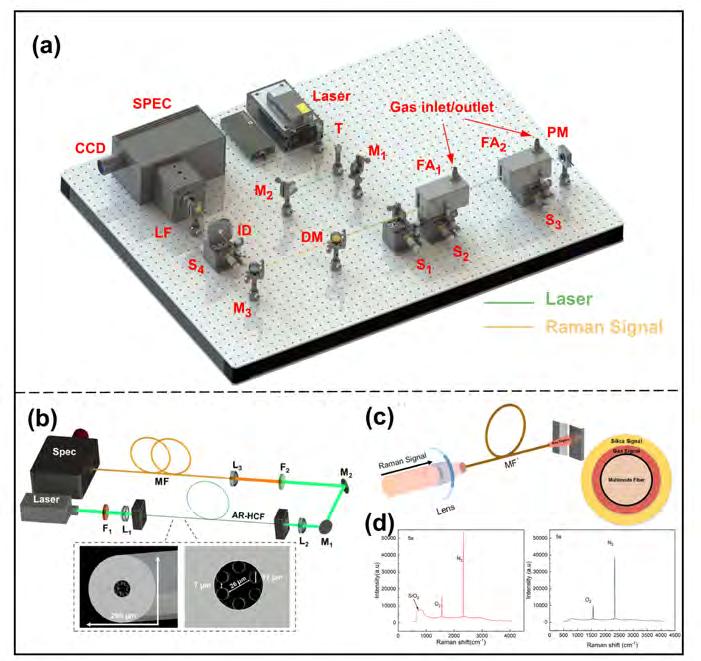
Figure12 HC-ARF-basedFERSgassensors.(a)FERSsetupfordetectingkeygasesgeneratedduringthethermalrunawayoflithium-ion batteries(reproducedfromRef.[112]).(b–d)FERSsensorforCO2 isotopedetection[113]:(b)experimentalsetup(inset:3Dmodeland microscopeimageoftheHC-ARFcrosssection);(c)schematicillustrationofthespatialfilteringprocess;(d)comparisonofRamansignals (left)withoutand(right)withspatialfiltering.
charge-coupleddevice(CCD)withanadjustableirisdiaphragm(ID).ThisconfigurationsubstantiallyenhancesbothRamansignalintensityandtheSNR.AsshowninFigure12a,thesystemachievedppm-level detectionlimitsforsevengases,CH4,C2H6,C2H4,C2H2,CO,CO2,andH2,withina60sintegration time(e.g.,CH4 aslowas0.8ppm),providinganeffectivepathwayfor in-situ andnon-destructiveevaluation ofbatteryhealth.
Incontrast,recentworkbyYang etal.[113]demonstratedthecapabilityofFERScombinedwithHC-ARF forisotope-resolvedgassensing.Toaddressthelimitedsignalcollectionefficiencyperunitlengthcausedby thelownumericalapertureofHC-ARF,thestudyadoptedaforward-scatteringopticalconfigurationand extendedthefiberlengthto5m(Figure12b).Moreover,byexploitingtheattenuationcharacteristicsofthe SiO2 backgroundsignalduringtransmissionandusinga10-μm-core-diameterMMFasa“fiberpinhole”for spatialfiltering,thesystemeffectivelysuppressedcladding-inducedbackgroundinterferenceandsubstantiallyreducedspectralbaselinedrift(Figure12c,d).Underalaserpowerof1.8Wandanintegrationtime of300s,thesystemachieveddetectionlimitsof0.5ppmfor 13C16O2 and1.2ppmfor 12C16O2 inair, demonstratingthestrongpotentialofHC-ARF-basedFERSfortrace-gasmonitoringandisotope-tracing applications.
Otherdetectionmethods
ToexploretheapplicationpotentialofHC-ARFsingassensing,researchershavefocusedonintegrating variousspectroscopicdetectiontechniqueswithHC-ARFs,suchaschirpedlaserdispersionspectroscopy (CLaDS)[114],heterodynephase-sensitivedispersionspectroscopy(HPSDS)[115],andlight-induced thermoelasticspectroscopy(LITES)[116,117].Comparedwithabsorptionspectroscopy,dispersionspectroscopyhasattractedincreasingattentionduetoitsinherentadvantagesofimmunitytolaserpowerfluctuations,calibration-freeoperation,andabroaderdynamicrange[118].Thistechniqueretrievesgasstate parametersbyprobingtheRIvariation(i.e.,dispersion)accompanyingmolecularabsorptionnearresonance frequencies[119].TheCLaDSmethoddetectsinstantaneousfrequencyshiftsinducedbyRIstepswhena chirpedmulti-frequencysignalpropagatesthroughthegassample[120,121].Increasingthechirpsweeprate enhancesthefrequency-shiftsignal,therebyimprovingdetectionsensitivity.Becausespectralinformationis encodedinthefrequencyorphasedomainratherthantheamplitudedomain,CLaDSexhibitsstrongimmunitytoamplitudenoiseandpowerfluctuations[122].WhencombinedwithHC-ARFs,CLaDSbenefits fromthelonginteractionpathandlowopticallossofthefiber,enablingcompact,alignment-free,andhighly sensitivesensingarchitectures[114].However,asafrequency-domaintechnique,CLaDSrequiresanexpensivespectrumanalyzerforhigh-speedfrequencyacquisitionandahigh-bandwidthlasercontrollerto handlerapidmodulation.Incontrast,HPSDSanalyzesgasparametersbydetectingtherelativephaseshift inducedbygasdispersioninatripletopticalsignalgeneratedthroughhigh-frequencyintensitymodulation.It doesnotrequireachirpedlasersourceorhigh-endspectrumanalyzer,offeringasimpleropticallayoutthat facilitatesdataacquisition(DAQ)andconcentrationretrieval[123,124].WhenintegratedwithHC-ARFs, theefficientlightconfinementandreducedbeamdivergencesignificantlyimprovemodulationstabilityand SNR.Nevertheless,sinceHPSDStypicallyoperateswithmodulationfrequenciesinthe100MHz–10GHz range,itimposesstricterperformancerequirementsonthemodulatoranddetectionelectronics.
LITES,alsoknownasquartz-enhancedphotoacousticspectroscopy(QEPAS),isanon-contactdetection techniquebasedonthethermoelasticeffectofaQTF.Itfeatureslowcost,smallfootprint,highsensitivity, andbroadbandspectralapplicability[125].Whenthemodulatedlaserpassesthroughthegasandilluminates theQTFsurface,aportionoftheopticalenergyisabsorbedandconvertedintoheat,whichinducesthermoelasticexpansionandmechanicalvibrationoftheQTF.Owingtoitsresonancecharacteristics,theQTF amplifiesthisvibrationand,viathepiezoelectriceffect,convertsitintoanelectricalsignalcorrespondingto thetargetgasconcentration[126].ThehighsensitivityofLITESdependsonthequalityfactor(Q-factor)of theQTF;thus,designingcustomizedQTFswithhigher Q-factorsandlowerresonancefrequenciesrepresents aneffectiveapproachtofurtherenhancesensorperformance[127].ThecombinationofLITESwithHCARFsenablesin-fiber,compact,andhighlyrobustacousticsensing,astheconfinedlight-gasinteraction regionenhancesphotothermalconversionefficiencyandmechanicalresponse.
Overall,althoughthesetechniquesdifferintheiroperatingprinciples,theirintegrationwithHC-ARFs offerssynergisticadvantages,includingenhancedlight-gasinteraction,improvedSNR,andminiaturized, alignment-freeconfigurations,collectivelycontributingtogreaterstabilityandsensitivityinadvancedgas sensingsystems.
Table1summarizeskeyperformanceparametersofHC-ARF-basedgassensorsemployingdifferent detectiontechniquesreportedinrecentyears.CurrentHC-ARF-basedgassensorsareevolvingtoward
NatlSciOpen,2026,Vol.5,20250049
achievinglowerdetectionlimits,shorterresponsetimes,andmulti-gasdetectioncapabilities.Meanwhile, researcherscontinuetoexplorenovelsensingmechanismsaimedatfurtherreducingsystemnoiseandfully harnessingtheapplicationpotentialofHC-ARF-basedgassensors.
SUMMARYANDPROSPECTS
HC-ARF-basedgassensorshaveachievedremarkableprogressinrecentyears.Asapromisingalternativeto conventionalfree-spaceopticalgassensors,theyprovidenewopportunitiesforgasdetectionwithoutstandingsensitivityandlong-termstability.RationallydesignedHC-ARFsenablelow-loss,single-mode transmissionandcanfunctionascompactgascellswithextendedopticalpathlengths.Whencombinedwith advancedlaserspectroscopytechniques,thesefibersexhibitrobustandversatilegasdetectioncapabilities. SuchcharacteristicsrenderHC-ARF-basedsensorssuitableforawiderangeofpracticalapplications,from cost-effectiveandminiaturizeddevicestohigh-precisiontrace-gasdetectionandremote,distributedmultigassensing.Moreover,theyopennewavenuesforthedevelopmentofdetectionmethodologies,including TDLAS,PTS,PAS,andRS.
However,HC-ARFgassensingtechnologystillfacessubstantialchallengesinpracticalimplementation. Althoughsensorsensitivitytheoreticallyincreaseswithfiberlength,actualperformanceislimitedbyfactors suchaslaserpower,fibertransmissionlosses,andgasexchangeefficiency.Whilemicrochannelfabrication cangreatlyshortengasdiffusiontime,itrequiresexpensiveequipmentandinvolvescomplex,time-consumingprocessesthatincreaseproductioncostsandinevitablyintroduceadditionalopticallosses.Theuseof chalcogenideglassextendsthesensingrangeofHC-ARFsintotheMIRregion;however,itslowmechanical strengthandpoorthermalviscositymakefiberdrawingdifficult,leadingtohigherpropagationlossesand restrictedapplicability.Conversely,integratingadvancedspectraldetectiontechniquessuchasHPSDSand LITESwithHC-ARFshassignificantlyenhanceddetectionaccuracyandnoiseimmunity,effectivelyreducingthedetectionlimit.Lookingforward,breakthroughsinlow-lossfiberfabrication,improvementsin spectroscopicdetectionmethodologies,andtheexplorationofnovelsensingmechanismsareexpectedto substantiallyadvancethepracticaldeploymentandoverallperformanceofHC-ARF-basedgassensors. Insummary,withcontinuedtechnologicalinnovationandexpandingapplicationdomains,HC-ARFgas sensingtechnologyispoisedtobecomeamajorbranchinthefieldofgasdetection,makingsignificant contributionstohealthcarediagnostics,environmentalmonitoring,andindustrialprocesscontrol.
Funding
ThisworkwasfinanciallysupportedbytheNationalNaturalScienceFoundationofChina(62475201)andtheFundamental ResearchFundsfortheCentralUniversities(104972024JYS0045).
Conflictofinterest
Theauthorsdeclarenoconflictofinterest.
References
1PolettiF,WheelerNV,PetrovichMN, etal. Towardshigh-capacityfibre-opticcommunicationsatthespeedoflightin
NatlSciOpen,2026,Vol.5,20250049
vacuum. NatPhoton 2013; 7:279–284.
2JaworskiP,KoziołP,KrzempekK, etal. Antiresonanthollow-corefiber-baseddualgassensorfordetectionof methaneandcarbondioxideinthenear-andmid-infraredregions. Sensors 2020; 20:3813.
3KornaszewskiLW,GayraudN,StoneJM, etal. Mid-infraredmethanedetectioninaphotonicbandgapfiberusinga broadbandopticalparametricoscillator. OptExpress 2007; 15:11219–11224.
4MiaoR,ZhangX,ZhangJ, etal. Hollow-coreanti-resonantopticalfibersforchemicalandbiomedicalsensing. Sens Bio-SensRes 2024; 46:100701.
5YuS,ZhangZ,XiaH, etal. Photon-countingdistributedfree-spacespectroscopy. LightSciAppl 2021; 10:212.
6NikodemM,GomółkaG,KlimczakM, etal. Laserabsorptionspectroscopyat2μminsiderevolver-typeanti-resonant hollowcorefiber. OptExpress 2019; 27:14998–15006.
7HuJ,MenyukCR.Understandingleakymodes:Slabwaveguiderevisited. AdvOptPhoton 2009; 1:58–106.
8LaiCH,SunCK,ChangH.Terahertzantiresonant-reflecting-hollow-waveguide-baseddirectionalcoupleroperatingat antiresonantfrequencies. OptLett 2011; 36:3590–3592.
9LitchinitserNM,AbeeluckAK,HeadleyC, etal. Antiresonantreflectingphotoniccrystalopticalwaveguides. OptLett 2002; 27:1592–1594.
10ChangY,ZhangH,XuY, etal. Low-lossnodelesshollow-coreanti-resonantsoftglassfiberforthe4μmmid-infrared spectralrange. OptExpress 2024; 32:23712–23721.
11ChenX,HuX,YangL, etal. Doublenegativecurvatureanti-resonancehollowcorefiber. OptExpress 2019; 27: 19548–19554.
12HooYL,JinW,ShiC, etal. Designandmodelingofaphotoniccrystalfibergassensor. ApplOpt 2003; 42:3509–3515.
13HodgkinsonJ,TatamRP.Opticalgassensing:Areview. MeasSciTechnol 2013; 24:012004.
14BenabidF,KnightJC,AntonopoulosG, etal. StimulatedRamanscatteringinhydrogen-filledhollow-corephotonic crystalfiber. Science 2002; 298:399–402.
15WangYY,WheelerNV,CounyF, etal. Lowlossbroadbandtransmissioninhypocycloid-coreKagomehollow-core photoniccrystalfiber. OptLett 2011; 36:669–671.
16WangYY,PengX,AlharbiM, etal. Designandfabricationofhollow-corephotoniccrystalfibersforhigh-power ultrashortpulsetransportationandpulsecompression. OptLett 2012; 37:3111–3113.
17YuF,WadsworthWJ,KnightJC.Lowlosssilicahollowcorefibersfor3–4μmspectralregion. OptExpress 2012; 20: 11153–11158.
18KolyadinAN,KosolapovAF,PryamikovAD, etal. Lighttransmissioninnegativecurvaturehollowcorefiberin extremelyhighmateriallossregion. OptExpress 2013; 21:9514–9519.
19GaoS,WangY,DingW, etal. Hollow-coreconjoined-tubenegative-curvaturefibrewithultralowloss. NatCommun 2018; 9:2828.
20HabibMS,Antonio-LopezJE,MarkosC, etal. Single-mode,lowlosshollow-coreanti-resonantfiberdesigns. Opt Express 2019; 27:3824–3836.
21NikodemM,GomółkaG,KlimczakM, etal. Demonstrationofmid-infraredgassensingusingananti-resonanthollow corefiberandaquantumcascadelaser. OptExpress 2019; 27:36350–36357.
22ZhengW,QinY,XuO, etal. Widebandlowconfinementlossanti-resonanthollowcorefiberwithnestedU-shape tube. OptExpress 2021; 29:24182–24192.
23ZhangX,SongW,DongZ, etal. Lowlossnestedhollow-coreanti-resonantfiberat2μmspectralrange. OptLett 2022; 47:589–592.
24WuD,YuF,WuC, etal. Low-lossmulti-modeanti-resonanthollow-corefibers. OptExpress 2023; 31:21870–21880. 25HongYF,JiaAQ,GaoSF, etal. Birefringent,lowloss,andbroadbandsemi-tubeanti-resonanthollow-corefiber. Opt
NatlSciOpen,2026,Vol.5,20250049
Lett 2023; 48:163–166.
26GaoS,ChenH,SunY, etal. Truncatedanti-resonanthollow-corefiberforreducedmicrostructurediameter. J LightwaveTechnol 2024; 42:6077–6082.
27HaoY,GuoH,WangP, etal. Ultra-lowlossbendingresistantfew-modehollowcoreanti-resonantfiberwithnested ellipticaltubes. OptLaserTech 2025; 186:112685.
28PetrovichM,NumkamFokouaE,ChenY, etal. Broadbandopticalfibrewithanattenuationlowerthan0.1decibelper kilometre. NatPhoton 2025; 19:1203–1208.
29XuH,YangY,YuanJ, etal. Lowlossandhighpolarization-maintainingsingle-modehollow-coreanti-resonantfibers withS+C+L+Ucommunicationbands. Photonics 2025; 12:846.
30BelardiW,PastreA,BigotL,etal.Silicabasedopticalfiberswithrecordattenuationinthemid-infrared.In: ProceedingsoftheProgramsandAbstractsofOpticalFabricationandTesting2023.Québec,2023.
31ArmanH,OlyaeeS,SeifouriM.Numericaloptimizationofantiresonanthollowcorefiberforhighsensitivitymethane detection. SciRep 2024; 14:31534.
32YuF,KnightJC.Spectralattenuationlimitsofsilicahollowcorenegativecurvaturefiber. OptExpress 2013; 21: 21466–21471.
33ZhuJ,FengS,LiuC, etal. Designandfabricationofatelluritehollow-coreanti-resonantfiberformid-infrared applications. OptExpress 2024; 32:14067–14077.
34ZhuJ,LiuC,ZhangZ, etal. Low-losstelluriteanti-resonanthollow-corefiberfor2–10μmlaserdelivery. OptLett 2025; 50:5909–5912.
35YaoC,HuM,VenturaA, etal. Telluritehollow-coreantiresonantfiber-coupledquantumcascadelaserabsorption spectroscopy. JLightwaveTechnol 2021; 39:5662–5668.
36HeL,LiangY,GuanY, etal. Largemode-areaall-solidanti-resonantfiberbasedonchalcogenideglassformidinfraredtransmission. OptExpress 2023; 31:8975–8986.
37ZhangH,ChangY,XuY, etal. Designandfabricationofachalcogenidehollow-coreanti-resonantfiberformidinfraredapplications. OptExpress 2023; 31:7659–7670.
38JewellJM,AggarwalID.Determinationofintrinsicmid-infraredabsorptionofafluorideglass. OptLett 1991; 16: 1554–1556.
39RenH,WuD,QiuT, etal. Low-losschalcogenideanti-resonanthollow-corefiberformid-infraredpowerdeliveryat wavelengthsbeyond8μm. OpticalMater 2025; 162:116844.
40GattassRR,RhonehouseD,GibsonD, etal. Infraredglass-basednegative-curvatureanti-resonantfibersfabricated throughextrusion. OptExpress 2016; 24:25697–25703.
41HayashiJG,VenturaA,CimekJ,etal.Extrudedantiresonanthollowcorefibersformid-IRLaserdelivery.In: Proceedingsofthe22ndInternationalConferenceonTransparentOpticalNetworks(ICTON2020).Bari,2020,1−4..
42HuM,VenturaA,GrigoletoHayashiJ, etal. Mid-infraredabsorptionspectroscopyofethyleneat10.5μmusinga chalcogenidehollow-coreantiresonantfiber. OptLaserTech 2023; 158:108932.
43ZhangH,ChangY,XuY, etal. Analyticalinvestigationoftotallossesinanti-resonanthollow-corefiberscomprising differentmaterialsatmid-infraredwavelengths. PhysScr 2025; 100:105502.
44WangF,YuanW,HansenO, etal. Selectivefillingofphotoniccrystalfibersusingfocusedionbeammilled microchannels. OptExpress 2011; 19:17585–17590.
45MartelliC,OliveroP,CanningJ, etal. Micromachiningstructuredopticalfibersusingfocusedionbeammilling. Opt Lett 2007; 32:1575–1577.
46JasonK,WilliamC,MatthiasK,etal.Fugitivemethaneleakdetectionusingmid-infraredhollow-corephotoniccrystal fibercontainingultrafastlaserdrilledside-holes.In: ProceedingsofFiberOpticSensorsandApplicationsXIII Baltimore,2016,985210.
NatlSciOpen,2026,Vol.5,20250049
47HensleyC,BroaddusDH,SchafferCB, etal. Photonicband-gapfibergascellfabricatedusingfemtosecond micromachining. OptExpress 2007; 15:6690–6695.
48KoziołP,JaworskiP,KrzempekK, etal. Fabricationofmicrochannelsinanodelessantiresonanthollow-corefiber usingfemtosecondlaserpulses. Sensors 2021; 21:7591.
49KoziołP,BojęśP,JaworskiP, etal. Enhancinggasdiffusioninantiresonanthollow-corefibergassensorsusing microchannels. PhotonicSens 2025; 15:250336.
50LiuC,TaoW,ChenC, etal. Fabricatingairpressuresensorsinhollow-corefiberusingfemtosecondlaserpulse. Micromachines 2022; 14:101.
51ZhaoP,ZhaoY,BaoH, etal. Mode-phase-differencephotothermalspectroscopyforgasdetectionwithanantiresonanthollow-coreopticalfiber. NatCommun 2020; 11:847.
52WarringtonEA,PeverallR,SalterPS,etal.Ahighsensitivity,fastresponseopticalfibergassensorusingmicro-drilled anti-resonantfiber.In: Proceedingsofthe28thInternationalConferenceonOpticalFiberSensors(OFS-28), Technical DigestSeries.Naka-ku,Hamamatsu-shi,2023.
53KrzempekK.Part-per-billionlevelphotothermalnitricoxidedetectionat5.26μmusingantiresonanthollow-core fiber-basedheterodyneinterferometry. OptExpress 2021; 29:32568–32579.
54NovoCC,ChoudhuryD,SiwickiB, etal. Femtosecondlasermachiningofhollow-corenegativecurvaturefibres. Opt Express 2020; 28:25491–25501.
55WangJ,ChenW,WangP, etal. Fiber-enhancedRamanspectroscopyforhighlysensitiveH2 andSO2 sensingwitha hollow-coreanti-resonantfiber. OptExpress 2021; 29:32296–32311.
56WarringtonEA,SalterPS,DavisWOC, etal. Micro-drillinghollow-corefiberusingimageprocessingforrotational alignment. OptExpress 2025; 33:23616–23631.
57ZhangJY,DingEJ,XuSC, etal. Sensitizationofanopticalfibermethanesensorwithgraphene. OptFiberTech 2017; 37:26–29.
58YuC,WuY,LiuX, etal. Miniaturefiber-opticNH3 gassensorbasedonPtnanoparticle-incorporatedgrapheneoxide. SensActuatB-Chem 2017; 244:107–113.
59SangeethaM,MadhanD.Ultrasensitivemolybdenumdisulfide(MoS2)/graphenebasedhybridsensorforthedetection ofNO2 andformaldehydegasesbyfiberopticcladmodifiedmethod. OptLaserTech 2020; 127:106193.
60WangT,ZhuL,YueY, etal. Fiber-opticsensormodifiedbyelectrospunpolymer/Ti3C2 MXene-TiO2 fordimethyl sulfoxidesensing. Talanta 2025; 287:127630.
61SunD,XuS,LiuS, etal. Afiber-opticultravioletsensorbasedontheevanescentfield:Enhancedeffectsofblack phosphorousfilm. OptFiberTech 2021; 67:102747.
62YangJ,ZhouL,CheX, etal. Photoniccrystalfibermethanesensorbasedonmodalinterferencewithanultraviolet curablefluoro-siloxanenano-filmincorporatingcryptophaneA. SensActuatB-Chem 2016; 235:717–722.
63LiuH,WangH,ChenC, etal. Highsensitivemethanesensorbasedontwin-corephotoniccrystalfiberwithcompound film-coatedside-holes. OptQuantElectron 2020; 52:81.
64GiovanardiF,CucinottaA,RozziA, etal. Hollowcoreinhibitedcouplingfibersforbiologicalopticalsensing. J LightwaveTechnol 2019; 37:2598–2604.
65ErmatovT,NoskovRE,MachnevAA, etal. Multispectralsensingofbiologicalliquidswithhollow-core microstructuredopticalfibres. LightSciAppl 2020; 9:173.
66XiaZ,ZhangX,YaoJ, etal. Giantenhancementoframanscatteringbyahollow-coremicrostructuredopticalfiber allowssingleexosomeprobing. ACSSens 2023; 8:1799–1809.
67LiuW,ZhengY,WangZ, etal. Ultrasensitiveexhaledbreathsensorsbasedonanti-resonanthollowcorefiberwith in situ grownZnO-Bi2O3 nanosheets. AdvMaterInter 2021; 8:2001978.
68MauryaP,KushwahaA,VermaR.HighperformanceSPRgassensorbyusingheterostructureof2Dmaterials
NatlSciOpen,2026,Vol.5,20250049
graphene/blackphosphorous/MoS2 SensImag 2024; 25:66.
69LiY,ChenH,ChenQ, etal. Surfaceplasmonresonanceinducedmethanegassensorinhollowcoreanti-resonantfiber. OptFiberTech 2023; 78:103293.
70ItohT,ProcházkaM,DongZC, etal. TowardaneweraofSERSandTERSatthenanometerscale:From fundamentalstoinnovativeapplications. ChemRev 2023; 123:1552–1634.
71LeiT,DengC,YangX, etal. Surface-enhancedRamanscatteringopticalfibersensors:Advancesandprospects. J RamanSpectr 2025;jrs.70058.
72DingH,HuDJJ,YuX, etal. Reviewonall-fiberonlineRamansensorwithhollowcoremicrostructuredopticalfiber. Photonics 2022; 9:134.
73WeiJ,LiuY,NiuM, etal. Advancesinfiberopticsurface-enhancedramanspectroscopysensors. ACSPhoton 2025; 12:5312–5344.
74KolchanovD,MachnevA,BarhomH,etal.Gildedhollow-corefibersforsensingandendoscopy.In: Proceedingsof the2024IEEEOpto-ElectronicsandCommunicationsConference(OECC2024).Melbourne,2024,241.
75MerdalimovaAA,RudakovskayaPG,ErmatovTI, etal. SERSplatformbasedonhollow-coremicrostructuredoptical fiber:TechnologyofUV-mediatedgoldnanoparticlegrowth. Biosensors 2022; 12:19.
76GaoW,WangX,HeY, etal. Sub-ppmNO2 gassensinginCdTequantumdotsfunctionalizedhollow-coreantiresonantfiber. SensActuatB-Chem 2024; 405:135350.
77BenoyT,WilsonD,LengdenM, etal. MeasurementofCO2 concentrationandtemperatureinanaeroengineexhaust plumeusingwavelengthmodulationspectroscopy. IEEESensJ 2017; 17:6409–6417.
78KrzempekK.Areviewofphotothermaldetectiontechniquesforgassensingapplications. ApplSci 2019; 9:2826.
79SchiffHI,MackayGI,BecharaJ.Theuseoftunablediodelaserabsorptionspectroscopyforatmospheric measurements. ResChemIntermed 1994; 20:525–556.
80FathyA,SabryYM,HunterIW, etal. Directabsorptionandphotoacousticspectroscopyforgassensingandanalysis: Acriticalreview. LaserPhotonRev 2022; 16:2100556.
81ChaiK,HuB,FuZ, etal. Tunablediodelaserabsorptionspectroscopyforgasdetectionwithanegativecurvatureantiresonanthollow-corefiber. OptCommun 2025; 575:131278.
82GomółkaG,StępniewskiG,PyszD, etal. Highlysensitivemethanedetectionusingamid-infraredinterbandcascade laserandananti-resonanthollow-corefiber. OptExpress 2023; 31:3685.
83GoldensteinCS,StrandCL,SchultzIA, etal. Fittingofcalibration-freescanned-wavelength-modulationspectroscopy spectrafordeterminationofgaspropertiesandabsorptionlineshapes. ApplOpt 2014; 53:356.
84GomółkaG,PyszD,BuczyńskiR, etal. Wavelengthmodulationspectroscopyofoxygeninsideanti-resonanthollowcorefiber-basedgascell. OptLaserTech 2024; 170:110323.
85LiC,ShaoL,MengH, etal. High-speedmulti-passtunablediodelaserabsorptionspectrometerbasedonfrequencymodulationspectroscopy. OptExpress 2018; 26:29330–29339.
86HuM,VenturaA,HayashiJG, etal. Mid-infraredfrequencymodulationspectroscopyofnodetectioninahollow-core antiresonantfiber. Photonics 2022; 9:935.
87NikodemM,KrzempekK,DudzikG, etal. Hollowcorefiber-assistedabsorptionspectroscopyofmethaneat34μm. OptExpress 2018; 26:21843.
88KrzempekK,AbramskiK,NikodemM.Kagomehollowcorefiber-basedmid-infrareddispersionspectroscopyof methaneatsub-ppmlevels. Sensors 2019; 19:3352.
89PiotrJ.MoleculardispersionspectroscopyinaCO2-filledall-fibergascellsbasedonahollow-corephotoniccrystal fiber. OptEng 2019;58:026112..
90BialkowskiSE,MandelisA.Photothermalspectroscopymethodsforchemicalanalysis. PhysToday 1996; 49:76.
91KrzempekK,DudzikG,AbramskiK.PhotothermalspectroscopyofCO2 inanintracavitymode-lockedfiberlaser
NatlSciOpen,2026,Vol.5,20250049
configuration. OptExpress 2018; 26:28861–28871.
92LiZ,WangZ,YangF, etal. Mid-infraredfiber-opticphotothermalinterferometry. OptLett 2017; 42:3718.
93YaoC,WangQ,LinY, etal. PhotothermalCOdetectioninahollow-corenegativecurvaturefiber. OptLett 2019; 44: 4048–4051.
94YaoC,GaoS,WangY, etal. Heterodyneinterferometricphotothermalspectroscopyforgasdetectioninahollow-core fiber. SensActuatB-Chem 2021; 346:130528.
95WangQ,WangZ,ZhangH, etal. Dual-combphotothermalspectroscopy. NatCommun 2022; 13:2181.
96YaoC,ShiZ,LiZ, etal. Fabry-Pérotphotothermalinterferometryinahollow-coreantiresonantfiberforgasdetection inmid-infrared. SensActuatB-Chem 2024; 414:135930.
97JiangR,YaoC,ZhaoX, etal. Highlysensitivephotothermalgasdetectionenabledbyahollow-coreantiresonantfiber withfiberBragggratings. JLightwaveTechnol 2025; 43:2828–2834.
98YaoC,JiangS,GaoS, etal. Photothermalgasdetectionwithaditheredlow-finessefiber-opticFabry-Pérot interferometer. JLightwaveTechnol 2023; 41:745–751.
99ChenF,JiangS,JinW, etal. Ethanedetectionwithmid-infraredhollow-corefiberphotothermalspectroscopy. Opt Express 2020; 28:38115.
100HuM,YaoC,HuM, etal. Acomparativestudyofpump-probephotothermalspectroscopyusingMach-Zehnder interferometerandin-fibermodeinterferometer. OptLasersEng 2025; 185:108695.
101PatimiscoP,ScamarcioG,TittelF, etal. Quartz-enhancedphotoacousticspectroscopy:Areview. Sensors 2014; 14: 6165–6206.
102ZhaoY,QiY,HoHL, etal. PhotoacousticBrillouinspectroscopyofgas-filledanti-resonanthollow-coreopticalfibers. Optica 2021; 8:532–538.
103XuZ,LiT,SimaC, etal. Mid-infraredhollow-corefiberbasedflexiblelongitudinalphotoacousticresonatorfor photoacousticspectroscopygassensing. Photonics 2022; 9:895.
104ZhangC,Antonio-LopezJE,Amezcua-CorreaR, etal. PhotoacousticmethanedetectionassistedbyaH2-filledantiresonanthollow-corefiberlaser. OptFiberTech 2025; 90:104126.
105ZhangB,ShiY.Designofflexiblehollowcorefiberbasedphotoacousticgassensorwithhighcellconstantand compactsize. OptExpress 2023; 31:34708–34720.
106BischelWK,BlackG.WavelengthdependenceofRamanscatteringcrosssectionsfrom200−600nm.AIPConfProc 1983;100:181−187..
107WangP,ChenW,WangJ, etal. Hazardousgasdetectionbycavity-enhancedRamanspectroscopyforenvironmental safetymonitoring. AnalChem 2021; 93:15474–15481.
108WangXM,LiX,LiuWH, etal. GassensorbasedonsurfaceenhancedRamanscattering. Materials 2021; 14:388.
109KneblA,YanD,PoppJ, etal. FiberenhancedRamangasspectroscopy. TrACTrendsAnalChem 2018; 103:230–238.
110NieQ,LiuZ,ChengM, etal. Reviewonhollow-corefiberbasedmulti-gassensingusingRamanspectroscopy. PhotonicSens 2024; 14:240412.
111BuricMP,ChenKP,FalkJ, etal. EnhancedspontaneousRamanscatteringandgascompositionanalysisusinga photoniccrystalfiber. ApplOpt 2008; 47:4255–4261.
112WanF,LiuQ,KongWP, etal. High-sensitivitylithium-ionbatterythermalrunawaygasdetectionbasedonfiberenhancedRamanspectroscopy. IEEESensJ 2023; 23:6849–6856.
113YangM,LiuZ,XiongL, etal. Antiresonantfiber-enhancedRamanspectroscopygassensingwith1ppmsensitivity. OptExpress 2024; 32:4093–4101.
114JaworskiP,KrzempekK,BojęśP, etal. Mid-IRantiresonanthollow-corefiberbasedchirpedlaserdispersion spectroscopyofethanewithpartspertrillionsensitivity. OptLaserTech 2022; 156:108539.
115HuM,VenturaA,HayashiJG, etal. Tracegasdetectioninahollow-coreantiresonantfiberwithheterodynephase-
NatlSciOpen,2026,Vol.5,20250049
sensitivedispersionspectroscopy. SensActuatB-Chem 2022; 363:131774.
116MaY,FengW,QiaoS, etal. Hollow-coreanti-resonantfiberbasedlight-inducedthermoelasticspectroscopyforgas sensing. OptExpress 2022; 30:18836–18844.
117ChenW,QiaoS,HeY, etal. Mid-infraredall-fiberlight-inducedthermoelasticspectroscopysensorbasedonhollowcoreanti-resonantfiber. Photoacoustics 2024; 36:100594.
118Martín-MateosP,HaydenJ,AcedoP, etal. Heterodynephase-sensitivedispersionspectroscopyinthemid-infrared withaquantumcascadelaser. AnalChem 2017; 89:5916–5922.
119WangG,WangR,ZhaoW.Precisetemperaturemeasurementthroughwavelengthmodulationheterodynephasesensitivedispersionspectroscopy. Photonics 2025; 12:537.
120WysockiG,WeidmannD.Moleculardispersionspectroscopyforchemicalsensingusingchirpedmid-infrared quantumcascadelaser. OptExpress 2010; 18:26123–26140.
121PedroMM,JakobH,PabloA,etal.Quantum-cascade-laser-basedheterodynephase-sensitivedispersionspectroscopy inthemid-IRrange:Capabilitiesandlimitations.In: ProceedingsofPhotonicInstrumentationEngineeringIV(Proc SPIEVol. 10110).Bellingham:SPIE,2017.
122NikodemM,PlantG,SonnenfrohD, etal. Open-pathsensorforatmosphericmethanebasedonchirpedlaser dispersionspectroscopy. ApplPhysB 2015; 119:3–9.
123Bonilla-ManriqueOE,Moreno-OyervidesA,Mánguez-MartínR, etal.Directhigh-frequencymodulationofa quantumcascadelaserforhigh-sensitivitymoleculardispersionspectroscopyatambientpressure.IEEETransInstrum Meas2024;73:1−6..
124Martín-MateosP,AcedoP.Heterodynephase-sensitivedetectionforcalibration-freemoleculardispersionspectroscopy. OptExpress 2014; 22:15143.
125HuY,QiaoS,HeY, etal. Quartz-enhancedphotoacoustic-photothermalspectroscopyfortracegassensing. Opt Express 2021; 29:5121–5127.
126MaY,HeY,TongY, etal. Quartz-tuning-forkenhancedphotothermalspectroscopyforultra-highsensitivetracegas detection. OptExpress 2018; 26:32103–32110.
127MaY,HeY,PatimiscoP, etal. Ultra-highsensitivetracegasdetectionbasedonlight-inducedthermoelastic spectroscopyandacustomquartztuningfork. ApplPhysLett 2020; 116:011103.
128ChaiK,ZhengY,HuB, etal. All-fiberpressure-adaptiveCO2 concentrationmonitoringbasedonnegativecurvature anti-resonancehollowcorefiber. InfraredPhysTech 2025; 148:105879.
129ChaiK,ZhengY,HuB, etal. Highlytime-resolvedall-fibersensorforreal-timecarbonmonoxidedetectionand microleakagediagnosis. IEEESensJ 2025; 25:13005–13011.
130KrzempekK,JaworskiP,KoziołP, etal. Antiresonanthollowcorefiber-assistedphotothermalspectroscopyofnitric oxideat5.26μmwithparts-per-billionsensitivity. SensActuatB-Chem 2021; 345:130374.
131LiuF,BaoH,HoHL, etal. Multicomponenttracegasdetectionwithhollow-corefiberphotothermalinterferometry andtime-divisionmultiplexing. OptExpress 2021; 29:43445–43453.
132BaoH,JinW,HongY, etal. Phase-modulation-amplifyinghollow-corefiberphotothermalinterferometryfor ultrasensitivegassensing. JLightwaveTechnol 2022; 40:313–322.
133ChenF,JiangS,HoHL, etal. Frequency-division-multiplexedmulticomponentgassensingwithphotothermal spectroscopyandasingleNIR/MIRfiber-opticgascell. AnalChem 2022; 94:13473–13480.
134ZhengK,BaoH,LuoW, etal. Hollow-corefiber-basedmid-infraredphotothermalspectroscopyformulti-component gassensing. IEEEJSelTopQuantumElectron 2024; 30:1–6.
135WuJ,ZhaoP,BaoH, etal. Hollow-corefiberfabry-pérotphotothermalgassensor:Temperature-dependentbehavior. J LightwaveTechnol 2025; 43:9458–9464.
136BaiY,XiongD,YaoZ, etal. AnalysisofCH4,C2H6,C2H4,C2H2,H2,CO,andH2SbyforwardRamanscatteringwith
NatlSciOpen,2026,Vol.5,20250049
ahollow-coreanti-resonantfiber. JRamanSpectr 2022; 53:1023–1031.
137WanF,KongW,LiuQ, etal. Fluorescencenoiseeliminatingfiber-enhancedRamanspectroscopyforsimultaneous andmultiprocessanalysisofintermediatecompositionsforC2H2 andH2 production. AnalChem 2023; 95:8596–8604.
138PeiS,NieQ,LiuZ, etal. Atmosphericenvironmentmonitoringbyantiresonantfiber-enhancedRamanspectroscopy withsub-ppmsensitivity. IEEESensJ 2024; 24:34604–34610.
139WanY,LiX,WangZ, etal. Tracegasdetectionusinganti-resonanthollow-corefiberRamanspectroscopybasedona multi-stagespatialfilteringmethod. OptLasersEng 2025; 195:109341.
140ZhangH,WuT,WuQ, etal. Methanedetectionwithanear-infraredheterodynephase-sensitivedispersion spectrometeratastrongerfrequencymodulationusingdirectinjection-currentdithering. OptExpress 2023; 31: 25070–25081.
141BojęśP,PokryszkaP,JaworskiP, etal. Quartz-enhancedphotothermalspectroscopy-basedmethanedetectioninan anti-resonanthollow-corefiber. Sensors 2022; 22:5504.
142BojęśP,JaworskiP,PokryszkaP, etal. Dual-bandlight-inducedthermoelasticspectroscopyutilizinganantiresonant hollow-corefiber-basedgasabsorptioncell. ApplPhysB 2023; 129:177.
143SunX,ChenW,HeY, etal. All-fiberLITESsensorbasedonhollow-coreanti-resonantfiberandself-designedlowfrequencyquartztuningfork. Sensors 2025; 25:2933.
Information for Authors
Aims and scope
Volume 5 • Issue 1 • 20 January 2026
National Science Open (NSO) is an open access bimonthly journal launched in 2022 that disseminates the most influential research of profound impact in advancing human knowledge, covering the full arc of natural sciences and engineering. Papers with transformative originality and pivotal development in multidisciplinary areas, or their distinctive fields are published in this journal with fair, rigorous review & fast production. Led by a global team of distinguished researchers, NSO also publishes timely, insightful commentaries and perspectives, engaging the interest of academic community and wider public.
Types of manuscripts
Reviews: Extensive reviews cover recent progress in specific areas of science, including historical overviews, recent advances made by scientists within China and internationally & perspectives for future development. The content should be based on, or closely related to, the author’s own research work and appropriate for readers of a broad range of scientific disciplines. Reviews can be short or long formats, up to 50,000 words, with up to 20 figures/tables & up to 300 references.
Research Articles: Research articles originally report substantial advances regarding an important scientific problem. Articles are flexible in length, up to 20,000 words, with up to 10 figures/tables & up to 100 references. Other supporting information should usually be included in supplementary materials that will only be published online.
Perspectives: Perspectives include articles on the latest developments in a specific area of research, viewpoints on recent progress in science and technology, scientific research funding and administration, as well as science-related societal issues. Perspectives are limited to 1000 words, with no more than 10 references and one figure/table.
Commentaries: These include comments received by NSO on contents and subjects covered by NSO that are of general interest to our readers. Commentaries are limited to 1000 words, with no more than 10 references and one figure/table.
Manuscript preparation
Submitted manuscripts must not have been published (in print or electronic format) or be currently under consideration by another journal. The author should make sure that no part of the manuscript is copied from any other work only if all the permissions required (for print and electronic use) for any material drawn from other copyrighted publications have been obtained. All persons designated as authors should qualify for authorship. Multiple corresponding authors are accepted in a single submission. Manuscripts should be written in concise and correct English.
Acknowledgements and details of non-financial support must be included at the end of the text before references and not in footnotes. Personal acknowledgements should precede those of institutions or agencies.
Details of all funding sources for the work in question should be given in a separate section entitled “Funding”. This should appear after the “Acknowledgements” section.
Number references consecutively in the order in which they are mentioned in the text. Reference numbers in the text are full-sized Arabic numerals in square brackets at the end of the sentence. For three or more consecutive references cited together, use, for example, [1–4]. Format other references as [4,5,12], without spaces between the reference numbers.
For references with more than three authors, list the first three and add “et al.”. For articles originally published in a language other than English, indicate the language in parentheses after the article title provided in English. The titles of journals should be abbreviated according to the list of International Organization for Standardization (ISO). Please supply the entire page range.
Manuscript submission
Manuscripts should be submitted and will be sent for peer review through Scholar One (https://mc03.manuscriptcentral.com/nsopen).
For full Instructions for Authors, please visit https://www.nso-journal.org/author-information/instructions-for-authors For further information, please contact: National Science Open Editorial Office, Science China Press, No. 16, Dong-huang-cheng-gen North Street, Beijing 100717, China. E-mail: nso@scichina.com. Tel: +86(10)64037232. Fax: +86(10)64016350.
Disclaimer
The opinions expressed in NSO are those of the authors and contributors & do not necessarily reflect those of the editors, the editorial board, Science Press and EDP Sciences or the organization to which the authors are affiliated. Neither Science Press nor National Science Open makes any representation, express or implied, in respect of the accuracy of the material in this journal and cannot accept any legal responsibility or liability for any errors or omissions that may be made. The reader should make his/her own evaluation as to the appropriateness or otherwise of any experimental technique described.
Supervised by Chinese Academy of Sciences.
Sponsored by Science Press (China Science Publishing & Media Ltd.).
Published by Science Press (No. 16, Dong-huang-cheng-gen North Street, Beijing 100717, China. E-mail: nso@scichina.com) and EDP Sciences (17 Avenue du Hoggar, 91944 Les Ulis, France. E-mail: nso@edpsciences.org).
Printed by Beijing Congreat Printing Co., Ltd, Ji’an Road No. 2, Houshayu Jixiang Industrial Park, Shunyi District, Beijing 101318, China.
Edited by Editorial Board of National Science Open, No. 16, Dong-huang-cheng-gen North Street, Beijing 100717, China.
Editor-in-Chief: Yue Zhang
Editorial Staff: Executive Editor: Shengli Ren; Scientific Editors: Bingzi Zhang, Guilin Wang, Yiling Li, Suzhen Liu, Na Su, Xiuling Xu, Weijie Zhao; News Editor: Yang Liu; Art Editor: Xiaoling Yu
Cover image credit: Zhehao Ye, Yongzheng Wen & Xiaoling Yu
Copies of this journal sold without a Science China Press sticker on the cover are unauthorized and illegal.
ISSN 2097-1168
CN 10-1767/N