BACKGROUND & RESEARCH Basic Problems
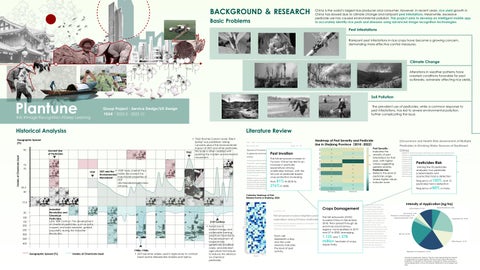
China is the world’s largest rice producer and consumer. However, in recent years, rice yield growth in China has slowed due to climate change and rampant pest infestations. Meanwhile, excessive pesticide use has caused environmental pollution. This project aims to develop an intelligent mobile app to accurately identify rice pests and diseases using advanced image recognition technologies.
Pest Infestations Rampant pest infestations in rice crops have become a growing concern, demanding more effective control measures.
Climate Change Alterations in weather patterns have
created conditions favorable for pest outbreaks, adversely affecting rice yields.
Soil Pollution
Plantune
#AI #Image Recognition #Deep Learning
The prevalent use of pesticides, while a common response to pest infestations, has led to severe environmental pollution, further complicating the issue.
Group Project - Service Design/UX Design YEAR:2023.3 - 2023.10
Historical Analysiss
Literature Review
Geographic Spread (%)
Variety of Chemicals Used
90
Ancient Use of Pesticides
75 70
1962
1939
45.5 40
1962: Rachel Carson's book "Silent Spring" was published, raising concerns about the environmental impact of DDT and other pesticides. This book is often credited with sparking the modern environmental movement.
DDT and the 1939: Swiss chemist Paul Environmental Müller discovered the insecticidal properties of Movement DDT (dichlorodiphenyltrichloro ethane).
Heatmap of Pest Severity and Pesticide Use in Zhejiang Province(2010 -2022)
Pest Severity : Indicates the severity of pest infestations for that year, with higher values suggesting greater severity.
Pesticide Use : Reflects the level of pesticide usage, where higher values indicate more
Pest Invation
The fall armyworm invasion in Yunnan, China has led to an increase in pesticide expenditure among smallholder farmers, with the full cost of pesticide-based crop protection increasing from 81% IN 2018 to 276% in 2020.
Among the 55 pesticides
analyzed, two pesticides (carbendazim and acetochlor) had a detection frequency of 100%, and 12 pesticides had a detection frequency of 80% or more.
Calendar Heatmap of PestRelated Events in Zhejiang, 2022
10.5 50 100 150 200 250 300 350 400
Pesticides Risk
Crops Damagement
Industrial Revolution and Chemical Pesticides Late 18th Century: The development of chemical pesticides, such as sulfur, copper, and lead arsenate, gained popularity during the Industrial Revolution.
Geographic Spread (%)
Variety of Chemicals Used
1940s-1950s DDT became widely used in agriculture to combat insect-borne diseases like malaria and typhus.
21st Century Advances in biotechnology and sustainable farming practices have led to the development of biopesticides, genetically modified crops, and precision agriculture techniques to reduce the reliance on chemical pesticides.
Each cell
represents a day, and the color intensity indicates the level of pest activity.
Intensity of Application (kg/ha)
The fall armyworm (FAW) invaded China in December 2018, then spread through 26 provinces (autonomous regions, municipalities) in 2019 and 27 in 2020, damaging 1.125 and 1.278 million hectares of crops, respectively.
Intensity of Application (kg/ha): The pie chart representing the intensity of application for a given period. The size of each slice indicates the proportion of intensity for that period compared to others, providing a visual representation of how the intensity distribution has changed over time.