Women’s Film Histories in Scandinavia
Historiography, Screenwriting and Costume
Edited by Anna Sofia Rossholm, Ingrid S. Holtar, Louise Wallenberg, and Eirik Frisvold Hanssen
Historiography, Screenwriting and Costume
Edited by Anna Sofia Rossholm, Ingrid S. Holtar, Louise Wallenberg, and Eirik Frisvold Hanssen
Historiography, Screenwriting and Costume
Edited by Anna Sofia Rossholm, Ingrid S. Holtar, Louise Wallenberg, and Eirik Frisvold Hanssen
National Library of Norway, Oslo 2026
Preface 9
1 Introduction 11
Anna Sofia Rossholm, Ingrid S. Holtar, Louise Wallenberg, and Eirik Frisvold Hanssen
PART 1: FEMINISM AND FILM HISTORIOGRAPHY
2 Movements, Feminist Film Culture, and Film History: Vibeke and Vibeke 32 in Berlin 1973
Ingrid S. Holtar
3 Rediscovering (Lesbianism in) Tuija-Maija Niskanen’s Avskedet (1982) 60
Ingrid Ryberg
4 Female Agency and the Database: The Nordic Women in Film Website 84
Tove Thorslund
PART 2. SCREENWRITING, COLLABORATION AND AUTHORSHIP
5 The Writer’s-Widow-Turned-Screenwriting-Manager: Stina Bergman’s 108 Collaborative Authorship in Swedish Classical Cinema
Anna Sofia Rossholm
6 Archives, Authorship and Agency: Astrid Lindgren as Screenwriter 139 Dagmar Brunow
7 Capital, Authorship and Intermediality: Anja Breien’s Published 163 Screenplays
Eirik Frisvold Hanssen
8 Scouts and Scriptwriters: The Dramaturgs of NRK Fjernsynsteatret 197
Ingrid S. Holtar
9
Women Film and Television Screenwriters in the 2020s: 225
New Opportunities and Recurring Challenges in Danish Screen Industries
Eva Novrup Redvall
10 Behind the Director’s Chair: The Collaboration Between Screenwriters 252
Anna Bache-Wiig and Siv Rajendram Eliassen and Director Erik Poppe
Anne Gjelsvik
PART 3: FILM COSTUME DESIGN, LABOR AND THE ARCHIVE
11 Asta Nielsen’s Sense of Fashion: Being Fashionable in a 280 Cross-Media Culture
Helle Kannik Haastrup and Anne Jerslev
12 Professionalizing Costume Design in Sweden: Traces and Conjectures 315 from the Silent Era
Anne Bachmann
13 Stitching It Together: Loose Threads and First Film Costume Designers 333 in Norwegian Cinema
Maria Fosheim Lund
14 Odd Couple Out: On Film Architect Bibi Lindström and 365 Costume Designer Max Goldstein
Tytti Soila and Louise Wallenberg
15 Costume Design in Norwegian Film Production: Working Conditions 396 and Acknowledgment
Anne Marit Myrstad
This collection is the result of a collaboration between the University of Copenhagen, Stockholm University, the Swedish Film Institute and the National Library of Norway on a series of three explorative workshops entitled “Feminist Film History in Scandinavia: New Approaches, Methodologies, and Connections.” The workshops, held in Copenhagen, Stockholm, and Oslo in 2022 and 2023, were funded by the Joint Committee for Nordic Research Councils in the Humanities and Social Sciences (NOS-HS) and gathered film and media scholars, film archivists, and film professionals from our three Scandinavian countries, as well as international experts, to examine neglected aspects of gender in the Nordic film industries past and present.
The collaboration between these cultural heritage institutions and universities dates back to the 2014 symposium Making the Invisible Visible in a Digital Age , organized by Ingrid Stigsdotter and Tytti Soila (Stockholm University) with Jannike Åhlund and Kajsa Hedström (Swedish Film Institute). The symposium led to the anthology Making the Invisible Visible: Reclaiming Women’s Agency in Swedish Film History and Beyond , edited by Stigsdotter (Nordic Academic Press, 2019) and evolved into two projects revising Nordic film historiography by foregrounding female film professionals: the research project Women’s Film History Network: Norden (2016–2017, funded by NIKK) and the website Nordic Women in Film (nordicwomeninfilm.com, launched by the Swedish Film Institute in 2016).
The editors wish to thank NOS-HS for their generous support in making the three workshops and this collection happen. We would also like to give a special thanks to Sofie Arneberg who has helped us with formatting and copyediting.
Oslo/Stockholm, 1 December 2025
Anna Sofia Rossholm, Ingrid Synneva Holtar, Louise Wallenberg, Eirik Frisvold Hanssen
Anna Sofia Rossholm, Ingrid S. Holtar, Louise Wallenberg, and Eirik Frisvold Hanssen
In recent years, Scandinavian film and film culture, and especially Swedish cinema, have been internationally praised for their efforts to achieve gender equality in the so-called above-the-line roles behind the camera of director, producer and screenwriter (Byrnes 2015; Jansson 2024). Although activist women’s film organizations already started articulating and fighting the imbalance between men and women in the screen industries in the 1970s (Branner et al. 2016; Jansson 2024), it was not until the early 2010s that the real and perceived lack of women behind the camera started gaining political attention internationally (see e.g., UNESCO 2015), regionally (Council of Europe 2015), and nationally (Burgess 2010; EWA 2015). In response, in several countries where filmmaking is subsidized by state funding (as in Scandinavia) initiatives were introduced to increase women’s participation in film production. These efforts coincided with a growing body of research by film scholars and social scientists examining the screen industries as gendered systems (see e.g., Banks 2009; Wing-Fai et al. 2015; O’Brien 2019; Liddy 2020; O’Brien, Kerrigan and Liddy 2022; Wallenberg and Koskinen 2022; Jansson 2022; Wallenberg et al. 2023).
Scandinavia’s strong self-image as a gender-equal region, rooted in social democratic values and welfare state policies (Castles 1978; Andersen 2002), has shaped both national identity and international perception. As a region, Scandinavia is internationally known for
active gender equality policies with roots in strong women’s movements, and attention to gender inequality in the film industries must be understood in the context of these feminist interventionist legacies (Ryberg 2020; Holtar et al. 2022; Jansson 2022; 2024). While equality measures did influence and shape most social and cultural activities, the Scandinavian film industries, heavily male dominated since their inception in the early 1900s, were late in taking gender policies and measures into account. The ambitious Swedish action plan, “50/50 by 2020”, introduced in 2016, received widespread international attention. The Norwegian Film Institute set a similar goal of gender parity among key production staff by 2020 in 2018 (Dancus 2019, 7). The Danish Film Institute also initiated gender parity work in collaboration with the film industry in 2017, and an action plan for diversity in Danish film production in 2024.1 When the share of female film workers in Sweden finally reached 50/50 in the three above-the-line positions 2014–15, it was the outcome of more than 15 years of state-funded measures and vivid debates (Skoglund 2012; Helmerson 2018; Nordström 2015).
Despite all the acclaim, scholarly research and reports issued by the three Scandinavian film institutes show that much remains to be done (Redvall and Sørensen 2018; Reestorf 2020; Jansson and Wallenberg 2020; Thorsen 2020; Savolainen 2020; Bragadóttir 2020; SFI 2018; 2019; 2021; 2023; Wallenberg and Jansson 2021; Wallenberg and Koskinen 2022; Wallenberg et al. 2023; Jansson 2024). While the share of female film professionals in key functions initially increased both in Sweden and Norway shortly after the introduction of ambitious equality goals, sustaining the numbers over time soon proved challenging (Dancus 2019, 8–9). Women filmmakers continue to receive smaller production and marketing budgets, have less access to distribution, and face lower audience reach (Jansson et al. 2021; SFI 2019). These issues mirror global patterns of inequality in film indus1 See https://www.dfi.dk/branchen/koensbalance and https://www.dfi.dk/nyheder/ handlingsplan-mangfoldighed-i-dansk-film
tries (Banks 2009; Bielby and Bielby 1996; Mark 2006; Grugulis and Stoyanova 2012; Smith et al. 2013; EWA 2015; Jones and Pringle 2015; Lauzen 2019; Liddy 2020).
This anthology presents a feminist perspective on the histories of female film professionals in Sweden, Denmark and Norway. The book comes at a crucial juncture in the recent history of attention to gender perspectives in Scandinavian film policies. In addition to structural barriers to gender equality in film production (Loist et al. 2024, 119), there is a sense that the collective impatience for change that characterized the mid-2010s, propelled forward by the #MeToo movement, no longer holds the same urgency in current public film discourse. When we started compiling this collection, almost a decade had passed since the 50/50 balance between men and women regarding above-the-line positions had been achieved in Sweden. Since then, statistics have shown that women are again outnumbered by men in leading positions (SFI 2023; Loist et al. 2024). In 2022, the guidelines regarding gender equality and diversity work that previously were stipulated in the government policy letter to the Swedish Film Institute were erased. This also entailed the removal of women’s film history as a stated priority in activities related to the film archive and the preservation of film heritage. The website “Nordic Women in Film” was initiated by the Swedish Film Institute in 2016 as one of five action points for better gender equality in the Swedish film industry, and it was created, formulated and run by the SFI in collaboration with the National Library of Norway, the University of Copenhagen and Stockholm University. Its aim has been to increase and spread knowledge and awareness of women’s film work in the Nordic region throughout film history, and to highlight their often neglected or forgotten contributions. For almost ten years, Nordic Women in Film has been an important node for the ongoing work on feminist historiography and women’s film history in Scandinavia. Several chapters in this volume draw on materials and documentation produced and published as part of the NWIF project. However, as Tove Thorslund discusses in her chapter dedicated to the
website, this era is probably over, as Nordic Women in Film was discontinued in 2026.
As feminist film scholarship has focused on recovering and highlighting the contributions of women film professionals, it is important to recognize that women have always been integral to film culture. This is particularly evident in international studies of the silent era, which reveal that women were not only active participants but often dominated certain areas of film work (Bruno 1993; Bean and Negra 2002; Lant and Periz 2006; Callahan 2010; Stamp 2015; Gledhill and Knight 2015; Duckett and Potter 2015; Hill 2016; Bridges and Robeson 2016; Gaines 2018; Finamore and Cormack 2026).
The Women Film Pioneers Project at Columbia University provides extensive documentation of the diverse roles women held during this period. 2 However, as Shelley Stamp (2015) argues, fully understanding women’s historical contributions also requires attention to uncredited labor and a broader analytical scope that moves beyond the usual focus on directors and screenwriters, above-the-line roles that, as previously mentioned, dominate official statistics on gender equity but represent only a fraction of women’s involvement in film production. This call for a broader perspective is not limited to historical research. As production studies scholar Miranda Banks (2009, 87–89) has shown, contemporary studies of gender inequality in film and media often concentrate on “creative” professions, overlooking the gendered dynamics of technical and craft-based roles, thus obscuring the full extent of women’s labor and reinforcing narrow definitions of creative authority in the industry. Indeed, research on women’s work in film is not limited to early film history: there is also scholarship that looks at film professions dominated by women in other, somewhat later periods, professions that continue to be female dominated (see e.g., Hill 2016; Cobb 2015; Cobb and Williams 2020; Finamore and Cormack 2026).
2 https://wfpp.columbia.edu/pioneers/
Christine Gledhill and Julia Knight have argued that the question of writing women’s film history is fundamentally methodological. It is more than a question of presenting a corrective to existing histories, with the aim of adding female names to current narratives and giving individual women the attention they deserve (2015, 11). Rather, feminist perspectives signal a challenge to traditional methodologies and film-historical models. A central aim of feminist film research is, in other words, to rethink established categories, not least by expanding the understanding of authorship and creative contributions, seen in light of broader work conditions and processes. A heterogeneous feminist approach to film history provides an opportunity to trace women’s contributions to film culture, also in periods with few or no female directors and thus often associated with absence and exclusion.
In both film historiography and thematic anthologies (including book series predominantly organized around national cinemas), it is common to group the countries of Scandinavia and the Nordic region together. In these publications, the terms “Scandinavian” and “Nordic” are often used interchangeably. While “Scandinavia” typically refers to Sweden, Norway, and Denmark – as it does in this volume – in many instances it is also extended to include Finland and Iceland. This transnational framing is evident in initiatives such as the Danish Film Institute’s Norden på film website (curated in collaboration with other Nordic national film heritage institutions), 3 the aforementioned Nordic Women in Film platform, festivals like Nordische Filmtage in Lübeck, and, importantly, the Journal of Scandinavian Cinema . International research on Scandinavian cinema also frequently takes place within the broader academic field of Scandinavian studies.
While scholarship on women in Scandinavian cinema has expanded in recent years, significant areas of the field remain underexplored. Three recent publications examine women’s agency in (mainly) Swedish film history (Stigsdotter 2019; Jansson 2022; Wallenberg et al.
3 https://www.danmarkpaafilm.dk/danmark-paa-film/norden-paa-film
2023), and there has been important work on women directors (Soila 2004; Hjort 2010; Dancus 2019; Ryberg 2019; Larsson 2020; Lund et al. 2024), Scandinavian actresses (Thrane 2019; Kobayashi 2025), women-led production companies (Lund 2017; Jerslev 2021), feminist organization (Soila 2019; Holtar 2022; Ryberg 2026), and women writing for the screen and their authorial agency (Redvall 2015; Rossholm 2022; 2024; 2025).
In this book, Scandinavian film does not denote a single film industry, but rather different national film industries that share a long history of collaboration, co-production and cross-border professional exchange (see Soila et al. 1998; see also Cowie 1992; Lachmann and Lange-Fuchs 1993). 4 Since the 2000s, many anthologies on the region have emphasized the position of Scandinavian cinema within a transnational and networked global film industry and market (Hjort and Lindqvist 2016; Nestingen and Elkington 2005; Thomson 2006; Gustafsson and Kääpä 2015; Stenport and Lunde 2019; Stenport et al. 2026).
In anthologies on Scandinavian and Nordic cinemas, Sweden, Norway and Denmark are often understood as “small nation cinemas”, each characterized by limited domestic markets, and, for the past decades, strong involvement by the state, most importantly through national film institutes that actively fund and shape film production and exhibition (Hjort and Lindqvist 2016, 4; Soila 2005, 2–3; Sundholm et al. 2012, 3; Dancus 2019, 13–14). The same anthologies also frequently underscore the need to challenge monolithic conceptions of the region and its film industries as culturally or industrially homogeneous (Hjort and Lindqvist 2016, 6; Soila 2016, 1; Sundholm et al. 2012, 3; Gustafsson and Kääpä 2015, 5). Despite shared cultural, linguistic and political traits, significant differences exist, including in policies and discourses on gender and film. The most obvious historical distinction is perhaps the global prominence of Swedish and
4 For an in-depth account on notions of Scandinavia and “Scandinavism” as transnational discourse and practice in the silent era, see Bachmann 2013.
Danish cinema since the silent era, in contrast to Norway’s later and more modestly scaled film production, which for a long time lacked a developed industry infrastructure. This contrast is also evident in this volume, for example, in the chapters by Anne Bachmann and Maria Fosheim Lund on the early establishment of costume design practices in Sweden and Norway.
Scandinavian cinema follows similar patterns historically to other comparable film industries – with a significant number of women in key filmmaking roles during the silent era, at least in the more established Swedish and Danish film industries, fewer during the classical sound era, and a more feminist-aware film culture in the 1970s (for an overview of women in Swedish film history, see Wallenberg et al. 2023). There is nothing to suggest that there were more women in filmmaking roles in Scandinavia than in other comparable film industries during these periods. On the contrary, even if there were some prominent women in key filmmaking roles in the silent era, women’s filmmaking seems to be less prominent in Scandinavia than, for instance, in Hollywood. Anna Sofia Rossholm (2025) has e.g. shown that in Sweden between the 1920s and 1960s, it was predominantly through collaborations between film production and other cultural sectors – such as literature, theater and journalism – that women found space in a predominantly male film culture. For example, women on long-term contracts as screenwriters existed in Hollywood during the male-dominated classical era, but nothing equivalent existed in the Scandinavian film industries, where women who may have been established authors or journalists could be hired to write screenplays for a single film at a time.
Our book does not provide one all-encompassing history of women’s contributions to Scandinavian film production but is a collection of case studies, divided into three sections. The chapters of the first section examine film-historiographical questions related to the writing of feminist film histories and the reclaiming of women’s work in a Scandinavian context. The collection begins with Ingrid S. Holtar’s account
of the meeting between Norwegian filmmaker Vibeke Løkkeberg and Danish filmmaker and activist Vibeke Pedersen at the First International Women’s Film Seminar in Berlin in 1973, where they both had films on the program. Scandinavian women filmmakers took part in international networks, and Holtar also demonstrates the importance of comparative institutional perspectives on women’s filmmaking between nations, tracing quite different conditions for funding, production and distribution of alternative feminist cinema during the 1970s in Norway and Denmark. Løkkeberg’s recordings of the event, intended for a documentary, remained forgotten in the archive until recently, and was the foundation for Løkkeberg’s film The Long Road to the Director’s Chair, which premiered at the Berlin Film Festival in 2025, over fifty years after the original event.
The perception of Scandinavia as a region characterized by progressive politics is not only limited to gender. Ingrid Ryberg examines the intersection between feminism and queer perspectives in her chapter on the Swedish-Finnish co-production Avskedet (The Farewell , Tuija-Maija Niskanen, 1982), a film depicting a lesbian relationship that was largely overlooked but recently digitally restored and relaunched as a queer film classic. Ryberg criticizes a contemporary ahistoric tendency to overstate and idealize the LGBTQ+ politics of Sweden and Finland in the 1980s, demonstrating challenges during production and the downplaying of the film’s queer aspects in its contemporary reception. In her chapter on the Nordic Women in Film website, Tove Thorslund argues for the potential of digital platforms to preserve and promote women’s film histories as well as the challenges of documenting the contributions of women in a male-dominated industry.
The two subsequent sections each delve into a specific professional category: screenwriting and costume design. As creative and skilled roles in film production, both screenwriting and costume design highlight several issues related to gender, collaboration, work processes, and power relations. They also actualize questions of visibility
and valorization, albeit in different ways. Both are areas where women have been active, and in the case of costume design have even dominated the workforce, but which in various ways have been largely neglected in established film history.
Two important analytical frameworks spring from these historical circumstances and infuse most of the chapters on screenwriting and costume design in this book: collaboration and intermediality. Collaboration in terms of questions of authorship, work processes, creative contributions and power relations are examined along with cinema’s interaction with other media and cultural fields, including literature, fashion and the theater. These intersections concern professional relations between individuals and aesthetic relations between media but are also of an institutional and financial nature, as found in the interplay between film, fashion and publishing industries, and within diverse media landscapes.
The project leading to this book was initiated by two universities and two national film heritage institutions, and naturally posits the film archive, and its holdings, as a fundamental condition for the writing of film history, inviting self-reflection on the fragmented state of existing knowledge and the need for ongoing research and documentation. In several contributions, archives serve as sources for uncovering alternative narratives that reveal the often-invisible work processes behind the finished film. Other chapters examine archival gaps and how the absence of traces itself can constitute a form of knowledge. Unfinished and unmade films (Hanssen, Holtar, Rossholm), testimonies that shed light on working conditions and lack of recognition (Gjelsvik, Myrstad), and alternative arenas for production, exhibition and distribution (Holtar, Ryberg) occupy a particularly prominent place in the book. The volume also addresses various mechanisms of marginalization: lack of funding, crediting practices that downplay women’s contributions, and the undervaluation of work by women in reviews and public discourse.
The chapters that focus on screenwriters and costume designers – past and present – collectively employ a multi-methodological approach, combining archival research, textual and visual analysis,
and ethnographic work. Hence, some of the contributions in this collection are built on original archival research, activating the collections of the archive, whereas other contributions (such as the chapters by Anne Gjelsvik and Anne Marit Myrstad) rely on engagement with film workers to uncover and discuss actual work conditions and experiences of being in the industries.
The case studies span more than a century. The earliest cases appear in the section on costume design, where Helle Kannik Haastrup and Anne Jerslev explore the practice in the 1910s and 1920s of film stars providing their own wardrobe to the films they starred in, focusing on the international Danish superstar Asta Nielsen. Anne Bachmann traces the gradual professionalization of costume design and costume making in Sweden during the silent era, highlighting the transition to salaried, specialized roles. At the other end of the timeline, the book examines contemporary working conditions for Danish screenwriters, as discussed by Eva Redvall, and for Norwegian costume designers, as detailed by Anne Marit Myrstad.
Across its chapters, the book presents examples of work done by women in Scandinavian film and television from every decade between the 1910s and 2020s. It features both well-established figures and lesser-known professionals whose contributions often remain unnoticed, as well as insights into specific collaborations across professional roles and gender lines and the reception of their collective work. Anne Gjelsvik explores the “collaborative authorship” between Norwegian screenwriter duo Anna Bache-Wiig and Siv Rajendram Eliassen and director Erik Poppe in the 2010s and 2020s. Tytti Soila and Louise Wallenberg examine the interplay between costume and set design in Swedish cinema of the 1950s and 1960s, focusing on the prolific partnership between costume designer Mago (Max Goldstein) and production designer Bibi Lindström.
While costume design has been systematically undervalued (and gendered), the screenwriter is usually understood as a key creative force and is as such not a marginalized film professional. In contemporary film policy discourse, the screenwriter is, as previously mentioned, one of the three so-called key positions that are monitored and used as
a benchmark for assessing gender equality. However, as Eva Novrup Redvall argues in her chapter on Danish female screenwriters, they are “notoriously overlooked, in the press as well as in Scandinavian film history”. In public film discourse, it is still the director that is at the center of attention, as shown by both Redvall and Anne Gjelsvik in this volume.
This invisibility is, perhaps, also connected to how the screenplay, as both Anna Sofia Rossholm and Eirik Frisvold Hanssen point out in their chapters, is an intermediate entity. The book features several examples of archival research that uncover neglected contributions by women in the field of screenwriting. Rossholm details Stina Bergman’s influential role as a screenwriting manager at Swedish production company Svensk Filmindustri (SF) in the 1930s and 1940s. Hanssen examines the five book publications that relate to both realized and unrealized film projects by Anja Breien and how they reflect changes in her career and position within Norwegian film production. Dagmar Brunow reflects on how archival documents demonstrate the extent and nature of Astrid Lindgren’s work as a screenwriter, adapting stories and characters across a number of different media. Ingrid S. Holtar examines the role of women dramaturgs in the Norwegian public broadcaster NRK’s television theater department in selecting and developing screenplays and influencing the repertoire of Norwegian drama production. A challenge posed to a feminist history of screenwriting is how to trace the voice of a screenwriter in a film, or – perhaps even more challenging – other less visible contributions leading to a finished script. This book considers female screenwriters and women working with script development in film and television in Sweden, Denmark and Norway, and provides different ways to activate archival sources relating to screenwriting to discuss agency and authorship.
If the screenplay is intermediate by nature, film costumes are paradoxically visible and invisible at the same time. As summarized by Anne Marit Myrstad in this volume, the strong visibility of “characters in costume” does not mean that “costumes are regularly given attention” or regularly highlighted as creative or artistic aspects of a
film. Whereas the screenwriter is an acknowledged creative force in filmmaking, the costume designer has, by and large, been relegated to the margins. The marginalization and relative invisibility of the costume designer is reflected in crediting practices, even though the profession represents a highly educated and skilled contributor in the film production crew, as demonstrated by Myrstad, as well as Maria Fosheim Lund, who carefully examines the careers of the earliest credited costume designers in Norwegian cinema and reflects on the historiographical challenges of documenting careers that have been mostly hidden from public discourse. In recent years, a subdivision within production studies has focused on costume design and specific costume designers (Landis 2006; 2025; Banks 2009; Finamore and Cormack 2026). In this book, both the visibility and use of costumes on film, and questions concerning the development of costume design as a profession as well as its current state, are at play.
In summary, this book, with its focus on costume designers and screenwriters, examines the dynamic between the visible and the invisible dimensions of film production. By combining analyses of these two professions with a broader historiographic perspective, this book offers a wide-ranging account of women’s filmmaking, while remaining attentive to individual case studies. It is particularly valuable to foreground other professional categories within the Scandinavian context, since Swedish, Norwegian, and Danish cinema—like much of European cinema—has largely been associated with celebrated directors and auteur filmmaking. A study of women in film history with a specific focus on alternative professional roles is therefore not only a contribution to the history of women in film but also opens new perspectives on Scandinavian cinema. In doing so, it may foster a broader and more inclusive historiography that extends beyond the framework of women’s history alone.
Andersen, Gøsta Esping. 2002. Why We Need a New Welfare State. Oxford: Oxford University Press.
Avskedet. 1982. Directed by Tuija-Maija Niskanen. Sweden/Finland: Cinematograph AB, Stiftelsen Svenska Filminstitutet, Sveriges Television AB TV2, Oy Mainos-TV-Reklam Ab and AB Svensk Filmindustri.
Bachmann, Anne . 2013. “Locating Inter-Scandinavian Silent Film Culture: Connections, Contentions, Configurations.” PhD diss., Stockholm University. Banks, Miranda J. 2009. “Gender Below the Line: Defining Feminist Production.” In Production Studies: Cultural Studies of Media Histories, edited by Vicki Mayer, Miranda J. Banks, and John T. Caldwell. New York: Routledge.
Bean, Jennifer M. , and Diane Negra. 2002. A Feminist Reader in Early Cinema. Durham: Duke University Press.
Bielby, Denise , and William T. Bielby. 1996. “Women and Men in Film: Gender Inequality Among Writers in a Culture Industry.” Gender & Society 10 (3). https://doi.org/10.1177/089124396010003004.
Bragadóttir, Gudrun, E. 2020. “Out in the Cold? Women Filmmakers in Iceland.” In Women in the International Film Industry, edited by Susan Liddy. Cham: Palgrave Macmillan. https://doi.org/10.1007/978-3-030-39070-9_11.
Branner, Suzanne , Christina Olofson , and Margareta Vinterheden. 2016. “Öppet brev till Anna Serner: Makt att tolka verkligheten?” Feministiskt perspektiv, June 17.
Bridges, Melody , and Cheryl Robeson , eds. 2016. Silent Women: Pioneers of Cinema. London: Aurora Metro Publications.
Bruno, Giuliana. 1993. Streetwalking on a Ruined Map. Princeton: Princeton University Press.
Burgess, Marilyn. 2010. “Needs Assessment for Gender-Based Impact Analysis of the Canadian Feature Film Policy, Prepared for the Department of Canadian Heritage and Telefilm Canada.” Ottawa: Telefilm Canada. COI: 20.500.12592/6dzhwg
Byrnes, Paul. 2015. “How Sweden Hit Its 50:50 Gender Target for Film Production in Record Time.” The Sydney Morning Herald, May 24.
Callahan, Vicki , ed. 2010. Reclaiming the Archive: Feminism and Film History. Detroit: Wayne State University Press.
Castles, Francis. 1978. The Social Democratic Image of Society (Routledge Revivals): A Study of the Achievements and Origins of Scandinavian Social Democracy in Comparative Perspective (1st ed.). London: Routledge. https://doi.org/10.4324/9780203092316.
Cobb, Shelley. 2015. Adaptation, Authorship and Contemporary Women Filmmakers. London: Palgrave Macmillan.
Cobb, Shelley , and Linda Ruth Williams. 2020. “Histories of Now: Listening to Women in British Film.” Women’s History Review 29 (5): 1–13.
Council of Europe. 2015. “Sarajevo Conference Declaration: Women in Today’s European Film Industry: Gender Matters. Can We Do Better?” Accessed March 2, 2016. https://www.sff.ba/upload/documents/Conference-Declaration-onGender-Equality.pdf.
Cowie, Peter. 1992. Scandinavian Cinema. London: The Tantivy Press.
Dancus, Adriana Margareta . 2019. Exposing Vulnerability: SelfMediations in Scandinavian Films by Women. Bristol and Chicago: Intellect.
Duckett, Victoria , and Susan Potter . 2015. “Introduction: Women and the Silent Screen.” Screening the Past 40:1.
EWA (European Women’s Audiovisual Network). 2015. “Executive Summary. Where are the Women Directors? Report on Gender Equality in the European Film Industry.” https://www.ewawomen.com/wp-content/ uploads/2018/09/2016Exec_summary-Berlinale.pdf.
Finamore, Michelle , and Emma Cormack , eds. 2026. Goddesses from the Machine. New York: Bard Graduate School.
Gaines, Jane . 2018. PinkSlipped: What Happened to Women in the Silent Film Industries? Champaign, IL: University of Illinois Press.
Gledhill, Christine , and Julia Knight . 2015. Doing Women’s Film History: Reframing Cinemas, Past and Future. Urbana: University of Illinois Press.
Grugulis, Irena , and Dimitrinka Stoyanova. 2012. “Social Capital and Networks in Film and TV: Jobs for the Boys?” Organization Studies 33 (10): 1311–31.
Gustafsson, Tommy , and Pietari Kääpä , eds. 2015. Nordic Genre Films: Small Nation Film Cultures in the Global Marketplace. Edinburgh: Edinburgh University Press.
Helmerson, Erik. 2018. “Normkritiken tar över kulturen och ingen vågar klaga.” Dagens Nyheter, January 3.
Hill, Erin . 2016. Never Done: A History of Women’s Work in Media Production. New Brunswick: Rutgers University Press.
Hjort, Mette. 2010. Lone Scherfig’s Italian for Beginners. Seattle: University of Washington Press.
Hjort, Mette , and Ursula Lindqvist , eds. 2016. A Companion to Nordic Cinema (Wiley Blackwell Companions to National Cinemas). Chichester: Wiley Blackwell.
Holtar, Ingrid S . 2022. “Feminism on Screen: Feminist Filmmaking in Norway in the 1970s.” PhD diss., Norwegian University of Science and Technology.
Holtar, Ingrid S ., Maria Fosheim Lund , and Johanne Kielland Servoll . 2022. “A Revelation: Addressing Feminist Agency in Norwegian Film History.” Journal of Scandinavian Cinema 12 (2): 119–33. https://doi.org/10.1386/ jsca_00068_1.
Jansson, Maria. 2022. Kvinnors närvaro och makt över filmen. Lund: Studentlitteratur.
Jansson, Maria. 2024. “Activism and Gender Equality Policy in the Swedish Film Sector from the Second Wave to #Metoo.” Women’s Studies International Forum 105 (28 December): 102942.
Jansson, Maria, Frantzeska Papadopoulou , Ingrid Stigsdotter , and Louise Wallenberg. 2021. “The Final Cut: Directors, Producers and the Gender Regime in the Swedish Film Industry.” Gender, Work & Organization 28 (6): 2010–25. https://onlinelibrary.wiley.com/doi/full/10.1111/gwao.12621?af=R.
Jansson, Maria , and Louise Wallenberg . 2020. “Experiencing Male Dominance in Swedish Film Production.” In Women in the International Film Industry: Policy, Practice and Power, edited by Susan Liddy. London: Palgrave MacMillan.
Jerslev, Anne. 2021. “Danish Documentary Film Production: An All-Female Company.” In A History of Danish Cinema, edited by Claire Thomson, Isak Thorsen and Pei Sze Chow. Edinburgh: Edinburgh University Press.
Jones, Deborah , and Judith K. Pringle . 2015. “Unmanageable Inequalities: Sexism in the Film Industry.” The Sociological Review 63 (S1).
Kobayashi, Saki . 2025. “They Called Me Hot-Blooded. Exploring Viveca Lindfors’ Transnational Stardom and Swedish Film Star Culture in the 1940s.” PhD diss., Stockholm University.
Lachmann, Michael , and Hauke Lange-Fuchs. 1993. Film in Skandinavien, 1945–1993. Dänemark – Finnland – Island – Norwegen – Schweden. Berlin: Henschel Verlag.
Landis, Deborah. 2006. Dressed: A Century of Hollywood Costume Design. New York: Harper Collins.
Landis, Deborah , ed. 2025. The Bloomsbury Encyclopedia of Film and Television Costume Design, volumes 1–3. London and New York: Bloomsbury.
Lant, Antonia, and Ingrid Periz , eds. 2006. Red Velvet Seat: Women’s Writing on the First Fifty Years of Cinema. London: Verso.
Larsson, Mariah . 2020. A Cinema of Obsession: The Life and Work of Mai Zetterling. Madison: University of Wisconsin Press.
Lauzen, Martha . 2019. “It’s a Man’s (Celluloid) World: Portrayals of Female Characters in the Top Grossing Films of 2018.” https://womenintvfilm.sdsu.edu/ wp-content/uploads/2019/02/2018_Its_a_Mans_Celluloid_World_Report.pdf
Liddy, Susan, ed. 2020. Women in the International Film Industry: Policy, Practice and Power. London: Palgrave MacMillan.
Loist, Skadi , Martha Emilie Ehrich , Sophie Radziwill , and Elisabeth Prommer . 2024. “Gender Inequality in the Nordic Film Industry: Exploring above-the-line Positions in Film Production.” Nordic Journal of Media Studies 6 (1): 110–35. https://doi.org/10.2478/njms-2024-0006.
The Long Road to the Director’s Chair. 2025. Directed by Vibeke Løkkeberg. Norway: The Norway Film Development A/S, Viafilm A/S and Centralfilm A/S.
Lund, Maria Fosheim . 2017. “Disappearing Act: The Silent Film Career of Aud Egede-Nissen (1893–1974).” Journal of Scandinavian Cinema 7 (2): 135–47.
Lund, Maria Fosheim , Johanne Kielland Servoll , and Ingrid S. Holtar. 2024. “Expressions of a Backlash: Challenging the Story of Success in Norwegian Cinema of the 1980s and 1990s.” Nordic Journal of Media Studies 6 (1): 136–56. https://doi.org/10.2478/njms-2024-0007.
Mark, Eva. 2006. “Filmbranschen ur jämställdhetsperspektiv.” In Att göra som man brukar: Om beslutsprocesser i filmbranschen. Stockholm: Wift Sverige.
Nestingen, Andrew , and Trevor G. Elkington, eds. 2005. Transnational Cinema in a Global North. Detroit: Wayne State University Press.
Nordström, Andreas. 2015. “Många kritiska röster mot filminstitutets identitetspolitik.” Dagens Nyheter, November 28.
O’Brien, Ann e. 2019. Women, Inequality and Media Work. London: Routledge.
O’Brien, Anne , Páraic Kerrigan , and Susan Liddy. 2022. “Conceptualising Change in Equality, Diversity and Inclusion: A Case Study of the Irish Film and Television Sector.” European Journal of Cultural Studies 26 (3): 1–18.
Redvall, Eva N. 2015. “Danish Women Screenwriters.” In Women Screenwriters: An International Guide, edited by Jill Nelmes and Jule Selbo. London: Palgrave Macmillan.
Redvall, Eva N. and Inge Ejbye Sørensen. 2018. “Hard Facts, Soft Measures: Gender, Quality and Inequality Debates in Danish Film and Television in the 2010s.” Journal of Scandinavian Cinema 8 (3): 233–49. https://doi.org/10.1386/jsca.8.3.233_1.
Reestorf, Camilla Møhring. 2020. “Grænseoverskridende adfærd: diskrimination, chikane, uønsket seksuel opmærksomhed, vold og magtmisbruk i film-, tv-
og scenekunstbranchen.”https://skuespillerforbundet.dk/wp-content/ uploads/2025/05/Graenseoverskridende_adfaerd.pdf.
Rossholm, Anna Sofia. 2022. “Screenwriting, Authorship and Gender in Swedish Cinema of the 1940s: Dagmar Edqvist’s ‘The Ingegerd Bremssen Case’.” Journal of Scandinavian Cinema 12 (2): 179–86.
Rossholm, Anna Sofia. 2024. “Astrid Lindgren’s Early Filmmaking: Transmediations Across Radio, Books, and Moving Images.” In Swedish Children’s Cinema: History, Ideology and Aesthetics, edited by Malena Janson. Cham: Palgrave Macmillan.
Rossholm, Anna Sofia. 2025. “Women’s Literary Writing as A Gateway to Filmmaking: Adaptation, Screenwriting and Gender in Swedish Classical Cinema”. Adaptation 8 (2).
Ryberg, Ingrid. 2019. “An Elevated Feminist Ahead of Her Time? Mai Zetterling’s Non-Fiction Shorts in the 1970s and 1980s”. In Making the Invisible Visible: Reclaiming Women’s Agency in Swedish Film History and Beyond, edited by Ingrid Stigsdotter. Lund: Nordic Academic Press.
Ryberg, Ingrid. 2020. “Promoting the Image of Gender Equality in Swedish Film as the 2020 Deadline Expires”. Camera Obscura 35 (3): 142–53.
Ryberg, Ingrid. 2026. Swedish Film Feminism: Between Grassroots Movements and Welfare Policies. New York: Bloomsbury Academic.
Savolainen, Tarja. 2020. “To Change or Not to Change? Women and Gender Equality in the Finnish Film Industry.” In Women in the International Film Industry: Policy, Practice and Power, edited by Susan Liddy. London: Palgrave MacMillan.
SFI (Swedish Film Institute). 2018. Looking Back and Moving Forward. Gender Equality Report 2017. https://www.filminstitutet.se/globalassets/2.-fa-kunskapom-film/analys-och-statistik/publications/other-publications/swedish-filminsitute-gender-equality-report_2017_eng.pdf.
SFI. 2019. The Money Issue. Gender Equality Report 2018. https://www. filminstitutet.se/globalassets/2.-fa-kunskap-om-film/analys-och-statistik/ publications/other-publications/sfi-gender-equality-report-2018---lowres.pdf.
SFI. 2021. Gender Equality Report: Which Women? Gender Equality Report 2019/2020. https://www.filminstitutet.se/globalassets/2.-fa-kunskap-om-film/ analys-och-statistik/publications/other-publications/which-women---genderequality-report-19-20.pdf.
SFI. 2023. 406 Days – It’s about Time. Gender Equality Report 2021/2022. https://www.filminstitutet.se/globalassets/2.-fa-kunskap-om-film/analys-ochstatistik/publications/other-publications/406-days--its-about-time.-genderequality-report-2021-2022.pdf.
Skoglund, Karolina. 2012. “Dalle: Jag har fel kön.” Aftonbladet, March 26.
Smith, Stacey L. , Marc Choueiti , Elizabeth Scofield , and Katherine Pieper. 2013. Gender Inequality in 500 Popular Films: Examining OnScreen Portrayals and Behind the Scenes Employment Patterns in Motion Pictures Released between 2007–2012. Los Angeles: Annenberg School for Communication & Journalism, University of Southern California.
Soila, Tytti. 2004. Att synliggöra det dolda: Om fyra svenska kvinnors filmregi. Eslöv: Brutus Östlings Förlag Symposion.
Soila, Tytti , ed. 2005. The Cinema of Scandinavia. London/New York: Wallflower Press.
Soila, Tytti. 2019. “Activism, Ideals and Film Criticism in 1970s Sweden.” In Making the Invisible Visible: Reclaiming Women’s Agency in Swedish Film History and Beyond, edited by Ingrid Stigsdotter. Lund: Nordic Academic Press.
Soila, Tytti , Astrid Söderbergh Widding , and Gunnar Iversen. 1998. Nordic National Cinemas. London and New York: Routledge.
Stamp, Shelley. 2015. “Feminist Media Historiography and the Work Ahead.” Screening the Past 40. https://www.screeningthepast.com/issue-40-first-release/ feminist-media-historiography-and-the-work-ahead/.
Stenport, Anna Westerstahl , and Arne Lunde , eds. 2019. Nordic Film Cultures and Cinemas of Elsewhere. Edinburgh: Edinburgh University Press.
Stenport, Anna Westerstahl , Maria Jansson , Mariah Larsson , and Scott MacKenzie , eds. 2026. Women Filmmakers and the Welfare State: Transnational Film Cultures During the Long 1970s in Canada and Sweden. London: Routledge.
Stigsdotter, Ingrid , ed. 2019. Making the Invisible Visible: Reclaiming Women’s Agency in Swedish Film History and Beyond. Lund: Nordic Academic Press.
Sundholm, John , Isak Thorsen , Lars Gustaf Andersson , Olof Hedling , Gunnar Iverse n, and Birgir Thor Møller , eds. 2012. Historical Dictionary of Scandinavian Cinema. Lanham: The Scarecrow Press.
Thomson, C. Claire , ed. 2006. Northern Constellations: New Readings in Nordic Cinema. London: Norvik Press.
Thorsen, Tess Sophie Skadegård. 2020. “Gendered Representation in Danish Film.” In Women in the International Film Industry: Policy, Practice and Power, edited by Susan Liddy. London: Palgrave Macmillan. Thrane, Lotte. 2019. Maske og menneske: Asta Nielsen og hendes tid. Copenhagen: Gads forlag.
UNESCO. 2015. Reshaping Cultural Policies: A Decade Promoting the Diversity of Cultural Expression for Development. 2005 Convention Global Report. https://unesdoc.unesco.org/ark:/48223/pf0000243029.
Wallenberg, Louise , and Maria Jansson , eds. 2021. “On and off screen: Women’s work in the screen industries.” Special issue of Gender, Work & Organization 26 (6).
Wallenberg, Louise , and Maaret Koskinen , eds. 2022. “The Politics of Gendered Work and Representation in the Nordic Screen Industries.” Journal of Scandinavian Cinema 12 (2): 111–17.
Wallenberg, Louise , Frantzeska Papadopoulou , Maaret Koskinen , and Tytti Soila. 2023. Now About All These Women in the Swedish Film Industry. New York: Bloomsbury.
Wing-Fai, Leung , Rosalind Gill , and Keith Randle. 2015. “Getting In, Getting On, Getting Out? Women as Career Scramblers in the UK Film and Television Industries.” The Sociological Review 63 (1).
2. Movements, Feminist Film Culture, and Film
Vibeke and Vibeke in Berlin 1973
Ingrid S. Holtar
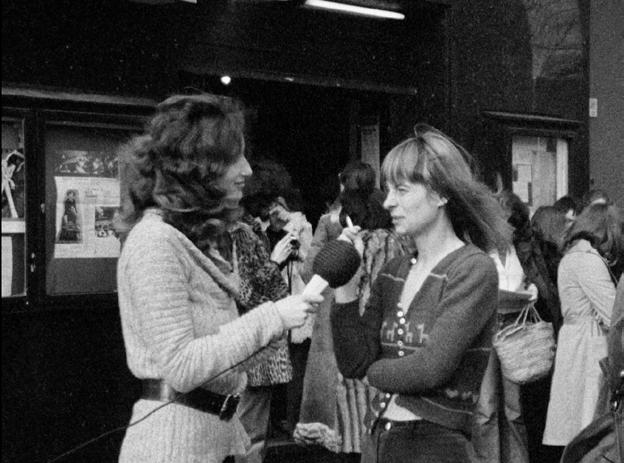
A flicker of light and a synchronization beep. “Sound rolling!”, a man’s voice calls out off-screen. On-screen, a woman in her late 20s turns towards the camera, communicating with the camera operator while adjusting her position. She is holding a microphone, which she directs towards another young woman standing next to her. “Where do you come from and what do you do?” she asks her in Norwegian. “From Copenhagen. I work in the Women’s Movement,”1 the woman answers in Danish.
This is the beginning of a recorded interview that Norwegian film director Vibeke Løkkeberg (b. 1945) conducted with Danish film activist and journalist Vibeke Pedersen (b. 1945) (fig. 1). It takes place outside Arsenal Cinema in West Berlin in 1973, where the two women were participating at the First International Women’s Film Seminar (Erstes Internationales Frauenfilmseminar): a women’s film festival screening films made by and about women, gathering women working in film and television from Germany, Europe, and the U.S. for four days of screenings, discussions, and workshops. During the event, Løkkeberg interviewed several of the women present, including Vibeke
1 “Hvor kommer du fra og hva gjør du?” “Fra København. Jeg arbejder i Kvindebevægelsen.”
The National Library of Norway.
Pedersen, for a film project about the festival and women’s position in the international media industries.
In this chapter, I wish to pause at these women’s physical presence outside Arsenal Cinema, and to ponder: What can the fact that these two women, the two Vibekes, both traveled to Berlin to a women’s film festival tell us about feminist film practice in the 1970s, and what can we learn about film history from following their journeys? Building on a methodological approach of movement and mobility suggested by Kathleen McHugh (2009), this chapter will offer a comparison between these two women, and the connections, journeys, films, and funding schemes that made this meeting in Berlin in 1973 possible. By tracing and comparing the different trajectories of Løkkeberg and Pedersen and the economic conditions for production and distribution that enabled their travels and practices, important factors of the women’s film movement in the 1970s come to the fore.
At first glance, the two Vibekes are not the most likely figures to compare. Løkkeberg went on to become a film director and novelist and is today one of the best-known filmmakers of Norwegian cinema. In the last ten years, her position as a feminist auteur has been cemented, through e.g. the publication of an artist biography by Johanne Kielland Servoll (2020) and the re-release of her feature fiction films (The National Library of Norway 2021). Pedersen, by contrast, was not an aspiring filmmaker, but a film activist, journalist, and film student. She would go on to pursue an academic career and write her PhD Kvinden som ikon (“The woman as icon”, 1995) inspired by the theoretical writings of Laura Mulvey. She belongs to the first generation of Danish-educated film scholars at Copenhagen University, where she would later hold a position as Lecturer Emerita.
Løkkeberg’s and Pedersen’s career paths, then, cannot be said to have developed in parallel. Still, in the moment of the Women’s Film Seminar in Berlin in 1973, the two women’s trajectories were not that different. They both traveled there by invitation, bringing with them a film: Pedersen with Femø 1971 (1973), and Løkkeberg with Abort (Abortion , 1972), both short documentaries and the first film either of them had ever directed. I aim to explore the potential of this meeting for thinking about the concrete movement of the feminist film movement in the 1970s and its transnational character and national conditions. I ask: How did Vibeke and Vibeke come to find themselves in Berlin in 1973?
This chapter responds to a methodological concern of feminism and film history. This is a concern that has been hugely important to the field of feminist film studies in the last two decades, and which can be placed within a larger “turn to history” in film studies (Gaines 2013). The Women Film Pioneers Project, first started by Jane Gaines and Monica Dall’Asta in 1993 and published online in 2013, is in many ways a fundamental project in this regard, uncovering lost histories of women’s work in early cinema and rethinking who and what counts as subjects of film history (Gaines, Vatsal and Dall’Asta 2013). The critical
mission of this project, which it shares with the field of feminist film history at large, is, to paraphrase Sarah-Mai Dang, not only to tell a different story, but the need to tell stories differently (2020, para. 9).
In the essay “The World and the Soup: Historicizing Media Feminisms in Transnational Contexts” (2009), Kathleen McHugh frames the challenge of feminism and film history by posing the historiographical question of “how and why film feminisms are in danger of being lost, left out of histories of media” (2009, 113). Writing in the late 2000s, McHugh’s essay came in the wake of discussions about the stagnation of feminist film theory and the demise of feminism in film studies and beyond (e.g., Rich 1998; Petro 2002). Though the conditions for feminism and feminist film studies looks different today, not least due to a renewed interest in historical research on film feminisms of the 1970s (e.g., Jacob 2015; Fabian 2018; Smukler 2019; Ryberg 2019; Missero 2022), McHugh’s historiographical problematization still holds relevance. According to McHugh, one reason for the danger of the loss of feminism from historical accounts is due to what she calls “the problem of the world in registering feminisms’ effects in and on film history” (2009, 113). This is a historiographical problem, a problem of how to write a film history that can account for women’s contributions to and feminism’s impact on cinema. Approaching a similar argument as Jane Gaines (2004) and Patrice Petro (2002), the problem, according to McHugh, concerns film history on the one hand and feminist film theory on the other.
Beginning with the former, and as many scholars have shown and discussed, women’s contributions to cinema and the impact of feminism fall outside the dominant paradigms of film history (e.g., Hastie 2007; Hill 2016). Film history, writes McHugh, is usually organized according to three main frameworks: world cinema, Hollywood and industrial cinema, or cinemas in resistance to Hollywood, such as national cinemas or avant-garde movements (2009, 116). These frameworks are unable to bring into view the work of women and the legacy of feminism as significant historical formations. Rather, feminism’s historical role is usually reflected through attention to the contributions of individual women, either through the perspective of auteurism,
or catalogued and gathered under rubrics according to gender and geography.
However, the problem in registering feminism’s impact on film history not only concerns the dominant framework of film history, but also relates to central aspects of feminist film theory. If the optic of film history is too narrowly national, writes McHugh, women’s and feminist work has also fallen out of consideration because of the models of feminist film theory which have been too universalizing, not able to adequately consider the differences between women in terms of resources and priorities, let alone their uneven placement according to power relations and circuits of capital (McHugh 2009; Shohat 2003; Wang 2011). This derives in part from a focus on marginalization and displacement of women in feminist film theory and criticism, and the important theoretical conception of the absence of women in/on film. Jane Gaines has argued that this paradigm made film feminists in the 1970s unable to see all the women who did work in the film industries in the silent era (Gaines 2018), while Pam Cook has called for the development of “a more complex map of the role of women in Hollywood cinema than models defined by exclusion and marginalization” (Cook 1998, 245). It is also in part due to theoretical frameworks that have focused on film texts, and primarily the Hollywood film, rather than a range of different contexts (McHugh 2009, 116). This has had the effect, among others, of leaving too narrow a sense of what a feminist film can be, resulting in only a small selection of “proper” feminist films (Warren 2008).
The problem with the dominant historical organization for women in film history is not only that women are marginalized. It is rather, firstly, that gendered patterns become difficult to detect. For a historical investigation of the conditions of women working in film, the variety of careers and contexts of production are crucial to consider, both because they speak to the diversity in how and where women have contributed to cinema, and because they make it possible to distinguish commonalities and differences in the pathways relating to training, funding, and career development. Secondly, feminism as a social and cultural force disappears. For a history of film feminism, the
career descriptions and filmographies gathered under rubrics such as “women’s films” tend to reduce the impact of feminism into a series of individual contributions. Because of this, feminism as a social movement disappears, and with it at least one important way of understanding how women created and fought for their own space as filmmakers, worked for alternative voices in film production, and used film as part of a political and social movement.
For feminism not to be lost from historical accounts, and to create a more historical sense of the impact of feminism, McHugh suggests two historiographical methods that focus on movement and mobility: first, follow the filmmaker, and second, follow the money. “The issue of mobility,” writes McHugh, “reframes women’s filmmaking and feminist movements in a way that exceeds the historical stasis and containment of encyclopedias and nations” (2009, 115–16), while it also “compels a focus on details of mobility and money in diverse and uneven circumstances rather than on a generation of ‘feminism’ as a univocal historical determinant” (2009, 140).
In the remainder of this chapter, I will employ these historiographical methods to my case study of Pedersen’s and Løkkeberg’s presence in Berlin in 1973. This means following the filmmakers and their movements to uncover what connections and travels that supported and enabled their journeys. I look to Ana M. López who, in her study of Latin American cinema, suggests the usefulness of studying what she calls “traveling filmmakers” to bring out a “continental perspective that includes, but mediates, the national” (2000, 35). For her, this requires an analysis of official contracts, e.g., international agreements, but also and more importantly, research into the unofficial contacts, networks and exchanges that are established “through interpersonal relationships and work-related travel” (2000, 35). This also means following the money, and the systems of production and of distribution that made it possible for them to make and distribute their films.
To do so, I draw on conversations I have had with the two filmmakers discussing their trip to Berlin and their film engagement in Norway and Denmark, respectively (Løkkeberg 2018; Løkkeberg 2023; Pedersen 2024). I also draw on previous research into feminist film
culture in Norway and Pedersen’s own student thesis on feminist film culture in Denmark, originally published in 1979 and available from the Royal Library in Copenhagen. By doing so, I aim to bring out aspects related to the transnational networks and the character and material force of film feminism in the 1970s.
It is obvious that the feminist film movement was about motion and mobility, perhaps most clearly visible through the wave of women’s film festivals. The women’s film events in New York (1972), Edinburgh (1972) and Toronto (1973) are often cited as early and important examples, but there were hundreds of similar initiatives, of different sizes and ambitions and in different countries, dedicated to showing films by and about women. All these initiatives were dependent on the movement of people – filmmakers, journalists, film activists, as well as audiences who came to watch and discuss the films. The events also had a distinct character of networking, where traveling filmmakers and activists met, influenced, and inspired each other to pursue similar initiatives in national and transnational contexts of production and exhibition.
This was also the case of The First Women’s Film Seminar in Berlin, which was “neither a first nor a seminar but nonetheless a major event for the German-speaking feminist film world” (Baumeister et al. 2024, 180). According to Julia Knight, the seminar held two important functions, as it “provided a rare chance to see work of contemporary women filmmakers” and “offered the first opportunity in Germany for women filmmakers to meet each other and discuss their work” (1992, 103). The seminar had a distinct snowball effect, and the program “traveled in different variations and personal constellations throughout West Germany, to small villages as well as to big cities, to local women groups or to community colleges” (Baumeister et al. 2024, 185). Other kinds of feminist film initiatives also followed in its wake: the German feminist film journal Frauen und Film (“Women and film”) in 1974, and the association of women film workers, Verband der Filmarbeiterinnen, in 1978 (Baumeister et al. 2024, 185).
The First Women’s Film Seminar was organized by filmmakers and activists Claudia von Alemann and Helke Sander. They had support from the organization Freunde der Deutschen Kinemathek e.V, (“Friends of the German cinematheque,” today known as Arsenal Filminstitut) and the Municipal Cinema Frankfurt (today called the German Film Museum), while it was the foundation of Protestant journalism (Gemeinschaftswerk der evangelischen Publizistik) that provided the funding (Baumeister et al. 2024, 183). Claudia von Alemann had worked as a freelance critic for the Protestant film magazine Evangelischer Filmdienst (today edp Film), and she went to the co-editor of the magazine with the proposition to fund a women’s film seminar. According to Alemann, “he said yes but we had to label it a pedagogical, didactic seminar which could be used by other towns and groups” (Purkpong 2024, 19). The funding contributed to the educational character of the seminar and especially the film festival brochure, which was published by Alemann and Sander in 1974 (Baumeister et al. 2024, 184; Purkpong 2024, 18–19).
The festival itself was a closed event with over 200 participants from the German film and television sector, including practitioners, students, and journalists, as well as twelve guests from abroad (Baumeister et al. 2024, 183; Purkpong 2024, 21). Among them, Claire Johnston, Barbara Evans and Francine Winham from London Women’s Film Group, Annabella Miscuglio from the Italian Colletivo Feminista di Cinema, Israeli cinematographer Nurith Aviv traveling from France, Ariel Dougherty, co-founder of the production and distribution company Women Make Movies in New York, as well as the two Vibekes from Scandinavia. It was, of course, film that brought them all there. The festival screened forty-five films from seven different countries: Germany, Italy, France, U.K., the U.S., Norway, and Denmark (Alemann and Sander 1974). 2 According to Helke Sander,
2 Other Scandinavian women with films in the program were the Danish directors and visual artists Jytte Rex, Kirsten Justeesen, Ursula Reuter Christiansen, and Lisbeth Dehn Holgersen, but they were not themselves present at the festival.
“for most of us it was surprising that there were already enough of us to be able to fill a whole festival with our films” (Knight 1992, 103). How, we might wonder, were they able to do so?
The organizers Alemann and Sander, writes the collective behind the 2023 revisitation festival feminist elsewheres, “had no material to draw on, no distribution network or a film/address register when they began researching women filmmakers in and outside Europe” (Baumeister et al. 2024, 182). What they did have, however, were international connections from their own travels, as well as that of Erika Gregor, who supported the festival by facilitating collaboration with Arsenal Cinema (Baumeister et al. 2024, 182). Indeed, following the footsteps of Pedersen and Løkkeberg, it seems that their presence at the Women’s Film Seminar was partly predicated on earlier travels.
The Journeys of Vibeke Pedersen and Femø 1971
Pedersen was at the Women’s Film Seminar with the short film Femø 1971, an observational documentary of 37 minutes shot in color from the first women’s summer camp on the Danish island of Femø. The film is the only audiovisual record of the camp and includes observational footage of it and its activities. Most of the scenes, however, are of conversations between the participating women talking together in groups. The film was inspired by the consciousness-raising group, a fundamental structure of the women’s liberation movement, where women through conversation and sharing of personal experiences could name and understand the collective challenges in their situation. The women in the film are seated in the grass in their summer wear, bare-breasted and relaxed, and reflecting on their lives back home and the impact of coming together for a holiday with other women and their children.
Pedersen was an active member of the Danish movement for women’s liberation, called the Red Stockings Movement (Rødstrømpebevægelsen), and was also part of the organizing team behind the Femø summer camp. She recalls that as they planned the different activities that the camp would offer, she had the idea that one of these activities should be the making of a film. The film, then, was
envisioned as a collective endeavor, by and about the women at the camp. As it turned out, it was mainly Pedersen who did the film and sound recording, as she was one of the few who knew how to operate the camera. Still, according to Pedersen, a collective sense characterized the production as many of the women at the camp engaged in finding subjects for the documentary. They would suggest to Pedersen people she should reach out to, or tell her about interesting conversations that were happening, as well as aid her during the recording situations. Femø 1971 was made and funded through Workshoppen, the Danish Film Workshop in Copenhagen. The Workshop was established in 1970 with funding from the Danish Film Institute and the Danish Broadcasting Corporation, Danmarks Radio, with the aim to provide opportunities for filmmaking outside of the traditional production institutions. The Workshop was a place where non-professionals and aspiring filmmakers could borrow equipment, learn basic filmmaking skills, and, upon a successful application, receive film stock for film production. The applications to the Workshop were processed by a working group selected by the producers themselves, which made the Workshop in many ways a grassroots film organization. It was, as Pedersen would describe it, an “experiment of media democratization”3 (Pedersen 1979, 49) and had the result that many films were made in Denmark by people who otherwise would not have had the resources to do so, in different ways and about other subject matters than in the established film production community. Next to the establishment of the national film school in 1966, the Workshop has been credited as the most important institution in Denmark for women’s opportunities as filmmakers in the 1970s and 1980s, and a crucial precondition for feminist filmmaking activity (Knudsen and Rowley 2004). For instance, the Workshop offered technical courses for women interested in filmmaking, which Pedersen made use of. She recalls the thrill of receiving the positive reply from the Workshop to her application, and she left for Femø with a Super 8 mm camera and a
3 “Workshoppen er i høj grad et mediedemokratiseringseksperiment … ”.
backpack full of raw film stock – although not enough to last for the entire week, and halfway through the camp, Pedersen had to take the bus back again to Copenhagen to restock.
This suggests the unique possibilities of the Film Workshop for alternative and grassroots filmmaking. Moreover, the experimental format of the Workshop made it possible to pursue collective filmmaking practices, a form of production that strongly resonated with the nonhierarchical and collaborative ideologies of the Red Stockings Movement (Pedersen 1979, 5). Indeed, feminist women were quick to seek out the opportunities offered by the Film Workshop. By 1973, seven titles by and about women had been made through the Workshop, including Femø 1971 (Pedersen 1979, 5). By comparison, only two political women’s films were made through the public funding opportunities of Kortfilmrådet (the Short Film Council) during the same period.
Although the conditions for alternative film production were favorable in Copenhagen, the challenge of distribution was as big a problem there as elsewhere. The responsibility of the Workshop for the films they supported ended with the film production. There was no further funding for the distribution and exhibition of them, and support from the Workshop did not necessarily entail support for a film print ready for distribution (Pedersen 1979, 6). In this period, the main distribution channel for short and documentary film in Denmark was the state-owned distribution center, Statens Filmcentral. However, the Workshop films were not automatically bought by this center, and indeed, only a handful of the Red Stockings Movement films gained distribution through this distribution channel (Pedersen 1979, 20–21). 4
4 The Workshop established a temporary distribution arm in 1972, called Nøddistributionen, “the emergency distribution”, but it was not until the mid-1970s that the Workshop’s distribution arm was formalized and developed. Pedersen was herself involved in this work. In 1976, the distribution group of the Workshop formed an independent organization under the name Dansk Filmcenter (The Danish film center), modelled on the Swedish radical film organization FilmCentrum (Pedersen 1979, 18). FilmCentrum was established in 1968 as a distribution center for alternative filmmaking and was later expanded with the exhibition outlet Folkets Bio (The People’s Cinema). Like its Swedish model, Dansk Filmcenter included both the import, distribution, and exhibition of alternative film.
This meant that it was, at least in the beginning, up to the producers of the Workshop films themselves to distribute the films, and they were to a large degree dependent on alternative networks to be able to do so.
Femø 1971 was one of the films that were not bought by Statens Filmcentral, and Pedersen was herself responsible for the physical distribution of the film (1979, 7). Within Denmark, the circulation of Femø 1971 formed part of Pedersen’s work of alternative film distribution where she for instance developed, together with other women from the Red Stockings Movement, a distribution catalogue of women’s films. These films, including Femø 1971, were shown for instance at a cinema theater called Kvindebiografen – “The women’s cinema” – located in the women’s house in Copenhagen, the Red Stockings Movement’s meeting place. It was also Pedersen herself who brought the Super 8 film of Femø 1971 to Berlin. Moreover, without any German or English subtitles, she also provided a live translation of the dialogues and discussions during the screening at the Women’s Film Seminar.
This was, however, not Pedersen’s first time in Berlin or at Arsenal Cinema. In 1971, when packing her bag to go to Femø, she had just returned home from another trip, to Internationales Forum des Jungen Films (the International Forum of New Cinema) at the Berlin Film Festival. Pedersen was a film studies student at the time, enrolled at the brand-new Film Studies program at the University of Copenhagen in 1967. During these years, she became involved in the student film community. After a visit to Algeria in 1969, where she attended Le premier festival culturel panafricain d’Alger (the PanAfrican Culture Festival of Algiers, PANAF), the connection between film and political work became explicit to her. Together with her partner at the time, Viggo Holm-Jensen, Pedersen wrote articles and edited special issues for the student-run film journal Die Asta , named after the Danish-born German silent film star Asta Nielsen, on worker’s cinema, post-colonial cinema and third cinema. In extension of Die Asta , she also worked to import political films to Denmark through the alternative distribution project Kinok, named so in reference to the Soviet filmmakers Dziga Vertov, Elizaveta Svilova and Mikhail Kaufman’s radical film collective in the 1920s.
It was likely this activity that gained Pedersen an invitation as a journalist to the first iteration of the Forum of New Cinema at the Berlin Film Festival in 1971. The Forum of New Cinema, a program section with “no compromises or outward considerations” (Gregor, 1997), was established as an independent part of the Berlin Film Festival, and a result of controversies regarding the film festival’s programming policies in the wake of the student uprising in May 1968. While still a part of the Berlinale, the Forum was the responsibility of the Friends of the German Cinematheque (later Arsenal). According to Pedersen, it must have been Erika and Ulrich Gregor, founders of both Arsenal and the Forum, and later supporters of the Women’s Film Seminar, who invited her. She recalls:
It would be typical of the two – Erika and Ulrich Gregor – to invite the young female journalist who was writing about different radical movements. It may very well be that Erika thought: “we need to have women with us”. 5 (Pedersen 2024)
This means that when Claudia von Alemann and Helke Sander started their research, Pedersen was already familiar with Erika Gregor and might have been suggested by Gregor as a potential candidate. Pedersen, then, traveled to the Women’s Film Seminar in Berlin on account of a network of different initiatives and practices as both a journalist and a feminist activist, including the visit to the Berlin Film Festival in 1971, her involvement at the women’s camp at Femø, and her use of the Film Workshop in Copenhagen.
Løkkeberg traveled to the Women’s Film Seminar with the film Abort (Abortion , 1972), a 43-minute hybrid documentary in black and white about Norwegian abortion legislation. The film explores the then-
5 “Det ville være typisk for dem to – Erika og Ulrich Gregor – at invitere en ung kvinde, der skriver om forskellige radikale bevægelser. Det kan godt passe, at Erika har tænkt, ‘vi skulle have nogle kvinder med’.”
current law on abortion, dating from 1964, and its limitations. It features interviews with two medical doctors who, by explaining the legislation, the procedure, and its consequences, give their views in favor of self-determined abortion. The interviews are combined with fictionalized elements in the form of voice-over presentations of the social and economic situation of women applying for abortion and a frame story about a young girl who discovers that she is pregnant. The film also features interviews with two anti-abortion activists, whose condemnation of women seeking abortions rather functions to strengthen the film’s arguments of the class and gender discrimination of the legislation.
Abort was Løkkeberg’s first film as a director, and she had started the film project almost four years before the festival screening in Berlin (Servoll 2020, 125–28). The idea for the project originally came from a news story about a pregnant woman who had been picked up for prostitution, and whose situation sparked Løkkeberg’s attention. The woman had applied twice for an abortion, but her request had been denied both times. Only the year before, Løkkeberg had herself had an abortion, and the experience was foundational to her own political consciousness (Servoll 2020, 126). She started to develop the woman’s story into a current issue documentary for NRK, the Norwegian public broadcaster, but the subject of prostitution was deemed too controversial, and Løkkeberg was forced to rework the material into a documentary about the consequences of the abortion legislation for working class women.
The kind of dedicated, low-level film production opportunities that the Film Workshop in Copenhagen represented did not exist in Norway. Abort , rather, was the result of a long and difficult production process. It was finally produced by the production company Norsk Dokumentarfilm A/S with funding from the Ministry of Church and Education, but the film involved backing from several different institutions and people. Crucially, Løkkeberg encountered progressive forces in the Norwegian Directorate of Health and early on gained the support of physician Aud Blegen Svindland, who was employed at the Directorate of Health and an advocate for self-determined abortion
(Servoll 2020, 129; Aanesen 2018, 66). Svindland contributed with an interview to the film, explaining her own stance, and introduced Løkkeberg to Karin Stoltenberg, a senior officer of the Ministry of Consumer Affairs and Administration. Both Blegen and Stoltenberg helped Løkkeberg secure funding to complete the film (Aanesen 2018, 66). After an intervention by director and journalist Pål Bang-Hansen who was employed in the film department of the Norwegian public broadcaster, Løkkeberg also received financial support from the film producer Egil Monn-Iversen (Servoll 2020, 129).
Another key institution in the making of Abort was the Norwegian Film Institute (NFI). Established in 1955 as a film library and archive, the NFI had by the 1970s been reorganized and co-located with the government initiative The State Film Education (Statens Filmopplæring). Unlike both Denmark and Sweden, Norway did not have a national film school until the 1990s. Instead, various training initiatives were formed in the late 1960s and early 1970s, including a “study department” (Studieavdelinga ved Norsk Film) at the municipal-state owned production company Norsk Film A/S, a two-year vocational training in cinematography and editing at the Norwegian Broadcasting Corporation, and the State Film Education, which offered yearly courses in film production. While none of these initiatives can be compared to the low-threshold entry point provided by the Workshop, they did represent important access points and talent development opportunities for aspiring filmmakers, and most feminist documentaries and short films in Norway were produced by women with some connection to these institutions. The NFI provided Løkkeberg with encouragement and a contact point to the resources and equipment of the film production community, giving her access to film stock and collaboration with a cinematographer and sound technician in the early phases of production (Løkkeberg 1971, 71).
In the beginning, the NFI was furthermore the distributor of Abort . Later, the film would be part of the distribution catalogue of Statens filmsentral (the State Film Central), which was the main distributor of short and documentary in Norway. Indeed, for a short, political documentary, Abort had an almost exceptionally wide exhibi-
tion. It was first shown on television in February 1972, albeit in a censored version, before it traversed the alternative film network of political organizations, including the Norwegian women’s liberation organization Kvinnefronten (The Women’s Front) and several film societies where it became a main attraction (Servoll 2020, 169; Aanesen 2018, 66–67). These screenings were organized as discussion nights, often with Løkkeberg herself present.
Løkkeberg traveled further with the film as well, and in the autumn of 1972, she brought the film with her to the Pesaro Film Festival in Italy. Like the Forum of New Cinema in Berlin, Pesaro had a profile of screening young cinema:
The goal was to create a non-competitive festival of “first works,” not in the personal sense, but in the sense of new choices and new paths able to generate renewal processes, of growth, maturation and the evolution of cinema. (Pesaro Film Festival 2019)
Løkkeberg had visited the festival once before in 1968, then as the lead actor of the feature film Liv (1967). Liv was directed by Løkkeberg’s first husband Pål Løkkeberg; the two of them had written the script together. This time, she returned as a director. Løkkeberg had herself written to the festival and introduced herself and the film with the hopes that they would screen Abort . A draft of the letter, partly relayed in Servoll’s biography, closes with the following lines: “I have already ordered plane-ticket to Italy, in the optimistic hope that you will read this with good will” (Servoll 2020, 146). The festival must have done exactly so, and Løkkeberg was invited to present Abort at the seventh edition of Pesaro Film Festival.
Following the festival screening in Pesaro, Servoll writes, “the newspapers could report that Abort was also screened at a German film festival”6 (2020, 146), after which Arsenal bought Abort for German distribution. This was in keeping with the ideals of the 6 “Senere på høsten kunne avisene melde at Abort også var vist på filmfestival i Tyskland.”
cinematheque, who, in the words of Ulrich Gregor, “directed their efforts toward retaining the films in Berlin” and making “prints available for cultural film activity” (Gregor 1997). It is somewhat uncertain whether the festival in question was indeed the Women’s Film Seminar in 1973 or if this was another, earlier German film festival in 1972, and thus also if Abort was in Arsenal’s distribution already before Alemann and Sander began their research. Løkkeberg might even have crossed paths with Erika and Ulrich Gregor earlier as well, when she was at the Berlin Film Festival in 1967 presenting the feature film Liv (Servoll 2020, 88). Regardless, the screening in Italy seems to have been a precondition for Løkkeberg’s invitation to Berlin in 1973. Like Pedersen, one trip led to another.
For Løkkeberg’s part, this was especially true. Through Ulrich and Erika Gregor, Arsenal distributed Abort in Germany, where the film was screened by various organizations over the next decade (Aanesen 2018, 67). When Løkkeberg directed her first feature film Åpenbaringen (The Revelation) in 1977, the film was invited to the 1978 Forum of New Cinema and was subsequently bought for German distribution by Arsenal under the title Die Offenbarung.
When they met at Arsenal Cinema in 1973, neither Pedersen nor Løkkeberg were in Berlin for the first time. Rather, they had both been present at the Berlin Film Festival, Løkkeberg in 1968 and Pedersen in 1971, and were, in some way or another, on the radar of Erika and Ulrich Gregor of the Arsenal. These two figures, and especially Erika Gregor and her network, can thus be seen as what Kathleen McHugh calls a “structure of opportunity” (2009, 126) that enabled women to meet and connect in the early 1970s. The transnational feminist film culture that developed during this decade was in other words intimately connected to the young cinemas and radical energies of film festival networks of the late 1960s.
The narratives of how Pedersen and Løkkeberg traveled to Berlin, moreover, reveal stories of personal initiative. The can-do-spirit of these young women seeps through the accounts of applications sent,
travels planned, tickets bought, and the ambitions of each woman’s film practice. Both were present at the festival with their first film as directors, which in different ways are emblematic of the generation of women directors and film activists who turned to filmmaking in the 1970s as part of the movement for women’s liberation, whether coming from an academic and political background, like Pedersen, or like Løkkeberg with knowledge of film production through her role as an actor. Both picked up the camera with clear feminist ambitions for their films.
However, the contexts that they traveled from and made films within were quite different. Pedersen’s practice was to a large degree part of a grassroots movement. Both her filmmaking and film cultural activity developed through alternative film networks and political organizations with ties to the university and to the women’s liberation movement. The women’s camp at Femø and the Women’s House distribution catalogue were both made possible through the volunteer work and activism of the Red Stockings Movement. The Film Workshop, while publicly funded, was a bottom-up initiative that was largely controlled by the producers themselves. Løkkeberg, by contrast, was only able to make the film with support from people in positions at public institutions: the NFI, the Directorate of Health, and the Ministry of Church and Education. Through the circulation of the film, Løkkeberg was an integral part of the alternative film club movement in Norway, but her travels with Abort also placed her within the A-list film festival network that she would travel within for the rest of her career.
These differences attest to a difference between the two women’s filmmaking ambitions – between the film activist and the film auteur. However, it also attests to a considerable difference between the conditions for (feminist) filmmaking in Denmark and Norway at this moment.
Danish film feminism was primarily a grassroots initiative, tightly connected to the Red Stockings Movement. Picture, for instance, the women’s cinema in Copenhagen: the cinema could seat about 25 people on empty beer crates built into sloping rows, and for a
period in 1972 and 1973, the film group screened films there every Friday night (Pedersen 1979, 8). The films they screened were Danish documentaries made by and about women, several of them stemming from the Workshop, as well as imported films. The Swedish director Maj Wechselmann, who herself was present at a screening of her film Flickor på Marabou (Girls at Marabou , 1971), called, in an article for the Swedish journal Film&TV, the women’s cinema in Copenhagen “… the smallest, most primitive cinema I had ever seen”7 (Pedersen 1979, 11), but went on to describe the atmosphere of the screening in the most positive of terms:
After the film there was a discussion. I listened bewildered: There was absolutely no doubt – Here was a new tone I had never experienced before. It was simply very gratifying: A spontaneity, a softness, curiosity and, above all, this ability to renounce one’s own prestige in a discussion. 8 (Pedersen 1979, 11)
The Women’s Cinema was, however, short lived. This attests to both the passion and the challenge of grassroots initiatives. The initiatives and activities placed a high demand on the volunteer and activist work of individuals. This was made even more difficult by the lack of support systems such as for instance a distribution channel for the Film Workshop productions.
The situation for feminist film culture in Norway was, by comparison, more dependent on support from institutional structures and less on grassroots activity. This does not necessarily mean that the women who made films and film events there were less active, but in Norway there were no, or very few, possibilities for grassroots film production. By and large, the only way to make films was through the support of established film and television institutions. This would
7 “ … det minsta, mest primitiva biorum jag sett intill dags dato.”
8 “Efter filmen blev det diskussion. Jag lyssnade förbryllad: Det var absolut ingen tvekan – Här fanns en ny ton som jag aldrig upplevt förut. Det var helt enkelt väldigt glädjande: En spontanitet, en mjukhet, nyfikenhet och först och främst detta att man kunde ge avkall på den egna prestigen i en diskussion.”
50
mean that rather few were able to do so. On the other hand, it also meant that the ones who succeeded in producing a film would often find themselves in a situation of more support from the film production community. The production and distribution of Løkkeberg’s Abort exemplifies this situation.
Here, then, it is possible to locate one reason for a difference in the kinds of films that women made in Norway and in Denmark in the 1970s. In Denmark, a key feature of this period is the documentaries made by the Red Stockings Movement (Pedersen 2015). However, not that many women were able to make the move into direction of feature films in these same years. In Norway, by contrast, there were fewer documentary and short films, but relatively speaking quite many feature films made by and often about women in the 1970s (Holtar 2022).
As for the Women’s Film Seminar itself and the presence of the two Vibekes, what was the significance of this event for the two film feminists? Interestingly, both Pedersen and Løkkeberg came to the Women’s Film Seminar prepared to learn and record, and they both brought home with them material for media productions about the film festival.
Løkkeberg traveled to the Women’s Film Seminar in Berlin with the ambition to make a film for television. She had gained initial support from a production company called Centralfilm A/S, which mainly produced informational films and commercials, but that also started making documentary films for television in the 1970s. She was accompanied by cinematographer Georg Helgevold Sagen and sound recordist Ivar Rolland, both employed by the production company. During the festival, they recorded Løkkeberg as she interviewed several of the filmmakers and journalists who were present, asking them about their experiences of being a woman in the male-dominated media sectors, about their film and television work, and their feminist engagements. However, on her return to Norway, Løkkeberg was unable to complete the film. This is most likely because the production company was unable to sell the film to the Norwegian Broadcasting Corporation, and therefore lost interest in the project.
For a long time, the material was believed to be lost as well, until the production material, containing the interviews as well as ambience footage and sound recordings from the cinema and the seminar rooms of the Women’s Film Seminar, resurfaced at the National Library of Norway between 2019 and 2023 (Bræin 2023). The National Library digitized and synchronized the material, and through collaborations with feminist film festivals and film heritage institutions, the film project has been brought back into public consciousness. Since 2023, there have been several public screenings of various selections of the unedited production material.9 In Germany, the rushes were screened twice at Arsenal Cinema in Berlin, first at the festival Archival Assembly in June 2023, and then in November 2023 at feminist elsewheres, a fifty-year revisitation festival of The First Women’s Film Seminar. In Norway, the production material was screened twice at the Cinematheque in Oslo, first in October 2023 and then in March 2024. The rushes from the film were also featured at the Norwegian edition of the feminist film exhibition No Master Territories: Feminist Worldmaking and the Moving Image (curated by Erika Balsom with Clemens Ottenhausen and Silja Espolin Johnson), presented at Kunstnernes Hus in Oslo February to May 2026. Through these screenings, the unfinished film has become ingrained in recent thinking about the legacy and heritage of the feminist film movement of the 1970s, its revisitations, and its intergenerational encounters today (Balsom 2024; Baumeister et al. 2024; Holtar 2024). In February 2025, Vibeke Løkkeberg premiered her own, completed version of the film under the title The Long Road to the Director’s Chair (2025) at the Berlin Film Festival, opening new avenues of travels and connections as the film traverses the international film festival circuit.
9 The unfinished production material resurfaced at the same time as I started working as a researcher at the National Library, having just completed a dissertation on feminist filmmaking in Norway in the 1970s (Holtar 2022), and I have been involved in and contributed to all of these screening initiatives, with the exception of the first screening at Arsenal Cinema in June 2023. As such, another avenue of mobility to consider is the intersections of research, archiving and film curatorial practices that reactivates certain legacies and enables new forms of movement of works and practitioners.
Pedersen, on the other hand, traveled with a tape recorder to the Women’s Film Seminar in 1973 with the ambition to make a program for radio. Unlike Løkkeberg’s television film, Pedersen was successful in completing and broadcasting the radio program. It was aired on Danish radio December 28, 1973, and titled “Kvindefilmseminar i Vestberlin” (“Women’s film seminar in West Berlin”). A transcription of the program is published in Pedersen’s student paper, and reveals that the program consisted of excerpts from interviews recorded at the Women’s Film Seminar and Pedersen discussing the burgeoning women’s film movement, the challenges of women’s work in film, and the initiatives of women filmmakers, by presenting some of the film collectives present at the festival and the films they screened: West German directors, a French film group, The London Women’s Film Group, and the American Women Make Movies (Pedersen 1979, 43–48).
Pedersen would further pursue the issues raised and the films screened at the Women’s Film Seminar in her writings and film screening work, and she was especially attuned to the German filmmakers (Pedersen 1979). Together with the film group of the Women’s House in Copenhagen, Pedersen secured two of Claudia von Alemann’s documentary films for distribution in Denmark: Aus eigener Kraft – Frauen in Vietnam (“Under their own power – Women in Vietnam”, 1971) as Kvinder i Vietnam (“Women in Vietnam”) and Es kommt darauf an, sie zu verändern (The Point is to Change It , 1973), as Kvinder på fabrik (“Women in factories”), and made them available through the Women’s House distribution catalogue for women’s films (Pedersen 1979, 16). She also maintained a personal relationship with Alemann, who would later come to Copenhagen to visit.
Løkkeberg, on the other hand, seems to have retained a connection to Berlin primarily through Arsenal and Erika and Ulrich Gregor. In 1975, Alemann was invited to Norway by the Goethe Institute, the student society in Bergen and the Women’s Front in Oslo for a screening of Es kommt darauf an, sie zu verändern in Bergen and to host a women’s film seminar in Oslo called “Women’s film seminar: Women in the workplace” (Kvinnefilmseminar: kvinner i arbeidslivet) (Holtar
2022, 106). It is unknown whether Løkkeberg and Alemann connected in Oslo while Alemann was there, or even in Berlin on one of Løkkeberg’s many returns. Nonetheless, the two filmmakers’ careers share several interesting similarities. By the early 1980s, they would both be among the leading (female) film directors of their national cinemas and often cited as examples of the (supposed) gender equality of the Norwegian and German film industries of the 1980s respectively (e.g., Kindem 1987; Lian 2015; Lennsen 1984; McHugh 2009). Here, then, new parallels come to the fore, and with them further travels, connections, and meeting points to explore.
B. Ruby Rich begins her seminal book Chick Flicks: Theories and Memories of the Feminist Film Movement by stating her conviction that “the landscape of feminism and film has been deprived of its own history, substituting a canon of texts for a set of lived experiences long forgotten” (1998, 1). Rich is here referring to the notion that the feminist film movement, an eclectic field of women’s filmmaking, film criticism and film exhibition and distribution that developed in the early 1970s, had given way to the academic discipline of feminist film theory, and in the process lost sight of its origins. However, this loss of the history of feminism, and as Alexandra Juhasz (2006) would argue, also its future, cannot only be ascribed to the development of feminist film theory, but also reveals the limitations of the standard models of film historiography. Over the last decades, feminist film scholars have worked to solve this impasse, and what Kathleen McHugh calls “the problem of the world” in registering “the distinct, often paradoxical transnational cultural specificities of women’s and feminist film production” (2009, 118).
This chapter has explored McHugh’s historiographical methodology of movement and mobility by following the trajectories of two film feminists, Vibeke Pedersen from Denmark and Vibeke Løkkeberg from Norway, and the connections that enabled them to travel to the First International Women’s Film Seminar in Berlin in 1973. Following their movements and their films has made it possible to conduct at
least two historical analyses of film feminism in the 1970s. Firstly, the method of following the filmmakers and their journeys brings out the networks and meeting points, the personal initiatives and professional contacts that made these journeys possible. By doing so, the transnational character of the feminist film movement, understood as the physical movement across borders as well as the specific power relations that enabled these movements, comes into view. In this chapter, the two filmmakers and the time span chosen suggests only a small circuit, but this method could be expanded to include other participants in the seminar as well as other events, and in this way bring into view a much larger network of traveling filmmakers, as the example of Claudia von Alemann’s travels to Scandinavia suggests. The questions would be: Who traveled where, when, and through what structures of support and opportunities? Secondly, the method of following the production and distribution of the films, tightly connected to the travels of the makers, draws attention back to the national conditions of film production and circulation. Here, the differences between the contexts that Pedersen and Løkkeberg made films within exemplify larger tendencies and differences between the development and character of feminist film practices in Norway and Denmark.
The method of mobility, whether following the filmmakers or following the money, revolves around comparisons. There are, however, still other comparisons and perspectives left to uncover. One is the aesthetic and political character of the films themselves. Another is the space created by the Women’s Film Seminar, and the discussions and experiences recorded by both Løkkeberg and Pedersen during their time in Berlin. The pathways of these productions, the television film and the radio program, points to further analysis of movement, money and mobility of feminist media making in the 1970s.
Aanesen, Ellen , ed. 2018. Vi var mange. Kvinneaktivister fra 70tallet forteller. Oslo: Oktober.
Abort. 1972. Directed by Vibeke Løkkeberg. Norway: Norsk Dokumentarfilm A/S.
Alemann, Claudia , and Helke Sander. 1974. Zur Situation der Frau. Modellseminar, Film und Literaturverzeichnis. Berlin: Freunde der Deutschen Kinematek e.V. Åpenbaringen. 1977. Directed by Vibeke Løkkeberg. Norway: Studieavdelinga ved Norsk Film AS.
Aus eigener Kraft – Frauen in Vietnam. 1971. Directed by Claudia von Alemann. West Germany: Alemann Filmproduktion (Köln).
Balsom, Erika. 2024. “Deep Cuts: The First International Women’s Film Seminar.” Cinema Scope, 97. https://cinema-scope.com/cinema-scope-magazine/ deep-cuts-the-first-international-womens-film-seminar/.
Baumeister, Elena , Fiona Berg , Charlotte S. Eitelbach , Sophie Holzberger , and Arisa Purkpong. 2024. “Feminist Elsewheres. A Making(-)of Three Festivals in the Making.” Feminist Media Histories 10 (2–3): 180–97. https://doi.org/10.1525/fmh.2024.10.2-3.180.
Bræin, Nina Mari . 2023. “Vibeke Løkkebergs ukjente dokumentarfilm møter publikum etter 50 år.” Forskning.no, November 8. https://www.forskning.no/ film-historie-kjonn-og-samfunn/vibeke-lokkebergs-ukjente-dokumentarfilmmoter-publikum-etter-50-ar/2278417.
Cook, Pam. 1998. “No Fixed Address: The Women’s Picture from Outrage to Blue Steel.” In Contemporary Hollywood Cinema, edited by Steve Neale and Murray Smith, 229–46. London: Routledge.
Dang, Sarah-Mai. 2020. “Unknowable Facts and Digital Databases: Reflections on the Women Film Pioneers Project and Women in Film History.” Digital humanities Quarterly, 14 (4). https://www.digitalhumanities.org/dhq/ vol/14/4/000528/000528.html#.
Es kommt darauf an, sie zu verändern. 1973. Directed by Claudia von Alemann. West Germany: Alemann Filmproduktion (Köln).
Fabian, Rachel. 2018. “Reconsidering the Work of Claire Johnston.” Feminist Media Histories, 4 (3): 244–73. https://doi.org/10.1525/fmh.2018.4.3.244
Femø 1971. 1973. Directed by Vibeke Pedersen. Denmark: Workshoppen. Flickor på Marabou. 1971. Directed by Maj Wechselmann. Sweden: Dramatiska Institutet.
Gaines, Jane M. 2004. “Film History and the Two Presents of Feminist Film Theory.” Cinema Journal, 44 (1): 113–19.
Gaines, Jane M. 2013. “What Happened to the Philosophy of Film History?” Film History, 25 (1–2): 70–80.
Gaines, Jane M. 2018. Pinkslipped: What Happened to Women in the Silent Film Industries? Urbana: University of Illinois Press.
Gaines, Jane, Radha Vatsal , and Monica Dall’Asta , eds. 2013. Women Film Pioneers Project. Center for Digital Research and Scholarship. New York: Columbia University Libraries.
Gregor, Ulrich. 1997. “History of the International Forum of New Cinema.” https://www.arsenal-berlin.de/forumarchiv/forum97/forges-e.html.
Hastie, Amelie. 2007. Cupboards of Curiosity: Women, Recollection, and Film History. Durham: Duke University Press.
Hill, Erin. 2016. Never Done: A History of Women’s Work in Media Production. New Brunswick: Rutgers University Press.
Holtar, Ingrid S. 2022. “Feminism on Screen: Feminist Filmmaking in Norway in the 1970s.” PhD diss., Norwegian University of Science and Technology.
Holtar, Ingrid S. 2024. “Searching for Film Feminism: Claudia von Alemann, Vibeke Løkkeberg and Archival Traces from the 1970s.” In Punched Card, edited by Arisa Purkpong, 48–59. Berlin: Fat Vampire Press.
Jacob, Clarissa K. 2015. “Women & Film: The First Feminist Film Magazine.” Feminist Media Histories 1 (1): 153–62. https://doi.org/10.1525/fmh.2015.1.1.153.
Juhasz, Alexandra. 2006. “The Future Was Then: Reinvesting in Feminist Media Practice and Politics.” Camera Obscura, 21 (1): 53–57.
Kindem, Gorham A . 1987. “Norway’s New Generation of Women Directors: Anja Breien, Vibeke Lokkeberg and Laila Mikkelsen.” Journal of Film and Video 39 (4): 28–42.
Knight, Julia. 1992. Women and the New German Cinema. London: Verso.
Knudsen, Mette , and Jane Rowley. 2004. Køn og arbejde i film og TV 1992–2002. Copenhagen: WIFT / DK.
Lennsen, Claudia. 1984. “Women’s Cinema in Germany.” Jump Cut 29:49–50. https://www.ejumpcut.org/archive/onlinessays/JC29folder/WomCinemaGermany.html.
Lian, Vigdis. 2015. “Ikke bare Hustruer – kvinnelige regissører 1975–2000”. In Ta det som en mann, frue! Kvinnelige regissører i norsk spillefilmproduksjon – en debattbok, edited by Vigdis Lian, 9–39. Oslo: Emilia Press.
Liv. 1967. Directed by Pål Løkkeberg. Norway: P.V.L. Produksjon.
The Long Road to the Director’s Chair. 2025. Directed by Vibeke Løkkeberg. Norway: The Norway Film Development AS, Viafilm AS and Centralfilm AS.
Løkkeberg, Vibeke. 1971. “Ja vi elsker: Om en abortfilm og avbrytelser i et filmsvangerskap.” Fant 18 (2): 70–74.
Løkkeberg, Vibeke. 2018. Interview by the author, April 3.
Løkkeberg, Vibeke. 2023. Interview by the author, March 7.
López, Ana M. 2000. “Crossing Nations and Genres: Travelling filmmakers.”
In Visible Nations: Latin American Cinema and Video, edited by Chon A. Noriega, 33–50. Minneapolis: University of Minnesota Press.
McHugh, Kathleen. 2009. “The World and the Soup: Historicizing Media Feminisms in Transnational Contexts.” Camera Obscura 24 (3): 111–51.
Missero, Dalila. 2022. Women, Feminism and Italian Cinema. Edinburgh: Edinburgh University Press.
The National Library of Norway. 2021. Vibeke Løkkeberg: Regn, Åpenbaringen, Løperjenten, Hud, Måker. DVD/Blu-ray box set. Oslo: Nasjonalbiblioteket.
Pedersen, Vibeke. 1979. “Kvindefilmoffentlighet efter 1970: Skrifter om kvinder og film 1971–79 med indledning om kvindebevægelse og film i Danmark.” Student paper, University of Copenhagen.
Pedersen, Vibeke. 1995. Kvinden som ikon: Iscenesætttelse af køn i klassisk film og postmoderne tv. Copenhagen: Borgens forlag.
Pedersen, Vibeke. 2015. “Rødstrømpefilm og filmkultur i 70ierne.” In KVINDER: Bladet Kvinder 1975–1984, edited by Signe Arnfred, Litten Hansen, and Anne Houe, 328, 343. Copenhagen: Tiderne Skifter.
Pedersen, Vibeke. 2024. Interview by the author, May 9–10.
Pesaro Film Festival. 2019. “A Long Festival History.” https://www.pesarofilmfest.it/en/updates/news/99-a-long-festival-history.
Petro, Patrice. 2002. Aftershocks of the New: Feminism and Film History. New Brunswick: Rutgers University Press.
Purkpong, Arisa. 2024. “Conversation between Claudia von Alemann and Arisa Purkpong: Aus Eigener Kraft – Frauen in Vietnam.” In Punched Card, edited by Arisa Purkpong, 10–25. Berlin: Fat Vampire Press.
Rich, B. Ruby. 1998. Chick Flicks: Theories and Memories of the Feminist Film Movement. Durham and London: Duke University Press.
Ryberg, Ingrid. 2019. “An Elevated Feminist Ahead of Her Time? Mai Zetterling’s Non-Fiction Shorts in the 1970s and 1980s.” In Making the Invisible Visible: Reclaiming Women’s Agency in Swedish Film History and Beyond, edited by Ingrid Stigsdotter, 159–82. Lund: Nordic Academic Press.
Servoll, Johanne Kielland. 2020. Vibeke Løkkeberg: En kunstnerbiografi. Bergen: Fagbokforlaget.
Shohat, Ella. 2003. “Post-Third-Worldist Culture: Gender, Nation and the Cinema.” In Rethinking Third Cinema, edited by Anthony R. Guneratne and Wimal Dissanayake, 51–78. New York: Routledge.
Smukler, Maya Montañez. 2019. Liberating Hollywood: Women Directors and the Feminist Reform of 1970s American Cinema. New Brunswick: Rutgers University Press.
Wang, Lingzhen. 2011. “Introduction: Transnational Feminist Reconfiguration of Film Discourse and Women’s Cinema.” In Chinese Women’s Cinema: Transnational Contexts, edited by Lingzhen Wang, 1–43. New York: Columbia University Press.
Warren, Shilyh. 2008. “By, For and About: The ’Real’ Problem in the Feminist Film Movement.” Mediascape: The UCLA’s Journal for Film and Media Studies 4 (2). https://www.scribd.com/document/389514318/Warren-Shilyh-By-For-AndAbout-The-Real-Problem-in-the-Feminist-Film-Movement.
Tuija-Maija Niskanen’s Avskedet (1982)
Ingrid Ryberg
In this time of flattened historical narratives, commodifiable feminism, and marketable “rediscoveries”, attending to the richness and complexity of feminist film histories is more urgent than ever. (Castro 2022, 46)
While every discovery is worthy of celebration, proclaiming, in effect, “I found a woman!” is only the first step in a disruptive feminist historical practice. … The real task is to connect the women we find to larger histories, to curate feminist histories that reimagine not only cinema’s past, but the key role that gender has played in both cinema’s history and how that history gets told. (Stamp 2024)
In 2023, the Swedish Film Institute launched a list of Swedish queer film classics, promoting titles that have been digitally restored and made available through the national film heritage project (SFI 2023). Many of the included films, as well as a long array of additional titles, are also represented in the recent documentary Fördom och stolthet – en queer filmhistoria (Prejudice and Pride: Swedish Film Queer, Eva Beling, 2022), which – taking its cue from The Celluloid Closet (Rob Epstein and Jeffrey Friedman, 1995) – chronicles Sweden’s queer film history. Both projects testify to a recently awakened interest in and a long-overdue recovery of Swedish queer audiovisual history. The Swedish Film Institute’s brochure Queer – den svenska filmgarderoben (“Queer, the Swedish film closet”, Gustavsson et al. 2020) and the
introduction of a queer “tag” at the archival streaming site Filmarkivet.se in 2017 (see Brunow 2018) also contribute to a belated official recognition of this dimension of Swedish audiovisual heritage.
One of the lesser-known titles on the Film Institute’s list is the Swedish-Finnish feature-length period drama Avskedet (The Farewell , Tuija-Maija Niskanen, 1982). Digitally restored and relaunched in 2021, the film recounts the coming of age of Valerie, played by Sanna Hultman as a child and Pirkko Nurmi as an adult, who grows up in an authoritarian bourgeois family in Helsinki around the time of the Second World War. Unable to fulfill her parents’ normative and repressive gender and class expectations, she eventually finds her own path in life, falling in love with another woman and turning to theater. Produced by Ingmar Bergman’s company Cinematograph AB, with a stellar cast including Gunnar Björnstrand and Mimi Pollak and a lush set design signed Anna Asp, Avskedet was the feature-length debut of director Tuija-Maija Niskanen, as well as of actress Stina Ekblad, who plays Valerie’s lover and who shortly after was offered the role as Ismael in Bergman’s Fanny och Alexander (Fanny and Alexander, 1982).
As a Swedish-Finnish co-production by a first-time woman director, the film has – perhaps unsurprisingly – fallen outside of dominant auteur-centered Swedish film history and has remained overlooked in established accounts until its recent relaunch. Its omission even from the documentary Fördom och stolthet , as well as previous compilations of Swedish queer film history (e.g., Bendjelloul 2012), moreover reveals that Avskedet ’s newly acquired official status as a “Swedish queer film classic” has not always been a given. However, in addition to the prompt inclusion on the queer classics list, the relaunch put distinct emphasis on the film’s queer aspects overall. The teaser includes a clip from the film’s most intimate scene where Ekblad’s character Kerstin, dressed in a slip, dances sensually to tango music for the onlooking Valerie. Furthermore, the promotion spells out that the script was based on the life of renowned Swedish-speaking Finnish theater director Vivica Bandler and, hinting at what her life was like, adds that she was “known among other things for her relationship with Tove Jansson”, the beloved artist who created the Moomin characters
(SFI 2021; 2023). Coincidently, that relationship between two of Finland’s most famous women – an open secret for a long time – was recently passionately portrayed in Zaida Bergroth’s Tove (2020), which contains a bedroom scene that bears evident resemblance with the dance scene in Avskedet .
Since the digitization, Avskedet has been picked up by festivals such as Il Cinema Ritrovato in Bologna and Nordische Filmtage Lübeck, as well as by a “Queer 80s” series at the Barbican in London. Introducing the film as being about “a gay woman [struggling] to cope in the repressive home of her haute bourgeois father”, the presentation of the event also suggested a contextualization of the film as representative of Sweden and Finland in the 1980s, claiming that “Sweden and Finland paved the way to greater LGBTQ+ equality in the 1980s – the repressive society depicted in Avskedet shows just how far they had come” (Barbican 2024).
This idealizing and ahistoric conception of the two countries in the 1980s and the general light-hearted framing of Avskedet as a queer film in the present stand in stark contrast to how the lesbian plot was downplayed in the film’s official promotion and reception at the time of the original release, some forty years ago. As I account for in this chapter, most critics in both Sweden and Finland ignored or circumscribed the relationship between Valerie and Kerstin, and the promotion contributed to mystifying the film’s painful queer stakes by stating that the portrayed oppression and rebellion were not openly spelled out. Now as the film’s lesbian qualities are being rediscovered and restored in the current relaunch and recirculation, this heteronormative silencing, but also the film’s intriguing parallel counterpublic reception –both of which make up inseparable parts of its legacy, as I shed light on in this chapter – paradoxically risk being obscured and silenced in turn.
Elaborating on this dilemma by offering an in-depth account of Avskedet ’s multilayered production, promotion, and reception history, this chapter engages in current debates in queer and feminist film historiography, urging for methodological approaches – but also archival and curatorial practices – to privilege complexity, inconsistency, and
critique over celebratory catchphrases and reparative frameworks. The case of Avskedet , I argue, aptly illustrates not only how the popular rhetoric of “forgotten” and “rediscovered” films tends to decontextualize and erase more history than it makes visible, but also how queer and feminist film histories in the Nordic region risk being co-opted into the logics of Nordic exceptionalism and homonationalism and utilized to polish the image of heritage institutions. In addition to archival and documentary projects like the ones already mentioned, the current interest in narrating and incorporating LGBTQI+ pasts into national histories is seen in television series like Torka aldrig tårar utan handskar (Don’t Ever Wipe Tears Without Gloves, 2012) about the AIDS crisis in Sweden (see Koivunen 2018) and Vår tid är nu (The Restaurant , 2017), an ambitious chronicling of post-wartime Sweden, as well as in Finnish biopics, like the already mentioned Tove and Tom of Finland (Dome Karukoski, 2017). Such insertion of women’s and queer histories into national memory is often harnessed to contemporary “woke” nationbranding and the construction of national self-images of progressivity, gender equality, and “gay-friendliness” (see also Ryberg et al. 2021; Ryberg forthcoming).
As well-intended as such initiatives often are, I contend in this chapter that it is also important to interrogate their politics of memory and what desires are being served in the present. As the case of Avskedet shows, what risks getting lost when queer histories and audiovisual heritage are appropriated by contemporary imaginaries of national gay-friendliness is the subcultural status and complex meanings of the queer past: how it has been shaped by and in opposition to dominant discourses and the heteronormative state institutions that now seek to recognize it. Based on archival research extending beyond established film culture, shedding light on Avskedet ’s queer reception, this chapter offers a reminder that the counterpublic (Berlant and Warner 1998) and world-making (Muñoz 2009) dimensions of queer audiovisual cultures are not necessarily reconcilable with and rarely opened up by contemporary reparative attempts at inclusiveness and institutional polishing (Ahmed 2012).
Alternating between temporal layers, Avskedet tells the story of the character Valerie’s upbringing as the older of two daughters in a bourgeois Swedish-speaking Finnish family in Helsinki in the mid-twentieth century. Growing up with a tyrannical father who repeatedly cheats on the superficial, emotionally cut-off mother, and a younger sister, who, in contrast to Valerie, successfully fulfills the parents’ demands for gender and sexual normativity, Valerie becomes an outsider observer of a conservative environment where she can only fail. Against her parents’ wishes for her to take on responsibility for the family estates, she decides to join a theater and begins a relationship with another woman, Kerstin. The relationship ends abruptly when the parents find out about it. In a humiliating scene, Valerie is summoned to her father’s office and forced to read aloud a love letter she has written to Kerstin, in the presence of both the parents and Kerstin. When the two women meet again years later, Kerstin confesses having been involved with Valerie’s father but also affirms that she has never stopped loving Valerie.
Narrated through flashbacks with the father’s funeral reception as a framework, the film is told from Valerie’s perspective. The tender camera persistently centers her pensive gaze on the parents’ miserable marriage and gender masquerade. Her recollections of how she felt about their inaccessibility and disapproval of her person are also told in voiceover narration. As a child, Valerie often takes her refuge in the kitchen with the housekeepers. In these sequences, as well as in those with Valerie’s childhood friend Gustav, the film is not without warmth and humor, in contrast to the cold and cynical interactions between family members. However, when she makes acquaintance with a poor, slightly older girl on the street and invites her home, she is made acutely aware that this is inappropriate. Sneaking into her mother’s room, Valerie finds out from her diary not only that she hopes to feel more connected to the newborn little sister than she does to Valerie, but also that she worries that Valerie has “bad predispositions” since all her playmates seem odd. After this incident, Valerie attempts suicide.
As a young adult, at the outbreak of the Winter War, Valerie meets Kerstin at a party. Valerie shares her dream to pursue theater, and the two women talk about trusting and supporting each other. The already mentioned erotically charged tango scene – in which Kerstin playfully performs for Valerie, then rests her head on Valerie’s lap while Valerie leans forward to caress and kiss her forehead – is followed by the brutal exposure of the relationship in the father’s office. In the letter that Valerie is forced to read, she confesses her love for Kerstin, how she misses her when they are apart, how she feels Kerstin is the person she has long been waiting for, and how she feels capable of loving herself only through Kerstin. “For the first time, I know what it is to love and be loved without fear”, she ends the letter.
The forced outing and Valerie’s articulation of self-realization, truth, and love through the relationship with Kerstin evokes the gay and lesbian liberation movement’s emphasis on “coming out”. The frankness of the letter and the dance scene, as well as the harsh response from the parents, all contribute to centering Valerie’s sexuality as the film’s key conflict. In addition to the mother’s comments about “bad predispositions”, the father and sister both hint at Valerie’s alleged deviant orientation by stating that she is “one of those” and of a certain kind. Set against the political backdrop of the Second World War, the stakes of this orientation are also violently spelled out by the father, who is sympathetic to the Nazis. “Do you know what happens in Germany?”, he asks, adding: “Those like you end up in something called concentration camps.” In order for at least one of their daughters to become “normal”, the parents decide to separate Valerie from her sister.
Given these explicit moments and the fact that the film’s key turning points and dramaturgical peak all relate to Valerie’s queerness and the same-sex relationship between her and Kerstin – a highly unusual theme in both Swedish and Finnish film production at the time – it is remarkable that neither the promotion nor the dominant reception of the film drew attention to or spelled these aspects out, as I account for further down. As I show next, the film rather got inserted into the niche of “women’s film”, a more attainable but also flexible framework in these years.
“Finnish Female Power Behind Film About a Woman’s Revolt”
Gaining some publicity in the Swedish press as it went into production, Avskedet was initially presented as the work of three women: the director Tuija-Maija Niskanen, scriptwriter Eija-Elina Bergholm, and Vivica Bandler, whose life and upbringing the film was reported to be based on (Sörenson 1980; Norrländska Socialdemokraten 1980; Matteson 1980; Sehlin 1980). Several articles stressed the gendered aspects through headings such as “Kvinnotrio gjorde film om en kvinnas uppbrott” (“Women trio made film about a woman’s departure”, Norrländska Socialdemokraten 1980) – and “Finsk kvinnokraft bakom film om kvinnas revolt” (“Finnish female power behind film about a woman’s revolt”, Matteson 1980), while also offering brief introductions of these three women. Niskanen had been praised for a television adaptation based on Edit Södergran’s Landet som icke är (“The land which is not”, 1925), where Bergholm was scriptwriter and Pirkko Nurmi played the lead role. Of the three women, Bandler was the best-known as a prominent cultural figure and theater manager in both Finland and Sweden. In Finland she had overseen the avantgarde theater Lilla Teatern and at the time of the initiation of Avskedet she was the head of Stockholm City Theatre. According to news reports and promotion materials, the initial idea for the project sprung from conversations between Bandler and the head of the theater department at the Swedish Television, Lars Löfgren (e.g., SFI 1980). Löfgren was fascinated with Bandler’s recollections of her upper-class upbringing in Helsinki, and a couple of years after the idea was born, the director and scriptwriter were hired to realize the project. According to reports, the script was written by Bergholm but based on Bandler’s oral testimonies from her childhood which she shared with Bergholm during the scriptwriting (Matteson 1980; Sörenson 1980).
The film was co-produced by Swedish and Finnish companies and conceived as a film aimed for both theatrical distribution and television broadcast. The production was managed by Cinematograph and the shoot took place in the film studios at the Film House in Stockholm in the spring of 1980. In addition to the roles of Valerie and Kerstin, the cast consisted of well-known actors like Karl-Axel Heikert and
Kerstin Tidelius as the parents, and Gunnar Björnstrand and Mimi Pollack as the grandparents. The production leader was Katinka Faragó and set designer Anna Asp who both, like Ekblad, also worked on Fanny och Alexander that shortly went into production – and ended up having its premiere four months before Avskedet premiered in Sweden.
Sharing her recollections from the shoot on the audio track of the teaser for the relaunch, Ekblad describes the warm and playful atmosphere and how much she appreciated working with the director Niskanen and the other actors. In press reports about the production at the time, Niskanen also talked positively about her experience, not least about working together with Bergman when editing the film on Fårö during the summer of 1980 (Högnäs 1981).
However, reports from the ensuing months and years reveal that the production did not in fact run smoothly. A letter from Bergman to Jörn Donner, then CEO of the Swedish Film Institute and in this capacity producer of the film, in the fall of 1980 indicates that disagreements were arising concerning the editing (Bergman 1980). In the letter, Bergman explained that the film had been recut together with Niskanen and Sylvia Ingemarsson (later Ingemarsdotter), and that it had become a much more powerful film in his opinion. Three “complexes” had to be cut, all centered on the figure of the father – a modification which made the figure of the mother more multidimensional, according to Bergman. He admitted that there was a formal imbalance between the first – fragmentary – and the second – cohesive – part of the film, which might seem “disturbing to sensitive viewers”, but he himself found “Avskedet to be one of the most sensual, unusual and moving films made in Sweden in an awful long time.” “It is the dollop of butter in the soft porridge of Swedish film,”1 Bergman closed the letter.
1 “Det föreligger alltså en formell obalans som möjligen kan verka störande på känsliga personer. Jag tycker AVSKEDET är en av de sensuellaste, ovanligaste och mest gripande filmer, som gjorts i Sverige på ohyggligt länge. Den är smörklicken i den svenska filmens slätvälling.”
The letter provides important insight into some of the artistic decisions made during the editing and what the stakes seem to have been about in the ensuing conflict. According to news reports as well as promotion materials from the Swedish Film Institute, the premiere was planned for the winter of 1980 (SFI 1980; Norrländska Socialdemokraten 1980). An interview with Niskanen in January 1981 stated that the film was about to be completed (Högnäs 1981). However, it took one more year before the film had its international premiere at the film festival in Berlin and its theatrical release in Finland. In Sweden, the film did not premiere until March 1983. Media reports from these years testify to tensions not only between the director and Donner but also between Niskanen and Bandler, who by the time Avskedet finally premiered had chosen to remove her name from the film (Högnäs 1982a; 1982b). Another name that disappeared from the final promotion materials and credits was Sylvia Ingemarsson, who had edited the first version of the film.
In December 1981 and early 1982, several articles reported that Donner had hired another editor to recut the entire film without the director’s consent (Sydsvenska Dagbladet 1981; Skawonius 1981; Högnäs 1982a). According to Donner, the director had altered the script, and the new editor had simply restored the original story. The new editor, Dubravka Čebulc (later Antonia Dubravka Carnerud), was not mentioned by name in media reports but is credited in the final version of the film. Donner claimed that this intervention was necessary to mediate between the director and Bandler, who also found that the script had been altered. Bergman’s letter to Donner about removing key scenes with the father suggests that this was indeed the case. Niskanen, on her side, said in one interview that Donner had violated her film and that she no longer saw it as her own work (Högnäs 1982a). However, when interviewed on occasion of the film’s premiere at the film festival in Berlin in 1982, Niskanen did not mention these conflicts, but rather criticized the film’s promotion as a women’s film and inclusion in a separate women’s section at the festival (Udd 1982).
The conflict-ridden production came into focus again when the film was broadcast on Swedish Television in 1984. In a couple of inter-
views, Bandler openly criticized the film, saying that she felt it was too private and lacked humor (Malgefors 1984; Järnefors 1984). She also denounced the original promotion of the film as based on her own life, claiming that even though the script had borrowed features from reality, the parents in the film had nothing to do with her own family (Järnefors 1984). Contributing considerably to the film’s publicity, the many reports about controversies related to the production share with the critical reception – that I turn to next – a tangible silence regarding Avskedet ’s lesbian content.
Despite the negative publicity and Bandler’s as well as Niskanen’s public distancing from the finished film – quarrels that were mentioned in several reviews – Avskedet was mostly favorably received. Critics praised its “psychological realism” and “visual intensity” (Hjertén 1983), although some also found it uneven and lacking in energy and focus (Blomkvist 1983; Bjelkendal 1983). Others found it too enigmatic and annoyingly half-spoken (Larsson 1983). Several Swedish reviewers seem to have taken hold of the promotion material’s framing of the theme as a matter of “being apart from the traditional gender roles of a bourgeois environment” (SFI 1982) and the suggestion that the oppression and rebellion seen in the film were not clearly defined. The same indirect approach and avoidance of the relationship between Valerie and Kerstin characterized the Swedish Film Institute’s international promotion materials, stating for instance that “[t]he oppression in the film is rarely brought out into the open. Neither are Valerie’s rebellious feelings always put into words. She is quite simply apart from the middle-class world in which she grows up” (SFI 1982). In the same vein, the production stills from the company Cinematograph, held in the Ingmar Bergman Foundation Archives in Stockholm, also downplay the relationship between Valerie and Kerstin. Both characters are represented in the photos, but only twice together, in shots that do not evidently foreground their romantic connection (fig. 1).
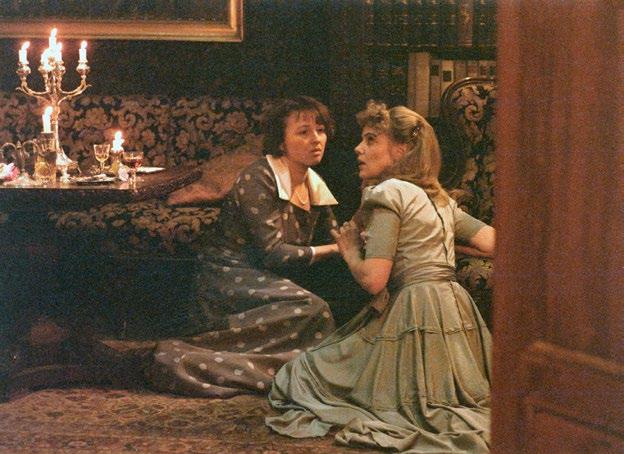
Replicating this framing, with few exceptions, the mainstream reception – while noting that Valerie broke with patriarchal norms and expectations from her parents – avoided her desire for other girls and women. The relationship with Kerstin got mentioned in passing as a matter of friendship or in terms of breaking with upper-class conventions. Valerie was described as confused and in search of identity, as wounded by her patriarchal upbringing, inhibited by invisible oppression, and as feeling different and ugly. Kerstin was in some cases described as her best friend, rather than lover, as well as having an “androgynous disposition”, which – given her feminine appearance in Avskedet – might seem surprising (Sörenson 1983). Ekblad, however, did play the androgynous character of Ismael in Fanny och Alexander, and several other queer characters in Swedish film, television, and theater in the 1980s. She was cast as the historical figures Agnes von Krusenstjerna in Mai Zetterling’s Amorosa (1986) and as Siri von Essen, wife of August Strindberg, in the television series August Strindberg:
Ett liv (August Strindberg: A Life , Kjell Grede and Johan Bergenstråhle, 1985), as well as the androgynous Tintomara in an adaptation of Carl Love Almqvist’s Drottningens juvelsmycke (The Queen’s Tiara) at the Royal Dramatic Theatre in Stockholm in 1987.
Much in the same way as in Sweden, as Hanna Kangasniemi has shown, the mainstream Finnish reception also overlooked the lesbian relationship (Kangasniemi n.d.). Among the reception materials collected by the Swedish Film Institute, including both Swedish and Finnish reviews, only a few cases address the film’s queer aspects. For instance, one Finnish critic wrote that “[t]he ‘new kind’ of love which emerges towards the end of the movie has also been handled with delicacy and sensitivity” (Eteläpää 1982). Another exception is a Swedish critic who upon the film’s television broadcast wrote about Valerie: “Her relation to her family does not get better when she begins a relationship with a woman. Her father deems her sick and abnormal a threat against humanity (sic). Valerie is forbidden to see her younger sister”2 (Backlund 1984). Only here are the brutal stakes at the heart of the film addressed.
Circumscribing the film’s lesbian plot in terms of breaking free from conventions and longing for independence, Avskedet ’s official promotion and reception overall reveal that this theme was far from comfortably or effortlessly handled in dominant cultural criticism in Sweden and Finland in the 1980s. Quite contrary to a contemporary romanticized perception of the two countries proposed in the context of the film’s screening at the Barbican, this case sheds light on the elaborate ways in which critics sought to avoid the issue of lesbianism during these years.
Importantly, legislation in Sweden and Finland differed considerably at this time. In Sweden, homosexuality had been removed from the official list of mental illnesses in 1979 and was in the process of
2 “Hennes relation till familjen blir inte bättre när hon inleder ett förhållande med en kvinna. Hon utpekas av fadern som sjuk och onormal ett hot mot mänskligheten (sic). Valerie förbjuds att träffa sin yngre syster.”
gaining political recognition, not least through a state investigation undertaken between 1978 and 1984 (Statens offentliga utredningar 1984), which paved the way for anti-discrimination laws and other rights. Finland, in contrast, upheld a restrictive view on homosexuality, formalized in the so-called Encouragement Act which criminalized “encouragement” of homosexual behavior and created “an atmosphere of self-censorship” (Rydström 2007, 35). Whereas such legal restrictions set specific conditions for the film’s reception in Finland, the evasive handling of the film’s same-sex content in Swedish media might seem more perplexing. It is worth noting, though, that this was not the only case where the representation of lesbianism was met with silence or rejection at this time. The educational short Eva och Maria (Eva and Maria , Mary Eisikovits, Marie Falksten, and Annalena Öhrström, 1983) is another case in point. The film was funded by the National Board of Health and Welfare and produced by the company Tjejfilm in Gothenburg. When the film was completed in 1983 after a drawn-out production phase, it was met with disregard and critique of its “too-positive” portrayal of lesbian love and the Swedish Television refrained from broadcasting it (see Ryberg 2018).
As I have suggested elsewhere, the anxious inability to address lesbianism in the cultural public sphere in Sweden in the 1980s can be related to how lesbianism was constructed in the ongoing state investigation about homosexuals and society (see Ryberg 2018). According to Sara Edenheim (2005), in this and ensuing official government reports regarding “deviant sexuality and gender”, homosexuality came to be regarded as a matter of a victimized group suffering from discrimination and prejudice, rather than as a matter of illness. At the same time, this implied a postulation that homosexuals were to be seen as the same as heterosexuals, and this notion of sameness formed the basis for claims to recognition and rights, resulting in the paradoxical exclusion of issues of same-sex desire and non-binary gender. Moreover, Edenheim argues, lesbian desire was either “inconsequentialized or excluded from the reports altogether” (Edenheim 2005, 242), as they presumed male-centered definitions of body and sexuality. Lesbianism
was discussed only in terms of monogamous love relationships and parenthood (Edenheim 2005, 115).
Another possible, perhaps more direct, contributing factor to the sweeping under the rug of Avskedet ’s lesbian content may have been the film’s advertised connection to Vivica Bandler and her publicly displayed ambivalence towards the film. In one interview, Donner stated that Bandler withdrew her name from the film “for personal reasons” (Högnäs 1982b). Closeted for most of her life, the only time Bandler herself openly commented on her desire to be “in a woman’s arms” was in her memoirs, published in 1992 (Bandler and Backström 1992, 276). At the time of Avskedet ’s release, neither Bandler and Jansson’s relationship with each other, nor with anyone else, was openly spoken of. However, if nervous tactfulness regarding the reallife backdrop to the film may have contributed to setting a discrete tone in the dominant reception, this also spurred lesbian gossip and attention. For those interested, the film’s lesbian qualities were far from invisible. As I show next, Avskedet came to circulate between lesbian and feminist film events not just in Sweden and Finland but internationally for years, giving rise to significantly different and outspoken conversations.
According to Kangasniemi, Avskedet was the first Finnish production depicting physical love between two women and as such it quickly gained a reputation as a lesbian film – despite the invisibility of these aspects in its official reception. Based on interviews with lesbian and bisexual viewers conducted in the early 1990s about their memories of the film, Kangasniemi found that in Finland the film’s connection to Bandler and rumors about her bisexuality contributed decidedly to the attention it received in lesbian circles. Viewers interpreted the film with Bandler’s life as an intertext. Some found it comforting to know that even if Valerie’s relationships with other women did not work out in the film, Bandler’s had flourished in reality. Screenings in contexts of various women’s and lesbian events also contributed to the film’s impact on lesbian subculture in Finland. The very promotion of
Niskanen as a female film director attracted lesbian and bisexual women, Kangasniemi found from her interviews. In addition to circulating subculturally on VHS cassettes – following the Finnish television broadcast in 1986 – Avskedet also had an unusually long lifespan thanks to its inclusion in various international lesbian and gay film festivals in the 1980s and 1990s, for example Homo Film Festivalen (the Homo film festival) in Oslo in 1990 and in 1993 at Los Angeles International Gay & Lesbian Film & Video Festival. According to Kangasniemi, this distribution unexpectedly made Avskedet one of Finland’s most exported films in these decades.
Kangasniemi’s study offers invaluable insight into the film’s impact in Finland at a time when the Encouragement Act was still in place, but lesbian activism was on the rise. Today, confirming the film’s crucial place in Finland’s queer history, Avskedet is included in the timeline presented by the association Sateenkaarihistorian ystävät (Friends of Queer History), established in 2020. The film, the post states, “is an indirect portrayal of the relationship between Vivica Bandler and Tove Jansson” (Sateenkaarihistorian ystävät n.d.). Whereas the film, until recently, has remained lesser recognized in Sweden, archival records from women’s and lesbian and gay film contexts in the 1980s also testify to an alternative circulation and reception. Avskedet was included in some of the first gay and lesbian film festivals explicitly advertised in such terms in Sweden, such as Homofilmfestival (Homo film festival) in Malmö in 1984 and Filmer om lesbiska och bögar (Films about lesbians and gays) in Gothenburg in 1985. Unsurprisingly, contrasting the official promotion and reception, the film’s lesbian theme was not avoided in these contexts. “The film’s most emotionally saturated scene is when both we and Valerie herself realize that she loves Kerstin”, reads the presentation in the brochure for the festival in Gothenburg (Marie Falksten Private Collection 1985). Moreover, in a review in the gay magazine Revolt – mot sexuella fördomar (“Revolt – against sexual prejudice”), the representation of lesbianism was sophisticatedly analyzed in line with queer counter discourse at the time. Evoking the rhetoric of positive and negative images, emblematic of gay and lesbian film culture gener-
ally in this decade, the review celebrated Avskedet as a film where: “women portray women’s love for women. The love scenes, which are not sex scenes, are heartfelt and soft. In warm colors, with simple close-ups without sentimentality, two women who relate exclusively to each other are represented, in equality and free from roles settled in advance”3 (Revolt – mot sexuella fördomar 1983). Evoking complex questions about the representability of lesbian desire and looking relations beyond the male gaze and heteronormative to-be-looked-at-ness, the review, moreover, contrasted the scene where Kerstin dances for Valerie with a lesbian dance scene in Bernardo Bertolucci’s The Conformist (1970). About that film, the reviewer wrote: “The two women dance next to each other, posing like two beautiful, well trained circus animals for the onlookers/men. In Avskedet , on the contrary, one woman dances for the other, unaware of, uninterested in any other spectator than the woman she loves”4 (Revolt – mot sexuella fördomar 1983).
In an intriguing footnote, the author furthermore speculates about Donner’s infamous recut of the film. This, the author assumes, resulted in the film’s lesbian scenes having been “drastically reduced.” Based on manuscript materials held in the Swedish Film Institute’s archives and in Ingmar Bergman Foundation Archives in Stockholm, as well as details in Bergman’s letter to Donner about the version he was involved in editing on Fårö, it is improbable that there would have been a lot of additional lesbian content to remove. The manuscript does not include any other whole scene focusing on the same-sex relationship, although some interaction between Valerie and Kerstin happening right before and after the scene with the letter in the father’s
3 “Här skildrar kvinnor kvinnors kärlek till kvinnor. Kärleksscenerna, som inte är sexscener, är innerliga och mjuka. I varma färger, med enkla närbilder utan sentimentalitet återges två kvinnor som relaterar uteslutande med varandra, i jämnlikhet (sic) och fria från på förhand uppgjorda roller.”
4 “De två kvinnorna dansar snarast bredvid varandra, poserande som två vackra, väldresserade cirkusdjur för betraktarna/männen. I ’Avskedet’ däremot dansar den ena kvinnan för den andra, omedvetna om, ointresserade av någon annan betraktare än den kvinna hon älskar.”
office is indeed excluded from the final version of the film. Moreover, it is not unlikely that that version put greater emphasis on the relationship between the women, rather than on the relationship between Valerie and her father. Concluding from Bergman’s letter, that version would have ended with the emotionally charged scene between Valerie and Kerstin seeing each other again years after their love affair had had to end. According to Bergman, this was a “logical and beautiful” ending (Bergman 1980). However, what the imaginative footnote first and foremost shows is that if reports about conflicts during the production may have contributed to the mainstream reception’s avoidance of the issue of lesbianism, they also fueled fantasies about the potential lesbian content that might be missing from the film.
Nevertheless, records of the film’s distribution and reception even in feminist and lesbian contexts are contradictory. Some women’s film programs offer the same silence and discretion as the dominant reception, a reminder of the sometimes-uneasy relation between lesbian and heterosexual feminist contexts in the 1980s. For instance, despite being one of very few lesbian-themed films screened by Svenska Kvinnors Filmförbund (Swedish Women’s Film Association), this aspect of the film remained unmentioned in the context of the festival Kvinnor i nordisk film (Women in Nordic film) that they organized in 1986. In the short presentation of the film – included in the catalogue’s Finnish section – Valerie’s relationship with Kerstin is omitted while she is described as finding her own truth in the world of theater (Ag and Thisner 1986, 32). Moreover, in the context of the organization Kvinnobion (the Women’s cinema) in Gothenburg, where the film was screened and the director participated in a seminar in January 1984, the notes from the audience discussion do not mention any talk about the issue of lesbianism (Mötesbok för Kvinnobion och Biofem 1984). Of course, this does not mean the issue could not have been brought up, but in that case this part of the discussion eluded documentation.
The fragmented and multidimensional production, distribution, and reception history that I have painted here obviously exceeds the space and detail normally afforded in curatorial and archival practices and contexts. The digital restoration, relaunch, and recirculation of Avskedet is undoubtedly worth lauding. The film’s recent inclusion (along with several other films directed by women) in the Swedish film heritage demonstrates the crucial importance of equality and diversity measures guiding institutional work (see Hagerfors 2016). However, the complexity of this case also offers an important reminder of the need for careful contextualization and critical reflection regarding the construction and stakes of women’s and queer film histories and their place in national film heritages in the present. The misguided framing of Avskedet as an example of Swedish and Finnish progressiveness in the 1980s in the context of the “Queer 80s” series in London highlights some of the risks and pitfalls when previously unnoted “queer classics” are discovered and simply inserted into given frameworks and popular conceptualizations, rather than allowed to trouble these.
Maggie Hennefeld, Teresa Castro, and Shelley Stamp have all recently urged feminist film historiography to do more than just recuperate unknown titles and directors or add alternative examples to existing patriarchal structures. As Castro puts it, “[f]eminist histories do more than rescue or recuperate: they consider the discursive and historical dimensions of gender, while simultaneously cultivating the indispensable self-reflection that characterizes any feminist historiographic enterprise” (Castro 2022, 44). Similarly, Hennefeld argues that “feminist histories that offer new information without conceptual invention – without breaking through the walls that sideline feminist works – will be doomed to obscurity” (Hennefeld 2018, 80).
As I have shown in this chapter, the case of Avskedet complicates any simple framing of the film as a forgotten and rediscovered queer film classic representative of progressive LGBTQI+ politics in Sweden and Finland in the 1980s. As innocent and well-intended as such selling points aiming to reach new audiences in the present may seem, they risk not only over-simplifying but also decontextualizing
and misinforming our understanding of queer and feminist film histories. Avskedet ’s dominant heteronormative promotion and reception history pose a challenge to the Nordic gay-friendly imaginary, offering a reminder of the palpable lesbophobia that until very recently restricted public conversations about lesbian representations and experiences (see also Rosenberg 2000). Recognizing the film’s queer value in the present cannot and should not compensate for this history but rather involve highlighting these aspects as an essential part of its legacy.
In their respective work, Patrik Steorn and Dagmar Brunow have both argued that heritage institutions should allow and give space for the complexities of queer experiences on their own terms rather than “co-opt LGBT culture as a way to seem more radical than they are”, as Steorn puts it (Steorn 2010, 136). Scrutinizing the Swedish Film Institute’s ambition to create a more inclusive film heritage by introducing the tag “queer” at the archival streaming site Filmarkivet.se in 2017, Brunow stresses the need for transparency, accountability, thorough historicization, and critical reflection upon the ambivalences of queer visibility and the politics of recognition (Brunow 2018).
In the same vein, feminist film scholars and curators like Daniella Shreir, Erika Balsom, and Hila Peleg critically point out that in the neoliberal present, the high currency of notions of forgotten and recuperated women’s films are too often capitalized on by the very same institutions that set up the parameters for women’s exclusion and marginalization in the first place. As Balsom and Peleg put it, “[t]he rhetoric of oblivion can prepare the ground for a self-congratulatory proclamation of discovery – an utterance that, whatever the intentions of its enunciator, is inevitably bound to the accrual of capital and institutional power” (Peleg and Balsom 2022, 31). This terminology, furthermore, tends to presuppose dominant history while blocking out alternative contexts and communities where such “forgotten”, and “unknown” films may have been consistently screened and discussed. “Assuming that a film has been consigned to the dustbin of history risks universalizing one particular film culture, and can unfairly negate the care, labor, and knowledge of those who had shepherded the work
through time,” Balsom and Peleg furthermore contend (Peleg and Balsom 2022, 31). Avskedet ’s rich queer distribution and reception is a case in point. Recognizing this history is as important as recognizing the film title and director in dominant film historical accounts. To restore queer dimensions to film history is not simply about recognizing “queer classics” – but to dig into their many times uncomfortable, inconsistent, and complicated baggage and allow for this to disrupt given historiographical, curatorial, and archival frameworks.
The author wishes to thank Marie Falksten, and the archivists at the Swedish Film Institute, the National Library of Sweden, and the Ingmar Bergman Foundation, Stockholm, for invaluable help accessing the materials discussed in this piece, as well as Sylvia Ingemarsdotter and Antonia Dubravka Carnerud for both generously sharing their recollections from editing the film. This research is funded by the Swedish Research Council: 2021-01983.
Ag, Lena , and Iréne Thisner. 1986. Kvinnor i nordisk film: Filmfestival 1986. Stockholm: Svenska kvinnors filmförbund.
Ahmed, Sara. 2012. On Being Included: Racism and Diversity in Institutional Life. Durham, N.C.: Duke University Press.
Amorosa. 1986. Directed by Mai Zetterling. Sweden: Sandrew Film & Teater AB, Stiftelsen Svenska Filminstitutet and Sveriges Television AB TV1.
August Strindberg: Ett liv. 1985. Directed by Kjell Grede and Johan Bergenstråhle. Sweden/Austria/West Germany/Denmark: Sveriges Television AB TV1, Satel, Westdeutscher Rundfunk (WDR), Taurus Film, Danmarks Radio and Crone Film Produktion A/S.
Avskedet. 1982. Directed by Tuija-Maija Niskanen. Sweden/Finland: Cinematograph AB, Stiftelsen Svenska Filminstitutet, Sveriges Television AB TV2, Oy Mainos-TV-Reklam Ab and AB Svensk Filmindustri.
Backlund, Monica. 1984. “Finsk-svensk debutfilm som redan prisbelönats.” Expressen, May 17.
Bandler, Vivica , and Carita Backström. 1992. Adressaten okänd. Stockholm: Norstedt.
Barbican. 2024. “The Farewell (15*) + introduction by Mekella Broomberg.” Accessed August 15, 2024. https://www.barbican.org.uk/whats-on/2024/event/ queer-80s-the-farewell-introduction.
Bendjelloul, Wanda. 2012. “Bortom garderoben.” FLM. Accessed August 15, 2024. https://flm.nu/2012/10/bortom-garderoben/.
Bergman, Ingmar. 1980. “Letter to Jörn Donner.” In Ingmar Bergman Foundation Archives, Stockholm.
Berlant, Lauren Gail , and Michael Warner. 1998. “Sex in Public.” Critical Inquiry, 24:547–66.
Bjelkendal, Göran. 1983. “Farväl till Avskedet.” Recension, 2: 8.
Blomkvist, Mårten. 1983. “Ovanligt bra manus.” Expressen, March 12.
Brunow, Dagmar. 2018. “Naming, Shaming, Framing?: The Ambivalence of Queer Visibility in Audio-Visual Archives.” In The Power of Vulnerability:
Mobilising Affect in Feminist, Queer and AntiRacist Media Cultures, edited by Anu Koivunen, Kata Kyrölä, and Ingrid Ryberg. Manchester: Manchester University Press.
Castro, Teresa. 2022. “The Many Feminist Histories of Documentary.” In Feminist Worldmaking and the Moving Image, edited by Erika Balsom and Hila Peleg. Cambridge, Massachusetts: The MIT Press.
The Celluloid Closet. 1995. Directed by Rob Epstein and Jeffrey Friedman. USA: Channel 4 and Home Box Office.
Edenheim, Sara. 2005. Begärets lagar: moderna statliga utredningar och heteronormativitetens genealogi. Eslöv: Symposion.
Eteläpää, Heikki. 1982. “Farewell, directed by Tuija-Maija Niskanen.” Uusi Suomi, April 8.
Eva och Maria. 1983. Directed by Mary Eisikovits, Marie Falksten, and Annalena Öhrström. Sweden: Tjejfilm.
Fanny och Alexander. 1982. Directed by Ingmar Bergman. Sweden/France/West Germany: Cinematograph AB, Sveriges Television AB TV1, Gaumont International SA, Personafilm GmbH, Tobis Filmkunst GmbH and Stiftelsen Svenska Filminstitutet.
Fördom och stolthet – en queer filmhistoria. 2022. Directed by Eva Beling. Sweden: Beling Films AB.
Gustavsson, Clara , Jan Göransson , and Magnus Rosborn. 2020. “Queer: den svenska filmgarderoben.” Accessed August 15, 2024. https://www.filminstitutet. se/globalassets/3.-se-och-samtala-om-film/biodistributionen/distributionsbilder/ queer_201209.pdf.
Hagerfors, Lova. 2016. “Att förändra genom digitalisering.” Accessed June 15, 2023. https://nordicwomeninfilm.com/att-forandra-genom-digitalisering/. Website discontinued. Archived at the Swedish Film Institute and at the National Library of Norway.
Hennefeld, Maggie. 2018. “Film History.” Feminist Media Histories, 4 (2): 77–83. Hjertén, Hanserik. 1983. “Ovanlig uppbrottsfilm.” Dagens Nyheter, March 12.
Statens offentliga utredningar. 1984. Utredningen om homosexuellas situation i samhället. Homosexuella och samhället: Betänkande. Stockholm: Liber/Allmänna förl.
Högnäs, Tor. 1981. “Bland hemlärare och tjänstefolk.” Dagens Nyheter, January 26.
Högnäs, Tor. 1982a. “Donner i bråk om finsk film.” Dagens Nyheter, January 23.
Högnäs, Tor. 1982b. “Jörn Donner försvarar sig.” Dagens Nyheter, January 24.
Järnefors, Sara. 1984. “Vivica Bandler kritiserar filmen hon själv skrivit manus till.” StockholmsTidningen, May 23.
Kangasniemi, Hanna. n.d. “Jäähyväiset ja katsojan valta nähdä.” The National Audiovisual Institute KAVI. Accessed August 15, 2024. https://elonet.finna.fi/ Content/suomalaisen-elokuvan-vuosikymmenet?p=%2F19801989%2Fjaahyvaiset-ja-katsojan-valta-nahda&lng=sv.
Koivunen, Anu. 2018. “The Caring Nation: Don’t Ever Wipe Tears Without Gloves as a Reparative Fantasy.” In The Power of Vulnerability: Mobilising Affect in Feminist, Queer and AntiRacist Media Cultures, edited by Anu Koivunen, Kata Kyrölä, and Ingrid Ryberg. Manchester: Manchester University Press.
Landet som icke är. 1977. Directed by Tuija-Maija Niskanen. Finland: Finlands Svenska Television and Yleisradio.
Larsson, Stig. 1983. “Ännu ett uppbrott.” StockholmsTidningen, March 12.
Malgefors, Lars. 1984. “Sanningen om Avskedet.” In Röster i radio TV 20, 30–32.
Marie Falksten Private Collection. 1985. Festival Program. “Filmer om lesbiska och bögar 12/12–19/12-1985 på Folkets Bio.”
Matteson, Alf. 1980. “Finsk kvinnokraft bakom film om kvinnas revolt.” Nordvästra Skånes Tidningar, June 24.
Mötesbok för Kvinnobion och Biofem. 1984. Notebook. “Seminarium med Tuija Maija Niskanen och Ritva Laatto 14–15 jan.” Kvinnobion Collection, Kvinnsam, Gothenburg University Library.
Muñoz, José Esteban. 2009. Cruising Utopia: The Then and There of Queer Futurity. New York: New York University Press.
Norrländska Socialdemokraten. 1980. “Kvinnotrio gjorde film om en kvinnas uppbrott.” June 17.
Peleg, Hila , and Erika Balsom. 2022. “Introduction: No Master Territories.” In Feminist Worldmaking and the Moving Image, edited by Erika Balsom, and Hila Peleg. Cambridge, Massachusetts: The MIT Press.
Revolt – mot sexuella fördomar. 1983. “Avskedet.” May 5, 59.
Rosenberg, Tiina. 2000. “Det nya Lukas-evangeliet: om det heteronormativa mottagandet av Fucking Åmål.” Lambda Nordica, 6 (4): 23–36.
Ryberg, Ingrid. 2018. “Abortion Prevention: Lesbian Citizenship and Filmmaking in Sweden in the 1970s.” In The Power of Vulnerability: Mobilising Affect in Feminist, Queer and AntiRacist Media Cultures, edited by Anu Koivunen, Kata Kyrölä, and Ingrid Ryberg. Manchester: Manchester University Press.
Ryberg, Ingrid , Kyrölä, Kata , and Koivunen, Anu. 2021. “Guest editorial: Queer World-Making in Nordic Cinema.” Lambda Nordica, 25(3–4), 7–25.
Ryberg, Ingrid . Forthcoming. “Tove.” In Screening Postmillennial Queer Film, edited by Cüneyt Çakırlar. Routledge.
Rydström, Jens. 2007. “Introduction: Same-Sex Sexuality and the Law in Scandinavia 1842–1999.” In Criminally Queer: Homosexuality and Criminal Law in Scandinavia 1842–1999, edited by Jens Rydström, and Kati Mustola. Amsterdam: Aksant Academic Publishers.
Sateenkaarihistorian ystävät. n.d. “Finland’s Queer History Timeline.” Accessed August 15, 2024. https://sateenkaarihistoria.fi/en/ finlands-queer-history-timeline/.
Sehlin, Kjell. 1980. “Tre kvinnor bakom ny film.” VästgötaDemokraten, June 28.
SFI (Swedish Film Institute). 1980. “The Farewell.” NEWS Published by The Swedish Film Institute, 2 (40).
SFI. 1982. “The Farewell.” NEWS Published by The Swedish Film Institute, 4 (83).
SFI. 2021. “Avskedet och Pensionat Oskar nylanseras för bio.” Accessed August 15, 2024. https://pressroom.filminstitutet.se/posts/pressreleases/avskedet-ochpensionat-oskar-nylanseras-for-b.
SFI. 2023. “Queera klassiker.” Accessed August 15, 2024. https://www. filminstitutet.se/sv/se-och-samtala-om-film/biodistributionen/queera-klassiker.
Skawonius, Betty. 1981. “Åter bråk med Donner.” Dagens Nyheter, December 23.
Sörenson, Elisabeth. 1980. “Munchs vildvin bakom finsk-svensk debutfilm.”
Svenska Dagbladet, March 30.
Sörenson, Elisabeth. 1983. “Sevärt avsked från en högborgerlig miljö.” Svenska Dagbladet, March 12.
Stamp, Shelley. 2024. “Conference Report: FIAF Symposium: Women, Cinema, and Film Archives.” Feminist Media Histories, 10 (2–3): 140–44.
Steorn, Patrik. 2010. “Queer in the Museum: Methodological Reflections on Doing Queer in Museum Collections.” Lambda Nordica, 15 (3/4): 119–43.
Sydsvenska Dagbladet. 1981. “Donner klipper kvinnofilm efter författarprotest.” December 23.
Tom of Finland. 2017. Directed by Dome Karukoski. Finland/Sweden/Denmark/ Germany: Helsinki Filmi Oy.
Torka aldrig tårar utan handskar. 2012. Directed by Simon Kaijser. Sweden: Sveriges Television AB.
Tove. 2020. Directed by Zaida Bergroth. Finland/Sweden: Helsinki-filmi Oy.
Vår tid är nu. 2017. Directed by Harald Hamrell. Sweden: Jarowskij.
Udd, Eirik. Interview with Tuija-Maija Niskanen. 1982. Norrskensflamman, February 22.
Tove Thorslund
When tracing women’s work in film history, questions such as how film history generally has been written, who is mentioned, who is left out, and why, come to the fore. Many of us know who Victor Sjöström, Mauritz Stiller and Ingmar Bergman were, but few have ever heard of Anna Hofman-Uddgren, Karin Swanström or Barbro Boman. Not to mention female film workers in non-director roles, such as screenwriter Ester Julin, film editor Marie Ejlersen, costume designer Lita Prahl, title and credit designer Alva Lundin, composer Maj Sønstevold and many more – because a film is rarely the result of one person’s efforts, but rather a collective work where many professions and people work together. In this chapter I address one way to challenge the dominant methodologies and concepts in traditional male-oriented and auteur theory influenced historiography, by discussing the “Nordic Women in Film” website.
Nordic Women in Film (nordicwomeninfilm.com) was a website-based resource for research on women in the Nordic film industry,1 active between 2016–2025. It was a database of professional profiles, including historical as well as contemporary biographies and filmogra1 That is, women who are, or have been, active within the film industries of one or several of the five Nordic countries: Sweden, Norway, Denmark, Finland and Iceland.
phies. It was also a digital publication of articles and interviews with and about women who in different capacities have worked, or are working, in the Nordic film industries. The aim of Nordic Women in Film was to increase and spread knowledge and awareness of women’s professional contributions to film in the Nordic region, and to put spotlight on neglected or forgotten work. Since the writing of film history thus far generally has been male-oriented, one endeavor of the website was to make work done by women, in film history and beyond, more visible.
The website was initiated by the Swedish Film Institute and was run in collaboration with the National Library of Norway, Copenhagen University and Stockholm University. Hence, it was a collaboration between two national film heritage institutions and two universities, providing opportunities for inter-Nordic and inter-institutional exchange of knowledge regarding film historiography, film policy, working conditions, and archival practices. Within this partnership, workshops and seminars focusing on research on women in Nordic film history were also organized (this anthology being an outcome of one such collaboration).
For the sake of transparency, I should make it clear that I worked at the Swedish Film Institute as editor and project manager of Nordic Women in Film between 2019–2025, and it is in this position I have written this text. During the final stages of writing this chapter, it became clear that the Swedish Film Institute had to make financial cuts due to several years of insufficient funding, ultimately resulting in a financial crisis. One of these cuts had consequences for Nordic Women in Film, which was decided to be discontinued. 2 As a consequence, this chapter has shifted its focus. What began as a descriptive
2 A selection of Swedish articles and biographies from nordicwomeninfilm.com has been transferred to svenskfilmdatabas.se (also run by the Swedish Film Institute). The Norwegian content can be found on lokalhistoriewiki, which is administered by the National Library of Norway: https://lokalhistoriewiki.no/wiki/Kategori:Nordic_Women_in_Film. The website nordicwomeninfilm.com has also been archived by the Swedish Film Institute and by the Web Archive at the National Library of Norway.
piece, intended to raise awareness of Nordic Women in Film, has instead become a form of documentation and closure of the project. I will return to this later in the chapter.
The website Nordic Women in Film was launched in April 2016, initially as a Swedish project. The initiative to create the site came a few years earlier from documentary filmmaker Tove Torbiörnsson, who at the time worked as one of the Heads of department at the Swedish Film Institute. Her original inspiration came from the project Nordic Women’s Literature (nordicwomensliterature.net), a web-based project focusing on female authors, and her idea was to do something similar for film.
But let us back up a bit further: the Swedish Film Institute is a foundation, which between 1963 and 2016 was regulated by the Film Agreement (filmavtalet) between the Swedish state and private film industry, and which was renegotiated at intervals of roughly five years. The first Film Agreement followed the Swedish Film Reform, initiated by the founder of the Film Institute, Harry Schein, and the then Swedish Minister of Finance, Gunnar Sträng. It was an agreement between the film industry and the government, with the aim of supporting the production of new Swedish film. The idea was that cinemas would be granted a lower tax. Instead, a 10 percent fee would be added to each cinema ticket sold which, through a funding system, would go into Swedish film production. In addition to this, the government also added resources. The reform came into motion and remained intact until January 1, 2017, when the 10 percent fee was removed from the agreement. The Swedish Film Institute has since been solely financed by state funding (SFI 2015). 3
3 The 2025 Film Inquiry (SOU 2025:24) now proposes, among other things, going back to the lower tax, 10 percent fee agreement. Whether this will be implemented or not remains to be seen.
In 2000, the Swedish government stated a mission to support equality within the Swedish film industry in the Film Agreement. In 2006, the Film Agreement was renegotiated, and it was specified that a goal of a gender balance of 40/60 was desired for the key positions of producer, director and scriptwriter for films that received funding from the Swedish Film Institute. The aim was not only to ensure that more women made films, but also that a greater number of women would lead to more equal working conditions and that a greater diversity of perspectives would be represented (SFI 2017, 12–13). In the following Film Agreement, from 2013, the statement had sharpened, from 40/60 to an equal gender balance of 50/50 over time. To achieve this, an action plan, “Towards a Gender Equal Film Production” (2013), was launched, designed to answer five arguments, the first being: “There are no competent women.”4 The Nordic Women in Film website was written into the action plan as an answer to this argument: “The remedy in the action plan was to set up a website, Nordic Women in Film, where all women from the beginning of film history in the key positions of cinematographer, director, scriptwriter, producer and editor are presented” (SFI 2017, 18).
Nordic Women in Film was thus formulated as a visibility site, driven by contemporary film policy goals. To make the collection of information manageable, it was decided that the initial focus would be on five professions. The website later grew to incorporate 34 film professions, such as animators, production designers, make-up designers, continuity supervisors, intimacy coordinators, film composers, etc.
4 The other arguments were: “Women filmmakers do not have enough experience . The remedy in the action plan was the strategy training course Moviement, where women directors were informed about gender structures, and exchanged knowledge and experience with each other. Not that many women want to be directors . The actions were to carry out studies at schools to find out what is needed for women’s dreams to be taken as seriously as those of men; development funds were being put into regions in Sweden. Counting decreases quality . The action plan shows that a quota system is not necessary since counting generates new awareness. The powers in the industry do not want change The action plan initiates a research study alongside the industry to create involvement” (SFI 2017, 18. Italics added).
The idea for Nordic Women in Film was first launched in 2012 at Almedalen (a Swedish annual forum for political discussions, considered to be one of the most important political events of the year), together with the Swedish Film Institute’s first gender equality plan. The work of collecting information for Nordic Women in Film began in 2013. Material was mainly collected from the Swedish Film Database (svenskfilmdatabas.se) and the printed nine-volume series Svensk filmografi (“Swedish filmography”, Åhlander et al. 1986–2000), but also from various published works and unpublished archival materials, as well as by interviewing people working in the film industry.
2013 also saw the launch of the Women Film Pioneers Project (wfpp.columbia.edu/), which today is a well-known resource for film scholars doing research on female film professionals who worked in the silent era. Although different in geographical scope as well as by time frame, the Women Film Pioneers Project and Nordic Women in Film also shared similarities, and the US site was of course a great inspiration for the Nordic Women in Film website.
In 2016–17, Nordic Women in Film was further developed through the Women’s Film History Network – a cooperation between the Swedish Film Institute, the National Library of Norway, and the film sections at the University of Copenhagen (Denmark) and Stockholm University (Sweden), financed by the Nordic Gender Equality Fund (NIKK – Nordic Information on Gender), a Nordic co-operative body under the Nordic Council of Ministers. The NIKK project was a 15-month initiative in which Stockholm University, the Swedish Film Institute, the National Library of Norway and the University of Copenhagen were to build up a network of researchers and writers with an interest in women’s contribution to Nordic film history. Through this cooperation, nordicwomeninfilm.com grew to contain material on women working in all the Scandinavian film industries, made possible by one appointed editor in each country. Besides the editorial team, numerous film researchers, journalists and cultural writers have been involved in researching and writing biographies, in-depth articles, and interviews about and with the women on the site, with the endeavor of making archival and biographical infor-
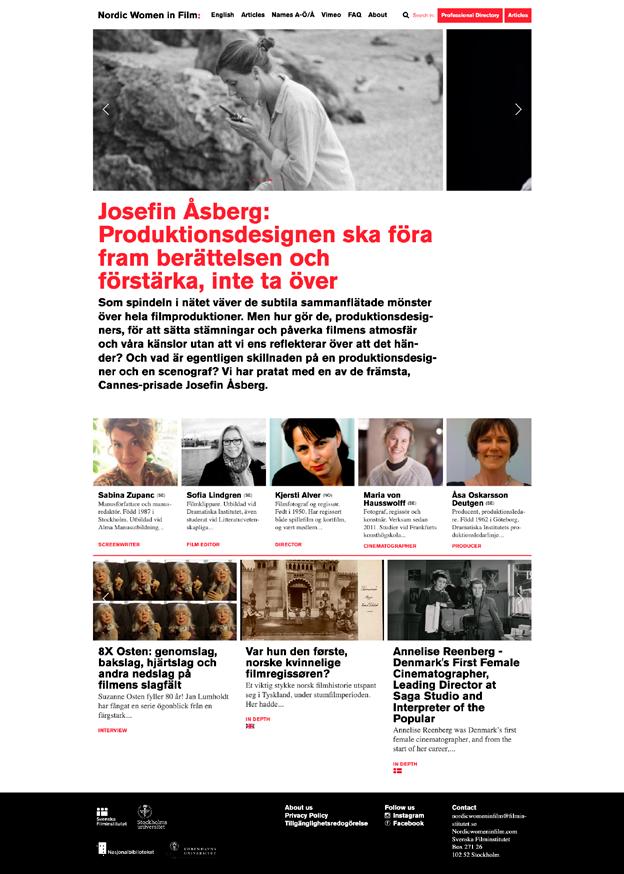
Fig. 1: Screenshot, nordicwomeninfilm.com, November 2025
mation accessible to a broader audience, as well as making contemporary female film professionals more visible through interview-based articles. The website was thus the outcome of a collaborative, collective effort.
The downside to the NIKK project was the time-framed funding of one year. When the resources ran out, the National Library of Norway was able to incorporate Nordic Women in Film as one of their continuing projects, making it possible for one research librarian to continue to work with the Norwegian part of the project as part of their job description. Until 2025, the Swedish Film Institute had incorporated Nordic Women in Film as part of its standard operations, with one editor managing the Swedish side of the collaboration. For the two universities, the same was not possible, with the effect that few new Danish professional profiles were added after 2018. For the same reason, the Danish profiles that already existed on the site were not updated at the same frequency as the Norwegian and Swedish profiles.
In December 2025, the website featured 1,570 professional profiles, containing metadata, details of years active, filmography, biographical text, photographs, links to other relevant sites and in some cases filmed material. In addition, in-depth articles and interviews (295 as of December 2025) about female film professionals from (mainly) Sweden, Norway and Denmark were also available to read on the website (fig. 1). There were very few profiles in the database from the other two Nordic countries, Finland and Iceland, but the ambition had been to find collaborators in these countries as well, to make the website Nordic, as the name stated, instead of mainly Scandinavian. All texts on the website were written in Swedish, Norwegian, Danish or English, highlighting, for example, Bibi Lindström, one of the most prolific production designers in Sweden during the 1930s–1970s; Norwegian actor and producer Aud Egede-Nissen who ran her own production company during the silent era; and Annelise Reenberg, Denmark’s first female cinematographer and a leading director at Saga Studio. A limited number of texts were written in English. Some articles were
presented in the form of a podcast, such as one about film pioneer Anna Hofman-Uddgren, who directed her first film in 1911, and another, where contemporary screenwriters Cilla Jackert and Lisa Langseth discussed different aspects of screenwriting in conversation with film professor Tytti Soila.
On the Nordic Women in Film website, past met present. The timeframe on the site spanned from the early 1900s until today. The information was quite diverse, with in-depth articles written by film scholars, as well as interviews with women working in the industry today, conducted by film journalists or writers with an interest in film and gender.
In many cases, writing the biographies of the pioneering women has not been easy. As many researchers have stated before, this is especially true for historians working to find information on female filmmakers in the silent era (Stamp 2015; Dall’Asta and Gaines 2015). One big challenge for film historians is how to discuss the “blind spots” – the uncertainty of history – while at the same time making findings (and non-findings) accessible and comprehensible. As we now know, women have largely been written off in film history, and many of their contributions have been forgotten (see, for example, Stamp 2015; Leigh 2015; and Dall’Asta and Gaines 2015). As Shelley Stamp argues:
… the story Hollywood began telling about itself in the 1920s – that female filmmakers were an anomaly, that women chiefly served the glamour industry, and that female viewers and female subject matter were marginal to the box office – has been so indelibly imprinted that generations of historians have repeated and reinforced the story for nearly a century … when being “seen on the screen” is still considered women’s primary role in Hollywood, it is essential to remember that these fictions have a long tail. A vengeful “forgetting” of women such as Lois Weber yields a skewed narrative with profound consequences for subsequent generations of filmmakers and filmgoers. (Stamp 2015)
Stamp makes this argument about Hollywood film culture, but as has been proven by the contents on nordicwomeninfilm.com, the same can be said about women in the Nordic film context.
The forgotten, or misplaced, traces of information that do exist are often scattered across a range of sources, including newspapers, film magazines, advertisements, film programs, manuscripts etc. Unconventional sources such as popular women’s magazines can also be rich in information concerning early film culture. Focusing on the Swedish context, I would like to give a couple of examples of personal and company archives with quite diverse contents, which have been researched for articles and biographies for the Nordic Women in Film website.
Notably, only 17 out of 96 of the personal and company archives at the Swedish Film Institute are connected to female film workers (Blomfeldt 2023), which is quite symptomatic when discussing women’s agency (or lack thereof) in film history at large. Most of the personal archives – male or female – are connected to directors or actors, professions that historically, as well as today, are associated with agency and power, making these professions more likely to be documented and leave traces in the archive. This is not an issue for the film industry alone, of course. Major art museums and their collection policies have, for instance, been the focus of feminist critique, precisely because the question of whose work gets collected translates into the question of whose work is counted in art history (see Nochlin 1971; D’Ignazio and Klein 2020). Today, however, there is an awareness of what is absent, and the Swedish Film Institute makes proactive choices to approach and collect female archives. In 2022–23, three new personal archives connected to female film workers were added: director Christina Olofsson, experimental filmmaker Gunvor Nelson, and actress Maud Hansson Fissoun. During this period, production manager Suzanne Branner also donated material that has been integrated into existing archives, including that of the Swedish Women’s Film Association. The scarcity of women and of a diversity of professions in the archives is why an archive such as that of credit title and intertitle designer Alva Lundin is so unique. Between 1919 and 1960, Lundin created title sequences for nearly 500 feature films, among them Erotikon (directed by Mauritz Stiller, 1920) and Flickan i frack (The Girl in Tails, directed by Karin Swanström, 1926) (figs. 2–3). Alva
Lundin’s archive consists of title cards only. With no personal, financial, or other documents, it is an archive for the study of Lundin’s aesthetic process. Film scholar Sofia Bull has studied the title cards in the archive, and used these in combination with interviews of living relatives of Lundin, material found at the Technical School for Female Apprentices where she was educated, as well as biographical information in various newspapers and magazines from the time period when Lundin was active to map out the professional life of Alva Lundin, as well as analyzing the methods and progress in her aesthetic choices (Bull 2020).
Another archive which is highly interesting for the study of women’s work in the Swedish film industry is the archive of the Swedish Women’s Film Association, an association established in 1976 to address women’s rights within the Swedish film industry. The organization also raised questions about women’s agency (or lack thereof) at film festivals and other public or political arenas where film was discussed, as well as how women were represented on screen. The archive, which is rich in information, contains minutes from meetings, correspondence, programs, reports, and other documents, available for research on the
history of the company. Several articles on the Nordic Women in Film website were connected to the Swedish Women’s Film Association, and its archive, e.g., film professor Tytti Soila’s personal recollection of the establishment of the association (first published in Soila 2019).
Several decisions had to be considered upon the publication of nordicwomeninfilm.com. One was that the Nordic Women in Film website would focus on film workers behind the camera, exploring women’s scope for action in a variety of professional roles, such as directors, producers, gaffers, cinematographers, and casting directors. The website also featured professional profiles of women that, although not working directly in film production, nonetheless have taken part in shaping discourses on cinema and film culture, such as early film critics and film censors. There were no actors in the database, unless they also worked in some other capacity behind the camera. The choice was made not to include actors partly in order to make the database manageable for the small editorial team working on the project, and partly because we wanted to shift focus from women’s contributions in front of the camera – which is arguably the only type of film work where women’s contributions have not been neglected in film history (e.g., see Stamp 2015) – and instead highlight women’s efforts behind the camera. Another decision was that a prerequisite for inclusion in the database would be having made at least three films, with some form of public screening (such as cinema, film festival, television, etc.). However, this rule was not always followed. The historical value of having worked in the early years of the film industry was in many instances considered more important than the number of films made. Another prerequisite to be included in the database was that the person had been professionally active within a Nordic context. Lastly,
anyone who fit the previous descriptions, and considered themselves to be a woman could be represented in the database. 5 One frequently asked question was why the website was called Nordic Women in Film, when the collaboration and content (mainly) was Scandinavian. As stated earlier, the ambition had always been to include all five Nordic countries in the collaboration, but for different reasons not all the approached film organizations wanted to, or had the resources to, join when the project was launched. And so, it was decided that the website would begin as a collaboration between film institutions in the three Scandinavian countries – Sweden, Norway and Denmark – with the aim to find collaborators in Finland and Iceland at a later point. One outcome of the Scandinavian collaboration was the way language was represented on the website. The three languages (besides English) that were featured on Nordic Women in Film – Swedish, Norwegian, and Danish – have similar vocabulary and can quite easily be read by Swedes, Norwegians, and Danes alike. A decision was therefore made to publish texts in all three languages. A professional profile about a Danish film worker was written in Danish, whereas one about a Norwegian film worker was written in Norwegian, and so on. In addition, some of the articles and biographies on the website were also available in English. Fixed headings on the website were written in English, as not to promote any one of the Scandinavian languages over another. Therefore, when looking at the front page, the visitor encountered four languages, which might have seemed confusing, but hopefully came across as inclusive. The small number of professional profiles of film workers from Finland and Iceland that did exist in the database were written in either English or Swedish (Swedish being one of the official languages in Finland). Like Swedish, Norwegian and Danish, Icelandic belongs to the North Germanic languages but is too different to be intelligible to readers of Scandinavian languages. Finnish belongs to the Uralic languages and 5 We also welcomed non-binary and transgendered film professionals who were comfortable with being featured in a database named “Nordic Women in Film”.
is thus completely different. If a partnership between all five Nordic countries would have taken place, a redirection of how language was used on the website would therefore have been necessary, starting with an English-language version of all content.
“A database can be used to store, organize, search, query and retrieve information,” Sarah-Mai Dang states, quite matter-of-factly. She continues: “Although relatively new, the technique of a digital database remains in the long-standing media practice of collecting and administrating information by libraries, museums, archives, encyclopedias, and others” (Dang 2020). Nordic Women in Film wanted to make research on women in early and contemporary cinema accessible to a broader audience, which is why the set-up fell on creating a digital database. The intention was also to create a collaborative inter-Nordic database, which could be easily accessible – as well as adjustable – for people working across countries. There was also a need for the database to work equally well on different devices, such as a mobile phone or a computer screen, making the information easy to access at home or in the workplace, as well as on the subway or while walking to a café. As the intention was to create a database where the user should be able to find information easily, as well as hopefully learn something new, an internet-based digital database made sense. At its best, a database can be, as Vicki Callahan states, “capable of infinite permutations of assembly [with a] search engine, which should produce unexpected relations, further research possibilities, and new knowledge formations” (Callahan 2010, 6). There is a potential elasticity in a digital database, in the sense that amendments can be made to the setup (how the search engine can be used, whether a category, photograph, or link can be added, how to narrow down the search even further, etc.) as well as to the written texts. The different types of texts on the website (such as professional profiles and articles) were treated somewhat differently. The contemporary professional profiles were updated with new information (new film titles were added to the filmography, new production companies or new work titles were added to the biography, etc.) or corrected if needed. All these amendments were made manu-
ally by the editors. 6 However, the same was generally not done with articles – once they were published, they stayed as they were, as if printed.
Knowing that it has not always been easy to find information about the pioneering women working in film in the early years of cinema, one endeavor of the database was to also document the present: to gather information about women working in the film industry today and make that information accessible and visible, for generations to come. The period covered on the site, from the early 1900s until today, as well as the wide variety of texts represented – film-historical texts written by scholars, as well as interviews with contemporary film professionals written by journalists – are arguably what made Nordic Women in Film unique. It also meant that the website had a quite broad readership, spanning from film scholars and students to film industry professionals, as well as to a general audience with an interest in film and/or gender.
In the search box on the website, one option was to search for people by active years, by pulling up a timeline between the years 1907 and present. This way, you could, for example, find Danish female directors active between 1907–40, or Norwegian female cinematographers active between 2020 and 2024, which might have been useful for researchers who wanted to find information about film pioneers, or producers who searched to find new crew members. A search for Nordic Women in Film in the digital research vehicle Retriever further shows that journalists have used Nordic Women in Film as a source for their own articles, for instance when writing the backstory to someone they had interviewed (e.g., Ekh 2022, 33; Klinga 2022, 8; Lundbladh 2021, 8).
Until December 2024, the website had a networking function for active film professionals. Through a contact form on the website, it
6 Updated texts were marked as such, e.g.: “Jane Smith (2019, updated by ed. 2024).”
was possible to get in touch with many female film workers, via the Nordic Women in Film editors. The idea was that it would serve as a practical tool for the active film industry, for example when it came to employing new crew members. The contact form also enabled another form of engagement from the user. Some of the more common messages received via the contact form were from film professionals with questions about updates or changes in the texts about them, or with information about new film titles for their filmography. Organizers of film festivals were also frequent users of the contact form, writing with invitations to filmmakers and/or asking to screen their films. It also made it possible for the film audience to write to film workers, often praising their films.
During three weeks in May 2024, a survey was conducted on the website, to better understand who used the site, and what needs and wishes they might have for Nordic Women in Film. The survey could be accessed through a pop-up window that appeared on nordicwomeninfilm.com. It was also posted on social media. Unfortunately, only 44 out of 4,275 unique visitors during this time period responded to the survey (according to Google Analytics), making it insufficient for a qualified reading. With that in mind, it might nonetheless be interesting to know something about the people that did answer. Most of the respondents answered that they would visit the website in their capacity as film professionals (15 people, or 34 percent) or as someone generally interested in film (14 people, or 32 percent). Five people (11 percent) answered as researchers; three people, or 7 percent, as students and seven people, or 16 percent, selected “other”. Among the latter category, five of these were potential film professionals (“author”, “screenwriter”, “film composer”, “writer” and “producer”), and one was a researcher (“Researcher and US Professor”). Most of the respondents were 40–59 years of age, and 68 percent answered they were women. When asked where they lived, 75 percent said Sweden, 11 percent Norway, 2 percent Denmark and 11 percent answered “other” (USA, Spain or Germany). 88 percent answered that they usually found what they were looking for when visiting nordicwomeninfilm.com. The ones that answered that they did not, filled
in that they wanted more interviews and updated filmographies, or that they wanted “contact info or a bio for someone I may work with.” One answered, “Usually yes, but today I could not because this survey is blocking the site and the positioning of its frame makes it impossible to close and proceed.” Two people answered that they could not answer because it was their first time visiting the site. When asked what they thought was the most important feature of the website (this was a question where several boxes could be checked), 75 percent answered the database of professional profiles; 50 percent answered the in-depth articles with film-historical context; and 43 percent answered interviews with people working in the film industry. The last question, “Is there anything you feel is lacking, or that you would like to see more of on nordicwomeninfilm.com?”, was answered by 12 people. Among the answers, Finnish film workers were called for, as were an option to update one’s own biography, and a more interactive layout. One specific suggestion was made for an article about female award-winners, and two answers referred to the complexity of having both historical and contemporary profiles in the database. Both thought it better to focus on one aspect rather than both:
[T]he checked boxes above (9.) are the true gem of this site (i.e. the database and historical context) develop that further and you would be breaking ground for the future (on the other hand I understand how teasing it is to develop the aspects of contemporary filmworkers, but that would only shift the balance of focus to entertainment, and in depth render this site obsolete).
I think I’m unsure what it is for. Is it meant to be an active database of film professionals so women are better represented in the workplace? In that case there should be a place to highlight younger, less experienced women as well. Or is it meant to be more of a historical document with what women have accomplished and how they have contributed to culture, so that we don’t once again become invisible?
As mentioned earlier, the mix of historical and contemporary content – the fact that the website featured both, and endeavored to reach out to film-historical scholars as well as to the contemporary film industry
– were arguably what made Nordic Women in Film unique. The original idea of the project was to gather all women who have worked, or are working, behind the camera (in a Nordic context), to show that all of these women, who are so rarely mentioned in film history, exist, and at the same time strive to make sure that the women working in film today will not be forgotten. Having said that, the website did cover a lot, with its many languages, different countries, pioneers and contemporary women side by side, different types of articles, and wide range of intended users. A restructuring of the website had likely been necessary, if the project had continued.
Although the number of women working in the film industry has increased during the last decades, they are still outnumbered by men, at least within the so-called key positions of director, screenwriter, producer, and cinematographer. A recent report from the European Audiovisual Observatory shows that only 26 percent of directors of European feature films between 2018 and 2022 were women. Female screenwriters account for 29 percent, cinematographers 11 percent, and producers 35 percent in the same report (Simone 2023, 10).
If we look at the Swedish film industry, the work to promote gender equality has been described internationally as highly successful, but domestically there has been criticism. In public debate, gender equality has been contrasted with quality, and there has been a fear that particularly the Swedish Film Institute’s focus on gender parity would mean fewer high-quality films getting the green light to go on to production (the Swedish Film Institute being the main funding body for Swedish films) (Jansson 2022, 151–72. Also: Lindblad 2020; Pallas 2021; Boström 2022; Serner 2020). In other words, it was stated that a gender-equal system would hinder the best projects from being made. Looking at the constructed dichotomy between equality and quality, it would seem as if films of higher quality would equal films made by men. But there are no statistics to suggest that films made by women would be of lower quality. In fact, since data collection started in 2007 until 2024, the top four positions in a critic-based rating index based
on reviews in the major Swedish newspapers are films with female directors: Amanda Kernell’s Sameblod (Sami Blood , 2017) Anna Odell’s Återträffen (The Reunion , 2013), Lisa Aschan’s Apflickorna (She Monkeys , 2011), and Mia Englund’s Hypermoon (2023) (statistics collected from the Swedish Film Database, and Film i Väst, 2022). However, discussions in the printed press continued to center on equality versus quality, and what some considered a gender-equality focus which overshadowed everything else in film policy (Lindblad 2020; Pallas 2020; and for a different point of view: Holmberg 2020).
In a 2021 report from the Swedish Agency for Cultural Policy Analysis, it was stated that film cultural policy affects artistic freedom:
In part, it is due to a lack of clarity in how the Film Institute describes its work against discrimination and for diversity and equality that can be interpreted as meaning that artistic content can or should be evaluated on the basis of how it relates to different grounds of discrimination. But it is also about how the Swedish Film Institute communicates issues related to gender equality and diversity in Swedish film. The Swedish Film Institute has in various contexts examined Swedish film content based on different diversity and equality aspects. These reviews can be relevant in themselves, but when communicated from the commissioner to potential [film funding] applicants, there is also a risk that artists and cultural creators adapt their artistic work in a way that is not desirable based on the ideal of artistic freedom. 7 (Myndigheten för kulturanalys 2021, 13–14)
According to the report, almost half of the film funding applicants stated that they at some point had adapted their artistic content to try
7 “Delvis handlar det om en otydlighet i hur Filminstitutet beskriver sitt arbete mot diskriminering och för mångfald och jämställdhet som kan tolkas som att konstnärligt innehåll kan eller bör värderas utifrån hur det förhåller sig till olika diskrimineringsgrunder. Men det handlar också om hur Filminstitutet kommunicerar frågor kring jämställdhet och mångfald i svensk film. Filminstitutet har i olika sammanhang granskat svensk films innehåll utifrån olika mångfalds- och jämställdhetsaspekter. Dessa granskningar kan i sig vara relevanta men när de kommuniceras från bidragsgivaren till potentiella sökande finns också en risk att konstnärer och kulturskapare anpassar sitt konstnärliga arbete på ett sätt som inte är önskvärt utifrån idealet om konstnärlig frihet.”
to increase their chances of getting their application approved (Myndigheten för kulturanalys 2021, 14).
The raised concerns resulted in changes in the government’s guidelines to the Swedish Film Institute. In its 2022 appropriation letter, the guideline of promoting gender equality, diversity and children’s perspectives was withdrawn. The reason cited for this was to ensure that artistic freedom would not be interfered with; that politics should be held at arm’s length from culture (Källén 2021). The mission that the Swedish government had given the Swedish Film Institute in the year 2000, to support equality within the Swedish film industry, was thus diminished. The withdrawal also had a tangible effect on the project Nordic Women in Film, which, since it no longer speaks to the given guidelines, was one of the cuts made when the Swedish Film Institute had to make financial savings. Another effect was the discontinuation of the annual gender equality reports (SFI 2017, 2018, 2021, 2022).
The film industry is not gender-equal, neither historically nor today. Professions that are often considered prestigious, such as director and cinematographer, are still dominated by men, and a very small percentage of female directors work on high-budget productions that reach a larger audience (SFI 2018, 11–12). To make change happen, to nurture a film culture with more equality and diversity in front of as well as behind the camera, the structural norms need to continually be addressed. The key questions remain: Who will get the resources and acknowledgement? Whose stories will be told on the screen? Who is mentioned? Who is left out? And whose work is collected and archived for the future?
Åhlander, Lars, Torsten Ljungstedt , and Jörn Donner. 1986–2000. Svensk filmografi, del 1–9. Stockholm: Norstedt.
Blomfeldt, Markus. 2023. “Arkivöversikt – Svenska Filminstitutets bibliotek.” https://www.filminstitutet.se/globalassets/2.-fa-kunskap-om-film/biblioteket/ arkivoversikt-extern.pdf.
Boström, Håkan . 2022. “Vrid av pengakranen till ideologimyndigheterna.”
GöteborgsPosten, November 7, 2.
Bull, Sofia. 2020. “Alva gick från pionjär till nestor i filmtextdesign.” Accessed February 17, 2025. https://nordicwomeninfilm.com/alva-gick-fran-pionjar-tillnestor-i-filmtextdesign/?lang=sv. Website discontinued. Archived at the Swedish Film Institute and at the National Library of Norway.
Callahan, Vicki. 2010. “Reclaiming the Archive: Archaeological Explorations toward a Feminism 3.0”. In Reclaiming the Archive: Feminism and Film History, edited by Vicki Callahan, 1–7. Detroit: Wayne State University Press.
Dall’Asta, Monica , and Jane M. Gaines. 2015. “Constellations: Past Meets Present in Feminist Film History.” In Doing Women’s Film History, edited by Christine Gledhill and Julia Knight, 13–25. Urbana, Chicago, and Springfield: University of Illinois Press.
Dang, Sarah-Mai . 2020. “Unknowable Facts and Digital Databases: Reflections on the Women Film Pioneers Project and Women in Film History.” In Digital Humanities Quarterly 14 (4). https://www.digitalhumanities.org/dhq/ vol/14/4/000528/000528.html.
D’Ignazio, Catherine , and Lauren F. Klein. 2020. Data Feminism. The MIT Press. https://data-feminism.mitpress.mit.edu/pub/f8vw7hhr.
Ekh, Melina. 2022. “Tio kända ögonblick i Blekinges kvinnohistoria.” Blekinge Läns Tidning, March 10, 33.
Erotikon. 1920. Directed by Mauritz Stiller. Title cards by Alva Lundin. Sweden: AB Svensk Filmindustri.
Film i Väst. 2022. “Betygsindex svensk film.” Accessed February 17, 2025. https://filmivast.se/betygsindex-svensk-film.
Flickan i frack. 1926. Directed by Karin Swanström. Title cards by Alva Lundin. Sweden: AB Sandrew-Produktion.
Holmberg, Jonas. 2020. “Svensk film plågas inte av någon genusdoktrin.” Expressen, October 12. Last updated June 14, 2021. Accessed February 17, 2025. https://www.expressen.se/kultur/svensk-film-plagas-inte-av-nagongenusdoktrin.
Jansson, Maria. 2022. Kvinnors närvaro och makten över filmen. Lund: Studentlitteratur.
Källén, Matilda. 2021. “Kulturministern om Filminstitutets nya riktlinjer: ‘Kulturen ska vara fri från politisk inblandning’”. Dagens Nyheter, December 29. Accessed February 17, 2025. https://www.dn.se/kultur/kulturministern-omfilminstitutets-nya-riktlinjer-kulturen-ska-vara-fri-fran-politisk-inblandning.
Klinga, Roland. 2022. “Dogborn’-regissören: ‘Jag blev förälskad i Norrköping’.” Folkbladet Östergötland, August 16.
Leigh, Michele. 2015. “Reading between the Lines: History and the Studio Owner’s Wife.” In Doing Women’s Film History, edited by Christine Gledhill and Julia Knight, 42–52. Urbana, Chicago: University of Illinois Press.
Lindblad, Helena. 2020. “Filminstitutets Anna Serner bör bredda sin repertoar eller lämna vd-stolen.” Dagens Nyheter, September 17, 6.
Lundbladh, Alexandra. 2021. “Alva Bratt gör rösten till Lena Nyman.” Nöjesguiden, June 28, 8.
Myndigheten för kulturanalys. 2021. Så fri är konsten: Den kulturpolitiska styrningens påverkan på den konstnärliga friheten. Rapport 2021:1. Gothenburg: Taberg Media Group AB. https://kulturanalys.se/wp-content/uploads/2021/06/2021_1webb.pdf
Nochlin, Linda. 1971. “Why Have There Been No Great Women Artists?” In Woman in Sexist Society: Studies in Power and Powerlessness, edited by Vivian Gornick and Barbara Moran. New York: Basic Books. https://www.writing. upenn.edu/library/Nochlin-Linda_Why-Have-There-Been-No-Great-WomenArtists.pdf.
Pallas, Hynek. 2020. “Nu måste svensk film räddas från flosklerna.” Expressen, September 29. Last updated June 10, 2021. Accessed February 17, 2025. https://www.expressen.se/kultur/hynek-pallas/-nu-maste-svensk-film-raddasfran-flosklerna.
Pallas, Hynek. 2021. “Nu måste Filminstitutets politisering få ett slut.” GöteborgsPosten, June 12, 48.
Serner, Anna. 2020. “Tondövt att förminska Filminstitutets arbete.” Expressen, October 20. Accessed February 17, 2025. https://www.expressen.se/kultur/ tondovt-att-forminska-filminstitutets-arbete.
SFI (Swedish Film Institute). 2015. “History of the Film Institute.” Accessed February 17, 2025. https://www.filminstitutet.se/en/about-us/swedish-filminstitute/mission-and-organisation/history-of-the-film-institute/.
SFI. 2017. Looking Back and Moving Forward: Gender Equality Report 2017. https://www.filminstitutet.se/globalassets/2.-fa-kunskap-om-film/analys-ochstatistik/publications/other-publications/swedish-film-insitute-gender-equalityreport_2017_eng.pdf.
SFI. 2018. The Money Issue: Gender Equality Report 2018. https://www. filminstitutet.se/globalassets/2.-fa-kunskap-om-film/analys-och-statistik/ publications/other-publications/sfi-gender-equality-report-2018---lowres.pdf.
SFI. 2021. Which Women?: Gender Equality Report 2019/2020. https://www.filminstitutet.se/globalassets/2.-fa-kunskap-om-film/analys-ochstatistik/publications/other-publications/which-women---gender-equalityreport-19-20.pdf.
SFI. 2022. 406 Days – It’s about Time: Gender Equality Report 2021/2022. https://www.filminstitutet.se/globalassets/2.-fa-kunskap-om-film/analys-ochstatistik/publications/other-publications/406-days--its-about-time.-genderequality-report-2021-2022.pdf.
Simone, Patrizia. 2023. “Female Professionals in European Film Production.” European Audiovisual Observatory. Council of Europe. Accessed December 20, 2024. https://rm.coe.int/female-professionals-in-european-film-production2023-edition-p-simone/1680acfdcb.
Soila, Tytti. 2019. “Activism, Ideals and Film Criticism in 1970s Sweden.” In Making the Invisible Visible: Reclaiming Women’s Agency in Swedish Film History and Beyond, edited by Ingrid Stigsdotter. Lund: Nordic Academic Press.
SOU 2025:24 (Statens Offentliga Utredningar). Publiken i fokus – reformer för ett starkare filmland. Stockholm: Elanders Sverige AB.
Stamp, Shelley. 2015. “Feminist Media Historiography and the Work Ahead.”
Screening the Past 40. https://www.screeningthepast.com/issue-40-first-release/ feminist-media-historiography-and-the-work-ahead.
PART 2 SCREENWRITING, COLLABORATION AND AUTHORSHIP
5. The Writer’s-Widow-Turned-Screenwriting-Manager: Stina Bergman’s Collaborative Authorship in Swedish Classical Cinema
Anna Sofia Rossholm
During Stina Bergman’s career in the film industry in the 1930s and 40s, she wrote a total of six screenplays. All were literary adaptations, and only for the three screenplays based on works written by her late husband Hjalmar Bergman was she credited as the primary screenwriter. What is remarkable about Stina Bergman’s contribution to Swedish film history is not the scale of her output but the success she achieved.1 Her films were among the most critically acclaimed of the 1930s, and in the early 1940s she was appointed head of the screenwriting department at the major production company Svensk Filmindustri (SF), a position that gave her considerable influence over the development of Swedish cinema in the 1940s. She influenced which films would be made and how the stories should be written, and she sought out the talents of the younger generation of writers. The most renowned of these talents was Ingmar Bergman, who began his career in film at SF’s screenwriting section and under Stina Bergman’s guidance was hired to create or revise scripts – but he was far from the only one. The 1940s, sometimes referred to as the Second Golden Age of
1 Throughout the text, I will use first and last names for persons with Bergman as their surname. This is because the text mentions four different people who all have the surname Bergman. SB is short for Stina Bergman in the text.
Swedish Cinema, was a time of artistic revival. Cinematic creativity and stories that challenged norms and conventions were in demand. While Stina Bergman was perhaps not the most powerful manager in the film business, she certainly contributed to the establishment, development and circulation of new stories and new authors.
A question that inevitably comes to mind is how such an inexperienced screenwriter could achieve such great success with just a few screenplay credits to her name. How could someone who had only written three screenplays manage to become the head of the screenwriting department of Sweden’s largest production company? Although these questions are relevant, they are also quite misleading. Stina Bergman was not an inexperienced writer when she was hired as a screenwriter for her first film. Even if she had not previously written screenplays, she was an experienced author who had worked since her youth in various forms of writing that have much in common with screenwriting. She had, for example, assisted her husband in his writing, translated a range of books from several languages, and rewritten novels into plays or into easy-to-read prose versions. A screenplay as writing-in-process (Price 2010, 41–42), “intermediate” in nature (Maras 2009, 47–63), shares similarities with the adaptive and collaborative writing that characterizes the entire range of Stina Bergman’s authorship. A more difficult question to answer is how she as a woman managed to do what she did. As the only woman among Swedish screenwriters in the 1930s, how did she outshine her more experienced male colleagues? Moreover, how did she negotiate her status as an author in relation to the male authors around her? This chapter examines a case of female authorship that seems to be an isolated exception, while placing it in its historical context. By doing so, I hope to shed light on the complexities and paradoxes of women’s cinematic authorship in a period known for its absence of women filmmakers.
In this study, Stina Bergman’s screenwriting is examined from the perspective of authorial practice. Authorial practice is considered both in terms of creative practice (the adaptation of existing works into a
screenplay) and professional practice (SB’s function as head of the screenwriting section at SF). The scholarly debate on women’s authorship has often found itself in the paradoxical position of simultaneously asserting women’s authorship while also problematizing and criticizing the very idea that a work is a product of individual creation (discussed by Tasker 2010). Stina Bergman’s authorship sheds light on this paradox in an interesting way: just one of many creative women who have been overshadowed by the men regarded as the primary authors of a given national cinema (or a given genre of cinema, and so on), her screenwriting can only be understood in critical dialogue with the classical notion of authorship as individual creative achievement.
Since poststructuralism’s problematization and criticism of the solitary genius as the origin of great art, authorship theories have moved in directions that either rethink individual authorship or criticize it. A collectivist approach to authorship advocated by, for example, Robert L. Carringer (1985, ix), argues that anyone who makes a “distinguishable contribution” to a work is an author. In filmmaking, this means that anyone from a lighting designer to a director would be called a co-author. Even if such a production studies-oriented definition has proven to be a useful tool for problematizing classical auteurism (see, primarily, Gaut 1997; also compare with Gjelsvik’s chapter in this book), a broader understanding of authorship may undermine the concept of the single author itself. It is telling that, in later analyses, Carringer introduces the notion of the “primary author” as a separate category to distinguish between different roles in filmmaking (2001). On the other end of the spectrum, there is an approach that revisits an understanding of authorship in terms of artistic intentionality and individual control while also acknowledging the possibility of multiple authors and authorial collaborations. This is a position advocated by the philosopher Paisley Livingston, who defines authorship as “artistic or expressive accomplishments in which someone exercises sufficient control in the production of an utterance or a work as a whole” (2011, 221). With such a definition, cinematic authorship can only be attributed to individuals or groups of individuals with overall control of the film. In arthouse cinema, this would primarily be the director,
but in other film-cultural contexts it could also be the screenwriter or the producer.
Stina Bergman’s authorship is situated somewhere in between these two opposed alternatives. As a screenwriter, her influence overall was, of course, greater than that of, say, the lighting designer. At the same time, she adapted already-written material from one form to another, making no claim to personalize the stories she rewrote. I would accordingly characterize her creative work in terms of collaborative authorship. That is, filmmaking as a complex activity always requires many coordinated skills, but SB’s “voice” is always in some sense dialogical; it is expressed in interaction with her fellow artists in production and through the texts that she adapts. Understanding collaborative authorship in this sense necessitates a dynamic conception of authorship. In this context, Stina Bergman sits on the threshold of authorship; she negotiates the boundaries of what it means to be an author. This study does not aim to identify Stina Bergman as the “true author” in the productions she worked on. That would merely duplicate “the romantic version of authorship, with its ‘continual desire to identify the true author out of the complex of creative personnel’” (Caughie quoted in Staiger 2003, 42). Instead, analysis highlights the collaborative aspects of filmmaking on the threshold of what is commonly conceptualized as authorship.
As described by Janet Staiger, authorship means different things depending on the context in which an author is placed – in the work, in public discourse, in the production context or in the individual reader’s encounter with the text (Staiger 2003). In this analysis, Stina Bergman’s collaborative authorship is in three different places: 1) at a textual level in the relationship between the literary original and the film script; 2) in public discourse such as marketing, and reviews or interviews about the films; and 3) in relation to the author’s agency in the creative process. The combined approach is in line with the “contextual turn” that feminist authorship studies have taken in recent decades (Paszkiewicz 2019), through which textual analysis is understood in relation to aspects such as the contexts of production and distribution, as well as critical reception (for instance, by Grant 2001;
Cobb 2015; White 2015). This analysis of empirical material demonstrates how the different levels cannot be strictly separated but are instead intertwined.
The material that might be explored in order to evidence authorial context includes interviews that Stina Bergman gave or other texts that she published about her work. These can both testify to the actual production process and be an example of what Staiger – through Foucault – refers to as the “self-fashioning” (2008) of authorship, i.e. a construction of the self as author in the public sphere. In a similar way, the screenplay as a text can be seen both as a trace of the actual production process and as a text that can be read and analyzed as an aesthetic expression. The editorial statements that Stina Bergman wrote in her capacity as head of the screenwriting section are traces of the production process, but they also testify to her own ambitions and ideas about filmic writing and, perhaps more than other documents, document her personal voice. Although her contribution to the filmmaking process was more limited in her role as head of the screenwriting section, this professional work gives insight into her own personal style and ideas about which kind of stories should be prioritized in film culture. In this context, SB’s editorial statements also provide a unique insight into the story that never happened – the story of the personally colored films that Stina Bergman never made – while they also shed light on some of the “what if” questions that may arise when approaching women’s creativity and authorship (Gaines 2022).
Stina Bergman is best known as the wife and then widow of the author Hjalmar Bergman, an author famous in Swedish literary history for plays and novels that combine realism with fantasy and the lighthearted with the tragic. Her unwavering loyalty to her husband despite his excessive jealousy, his drug and alcohol addiction, and his sexual attraction to young men is well documented in his biographies (Linder 1962, 186–98; Linder 1983, 158–60; Linder 1984, 27–35, 88–91). What is perhaps less known is the extent to which this co-dependence also
involved co-creation and co-writing. As an author’s wife, SB negotiated a range of roles: she was his agent, secretary, critic, and editor. After his passing, she upheld his legacy and maintained the rights to his works. She was thus one of the many wives of famous authors or artists who have been brought into light in recent history writing as more active creators than had been previously acknowledged (e.g., Ciuraru 2023; for the film industry, see Leigh 2015; Stamp 2015).
SB’s involvement with film was, from the start, linked to this dual role as wife and writing partner. Hjalmar Bergman was one of the few literary authors who wrote film scripts during the silent film era, and it has been suggested that his wife was the driving force behind his approach to film (Linder 1973, 104). After his passing, SB made her name as a screenwriter with the screenplays for the films Swedenhielms (1935), Dollar (1938) and Hans nåds testamente (His Lordship’s Last Will , 1940), based on Hjalmar Bergman’s eponymous plays and novel (1925; 1926; 1910). During the 1930s, she also adapted his works for radio and supervised stage productions of his plays. In addition to adapting film scripts, she also wrote the novelizations published when the films premiered. Although it might appear that her close connection to her husband’s writing became even stronger after his passing, this was a period during which SB also enjoyed her greatest personal success. The film adaptations she wrote were among the few in 1930s Swedish cinema that were praised by critics, and she came to collaborate with key figures in the industry. For instance, apart from working with Gustaf Molander, she collaborated with screenwriter Gösta Stevens on the script for the film En kvinnas ansikte (A Woman’s Face , 1938) and with her brother, film and theater director Per Lindberg, co-writing two scripts for films that he directed – Gubben kommer (The Old Man Arrives, 1939) and Gläd dig i din ungdom (Rejoice While You’re Young , 1939).
The complexity of Stina Bergman’s relationship to the issue of authorship can also be explored in relation to the complexity of what we might call “women’s history”. On the one hand, as a female screenwriter, she was a unique case in the mid-1930s. She did not belong to any broader trend or movement, and as noted above, she operated on
her own: the women filmmakers who had emerged in the silent era were no longer active. Indeed, apart from Karin Swanström – who was artistic director for SF’s productions in the 1930s – there were virtually no other women in key filmmaking roles in Sweden. On the other hand, her achievement is important for women’s cinematic authorship in the latter part of the classical period. Her proven talent for adapting literary stories to film, combined with the cultural capital she possessed through her networks, made her one of the central figures in the literary turn in Swedish film culture in the late 1930s and 1940s. This was a shift that, among other things, meant that a growing number of scriptwriters came to the film industry with a background in literary writing. This interest in original stories drawn from contemporary Swedish literature also influenced women’s cinematic authorship. Although there was not a significant increase in women screenwriters during this period (Forsman and Sundstedt 2021, 193), the few women who did write screenplays received cultural recognition from the literary sphere and therefore received recognition for their work (Rossholm 2022). Stina Bergman can thus be placed in a broader context of women’s cinematic authorship because in the 1940s she advocated for cultural change (that is, the cultural recognition of female screenwriters) and this was beneficial for subsequent women authors. Coming to film from the literary sphere, SB can also be seen as a forerunner of the literary authors that began writing films in the 1940s. Famous writers such as Dagmar Edqvist, Maria Lang and, not least, Astrid Lindgren wrote screenplays based on their literary works in the ensuing decades. This literary turn in the film industry also made women’s voices heard in a more indirect way since several of the films that emerged were adapted from female-authored literary works. What is remarkable about this subsequent flourishing of female literary presence is that as much as 30 percent of newly published Swedish literature was, at this time, written by female authors (Svedjedal 1982, 43–45, 70). There was also an increasing number of film adaptations addressing previously banned topics belonging to a female sphere of experience, not least society’s double standards regarding female sexuality. Below, I explore how Stina Bergman approached these tendencies as a manager, and
how her search for original stories also meant criticizing those stories that were not to her liking.
Adaptation Strategies: Hollywood Meets Swedish Literature
Stina Bergman authored three aforementioned comedy-dramas based on the works of Hjalmar Bergman: Swedenhielms , Dollar and Hans nåds testamente . Swedenhielms and Dollar are based on original stage plays, while Hans nåds testamente was first published as a novel (H. Bergman 1910), and then adapted by Hjalmar Bergman himself first to silent film (1919), then to radio drama (1929) and finally to stage play (1983 [1931]). These three film adaptations follow roughly the same adaptation strategy: they are at once faithful to the tone and narrative of the literary original while also adapting the form to a cinematic and Hollywood-inspired style with greater spatial dynamics and a more plot- and character-oriented dramaturgy. All three stories feature a rich cast of characters and are set in an upper-class Swedish milieu, and the action is concentrated in a closed environment for a limited time. When adapted into film, this spatial unity is somewhat disrupted and the action spreads out to surrounding locations. Both Swedenhielms and Hans nåds testamente are set in large upper-class homes, and where the literary originals concentrate on a few rooms in the home, the spatiality of the films is expanded to alternate between indoor and outdoor scenes, the home and other locations. The opening of the latter well illustrates the differences between the versions. The four different precursors of Hans nåds testamente written by Hjalmar Bergman (novel, silent film, radio drama and stage play), which thus precede the film version written by Stina Bergman, all begin in the same way: the opening scene, like the other scenes, takes place inside the manor house and among the servants. The film, on the other hand, is introduced with two of the main characters on horseback chasing each other in the surroundings of the large estate. The opening sentence of the screenplay captures action and character rather than environment and atmosphere: “Horse hooves approach the camera quickly pulls back and takes in BLENDA, who is rushing on horseback
through the allée towards the castle”2 (S. Bergman 1940, 1). In the film, movement is intensified, the main characters are slightly more foregrounded compared to secondary characters and, above all, space is expanded and outdoor environments are included.
For Swedenhielms and Dollar, Stina Bergman wrote not only scripts but also novelizations – prose fiction books illustrated with photographs from the film – that were published as the films were shown in cinemas (1935 and 1938). The authorial agency was more prominent in these novelizations than in the screenplay adaptations: SB rewrote a drama text into novelistic prose that included characters’ backstories and detailed descriptions of the environment in which the drama is set. Unlike most other novelizations, those authored by Stina Bergman are narrated with a subjective, somewhat ironic tone, giving a distinct authorial presence in the text. In contrast to the original stage play that begins with a scene description of the living room, the novelization introduces a background context that is absent in the original stage play:
Out on Lidingön, the beautiful villa town outside Stockholm, there was a rather large house belonging to the engineer Rolf Swedenhielm. He had become the owner of this beautiful and well-furnished home when he sold some of his epoch-making inventions for which he was sometimes well paid, sometimes less so. 3 (H. Bergman and S. Bergman 1935, no page number)
The lighthearted tone of the novelization is well suited to the story and characteristic of Stina Bergman’s personal style. Both her published fairy tales and the articles she wrote to establish her husband’s legacy are characterized by a light, sometimes dry irony.
2 “Hästtramp närmar sig, kameran åker hastigt bakåt och tar in BLENDA, som stormar fram till häst genom allén upp mot slottet.”
3 “Ute på Lidingön, den vackra villastaden utanför Stockholm, låg bland andra ett ganska stort hus, som tillhörde ingenjör Rolf Swedenhielm. Han hade blivit ägare till detta vackra och väl inredda hem en gång då han fått sälja några av sina epokgörande uppfinningar för vilka han stundom fick bra betalt, stundom mindre bra.”
The scripts that Stina Bergman wrote as a second or third screenwriter share similarities with her first film adaptations, but are also different from them in some ways. The first of these films was En kvinnas ansikte (1938), a drama thriller about a woman turned criminal due to a refiguration of her face based on the French play Il était une fois (Croisset 1936). The film was one of the major successes of 1930s Swedish cinema, nominated at the Venice Film Festival and remade in Hollywood (1944). Stina Bergman was second screenwriter for this film, writing together with Gösta Stevens, one of the most established screenwriters of Swedish cinema at the time. As with Swedenhielms and Dollar, the film was directed by Gustaf Molander with the emerging star, Ingrid Bergman, in the lead role. While the archive material does not trace any details of the co-writing process, the development of the script is in line with the emphasis on the main characters that we see in her other screenplays. Two versions of the script have been preserved, one of which is closer to the French original, while the other – the adaptation on which the film is based – adapts the story to a more effective dramaturgy. In this second script, the portrayal of the main character is tightened and builds a suggestive tension as the character is gradually introduced, first through voice, then silhouette and only thereafter her frightened face is exposed. In addition, the location of both the early script and the original play is shifted from London to Stockholm and the Swedish countryside.
In Stina Bergman’s first two collaborations with her brother Per Lindberg, she was hired as third screenwriter in the process of adapting two important literary works into film. For both Gubben kommer and Gläd dig i din ungdom , the literary authors of the novels on which the films were based, Gösta Gustav-Janson and Vilhelm Moberg, respectively, were involved in the screenwriting process with the director and Stina Bergman. In Gubben kommer, there is a change from novel to screenplay that is reminiscent of the change in the way the protagonist is portrayed in En kvinnas ansikte . In the novel, “the old man,” the protagonist of the story, is absent for most of the narrative, while in the film there is a tension and dynamic between absence and presence, between hiding and showing the character’s actions (1939).
As in En kvinnas ansikte , in which Ingrid Bergman’s character is introduced gradually, there is a balance that conforms to Stina Bergman’s practice of foregrounding the main characters of the stories. Together with the spatial dynamics and action-oriented storytelling, this bears witness to her ability to adapt the stories to cinematic conventions while maintaining fidelity to the literary original. This ability was particularly interesting in the film culture of the late 1930s and 1940s, which came to be characterized by ambitious cinematic storytelling while maintaining strong connections to the literary sphere.
In the 1930s and 1940s, the screenwriter enjoyed greater authorial status than in later periods, particularly as they were more often recruited from the literary sphere. At the same time, the discourse during this period tended to reduce the collaborative and collective nature of cinematic production to a solitary achievement, perhaps more akin to literary writing. Even though most screenplays were co-written, in the credits of this period, only a single (and main) author was listed as screenwriter. Stina Bergman is thus credited as the sole author of Swedenhielms , Dollar and Hans nåds testamente – even if she sometimes collaborated with the director in the writing process – while for the other productions she is not mentioned in the credits at all. Moreover, in films in which she was credited as sole screenwriter, her authorial status is also overshadowed, as Hjalmar Bergman’s name appears first and in the largest letters in the film credits. This foregrounding of the name of her late husband is even more apparent in the novelizations of the films. The paratexts of these books state that they are authored by Hjalmar Bergman, even though he was deceased when the books were written and despite that they were more significant rewrites of the original material than the film scripts. Stina Bergman’s name appears as initials – S.B. – below her husband’s name on the title page of the book. This was common in the 1930s, however. Novelization at this time was a form of book that rarely identified the author as most of them were printed without an author’s name on the cover. Most of
them were, as Johan Klingborg, with Foucault’s terminology, phrases it, books “without an author function”, published as if they were written by themselves (2024, 112). If the film on which the prose adaptation was based was a literary adaptation, it was common, as in the cases of Swedenhielms and Dollar, that the author of the literary original was credited as the author of the novelization. It was therefore an unusually strong authorial recognition to have Stina Bergman’s initials appear on the cover of the book. In editions of these novelizations published in recent years (H. Bergman 2019), Stina Bergman’s name is entirely omitted from the book, and the edition gives the impression that Hjalmar Bergman himself wrote the text. These contemporary publications of Swedenhielm and Dollar are part of a series of Hjalmar Bergman’s so-called “film stories,” short stories he wrote in the 1920s that were meant to be transferred into films. The novelizations of Dollar and Swedenhielms are erroneously included in the collection of film stories authored in the silent film period, and there is no information in the editions that the books were written and originally published in a different film-historical context and several years after Hjalmar Bergman’s passing. The credits of both films and the novelizations in the 1930s thus gave Stina Bergman some authorial recognition, although her name is placed behind that of her husband.
Stina Bergman frequently commented on her authorship in interviews and promotional materials. In these comments, she demonstrates an ambivalent authorship: she simultaneously showcases herself yet places her achievement behind the artistic work of others. Of particular interest are the films’ program sheets (fig. 1). These were short booklets about the film production aimed at the broad audience the production company hoped to attract. In these program sheets written by or about Stina Bergman, her role in the production was diminished and reduced to a kind of helper at the shooting of the films placed in the shadow of the director and author. At the same time, through the subjective and humorous tone of her writing, she also takes a comparatively large place in this marketing material. In the program for Swedenhielms, she wrote a response to a journalist’s request for a comment on her role in the production:
If I tell you that I never touched Mr. Molander’s work during the entire filming, you’ll mutter, “well, that’s all that’s missing!” And if I tell you that I tried to preserve as much as possible of Hjalmar Bergman’s dialogue in the film, you’ll whisper to your neighbor, “lucky she had such good sense!”
If you then ask, with raised eyebrows and a slightly contemptuous shrug of your divine shoulders, what did madam actually do during the many weeks that she spent littering the movie set during the shooting of this best, or second-best, or second-second-second-second best movie of all time, I will answer truthfully: I enjoyed myself! 4 (Swedenhielms [Film program] 1935, no page number)
This description shows an awareness of how to negotiate her difficult role in film production: to simultaneously make herself invisible behind the authors who should be highlighted and explain her contribution. The description of the film set as a playful place where work and play go handin-hand is reinforced in the next production, Dollar. In the program for that film, she
Fig. 1: Film program for the film Swedenhielms (1935), in which Stina Bergman responds to a letter from a journalist.
4 “Om jag säger att jag aldrig under hela filminspelningen rörde vid herr Molanders arbete då mumlar ni – nej det fattas bara det! Och om jag säger att jag försökt bevara så mycket som möjligt av Hjalmar Bergmans repliker i filmen, så viskar ni till er granne – tänk att hon hade så mycket vett!
Om ni sedan med höjda ögonbryn och med en lätt föraktfull knyck på era gudomliga axlar frågar: vad gjorde frun egentligen under de många veckor frun gick och skräpade ute i filmstaden under inspelningen av denna alla tiders bästa, eller näst bästa eller nästnästnästnäst bästa film, så svarar jag sanningsenligt: jag njöt och trivdes!”
described how the story came into being when the characters – the eight people in the drama – came alive in the imagination of Hjalmar Bergman, the author:
The writer tore out his wavy hair and said: I thought this would be a decent and fine comedy! If you’re going to be in it, you mustn’t muck about like you’ve been doing, with a crush here and a crush there, but you must get married so that the story is straight and behave properly, and Julia must promise to curb her horrible temperament! 5 (Dollar [Film program] 1938, 13)
She continues to describe how the story is given cinematic form with director Molander as the controlling “General” of the project. Her own contribution is reduced to that of a loyal member of the film team, subordinate to the director.
Director Molander, in turn, had to tear out his wavy hair for the sake of The Eight, so thoroughly that there was not much left when the film was finished. For days and nights, weeks and months, he worked for the good of The Eight. And early in the morning, on one of the last days of shooting, the photographer, the assistant, the script boy and I were standing in the corridor outside the studio and when Gustaf Molander arrived, I greeted him with: “General! Your staff is waiting for you!”6 (Dollar [Film program] 1938, 15)
The two authors, who both similarly tear out their hair (with a nod to Molander’s bald head), also provide a space to distinguish the two art forms: the collective of the film is contrasted with the solitary literary
5 “Författaren rev sitt vågiga hår och sa: jag hade tänkt mig att det skulle bli en anständig och fin komedi, det här! Ska ni vara med så får ni inte slafsa omkring som hitintills med förälskelse här och förälskelse där, utan då får ni gifta er så det blir reda i historien och uppföra er ordentligt och Julia måste lova att lägga band på sitt fasliga temperament!”
6 “Regissör Molander fick nu i sin tur riva sitt vågiga hår för De åttas skull och det så grundligt att det inte fanns mycket kvar när filmen var färdig. I dagar och nätter, i veckor och månader arbetade han för De åttas bästa. Och en tidig morgon, en av de sista inspelningsdagarna, stod fotografen, assistenten, scriptboyen och jag i korridoren utanför ateljen och då Gustaf Molander kom hälsade jag honom med ett: general! Er stab väntar er!”
author. However, Stina Bergman’s own role in the production of both literature and film is clearly diminished. She did not write in the program for the third production, Hans nåds testamente , but is presented in a similar way as for the other productions. While she is noted as the film’s scriptwriter and assistant director, the bulk of the description explains her involvement in bringing together the many child extras:
All the kids, numbering about sixty, are residents of Dalarö, Sandemar and Gålö, and were brought together by Stina Bergman, who, as is well known, has been living on Dalarö for many years, where she knows everybody on the mainland and the surrounding islands. Mrs. Bergman, who wrote the script and served as her brother’s assistant during the filming, left notes on telephone poles announcing that the filming would take place at Sandemar on a specific day and that all the good and nice kids in the community could participate if they wanted to. 7 (Hans nåds testamente [Film program] 1940, 11)
Although Stina Bergman is primarily described here as a kind of motherly, all-purpose helper, her role during the film shoot is given a formal title: assistant director. She is credited as assistant director only in this program; no other sources list her under that title. As the previous quotes illustrate, in other programs, she also mainly talks about her activities on set, even though her primary creative role was as a screenwriter. This is likely partly because audiences find it more engaging to hear about the action on a film set than about work at a desk, but it also shows that one of her responsibilities genuinely involved being present during filming. In interviews about her involvement in other media productions than film, Stina Bergman similarly describes her authorship in terms
7 “Samtliga ungar, till antal omkring sextio, äro hemmahörande på Dalarö, Sandemar och Gålö, och trummades ihop av Stina Bergman, vilken som bekant sedan många år själv är bosatt på Dalarö, där hon känner varenda kotte både på fastlandet och det omgivande öarna. Fru Bergman, som skrivit manuskriptet och under inspelningen tjänstgjorde som assistent åt sin bror, lät mestadels lappar på telefonstolparna bekantgöra att filmningen skulle äga rum vid Sandemar den och den dagen och att alla samhällets snälla och trevliga ungar kunde få vara med, om de ville.”
of channeling her late husband’s thoughts and intentions. For example, in a review of a theatrical production of the play Patrasket (“The rabble”), it was reported that she seeks to “interpret what her husband would have thought and said on this occasion”8 (“E.N.-m” 1932). In an interview in which it is explained that SB has taken on the task of transforming the novel Flickan i frack (1925) into a libretto, she explains that she knew her husband’s artistic intentions and that he gave her the task of reworking the text.
I’ve been sitting next to him for twenty-five years while he’s been writing. He discussed everything with me before it was published. So I think I dare say that no one understands his intentions as well as I do, that no one actually knows him as well as I do – so that if his work is to be revised, I would like to be involved.9 (Dagens Nyheter 1932)
In all sources, Stina Bergman minimizes her own authorial role, reducing the complex process of reworking from one medium to another to personal relationships and her proximity to the author of the original work. This downplaying of personal agency is more an expression of strategy in the cultural market than of low self-esteem. As her husband’s unofficial agent during the 1910s and 1920s, she had a solid understanding of the cultural capital inherent in individual authorship, and she continued to use these strategic skills in her work with cinema.
This dual and ambivalent authorship status is also evident in the critical reception of Stina Bergman’s films. She is mentioned and acclaimed in several reviews, which can be seen as a recognition of her contribution to the film, but at the same time faithfulness to the literary original is often emphasized as the greatest merit. On her debut film Swedenhielms, for example, one reviewer writes that “her script as
8 “tolka vad hennes make skulle hade tänkt sagt vid detta tillfälle.”
9 “Jag har ju suttit bredvid honom i tjugofem år medan han skrivit. Han har diskuterat igenom allting med mig innan det gått till trycket. Jag tror alltså jag vågar säga att ingen förstår hans intentioner så väl, att ingen i själva verket känner honom så bra som jag – så att om det nu ska påtas i hans arbeten, så vill jag gärna vara med.”
a whole is commendable; it follows her husband’s intentions exactly as the film requires”10 (“Ewo” 1935). Sometimes, however, reviewers highlight the adaptation from literature to film as an improvement of the work. For example, the same reviewer who commented on how well Stina Bergman followed her husband’s intentions writes in the introduction to the review that the characters in the film, compared to the play, “have become more human” and “come closer to us”11 (“Ewo” 1935). He attributes this improvement to Stina Bergman, stating that she is “worthy of honorable mention in a double sense.” In this context, it was proposed that SB simultaneously improved and preserved the literary original on which the adaptation is based. A similar comment on the film Dollar is made in a review written by the previously mentioned director – and also Stina Bergman’s brother – Lindberg (who in addition to being a film and theater director and producer also was a film critic). Lindberg describes how the screenwriter and director have developed the plot of Dollar into an “appropriate sequence of shifting environments” that allows “the story to flow clearly”12 (Lindberg 1938). The positive appraisals follow the classic notion prevailing in this period that an adaptation should be faithful to the original, adapting only to media differences (Leitch 2007, 1–21; Bruhn, Gjelsvik and Hanssen 2013, 5–6). It is therefore particularly interesting that Stina Bergman was also praised for revisions and changes in relation to the original.
The screenwriting department at SF was established as the result of an overall reorganization of the company’s production, which in turn followed an international trend through which screenwriting took a more
10 “hennes manuskript som helhet är berömvärt, det följer makens intentioner precis så som filmen fordrar det.”
11 “De ha blivit mänskligare. De ha kommit oss närmare.”
12 “Miljöerna kunna skifta i behaglig omväxling. Och förloppet kan bekvämt få ha sin naturliga gang.”
prominent place in film production (Maras 2009, 86–96). Stina Bergman was initially employed, and from 1942 also the head of the department. Her achievements as manager are perhaps best remembered through Ingmar Bergman’s description of her role in the development of his filmmaking career. Ingmar Bergman’s entry into the film industry was indebted to Stina Bergman who spotted the young talented stage writer (together with her manager at SF) and offered him a contract at the screenwriting department – first as a kind of “script doctor” to learn the basics of writing film scripts. In Laterna Magica , he describes himself – in the racist and classist terms used at the time – as one of five “script negroes” working under Stina Bergman’s “competent and motherly guidance” (“kompetenta och moderliga ledning”) which meant that he “cleaned up scripts, wrote dialogues and drafted films” (I. Bergman 1987, 167). The fact that he calls her guidance “motherly” is not only a classic description of female leadership as belonging to the private family sphere, but also an indication that his period in the screenwriting department constituted the “childhood” of his filmmaking career. In another context, he described these early experiences in the film industry as a training in classical dramaturgy where they were taught to “build the plot towards a climax” with “introduction, thesis and conclusion” (quoted in Forsman and Sundstedt 2021, 181). This description of the screenwriting department as a school for learning classical dramaturgical rules is partly true, but it was also more than that. Stina Bergman’s editorial statements testify to both the rule-based approach to screenwriting and a search for originality and artistic exploration. To take her guidance of Ingmar Bergman’s writing as an example, an editorial statement written by Stina testifies that Ingmar had proposed a film adaptation of the Danish novel Den yderste dag (The Final Day, Jørgensen 1897), an inner spiritual journey. Despite the challenges in adapting such a story, Stina Bergman saw the value of the story and that Ingmar Bergman might be the right person for the adaptation, and only raised reservations that the portrayal may be too conventional:
As for making a movie out of such a subtle and soulful story as this, we all know how difficult that is. But there is also a lot of cinematic material here, perhaps neither original nor particularly interesting, but still. And it is possible that Ingmar Bergman (who launched this idea) would be able to find a way to do it.13 (S. Bergman 1943a)
While we do not know why this project never materialized – if it was rejected based on Stina Bergman’s arguments or for other reasons –this is one of many statements that evidence her clear idea that the “cinematic” included a search for new and original stories. Such editorial statements are invaluable sources that cast light on aspects of filmmaking that are otherwise often invisible and unknown – not least because they provide traces of projects that were never realized. SB’s statements concern novels, short stories or other literary works that could be considered for film adaptations, finished scripts, as well as synopses that have not yet taken shape as a script. They range from comments on scripts or synopses written by SF staff, to screenplays submitted to SF (often by writers, journalists or other creative professionals). As the above example shows, SB’s role is clearly an advisory one. She is not the person who ultimately decides whether or not a book or script should become a film.
The activities of the screenwriting department and Stina Bergman’s work illustrate the evolving professionalization of screenwriting in the 1940s. The use of script doctors shows how the Swedish industry was trying to adopt Hollywood methods; Stina Bergman herself wrote a booklet to guide new screenwriters in their professional work (1942a). At the same time, the industry was also starting to include people with no previous experience of working in film. Particularly in relation to the literary sphere, this increased the originality of screen stories and helped raise the quality of screenplays. Stina Bergman’s search for original, preferably literary stories, com-
13 “Vad det nu angår att göra en film av en sådan subtil och själfull berättelse som denna, så veta vi ju alla hur svårt det är. Men här finns även mycket filmiskt stoff, visserligen varken originellt eller särskilt intressant men ändå. Och det är ju möjligt att Ingmar Bergman (som lanserat denna tanke) skulle kunna finna en form att klara det på.”
bined with her firm belief that cinematic storytelling involves actiondriven dramaturgy, meant that she was no stranger to reworking existing literature. As she explained, in relation to the proposal to film the classic Laura Fitinghoff 1907 novel Barnen från Frostmofjället (The Children from Frostmo Mountain adapted to film by Husberg, 1945): “The novel obviously needs to be concentrated and tied together more dramatically and have a different ending”14 (S. Bergman 1943c). In a more scathing tone, she commented on a proposal to rework a novel depicting a spiritual journey with the words: “It’s not possible to make a film of this, at least not if you are going to follow the book. But maybe we don’t need to?”15 (S. Bergman 1942b).
In addition to describing how to adapt prose into film, the editorial statements also show Stina Bergman’s unmistakable, often sharp sense of humor. The documents, which were for the attention of colleagues, are often written with brutal sarcasm and irony. For example, this is how SB introduces a statement about a manuscript by the German author Kyrill Goranoff:
I have often thought I had reached the bottom of the well where the strange waters of film madness flow, but after reading this last opus I have plunged miles further and found that the bottom of the madness apparently does not exist.16 (S. Bergman 1944)
Or when, in a comment on a manuscript submitted by a journalist at the important newspaper Aftonbladet , she reflects on how to communicate to the journalist that she is “unskilled as a writer” without causing friction with a member of the press:
14 “Romanen behöver givetvis koncentreras och knytas ihop mer dramatiskt och få ett annat slut.”
15 “Jag tror inte det går att göra film av detta, åtminstone inte om man ska följa boken. Men det kanske man inte behöver?”
16 “Jag har många gånger trott att jag nått botten i den brunn där filmvanvettets underliga vatten porlar, men efter att ha läst detta sista opus har jag störtat kilometer vidare och funnit att botten på vanvettet tydligen inte existerar.”
Maybe we should “bring her in.” And discuss with her for an hour, during which we let her understand the above (that she is unskilled as a writer), but in a way that makes her give up voluntarily. That way we don’t have to swing the sword. Several people have already walked through my door convinced that they are great writers and have left it apologizing for being so stupid.17 (S. Bergman 1941b)
There are many such quips among Stina Bergman’s editorial statements. They are interesting not only because they testify to a biting delight in wording, but also because Stina Bergman’s straightforwardness in these texts can be seen as another side of the strategic navigation we see in the program texts and interviews about her husband’s literary legacy, in which she clearly diminishes her own authorial effort. These statements also reveal the stories she is most passionate about, what she would like contemporary cinema to focus on, and what subjects she considers less appropriate. It is perhaps unsurprising that SB is skeptical of films about sexual desire and lust, given that the Hjalmar Bergman comedies she worked on are characterized by innocent and often childish expressions of love. Some of the more daring novels of the time – often written by female authors – were thus rejected by Stina Bergman. To a proposal to film Kerstin Göransson-Ljungman’s novel Så blankt havet ligger (How Shiny the Sea Is, 1941), for example, she comments at the outset with the words “it’s body against body all the way,” specifying that the protagonist is “indulging herself” out of “pure lust.” She concludes: “This cannot be filmed”18 (S. Bergman n.d.). While the novel was indeed not filmed, in 1944 a film adaptation of a later novel by the same author, En dotter född (A Daughter Born , 1942), was produced by a small production company (En dotter född , 1944). Another example of SB’s impact as
17 “Man kanske ska ‘ ta hit henne’. Och diskutera med henne en timmes tid under vilken man låter henne förstå det ovan antydda (att hon är obegåvad som författare), men på ett sätt som gör att hon självmant avstår. Så slipper vi svänga bödelssvärdet. Det är redan flera som kommit in genom min dörr fast övertygade om att de äro stora författare och som gått ut genom den, beende om ursäkt över att de kunnat vara så dumma.”
18 “Det är kropp mot kropp hela boken igenom. … Detta KAN ju inte filmas.”
the head of the screenwriting department can be seen in the comments she provided to a proposal for a film adaptation of Ester Lindin’s novel Tre blommiga täcken (Three Flowered Quilts , 1946). Here, she quotes Sven Stolpe’s words in his review of the novel: “Control yourself, woman!”, summarizing the idea as a story about “an unsatisfied woman’s search for sensual pleasures who reveals as openly as possible how she achieves and enjoys these pleasures”19 (S. Bergman 1946). Although Lindin’s controversial debut novel Tänk om jag gifter mig med prästen (What if I Marry the Priest , 1941) had been successfully adapted for the screen in 1941, Stina Bergman’s negative comments might have prevented other stories by the author from coming into being. In a similar way, she advises against the filming of Marika Stiernstedt’s Man glömmer ingenting (You Don’t Forget Anything , 1940), a project that came to be carried out by another production company (1942): “Should anyone want to dare to make a love witch dance on film, I recommend the subject – otherwise not”20 (S. Bergman 1941a). Clearly, Stina Bergman had a sense of what was permissible to portray in the cinematic climate in which she worked. It is also clear, however, that her personal taste – or perhaps distaste –played a role in the critical assessments she made of films with themes of lust and sexual desire. Her somewhat “prude” taste and criticism of women writers who pushed the boundaries of depiction of female sexuality shows that she did not advocate for women authors per se.
Stina Bergman’s role in the screenwriting department was thus mainly to guide screenwriters, to comment on screenplays and select stories to adapt into screenplays, which made her authorial agency less visible – she was no longer credited for the films she was involved in –while giving her control over a larger and broader range of films. There are few sources that indicate the extent to which her guidance and editorial activities also involved writing, but some examples show that her
19 “Behärska dig kvinna! … En otillfredställd kvinnas jakt efter sinnliga njutningar och avslöjar så ohöljt som möjligt hur hon uppnår och avnjuter dessa njutningar.”
20 “Skulle någon vilja våga göra en kärlekens lusthäxdans på film så rekommenderar jag ämnet – annars inte.”
involvement in other people’s script work could in some cases be regarded as co-creation. One of the most renowned established writers she mentored in screenwriting was the author Vilhelm Moberg. He wrote a number of adaptations of his own literary works in the 1940s, and his first attempt at such an adaptation was under Stina Bergman’s direction. Her letters to this author attest to caution in criticizing the first draft sent to her and willingness to be of service and help him in the rewriting. “I promise you I will do everything I can to make a good movie – if you will promise me the patience and energy to help?” she wrote (S. Bergman 1941c). The rewrite seems to have granted this request, and resulted in a process of creation in dialogue between the author and Stina Bergman (Liljenberg 2006, 108).
In addition to what seems to be active co-writing, single editorial statements commenting on the screenplay ideas that she was most passionate about are so detailed that they border on or suggest that she was developing the story herself. It is actually surprising to see which subjects most obviously affect and shake her, given the lighthearted comedies of which she was the main author. Her most committed editorial statement deals with socially, even politically, oriented stories in a strong anti-fascist vein, targeting both Nazi Germany and the Soviet Union. The lengthiest reader’s statement in the collection, at a full eight pages (most are one or two pages long) concerns a suggestion that seems to have come from Stina Bergman herself, namely to adapt the American author Francis Marion Crawford’s novel A CigaretteMaker’s Romance (1890) to a contemporary Swedish context by having the story reflect the refugee situation in wartime Europe, and Sweden as a host country for refugees. In her statement, Stina Bergman strongly advocates for this perhaps risky project, given the political climate of the time. She begins with a plot description that highlights her awareness of dramaturgy and style, and then goes through suggestions for reworking the novel to contemporary conditions, “letting today’s war events form the background to the lives of these poor refu-
gees, to their hope and their despair.”21 Her long account of the action ends with the words: “In the deathly pale face of Vjera there is only one big question. Then she falls unconscious into the Count’s arms. And – love won.”22 This is followed by a description of her own feelings while reading the book: “I froze and cried when I got to the end, which happens very rarely” (S. Bergman 1943b). In the suggestions for revision that conclude the proposal, she outlines the big picture – turning the protagonist into a victim of fascism – and gives space for details such as the workplace in Stockholm where he might work as a refugee:
Instead of being Russian, the Count is French, or even better, Italian. Fascism deprived him of his possessions because he refused to recognize the party. He is driven into exile, and like so many others ends up in Sweden, where he lives by working as a plasterer in a half-Italian workshop, Rossi’s on Regeringsgatan for example, and waits for the great miracle to happen every Thursday of the week. 23 (S. Bergman 1943b, 7)
With such details – a backstory, and the exact streets of Stockholm where the story will take place – it certainly sounds like Stina Bergman is already writing the script. However, there is no trace of such a work, and the film was never produced.
This chapter shows what we can uncover if we explore the creative practice of a writer whose writing is fundamentally collaborative, from collaboration with her husband in the 1910s and the 1920s to co-writing for the film industry with directors and writers such as Gustaf
21 “Man skulle då få ett osökt tillfälle att låta dagens krigshändelser bilda bakgrunden till dessa stackars flyktingars liv, till deras hopp och deras förtvivlan.”
22 “I Vjeras dödsbleka ansikte läsas bara en enda stor fråga. Så faller hon avsvimmad i grevens armar. Och – kärleken vann.”
23 “Istället för ryss är greven fransman eller ännu hellre italienare. Det är fascismen som berövat honom hans ägodelar eftersom han vägrar att erkänna partiet. Hans drivs i landsflykt, och hamnar som så många andra i Sverige där han livnär sig med att arbeta som gipsmakare i en halvitaliensk verkstad, Rossis på Regeringsgatan t.ex. och väntar på att det stora undret ska ske varje torsdag i veckan.”
Molander, Gösta Stevens, Per Lindberg and Vilhelm Moberg. The problem in film historiography is not only that a number of individual authorships have been left in the shadow of the great names who made the most canonized films. It is perhaps, above all, that the collaborative authorship that characterizes cinema is not studied to a significant degree. Stina Bergman writing for cinema is an example of perhaps the most typical way of making films: rewriting stories into a dramatic form that fits the conventions of how to tell a story with film. At the same time, the parts of this study that explore individual creativity are also particularly indicative of how questions of “what if” are fundamental when it comes to understanding women’s creative work. The suggestion that Stina Bergman’s role during filming may have had something to do with directing, and the stories that engaged her most in her role as head of the screenwriting section, give an indication of what could have been had history been written differently. Stina Bergman’s work is traced in various sources, often found in the margins of writings about the famous men she collaborated with. These sources, together with production documentation from SF, promotional materials and critical reception, provide a picture of her work that is not complete or without question marks, but which gives indications of the multifaceted activities that her engagement in the film industry entailed.
Stina Bergman’s contribution to the film industry did not lead to an increase in the number of women filmmakers or screenwriters, and there is no indication in her statements that she found female screenwriters particularly interesting merely because they were women. Furthermore, she clearly distanced herself from stories about sexuality and passion – themes that several of the controversial women writers of the time were exploring. At the same time, her search for new talent and screenplays written by people outside the film industry was a step towards letting women into the film industry. The women who came to write screenplays in the 1940s and 1950s almost exclusively had, like Stina Bergman herself, a background in other kinds of writing, most often literary. There are several paradoxes in Stina Bergman’s authorship: her most personal voice and approaches to per-
sonal narratives can be found in the texts where her authorial agency is weakest – in the texts where she only influences the shaping of the narrative indirectly in editorial comments – and the promotional materials that aimed to reduce her role in the process to a kind of “hang-around” on the film sets reveal that she probably did more than write the script, but also participated in the directing process. This study shows that female cinematic authorship is characterized by paradoxes and negotiated authorship status in a period when women seemed almost entirely absent from filmmaking roles. Because writing negotiates the boundaries of what authorship is or is perceived as being, these women are important and even foundational pieces of a puzzle that helps reorientate our understanding of women, scriptwriters, filmmaking, and film history.
A Woman’s Face. 1944. Directed by George Cukor. Written by Donald Egdon Stewart and Elliott Paul. USA: MGM.
Barnen från Frostmofjället. 1945. Directed and written by Rolf Husberg. Sweden: Produktion S. Bauman.
Bergman, Hjalmar. 1910. Hans nåds testamente. Stockholm: Bonnier.
Bergman, Hjalmar. 1925. Swedenhielms: Komedi i fyra akter. Stockholm: Bonnier.
Bergman, Hjalmar. 1925. Flickan i frack. Stockholm: Bonnier.
Bergman, Hjalmar. 1926. Dollar: Komedi i tre akter. Stockholm: Bonnier.
Bergman, Hjalmar. 1939. Hans nåds testamente: Lustspel för radio. Stockholm: Bonnier.
Bergman, Hjalmar. 1983. Hans nåds testamente lustspel i 3 akter, 12 tablåer. (Premiered 1931). Stockholm: Kungl. Dramatiska teatern.
Bergman, Hjalmar. 2019. Dollar. Stockholm: The Sublunar Society (novelization authored by Stina Bergman).
Bergman, Hjalmar , and Stina Bergman. 1935. Swedenhielms: Filmversion. Stockholm: Åhlén & Åkerlund (Bonnier) (novelization authored by Stina Bergman).
Bergman, Hjalmar , and Stina Bergman. 1938. Dollar: Filmversion. Stockholm: Åhlén & Åkerlund (novelization authored by Stina Bergman).
Bergman, Ingmar. 1987. Laterna magica. Stockholm: Norstedt.
Bergman, Stina. 1940. Hans nåds testamente. Unpublished shooting script. Stockholm: Swedish Film Institute archive.
Bergman, Stina. 1941a. “Man glömmer ingenting.” Unpublished editorial statement. August 17. Stockholm: Centre for Business History.
Bergman, Stina. 1941b. “Vi som vill.” Unpublished editorial statement. September 18. Stockholm: Centre for Business History.
Bergman, Stina. 1941c. Letter to Vilhelm Moberg, September 21. Stockholm: Centre for Business History.
Bergman, Stina. 1942a. Några ord om hur man skriver film. Stockholm: Svensk Filmindustri.
Bergman, Stina. 1942b. “En Pilgrimsväg”. Unpublished editorial statement. November 13. Stockholm: Centre for Business History.
Bergman, Stina. 1943a. “Den yttersta dagen”. Unpublished editorial statement. February 26. Stockholm: Centre for Business History.
Bergman, Stina. 1943b. “A Cigarette maker’s romance.” Unpublished editorial statement. September 16. Stockholm: Centre for Business History.
Bergman, Stina. 1943c. “Barnen från Frostmofjället”. Unpublished editorial statement. September 20. Stockholm: Centre for Business History.
Bergman, Stina. 1944. “Emigrant oder Colibri.” Unpublished editorial statement. May 12. Stockholm: Centre for Business History.
Bergman, Stina. 1946. “Tre blommiga täcken.” Unpublished editorial statement. October 10. Stockholm: Centre for Business History.
Bergman, Stina . n.d. “Så blankt havet ligger”. Unpublished editorial statement. Stockholm: Centre for Business History.
Bruhn, Jørgen , Anne Gjelsvik , and Eirik Frisvold Hanssen , eds. 2013. Adaptation Studies: New Challenges, New Directions. London: Bloomsbury.
Carringer, Robert L. 1985. The making of Citizen Kane. London: Murray.
Carringer, Robert L. 2001. “Collaboration and Concepts of Authorship.”
PMLA 116 (2): 370–79.
Ciuraru, Carmela. 2023. Lives of the Wives: Five Literary Marriages. New York: Harper.
Cobb, Shelley. 2015. Adaptation, Authorship, and Contemporary Women Filmmakers. Houndmills, Basingstoke, Hampshire: Palgrave Macmillan.
Crawford, Francis Marion. 1890. A Cigarette Maker’s Romance. Macmillan.
Croisset, Francis de. 1936. Il etait une fois. Paris.
Dagens Nyheter. 1932. [Interview]. August 11.
Dollar. 1938. Directed by Gustaf Molander. Written by Stina Bergman and Gustaf Molander. Sweden: Svensk filmindustri.
Dollar [Film program]. 1938. Unpublished promotional document. Stockholm: Swedish Film Institute archive.
“E.N.-m”. 1932. “Patrasket.” Dagens Nyheter, November 25.
En dotter född. 1944. Directed by Gösta Cederlund. Written by Lars Tessing and Torsten Lundqvist. Sweden: Film Imago.
En kvinnas ansikte. 1938. Directed by Gustaf Molander. Written by Gösta Stevens and Stina Bergman. Sweden: Svensk Filmindustri.
“Ewo”. 1935. “Swedenhielms.” Review. Svenska Dagbladet, April 9.
Fitinghoff, Laura. 1907. Barnen från Frostmofjället. Stockholm: Ljus.
Forsman, Johanna , and Kjell Sundstedt. 2021. Det svenska filmmanusets historia. Stockholm: Bonnier.
Gaines, Jane. 2022. “Counterfactual Speculation: What if Antonia Dickson Had Invented the Kinetoscope?” Feminst Media Histories Summer: 8–34.
Gaut, Berys. 1997. “Film Authorship and Collaboration.” In Film Theory and Philosophy, edited by Richard Allen and Murray Smith, 149–72. New York: Oxford University Press.
Gläd dig i din ungdom. 1939. Directed by Per Lindberg. Written by Vilhelm Moberg, Per Lindberg and Stina Bergman. Sweden: Svensk Filmindustri.
Göransson-Ljungman, Kjerstin. 1941. Så blankt havet ligger. Stockholm: Wahlström & Widstrand.
Göransson-Ljungman, Kjerstin. 1942. En dotter född. Stockholm: Wahlström & Widstrand.
Grant, Catherine. 2001. “Secret Agents: Feminist Theories of Women’s Film Authorship.” Feminist Theory 2 (1): 113–30.
Gubben kommer. 1939. Directed by Per Lindberg. Written by Gösta GustafJanson, Per Lindberg and Stina Bergman. Sweden: Svensk Filmindustri.
Gustaf-Janson , Gösta, Per Lindberg and Stina Bergman. 1939. Gubben kommer. Unpublished shooting script. Stockholm: Swedish Film Institute archive.
Hans nåds testamente. 1919. Directed by Victor Sjöström. Written by Victor Sjöström and Hjalmar Bergman. Sweden: Svenska Biografteatern.
Hans nåds testamente. 1940. Directed by Per Lindberg. Written by Stina Bergman. Sweden: Svensk Filmindustri.
Hans nåds testamente [Film program]. 1940. Unpublished promotional document. Stockholm: Swedish Film Institute archive.
Jørgensen, Johannes. 1897. Den yderste dag. Copenhagen: Det Nordiske forlag.
Klingborg, Johan. 2024. “Verkar film: 1930–talslitteraturen i det svenska filmnätverket.” PhD diss., Stockholms universitet.
Leigh, Michelle. 2015. “Reading between the Lines: History and the Studio Owner’s Wife.” In Doing Women’s Film History: Reframing Cinemas, Past and Future, edited by Christine Gledhill and Julia Knight, 42–52. Urbana: University of Illinois Press.
Leitch, Thomas. 2007. Film Adaptation and Its Discontents: From Gone with the Wind to The Passion of the Christ. Baltimore, MD: Johns Hopkins University Press.
Dagens Nyheter. 1932. “Libretto efter författarens synopsis.” August 11.
Liljenberg, Bengt. 2006. Dramatik på vita duken: anteckningar kring den svenska filmen och dess relation till författarna 1910–1990. Stockholm: Carlsson
Lindberg, Per. 1938. “Dollar.” Review. Dagens Nyheter, September 6.
Linder, Erik Hjalmar. 1962. Sju världars herre: Hjalmar Bergmans liv och diktning till och med En döds memoarer. Stockholm: Bonnier.
Linder, Erik Hjalmar. 1973. Kärlek och fadershus farväl: Hjalmar Bergmans liv och diktning från Markurells i Wadköping till Farmor och Vår Herre. Stockholm: Bonnier.
Linder, Erik Hjalmar. 1983. Se fantasten: Hjalmar Bergmans liv och diktning från Eros’ begravning till Clownen Jac. Stockholm: Bonnier.
Linder, Erik Hjalmar. 1984. Fem decennier med Hjalmar Bergman. Stockholm: Författarförlaget.
Lindin, Ester. 1942. Tänk, om jag gifter mig med prästen!: roman. Stockholm: Hökerberg.
Lindin, Ester. 1946. Tre blommiga täcken. Stockholm: Hökerberg.
Livingston, Paisley. 2011. “On Authorship and Collaboration.” The Journal of Aesthetics and Art Criticism 69 (2): 221–25.
Man glömmer ingenting. 1942. Directed by Åke Ohberg. Written by Torsten Lundqvist and Albert Wemmerlöv. Sweden: Svea.
Maras, Steven. 2009. Screenwriting: History, Theory and Practice. London: Wallflower.
Paszkiewicz, Katarzyna. 2019. Genre, Authorship and Contemporary Women Filmmakers. Edinburgh: Edinburgh University Press.
Price, Steven. 2010. The Screenplay: Authorship, Theory and Criticism. Basingstoke: Palgrave Macmillan.
Rossholm, Anna Sofia. 2022. “Screenwriting, Authorship and Gender in Swedish Cinema of the 1940s: Dagmar Edqvist’s ‘The Ingegerd Bremssen case’.” Journal of Scandinavian Cinema, 12 (2): 179–86.
Staiger, Janet. 2003. “Authorship Approaches.” In Authorship and Film, edited by David A. Gerstner and Janet Staiger, 27–57. New York: Routledge.
Staiger, Janet. 2008. “Analysing Self-Fashioning in Authoring and Reception.” In Ingmar Bergman Revisited: Performance, Cinema and the Arts, edited by Maaret Koskinen, 89–106. London: Wallflower.
Stamp, Shelley. 2015. Lois Weber in Early Hollywood. Oakland, California: University of California Press.
Stevens, Gösta , Stina Bergman , and Ragnhild Prim. 1938. De två ansiktena: Film efter uppslag från Francis de Croissets skådespel: Il était une fois. Unpublished shooting script. Stockholm: Swedish Film Institute archive.
Stevens, Gösta , Stina Bergman , and Ragnhild Prim. 1938. En kvinnas ansikte. Unpublished shooting script. Stockholm: Swedish Film Institute archive.
Stiernstedt, Marika. 1940. Man glömmer ingenting: Roman. Stockholm: Bonnier
Svedjedal, Johan. 1982. Prosa mellan krigen: Förstagångsutgivningen av svensk prosafiktion i original i bokform för vuxna 1916–1940. Litteratur och samhälle 18:2. Uppsala: Avdelningen för litteratursociologi.
Swedenhielms. 1935. Directed by Gustaf Molander. Written by Stina Bergman and Gustaf Molander. Sweden: Svensk Filmindustri.
Swedenhielms [Film program]. 1935. Unpublished promotional document. Stockholm: Swedish Film Institute archive.
Tänk om jag gifter mig med prästen. 1941. Directed and written by Ivar Johansson. Sweden: Film Lux.
Tasker, Yvonne. 2010. “Vision and Visibility: Women Filmmakers, Contemporary, Authorship, and Feminist Film Studies.” In Reclaiming the Archive: Feminism and Film History, edited by Vicki Callahan. Detroit: Wayne State University Press.
White, Patricia. 2015. Women’s Cinema, World Cinema: Projecting Contemporary Feminisms. Durham: Duke University Press.
Dagmar Brunow
While Astrid Lindgren (1907–2002) is globally recognized as a popular author of over 70 children’s books translated into 97 languages and selling over 150 million copies, little is known about her work in the Swedish film industry.1 From the 1950s to the 1980s, Astrid Lindgren wrote 27 screenplays for film and television featuring her popular characters, such as Pippi Longstocking, Emil of Lönneberga, and Ronja, the Robber’s Daughter (Nordic Women in Film 2015). Box office hits at the time of their cinema release, most of the films are now part of Sweden’s audiovisual memory, still circulating on television, via DVDs and streaming sites. 2 And yet, despite being “by far the most important name in Swedish children’s cinema” (Rossholm 2024, 215) as well as the major brand name for marketing these films from the 1960s onwards, Lindgren has been sidelined in Swedish film historiography. Her marginalized role in film history contrasts sharply with the
1 An exception is Anna Sofia Rossholm’s research project on Lindgren’s early screenplays (Rossholm 2024).
2 In the 1960s and early 1970s, five collaborations between Hellbom and Lindgren ranked among the most popular Swedish films of their respective years: the three films based on the Saltkråkan TV series (1964, 1965, 1966) as well as Pippi Långstrump på de sju haven (1970) and Emil i Lönneberga (1971) (Furhammar 1991, 313). These box office hits attracted over a million viewers to cinemas, a remarkable achievement given Sweden’s population of just 8 million at the time. The films also have been successful exports.
hypervisibility of her public persona and her characters across Swedish popular culture, where they remain continuously mediated via films, picture books, computer games, merchandise, and theme parks, such as the major international tourist attractions Astrid Lindgren’s World in Vimmerby and Junibacken in Stockholm.
In this chapter I set out to trace and reclaim Astrid Lindgren’s agency in the film industry through her work as a screenwriter. Astrid Lindgren was one of the most active female screenwriters in Swedish film history and one of the few literary writers whose screenwriting career spanned four decades (Forsman and Sundstedt 2021). However, her recognition as an auteur seems to be more manifest in the film industry than among film scholars. Within the film industry, Lindgren’s authorship has been mobilized from pre- to post-production, distribution, and exhibition. Although her screenplays have been filmed by popular Swedish directors, such as Olle Hellbom, Tage Danielsson, Lasse Hallström and Daniel Bergman, the films are marketed on DVD editions and streaming sites with Astrid Lindgren’s name, while the director’s name tends to remain invisible. 3 Lindgren actively participated in marketing of the films by visiting shooting locations, writing drafts for program notes, doing interviews and attending film premieres (Karlsson and Erséus 2004; Forsman and Sundstedt 2021).
Lindgren’s presence in the film industry is paradoxical: she is highly visible in certain contexts yet strikingly absent from mainstream film history (see also Hanssen 2019). On the one hand, Lindgren occupies a space of hypervisibility in the public sphere, whether through media representations or cultural iconography. On the other, she is excluded from scholarly discussions and canonical recognition within film studies. This tension between visibility and absence highlights broader issues within feminist film studies, including questions
3 Tage Danielsson directed Ronja Rövardotter (1984), Lasse Hallström Alla vi barn i Bullerbyn (1986) and Mer om oss barn i Bullerbyn (1987), Daniel Bergman Go’natt herr luffare (1988) and Kajsa Kavat (1989).
of representation, historiographical gaps, and the ways in which certain figures are remembered or forgotten in film studies. Meanwhile, screenwriting is a creative practice which oscillates between individual and collective workflows (Taylor and Batty 2024). These industrial workflows are highly gendered, as film scholars such as Erin Hill (2016), J. E. Smyth (2018), Natalie Wreyford (2018), and Melanie Bell (2021) have shown. Studying Astrid Lindgren’s role as a screenwriter therefore ties in with recent research on women’s involvement in Swedish film (Stigsdotter 2019; Jansson and Wallenberg 2022; Wallenberg et al. 2023). It also resonates with recent scholarship on Astrid Lindgren that explores authorship from an intermedial perspective (Rossholm 2024). Research on Astrid Lindgren tends to be situated within literary studies. When studying her films, film scholars have focused on the representation of Swedishness, gender, and ethnicity (Holmlund 2003; Maldacker 2005; Janson 2007; Åberg 2023). In terms of methodology, textual analysis dominates. Moreover, we can observe a tendency to situate research on Lindgren within children’s film culture (LangeFuchs 1991; Kurwinkel 2012). Intermedial perspectives on Lindgren tend to focus on films in relation to published books (Ehriander and Hedén 1997; Kümmerling-Meibauer and Surmatz 2011; Ehriander and White 2019; Löwe 2011; White and Ehriander 2020). Journalists Karlsson and Erséus (2004) have collected stories and anecdotes from the location scouting, casting, and the film shootings for their book on Astrid Lindgren’s film world. However, more studies on the production context of Astrid Lindgren’s films are needed, and this includes screenwriting.
This chapter presents a case study of the screenplay development of På rymmen med Pippi Långstrump (Pippi on the Run , 1970). During the 1940s, Pippi Longstocking had quickly evolved into a cross-media storyworld, starting with a book series (from 1945), a play (including a 1946 production by Elsa Olenius at Vår Teater in Stockholm), a film (directed by Per Gunvall in 1949), and a radio drama. In the late 1960s, new Pippi film adaptations emerged, followed by animated versions in the 1990s. These transformations introduced new episodes and characters, showcasing Lindgren’s skill in adapting
her storyworld across media (Rossholm 2024). The 1960s saw German co-productions directed by Olle Hellbom, starring Inger Nilsson, including the TV series Pippi Långstrump (Pippi Longstocking , 1969) and films like Pippi Långstrump på de sju haven (Pippi in the South Seas , 1970) and Här kommer Pippi Långstrump (Pippi Goes on Board , 1973, a re-edit of the 1969 series). Animated adaptations followed in the 1990s. The film På rymmen med Pippi Långstrump (Pippi on the Run , 1970), based on an original screenplay, was the result of close collaboration between screenwriter Astrid Lindgren, director Olle Hellbom and producer Olle Nordemar. 4 The book editions were published only afterwards. 5
This chapter will ask the following questions: How can archival screenplay studies help us trace the creative practice in the film industry that oscillates between individual and collective workflows? What do archival screenplay studies tell us about Lindgren’s agency during script development, and about her role in the film industry? How does she negotiate the collaborative work of script development with her authorship? This chapter sets out to contribute to the recognition of female screenwriters (Nelmes and Selbo 2015), to research on screenwriting in the Swedish film industry (Forsman and Sundstedt 2021), and to the broad field of Lindgren studies.
Studying screenplay development helps us trace how Lindgren navigates and negotiates the film industry with its collaborative workflows, its economic and technological requirements, and its media affordances. I have previously made a case for archival screenwriting research (Brunow 2022), in dialogue with screenwriting studies and adaptation studies, suggesting the study of different screenplay drafts as primary sources. Archival studies help us to uncover the creative
4 For a complete list of films directed by Olle Hellbom, see https://www.svenskfilmdatabas. se/sv/item/?type=person&itemid=63380
5 After the film’s release, the picture book På rymmen med Pippi Långstrump (“On the run with Pippi Longstocking”) was published with photographs from the film (Lindgren 1971). Meanwhile, both the film and the picture book have been further adapted as Pippi på rymmen (Lindgren 2020) with illustrations by comic artist Fabian Göranson.
process around screenplay development, as physical screenplays featuring handwritten notes and drawings offer insights that digitized versions cannot provide (Brunow 2022). The archive of Astrid Lindgren, housed in the Manuscript Division of the National Library in Stockholm, is the largest collection ever donated by a single Swedish individual. In 2005, it was recognized by UNESCO and added to the Memory of the World Register. As the name reveals, it is defined and structured by Lindgren’s authorship. 6 In contrast, the manuscript collection at the Swedish Film Institute in Stockholm contains an almost complete archive of Swedish screenplays spanning more than a century of cinema history. In the collection we can find variants of the shooting script of På rymmen med Pippi Långstrump as well as promotional materials for the film. The script supervisor Gunilla Hagberg’s copy, for example, contains handwritten notes, corrections, changes, newly added dialogues, deleted scenes as well as drawings of props or camera positions to grant continuity during the editing process. This study highlights how Astrid Lindgren negotiates her authorship when working as a screenwriter in a collaborative process, together with Olle Hellbom and Olle Nordemar. I therefore propose the concept of “transmediating authorship” to better understand the complex negotiations of authorship and agency. Building on Rossholm (2013) and Mousavi (2021), the concept of “transmediating authorship” explores how authors navigate the demands of the film industry, book market, and art world, drawing on Staiger’s (2003) notion of authorship as a form of self-fashioning. I argue that this concept can allow us to study media affordances by looking at the possibilities and limitations of different media within their historical, sociological, economic, and technological context. Drawing on Rossholm’s research on
6 Access to the holdings of the Astrid Lindgren Archives at the National Library of Sweden (KB) is restricted to researchers and requires the permission of Astrid Lindgren’s rightsholders, the Astrid Lindgren Company (Astrid Lindgren AB). Researchers are allowed to access only one archive box at a time. To be able to compare different screenplay versions, I had to obtain special permission to access multiple archive boxes simultaneously. Accessing correspondence requires an additional written application to the Astrid Lindgren Company.
Lindgren’s cross-media publishing (Rossholm 2024), I offer a transmedia perspective on Astrid Lindgren’s screenwriting. As a screenwriter, Lindgren developed both adapted and original screenplays. However, not all adapted screenplays were based on published books. På rymmen med Pippi Långstrump and Pippi Långstrump på de sju haven are two examples based on original screenplays. 7 These films were rather, I argue, adaptations of a storyworld which Lindgren had developed around her characters.
Examining screenplay development in Lindgren films bridges adaptation studies, screenwriting studies, and film production studies. Comparing different versions of the screenplay traces the evolution from idea to finished film, revealing how plots, characters, themes, and motifs are developed. Although Astrid Lindgren is credited as the sole author of the screenplay, screenwriting is a collaborative process during which ideas are continually refined and adapted to meet the requirements from the production companies. These may include budget constraints, technical issues, and compliance with censorship regulations. Attempts to reconstruct the collaboration between screenwriter Astrid Lindgren, director Olle Hellbom, and producer Olle Nordemar remain difficult, though, due to the absence of records documenting verbal exchanges, such as phone calls or meetings — interactions that were central to Lindgren’s work with Hellbom and Nordemar (Forsman and Sundstedt 2021).
This case study of the screenwriting process around På rymmen med Pippi Långstrump examines unpublished screenplay versions and production ephemera from the Astrid Lindgren Archives at the National Library of Sweden (KB) and the Swedish Film Institute (SFI). These materials include program flyers, notes, minutes, invoices, letters, photographs, production notes, and program notes, which shed light on screenplay development and marketing strategies
7 Other original screenplays are the ones for Luffaren och Rasmus (1955) and Rasmus, Pontus och Toker (1956) (see also Rossholm 2024) as well as the TV series about Saltkråkan (see also Åberg 2023).
for the film’s release (Brunow 2020; 2022). I will study screenplay development from both a synchronic and a diachronic perspective by distinguishing “versions” and “variants” of the screenplay (Brunow 2022). “Versions” refer to the different drafts of a screenplay, from the synopsis to the shooting script. Examining versions, for instance of the shooting script, offers a synchronic perspective, adding a better understanding of last-minute changes made during the shooting. “Variants” represent different copies of the same version, such as those belonging to the director, stage manager, or screenwriter. These variants, often found in archived typewritten copies, reveal handwritten edits, deleted or rewritten dialogues, and other changes. Even the shooting script is not immune to alterations. Lindgren continuously revised the screenplay even during the shooting, often contributing with new dialogues and song lyrics at short notice. The Swedish Film Institute’s screenplay collection holds two variants of the 86-page shooting script. One belonged to Jan-Eric Söderman, who was the first assistant cameraman for some of the Pippi films and the Saltkråkan series. The other variant belonged to script supervisor Gunilla Hagberg, later Jakobson, and is filled with numerous handwritten notes along with many Polaroid photos. The script supervisor’s variant gives evidence of how the process of script development continued during the shooting. The case study is divided into four parts, each of them around archival findings: The first part traces the script development by comparing different screenplay versions from synopsis to shooting script. Secondly, variants of the shooting script are compared to trace changes that were made during the shooting of the film. The third part is dedicated to the transmediation of storyworlds, and the final one to archival ephemera, looking at Lindgren’s draft for the marketing of the film. Together, these cases offer examples of how we can study the transmediation of authorship, in this case that of Astrid Lindgren.
Archived screenplay versions allow us to study the development of the screen idea (Macdonald 2013) in both original and adapted screenplays. Comparing screenplay versions allows researchers to study how the
screen idea evolves over different versions and variants, making the screenplay a “fluid text” that is constantly being rewritten (Bryant 2007). Long reduced to the status of being “invisible texts” (Roblin and Well-Lassagne 2016, 5), screenplays are historical sources for studying the industrial context of filmmaking, allowing us to find traces of the artistic process involved (Morris 2010). They help us to understand its media affordances and genre conventions, while granting us insights into the historical context with its economic and technical production conditions. Simone Murray (2012) has emphasized the significance of examining the production context of adaptations, thereby shifting the focus from a single author to a collective of creators. For Jack Boozer, the screenplay has a decisive role during the production process, as “the film’s narrative springboard” (Boozer 2008, 4) providing a guideline for the choice of plot, genre, characters, motifs, and themes. Kerrigan and Batty, too, highlight the industrial context when defining screenplay development as a practice, “in which ideas, emotions and personalities combine with the practicalities, policies and movements of the industry to create, refine and tell a story in the best way possible and under the circumstances at the time” (Kerrigan and Batty 2016, 3). 8 It is therefore somewhat unexpected that screenplay development has often been overlooked in intermedial and adaptation studies (Brunow 2022).
As I have previously argued, screenwriting studies complicate oversimplified notions about the source medium and the target medium as in the reductive perspective “from book to film” (Brunow 2022). Meanwhile, adaptation studies also expand this perspective, largely influenced by Linda Hutcheon (2006), who asserts that the source medium for adaptation can encompass a broad range of media, including amusement parks (see also Bruhn 2013). Rather than a published book, the source medium for a film adaptation is the transmedia
8 Studies on the history of screenwriting show how industry standards have had repercussions on the screenplay versions, see Sternberg (1997), Tieber (2008), Maras (2009) and Price (2013).
storyworld that Lindgren and her collaborators have developed around her main characters, such as Pippi Longstocking, Emil, or Ronja. These transmedia networks include books, films, games, merchandise, and even theme parks such as Junibacken, Vimmerby, and Astrid Lindgren’s World. Rossholm (2024) has outlined how Lindgren developed her authorship across media right from the start of her career. We therefore see that the role of the screenwriter as an “intermedial figure” (Murray 2012, 133) is complicated by cases such as Lindgren’s when screenplays are merely one text among many in the process of “transmediating authorship”.
My understanding of authorship draws on the notion of “authorworld” as developed by Karen Boyle (2018) when discussing Agnès Varda. The concept aims at “acknowledging the multiplicity of creative and interpretative roles she occupies” (Boyle 2018, 42). While Boyle looks at the neglected object of the DVD box set, I look at screenplay versions and ephemera to acknowledge Lindgren’s “multiplicity of creative and interpretative roles she occupies” within the Swedish film industry. Drawing on Boyle (2018), I argue that Lindgren occupies shifting creative positions, each of which offers (re)interpretations of her work. I posit that Lindgren sets out to control the media transformation of her storyworlds to a high degree – and she does so through a variety of media products and a process of transmediation – of stories, characters, which I call “transmediating authorship”, following Lars Elleström’s (2021) theorizations of media transformation and informed by Janet Staiger’s theorizations of authorship (2003).
The four decades of Lindgren’s screenwriting career saw fundamental changes to the Swedish film industry, from commercial cinema production and distribution in the 1940s and 1950s to the state-subsidized system since 1964 when the Swedish Film Institute was established. It was early in her career, after the disappointment with the first film adaptation of Pippi Långstrump (1949), that Astrid Lindgren resolved to write the screenplays for her stories herself (Karlsson and
Erséus 2004).9 Her collaboration with producer Olle Nordemar, which would last until 1980, started with the first film based on Lindgren’s screenplay, Luffaren och Rasmus (Rasmus and the Vagabond , Rolf Husberg, 1955). It was immediately followed by Rasmus, Pontus och Toker (Rasmus, Pontus and Toker, Stig Olin, 1956). Mästerdetektiven lever farligt (Bill Bergson Lives Dangerously, Olle Hellbom, 1957) was the start of Lindgren’s decades-long collaboration with Olle Hellbom that would only end with his death in 1982 (Lind 2018; Rossholm 2024).10 Together, Hellbom and Lindgren produced popular successes, such as feature films and TV series based on the storyworlds of the Bullerby children (1960–62), Seacrow Island (1964–68), Pippi Longstocking (1969–73), Emil of Lönneberga (1971–75), Karlsson-onthe-Roof (1974–84) and The Brothers Lionheart (1977).
Långstrump: From the Synopsis to the Shooting Script
Comparing screenplay versions traces the media transformation of the screen idea. Thanks to the archival holdings available, we can follow how the screen idea evolves via different screenwriting “genres”, from a synopsis in running prose to a shooting script featuring stage directions in one column and dialogue in the other. In the Astrid Lindgren archives at the National Library of Sweden we can find two versions of the synopsis for På rymmen med Pippi Långstrump. The first (which I call Synopsis 1) consists of six typewritten pages; the second (Synopsis 2) is slightly more detailed, comprising nine pages. They were typed by Astrid Lindgren who also corrected some minor typos. Synopsis 1 presents the film’s opening sequence in quite some detail, introducing
9 The earliest draft of a screenplay that can be found in Astrid Lindgren’s archive at the National Library of Sweden (KB) dates to the year 1943. It is a draft for a film that was written with Swedish star Sickan Carlsson in mind (Törnqvist 2011; Rohdin 2012). Lindgren had thus considered film to be a potential medium for her ideas from the very outset of her career, even before the publication of her literary debut Britt-Mari lättar sitt hjärta (1944).
10 During the Hellbom-Lindgren collaboration, only the two Madicken films were directed by someone else – Göran Graffman. Both Du är inte klok, Madicken (1979) and Madicken på Junibacken (1980) were based on screenplays written by Astrid Lindgren.
the characters of Pippi, Tommy and Annika as well as the setting (Astrid Lindgrens arkiv, Kapsel 12).11 Synopsis 1 even includes several lines of dialogue, some of which were discarded during the screenplay development process, while others have been retained.
Though the dialogue and stage directions in the early screenplay version are nearly identical to the shooting script, there are some differences. For instance, the earlier version states: “Switch to the Settergrens’ living room. Mr. Settergren is reading the newspaper, Mrs. Settergren is trying to read a book but seems annoyed”12 (Astrid Lindgrens arkiv, Kapsel 12). However, in the shooting script this transforms into: “Ext. Evening. Switch to the Settergrens’ porch. The Settergrens are doing something”13 (Astrid Lindgrens arkiv, Kapsel 12). The location has been changed from Settergrens’ living room to their front porch. Interestingly, the earlier version provides more detailed descriptions of the characters’ activities compared to the later shooting script.
In the early stages of screenplay development, we can already see evidence of Lindgren considering potential film images for a scene. For example, in Synopsis 1, she proposes alternative ways to visually depict the children’s horseback journey following their escape from home.
11 The original text goes: “Kvällsstämning. Pippi ridande som en lössläppt naturkraft genom sommarnattsskymningen. Villa Villakulla [sic] upplyst, där inne väntar Tommy och Annika. Varför kommer inte Pippi, vi måste ju säga gonatt åt henne i alla fall? Lattjar med Herr Nilsson som har lite specialroligheter för sig. Pippi kommer inridande på hästen. Hon sätter igång nånting roligt och det kulminerar i musikorkestern, i vilken hästen och Herr Nilsson deltar. En rätt vidlyftig scen, eftersom det ju är nästan det sista vi ser av Villa Villekulla invändigt. Plötsligt tittar Annika på klockan, oj, vi som skulle vara hemma klockan nio – och nu är hon elva! Tommy och Annika rusar hem. Blir mottagna av arg mamma och en mera indifferent pappa som sitter och läser tidningen med likväl ingriper på sin frus sida. ’Du bara skäller och skäller’, säger Annika harmset gråtande till sin mamma. Mamman är fortfarande arg men på mödrars vis blir hon här skuldmedveten och försvarar sig lite hjälplöst – nej, inte skäller väl jag? Annika rusar i säng och gråter, Tommy håller med henne – egentligen får man aldrig göra som man vill! Nä, enda sättet vore att rymma, säger Annika.”
12 “Växling till Settergrens vardagsrum. Herr Settergren sitter och läser tidningen, fru Settergren försöker läsa en bok men verkar irriterad.”
13 “Ext. Kväll. Växling till Settergrens veranda. Settergrens pysslar med något.”
Taking a break somewhere nice. A little charming thing of some kind … maybe they’re playing with a frog. Picking wild strawberries and stringing them on a straw? Finding a badger’s den? Jumping on the rocks in a stream? Discovering a huge rock which they push down a mountainside with their combined strength? Meeting a little cat that is out walking all by itself? No matter what’s going on, they’ll surely be eating something.14 (Astrid Lindgrens arkiv, Kapsel 12, Synopsis 1)
Lindgren suggested different options, but instead of selecting one of them, director Olle Hellbom incorporated most of them into the film. In the shooting script we can see that Lindgren added new dialogue between the children. A new short scene is also added showing the children riding on horseback past the local caramel shop. It is followed by a sequence of those scenes proposed by Lindgren, including stringing wild strawberries on a piece of straw and jumping from stone to stone in a little river. The sequence begins with the song “Mors lilla lathund”, initially called “Rymmarvisan”. The shooting script describes its function to connect the different locations of the children’s actions. This example illustrates that Lindgren also offers solutions for the breakdown of a scene. Another example of Lindgren’s ability to imagine film scenes can be found in Synopsis 1. Here Lindgren suggests how to visualize a scene of the children having lost each other after meeting Konrad (Hasse Alfredson): “You could perhaps also take a helicopter picture of the children and see how they wander around a large boulder or mountain area, as close as possible to each other without meeting, since they are not shouting at each other at that moment”15 (Astrid Lindgrens arkiv, Kapsel 12, Synopsis 1). Meanwhile, in shot 250 of the shooting script Lindgren proposes an aerial shot
14 “Rast på något trevligt ställe. En liten charmgrej av något slag i stil med Puhpinnarna, kanske de lattjar med en groda. Plocka smultron och trä upp på strå? Hitta ett grävlingsgryt? Hoppa på stenarna i en bäck? Hitta en jättestor sten som de med gemensamma krafter välter nerför en bergssluttning? Träffa på en liten katt som är ute och kliver alldeles själv? Äter något gör de väl under alla förhållanden.”
15 “ Man kan kanske också ta en helikopterbild av barnen och se hur de irrar runt omkring ett stort stenblock eller bergsparti, hur nära varann som helst utan att träffas, eftersom de just då inte skriker på varann.”
from a helicopter (Astrid Lindgrens arkiv, Kapsel 12, Inspelningsmanus).16 Her suggestion was incorporated, challenging the notion that Lindgren delivers solely the dialogue while Hellbom and Nordemar handle scene solutions. According to Hauke Lange-Fuchs, Astrid Lindgren had once told him: “I always have pictures in my head and when I write a screenplay, on the left is what happens in the picture, and on the right is what people say and so on”17 (Lange-Fuchs 1991, 16).
Examining screenplay variants can reveal how Astrid Lindgren incorporated changes even after copies of the shooting script had been printed. Astrid Lindgren’s personal copy of the shooting script of På rymmen med Pippi Långstrump in the Astrid Lindgren Archives reveals several corrections that have been included in its final version. Notably, on the final page of her copy, she annotated specific page numbers that indicate her changes on these pages, often written in shorthand. These tend to be minor corrections, likely communicated through telephone exchanges. For example, when the shooting script wrongly writes “Karlssons Kalasklister”, Lindgren changes “Karlssons” to “Konrads” (Astrid Lindgrens arkiv, Kapsel 12, Inspelningsmanus, 18).
In the song “Lira lara loppan”, she changes “barnungar” to “ungar” in the verse “Och hela långa dan får dessa stackars barnungar skäll”, most likely with the ambition to create a better rhythm (71). Even minor changes to dialogues occur. On page 62 of Lindgren’s copy, the Sulky Farmer (Sura Bonden) shouts in panic, “Nils-Agust” (when he is face to face with the bull). Astrid Lindgren changes this line to “PisseNisse!”. The final version of the film’s shooting script, archived at the Swedish Film Institute, indicates that all of Lindgren’s suggestions were accepted.
16 “Helikopterbild rakt ovanför så att man ser hur nära barnen är och hur eländigt de skils (sic) åt.”
17 Originally in German, my translation.
Handwritten notes in the shooting script indicate where scenes were changed, reordered or deleted during the shooting, where dialogues were added or deleted. Counter to the assumption that Lindgren’s dialogues are hardly changed during filming, the shooting script demonstrates that this could indeed occur. For example, we can find one such instance with several dialogue changes at the beginning of the film (fig. 1). Tommy’s line evolved from: “What have you done with Pippi, Mr. Nilsson? We haven’t seen her all day.” to: “Hello Mr. Nilsson. What have you done with Pippi today? We haven’t seen her all day.” Annika’s response was altered from: “We must at least say goodnight to her, you understand” to: “We can wait so that we can at least say goodnight to her.” Furthermore, Annika’s subsequent line changed from: “Look, all the buns are gone! What if we were to bake some fresh buns until Pippi comes!” to: “Look, there are no buns left. But Tommy, why don’t we bake new buns for her!” These modifications resulted in shorter, simpler sentences, likely developed in collaboration with the child actors during the shooting. According to Inger Nilsson, the dialogue was never improvised. During the shooting of the Pippi TV series, for example, Hellbom would rehearse each scene’s lines with the child actors (Karlsson and Erséus 2004, 76). This practice, which he will most likely have used for the films as well, may explain the changes
in the shooting script. This example demonstrates that screenplay development is an ongoing process that continues through production (Brunow 2022; Maras 2009).
Screenplay versions also give us unique insights into the adaptation of storyworlds, “the shared elements of a universe that exist across a range of different media” (Askander et al. 2021, 265). Lindgren’s collaborative process makes her a precursor to twenty-first century cross-media storyworlds (Ryan 2014). Unlike creators of singular storyworlds (e.g., Star Wars, Harry Potter), Lindgren created several. By adopting an intermedial research perspective, we can follow the media transformation of Pippi’s storyworld: how it is portrayed in different media (see also Rossholm and Rossholm 2019), looking at the specific affordances of a feature film. We can therefore understand the media transformation of Pippi Longstocking as the development of a storyworld that has been spread across various media formats and platforms (see Ryan 2014; Elleström 2021). Lindgren’s transmedia storyworlds have been created through books, radio programs, theater productions and television series (Rossholm 2024).
The introduction of new characters is a way of expanding the Pippi Longstocking storyworld. This was the case when the character Aunt Prysselius (Prusseluskan) was developed for the 1969 TV series and when the tramp (“luffare”) Konrad was introduced in På rymmen med Pippi Långstrump. Studying the screenplay versions shows how these characters evolved and were integrated into the narrative. The role of Konrad was created for the popular actor and comedian Hasse Alfredson. Plans to include him and Tage Danielsson in the Pippi films already existed before På rymmen med Pippi Långstrump, as a memo from a 1967 meeting between Astrid Lindgren, Olle Hellbom, and Olle Nordemar testifies to. According to this memo, filed in the Astrid Lindgren Archives, Hasse Alfredson and Tage Danielsson were meant to play the police officers Kling & Klang in the Pippi TV series: “If Hasse & Tage can be persuaded to take part, we suggest that Tage
becomes a chief constable and Hasse an ordinary policeman”18 (PM 4/12 1967, Astrid Lindgrens arkiv, Kapsel 12). Yet, they could not be persuaded to participate at that time. Nevertheless, their collaboration would materialize later, with Hasse Alfredson playing the role of the tramp Konrad in På rymmen med Pippi Långstrump. 19 The archived screenplay collection of På rymmen med Pippi Långstrump indicates that Hasse Alfredson had been cast even before the screenplay was developed. Alfredson’s name appears in Synopsis 1, while the name, actions and dialogues of his character are still undecided. His role is described as a tramp (“luffare”). In later script versions, more detailed scenes and dialogues with Konrad can be found. In the shooting script, the meeting with Konrad and the children has been expanded to ten pages.
In addition to screenplay versions and variants, the archives contain more material traces that shed light on Lindgren’s role in “transmediating authorship.” Lindgren was active around the marketing of the film, not only by attending cinema premieres and doing interviews, but also by writing program notes for nationwide distribution. Promotional texts are vital tools in the distribution and marketing strategy, shaping audience expectations and contributing to the overall meaning-making process involving distribution companies, cinemas, film critics, and viewers. Working part-time as a literary editor for the Rabén and Sjögren publishing house, Lindgren was used to crafting advertising texts and blurbs for books. However, she was also familiar with the different media of film marketing, as the archival findings indicate. In the Astrid Lindgren archives at the National Library of Sweden, I have found a typewritten advertising text that Lindgren wrote for the launch of På rymmen med Pippi Långstrump. The type-
18 “Om HasseåTage kan förmås att medverka, föreslår vi att Tage blir överkonstapel och Hasse vanlig polis.”
19 Tage Danielsson took over as director of Ronja Rövardotter (1984) following Olle Hellbom’s death in 1982.
script is slightly longer than half an A4 page and is a draft for the films’ program notes as an entry in the Swedish Film Database confirms. 20 The draft for the PR text is a media transformation from the twocolumn shooting script to a flowing prose text.
Comparing this draft with the published version in the Swedish Film Database shows how much of Lindgren’s initial suggestions have been used, although the final program notes are slightly shorter, less lyrical, and more matter-of-fact (Brunow 2024). Additionally, both the draft and the note include a snippet from the song “Sommaren är min” (“Pippi’s Summer Song”) from På rymmen med Pippi Långstrump, almost as a teaser for this popular tune, which, like many other Lindgren film songs, has become a classic of Swedish popular culture. 21 This example of an advertising text illustrates Astrid Lindgren’s influence and engagement throughout film production from the initial planning stage to post-production and distribution.
Despite Lindgren’s fame, she is the one doing the gendered secretarial work of typing up the text, a skill she had learned during her training as a secretary in the 1920s and which she had refined during her professional career. In the Astrid Lindgren Archives I found minutes, typed out by her, from planning meetings with Hellbom and Nordemar. Despite the gendered nature of this activity, the concept of “transmediating authorship” allows us to regard her activity as part of her self-fashioning as an author and public persona. It was also a way for her to keep control over the creative process and to set the agenda. For example, Synopsis 1 of På rymmen med Pippi Långstrump contains a short introduction from Astrid Lindgren to Olle Hellbom and Olle Nordemar: “Hi Olles! Well, I wrote this down anyway to clarify the concepts a bit for myself”22 (Astrid Lindgrens arkiv, Kapsel 12). It appears that the three have had previous conversations about the
20 https://www.svenskfilmdatabas.se/sv/item/?type=film&itemid=4861#plot-summary
21 See Rossholm 2024 for the role of songs and audio-material in Lindgren’s transmedia publishing.
22 “Hej Ollar! Jo, jag skrev i alla fall ner det här för att klara begreppen lite för mej själv och då kan ni ju titta på det också och se var stötar behöver sättas in.”
screen idea, and Lindgren has now produced an initial draft. The fact that she “wrote this down anyway” indicates that this was not originally intended, but that her contribution can also be seen to have kept control over her authorship.
The complexities of authorship can also be traced in Lindgren’s 659 shorthand notebooks archived at the National Library, currently being transcribed in a crowd-sourced project (Nauwerck 2022). We know from biographical accounts that Lindgren used to spend early mornings in bed, filling one notebook after the other in the Melin system of shorthand that she learned during her secretarial training in the 1920s. They contain drafts of her work, but also drafts of letters, and ideas quickly jotted down. A first glance at some of the transcribed sections from Lindgren’s Pippi manuscripts reveal an unexpected discovery: these drafts, unlike the finalized synopses in her archive, are fragmented notes and loose thoughts, sometimes even in English. 23 They counter the dominant narrative around Astrid Lindgren, both in biographical accounts and her self-fashioning, as a writer who just quickly writes down – in shorthand, and then merely types it off –sometimes called the “Lindgren myth” (Nauwerck 2022).
This chapter has shown how studying screenplay development provides insights into Astrid Lindgren’s contribution to the film industry. Examining the screenplay development of På rymmen med Pippi Långstrump helps us to better understand how Lindgren transmediates authorship, how she creates storyworlds across media, and how she navigates the film industry. The findings show that Lindgren was not a mere supplier of dialogue but far more involved in the adaptation process than previously thought (Jungstedt 1974; Forsman and Sundstedt 2021). From the outset, she actively engaged in the filmmaking process,
23 A big thank you to Malin Nauwerck for granting me access to the hitherto unpublished transcriptions of the shorthand notebooks. Cracking the Lindgren code is a work in progress (see Nauwerck 2022).
suggesting scene solutions that found their way into the film version. By analyzing her involvement in the creative and industrial processes of filmmaking, this study challenges Lindgren’s paradoxical position in the Swedish film industry between hypervisibility in the public sphere and absence in film historiography. It also highlights the importance of integrating screenwriting studies into broader discussions of authorship, gender, and labor in the film industry.
Employing a transmedia perspective enables us to show the limitations of studying “the screenplay” (in the singular) when multiple screenplay versions and variants can be found in the archives. Instead of simply focusing on a single screenplay version, scholars may want to look at screenwriting as an ongoing process to better understand the transmediation of the storyworld across different media. Hopefully, the case of På rymmen med Pippi Långstrump can inspire future research into Lindgren’s screenplay development and its intermedial dynamics, especially in view of the ongoing transcription of Lindgren’s shorthand notes.
Future research around cinema distribution could study how these texts were used in the marketing of the film and how their presence in program sheets or other promotional materials were targeting audiences. The Astrid Lindgren Archives at the National Library of Sweden are a treasure trove for scholars who want to study the creative processes behind Lindgren’s ways of navigating and transmediating authorship.
Åberg, Anders W. 2023. Blågula barn i bild: Barnfilm och nationalism i Sverige. Gothenburg: Makadam.
Askander, Mikael , Anja Gutowska , and Peter Makai. 2021. “Transmedial Storyworlds.” In Intermedial Studies: An Introduction to Meaning Across Media, edited by Jørgen Bruhn and Beate Schirrmacher, 265–81. New York: Routledge.
Bell, Melanie. 2021. Movie Workers: The Women Who Made British Cinema. Champaign: University of Illinois Press.
Boozer, Jack. 2008. Authorship in Film Adaptation. Austin: University of Texas.
Boyle, Karen. 2018. “Tout(e) Varda: The DVD Collection as Authorworld.” New Review of Film and Television Studies 16 (1): 40–61.
Bruhn, Jørgen. 2013. “Dialogizing Adaptation Studies: From One-Way Transport to a Dialogic Two-Way Process.” In Adaptation Studies: New Challenges, New Directions, edited by Jørgen Bruhn, Anne Gjelsvik, and Eirik Frisvold Hanssen, 69–88. London: Bloomsbury Academic.
Brunow, Dagmar. 2020. “Var ligger biodukens Småland? Hur Elin Wägners Åsa-Hanna blev film.” HumaNetten 45:305–22. https://doi.org/10.15626/ hn.20204514.
Brunow, Dagmar. 2022. “Towards an Archival Study of Screenplay Versions: The Role of Screenwriting Research for Adaptation Studies.” Interfaces: Image Texte Language 47: 1–21. https://doi.org/10.4000/interfaces.4494.
Brunow, Dagmar. 2024. “Att studera Astrid Lindgrens filmmanus: På rymmen med Pippi Långstrump.” In Mer om Astrid Lindgren: Författaren, förläggaren och filmskaparen, edited by Helene Ehriander and Eva Söderberg, 129–55. Gothenburg: Makadam.
Bryant, John. 2007. “Witness and Access: The Uses of the Fluid Text.” Textual Cultures 2/1: 16–42.
Ehriander, Helene , and Birger Hedén , eds. 1997. Bild och text i Astrid Lindgrens värld. Litteraturvetenskapliga institutionen, Absalon skrifter vol 13. Lund: Lund University.
Ehriander, Helene , and Anette Almgren White , eds. 2019. Astrid Lindgrens bildvärldar. Gothenburg: Makadam.
Elleström, Lars. 2021. “Transmediation: Some Theoretical Considerations.”
In Transmediations Communication Across Media Borders, edited by Niklas Salmose and Lars Elleström, 1–13. New York/London: Routledge.
Forsman, Johanna , and Kjell Sundstedt. 2021. Det svenska filmmanusets historia. Stockholm: Albert Bonniers förlag.
Furhammar, Leif. 1991. Filmen i Sverige. Höganäs: Wiken.
Hanssen, Eirik Frisvold . 2019. “Visible Absence, Invisible Presence: Feminist Film History, the Database, and the Archive.” In Making the Invisible Visible, edited by Ingrid Stigsdotter. Lund: Nordic Academic Press.
Hill, Erin. 2016. Never Done: A History of Women’s Work in Media Production. New Brunswick: Rutgers University Press.
Holmlund, Chris 2003. “Pippi and Her Pals.” Cinema Journal 42 (2): 3–24.
Hutcheon, Linda. 2006. A Theory of Adaptation. New York/London: Routledge.
Janson, Malena. 2007. “Bio för barnens bästa: svensk barnfilm som fostran och fritidsnöje under 60 år.” PhD diss., Stockholm University.
Jansson, Maria , and Louise Wallenberg. 2022. “Women’s Agency in the Swedish Film Industry: Annoying Little Buggers and Passionate Team Players.” Journal of Scandinavian Cinema 12 (2): 201–16.
Jungstedt, Torsten. 1974. “Världens bästa Lindgren: Intervju med Astrid Lindgren.” Chaplin 135: 298–309.
Karlsson, Petter , and Johan Erséus. 2004. Från snickerboa till Villa Villekulla: Astrid Lindgrens filmvärld. Stockholm: Forum.
Kerrigan, Susan , and Craig Batty. 2016. “Re-Conceptualising Screenwriting for the Academy: The Social, Cultural and Creative Practice of Developing a Screenplay.” New Writing 13 (1): 130–44.
Kümmerling-Meibauer, Bettina , and Astrid Surmatz , eds. 2011. Beyond Pippi Longstocking: Intermedial and International Aspects of Astrid Lindgren’s works. New York/London: Routledge.
Kurwinkel, Tobias , ed. 2012. Astrid Lindgrens Filme: Auralität und Filmerleben im Kinder und Jugendfilm. Würzburg: Königshausen & Neumann.
Lange-Fuchs, Hauke. 1991. Einfach zu sehen: Astrid Lindgren und ihre Filme. Frankfurt/Main: Bundesarbeitsgemeinschaft für Jugendfilmarbeit und Medienerziehung.
Lind, Kalle. 2018. “Astrid Lindgren och de tidiga filmåren.” Svensk Filmdatabas. https://www.svenskfilmdatabas.se/sv/astrid-lindgren-och-de-tidigafilmaren.
Lindgren, Astrid. 1971. På rymmen med Pippi Långstrump. Stockholm: Rabén och Sjögren.
Lindgren, Astrid. 2020. Pippi på rymmen. Stockholm: Rabén och Sjögren.
Löwe, Corina. 2011. “Bill Bergson, a Political Statement or a Symbol of Swedishness? A Comparison of Astrid Lindgren’s Bill Bergson Texts with the 1990s Film Adaptations.” In Beyond Pippi Longstocking: Intermedial and International Aspects of Astrid Lindgren’s Works, edited by Bettina Kümmerling-Meibauer and Astrid Surmatz, 105–24. New York/London: Routledge.
Macdonald, Ian W. 2013. Screenwriting Poetics and the Screen Idea. Basingstoke: Palgrave Macmillan.
Maldacker, Sabine. 2005. “Mattisräuber und Meisterdetektive: Astrid Lindgren auf der Leinwand.” PhD diss., Universität Mainz. Berlin: Mensch und Buch Verlag.
Maras, Steven. 2009. Screenwriting. History, Theory and Practice. London: Wallflower Press.
Morris, Nathalie. 2010. “Unpublished Scripts in BFI Special Collections: A Few Highlights.” Journal of Screenwriting 1 (1): 197–202.
Mousavi, Nafiseh. 2021. “The Art of Repeating Oneself: Migratory Self-adaptation: Media Transformation and Authorship in Persepolis and The Patience Stone.” PhD diss., Lund University. Växjö: Linnaeus University Press.
Murray, Simone. 2012. The Adaptation Industry: The Cultural Economy of Contemporary Literary Adaptation. New York/London: Routledge.
Nauwerck, Malin. 2022. “Storyteller, Stenographer, and Self-Published Superstar: How Astrid Lindgren’s Multiple Roles in Book Production Created the Lindgren Myth.” Mémoires du livre / Studies in Book Culture, 13 (1): 1–37.
Nelmes, Jill , and Jule Selbo , eds. 2015. Women Screenwriters: An International Guide. Basingstoke, Hampshire: Palgrave Macmillan.
Nordic Women in Film. 2015. “Astrid Lindgren”. Last modified February 17. https://nordicwomeninfilm.com/person/astrid-lindgren/. Website discontinued. Archived at the Swedish Film Institute and at the National Library of Norway.
På rymmen med Pippi Långstrump. 1970. Directed by Olle Hellbom. Screenplay by Astrid Lindgren. Sweden/West Germany: KB Nord Art AB & Co, AB Svensk Filmindustri, Iduna-Film GmbH.
Price, Steven. 2013. A History of the Screenplay. Basingstoke: Palgrave Macmillan.
Roblin, Isabelle , and Shannon Wells-Lassagne. 2016. “Screenwriting, Adaptation and the Screen Idea.” Journal of Screenwriting 7 (1): 5–9.
Rohdin, Mats. 2012. “Att sprida stoffet för alla vindar: Astrid Lindgren, filmen och mediernas mångfald.” Biblis (59): 27–41.
Rossholm, Anna Sofia. 2013. “Auto-adaptation and the Movement of Writing across Media: Ingemar Bergman’s Notebooks.” In Adapation Studies: New Challenges, New Directions, edited by Jørgen Bruhn, Anne Gjelsvik and Eirik Frisvold Hanssen, 203–22. London: Bloomsbury Academic.
Rossholm, Anna Sofia. 2022. “Screenwriting, Authorship and Gender in Swedish Cinema of the 1940s: Dagmar Edqvist’s ‘The Ingegerd Bremssen Case’.” Journal of Scandinavian Cinema 12 (2): 179–86.
Rossholm, Anna Sofia. 2024. “Astrid Lindgren’s Early Filmmaking as Transmedia Writing.” In Swedish Children’s Cinema: History, Ideology, Aesthetics, edited by Malena Janson, 215–36. Basingstoke: Palgrave Macmillan.
Rossholm, Anna Sofia , and Eliza Rossholm. 2019. “Bilden utanför boken: Appropriering av Pippi Långstrump i appar, spel och lek.” In Astrid Lindgrens bildvärldar, edited by Helene Ehriander and Anette Almgren White, 173–89. Gothenburg: Makadam.
Ryan, Marie Laure. 2014. “Story/worlds/media: Turning the Instruments of a Media-conscious Narratology”. In Storyworlds Across Media, edited by Marie Laure Ryan and Jan Noël Thon, 25–49. Omaha: University of Nebraska Press. Sherry, Jamie. 2016. “Adaptation Studies through Screenwriting Studies: Transitionality and the Adapted Screenplay.” Journal of Screenwriting 7 (1): 11–28.
Smyth, J. E. 2018. Nobody’s Girl Friday: The Women who Ran Hollywood. Oxford University Press.
Staiger, Janet. 2003. “Authorship Approaches.” In Authorship and Film, edited by David A. Gerstner and Janet Staiger, 27–60. London and New York: Routledge.
Sternberg, Claudia. 1997. Written for the Screen: The American MotionPicture Screenplay as Text. Tübingen: Stauffenburg.
Stigsdotter, Ingrid. 2019. “Tracing Women’s Agency in Swedish Film History and Beyond: An Introduction.” In Making the Invisible Visible: Reclaiming Women’s Agency in Swedish Film History and Beyond, edited by Ingrid Stigsdotter, 13–30. Lund: Nordic Academic Press.
Szczepanik, Petr. 2013. “How many Steps to the Shooting Script? A Political History of Screenwriting.” Iluminace: Journal for Film Theory, History, and Aesthetics 25 (3): 73–98.
Taylor Stayci , and Craig Batty. 2024. “One for the Team: Understanding Individual and Collaborative Pursuits of Script Development Across Competing Discourses.” Creative Industries Journal 17 (1): 157–68.
Tieber, Claus. 2008. Schreiben für Hollywood: Das Drehbuch im Studiosystem. Münster: Lit Verlag.
Törnqvist, Lena. 2011. “Rapport: Astrid Lindgrens arkiv – nya forskningsmöjligheter.” Barnboken 34 (2): 59–67.
Wallenberg, Louise , and Maria Jansson. 2021. “On and Off Screen: Women’s Work in the Screen Industries.” Gender, Work & Organization 28 (6): 1991–96.
Wallenberg, Louise , Frantzeska Papadopoulou , Maaret Koskinen , and Tytti Soila. 2023. Now About All These Women in the Swedish Film Industry. New York: Bloomsbury Academic.
White, Anette Almgren , and Helene Ehriander. 2020. “Ett litet djur åt Pelle: En bilderboks relationer till Vi på Saltkråkan.” HumaNetten 45: 231–55.
Wreyford, Natalie. 2018. Gender Inequality in Screenwriting Work. Basingstoke and New York: Palgrave Macmillan.
Eirik Frisvold Hanssen
Throughout the 1970s and the first half of the 1980s, Anja Breien (1940–2026) was arguably Norway’s leading and most internationally acclaimed filmmaker. Breien’s career as a film director spans five decades, beginning in 1967, with a body of work that includes nine fiction feature films and fourteen short films and documentary films. The nine feature films, produced between 1971 and 1996, represent a consistent output over a quarter of a decade. For a significant period, Breien benefited from the policies of Norwegian state-owned production company Norsk Film A/S, which involved the investment in new talents to give them the opportunity to develop their artistry (Myrstad 2020a, 170–73).
Breien studied film directing at IDHEC in Paris in the early 1960s. Her films as well as her contributions to Norwegian film debate often seem to be influenced by French 1960s film culture and discourse, particularly regarding attitudes towards notions of authorship, the importance of cinephilia and a knowledge of film history, and – as this chapter will demonstrate – a suspicion towards the “literary” and “traditions of quality”.
Since the mid-1990s, despite numerous attempts, Breien did not succeed in acquiring funding to make any additional feature films and subsequently worked solely in short and documentary formats. Between 1981 and 2015, five books were published presenting screenplays by
Breien. Three of these books include shooting scripts for films that have been made: Forfølgelsen (Witch Hunt , released as a film and published as a book in 1981), Trollsyn (Second Sight , released as a film and published as a book in 1994) and Hustruer (Wives, released as a film in 1975, with the script published in book form 2006). The two other books, Kaniaw (2006) and Prosjekt S (“Project S”, 2015) relate to film projects that were never realized. Although Kaniaw was not initially presented as a screenplay, the publication was predominantly discussed and perceived as a form of screenplay for an unmade film. The book editions examined in this chapter reflect Breien’s attitude to the relationship between cinematic and literary form, the intermediate and intermediary. They also serve as snapshots of the period from the early 1980s to the mid-2010s, reflecting changes in Breien’s career from a highly privileged position as a filmmaker to a more marginal one, amidst significant developments in the Norwegian film industry.
Thus, this chapter will consider the unfinished and unmade as central aspects of Breien’s filmmaking career. Alix Beeston and Stefan Solomon have argued that feminist film historiography is an “ideal location for an analysis of unfinished films” (2023, 17). Analyzing the unfinished can reveal the practical and institutional realities of film industries as well as how incompletion is “constitutive of women’s film and media history” and how feminist perspectives can help recast unfinished films through notions of possibilities and potentials (10–11).
To some extent, Breien’s cultivation of the unfinished, intermediary and open-ended can thus be read as a deliberate aesthetic and political strategy (15).
Eva Novrup Redvall has recently urged media scholars to “ask critical questions about what is not produced, who doesn’t get funding and opportunities, or whose voices are not being heard” (2023, 69).
Using the term “unproduction studies”, James Fenwick has argued that focusing on marginalized, suppressed and forgotten histories might reveal more about how media industries work than focusing on films that were made. Fenwick argues that “film industries are typically built on an infrastructure of unmade projects”, which constitute relevant objects of study to identify the structural forces that margin-
alize certain filmmakers (2022, 3–11). Fenwick locates the history of unproduction in the archive. In this chapter, however, Breien’s unmade films are not predominantly accessed through archival documents (although they provide relevant context in several instances) but through the published books that were made in their place, as monuments to their absence (see also Hanssen 2013).
The five books serve as the main objects of analysis in this chapter. They will be placed in a Norwegian film-historical context, and where available, the published screenplays will be compared to the original shooting scripts held at the National Library of Norway. In addition, the chapter will consider the reception of the books, primarily in newspapers, and their visibility in a Norwegian media context. I argue that the reception of these books, the way they were described and interpreted in the media, reflects broader developments in Breien’s career and Norwegian film history overall.
Until the late 1990s, the published screenplay was a rare phenomenon in a Norwegian context. In addition, it is not a genre that has seen any inclusion in the literary canon the way stage dramas have, despite the fact that many screenplays have been published in book form internationally for several decades. There are also few scholarly attempts to examine the specific phenomenon of screenplays published as books.
In his book on theories of the screenplay, Steven Maras considers the methodological difficulties of examining this particular genre. Screenplays are usually understood as an unusual text form, an intermediate entity, a “structure that wants to be another structure”, to quote Pasolini (1986), a text that is destined to “vanish into the film”, taking part in transitional and transformational processes (Maras 2009, 6). Maras explores the longstanding debate in screenwriting discourse on the literary status of the script, where literary value often has been understood in terms of a question of whether screenplays should be assessed as “autonomous” or “intermediate” works (Maras 2009, 47–63).
In her analysis of Ingmar Bergman’s screenplays and notebooks, Anna Sofia Rossholm argues that any notion of “the literary” should not be understood as synonymous with the autonomous. Screenplays
are literary, but not necessarily autonomous artistic forms of expression. Their aesthetic quality is rather linked to notions of transformation and movement, of a written text about to be transformed into another art form. The screenplay constitutes the interplay between the visual and the verbal, the unfinished and the finished work (Rossholm 2017, 103–4).
Various explanations have been proposed for the increase in the international phenomenon of publishing screenplays in book form since the 1980s. In an article from 2000, Barbara Korte and Ralf Schneider question the literary autonomy of the genre and highlight its position in what they call the “sociological system of literature”, which involves the critical recognition of the genre and the aesthetic evaluation of the textual form, a major factor in establishing its cultural prestige and position in a hierarchy of “cultural goods” (Korte and Schneider 2000, 91–92). They describe the publication of screenplays as a process in which the “symbolic capital” of a high-prestige cultural area of established art is transferred to a less widely acknowledged cultural sphere, noting that screenplays seem to have gained foothold within the literary system as published texts (93, 104). Very few published screenplays reproduce exactly what is seen in the film; with exceptions, most book editions present shooting scripts, the last phase of writing before production begins. Simone Murray has argued that the proliferation of published screenplays highlights the increased cultural status of the screenplay as a document in its own right. She distinguishes between published shooting scripts, which are typically attributed primarily to the screenwriter, and texts that are adjusted to closely resemble the finished film (Murray 2012, 151–54).
Korte and Schneider speculate that the increase in published screenplays may be connected to the establishment of home video, shifting the screenplay’s function as a record of a film to a tool for comparison (2000, 94). Steven Price suggests that the emergence of the screenwriting manual in the 1980s as a kind of substitute training school might also explain the growth of the otherwise niche market of published screenplays, with aspiring screenwriters as a target audience (Price 2013, 202).
In this chapter, the published screenplay is understood as a form of in-between entity, a literary text that relates both to questions of media identity and cultural hierarchies as well as the complicated practical realities of film funding structures and production models, producing material expressions of Breien’s shifting position in the Norwegian cultural landscape.
Forfølgelsen (Witch Hunt , 1981)
Forfølgelsen was Breien’s fifth feature film, a Norwegian-Swedish co-production set in the seventeenth century. It tells the story of a witch trial against a young woman, played by Lil Terselius (who also had the leading role in Anja Breien’s Den allvarsamma leken (Games of Love and Loneliness), a film adaptation from 1977 of Hjalmar Söderberg’s novel). The screenplay for Forfølgelsen was issued by Norwegian publisher Aschehoug in 1981, coinciding with the film’s release. It was part of the series Aschehougs Litteraturverksted (“Aschehoug’s literary workshop”), established in 1975 and described by the publisher as a “book series for everyman with unpretentious and original publications”1 (ad in Aftenposten , November 24, 1975).
The timing of this publication is significant. Breien’s screenplays were published at various times relative to the release of the films for which they were written. The simultaneous release of the book and the film highlights Breien’s status as Norway’s foremost film director, comparable to how the book containing the script for Ingmar Bergman’s Persona was launched on the Swedish film premiere in 1966.
The cover presents the publication as containing the original script and as a richly illustrated book “with images from the film” (Breien 1981). It is a lavish volume, in large format and with hardcover binding. As in the shooting script used during the production of the film, the written text appears only on the right-hand pages, while the book’s left-hand pages display production stills in black and white. The book includes 74 full-page photographs, presented in a horizontal
1 “en bokserie for hvermann med upretensiøse og originale utgivelser”.
format to emulate (but not entirely replicate) the format of the cinema screen (figs. 1–2). In an analysis of published screenplays by Derek Jarman, literary scholar Miguel Mota reminds us that production stills do not quote but rather misquote the actual film, as on-set film still photography usually involves shooting from different angles and producing different compositions than the film camera (Mota 2005, 225).
The book begins with a list of the cast, the actors who will appear in the images throughout the book, followed by credits for still
photographer Dan Young and the film’s cinematographer Erling Thurmann-Andersen, separating the stills and the film screen as providing two different sets of images, produced by two different (co-) creators. No other crew members are mentioned (Breien 1981, 5). The fact that the images, which were photographed in color, are printed in black and white, is probably motivated by budgetary restrictions but also helps accentuate the material otherness of the still photographs.
In Breien’s preface, identical to the one in the original shooting script, she speaks in the future tense, simultaneously addressing the cast and crew at the beginning of production and the reader of the book, inviting both audiences to imagine the film (Breien 1980; Breien 1981, 7). The preface expresses Breien’s ambition to make a film, set in mountainous landscapes in southwestern Norway, that according to the author-director should be truly visual, with a carefully selected color scheme for costumes and landscapes across seasons, but not overly “picturesque”.
Here, Breien also addresses the recurring theme of her mistrust in verbal language, describing words in a screenplay as “industrious traitors” (“flittige forrædere”) and emphasizing that literary quality is not any indication of cinematic quality. She claims to have tried her best to replicate the visible and audible elements, and to articulate herself as succinctly as possible. The preface ends with an open-ended reflection: “If I could paint, this would probably not have become a film. But I can’t. So therefore … ”2 (Breien 1981, 7).
In his book-length history of the screenplay, Steven Price observes that the screenplay has remained “remarkably consistent” in format, length, scene headings, the lineation of different elements, and the presentation of dialogue and prose descriptions of action (Price 2013, 2). The distinction between “dialogue text” and “scene text” in conventional screenplays, the latter term referring to “remaining”
2 “Om jeg hadde kunnet male, hadde dette neppe blitt en film. Men det kan jeg ikke. Så derfor … ”
prose elements and descriptions (Price 2013, 10), is not always clearly separated in Breien’s scripts.
Breien was possibly influenced by the work methods of European auteurs during the 1950s and 1960s, such as Bergman, who “liberated” themselves from the traditional screenplay and production models based on clear divisions of labor, where shooting scripts defined the production. This formal openness facilitated improvisation during shooting and more control for the director.
This openness is associated with auteurist cinema and the notion of the director’s control (which – as in the case of Breien – also can involve collaboration and improvisation). In Rossholm’s analysis of a similar openness in Bergman’s screenplays, she notes that many artistic choices were not written down but created during shooting (Rossholm 2017, 123). Price has also described how Bergman’s screenplays have a more “literary” structure and narrative flow, lacking the standardized slug lines of conventional scripts (Price 2013, 170–73).
The scenes in the screenplay for Forfølgelsen are written in a similarly literary prose format with detailed descriptions of action, landscapes and environments. Often, the dialogue is not written out in standard screenplay format but integrated into the text, as in a novel or short story. For example, the first scene reads: “‘Who let the horses out’, says a voice in passing”3 (Breien 1981, 9). Who the voice belongs to is not identified. Portions of the first part of the screenplay were even used in press releases ahead of the film’s premiere, explicitly referring to the “first page” of Breien’s screenplay (Dagningen 1981).
The text published in the book is practically identical to the script used during shooting (Breien 1980). The slug lines “Ext.” and “Int.” at the beginning of scenes (indicating exterior and interior locations) have been removed, though the book retains the screenplay’s scene numbering, with large numbers at the left top corner of the page.
The layout of the text in the book, however, is different from the shooting script, more compressed and with less empty space on the
3 “‘Hvem slapp ut hestene?’ sier en røst i forbifarten.”
page. As Maras notes, this change in layout aligns with early attempts at making the script an “object” of literature. Maras refers to the introduction to the anthology Twenty Best Film Plays , edited by John Gassner and Dudley Nichols and published in 1943, where Gassner argues for making the screenplay more readable according to usual print culture norms – “to enable us to realise the literary qualities of the script, the broken typography of the shooting script, useful only to the director and the camera-men, has been dispensed with” (Gassner quoted in Maras 2009, 54).
The film documentation archive at the National Library of Norway contains two original shooting scripts from the production of the film, belonging to the director (Breien 1980) and the cinematographer (Breien and Thurmann-Andersen 1980). Both scripts include extensive handwritten notes and drawings, descriptions of technical choices, thoughts about characters, and indications of changes and omissions. These annotated scripts, which could serve as the foundation for a detailed production study, reveal a production process where many artistic choices were made during shooting.
The numerous changes in the dialogue – deletions and rewordings – handwritten in the shooting script (and implemented in the finished film) are not reflected in the book, which mainly reproduces the original form of the shooting script, with (as far as I can detect) one exception: the year in the concluding title of the film has been changed – from 1627 to 1630 – both in the shooting script and in the book (Breien 1981, 151), as well as the finished film.
The hardcover binding of Breien’s script has paintings by the Norwegian artist Nikolai Astrup glued on the front and back. In an interview in Aftenposten before the film’s release, Breien described how Astrup’s paintings had inspired the work, even suggesting that a possible genre term for the film could be “Astrupism” and introducing herself as a director working closer to painting than literature (Haddal 1981a). On the title page of the shooting script Breien included a lengthy quote from Selma Lagerlöf’s Gösta Berlings saga . Thurmann-Andersen’s script also notes Norwegian artists, including Astrup, Theodor Kittelsen and Peder Balke as visual references.
Significant attention was given to both the film and the book in the Norwegian press; the latter was sometimes mentioned in connection with reviews of the film. In his review in Dagbladet , Thor Ellingsen referred to the book, with its inclusion of Dan Young’s photographs, as a “beautiful object”, noting how well Breien’s striking, compact and effective writing was a reading experience in itself (Ellingsen 1981). The book also received numerous individual reviews in national and local papers, often by critics who had not yet seen the film. A limited number of distribution prints entailed that films were usually first screened in the major cities, then circulated to smaller locations, often over a period of several months. However, the book was more instantly available throughout the country.
Reviews of the book appeared simultaneously with reports from the Venice Film Festival where Lil Terselius received the award for best actress and the film a special mention from the main jury. The reviews included encouragements to read the book first and then watch the film (Helgesen 1981), comments on the beauty of the book as a physical object, the clear and concise writing style and the rhythm of the prose (Holt 1981), how the detailed verbal descriptions triggered the imagination and conveyed Breien’s cinematic vision and perfectionism (ast1981), and how it functioned both as an independent work and as a supplement to the film (Haddal 1981b). Some reviewers also linked Breien to a global auteurist phenomenon by comparing her to other international directors whose screenplays had been published (Haddal 1981b; Holt 1981). There were also critical reviews, describing the book as an interesting experiment but inadequate as a reading experience (Rønnes 1981), as a work falling between two stools (JOS. 1981), and as an “unnecessary book” with an unclear target audience (Andersen 1981). The film itself also received mixed reviews in Norway and was described as an example of the distanced and cold filmmaking increasingly associated with Breien – professional but impersonal. According to Johanne Kielland Servoll, who studied the reception of the film Forfølgelsen in the context of broader discussions on auteurism in Norwegian film debates, Breien’s “professionalism” was turned against
her by the end of the 1970s and throughout the 1980s (Servoll 2014, 288–92).
Servoll describes Breien’s public presence during this period as requiring a “balancing act” between her undeniable success and the humility required by a broader community (Servoll 2014, 233–35). Breien held a particularly privileged position in Norwegian film production throughout the 1970s, and to some extent during the 1980s until the early 1990s, as she was able to maintain a continuous production of feature films. The production company Norsk Film A/S was independent in deciding their “repertoire”, and Breien was a trusted filmmaker with a good track record (Myrstad 2020a, 186–95; Myrstad 2020b, 203–5). This period also saw an increased debate about access to funding. Breien’s ability to sustain a career and her privileged position within the company was seen as an exception – and as cause for debate and envy.
In 1981, Breien was at the height of her powers. However, this was also a period of intense criticism of Norwegian cinema, particularly regarding how Norwegian films were alienating their audience and losing ground at the domestic box office (Myrstad 2020a, 195–98). Among the attempts to identify the reasons for the dire situation was a notion, not necessarily based on fact, of an extreme or misunderstood “auteur tradition” in Norway, characterized by film directors doing everything themselves (Servoll 2014, 198–99; 245–52). This was increasingly seen as a symptom of a lack of professionalism and craftsmanship in the Norwegian film industry, leading to calls for models based on clearer divisions of labor.
1981 was also infamously known as “jenteåret” (“year of the girls”) in Norwegian cinema. Breien’s Forfølgelsen , along with Vibeke Løkkeberg’s Løperjenten (Betrayal ) and Laila Mikkelsen’s Liten Ida (Little Ida), were all internationally and critically acclaimed films seen as saving face for Norwegian cinema during that year – simultaneously as the concept of the auteur was losing legitimacy in Norwegian film discourse (Servoll 2014, 257). According to Servoll, the emergence of female directors coinciding with auteurism being miscredited can also be seen in relation to the status of their films as “women’s cinema”,
understood in terms of the politicization of art during the 1970s, which was also losing ground. Instead, the early 1980s saw increased interest in popular genre films, changes in cultural hierarchies, a greater emphasis on the importance of the audience, and the emergence of what was understood as traditionally “masculine” genres, such as action and crime films, and films emulating aspects of the western. There was an increased emphasis on craftsmanship, division of labor, storytelling and audience popularity, alongside a great interest in classical film dramaturgy throughout Scandinavia. The 1980s and onwards resulted in films that were more commercially successful in the domestic market but also with a large majority of male film directors. The decade also saw a new right-wing government in Norway and comprehensive changes to the media landscape, along with deregulations and more market-oriented media and film policies (Servoll 2014, 269–76; Helseth 2020, 219–27). Thus, the next book published under Anja Breien’s name, Trollsyn , thirteen years later, in 1994, was released both under very different personal circumstances for Breien and in a fundamentally changed Norwegian cultural landscape and film industry.
Trollsyn is based on the Norwegian legend of the “Jostedal Grouse” (“Jostedalsrypa”), a young girl who is the only survivor of the Black Plague in an isolated valley. The film marks a return to a story that also served as the foundation for Breien’s debut short film, “Vokse opp” (“Growing up”), made in 1967 and released as part of the omnibus film Dager fra 1000 år (“Days from a thousand years”) in 1970.
The film had a troubled production history that led to a complicated understanding of its authorship. In August 1993 reports emerged that Breien had left the production due to illness, with the film’s producer Erik Borge stepping in as director. To Dagbladet , Borge expressed his intention to realize Breien’s vision, based on her script, but also acknowledged that he could not make a true Breien film (Lunnan 1993). About a month later, in September, shooting had finished, and Borge was introduced as the film’s “replacement director” (“erstatningsregissør”). He reiterated that the film could never be a proper
“Breien film”, despite minimal changes to the script. At this point, a third name also appears in the reports about the film: Ola Solum had “volunteered” to support Borge as a “super assistant” (Hansen 1993).
Two months later, in December, Dagbladet ran a headline describing Trollsyn as “one film with three directors”, asking the reader in the subheading, “Confused?”, and adding that more details would follow (Dagbladet 1993). The following day, under the heading “The Jostedal Grouse as communal work” (“Jostedalsrypa på dugnad”), the newspaper reported that Breien had requested not to be credited as director. Instead, there was agreement that she would be credited for the screenplay and casting, Borge as producer, and Ola Solum now as the director of the film (Bratten 1993a). There had been no conflict, but the film was no longer a Breien film. According to Borge, Breien had directed 25–30 percent of the film, himself about 5–10 percent, and Solum 60–70 percent. Recalling Servoll’s account of the critical attitudes toward auteurism in Norwegian film discourse in the previous decade, the feature article was accompanied by an opinion piece about the “myth of the director” in Norwegian cinema (Bratten 1993b).
Another month passed, and in January 1994, it was announced that Anja Breien would publish her screenplay for Trollsyn as a book, having declined the publisher’s suggestion to rewrite it as a novel (Hamar Arbeiderblad 1994). The book was published in April.4
In August 1994, in an interview with Dagbladet , Solum was presented as the film’s definite director. Here, he claimed a form of
4 There are certain similarities between Breien’s publication in 1994 and Anne Gullbjørg Digranes’ script for a Norwegian film, which was published as a book under the title Christinas historie (Digranes 1986). The film Fengslende dager for Christina Berg , based on Digranes’ script and directed by Egil Kolstø, was released in 1988. This film had in fact a much more troubled production history than Trollsyn , with funding received in 1984, and shooting carried out in 1985. Simultaneously with the publication of the book in the spring of 1986, Digranes sued the production company Filmgruppe 84 for making severe alterations to her script, demanding that the film should not be released. The completion of the film was also paused because of lack of funding. In 1987 the Norwegian Ministry of Culture helped settle the lawsuit and secure funding for the last stage of post-production. Digranes received 150,000 Norwegian Kroner in damages, and her name was removed from the credits of the film when it opened in 1988 (Bremnes 1986; 1987).
authorship as an interpreter of the story, rather than being its creator, by identifying contemporary subtexts and parallels to the medieval plot, such as abandoned children in Norway, war victims in Bosnia and victims of the AIDS epidemic in Africa (Bratten 1994). He emphasized that Trollsyn was Breien’s film, and that he had tried to remain faithful to her project. Solum wanted them both to be credited as directors and he had attempted to make a film that functioned as a whole.
Solum had been in a similar position a few years earlier, taking over the direction of the Knut Hamsun adaptation Landstrykere (Wayfarers) in 1989. He was seen as a versatile but markedly different director than Breien, and was associated with the rise of action-oriented films and the so-called “helicopter period” in Norwegian cinema during the last half of the 1980s, which began with Solum’s popular Cold War action thriller Orions belte (Orion’s Belt) in 1985 (Iversen 2011, 261–62; Helseth 2020, 241).
The film premiered on August 22, 1994, three months after the publication of the book. In the poster for Forfølgelsen , only Breien’s name was included, directly under the film title and in the same font and size. In contrast, the poster (and newspaper ads) for Trollsyn listed an extensive number of different professional functions on equal terms, reflecting the film’s complex authorship and production history.
The book presenting Breien’s screenplay for Trollsyn is in a much smaller format than Forfølgelsen , thin, in paperback and with no illustrations (Breien 1994). However, the literary form of the screenplay is very similar to the prose found in Forfølgelsen . Again, Aschehoug published the book, with financial support from the Norwegian Film Institute.
Instead of an introduction by Breien, the script is followed by an afterword by publisher Astrid de Vibe, discussing the nature of the published screenplay as form (de Vibe 1994). A film script is not an autonomous literary text, de Vibe argues – it is rather a “verbal foundation” for a film. In addition, the screenplay is a means of exposing Anja Breien as director, to accentuate her status as an auteur of Norwegian cinema but also indicating the interplay arising between all participants in the production of the film (de Vibe 1994, 86–91). Here,
the book functions as a means for Breien to reclaim the authorship of the screenplay. The book is also a document of both the film that soon would be released – and the film that was never made, Breien’s version and vision.
The text printed in the book is basically identical to the film’s shooting script, dated January 1993, with some minor adjustments (Breien 1993). As in the case of Forfølgelsen , the layout is different and more compact. Scene numbers have been omitted, unlike the book version of Forfølgelsen , where the numbers were prominent and integrated into the book design.
According to Price, after the heyday of New Hollywood, the 1980s saw significant changes in screenwriting culture, with the notion of “story” becoming increasingly central in the discourse of the Hollywood industry. Aimless protagonists and open endings were increasingly replaced by the blockbuster. The period saw a rise in screenwriting manuals (and published screenplays), reinforcing the notion of the screenplay as an object with precisely definable characteristics (Price 2013, 200–1). With the disappearance of the Hollywood studios’ writing departments came a clearer separation between screenwriting and production, and the establishment of a formal distinction between the “master-scene” screenplay (which segments the action scene by scene, with a new scene occasioned by the change of location and/or time) and the shooting script (which segments a scene into shots) (Price 2013, 182–99). From the late 1970s, there was also an increased attention to training in classical dramaturgy throughout Scandinavia, with influential courses on the topic organized for Scandinavian filmmakers (Servoll 2014, 249–52).
The shooting script for Trollsyn in the collection of the National Library of Norway, donated by Breien, reflects a production based on clearer principles of division of labor compared to the two scripts from Forfølgelsen . While the literary form of the two screenplays is similar and the use of dialogue is sparser in Trollsyn than in any of her other films, the shooting scripts differ significantly. The handwritten notes on the left-hand pages made on set during the shooting of Forfølgelsen
are replaced by a detailed, typed, pre-planned shooting script. 5 Though there are some adjustments, there are much fewer handwritten notes, and less seems to have been decided on set in favor of more detailed pre-shooting decisions. Most of the script has no hand-written annotations at all, as Breien left after about a quarter of the shoot. The reception of the book in newspapers was in part clearly influenced by de Vibe’s afterword, describing the act of reading while waiting for the film, and understanding the literary text as inextricably linked to Breien as the author. The book received several reviews in the press, all clearly distinct from the reviews of the film appearing months later.
A review in Klassekampen expressed understanding of Breien’s motivation to present the original script, to serve as a comparison to the ensuing completed film, displaying the vision and ambition of an auteur before the “cultural-industrial” production apparatus modified the potential of the written text (Finslo 1994). Other reviews highlighted the book’s insight into the filmmaking process and the suggestive power of Breien’s prose (Ellingsen 1994a), functioning both as a preview of the film to come and a manifestation of Breien’s original personal vision (Haddal 1994; Stanghelle 1994).
The reviews of the film appearing three months later were mixed. Critics compared Breien and Solum’s directing styles and questioned whether the film’s weaknesses could be ascribed to Breien’s screenplay or to the execution of it. Terje Eidsvåg in Adresseavisen referred to the book as a key to ascribing responsibility, noting Solum’s loyalty to the script (Eidsvåg 1994); others speculated on how a film by Breien alone might have been. Breien’s style was defined as more poetic, restrained, ambiguous and evocative – while Solum’s style was described as more direct, contemporary, epic, and
5 In an earlier version of the script, also held at the National Library of Norway, dated 1991 and attached to an application for production funding to the Norwegian Film Institute, a preface written by Breien again states a strong longing to liberate herself from “the verbosity and literariness” (“snakkesalighet og litterære overheng”) of most feature films. See Breien 1991.
closer to the conventions of action cinema (Eidsvåg 1994; Ellingsen 1994b; Larsen 1994). Eidsvåg noted that a lack of story was a fundamental problem for the film, suggesting that Breien might not have succeeded either with the (publicly available) screenplay. The film was also criticized for being touristy and kitschy in its presentation of the Norwegian landscape – characterizations standing in stark contrast to Breien’s explicit ambition in the preface to Forfølgelsen of avoiding the “picturesque” in the film’s imagery (Ellingsen 1994b).
Trollsyn marked the last time a screenplay by Breien was published in book form the same year as the film’s release. Breien’s version of Trollsyn was never realized, and her subsequent books also either present the basis of film projects that were unfulfilled – or move decades into the past.
Hustruer from 1975 was Breien’s breakthrough film, a collaborative project largely based on improvisation and initiated as a direct response to John Cassavetes’ Husbands from 1970 (see e.g., Holtar 2022, 119–33). While the publication of the two books considered so far in this chapter occurred simultaneously or a few months prior to the release of the respective films, the screenplay for Hustruer was published in 2008, 33 years after the film’s premiere in 1975, reinforcing the film’s legacy as a canonized classic in Norwegian film history. The book was part of the series “Fra idé til film” (“From idea to film”), established with the pedagogical purpose of publishing shooting scripts from important Norwegian feature films, along with commentary, analysis and interviews (Skagen 2008). The series was initiated by Sølve Skagen, a Norwegian filmmaker who at the time was head of the film directing program at the Norwegian Film School (established in 1997). In the book, the screenplay is treated very specifically as an in-between entity, as a constituting element in the process between “idea” and film. By 2008 the published screenplay had become a much more well-established phenomenon than in the 1980s and early 1990s. Between 1997
and 2008, 15 screenplays for contemporary Norwegian films were published as books. 6
Unlike the two previous screenplays published by the major Norwegian publishing house Aschehoug, this book was issued by Vett & Viten, a much smaller publisher specializing in textbooks (and like Trollsyn , with financial support from the Norwegian Film Institute). With this book, Breien’s screenplay left the realm of contemporary literature, and instead entered the realms of film history and canonization – and film education. By 2008, twelve years had also passed since Breien released her final feature film, Hustruer III (Wives III ) from 1996, the third film in the series initiated in 1975.
The book is a composite of new material, facsimiles and archival documents, following a standardized format for the series: a short preface by the director, a piece of journalistic criticism, an academic essay, an interview with the director and two of the lead actors, a questionnaire for the producer, production stills, the screenplay (constituting the majority of the book), credits and press clippings.
While the still photos and press clippings are copies or facsimiles of original archival materials, the screenplay is a visual imitation of the shooting script, obviously retyped and reformatted but retaining the signature Courier font and the same layout and pagination as the original script (Skagen 2008, 51–174). The 12-point Courier font, introduced in the 1960s, became the default typeface for screenplays, accessible for both typewriters and the home computers that eventually replaced them. According to Price, the font contributed to the generic physical form of screenplays, which also included a set length of the document and the arrangement of words on the page (Price 2013, 202–3). The Courier font in a published book conveys a sense of incompleteness and roughness, accentuating the text as a work in progress (see Mota 2005, 221–22). The words in the film script – read
6 The number of books is obtained through searches in the National Library of Norway’s catalogue and online digitized collection. See https://bibsys-almaprimo.hosted.exlibrisgroup.com/primo-explore/search?vid=NB and https://www.nb.no/
as image – call attention to the uncertain status of the screenplay, suggesting something less legitimate and permanent than, for example, the Garamond font used in the book edition of Trollsyn .
Here, the screenplay appears as one fragment among many, with its own materiality, simulated as a visually recognizable raw material in the process from idea to film. The Courier font also reflects financial aspects of filmmaking – the easy, almost universal access to a typewriter and paper (or a computer with word processor software) versus the vast financial obstacles of producing a film.
The original shooting script in the National Library’s collection includes a “note to the archivist”, written by Breien, stating that “separate lists of dialogues made on location here and there” are lacking among the donated papers (Breien 1975b). The script contains numerous handwritten notes, including technical instructions, descriptions of camera angles, and dialogue written on set, as well as loose pages with additional scenes, sometimes described as “whims” (“innfall”). Conversations are often described indirectly in the script (as reprinted in the book) but supplemented by handwritten lines of dialogue in several places. Here, the shooting script clearly serves as the foundation for a production where many central ideas occurred during shooting.
The non-standardized screenplay is also a reflection of Breien’s public rejection of the notion of the “demon director” in favor of an ideal of filmmaking associated with teamwork and collaborative creative processes that take a very different shape than the formatting of screenplays and pre-planned shooting scripts associated with the models of strict divisions of labor in Hollywood. While highlighting the collective, Breien was also eager to emphasize the director’s responsibility for artistic choices and the film as a whole, the need to establish an atmosphere of collaboration, and the importance of careful planning.
In the preface to the final version of the script, interestingly not included in the book, Breien expresses to her collaborators a hope of being freer during shooting than what is usual in a feature film. She shares her ambition to create a space for improvisation, and the need to define a working method together with the whole crew to give freedom
to the actors (Breien 1975a). She adds that she has written dialogue for some scenes, but not all. Some of the dialogue is to be written during production, and some is to be improvised. In all cases, the written dialogue should only be considered as suggestions. Again, we find an example of Breien’s mistrust in verbal language; she adds that a danger for a film like Hustruer is becoming too “literary”, with excessive dialogue, and asks if parts of what is suggested through dialogue could be expressed through acting and action instead.
Decades later, in an interview for the book, Breien mentioned how the film secured funding, within the system of Norsk Film A/S, based solely on a 15-page scenario, and was produced quickly, retaining a sense of timeliness and relevance (Skagen 2008, 23; see also Holtar 2022, 121). Breien regularly contrasted this efficient decision-making process with the more prolonged processes of recent decades, which involved lengthy periods of screenplay development and feedback from consultants, often meaning that it could take years from when the idea of a film appeared until it could go into production. Breien’s difficulties in securing funding for her feature film projects since the mid-1990s led to the creation of the two books based on film projects that were never realized.
The Unfinished and the In-Between: Kaniaw (2006)
In 2006, two years before the publication of the Hustruer book, Breien published Kaniaw, a story about a young Kurdish woman who fled to Norway as a child and returns to Kurdistan to stop her own arranged marriage. The book was subtitled a “bildefortelling”, a “picture story”, and in the introduction Breien writes that she wants to tell her story as if it were a film (Breien 2006, 17). Next to the “picture story” designation on the title page is the image of a negative film strip, the raw material for the processed images appearing in the book. Breien’s frequent collaborator, Per Hjorth, is credited with the book’s graphic design. Kaniaw was partly seen as Breien’s debut as a literary author, but in several interviews following the book’s release it was presented as a film project that did not receive funding (see e.g., Brække 2007; Hoffengh 2009; Bjørnskau 2009).
Both Ingrid Ryberg and Ingrid Holtar have highlighted the centrality of issues like funding, equipment and infrastructure to cinema, making women’s filmmaking very different from other artforms linked to the women’s movement or political engagement overall (Ryberg 2019, 169; Holtar 2022, 69–72). While book publishing initially seemed to provide additional cultural credibility for Breien’s films – in particular, the published screenplay of Forfølgelsen reinforced her privileged position – later in her career books rather became more of a last resort. Regardless of cultural hierarchies or the notion that literature endows cinema with cultural capital, as suggested by Korte and Schneider (2000, 91–92), publishing a book has historically been infinitely easier and cheaper than producing and distributing a film. Holtar has pointed out that the women who started making feature films in Norway during the 1970s faced increasing difficulties obtaining funding in the 1980s (Holtar 2022, 260–61; see also Lund et al. 2024). For Breien, the book was no longer an expression of a privileged position in the film industry, as it had been in 1981, but rather a sign of her marginalization.
The form of the book is remarkably similar to Breien’s previous publications, both in its literary prose and its use of images. Kaniaw basically follows the same template as Forfølgelsen , with text printed on the right page and images on the left (in some cases, the right pages are blank).
The events in the story are presented as scenes, accompanied by images of locations, landscapes, and interiors, mostly without human figures. In some instances, images are repeated and combined; Breien and Hjorth play with variation of sizes, and combining and contrasting positive and negative images (fig. 3). This exploration of format, framing, distance and size suggests a kind of cinematic montage approach to the still images printed in the book. In one instance (Breien 2006, 121), the same image of a group of sheep herders is simultaneously presented in the form of a small image seen from a distance, as well as enlarged close-up (fig. 4).
The book’s dimensions and horizontal format are also reminiscent of Forfølgelsen , along with the combination of text and
photographs throughout. Breien has characterized Kaniaw as something in between a film and a book, an entity with the intermediary character often assigned to the screenplay as textual form (Eik and Stenersen 2006). This notion of Breien’s book challenging established categories has been considered a question not only of medium but also of literary genre. Johan Tønnesson, professor of non-fiction literature, refers to Kaniaw as a book defying established genres within the non-fiction field and as an example of how categories can be misleading and confining, pointing out that no major Norwegian publisher would publish the book, precisely because it did not fit into any established literary genre (Tønnesson 2012, 41–42).
In the reception of the book, it was, in fact, largely perceived as a document of an unmade film (Skarstein 2006). Under the heading “Instead of the film” (“I stedet for filmen”), Per Haddal in Aftenposten described the book as an enticing mix of literary fiction, documentary and screenplay that could potentially be transferred to the screen – a “feature film in prose” (Haddal 2006). Breien’s first-person narration was elsewhere described as a “voice-over”, and the book’s dramaturgy, cutting quickly from one scene to the next, as “cinematic” (Bentzrud 2006).
The book was also criticized for its “genre confusion”, rather than being a fruitful hybrid, of appearing too much like a screenplay, with the
prose functioning as scene directions, and as something unfinished lacking necessary literary form (Enger 2006). One reviewer suggested the story would have been more powerful as a film (Farstad 2006).
The reception of the book also contributed to an emerging narrative of the “work ban” on Breien as a feature film director, while still suggesting possibilities for other future films from her (Haddal 2006).
During an interview with Aftenposten , Breien was asked why the story did not become a film. She replied: “Well, it might become a film. I usually say that I know the rights holder”7 (Eik and Stenersen 2006).
The authorship of the book Prosjekt S was attributed to both Breien and her collaborator from Kaniaw, Per Hjorth. While Kaniaw was presented as a picture story with the potential of being turned into a film, Prosjekt S , published nine years later, is an announced screenplay for an unrealized film, with the title itself suggesting something unformed and unfinished. The story follows a ten-year-old girl in Oslo,
7 “Film kan det vel bli. Jeg pleier å si at jeg kjenner hun som sitter på rettighetene.”
imagining contact with her father in war-torn Damascus (Breien and Hjorth 2015).
In the afterword, the authors start by asking the question “Why this book?”, immediately answering: “Because it did not become a film”8 (Breien and Hjorth 2015, 203). The afterword describes a long, drawn-out development process, and argues that years spent on a film project that is never realized become wasted years. Therefore, the book was initiated in the form of a work document, presenting the screenplay with “research images”. Breien and Hjorth refer to the story they wanted to tell, about a child, here and then rather than “here and now” – in March 2013. The sense of “here and now” achieved with Hustruer is no longer possible within the current funding system, the authors seem to suggest.9
Kaniaw is not far removed from Forfølgelsen or Trollsyn in terms of literary style, exploring a form suggestive of the novel or the short story. Prosjekt S differs from the previous examples by adapting a conventional, standardized screenplay format – reflecting the standardization of the Norwegian film industry regarding application requirements and funding procedures. There is no longer any blurring between “scene text” and “dialogue text”; dialogue is assigned to characters according to standard conventions and fully written out. This formal choice, differing from Breien’s previously published screenplays, can also be read as deliberately emphasizing the screenplay as a structure that wants to become another structure, a text that will never be made into a film yet aspires to.
The book includes an interplay of text and images similar to Forfølgelsen and Kaniaw, with a layout suggestive of a shooting script. Again, the text is only printed on the right-hand pages, while the lefthand pages are either blank or feature images. As in Kaniaw, the
8 “Hvorfor denne boken? Fordi det ikke ble film.”
9 In 2012, three years prior to Prosjekt S , director and screenwriter Siri Senje also published two screenplays in book form that never were made into films. These works were, however, part of a PhD project in artistic research at the Norwegian Film School, focusing specifically on screenwriting and the screenplay as genre. See Senje 2012.
authors play with scale, framing and the display of details in the images. Many of the images also constitute a form of documentary, intermedial collage effect, as the young protagonist imagines her father’s life through media images she encounters in the local library, in the form of newspaper photographs of the war, children’s drawings, a screenshot from YouTube of a black frame with a warning that the video she has selected contains sensitive images and requires age verification, which she is unable to provide (Breien and Hjorth 2015, 24–27). Many exterior images depict the suburb of eastern Oslo where the protagonist lives. In one location image of a hill, the words “(with snow)” in brackets (“(med snø)”) are superimposed (Breien and Hjorth 2015, 51); here, words are used not only to conjure images but also to make us look differently at the images printed alongside the verbal content, inviting us to imagine the hill we see covered in snow (figs. 5–6).
In contrast to the extensive press coverage of Breien’s earlier book publications, Prosjekt S , released by the small publisher Transit, received almost no media attention, and only a single review in Norwegian newspapers, a couple of months after its publication. In Dagens Næringsliv, critic Bjørn Gabrielsen treated the text as a screenplay that was never made into a film. Gabrielsen noted that there are far more screenplays written around the world than films made; most readers of screenplays are professionals, interested only if they believe the screenplay can be made into a successful film, leading to a wealth of stories that are lost. The critic was also struck by how effectively the visual sequences were articulated in the book, producing a reading experience similar to viewing a film (Gabrielsen 2016).
The book was mentioned in some interviews, as its release coincided with Breien’s seventy-fifth birthday, the reissue of several of her films (including Forfølgelsen) on DVD published by the National Library of Norway, and extensive public interest in her relationship with former politician and diplomat Thorvald Stoltenberg (see e.g., Ekeberg 2016; Halleraker 2017). The interest in Breien was limited to her current private life and previous artistic output, while her latest work was practically ignored.
In fact, the only mention of the book in a Norwegian newspaper, apart from the few brief references in interviews with Breien, is an article in Drammens Tidende in 2016, where it appears on a list of books published in 2015 without any user loans in the local library (Havnaas 2016). The genre attributed to the book in this list was incidentally “drama”, highlighting that although hardly anyone seemed to be interested in them anymore, the difficulties in assigning established genre categories to Breien’s literary publications still remained.
As mentioned above, Breien ended her preface to the screenplay of Forfølgelsen with the following, open-ended reflection: “If I could paint, this would probably not have become a film. But I can’t. So therefore … ” The beginning of the afterword to Projekt S – “Why this book? Because it did not become a film” – seems to echo the sentiment from over 30 years earlier, but while Breien in 1981 defined her restric-
tions in terms of her own personal capabilities as an artist, the resignation found in the more recent afterword addressed restrictions of a more structural kind.
For Breien, expressing oneself always seemed to be a negotiation between ambition and capability, between what one wants to do and what is possible. Such negotiation and uncertainty are at the core of the screenplay as a form. As demonstrated by the examples in this chapter, a screenplay can be successfully made into a film, but sometimes according to someone else’s vision, or it can remain as words on paper, to be published and read, or entirely ignored and forgotten. The narrative of Breien not being able to secure funding for feature films continued throughout the twenty-first century and was especially associated with the unrealized fourth installment in the Hustruer series (see Vogel 2020). Breien directed short and documentary films throughout her career, continually highlighting the specific aesthetic and narrative possibilities associated with different genres
and formats. The Festschrift published in connection with her eightieth birthday in 2020 includes an extensive and impressive list of achievements; here, Kaniaw and Prosjekt S are, somewhat unexpectedly, included in her filmography, listed as film works, even though technically they never were made into films (Holst 2020, 86–87).
Vibeke Løkkeberg, a filmmaker of the same generation, who had even greater difficulties finding funding for her films in the 1990s, also found publishing books to be an alternative outlet of expression. Løkkeberg established herself as a highly successful novelist, and has published six novels since 1989, often from unrealized film ideas – very different from the kind of intermediary works typical of Breien’s literary output (Servoll 2020, 352–56; 420–44; 465–70).
There are striking similarities in form and design between the three illustrated books Forfølgelsen , Kaniaw, and Prosjekt S , a consistency in their exploration of the intermedial and unfinished as fundamental to the screenplay as a structure about to – or at least aspiring to – become something else. There are also similarities in Breien’s exploration of the boundaries between the literary form of the screenplay and other forms of prose, the design and format of the books, the variations of interplay between still image and text, the way words are employed to evoke images, or how still images are employed to evoke movement.
In one sense, books like Kaniaw and Prosjekt S, but also Trollsyn , showcase Breien’s pragmatic flexibility and her inclination to express herself through whatever means available. It is also worth adding that there are notable similarities between the format of these books and several of Breien’s short films, especially in her recurring exploration of the interplay between still photography and the temporality and duration of cinema. In a 2006 interview in Aftenposten , the journalists suggest a link between the “picture story” of Kaniaw and a recent short film, Uten tittel (“Untitled”), released in 2005, where the story is told through still photographs (the title, or lack thereof, was incidentally directly inspired by the common tradition for such designations in painting) (Eik and Stenersen 2006). Another short film, Solvorn from 1997, was based on a collection of old glass negatives
found by Breien, while Riss (Etchings) from 2014, co-directed with Per Hjorth, consisted of still photographs of an old greenhouse in the Oslo Botanical Gardens in the process of being cleared out and demolished. Breien’s cinematic exploration of paintings by Edvard Munch in the short documentary Ansikter (Faces) from 1971 also demonstrated her interest in the relationship between cinema and other art forms, and between movement and stasis.
The final published books in Breien’s oeuvre reflect a sense of resignation and protest combined with pragmatism, of expressing oneself in a different medium than what was originally intended, out of necessity rather than choice. But they also seem to reflect a continued interest in the unfinished, the in-between and the intermedial, an interest that represents a key and mostly unexplored aspect of Breien’s long and varied career.
Andersen, Kjell. 1981. “Unødvendig filmbok.” Friheten, November 11.
Ansikter. 1971. Directed by Anja Breien. Norway: Norsk Film A/S. ast-. 1981. “Leseverdig filmmanus.” Drammens Tidende, September 26.
Beeston, Alix , and Stefan Solomon. 2023. “Pathways to the Feminist Incomplete: An Introduction, a Theory, a Manifesto.” In Incomplete: The Feminist Possibilities of the Unfinished Film, edited by Alix Beeston and Stefan Solomon, 1–36. Oakland: University of California Press.
Bentzrud, Inger. 2006. “Mellom film og roman.” Dagbladet, September 25.
Bjørnskau, Erik. 2009. “Med kamera i Kurdistan.” Aftenposten, October 19.
Brække, Jonas. 2007. “Frustrert ‘Hustruer’-regissør.” Dagsavisen, August 31.
Bratten, Bjørn. 1993a. “Jostedalsrypa på dugnad.” Dagbladet, December 16.
Bratten, Bjørn. 1993b. “Myten om regissøren.” Dagbladet, December 16.
Bratten, Bjørn. 1994. “Ola Solum klar med ‘Trollsyn’.” Dagbladet, July 9.
Breien, Anja. 1975a. “Hustruer.” Screenplay. Screenplay collection #5067. National Library of Norway.
Breien, Anja. 1975b. “Hustruer.” Shooting script with Breien’s notes and annotations. Screenplay collection #4683. National Library of Norway.
Breien, Anja. 1980. “Forfølgelsen.” Shooting script with Breien’s annotations. Screenplay collection #3524. National Library of Norway.
Breien, Anja. 1981. Forfølgelsen. Oslo: Aschehoug.
Breien, Anja. 1991. “Trollsyn.” Early draft of screenplay, attached to funding application to the Norwegian Film Institute. Screenplay collection #3578. National Library of Norway.
Breien, Anja. 1993. “Trollsyn.” Shooting script with Breien’s annotations. Screenplay collection #3527. National Library of Norway.
Breien, Anja. 1994. Trollsyn: Filmmanus. Oslo: Aschehoug.
Breien, Anja. 2006. Kaniaw: En bildefortelling. Oslo: April.
Breien, Anja , and Per Hjorth. 2015. Prosjekt S: Filmmanuskript. Oslo: Transit.
Breien, Anja , and Erling Thurmann-Andersen. 1980. “Forfølgelsen” [shooting script with Thurmann-Andersen’s annotations]. Screenplay collection #8359. National Library of Norway.
Bremnes, Kari. 1986. “Erstatningskrav mot norsk film.” Nationen, September 11.
Bremnes, Kari. 1987. “Løsning for ‘Christina’.” Nationen, February 3.
Dagbladet. 1993. “En film – tre regissører.” December 15.
Dager fra 1000 år. 1970. Directed by Anja Breien, Egil Kolstø, and Espen Thorstenson. Norway: Norsk Film A/S.
Dagningen. 1981. “Anja Breien med film om hekser og kjærlighet.” May 30.
de Vibe, Astrid. 1994. “Etterord: Anja Breiens ‘Trollsyn’ – Filmmanuskriptet som tekst.” In Trollsyn: Filmmanus, Anja Breien, 85–93. Oslo: Aschehoug.
Den allvarsamma leken. 1977. Directed by Anja Breien. Sweden/Norway: Sandrew Film & Teater AB, Svenska Filminstitutet and Norsk Film A/S.
Digranes, Anne Gullbjørg. 1986. Christinas historie: Filmmanus. Oslo: Cappelen.
Eidsvåg, Terje. 1994. “Vakker, men vaklende.” Adresseavisen, July 22.
Eik, Espen A. , and Tor G. Stenersen. 2006. “- Er dette en bok eller er jeg blitt gal?” Aftenposten, September 20.
Ekeberg, Emilie. 2016. “Pioneren.” Klassekampen, October 12.
Ellingsen, Thor. 1981. “Den vakre og mørke visen om Eli Laupstad.” Dagbladet, August 25.
Ellingsen, Thor. 1994a. “Breiens bok om ‘Trollsyn’.” Dagbladet, April 25.
Ellingsen, Thor. 1994b. “Effektivt og effektfullt.” Dagbladet, July 22.
Enger, Rolf. 2006. “En reise til Kurdistan.” Bergens Tidende, November 22.
Farstad, Aud. 2006. “Medrivende om kjærlighetens katastrofe.” Sunnmørsposten, December 13.
Fengslende dager for Christina Berg. 1988. Directed by Egil Kolstø. Norway: Filmgruppe 84 A/S and Telko-Film A/S.
Fenwick, James. 2022. Unproduction Studies and the American Film Industry. London/New York: Routledge.
Finslo, Yngve. 1994. “Manusminus lyd og bilde.” Klassekampen, April 25.
Forfølgelsen. 1981. Directed by Anja Breien. Screenplay by Anja Breien. Cinematography by Erling Thurmann-Andersen. Norway/Sweden: Norsk Film A/S and Svenska Filminstitutet.
Gabrielsen, Bjørn. 2016. “Damaskus og Mortensrud.” Dagens Næringsliv, February 20.
Haddal, Per. 1981a. “Seks norske filmer.” Aftenposten, August 20.
Haddal, Per. 1981b. “‘Forfølgelsen’ i bokform.” Aftenposten, October 10.
Haddal, Per. 1994. “Film blir bok før film.” Aftenposten, May 16.
Haddal, Per. 2006. “I stedet for filmen.” Aftenposten, September 20.
Halleraker, Tormod. 2017. “Etterlyser flere kvinner i registolen.” Dagbladet, April 21.
Hamar Arbeiderblad. 1994. “Filmmanus i bokform.” April 19.
Hansen, Lars Ditlev. 1993. “‘Trollsyn’ er i boks.” Aftenposten, September 22.
Hanssen, Eirik Frisvold. 2013. “Eisenstein og Kapitalen: Filmen som kunne ha vært.” Wuxia 1:39–45.
Havnaas, Torun. 2016. “Disse bøkene har ingen lånt.” Drammens Tidende, December 12.
Helgesen, Kjell. 1981. “Visuelt og erke norsk”. Oppland Arbeiderblad, September 18.
Helseth, Tore. 2020. “Film i mediesamfunnet”. In Norsk Film A/S: En kulturhistorie, edited by Tore Helseth and Jo Sondre Moseng, 219–54. Oslo: Universitetsforlaget.
Hoffengh, Sissel. 2009. “Laget film om forfulgte.” Dagsavisen, October 14.
Holst, Jan Erik , ed. 2020. Anja Breien 80 år: Et festskrift til jubilanten. Oslo: Jan Erik Holst Filmprosjekter.
Holt, Knut. 1981. “Filmmanus i bokform.” Fædrelandsvennen, September 9.
Holtar, Ingrid S. 2022. “Feminism on Screen: Feminist Filmmaking in Norway in the 1970s.” PhD diss., Norwegian University of Science and Technology. Husbands. 1970. Directed by John Cassavetes. USA: Faces Music Inc.
Hustruer. 1975. Directed by Anja Breien. Screenplay by Anja Breien. Norway: Norsk Film A/S.
Hustruer III. 1996. Directed by Anja Breien. Norway: Norsk Film A/S and Magdalenafilm A/S.
Iversen, Gunnar. 2011. Norsk filmhistorie: Spillefilmen 1911–2011. Oslo: Universitetsforlaget.
JOS. 1981. “Forfølgelsen.” Dagen, October 20.
Korte, Barbara , and Ralf Schneider. 2000. “The Published Screenplay – A New ‘Literary’ Genre?” AAA: Arbeiten aus Anglistik und Amerikanistik 25 (1): 89–105.
Landstrykere. 1989. Directed by Ola Solum. Norway: Norsk Film A/S.
Larsen, IdaLou. 1994. “Vakkert – og uengasjerende”. Nationen, August 12.
Liten Ida. 1981. Directed by Laila Mikkelsen. Norway/Sweden: Norsk Film A/S and Svenska Filminstitutet.
Løperjenten. 1981. Directed by Vibeke Løkkeberg. Norway: ÅsFilm A/S.
Lund, Maria Foshei m, Johanne Kielland Servoll , and Ingrid Synneva Holtar. 2024. “Expressions of a Backlash: Challenging the Story of Success in Norwegian Cinema of the 1980s and 1990s.” Nordic Journal of Media Studies 6 (1): 136–56.
Lunnan, Kjersti. 1993. “Anja Breien trekker seg.” Dagbladet, August 11.
Maras, Steven. 2009. Screenwriting: History, Theory and Practice. London/New York: Wallflower Press.
Mota, Miguel. 2005. “Derek Jarman’s Caravaggio: The Screenplay as Book”. Criticism 47 (2): 215–31.
Murray, Simone. 2012. The Adaptation Industry: The Cultural Economy of Contemporary Literary Adaptation. New York/London: Routledge.
Myrstad, Anne Marit. 2020a. “Filmens nasjonalteater.” In Norsk Film A/S: En kulturhistorie, edited by Tore Helseth and Jo Sondre Moseng, 169–201. Oslo: Universitetsforlaget.
Myrstad, Anne Marit. 2020b. “Kunstnerisk triumf, krevende produksjonsforhold: En produksjonsstudie av Arven (Anja Breien, 1979)”. In Norsk Film A/S: En kulturhistorie, edited by Tore Helseth and Jo Sondre Moseng, 203–16. Oslo: Universitetsforlaget.
Orions belte. 1985. Directed by Ola Solum. Norway: Filmeffekt A/S.
Pasolini, Pier Paolo. 1986. “The Screenplay as a ‘Structure that Wants to Become Another Structure’”. The American Journal of Semiotics 4 (1–2): 53–72.
Price, Steven. 2013. A History of the Screenplay. Basingstoke: Palgrave Macmillan.
Redvall, Eva Novrup. 2023. “Failure Studies.” In Produktionskulturen audiovisueller Medien: Neuere Perspektiven der Medienindustrie und Produktionsforschung, edited by Stefan Udelhofen, Denis Göttel, and Aycha Riffi. Wiesbaden: Springer VS.
Riss. 2014. Directed by Anja Breien. Norway: Vinjar Film. Rønnes, Terje. 1981. “Interessant eksperiment.” Gjengangeren, September 22.
Rossholm, Anna Sofia . 2017. Ingmar Bergman och den lekfulla skriften. Gothenburg/Stockholm: Makadam förlag.
Ryberg, Ingrid. 2019. “An Elevated Feminist Ahead of her Time? Mai Zetterling’s Non-Fiction Shorts in the 1970s and 1980s.” In Making the Invisible Visible:
Reclaiming Women’s Agency in Swedish Film History and Beyond, edited by Ingrid Stigsdotter, 159–82. Lund: Nordic Academic Press.
Senje, Siri. 2012. Frosten; September: Originalmanus spillefilm. Oslo: Vidarforlaget.
Servoll, Johanne Kielland. 2014. “Den norske auteuren: En begrepshistorisk analyse.” PhD diss., University of Oslo.
Servoll, Johanne Kielland. 2020. Vibeke Løkkeberg: En kunstnerbiografi. Oslo: Fagbokforlaget.
Skagen, Sølve , ed. 2008. Hustruer: Fra idé til film. Nesbru: Forlaget Vett & Viten.
Skarstein, Vigdis Moe. 2006. “Er du norsk?” Adresseavisen, October 9.
Solvorn. 1997. Directed by Anja Breien. Norway: Elan-film A/S.
Stanghelle, John. 1994. “Å lese en film.” Vårt Land, June 6.
Tønnesson, Johan L. 2012. Hva er sakprosa? Oslo: Universitetsforlaget.
Trollsyn. 1994. Directed by Ola Solum. Screenplay by Anja Breien. Norway and Sweden: Northern Lights AS and MovieMakers Sweden AB.
Uten tittel. 2005. Directed by Anja Breien. Norway: Aprilfilm A/S.
Vogel, Eric. 2020. “Hustruer – 40 år etter – filmen som ikke ble noe av.” In Anja Breien 80 år: Et festskrift til jubilanten, edited by Jan Erik Holst, 85. Oslo: Jan Erik Holst Filmprosjekter.
8. Scouts and Scriptwriters: The Dramaturgs of NRK Fjernsynsteatret
Ingrid S. Holtar
In 2015, former Director of the Norwegian Film Institute Vigdis Lian edited and published a debate book that aimed to discuss the marginalized position of women directors in Norwegian cinema. The book, entitled Ta det som en mann, frue! after the Danish feminist comedy Ta’ det som en mand, frue (Take it Like a Man, Ma’m , 1975), featured articles and essays from film bureaucrats, film critics and film practitioners. One of the most original contributions came in the form of an autobiographical piece written by Eli Skolmen Ryg about her time as a director in the television theater department of the Norwegian Broadcasting Corporation, NRK Fjernsynsteatret. Under the heading “Jenteregissørene i Fjernsynsteatret” (“The girl directors of television theater”), Ryg discusses her career, drawing particular attention to her work on feminist-themed television plays of the late 1970s and 80s: Ekteskap (“Marriage”, 1979), Den som henger i en tråd (“The one who hangs by a thread”, 1980), Kvinnen og den svarte fuglen (“The woman and the black bird”, 1982) and Etterbyrden (“Afterbirth”, 1984) (Ryg 2015). Ryg’s essay raises several questions related to women’s contributions in Norwegian television theater and the impact of feminism on audiovisual culture in the 1970s and 80s. From 1960 until 1991, NRK Fjernsynsteatret was a regular programming post every Tuesday night on Norwegian television and a huge part of the cultural offering. During this period, it became one of the most recognizable and
perhaps most ambitious television departments of the Norwegian Broadcasting Corporation (Dahl et al. 1996, 321).
Fjernsynsteatret would figure at the top of viewing statistics, and each week’s television play received thorough coverage and reviews in the news press. Fjernsynsteatret produced its own television plays, creating approximately 500 in-house productions during these 30 years. In addition, it would air television plays from foreign channels such as the BBC, as well as Swedish, Danish, and Finnish television plays through the broadcasting collaboration Nordvision, established in 1959.
As an audiovisual production department of NRK, which was state-owned and held a monopoly on all radio and television broadcasting until the 1980s, Fjernsynsteatret presents a highly interesting context of production from which to note the contributions of women to audiovisual culture, and seems ripe with possibilities for exploring a feminist film and television history.
In this chapter, I begin to explore some of these possibilities by looking at the script and the role of the dramaturgs of NRK Fjernsynsteatret. According to Ryg, the dramaturgs were central to the program repertoire of television theater and an important support in the production of what she labels “women’s content.” In her essay, she writes:
It became important to tell stories with a female point of departure by and for women. … I can’t remember that we met more opposition [to this kind of material] than with other suggestions. Like I said, the strong girls in the department were interested in the same thing.1 (Ryg 2015, 102)
By “the strong girls”, Ryg is referring to the dramaturgs, the women employed in the script department of NRK Fjernsynsteatret whose job it was to find suitable texts for the television theater and in different ways prepare and develop them into scripts for television plays. The
1 “Det ble viktig å fortelle historier med kvinnelig utgangspunkt av og med kvinner. … Jeg kan ikke huske at vi møtte mer motstand enn ved andre typer forslag. Som sagt, de sterke jentene i avdelingen var jo opptatt av det samme.”
dramaturgs were the organizing force behind Fjernsynsteatret and had a crucial role in nominating which plays and literary works would be made into television plays, as well as in finalizing the scripts. Taking Ryg’s recollections as a starting point, I ask: who were the dramaturgs, and what was their role? What place did the script hold within NRK Fjernsynsteatret, and how can an examination of the script, scriptwriting and script consultant work open up a feminist history of the NRK’s television theater? While the importance of single dramaturgs such as Karen Lisa Castberg in Norway and Gunilla Jensen in Sweden has been acknowledged in accounts of television theater (Eide 1997; Ørjasæter 1994; Forslund 2006), the role and work of the dramaturgs has not gained much critical or scholarly attention. In Norway, most of the people employed as dramaturgs were women, and as such this inquiry forms part of the ongoing work to identify women’s contributions to television broadcasting histories (see, e.g., Berke 2022; Andrews 2022; Baker and Connors 2020).
To answer these questions, I draw on archival sources and accounts of NRK Fjernsynsteatret to discuss its script work and repertoire. Its archival situation reflects the fundamentally hybrid nature of this genre and production form. In Norway, the archives of television theater productions are not primarily found in the Film Documentation Collections of the National Library of Norway, nor in NRK’s archives within the National Archives, but in the Theatre Collections held as part of the Private Collections of the National Library of Norway. I consult letters, memos, and meeting notes from these archives. Finally, I draw on the television plays themselves, which are digitally available on the NRK website (tv.nrk.no). I begin by presenting a brief history of NRK Fjernsynsteatret to give an overview of this unique form and its content. In Norwegian film and television studies, Fjernsynsteatret has mostly been described from an institutional point of view or through critical assessments. Therefore, to flesh out the context of production, I also look to historical work in Nordic and British television theater. Arguing for text as a fundamental part of Norwegian television theater, I then zoom gradually in on the work of the dramaturgs. The archive of Fjernsynsteatret holds shooting scripts, but not script
drafts, and as such it has not been possible to follow the development of specific scripts from the point of view of the dramaturgs. Instead, I suggest the dramaturgs’ role and script work through interpretations of meeting minutes of the so-called repertoire council and an overview of the repertoire politics of NRK Fjernsynsteatret, rather than through close readings of scripts. I concentrate exclusively on the in-house productions and use these to draw out various facets of the dramaturgs’ work. In the final section, I return to the opening question of female authors and television plays, zooming out again at the very end to point to broader connections and potentials of transmedial and transnational histories of television theater.
It is certain that Norwegian television without theater is unthinkable. 2 (Arbeidsutvalget for fjernsyn 1956, 89)
If television theater might seem a quaint concept today, in the first period of television broadcasting, it was understood as a fundamental part of what television should and could be. In Norway, television theater was as old as television itself. In 1960, when NRK officially opened its television department following years of experiments and trials, television theater was already established as a distinct program section. The vignette “Fjernsynsteatret” (“the television theater”) had in fact premiered in 1959 with the play Blåpapiret (“The blue paper”), a comedic act by Norwegian playwright Helge Krog (Ørjasæter 1994, 19). Moreover, one of Norwegian television theater’s greatest hits, Den fjerde nattevakt (The Fourth Night Watch , 1960), which followed Carl Fredrik Engelstad’s dramatization of a novel by Norwegian author Johan Falkberget, was aired on television several months before the official opening of NRK’s television broadcasting (Ørjasæter 1994, 19, 21).
2 “Visst er det at norsk fjernsyn utan teater kan ikkje tenkjast.”
This was not only the case in Norway. When the Danish public broadcaster Danmarks Radio, the first of the Nordic broadcasters to venture into television, officially opened its television broadcasting on October 2, 1951, television plays made up half of the airtime with scenes from Danish author and scriptwriter Johannes Allen’s Harlekins Tryllestav (“Harlekin’s magic wand”, Engberg 1976, 74). The Swedish public broadcaster Radiotjänst (known as Sveriges Radio from 1957) launched its trial television broadcasting on October 29, 1954. The first television play followed on December 17, with the single act När man köper julklappar (Christmas Gift), from the play Anatol by Austrian playwright Arthur Schnitzler, directed by Jan Molander (Forslund 2006, 11). As for Finland, the fourth country of the Nordvision collaboration, “[t]elevision drama was at the heart of the early Finnish broadcasting schedule” (Kortti 2023, 60). In contrast to the public monopoly situation of Denmark, Sweden and Norway, Finnish television broadcasting, which began in 1957, was both public and commercial, and interestingly, by the mid-1960s, both the public broadcaster Yleisradio and the commercial broadcaster Mainos-TV (later MTV) had their own television theater departments (Kortti 2023, 61).
But what, exactly, was television theater? In line with NRK’s public service values of enlightenment and cultural communication, Fjernsynsteatret was tasked with bringing theater into Norwegian homes. As an institution, NRK shared many similarities with the British Broadcasting Corporation (BBC), whose public service visionary John Reith (Director General from 1927–38) “saw the technology of broadcasting as an opportunity for realizing his mission of disseminating ‘culture’ to the public” (Syvertsen 1992, 48; see also Briggs 1961, 235–40). 3 Dramas of the European literary-theatrical tradition were a key part of this project and, writes Jonathan Bignell, “television drama
3 As in Britain, the public service mission in Norway and the other Nordic countries was a paternalistic and top-down project. However, Trine Syvertsen argues, due to different conceptions of enlightenment and national culture, the Nordic countries “developed a unique egalitarian tradition of popular education based on mass movements” (Syvertsen 1992, 49).
was initially approached by BBC staff from a literary and textual standpoint, as analogous with theater drama” (Bignell 2014, 375). Similarly, in Norway, Fjernsynsteatret was more than anything understood as a theater, a national stage aired on television (Eide 1997). As pointed out by for instance Marguerite Engberg for the Danish case, this is reflected in the various terms used to describe this new, intermediate artform: fjernsynsspill (“television plays”), fjernsynsteater (“television theater”), tv teater (“TV theater”), tv stykker (“TV pieces”) (1976, 75).
This situation was mirrored by the way television theater was produced. The television theater department had its own ensemble of actors, directors, dramaturgs, production managers, technical directors, and camera operators. It would, when necessary, import creative staff from other stage theaters, both national and foreign. In 1973, Norwegian newspaper Bergens Tidende described Fjernsynsteatret’s production form as follows: after a script was accepted and the key personnel, such as actors and stage director, agreed on it, the production manager, art director and director planned out the production. Then came four to six weeks of reading rehearsals, followed by several weeks of rehearsals with camera settings, dress rehearsal, and finally, recording (Lotte 1973, 4). In the very beginning, this was a three-camera live broadcasting. This meant that the production form of television plays in Norway and abroad was reminiscent of the stage theater, as the actors would play through the entire play from beginning to end for an audience live on air (Eide 1997, 90–91). When videotape was introduced in the late 1950s in Denmark and Britain and early 1960s in Norway, television plays could be pre-recorded. However, even though this created new aesthetic possibilities, the productions would to a large degree retain the “as if live” play-through (Engberg 1976, 97–98; McLoone 1997, 95). The television play could be recorded in sequences but would normally not be recorded out of chronology and did not adapt the method of rehearsing and recording scene-by-scene that now characterizes television drama production (Hewett 2014, 336–39). The production of television plays, then, was very different from that of
film production, and to some degree premised on the principle of direct transmission even after this practice subsided. While television theater had a strong self-identity as theater, the use of film stock and the aesthetics of cinema were never far away. As Michael Eaton remarks: “[Television drama] borrowed its dramatic construction entirely from the theater but its syntax was that of classical continuity editing” (quoted in Törnqvist 1999, 20). At a technical level, not all television plays were strictly electronic productions, and in Norway television plays would from the very beginning include outdoor location scenes recorded on 16 mm film (Ørjasæter 1994, 21; 25).4
The use of film stock in combination with studio recording would become more common into the 1970s. In this period there was a tendency both towards imitating the aesthetics of cinema, through for instance an increased use of outdoor location, and a growing concern about the specificity of television aesthetics: exploring, more and more, what television could be and utilizing the potentials of the smaller screen (Eide 1997, 17–18; 111; Bastiansen and Dahl 1999, 357). Moreover, while many of the leading figures of early television theater came from stage theater, some of them also came from the film sector, such as theater and film director Arild Brinchmann and cinematographer and film director Tore Breda Thoresen. These directors arguably brought with them a cinematic sensibility to the television stage; a situation with parallels to that of Swedish television theater, where directors like Alf Sjöberg and Ingmar Bergman were quick to engage in television theater (Engberg 1976, 83–84).
The 1980s presented further developments in the form of higher production value and an increase in seriality (Bastiansen and Dahl 2019, 270). In an overview article in a Norwegian online encyclopedia, Erik Løken Larsen and Marianne Dyrnes argue that “[t]hrough these
4 Den fjerde nattevakt (The Fourth Night Watch , 1960) was the first Norwegian television play to be recorded on tape (although this was done by Danmarks Radio as a live broadcasting from the NRK which was transmitted to Denmark). It was also the first Norwegian television play that included outdoor location scenes recorded on film (Ørjasæter 1994, 21; 25).
productions Fjernsynsteatret came close to the form of cinema, so that the television theater of the 1980s could better be described as a stateowned film production company than as a theater stage”5 (Larsen and Dyrnes 2025). However, this could perhaps more precisely be described as a movement away from both theater and film, and closer to modern television drama production. NRK Fjernsynsteatret was also replaced by the new department of NRK Drama in 1991, redefining the productions as drama and leaving the hybrid notion of television plays behind.
Jo Ørjasæter, who for many years worked as a television theater critic, remarks that as Fjernsynsteatret was dissolved as a distinct department, it was a given that NRK would continue to develop large-scale productions in the serial format (Ørjasæter 1994, 271). As described by Egil Törnqvist, “television drama has generally moved away from its theatrical origins in the direction of cinema”, which gives the earlier period up until the 1990s a historical character (Törnqvist 1999, 21). This historical overview shows the hybrid and changing nature of television theater from 1960 to 1990. However, a central facet of the television theater in this period remains: a dedication to broadcasting dramatic literature and novels. Indeed, in her work on the development of Norwegian television theater in the 1960s, Camilla Juel Eide argues that one of the main characteristics of Fjernsynsteatret was the centrality of the text. Theater, she writes, is not necessarily founded on texts, but could equally be based on a loosely defined scenario or a concept that sets the stage for improvization. Fjernsynsteatret, however, looked to a text-based tradition of theater, and developed all its productions on texts. In this way, she suggests, “one could say that the television theatre was engaged in the spreading of text rather than the spreading of theater”6 (1997, 15, italics in original). This holds especially true for the later periods, where even though the form changed, first towards cin-
5 “Gjennom disse oppsetningene nærmet Fjernsynsteatrets produksjoner seg filmens form, slik at 1980-årenes fjernsynsteater egentlig bedre kunne karakteriseres som et statlig filmselskap enn som et teater.”
6 “På denne måten kan man snakke om at Fjernsynsteatret drev spredning av tekst heller enn spredning av teater.”
ema in the 1970s and then television serials in the 1980s, the text, whether dramatic or literary, retained its central position.
This is also where we find an intriguing pathway into the contribution of the women employed as dramaturgs in NRK, through their role in both searching for relevant texts and in preparing and sometimes reworking these texts into television theater scripts.
In general, three kinds of texts were used as television theater scripts: stage plays, original plays written for television, and dramatizations of novels and short stories. While all three types of scripts were represented throughout the history of NRK Fjernsynsteatret, stage plays and dramatizations of novels and short stories were the most common in the Norwegian context. Furthermore, each of them can, roughly, be tied to the overarching technological and aesthetic developments that the television theater went through: an emphasis on historical and contemporary stage drama in the early period of the 1960s, the introduction of original television plays in the 1970s through the increased impact of cinema and young television professionals, and finally, a turn towards more large-scale productions in serial formats that adapted Norwegian literary classics in the 1980s. In Norway, these developments correspond to three phases which are often periodized according to the three Theater Directors (teatersjefer) of NRK Fjernsynsteatret: Arild Brinchmann (1960–67), Tore Breda Thoresen (1967–80) and Magne Bleness (1980–91). The Theater Directors were responsible for the repertoire and would have the final say on all productions. However, they did so with support and help from the dramaturgs, the literary consultants of the television theater.
Karen Lisa Castberg was the first dramaturg, and she headed the script department throughout 30 years of television theater. Many of the accounts of Fjernsynsteatret describe Castberg – who went by the nickname “Katti” – as a formidable presence in the department. In her thesis on the initial period of NRK Fjernsynsteatret, Camilla Juel Eide comments:
Although it was obviously Brinchmann’s ideas that determined the Television Theater’s repertoire policy on a more concrete level, he also had important assistance from Karen Lisa Castberg when it came to finding and selecting the plays. The Theater Director was responsible but did not necessarily find the plays himself. 7 (1997, 47)
Castberg’s role, as she herself described it to Juel Eide, was that of the scout: looking for dramatic literature that NRK Fjernsynsteatret could produce by scouring lists of repertoires, publishing house catalogues, theater journals, and reviews (1997, 47). Castberg held a degree in literature with a specialization in drama and had worked as a theater critic for the local newspaper Stavanger Aftenblad , where she reported on the productions of the Oslo-based theaters. Her background gave her intimate knowledge of the theater scene of the capital city, and she was also keenly aware of what was happening in contemporary dramatic arts in Western Europe.
By the early 1970s, Karen Lisa Castberg had been joined by four more dramaturgs: Erna Ofstad, Hilda Lundgren Olsen, Åse Vikene, and Jan Hogne Sandven. 8 This group, led by Castberg, was responsible for finding new plays to record, writers to commission, or novels to dramatize. They looked for scripts for the in-house productions, as
7 “Selv om det åpenbart var Brinchmanns ideer som var bestemmende for Fjernsynsteatrets repertoarpolitikk på et mer konkret plan, hadde han også viktig assistanse fra Karen Lisa Castberg når det gjaldt å finne fram til og plukke ut stykkene. Teatersjefen sto ansvarlig, men lette ikke nødvendigvis selv opp stykkene.”
8 Like Castberg, these younger dramaturgs were often highly educated, their backgrounds reflecting the hybrid nature of the television theater. Hilda Lundgren Olsen, employed in NRK from 1967, had a degree in French, in German literary history and in theater studies. Erna Ofstad, based in Sweden, also came from a background in literary studies, and had worked as a literature critic, author, and poet. She began working at Fjernsynsteatret in the late 1960s. Åse Vikene came from the theater and had worked as an assistant director at the National Theatre before she was employed as a dramaturg around 1970/1971. Jan Hogne Sandven joined the television theater around 1970 after taking a degree in French, where he wrote his thesis on the problems of language in contemporary cinema.
well as for foreign television plays to import to NRK.9 “It all begins here, with Karen Lisa Castberg, Åse Vikene, Hilda Lundgren Olsen, Jan Hogne Sandven”, 10 as one journalist dramatically described the importance of the dramaturgs’ work (Sandefjords blad 1986, 11). But how, to paraphrase the journalist, did it all begin with them?
The selection of potential television theater scripts happened in the meetings of a script and repertoire group. This began as a “reading group” established by Brinchmann and consisting of Castberg and two directors (Eide 1997, 48), but soon expanded to include not only the Theater Managers, the dramaturgs, and the directors, but also the script supervisors (who would often have technical direction on the productions), representatives from the actors’ ensemble, as well as the production manager. They met approximately once a month to discuss new scripts (Fjernsynsteatret n.d.). In the 1960s, the meetings were referred to as “manusmøte” (“script meeting”), while in the 1970s the group adopted the more formal title “repertoarrådsmøte” (“repertoire council meeting”). It was the dramaturgs who were responsible for the meetings of the repertoire group, including the administrative tasks of sending out the meeting invitation, providing reading material, usually scripts, for discussion, and writing and distributing the minutes after each meeting. Some of these minutes are found in the collections of the National Library of Norway. Reading them gives a sense of how the repertoire group worked to choose and develop scripts. Each minute begins with a short list of attendees, most often only showing given names, followed by short overviews of the script proposals.
In the early 1970s, the expansion and formalization of the dramaturg group and the repertoire group brought with it certain changes in how the meetings were organized. Instead of presenting scripts at
9 According to a news story in Morgenbladet in 1987, Lundgren Olsen and Hogne Sandven were responsible for dramatic literature in French, while German and English works were covered by Castberg and Vikene (Aglen 1987, 7). This description of the areas of responsibilities might explain the relative lack of television plays from Spanish language literary tradition, with a few exceptions, such as by Federico Garcia Lorca.
10 “Det er her det hele begynner, hos Karen Lisa Castberg, Åse Vikene, Hilda Lundgren Olsen, Jan Hogne Sandven.”
the meeting, as was the norm in the 1960s, the dramaturgs sent out a selection of scripts in advance which were then discussed in the group. The detailed tone of the earlier meeting notes, indicating who had read what and their initial reaction, was now often dispersed of in favor of a detailed but depersonalized summary of the main points from the group discussion. Moreover, in 1973 the dramaturgs established a so-called “script bank”, a repository of television theater scripts ready for production (Fjernsynsteatret 1973). This meant that more scripts were accepted in the repertoire group, as this did not necessarily mean they would be produced, but they were passed on for clearing of rights, translations, and other related tasks. The more personal and transparent style of the 1960s, then, makes these minutes a good place to begin to explore the role of the dramaturgs in the decision-making process and the script work.
According to minutes dated December 12, 1966, this script meeting began with an orientation by Brinchmann on various television plays in progress, before dramaturgs Karen Lisa Castberg and Erna Ofstad presented scripts they had read since the last meeting. Ofstad, who must then only recently have joined NRK, was based in Stockholm, but “it had been decided that she should come here to Oslo and attend our script meetings which we conduct in the evenings once a month”11 (Fjernsynsteatret 1966). The minutes relay their brief descriptions of and recommendations for each script. In this case, Castberg had read three new scripts, as well as one novel. She passed on two of the scripts for a second opinion. The first was described as “… quite a nice little depiction of everyday life, but she thinks it was rather sentimental. Katti would like others to read it too, and Per got it to read through”, while the second was “not uninteresting, but it did not appeal to Katti. Knut got it to read”12 (Fjernsynsteatret 1966). The
11 “Det har blitt besluttet at hun skal komme hit til Oslo og være med på våre manusmøter som vi har om kvelden en gang i måneden.”
12 “ … ganske fin liten hverdagsskildring, men hun synes den var nokså sentimental. Katti ville gjerne at andre også skulle lese den, og Per fikk det til gjennomlesning”; “[i]kke uinteressant, men det tiltalte ikke Katti. Knut fikk det til lesing.”
third, however, she found “ … completely out of whack”13 , and no plans were made for this script. Next to the scripts, Castberg had read one novel which she thought “could be something”, and it was decided that the author should be contacted. Erna Ofstad, on her side, had read four plays. She rejected the first three, but the fourth “ … she took an interest in. Per was given a copy to read through”14 (Fjernsynsteatret 1966).
In each of these cases, the dramaturgs gave their evaluations and recommendations before the scripts were passed on for further consideration. Their work, it follows from this, figured as a sort of screening process, and the personal tastes and responses of the dramaturgs weighed heavily in what was passed on. “Per” and “Knut” likely refer to Per Bronken and Knut Thomassen or Knut M. Hanssen, all of whom worked as directors in Fjernsynsteatret. They were given the scripts to determine if they would be interested in directing the plays. This means that the dramaturgs had a great deal of say in the initial selection process, but that the project had to be supported by a director for it to be considered for production.
Once a script had passed the dramaturgs’ screening and a director had claimed it, Castberg and the dramaturg’s role then included the practical work of obtaining rights and of organizing translations. The dramaturgs would also translate scripts themselves, and Castberg, Åse Vikene and Jan Hogne Sandven are credited as translators for several television plays. In short, they were deeply involved in the selection of scripts, and responsible for having them ready for production. At this point in the production process, the dramaturgs’ work was mostly done, and their names are typically not included in the production plans of the shooting scripts.
The dramaturgs were scouts, but they were also script consultants and scriptwriters. The minutes reveal some of the ways they were more directly involved in the process of dramatization and
13 “ … helt borti hampen.”
14 “ … fattet hun derimot interesse for. Per fikk et eksemplar til gjennomlesning.”
scriptwriting, helping the directors or writers develop scripts. It was not unusual that the directors of NRK Fjernsynsteatret wrote scripts themselves, either original television plays or, more often, literary adaptations, and the dramaturgs would assist them. An example of this is found in the meeting minutes from 1966, where Castberg had “read a part of Tore’s dramatization of Kielland, which she thought was nicely done with only a few small things that should be discussed”15 (Fjernsynsteatret 1966). This refers to a dramatization of Skipper Worse (1882) by Norwegian author Alexander L. Kielland. The television play Skipper Worse was aired in five parts in 1968, with Tore Breda Thoresen credited as director and scriptwriter. While uncredited, the “discussion” that is referenced by the minutes suggests that Castberg was involved in the dramatization of the literary work. This involvement can have taken various forms, from comments and suggestions to more thorough editorial and development work.
Furthermore, it was the dramaturgs’ job to work with authors outside of NRK to develop scripts for new original television plays. This involved both scouting and script development. For instance, in a letter dated 1984 and found in the folder of Fjernsynsteatret’s general correspondence regarding manuscripts, dramaturg Åse Vikene reaches out to an author to propose an adaptation of the author’s work. She explains that the dramaturgs had been given the opportunity to “… go out ourselves with an initiative to writers who we think have the ability to write television drama”,16 and further explains that she would be the author’s personal contact and counselor (Vikene 1984a). In a later letter, after the author had sent two scene drafts, Vikene gives some more indication about the script process: “First I would like to send you written reactions, and then we should meet and discuss what we have
15 “Videre hadde Katti lest en del av Kielland-dramatiseringen til Tore [Breda Thoresen], som hun mente var lekkert gjort med bare noen småting som bør diskuteres.”
16 “ … selv gå ut med et initiativ ovenfor forfattere som vi tror har anlegg for å skrive fjernsynsdramatikk.”
each done each on our side”17 (Vikene 1984b). The letter suggests active participation from Vikene, who had an editorial responsibility in the script development.
The dramaturgs would also take on an even more active part in the script development, and sometimes write or co-write scripts themselves. In the above-mentioned letter to the author, Vikene excuses a tardiness in her reply due to the enormous work on adapting the novel Av måneskinn gror det ingenting (Nothing Grows by Moonlight , 1947) by Torborg Nedreaas (Vikene 1984b). Vikene collaborated on this script with Arild Brinchmann, and the television play was broadcast on NRK in 1987. Vikene is the dramaturg with most scriptwriting credits to her name. She also worked as a screenwriter and dramaturg in the film sector, with her first major film project coming in 1975 with the adaptation of Ibsen’s play Fru Inger til Østråt (Lady Inger, 1854), directed by fellow Fjernsynsteatret employee Sverre Udnæs. In her later career, Vikene would continue to work in both television and film with literary adaptations, including writing the script for the crime series Sejer (2000–03) based on the novels by Karin Fossum, and the film Mors Elling (Mother’s Elling , 2003) based on Ingvar Ambjørnsen’s novel (1995). During her time at Fjernsynsteatret, Vikene was responsible for several dramatizations of Norwegian literature, and she would also write and direct the original television play På vinterveien (“On the winter road”) in 1990. Along with Vikene, Erna Ofstad wrote several scripts, often in collaboration with director Eli Ryg.
The dramaturgs not only found the plays, then, but in different ways contributed to the dramatization of the literary source material into television plays, either as a script consultant or, sometimes, as a scriptwriter. Most often, however, the dramaturgs were involved in the very early stages of the selection and development of television plays, and their contributions are not always visible in the credits of the final programs. Still, as scouts, script consultants and scriptwriters, not to 17 “Først vil jeg gjerne sende deg skriftlige reaksjoner, og så bør vi møtes og diskutere hva vi har gjort hver på vår kant.”
mention the role of finding foreign television plays to import to NRK, the dramaturgs played an important role for the development of the repertoire policies of Fjernsynsteatret.
It is well established that Castberg was integral in shaping the pathway taken by Fjernsynsteatret in the early 1960s. In the first phase, under the direction of Arild Brinchmann, the repertoire followed mainly two lines (Bastiansen and Dahl 2019, 269). On the one hand, it made the great stage drama of the past available to contemporary audiences, looking to esteemed playwrights such as William Shakespeare, Anton Chekhov, and Henrik Ibsen. On the other hand, it looked to contemporary European theater and what would be labeled the absurd, modernist, or experimental drama by figures such as Samuel Beckett, Harold Pinter, Jean Genet, and Eugene Ionesco. It is this part of the repertoire that has become the hallmark of this early period, often referred to as “the Brinchmannian line” (“den brinchmannske linjen”). It was also overwhelmingly controversial, and the public outrage following certain of these television plays figures prominently in the history of NRK Fjernsynsteatret (Eide 1997, 50–87; Dahl et al. 1996, 323–24; Bastiansen and Dahl 2019, 269; Barth 2003). Indeed, according to Juel Eide, it was NRK Fjernsynsteatret that introduced modernist theater to Norway, which interestingly made the repertoire of Fjernsynsteatret more progressive than that of the other stage theaters (Eide 1997, 82). In Paris, she reminds us, where both Beckett and Ionesco were established names, they were only played on smaller stages. In Norway, which by contrast was like “a sleepy little village where not much happened”, 18 modernist dramatic literature was introduced to the general public through NRK (Eide 1997, 82).
18 “Oslo var på denne tiden, i forhold til Paris, nærmest en søvnig liten landsby hvor lite skjedde.”
Castberg was a fierce defender of the “Brinchmannian line” of modernist and absurd theater. In her thesis, Eide refers to her interview with television theater director Tore Breda Thoresen when he states that “Castberg was a central figure when it came to contemporary drama, and that both she and Brinchmann were advocates for this repertoire”19 (1997, 47). It was, among others, Castberg who introduced Brinchmann to the dramatic writings of Harold Pinter, who would become something of a figurehead for NRK’s modernist repertoire.
From the late 1960s onward, NRK Fjernsynsteatret would depart from this line of programming. Under the direction of Thoresen (1967–81), the television theater began, as previously described, to look more towards cinema and to a specific television aesthetic. Plays originally written for television entered the screen. Inspired by international developments and the documentary aesthetics associated with director Ken Loach and producer Tony Garnett in the UK through television plays such as Cathy Come Home (1966), aired in Norway in 1967, a new generation of writers started contributing to Scandinavian television theater. In Denmark, Leif Panduro stands out as the preeminent television play writer (Engberg 1976, 109–12; Eide 1997, 108), while in Sweden, television plays concerned with contemporary everyday life were written for instance by Carin Mannheimer, Bengt Bratt and Lars Molin (Forslund 2006, 295). In Norway, Sverre Udnæs is often named as the most important writer of original television plays (Eide 1997, 108; Ørjasæter 1994, 193).
Unlike Sweden and Denmark, however, Norway never saw the original television play reach the same output level as in the Scandinavian counterparts, and for Norwegian content the literary traditions of novels and short stories became the most important source for television plays (Eide 1997, 108). Into the 1980s, and under the direction of actor and director Magne Bleness, literary dramatizations became increasingly common. Of special interest for this chapter
19 “Castberg var en sentral figur når det gjaldt samtidsdramatikken, og at både hun og Brinchmann var fanebærere for dette repertoaret.”
are the adaptations of Norwegian female authors such as Amalie Skram, Sigrid Undset, Cora Sandel, and Nini Roll Anker. Several of the television plays based on these writers were initiated by women, and according to director Eli Ryg, this happened as part of a conscious strategy to present women’s content in Fjernsynsteatret – a strategy she suggests found important support among the dramaturgs.
During the 1970s, NRK Fjernsynsteatret, in line with the cultural sector at large, felt the impact of the new women’s movement. From the mid-70s and until the mid-80s, the repertoire of Fjernsynsteatret reveals a small but noticeable group of television plays made under the auspices of women’s liberation. Some of these engaged the debates on women’s situation in contemporary society, such as To akter for fem kvinner (“Two acts for five women”, 1976), written first for the stage by declared feminist writer Bjørg Vik and directed for television by Kirsten Sørlie, and Vi har da alltid hatt det så bra (“But we have always been so happy”, 1976), directed by Eli Ryg. This was a Norwegian translation of the Swedish original television play Har vi inte alltid haft det bra (1973), written by Carin Mannheimer and based on her 1969 book Rapport om kvinnor (“Report on women”). Other television plays looked to the past and to works by female authors with a more or less explicit political agenda, including the large-scale serial production Jenny (1983), based on Sigrid Undset’s novel (1911) and written and directed by Per Bronken with Karen Lisa Castberg as literary consultant, and Den som henger i en tråd (1980) written by Åse Vikene based on Nini Roll Anker’s novel (1935) and directed by Ryg. While this is not to suggest that all the dramaturgs in NRK worked from a feminist standpoint, these television plays can be seen as part of the new women’s movement’s project of visibility, strongly motivated by the period’s emphasis on self-representation.
Director Eli Ryg was a vocal proponent and indeed a driving force behind this project, and stated in a 1979 interview in Kvinnefront , the member’s magazine of the radical women’s organization Kvinnefronten: “If female cultural workers do not take hold of female
material, it will remain there – untouched”20 (Kvinnefront 1979, 27). In this period, Ryg later explains, there was a wish to create balance, understood as gender balance in what voices were brought to the television screen, and according to her, both she and the dramaturgs searched actively for material written by and about women (Ryg 2015, 101). “Sometimes”, she writes, “the suggestion came from me or in collaboration with one of the dramaturgs”21 (102).
Den som henger i en tråd was the first novel they presented. It is about the precarious situation of a group of women working at a Norwegian textile factory. In the mid-1970s, the novel spoke to themes that throughout that decade had been central in public and political discourse: the exploitation of women in working life, the workers’ struggle, class solidarity, and abortion. According to Ryg, “we were all very happy when we found Den som henger i en tråd by Nini Roll Anker, a great novel about women’s struggle for better wages in the textile industry”22 (2015, 102). And indeed, the meeting minutes of February 1976 report an “unanimous enthusiasm for the book which was found to give a fabulous clairvoyance in all directions”23 , with the conclusion stating: “We should do something about this book – fast! We investigate rights and discuss further”24 (Fjernsynsteatret 1976).
While not moving quite as rapidly as one could expect from the tone of these minutes, the novel was accepted for production at Fjernsynsteatret. Åse Vikene adapted the novel into a television play which aired in four parts of one hour each on NRK in the spring of 1980. Den som henger i en tråd stands out as one of the most ambitious feminist-themed television plays of Fjernsynsteatret and was also aired for instance on Finnish television in August 1981.
20 “Hvis ikke kvinnelige kulturarbeidere griper tak i kvinnelig materiale, blir det liggende der – urørt.”
21 “Noen ganger kom forslaget fra meg eller i samarbeid med en av dramaturgene.”
22 “Vi var alle veldig glade da vi fant Den som henger i en tråd av Nini Roll Anker, en flott roman om kvinnekamp for bedre lønn i tekstilindustrien.”
23 “Samstemmig begeistring for boka som man fant ga et fabelaktig klarsyn i alle retninger.”
24 “Denne boka bør vi gjøre noe med – fort! Vi undersøker rettigheter og diskuterer videre.”
By this time, Ryg and Vikene had found another author that they wished to adapt for Fjernsynsteatret: Amalie Skram (1846–1905). A contemporary of Henrik Ibsen, Skram was a Norwegian-born writer who lived most of her life in Denmark. As an author, she belonged to the naturalist movement in Scandinavian literature of the late 1800s and is particularly well-known for her critique of women’s conditions of life and of the gendered difference between men and women in sexual mores and bourgeois marriage (Engelstad 2025). Her work was republished in the 1970s and received new public attention, not least through Fjernsynsteatret. For this reason, the television play adaptations of Skram’s work serve as an interesting closing example of female authors in NRK Fjernsynsteatret.
Skram’s name first appears in the minutes from the repertoire meeting of February 1977, when Åse Vikene and Eli Ryg suggested the novel Forrådt (Betrayed , 1892). The novel is about a young, inexperienced bride who follows her older husband, a sea captain, to sea. She becomes obsessed with his sexual past, and her questions and condemnations lead him to mental instability and ill health. Considered part of Skram’s so-called cycle of marriage novels, which each explore women’s conditions under bourgeois marriage, this novel is understood as a sharp critique of repressive social roles and double standards of sexual morality.
The minutes, discussing the subject matter and its relevance for the day, express as a main objection that the setting of the novel, which includes the ship at sea and the nightlife of London, would be too difficult to portray within the confines of television theater, and ends with the following conclusion:
More Amalie Skram should be read, but it is a point that, in view of the capacity problems of the near future, we gather around material that can be produced electronically. That is why reading Hellemyrsfolket
or Constance Ring is not the most important thing right now. 25 (Fjernsynsteatret 1977a)
Forrådt was never brought to the electronic screen. Similarly, and in keeping with the recommendations for smaller, electronic studio productions voiced in the meeting minutes, neither the generational quartet Hellemyrsfolket (1887–98) nor the marriage novel Constance Ring (1885) were discussed as possible television plays. However, two more works by Amalie Skram were discussed at the next meeting of the repertoire group, held in March 1977: the short story “Knut Tandberg” (1886) and the play Agnete (1893), which was Skram’s only dramatic work (Fjernsynsteatret 1977b). While the minutes do not reveal who presented these suggestions, the fact that they were discussed was a direct consequence of Vikene and Ryg’s initial wish to bring Forrådt to Fjernsynsteatret, and the short story and the play both came to fruition as television play adaptations. Eli Ryg and Erna Ofstad collaborated on adapting “Knut Tandberg” into the television play Ekteskap (“Marriage”, 1979). According to Fjernsynsteatret’s script registry (Fjernsynsteatret 1974–79), the production rehearsals ran from the beginning of November 1977 until early January 1978, and studio recording commenced a couple of days later. Agnete (Norway, 1979), directed by Finn Kvalem, was recorded the following summer of 1978, and the two television plays were aired on NRK during the first months of 1979.
The treatment of Amalie Skram’s authorship in the in-house productions of NRK Fjernsynsteatret in the late 1970s points to a case where at least two members of the dramaturg group – Åse Vikene and Erna Ofstad – in necessary collaboration with a director – Eli Ryg –served as an important precondition for the realization of womenauthored television plays. They started as scouts, finding a novel and an author whom they wished to present to the repertoire group, before
25 “Mer Amalie Skram bør leses, men det er et poeng at vi med tanke på den nærmeste tidens kapasitetsproblemer samler oss om stoff som kan produseres elektront. Derfor er det i denne omgang ikke det viktigste å lese Hellemyrsfolket eller Constance Ring.”
suggesting and arguing for the relevance of her text; then searching for other possibilities from the same author and, finally, developing and writing the script for the television theater. Through their efforts, Fjernsynsteatret itself played an important part in the rediscovery of Skram’s authorship in the 1970s.
Moreover, the example of Amalie Skram points outside the workings of the script department and repertoire group of NRK Fjernsynsteatret and allows us to connect its dramaturgs and directors to larger tendencies of film and television. Indeed, the Norwegian television theater was not the only institution adapting Skram’s work. During these same years, Norwegian film production turned towards the author’s work, and Skram’s texts made their way onto the big screen on two occasions. In 1978, Norwegian-French director Nicole Macé adapted the two novels Professor Hieronimus (1895) and På St. Jørgens (“At St. Jørgen’s”, 1895) into the feature film Formynderne (The Guardians, 1978). The next year, the feature film Lucie (1979) premiered in Norwegian cinemas, written and directed by Jan Erik Düring and based on Skram’s novel (1888) with the same title. Both films were produced by the Norwegian publicly owned production company Norsk Film AS, which during this period could be considered a parallel institution to NRK.
Perhaps even more intriguing in the context of this anthology are the Scandinavian parallels to the television plays of Skram’s work. Erna Ofstad, who worked on the dramatization of “Knut Tandberg” was further involved in another production connected to Skram’s authorship, this time produced in Sweden. Sveriges Radio produced, in collaboration with NRK and Danmarks Radio, a biographical series about Amalie Skram’s life and authorship, written and directed by Swedish television director Tone Bengtsson, with Ofstad credited as consultant. This was a two-part television play called Prisgitt (1979), which can be translated into “Dependent on”, or “At the mercy of”, alluding to Skram’s naturalist literary style in which the conditioning
of humankind by social structures, heredity and environment is one of the key characteristics. In Denmark, Danmarks Radio produced the television play Else Kant (1978), written by author and television playwright Kirsten Thorup based on Skram’s two autobiographical novels Professor Hieronimus and På St. Jørgens and directed by Line Krogh. This was, then, the same literary source as the Norwegian film Formynderne , and the television play Else Kant aired in Norway only months before the premiere of the feature film. The SwedishNorwegian co-production Prisgitt aired in April 1979 and figured in this way as a conclusion to the television theater’s treatment and presentation of Skram’s authorship.
The Norwegian television theater, NRK Fjernsynsteatret, was a hybrid audiovisual form, oscillating between film, television, theater, and, not least, literature. Perhaps more than anything, Fjernsynsteatret was characterized by the central place held by the text as a starting point for productions and in the self-identity of its own cultural commitment. This centrality of text also leads to at least two pathways of feminist film historiography.
First, it presents an intriguing pathway into a history of women working in television theater through the prominent roles that women held as dramaturgs. This is a history that uncovers and brings into view underexplored contributions of women as creative agents in television production. The mostly female dramaturgs of NRK Fjernsynsteatret were responsible for the repertoire, and they were the ones who were charged with finding plays, novels and short stories that could be produced by the television theater and present them to the repertoire group. The script suggestions came from the dramaturgs but were also presented by the directors, and a close collaboration between director and dramaturgs was often the case. Once a script was accepted by the repertoire group, the dramaturgs were responsible for its further development, clarifying the rights and reworking the script together with a director or writer. This reworking could take different
forms, and the dramaturgs’ creative contributions to the scripts of television theater ranged from acting as scouts and consultants to scriptwriters.
Second, the text and the role of the dramaturgs also sheds light on a history of feminist film and television production, where Fjernsynsteatret itself contributed to the visibility of women’s writing and female authors in the late 1970s and 80s. Following the various audiovisual iterations of Amalie Skram’s authorship in these years points to clear connections between film and television in the kinds of stories and source material that were brought to electronic and projected screens. They also bring out the television theater as a transnational phenomenon with parallel trends across the Nordic countries.
While a rich example, the parallel adaptations of the novels, short stories and plays by Amalie Skram in these years should not be understood as a unique one. Many authors, including female authors, were recurrently adapted by television theater, and the traveling names, themes, and television plays are only to a small degree mapped out (see e.g., Törnqvist 2000 on Henrik Ibsen in television theater). What they all share is, I contend, the stand-out feature of television theater as a production form: its commitment to the centrality of text. This must be understood not only as a cultural prerogative but, in the context of public service institutions, as a public responsibility, and it is in this respect no surprise that it was primarily the “serious” literature and dramatic arts that featured in the repertoire of television theater. As Karen Lisa Castberg formulated, television theater should not be ordinary entertainment as a pastime (Eide 1997, 48). If, in the 1960s, this included scouting for and defending writers who explored the human condition in the post-war era, in the 1970s, this became a question of searching for writers who could speak to the human condition as also determined by and expressed through gendered experiences. How this condition has been expressed through the aesthetics of television theater is a question that still needs to be answered.
Aglen, Trond . 1987. “Fransk i ‘hjemmeteatret’.” Morgenbladet, March 10, 7.
Agnete. 1979. Directed by Finn Kvalem. Screenplay by Finn Kvalem, based on the play Agnete by Amalie Skram, 1893. Norway: NRK.
Andrews, Kylie. 2022. Trailblazing Women of Australian Public Broadcasting 1945–1975: A History of Women who Defied the Odds and Produced Groundbreaking Radio and Television at the Postwar ABC. London: Anthem Press.
Arbeidsutvalget for fjernsyn. 1956. Fjernsyn i Norge: Utredning om de tekniske og økonomiske forutsetninger og retningslinjer. Oslo: Det mallingske boktrykkeri.
Baker, Jeannine , and Jane Connors. 2020. “Glorified Typists’ in No-Man’s Land: The ABC Script Assistants’ Strike of 1973.” Women’s History Review 29 (5): 841–59. https://doi.org/10.1080/09612025.2019.1703539
Barth, Morten. 2003. “Kampen om Fjernsynsteatret.” Rushprint 38 (1): 26–29; 39–40.
Bastiansen, Henrik G. and Hans Fredrik Dahl. 1999. Over til Oslo: NRK som monopol 1945–1981. Oslo: J. W. Cappelens forlag.
Bastiansen, Henrik G. and Hans Fredrik Dahl. 2019. Norsk mediehistorie. 3rd ed. Oslo: Universitetsforlaget.
Berke, Annie. 2022. Their Own Best Creations: Women Writers in Postwar Television. Oakland: University of California Press.
Bignell, Jonathan. 2014. “The Spaces of The Wednesday Play (BBC TV 1964–1970): Production, Technology and Style.” Historical Journal of Film, Radio and Television, 34 (3): 369–89. https://doi.org/10.1080/01439685.2014.937182.
Briggs, Asa. 1961. The History of Broadcasting in the United Kingdom. Volume 1: The Birth of Broadcasting. London: Oxford University Press.
Cathy Come Home. 1966. Directed by Ken Loach. Screenplay by Jeremy Sandford. U.K.: BBC.
Dahl, Hans Fredrik , Jostein Gripsrud , Gunnar Iversen , Kathrine Skretting , and Bjørn Sørenssen. 1996. Kinoens mørke, fjernsynets lys: Levende bilder gjennom hundre år. Oslo: Gyldendal Norsk Forlag.
Den som henger i en tråd. 1980. Directed by Eli Ryg. Screenplay by Åse Vikene, based on Den som henger i en tråd by Nini Roll Anker, 1934. Norway: NRK.
Eide, Camilla Juell. 1997. Et medium søker sin form: Arild Brinchmann og Fjernsynsteatret. Master’s thesis, Norwegian University of Science and Technology. Oslo: Norges forskningsråd.
Ekteskap. 1979. Directed by Eli Ryg. Screenplay by Eli Ryg and Erna Ofstad, based on “Knut Tandberg” by Amalie Skram, 1886. Norway: NRK.
Else Kant. 1978. Directed by Line Krogh. Screenplay by Kirsten Thorup, based on Professor Hieronimus and På St. Jørgens by Amalie Skram, 1895. Denmark: DR.
Engberg, Marguerite. 1976. “Dansk TV-teaters historie. En kort oversigt.”
In TVteatret: Kunst, teknik, historie, edited by John Chr. Jørgensen, 70–123. Copenhagen: Gyldendal.
Engelstad, Irene. 2025. “Amalie Skram”. In Store norske leksikon. Last updated October 28. 2025. https://snl.no/Amalie_Skram.
Etterbyrden. 1984. Directed by Eli Ryg. Screenplay by Ragnhild Nilstun, based on Etterbyrden by Ragnhild Nilstun, 1979. Norway: NRK.
Fjernsynsteatret. n.d. Fjernsynsteatret, TSark A155. Manus- / repertoarrådsmøter [Manuscript / Repertoire Council Meetings]. Theatre Collection, Private Collections, The National Library of Norway, Oslo.
Fjernsynsteatret. 1966. “Manusmøte.” December 12. Fjernsynsteatret, TSark A155. Manus- / repertoarrådsmøter [Manuscript / Repertoire Council Meetings]. Private Collections, The National Library of Norway, Oslo.
Fjernsynsteatret. 1973. “Til repertoarrådets medlemmer.” September 7. Fjernsynsteatret, TSark A155. Manus- / repertoarrådsmøter [Manuscript / Repertoire Council Meetings]. Theatre Collection, Private Collections, The National Library of Norway, Oslo.
Fjernsynsteatret. 1974–79. Fjernsynsteatret TSark A155. Utleverte manus. Fortegnelser, protokoll V 1974–1979 [Handed out manuscripts. Records, protocol V 1974–1979]. Theatre Collection, Private Collections, The National Library of Norway, Oslo.
Fjernsynsteatret. 1976. “Referat fra repertoarrådsmøte.” February 2. Fjernsynsteatret, TSark A155. Manus- / repertoarrådsmøter [Manuscript / Repertoire Council Meetings]. Theatre Collection, Private Collections, The National Library of Norway, Oslo.
Fjernsynsteatret. 1977a. “Repertoarrådsmøte.” February 7. Fjernsynsteatret, TSark A155. Manus- / repertoarrådsmøter [Manuscript / Repertoire Council Meetings]. Theatre Collection, Private Collections, The National Library of Norway, Oslo.
Fjernsynsteatret. 1977b. “Referat fra rep. rådsmøte.” March 7. Fjernsynsteatret,
TSark A155. Manus- / repertoarrådsmøter [Manuscript / Repertoire Council Meetings]. Theatre Collection, Private Collections, The National Library of Norway, Oslo.
Formynderne. 1978. Directed by Nicole Macé. Screenplay by Nicole Macé, based on Professor Hieronimus and På St. Jørgens by Amalie Skram, 1895. Norway: Norsk Film AS.
Forslund, Bengt. 2006. Dramat i tvsoffan. Från Hamlet till Svensson, Svensson. Svensk tvdramatik under 50 år. Malmö: Bokförlaget Arena.
Hewett, Richard. 2014. “Spaces of Preparation: The ‘Acton Hilton’ and Changing Patterns of Television Drama Rehearsal.” Historical Journal of Film, Radio and Television 34 (3): 331–44. https://doi.org/10.1080/01439685.2014.937179
Jenny. 1983. Directed by Per Bronken. Screenplay by Per Bronken, based on Jenny by Sigrid Undset, 1911. Norway/Germany: NRK/NDR.
Kortti, Jukka. 2023. “Television theatre as a mode of production: Adapting The Word for Finnish television in 1962.” Journal of Scandinavian Cinema 13 (1): 59–66. https://doi.org/10.1386/jsca_00082_1.
Kvinnefront. 1979. “Fjernsynsfilm om fortiet kvinnehistorie.” Kvinnefront 5: 10–11; 26–27.
Kvinnen og den svarte fuglen. 1982. Directed by Eli Ryg. Screenplay by Eli Ryg, Katja Medbøe, Åsmund Feidje, and Lise Eger, based on Kvinnen og den svarte fuglen by Nini Roll Anker, 1945. Norway: NRK.
Larsen, Erik Løken , and Marianne Vallat Dyrnes. 2025. “Fjernsynsteatret” in Store norske leksikon. Last updated July 21. 2025. https://snl.no/ Fjernsynsteatret.
Lotte. 1973. “Det Fjernsynsteatret folk ikke ser: Masse dramatikk må NRK bare se langt etter.” Bergens Tidende, April 2.
Lucie. 1979. Directed by Jan Erik Düring. Screenplay by Jan Erik Düring, based on Lucie by Amalie Skram, 1888. Norway: Norsk Film AS.
McLoone, Martin. 1997. “Boxed In?: The Aesthetics of Film and Television.” In Big Picture, Small Screen: The Relations between film and television, edited by John Hill and Martin McLoone, 76–106. Luton: University of Luton Press.
Ørjasæter, Jo. 1994. Fjernsynsteatret til glede og forargelse. Oslo: Ad Notam Gyldendal.
Prisgitt. 1979. Directed by Tone Bengtsson. Screenplay by Tone Bengtsson. Sweden/Norway/Denmark: SV2/NRK/DR.
Ryg, Eli Skolmen. 2015. “Jenteregissørene i Fjernsynsteatret.” In Ta det som en mann, frue! Kvinnelige regissører i norsk spillefilmproduksjon – en debattbok, edited by Vigdis Lian, 99–107. Oslo: Emilia Press.
Sandefjords blad. 1986. “Dramaturgene – hva gjør de?”, Sandefjords blad, May 10.
Skipper Worse. 1968. Directed by Tore Breda Thoresen. Screenplay by Tore Breda Thoresen, based on Skipper Worse by Alexander L. Kielland, 1882. Norway: NRK.
Syvertsen, Trine. 1992. “Public Television in Transition: A Comparative and Historical Analysis of the BBC and the NRK.” PhD diss., University of Leicester. Oslo: Norges forskningsråd.
To akter for fem kvinner. 1976. Directed by Kirsten Sørlie. Screenplay by Bjørg Vik. Norway: NRK.
Törnqvist, Egil. 1999. Ibsen, Strindberg and the Intimate Theatre: Studies in TV Presentation. Amsterdam: Amsterdam University Press.
Törnqvist, Egil. 2000. “Opening the Ibsen Teleplay: Variations within an Artform.” In Ibsen on Screen, edited by Jan Erik Holst and Astrid Sæther, 61–72. Oslo: The Centre for Ibsen Studies and The Norwegian Film Institute.
Vi har da alltid hatt det så bra. 1976. Directed by Eli Ryg. Screenplay by Carin Mannheimer, translated by Elisabeth Thams. Norway: NRK.
Vikene, Åse. 1984a. Correspondence with Anne Karin Elstad. June 6. Fjernsynsteatret, TSark A155. “Korrespondanse vedr. Manuskripter & oppførelsesplaner” [Correspondence regarding manuscripts & production plans]. Theatre Collection, Private Collections, The National Library of Norway, Oslo.
Vikene, Åse. 1984b. Correspondence with Anne Karin Elstad. September 24. Fjernsynsteatret, TSark A155. “Korrespondanse vedr. Manuskripter & oppførelsesplaner” [Correspondence regarding manuscripts & production plans]. Theatre Collection, Private Collections, The National Library of Norway, Oslo.
9. Women Film and Television Screenwriters in the 2020s: New Opportunities and Recurring Challenges in Danish Screen Industries
Eva Novrup Redvall
When the historical drama Pigen med nålen (The Girl with the Needle , Magnus von Horn, 2024) was selected for the main competition at the Cannes Film Festival in 2024, this naturally made the headlines in the Danish press. While some regard the festival as the main venue for watching film history happen in real time, many people focus mostly on the festival as an international film competition. Like in sports, it is all about winning – and about winning with films that can be counted as a national trophy in a time where many funding bodies are expected to provide a certain number of prizes to illustrate that their commissioning strategies are successful and convince politicians to keep financing the national film production.
The Danish Film Agreements ( filmaftaler) for 2019–23 and 2024–27 state how the slate of films supported by the Danish Film Institute (DFI) is expected to have at least 8–10 feature films selected for major A-list festivals per year, along with many other measurable targets like reaching a national market share of 29 percent (Kulturministeriet 2018; 2023). There was thus much Danish excitement when Pigen med nålen made it into the main competition program, since this was officially a Danish production, despite being directed by Swedish Magnus von Horn, having a Polish cinematographer, editor and production designer, and being financed as a co-production between Denmark, Sweden and Poland. The selection led to
feature articles explaining to Danish readers how to think of Danish films in a globalized world and which elements to consider in terms of whether a film is regarded as Danish or not (e.g., Monggaard 2024). Several of these articles completely ignored the fact that the main reason for this film being Danish was that it is co-written by the Danish screenwriter Line Langebek, who took her original idea to a Danish production company – before director Magnus von Horn was involved, and later the Danish actors and the rest of the production team. Screenwriters are notoriously overlooked, in the press as well as in Scandinavian film history. During the Cannes coverage, Pigen med nålen was mostly discussed as a new film by Magnus von Horn as he gave interviews and walked the red carpet together with the film’s stars and producers (the screenwriter did not make the red carpet cut). Similarly, Scandinavian film studies have tended to focus mostly on directors as the auteurs and artists behind acclaimed or popular films, often ignoring the important input, vision and craft of the writer(s) involved (as discussed in Redvall 2010a). Scandinavian film schools were surprisingly late in starting to focus on screenwriting as an important and independent craft (Redvall 2010b), and there are generally few studies of individual screenwriters, even though recent years have seen a new interest in the writing of national screenwriting histories, such as Johanna Forsman and Kjell Sundstedt’s history of Swedish screenwriting (2021) or a historical account of the union for Danish screenwriters (Danske Dramatikere) for the stage as well as the screen (Jensen 2022). Moreover, some research on individual female screenwriters have emerged, like Anna Sofia Rossholm’s interesting case study on the work of Swedish author and screenwriter Dagmar Edqvist (2022).
It is nonetheless remarkable how screenwriters were still generally overlooked in the early 2020s, despite new developments where head writers of popular television series had, for instance, gained more visibility as “showrunners” or “one vision creators” of shows and highlighted the importance of having talented writers as the “authors” of new series (Redvall 2013). Despite some years with more focus on the many possible challenges related to issues around intersectionality, on
screen as well as behind the scenes, it is still evident that being a screenwriter and a woman does not make it any easier to get attention as representing a key position in filmmaking rather than being delegated to the shadows (as documented by Natalie Wreyford’s book on many different aspects related to gender inequality in screenwriting work, 2018).
Following a brief introduction to the history of Danish women screenwriters, this chapter focuses on the fact that there are in fact many female screenwriters in Danish film and television as of the early 2020s, even if they are often not noticed in the wider public or given much academic attention. The chapter highlights three main reasons for the emergence of more women’s voices in Danish screenwriting. The first is a new focus on DEI (Diversity, Equity and Inclusion) measures and new educational pathways; the second is related to general changes in the mediascape with more players looking for a more diverse slate (particularly for television fiction); and the third relates to how the late 2010s and early 2020s saw more established women filmmakers take a clear stand and call for greater focus on gender issues in the Danish film and television industries. Following this, the chapter outlines the many (recurring) remaining challenges, focusing on issues related to 1) pigeonholing, 2) work/life balance, and 3) women as collaborators as well as competitors.
Rather than doing textual analyses of individual films written by women screenwriters as in more traditional film studies, the chapter investigates contextual elements around media industry-related research questions and production studies perspectives such as who gets to enter an industry, how and why (Havens and Lotz 2016; Redvall and Bruun 2022). As highlighted in much of the literature on women and creative work in the screen industries, there can be many challenges to “getting in and getting on” (e.g., Eikhof and Marsden 2019), which influences the kinds of stories told (and not told) and who is represented on screen and behind the screen (or not). While there is much to explore in this regard and excellent new research on women working across different professions and negotiating different aspects of media work in Scandinavia as well as in international film and
television (e.g., Liddy 2020; Stigsdotter 2020; O’Brien 2019; Liddy and O’Brien 2021; Wallenberg and Koskinen 2022; Jansson and Wallenberg 2022; Wallenberg et al. 2023; Holtar 2026), this chapter focuses specifically on the developments and conditions for screenwriters in the context of a particular small nation.
In terms of methodology and data, the chapter builds on and synthesizes research I have conducted for previous publications since 2010, on my own (Redvall 2010a; 2010b; 2015; 2019; 2024a; 2024b) and together with Inge Ejbye Sørensen (2018). This is combined with findings from recent industry reports (e.g., DFI 2022), national press coverage of female screenwriters and directors, and observations at industry events, such as the World Conference of Screenwriters in Copenhagen in 2022 (WCoS 2022) and the most recent industry seminar on the Danish Film Institute’s diversity measures (DFI 2024). The basis for the chapter is a keynote lecture given at a workshop at Feminist Film History in Stockholm in 2022, which led to fruitful discussions and input from the dedicated workshop participants that have informed the following text and its structure.
While screenwriting and screenwriters were given little attention in film and media studies for many years, this changed for the better with the emergence of the Screenwriting Research Network (SRN) in 2010, bringing together academics and practice-based researchers with a shared interest in screenwriting studies (SRN 2024). The SRN has built a community of screenwriting scholars around an annual conference, the Journal of Screenwriting (est. 2010), and a new book series, “Palgrave Studies in Screenwriting” (est. 2012). These initiatives have led to the emergence of groundbreaking new research from a range of perspectives, theoretically and methodologically as well as geographically. While some of the pioneering publications in this field developed a shared terminology for thinking about “screen ideas” or “the doxa” of screenwriting from the silent film era to the digital age (e.g., Maras 2009; Price 2010; Macdonald 2013; Millard 2014; leading to the comprehensive Palgrave Handbook of Screenwriting Studies edited by
Davies, Russo and Tieber in 2023), other publications focused on writing the histories of overlooked screenwriters based on specific case studies or helpful overview efforts.
Women Screenwriters: An International Guide (Nelmes and Selbo 2015) was an impressive (913-page!) achievement in this regard, bringing together scholars from all over the world to document the work of more than 300 female screenwriters from over 60 different countries. The book features individual chapters on Finland (by Riikka Pennanen and Raija Talvio), Norway (by Kyja Kristjansson-Nelson) and Sweden (by Johanna Forsman and Kjell Sundstedt), and a chapter on Danish women screenwriters by myself, on which this short historical account is partly based. The following is meant as a brief summary as a context for understanding and mirroring contemporary developments and chart continuities as well as changes in the Danish context, but the interested reader ought to also read the informative chapters in Women Screenwriters and other publications focusing on women screenwriting pioneers and histories in the international research literature (e.g., Selbo 2010; Welch 2018; and many more).
Despite its small country size and limited domestic audience, Danish film managed to secure an impressive position in the early silent years of film history. This was mainly due to the position of the company Nordisk Films Kompagni that has been thoroughly researched over the years (e.g., Thorsen 2017). Part of this research has focused on the change from “happy amateurs” suggesting ideas for potential screenplays to the professionalization of the screenwriter. Stephan Michael Schröder has thus documented how Nordisk Films Kompagni established a story department to read unsolicited screenplays in 1911, which was receiving more than 2000 screenplays per year by 1916 (2006). According to Schröder, 95 percent of these screenplays were not suited for production, but gradually – and partly thanks to emerging screenwriting manuals (like Locher 2016) – the screenplays improved. Moreover, when the continuity film became the norm after the First World War, this necessitated writers with a better sense of storytelling and dramaturgy, making it harder for inexperienced writers with little sense of best practice.
In the silent film era, Denmark had two remarkable female screenwriters, Agnete von Prangen (1880–1968) and Harriet Bloch (1881–1976). Von Prangen started as an actress in 1912 and wrote screenplays from 1914 to 1919. Her way of getting in and getting on was to get to know the industry from her work as an actress as well as from being married to the director August Blom. Von Prangen was the first of many female screenwriters who started out in acting careers before moving into writing for the screen, either in combination or exclusively. As outlined in her portrait in the Women Film Pioneers Project, the highly productive Harriet Bloch was more of an exception, since she learned the craft of writing from going to the cinema and finding that she might in fact be able to write better stories than what she saw on screen. Her way into the industry was writing an unsolicited screenplay that got picked up. After this, she estimated that she wrote around 150 screenplays (some of which were never made) while being a housewife and mother, raising six children (Granhøj and Redvall 2017).
Although the screenwriting by Agnete von Prangen and Harriet Bloch illustrates how it was possible for women to enter the silent film industry, women writers were rare. When sound film became the norm and the Danish film industry got a studio system, similar to the one in the US (though naturally on a much smaller scale), there were still very few women writers, but some of them managed to build impressive careers. The most prolific was the writer/director Alice O’Fredericks (1899–1968) who directed almost 80 films between 1934 and 1967 (alone or with others), leading to historians hailing her as the most productive female director in the world (Schepelern n.d.). O’Fredericks worked her way up from script girl and later actress. When she found that she was getting fewer roles, she started writing screenplays, winning an open (and anonymous) screenplay contest in a Danish newspaper that launched her amazing career.
O’Fredericks wrote or co-wrote almost all her films, many of them based on books by female authors. One of the films that she did not write was Saa mødes vi hos Tove (“We meet at Tove’s”, 1946) which is widely regarded as the first Danish women’s film (kvindefilm). The screenplay was by Grete Frische (1911–62) who wrote a wide range of
popular as well as “problem” films and worked as a script doctor for many years. Frische is counted among the six writers who wrote more than half of the 350 sound films produced in the years 1930–60 and represents an outstanding example of a professional woman writer who managed to tell many women’s stories at this point in time (Schepelern 1995). A third writer/director worth mentioning from the studio era is Annelise Reenberg (1919–94) who started her career as Denmark’s first female cinematographer before heading the highly popular family franchise Min søsters børn (“My sister’s children”, 1966–71) and making Danish classics like Baronessen fra Benzintanken (“The baroness from the gas station”, 1960) and Frøken Nitouche (“Miss Nitouche”, 1963).
While women writer/directors were thus behind some of the most successful films of the Danish studio era, this changed during the 1960s with new discussions of film as art and a focus on the (male) director as a writer-director “auteur”, marginalizing the professional screenwriter (Bondebjerg 2005). However, the following years did see some prominent women writer-directors, many of them focusing on stories about women. Among them were Annelise Hovmand (1926–2016) who started as a script girl and editing assistant before meeting director Johan Jacobsen and moving into writing and directing, most notably with the award-winning drama Ingen tid til kærtegn (No Time for Kisses, 1957). Another noteworthy female writer/director was Astrid Henning-Jensen who made several films about women, such as Vinterbørn (Winter Born , 1978) about a maternity ward, Øjeblikket (The Moment , 1980) about a woman with breast cancer, Tove Ditlevsen’s coming of age story Barndommens Gade (Early Spring , 1986) and Bella, min Bella (Bella My Bella , 1996) about a single mother and her teenage daughter.
Astrid Henning-Jensen was not part of the women’s movement, but several other writers and writer/directors grew out of this, often working in filmmaking as a collective endeavor with films like Ta’ det som en mand, frue (Take It Like a Man, Ma’m , 1975) or the television production Krigsdøtre (Daughters of War, 1981). The establishment of publicly funded film workshops and access to cheaper technology in
the 1970s facilitated the emergence of new female voices, but contrary to some of the earlier women writers who made highly popular films for wide audiences, many of their productions were more in the periphery of commercial film culture, such as the work of Mette Knudsen (1943–) or Jytte Rex (1942–) coming from the art academy.
In the 1970s and 80s, the profession of screenwriting was generally under pressure while still fewer Danish films were made. However, in the late 1970s, journalist and screenwriter Lise Nørgaard created what ended up being a milestone in Danish television fiction when writing the legendary historical drama series Matador (1978–82). The series was based on her original idea and written together with Karen Smith, Jens Louis Petersen and Paul Hammerich, as an early example of a collaborative writing process for Danish television.
Nørgaard had no training in writing for film or television, but this was the case for most screenwriters at the time. This changed when the National Film School of Denmark started to include screenwriting in their programs, first as a short course in 1982 and from 1988 as a two-year screenwriting degree program (that was made into a 4-year program, mirroring the other film school programs, in 2015). Other training initiatives also gradually moved into prioritizing screenwriting, such as the independent film school/community Super16 accepting screenwriting talent from 2011. In 2013, more than 50 women had graduated from the screenwriting program at the National Film School, but few of them had managed to make successful careers as professional screenwriters (Redvall 2015).
As documented by this brief historical outline leading up to the new Millennium, some women screenwriters, but particularly some women writer-directors, have made their mark in Danish film history, from the silent film era up until today. In the early years, their access to the industry was mostly based on acting or assistant positions – or being in relationships with male filmmakers – but this started to change from the 1970s onwards with the film collectives of the women’s movement, the establishment of publicly funded film workshops and new film education opportunities.
Andel kvindelige producere og manuskriptforfattere, der modtager produktionsstøtte
Fig. 1: The percentage of female producers (red) and screenwriters (blue) of films receiving production funding from the Danish Film Institute in the years 2012–21. Source: The report Køn i dansk film (“Gender in Danish film”), published by the Danish Film Institute (DFI 2022, 4).
When looking at the Danish numbers in a report on gender in Danish cinema by the DFI from 2022, there are still major discrepancies between the number of male and female writers as well as directors. In 2022, the Danish Film Institute was proud to announce that this was the first year ever with an equal number of female and male directors receiving support from the commissioner scheme (targeting films with unique artistic and cinematic ambitions), following very uneven numbers in the previous ten years with women directors only representing 9 percent in 2014 and no more than 29 percent in the years 2012–19 (DFI 2022). As for women screenwriters (as illustrated by figure 1), the numbers had improved from zero percent (!) of DFI-funded films being written by a woman in 2012 through some very fluctuating years to 32 percent in 2021 (DFI 2022). As I will now move on to discuss, there are still many challenges for women writers in the Danish screen industries, but also new opportunities related to 1) a new focus on DEI measures and film education; 2) general changes in the mediascape; and 3) established women filmmakers deciding to engage in discussions of gender imbalance.
The early 2020s were marked by new developments that offered more opportunities for screenwriters in general, among them women, which I will now briefly outline. First, a new institutional focus on DEI issues put gender imbalance higher on the agenda, among policymakers and commissioners as well as practitioners. The mid-2010s saw more discussion of the lack of diversity both in front of and behind the screen (e.g., Thorsen 2020) that led to several initiatives to try to create change. Based on a general reluctancy to implement harder measures such as quotas, several soft measures were introduced, focusing on facilitating an increased awareness of inequalities, among commissioners as well as practitioners. These included initiatives like awareness courses for commissioners to fight unconscious bias, a kønsredegørelse (“gender declaration”) for productions applying for support or more humorous interventions like “Manusfestet” (“The Manuscript-Festo”) outlining common clichés when portraying women on screen (Redvall and Sørensen 2018).
The DFI numbers for women screenwriters in figure 1 illustrate how this did not lead to overnight improvements in the overall statistics for women screenwriters, but the early 2020s were marked by a widespread sense of the film and television industries acknowledging the lack of diversity as a problem and being open to introducing several different measures. As discussed at a DFI launch of a series of new DEI initiatives in 2024, many practitioners were frustrated by improvements happening too slowly (DFI 2024), but other new developments point to how there might be better conditions for change in the near future.
As an example, parallel to the new DEI discourses in the industry, new educational pathways for screenwriters emerged, meaning that there were more official or semi-official ways to enter the industry rather than the National Film School of Denmark being the main gateway. Some of the new educational initiatives focus on training talent for creating content for children and young audiences, such as the Cross-Media School of Children’s Fiction (established in 2020) and new forms of collaborations between the national film workshops and
the Danish public service broadcaster DR on making television series for teenagers (“Serieskolen med DR Ultra”/“The Series School with DR Ultra”, which ran a talent training scheme as three editions 2022–24). Case studies of these initiatives show that they were partly based on deliberate intentions of attracting new kinds of talent and voices that will hopefully lead to a more diverse talent pool in the years to come (Redvall 2024b).
The literature on film education shows that where filmmakers train and what they are taught matters (e.g., Hjort 2013), as does who is in fact accepted and offered the opportunity to move into the industries in the first place. International research on working in the creative media industries indicates that although new entrants regard DEI as important, they also find that it takes time for them to attain an industry position where they can be agents of change (O’Brien and Arnold 2022). Even if it can take time for new talent to have a clear industry impact, there seems to be promising perspectives in getting a more diverse slate of talent into these industries, through educational as well as policy/industry initiatives focusing on DEI measures. Hopefully, the number of female screenwriters will better reflect this moving forward. This brings me to the second opportunity highlighted in this chapter, related to how general changes in the mediascape have created more opportunities for female screenwriters. While previously there were few pathways and possibilities for making film and television fiction in the Danish screen industries, this started to change during the 2010s with the coming of new players and platforms. For many years, almost all feature films have depended on public support from the DFI while DR and later TV 2 were the only producers of television fiction. The 2010s saw a move towards several broadcasters commissioning more television drama, offering new opportunities for screenwriters as both head and episode writers. However, even if the national and international success of Sunday night dramas like Forbrydelsen (The Killing , 2007–12) and Borgen (with three seasons 2010–13 and a new season in 2022) were much hailed for having strong female leads and addressing issues of work/life balance in their quite different arenas, they were based on original ideas from and headed by male screenwriters
(Redvall 2013). This pattern was challenged when Maya Ilsøe developed her original idea for a family drama into the Sunday night series Arvingerne (The Legacy, 2014–17), and since then there have been other remarkable high-end DR series initiated and headed by women writers, like Maja Jul Larsen’s drama Ulven kommer (Cry Wolf, 2020) and Mette Heeno’s Carmen Curlers (2022–25).
TV 2’s most successful series for many years, Badehotellet (The Seaside Hotel , impressively running for nine seasons 2013–24), was written by the husband and wife writing team Stig Thorsboe and Hanna Lundblad, and TV 2 has also commissioned several other series helmed by women writers, like Sommerdahl (The Sommerdahl Murders, 2020–, created by Lolita Belstar) and the television Christmas calendar serial Kometernes jul (Christmas of the Comets , 2021) by Jenny Lund Madsen who went on to be the showrunner of the TV 2 crime series Graverne (Off the Record , 2024). TV 2 has offered opportunities for established writer-director talent like Lone Scherfig with the maternity ward series Dag & Nat (The Shift , 2022) and for younger talent with a series like Dark Horse by Sara Isabella Jønsson. Meanwhile, a broadcaster like Viaplay has commissioned series by women writers, like Drømmeren (The Dreamer, 2022) about Karen Blixen (written by Dunja Gry Jensen), and international SVOD services have ordered series like Equinox (2020), created by Tea Lindeburg for Netflix based on a podcast by her.
While the number of prominent Danish female screenwriters was limited in the 2010s, the early 2020s were marked by a range of very different productions by women writers who appear to seamlessly move between film and television. As two examples, after writing and directing Equinox , Tea Lindeburg made the feature film Du som er i himlen (As in Heaven , 2021), and Dark Horse writer Sara Isabella Jønsson wrote the award-winning feature film Ustyrlig (Unruly, 2022) together with its director Malou Reyman. In the early 2020s, Danish women screenwriters moved between media forms, and between developing their own original ideas and helping directors make their visions manifest on the written page. Moreover, women screenwriters worked in a variety of genres. Despite this, as I will discuss in relation
to the recurring challenge of pigeonholing, there were still problems with stereotypical notions of what genres or characters should be written by which gender.
Overall, contrary to the few women screenwriters who were able to build careers for themselves throughout Danish film history, the palette of women writers for both film and television in the early 2020s was remarkable. While the number of films produced was still more or less the same (and there are still more male writers for the cinema screen), the range of women writers working across the Danish screen industries in the 2020s, as showrunners and head writers as well as episode writers, is encouraging and illustrates that there is plenty of talent to build on for both film and television in the years to come. However, the mid-2020s have seen the Danish screen industries face several industry challenges (following a conflict around residuals, a new cultural contribution streaming tax, and several national and international broadcasters and streamers pausing or being more hesitant in their investments) that caused concern across the screen industries and professions in terms of the number and nature of productions in the coming years.
Before moving on to the challenges, the third positive note to be mentioned here is a sense of more established women filmmakers starting to actively engage in discussions around the conditions for female talent in the screen industries. As discussed in previous research literature, many women directors have been somewhat reluctant to discuss gender issues over the years, insisting that they are first and foremost filmmakers, regardless of being male or female. In the Danish screen industries, citing the presence of acclaimed directors like Susanne Bier and Lone Scherfig has been a way to argue that women do in fact have opportunities to succeed if they are talented enough, even if names like these have been among the few famous exceptions for many years. As stated by film scholar Mette Hjort, “far from fueling a movement towards greater equity” the success of a director like Susanne Bier has “served to create the impression that policy-style interventions are unnecessary” when it comes to DEI initiatives (2018, 139).
For many years, a director like Bier was rather invisible in debates about gender. This partly changed during the 2020s when Bier became more vocal about having experienced sexism and wanting to actively promote women filmmakers (e.g., in DR 2018 or Madsen 2018). If established names will put DEI issues more firmly on the agenda and try to help pave the way for upcoming talent, this can be a way to both get more press and industry attention to issues of gender inequality. In the US context, an actress like Geena Davis has increased the visibility of gender issues through her Geena Davis Institute, organizing events and publishing research since 2004 (Geena Davis Institute 2024). Famous advocates can promote the need for change, and even if a director like Bier does not seem to be actively trying to drive change to a similar degree, it makes a difference to hear established women practitioners talk openly about DEI issues rather than ignoring them.
This is also the case when it comes to acknowledging the crucial contributions of screenwriters, male or female, which are normally rather invisible for non-industry audiences. Several awards shows in the past few years have seen directors and screenwriters share the stage and limelight when winning acclaim based on strong writer-director collaborations, like the one between director May el-Toukhy and screenwriter Maren Louise Käehne when winning the Nordic Council Film Prize with Dronningen (Queen of Hearts) in 2019. During the 1990s, male screenwriters like Kim Fupz Aakeson and Anders Thomas Jensen (who moved on to also direct) became known in the public sphere, but it is still hard for the wider film-going audiences to name a female screenwriter who is not a writer-director.
The emergence of prominent female television showrunners and seeing film directors increasingly share the attention with their collaborating screenwriters and discuss issues of gender might help make women screenwriters more visible across the board. The strong female writing talent is out there, but as illustrated by the opening Cannes example of this chapter there is still a default tendency to only focus on directors in relation to new releases and downplay the importance and input of the (male or female) writers.
As discussed above, there are positive developments when looking at the state of affairs for women writers in the early 2020s, but there are also several recurring challenges. Some of these are related to structural issues and general biases, but there are also more industry-specific topics to address. The following will do this, focusing on recurring issues of 1) pigeonholing; 2) work/life balance in the creative media industries; and 3) how women are both collaborators and competitors when fighting for the limited openings for them in the screen industries.
In terms of the first challenge of pigeonholing, despite the range of different films and series made by women writers in the past years, there still seems to be widespread notions of women being better at writing certain kinds of stories and characters because of their gender. When the newspaper Politiken wrote an article about the working conditions for women screenwriters in 2016, one of the main points – besides how it was generally harder for them to get hired than for their male colleagues – was that they were often regarded as mostly being good at “writing emotions” (Bo 2016). At the World Conference of Screenwriters hosted by the Danish Writers’ Guild in Copenhagen in 2022, this issue was still pinpointed by national as well as international writers on stage, arguing that women were, for instance, generally not regarded as good at writing genre fare like action or sci-fi films (WCoS 2022).
A 2018 report for the Writers’ Guild of Great Britain on gender inequality and screenwriters documented how women writers were best represented in short-form children’s television content or major soap operas (Kreager and Follows 2018). Based on reports like these and further research, scholars like Beth Johnson and Alison Peirse have discussed issues of “pigeonholing”, arguing how women often find it hard to move on from genres with low cultural cache to content that is regarded as more prestigious. They analyze “how genre shapes career trajectory, arguing that social mobility for female screenwriters is inherently different and unequal to that of their male counterparts” (2021, 1), partly based on the informal recruitment processes in the
media industries (as discussed by e.g., Wreyford 2015 and others) making it hard to break out of these patterns.
Without having conducted a structured study of the Danish screen industries, a quick glance at the kinds of film and television fiction written by women screenwriters finds many dramas and comedy series rather than more action-oriented genre fare (that is, however, generally sparse in the domestic screen industries), but there are also several women writers of crime series. With no Danish tradition for soap operas, this is not a common training ground, but the somewhat limited production of children’s film and television or family fare can be a place to launch writing careers, as when Maya Ilsøe moved from writing two DR television Christmas calendars (Absalons hemmelighed (Absalon’s Secret , 2006), and Pagten (The Pact , 2009)) to being the showrunner of Arvingerne .
While there can thus be major differences in the genres produced between national production cultures, reports like the one for the UK Writers Guild and statements from the WCoS point to tendencies to “type-cast” writers based on gender. I have limited data on this from the Danish industries but looking at the slate of quite different productions coming from women writers in the early 2020s, several of them seem to be challenging the more stereotypical notions of what women writers are fit to write even if there are most likely still many preconceptions on this issue among producers and commissioners.
The second recurring challenge highlighted here is the important issue of work/life balance and general working conditions in the screen industries. Again, this can be regarded as an issue for male as well as female writers, as addressed by UK organizations such as Raising Films that support, promote and campaign for better working conditions for all kinds of parents across the UK screen industries (Raising Films 2024). However, as emphasized by many other organizations focusing specifically on the challenges of women in the film and television industries, such as Women in Film and Television (WIFT) or Moms First, there are specific challenges for women in the work market, for example around pregnancy and maternity leave (see also Wreyford 2018 for a chapter on the impact of motherhood on
screenwriters). This is the case for women working across professions in the screen industries, also for women screenwriters even if they often have more flexible work lives than many other professions who need to spend long days on set.
This chapter does not have the scope to go into detail with a huge topic like this but will basically stress how issues around general working conditions is a major and recurring challenge for women in the screen industries, even in Scandinavian welfare state countries with paid maternity leave, decent daycare and a general focus on trying to secure equal rights in the job market. Rather, I will briefly point to how the lockdown measures during the COVID-19 pandemic foregrounded some of these challenges in interesting ways, when writers’ rooms suddenly had to move online and the borders between work and the private sphere became both more blurry and more visible through people working from home.
An article from the Journal of Screenwriting on a collaborative online writing process during the pandemic interestingly addresses how some women writers experienced the pandemic as “humanizing the working process” in different ways, by everyone experiencing similar struggles of having no childcare while working from home and this being evident in Zoom sessions where everyday life would be present and interrupt. Among other things, the article on the workings of an all-female writers’ room engages with issues of how the screen industries often demand a lot of “nonsense socializing” (but no evening childcare for doing this) since this is how you network and find new projects in the informal hiring set-ups. According to one writer, a somewhat surprising positive side effect of the pandemic was that employers had to consider work/life issues, partly because they were suddenly in the same situation as their employees (Langebek 2021). Following the pandemic, it has been hard to see any remarkable changes around working conditions in the screen industries, but there are new developments, for instance related to new set ups for job sharing in the UK screen industries (Redvall 2024a). However, there is definitely still room for improvement when it comes to DEI and working conditions in the screen industries across many different issues, as
highlighted by the 2024 website of the Danish section of WIFT that points to a range of agendas, among them better work/life balance and equal pay.
While WIFT is an example of an organization where women team up to have a stronger voice and push for positive change, the third recurring challenge I will mention in closing is the issue of how women in the competitive screen industries are not only trying to work together for change, but also continuously fighting for the same jobs. Since the emergence of #MeToo in the late 2010s, there has been a sense of women speaking up, showing solidarity and supporting each other when it comes to issues of sexism, but the fact is that women screenwriters are simultaneously trying to secure jobs for themselves in portfolio career industries with informal hiring practices (Wreyford 2015). One can find many business articles on empowering women through prioritizing collaboration over competition (e.g., Walter 2023), and while there are good examples of highly collegial collaborative writers’ rooms (like the one presented in Langebek 2021), there are many other examples of the hardships of securing a spot in such a room or getting a film or television screenplay picked up. Research shows how women have often felt out of place in the male-dominated context of the film industries (Jansson and Wallenberg 2022). At the World Conference of Screenwriters in 2022, work stories shared from a panel with the title “A room of one’s own? What will it take for female voices to be heard?” addressed how women writers still find that there are many challenges to overcome in writing rooms, development processes or pitch meetings. Jenny Lund Madsen shared a story of how she was once hired to be in the writers’ room for a Danish comedy series with the sense that they had recruited her specifically to be the female voice in the room. When there were talks about inviting yet another woman writer to the room, she felt her position was under pressure, leading to her regarding the potentially incoming woman writer as more of a threat than a welcome contribution to the writing team. Madsen raised this example as an illustration of how it can be difficult for women to be true collaborators when there is a sense of competing for very few opportunities for women writers, and
how she has deliberately tried to be aware of this issue in her own career moving forward (WCoS 2022). Several other “war stories” from screenwriters or writer/directors document how it has in fact been instrumental for their careers to be helped or mentored by other women, like writer/director Charlotte Sieling who has argued that having a credit as the conceptualizing director of a Nordic Noir series like Bron (The Bridge) was a crucial calling card for building an international career as a director, but so was a female agent who was set on trying to help strong female talents move from the national to the international stage (in Redvall 2019).
Research on the UK film industries has discussed that while there are “many myths about women competing with each other and not helping other women”, there are also many positive examples of women working together and of how “effective women are at boosting other women’s employment in key film roles” (Cobb et al. 2019, 1).
Undoubtedly, there are both good and bad examples in this regard, and it would be interesting to conduct a study of this in the Danish context. When I presented the WCoS writers’ room example mentioned above at the Stockholm keynote in 2022, one of the authors of the foundational Women Screenwriters book, Jule Selbo, was present and shared many similar examples from her time as screenwriter and author of several screenwriting manuals. While women in the screen industries do seem to have a more collective and prominent voice and gather around productive collaborative initiatives as of the mid-2020s, there are still recurring tensions in terms of who gets in, who gets on and who gets helped in relation to specific cases and productions.
Grounded in a brief historical outline, I have attempted here to provide a moment-in-time snapshot of some of the new opportunities and recurring challenges for women screenwriters working in the Danish film and television industries in the early 2020s. As illustrated by the historical recap, early women screenwriters normally entered the industry based on working their way up from acting or assistant professions to being writers (and directors) in their own right, and
sometimes based on romantic or professional relationships with male directors. While networking and having good contacts is still essential, there are now more educational pathways in the screen industries that make it possible for women writers to work their way into the industry with a professional identity as screenwriter from the beginning of their career. Moreover, new DEI discussions have raised important issues around problems related to a lack of diversity across positions and professions. Combined with more established women filmmakers speaking out about the need for more diversity and overall changes in the mediascape, this has led to the emergence of a range of different female screenwriters working across film and television in the 2020s.
However, as evident from the three recurring challenges for women screenwriters discussed in the chapter, there is still room for improvement. The areas for improvement are the number of women writers, the types of projects they are considered suited to take on, and general work/life conditions in the often very stressful and highly competitive screen industries. The international interest in Danish television series during the late 2010s and the coming of new players and platforms led to record-breaking numbers for Danish series production that offered much-needed opportunities for a range of women writers and showrunners. However, at the time of writing this chapter in the spring of 2024, there is a decline in the commissioning of new series and a general sense of crisis in the Danish film and television industries that naturally also affects screenwriters. It will be interesting to follow how all this plays out in the coming years, but there is a widespread sense of having many talented and skilled women writers in the industry who are eager to tell their stories and create engaging characters.
Scholars working on the cultural industries always emphasize the ongoing tensions between continuity and change (Hesmondhalgh 2018) or how studying the media industries is like trying to capture a constantly moving target (Holt and Perren 2018). From a scholarly perspective this should not stop us from trying to address and analyze ongoing developments, even if we might be proven wrong when things can be studied in a more longitudinal perspective and contextualized
to a different extent some years down the line. Moreover, academics can in fact offer valuable insights to the contemporary screen industries, among other things when pointing to aspects that are overlooked in the busy industry schedules or by stressing what can be learned from failure as well as success in industries that tend to mostly focus on best practice and success stories (Redvall 2023).
As illustrated by the example mentioned in the opening of this chapter, screenwriters – and not the least women screenwriters – are still often overlooked, even when they are the ones who have initiated new screen productions with their original ideas that have often taken many years to develop and a lot of stubborn dedication to convince people to collaborate on. Scholarly screenwriting studies can help create an awareness of the important work of screenwriters and their contributions to Scandinavian film and television histories and industries. Film scholars like Shelley Cobb and Natalie Wreyford have argued that it is valuable to use feminist interrogations of both research methods and knowledge around the collection and dispersion of quantitative data to create a sense of women’s presence as well as absence in the screen industries. As they state, shedding new light on the women that have contributed to film history and are now active can be a way to counteract “the perception that because women are underrepresented in filmmaking, what they do is insignificant or not influential” (Cobb and Wreyford 2017, 126). In a similar vein, more qualitative research on these specific contributions is needed, for instance through listening to women in the film industries and collecting their “histories of then” as well as their “histories of now” (Cobb and Williams 2019). Hopefully, the coming years will provide even more both historical and contemporary quantitative as well as qualitative studies on women screenwriters and their work as well as their working lives.
This chapter builds on a keynote from the workshop “Feminist film history in Scandinavia: New approaches, methodologies, and connections” with a special focus on screenwriting at the University of Stockholm in 2022. I would like to thank Anna Sofia Rossholm, Eirik
Frisvold Hanssen, Louise Wallenberg and Tove Thorslund for the invitation and for all their hard work with bringing scholars with an interest in feminist film history together. It has been highly rewarding and inspiring to take part. I would also like to thank the two peer reviewers of this chapter for their positive and constructive feedback. As a notification of interest, I have served on the board of the Danish Film Institute since May 2018. Parts of the chapter, on new training opportunities and writing for children and young audiences, build on research conducted as part of the Reaching Young Audiences research project, based at the University of Copenhagen 2019–24 and funded by Independent Research Fund Denmark (grant: 9037-00145B).
Bo, Michael. 2016. “Kvindelige forfattere bliver fravalgt.” Politiken, June 29. https://politiken.dk/kultur/film_og_tv/art5627828/Kvindeligemanuskriptforfattere-bliver-fravalgt.
Bondebjerg, Ib. 2005. Filmen og det moderne. Copenhagen: Gyldendal.
Cobb, Shelley , and Ruth Williams. 2019. “Histories of Now: Listening to Women in British Film.” Women’s History Review 29 (5): 890–902. https://doi.org/10.1080/09612025.2019.1703542.
Cobb, Shelley , Ruth Williams , and Natalie Wreyford. 2019. “Calling the Shots: How Women in Key Roles on UK-Qualifying Films Work to Employ Other Women.” Report by the research project Women Calling the Shots. https://callingtheshots138740090.wordpress.com/wp-content/uploads/2019/08/ how-women-in-key-roles-on-uk-qualifying-films-work-to-employ-otherwomen.pdf.
Cobb, Shelley , and Natalie Wreyford. 2017. “Data and Responsibility: Towards a Feminist Methodology for Producing Historical Data on Women in the Contemporary UK Film Industry.” Feminist Media Histories 3 (3): 107–132. https://doi.org/10.1525/fmh.2017.3.3.107.
Davies, Rosamund , Paolo Russo , and Claus Tieber , eds. 2023. The Palgrave Handbook of Screenwriting Studies. Cham: Palgrave Macmillan.
DFI (The Danish Film Institute). 2022. Køn i dansk film. Copenhagen: Det Danske Filminstitut.
DFI. 2024. “Præsentation af mangfoldighedsplan.” Presentation of DFI’s new DEI initiatives at the DFI in Copenhagen, June 11.
DR. 2018. “Susanne Bier vil promovere kvinder i filmbranchen.” June 15. https://www.dr.dk/nyheder/kultur/film/susanne-bier-vil-promovere-kvinder-ifilmbranchen.
Eikhof, Doris R. , and Stevie L. Marsden. 2019. “Diversity and Opportunity in the Media Industries.” In Making Media: Production, Practices, Professions, edited by Mark Deuze and Mirjam Prenger, 247–58. Amsterdam: Amsterdam University Press.
Forsman, Johanna , and Kjell Sundstedt. 2015. “Sweden.” In Women Screenwriters: An International Guide, edited by Jill Nelmes and Jule Selbo, 550–77. Basingstoke: Palgrave Macmillan.
Forsman, Johanna , and Kjell Sundstedt. 2021. Det svenska filmmanusets historia. Stockholm: Bonnier.
Geena Davis Institute. 2024. https://geenadavisinstitute.org.
Granhøj, Birgit , and Eva N. Redvall. 2017 “Harriet Bloch.” In Women Film Pioneers Project, edited by Jane Gaines, Radha Vatsal and Monica Dall’Asta. New York, NY: Columbia University Libraries. https://doi.org/10.7916/d8-4wt4-4h36.
Havens, Timothy , and Amanda Lotz. 2016. Understanding Media Industries. 2. ed. Oxford: Oxford University Press.
Hesmondhalgh, David. 2018. The Cultural Industries. 4th ed. London: Sage.
Hjort, Mette , ed. 2013. The Education of the Filmmaker in Europe, Australia, and Asia. Vol. 1. Basingstoke: Palgrave Macmillan.
Hjort, Mette. 2018. “Gender Equity in Screen Culture: On Susanne Bier, the Celluloid Ceiling, and the Growing Appeal of Television Production.” In ReFocus: The Films of Susanne Bier, edited by Missy Molloy, Mimi Nielsen and Meryl Shriver-Rice, 134–48. Edinburgh: Edinburgh University Press.
Holt, Jennifer , and Alisa Perren. 2018. “Media Industries: A Decade in Review.” In Making Media: Production, Practices, and Professions, edited by Mark Deuze and Mirjam Prenger, 31–44. Amsterdam: Amsterdam University Press.
Holtar, Ingrid S. 2026. “Feminist Interventions and Film Policy: The Work for Gender Equality in Nordic Film Production.” In Handbook of Nordic Cinema, edited by Gunnar Iversen and Maria Larsson. Cham: Springer.
Jansson, Maria , and Louise Wallenberg. 2022. “Women’s Agency in the Swedish Film Industry: Annoying Little Buggers and Passionate Team Players.” Journal of Scandinavian Cinema 12 (2): 201–16. https://doi.org/10.1386/jsca_00073_1.
Jensen, Jacob Wendt. 2022. Danske Dramatikeres historier. Copenhagen: Danske Dramatikere.
Johnson, Beth , and Alison Peirse. 2021. “Genre, Gender and Television Screenwriting: The Problem of Pigeonholing.” European Journal of Cultural Studies 23 (3): 1–15. https://doi.org/10.1177/13675494211006089.
Kreager, Alexis , and Stephen Follows. 2018. Gender Inequality and Screenwriters. London: ALCS/WGGB. https://writersguild.org.uk/wp-content/ uploads/2018/05/Gender-Inequality-and-Screenwriters.pdf
Kristjansson-Nelson, Kyja. 2015. “Norway.” In Women Screenwriters: An International Guide, edited by Jill Nelmes and Jule Selbo, 516–22. Basingstoke: Palgrave Macmillan.
Kulturministeriet [The Cultural Ministry]. 2018. “Filmaftale 2019–2023.” https://www.dfi.dk/sites/default/files/docs/2018-11/Filmaftale_2019-2023.pdf.
Kulturministeriet [The Cultural Ministry]. 2023. “Filmaftalen for 2024–2027: En stærk filmnation.” https://www.dfi.dk/sites/default/files/docs/2023-11/ Filmaftale_2024-2027.pdf.
Langebek, Line. 2021. “Royals Next Door: Team Writing for Children on Zoom.” Journal of Screenwriting 12 (3): 357–69. https://doi.org/10.1386/ josc_00072_7
Liddy, Susan , ed. 2020. Women in the International Film Industry: Policy, Practice and Power. Cham: Palgrave Macmillan.
Liddy, Susan , and Anne O’Brien , eds. 2021. Media Work, Mothers and Motherhood: Negotiating the International Audiovisual Industry. London: Routledge.
Locher, Jens. 1916. Hvorledes skriver man en Film? Copenhagen: V. Pios Boghandel.
Macdonald, Ian W. 2013. Screenwriting Poetics and the Screen Idea. Basingstoke: Palgrave Macmillan.
Madsen, Fie West , 2018. “Susanne Bier er begyndt at sige fra: ’Jeg har bare fået nok af en verden styret af mænd’.” BT, October 18. https://www.bt.dk/ film,-tv-og-streaming/susanne-bier-er-begyndt-at-sige-fra-jeg-har-bare-faaetnok-af-en-verden-der-er-styret-af-maend
Maras, Steven. 2009. Screenwriting: History, Theory and Practice. London: Wallflower Press.
Millard, Kathryn. 2014. Screenwriting in a Digital Era. Basingstoke: Palgrave Macmillan.
Monggaard, Christian. 2024. “Dansk film er en mangeartet og ikke nødvendigvis dansksproget størrelse.” Information, May 10. https://e-avis.information. dk/titles/information/4482/publications/24038/pages/24.
Nelmes, Jill , and Jule Selbo , eds. 2015. Women Screenwriters: An International Guide. Basingstoke: Palgrave Macmillan.
O’Brien, Anne. 2019. Women, Inequality and Media Work. London: Routledge.
O’Brien, Anne , and Sarah Arnold. 2022. “Creative Industries’ New Entrants as Equality, Diversity and Inclusion Change Agents?” Cultural Trends 33 (2): 174–88. https://doi.org/10.1080/09548963.2022.2141100.
Pennanen, Riikka , and Raija Talvio. 2015. “Finland.” In Women Screenwriters: An International Guide, edited by Jill Nelmes and Jule Selbo, 302–10. Basingstoke: Palgrave Macmillan.
Price, Steven. 2010. The Screenplay: Authorship, Theory and Criticism. Basingstoke: Palgrave Macmillan.
Raising Films. 2024. https://www.raisingfilms.com.
Redvall, Eva Novrup. 2010a. “Manuskriptskrivning som kreativ proces: De kreative samarbejder bag manuskriptskrivning i dansk spillefilm.” PhD diss., University of Copenhagen.
Redvall, Eva Novrup. 2010b. “Teaching Screenwriting in a Time of Storytelling Blindness: The Meeting of the Auteur and the Screenwriting Tradition in Danish Film-Making.” Journal of Screenwriting 1 (1): 57–79.
Redvall, Eva Novrup. 2013. Writing and Producing Television Drama in Denmark: From The Kingdom to The Killing. Basingstoke: Palgrave Macmillan.
Redvall, Eva Novrup. 2015. “Denmark.” In Women Screenwriters: An International Guide, edited by Jill Nelmes and Jule Selbo, 266–87. Basingstoke: Palgrave Macmillan.
Redvall, Eva Novrup. 2019. “Nordic Noir as a Calling Card: The International Careers of Danish Film and Television Talent in the 2010s.” In Nordic Film Cultures and Cinemas of Elsewhere, edited by Anna Stenport and Arne Lunde, 190–204. Edinburgh: Edinburgh University Press.
Redvall, Eva Novrup. 2023. “Failure Studies.” In Produktionskulturen audiovisueller Medien, edited by Dennis Göttel and Stefan Udelhofen, 67–84. Cham: Springer.
Redvall, Eva Novrup. 2024a. “Are Two Heads Better Than One? Creative Collaborations and Job Sharing in the Media Industries.” Flow Journal, April 24. https://www.flowjournal.org/2024/04/two-heads-better-than-one/.
Redvall, Eva Novrup. 2024b. Writing and Producing for Children and Young Audiences: Cases from Danish Film and Television. Cham: Palgrave Macmillan/Springer.
Redvall, Eva Novrup , and Hanne Bruun. 2022. Medieproduktionsanalyse. Frederiksberg: Samfundslitteratur.
Redvall, Eva Novrup, and Inge Ejbye Sørensen. 2018. “Hard Facts, Soft Measures: Gender, Quality and Inequality Debates in Danish Film and Television in the 2010s.” Journal of Scandinavian Cinema 8 (3): 233–49.
Rossholm, Anna Sofia. 2022. “Screenwriting, Authorship and Gender in Swedish cinema of the 1940s: Dagmar Edqvist’s ‘The Ingegerd Bremssen case’.” Journal of Scandinavian Cinema 12 (2): 179–86. https://doi.org/10.1386/ jsca_00074_1.
Schepelern, Peter. 1995. “Mellem lyst og pligt: Filmkultur og filmkritik i Danmark.” Mediekultur 23: 5–25.
Schepelern, Peter. n.d. “Danish Film History: 1950–59.” https://www.dfi.dk/ en/english/danish-film-history/danish-film-history-1950-1959.
Schröder, Stephan Michael. 2006. “Screenwriting for Nordisk 1906–18.” In 100 Years of Nordisk Film, edited by Lisbeth Richter Larsen and Dan Nissen. Copenhagen: Det Danske Filminstitut.
Selbo, Jule. 2010. “Screenwriters Who Shaped the Pre-Code Woman and Their Struggle with Censorship.” In Analysing the Screenplay, edited by Jill Nelmes. London: Routledge.
Thorsen, Tess S. Skadegaard. 2020. “Gendered Representation in Danish Film.” In Women in the International Film Industry: Policy, Practice and Power, edited by Susan Liddy, 111–30. Cham: Palgrave Macmillan.
Stigsdotter, Ingrid. 2020. Making the Invisible Visible: Reclaiming Women’s Agency in Swedish Film History and Beyond. Lund: Nordic Academic Press. SRN. 2024. Screenwriting Research Network website. https://screenwritingresearch.com.
Thorsen, Isak. 2017. Nordisk Films Kompagni 1906–1924: The Rise and Fall of the Polar Bear. Harrogate: John Libbey Publishing.
Wallenberg, Louise , and Maaret Koskinen. 2022. “The Politics of Gendered Work and Representation in the Nordic Screen Industries.” Journal of Scandinavian Cinema 12 (2): 111–17. https://doi.org/10.1386/jsca_00067_2.
Wallenberg, Louis e, Frantzeska Papadopoulou , Maaret Koskinen , and Tytti Soila. 2023. Now About All These Women in the Swedish Film Industry. London: Bloomsbury.
Walter, Yasmin. 2023. “Collaboration over Competition: Empowering Women in Business.” Forbes.com, June 8. https://www.forbes.com/sites/forbesbusinessco uncil/2023/06/08/collaboration-over-competition-empowering-women-inbusiness/?sh=301d501848e3.
Welch, Rosanne. 2018. When Women Wrote Hollywood: Essays on Female Screenwriters in the Early Film Industry. Jefferson, NC: McFarland.
WCoS (World Conference of Screenwriters). 2022. WCoS website with programme. https://www.wcos2022.com.
Wreyford, Natalie. 2015. “Birds of a Feather: Informal Recruitment Practices and Gendered Outcomes for Screenwriting Work in the UK Film Industry.” The Sociological Review 63 (1): 84–96.
Wreyford, Natalie. 2018. Gender Inequality in Screenwriting Work. Cham: Palgrave Macmillan.
10. Behind the Director’s Chair: The Collaboration Between Screenwriters Anna Bache-Wiig and Siv Rajendram Eliassen and Director Erik Poppe
Anne Gjelsvik
The collaboration between screenwriting duo Anna Bache-Wiig/Siv Rajendram Eliassen and director Erik Poppe is something of an anomaly in Norwegian cinema. Several elements make it stand out within contemporary Norwegian film production. For one thing, a female screenwriting duo working within feature film is in itself uncommon, and the partnership between the two writers began even before they teamed up with Poppe in 2016. Such a long-running, strong screenwriting team is also an unusual thing in Norway regardless of the gender makeup. However, long-standing and ongoing partnerships between directors and screenwriters do tend to be all-male.1
Erik Poppe is one of Norway’s most acclaimed directors, with a distinct style. However, unlike many of his peers, often categorized as
1 Examples are Joachim Trier and Eskil Vogt’s collaboration on the screenplays for six feature films: Reprise (2006); Oslo, 31. august (Oslo, August 31st , 2011); Louder Than Bombs (2015); Thelma (2017); Verdens verste menneske (The Worst Person in the World , 2021); and Affeksjonsverdi (Sentimental Value , 2025); or Poppe’s prior collaboration with screenwriter Harald Rosenløw Eeg on four films: Hawaii, Oslo (2004); deUSYNLIGE (Troubled Water, 2008); Tusen ganger god natt (A Thousand Times Good Night , 2013); and Kongens nei (The King’s Choice , 2016). An exception to the male rule is the collaboration between director Anne Sewitsky and Ragnhild Tronvoll on two films: Sykt lykkelig (Happy, Happy , 2010) and De nærmeste (Homesick , 2015).
auteurs, he rarely writes his own screenplays. 2 The three films and one television series the trio has collaborated on so far, which are the last four of Poppe’s productions, are each very distinct. This makes it hard to place their work within a specific tradition, genre, or topic, and it also distinguishes this collaborative authorship from some of the most typical traits of the auteur. One common feature, however, is that all the three films are based on preexisting material, such as a novel or historical events and sources, adding other questions about authorship into the mix.
This collaboration has resulted in a series of critical and commercial successes. In my initial description I have described the films in question as “Erik Poppe productions”, and by doing so implicitly named him as their main creator. If you google the three films examined in this chapter, Utøya 22. juli (Utøya: July 22, 2018), Utvandrarna (Emigrants, 2021), and Quislings siste dager (Quisling: The Final Days, 2024), they will be referred to as “Poppe movies”. 3 However, in this chapter I will examine the notion of authorship by focusing on the role of the screenwriters. Within Norwegian film culture, the screenwriter could be described as “standing behind the director’s chair”, as the idea of the director as the principal creator of a film has traditionally held a strong position in the cultural public sphere (Gjelsvik 1994).
I will take as my starting point some perspectives from theories about authorship, particularly the idea of collaborative authorship in cinema. In his article on collaborative film authorship, Berys Gaut argued that theories of authorship deserved more “careful treatment” than what had been the case in film studies and film criticism thus far (Gaut 1997, 69). Hence, a move beyond the idea of the director-asauthor, made famous by the auteur critics following the French New Wave, is called for. Given that all feature film productions are highly collaborative in ways that always affect their artistic properties, the
2 Examples of acclaimed Norwegian writer-directors are Joachim Trier, Dag Johan Haugerud, Sara Johnsen, and Bent Hamer.
3 The most recent of their collaborations is the TV series Quisling (2024) which is an expansion of the film, but I will not include this in my discussion.
importance of the contributions of different cinematic roles should be explored in more detail, Gaut argues (Gaut 1997). After decades of theoretical discussions of authorship within film studies, particularly focusing on auteur theory, the field of screenwriting studies is now established as its own tradition. One of the challenges within academic screenwriting studies, as Craig Batty has addressed, is that much of this research has overlooked the actual process of writing, focusing instead on the product of the writing and how this is consumed (Batty 2016, 59). By “product of writing”, Batty means the screenplays, but this term could of course be expanded to include the finished films. This study aims to include perspectives on the process as well as the product.
Ideally, a study like this would be based on a larger empirical body of material and include access to the writing room and the set during production, as well as different drafts and versions of the screenplays (see, for instance, Redvall 2016). However, as formulated by Eva Novrup Redvall, analyzing cinematic authorship to determine the exact nature of the process and creative responsibility can be quite challenging, even with direct access and empirical data: “Analyzing this issue calls for concrete knowledge about the production processes, something that has often complicated discussions of authorship in film and media works” (Redvall 2016, 498).
Nevertheless, my discussion will be informed by several empirical sources that provide some insight into the creative process and the creative collaboration. First and foremost, I will be drawing on my own interviews with Anna Bache-Wiig and Siv Rajendram Eliassen, and with Erik Poppe. I have interviewed Bache-Wiig and Eliassen on two occasions, first as part of my research on the films made about the Norwegian terror attacks in 2011. This interview centered on how they got involved in Erik Poppe’s film about the subject, how they worked to develop the script, and on how they collaborated with Poppe in the process (Gjelsvik 2019; 2025; Bache-Wiig and Eliassen 2018a). The interview was semi-structured, recorded and transcribed. The second interview was part of an online workshop on adaptation hosted by Linneaus University, where the two were interviewed live and videorecorded for future reference (Bache-Wiig and Eliassen 2021). The
focus for this conversation was the adaptation of literary classics, and the writers reflected on adapting Vilhelm Moberg’s Utvandrarna (Emigrants) novels (1949-1959). I also interviewed Erik Poppe about his work on the film about the 2011 attacks, and this interview was also recorded and transcribed (Poppe 2018b). My own interviews have been supplemented with interviews with all three published elsewhere. I have also had access to the final drafts of the screenplays for all three films, of which only one, Utøya 22. juli , was published (Bache-Wiig and Eliassen 2018b).4
Accordingly, in this chapter I will investigate the concept of collaborative authorship from two main perspectives: first from the film critics’ point of view, as reflected in the reception of the films, or the product, to use Batty’s term. This part will be based on reviews from a selection of Norwegian newspapers. I have chosen newspapers with a national circulation ( Aftenposten , VG , Dagbladet , Dagsavisen , Morgenbladet , Vårt Land , Klassekampen) in addition to NRK, the national Norwegian public broadcaster. Although studying the differences between the reception Utvandrarna received in Sweden and Norway might have been interesting, I have chosen to limit my study to Norway, in order to make the material more homogenous across all three films. I will also be looking at things from the filmmakers’ own point of view, from inside the process . Lastly, and only briefly, I will touch on the films themselves, their themes, and topics. I will examine the collaborative authorship in all the films this team of three has made together, Utøya 22. juli (2018), Utvandrarna (2021), and Quislings siste dager (2024). In my discussion, I will focus on what the filmmakers themselves think about writing, creation, and authorship, and compare this to the reflections made by Norwegian film critics.
4 The script for Utvandrarna courtesy of Anna Bache-Wiig and Siv Rajendram Elisassen, and Quislings siste dager courtesy of Erik Poppe.
When Siv Rajendram Eliassen and Anna Bache-Wiig first partnered up, they were coming together from very different backgrounds. Eliassen was the most experienced screenwriter of the two, whereas BacheWiig was a trained actor who had also written several novels. Eliassen has extensive experience in screenwriting, spanning more than two decades in both television drama and film production. She has written or co-written several high-profile series over the last 20 years, like Brigaden (Battalion , 2002), Ran (2005), Størst av alt (Above all , 2007), Kodenavn Hunter 2 (Codename Hunter 2, 2008) and the Danish TV series Den som dræber (Those Who Kill , 2011). Her most recent writing credit was Snøsøsteren (The Snow Sister, 2024). She also had the initial idea for the successful Norwegian drama series Lykkeland (State of Happiness, 2018–24). Eliassen has won several awards for her screenplays, including the Amanda Award for “Best Screenplay” for the feature film Varg Veum: Falne engler (Fallen Angels, 2008).
Anna Bache-Wiig graduated from Norway’s State Theatre School in 1998 and has worked as an actor on several of Norway’s main stages, and in some of its most popular TV series and films, including Buddy (2003), Varg Veum: Falne engler (2008), and Mammon (2014). She has written books both for children and adults, most recently the novel Til våren (“Next spring”, 2023). She is now also an experienced screenwriter, but she came to the trade later than Eliassen. They began their collaboration in 2011, brought together by a producer who thought that when Bache-Wiig wanted to develop her first idea for television, she would need to team up with a more experienced partner. 5 Bache-Wiig has said that for her, it was not love at first sight: “As is always the case with good dramaturgy, the love affair started with skepticism; on my part skepticism about having a person I did not know thrust upon me”6 (Huser 2015). The pair’s first successful
5 A series about ice skater Sonja Henie’s life that never was realized.
6 “Og, som alltid i god dramaturgi, startet kjærlighetsforholdet med skepsis, for min del mot å bli prakket på et menneske jeg ikke kjente.”
collaboration was Norwegian TV drama Frikjent (Acquitted , 2015), which was a national hit with reviewers and audiences alike, and nominated for “Best Screenwriter” and “Best Mini-Series” at the Seoul International Drama Awards.
With their different backgrounds, the collaboration started out with the two of them overseeing different parts of the writing process. Eliassen focused on the construction of a series, while Bache-Wiig concentrated more on scenes and situations. Today, their collaboration is tighter, with Bache-Wiig describing them as a two-headed troll that writes based on long, detailed, and at times heated discussions about the construction of stories, characters, and structure in their scripts (Huser 2015; Bache-Wiig and Eliassen 2021). They both find they benefit from being a duo, as they can be each other’s critical voice during the development phase and support each other in discussions with directors and producers during the production phase (Bache-Wiig and Eliassen 2021).
Reflecting on the difference between television and film productions, Eliassen has described the writer of a television series as the creator and the hub of the production (often having the initial idea, as she did for Frikjent), and the film writer as often more of a hired hand (Huser 2015). For instance, while working on Frikjent , Bache-Wiig and Eliassen were involved in all the creative processes, from inception to editing, including the selection of the directors working on the production. Still, they compare handing their screenplay over to someone else as “giving their child up for adoption” (Huser 2015). Directing television series is different from directing films, and more like a relay between several directors, leaving the screenwriters in charge of shepherding the project from idea to premiere: “We are the ones who are looking after the throughlines. It’s not about power, but about managing the plot”7 (Huser 2015). Their latest TV series, Heksejakt (Witch Hunt), premiered in 2020 on TV 2 Norway.
7 “Det er vi som passer på de lange linjene. Det handler ikke om makt, men om å forvalte historien.”
Erik Poppe’s position in Norwegian film production can be summarized in different ways, but the combination of box office success, critical accolades, and his strong persona makes him a notable and distinguished contemporary director no matter how he is summarized. He has won many national awards and is the only director who has been awarded the Norwegian National Film Critics Award (Filmkritikerprisen) four times, for Hawaii , Oslo (2005), DeUSYNLIGE (Troubled Water) (2009), Tusen ganger god natt (A Thousand Times Good Nigh t, 2014) and Kongens nei (The King’s Choice , 2017). The latter is also one of the most awarded films at the Norwegian national film award the Amanda (with eight wins, including best film), and was a national box office hit. Before becoming a film director, Poppe worked as a newspaper photographer, and he is also a trained cinematographer, having worked in this capacity on several film productions. In 2015 he completed a PhD in artistic research.
On Wikipedia, Poppe is described as “one of Scandinavia’s most experienced and compelling film directors recognized for his work with actors and multi-pronged narratives,” and his films are characterized as follows: “His movies are often built around ensemble casts, sharp writing, impressive camera work, and an uncanny knack for rhythm and music in the editing” (Wikipedia 2022). However, aside from his debut Schpaa (1998) and Tusen ganger god natt – the latter being partly autobiographical and based on his own experiences as a photographer in war and conflict zones – all the screenplays for his films have been written by others. This makes the mention of “sharp writing” as a typical feature of his films quite intriguing. Nevertheless, he often initiates his films himself, and the screenplays are often based on his ideas. Poppe is thus sometimes credited with “story by.” He always follows the writing process closely and has the final say on both the shooting script and the final version of the films. 8
8 Information based on interviews. The shooting script for Quislings siste dager is marked “revised by Erik Poppe”. In her discussion of DeUSYNLIGE Elisabeth Oxfeldt credits both Harald Rosenløw Eeg and Erik Poppe for the script (Oxfeldt 2010).
The development of Utøya 22. juli can serve as an example of how Poppe’s projects are usually initiated by himself as director. After the twin terror attacks in Norway on July 22, 2011, where 8 people were killed by a bomb in the Government Quarter in Oslo and 69 in a mass shooting at a youth camp on the small island of Utøya in Tyrifjorden, Poppe felt the urge to bring the story back to those who experienced the terror. His feeling was that in the aftermath of the terror attacks, the experiences of those closest to the massacre were almost forgotten in a public discourse where other factors (the terrorist, his trial, the role of the police, etc.) were at the forefront (Poppe 2018b). He began reflecting on the possibility of telling the inhumane and incomprehensible story of being on an island with an unknown shooter at large, and how this could be made into a film in an ethical way.
After initial and quite substantial research, Poppe decided to make a film where the governing idea and dramaturgical framework would be to try to recreate an authentic experience of the passage of time on the island. He contacted Eliassen, whom he already knew, to pitch her the idea.9 She wanted to include her writing partner BacheWiig in the project (Poppe 2018b; Bache-Wiig and Eliassen 2018a). Poppe’s pitch was for the film to follow some of the youths on the island from just before terrorist Anders Behring Breivik arrived, through the 72 minutes he spent on the island, and until his shooting spree was halted by the police. This should be done in continuity, with a single camera, and preferably without any cuts (Poppe 2018b; Huser 2018). According to Eliassen, this was an idea that immediately hit them “in the gut”, and one that felt both right and challenging at the same time (Huser 2018). After the screenwriters accepted the difficult task and the governing principle for the film, their own research process and creative negotiations with the director began.
After this initial collaboration, which started in 2016, Eliassen and Bache-Wiig have been involved in two more projects with Poppe. The second came about after the production company SF Sweden
9 Both had worked on the television series Brigaden at an early stage of their careers.
invited Poppe to direct a new adaptation of one of the most important Swedish classics, Vilhelm Moberg’s Utvandrarna series of four novels (1949–1959; famously adapted by Jan Troell in Utvandrarna (The Emigrants, 1971) and Nybyggarna (The New Land , 1972)). Poppe asked the screenwriters to rejoin him for this project, this time one not originally initiated by himself.
Most recently, the writing team were again invited to take part in Poppe’s project(s) about Vidkun Quisling, the Norwegian politician who, in 1945, was arrested, convicted, and executed for treason in the aftermath of World War II. The film chronicles the months following the infamous traitor’s imprisonment and focuses on conversations between him (played by Gard Eidsvold) and priest Peder Olsen (Anders Danielsen Lie) that took place while Quisling was in prison and on trial, up until his execution by shooting. A key source for the script was a contemporaneous diary written by Olsen. This project consists of both a feature film and a television series in four episodes (produced for the Norwegian broadcaster TV2), the latter expanding the timeframe and focusing more on Quisling’s wife Maria (BacheWiig and Eliassen 2022). Quislings siste dager is in turn part of a larger project, together with Kongens nei and Utøya 22. juli that Poppe has named the “fragile-democracy trilogy.”
In summary, the three scripts are all, in one way or another, based on existing material: a real event (interviews and other research), a series of novels, and, again, actual events (historical documents, a diary, and other research). This means that none of the projects are based on an original fictional idea from either the screenwriters or the director. Additionally, it is worth noting that two of the projects, Utøya 22. juli and Quislings siste dager, are based on highly controversial material, as I will return to shortly.
As noted by Berys Gaut, the traditional view on film authorship has been that the author behind a film is one individual, namely the director (Gaut 1997, 154). To exemplify the auteur position, Gaut quotes VF Perkins’s Film as Film from 1972: “Being in charge of relationships, of
synthesis, he (sic.) is in charge of what makes a film” (Perkins quoted in Gaut 1997, 156). Turning now to look at how contemporary Norwegian critics write about the three movies in question, I will demonstrate that a traditional view on the director as auteur is still thriving in Norwegian film criticism today.
Of the three movies, Utøya 22. Juli , a truly singular film due to the circumstances, received the most attention in the Norwegian press, and the film was reviewed very positively for the most part. The director’s role was foregrounded in the reception, and the critics’ views of the film and of Poppe often seemed to align, whether they favored the film or were more skeptical. One example of a reviewer that clearly foregrounded Utøya 22. juli as a “Poppe film” is Kjetil Lismoen in Aftenposten , writing that: “Erik Poppe’s film version of the Utøya terror delivers what the filmmakers promised: a sensitive film that circumvents the terrorist and allows us to exclusively follow the victims’ experiences of the terror”10 (Lismoen 2018). In her review, Klassekampen’s Guri Kulås also points to the director’s chair when discussing the artistic choices that were made (Kulås 2018). The same goes for Inger Merete Hobbelstad in Dagbladet :
There is overall good reason to praise Erik Poppe for making so few missteps. … Why was this film made in the first place? Because someone had to do it? And Erik Poppe was the first to raise his hand?11 (Hobbelstad 2018)
However, Lismoen, as seen in the quotation from his review, sometimes refers to those behind the film in plural, as the filmmakers. This
10 “Erik Poppes filmversjon av terroren på Utøya filmskaperne leverer hva de har lovet: en sensitiv film som omgår terroristen og lar oss utelukkende følge ofrenes opplevelse av terroren.”
11 “Det er i det hele tatt grunn til å berømme Erik Poppe for at han i så liten grad trår feil. Hvorfor er denne filmen egentlig laget? Fordi noen måtte lage den? Og Erik Poppe rakk opp hånden først?”
can also be seen in the following: “Most of ‘the rules’ the filmmakers have set for themselves work to the film’s advantage”12 (Lismoen 2018). Some reviewers include the names of the screenwriters only in bulleted lists of credits. This is the case with Klassekampen’s review, although Kulås also praises the manuscript directly (“much good work has gone into the script”), though without naming the authors (Kulås 2018). Some reviewers mention the screenwriters’ role more explicitly, for instance: “Poppe and screenwriters Anna Bache-Wiig and Siv Rajendram Eliassen’s film is about the suffering of individuals, not the national trauma”13 (Nilsen 2018). Some applaud Poppe, Bache-Wiig and Eliassen for making wise decisions based on the stories they gathered from survivors, and Poppe for turning them into such moving testimony (Steinkjer 2018; see also Vestmo 2018). Whereas Mode Steinkjer describes the creative choices as owned by the director, Morgenbladet’s critic, Ulrik Eriksen, reflects in more detail on the collaborative authorship in his review:
How does one make a film about the worst terrorist attack on Norwegian soil in peacetime? What stories need to be told? And why? To director Erik Poppe and screenwriters Anna Bache-Wiig and Siv Rajendram Eliassen, the answer is roughly as follows: a film shot in one continuous take trying as accurately as possible – yet nonetheless fictitiously – to convey the young people’s own experience of the 72 minutes during which a peaceful island was transformed into a bloody battlefield. In one scene, Kaja crawls into her tent to look for her little sister. Suddenly, she hears footsteps, and a shadow can be glimpsed through the fabric of the tent … Whatever its origin, be that in the imagination of the screenwriters, or
12 “De fleste av ‘reglene’ filmskaperne har satt for seg selv, virker til filmens fordel.”
13 “Poppe og manusforfatterne Anna Bache-Wiig og Siv Rajendram Eliassens film handler om individenes lidelse, ikke det nasjonale traumet.”
262
the testimony of a survivor – the scene is like something out of a horror film.14 (Eriksen 2018)
When it comes to the reviews of Utvandrarna , they are more mixed. Interestingly, though, the role of the screenwriters is more foregrounded in several of these. There could be several reasons for this. For one, the screenwriters’ role in an adaptation of a series of classic novels is more obvious. Additionally, the two writers were by this point more established and well-known. Based on the reviews, however, the film’s feminist point of view is a more likely cause. Morten Ståle Nilsen writes that Poppe, Bache-Wiig and Eliassen use Moberg’s novels as a Trojan horse to make the audience think about the situation in 2022 (when the film was released), and that their version of Utvandrarna is a “woman’s story” (Nilsen 2022). This take is also voiced by Ulrik Eriksen, who was critical of what he saw as a foregrounding of the contemporary, at the expense of the historical perspective in Moberg’s novels:
Out of a well-intentioned eagerness to promote the female perspective – and draw parallels to cultural clashes recognizable from contemporary migration – the screenwriters introduce tacked-on conflicts about girls’ education and religious head coverings. There is a self-centeredness underpinning this … We are fed clear points based on the filmmakers’ idea of what a strong woman is.15 (Eriksen 2022)
14 “Hvordan lage en film om det verste terrorangrepet på norsk jord i fredstid? Hvilke historier bør frem? Og hvorfor? For regissør Erik Poppe og manusforfatterne Anna Bache-Wiig og Siv Rajendram Eliassen (Frikjent) er svaret omtrent som følger: en film tatt opp i én kontinuerlig tagning, som forsøker så nøyaktig som mulig – men like fullt fiktivt – å formidle ungdommenes egen opplevelse av de 72 minuttene da en fredfull øy ble omskapt til en blodig slagmark. I en scene kryper Kaja inn i teltet sitt for å lete etter lillesøsteren. Plutselig hører hun skritt, og en skygge kan skimtes utenfor teltduken. Hun holder pusten. Uansett opphav – enten fra manusforfatternes fantasi, eller en overlevendes vitneutsagn – er scenen som hentet ut av en skrekkfilm.”
15 “I velment iver etter å fremme det kvinnelige perspektivet – samt trekke paralleller til gjenkjennelige kulturelle stridigheter fra dagens folkeforflytninger – introduserer manusforfatterne påklistrede konflikter om jenters skolegang og gudfryktig bruk av hodepryd. Det ligger en selvopptatthet i bunn her Vi mates med tydelige poenger, basert på filmskapernes ideer om hva et solid kvinnfolk er for noe.”
Birger Vestmo also describes Utvandrarna as a feminist film, directly after touching on the role of the screenwriters. While he can “feel” the cuts and shortcuts they have had to make and take, he also praises the script for telling a coherent story while still conveying the content and spirit of the novels (Vestmo 2022). However, Vestmo also foregrounds that Poppe has been “the brave one” here, and that this bravery was needed to tell the whole story in only two and a half hours (Vestmo 2022). Vestmo compares Poppe’s film with Troell’s six-hour version, as does Hanna Bull Thorvik in Dagbladet . Both critics praise Poppe’s courage in risking these inevitable comparisons with both previous works, Moberg’s “Swedish national treasure” (Thorvik 2022) and Troell’s “legendary films” (Vestmo 2022). Thorvik also writes, however, that adapting a national treasure calls for more humility than Poppe demonstrates, in a review that also celebrates Troell’s version. She describes the film as “Poppe’s version” and uses the term “Poppian crossing” (“poppeske overfarten”) as a metaphor for the production.
The bluntest description of Poppe’s adaptation is found in Dagsavisen ’s review, where Espen Svenningsen Rambøl also praises the director for dusting off the pages of the literary heavyweights: “It takes balls to set about to improve or at least try to recreate them for new generations. Since no one in Sweden apparently possessed the sufficient testicle size, that task went to a Norwegian in Erik Poppe”16 (Rambøl 2022). While the reviewer mentions the screenwriters by name once, all choices and creative solutions are credited to Poppe. According to him, it is Poppe who has created a version that foregrounds similarities between historical Scandinavian emigrants and contemporary immigrants in Scandinavia, and Rambøl continuously refers to “his take”, “his inspiration”, “his creation” and “his instincts.”
16 “Det krever baller å gi seg i kast med å forbedre dem, eller i det minste prøve å gjenskape dem for nye generasjoner. Siden ingen i Sverige tilsynelatende var i besittelse av den tilstrekkelige testikkelstørrelsen gikk den oppgaven til en nordmann i Erik Poppe.”
When it comes to the initial press coverage of Quislings siste dager, it was particularly focused on the challenge Gard Eidsvold faced in portraying Vidkun Quisling, partly due to his family history – the actor’s father was in the resistance movement during the Nazi occupation of Norway (see, for instance, Pedersen 2022; Halvorsen 2024). Aside from this, the reception once again centered on Poppe as creator, discussing his choices. Symptomatic of this was the title of Aftenposten ’s review which could be translated to “Erik Poppe has apparently made some problematic choices”. 17 Although reviewer Ingrid Åbergsjord also criticized Bache-Wiig and Eliassen for depicting Quisling’s execution in too much detail, this almost feels like an afterthought. Most reviewers describe the film as a Poppe film, using phrases like “Erik Poppe has made a riveting film” (Aalen 2024), or writing that the film was “directed with precision and grandeur” (Vestmo 2024). However, both NRK and VG also foreground the role of the screenwriters. NRK’s Vestmo writes: “Such a dramatization might raise some eyebrows, but Anna Bache-Wiig and Siv Rajendram Eliassen’s well-written script effectively discusses the obvious conflict between Quisling’s stated goals and the means he used to achieve them”18 (Vestmo 2024). A more negative critic, Morten Ståle Nilsen, comments on the screenwriters’ work twice in his short review: “How much of the dialogue sticks to the source material (which has not been fully published), and how much must be attributed to the screenwriters Anna Bache-Wiig and Siv Rajendram-Eliassen, is hard to say”19 and “The screenwriters also depict Quisling breaking down in silent
17 “‘Quislings siste dager’: Erik Poppe har tilsynelatende tatt noen problematiske valg.”
18 “En slik dramatisering vil kanskje kunne få noen til å heve øyenbrynene, men Anna BacheWiig og Siv Rajendram Eliassens velskrevne manus diskuterer godt den åpenbare konflikten mellom Quislings uttalte mål og midlene han benyttet seg av for å oppnå dem.”
19 “Hvor mye av dialogen som holder seg til kilden (som ikke har vært offentliggjort i sin helhet), og hvor mye som må tilskrives manusforfatterne Anna Bache-Wiig og Siv Rajendram Eliassen er ikke godt å si.”
tears, falling to his knees, and receiving communion during his last evening alive”20 (Nilsen 2024).
To briefly sum up: the reviewers tend to mainly credit Poppe for the creative choices and decisions. However, there is a tendency to give more credit to the two screenwriters as the collaboration unfolds, as well as when the role of women and a feminist perspective is discussed.
As the above overview of the collaboration between these three has shown, the partnership was initiated by the director, who invited the writers to join the projects. This does not mean that the screenwriters have not influenced the three films, and I will provide some examples of their influence in my discussion of what collaborative authorship can mean in practice, focusing mainly on Utøya 22. Juli .
Although the governing idea, the setting and timeframe for the film were already given when Bache-Wiig and Rajendram Eliassen started working on the screenplay for Utøya 22. juli , many important decisions were yet to be made. Because the motivation behind the project was “to bring the story back to the youth, to the parents, to the mums who waited at the other end for the call they never got” (Poppe 2018b), research into the survivors’ actual experiences was needed. Poppe began this work, but the screenwriters conducted most of the interviews with young survivors, deeming that doing this in person was an emotional and ethical necessity for their preparations (BacheWiig and Eliassen 2018a).
After the extensive research phase, another challenge was deciding which stories to choose and how to construct fictional characters based on the authentic experiences relayed by the informants, without keeping the script too close to actual individuals. Both director and screenwriters wanted to avoid family and friends recognizing their loved ones in the film. Fictionalizing the survivors’ narratives was of 20 “Manusforfatterne skildrer også hvordan Quisling bryter ut i stum gråt, faller på kne og mottar nattverden i løpet av sin siste kveld i live.”
high importance for the screenwriters, and this was already the case early on in the process. Bache-Wiig and Eliassen describe the director’s initial idea more like a “fictionalized reconstruction”, whereas, to them, it became evident that “if we were to do it, we set an ultimatum for ourselves, that it had to be fiction, pure fiction” (Bache-Wiig and Eliassen 2018a). This meant, for instance, that they would make sure no one felt the events in the film could be traced back to themselves.
Given the close-to-reality approach at the core of the project, the casting of young amateurs ended up being decisive for the construction of the main character, 18-year-old Kaja. Since the film follows her throughout its runtime, the production needed an actor capable of handling such a challenging task, and the director’s choice fell on Andrea Berntzen (see Gjelsvik 2019; Gjelsvik 2025). This made the main character a white middle-class girl from the eastern part of Norway, with strong political ambitions, a character not entirely in line with the screenwriters’ original intentions (Bache-Wiig and Eliassen 2018a). Overall, the casting influenced the character ensemble in ways that were not planned, leading, for instance, to less diversity than initially intended.
The film was made in a singular way: after rehearsing parts of the script with the young actors, and later the whole sequence with both the actors and cinematographer Martin Otterbeck, the whole film was shot in chronological order, five separate times, over five days (Poppe 2018a). It consists of a few long takes, which appear as a single shot, the few cuts camouflaged (Gjelsvik 2019). Although the long takes needed very thorough and detailed planning, the shooting script nonetheless needed to be rewritten and updated during the production week. Any adjustments the screenwriters made between shootings had to be kept within the strict timeframe, and Bache-Wiig and Eliassen worked on this in their hotel room at night (Bache-Wiig and Eliassen 2018a). The unique structure and production method entailed fewer changes and differences between the script and the finished film than what is common.
Staying close to the timeline of the actual events was a challenge for the screenwriters, because it meant they had to take into account
where the terrorist was on the island at any given time. They researched this on Utøya themselves: “It was really difficult, we had to time all the dialogue, and we would walk around Utøya figuring out how long it would take someone to move from here to there”21 (Bache-Wiig and Eliassen 2018a). In the script, this is indicated as follows: “Approximately 17:26: Breivik enters the Café building and Lillesalen” (Bache-Wiig and Eliassen 2018b, 42), “At 17:36–17:37 Breivik has moved a few meters south and is shooting kids hiding between the forest path and the water” (Bache-Wiig and Eliassen 2018b, 55). 22 Keeping the script in accordance with the actual timeline of the shooting was of such importance to the director that the screenwriters describe this dogmatic idea as “almost annoying” to them as they struggled with the script. In hindsight, they see this restricting framework as an inspiring challenge and of utmost importance to the final structure of the screenplay. In real life, mere coincidence made the difference between being killed or surviving. Thus, a traditional plot or a traditional hero could not work for this film (Bache-Wiig and Eliassen 2018a; Huser 2018).
Based on the timeline, the screenwriters could place their protagonist Kaja in locations where she would not be shot until the end of the film. Whether or not Kaja should survive was an important choice, and one that was also up for debate between the three of them, with the screenwriters initially fighting to keep her alive.
When there were disagreements, they typically occurred between the two writers on one side and the director on the other. Overall, they all describe the process as discussions and negotiations, rather than conflict (Bache-Wiig and Eliassen 2018a; Poppe 2018b).
One major disagreement was related to a specific and unusual stylistic choice in the film. At the beginning, we meet Kaja in the forest at Utøya, where she is walking around, talking aloud. At one point, she
21 “Det var kjempevanskelig, vi måtte jo time alle dialogene og vi gikk rundt på Utøya og tok tid, hvor lang tid tar det å gå herfra til dit.”
22 “Ca. kl. 17.26: Breivik kommer inn i kafébygget og Lillesalen.”; “17.36–17.37 Breivik har beveget seg noen meter sørover og skyter ungdommer som har gjemt seg i skrenten mellom stien og vannet.”
turns and looks directly into the camera, saying: “You will never understand.” Shortly after, this Brechtian element is explained within the diegesis, as the audience learns that she is actually on the phone talking to her mother. The effect of this scene is nonetheless a breaking of the fourth wall, giving the impression that Kaja is speaking directly to the spectator, who will never be able to fully understand the experience of that day on Utøya. The screenwriters were initially quite skeptical about how this scene would work, and reluctant to keep it, but after the film was made, they agreed that the director’s bold move was the right choice.
If the collaborative process was a challenge leading up to the shooting of the film, these discussions seem to have been laid to rest after the fact. In Bache-Wiig and Eliassen’s published script, Poppe has contributed an afterword. Here, he reflects on the status of the finished product, the script, in general, but also describes how the shooting of the film needed to stay closer to the script than what is usual, due to the technical limitations:
Leafing through a script afterward is often revealing, seeing what either didn’t work or for other reasons didn’t make it into the final film … The script, in other words, represents the film’s vision, both through the technical challenges, and not least, through the moral dilemmas a filmmaker must address when dealing with an event like this. 23 (Poppe 2018a, 125)
Whereas the 22 July project was an obvious challenge, the screenwriters were not entirely prepared for an adaptation of Vilhelm Moberg’s classic to become so controversial. With both the original novels and Jan Troell’s award-winning adaptations Utvandrarna and Nybyggarna being beloved works of the Swedish canon, a recurring comment the two received while working on the project was “how dare you do this?”
23 “Å bla gjennom et manus i etterkant er ofte avslørende, det å få øye på hva som enten ikke virker eller som av andre årsaker ikke fikk plass i den endelige filmen Manuset representerer med andre ord filmens visjon, både gjennom de tekniske utfordringene og, ikke minst, gjennom de moralske problemstillingene en filmskaper må ta stilling til i møtet med en hendelse som dette.”
(Bache-Wiig and Eliassen 2021). Having a theater background, BacheWiig was somewhat surprised by what she describes as a reluctance within the film industry to touch the classics, stating that, “that’s what we do in theater, we always make new versions, and the classics will always survive” (Bache-Wiig and Eliassen 2021). They worked very intimately with Moberg’s original text, combined with research on immigration then and now, but they avoided revisiting Troell’s version (Bache-Wiig and Eliassen 2021). When accepting the challenge to adapt a national classic, they wanted to make something new and up-to-date, and for them, this meant focusing on the principal female character in the novels, Kristina (played by Lisa Carlehed). This approach is very much in line with their ongoing ambition to improve female roles in film and television, something that can also be seen in the television series focusing on Maria Quisling (also played by Lisa Carlehed) (Bache-Wiig and Eliassen 2023).
Their collaboration is also strengthened by a mutual interest in such perspectives (Bache-Wiig and Eliassen 2021). In the case of Utvandrarna , the emphasis on the female perspective in Moberg’s story was a joint enterprise between the director, screenwriters and producer Fredrik Wikström, who initiated the project. However, this choice came at a cost, and foregrounding Kristina meant cutting other popular characters, such as Robert, the gold digger and younger brother of the novels’ protagonist Karl-Oskar. Moberg’s novels fill a huge canvas with its depictions of poor farmers leaving the Swedish countryside to re-establish themselves in Minnesota around 1850, with Karl-Oskar, his wife Kristina, and their children at the center of a collective narrative. In the case of this adaptation, the negotiations about choices were primarily held between Norwegian and Swedish partners in the project. The screenwriters and director were united in their ambition to rewrite the story about Swedish immigrants in Minnesota 150 years ago in a manner that would also let it reflect conditions for (female) immigrants in Scandinavia today. Talking about the development of this perspective, the screenwriters emphasize that Poppe and the two of them worked as
a team when it came to major decisions, but also that his ideas were always at the core (Bache-Wiig and Eliassen 2021).
Coming into the project at a time when several drafts of the script already existed, Poppe took on the production on the condition that the project should start afresh, with said relevance for our contemporary society, and with a new script.
If I hadn’t gotten Anna and Siv to join me on this, I am not sure it would have worked at all. They dared to be even more disrespectful than me, and to challenge me all the way from script to the cutting room, something we needed. 24 (Huser 2022)
Talking about the project and the process in interviews, Poppe sometimes uses the word “we”, but more often “I” when describing major decisions (see Huser 2022).
Finding ways to turn someone the screenwriters saw as a relatively passive woman into an active protagonist was, along with the great number of pages to adapt for the screen, the major challenge. They worked their way through all the scenes featuring Kristina in the novels, to find ways to transform her into the most important character on the screen. Finding a key scene where she acted out of character, as well as adding a few original scenes, became the solution. Making cuts and clear choices are, Bache-Wiig and Eliassen have stated, one of the most important tasks of the screenwriter, particularly when adapting existing material, be it fictional or factual, into film (Bache-Wiig and Eliassen 2021). Reflecting on what it takes to become a successful screenwriter for cinema, they concur that it is as much about being able to rewrite as to write (Bache-Wiig and Eliassen 2021).
The production history of Quislings siste dager is somewhat more complicated. The idea for the project was born many years prior
24 “Hadde jeg ikke fått med meg Anna og Siv, er jeg ikke sikker på om dette hadde gått i det hele tatt. De turte å være enda mer respektløse enn meg og utfordre meg hele veien fra manuset til klipperommet, noe vi trengte.”
to production, and both the screenwriters and director had changed over the years. When Paradox received its initial Norwegian Film Institute (NFI) funding to develop a film about Quisling, Danish director Per Fly and screenwriter Stig Svendsen were slated to make it. Later, when the film received funding for production, Poppe was on board and Ravn Lanesskog attached as screenwriter (NFI 2024). Poppe brought in his usual collaborators, who are now the solely credited screenwriters, with Lanesskog credited for the story (IMDb; Bache-Wiig and Eliassen 2023). Given the controversy inherent in making a film about one of history’s most famous traitors, this was a production with many potential pitfalls. Accordingly, Poppe brought in expertise on many levels. In addition to his two trusted screenwriting collaborators, he also used historians as consultants, even though the film was created as a fictionalized depiction of Quisling’s final days.
Arguing for the idea of collaborative authorship in film, Gaut claims it is evident that many collaborators, even beyond directors and writers, make significant artistic contributions to a film (Gaut 1997, 161). Nevertheless, identifying the artistic input from each different collaborator, or author, is a challenge, both theoretically and empirically, as foregrounded by Redvall (2016). Different contributors can have different aims or possess different amounts of power in the production process (Gaut 1997, 164). When a director has final cut, like Erik Poppe does on the films he makes with Paradox and SF, the role and influence of the screenwriters are to some degree at his mercy. In practical terms, doing research on who creates and decides what is difficult. In the different interviews, Erik Poppe and Anna Bache-Wiig and Siv Rajendram Eliassen do not fully describe the processes behind their films the same way. Also, when someone is asked to talk about their craft, be that directing or screenwriting, it is perhaps a given that they will emphasize their own contributions at the expense of their collaborators’. However, collaborative creative processes are sometimes so tight that it can be difficult, in retrospect, to remember who came up with what idea. This must clearly be the case with Bache-
Wiig and Eliassen who describe their collaborative writing process as a one body-two heads situation, where they sometimes use one computer, one of them dictating while the other writes down the ideas (Bache-Wiig and Eliassen 2021). It is, however, likely that controversies and differences in decision making have a greater imprint on memories than the choices everybody agreed on from the start. In the interviews, each party does however comment on the importance of the others’ contributions and choices, and give credit where credit is due, even in the cases where there were disagreements during the process.
What is evident, in any case, is that screenwriting team Anna Bache-Wiig and Siv Rajendram Eliassen have influenced the three last Poppe productions to a greater degree than reviewers tend to give them credit for. As their collaboration demonstrates, it is sometimes clearly relevant to talk about co-authorship in the creation of films.
Aalen, Kristin. 2024. “Imponerende kammerspill om Quislings siste dager.”
Vårt Land, August 18.
Åbergsjord, Ingrid. 2024. “Quislings siste dager: Erik Poppe har tilsynelatende tatt noen problematiske valg.” Aftenposten, September 13. https://vink.aftenposten.no/artikkel/qPyb6z/ filmanmeldelse-av-quislings-siste-dager-i-regi-erik-poppe-med-gard-beidsvold-anders-danielsen-lie.
Bache-Wiig, Anna and Siv Rajendram Eliassen. 2018a. Interview by the author, November 5.
Bache-Wiig, Anna and Siv Rajendram Eliassen. 2018b. Utøya 22 juli: Filmmanus. Oslo: Tiden norsk forlag.
Bache-Wiig, Anna and Siv Rajendram Eliassen. 2020. Sista brevet till Sverige – an original screenplay. Based on the Emigrants by Vilhelm Moberg. Version 16, Shooting draft, August 14, 2020.
Bache-Wiig, Anna , and Siv Rajendram Eliassen. 2021. “Från bok til film. Utvandrarna och Aniara.” Webinar interview conducted by Jørgen Bruhn and Anne Gjelsvik, March 25.
Bache-Wiig, Anna and Siv Rajendram Eliassen. 2022. Quislings siste dager – an original screenplay. Revised by Erik Poppe. Version 8.2. September 12, 2022. Shooting script.
Bache-Wiig, Anna and Siv Rajendram Eliassen. 2023. Quislings siste dager TVSerien. Versjon 4, October 3, 2023.
Batty, Craig. 2016 “Screenwriting Studies, Screenwriting Practice and the Screenwriting Manual.” New Writing 13 (1): 59–70.
Eriksen, Ulrik. 2018. “Uro og verdighet.” Morgenbladet, March 9.
Eriksen, Ulrik. 2022. “Nå er det mødrenes tur.” Morgenbladet, September 2.
Gaut, Berys. 1997. “Film Authorship and Collaboration.” In Film Theory and Philosophy, edited by Richard Allen and Murray Smith. New York: Oxford University Press.
Gjelsvik, Anne , 1994. “Ledig stol. Manusforfatteren i norsk film.” Master’s thesis, Norwegian University of Science and Technology.
Gjelsvik, Anne. 2019. “‘– Ingen vanlig kinoopplevelse’ Om å se Utøya 22. juli på kino.” Norsk medietidsskrift 26 (2): 1–17.
Gjelsvik, Anne. 2025. “Cinematic Representations of Crisis: Comparing Cinematic Treatments of the 22 July Terror Attacks.” In Terrorism in Memory Culture: Investigating the Aftermath of July 22 in Norway, edited by Alexandre Dessingué and Paula Hamilton. Cham: Palgrave Macmillan.
Halvorsen, Bjørn Egil. 2024. “Gard. B. ‘Quisling’ Eidsvold: Et perfekt hatobjekt.” AMagasinet, August 18. https://www.aftenposten.no/amagasinet/i/ qP6EqE/gard-b-eidsvold-spiller-quisling-i-storsating-paa-kino-og-tv.
Hobbelstad, Inger Merete. 2018. “Samvittighetsfull film om tragedien. Men hvorfor er den laget?” Dagbladet, February 18. Accessed June 8, 2024. https://www.dagbladet.no/a/69533230.
Huser, Aleksander. 2015. “Norges seriemestere?” Cinema, February 26. Accessed June 9, 2024. https://cine.no/2015/02/26/norges-seriemestere/.
Huser, Aleksander. 2018. “- Det føltes feil å skape en klassisk helt.” Rushprint, April 19. Accessed June 9, 2024. https://rushprint.no/2018/04/det-foltes-feil-askape-en-klassisk-helt/.
Huser, Aleksander. 2022. “Filmen tolker historien utfra den verden jeg er en del av akkurat nå.” Rushprint, August 23. Accessed June 9, 2024. https://rushprint.no/2022/08/ filmen-tolker-historien-utfra-den-verden-jeg-er-en-del-av-akkurat-na/.
Kulås, Guri. 2018. “Tar deg med dit.” Klassekampen, February 20. Lismoen, Kjetil. 2018. “Utøya 22. juli: Overbevisende om terroren på Utøya.” Aftenposten, February 19. Accessed June 8, 2024. https://www.aftenposten.no/ kultur/i/J1l1gX/Utoya-22-juli-Overbevisende-om-terroren-pa-Utoya. NFI. 2024. Quislings siste dager. https://www.nfi.no/filmer/quislings-siste-dager. Nilsen, Morten Ståle. 2018. “Filmanmeldelse ‘Utøya 22. juli’: Helvete på norsk jord.” VG, February 20. Accessed June 8, 2024. https://www.vg.no/rampelys/i/ rLnL1w/filmanmeldelse-utoeya-22-juli-helvete-paa-norsk-jord.
Nilsen, Morten Ståle. 2022. “Utvandrerne: vakker lidelse.” VG, September 3. Accessed June 9, 2024. https://www.vg.no/rampelys/film/i/3EkM5e/ filmanmeldelse-utvandrerne-lekker-lidelse.
Nilsen, Morten Ståle. 2024. “Filmanmeldelse ‘Quislings siste dager’: Livløst om landsforræderen.” VG, September 12. Accessed June 8, 2024. https://www.vg.no/rampelys/i/gwvgBB/filmanmeldelse-quislings-siste-dagerlivloest-om-landsforraederen.
Oxfeldt, Elisabeth. 2010. “Literary Intertextuality in Harald Rosenløw Eeg and Erik Poppes deUSYNLIGE.” Edda 97 (1): 64–78.
Pedersen, Pål Fredrik. 2022 “Å spille Quisling er det mest krevende jeg har gjort.” TV2, December 3. Accessed June 9, 2024. https://www.tv2.no/ underholdning/a-spille-quisling-er-det-mest-krevende-jeg-har-gjort/15275786/.
Poppe, Erik. 2018a. “Etterord.” In Utøya 22 juli. Filmmanus, by Anna Bache-Wiig and Siv Rajendram Eliassen. Oslo: Tiden.
Poppe, Erik. 2018b. Interview by the author, March 7.
Quislings siste dager. 2024. Directed by Erik Poppe. Screenplay by Anna BacheWiig and Siv Rajendram Eliassen. Norway: Paradox.
Rambøl, Espen Svenningsen. 2022. “Hjemme er der hjertet er og potetene gror.” Dagsavisen, September 1. Accessed June 9, 2024. https://www.dagsavisen. no/kultur/film/2022/09/01/hjemme-er-der-hjertet-er-og-potetene-gror/.
Redvall, Eva. 2016. “The Writing of Television Drama: Issues of Creative Collaboration and Authorship in Danish Writers’ Rooms.” In A Companion to Nordic Cinema, edited by Mette Hjort and Ursula Lindqvist. Sussex: John Wiley & Sons.
Steinkjer, Mode. 2018. “Kinopremiere i dag: En grusomt god film.” Dagsavisen, February 19. Accessed June 9, 2024. http://www.dagsavisen.no/kultur/film/ utoya-22-juli-til-ungdommen-1.1103639.
Thorvik, Hanna Bull. 2022. “Hvor er romantikken?” Dagbladet, September 1. Accessed June 9, 2024. https://www.dagbladet.no/kultur/hvor-erromantikken/77039228.
Utvandrarna. 2021. Directed by Erik Poppe. Screenplay by Anna Bache-Wiig and Siv Rajendram Eliassen. Norway: Paradox.
Utøya 22. juli. 2018. Directed by Erik Poppe. Screenplay by Anna Bache-Wiig and Siv Rajendram Eliassen. Norway: Paradox.
Vestmo, Birger. 2018. “Utøya 22. juli.” NRK P3 Filmpolitiet, March 9. Accessed June 9, 2024. https://p3.no/filmpolitiet/2018/02/utoya-22-juli.
Vestmo, Birger. 2022. “Utvandrerne.” NRK P3 Filmpolitiet, September 2. Accessed June 9, 2024. https://p3.no/filmpolitiet/2022/08/utvandrerne/.
Vestmo, Birger. 2024. “Quislings siste dager. Historisk drama med en aktuell nerve.” NRK P3 Filmpolitiet, August 18. https://p3.no/filmpolitiet/2024/08/ quislings-siste-dager/.
Wikipedia. 2022. “Erik Poppe.” Last modified October 14, 2022. Accessed November 9, 2023. https://en.wikipedia.org/wiki/Erik_Poppe.
11. Asta Nielsen’s Sense of Fashion: Being Fashionable in a Cross-Media Culture
Helle Kannik Haastrup and Anne Jerslev
Asta Nielsen, the greatest Danish film star of the silent era, made her breakthrough in the erotic melodrama Afgrunden (The Abyss) in 1910. She made two more films in Denmark, Den sorte Drøm (The Black Dream , 1911) and Balletdanserinden (The Ballet Dancer, 1911), before moving to Germany, where she became the celebrated Die Asta and embarked on an international career. Nielsen made more than 60 films in Germany (a few of her early 1920s films were the work of her own production company) before fleeing the Nazi regime in 1937 and returning to Denmark. She became synonymous with the New Woman on and off the screen, signifying empowerment and independence as a successful professional in the brand-new film industry (see, for example, Seydel and Hagedorff 1981; Petro 1989; Jerslev 2000; Ganeva 2008; Gramann and Schlüpmann 2009; Schlüpmann et al. 2009; Allen 2012; Allen 2017; Haastrup 2023).
Asta Nielsen was known for exerting influence on her choice of films and the production process. She was intrigued by the idea of fashion as a way of telling visually interesting stories on screen and drawing attention to her acting and presence as a star. She was also said to have possessed “an acute sense of how colors, lines, and fabrics appear on-screen, and she was much better than camera people in understanding how these visual effects work” (director Rudolf Meinert
quoted in Ganeva 2008, 113). Early in her career, but also after she became a world-famous diva, Nielsen carefully selected the costumes she wore on the screen (Hampicke 1995; Ganeva 2008; Schlüpmann 2012). Her signature look was introduced early on, in Der Totentanz and Wenn die Maske fällt from 1912, and it remained fashionable during most of her career – short haircut with sharp bangs, slender figure and body-hugging dresses (fig. 1). Her production company ArtFilm (1920–22) even used her signature look as a logo.
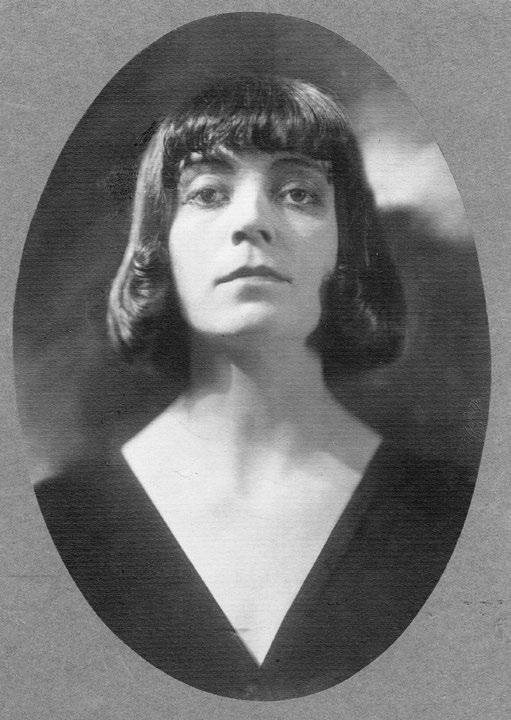
She was “ultra-chic” (Allen 2011, 65) and ahead of her time in terms of her attire; for example, her short haircut only became mainstream fashion in the 1920s. She has herself referred to the importance of being fashionable as an actress: “I read recently that a well-made film must, at all times, have the same effect as a good fashion magazine … Today’s actresses pay special attention to this aspect of film”1 (Elegante Welt 1919; see also Ganeva 2008).
By studying Asta Nielsen’s films and her visual presence in various media, our research offers a nuanced understanding of the key role that fashion played in creating her image as a modern, powerful woman. Very early on, it became clear that she had succeeded in establishing a narrative of a woman in control on the screen and off. Until the early 1920s, she exerted significant influence on her films (Schlüpmann 2012), and when they became more “director-centric” (Allen 2017), she set up her own production company to retain creative control. Her appearance, poses and clothes spoke of a fashionable, modern and confident woman. Accordingly, this chapter examines how, as a film star in the silent era, Asta Nielsen embodied the New Woman by being fashionable and modern on and off screen and in various Danish cultural media. Contrary to extant research on Asta Nielsen (e.g., in Gramann and Schlüpmann 2009; Schlüpmann et al. 2009), our analysis combines a focus on the way she constructed her on-screen presence with how she also embodied a fashionable presence in print: We show how her signature style communicated fashion and now-ness as part of the new film culture and how it was also exposed to a mass audience in daily newspapers, magazines, promotion stills and posters.
1 “Ich las neulich einmal, ein gutgemachter Film muß jederzeit wie ein tadelloses Modejournal wirken … Heute wenden unsere sch ö nen Filmfrauen dieser wichtigen Frage ihr besonderes Augenmerk zu.”
Quotes in Danish and German have been translated into English by the authors, and all original quotes are inserted in footnotes. We have used the original titles for films and magazines.
José Teunissen asks why “the fashion show and audiovisual media are so crucial for the fashion system” (2020, np). We pose the question slightly differently when referring specifically to Asta Nielsen: How did film and fashion mutually enhance the sense of movement and visibility crucial to modernity and contemporary urban life? How did Nielsen, as a popular star with individual agency, epitomize the changes in the ways femininity and the female body were constructed during this period? How was she constructed as a New Woman across different media?
The first part of the chapter contextualizes Asta Nielsen’s fashionability, historically and theoretically, and defines “the fashionable” in relation to the film star. We outline the scholarly discussion about the relationship between fashion, film and modernity in the 1910s and 1920s and link this discussion to the concept of the new woman and contemporary film as a display window for urban fashion (Ganeva 2008; Petro 1989; Allen 2012; Uhlirova 2022), which imparts both visual pleasure and important information about fashionable dressing to a female cinema audience. The second part consists of a short review of early fashion films and arguments about the advantages of using the film medium to present fashion by designers such as Paul Poiret. In the third part, we zoom in on Asta Nielsen and fashion by characterizing the Danish women’s magazine Vore Damer (“Our Ladies”) and how Nielsen was presented in it. However, our analysis also includes how she was presented as fashionable in posters, film stills and postcards. We then return to films and discuss how Nielsen’s distinct visual style contributed to the cinematic storytelling. Borrowing Jane Gaines’ term “dress plot” (1990, 182), we distinguish between what we suggest calling a “disguise plot” and a “transformation plot” but focus on the “disguise plot”, exemplified by a discussion of Nielsen’s androgynous appearance in Hamlet (1920).
In contrast to previous studies of Asta Nielsen, which delve into her interest in fashion and costumes (Allen 2012; Teunissen 2020; Hampicke 1995), we adopt a cross-media perspective (Jenkins 2006) and
situate her fashion sensibility in a Danish media context. We study Nielsen’s sense of the fashionable as a contemporary visual sensibility connected to performance, mise-en-scène and bodily poses and how it is expressed and performed on screen and in other media formats. Nielsen’s star image was that of a modern, fashionable woman with power and success in her profession. The fact that she was a performer whose clothes stood out also generated “diva moments” (Brewster and Jacobs 1999). We show how she constructed her on-screen outfits as fashion and created what we call fashionable moments , moments of heightened visibility, in which bodily poses were prominent and drew attention to the design and details of the outfit rather than to the character (fig. 2).
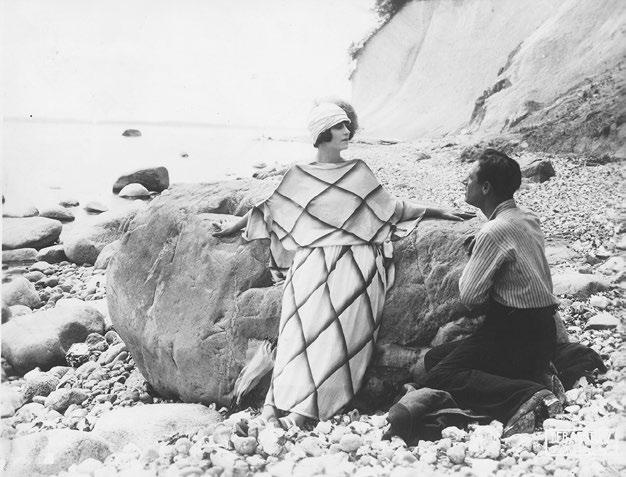
We draw on Marketa Uhlirova’s (2020; 2022) critical study of the relationship between fashion and costumes as at once similar and separate terms; in short, she questions the oft-cited conceptual difference: cos-
tumes were created for specific films to underpin psychological characterization and the unfolding of the narrative, whereas the nature of fashion is to “act independently, to occupy the position of the primary object of spectacle, to become a pure statement” (Uhlirova 2022, 530).
In conceptualizing Nielsen’s sense of stylish and modern clothes, we note Uhlirova’s claim that fashion “evinces an ungraspable sense of allure and vitality” (2022, 537) and also borrow the term modisk from the Danish scholar of fashion photography Charlotte Andersen (2006), which we translate as “fashionable.” To Andersen, the fashionable or fashionability in fashion photography is not solely attached to the clothes on show but is a more general visual sensibility related to the modern , which may saturate the entire visual space as a sense of a style or an aesthetic mode “typical of fashion” (Andersen 2006, Endnote 13, 290). 2 In order to grasp fully Asta Nielsen’s stylish appearances, fashion, costumes and the fashionable, we conduct a cross-media analysis (Jenkins 2006) and move beyond her screen presence to include how she posed and presented herself as a modern woman and diva (Petro 1989) in other kinds of visual material.
Undoubtedly, Asta Nielsen dressed to be seen in her films and the fact that she chose her own costumes and even wore some of them off-screen emphasized that her appearance in some of the dramas was fashionable (fig. 3). The clothes always emphasized her presence on screen and she carefully selected them as she often points out in her self-biography Die schweigende Muse ; for example that she started months in advance of shooting to think about the character and “decide on all the outer characteristics, from the line of the costumes to all the other defining outer attributes … ”3 (1979, 137). She said that she intended to be both modern and “abstract” in her clothing – contemporary but removed from the “present moment” (Vore Damer 1920).
2 Charlotte Andersen writes: “Jeg anvender tilbagevendende termen ‘ modisk ’ til at beskrive ‘ en-for-moden-typisk’ måde” (2006, Endnote 13, 290).
3 “Monate vorher schon lebte ich mich in die Gestalten ein, die ich darstellen sollte, legte alle Äusserlichkeiten zurecht, von der Linie des Kostüms, bis zu allen Einzelheiten characterisierender Requisiten …”
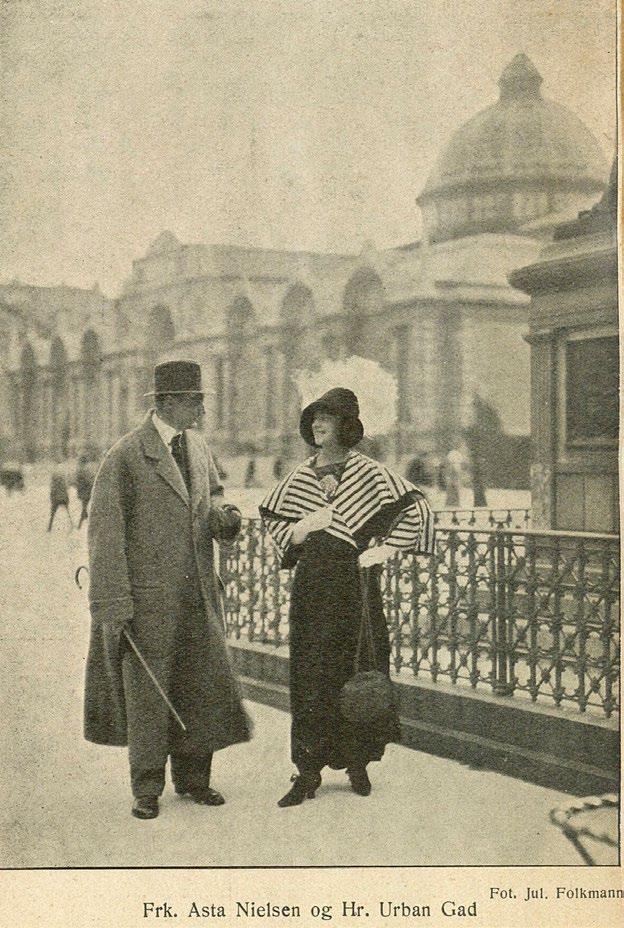
Yet, when she brought the clothes alive with her movements, they exuded contemporary stylishness, and her whole appearance represented a statement of willful “to-be-looked-at-ness” and fashionability. The Spanish journalist and writer Pablo Diaz put it eloquently in his short book about the actress from 1920: “She creates costumes. She makes fashion”4 (1920, 59). The fashionable is a bodily doing through clothes, which Nielsen mastered.
In terms of screen presence, it is significant that Asta Nielsen used costume as both an integral part of the storytelling – as costumes –and as a way to create visibility and star presence – exuding fashionability. With her powerful appearance, she created visually what Winfried Pauleit (2010, 139) called a “force field” (ein Kraftfeld ). On the one hand, there had to be a close link between the clothes and her character, or in her words: “A very chic hat does not go well with a broken heart”5 (Diaz 1920, 61). To Asta Nielsen, costumes expressed interiority or the “language of the body.”6 On the other hand, in contemporary narratives, she maintained a combination of her signature look (short hair, slim figure, tight dresses) with an acute sense of how she could make contemporary fashion work for her on the screen but also endowed clothes with a sense of the fashionable.
Asta Nielsen constructed fashionability through her preoccupation with “the line” (die Linie), as she called it, the visual forming of the body in poses, and she claimed that it was “the line of the body”7 that fascinated an audience (Diaz 1920, 60). Nielsen argued that “film should pioneer fashion”8 and that she loved fashionably dressed women (Vore
4 “Sie kreiert Kostüme. Sie schafft Mode.”
5 “ein besonders schicker Hut passt nicht zu einem gebrochenen Herzen”.
6 “die Sprache des Körpers.”
7 “die Linie des Körpers.”
8 “Gewiss, der Film soll ein Pioneer der Mode sein.” Asta Nielsen’s reflections on fashion in the article in Vore Damer are quoted from Pablo Diaz’s short book about Nielsen (1920, 59–62); we quote from Diaz’ book. In the magazine, the extract is placed above a note about the upcoming Hamlet film and illustrated with two stills from the film, a portrait and a pose. Part of Diaz’s chapter is also quoted in Poul Malmkjær’s biography Asta. Mennesket, myten og filmstjernen (“Asta. The Person, the Myth, the Film Star”, 2000).
Damer 1920; Diaz 1920, 60). Yet, at the same time, by forming her body in the right way, she could make costumes fashionable: “Only the line works in film. Any piling up of fabric, anything puffed out, unclear, makes you fat”9 (Diaz 1920, 61). Asta Nielsen stressed that “clothes emphasize the line and make it clear”10 (Diaz 1920, 60). To her, the line – the fashionable form of the slender, modern body wrapped in tight-fitting fabric – encompasses the abstract as well as the contemporary. The line was both saying and showing, posing and speaking, outline and corporeality (fig. 4).11
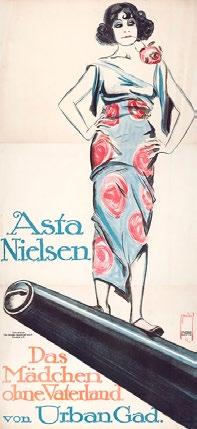
Fig. 4: Asta Nielsen in Das Mädchen ohne Vaterland (Urban Gad, 1912). German movie poster designed by Ernst Deutsch-Dryden. Source: Wikimedia Commons.
As a female star in the 1910s and 1920s, Asta Nielsen has been regarded as the epitome of the new woman both on and off the screen (Petro 1989; Witt -Brattström 2004; Wischmann 2006; Ingemarsdotter 2019; Duckett 2023), not least through her active use of the body in striking poses and movements. She symbolically “negotiated the erotic contract” between men and women, as Ebba Witt-Brattström has defined the changed gender dynamics in the early twentieth century (2004, xi), by wearing men’s clothes and by her persona embodying the image of the financially independent, mobile and socially active woman. We thus also accord with Victoria Duckett’s characterization of the new woman as one who “dares to challenge mores of behaviors, enjoys a good laugh, likes fash-
9 “Nur die Linie wirkt im Film. Jede Stoffanhaüfung macht dick, alles Bauschige, Unklare.” We translate the German word Linie as line in English.
10 “Kleider unterstreichen, verdeutlichen die Linie.”
11 Fischer (2003) suggests talking about the “outline” and the “silhouette” instead of “line” and suggests that the term “clearly implies an aesthetic interest in the female outline rather than in her full corporeality” (Fischer 2003, 36). Asta Nielsen’s poses merged the corporeal with posing.
288
ion and is comfortable acting out in public” (Duckett 2023, 151). For Nielsen, this all started with the famous gaucho dance in her first film Afgrunden , from 1910, in which she tied her lover up and danced around him with her body close to his. When studying Nielsen’s films and other kinds of visual representation over almost two decades, it appears that she maintained an aura of being modern and fashionable with her own “star style” (Herzog and Gaines 1990) – short dark hair and heavy eye make-up, ultra-thin frame and tight-fitting dresses –and “costume aesthetic” (Gaines 1990). However, her “stylish movements” (“The movements are stylized – to this day that is my artistic Leitmotif in films”12 (Elegante Welt 13, 1919)) and way of creating fashionable moments differed depending on the genre, story and media.
A key feature in fashion, film and modernity was movement ; how movement was created through the new technology, the moving images and how clothes moved along with the body and created an aesthetic experience. Films called for and constructed a way of seeing which was fleeting and transient but also observant. This gaze was consistent with moving about in public spaces, perceiving metropolitan public life and becoming attuned to the demands of visibility, which equaled fashionability in the modern city (Allen 2012; Kracauer 1996; Petro 2014; Schlüpmann 1999; Hansen 1993) (fig. 5). Movement and the fashionable are closely connected with the female protagonist in Asta Nielsen’s films as seen, for example, in S1 (1913), in which Nielsen’s character hikes, cycles and swims, and in Die Suffragette (“A Militant Suffragette”) (1913), in which she plays golf, rows and engages in activism, marching in demonstrations and making lively political speeches to a large audience. Teunissen argues that the French couturier Paul Poiret ushered in a new way of using clothes to accentuate the 12 “Man stilisiere seine Bewegungen – das ist auch heute noch mein künstlerisches Leitmotiv beim Filmen.”
female body as a moving one: “the couturier marked the beginning of a search for an aesthetic of a body in motion, presented by an active young woman displaying a perceptible body beneath the clothing that emerges while her body moved” (Teunissen 2020, np). In Das Ende vom Liede (“So Ends My Song”) (1919), Nielsen shows off her elegant flapper dress when running back and forth in front of the camera to greet her fiancé enthusiastically, which makes visible the details of the frills on her skirt and the bat sleeves. Or in the final scenes of Erdgeist (“Earth Spirit”) (1923), when her glamorous tight-fitting and long evening gown is the center of attention in the final showdown with her lover. In Die Suffragette Asta Nielsen’s character is an activist shown talking eagerly, arms spread out, wearing a tight skirt, white blouse, black tie and hat (speaking at a big meeting, standing on a table surrounded by fellow suffragettes and taking part in a demonstration). We also see her in action in the oft-reproduced still from the demo (the scene did not survive on film) with outstretched arms and legs making a dramatic diagonal line which emphasizes her body as active and agile and shows how the long and rather tight skirt was not a hindrance to movements that filled space. The same outstretched bodily lines are seen in multiple stills from Nielsen films; the characters fill the space with quite unfeminine movements that make the contours of the body visible and the whole appearance fashionable.
Action and movement were key to the construction of the modern woman, making the fashionable body an active, moving one. Paul Poiret was constructing a modern “aesthetics of a body in action”, and Teunissen claims that “[s]tarting in 1910, the fashionable (new) woman needed to be able to display an elegant body in action, a body that strolled, paraded and sauntered down the city boulevards” (2020). The movements of the slim body (Poiret’s ideal), in unison with the clothes, created fashionable images of female elegance and aspiration combined with movement and agency. This way, Poiret not only created a new look based on a modern sensibility but also “a new ideal type: a youthful moving woman” (Teunissen 2010, 241), who epitomized a modern consumer corresponding with the transience of modernity and the logic of
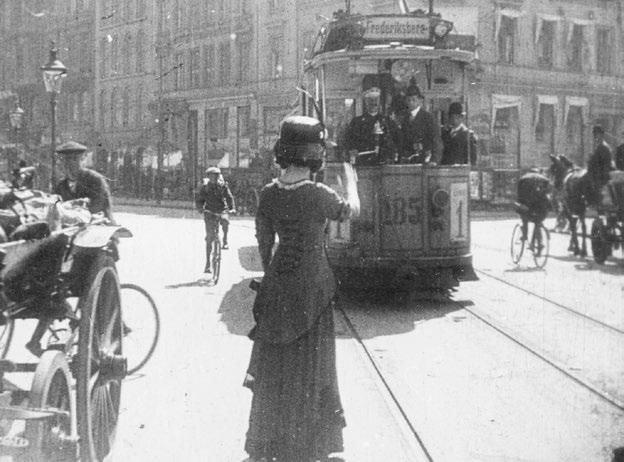
fashion.13 This modern woman was also congruent with cinema as a medium that “moves with the current of the times” and “the product of a general sensibility” (2001 (1913), 258) – a sense of newness and nowness. From 1910, Poiret himself staged moving bodies in action in “fashion parades” in his salon and in his back garden, which he recorded on film for promotional use. He toured, showing his films and staging shows with a group of models while also giving lectures around the world (Evans 2001; Evans 2011; Teunissen 2010; Teunissen 2020).
In this sense, Poiret’s idea of the (elegantly) moving slim body was congenial not only with the new medium but also with a modern
13 Based on a study of stills from a couple of Asta Nielsen’s 1913 films, Jose Teunissen (2010) draws attention to the way Nielsen chose clothes that resembled Poiret’s style and how this style emphasized her slender frame. In Denmark, the slim body ideal was featured in the journal Vore Damer (for example, the cover of issue 1 in February 1913, issue 3 in March 1913 and issue 3 in 1923).
way of life and a visible modern woman playing a full part in public life in many different ways. Asta Nielsen embodied this new visibility and the relationship between film, movement, modernity and modern life like no other actress. Her highly praised acting style, facial gestures and big eyes, appearance, poses, sense of lines, way of moving and taking possession of the on-screen space, as well as the way she stood out in photographs, made her the essence of the modern woman. This is epitomized in the opening scene of her first film Afgrunden), in which we see her on a busy urban street waiting for and then boarding a tram (Fig. 5). Pablo Diaz also captures how she embodied modernity in film when referring to the enthusiasm she aroused in Paris:
Out of all the small and large cinemas, her figure transposed itself into the life of this large city, stamped itself on it, and you were not quite up to it if you revealed the least bit of wonder about this. Oh, the wonderful destiny of great art, to be able to captivate an entire city …14 (Diaz 1920, 7–8; see also Thomsen 2012)
Poiret’s fashion shows addressed an affluent audience of women (but also men). Shows featuring models became a common form of entertainment from the 1910s onwards, and live models displayed fashion in department store windows (Ganeva 2008). By contrast, the film medium addressed a socially much wider and, in particular, a female –mass audience (Hansen 1993 Schlüpmann 1996). Miriam Hansen coined the term “vernacular modernity” in order to capture:
cultural practices that both articulated and mediated the experience of modernity, such as the mass-produced and mass-consumed phenomena of fashion, design, advertising, architecture and urban environment, of photography, radio, and cinema. (Hansen 1999, 60)
14 “Aus all den kleinen und grossen Kinos transponierte sich ihre Gestalt in das Leben dieser grossen Stadt, prägte sich ihr auf und man war nicht ganz auf der Höhe, wenn man die geringste Verwunderung darüber zeigte. O schönes Schicksal einer grossen Kunst, eine ganze Stadt zu verzaubern … ”
Film was able to show moving bodies in action in genres like the short fashion films and in newsreels as early as the 1910s (Ganeva 2008; Teunissen 1997; Teunission 2020; Haller 2010; Herzog 1990; Uhlirova 2020). Fashion shows were filmed and screened in cinemas (Haller 2010), and from the end of the 1910s into the 1920s, the Konfektionskomödien (“fashion farces”) in Germany offered a consumer’s view of the fashion on display (Ganeva 2008; see also Street and Yumibe 2019).
In the early French fashion films, fashion functioned as an attraction (Uhlirova 2020). By contrast, the more thematic fashion reports in newsreels focused on fashion as fashion and started as very short, thirty-second displays of fashion in which models moved stiffly and posed uncomfortably in front of the camera. By the mid-1910s, they had turned into short films independent of the newsreels and included slightly more realistic displays of models moving about the city boulevards (Uhlirova 2020; Ganeva 2008). Regarding the later German Konfektionskomödien in the 1920s, Ganeva shows that fashion, films and advertisements were closely linked (producers and retailers are often mentioned during the fashion shows in the films, and the female protagonist is often a model). Ganeva concludes that:
In other words, the Konfektionskom ö die and other Weimar films functioned as a compendium of suggestions, tips, and updates disseminated to a mass audience at no extra charge. In short, films offered fantasies beyond reach, but they were also a source of practical, usable advice. (Ganeva 2008, 118)
A 1915 article in the German film trade journal Der Kinematograph titled “Kino und Mode” (“Cinema and Fashion”) describes the gaze of the new medium as at once consumerist and educational. The article argues that, ideally, this way of watching should simultaneously provide information to the female audience as potential consumers and teach them the art of appearances. To this end, the moving images are both an advantage and a disadvantage, according to the article. On the one hand, it argues that the short films’ transience prevents the audience from creating a mental image of a piece of fashion and from
copying the details and styles at home. On the other hand, unlike drawings and photographs in women’s magazines, films can show how fabrics adjust to the movements of the wearer and how fabrics and styles can enhance and support a look of “the free and graceful movements of the person wearing them.”15
The camera’s ability to show clothes and bodily appearances from multiple angles meant films could teach female audiences about the proper match between bodily movements and different kinds of clothes. They could demonstrate which clothes were conducive to an elegant way of walking and how to gracefully and professionally manage all the tools needed to live an active cultural life in the big city. A whole system of bodily movements, of becoming styles and proper and graceful conduct in social spaces, could be taught to the modern consumer through film as well as – or by means of – fashion choices. The argument in Der Kinematograph (1915) was that films could help female audiences be better consumers and improve how they comported themselves in general. Whereas Poiret concentrated on the modern woman and capturing the aesthetics of a fashionably clad moving body on film, the article in Der Kinematograph focused on how moving images could help improve the female cinemagoer’s taste and skills. In this sense, the article corresponded with the general didactic and aesthetic tone of the women’s magazines of the day. However, it was also aware of the visual potential of moving images to construct the fashionable, something of which magazines were not capable.
According to Emilie Altenloh, Asta Nielsen’s films were most popular with female audiences (2001 (1913), 259; see also Schlüpmann 1996), and she was admired for her passionate temperament (2001 (1913), 285). Similarly, the female audience found Nielsen particularly appealing because of her authenticity: “she did not act, she was”, and they perceived her as embodying a relatable experience through the characters she played (Haller 2009, 177). As a popular star, Nielsen was 15 “eine freie und graziöse Bewegung des Trägers.” The article is also quoted in Hampicke 1995.
a role model for the female audience, including both the upper classes and “the ‘real’ New Women: modern self-confident female money earners” (Grimm 2023, 127).
As such, for the female audience, actresses and fashion were closely linked (Hampicke 1995). In the scene in Die Suffragette in which Nielsen’s character is preparing to visit the politician’s house, we see her walking down the stairs and then turning around in her tight, elegant dress and big hat (resembling the hat she wears in Der Totentanz) as if using the film medium to show her dress and how it moved with her body from different angles. Similarly, in the penultimate scene in the politician’s house, she stands up, sits down and wanders around the room so that her figure and the ultramodern – or even modern before its time – evening dress is continuously on display. In this way, her films were closely connected to fashion. However, articles in the leading women’s magazine Vore Damer offered an interconnected but very different fashion experience.
When browsing through the Danish women’s magazine Vore Damer from the period between its first issue in 1913 and the mid-1920s, we notice that, unsurprisingly, the journal includes a great deal of writing about fashion and a great many illustrations (drawings as well as photographs) – except for the war years, during which fashion reporting was less common. However, the journal used its unique materiality as a magazine to include detailed written descriptions of fabrics and styles in the fashion coverage, as if attempting to create sensory feelings of materials through words. In addition, reports (from Paris and New York but also from up-market department stores in Denmark) were often followed by drawings of slightly more ordinary versions of the curated dresses from the autumn or spring fashion shows, moderated and turned into sewing patterns for sale. Hence, Vore Damer provided its female readers with access to new fashions they could make for themselves.
Primarily at the beginning of the period, the journal’s illustrators were at times inspired by Poiret’s fashion shows and the
photographs taken from the ones in his garden (a photo reproduced in Teunissen (2010, 243) shows the models as “women flâneurs”, walking and chatting seemingly intimately). Apparently, they were also inspired by the early French fashion newsreels, which composed social situations to display fashion (Uhlirova 2020). In contrast to the more classical drawing of single models posing in different outfits side by side or beneath each other on the page, quite a few fashion illustrations created a social situation by composing a tableau of models in small groups communicating with each other, chatting, gossiping, having a good time, their bodies partly turned towards each other, partly turned towards the reader. The drawings created a more dynamic space instead of the stiff singular, more or less frontal, decontextualized poses. Headlines also helped create a story. Examples include the heading above a drawing of three chatting women “debating the new spring fashion” (Vore Damer 1916); the headline “Paris by night” in issue 8, 1914; and an article under the heading “From the birthplace of fashion” (“Fra modens fødested”) in issue 12, 1923, in which three groups of models appear to be entertaining each other. The article explains not only what they are wearing but is one among many texts in Vore Damer which is slightly ironic about international fashion magazines and the very idea of fashion as continuously changing:
It is not worth it, we are letting ourselves be duped because the big foreign fashion magazines talk about “the new line”; “the line” has many useful qualities, only it is not new. … We are still supposed to have hips, waist and shoulders of the same, slender stature, and we still need to be just as flat on the front as from behind. That is what the fashion magazines dictate, at any rate.16 (Vore Damer 1923b)
Although Nielsen’s appearances in Vore Damer were irregular and usually connected to an upcoming film, she also gave a few interviews,
16 “Det er ikke værd, vi lader os bluffe, fordi de store udenlandske Modeblade taler om ‘den nye Linie’; thi ‘Linien’ har mange gode Egenskaber, den er blot ikke ny. Vi skal stadig have Hofter, Taille og Skulder af samme, ringe Bredde, og vi skal stadigt være lige saa flade for som bag og bag som for. Det siger i alt Fald Modebladene.”
which featured portraits and photographs from her private home (e.g., “Asta Nielsen at home” in Vore Damer 1925). She was, however, revered and celebrated from the very beginning, as witnessed by the feature article “World-Famous Danish Divas 1: Asta Nielsen-Gad”17 on the occasion of the premiere of Der Totentanz (Vore Damer 1913c). The article describes how she had control over her costumes and that, at one point, she refused to play a nun, as suggested by Urban Gad, because a nun’s costume would impair her dynamic acting style. The article is illustrated with a headshot featuring her signature hairstyle, and in two stills from the film she poses in a sophisticated décolleté black dress. Moreover, the journalist thinks of the busy diva that: “as she must continuously think about maintaining her figure so that it suits her film roles, one can understand that as far as nutrition is concerned, she often has to endure hardships that are not always sensible.”18
The slim body ideal and tight dresses we find in Vore Damer in the first volumes of the 1920s still fit with Asta Nielsen’s early look. A few years later, in the mid-1920s, her figure was no longer ultra-slender, although she was still chic. The pageboy hairstyle that she introduced in the 1910s (Vore Damer 1913c) did not become fashionable until the first half of the 1920s (e.g., Vore Damer 1922a; 1924a).19 An article from 1924 addressed the new hairstyle under the headline “Is it the inevitable?”: 20 “Seeing that more and more of the civilized world’s women indulged in bobbed hair, you chose to follow fashion, not least
17 “Danske divaer med verdensberømmelse 1: Asta Nielsen-Gad.”
18 “Naar hun desuden stadig maa tænke paa at holde sin Person i den Form, der passer bedst ind i Filmen, vil man forstaa, at hun på Næringsmidlernes Område ofte maa underkaste sig Strabadser, der ikke altid er lige heldige.”
19 Friederike Grimm (2023, 115) claims that Asta Nielsen’s iconic look was “branded on posters, postcards and in cinema ads in newspapers from 1911 onwards”. However, it should be noted that in many of the early films, her hair was made to look short rather than it actually being cut short.
20 “Er det det uundgåelige?”: “Men alt som flere og flere af hele den civiliserede Verdens Kvinder henfaldt til Pagehaar, bøjede man sig for Flertallet, fordi man lærte at indse, at det korte Haar er overmaade praktisk, og at det tilmed kan virke præcis lige saa feminint som det lange.”
because you learned that short hair is practical and might be accepted as being just as feminine as long hair”21 (Vore Damer 1924a).
Vore Damer rarely connected Asta Nielsen directly with fashion in these articles, which were mostly illustrated with press photographs for the new film or perhaps a portrait. 22 However, compared to the abundance of photographs from theater premieres and articles about Danish stage actresses, Asta Nielsen undoubtedly appears cosmopolitan and fashionable in her photographs. By contrast, most of the stage actresses portrayed were definitely plumper, and their costumes somewhat histrionic.
As well as the extract from Diaz’s book mentioned above, an exception to the magazine’s primary focus on a new Asta Nielsen film is the article “Moden og dens bærende kræfter i filmen” (“Fashion and its driving forces in film”) subtitled “Asta Nielsens Kostumer i Afgrunden” (“Asta Nielsen’s costumes in Der Absturz ”) (Vore Damer 1922b). 23 The text is mostly concerned with film stars – or divas as they are also called – in general, how they influence contemporary fashion and vice versa: “An up-to-date star chooses the costumes of today and – if possible – a couple of tomorrows.”24 Asta Nielsen is mentioned in the article’s final paragraph as an ideal example, and even more than that, she “has the authority and telling taste by which she can model fashion in accordance with her body’s form.” Again – the fashionable was constructed through Asta Nielsen’s posing and creation of “lines”;
21 Moreover, Vore Damer 11, 1924 also published a full-page article on short hair (what the article called “boys’ hairstyles”) (“drengefrisuren”) from a more conservative point of view. The article claimed that “vore Herrer” (our gentlemen) “despite the modern neutralization of gender differences, still prefer the distinctly feminine woman” (“vore Herrer, der trods den modern Neutralisering af Kønnene stadigt foretrækker den udpræget feminine Kvinde”). Hardly any of the female models in Vore Damer in the year 1925 – drawn or photographed – had long hair.
22 According to Andrea Haller, the same was the case in the German women’s magazines (Haller 2010, 335).
23 It is a bit confusing that Vore Damer translates Der Absturz into Afgrunden as this was also the title of the debut film that made Asta Nielsen famous 12 years earlier.
24 “En up to date Stjerne vælger derfor altid en række Kostumer fra i Dag – og om muligt et Par fra i Morgen.”
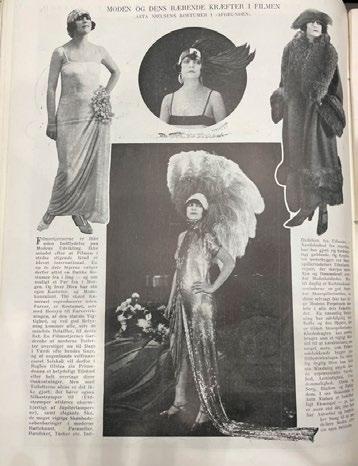
6:
and with
it was not immanent in the clothes.
However, the article also shows how film stills are made fashionable. Asta Nielsen is deliberately cut out of original stills and moving her from a film context to a magazine transforms her into Asta Nielsen, the fashion model (fig. 6). Fashionability is defined and emphasized in the photographs – made possible by the many poses in the films. She is shown wearing several different outfits: The fashionable is evident in a white silk evening gown in the style of a slip dress and a voluminous fur coat, whereas the show dress, a sequined dress accessorized with an opulent hairpiece with long feathers, is endowed with fashionability by being transferred to a different medium. In this way, Nielsen’s film stills transform costumes into fashion and present a spectacular “star” look. The article concludes that Nielsen is a ‘fashion authority’, which underlines her status as a tastemaker, frontrunner and glamourous star. 25
Since Asta Nielsen mainly starred in German films, her fashion authority was implicitly understood as European, and Vore Damer held
25 Pablo Diaz wrote about Nielsen appearing on set: “Asta Nielsen walked onto the set. She was wearing a low-cut, light-brown party dress, a hat with a broad band and luxurious feathers. Sequins sparkled; silk shimmered” (“Asta Nielsen tritt ein. Sie trägt ein weitausgeschnittenes, lichtbraunes Gesellschaftskleid, einen breitrandigen Hut mit kostbaren Federn. Es glitzert von Pailletten, es schimmert von Seide”) (Diaz 1920, 37).
fashion by European designers in high esteem. Regular columns included “Paris says … ” showing unnamed models posing in the latest fashion available in Danish shops, regular reports from fashion shows in Copenhagen, as well as Paris-inspired fashion in recurrent advertisements for Magasin du Nord, the most exclusive department store in Copenhagen. Linking fashion to the promotion of Hollywood stars and their upcoming films was also common in the 1920s (for example, Vore Damer 1924b).
After World War I, Asta Nielsen starred in no more than two productions a year, many of which were rejected by the Danish film censors. As we have shown, she was visible in Vore Damer through film stills from Der Absturz (1922), which framed her as fashionable (fig. 7), but Hamlet , Fräulein Julie and Die freudlose Gasse were quite extensively covered as well. Even though her unique status as a star was challenged by the new generation of actresses from Hollywood, her signature look was as popular as ever, and her use of fashion as part of her star image was still significant. 26
However, Nielsen’s sense of the fashionable was not only presented on screen, in film stills or in Vore Damer ; it was also prominent in other extra-cinematic materials such as movie posters and postcard portraits. The posters on display in the cultural public sphere expressed an eye-catching and colorful aesthetic with creative interpretations of the film star and genre. Occasionally, the posters conveyed the fashionable by emphasizing – even exaggerating – her signature look, for example, in Das Mädchen ohne Vaterland (1912) and Die Suffragette by the graphic artist and costume designer Ernst DeutschDryden (Fig. 4). By contrast, the postcards were portraits and all about photographic likeness and a glamorous look. Mostly, the postcards were medium close-ups of Nielsen’s face, with details of her look and make-up, hairstyle, jewelry, and hats prominent – as well as collars and
26 The daily newspaper B.T. ran a series of film-star look-alike contests in the 1920s and Asta Nielsen was by far the most popular star to emulate: “Asta Nielsen slaar alle Films- Konkurrencens Rekorder.” (“Asta Nielsen breaks every record in the competition”, B.T. 1921, October 18).
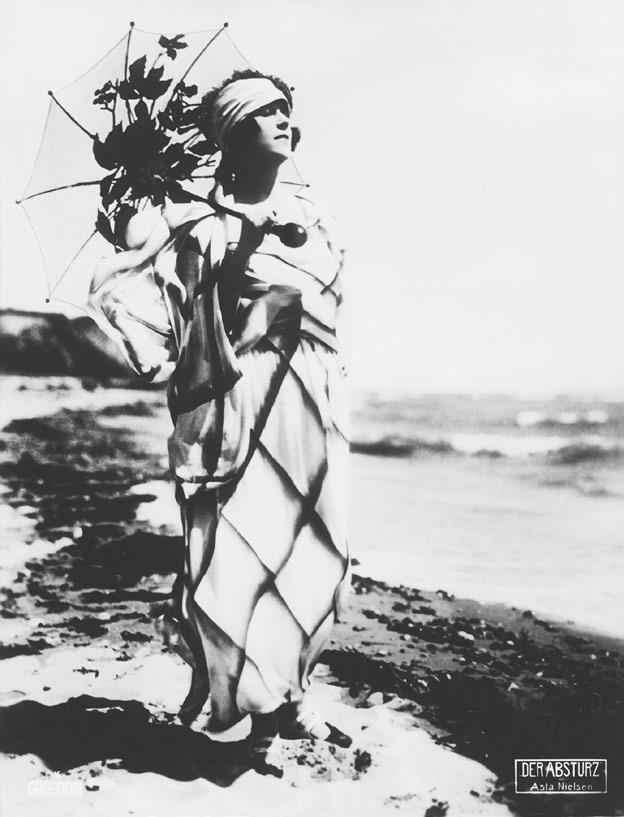
decolletage. Filters and soft, flattering lighting techniques created a flawless complexion and perfect hairstyle; usually, she featured either a stern power stare straight at the viewer or a faint smile.
As we have shown, the promotional stills could be characterized as fashionable moments when transported into the pages of Vore Damer. Notably, however, a couple of stills were fashionable in their own right, such as the ones from Der Absturz 27 which illustrate clearly how fashion was not only about clothes, but a visual sensibility created by and around Asta Nielsen. In the stills, she poses in an at once relaxed, loose and exquisite light dress with diagonal squares in a slightly blurred black and wears a white turban, which hides her hair except for a black rim circling her face. The shots are taken on the beach (her lover in the film is a fisherman). The wind makes the dress flow slightly, and one of the full-length photographs, in which she is staring out to sea and holding a Japanese-inspired parasol in one hand, is a bit out of focus and overexposed, beautifully exemplifying Charlotte Andersen’s (2006) idea of fashion not only as clothes but as a photographic sensibility.
As mentioned earlier, it was quite common for actresses in the early silent cinema to be expected to provide their own dresses for filming (Gaines 1990). Asta Nielsen emphasized fashionability by choosing dresses inspired by contemporary designers like Coco Chanel for the relaxed and comfortable dress code for outdoor leisure and the aforementioned Paul Poiret for glamorous and sophisticated evening gowns. According to Jane Gaines, “dressing the part and playing the part” on screen were closely linked from early on; hence “[i]nterpreting the role for the silent actress also meant translating character into costume by means of the ‘dress plot’, a kind of scenario indicating all of her wardrobe changes” (Gaines 1990, 181–82). However, Nielsen seemed to take
27 See https://www.dfi.dk/en/viden-om-film/filmdatabasen/film/afgrunden-1 (accessed December 3, 2025).
clothes in two directions: She agreed with the dress plot thinking (“The dress must be in accordance with the atmosphere in the scene in which it is worn” (Vore Damer 1920)). 28 On the other hand, the analogy between dressing the part and playing the part never quite fitted with Asta Nielsen’s appearances. There was always something more, an enhanced sense of bodily visibility and powerful ‘standing out’, a force field (Pauleit 2010) around her.
Asta Nielsen’s on-screen costumes and her use of fashion were often a means of transforming her characters’ identities and functioned as visual enhancements of her brand as “the Duse of cinema” as she was labelled early on in her career (in reference to the acclaimed Italian actress Eleonora Duse). In addition to her presence as the diva and the object of everyone’s attention, she usually wore conspicuous clothing. She chose bold, graphic patterns such as the prominent use of striped garments in many films, in Das Mädchen ohne Vaterland , Zapatas Bande (1914) and Die geliebte Roswolskys (“Roswolsky’s Mistress”) (1921), and the “large bobble” patterned dress in Vordertreppe und Hintertreppe (1915). Another strategy was to dress in light monochrome outfits to make her stand out from everyone and everything else in a scene, for example, in a white ruffled dress in Graf Sylvains Rache (1920), a white fur coat in Das gefährliche Alter (“The Dangerous Age”) (1927) and Wenn die Maske fällt , a white summer dress in Die FilmPrimadonna (1913), and her black silhouette standing out in the snow at the end of Dora Brandes (1916). 29
The “narratives of fashionable transformations” (Moseley 2002) were always motivated by the story. They included what we would call the “disguise plot” in cross-dressing films and the “transformation
28 “Toilettet maa læmpes efter samme Stemning, som præger den Scene, som man bærer det i.”
29 The way Asta Nielsen constructed her appearance as a force field through her striped outfits can also be seen in a press photograph showing the founders of the “Internationalen Film-Vertriebs Gesellschaft” in 1911. Asta Nielsen is the only woman in the photo and the only one wearing black-and-white. She is sitting down, surrounded by five men (among these Urban Gad and Paul Davidson), clad in a large hat and a strikingly eye-catching striped jacket (Seydel and Hagedorff 1981, 51).
plot” in which her character was a professional performer. Both types of narratives included changes of clothes and added nuances to the character she incarnated. In the transformation narratives, the change of clothes was motivated by her profession as an actress in film or theater, such as the Pierrot from the commedia dell’arte tradition in Komödianten (1913), the elaborate show dresses in Der Absturz, or surreal patterned outfits in Erdgeist . Conversely, the disguise plots were cross-dressing narratives in which wearing men’s clothing was a means of achieving privilege and status unattainable as a woman in Das Liebes ABC (“The ABC of Love”) (1916), Jugend und Tollheit (1912) and Hamlet (1920). The masculine attire she wore in these films was always elegant and tight-fitting and accentuated her slim figure even though it was supposed to be a disguise. Thus, the lines she created out of these bodily appearances exuded fashionability, even though masculine dressing was not in fashion in the 1910s and her popular “Hosenrolle” or “breeches roles” were, accordingly, considered entertaining, not controversial (Horak 2016). A decade later, however, the gamine look was considered fashionable and part of the androgynous look of both Greta Garbo and Marlene Dietrich in Hollywood (Petro 2014). 30
This is also the case in Hamlet , produced by Asta Nielsen’s own company, in which she plays a female Hamlet and fuses her signature look (which was also the company logo) with an androgynous period costume. Her “fashionable garçonne girl” (Ingemarsdotter 2019) wears a black leotard-like dress accessorized with tunics, capes and large woolen shawls, also in black. She wears trousers, but the look, when combined with long capes and shawls, seems to reference the elegant contemporary dresses seen in the pages of Vore Damer (for example, the Erté drawings in the article “From the fringes of fashion” (1924f)) or in other of her films set in contemporary times. Conspicuous bodily
30 In 1924, Vore Damer published an article titled “Do women want men’s clothes?” (“Vil Kvinderne have Mandsdragt?”) which refers to Hollywood actresses propagating more masculine and comfortable clothes (Vore Damer 1924d).
posing makes the period costumes fashionable in Hamlet , in particular in the scenes in the church, when she swears to avenge her father and in the castle corridor and when she leans against the wall, arms spread in an expression of longing for her love interest Mercutio. Or in the scene where she walks, expressionless, down a staircase, cape flowing in her wake, as she returns to the castle after learning of her father’s death.
The fashionable black outfits honor the tradition of Hamlet being dressed in black because she is mourning her father, and it makes her stand out in relation to the other characters’ more traditionally gendered historical costumes. In her tightfitting tricots, she creates lines visually, abstraction and fashionability at one and the same time. In addition, her “pageboy” haircut is both historical and contemporary, even futuristic. Nielsen’s Hamlet sports a slenderer body than the film’s male and female characters, except Ophelia. Hamlet has a dynamic and corset-free presence at the same time as her demeanor and body language convey regal authority. Nielsen’s Hamlet is also an example of the “disguise plot” since the male identity allows her to be heir to the throne, while also tragically thwarting a potential loving relationship with Mercutio. It is only in the final scene that Mercutio discovers that his dying friend Hamlet is a woman (fig. 8). The subtle reveal is emphasized by her dress being more décolleté and slightly disheveled as she collapses after the duel, and a soft white shirt collar becomes visible, giving her look a sensual and contemporary feel. In contrast to the contemporary cross-dressing plots of the “Hosenrolle films” (Horak 2023, np), the Hamlet character dies, and there is no change into female clothes or a heterosexual happy ending. To everybody else, Hamlet is the dead Prince of Denmark.
The film attracted a great deal of media attention, both in Denmark and abroad. Vore Damer covered it with a front page and a spread (1920) announcing the upcoming release and another full page (1921) after the premiere in Denmark. The short texts describe how the sensational project came to fruition but also emphasized “this slim and elegant, ponderous Danish Prince in his smooth black silk suit with the
black tights and shoes with straps” and the character’s “morbid grace”31 (Vore Damer 1920). The front page and three of the stills show Asta Nielsen posing with outstretched arms, filling space with her black androgynous line , woman and prince, at one and the same time. The two other photographs are portraits, one close-up and one medium close-up, in front of a desk covered with books, her short black hair like a helmet framing her delicate face. The article thus informed readers about the film with a female Hamlet, but it also anticipated in a safe way a new trend in fashion by giving editorial priority to images from a period film with a woman disguised as a man – a type of female character which would become visually striking in international film during the 1920s (Ingemarsdotter 2019).
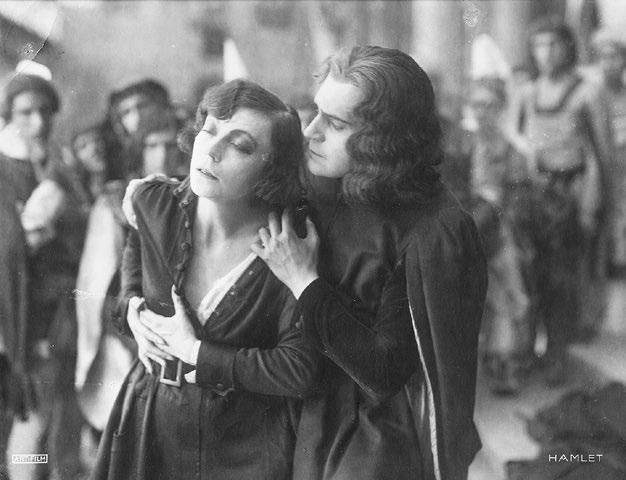
31 “Den smækre, tungsindige, danske Prins i sin glatte sorte Silkedragt med de sorte lange Strømper og Spændsko … morbide Ynde.”
This chapter has studied how Asta Nielsen, in many of her films, embodied a specific character and created moments in which her poses, her vivid physicality and her bodily appearance transformed into a fashionable visuality reminiscent of fashion films. We have argued that Nielsen used costumes in her disguise dramas and fashion in her choice of (glamorous) clothes for her appearances on and off screen. Equally important, however, she created what we, inspired by Charlotte Andersen’s (2006) discussion of fashion photography, have called fashionable moments by means of her vivid bodily movements, her poses or lines, and the ways she used rooms and spaces as backdrops against which to stand out. Our argument has been that Asta Nielsen’s sense of the fashionable was not just a question of clothes, even though her choice of them on and off the screen was inspired by contemporary fashion designers. It was also a visual sensibility, which may in a sense have been “ungraspable” to use Marketa Uhlirova’s (2022) term, but which also connected to a wider modern sensibility, to the modern woman’s vitality and to now-ness.
The crucial connection between movement, vitality and visibility in modernity were key aspects of the way in which Asta Nielsen created fashionable moments in moving images. As the discussions of fashion and moving images of the time revealed, films could show how clothes looked in real life on physically active, outgoing, modern women. The New Woman was catered to by designers such as Poiret and Chanel, and fashion was understood as a key means of individual self-expression, challenging conservative ideas of how a woman should look, dress and act. On-screen, Nielsen was wearing dresses with bold patterns as well as Poiret and Chanel-inspired gowns and dresses, but she also radiated a sense of the fashionable when posing in cross-dressing outfits in disguise plots. Her androgynous look was widely enjoyed in the “Hosenrolle films”, but it was not until her controversial staging of a female Hamlet, in which she showcased the androgynous look as something to be contemplated and admired, that the establishment refused to accept the way she embodied a fashionable gender crossover (Haastrup 2022).
Central to our argument has been that Asta Nielsen used fashion as visual communication in a strategic way in which she combined the line, the pose, an aesthetic sense of fabric and patterns with an acute understanding of the potential of the new media to express a contemporary fashionability and display herself successfully as die Asta . She always managed to draw attention to her figure and lines, displaying her outfits as to-be-looked-at-ness and as inspiration for the female audience. Following this, our cross-media analysis of the popular magazine Vore Damer has demonstrated how Asta Nielsen’s fame extended beyond the screen to the wider Danish cultural context (see fig. 6). In Vore Damer, promotional stills were made fashionable through different cuts and editorial framings. This way, Vore Damer connected the diva Asta Nielsen’s fashionable and cosmopolitan look with the magazine’s more accessible and everyday outfits, such as cutout patterns and department store adverts that appealed to a wider female readership. Nielsen also epitomized a sense of agency and individual freedom on screen – not least to women, who Emilie Altenloh (2001(1913)) describes as her most ardent admirers.
We have pointed out that, as a popular film star, Asta Nielsen fully understood the potential of the relatively new connection between fashion and film in a contemporary Danish and German media context in the 1910s and 1920s and how her presence on screen added to it a feeling of perpetual newness. Despite her age – Asta Nielsen was almost thirty when she made her debut in Afgrunden – she was a first mover. Her signature haircut, slender body and alternating bespoke cross-dressing with glamourous gowns were all hallmarks later adapted by Hollywood stars like Garbo and Dietrich. This chapter contributes to research on Asta Nielsen by using her sense of fashion and fashionability as the lens through which to show how she was in control of her star image as a modern woman who successfully combined telling stories about women with making them relatable to a large audience. She embodied the New Woman on the screen and off: the fashionable, glamorous and celebrated actress, the independent and confident woman who posed fashionably and elegantly in her films and for photographers on the streets of big cities.
Der Absturz. 1922. Directed by Ludwig Wolff. Germany: Art-Film.
Afgrunden. 1910. Directed by Urban Gad. Denmark: Kosmorama.
Allen, Julie. 2011. “Denmark’s Ugly Ducklings: Georg Brandes and Asta Nielsen’s Metacultural Contributions to Constructions of Danish National Identity”. Scandinavian Studies 83 (1): 63–90.
Allen, Julie. 2012. Icons of Danish Modernity: Georg Brandes and Asta Nielsen. Seattle and London: Washington University Press.
Allen, Julie. 2017. “Asta Nielsen.” In Women Film Pioneers Project, edited by Jane Gaines, Radha Vatsal, and Monica Dall’Asta, New York, NY: Columbia University Libraries. https://wfpp.columbia.edu/pioneer/asta-nielsen-2/.
Altenloh, Emilie. 2001 (1913). “A Sociology of Cinema: The Audience”. Screen 47 (3): 249–93.
Andersen, Charlotte. 2006. Modefotografi: En genres anatomi. København: Museum Tusculanums forlag.
Balletdanserinden. 1911. Directed by August Blom. Danmark: Nordisk Films Kompagni.
Brewster, Ben , and Lea Jacobs. 1999. Theatre to Cinema. Oxford: Oxford University Press.
B.T. 1921. “Asta Nielsen slaar alle Films-Konkurrencens Rekorder”. October 18.
Diaz, Pablo. 1920. Asta Nielsen: Eine Biographie unserer populären Künstlerin. Berlin: Verlag der “Lichtbild Bühne”.
Dora Brandes. 1916. Directed by Magnus Stifter. Germany: Saturn Film Aktiengeselschaft.
Duckett, Victoria. 2023. “The Genesis of the New Woman”. Imago – Studies in Cinema and Media: The New Woman in European Silent Cinema: Images, Narratives, and Social Discourses, edited by Silvio Alovisio and Veronica Pravadelli, no. 26: 137–59.
Elegante Welt. 1919. No. 13.
Das Ende vom Liede. 1919. Directed by Willy Grundwald. Germany: Cserépy-film.
Erdgeist. 1923. Directed by Leopold Jessner. Germany: Leopold Jessner-Film.
Evans, Caroline. 2001. “The Enchanted Spectacle.” Fashion Theory 5 (3): 271–310.
Evans, Caroline. 2011. “The Walkies: Early French Fashion Shows as a Cinema of Attraction.” In Fashion in Film, edited by Adrienne Munich, 110–35. Bloomington & Indianapolis: Indiana University Press.
Die FilmPrimadonna. 1913. Directed by Urban Gad. Germany: Projektions A-G Union (PAGU).
Fischer, Lucy. 2003. Designing Women: Cinema, Art Deco, and the Female Form. New York: Columbia University Press.
Fräulein Julie. 1922. Germany: Germany: Art-Film.
Die freudlose Gasse. 1925. Directed by Georg Wilhelm Pabst. Germany: So-Far Film.
Gaines, Jane. 1990. “Costume and Narrative: How Dress Tells the Woman’s Story.” In Fabrications: Costume and the Female Body, edited by Jane Gaines and Charlotte Herzog, 180–211. London & New York: Routledge.
Ganeva, Mila. 2008. Women in Weimar Fashion: Discourses and Displays in German Culture, 1918–1933. London: Boydell and Brewer.
Das gefährliche Alter. 1927. Directed by Eugen Illés. Germany: GmbH Illés Film.
Die geliebte Roswolskys. 1921. Directed by Felix Basch. Germany: Berlin MessterFilm.
Graf Sylvains Rache. 1920. Directed by Willy Grunwald. Germany: Cserépy-Film.
Gramann, Karola and Heide Schlüpmann , eds. 2009. Unmögliche Liebe: Asta Nielsen, ihr Kino. (Vol 2). Vienna: Verlag Filmarchiv Austria.
Grimm, Friederike. 2023. “Adoring the New Woman: Asta Nielsen’s Diverse Fan Base in Germany and Austria-Hungary in the Early 1910s.” In Imago – Studies in Cinema and Media: The New Woman in European Silent Cinema: Images, Narratives, and Social Discourses, edited by Silvio Alovisio and Veronica Pravadelli, no. 26, 37–51. Rome: Bulzoni Editore. https://www.bulzoni.it/en/cat/ imago-26.html.
Haastrup, Helle Kannik. 2022. “To Be a Female Hamlet: Asta Nielsen’s Star Image, Cross-dressing Films, and Critical Reception.” Kosmorama 281. https://www.kosmorama.org/artikler/female-hamlet.
Haastrup, Helle Kannik 2023. “Female Stars of German Cinema in an Entangled Danish Film Culture.” In Danish and German Silent Cinema. Towards a Common Film Culture, edited by Lars Martin Sørensen and Casper Tybjerg. Edinburgh: Edinburgh University Press.
Haller, Andrea. 2009. “‘Nur meine Asta und damit basta’. Ein Blick in die Frauen-und Fanzeitschriften der 1910er-Jahre”. In Unmögliche Liebe: Asta Nielsen, Ihr Kino, edited by Heide Schlüpmann, Eric de Kuyper, Karola Gramann, Sabine Nessel, and Michael Wedel, 325–37. Wien: Verlag Filmarchiv Austria.
Haller, Andrea. 2010. “Weibliches Publikum, Programmgestaltung und Rezeptionshaltung im frühen Deutschen Kino (1906–1918).” PhD diss., Fachbereich II, Medienwissenschaft, Universität Trier.
Hamlet. 1920. Directed by Svend Gade and Heinz Schall. Germany: Art-Film.
Hampicke, Evelyn. 1995. “Die Suffragette – Asta Nielsen und ihre Kleider”. Kintop 3:161–72.
Hansen, Miriam. 1993. “Early Silent Cinema: Whose Public Sphere?” New German Critique 29: 147–184.
Hansen, Miriam. 1999. “The Mass Production of the Senses: Classical Cinema as Vernacular Modernism.” Modernism/Modernity 6 (2): 59–77.
Herzog, Charlotte. 1990. “‘Powder Puff’ Promotion: The Fashion Show-inthe-Film.” In Fabrications: Costume and the Female Body, edited by Jane Gaines and Charlotte Herzog, Routledge.
Horak, Laura. 2016. Girls Will Be Boys: CrossDressed Women, Lesbians, and American Cinema, 1908–1934. New Brunswick, NJ: Rutgers University Press.
Horak, Laura. 2023. “Girls Will Be Boys in German Silent Cinema.” NECSUS, Spring Issue: https://necsus-ejms.org/girls-will-be-boys-in-german-silentcinema/
Ingemarsdotter, Jenny. 2019. The Masculine Modern Woman: Pushing Boundaries in the Swedish Popular Media of the 1920s. New York & London: Routledge. Jenkins, Henry. 2006. Convergence Culture. New York: New York University Press.
Jerslev, Anne. 1995. “Asta Nielsen, kvindeligheden og de store følelser.” Kosmorama.org (213). https://www.kosmorama.org/kosmorama/arkiv/213/asta-nielsenkvindeligheden-og-de-store-foelelser.
Jugend und Tollheit. 1912. Directed by Urban Gad. Germany: Deutche Bioscop GmbH.
Kinematograph. 1915. “Kino und Mode.”. April 14.
Komödianten. 1913. Directed by Urban Gad. Germany: Deutsche Bioscop GmbH.
Kracauer, Sigfried. 1996 [1927]. “The Mass Ornament”. In The Mass Ornament: Weimar Essays, 75–89. Cambridge, MA and London: Harvard University Press.
Das Liebes ABC. 1916. Directed by Magnus Stifter. Germany: Neutral-Film.
Das Mädchen ohne Vaterland. 1912. Directed by Urban Gad. Germany: Projektions A-G Union (PAGU).
Malmkjær, Poul. 2000. Asta: Mennesket, myten, filmstjernen. København: Haase & Søn.
Moseley, 2002. “Trousers and Tiaras: Audrey Hepburn, a Woman’s Star.” Feminist Review (71, Fashion and Beauty): 37–51.
Nielsen, Asta. 1979 [1945/46]. Die schweigende Muse. München: Heyne Verlag.
Pauleit, Winfried. 2010. “Die Filmprimadonna im Spiegel der Standfotografie.” In Unmögliche Liebe. Asta Nielsen, ihr Kino, edited by Heide Schlüpmann, Eric de Kuyper, Karola Gramann, Sabine Nessel and Michael Wedel. Wien: Verlag Filmarchiv Austria.
Petro, Patrice. 1989. Joyless Street: Women in Weimar Cinema. Princeton, NJ.: Princeton University Press.
Petro, Patrice. 2014. “Cosmopolitan Women: Marlene Dietrich, Anna May Wong, and Leni Riefensthal.” In Silent Cinema and the Politics of Space, edited by Jennifer M. Bean, Laura Horak and Anupama Kapse. Indiana: Indiana University Press.
S1. 1913. Directed by Urban Gad. Germany: Projektions A-G Union (PAGU).
Schlüpmann, Heide. 1996. “Cinema as Anti-Theater: Actresses and Female Audiences in Wilhelminian Germany.” In Silent Film, edited by Richard Abel, 125–45. New Brunswick, NJ: Rutgers University Press.
Schlüpmann, Heide. 1999. “The Mass Production of the Senses: Classical Cinema as Vernacular Modernism.” Modernism/Modernity 6 (2): 59–77.
Schlüpmann, Heide , Eric de Kuyper , Karola Gramann , Sabine Nessel , and Michael Wedel , eds. 2009. Unmögliche Liebe: Asta Nielsen, ihr Kino. Vienna: Verlag Filmarchiv Austria.
Schlüpmann, Heide. 2012. “27 May 1911: Asta Nielsen Secures Unprecedented Artistic Control.” In A New History of German Cinema, edited by Jennifer M. Kapczynski and Michael D. Richardson, 44–50. Rochester, NY: Camden House.
Seydel, Renate and Allan Hagedorf. 1981. Asta Nielsen: Ihr Leben in Fotodokumenten, Selbstzeugnissen und Zeitgenössischen Betrachtungen. Berlin: Henschelverlag.
Den sorte Drøm. 1911. Directed by Urban Gad. Danmark: Fotorama. Street, Sarah and Joshua Yumibe. 2019. Chromatic Modernity: Color, Cinema, and Media of the 1920s. New York: Columbia University Press.
Die Suffragette. 1913. Directed by Urban Gad. Germany: Projektions A-G Union (PAGU).
Teunissen, José. 1997. “Før catwalk blev moderne: Modefilmreportagen 1910–1930.” Forum: Tidsskrift for køn og kultur 17 (4): 34–39.
Teunissen, José. 2010. “Mode und Modernität.” In Unmögliche Liebe: Asta Nielsen, ihr Kino, edited by Heide Schlüpmann, Eric de Kuyper, Karola Gramann, Sabine Nessel and Michael Wedel, 241–51. Wien: Verlag Filmarchiv Austria.
Teunissen, José. 2020. “Clothes in Movement: The Rise of the Modern, Independent Woman”. Accessed June 14, https://ualresearchonline.arts.ac.uk/id/ eprint/16086/8/KClothesin%20Movementdef_finaledited.pdf.
Thomsen, Bodil Marie. 2012. “Die Asta and the Avantgarde.” In Cultural History of the AvantGarde in the Nordic Countries 1900–1925, edited by Hubert van den Berg et al. ii, 91–104. Amsterdam and New York: Brill-Odopi.
Der Totentanz. 1912. Directed by Urban Gad. Deutsche Bioscop GmbH.
Uhlirova, Marketa. 2020. “Excavating Fashion Film: A Media Archaeological Perspective.” Journal of Visual Culture 19 (3): 340–61.
Uhlirova, Marketa. 2022. “Fashion in Cinema: Reframing the Field”. In The Routledge Companion to Fashion Studies, edited by Eugenia Paulicelli, Veronica Manlow and Elizabeth Wissinger, 351–61. London: Routledge.
Vordertreppe und Hintertreppe. 1915. Directed by Urban Gad. Germany: Projektions A-G Union (PAGU).
Vore Damer. 1913a. No. 1.
Vore Damer. 1913b. No. 3.
Vore Damer. 1913c. No. 13.
Vore Damer. 1916. No. 8.
Vore Damer. 1920. No. 19.
Vore Damer. 1921. No. 3.
Vore Damer. 1922a. No. 18.
Vore Damer. 1922b. No. 25.
Vore Damer. 1923a. No. 3.
Vore Damer. 1923b. No. 12.
Vore Damer. 1924a. No. 2.
Vore Damer. 1924b. No. 3.
Vore Damer. 1924c. No. 4.
Vore Damer. 1924d. No. 9.
Vore Damer. 1924e. No. 11.
Vore Damer. 1924f. No. 23.
Vore Damer. 1925. No. 27.
Wenn die Maske fällt. 1912. Directed by Urban Gad. Germany: Projektions A-G Union (PAGU).
Wischmann, Antje. 2006. Auf die Probe gestellt: Zu Debatte um die ‘neue Frau’ der 1920er und 1930er Jahre in Schweden, Dänemark und Deutschland. München: Romberg Verlag.
Witt-Brattström, Ebba. 2004. New Woman and the Aesthetic Opening: Unlocking Gender in Twentiethcentury Texts. Stockholm: Södertörn Academic Studies.
Zapatas Bande. 1914. Directed by Urban Gad. Germany: Projektions A-G Union (PAGU).
Anne Bachmann
A rough narrative of how we presume that costume design developed in Swedish film might sound like this: During the first decades of filmmaking, we know that actors seem to have supplied their own clothing for the most part, as was the case internationally as well as on the theater stage. At an unknown point probably in the late silent era, costume practices had evolved so that studios hired professionals to assemble and/or make costumes in-house, and in postwar times, that job description would propel Swedish designers such as Mago or Marik Vos from local theater work to international recognition. One notion of the work needed to fill in these blanks is to identify a time bracket when such a transition could have finished. We could trace a development up until the costume designers self-identified as such and made it known for posterity, for instance by talking about or implicating it to the press or indicating it by their own hand in archived material or published writing. The question asked would then be: When did Swedish film go from the well-known earlier practice, when actors would wear their own clothes on set, to a practice where it was someone’s job to oversee and maybe create what they would be wearing? And would it not be reasonable to assume that surely, company archives can help answer that question? However, such a research question would soon be hampered by a number of problems. The practices are neither strictly sequential nor
simply overlapping. As is likely the case generally, and not only in Sweden, there is a simultaneity of practices that extend over time. This also appears to be true for American film (Finamore 2013, 130; Sigler 2019, 75). Company correspondence in Scandinavia shows that actors in supporting roles were still sometimes expected to wear their own clothes in the second half of the 1930s, which is well after lead actors began to have their costumes “designed” (Svensk Filmindustri 1937). Another issue is that the word designed can be misleading. It lacks a straightforward equivalent in the archive as well as in the Swedish and Scandinavian press during the silent era, just like “costume designer” and even “costume”. Looking at the U.S., Drake Stutesman (2011, 29) explains how costume work in American film, at least until the mid1910s, was known as “wardrobe”. As a result, Lora Ann Sigler’s (2021) study of character and costume in American film uses the term “wardrobe” for that period, generally reserving “costume” for the later practice when actors’ clothes were more deliberately integrated into a complete film look. In brief, the terminology differs from today’s, and from this, it follows that the understanding of the task of managing and creating clothing for movies at that time would also differ from current practices. The individuals involved likely did not see their roles in the same way we do, posing a challenge in navigating categorizations and word choices. For example, terms such as scenography or props sometimes encompass costume.
As for the available evidence, one challenge for researchers in small filmmaking countries is often to calibrate scant archival sources towards what might count as evidence that change has taken place. The archive is, if not silent, then at least subdued. Archival holdings concerning film costume are limited and with many lacunae; much of the material has been culled, and other things have likely disappeared, and for the remaining material, provenance, and meaning are sometimes quite unclear. With a weak paper trail and discontinuous archival evidence, it can be hazardous to assess development. The problem might be better expressed as: How can we understand or infer who participated with what kinds of work in what we now know as costume design at different points in time in Sweden? The time frame for this
chapter is the 1920s, during which decade the role of the costume designer is usually described as solidifying in Hollywood. From within a historiographical mindset, any “firsts” or “lasts” are unlikely findings; instead, what this enquiry seeks are, for instance, hints that a particular practice seemed self-evident at a certain point, or in what ways different practices may have coexisted. In this way, even modest findings and observations can contribute to film history in the context of a small film-producing country. Furthermore, to open the field, historiographical questions and points for discussion or conjecture are privileged over definitive answers and findings. The sources used are primarily from Sweden but also, at times, from other parts of Scandinavia, shedding light on developments in Sweden.
The transition to professional film costume design from actors relying on their own wardrobes occurred at different points in time in different film-producing countries. As Lora Ann Sigler notes, scholarship on silent cinema costume remains relatively limited (2019). Most usefully, however, M. Tolini Finamore (2013) has discussed how, aside from period dramas and fantastical epics, American actors were expected to provide their own modern costumes until at least 1915 and, by contract, well into the 1920s. Actors often attempted to maximize the use of a well-stocked wardrobe at home to land desired roles. Eugenia Paulicelli dates the same development in Italian cinema to the 1930s (2016, 13). Furthermore, Paulicelli contends that professional film costuming in Italy helped shape a uniquely Italian sense of fashion, just as cinema in the U.S. offered opposition and competition to Paris fashion. This latter point has been explored by Hollywood scholars such as Lundén (2021, 60–65).
Highlighting the power dynamics between fashion and film costume design is an aspect of understanding the broader emergence of costume design. Nonetheless, as Marketa Uhlirova (2021, 352) has noted, film costume in the silent era was characterized by the lack of a clear distinction between “costume” and “fashion”. To the extent that the two were seen as a continuum or as different expressions of the
same phenomenon, this would have supported the idea that actors supplying their own clothing for film productions was natural, practical, and efficient. Accordingly, the perceived relationship between actor and character would have been shaped by this. Since this practice coincided with the early stages of the star system from the early 1910s onward, the conflation between costume and fashion would have provided fertile ground as star personas developed. It would likely influence expectations about the fit between the actor and the role, within the framework of Richard Dyer’s (1998, 126–31) theory of the star/ character relationship. “Fashion” in costume would suggest that actors were responsible for the fashionability of their own wardrobe. In countries other than Sweden, this could also involve enlisting celebrity designers for filmmaking, such as Paul Poiret. However, the element of “fiction” in some respects points elsewhere, away from the individual actor and towards the film company. This is especially relevant when films are set far from the “here and now” of their production period, such as historical films, science fiction, or movies set in different parts of the world. In some cases, costume appears to have been regarded more as scenography, but any strict distinction between contemporary costumes and other types of costume does not seem to have been fixed.
How, then, do we gather glimpses of costume work among film professionals, such as designers, actors, scenographers, and others? The most likely initial source to consult is company archives. The Swedish Film Institute maintains older company records through Filmhistoriska samlingarna (The Film Historic Collections). For Swedish silent-era film production, most sources here are from Swedish Biograph, with some from Skandia. The two companies merged into Svensk Filmindustri in 1919, and their separate records continue into the early 1920s. Surviving documents include general ledgers, purchase and sales ledgers, inventories, personnel and salary lists, and isolated cash reports – most cash reports and receipts were culled at some point, possibly during collection. Company correspondence is useful where available; for example, the Danish Film Institute’s collection includes
letters discussing the Swedish actor Lilly Jacobsson borrowing clothes from the studio in 1919 (Nordisk Film 1919). The need for correspondence about the borrowing indicates that this was not routine at the time. The production involved might be one of Nordisk’s popular Maharaja films, one of Jacobsson’s four films for Nordisk that year. If so, this would explain the costume borrowing, but it does not suggest that such borrowing was considered unusual as late as 1919, especially for a leading role.
In the case of Swedish companies around this time, I have not encountered similar correspondence regarding costume. However, press sources can be helpful for hints about what practices are generally expected or assumed, or not. Collections of press clippings from all three Scandinavian countries shed light on costuming in Swedish film. In November 1916, Svenska Dagbladet ’s film column mentioned the costume of Danish star Lili Bech in a Swedish film (Svenska Dagbladet 1916). At the time, Bech was actively involved in Swedish film production; this period was known as the “Danish era” at Swedish Biograph, artistically, financially, and in terms of castings (Olsson 2022, 49ff.). The interesting aspect of the piece in Svenska Dagbladet was that the paper praised Bech for her excellent costuming. More precisely, it was not the film’s costumes that were the focus, but Bech’s own costumes. What is more, the point was not whether her costumes were fashionable or tasteful, but whether they were believable. Bech’s roles covered a range from young girl to middle-aged, and the paper viewed her costumes as representing those historical periods and trends in a good and effective way. In other words, this kind of costuming falls more within the realm of “fiction” rather than “fashion”, in the sense that these costumes were mostly historical – even if they were set in the relatively near past rather than the more distant “olden days” typically associated with period costume. This understanding of costuming – where it is integrated into acting even when mainly representing fictional aspects of roles rather than conveying star persona – is even more apparent in a press source about another Danish star, specifically Scandinavia’s first great film star, Asta Nielsen. The discourse surrounding Nielsen’s costuming
often focused on her glamorous and expensive wardrobe, and also discussed her costume choices. It was not uncommon for the Danish press to be hostile towards Nielsen. In a Danish press piece likely from 1913, she was criticized for not dressing femininely enough in her various roles (Tommen [Dreyer], ca. 1913). Behind the pseudonym Tommen was Carl Th Dreyer, who accused Nielsen of favoring tight jersey materials independently, despite being, in his view, too thin for them. When that no longer “amused” her, he wrote, Nielsen resorted to masculine clothing – which, it is implied, was equally problematic. Nielsen would indeed continue these practices in the years ahead, despite this writer advising her to avoid emphasizing her thinness further and instead to conceal it in more traditionally feminine attire. Even in such a negative account of her costume choices, it is more apparent here than in the case of Lili Bech how the “fiction” aspect of the role was seen as integral to the star image. As Helle Kannik Haastrup (2022) notes, the androgynous look was well established in Nielsen’s on-screen presence.
The remark about Asta Nielsen is a side note since it does not relate to Swedish film. However, most of the movies mentioned earlier regarding her costumes were not Danish either; they were German. This underlines the international and transnational character of film production and its impact on assumptions about costume design. Silent film actors moved across borders easily, but that does not mean costume practices in different countries were necessarily the same. The Danish discussion of Asta Nielsen’s films seems to assume that German cinema at the time operated like Danish film did. Meanwhile, we see that costume practices can differ significantly between countries. A useful concept to consider is production hubs. In this context, Berlin served as a hub for Scandinavian actors and film workers seeking larger productions and audiences. From a network perspective, many connections converged there, giving Scandinavians a sense of familiarity with how things operated in Berlin. Similarly, Copenhagen functioned as a smaller hub for Denmark and the wider Scandinavian region.
A well-known historiographic issue in accurately describing work related to women is that work deemed less prestigious at the time is often hidden in records and credits. In film history, this means that women’s work – whether in costume design, editing, or other roles traditionally performed by women – is less frequently credited in films, making it more likely to be invisible (Stamp 2015). Consequently, terms that were not included in credits are not reflected in national filmographies. For example, costume work that might earlier have been seen as part of scenography or acting, and not specifically recognized, is now more likely to be regarded as costume design due to evolving understanding of the creative labor involved. The issue of authorship in film historiography has been extensively explored from a feminist perspective (Callahan 2010). To add complexity to these questions about the recognition of female film workers, Drake Stutesman (2011, 18) describes the problem of recognizing film costume design as not only related to women’s work but also connected to a blurring with fashion, which is perceived as passive or non-creative consumption, along with women’s work generally. She considers this a significant frontier for feminist scholars studying film. Eirik Frisvold Hanssen examines this issue within a Norwegian-Swedish context, emphasizing the theoretical aspects of the practical problem and “the necessity of looking in unexpected places” (Hanssen 2019, 44).
Feminist historical scholarship aims to address the invisibility resulting from work that remains unnamed, both theoretically and practically, such as in the Women Film Pioneers Project or, in the case of Sweden, the endeavor Nordic Women in Film. As Sarah-Mai Dang (2023, 84) highlights about the Women Film Pioneers Project, regarding the effort to make their research more tangible through data visualizations, the project, as a form of plural film historiography, has moved away from using a classification system or taxonomy of professions and job titles. Instead, it prefers individual discussions and definitions to describe labor, contributions, and responsibilities. A problem with classification is not only that records about who performed which tasks are incomplete, but also that we lack insight into how the
individuals performing this labor may have perceived it themselves. A well-known, more masculine-coded parallel from early film history is how we search for directors in early cinema, when the cinematographer might have carried out tasks we now associate with the director. The key factor determining job titles ultimately appears to be timing. In the case of film credits for wardrobe and costume work during the American silent era, recognition and praise in the press for good costuming coincided with the emerging practice of crediting costume work (Finamore 1913, 107–30). Simultaneously, it seems essential in these discussions to also uphold the principle that Dang, following the New Film History approach, refers to as “coincidences, contradictions, and contingencies” (2023, 84), viewing phenomena and developments related to job titles in the film industry as meaningful in their own right and specific to that particular stage, rather than solely in relation to what followed (Elsaesser 1986).
Inside Swedish archives, any initial assumption from today’s perspective that film costume design was a distinct production category by the mid to late 1910s quickly fades. When examining Swedish Biograph’s main ledger, categories such as costume, tailoring, or similar are absent, even though decor and props are included as main categories (Swedish Biograph 1917–20). The inventory lists various items – from machinery to scenery and wardrobes – side by side. The creation of clothing items is not specifically documented. However, company archive sources from Svensk Filmindustri in 1921 offer a snapshot of the tailors and seamstresses employed there at that time, along with their earnings and how they were paid (Svensk Filmindustri 1921). Of course, data from one instance at a single company does not provide a comprehensive picture of all of Sweden or different periods during the silent era. For context, Svensk Filmindustri was the result of a recent merger and was by far the country’s largest film-producing company. By 1921, they had the resources for in-house employment and commissions after several successful years.
The individuals listed as tailors and seamstresses must all have been skilled workers and earned considerably more than unskilled laborers, even though the difference from what many of the actors or
directors earned was still astronomical. There were three permanent employees in this line of work, one man, Gustaf Dahlberg, and two women, Maria Ås and Emma Thelin. Dahlberg was paid about as much as both women together. A further 14 persons were temporarily employed, four men and ten women: Hugo Svedberg, Karl Lindqvist, Gunnar Lindqvist, Axel Svedberg, Hulda Syhl, Betty Nilsson, Tora Björkstrand, Tekla Lindqvist, Emilia Pettersson, Tora Holmqvist, Blenda Vennerström, Andrea Bladh, Karin Ehlen, and Agnes Möller.
To contextualize their gendered paychecks, this group of tailors and seamstresses is comparable in size to the similarly skilled group of carpenters and upholsterers. The tailors and seamstresses number 17, while the carpenters total 15. Nonetheless, the carpenters earn more overall (SEK 6,202.90 compared to SEK 5,551.72 for the tailors and seamstresses), and all of them are men. They also have fewer temporary employees (9 out of 15, versus 14 out of 17), meaning they enjoy greater job security. Cash reports from Skandia from the same period show that seamstresses as a group were paid weekly (Skandia 1917–20). Presumably, this applied to those women within the group of tailors and seamstresses who were temporarily employed. The overall pattern of payment frequency across various groups in these sources aligns with common knowledge: that weekly wages typically indicate working-class employment. This does not apply universally: many workers from the working classes received twice-monthly pay, just as those higher in the hierarchy, such as executives, actors, and others (Svensk Filmindustri 1920), but the pattern is nevertheless strengthened by the fact that those paid weekly generally earned the lowest wages overall. A further notable trait of the employment mode for the temporarily employed seamstresses is that within the cash reports, they are not identified by individual name. Instead, they are only referred to collectively as (“Seamstresses, salaries”), whereas other individuals’ payments are recorded by name. This phenomenon, where someone is treated as a group rather than as an individual, is known from representation analysis as an act of othering. What role, then, did these tailors and seamstresses play?
Company inventories from Swedish Biograph and Skandia in the late
1910s offer some clues on how the company’s wardrobe was managed (Swedish Biograph 1915; Skandia 1918–20). These inventories list ready-made shoes and boots with sizes, but unsurprisingly, garments are listed without any size information, as this period predates standardized sizing of ready-made clothes. A key skill in sewing at that time would have been making alterations. Daily sewing at home involved repurposing garments so others could wear them, or so the same person could continue wearing them as fashion changed or their body shape altered. Maternity wear is a clear example. In film production of this period, to fully utilize a wardrobe, alterations for new roles and actors would also have been essential. Therefore, costume work in film was likely more specialized and slower than the work of industry seamstresses at the time producing confectionery pieces, who are described as being generally less skilled and more poorly paid than they were a few decades earlier (Riello 2020, 115–16). For instance, altering fitted waists for women’s wear would have been especially laborious, so these seamstresses probably appreciated that the second half of the 1910s was characterized by draped, obscured, empire-line or dropped waists.
Alterations aside, seamstresses and tailors would buy cloth and construct new garments. In Skandia’s inventory, cloth for men’s suits is listed particularly carefully and by the meter. For men’s suits on the silver screen the materials varied greatly, from rough cheviot to sleek satin, wool jersey, velvet, and a thin, plain-weave muslin. Seamstresses and tailors may also reasonably have been the ones to shop for readymade garments. In the inventories it is often unclear whether the listed items were produced in-house or not, unless additional information is provided – for example, indicating that the item was unfinished and therefore made within their own workshops, or conversely, details about where it was purchased. One clue to significant in-house production is the amount of cloth measured by the meter, which seems substantial compared to the list of garments. Accordingly, tailors and seamstresses at the time would have designed and sewn new garments for film production themselves as a significant part of their work.
The inventories include columns indicating the provenance of purchased items, but most often the place of purchase is not recorded, even when it seems reasonable to assume the item was bought and not made. Many clothing items do appear to have been bought off the rack, similar to current practices. Cash reports or receipts that might have contained this information are not extant. When inventories do specify the place of purchase, the shop or department store is an upscale or otherwise reputable one. Skandia’s inventory notes a coat and suit from Paul Bergström, who is associated with the department store PUB in Stockholm, and a ladies’ dress from NK, Stockholm’s department store Nordiska Kompagniet. Spurs and stirrup leathers were acquired from a specialist store for military effects (Militär Ekipering), and suede gauntlets from a likewise specialized glove manufacturer (Skånska Handskfabriken, also known from gloves in the upper-class Hallwyl Collection hailing from one of Sweden’s most moneyed families at the time). Perhaps, records of place of purchase served primarily in practice as a signal to look particularly well after goods detailed in this way.
The saber also offers a clue regarding the intended film production. In fact, in this particular inventory – one of few, and the only one for this company – many objects listed appear to have been purchased for the same production: Gyurkovicsarna (Lieutenant Tophat , John Brunius, 1920) (fig. 1). This film required numerous fine dresses and suits, giving the archive pages an aura of the extraordinary. The film was well-received at the time, described as amiable, playful, exuberant, and gracious (Svensk Filmografi 2024). The final clue in the inventory is Hungarian military uniforms, indicating that the story is set in Hungary, based on a story by the nationalist writer Ferenc Herczeg (sought after in Swedish film circles at the time because he also supplied the original play for Mauritz Stiller’s elegant society comedy Erotikon from 1920). The inventory also details when items are meant for the lead actor, Gösta Ekman.
A flamboyant and attractive wardrobe and costume are likely to draw more attention from the public and the press, and influence the film’s historical impact. They likely contributed to a shift towards
increasingly informative credits for costume design, considering Clare West’s unusual crediting and new job title following her work on costume in D.W. Griffith’s spectacular period dramas (Finamore 2013, 120; 124). Film scholars are, of course, also more likely to discuss costumes that come across as fabulous. The conflicting relationship between eye-catching costume and the emerging classical Hollywood style, which aims to streamline the narrative and hide its mechanisms, was discussed by Jane Gaines (1990) in a foundational text for establishing the academic field of film and fashion. Interestingly, the classical ideal of “invisible” wardrobe has been juxtaposed with the historical invisibilities of costume work, such as those explored in this chapter (Stutesman 2016, 10). One aspect of flamboyance in costume is that its on-screen visibility often extends to visibility in the archives. This can serve as a reminder in academic contexts where “softer” and more subjective approaches, like analyzing the costumed body on screen, may seem somewhat intangible or defensive. When sartorial elegance or
ostentatiousness influences the overall perception of the film, archival traces tend to support and contextualize such observations. A film with a distinctive visual identity based on costume is also likely to leave a notable mark of this circumstance in company source materials. Such costuming does not only appear in the film’s perceived aesthetics, but might reasonably influence its economic base. Gyurkovicsarna was indeed successful at the box office.
Inventories also raise questions about “common” or “uncommon” costumes through what items are listed as owned by the production company. Items such as medieval leg wraps or burlap pinafores frequently appear in the inventories, alongside various types of professional clothing like medical gowns, garments for monks, nuns, or priests, and police or military uniforms. It seems only logical that such kinds of costumes – the “dressing-up box” varieties – were not expected to be covered by the actors. However, the picture becomes more complex when the “dressing-up” styles are contemporary and reflect social stratification. Swedish Biograph’s inventory from 1915 reflects the period when the Danish style of the drawing-room erotic melodrama was adopted as a strategic influence in Swedish film. Archival evidence of how the “Danish” style appeared in the available sets, props, and wardrobe for Swedish film around 1915 is therefore of general interest. The props inventory contains items such as antimacassars, an abundance of curtains and drapes, cigar trays, flowerpots, and books. This suggests a contemporary and economically stable form of interior decoration, clearly suitable for the erotic melodrama, which is often described as stylish, fashionable, and geographically non-specific (Engberg 1993). The production company’s wardrobe also includes matching items for costuming.
Although the sources are limited, these clothes do not definitively indicate a particular stage in the Swedish shift towards costumes being the responsibility of the production company. However, they remain notable, as they hint at the broader trend in Swedish film production at the time. A Swedish press report from around the same period, 1916, humorously remarked on people dressing to impress for film auditions under the heading “film counts and countesses”
(“Cobra” 1916). Apparently, the advertisement called for well-dressed ladies and gentlemen, quite in the Danish style, either as extras or in supporting roles. According to Jan Olsson (2022, 279), the original ad for extras satirized by the pseudonym Cobra (in real life, the writer Harald Wägner) was in fact a ruse to gather well-dressed extras for the opera scene in Mauritz Stiller’s Erotikon (1916). In any case, the circumstance that Erotikon may have been the film production for which all this finery was in fact intended lends even more emphasis to how practical it was for production companies to have the individuals bring the desired level of fashion and glamour themselves. Interestingly, this contrasts with the 1915 inventory, where such finery appears somewhat out of place. The inventory-taker evidently struggled with spelling foreign words. Throughout, peignoir – a delicate housecoat or dressing gown that, despite its practicality, was quite fashionable – was misspelt, as was redingote (frock coat). In the same inventory, the latter was eventually crossed out and replaced with the more straightforward term jackett , referring to the similar garment “morning coat”. Perhaps these items were considered distinctive and peculiar enough to be categorized alongside leg wraps, burlap pinafores, or police uniforms. Maybe after all they belonged less to the register of the fashionable, where the actor was still responsible for the costume, than to the register of the dressing-up box.
The Swedish development from a practice where actors were expected to supply their own costumes to one where costume design was a function handled by professionals at the production company can only be traced when allowing for significant timeline overlaps, various terminology issues and, at best, fragmented paper trails. In its differing historical conceptions and forms, film costume design is an example of film work associated mainly with women and, not least during the silent era, with having low visibility for posterity. Recognizing particularities in how this work appears in historical sources takes a cue from the empirical imperative of New Film History to see historical phenomena not in the light of what came next, but rather in their own
right. At the same time, it pairs the empirical neutrality or “objectivism” associated with New Film History, as discussed by Nicolas Baer (2018), with a will to specifically render phenomena we know to be invisible visible (Stigsdotter 2019). In the case of Sweden, a variety of hints and strands of information count towards knowledge production, such as evidence for an understanding of good costuming at a specific point in time as part of acting skills. Sweden, as an example of a smaller film-producing industry, also offers hints about how costume worked in bigger film-producing hubs, during the in many ways internationally oriented silent era.
From both press and company sources, it is possible to distil clues about whether a particular practice appeared expected or unusual at a specific time. For instance, did production companies seem to provide costumes for actors as a standard practice at a certain junction, and if they did, was it for an extra, a supporting actor or a star? Company sources offer pieces of a puzzle regarding who performed certain tasks related to costumes, such as what responsibilities fell to seamstresses and tailors, and under what working conditions or employment arrangements they operated. Company archive sources also provide a distinct discourse where elaborate costume design and its provenance are particularly visible – mirroring their prominent display on screen. The sources indicate varying ideas about costume: Costume as fashion, where the actor was a fashionable visual persona, informing the emerging idea of the star; costume as subsumed into acting, as one of the actor’s personal tools of the trade; and costume as scenography, somewhat removed from the register of fashionability. Correspondences between these ideas of costume and practices of what costumes were supplied by production companies, however, are not necessarily clear and tidy, which invites casting the net wider to identify more source material. Widening the range of sources and being creative about this process would be a productive way ahead, such as by pairing film practices with concurrent theater practices. Also, by operationalizing more traces from peripheral and popular sources and mentions in the contemporary press, a more vivid and nuanced picture may emerge.
Baer, Nicholas. 2018. “Historical Turns: On Caligari, Kracauer and New Film History.” Research in Film and History 1: 1–16.
Callahan, Vicki , ed. 2010. Reclaiming the Archive: Feminism and Film History. Detroit: Wayne State University Press.
“Cobra” [Harald Wägner ]. 1916. “Bland filmgrevar och -grevinnor.” Aftonbladet, July 4. Statens biografbyrå. Newspaper clipping. SE/RA/420285/Ö 1/3. Swedish National Archives, Stockholm, Sweden.
Dang, Sarah-Mai. 2023. “The Women Film Pioneers Explorer: What Data Visualizations Can Tell Us About Women in Film History.” Feminist Media Histories 9 (2): 76–86. https://doi.org/10.1525/fmh.2023.9.2.76.
Dyer, Richard. 1998 [1979]. Stars. London: BFI.
Elsaesser, Thomas. 1986. “The New Film History.” Sight and Sound 55 (4): 246–51.
Engberg, Marguerite. 1993. “The Erotic Melodrama in Danish Silent Films 1910–1918.” Film History 5 (1): 63–67.
Erotikon. 1920. Directed by Mauritz Stiller. Sweden: Svensk Filmindustri.
Finamore, M. Tolini. 2013. Hollywood Before Glamour: Fashion in American Silent Film. London: Palgrave Macmillan.
Gaines, Jane. 1990. “Costume and Narrative: How Dress Tells the Woman’s Story.” In Fabrications: Costume and the Female Body, edited by Jane Gaines and Charlotte Herzog. New York. Routledge.
Gyurkovicsarna. 1920. Directed by John W. Brunius. Sweden: Skandia.
Haastrup, Helle Kannik. 2022. “To Be a Female Hamlet: Asta Nielsen’s Star Image, Cross-Dressing Films, and Critical Reception.” Kosmorama 281. https://www.kosmorama.org
Hanssen, Eirik Frisvold. 2019. “Visible Absence, Invisible Presence: Feminist Film History, the Database, and the Archive.” In Making the Invisible Visible: Reclaiming Women’s Agency in Swedish Film History and Beyond, edited by Ingrid Stigsdotter. Lund: Nordic Academic Press.
Lundén, Elizabeth Castaldo. 2021. Fashion on the Red Carpet: A History of the Oscars, Fashion and Globalisation. Edinburgh University Press.
Nordisk Film. 1919. Letter to Lilly Jacobsson [Lilly Jacobsen, sic], August 28. Nordisk Films Kompagni collection, II:38. Danish Film Institute library, Copenhagen, Denmark.
Olsson, Jan. 2022. The Life and Afterlife of Swedish Biograph: From Commercial Circulation to Archival Practices. University of Wisconsin Press.
Paulicelli, Eugenia. 2016. Italian Style: Fashion & Film from Early Cinema to the Digital Age. New York: Bloomsbury Academic.
Riello, Giorgio. 2020. Back in Fashion: Western Fashion from the Middle Ages to the Present. New Haven: Yale University Press.
Sigler, Lora Ann. 2019. Medieval Art and the Look of Silent Film: The Influence on Costume and Set Design. Jefferson, North Carolina: McFarland.
Sigler, Lora Ann. 2021. Clothes Make the Character: The Role of Wardrobe in Early Motion Pictures. Jefferson, North Carolina: McFarland.
Skandia. 1917–20. Kassarapporter. SF Collection P II Skandia GII e:I:I, The Film Library, Swedish Film Institute, Stockholm, Sweden.
Skandia. 1918–20. Inventariebok. SF Collection P II Skandia D VII Inventarier. The Film Library, Swedish Film Institute, Stockholm, Sweden.
Stamp, Shelley. 2015. “Feminist Media Historiography and the Work Ahead.” Screening the Past 40: 1–11.
Stigsdotter, Ingrid , ed. 2019. Making the Invisible Visible: Reclaiming Women’s Agency in Swedish Film History and Beyond. Lund: Nordic Academic Press.
Stutesman, Drake. 2011. “Costume Design, or, What is Fashion in Film?” In Fashion in Film, edited by Adrienne Munich, 17–39. Bloomington: Indiana University Press.
Stutesman, Drake. 2016. “The Silent Screen, 1895–1927.” In Costume, Makeup and Hair, edited by Adrienne L. McLean, 21–46. London: Rutgers.
Svensk Filmindustri. 1920. Aflöningsbok. SF Collection, The Film Library, Swedish Film Institute, Stockholm, Sweden.
Svensk Filmindustri. 1921. Personal löner m. m. Archival copies by Gösta Werner. SF Collection, The Film Library, Swedish Film Institute, Stockholm, Sweden.
Svensk Filmindustri. 1937. Letter to Svenska A/B Nordisk Tonefilm, Copenhagen, from Svensk Filmindustri, Stockholm, November 23. Nordisk Films Kompagni collection, X,13:16. Danish Film Institute library, Copenhagen, Denmark.
Svenska Dagbladet. 1916. “Från måndagens biografpremiärer.” November 7. Statens biografbyrå. Newspaper clipping. SE/RA/420285/Ö 1/4. Swedish National Archives, Stockholm, Sweden.
Swedish Biograph. 1915. Inventarieförteckning. SF Collection, The Film Library, Swedish Film Institute, Stockholm, Sweden.
Swedish Biograph. 1917–20. Huvudbok. SF Collection NI Svenska Bio GI. The Film Library, Swedish Film Institute, Stockholm, Sweden. Tommen [Carl Th. Dreyer]. Ca 1913. “Asta Nielsen-Gad.” Newspaper clipping. Person file for Asta Nielsen. Danish Film Institute library, Copenhagen, Denmark.
Uhlirova, Marketa. 2021. “Fashion in Cinema: Reframing the Field.” In The Routledge Companion to Fashion Studies, edited by Eugenia Paulicelli, Veronica Manlow and Elizabeth Wissinger, 351–61. London: Routledge.
Maria Fosheim Lund
This chapter explores the often-overlooked legacy of costume design in Norwegian cinema, tracing its origins and examining persistent traits within the profession. By focusing on the pioneering careers of Norway’s first credited costume designers, it seeks to address the longstanding absence of recognition and scholarly attention these women have experienced in film history. My question about the overall absence of film costume designers in Norwegian film history will circle around the careers of four women who are the first credited costume designers in the Norwegian filmography Filmen i Norge (Braaten, Holst, and Kortner 1995), including Gerd Jensenius (1912–2010), Edith Carlmar (1911–2003), Bergljot Breistein (1900–58), and Lita Prahl (1905–78). Following their paths into and out of the national filmography raises questions on archival care, knowledge status, and methodologies for researching known and unknown costume designers alike. It also invites a contextual understanding of film costume design as it has been developed within a small nation’s film culture such as that of Norway1 .
1 A broader analysis of the aesthetic aspects and qualities of film costumes and its impact on Norwegian cinema, falls outside the scope of this chapter.
Many observations on the first decades of (credited) film costume work are relevant vis à vis the profession of film costume design today. 2 Then, as now, the film costume designer was an anomaly in the film industry, in that she, usually a woman, was able to pursue a degree or training that could lead to correspondingly relevant work and sometimes even a career in an industry that in most other occupational categories were – and continue to be – male dominated (Loist et al. 2024). With roots in the emancipation movement in the latter half of the nineteenth century which advocated for the rights of unmarried women to earn an income, the history of education for women in Norway with its emphasis on handicrafts and textile work shed light on how costume designers come from a tradition of educated but lowpaid working women (Ulvedalen and Hellenes 2023). In this sense, women’s education, the history of acceptable feminine work inside and outside of the home, and the glass-walling in the film industry that perpetuates the gendering of work creates a triangulation through which the legacy of costume design can be approached. This chapter explores the predominance of female workers in costume design, both historically and in the present, by using Erin Hill’s transhistorical approach (Hill 2016). Hill’s theoretical framework encourages a dia-
2 Individuals who worked in film costumes before 1938 are not credited in the printed filmography Filmen i Norge (Braaten, Holst, and Kortner 1995), but other sources give clues as to where the costumes “came from”. Metadata retrieved from the database system manually updated by film archivists at the National Library of Norway includes credits for Per Aabel as costume designer for Jeppe paa Bjerget (Jeppe on the Hill , 1933). Per Aabel was educated in visual arts and worked in scenography and costume design in the theater before moving into acting and directing. He co-directed Jeppe paa Bjerget with Harry Ivarson. That Per Aabel had received costume credits in the field of theater may explain why he was the first to adapt this practice into film credits, even if it did not become a standard practice until several decades later. It is also known that actors, and especially actresses, were expected to supply their own wardrobes in theater productions, and this praxis may have continued into early film production (Hov 2020, 360–65). In addition, the 1935 film Du har lovet mig en kone! (You Promised Me a Wife! , Tancred Ibsen and Einar Sissener) is registered in the database with a costume credit for the fashion warehouse Molstad & Co, a large employer of seamstresses. In the first issues of the film journal Helt og Skurk , full-page ads for the men’s tailor shop J. E. Hedén was included, for example in the February issue of 1918, where an ad informed that the company was the tailor for the only Norwegian film company active at the time, Christiania Film, established by Peter Lykke-Seest.
chronic perspective, which is employed here to investigate how it can reveal traditions and continuities in women’s work within the film industry, specifically in costume design. To contribute to an understanding of gender dynamics in the film industry, the chapter focuses on the first known female costume designers’ entry into the field, acknowledging the structures that facilitated opportunities, such as background and education, training, and social status.
Recent research has addressed how the issue of gender has been ossified or left out of the discussion in Norwegian film historiography (Servoll 2014; Hanssen 2019; Svane 2020; Holtar 2022; Holtar et al. 2022; Lund et al. 2024). Primarily, research on women in the film industry has tended to focus on occupational categories where they have been in the minority. However, since the first film credits for the profession of film costume work, albeit infrequent, started appearing in Norwegian films at the end of the 1930s, film costuming has been an area where women have consistently been in the majority. The epistemological status of film costume design reveals the paradox at hand that there has been even less scholarly attention directed towards women in the sectors of the film industry that they do dominate – historically and today – including make-up and costume design, as well as continuity and casting. At the same time, research on women in the film industry, including studies that approach the subject from a feminist point of view, have tended to focus on male-dominated areas of work above the line and at the top of the job hierarchy. Little academic interest has been reserved for what is perceived as feminine or female-dominated work, so-called women’s work (Fortmueller 2018, 475) or furthermore, how and why several areas of work in the Norwegian film industry became, and continue to be, gendered female. Elena Trencheva, writing on Finnish film costuming, has further identified a lack of research on costume in “small national cinema industries” (Trencheva 2018, 44). Similar to the Finnish film industry, Norwegian film culture is understood here as a small nation cinema due to its small population and small size of language, factors contributing to
difficulties in sustaining a commercial industry as well as challenges in expanding its market (Hjort 2005). Here, then, questions arise of why small nation cinemas foster similarly gendered occupational categories as found within much larger-scale film industries, and the issue of gender as it is connected to status, hierarchies, and glass walls and ceilings seem pertinent to keep at the core of an exploration of the costume designer’s absence from research.
In the instances where the industry at large has commissioned reports that aim to scrutinize gender balance, focus has consistently been on under-representation, circling around above-the-line professions at the top of the industry hierarchy (Berentsen and Sørensen 2006; Sørensen 2010) or on representation on-screen (Bjerkeland and Servoll 2016; Kleppe, Holmene, and Holmboe 2023). No similar studies have researched representation in other areas of the industry, or the so-called below-the-line areas of work. As a result, there exists less qualitative as well as quantitative knowledge about the field and the profession of costume design. With facts and figures about this profession missing, research on the field from, for example, economic, longitudinal, or sociological perspectives pose challenges.
Adopting a historical perspective on Norwegian costume design is challenging due to a lack of documentation. The National Library of Norway, which inherited film documents from the Norwegian Film Institute in 2008, holds at present scant records related to costume designers, and lacks personal archives. A further challenge for archives is how practitioners within the field of costume design typically work as freelancers across film, theater, television, opera, and commercials, and as such also belong to many spheres. Costume designer Wenche Petersen offers another perspective on the legacy of film costumes, emphasizing that once a film is completed, it serves as a lasting document and testament to the costume work involved (Lund 2019). In fact, after the production is completed, the film often remains as the only documentation through which the costume designer’s contributions can be studied, even if the focus is not centered on costumes’ aesthetic qualities or narrative roles.
Film costumes and related material are not systematically collected or archived after a film is completed, and the costumes that remain from earlier productions are often the result of an unpremeditated approach. The guardianship of film costume heritage is not guided by a coordinated plan on a national level, and to date no Norwegian institution carries the responsibility for the systematic curating of film costumes or the dissemination of their history of design, production, or use. In 2019, the Film Museum in Oslo was dissolved. The ownership of the collection was transferred to the National Museum, and an agreement was made with Norway’s national photo museum, Preus Museum, to care for and register it (Døskeland 2021, 42–44). Preus Museum is going through and registering the nearly 3,000 objects of all categories relating to Norwegian film production, including costumes. No plans currently exist for the exhibition of the collection. While the National Museum does not have film costumes in its collections already, it does have state-of-the-art facilities for textile conservation, storage, and exhibition. Rather than living an afterlife as museum objects, many film costumes that have dressed characters in Norwegian moving image productions are part of a recycling, re-use and altering ecology, being rented from the film costume warehouse Norsk Film Kostyme A/S located at the film production studios outside of Oslo. Here, costumes are cleaned, repaired, and stored on racks and can be rented by either moving image productions or private entities, enduring wear and tear. While the warehouse does not have a catalog over its material, its employees possess knowledge about the inventory that stretches back to film productions from the 1950s. 3 As such, many costumes become palimpsestic items overwritten by different film productions, carrying
3 There are other costume departments and warehouses in Norway, albeit without the same strong ties to the film industry as Norsk Films Kostyme A/S. The public broadcaster NRK has a costume department and warehouse built to accommodate in-house productions, as have most established theaters. Costumes have been borrowed across institutions, and a possible venue for further research would be to inspect archival records and traces such as return slips or bills for dry cleaning (to the extent that they exist), to map out how costume rental has functioned across stage and screen, and its frequency.
memories of several film characters or actors, as they have been altered and re-fitted for various purposes.
From this observation of current knowledge gaps, archival precariousness, and the fact of film costumes being treated as sometimes utilitarian items, sometimes museum objects, the chapter will move towards an active illustration of how the lost legacy of film costume designers might still be retrieved, repaired, reinterpreted, and perhaps even (re-) imagined as a historical narrative. The impulse comes from film scholar Jane Gaines’ insights about the contributions of feminist film theory to what she calls the “larger field of feminist inquiry” in the way that feminist film theory’s attention is directed towards a film’s images “to make its constructedness evident – to turn it inside out so that the stitching shows” (1990, 1). One aspect of making the constructedness of film evident beyond textual analysis is by pointing out the team effort behind its making, and in this context, to highlight the work that comes out of a film’s costume department (or a one-woman effort). Furthermore, to feminist film historiography, there is value in making the stitching together of research apparent to the reader, as a way of both acknowledging and foregrounding the fragmented state of knowledge about (in this case) film costume designers. To make “the stitching show” further invites a reparative approach, by patching over knowledge gaps and looking for fruitful approaches into the largely under-researched field that is Norwegian film costume design. While not all the threads can be sewn together, this chapter will focus on the career trajectories of four costume designers who in different ways have been cut loose from the larger narrative about Norwegian cinema. Here, the chapter aligns with the approach of feminist film historiography, where a key question is who is absent from film history, why, and how a film historical narrative can make room for these female figures without replicating the patterns of traditional history-writing that excluded them in the first place. In many ways, this resonates with Annette Förster’s methodology of “careerology” (2017). Förster is invested in reconstructing
careers of women who worked across media in the silent cinema era (ca. 1896–1930), specifically because this approach can “highlight and exemplify practices and genres in popular cultures of the time that otherwise remain largely obscured” (2017, 10–11). While it lies outside the scope of this chapter to reconstruct entire careers of costume designers across media, I hope to highlight and exemplify some of the obscured practices of film costume design and designers in the early years when the Norwegian film industry first started crediting this work. To reconstruct these careers, in absence of archival primary sources, information is gathered from secondary sources, mainly the digitized collections of films, photographs (film stills), newspapers, journals and magazines, and books available on the website of the National Library of Norway. This includes both OCR searches in large quanta of material and close readings of a selection of sources that are used to retrieve and reconstruct, in part, the careerographies of Lita Prahl, Gerd Jensenius, Bergljot Breistein and Edith Carlmar.
As established, Norwegian cinema is to be considered a small nation cinema. This is true not only in terms of its cultural markers and commercial prospects, but also in terms of output. However, in newspapers and journals from as early as the 1920s, there is a discussion in place about a Norwegian film industry as already existing, even though in retrospect the number of films produced and the relatively few people working in film at a professional level would challenge this perception. The term “industry” signals a system that employs a larger number of personnel, and has a certain level of output, but these are relative sizes with many variables. While dictionaries include many definitions of the term “industry” not all insist on scale, but simply as referring to “the people and activities involved in one type of business” (Cambridge Dictionary). In addition, in the study of a small nation cinema, it is useful to consider the size of the film industry relative to that of other national industries.
In a Norwegian context, what we would now consider a fully-fledged film industry as opposed to a cottage industry4 was formed during the 1930s. Most notable in this was the establishment of the film production company Norsk Film AS in 1932 and the opening of the first permanent film studio in Jar (near Oslo) in 1934–35, along with the introduction of sound film. Together, these factors necessitated a steady need for skilled workers. Thirty-five feature films were produced and released in Norway in the 1930s, up from 26 in the 1920s. In the 1940s, 36 films had theatrical release. 5 Also, what Louise Wallenberg in a Swedish context has described as the superstructure of the film industry, consisting of critics, journalists, audiences, film censors and “artists from many branches” (2023, 5) was in place in Norway during the silent era, centered around the capital. Here, then, the notion of a Norwegian film industry also takes into consideration a growing film culture, that includes audiences and critics, cinemas, trade journals, and film workers.
Anne Marit Myrstad has characterized Norwegian cinema prior to the 1930s as a “non-industrial” production environment (2023, 184). Unlike larger film industries, Norway lacked specialized departments for art, camera, lighting, sound, and costume design, which were vital to the structured studio system. In the US, costume departments became prominent during the silent film era. However, these were predominantly male-led until 1931, when Edith Head became the first woman to head a costume department at Paramount (Fortmueller 2018). Despite the rise of specialized departments in larger film-producing countries, the establishment of Norsk Film AS did not initially lead to the creation of a dedicated costume department with permanent staff. While institutional histories of both the Norwegian film and television industries leave out details about the establishment of such departments, it is possible to glean from other sources that the state broad-
4 A cottage industry can be understood as a small manufacturing business operating independently, without the use of a dedicated facility, and often with modest capital requirements.
5 This count is based on the filmography included in Norsk filmhistorie (Iversen 2011).
caster NRK established a tentative costume department in the 1960s, while Norsk Film AS did not establish a costume department until the late 1980s. Most costume designers, then, worked as freelancers in the film industry, often in combination with other work in other industries, and still do (see for example Derlick 2024). The use of the word “costume department” is nevertheless existent in discourse on Norwegian film production before the 1980s, and the term must be understood as describing a constellation of workers, rather than as a reference to a physical space.
Overall, pre-World War II film history in Norway is nearly void of women, save for a steady presence of actresses. On-screen, female leads were in the majority in the films of the 1920s (Myrstad 2023). Behind the camera, Norwegian cinema was male dominated. The first woman credited for non-acting work on a Norwegian production was Gurly Drangholt, who was credited as producer/co-screenwriter/assistant director on the film Madame besøker Oslo (Madame Visits Oslo, Harry Ivarson, 1927). Aud Egede-Nissen (later Richter), who had produced a series of films in Germany in the 1910s, produced the films Frøken Statsadvokat (“Miss Public Prosecutor”, Adolf Trotz, 1929), Eskimo (George Schnéevoigt, 1930), En glad gutt (“A happy boy”, John W. Brunius, 1932), and Syndere i sommersol (“Sinners in the summer sun”, 1934). In 1930, Ragnhild Moxnes was the first woman credited for make-up on Kristine Valdresdatter (Rasmus Breistein, 1930), a category that began collecting credits in 1917 with Oscar Gustafson for En vinternat (“A winter night”, Peter Lykke-Seest and Oscar Gustafson, 1917). While make-up is inconsistently credited work, it is the category most regularly populated with women in the Norwegian filmography of the 1930s. In 1939, the first credit for continuity appears with Edith Carlmar listed as “Script” for Gjest Baardsen (Tancred Ibsen, 1939), and throughout the 1940s, the category is only credited to women, with Hjørdis Heise most frequently credited in the category. In Norwegian film production, costume design has historically been an area where contributions, often predominantly by women, have gone largely
uncredited. 6 This suggests a lack of status connected with the profession, as several studies on women’s work in various areas of the film industry have laid bare (Hill 2016; Banks 2018; Banks and Caldwell 2009; Bell 2021; Wallenberg et al. 2023), but also that the credits were likely enveloped by other categories associated with production design, as was the tradition in theater, where a costume designer often worked under a scenographer. In the Norwegian filmography, scenography credits are listed using vocabulary such as “dekorasjoner” (“decorations”) and “arkitekt” (“architect”), in addition to “scenografi” (“scenography”).
In October of 1938, the film Eli Sjursdotter (Leif Sinding) premiered in cinemas, and for the first time a Norwegian film included a credit for “Costumes”. Eli Sjursdotter is a historical war drama set in the eighteenth century, featuring a display of military uniforms and rural farm clothing appropriate to the changing of seasons within the film’s diegesis from a difficult winter into a mild spring. The film is an adaptation of the eponymous novel by Norwegian author Johan Falkberget from 1913 and is set at the time of the Great Northern War (1700–1721). The novel’s plot picks up when the War is nearing its end after the death of Swedish King Charles XII, and as three Swedish soldiers are trying to make their way safely back to Sweden through what is increasingly hostile enemy land (fig. 1). The central love plot in the film involves a young Norwegian woman, Eli, and her illegitimate love affair with one of the Swedish soldiers, Per (fig. 2).
Throughout 1938, several newspapers reported from the production of Eli Sjursdotter. The shoot was expected to be complicated, requiring a specialized technical crew, a large number of extras for exterior winter storm scenes shot near Røros, the rental of uniforms
6 In my own count of costumes credited in the printed filmography Filmen i Norge (Braaten, Holst, and Kortner 1995), the percentage of narrative feature films with credits for costumes by decade are: 1930s: 2%; 1940s: 8%; 1950s: 2%; 1960s: 14%; 1970s: 22%; 1980s: 28% and 1990s: 24%.
for approximately one hundred soldiers portraying the army of General Armfeldt, eighteenth-century rifles, and permission to film in the historic Kvikne church in Tynset. The production was costly, and newspapers reported that the film had double the budget of what was common in the Norwegian film industry at the time (Østerdølen 1938). In addition to signing rising star Sonja Wigert in the title role, the production also enlisted a military expert and a dialect consultant, and commissioned original orchestral music written by Jolly KramerJohansen.
The newspaper Kongsberg Dagblad , impressed with the largescale film project, ran a piece about the production using the title “Mennene bak kameraet under innspillingen av ‘Eli Sjursdatter’” (“The men behind the camera during the production of ‘Eli Sjursdatter’”, E.O. 1938, 6). Surprisingly, one woman appears among the men: Gerd Rogne. The article describes how she, a “young, gifted artist,” designed the costumes for the film based on thorough research. From other newspapers, it is possible to gather more information about Gerd Rogne, her work, background, and responsibilities, alongside a few biographical details. The newspaper Ny Tid describes her as having made the costumes and overseeing them during the production period. In Arbeidets Rett , she is described as a “draktekspert” – an expert on the history of costumes. In sum, Gerd Rogne’s work on the film Eli Sjursdotter entailed doing research, drawing sketches, making costumes, and being responsible for them on-set. Indeed, the work seemed to fit the job description of what one would call a costume designer today, and even included many of the responsibilities that could go to a cutter, a seamstress, a dresser, and an on-set costume assistant.
In June of 1938, Gerd Rogne married Wilfred Jensenius, and soon became known as Gerd Jensenius, the name she is listed with in the Norwegian filmography, despite the fact that the film’s credits use her maiden name, Rogne. Wilfred Jensenius was also attached to the production of Eli Sjursdotter, and the couple reportedly married between the film’s winter and summer takes. In the marriage announcement, Wilfred is listed as a “tegner” (drawing/sketch artist),
and Gerd as working within the applied arts. The newspaper uses the new and at the time radical term “brukskunstner” (“applied arts artist”) that pointed towards functionalism, modernism, and industrial design. Other newspapers describe that Gerd was educated as an artist at the Industrial School for Women in Oslo where she graduated in 1933 after a two-year program – in a school that educated its pupils in seam and sewing, textiles and weaving, and drawing.
The Industrial School for Women in Oslo was a pioneering higher educational institution for women, accepting female pupils from 1875, seven years before women were able to enter university (Håberg 2012, 3). The school was built on the belief that women could become emancipated through being able to make a living and was as such based on progressive principles. The school even believed married women should be able to earn an income, an idea that remained contested until post-World War II. The school was also progressive in its inclusion of drawing in the curriculum (Håberg 2012, 52–54). Drawing departed somewhat from the traditionally acceptable and “effeminate” work such as sewing, stitching, weaving, knitting, or embroidering, but the school believed its pupils should be educated in designing motifs, patterns, and embellishments. Gerd Rogne Jensenius was a student in the two-year program in drawing.
In 1943, a little book was published with the title Jeg vil til filmen: Et gløtt i ord og bilder bak kulissene i norsk film (“I want to work in film: A glimpse from behind the scenes of Norwegian film production”) signed Småen, a pen name used by then-journalist and later filmmaker Solvejg Eriksen, was published. In the foreword, the author writes that the book is meant to give the “man in the street” and the “woman behind the counter” who dream of working in the film industry a glimpse from the inside. Published only five years after Gerd Jensenius’ pioneering 1938 costumes credit, the publication was the first of its kind in Norway to give information about various occupations in the film industry. The author directly addresses the aspirational outsider with little knowledge of film production, giving a series of tips as
345
to how to get started in the different professions, with most ink devoted to the budding screenwriter. Among the professions, “kostymetegner” (costume designer) is mentioned. A little under two pages is allocated to the profession, which explains the different effects that the colors of clothing have on black and white film stock, and the stylishness of Hollywood stars who consult with fashion designers. The text admits that the circumstances of Norwegian film production are very different and characterized as having a “smaller format” (Småen 1943, 71). Eriksen laments the state of Norwegian film costumes because “it doesn’t seem like it’s taken into serious consideration, the clothes, they have a haphazard appearance, especially where no specific woman (or man) is behind the costumes.”7 To those interested in the profession, she suggests that the reader “use their eyes” and carefully study the costumes as they appear on film. The final passage concludes: “But this is not sufficient. If one intends to take it seriously one should get an education and preferably a few years of studies abroad.”8 (1943, 72).
One costume designer who had both education and experience from outside Norway was Bergljot Breistein (née Lund). In a newspaper article in Halden that focused on how the Norwegian film industry had grown and begun to feature skilled workers in several areas, Bergljot Breistein’s Hollywood background and training as a costume designer (“kostymetegnerske”) was highlighted (Halden 1941, 2). The text further underscored that it was not through her director-husband Rasmus Breistein that Bergljot Breistein had gained a footing in the film industry. In fact, she was already living in the United States when she met her husband there in 1925 while he was on tour with his films. The article describes how Breistein made costumes for actresses such as Helen Hayes, Maureen O’Sullivan, and Carole Lombard, and that she was later hired at United Artists, where she describes being one of
7 “det ser heller ikke ut til at der enda tas alvorlig nok hensyn til dette med klærne, det ser ofte ut som det har et tilfeldig preg, særlig der hvor ikke en bestemt kvinne (eller mann) har stått for kostymene”.
8 “Men det er selvsagt ikke nok. Skal en ta det alvorlig må man skaffe seg en utdannelse og helst noen års studier i utlandet.”
30–40 women in the costume department (which according to Breistein was run by a Norwegian woman) 9 (1941, 2).
That the entry of the costume designer was seen as part of the professionalization of the Norwegian film industry is also expressed in an article about Bergljot Breistein in the ladies’ journal Alle kvinner :
Here [in Norway] it will of course not be possible to work with a staff of such dimensions [as in Hollywood], but still the days when the film producer doubled as screenwriter and director, and cinematographers dabbled in two or three more fields beyond their own, are over. As conditions have become more generous within the Norwegian film industry, more specialists can be afforded, and the last field to gain its own man – or rather woman – is the wardrobe. It is Mrs. Rasmus Breistein who has taken on the job of composing and preparing all garments that appear in a film, and when one hears that she has learnt the vocation at one of the world’s largest film ateliers, one realizes that she knows her stuff.10 (H-K. 1941, 20)
This article is the most detailed description of Breistein’s background, education and work and gives an impression of her tasks, areas of responsibility, and work conditions. The magazine interviews Breistein in her traditional log house home outside of Oslo, and photographs
9 United Artists has a history of changing ownership and business models, and as Breistein does not give details about the actual years she worked with UA, or the specific titles of the films she worked on, the possibility that the article employs a level of hyperbole is present. If Breistein worked with United Artists sometime in the late 1920s or during the 1930s, it would likely not have been in a costume department owned directly by United Artists, which was not organized as a studio but was an umbrella for independent productions. Many productions with distribution agreements with United Artists rented the Pickford-Fairbanks Studios in West Hollywood owned by two of the co-founders of United Artists, namely Mary Pickford and Douglas Fairbanks, and which was rechristened United Artists Studio in 1927 (AcademyMuseum.org).
10 “Her på berget blir det selvfølgelig ikke tale om å drive med en stab av slike dimensjoner, men allikevel er det slutt med de dager da filmprodusenten også var manuskriptforfatter og regissør, og fotografer og andre klorte borti en to-tre fag foruten sitt eget. Efter hvert som forholdene er blitt rummeligere innen norsk film, er det også blitt råd til flere spesialister, og det siste felt som har fått sin egen mann – eller rettere kvinne – er altså garderoben. Det er fru Rasmus Breistein som er gått inn for jobben å komponere og besørge forarbeidet alle de plagg som forekommer i en film, og når en hører at hun har lært faget på et av verdens største filmatelier, skjønner en at hun kan sine ting.”
3: Per Aabel and Wenche Foss in En herre med bart (Alfred Maurstad, 1942). Still photo. Source: The National Library of Norway.
Fig. 4: Alfred Maurstad as the title character Trysil-Knut in the middle (Rasmus Breistein, 1942). Still photo. Source: The National Library of Norway.
show her doing needlework outdoors. Another photo features her in her husband’s office. As the caption describes it, she is drawn to that room and that desk when she works with pencil and paper, because of the office’s good lighting. As such, it seems that the woman described as the first “Head of Costumes” (“kostymesjef”) in Norwegian cinema did not have a “room of her own.”
The article also details Breistein’s education by listing that she had completed courses in the US in “fashion design, color theory, cutting and sewing” (“motetegning, farvelære, tilskjæring og søm”) (H-K. 1941, 20). She describes being interested in clothing since the time she was a schoolgirl, but that she was not allowed to use her creations outside her home, as they were considered too odd. Breistein states that she had her own atelier in the US for a while, but that her goal was always to enter the film industry, which she did through “bluffing” and “swindling” her way into meeting the head (male) costume designer, upon which she confessed her method and begged for a job, which she got. About the studio work, she mentions the level of perfection and skills needed to make Hollywood film costumes. She describes the work related to the quality of fabrics as well as knowledge about how different colors “photograph” in black and white, and the importance of getting familiarized with the script in order to understand the mood of the film and how to support it through costumes. Breistein’s comments about Norwegian cinema align with those of Solvejg Eriksen, in that she also characterizes the costumes as haphazard, and even goes one step further in indicating that film actresses need a better understanding of what their role requires, costume-wise, and the importance of setting personal tastes aside (1941, 21; 27).
Breistein’s first work on a Norwegian film production was on her husband Rasmus Breistein’s film Gullfjellet , which premiered in February 1941. Breistein worked on two more films with her husband as director, TrysilKnut (“Knut of Trysil”, 1942) and Den nye lægen (“The new doctor”, 1943) and had an on-screen role in the latter. She also designed the costumes for two films directed by actor Alfred Maurstad, a long-time collaborator of Rasmus Breistein: Hansen og Hansen (“Hansen and Hansen”, 1941) and En herre med bart (“A gentleman with
a mustache”, 1942). Both films were made with Rasmus Breistein as producer (Solum 2000, 97).11 Through these five films, Bergljot Breistein worked with both historical and contemporary dress, including Norwegian folk costuming and urban, modern clothing, much of it with a distinct, well-tailored design. In the modern comedy En herre med bart , Bergljot Breistein added to the film’s visual pleasure with well-fitted, sleek, and fashionable quality costumes for local film stars Wenche Foss and Per Aabel (fig. 3). She also dressed stars such as her collaborator Alfred Maurstad, accentuating his portrayal of the nonchalant Trysil-Knut in the eponymously titled film (fig. 4).
While both Gerd Jensenius and Bergljot Breistein became costume designers through their education, the theater that lent much of its talent to the film industry was another important starting point for costume designers. This was the case for both Edith Carlmar and Lita Prahl, who had remarkable but quite different careers. Indeed, both were working as performers in the theater before transitioning into other creative work. 12 Carlmar, notably, became the first woman to direct a fiction feature film in Norway with Døden er et kjærtegn (Death is a Caress) in 1949, while Prahl transitioned from acting to scenography to costume design and became the head of the costume department at the National Theater in Norway in 1938, a position she held for more than four decades.
Edith Carlmar was the second of only two film workers to be credited for costume work in the 1930s after Gerd Jensenius, with the
11 The anthology book about Rasmus Breistein, På optagelse i friluft: Filmregissøren Rasmus Breisteins filmliv (Diesen 2000) does not mention the husband-and-wife collaboration. Bergljot Breistein’s name only appears once in the 181-page book, in an illustration credit for Den nye lægen (Rasmus Breistein, 1943). This photo credit states that “Mrs. Breistein” was responsible for the costumes on several of her husband’s films.
12 The theater and the profession of acting was a crucial entry point to other creative professions, such as directing and producing, for women. Acting was often a starting point, as this was an acceptable profession for women. Moreover, in the theatre, men and women were colleagues, and shared a flexible work culture (Lund 2026).
film Gjest Baardsen (Tancred Ibsen, 1939). Of the four women mentioned in this chapter, only Carlmar has a presence in Norwegian film history beyond filmographic metadata, and she has been the subject of several articles and one book-length interview (Dokka 2000). Edith Carlmar’s biographical details are also well-known in a Norwegian context, as some of her films are seen in relation to her own poor, working-class background in the Eastern part of Oslo. In the interview book Jeg ser alt i bilder (“I see everything as images”), Carlmar recounts how she got her first job in the film industry through her acquaintance, the well-known actress Lillebil Ibsen. According to Carlmar, Lillebil Ibsen had gotten a good impression of Carlmar as being highly capable and efficient, and suggested she work on her husband Tancred Ibsen’s upcoming film production, Gjest Baardsen . At first, she was offered the position of script girl, which soon evolved into production assistant, with responsibility for props and costumes (Dokka 2000, 21–22). Carlmar’s work on the costumes of Gjest Baardsen has received very little attention, all the while the film relies in large part on its costumes to support both the historical context of Norway in the early 1800s and its part in creating the visual representation of the mythical main character, who was a real-life local variation of Robin Hood (figs. 5–6). Other central characters range from sheriffs and bailiffs to farmers, requiring appropriate dress to support the specific time and place markers of the film’s narrative. The exact nature of Edith Carlmar’s work on the costumes is difficult to ascertain without further sources; perhaps the work was similar to Gerd Jensenius’ on Eli Sjursdotter, which was also a historical drama, and which included research, design, and responsibility on-set. Perhaps it also required knowledge of how colors would shoot in black and white, as discussed by Solvejg Eriksen in her book. Another relevant factor is that Edith Carlmar was the daughter of a seamstress who made articles of clothing for the ice-skating champion (and later film actress) Sonja Henie and has recounted how she assisted her mother in her work (2000, 13–14). Carlmar did not receive further crediting within the area of costume work but did continue her work
within the film industry for several decades, achieving a varied and respected career.
In 1933, Edith Carlmar crossed paths with Lita (Lizzie) Prahl (and many of Norwegian theater’s most prominent women) when the two were cast as schoolgirls in a stage adaptation of the German play Gestern und heute , famous for its German film adaptation from 1931, Mädchen in Uniform (“Girls in Uniform”, Leontine Sagan). The allfemale cast was directed by veteran actress-director Agnes Mowinckel and headed by film producer and actress Aud Richter (Egede-Nissen). After working as an actress for nearly a decade (Sceneweb.no), Prahl signed a contract with the National Theater in 1934 to work as assistant to scenographer Rahe Raheny (Dagbladet 1934, 3). This job led to Prahl’s involvement with the costume department. For Lita Prahl, her entry into the costume profession seems to have been, at first, part of a strategy to become a director. In a 1938 interview, the same year she became the head of the costume department at the National Theater, she clearly states that her ambition was to get to know as many aspects as possible of the theater professions in order to reach her goal in becoming a director (Mais 1938, 6), and the sentiment is also expressed in other interviews Prahl gave during the 1930s, citing Agnes Mowinckel 13 as her idol and source of inspiration. However, unlike Edith Carlmar who made a career of directing films, Prahl stayed on at the National Theater as a costume designer where she had an extensive career. Theater reviews regularly singled out her costume design and gave her acclamation. Still, her remarkably long career as head designer at the National Theater in Oslo spanning almost four decades (1938–75) has hardly received any attention.
13 Agnes Mowinckel (1875–1963) was an actress and theater director who was educated within visual arts at Den kongelige Tegneskole (Lyche 1990, 22). She worked with costumes and scenography, and became Norway’s third female theater director, following Ludovica Levy and Thora Hansson.
Norway.
Prahl’s first time working on a film production was on Tante Pose (“Aunt Pose”, Leif Sinding, 1940), a caustic comedy of marriage, where Prahl also appears in the small role of Mademoiselle de Polignac, a shy live-in governess. The film’s narrative unfolds during the Christmas holidays in the well-to-do Bals family household, where two of the five children, daughters Ruth and Antoinette, are of marrying age. When their spinster aunt, Blanca Bals, whom they tauntingly refer to as Tante Pose, invites herself to spend Christmas in their house, chaos awaits.
The uptight old aunt, played by Henny Skjønberg, is dressed like a relic from the past, with her buttoned-up black dress covering just about every inch of her body (fig. 7). Her conservative values expressed through her clothing and demeanor are at odds with her brother’s young and dynamic family. She is especially displeased when the family invites two young men as family guests for the holidays. As
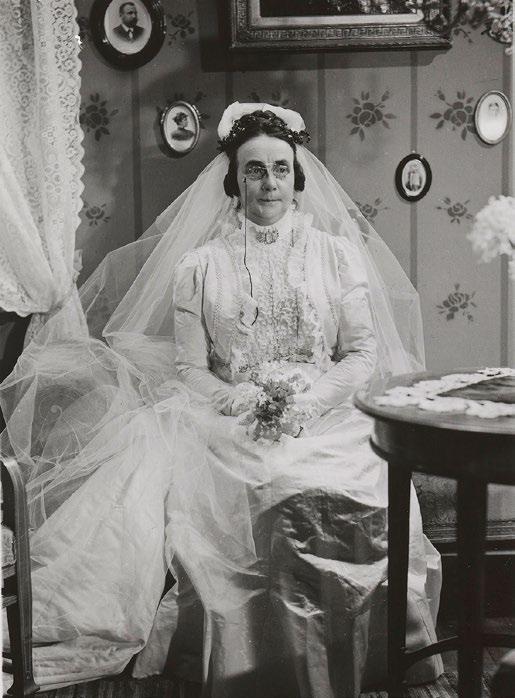
she had foreseen, romance develops between the daughters of the house and the young men, but a more surprising turn of events is when Blanca herself sets her eyes on an older unwed lawyer, who goes by his last name Plum, at one of the Christmas parties. Three engagements are thus announced at the same time, and Tante Pose declares that she will be the first of them to be married, and transforms herself from a prim spinster into a white virginal bride with a distinct, antiquated and excessive appearance (fig. 8).
Lita Prahl worked on three further films: Tørres Snørtevold (Tancred Ibsen, 1940), Rikard Nordraak (Alf Scott-Hansen, 1945) and Storfolk og småfolk (“Important people and common people”, Tancred Ibsen, 1951). During the war, the National Theater experienced a difficult and turbulent period during which the theater’s creative and technical staff was planning to collectively resign in support of the actors’ strike of 1941 against German occupying forces (Ringdal 2000, 251). This, however, did not come into effect, and Lita Prahl was still the head of costume design when the war ended. Edith Carlmar was also able to get her career back after the war. She had stayed active in the film industry until 1943 but grew increasingly uncomfortable as more offers from Nazi sympathizers arrived, and she withdrew from film work until the war ended. During this period, she even declined offers to direct films (Dokka 2000, 23).
To further track Gerd (Rogne) Jensenius’ career requires a detour through World War II-related literature, which gives a clearer picture of what ended her career within the film industry. During the panic days of April 1940 following the German invasion of Norway, Gerd and Wilfred Jensensius fled with their toddler from Oslo to Sweden. In Sweden, they were both involved in the resistance movement (Johansson 2016). In 1942, Wilfred enlisted as a war sailor and ended up in German imprisonment, while Gerd and her daughter lived with the Dominican sisters in Stockholm for extended periods of time (Byström 2009). The couple was reunited after three years apart, in 1945. There is no indication that Gerd went back to the film industry after the war. Instead, she reorientated herself towards the art scene. In 1944, Gerd Rogne Jensenius exhibited work as part of the exiled artists exhibition “Konstnärer i landflykt” (“Artists in exile”) in a barracks at Nybrokajen in Stockholm. And in 1951, she was one of a group of female artists who participated in an exhibition at the art institution Charlottenborg in Copenhagen that later traveled to Oslo Kunstforening (“Oslo art society”). Although no primary or secondary sources can confirm her further career choices, it seems that the outbreak of the war can, in part, explain why Gerd Rogne Jensenius
did not continue to work in the film industry, even though Wilfred Jensenius did.
Like Edith Carlmar, Bergljot Breistein did not make costume design for any feature films after 1943. The Nazification of national film policy and the Norwegian film industry made it increasingly difficult for film workers on both ideological and economic levels to continue making films. And when her husband Rasmus Breistein returned to filmmaking after the war, it was as a documentarian. Bergljot Breistein’s further career maneuvers are not well documented, but in the early 1950s she did for a few years have her own fashion column in in the journal Nynorsk vekeblad where she was featured as a fashion specialist (motespesialist). The column included illustrated articles about how to dress for different occasions and seasons, in style. This column gives evidence that she remained professionally active and affiliated with dress and costume after the war, albeit not in the film industry.
Another factor that can explain why some careers ended while others continued is that until the end of the 1930s, it was widespread practice to fire women from their positions when they married, the logic being that they should make their positions available to unmarried women, or men (depending on the type of work). This followed the so-called family principle where a woman was expected to devote herself to her family in the case of marriage, and because her salary was never meant to support a family, she could be paid less than men for the same type of work (Messel 2022, 27). Between the years 1928 and 1939, for example, the City of Oslo did not hire any married women (Moum 1981, 82). While a change was about to happen in the late 1930s where women would be allowed to stay in employment after marriage, the interruption of World War II saw an increase in unemployment, and societal structures were upheld where employers by default fired women who entered marriage (Skaarer 2005). Of the four women included in this chapter, only Lita Prahl remained unmarried, and she is notably the sole woman of the group who continued in fulltime employment until retirement age. Gerd Jensenius married the same year she worked on Eli Sjursdotter, and never returned to the
industry. Bergljot Breistein had established her costuming career before she met her husband, but worked as a costume designer (in a Norwegian context) only on the feature films he directed or produced. Edith Carlmar had a long and varied career as a freelance film worker and directed ten films during a ten-year period (1949–59) in partnership with her producer-husband, Otto Carlmar.
Even after the first credit for a film costume designer was included on a Norwegian feature film in 1938, it was not a watershed moment in the sense that most films would be crediting their costume designers from that moment onwards. For decades to follow, the crediting of film costume designers was a sporadic event at best. This lack or loss of information has therefore required a combination of methodologies and theoretical perspectives to establish the parameters that can allow for the process of writing film costume designers back into Norwegian film history. This also includes an acknowledgement of the effect World War II had on the larger national film industry, a story that often focuses on film directors’ resistance and opposition (or collaboration) during the Nazi occupation, but often leaves out ramifications for other professions and film workers, and knowledge about how the war affected women in the film industry is still uncovered.
By weaving Gerd Jensenius, Lita Prahl, Edith Carlmar and Bergljot Breistein’s stories into the larger picture, we can try to imagine where and how a history of Norwegian film costume designers might begin, building on the argument of scholars like Erin Hill who suggest turning one’s focus to what women did do, and continue to do, to further explore why and how professions within the film industry continue to be so highly gendered. In the case of costume design, the profession is interwoven with the history of education and vocational training for women. The educational system, in turn, is a result of the emancipation movement’s work to establish a school system where unmarried women could get an education that could lead to salaried work, releasing their fates from that of their attachment to husbands, fathers, or brothers. Higher education for women, starting in the late
nineteenth century, grew out of the traditionally effeminate work performed within the domestic sphere that had started to become part of school’s curricula across the country. Moreover, women have often been aligned with textile work, even as much of this work became possible to do using machinery. Tools and technology are used in cleaning, steaming, pressing, ironing, coloring, repairing, and adjusting fabric. Acquiring knowledge about different textiles requires techniques both simple and advanced, to maintain, repair, or give patina, alter, and adjust. This work that partly connects, at least traditionally, with women’s work in the home, has over centuries grown into various professional areas of work outside the home. At the same time, much of this work is done by workers – women – educated within the field and in possession of a specific set of skills.
The term “occupational segregation” is employed by media scholar Anne O’Brien in her book on professions in the media industry, titled Women, Inequality and Media Work . According to O’Brien, it is both the supply and demand side that determines what creates and maintains occupational segregations. On the supply side, educational preferences, and gender-based preferences for different jobs have been shown to have clear gender patterns in earlier studies, while on the demand side, one explaining factor, according to O’Brien, is that “jobs are stereotypically connected with the characteristics of current occupants” (2019, 28). O’Brien also identifies what she calls horizontal and vertical occupational segregation, where vertical segregation is often described using the metaphor of the glass ceiling, and O’Brien uses the metaphor of “glass walls” to explain horizontal occupational segregation between professions in the film industry that have similar educational requirements. Glass elevators are for individuals who have upwards mobility in the system, without any specific skills or experiences.
The heteronormative structures and mechanisms of the time the four women began working in the film industry continue to affect research avenues almost one hundred years later. What is more, doing research on women in the film industries often also includes partly understanding and adopting such a heteronormative logic in one’s own
work – to track someone’s career necessitates an overview of maiden and married names, and sometimes combinations of these. Throughout a woman’s career, her last name may change, and she may appear with different names in a filmography, a fact that can easily be overlooked. In addition, her name may be misspelled. To find the women included in this chapter it was necessary to search for common variations of their first names (e.g., Bergljot and Bergliot), or inconsequential spellings of their names (Lita – Rita; Prahl – Pral), or simply using their husbands’ names (Fru Rasmus Breistein). Personal information and knowledge about spouses’ names or other family names may help lead to information that a woman’s birth name alone cannot provide, at least in historical research.
Another such aspect is the archival status. While film costumes themselves may be in a state of precariousness due to a lack of plan or ambition for their collecting, curating or dissemination, archival lacunae in paper-based collections further testify to what Erin Hill has written about the inexistence of documentation: “Women were never absent from film history; they often simply weren’t documented as part of it because they did ‘women’s work’” (2016, 5).
Banks, Miranda. 2018. “Production Studies.” Feminist Media Histories 4 (2): 157–61. https://doi.org/10.1525/fmh.2018.4.2.157.
Banks, Miranda J. , and John Thornton Caldwell. 2009. Production Studies: Cultural Studies of Media Industries. New York: Routledge.
Bell, Melanie. 2021. Movie Workers: The Women Who Made British Cinema. 1st ed. Champaign: University of Illinois Press. https://doi.org/10.5622/illinois/ 9780252043871.001.0001.
Berentsen, Anne , and Svanhild Sørensen. 2006. Tallenes tale: Den offentlige pengestrømmen i norsk film i et kjønnsperspektiv. Oslo: Kulturmeglerne.
Bjerkeland, Ingvild , and Johanne Kielland Servoll. 2016. “Hovedkarakterer i norsk kinofilm i perioden 2011–2015 i et kjønnsperspektiv. En kvantitativ undersøkelse.” Oslo: Norsk skuespillerforbund.
Braaten, Lars Thomas , Jan Erik Holst , and Jan H. Kortner , eds. 1995. Filmen i Norge: Norske kinofilmer gjennom 100 år. Oslo: Ad Notam Gyldendal.
Byström, Tora. 2009. “Nordens Frihet: Samfundet, tidningen, kretsen.” PhD diss., Umeå University.
Dagbladet. 1934. “Lizzie Prahl til Nationaltheatret som teatermaler.” June 8.
Den nye lægen. 1943. Directed by Rasmus Breistein. Costumes by Bergljot Breistein. Norway: Triangel Produksjon.
Derlick, Inger. 2024. Mitt liv med mote og kostymedesign. Nesoddtangen: Derlick Bok.
Diesen, Jan Anders. 2000. På optagelse i friluft: Filmregissøren Rasmus Breisteins filmliv. Oslo: Norsk filminstitutt.
Dokka, Ingrid Kristin. 2000. Jeg ser alt i bilder: Filmregissøren Edith Carlmar. Oslo: Norsk filminstitutt.
Døskeland, Tora Sanden. 2021. “Museum meldt savnet.” Klassekampen, July 24.
Eli Sjursdotter. 1938. Directed by Leif Sinding. Costumes by Gerd Jensenius. Norway/Sweden: Merkur Film and Skandinavisk Biografservice.
En herre med bart. 1942. Directed by Alfred Maurstad. Costumes by Bergljot Breistein. Norway: Triangel Produksjon.
E.O. 1938. “Mennene bak kameraet under innspillingen av ‘Eli Sjursdotter’.”
Kongsberg Dagblad, December 6.
Förster, Annette. 2017. Women in the Silent Cinema: Histories of Fame and Fate. Amsterdam: Amsterdam University Press.
Fortmueller, Kate. 2018. “Gendered Labour, Gender Politics: How Edith Head Designed Her Career and Styled Women’s Lives.” Historical Journal of Film, Radio and Television 38 (3): 474–94. https://doi.org/10.1080/01439685.2017.1357253.
Gaines, Jane. 1990. “Introduction: Fabricating the Female Body.” In Fabrications: Costume and the Female Body, edited by Jane Gaines and Charlotte Herzog, 1–27. AFI Film Readers Series. New York and London: Routledge.
Gjest Baardsen. 1939. Directed by Tancred Ibsen. Costumes by Edith Carlmar. Norway: Norsk Film.
Gullfjellet. 1941. Directed by Rasmus Breistein. Costumes by Bergljot Breistein. Norway: Norsk Film.
Håberg, Kirsten Røvig. 2012. Fra skyggetanter til yrkeskvinner. Oslo: ABMmedia.
Halden. 1941. “Norsk film får nye fagfolk.” February 8.
Hansen og Hansen. 1941. Directed by Alfred Maurstad. Costumes by Bergljot Breistein. Norway: Meteor Film.
Hanssen, Eirik Frisvold. 2019. “Visible Absence, Invisible Presence: Feminist Film History, the Database, and the Archive.” In Making the Invisible Visible: Reclaiming Women’s Agency in Swedish Film History and beyond, edited by Ingrid Stigsdotter, 33–48. Lund: Nordic Academic Press.
Hill, Erin. 2016. Never Done: A History of Women’s Work in Media Production. New Brunswick, New Jersey: Rutgers University Press.
Hjort, Mette. 2005. Small Nation, Global Cinema: The New Danish Cinema. Public Worlds, v. 15. Minneapolis: University of Minnesota Press.
H-K. 1941. “Juveler for millioner.” Alle Kvinners Jul: 20–21, 27.
Holtar, Ingrid S. 2022. “Feminism on Screen: Feminist Filmmaking in Norway in the 1970s.” PhD diss., Norwegian University of Science and Technology. https://hdl.handle.net/11250/3017104.
Holtar, Ingrid S. , Maria Fosheim Lund , and Johanne Kielland Servoll. 2022. “A Revelation: Addressing Feminist Agency in Norwegian Film History.” Journal of Scandinavian Cinema 12 (2): 119–33. https://doi.org/10.1386/ jsca_00068_1.
Iversen, Gunnar. 2011. Norsk filmhistorie: Spillefilmen 1911–2011. Oslo: Universitetsforlaget.
Johansson, Anders. 2016. De glemte blokadebryterne. Oslo: Cappelen Damm. Kleppe, Bård , Ingeborg Holmene , and Line Elise Holmboe. 2023. “Innholdsmangfold i norske filmer og serier.” Rapport 803. Telemarksforsking(TF)/Norsk filminstitutt (NFI).
Loist, Skadi , Martha Emilie Ehric h, Sophie Radziwill , and Elizabeth Prommer. 2024. “Gender Inequality in the Nordic Film Industry: Exploring above-the-Line Positions in Film Production.” Nordic Journal of Media Studies 6 (1): 110–35. https://doi.org/10.2478/njms-2024-0006.
Lund, Maria Fosheim , Johanne Kielland Servoll , and Ingrid Synneva Holtar. 2024. “Expressions of a Backlash: Challenging the Story of Success in Norwegian Cinema of the 1980s and 1990s.” Nordic Journal of Media Studies 6 (1): 136–56. https://doi.org/10.2478/njms-2024-0007.
Lund, Maria Fosheim. 2019. “Klar med sikkerhetsnåler: Intervju med kostymedesigner Wenche Petersen.” Nordic Women in Film. https://nordicwomeninfilm. com/person/wenche-petersen/. Website discontinued. Archived at the Swedish Film Institute and at the National Library of Norway.
Lund, Maria Fosheim. 2026. “Aud Egede-Nissen: Star Producer.” PhD diss., University of Oslo.
Lyche, Lise. 1990. Norsk teaters mare: Agnes Mowinckel og norsk kunstnerliv. Oslo: Grøndahl.
Mais [Marie Fearnley]. 1938. “Et kvart tusen kostymer!” Dagbladet, July 29.
Messel, Jan. 2022. Profesjonsutdanninger i sentrum: Fra jordmorutdanning til OsloMet 1818–2018. Oslo: Pax forlag.
Moum, Sidsel Vogt. 1981. Kvinnfolkarbeid: Kvinners kår og status 1875–1910. Oslo: Universitetsforlaget.
Myrstad, Anne Marit. 2023. “Heroines of Norwegian Silent Cinema: Nordic Femininity and Conventions of Cinematic Whiteness.” Journal of Scandinavian Cinema 13 (2): 183–205. https://doi.org/10.1386/jsca_00094_1.
O’Brien, Anne. 2019. Women, Inequality and Media Work. London: Routledge. Østerdølen. 1938. “Eli Sjursdotter – en ny norsk storfilm.” October 17.
Rikard Nordaak. 1945. Directed by Alf Scott-Hansen. Costumes by Lita Prahl. Norway: Nordlys Film.
Ringdal, Nils Johan. 2000. Nationaltheatrets historie 1899–1999. Oslo: Gyldendal.
Sceneweb.no. “Lita Prahl.” Accessed March 18, 2024. https://sceneweb.no/nb/artist/30195/Lita_Prahl.
Servoll, Johanne Kielland. 2014. “Den norske auteuren: En begrepshistorisk analyse.” PhD diss., University of Oslo.
Skaarer, Åse Camilla. 2005. “Gifte kvinners rett til arbeid.” Kvinnehistorie.no. Accessed March 27, 2024. https://www.kvinnehistorie.no/artikkel/t-2680.
Småen [pseud. for Eriksen, Solvejg ]. 1943. Jeg vil til filmen: Et gløtt i ord og bilder bak kulissene i norsk film. Oslo: John Griegs Forlag.
Solum, Ove. 2000. “En god gammel kjenning. Rasmus Breisteins lydfilmer.” In På optagelse i friluft: Filmregissøren Rasmus Breisteins filmliv, edited by Jan Anders Diesen, 66–105. Oslo: Norsk filminstitutt.
Storfolk og småfolk. 1951. Directed by Tancred Ibsen. Costumes by Lita Prahl. Norway: Norsk Film.
Sørensen, Svanhild. 2010. “Ta alle talentene i bruk!: Utjevningsforslag for balansert kjønnsrepresentasjon i norsk filmbransje.” Oslo: Bransjerådet for film.
Svane, Anette. 2020. “From Edith Carlmar to Iram Haq: Women in the Norwegian Film Industry.” In Women in the International Film Industry: Policy, Practice and Power, edited by Susan Liddy, 149–62. Cham: Springer International Publishing. https://doi.org/10.1007/978-3-030-39070-9.
Tante Pose. 1940. Directed by Leif Sinding. Costumes by Lita Prahl. Norway: Merkur Produksjon
Trencheva, Elena. 2018. “Costume in Early Finnish Film (1921–31).” Studies in Costume & Performance 3 (1): 43–60. https://doi.org/10.1386/scp.3.1.43_1.
TrysilKnut. 1942. Directed by Rasmus Breistein. Costumes by Bergljot Breistein. Norway: Meteor Film.
Tørres Snørtevold. 1940. Directed by Tancred Ibsen. Costumes by Lita Prahl. Norway: Norsk Film.
Ulvedalen, Janette , and Anette Hellenes. 2023. Kvinnekamp med nål og tråd: Kjole og draktsyerfaget gjennom 100 år. Oslo: Solum Bokvennen.
Wallenberg, Louise. 2023. “Introduction.” In Now About All These Women in the Swedish Film Industry, edited by Louise Wallenberg, Frantzeska Papadopoulou, Maaret Koskinen, and Tytti Soila, 1–28. New York: Bloomsbury Publishing Inc. https://doi.org/10.5040/9781501366185.
14. Odd Couple Out: On Film Architect Bibi Lindström and Costume Designer Max Goldstein
Tytti Soila and Louise Wallenberg
This chapter focuses on film architect Bibi Lindström (1904–84) and costume designer Max Goldstein, known as Mago (1925–2008), two film workers who came to influence Swedish film (and theater) aesthetics and production in the mid- and late twentieth century. Both were highly productive, and they collaborated with some of Sweden’s most important and successful film (and stage) directors, including Ingmar Bergman and Arne Mattsson. Mastering and widely contributing to two crucial aspects of the mise-en-scène, i.e. set design and costume, their cinematic legacy is undeniable, yet they have received little attention by film scholars. In a few earlier publications, we have partly tried to fill this gap: Soila has written about Lindström and her pivotal role in the Swedish film industry (Soila 2018; 2023), and Wallenberg has written on Mago’s costume design for film (Wallenberg 2008; 2017; 2025).1 In this chapter, we aim to contribute to this much-needed original research as we highlight Lindström and Mago’s work and importance for Swedish film – this time bringing them together by discuss-
1 In a podcast published on the website “Nordic Women in Film” (discussed in this collection by Tove Thorslund) and kvinnohistoriska.se, Tytti Soila is interviewed on Bibi Lindströms’ work. See https://www.kvinnohistoriska.se/kvinnans-plats/arkitekten?locale=en.
ing a small number of their joint films, films that clearly wear their distinctive yet combined aesthetic and formal imprints. Lindström and Mago were greatly inspired by modernist aesthetics, and this transpired into their film work in different forms. And while the modernist crafting of space and costumes is noticeable in most of their work, it seems most lucidly manifested in the films that they collaborated on, as both of them brought this aesthetics to the fore in intimate and allied combination.
Consequently, this chapter aims at introducing Lindström and Mago to a larger audience, while also exploring a small number of their joint films in terms of modernist aesthetics. The chosen films are Gycklarnas afton (Sawdust and Tinsel , Ingmar Bergman 1953); Körkarlen (The Phantom Carriage , Arne Mattsson 1958); Mannekäng i rött (Mannequin in Red , Arne Mattsson 1958); Ryttare i blått (Rider in Blue , Arne Mattsson 1959); Den kära leken: En fyrfärgsbild av ett äktenskap (The Beloved Game: A Marriage in Four Colors, Kenne Fant 1959); and Persona (Ingmar Bergman 1966). While these will be the focus of our attention, we will also refer to some of their other films as well. Our analytical focus will mainly be on set design and costume, and on how these visual, yet tactile, aspects interact in the six films. 2
The selection makes up an indeed “speckled” assortment: the first and the last are two internationally famous art films by renowned director Bergman, filmed in black and white, as is Körkarlen , while the two films by Mattsson with a color in their title, are extravagant, colorful, and entertaining. Finally, Den kära leken is a mixture of both color and black and white, and – like the Mattsson films – is little-known outside of Sweden. All six, although clearly marked by genre differences, are aesthetic representations of “reality” (Stern 2020), a reality that through the films’ formal aspects is constructed as multiple, varied, and indeed diverse. Hence, Den kära leken – partly filmed in
2 It should be added that our “odd couple out” also collaborated on the following film productions: Det var en gång en sjöman (Once there was a sailor, Ragnar Frisk, 1951); Får jag låna din fru? (May I Borrow Your Wife? Arne Mattson, 1959); Bröllopsdagen (The Wedding Day , Kenne Fant, 1960); and Mr. and Mrs. Sweden (Göran Gentele, 1969).
excessive colors emphasizing set design and costume – depicts a kind of reality that painstakingly varies from the more sober, modern and strict Persona , filmed in black and white.
The chapter is structured as follows: first, we offer a short contextualization explaining the cinematic situation in Sweden in which the two started out their careers. We then move on to describing Lindström and Mago’s personal histories and educational backgrounds, focusing on how they came to work in the cinema industry, and sketching out their increasing importance within the industry over time. Next, we discuss the chosen films, emphasizing their aesthetics and how their production design and costuming work together. To illustrate the reception and evaluation of their work in their contemporary frame, we rely on a number of newspaper articles and film reviews, avoiding the professional and fan press, as we believe that the newspapers spoke to and for larger audiences. In our conclusion, we offer a final reflection on the role of production design and costume in terms of their (in)visibility in relation to the overall story – including Mago and Lindström’s own views.
Before moving on, let us first briefly explain why we have chosen to include Mago in a collection that is about female film workers. Although a man, he did occupy a distinctly feminine position because of his profession as a costume designer, and also, because throughout his life he much preferred to design for women than for men, on screen and stage as well as off them. Actress Harriet Andersson in fact referred to him as “the grand divas’ best little friend”3 . While Mago writes respectfully of male painters and their art in his memoirs, he speaks lovingly about “his” stars, Annalisa Ericsson, Karin Kavli, Git Gay and Zarah Leander (Mago 1988). In addition, we find his collaboration with Lindström to be of utmost interest, not least because both of them occupied professions that “belonged” to the other sex: film architecture (later, set design) and costume design were (and still are) gendered professions and domains, the former being dominated by
3 “de stora primadonnornas lille vän”. See https://www.ingmarbergman.se/person/mago
men, and the latter by women. Hence, Lindström and Mago make the odd couple out because of them being active in the “wrong” domains.
Following a prosperous decade of film production in the 1930, the 1940s would prove to be meager, in terms of both quantity and quality. 4 A few memorable film productions can be mentioned, and three such examples are Hets (Torment , Alf Sjöberg 1946), Människor i stad (Symphony of a City, Arne Sucksdorff 1947) and Hasse Ekman’s lesbian drama Flicka med hyacinter (Girl with Hyacinths, with Lindström in charge of production design), which premiered in 1950. Generally, however, this period has been seen as characterized by apparent mediocracy (by the contemporaries). 5 As we enter the 1950s, the economic situation for national film production is still meagre, yet the situation will start to change slightly, and two important factors are the impact that auteur theory starts to have on films critics, and the partly outspoken ambitions of a film industry that advocates for cinema as art, as in opposition to film as entertainment. Here, the young Ingmar Bergman is clearly an important figure: he started making films already in the mid-1940s, and would in the early 50s rise to international fame with his string of award-winning films: Sommaren med Monika (Summer with Monika) and Gycklarnas afton (Sawdust and Tinsel ), both released
4 See, for example, Furhammar 2003 and Habel 2002. The dominant genre during the 1940s continued to be comedy, with the film industry clearly targeting the homebound, national audience, and the audience was given little new in terms of narrative and/or cinematographic innovation. The freshness of both new and old faces, some of which came from vaudeville and theater, that had populated Swedish film production in the 1930s, was now gone and it seems that the film production of the 1940s was caught in a spinning wheel.
5 The first couple of years of the 1940s were however rather productive: As a neutral nation during the war, Sweden had a more stable economy than its neighboring countries, which meant that Sweden could secure its film production. Further, due to the trade blockade/ embargo on foreign film, Swedish film production – continuously emphasizing and representing a national romantic image of Sweden and Swedishness – could flourish and Swedes continued to flock to the cinemas. After the war, however, the production would decrease and this had partly to do with an increased cinema tax, and with the fact that foreign films, especially Hollywood film, started to flood the market. See Furhammar 2003.
in 1953, followed by Sommarnattens leende (Smiles of A Summer Night) in 1955 and Smultronstället (Wild Strawberries) and Sjunde inseglet (The Seventh Seal ) in 1957. 6
But Bergman was not alone: Arne Sucksdorff won awards and praise abroad with his artistic (semi-)documentary films, and director and actor Hasse Ekman becomes a highly popular director with the Swedish audience through his elegant, timely, and romantic comedies. 7 Director Arne Mattsson made a sensation with his romantic drama film Hon dansade en sommar (One Summer of Happiness , 1951), while also being able to present a broader palette of remakes of historical dramas and creating powerful adaptations of literary novels, as well as a series of more lightweight comic detective films. Ekman and Mattsson’s more popular films (often comedies), and especially those that were filmed in striking colors, can be considered as complete opposites to Bergman’s more somber black and white dramas. In fact, it would take until 1964 for Bergman to make his first color film, För att inte tala om alla dessa kvinnor (All These Women , with costumes by Mago). Hence, central to the creation of Bergman and Mattsson’s cinematic universes are Mago and Lindström – with Mago designing costumes for no less than 13 of Bergman’s films, and nine of Mattsson’s, and with Lindström being the architect of most of Mattsson’s 1950s films.
Lindström started working for the industry in the 1930s when making the set design for Den farliga leken (The Dangerous Game . Weyler Hildebrand 1933), and Mago started in 1950, when designing costumes for Södrans revy: farväl til 40 talet (The South Theatre Revue: Farewell 1940s , Sven Paddock and Arthur Spjuth, 1950). As mentioned, it is important to stress that within the film industry, which is (still) a highly gendered organization and system, Lindström
6 Bergman makes his first films in 1946: Kris (Crisis) and Det regnar på vår kärlek (It Rains on Our Love), and these are followed by Skepp till India land (A Ship bound for India , 1947); Musik i mörker (Music in Darkness , 1948); Hamnstad (Port of Call , 1948); Fängelse (Prison , 1949); and Törst (Thirst , 1949).
7 Sucksdorff wins an Academy Award for best short film with his Symphony of A City in 1949, and in 1954, he wins the Palme d’Or in Cannes for his Det stora äventyret (The Great Adventure , 1953).
occupied a predominantly male occupation: before her, film architecture had been an exclusively male sphere par excellence . Similarly, Mago occupied a predominantly female occupation, costume design. It is also important to note that whereas Lindström managed to break the “glass ceiling” and actively pave the way for more women to come into film architecture (later known as set design), Mago must be considered somewhat of an anomaly, since to this day, costume design continues to be seen as a “women’s profession” in Sweden, and abroad. 8 Yet, when looking to Hollywood, we see that some of Mago’s most prominent contemporary costume designers were male.9
Between them, they contributed to some 200 film and television productions: Lindström debuted in 1933, and her final production, the children’s television series Den vita stenen (The White Stone , Göran Graffman) premiered in 1973. Thus, she had a career that spanned over four decades.10 Goldstein, debuting for film in 1950, made his last contribution in 2000, when designing costumes for Bergman’s television film Bildmakarna (The Image Makers), his film career spanning over half a century. However, the common social denominators between Lindström the film architect and Mago the costume designer were not many as they started working together at the beginning of the 1950s. Lindström was about ten years older, and already very well established within the film industry when Mago started
8 See, for example, Banks (2009); Warner (2024); Wallenberg (2025, 2026).
9 Examples would be Walter Plunkett, Orry-Kelly, Travis Banton, and Edward Stevenson.
10 Upon retirement, she had contributed to 149 films as architect, and to another three films as scenographer, and to several TV productions. In addition, she had made the set design for several theatrical plays, including for the Royal Dramatic Theater. She was indeed a pioneer, and none of her male colleagues were as productive as she was: Film architect P. A. Lundgren (1911–2002) contributed to 113 films, Nils Nilsson (1919–81) to 70 films, Wilhelm Bryde (1888–1974) to 72 films.
out. Their backgrounds differed as well: Lindström belonged to the liberal, well-off middle class in Stockholm while Mago was a Jewish refugee in a foreign country. However, as their professions, interest and attentiveness to modernity, modern art and design brought them together at the beginning of the 1950s, it resulted in spectacular and spirited playfulness and elegance in line with the period’s alignment with transformation and orientation towards modern life and its form, speed and belief in the future.
Introducing Lindström and Mago Mago was born in Berlin in March 1925 to a large, prosperous family with access to cultural and material benefits – his father was a pediatrician. His childhood milieu was constrained by customs and rituals on the one hand, and the freedom of fantasy on the other. The family was conservative but interested in modern art and entertainment, and the children were introduced to theater and film early on. The short plays staged in the family living room and the numerous sketches made of relatives would serve as a foundation for a life-long career. As the threats against the Jewish population in Hitler’s Germany increased, the family decided to send Max and his younger brother Peter to Sweden in 1939, a few months before Max’ 14 th birthday. The Goldstein family was able to reunite in Sweden in 1940, but rather than sending Max to regular school, he was sent to Stockholm where he worked as an apprentice in the clothing industry, learning fashion design in situ . He was also able to contribute to different youth magazines and newspapers with his comic strips. Relatives helped him to an art exhibition, and he would win a prize awarded by Dagens Nyheter, one of the major daily newspapers in Stockholm (Åström 1941, 8; fig. 1). During the 1940s, he made a living mainly by contributing to the evening papers Aftonbladet and Expressen with his fashion drawings. Through his interest in revue and operettas, he would, if nothing else, sit in the audience and draw the extravagant costumes worn by the stars on stage. Eventually, he was offered work backstage. It was around this time that he started to use Mago as his artist name. “Mago”, of course,
was a combination of the first two letters of his first and last name, and also evoked the idea of him as a magician.11
Due to their refugee status, one of Mago’s cousins, Dieter Winter, went to live with the family of a vicar in one of the parishes in Stockholm. The vicar was Erik Bergman, and Mago was introduced to the family’s youngest son Ingmar. Ingmar Bergman had started his career as an instructor at an amateur theater, Mäster Olofsgården, in the Old Town in Stockholm, and later moved on to Dramatikerstudion, a semi-professional production unit for modern drama. These two institutions were Mago’s channel to steadier employment in theaters; his first assignment was to design the stage décor for an “operetta for the youth”, Kärlek och trolltyg (Love and Spells) in April 1945 (Svenska Dagbladet 1945b, 11).
At that time, Lindström was already a name, if not a legend, in the artist circles of Stockholm. Lindström and her brother were brought up by a well-to-do single mother interested in art and politics. She encouraged her daughter to leave Sweden at the age of 18 for studies in Munich – the then number one art city in Europe – at Münchener Lehrwerkstätten (Munich Educational Workshops). Her education was in decorative painting with focus on murals, i.e. creating ornaments on large surfaces designed to be seen at a distance, as in architecture, or for theater. She picked up modernist ideas – expressionism as well as functionalism – and on returning to Stockholm, became acquainted with well-known city planners and architects, who together
11 At end of the 1940s, Mago was well established in the fashionable layers of media world in the Swedish capital, and newspapers noted his whereabouts even outside his profession as a draftsman in the daily press. For instance, in the winter of 1947, he was responsible for arranging an exhibition promoting holiday travels to Riviera. Consequently, even the attendants looking after the bountiful flower-arrangements at the venue were dressed in “Riviera-dresses” designed by him and produced at Lejamagasinet , one of the leading fashion studios in Stockholm. In his capacity of coordinator, he even acted as a guide for the eight mannequins from Paris and Svenska Dagbladet published a report and a picture of the models of the fashion house (Svenska Dagbladet 1947a, 14). Only a few days later, a review of a play of Strindberg was announced in the same paper, reporting that Mago’s décor was suggestive, but that the venue did not support its impact (Svenska Dagbladet 1947b, 9).
contributed to the functionalist turn in Sweden (Rudberg 1992; Gedin 2018). She was first employed as an assistant for renowned painter Isaac Grünewald for the Stockholm Exhibition in 1930, and ten years later, she worked with the famous architect Sven Markelius on the Swedish Pavilion at the 1939 Word Expo in New York.
Lindström enjoyed working with set design and was looking for employment in the many private theaters (such as Oscarsteatern) in the early 1930s, but soon, film would become her permanent field of work. She was employed by one of the larger production companies in the country, Europa Film, and later by AB Sandrew-Produktion (commonly known as Sandrews), a film company with higher artistic ambitions. She would also work at the company studios Sandrewateljéerna located in Gärdet, a district at the outskirts of the city, until the mid1960s. Alongside her permanent work, Lindström was, in a sense, an influencer long before the expression came into circulation. She was interviewed about her work in the press, and she was involved with the Housing Association of the city to promote better housing developments. She also gave lectures at women’s associations on her work as well as on interior design in terms of sensible planning and furnishing homes (Svenska Dagbladet 1945a, 14). The newspapers would report on her work on prestigious productions, describing the ways she rode around on her bicycle hunting for furniture for the interiors or climbed to the top of décor sets if necessary (Brodjaga 1931, 11). It is significant that even while Gycklarnas afton was under production, Svenska Dagbladet (among others) reported on her achievements for Alf Sjöberg’s prestige films Barabbas (Svenska Dagbladet 1953a, 11) and Karin Månsdotter (Svenska Dagbladet 1953b, 9).
In 1950, a New Years’ Revue financed by Sandrews achieved tremendous success at Södra Teatern, a popular stage in Stockholm. The company decided to profit on the achievement by producing the film Södrans revy : Farväl till 40 talet . The film was depicted as a documentary about a stage show; in other words, it was a theater performance with a live audience filmed with stationary takes recording a cavalcade
of comic sketches dealing with the arts and politics of the 1940s. Södrans revy was the first assignment to bring Mago and Lindström together. A year later, they worked together on their second film, Det var en gång en sjöman (Once There Was a Sailor, Ragnar Frisk, 1951). This film may have been a triviality, perhaps, but one containing an element that illustrates the creative imagination, play, and movement characteristic for both of their work. The story is about the adventures of a sailor in an imaginary harbor called Jazzablanca, where “reality” scenes mix with staged sequences. Both the stage, where a “performance within a performance” takes place, and the “reality” reflect a lavish imagination, such as shady saloons, narrow lanes, suspicious characters, ship corridors – whereas the staged and performative sequences allow even further expansion of imagination with extravagant costumes against lush props, hand-painted by Lindström.
Even when shooting a black-and-white film, extensive test filming had to be done in order to establish the best possible impression. In his memoirs, Mago stresses the meticulous work required when choosing the color, texture and fall of the costume fabrics – nuances of white, grey and black may reflect the playfulness of figures and forms just as much as colors might, but not always in the ways one expected (Mago 1988, 204).
Unlike Det var en gång en sjöman , a low-budget freelance job for a smaller company called Svea Film, the next production to engage both Lindström and Mago would be a prestigious film that actualized the ambitions of Sandrews, namely Bergman’s Gycklarnas afton . Bergman had worked for Svensk Filmindustri and other companies for a while, but to make Gycklarnas afton , he chose to turn to Sandrews. To Mago, film production was still relatively new, and in his memoir, he recalls how he happened to meet Bergman backstage at Oscarsteatern, a private theater in Stockholm, and how a few days later he “found a film script in my hand”12 (Mago 1988, 130–31). Lindström,
12 “Några dagar efter Ingmars och mitt korta möte i artistfoajén höll jag ett manuskript i handen. ‘Gycklarnas afton’.”
being an employee at Sandrews, came on board with the ordinary Sandrew studio staff. She knew cinematographer Sven Nykvist well, who would shoot the interiors in the film – and who actually had filmed a short documentary directed by Lindström herself in 1943, En Stockholmssilhuett (A Stockholm Silhouette). The exteriors were filmed by Hilding Bladh whom she had known since one of her first film jobs, Flickorna från Gamla Sta’n (The Girls in the Old Town , Schamyl Bauman 1934).
For both Lindström and Mago, Gycklarnas afton was the first film they did with Ingmar Bergman. The film was part of a new wave of modernist art cinema that started appearing after World War II (see, e.g., Shiel 2006; Kovács 2007), and as such, it was probably a welcome assignment for both of them. Lindström, who was known for her reliability and readiness to do her best in any assignment presented, was personally in favor of experimental and art film. Mago, on the other hand, had shown proof of his stylized drawing quality from early on (see fig. 1). While modernist in terms of its cinematography, the narrative of Gycklarnas afton demanded detailed, ornamented, and old-fashioned settings and costumes as the story is set in the Swedish countryside in the early 1900s. At the center of the film is a traveling circus company that moves from one small town to another, trying to support themselves through make-believe to an audience that partly despises them. This is a film about poverty, deception, humiliation, and hardship – but also about endurance and solidarity.
The production process of Gycklarnas afton inferred exceptional demands for the entire crew and the numerous helpers, with long travels between localities – the trip from Stockholm to Gävle is 200 kilometers, with Ystad and Höganäs more than 600 kilometers away – and a shooting period that lasted for nearly five months. This was one of Mago’s favorite films, and he has described meticulously the complicated process of making the costumes for it. He showed a kind of protective attitude towards both the director and the photographer, saying that negligence by the costumer or sudden mishaps such
as a sneaker jutting under a lace dress should not occur or cause breakups in their work (Mago 1988, 203). Neither did Lindström skimp on her efforts, but consulted circus workers in order to get it right when erecting a circus tent.
Clearly, Lindström and Mago’s design processes and assignments represent two different aspects of the creative process: Lindström, with her wide-angle approach, needed to furnish large and varied spaces, while Mago’s gaze represented the extreme close-up on the actors, focusing on their facial expressions and movements, not to mention their detailed and elaborate costumes. He describes how he wanted his costumes to support the actors so that they would feel safe and secure in front of the camera or on stage. Such an ambition brought on a certain intimacy between him and the actors, and in his memoirs, he writes: “during the first acquaintance – and this goes for both men and women – while talking about such personal, special, and sometimes delicate, as the clothing, a one-to-one rapport is needed” (Mago 1988, 228).
The costumes in Gycklarnas afton are indeed eclectic – combining the theatrical and over-the-top with worn-out and dirty garments, serving to pinpoint the spectacular, unconventional and precarious aspects of traveling life for circus artists. The more spectacular costumes are for showtime, for the audience, in a performative attempt to make believe, whereas the worn-out garments are for behind the scenes, when the performance is over. In an almost head-on implementation of Erving Goffman’s notion of front- and backstage, Mago manages to show the two sides of performative life: the spectacular illusion and the more grim reality (Goffman 1956).
In the opening scene of the film, the elderly clown (Anders Ek), who has just come to realize that his wife (Gudrun Brost) has bathed naked amongst a group of young soldiers – and who is now humiliating her verbally – is dressed in a classic one-piece white body suit made of thin shiny silk and a cone-shaped white clown cap, both of which are mirrored by white foundation covering his face. As he starts to cry, his white foundation cracks, revealing every wrinkle on his face, and turning it into a mask of pure despair and pain. His expression is clearly
reminiscent of Lon Chaney’s sad clown in Victor Sjöström’s He Who Gets Slapped (1928), and indeed, this scene is a tribute to Sjöström. But also, it could be tribute to Mago’s own childhood and to his love for all extravagant and excessive – as well as to the effeminate.
According to Mago, Bergman (in contrast to many other directors he worked with) took a very serious and detailed interest in costume design. He would, then, have Mago involved already at the scriptwriting stage, in order to have the costumes and looks in place in the early design of each shot (Mago 1988, 202). In his memoirs, Bergman has in fact described how he actually visualized his characters in costume even before the story was there (Bergman 1990). This stands somewhat in contrast to someone like American director James Ivory, who has stated that before he starts working on a film idea, what he first visualizes is the architecture and the interiors, in his case often starting with a staircase.13 And while Bergman started out envisioning his characters in costume, and Ivory with imagining interior spatiality, long before there was a story, their initial work processes both help us understand the uttermost importance of a film’s mise-en-scène.
Both Mago and Lindström have stressed the importance of teamwork when creating a film. To journalists, Lindström has explained that she considered it extremely important that the craftsmen were encouraged to use their imagination when handling their tools in the studio, as the set had to be built in relationship to the ratio of the picture frame as well as to the camera angle, and the modus of the film was very much dependent on their inventiveness (Age 1954, 20).
Mago, of course, has given credit to the seamstresses and cutters in the studios. He has written extensively of the ways the camera lens in combination with the degree and quality of lights in the set influence the fidelity of fabric colors. Thus, the light reflected from a button could destroy the impression of an image, a red dress could actually appear black in film, and costumes and other articles should be washed
13 James Ivory, lecture given at the University of Oregon in May 2003.
in tea, for instance, in order to achieve the proper whiteness. Also, while a costume should look elegant and fit into every situation, it should be made easy to wear and supple enough for a variety of movements and situations (Mago 1988, 203–4).
Color film, broadly introduced in the 1950s, proved to be a particular challenge for those in charge of furnishing and costume. Yet, Lindström was quite excited when the opportunity came to work with color film. She told a reporter that she was ready for new challenges in replacing the scarce possibilities offered by black and white film, namely nuances of brightness and shadow created by juxtaposing oppositions like shiny against lackluster or light against dark (Svenska Dagbladet 1954, 18). Along with color film came oftentimes wide-angle cameras with different rations of film stock: Eastman Color in 1:66:1 and Agascope – the Nordic equivalent for Cinemascope – in ratio 2:35:1. This, of course, would change the conditions for a film architect who had to fit buildings and interior constructions in a new kind of frame.
The 1950s was the decade when the odd couple out did most of their films together: next to Bergman’s Gycklarnas afton , they worked on four Mattsson films, while also doing two films for Kenne Fant: Den kära leken and Bröllopsdagen (The Wedding Day, 1960). And it was in two of their films with Mattsson that they got to fully explore the possibilities with color. In Mannekäng i rött (1958) and Ryttare i blått (1959), two films belonging to a series of detective stories about a private detective couple called the Hillmans, Lindström and Mago created vibrant set designs and costumes that served both to support and enhance each other. However, the other two Mattsson films, Får jag låna din fru? (May I Borrow Your Wife , 1959) and Körkarlen (The Phantom Carriage , 1958), were filmed in black and white, with the latter film clearly deviating from the other Mattsson films in terms of genre: the first three are examples of comedy and/or comic thriller, while Körkarlen must be defined as a melodrama.
Mannekäng i rött was the second in a series of five crime films based on the novel and radio series written by Folke Mellvig.
Lindström and Mattsson chose a variety of settings as the backdrop to this story about serial killings in a fashion house.14 The interiors of the film were shot in the Sandrews studios, the exteriors in the small towns of Sigtuna and Uppsala, at the Nordic Museum in Stockholm, at Örbyhus Castle, and at the horse race tracks in Ulriksdal just outside the city. The critical reception of the film was not too enthusiastic, yet Lindström and Mago’s work was appreciated. For example, film critic Ellen Liliedahl with understated irony described the film as having:
a snappy, colored and curious montage, generally presenting too much of everything, too much posing and acting, too many interiors, too many mystifications. Image-wise brilliant, Hilding Bladh’s photo in its best moments have a lyric quality that reaches outside the story’s context.
And she would emphasize:
The visual effects include Mago’s collection of elegant fashion creations, shockingly beautiful, or just shocking, as is the set of stylish interiors built by Bibi Lindström15 (Lill 1958, 15).
In this film, the interiors are spacious and tastefully furnished by Lindström according to the latest in Swedish design, as if on display. A much-distributed picture – an interior take at the home of the main characters, the Hillmans (Annalisa Ericson and Karl-Arne Holmsten) – depicts an older Gustavian cupboard signaling old, yet classy,
14 The film centered on a married couple, the Hillmans, who together solve crimes. There were five Hillman-films made between 1958 and 1963, all of them having a color in the title (Damen i svart (Lady in Black , 1958); Mannekäng i rött (Mannequn in Red , 1958); Ryttare i blått (Rider in Blue , 1959); Den gula bilen (The Yellow Car, 1963); and Vita frun (Lady in White , 1963)). The novels were written by Folke Mellvig, and he was also involved in writing the film scripts, with the help of Lars Widding, for the first three films. All films were directed by Mattsson.
15 “ett klatschigt kulört och kuriöst bildmontage … över huvud taget för mycket av det mesta … för mycket poserande och agerande, för många interiörer, för många mystifikationer. Bildmässigt briljant, Hilding Bladhs foto når i sina bästa ögonblick en lyrisk kvalitet alldeles utanför sammanhanget. Till de visuella effekterna hör också Magos uppsättning av eleganta modekreationer, chockartat vackra eller bara chockartade, och Bibi Lindströms uppsättning av flotta interiörer.”
bourgeoisie taste as if present in the life of the couple but only as a background, a bit passé. Instead, the modern design is on display in the front with a coffee table and a bookshelf made of teak, the woodwork in vogue at the time. The easy chair at front in curved veneer is probably a Mingo by one of the designers of the day, Yngve Ekström.
Many of the film’s scenes, however, take place inside the fashion house La Femme . Here, the interiors are elegantly designed in velvety gray and soft pastels as if to allude to the famous Maison Dior and its characteristic nuance montaigne gray. Clearly, Lindström must have been very familiar with the interiors of Maison Dior – paying tribute, but also appropriating, the Dior ambiance to make her own interiors fashionable, sophisticated, and also, credible.
Since the film takes place in a fashion house, it is tempting to see Mago going a bit berserk when it comes to fashionable costumes. Creating fashions for both actresses and extras, he seems to have gone all in for the New Look – which is the look that perfectly matched Lindström’s soft gray interiors. The grand finale at the end of the film – i.e. the fashion show – demonstrates Mago’s absolute and sensible pitch, with mannequin after mannequin wearing costumes that could easily be mistaken for high-end fashion. Mago presents a stream of fancy outfits ranging from deep décolletages dresses with exciting cuts, velvety suits, tight shiny trousers, voluptuous chiffons and romantic light blue and pink effeminate dresses. Without a doubt, his many fashionable costumes and looks break the frame and the narrative, and as they become excessive and conspicuous fashion, they constitute, in a Barthesian sense, a third meaning : While intruding on the seamlessness and the totality of the film narrative, demanding to take up center space, they also emphasize the performative role of dressing, and the intimate relationship between costume and fashion (Barthes 1985; Wallenberg 2017).
Ryttare i blått is the third Hillman film. Style-wise, it has many similarities with Mannekäng i rött , but this time the narrative is set in a country environment including a posh manor and a cavalry regiment.
While the Hillman couple together solved the crimes in the previous films, this time it is Kajsa Hillman (Ericson) who solves murders. Again, Lindström staged a multitude of scenes from the staples, the exclusive interiors of the manor – including the ball scene where she decorated a venue for Mago to excel with fancy dresses made of lace, silk, velvet, and duchess, not to mention the military uniforms. Again, set design and costume interact with and support one another, making the mise-en-scène stand out in its visual and colorful completion. And just as in Mannekäng i rött , the reactions to Ryttare i blått were divided: the box office results were more than satisfactory, but the critics failed to see the tongue-in-cheek quality in the excess. Ellen Liliedahl was even more drastic this time and mirrored the common opinion among critics when she wrote: “[The film is] at the same time childish and perverted. I do not know whether the color film was given such unlikely exaggerated nuances on purpose, but in any case, the overtly spinach-green tones of meadows and fields adds to an artificial impression.”16 However, she admits that the film as a kind of “kaleidoscope” with its constant movements and imaginary details – all in an exited, irresistible tempo (Lill 1959b, 15). Also, the nestor of Swedish film criticism, Bengt Idestam-Almqvist (alias Robin Hood), who loved a good melodrama mise-en-scène, wrote in StockholmsTidningen :
At the sight of the near-documentary description of Strömholm Castle, it is easy to see that Arne Mattsson and photographer Hilding Bladh have fallen in love with the charming milieu – and the architect Bibi Lindström’s studio-interiors insert themselves seamlessly with the sequences taken on location. In such a milieu the young actors reciprocate confidently in their immaculate uniforms.17 (Robin Hood 1959, 11)
16 “[Det är] på samma gång barnslig och pervers i all sin yttre virtuositet. Jag vet inte om färgfotot med flit givits högst osannolika och överdrivna toner, med en över alla gränser spenatgrön grönska i fält och ängar, men det bidrar till alla händelser till det artificiella intrycket.”
17 “Man ser att Arne Mattsson och fotografen Hilding Bladh förälskat sig i den tjusiga miljön. De ger en nästan dokumentär skildring av Stömsholm, och arkitekten Bibi Lindströms ateljéinteriörer smälter bra ihop med bilderna tagna ’på plats’. I miljön rör sig våra aktörer i uniformer av yngre och äldre snitt militäriskt.”
In retrospect, it might be safe to say that the intention of the creators was precisely to give an impression of make-believe. In Mattsson’s color films, it is apparent that the (visual) surface constantly manifests itself through the equilibristic use of the new cinematic devices. The excess clearly contributed to a certain unease: the innovative use of camera, the editing, and the showy coloring, all help emphasize the fact that the very surface is constructed , made-up. Such an experimental play with visual conventions was seen to contradict the “banality” and linearity of the “whodunit” narrative, signaling the fact that the orderly, neat, safe, and straightforward storyline is in itself a construct. Despite some reasonably good box office sales, the crime films of the period were quite badly received by the critics, causing a few heated debates, and this was not just due to the fact that the crime genre was generally referred to as “petty”, “minor” and “insincere.” Looking at the debate that followed Mattsson’s color films shows that the consensus among Swedish films critics was that one should not waste experimental energy on these petty genre stories, as Nils Beyer, the wellknown critic of StockholmsTidningen , put it in one of his reviews (Beyer 1961, 8). The author Klas Östergren provides another form of explanation, namely that the crime film was defined as an essentially American genre, one that was inserted and adapted into Swedish culture – and that the domestic replicas per definition were considered as lesser ones (Östergren 1984, 671).
The same year that Lindström and Mago worked on Ryttare i blått , they also collaborated on upcoming director Kenne Fant’s romantic comedy Den kära leken (The Beloved Game , 1959), a film that was adapted from the stage. Here, Mago and Lindström would create as colorful settings and fashionable costumes as they had in the two Mattsson films. Den kära leken depicts a married couple in crisis (Bibi Andersson and Sven Lindberg) and the story takes place in a vacation home by the sea during some 15 hours, mixing reality and dream to offer a moral (and highly disputable) lesson on love and marital life.
In the opening scenes, we are invited to witness a fight between wife and husband, followed by the wife leaving in an emotional and angry state, while the husband remains cold and unaffected. We later learn that he, over a longer period of time, has constantly criticized her for being either “too little or too much.” In what follows, the husband is presented with four different dream scenarios, screened to him by a traveling film projectionist (Sigge Fürst) who makes his living from the dream carrying machine. These dream scenarios include four different women (all played by Lena) who, when put together, constitute his dream woman.
The “real” story taking place in the vacation home is filmed in black and white, and its setting is bright, functionalist, and modern, a style that is often referred to as Scandinavian. Interestingly, many of the furniture pieces look like those in the Hillman residence in Mannekäng i rött : the wicker furniture and the trellis against the wall with a climber, probably a Hoya bella, a fashionable plant in the 1950. The four dream sequences are filmed in bright colors, each of them taking place in enclosed spaces with over-decorated interiors, as if emphasizing tensions through their organization space. In this way, the interior space goes way beyond being just a backdrop for the story (see, e.g., Andrews et al. 2016).
In the dream sequences, the four women’s fashionable and monochrome costumes are completely in sync with the settings, all while being over-simplified expressions of what the husband is missing in his wife. Hence, the four sequences are dominated by white, light blue, red, and green, with white indicating intellectualism, light blue romanticism, red sexuality and sensuality, while, lastly, green refers to the idea of care. The four colors are also connected to four different flowers, hence indicating that each woman “is” a particular flower: Violet, Pelargonium, Orchid and Rosehip. Settings and costume are coordinated to complement each other – emphasizing how the husband views his “wives” only as decorative elements within their domestic sphere, just as popular cinema has often marked domestics spaces, i.e. the kitchen, the bedroom, the bathroom, as feminine spaces (Berry 2022). In all these scenarios, the husband finds bliss at first, but then
turns against the woman – his white wife is too intellectual, his light blue wife is too romantic, his green wife is too caring, his red wife too sensual – and each scenario ends with his “wife” leaving him.
Lindström and Mago were given free rein to design the set and the costumes to highlight differences between reality and dream, between real married life and the illusion of it – with reality being subdued, subtle, and indeed relatable, and the dream scenarios being theatrical, conspicuous, and over the top. In their exaggeration, surely, these colorful sequences function as manifest, if not over-explicit, moral messages to the husband (and the audience) to be content with what one has. And since this is a romantic comedy, the wife will return to the vacation home, and the two will reunite.
As for more artsy films and promising auteurs such as Kenne Fant, the acceptance of color and widescreen spectacles was generally greater than the acceptance of mixing different genres. It is interesting to note that Den kära leken , based on a play called Babels torn (The Tower of Babel ) performed at The Royal Dramatic Theatre in 1955, had an air of cultural value from the start and was greeted with applause.
“Den kära leken ,” wrote the otherwise judgemental critic Carl Björkman, “is a triviality, but a triviality with imagination. Mago’s costumes are a noteworthy contribution to the glittering fantasy effects: surprising, sophisticated and of international quality. Aren’t there any Oscars for film costume designers? If there were one, Mago should be ready for that now”18 (C.B.-n 1959, 19). The play with colors and clothes received appreciation by other critics as well, as for instance Ellen Liliedahl: “Spirited and imaginative comedy about the complicated nature of a woman [presented with] Fant’s elegant, delightful, and cultivated touch. The colored films within the film are by Bibi
18 “Den kära leken är som sagt en bagatell, men en bagatell med fantasi. Och till filmens glittrande fantasieffekter bidrar inte minst Magos kostymer, överraskande, sofistikerade, av internationell klass. Finns det ingen Oscar för filmens kostymtecknare? I så fall är Mago nu mogen för den.”
384
Lindström’s witty décor in line with the standardized types of each woman”19 (Lill 1959a, 21).
As mentioned above, the economic situation for film production in Sweden in the 1950s was problematic. Troubled by increasing tax burden and production costs, declining box office figures and increasing rivalry from other entertainment forms, the big film companies was looking for solutions. One way to deal with the problem was to rely on old, previously unfailing measures. These included remakes of earlier successes and exploitation of old themes in new wrappings. This was probably why in 1957 Mattsson set out to do a remake of Victor Sjöström’s classic Körkarlen from 1921, based on the novel by Nobel Prize laureate Selma Lagerlöf from 1912 about a Salvation Army officer, Edith (Ulla Jacobsson) who tries to save a drunkard named David Holm (Sjöström). Sjöström’s version was already firmly placed in the national canon, as a masterpiece of the so-called Golden Era of Swedish cinema and as such, it provided a particular challenge for its producers.
As mentioned, Lindström had already worked with Mattsson in several of his successful films, including Hon dansade en sommar starring Ulla Jacobsson and the adaptation of Halldór Laxness’s novel Salka Valka in 1954, and hence, she knew what to expect. Mattsson was keen on extreme angles, and to achieve them, the scenery had to be built with five different prerequisites, according to Lindström’s son. To enable a clear line of sight and decent photo quality for the camera, the scenography had to provide enough light, yet avoid reflections into the camera; it also had to contain an acceptable working space for the photographer, to conceal the equipment – and finally, to keep the buildings from falling down. 20
19 “Men accepterar man nu underhållningen om kvinnans komplicerade natur [har] i Kenne Fants älskvärda och kultiverade tappning filmerna i filmen gjorts i färg med Bibi Lindströms spirituella dekor avpassad till de typiserade fruarnas karaktär.”
20 Jonas Göransson. On-site interview with Tytti Soila in Gothenburg, March 7, 2019.
Much of the work was done in the studios of the producer, AB Svensk Tonefilm, but since the production schedule was tight, other facilities were also used. The previous work with Salka Valka was useful during the planning because this story was depicted in the scanty milieus of a Salvation Army prayer house. Mago and his helper, the seamstress Bertha Sånnell, spent much time looking for dark, coarse fabrics to sew costumes for the poor with, and the patination was painstakingly done by hand, using sandpaper, ripping and slashing the fabrics and putting heavy stones in the pockets to stretch them out (Mago 1984, 213).
The Salvation Army uniforms with their degrees of designation were a new area for Mago, and he had to visit a local church in order to learn about the right contemporary cut for the uniforms at the turn of the twentieth century. He remembered that when it came to the classic bahytt of the uniform, the rim of the hat had to be modelled smaller in order to allow more and proper light on the faces of actresses. Other than that, he did not think that the “meagre and simple, yet neatly kempt costumes” were a problem for him; “the problem is to draw a sketch of such clothes and still make them look good”21 (Mago 1988, 215). Meagre or not, the lanky silhouette of Sister Edith in a perfectly fitting dress with a high waist and an ankle-length skirt is a striking sight, especially since it is being framed by arches, doorways, and a surprising mirror, all of which contribute to a paranormal dimension of the story.
Anna Greta Ståhle (Age), a journalist at Svenska Dagbladet , visited the studio site during the filming and wrote an extensive article on the set design and costumes for Körkarlen . The article was illustrated by Mago’s sketches for costumes, along with a photo of a scene depicting the Charioteer – the servant of death – picking up a drowned girl at the bottom of the sea. Ståhle was full of awe as for Lindström and Mago’s work as she described the advanced construction of the scene,
21 “[T]orftigt enkla, men prydligt hållna klänningarna … Problemet där var för mig att sådana kläder på en skiss ändå ser snygga ut.”
filmed through an aquarium and layers of veil in order to create the impression of an eerie underwater action. It should be mentioned that this scene was also painstakingly designed for Sjöström’s version, yet in Mattsson’s remake, this scene was omitted in the final version (Age 1958, 18).
In 1966, Lindström and Mago are back working with Bergman on his utterly modernist and avant-garde drama Persona . This is by far the most contemporary and modernist film that they work on together, creating a minimalist and harsh universe in black and white that is far from the extravagant and colorful mise-en-scène they created for Mattsson’s detective films or for Fant’s romantic dramas. Persona is characterized by the complete lack of excess – both in terms of exterior and interior settings and in terms of costume. Filmed in harsh sunlight, or in chiaroscuro for the indoor scenes, the film’s presentation of reality is, to say the least, cinematic. The dominant scenery is the austere landscape of Fårö, a small island in the Baltic Sea, just north of Sweden’s largest island Gotland, characterized by stony beaches and little vegetation. The cabin where the story takes place is simple and functionalist – with walls and furniture made from a light (and blond) wood.
The contemporary and modern costumes created for the two female protagonists – from straight knee-long dresses and skirts, straight slacks, simple shirts, plain bathing suits, to large straw hats –are all in line with the setting. In contrast to Mannekäng i rött , Mago’s costumes never break the frame, but stay within it, and it is interesting to note that they do so in a film in which both the narrative and the visual framing is broken – repeatedly. While Bergman apparently was experimenting with narrative and cinematic techniques, including the tension between image and word, and trying to break the frame so as to create a kind of hyper-reflexivity, the costumes and the settings seem to be the only reliable elements in the film.
In hindsight, this, the perhaps most modernist of Bergman’s films, is still experienced as extraordinarily modern and timeless – and
it is, more than anything else, the setting and the costumes that contribute to this sense of timelessness. Some 60 years later, one is struck by the absolute sensitivity that characterizes the sober surroundings and looks that Lindström and Mago in tandem created for the film’s two leading ladies. In adopting the aesthetic image that was dominant at the time, but interpreting and translating it to fit and correspond with the austere narrative and visual universe of Persona , they managed to create a timeless representation of a reality that lingers on today. And while Mago’s many creations for Mannekäng i rött and Den kära leken were extravagantly fashionable as expressions and interpretations of fashion’s zeitgeist (Vinken 2005), the simple, toned down, and modern costume in Persona are not marked by time: in fact, several fashion brands continue to come back to this film to get inspiration for their new collections, paying tribute to Mago’s subtle and accurate fashion sense, but also, to the film’s clean and inconspicuous setting and milieus. 22
In focusing on Lindström and Mago, and through discussing six of their joint films, we have sought to introduce these two film workers, and some of their rich work, to a larger audience. In doing so, our short case study contributes to the overall goals of Women’s Film Histories ; that is, recognizing overlooked labor, interrogating gendered divisions of film work, and expanding the archive of Scandinavian film production.
Although only focusing on a handful of their many film productions, we have wanted to show how remarkable – and highly productive – they both were, individually as well as jointly. It is without a doubt that their rich and varied work has been of huge importance to Swedish film production in the mid to latter half of the twentieth century.
22 Known examples would be Steven Meisel’s photo series for Italian Vogue in 2008; the New York hat brand Bagtazo’s Liv and Bibi hats (see https://www.bagtazocollection.com/diary/ tag/Ingmar+Bergman+Fashion?srsltid=AfmBOorqksnThVlcaTVE1dDhm1zwFMfwUc3kjJ_ n62aDXlyuM3xpW2MQ).
388
Without their aesthetic and modernist sense, and not least their skill in how to construct cinematic universes through production design and costume, Swedish film would have been far less aesthetically interesting and gratifying.
The films and our discussions of them also exemplify how production design and costumes vary, and how these can be used to break or stay within the frame. Lindström and Mago were both aware of this, and both have described how they took great care to always serve the story, to be verisimilar, and – as Mago would describe it – always support and protect the actors and their characters (Mago 1988, 215); that is, never to outdo the story. Hence, Lindström and Mago’s work and contribution may be considered to have been most successful when transparent and moderate, i.e. when forming an invisible part of a film’s narrative and visual universe – and here Persona is a good example. Yet, as one watches Persona today, it becomes apparent that the subtleness of their tangible work is partly what makes the film so modern and timeless. It is as if their very underdoing of production design and costuming, paradoxically, helps bring out their absolute, if not quintessential, importance to the image. Today, it is as if the aesthetical qualities of their modern and simple set design and costume in many ways make Persona what it is, hence transgressing the limitations for what their work was expected or allowed to do – and to be. While serving the story, as in supporting the characters and the total narrative of the film, the setting and the costumes are perhaps what stand out the most.
But they also worked on film productions where the stories demanded and allowed for a certain conspicuous excess, and here Mannekäng i rött, Riddare i blått and Den kära leken are three prime examples. In these films, set design and costuming in many ways outdo the stories in constantly breaking the frame and the narrative with their affluence and visibility. It is interesting to note, again, that it was in fact when breaking the rule of transparency that Lindström and Mago’s work got the most positive reception and reaction. While film critics did not consider Mannekäng i rött or Den kära leken to be of any higher cinematic or artistic quality, the films’ colorful, fancy, detailed,
and often modernist set design and costume were avidly applauded. And they were so in tandem : together, our odd couple out managed to create a hyper-visual and tangible cinematic world where production design and costume in unison helped support and accentuate one another. But they did more than that: together they made the films. And just as we are prone to state that without set design and costumes, there is no film, we are also inclined to say that without Lindström and Mago, Swedish film would have been so much less in every sense: less visible, less affluent, less particular, less excessive, less moderate – and definitively less modernist.
Age [Anna Greta Ståhle]. 1954. “Arkitekt för 90 filmer.” Dagens Nyheter, May 9.
Age [Anna Greta Ståhle]. 1958. “Körkarlen slutar på havets botten.” Dagens Nyheter, March 21.
Andrews, Eleanor , Stella Hockenhull and Fran Pheasant-Kelly , eds. 2016. Spaces of the Cinematic Home: Behind the Screen Door. London: Routledge. Åström [pseud.]. 1941. “Farbror rita ett djur.” Dagens Nyheter, October 13.
Banks, Miranda. 2009. “Gender Below-the-Line. Defining Feminist Production Studies.” In Production Studies: Cultural Studies of Media Industries, edited by Vicki Mayer, Miranda Banks and John Thornton Caldwell. New York: Routledge.
Barabbas. 1953. Directed by Alf Sjöberg. Costumes by Gunnar Gelbort. Set design by Bibi Lindström. Sweden: AB Sandrew-Production.
Barthes, Roland. 1970/1985. “The Third Meaning: Research Notes on some Eisenstein Stills.” In The Responsibility of Forms: Critical Essays on Music, Art, and Representation, trans. Richard Howard. Berkeley: University of California Press. Bergman, Ingmar. 1990. Images: My Life in Film. New York: Arcade Publishing.
Berry, Jess. 2022. Cinematic Style: Fashion, Architecture and Interior Design on Film. London: Bloomsbury Publishing.
Beyer, Nils. 1961. StockholmsTidningen, September 1.
Bildmakarna. 2000. Directed by Ingmar Bergman. Costumes by Mago. Sweden: Sveriges Television AB.
Brodjaga [Alma Braathen]. 1931. “En duktig dekorationsmålarinna.” StockholmsTidningen, October 3.
Bröllopsdagen. 1960. Directed by Kenne Fant. Costumes by Mago. Set design by Bibi Lindström. Sweden: Svenska AB Nordisk Tonefilm.
C.B.-n [Carl Björkman] . 1959. “Den kära leken.” Dagens Nyheter, October 1.
Den farliga leken. 1933. Directed by Weyler Hildebrand. Set design by Bibi Lindström. Sweden: AB Europa Film.
Den kära leken: En fyrfärgsbild av ett äktenskap. 1959. Directed by Kenne Fant.
Costumes by Mago. Set design by Bibi Lindström. Sweden: Svenska AB Nordisk Tonefilm.
Det regnar på vår kärlek. 1946. Directed by Ingmar Bergman. Production design by P.A. Lundgren. Sweden: Sveriges Folkbiografer AB.
Det stora äventyret. 1953. Directed by Arne Sucksdorff. Sweden: Arne Sucksdorffs filmproduktion.
Den vita stenen. 1973. Directed by Göran Graffman. Costume design by Birgitta Bäck. Set design by Bibi Lindström. Sweden: Swedish Television.
Det var en gång en sjöman. 1951. Directed by Ragnar Frisk. Costumes by Mago. Set design by Bibi Lindström. Sweden: AB Svea Film.
En Stockholmssilhuett. 1943. Directed by Bibi Lindström. Sweden: AB Sandrew-ateljéerna.
Flicka med hyacinter. 1950. Directed by Hasse Ekman. Set design by Bibi Lindström. Sweden: Terrafilm.
Flickorna från Gamla Sta’n. 1934. Directed by Schamyl Bauman. Costumes by Ingrid Siik. Set design by Bibi Lindström. Sweden: Europafilm.
Furhammar, Leif. 2003. Filmen i Sverige. Stockholm: Svenska Filminstitutet.
Får jag låna din fru? 1959. Directed by Arne Mattson. Costumes by Mago. Set design by Bibi Lindström. Sweden: Sandrew Teater & Film AB.
Fängelse. 1949. Directed by Ingmar Bergman. Production design by P.A. Lundgren. Sweden: Terrafilm.
För att inte tala om alla dessa kvinnor. 1964. Directed by Ingmar Bergman. Costumes by Mago. Production design by P.A. Lundgren. Sweden: AB Svensk filmindustri.
Gedin, Per. I. 2018. När Sverige blev modernt. Stockholm: Bonnier.
Goffman, Erving. 1956. The Presentation of Self in Everyday Life. New York: Doubleday.
Göransson, J. 2019. On site interview with Tytti Soila in Gothenburg, March 7.
Gycklarnas afton. 1953. Directed by Ingmar Bergman. Costumes by Mago. Set design by Bibi Lindström. Sweden: AB Svensk Filmindustri.
Habel, Ylva. 2002. “Modern Media, Modern Audiences: Mass Media and Social Engineering in the 1930s Swedish Welfare State.” PhD diss., Stockholm University.
Hamnstad. 1948. Directed by Ingmar Bergman. Production design by Nils Svenwall. Sweden: AB Svensk Filmindustri.
Hets. 1946. Directed by Alf Sjöberg. Costumes by Mimmi Thörnquist-Zedell. Set design by Arne Åkermark. Sweden: Svensk Filmindustri.
He Who Gets Slapped. 1928. Directed by Victor Sjöström. Costumes by Sophie Wachner. Set design by Cedric Gibbons. USA: MGM.
Hon dansade en sommar. 1951. Directed by Arne Mattsson. Set design by Bibi Lindström. Sweden: Svenska AB Tonefilm.
Karin Månsdotter. 1953. Directed by Alf Sjöberg. Costumes by Ulrika Friberger. Set design by Bibi Lindström. Sweden: AB Sandrew Produktion.
Kris. 1946. Directed by Ingmar Bergman. Production design by Arne Åkermark. Sweden: AB Svenska Filmindustri.
Körkarlen. 1921. Directed by Victor Sjöström. Sweden: Svensk Filmindustri.
Körkarlen. 1958. Directed by Arne Mattsson. Costumes by Mago. Set design by Bibi Lindström. Sweden: Svenska AB Nordisk Tonefilm.
Kovács, András Bálint. 2007. Screening Modernism: European Art Cinema, 1950–1980. Chicago: The University of Chicago Press.
Lill [Ellen Liliedahl]. 1958. “Royal: Mannekäng i rött.” Svenska Dagbladet, December 20.
Lill [Ellen Liliedahl]. 1959a. “Sergelteatern: Den kära leken.” Svenska Dagbladet, October 2.
Lill [Ellen Liliedahl]. 1959b. Svenska Dagbladet, October 17.
Mago. 1988. Klä av, klä på … Tecknat och antecknat. Stockholm: Författarförlaget.
Mannekäng i rött. 1958. Directed by Arne Mattsson. Costumes by Mago. Set design by Bibi Lindström. Sweden: Sandrews Film & Teater AB.
Mr. and Mrs. Sweden. 1969. Directed by Göran Gentele. Costumes by Mago. Set design by Bibi Lindström. Sweden: Europafilm.
Musik i mörker. 1948. Ingmar Bergman. Production design by P.A. Lundgren. Sweden: Terrafilm.
Människor i stad. 1947. Directed by Arne Sucksdorff. Sweden: Svensk Filmindustri.
Persona. 1966. Ingmar Bergman. Costumes by Mago. Set design by Bibi Lindström. Sweden: Svensk Filmindustri.
Robin Hood [Bengt Idestam-Almqvist]. 1959. StockholmsTidningen, October 16.
Rudberg, Eva. 1992. Funktonalismen – värd att vårda. Stockholm: Riksantikvarieämbetet.
Ryttare i blått. 1959. Directed by Arne Mattsson. Costumes by Mago. Set design by Bibi Lindström. Sweden: Sandrew Film & Teater AB.
Salka Valka. 1954. Directed by Arne Mattsson. Costumes by Bertha Sånnell. Set design by Bibi Lindström. Sweden: Svenska AB Tonefilm.
Shiel, Mark. 2006. Italian Neorealism: Rebuilding the Cinematic City. London: Wallflower Press.
Sjunde inseglet. 1957. Directed by Ingmar Bergman. Costumes by Manne Lindholm. Production design by P.A. Lundgren. Sweden. Svensk Filmindustri.
Skepp till India land. 1947. Directed by Ingmar Bergman. Production design by P.A. Lundgren. Sweden: AB Terrafilm.
Smultronstället. 1957. Directed by Ingmar Bergman. Costume design by Millie Ström. Production design by Gittan Gustafsson. Sweden: AB Svensk Filmindustri.
Soila, Tytti. 2018. “Bibi Lindström – pionjär och influencer.” Nordic Women in Film. https://nordicwomeninfilm.com/bibi-lindstrom-pionjar-och-influencer/ ?lang=sv. Website discontinued. Archived at the Swedish Film Institute and at the National Library of Norway.
Soila, Tytti. 2023. “Bibi Lindström: So Easy to Work With.” In Louise Wallenberg et al., Now About All These Women in the Swedish Film Industry. New York: Bloomsbury Academics.
Sommaren med Monika. 1953. Directed by Ingmar Bergman. Costumes by Barbro Sörman. Production design by P.A. Lundgren. Sweden: AB Svensk filminudstri.
Sommarnattens leende. 1955. Directed by Ingmar Bergman. Costumes by Mago. Production design by P.A. Lundgren. Sweden: AB Svensk Filmindustri.
Svenska Dagbladet. 1945a. February 2.
Svenska Dagbladet. 1945b “Aftontidningens Ungdomsteater.” April 27.
Svenska Dagbladet. 1947a. January 12.
Svenska Dagbladet. 1947b. January 17.
Svenska Dagbladet. 1953a. May 5.
Svenska Dagbladet. 1953b. June 25.
Svenska Dagbladet. 1954. “På lördagen … ” May 9.
Södrans revy: farväl til 40talet. 1950. Directed by Sven Paddock and Arthur Spjuth. Costumes by Mago. Sweden: AB Sandrew-Poduktion.
Törst. 1949. Directed by Ingmar Bergman. Production design by Nils Svenwall. Sweden: Svensk Filmindustri.
Vinken, Barbara. 2005. Fashion Zeitgeist. London: Berg.
Wallenberg, Louise. Forthcoming 2026. “Kostymen: skådespelarens andra hud.” In För att inte tala om alla dessa kvinnor, edited by Louise Wallenberg, Maaret Koskinen, Frantzeska Papadopoulou and Tytti Soila. Stockholm: Carlsson.
Wallenberg, Louise. 2025. “Mago – estet, elegant och modernist.” Stockholm: Svenska Filminstitutet. https://www.svenskfilmdatabas.se/sv/sfdbart-maxgoldstein-estet-elegant-och-modernist/.
Wallenberg, Louise. 2017. “Mago’s Magic.” In Fashion, Film, and the 1960s, edited by Eugenia Paulicelli, Drake Stutesman, and Louise Wallenberg. Bloomington: Indiana University Press.
Wallenberg, Louise. 2008. “Magos magiska mode.” FLM: En kulturtidskrift om film (3).
Warner, Helen. 2024. “Costumes and Wardrobe: Gender and the Invisible Labour of Costume Departments.” In Hollywood Unions, edited by Kate Fortmueller and Luci Marzola. New Brunswick: Rutgers University Press. Östergren, Klas. 1984. “Brottsplats folkhemmet.” Svensk filmografi, part 5. Stockholm: Norstedts.
Anne Marit Myrstad
In a time when work behind the screen has been gaining increased interest, gender balance and the position of women behind the screen also become important research topics. Only fairly recently have behind-the-screen studies been undertaken in Norway (Bakøy and Helseth 2016), a small film nation with a small film studies community. Feminist contributions are rare, and studies of costume design have been close to nonexistent. This present anthology is based on a workshop series initiating Scandinavian feminist film-historical research on women behind the screen. Thanks to this workshop series and anthology, costume design is finally being given some academic attention. This chapter, for instance, looks at how costume designers who are active in Norwegian film production experience their working conditions and the current status of costume design.1 Their experiences, as conveyed in a questionnaire and follow-up interviews, are set in a Norwegian film historical context and further discussed as part of a growing research field on costume design as a film production profession. To include Norwegian film production in this international field
1 The intention initially was, and still to a large degree is, to focus on film production due to organizational differences between film and television productions. The informants have, however, been given the opportunity to take experiences from TV drama into account when relevant.
of costume design research, I seek to identify and shed some light on working conditions and status for costume design and costume designers in Norway.
The historical knowledge on film costuming as a profession has its basis in studies of the American film industry. However, the Norwegian film history deviates from that of Hollywood, and this motivates this brief introduction.
In the 1980s, the Norwegian Film Institute (NFI) contributed to the FIAF’s (International Federation of Film Archives) international directory of film production professions, including a directory for Set and Costume Designers in Scandinavia (Rîpeanu 1986). Bjørn Sverre Kristensen, an archivist at the NFI, wrote the entry on Norwegian film production (Kristensen 1986b). While working on this topic he also published two articles in the industry journal Film & Kino on some of the more prominent designers (Kristensen 1985; 1986a).
With the establishment of “Nordic Women in Film” in 2017, the National Library of Norway, which today is Norway’s national film archive, dedicated significant resources to registering, presenting, and documenting women behind the screen and to some extent also interviewing female film workers, among them Norwegian costume designers. The short presentations and sometimes full interviews are by far the most important and precious source regarding costume design in Norway to date. However, this national film archive holds very few material items in costume design. 2 The collection of film costumes from a now-defunct Norwegian film museum, formerly part of the Norwegian Film Institute, is for the time being stored at Preus
2 This comes with one brilliant exception: the sketches by costume designer Kari Elfstedt, an active costume designer for film since 1974, who worked on the Christmas favourite Reisen til julestjernen (Journey to the Christmas Star, Ola Solum, 1976).
Museum, the National Photo Museum. Hopefully, new exhibition possibilities will be provided by this costume collection’s new owner, the National Museum. Norwegian costume designers are happy though, to have a well-run private storage of historical film costumes. This storage facility, Norsk Film Kostyme (Norwegian Film Costume), holds costumes dating from the start of the publicly owned film production company Norsk Film A/S, established in the 1930s, and until today. This private, formerly public, enterprise is provided with some modest state support, and must rent out film costumes to the public in order to ensure the survival of the storage facility.
When Gerd Jensenius was credited for the costumes in the 1938 production Eli Sjursdotter, costume was for the first time listed in the national filmography (Braaten et al. 1995), now run by the National Library of Norway. Norwegian film production is not easily compared to Hollywood, but it is still interesting that Adrienne McLean found that in Hollywood, costume designers were credited rather early. They were “among the first craftspeople to be regularly featured in film credits from around 1925” (McLean 2016, 3). This was possibly because in the effort to obtain the best possible narrative coherence, costumes were seen as not only important for building character, but also “crucial to continuity” (Mc Lean 2016, 3). Dedicated work with costumes presumably also took place in Norway before 1937, and not mentioning any kind of costume work in the credits or subsequent filmography does not mean the work was not done. It is thought-provoking that costume dramas such as Laila (Gunnar Schneevoigt, 1929) and Liv (Rasmus Breistein, 1934) have no credits for “costume.” On the other hand, the closely related function of “makeup” appears in the credits as early as En Vinternat (“A winter night”, Peter Lykke-Seest and Oscar Gustafson, 1917). The makeup artist credited was male. Based on its stable crediting, makeup seems to have been regarded the more
important craft. 3 “Costume work” was occasionally credited up until the 1970s, and from the 1980s “costume design” was regularly credited in films.
Costume designers in Norway seem to have been held in lower esteem historically than for instance in the Swedish film industry. In an interview with Maria Fosheim Lund, costume designer Kari Elfstedt, active from 1974 to 2008, holds that costume designers in Norwegian film productions often had to struggle to be mentioned in the film credits. They saw that foreign colleagues could even make it to the opening credits, while she and her colleagues “had to fight to be included [in the end credits], and it depended on the director and producer” (Lund 2021). Elfstedt connects this to what she experienced as a widespread attitude in the Norwegian film industry that clothes or costumes “were not so important”.
On the overall importance of costume design, the history of film awards is telling. The Oscars have been awarded since 1929, but it was not until 1949 that the award for Best Costume Design was introduced. Still, this was 70 years earlier than in Norway, though comparisons between the two nations are not straightforward. The Norwegian equivalent to the Oscar, the Amanda, was established as late as in 1985. Up until 1998, there was a joint below-the-line 4 Amanda award called Beste faglige innsats (Best behind-the-screen achievement). 5 Kari Elfstedt, for instance, was part of the group awarded for visual design for Landstrykere (Wayfarers , Ola Solum, 1989). In 2016, Norsk Film Kostyme A/S (Norwegian Film Costume) was granted the honorary
3 Exploring how costumes are credited, for instance, in other Scandinavian countries and in Hollywood could shed light on these questions.
4 The categories above and below-the-line referring to artistic and versus non-artistic film production professions are not easily applied and seldom used in a Norwegian context. Anne Isene holds that costume designers are artists, not simply craftsmen, they are just not paid accordingly: “We are ‘below-the-line’ even though we are artists” (Isene 2023, 16).
5 https://no.wikipedia.org/wiki/Amandaprisen#Kategorioversikt. Accessed June 15, 2024.
399
below-the-line award Gullklapperen (“The golden clapper”). The joint below-the-line award was followed by awards for specific technical achievements, for instance cinematography in 2008, the same year sound was awarded, and eventually in 2020 a Best Costume Design award was established. Kanonprisen (“The Canon award”) was established in 2004 6 , for which nominations were made by film colleagues and awarded at the Kosmorama film festival, but there was only a category for production design, none for costumes. In an interview with Vanja Ødegård for Nordic Women in Film, costume designer Ida Toft expresses disappointment with this absence: “The fact that functions traditionally seen as female professions, such as casting, makeup, and costume, still do not have categories at the Kanon Award, which is the industry’s own award, seems a bit backward”7 (Ødegård 2021).
Studies of behind-the-camera professions that are dominated by women often draw upon an understanding of the ambiguities attributed to the trope of being “women’s work.” This trope implies a historical perspective based on, among others, the Enlightenment philosopher Jean-Jacques Rousseau (Rousseau 1962 [1762]; Wiestad 1989). Rousseau argued that women’s work in the household was to be understood as an act of love, not as work. Household activities have subsequently been positioned at a distance from wage labor. With the establishment of professions based on work in the home – caring, cleaning, clothing, and so forth – these jobs have not ended up being well-paid, partly because they connote “woman” and thus imply that the services should be provided for free and out of womanly compassion (Solheim 2002; Borchgrevink and Holter 2017). These critical feminist insights have motivated and guided the present study of costume design in contemporary Norwegian film
6 Kanonprisen was awarded for the last time in 2024.
7 “Det at fagfunksjonene som tradisjonelt er kvinneyrker som casting, maske og kostyme fortsatt ikke har kategorier på Kanonprisen, som er bransjens egen prisutdeling, synes jeg er litt sidrumpa.”
production. Furthermore, I draw on Louise Wallenberg and Maria Jansson’s overview of research on women’s work behind the camera (Wallenberg and Jansson 2021). They point to the interrelated fields of feminist production studies, management, and work life studies in screen industries and feminist media studies on women behind the screen (2021, 2). Originating from different disciplines, although with similar aims and methodologies, their work is immensely relevant to this study. My interests resonate not least with feminist production studies focusing on costume designers as part of a film and media studies field that often overlaps with feminist media studies. In addition, my study is inspired by film-historical studies as well as the field of cultural studies and communications studies.
Among the contributions worth mentioning is Miranda J. Banks’s interviews with American costume designers (2009). Banks used her study to exemplify feminist production studies as such, and pointed to a development where production studies initially focused on above-the-line professions, especially roles considered creative , such as director, writer, producer. These professions have, for instance, had the privilege of negotiating their own salary. Feminist studies contribute first and foremost to a new wave of studies focusing on below-theline labor, denoted as craft , such as editors, production designers, and costume designers. These are professions understood as technicians or craftspeople with standardized contracts, thus signaling lower status and pay. This interest in below-the-line labor goes hand in hand with an anti-auteurist aspect of feminist production studies where the profession, not the individual artist or craft person, is in focus (Banks 2018, 158). My study is an anti-auteurist as well as below-the-line study as far as those categories can be related to Norwegian film production. When Banks holds that “costume design is devalued” (Banks 2009, 90), the devaluation is discussed with reference to “women’s work.” Banks points to the fact that “[e]ven the costume designer’s tools – cloth and needle – are those traditionally ascribed to women’s domestic labor” (Banks 2009, 91).
Both Adrienne McLean with her Costume, Makeup and Hair (2016) and Erin Hill with her Never Done: A History of Women’s Work
(2016) study female below-the-line workers in Hollywood within a film history framework. Hill investigates the processes whereby Hollywood in the silent era identified “women’s work” that could be lower paid, for instance, through the “logic surrounding the concept of women’s work” (Hill 2016, 8). McLean, in her history of three central woman’s professions in Hollywood, traces the esteem of the costume designer from potential star status in the early studio era to a decline in post-classic Hollywood where costumes were seen as mere shopping. In her historiographical discussion, McLean problematizes what she calls the trope of invisibility, “spectacular invisibility”, referring to the challenging fact that “the audience should be entirely unconscious” of the character’s costumes (McLean 2016, 10).
In Voices of Labor. Creativity, and Conflict in Global Hollywood , media and communication researchers Michael Curtin and Kevin Sanson analyze interviews with workers in below-the-line professions in global Hollywood (Curtin and Sanson 2017). Their study is not primarily feminist, but in interviews with female professionals, such as costume designer Mary Jane Fort, gender dynamics are explicitly thematized. Fort is rather explicit when it comes to experiences of disregard from male professionals on set (2017, 69; 77). A historical perspective informed their study in that working conditions were understood as before and after the conglomeration and globalization of post-classical Hollywood. Though she is an artist in her own right, the Fort interview tells us more about the profession of costume design than about Fort’s individual career.
Tiffany Bale’s 2024 thesis Staying, Remaining and Surviving: Researching Women’s Costume Careers in UK Film and Television conducts a range of qualitative interviews with costume designers to study the importance of working relationships during film production. One of her overall findings is that among costume designers in the UK today there is still a common experience that their profession is of “less value than the other craft roles in the production” (Bale 2024, 143). The time seems ripe, therefore, to proceed to the study of costume designers in Norwegian film production.
Fifteen costume designers answered the anonymous survey, 8 and this gave a relatively good national representation. Costume designer Anne Isene holds that ten years ago, film and TV costume designers would be a group of approximately 15 people (Isene 2023, 17). Today, with an almost explosive increase in both film and TV drama productions, she suggests that there might be about 40 active costume designers in Norway. Costume designer Vibeke Larsen Maltun suggests a similar number of 30–40 active costume designers in Norwegian film and TV drama productions (Maltun 2024, 49). Some of the responding costume designers agreed to participate in an interview in addition to, or instead of, filling out the survey. Three follow-up interviews were conducted on a digital platform.9
Semi-structured interviews along with document analyses are the most commonly used methods in research on behind-the-screen labor in film production. However, my choice of a survey as my main method was motivated by a wish to hear from as many costume designers as possible. The survey thus asked questions that would be relevant also for an interview situation. Costume designers as a group are not among the socially marginalized groups often addressed by social science research. The designers are interviewed here because they hold a distinct competence. Along with media researcher Hanne Bruun, I suggest they could be considered “exclusive” in that they are addressed because they hold specific knowledge and skills (Bruun 2016, 134). The questions in the survey structured the interviews and served as a framework, to allow associations and reflections to flow as freely as possible. The three costume designers who agreed to an inter-
8 The survey was answered anonymously in principle, but the informants were not denied the possibility to give information that would make identification possible, for instance, by mentioning films were they had costume design. Furthermore, the survey and interviews were conducted in Norwegian, and citations in this text are translated by me.
9 The digital conversations were recorded with consent and then transcribed to text.
view have high formal competence and extensive artistic skills.10 Anne Isene holds a degree from Central Saint Martins School in London. As the other two, Isene has held all the main costume department positions. She has worked as costume designer for instance on the war dramas Den største forbrytelsen (Betrayed , Eirik Svensson, 2020) and Nr. 24 (Number 24 , John Andreas Andersen, 2024) and the HBO Max series Beforeigners season 2 (2022) (figs. 1–2). Maria Brinch was educated at KHIO (Oslo National Academy of the Arts), and divides her time between Visual Art production and costume work for film and TV. As costume designer, she was responsible for e.g. Rottenetter (“Rat nights”, Arild Østin Ommundsen, 2009), En som deg (Must Have Been Love , Eirik Svensson, 2012) and, more recently, the NRK TV series Makta (Power Play, 2023–24) (figs. 3–4). Vibeke Larsen Maltun also has a degree from KHIO. She combines costume work with clothing design and visual art production. She has recently worked on costume design for the drama The Recovery Channel (Ellen Ugelstad, 2024), and helped with the costume design for the historical drama Sulis 1907 (The Riot , Nils Gaup, 2023). Also, Maltun crosses over from film to TV production and was, for instance, costume designer for the TV3 TV series Melk (Milk) from 2017 (figs. 5–7).
Thus, all three costume designers interviewed fit the category “exclusive”. During the interviews they are, however, addressed as representatives of their profession more than as artists in their own right. The three interviews were very important in helping me, the outsider looking in, better see and understand what it means to be a costume designer in Norwegian film and TV drama productions. The interviews should thus be seen as an extension of the survey.
In building the questionnaire, the interview structure of Michael Curtin and Kevin Stanson was used as a reference, as was Banks’s summaries of her questions (Banks 2009, Cutrin and Stanson
10 As at least two of the interviewees are also members of the group of 15 informants in the survey, and I therefore stick to 15 as the total number of informants in this study.
404
2017).11 My survey/interview guide consisted of eight questions. The first two questions concerned education and work experience, while the next three addressed how costume design is positioned in the production crew and assigned resources. The next two questions elicited feedback both on set and after the premiere, and in the concluding question the informants and interviewees were invited to share any additional comments.
The costume designers participating in this study are a highly qualified group of professionals who entered the field of film costume design in the period 1982 to 2021. Eight designers had received their main education from aforementioned KHIO. Another three were educated at equivalent international arts academies in Australia and the UK, and two have a college-level degree in costume or makeup. Interviews on the Nordic Women in Film website confirmed the impression of costume designers as a group of artists with high formal expertise. KHIO is Norway’s most prestigious arts education institution, also encompassing theater, fine arts, opera, and dance, but not film. The Film School of Norway, which was established in 1997 in Lillehammer north of Oslo on premises built for the 1994 Olympic games, does not offer a study program in costume design. However, it occasionally offers some collaboration with Clothing and Costume Design students from KHIO.
The costume designers in this study entered their role with broad and varied work experience. Five of the informants had a lifelong career as a costume designer with 40–50 films and/or TV productions behind them. Another five had worked on 10–40 productions, while the last five in the survey were at an early stage of their career. It should be noted that before being offered a position as costume
11 Tiffany Bale’s thesis only came to my knowledge after my survey and follow-up interviews, but I am satisfied to learn that although she investigates relationships between women’s perceptions and practices in costume departments, her questions resonate with my study design.
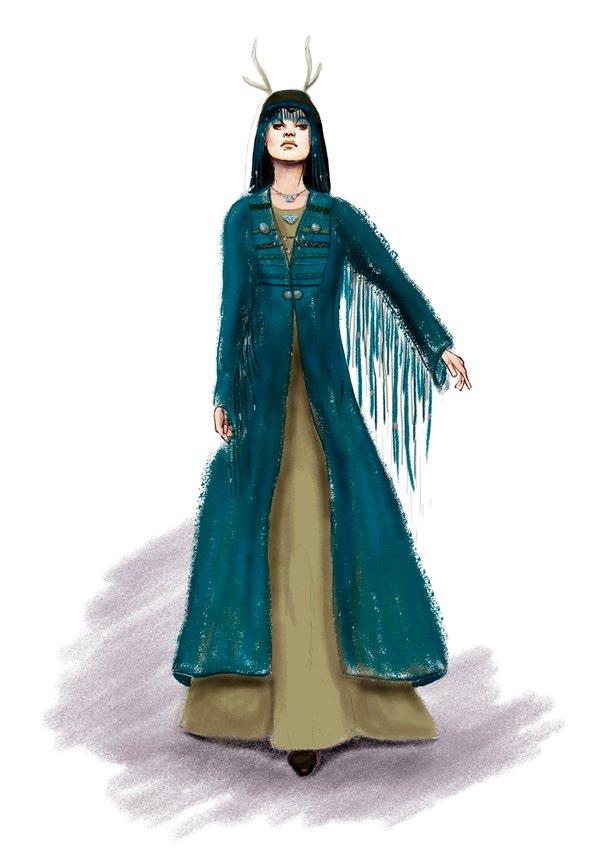
Fig. 1: Costume sketch by Anne Isene for a volve (seeress), a Viking Age female spiritual leader, in the TV series Beforeigners season 2 (HBO MAX, 2021–2022). In Beforeigners, characters from different historical periods seek integration and influence in present day Norway. To create costumes for a range of historical periods demands historical insight along with artistic imagination.
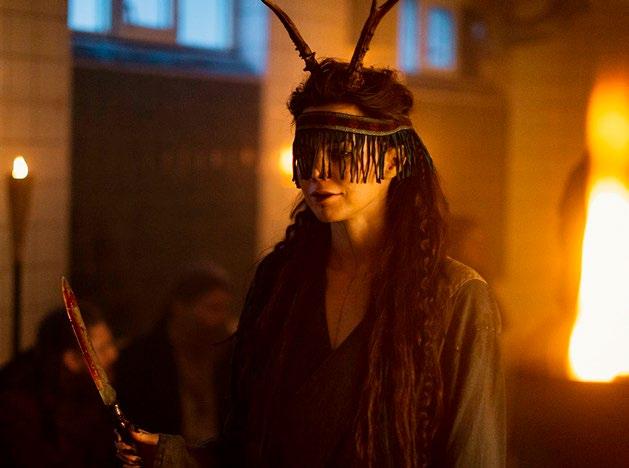
designer for a production, you will normally have worked and built expertise for many years as an assistant in a costume department. Most costume designers have years of practice working as a “set costume designer” or as an “assistant set costume designer” working with actors and extras on set. These people bring the correct costumes to the set, dress and undress actors, repair costumes, and ensure the continuity of the design throughout the shooting (Isene 2023, 3–4).
This work on set takes place under the supervision of, and in close dialogue with, the costume designer. A costume designer will also be on set, for instance, for intimate, possibly vulnerable, takes. When not on set, but working on the coming scenes, they will repeatedly take phone calls from assistants and set costume designers (Brinch 2023, 20). All of this means that when entering the lead artistic role of costume designer, one will have already mastered the different tasks and routines of costume work.
With these practical skills gained under supervision and with their high level of arts education, one would expect costume designers to enjoy a proportionate amount of prestige and importance within the Norwegian film and television production environment.
At the question of how costume designers experience their involvement in the development of the visual design of the film or television production, the responses of these informants did not give a clear picture. Nine of the informants gave a primarily descriptive answer, as represented by the response: “It depends, sometimes early, sometimes late”,12 referring to when in the pre-production phase they are involved. One of the informants indicated satisfaction with the fact that she entered late in the process, when the design had already been decided. From there she could work to give life to the director’s vision, feeling free to get involved when relevant.
The remaining six respondents did not share a similar viewpoint, and the question seemed instead to trigger critical engagement. For instance, one wrote: “Usually the director and the production designer have already decided on the visual design before they meet with me. And so, they miss a lot of opportunities.” Another answer pointed to the producer’s professionalism in deciding when and how the costume designer should be engaged, and they might be left with arguing and trying to convince the producer to let them be involved earlier on in the project. Compared with another art form, one informant held that: “Working in theater, you contribute much more to the design of the whole project. In a film or TV show you do not feel that important.” In my interview with Anne Isene, she mentioned a British production in which she was involved from the start and developed the visual design together with the director, cinematographer, and
12 Citations from the survey are given here without reference to the informant’s number or the page number in the written report. When interviewees are cited, their surname is given along with the page number in the digital transcription.
production designer. This stands out as her preferred model allowing for “an outstanding collaboration” (Isene 2023, 11). Maltun referred to situations where she had to inform “the production team that there is much money to be saved if they take me in at an early stage” (Maltun 2024, 19). Brinch agreed that early involvement benefits the production and is “better for the director and actors, because then you yourself experience being a part of it all” (Brinch 2023, 16). She referred to a situation where she chose to challenge the use of money on a production, asking: “Do you really need the 300 uniforms, or could you do with 70?” Because this reduction was accepted by the director, resources could be redistributed. This is but one example of how close and early involvement of the costume designer can have a direct effect on the production’s budget (Brinch 2023, 13).
Although there were different experiences, I found that more than half of the costume designers accepted the timeline for their involvement. However, six of the survey respondents, as well as those who were interviewed, did want to see a change in how the work is organized to include earlier involvement of the costume designer. Based on the Norwegian informants, we can conclude that neither the high level of education nor the amount of work experience one brings to the job necessarily means that one will enter a position where one’s expertise is called for when it comes to the development of the overall visual design.
While three informants found that their budgets were sufficient, the remaining twelve pointed to severe challenges when it came to money. When asked whether costumes and costume design have a fair share of the production’s total budget, the answers included “Absolutely not” and “No, there is too little money to hire people and to do the job.” It was also noted that the budget seems to be set at random: “No one with insight into what realizing the manuscript really requires has been involved in setting the budget.” Thanks to unreasonable budgets, costume designers end up continuously negotiating with producers throughout the production. One costume designer shared the experi-
ence of having had a cut in her payment equal to the sum she had to use above budget, a budget she from the start, and repeatedly, had informed was impossibly low.
Neither the survey nor the interviews give a clear picture of how this skilled group of film workers are paid, but there were statements pointing in direction of unjust arrangements. On the question of keeping budgets low, not least costume and make-up, Vibeke Maltun pointed to a tendency to hire people without relevant education or experience simply because they “say yes to everything” (Maltun 2024, 5). This saves money and implies that just anyone can do costuming, suggesting that despite one’s education and work experience as a costume designer one is always replaceable. This is hopefully not yet the dominant strategy in the Norwegian film business. In Hollywood, it has been claimed, the whole work system functions thanks to “eager aspirants, replenishing its labor ranks with those amenable to a mobile and excessive regime of production” (Curtin and Sanson 2017, 7).
Another variant of saving money by using people who are eager to secure a career within the creative field of film production might be to ask the costume designer to do more than one of the costume jobs or even do the make-up. Alternatively, the make-up artist may be asked to do the costumes. On this matter, Maltun states: “No one asks the director to do sound and lighting”, suggesting how esteem is unevenly distributed to the disadvantage of certain professions (Maltun 2024, 5). For costume design, the lack of insight into what it takes sustains the idea that such jobs can be combined with other roles or even covered by non-professionals. Not only are costumes considered to be at their best when not noticed on screen (perhaps apart from costume dramas), but the work of the costume designer takes place off set. One of the costume designers in Tiffany Bales’s study exemplified this when she argued that “to the untrained eye, it’s a bit like you’ve just got somebody there who hands out coats and slippers” (Bale 2024, 109).
Related to resources is the question of how the costume department or group is put together. In Norway, probably due to historically small production crews with tight budgets, there has been no tradition for a “supervisor” or administrative head of costume. However, this is
an established professional position in larger film nations and costume departments. Michael Curtin and Kevin Sanson have described a wardrobe or costume supervisor as one who “manages every single logistical element in the costume department: budgets, supplies, materials, script breakdowns” (Curtin and Sanson 2017, 70). The costume designer, on the other hand, is the person “responsible for designing, creating, and overseeing the wardrobe of all the actors on a set” (Banks 2009, 90). In Norway, costume designers have been performing both the artistic and administrative tasks, and this has kept costs down (Isene 2023, 2). However, on recent larger Norwegian productions a “costume supervisor” has been in place (Isene 2023, 2; Maltun 2024, 4).
In general, Norwegian costume designers seem to experience a conflict between doing a good job and sticking to the spending limit: “[T]he budget becomes the most important demand … it overshadows expectations to create the costumes” (Isene 2023, 6). The increasingly tighter budgets lead to higher demands, and this is addressed also in international research literature. Doing the work in fewer hours and with fewer resources is a tendency that “undermines their ability to do what they are hired to do” (Curtin and Sanson 2017, 4). We have seen a tremendous and necessary rise in state funding for film production in Norway since 2007. At the same time, there has been an increase in international collaborations in both film and TV dramas in recent years. This has benefitted the whole industry. However, the positive and promising increase in production volume within TV drama and fiction film does come with a downside, and ironically enough, when competition tightens, production speed increases, hours assigned to the job are reduced rather than increased, and the total workload subsequently grows (Isene 2023, 11).
How the costume designer is involved and receives feedback signals the standing of the profession among collaborators within the production and beyond. Nine of the informants reported that they get feedback from the director and/or producer during the production process. The remaining six reported little contact with the director and the
overall vision of the project during the process. For some projects, feedback and communication might not be necessary, but lack of this could also mean lack of interest in and understanding of the function of costume design. The group of informants experiencing a low degree of communication with production heads instead pointed to the importance of feedback from colleagues such as make-up artists, costume assistants, production designers, or actors. For instance, one informant put into words the value of an actor saying: “Now you really helped me with my part.”
When it comes to feedback after the premiere, only seven of the informants mentioned this explicitly. On the positive side, one informant reported to have experienced a “thank you”, and positive mention at the premiere party. Others reported on feedback from family and friends. For those who reported being noticed primarily in the private sphere, we might say that their work suffers from a kind of public invisibility in a period when directors and actors garner a lot of attention – to the extent that the film or TV dramas have good reviews. But this could perhaps be overstated. Isene described how the director’s feedback on costumes and to the costume designer primarily comes during shooting; that is: “When [the costumes] are seen in the camera for the first time”, not when the film goes public a year or more after the work is done (Isene 2023, 15). At the same time the crew will, if they can make it, be there for celebrations at the premiere.
It is important to remember here that costume design is also a profession marked by certain invisibilities in the first place. Characters in costumes are what we primarily see when watching a film, but this strong visibility does not mean that costumes are regularly given attention or seen as a creative and artistic part of the film in question. In a study of working conditions in Hollywood, renowned costume designer Mary Jane Fort put into words this visual/invisible dilemma of costume design when she described how she worked to “help visually tell the story through what the characters wear”, and consequently: “If I do my job well, I don’t draw attention to that process” (Fort quoted in Curtin and Sanson 2017, 75). The contrast to fashion design might clarify this aspect. While the costume designer makes the costumes, in
Banks’s words, “veiled in the process of production”, the fashion designer works to place the design “on stage” to “highlight the uniqueness of the creation” (Banks 2009, 94). Banks further draws a line between the invisibility of costume design on screen and in the press: “The invisibility of costume designers’ labor on screen, however, frequently means that they are marginalized on the set and in the press” (Banks 2009, 91).When one informant stated that she only chooses projects where costume design is actually given prominence and importance, this reminds us that there are nuances. Just as Banks uses “frequently” and not “always”, film productions that hold costume design in high esteem are possible to find.
To the question of whether the value of costume and costume design within the film and television business has increased over the years, again the answers differed. The range in responses is illustrated with one informant claiming, “Costume design is respected – as it has always been”, while another said, “Costume design is at the bottom of the priority list as always.” This difference in opinion, or rather interpretation of experience, might be related to the fact that the first statement came from an informant who was new to the business, while the more critical one had worked on fiction films for decades. Among those who have been in the business for some time, a great improvement occurred when the costume collection was organized by Norsk Film Kostyme A/S (Norwegian Film Costume). From then on, a costume designer could rent proper costumes instead of searching through bags in a barn. With a proper storage facility, costumes were ascribed status, with one informant saying: “Money is an eye opener” referring to this institutionalization of costumes from Norwegian film history.
In 2014, it was suggested to sell off the collection of Norwegian Film Costume, which prompted Norwegian costume designers to mobilize. Karen F. Gram, Anne Pedersen and Bente Ulvik even made a very interesting promotional documentary on film costumes and the importance of the storage. 13 Sequences from the costume warehouse
13 https://www.youtube.com/watch?v=P5shWjfSRaw&pp=ygUSbm9yc2sgZmlsbSBrb3N0eW1l

were cut together with directors’ interviews on the value of film costume and the threatened institution. This film also revealed the possibility that the costume designer ends up being invisible. Several of the directors spoke with enthusiasm about the importance of costumes, and some of them pointed to their own work with costumes. One described all the hours spent perusing all the rows in the costume warehouse. Another told about the thrill of dressing up an actor with a
Fig. 4: Kathrine Thorborg Johansen and Thorbjørn Harr as political opponents in Makta (NRK, 2023–2024). Photo: Erika Hebbert. Source: Motlys/Novemberfilm/NRK.
costume and experiencing how a character came to life. While these were undoubtedly their genuine experiences, at the same time the costume designer disappeared from the story. As long as the director could do their job, the costume designers could not be that important. Anne Isene describes a downward spiral when costuming work is not given positive attention. When someone says, “It is only clothes”, the next step is: “I can have anyone do this because it is only clothes”, and then: “It does not matter if I pay you, because you actually do not possess a skill that is valuable” (Isene 2023, 18). She refers to this discourse as “somewhat gender-based” and “somewhat based on the professional field.” Insofar as gender goes along with the profession through persistent ideas of “women’s work,” this is at least partially the same reason. In her interview, Fort described how during production, people in the costume department in a degrading manner were called “the Vanities” or “Wardrobe.” Fort experienced this as worthy of criticism: “It’s just rude. They have names. They are professionals” (Curtin and Sanson 2017, 77).

Fig. 6: The costume department most often creates changes to the actor’s body that will be covered with clothes, sometimes in collaboration with the make-up and hair department responsible for changes to the skin and hair. In the case of the TV series Melk, the pregnant bellies were created by the costume designer, Vibeke Larsen Maltun. Photo: Vibeke Larsen Maltun.
When asked directly about aspects that could further shed light on the organization and status of costume design in Norwegian film production , this turned out to be a continuation of an aspect central to this profession. On the referenced question, three of the informants refrained from contributing. The remaining twelve gave rather harsh critical comments like: “The costume designer does not have high status”, and “Costume design is a narrative device that does not have the space to show its potential in Norwegian fiction film making.”
A central critique is the mentioned absence of a “costume supervisor” resulting in an unnecessarily difficult production period with both artistic and administrative responsibilities. In addition, although the Norwegian filmmaker’s union has signed an agreement that limits
Source: Anagram.
the working day to ten hours of shooting, this does not apply to the costume department. The set designer and often also the costume designer will have to arrive one hour earlier and stay after shooting is finished so that the actors are dressed and redressed for the official ten working hours on set. The production company will apply for and receive a dispensation from the union requirement because the shooting period for each production is usually no longer than three months. Working conditions are also often more strenuous than necessary because workspaces for costume designers are “few, if any” and are not properly equipped for the different processes of costume design. Transport of costumes between locations is also complicated. A costume truck might be available, but the rent is high and seldom accounted for in the budgets. Such efforts to save money on the costume budget also affect the salaries. If possible, even experienced costume workers will still be offered only the minimum wage. Another challenge concerning regulations is that after ten years in the business, you have reached the highest possible pay as costume designer. More years of experience beyond this does not give you a pay rise (Isene 2023,
20). “I have noticed”, one informant argued, “that the costume designers are paid less than equivalent positions on set” (Maltun 2024, 14). Maltun pointed to an interesting fact; there is no organization or union particular to costume design in Norway (2024, 8). Similarly to Brinch and Isene, she strongly approved of the work done by the Norwegian union for film workers, Norsk filmforbund. At the same time, and referring to the make-up artists with more than one union and often better conditions than costume designers, a union for costume designers might serve to improve status, working conditions, and wages.
The experience that costume design has low status on set, though not without nuances, is hard to ignore. As one informant stated: “The profession of costume design is given status when the director and producer give it status”, implying that this is not always the case. According to several of the costume designers, directors and producers new to the business tend to signal a lack of understanding and insight. The Norwegian Film School may play a part in this unfortunate flaw. Costume designers inform us that they have over the years tried to persuade the school to take this area more seriously but have experienced that costume and costume design have been difficult to prioritize. Some years, however, there have been joint workshops between the art academy’s clothing and costume design department and the national film school. This is, however, neither stable nor institutionalized and may leave new generations of filmmakers with limited insight into the artistic contribution and the work procedures of costuming. On the other hand, costume designers experience that directors and producers who bring in experience, for instance from theater, have a very different and better understanding of the importance of costume.
With the expanded production in fiction film and TV drama, the number of costume designers in Norway has increased significantly. Long overdue, costume design has received national awards both within TV and film. This has contributed to more public attention and acclaim
for costume design and costume designers. When costume designer Karen Fabritius Gram was given the Edith Carlmar Award designated to women in the film industry, 14 the jury stated (in my translation): “Few, if any, in Norwegian film production have left their visible mark on so many Norwegian films and series. Her work is visible in quality, quantity, and breadth”15 (Rushprint 2021). Unquestionably visible and somewhat invisible at the same time, there is little doubt that if not for this award, Gram’s achievements might still have gone relatively unnoticed. In a Norwegian context we have seen that not only did awards for costume design come late, only since the 1970s have credits been seen regularly, though far from always, for any kind of costume work. In archiving, film journalism, and academia, costume design is only in recent years beginning to gain attention.
The survey and interviews in this study imply that public attention does occur, but this is nothing that a costume designer can count on or expect. Costume designers may also not be invited to participate in the film’s overall visual design and must accept from time to time to play a role where their contribution is marginalized rather than utilizing the competence they actually bring to the production. A majority of the costume designers participating in the survey and interviews find that their budgets are low compared to other functions behind the screen, and this adds to insufficient working space, inconvenient transportation of costumes, and often a battle to get a reasonable wage. These unsatisfactory aspects turned out to be more serious and common than I had expected.
The questions in the survey and interviews, though relatively open, seem not to have encouraged informants to describe the joy, fascination, and satisfaction of being a costume designer. However, in the
14 Edith Carlmar is Norway’s first female film director and the Award goes to an outstanding achievement by a woman behind the camera: https://no.wikipedia.org/wiki/Edith_Carlmarprisen . Accessed June 15, 2024.
15 “ Få, om noen, norske filmarbeidere har satt sitt synlige preg på så mange norske fiksjonsfilmer og serier som årets prisvinner. Hennes arbeid er synlig både i kvantitet, kvalitet og bredde.”
interviews, with time to talk about specific projects, the excitement of their profession did come across. Vibeke Maltun told about the intense experience of working with costume design on the historical drama Sulis 1907. Brinch shared her enthusiasm for working on the experimental TV series Makta (Brinch 2023, 31), while Isene pointed with satisfaction to the fact that what a costume designer has created is recorded and saved. One’s design is there on screen and can be experienced for generations. Speaking for most costume designers, I presume, she stated: “It is fantastic to be allowed to do this” (Isene 2023, 14; 22). Such expressions of joy and satisfaction are also present in international production studies on costume design, and it is likely that these experiences help one endure working conditions that are worthy of criticism.
Though many aspects of costume design will manifest across borders, Norwegian film production might stand out when it comes to objectionable factors such as the relative lack of costume design in film schools, the costume supervisor still being an exception, and having no specific union for costume designers. Thus, even though praise and attention, working conditions, and wages have differed throughout history and from production to production in a national context, many costume designers – if not all – seem to experience a need to speak out to have their field taken seriously when it comes to status, conditions, payment, and having a say.
The role of costume design cuts across and challenges the hierarchy of arts and crafts. Searching for reasons that costume design is having trouble being seen and honored, the gender dimension of the field is relevant. None of the questions in the survey addressed gender explicitly, but in attempts to explain low esteem and visibility, this aspect came up in the survey and interviews. Although there are male
costume designers, 16 costume design for the screen still appears as feminine and as such bears the weight of the degradation connected to “women’s work”, regarded as more of a duty (or love) than as paid work. The gendering of work points to a symbolic structure, “a gendered code” (Solheim 2002, 118). Still, this code can be broken. For instance, if costume design in the theater has a higher standing than in film, it means costume design could rise to higher esteem also in film and TV production.
The belated awards and credits, the lack of archival traces and public attention, and the totality of working conditions for costume designers matching neither their high level of expertise nor the importance of costumes in screen arts are all factors that contribute to the low status held by costume design in Norwegian film culture today. At the same time, this small-scale study needs to be extended, and its suggestions further discussed. Costume designers are doing their job every day to keep up the artistic level of costume design under complex conditions while still taking up the fight for a better working environment. It is time for archives and academics to give more thorough and broader attention to costume design, including big data projects searching for more sources, preservation of film costumes, and studies of the aesthetic and narrative role of costume design in film and TV drama. Costumes on screen are preserved as part of our audiovisual cultural heritage and invite studies across time, genres, and particular costume designers’ work.
16 The gender division in Norwegian costume design has not yet been properly mapped. As an example, among the 22 Norwegian fiction films premiering in 2024, costume design is mentioned in Norwegian filmography for 13 of them. These costume designers are all women. One of the titles, with five credited costume workers, has one male set costume designer.
Bakøy, Eva , Tore Helseth , and Roel Puijk , eds. 2016. Bak kamera: Norsk film og TV i et produksjonsperspektiv. Vallset: Oplandske bokforlag.
Bale, Tiffany. 2024. “Staying, Remaining and Surviving: Researching Women’s Costume Careers.” PhD diss., University of Glasgow.
Banks, Miranda J. 2009. “Gender Below-the-Line: Defining Feminist Production Studies.” In Production Studies: Cultural Studies of Media Industries, edited by Vicki Mayer, Miranda J. Banks, and John T. Caldwell. New York: Routledge.
Banks, Miranda J. 2018. “Production Studies.” Feminist Media Histories 4 (2): 157–61.
Beforeigners 2. 2021–22. Creators: Anne Bjørnstad and Eilif Skodvin. Costume design by Anne Isene. Norway: Rubicon TV A/S for HBO Max.
Borchgrevink, Tordis and Øystein Gullvag Holter , eds. 2017. Labour of Love: Beyond the SelfEvidence of Everyday Life. London: Routledge.
Braaten, Lars Thomas , Jan Erik Holst , and Jan H. Kortner , eds. 1995. Filmen i Norge: Norske kinofilmer gjennom 100 år. Oslo: Ad Notam Gyldendal.
Brinch, Maria. 2023. Interview by the author, May 3.
Bruun, Hanne. 2016. “The Qualitative Interview in Media Production Studies.”
In Advancing Media Production Research: Shifting Sites, Methods, and Politics, 1st ed., edited by Chris Paterson, David Lee, Anamik Saha, and Anna Zoellner. London: Palgrave Macmillan.
Curtin, Michael and Kevin Sanson , eds. 2017. Voices of Labor: Creativity, Craft, and Conflict in Global Hollywood. Los Angeles: University of California Press.
Den største forbrytelsen. 2020. Directed by Eirik Svensson. Costume design: Anne Pedersen and Anne Isene. Norway: Fantefilm
Eli Sjursdotter. 1938. Directed by Leif Sinding. Costume design by Gerd Jensenius. Norway/ Sweden: Skandinavisk Biografservice, Merkur Film and Svea Film.
En som deg. 2012. Directed by Eirik Svensson. Costume design by Maria Brinch. Norway/Finland: 4 ½ Film.
En Vinternat. 1917. Directed by Peter Lykke-Seest and Oscar Gustafson. Norway: Christiania Film Co. A/S.
Hill, Eirin. 2016. Never Done: A History of Women’s Work in Media Production. New Brunswick, New Jersey: Rutgers University Press.
Isene, Anne. 2023. Interview by the author, April 21.
Kristensen, Bjørn Sverre. 1985. “Kjøpe ligger hinsides alle muligheter.” Film & Kino 5: 326–29.
Kristensen, Bjørn Sverre. 1986a. “Kostyme- og setdesignere i Norge: generasjonsskifte.” Film & Kino 1: 20–23.
Kristensen, Bjørn [Sverre]. 1986b. “Norway.” In International Directory of Cinematographers: Set and Costume Designers in Film. Vol. 5. Denmark, Finland, Norway, Sweden (from the beginnings to 1984), volume coordinated by Bujor T. Rîpeanu. International Federation of Film Archives (FIAF). München: K.G. Saur.
Laila. 1929. Directed by Gunnar Schnéevoigt. Norway: Lunde-film.
Landstrykere. 1989. Directed by Ola Solum. Costume design by Kari Elfstedt. Norway: Norsk Film A/S.
Liv. 1934. Directed by Rasmus Breistein. Norway: Rasmus Breistein.
Lund, Maria Fosheim. 2021. “Kari Elfstedt: Om å skape en egen dramaturgi for kostymene.” Accessed June 1, 2023. https://nordicwomeninfilm.com/karielfstedt-om-a-skape-en-egen-dramaturgi-for-kostymene/?lang=no. Website discontinued. Archived at the Swedish Film Institute and at the National Library of Norway.
Makta. 2023–24. Creators: Johan Fasting, Kristin Grue, and Silje Storstein. Costume design by Maria Brinch. Norway: Motlys and Novemberfilm for NRK TV.
Maltun, Vibeke Larsen. 2024. Interview by the author, June 6.
McLean, Adrienn , ed. 2016. Costume, Makeup, and Hair. New Brunswick, New Jersey: Rutgers University Press.
Melk. 2017. Creators: Julia Schacht and Ragnhild Heien Myntevik. Costume design by Vibeke Larsen Maltun. Norway: Anagram for TV3.
Nr. 24. 2024. Directed by John Andreas Andersen. Costume design by Anne Isene. Norway: Motion Blur.
Ødegård, Vanja. 2021. “Kostymedesigner Ida Toft – å bygge karakterer med klær.” Accessed June 1, 2023. https://nordicwomeninfilm.com/kostymedesignerida-toft-a-bygge-karakterer-med-klaer/?lang=no. Website discontinued. Archived at the Swedish Film Institute and at the National Library of Norway.
The Recovery Channel. 2024. Directed by Ellen Ugelstad. Costume design by Vibeke Larsen Maltun. Norway: Twentyone pictures.
Reisen til julestjernen. 1976. Directed by Ola Solum. Costume design by Kari Elfstedt and Wenche Pedersen. Norway: Norsk Film A/S.
Rîpeanu, Bujor T. , ed. 1986. International Directory of Cinematographers, Set and Costume Designers in Film. Vol. 5. Denmark, Finland, Norway, Sweden (from the beginnings to 1984). München: K. G. Saur.
Rottenetter. 2009. Directed by Arild Østin Ommundsen. Costume design by Maria Brinch. Norway: Paradox A/S.
Rousseau, Jean-Jacques. 1962. Emile eller Om opdragelsen. Vol. 3. Copenhagen: Borgen.
Rushprint. 2021. “Edith Carlmar-prisen til Karen Fabritius Gram.” March 8. Accessed April 10, 2025. https://rushprint.no/2021/03/edith-carlmar-prisen-tilkaren-fabritius-gram/.
Solheim, Jorun. 2002. “Modernitetens kjønnede kompetanseregime” and “Arbeid og ikke-arbeid.” In Den usynlige hånd? Kjønnsmakt og moderne arbeidsliv, edited by Anne Lise Ellingsæter og Jorun Solheim, 118–22. Oslo: Gyldendal Akademiske.
Sulis 1907. 2023. Directed by Nils Gaup. Costume design by Vibeke Larsen Maltun. Norway: Storyline.
Wallenberg, Louise and Maria Jansson. 2021. “On and Off Screen: Women’s Work in the Screen Industries.” Gender, Work & Organization 28 (6): 1991–96.
Anne Bachmann is Senior Lecturer in Fashion Studies at the Department of Media Studies at Stockholm University, Sweden. Her work centers on visual culture and cultural history, and she holds a PhD in cinema studies from Stockholm University. She has published in fields such as media historiography; stardom, digital fandom, and tie-ins; film costumes; the transnational; and silent cinema. She has previously worked as an analyst at the Swedish Agency for the Media, and has taught extensively within film studies, television studies and fashion studies in Sweden.
Dagmar Brunow is Professor of Film Studies at Linnaeus University (Sweden). Her research centers on archives, cultural memory, film historiography, experimental filmmaking and video culture, feminist and queer cinema, and screenwriting as transmediation. She is the author of Remediating Transcultural Memory: Documentary Filmmaking as Archival Intervention (de Gruyter, 2015), co-editor of Queer Cinema (with Simon Dickel, 2018), and coeditor of the Frauen und Film special issue “Archive” (with Katharina Müller, 2024). Her research projects “The Lost Heritage: Improving Collaborations between Digital Film Archives” (2021–2024) and “The Cultural Heritage of Moving Images” (2016–2018) have been funded by the Swedish Research Council.
Anne Gjelsvik is Professor of Film Studies at the Department of Art and Media Studies at the Norwegian University of Science and Technology, Trondheim, Norway. Gjelsvik’s research focus on the relationship between film and society, with a focus on Norwegian and American contemporary cinema. She has published several books both in English and Norwegian, as well as many articles in journals and anthologies on a wide range of topics within film studies. Her two latest books are ReFocus: The Films of Joachim Trier (Edinburgh University Press, 2024) and Bearbeidelser (Universitetsforlaget 2020), on the artistic treatments of the terror attacks in Norway in 2011.
Eirik Frisvold Hanssen is a Senior Researcher in the Department of Research and Collections at the National Library of Norway and has a PhD in Cinema Studies from Stockholm University. He has published on Scandinavian and international film history, film theory, color and cinema, intermediality, and film as cultural heritage, and co-edited several anthologies.
Ingrid Synneva Holtar is a Senior Researcher in the section for Visual Media and Conservation, Department of Research and Collections, at the National Library of Norway. She holds a PhD in Film Studies from the Norwegian
University of Science and Technology with the doctoral thesis “Feminism on Screen: Feminist filmmaking in Norway in the 1970s” (2022).
Helle Kannik Haastrup is Associate Professor of Media Studies at Department of Nordic Studies and Linguistics, University of Copenhagen. She serves as Head of Section of Media & Communication and specializes in research about film and media aesthetics and culture, and celebrity studies. Her latest publication is the monograph Digital Film and Television Culture: From Hollywood to Social Media (Routledge, 2025).
Anne Jerslev is Professor of Film and Media Studies at the Department of Communication, University of Copenhagen. She has published widely within film and media studies, in later years about older women in the media, celebrities, visibility and ageing and mediated scandals. She is the author of David Lynch – Blurred Boundaries (Palgrave Macmillan, 2021). More recently she co-edited the 2025 volume of Nordic Journal of Media Studies, Influencers: Entertainment, Politics, and Strategic Online Culture and “Constructing and deconstructing an icon: Anita Ekberg in La dolce vita and Intervista” in Anita Ekberg: International Blonde (Edinburgh University Press, 2025).
Maria Fosheim Lund is a PhD fellow at the University of Oslo, Dept. of Media & Communication, currently on leave from her position as a research librarian at the National Library of Norway. Her thesis project is focused on the work of actress-producer Aud Egede-Nissen in the early European film industries. She has co-edited the books Small Country, Long Journeys: Norwegian Expedition Films (2017) and Silent Ibsen: Transnational Film Adaptation in
the 1910s and 1920s (2022) with Eirik Frisvold Hanssen.
Anne Marit Myrstad is Professor Emerita of Film Studies at the Department of Art and Media Studies at Norwegian University of Science and Technology in Trondheim. In her film historical research Anne Marit Myrstad has contributed with feminist perspectives on Norwegian film history, including national, i.e. rural, films of the 1920s, postwar housewife films, film modernism of the 1960s, as well as in contemporary cinema. Recently Myrstad has also contributed on production studies, including a study of the cultural history of the public film company Norsk Film A/S (Norwegian film A/S).
Eva Novrup Redvall is Associate Professor and Head of Section for Film Studies and Creative Media Industries at the University of Copenhagen. Her research focuses on screenwriting and production. Among her books are the monographs Writing and Producing Television Drama in Denmark: From The Kingdom to The Killing (2013) and Writing and Producing for Children and Young Audiences: Cases from Danish Film and Television (2024). She served on the board of The Danish Film Institute (2018–25) and has been a film critic for the Danish newspaper Information since 1999.
Anna Sofia Rossholm is Associate Professor at the Department of Media Studies at Stockholm University. Her research and teaching interests include transmediations, adaptations, screenwriting, women’s film history, film pedagogy, children’s cinema, cinematic tourism and eco-criticism. Her current research project explores authors who write for the cinema, with a particular focus on women authors such as
Astrid Lindgren, Stina Bergman, Dagmar Edqvist and Ulla Isaksson. Previous research includes publications on Ingmar Bergman’s filmmaking, with a particular focus on the filmmaker’s writing processes, which among other things resulted in the book Ingmar Bergman and Playful Writing (Makadam, 2017).
Ingrid Ryberg is Associate Professor of Film Studies in the Department of Cultural Sciences at the University of Gothenburg. She is the author of Swedish Film Feminism: Between Grassroots Movements and Welfare Policies (2026) and the co-editor, with Anu Koivunen and Kata Kyrölä, of the volume The Power of Vulnerability: Mobilising Affect in Feminist, Queer and Anti-Racist Media Cultures (2018). She is also the director of films and performances, including the documentary An Army of Lovers (2018), about queer filmmaking in Sweden in the 1970s, and the interactive performance installation Invites: Cinemaoke in Bergman’s Closet (2018).
Tytti Soila is Professor Emeritus of Cinema Studies at Stockholm University and has published extensively in the area of Nordic countries’ cinema and women’s work within film cultures. She is co-editor and author of Anita Ekberg, International Blonde (2026), co-editor and author of Now About All These Women in the Swedish Film Industry (2023), editor of Stellar Encounters: Stardom in Popular European Cinema (2009), Cinema of Scandinavia, 24 Frames (2005) and author of Att synliggöra det dolda (2004).
Tove Thorslund holds a PhD in Cinema Studies from Stockholm University. She worked at the Swedish Film Institute as editor and project manager of Nordic Women in Film between 2019–2025.
Louise Wallenberg is Professor of Fashion Studies at the Department of Media Studies at Stockholm University, Sweden. She holds a PhD in Cinema Studies from the same university (2002), and she was the establishing director of the Centre for Fashion Studies at Stockholm University between 2007 and 2013. Her research interests include cinema, fashion, gender, and organizational and work life experiences. Her publications include the anthologies MODE (2009); Nordic Fashion Studies (2011); Fashion, Film, and the 1960s (2017); Harry bit för bit (2017); Fashion and Modernism (2018); Fashion Ethics and Aesthetics (2023); Ingmar Bergman at the Crossroad between Theory and Practice (2022); and Now About All These Women in the Swedish Film Industry (2023).
Nota bene is the National Library of Norway’s channel for disseminating research findings built on its collections, and research of relevance to these collections. All manuscripts are peer reviewed. Nota bene has a wide thematic profile. In order to mirror the full breadth of our collection, the publications, which include monographs, critical editions and edited collections, may be based on manuscripts, printed material, film, photography, music, broadcasting, and digital media.
Nota be N e 1
Det nasjonale i Nasjonalbiblioteket | Marianne Takle | 2009
Nota be N e 2
The Archive in Motion. New Conceptions of the Archive in Contemporary Thought and New Media Practices | Eivind Røssaak (ed.) | 2009
Nota be N e 3
Axel Charlot Drolsum. Brev 1875–1926 | Bjørg Dale Spørck | 2011
Nota be N e 4
Opplysning, vitenskap og nasjon. Bidrag til norsk bibliotekhistorie | Ruth Hemstad (ed.) | 2011
Nota be N e 5
Latin Manuscripts of Medieval Norway. Studies in Memory of Lilli Gjerløw | Espen Karlsen (ed.) | 2013
Nota be N e 6
Den engasjerte kosmopolitt. Nye Bjørnson-studier | Liv Bliksrud, Giuliano D’Amico, Marius Wulfsberg and Arnfinn Åslund (eds.) | 2013
Nota be N e 7
Naturen og eventyret. Dokumentarfilmskaperen Per Høst | Gunnar Iversen | 2014
Nota be N e 8
Å bli en stemme. Nye studier i Camilla Colletts forfatterskap | Trond Haugen (ed.) | 2014
Nota be N e 9
Propagandakrig. Kampen om Norge i Norden og Europa 1812–1814 | Ruth Hemstad | 2014
Nota be N e 10
Small Country, Long Journeys. Norwegian Expedition Films | Eirik Frisvold Hanssen and Maria Fosheim Lund (eds.) | 2017
Nota be N e 11
Reformasjonstidens religiøse bokkultur cirka 1400–1700: tekst, visualitet og materialitet | Bente Lavold and John Ødemark (eds.) | 2017
Nota be N e 12
I dørtrekken fra Europa. Festskrift til Knut Sprauten. I anledning 70-årsdagen 22. juni 2018 | Ola Alsvik, Hans P. Hosar and Marianne Wiig (eds.) | 2018
Nota be N e 13
Litterære verdensborgere. Transnasjonale perspektiver på norsk bokhistorie 1519–1850 | Aasta M.B. Bjørkøy, Ruth Hemstad, Aina Nøding and Anne Birgitte Rønning (eds.) | 2019
Nota be N e 14
Lov og lovgivning i middelalderen. Nye studier av Magnus Lagabøtes landslov | Anna Catharina Horn and Karen Arup Seip (eds.) | 2020
Nota be N e 15
Notated Music in the Digital Sphere. Possibilities and Limitations | Margrethe Støkken Bue and Annika Rockenberger (eds.) | 2021
Nota be N e 16
Språk i arkivet. Historier om hvordan språk reflekterer samfunnet | Johanne Ostad and Elise Kleivane (eds.) | 2021
Nota be N e 17
Silent Ibsen. Transnational Film Adaptation in the 1910s and 1920s | Eirik Frisvold Hanssen and Maria Fosheim Lund (eds.) | 2022
Nota be N e 18
Old Norse Law Books from a Material Perspective | Jóhanna Katrín Friðriksdóttir and Lukas Rösli (eds.) | 2024
Nota be N e 19
The Hermeneutics of Bibliographic Data and Cultural Metadata | Jens-Morten Hanssen and Sissel Furuseth (eds.) | 2025
Nota be N e 20
The Voices of Jon Fosse. A Critical Study | Marius Wulfsberg and Trond Haugen (eds.) | 2025
Nota be N e 21
Women’s Film Histories in Scandinavia. Historiography, Screenwriting and Costume | Anna Sofia Rossholm, Ingrid S. Holtar, Louise Wallenberg and Eirik Frisvold Hanssen (eds.) | 2026
© National Library of Norway, Oslo 2026
ISBN 978-82-7965-613-5 (printed)
ISBN 978-82-7965-614-2 (e-book)
ISSN 1891-4829 (printed)
ISSN 2535-4337 (e-book)
Design: Superultraplus Designstudio AS www.superultraplus.com
Print: Erik Tanche Nilssen AS
This material is protected by copyright law. Without explicit authorisation, reproduction is only allowed in so far as it is permitted by law or by agreement with a collecting society.
Women’s Film Histories in Scandinavia: Historiography, Screenwriting and Costume explores the role of women in Scandinavian cinema from the silent-film era to the present day. The book centers on two professions in which women have been notably active throughout film history: costume design and screenwriting. These roles occupy different positions in film culture and production, and by bringing them together, the collection highlights women’s significance in film history in both distinct and complementary ways. Screenwriters have at times enjoyed relatively high status and, in certain historical contexts, have even been regarded as the primary creators of a film. Costume designers, by contrast, often belong to the more invisible members of a production team—classified as “below the line.” In addition to discussions on costume work and screenwriting, the book includes a section addressing historiographical questions concerning women’s place in film history. By illuminating women’s contributions beyond the conventional focus on directors and actors, Women’s Film Histories in Scandinavia presents women’s film history as an alternative way of writing the history of cinema.
cirka 1400–1700:
tekst, visualitet og materialitet
Nota bene is the National Library of Norway’s channel for disseminating research findings built on its collections, and research of relevance to these collections. All manuscripts are peer reviewed. Nota bene has a wide thematic profile. In order to mirror the full breadth of our collection, the publications, which include monographs, critical editions and edited collections, may be based on manuscripts, printed material, film, photography, music, broadcasting, and digital media.
Bente Lavold og John Ødemark (red.)
ISBN: 978-82-7965-613-5