![]()


As we settle into the new year, the symbolism of the Chinese New Year and the Year of the Horse—energy, independence, and bold change—feels fitting as we charge into the second half of our remarkable 2025/26 season. In my final year as President & CEO of your Nashville Symphony, I’ve been reflecting on defining moments from my nearly three decades with this organization. One such moment came in 2018 when we collaborated with the Jewish Federation of Greater Nashville to host the Violins of Hope, a collection of 32 restored instruments once owned by Jewish musicians who were interned in concentration camps during the Holocaust, sometimes literally saving their lives. Violins of Hope Nashville was one of the most successful, meaningful, and impactful projects in our history by any measure. This historic initiative across Middle Tennessee brought the community together around music, art, education, social justice, and remembrance. During the project, we presented an unprecedented 12 consecutive sold-out classical concerts and hosted dozens of community events, exhibits, and discussions centered on the instruments.
The centerpiece of the Violins of Hope Nashville initiative was a new commission from composer Jonathan Leshnoff : Symphony No. 4 "Heichalos," which we premiered and recorded in Laura Turner Hall. That was the very first recording ever made using that collection of instruments—an opportunity for which we were deeply honored—and that recording went on to earn a GRAMMY® nomination for Best Classical Compendium.
This month, in a full-circle moment, we welcome back Jonathan Leshnoff for performances and a recording of The Sacrifice of Isaac , his monumental new oratorio co-commissioned by your Nashville Symphony, conducted by Robert Spano and featuring the Nashville Symphony and Chorus . February also brings a dynamic mix of concerts that reflect the depth of our programming. We begin and end the month with Resident Conductor Nathan Aspinall . First in performances of the film Amadeus Live, followed later in the month by concerts featuring Berlioz’s Symphonie fantastique and works by Ligeti and Britten. We’ll miss Nathan’s artistry and energy, as this season marks his final season with us.
We also celebrate American songwriting with Bluebird at the Symphony and honor a folk legend in the tribute John Denver: A Rocky Mountain High Concert Celebration . And, on February 11, the renowned Jazz at Lincoln Center Orchestra takes the stage with Wynton Marsalis for a special presentation you’ll not want to miss.
Thank you for being part of our journey and for all your support. We are deeply grateful.
Warmest regards,

Alan D. Valentine | President & CEO

The Nashville Symphony inspires and engages a diverse and growing community with extraordinary live orchestral music experiences.
Spano Conducts Bernstein featuring Leshnoff and the Nashville Symphony Chorus February 6 & 7
John Denver: A Rocky Mountain High Concert Celebration
February 12, 13 & 15
SPECIAL EVENT
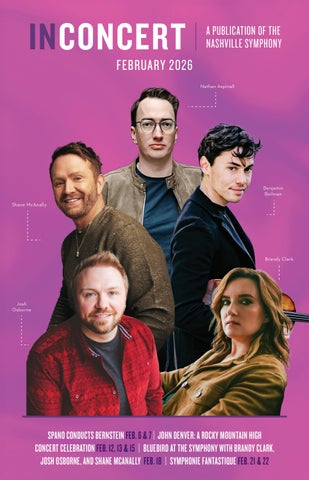
Bluebird at the Symphony with Brandy Clark, Josh Osborne, Shane McAnally, and Members of the Nashville Symphony February 18
615.687.6400
info@NashvilleSymphony.org NashvilleSymphony.org
PHOTOGRAPHY & VIDEO POLICY
Video cameras, recording devices, and flash photography are strictly prohibited in the concert hall or in any other space where a performance or rehearsal is taking place. Cameras with a detachable lens may only be used pending approval from the artist and the venue and will be subject to rules and restrictions. For more information, please contact the Nashville Symphony's Communications office
73 W hite Bridge Rd, STE 103-115 N ashville, TN 37205
615.909.9904


Music Advisor
NATHAN ASPINALL Resident Conductor
FIRST VIOLIN*
Peter Otto, Concertmaster
Walter Buchanan Sharp Chair
Erin Hall, Acting Associate Concertmaster
Gerald C. Greer, Acting Assistant Concertmaster
Tianpei Ai
Isabel Bartles
Francesca Bass
Beverly Drukker
Dawn Gingrich
Anna Lisa Hoepfinger
John Maple
Kirsten Mitchell
Ashley Odom
SECOND VIOLIN*
Jung-Min Shin, Principal
Lucia Nowik, Acting Assistant Principal
Likai He
Daniel Kim
Charissa Leung
Louise Morrison
Laura Ross
Johna Smith
Jeremy Williams
VIOLA*
Daniel Reinker, Principal
Shu-Zheng Yang, Assistant Principal
Michelle Lackey Collins
The Drs. Mark & Nancy Peacock Chair
Christopher Farrell
Anthony Parce
Melinda Whitley
Clare Yang
Music Director Laureate
Chorus Director
Kevin Bate, Principal James Victor Miller Chair
Una Gong, Assistant Principal
Anthony LaMarchina, Principal Cello Emeritus
Stephen Drake
Bradley Mansell
Keith Nicholas
Lynn Marie Peithman
Xiao-Fan Zhang
BASS*
Joel Reist, Principal
Glen Wanner, Assistant Principal
Matthew Abramo
Evan Bish
Kevin Jablonski
Katherine Munagian
FLUTE
Érik Gratton, Principal Anne Potter Wilson Chair
Leslie Fagan, Assistant Principal
Gloria Yun, Norma Grobman Rogers Chair
PICCOLO
Gloria Yun, Norma Grobman Rogers Chair
OBOE
Titus Underwood, Principal ◊
Christopher Gaudi, Acting Principal +
Ellen Menking, Assistant Principal
Kate Bruns +
ENGLISH HORN
Kate Bruns+
CLARINET
Danny Goldman, Acting Principal +
Katherine Kohler, Assistant Principal ◊
Spencer Prewitt
Acting Assistant Principal +
Daniel Lochrie
E-FLAT CLARINET
Katherine Kohler
BASS CLARINET
Daniel Lochrie
BASSOON
Julia Harguindey, Principal ◊
Asha Kline, Acting Principal +
Gil Perel, Acting Assistant Principal
Nicole Haywood Vera Tenorio +
CONTRABASSOON
Nicole Haywood
Vera Tenorio +
HORN
Leslie Norton, Principal
The Dr. Anne T. & Peter L. Neff Chair
Beth Beeson
Patrick Walle, Associate Principal/3rd Horn ◊
Radu V. Rusu, Acting Associate Principal/ 3rd Horn
Hunter Sholar
Anna Spina, Acting Assistant Principal/ Utility Horn +
TRUMPET
William Leathers, Principal
Patrick Kunkee, Co-Principal
Alexander Blazek
TROMBONE
Paul Jenkins, Principal
Anthony Cosio-Marron, Assistant Principal
BASS TROMBONE
Chance Gompert
TUBA
Chandler Currier, Principal
TIMPANI
Joshua Hickman, Principal
PERCUSSION
Sam Bacco, Principal
Richard Graber, Assistant Principal
HARP
Licia Jaskunas, Principal
KEYBOARD
Robert Marler, Principal
LIBRARY
Renee Ann Pflughaupt, Principal Librarian
Amelia Van Howe, Librarian
ORCHESTRA PERSONNEL
Pavana Stetzik, Director of Orchestra Personnel
Sarah Figueroa, Manager of Orchestra Operations


Internationally acclaimed conductor Leonard Slatkin is Music Director Laureate of the Detroit Symphony Orchestra (DSO), Directeur Musical Honoraire of the Orchestre National de Lyon (ONL), Conductor Laureate of the St. Louis Symphony Orchestra (SLSO), Principal Guest Conductor of the Orquesta Filarmónica de Gran Canaria (OFGC), and Artistic Consultant to the Las Vegas Philharmonic (LVP). He maintains a rigorous schedule of guest conducting and is active as a composer, author, and educator.
The 2025/26 season includes engagements with the National Symphony Orchestra (Ireland), Manhattan School of Music Symphony Orchestra, SLSO, USC Thornton Symphony, LVP, Taiwan Philharmonic, KBS Symphony Orchestra (Seoul), Gunma Symphony Orchestra, NHK Symphony Orchestra (Tokyo), Nashville Symphony, Atlanta Symphony Orchestra, Orchestre Symphonique de Montréal, Warsaw Philharmonic, Franz Schubert Filharmonia (Barcelona), ONL, Prague Symphony Orchestra, Filarmonica George Enescu (Bucharest), OFGC, and Rundfunk-Sinfonieorchester Berlin.
Slatkin has received six GRAMMY® Awards and 35 nominations. Naxos recently reissued Vox audiophile editions of his SLSO recordings featuring the works of Gershwin, Rachmaninov, and Prokofiev. Other Naxos recordings include Slatkin Conducts Slatkin a compilation of pieces written by generations of his family—as well as works by Saint-Saëns, Ravel, Berlioz, Copland, Borzova, McTee, and Williams. A recipient of the National Medal of Arts, Slatkin also holds the rank of Chevalier in the French Legion of Honor. He has been awarded the Prix Charbonnier from the Federation of Alliances Françaises, Austria’s Decoration of Honor in Silver, and the League of American Orchestras’ Gold Baton. His debut book, Conducting Business (2012), for which he received the ASCAP Deems Taylor Special Recognition Award, was followed by Leading Tones (2017) and
Classical Crossroads: The Path Forward for Music in the 21st Century (2021). His latest books are Eight Symphonic Masterworks of the Twentieth Century (spring 2024) and Eight Symphonic Masterworks of the Nineteenth Century (fall 2024) , part of an ongoing series of essays that supplement the scorestudy process, published by Bloomsbury.
Slatkin has held posts as Music Director of the New Orleans Philharmonic-Symphony Orchestra, SLSO, National Symphony Orchestra, DSO, and ONL, and he was Chief Conductor of the BBC Symphony Orchestra. He has served as Principal Guest Conductor of London’s Philharmonia and Royal Philharmonic, the Pittsburgh Symphony Orchestra, the Los Angeles Philharmonic at the Hollywood Bowl, and the Minnesota Orchestra.
He has conducted virtually all the leading orchestras in the world, including the New York Philharmonic, Chicago Symphony Orchestra, Philadelphia Orchestra, Boston Symphony Orchestra, San Francisco Symphony, Los Angeles Philharmonic, Berlin Philharmonic, Bayerischer Rundfunk (Munich), Royal Stockholm Philharmonic Orchestra, Royal Concertgebouw Orchestra (Amsterdam), Orchestre de Paris, Oslo Philharmonic Orchestra, and Israel Philharmonic Orchestra, as well as all five London orchestras.
Slatkin’s opera conducting has taken him to the Metropolitan Opera, Lyric Opera of Chicago, Washington National Opera, Opera Theatre of St. Louis, Santa Fe Opera, Vienna State Opera, Stuttgart Opera, and Opéra Bastille in Paris.
Born in Los Angeles to a distinguished musical family, he began his musical training on the violin and first studied conducting with his father, followed by Walter Susskind at Aspen and Jean Morel at Juilliard. He makes his home in St. Louis with his wife, composer Cindy McTee. For more information, visit leonardslatkin.com.

Australian Conductor
Nathan Aspinall has led orchestras across the globe and is widely admired for his thoughtful, nuanced interpretations and powerful performances. His collaborative approach to performing with fellow musicians has resulted in ongoing partnerships and deep relationships with the orchestras with whom he performs.
Nathan currently serves as Resident Conductor with the Nashville Symphony and this season will lead the orchestra in multiple programs including his fourth appearance on the classical subscription series with a program of Berlioz, Ligeti and the Britten Violin Concerto with Benjamin Beilman. In previous seasons Nathan has conducted acclaimed performances with the Nashville Symphony in dynamic repertoire including symphonies of Prokofiev, Tchaikovsky, Dvorak and Sibelius and last season led a special all Ravel program to mark the 150th anniversary of the composers birth.
Aspinall has performed around the world, leading the orchestras of Minnesota, Detroit, St Louis, Atlanta, Sydney and the MendelssohnOrchesterakademie of the Gewandhausorchester

in Leipzig. He has assisted many of today’s leading conductors including Stéphane Denève, Jakub Hrůša, Nathalie Stutzmann, Thomas Søndergård, and Simone Young.
Nathan was a conducting fellow at the Tanglewood Music Center with the Boston Symphony Orchestra where he was mentored by Andris Nelsons, Thomas Adès and Giancarlo Guerrero. He is also a recipient of the Robert J. Harth Conducting Prize at the Aspen Music Festival.
A strong believer that music is for everyone, Nathan is passionate about orchestras reaching an ever-widening audience. At the Nashville Symphony, he spearheads education and community initiatives, the commissioning of new projects and curates community programing. Supporting future generations of musicians, Nathan is an advocate for music education and outreach and has led performances and masterclasses for conservatories, universities and youth orchestras around the country. Festival appearances include the Cabrillo Festival of Contemporary Music, Oregon Bach Festival and the Tanglewood Music Center Conducting Seminar. He studied orchestral conducting with Hugh Wolff at New England Conservatory in Boston and music performance at the University of Queensland.
Appointed as Chorus Director of the Nashville Symphony in 2016 , Dr. Biddlecombe has raised the bar of excellence for Nashville’s premier choral ensemble through intense musical preparation, diverse programming, and communitybuilding. He also serves as Professor of Choral Studies and Associate Dean for Undergraduate Education at Vanderbilt University’s Blair School of Music, where he directs the Vanderbilt Sixteen and teaches courses in choral conducting and music education.
His work with the Nashville Symphony has included chorus preparation for many of the repertoire’s most revered masterworks. Notable performances have included two Mahler symphonies, Bernstein’s Symphony No. 3 “Kaddish”, and Requiems by Mozart and Verdi. He has prepared the chorus for two major
world-premiere recordings, John Harbison’s Requiem (rel. 2018, Naxos) as well as the upcoming release of Gabriela Lena-Frank’s Conquest Requiem and Antonio Estevez’s Cantata Criolla. He has conducted the chorus and orchestra in performances of Haydn’s Creation, Handel’s Messiah , Vivaldi’s Gloria , and the annual Voices of Spring concert.
Tucker is a veteran teacher and advocate for music education. He frequently conducts scholastic honor choirs throughout the United States, with international engagements in England, Scotland, China, and the Czech Republic. Dr. Biddlecombe is a graduate of SUNY Potsdam and Florida State University, where he completed studies in choral conducting and music education with Daniel Gordon and André Thomas, respectively. He resides in Nashville with his wife Mary Biddlecombe, director of the Blair Academy at Vanderbilt, and Artistic Director of Vanderbilt Youth Choirs.


FRIDAY & SATURDAY, FEBRUARY 6 & 7, AT 7:30 PM
ROBERT SPANO, conductor
TUCKER BIDDLECOMBE, chorus director
KELLEY O’CONNOR, mezzo-soprano
JAMES LAING, counter tenor
JOSHUA LOVELL, tenor
NMON FORD, baritone
LEONARD BERNSTEIN
Symphony No. 1 (“Jeremiah”)
Prophecy
Profanation
Lamentation
INTERMISSION
JONATHAN LESHNOFF
The Sacrifice of Isaac - Live Recording
THANK YOU TO OUR CLASSICAL SERIES SPONSOR

CHORAL PERFORMANCES ARE GENEROUSLY SUPPORTED BY

The Sacrifice of Isaac was commissioned by: The Atlanta Symphony Orchestra, Robert Spano, Music Director Laureate, made possible through The Robert Spano Fund for New Music, established by The Antinori Foundation. Also commissioned by Patricia Werthan Uhlmann, in loving memory of her husband John Weil Uhlmann, and Eileen Williams and Judah Gudelsky. Co-commissioned by the Nashville Symphony Orchestra, Giancarlo Guerrero, Music Director Laureate, and the Baltimore Symphony Orchestra, Jonathon Heyward, Music Director.
This concert will last approximately one hour, 35 minutes, including a 2 0-minute intermission. To ensure the highest quality recording, please keep noise to a minimum.

TLeonard Bernstein Symphony No. 1 (“Jeremiah”)
Composed: 1942
he work I have been writing all my life is about the struggle that is born of the crisis of our century, a crisis of faith,” Leonard Bernstein said in a 1977 interview while making a new recording of his Symphony No. 1 (Jeremiah). That lifelong concern is already powerfully present in this early, defining work, which reveals the dramatic instinct and ear for vivid gesture that would animate Bernstein’s music across every domain he touched.
Although Bernstein, the composer, is often associated first with stage works such as West Side Story, Jeremiah marks his earliest major symphonic statement. The first of his three symphonies, received its premiere in January 1944, just months before Fancy Free would announce his arrival in New York’s theatrical world. The two works already share a common DNA: immediacy of expression and an instinct for emotional clarity that speaks directly to the listener.
The origins of Jeremiah date back to 1939, shortly after Bernstein’s graduation from Harvard, when he sketched a setting of Hebrew verses from the Book of Lamentations for solo soprano and orchestra. Amid the upheaval of the Second World War, the prophet Jeremiah’s lament over the destruction of Jerusalem by the Babylonians in the 6th century BCE took on renewed resonance. Bernstein expanded the piece into a three-movement symphony, with the vocal movement—shifted to mezzo-soprano—as its culmination.
The symphony unfolds in three movements: the first two (“Prophecy” and “Profanation”) are purely orchestral, while the final movement (“Lamentations”) introduces a mezzo-soprano soloist, who sings in Hebrew from the biblical Lamentations, transforming the symphony into a direct human outcry.
With Jeremiah, Bernstein began a lifelong artistic exploration of faith, doubt, and moral struggle— questions that would return in his two later symphonies, The Age of Anxiety and Kaddish, and beyond. Even here, in his First Symphony, the theatrical instinct and the ethical urgency that define his music are already unmistakably present.
Bernstein emphasized that his intention was “not one of literalness, but of emotional quality.” The
opening movement, Prophecy, “aims only to parallel in feeling the intensity of the prophet’s pleas with his people,” while the scherzo, Profanation, seeks “to give a general sense of the destruction and chaos brought on by the pagan corruption within the priesthood and the people.”
By setting a poetic text, the final movement, “Lamentation,” assumes what Bernstein called a “more literary conception,” becoming “the cry of Jeremiah, as he mourns his beloved Jerusalem, ruined, pillaged, and dishonored after his desperate efforts to save it.”
In addition to solo mezzo-soprano, scored for piccolo and 2 flutes, 2 oboes, English horn, 2 clarinets, E-flat clarinet, bass clarinet, 2 bassoons, contrabassoon, 4 horns, 3 trumpets, 3 trombones, tuba, timpani, percussion, piano, and strings.


The Sacrifice of Isaac Composed: 2020
ver recent seasons, the Nashville Symphony has returned repeatedly to the music of the Baltimorebased composer Jonathan Leshnoff, performing and recording a growing body of work shaped by his sustained engagement with Jewish spiritual thought.
First championed in Nashville under Giancarlo Guerrero, that relationship continues here under Robert Spano, who led the world premiere of The Sacrifice of Isaac with the Atlanta Symphony Orchestra and Chorus in 2024 and now brings the work to Nashville as part of its continuing life.
The biblical account of the binding of Isaac (Genesis 22) is among the most unsettling and enigmatic narratives in scripture. God commands Abraham to sacrifice his son; Abraham obeys; at the final moment, the command is revoked, and a ram is offered in Isaac’s place. The story unfolds with terse economy, offering little in the way of psychological commentary. Its moral and theological implications—obedience, faith, sacrifice, and the nature of divine command—have provoked millennia of interpretation and debate.
The Sacrifice of Isaac approaches this story as an expansive oratorio rooted firmly in Jewish tradition. Leshnoff aligns himself with a long lineage of oratorio composers such as Handel and Mendelssohn, who shaped monumental musical works around biblical narratives, while pursuing a different interpretive vantage point.
Rather than treat the narrative as an abstract theological problem, he draws on Jewish textual traditions, including Midrash—rabbinic reflections that speculate on what the biblical text leaves unsaid— to dramatize the story.
The libretto, assembled by the composer, puts that impulse into practice. Leshnoff observes that the biblical verses alone are too brief and matter-of-fact to sustain a large-scale musical drama. By expanding the narrative through Midrash and related Jewish sources, the libretto opens space for dialogue, confrontation, and reflection absent from the biblical text itself. Structurally, the scriptural passages function almost like the choruses of Greek tragedy, anchoring the narrative, while the surrounding material gives shape to the characters’ inner lives.
Structured as an oratorio—an extensive narrative work for soloists, chorus, and orchestra—the drama unfolds without staging, relying on music and text alone to shape its emotional and moral arc.
Musically, the form of
The Sacrifice of Isaac is closely governed by its text. Pacing, texture, and harmonic tension respond directly to the unfolding narrative, often at the level of individual phrases. Rather than impose a predetermined musical architecture, Leshnoff follows the internal demands of the story, giving the music a sense of inevitability shaped by language and meaning.
The oratorio is framed by a blessing, heard at both the beginning and the end. Leshnoff describes it as a gesture traditionally passed from parent to child— but here opening a story in which that very lineage appears threatened, setting up the central paradox at the heart of the work. When the blessing returns at the conclusion, it does so transformed, no longer offering reassurance but bearing the weight of what has been endured.
Vocal characterization is similarly intentional. Abraham is cast as a baritone, while Isaac’s music lies higher, conveying vulnerability and emotional exposure. Crucially, Isaac is not portrayed as a child. Drawing on Jewish tradition, Leshnoff notes that Isaac was approximately thirty-seven years old
at the time of the binding, fully aware of what was occurring. This understanding deepens the story’s moral complexity, particularly in light of the fact that Abraham and Isaac never speak again in the biblical narrative after this episode.
The orchestra plays a central dramatic role throughout the work. At times it speaks with overwhelming power, amplified by an expanded brass section; elsewhere, the sound world turns inward, thinning to hushed textures and reduced sonorities. As Leshnoff puts it, “even though I have all the instruments and singers on stage, my paint brush changes throughout.”
Silence itself becomes expressive, “suddenly erupting,” as Leshnoff notes, at the dramatic turning point of the work. After driving the music to maximum intensity— with full chorus and blazing orchestral sound—an abrupt cut off at the moment just before the sacrifice is to take place replaces the expected climax with charged stillness.
For Leshnoff, the enduring significance of the binding of Isaac does not lie in resolving its contradictions, but in reframing them. He understands the story not as a test designed to inform an all-knowing divine being, but as an ordeal through which Abraham himself must grow—a crucible that forces confrontation with the limits of reason, obedience, and faith.
The Sacrifice of Isaac thus emerges as a meditation on how profound difficulty can shape character, a perspective Leshnoff sees as especially resonant for modern listeners.
The contrast between forceful expression and restraint shapes much of the musical narrative. The chorus continually shifts its role, moving between proclamation, reflection, and lyricism, while the three solo voices draw the drama into sharper human focus. One especially striking moment comes in Isaac’s solo aria, the only extended passage sung in Hebrew. Rather than voice fear or despair at the brink of death, Isaac sings Yedid Nefesh, a Sabbath poem expressing

the soul’s longing for closeness with God. Set at the moment when catastrophe seems inevitable, the aria transforms the scene into one of inward transcendence, offering a glimpse of beauty and spiritual strength where disaster might be expected.
Elsewhere, three shofars—an ancient ram’s horn associated with Jewish ritual—cuts through the orchestral fabric at a pivotal moment, their sound evoking the ram that ultimately replaces Isaac on the altar. God’s voice enters unexpectedly, represented not by a low voice asserting authority through sheer volume but by a countertenor who floats above

Robert Spano, conductor, pianist, composer, and teacher, is known worldwide for the intensity of his artistry and distinctive communicative abilities, creating a sense of inclusion and warmth among musicians and audiences that is unique among American orchestras. Music Director of the Fort Worth Symphony Orchestra since August 2022—Spano will continue there through July 2031—shaping the artistic direction of the orchestra and driving its continued growth. This season, Spano also steps into the role of Music Director of the Washington National Opera for a three-year term. An avid mentor to rising artists, he is responsible for nurturing the careers of numerous celebrated composers, conductors, and performers. As Music Director of the Aspen Music Festival and School since 2011, he oversees the programming of more than 300 events and educational programs for 630 students and young performers. He also directs the Aspen Conducting Academy, which offers participants unparalleled training and valuable podium experience. After twenty seasons as Music Director with the Atlanta Symphony Orchestra, he now serves as its Music Director Laureate. He also becomes Principal Guest Conductor of the Rhode Island Philharmonic Orchestra & Music School this season, where he previously served as Principal Conductor. In his fourth season as music director of the Fort Worth Symphony Orchestra, Spano leads more than six symphonic programs, including a world premiere by Michael Gandolfi. Spano leads two productions at Washington National Opera in 2025/26: the company’s production of Mozart’s The Marriage of Figaro and a new production of Robert Ward’s Pulitzer Prizeand Tony Award–winning opera The Crucible. Other
suspended sonorities. Moments of stillness often arrive where a grand climax might be expected, sharpening tension and leaving us suspended within the story’s unresolved questions.
Along with tenor, baritone, and countertenor soloists, scored for 3 flutes, 3 oboes, 3 clarinets, 3 bassoons, 4 horns, 4 trumpets, 3 shofars, 4 trombones, tuba, timpani, 3 percussionists, piano, harp, strings, and chorus.
− Thomas May is the Nashville Symphony's program annotator.
highlights of the season include a return to the Atlanta Symphony Orchestra for two programs celebrating the 250th anniversary of America’s independence and guest conducting appearances with the Louisville Orchestra, Nashville Symphony, San Diego Symphony, and Indianapolis Symphony Orchestra. Spano’s newest recording as a pianist and composer is a collaboration with mezzo-soprano Kelley O’Connor, Songs of Orpheus, a series of song cycles by Edvard Grieg, Claude Debussy, George Crumb, and Spano himself, on Sono Luminus.
Robert Spano made his Metropolitan Opera debut in 2019, leading the U.S. premiere of Nico Muhly’s Marnie. Recent concert highlights include several world-premiere performances, including The Sacrifice of Isaac by Jonathan Leshnoff with the Atlanta Symphony Orchestra; Steven Mackey’s Aluminum Flowers and James Ra’s Te Deum with the Curtis Symphony Orchestra; Jake Heggie’s Earth 2.0 with the Fort Worth Symphony Orchestra; a new production of Fidelio with the Washington National Opera; Of Earth and Sky: Tales From the Motherland by Brian Raphael Nabors with the Fort Worth Symphony Orchestra and Rhode Island Philharmonic; and Voy a Dormir by Bryce Dessner at Carnegie Hall, with the Orchestra of St. Luke’s and mezzo-soprano Kelley O’Connor.
With a discography of critically acclaimed recordings for Telarc, Deutsche Grammophon, and ASO Media, Robert Spano has garnered four GRAMMY® Awards and eight nominations with the Atlanta Symphony. Spano is on faculty at Oberlin Conservatory and has received honorary doctorates from Bowling Green State University, the Curtis Institute of Music, Emory University, and Oberlin. Maestro Spano is a recipient of the Georgia Governor's Award for the Arts and Humanities and is one of two classical musicians inducted into the Georgia Music Hall of Fame.
Abraham: Baritone
Aria 1 : "May G–d bless you and watch you"
Source: based on Jewish Liturgy: Parent's Prayer before Yom Kippur
Baritone Solo (Abraham)
Isaac: Tenor
May it be the will of your Father, who dwells in heaven, that He puts in your heart the love and fear of Him. Your mouth should speak wisdom and your heart should rest with truth, may your feet run to do His will May the L–rd bless you. May He watch you.
May He favor you. May He lift up His face to you. and give you peace.
May G–d give you sons and daughters, O, G–d, give them food! with tranquility!
May your womb be blessed!
May the L–rd bless you. May He watch you. May He favor you. May He lift up His face to you. and give you peace.
Aria 2 : "And Sarah will have a son"
Source: based on Genesis 18:2, 9-13 and Psalms 30:11
Choir, countertenor (Word of G-d)
And he lifted his eyes and saw three men were standing beside him and said: “I will return and Sarah will have a son, she will have a son!”
Now Abraham and Sarah were advanced in days; the manner of women had ceased with Sarah.
Sarah, she laughed, “Ha, ha!”
I am old and I’ll have a child? Hear me, be kind to me, help me (based on Psalms 30:11).
I am old and I’ll have a child? Hear me! Help me!”
And G–d said:
“Is anything too difficult for G–d?
… I will return to you, And Sarah will have a son.” (Genesis 18)
Aria 3 : "And G–d visited Sarah"
Source: Genesis 20: 1-3
choir
And G-d visited Sarah as He had said, and G–d fulfilled His promise.
Sarah became pregnant, and gave birth to a son in his old age,
And Abraham called the name of his son that Sarah bore to him … Isaac.
Word of G-d: Countertenor
Aria 4 : "Take your son, your only son"
Source: Genesis 22: 1-2
Baritone (Abraham), countertenor (Word of G-d)
[G–d]: “Abraham.”
[Abraham:] “Here I am.”
[G–d]: “Take now your son, your only one, that you love, Isaac!
And bring him for a burnt offering on one of the mountains which I will show you.”
Aria 5: "Abraham saw the place off afar"
Source: Genesis 22: 4, 7
Tenor (Isaac), Baritone (Abraham), Choir
On the third day, Abraham lifted up his eyes, and saw the place off afar.
Abraham took the wood for the sacrifice, And put it on Isaac.
[Isaac:] “Father!”
[Abraham:] “Here am I, my son.”
[Isaac:] “Here’s the fire and the wood, where is the lamb?”
[Abraham:] “My son, G–d will provide a lamb for the sacrifice.”
Aria 6: "It's unnatural!"
Source: Midrash Rabbah, Genesis, Va'aerah 56: 7
Choir
[The angels said:] “It’s unnatural! That he should slay his son!
Is Abraham not hospitable to guests?
Does Abraham have no merit?
It’s unnatural! Cruelty! Strange! That he should slay his son with his own hand!”
Aria 7: "Wretched son of a wretched woman"
Source: Midrash, Tanhuma, Vayera, 22
Satan [choir]: “Wretched son of a wretched woman!”
Isaac: “Father, look at what Satan is saying to me!”
Satan: “How many fasts did your mother fast until you were born?
Now the old man has gone mad!”
Isaac: “Father, look at what Satan is saying to me!”
Satan: “And now he is going to slaughter you!”
Isaac: “Father!"
Translations of Texts by Jonathan Leshnoff
Aria 8: "You are called merciful"
Source: Pirke d'Rebbe Eliezer 31 and Genesis 22: 10
Choir
[Angels:] You are called merciful, whose mercy is upon all His works. Have mercy upon Isaac, for he is a human being, and the son of a human being, and is bound before You like an animal! Abraham stretched forth his hand, and took the knife to slaughter his son.
Aria 9: "Yedid Nefesh"
Source: liturgical song by Elazar Ezkari, 17 th century and Confession before death (Vidui), liturgy (the following sung in original Hebrew, translation below):
Tenor (Isaac)
Beloved of the soul, merciful Father, draw Your servant to Your will.
He will come running to you as fast as a deer and will bow before Your greatness. He is bound to you in closeness and, to You, his love will be sweeter than honey
Radiance of the World! My soul thirsts for You. Please, G–d, heal her by showing her Your splendor. Only then will she be strengthened and healed, and she will have eternal happiness.
Ancient One, let Your mercy be aroused, and have pity on your beloved child. It has been so long that I have yearned to see Your splendor! This is the wish of my heart! Have pity and do not hide Yourself! (in English) My life and death are in Your hands. If I die, may it be an atonement for me.
Aria 10: "Lay not your hand"
Source: Genesis 22: 11, 12, 16, 17
Countertenor (Word of G-d)
Baritone (Abraham)
[Word of G-d:] “Abraham, Abraham.” [Abraham:] “Here I am.”
[Word of G-d:] “For now I know that you fear G–d, since you have not withheld your son. Lay not your hand upon the child, Nor do anything unto him.
By Myself, I have sworn, Since you did this, I will bless you. Lay not your hand upon the child, Nor do anything unto him.”
Aria 11: "Remember us!"
Source: Liturgy for Rosh HaShana, Musaf prayer
Choir
Remember us for mercy!
When Abraham bound Isaac on the altar he suppressed his mercy to do Your will, So, too, suppress Your anger from Your people, from Your city, and Your heritage. Remember us!
May You see the sacrifice of Isaac! Remember us for goodness! Remember us! Remember us for goodness, from the heights of heaven with compassion,
As there is no forgetting before your honored throne.
Aria 12: "May G–d bless you and watch you"
Source: based on Jewish Liturgy, Parent's Prayer before Yom Kippur
Baritone (Abraham), Tenor (Isaac), Countertenor (Word of G-d)
May it be the will of your Father, who dwells in heaven, that He puts in your heart the love and fear of Him. Your mouth should speak wisdom and your heart should rest with truth, may your feet run to do His will May the L–rd bless you. May He watch you. May He favor you. May He lift up His face to you. and give you peace.
[Word of G–d:] “Abraham. Abraham.”
chorus director
David B. Thomas , chorus p resident | Ally Hard, p resident elect
Lucy Alegria
Dana Amindaneshpour
Mary Biddlecombe
Maddie Brasher
Stephanie Breiwa
Julia Brown
Miranda Burnett
Megan Calgaro
Bethany Cárdenas
Angela Carr Forsythe
Sara Jean Curtiss
Katie Doyle
Amy Frogge
Gillian Garnowski
Kelli Gauthier
Grace J. Guill
Ally Hard
Emily Harrison
Heaven Howard
Vanessa Jackson
Amy Jarman
Jiana Kevilus
Megann Knapp
Leda Knowles
Ashleyn Lagerberg
Jean Miller
Abigail Orr
Emily Packard
Lucia Palladino
Angela Pasquini
Nicole Rivera
Veronica Selby
Sana Selemon
Kristine Smith
Renita J. Smith-Crittendon
Megan Starkey
Alexis Alduenda
Tessa Berger
Taylor Bradley
Sydney Braunstein
Joyce Brittain
Sarah Bronchetti
Vinéecia Buchanan
Cathi Carmack
Sara Chang
Kelsey Christian
Lisa Cooper
Brianna Corbett
Carla Davis
Kat Dennis
Bethany DiSantis
Peggy Lin Duthie
Michele East
Becky Evans-Young
Sierra Frazier
Peyton Garrison
Elizabeth Gilliam
Bevin Gregory
Thomas Andrew Butler
Stephen Calgaro
Daniel Capparella
Taylor Chadwick
Vincent Davis
Vic Esparza Morales
Joe A. Fitzpatrick
Andrew Galea
Peter Groenwald
Alan Henderson
Kory Henkel
James E. Howell
Gunnar Hudson
Ron Jensen
Ben Kahan
David Lowe
Damon Maida
Joshua Mellor
Dan Arterburn
Michael Beckhart
Christian Bumpous
Carson Burch
Mitch Crain
Dustin Derryberry
Kyle Duckworth
Mark Filosa
Stuart Garber
Timothy Goodenough
Duane Hamilton
Andrew Hard
Jonah Hathaway
Jason Jedlička
Jacob Laan
John Legan
Ryan Li
Bill Loyd
Zayne Lumpkin
Rob Mahurin
Andy Miller
Chris Mixon
Alyson Haley
Leah Handelsman
Emily Sharnick
Amanda Hopkins
Mallory Howard
Sidney Hyde
Jung Ae Kim
Stephanie Kraft
Brittany McDonald
Kirsten McGlone
Alisha Menard
Marie Stennett
Angela Stenzel
Clair Susong
Leigh Sutherland
Marva Swann
Cassidy Van Amburg
Katherine Wehrenberg
Sylvia R. Wynn
McClain Kitchens Ziegler
Eva María Monroy
Madalynne Putz
Stacy L. Reed
Naudimar Ricardo Arnosa
Bonnie Ritchie
Gray Shiverick
Deanna Talbert
Clara Warford
Devin Mueller
Dale Nickell
Ryan Norris
Chris Riggins
Derrick Rohl
Kevin Salter
AJ Sermarini
Zach Shrout
Daniel Sissom
Eddie Smith
Larry Smith
Carlos Solano
Nathan Stroud
Mark Sullivan
Alex Tinianow
Nathan Wildes
Jonathan Yeaworth
Phil Zuehlke
Steve Myers
Alec Oziminski
Steve Prichard
Nate Pylant
Michael Rahimzadeh
Austin Reid
Raphael Reyes
Zachary Sheinfeld
Dan Silva
Merv Snider
Larry Strachan
Josh Sulkin
David B. Thomas
Nic Townsend
Miles Troxler
Addison Waege
C. Brian Warford
Quinn Welder
Eric Wiuff
David Wyckoff
Jeff Burnham , accompanist * recognizes section leaders and officers

KELLEY O'CONNOR, mezzo-soprano
The GRAMMY ®Awardwinning mezzo-soprano
Kelley O’Connor is one of the most compelling vocal artists of her generation, celebrated for her commanding stage presence, velvet vocal tone, and the rare ability to create sheer magic in performance. Her repertoire spans from Beethoven, Mahler, and Brahms to Corigliano, Dessner, and Adams, and she is widely sought after by many of today’s leading composers. O’Connor appears regularly with the world’s foremost orchestras and conductors, in recital and chamber music, and with major opera companies in the U.S. and abroad.
In the 2025/26 season, O’Connor returns to the Aspen Music Festival for the world premiere of Christopher Theofanidis’s Siddhartha, under Robert Spano. She opens the Grand Rapids Symphony season with Beethoven’s Ninth Symphony and performs the work again with the San Francisco Symphony; joins the New World and Fort Worth Symphonies for Peter Lieberson’s Neruda Songs ; appears with the Colorado and Winston-Salem Symphonies for Handel’s Messiah ; sings Mahler’s Symphony No. 2 with the Indianapolis Symphony; returns to the Atlanta Symphony for Bernstein’s Jeremiah Symphony; and performs with the Nashville Symphony in Verdi’s Requiem and Bernstein’s Jeremiah.
Recent highlights include the premiere of an expanded version of Thomas Adès’s America (A

JAMES LAING counter tenor
James Laing studied at Uppingham School, was a choral scholar at Trinity College, Cambridge, and continued his training at the Royal College of Music. He was selected by OPERA NOW as one of “Who’s Hot” for his performance as Nerone in Agrippina at the London Handel Festival.
Current engagements include Trinculo ( The Tempest ) for his debut at the Wiener Staatsoper; Oberon ( A Midsummer Night’s Dream ) for Korea National Opera, Opera North, and Opera Theatre
Prophecy) in her debut with the Gewandhausorchester under Andris Nelsons; Mahler’s Second Symphony with the Kansas City Symphony and Third Symphony with the San Francisco Symphony; John Adams’s El Niño with the Houston Symphony; and a gala performance of Beethoven’s Ninth with the New York Philharmonic celebrating the reopening of David Geffen Hall.
A muse to many of today’s most acclaimed composers, O’Connor has premiered works by John Corigliano, Kareem Roustom, Joby Talbot, and Bryce Dessner. John Adams wrote the title role of The Gospel According to the Other Mary for her, which she has performed widely in concert and staged productions under Adams, Gustavo Dudamel, Sir Simon Rattle, Gianandrea Noseda, Grant Gershon, and David Robertson. She is also regarded as the preeminent living interpreter of Lieberson’s Neruda Songs and created the role of Federico García Lorca in Osvaldo Golijov’s Ainadamar.
Operatic highlights include Les Troyens (Seattle Opera), The Rape of Lucretia (Boston Lyric Opera), Carmen (LA Opera), Anna Bolena (Lyric Opera of Chicago), Madama Butterfly (Boston Lyric Opera and Cincinnati Opera), Falstaff (Santa Fe Opera), and A Midsummer Night’s Dream (Lyric Opera of Chicago and Canadian Opera Company).
Her recordings include GRAMMY ® Awardwinning Ainadamar with Robert Spano and the Atlanta Symphony, as well as releases on Deutsche Grammophon, Nonesuch, and Sono Luminus, including her recent album Songs of Orpheus with pianist and composer Robert Spano.
of Saint Louis; The Refugee (Flight) for State Opera of South Australia; and The Cherub in Figaro Gets a Divorce for the Royal Swedish Opera.
Laing has appeared with many of the world’s leading opera companies, including the Royal Opera, Covent Garden; English National Opera; Glyndebourne Festival Opera; Garsington Opera; Opera North; Scottish Opera; Welsh National Opera; Opera Holland Park; Den Jyske Opera; Opéra de Nice; Theater Aachen; the Göttingen Festival; the Sächsische Staatsoper Dresden; Zurich Opera; and the Icelandic Opera, among others.
His extensive repertoire reflects a particular affinity for Baroque and contemporary works and includes Apollo ( Death in Venice ), Oberon ( A Midsummer

Night’s Dream ), Endimione (La Calisto) , Giuliano (Eliogabalo), Nerillo (L’Ormindo), Raphael (Tobias and the Angel), Orfeo (Orfeo ed Euridice), Tolomeo (Giulio Cesare), Medoro (Orlando), Armindo (Partenope), Bertarido (Rodelinda), Ascanio (Ascanio in Alba), and Zelim (La verità in cimento).
He has created roles in several contemporary operas, including Peter Brødre (Daniel Bjarnason), Hamlet (The Firework Maker’s Daughter, David Bruce), Coachman/Fox (The Adventures of Pinocchio, Jonathan Dove), Terry (Marnie, Nico Muhly), and the Cheshire Cat (Alice’s Adventures in Wonderland, Will Todd).
In concert, Laing has appeared with the Academy of Ancient Music, Britten Sinfonia, The English Concert, the Hallé, Royal Northern Sinfonia, Dunedin Consort, and Bournemouth Symphony

JOSHUA LOVELL tenor
Canadian-born tenor Josh Lovell, a former ensemble member of the Wiener Staatsoper and prizewinner of numerous prestigious competitions, has been praised by The Guardian as “a handsome-sounding tenor with a warm, liquid voice and easy high notes.”
Renowned for his vocal versatility, Lovell commands a wide-ranging repertoire spanning baroque, romantic, and contemporary works, bringing vivid dramatic intensity and stylistic finesse to his performances.
Though still early in his freelance career, Josh Lovell has already established himself as one of the most exciting tenor talents of his generation, with notable debuts at Teatro alla Scala as Fernand in Thomas Adès’ The Tempest; at the Salzburger Festspiele as the Italian Singer in Capriccio under Christian Thielemann; at Glyndebourne Festival Opera as Ernesto in Don Pasquale; and at both the Opéra national de Paris and Edinburgh International Festival as Ferrando in Così fan tutte
He has appeared at Bayerische Staatsoper as Florville (Il signor Bruschino), the Italian Singer (Der Rosenkavalier), and Count Almaviva (Il barbiere di
Orchestra, as well as internationally with the Royal Concertgebouw Orchestra, Netherlands Bach Society, Les Arts Florissants, Tafelmusik, Arion Baroque Orchestra, the National Orchestra of Spain, and the Atlanta Symphony Orchestra. He has worked with conductors including Harry Bicket, William Christie, Ivor Bolton, John Butt, Paul McCreesh, Nicholas Kraemer, Stephen Layton, Robert Spano, and Ryan Wigglesworth.
His recordings include Tobias and the Angel (Chandos)—selected as a Gramophone's Album of the Month—Focus on Amadigi for English Touring Opera, and Bach’s Magnificat on Atma. His performance in The Adventures of Pinocchio with Opera North is available on Opus Arte Blu-ray/DVD.
This marks his debut with the Nashville Symphony.
Siviglia); at Deutsche Oper Berlin as Gérald (Lakmé); at Oper Frankfurt as Grimoaldo (Rodelinda); and at Atlanta Opera as Jupiter and Apollo ( Semele ). Additional highlights include debuts at the Rossini Opera Festival in Pesaro as Lindoro ( L’italiana in Algeri ) and as Medoro ( Orlando Paladino ) under Giovanni Antonini at both Teatro Real and Gran Teatre del Liceu. He recently returned to La Scala as Ritornello in Gassmann’s L’Opera seria
During his tenure at the Wiener Staatsoper, Lovell sang numerous principal roles, including Don Ottavio, Don Ramiro, Nemorino, Fenton, Lysander, Lurcanio, and Telemaco.
His 2025/26 season includes Ferrando at Oper Leipzig; L’Opera seria at Theater an der Wien; the world premiere of Iain Bell’s Medusa at La Monnaie; and Tamino as well as Claude Lejeune in the American premiere of Tobias Picker’s Lili Elbe at Santa Fe Opera. Concert engagements include appearances with the San Francisco Symphony, Swedish Radio Symphony Orchestra, and Nürnberger Symphoniker.
An acclaimed recording artist, Lovell appears on award-winning Opera Rara releases, including Offenbach’s La Princesse de Trébizonde, winner of 2024 Opera Recording of the Year, and Cimarosa’s L’Olimpiade with Les Talens Lyriques under Christophe Rousset.

NMON FORD baritone
Panamanian-American baritone Nmon Ford begins a new artistic chapter as the composer, librettist, and title-role performer of House of Orfeus , originally scheduled for its world premiere at London’s Young Vic Theatre. The work will be presented by Lincoln Center in an upcoming season, with further Young Vic dates to be announced.
Nmon has enjoyed continued success in increasingly dramatic repertoire, most recently appearing as Le Spectre in Thomas’ Hamlet with the Cincinnati Symphony. Recent engagements include Sharpless in a new Matthew Ozawa production of Madama Butterfly at Cincinnati Opera and Detroit Opera; Jesus in Bach’s St. Matthew Passion with the Atlanta Symphony under Nathalie Stutzmann; and Haydn’s Creation with the Fort Worth Symphony conducted by Robert Spano.
He made his role and company debut as Crown in the English National Opera/Metropolitan Opera coproduction of Porgy and Bess, following a gala concert with the Atlanta Symphony featuring Amonasro ( Aïda ). Additional highlights include his Lincoln Center Mostly Mozart Festival debut as The Celebrant in Bernstein’s MASS; Iago (Otello) with the Atlanta Symphony; Jochanaan (Salome) at Pittsburgh Opera;
and MASS at Salzburg’s Grosses Festspielhaus with the Salzburg Mozarteumorchester.
Concert and operatic appearances include the Dallas Symphony (Sea Symphony), Chicago Opera Theater (title role in Bloch’s Macbeth ), Atlanta Symphony at Carnegie Hall (Brahms's Requiem), St. Louis Symphony (Carmina Burana), and Milwaukee Symphony (Brahms's Requiem ). After performing Mahler’s Lieder eines fahrenden Gesellen with the Orchestre National des Pays de la Loire under John Axelrod, he was immediately re-engaged for Kindertotenlieder and Fauré’s Requiem
Nmon’s Italian debut came at Ancona’s Teatro delle Muse in the title role of The Emperor Jones, earning him the Premio Franco Corelli for Outstanding Debut. He has since appeared with Hamburg State Opera, Michigan Opera Theater, Teatro Comunale di Bologna, the Sferisterio Festival, and festivals in Hungary and the U.S., singing roles including Don Giovanni, Escamillo, Scarpia, Billy Budd, di Luna, Thoas, and Elijah.
A GRAMMY ® -winning recording artist, Nmon has released albums on Naxos, Telarc, Universal/ Decca, and Koch International. His honors include First Prize in the Wagner Division of the Liederkranz Foundation Competition and major awards from the Gerda Lissner and George London Foundations. He earned both his Bachelor’s and Master’s degrees with honors from the University of Southern California.


THURSDAY, FRIDAY & SUNDAY, FEBRUARY 12, 13 & 15 AT 7:30 PM
JASON SEBER, conductor
CHRIS NOLE, piano
ALAN DEREMO, bass
NATE BARNES, drums
MACK BAILEY, guitar & vocals
JON CONLEY, guitar & mandolin
Season Suite: Late Winter, Early Spring
(When Everybody Goes to Mexico)
Eagle and the Hawk
Follow Me
Farewell Andromeda
For Baby (For Bobbie)
Back Home Again
Sunshine on My Shoulders
Annie's Song
Poems, Prayers, & Promises
Darcy Farrow
Thank God I'm a Country Boy
For You
Matthew
Druthers
Goodbye Again
This Old Guitar
Leaving on a Jet Plane
Take Me Home, Country Roads
Calypso
Selections and order are subject to change.


JASON SEBER
Jason Seber is known for his inviting and engaging approach on and off the podium. A strong believer in the eclectic experiences which today’s symphony orchestras offer their communities, he strives to make music of many genres and styles accessible, relevant, and meaningful to diverse audiences across the country.
Seber has conducted many leading American orchestras, including the Baltimore, Colorado, Detroit, Houston, Indianapolis, Kansas City, Milwaukee, Nashville, National, North Carolina, Phoenix, San Diego, and St. Louis Symphony, the Louisville and Minnesota Orchestra, the Buffalo Philharmonic, and the Cincinnati Pops, among others. Seber has conducted more than 25 full feature films and has had the pleasure of performing with a wide range of artists including Patti Austin, Mason Bates, Andrew Bird, Boyz II Men, Ashley Brown, Melissa Etheridge, Ben Folds, Cody Fry, Renee Elise Goldsberry, Indigo Girls, Wynonna Judd, Lyle Lovett, Katharine McPhee,
Natalie Merchant, Brian Stokes Mitchell, My Morning Jacket, Leslie Odom Jr., Aoife O’Donovan, Pink Martini, Ben Rector, Stephen Schwartz, Doc Severinsen, Violent Femmes, and Bobby Watson.
Seber served as associate conductor of the Kansas City Symphony from 2016 to 2022. In this position he led the Symphony in more than 300 performances on the Classical, Pops, Classics Uncorked, Family, Film + Live Orchestra, Education, and Christmas Festival series. He also served as co-host for the Symphony’s podcast, “Beethoven Walks into a Bar.” Prior to Kansas City, Seber was the education and outreach conductor at the Louisville Orchestra from 2013 to 2016 and music director of the Louisville Youth Orchestra from 2005 to 2016.
A passionate advocate for music education, Seber has led the Honors Performance Series Orchestra in concert at Carnegie Hall, Sydney Opera House, and Royal Festival Hall in London. He is a frequent guest conductor of the National Repertory Orchestra each summer and he has served as the All-State Orchestra conductor for Georgia, Kansas, Missouri, and Pennsylvania.


WEDNESDAY, FEBRUARY 18 AT 7:30 PM
OF THE NASHVILLE SYMPHONY
BRANDY CLARK, songwriter
JOSH OSBORNE, songwriter
SHANE McANALLY, songwriter
BLUEBIRD AT THE SYMPHONY with Jon Nite, Natalie Hemby, and Rivers Rutherford April 3
For the second year in a row, this one-of-a-kind experience expands to Schermerhorn Symphony Center’s grand stage, where the musicians of the Nashville Symphony join forces with The Bluebird Cafe to bring you Bluebird at the Symphony.
Since 1982, Nashville’s iconic Bluebird Cafe has celebrated the artistry of songwriters, offering an intimate, acoustic environment that pulls back the curtain on the “Heroes Behind the Hits.” Over four decades, countless artists and songwriters have launched their careers at The Bluebird, giving audiences an exclusive front-row seat to the creative process.
Bluebird at the Symphony offers an unforgettable fusion of Nashville’s rich songwriting tradition and the unparalleled talent of the musicians of the Nashville Symphony, showcasing the songwriting soul of Music City in a new way. Witness the creativity of the songwriters, enhanced by the grandeur of world-class musicians of the Nashville Symphony, as timeless songs come to life like never before.


A GRAMMY ® , CMA, and Americana Awardwinner, Brandy Clark is one of her generation’s most esteemed songwriters and musicians. In the midst of a landmark year, Clark won Best Americana Performance at the 66th GRAMMY® Awards and Song of the Year at the 2024 Americana Honors & Awards with her acclaimed song, “Dear Insecurity,” featuring 11-time GRAMMY ®-winner Brandi Carlile. The track is from Clark's self-titled album, which was produced by Carlile and features her most personal songwriting to date. Released to overwhelming praise, Forbes calls the record “an Americana Masterpiece,” while Variety proclaims it “further clarifies that she’s one of America’s treasures,” and Billboard declares, “Clark continues to convey her inexorable talents as both a song-crafter and vocal interpreter.” In addition to her work as a solo artist, Clark has written songs such as “A Beautiful Noise,” the GRAMMY®-nominated duet performed by Brandi Carlile and Alicia Keys, and Kacey Musgraves’ “Follow Your Arrow.” She also composed the music for the hit musical comedy, Shucked, alongside her longtime collaborator, Shane McAnally. With the show, Clark won Outstanding Music at the 67 th Drama Desk Awards and was nominated for Best Original Score at the 76th Tony Awards, with Shucked receiving nine Tony nominations overall last year.

After years of honing his craft, GRAMMY ® , ACM, and CMA award-winning songwriter Josh Osborne has become one of the go-to songwriters on the Nashville music scene. After scoring his first #1 song in 2012 with Kenny Chesney’s “Come Over,” Osborne has been on quite an amazing roll, scoring a total of 31 #1 songs so far, in addition to winning 43 ASCAP awards for most performed songs, as well as three ASCAP Song of the Year awards for his hits “Leave The Night On”, “Body Like A Back Road,” and “One Man Band.”
In 2014, Osborne was awarded the coveted GRAMMY® award for Best Country Song for “Merry Go ‘Round” recorded by Kacey Musgraves, and won his second GRAMMY ® award for Best Country
Song in 2025 for “The Architect,” also recorded by Musgraves. He has been nominated four more times for Best Country Song at the GRAMMY ® awards. Also in 2014, Josh was honored by having his name added to the prestigious Country Music Highway, which runs through the state of Kentucky and near his hometown of Virgie. Josh is the 2021 ASCAP Country Songwriter of the Year; 2019 NSAI Songwriter Of The Year; 2016, 2021, and 2022 Music Row Magazine Songwriter of the Year; an eight-time nominee for ACM Songwriter of the Year; two-time ACM Song of the Year winner for his songs “One Man Band” and “Next Thing You Know;” a multiple CMA award nominee, and multiple CMA Triple Play Award Winner.

Shane McAnally has written and/or produced more than 50 number one songs, garnered four GRAMMY ® Award wins (with 11 total nominations), been nominated for more CMA Awards than any other songwriter in history, and been named ACM’s Songwriter of the Year twice. He has written and produced songs for everyone from Sam Hunt to Kenny Chesney to Blake Shelton to Kacey Musgraves and received Billboard’s Trailblazer Award for his work both in country music and in championing voices in the LGBTQ community. In 2012, McAnally founded SMACKSongs, which includes publishing, digital, and management branches, and whose writers are credited with nearly 80 top 10 songs at country radio. SMACK also manages singer/songwriter Walker Hayes, who shot to superstardom with his smash hit “Fancy Like,” produced by McAnally. On screen, he starred in NBC’s hit television show Songland alongside Ryan Tedder and Ester Dean. In 2023, McAnally brought the Tony Award-winning musical Shucked to Broadway—a production he wrote the music and lyrics for with his collaborator Brandy Clark. Shucked was nominated for 9 Tony Awards and a GRAMMY® for Best Musical Theater Album during the 2023 season. McAnally has been featured in the New York Times, Billboard, Rolling Stone, The LA Times , and on The Kelly Clarkson Show, NPR Tiny Desk, and more.


SATURDAY, FEBRUARY 21, AT 7:30 PM | SUNDAY, FEBRUARY 22, AT 2:00 PM
NASHVILLE SYMPHONY
NATHAN ASPINALL, conductor
BENJAMIN BEILMAN, violin
GYÖRGY LIGETI
Concert Românesc
BENJAMIN BRITTEN
Violin Concerto No. 1
INTERMISSION
HECTOR BERLIOZ
Symphonie fantastique
THANK YOU TO OUR CLASSICAL SERIES SPONSOR

This concert will last approximately one hour, 55 minutes, including a 2 0-minute intermission.


SGyörgy Ligeti
Concert Românesc
Composed: 1951
ome of the most vivid sounds György Ligeti remembered from childhood were also the most unsettling: the blare of a Romanian alpenhorn (bucium) producing pitches that seemed “out of tune,” and masked folk musicians whose ritual performances bordered on the uncanny. Growing up as part of Transylvania’s Hungarian-speaking Jewish minority, Ligeti absorbed these impressions long before he had the language to describe them.
Those early encounters would later help shape Ligeti into one of the most original and independent musical voices of the later 20th century. Concert Românesc reaches back to that formative world. Composed in 1951, when Ligeti was newly appointed to the faculty of the Franz Liszt Academy in Budapest, the work is a kind of musical “memory play” sparked by his participation in state-sponsored folk music research. As part of this initiative, he transcribed Romanian village music from wax-cylinder recordings—melodies and harmonic practices recalling the “foreign” sounds that had fascinated him as a child.
Under Stalinist cultural policy in postwar Hungary, even folk music was permitted only in ideologically approved forms, favoring smooth, conventional harmonizations over the raw, dissonant practices of actual rural ensembles. Concert Românesc was conceived as what Ligeti later called a “camouflage piece,” outwardly conforming to official expectations while preserving musical elements he loved. Even so, it was deemed unacceptable because of what authorities labeled forbidden dissonances. The work was banned and remained unperformed until 1971, long after Ligeti had fled Communist Hungary.
Concert Românesc packs an entire sound world into a tightly compressed span of four movements played without pause, unfolding like a collage of remembered sounds. Solo winds and strings emerge from the orchestral texture in ways that recall the heterogeneous sound of Romanian folk ensembles.
In the third movement, listen for the horn’s echo of the alpenhorn, whose natural harmonic series produces pitches that can sound eerily “out of tune.” Introduced by a fanfare, the finale erupts with the energy of a folk
fiddler set loose inside the orchestra—culminating in a harmonic clash that once proved politically fatal to the piece but now sounds vividly alive.
Scored for 2 flutes (2nd doubling piccolo), 2 oboes (2nd doubling English horn), 2 clarinets, 2 bassoons, three horns, two trumpets, percussion, and strings.

Violin Concerto No. 1, Op. 15
Composed: 1938-39 and subsequently revised
n the spring of 1939, as Europe slid ever deeper into catastrophe, Benjamin Britten followed the example of his friend, the poet W. H. Auden, in leaving England for the United States. He brought with him two major works still in progress: Les Illuminations , a song cycle based on poetry by Rimbaud, and his Violin Concerto. Although Britten’s North American stay would last only a few years, it proved remarkably productive—and deeply reflective of the historical moment.
Britten completed the Violin Concerto during that final summer of uneasy peace in 1939, a period he and his partner, the tenor Peter Pears, spent traveling and visiting such figures as Aaron Copland. When war broke out, Copland urged Britten to remain in America—“After all, anyone can shoot a gun,” he argued, “but how many people can write music like you?”—but Britten’s homesickness ultimately prevailed, and he returned to England in 1942.
A darkly mournful character pervades the Violin Concerto, suggesting the composer’s response to events unfolding around him. Britten was grieving not only the defeat of the Spanish Republican cause by the Fascists—an event that coincided with the concerto’s composition—but also a broader sense of looming catastrophe.
Britten described the new work to his publisher as “without question my best piece,” adding, “It is rather serious, I’m afraid,” and remarked soon after the outbreak of war that work mattered precisely so that people might “think of other things than blowing each other up!”
The concerto carries no explicit program, but it offers an innovative rethinking of the soloist’s role and points forward to hallmarks of Britten’s mature style, particularly his striking orchestral imagination.
Written for the Spanish expatriate violinist Antonio Brosa, the piece also reflects impressions from the
composer’s 1936 visit to Barcelona, during the tense months leading up to the Spanish Civil War—including what Brosa later identified as traces of Spanish idioms, as well as the impact of Alban Berg’s Violin Concerto, whose world premiere during the trip Britten described as “just shattering.”
The concerto’s three movements follow an unconventional tempo scheme: instead of the customary fast–slow–fast design, Britten places a fast scherzo at the center, framed by two movements of notably serious character.
The first movement introduces a five-note motto on the timpani that recurs throughout—terse, like a Morse code signal, with shades of the opening of Beethoven’s Violin Concerto—while the solo violin spins an extended lamentation above it. The frenetic Vivace features some of Britten’s most imaginative orchestral writing, including an unusual dialogue between tuba and piccolos.
A solo cadenza leads directly into the finale, the longest movement. The trombones—making their first appearance in the concerto—state a solemn theme that ascends and then descends, unfolding like a question that turns back on itself. This supplies the basis for a loosely treated passacaglia, a Baroque-derived variation form built on a recurring harmonic pattern. In the dirge-like coda that closes the work, the violin seeks resolution, but Britten ends ambiguously, with a trill poised between minor and major—leaving the concerto’s emotional questions unresolved.
In addition to the solo violin, the Violin Concerto is scored for 3 flutes (2nd and 3rd doubling piccolo), 2 oboes (2nd doubling English horn), 2 clarinets, 2 bassoons, 4 horns, 3 trumpets, 3 trombones, tuba, timpani, percussion, harp, and strings.

SHector Berlioz
Symphonie fantastique, Op. 14
Composed: 1830; subsequently revised
ymphonie fantastique grew out of two transformative encounters that profoundly expanded the young Hector Berlioz’s imagination: Shakespeare and Beethoven. In the fall of 1827, a London theater company electrified Paris with performances of Shakespeare in English. Berlioz, who
had already defied his father’s wishes by abandoning medical studies in favor of music, was swept up by the experience.
Central to that fascination was the Irish actress Harriet Smithson, whose portrayals of Ophelia and Juliet ignited an intense obsession. Berlioz’s fixation on Smithson—whom he later married, and from whom he eventually separated—sparked a lifelong devotion to Shakespeare and inspired several of his major works.
Around the same time, Berlioz encountered the symphonies of Beethoven, newly introduced to Paris. He found in Beethoven not only a model of expressive freedom but also a precedent for largescale symphonic narrative. In particular, Beethoven’s Sixth Symphony (Pastoral) suggested the possibility of expanding the symphony beyond the traditional four-movement frame—an idea Berlioz would take in a far more radical direction.
All of these influences converge in Symphonie fantastique, which premiered in December 1830, just months after the July Revolution in Paris and only three years after Beethoven’s death. For the premiere, Berlioz circulated an explicit program describing the work as a sequence of hallucinations experienced by an unnamed Artist obsessed with an idealized woman, the Beloved. Her image haunts him everywhere, and the drama spirals from emotional agitation into nightmare: visions of murder, execution, and finally a witches’ sabbath grotesquely celebrating his funeral.
Berlioz later grew uneasy with so literal a reading and preferred that Symphonie fantastique be heard less as autobiography than as a work of musical imagination. Even so, the original program remains a revealing window into the emotional and theatrical impulses that shaped the music.
The opening movement (“Reveries, Passions”) begins with a slow, melancholy introduction that depicts the Artist in solitude. When the Allegro emerges, Berlioz introduces the idée fixe—a recurring melody representing the Beloved. This “fixed idea” returns throughout the symphony in altered guises, shaping both the narrative and the musical structure.
“A Ball,” the second movement, places the idée fixe within a glittering dance atmosphere, highlighted by shimmering harp textures. The third movement, “Scene in the Countryside,” is the longest and most enigmatic. Echoes of Beethoven’s Pastoral are most apparent here, as duetting shepherds—heard in the oboe and English horn—frame the Artist’s growing unease, which

culminates in the threat of an approaching storm.
The final two movements chart the Artist’s descent into inferno. “March to the Scaffold” depicts his hallucinated execution before a bloodthirsty crowd. In the spine-tingling “Witches’ Sabbath,” the idée fixe reappears as a grotesque clarinet mockery, while Berlioz also parodies the Dies irae, an ancient chant from the Catholic Mass for the Dead, twisting its solemn associations into something macabre and sardonic and transforming it into an orgiastic witches’ dance.
It is in the “Witches’ Sabbath” that Berlioz unleashes his most startling orchestral effects. Near the end, violins and violas evoke rattling skeletons by playing their instruments with the wood of the bow, while graveyard bells mix with a bellowing tuba.
Overall, the sonic extremes of Symphonie fantastique not only provided Berlioz with catharsis for his own turbulent personal experience but reshaped the Romantic generation’s sense of what music itself could express—marking a decisive turn toward autobiographical expression in sound.
Scored for 2 flutes (2nd doubling piccolo), 2 oboes (2nd doubling English horn), 2 clarinets (2nd doubling E-flat clarinet), 4 bassoons, 4 horns, 2 cornets, 2 trumpets, 3 trombones, 2 bass tubas, timpani, bass drum, snare drum, cymbals, bells, 2 harps, and strings.
− Thomas May is the Nashville Symphony's program annotator.

BENJAMIN BEILMAN violin
Benjamin Beilman has earned international acclaim for his passionate performances and distinctive tone—The New York Times called it “muscular with a glint of violence,” while The Strad praised its “pure poetry.” Praised for his instinctive sense of form and color, he uncovers new depths in familiar works and expands the violin’s expressive range through his commitment to contemporary music. Recent and upcoming orchestral highlights include his subscription debut with the Berlin Philharmonic— following a 2024 US tour with the orchestra—and appearances with the Minnesota Orchestra, Dresden Philharmonic, Antwerp Symphony, and Nashville Symphony. Beilman records for Warner Classics and has received a Borletti-Buitoni Trust Fellowship, an Avery Fisher Career Grant, and a London Music Masters Award. He performs with the ex-Balaković F. X. Tourte bow (c. 1820), and plays the “Ysaÿe” Guarneri del Gesù from 1740, on loan from the Sasakawa Music Foundation.
Every gift helps the Nashville Symphony open doors to music, creativity, and inspiration for young people across our community:


$10 $15 0 $200 $40 0 $700 $1,000
Gives 10 students the joy of attending a Young People’s Concert – often their first orchestral experience.
Sends our musicians into local schools for a sectional performance that sparks a lifelong love of music.
Introduces 100 students to the magic of the violin (or is it a fiddle?) through our partnership with the Country Music Hall of Fame.
Brings the Storytime Ensemble to a classroom or community center, blending music and imagination.
Sends a quartet to a school for one performance, bringing music to the students directly.
Presents a Chamber Music performance, giving audiences an unforgettable experience of live artistry.
When you give, you’re not just making a donation—you’re putting instruments in children’s hands, music in their ears, and possibility in their hearts. Together, we can inspire tomorrow’s music lovers, creators, and performers.
Your gift will make a difference right now.
Gifts of $50,000+
Anonymous
Mr. Russell W. Bates & Mr. Benjamin Scott
Mr. & Mrs. Jack O. Bovender Jr.
Mr. Michael Carter, Sr. & Mrs. Pamela Carter
Mr. & Mrs. Joseph Cavarra
Mr. & Mrs. Kevin W. Crumbo
Charmion Hearn
Mrs. Martha Rivers Ingram
Donna & Ralph Korpman
Neil Krugman and Leona Pratt
Mr. & Mrs. Jonathan A. McNabb
Vicki & Rick Horne
Drs. Mark & Nancy Peacock
Mr. & Mrs. Keith B. Pitts
Mrs. Joan Rechter
Mr. & Mrs. James C. Seabury III
Dr. & Mrs. Mark B. Whaley
Gifts of $25,000 - $49,999
Anonymous
Dr. & Mrs. Carl C. Awh
Mr. & Mrs. Dennis Bottorff
Mrs. J. C. Bradford Jr.
Dorit Cochron
Mr. Jason P. Somerville & Mr. Eric Cook
Hilton & Sallie Dean
The Ann M. Duffer Family Foundation
Mrs. Leda Goldsmith
Andrew Horowitz
Mrs. and Mrs. David B. Ingram
Dr. & Mrs. George R. Lee
Mr. & Mrs. Lawrence Lipman
Mr. Mark E. Lopez & Mr. Patrick J. Boggs
Richard L. & Sharalena Miller
Mr. & Mrs. David K. Morgan
Mr. & Mrs. Rick Scarola
Mr. and Mrs. Christopher J. Simovich
Mr. and Mrs. James H. Todd
Mr. & Mrs. Joel Williams
Gifts of $15,000 - $24,999
Anonymous
Mr. & Mrs. Stephen M. Abelman
Dr. & Mrs. Frank H. Boehm
Ms. Lucie W. Cammack
Mr. & Mrs. Robert W. Chasanoff
Estate of Elizabeth F. Cormier
Nick & Connie Deidiker
Mr. and Mrs. C. David Griffin
Mx. Morgan Karr & Gabriel Starner
Larry & Leiyan Keele
Ellen Harrison Martin & Gerald Martin Nadeau
Anne & Peter Neff
Victoria & William Pao
Mr. & Mrs. Philip M. Pfeffer
Sylvia Rapoport and Ronald Soltman
Will & Kellie Robinson
Drs. Warren & Elisabeth Sandberg
Michael & Grace Sposato
Christi & Jay Turner
Mr. & Mrs. William H. Wade
The Harris Widener Family Fund
Mrs. Jerry Williams
Gifts of $10,000 - $14,999
Anonymous
Virginia Adamson
Reed & Dianne Arvin
Sallie & John Bailey
Thomas Barrett & Belinda Berry
The Nashville Symphony is deeply grateful to the following individuals who contributed between November 1, 2024 and December 31, 2025 to support the concert season and services to the community through their generous gifts to the Annual Fund, Endowment and support for Special Events.
Branden Leslie Burkey
Ms. Heather C. Burroughs
Mr. & Mrs. Mike Cain
Mr. & Mrs. Pat Campbell
William and Sharon Cheek
Dr. & Mrs. André L. Churchwell
David & Starling Clark
Mr. & Mrs. Roy J. Covert
Greg & Collie Daily
Mr. & Mrs. Ralph W. Davis Jr.
Dr. Daniel Diermeier
Mr. & Mrs. Gerald M. Farina
Tommy & Julie Frist
Cathey & Wilford Fuqua
Mr. & Mrs. Frederick Sutton Grace
Mr. Eric Greer
Mr. & Mrs. F. David Haas
Emily Humphreys
Yi and Henry Ingram
Mr. Robert J. Turner & Mr. Jay Jones
T.K. & Laura Kimbrell
Robin & Bill King
Sarah & Walter Knestrick
Mr. & Mrs. Denis Lovell
Erin L. Luper
Mr. & Mrs. David Manning
Mr. & Mrs. Lowell F. Martin
Mr. and Mrs. Robert A. McCabe Jr.
Jamison & Heather Monroe
Mr. & Mrs. Lee F. Noel
Mr. & Mrs. Laurence M. Papel
Mr. & Mrs. Christopher R. Redlich Jr.
Jeanie Rittenberry
James L. & Victoria L. Rooney
Anne Russell
Mrs. J. Ronald Scott
Teresa Sebastian & Steven Tunis
Vivian & Justin Shields
Leon & Leslie Shivamber
Dr. Neil & Ruth Smith
Mr. & Mrs. Mark Tillinger
Alan D. & Jan L. Valentine
Mr. Richard J. Waldrop
Ms. Amanda Warner
Betty R. Waters
Mr. & Mrs. W. Ridley Wills III
Gifts of $5,000 - $9,999
Anonymous
Oran & Sara Aaronson
Ms. Teresa Broyles-Aplin & Mr. Don Aplin
Keith Arendsee
Mr. & Mrs. Jeremy Atack
Steven Attorri
Mrs. Janet Ayers
Brian & Beth Bachmann
Ms. Jane B. Bachmann
David & Stephanie Bailey
Sallie Ballantine Bailey
Frank & Dina Basile
Craig & Angela Becker
Lewis & Denise Bellardo
Dr. and Mrs. Randy Bellows
Mr. & Mrs. Douglas Bennett Jr.
Ms. Pamela Bollinger
Mr. & Mrs. Richard M. Bracken
Mr. & Mrs. Martin S. Brown Jr.
Mrs. Ann Bumstead
Chuck & Sandra Cagle
Mr. and Mrs. Anthony Calderon
Mary Taylor Gallagher & Chris Cardwell
Anita & Larry Cash
Mr. & Mrs. Fred J. Cassetty
Jay & Ellen Clayton
Mr. and Mrs. George M. Clements
Mr. & Mrs. Charles W. Cook Jr.
Brian & Haden Cook
Kathy & Scott Corlew
David Coulam & Lucy A. Visceglia
Drs. Michael S. and Rowena D. Cuffe
Mr. & Mrs. J. Bradford Currie
Mr. Ralph A. DeCuyper & Mr. Stephen Sirls
Mr. & Mrs. Robert S. Doochin
Travis & Robin Dunn
Mr. and Mrs. Burton Dye
Mr. Stephen R. Eaves
Jere & Linda Ervin
Laurie & Steven Eskind
Ms. Marilyn Falcone
Alice Fitzgibbon
Dr. & Mrs. Arthur C. Fleischer & Family
Mr. & Mrs. John J. Fletcher
Tom & Judy Foster
Bill & Tracy Frist
Ms. Marilyn L. Garcia
Dot & Luther Gause
Frank & Louise Grant
Jim & Paula Grout
John & Libbey Hagewood
Carolyn N. and Terry W. Hamby
Jim & Stephanie Hastings
Mr. & Mrs. J. Michael Hayes
Mr. & Mrs. Robert E. Henry
Gregory T. Hersh
Dr. & Mrs. Stephen L. Houff
Mr. & Mrs. John Huie
Kate and Hank Ingram
Dr. & Mrs. Abdallah M. Isa
Donald L. Jackson
G. Brian Jackson & Roger E. Moore
Trent Janos & Carine D'Angelo
Angela Bostelman-Kaczmarek & Tom Kaczmarek
Ms. Diane Klaiber
Estate of Heloise Werthan Kuhn
Mr. Paul H. Kuhn, Jr.
Bradley & Megan Lawrence
Dr. Michelle Law
Mr. Joseph Y. Lee & Ms. Erica Fetterman
Sally M. Levine
Mr. and Mrs. Terry Logan
Matthews Family Charitable Fund
Mr. and Mrs. Dewitt Kerry McCluggage
Priscilla McKeehan
Mrs. Sharon L. McMahan
John & Crispin Menefee
Joseph & Julia Moore
Bill & Cindy Morelli
Mr. Devin R. Mueller
James & Patricia Munro
Dr. & Mrs. Turner Nashe Jr.
Mrs. Gwen Noe
Mr. Randall Newman
Mr. & Mrs. Larry D. Odom
Doria Panvini
Ms. Donna Pavlick
Alexandria Payton
Peggy & Hal Pennington
Mr. & Mrs. John S. Perry
Ms. Allison R. Reed & Mr. Sam Garza
Paul & Gerda Resch
Dr. Amy Robertson & Mr. Carl Marshall
Ms. Kathy R. Robbins
Ms. Melanie Robinson
John & Carol Rochford
Mr. & Mrs. David L. Rollins
Rebecca Rouland
Mr. Lawrence Rubin
Ms. Mary Frances Rudy
Kenneth & Joan Sands
Dr. Norm Scarborough & Ms. Kimberly Hewell
Dr. & Mrs. Stephen Seale
While we strive to recognize all our donors at the appropriate levels, mistakes can happen. If you believe an error has been made, please contact giving@nashvillesymphony.org.
Sheila Shields
The Shields Family Foundation
Mrs. Jay Shuman
Mr. Irvin Small
Mr. Cade Smith
Esther Smith
Ms. Maggie Smith
K.C. & Mary Smythe
Stephen Franklin Sparks
Clark Spoden & Norah Buikstra
W. Lee & Jane St. Clair
Mr. & Dr. Robert J. Stewart
Dr. Eric & Mrs. Julie Sumner
Dr. Steve A. Hyman &
Mr. Mark Lee Taylor
Ms. Meril Temlock
Owen Thorne
Ms. Janice E. Ticich
Martha Trammell
Mr. & Mrs. James F. Turner Jr.
Dr. Carroll Van West &
Dr. Mary Hoffschwelle
Larry & Brenda Vickers
Tyler Walker
Larry W. Warden
Mrs. Lisa W. Wheeler
Mrs. Barbara Bransford White
Ms. Memorie K. White
Mr. Milton White
Dean & Donna Whittle
Mrs. Gail Williams
Mr. & Mrs. Randy Wright
Berje Yacoubian &
Kathy Wade-Yacoubian
Shirley Zeitlin
Gifts of $3,000 - $4,999
Anonymous
Bill & Shelley Alexander
Dale & Julie Allen
Dr. & Mrs. Gregg P. Allen
Mr. and Mrs. William F. Andrews
David Baldwin & Melissa K. Moss
Meera Ballal
Dr. & Mrs. Jeffrey R. Balser
Mr. Joe E. Barlow
Ned Bates & Brigette Anschuetz
David & Holly Baulch
Michael V. and Sharry D. Beard
Mr. Lee A. Beaman
Ms. Betty C. Bellamy
Mike & Kathy Benson
Mrs. Jean Bills
Celia Applegate & David Blackbourn
Anne Blake & Jud Rogers
Randolph & Elaine Blake
Dennis & Tammy Boehms
Mrs. Ellen L. Borchers
Jamey Bowen & Norman Wells
Robert & Barbara Braswell
Dr. Robert J. Brewer
Steve and Elizabeth Brubaker
Mr. & Mrs. Scott Bryant
Richard Burroughs
Mr. & Mrs. Barney D. Byrd
Benjamin Byrd and Lindsay Stevenson
Mr. & Mrs. John P. Campbell III
Ms. Katherine Cannata
Mr. & Mrs. Sykes Cargile
David L. Carlton
Crom & Kathy Carmichael
Mr. & Mrs. Thomas H. Carr
Robin & Robert Carroll
Abby & Zane Cavender
Mr. & Mrs. Kenneth Chadwell
Berto and Karen Chalfant
David & Pam Chamberlin
Mr. Alex Chan & Ms. Jennie E. Stumpf
Erica & Doug Chappell
Charles A. Chase
Barbara & Eric Chazen
Ms. Carol J. Childress
Mr. & Mrs. Cooper Chilton
Catherine Chitwood
Cynthia R. Cohen
Ed & Pat Cole
Mrs. Nancy B. Cooke
Teresa Corlew & Wes Allen
Roger & Barbara Cottrell
Mr. & Mrs. Donald Counts
Paula & Bob Covington
Kelly Crockett
Mr. & Mrs. Justin Dell Crosslin
Dr. and Mrs. Charles E. Daley III
Allen and Delphine Damon Household
Mr. M. Bradshaw Darnall III
Anne Bradbury Davis
Beatrice deVegvar
Myrtianne Downs and Robert McMahan
Kathleen Duer
Mr. and Mrs. Steve Dugas
Mr. & Mrs. Thomas Eck
Sherie Edwards
Mr. & Mrs. Charles Anthony Elcan
Drs. James & Rena Ellzy
Jason and Susan S. Epstein
Megan & Steven Epstein
Dr. & Mrs. Jeffrey B. Eskind
Mrs. Ethel T. Fennell
Mr. Brian T. Fitzpatrick
Drs. Ricardo Fonseca & Ingrid Mayer
Mr. & Mrs. Steven B. Franklin
Mrs. Karyn M. Frist
Dr. & Mrs. Robert A. Frist
Dr. & Mrs. Ronald E. Galbraith
Mr. & Mrs. Stuart Garber
Mrs. Virginia Ingram and Mr. Chris Garchitorena
Drs. Waldon and Renee Garriss
Carlene Hunt & Marshall Gaskins
Mr. Norman B. Gillis
Mr. & Mrs. Martin E. Gilmore
Mr. Leonard C. Glass Sr.
Andrew & Alene Gnyp
Mr. Harry W. Graves Jr.
Lisa & Douglas Gregg
Mr. Matthew T. Grimm
Karen & Daniel Grossman
Bob & Judy Gunter
Cuong Ly & Gina Guo
Stephen & Marilynn Halas
Mrs. Robbie J. Hampton
Mr. and Mrs. Tom Harrington
Mr. and Mrs. Aubrey Harwell Jr.
Mr. & Mrs. John Burton Hayes
Steve Hesson
Ms. Sylvia Hix
Aurelia L. Holden
Ms. Mary A. Hooks
Bill & Carolyn Hunter
Mr. & Mrs. Donald J. Israel
Mr. & Mrs. Clay T. Jackson
Mr. & Mrs. John F. Jacques
Elizabeth Jennings
The Kirkland Foundation/Chris & Beth Kirkland
Mr. & Mrs. David J. Klintworth
Dr. & Mrs. Mike LaDouceur
Bobbie Jean Lamar
Mr. Edward Lanquist
Martha & Larry Larkin
Kevin & May Lavender
Mr. and Mrs. Gaylon M. Lawrence
Mr. and Mrs. Shawn Lehman-Grimes
John & Mary Leinard
Mr. & Mrs. Jeremy R. Lemmon
Ted & Anne Lenz
Douglas & Mizuho Leonard
Alice & John Lindahl
Mr. & Mrs. James C. Lundy Jr.


The Nashville Symphony is dedicated to sharing live orchestral music experiences with communities across Middle Tennessee — at Schermerhorn Symphony Center and beyond. Your support helps send our musicians into schools, community centers, and parks throughout the region.
EASY WAYS TO GIVE SCAN THE QR CODE TO DONATE NOW!
via phone: 615.687.6494
via mail: One Symphony Place Nashville, TN 37201
Online: NashvilleSymphony.org/Donate
* denotes donors who are deceased

Mr. George Luscombe II
David & Sarah Mansouri
Joelle Maynard
Dr. Mark & Mrs. Theresa Messenger
Ingrid Meszoely MD
Mr. David K. Mitchell
Mr. & Mrs. S. Moharreri
Bill & Cindy Morelli
Mr. Wayne E. Morris
Dr. & Mrs. Kelvin A. Moses
Ms. Karen Mufarreh
Matt & Rhonda Mulroy
Johnny Mutina & Earl Lamons
Michael & Patricia Nelson
Mr. & Mrs. Carl A. Neuhoff Jr.
Mr. & Mrs. Robert J. Notestine
Ashley & Aaron Odom
Mr. & Mrs. Bond E. Oman
David & Pamela Palmer
Susan Holt & Mark Patterson
Mr. and Mrs. Joseph Ross Pepper
Dr. and Mrs. Philip Perdue
Melinda C. Phillips
Robert & Laura Pittman
Robert Pitz & Carol Armes
Mr. Jason E. Poole
Mr. & Mrs. Thomas F. Potter
Donna and Tom Priesmeyer
Mr. & Mrs. Gustavus A. Puryear IV
Mr. & Mrs. W. Edward Ramage
Neil & Ella Redkevitch
Ms. Petra Radova
Ms. Anna Reahl
Mr. Allen Reynolds
Mr. & Mrs. Don Ricketts
Jan Riven
Amy Robertson & Carl Marshall
Ms. Judith A. Robison
Anne Roos
Ms. Sara L. Rosson & Ms. Nancy Menke
Mr. Alexander Ruth Sr.
Karen W. Saul
Daniel Schafer & Melissa Rose
Dr. & Mrs. John Schneider
Mr. & Mrs. Hank Schomber
Teresa Sebastian and Steven Tunis
Mr. & Mrs. Todd Seifferth
The Honorable Wayne C. Shelton & Mrs. Patty Shelton
Jennifer Shinall
Mrs. Judith F. Simmons
Mr. & Mrs. Kevin S. Smith
Nan E. Speller
Mr. & Mrs. Thomas H. Stearns
Mr. and Mrs. Thomas R. Steele
Barbara Newton & Kent Stewart
Robert & Virginia Stewart
Suzanne and Andrew Storar
Rachel Zamata Swanson
Mr. & Mrs. David B. Thomas Sr.
Mr. Jerry Thursby
Mr. and Mrs. Cromwell Tidwell III
Mila & Bill Truan
Patricia Parker and John Vayda
Veronica Votypka Mclean
Mrs. Janet M. Wade
Mr. & Mrs. John E. Waggener Jr.
Kris & G. G. Waggoner
Mike & Elaine Walker
Dr. & Mrs. Mark Wathen
Sam R. McColl & Christy A. Watkins
Talmage M. Watts & Debra Greenspan Watts
Mrs. Lisa W. Wheeler
Mr. James L. White
Ms. Judith B. Wiens
Missy Williams
Mr. Lanny Willis
Mr. & Mrs. William M. Wilson
Ira & Elaine Work
Mr. & Mrs. D. Randall Wright
Ms. Pamela J. Wright
Mr. and Mrs. Darryl Yochem
Mr. Craig Zimberg and Ms. Tara Sawdon
Dr. & Mrs. Victor L. Zirilli
And deepest thanks to all our donors who made gifts of any size. We’re so appreciative of you and your support!
It’s never too late to add your name to the list with a generous contribution to the Nashville Symphony Annual Fund. Your support makes this performance and many more possible. Visit NashvilleSymphony.org/Donate to give and see your name in lights soon.
OFFICERS
Mary Cavarra Board Chair
Pamela Carter Immediate Past Board Chair
Teresa Sebastian Board Chair-Elect
Dr. Mark Peacock Vice Chair
Hank Ingram Vice Chair
Jonathan McNabb Treasurer
Emily Humphreys
Secretary
Alan D. Valentine President & CEO
DIRECTORS
Steve Abelman
Grace Awh
Alec Blazek*
Teresa Broyles-Aplin
Alexis Caddell*
Dr. Andre Churchwell
Starling Davis Clark
Eric Cook
John Crosslin
Yuri Cunza
Nick Deidiker
Robert Dennis
Travis Dunn
Dr. Stephen Eaves
Catherine Grace
Brenda Griffin
Cesar Gueikian
Tonya Hallett
Michael Hayes
Likai He*
Vicki Horne
John Huie
Henry Ingram
Martha R. Ingram*
Neil Krugman
Dr. Trey Lee
OFFICERS
Courtney Orr Chair
Keeley Locke Immediate Past Chair
Steven Attorri Chair-Elect
Hank Ingram Chair Emeritus
Branden Burkey Secretary
Trent Janos Development Chair
Virginia Adamson Governance Chair
Katherine Richardson Membership – Engagement Chair
Alex Wilhelm Membership – Recruitment Chair
Lindsay Stevenson Performance & Special Events Chair
Jasmine Greer Spirits of Summer Co-Chair
Alexandria Payton Spirits of Summer Co-Chair
Samantha Breske Magee
Rhonda Mulroy
Phylanice Nashe
Courtney Orr
Victoria Chu Pao
Anthony Parce*
Dr. Mark Peacock
Brett Ponton
Marielena Ramos
Christopher Redlich
Jeanie Rittenberry
Will Robinson
Jim Rooney
DIRECTORS
Clay Brewer
Laura Ross
Dr. Kenneth Sands
Benjamin Scott
Michael Sposato
David Thomas Sr.
Jim Todd
Bryce VanDiver
Bill Wade
Gail Williams
Peter Witte*


Thank you to our corporate and foundation partners for their generous support of the 2024/25 season and our education and community engagement activities. Partners through July 31, 2025 .


Accurate Healthcare
Actual Food
Ann Hardeman and Combs L. Fort Foundation
Beam Smile Design
Brown Brothers Harriman
Bruce Pittman, Inc.
Burroughs Family Foundation
Carolyn Smith Foundation
Christenberry Anderson Loomis
Family Foundation
Coca-Cola Bottling Company Consolidated
The Cockayne Fund Inc.
Corrections Corporation of America
Daniel A. Hatef M.D.
The Danner Foundation
DeLozier Plastic Surgery
Dillard's Corporation
Earl Swensson Associates, Inc. (ESa)
Ernest & Selma Rosenblum Fund
Ernst & Young


Fifth Third Bank
Gilpin Facial Plastics
Goodin Lawncare
The Hermitage Hotel
The Hendrix Foundation
The Heritage at Brentwood
Hewlett Packard
Hilton Nashville Downton
Jewish Federation of Nashville and Middle Tennessee
KraftCPAs PLLC
Laroche Family Foundation
Lightning 100
Los Angeles Philharmonic Association
M. Stratton Foster Charitable Foundation
The Mall at Green Hills
Melkus Family Foundation
The Memorial Foundation
Metropolitan Government of Nashville & Davidson County
Morgan Stanley Gift Fund
Modern Woodmen
Nashville Plastic Surgery Institute
Northern Trust
Oakwood Cleaners
Private Edition
Publix Super Markets Charities
R. H. Boyd Publishing Corporation
Ryman Hospitality Properties Foundation
Samuel M. Fleming Foundation
Sebastian-Tunis Foundation
Soundtrack My Drink
StillWater
Styleblueprint
The Swanson Family Foundation
THNKS
Thrivent Financial
UBS
Vanderbilt University Medical Center
EXECUTIVE
Alan D. Valentine, President & CEO
Jeff vom Saal, COO
Amy Killett, CFO
Melinda C. Phillips, CDO
Heather Romero, Senior Executive Assistant & Board Liaison
ARTISTIC ADMINISTRATION
Angelica Franzino -Brown , Vice President of Artistic Planning
Evann Brantley, Director of Artistic Operations
Abby Sams, Manager of Artistic Planning
Andrew Risinger, Organ Curator
COMMUNICATIONS
Sherry D. Gibbs, Vice President of Communications
Alina Van Oostrom, Director of Digital Graphics
DEVELOPMENT
Jillian Neal, Senior Director of Development
Kimberly DePue, Development Officer
Byron Harvey II, Development Officer
Ashton Jennings, Senior Director of Corporate Partnerships
Serena Collins, Corporate Partnerships Assistant
Meredithe Hyjek, Director of Development Events
Ross Bader, Director of Donor Relations & Volunteer Services
Robert Esposito, Assistant Director of Development Operations
Emma Rojo, Development Operations Specialist
Jennie Humann, Grants Manager
Victoria Leniar, Development Coordinator
EDUCATION & COMMUNITY ENGAGEMENT
Kimberly Kraft McLemore, Vice President of Education & Community Engagement & General Manager
Bryson Finney, Director of Learning
Kelley Bell, Director of Community Engagement
FINANCE
Karen Warren, Controller
Sheri Switzer, Senior Accountant
Bobby Saintsing, Payroll & Accounts Payable Manager
HUMAN
& INCLUSION
Junico Cardwell, Director of Human Resources
Trenton Leach, Senior Director of IT
Luke Henry, Director of Customer Service
Julia Towner, Ticketing & Customer Service Specialist
Nathan Stone, Director of CRM & Ticketing Operations
Elise Boling, Ticketing Operations Specialist
Garrett Seeds, Ticketing & Sales Supervisor
Richard Byington, Sales Specialist
Misha Robledo, Group Sales Specialist

Orchestra Personnel
Pavana Stetzik, Director of Orchestra Personnel
Sarah Figueroa , Manager of Orchestra Operations
Production
Trey Franklin, Senior Lighting Director
Cameron Lambert, Audio Director
Brent Mitschke, Audio Engineer & Production Manager
Cameron Martin, Orchestra Stage Manager
Lacy Tier, Assistant Orchestra
Stage Manager
Kai Nakkim, Assistant Production Manager
VENUE MANAGEMENT
Eric Swartz, Vice President of Venue Management
John Sanders, Chief Technical Engineer
Kenneth Dillehay, Chief Engineer
Wade Johnson, Facility Director
Amber Arthur, Senior Event Manager
Abigail Imthurn, Event Supervisor
Kensi Bledsoe,Sales & Event Coordinator
Kamiljon Bouranov, Beverage Manager
Dominic Vulcano, Assistant Beverage Manager
Robert Gibbs , Director of Security
Tonesha Greer, Stage Door Receptionist