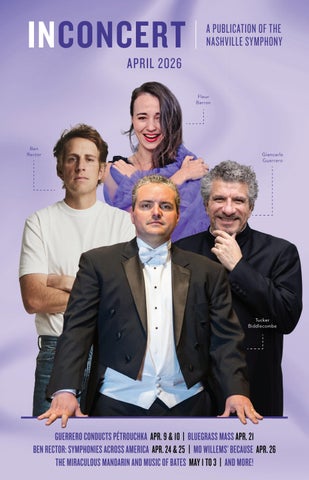
Nashville Symphony | April 2026 InConcert

Page 1


A PUBLICATION OF THE NASHVILLE SYMPHONY

GUERRERO CONDUCTS PÉTROUCHKA APR. 9 & 10 | BLUEGRASS MASS APR. 21

BEN RECTOR: SYMPHONIES ACROSS AMERICA APR. 24 & 25 | MO WILLEMS’ BECAUSE APR. 26

THE MIRACULOUS MANDARIN AND MUSIC OF BATES MAY 1 TO 3 | AND MORE!

Giancarlo Guerrero
Ben Rector
Tucker Biddlecombe
Fleur Barron

LETTER FROM THE PRESIDENT & CEO

As I continue reflecting on memorable milestones from my 28 years with the Nashville Symphony, I naturally return to one transformative moment: our move into Schermerhorn Symphony Center and the Laura Turner Hall nearly twenty years ago.

Opening this magnificent hall expanded our horizons in ways we could scarcely imagine at the time. Schermerhorn Symphony Center allowed us to dream bigger. For the first time in our history, we were fully in control of our own artistic calendar and destiny. We gained the flexibility to program boldly, host events at scale, and welcome audiences into a home designed specifically and acoustically for symphonic music.

Artistically, the hall opened new doors as well. After moving into Schermerhorn, we presented our first liveto-film event with The Wizard of Oz . It felt especially fitting, just as Dorothy’s world transforms into color when she arrives in Munchkinland, so too did our orchestra enter a new era upon landing in our permanent home, where the room’s brilliant acoustics made every note of music sound like it was being heard in color. Some initially wondered whether audiences would embrace the idea of watching a film outside a traditional cinema, but they quickly discovered what makes these performances extraordinary: experiencing a beloved movie while your Nashville Symphony performs the score live is unlike any other cinematic experience.

The building also enabled us to grow institutionally. In a single year’s time, our annual ticket revenues tripled as we opened the hall, and our fundraising capacity increased dramatically as well, allowing us to present signature events that have become cornerstones of our community. With the support of many volunteers for the past twenty years, the Nashville Symphony Guild’s Fashion Show evolved—almost instantly upon moving into Schermerhorn—into the spectacular celebration it is today. Our Symphony Ball also moved from the Loews Vanderbilt Plaza Hotel into the Laura Turner Hall, where its fundraising potential and impact seemed limitless. These two events have raised millions over the years to support our free Music Education and Community Engagement Programs.

Even before the building was complete, a sign on the construction fence proclaimed, “Every Child. Every Grade. Every Year.” That message reflected our unwavering commitment to music education. Over time, we learned that while reaching large numbers of students broadly is important, deep investment in individual students can create life-changing impact. That insight led to the founding of Accelerando in 2016

Accelerando is an intensive music education program designed to prepare gifted young musicians for collegiate study and professional careers. Through instruction, mentorship, performance opportunities, and college guidance, the program provides a pathway to excellence for students who might otherwise lack access. Since its inception, Accelerando graduates have gone on to study at the country’s leading conservatories and music schools on music scholarships totaling in the millions of dollars and averaging more than $100,000 per student.

As Accelerando approaches its 10 th anniversary, we face a pivotal moment. The foundation funding that has sustained this program for the past decade concludes this year. On March 31, we kicked off a spring campaign of support for Accelerando that will culminate with a ten year celebration on June 9. I invite you to be a part of this campaign and hope you will consider contributing and continuing this powerful legacy of opportunity and impact. Scan the QR code below to instantly make your contribution today.

Finally, I encourage you to renew or subscribe to our 2026/27 season , the first under our new Music Director, Leonard Slatkin . It’s a season in which you will Be Moved . and Be Amazed . But most of all, you’ll want to Be. Here. You can secure your seats today at NashvilleSymphony.org/SeasonTickets.

Thank you for your continued support and for all you do to strengthen your Nashville Symphony. I look forward to seeing you at Schermerhorn Symphony Center this month.

Warmest regards,

The Nashville Symphony inspires and engages a diverse and growing community with extraordinary live orchestral music experiences.

615.687.6400

info@NashvilleSymphony.org NashvilleSymphony.org

Video cameras, recording devices, and flash photography are strictly prohibited in the concert hall or in any other space where a performance or rehearsal is taking place. Cameras with a detachable lens may only be used pending approval from the artist and the venue and will be subject to rules and restrictions. For more information, please contact the Nashville Symphony's Communications office PHOTOGRAPHY & VIDEO POLICY

2025/26 NASHVILLE SYMPHONY

LEONARD SLATKIN

Music Advisor

NATHAN ASPINALL Resident Conductor

FIRST VIOLIN*

Peter Otto, Concertmaster

Walter Buchanan Sharp Chair

Erin Hall, Acting Associate Concertmaster

Gerald C. Greer, Acting Assistant Concertmaster

Tianpei Ai

Isabel Bartles

Francesca Bass

Beverly Drukker

Dawn Gingrich

Anna Lisa Hoepfinger

John Maple

Kirsten Mitchell

Ashley Odom

SECOND VIOLIN*

Jung-Min Shin, Principal

Lucia Nowik, Acting Assistant Principal

Likai He

Daniel Kim

Charissa Leung

Louise Morrison

Laura Ross

Johna Smith

Jeremy Williams

VIOLA*

Daniel Reinker, Principal

Shu-Zheng Yang, Assistant Principal

Michelle Lackey Collins

The Drs. Mark & Nancy Peacock Chair

Christopher Farrell

Anthony Parce

Melinda Whitley

Clare Yang

GIANCARLO GUERRERO

Music Director Laureate

TUCKER BIDDLECOMBE

Chorus Director

CELLO*

Kevin Bate, Principal James Victor Miller Chair

Una Gong, Assistant Principal

Anthony LaMarchina, Principal Cello Emeritus

Stephen Drake

Bradley Mansell

Keith Nicholas

Lynn Marie Peithman

Xiao-Fan Zhang

BASS*

Joel Reist, Principal

Glen Wanner, Assistant Principal

Matthew Abramo

Evan Bish

Kevin Jablonski

Katherine Munagian

FLUTE

Érik Gratton, Principal Anne Potter Wilson Chair

Leslie Fagan, Assistant Principal

Gloria Yun, Norma Grobman Rogers Chair

PICCOLO

Gloria Yun, Norma Grobman Rogers Chair

OBOE

Titus Underwood, Principal ◊

Christopher Gaudi, Acting Principal +

Ellen Menking, Assistant Principal

Kate Bruns +

ENGLISH HORN

Kate Bruns+

CLARINET

Danny Goldman, Acting Principal +

Katherine Kohler, Assistant Principal ◊

Spencer Prewitt

Acting Assistant Principal +

Daniel Lochrie

E-FLAT CLARINET

Katherine Kohler

BASS CLARINET

Daniel Lochrie

BASSOON

Julia Harguindey, Principal ◊

Asha Kline, Acting Principal +

Gil Perel, Acting Assistant Principal

Nicole Haywood Vera Tenorio +

CONTRABASSOON

Nicole Haywood

Vera Tenorio +

HORN

Leslie Norton, Principal

The Dr. Anne T. & Peter L. Neff Chair

Beth Beeson

Patrick Walle, Associate Principal/3rd Horn ◊

Radu V. Rusu, Acting Associate Principal/ 3rd Horn

Hunter Sholar

Anna Spina, Acting Assistant Principal/ Utility Horn +

TRUMPET

William Leathers, Principal Patrick Kunkee, Co-Principal Alexander Blazek

TROMBONE

Paul Jenkins, Principal

Anthony Cosio-Marron, Assistant Principal

BASS TROMBONE

Chance Gompert

TUBA

Chandler Currier, Principal

TIMPANI

Joshua Hickman, Principal

PERCUSSION

Sam Bacco, Principal

Richard Graber, Assistant Principal

HARP

Licia Jaskunas, Principal

KEYBOARD

Robert Marler, Principal

LIBRARY

Renee Ann Pflughaupt, Principal Librarian

Amelia Van Howe, Librarian

ORCHESTRA PERSONNEL

Pavana Stetzik, Director of Orchestra Personnel

Sarah Figueroa, Manager of Orchestra Operations

Internationally acclaimed conductor Leonard Slatkin is Music Director Laureate of the Detroit Symphony Orchestra (DSO), Directeur Musical Honoraire of the Orchestre National de Lyon (ONL), Conductor Laureate of the St. Louis Symphony Orchestra (SLSO), Principal Guest Conductor of the Orquesta Filarmónica de Gran Canaria (OFGC), and Artistic Consultant to the Las Vegas Philharmonic (LVP). He maintains a rigorous schedule of guest conducting and is active as a composer, author, and educator.

The 2025/26 season includes engagements with the National Symphony Orchestra (Ireland), Manhattan School of Music Symphony Orchestra, SLSO, USC Thornton Symphony, LVP, Taiwan Philharmonic, KBS Symphony Orchestra (Seoul), Gunma Symphony Orchestra, NHK Symphony Orchestra (Tokyo), Nashville Symphony, Atlanta Symphony Orchestra, Orchestre Symphonique de Montréal, Warsaw Philharmonic, Franz Schubert Filharmonia (Barcelona), ONL, Prague Symphony Orchestra, Filarmonica George Enescu (Bucharest), OFGC, and Rundfunk-Sinfonieorchester Berlin.

Slatkin has received six GRAMMY® Awards and 35 nominations. Naxos recently reissued Vox audiophile editions of his SLSO recordings featuring the works of Gershwin, Rachmaninov, and Prokofiev. Other Naxos recordings include Slatkin Conducts Slatkin a compilation of pieces written by generations of his family—as well as works by Saint-Saëns, Ravel, Berlioz, Copland, Borzova, McTee, and Williams. A recipient of the National Medal of Arts, Slatkin also holds the rank of Chevalier in the French Legion of Honor. He has been awarded the Prix Charbonnier from the Federation of Alliances Françaises, Austria’s Decoration of Honor in Silver, and the League of American Orchestras’ Gold Baton. His debut book, Conducting Business (2012), for which he received the ASCAP Deems Taylor Special Recognition Award, was followed by Leading Tones (2017) and

MUSIC ADVISOR

LEONARD SLATKIN

Classical Crossroads: The Path Forward for Music in the 21st Century (2021). His latest books are Eight Symphonic Masterworks of the Twentieth Century (spring 2024) and Eight Symphonic Masterworks of the Nineteenth Century (fall 2024), part of an ongoing series of essays that supplement the scorestudy process, published by Bloomsbury.

Slatkin has held posts as Music Director of the New Orleans Philharmonic-Symphony Orchestra, SLSO, National Symphony Orchestra, DSO, and ONL, and he was Chief Conductor of the BBC Symphony Orchestra. He has served as Principal Guest Conductor of London’s Philharmonia and Royal Philharmonic, the Pittsburgh Symphony Orchestra, the Los Angeles Philharmonic at the Hollywood Bowl, and the Minnesota Orchestra.

He has conducted virtually all the leading orchestras in the world, including the New York Philharmonic, Chicago Symphony Orchestra, Philadelphia Orchestra, Boston Symphony Orchestra, San Francisco Symphony, Los Angeles Philharmonic, Berlin Philharmonic, Bayerischer Rundfunk (Munich), Royal Stockholm Philharmonic Orchestra, Royal Concertgebouw Orchestra (Amsterdam), Orchestre de Paris, Oslo Philharmonic Orchestra, and Israel Philharmonic Orchestra, as well as all five London orchestras.

Slatkin’s opera conducting has taken him to the Metropolitan Opera, Lyric Opera of Chicago, Washington National Opera, Opera Theatre of St. Louis, Santa Fe Opera, Vienna State Opera, Stuttgart Opera, and Opéra Bastille in Paris.

Born in Los Angeles to a distinguished musical family, he began his musical training on the violin and first studied conducting with his father, followed by Walter Susskind at Aspen and Jean Morel at Juilliard. He makes his home in St. Louis with his wife, composer Cindy McTee. For more information, visit leonardslatkin.com.

NATHAN ASPINALL, Resident Conductor

Nathan Aspinall has led orchestras across the globe and is widely admired for his thoughtful, nuanced interpretations and powerful performances. His collaborative approach to performing with fellow musicians has resulted in ongoing partnerships and deep relationships with the orchestras with whom he performs.

Nathan currently serves as Resident Conductor with the Nashville Symphony and this season will lead the orchestra in multiple programs including his fourth appearance on the classical subscription series with a program of Berlioz, Ligeti and the Britten Violin Concerto with Benjamin Beilman. In previous seasons Nathan has conducted acclaimed performances with the Nashville Symphony in dynamic repertoire including symphonies of Prokofiev, Tchaikovsky, Dvorak and Sibelius and last season led a special all Ravel program to mark the 150th anniversary of the composers birth.

Aspinall has performed around the world, leading the orchestras of Minnesota, Detroit, St Louis, Atlanta, Sydney and the MendelssohnOrchesterakademie of the Gewandhausorchester

in Leipzig. He has assisted many of today’s leading conductors including Stéphane Denève, Jakub Hrůša, Nathalie Stutzmann, Thomas Søndergård, and Simone Young.

Nathan was a conducting fellow at the Tanglewood Music Center with the Boston Symphony Orchestra where he was mentored by Andris Nelsons, Thomas Adès and Giancarlo Guerrero. He is also a recipient of the Robert J. Harth Conducting Prize at the Aspen Music Festival.

A strong believer that music is for everyone, Nathan is passionate about orchestras reaching an ever-widening audience. At the Nashville Symphony, he spearheads education and community initiatives, the commissioning of new projects and curates community programing. Supporting future generations of musicians, Nathan is an advocate for music education and outreach and has led performances and masterclasses for conservatories, universities and youth orchestras around the country. Festival appearances include the Cabrillo Festival of Contemporary Music, Oregon Bach Festival and the Tanglewood Music Center Conducting Seminar. He studied orchestral conducting with Hugh Wolff at New England Conservatory in Boston and music performance at the University of Queensland

TUCKER BIDDLECOMBE

Appointed as Chorus Director of the Nashville Symphony in 2016 , Dr. Biddlecombe has raised the bar of excellence for Nashville’s premier choral ensemble through intense musical preparation, diverse programming, and communitybuilding. He also serves as Professor of Choral Studies and Associate Dean for Undergraduate Education at Vanderbilt University’s Blair School of Music, where he directs the Vanderbilt Sixteen and teaches courses in choral conducting and music education.

His work with the Nashville Symphony has included chorus preparation for many of the repertoire’s most revered masterworks. Notable performances have included two Mahler symphonies, Bernstein’s Symphony No. 3 “Kaddish”, and Requiems by Mozart and Verdi. He has prepared the chorus for two major

, Chorus Director

world-premiere recordings, John Harbison’s Requiem (rel. 2018, Naxos) as well as the upcoming release of Gabriela Lena-Frank’s Conquest Requiem and Antonio Estevez’s Cantata Criolla. He has conducted the chorus and orchestra in performances of Haydn’s Creation, Handel’s Messiah , Vivaldi’s Gloria , and the annual Voices of Spring concert.

Tucker is a veteran teacher and advocate for music education. He frequently conducts scholastic honor choirs throughout the United States, with international engagements in England, Scotland, China, and the Czech Republic. Dr. Biddlecombe is a graduate of SUNY Potsdam and Florida State University, where he completed studies in choral conducting and music education with Daniel Gordon and André Thomas, respectively. He resides in Nashville with his wife Mary Biddlecombe, director of the Blair Academy at Vanderbilt, and Artistic Director of Vanderbilt Youth Choirs.

GUERRERO CONDUCTS PÉTROUCHKA

THURSDAY & FRIDAY, APRIL 9 & 10, 2026, AT 7:30 PM

NASHVILLE SYMPHONY

GIANCARLO GUERRERO, conductor

ALESSIO BAX, piano

JOHANNES BRAHMS

Piano Concerto No. 2

Allegro non troppo

Allegro appassionato

Andante

Allegretto grazioso

Alessio Bax, piano

INTERMISSION

IGOR STRAVINSKY

Pétrouchka (1947)

The Shrove-Tide Fair

Pétrouchka's Cell

The Moor's Cell

The Shrove-Tide Fair (Towards Evening)

THANK YOU TO OUR CLASSICAL SERIES SPONSOR

This concert will last approximately 1 hour, 45 minutes, including a 20-minute intermission.

TJohannes Brahms

Piano Concerto No. 2 in B-flat major, Op. 83

Composed: 1881

his program spans two contrasting worlds—and two contrasting kinds of storytelling: Johannes Brahms’s expansive Romantic eloquence and Igor Stravinsky’s sharp-edged theatrical imagination.

For Brahms, the path to that eloquence was hard won. He spent many years wrestling with his tempestuous First Piano Concerto before finally unveiling it to the public in 1859. More than two decades separate that work—his first orchestral composition to be performed—from the premiere of its successor. By then, he could draw on the experience with large-scale orchestral forms he had gained from writing his first two symphonies and Violin Concerto.

This score’s epic scale makes Brahms’s characteristically ironic description of it as “a tiny, tiny piano concerto with a tiny, tiny wisp of a scherzo” all the more pointed. The work unfolds on a grand canvas. Brahms began sketching material while traveling in Italy in the spring of 1878, gathering ideas he had set aside from his initial plans for the Violin Concerto. After trying it out at a private event, he appeared as soloist for the public premiere in Budapest in 1881. Brahms dedicated the score to Eduard Marxsen (1806–1887), a pianist-composer who had been an important teacher and mentor during his youth.

In the late 1870s, Brahms spent several summers in Pörtschach, in the Wörthersee region of southern Austria, where he found renewed creative energy and worked on the Second Symphony and the Violin Concerto, among other compositions. He rhapsodized that “the melodies fly so thick you must watch out not to step on one.” The Second Piano Concerto belongs to this same burst of extraordinary productivity. If Brahms had important things to prove with the First Piano Concerto, the Second basks in confidence securely achieved. Nowhere is the distance he had traveled more apparent than in the contrast between these two works. Unusually expansive, the Second is cast in four movements rather than the conventional three. Its abundant lyricism and, for Brahms, unusually sunny character disguise just how demanding the solo part really is.

The Second becomes a vehicle for pianistic artistry of almost superhuman scope, yet it also grants unusually prominent roles to individual orchestral instruments. The result is not a contest between soloist and orchestra but a richly symphonic collaboration.

Instead of giving the first word to the soloist, Brahms begins with a solitary horn. Its broad, spacious call evokes the landscape that had fueled his creativity in Pörtschach, like a question posed into open air. The piano’s entrance answers with sweeping grace and confidence, establishing the vast horizon against which the first movement proceeds.

Though moments of agitation arise—even fierce, cadenza-like outbursts from the piano—the prevailing character is one of engaged and mutually respectful dialogue between soloist and orchestra. The adventurous development section begins with a minor-key transformation of the horn theme, while the spellbinding coda refracts the main idea in radiant new light.

Marked Allegro appassionato, the “tiny, tiny wisp of a scherzo” that ensues surges with restless, stormdriven energy. In its darker D minor coloring, it recalls the mood of Brahms’s First Piano Concerto.

Like the opening movement, the Andante begins not with the piano but with a solo cello, its melody warmly supported by the strings. The piano embellishes rather than takes the lead, leaving the main theme to the orchestra; without trumpets and timpani, the sound feels more intimate. In the central interlude, the piano converses closely with two clarinets, almost like chamber music.

The finale is strikingly varied, as plentiful in ideas as the first movement is concentrated. In the coda, Brahms shifts the meter and accelerates the tempo. Soloist and orchestra merge for the ebullient conclusion.

In addition to solo piano, scored for 2 flutes (2nd doubling piccolo), 2 oboes, 2 clarinets, 2 bassoons, 4 horns, 2 trumpets, timpani, and strings

BIgor Stravinsky

Pétrouchka (1947 version)

Composed: 1910-11

efore June 1910, Igor Stravinsky was simply one of several “promising” young Russian composers with a flair for brilliant orchestral color, cultivated under the guidance of his teacher, Nikolai RimskyKorsakov. Everything changed when the ingenious (and ruthless) impresario Serge Diaghilev decided to take a chance on the ambitious twenty-something year old. D iaghilev commissioned Stravinsky to

write a fresh score for his fledgling Ballets Russes, the Paris-based company that had been electrifying Western audiences with stars from the Russian Imperial Ballet—among them Michel Fokine and the legendary Vaslav Nijinsky, whose tempestuous relationship with Diaghilev added its own drama.

Stravinsky’s first collaboration with Diaghilev produced The Firebird, a lavish folkloric spectacle that became a sensation in Paris. At 28, Stravinsky suddenly found himself one of the most talked-about new composers in Europe. Even before he had finished The Firebird, another idea was taking root. He later recalled dreaming “a scene of pagan ritual in which a chosen sacrificial virgin danced herself to death”— the germ of what would become The Rite of Spring. But another revolution came first. After preliminary work in the summer of 1910, Stravinsky set Rite aside to pursue what he initially imagined as “an orchestral piece in which the piano would play the most important part.” In his autobiography he describes how this projected concert work gradually evolved into the ballet we know as Petrushka (Pétrouchka in French). Like Rite and other theater works of this period, it would later enjoy a parallel life in the concert hall.

Stravinsky’s first sketches—as always, conceived at the keyboard—conjured an animated puppet. He envisioned Petrushka (“little Peter”), a tricksterjester figure from Russian folk tradition, akin to the Pulcinella of commedia dell’arte (or Punch in the English version). From this fanciful scenario, drawing on the Russian puppet tradition, Stravinsky fashioned one of his most daring early experiments in harmony, orchestral coloration, and film-like collage effects.

The music of those first sketches became the lament of the unhappy puppet in the second scene, “Petrushka’s Room.” Its musical signature is the striking sound of C major colliding with F-sharp major—the so-called “Petrushka chord.” Sounded together, these notes create a disorienting sonority that feels suspended between two incompatible worlds.

At first, Stravinsky still imagined a concert piece with piano at its center rather than a theatrical work. But when Diaghilev visited him that summer at his Swiss Riviera residence, he persuaded the composer that this “theme of the puppet’s sufferings” should become a ballet for the upcoming season. The puppet became a potent symbol of the story’s in-between quality—poised between human and mechanical.

Unlike The Firebird , which came with a readymade plot, Petrushka’s narrative grew out of music already composed. Stravinsky and Diaghilev sketched the scenario, later refined by Alexandre Benois (the score’s dedicatee and designer of the sets).

The result was a “burlesque in four scenes” set during Carnival celebrations in early-19th-century St. Petersburg. Stravinsky composed most of the score in Switzerland, though a nostalgic Christmas visit to St. Petersburg nourished his imagination. At the 1911 Paris premiere, Nijinsky danced the title role with choreography by Fokine. Diaghilev had engineered another multimedia sensation, and Stravinsky’s music was again a triumph—controversial, though not yet riotous.

Petrushka’s popularity soon led to multiple versions, including concert suites and piano arrangements. In 1947, for both artistic and financial reasons—including the opportunity to secure a new copyright—Stravinsky issued a revised edition. He streamlined certain aspects of the orchestration and expanded the piano part. This is the version that Maestro Guerrero has chosen for this performance.

WHAT TO LISTEN FOR

The Shrovetide Fair—a bustling Carnival celebration before the austerity of Lent—unfolds as a collage of festive confusion, with the Petersburg crowd jostling amid competing sights and sounds. Stravinsky’s episodic structure is energized by constantly shifting rhythms, orchestral colors, and asymmetrical patterns—a technique akin to cinematic jump cuts.

Street performers and vendors flash past before the Magician commands attention, charming his puppets to life with a flute cadenza. Among them are three figures who will dominate the drama: Petrushka, the Ballerina, and the Moor. They burst into the bright yet angular Russian Dance, one of many references to vernacular or pseudo-popular idioms woven into the score.

A tension-building drum roll—a recurring link between scenes—leads to Petrushka’s room. Here the puppet, painfully aware of his own awkwardness and rejection, veers between defiance and despair, his anguish punctuated by biting trumpet blasts. Another drum roll ushers us into the Moor’s room, home to Petrushka’s swaggering rival for the Ballerina’s attention.

Stravinsky presents the music in short, sharply defined bursts of color. A trumpet solo gives way to a surreal waltz for flute, trumpet, and bassoon, depicting the Ballerina’s flirtation with the Moor. Contradictory textures overlap freely, unconcerned with conventional cohesion.

The final scene returns to the Fair as evening falls, presenting a motley procession: the Wet Nurses (to an old Russian folk song), the Peasant and Bear (announced unmistakably by the tuba), the Gypsy Girls, the Coachmen—whose heavy accents foreshadow The Rite of Spring—and the Masqueraders. The puppets grow further entangled in their personal drama, culminating in the Moor’s fatal attack on Petrushka with his saber. After the crowd departs, the puppet’s ghost returns in mocking defiance to terrify the Magician. Stravinsky was especially proud

ABOUT THE SOLOISTS

Combining exceptional lyricism and insight with consummate technique, Alessio Bax is without a doubt “among the most remarkable young pianists now before the public” (Gramophone). He catapulted to prominence with First Prize wins at both the 2000 Leeds International Piano Competition and the 1997 Hamamatsu International Piano Competition and is now a familiar face on five continents as a recitalist, chamber musician, and concerto soloist. He has appeared with nearly 200 orchestras, including the New York, London, Royal, and St. Petersburg Philharmonic Orchestras, the Boston, Baltimore, Dallas, Cincinnati, Seattle, Sydney, and City of Birmingham Symphony Orchestras, and the Tokyo and NHK Symphony in Japan, collaborating with such eminent conductors as Marin Alsop, Vladimir Ashkenazy, Sir Andrew Davis, Hannu Lintu, Fabio Luisi, Sir Simon Rattle, Ruth Reinhardt, Yuri Temirkanov, and Jaap van Zweden.

As a renowned chamber musician, Bax has collaborated with Lisa Batiashvili, Joshua Bell, Ian Bostridge, Lucille Chung, James Ehnes, Vilde Frang, Steven Isserlis, Daishin Kashimoto, François Leleux, Sergei Nakariakov, Emmanuel Pahud, Lawrence Power, Jean-Guihen Queyras, Paul Watkins, and Tabea Zimmermann, among many others.

In March 2026, Bax was named founding Artistic Director of the London Chamber Music Festival at Sinfonia Smith Square. Since 2017, he has been the Artistic Director of the Incontri in Terra di Siena Festival, a Summer Music Festival in the Val d’Orcia region of Tuscany. Bax appears regularly in festivals

of the details in these final minutes, illustrating Petrushka’s death with shrieking woodwinds and gooseflesh tremolos.

Scored for 3 flutes ( 3 rd doubling piccolo), 2 oboes, English horn, 3 clarinets (3rd doubling bass clarinet), 2 bassoons, contrabassoon, 4 horns, 3 trumpets, 3 trombones, tuba, timpani, percussion, celesta, piano, harp, and strings

− Thomas May is the Nashville Symphony's program annotator.

such as Seattle, Bravo Vail, Salon-de-Provence, Le Pont in Japan, Great Lakes, Verbier, Ravinia, Music@Menlo, Aspen, and Tanglewood.

In 2009, Bax was awarded an Avery Fisher Career Grant, and four years later he received both the Andrew Wolf Chamber Music Award and the Lincoln Center Award for Emerging Artists.

Bax’s most recent album releases are Forgotten Dances and Debussy & Ravel for Two with Lucille Chung. His celebrated Signum Classics discography also includes Italian Inspirations ; Beethoven’s Hammerklavier and Moonlight Sonatas (a Gramophone Editor’s Choice); Beethoven’s Emperor Concerto; Bax & Chung, a duo disc with Lucille Chung; Alessio Bax plays Mozart , recorded with London’s Southbank Sinfonia; Alessio Bax: Scriabin & Mussorgsky (named “Recording of the Month ... and quite possibly ... of the year” by MusicWeb International); Alessio Bax plays Brahms (a Gramophone Critics’ Choice); Bach Transcribed ; and Rachmaninov : Preludes & Melodies (an American Record Guide Critics’ Choice). Recorded for Warner Classics, his Baroque Reflections album was also a Gramophone Editor’s Choice. He performed Beethoven’s Hammerklavier Sonata for Daniel Barenboim in the PBS-TV documentary Barenboim on Beethoven: Masterclass, available on DVD from EMI.

At the age of 14, Bax graduated with top honors from the conservatory of Bari, his hometown in Italy, and after further studies in Europe, he moved to the United States in 1994. He has been on the piano faculty of Boston’s New England Conservatory since the fall of 2019 and serves as co-artistic director of the Joaquín Achúcarro Foundation for emerging pianists.

Bax lives in New York City with pianist Lucille Chung and their daughter, Mila.

ABOUT THE CONDUCTOR

Giancarlo Guerrero is a six-time GRAMMY® Awardwinning conductor whose imaginative programming and “curatorial and interpretive creativity” (Chicago Tribune) draw out of his orchestras “exceptionally powerful and enchanting performances” (BBC Music Magazine). 2025 marks Guerrero’s first season as Artistic Director and Principal Conductor of the Grant Park Music Festival in Chicago. Guerrero also took on the role of Music Director of Sarasota Orchestra in the 2025/26 season.

Guerrero is currently Music Director Laureate with the Nashville Symphony, following sixteen years as Music Director. During his tenure in Nashville, he championed the works of prominent American composers through commissions, recordings, and world premieres. Under Guerrero’s direction, the Nashville Symphony released twenty-one commercial recordings, which have garnered thirteen GRAMMY® nominations and six GRAMMY® Awards.

In recent seasons, Guerrero has led prominent North American orchestras including the New York Philharmonic, Los Angeles Philharmonic, Philadelphia Orchestra, Cleveland Orchestra and the San Francisco, Boston, Baltimore, Chicago, Cleveland, Dallas, and Detroit Symphonies. Internationally, he has worked with orchestras in Bilbao, Frankfurt, London, Paris, São Paulo, and Sydney.

Guerrero previously held posts as Music Director of the NFM Wrocław Philharmonic, Principal Guest Conductor of both The Cleveland Orchestra, Miami Residency and the Gulbenkian Symphony in Lisbon, Music Director of the Eugene Symphony, and Associate Conductor of the Minnesota Orchestra.

Born in Nicaragua, Guerrero immigrated during his childhood to Costa Rica, where he joined the local youth symphony. He studied percussion and conducting at Baylor University and earned his master’s degree in conducting at Northwestern. Guerrero is particularly engaged with conducting training orchestras and has worked with the Curtis School of Music, Colburn School in Los Angeles, The Juilliard School, National Youth Orchestra (NYO2), and Yale Philharmonia.

HARRY POTTER AND THE CHAMBER OF SECRETS™ IN CONCERT

FRIDAY & SATURDAY, APRIL 17 & 18, AT 7:30 PM | SUNDAY, APRIL 19, AT 2 PM

NASHVILLE SYMPHONY | JUSTIN FREER, conductor

Directed by Chris Columbus

Produced by David Heyman

Written by Steve Kloves

Based on “Harry Potter and the Chamber of Secrets” by J.K. Rowling

Starring:

Daniel Radcliffe

Rupert Grint

Emma Watson

Kenneth Branagh

John Cleese

Robbie Coltrane

Warwick Davis

Richard Griffiths

Richard Harris

Jason Isaacs

Alan Rickman

Fiona Shaw

Maggie Smith

Julie Walters

Music by John Williams

Cinematography by Roger Pratt

Edited by Peter Honess

Produced by Heyday Films, 1492 Pictures

Distributed by Warner Bros. Pictures

Justin Freer President/Founder/Producer

Brady Beaubien Co-Founder/Producer

Chief XR Officer / Head of Publicity & Communications

Andrew P. Alderete

Director of Operations Andrew McIntyre

Senior Marketing Manager Brittany Fonseca

Senior Social Media Manager Si Peng

Worldwide Representation WME

Music Preparation JoAnn Kane Music Service

Sound Remixing Justin Moshkevich, Igloo Music Studios

This concert will last approximately two hours, 58 minutes, including a 20 -minute intermission.

All characters and elements © & ™ Warner Bros. Entertainment Inc. Publishing Rights © JKR.

ABOUT THE COMPOSER: JOHN WILLIAMS

In a career spanning more than six decades, John Williams has become one of America’s most accomplished and successful composers for film and for the concert stage, and he remains one of our nation’s most distinguished and contributive musical voices. He has composed the music and served as music director for more than one hundred films, including all nine Star Wars films, the first three Harry Potter films, Superman, JFK, Born on the Fourth of July, Memoirs of a Geisha, Far and Away, The Accidental Tourist, Home Alone, and The Book Thief. His 50-year artistic partnership

with director Steven Spielberg has resulted in many of Hollywood’s most acclaimed and successful films, including Schindler’s List, E.T. The Extra-Terrestrial, Jaws, Jurassic Park, Close Encounters of the Third Kind, the Indiana Jones films, Munich, Saving Private Ryan, The Adventures of Tintin, War Horse, Lincoln, The BFG, The Post, and The Fabelmans. His contributions to television music include scores for more than 200 television films for the groundbreaking, early anthology series Alcoa Theatre, Kraft Television Theatre, Chrysler Theatre, and Playhouse 90, as well as themes for NBC Nightly News (“The Mission”), NBC’s Meet the Press, and the PBS arts showcase Great Performances. He also composed themes for the 1984,

1988, and 1996 Summer Olympic Games, as well as the 2002 Winter Olympic Games. He has received five Academy Awards and 53 Oscar nominations, making him the Academy’s most-nominated living person and the second-most nominated person in the history of the Oscars. He has received seven British Academy Awards (BAFTA), twenty-five GRAMMY®s, four Golden Globes, five Emmys, and numerous gold and platinum records. In 2003, he received the Olympic Order (the IOC’s highest honor) for his contributions to the Olympic movement. He received the prestigious Kennedy Center Honors in December of 2004. In 2009, Williams was inducted into the American Academy of Arts & Sciences, and he received the National Medal of Arts, the highest award given to artists by the United States Government. In 2016, he received the 44th Life Achievement Award from the American Film Institute—the first time in their history that this honor was bestowed upon a composer. In 2020, he received Spain’s Princess of Asturias Award for the Arts as well as the Gold Medal from the prestigious Royal Philharmonic Society in the UK, and in 2022 he was awarded an honorary knighthood of the British Empire as one of the final awards approved by Her Majesty Queen Elizabeth II.

In January 1980, Williams was named nineteenth music director of the Boston Pops Orchestra, succeeding the legendary Arthur Fiedler. He currently holds the title of Boston Pops Laureate Conductor which he assumed following his retirement in December 1993 after fourteen highly successful seasons. He also holds the title of Artist-in-Residence at Tanglewood. Williams has composed numerous works for the concert stage, among them two symphonies, and concertos commissioned by several of the world’s leading orchestras, including a cello concerto for the Boston Symphony Orchestra, a bassoon concerto for the New York Philharmonic, a trumpet concerto for The Cleveland Orchestra, and a horn concerto for the Chicago Symphony Orchestra. In 2009, the Boston Symphony premiered his concerto for harp and orchestra entitled “On Willows and Birches”, and in the same year, Williams composed and arranged “Air and Simple Gifts” especially for the first inaugural ceremony of President Barack Obama.

In 2021, Williams premiered his second violin concerto with the Boston Symphony Orchestra at Tanglewood along with soloist Anne-Sophie Mutter, for whom he composed the work.

ABOUT THE CONDUCTOR: JUSTIN FREER

American composer/ conductor Jusitn Freer was born and raised in Huntington Beach, California. He has established himself as one of the West Coast’s most exciting musical voices and is a highly sought-after conductor and producer of film music concerts around the world. Freer began his formal studies on trumpet, but quickly turned to piano and composition, composing his first work at eleven and giving his professional conducting debut at sixteen.

Continually composing for various different mediums, he has written music for world-renowned trumpeters Doc Severinsen and Jens Lindemann and continues to be in demand as a composer and conductor for everything from orchestral literature to chamber music around the world.

He has served as composer for several independent films and has written motion picture advertising music for some of 20th Century Fox Studios’ biggest campaigns including Avatar, The Day the Earth Stood Still, and Aliens in the Attic. As a conductor, Freer has appeared with some of the most wellknown orchestras in the world including the Chicago Symphony Orchestra, Cleveland Orchestra, London

Philharmonic, Los Angeles Philharmonic, New York Philharmonic, and the Philadelphia Orchestra. He is also one of the only conductors to have ever conducted in both the ancient Colosseum and Circus Maximus in Rome.

Renowned wind conductor and Oxford Round Table Scholar Dr. Rikard Hansen has noted that, “In totality, Freer’s exploration in musical sound evoke moments of highly charged drama, alarming strife and serene reflection.”

Freer has been recognized with numerous grants and awards from organizations including ASCAP, BMI, the Society of Composers and Lyricists, and the Henry Mancini Estate. He is the Founder and President of CineConcerts, a company dedicated to the preservation and concert presentation of film, curating and conducting hundreds of full length music score performances live with film for such wide ranging titles as Rudy, Gladiator, The Godfather, Breakfast at Tiffany’s, It’s A Wonderful Life, and the entire Harry Potter film franchise.

Freer earned both his B.A. and M.A. degrees in Music Composition from UCLA, where his principal composition teachers included Paul Chihara and Ian Krouse. In addition, he was mentored by legendary composer/conductor Jerry Goldsmith.

BLUEGRASS MASS with the Nashville Symphony Chorus

TUESDAY, APRIL 21, 2026, AT 7:30 PM

NASHVILLE SYMPHONY CHORUS

TUCKER BIDDLECOMBE, chorus director

CHARLES BUTLER , banjo

JACOB JOLLIFF, mandolin

JERRY KIMBROUGH, guitar

CRAIG NELSON, bass

GABE TERRACCIANO, violin

SCAN TO LEARN MORE ABOUT THE BLUEGRASS BAND

SHAWN KIRCHNER

Heavenly Home Alleluia

Angel Band

Unclouded Day

RANDALL THOMPSON

Alleluia

TRADITIONAL, ARR. ALICE PARKER

Hark I Hear the Harps Eternal

TRADITIONAL, ARR. ALICE PARKER

Wondrous Love

TRADITIONAL, ARR. ALICE PARKER

Swing Low Sweet Chariot

TRADITIONAL, ARR. ALICE PARKER

Saints Bound for Heaven

ELAINE HAGENBERG

Alleluia

INTERMISSION

CAROL BARNETT

The World Beloved: A Bluegrass Mass

NASHVILLE SYMPHONY CHORUS

TUCKER BIDDLECOMBE, chorus director

David B. Thomas , chorus p resident | Ally Hard, p resident elect

Lucy Alegria

Dana Amindaneshpour

Mary Biddlecombe

Maddie Brasher

Stephanie Breiwa

Julia Brown

Miranda Burnett

Megan Calgaro

Bethany Cárdenas

Angela Carr Forsythe

Sara Jean Curtiss

Katie Doyle

Amy Frogge

Gillian Garnowski

Kelli Gauthier

Grace J. Guill

Ally Hard

Emily Harrison

Heaven Howard

Vanessa Jackson

Amy Jarman

Jiana Kevilus

Megann Knapp

Leda Knowles

Ashleyn Lagerberg

Jean Miller

Abigail Orr

Emily Packard

Lucia Palladino

Angela Pasquini

Nicole Rivera

Veronica Selby

Sana Selemon

Kristine Smith

Renita J. Smith-Crittendon

Megan Starkey

Alexis Alduenda

Tessa Berger

Taylor Bradley

Sydney Braunstein

Joyce Brittain

Sarah Bronchetti

Vinéecia Buchanan

Cathi Carmack

Sara Chang

Kelsey Christian

Lisa Cooper

Brianna Corbett

Carla Davis

Kat Dennis

Bethany DiSantis

Peggy Lin Duthie

Michele East

Becky Evans-Young

Sierra Frazier

Peyton Garrison

Elizabeth Gilliam

Bevin Gregory

Alyson Haley

Leah Handelsman

Emily Sharnick

Amanda Hopkins

Mallory Howard

Sidney Hyde

Jung Ae Kim

Stephanie Kraft

Brittany McDonald

Kirsten McGlone

Alisha Menard

Thomas Andrew Butler

Stephen Calgaro

Daniel Capparella

Taylor Chadwick

Vincent Davis

Vic Esparza Morales

Joe A. Fitzpatrick

Andrew Galea

Peter Groenwald

Alan Henderson

Kory Henkel

James E. Howell

Gunnar Hudson

Ron Jensen

Ben Kahan

David Lowe

Damon Maida

Joshua Mellor

Dan Arterburn

Michael Beckhart

Christian Bumpous

Carson Burch

Mitch Crain

Dustin Derryberry

Kyle Duckworth

Mark Filosa

Stuart Garber

Timothy Goodenough

Duane Hamilton

Andrew Hard

Jonah Hathaway

Jason Jedlička

Jacob Laan

John Legan

Ryan Li

Bill Loyd

Zayne Lumpkin

Rob Mahurin

Andy Miller

Chris Mixon

Devin Mueller

Dale Nickell

Ryan Norris

Chris Riggins

Derrick Rohl

Kevin Salter

AJ Sermarini

Zach Shrout

Daniel Sissom

Marie Stennett

Angela Stenzel

Clair Susong

Leigh Sutherland

Marva Swann

Cassidy Van Amburg

Katherine Wehrenberg

Sylvia R. Wynn

McClain Kitchens Ziegler

Eva María Monroy

Madalynne Putz

Stacy L. Reed

Naudimar Ricardo Arnosa

Bonnie Ritchie

Gray Shiverick

Deanna Talbert

Clara Warford

Eddie Smith

Larry Smith

Carlos Solano

Nathan Stroud

Mark Sullivan

Alex Tinianow

Nathan Wildes

Jonathan Yeaworth

Phil Zuehlke

Steve Myers

Alec Oziminski

Steve Prichard

Nate Pylant

Michael Rahimzadeh

Austin Reid

Raphael Reyes

Zachary Sheinfeld

Dan Silva

Merv Snider

Larry Strachan

Josh Sulkin

David B. Thomas

Nic Townsend

Miles Troxler

Addison Waege

C. Brian Warford

Quinn Welder

Eric Wiuff

David Wyckoff

Jeff Burnham , accompanist * recognizes section leaders and officers

BEN RECTOR: SYMPHONIES ACROSS AMERICA with the Nashville Symphony

FRIDAY & SATURDAY, APRIL 24 & 25, 2026, AT 7:30 PM

BEN RECTOR & NASHVILLE SYMPHONY

ABOUT BEN RECTOR

Fifteen years after starting his career writing songs and touring in his Honda Accord on the weekends, Ben Rector found himself at home and at the piano in March 2020. The alchemy of life’s big questions, more downtime than he’d had in a decade, and those now all-too-familiar “unprecedented times” resulted in his career album: The Joy of Music. The project includes a breathtaking short film (featuring seven songs brought to life with stunning cinematography), inviting listeners and viewers to visit a dream world that communicates Rector’s creative process and his reckoning with his

job as an artist. He is led through the film’s chapters by his new friend Joy, a muppet monster he created with Jim Henson’s Creature Shop. In this fantastic and dream-like landscape we see and hear Rector overcome a deep-seated fear of failure, dancing, and singing his way through the journey of rediscovering the joy of music.

Ben Rector has amassed more than a billion streams across all platforms, has performed on numerous late night and morning TV shows including Conan, The Today Show, Jimmy Kimmel, Live With Kelly And Ryan, The Macy's Thanksgiving Day Parade, and as a celebrity mentor on American Idol alongside Ryan Tedder, Jewel, Brian McKnight, Jason Aldean, and more. His records have topped numerous Billboard charts, with his last two records landing at #1 on Billboard's US Folk and #2 on Billboard's US Rock and US Indie charts. Rector has built a dedicated touring base, regularly selling out theaters and amphitheaters across the country, including three consecutive nights at the legendary Ryman Auditorium in Nashville.

ABOUT THE CONDUCTOR

Enrico Lopez-Yañez has quickly established himself as one of the nation’s leading conductors of popular music and become known for his unique style of audience engagement. Lopez-Yañez holds the titled positions of Principal Pops Conductor of the Detroit and Pacific Symphonies, Principal Conductor of Dallas Symphony Presents, and Principal Guest Conductor of Pops at the Indianapolis Symphony Orchestra. He previously served as Principal Pops Conductor of the Nashville Symphony for eight seasons.

As a trailblazer in the symphonic world, Lopez-Yañez has premiered dozens of orchestral collaborations with artists including Dolly Parton, Kelsey Ballerini, Portugal. The Man, The Mavericks, Tituss Burgess, and The War & Treaty. Lopez-Yañez has collaborated with a broad spectrum of artists including: Nas, Patti LaBelle, Itzhak Perlman, Kenny Loggins, Stewart Copeland, Toby Keith, Gladys Knight, Ben Folds, and more. As an active composer/arranger his works have been performed by orchestras across North America including the Atlanta Symphony, Baltimore Symphony, National Symphony, Phoenix Symphony, Seattle Symphony, and Toronto Symphony, among many others.

Lopez-Yañez was the recipient of the 2023 “Mexicanos Distinguidos” Award by the Mexican government, an award granted to Mexican citizens living abroad for outstanding career accomplishments in their field. As an advocate for Latin music, he has arranged and produced shows for Latin Fire, Mariachi Los Camperos, and The Three Mexican Tenors, and collaborated with artists including Aida Cuevas, Arturo Sandoval, and Lila Downs.

As Artistic Director and Co-Founder of Symphonica Productions, LLC, Lopez-Yañez curates and leads programs designed to cultivate new audiences. Symphonica’s productions have been performed by major orchestra across North America including the Baltimore Symphony, Florida Orchestra, Milwaukee Symphony, North Carolina Symphony, Phoenix Symphony, Seattle Symphony, Toronto Symphony, and many more.

As a producer, composer, and arranger, LopezYañez’s work can be heard on numerous albums including the UNESCO benefit album Action Moves People United and children’s music albums including The Spaceship that Fell in My Backyard, winner of the John Lennon Songwriting Contest, Hollywood Music and Media Awards, Family Choice Awards and Kokowanda Bay, winner of a Global Media Award as well as a Parents’ Choice Award where Lopez-Yañez was lauded for his “catchy arrangements” (Parents’ Choice Foundation).

MO WILLEMS’ BECAUSE

SUNDAY, APRIL 26 AT 3 PM

NASHVILLE SYMPHONY

ERNESTO ESTIGARRIBIA MUSSI, conductor

BRYSON FINNEY, narrator

THANK YOU TO OUR FAMILY SERIES SPONSOR

This concert will last approximately 50 minutes.

ABOUT OUR SENSORY FRIENDLY CONCERTS

All Family Series concerts have the following sensory friendly supports available. Ask an usher or visit the information kiosk in the Main Lobby for more information!

• Flexible seating areas

• Booster seats

• No shushing in the concert hall—it’s OK to make noise!

• Closed captioning

• American Sign Language interpreting

• Fidget toys

• Noise-cancelling headphones

• Quiet spaces

• Social stories, maps, and more!

Learn more at NashvilleSymphony.org/SensoryFriendly

WHEN THE CONCERT BEGINS...

The concertmaster will arrive to help the orchestra tune their instruments.

Then, the conductor will arrive!

IT’S TIME FOR THE ORCHESTRA TO PLAY!

HERBERT CHAPPELL

Paddington Bear's First Concert

MONTGOMERY Because

WHEN THE CONCERT IS OVER...

The conductor will turn around and the orchestra will stand up. You can clap for the orchestra if you liked the music!

NASHVILLE SYMPHONY

2026/27 SEASON

SEASON HIGHLIGTS

CLASSICAL

Opening Weekend: Celebrating 20 Years at Schermerhorn

SEP 11 TO 13, 2026

POPS

Ketih Lockhart's The Golden Age of Pops

OCTOBER 8 & 9, 2026

CLASSICAL Mozart & Marsalis

OCTOBER 16 & 17, 2026

MOVIE

Harry Potter and the Prisoner of Azkaban™ In Concert

NOV 6 TO 8, 2026

FAMILY

How America Found Its Sound NOV 15, 2026

SPECIAL EVENT

Home Alone In Concert

DEC 4 TO 6, 2026

CLASSICAL

Final Alice & Britten's Young Person's Guide

JAN 8 & 9, 2027

MOVIE

The Wizard of Oz In Concert FEB 5, 2027

CLASSICAL

Scheherazade & Saint-Saens

MAR 19 TO 21, 2027

SPECIAL EVENT

Bach's Birthday: From Brandenburg to Magnificat

MAR 19 TO 21, 2027

POPS

John Williams: The Sound of a Generation

APR 15 & 16, 2027

FAMILY

Philharmonia Fantastique

APR 18, 2027

THE MIRACULOUS MANDARIN AND MUSIC OF BATES

FRIDAY & SATURDAY, MAY 1 & 2, 2026, AT 7:30 PM

SUNDAY, MAY 3, 2026, AT 2 PM

NASHVILLE SYMPHONY

GIANCARLO GUERRERO, conductor

FLEUR BARRON, mezzo-soprano

NIKOLAI RIMSKY-KORSAKOV

Russian Easter Overture, Op. 36

MASON BATES

Passage for mezzo-soprano, orchestra & laptop | Live Recording Fleur Barron, mezzo-soprano

INTERMISSION

MASON BATES

The Rhapsody of Steve Jobs | Live Recording

BÉLA BARTÓK

Suite from The Miraculous Mandarin, Op. 19

THANK YOU TO OUR CLASSICAL SERIES SPONSOR

This concert will last approximately 1 hour, 30 minutes, including a 20-minute intermission. To ensure the highest quality recording, please keep noise to a minimum.

Russian Easter Overture, (Op. 36)

Composed: 1887-88

g ainst a backdrop of upheaval in the Russian Empire, a circle of young composers gathered in St. Petersburg under the leadership of Mily Balakirev. Known as “the Mighty Five,” they sought an authentic expression of the Russian “soul,” often drawing on folk and liturgical sources.

Rimsky-Korsakov, the youngest of the group, began as a naval officer before turning decisively toward music. Though Balakirev opposed conservatory training, Rimsky later immersed himself in rigorous study after joining the Saint Petersburg Conservatory at twenty-seven. The result was a rare synthesis: nationalist fervor joined with masterly orchestration.

Composed in the late 1880s, Russian Easter Overture (Rimsky called it The Bright Holiday) reflects both sides of his formation. It draws on themes from the Russian Orthodox liturgy while showcasing the brilliantly colored orchestration for which he became renowned. Though not personally religious, Rimsky was fascinated by the holiday’s older, legendary layers—the way ancient folk customs and seasonal rituals lingered beneath the Orthodox celebration, especially in the transition from the somber mystery of Holy Saturday to the exuberant celebration of Easter morning.

WHAT TO LISTEN FOR

The Overture opens with solemn woodwind sonorities and chant-like themes from the Orthodox liturgy. In the Allegro, a trumpet intones what Rimsky described as the “voice of the Archangel,” soon giving way to dance-like bell figures and animated passages suggesting the reading of the Gospel. The work moves toward a blazing conclusion, its orchestral palette expanding into jubilant brass and ringing bells.

Scored for 3 flutes (3rd doubling piccolo), 2 oboes, 2 clarinets, 2 bassoons, 4 horns, 2 trumpets, 3 trombones, tuba, timpani, percussion, harp, and strings.

OMason Bates

Passage

Composed: 2017

ne of the most widely performed American composers of his generation, Mason Bates is familiar to Nashville audiences. In 2024, the Nashville Symphony performed his Nomad Concerto for violin and orchestra, written for Gil Shaham—part of an ongoing collaboration that continues with these performances. Whether writing for the opera stage, the concert hall, or shaping a dance event through his DJ alter ego, Bates understands his creative role to be that of a storyteller.

Well before turning to opera, Bates had established a national reputation through major orchestral commissions and residencies. Across his work, he advances classical traditions into a contemporary, technologically informed idiom that speaks to the experiences of audiences in the digital age.

His debut full-length opera, The (R)evolution of Steve Jobs, premiered in 2017 and went on to win a GRAMMY® Award for Best Opera Recording. More recently, his opera The Amazing Adventures of Kavalier & Clay—based on Michael Chabon’s Pulitzer Prize–winning novel—opened the Metropolitan Opera’s current season to notable acclaim, further extending his presence on the national stage.

He has served as composer-in-residence with major American orchestras and, from 2015 to 2020, was the inaugural composer-in-residence at the John F. Kennedy Center for the Performing Arts—an institution founded in the spirit of President Kennedy’s conviction that the arts are vital to the life of a nation. During his residency there, Bates found inspiration in the visions of both JFK and Walt Whitman for Passage, scored for orchestra and mezzo-soprano.

The work interweaves excerpts from Whitman’s “Passage to India,” later incorporated into Leaves of Grass, with clips from Kennedy’s speeches about the American space program—most prominently the May 25, 1961 address to Congress announcing the “Moonshot.” Bates became fascinated by the idea of bringing together “two voices from totally different perspectives, but both looking into the heavens.”

Whitman addresses the planet as a “vast Rondure, swimming in space,” while JFK frames space travel as a national aspiration. Though Kennedy never references Whitman directly, Bates discovered resonant echoes between poet and president. Together, the

interwoven texts depict “Whitman looking at American exploration as an important element in our nation’s consciousness and JFK’s speeches about accomplishing this aspirational mission.” Musically, he extends that idea: “The ghost of JFK echoes behind the soloist’s voice, trailing her throughout the piece—with a moment in the middle where they come together.”

Bates had previously incorporated samples from the first American spacewalk into his 2009 work

The B-Sides, but here the recorded presidential voice becomes an expressive partner to the soloist. For the vocal writing, he focused on the warmth and depth of the mezzo-soprano register, treating the piece almost like a concerto for voice.

Whitman’s imagery of travel and forward motion animates much of the score. There is considerable word painting throughout—for example, bustling rhythms in the strings that place us inside a train crossing the American plains. Surging gestures suggest steamships and medieval navigators. At the center, Whitman’s vision of the “vast Rondure” and JFK’s invocation of the unknown converge in an ambient passage of ethereal chords, capturing a shared sense of awe.

“The orchestra is a great medium for exploring big topics,” Bates has said. “In the face of the intractable issues we face today, whether climate change or social inequity, it’s inspiring to me to see how JFK approached a pressing issue and said, ‘Let’s do it! Let’s go to the moon!’ And we did it.” In Passage, poetry

ABOUT THE SOLOISTS

Singaporean-British mezzo

Fleur Barron won a 2025 GRAMMY® Award for Best Opera Recording in the title role of Saariaho’s Adriana Mater , with the San Francisco Symphony under Esa-Pekka Salonen.

Highlights of the current season include leading roles at the Salzburg Festival with Esa-Pekka Salonen and Peter Sellars, Teatro dell’Opera di Roma with Peter Sellars, and Maggio Musicale; symphonic collaborations with Kirill Petrenko and the Berlin Philharmonic, Nathalie Stutzmann and both the Atlanta Symphony and Bavarian Radio Symphony, Semyon Bychkov and the Czech Philharmonic, and Giancarlo Guerrero and the Nashville Symphony. A prolific recitalist, Fleur recently co-founded Trio Afiori with clarinettist Anthony McGill and pianist Gloria Chien, which has a debut United States recital tour,

and presidential rhetoric intertwine in a meditation on aspiration—and on the enduring impulse to look beyond the horizon.

WHAT TO LISTEN FOR

The work unfolds in a single, continuous span, opening in a hushed, “dreamy, blurry” atmosphere before gathering momentum. Notice how the mezzosoprano’s lyrical setting of Whitman contrasts with— and at times overlaps—the archival recordings of JFK’s voice, creating an echo across time.

As the text turns to images of travel and connection— railroads, steamships, the spanning of oceans—the orchestra becomes more propulsive, with bustling rhythms and bright percussion suggesting motion and forward drive. Midway through, an expansive, suspended section evokes the vastness both Whitman and Kennedy contemplate. The piece culminates in a surge of orchestral brilliance, with ringing brass and heightened energy underscoring the shared sense of aspiration.

Scored for 3 flutes ( 2 nd doubling piccolo), 2 oboes ( 2 nd doubling English horn), 2 clarinets in A, 2 bassoons ( 2 nd doubling contrabassoon), 4 horns in F, 3 trumpets in C, 2 trombones, bass trombone, tuba, 3 percussionists, laptop, harp, piano/celesta, strings, and solo mezzo-soprano.

including Chamber Music Society of Lincoln Center.

Mahler's music is a major backbone of Fleur's artistic identity, in particular the cycles Das Lied von der Erde and the Kindertotenlieder, which she has recently toured with both Daniel Harding and Semyon Bychkov, among others. She is also closely associated with French repertoire and has performed and recorded Ravel's Shéhérazade, Trois Poèmes de Mallarmé, and his opera L'Heure Espagnole with the Barcelona Symphony Orchestra and Ludovic Morlot. Other highlights of recent seasons include Claude Vivier’s Wo bist du Licht and Stravinsky’s Pulcinella with her mentor Barbara Hannigan and the London Symphony Orchestra, and Schönberg's Vier Lieder Op. 22 with Vladimir Jurowski and the RundfunkSinfonieorchester Berlin.

Fleur Barron’s recording catalogue extends from Purcell to Saariaho with labels such as Deutsche Grammophon and Pentatone. She holds degrees from Columbia University (B.A. Comparative Literature) and Manhattan School of Music.

WMason Bates

The Rhapsody of Steve Jobs

Composed: 2021

hen he died at the age of 56 in 2011, Steve Jobs had already assumed an almost mythical stature. With librettist Mark Campbell, Mason Bates transformed that legacy into The (R)evolution of Steve Jobs, premiered by Santa Fe Opera in 2017 and later taken up by companies nationwide. Rather than a conventional biography, the opera explores the contradictions of its subject—visionary brilliance alongside vulnerability and relationships.

Moving between the 2007 iPhone launch and his own memorial service, the opera traces Jobs’s arc from garage tinkerer and tech revolutionary to a man forced, through love and spiritual counsel, to confront his mortality—an outward revolution mirrored by an inward evolution.

Bates has remarked that what drew him to Jobs’s story was the role he played in transforming human communication. In the opera, Bates expands traditional orchestral resources with electronic elements that heighten its sense of velocity and technological sheen. Against this charged, electro-acoustic environment, he sets contrasting musical identities: the buoyant energy associated with Steve Wozniak, Apple’s co-founder; the meditative aura surrounding his spiritual advisor Kōbun Chino Otogawa; and the lyrical grounding of Laurene, his wife and moral counterweight. These interacting sound worlds shape a portrait not of an icon alone, but of a man defined by relationships.

The Rhapsody of Steve Jobs, as Bates explains, “swirls together many key musical elements” from the opera into “a lively symphonic work [that] stays true to the kinetic surface of the opera, which uses an electroacoustic sound world to conjure the excitement of the early Information Age.” Rather than assembling a conventional suite with themes presented in sequence, he opted for “a rhapsodic approach that interweaves them—a kind of free remix that required considerable new material.”

IN THE COMPOSER'S WORDS

“The anchoring theme is from the opening number ‘One Device,’ in which Steve Jobs mesmerizes the audience with the presentation of the first iPhone. This short motif is presented obsessively while a bustle of instruments accumulate around it, propelling us into the Overture of the opera. Between rondo-like reprises of the opening motif, we hear cameos of ‘Ma Bell’ (a swinging duet between Jobs and Steve Wozniak) and ‘Look Up, Look Out’ (Laurene Powell Jobs’s closing aria, which implores the audience to connect beyond devices). The coda brings us back to the opening product launch with a pulsing build of material that, like the cult-like following of Jobs himself, is both exuberant and frenetic.”

Scored for 3 flutes ( 3 rd doubling piccolo), 2 oboes, 2 clarinets, 2 bassoons, 4 horns, 2 trumpets, 3 trombones, tuba, timpani, percussion, harp, and strings.

WE CREATE THE SOUND OF NOW!

The Nashville Symphony is a leader in championing new music. Your donations allow us to dedicate resources to record new orchestral music including the Mason Bates pieces in this program. Together, we are leaving a profound impact on the American repertoire.

EASY WAYS TO GIVE

Via phone: 615.687.6494

Via mail: One Symphony Place Nashville, TN 37201

Online: NashvilleSymphony.org/DonateNow

The Miraculous Mandarin

Composed: 1918-19; orchestrated 1924

ike Rimsky-Korsakov, Béla Bartók drew deeply on folk traditions as a source of renewal. Through his pioneering research into Hungarian and other Eastern European folk music, he helped reshape the language of modern composition. Yet the “pantomime-ballet” The Miraculous Mandarin reveals another side of his imagination: it plunges into a stark urban drama of violence and obsessive desire, matched by music of ferocious intensity and startling orchestral color.

When the work premiered in Cologne in 1926, it provoked such scandal that the mayor banned further performances. In 1927, Bartók fashioned a suite that omits the final scene of the pantomime and concludes with a specially composed ending, allowing the music to stand independently in the concert hall.

The Expressionist scenario was written by fellow Hungarian author Menyhért Lengyel, who would later become a Hollywood screenwriter; indeed, the ballet moves with almost cinematic intensity. Set in a seedy urban neighborhood, the ballet unfolds as a kind of Freudian allegory of desire. It follows three thugs who force a young woman to lure strangers into their apartment so they can be beaten and robbed.

Her first two victims—a shabby old man and a shy young student—are easily dispatched. The third is a mysterious Mandarin, a wealthy Chinese man. Despite the work’s avant-garde qualities, Lengyel relied on an ugly stereotype of Asians. After the thugs attempt to murder him by suffocation, stabbing, and hanging, the Mandarin remains freakishly unharmed. Only when the young woman finally embraces him does he begin to bleed and die.

Even without staging, Bartók’s music is so extraordinarily graphic that the listener can envision the action. He achieves this through his highly imaginative exploitation of all his orchestral resources, including “special effects” such as flutter-tonguing, unusual tunings, and even quarter-tones.

WHAT TO LISTEN FOR

The opening erupts in a vivid rush of sound, immediately establishing a decadent urban scene. In the brass, Bartók evokes the rude chaos of traffic. Sinuous clarinet solos accompany each of the young woman’s seductive “decoy” dances. Sliding trombones signal the appearance of a penniless old man, while a young student lured into the apartment is characterized by a timid oboe and English horn.

The Mandarin’s arrival is announced by a simple folk-like theme in the brass, its stark outline intensified by harsh, dissonant harmonies. An atmosphere of tense, ironic sensuality—listen for the distorted waltz—builds as the young woman dances for him. Furious chase music in the strings spirals outward to draw in the full orchestra.

Scored for 3 flutes (3rd doubling piccolo), 3 oboes (3rd doubling English horn), 3 clarinets and bass clarinet, 3 bassoons and contrabassoon, 4 horns, 3 trumpets, 3 trombones, tuba, timpani, percussion, celesta, harp, piano, organ, and strings.

− Thomas May is the Nashville Symphony's program annotator.

ABOUT THE CONDUCTOR

Giancarlo Guerrero is a six-time GRAMMY® Awardwinning conductor whose imaginative programming and “curatorial and interpretive creativity” (Chicago Tribune) draw out of his orchestras “exceptionally powerful and enchanting performances” (BBC Music Magazine). 2025 marks Guerrero’s first season as Artistic Director and Principal Conductor of the Grant Park Music Festival in Chicago. Guerrero also took on the role of Music Director of Sarasota Orchestra in the 2025/26 season.

Guerrero is currently Music Director Laureate with the Nashville Symphony, following sixteen years as Music Director. During his tenure in Nashville, he championed the works of prominent American composers through commissions, recordings, and world premieres. Under Guerrero’s direction, the Nashville Symphony released twenty-one commercial recordings, which have garnered thirteen GRAMMY® nominations and six GRAMMY® Awards.

In recent seasons, Guerrero has led prominent North American orchestras including the New York Philharmonic, Los Angeles Philharmonic, Philadelphia Orchestra, Cleveland Orchestra and the San Francisco, Boston, Baltimore, Chicago, Cleveland, Dallas and Detroit Symphonies. Internationally, he has worked with orchestras in Bilbao, Frankfurt, London, Paris, São Paulo, and Sydney.

Guerrero previously held posts as Music Director of the NFM Wrocław Philharmonic, Principal Guest Conductor of both The Cleveland Orchestra, Miami Residency and the Gulbenkian Symphony in Lisbon, Music Director of the Eugene Symphony, and Associate Conductor of the Minnesota Orchestra.

Born in Nicaragua, Guerrero immigrated during his childhood to Costa Rica, where he joined the local youth symphony. He studied percussion and conducting at Baylor University and earned his master’s degree in conducting at Northwestern. Guerrero is particularly engaged with conducting training orchestras and has worked with the Curtis School of Music, Colburn School in Los Angeles, The Juilliard School, National Youth Orchestra (NYO2), and Yale Philharmonia.

CELEBRATING 10 YEARS

Accelerando offers exceptional musical training at no cost to qualifying Middle Tennessee students who exhibit the talent, potential, and ambition to pursue serious music study at the collegiate level. Learn More at NashvilleSymphony.org/Accelerando

INDIVIDUALS

MARTHA RIVERS INGRAM SOCIETY

Gifts of $50,000+

Anonymous

Mr. Russell W. Bates & Mr. Benjamin D. Scott

Mr. & Mrs. Jack O. Bovender Jr.

Mr. Michael Carter, Sr. & Mrs. Pamela Carter

Mr. & Mrs. Joseph Cavarra

Mr. & Mrs. Kevin W. Crumbo

Charmion Hearn

Mr. & Mrs. Rick Horne

Mrs. Martha Rivers Ingram

Donna & Ralph Korpman

Neil Krugman and Leona Pratt

Mr. & Mrs. Jonathan A. McNabb

Drs. Mark & Nancy Peacock

Mr. & Mrs. Keith B. Pitts

Mrs. Joan Rechter

Mr. & Mrs. James C. Seabury III

Dr. & Mrs. Mark B. Whaley

WALTER SHARP SOCIETY

Gifts of $25,000 - $49,999

Anonymous

Dr. & Mrs. Carl C. Awh

Mr. & Mrs. Dennis Bottorff

Mrs. J. C. Bradford Jr.

Dorit Cochron

Mr. Jason P. Somerville & Mr. Eric Cook

Hilton & Sallie Dean

The Ann M. Duffer Family Foundation

Mrs. Leda Goldsmith

Andrew Horowitz

Mrs. and Mrs. David B. Ingram

Mr. and Mrs. R. Milton Johnson

Dr. & Mrs. George R. Lee

Mr. & Mrs. Lawrence Lipman

Mr. Mark E. Lopez & Mr. Patrick J. Boggs

Richard L. & Sharalena Miller

Mr. & Mrs. David K. Morgan

Mr. & Mrs. Rick Scarola

Mr. and Mrs. Christopher J. Simovich

Mr. and Mrs. James H. Todd

Mr. & Mrs. Joel Williams

VIRTUOSO SOCIETY

Gifts of $15,000 - $24,999

Anonymous

Mr. & Mrs. Stephen M. Abelman

Dr. & Mrs. Frank H. Boehm

Ms. Lucie W. Cammack

Mr. & Mrs. Robert W. Chasanoff

Estate of Elizabeth F. Cormier

Nick & Connie Deidiker

Cathey & Wilford Fuqua

Mr. and Mrs. C. David Griffin

Mx. Morgan Karr & Gabriel Starner

Larry & Leiyan Keele

Ellen Harrison Martin & Gerald Martin Nadeau

Anne & Peter Neff

Victoria & William Pao

Mr. & Mrs. Philip M. Pfeffer

Sylvia Rapoport and Ronald Soltman

Will & Kellie Robinson

Drs. Warren & Elisabeth Sandberg

Michael & Grace Sposato

Christi & Jay Turner

Mr. & Mrs. William H. Wade

The Harris Widener Family Fund

Mrs. Jerry Williams

MUSICIANS CIRCLE

Gifts of $10,000 - $14,999

Virginia Adamson

Reed & Dianne Arvin

Sallie & John Bailey

The Nashville Symphony is deeply grateful to the following individuals who contributed between December 1, 2024 and February 28, 2026 to support the concert season and services to the community through their generous gifts to the Annual Fund, Endowment and support for Special Events.

Thomas Barrett & Belinda Berry

Branden Leslie Burkey

Ms. Heather C. Burroughs

Mr. & Mrs. Mike Cain

Mr. & Mrs. Pat Campbell

William and Sharon Cheek

Dr. & Mrs. André L. Churchwell

David & Starling Clark

Mr. & Mrs. Roy J. Covert

John Crosslin

Mr. & Mrs. Ralph W. Davis Jr.

Dr. Daniel Diermeier

Travis & Robin Dunn

Mr. & Mrs. Gerald M. Farina

Tommy & Julie Frist

Mr. & Mrs. Frederick Sutton Grace

Mr. Eric Greer

Mr. & Mrs. F. David Haas

Emily Humphreys

Yi and Henry Ingram

Mr. & Mrs. Steven L. Jackson

Mr. Robert J. Turner & Mr. Jay Jones

T.K. & Laura Kimbrell

Robin & Bill King

Sarah & Walter Knestrick

Mr. & Mrs. Denis Lovell

Erin L. Luper

Mr. & Mrs. David Manning

Mr. & Mrs. Lowell F. Martin

Mr. and Mrs. Robert A. McCabe Jr.

Jamison & Heather Monroe

Mr. & Mrs. Lee F. Noel

John & Meredith Oates

Mr. & Mrs. Laurence M. Papel

Mr. and Mrs. Bernard A. Pargh

Mr. W. Brantley Phillips, Jr. & Mrs. Joelle Phillips

Mr. Brett Ponton

Mr. & Mrs. Christopher R. Redlich Jr.

Paul & Gerda Resch

Jeanie Rittenberry

James L. & Victoria L. Rooney

Anne Russell

Mrs. J. Ronald Scott

Teresa Sebastian & Steven Tunis

Vivian & Justin Shields

Leon & Leslie Shivamber

Dr. Neil & Ruth Smith

Kenneth & Joan Sands

Mr. & Mrs. Mark Tillinger

Mr. and Mrs. James H. Todd

Alan D. & Jan L. Valentine

Bryce VanDiver

Mr. Richard J. Waldrop

Ms. Amanda Warner

Betty R. Waters

Mr. & Mrs. W. Ridley Wills III

STRADIVARIUS SOCIETY

Gifts of $5,000 - $9,999

Anonymous

Oran & Sara Aaronson

Ms. Teresa Broyles-Aplin & Mr. Don Aplin

Keith Arendsee

Mr. & Mrs. Jeremy Atack

Steven Attorri

Mrs. Janet Ayers

Brian & Beth Bachmann

Ms. Jane B. Bachmann

David & Stephanie Bailey

Sallie Ballantine Bailey

Frank & Dina Basile

Craig & Angela Becker

Ms. Betty C. Bellamy

Lewis & Denise Bellardo

Dr. and Mrs. Randy Bellows

Mr. & Mrs. Douglas Bennett Jr.

Laura Blackstock

Ms. Pamela Bollinger

Mr. & Mrs. Richard M. Bracken

Mr. & Mrs. Martin S. Brown Jr.

Mrs. Ann Bumstead

Joseph Burnett and Callie Khoury

Chuck & Sandra Cagle

Mr. and Mrs. Anthony Calderon

Jamie Brennan Capps

Mary Taylor Gallagher & Chris Cardwell

Anita & Larry Cash

Mr. & Mrs. Fred J. Cassetty

Jay & Ellen Clayton

Mr. and Mrs. George M. Clements

Mr. & Mrs. Charles W. Cook Jr.

Brian & Haden Cook

Kathy & Scott Corlew

David Coulam & Lucy A. Visceglia

Drs. Michael S. and Rowena D. Cuffe

Mr. & Mrs. J. Bradford Currie

Greg & Collie Daily

Mr. Ralph A. DeCuyper & Mr. Stephen Sirls

Mr. & Mrs. Robert S. Doochin

Mr. and Mrs. Burton Dye

Mr. Stephen R. Eaves

Jere & Linda Ervin

Laurie & Steven Eskind

Ms. Marilyn Falcone

Alice Fitzgibbon

Dr. & Mrs. Arthur C. Fleischer & Family

Mr. & Mrs. John J. Fletcher

Tom & Judy Foster

Bill & Tracy Frist

Ms. Marilyn L. Garcia

Dot & Luther Gause

John & Lorelee Gawaluck

Mrs. Allis D. Gilmor

Frank & Louise Grant

Jim & Paula Grout

John & Libbey Hagewood

Carolyn N. and Terry W. Hamby

Jim & Stephanie Hastings

Mr. & Mrs. J. Michael Hayes

Mr. & Mrs. Robert E. Henry

Gregory T. Hersh

Dr. & Mrs. Stephen L. Houff

Mr. & Mrs. John Huie

Kate and Hank Ingram

Rodney Irvin Family

Dr. & Mrs. Abdallah M. Isa

Donald L. Jackson

G. Brian Jackson & Roger E. Moore

Trent Janos & Carine D'Angelo

Angela Bostelman-Kaczmarek & Tom Kaczmarek

Ms. Diane Klaiber

Estate of Heloise Werthan Kuhn

Mr. Paul H. Kuhn, Jr.

Bradley & Megan Lawrence

Dr. Michelle Law

Mr. Joseph Y. Lee & Ms. Erica Fetterman

Sally M. Levine

Mr. and Mrs. Terry Logan

Samantha Breske Magee & Lucas Magee

Ms. Kathryn Martin

Matthews Family Charitable Fund

Mr. and Mrs. Dewitt Kerry McCluggage

Priscilla McKeehan

Mrs. Sharon L. McMahan

John & Crispin Menefee

Don Miggs and Lisa Debartolo Miggs

Joseph & Julia Moore

Bill & Cindy Morelli

Mr. Devin R. Mueller

James & Patricia Munro

Dr. & Mrs. Turner Nashe Jr.

Suzanne Noble

While we strive to recognize all our donors at the appropriate levels, mistakes can happen. If you believe an error has been made, please contact giving@nashvillesymphony.org.

Mrs. Gwen Noe

Mr. & Mrs. Larry D. Odom

Doria Panvini

Ms. Donna Pavlick

Alexandria Payton

Peggy & Hal Pennington

Mr. & Mrs. John S. Perry

Ms. Allison R. Reed & Mr. Sam Garza

Dr. Amy Robertson & Mr. Carl Marshall

Ms. Kathy R. Robbins

Ms. Melanie Robinson

John & Carol Rochford

Roseanne Rogers and Aashish Shah

Mr. & Mrs. David L. Rollins

Rebecca Rouland

Mr. Lawrence Rubin

Ms. Mary Frances Rudy

Kenneth & Joan Sands

Dr. Norm Scarborough & Ms. Kimberly Hewell

Mr. James Benjamin

Banwell Schiffbauer

Dr. & Mrs. Stephen Seale

Sheila Shields

The Shields Family Foundation

Mrs. Jay Shuman

Mr. Irvin Small

Mr. Cade Smith

Esther Smith

Ms. Maggie Smith

K.C. & Mary Smythe

Stephen Franklin Sparks

Clark Spoden & Norah Buikstra

W. Lee & Jane St. Clair

Mr. & Dr. Robert J. Stewart

Dr. Eric & Mrs. Julie Sumner

Dr. Steve A. Hyman &

Mr. Mark Lee Taylor

Ms. Meril Temlock

Owen Thorne

Ms. Janice E. Ticich

Martha Trammell

Mr. & Mrs. James F. Turner Jr.

Dr. Carroll Van West &

Dr. Mary Hoffschwelle

Tyler Walker

Larry W. Warden

Mrs. Lisa W. Wheeler

Mrs. Barbara Bransford White

Ms. Memorie K. White

Mr. Milton White

Dean & Donna Whittle

Mrs. Gail Williams

Mr. & Mrs. Randy Wright

Berje Yacoubian & Kathy Wade-Yacoubian

Shirley Zeitlin

GOLDEN BATON SOCIETY

Gifts of $3,000 - $4,999

Anonymous

Bill & Shelley Alexander

Dale & Julie Allen

Dr. & Mrs. Gregg P. Allen

Amy Andersson and Rich Bonaventura

Mr. and Mrs. William F. Andrews

David Baldwin & Melissa K. Moss

Meera Ballal

Dr. & Mrs. Jeffrey R. Balser

Mr. Joe E. Barlow

Ned Bates & Brigette Anschuetz

David & Holly Baulch

Michael V. and Sharry D. Beard

Mr. Lee A. Beaman

Mike & Kathy Benson

Mrs. Jean Bills

Celia Applegate & David Blackbourn

Anne Blake & Jud Rogers

Randolph & Elaine Blake

Dennis & Tammy Boehms

Mrs. Ellen L. Borchers

Jamey Bowen & Norman Wells

Robert & Barbara Braswell

Dr. Robert J. Brewer

Steve and Elizabeth Brubaker

Mr. & Mrs. Scott Bryant

Richard Burroughs

Mr. & Mrs. Barney D. Byrd

Benjamin Byrd and Lindsay Stevenson

Mr. & Mrs. John P. Campbell III

Ms. Katherine Cannata

Mr. & Mrs. Sykes Cargile

David L. Carlton

Crom & Kathy Carmichael

Mr. & Mrs. Thomas H. Carr

Mr. and Mrs. Clay R. Caroland III

Robin & Robert Carroll

Abby & Zane Cavender

Mr. & Mrs. Kenneth Chadwell

Berto and Karen Chalfant

David & Pam Chamberlin

Mr. Alex Chan & Ms. Jennie E. Stumpf

Erica & Doug Chappell

Charles A. Chase

Barbara & Eric Chazen

Ms. Carol J. Childress

Mr. & Mrs. Cooper Chilton

Catherine Chitwood

Cynthia R. Cohen

Ed & Pat Cole

Mrs. Nancy B. Cooke

Teresa Corlew & Wes Allen

Roger & Barbara Cottrell

Mr. & Mrs. Donald Counts

Paula & Bob Covington

Kelly Crockett

Mr. & Mrs. Justin Dell Crosslin

Mr. Charles Curtiss

Dr. and Mrs. Charles E. Daley III

Allen and Delphine Damon Household

Mr. M. Bradshaw Darnall III

Mrs. Anne Davis

Beatrice deVegvar

Myrtianne Downs and Robert McMahan

Kathleen Duer

Mr. and Mrs. Steve Dugas

Mr. & Mrs. Thomas Eck

Sherie Edwards

Mr. & Mrs. Charles Anthony Elcan

Drs. James & Rena Ellzy

Jason and Susan S. Epstein

Megan & Steven Epstein

Dr. & Mrs. Jeffrey B. Eskind

Mrs. Ethel T. Fennell

Mr. Brian T. Fitzpatrick

Drs. Ricardo Fonseca & Ingrid Mayer

Mr. & Mrs. Steven B. Franklin

Mrs. Karyn M. Frist

Dr. & Mrs. Robert A. Frist

Dr. & Mrs. Ronald E. Galbraith

Mr. & Mrs. Stuart Garber

Mrs. Virginia Ingram and Mr. Chris Garchitorena

G. Waldon & Renee Garriss

Carlene Hunt & Marshall Gaskins

Mr. Norman B. Gillis

Mr. & Mrs. Martin E. Gilmore

Mr. Leonard C. Glass Sr.

Andrew & Alene Gnyp

Jim Govekar

Mr. Harry W. Graves Jr.

Lisa & Douglas Gregg

Dr. & Mrs. Benjamin D. Griffin

Mr. Matthew T. Grimm

Karen & Daniel Grossman

Bob & Judy Gunter

Cuong Ly & Gina Guo

Stephen & Marilynn Halas

Mrs. Robbie J. Hampton

Mr. and Mrs. Tom Harrington

Mr. and Mrs. Aubrey Harwell Jr.

Mr. & Mrs. John Burton Hayes

Steve Hesson

Ms. Sylvia Hix

Aurelia L. Holden

Ms. Mary A. Hooks

Bill & Carolyn Hunter

Mr. & Mrs. Donald J. Israel

Mr. & Mrs. Clay T. Jackson

Mr. & Mrs. John F. Jacques

Elizabeth Jennings

BEYOND THE STAGE

The Nashville Symphony is dedicated to sharing live orchestral music experiences with communities across Middle Tennessee — at Schermerhorn Symphony Center and beyond. Your support helps send our musicians into schools, community centers, and parks throughout the region.

EASY WAYS TO GIVE SCAN THE QR CODE TO DONATE NOW!

via phone: 615.687.6494

via mail: One Symphony Place Nashville, TN 37201 Online: NashvilleSymphony.org/Donate

* denotes donors who are deceased

The Kirkland Foundation/Chris & Beth Kirkland

Mr. & Mrs. David J. Klintworth

Dr. & Mrs. Mike LaDouceur

Bobbie Jean Lamar

Mr. Edward Lanquist

Martha & Larry Larkin

Kevin & May Lavender

Mr. and Mrs. Gaylon M. Lawrence

Mr. and Mrs. Shawn Lehman-Grimes

John & Mary Leinard

Mr. & Mrs. Jeremy R. Lemmon

Ted & Anne Lenz

Douglas & Mizuho Leonard

Alice & John Lindahl

Mr. & Mrs. James C. Lundy Jr.

Mr. George Luscombe II

David & Sarah Mansouri

Joelle Maynard

Mr. Garry K. McGuire

Dr. Mark & Mrs. Theresa Messenger

Ingrid Meszoely MD

Mr. David K. Mitchell

Mr. & Mrs. S. Moharreri

Bill & Cindy Morelli

Mr. Wayne E. Morris

Dr. & Mrs. Kelvin A. Moses

Ms. Karen Mufarreh

Matt & Rhonda Mulroy

Mr. & Mrs. Patrick H. Murphy

Johnny Mutina & Earl Lamons

Michael & Patricia Nelson

Mr. & Mrs. Carl A. Neuhoff Jr.

Mr. Randall Newman

Mr. & Mrs. Robert J. Notestine

Ashley & Aaron Odom

Mr. & Mrs. Bond E. Oman

David & Pamela Palmer

Susan Holt & Mark Patterson

Mr. and Mrs. Joseph Ross Pepper

Dr. and Mrs. Philip Perdue

Melinda C. Phillips

Robert & Laura Pittman

Robert Pitz & Carol Armes

Mr. Jason E. Poole

Mr. & Mrs. Thomas F. Potter

Donna and Tom Priesmeyer

Mr. & Mrs. Gustavus A. Puryear IV

Mr. & Mrs. W. Edward Ramage

Neil & Ella Redkevitch

Ms. Petra Radova

Ms. Anna Reahl

Mr. Allen Reynolds

Mr. & Mrs. Don Ricketts

Jan Riven

Amy Robertson & Carl Marshall

Ms. Judith A. Robison

Anne Roos

Ms. Sara L. Rosson & Ms. Nancy Menke

Mr. Alexander Ruth Sr.

Karen W. Saul

Daniel Schafer & Melissa Rose

Dr. & Mrs. John Schneider

Mr. & Mrs. Hank Schomber

Teresa Sebastian and Steven Tunis

Mr. & Mrs. Todd Seifferth

The Honorable Wayne C. Shelton &

Mrs. Patty Shelton

Jennifer Shinall

Mrs. Judith F. Simmons

Mr. & Mrs. Kevin S. Smith

Nan E. Speller

Mr. & Mrs. Hans Stabell

Mr. & Mrs. Thomas H. Stearns

Mr. and Mrs. Thomas R. Steele

Barbara Newton & Kent Stewart

Robert & Virginia Stewart

Suzanne and Andrew Storar

Rachel Zamata Swanson

Mr. & Mrs. David B. Thomas Sr.

Mr. Jerry Thursby

Mr. and Mrs. Cromwell Tidwell III

Mila & Bill Truan

Patricia Parker and John Vayda

Larry & Brenda Vickers

Veronica Votypka Mclean

Mrs. Janet M. Wade

Mr. & Mrs. John E. Waggener Jr.

Kris & G. G. Waggoner

Mike & Elaine Walker

Dr. & Mrs. Mark Wathen

Sam R. McColl & Christy A. Watkins

Talmage M. Watts & Debra Greenspan Watts

Mrs. Lisa W. Wheeler

Mr. James L. White

Ms. Judith B. Wiens

Missy Williams

Mr. Lanny Willis

Mr. & Mrs. William M. Wilson

Ira & Elaine Work

Mr. & Mrs. D. Randall Wright

Ms. Pamela J. Wright

Mr. and Mrs. Darryl Yochem

Mr. Craig Zimberg and Ms. Tara Sawdon

Dr. & Mrs. Victor L. Zirilli

Micah Zuercher

And deepest thanks to all our donors who made gifts of any size. We’re so appreciative of you and your support!

It’s never too late to add your name to the list with a generous contribution to the Nashville Symphony Annual Fund. Your support makes this performance and many more possible. Visit NashvilleSymphony.org/Donate to give and see your name in lights soon.

2025/26 BOARD OF DIRECTORS

OFFICERS

Mary Cavarra Board Chair

Pamela Carter

Immediate Past Board Chair

Teresa Sebastian Board Chair-Elect

Dr. Mark Peacock Vice Chair

Hank Ingram Vice Chair

Jonathan McNabb Treasurer

Emily Humphreys

Secretary

DIRECTORS

Steve Abelman

Grace Awh

Alec Blazek*

Teresa Broyles-Aplin

Alexis Caddell*

Dr. Andre Churchwell

Starling Davis Clark

Eric Cook

John Crosslin

Yuri Cunza

Nick Deidiker

Robert Dennis

Travis Dunn

Alan D. Valentine President & CEO + Indicates Young Leaders Intern * Denotes Non-Voting Member

Dr. Stephen Eaves

Catherine Grace

Brenda Griffin

Cesar Gueikian

Tonya Hallett

Michael Hayes

Likai He*

Vicki Horne

John Huie

Henry Ingram

Martha R. Ingram*◊

Neil Krugman

Dr. Trey Lee

2025/26 ASSOCIATE BOARD OF DIRECTORS

OFFICERS

Courtney Orr Chair

Keeley Locke Immediate Past Chair

Hank Ingram Chair Emeritus

Branden Burkey Secretary

Trent Janos Development Chair

Virginia Adamson Governance Chair

Katherine Richardson Membership – Engagement Chair

Alex Wilhelm Membership – Recruitment Chair

Lindsay Stevenson Performance & Special Events Chair

Jasmine Greer Spirits of Summer Co-Chair

Alexandria Payton Spirits of Summer Co-Chair

Samantha Breske Magee

Rhonda Mulroy

Phylanice Nashe

Courtney Orr

Victoria Chu Pao

Anthony Parce*

Dr. Mark Peacock

Brett Ponton

Marielena Ramos

Christopher Redlich

Jeanie Rittenberry

Will Robinson Jim Rooney

Denotes Honorary Lifetime Member • Owen Board Fellow

Laura Ross

Dr. Kenneth Sands

Benjamin Scott

Michael Sposato

David Thomas Sr.

Jim Todd

Bryce VanDiver

Bill Wade

Gail Williams

Peter Witte*

DIRECTORS

Clay Brewer

Alexander Chan

Chelsea Curtis

Jason Eskind

Valentina Guidi

Gina Guo

Lizzie Hogan

Andrew Horowitz

Moragn Karr

Devin Mueller

Owen Thorne

Trey Watson

CORPORATIONS & FOUNDATIONS

INSTITUTIONAL PARTNERS

Thank you to our corporate and foundation partners for their generous support of our concert season and our education and community engagement activities. Partners from December 1, 2024 to February 28, 2026.

SPONSORS

Accurate Healthcare

Actual Food

AllianceBernstein

COUNIHAN FAMILY FOUNDATION

American Endowment Foundation

Ann Hardeman and Combs L. Fort Foundation

Aventi Aviation Group

Beam Smile Design

BellSouth

Brian S. Biesman, M.D.

Brown Advisory

Brown Brothers Harriman

Bruce Pittman Inc.

Carolyn Smith Foundation

Castle Homes

Chad James

Christenberry Anderson Loomis

Family Foundation

Coca-Cola Bottling Company Consolidated

The Cockayne Fund Inc.

CoreCivic

Daniel A. Hatef M.D.

The Danner Foundation

DeLozier Plastic Surgery

Diamond Cellar

Dillard's Corporation

DRC Ventures

Earl Swensson Associates

Equitable Trust

GOVERNMENT SPONSORS

WASHINGTON FOUNDATION, INC.

AND LOUIS TODD FAMILY FOUNDATION

WILLIAM STAMPS FARISH FUND

Ernest & Selma Rosenblum Fund

Ernst & Young

Fifth Third Bank

First Tennessee

FirstBank

Gilpin Facial Plastics

Goodin Lawncare

Gus Mayer

The Hendrix Foundation

Henry Laird Smith Foundation

The Heritage at Brentwood

The Hermitage Hotel

Hewlett Packard

Holland & Knight

Hub International

James Stephen Turner Family Foundation

Jewish Federation of Nashville and Middle Tennessee

KraftCPAs PLLC

Laroche Family Foundation

Lightning 100

M. Stratton Foster Charitable Foundation

The Mall at Green Hills

MedDev

The Memorial Foundation

Metropolitan Government of Nashville & Davidson County

Modern Woodmen of America

Nashville Center For Aesthetic Dentistry

Nashville City Club

Nashville Electric Service

Nashville Plastic Surgery Institute

Northern Trust

Oakwood Cleaners

The Palm Restaurant – Nashville

Patricia Marie Fine Jewelry

Private Edition

Publix Super Markets Charities

Regions Financial Corp

R. H. Boyd Publishing Corporation

Ryman Hospitality Properties Foundation

Samuel M. Fleming Foundation

Sebastian-Tunis Foundation

The Signatry

Soundtrack My Drink

Steinway Piano Gallery

StillWater

Style Blueprint

The Swanson Family Foundation

THNKS

Truist Financial

Turner Foundation, Inc.

UBS

Vanderbilt University Medical Center

Zuzu

PATRICIA
THE

NASHVILLE SYMPHONY STAFF LISTING

EXECUTIVE

Alan D. Valentine, President & CEO

Jeff vom Saal, COO

Amy Killett, CFO

Melinda C. Phillips, CDO

ARTISTIC ADMINISTRATION

Angelica Franzino -Brown , Vice President of Artistic Planning

Evann Brantley, Director of Artistic Operations

Abby Sams, Manager of Artistic Planning

Andrew Risinger, Organ Curator

COMMUNICATIONS

Sherry D. Gibbs, Vice President of Communications

Alina Van Oostrom, Director of Digital Graphics

Randi Wilson, Graphic Design Associate

DEVELOPMENT

Jillian Neal, Senior Director of Development

Kimberly DePue, Development Officer

Byron Harvey II, Development Officer

Ashton Jennings, Senior Director of Corporate Partnerships

Serena Collins, Corporate Partnerships Assistant Meredithe Hyjek, Director of Development Events

Ross Bader, Director of Donor Relations & Volunteer Services

Robert Esposito, Assistant Director of Development Operations

Emma Rojo, Development Operations Specialist

Jennie Humann, Grants Manager

Victoria Leniar, Development Coordinator

EDUCATION &

COMMUNITY ENGAGEMENT

Kimberly Kraft McLemore, Vice President of Education & Community Engagement & General Manager

Bryson Finney, Director of Learning

Kelley Bell, Director of Community Engagement

FINANCE

Karen Warren, Controller

Sheri Switzer, Senior Accountant

Bobby Saintsing, Payroll & Accounts Payable Manager

I NFORMATION TECHNOLOGY

Trenton Leach, Senior Director of IT

MARKETING & TICKETING

Sherry D. Gibbs, Vice President of Communications

Luke Henry, Director of Customer Service

Julia Towner, Ticketing & Customer Service Specialist

Nathan Stone, Director of CRM & Ticketing Operations

Elise Boling, Ticketing Operations Specialist

Garrett Seeds, Ticketing & Sales Supervisor

Richard Byington, Sales Specialist

Misha Robledo, Group Sales Specialist

ORCHESTRA OPERATIONS & PRODUCTION

Orchestra Personnel

Pavana Stetzik, Director of Orchestra Personnel

Sarah Figueroa, Manager of Orchestra Operations

Production

Trey Franklin, Senior Lighting Director

Cameron Lambert, Audio Director

Brent Mitschke, Audio Engineer & Production Manager

Cameron Martin, Orchestra Stage Manager

Lacy Tier, Assistant Orchestra

Stage Manager

Kai Nakkim, Assistant Production Manager

VENUE MANAGEMENT

Eric Swartz, Vice President of Venue Management

John Sanders, Chief Technical Engineer

Kenneth Dillehay, Chief Engineer

Wade Johnson, Facility Director

Amber Arthur, Senior Event Manager

Abigail Imthurn, Event Supervisor

Kensi Bledsoe,Sales & Event Coordinator

Kamiljon Bouranov, Beverage Manager

Dominic Vulcano, Assistant Beverage Manager

Robert Gibbs , Director of Security

Tonesha Greer, Stage Door Receptionist

Turn static files into dynamic content formats.

Create a flipbook
Nashville Symphony | April 2026 InConcert by Nashville Symphony - Issuu