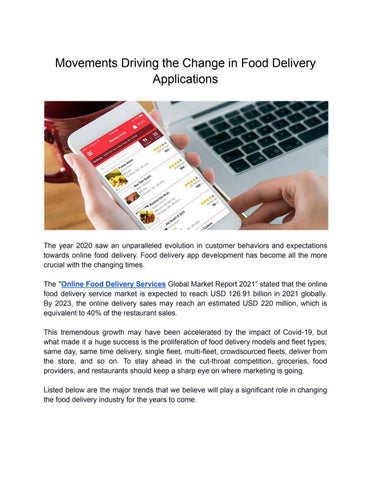
Movements Driving the Change in Food Delivery Applications
The year 2020 saw an unparalleled evolution in customer behaviors and expectations towards online food delivery. Food delivery app development has become all the more crucial with the changing times. The "Online Food Delivery Services Global Market Report 2021” stated that the online food delivery service market is expected to reach USD 126.91 billion in 2021 globally. By 2023, the online delivery sales may reach an estimated USD 220 million, which is equivalent to 40% of the restaurant sales. This tremendous growth may have been accelerated by the impact of Covid-19, but what made it a huge success is the proliferation of food delivery models and fleet types; same day, same time delivery, single fleet, multi-fleet, crowdsourced fleets, deliver from the store, and so on. To stay ahead in the cut-throat competition, groceries, food providers, and restaurants should keep a sharp eye on where marketing is going. Listed below are the major trends that we believe will play a significant role in changing the food delivery industry for the years to come.
Top 6 Food Delivery Industry Trends To Watch Out In 2021 ● ● ● ● ● ●
Increasing access to third-party delivery Using in-house delivery fleets Prioritizing the need for delivery management software Big tech companies embracing the food delivery industry The rapid rise in online grocery delivery Development of food delivery application
➔Increasing Access To Third-party Delivery This trend is expanding among restaurants and the grocery industries due to the high demand for prepared meal services. Instead of worrying about the delivery logistics, eateries are using third-party delivery providers. Food chains are constantly partnering with third-party to expand the customer reach, accessing all stores any time of the day. This way, they can focus on their core business of tossing out meals as soon as the orders start flowing in. Although it's a convenient strategy, restaurants and eateries have little control over the delivery operations. To overcome this hurdle, they are suing websites for food ordering and using DaaS providers for delivery. Food delivery app development helps eateries to connect better with their-party providers. It offers better control and visibility over the delivery operations, KPIs, and data generated with third-party.
➔Using In-house Delivery Fleets Some restaurants are very stubborn and resistant to using third-party providers for making food deliveries on time. They make use of a different and relatively radical approach - using in-house delivery fleets over third-party access. This concept is becoming quite popular in growing times. Food chain giants like Domino's and Jimmy John's have successfully been delivering through in-house fleets. According to the 36-year-old non-pizza chain, Jimmy John's has been able to shun third-party delivery by optimizing its ability to accommodate delivery.
Today Domino’s has partnered with a third-party for food delivery. However, bypassing the surge of third-party fleets, Domino’s has also been able to deliver directly to customers for over 60 years in a row now. The tide is, however, shifting towards third-party providers because of its benefits, as mentioned above. At scale, thousands of order deliveries flow in each day. With that in mind, logistics become increasingly complex. Hence shifting towards food delivery management software becomes more valuable.
➔Prioritizing The Need For Delivery Management Software With large food chains and thousands of deliveries per day, the logistics may seem unbearable to catch on. A significant part of the delivery flow remains in the hands of third parties. Hence, eateries are opting for data collection and analysis to understand the delivery operations better. As of 2019, the fast-food giant McDonald’s realized the importance of delivery management software. Since then, they are using it to track, measure, analyze and improve delivery operations. With that, the need for Food ordering app development has increased over time. Getting insights into their delivery operation is valuable. On the one hand, it benefits eateries by bettering relationships with aggregators and eternal fleets, offering unparalleled deliveries. On the other hand, it provides better marketing, branding, and customer care.
➔Big Tech Industry
Companies
Embracing
The
Food
The tech giants like Amazon and Google have entered the food industry. As in 2017, Amazon had bought whole foods to control the grocery market. Following its footsteps, Uber Eats has delivered groceries and restaurant meals through the Food delivery mobile application. Likewise, Google came into the market with innovations that allow consumers to order through Google Maps and Search Functions. The restaurants that participate in Google Maps can integrate their orders through maps and search results.
Today a higher percentage of food business revenue is invested in online sales and off-premise fulfillments. This movement is expected to break through with investments, marketplaces, and services from big tech companies.
➔The Rapid Rise In Food Delivery Subscriptions Increase in food delivery subscription in the U.S., the age range from the early 1980s to the mid-2000s is massively oriented towards the food delivery industry. The millennials are supposedly the first generation who would trade going out for staying at home. The food information council observed 55% of millennials prefer convenience over taste. Hence, the need to dine on customized meal kits delivered at their doorstep. Today, more consumers are interested in new cuisines, looking for vegan, gluten-free, paleo, organic, or ethically sourced foods. Therefore, the growth of specialized food continues.
➔Food Delivery Application Development Due to the Covid-19, Food delivery app development is higher in demand. With the government regulations, restaurants had to cut down on hours of operation. Being physically absent from restaurants and eateries has increased the need for ordering food online. Therefore, hire a professional food delivery app developer team to create more such apps to meet the increasing demand for food delivery apps. Apps allow customers to place online orders effortlessly. After that, their-part fleets take root to deliver the charges in a limited time. The applications allow users to track the delivery executives and the routes they take to deliver the order. Alongside, they can keep track of the time taken to make their orders.
To ConcludeThe convenience and comfort of getting food and groceries delivered through online orders are simply irresistible. With the present changes still making shifts in the food industry, the delivery initiatives will continue to dominate the future of online food delivery. At no point are the accelerated trends slowing down soon. So, to get started, you will need the help of a professional food delivery app development company that can
assist you in harnessing the power of these trends by incorporating unique features in your app and developing it as per the recent trends in food delivery.