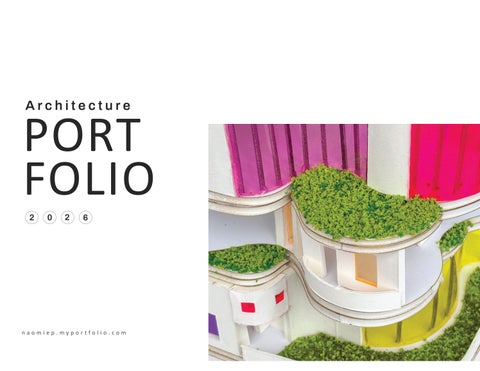
Architecture
PORT FOLIO 2
0
2
6
naomiep.myportfolio.com
Construc on Drawings Undergrad Precedent Study
Riverside Fieldhouse Ann Arbor Undergrad Studio 2
This project focuses on featuring accesiblility, visual and physical, within a building that is oriented with the natural topography of the chosen site. The blue concrete cas ng serves as a textural move to relect the river and contrast the greenery across the views surrounding the fieldhouse. Specific skylight cutouts renforce the curved language across the plan and provide space for moments of beauty and regula on.
Expression and Connec on Community Center Chicago, IL The Expression and Connec on Community Center aims to address a lack of third spaces, publicly designated ar s c expressive zones, and affordable transi onal housing for those aging out of the foster system and other inneed communi es. The center would priori ze spaces for invi ng social connec on from the street, educa on, crea on and inspira on, communal health and wellness, and privacy for residents. Taking inspira on from the Horseshoe Farms program, this program incorporates public ameni es that also serve as skill-building/teaching opportuni es, community-centered ac vity spaces, exhibi ons, and both indoor and outdoor gathering areas. Connec ons could be fostered through community engagement programs and a flexible use space that allows community members to customize according to their needs. w In a society that criminalizes certain types of public expression, such as graffi , third spaces for ar s c expression are becoming increasingly vital. I tackle this with a public access art studio, poten ally using recycled art materials and offering classes, as well as flowing organic sea ng surrounding a designated tagging wall embedded into the outdoor social space, drawing the public onto the site and encouraging explora on. Adjustable exhibi on and presenta on spaces provide flexible, community-centered spaces to suit the needs of the users.
Form Collages
Salvage Stops Detroit, MI
Detroit’s decline in housing and public transit systems can be traced to interconnected factors, including the automo ve industry’s influence on transit policy, redlining, and racist housing
APRIL 8, 1956
The
Detroit
THE HOME NEWSPAPER FOR MORE THAN 80 YEARS
News
Home Edition 34 PAGES
C
FIVE CENTS
Streetcar Discontinued Bus Transit Remains
prac ces. Redlining not only enforced segrega on but also promoted rela vely inexpensive
1863 - 1956
single-family housing in suburbia accessible to those who were white and working class, contribu ng to white flight from the city. This outward movement, paired with a lack of funding and rising costs for necessi es, weakened inner-city neighborhoods and le behind popula ons of primarily people of color and the elderly, facing higher housing prices, limited job access, and increasing economic instability. At the same
me, highways and bus lines replaced Detroit’s streetcar system, despite
community resistance, reflec ng a broader methodology of expanding the city outward rather than reinforcing its core. As described in The Derailment of Detroit, “Transit maintained connec vity to the urban center, which was weighed down by the burden of history. While cars traveled on a linear path away from this center, mass transit moved in a cyclical pa ern, always returning to the loca on of its past.” This shi from cyclical connec vity to linear escape made public transit incompa ble with suburban expansion, reinforcing car dependency and reshaping the city’s spa al logic. As infrastructure shi ed, Detroit’s built environment followed, producing pa erns of vacancy, APRIL 20, 2027
demoli on, and fragmented land use. In response, the design of a bus shelter constructed from salvaged materials is sited at the crossroads of former streetcar stops and areas with dense popula ons with limited access to transit, directly engaging the spa al memory of transit within the city. The shelter operates not only as a protec ve space, but as a memorial to the streetcar system and the circular connec vity it once provided. By reusing materials from demoli on cycles, the interven on reclaims fragments of the city’s past while addressing the present condi ons of exposure and disconnec on. The bus stop becomes both a site of memory and a tool for reestablishing connec on within a system long defined by separa on.
The Detroit News THE HOME NEWSPAPER FOR MORE THAN 120 YEARS
Home Edition 34 PAGES
C
New Bus Shelters Built From Salvage Community Builds Together
TWO DOLLARS
sh
Bru
Fredro St
St
t
rS
to Vic
r nte rpe Ca
St
St nt na Co
Detroit Population Density People per acre (2019)
30 - 40 20 - 30 Half Mile Access to Frequent Transit DDOT Transit Network DDOT Frequent Network (< 15 minutes) Chosen Sites New Bus Shelter Residential Structures Commercial Structures
t yS nle Ha
t tS nan Co
Greater than 40