Connie Cigarran, Friends of the NHA Representative
Gene Clapp
Michael Ericksen
Meg Jacobs Flax
Annabelle Fowlkes
Robert Greenspon
Connie Anne Harris
Ayesha Khan
Bill Liddle
Valerie Paley
Mary Read
William (Bill) Richards
Roberto Santamaria
Denise Saul, Friends of the NHA Representative
Janet Sherlund, Trustee Emerita
Melinda Sullivan
Jason Tilroe
Jim Waterbury
Ex Officio
Niles D. Parker, Gosnell Executive Director
HISTORIC NANTUCKET (ISSN 0439-2248) is published by the Nantucket Historical Association, 15 Broad Street, Nantucket, Massachusetts. Periodical postage paid at Nantucket, MA, and additional entry offices.
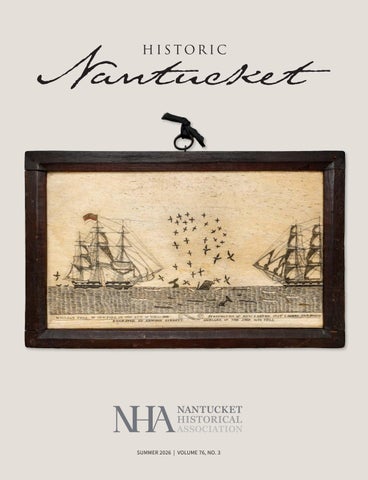
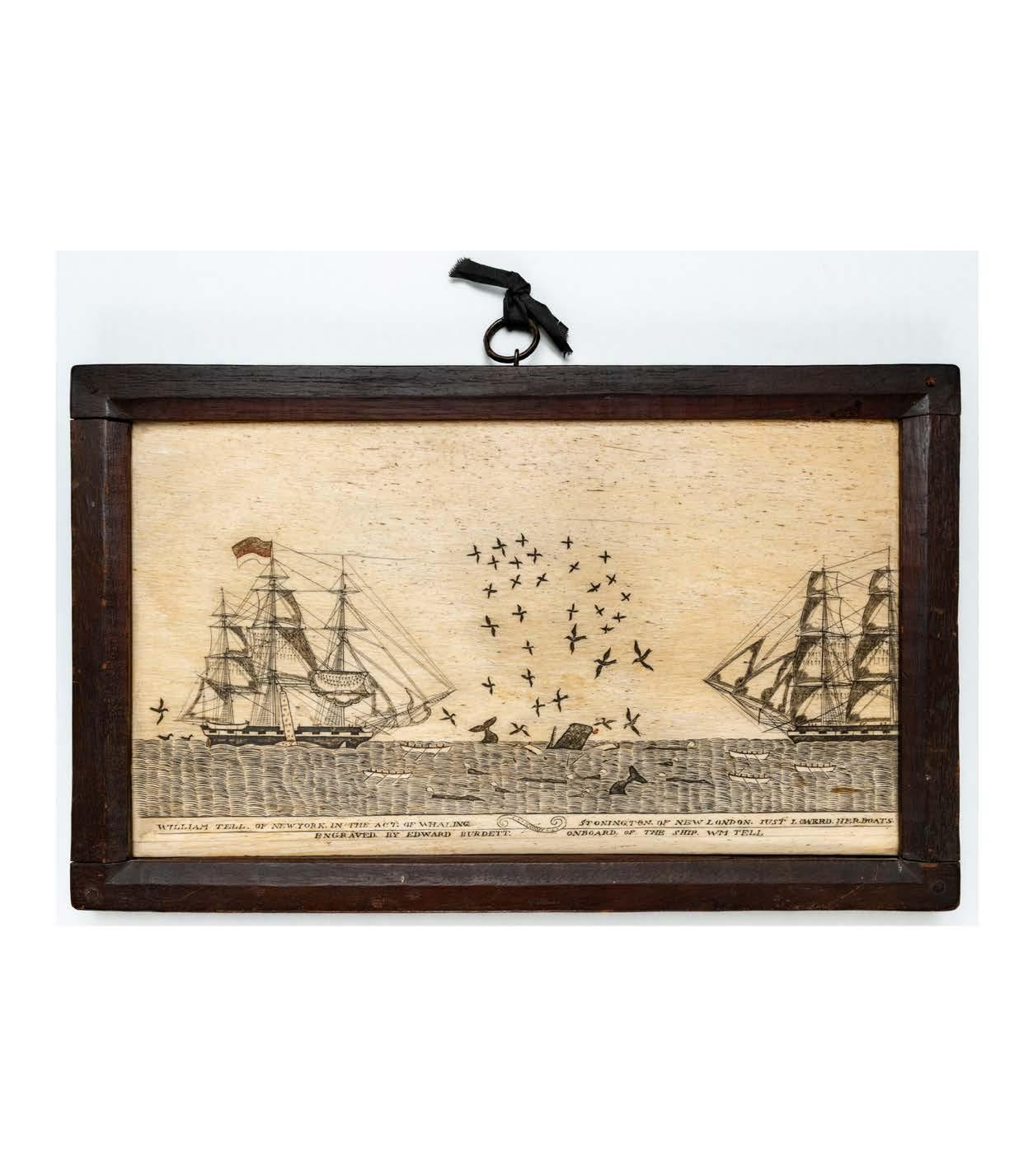
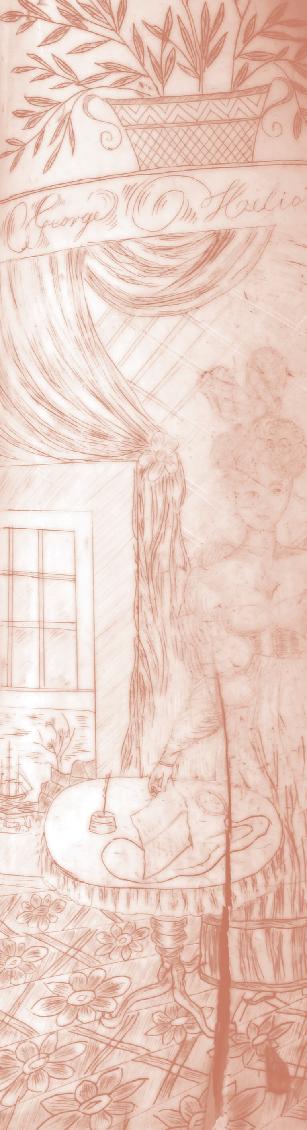
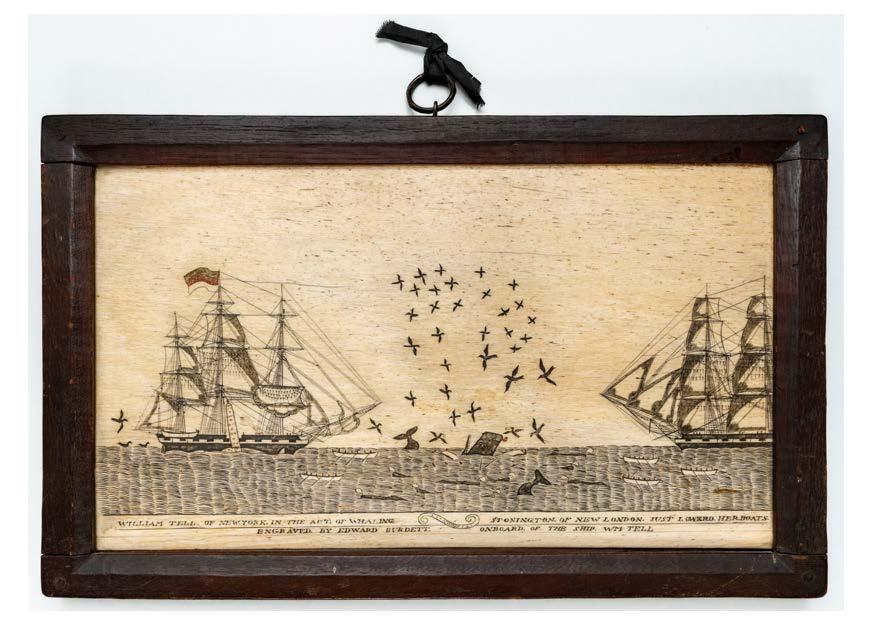
Cover: The William Tell / Stonington plaque by Edward Burdett. Read more about
The Height of the Summer
FROM THE BOARD PRESIDENT AND GOSNELL EXECUTIVE DIRECTOR
The summer season is upon us, and we want to highlight some of the many programs and initiatives which are underway. Your generosity and continued support enable us to preserve, celebrate, and share Nantucket history in exciting ways.
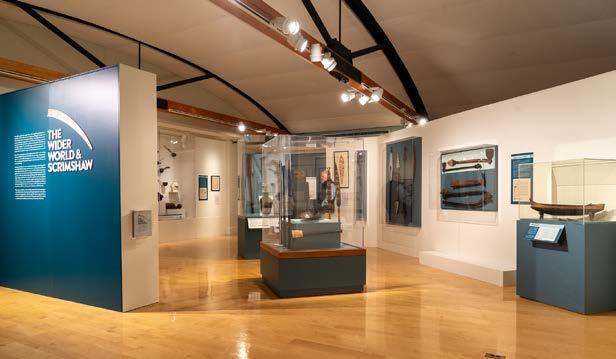
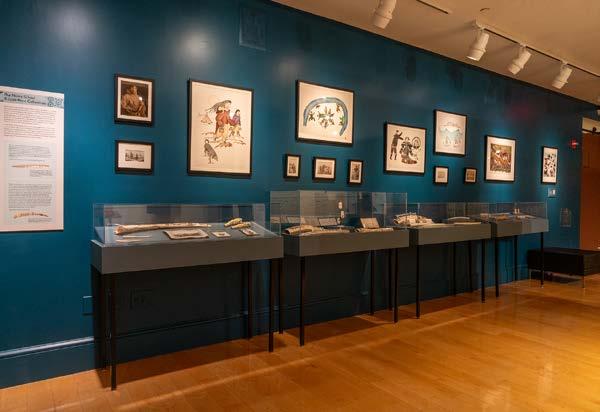
Our featured exhibition opened early for the season this past April. As the first venue to host the traveling exhibition The Wider World & Scrimshaw, organized by the New Bedford Whaling Museum, with support provided by Art Bridges, this exhibit showcases over 300 objects and sets scrimshaw—the folk art made by whalers from the body parts of whales—in conversation with carved decorative arts and material culture made by Indigenous community members from across Oceania, the Pacific, and the Arctic. We hope this early opening allowed many of you and our island community the chance to visit before the season was underway. If not, we encourage you to stop by while the exhibition is on display through November 1st, here at the Whaling Museum.
When you do stop in, make sure to see a brand-new addition to our collection now on display in the Arie L. Kopelman Gallery (and featured here on the cover of this issue): a masterwork scrimshaw plaque considered one of the best in the world. Read more about this incredible piece later in this issue. We thank the Friends of the NHA, the Hussey Family, and the many generous donors who joined them, for making this acquisition possible.
Our Learning, Engagement, and Experience team is ready to spend the day with you, not only serving up our daily offerings across our campus but also creating new programming and experiences. This includes an increased number of FREE lectures hosted at the Whaling Museum through the fall season. We invite you to join us and hear from the many featured speakers, including our research fellows and notable authors. If you're looking for something for the family, our core offering, Hands-on-History for young visitors, is thriving and available each week at our Whaling Museum Discovery Center, with new crafts directly tied to our exhibition. And we hope many of you will join us for our third annual Community Day on August 5th at Children’s Beach, where exhibition themes will be further explored.
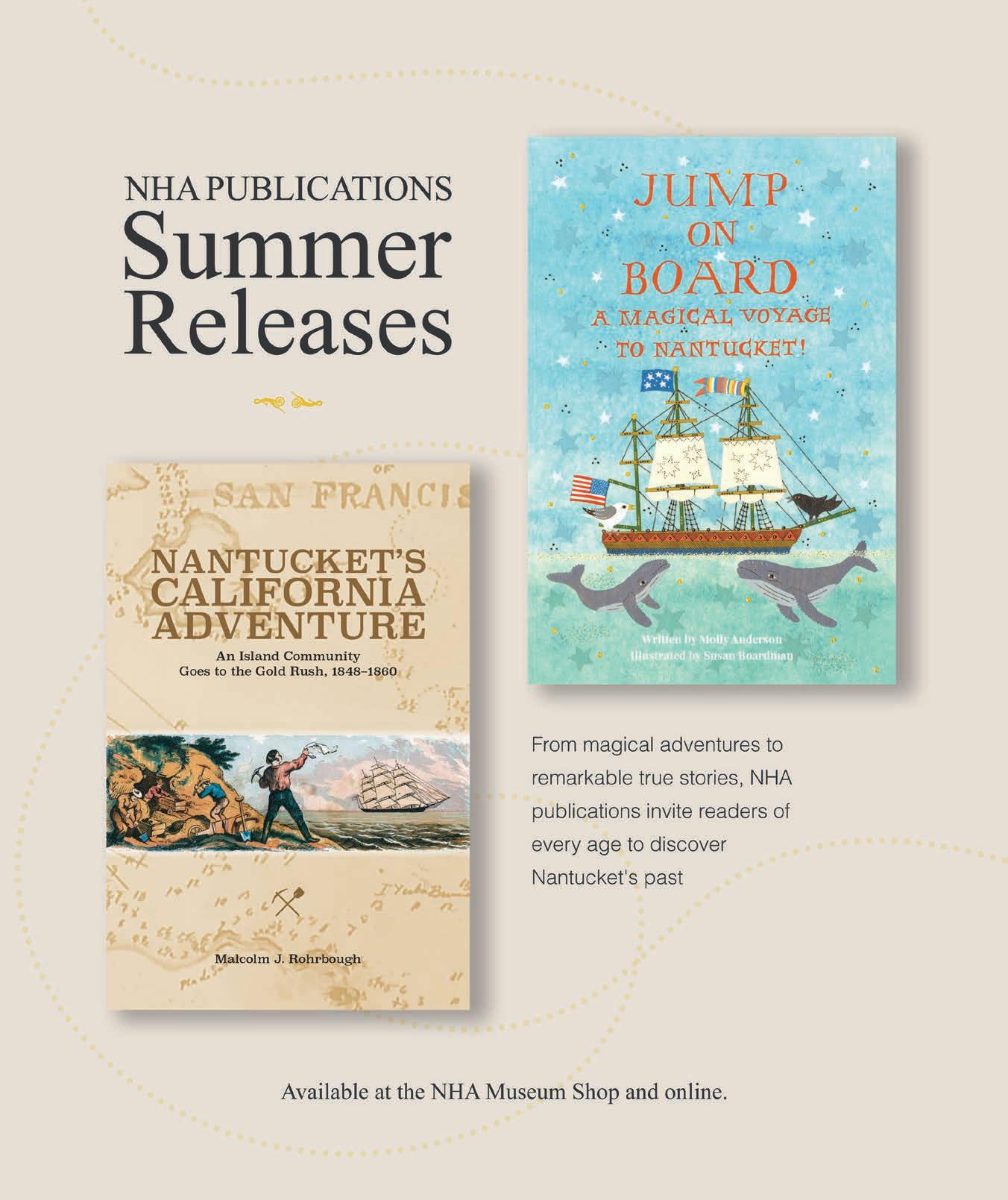
To sneak in a few more updates about this season, stop into the Museum Shop, as it highlights more locally made and crafted products, and our new NHA publications being released this summer hit the shelves! Pop into the1800 House and get hands-on with the many Heritage Craft classes we offer each week. Step outside and explore one of our historic sites open for the season and FREE to all visitors. History is at your fingertips!
We look forward to gathering with you, sharing these stories, and telling more of Nantucket’s history together. Thank you and Happy Summer!
Lucinda Ballard, President, Board of Trustees
Niles Parker, Gosnell Executive Director
Outgoing Trustees
Thank you for your support and commitment to the Nantucket Historical Association
Amanda Cross joined the NHA Board of Trustees in 2018 and has been a generous, deeply engaged supporter of the organization ever since. Passionate about stories of rights, race, and social history, she has contributed her leadership and expertise across numerous areas of the NHA, serving on the Development, Education & Interpretation, and Collections & Exhibitions Committees, and chairing the Diversity, Equity, and Inclusion Committee.
Amanda is particularly proud of the NHA’s commitment over the past decade to expanding access to its collections through digitization and online resources, making Nantucket’s history available to a broader and more diverse audience. Her philanthropy reflects her wide-ranging interests and dedication to the institution, supporting major campaigns, special events, exhibitions, membership, the Annual Fund, the NHA Scholarship Fund, and initiatives addressing climate change.
Through both her leadership and generosity, Amanda has helped advance the NHA’s mission and strengthen its future, leaving a lasting impact on the organization and the community it serves.
Sara Schwartz joined the NHA Board of Trustees in 2022 and quickly became a dynamic and influential leader within the organization. Throughout her tenure, she served as Clerk of the Board and as an active member of both the Executive Committee and the Audit & Risk Committee. As Chair of the Committee on Trustees & Governance, Sara played a pivotal role in strengthening the NHA’s governance practices, leading the search and appointment process for a new Board President and helping to identify and recruit talented trustees to guide the organization’s future. Drawing on her professional expertise, Sara and her law firm also provided invaluable support in updating key organizational documents, helping to ensure that the NHA’s policies and practices reflected the highest standards of governance and accountability. In addition to her leadership, Sara has been a generous supporter of the NHA through contributions to the Annual Fund, capital campaigns, membership, and special events. Her thoughtful leadership, professional expertise, and unwavering commitment have helped position the NHA for continued success in the years ahead.
Incoming Trustee
Welcome an exciting new board member to the Nantucket Historical Association
Patricia Rand Burnswas born and raised in NYC, where she graduated from The Brearley School and NYU with a BA in Art History and minors in French and German. Patricia has been coming to Nantucket since she was 7 and grew up first in the Tony Sarg house and then 14Orange Street (where her wedding reception was held) and now with her husband, Barrett, they reside in the jailers cottage of the Old Jail, so Nantucket history is part of her DNA. Patricia’s family loved restoring and collecting so weekly attendance at Parke-Bernet/Sotheby’s auctions was a family ritual. By profession she is a “nose”, having trained at Roure Bertrand DuPont and then going on to be Director of Fragrance Product Development for the Estee Lauder Companies. Among her creations are White Linen and Beautiful. Patricia and Barrett have lived in NYC, Houston, Phoenix, San Francisco, Bloomfield Hills, MI and currently reside in Greenwich, Ct.
Voluntarism has always played a significant role wherever they landed with the Junior League leading the way in every city along with being a member of the AJLI governance committee. Patricia has been a docent at Bayou Bend in Houston, Chairman of the Phoenix Art Museum Antique Show, a member of the Learning Differences in the Workplace board at the Ford Motor Company in Dearborn, MI. In Greenwich, Patricia has been Sustainer Chair of the Greenwich Junior League, Co- Chair of Fund Development for the Greenwich Red Cross board, Chair of the Breast Cancer Alliance Luncheon, a member of the United Way of Greenwich Board where she co- chaired the Annual Campaign and was a founding member of the United Sole Sisters. Patricia has been a board member of The Nathanial Witherell, a town owned skilled nursing facility, establishing their 501(c)3, and Chair of the Commission on Aging for nine years, overseeing two town departments as a volunteer. Patricia has also been PTA chair of the Hopi School in Phoenix and The Parkway School in Greenwich and Board President of The Woodhall School in Bethlehem, CT. Patricia is currently a member of the Acquisitions and Exhibitions Committee of the NHA and looks forward to deepening her knowledge of Nantucket.
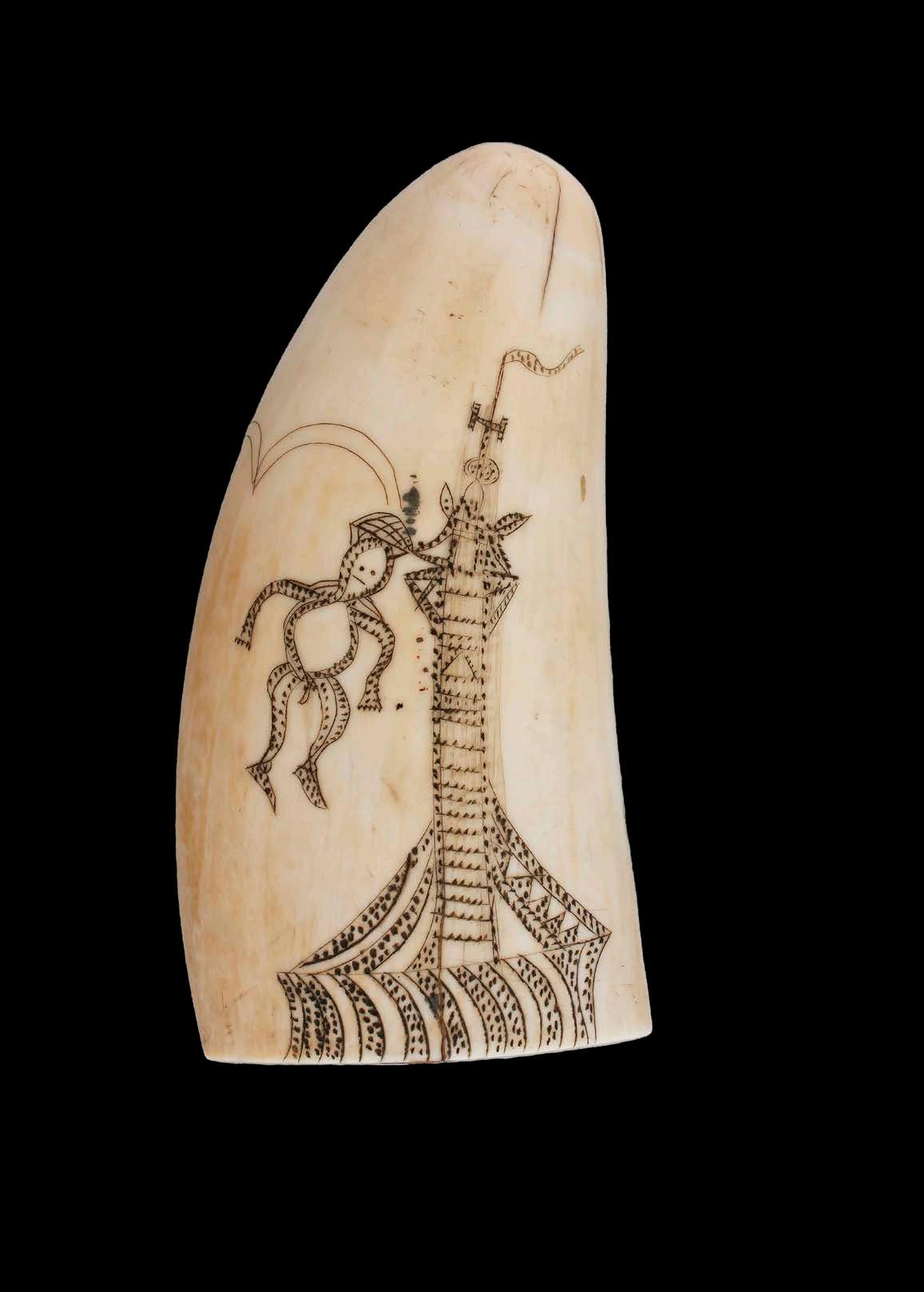
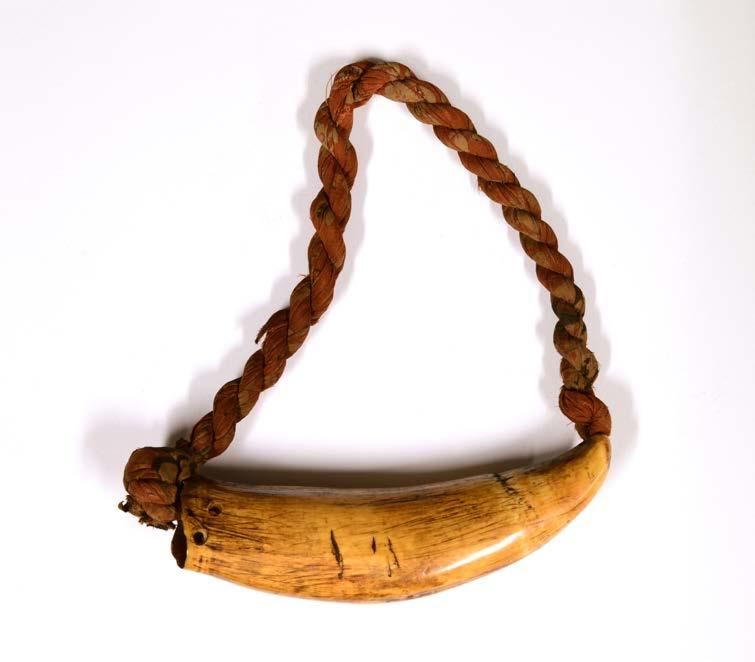
Aboriginal maker once known (Aboriginal Australian, possibly Eden) Dreamtime tooth (back), 1800s
Engraved sperm whale ivory, 2 5/8 x 5 1/4 in.
New Bedford Whaling Museum, 00.195.47
THE WIDER WORLD & SCRIMSHAW
The Wider World & Scrimshaw was organized by the New Bedford Whaling Museum, New Bedford, Massachusetts.
This exhibition was curated by Naomi Slipp, Douglas and Cynthia Crocker Endowed Chair for Chief Curator, with valuable curatorial support from Melanie Correia, Associate Curator of Collections & Exhibitions, and Ymelda Rivera Laxton, Assistant Curator of Contemporary Art & Community Projects, and in partnership with an exhibition Advisory Board and dozens of international scholars, artists, and culture bearers. We are grateful for their collaboration.
Generous support provided by
The Nantucket Historical Association’s Whaling Museum is the first venue to host the traveling exhibition The Wider World & Scrimshaw, organized by the New Bedford Whaling Museum with support provided by Art Bridges. Surveying carving traditions that emerged along whaling routes in the Pacific world, the exhibition showcases over 300 objects and sets scrimshaw—the folk art made by whalers on the body parts of whales—in conversation with carved decorative arts and material culture made by Indigenous community members from across Oceania, the Pacific, and the Arctic.
The Wider World & Scrimshaw was organized in consultation with a diverse advisory board of artists, scholars, and culture bearers, and foregrounds the work of Native communities across the Pacific world, many of whom have cosmologies related to whales, distinctive maritime traditions involving marine mammals, and vibrant carving styles. It also explores how Native communities in the Pacific and Arctic were impacted by commercial whaling ventures in the 1800s and the external pressures of colonialism and Western empire-building. Engaging in questions about identity, place, and material, The Wider World & Scrimshaw considers the impact of exploration and whaling on the production of material culture in the Pacific world between 1700 and today.
The following photo essay is adapted from the exhibition script for The Wider World & Scrimshaw. Object photography is shared courtesy of the New Bedford Whaling Museum and installation photography is provided by Sara Williams for the NHA. Exhibition design is by Helen Riegle, HER Design, and Kurt Weidman.
SETTING THE STAGE
Starting in the 1830s, diverse communities came into contact as US whaling vessels traversed the Pacific to extract natural resources, including hunting toothed and baleen whales, seals, walrus, and other marine animals. This extractive economy drove global exploration and trade, decimated indigenous species, forced settler colonial agendas, and affected cultural exchange and adaptation. US whaleships stopped at regular locations within this vast territory. They established colonies, shore whaling stations, and trade networks, and picked up supplies, materials, and crew.
Who made up the crew of US whaleships? Where did the vessels go? What knowledge did US settlers have about Indigenous communities? Introductory items in the exhibition speak to the diversity of whaling crews, their global range, and general knowledge people had about tribal territories.
WHAT IS “SETTLER COLONIALISM”?
Settler colonialism is an ongoing system of power that perpetuates the repression and genocide of Indigenous people and cultures. It normalizes the occupation and exploitation of land and resources to which Indigenous people have genealogical relationships. It includes interlocking forms of oppression, like racism, white supremacy, heteropatriarchy, and capitalism. While traditional colonialism is similar, settler colonialism focuses specifically on the removal of Indigenous people from their historical lands. Whalers, merchants, and missionaries participated in colonizing the Pacific world. Through their actions, they facilitated settler colonialism in these regions. They might not, however, always have been aware of the individual roles they played. Systems of power, like settler colonialism, are much more complex than one person or instance. They also continue into the present in myriad ways.
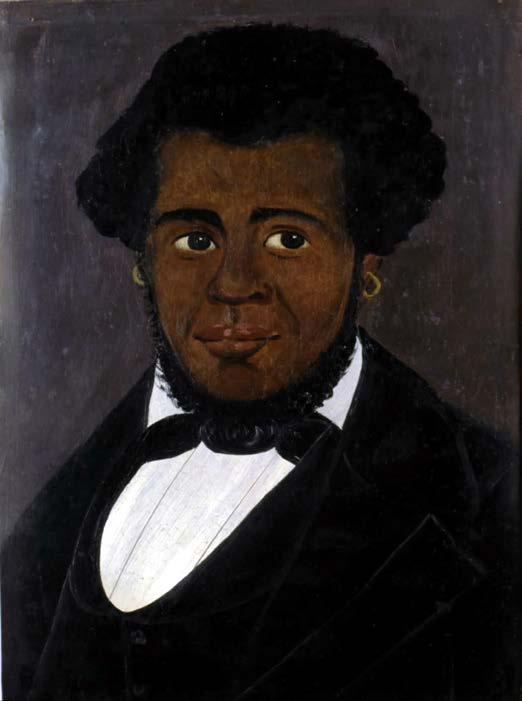
Above: US whaling vessels were very diverse. Crews included Black men (free and formerly enslaved), Native Americans, immigrants to New England, Azoreans and Cape Verdeans, US-born and European-descended men, and Pacific Islanders. Seen here is Captain Absalom F. Boston (1785–1855), a leading figure in Nantucket’s Black community in the first half of the nineteenth century. Boston commanded the island’s first all-Black whaling crew when he took the schooner Industry out to the Cape Verde Islands in 1822. The voyage built on experiences Boston gained on the Lydia (1808–9), Thomas (1809–11), and Independence (1817–19).
Prior-Hamblin School artist once known
Portrait of Captain Absalom F. Boston (1785–1855), ca. 1835 Oil on board, 16 1/4 x 12 1/8 x 3/4 in. Nantucket Historical Association, Gift of Sampson D. Pompey, 1906.56.1
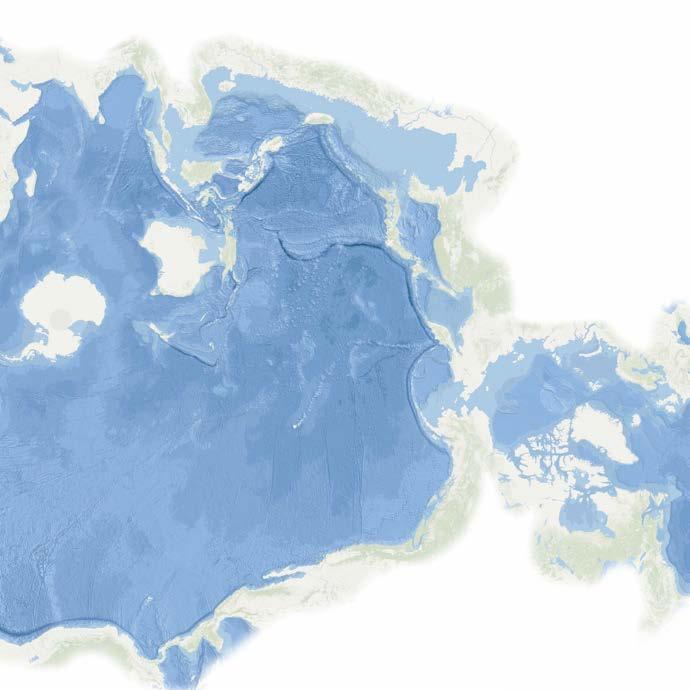
Spilhaus Projection (right):
South African-American geophysicist and oceanographer
Dr. Athelstan F. Spilhaus (1911–1998) developed a seawater-focused map of Earth in 1942. Known as the Spilhaus Projection, this map allows us to see the world ocean as one big, contiguous body of seawater.
(Map: Esri, GEBCO, NOAA, Garmin, and other contributors).
WATERCRAFT
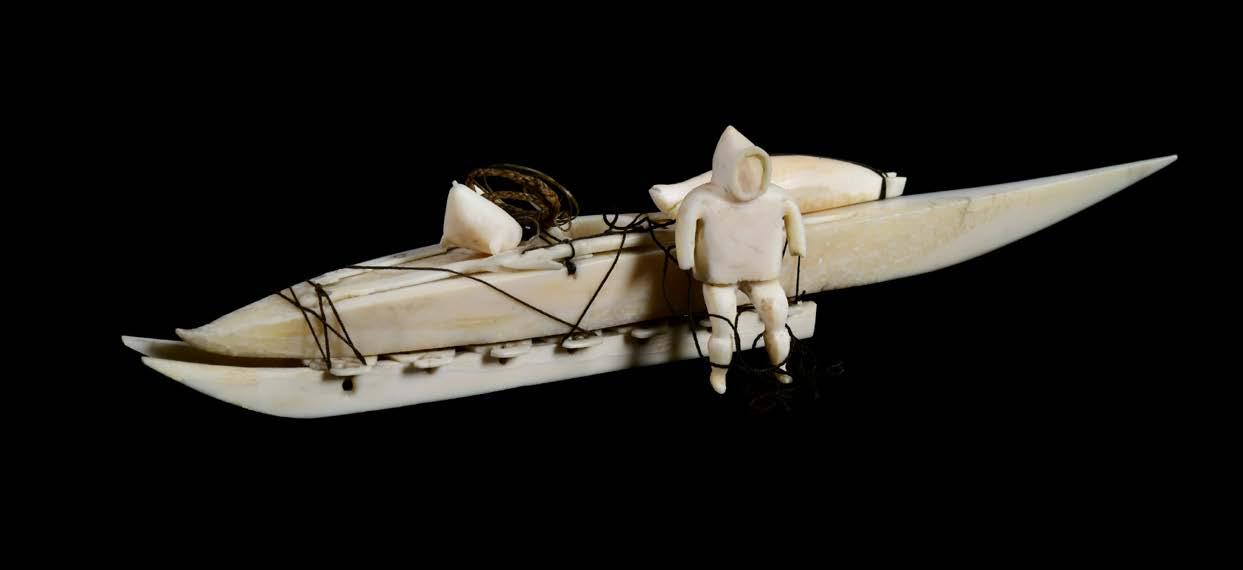
The communities represented in The Wider World & Scrimshaw are all seafaring cultures of the Pacific world. The exhibition includes model boats from New England, Inuit Nunaat, Iñupiat territories, Kuki ‘Āirani (the Cook Islands), Yakutat and Tlingit lands, Hawai‘i, and Niue, which underscore how the sea sustains and brings these maritime cultures together.
Arctic maker once known (Inuit Nunaat) Model qajaq on sledge with driver, ca. 1900 Walrus ivory, seal gut, sinew, and thread, 1 1/4 x 3/4 x 7 3/8 in.
New Bedford Whaling Museum, 2001.100.1865
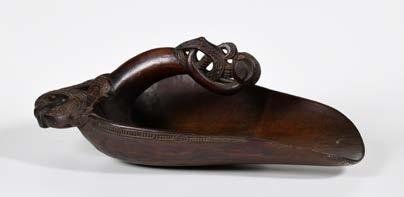
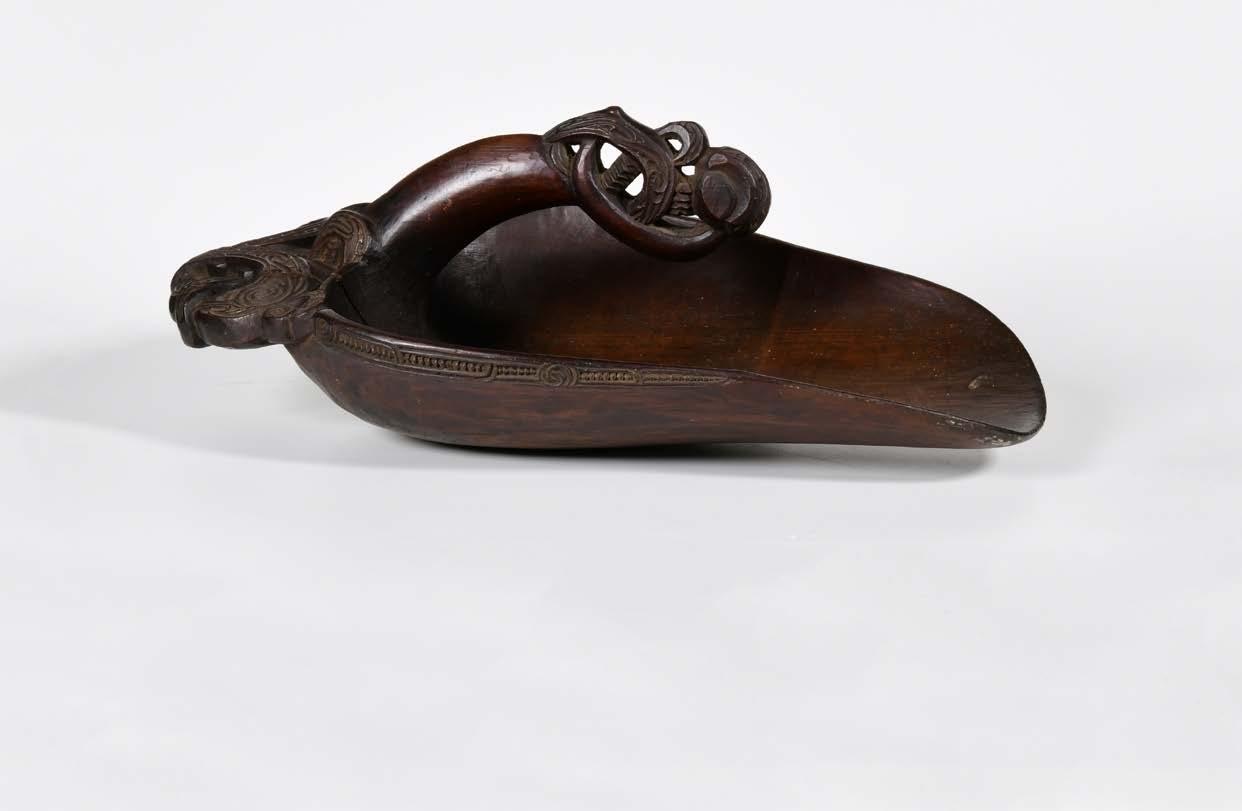
“ TATĀ IS A MĀORI WORD THAT MEANS TO BAIL WATER OUT OF A WAKA (CANOE). IT IS ALSO USED TO DESCRIBE A CANOE BAILER. TATĀ OFTEN FEATURE ORNATE WHAKAIRO (CARVING), SIGNIFYING HIGH STATUS TAONGA (TREASURES). THIS EXAMPLE HAS A WHAKAIRO ON THE HANDLE, WHICH TAKES THE FORM OF A STYLIZED MANAIA FIGURE. SUCH CARVINGS OFTEN EMBODY TĪPUNA (AN ANCESTOR) ADDING MANA (PRESTIGE) TO THE TATĀ. TOTARA WOOD IS STRAIGHT-GRAINED AND DURABLE, AND RED, THE COLOR ASSOCIATED WITH RANGATIRATANGA (CHIEFLY LEADERSHIP). FUNCTIONALLY, TATĀ ARE USED TO SAVE PEOPLE FROM PERIL ON THE OCEAN.”
—ANGELA WANHALLA, UNIVERSITY OF OTAGO
PADDLES, WANDS, & CLUBS
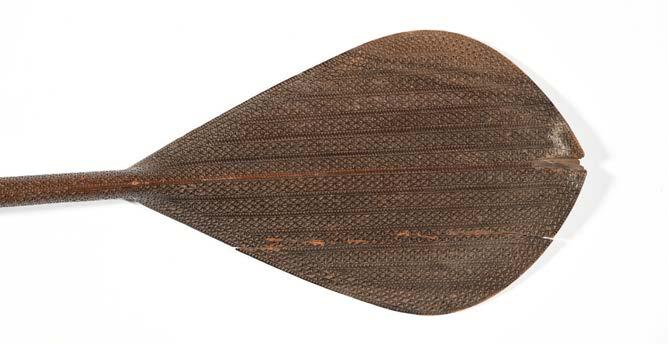
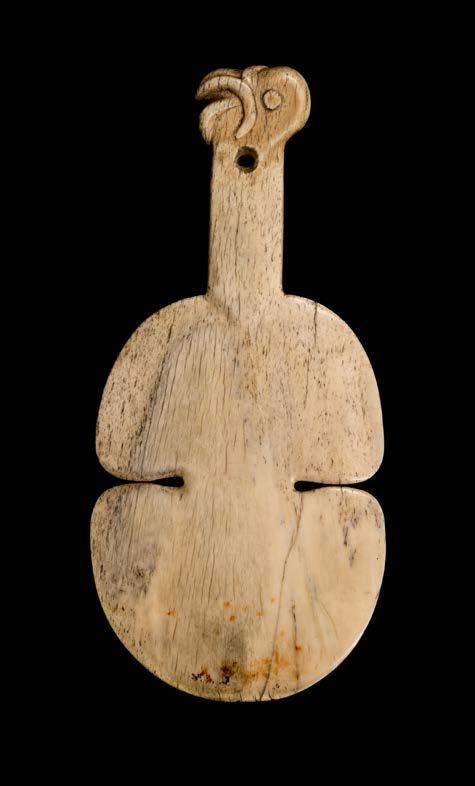
There are about 25,000 islands in the Pacific Ocean. Each is distinctive. Oceanic carvings like paddles, clubs, and dance wands were made from wood and whalebone for ceremonial and utilitarian purposes along seafaring routes in the Pacific. Examples in the exhibition from Papua New Guinea, the Solomon, Austral, Marshall, and Gilbert Islands, Tonga, Fiji, and Kiribati, among others, illuminate traditional carved forms and techniques.
Hundreds of thousands of items like these were collected in the 1800s by American and European mariners, traders, whalers, and settlers, and later by generations of museum curators. The vast majority are in US and European museums where they are treated as ethnographic objects, prized for their formal qualities and utility, and framed as representative of cultural differences.
This cultural heritage ties descendent communities to their land, water, and traditions. Such items are of profound importance for Islanders today, who aim to reconnect with displaced heritage and continue ancestral traditions and artforms despite historical disruption and harm.
Austral Island maker once known (possibly Ra‘ivāvae, Austral Islands) Ceremonial paddle, ca. 1825 Wood, 8 1/4 x 38 3/4 in. New Bedford Whaling Museum, 1975.11
Māori maker once known (Aotearoa) Tatā (canoe bailer), 1800s Wood, 7 1/4 x 11 1/2 x 19 1/2 in. New Bedford Whaling Museum, 00.200.735
THE COCONUT AS COSMOLOGY
Ni (coconut tree) is essential to the economies and cultures of Moana Oceania. It is called the “tree of life,” “tree of heaven,” and “tree of abundance,” and every part has a use. The nut can be eaten, carved, pressed into oil, scraped for cream, and used as a vessel, or as fuel. The husks become coir for ropes and mats, or sennit for twine. The water is drunk or processed into milk. The leaves become roof thatch or baskets. The trunk is for building. The sap is fermented into wine. The juice creates sugar.
Coconuts will float long distances and still be viable. Landing on a new shore after a hundred days at sea, a coconut will grow into a tree. Because of this, the coconut is an apt metaphor for the adaptability of Pacific communities, who journeyed between island chains for millennia. The Pacific diaspora changed in the 1800s, as imperialism and colonialism impacted island nations in different ways. US and European militarism (including testing and defense), foreign investment, corporate interests, and environmental degradation negatively impacted many islands communities. Today, climate change is the largest threat to the region.
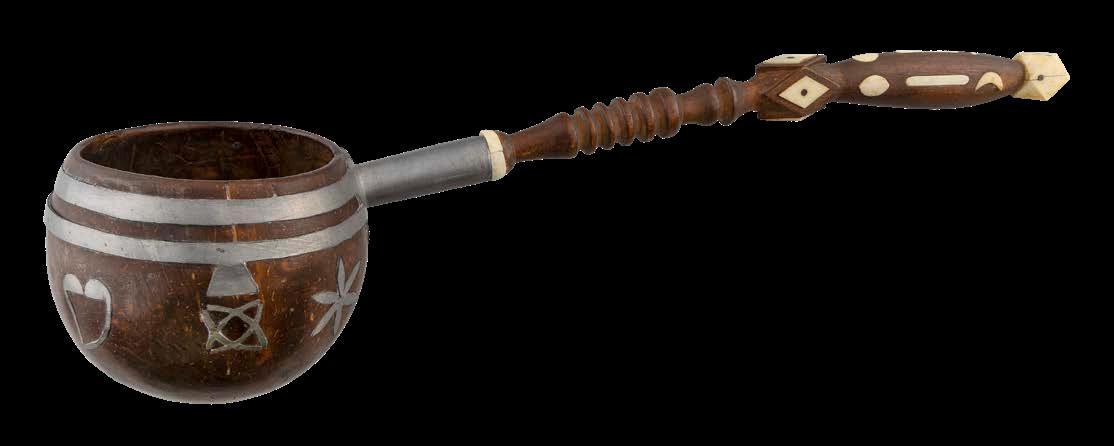
introduced to the Caribbean and Americas around 1500. Coconut dippers were ubiquitous across the United States in the 1800s, where they were used for communal water drinking in domestic and industrial settings. Coconut dippers were simple: half a coconut shell attached to a handle. Their construction and materials varied widely. Dippers in this section are made from coconut, walrus, whale, and elephant ivory, whalebone, abalone, tortoiseshell, rare woods, baleen, copper, and silver. Made by whalers, sailors, Iñupiaq, and Pacific Islanders, dippers illuminate global histories of colonialism, maritime trade, and imperialist projects. They vividly showcase the global circulation of natural materials in the 1800s.
Maker once known
Coconut shell dipper, 1800s
Coconut shell, pewter, wood, and walrus ivory, 4 3/8 x 17 in.
New Bedford Whaling Museum, 2001.100.725
CONTAINERS
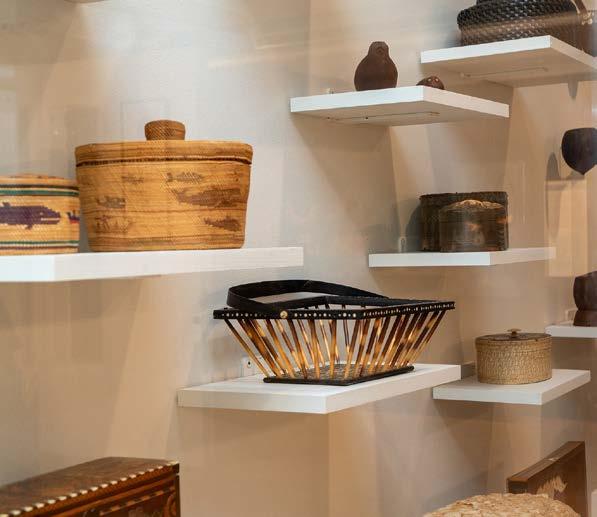
Work baskets, storage containers, and sewing or ditty boxes accommodate personal belongings, like needles, thread, and soap. Some of the works in the exhibition were made by Pacific Islander, Azorean, and New England whalers on shipboard, others were crafted by Iñupiat, Makah, and Native Alaskan makers. The diverse materials used in their construction include whale or walrus ivory, panbone, baleen, cedar wood, abalone, mother-of-pearl, tropical hardwoods, ebony, tortoise shell, grasses, and in one case, African porcupine quills. Some are inlaid with whimsical decorations, carved, or fancifully incised. Others are made of pierced fret or latticework. These varied containers demonstrate a transoceanic exchange of forms and materials during periods of intense pressure and adaptation.
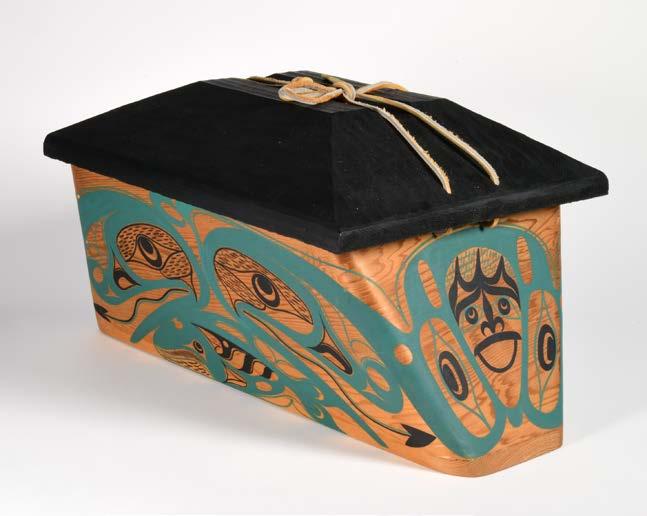
“ ART (TSA QWA SUPP) THOMPSON WAS BORN IN THE DITIDAHT VILLAGE IN WHYAC. HE WAS BOTH OF NUU-CHAH-NULTH AND COAST SALISH ROOTS. THOMPSON DEVELOPED HIS ART FORM AND CRAFT OVER DECADES, STUDYING WITH NUU-CHAH-NULTH ARTISTS RON HAMILTON AND JOE DAVID, AND WORKING WITH CARVER DUANE PASCO. HE WAS PART OF A GROUP OF CONTEMPORARY ARTISTS WHO GROUNDED THEIR WORK WITHIN THEIR CULTURE AND CULTIVATED THE POPULAR APPEAL OF NATIVE NORTHWEST COAST ART TO BROADER AUDIENCES IN PRINTMAKING AND BEYOND.”
—YMELDA RIVERA LAXTON, NEW BEDFORD WHALING MUSEUM
Above left:
Art Thompson (Tsa qwa sup) (Nuu-chah-nulth, 1948–2003)
Bentwood box, 1992. Cedar, leather, and paint, 10 1/4 x 18 1/8 x 11 1/4 in. New Bedford Whaling Museum, 2001.100.3433.
Above right:
Installation view of varied containers.
Right page top:
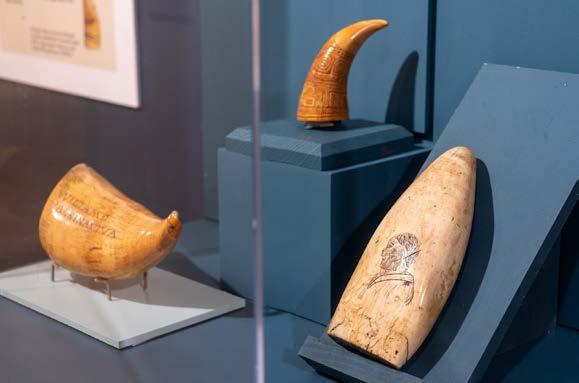
Installation view of “Sperm Whale Teeth” section. L-R: Memorial tabua (ceremonial whale tooth) from Fiji, tooth carved in emulation of Enata designs, and tooth with an image of an individual identified as “A New Zealand / Chief.”
SPERM WHALE TEETH
Sperm whales have about forty-six teeth, which were prized for scrimshaw. After being extracted from the whale’s mouth, the teeth were scraped smooth and polished. Crewmen kept, traded, or decorated them as personal souvenirs or gifts. They made designs freehand or with a template. Artists copied popular visual culture from magazines; others pictured what they saw at sea. Engraved whale teeth are considered an iconic scrimshander’s artform and the pinnacle of whaling art. Taken together, the teeth included in the exhibition demonstrate how whalers traveled across the Pacific, highlight individual exploits or identities, and — in their material form — remind us of the life and death of a whale.
“ IN THE 1800S, SPERM WHALE TEETH OR TABUA PLAYED A MAJOR ROLE IN EXCHANGES BETWEEN INDIGENOUS PEOPLE AND FOREIGNERS IN FIJI. FOR FIJIANS, TABUA WERE (AND STILL ARE) A SUPREME SYMBOL OF RESPECT, DEFERENCE, AND LOYALTY. THEIR CEREMONIAL PRESENTATION SIGNIFIES ALLIANCE AND THE SUBMISSION OF ONE INDIVIDUAL OR GROUP TO ANOTHER. AS A TESTAMENT TO ITS VALUE, THIS ESPECIALLY LARGE TOOTH WAS SMOKED AND POLISHED WITH OIL TO ACHIEVE A RICH PATINA. THE NAME WILLIAM E BALEINASUVA WAS CARVED INTO ITS SURFACE . . . . WHALE TEETH WERE EXTREMELY RARE IN FIJI PRIOR TO SUSTAINED WESTERN CONTACT, WHICH BEGAN AROUND 1800 WHEN MERCHANTS STARTED FREQUENTING THE ARCHIPELAGO TO ACQUIRE SANDALWOOD AND SEA CUCUMBER FOR THE CHINA TRADE. TO SECURE THESE GOODS AS WELL AS THE INDIGENOUS LABOR FOR THEIR PROCESSING, MERCHANTS IMPORTED A STEADY SUPPLY OF WHALE TEETH SOURCED FROM THE THEN-EXPANDING EURO-AMERICAN WHALING INDUSTRY, WHICH CONSIDERED THEM A WASTE PRODUCT. . . . FIJIAN CHIEFS WHO ENGAGED IN FOREIGN TRADE GAINED CONSIDERABLE POWER IN LOCAL POLITICS. FOR MORE THAN A CENTURY, WHALE TEETH WERE BOTH AN INSTRUMENT OF COLONIAL EXPLOITATION AND OF INDIGENOUS AGENCY IN FIJI.”
—MAGGIE CAO, UNIVERSITY OF NORTH CAROLINA-CHAPEL HILL
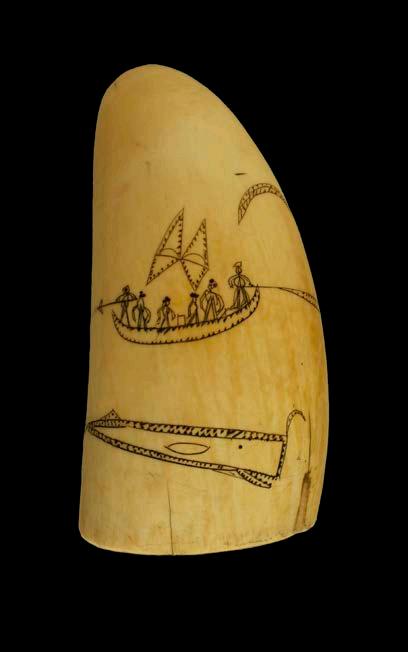
Left: The “Dream Tooth” was likely executed by an Australian Aboriginal whaler, perhaps from Eden, an area on the South Coast of New South Wales. Whaling ships operated around Eden starting in 1791, and the first shore whaling venture founded in 1828 employed local Thawa Aboriginal people. The tooth pictures six men sailing a proa (boat). One wields a harpoon. A sperm whale lurks beneath.
Aboriginal maker once known (Aboriginal Australian, possibly Eden)
Dreamtime tooth (front), 1800s
Engraved sperm whale ivory, 2 5/8 x 5 1/4 in.
New Bedford Whaling Museum, 00.195.47
SEXUALITY & GENDER
Sailors made domestic objects as gifts for their mothers, wives, sisters, daughters, or for trade. They made elaborate canes from narwhal tusk and whale ivory. They also made jagging wheels, or pie crimpers, in elaborate shapes that included materials acquired at sea, like abalone, ebony, tortoise shell, and the bones, teeth, and baleen of marine mammals. These artifacts supported the domestic comforts of home and labor mostly embodied by women. Such items could take hundreds of hours to make and are a reminder of the purpose of scrimshaw: to fill the time, keep hands busy, and dilute boredom. The manufacture of such objects also suggests how absent women, their bodies, and the intimacy of physical connection occupied an imaginary space on shipboard.
“ IN MOANA OCEANIA, WHALES ARE REVERED WITHIN NETWORKS OF FAMILIAL AND CULTURAL CONNECTION AND CELEBRATED THROUGH FORMS OF EXPRESSION, INCLUDING CARVINGS, SONGS, AND SPOKEN NARRATIVES. THESE EXPRESSIONS HONOR TIES OF KINSHIP AND AFFINITY, SPANNING GENERATIONS OF WHALES AND PEOPLE, AND CONNECTING ANCESTORS AND ATUA (POLYNESIAN GODS) TO THE PRESENT DAY. THE COMMERCIAL WHALING PERIOD WAS A BRIEF, ALBEIT DEVASTATING, INTRUSION INTO THIS ENDURING TRADITION; THE IMPORTANCE OF WHALES TO MOANA OCEANIA COMMUNITIES PERSISTS ACROSS THE EXPANSE OF TIME AND OCEAN.”
—BILLIE LYTHBERG, UNIVERSITY OF AUCKLAND
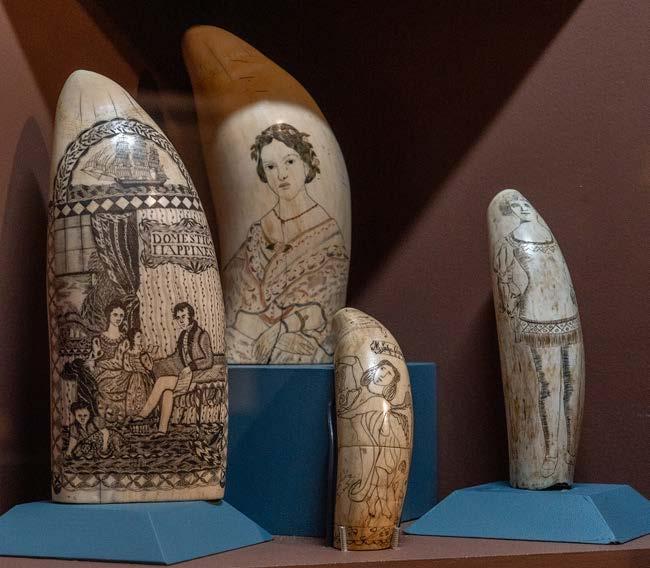
Installation view of exhibition objects in the “Sexuality & Gender” section.
L-R: Domestic happiness tooth, Lady in a serpent bracelet, John Boston booth, and tooth possibly depicting Ellen “Nellie” Farren (1848—1904).
WHALE COSMOLOGIES
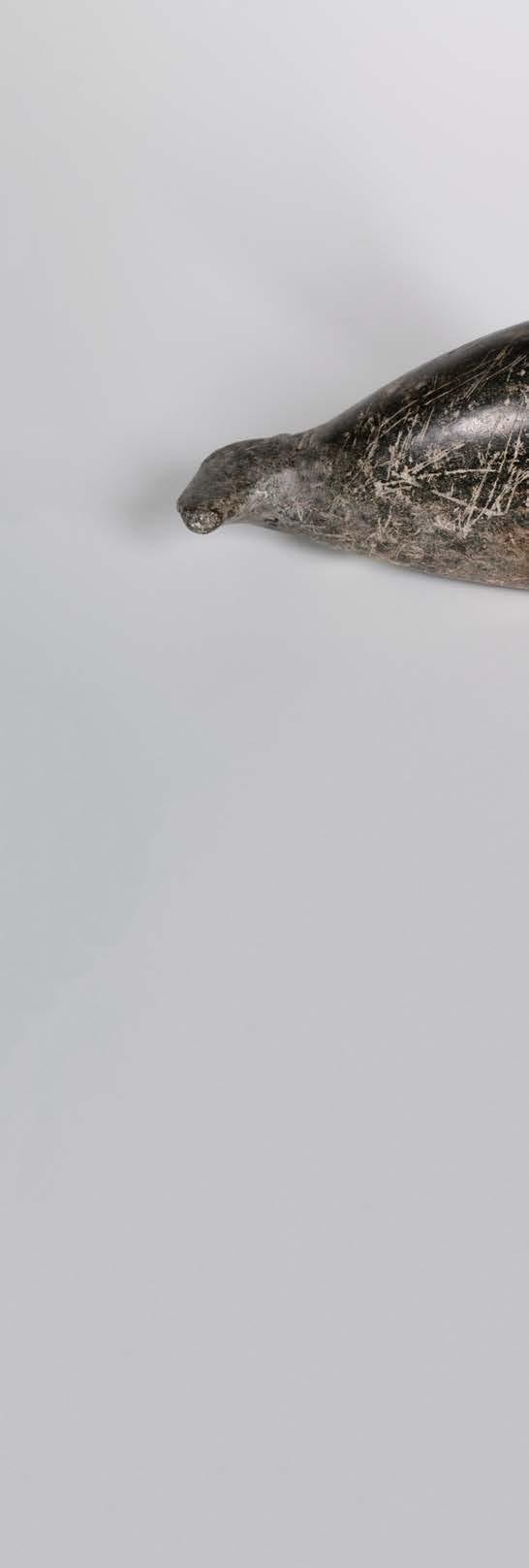
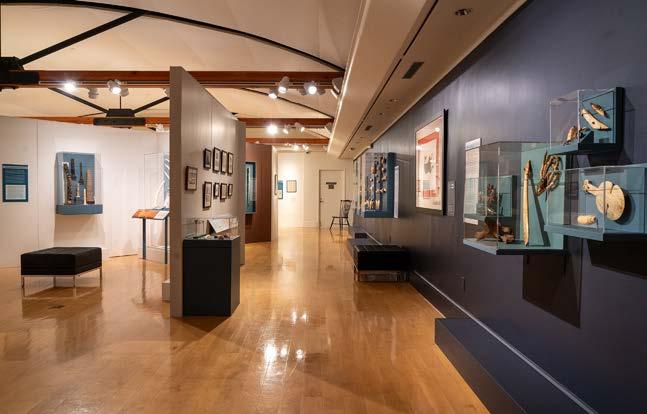
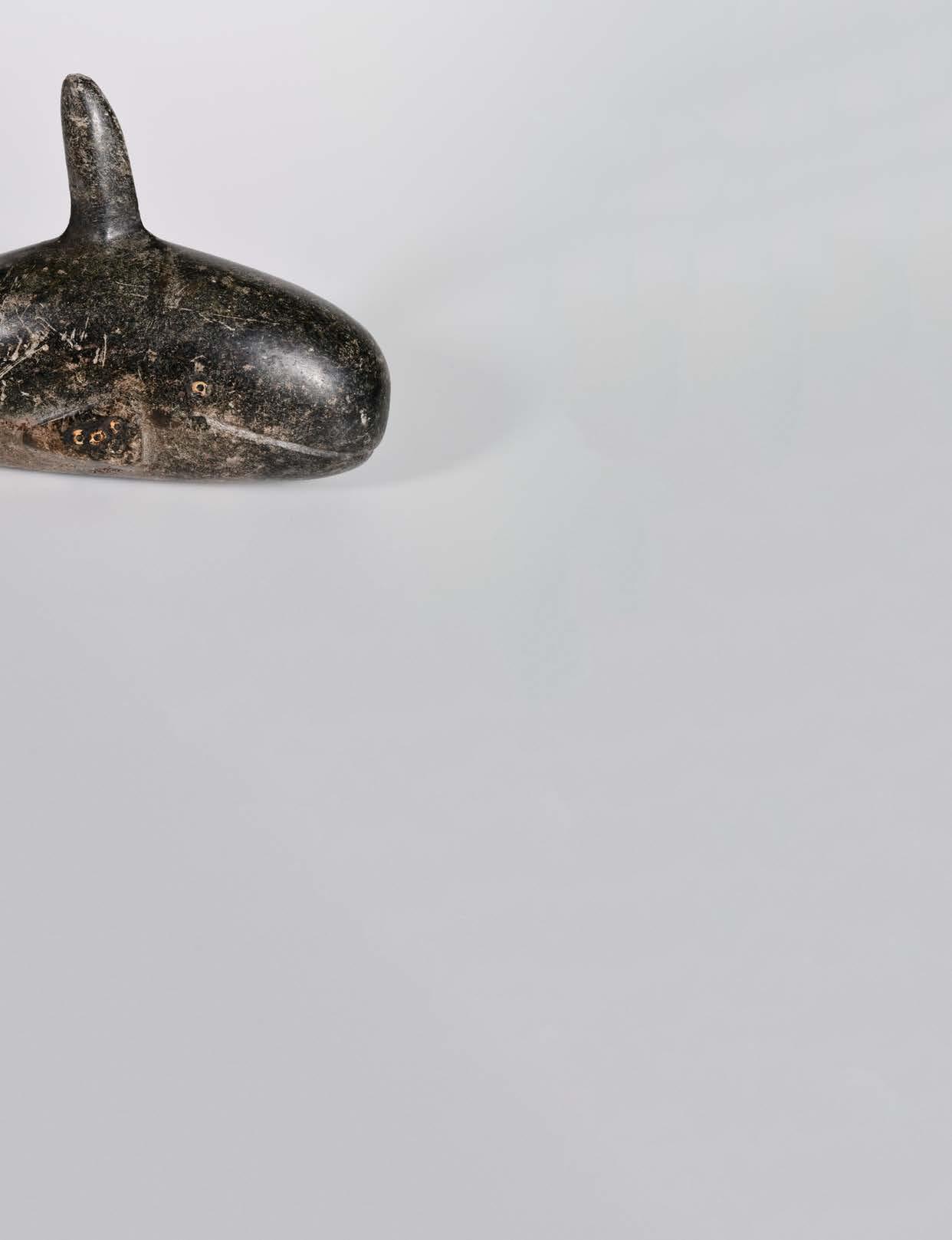
Whale people are communities who are closely connected to whales through ancestral kinship relationships. Often, oral stories about whales are passed down through the generations. Located at the spatial and theoretical heart of the exhibition, this section underscores the import of marine mammals for diverse cultural groups across the Pacific world. Work by contemporary artists, storytelling, and cultural belongings, such as the Chumash whale carving and Māori Kotiate parāoa seen here, underscore the interconnectedness of whales to the lifeways and cosmologies of Native communities and demonstrate how whales remain part of Indigenous life in the Pacific world. They also evoke the presence of thousands of whale ancestors. THE WIDER WORLD & SCRIMSHAW
Top: Chumash maker once known (Chumash)
Whale effigy, ca. 1500–1700
Soapstone (steatite) and clamshell beads, 5 x 2 1/2 x 8 3/8 in.
New Bedford Whaling Museum, 2001.100.1962
Left: Māori maker once known (Aotearoa)
Kotiate parāoa (short-edged weapon), late 1700s to early 1800s
Whale skeletal bone, 6 x 12 3/4 in.
New Bedford Whaling Museum, 2001.100.2282
Above: Installation view showing the “Whale Cosmologies” section on the right.
SEEING EACH OTHER | SEEING OURSELVES
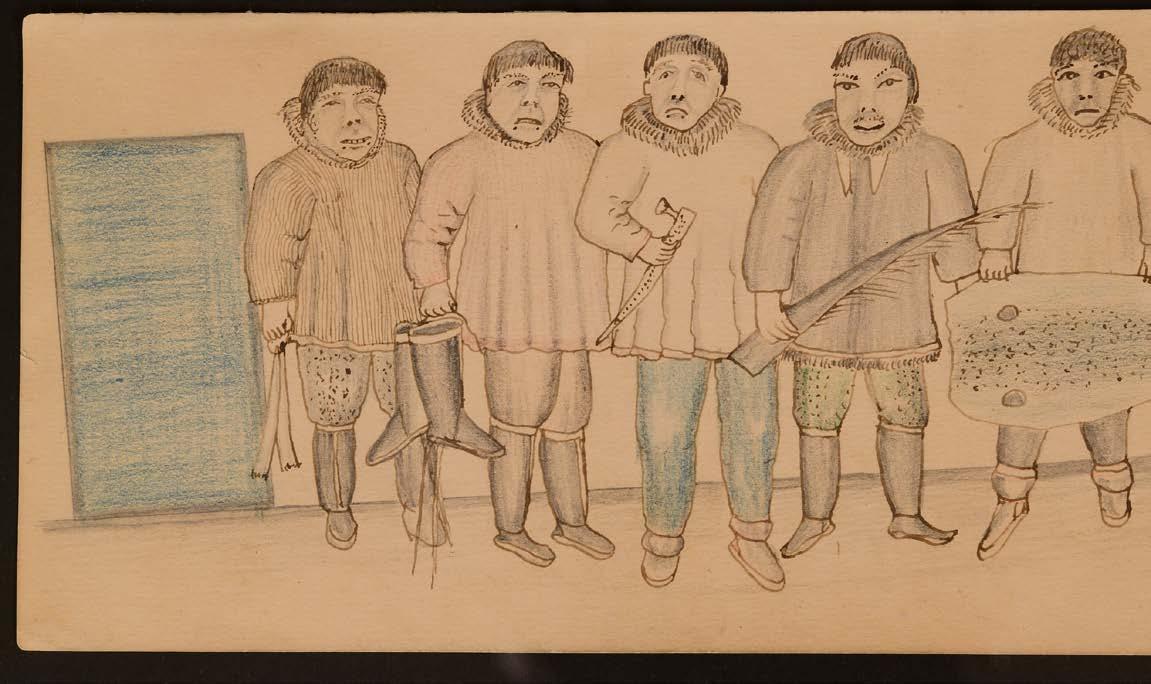
US and European prints, paintings, and publications demonstrate an interest in solidifying the myth of discovery and conquest of the Pacific world through visual means. Such scenes constructed visual imaginaries about far-off territories colonial audiences would never physically reach, regularly primitivize Indigenous cultural groups and traffic in Native stereotypes. Rarer examples turn the mirror back, revealing how whalers, and other colonizers were seen and recorded on the visual and material culture produced by Indigenous makers. Featured in the exhibition are a group of mission school drawings made by Iñupiaq children that record the intimacies of community life. The works present a rich counterpoint to traditional settler colonial histories, and—in so doing—emphasize survivance and futurity.
THIS DRAWING AND OTHERS IN THE EXHIBITION, “…WERE PROBABLY MADE BY STUDENTS OF TOM AND ELLEN LOPP, WHO STAFFED A MISSION SCHOOL ON THE SEWARD PENINSULA IN THE 1890S. THE SCHOOL WORKED TO ASSIMILATE IÑUPIAT CHILDREN AND YOUTH, AND THE DRAWINGS WERE USED AS EVIDENCE OF THEIR SUCCESS. BUT THE PICTURES HAVE MORE COMPLEX MEANINGS. FOR THE IÑUPIAQ, ADAPTING TO CHANGING CIRCUMSTANCES IS A CENTURIES-OLD TRADITION. PICTURES LIKE [THE ONE SEEN HERE] MIGHT BEST BE UNDERSTOOD AS ADAPTING TRADITIONAL WAYS OF SHARING INFORMATION ABOUT IÑUPIAQ LIFE TO NEW MEDIA.”
—ELIZABETH HUTCHINSON, BARNARD COLLEGE
FORCED ASSIMILATION TACTICS & SURVIVANCE
Survey expeditions and whalers were quickly followed by missionaries and settlers. Increasingly aggressive Federal policies aimed to eradicate Native people and their culture in order to acquire Native land and natural resources. Forced assimilation tactics included the development of mission and residential schools, registration criteria and blood quotas, the destruction or theft of cultural heritage, intentional bans on traditional foodways, and rules against spoken language, religion, and tradition. In spite of over 200 years of cultural genocide and physical violence, Native communities persisted and today many are continuing or reviving languages, tradition, lifeways, and cultural practices in order to teach future generations.
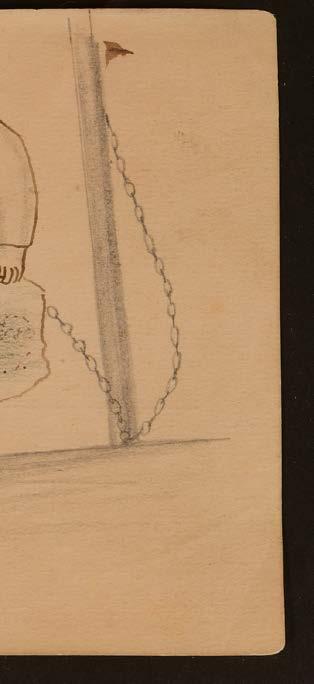
Iñupiaq maker once known (Inuit Nunaat), possibly Port Clarence Mission School
Iñupiaq men holding cultural belongings, ca. 1890
Pencil and ink on paper, 3 1/2 x 7 7/8 in New Bedford Whaling Museum, 1914.35.4
TRADE GOODS
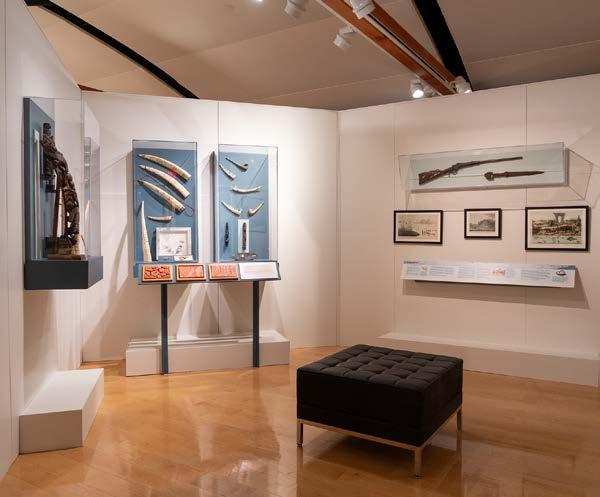
An active carving tradition developed in the Pacific Northwest and Arctic regions for internal cultural and spiritual use. This was adapted in the early 1800s for outside markets through trade and later tourism. The fur trade (especially sea otter and beaver pelts) and explorers like Vancouver and Cook spurred contact between settlers and Native communities in the Pacific Northwest. Over 200 vessels visited between 1785 and 1804 to trade, mainly for blankets and firearms. The near extinction of sea otters drove the trade inland, promoting Euro-American settlement and resource extraction. Similarly, outside explorers and fur traders arrived in Alaska in 1741 and the first settlement was in 1784. In 1867, the United States purchased Alaska from Russia. The gold rush, started in 1870, led explorers, settlers, and missionaries to arrive in greater numbers. For many Native communities the introduction of commercial whaling and markets for natural resource provided an economic opportunity to communities experiencing the impacts of settler colonialism and threats to traditional lifeways and survival.
Installation view of the “Trade Goods” and “Totem Poles: Real & Imagined” sections.
THE NOME SCHOOL
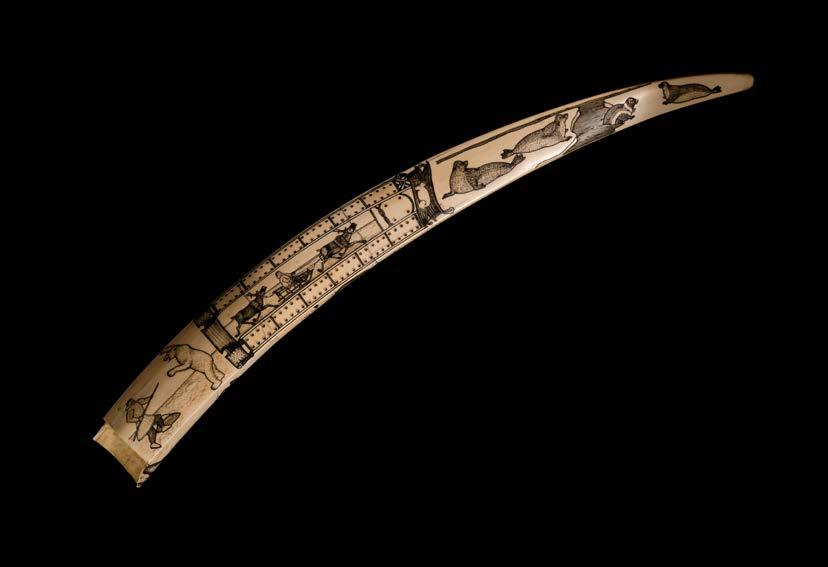
Items made for the souvenir trade in Nome, Alaska, for settlers and tourists drawn by the 1898 Gold Rush demonstrate creative adaptations by Native artists to meet changing market conditions. The “Nome school” of Iñupiat carvers incised walrus tusks with figurative imagery of arctic animals and quirky decorative motifs, including oversized houseflies, human hands, and exotic non-native species (like Indian elephants), making sly commentary on the illusionism of carving, the physical material support, and the “trade” in “Native” souvenirs that supported their livelihood.
“ POPULAR MATERIALS CARVED FOR A TOURIST MARKET INCLUDED REPLICAS OF TOOLS AND CEREMONIAL ITEMS, JEWELRY AND SMALL FIGURINES, AS WELL AS ITEMS MADE SPECIFICALLY FOR EURO-AMERICAN TASTES SUCH AS UMBRELLA HANDLES, KNIVES, PIE CUTTERS, LETTER OPENERS, FIGURINES, PIPES, AND CRIBBAGE BOARDS ENGRAVED WITH PICTORIAL SCENES. SOME ARTISTS BECAME RENOWNED FOR THEIR WORK, SUCH AS ANGOKWAZHUK (1875–1918), ALSO KNOWN AS “HAPPY JACK,” WHO CREATED DETAILED ENGRAVINGS ON CRIBBAGE BOARDS DEPICTING LANDSCAPES, PORTRAITS OF PEOPLE, AND HUNTING SCENES.” —NADIA JACKINSKY-SETHI, ALUTIIQ ART HISTORIAN AND ARTS ADMINISTRATOR
Left above:
Billy “Billiken” Komoneseok (Iñupiaq)
Cribbage board (front), 1908–1912
Engraved walrus ivory, 3 x 2 x 27 3/8 in.
New Bedford Whaling Museum, 2001.100.2255
Left below:
Installation view of the “Nome School & Inuit Print Collectives” section.
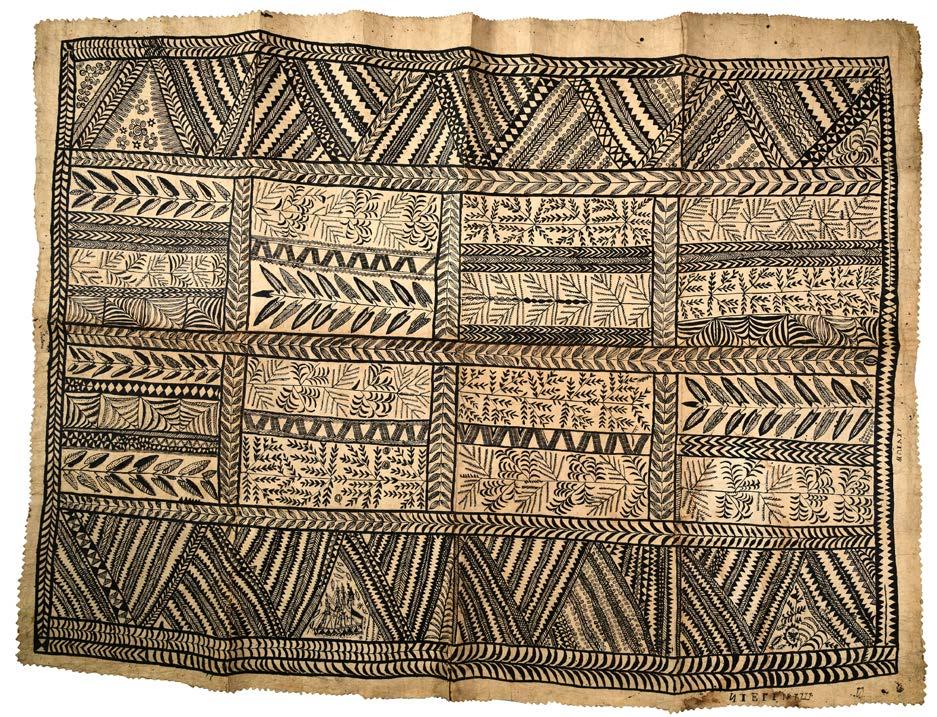
HOW HIAPO IS MADE
Harvest
Hiapo is created by beating the inner bark of a tree. In Niue different trees are used for Hiapo such as the Ata, Banyan, or Hiapo tree which is more commonly known as the paper mulberry. The tree is cut from the base of the trunk, the branches are removed close to the trunk, and the inner bark is carefully stripped. A line is cut down the length of the trunk, and the inner bark is fully removed in one strip.
Beating
The inner bark strip is then beaten with an Ike (beater) on a Tutua (anvil). These tools are made with a hard wood making it easy to beat the tough inner bark of the trees. Water is used to help the bark spread during the beating process, and the
bark is likely to spread to more than three times its original size. Different thicknesses and surface textures are dependent on the tools used and the desired outcome of the maker.
Pasting
To create a large Hiapo, pieces are joined by pasting them together using a glue made from the root of the tapioca plant.
Painting
Using soot from the tuitui (candlenut) an ink is made to decorate the Hiapo and a dried Pandanus seed is used as a paint brush. The artist will choose different traditional motifs and symbols to create a composition suitable for the purpose of the Hiapo.
Niuean maker once known (Niue)
Hiapo (tapa cloth), ca. 1880–1890
Barkcloth (mulberry), 68 x 88 in.
New Bedford Whaling Museum, 00.200.452
SCIENTIFIC MANAGEMENT AND TRADITIONAL ECOLOGICAL KNOWLEDGE
Indigenous communities have long histories with marine mammals, including walruses and whales, from harvesting the bodies and bones that wash up on the shore to coastal hunting practices. Subsistence traditions are done in concert with the regional ecosystem but are often in conflict with Federal laws and regulations that aim to protect marine mammals from widespread hunting.
The Marine Mammal Protection Act (MMPA) passed in 1972 prohibits the taking of marine mammals — including harassment, hunting, capturing, or killing — in US waters and by US citizens on the high seas. This includes whales, dolphins, seals, sea lions, walruses, polar bears, sea otters, and manatees. Most widespread conservation legislation, like the MMPA, treats communities the same, cutting Native people off from traditional lifeways. In most cases, the burden is placed on Indigenous communities to self-organize, petition, or sue Federal and state entities to allow them to continue sustainable hunting practices.
After sustained activism, the Iñupiat achieved the right to hunt bowhead whales in 1998, Native Alaskans regained walrus hunting rights at Qayassiq in 1997. In 2024 the Aquinnah Wampanoag successfully claimed the right to harvest and bury a right whale that washed ashore dead on Noepe (Martha’s Vineyard), and in 2024 Indigenous leaders of Aotearoa (New Zealand), Otaheite (Tahiti), Pule‘anga Fakaru‘i ‘o Tonga (Tonga), and Kūki ‘Airani (Cook Islands) signed a treaty gran��ng whales legal personhood. The Makah have been fighting since 2005 to sustainably hunt gray whales in the Pacific Northwest (a right protected by an 1855 treaty) and still do not have a final decision.
These examples demonstrate how, despite food scarcity and traditional ecological practices that mirror the demands of western scientific conservation, Native people continue to face challenges to their sovereignty and way of life. In the past five years, Federal bodies and western science have begun to recognize Traditional Ecological Knowledge (TEK) as an integral tool toward achieving sustainable ecological relationships. TEK is the ongoing accumulation of practice, knowledge, and belief about relationships between living beings in a specific ecosystem acquired by Indigenous people over thousands of years through direct contact with the environment and handed down through generations. The future of conservation will, hopefully, increasingly be an effort of partnership and shared custodianship.
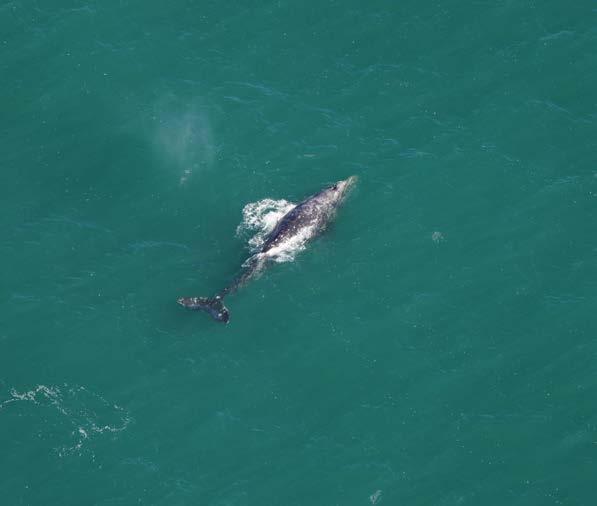
In 2024, a gray whale was sighted in the Atlantic Ocean. Extinct in the Atlantic since the 1700s and most common in the North Pacific, gray whales may be returning due to climate change and melting sea ice and changing prey distribution. Is this adaptation at work or the recolonization of past territory?
A gray whale seen south of Nantucket on March 1, 2024 Photo: New England Aquarium
THE WIDER WORLD & SCRIMSHAW
ADVISORY BOARD MEMBERS
Ratu Jone Balenaivalu, Manager Technical, Administration & Facilities, Fiji Museum
Dawn Biddison, museum specialist, Smithsonian Arctic Studies Center
Alison Bremner, Tlingit artist born and raised in Southeast Alaska
Bobby Lynn Qalutaksraq Brower, Iñupiaq Fashion Designer, furrier, teacher, and mother of four
Maggie M. Cao, associate professor and David G. Frey Scholar of American Art, University of North Carolina Chapel Hill
Erin Ggaadimits Ivalu Gingrich, Koyuokon Denaa & Iñupiaq interdisciplinary artist
Michael R. Harrison, Chief Curator & Obed Macy Research Chair, Nantucket Historical Association
Ishmael Angaluuk Hope, Tlingit and Iñupiaq poet and Indigenous scholar who lives in Dzantik’ihéeni, Lingít Aaní
Elizabeth Hutchinson, Associate Professor of Art History, Barnard College, Columbia University
Nadia Jackinsky-Sethi, Alutiiq art historian, museum consultant and arts administrator based in Homer, Alaska
Jamie L. Jones, Assistant Professor, Department of English, University of Illinois at Urbana-Champaign
Ryan Tucker Jones, Professor and Ann Swindells Chair of History, University of Oregon
Sonya Kelliher-Combs, Iñupiaq/Athabascan artist, curator, and advocate who lives and works in Anchorage, Alaska
Courtney M. Leonard, Shinnecock artist and filmmaker and Assistant Professor of Art and Art History at St. Olaf College
Billie Lythberg, Senior Lecturer, Faculty of Business & Economics, Waipapa Taumata Rau | The University of Auckland
Edward D. Melillo, William R. Kenan, Jr. Professor of History and Environmental Studies, Amherst College
Maia Nuku, English and Māori (Ngā Puhi) descended Curator for the Arts of Oceania, The Metropolitan Museum of Art
Kailani Polzak, Assistant Professor in the History of Art and Visual Culture, University of California, Santa Cruz
Bart Pushaw, Assistant Professor of Art History, University of Tennessee at Chattanooga
Joshua L. Reid, registered member of the Snohomish Indian Nation and John Calhoun Smith Memorial Endowed Associate Professor of History, University of Washington
Nancy Shoemaker, Professor of History, University of Connecticut
Cora-Allan Lafaiki Twiss, Māori (Ngā Puhi, Tainui) and Niuean artist who actively regenerates Niue hiapo
Jennifer Wagelie, Director of Learning, Office of Cultural Transformation, California State University, Sacramento
Angela Wanhalla, Kāi Tahu historian and professor of history, Ōtākou Whakaihu Waka / The University of Otago in New Zealand
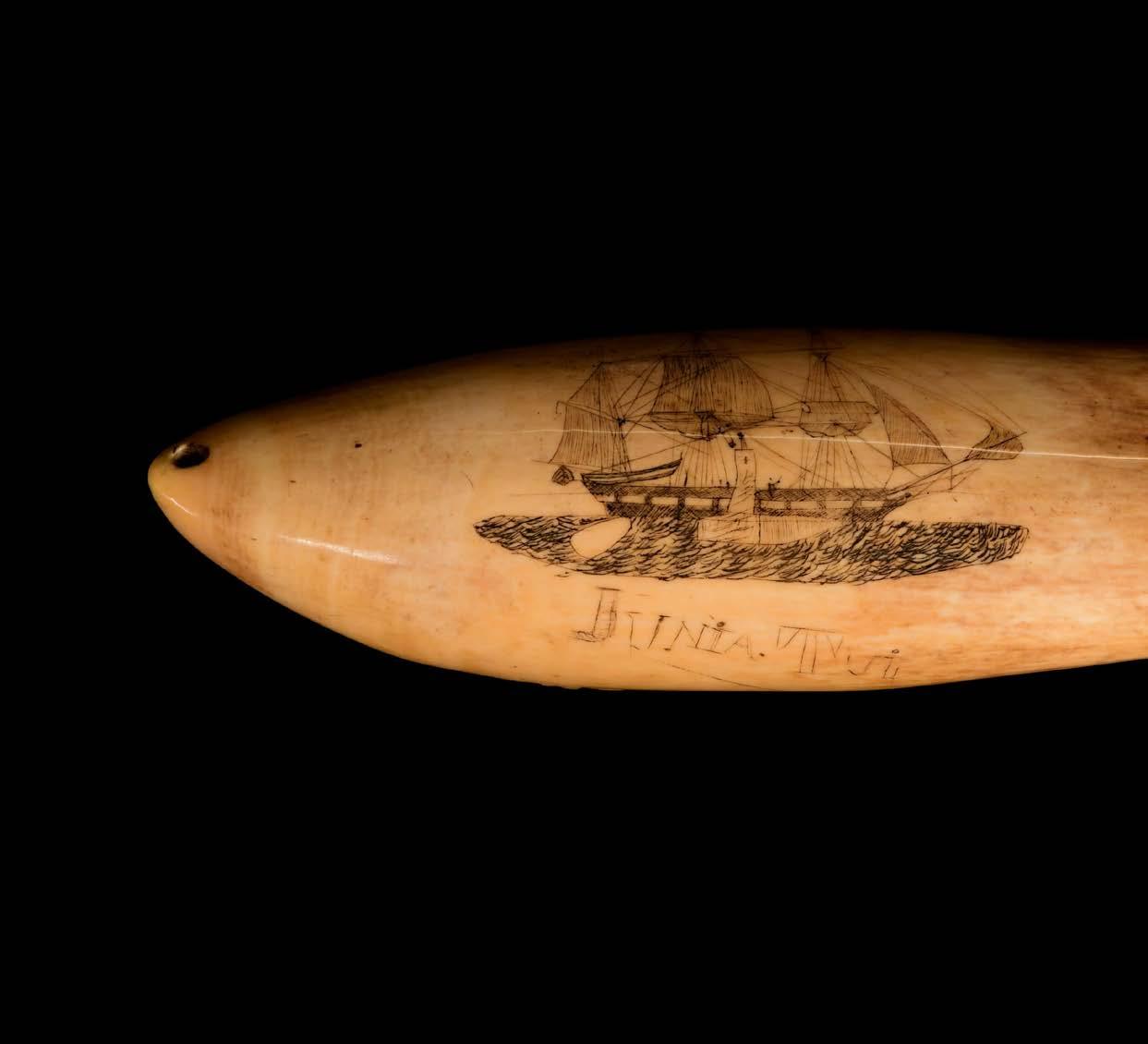
Tabua with scrimshaw by unindentified 19th-century makers, inscribed “Junia Tui” (“King Junia”). New Bedford Whaling Museum, 2001.100.1680.
WHALE TEETH GLOBAL ARTIFACTS AS
By Maggie M. Cao
Maggie M. Cao is Associate Professor and David G. Frey Scholar of American Art at the University of North Carolina at Chapel Hill. Her research focuses on the history of globalization with particular interest in the intersections of art with histories of technology, natural science, and economics in the eighteenth and nineteenth centuries. She is the author of The End of Landscape in Nineteenth-Century America, which examines the fate of the nation’s preeminent artistic genre after the Civil War, and Painting US Empire: Nineteenth-Century Art and Its Legacies
We often consider scrimshaw teeth to be the work of singular whaleman artists, even if their names are no longer known to us today, but occasionally teeth have been shaped by multiple hands working across vast cultural and geographical divides. In the New Bedford Whaling Museum’s collection is a tooth whose pictorial design—a portrait of a whaling bark midhunt—is a conventional subject of Euro-American scrimshaw. More unusual is a second inscription running just below the waves in which the ship is nestled. There, an Indigenous Fijian has carved the letters “JUNIA TUI” with decorative flourishes. The inscription, likely a name, along with the holes drilled at the top and bottom of the tooth that once attached it to woven coconut-fiber cord, mark the tooth’s transformation from scrimshaw into tabua, a Fijian ceremonial object.
Most tabua were and are uncarved sperm whale teeth, but engraved examples like this one exist in New Bedford, in Fiji, and elsewhere around the world, suggesting that their circulation was not uncommon. Preserved in this incised conversation between two whalebone engravers is a story of encounter, though not exactly between whalers and Fijians, whose paths seldom physically crossed. Rather, the circulation of these multiauthored artifacts by merchants of the China trade reveals the multivalent meaning of whale teeth as global artifacts in the contexts of empire and ecology during the nineteenth century. The tooth’s overlapping inscriptions show how White scrimshanders and Indigenous Fijians both valued whale ivory as an enlivened material marking time and place, though in different culturally specific ways.
Tabua are artifacts of maritime globality, brought to Fiji by foreigners. Until the late eighteenth century, sperm whale teeth were extremely rare on the island chain. Carved and inlaid whalebone artifacts along with some teeth were originally introduced by craftsmen from neighboring Tonga, where whales beached with more frequency due to currents, but only with the expansion of the Euro-American whaling industry to the Pacific did whale teeth begin arriving in Fiji in quantity. It was not the whalers themselves who brought the teeth, but China traders who, en route to Canton, frequented the archipelago to acquire sandalwood and sea cucumbers, highly valued commodities in China.1 Seeing that whale ivory was a desirable trade item for acquiring these island resources, Euro-American traders initially presented chiefs with false tabua—elephant and walrus tusks carved into whale tooth forms. In this early period of contact, the term “tabua,” which roughly translates to “sacred,” referred to a class of ceremonial objects in a variety of materials, including wood carved into tooth forms. Only after sustained interaction with White mariners did the word became synonymous with sperm whale teeth, a definition that persists to the present.2
By the 1810s, White merchants were highly aware of the esteem in which Fijians held whale ivory and knew exactly how to acquire the teeth cheaply. When the ship Sultan left Boston in 1815, it carried a box of forty-eight teeth separated into three grades along with instructions from the ship owners to the captain for obtaining more
1 Edward D. Melillo, “Making Sea Cucumbers Out of Whales’ Teeth: Nantucket Castaways and Encounters of Value in Nineteenth-Century Fiji,” Environmental History 20 (July 2015): 449–74.
2 Nicholas Thomas, Entangled Objects: Exchange, Material Culture, and Colonialism in the Pacific (Cambridge, Mass.: Harvard University Press, 1991), 66–75, 110–18.
Tabua by an unidentified Fijian maker. New Bedford Whaling Museum, 1985.16.35.
“from the Whale Ships you will meet” as “the Whalemen considered them of little or no value.”3 Whalebone and ivory may have served as a media for a startling range of sailor-made decorative goods, but they were nevertheless waste products for the whaling industry, which valued whales for their oil rather than their bones.
For Fijians, tabua always signified a worldly thing that arrived by way of people across the sea. Moreover, the carving and decoration of whale ivory had always been a specialty of non-Native craftsmen, first Tongans and later White whalemen. Tabua’s links to foreigners are perhaps what prompted Fijian chiefs (who conducted business with visiting merchants) to value decorated as well as unadorned teeth. We may even understand the conversion of scrimshaw into tabua as a form of cross-cultural consumption and appropriation. Just as scrimshanders sometimes inscribed whalebone with titillating Indigenous figures they encountered in Oceania, so too could Fijians— through acquiring scrimshaw—behold and claim ownership of the White, female bodies commonly engraved by scrimshanders on enamel surfaces.
“Whalebone and ivory may have served as a media for a startling range of sailor-made decorative goods, but they were nevertheless waste products for the whaling industry, which valued
whales for their oil
rather than
their
bones.”
There is a long history of Indigenous consumption of foreign media and of naturalistic art in Oceania. Perhaps the most famous took place in 1777 during explorer James Cook’s final visit to Tahiti while circumnavigating the globe. On this occasion, Pomare the First agreed to sit for a painted portrait by an expedition artist, but only if he received in exchange a portrait of Cook. The small, framed oil painting he received (now lost) was preserved until the early part of the nineteenth century and was shown to later visiting mariners, who inscribed their ships’ names and dates on the back. For the Tahitians, it served as a record and lineage of European contact—an artwork transformed into historical evidence.4
Tabua, too, might be understood as a kind of historical record. It was not just a commodity, though foreigners in the nineteenth century often mischaracterized it
3 Quoted in Stuart M. Frank, Ingenious Contrivances, Curiously Carved: Scrimshaw in the New Bedford Whaling Museum (Boston: David R. Godine, 2012); Nina Hellman and Normal Brouwer, A Mariner’s Fancy: The Whaleman’s Art of Scrimshaw (New York: South Street Seaport Museum and Balsam Press, 1992), 11.
4 Nicholas Thomas, “European incursions, 1765–1880,” in Art in Oceania: A New History, ed. Peter Brunt and Nicholas Thomas (London: Thames & Hudson, 2012).
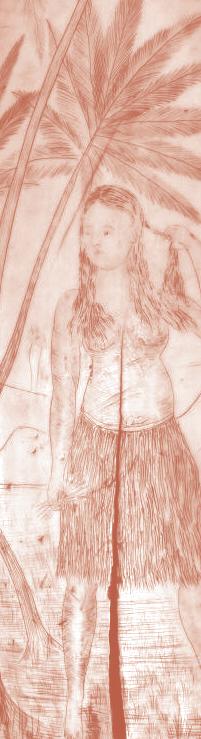
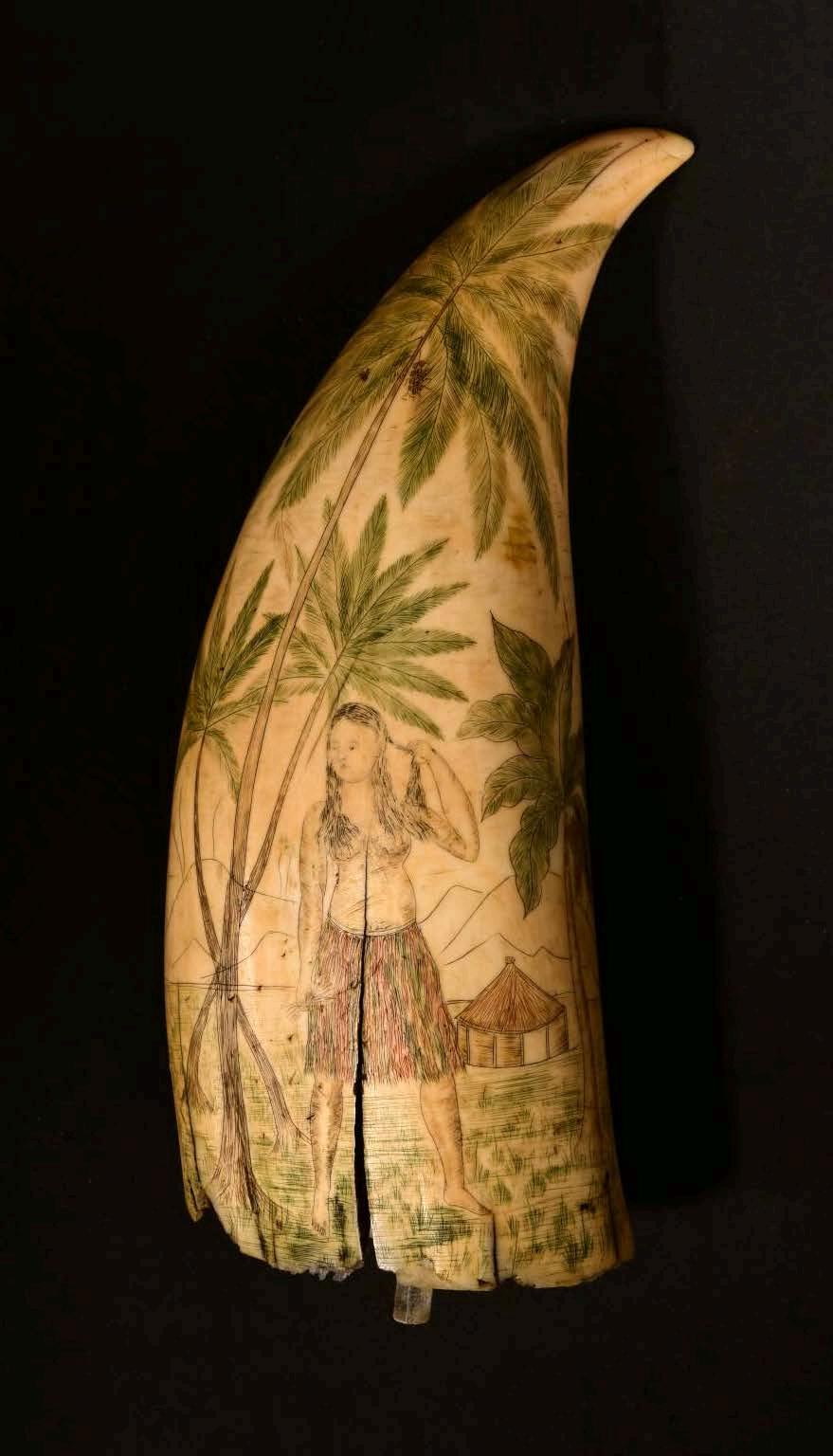
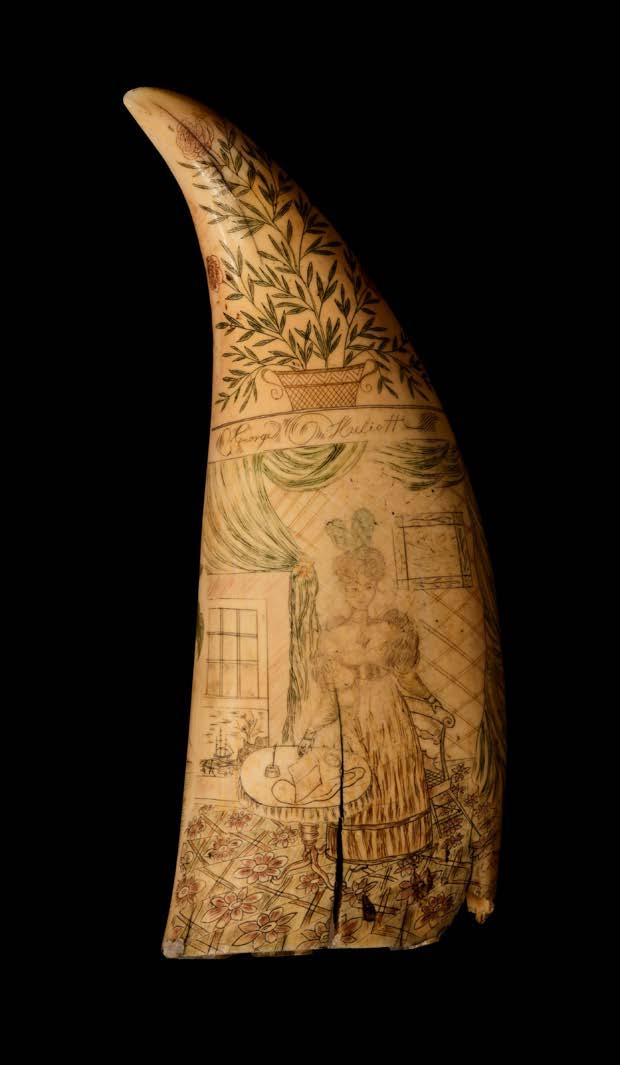
Scrimshaw tooth by George Hiliott from the 1830s depicting a Polynesian woman in a grove on one side and an American or European woman in a domestic setting on the other. New Bedford Whaling Museum, 2001.100.159.
as a form of “savage money.”5 Once whale teeth entered Indigenous communities, the objects had very little everyday utility. They were stored away until needed as ceremonial gifts given during occasions of personal and political import—notably events marking genealogical change. On such occasions of circulation, the recitation of genealogies often took place to commemorate familial and communal ancestry and history. Whale teeth are still today presented at marriages, births, deaths, and various state and diplomatic events.6 When inscribed with Fijian names, they likely helped to commemorate the social changes they witnessed upon presentation. During the colonial era, whale ivory was a medium in which historical events like anniversaries of British rule were commemorated. On such occasions, the teeth were inscribed much as medals or plaques would have been in European tradition. As whaling declined in the late nineteenth century, so too did the supply of teeth entering Fiji, meaning that eighteenthand nineteenth-century whale ivory, already marked by its prior circulation, was often imprinted anew, with each tooth becoming a palimpsest bearing the marks of its historical circulation.
For scrimshanders, whale teeth also served commemorative purposes. On their surfaces, whalemen recorded the geography and temporality of specific oceanic journeys. On multiyear voyages that moved between the tropics and the poles, whalemen were beset by temporal irregularities and monotony. Whaling had a rhythm: periods of intense labor following a successful hunt and significant lulls as sailors navigated from one hunting ground to another. Scrimshaw has its origins in the geographic expansion of whaling to distant oceans because it served as a shipboard pastime during monotonous periods. It is thus not surprising that whale teeth were called upon to help sailors situate such voyages in time and space.
Scrimshanders often decorated teeth with charts noting the dates that their ship reached significant ports and had successful hunts. They sometimes transformed the ivory surfaces into maps marked with nautical coordinates. Such factual inscriptions likely helped mark temporal and geographical change within the atemporality and mundaneness of maritime routine—a kind of shipbound equivalent of a prisoner’s hatch marks on a cell wall. Notations of time and place were essential tools of an imperial maritime culture. Dominion over the world’s oceans and its resources—not just whale oil but also sandalwood, sea cucumbers, and a host of other extractive commodities—required accurate and efficient navigation using chronometers and nautical charts. For the whole of the nineteenth century, the most sophisticated and accurate technologies of shipboard timekeeping and placemaking were produced in the United Kingdom, then the world’s strongest maritime empire. Indeed, the majority of
5 D. Graham Burnett, “Relational Economics: Tabua and the Question of Currency,” Cabinet 50 (summer 2013), https://www.cabinetmagazine.org/issues/50/burnett.php.
6 Steven Hooper, “‘Supreme among Our Valuables’: Whale Teeth Tabua, Chiefship and Power in Eastern Fiji,” Journal of Polynesian Society 122 (June 2013): 103–60.
ships traversing the world’s major oceans in those years kept not their local time but that of the Royal Observatory in Greenwich, just outside London. We have inherited the period’s maritime imperialism in our present-day system of world clocks, which remains pegged to Greenwich Mean Time.7
When Fijians appropriated scrimshaw for their own social needs, they moved whale teeth from the domain of the Euro-American maritime imperialism into their own. Scrimshaw turned into tabua registers both the White whaleman’s concern with navigation and extraction and the Fijian’s investment in genealogical connection. Both reinforce their makers’ historical and geographical positioning, though the former is abstract and the latter interpersonal.
But what of the whale? We cannot forget that the whale tooth itself registers time and place. Much like a tree’s rings, a sperm whale tooth’s size and marbling patterns correlate to cetacean age. Its layers can be read by marine biologists to reveal a history of the animal’s migrations and ecological circumstances.8 Indeed, it is these biological markers that bring together divergent colonial and Indigenous understandings of time and place. Fijians regarded whale teeth as sacred artifacts enlivened by their origin in the mouths of leviathan creatures. Whalemen, too, associated the teeth with powerful living beings, who regularly threatened their very lives when pursued. It was not uncommon for scrimshanders to inscribe whale teeth with first-person narratives of sentient teeth. An 1821 example reads, “One Christmas Eve in their Boats did go / And kill’d this whale & tow’d Alongside / And took me out of his mouth so wide.” In this case, the tooth seems to speak its own history. Such “speaking” teeth often relate the time and location of their own harvesting, thus marking not just a moment in the life of the hunter but also of the hunted whale.
Fijians never hunted whales, but their rhythms were meaningful for Indigenous navigation. Historically, the people of Oceania were dominant and accomplished seafarers whose means of navigation did not rely on clocklike instruments and paper charts. To move from island to island across the vast Pacific, they used techniques orally transmitted from one generation to the next for building mental maps of time and space. These maps were dynamic rather than static, based on observations of the ecosystem—of currents, swells, and winds, but also of animals, including the flight patterns of birds and the migration routes of whales.9 Long before whale teeth so centrally governed global relations in the Pacific, the whale’s rhythms had helped Islanders find their place in time.
7 Ronald R. Thomas, “The Home of Time: The Prime Meridian, the Dome of the Millennium, and Postnational Space,” in Nineteenth-Century Geographies: The Transformation of Space from the Victorian Age to the American Century, ed. Helena Michie and Ronald R. Thomas (New Brunswick, N.J.: Rutgers University Press, 2003), 23–39.
8 J. Bow and C. Purday, “A Method of Preparing Sperm Whale Teeth for Age Determination,” Nature 210 (1966): 437–38.
9 Vincente Diaz, “No Island Is an Island,” in Native Studies Keywords, ed. Stephanie Nohelani Teves, Andrea Smith, and Michelle H. Raheja (Tucson: University of Arizona Press, 2015), 90–108.
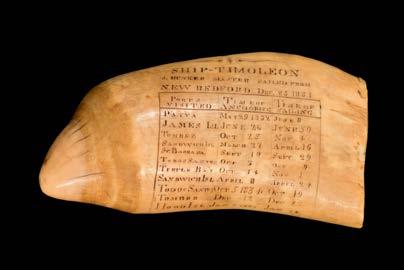
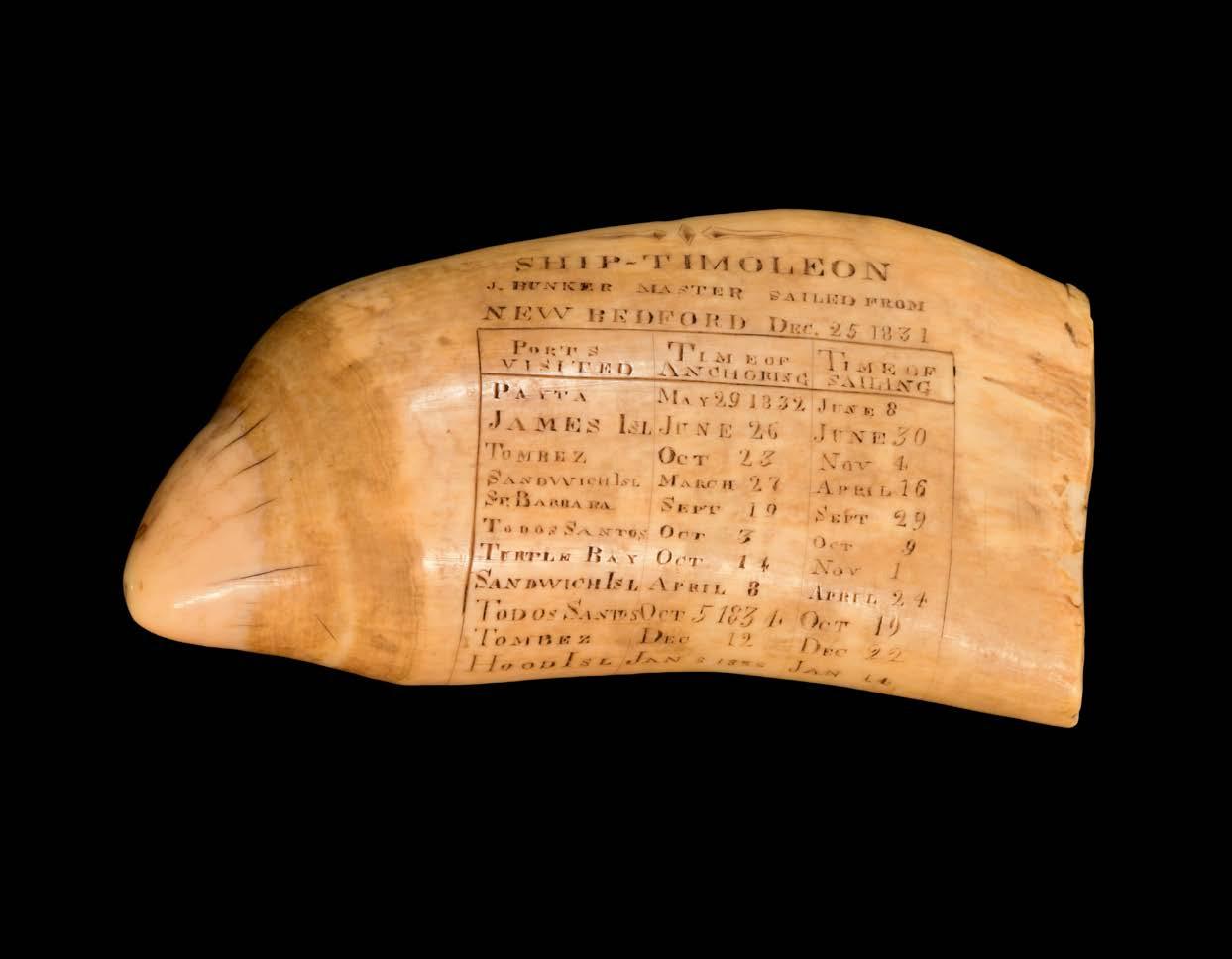
Tooth engraved by John H. Ricketson with ports of call visited by the ship Timoleon of New Bedford between 1832 and 1835. New Bedford Whaling Museum, 1973.13.
THE ARTIFACT UNDER THE FLOOR
HADWEN AND BARNEY OFFERS UP ONE MORE CLUE TO ITS PAST
By Mark Foster
Mark Foster is a designer, researcher, historian, and writer, depending on when you ask him, with a long interest in Nantucket, New Bedford, whaling, and history. For more information on nineteenth-century refining, see his article “New Bedford: Whale Oil Refining Capital,” Industrial Archeology 40, nos. 1 and 2, 2014.
The Old Timber
A piercingly bright Sunday morning, back in February 2012, found former NHA curator Ben Simons and myself out behind the Whaling Museum, examining two sections of a large, old timber. With the generous indulgence of the curator, I had been taking advantage of a change in exhibits, sparse winter tourists, and an unattended ladder to investigate again the Hadwen and Barney Candle Factory. If one suffers from an incurable interest in Nantucket, whaling, and the refining of whale oils, the historic old candle factory is a required subject of study, for it is one of the nation’s few surviving oil refinery buildings.
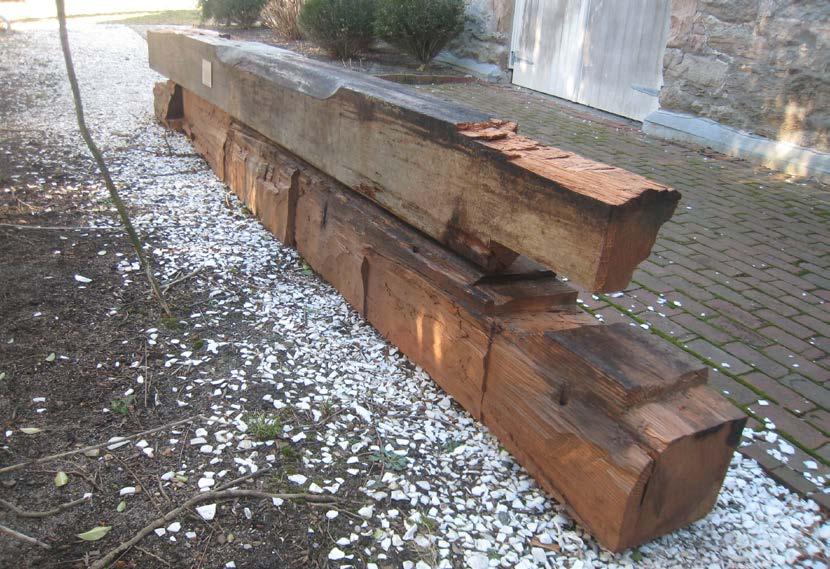
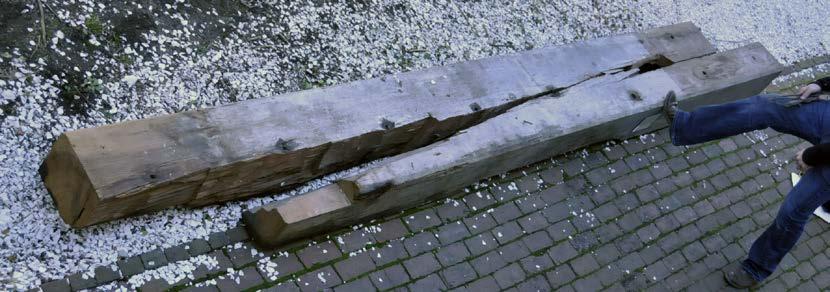
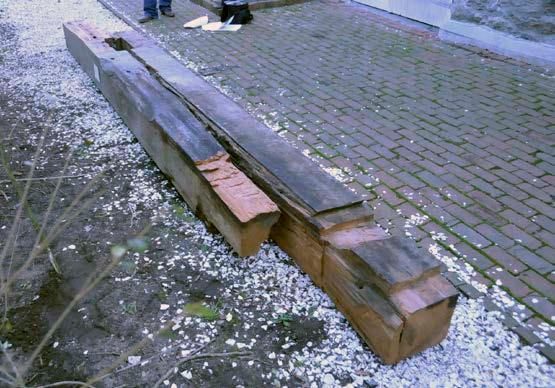
The two sections of timber as they lay outside the Whaling Museum in February 2012.
“ IT WAS AN IMPOSING OLD TIMBER: 20-INCHES DEEP, 11-INCHES WIDE,
AND NEARLY 16-FEET LONG, SPLIT INTO TWO SECTIONS, AND MARKED BY ANCIENT STAINS, FADING PAINT, HOLES, IMPRESSIONS, AND A LARGE RECTANGULAR CUTOUT.
"
On my previous visit the timber in question had lain on the floor of the museum, in Sanderson Hall, with a label identifying it as part of the building’s second lever press, a long-lost twin to the giant press that stands in the museum today. The upper portion of that second press was almost certainly removed in 1919, when owner Emily M. Treadwell gave the building its then-fashionable Colonial Revival makeover.1 The basement portion of the press was left in place, for good reason: it helped support the original floor timbers that in turn supported the entire floor, as well as, later, a replica tryworks built in 1930 as a museum exhibit. Both the original floor timbers and the lower portion of the press were replaced in 1955, and the replacements themselves were removed in in 2005. With so many changes, this Hadwen and Barney fan was naturally excited that a remnant of that second press had survived, but I was also baffled, for this timber did not match any part of the surviving press.
It was an imposing old timber: 20-inches deep, 11-inches wide, and nearly 16-feet long, split into two sections, and marked by ancient stains, fading paint, holes, impressions, and a large rectangular cutout. According to Simons, the two sections had been found on top of the stone kettle foundation, oriented north–south and lying several feet apart. There they had supported the floor that, with the removal of the building’s kettles, hearth, and chimney, had been laid over that foundation, presumably as part of Treadwell’s 1919 renovation. Together, on that sunny but cold morning, Simons and I rotated, measured, photographed, put together and pulled apart what turned out to be two large, dense, heavy pieces of wood, an effort not without sacrifice, for it aggravated the stoic curator’s back. By the time we were done and our fingers were numb, it was clear that the timber was not part of a lever press. We were not disappointed, however, for the timber’s scattered clues hinted at something much more significant.
1 “Has A New Doorway,” Inquirer and Mirror, Aug. 30, 1919, 4; “Waterfront,” idem, Sept. 27, 1919, 1.
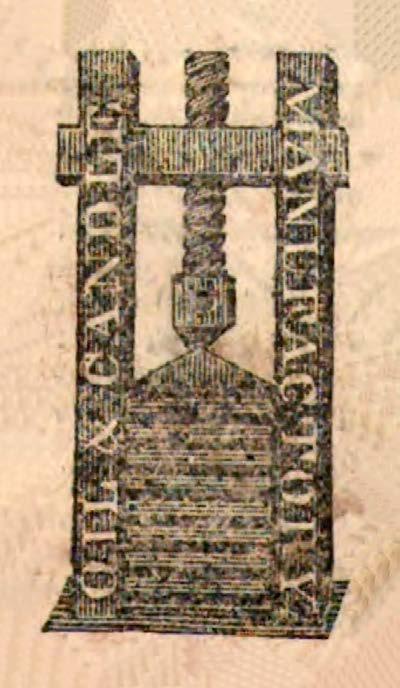
The only image found for a screw press associated with a refinery of whale oils is this 1821 advertising cut. Though generally used in newspapers, in this case the cut appeared in an ad for New York refiner Samuel Judd in Nathaniel Bowditch’s New American Practical Navigator (New York: Edmund M. Blunt, 1821).
The Context
The Hadwen and Barney Candle Factory, built about 1847 after the Great Fire of Nantucket, was part of what was termed at the time an oil and candle works, i.e., a refinery of whale oils. It was here that the crude oil rendered at sea from the blubber of whales was processed into several grades of refined oil and where spermaceti was manufactured into candles. Most midnineteenth-century oil and candle works processed spermaceti and sperm oil, extracted from sperm whales, and whale oil, the oil extracted from baleen whales. (Sperm oil and whale oil were entirely different oils and consequently were always kept separate). A typical mid-century oil and candle works included, at minimum, three buildings: a bleach house or try house, an oil shed, and a large candle house. By the 1850s, such a complex might also include a fourth building dedicated to refining whale oil and additional sheds.
The candle house, the largest building in an oil and candle works complex, was where the latter stages of sperm-oil processing took place and where spermaceti candles were made. What we now call the Hadwen and Barney Candle Factory was the candle house for the Hadwen and Barney oil and candle works. A bleach house and shed once stood at the rear of the property, behind the surviving building. Candle houses like the Hadwen and Barney building had three essential components: kettles, slack presses, and a taut press. The presses were essential because, by squeezing chilled oil through cloth bags, they both separated spermaceti from crude oil and divided the crude oil into three grades of refined oil. Over the long seasonal refining process, slack presses were used in the first two pressings, in winter and spring, while a taut press, exerting greater pressure, was used in the third and final pressing, either during summer or within a heated room. Slack presses might be lever presses—typical of Nantucket—screw presses, or, toward mid-century, hydraulic presses. Taut presses were typically screw presses until the 1830s, when they began to be replaced by hydraulic presses.
Of screw presses, many venerable examples survive from other industries. One need not look far, for example, to find screw presses used for wine, books, clothing, cotton, tallow, cheese, and olive oil. There are also thousands of period illustrations of such presses—just have a look at Diderot’s encyclopedia. But when it comes to a taut screw press used in a candle house, we have only one small 1820s advertising cut for visual evidence. For physical evidence, we have nothing; that’s what makes this old timber so interesting.
The “outside” (left) face of the post, looking bottom to top. With curator’s leg. Note original paint, line of dark washer impressions, and, at the top, holes for tie rods.
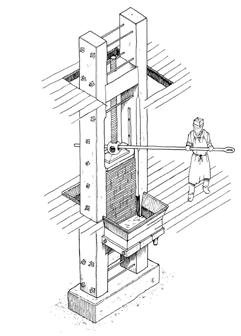
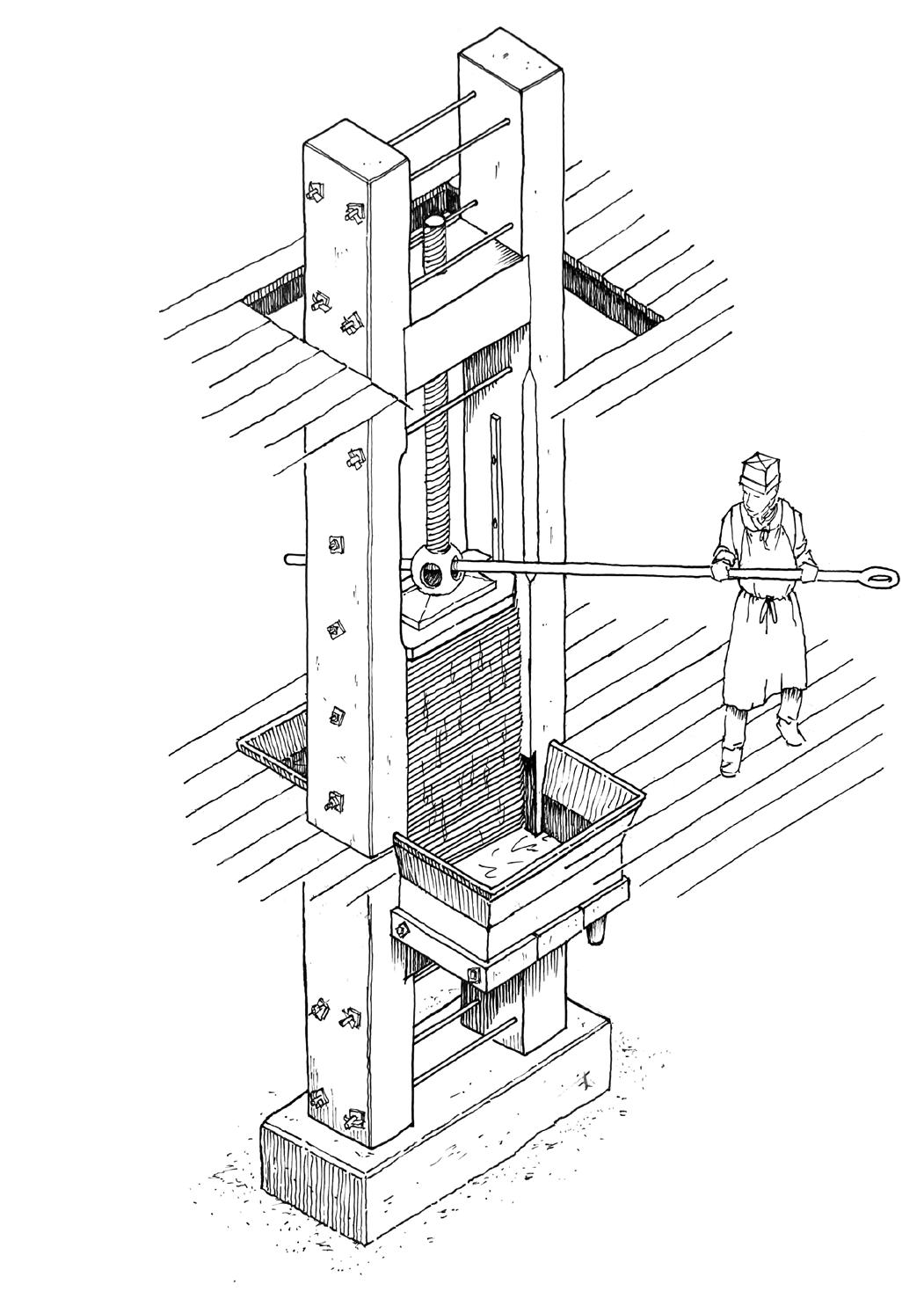
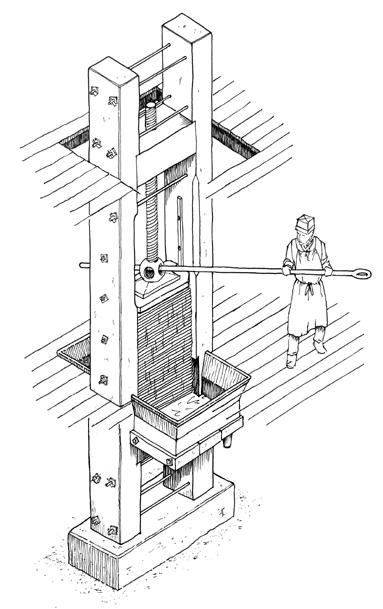
Reconstructed Taut Screw Press
Elevations of the existing timber and elevations, section, and plan of the reconstructed screw press. Plans by Mark Foster.
The Post
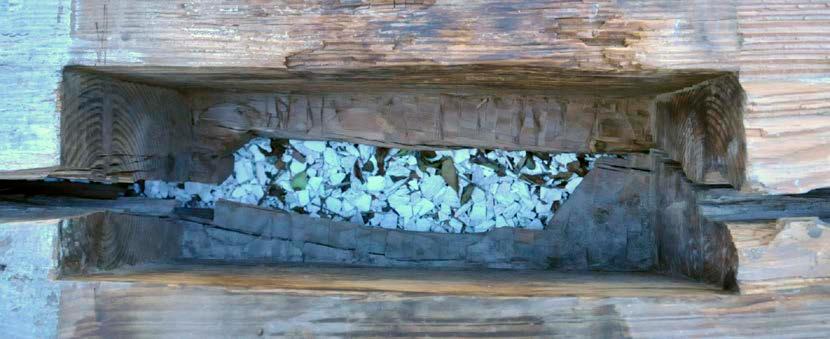
The timber’s secrets became more intriguing when I reviewed the photos and the measurements, and created scale drawings. Among the first notable clues were the beveled edges at one end of the timber. These small details hinted that this was the top of the timber, and that the timber had, in fact, been an upright post. Several feet below this top end, the timber had a large, deep, 6-inch by 18-inch cutout. It became clear that this recess was actually a mortise and, now knowing which end was up, that it roughly coincided with the location of the crossbar found near the top of a typical screw press frame. Such crossbars held the threaded iron box through which the iron screw (perhaps 4 to 6 inches in diameter) turned.2 Above the mortise, the wood was split roughly back, but enough remained to show that the post at one time extended inward over the missing crossbar. This natural extension of the wood would have reinforced the crossbar against the upward pressure of the screw as the screw pressed downward against the bags of oil.
2 There are scattered references to screw dimensions. See, for example, “Auction Sales … By WM. C. HOLLY & CO.,” The National Advocate (New York), Mar. 25 1825, 3, which includes, “Also, 1 screw, 5 inch stem, for spermaceti taught press, with iron plates and lever complete.”
Mark Foster - May 29 2025
Left: Isometric of reconstructed screw press. Drawn by Mark Foster.
Above: The “inside” (right) face of the post, looking bottom to top. Note drip edge (near bottom), vertical recess for guide bar at center, dark oil stains, large chamfer, and mortise.
Between the mortise and the top of the post were two one-inch holes, with two imprints from what must have been large, rectangular washers, about 2 ½ x 3 ¼ inches. The holes undoubtedly held iron tie rods that passed through the head of the press and which, secured at either end, pinned the two posts against the tenoned ends of the crossbar, thereby holding the head of the press together. These rods may have been threaded, like the long iron bolts that hold the press bed of the existing lever press together, or may have had slots with a key or wedge driven through, the method used to hold the base of the lever press together.
In the middle section of the post, a vertical line of rectangular washer impressions and holes corresponded with a narrow vertical recess at the “inner” side of the post. This suggested there had once been a vertical strip of iron recessed into the post and secured by tie rods. The iron served as one of two guides for the follower, the large plate attached to the nut at the end of the screw. Guides like these, recessed or protruding, are typical of screw presses, and the follower (as well as press plates) would have been notched to receive them. A long iron bar placed through a hole in the nut served as a lever to turn the screw. This bar, in turn, could be attached to a windlass or capstan to produce greater leverage.
Also in this middle section, the inner front corner of the post had a large chamfer, another common screw press feature. The chamfer’s flat surface would have prevented damage where the iron bar hit the post. In the same area, an offset hole and washer impression indicated the location of another reinforcing tie rod. Finally, lines scribed across the face of the post may have shown the height to which plates and bags were to be stacked and, perhaps, the lowest point to which the screw could be turned before it fell from the threaded box.
Near the bottom of the post, on the inner side, the wood stepped inward with a sharp 1-inch upward cut. This was likely a drip edge, which allowed oil running down the inside face of the post to drip off into the press bed. Hereafter, the lower portion of the post was, unfortunately
“ THE TIMBER’S SECRETS BECAME MORE INTRIGUING WHEN I REVIEWED THE PHOTOS AND THE MEASUREMENTS, AND CREATED SCALE DRAWINGS. AMONG THE FIRST NOTABLE CLUES WERE THE BEVELED EDGES AT ONE END OF THE TIMBER. "
for us, sawn off. Imagining its features requires some educated guesswork. The lower portion of the press, like the upper, had to resist the immense pressure of the press itself, so something like the construction above was probably repeated below: a tenoned crossbar (typical of screw presses), an inward extension of the post to reinforce the crossbar, and tie rods to hold the bottom together. The crossbar would have supported the press bed (a common arrangement), on which bags of oil and press plates were alternately stacked and which captured the oil pressed from the bags. We may make an educated guess that the screw press bed was similar to that of the surviving lever press: a shallow box of heavy boards and timbers, bolted together and recessed into the wood floor. From the bed, oil would have drained to a basement cistern. In the basement, the bottom of the press posts probably rested on a large wood block, similar to the original arrangement at the lever press. Finally, the post had also been painted and showed oil stains that grew larger as the stains moved down the post.
Assembling all these clues together created a clear picture: our one-time floor support was originally the left-hand post in the frame of a very large screw press. How large? If the lower limit of paint on the post indicates the floor level, then the press stood a little over 14 feet above the first floor, and around 22 feet in total. Evidence suggests the press may have been
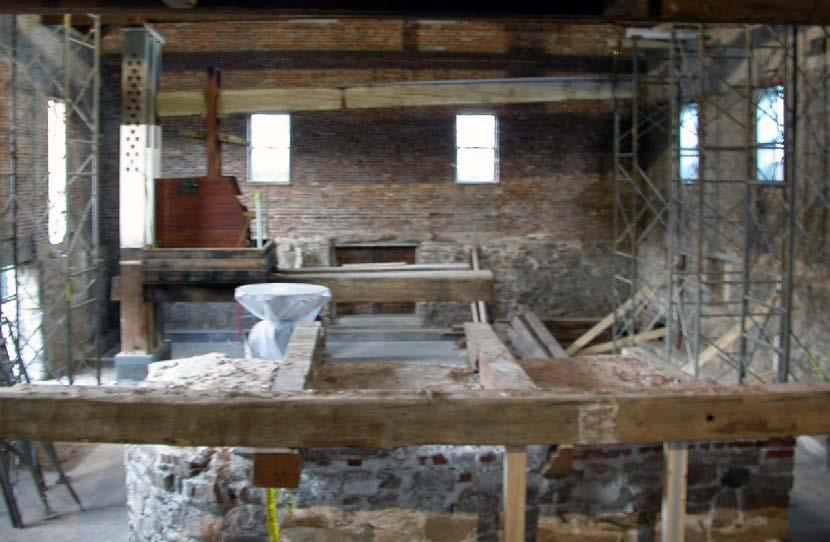
Figure 8. Hadwen and Barney Candle Factory, looking north during renovation, showing the two sections of the timber where they lay over the stone kettle foundation, lower center. Photo by Niles Parker.
around 5 feet in width.3 That leaves the dimension between the posts at just over 3 feet, similar to our 1820s newspaper cut if we assume that press was also five feet wide. The depth of the press would be the depth of the press bed—around four feet.4 Period records suggest the press probably held thirty to forty iron press plates and, at two bags per plate, sixty to eighty bags of oil.5 Thanks to the old timber, we now have a plausibly reconstructed taut screw press, perhaps incorrect in some details but generally correct in principle.
To the author’s knowledge, this old timber is the only physical evidence in existence for a taut screw press used to refine sperm oil. This puts it in good company, for the building’s lever press is the world’s only surviving lever press used to refine sperm oil. But this isn’t where our story ends.
The Building
The Hadwen and Barney building itself is also a rarity, one of just a handful of surviving oil and candle works buildings. Of these, it is the only building which contains an original lever press; now, it also retains the only surviving physical evidence from an original screw press. Curiously, by the time the Hadwen and Barney building was built, many oil and candle works had replaced the taut screw press with a taut hydraulic press. It may be an indication of the post-fire rush to get the building built that the owners looked back to the cheaper, easier-to-acquire screw press. But where in the building did the screw press stand? We have some clues. The height of the paint on the post roughly coincides with the height of the attic south of the kettle foundation. North of the foundation, the two gigantic lever presses left little room for anything else. It is likely, then, that the screw press stood somewhere south of the kettles.
3 A 5-foot width is in keeping with the press proportions in the 1820s newspaper cut, the former framed opening in the attic joists, and the size and proportions of press plates from the existing lever press and from hydraulic presses at the Robinson Oil Works in New Bedford.
4 This estimate is based mainly on the estimated size of the screw press plates combined with the clearances allowed around the press plates in the existing lever press.
5 For the number of plates, see, for example, two notices for the auction sale of the Herman and Horace Canfield oil manufactory in Brooklyn, N.Y., in Commercial Advertiser (New York), Sept. 24, 1835, 3, 4, which include: “1 Screw taught [taut]” with thirty-eight iron plates.
Figure 7. Mortise. Note tree rings right and left sides, showing the post was made from the center of a tree. Also, left, circular cuts left by boring tool used to bore out the mortise, and, across back, chisel marks left from squaring the mortise.
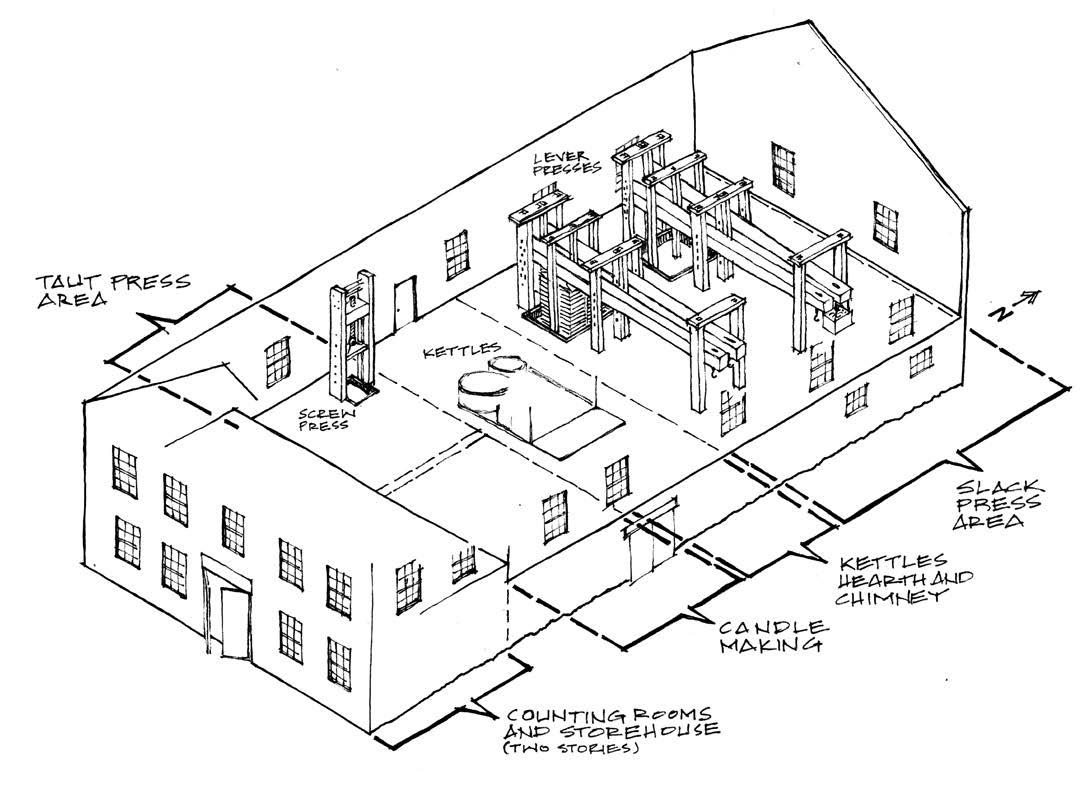
Figure 9. Isometric schematic plan showing four general works areas in the Hadwen and Barney Candle House. While the counting rooms and storehouse at the front (south) end of the building were an unusual addition, the factory portion of the Hadwen and Barney building likely represents a candle house plan and form that developed on Nantucket and which was repeated in other oil and candle works. Plan by Mark Foster.
During my visit, I had been looking for clues to openings in the original floor. This was tough going. South of the kettle foundation, most of the floor and floor timbers (undoubtedly soaked in oil) were replaced or reworked, probably before 1919, when Emily M. Treadwell removed the kettles and chimney and extended the floor over the kettle foundation, and both this floor and Treadwell’s were then removed in the 2005 renovation. Only one timber survives in place from the building’s original floors, running east–west along the south side of the kettle foundation. This timber has a mortise on its south side, about 6 feet, 8 inches from the west wall, which implies the former existence of a cross timber and, therefore, a floor opening. There is also reference to a framed floor opening in this area, though that framing was removed without documentation in the 2005 renovation.6 Above this area, a snapshot taken during the renovation shows a framed opening in the attic joists. That framing was also removed without documentation, but the opening can be estimated at about 5 feet square, large enough to accommodate our screw press.
6 The framed floor opening is mentioned in an unsigned and undated manuscript, “Oil Manufacturing Process at the Hadwen and Barney Refinery and Candle Factory” (1980s?), at the NHA, apparently developed for interpreting the candle house. This is mainly a summary of refining from Lewis Holmes, The Arctic Whaleman (1857), 288–96, but occasionally relates that description to the Hadwen and Barney building.
Furthermore, there was once an enclosed basement room below this area, also removed in the 2005 renovation, just as there was once an enclosed room below the taut press room at New Bedford’s Robinson Oil Works.7 There is a strong possibility, then, that this spot, roughly between the two former southwest windows, was where our screw press stood.
Our clues could be misleading us, but this location fits so well with the overall logic of the building that, once seen, it is difficult to imagine otherwise. Consider: each of the two original lever presses sat in front of and roughly between two windows, their backs to the west wall. Our evidence places the screw press roughly between two windows, its back to the west wall. At the basement level, each lever press had a single nearby window at the west. At our proposed screw press location, there is a single nearby window at the west. Located here, the screw press becomes part of an efficient plan, where all three of the building’s presses are set in a line near the west wall, all with easy access to the kettles that sat at the west end of the kettle foundation. If these suppositions are correct, with these three presses in place we have accounted for a significant portion of the building. We can now make a rough schematic plan, with a slack press area at the north; kettles, hearth, and chimney at the kettle foundation at the lower center; and a taut press area at the southwest. Significantly, that leaves us an unassigned area at the southeast, where we can now place, by elimination, candle making. The old timber, then, helps us reconstruct the press and reconstruct the building.
Fragments of Bigger Stories
Chiseled and sawn, stained, holed, and cloven in two, our old timber lay quietly supporting the floor for nearly a century. Freed from that labor, with a bit of care and coaxing, the old post loosed its story and helped us reconstruct the taut screw press it once belonged to, a press type once standard in candle houses. In turn, that press helped us further reconstruct the candle house, a building type once a standard of oil and candle works found throughout Nantucket and elsewhere.8 With that, our post has made a small contribution to our understanding of larger histories. In 1833, as Nantucket whaling approached its peak, forty-three oil and candle works were in operation within the town. In the United States, somewhere between sixty and eighty oil and candle works were in operation before the Civil War. Ancestors to the floating factories that would decimate whale populations in the twentieth century, these nineteenth-century refineries were a link between the maritime enterprise that hunted whales across the globe and the markets that consumed those whales as refined oil and candles in the industrializing, urbanizing United States. Little did we realize on that cold morning, as we wrestled with the old timber and aggravated the curator’s back, that the Hadwen and Barney Candle Factory had offered up a new and unique artifact, a small part of the intertwining histories of whales, buildings, towns, and industries. and history.
7 Mark L. Foster, “William A. Robinson & Co. Oil Works Historic Structures Report” (New Bedford Whaling National Historical Park, New Bedford, Mass., 2011).
8 I think the Hadwen & Barney building is not just a candle house but a specific type of candle house, representing a plan and form that developed on Nantucket and was repeated elsewhere. For example, two other candle houses (in Edgartown and in Hudson, N.Y.) appear to have the same window pattern as the Hadwen and Barney factory: two windows, a space, then three windows, implying the same layout within.
Greater Light Gate Restoration
By Phoebe Botticelli Pohl
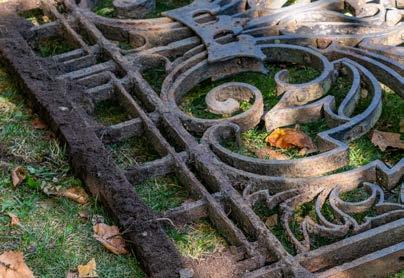
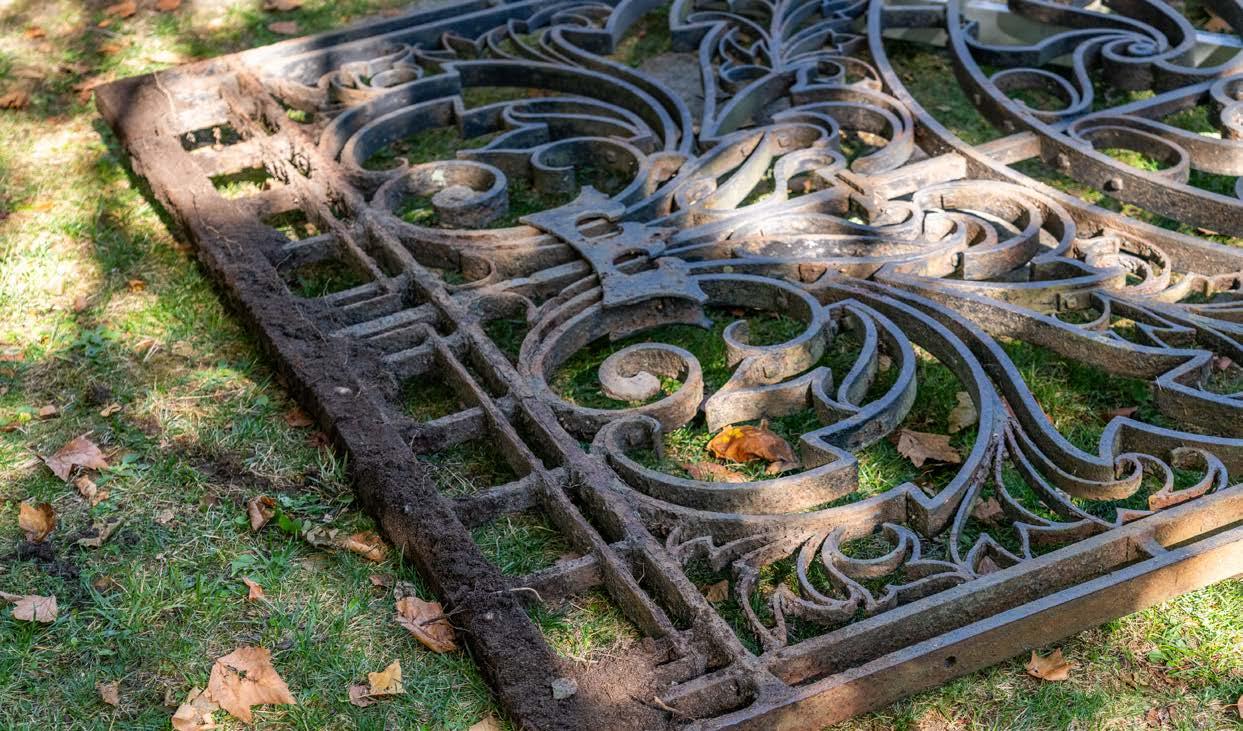
Last fall, the NHA removed the Greater Light garden’s ornate ironwork “gates” for restoration. The large panels, purchased from a Philadelphia salvage yard by the Monaghan sisters in the late 1920s, had begun to show widespread signs of corrosion and scaling, with more severe degradation appearing in the bottom courses where the metal met, and buried into, the garden’s topsoil. In preparation for their conservation, the restoration team researched the artifacts’ history, specifically seeking answers to questions about whether the contemporary installation of the “gates” reflected the sisters’ original design.
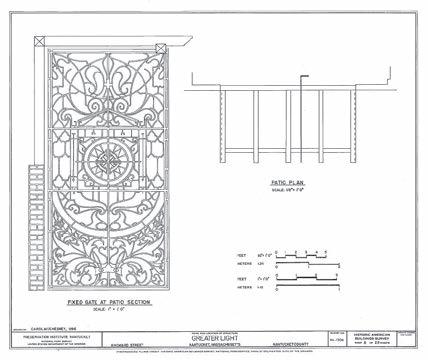
The NHA looked to the institutional archive to answer these questions. According to Hanna and Gertrude’s telling, the gates were the perfect height for the twelve-foot patio aperture, an assertion that was in keeping with their unique design approach: “when you have the right piece, it fits.” But an investigation into the house’s record proves that this was not entirely accurate. A succession of images, many from the Monaghans’ own collection, show that the approximately six-inch bottom border had always been embedded in the ground. In fact, drawings of the panels created in 1996 for the Historic American Buildings Survey omitted this gridded section entirely. In 2011, following the site’s renovation, the level of the brick patio appears to have been at its lowest, an the base of the panels still disappears below ground.
By consulting the record, the restoration team was able to deduce that the installation of the gates, which has inadvertently led to these areas of accelerated degradation, is entirely in keeping with the sister’s vision.
Investigations like this one are an integral first step for each one of the NHA’s building projects. To aid in this research, the Association has made an exciting investment in the development of a new properties management database, in which vital information, documenting both contemporary and historic interventions, can be stored and easily recalled.
The need for this kind of system was first articulated in 2024 as part of Goal 3 of the newest Strategic Plan: to “expand organizational infrastructure and staff capacity for monitoring the physical campus, carrying out routine maintenance and capital projects, and flexibly responding to the unexpected.”
In addition to providing meaningful historical context, the data collected will also be an invaluable resource for guiding some of the more mundane aspects of stewardship. Knowing specifics about what work was undertaken, when, and by whom will aid in the planning, budgeting, and prioritization of future projects, allowing the NHA to anticipate and proactively respond to building related issues across our campus.
In developing the database and its associated documentation process, the NHA strove for a realistic, easy to execute approach, one that prioritized responsible and practical record keeping while simultaneously acknowledging the natural capacity constraints of our staff and contractors. We consulted best practice protocols at peer organizations and eventually identified the key datapoints necessary for a holistic understanding of each project. Entries will include descriptions of the pretreatment conditions, detailed scopes of work, statements on the intentions guiding major decisions, and in-process and finished-product photographs. They will also store timelines, financial information, and material inventories. The goal is to continue to build records like the ones we consult most, so that in the close and distant future our successors can continue to make responsible and well-informed stewardship decisions.
The iron “gates” are currently being treated at Daedalus Art Conservation in Watertown, Massachusetts, where metalwork specialists are in the process of removing and repairing the microbial corrosion caused by direct contact with the soil. Prior to their return to Greater Light, Daedalus will also prepare recommendations for reinstallation that would retain the appearance intended by the Monaghan sisters while protecting the artifacts from ongoing damage resulting from their burial. All treatment details will be recorded in our new database, and, if the NHA does choose to make installation changes for the long-term preservation of the ironwork, careful notes will describe the alteration, ensuring that future preservationists have a very clear understanding of what changed, when, and why.
1. The base of the Greater Light ironwork “gates” upon deinstallation, Fall 2025.
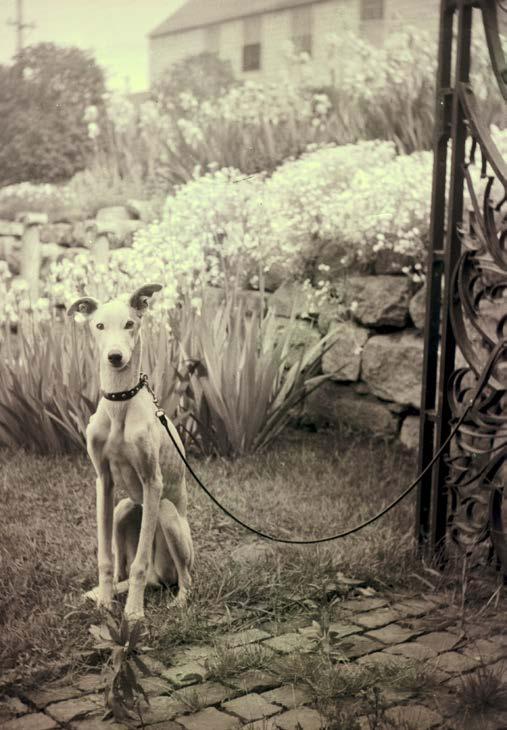
2. The Monaghans’ dog in the garden of Greater Light, 1930s, PH37-N8.
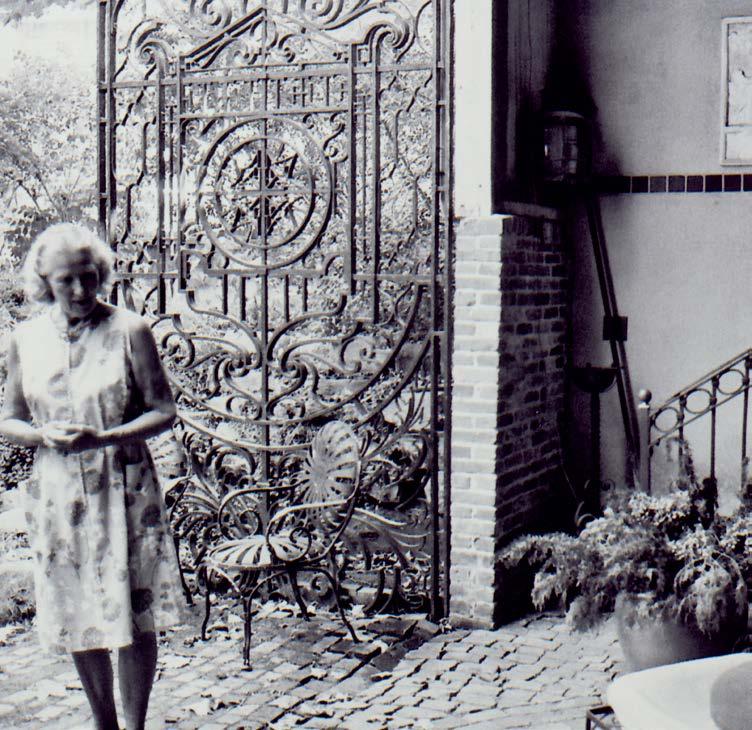
3. Selina Johnson giving a tour of the Greater Light back patio, 1970s, SC706-9.
4. Historic American Buildings Survey, Carol McChesney, et al. Greater Light, 8 Howard Street, Nantucket, MA. Retrieved from the Library of Congress.
EDUCATION INITIATIVES
Both initiatives were designed to support the organization’s strategic goal of “engaging a broader audience by prioritizing accessibility and inclusion and collaborating with partners.”
Partnering for Audience Expansion in Education Programming
This spring, the NHA executed two programs that would not have been possible without collaboration from our broader community. Both initiatives were designed to support the organization’s strategic goal of “engaging a broader audience by prioritizing accessibility and inclusion and collaborating with partners.”
The Junior Guides Program
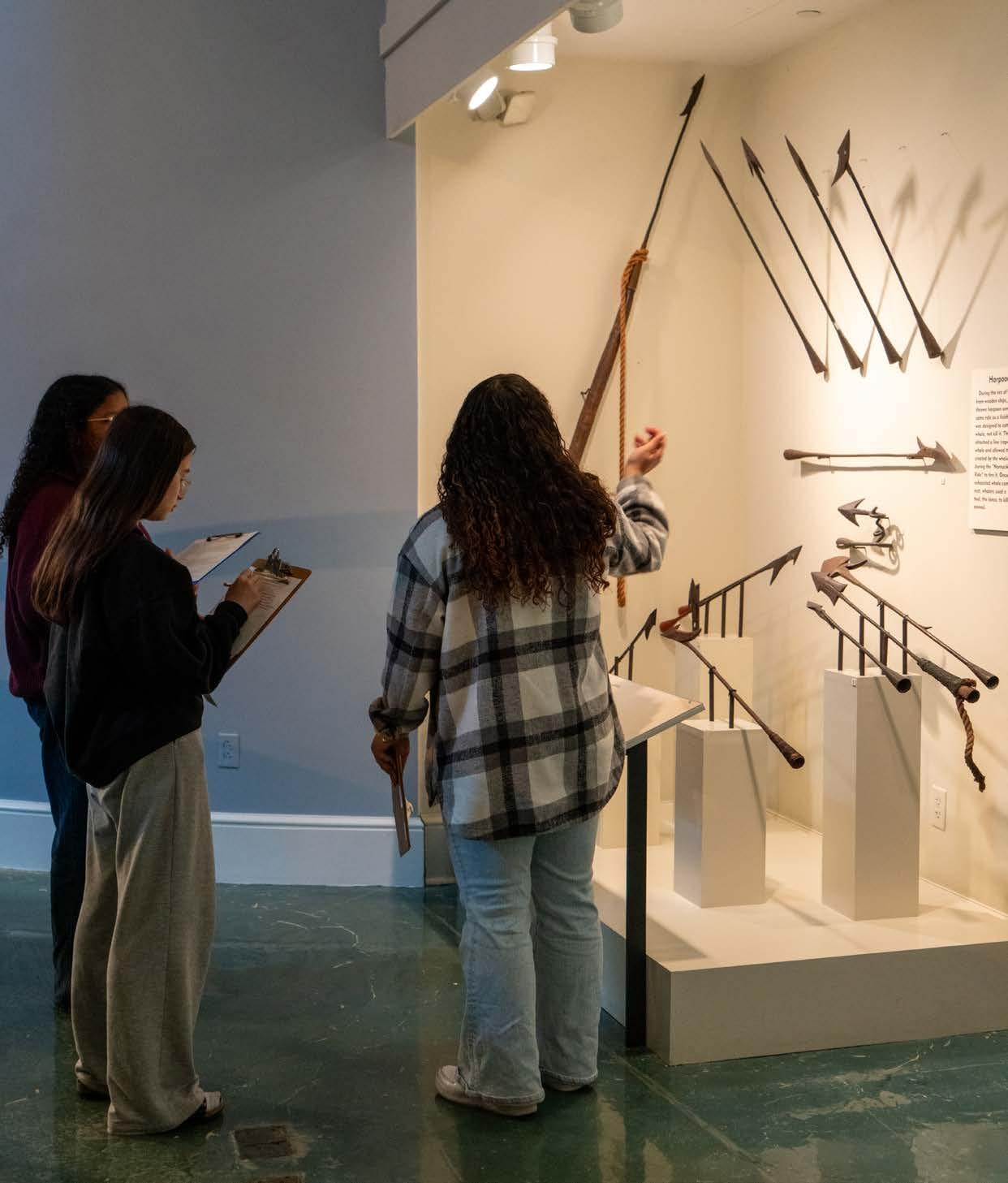
In March, the NHA relaunched Junior Guides, a program developed to engage Nantucket High School’s (NHS) Heritage Spanish class with the island’s history and the experience of facilitating gallery tours in the role of Museum Guide.
The NHA partnered Community Program Educator Zacil Sassy Nash, a native Spanish speaker, who collaborated in the development of this program, taught students public speaking skills, and assisted with translation and bilingual instruction.
The Junior Guides program has both in-classroom and in-museum components. To spark students’ curiosity about Nantucket history, students visited the Whaling Museum for an initial exploration, taking note of objects that caught their interest. After students identified artifacts that they wanted to learn more about, museum educators went to Nantucket High School Heritage Spanish classes to teach students about the role of an NHA Museum Guide, including the public speaking skills that are necessary for success in the job, and the history behind the objects that they selected. Students developed presentations about the objects in Spanish, and returned to the Museum at the program’s end to display their skills and knowledge in a final assessment.
Teachers and students responded positively to the program; in an anonymous feedback survey, the majority of student participants responded that they learned more about Nantucket history, enjoyed their visits to the museum, and thought that NHS and the NHA should continue the program into the future, so that more students are able to participate in it.
The NHA looks forward to building and expanding upon this program in future years, encouraging students to share their learning in presentations to the community, by offering Spanish Language tours of artifacts at events such as the annual Fiesta Community Celebration.
Nantucket Public School Sixth-Grade Curriculum
This spring, the NHA launched curriculum to accompany the publication of a new graphic narrative for middle grade readers: The Adventures of Nancy Gardner Prince, Written by Herself, adapted by Frances Karttunen and with illustrations by John Walsh. In the six-week unit, sixth graders at Cyrus Peirce Middle School read about the life of Nancy Gardner Prince, a Black Nantucket descendant who traveled the world in the 1800s.
Students used The Adventures of Nancy Gardner Prince as a foundation to develop their own storytelling skills; deepened their perspective on Nantucket’s history through NHA staff classroom visits; and connected this history to their own experiences. Students crafted original graphic memoirs inspired by the text. With the guidance of NHA’s Director of Heritage Craft, Mary Lacoursiere, they learned traditional bookmaking techniques to create their own handmade book.
In addition to collaboration between the Heritage Craft and Education arms of the NHA, the inaugural year of this curriculum has been greatly enhanced by partnerships with outside organizations. The Nantucket Education Trust generously provided funding to supply each sixth-grade student with their own copy of The Adventures of Nancy Gardner Prince, enabling them to read at their own pace, revisit the text, and actively engage with the story and history both during and after the unit. The Museum of African American History Boston & Nantucket hosted a book release celebration for participating students, giving them a space to publicly share their work with their classmates and community at the African Meeting House.
Partnerships with schools, educators, nonprofits, and community organizations allow the NHA to expand the reach and impact of our programming, bringing new audiences into museums and museum educators into the classroom. We value these collaborations as we continue to prioritize accessibility and inclusion so that all Nantucket youth can engage deeply with our island’s history.
RECENT ACQUISITIONS
The William Tell / Stonington Plaque
The NHA is pleased to announced the acquisition of perhaps the most important piece of whalemen’s scrimshaw to emerge in the last fifty years: an engraved plaque by Edward Burdett. The plaque, which had been in the possession of a single family for two hundred years, was offered to the Nantucket Historical Association by the descendants of Captain Valentine Hussey, a significant merchant from Nantucket’s whaling era.
The plaque is engraved with a detailed depiction of an encounter between the whaleships William Tell of New York and Stonington of New London, showing them jointly hunting a pod of sperm whales. Edward Burdett was second mate of the William Tell from 1829 to 1833, and he made much of his best scrimshaw on this voyage. The William Tell was commanded by Capt. Nathaniel Gardner and was one of many ships owned by Jacob Barker, a leading New York merchant whose Nantucket family connections led him to often hire Nantucket men to run his vessels. The Stonington was Captain Gardner’s previous command. While the plaque may show a real encounter between the two ships, evidence suggests Burdett imagined this scene of the two ships meeting and engraved it as a tribute to Captain Gardner.
The acquisition of the plaque was negotiated and underwritten by the Friends of the Nantucket Historical Association, with significant additional support from numerous angel
donors. Over the last forty years, the Friends have purchased over $4 million worth of art, artifacts, and manuscripts for the association’s collections. These include many significant items now held by the NHA, including paintings by Eastman Johnson, Elizabeth Rebecca Coffin, and Gilbert Stuart, hunting decoys, island-made silver, lightship baskets, maps, and logbooks, as well as the three other examples of Burdett’s work the NHA holds.
The plaque is a gift of the Friends of the Nantucket Historical Association with partial gift of Peter Nash Hussey, Michael Phelps Hussey, and Alison Randle Hussey Cummings. Additional generous support from Peter & Bonnie McCausland, The McCausland Foundation; Christy & Bill Camp; Barbara & Amos Hostetter; Franci Neely; Melinda & Paul Sullivan; Connie & Tom Cigarran; Maureen & Edward Bousa; Anne Marie & Doug Bratton; The H. L. Brown Jr. Family Foundation; Laurie & Bob Champion; Anne & Todd Knutson; Coco Kopelman; Margaret Hallowell & Stephen Langer; Denise & Andrew Saul; Helen & Chuck Schwab; Janet & Rick Sherlund; J. Tilroe; Pamela & Max Berry; Karyn Frist; Kaaren & Charles Hale; Diane & Art Kelly; Sharon & Frank Lorenzo; Anne & Brec Obrecht; George Spencer III; Stephanie & Jay Wilson; Robyn & John Davis; Rafael & Gail Osona; Susan & Kennedy Richardson; Patricia S. & Thomas J. Anathan; Susan Shapiro; Merrielou Symes; and Mary Randolph Ballinger.
NEWS, NOTES & HIGHLIGHTS
Old Mill Restoration Project Update
The NHA is beginning the next phase of restoration work on the Old Mill. The current project, which began in late 2024, required additional research and materials testing once the structure was opened for thorough inspection. Those findings have led to a broader view of the project and an understanding that more intensive restoration will be required.
Historic machines such as the Old Mill are often upgraded with modern technology because it can be difficult to source original parts and materials. The NHA does not want to take that approach, as it’s critically important to preserve what makes this Mill unique. When the Mill was built in 1746, millwrights were more common. Now they are few and far between. The NHA is grateful for our partnership with millwright, Amy Boyce from Husk Preservation, and for her knowledge, guidance, and efforts to ensure we can restore the Mill using the best methods and appropriate materials.
Much of the work on the Mill to date has not been visible to the public. For instance, consultants have performed materials testing on the inside timbers, and monitoring systems have been installed to track wind, weather, and humidity. Other sensors track the moisture levels in the wood, as well as temperature, and humidity inside the Mill, along with ground and water-level sensors that determine how the stone foundation has shifted over the years. In addition, the NHA has performed laser scanning of the structure to obtain highly accurate dimensions of the mill in its current condition. Ground-penetrating radar imagery has been done on the site, and significant archival research has taken place to better understand the history of the mill and all of the previous work that has been done.
This summer, work on the Mill will begin to become more evident to the public. Security fencing has been delivered and installed around the perimeter. A boom will be delivered and remain on the premises, to allow
contractors to access the entire exterior of the building without the need for scaffolding. After completion of these preliminary next steps, a crane will be used to help remove the cap from the top of the Mill. Amy Boyce will then conduct an official preservation and reconstruction work survey once the cap is removed. Barber & Sons of Nantucket will lead all non-preservation-related construction, such as making panels to protect siding.
This project will be a multi-year effort and promises to reveal interesting information about the mill and its history. The NHA will share plans and new information as the project progresses.
The NHA is thankful to the Community Preservation Committee (CPC) and their important leadership support of the project.
Students visiting the Old Mill this past spring to learn more about the restoration project.
NEWS, NOTES & HIGHLIGHTS
Properties
Research Library
At the beginning of May, the Research Library staff temporarily relocated to the NHA’s Bartlett Road properties to allow for preparations of the installation of a new skylight. The original skylight, installed decades ago, had begun to show significant signs of age, including cracked panes and deteriorating framing that compromised both its appearance and integrity.
In coordination with Marine Home Center and led by Andersen Construction, Velux Commercial fabricated a new custom like-kind extended-pyramid skylight. May’s rising temperatures cemented an ideal time to complete the project, which was planned as a two-phased approach in conjunction with the rubber membrane replacement project that took place in the fall of 2025.
During the first week of May, the original skylight was carefully removed with the assistance of Holdgate Partners, and the new structure was installed shortly thereafter. With the Research Library temporarily closed to the public and staff working mid-island, the project also provided an ideal opportunity to undertake additional infrastructure improvements.
In collaboration with Kenny Howard Electric, Harry Grodsky & Co. installed a new humidification system for the library, an important enhancement that will help support the long-term care of the collections housed within the building.
Skylight replacement in progress
The team sealing the skylight before installation
Newly installed skylight from rooftop
Fine Arts Gallery Expansion
The Fine Arts Gallery Expansion project continues to move steadily forward. As of May, demolition work is nearly complete, and the project team is advancing into the next phase of planning, including final coordination of electrical systems, mechanical infrastructure, and lighting design.
With the ceiling opened during demolition, the team was able to thoroughly assess the building’s existing infrastructure and replace outdated wiring where needed. As the new lighting and interior partition plans continue to develop, sprinkler placement is also being carefully coordinated to ensure complete coverage throughout the reconfigured gallery spaces.
The first phase of new construction will focus on the creation of a new liquor closet and mechanical room. In preparation for this work, all HVAC equipment and mechanical systems have already been ordered, allowing the project to continue progressing on schedule.
Throughout the process, the NHA has been working closely with Andersen Construction, Emeritus, Harry Grodsky & Co., Kenny Howard Electric, and Moran Sheet Metal to guide the transformation of the space with careful attention to both function and design.
New Fine Arts Gallery before wall demolition
New Fine Arts Gallery after wall demolition
New Fine Arts Gallery wall demolition in progress
NEWS, NOTES & HIGHLIGHTS
Programs
Jail Break Escape Room
This May, the Old Jail provided the perfect setting for the NHA’s first-ever escape room experience. Nearly 150 participants stepped inside the historic jail cells to test their problem-solving skills as they raced against the clock to decode clues and uncover the keys needed to escape. While not every team managed to break out in time, the event was filled with laughter, curiosity, and suspense as participants worked together under pressure. The program offered a fun and engaging new way to interact with one of the NHA’s historic sites.
The Fluid Border: Maintaining Indigenous Maritime and Sovereignty
Master boat carver and artist Jonathan James-Perry joined us at the NHA this April to speak about his role in helping maintain indigenous maritime traditions. Hailing from the Aquinnah community of the Wampanoag nation, James-Perry is one of the many artists featured in this year’s featured exhibition in McCausland Gallery, The Wider World and Scrimshaw. In his program to help celebrate the exhibit’s opening, he described just a small handful of the 50 traditional vessels, known as muhsh8nash, that he has helped create. Drawing from both regional history and personal family heritage, he reflected on the artistic and cultural significance of this work, emphasizing restorative efforts, cultural preservation, and intergenerational knowledge. His lecture highlighted how art and craftsmanship can strengthen connections between past and present communities while honoring enduring traditions.
New Heritage Craft Workshop Space
After the NHA’s recent acquisition of a new property last year, our Heritage Craft workshops now have even more space to grow. This spring, Mary Lacoursiere and the Heritage Craft team held their first workshops in the new space. Led by professional marbling artists Regina and Dan St. John, the three-day inaugural sessions were joined by participants who came from all over the US and Central America. The expanded workshop space will allow the Heritage Craft program to continue introducing new workshops and larger classes, creating even more opportunities for participants to explore traditional and contemporary artistic techniques. These events mark the beginning of an exciting new chapter for hands-on programming at the NHA.
From top top to bottom: Jail Break attendees in progress; Johnathan James Perry; and paper marbling workshop.
Programs
Wampanoag Symposium
Coinciding with Native American Heritage Month, the NHA will host the symposium Native Stories, New Approaches: Re-presenting Indigenous Communities and Collections.
This program brings together four participants (introduced below) to discuss the complex and sensitive relationship between Indigenousmuseums and Indigenous peoples. Speakers will share examples of new approaches to Indigenous collections care, and highlight new ways of thinking about how Indigenous history is collected, interpreted, and presented in museum settings. As the NHA continues to work to expand the presence and representation of Wampanoag history in its public offerings, this symposium explores the creative approaches and partnerships that sister institutions have recently used to present Indigenous history in their galleries.
Marjory O’Toole is the Executive Director of the Little Compton Historical Society and holds an MA in Public Humanities from Brown University. In her twenty years with LCHS, she has curated or co-curated over twenty exhibits, and authored, co-authored, or edited twelve local history books. In 2026, due to her work with the Sakonnet History Project, Marjory was named the Eva Butler Scholar Award recipient by the Tomaquag Museum, and the project received an Outstanding Public History Project Award from the National Council on Public History and a Leadership in History Award from the American Association for State and Local History.
A citizen of the Mashpee Wampanoag Tribe and a former journalist, Paula Peters is a writer and historian concentrating on the authentic Wampanoag story told in the Wampanoag voice. Paula is the founder of SmokeSygnals, a Mashpee-based and
Indigenous-led creative agency specializing in museum installations at institutions including the Box in Plymouth, UK; Mystic Seaport,;and the Smithsonian. She produced “OurStory: 400 Years of Wampanoag History” for the commemoration of the 400th anniversary of the Mayflower arrival in 2020, and the community driven “Wampum Belt Project” exhibit in search of Metacoms belt. Paula lives with her husband and children in her ancestral homeland in Mashpee.
With over two decades’ experience in the museum field, Elysia Poon's career has demonstrated a dedication to collaborative programming and community-based collections care. She currently serves as the Indian Arts Research Center executive director at the School for Advanced Research in Santa Fe, New Mexico. In this capacity, Elysia has helped facilitate the development of the Standards for Museums with Native American Collections and served as project facilitator for the groundbreaking, nationally traveling exhibition, Grounded in Clay: The Spirit of Pueblo Pottery. Under her leadership, the IARC continues to be at the forefront of the national conversation around how collecting institutions and Native American communities can work together to foster and promote cultural heritage and further contemporary art practices.
Alaka Wali is Curator Emerita of North American Anthropology at the Field Museum in Chicago. She led the collaborative curation of the Museum's permanent exhibition, Native Truths: Our Voices, Our Stories, and co-edited the companion volume, The Future is Indigenous. Stories from the New Native North America Hall at The Field Museum. She has also published on her research and programmatic efforts to engage communities for environmental conservation efforts in the Western Amazon region of South American and in the Chicago region.
Photos by John Weinstein
NEWS, NOTES & HIGHLIGHTS
Scholarships
2026 NHA High School Scholarship Recipients
Every year, the Nantucket Historical Association Scholarship is awarded to graduating seniors of Nantucket High School who is pursuing a four-year college degree and has also demonstrated a commitment to Nantucket’s community through volunteer time and initiatives. We congratulate this year’s recipients and wish them luck as they begin college this fall.
Cora Iller is a Nantucket native with a passion for serving her community. Her commitment to community involvement is reflected in her volunteer work with the Nantucket Boys & Girls Club, Nantucket Dance Theater, and St. Mary’s Faith Formation program, as well as her internship at Nantucket Cottage Hospital. A dedicated ballet student, Cora has performed in numerous Nantucket Ballet productions. She is also a contributing writer for Veritas, Co-President of the NHS Latin Club, and a member of the National Honors Society. Cora is excited to pursue Nursing at Villanova University in the Honors Program beginning in Fall 2026.
Preslava Penkova was born on Nantucket. Her upbringing instilled a deep commitment to competitive swimming and tennis during the school year, even becoming a tennis captain her senior year. Presy attended the Nantucket Bulgarian School, earning a second diploma and later volunteering to teach traditional Bulgarian dances to local youth to share her passion for culture. She spends her summers working with the Nantucket Historical Association, helping digitize historic documents to preserve local history. She looks forward to combining her background in cultural advocacy and historical research to achieve her ultimate goal of becoming a human rights lawyer. She will be attending Georgetown University pursuing a degree in International Relations on a pre-law track.
Staff Update
New Faces and New Roles at the NHA
Katherine Oldakowski , Heritage Craft Program Manager
Katherine Oldakowski has been a summer resident of Nantucket for more than 20 years and brings a lifelong passion for heritage crafts, education, and community engagement to her role as Program Manager for Heritage Crafts at the Nantucket Historical Association. She holds a master’s degree in Library Science and has spent over a decade taking classes through the NHA, particularly at the 1800’s House. A longtime craft enthusiast, Katherine is excited to help preserve and share traditional crafts and skills with the Nantucket community and visitors alike. In her spare time, Katherine enjoys reading, needlepoint, spending time with her family and walking her English cream golden, Izzy. If you see them out and about, please say hello!
Staff Update
New Faces and New Roles at the NHA
Christina Beale joined the Nantucket Historical Association as a Digitization Assistant in the Spring of 2026. She had previously worked for Paramount Global in Digital Operations, and is excited to transition her focus from entertainment to historical research and to utilize her history degree from Lehigh University. Christina has spent summers on Nantucket her whole life, and through the NHA's Barney Nantucket Genealogy database found she could trace her family's roots to several of the first English settlers on Nantucket. By digitizing more of the NHA's collection, she hopes others are able to easily learn more about themselves and
Mario Rodriguez, a Long Island native, is currently in his third full year on Nantucket. With a fashion background rooted in New York City and experience working with a variety of brands and designers, he has developed a particular interest in the intersection of fashion and history. Through his part-time digitization work with the Nantucket Historical Association, Mario has enjoyed contributing to the preservation of the island's historical collections while gaining
Paige Walker joined the Nantucket Historical Association as a Summer Intern, working as a Museum Guide, a Visitor Services Representative, and an Archival Researcher, creating a series of online digital learning resource guides on Nantucket history. She recently graduated from New York University with honors in Architectural History and Environmental Studies. In the fall, she will begin her master’s in Historical and Sustainable Architecture in London. During her time at NYU, Paige studied in Prague, Czechia, where she worked as a Historical Architecture Intern and created tourism guides on local landmarks. She also embarked on multiple undergraduate research projects, including a study on the evolution of the New York City coastline use and a comparative analysis of redlining in the United States with the post-Troubles urban fabric of Belfast, Northern Ireland. Paige fell in love with the history of Nantucket as a child when she visited over the summers, spending lots of time in the Whaling Museum. Her other interests include sewing projects and travel. With her passion for historical research and old buildings, Paige is excited to help share the story of Nantucket.
NEWS, NOTES & HIGHLIGHTS
Meet Our 2026 Fellow
E. Geoffrey and Elizabeth Thayer Verney Fellowship
Dr. Lynne Anderson is a former professor of education at the University of Oregon, where her research focused on the use of technology to enhance literacy – reading, writing, and studying – for students struggling in school. Since retiring from academia, Dr. Anderson has pursued a rigorous program of research on early female education and the role of needlework samplers in the schoolgirl curriculum, resulting in publications, exhibitions, and presentations. She is the founder and President of the Sampler Consortium International, a non-profit membership organization for individuals and organizations interested in conducting and promoting scholarship on schoolgirl samplers and related girlhood embroideries. Dr. Anderson is also the Director of the Sampler Archive Project, a nationwide effort to locate, photograph, and document American samplers in public and private collections across the nation, making images and information available to the public in a user-friendly, online, searchable database
Research Project:
Quaker Female Education on Nantucket, 1660-1860
The purpose of Dr. Anderson’s project is to conduct research on the educational opportunities and experiences of girls and young women born into or living with Quaker families on Nantucket from the mid-seventeenth to mid-nineteenth centuries. The proposed research is part of a larger study of Quaker female education in New England, leading to a book titled Samplers, Social Justice, and the Society of Friends: Quaker Female Education in New England, 1660-1860. The book explores what Quakers mean when they call for a useful, albeit “guarded,” education, and the impact of an educational philosophy that promotes learning for girls as well as boys, blacks as well as whites, and the impoverished as well as the wealthy. It investigates the educational experiences of Quaker girls and young women in early New England and showcases the stories of largely unknown female students, teachers, and schools. To identify and study Quaker schools, teachers, and students, the project will explore diverse forms of data held by the NHA, including primary and secondary print sources, schoolgirl samplers, historic newspapers, portraits and photographs, as well as personal publications such as memoirs, diaries, and letters.
About the Fellowship
In an effort to enhance the public’s knowledge and understanding of the heritage of Nantucket, Mass., the Nantucket Historical Association offers an annual fellowship, the E. Geoffrey and Elizabeth Thayer Verney Fellowship. Established in 1999, the award encourages research in the collections of the Nantucket Historical Association Research Library and is open to academics, graduate students, and independent scholars. Learn more by contacting Library@nha.org
Research
Research Fellow Update
Established in 1996, the NHA Research Fellows program honors individuals for their significant contributions and service to the Nantucket Historical Association in fields of research directly related to the historical collections and properties of the NHA or through independent research that substantially augments the understanding of the history of Nantucket.
Nathaniel Philbrick
Eric Jay Dolin
Eric Jay Dolin's new book is The Wreck of the Mentor: A True Story of Death, Despair, and Deliverance in the Age of Sail. The New Bedford whaleship Mentor wrecked in 1832 on a remote reef in the western Pacific. With supplies dwindling, the eleven surviving crewmen faced the miseries of shipwreck in unfamiliar territory and the profound uncertainty of contact with the Indigenous people of the Micronesian archipelago of Palau. In this gripping saga of cultural collision, tribal wars, and dashed hopes, the author vividly reconstructs the Mentor’s doomed voyage, the years of perilous captivity, and the delicate negotiations and fraught naval rescue mission that followed.
Nathaniel Philbrick’s forthcoming publication is The Rush: California Gold, the Civil War, and the Making of the Modern World, scheduled for release on October 6. The book tells the story of how the discovery of gold in California helped forged the modern United States and lit the fuse to the Civil War. Several characters with Nantucket roots appear in the book, including the physician Charles Winslow and Mary Ellen Pleasant, an African American woman who became the nineteenth-century equivalent of a multimillionaire in San Francisco.
Betsy Tyler
Betsy Tyler is engaged with several projects documenting historic properties for the Nantucket Preservation Trust and the ‘Sconset Trust, and is writing a forthcoming history of the Nantucket Land Bank Commission. For the 2025 and 2026 academic years, she has been a guest lecturer for the University of Florida’s Preservation Institute Nantucket, where she instructs students in the intricacies of local deed research. Tyler currently serves as a member of the Nantucket Historical Commission, having been appointed to a three-year term in 2025.
C.L.W. French Society
C.L.W. French Society
The NHA circle of leadership support
The Nantucket Historical Association established the C.L.W. French Society to recognize individuals who contribute to the NHA at the highest levels.
Named after Miss Caroline L.W. French of Boston, one of the earliest major donors to the NHA. Miss French was one of the benefactors of the NHA’s purchase of the Quaker Meeting House in 1894, under the condition that the Association raise a reserve to purchase the Old Mill should it come on the market. By helping to secure two of the NHA’s most iconic properties, Miss French’s support is felt more than a century later.
Through this prominent giving society, the board of trustees acknowledges the generous total annual giving by our top individual donors to the NHA’s operations.
C.L.W. French Society members contribute $5,000 or more annually to the annual fund, membership, fundraising events, as well as for exhibitions, educational programs, and other special initiatives.
For more information about the C.L.W. French Society, please contact the Development Department at (508) 228-1894 or giving@nha.org.
Qualifying donors are entitled to the following benefits:
$5,000 – $9,999
• A family-level membership
• Unlimited guest passes
• Invitations to exclusive C.L.W. French events
• VIP early entry to Exhibition Openings
• Recognition on C.L.W. French Society donor board
• C.L.W. French Society merchandise
$10,000 – $24,999
• All above benefits
• Invitation to an intimate coffee and conversation with NHA directors
$25,000 – $49,999
• All above benefits
• Private tour or Decorative Arts workshop for up to 6 people, tailored to your interests
$50,000 – $99,999
• All above benefits
• 10% off an NHA event rental
$100,000 and Above
• All above benefits
• Call ahead parking spot for general admission, programs, and special events