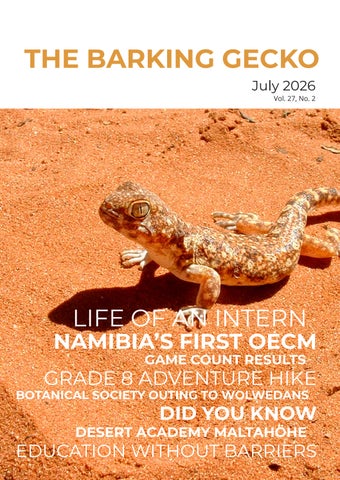
THE BARKING GECKO July 2026
Vol. 27, No. 2
LIFE OF AN INTERN
NAMIBIA’S FIRST OECM GAME COUNT RESULTS
GRADE 8 ADVENTURE HIKE
BOTANICAL SOCIETY OUTING TO WOLWEDANS
DID YOU KNOW
DESERT ACADEMY MALTAHÖHE
EDUCATION WITHOUT BARRIERS
CONTENTS 4
EDITOR’S INPUT
5
MESSAGE FROM THE CEO
6
GREETINGS FROM THE NORTH
13
GREETINGS FROM THE SOUTH
17
NAMIBIA’S FIRST OECM
19
GAME COUNT RESULTS
22
OUR STAY AT NAMIBRAND
26
THE LIFE OF AN INTERN @ NADEET
28
BOTANICAL SOCIETY OUTING TO WOLWEDANS
32
GRADE 8 ADVENTURE HIKE
36
DESERT ACADEMY MALTAHÖHE
42
EDUCATION WITHOUT BARRIERS
43
DID YOU KNOW?
“Wilderness is not a luxury but a necessity of the human spirit.” - Edward Abbey
2
Jessica Steyn
Aptosimum spinescens at sunset.
3
Jessica Steyn
EDITOR’S INPUT
A
s I reflect on the past few months, it is hard to believe how quickly the year has flown by. Being on maternity leave and welcoming our beautiful daughter, Amelia, on 30 April made this a truly special chapter in our lives. While I missed many of the activities taking place across the Reserve, it was wonderful to see everything continuing so seamlessly. One of the last events I took part in before my maternity leave was hosting the Botanical Society during their visit to our remarkable Reserve. Fortunately, a few welcome showers of rain brought enough flowering plants to delight the botanists, while the breathtaking landscapes offered everything they had hoped to experience. This edition highlights the incredible diversity of work taking place at NamibRand. From essential maintenance projects across the Reserve, to students learning and growing at Keerweder and NaDEET, to school children discovering the wonders of the desert on foot and even exploring holistic growing practices — every activity contributes to a greater purpose. Conservation is not just about protecting wildlife; it is about connecting people, knowledge, landscapes and sustainable practices. Everything is interconnected. One of the year’s proudest achievements was receiving recognition as Namibia’s first Other Effective Area-Based Conservation Measures (OECM) site. This milestone represents the culmination of years of dedicated work and collaboration with the Ministry of Environment, Forestry and Tourism, marking another significant step forward for conservation in Namibia. I hope you enjoy this edition of The Barking Gecko and the stories that showcase the passion, commitment and people who make NamibRand such an extraordinary place.
Happy family at NamibRand
4
T
he NamibRand Nature Reserve is now an internationally recognised protected area. One of the first tasks when I joined the NamibRand Nature Reserve in 2004 was to investigate how we could officially register the Reserve as a bona fide protected area. I am happy to report that this has finally been achieved. Although the Nature Conservation Ordinance 4 of 1975 includes a provision for the establishment and official registration of private game parks and private nature reserves, we were advised to wait for the new Wildlife and Protected Areas Management Bill that would effectively replace the old ordinance and become the overarching law to govern nature conservation in Namibia. Unfortunately, twenty-two years
later, the new bill is still waiting to be passed by parliament. Fortunately, Namibia is a signatory to the Convention on Biological Diversity (CBD) and the objectives and targets set by this global alliance have always been supported and implemented by the Ministry of Environment, Forestry and Tourism (MEFT). One of the mechanisms born out of the CBD are Other Effective Area-based Conservation Measures (OECMs) and the NamibRand Nature Reserve was certified as Namibia’s first OECM site on 31 March 2026. We are extremely proud of this achievement that now officially recognises our efforts and dedication to biodiversity conservation. NamibRand has been committed to environmental stewardship for
Jessica Steyn
MESSAGE FROM THE CEO
Family Steyn in June 2026
more than 45 years and this recognition validates our longterm nature conservation efforts that started in 1981. Read all about OECM’s in this edition of the Barking Gecko. The Reserve lies at the northern edge of the winter rainfall system for southern Africa. Every few years, we get a few raindrops at this time of year. This year, the cold fronts that bring the wet weather were unprecedented and the Reserve received a deluge of rain in June. Some places on the Reserve received more than 100 mm in the last two weeks of June. This is more than our long-term annual average of 70 mm of rain, which we normally get in the main rainfall season from October to April. More information on this once-in-a-lifetime weather can be found in this edition of the Barking Gecko. NamibRand’s family has grown again. We welcomed Amelia Steyn to the world on 30 April 2026. Proud parents Jessica and Andre and big brother Dominic are already back at our wardens’ station at Keerweder. We wish the them lots of happiness and all the best! We hope you enjoy this edition of our Barking Gecko newsletter. Kind regards,
The NamibRand Nature Reserve OECM certificate as awarded on 31 March 2026
5
Jessica Steyn
Area close to the Keerweder pan that has been taken over by Geigeria ornativa.
GREETINGS FROM THE NORTH CONSERVATION IN ACTION
MAINTAINING A LIVING LANDSCAPE Jessica & Andre Steyn
W
hen people think of the NamibRand Nature Reserve, they often picture sweeping dunes, endless horizons and abundant wildlife. Yet behind these iconic scenes lies a tremendous amount of work carried out by our dedicated staff, researchers and partners. Every road maintained, every species recorded and every research project hosted contribute to the long-term conservation of this remarkable landscape. The first few months of the year were particularly busy, with numerous maintenance projects, scientific visits and ecological observations taking place across the Reserve. Removing the Past to Restore the Future Conservation is not only about protecting nature — it is also about knowing when to remove the footprint of previous human activities. One such project took place, when the Keerweder maintenance team dismantled the old Zebra Dam near Losberg. The dam has long since fallen out of use and removing obsolete infrastructure forms part of our commitment to allowing the landscape to recover as naturally as possible. During the operation, the corrugated iron was
6
cut into transportable sections and taken back to Keerweder. The remaining concrete base will be removed during a future maintenance trip. The staff also began dismantling the old Verweg homestead infrastructure. Although the main building foundations, portions of the walls and fencing still remain, removing abandoned structures reduces visual impacts on the landscape and ensures these areas can gradually return to a more natural state. These projects may seem small, but together they represent an important philosophy of conservation — leaving as little unnecessary human infrastructure behind as possible. Keeping the Reserve Connected With hundreds of kilometres of roads crossing the Reserve, maintenance is an ongoing priority. Rather than relying solely on commercial equipment, the Keerweder workshop once again demonstrated remarkable ingenuity by constructing three new road graders. Two compact graders were specifically designed to maintain the tracks between Jakob and Wolwedans, and between Keerweder and
Jessica Steyn
Andre Steyn
Exploring various areas to show plant diversity.
Group photo of Botsoc at Chateau viewpoint.
Kwessi Dunes Lodge. A much larger grader was also built to assist Kwessi Dunes Lodge with maintaining its entrance road. These homemade implements provide a practical and cost-effective solution for maintaining access throughout the Reserve while ensuring that visitors, staff and researchers can reach even the more remote corners of NamibRand safely. Another significant road project arose through collaboration with NamibSky Ballooning. The company asked that several old roads in the Valley of Tears, last driven in 2016, be reopened. These routes are important during longer balloon flights, allowing retrieval vehicles to access areas where balloons may land.
While the March count focused specifically on zebra, May brought one of the Reserve’s largest annual monitoring exercises — the annual game count. During this survey, every animal encountered across NamibRand is carefully recorded. By repeating this exercise each year, we are able to build a longterm picture of how wildlife populations respond to changing environmental conditions, rainfall patterns and management practices. You can read more about this year’s game count elsewhere in this edition.
These routes now provide an important alternative landing and recovery option whenever strong northerly winds prevent balloon flights from operating on the Geluk side, allowing visitors to continue enjoying one of Namibia’s most spectacular aerial experiences while minimising operational challenges.
Andrea Hesemans
Ruan from NamibSky and André headed into the valley to locate and reopen these forgotten tracks. A week later, NamibSky returned with grading equipment to improve the roads and familiarise their pilots and ground crews with the area.
In March, staff undertook a dedicated Burchell’s Zebra census to estimate the Reserve’s current population. The survey forms part of our long-term monitoring programme and provides valuable information on population trends, distribution and future management needs.
Understanding Our Wildlife Monitoring wildlife populations remains one of the most valuable tools available to conservation managers.
Group photo taken after the Kgotla meeting, from left to right: Jacques Junius, André Steyn, Jessica and Dominic Steyn, Kerstin Klein, Johensia Liebenberg, Denis Hesemans, Martin Verwey, Chantell Verwey, Jonas Ndeuludila and Adam Taseb.
7
Jessica Steyn Andre Steyn
Kwessi staff in the process of uploading the big grader for their entrance road.
The team was excited when André and the rest of the field staff spotted cheetahs on the Reserve. However, true to their elusive nature, the cheetahs disappeared as quickly as they had appeared. Several camera traps were deployed in the hope of capturing images of them, but so far, they have managed to avoid detection. When Rain Rewrites the Landscape One of the greatest reminders that nature is never predictable came from the weather. Following the exceptional rainfall around Keerweder Pan during November, botanists and staff began noticing vegetation appearing in places where it had never previously been recorded. One particularly striking example was the dramatic spread of Geigeria ornativa, which colonised large areas around the pan where the species had not been observed before.
Andre Steyn
Elton busy cutting the old Zebra dam apart, using an angle grinder.
As the rainy season progressed, further showers continued to surprise us. Then came June. Rain during June is not unusual in the Namib Desert, but it is normally limited to only a few scattered millimetres. This year was different. Significant rainfall fell across much of the Reserve, with some areas even experiencing hail — an extraordinary sight in one of the driest places on Earth. Our rainfall table shows just how much rain each area of the Reserve received during June alone. These unusual conditions transformed parts of the landscape almost overnight.
The dismantled Zebra dam.
8
Jessica Steyn
Rain showers seen behind Jakop in the Valley of Tears.
Winter-growing species emerged from soils where they had remained dormant for years, creating brief windows of botanical abundance before disappearing once again beneath the sand. Perhaps the most exciting discovery was the addition of a completely new species to the NamibRand plant list: Phyllopodium namaense. This tiny and easily overlooked plant was discovered growing amongst the dunes, demonstrating once again how much there is still to learn about the biodiversity of the Namib Desert. Moments like these highlight the importance of long-term monitoring. Without regular observations by staff and visiting botanists, these short-lived appearances could easily go unnoticed. However, with winter setting in and the ground remaining wet, temperatures dropped rapidly overnight. By the end of June, parts of the Reserve experienced heavy frost, creating crisp, cold mornings and adding yet another unusual chapter to this remarkable season.
Welcoming Science to the Desert NamibRand continues to serve as an internationally recognised outdoor laboratory, attracting scientists from across the world. In January, researchers from the University of Florida visited Keerweder to study the evolution of venom complexity in social spiders. Their work focused on collecting Stegodyphus spiders from dry riverbeds within the Reserve. The collected specimens will undergo venom extraction and detailed laboratory analysis in the United States, helping scientists better understand how venom has evolved within these remarkable social spider colonies. We eagerly await the results of this fascinating research. Fairy circles also continued to draw international attention. In March, Prof. Hezi Yizhaq and Dr. Stephan Getzin returned to NamibRand to continue their long-running investigations into one of the desert’s greatest mysteries. Their ongoing collaboration has contributed significantly to our understanding of these iconic circular vegetation patterns. Also in March, Daniel Wyss
arrived with a group of twenty students from Georg-August University, Göttingen. While based at NaDEET, the students visited Keerweder, where Jessica introduced them to the history, management philosophy and conservation work undertaken across the Reserve. A field excursion to Jagkop Waterhole provided an opportunity to discuss the area’s fascinating geology, ecology and fairy circles while experiencing the landscape firsthand. Visits such as these help inspire the next generation of conservationists while strengthening international scientific collaboration. Exploring Desert Flora Towards the end of March, NamibRand welcomed another enthusiastic group of visitors — members of the Botanical Society of Namibia (Botsoc). Twenty-three participants spent three nights at Dune Lodge, generously hosted by Wolwedans at a discounted rate. The excursion proved so popular that additional members had to be placed on a waiting list. The first day we explored the northern reaches of the Reserve before the group enjoyed lunch in the
9
Ice crystals found everywhere.
10
Jessica Steyn
Jessica Steyn
Jessica Steyn Jessica Steyn
Jessica Steyn
Jessica Steyn
Jessica Steyn
Hiking to remote areas to retrieve camera traps. Jessica Steyn
Meetings such as these ensure that everyone working within the Reserve continues moving towards the same goal: protecting this extraordinary landscape while supporting responsible tourism, scientific research and sustainable conservation. Every Day Counts Many of the activities described here happen quietly, far from public view. A road grader built in a workshop. An abandoned
Jessica Steyn
Jessica Steyn
Coldness over the Reserve. Jessica Steyn
Stronger Together Conservation is ultimately built on partnerships. On 27 March, NamibSky hosted the quarterly Kgotla meeting at Geluk. Before formal discussions began, Dennis gave participants a tour of the local school “Little Bugs”, highlighting the important connection between conservation, tourism and surrounding communities. Representatives from the Reserve and concessionaires then met to discuss operational matters, share updates and strengthen collaboration across NamibRand.
Phyllopodium namaense in the dune fields, flowering after the winter rain.
Rain seen in the Reserve.
Jessica Steyn
The following day offered a fullday excursion into the southern Reserve, including lunch at Boulders and visits to several isolated locations renowned for their unique plant diversity. For many participants, the trip was far more than simply identifying plants. It was an opportunity to appreciate the incredible resilience of desert vegetation and experience the breathtaking scenery that makes NamibRand such a special place.
Jessica Steyn
beautiful Wolwedans gardens. A relaxed afternoon concluded with sundowners overlooking the spectacular Château viewpoint.
Fog hanging over the mountains.
11
Rain gauge
Total (mm)
Kwessiegat House
63
Cobra Dam
68
Bushmankoppies
68
Keerweder House
72
Boscia
66
Jagkop
46
Zebra Dam
79
Verweg House
78
Toekoms House
95
Kudu Water
89
Kraal Junction
55
Karl’s Valley
53
Wolwedans Village
67
Schafsberg
75
DDR
85
NaDEET Centre
111
Die Duine House
96
Horseshoe Water
85
Horseshoe Camp
106
Hideout House
83
Straussenwasser
60
Swartkoppie
59
Vista
48
Twee Pompe
87
Aandster House
92
Kalkpomp
87
Prosopis
48
Grootpomp
72
Satanskop Duine
72
Satanskop South
61
Springbokvlakte House
65
Two pumps
75
Four Tanks
63
Park border
52
Aandster Water
67
Excelsior Turnoff
65
Saffier House
76
Sonop water
58
Dina North Reservoir
97
Dina Middle
65
Dina Old House
70
Dina South Reservior
85
Dina Dunes
48
12
structure was removed. A spider collected for research. A tiny flowering plant discovered after unexpected rain. Individually, these may seem like small accomplishments. Together, however, they form the foundation of effective conservation. By combining practical management, scientific research, ecological monitoring and strong partnerships, NamibRand continues to demonstrate that protecting a landscape is not achieved through one grand action, but through thousands of thoughtful decisions made every single day.
Map of the rainfall amounts recorded across the reserve during June.
Chantell Verwey
GREETINGS FROM THE SOUTH
Beautiful Sunset in the Namib.
Martin Verwey
A
s always, the Namib Desert never seems to disappoint. We were blessed with an average rainy season this year. We received soft, soaking rain, which is good for the ground. All vegetation grew well with the gentle rain we received. As we began to prepare for the cold winter coming in May, we received another big surprise. We received almost as much rain in May and June as we did in our normal rainy season. It’s not normal for us to receive so much rain at this time of year, so it will be quite interesting to see what the veld does with the winter rain. It was also a soft rain that fell, not a hard rain that washes everything away. We are already noticing oryx calves, also unusual for the time of year, and the veld is full of beautiful wildflowers and other plants. As mentioned in the previous newsletter, we participated in the project with ProNamib where they capture, collar and release cheetahs. The cage that was located on the south side of the Reserve was not successful, and the cage was moved back to ProNamib Nature Reserve, where there was definite cheetah activity noted. Because we were part of the project, we were contacted when the cheetah was captured, and we helped with the collaring of the cheetah and gathering all information needed for
the research. A sample of hair and blood was taken. The cheetah was measured from head to the tip op his tail, the length of his teeth and how big his feet are. It was a unique experience to be so close to this magnificent animal. The cheetah was one of two males that were moving in the area. After the cheetah was safely released, everybody went back to ProNamib base, where Ruben Portas gave a short lecture on the cheetah population and the animals’ behaviour, which gave a new perspective on the magnificent animal. It was a privilege for us to welcome the grade 8 pupils from St. George’s School for a hike in the dunes. The first group of students came on the 19th of May. It was the first school group coming to NamibRand, and we enjoyed them very much. The first group arrived at Aandster main gate a little later than planned, and this put pressure on them to finish the first day, which was a 9 km walk. On the second and third day, they got up very early and covered the entire distance to arrive at the end, which was at the NaDEET centre. Among the learners, there were a few who had a hard time; feet that were sore and bags that were very heavily packed, making it a little more difficult for them. We kept an eye on the children from a distance
13
I am also proud to say that we have completed quite a few of our maintenance projects and other larger projects. Among other things, we have moved the radio repeater that was situated on Satansberg to a new location, the Aandster mountain, which is easier to reach on foot. This was done to provide a better radio connection with Boulders camp and to make sure maintenance could be done on the equipment when needed, without the help of a helicopter.
Chantell Verwey
in the bakkie and were always close enough if a problem arose. The second group of pupils came on the 25th. They arrived at the Aandster gate on time and did the entire first 9 km of the hike to the house. Some of the second group learners also struggled with heavily-packed bags, but that was sorted out at Aandster’s house that evening before they went on with the hike the next day. All in all, both groups covered 30 km over the period of three days. Chantell and I really enjoyed both groups of students and teachers and are looking forward to the next groups.
Cheetah, relaxed in the cage, before he’s darted and collared.
Retrieving the radio repeater equipment on top of Satansberg.
14
Chantell Verwey
Briefing on what each participant is supposed to do and not do around the cheetah.
Chantell Verwey
Chantell Verwey
Chantell Verwey
I greet you with the red sand still in my shoes.
Martin Verwey
Martin Verwey
Martin Verwey Martin Verwey
Two Cape Teal ducks, who must have gotten lost, are enjoying the rainwater that is lying in the road on the route to Family Hideout.
Chantell Verwey
Chantell Verwey
The radio repeater placed in a new area to get easy access.
Welcoming the students at the gate to Aandster and heading them off to where their hike begins.
15
Chantell Verwey
Chantell Verwey
Chantell Verwey
Chantell Verwey
Us assisting with transport and backup where needed for the school group.
Groups arriving at Aandster homestead after 9 km hike and taking a deserved break on the grass.
16
NAMIBRAND NATURE RESERVE
NAMIBIA’S FIRST OECM By Nils Odendaal
T
he NamibRand Nature Reserve is now an officially recognised protected area. On 31 March 2026 the Ministry of Environment, Forestry and Tourism (MEFT) certified the Reserve as Namibia’s first Other Effective Area-based Conservation Measures (OECM) sites.
The global conservation agenda is undergoing a structural shift. The adoption of the Convention on Biological Diversity’s (CBD) Kunming–Montreal Global Biodiversity Framework (GBF) has placed unprecedented emphasis on achieving the Target 3 ambition of effectively conserving at least 30 per cent of the planet’s land and sea areas by 2030. Achieving this goal requires strengthening and expanding conservation efforts through complementary approaches that include formally designated protected areas, Other Effective Area-based Conservation Measures (OECM) sites, and Indigenous and Traditional Territories (ITTs). Together, these approaches can support more inclusive, representative, and effectively governed conservation systems that recognise the contributions of diverse actors and governance arrangements in securing long-term biodiversity and social outcomes.
Born out of the Aichi Target 11, the predecessor of Target 3 of the GBF, OECM sites have emerged as a critical mechanism for recognising and supporting conservation outcomes occurring outside formally protected areas. Parties to the CBD define OECM sites as geographically defined areas that are not formally protected areas but are governed and managed to achieve positive and sustained long-term outcomes for the in situ conservation of biodiversity, together with associated ecosystem functions and cultural values (CBD 2018). A core principle of OECM sites is that they are recognition mechanisms rather than new conservation designations. OECM sites do not inherently require changes in land tenure, new land-use restrictions, or the transfer of governance authority to the state. Instead, they recognise existing governance and management systems that already deliver effective and sustained conservation outcomes for biodiversity. Their role is to acknowledge and strengthen existing conservation efforts, bring a wider set of actors into national biodiversity strategies, and support long-term stewardship. Unlike formally protected areas, which are designated for conservation,
OECM sites can emerge from diverse governance and landuse contexts where biodiversity is conserved as a by-product, such as community-managed rangelands, small-scale fisheries, private reserves, rural research facilities, municipal or military lands and production landscapes. These areas already deliver meaningful conservation results alongside other social and economic benefits, but have largely been overlooked in comparison to other conservation actions. OECM sites can act as a bridge between biodiversity conservation and sustainable economic development. In line with these targets and objectives, Namibia embarked on developing its own national OECM framework in 2024. A technical working group headed by the MEFT and comprised of representatives from the Ministry of Fisheries and Marine Resources, World Wildlife Fund Namibia (WWF), the Namibia Nature Foundation (NNF) and the Namibian Association of CBNRM Support Organisations (NACSO) adapted the OECM application guidelines for Namibia and evaluated the first application in late 2025. The first three OECM sites formally recognised in Namibia are NamibRand Nature Reserve
17
The recognition of these first OECM sites took place during a Validation Workshop and Certification Ceremony held from 30 to 31 March 2026 in Windhoek, marking the culmination of a consultative process to validate Namibia’s Framework and Guidelines for OECMs. Officiating the certification ceremony, Sikongo Haihambo, Executive Director of MEFT, commended Namibia’s progressive conservation policy environment. “It is commendable that Namibia’s legislation allows conservation to be recognised beyond state-owned protected areas, communal conservancies and community forests,” Haihambo said. “OECM sites demonstrate that effective conservation cuts across communal, private and mixed-use landscapes where people live and work as stewards of our natural heritage.” Speaking on behalf of the technical working group, Kenneth Uiseb, Deputy Director: Wildlife Monitoring and Research at MEFT, explained the basis for recognising the sites. “The three sites were identified because they contribute directly to Global
18
WWF Namibia
(188,980 hectares), ProNamib Nature Reserve (84,500 hectares) and Canyon Nature Park (45,000 hectares). Collectively, these sites cover 318,480 hectares of land managed for longterm biodiversity conservation, contributing significantly to landscape connectivity and ecosystem protection across Namibia’s communal, private and mixed-use landscapes.
The first three OECM sites formally recognised in Namibia on 31 March 2026. From left to right: Nils Odendaal (NamibRand Nature Reserve), Nadja LeRoux (Canyon Nature Park), Sikongo Haihambo (Executive Director of the MEFT), Murray Tindall (ProNamib Nature Reserve), Timoteus Mufeti (Environmental Commissioner of the MEFT)
Biodiversity Framework Target 3, the 30 by 30 target, which calls for at least 30 percent of the world’s land and sea areas to be conserved by 2030,” Uiseb said. “They demonstrate that well managed landscapes can deliver long-term conservation outcomes even when not formally proclaimed as protected areas.” Speaking on behalf of the recognised sites, Nils Odendaal, Chief Executive Officer of NamibRand Nature Reserve, welcomed the milestone. “This recognition affirms the dedication of land managers, conservation partners and communities who have worked consistently to achieve real conservation outcomes,” said Odendaal. “Recognition as an OECM site highlights the strength
of partnerships and shared stewardship for Namibia’s biodiversity.” The recognition of NamibRand Nature Reserve, ProNamib Nature Reserve and Canyon Nature Park underscores the importance of diverse governance and management models in achieving Namibia’s biodiversity commitments, while supporting ecosystem protection, climate resilience and socioeconomic benefits. With the first OECM sites now certified, Namibia continues to strengthen its leadership in inclusive, outcome-driven conservation aligned with the Kunming Montreal Global Biodiversity Framework.
2026
GAME COUNT RESULTS By Jessica Steyn
T
he results of the highly anticipated annual game count, held in May 2026, have been compiled. According to the dataset the ecosystem is showing extraordinary signs of vitality. The total estimated number of wildlife across the ten monitored zones has surged by an impressive 33.46%, jumping from 11933 animals last year to a 15926 individuals this year.
This substantial growth is primarily driven by remarkable population spikes in two key indicator species: Springbok and Burchell’s Zebra. This report provides a breakdown of these year-overyear shifts and highlights the critical hotspots discovered along our surveyed routes. The springbok population has experienced a phenomenal boom over the last twelve months. The physical count on the ground more than doubled, increasing from 684 to 1,295 sightings. This translates to an overall 46.91% increase in the total estimated population, soaring from 5598 to 8,224 animals. Springbok are now officially the most populous game species monitored in these zones. Burchell’s Zebra showed the highest percentage growth of any group at 72.60%. Participants counted 703 individuals during the May 2026 sweep, compared to just 369 last year. The total estimated population has subsequently expanded from 1945 to 3358, signalling ideal environmental conditions and high foal survival rates. The oryx population remains stable, though the mathematical estimation model suggests a minor contraction of -023% (moving from 4354 down to 4344). Interestingly, the actual number of individual oryx physically counted on the routes actually increased from 668 to 697. This indicates that while the broader estimate is flat, localised visibility remains high.
The game count area with the ten routes
The May 2026 data exposes an incredibly uneven distribution of wildlife across the 532 km of total route length. Analysis reveals that wildlife movement patterns are completely independent of route length, focusing heavily on specific ecological sweet spots rather than the size of the zone.
19
Route 6 proved to be the ultimate high-density zone. Despite being the shortest route in the entire survey at just 35 km long, it yielded a staggering 459 total animals (202 oryx and 257 springbok).
was avoided by springbok (only 4 counted) and zebras (none counted), serving almost exclusively as an oryx transit route (113 counted). Here it is important to mention that the route is 90% in the dunes and oryx are often the only species mostly found there.
(156) and Route 1 (101), but completely absent (0 recorded) across Routes 4, 5, 6 and 9.
It is important to note that this method is best suited for monitoring large plains species such as oryx, springbok and Burchell’s Zebra. It is Route 10 held the highest less effective for detecting absolute volume of game with smaller species like steenbok Oryx were most abundant 671 total animals counted or animals with more specific in the central-west sectors, across 59 km. This area was Burchell's Zebra showed highly localised herding behaviour. They were concentrated in Route 10 habitat preferences, such clustering along Route 6 (202), a magnet for both springbok (298),and Route 2 (156) Routeit 1 (101), but3 completely absent across 4, 5,Zebra. 6 and as kudu orRoutes Mountain Route (114) and Route 4 (0 recorded) (340) zebra (298),and making Carnivores are more effectively (113). a9.vital corridor for larger herds. monitored using methods such as plains camera traps such and the markSpringbok were mostly found In stark contrast, Route 9 It is important to note that this method is best suited for monitoring large species as oryx, and-recapture technique. on Route 10 (340) and Route 6 (53 km long) was virtually springbok and Burchell’s zebra. It is less effective for detecting smaller species like steenbok or animals (257), avoiding the dune areas abandoned, with a total count with specific habitat such as kudu or mountain Population zebra. Carnivores are more figures derived from in the west. of onlymore two springbok and nopreferences, this count are estimates rather sightings of any oryx or zebra. effectively monitored using methods such as camera traps and the mark-and-recapture technique. than fact. Wildlife management Burchell’s Zebra showed highly at NamibRand is guided notatby localised herding behaviour. Similarly, Route 4 showed Population figures derived from this count are estimates rather than fact. Wildlife management population estimates alone, but They were concentrated a surprisingly low density. NamibRand is guided not by population estimates alone, but by trends in animal numbers and by trends in animal numbers in Route 10 (298), Route 2 Despite its 47km length, it
distribution patterns. This means we focus on whether populations are increasing or decreasing, and where animals are concentrated across the landscape. These insights are drawn directly from observed sightings and not from estimated population sizes.
Total estimated numbers of game (Zone 1-10; May 2025 - May 2026) Species
Oryx Springbok B. zebra Total
20
May-25 No. Counted Total estimated number 668 684 369 1727
4354 5598 1945 11933
May-26 No. Counted Total estimated number 697 1295 703 2695
4344 8224 3358 15926
Percentage change
-0.23% 46.91% 72.60% 33.46%
and distribution patterns. This means we focus on whether populations are increasing or
decreasing, and where animals are concentrated across the landscape. These insights are
drawn directly from observed sightings and not from estimated population sizes.
Total wildlife distribution. Rainfall in mm.
Total wildlife density
For the game count report, wildlife distribution is based on the number of animals seen in each grid square or monad.
Please note that all species counted (actual numbers) were used in the calculation (mapping) for the total wildlife distribution. The maps above show the total wildlife species distribution and density. Data is shown on a gradient from light (low values) to dark (high values). Rainfall values were added to the maps to indicate where and how much rain was recorded: the bigger the circle, the more rain occurred there.
During the game count, each sighting is marked in the corresponding grid square or monad. This data is then used to map the distribution of the animals (i.e. where animals were seen).
21
OUR STAY AT
NATURE
NAMIBRAND RESERVE
N
amibRand hosted two Nature Conservation Students from the Namibia University of Science and Technology during the first half of the year. These insights from each student showcase their experiences.
Iimanuel Haihambo THE DESERT EXPERIENCE By Photos by Iimanuel Haihambo NamibRand Nature Reserve is one of the places that has taught me how fascinating the desert is. Since I was 6 years old, I have always taken care of my grandfather’s cattle. I knew the love for nature ran through my veins. I am busy pursuing my bachelor’s degree in Natural Resource Management at the Namibia University of Science and Technology (NUST). I have completed my
6-month internship at NamibRand, and it was one of the best experiences of my life so far. We were stationed at Toekoms homestead, which had no Wi-Fi or TV. I never knew that staying away from social media could be such fun and so peaceful. When one connects with nature you will always find the real you. The Reserve’s staff, Mrs Jessica, Mr Martin, Mr Andre, Mr Abraham, Mr Elton & Mr Moses, made us feel at home with their jokes, honesty and encouraging speeches. I have learned so much from them, and I am sure that this experience will benefit me in the future. I hope to pass on the knowledge I have received. Looking at the sunset behind the Losberg Mountain is one of the beautiful features the desert could give me. The desert is one of the best places one can escape the world, with wonderful landscapes, with the shadows of the clouds giving off different colour variations, making the scenery of the landscapes more fascinating.
Chameleon on the fence.
22
My inspiration to learn has pushed me to seek more knowledge from the researchers who make a stop at the Keerweder research home. I have learned how to differentiate between zebras based on their stripes. We also helped Mr John Pallett and his veterinary assistant to work on their research focused on the “Increased mortality rate of Ludwig’s Bustard by powerlines in southern Namibia.” We placed a telescope in the field and used binoculars to observe the behaviours of these large birds.
Taking a recording of the darkness of the sky.
The Dark Sky recording night was one of the memorable nights at NamibRand. We had to record the darkness of the sky above the Reserve, from the south to the north; NaDEET is one of the darkest places in the Reserve. The total darkness also forced me to learn about the new constellations that one has never known.
Mr Martin replacing panels at one of the Family Hideout Camps.
Enos Namidi MY JOURNEY AT NAMIBRAND By Photos by Enos Namidi
As a Natural Resource Management student at the Namibia University of Science and Technology (NUST), I had the privilege of completing my Work Integrated Learning internship at the NamibRand Nature Reserve. During my internship, I was stationed at Toekoms, where I experienced firsthand the beauty, challenges and wonders of one of Namibia’s most unique landscapes. My time at NamibRand was both educational and rewarding.
On a trip out with the BOTSOC group around the Reserve.
Us watching the sunset at the Tok Tokkie Trails.
As part of my internship, I conducted my own research project on Euphorbia lignosa, investigating its distribution, abundance and health across different slope aspects at Jagkop. Conducting this research allowed me to develop practical fieldwork and data collection skills while gaining a deeper
23
understanding of ecological research in arid environments. Seeing my project develop from field observations to a completed study was one of the most fulfilling aspects of my internship. One of the most remarkable things about NamibRand was experiencing the desert in a way I had never done before. The Reserve received rain during my stay, transforming parts of the landscape with fresh green grass and bringing new life to the environment. Witnessing the contrast between the dry desert and the green vegetation after rainfall was truly fascinating and showed how dynamic desert ecosystems can be. Another highlight was participating in game counts across the Reserve. These activities provided valuable insight into wildlife monitoring and conservation management while allowing me to observe many of the animals that inhabit NamibRand. Every trip into the field presented an opportunity to learn something new about the Reserve and its wildlife. A further highlight was a tour organised with the Botanical Society, where we learned extensively about the diverse plant species found in the Reserve. This experience greatly enriched my botanical knowledge, and the guidance of Jessica Steyn was especially valuable in helping us understand plant identification and ecological
Removing the fence where the fairy circle research was conducted.
relationships within the desert environment. The desert was also full of unforgettable wildlife encounters. One of the most fascinating moments was while walking the Tok Tokkie Trail, where we observed a Dancing White Lady Spider capturing its prey. Watching the spider’s incredible speed and hunting behaviour was an experience I will never forget. We were also fortunate enough to see a chameleon, another reminder of the amazing diversity of life that survives and thrives in the harsh desert environment. A special part of my internship was the people I met. All the staff members at NamibRand were incredibly helpful, welcoming and always willing to share their knowledge and experience. Their guidance and support made the internship enjoyable and provided a positive environment for learning and personal growth. I am grateful for the time they invested in helping me develop both professionally and personally. Living at Toekoms allowed me to appreciate the peacefulness and beauty of the Namib Desert. From spectacular sunsets and vast open landscapes to clear night skies filled with stars, every day offered something memorable. My time at NamibRand strengthened my passion for conservation and provided experiences that I will carry with me throughout my career.
Busy observing the Ludwig’s Bustards in the field.
24
I would like to thank the entire NamibRand team for their support, encouragement, and hospitality throughout my internship. The lessons learned, friendships formed and experiences gained have made this one of the most valuable and memorable chapters of my academic journey.
A trap made by the Dancing White Lady Spider.
Magnetite grains extracted from NamibRand dunes using a magnet during our Tok Tokkie Trail.
Welding the playground frame.
Dominic and I are enjoying our break at Boulders Camp during our time with the Botanical Society.
Studying Ludwig’s Bustards with researchers.
25
NaDEET
Joanne Brand
Titus Angula, Centre Assistant, riding the sand board with a participant.
Titus Angula and Aletha Shomeya preparing a pizza during family-style cooking.
THE LIFE OF AN INTERN
AT NADEET CENTRE
By Aletha Shomeya & Titus Angula, Centre Assistants at NaDEET Centre
H
ave you ever wondered what happens behind the scenes at NaDEET Centre? For a Centre Assistant, that question becomes a daily reality, and it is a role filled with a lot of learning and laughter. What starts as an internship can often lead to so much more than one expected. The opportunity opens doors for young professionals to explore their career path by offering first-hand experience and knowledge about environmental education and its impact on people. The best way to teach about sustainable living is to practice it while guiding others, and that is what a Centre Assistant does at NaDEET Centre.
reading for the ”Measuring Our Enviro Footprint” activity. We are responsible for being on the lookout for the group’s arrival on our entrance road, which should be 1-2 hours, but at times may be in the evening if there are late arrivals! Once the group arrives at the NamibRand Nature Reserve gate, we escort the participants to the NaDEET Centre, up over the first dunes, beginning the adventure! Upon arrival, as Centre Assistants, we give them an introduction to the facilities, including the waste sorting system. The first day is always magical as participants are filled with excitement and with late-night chatting and storytelling, as they wait in anticipation of what the day to come shall bring.
Our role as Centre Assistants goes beyond the actual programme itself. It begins with pre-programme preparations; together with the entire NaDEET team, we prepare the Centre in expectation of the group’s arrival. We pack and arrange all the materials that are needed during the programme, including recording the starting
At the Centre, our days begin early as the first task of the day is to assist participants with breakfast preparations. As Centre Assistants, this is a hands-on teaching moment which involves showing the breakfast team how to use the fuel-efficient stoves. Watching as curiosity turns into understanding and skill-building is the most
26
rewarding part of the morning. The thrill of observing how amazed participants are when the heat energy from our home-made recycled fireballs rapidly boils water in the kettle never gets old. Depending on the type of programme, each day brings something unique, because at times we get to facilitate activities on our own, which is both exciting and nerve-wracking in the best way, especially when it is the first time. Other times, we assist the Environmental Educator by helping them to bring lessons about sustainability to life. During familystyle solar cooking, we assist the Kitchen Educator with supervising participants and demonstrating how to use parabolic solar cookers and solar ovens. In addition, we supervise kitchen clean-ups, which sounds simple, but it highlights a moment of teamwork and responsibility that ties the whole experience together, as we must ensure that the cleaning group works together to finish quickly so that they have enough time to rest before the next activity begins.
NaDEET
Preparing meals together and cooking using solar equipment has really helped us realise how small daily choices can have a positive impact on the environment. With Namibia enjoying sunshine nearly every day of the year, why not put it to good use? A daily activity that we facilitate is measuring our Environmental Footprint. This involves auditing how much water and energy we use, as well as the waste generated, to see the impact we have on our environment. One of the most enjoyable activities with participants is the biodiversity dune walk. This is where the participants get to explore the nature reserve and interact with the surroundings, by reading our “daily desert newspaper” on the dunes and identifying tracks of nocturnal animals. We educate curious minds about the adaptations of the flora and fauna they’ve come across and the geology of the Namib Desert. On the last day of the programme, we take the participants to watch
When we are not with participants at the Centre, we also do a variety of work at NaDEET Base. This includes assisting with administration in the office, gardening, composting and working on various technical projects in the workshop. Here, we are either learning a new set of skills or advancing the ones that we already have. We also get the opportunity to interact with tourists by giving short educational tours of the NaDEET Centre, sharing the story of sustainability with a wider audience.
Aletha Shomeya facilitating the Ecosystem Services activity with participants.
NaDEET
NaDEET
Titus Angula explaining adaptive features of a tok tokkie beetle (Tenebrionidae) during a biodiversity dune walk.
the sunset from the top of the dunes and go dune boarding. It is the most thrilling activity of the week, and as Centre Assistants, we help participants safely slide down the dune. On departure day, we supervise the participants as they clean up their accommodation facilities. And finally, we walk them down to the nature reserve gate to where their bus awaits them. This may be a very emotional moment of goodbyes, as participants share their gratitude and some show reluctance to leave.
Titus Angula soaking fireball materials.
Looking back, it becomes clear how much professional growth has occurred. As Centre Assistance, we have learned how to work with all kinds of people, and each group teaches us something new about patience, communication and creativity. We have also learned that there is no single way to educate, as sharing information and skills with a class full of ten-year-olds looks very different from guiding a group of adults. NaDEET has shown us different ways to educate, and that flexibility is a skill we will carry forever. Before coming to NaDEET, we never imagined that we would learn other life skills, such as how to make pizza from scratch or bake a cake in a solar oven. But by simply showing up and assisting, we have picked up professional cooking skills along the way. It is amazing how much you learn when you are willing to help. Life as a Centre Assistant at the NaDEET Centre is busy, varied and full of small moments that can shape one’s life. You wake up early, you cook, you teach, and you learn. And somewhere along the way, you realise you are growing into a more capable, confidentand connected person. If you ever get a chance to visit or work at NaDEET, come hungry for more than just healthy food. Come ready to learn, laugh and leave a little different from when you arrived. For more information, feel free to ask: titus2000angula@gmail.com | alethashomeya4@gmail.com
27
BOTANICAL SOCIETY OF NAMIBIA
OUTING TO WOLWEDANS DESERT LODGE
IN THE NAMIBRAND RESERVE 21 - 21 MARCH 2026
T
wenty-three (23) very fortunate members of the Botanical Society of Namibia were treated to a botanical highlight at the NamibRand Reserve and Wolwedans Desert Lodge by the kind and generous invitation of Stephan Brueckner (Group MD at Wolwedans), Nils Odendaal (CEO of the NamibRand Nature Reserve) and Jessica Steyn (Area Warden). Heartfelt thanks go to all who made this extra-ordinary outing possible. After many years of very sparse rainfall, the Reserve had excellent rain in the past season (2025/26) – a shower of 100 mm in November and some more after that – and the desert flora did not disappoint. Limeum arenicolum, found only at Wolwedans, and not eaten by any beast, and poisonous Greigeria ornativa suddenly appeared. Vast fields of gentle grasses, which included the many Stipagrostis spp (long, short, dune, silky bushman grasses), glistened in the sunlight and “danced” in the breeze; green trees, shrubs and bushes showed off their blooms, and animals enjoyed the plenty. Soft hues of desert colours: yellows, pinks, blues, oranges and soft browns filled the magical vistas. The group was treated to the comfort, luxury, solitude and
28
absolute silence (except for the haunting call of the jackal) that only a desert lodge can offer. Added to this indulgence the kitchen staff presented their formidable culinary skills with home grown vegetables and wonderful dishes. Boulders Camp, a very remote site with only five rooms, set amongst orange boulders surrounded by a beautifully designed “garden” of reddish stone with a semicircular walk, and comfortable chairs to enjoy the meals, sundowner and solitude, was the perfect venue for a lunch stop, where the group was spoiled rotten. Another unforgettable lunch was served at the reception venue – with deliciously prepared home-grown vegetables. Being a registered International Dark Sky Reserve with Gold Status since 2012 - the first in Africa - Wolwedans Desert Lodge offers another special attraction. There is very little light pollution and the amazing night sky is dark, deep and “sparkles”. No drive was too far for our very knowledgeable host, Jessica, and her staff, to show the group the floral specialities of the area. The first stop on the dunes was necessitated by a flat tyre, which gave us time to walk on the warm orange sand of the dunes and watch and photograph
Ellen Gudde
By Ellen Gudde
Sunset mood.
the stunning landscape, spot a Shovel-snouted Lizard, and flocks of Speckled Pigeon, and the mystical fairy circles. The second stop was at a totally different environment – a rocky outcrop and stony hill with Kissenia capensis (sandpaper bush), Euphorbia lignosa with green and red fruit on different plants; beautiful Euphorbia avasmontana, Commiphora saxicola, Commiphora tenuipetiolata, Boscia albitrunca and B. foetida, and Moringa ovalifolia. “Fairy circles” with soft green grasses on the verges elicited interesting discussions about
Ellen Gudde
A very happy Botsoc group.
their existence; and the many theories such as termite/ants’ activity, mushroom growth, a water theory, mathematical calculations, euphorbia growth and demise, natural gasses and alien visits gave much food for thought; however, the bottom line remains, why do fairies create circles and what do the fairies look like? Let us keep some mystery in a world that needs to be proven! And what better way to make the mystery your own by adopting a fairly circle, as Beth did?
Ellen Gudde
We visited the farmhouse at Gorassis, where it all started. The neat house, still in use, stands on the first farm bought by the visionary of the NamibRand Reserve, Albie Brueckner. The
There are two owls in the fallen tree!
place had no water, yet a dream was built upon it! There are a few very large trees in the NamibRand Reserve, having survived the harshness of the desert. We marvelled at the one large Ficus ilicina or was it F. sycomorus? in the shelter of huge rocks, having found the right place for survival in an otherwise harsh climate. On our drive we visited dry river courses, with gemsbok and zebra at the watering points, spotted Grey-backed Sparrow Larks and two Spotted Eagle Owls in a tree their presence was discussed for a long while and only a photo will prove that there were actually two of them. We watched a number of (16) Lappet-faced Vultures on the orange dunes. The park has 10 active vulture nests. We spotted Rueppels Korhaan and Pale-chanting Goshawk. Other Interesting plants encountered on drives and walks, most in flower, were the following: Hibiscus elliottiae with its stunning red flower, only in koppie areas Acrotome inflata Limeum fenestratum – long and
spindly and only in the dunes Hermannia minimifolia Sesamum triphyllum Chascanum garipense with its delicate flowers Kissenia capensis Heliotropium hereroense with its attractive sprays of white flowers Euphorbia glanduligera Purple Sesamum capense Purple flowers on Otoptera burchellii The dainty “skaapertjie” plant – Polygala leptophylla Aptosimum spinescens – a small shrub with strikingly blue flowers
Ellen Gudde
Another memorable drive was to a sundowner site on the dunes – once again a car broke down – was it the Landrover? We watched the sun set. There is nothing better than sitting in the warm sand with a cool drink watching the close of a magical day.
Botsoc outing farewell - as we left it rained.
29
Ellen Gudde
Leucosphara bainsii Amphiasma divaricatum Sericorema sericea with yellow flowers Tephrosia dregeana with purple flowers and pods similar to pea pods The small plant, Galenia papulosa, with purple flowers Flowering Cleome angustifolia subsp. diandra A “vet plant” with segments, found only in the south of NamibRand Psilocaulon corianium Dried up Namibian Edelweiss – Helichrysum sp. Euphorbia namibiensis – an endemic – at the last stop – by this time most of the participants were totally exhausted.
Ready for the sun, heat, dust!! Jessica Steyn
Too much to see!!
Barleria lancifolia in flower.
Ellen Gudde
Ellen Gudde
Geigeria ornativa
Group exploring a small koppie.
30
Another special site in the Reserve visited was the Acacia erioloba “forest” with hundreds of healthy trees, and due to the rains, in full foliage. We visited other tourist accommodations in the NamibRand Reserve – only limited beds are available in the whole Reserve to safeguard the desert ambience. We marvelled at Andre’s old 1948 Ford. We loved the baby springbok and the large herds of oryx and zebra. The drives were characterised by laughter and chatting, and the many photo stops, demanded by Manda, to take yet another image, hats flying off in the wind, moist “kikois” used against the heat of the day, sunburns, which were surely felt by Jaco and Tina on the roof of the car, and lots of fun. The group was also treated to the usual desert weather the customary wind with the accompanying sand, the coolness of the night, the slight breeze at the sundowner on the dunes and, for the final farewell, rain clouds built up all around as we headed home, travelling in the rain, after a wonderful weekend.
Jessica Steyn Jessica Steyn
Jessica Steyn
Our lunch stop at Boulders.
Jessica Steyn
A stop on the road as the tyre is being changed.
Group out and beyond to explore and see.
31
Chantell Verwey
Chantell Verwey
Moses Hanse (NamibRand staff) and Boetie Mbunga (Wolwedans guide) guided the students on their hike.
Boetie guiding the students and presenting them with all the knowledge possible.
THE GRADE 8
SUSTAINABILITY ADVENTURE HIKE
NAMIBRAND AND NADEET By Gisela Taylor
S
t George’s Diocesan School is a proud member of a global network of schools known as Round Square. Round Square is built around a framework of six ideals. As a Round Square school, we encourage our students to develop their capabilities within a range of experiences.
of the Round Square Ideal of Environmentalism. What better way to do this than to allow our students to experience sustainable living at The Namib Desert Environmental Education Trust (NaDEET)?
between humans and the environment through practical experiences. Our school, NamibRand Reserve and NaDEET teamed up to design a programme that would meet all these needs.
The purpose of the Sustainability Adventure Hike was to:
For years, we had the tradition of taking our Grade 8 students on the Fish River Hike, focusing on the Round Square Ideal of Adventure.
• challenge our students both physically and emotionally, • develop their interpersonal skills and teamwork, • develop an awareness of the need for planning and attention to detail, • learn first-hand about sustainable living, conservation and finding the balance
Since the NaDEET centre is located within the NamibRand Nature Reserve, we were able to combine a two-day hike through the beautiful Namib Desert with a two-day sustainability programme. This resulted in an amazing educational experience for our students.
This year, we decided to enhance the Grade 8 outing by adding the element of Sustainability to it, this being one of the categories
32
Upon their return, we asked some of our students to tell us about their experiences…
Chantell Verwey Martin Verwey
Chantell Verwey Martin Verwey
St Georges school students, leaving for their hike to Tok Tokkie Day camp.
OUR JOURNEY TO NADEET Introduction: Recently, we have had the opportunity to visit the NamibRand Nature Reserve and NaDEET. It was an exciting and educational experience that taught us a significant amount about the environment and sustainable living. As a student and representative of the St. George’s Diocesan School, I will be authoring this report to demonstrate how well NamibRand and NaDEET have worked in hand to educate us about our country and lifestyle. The main purpose of the NamibRand hike to NaDEET was not only to inform but strictly demonstrate how intricate and amazing our country is, along with educating us on how our
Author: Shivani Chatwal Editors: Yifei Gu and Gabriella Kapend Compiler: Elifas Mumati
non-sustainable habits will lead to the destruction of not only Namibia, but our entire earth. Teachings: At NaDEET, we learned how to save water and energy through educational and captivating exercises, and how solar power, by means of solar ovens and reflective dish stoves, can be used instead of electricity from non-renewable resources. We also learned about recycling and reducing waste. The activities were fun, practical and helped us understand how small actions can make a significant difference. While exploring NamibRand, we saw the beautiful desert landscape and learned about the plants and animals that survive in this harsh environment.
33
Martin Verwey Martin Verwey
Martin Verwey
Martin Verwey
Students reaching the lunch spot for a well-deserved rest before continuing to the night’s camp.
The groups reach the NaDEET Centre.
34
Martin Verwey
Martin Verwey
Everybody getting ready for the night at the camp.
One of the most interesting parts of the trip was learning to appreciate and survive in the wild wilderness we call the desert. We were taught valuable skills such as finding direction, using resources wisely, and understanding how people can stay safe in nature by the NamibRand and NaDEET team. All this information was brought to us through vigorous yet fun and enjoyable activities which, as students, we could appreciate. We found this trip both enjoyable and educational because we were learning through real-life experiences instead of just reading from textbooks. It truly opened our minds and gave us a deeper understanding of the environment, showing us exactly why it is important to protect it. Conclusion: This visit inspired us to adopt more environmentally friendly habits, such as keeping
track of things like water and electricity usage and CO2 emissions, and encouraging others to do the same. It was an unforgettable experience that taught us valuable lessons we can apply in our everyday lives.
Martin Verwey
We enjoyed a recycling activity to reduce litter, where we created fireballs. Fireballs are tennis ballshaped balls that are made from using recycled shredded paper and cardboard that we crushed together after being soaked in water.
The groups reach the NaDEET Centre.
Overall, the NaDEET Centre was a fun and insightful place with lovely staff; I would recommend this trip to any other adventurers who are looking for a safe and enjoyable, as well as educational trip.
Jessica Steyn
Editors note: This group consisted of 72 students, 3 teachers, 2 parents and a medic.
Extraordinary sunset over the reserve.
35
DESERT ACADEMY MALTAHÖHE A NEW CHAPTER FOR SKILLS DEVELOPMENT IN NAMIBIA By Annely Ickua - The Wolwedans Foundation
T
he Desert Academy Maltahöhe (DAMA) has officially commenced classes at its new campus, welcoming its first intake of Horticulture and Crop Husbandry trainees while opening applications for Hospitality and Tourism. Revitalising the national agenda for rural-based provision of vocational training, the Academy has purposefully found a home in the rural Namibian south, in the Hardap Region, with the aim of meeting the needs of the communities there.
Desert Academy Maltahöhe (DAMA)
Previously known as the Wolwedans Desert Academy in the NamibRand Nature Reserve, the new campus opened in 2026. It does not replace the original vision; instead, it expands it by bringing training closer
Students in their classroom
36
to trainees. The Wolwedansbased infrastructure remains a benchmark and blueprint for desert-based learning, offering a unique environment for higherlevel training and workplace assessment. The move to Maltahöhe marks an exciting milestone for Desert Academy. New purpose-built campus facilities provide an inspiring learning environment while positioning the Academy within the RuralRevive initiative, where students learn alongside functioning farms, hospitality businesses and local enterprises. This integration ensures graduates leave with both nationally recognised qualifications and valuable workplace experience.
Purpose-driven Learning – In a Living Classroom Established by the donorfunded Wolwedans Foundation, Desert Academy combines nationally accredited vocational qualifications with practical workplace experience, entrepreneurship and personal development. More than a training institution, it equips young Namibians with the skills, confidence and industry exposure needed to build meaningful careers and contribute to Namibia’s growing economy. The Academy’s first Horticulture and Crop Husbandry Level 2 intake has begun a ten-month programme accredited by the Namibia Training Authority (NTA). Beyond meeting national accreditation standards, Desert Academy adds value through its signature Living Classroom model, combining hands-on learning with entrepreneurship, leadership and real-world practical exposure. Through this unique approach, trainees gain hands-on experience in crop production, irrigation, soil management, pest control, harvesting and sustainable farming practices while learning alongside active agricultural enterprises in a pristinely natural environment, where city bred distractions are rare. Applications are also open for
Students hard at work, putting their theory into practice.
37
Desert Academy Maltahöhe (DAMA)
Desert Academy Maltahöhe (DAMA)
Desert Academy Maltahöhe (DAMA)
Desert Academy Maltahöhe (DAMA)
Desert Academy Maltahöhe (DAMA)
Desert Academy Maltahöhe (DAMA)
Desert Academy Maltahöhe (DAMA)
the Academy’s Hospitality and Tourism programme. Building on more than 15 years of vocational training excellence through the former Wolwedans Desert Academy, the programme prepares graduates for careers across Namibia’s thriving tourism industry while upholding the country’s reputation for genuine hospitality and service.
Desert Academy Maltahöhe (DAMA)
Desert Academy Maltahöhe (DAMA)
Every recruitment process is not just about building a classroom, but beginning a journey shaped by purpose, character and the belief that education transforms lives.
The Academy’s training programmes are selected to directly support Namibia’s national development priorities. Agriculture, for example, remains central to strengthening food security in arid and semi-rural environments, reducing reliance on imported produce and creating employment across the agricultural value chain. At the same time, tourism continues to be one of the country’s leading economic growth sectors, creating demand for skilled professionals for tourism operations. Vocational education meets these needs with practical,
Adrian Basson, horticultural specialist, giving guidance to the students.
38
industry-relevant skills. Sustainable Education Needs a Voice Desert Academy’s growth is made possible through a network of local and international partners committed to expanding access to quality vocational education. Operated by the donor-funded Wolwedans Foundation, the Academy receives collaborative support from strategic partners including the Namibia Training Authority, SSC Development Fund and various forms of funding from the German Federal Ministry for Economic Cooperation and Development (BMZ), NamibRand Safaris, The NamibRand Nature Reserve, the ProNamib Reserve, RuralRevive and a growing network of like-minded supporters. The Wolwedans Foundation Education Assistance Fund, too, offers a model for trainee support that helps to guide philanthropists and organisations towards the removal of financial barriers for deserving trainees. By combining accredited education with relevant, realworld experience, DAMA inspires a new generation, with a new way to shape Namibia’s future. With 2026 classes underway, a growing campus and Hospitality and Tourism applications coming in, the Academy continues to create and grow a space for education and industry to meet. Together, we’re building a desertbased livelihood, by creating its economy. Connect. Visit www.desertacademy.org Interact: Facebook & Instagram @ DesertAcademyMaltahohe. Engage: RuralRevive Community Development Initiative at www. ruralrevive.com
VOICES FROM DESERT ACADEMY MALTAHÖHE By Theresia K. Shifiona - DAMA Horticulture & Crop Husbandry Facilitator
WHAT INSPIRED YOU TO APPLY TO DESERT ACADEMY, AND WHY DID YOU CHOOSE THIS PROGRAMME? By Mwatile Petrus Desert Academy inspired me in many ways because I want to bring the best to local people in my community in Namibia. I want to help people become self-reliant, with a strong focus on community development through agriculture. I also believe this programme will provide us with job opportunities after we successfully complete Level 3 in Horticulture. I became interested in Desert Academy because it has done great work, especially in the southern part of Namibia. They provide quality training to people from different regions of Namibia.
That is why I was inspired to apply and benefit from this opportunity through my dedication and seriousness. I chose this programme because my future dream is to become a farmer. I have a strong interest in agricultural production and want to gain more knowledge and experience in horticulture so that I can become a successful organic horticultural farmer. I also want to obtain my Level 3 Certificate, which will help me achieve my future goals. That is why I do not want to waste this opportunity.
HOW HAS YOUR EXPERIENCE AT DESERT ACADEMY BEEN SINCE CLASSES STARTED, AND WHAT HAS STOOD OUT TO YOU THE MOST SO FAR? By Julia Nakanyala Desert Academy is a place where we gain knowledge and experience on how to become self-employed and work independently. It helps us improve our living standards
and change our backgrounds for the better. We gain valuable knowledge about farming, planning and managing our own businesses. Since the classes started, the training
39
has been going very well. The facilitators provide us with everything we need for our training and studies. As a trainee, I am happy to be here and to gain the knowledge and experience
that Desert Academy provides. This knowledge will help us improve our lives, support our families, and contribute to our communities. It will also allow us to pass these skills on to future generations. One thing that stands out for me is
that our facilitators teach us to be respectful, disciplined, honest and responsible in our work. They also teach us how to behave professionally. I am very grateful for this opportunity and proud to be part of Desert Academy!
WHAT NEW SKILLS OR KNOWLEDGE ARE YOU MOST EXCITED TO LEARN, AND HOW DO YOU HOPE THESE WILL HELP SHAPE YOUR FUTURE? By Elsie Fredericks One of the skills I am most excited to learn is the science behind growing new plants from existing plants, such as grafting and stem cuttings. Learning these skills and gaining this knowledge will broaden my career opportunities by opening doors to different professional
roles, such as managing nurseries, consulting and other horticultural careers. Fun fact: Working closely with plants has been proven to benefit people by lowering stress levels and improving physical fitness.
HOW DO YOU BELIEVE VOCATIONAL TRAINING CAN CREATE OPPORTUNITIES FOR YOUNG PEOPLE AND CONTRIBUTE TO YOUR COMMUNITY BACK HOME? By Kotjiua Tjavanga Vocational training gives young people the tools to create their own future instead of relying on the limited job market. It teaches practical skills that can lead to immediate income opportunities. By bringing these skills back home, I can help meet the needs of my community by providing valuable services. It will keep
40
financial resources circulating within the local community, and I can also mentor other young people in horticulture. This can help turn young people from job seekers into job creators, which I believe is exactly what our community needs most. I believe vocational training helps build a stronger and more selfsufficient community.
WHERE DO YOU SEE YOURSELF FIVE YEARS FROM NOW, AND HOW DO YOU THINK DESERT ACADEMY WILL HELP YOU ACHIEVE THAT VISION? By Reinoldus Ngoma As a student at Desert Academy Maltahöhe, I have no doubt that my future looks bright. In five years, I see myself as a professional horticulturist who is either self-employed or working on a productive agricultural farm. The theoretical and practical knowledge I gain here will play an important role in my
future because it prepares me both physically and mentally for business. The leadership lessons I receive at the institution also prepare me for future opportunities. Desert Academy Maltahöhe not only prepares me academically but also helps me make better life choices that will benefit me in the future.
Jessica Steyn
Share your comments and insights with us: foundation@wolwedans.org or Follow @DesertAcademyMaltahohe on Facebook & Instagram.
Endless rain over the dunes.
41
EDUCATION
WITHOUT BARRIERS By Mariette Mukamana, Photos by NamibSky Community
O
ne of the greatest joys at the Namib Sky Community Trust is witnessing children flourish beyond what once seemed possible. This year has been a powerful reminder that every opportunity we create is made possible through the generosity and partnerships that stand behind our children. Through our scholarship partnership with the Gymnasium Group of Schools Namibia, some learners are given access to quality education, private hostel accommodation and the support they need to succeed. By covering their school fees, boarding and living expenses, we remove financial barriers and empower these young learners to reach their full potential. This term, we celebrate two scholarship learners whose achievements are a testament to that investment. After earning selection for the Namibian National Rugby Team last year, Lafrens Engelbrecht has now secured a place to tour Wales and England following a tournament in South Africa. Meanwhile, Elizabeth Stoffel (“Lily”) continues to excel both academically and on the netball court, recently travelling to Pretoria as part of her school’s A Team. We extend our heartfelt thanks to Colette Rieckert, Director of the Gymnasium Group of Schools, for her unwavering commitment to education and for partnering with the Namib Sky Community Trust to invest in the futures of these remarkable young people. Together, we are opening doors and changing lives.
Portrait of Elizabeth and her netball team.
Behind every success story is someone who chose to believe in a child. Today, you have the opportunity to do the same. Together, we can ensure that even more children have access to quality education, nutritious meals and the chance to reach their full potential. Visit www.namibskycommunity.org or contact us at info@namibskycommunity.org and discover how you can become part of their story.
42
Lafrens with his Ruby Team
Infographic illustration of the fulgurite formation cycle and structural characteristics, digitally generated for educational demonstration, 2026.
DID YOU KNOW?
WHEN LIGHTNING PAINTS WITH GLASS By Jessica Steyn
These delicate glass tubes trace the exact path the lightning took through the dune, creating twisting, branching shapes that resemble tree roots buried beneath the sand. Inside, they are smooth and glassy; outside, they remain rough, coated with grains of sand that never fully melted. Each one is completely unique—a frozen record of a single lightning strike. The Namib’s dunes provide the perfect canvas for this remarkable phenomenon. Rich in quartz and made up of dry, insulating sand, they allow the immense energy of the lightning to remain concentrated long enough to create these natural glass sculptures. As the wind continually reshapes the dunes, a fulgurite that has lain hidden for years may suddenly emerge at the surface, waiting to be discovered. So, after the next desert thunderstorm,
Source Note: Scientific data regarding extreme lightning temperatures and the geochemical formation of sand fulgurites are adapted from standard reference models provided by NOAA and the International Mineralogical Association (IMA).
Jessica Steyn
When lightning strikes a quartz-rich sand dune, temperatures can soar to an astonishing 30,000°C. In that instant, the sand doesn’t simply scorch— it melts, transforming into glass before cooling almost as quickly as it formed. The result is one of nature’s hidden masterpieces: a fulgurite, often called fossilised lightning.
remember: somewhere beneath the sands, lightning may have left behind not just a memory— but a work of art forged from fire, sand and sky.
Jessica Steyn
F
or a fraction of a second, the desert becomes hotter than the surface of the Sun.
A fulgurite found by a guest in the dunes on NamibRand.
43
Jessica Steyn
A spider web adorned with collected fog droplets.
The editors would like to thank all the contributors to this edition of the Barking Gecko. Many thanks to Vicky Human for her support and layout skills. This newsletter is for our readers, friends and colleagues of NamibRand. We welcome any ideas, input and feedback you may have. KINDLY NOTE: Photographs are under copyright and may not be reused without the permission of the photographer.
Editors: Jessica Steyn, Area Warden & Barbara Curtis Reserve Office PO Box 131 Maltahöhe, Namibia Phone: +264-63-683 026 Email: jessica@namibrand.org
Head Office: 2 Mozart Street PO Box 40707 Windhoek, Namibia Phone: +264-61-224 882 Email: info@namibrand.org Website: www.namibrand.org
If you wish to subscribe to The Barking Gecko, please contact the editor at the above address. Note that previous issues of this newsletter are available on the NamibRand website.