Our grandmothers survived so we could be here today. We do this work so our granddaughters can thrive. Seven generations back are watching. Seven generations forward are counting on us.”
– PROCESS PARTICIPANT
EXECUTIVE
Summary
This report celebrates the extraordinary work of Friendship Centres while charting a path forward to enhance their capacity to protect and nurture urban Indigenous women, girls, and Two-Spirit peoples.
Through extensive engagement with approximately 100 community members, we heard powerful testimonies of both the challenges faced and the remarkable successes already achieved in Friendship Centres across Canada.
What emerged from this process is a story of resilience, innovation, and deep cultural wisdom. While respondents identified serious concerns, with 63.75% noting intergenerational trauma as a pressing issue, they also shared inspiring examples of how Friendship Centres are already transforming lives through cultural programming, safe spaces, and community care. This report honors that work while identifying specific supports needed to expand these successes.
INTRODUCTION
Friendship Centres as Beacons of Hope
For over 50 years, Friendship Centres have served as cultural homes for urban Indigenous peoples across Canada.
In cities where Indigenous peoples can feel isolated from their traditional territories and communities, Friendship Centres provide connection, support, and a sense of belonging. When it comes to addressing violence against Indigenous women, girls, and Two-Spirit peoples, these Centres have become sanctuaries and sources of strength.
The National Association of Friendship Centres represents 107 Centres that serve over 1.3 million urban Indigenous peopleannually. Each Centre reflects its unique community while sharing a common commitment to cultural preservation, community wellness, and mutual support. This report amplifies their voices and wisdom, recognizing Friendship Centres as experts in urban Indigenous realities.
Learning Journey
Gathering Wisdom from Experience
In fall 2023, the NAFC brought together a steering committee of regional leaders, Elders, youth representatives, and knowledge keepers. Rather than starting from a place of deficit, they began by acknowledging what was already working. Through exercises like “Roses, Buds, and Thorns,” they celebrated current successes while honestly examining challenges and identifying promising opportunities.
The committee practiced “Walking in Another’s Moccasins,” developing deep empathy for di erent perspectives within urban Indigenous communities. They considered the experiences
Coming Together in Sacred Space
The December 2023 summit brought this framework to life through community dialogue. Participants gathered not as statistics or case studies, but as relatives working toward shared healing. The energy was palpable as survivors, families, Friendship Centre workers, and allies collaborated on solutions.
of grieving families, vulnerable youth finding their way in cities, Elders maintaining cultural knowledge far from traditional territories, and the guidance of ancestors who survived so much.
Through “Backwards Infinity Mapping,” the committee envisioned thriving urban Indigenous communities where women, girls, and Two-Spirit peoples live with dignity and safety. Working backward from this vision, they identified practical steps to make it reality. This process yielded six strategic directions that honor both immediate needs and long-term transformation.
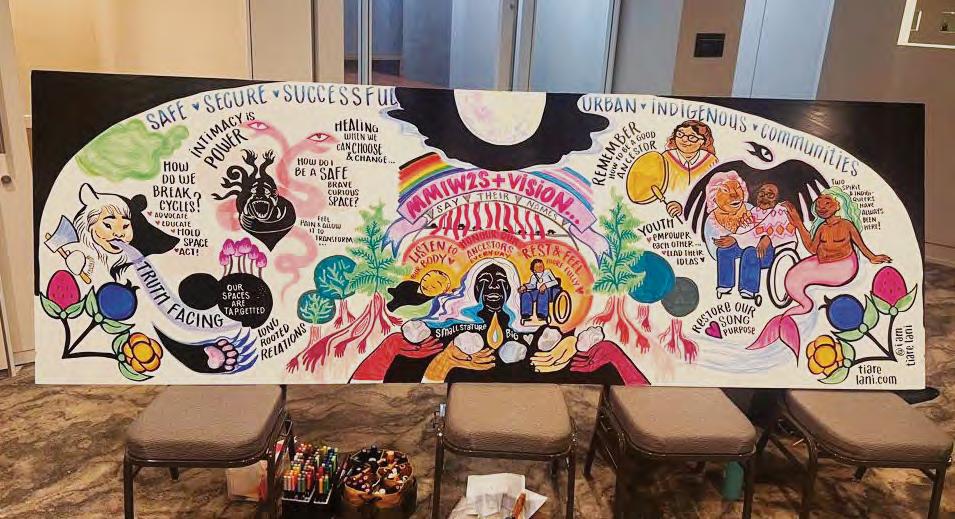
A beautiful artifact from this gathering is the collaborative artwork participants created together. The vibrant piece radiates hope and determination, depicting themes of safety, truth, and youth empowerment. The declaration that “Macy is power” serves as a reminder that the strength of Indigenous women, girls, and Two-Spirit peoples endures and inspires.
Expanding the Circle
Following the summit, comprehensive surveys in English and French reached approximately 100 respondents across 11 provinces and territories. The depth of responses showed how much this work matters to people. They didn’t simply check boxes; they shared stories, o ered detailed recommendations, and expressed both frustrations and hopes.
Fig 1. Graphic Representation of Summit Dialogue
VOICES OF
Experience
The 83% of respondents who work in Friendship Centres brought invaluable frontline experience.
They were joined by Elders carrying traditional knowledge, board members providing governance perspectives, and community members with lived experience. This diversity enriched our understanding.
Ages ranged from engaged youth (34% aged 19-35) to experienced Elders (16% over 65), creating intergenerational dialogue. The gender diversity of respondents (89% women, 10% Two-Spirit/Indigiqueer, along with non-binary, transgender, and male voices) ensured multiple perspectives on gender-based violence.
UNDERSTANDING THE
Landscape
Many respondents have dedicated decades to this work. They’ve completed relevant education, attended specialized training, and most importantly, learned through experience. Several identify as survivors, transforming their pain into purpose by helping others. Some testified at the National Inquiry, demonstrating their commitment to systemic change. This personal investment infuses their recommendations with authenticity and urgency.
Respondents painted a picture of interconnected challenges when asked about factors that create vulnerability to violence.
Intergenerational trauma (identified by 63.75%) reflects the ongoing impacts of residential schools, the Sixties Scoop, and continued family separations. However, respondents emphasized that trauma doesn’t define Indigenous peoples; rather, understanding it helps explain why additional supports are needed.
Anti-Indigenous racism (42.5%) and sexism (38.75%) create environments where Indigenous women, girls, and Two-Spirit peoples are devalued. Yet respondents also shared how Friendship Centres counter
these narratives daily by celebrating the strength, wisdom, and contributions of Indigenous women, girls, and Two-Spirit peoples.
Issues like inadequate housing, substance use as a coping mechanism, and human tra cking (each identified by over 30% of respondents) show how various systems fail to protect Indigenous women, girls, and Two-Spirit peoples. But for each challenge identified, respondents also shared examples of Friendship Centres developing innovative solutions with limited resources.
CELEBRATING
Current Successes
The steering committee’s “Roses” analysis revealed five areas where Friendship Centres already excel:
COMMUNITY PARTNERSHIPS
demonstrate how Friendship Centres weave themselves into the fabric of their cities. One Centre partnered with the public library to create homework spaces for Indigenous youth. Another collaborates with local businesses to provide job training. These partnerships extend Friendship Centres’ reach while educating nonIndigenous communities.
NETWORKS OF INDIGENOUS WOMEN AND GENDER- DIVERSE PEOPLES
provide peer support that professional services cannot replicate. These networks understand the specific joys and challenges of being Indigenous in urban settings. They celebrate each other’s successes, provide practical help during crises, and maintain cultural connections in cities.
RELATIONSHIPCENTERED APPROACHES
distinguish Friendship Centres from institutional services. As one Elder beautifully expressed, “We don’t see clients or cases. We see relatives.” This approach recognizes that healing happens through connection, cultural continuity, and community care.
CULTURALLY GROUNDED PROGRAMMING
produces remarkable results when it’s properly supported. Centres report that participants in cultural programs show increased self-esteem, stronger cultural identity, and greater resilience. One Centre noted a 60% reduction in crisis incidents after introducing daily smudging and weekly women’s circles.
SACRED RESPONSIBILITIES
remain central to Friendship Centre work. Many maintain sacred fires during significant times, host ceremonies, and ensure cultural protocols are followed. These practices connect urban Indigenous peoples to millennia of wisdom and strength.
“ We’re planting gardens with annual seeds when we need to grow forests.”
– PROCESS PARTICIPANT
HONEST
Reflections
on Challenges
The steering committee’s “Thorns” analysis identified barriers that limit Friendship Centres’ impact:
RELATIONSHIPS WITH LAW ENFORCEMENT
often lack the trust needed for e ective collaboration. Historical and ongoing negative experiences mean many Indigenous women, girls, and Two-Spirit peoples hesitate to seek police help. Friendship Centres work to bridge this gap but need support to create meaningful change.
CAPACITY LIMITATIONS
prevent Centres from meeting all community needs. Current funding models mean Centres operate with small teams serving large populations. Sta dedication is extraordinary, but they need resources to sustain and expand their work.
INCONSISTENT SYSTEM RESPONSES
leave women vulnerable even when they seek help. Friendship Centres often fill gaps left by other systems, but they shouldn’t have to work alone.
YOUTH ENGAGEMENT
requires dedicated resources that many Centres lack. Young people face unique challenges in urban settings and need specialized programming.
PROVINCIAL GOVERNMENT ENGAGEMENT
varies significantly across regions. Since provinces control many relevant systems (health, education, child welfare), their involvement is crucial for comprehensive solutions.
SOCIETAL ATTITUDES
create environments where violence seems permissible. Friendship Centres work to change these narratives but need broader societal support.
SEEDS OF Transformation
The “Buds” analysis revealed exciting opportunities emerging in Friendship Centres:
URBAN INDIGENOUS SAFETY STRATEGIES
reimagine what safety means from Indigenous perspectives. Rather than relying solely on surveillance or police presence, these approaches create environments where Indigenous women, girls, and Two-Spirit peoples feel culturally connected, economically secure, and surrounded by supportive community.
HEALTHY RELATIONSHIP ARCHITECTURES
focus on prevention by teaching young people what respectful relationships look like. Drawing on traditional teachings about mutual respect and sacred responsibilities, these programs o er alternatives to cycles of harm.
RENEWED RITES OF PASSAGE
adapt traditional coming-of-age ceremonies for urban contexts. These ceremonies teach young women, girls, and Two-Spirit youth their sacred worth, providing protective cultural identity.
OPEN CONVERSATIONS ABOUT INTIMACY
address topics often silenced by shame or colonial moralizing. Culturally appropriate education about consent, healthy sexuality, and online safety fills crucial gaps.
DECOLONIZED SPACES
examine how even well-intentioned services might perpetuate harmful patterns. This ongoing work ensures Friendship Centres truly reflect Indigenous values and ways of being.
COMMUNITY-GUIDED Solutions
Sustainable Support For Proven Success
Every respondent emphasized that current funding approaches undermine good work. As one director explained, “We’re planting gardens with annual seeds when we need to grow forests.” Friendship Centres need stable, multi-year funding that recognizes their essential role in urban Indigenous communities.
This isn’t about charity but about investing in proven solutions. Friendship Centres already demonstrate remarkable outcomes with limited resources. Proper funding would allow them to retain skilled sta , extend hours to evenings
Creating True Sanctuaries
Housing emerged as more than just shelter. As one survivor shared, “I needed a place where my spirit could heal, not just my body.” Friendship Centres envision culturally grounded safe spaces that feel like home rather than institutions.
These spaces would welcome whole families because separating mothers from children compounds trauma. They would embrace TwoSpirit and LGBTQ+ individuals who often face
and weekends when isolation peaks, and reach community members who can’t access daytime services. (Leverage $1 into $8 dollars)
One innovative suggestion involved recognizing Friendship Centres as essential services, like hospitals or fire departments. Just as we don’t question funding emergency rooms because emergencies are unpredictable, we shouldn’t expect Friendship Centres to constantly justify their existence while responding to ongoing crises.
discrimination elsewhere. Most importantly, they would o er ceremony, traditional foods, and Elder support alongside practical services.
One particularly creative suggestion involved developing networks of trained Indigenous families who could provide short-term sanctuary. This would expand capacity while keeping Indigenous women, girls, and Two-Spirit peoples within caring Indigenous communities.
“
I needed a place where my spirit could heal, not just my body.”
Walking Beside Those Who Need Support
The recommendation for specialized support workers recognizes that navigating systems designed without Indigenous peoples in mind can be overwhelming. These advocates would understand both Western systems and Indigenous approaches to healing, serving as bridges between worlds.
Rather than forcing survivors to repeat their stories to multiple agencies, these advocates would provide consistent support throughout
their journey. They would ensure cultural safety in hostile environments and help translate between di erent ways of understanding and responding to violence.
Round-the-clock outreach teams would meet people where they are, both physically and emotionally. These teams would build trust over time, o ering support when people are ready to receive it rather than imposing rigid timelines.
Healing Through Culture
The emphasis on cultural programming reflects Indigenous understanding that violence disconnects people from their identity. Reconnection to culture provides the foundation for all other healing. Respondents shared moving stories of transformation through cultural engagement.
Access to culture emerged as one of the most pressing needs across all respondents. This reflects the particular challenges of maintaining Indigenous cultural practices in urban settings, where people may be far from their traditional territories and ceremonies. Daily access to ceremony, weekly healing circles, seasonal gatherings, and land-based experiences should be core programming, not special events. Elders must be properly honored for sharing their knowledge, recognizing their teachings as invaluable medicine. their teachings as invaluable medicine.
Youth as Leaders, Not Just Recipients
Young people emerged as key partners in creating change. They navigate challenges unknown to previous generations while carrying hopes for the future. Youth-designed programs ensure relevance and engagement.
Successful examples include youth creating social media campaigns about healthy relationships, developing apps that share cultural teachings, and mentoring younger peers. These initiatives show that with support, youth become powerful advocates for change.
Transforming (Toxic) Masculinity Through Culture
Engaging men and boys represents crucial prevention work. As one male Elder shared, “Our men are hurting, and hurt people hurt people. We need to heal our men to protect our women, girls, and Two-Spirit relatives.”
Programs that reconnect men to traditional roles as protectors and providers (in the true sense of supporting and nurturing, not controlling) show promising results. Teaching boys emotional intelligence through cultural activities like drum-making provides lessons that sink deep.
Honouring Sacred Diversity
Two-Spirit individuals shared experiences of multiple marginalizations, facing discrimination in both mainstream and sometimes Indigenous communities, influenced by (settler) colonial binary thinking. Creating specific Two-Spirit programming led by Two-Spirit people ensures these community members receive culturally relevant support.
This work involves educating all community members about traditional gender diversity and the sacred roles Two-Spirit people held. Reclaiming these teachings heals individuals and strengthens entire communities.
“
Our men are hurting, and hurt people hurt people. We need to heal our men to protect our women, girls, and Two-Spirit relatives.”
A PRACTICAL Path Forward
Building the Foundation (First 6 Months)
Success begins with securing resources that match the magnitude of need. Friendship Centres shouldn’t compete against each other for scraps but should unite in demonstrating their collective impact and needs. This unified approach shows strength and shared purpose.
Establishing coordination structures ensures no community gets left behind. Regional coordinators would share promising practices, preventing each Centre from reinventing solutions. Most importantly, survivor advisory councils would guide all work, ensuring those most a ected shape responses.
Expanding Impact (Months 6-18)
With stable funding and structures in place, Centres can thoughtfully expand services. This means carefully selecting sta who combine professional skills with cultural knowledge and lived understanding. Indigenous post-secondary institutions could develop specialized training for these roles.
Cultural programming expansion should build on each Centre’s unique strengths. Some might excel at ceremony, others at youth engagement, still others at Elder programs. The beauty lies in this diversity, with Centres learning from each other while maintaining their distinct community connections.
Sustainable Transformation (Beyond 18 Months)
True change requires shifting how entire systems operate. This means trauma-informed, culturally safe approaches becoming standard everywhere Indigenous women, girls, and Two-Spirit peoples interact with services. It means communities controlling their own data and stories. It means creating conditions where violence becomes less likely through stable housing, economic opportunity, and strong cultural identity.
WALKING
Forward Together
This report captures more than recommendations; it holds the dreams and determination of people who refuse to accept violence as inevitable.
Every suggestion comes from someone who believes change is possible because they’ve already seen it happen in Friendship Centres.
The vision of safe urban Indigenous spaces guides us forward. In these spaces, women walk with confidence. Children witness healthy relationships. Elders share wisdom freely. Two-Spirit peoples embody their sacred gifts. Men understand strength through gentleness. Communities care for each other as relatives.
Achieving this requires everyone to act. Governments must provide resources that honor Friendship Centres’ proven track record. Other service providers must learn from Friendship Centre approaches. Media must amplify stories of strength rather than stereotypes. Non-Indigenous people must become allies through education and action.
CONTINUING THE
Journey Forward
Indigenous women, girls, and Two-Spirit peoples continue to face disproportionate violence.
Families continue searching for missing loved ones. But in Friendship Centres across Canada, transformation happens daily. Women rediscover their worth. Families interrupt cycles of harm. Communities reclaim practices that protected their members since time immemorial.
An Elder’s words during the summit inspire continued action: “Our grandmothers survived so we could be here today. We do this work so our granddaughters can thrive. Seven generations back are watching. Seven generations forward are counting on us.”
The path forward builds on decades of dedicated work by Friendship Centres. This report amplifies their expertise and
identifies the supports needed to expand their life-saving services. Friendship Centres have shown what’s possible with limited resources; with proper support, they can reach even more community members in need.
As one survey participant wrote: “I shared my story because I believe in the power of Friendship Centres to create change. They saved my life. With proper support, they can save many more.”
Our relatives deserve safety, dignity, and joy. Friendship Centres stand ready to expand their life-saving work. This report shows how. Now we must act, together, guided by the strength and wisdom of those who never stopped believing in a better future.
I shared my story because I believe in the power of Friendship Centres to create change. They saved my life. With proper support, they can save many more.”
CONSOLIDATED
Action Plan
Based on community wisdom gathered through the steering committee, summit, and surveys, this action plan provides clear steps for implementation. Each action builds on existing Friendship Centre strengths while addressing identified barriers.
Immediate Actions (0-6 months)
1. ESTABLISH SUSTAINABLE FUNDING FRAMEWORK
• Unite all 107 Friendship Centres in a coordinated funding proposal to federal government
• Advocate for multi-year core funding agreements (minimum 5 years) rather than project-based funding
• Develop coming-of-age ceremonies adapted for urban contexts
• Properly compensate Elders and knowledge keepers
• Lead: Friendship Centre cultural coordinators with Elders
6. STRENGTHEN SYSTEM PARTNERSHIPS
• Negotiate formal protocols with police services including:
• Mandatory cultural safety training for all o cers
• Indigenous liaison positions
• Regular community-police dialogues
• Accountability mechanisms for inadequate responses
• Establish partnerships with hospitals for Indigenous patient navigators
• Create referral agreements with child welfare ensuring cultural continuity
• Lead: NAFC with government relations support
7. LAUNCH YOUTH LEADERSHIP INITIATIVE
• Create youth advisory councils in each Centre
• Develop peer mentorship programs pairing youth with Elders/survivors
• Design youth-led healthy relationship workshops
• Establish self-defense and empowerment programs
• Support youth-created awareness campaigns
• Lead: Youth coordinators with youth advisors
“
One respondent emphasized the need to go beyond symbolic gestures— such as hanging red dresses—and instead encourage people to learn the names and stories of those lost.
– SURVEY RESULTS
8. DEVELOP INDIGENOUSLED HOUSING
• Create Indigenous-led safe houses (minimum one per major urban centre)
• Establish transitional housing with wraparound supports
• Develop “auntie house” networks of trained Indigenous families
• Ensure all housing is 2SLGBTQQIA+ inclusive
• Include space for children and extended family
• Lead: Friendship Centres with Indigenous housing organizations
9. IMPLEMENT MEN’S HEALING PROGRAMS
• Expand “I Am a Kind Man” to all Centres
• Create boys’ groups teaching emotional intelligence through culture
• Establish men’s healing circles addressing trauma and masculinity
• Develop fatherhood support programs
• Create accountability processes for men who have caused harm
• Lead: Male Elders and program facilitators
10. BUILD TWO -SPIRIT SPECIFIC SERVICES
• Hire Two-Spirit program coordinators
• Develop Two-Spirit healing circles and ceremony
• Create educational materials about traditional gender diversity
• Establish Two-Spirit youth mentorship
• Ensure all Centre policies and spaces are inclusive
• Lead: Two-Spirit knowledge keepers and coordinators
11. CREATE DATA SOVEREIGNTY FRAMEWORK
• Develop unified data collection system owned by Friendship Centres
• Train sta in culturally safe research methods
• Create community-based evaluation processes
• Produce annual MMIWG2S+ report cards
• Share promising practices through knowledge exchanges
• Lead: NAFC research team with academic partners
Long-term Systems Change (3-5 years)
12. TRANSFORM SERVICE DELIVERY MODELS
• Evolve Friendship Centres into comprehensive MMIWG2S+ hubs
• Integrate health, legal, cultural, and social services
• Extend to 24/7 operations in high-need areas
• Develop mobile outreach for remote communities
• Create virtual support options while maintaining in-person services
• Create Indigenous-led a ordable housing reducing homelessness
• Develop comprehensive mental health and addictions supports
• Establish prevention education from kindergarten through post-secondary
• Support community-led research on e ective interventions
• Lead: Multi-sector partnerships
14. SHIFT SOCIETAL ATTITUDES
• Launch national awareness campaign celebrating Indigenous women, girls, and Two-Spirit peoples
• Develop media guidelines countering harmful stereotypes
• Create educational resources for non-Indigenous service providers
• Build allyship through public education
• Document and share success stories
• Lead: Communications teams with creative professionals
Accountability and Monitoring
QUARTERLY REVIEWS
• Regional coordinators report to survivor advisory councils
• Document progress on each action item
• Identify barriers and develop solutions
• Share updates with all Friendship Centres
ANNUAL GATHERING
• Bring together all stakeholders to assess progress
• Celebrate successes and honour those doing the work
• Adjust strategies based on learning
• Maintain momentum through peer support
COMMUNITY INDICATORS
• Track service utilization increases
• Monitor safety perception improvements
• Document cultural connection strengthening
• Measure system response enhancements
• Celebrate lives saved and transformed
Resource Requirements
HUMAN RESOURCES
• 13 regional MMIWG2S+ coordinators
• 107 GBSV advocacy specialists (1 per Centre)
• 200+ 24/7 outreach workers
• 50+ Two-Spirit program coordinators
• Proper compensation for hundreds of Elders
INFRASTRUCTURE
• 50+ Indigenous-led safe houses
• 100+ transitional housing units
• Expanded/renovated Friendship Centre spaces
• Technology for virtual services
• Vehicles for outreach
Call to Partners
FEDERAL GOVERNMENT
• Provide sustainable, flexible funding
• Reform policies creating vulnerabilities
• Support Indigenous-led solutions
PROVINCIAL/TERRITORIAL GOVERNMENTS
• Engage meaningfully in implementation
• Reform systems under your jurisdiction
• Match federal investments
MUNICIPALITIES
• Support safe houses and services
• Include Friendship Centres in planning
• Address discriminatory bylaws
PRIVATE SECTOR
• Provide employment opportunities
• Support social enterprises
• Contribute to infrastructure needs
ALL CANADIANS
• Educate yourselves about MMIWG2S+
• Challenge stereotypes and racism
• Support Friendship Centres in your community
This action plan transforms community wisdom into concrete steps. Each action has been requested by those doing the work. Success requires commitment from all partners, but most importantly, it requires trusting and resourcing Indigenous-led solutions. Friendship Centres have proven their e ectiveness. With proper support, they will continue saving and transforming lives.
“
I shared my story because I believe in the power of Friendship Centres to create change. They saved my life. With proper support, they can save many more.”