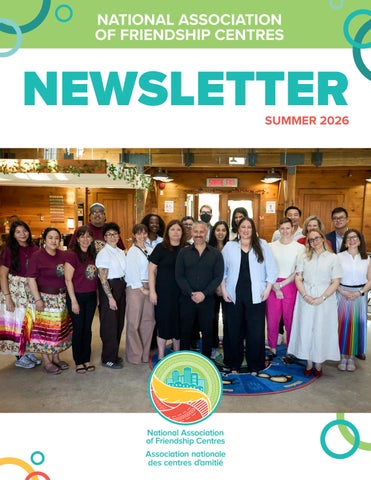
NATIONAL ASSOCIATION OF FRIENDSHIP CENTRES
NEWSLETTER SUMMER 2026
Newsletter
1
Contents Message from the CEO 1 55th NAFC Annual Meeting 2 National Youth Forum 3 National Office Activities 4 News and Highlights from the Friendship 10 Centre Movement 13 Departmental Updates 17 Spirits of Friendship 17 Suggested Reading 18
2
National Association of Friendship Centres
Message from the CEO Aaniin/Hello, This month marks a time of reflection and connection across our networks with the beginning of Pride Month, a time to celebrate 2SLGBTQQIA+ peoples and honour our strength and diversity as we collectively work towards safety, inclusion and belonging for all. June also marks National Indigenous History Month, a time to recognize and celebrate the rich histories, cultures, languages and diversity of First Nations, Inuit and Metis peoples across Canada. I hope you take this time to listen, learn, reflect and uplift Indigenous voices and the work of Friendship Centre. I would also like to wish everyone a happy Summer Solstice, this also marks a time for gratitude, reflection and community connection. I want to extend my sincere thanks to Friendship Centres, Provincial and Territorial Associations, Board members, staff, volunteers, and partners for your continued dedication to supporting urban Indigenous communities across Canada. I am looking forward to gathering with many of you in Brandon, Manitoba, at the end of July for the NAFC’s 36th National Youth Forum and 55th Annual Meeting. These events provide an important opportunity to connect, share knowledge, celebrate accomplishments, and discuss the future of our Movement. I am excited to join youth leaders, delegates, and Friendship Centre representatives from coast to coast to coast as we come together to strengthen our collective voice and vision. Advocacy continues to be a key priority for the NAFC. Over the past several months, we have been meeting with federal Ministers and government officials to advance Friendship Centre priorities, highlight the vital role our network plays in communities, and advocate for investments that strengthen services and supports for urban Indigenous people. These discussions have also provided opportunities to explore new funding avenues and partnerships that can help expand the impact of Friendship Centres across the country. In July, the NAFC will be submitting its recommendations as part of the federal government’s Pre-Budget Consultations process. Our submission includes recommendations focused on urban Indigenous housing and infrastructure, employment and skills development, gender-based violence prevention and supports, emergency response funding for Indigenous evacuees, and investments in Indigenous-led digital infrastructure and artificial intelligence. These recommendations reflect the priorities and realities experienced by Friendship Centres and the communities they serve.
Newsletter
1
We are also exploring partnership opportunities with organizations such as the Aboriginal Sports Circle, Spirit North, and Boys and Girls Clubs of Canada. These discussions are focused on identifying opportunities to strengthen programming, enhance supports for Indigenous youth and families, and create new collaborative initiatives that benefit Friendship Centres and their communities. Thank you for your continued leadership, commitment, and partnership. I wish everyone a safe and enjoyable summer.
55th NAFC Annual Meeting The National Association of Friendship Centres (NAFC) is pleased to invite members to the 55th Annual Meeting, proudly hosted by the Brandon Friendship Centre in partnership with the Manitoba Association of Friendship Centres. The Annual Meeting will take place from July 26–28, 2026, at the Victoria Inn in Brandon, Manitoba, located on Treaty 2 Territory and the shared traditional lands of the Dakota Oyate, Anishinaabeg, Cree, Anisininew, and Dene Peoples, as well as the National Homeland of the Red River Métis. Registration is now open. To learn more about the event and register, visit nafc.ca/annual-meeting.
Host an NAFC Annual Meeting The National Association of Friendship Centres is pleased to announce a Call for Letters of Intent from Friendship Centres and Provincial/Territorial Associations interested in hosting the NAFC Annual Meeting in 2027, 2028, 2029, or 2030. Interested hosts must be able to provide appropriate meeting facilities, accommodations, accessibility for delegates, and plans for cultural and social programming. Detailed requirements are outlined in the attached Call for Letters of Intent package. Letters of Intent may be submitted by email to melmaracle@nafc.ca. Questions regarding the process can be directed to Mel Maracle, Office Manager, at the same email address. We encourage Friendship Centres and PTAs interested in showcasing their community and hosting this national gathering to submit a Letter of Intent for consideration.
2
National Association of Friendship Centres
Executive Elections The NAFC is also pleased to announce that the positions of Vice-President and Treasurer are up for election during this year’s Annual Meeting. These important leadership roles help guide the organization’s strategic direction and support the continued growth and success of the Friendship Centre Movement. For those interested in learning more about the election process, eligibility requirements, and nomination information please visit nafc.ca/annual-meeting.
2026 Elections: • Vice President • Treasurer More info to come.
National Youth Forum The 36th National Youth Forum will be held from July 24-26, 2026, at the Victoria Inn in Brandon, MB on Treaty 2 Territory and is shared with the Dakota Oyate, Anishinaabeg, Cree, Anisininew, Dene peoples and the national homeland of the Red River Metis. Today, many other Indigenous people call Brandon their home including the Ininew, Anisininewuk, Denesuline and Inuit. The theme for this year’s Youth Forum is ‘Revitalizing Roots: Healing through the Land’ - A focus on renewing our sacred connection with the land as urban Indigenous youth and leading with balance while caring for ourselves, our communities, the land and environment. When we take care of the land, the land takes care of us. The National Youth Forum will include keynote speakers include Inuit storyteller and advocate Braden Kadlun, and Jennifer Brazeau, Executive Director of the Lanaudiere Friendship Centre and Alqonquin Anishinabe from Kitigan Zibi, an evening of entertainment including the Asham Stompers, Dj the Kaptain, and DeeDee Austin, and on the land activities with Waterways Canada, Meaghan Anishinaabie and Garrick. Registration is now open. To learn more about the event and register, visit nafc.ca/nyf.
IYC Elections The Indigenous Youth Council (IYC) will also be holding elections during this year’s National Youth Forum. The positions of Vice-President and Treasurer are open for election, providing an opportunity for Indigenous youth leaders to help shape the future direction of the Council and
Newsletter
3
represent urban Indigenous youth voices from across the country. The NAFC and IYC encourage eligible youth to consider putting their names forward and becoming part of the next generation of leadership within the Friendship Centre Movement. For more information about the National Youth Forum and IYC elections, visit nafc.ca/youth-fool
National Office Activities Privy Council Office Tour of Maniwaki Native Friendship Centre’s Gatineau Point of Service The NAFC, Regroupement des centres d’amitié autochtones du Québec and the Gatineau - Maniwaki Native Friendship Centre were pleased to welcome the Privy Council Office and Housing, Infrastructure and Communities Canada to the Gatineau Point of Service to learn about the important work being done to support urban Indigenous people in Gatineau. This visit was an opportunity to share how Friendship Centres and points of service provide culturally relevant, community-based supports that respond to the needs of First Nations, Inuit, and Métis Peoples living in urban communities. The Maniwaki Native Friendship Centre saw the need for creating a space for urban Indigenous people in Gatineau, many from the Maniwaki area as well as some of the northern communities in Quebec. Thank you to the Privy Council Office and Housing, Infrastructure and Communities Canada for visiting, and to the Gatineau Point of Service for the continued work you do for community.
4
National Association of Friendship Centres
Odawa Native Friendship Centre Pow Wow The NAFC had a great time at The Odawa Native Friendship Centre Powwow alongside Roots Strategies who sponsored the booth and partnered with NAFC for an info table. This weekend brought people together in a spirit of respect, connection, and shared purpose. Through song, dance, food, vendors, and gathering, the Powwow created space to honour Indigenous identities and uplift the strength of urban Indigenous community. Thank you to Odawa Native Friendship Centre, the organizers, volunteers, dancers, singers, drummers, vendors, families, and everyone who came together to make this weekend possible.
Summer Solstice Indigenous Festival The NAFC was proud to serve as a co-host of the 2026 Summer Solstice Indigenous Festival with Indigenous Experiences Canada, which took place June 20–21 at Wesley Clover Parks in Ottawa, Ontario, on the unceded territory of the Algonquin Anishinabeg. The festival brought together thousands of attendees to celebrate Indigenous cultures, traditions, and contemporary achievements through a vibrant weekend of programming. Visitors enjoyed the Competition Pow Wow, live music and entertainment, cultural demonstrations, Indigenous culinary experiences, the Indigenous Marketplace, and opportunities to learn about and connect with Indigenous communities from across the country. Festival-goers also had the chance to experience the Ojibwe Spirit Horses and participate in a variety of family-friendly activities and cultural experiences. The NAFC extends its gratitude to the organizers, volunteers, performers, vendors, partners, and attendees who helped make this year’s festival a success. Events such as the Summer Solstice Indigenous Festival continue to play an important role in celebrating Indigenous cultures, supporting Indigenous businesses and artists, and fostering greater understanding and reconciliation.
Newsletter
5
Meeting with Minister Rebecca Alty On June 1st, NAFC’s CEO Jennifer Rankin, and Acting Policy & Research Manager Kara Louttit, met today with the Minister of Crown-Indigenous Relations Rebecca Alty and her team to discuss Friendship Centres’ role in strengthening northern service delivery, emergency preparedness, and MMIWG2S+ implementation. NAFC looks forward to continued collaboration to advance these important priorities for Friendship Centres and urban Indigenous Peoples across Canada.
Day of Dialogue NAFC CEO Jennifer Rankin attended and spoke at the Day of Dialogue as part of the Forum of Ministers on Human Rights (FMHR), hosted by the Honourable Minister Marc Miller, alongside Minister Rebecca Alty, federal ministers, Indigenous leadership, civil society organizations, and provincial and territorial representatives. Discussions focused on addressing barriers Indigenous Peoples face in healthcare and social services, and how federal, provincial, and territorial governments can work together to tackle issues including racism, gender-based violence, and poverty. Jennifer emphasized that Friendship Centres are trusted, community-based infrastructure that thrive through an intersectional and inclusive approach to supporting urban Indigenous communities. She noted that proximity to services does not equal access, and that while nearly 80% of Indigenous peoples spend significant time in urban settings, funding and policy continue to fall short of these realities. Friendship Centres are already putting human rights into action every day — delivering healthcare and social services, protecting women and children, and advancing self-determination in communities across the country.
Spirit North NAFC CEO Jennifer Rankin met with Spirit North CEO Gary St Amand and Associate Director, Development and Government Relations James Graham to talk about their work in using sport and physical activity to help young people discover their unique strength and spirit. Their programs align with similar principles with the work of Friendship Centres centred in health, wellness, and connection to the land and inspire Indigenous youth to build brighter futures for themselves and their communities. Look forward on ways we can collaborate! 6
National Association of Friendship Centres
Canadian Health and Fitness Institute Parliamentary Reception The NAFC attended the Canadian Health and Fitness Institute Parliamentary Reception alongside our partners Spirit North CEO Gary St. Amand, Aboriginal Sport Circle (ASC) President Rob Newman, and Vice President Dr. Janice Forsyth. The NAFC looks forward to further collaboration on supporting Indigenous lead approaches to foster participation for Indigenous communities including urban - in sport, physical activity and recreation across Canada.
NAFC Managers Gather in Ottawa to Plan for the Year Ahead On June 16–17, NAFC managers gathered in Ottawa for two days of collaboration, planning, and team-building as the organization prepares for a busy year ahead. The meeting provided an opportunity for managers from across the organization to connect in person, review key priorities, and coordinate upcoming initiatives. Discussions focused on preparations for the NAFC’s 55th Annual Meeting and 36th National Youth Forum, finance and reporting priorities, organizational planning, and strategic goals for the coming year. The team also welcomed the NAFC’s new Human Resources Business Partner and explored opportunities to further strengthen internal processes and support staff across the organization. In addition to planning sessions, managers participated in team-building activities designed to strengthen relationships, collaboration, and shared purpose. The gathering reinforced the NAFC’s commitment to working together in support of Friendship Centres and the Indigenous communities they serve. The team left energized and focused on advancing priorities that will strengthen the Friendship Centre Movement in the months ahead.
AFCS Annual General Meeting The NAFC was proud to attend the Aboriginal Friendship Centres of Saskatchewan Annual General Meeting on June 6, 2026, in Saskatoon, SK. NAFC CEO Jennifer Rankin and Executive Coordinator Veronica Wemigwans joined Indigenous Youth Council (IYC) President Caley Rain Anderson and IYC Saskatchewan Youth Representative Theland Kicknosway for a productive and engaging gathering. The meeting featured key highlights, including elections for Vice President, Treasurer, and National Representative,
Newsletter
7
followed by informative presentations from NAFC and AFCS departments. A special moment of the event was the celebration of AFCS Executive Director Laurie Bouvier’s 10year anniversary—an incredible milestone. Congratulations on a decade of dedicated leadership and impact!
The National Association of Friendship Centres proudly congratulates Annette Morgan on receiving the 2026 Public Service Award at the Indspire Awards. As Executive Director of the Dze L K’ant Friendship Centre Society and President of the BCAAFC, Annette’s leadership reflects the heart of the Friendship Centre Movement by fostering connection, empowering community members, and helping to build stronger and more vibrant communities. This well-deserved recognition celebrates her dedication to strengthening community and uplifting others through service. Congratulations Annette!
NTNU Annual Meeting Thank you to the The Northwest Territories/Nunavut Council of Friendship Centres for warmly welcoming NAFC CEO Jennifer Rankin, IYC Vice President Ethan Cameron and the NAFC Senior Information Analyst Andrew Macumber and Senior Communications Coordinator John Paillé to your Annual Meeting from June 27–28, 2026 held in Yellowknife, NWT. We are grateful for the opportunity to gather with Friendship Centre leaders from across the North, hear updates from communities, and continue strengthening the Friendship Centre Movement coast-to-coast-to-coast.
8
National Association of Friendship Centres
NAFC also extends congratulations to the newly elected NTNU Board members: Vice President Anthony Spink of The Tree of Peace Friendship Centre , Treasurer Aaron McNab of Deh Cho Friendship Centre, and National Youth Representative Sharon Martin of Tłįchǫ Łeàgı̨ą Ts’ı̨ı̨lı̨ Kǫ Tłįchǫ Friendship Centre. We look forward to continuing to work together in support of Friendship Centres and the communities they serve.
BCAAFC Annual Meeting The NAFC was pleased to attend the BCAAFC Annual General Meeting from July 3–5, 2026, hosted in Prince George, BC at the Prince George Native Friendship Centre. NAFC CEO Jennifer Rankin, Acting Policy and Research Manager Kara Louttit, and Acting Program Manager James Lavallee joined Friendship Centre leaders and delegates for meaningful discussions, learning, and collaboration. Highlights included the Welcome and Opening, the Friendship Centre Circle, Government Relations and Data Trainings, AGM business and elections, the Annual Report, PIYC and Elder Council reports, an NAFC Update from Jennifer Rankin, and the NAFC AGM Planning Discussion. We are grateful to BCAAFC and the Prince George Native Friendship Centre for bringing the Friendship Centre Movement together in a spirit of connection, governance, and shared commitment to urban Indigenous communities. Congratulations to the newly elected BCAAFC members : • • •
Vice President, Rosanne McGregor, Caribou Friendship Centre Society Secretary, Cal Albright, Kamloops Aboriginal Friendship Society NAFC Representative, Cyndi Stevens, Port Alberni Friendship Centre
Newsletter
9
News and Highlights from the Friendship Centre Movement RCAAQ Celebrates 50 Years The Regroupement des centres d’amitié autochtones du Québec (RCAAQ) recently marked an important milestone, celebrating 50 years of the Quebec Native Friendship Centre Movement and its ongoing commitment to supporting First Nations and Inuit peoples in urban communities Indigenous service infrastructure, supporting Friendship Centres in communities throughout Quebec and advocating for the rights, interests, and well-being of Indigenous peoples living in urban areas. Over the past five decades, the RCAAQ has played a leading role in advancing culturally relevant services, strengthening Indigenous leadership, and promoting dialogue and reconciliation throughout Quebec. Today, the network includes 11 Native Friendship Centres serving 14 cities and towns, offering programs and services in areas such as health, education, justice, employability, youth programming, social inclusion, and cultural revitalization. The anniversary celebration highlighted the resilience, growth, and impact of the Friendship Centre Movement while honouring the many Elders, youth, staff, volunteers, and community leaders who have contributed to its success over the years. The milestone also recognized the importance of Friendship Centres as culturally safe gathering places that foster belonging, support, and connection for urban Indigenous peoples. As the Movement looks toward the future, the RCAAQ continues to advocate for sustainable investments and equitable services that reflect the realities of urban Indigenous communities. Guided by values of solidarity, respect, and self-determination, the organization remains committed to strengthening Indigenous voices and supporting thriving urban Indigenous communities for generations to come. Learn more at https://www.rcaaq.ca/en/50th-anniversary/
10
National Association of Friendship Centres
Dze L K’ant Friendship Centre Over the past year, the Dze L K’ant Friendship Centre Houston Office has proudly delivered the Whole Animal and Future Elder Program, providing community members with opportunities to learn traditional skills, strengthen cultural connections, and participate in hands-on learning experiences. The program focused on preserving and sharing knowledge related to traditional food preparation, including butchering animals, making sausage, preparing jerky, and smoking fish and meats. These workshops helped participants build practical skills while supporting food security, self-sufficiency, and cultural revitalization. A key achievement of the program was the construction of two community smokehouses, which continue to serve as important spaces for smoking fish and meats and for sharing traditional teachings across generations. The program also emphasized youth engagement and community participation, welcoming people of all ages and fostering meaningful opportunities for mentorship and knowledge transfer. Through a partnership with School District 54, students were able to participate in cultural and landbased learning activities that strengthened their connections to community, culture, and traditional practices. Supported through funding from ISPARC Food Sovereignty and Indigenous Youth Roots, the Whole Animal and Future Elder Program has brought people together, strengthened traditional knowledge, and created lasting opportunities for learning and community wellness that will continue to benefit future generations.
Kamloops Aboriginal Friendship Centre Meeting People Where They’re At
For more than 50 years, the Kamloops Aboriginal Friendship Society (KAFS) has been a trusted place where community members can access culturally appropriate and inclusive supports. Today, that commitment is extending beyond the walls of the Friendship Centre through its Crisis Response, Community Led (CRCL) program, a mobile mental health crisis response service delivered in partnership with the Canadian Mental Health Association BC Division. CRCL provides community-based support for individuals aged 13 and older experiencing mental health or substanceuse crises, with trained responders meeting people wherever they are when support is needed. Between April 2025 and March 2026, the program responded to 267 calls, including 180 in-person dispatches throughout the Kamloops area. Rather than requiring individuals in crisis to seek help on their own, CRCL brings compassionate, trained support directly to them, helping to de-escalate situations, develop safety plans, and connect people with longer-term services and resources.
Newsletter
11
For KAFS, the program reflects a long-standing commitment to supporting community members with dignity, care, and cultural safety. By providing a mental health response to mental health crises, CRCL not only helps individuals access the right supports at the right time, but also reduces pressure on police and emergency services. Whether responding to youth, Elders, students, people experiencing homelessness, or anyone facing a difficult moment, the program demonstrates what it truly means to meet people where they are at.
Nistawoyou Association Friendship Centre For the past seven years, Claire Beaulieu-Antoine has been a guiding cultural presence at the Nistawoyou Association Friendship Centre in Fort McMurray, where she serves as a Knowledge Keeper and community educator. Through workshops, medicine walks, cultural programming, storytelling, traditional teachings, and the arts, Claire has helped create meaningful opportunities for Indigenous and non-Indigenous community members alike to connect, learn, and heal together. Her work regularly brings together generations of people through hands-on cultural experiences ranging from bannock making and painting workshops to land-based teachings and wellness gatherings. Claire is also widely recognized for her contributions to the arts and cultural life of the Wood Buffalo region. In 2024, she received the prestigious Lifetime Achievement Award at the Arts Council of Wood Buffalo’s “Buffy Awards,” honouring her enduring impact on the region’s artistic and cultural community. In addition to her role as a cultural educator, Claire is an accomplished Indigenous artist whose work and traditional knowledge have been featured in projects such as Women of the Nistawoyou, where her painting The White Buffalo Calf Woman highlighted Indigenous teachings, spirituality, and prophecy. We are incredibly grateful to have Claire as part of our team and community. Her kindness, wisdom, creativity, and dedication continue to inspire those around her every day, and we are deeply proud to celebrate her contributions and accomplishments.
Winnipeg Indigenous Friendship Centre The Winnipeg Indigenous Friendship Centre Inc. has been incorporated since June 4, 2021, marking the second iteration of a Friendship Centre serving the Winnipeg community. As of April 1, 2026, the Centre proudly moved into its own dedicated space located at 410/412 McGregor St Winnipeg. The Centre currently offers a variety of programming for community members, with programs operating on a six-week rotation cycle. In addition, the Winnipeg Indigenous Friendship Centre has developed a thriving Seniors Program focused on supporting Elders in the community. Administrative offices are conveniently located adjacent to the main programming area, creating an accessible and welcoming environment for visitors. 12
National Association of Friendship Centres
A major focus of the Centre’s work has been supporting Elders by creating a safe and inclusive space where they can gather, enjoy a cup of tea, and socialize with neighbours and friends. Community feedback and research identified the importance of providing opportunities for connection in a safe and welcoming setting. To support this vision, the Centre has established a dedicated Elders Room for regular use and community gatherings. The Centre also hosts a popular merchandise bingo every Friday afternoon. The Winnipeg Indigenous Friendship Centre continues to grow while strengthening services and supports for the Winnipeg Indigenous community.
Departmental Updates Data Strengthening Data Capacity Across the Friendship Centre Movement Building data capacity at the national office and throughout the Friendship Centre Movement remains a key priority for the NAFC Data Team. To support this work, representatives from each region, the Senate, and the Indigenous Youth Council will be invited to participate in the second National Data Gathering, taking place in Ottawa in late November 2026. The gathering will provide an important opportunity for participants to share knowledge, strengthen relationships, and continue advancing a collective national data strategy. Through these conversations, the Friendship Centre Movement is working toward a shared vision of becoming information leaders on urban Indigenous peoples—using data to tell meaningful stories, support community priorities, and empower members to achieve their self-determined goals.
Advancing a National Data Platform The NAFC Data and Program teams are also collaborating on the development of a new application that will centralize data collected through national programming. Built on Bridging Across Canada, the NAFC’s national database, the platform will provide an accessible and user-friendly online experience while upholding Indigenous data sovereignty by securely storing information on NAFC-owned servers located within the Membertou First Nation community. The new platform is expected to be available in 2027 and will complement the existing Friendship
Newsletter
13
Centre application, which supports day-to-day data collection and reporting needs at the local level. Currently, 21 members—including three Provincial/Territorial Associations and the NAFC— are using the application. Friendship Centres interested in learning more about these tools are encouraged to connect with the Data Team.
Using Data to Drive Transformational Change By centralizing and standardizing data collection across programs and communities, the Friendship Centre Movement is creating a stronger, more connected narrative about the experiences and realities of urban Indigenous peoples. This growing body of information will help tell stories that span regions, generations, and social issues, while highlighting the impact of Friendship Centres nationwide. To support this work, the NAFC is developing accessible tools and interfaces that will allow both national office staff and members to explore and use data more effectively. These initiatives form part of a broader effort to modernize data mobilization across the Movement and will help inform the development of the NAFC’s forthcoming AI and Innovation Strategy, which will be released following discussions at the National Data Gathering.
Policy and Research 2026 Spring Economic Statement Analysis Following the release of the federal government’s 2026 Spring Economic Statement, the NAFC Policy and Research team completed a comprehensive analysis of the announced measures and their implications for urban Indigenous peoples and the Friendship Centre Movement. The review examined commitments across government sectors through two key lenses: alignment with Friendship Centre priorities and NAFC advocacy efforts, including recommendations outlined in our Pre-Budget Submission, and the potential impacts on urban Indigenous communities in areas where Friendship Centres play a critical role and continue to advocate for meaningful inclusion. The NAFC was encouraged to see Friendship Centres explicitly recognized in the Statement, including through the commitment of $168 million over five years, beginning in 2026–27, to support Urban Programming for Indigenous Peoples. This investment reflects the essential role Friendship Centres play as Indigenous-led community infrastructure, delivering culturally grounded, wraparound supports that foster identity, belonging, family wellbeing, employment readiness, and community participation. As implementation of these investments moves forward, the NAFC will continue to advocate for approaches that reflect the realities of urban Indigenous communities and recognize Friendship Centres as trusted partners in developing inclusive, community-driven solutions that create lasting impacts.
14
National Association of Friendship Centres
MMIWG2S+ National Summit From May 4–6, 2026, survivors, advocates, community leaders, frontline workers, and government representatives gathered in Ottawa, Ontario, for the MMIWG2S+ National Summit, organized by the MMIWG2S+ Urban Indigenous Action Group (UIAG). The Summit provided a national forum for meaningful conversations focused on safety, healing, accountability, and long-term responses to violence against Indigenous women, girls, and 2SLGBTQQIA+ people. Over three days, participants engaged in presentations and discussions on topics including human trafficking and exploitation, Survivor Voices, community-led safety initiatives, Two-Spirit advocacy, systems change, and the ongoing implementation of the Calls for Justice. Speakers emphasized the importance of Indigenous-led solutions, wraparound supports, housing, prevention efforts, and stronger collaboration across justice, child welfare, health, and community service sectors. Acting Policy and Research Manager Kara Louttit presented during a Survivor Voices session, sharing reflections on grief, healing, Two-Spirit advocacy, and experiences with Walking With Our Sisters and community-based MMIWG2S+ advocacy efforts across the country. The Summit created space for relationship-building, shared learning, and collective reflection, while reinforcing the importance of sustained action and Indigenous community-led responses to address and prevent violence against Indigenous women, girls, and 2SLGBTQQIA+ people.
Programs Indigenous Languages Program (ILP) The National Association of Friendship Centres (NAFC) is pleased to announce the approval of all 22 eligible Indigenous Languages Program (ILP) applications submitted by Friendship Centres across six provinces. This funding round was dedicated to supporting the continuity and sustainability of language revitalization initiatives already underway at Friendship Centres previously funded through the ILP. In addition, the NAFC was able to offer multi-year funding agreements to four of the funded Friendship Centres, providing greater stability and long-term support for their language programming. As part of ongoing efforts to strengthen Indigenous language revitalization initiatives, Indigenous Languages Program Coordinator Dani Sherwood attended the Discoveries and Insights in Skills Training in Intergenerational Language Sustainability (DISTILS) Conference and Workshop in Edmonton, Alberta, from May 4–7, 2026, alongside several other members of the Friendship
Newsletter
15
Centre Movement. The conference brought together presenters and language champions from 16 countries around the world, all dedicated to advancing Indigenous language revitalization and intergenerational language transmission. The event provided valuable opportunities for learning, collaboration, and sharing promising practices from diverse communities and nations.
Youth Gathering Our Voices Members of the NAFC Indigenous Youth Council (IYC) recently attended the Gathering Our Voices Youth Conference in British Columbia, hosted by the BC Association of Aboriginal Friendship Centres (BCAAFC). During the conference, Neveah Munroe, Manitoba Representative, participated in a panel discussion focused on youth leadership within the Friendship Centre Movement, while Samantha Jack, NAFC Youth Executive, helped facilitate a workshop alongside Rideau Hall on the Foundation for Education. The conference provided an opportunity for IYC members to connect with Indigenous youth leaders from across the country, share experiences, and contribute to important discussions on leadership, education, and community engagement. The IYC extends its gratitude and congratulations to the Provincial Indigenous Youth Council in British Columbia and the BCAAFC for hosting another successful Gathering Our Voices conference.
IYC External Committee Meetings IYC members Ethan Cameron, Interim Vice-President and British Columbia Representative, and Neveah Munroe, Manitoba Representative, recently participated in the renewal process for the First Nations Mental Wellness Continuum Framework as members of the Youth Working Group. Throughout the meetings, they engaged in meaningful discussions alongside youth, community organizations, and Indigenous leadership from across the country. The week focused on relationship building, networking, knowledge sharing, and ensuring youth perspectives were reflected throughout the renewal process. Their participation highlighted the importance of Indigenous youth voices in shaping mental wellness programs and services. By contributing their experiences and perspectives, Ethan and 16
National Association of Friendship Centres
Neveah helped ensure that the needs, priorities, and realities of Indigenous youth remain central to conversations about mental wellness and community wellbeing.
Spirits of Friendship The Friendship Centre Movement has been shaped over a period of 60 years by Indigenous leaders in communities across Canada. These dedicated Indigenous people have greatly contributed to the success and growth of today’s Friendship Centre Movement. To view the stories of Friendship Centre trailblazers, or our Spirits of Friendship, click here. We are honoured to have known them and privileged to have worked with them and to be a part of their legacy.
Dr. Baptiste (Skip) Dick-Lexixiekek The National Association of Friendship Centres would like to recognize the life of a respected Songhees Elder and co-founder of the Victoria Native Friendship Centre. Dr. Skip’s lifelong commitment to supporting Indigenous people in urban communities helped lay the foundation for what has become a vital gathering place, service hub, and source of cultural connection for generations of Indigenous peoples in Victoria. As one of the early leaders who helped establish the Victoria Native Friendship Centre, their vision, dedication, and service contributed to the growth of the Friendship Centre Movement and the strengthening of urban Indigenous communities. Their legacy will continue to be felt through the countless lives touched by their leadership, generosity, and commitment to community. We join the Victoria Native Friendship Centre, the Songhees Nation, and all those who knew them in honouring a life of service and celebrating their lasting contributions to Indigenous peoples and communities. If you think someone should be added to the Spirits of Friendship, please send an e-mail to communications@nafc.ca with a short bio, specifically detailing their involvement in the Friendship Centre Movement and any photos you would like included.
Suggested Reading • • • •
NAFC GBA+ Toolkit - nafc.ca/gba-toolkit NAFC MMIWG2S+ Implementation Report and Action Plan - nafc.ca/mmiw-report NAFC Research Framework and Toolkit - nafc.ca/research-framework NAFC Data Strategy - nafc.ca/data-strategy
Newsletter
17
Organizational Chart
18
National Association of Friendship Centres
Newsletter
19
SUPPORT YOUR LOCAL FRIENDSHIP CENTRE!
WWW.NAFC.CA 20
National Association of Friendship Centres