Search HSBC UK Commercial Brokers or scan the QR code to find out more
Ask the expert
16 Ampla Finance: Buying time
Special features
18 Allica Bank: Reflecting reality
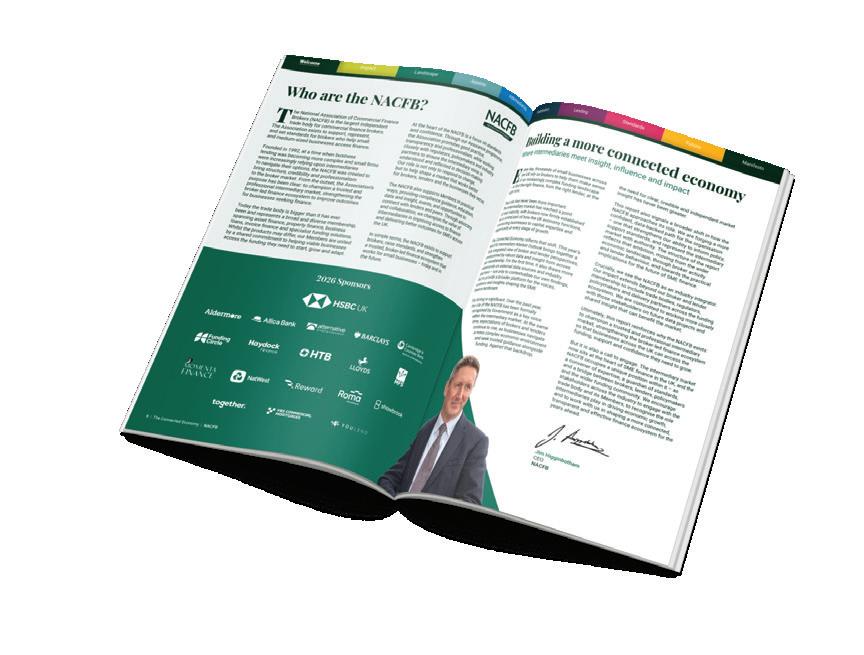
21 NACFB: The Connected Economy
48 Charity Bank: Risk and reward
50 Square 1 Media: Stop the scattergun approach
52 Asset Advantage: Flexible funding
54 Catalyst Property Finance: Unlocking potential
56 Roma Finance: Breaking the mould
58 365 Finance: Balancing noise and insight
60 Clarion Solicitors: Employee Ownership Trusts
62 The big interview: Paragon’s John Phillipou
Industry insights
66 Handelsbanken: All shook up
68 Novuna Business Cash Flow: Leading the charge
70 PMJ Capital: From caution to confidence
72 Liquid Link: Driving value
74 Momenta Finance: Shared ambition
Opinion & commentary
76 One.funding: Clear signals
78 NatWest: On your radar?
80 Triodos Bank UK: Keeping faith
82 Recognise Bank: Bridging gaps
84 Swishfund: Seeking perfection
86 Broka: Alignment is key
88 NACFB: Five key dates for your diary
90 Five minutes with: NACFB Chair, Simon Featherstone
John Phillipou
Jim Higginbotham Chief Executive Officer
NACFB
Hello
When I look around our market today, I’m reminded just how much experience and resilience sits within the intermediary community.
Many of you have built businesses through economic cycles, regulatory change, geopolitical shocks and even a global pandemic. The commercial finance sector has proven time and again that it can adapt. But we are once again operating in a period of significant change.
Technology is advancing at staggering pace. Automation and ‘zero human touch’ fulfilment models are becoming commonplace. Post-pandemic working patterns have altered how relationships are built and maintained. These shifts create real opportunity – but they also bring risk. In some areas, we are beginning to see unintended consequences where speed and efficiency can compromise suitability and customer outcomes.
That context makes the findings in this year’s Intermediary Market Outlook particularly important. In this issue of Commercial Broker, we share selected insights from the report, alongside a sit-down interview with John Phillipou of Paragon Bank and Chair of the Finance & Leasing Association. Together, they reinforce the central role the intermediary channel plays in SME finance - and the responsibility that comes with it.
Here at the NACFB, our purpose is clear: to help responsible brokers deliver great outcomes for customers and to strengthen trust across the ecosystem in which we all operate. In 2026, our priorities reflect that clarity. We will continue embedding our Assurance process as a meaningful market differentiator, launch enhanced training for new entrants, improve our data capability to support advocacy, and deepen collaboration with lenders, partners and policymakers.
Because this market does not operate in isolation – it is sustained by relationships, shared standards and mutual confidence between brokers, lenders and borrowers alike. If we are to protect and strengthen the future of intermediary-led lending, that confidence must continue to be earned through responsible broking at its core.
One application. Two solutions.
Zero uncertainty.
Seamlessly move your clients from bridging to term finance with
bridge-to-term products: Stabiliser and Improver
TBroker-led SME lending reaches £33bn in 2025
NACFB report reveals broker-led SME lending up 25% year-on-year
he National Association of Commercial Finance Brokers (NACFB) has published its inaugural Intermediary Market Outlook 2025/26, providing the most comprehensive picture to date of the UK’s broker-led SME finance market.
NACFB Member brokers originated £33 billion in SME lending in 2025, a 25% year-on-year increase that positions the intermediary market as a core pillar of UK business finance. NACFB analysis indicates that its Members account for nearly two-thirds of broker-facilitated SME lending in the UK, placing the total broker-led market at approximately £50 billion annually.
This year’s data shows that during 2025, the NACFB’s broker Members arranged 180,000 loans for UK businesses, generating an estimated £12 billion in direct GVA. When wider economic effects are included, the total impact rises to £19.2 billion, with lending activity supporting an estimated 185,000 additional jobs. Notably, 62% of broker-facilitated lending was delivered outside London and the South East, underscoring the intermediary market’s significant role in driving regional economic growth.
The 92-page Intermediary Market Outlook also draws on lender and broker survey data to explore transaction volumes, market dynamics, emerging friction points, regulatory considerations and expectations for the year ahead, enriched by independent third-party
insight to provide a holistic, evidence-led view of the sector.
Jim Higginbotham, CEO of the NACFB, said: “For most within our industry, the central role of brokers in SME finance has long been understood through experience. What this report does is provide external, data-backed evidence of that reality. The scale is unmistakable. £33 billion arranged by NACFB brokers alone. A 25% year-on-year increase. Lending that supports jobs, regional growth and economic output across the UK.”
Jim added: “This is no longer a peripheral channel within SME finance. Intermediaries are a structural component of how funding flows to small businesses. As complexity in the market increases, so too does the value of informed, professional guidance. The evidence shows a mature, resilient and increasingly influential intermediary market – one that policymakers, lenders and stakeholders cannot afford to overlook.”
Kieran Jones, Head of Communications & Advocacy at the NACFB, added: “The £33 billion headline understandably draws attention, but the real substance of this report sits beneath that number. When you look closely at the data, you see brokers considering an average of six lenders per deal, a quarter of clients having been declined elsewhere before being successfully funded, and nearly two-thirds of lending delivered outside London and the South East.
Those details reveal how this market actually operates – through careful structuring, regional reach and problem-solving capability.
“We also see a shift in behaviour. Relationships are increasingly ongoing rather than transactional, core lender panels are deepening, and a growing proportion of lender portfolios are now broker-originated. That speaks to maturity and consolidation, not fragmentation,” Kieran added.
For the first time, NACFB has combined internal CRM data, broker survey responses and lender insight to build a detailed demographic and economic profile of its membership base, which now stands at 1,400 broker firms and more than 3,000 individual brokers – the largest in its history.
The report signals a more confident, evidence-led approach from the trade body, strengthening its ability to inform policy, support professional standards, and represent the intermediary market with authority.
Extracts of the report can be found from p.21 of this magazine and the full report can be accessed via the below QR code.
Plan A got lost in the algorithm.
It’s time for Plan Alternative.
When your usual lending strategy can’t navigate the complexity, the original alternative is here.
NACFB Expo sees 500+ delegates register in first week
More than 500 delegates registered in the first week of sign-up for the NACFB Commercial Finance Expo 2026, marking a record-breaking early surge.
The largest trade show of its kind, this free-to-attend, award-winning event returns to Birmingham’s NEC on Wednesday 10th June, welcoming the brokers, lenders and suppliers who keep UK businesses supported with the finance they need to grow. After drawing 3,200 industry professionals through the doors last year, the NACFB Expo is set to raise the bar once again. The vibrant
metropolis theme returns – bigger, bolder and more immersive than ever.
Visitors will wander the bustling streets lined with more than 150 exhibitors, attend panel sessions and debates in the Big Picture Theatre, and make the most of the central park, offering weary shoppers much-needed respite. Attendees can get involved in games and competitions taking place across the metropolis, pick up plenty of promotional merch, and refuel at a wide choice of drinks stations and eateries. The Broker’s Arms Members-only pub offers a lively
hub for informal networking and catching up with industry peers, while dedicated quiet zones offer calm spaces for focused conversations, impromptu meetings or a moment to recharge away from the buzz.
Commenting, NACFB CEO, Jim Higginbotham, said: “For brokers, lenders and suppliers, the bustling metropolis theme reflects both how far our industry has come and where it’s heading next.”
Register for free via commercialfinanceexpo.co.uk
FINANCE SIMPLIFIED
Investing in people
Understanding the importance and value of brokers
Ian Coulson Head of Commercial Brokerage HSBC UK
When HSBC UK re-entered the broker market in 2022, it became clear how the landscape had changed and how brokers now play a central role for many businesses accessing finance.
More than 20 years ago, when I first worked closely with brokers, the market was very different. Brokers are now more trusted and for many businesses they are now the first port of call for accessing finance. This shift has been one of the most important learnings for us as a bank over the last three years.
The quality of propositions coming through intermediaries is on par with what we see directly, and in many cases the credit quality of the businesses is stronger (based on data held as at 30th September 2025). SMEs are better advised, better prepared and clearer about what they need which allows for a positive experience for clients, brokers, and lenders alike.
Our initial approach was deliberately measured, to ensure the relationship with brokers was developed in the most effective way. Following an initial 18-month pilot with term lending products, we broadened our offering to include, trade, invoice finance, and asset finance with a focus on both SME and mid-corporate businesses.
What followed has exceeded our expectations, with over a billion of lending delivered through this channel since our launch.
It is for these reasons that the timing felt right to embark on the next stage of our growth, announcing our headline sponsorship for 2026/27. The NACFB has been pivotal in our re-entry to the market and its focus on quality assurance has helped us to build our confidence, making the trade body an obvious partner for us.
This partnership will enable us to further develop our brand in the broker market. We recognise the need for brokers to understand
what a lender stands for, and where it is competitive. For us, this means being clear on ‘why HSBC’. The answer? We combine local decision-making for UK businesses with the strength, experience and international reach of a global bank.
To activate this growth, we have invested heavily in people and relationships. We now have 14 dedicated business development managers covering the intermediary market, who are supported by a wider network of relationship managers and directors across the bank. For brokers, that means complete simplicity with one point of contact responsible for bringing the full capabilities of HSBC UK to the table.
Looking ahead, growth is the continued ambition for us. Working with more brokers, widening our reach and building long-term relationships that go beyond individual transactions will support our aim of being the leading high-street lender for intermediaries by 2028.
For this growth to continue, brokers remain a central part of the journey. They bring insight, reach, and trusted relationships with businesses across the UK. For banks that want to support growth, intermediaries are no longer optional, they are essential.
To find out more about how we could support you, email us on uk.broker.scheme@hsbc.com
The NACFB has been pivotal in our re-entry to the market and its focus on quality assurance has helped us to build our confidence, making the trade body an obvious partner for us
Left
right: Maeve Ward, Nick Parker, Chris Evans, Michelle Walsh, Tanya Elmaz, Abi Pickford
Jim Baker
Sales Director –Bridging & Development
Finance
Decisions that deliver
Supporting brokers with clarity, access, and certainty
If you ask brokers what they really want from a lender, the answers are usually simple. Be clear. Be reachable. And don’t move the goalposts halfway through a deal.
That’s been Masthaven Finance’s approach for over 20 years. Not because it sounds good in marketing copy, but because it’s the only way this market actually works. Deals are complex, timelines are tight, and when something goes off-plan –which it often does – brokers need a lender who stays in the conversation rather than disappearing behind a process.
Masthaven was built on that principle. We believe in honest conversations, keeping our word, and making sure brokers always know where they stand. You can pick up the phone to anyone here and get a straight answer. If we can’t do a deal, we’ll tell you early on. If we can, we’ll back it properly and see it through.
Decisions made by trusted people
One of the things brokers notice quickly is how closely our teams work together. Sales, underwriting and credit sit side by side, with decision-makers involved at key stages: enquiry, valuation and legals, so decisions don’t drift or get stuck waiting for sign-off from someone who hasn’t seen the full picture.
Every case is assigned a dedicated underwriter from start to finish. That means brokers aren’t constantly re-explaining the same deal to different people as it progresses. Our BDMs are
equally hands-on. They’re not just there to pass messages along; they feed broker feedback directly to the CEO and credit team. If something isn’t working in practice, it gets challenged and changed.
That feedback loop has shaped how our products have evolved, including recent changes to simplify refurbishment lending and open up opportunities like commercial-to-semi-commercial conversions – because that’s what brokers told us they were seeing more of.
What brokers can expect
Certainty early on matters. That’s why our brokers can choose between same-day indicative terms or fully credit-backed terms. When credit-backed terms go in front of a client, they’ve already been reviewed by the people who will ultimately sign the deal off.
We keep things transparent and deliverable: no exit fees on any product, sensible monitoring surveyor costs, and clear requirements set out upfront. Communication stays consistent throughout the application process, with the same underwriter and regular updates, so there are no last-minute surprises.
And when valuations don’t come back as expected, we look at the detail and apply commercial judgement. On a recent ground-up scheme, both the market value and gross development value came back lower than anticipated. Rather than pulling the plug, we worked through the
Masthaven
numbers using residual calculations and wider market data. The developer kept building, and the deal stayed on track. That’s the difference between process and pragmatism.
Backing the parts of the market that need it
We’ve always been comfortable lending where others are cautious. We’re one of the few lenders offering regulated development loans, and we support both experienced developers and first-time entrants. The market needs new developers coming through, and with the right structure and support, those deals can be just as strong.
Geographically, we’ve focused on areas that are often underserved, particularly Scotland and regional towns.
Looking ahead
The wider SME lending sector is moving into a more constructive phase. Demand remains solid, confidence is returning, and competition is driving sharper pricing and greater flexibility – all pretty positive for SMEs looking to act on opportunity.
The challenge hasn’t changed, though. Deals still need to be structured realistically. In bridging, that means clear exit planning and credible fall-back options. In development finance, momentum only translates into success where schemes are well thought through, with sensible contingencies built in from the outset.
After a stop-start 2025, the mood heading into 2026 feels more purposeful. For us, the focus is on building momentum – we’re investing in technology, refining propositions, and expanding our Masterclass programme to support even more brokers with practical and market-led insight. But while tools and initiatives matter, the fundamentals matter more.
At Masthaven, we’ll keep doing what we’ve always done: leading with trusted people making trusted decisions, delivering loans as promised. We believe in clear thinking, honest conversations, and doing things properly – because that’s how trust is built. Not overnight, but over decades of showing up, solving problems, and staying true to our promises.
That’s the Masthaven way. It always has been.
We believe in honest conversations, keeping our word, and making sure brokers always know where they stand
Driving change
How the ACP is setting a new industry standard
Sarah Cunningham Head of Compliance NACFB
In a market where confidence, credibility and consistency matter more than ever, NACFB Assurance is fast becoming the industry’s gold seal of integrity. More than a benchmark for regulatory compliance and robust processes, it’s redefining how brokers, lenders and business borrowers work together, building a stronger, more connected commercial finance community where trust thrives, excellence is upheld, and mutual success is the ultimate goal.
Think of the Assurance Consultation Process (ACP) as the broker’s equivalent of an MOT. Just as an MOT ensures your car isn’t a danger to yourself, your passengers, or other road users, the ACP checks under the bonnet of your business to make sure you’re not exposing yourself, your colleagues, or your clients to unnecessary risk. It’s not about catching you out – it’s about keeping you roadworthy: giving you the confidence that everything is running smoothly, flagging requirements before they become problems, and providing the support to get you back on the road stronger than before.
But what exactly is the ACP? Where did it begin – and what are its true aims as it shapes the future of commercial finance?
Evolution
The Assurance process has gone through its own series of upgrades. It began in 2017 with the Minimum Standards
Review (MSR) – a two-day, in-person assessment designed to examine Members’ adherence to core compliance principles. In 2022, the MSR gave way to the Assurance Consultation Process (ACP), streamlining the approach into a two-hour call supported by a partial document review and followed by the issuing of remediation work.
Now, the ACP has once again moved up a gear. Over the past year, it has embraced a smarter, more efficient model: capturing essential information through a targeted questionnaire and reducing broker call time from two hours to just 15 minutes –without compromising on depth or effectiveness.
The current landscape
This evolution reflects the reality brokers face. As the regulatory perimeter continues to shift, keeping pace with changing requirements has become increasingly complex for our Members. Lenders, too, face growing obligations around oversight of their broker panels.
Now, in the diverse, fast-evolving market we find ourselves in, consistency and clarity have never been more important. That’s where the Assurance Process comes in: a universal, industry-created and lender-endorsed framework designed to support both regulated and unregulated brokers, of every shape and size. Bringing both sides on the same journey, reducing duplication, increasing clarity, and strengthening confidence across the chain.
The road ahead
Digitisation of the system is complete, bringing greater ease and
It’s not about catching you out – it’s about keeping you roadworthy
speed for our Members. Streamlined questions are now live, and the Association is expanding its Assurance team to ensure even faster response times and greater Member support.
As I mentioned earlier, the ACP has been streamlined into a set of tailored Assurance questions. Once a Member submits their questionnaire, it is reviewed by a Quality Assurance Officer, with a brief follow-up call arranged where clarification is required. This proportionate and supportive approach focuses on identifying and addressing risk. Any remediation is issued digitally and, once completed, the broker is assessed against the NACFB Assured Standards.
The move to a fully-digital process unlocks powerful efficiencies. With broker consent, lenders can securely access Assurance information through the Patron portal, using it to support their own oversight and Assurance requirements. This dramatically reduces repetitive requests, cuts administrative burden, and creates a single, trusted source of information.
The result? Less time spent duplicating work. More time focused on serving clients and growing sustainable businesses.
Building momentum across the industry
The ACP is increasingly embedded across the sector, supported by endorsement from the Finance & Leasing Association and ongoing collaboration with key trade bodies. This momentum signals a clear direction of travel: toward shared standards, shared assurance, and shared confidence.
NACFB Assurance is not just keeping pace with change – it is helping lead it. By combining robust oversight with efficiency,
transparency and support, it is setting a new benchmark for how commercial finance can work better for everyone.
Members have already started receiving requests from lenders to access their Assurance reviews. With a single authorisation, lenders can securely view key Assurance information held on the NACFB platform – including current Assurance status, core regulatory details, and the policies and documentation submitted as part of the Assurance process.
By sharing this information, firms can cut down on repeated compliance and Assurance information requests from multiple lenders, and enable faster, more efficient panel management.
Like Gas Safe or TrustMark for other industries, the Assurance badge is becoming the de facto benchmark for intermediary excellence – a visible mark of trust and professionalism.
Ultimately, our ambition is clear: to establish and uphold a single, universally recognised broker standard – one trusted equally by brokers, lenders, and borrowers.
NACFB Assurance is not just keeping pace with change – it is helping lead it
Buying time
How probate finance can help inheritance delays
Probate has become a major source of delay for families waiting for their inheritance. While the courts have cut the time it takes to grant probate itself to just over four weeks on average, down from around twelve weeks at the end of 2023 (gov.uk), this is only one part of the process. We sat down with Josh Hawker, head of growth at NACFB Patron Ampla Finance, to discover how probate finance can help families cope with inheritance delays.
Probate delays are easing in the courts, but families are still waiting months for their inheritance – why does the process take so long?
From death to final distribution, it can take between six to 12 months for a typical estate, and longer where there are overseas assets, trusts or disagreements between beneficiaries. In practice, that means months where property, investments and bank accounts are locked, even though bills and tax still need to be paid.
Demand on the system is high. Analysis of government data by the Yorkshire Times shows there were about 292,000 probate applications in 2022, rising roughly by 3% a year since 2020, and the Probate Registry is expected to handle around 350,000 cases annually. At the same time, the number of cases taking more than a year to get a grant has jumped by 134% in three years, and cases taking
nearly two years are up by 132% (todayswillandprobate.co.uk).
When assets are frozen, but costs keep coming, what financial pressures do families face during probate delays?
Inheritance tax is usually due by the end of the sixth month after death, and in most cases some or all of the tax must be paid before probate is granted (gov.uk). Executors can therefore face a large tax bill, funeral costs, care fees and mortgage payments while the main estate assets are still frozen. If there is little cash on hand, the usual answer is a quick sale of the main property.
In a slow or uncertain housing market, that often pushes families towards discount sales or ‘cash buyer’ offers. The estate meets its tax deadline, but beneficiaries lose tens or even hundreds of thousands of pounds in long-term value.
Instead of rushing into a sale, how can probate lending give executors time, flexibility and better outcomes?
Used well, probate lending can prevent distressed sales by funding the inheritance tax bill so executors can wait for a fair market offer rather than selling at a discount. In addition, it can also be used to pay for basic refurbishment so a tired property can achieve a higher price or to provide cash so one beneficiary can buy-out others and keep the family home, or so vulnerable beneficiaries are not left short while the estate is tied up.
Josh Hawker Head of Growth
In a market where inheritance tax receipts have hit record highs and more estates are brought into scope, demand for this kind of solution is set to grow.
When short-term finance looks attractive, what safeguards should executors put in place before proceeding?
Where an estate is asset-rich and cash-poor, and where a forced sale would clearly damage value, short-term finance can protect both beneficiaries and executors. It’s vital to have clear communication with the family and for them to have a careful review of whether the numbers truly work in the estate’s favour. Loans are subject to suitability and affordability criteria and incur interest and fees.
Used well, probate lending can prevent distressed sales by funding the inheritance tax bill so executors can wait for a fair market offer
Ampla Finance
Reflecting reality
A smarter way to fund commercial refurbishment
Steve Palfreeman Head of Bridging Sales Allica Bank
The NACFB Commercial Lender Awards are always a fantastic way to end the year. But this year was extra special, as Allica was the grateful winner of the ‘Pioneers of the Year’ category, alongside three other awards.
Things aren’t always straightforward, and clients often need flexibility to get deals moving
I was especially proud of the pioneer award, as it recognised our bridge-to-term products, which we launched in 2025 as a real first for the market, unlocking investment opportunities for businesses across the UK.
Our bridge-to-term loans start as bridging finance, helping businesses access funds quickly, then move seamlessly onto a term loan once agreed conditions are met.
They solve a problem brokers regularly tell me about, where their client doesn’t meet the criteria for a traditional term loan, but they are also anxious about the exit risk if they take on a bridging loan, or simply don’t want the hassle of a refinance application.
Ultimately, it reflects the reality of real estate investment for established developers and landlords. Things aren’t always straightforward, and clients often need flexibility to get deals moving. Whether that’s bringing a property up to the required standard, or giving the business time to stabilise their rental income or secure tenants. We’ve got both these scenarios covered.
From bridge to term, without the uncertainty
Our ‘Improver’ bridge-to-term product is a great example of this in action. It allows borrowers to refurbish commercial properties over the course of the loan before moving onto a more typical term loan automatically when agreed conditions are met.
We recently completed on an office purchase in South West London for £2 million, where the client required £400,000 to improve the property before moving onto the term facility. The refurbishment costs were released on a drawdown basis in arrears, up to 65% LTGDV.
The key benefit of this product is that it’s one facility, signed from the outset, for up to seven years. It means that once the borrower completes the works, they will move automatically onto a term loan with Allica without having to go through the process of applying for a refinance.
There are other ways the Improver loan can help too. For example, supporting auction purchases, where properties often need work but have strong potential. Borrowers can also use an Improver bridge-to-term loan to fund sustainability improvements, shifting to a term loan when its EPC rating is increased.
These are just a few examples of how Allica helps drive investment in important business assets that otherwise wouldn’t have happened. Unlocking these opportunities is exactly what we set out to do.
How bridge-to-term works in practice
We offer two types of bridge-to-term loan. The ‘Improver’, which I’ve already mentioned, allows businesses to fund repairs and refurbishments before porting to a term mortgage. It can support businesses with between £500,000 and £5 million in funding.
And then there’s the ‘Stabiliser’, designed for clients who need time to stabilise rental income or secure tenants before refinancing. It has a minimum loan size of £250,000.
We introduced bridge-to-term loans to help your clients mitigate time pressure and exit risk – two of the most common client worries I hear about from brokers. Their initial application will
cover both loans, so there’s no being left in limbo about exiting a bridging loan, or piles of extra paperwork to do. We also underwrite the loan from a bridging perspective, because we understand clients are often using the product to move fast.
Your clients may also be able to release equity in the property when they transition onto the term portion of the loan.
In terms of what this means for brokers, we’ll pay a tranched commission. You get a standard 1.5% on origination of the loan, followed by a further 0.5% when transitioning to term. In effect, you get a second payment up to two years after arranging the deal, without any extra work.
Built with brokers, shaped by real deals
Our award-winning bridge-to-term products were developed in close collaboration with our broker partners to properly understand what they and their clients need. And we’re continuing to build on it, having already added semi-commercial properties to the proposition, and with pricing enhancements on the way.
The goal with our award-winning bridge-to-term products was simple: provide fast, flexible finance with a guaranteed exit solution. And we’re already doing exactly that.
If you’ve got a client who could benefit, our team would love to talk it through.
Our bridge-to-term loans start as bridging finance, helping businesses access funds quickly, then move seamlessly onto a term loan once agreed conditions are met
Professional support, personal approach.
Access our team for expert advice, bespoke webinars, and loans of all sizes. Because business could use a bit less grey.
Security may be required. Product fees may apply. Over 18s only. Subject to status, business use only.
Intermediary Market Outlook 2025/26
Building a more connected economy
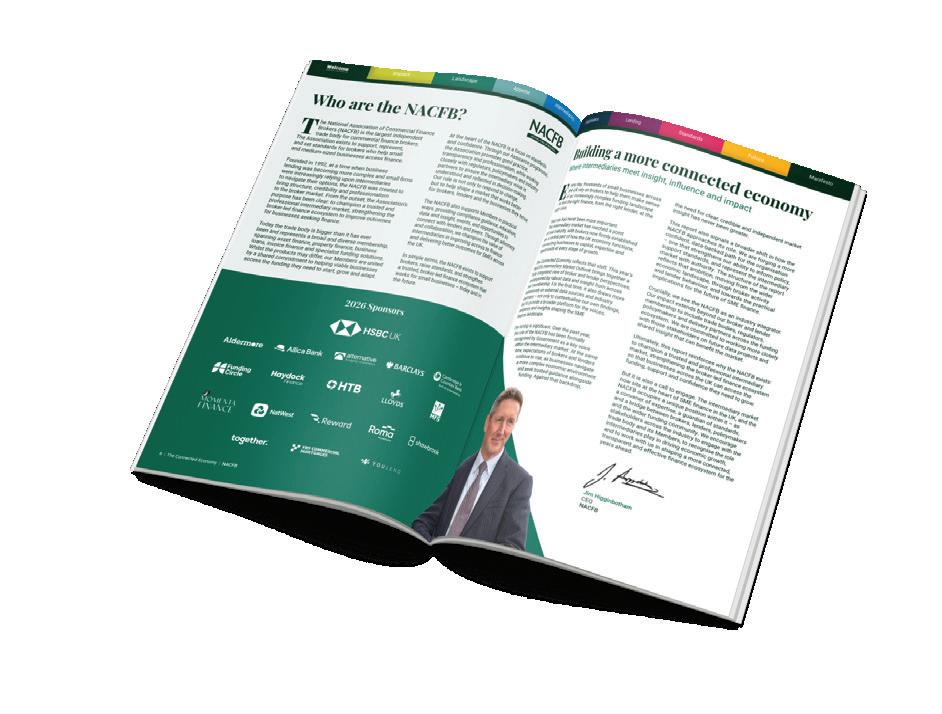
In the following pages, we present selected findings from the NACFB’s Intermediary Market Outlook 2025/26: The Connected Economy – a 92-page report offering one of the most comprehensive data-led assessments of the UK’s broker-led SME finance market.
The full report is built on original survey research conducted by the NACFB in November 2025, capturing responses from over one third of Member broker firms and approximately half of NACFB Patron lenders. Together, these dual perspectives provide a rare, integrated view of activity, sentiment and behaviour across the intermediary ecosystem.
To ensure rigour and objectivity, all data was fully anonymised prior to analysis and independently modelled by Freshminds, applying a structured projection framework to map survey responses across the NACFB’s full membership base. This approach enables the findings to reflect estimated market-wide outcomes, rather than raw respondent data alone – offering a more representative picture of scale and direction.
The extracts included here highlight key trends in broker activity, lender engagement and evolving market dynamics. They reflect a sector that has reached real maturity, with intermediaries now firmly embedded within how UK SMEs access capital.
The timing of this report is significant. Expectations of brokers and lenders continue to rise, economic conditions remain complex, and policymakers are placing greater emphasis on standards and transparency within the funding ecosystem. Against that backdrop, credible, independent market insight is essential.
The NACFB is committed to strengthening its role as an industry integrator – connecting brokers, lenders, regulators and policymakers through shared data and evidence.
To access the full Intermediary Market Outlook 2025/26 and explore the complete analysis, visit nacfb.org today.
Read the full 92-page report
For the complete data set, detailed modelling, segment analysis and policy context, download the full Intermediary Market Outlook 2025/26 from nacfb.org
Profiling the NACFB broker community
As of December 2025, the NACFB represents 1,400 broker firms, comprising more than 3,000 individual registered brokers – the largest membership base in the Association’s history. This milestone reflects both the continued growth of the intermediary market and the NACFB’s role as its leading professional body.
For the first time, the Association has been able to combine its internal CRM data with external company-level intelligence to build a detailed demographic profile of its membership. Using verified company identifiers, we can now accurately map the structure, scale and characteristics of NACFB firms, providing a clearer picture of who our brokers are and how the sector is evolving. This analysis has been enabled through a partnership with mnAi, whose data capabilities have allowed us to explore firm composition, size and emerging trends across the membership base.
Firm maturity and leadership profile of NACFB Members
Source: mnAi analysis of NACFB CRM data - December 2025 10
Source: mnAi analysis of NACFB CRM data - December 2025
Size
The NACFB membership remains dominated by small, independent firms, with just over half operating as single-broker businesses. However, there has been a slight year-on-year contraction in one-person firms, alongside growth in multi-broker practices. While larger firms remain a minority, they increasingly include broker networks and more structured teams, pointing to a gradual shift towards scale, collaboration and more resilient business models across the intermediary market.
Source: NACFB CRM data - December 2025
Product focus and regulatory profile of NACFB broker firms
Scope note: This analysis reflects NACFB Member firms only and shows both the primary business finance products brokers operate in and their regulatory status (Directly Authorised, Appointed Representative, or non-regulated).
36% 15% 49% 68% Property-led finance Appointed
The data highlights clear differences in how brokers operate across product types. Property-led finance dominates the membership, and is strongly associated with directly authorised firms, reflecting the regulatory complexity and specialist expertise typically required in this market. Asset finance, while smaller in overall share, shows a much higher concentration of Appointed Representatives, underlining the role of networks in Source:
supporting scale, compliance and distribution in this segment. Business finance lending generally operates with a more mixed regulatory profile and a notable presence of non-regulated activity, reflecting the diversity of products and routes to market in this space. Taken together, the figures suggest that regulatory structure closely tracks product complexity, with brokers aligning their operating model to the demands of each finance discipline.
Broker business outlook: growth stage
Source: NACFB broker survey - November 2025
Taken together, these findings point to a broker community that is largely stable but actively repositioning for the next phase of growth. Whilst only a minority of firms describe themselves as being in outright expansion mode, the overwhelming majority report either steady growth or a broadly flat position, with contraction remaining rare.
This stability is also reflected in how brokers are evolving their product offerings. Nearly half (49%) report that their proposition has stayed broadly the same, while 38% have diversified or added new products and services, and a further 13% have deliberately refined and specialised their focus.
Taken together, this suggests a market that is not standing still, but adapting in measured and intentional ways. Brokers appear to be balancing continuity with selective change – broadening capability where client demand requires it, or sharpening focus around areas of expertise – pointing to a sector responding strategically to market conditions rather than pursuing rapid or reactive expansion.
broadly the same
Diversified/added products (added more products and services)
Refined/focused (focused on fewer, more specialised offerings)
Source: NACFB broker survey - November 2025
BRIDGING WITH MOMENTUM.
Total lending originated by NACFB brokers in 2025
In 2025, NACFB Member brokers originated £33 billion of SME lending, representing a 25% increase on the previous year and highlighting the growing scale of intermediary-led finance. This expansion is reflected at firm level too, with 59% of brokers reporting that they originated more business in 2025 than in 2024. Based on lender feedback, the NACFB estimates that its
Members account for around two thirds of the total value of SME finance originated via the entire commercial finance broker community, not just within the Association. On this basis, the total volume of SME lending facilitated by commercial finance brokers across the UK in 2025 is projected to be around £50 billion.
NACFB broker activity in 2025 – at a glance
Approx. total transactions (#)
Average sized transaction (£)
These figures reflect activity within the NACFB broker community only, which in its current form skews towards property-led finance. This is reflected in both scale and value, with 113,000 property-led transactions and an average loan size of £222,000, compared with 38,000 asset finance deals averaging £111,000 and 32,000 business finance transactions averaging £122,000.
NACFB Members’ client reach in 2025
Number of clients served
New to firm clients
Source: NACFB broker survey - November 2025
The average loan sizes and number of transactions shown here are broadly indicative rather than definitive. While NACFB data coverage is substantial, producing more precise and granular averages would require a co-ordinated, cross-industry approach to transactional data, bringing lenders and trade bodies together to create a more complete and consistent single source of truth.
180,000
80,000
Source: NACFB broker surveyNovember 2025
During 2025, NACFB Members served an estimated 180,000 clients, with new-to-firm clients representing around 44% of this total (80,000 businesses). This level of new engagement underlines the intermediary market’s role in attracting and supporting first-time and growing borrowers.
Regional distribution of NACFB-brokered SME lending (2023–2025)
South West England
Across almost every UK region, property-led finance dominates the value of broker-arranged lending, typically accounting for 60-85% of total volumes. As you would expect, this is most pronounced in Greater London (85%), the South West (82%), the North East (82%) and the South East (80%), reinforcing the structural importance of property-backed borrowing to SME finance demand in both metropolitan and regional markets. Even in traditionally more industrial or mixed economies such as the West Midlands (71%), North West (71%) and East of England (70%), property remains the primary driver of lending by value.
Nature of broker-client relationships in 2025
Transactional (%)
e.g. one-off placements or deal-focused work
Ongoing/relationship-led (%)
e.g. repeat clients, ongoing support, or portfolio advice
Source: NACFB broker survey - November 2025
What this shows is that broking is far more than a series of oneoff transactions. While a significant share of deals are still done on a single-case basis, most activity now sits within ongoing client relationships. That points to a shift in how businesses use brokers – not just to source finance, but to help them
navigate funding over time as their needs change. Transactional deals will always have a place, especially for smaller or urgent requirements, but it is in these longer-term, relationship-led engagements that brokers are able to bring the greatest value, insight, and continuity for SMEs.
How quickly clients move from enquiry to drawdown
The data highlights just how differently these parts of the broker market operate in practice. Asset finance is, by nature, fastmoving: most deals complete in a matter of days, reflecting standardised products, lighter underwriting and more automated lender processes. Business finance sits somewhere in the middle, with a median of 11 days – quick enough for working-capital needs, but still shaped by credit assessment and case complexity.
Source: NACFB broker survey - November 2025
Property-led finance is fundamentally different. A median time to drawdown of 135 days reflects the reality of valuations, legal work, planning issues and layered funding structures. While some cases complete quickly, others take many months, underlining that property brokers are often managing long, complex transactions rather than high-volume deal flow.
How brokers navigate lender choice and deal outcomes
The average NACFB Member considers six lenders for each deal 6 lenders considered
Over a quarter of clients had already been turned away before approaching a broker 26% previously declined
These data points are some of the clearest demonstrations of the value brokers bring to the market. The fact that brokers typically test half a dozen lenders for each case, that more than a quarter of clients arrive having already been declined elsewhere, and that nearly one in four end up with a different type of finance
Nearly one in four ended up with a different product than they first requested 23% redirected
Source: NACFB broker survey - November 2025
than they originally asked for all point to the same thing: brokers spend their time finding routes through complexity. They are not just passing applications on – they are reshaping deals, reopening conversations and matching businesses to lenders that would otherwise remain out of reach.
Where NACFB Members placed business in 2025 (year-on-year +/- change)
Source: NACFB broker surveyNovember 2025
The 2025 data shows a market that continues to diversify, even as established players remain dominant. Specialist lenders (32%) and traditional high-street banks (27%) still account for the largest share of broker-placed business, reflecting the ongoing need for both deep underwriting expertise and balance-sheet scale.
Despite challenger banks still accounting for nearly a quarter of broker-led lending in 2025, their share fell by four percentage points year-on-year, signalling that growth in the broker channel is no longer being driven primarily by that segment. Rather than a simple shift back to incumbent providers, the data points to a more nuanced rebalancing across the market, with modest share erosion among both specialist lenders and traditional high-street banks. This reflects how brokers actively adjust placement strategies as pricing, credit appetite and risk tolerance evolve in a higher-rate environment.
Two other shifts are also worth noting. Fintech lenders (6%) and CDFIs (2%) continue to grow from a smaller base, widening the range of routes available to SMEs, particularly for niche, regional or underserved cases. At the same time, the emergence of broker own-book funding (4%) points to a quieter but important evolution: some intermediaries are now developing balance-sheet or funding-line capabilities alongside their brokerage activity, reflecting both the maturation of larger firms and the search for more flexible ways to support clients.
That said, it is important to recognise the perennial challenge of how lenders are categorised at all. Labels such as ‘challenger’, ‘specialist’, or ‘fintech’ are imperfect and increasingly blurred, but they remain widely used by policymakers, regulators, and market analysts, so they are adopted here for consistency and comparability rather than as rigid definitions.
The scale of broker’s lender panels in 2025
27 lenders (core)
On average, NACFB brokers report having 116 lenders available across their full panels but rely on a core group of around 27 for roughly 80% of their transactions. This reflects a pragmatic balance between breadth and depth: brokers maintain wide market coverage across all finance types, while concentrating activity with lenders they know, trust, and can execute with
How much SME lending now flows through brokers
Two in every three pounds lent by NACFB Patron lenders in 2025 was broker-introduced
In 2025, 68% of SME lending value by NACFB Patron lenders was originated through the broker community, meaning that almost two in every three pounds lent flowed via intermediaries rather than direct channels. This represents a one percentage point increase on 2024, when brokers accounted for 67% of lending value. Whilst the change may appear modest, it is significant.
116 lenders (full panel)
Source: NACFB broker survey - November 2025
efficiently. The figures underline a key asymmetry in the market – few SMEs could realistically access, compare, or even be aware of this many funding options on their own –highlighting the value brokers add by turning a fragmented lender universe into a navigable, competitive marketplace.
Source: NACFB lender survey - November 2025
The continued growth in broker share comes at a time when many lenders are actively investing in direct distribution and digital origination. Against that backdrop, the data suggests that brokers are not only retaining their relevance but strengthening their role as the primary source of meaningful lending volume across the SME market.
Brokers as a primary engine of lender portfolio growth
Broker-introduced business is no longer marginal to lender performance – it is now a core driver of growth, with the vast majority of lenders saying intermediaries actively expanded their portfolios in 2025.
Source: NACFB lender survey - November 2025
Lenders' broker panel composition
Lenders continue to expand their broker panels, with growth evident across both full and core relationships. In 2024, NACFB Patron lenders reported an average full panel of 590 brokers, with 170 classed as core, meaning core brokers accounted for around 29% of the total panel.
In 2025, the average full panel increased to 650 brokers, while the number of core brokers grew more markedly to 240. As a result, 37% of the full panel is now considered core. This
Broker
remuneration models utilised in 2025
indicates that lenders are not only broadening access to their panels but also deepening engagement with a larger proportion of brokers within them. Rather than signalling greater selectivity, the data points to a market in which lenders are investing more widely in broker relationships and elevating a greater share of those relationships into core status. This suggests growing confidence in the intermediary channel and a recognition that sustained lending volume increasingly comes from a broader base of trusted, active broker partners.
The picture is clear: percentage-based commission remains the commercial backbone of broker-led SME finance, used by almost all firms. But it is no longer the whole story. A quarter of brokers now operate hybrid models combining lender commission with client-paid fees, while flat fees, retained commissions and success-based structures all feature meaningfully across the market.
This growing mix reflects a market that is becoming more sophisticated and more client-led. Brokers are increasingly tailoring how they are paid to the nature of the deal – balancing upfront effort, ongoing service, and risk – rather than relying on a single, one-size-fits-all commission model.
Source: NACFB lender survey - November 2025
240 brokers (core)
650 brokers (full panel)
Broker responses to commission disclosure changes
We already fully disclosed commissions — no changes were required
We made changes to move from partial disclosure to full disclosure
We made changes to introduce partial disclosure (where none was previously given)
We continue to provide partial disclosure only
Not sure/still reviewing our approach
We do not currently disclose commissions to clients
Source: NACFB broker survey - November 2025
This result points to a market built far more on partnership than suspicion. With the vast majority of lenders rating trust as high or very high, it reflects how broker-introduced business has become embedded in lenders’ day-to-day operations rather than treated as a risk channel.
The results underline how far ahead of the curve much of the NACFB community already was. Well before the Supreme Court judgment, the Association had recommended full commission disclosure as best practice, setting clear expectations for transparency across the membership. As a result, most firms report that no material changes were required when the ruling and updated disclosure expectations came into effect in 2025.
Where firms did adjust their approach, it was largely to move from partial to full disclosure rather than to introduce transparency for the first time. This suggests that, for NACFB Members, the regulatory shift was primarily about formalising and evidencing established good practice, rather than forcing a fundamental change in how firms operate.
Source: NACFB lender survey - November 2025
How lenders judge broker performance
Quality and completeness of applications
Conversion rates (approved to completed)
Repeat business
Consistency in meeting lending criteria
Timeliness and responsiveness
Volume of deals submitted
Customer satisfaction
Deal approval rates
Source: NACFB lender survey - November 2025
What stands out here is that (most) lenders seem to care far more about the quality of what brokers bring them than the sheer volume they send. Complete, wellpackaged applications and strong conversion rates sit well ahead of deal flow alone, which points to a market that values efficiency, credit discipline and mutual time-saving. Repeat business and consistency also rank highly, reinforcing the idea that lenders value long-term, dependable relationships over one-off transactions – even if, anecdotally, that hasn’t always been the experience across the wider market.
This data shows that NACFB membership already carries real weight in lender decision-making: a clear majority either require it, prefer it, or use it at least occasionally when assessing broker quality. That gives the Association a meaningful starting position as NACFB Assurance is rolled out with lenders in 2026. In effect, the market is already signalling trust in NACFB as a filter for professionalism and standards – Assurance now has a ready-made channel through which it can deepen, formalise, and strengthen that confidence across lender panels.
Source: NACFB lender survey - November 2025
For your clients starting a new business or growing an existing one, using equity in their home can open up new frontiers.
Borrow , repay over 1 to
Choice of payments for up to five years
Low cost
Guarantee required and security over
£25,000 to £250,000 15 years interest-only early settlement residential or BTL property
With a Finsec Secured Business loan to power their business ambitions, the sky really is the limit.
For a decision within hours (not days) call us on
Broker outlook: the risks shaping the next 12-24 months
Economic downturn
Reduced lender appetite
Valuation/legal delays
Competition (direct-to-lender/fintech)
Regulatory burden
Technology/ cyber risk
Talent/skills shortages
Fraud/ financial crime
Margin compression
Rising defaults
Source:
Brokers see the biggest threats as coming from the wider economic climate and lender behaviour rather than from within the sector itself, reinforcing how closely intermediary activity remains tied to SME confidence and credit availability.
Broker technology investment priorities
e-signature/ document collection
Digital onboarding/e-IDV
AI case-matching/ assistant tools
Portal integrations/API
Cybersecurity/ compliance tooling
Automation
Deal origination/lead gen
Pricing/term-sheet tools
Open banking connectivity
Data enrichment/ credit analytics
The pattern here shows brokers using technology mainly to streamline and automate everyday processes – onboarding, document handling, CRM and compliance – rather than to replace human judgement or relationships, reinforcing that tech is being used to make brokers more efficient, not less personal.
Source: NACFB broker survey - November 2025
Lender confidence in scaling broker-led lending
Lenders are overwhelmingly confident they can grow and handle rising broker demand, pointing to a market that is investing for expansion rather than bracing for contraction. Good news.
What lenders see as the biggest risks to their lending
Technological disruption or legacy system limitations
Increased competition from other lenders
Reduced borrower demand
Increased risk of fraud or financial crime
Declining quality of broker submissions
Regulatory tightening or new compliance requirements
Interest rate volatility
Erosion of trust in broker-lender relationships
Staffing or resource shortages
Fee or commission transparency pressures
Disruption or withdrawal of funding lines Broker-originated
or disintermediation
Source: NACFB lender survey - November 2025
Source: NACFB lender surveyNovember 2025
Lenders’ biggest concerns are inward-looking: technology constraints, legacy systems, and intensifying competition all rank well above borrower demand or broker behaviour. Notably, fears of broker-led disintermediation barely register, reinforcing that lenders see brokers as part of the solution rather than a strategic threat.
How central brokers are to lenders’ long-term growth plans
Core to strategy
Brokers are primary route to market
Important
Brokers represent a key growth channel among several
Moderate
Brokers play a supportive but not central role
Limited Brokers are used selectively for certain products or segments
Not currently part of long-term growth plans
Source: NACFB lender survey - November 2025
This is perhaps one of the clearest signals from across this year’s data set: for most lenders, brokers are no longer just a distribution channel, but a core part of how they expect to grow. The fact that nine in ten lenders place brokers somewhere
Lenders’ plans for broker panel development in 2026
between ‘important’ and ‘core’ reflects a market that increasingly relies on intermediaries not just for volume, but for reach, risk-filtering and access to the SME economy that lenders cannot efficiently serve on their own.
Expand
Actively recruit and onboard more brokers
Retain approximately the same number of active brokers
Rationalise
Reduce the number of active brokers but strengthen existing relationships
Source: NACFB lender survey - November 2025
This points to a market that is still very much in expansion mode: most lenders are actively looking to bring more brokers onto their panels rather than retrench. The small proportion planning
to rationalise suggests that while quality and focus matter, the overriding strategy is to broaden reach and deepen intermediary coverage as broker-led origination continues to grow.
Get your clients fast, exible and reliable nancing.
Lenders’ confidence in their lending outlook for the next 12 months Broker
Source: NACFB lender survey - November 2025
Source: NACFB broker survey - November 2025
These two distinct data sets, both lender confidence and broker sentiment, point to a market that is cautiously positive, but viewed through different lenses. Lenders, assessing their own portfolios, pipelines and capital positions, report a high degree of confidence in their outlook for the year ahead. A clear majority expect lending activity to remain strong, with confidence underpinned by balance sheet strength, funding access and continued demand across core segments.
Broker sentiment, by contrast, perhaps reflects a wider and more immediate view of the SME landscape. Whilst brokers remain broadly optimistic, their outlook is more mixed, with a larger neutral and pessimistic cohort. This divergence likely reflects
brokers’ proximity to client decision-making, where uncertainty around costs, margins and timing continues to shape borrower behaviour, even where funding appetite exists.
Importantly, these perspectives are not contradictory. Instead, they highlight the intermediary’s role in translating lender confidence into real-world outcomes for businesses.
Brokers operate at the point where appetite meets uncertainty, balancing lender willingness with borrower readiness and risk. The alignment between strong lender confidence and measured broker optimism suggests a market that is functioning, but selectively and with greater judgement than in previous cycles.
Read the full 92-page report
For the complete data set, detailed modelling, segment analysis and policy context, download the full Intermediary Market Outlook 2025/26 from nacfb.org
Risk and reward
Navigating charity sector risks and unlocking impact through social lending
Nathan Whitaker Director of Business Development & Borrower Experience Charity Bank
The charity and social enterprise sector is central to the UK’s social fabric, connecting communities, capital, and innovation to create lasting impact. It provides vital services in housing, healthcare, education, environmental protection, and community support. For brokers and lenders, this sector represents both an opportunity and a responsibility. Mission-driven organisations are stepping up to meet rising demand but funding them comes with unique complexities. Understanding these nuances is critical for brokers advising clients and for lenders seeking to support the sector responsibly.
Why lending to charities carries distinct risks
By their very nature, charities prioritise purpose over profit, focusing on meaningful outcomes rather than financial gain. While this commitment is admirable, it could leave organisations exposed to some financial risk. Many rely on a limited mix of income streams, donations, grants, and contracts, creating concentration risk and what can appear to be a fragile funding model. According to Charity Commission data, the sector is operating on its narrowest financial margin in five years, with 42% of charities reporting expenditure exceeding income. Liquidity and cashflow pressures are common, often driven by grant payment delays and seasonal fundraising patterns, making cashflow unpredictable and adding complication to debt servicing.
Kirsty Dyke Senior Impact Lending Manager
Charity Bank
Governance adds another layer of complexity. Trustee-led boards do fantastic work, putting in their own time voluntarily in order to support the work of their charity. At times the voluntary nature can mean slower decision-making than you would see in the commercial market but ensures decisions and key risks are effectively governed.
Charities operate under the same economic pressures as the private sector, often with tighter margins. Resilience and reputation are key considerations. Comprehensive due diligence helps ensure that good intentions translate into sound, sustainable practice.
Six key insights for social sector lending
As we know, all lending carries risk. So what do brokers really need to know to unlock real impact and lending opportunities within the social sector? Here are six key insights to guide you.
1. Relationship-based lending
We know that strong governance is essential. Assessing not just financial metrics but mission alignment and social impact is vital. Look for strategic leadership, independent oversight, and transparency.
2. Try to widen the financial picture
Social organisations often rely on a mix of income sources, which can leave them vulnerable to concentration risks.
Lending to the social sector is a specialist market, complex, but full of opportunity
To assess resilience, where possible brokers should seek detailed forecasts, sensitivity analysis, and a clear breakdown of unrestricted versus restricted reserves.
3. Security and legal complexity
Review and take into account any title issues, planning permissions, and legacy asset ownership nuances as this can complicate transactions. It’s also essential to understand disposal restrictions under the Charities Act, which can significantly impact deal structuring.
4. Capex and strategic fit
All capital investment must align with long-term strategy, therefore it’s key that robust plans backed by demand evidence help avoid underfunded maintenance and “mission creep”.
5. Impact as a performance indicator
Organisations that measure their impact rigorously tend to be more sustainable and better at managing risk. Where available, service quality accreditations, such as Ofsted or CQC, provide valuable insight into operational resilience.
6. Navigating joint ventures
Partnerships between private investors and social bodies are growing, especially in housing and health. Well-structured JV models can unlock capital and expertise but require careful assessment of mission alignment and governance.
The opportunity behind the risk
Lending to the social sector is a specialist market, complex, but full of opportunity. At Charity Bank, 78% of our borrowers report increased resilience post-loan, and 71% become less dependent on grants. The right loan can enable significant social impact while strengthening the charity. With thoughtful due diligence
and the right partner, brokers have the opportunity to help charities build a more inclusive economy.
What this means for brokers
The charity and social enterprise sector presents both a challenge and a unique opportunity. Brokers must go beyond traditional financial analysis and adopt a more holistic, mission aware approach for example:
• Advisory role expansion – Brokers are not just intermediaries but trusted advisers. Understanding the mission, governance, and funding profile of each charity is essential to structuring deals that are both responsible and impactful.
• Facilitating partnerships – Brokers play a pivotal role in connecting charities and social enterprises with the right partners who can adapt propositions and take a patient approach.
• Championing impact – Encourage charities and social enterprises to measure and report on their social impact allowing brokers to help build a more robust lending case which will support the sectors long term sustainability.
Mission-driven organisations are stepping up to meet rising demand but funding them comes with unique complexities
Alex Hammond Co-Founder
Square 1 Media
Stop the scattergun approach
The strategic way to win new clients
When it comes to finding a home for a complex case, would you take a scattergun approach, firing out the enquiry to any who’ll listen?
I’m assuming, probably not. You’d consider the nuances, match the deal to the lender’s criteria, and tailor your pitch accordingly. Yet when it comes to attracting SME clients, too many brokers adopt a broad-brush marketing strategy that misses the mark.
In a relationship-led industry, strategic visibility has never been more important. SMEs don’t think in terms of products. They think in problems. “The bank said no,” “My lease is ending,” “Can I afford to buy the premises?”
This is the mindset brokers need to tune into – and where targeted marketing can help your business to stand out.
“Marketing doesn’t need to be clever,” says Jeff Knight, managing director at Momenti Group, which provides insight-driven marketing strategy for the lending market. “It needs to be clear, human, and focused on solving real SME problems. Get that right, and the right clients will find you.”
To do that, brokers should stop trying to appeal to everyone and start showing they understand someone. That means identifying the types of businesses you serve best – whether that’s independent retailers, logistics firms, manufacturers, or dentists – and speaking directly to their specific needs. Generic messages rarely cut through in a crowded marketplace.
Jeff continues: “Trust starts with credibility. Explain who you help, the problems you solve, and how you think – and SMEs will trust you when it matters most.”
Here are Jeff Knight’s top five tips for SME brokers:
1. Write down the top five to eight questions SMEs ask you on the phone. Turn these into a simple FAQ section on your website. It helps SMEs – and it helps you show up in Google and AI search results.
2. Be specific about who you help. “SMEs” is vague. Spell out the types of businesses and scenarios you work with most.
3. Use social media as a search tool, not a popularity contest. It’s no longer about likes. Share short, useful answers to real questions – because that’s what SMEs are now looking for.
4. Be visible and human. Use real photos. Show named email addresses. Make it easy to contact you.
5. Use email to stay useful. One helpful email a month is enough. Share insights, trends, and examples – not sales messages.
Geography also matters. While digital tools enable national reach, commercial finance remains, at its core, a people business.
SMEs often prefer working with brokers who understand local nuances – the regional property market, local authority planning quirks, or the challenges of high-street footfall. Proximity still breeds trust, so consider in-person opportunities to get in front of local potential clients.
Ultimately, marketing isn’t about shouting the loudest. It’s about being findable, trustworthy, and relevant when an SME is ready to act. With the right strategy – and a little discipline – brokers can position themselves as the first call when opportunity knocks.
Flexible funding
The key
to unlocking SME demand for asset finance and acquisition funding
Gary Thompson Sales Director Asset Advantage
With more than five million operating in the UK, employing 60% of the country’s workforce and contributing over 50% of the total turnover in the private sector (money.co.uk), small and medium-sized enterprises are undoubtedly the engine room of the UK economy.
Given their critical role at the coalface, commercial finance brokers are able to deliver tremendous insight into the attitudes, appetite and activity of UK SMEs. Recent broker sentiment suggests that over the next 12 months, SME funding demands will be driven less by short-term fixes and more by an ambition to grow and expand – particularly through asset finance and business acquisitions.
Asset finance demand
According to our latest broker survey, asset finance is expected to dominate SME funding demands, cited by nearly three quarters (72%) of respondents. This certainly continues the momentum seen across the market for asset purchases, with the FLA reporting that new business volumes grew in both September and October compared to the same months in the previous year.
We shouldn’t be surprised – asset finance provides a structured and well-proven path to invest in mission-critical equipment, technology and tools. It enables firms to scale at speed and expand operations and capabilities, all while maintaining important working capital. Considering the current pressures on small enterprises, this is significant.
Acquisition funding
Brokers also anticipate increasing demand for business acquisition funding, chosen by four-in-10 respondents. Our survey also found that nearly 60% of brokers have seen an
increase in client demand for funding to buy a business or complete a management buy-out (MBO).
Acquisition funding serves as a real catalyst to growth, enabling firms to jump at opportunities – whether that’s acquiring a competitor, a complementary business or a distressed firm to increase market share, capabilities or enter new markets. That’s in addition to ownership transitions, particularly where owners approach retirement or ambitious management teams and external investors look to drive forward a new phase of growth.
Growth-focused funding
Both types of business finance require two key components –expert advice and flexible funding options from growth-focused funders. The latter can sometimes be easier said than done, with brokers reporting limited product options and appetite –particularly when it comes to business acquisitions or non-standard assets.
Given the critical role of SMEs and the clear demand for funding, brokers need access to funders that are not just active in these growth areas, but willing to understand the business behind the case and adopt an open-minded and pragmatic approach to support brokers and facilitate transactions. This has been an area where agile specialist funders have been able to thrive and plug funding gaps. Given the predictions of brokers for the coming 12 months, the role these boutique funders and providers play is likely to become even more important.
Acquisition funding serves as a real catalyst to growth, enabling firms to jump at opportunities
Unlocking potential
Navigating the property project life cycle with specialist finance
Anna Bennett Marketing Director Catalyst Property Finance
TThe sooner we have all the facts, the better we can structure finance, even for quirky or complex deals
he property life cycle is anything but static. From acquisition to exit, every phase brings its own challenges – and its own financing opportunities. Understanding how funding should evolve alongside an asset is key to delivering real value to your clients. This article explores how to align the right finance solution with the right moment, helping you support smarter decisions and stronger outcomes at every stage.
Stage one: Acquisition and planning
The first hurdle is securing the development site or property, which requires speed, certainty and credibility of funding –particularly in competitive markets where delays can result in lost opportunities.
Auction finance: For clients looking to purchase at auction, auction finance is an invaluable tool, enabling them to move quickly and with confidence following a successful bid. These facilities are specifically designed to meet the strict auction timelines, typically allowing completion within the 28-day deadline. In addition, auction finance can often be arranged with minimal upfront underwriting, providing certainty of
funds ahead of auction day and strengthening the client’s bidding position.
Bridging finance (open market purchase): If your client is purchasing a site on the open market, a short-term bridge can provide the necessary funding to acquire the asset, undertake light refurbishment works, and swiftly transition (or ‘flip’) the property for sale or into their buy-to-let (BTL) portfolio.
Bridging finance (pre-development): Bridging finance is also effective for developers who already own a site with an existing dwelling. For instance, to facilitate the subdivision of a single title site to build multiple units, the loan provides crucial cashflow to undertake preliminary works and gain planning permission before moving to a longer-term development facility.
Stage two: Adding value through refurbishment or development
Once the asset is secure, the goal shifts to maximising its value.
Refurbishment finance: This is designed to unlock the value potential in distressed or outdated properties. It funds the renovation, with money released to the borrower in staged drawdowns. Crucially, a capable lender will understand the nuances of light, moderate, or heavy refurbishment schemes – even those requiring near-total rebuilds – and they should be comfortable funding 100% of the works. Leverage for refurb loans is against the project’s gross development value (GDV) and lenders offer higher leverage loans up to 80% of the open market value (not 180-day value) and 75% of GDV.
‘Ground up’ development finance: For clients turning undeveloped land into new homes, development finance provides the substantial capital needed to cover both land acquisition and the full construction costs. The loan size is calculated predominantly on the GDV, meaning developers can undertake larger schemes with lower personal capital outlay. Funds for the build are also released in arrears via structured drawdowns as milestones are hit, ensuring efficient cashflow management.
Stage three: The exit strategy
Specialist property finance is inherently short-term, and a successful project requires a solid exit strategy. Depending on
the project, your clients may consider transitioning out of their initial ground-up development finance facility with two key products.
‘Finish and exit’ finance: If the project is substantially complete (wind and watertight) but the developer needs more time and a final injection of cash to finish the final details before exit, this loan lifts them out of the original development facility.
Development exit finance: Once the property reaches practical completion (PC), this facility pays off the original development loan. It gives the client time to sell units or remortgage onto a long-term investment loan. Importantly, this exit finance often includes an element of capital raise, allowing your client to draw funds for their next project.
A final tip: Focus on full disclosure and leverage
From a lender’s perspective, we highly value receiving the full picture. Provide all the details on the borrower’s experience and the project’s complexity. The sooner we have all the facts, the better we can structure finance, even for quirky or complex deals.
Also, scrutinise leverage. A specialist lender’s loan-to-value (LTV) calculation can be key. Are they lending against OMV or 90-day value? Understanding this, and how interest is handled, can significantly impact your client’s day-one cashflow.
By familiarising yourself with these crucial stages, you establish yourself as an indispensable partner, helping your clients realise their property goals and supporting the regional housebuilders our economy relies on.
Understanding how funding should evolve alongside an asset is key to delivering real value to your clients
Sonia Mann Head of Sales Roma Finance
Breaking the mould
The importance of adaptable solutions in specialist property finance
In today’s specialist property finance market, flexibility is no longer a ‘nice to have’ – it is essential. Brokers are increasingly dealing with complex cases involving portfolio landlords, mixed asset types and evolving affordability challenges. Against this backdrop, the lenders that stand out are those able to take a flexible, case-by-case approach. However, flexibility on its own is not enough. It must be underpinned by reliability.
From a broker’s perspective, flexible lending adds real value when it comes with certainty of outcome. There is little benefit in creative structuring or a broad credit appetite if terms change late in the process or decisions are revisited unnecessarily. In a cautious market, brokers and their customers need confidence that a lender’s initial view will be carried through to completion wherever possible.
At Roma Finance, flexibility starts with understanding the reality that no two cases are ever the same. While clear criteria is essential, specialist transactions often come with nuances, particularly when working with professional landlords and property investors. Portfolios may include a mix of standard buy-to-let, HMOs, multi-unit blocks or holiday lets, while refurbishments and development-led strategies all bring their own quirks and considerations. A flexible lender recognises this and looks at the wider picture, rather than focusing on individual elements in isolation.
That flexibility must then be applied consistently. Experienced underwriters and decision-makers play a crucial role in ensuring that each case is assessed on its merits, using a pragmatic and common-sense approach. For brokers, this consistency is what builds trust. It allows them to have open conversations with borrowers, knowing that the lender’s position is unlikely to shift without good reason.
Affordability is a clear example of where flexibility and reliability need to work hand in hand. With stress testing continuing to challenge many landlords, lenders must be prepared to consider alternative ways of assessing affordability, while remaining transparent about how decisions are reached. Approaches such as top slicing can provide valuable support, but only when they are applied responsibly and communicated clearly from the outset.
Speed remains important in specialist finance, but it should never come at the expense of certainty. Brokers increasingly value lenders who combine efficient processes with dependable delivery. Clear communication, accessible teams and a commitment to follow-through all help ensure that flexible solutions translate into completed deals.
As the market continues to evolve, flexibility will remain a defining feature of specialist lending. Those lenders that pair this flexibility with reliability – offering consistent decision-making and a clear understanding of broker needs – will be best placed to support sustainable growth across the sector.
From a broker’s perspective, flexible lending adds real value when it comes with certainty of outcome
Balancing noise and insight
Lending in an age of volatility and AI
Jagriti Singh Head of Credit 365 Finance
SME lending now operates against a backdrop where uncertainty has become the norm. UK business insolvencies remain 30% higher than pre-pandemic levels, economic growth has been flat for two years, and small firms regularly cite cashflow pressures as their biggest barrier to stability. Even as inflation moderates, borrowing costs remain higher than the decade that shaped much of today’s lending infrastructure. For lenders, this environment demands an approach that moves beyond traditional assessments and embraces richer, more dynamic insight.
Since 2020, the financial profile of many small businesses has shifted considerably. SMEs often face irregular trading patterns, limited formal reporting and more pronounced revenue fluctuations. Underwriting based solely on traditional data therefore provides a narrower view of current resilience. Increasingly, decisions depend on recognising behavioural patterns: how a business manages liquidity in real time, how it responds to margin pressure and how stable its underlying demand appears to be. Alternative data – from open banking to supplier-payment behaviour, online reviews and geolocation context – often reveals these dynamics earlier and more reliably than static financial records.
AI is accelerating this evolution. Machine-learning models can analyse thousands of datapoints to detect early signs of stress or stability, mapping shifts in spending, margin or emerging reliance on short-term credit.
In markets where AI-assisted underwriting is more mature, lenders have seen faster decisions and improved predictive accuracy when human judgement and machine insight work together. Yet AI is not a replacement for underwriters. It enhances their ability to distinguish noise from meaningful patterns, but the final judgement – whether volatility is explainable, whether a business is genuinely viable and whether
the owner demonstrates financial discipline – still relies on experienced human interpretation.
As underwriting becomes more pattern-driven, clarity of information becomes essential. Brokers play a crucial role in shaping the narrative around a business, and the strongest outcomes emerge when context is communicated clearly and consistently. This works best through structured communication channels – often via dedicated sales or broker-support teams – which prevent underwriters being drawn into fragmented dialogues that dilute focus. A well-managed flow of information ensures underwriters receive coherent, relevant insight that supports faster responses, fairer assessments and better alignment between commercial expectations and risk appetite.
At the centre of all this must sit a customer-centric philosophy. Responsible underwriting is not about increasing approval volumes but about making decisions that strengthen, rather than strain, a business. Sometimes the right outcome is a moderated facility or a decline that prevents overextension. Good underwriting protects both the lender and the SME, ensuring credit acts as a stabiliser, not an additional source of risk.
For small businesses, these shifts represent progress. With richer data, AI-enhanced insight, structured communication and a commitment to sustainable outcomes, lenders can make decisions that are faster, fairer and far more attuned to real trading conditions.
Responsible underwriting is not about increasing approval volumes but about making decisions that strengthen, rather than strain, a business
Employee Ownership Trusts
A viable succession option for businesses?
Ben Slack Partner, Banking and Finance Clarion Solicitors
Succession can be a complex process to plan. Every business and its leaders have different priorities and situations, and sometimes traditional succession options just aren’t appropriate. That’s why, over the last couple of years, there has been an uptick in the use of Employee Ownership Trusts (EoTs) as a succession model. Aside from the potential tax advantages, they are a great source of employee engagement and can support business continuity.
A lender’s perspective
An Employee Ownership Trust is a trust that holds a controlling interest in a company for the long-term benefit of all employees. It essentially provides a method of ownership succession where employees become collective beneficiaries after the outgoing owners sell their shares to the trust (usually to facilitate their own exit via a method that’s free from Capital Gains Tax (CGT)) and is typically funded through a combination of company cash reserves, vendor loans, and external finance.
Employees don’t directly own the business shares in an EoT, but they benefit from the trust which can provide them with tax-free cash bonuses whilst giving them a greater say in how the company is run. The trustees, who are often a mix of individuals that represent the outgoing owners, employees, and independent trustees, use profits from the company to pay these bonuses (up to a certain limit), but they also use them to repay the original loan to the vendors over time.
For lenders, an EoT represents a relatively new type of funding scenario. It’s a scenario that’s commercially driven, but it’s underpinned by long-term employee stability and business continuity. That means lenders are in the unique position where they can position themselves not just as financiers, but as strategic partners
with a strong understanding of a business’s EoT options.
What to consider when financing an EoT
The key to a strategic approach is built on understanding. That means being able to navigate the structure of an EoT transaction, having legal clarity around the trust itself, as well as around beneficiary rights and share transfer, to help mitigate the problems that can occur through the complexity itself. Then there are the requirements for due diligence and valuation. To be able to accurately assess affordability, there needs to be a realistic company valuation as well as sustainable cashflow forecasts.
Depending on the process, there can be differences in security structures, too. This is particularly common in cases where vendor loans sit alongside bank lending. With this in mind, there can be a few points of concern, including subordination arrangements, deferred consideration, and governance post-transfer. And speaking of governance, it’s often essential for lenders to have assurance that the new trust structure will have proper governance mechanisms, with trustees acting in line with regulatory and fiduciary duties.
The importance of understanding EoTs as a broker
More UK businesses are actively exploring EoTs as a succession
EoT transactions don’t follow the same patterns as traditional management buyouts (MBOs) or trade sales
pathway, and that means brokers are often the first to be asked when it comes to sense-checking viability and outlining funding options. Businesses are looking to be introduced to the right lending partners through brokers, and that means an awareness of EoTs is an incredibly valuable part of a broker’s toolkit.
What’s important to understand is that EoT transactions don’t follow the same patterns as traditional management buyouts (MBOs) or trade sales. They’re not structured the same way, because the mix of vendor funding, external debt, and the trust arrangement means the finance conversation can look quite different – lenders are typically going to want reassurance on valuation and cashflow before progressing. Governance will also play a vital role in decisions. This is an area where brokers can help clients to shape more realistic proposals from the outset and avoid the delays that come with having to rework fundamentals later on.
There is also a clear commercial benefit to a broker’s understanding of EoTs. Those who are more comfortable guiding clients through the early stages (and those who know which lenders have an appetite for these transactions) put themselves in a strong position to win work. It’s about being able to spot when an EoT might be a good fit and being able to prepare clients for the questions that lenders will inevitably ask.
Strengthening relationships
A stand-out benefit of a business undergoing the employee ownership route of succession is the longer-term stability of the business. Statistically, employee-owned businesses are more resilient and less prone to detrimental short-term decision-making. This gives lenders and brokers a few unique advantages, particularly when engaging early in the process, including building deeper partnerships, supporting sustainable business succession in local economies and demonstrating a commitment to long-term value creation and responsible finance.
JOHN PHILLIPOU | PARAGON BANK
“Let’s
build something”
Meet the quiet architect of SME lending’s next chapter
Imeet John on a wintery Friday when the rain feels permanently stitched into the sky and daylight never quite appears. The Ship –equidistant from both Paragon’s and the NACFB’s offices, tucked just off Eastcheap in the shadow of the Walkie Talkie – offers a welcome refuge like only an old London watering hole can. John laughs as we duck inside. The pub, we both acknowledge, isn’t universally loved in either of our offices, yet its cramped alleyway charm, rebuilt after the Great Fire of London, feels like the City at its most honest.
It’s perhaps an apt setting for someone who has spent three decades building things that last. Today, John is managing director of SME lending at Paragon –the specialist bank marking ten years since acquiring Five Arrows and now having financed more than £3 billion of investment into the UK’s small business economy. Under his leadership, Paragon’s small business franchise has grown to serve 16,000 businesses, increased its loan book by almost 10%, and accelerated decision-making through a digitisation push that has cut approval times by 60%.
John has spent the week criss-crossing the country, also in his capacity as Chair of the Finance & Leasing Association –back late most nights – yet he still carries the bright, alert energy of someone who’d always rather be building than standing still. A self-confessed workaholic, he is driven but never overbearing; his enthusiasm ranges easily from what makes Britain a fertile place to do business to the way the lending sector can raise its game. When I suggest that his measured, statesmanlike presence might one day pull him towards politics, he shakes his head – modestly, but firmly. He believes he can achieve more from the outside than within.
What strikes you most is his curiosity. John talks readily about anything, finding interest everywhere. He describes his low boredom threshold as a strength – the quality that enables him to break down complex ideas, build teams around a shared purpose, and connect disparate parts into something more effective. “Let’s build something,” he says at one point. It feels less like a slogan than a truth about the way he moves through the world. We find a quiet corner and perch against a barrel, our conversation begins…
How did you find your way into SME and asset finance?
It’s not a glamorous story. I came out of university in Cardiff, didn’t land a graduate scheme and went into insurance for six months. I don’t want to throw the insurance industry under the bus, but I found it very linear. After half a year I could already see the next 20 years, and that didn’t appeal. An opportunity came up in asset finance with North West Securities, part of Bank of Scotland, and that’s where it really started. I moved down to Portsmouth in Hampshire, began right at the bottom on the admin desk and worked my way through the classic route –administrator to motor rep, then into commercial finance. One minute I was funding printing presses and kit for local engineering firms, the next I was dealing with construction equipment.
A big deal with a tough Irish construction customer on new JCBs led JCB Finance to ask a simple question: “Why aren’t you doing that for us?” So I spent six years with JCB, covering the south coast, doing agriculture as well as construction. That’s where I really learned that my strength wasn’t ‘sales’ in the traditional sense – it was liking people and being liked back. If there’s trust, you don’t need to force a sale.
From there came Citi, then Deutsche Leasing, then PEAC – and eventually Paragon and the FLA. But the thread all the way through has been the same: build something.
You use that phrase a lot – ‘build something’. Where does that builder’s mindset come from?
I’ve got a very low boredom threshold. I need a challenge in front of me. If things are too stable for too long, my mind just starts looking for problems to solve. At Deutsche Leasing I was effectively given a blank sheet of paper to build a UK construction proposition for a German manufacturer. That led, in time, to becoming managing director at 34, opening in Ireland, putting together deals as far away as Western Australia –
funding road planers to skim a metre of iron ore off a vast mine rather than digging a traditional pit. You suddenly realise the ‘art of the possible’ is much broader than a single transaction in the UK.
Those years taught me to move from thinking purely about a deal to thinking about portfolios, contracts, risk structures, cultures – the whole system. And because I started at the admin desk, I’ve always been curious about how things actually work. So ‘build something’ isn’t just about cranes and JCBs. It’s teams, propositions, relationships, governance. Give me a complicated jigsaw and I’m happy. Tell me it’s impossible and I’m happier.
What did you walk into at Paragon – and what sort of business are you trying to build there?
When I joined Paragon in 2019, it was four years on from the acquisition of Five Arrows and the State Securities group of businesses. They’d also bought a brokerage, Premier, and Iceberg, a specialist professional lending business. On paper it looked attractive; under the bonnet it was… busy. There were about 22 legal entities in the division. We had Paragon Business Finance, Paragon Commercial Finance, Paragon Technology Finance – all doing similar things across various sectors, often for the same type of SME customer... It was far more complex than it needed to be.
That’s exactly the sort of challenge that appeals to me. Over the last few years we’ve simplified the front end – we now go to market as Paragon – and done the hard yards behind the scenes on systems, risk, and culture. Today, we’ve cut average approval times by about 60% and lifted our auto-decisioning limit to £150,000, so more brokers and clients get fast, clean answers. But it’s never growth for growth’s sake. I’m not interested in a vanity ‘race to a billion’ if the portfolio and the culture aren’t right. Our growth has to be managed, sustainable and service-minded.
You’re also chair of the Finance & Leasing Association at what has
been a pretty turbulent time. What has that role taught you about leadership under pressure?
I never labelled it ‘crisis leadership’ in my head – I just thought, “There’s a big problem, we’d better get on with fixing it.” The discretionary commission issues in motor, the Court of Appeal and Supreme Court rulings… they’ve obviously created huge pressure across the industry. What it’s really taught me is the value of listening, especially to the quieter voices. I know I can dominate a room if I’m not careful, but often the best ideas come from the people who don’t naturally shout. The trick is to bring those views out in a way that doesn’t make them uncomfortable, and then to act on them quickly.
The other thing is balance. You can go in all guns blazing and alienate a regulator or key stakeholders. Or you can be so cautious that nothing happens. The FLA’s strength is that it’s member-led; my job has been to make sure we are genuinely reflecting that membership, being honest about where we’ve got things wrong as a sector, and still making a clear, confident case for the value of what we do. And I’ll say this: the way lenders across all three FLA divisions pulled together over a single weekend when the commission issue broke was extraordinary. By the Monday, there was a shared sense of direction. That doesn’t happen without a lot of goodwill and a willingness to park egos.
The relationship between lenders and brokers – and between the FLA and NACFB – has shifted in recent years. Why does that alignment matter so much now?
When I became FLA chair, one of the things that puzzled me was why we weren’t more collaborative with the NACFB. A huge slice of our members rely on brokers as their route to market. If your sales force is predominantly intermediated, your interests are naturally intertwined.
Historically, there’s been an underlying tension: who ‘owns’ the customer?
Brokers understandably feel close to their clients; lenders ultimately hold the risk and the liability. You’ll hear me tease brokers: “If you own the customer, are you paying back the commission if a claim lands?” Of course not. The truth is we both own the customer relationship and we both have responsibilities within it. When the broker-lender relationship is working properly, that question almost never comes up.
The NACFB’s broker Assurance standards, and the FLA’s endorsement of them, are part of the sector growing up. Some see it as regulation through the side door; I see it as us demonstrating that the vast majority of lenders and intermediaries already do things the right way. If we don’t set and show standards ourselves, someone else will do it for us – and probably less sensitively.
What’s your message to brokers in this environment – both those starting out and those who’ve been around the block?
For newer brokers, I’d say: don’t come into this thinking it’s just about finding a deal and taking a fee. You’re building a profession, not just a pipeline. Joining the NACFB, using the guidance, templates and training – it’s not expensive for what you get back. It’s a shortcut to doing things properly and sustainably. For the more established firms, the challenge is slightly different. Many have built fantastic portfolios and deep client loyalty over decades. But the world has changed. If something isn’t documented, regulators will increasingly behave as if it never happened. You might know you’ve always done the right thing; you now need to be able to evidence it.
From a lender perspective, we’re looking for long-term partners, not fair-weather introducers. At Paragon, our model is very broker-centric: direct access to relationship directors and underwriters, clear lines of communication, and a willingness to say “no, but here’s someone who can help” if a deal doesn’t fit our appetite. That kind of transparent, grown-up relationship is going to matter more, not less, over the next decade.
You’ve mentioned technology and data a few times. How is that changing the way Paragon works with brokers and SMEs?
Speed and clarity really matter to SMEs. They don’t sit around all day waiting for a credit decision. That’s why we’ve invested heavily in our front-end portal and in our data capabilities.
We started with a low automated threshold, moved it to £100,000, and now we’re at £150,000. A growing proportion of applications receive instant decisions, which is great for brokers trying to give clients a straight answer. But the real benefit is that all deals go through the same data engine. Even if something ends up needing a manual underwrite, our teams are starting from a far richer set of information – bank data, trends, affordability signals – that would have taken hours to compile a few years ago.
In the six months to June 2025, we delivered around £247 million of lending, up just over 7%, and grew the loan book to roughly £853 million, up about 9%. That’s not about chasing volume at any cost; it’s about using technology and an expanded credit and risk team to write better business, more quickly, and free up underwriters to focus on the complex, interesting cases brokers bring us.
Paragon’s also active in green and sustainable lending. What do you think is holding back faster adoption – and how are you tackling it?
The honest answer is uncertainty. In traditional asset finance you fund a diesel truck or a digger and you’ve got decades of data: you know roughly what it’ll be worth in five years, ten years, at a certain mileage or utilisation. That makes underwriters comfortable.
With newer green technologies – battery storage, certain solar solutions, some biomass kit – you don’t always have that residual value history. You can absolutely see the customer, the farm, the factory; what you can’t see as clearly is whether the equipment will perform
exactly as promised in years one, two and three, and what it’s worth if it all goes wrong.
So at Paragon we’ve tried to be strategic rather than fashionable. I’ve been flagging emerging technologies internally early, saying: “I’m not asking you to fund this yet, but we should be tracking it.” That means when we get to the point where something is proven, saving clients money and clearly durable, the answer can’t be “it’s too new for us” because we’ve been watching it for years.
We now fund a widening range of green assets – from rooftop solar to EV infrastructure – and we’re building a team of genuine specialists. You can’t just take a construction underwriter and badge them as an expert in battery storage overnight. It’s partnerships with knowledgeable brokers and credible energy firms that give us the confidence to lend and help SMEs move on their net-zero journey.
Given everything you’ve seen, what still excites you about this industry?
It’s at the sharp end of the real economy. One day you’re talking to a farmer about slurry tanks and solar, the next you’re looking at mining equipment or a crane at Heathrow, and then you’re in a meeting about how to structure Basel 3.1 in a way that doesn’t choke-off SME lending.
I studied economics and geography, so I enjoy the big-picture theory, but what keeps me energised is how it plays out on the ground. Asset finance and SME lending are where ideas meet reality. When we get it right, a business buys a bit of kit, hires three more people, grows, exports, invests again. There’s something very tangible about that.
And, selfishly, I’m still not bored. I’ve been in this industry for three decades and I’ve yet to have the ‘six-month insurance’ feeling again. As long as there’s something new to build – a proposition, a partnership, a way of doing things better – I’m where I want to be.
All shook up
The impact of the Renters’ Rights Act
The Renters’ Rights Act received Royal Assent on 27th October, passing into law. This law – billed as “the greatest shake-up to the private rental sector in a generation” – was a long time coming. Nor was this down to political wrangling; it started life under the last, Conservative government as the Renters’ Reform Bill, and politicians on all sides agree over giving greater protections to tenants. Nevertheless, it still took a year to pass through Parliament under the current administration.
There is no question the Act balances the landlord-tenant relationship more firmly towards the latter. It abolishes Section 21 “no-fault” evictions and fixed-term assured shorthold tenancies, introduces new administrative steps, limits the ability to increase rents, and substantially increases compliance requirements. There is little doubt this will have a significant impact. Already there are signs that smaller, casual, landlords are exiting the market – although this only accelerates a trend that was already well underway.
So, it is almost inevitable we will see a widespread professionalisation of the rental sector. Nearly all the new requirements are less onerous for professional landlords with multiple portfolios. Not only will they have the institutional knowledge enabling them to navigate the new administrative and compliance demands, they will be able to exploit economies of scale when it comes to investing in upgrading. They will also be used to strategising their portfolio management, all the way from tenant selection to revenue planning. Moreover, as smaller landlords choose to sell up, their larger professional counterparts are best-placed to take advantage of disposal opportunities.
As a consequence this should mean plenty of business. Institutional landlords will be looking for financing options,
whether for investing in their current portfolios or in acquisitions. There is likely to be a huge uptick in financing for fit-out, to meet or exceed the new standards. This is especially true around sustainability – the new energy standards will, for the most part, require retrofitting, but even where properties are already compliant, we know greener buildings command a premium, so enterprising landlords will want to get ahead of the curve.
As interest rates continue to soften, lenders have become more innovative, meaning greater demand for the expertise of brokers and intermediaries. This, too, has seen widespread development around green concerns, with many lenders now offering green financing. So, landlords will want to do business, and they will need advisers.
Ultimately this Act should be a net positive for the industry. Tenants will have better security, and be dealing with professional landlords. Those same landlords should have opportunities for expansion. And intermediaries will find there is plenty of work helping everyone through the transition. With luck, the “biggest change in a generation” looks set to be one for the better.
With luck, the “biggest change in a generation” looks set to be one for the better
Steve MacDonald
National Head of Intermediary Business Handelsbanken
Power growth
We’re championing brokers to go further, unlocking potential for clients where others see limits.
Î Specialist expertise
Î A flexible approach Î Efficient technology
John Atkinson Head of Commercial and Strategy
Leading the charge
Why mandatory e-invoicing is a win for UK businesses
The Autumn Budget announcement that e-invoicing will become mandatory for business-to-business (B2B) and business-to-government (B2G) transactions from April 2029 marks a pivotal moment for UK businesses. This move aligns the UK with global best practices and signals a clear commitment to digital transformation. For those of us in the commercial finance sector, it’s more than a compliance requirement, it’s an opportunity to unlock efficiency, transparency, and resilience in business operations.
What is e-invoicing and why does it matter?
E-invoicing is not simply sending a PDF by email. It’s the structured, machine-readable exchange of invoice data between supplier and buyer systems, enabling automatic processing without manual intervention. This distinction is crucial because it eliminates the inefficiencies and errors inherent in paper-based or semi-digital processes.
According to EU Directive 2014/55/EU, e-invoicing ensures invoices can be seamlessly integrated into accounts payable systems, reducing friction and accelerating payment cycles.
Looking at Novuna Business Cash Flow’s internal payment data, we can see that late payments are often caused by preventable issues:
• “Still in customer approval process” – 15% of delays occur because the invoice hasn’t been signed off internally.
• “Copy requested” – 12% of cases involve customers asking
for the invoice again, often well after the original was sent.
These inefficiencies highlight why structured, automated invoicing is essential.
The advantages for businesses
The benefits of e-invoicing extend far beyond compliance:
• Faster payments and improved cash flow – When invoices are transmitted electronically and processed automatically, payment delays caused by human error or postal lag disappear. Businesses can issue invoices instantly and track whether they’ve been received and opened, giving greater visibility and control over cash flow.
• Cost savings and efficiency – Businesses can expect substantial cost reductions by removing expenses related to paper, ink, postage and manual labour. For SMEs, which often rely on spreadsheets or basic templates, e-invoicing offers a streamlined, professional solution, allowing employees to focus on more valuable, strategic work.
• Error reduction – Manual data entry is prone to errors, which can lead to disputes and payment delays. According to government statistics, the average small business loses £22,000 a year to overdue invoices, which shows the scale of the issue is growing. E-invoicing ensures data integrity by exchanging machine-readable, structured data directly between financial systems, virtually eliminating human error.
Novuna Business Cash Flow
• Environmental impact – Moving away from paper-based systems supports sustainability goals, a growing priority for businesses and their stakeholders.
A step towards greater transparency
Government interest in e-invoicing is not accidental. Beyond efficiency, as part of a broader programme to modernise tax processes and improve the accuracy of tax reporting, it strengthens tax compliance and reduces fraud. Countries across Europe have already embraced mandatory e-invoicing for similar reasons, and the UK’s adoption will bring us in line with international standards. For brokers and SMEs, this means preparing now to avoid disruption later.
Why start preparing now?
Although the mandatory deadline is April 2029, businesses that adopt e-invoicing early will gain a competitive edge. The transition isn’t just about compliance, it’s about future-proofing operations. Brokers advising SMEs should encourage clients to explore digital invoicing solutions now, rather than waiting until the last minute.
Early adoption means:
• Building familiarity with new processes.
• Reducing reliance on outdated systems.
• Positioning your business as a forward-thinking partner in the supply chain.
What happens next?
• January 2026: Government launches detailed stakeholder collaboration to design the UK’s e-invoicing regime.
• November 2026: Full implementation roadmap published at 2026 Budget.
• April 2029: Mandatory e-invoicing goes live.
Final thoughts
Mandatory e-invoicing is a positive step for the UK economy. It promises greater efficiency, transparency, and resilience –qualities that every business needs in today’s fast-changing environment. But these are also qualities that lenders look for, therefore we believe that e-invoicing has the potential to unlock greater access to finance for SMEs. So, we encourage brokers and SMEs, to start planning now. The future of invoicing is digital, and those who embrace it early will reap the rewards.
Mandatory e-invoicing is a positive step for the UK economy
From caution to confidence
What 2025 taught us, and what 2026 may bring
Dave Rainford Managing Director PMJ Capital
Last year will be remembered less as a year of missing funding and more as a year of hesitation. For much of 2025, developers and landlords paused or delayed decisions, held back by higher interest rates, a slow planning system and growing regulatory and cost pressures. Residential landlords felt this most sharply, but the wider development market also slowed as caution became the default.
Encouragingly, sentiment started to shift in the latter part of the year. Easing interest rates have helped remove some of the fear that dominated earlier in 2025, allowing developers to revisit schemes that had been put on hold. This hasn’t triggered a full bounce, but it has brought a welcome sense of stability, and with it, renewed confidence.
One constant throughout the year has been liquidity. New lenders have entered the market, existing funders have sharpened their propositions, and appetite to lend has remained strong. The real challenge hasn’t been funding, it’s been delivery. Planning delays, biodiversity net gain requirements, affordable housing obligations and rising build costs have all slowed progress, even where lenders were ready to support viable schemes.
For brokers, 2025 reinforced an important lesson: funding availability alone isn’t enough. The strongest performers have been those who engage early with lenders, properly understand credit requirements and present well-structured, complete information from the outset. As activity begins to pick up, poor or late information is far more likely to cause delays or see deals fall away altogether. Lenders like ourselves will continue to expect well-structured, complete and timely information in 2026.
Looking ahead, the outlook for 2026 is more positive, but expectations need to stay realistic. Interest rates may continue to ease, but that alone won’t unlock activity. Developers will need to move with confidence, and brokers will play a key role in helping them do so. Choosing the right lender, not just the cheapest, will be important. Specialist development and bridging finance relies on experience, speed, and a clear understanding of local market conditions.
The right professional team is just as important. Legal advisers and consultants without specialist lending experience can quickly slow a transaction, undermining even the strongest funding proposition. Brokers are well placed to guide borrowers towards teams that can work at the required pace and complexity, rather than defaulting to a solicitor they’ve used for a house purchase or personal matter. In specialist lending, advisers who understand the process and commercial realities can make all the difference.
As we move further into 2026, collaboration will be key. Lenders, brokers and developers who communicate clearly, plan properly and act with conviction will be best placed to succeed. The capital is there. The appetite is there. The opportunity now lies in turning intent into delivery.
In specialist lending, advisers who understand the process and commercial realities can make all the difference
Driving value
Courier funding: The untapped market on Britain’s roads
Darren
Levers Director Liquid Link
The UK courier and light haulage sector continues to expand at an extraordinary pace. Driven by e-commerce, consumer expectations for immediate delivery, and the rise of flexible, platform-based work, it has become one of the most dynamic and demanding areas of the UK economy. Yet despite this scale, many couriers and hauliers experience stubborn barriers to appropriate finance.
For brokers, this presents a huge opportunity to bring clarity, confidence and capability to a market that urgently needs all three.
While technology is enabling faster fulfilment for customers, it doesn’t solve the cash flow realities behind the scenes. Whether you’re dealing with a one-van courier, or a small fleet, the story is consistent: daily outgoings such as fuel, maintenance and insurance are immediate, while payments from the major parcel networks can take 30, 60 or even 90 days.
For self-employed drivers, of which there are now estimated to be more than 500,000 in the UK, this lag can be financially destabilising. Delivery volumes can be volatile and dependent on multiple factors, which makes it extremely difficult to maintain liquidity and smooth cash flow. Traditional finance products aren’t geared up to their needs, being too slow, too rigid or simply not geared up to the way gig-economy logistics work.
Where brokers can add value
This is where brokers can make a real impact. Operators aren’t just looking for finance, they’re looking for funding partners who understand the rhythms of the courier niche, and can deliver solutions built around speed, flexibility and low friction.
Invoice finance is proving itself to be an effective solution in this space, unlocking up to 90% of invoice value and giving drivers and hauliers near real-time access to their earnings. When positioned well, it not only offers cash flow stability but also the confidence to take on more work, invest in better equipment or expand their reach.
The key for brokers is identifying providers who can deliver these facilities in a way that matches the realities of the market. That means fast onboarding, minimal paperwork, transparent fees and the ability to dip in and out as needed. Emerging specialist lenders are building solutions that deliver in these areas. A broker checklist for “what good looks like” in the courier space would be simple processes, rapid payout against completed jobs and flexibility, rather than long-term commitment.
As the courier sector continues to grow, so too does the need for specialist financial support. Brokers who familiarise themselves with the pressures and potential of this market stand to take advantage of its growth. For brokers willing to champion this niche and work with the right lending partners, the opportunity is wide open.
A broker checklist for “what good looks like” in the courier space would be simple processes, rapid payout against completed jobs and flexibility, rather than long-term commitment
Shared ambition
A relationship-led
approach to responsible lending
Tim Boag CEO Momenta Finance
NUnderstanding business plans and capital requirements is central to ensuring a responsible approach to funding and capacity to invest in the future
otwithstanding challenging economic conditions and lower GDP growth in recent years, many SMEs remain innovative and resilient, able to survive and succeed in realising their business ambitions. For many, this has required additional support from brokers and funders to ensure that funding lines can be adequately serviced by the business. For example, multiple loans from different lenders have become a visible feature of the UK SME funding landscape, as businesses secure facilities to manage cash flow, investment and day-to-day volatility.
Against this background, understanding business plans and capital requirements is central to ensuring a responsible approach to funding and capacity to invest in the future. For lenders and brokers who want to build sustainable portfolios and long-term client relationships, the question is not simply how to avoid risk, but how to work together so that funding structures support ambition rather than undermine it. The answer lies in models that combine strong relationships, flexibility around complex situations and a clear focus on customer outcomes.
Diversification of funding can be sensible if correctly structured
Diversification of funding can be sensible, particularly where lenders bring different specialisms or timing requirements which benefit the business. For example, short-term working capital
alongside longer-term finance for capital expenditure, such as term loans or asset finance. The challenge arises when debt is not aligned with purpose, resulting in cash flow pressures for businesses at progressively higher costs of finance. For more complex situations, further analysis and discussion can take place between the funder and the broker to ensure a sustainable solution for the borrower, which the business can service.
Outcomes-based responsibility is shaping behaviour
The shift towards outcomes-based regulation has reinforced expectations around how firms act to support customers in achieving their financial objectives. Even where commercial lending activities sit outside the strictest regulatory perimeter, the underlying principles of fair value, clear communication, and good outcomes for businesses are shaping behaviour and are good for both lenders and borrowers.
For lenders, that responsibility goes beyond a narrow interpretation of affordability. It can mean taking time to understand existing indebtedness, structures and stress points, and being prepared to reshape facilities where additional leverage is required. In many cases, that does not mean walking away; it means consolidating, refinancing or restructuring to create a more sustainable platform for growth.
Using data intelligently, keeping judgment central
Technology, open banking data and emerging AI tools now allow lenders to see patterns in commitments and repayment behaviour that would previously have been more difficult to establish. These tools can accelerate decisions, reduce manual effort and enable lenders to approve straightforward, lower-value requests with little or no human risk decisioning.
Yet the most effective models are those where human expertise also remains an integral part of the process. Experienced underwriters and relationship managers can interpret the signals, ask the right questions and work with brokers to decide whether a proposed structure genuinely suits the business in front of them. Any early indications of overextending then become the starting point for a constructive conversation, rather than a reason to close the door.
Working with brokers on solutions, not barriers
Brokers are often the first to see when a client’s funding
journey is edging from healthy diversification into problematic leverage. Within the intermediary community, professional standards and an outcomes-focused mindset are increasingly the norm, creating a strong platform for collaboration with lenders.
The most productive relationships are those where brokers and funders engage openly on existing borrowing, future plans and potential pressure points. That creates space to explore options such as consolidation, staged facilities, blended terms or different security packages that address the underlying need without leaving the business overburdened. In that context, responsible questions indicate commercial awareness and partnership.
A shared ambition for resilient SMEs
SMEs have demonstrated considerable resilience through recent economic cycles, but that resilience can be weakened if borrowing structures become opaque, fragmented or overly short-term. Lenders and brokers who adopt a relationship-led, solution-driven approach are well placed to ensure that access to capital remains a source of strength rather than vulnerability.
The opportunity for the market is to combine data, technology and human judgement in ways that support clear, flexible and commercially sensible funding structures. By doing so, lenders and intermediaries can help more SMEs realise their ambitions while maintaining the financial resilience that will carry them through the next phase of growth.
The most productive relationships are those where brokers and funders engage openly on existing borrowing, future plans and potential pressure points
Clear signals
From “submit and see” to strategic partnership
Lee Schofield CEO/Founder One.funding
One of the most common frustrations from brokers, and one I share, is the lack of clarity from lenders around what they will and won’t accept. Despite how far the commercial finance market has come, too many lenders still rely on a “submit and see” approach when it comes to broker-led business.
It’s often positioned as flexibility. In practice, it tends to create inefficiency on all sides.
Brokers invest time packaging deals that were never realistically within appetite. Clients are told a lender is “reviewing it”, only for the answer to come back late or not at all. Credit teams review cases that don’t align with current priorities. When those deals don’t proceed, nobody really wins, not the broker, not the lender, and certainly not the client.
The issue isn’t that lenders don’t have appetite. It’s that appetite is rarely communicated clearly enough. Most brokers understand that criteria changes. Funding lines fluctuate, sector exposure shifts and risk teams adjust stance depending on market conditions. That’s commercial reality. What’s harder to work with is when those realities are kept vague, leaving brokers to guess where the goalposts are at any given time.
There’s also a dynamic at play that’s rarely spoken about openly. Ambiguity can be useful for lenders. Keeping appetite loosely defined allows deal flow to remain high, gives BDMs flexibility in managing targets, and preserves optionality. If everything is “worth a look”, then nothing is ever truly off the table. The fear, understandably, is missing out on a potential opportunity.
But that fear of missing out has consequences.
A “submit and see” culture drives volume over quality. Brokers feel compelled to try lenders that are a long shot, just in case. Lenders spend time filtering out cases they don’t really want. Clients wait longer for clarity. Over time, this erodes trust and reinforces a transactional mindset rather than a collaborative one.
We know exceptions will always exist and that good deals don’t always fit neatly into a box. What’s needed is better signalling. If a lender isn’t keen on a particular sector right now, say so. If certain deal sizes, structures, asset types or borrower profiles aren’t a priority, be upfront about it. A clear “this isn’t for us at the moment” early on, is far more valuable than a drawn-out maybe.
Crucially, this isn’t about brokers dictating terms to lenders, or lenders controlling brokers. It’s about moving towards a more balanced relationship – one where both sides understand each other’s pressures, objectives and constraints, and work together accordingly.
The strongest broker-lender relationships I see are built on this kind of openness. Brokers place fewer but better-quality deals. Lenders see stronger conversion rates and more efficient use of time. Conversations become more commercial, more honest and more strategic. Most importantly, clients are managed properly, with realistic expectations set from day one.
Some lenders already operate this way. They publish live appetite guidance, run broker forums or empower BDMs to have direct conversations early in the process. Those lenders tend to receive better submissions and stronger loyalty
A “submit and see” culture drives volume over quality
from brokers, not because they always say yes, but because they are clear and consistent when the answer is no.
As we move further into 2026, broker professionalism is moving in the right direction. Packaging standards are improving, data quality is better, and clients expect faster, clearer outcomes. The market has matured, and so should the relationships within it.
If lenders want brokers to be more targeted, efficient and effective, then transparency is essential. Equally, brokers who want deeper lender support need to engage in a more strategic way. The opportunity now is to move beyond transactional interactions and build genuine partnerships.
Less “submit and see”. More clarity, collaboration and alignment. That’s how stronger outcomes and stronger relationships are built.
Ultimately, clarity is not a constraint on commercial creativity; it’s an enabler of it. When expectations are well defined, conversations become more focused, decisions are made earlier, and outcomes improve across the board.
Transparency allows both brokers and lenders to deploy their time and expertise where it adds the most value, creating momentum rather than friction in the funding process.
If lenders want brokers to be more targeted, efficient and effective, then transparency is essential
Dave Furnival Head of Broker
On your radar?
The UK’s Industrial Strategy: an opportunity for brokers
As we look forward to spring, it’s a perfect time to explore opportunities ready to bloom in the months ahead, and one topic that should be on every broker’s radar this year is the UK’s Industrial Strategy.
Launched in June 2025, the initiative aims to support highpotential sectors with clear, long-term commitments from government and private investors working together. While it’s too early to declare the strategy a success, it does offer brokers and businesses cues about where growth potential lies and where investment is flowing.
The framework is already beginning to deliver some tangible economic results with more than £250 billion of investment secured into key growth areas since its launch, supporting 45,000 high-quality jobs in communities across the country, according to GOV.UK.
It’s an encouraging start and it tells us that businesses are responding to the signals being sent about where growth is likely, offering brokers the chance to start early conversations about potential future financing needs.
The Advanced Manufacturing Plan within the strategy earmarks significant funding to develop the UK as a global hub for highvalue and low-carbon manufacturing and offers a boost to companies thinking about investing in automation, robotics and digital resources.
With over £4.3 billion allocated for advanced manufacturing over the next decade, the plan targets key sectors like aerospace, automotive, advanced materials and batteries.
Fresh rounds of funding for renewable technologies and infrastructure projects are planned, meaning businesses involved in clean tech should find it easier to secure investment and scale up their operations.
The creative industries, defence, financial and professional services, and life sciences are among the other sectors receiving a boost from the Industrial Strategy, demonstrating its broad scope and giving brokers more potential to advise and support across a wide array of businesses.
A constant concern of business leaders is finding the right workforce, and addressing skills gaps in engineering and technical trades is another goal of the wider plan. The national industry body, Make UK, estimates that filling this gap could contribute an additional £6 billion annually to the UK economy so success in this area could be significant.
Apart from the obvious opportunities for growth, the plan could encourage long-term thinking among business owners, and as they take advantage of the incentives from these government-backed initiatives, brokers will be in a strong position to support them with the additional funding needed to grow.
Brokers could also see an uptick in refinancing activity. As companies take advantage of new grants and tax incentives, they may need to restructure existing borrowing to improve cash flow or support further expansion, creating opportunities to propose new solutions aligned to longer-term strategies.
By regularly reviewing client plans, brokers can stay firmly in the conversation and solidify their positions as trusted advisers. Also, those with expertise in areas like asset finance for advanced equipment, or funding for R&D intensive businesses, can differentiate themselves in a crowded market and create deep client relationships.
Will 2026 be the year where the Government’s UK Industrial Strategy begins to deliver strongly on its goals? The signs are positive so far and brokers and clients that are aligned with this national push for growth could be set to flourish.
NatWest
THE ALTERNATIVE OVERDRAFT
OFTEN COPIED NEVER MATCHED.
We didn’t follow the market - we defined it with The Alternative Overdraft.
A flexible loan facility, that enables your clients to access funds faster, with the opportunity to draw, repay or reduce at any time.
Trusted. Proven. Ready when you are.
FKeeping faith What brokers need to know when working with faith groups
John Sharpe
National Lead Philosophy of Life and Faith Groups
Triodos Bank UK
aith-based organisations can often struggle to secure lending, especially in today’s economic climate. At Triodos Bank UK, we have worked with many different faith groups over the past 30 years and here are some key points to bear in mind for brokers who may be considering working with clients in this space for the first time.
Look for flexibility
One of the most common reasons why faith groups need lending is for property, whether that’s to purchase or refurbish an existing premises or build a new one from the ground up. But while a loan to invest in property is a common scenario across all sectors, one of the biggest obstacles when arranging lending for faith groups is the often-changeable nature of their income. For instance, churches tend to rely on donations and tithings, which can shift from one year to the next and can be dependent on fluctuations in membership levels.
Yet, while faith organisations don’t fit the standard SME box, many lenders continue to assess their applications using conventional commercial metrics. Look for banks that specialise in supporting this sector as they are likely to have a better understanding of how they work and the nature of their income streams and so are more likely to use metrics that align with how they operate.
Get prepared by asking your client how their membership levels are likely to change over the coming years and how they plan to make up for any shortfall in donations or tithings, such as special giving campaigns and fundraisers.
Consider values and ethos
Mission alignment is especially important when working with this sector, as lenders whose values align with your client are more willing to be flexible and innovative when arranging support, so make sure you have a good understanding of the organisation’s ethos when choosing who to approach.
For example, what is your client’s approach to environmental sustainability? What do they do to support their local community?
Protecting the planet and promoting a more compassionate society are often a priority for faith groups, but lenders who align with this may also need to take a closer look at their values, morals and beliefs. This may include factors such as whether the group you’re working with is operating in a non-coercive manner, with a tolerance for other faiths, fully gender inclusive and have a respect for people’s freedom (such as support for LGBTQ+ rights).
By asking the right questions early on in the process, you can help clients in the faith sector to find the lending that gives them the flexibility they need to achieve their goals, while aligning with their core values.
One of the biggest obstacles when arranging lending for faith groups is the often-changeable nature of their income
Caroline Luxmore Chief Commercial Officer
Recognise Bank
Bridging gaps
How specialist banks are meeting SME needs
In recent years, a growing number of specialist lenders have entered the market and changed the face of commercial finance with propositions built around speed, flexibility and pragmatic underwriting. In addition, bridging finance, previously seen as a niche tool, is now a staple in many brokers’ SME armoury, helping owners and investors act quickly on property, growth and cashflow opportunities when mainstream channels can’t move fast enough.
The latest data from UK Finance underlines this shift in activity. SME lending in Q3 2025 reached £4.2 billion, up 6.4% on the same quarter in 2024. Within that, gross advances to smaller businesses (turnover up to £2 million) rose 15% year-on-year – a strong indication that the very smallest firms are re-engaging with the market and looking for funding that fits today’s trading conditions.
What sits beneath those numbers is a clear change in behaviour. SMEs are increasingly looking for facilities that can bridge timing gaps (for example, buying before selling or acquiring before long-term refinancing), release value from more complex assets, or navigate planning and legal hurdles. Specialist banks and non-bank lenders have been at the forefront of this, developing structures that can be put in place quickly, tailored to the nuances of each case, and underwritten on real-world risk rather than inflexible scorecards.
In one recent example, our funding didn’t simply “buy time”; it allowed the borrower to unlock an entire development pipeline by tackling a complicated asset with a bespoke, milestone-led facility. This sort of framework is exactly what more SMEs are now asking for across property-backed growth, relocations, refurbishments and asset releases.
Drawing on our recent lending activity and broker feedback, four features stand out as priorities in what remains a complex market.
• Transparent pricing and terms – certainty over headline rate;
• Teamwork between broker and bank – to ensure issues are surfaced and solved early, not discovered near or at completion;
• Purpose-built structured deals – from acquisition-plus-capex draws to retained interest to assist in cash flow management, modern bridging matches project cash cycles;
• Decision-maker access – direct access to empowered credit professionals, rather than multi-layer committees, keeps momentum.
The recent uplift in SME lending suggests confidence is returning, with the smallest firms leading the way. That sits alongside broader market findings showing that SMEs still face patchy access to traditional term debt, especially where timing, asset complexity or shorter trading track records are involved. In that gap, specialist lenders are deploying targeted, time-bound capital that helps businesses move first and formalise long-term funding later.
With SME appetite rising and complex opportunities back on the table, bridging finance when used well and responsibly, can be the catalyst that turns plans into progress.
... bridging finance when used well and responsibly, can be the catalyst that turns plans into progress
Reliance Bank wins
Community Lender of the Year
Award from NACFB
Reliance Bank prioritise business lending to organisations that deliver positive social impact in the UK.
We outperform high street banks for customer satisfaction
We have a specialist understanding of the following key sectors: Community Faith Healthcare Social Housing
Reliance Bank have been awarded FIRST place overall in the 2025 Charity Finance Banking Survey!
Reliance Bank also achieved first place in the following categories:
Helping good people do great things with
Reliance Bank has been at the forefront of socially responsible banking since 1890, when we were founded as the bank for The Salvation Army.
We provide:
Loans for refinancing
Loans for business acquisition
Loans for property purchase
Loans for refurbishment
Loans for business expansion
Seeking perfection
The nine characteristics of a ‘perfect broker’
Andrew
Jackson Managing Director Swishfund
When perfection is paralysis, being ‘good enough’ can be an effective solution. Only, being ‘good enough’ at your job is not good enough to get ahead; it lacks ambition and is not good enough to beat the competition.
If we believe in our clients, then they return our confidence by allowing us to help them achieve their goals
A better view is to seek perfection. Seek it for yourself, because people who demand perfection from others are sociopaths. Perfection is not a platonic ideal but an opinion; and almost always achievable. Ground yourself in the understanding that there are many things that are perfect whilst also being different, such as children and pets, and 1961 Jaguar E-Types, and hand-knitted socks.
To approach perfection in our less than perfect finance industry, every broker should nurture nine characteristics of knowledge and behaviour: ‘The nine strives for perfection’ perhaps. There may be other aspects to strive for too, but these nine will be good enough (for now).
1. Superior knowledge of the market
As a former boss demonstrated, you can do the same thing for years and not learn anything new. Knowledge is knowing the
edge. Discovering new things means exploring the wilderness. Trade shows are a great hunting ground for this. They bring together diversity of values, views, processes and products, and put you ahead of the game.
2. Extensive understanding of products
For some clients interest is simple; for others it compounds their confusion. Brokers should factor into their practice that it is grade-A PR to explain APR clearly and concisely. A more enticing product for clients may be straight-line interest rather than its front-loaded amortising alternative. Term, cost, flexibility and early settlement fees are the oil that separates the medicine from the poison for fund-hungry clients.
3. Familiarity with annual accounts
When you turn over the front page of a set of accounts, it is an asset of yours to understand every column and row. Whilst sometimes taxing, it is never a liability to balance different lenders’ views on credit quality. Understanding accounts enhances everyone’s efficiency, conversion and profit; and this invaluable knowledge will never depreciate.
4. Consistently well-organised
Consistency is one of the five principles of persuasion. It is the foundation of trust. Consistency of quality is difficult to maintain in high-octane teams. Being highly organised by returning calls and regularly checking in with clients is key. Those clients will repay your efforts with loyalty and free marketing.
5. Curiosity
“The important thing is not to stop questioning. Curiosity has its own reason for existence,” but what did Albert Einstein know? Do you find that asking questions makes people feel more valued, and engaged? Have you garnished insight from a customer just by being curious? Do positively framed questions help customers get to “yes”?
6. Tenacity
A great broker doesn’t just have tenacity, they have elevenacity. Pushing the commercials to get the best deal for your clients is a powerful signal that a broker cares. People don’t care how much you know, until they know how much you care. Of course, there is a point where a lender can flex no more.
The ‘perfect broker’ knows when to appreciate the wiggle-room and stop pushing.
7. Patience
The fact that you have read this far suggests a great deal of patience. Letting things take a natural course, developing a partnership slowly, can deliver more deals than a one-off quick sell. Fast law is bad law; and fast money can be bad money. If you sincerely care about your client’s best interests, don’t force every deal to be done today as if your monthly bonus depends on it.
8. Charisma
We like to work with people who are compelling and kind, and who believe in us. If we believe in our clients, then they return our confidence by allowing us to help them achieve their goals. Charisma is about making other people feel good about themselves.
9. A nose for fraud
Lenders and brokers are on the same team. Our mutual enemies are the fraudsters. To be part of the fight, look out for things like the applicant living a hundred miles away from the business address, a broken website, statements of account with wonky lettering, or a loan purpose that makes no sense.
Ultimately, the ‘perfect broker’ is on the same team as the lender, acting together in the best interests of the client. If you always do your best for your clients, then you will be more than perfect.
If you sincerely care about your client’s best interests, don’t force every deal to be done today as if your monthly bonus depends on it
Alignment is key
Combining technology, data, and streamlined processes
Kristian Wilkinson Director Broka
After years working closely with brokers and lenders, one thing has become clear to me. The biggest issues in our market rarely come from the funding itself. They come from the way lenders are structured internally. Time and time again I have seen perfectly good cases derailed not by risk, not by complexity, but by misalignment between teams. The frustration this creates for brokers is enormous and entirely avoidable.
Lenders generally fall into three camps. Family offices who lend their own capital and make fast, tight decisions. Private lenders who co-lend or use mixed funding sources. And the structured finance and challenger bank operators who work through multiple approval layers. I have dealt with all of them. What usually happens in the second and third groups is predictable. A BDM issues terms. Underwriting then digs deeper and spots issues. Credit later steps in and may reshape or pull the offer entirely. By that point, the broker has often invested weeks of work into something that was never fully aligned internally. I have experienced and seen this more times than I can count.
This is where technology and data should already be playing a far bigger role. Through Broka, I see the impact every day. When lenders keep their criteria accurate and transparent, brokers present cases that fit. There is less back-and-forth. There are fewer surprises later. It removes the fog that normally sits between a broker’s expectations and a lender’s reality.
Valuations and legals are another area where delays pile up. Yet we have tools that dramatically speed this up. Desktop and automated valuation models (AVMs) are now widely viable. Dual representation and search indemnity consistently remove weeks from a timeline. Family offices with in-house expertise have been proving this model quietly for years. The capability exists across the industry, but adoption remains patchy.
21% of the market offer ‘dual rep legals’ and 20% of lenders have a desktop, in house or AVM option for valuations. Adopting these methods where possible would lead to more enquiries for lenders and quicker completion times, whilst removing friction and stress from the process. I appreciate these are not always suitable for complex cases, but all lenders should have these options where possible.
Automation is also no longer experimental. I have seen lenders shave entire stages off their process with automated credit papers, decision in principle (DIP) portals, digital ID verification and open banking. These tools do not remove scrutiny. They remove repetition. And repetition is where most timelines break down.
But none of this matters without alignment. If the person issuing terms is disconnected from the person approving the terms, the lender will always feel inconsistent. Some lenders I work with have changed this by simply bringing decision makers closer to the front.
When a broker faces a choice between a slightly cheaper lender and one who delivers certainty, they choose certainty. The lenders who combine technology, data and aligned decision making into a single coherent process will lead the next phase of the market. They will earn trust, repeat business and long-term loyalty.
When a broker faces a choice between a slightly cheaper lender and one who delivers certainty, they choose certainty
key NACFB events for your diary 5
From regional roadshows to flagship awards ceremonies, 2026 is shaping up to be a standout year for the NACFB events programme. Whether you’re looking to connect with lenders face-to-face, stay ahead of market trends, or celebrate excellence across the sector, these are the dates to have firmly in your diary.
2
NACFB Commercial Finance Expo –Wednesday 10th June
Mark your calendars. The sixteenth annual NACFB Commercial Finance Expo returns to Birmingham’s NEC this June. Following its successful introduction last year, the much-loved city theme is back for 2026 - bigger, bolder, and more immersive than ever. With more than 150 exhibitors and 2,000+ delegates expected to attend, this is far more than just another industry event. Registration is now open –secure your place today at commercialfinanceexpo. co.uk
1
NACFB Funding Future Growth roadshow
The NACFB’s popular Funding Future Growth roadshow returns for 2026, continuing its mission to support brokers working with SME clients across the UK. Free for brokers to attend, with lunch and refreshments provided, the roadshow kicks off in Sheffield on 12th March, before heading to Cardiff on 15th April, Cambridge on 12th May, Glasgow on 3rd September, Canterbury on 14th October, and concluding in London on 2nd December. To register for a show near you, please visit nacfb.org
3
5
NACFB Summer Party –TBC
You asked. We delivered. The trade-body’s ever-popular Summer Party makes a longawaited return after a two-year hiatus. While the date and venue are yet to be confirmed at the time of publication, the event promises a relaxed, informal setting to catch up with peers, talk a little shop, and enjoy the lighter side of the industry. Keep your eyes peeled on the NACFB Morning Briefing for updates and announcements.
4
NACFB Commercial Broker Awards –Friday 11th September
Celebrating excellence across the UK intermediary market, the NACFB Commercial Broker Awards return this September to the iconic Lancashire Cricket Club at Emirates Old Trafford. Exclusively open to NACFB Member brokers – from sole traders to large corporates – the awards shine a spotlight on outstanding achievement, expertise, and impact within the commercial finance sector.
NACFB Commercial Lender Awards - Thursday 26th November
Rounding off the year in style, the NACFB Commercial Lender Awards 2026 will once again take place at the Westminster Park Plaza. This prestigious evening recognises and celebrates excellence across the lending community. Expect an unforgettable evening of celebration, great food, dancing, and well-earned recognition.
Fuel Your Vision. Fund Your Growth.
From funding growth initiatives to investment in capital equipment or infrastructure, our Unsecured Business Loan can help SMEs to boost growth and move their businesses forwards.
Highlights:
• Loans from £25k – £350k
• 1 – 5 year terms
• Simple, online application process
• No early repayment charges after 12 instalments
• Combining smart automation with experienced underwriting
• Same day pay-outs*
*Once approved, where all required info is received by 12pm.
Interested in working with us? Get in touch
FOR INTERMEDIARIES ONLY
Five minutes with:
Simon Featherstone Chair, NACFB
If you have a pet, what is it and what’s its name?
I have an amazing Cockapoo called Bailey! I was originally against having a dog, but after much persuasion from my two daughters I caved and now I can’t imagine my life without her. And if I can say, I am her favourite, she’s glued to me!
What was your first car?
It was a green 1968 Mini with sliding back windows which I unfortunately crashed into the back of my friend racing him home from school two weeks after passing my test aged 17. My dad made me fix it up!
What was your favourite artist or band when you were at school? What’s your favourite now?
Growing up I was a huge fan of The Police but now it’s so hard to pick just one as I have an eclectic taste, especially as I have a group chat with my friends from university where we listen to a new album every month and rate it. Therefore, my range is anything from Sleep Token or secretly loving Taylor Swift caused by my daughter incessantly playing her at all times!
What was your dream job as a child?
I wanted to be James Bond and work in the secret service!
If you could choose any celebrity to be your best friend, who would it be?
As a huge James Bond fan, I would have to pick Daniel Craig! He’s my favourite James Bond.
How do you like to exercise?
I have a personal trainer three times a week who I now consider a close friend. I also like to occasionally play golf or racquetball with my friends.
Have you checked something off your bucket list? What was it?
Yes, last summer I was lucky enough to go to the Lions Tour in Australia.
What was your first big splurge?
After my first big bonus, I purchased Hi-Fi sound system.
What key skills and experience do you bring to the NACFB Board, and how do they support the Association’s work?
I have been involved in SME and specialist lending since 1990, having been CEO of Lloyds Bank SME and Bibby FS, together with being MD of business finance at Shawbrook. I have been a non-exec and chair for over seven years of smaller and larger organisations. During the GFC, I was also tasked with facing off to political stakeholders, but I hope the key skill I bring is people skills.
As Chair of the NACFB, what are your main priorities and ambitions for your term?
To continue to ensure effective governance, including embedding new board members. To further the reputation of the NACFB on behalf of its Members and to continue to focus on raising professional standards.
What do you see as the biggest challenges currently facing commercial finance brokers, and how is the NACFB responding?
The breadth of new funders, specialist lenders and digitalisation of processes mean it’s a challenge for Members to keep up. I also do not see regulation getting any easier. At the NACFB, we need to support Members to keep up, learn, and evolve their businesses through training and compliance support.
Looking ahead, what would success look like for the NACFB by the end of your tenure as Chair?
The Association’s stature and influence would have risen in the eyes of senior stakeholders and our Members and I hand over to a strong successor.
Drive The Dream
From modern classics to the latest supercar, we take a personal approach to prestige vehicle asset finance.
Dedicated sales team supported by specialist PV underwriters for a commercial can-do approach.
In-house valuation team, using the latest valuation tools and independent valuers.
Flexible funding structures with tailored balloon payments and deposits to suit your client's profile.