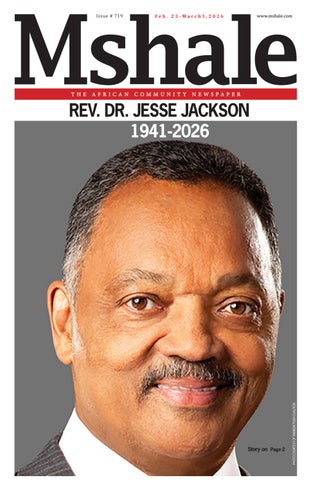
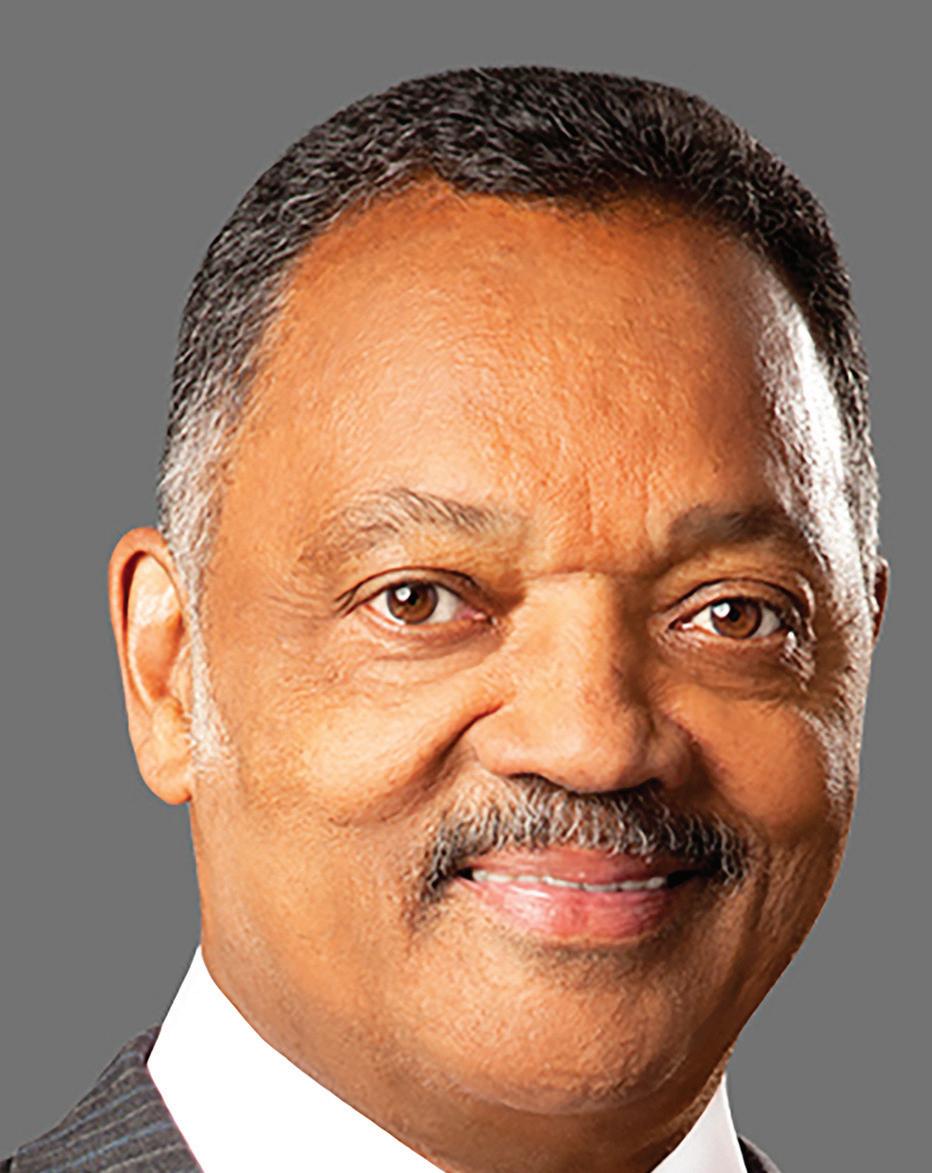
Civil rights icon Reverend Jesse Louis Jackson, Sr. passes away at 84
By Karen Juanita
Civil Rights icon Rev. Jesse Jackson, Sr., whose career took him from his early collaboration with Martin Luther King to creating the Rainbow/PUSH Coalition to two runs for the presidency and ultimately passing the torch to a new generation died Tuesday according to his family.
“Our father was a servant leader — not only to our family, but to the oppressed, the voiceless, and the overlooked around the world,” said the Jackson family in statement. “We shared him with the world, and in return, the world became part of our extended family. His unwavering belief in justice, equality, and love uplifted millions, and we ask you to honor his memory by continuing the fight for the values he lived by.”
Rev. Jackson was hospitalized at Chicago’s Northwestern Memorial Hospital on Nov. 12, for observation due to Progressive Supranuclear Palsy (PSP), a neurodegenerative disease that was initially mistaken for Parkinson’s, according to a Rainbow/PUSH statement. He was diagnosed with PSP during a Mayo Clinic visit in April 2025. There is no current cure for the disease, so his treatment was focused on alleviating his symptoms.
In the early 1960s when young activists were fighting against racebased discrimination Jackson was among them, unaware of the role he would play in the Civil Rights Movement over the next several decades. By the time of his passing, he had lived to see
calling for the release of Israeli hostages and Palestinian prisoners, and for an end to the suffering caused by the war in Gaza.
“We are faith leaders and advocates, united in this moment of moral reckoning to affirm the sanctity of all human life,” Jackson said at the time during his “Call to Action” summit.
He was also vocal about the 2024 election and the direction politics in
A Young Activist
Born in Greenville, S.C., on October 8, 1941, Jesse was the son of Helen Burns, a 17-year-old single mother. She later married Charles Henry Jackson, who adopted Jesse and helped raise him. After attending the University of Illinois on an athletic scholarship for one year, he transferred to North Carolina A&T College (NCAT) in Greensboro. It was there that he began working as a civil rights activist by joining the local chapter of the Congress of
the inauguration of a Black president and his work being done by thousands of people from every background.
Despite a 2017 diagnosis of Parkinson’s disease, Jackson slowed down but did not consider himself retired.
As recently as 2024, Jackson was organizing human rights campaigns to address the humanitarian crisis in Gaza,
America was headed. “We’ll win if we vote our numbers, but if we don’t, we risk losing our democracy,” he told The New Republic in 2023. “Trump wants to pull us back into white supremacy. DeSantis is even worse. He’s a Harvard and Yale man. He knows better. There’s something more insidious about that.”
Racial Equality (CORE). In July 1960, still a freshman, he joined seven high schoolers to walk into the whites-only Greenville County Public Library, demanding it be desegregated. They were arrested and became known as the “Greenville Eight.”
From there, Jackson grew into one of the most prominent young leaders in the movement. By 1965 he had become
active in the Southern Christian Leadership Conference (SCLC). He had already graduated NCAT and was attending Chicago Theological Seminary. King had called for people to support his voting rights campaign in Selma, Ala., so he drove down to the site with a group of students and participated in the Selma marches which followed “Bloody Sunday”. Wanting to bring the push for civil rights back to Chicago, Jackson sought an SCLC staff position and King hired him.
AmNews Archives
The next year, when King came to Chicago to advocate against discrimination in the north, Jackson took on the role of SCLC’s economic development and empowerment program in Chicago, which became known as Operation Breadbasket. Soon after, he became its national head.
At age 26, he was in Memphis working alongside King on the Poor People’s Campaign, when he witnessed King’s assassination on the balcony of the Lorraine Motel. Jackson remembered the hours leading up to one of the most monumental moments in American history.
He described King’s mood as he prepared to give his famous “I’ve been to the mountaintop” speech at Mason Temple in Memphis. “He kind of walked back through history, as he had done that earlier that day, but talking about his own family life,” Jackson recounted in a 2008 interview with TIME.com. “We had no way of knowing the kind of pressures he was under, that he internalized and simply would not share.”
The next day, April 4, 1968, he was with several other aides of King at the Lorraine Motel when shots rang out, killing him. He was tasked with the duty of telling Corretta Scott King that her husband was dead. “Those eight or ten steps to that phone was like a long journey.”
Carrilo
NY Amsterdam News via NNPA
Jackson Cont’d on Pg. 6
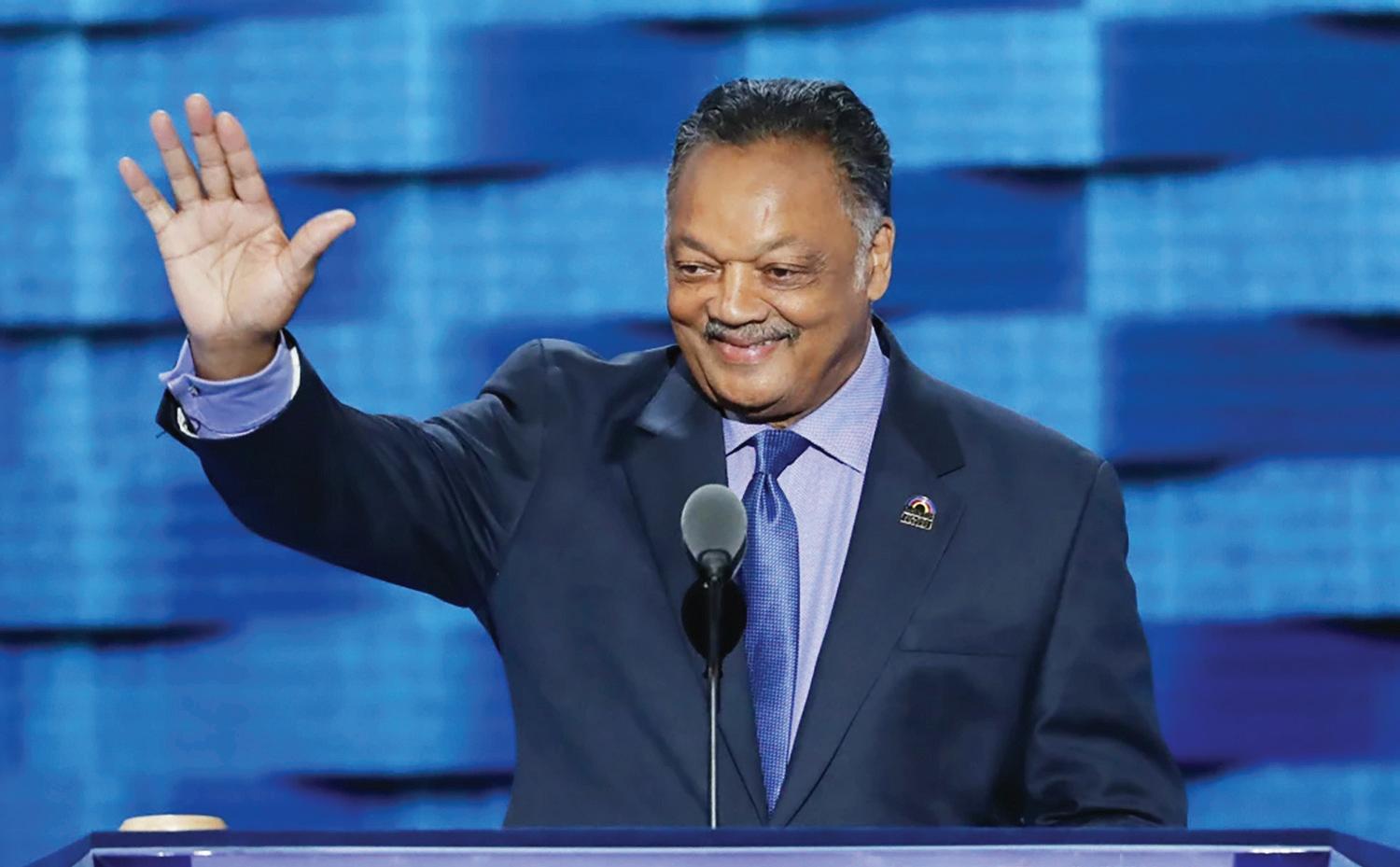
Rev. Jesse Jackson waves as he steps to the podium during the third day of the Democratic National Convention in Philadelphia, July 27, 2016.
Photo: J. Scott Applewhite/AP
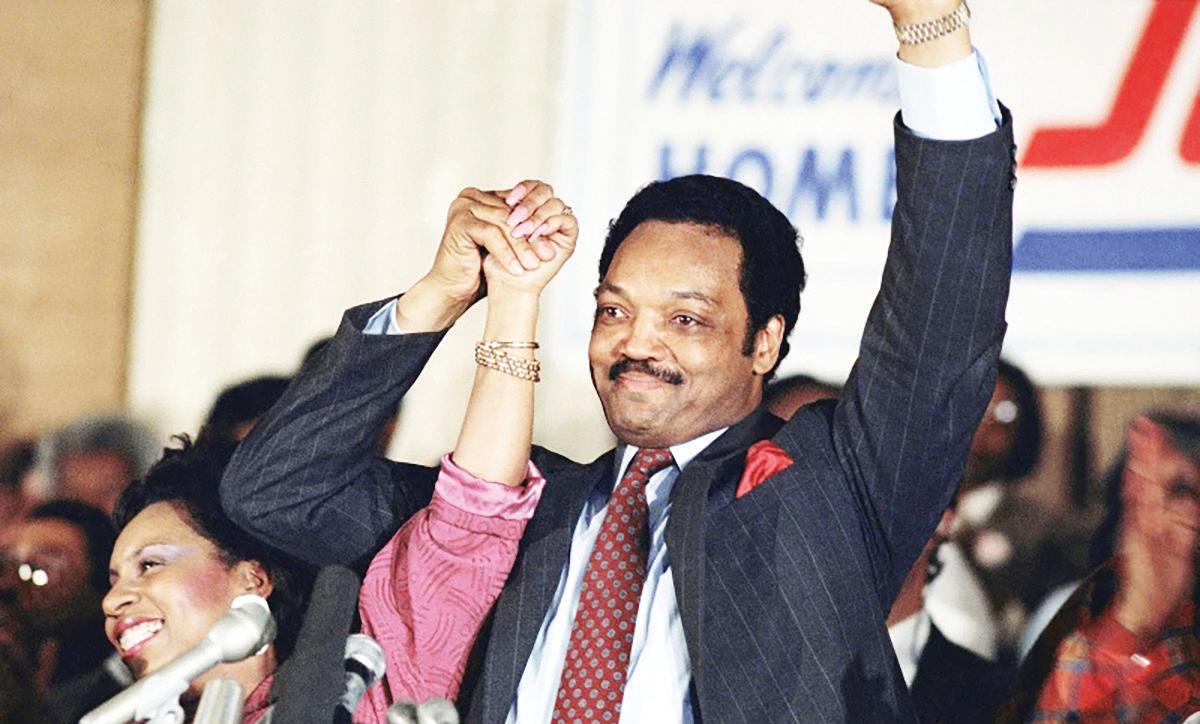
Democratic presidential hopeful Jesse Jackson with his wife, Jacqueline, salutes the cheering crowd at Operation Push in Chicago, March 10, 1988. He died Tuesday, Feb. 17, 2026 at his home in Chicago. Photo: Fred Jewell/AP
Guest Commentary by Dr. Benjamin F. Chavis, Jr.
Stop corporate consolidation silencing local media voices
American democracy is under siege across the board in different industries. Diversity is good for business and diversity is good for American democracy. Exclusive corporate policies and regulations erode democratic principles.
Local journalism is indispensable to the protection of civil rights and equality for all Americans, and in particular for Black American communities and other communities of color across the nation. Local-owned news media is crucial to community empowerment and civic participation.
Today we are facing another pivotal moment: huge corporate TV station groups seeking to weaken or eliminate the 39% national audience reach cap, alongside Nexstar’s proposed takeover of TEGNA. The cap is set by Congress and is not the FCC’s to discard. Media consolidation on this scale threatens the diversity of viewpoints, the independence of local newsrooms, and the public’s access to locally grounded information.
The National Newspaper Publishers Association (NNPA) and other local print and television news media organizations take an urgent exception to the current attempts by huge corporate consolidations to effectively silence local media voices and businesses. Millions of Americans rely on local TV stations and local community-owned newspapers as their most trusted news sources.
Consolidation among the big station groups has already led to: shrinking newsrooms, fewer reporters, and worse working conditions; must-run corporate segments displacing locally-focused reporting: and, word-for-word duplication of newscasts across stations held by the same owner. The steady erosion of localism means fewer culturally relevant perspectives, diminished investigative reporting, and weakened community accountability.
The growing devastation of the print journalism ecosystem offers a stark warning: corporate roll-ups prioritized margins over missions; local newspapers were hollowed out by distant ownership; and, communities lost vital watchdogs and trusted sources and valued generational businesses.
The same consolidation playbook is now being deployed in local televi-
sion. The country cannot afford another collapse of local journalism—this time in local TV news, where so many families rely on freely accessible information every day.
Absorbing TEGNA would give Nexstar control over 265 local TV stations reaching 80% of American homes. Such a combined entity would far exceed Congress’s 39% cap—making this not only a policy concern but also a legal one. This merger would trigger newsroom reductions, more content duplication, and a dramatic narrowing of editorial independence across dozens of cities.
Excessive consolidation gives a handful of corporate headquarters disproportionate influence over what the nation sees and hears. Communities of color are hit hardest when local storytelling disappears or when editorial direction is centralized far from the communities being covered. Local TV stations and other local journalism have long been essential entry points for young journalists of color; consolidation shrinks those pathways and reduces the diversity of the newsroom workforce.
Consolidation reliably drives up retransmission fees—costs that cable and satellite subscribers ultimately bear. Retransmission fees have risen over 2,000% in the past fifteen years. Nexstar has explicitly told investors that nearly half of its projected merger “synergies” come from raising retransmission revenues—effectively guaranteeing higher bills for millions of families without providing any new content or service. For households struggling with rising costs of living, these increases are especially burdensome.
The nation should not repeat the mistakes that allowed corporate consolidation to decimate local newspapers. Preserving strong, independent, community-rooted local print and television journalism is essential to democracy, equity, and civic life. The FCC should uphold the 39% cap, reject the Nexstar–TEGNA merger, and recommit to protecting localism, diversity, and the public interest. America’s airwaves belong to the people—not to a handful of corporate conglomerates.
Dr. Benjamin F. Chavis, Jr, is President and CEO of the National Newspapers Publishers (NNPA) and Executive Producer of the Chavis Chronicles on PBS TV Network.

‘Jim Crow 2.0’: Civil rights leaders sound alarm on SAVE America Act
The bill “is not about protecting our elections,” the NAACP Legal Defense and Educational Fund says. “It’s about disguising voter suppression.”
By Brandon Tensley Capital B News
House Republicans have pushed through legislation that civil rights organizations warn could disenfranchise millions of Americans — and disproportionately burden Black Americans — by erecting new barriers to the ballot box.
That bill, called the Safeguard American Voter Eligibility (SAVE) America Act, now heads to the Senate, where it faces steep odds. Still, advocates are sounding the alarm, arguing that the legislation, which some are calling “Jim Crow 2.0,” would fundamentally reshape who gets to participate in U.S. democracy.
The move continues President Donald Trump’s baseless claims about widespread voter fraud in U.S. elections.
“The SAVE America Act is not about protecting our elections — it’s about disguising voter suppression techniques aimed at disenfranchising Black voters as election security,” Demetria McCain, the director of policy at the NAACP Legal Defense and Educational Fund, said in a Feb. 12 statement the day after the GOP’s elections overhaul.
“It is disingenuous, it is discriminatory, and it is all based on a continuously disproven narrative of voter fraud propagated by an administration concerned not with voter protections but solely with the fear of letting people select their own leaders,” she added.
What is the SAVE America Act?
The SAVE America Act is a piece of legislation that would result in three major changes to how we vote:
The legislation would require Americans to provide documentary evidence of their citizenship when they register to vote, though they’re already required to attest — under penalty of perjury — that they’re citizens when they register. It would also mandate proof of residence as part of the registration process.
The legislation would implement a nationwide photo ID requirement to cast a ballot, relying on a narrower list of acceptable IDs than what currently exists in most states. For instance, it would bar the use of student IDs, even those issued by state universities, as valid identification.
The legislation would heighten the difficulty of voting by mail, restricting who can cast a ballot by mail without showing valid identification. This is despite evidence that the practice is secure and widely used, including by Trump and other Republicans.
How are civil rights organizations responding?
Civil rights organizations are united in denouncing the SAVE America Act.
“The authoritarianism woven into this bill has no place in our elections,” McCain said in her letter. “Instead of trying to solve a nonexistent problem, Congress must focus its attention on the affordability crisis that is decimating the livelihoods of millions of Black people and the federal encroachment on city streets.”
The Leadership Conference on Civil and Human Rights — along with 130 other organizations, including the Black to the Future Action Fund and the Black Voters Matter Action Fund — wrote a letter to Republican lawmakers criticizing the bill. Rules such as the proof of citizenship requirement aren’t necessary to guarantee secure elections, they said.
“They would do nothing more than exclude eligible voters — particularly Latino, Black, Asian American, Native Hawaiian, Pacific Islander, and Native American citizens; married women who have changed their names; low-income people; and people with disabilities — from the electorate and our democracy,” they added.
The organizations pointed to data showing the burden the legislation would cause: About half of U.S. adults don’t have a passport; twothirds of Black adults don’t possess
the document. Additionally, Black Americans are less likely to have a current driver’s license.
“It’s Jim Crow 2.0,” Senate Minority Leader Chuck Schumer recently said. “What they’re trying to do here is the same thing that was done in the South for decades to prevent people of color from voting.”
House Minority Leader Hakeem Jeffries recently said much the same, effectively characterizing Republican efforts as a solution in search of a problem.
“This is a desperate effort by Republicans to distract,” he told reporters. “The so-called SAVE Act is not about voter identification. It is about voter suppression. And they have zero credibility on this issue.”
Why do Republicans say that it’s necessary?
Trump and his allies maintain that the bill is necessary to extinguish fraud and restore public faith in elections, framing it as a commonsense safeguard against cheating.
“We need elections where people aren’t able to cheat,” Trump recently said, echoing baseless claims that he’s espoused since losing the 2020 presidential election to Joe Biden. “And we’re gonna do that. I’m gonna do that. I’m gonna get it done.”
However, there’s no evidence
of widespread election fraud. Investigations and analyses have found no proof of systemic irregularities.
The bill follows Trump’s recent comments that he wants to “nationalize” elections and “take over the voting” in more than a dozen jurisdictions — remarks that have alarmed civil rights advocates and election officials.
Such a move would be at odds with the U.S. Constitution, which grants states primary authority over the time, place, and manner of federal elections, subject to some congressional oversight.
The bill also comes in the middle of heightened tensions over election administration, including the FBI’s seizure of hundreds of boxes of 2020 election ballots in Fulton County, Georgia — a crucial battleground Trump continues to falsely claim he won in 2020.
“We all know how Black election workers have been treated [in Fulton County], receiving death threats, being doxxed and all kinds of things,” Fulton County Commissioner Dana Barrett told Capital B Atlanta in January, referring to the harassment of Shaye Moss and Ruby Freeman.
“Now Trump’s DOJ is coming after Georgia,” she continued. “They’re trying to get your private data. And they’re willing to break the law to get it.”
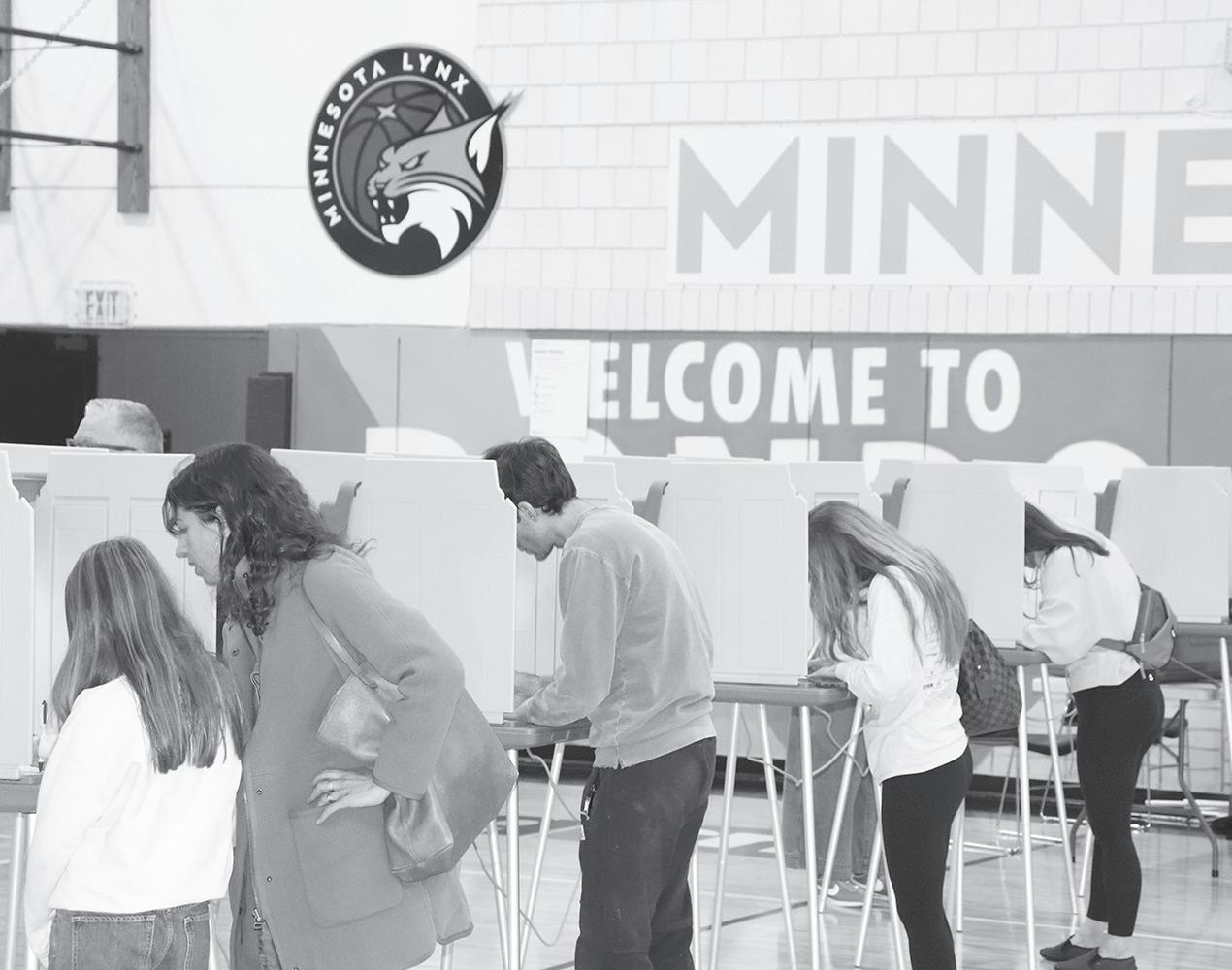
Voters fill out their ballots at the Martin Luther King Recreation Center in St. Paul, Minnesota on Election Day, Nov. 4, 2025. Mshale Staff
Photo by Tom Gitaa
TrumpRx: Better prescription drug deals may already exist
By Jennifer Porter Gore Word in Black via NNPA
At first glance, the website the Trump administration launched on Feb. 5 appears to be a solid effort to address the healthcare affordability crisis worrying millions of Americans. Dubbed “TrumpRx.gov,” the costfree government-run website is intended to help people without health insurance afford prescription drugs.
“You’re going to save a fortune,” President Donald Trump vowed at the site’s unveiling. “And this is also so good for overall health care.”
Well, not quite.
A site with big claims — and major limits
Several healthcare advocates say TrumpRx is a knock-off — and not a very good one — of more successful models already on the market. Those discount drug sites, experts say, offer better prices on a wider range of drugs, including generics, with fewer restrictions.
TrumpRx is designed to point Americans to drugmakers’ websites that offer direct-to-consumer pricing. Like those sites, Trump Rx also provides coupons that consumers can use at pharmacies.
Currently, individuals can buy 43 medications, including popular weight-loss drugs like Ozempic and Wegovy. The site also offers a few fertility medications, insulin products, two brands of asthma rescue inhalers, and a few others.
“Mostly, I think it’s just fuzzy math and no real benefit to the American public. There are 43 drugs on TrumpRx [and] you have to purchase them with cash, without insurance,” says Dr. Ezekiel Emanuel, a professor at the University of Pennsylvania Perelman School of Medicine. Emanuel is an oncologist and world leader in health policy and bioethics.
Trump “championed the fact that we were reducing the prices on Wegovy and all those GLP-1 drugs down to $199 per month,” Emanuel said Tuesday during a press briefing. “That actually works out to $2,400. Most Americans cannot afford $2,400 a year on one drug.”
Uninsured patients should shop around
At the same time, “more than half of the drugs on TrumpRx are actually cheaper, not going through TrumpRx, but getting them through Good Rx or Mark Cuban’s Cost Plus drug program,” Emanuel said. That’s because the drugs “are generics, and you can get them cheaper on generics, so he’s cutting brand names when there’s already a cheaper alternative.”
An analysis from the medical news website STAT found that generic versions of at least 18 drugs are cheaper on GoodRx or Cost Plus Drugs than the brand-name versions available through TrumpRx. In some cases, consumers who use the generics could save hundreds of dollars by using other platforms.
But consumers with private or government-funded healthcare, including Medicare, won’t be able to use the platform. Consumers also

must confirm they are not enrolled in “any government, state, or federally funded medical or prescription benefit programs.” They must also say they won’t apply the drug cost toward a deductible or seek reimbursement from an insurance company.
TrumpRx is part of the Most Favored Nation drug pricing effort the president introduced last year. It requires drugmakers to set prices forin the U.S. market at the lowest price charged to other nations. The administration also uses a Biden-era law that allows Medicare to negotiate for discounts on several prescription drugs.
Last year, the president issued an executive order demanding that pharmaceutical companies lower their prices. Since then, several major drugmakers have reduced prices on some of their products and returned some manufacturing to the U.S. to avoid tariffs the White House threatened to impose on imported medicines.
However, GoodRx and Cost Plus also offer programs for uninsured consumers. GoodRx is also a free service that lets consumers compare pharmacy prices and use coupons to lower their costs. Cost Plus sells medicines at the manufacturer’s price, plus a small fee. This is usually much lower than the retail markup, especially for generic drugs.

Live safe, healthy and independently
Bundle Medicare + Medical Assistance into one simple, affordable $0 premium plan. A HealthPartners® Minnesota Senior Health Options (MSHO) (HMO SNP) plan includes valuable perks to help you as you age. Get rides to appointments and more.
Easy, guided enrollment
Call 855-394-8845 (TTY: 711) to find out if you’re eligible. Oct. 1 to March 31: 8 a.m. to 8 p.m. CT, seven days a week April 1 to Sept. 30: 8 a.m. to 8 p.m. CT, Monday through Friday
HealthPartners is a health plan that contracts with both Medicare and the Minnesota Medical Assistance (Medicaid) program to provide benefits of both programs to enrollees. Enrollment in HealthPartners depends on contract renewal. Discrimination is against the law. HealthPartners does not discriminate because of race, color, national origin, creed, religion, sexual orientation, public assistance status, marital status, age, disability or sex. 25-3491751-3630254 (8/25) © 2025 HealthPartners H2422_004970_M Accepted 8/13/25
mshosales@healthpartners.com
Lachandretta "LaLa" Williams reaches for a pill bottle at MAC Pharmacy in Cleveland.
Photo: Sue Ogrocki/AP
Taking Up the Civil Rights Mantle
Jackson went on to become a prominent civil rights leader in his own right. After King’s assassination, he became an ordained Baptist minister and continued advocating for African Americans’ access to jobs as head of the SCLC’s Operation Breadbasket in Chicago. But conflicts between Jackson and Ralph Abernathy, who had taken over as SCLC president, led to Jackson’s resignation.
In 1971, Jackson founded Operation PUSH (People United to Save Humanity) to continue his civil rights work and advocate for economic improvements for the Black community. It succeeded in encouraging companies to hire more Black workers and collaborate more with Black-owned businesses. It was coupled with another project called PUSHExcel, aimed at bettering educational standards for inner-city students.
More than a decade later, Jackson also famously united a diverse coalition of ethnic, working-class, religious, and regional progressive voters under his “Rainbow Coalition,” which he organized in 1984 to deal with the challenges brought by the economy under President Ronald Reagan. This launched his 1984 presidential
campaign as a Democrat which he ran with a lack of funds and little support from the Democratic Party. However, to the surprise of many he secured 3 millions votes and won five primaries.
Jackson did face criticism for remarks he made in a private conversation that were seen as anti-semitic (which he later apologized for) and also for not distancing himself from Nation of Islam leader Minister Louis Farrakhan. But he was given a platform at that year’s Democratic National Convention in San Francisco, in which he was remembered for illustrating the strength of diversity in America.
“America is not like a blanket – one piece of unbroken cloth, the same color, the same texture, the same size,” he said. “America is more like a quilt – many patches, many pieces, many colors, many sizes, all woven and held together by a common thread. The white, the Hispanic, the black, the Arab, the Jew, the woman, the native American, the small farmer, the businessperson, the environmentalist, the peace activist, the young, the old, the lesbian, the gay and the disabled make up the American quilt.”
In the 1988 Democratic primary, he finished second — winning more votes than then-Senator Al Gore — and won the Michigan primary. In fact, Jackson won primaries and four caucuses in total receiving 6.9 million votes.
Again addressing Democrats at the party’s convention, he said:
“I’m often asked, ‘Jesse, why do you take on these tough issues? They’re not very political. We can’t win that way,’
“If an issue is morally right, it will eventually be political. It may be political and never be right. Fannie Lou Hamer didn’t have the most votes in Atlantic City, but her principles have outlasted every delegate who voted to lock her out. Rosa Parks did not have the most votes, but she was morally right. Dr. King didn’t have the most votes about the Vietnam War, but he was morally right. If we are principled first, our politics will fall in place.”
Jackson’s presidential campaigns emphasized racial and economic justice and pressured the Democratic Party to place greater emphasis on addressing issues important to working-class and low-income voters. But the emphasis after the 1988 campaign began to gradually focus on his activism rather than electoral politics. From 1991 to 1996, Jackson served as shadow senator for Washington D.C.
Afterward, he merged the Rainbow Coalition with Operation PUSH to form a new organization called the Rainbow/ PUSH Coalition, to address both economic inequity and to protect civil rights.
A Global Figure
Following his impressive presidential campaigns, Jesse Jackson gained international recognition. Some of it at great risk.
In 1983, Jackson successfully negotiated with Syrian officials for the release of a captured American navy pilot Lt Robert O Goodman, and several Cuban political prisoners.
Reagan criticized Jackson for interfering with foreign affairs, but he had gained a reputation in international conflict resolution and later went on a diplomatic mission to Lebanon.
In 1988, he met with Hezbollah leaders and engaged them in intensive negotiations to secure the release of nine U.S. hostages. The initiative did not result in the immediate release of the hostages, but it did spawn years of continued negotiations with Middle Eastern factions for negotiations and prisoner swaps.
In 1990, Jackson met with Iraqi President Saddam Hussein and helped negotiate the release of foreign nationals held as “human shields.” In 1997, he was appointed by President Bill Clinton and
Jackson Cont’d from Pg. 2
Jackson Cont’d on Pg. 7
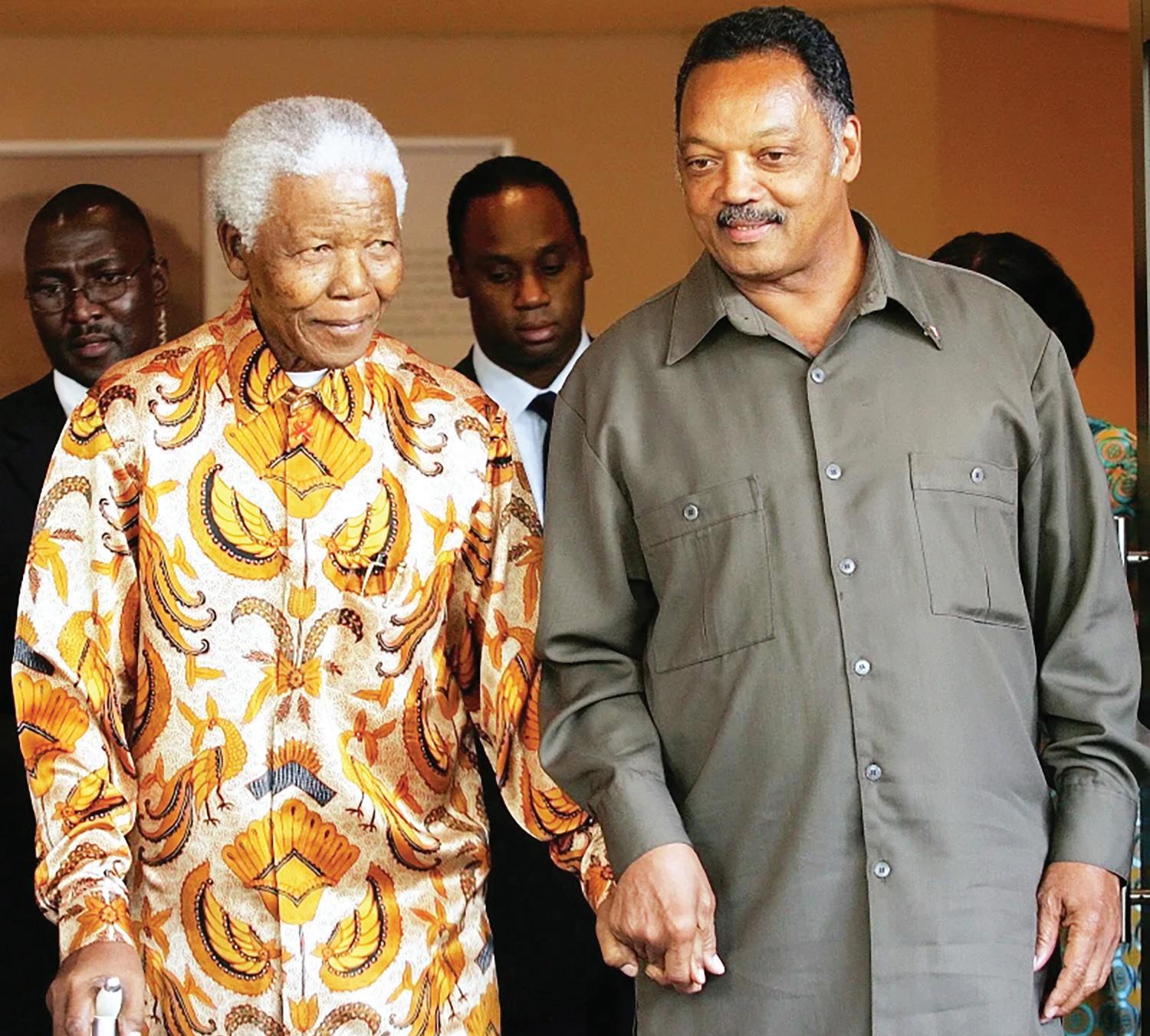
Former South African President Nelson Mandela, left, walks with the Rev. Jesse Jackson after their meeting in Johannesburg, South Africa, Oct. 26, 2005.
Photo: Themba Hadebe/AP
Secretary of State Madeleine Albright as the U.S.’s first-ever special envoy to promote democracy in Africa. “I could not have been special envoy to Africa until now,” Rev. Jackson was quoted as saying in a State Department release. “I’m excited by our Africa policy because it’s a source of pride, not shame.”
Jackson traveled to Yugoslavia in 1999 to negotiate the release of three U.S. prisoners of war during the Kosovo War. On January 15, 1997, Martin Luther King Jr. ‘s birthday, Rainbow PUSH launched its “Wall Street Project” which works to increase business opportunities for ethnic minorities with corporations. In 2000, President Clinton awarded Jackson the Presidential Medal of Freedom, the nation’s highest civilian honor.
Family controversy and admission
In 2001, Jackson publicly admitted to fathering a child resulting from an extramarital affair with Rainbow/PUSH staffer Karin Stanford. However, instead of denying or hiding the situation, he was open about it, stating, “This is no time for evasions, denials or alibis. I fully accept responsibility and I am truly sorry for my actions.”
“As her mother does, I love this child very much and have assumed responsibility for her emotional and financial support since she was born,” Jackson said. “My wife, Jackie, and my children have been made aware of the child and it has been an extremely painful, trying and difficult time for them.”
Health Challenges – A “pivot” not a retirement
Jackson announced his diagnosis
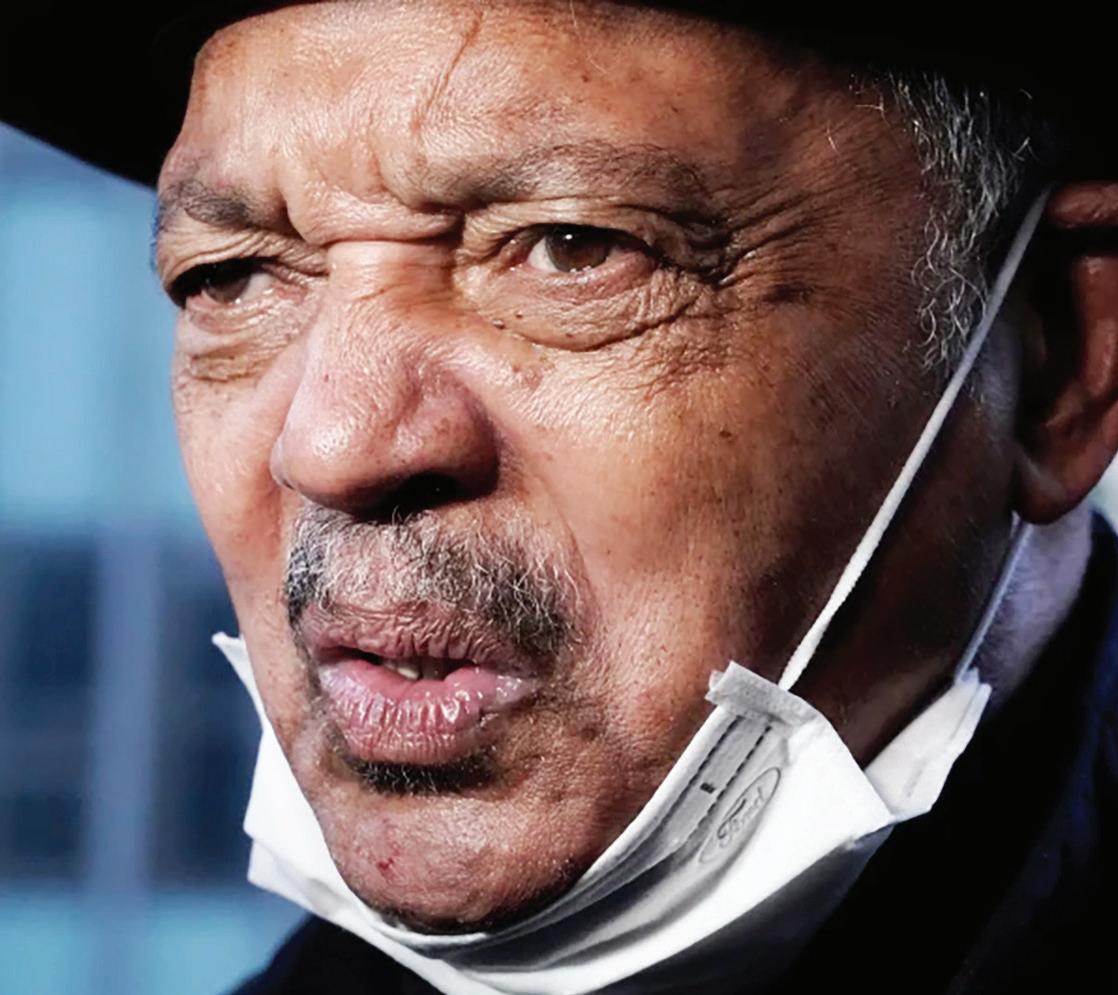
with Parkinson’s disease in 2017. He stepped down as president and CEO of the Rainbow/PUSH Coalition in July 2023, after leading the organization for more than 50 years, upon turning 81 years old. He said, though that he was not done. At the 57th annual Rainbow/

PUSH convention, that he we was going to “pivot” and still be a force in civil rights.
“I find fulfillment in my work. It’s my sense of purpose,” he told the Chicago Sun-Times. “I do everything with a sense of purpose.”

Rev. Jackson is survived by his wife, Jacqueline Jackson, and their children: Santita, Jesse Jr., Jonathan Luther, Yusef DuBois, and Jacqueline Lavinia. He is also survived by his daughter, Ashley, born to Stanford.
Jackson Cont’d from
Rev. Jesse Jackson answers questions at a rally, April 19, 2021, in Minneapolis, as the murder trial against the former Minneapolis police Officer Derek Chauvin in the killing of George Floyd advances to jury deliberations.
Photo: Morry Gash/AP
Nigeria and Kenya lead Africa’s push for electric vans assembled from Chinese EV kits
By Allan Olingo Associated Press
NAIROBI, Kenya (AP) — E-mobility companies in Africa are beginning to assemble electric vans and taxis locally, using Chinese-made kits and innovative financing to spread use of electric public transport across the continent.
Saglev of Nigeria has begun assembling 18-seater passenger electric vans using imported kits supplied by Chinese automaker Dongfeng Motor Corp. The Lagosbased company says it plans to make up to 2,500 vehicles a year, eventually assembling 17 electric models for Nigeria and other West African markets.
“This is a major step in Nigeria’s transition toward clean, fossil-free transportation,” said Saglev’s CEO Olu Falaye. He said the van is the first locally assembled electric
in some parts of Africa.
There’s a similar push in Kenya, where Chinese backed Rideence Africa recently signed a $2.46 million deal with Mombasa-based Associated Vehicle Assemblers (AVA) to begin local assembly of electric taxis and minibuses from kits supplied by China’s Jiangsu Joylong Automobile and Beijing Henrey Automobile Technology.
“We are now moving decisively from operator to manufacturer,” said Rideence Africa’s managing director, Minnan Yu. “Our aim is to build a Kenya-rooted new-energy mobility company serving Africa.”
Kenya and Nigeria, two of Africa’s largest economies, are leading the push for local EV assembly as countries seek to cut fuel costs, reduce emissions and build domestic manufacturing capacity.
“This partnership delivers
about $3 for up to 200 kilometers (123 miles), compared with more than $15 in petrol costs for similar distances.
“The assembly of electric vans is emerging as a strong market segment,” said Dennis Wakaba, the secretary-general of the Electric Mobility Association of Kenya. “Earlier, the cost of electric vans was high, putting off operators. But as local assembly scales up, these costs have dropped, attracting more orders.”
Kenya has one of Africa’s most active electric mobility markets, with startups assembling buses and vans and deploying them for public transport and ridehailing. Ethiopia and South Africa also have entered the market. In Ethiopia, Belayneh Kinde Group (BKG) assembles about 150 minibuses a month using Chinese components.
To make EVs more affordable,
realities for transport operators in Africa, where access to credit is limited and few can afford to purchase new vehicles outright.
“These innovative financing models mitigate risks for both assembler and operators, helping
vehicle of its kind for mass transit in Nigeria and sub-Saharan Africa.
“This feat is a clear signal that electric mobility in Nigeria is practical, scalable and ready for adoption,” Falaye said.
Saglev is a joint venture between Nigeria’s Stallion Group, a major auto distributor, and Chinese automaker Sokon Motor. It also plans to install solar-powered charging stations to provide more reliable sources of power, a key challenge for EV adoption
Kenya’s first dedicated electric vehicle assembly line, demonstrating clearly that Kenya has the capacity and capability to assemble EVs locally at scale,” AVA Managing Director Matt Lloyd said.
Electric vans and minibuses are central to public transport across Africa, where Japanese models such as the Toyota Hiace and Nissan vans dominate the roads, carrying passengers and goods.
EV charging costs average
companies like Rideence are adopting pay-as-you-drive and lease-to-own options that let operators avoid expensive initial payments. It leases its taxis to drivers for about $18 per day.
BasiGo-Kenya Vehicle Manufacturer, which also is expanding into electric vans assembly, requires operators of its EVs to pay a deposit and then about 20 U.S. cents per kilometer (32 cents per mile) driven.
That approach fits with financial
put vehicles on the road faster. With these, we expect to see more e-vans taking a larger share of the African transport systems,” Wakaba said.
Still, there are only about 30,000 EVs in Africa, compared with millions of gas and dieselfueled vehicles, latest figures from the Africa Mobility Alliance shows. The continent manufactured only 1.1 million vehicles in all last year, 90% of them in Morocco and South Africa.
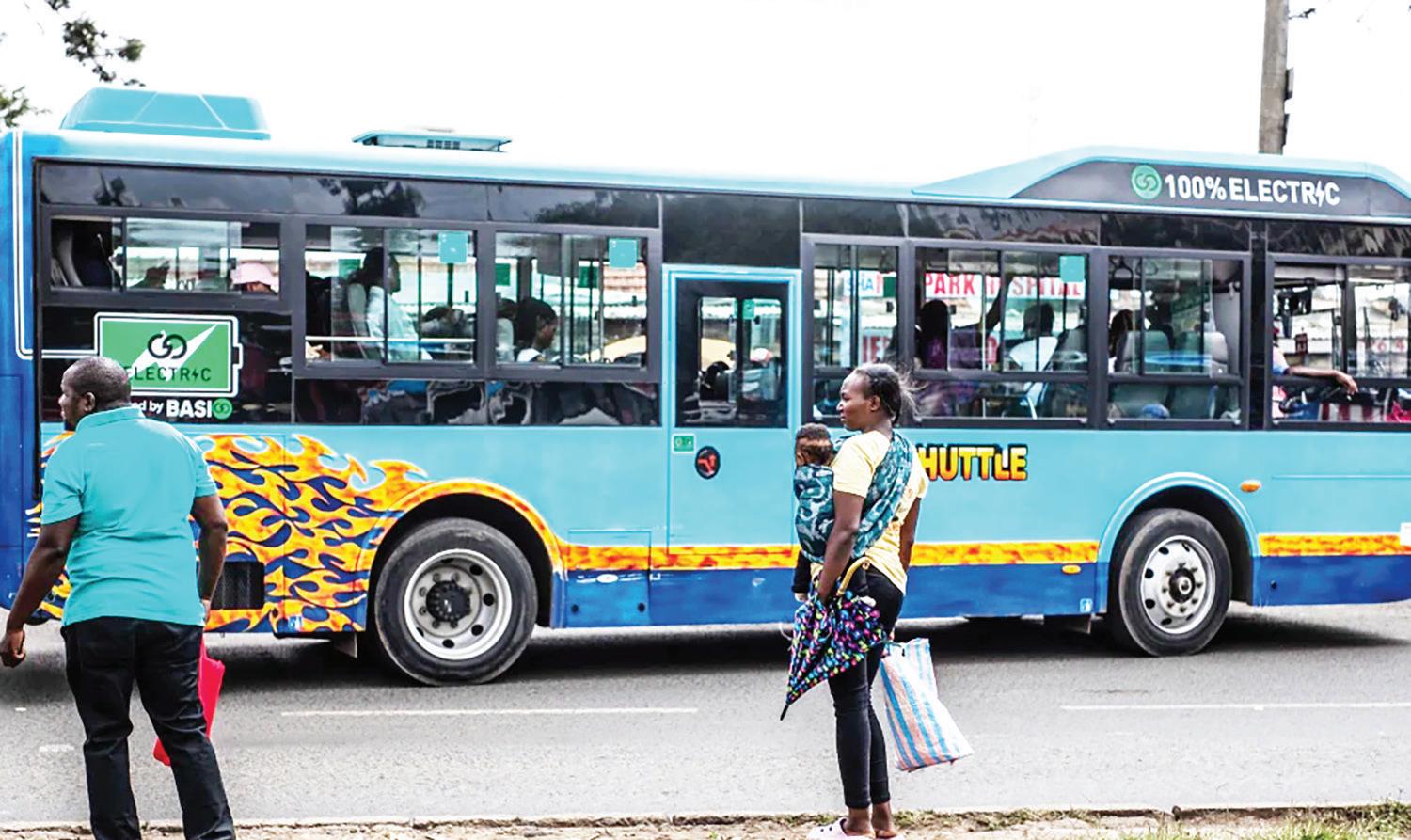
A battery electric bus drives through the streets of Nairobi, Kenya, Tuesday, Feb. 17, 2026. Photo: Samson Otieno/AP
Olu Falaye, CEO of Saglev. Photo: LinkedIn
After ICE raids, Ramadan in Minnesota is somber, but some hope it offers healing
Interfaith leaders across the Twin Cities are organizing dinners rooted in solidarity with Somali Americans and the Muslim community.
By Ulaa Kuziez Religion News Service
(RNS) — For many Muslims in the Twin Cities, Ramadan feels somber after the federal immigration enforcement surge left many immigrant families wary of gathering.
But those who spoke with RNS are hoping the Islamic sacred month of fasting and charity, which began this week, will offer a sense of communal grounding and healing.
Imam Abdisalam Adam, a leader at Dar Al-Hijrah Mosque in Minneapolis and an elementary school principal, said people are still cautious about gathering in large numbers at mosques because of the “unpredictability” of Immigration and Customs Enforcement action. He expects fewer people will attend nightly prayers at his Cedar-Riverside neighborhood mosque but said those who can participate in the month’s communal activities are seeking to process what’s happened in the state with others, leaning into spiritual practices for strength.
“The lessons of Ramadan are most relevant this year because of the fear and despair,” Adam said. “So definitely, people are tapping into their faith for grounding.”
Many mosques will hold free, near daily iftars, or fast-breaking evening meals, for their members throughout Ramadan, which will end March 19 or 20. Interfaith leaders across the Twin Cities are also organizing dinners rooted in solidarity with Somali Americans — a prominent target of President Donald Trump’s mass deportation agenda in Minneapolis— and the Muslim community.
Leading up to Ramadan, community members felt anxious about safety and “what it means to be Muslim in a time like this,” said Sarah Chebli, who organizes events with the Muslim American Society of Minnesota.
Chebli put together a series of events across MAS Minnesota’s seven mosques with a theme of holding firm to faith in the face of hate. The events also encouraged worshippers to support their immigrant community members.
“Ramadan is the month of ibadah (worship) … and also a part of worship is activism,” Chebli said. “It’s important that we keep showing up, that we don’t go back into our caves and forget everything that is happening, but contend with the moment that we’re living in.”
Amina Adan, a Somali American
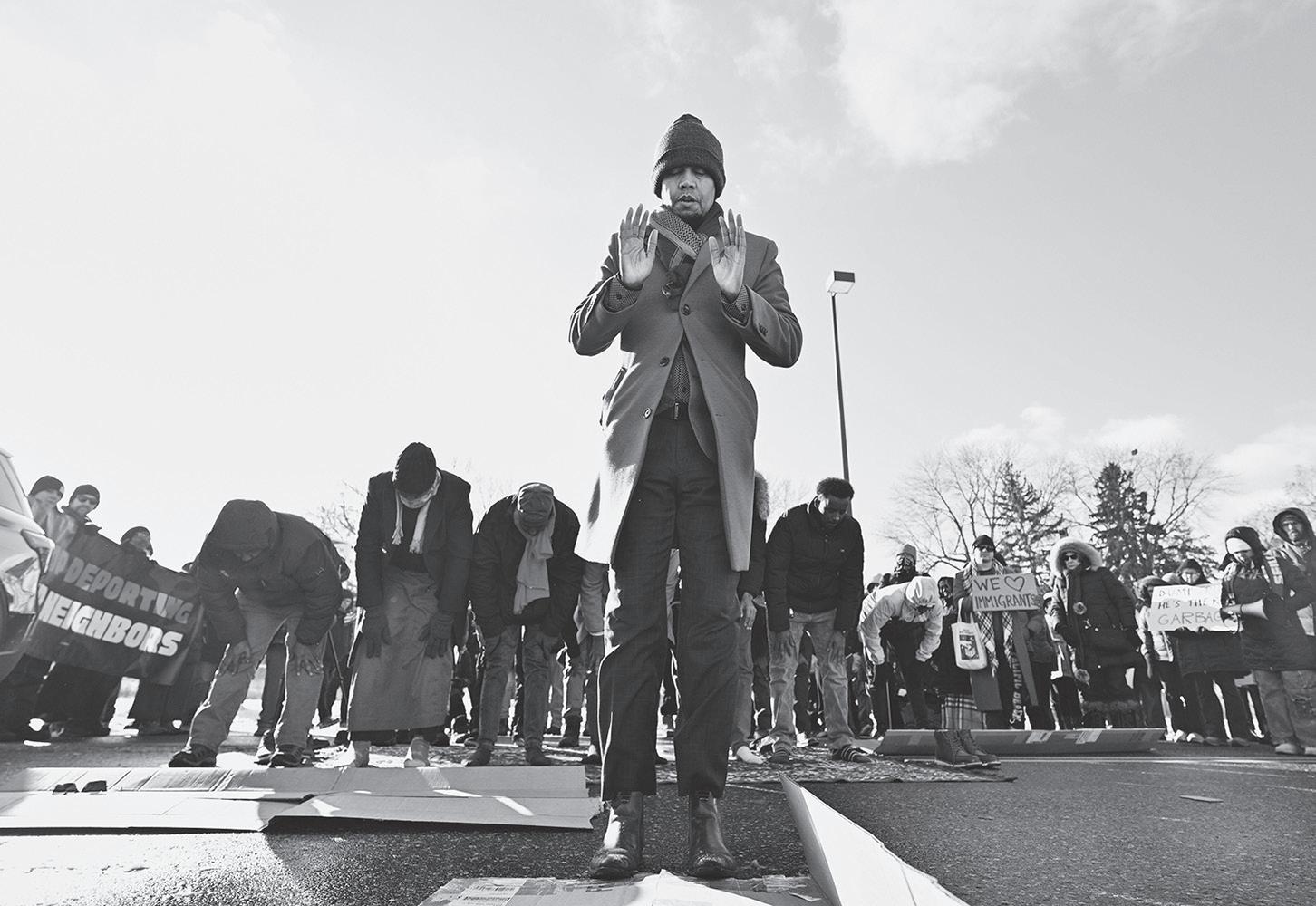
community organizer, said supporting people who are spending Ramadan alone is at the forefront of many people’s minds this month. She said some people in her community are hosting fewer iftar dinners and visits in their homes to create “less traffic and less possibility of anybody getting abducted.”
“There’s a little bit of sadness there,” she said. “But we are finding different ways of trying to give back and connect with others (by) accommodating kids and trying to create activities, and making sure that neighbors and family members that we know that are not able to go to work are getting fed.”
Meanwhile, close to 20 mosques are hosting interfaith dinners known as Taking Heart iftars, in partnership with the Minnesota Council of Churches and MAS Minnesota. For the past two decades, the dinners have mostly focused on educating people on the basics of the Muslim faith through presentations and genuine conversations over food.
The dinners this Ramadan, however, are taking on a different tone by calling on Christian communities to stand with Muslims as neighbors, said Suzanne Kelly, CEO of the Minnesota Council of Churches.
“Our Somali brothers and sisters have been under attack both related to these big fraud investigations and
also the ongoing ICE activity,” Kelly said. “This small opportunity to dialogue is a way to combat hate with love and rhetoric that speaks of belonging and that we are all God’s children.”
Adam said connections formed through the Taking Heart iftars and other interfaith gatherings over the years have strengthened interfaith solidarity with Muslim Americans during the past couple months in the state.
“It has significantly contributed to the level of trust and care that we have seen from Minnesotans,” he said. “If these relationships were not there, I don’t think we would have had this much of a response.”
For example, Chelbi said that at South Metro Islamic Center in Rosemount, volunteers have stood outside during Friday prayer to watch for immigration agents and support worshippers inside. She said the iftars will be a way to thank them and continue to build their relationship.
“It’s the conversations that Muslims and non-Muslims have at the table that really builds bridges,” she said. “People are not here to learn the rules (of) Islam. They’re here to learn who their neighbors are.”
And with the rare overlap of Lent and Ramadan, religious communities are also using their shared fasting experiences to connect. Jen Kilps, network
executive at the Minnesota Multifaith Network, is co-organizing a fish fry iftar that honors Ramadan, Lent and the Bahá’í month of fasting on Friday (Feb. 20). Held at Rabata Cultural Center, a Muslim women’s spiritual educational organization in Arden Hills, the interfaith dinner will feature conversations on building spiritual strength to do the work of healing and resistance.
“We have people working with the Legislature, we have people who are out protesting, we have people out leading vigils and mutual aid groups,” Kilps said. “Our spiritual disciplines and practices can be acts of resistance as well.”
Tom Homan, the Trump administration border czar, said earlier this month that 700 federal immigration officers would leave Minnesota immediately, and more than 2,000 would stay in the state.
But community leaders said the fear and disruption will not go away easily, even if all the agents leave. It will take work and time for immigrants to recover, Kelly said.
“As we look ahead, we have to think about healing, repair, reconciliation, and so events like Taking Heart help begin that process,” Kelly said. “It will take months, maybe even years, but these small steps, I think, send a message that we are resilient and that we are determined to undo the damage that’s been done.”
Yusuf Abdulle, executive Director and Imam of Islamic association of North America, leads a prayer as protesters gather at a rally for immigrants outside Signature Aviation near the Minneapolis–Saint Paul International Airport, Wednesday, Dec 3, 2025, in Minneapolis.
Photo: Tom Baker/AP
Art & Entertainment
Return engagement for Richard Bona at the Dakota in Minneapolis
By Susan Budig Mshale
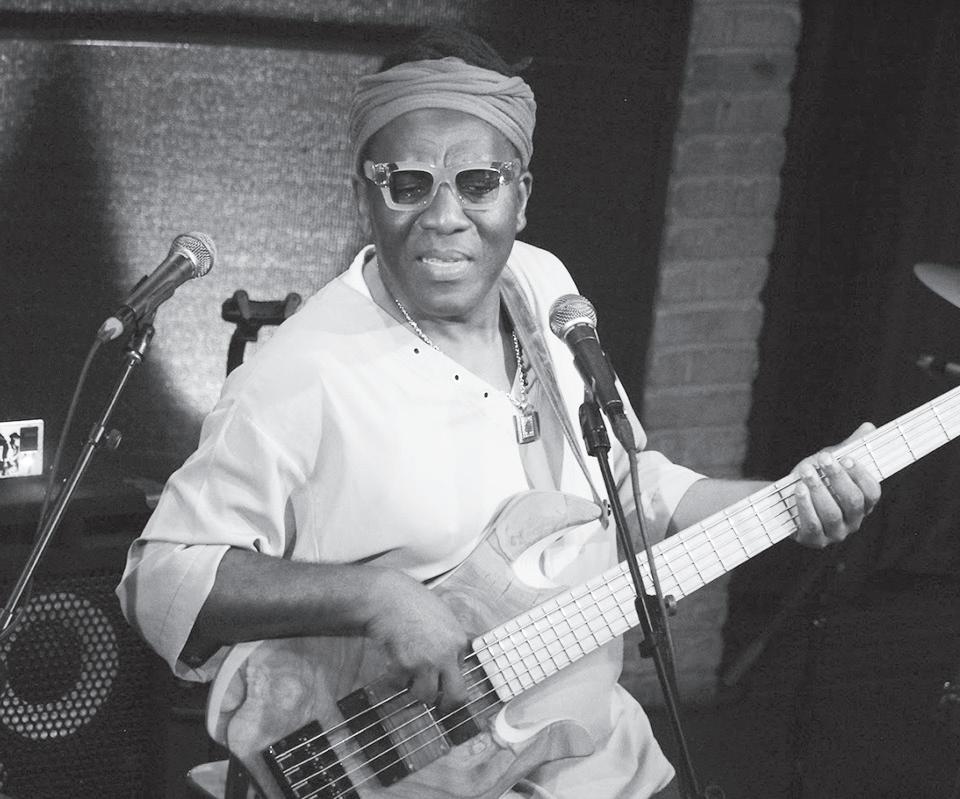
“I’m a griot. I was born surrounded by storytellers so that’s my way of keeping my roots,” said Richard Bona when Mshale spent time with him over a phone call recently. In the midst of his European tour—last week he and his trio were in Italy and Germany—having just landed in Paris, he continued, “I don’t even need to travel back to Africa, I was born into [my culture]. I communicate with the Universe. I keep telling my own African story.”
Bass-playing Bona and his band will take the Dakota’s stage on March 16th. It’ll be the second time he’s played there, his first time was an unquestionable hit. This time around, he’ll arrive knowing the Minnesota climate and its turmoil. “That broke my heart,” he said referencing ICE, “it turned me upside down.”
He likes to bring new music to his shows, but acknowledged that the fans request songs and he wants to honor their requests as well.
“It’s hard to manage that,” he said, “because I want to present something different, but they [his fans] say, you didn’t play
my favorite song. The fans get attached to a certain song.”
Bona laughs at this fully intending on indulging his audience by playing the songs they have heard before and want to hear
again.
“Most of them don’t understand the language, but it’s the melodies, the way we play them, that resonate with the
audience. We take the song and elaborate more and more, trying to get it to a better place. We add momentum and listen to each other,” he said, while also admitting, “Sometimes we don’t even know where we’re going [with the music], but we let it flow.”
Bona’s compendium of music goes all the way back to his childhood in Cameroon. Over three decades later, he won his first Grammy in 2002. He has a wealth of material from jazz to AfroPop to Latin to Flamenco upon which to draw.
“We want to be extremely focused when we’re playing so that we can if not reach excellence, then at least touch it,” Bona said. In their quest to reach perfection, they’ll bring along their instruments such as guitars and a looper.
Bona has a pet name for this electronic device that records a riff or phrase and then immediately plays it back in a loop. “I will bring my Magic Voodoo Machine. People love it. It’s becoming a signature tool for me…what you gonna do? I’ll bring it. I’ll bring it,” he said chuckling.
Tickets for Richard Bona’s 7 pm show on March 16th at The Dakota can be purchased at dakotacooks.com
Richard Bona during his concert at the Dakota on September 26, 2024 where he made his Minnesota debut. Mshale Staff Photo by Jasmine Webber