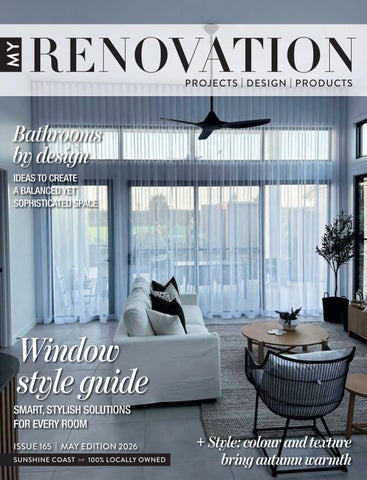
My Renovation May 2026

Page 1


PROJECTS | DESIGN | PRODUCTS

Bathrooms by design

IDEAS TO CREATE A BALANCED YET SOPHISTICATED SPACE

FOR

ROOM

price match guarantee*

Shademe is your trusted source for premium Australian-made internal and external shutters on the Sunshine Coast, offering stylish, durable protection built for harsh coastal conditions. With a wide range of materials and finishes, we deliver tailored solutions to suit any home – inside and out.

• Premium elite plantation shutters

• Typhoon plantation external shutters

• Bondi poly plantation shutters

• Odyssey poly plantation shutters •

STYLE & PRIVACY

(off

As I flicked through the final version of this month’s magazine prior to print, I couldn’t help but wish I were in the throes of renovating.

There are so many great ideas, designs and products available these days that it makes renovation a much smoother process. It is no wonder Australians continue to invest heavily in the industry.

According to the latest figures from the Australian Bureau of Statistics, Aussies are spending a combined $1.29 million on home alterations and additions.

06 COVER STORY

In this edition, we help readers break down some of the early renovating tasks and decisions, from managing projects to planning for a new deck.

Plus, we have all the usual style and product updates.

Happy renovating!

ON THE COVER

Beautiful window furnishings by Darren’s Blinds, Shutters and Curtains. Read the story on page six.

Darren’s Blinds, Shutters and Curtains

08 BATHROOM

Design inspiration 10 KITCHEN

Do you need a butler’s pantry? 12 STYLE Autumn warmth 14 TIPS

Ideas for your project

Managing a renovation

Installing a deck 20 POOLS

The right lighting 22 OUTDOORS

Using synthetic turf

The latest in the industry

28 FINISHING TOUCHES

Products, looks and styles

If you would like to advertise in the next edition please contact 5444 0152. Sales: sales@myweeklypreview.com.au

CHOOSING THE RIGHT WINDOW FURNISHINGS FOR YOUR HOME

The right products do more than fi nish a room – they shape how it feels, how it functions and how it’s lived in every day. From soft sheers to practical shutters, this guide breaks down the options to help you fi nd the right balance.

When planning a renovation or new build, window furnishings are often left until the fi nal stages – a quick decision made once everything else is in place. But like lighting or flooring, they play a bigger role in how a home looks, feels and functions.

From soft sheers to tailored shutters and modern hybrid designs, today’s options are less about covering windows and more about shaping the atmosphere of a space.

Sunshine Coast local Darren, from Darren’s Blinds, Shutters and Curtains, says the key is to think about window furnishings early, alongside your overall design direction.

With more than 20 years working across homes on the Coast, Darren says the shift in recent years has been towards softer, more flexible solutions that balance style with practicality.

“People still want function – privacy, light control, insulation – but they also want that softer, more considered look,” he says.

START WITH HOW THE ROOM WILL BE USED

Before narrowing down styles, it’s worth stepping back and thinking about what each space needs. Living areas may call for light fi ltering during the day and privacy at night, while bedrooms often require full blockout. Kitchens and bathrooms bring moisture and practicality into

the mix, while large sliding doors or open-plan zones may bene fi t from more flexible solutions. “It’s not one-size- fi tsall,” Darren says. “Every window can have a slightly different requirement depending on the room and how you live in it.”

THE SHIFT TOWARDS SOFTER, LAYERED INTERIORS

While traditional blinds still have their place, the overall look of modern interiors has softened and window furnishings are following suit. Sheer curtains are one of the most popular choices, offering privacy without blocking natural light and creating a relaxed, coastal feel that suits Queensland homes. For added practicality, many homeowners are pairing sheers with a secondary layer, such as a blockout roller blind, allowing for both light control and softness without the heaviness of full curtains.

A MODERN TAKE ON BLINDS

Blinds haven’t disappeared but they have de fi nitely evolved.

Sleeker fi nishes, re fi ned colours and more considered installations mean they work well within contemporary interiors. Roller blinds remain a popular, streamlined option, while panel glides work well across large openings. Timber and woodlook venetians bring warmth and texture, while aluminium options offer a cleaner, more minimal feel. “There’s de fi nitely a place for blinds in every home,” Darren says. “It’s just about choosing the right type and using them in a way that complements the space.”

SHUTTERS FOR STRUCTURE AND LONGEVITY

For those wanting a more architectural finish, shutters continue to be a strong choice. PVC and plantationstyle shutters offer clean lines, durability and excellent insulation, helping regulate both temperature and noise.

Product alert!

One of the newer additions to the market is Veri Shades. Made from soft fabric panels that hang like sheers but operate like vertical blinds, they allow you to walk through them even when closed, while shifting between light filtering and blockout.

COLOUR, TEXTURE AND TONE

As with any interior element, colour plays a key role. Neutral tones –whites, soft greys and warm beiges – remain a safe and popular choice, particularly for long-term appeal. For those looking to make more of a statement, subtle shifts in texture can have just as much impact as colour, from linen-look sheers to timber finishes or softly structured pleats.

WHY A TAILORED APPROACH MATTERS

Perhaps the biggest shift in window furnishings is towards more tailored, in-home design. Darren says seeing the space in person – the light, the layout, the surrounding finishes – allows for far better decision-making. “It’s much easier to choose when you can see samples in your own home,” he says. “You can look at how the light comes in, how the colours work, and what will actually suit the space.” That approach also ensures practical details – measurements, installation and functionality – are handled properly from the start.

Our interior design team will help you choose the perfect look for your windows. Darren’s Blinds have hundreds of creative ideas for your windows.

BEAUTIFUL BLINDS. SENSATIONAL SHUTTERS. CHIC CURTAINS

STARTING WITH A STEADY BASE

The foundation here is simple – off-whites are soft enough to feel warm, but clean enough to reflect light. These hues avoid the starkness that can come with pure white and bring a feeling of comfort. When it comes to the deep blue tones, use it with purpose – enough to add depth and structure.

Off -white layers, deep blue accents and warm metallics shape a bathroom that feels clean, considered and high-end.

USING BRASS

Brass and gold fi nishes bring the palette together. They work well with both the off-white base and the darker blue tones, adding warmth without feeling heavy. Used across tapware, handles and fi ttings, the fi nish feels consistent rather than decorative. It’s this restraint that keeps the look current and avoids it tipping into something overly styled.

Product alert!

A freestanding bath gives the space a focal point, but it needs to feel integrated rather than placed. The Highgrove Bathrooms’ matte white solid surface freestanding bath with overflow works because of its simplicity. The matte white finish sits comfortably within the palette, while the soft curves break up the more structured lines of cabinetry and tiling.

CONSIDER JOINERY

In a restrained palette, joinery needs to feel intentional. Think full-height cabinetry in an off-white or soft timber veneer, with minimal handles or integrated pulls. Floating vanities help keep the floor line clean, especially when paired with largeformat tiles. You can also bring in a deeper blue here – not as a feature wall, but in the vanity itself.

GET THE LOOK: BOUTIQUE TILE CO

In this look, the tile needs to do more than fi ll a surface. It needs to hold interest without being overwhelming. The Hallie tile, pictured here, is a straightforward choice when you want a clean, elevated fi nish without overcomplicating the space. The marble-inspired veining is soft and controlled, which keeps it versatile across different styles. It comes in both square and rectangle variants, making it easy to use across both walls and floors. The porcelain construction gives it durability for everyday use, with low water absorption and the strength needed for wet areas. It’s available from Boutique Tile Co , Mooloolaba.

At its best, a butler’s pantry takes pressure off the main kitchen. It’s where you can hide the mess – small appliances, prep work, dishes waiting to be dealt with. It also helps the main kitchen to stay clean and uncluttered, particularly in open-plan homes where everything is on display. But that only works if it’s set up properly. A narrow walkway with a few shelves won’t change how the kitchen functions. It needs to be usable, not just an extension.

BUTLER’S PANTRY: YES

OR NO?

It’s become a standard inclusion in many renovations, but a butler’s pantry only works if the space and layout support it.

So, where do most projects fail? Space! A butler’s pantry takes up valuable floor area, and in many cases, that space comes directly from the kitchen itself. If the main kitchen becomes tighter to accommodate it, the trade-off doesn’t always stack up. Reduced bench space, tighter walkways and compromised storage can outweigh the benefit of having a second zone. As a guide, you need enough room for proper circulation and bench depth on at least one side. Anything less starts to feel cramped quickly.

For those not able to commit to this contemporary take on the pantry, there are other options. In smaller homes, a well-designed kitchen can often do a better job. Integrated appliance cupboards, deeper drawers and improved storage can achieve the same outcome without sacrificing space. In some cases, a single, efficient kitchen will outperform a split layout.

NEW SHOWROOM MOOLOOLABA

WHEN DOES A BUTLER’S PANTRY WORK WELL?

• When there’s space for a second sink or prep area.

• Storage is planned properly, not added as an afterthought.

• It sits close to the main kitchen without disrupting the flow.

• Appliances can be housed out of sight but still easily accessed.

The biggest mistake people make when installing a butler’s pantry is treating it as a must-have rather than a design decision. Too often, the pantry is included for resale or because it feels expected, without considering how it will actually be used. The result is a space that looks good on paper but doesn’t quite hit the mark. Poor lighting, lack of ventilation and limited bench space are also common issues, particularly in smaller layouts. These are all important factors to consider when planning for the dream pantry.

1 3 2 5 4

AUTUMN WARMTH

Mustard, ochre and soft orange tones bring an instant sense of warmth into the home. Layered through textiles, natural fibres and simple styling pieces, these colours work beautifully to create a space that feels relaxed, inviting and lived in.

Stockists

1. The Ollie boucle ottoman is as practical as it is comfortable. Use it as extra seating, a soft side table or a place to rest your feet, while the textured boucle fabric adds warmth to the room. It’s from Pillow Talk. 2. The Attica resin servingware collection adds a sculptural edge to your table styling. With its bold finish and clean lines, it works just as well for entertaining as it does as a display piece. It’s from Adairs. 3. The Monte indoor mat brings pattern and texture into entryways and living spaces. Made from a blend of natural and durable fibres, it offers both style and practicality. It’s from Adairs. 4. The golden tone of Dulux’s Tupelo Honey hue is ideal for bringing a sense of warmth into a space. Visit Dulux.com.au for local stockists. 5.The Dalton cushions in ochre, fawn and avocado introduce rich, warm tones that instantly lift a sofa or bed setting. Finished with a tailored flange edge, these cushions pair easily with both neutrals and deeper seasonal shades. Available from Kas Australia.

CHOOSE YOUR BUILDER CAREFULLY

The right builder will shape the entire project. Look for someone you can communicate with easily and trust to guide decisions, not just follow instructions. Industry bodies such as Master Builders Australia can be a useful starting point when shortlisting.

Here are six general renovation tips to help get the ideas fl owing before you start your own project.

UNDERSTAND APPROVALS EARLY

Before work begins, check what approvals are required for your project. Regulations can vary depending on scope and location, and delays often happen when this step is left too late.

When you choose FORESHORE KITCHENS, you can expect professionalism, attention to detail and customer service that will put a smile on your face. We only work with industry-leading suppliers like Caesarstone, Polytec, Quantum Quartz and more.

CABINET MAKERS

KITCHEN MANUFACTURERS

BESPOKE JOINERY NEW

RENOVATIONS

COMMERCIAL PROJECTS

IMAGE: SHUTTERSTOCK

DO YOUR HOMEWORK ON TRADES

Recommendations are useful. Speak to people you trust, but also take the time to review recent work and ask direct questions. A quick site visit can tell you far more than a quote alone.

KEEP FINISHES BROAD IF RESALE MATTERS

If you’re renovating with resale in mind, stick to a neutral base and layer in colour through styling rather than fi xed elements. It keeps the space current without limiting appeal.

Flooring needs to work as hard as it looks good. In high-traffic areas, durability and maintenance matter. Consider how the material will wear over time, how easy it is to clean and whether it suits the way the space is used day to day. Timber flooring is a great option.

MAKE YOUR LAUNDRY FUNCTIONAL

A well-designed laundry comes down to layout. Prioritise bench space for sorting and folding, allow room for appliances to open fully and include storage that keeps everyday items within reach. Even a small laundry can work well when the basics are planned properly.

Work with us directly or let us deal with your builder or architect

From Hervey Bay to Byron Bay we cover all your needs from new builds, renos, residential and commercial

Sunshine Coast Family owned and operated since 1992

‘Supply and install’ or ‘supply only’ of high quality sustainably sourced solid and engineered flooring

Freshen up your existing floors with a sand and polish

SELECTING A FLOOR IS EASY

Come to our showroom in Maroochydore or book an on-site visit with our mobile showroom 07 5475 4110

FLOORING TIP: THINK BEYOND THE LOOK

MANAGING A BATHROOM RENOVATION: DIY OR BUILDER?

When a bathroom or laundry renovation reaches the point where walls are open and services are exposed, that’s when the questions start to arise. Do you take control of the trades, or hand it over to a builder?

Running a project yourself can work in controlled situations. If the scope is small, the process can be simple, and if you’re comfortable reading plans, coordinating timelines and making quick decisions on site, it can reduce costs. The saving is usually in the project management margin, but that needs to be weighed against the time you’ll spend to keep everything moving.

Where bathrooms differ is in

Transforming houses into dream homes

Thinking about a home makeover, but dreading the stress? We’ve got you covered!

At Coastal Trends, we specialise in beautiful, hassle-free renovations

– managing your entire project from start to finish.

Whether it’s a stylish kitchen upgrade, a modern bathroom, a laundry refresh, or new floors and walls – we handle it all, so you don’t have to!

• Complete Project Management – Start to Finish

• Quality Craftsmanship & Attention to Detail

• Kitchens | Bathrooms | Laundries | Floors | Walls

Let us bring your vision to life – minus the headaches! Relax, we’ve got this.

how tightly the work is linked. Plumbing, electrical, waterproofing and tiling all rely on each other being done correctly and in the right order. A delay or mistake early on can push everything back or effect the finish. Waterproofing, in particular, is not an area with much tolerance. If it fails, you’re

often looking at a full redo rather than a simple fix.

There’s also the question of responsibility. When you manage trades individually, each contractor is responsible for their portion only. If something goes wrong, it can be difficult to determine what the issue is.

In contrast, a builder takes

on the coordination and the outcome. There’s a clear line of accountability, which matters when you’re dealing with structural elements, wet areas and compliance.

Another factor that often gets overlooked is scheduling. Trades who regularly work together tend to move more efficiently, with fewer gaps between stages. When you’re booking independently, you’re working around availability, which can stretch a project out longer than expected, particularly if one delay affects the next trade in line.

In Queensland, there’s also the protection tied to licensed building work. Projects over the required threshold must be covered by home warranty insurance, which is arranged through the contractor.

This becomes important if work is left incomplete or defects appear after the job is finished, particularly in areas like waterproofing where issues aren’t always visible straight away.

Cost is usually the starting point for this decision, but it shouldn’t be the only one. A self-managed project might look cheaper upfront, but delays, rework or errors can quickly offset that saving. For wet areas, where the build quality is behind the surface, having one party responsible for the full result is often the safer path.

AT A GLANCE:

DIY vs builder

DIY:

• Lower upfront cost.

• Full control over trades and timing.

• Higher risk if something goes wrong.

Builder:

• Single point of contact.

• Structured timeline and sequencing.

• Covered under contract and warranty.

We are your Renovation Dream Team!

BUILDING A DECK THAT ACTUALLY WORKS

A well-planned deck can extend your living space, improve fl ow and add long-term value, but its success comes down to good planning.

1. Start with how you’ll use it Before size or shape, think about purpose. Will the deck be a place for a dining setting, a quiet outdoor corner, or somewhere the kids will use every day? This will influence everything that follows –position, access points and how much of the space is covered. A deck that connects directly to the kitchen or living area tends to get used more often, particularly for entertaining.

2. Let the site guide the design Not every block is straightforward. Sloping sites, pools or existing landscaping can all shape the outcome. Low-level decks work

Creating Award Winning Winning Kitchens & Bathrooms

Designers: Alan Schull & Chris Schull for Kitchen Shop Qld

well as an extension of indoor living, creating a seamless transition outside. Raised or split decks suit uneven ground, but they bring additional considerations such as stairs, balustrades and structural support. It’s also worth checking early whether council approval is required. In many cases, it is, particularly for elevated deck structures or larger builds.

3. Think beyond the footprint It’s easy to focus on size, but

the surrounding details matter just as much. Shade is one of the biggest factors in how often a deck gets used. This might come from a roof structure, pergola or even adjustable blinds. Power access is another practical addition, especially if you’re planning lighting, heating or outdoor appliances. Meanwhile, step lighting or overhead fi xtures can extend the use of the space, making the deck a great place for night dining or relaxing.

4. Plan the structure properly Preparation is where most problems are avoided. The ground beneath the deck needs to be considered just as carefully as the surface. Levelling the site, allowing for drainage and managing water flow are all essential. Without this, moisture can build up under the deck, leading to long-term damage. In some cases, simple solutions like drainage pipes or weed matting can make a signi fi cant difference.

5. Choose materials with longevity in mind

Decking boards will de fi ne the look, but also the level of maintenance. Timber offers warmth and character, while composite options reduce ongoing upkeep. Whichever you choose, protection from the elements is key. Sealing or fi nishing the surface helps extend the life of the deck and keeps it looking well-maintained over time.

6. Get the planning right Accurate planning at the start will save time, cost and frustration later. Mark out the space, check clearances around doors and windows and note any existing services before work begins. For more complex builds, bringing in a draftsperson or builder at this stage can help resolve issues early and ensure the design is workable.

Pool feature

GLOW UP: CHOOSING THE RIGHT POOL LIGHTING

Aswimming pool can add beauty, value and functionality to your home. With proper design, installation and maintenance, a swimming pool can be a great investment for your property and a wonderful addition to your lifestyle.

One important feature to consider when designing your swimming pool is the lighting. To be able to enjoy the view of your swimming pool at any time of the day, you should have the optimal lighting.

Aside from the beautiful visual appeal it brings to your home, it also ensures safety for your family. Here are some tips to help you choose the right lighting for your swimming pool.

1. Type of lighting: People now have access to a wide range of lighting alternatives because of advancements in lighting

technology. Different forms of illumination are typically taken into account for energy ef fi ciency. You can choose between LED, halogen, or fi bre optic lighting. LED lights are the most popular as they are energy-ef fi cient, long-lasting and they come in a variety of colours. Halogen lights are bright and provide excellent illumination. Fibre optic lighting is popular for creating a unique, colourful effect. When choosing the best pool lighting components, affordability and energy ef fi ciency must always come fi rst.

2. Brightness: The brightness of the lighting depends on the size of your pool and the desired effect. If you have a large pool, you may need brighter lighting to illuminate the entire area. Some pool lights come with

adjustable brightness settings, which can be helpful if you want to create a speci fi c ambience or mood in your pool area. The brightness of your pool lighting should be bright enough to see the pool clearly at night, but not so bright that it causes glare or discomfort.

3. Light colour: This is one factor that people tend to overlook. Deciding on the colour of the lighting can be daunting as there are many varieties to pick from. LED lights come in a variety of colours, and you can even choose ones that change colour for a fun and dynamic effect. You can choose from a variety of colours for your pool lights, such as white, blue, green, or even multi-coloured lights. The colour you choose will depend on the mood and ambience you want to create in your pool area. When selecting your light colour, select a colour that complements the overall design and aesthetic of your pool area.

4. Cost and maintenance: Set a budget for your pool lighting project and compare the costs of different lighting options. You can opt for energy-ef fi cient lighting options to save money on your energy bills in the long run. LED lights may be more expensive initially, but they are more energy-ef fi cient and have

a longer lifespan, which can save you money in the long run. Of course, it’s important to remember to factor in the cost of installation and ongoing maintenance.

5. Installation: Finally, it is important to consider the installation process for the

lights. Make sure the lighting you choose is compatible with your pool’s installation and electrical systems. When hiring a professional installer, ask for recommendations and ensure that they are experienced in installing pool lights.

Synthetic grass can be a great option in courtyards, front- or backyards, bin areas or around the pool. You are only limited by your imagination.

GOING GREEN

The quality of synthetic grass has come a long way in recent years. Here’s what you need to know.

did you know?

Synthetic grass can also be known as synthetic turf, astro turf, fake turf or fake grass.

While artificial grass can be costly initially, the ongoing upkeep is minimal particularly when you invest in a quality product, which is made up of several layers, including backing, multiple drainage layers and infill. This ensures a longer lasting life. Cleaning is as simple as using a blower, flexible garden rake or outdoor broom. It can also be hosed off.

Just like real grass, the synthetic variety is available in a range of styles. Take your time to compare different pile heights, colours and leaf sizes to find the right aesthetic for your home. Laying the grass is just as important as product quality so be sure to do your research and find a company that specialises in installation.

RENOVATION ACTIVITY HOLDS STEADY AS NEW BUILDS DRIVE APPROVAL SURGE

Alterations and additions remain consistent despite a sharp lift in new residential approvals, according to the Australian Bureau of Statistics.

enovation work is holding at a steady level across the nation, even as new home building drives a sharp rise in overall approvals.

According to the Australian Bureau of Statistics, the total value of residential building approvals rose 30.8 per cent to $12.50 billion in February, led by a 35.9 per cent increase in new residential work to $11.21 billion.

Alterations and additions, however, moved in the opposite direction, edging down 1.2 per cent to $1.29 billion in seasonally adjusted terms.

That monthly dip sits against a more stable underlying trend. The value of alterations and additions rose 1.5 per cent in

trend terms to $1.30 billion, pointing to consistent demand for renovation work despite fluctuations in headline figures.

By comparison, new residential building shows stronger volatility. While approvals surged month-tomonth, the trend estimate fell 1.2 per cent to $8.50 billion, suggesting the spike may not reflect sustained growth.

The difference highlights a more stable pattern in renovation activity, which tends to move gradually rather than in sharp swings. Alterations and additions remain a smaller share of the residential market overall, but continue to track consistently.

The broader approval data

reinforces that divide. Total dwelling approvals rose 29.7 per cent to 19,022 in February, driven by a 101.2 per cent increase in private sector dwellings excluding houses, while house approvals rose just 0.2 per cent.

In Queensland, the same pattern is evident. Seasonally adjusted figures show the value of alterations and additions reached $350.3 million in February, up from $329.1 million in January. New residential work, by comparison, rose from $2.10 billion to $3.06 billion over the same period.

Trend figures for Queensland further reinforce the contrast. Alterations and additions increased to $332.7 million, continuing a steady upward movement, while new residential building reached $2.01 billion, reflecting more gradual growth.

Total residential building work in Queensland rose to $3.41 billion in seasonally adjusted terms, with non-residential building also increasing to $2.32 billion.

Nationally, the value of non-residential building fell 4.4

per cent to $7.93 billion in seasonally adjusted terms, although trend estimates show a 1.3 per cent rise to $7.81 billion.

The latest figures point to a construction market being led by new builds in the short term, while renovation activity continues to move at a more consistent pace.

• Total residential building approvals rose 30.8% to $12.50 billion in February

• New residential work increased 35.9% to $11.21 billion

• Alterations and additions fell 1.2% to $1.29 billion (seasonally adjusted)

• In trend terms, alterations and additions rose 1.5% to $1.30 billion

• New residential building fell 1.2% to $8.50 billion in trend terms

Source: ABS

ROOM TO GROW

Australians are rethinking their backyards – and it’s not just about a new lawn or fancy decking. NAB data, released in late March, shows renovation loans jumped 21 per cent in 2025, surpassing growth seen in the previous two years. Many homeowners are using this financing to build granny flats to create more space, boost income and unlock extra value from the land they already own.

Searches for ‘granny flat’ are also surging on property platforms, especially in Sydney and Perth, as people look for practical ways to support family, add a second income stream or plan for future needs. The Housing Industry Association expects granny flat builds to jump tenfold in 2026 compared to four years ago.

NAB executive Denton Pugh says it reflects a broader shift in how Australians think about homeownership.

“People want their homes to

work harder for them. With affordability still tough and rental demand rising, adding a secondary dwelling is becoming a smart, practical option. It gives homeowners extra space without stretching into a much bigger mortgage or taking on the cost of moving,” Mr Pugh said.

“A well designed granny flat is more than just four walls. We’re seeing families use them to stay closer together –whether that’s giving ageing parents a safe, comfortable place to live nearby, or helping adult children stay at home longer as they look to enter the property market.

“They can give people the room they need as life changes, or generate steady rental income. More and more, they’re becoming a long-term investment that strengthens the value of the property.”

For NAB customer Haydan Andrews, building a granny flat was about smarter planning,

< from previous page

boosting long-term value and making the most of his block.

“When I first bought the place, I actually thought I’d knock down the existing house and do a full redevelopment. But once I started getting quotes, it was clear it would blow the budget massively,” Haydan said.

The 25-year-old kept the original front house and built a

“Switching to a granny flat just made more sense”

new granny flat in the backyard – turning the single-dwelling block into two separate living spaces.

“Switching to a granny flat just made more sense. The numbers stacked up straight away – lower build cost, quicker turnaround and rental demand is strong. It meant I could still grow the property without giving myself more of a financial headache.”

After living in the front house for a year, Haydan said the block’s layout helped him plan the project properly.

“The side access, the size – it all worked. I didn’t want to rush it. I wanted to build something that adds value long term.”

Designing it with future

tenants in mind was also important, he said.

“I didn’t want tenants feeling like they were stuck in someone’s backyard with zero privacy. So I designed it to feel like its own little place. It’s better for them, and it means both houses can do their own thing.”

He said, in the end, the project was about giving himself options.

“I underwent this process to set myself up.

“Whether I keep the place or sell it later, the granny flat gives me options – and that’s the whole point.”

BEST VALUE ON THE COAST

Haydan Andrews, outside his newly built granny flat

SMART HOME UPGRADES

WORTH A CLOSER LOOK

From climate control to kitchen tech, these are the home technology updates making their way into Australian homes.

NEST LEARNING THERMOSTAT (GEN 4)

Smart thermostats are becoming more common in Australian homes, particularly in new builds and high-end renovations where climate control is part of the overall design. The latest Nest model focuses on automation rather than manual control. It learns daily patterns, adjusts temperatures based on occupancy and includes an Eco mode to reduce energy use when the home is empty. A satellite sensor allows for more accurate readings across different rooms, which is useful in larger homes or spaces that heat and cool unevenly. Monthly energy reports track usage and highlight where savings can be made. The upfront cost is higher than standard systems, but the appeal lies in long-term efficiency and ease of use. Available from various electrical stores or from the Google store.

SAMSUNG 809L AI FAMILY HUB REFRIGERATOR

Kitchen appliances are increasingly doing more than one job. This model combines large-capacity refrigeration with a built-in touchscreen that acts as a central hub. The screen can display shopping lists, stream media and provide a view inside the fridge without opening the door. Internal cameras track food items and suggest recipes, while the system maintains consistent temperatures across compartments. Visit samsung.com/au.

KOHLER VEIL INTELLIGENT WALL HUNG TOILET

Smart bathroom fixtures are moving beyond novelty into practical territory. This smart toilet introduces hands-free opening and closing, along with built-in features designed for everyday use. These include a heated seat, LED lighting, automatic deodoriser and a UV-based self-cleaning functionality. It’s a product that balances convenience and hygiene, particularly in main bathrooms where touch-free operation is becoming more common. Visit kohler.com.

The Limone Vase by Creative Collection is finished in a warm yellow tone and detailed with hand-painted lemons. Style it with fresh flowers or leave it as a statement piece on its own. It’s from Coast Store, Cotton Tree.

SUNNY DAYS

As the cooler days approach, why not bring a sense of lightness into your home with warm yellows, soft textures and playful patterns.

Featuring bold yellow blooms and delicate embroidery, this cushion brings a light, decorative touch to any room. The soft green border adds contrast while keeping the overall look relaxed. It’s from Adairs

stockists. The Sunny decorative bowl is a simple way to introduce colour into your space. Made from porcelain with a high-gloss finish, it’s perfect for styling on a coffee table or kitchen bench. It’s from Pillow Talk.

The Rage mug has a playful, retro feel with its terrazzostyle flecks and handcrafted finish. It’s an easy way to add personality to your everyday routine. It’s from Kas Australia.

FINISHING TOUCHES

Skilfully hand-braided in India using eco-friendly jute, the stylish Noosa natural oval rug is also available in rectangular and runner shapes. It’s from Choices Flooring.

NATURE’S TOUCH

Give a nod to our beautiful landscapes by creating a homely space through the use of natural textures and materials.

Featuring a ceramic base and rattan shade, this lamp will suit most coastal-inspired homes. It’s from Coastal Drift Home, Kawana Shoppingworld.

These round antique dough bowls, once a staple in Indian kitchens, have been repurposed into timeless styling pieces. Handcrafted from solid teak with a raw, rustic appeal, each bowl is unique in character and ideal for displaying trinkets, fresh fruit, or as a decorative kitchen accent. Available from Coast Store, Cotton Tree.

The Ari sun vase from Pillow Talk is crafted with a natural textured finish and an engraved sun motif. Styled on its own or paired with neutral ceramics, it adds an artistic touch to any shelf or table. we

The Gio marble platter in white from Coast Store, Cotton Tree.

Folding Arm, Ziptrak, Motorised, Wire Guide, Fixed Frame, Pivot Arm, Multistop. ALL AUSTRALIAN MADE.
Roller Blinds, Romans, Venetians, Vertical Blinds, Panel Glides, Verishades, Ziptrak internal. ALL AUSTRALIAN MADE.
Sheer, Blockout, Valances, Pelmets, Bedheads, Lined Fabrics, Un-lined Fabrics, Silicon Coated, Linen, Natural Fibres, Machine Washable.

Turn static files into dynamic content formats.

Create a flipbook
My Renovation May 2026 by My Weekly Preview - Issuu