Health & Wellness 2026

Page 1


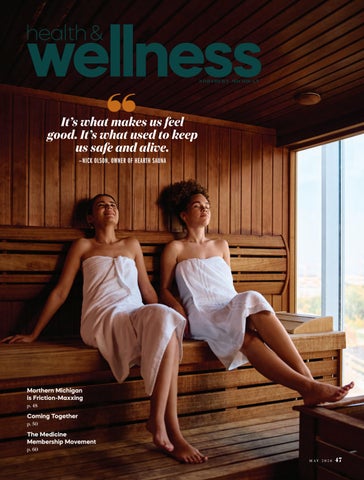
It’s what makes us feel good. It’s what used to keep us safe and alive.
—NICK OLSON, OWNER OF HEARTH SAUNA “
NORTHERN MICHIGAN

Northern Michigan is

Friction-Maxxing

People are logging off and leaning into daily life’s slight discomforts in search of happiness and purpose—an instinct already woven into our Up North DNA.

For most of human history, survival came first. We found food, we built shelter, we avoided becoming prey for something with sharp teeth. Comfort, if at all, came last. Fast-forward to today, and the need for convenience and instant gratification has replaced survival.

Long, cold winters are cushioned by central heat. A whole season’s worth of The Bear or Bridgerton keep us entertained safely indoors. DoorDash and Amazon deliver through sleet and snow. Your favorite song or film streams in seconds. Even love arrives with one fateful swipe.

Modern life has never been easier, yet people are trading ease for something more meaningful: a life that embraces challenge over instant gratification. Our grandparents called it toughening up, but we, in 2026, call it friction-maxxing. Here’s how it can help you tap your healthiest, most resilient self.

What is Friction-Maxxing?

The term, coined in early 2026 by writer Kathryn Jezer-Morton in a viral piece for The Cut, advocates taking on small daily inconveniences rather than eliminating them with technology.

When everything is frictionless, Jezer-Morton argues, we barely engage our minds or emotions to get what we want. The result is boredom, restlessness and a sense that life feels sterile or repetitive.

Friction-maxxing means pushing back and reframing difficulty as a way to learn and grow, prioritizing meaning over ease. That might be using your own calculations at work, swapping smartphones for flip phones, letting your kids wrestle with frustration, or buying a book or magazine instead of scrolling.

With purpose, everyday friction builds resilience, sharpens judgment, strengthens character and roots us in our surroundings. It asks us to be deliberate rather than distracted—more like a Zen master stepping calmly into a storm than a panicked, tech-dependent version of ourselves.

If You Live Here, You’re Probably Already Doing It

If friction-maxxing is about resilience through challenge, Northern Michigan is ahead of the curve. Here’s how our region pushes us, and how to lean into it even more.

Friction: Harsh Winter Weather

We get more than 10 feet of snowfall annually in some regions— plus ice storms, high winds and whatever else Mother Nature throws at us. That means shoveling and snow blowing at dawn, navigating whiteout highways and paying your neighborhood plow guy a good wage because we know what it takes.

Max It: Take a page from Robert M. Pirsig’s novel Zen and the Art of Motorcycle Maintenance and find beauty in elbow grease. Skip the plow service once in a while. Get up early and clear your own driveway with a shovel. Better yet, help your neighbor clear theirs. You’ll build community—and impressive biceps.

Friction: Roads That Bring Us to Our Knees

Winter snow and ice, spring thaws and summer downpours batter our infrastructure, leading to endless construction and traffic jams. The privileged work from home. The rest of us scrape windshields, stash emergency kits in our trunks and invest in snow tires every few seasons.

Max It: Leave earlier and take the back roads. Discover a place you’ve never noticed before. Let the detour be part of your day rather than an obstacle to it.

Friction: Nature Has Opinions

Living in Northern Michigan means loving nature, and sometimes battling it. Wildlife doesn’t respect property lines. AI might offer advice, but it won’t fix your fence or solve your mouse problems. Coexisting with nature is simply part of the deal.

neighborhood coffee shop and call a friend en route. Make the miles feel intentional.

Friction: Fewer Conveniences

Northern living offers fewer 24-hour stores, fewer delivery apps and less on-demand living. It requires planning, patience, extensive grocery lists and the ability to multitask.

Max It: Make trips to town count. Buy in bulk and learn to meal plan. Schedule appointments and other errands around grocery runs. If you crave fresh tomatoes, grow them yourself. You may discover a new hobby.

Friction: Play That’s Actually Work

The lifestyle we love demands effort. Anglers wake to early alarms and the risk of getting skunked. Skiing requires gear, timing and patience. Days on the lake or river mean checking the weather and hauling heavy equipment. The North sets its rules. You either participate or you stay inside.

Max It: Go beyond your comfort zone and try something new. If you love cooking, try foraging. If you have good balance and love the water, give lake surfing a go. Love to fish in the summer? Try ice fishing in the winter. For peak maxxing, learn to sail. Trailer the boat, step the mast, bend on sails, trim in shifting wind. Tack and jibe cleanly. Watch for shoals and bring her home. Moments of calm will feel earned and unforgettable.

With purpose, everyday friction builds resilience, sharpens judgment, strengthens character and roots us in our surroundings.

Max It: Make wildlife management a mindful ritual. Plant wildflowers to attract pollinators and natural predators. Grow pungent herbs like sage and rosemary to deter deer. Build your own garden fence or maybe become a responsible cat owner. Over time, harmony replaces frustration and the occasional skunk or bat becomes something you look forward to seeing.

Friction: Long Commutes

Rural life comes with distance. High home prices push many of us “just outta town.” Some of us search for a home near a quiet inland lake, on a two-track road or close to a favorite ski resort. That means miles behind the wheel, just to get to work or the grocery store.

Max It: Turn the drive into “me time.” Tune into a local radio station, start an audiobook or learn a language—you know Bad Bunny inspired you. Grab a hot drink to-go from your

Friction: Building Community Isn’t Easy

Life Up North can feel isolating. Winter keeps people indoors and summer crowds shift local rituals away from third places. Seasonal residents may feel disconnected from locals, and limited diversity can leave some searching for belonging.

Max It: Choose the communal table and make eye contact with strangers. Attend a concert, play, lecture or festival, and chat up someone new. Host a porch party or potluck. Seek out conversations beyond your usual circles and resist the comfort of your echo chamber. Community takes effort, but that effort is good for you. If friction-maxxing seems daunting, relax. Take a breath. You’re already living the dream in Northern Michigan. Embrace the natural rhythms of life here and you’ll be following the trend like a pro.

Matthew Dursum is associate editor of Traverse Northern Michigan magazine.

Coming Together

ELEV8 Climbing & Fitness
Third spaces offer a quieter kind of health— built on gathering, listening, learning and lingering together.

In 1989, urban sociologist Ray Oldenburg coined the term “third space” to describe the informal places we gather beyond home and work. The first space is home. Second space is the workplace. Third spaces live in between—neutral, accessible, informal environments where people come as they are, without obligation or agenda. Think: neighborhood coffee shops, dog parks, libraries, gyms. These are the places that quietly anchor communities.

Nick Olson believes we need more of these spaces.

Olson—co-owner of ELEV8 Climbing & Fitness, owner of Hearth Sauna and co-founder of the Michigan Sauna Fest—is a Traverse City “boomerang.” He grew up here, moved to New Jersey when he was 25, opened the first Jimmy John’s in the state, and, after eight years, had the chance to return home. The return wasn’t the homecoming he expected.

“As a very upbeat person, I found myself shockingly lonely,” he says. In New Jersey, Olson spent time at a local climbing gym that doubled as a social hub. People lingered. Conversations happened organically. He missed having that kind of community. So, he decided to help build it.

Together with ELEV8 co-founder Kevin Vlach, Olson created a space that functions as far more than a climbing gym. Chances to engage as a community all exsist under one roof. Large, sweeping windows—unusual for climbing gyms— flood the space with natural light, rejecting the closed-in, warehouse feel common to many gyms. The gym hosts coffee and connection events, women’s climbing night, family climbs and homeschooler climb time. It’s a place for movement, yes—but also for connection.

That same philosophy extends to Olson’s relationship with sauna culture. At his camp in Michigan’s Upper Peninsula, Olson has a traditional sauna: dark, quiet and deeply cozy.

photos courtesy of Nick Olson
Hearth Sauna

NOMI’S ALL-STAR THIRD SPACES

These are the places we slow down, gather and stay a while—no invitation required.

Commongrounds Cooperative

When he bought a home in Traverse City, one of his first purchases was another sauna. Friends began dropping by, asking to use it. The sauna became a meeting place. “When you get your heart rate up, people share things,” Olson says. He found himself listening to people talk openly about sex, grief, joy, loss—“these ecstatic, wonderful and horribly sad events,” he says. Eventually, Olson decided to take these moments beyond his backyard. The idea became Hearth Sauna.

Commongrounds Cooperative is Northern Michigan’s first real estate cooperative. Grab a locals’ day pass at the Grove Community Incubator and work alongside fellow remote workers. Learn latte art at the Higher Grounds Learning Lab, catch live music at The Alluvion or tuck into The Folded Leaf—recently relocated from Cedar—a bookstore built for lingering, resting and reconnecting with your inner reader.

Coin Slot is equal parts retro arcade and neighborhood bar. The space turns button-mashing into a social sport. Expect dance parties, live music and the chaos of pinball (21+ after 9 p.m.). Outdoor seating and the Full Send Ramen food truck make it the ideal local hangout.

Traverse Area District Library is not your typical library. TADL invites you to curl up with a book, flip through vinyl or catch a free film screening. Teens game in the Youth Department, seniors stretch out in chair yoga and everyone can borrow from the Library of Things—think sewing machines, birding backpacks, ukuleles and even a metal detector. Bonus: Submit a 3D print request for just 10 cents per gram and make something you can show off.

Pickle U in Williamsburg has eight indoor, climate-controlled pickleball courts, making this an all-season social scene. Take a lesson, join a league or rent a court and rally with friends. It’s competition, community and cardio.

Seven Hills on Old Mission Peninsula doubles as a community hub, blending a café, craft distillery with a cocktail lounge and a tasting room. Weekly events—from Wednesday bingo to Sunday euchre—turn neighbors into regulars. Nearby, the art gallery Tinker Studio will get your creative juices flowing.

Elk Rapids Cinema is a classic 1940s theater that proves movies are better together. On Mondays, Cinegroove pairs free classic films with live radio DJs and spirits from Château Chantal. Show up between 6 and 9 p.m. and let nostalgia do its thing.

Bee Well Mead and Cider in the village of Bellaire is a laid-back hangout with 20 rotating meads and ciders made from locally farmed ingredients. Not into booze? No problem. There’s pop, cold brew coffee, bar snacks and an arcade machine.

Bella’s Café in Frankfort is a cozy and delightful space that invites you to stay awhile. Wrap your hands around a latte, grab a book and settle in near the piano. It’s peak small-town third-space energy.

The Museum of Ojibwa Culture in St. Ignace is a living cultural space that centers learning and connection. In July and August, traditional Native American teachings take place on Monday and Tuesday evenings from 6 to 6:30 p.m. Fridays offer deeper conversations with elders about traditional tribal ways from 6 to 8 p.m.—an invitation to listen and reflect.

Malted Vinyl in Petoskey is inspired by 1950s Tokyo listening rooms and the ultimate 1970s family-room setup. It's a lounge made for slowing down. Sink into a couch, sip a cocktail and listen—really listen—to vinyl in a space that feels like your grandparents’ living room, but better stocked.

The science backs up what Olson witnessed firsthand. Exercise triggers the release of dopamine, endorphins and oxytocin—often called the body’s “feel good” and “hug” hormones. Sauna mimics moderate cardio, raising the heart rate between 120 and 130 beats per minute. As heart rate rises, defenses lower. People talk. They connect face-toface. The sauna, like the climbing gym, becomes a third space.

Olson expanded that vision with Sleeping Bear Saunas owner Vlad Borza to the Michigan Sauna Fest, held at Clinch Park in Traverse City. From April 10–12, saunas line the park, creating a pop-up community rooted in warmth. Last year, more than 300 people attended the inaugural fest and the event sold out. For Olson, the popularity of events and spaces like this reflects something deeper. “Fifty years ago, people had bowling leagues, knitting clubs, book clubs— things they went to every week,” he says. “The drop-off in that kind of regular social connection is staggering.” Third places like climbing gyms or saunas fill the gap in a modern way. Phones are put away, presence is invited and connection is made easier.

“We are social creatures,” Olson says. “We used to exist in little groups of fifty to a hundred and fifty people. That’s why we’re good at face-to-face connections. It’s what makes us feel good. It’s what used to keep us safe and alive.” For advocates like Olson, third spaces are one of the most powerful tools we have to protect mental health in an increasingly disconnected world. They offer something rare and essential: a place to simply be with others.

LOCAL TICKETS. ONE PLACE.

NORTHERN MICHIGAN

Top Dentists

This list is excerpted from the 2026 topDentists™ compilation, a database which includes listings for 50 dentists and specialists in Northern Michigan. The list was based on hundreds of detailed evaluations of dentists and professionals by their peers. The complete database is available at usatopdentists.com For more information call 706-364-0853; write PO Box 970, Augusta, GA 30903; email info@usatopdentists.com or visit usatopdentists.com.

SELECTION PROCESS

"If you had a patient in need of a dentist, which dentist would you refer them to?"

This is the question we’ve asked thousands of dentists to help us determine who the topDentists should be. Dentists and specialists are asked to take into consideration years of experience, continuing education, manner with patients, use of new techniques and technologies and of course physical results.

The nomination pool of dentists consists of dentists listed online with the American Dental Association, as well as all dentists listed online with their local dental societies, thus allowing virtually every dentist the opportunity to participate. Dentists are also given the opportunity to nominate other dentists who we have missed that they feel should be included in our list. Respondents are asked to put aside any personal bias or political motivations and to use only their knowledge

Charles P. Kass

Grand Traverse Endodontics

of their peer’s work when evaluating the other nominees.

Voters are asked to individually evaluate the practitioners on their ballot whose work they are familiar with. Once the balloting is completed, the scores are compiled and then averaged. The numerical average required for inclusion varies depending on the average for all the nominees within the specialty and the geographic area. Borderline cases are given a careful consideration by the editors. Voting characteristics and comments are taken into consideration while making decisions. Past awards a dentist has received, status in various dental academies (Academy of General Dentistry, American Academy of Periodontology, etc.) can play a factor in our decision.

Once the decisions have been finalized, the included dentists are checked against state dental boards for disciplinary actions to make sure they have an active license and are in good standing with the board. Then letters of congratulations are sent to all the listed dentists.

Of course there are many fine dentists who are not included in this representative list. It is intended as a sampling of the great body of talent in the field of dentistry in the United States. A dentist’s inclusion on our list is based on the subjective judgments of his or her fellow dentists. While it is true that the lists may at times disproportionately reward visibility or popularity, we remain confident that our polling methodology largely corrects for any biases and that these lists continue to represent the most reliable, accurate and useful list of dentists available anywhere.

Christopher M. Allen

Shoreline Endodontics

1087 Business Park Drive, Traverse City, MI 49686 shoreline-endodontics.com

Kari L. Brodsky

Otsego Endodontics

400 West Main Street, Suite 106, Gaylord, MI 49735 otsegoendo.com

Jeffrey H. Haag

Shoreline Endodontics

1087 Business Park Drive, Traverse City, MI 49686 shoreline-endodontics.com

4952 Skyview Court, Suite A, Traverse City, MI 49684 gtendo.com

Scott MacDonald

Northern Endodontics

405 North Division Road, Suite 2, Petoskey, MI 49770 northern-endodontics.com

Ryan B. McMahan

Otsego Endodontics

400 West Main Street, Suite 106, Gaylord, MI 49735 otsegoendo.com

Tawfiq M. Alkilani

Aspen Dental

3375 West South Airport Road, Traverse City, MI 49684 aspendental.com

Melissa L. Aylworth

Old Mission Dentistry

3258 Bowers Harbor Road, Traverse City, MI 49686 oldmissiondental.com

Kerry R. Brantly

Petoskey Family Dental Care

2115 M-119, Petoskey, MI 49770 drbrantly.com

General Dentistry
Endodontics

Brooke S. Chapman

Schulz Chapman Dentistry

127 South Madison Street, Traverse City, MI 49684 traversecitydentists.org

James Scott Clement

Petoskey Dental Associates

1301 South US 131, Petoskey, MI 49770 petoskeydental.com

Donald Scott Eaton

4144 Charlevoix Avenue, Petoskey, MI 49770 smilepetoskey.com

Brian R. Fisher

Denture Care Clinic

843 South Garfield Avenue, Traverse City, MI 49686 denturecareclinicoftraversecity.com

Kala Foster Foster Dental Care

1120 Gornick Avenue, Gaylord, MI 49735 989-705-7000 kalafosterdds.com

Matthew S. Free Today's Dental

10277 North Straits Highway, Cheboygan, MI 49721 cheboygandental.com

Chelsea K. Guzzo

Third Coast Dental Group

2266 Frankfort Highway, Frankfort, MI 49635 thirdcoastdentalgroup.com

Steven D. Hall

Suttons Bay Dental Center 1299 South West Bay Shore Drive, Suttons Bay, MI 49682 suttonsbaydental.com

William John Hendershot

Interlochen Family Dentistry

1977 White Oak Lane, Interlochen, MI 49643 interlochenfamilydentistry.com

Bruce C. Lee

12776 South West Bay Shore Drive, Traverse City, MI 49684 231-929-0522

Macare E. Lumbrezer

Traverse Dental Associates

555 South Garfield Avenue, Traverse City, MI 49686 traversedental.com

Vincent P. Mack

3347 West South Airport Road, Suite D, Traverse City, MI 49684 vmackdds.com

Jennifer Malicowski

AuSable Family Dental

800 East Michigan Avenue, Grayling, MI 49738 ausablefamilydental.com

Christina M. Mazzola

Traverse Dental Associates

555 South Garfield Avenue, Traverse City, MI 49686 traversedental.com

Christopher D. Mazzola

Traverse Dental Assoiates

555 South Garfield Avenue, Traverse City, MI 49686 traversedental.com

Jason M. Merrithew

Deerhaven Family Dentistry

5217 North Royal Drive, Traverse City, MI 49684 deerhavendentistry.com

Thor Lyn Mikesell

408 North Saint Joseph Street, Suttons Bay, MI 49682 suttonsbaydentist.com

Ralph C. Oppermann

AuSable Family Dental

800 East Michigan Avenue, Grayling, MI 49738 ausablefamilydental.com

Scott R. Perron

All Smiles Family Dentistry

103 Brand Street, Elk Rapids, MI 49629 allsmilesfamilydentistry.com

Brian K. Rathke

Bellaire Family & Cosmetic Dentistry

4631 South Michigan 88 Highway, Bellaire, MI 49615 bellairedentistrymi.com

Derek J. Rice

Copper Ridge Dental 4020 Copper View, Suite 200, Traverse City, MI 49684 derekricedds.com

Rebekah Sheppard

Alpine Family Dentistry

3096 West Michigan 32, Gaylord, MI 49735 gaylorddentist.com

Joshua C. Van Horn

Traverse Dental Associates

555 South Garfield Avenue, Traverse City, MI 49686 traversedental.com

Tim Wentzloff

Rose Street Dental

876 East Front Street, Traverse City, MI 49686 rosestreetdental.com

Jennifer A. White

Brite White Dental

113 East 7th Street, Manton, MI 49663 mybritewhitedental.com

Karrie T. Williams

Northern Family Dentistry 100 Sherwood Drive, Roscommon, MI 48653 northernfamilydentistry.com

Joseph P. Yancho

Yancho Dentistry

3699 West South Airport Road, Traverse City, MI 49684 yanchodentistry.com

Phillip C. Yancho Yancho Dentistry

3699 West South Airport Road, Traverse City, MI 49684 yanchodentistry.com

Daniel C. Madion

Grand Traverse Oral Surgery 12776 South West Bay Shore Drive, Traverse City, MI 49684 gtoralsurgery.com

Andrew W. Olsen 12776 South West Bay Shore Drive, Traverse City, MI 49684 gtoralsurgery.com

Kris A. Stegmann

Lakeside Oral Surgery and Dental Implant Center 540 South Garfield Avenue, Suite A, Traverse City, MI 49686 lakesideoralsurgery.com

Craig H. Fountain

Grand Traverse Oral Surgery

12776 South West Bay Shore Drive, Traverse City, MI 49684 gtoralsurgery.com

Spencer Crouch Up North Orthodontics 432 Munson Place, Traverse City, MI 49686 upnorthorthodontics.com

Ronald R. Lints Dr. Lints Orthodontics 4020 Copper View, Suite 240, Traverse City, MI 49684 drlints.com

Scott O. Schulz Schulz Orthodontics 4952 Skyview Court, Suite B, Traverse City, MI 49684 schulzortho.com

Madelyn Stumpos Traverse City Orthodontics 545 South Garfield Avenue, Suite A, Traverse City, MI 49686 traversecityorthodontics.com

Brandon Boike

Northern Michigan Pediatric Dentistry 1241 East 8th Street, Traverse City, MI 49686 nmpdkids.com

James M. Van Wingen

Northern Michigan Pediatric Dentistry 1241 East 8th Street, Traverse City, MI 49686 nmpdkids.com

Joseph Amalfitano

Amalfitano Center for Dental Implants 5000 Skyview Court, Traverse City, MI 49684 michiganimplantcenter.com

John C. Hall

Hall Periodontics & Dental Implants 4944 Skyview Court, Traverse City, MI 49684 hallperiodontics.com

Elizabeth Nesmith

Northern Periodontics & Dental Implants 2325 Summit Park Drive, Suite D, Petoskey, MI 49770 nperio.com

Pediatric Dentistry
Periodontics
Orthodontics
Oral and Maxillofacial Surgery

A Fresh Look at the Next Chapter

Retirement brings with it a rare and welcome luxury: choice.

After decades shaped by career demands, school calendars and family logistics, retirement offers something many people haven’t experienced in years: the chance to design each day with intention. We begin asking questions—What energizes me? What sparks my curiosity?

For many, that reflection naturally turns toward home. We begin to think not just about where we want to live, but how we want to live.

In earlier decades, independence often meant juggling everything ourselves—the house, the yard, the repairs, the schedules. In retirement, independence becomes more about creating space for what brings us joy.

In Northern Michigan, our surrounding environment plays a role in that vision. Summer offers long evenings and lake breezes, while winter brings a different pace, with snowstorms, icy roads and sidewalks and early sunsets. Many people find themselves wanting a home that allows them to savor the best of each season in a comfortable setting designed to make everyday living easier.

Over time, many homeowners find that creating that kind of ease isn’t always simple. Often, it’s not one major responsibility, but the steady stream of small tasks that quietly fill their days. Maintenance, repairs, scheduling and planning all require time, money and energy.

Social patterns shift in retirement, and many people find themselves seeking environments where connection happens more naturally. Increasingly, retirees are drawn to communities designed to make daily life easier while encouraging engagement. At The Village at Bay Ridge in Traverse City, the emphasis isn’t on slowing down, but on expanding what everyday life can offer.

“Many residents tell us they didn’t realize how much mental space homeownership was occupying,” says Linda Scott, community director at The Village at Bay Ridge. “Once that responsibility lifts, they often feel an immediate sense of freedom. Suddenly there’s more time and energy for the things they’ve always wanted to do.”

Residents talk about exploring new interests, deepening friendships and spending more time doing what they love.

One of the most appealing aspects is the flexibility to shape each day. “People appreciate that they can be as social or as private as

they like,” Scott said. “They can walk down the hall and join a conversation or close their door and enjoy a peaceful afternoon.”

Community living also offers the comfort of being surrounded by others navigating similar life stages. Shared experiences often lead to natural friendships and an easy sense of understanding. “There’s a real camaraderie here,” Scott says. “People look out for one another. They share stories, interests and encouragement. It creates a strong sense of belonging.”

Beyond lifestyle, research continues to highlight the value of social connection as we age. Strong relationships and regular engagement are consistently linked with better cognitive health, emotional well-being and longevity. In that sense, community becomes a quiet but powerful part of overall wellness.

Ultimately, retirement offers a rare opportunity to step back and consider how our surroundings shape the way we live.

Many people who choose The Village at Bay Ridge do so because the lifestyle aligns with what they want most in the years ahead: independence, connection and the ability to enjoy each day more fully. The wide range of ages and life experiences among residents adds a richness to daily life, and over time many find that loneliness fades while a stronger sense of community takes its place.

“People tell us they wish they had made the move sooner,” Scott says. “They feel more connected and more active, and they enjoy trying new things or simply spending more time doing what they love.”

The Membership Medicine Movement

Inside Northern Michigan’s quiet shift toward a new type of primary care.

The waiting room is a place that makes you want to speak softly as you sip your herbal tea. A humidifier hums gently. Polished hardwood floors glow; cozy mid-century chairs invite you to sink in as you wait. A wall of herbal supplements and vitamins lines one wall. Soft music drifts through the space.

What feels like the beginning of a spa session is, in fact, a doctor’s office.

At Traverse City’s Table Health Medicine, the setting reflects the philosophy. The practice, which has a Petoskey location as well, offers Direct Primary Care within a subscription-based model, blending conventional training with functional and integrative approaches delivered by both osteopathic physicians (DOs) and naturopathic doctors (NDs).

It’s a different approach to care that’s gaining traction as both doctors and patients experience increasing frustration with insurance-based traditional care models, where paperwork is burdensome and patient-doctor time is limited.

Practices offering integrative care may be based in functional, naturopathic or holistic foundations, spending more time in consultative appointments and looking more at the whole patient in order to address root causes in addition to symptoms. It’s a philosophy that requires a totally different model of care and compensation.

“There are a lot of misconceptions about integrative and functional medicine,” says Table Health’s Dr. Andrea Stoecker, DO. “It’s often dismissed as ‘woo-woo,’ but that simply isn’t true.”

One of the biggest misunderstandings, she says, is the assumption that DOs and NDs won’t prescribe medication. “We use a direct primary care model because it allows us to explore more than just medication,” she explains. “That doesn’t mean we don’t use medication when it’s appropriate.”

Another point of confusion: insurance. “The only difference is that patients pay us directly for their visits,” Stoecker says. “They can still use their insurance for labs, imaging and referrals.”

Increasingly, doctors who practice integrative care are offering patients a membership model. Patients pay a monthly fee

that covers visits and ongoing access, whether in person, via telehealth, by phone or through the patient portal.

“Because we’re not billing insurance for every visit, we can see fewer patients and spend more time with each one,” Stoecker says.

That shift in structure changes the rhythm of care. In traditional practices, reimbursement is tied to in-office visits and tightly documented encounter notes. Here, communication is more flexible.

“There’s a lot of burden in checklists doctors have to fill out for insurance companies in order to get paid,” Stoecker explains. “Insurance documentation requirements can interfere with the physician-patient relationship.”

Extensive documentation and billing detail, she adds, can pull focus away from the person in front of you. “When the patient— not the insurance company—is paying you, you can focus fully on their care.”

and conventional physicians, “except that DOs have additional training in osteopathic manipulation.” She adds that osteopathic education often builds in more emphasis on nutrition, lifestyle and whole-person evaluation.

Across integrative and naturopathic practices in the region, the emphasis is similar: longer initial visits, deeper health histories and collaborative treatment planning.

“Patients are often surprised by how thorough we are and how detailed their treatment plans become,” Stoecker says. “They’re not used to being listened to quite so thoroughly.”

When the patient— not the insurance company—is paying you, you can focus fully on their care.

The longer visits allow for deeper inquiry. “It’s nearly impossible to meaningfully help someone in a ten- or twenty-minute visit unless they have one simple problem,” she says.

In Northern Michigan, Traverse City serves much of the northern lower peninsula, and specialty care can mean long waits or long drives.

“Access to care here can be incredibly challenging,” Stoecker says. Even primary care appointments can be difficult to secure, booking out weeks or months in advance.

Many of her patients arrive after frustration elsewhere. “A lot of our patients come to us because they’ve been told their labs are ‘normal,’ but they still don’t feel well,” she says. Others have been prescribed medication without a deeper exploration of underlying causes.

“Many of my patients are strong self-advocates who have been on a difficult medical journey,” she says. Long wait times and inaccessibility in traditional offices also drive interest.

She sees growth in this approach locally and nationally. “Physicians go into medicine to help people,” she says. “The insurance model can make that very difficult.” The constraints of short visits and high patient volume contribute to burnout and physicians leaving practice. The membership model, she says, offers another path.

Table Health includes both DOs and NDs. Osteopathic physicians are fully licensed medical doctors with additional training in osteopathic manipulation and musculoskeletal mechanics.

“Our training is almost the same,” Stoecker says of DOs

Not all membership or holistic care models are led by NDs or DOs. MI Partner Health, based in Traverse City, offers comprehensive, team-based primary care in a membership model, with a staff comprising primarily certified medical doctors and physician assistants providing a variety of care options, including primary care, functional medicine, lifestyle medicine and behavioral health. Members are given regular annual and preventative care as well as treatment for minor issues like wounds, colds or joint injuries, as well as in-office procedures such as stitches. Management of chronic conditions like diabetes and referral for specialist care are also part of the equation.

MI Partner Health takes the model a step further by partnering with local businesses to provide employee care plans, intending to improve wellness, reduce absenteeism and ultimately result in a return on investment for business owners.

Across membership-model practices, several patterns repeat: 60- to 90-minute initial visits, layered treatment plans and follow-ups structured as working sessions rather than quick check-ins.

The model is not without barriers. Cost can be one. Membership fees require patients to budget for care outside the traditional insurance structure, though practices like Table Health position themselves as more affordable than concierge medicine.

Smaller staff sizes can also mean administrative constraints. Insurance processes like prior authorizations can be cumbersome. Still, Stoecker says the tradeoff is worthwhile if it protects time with patients.

“It’s about asking why,” Stoecker says. In a region defined by natural landscapes and active living, that question, and the time to explore it, is increasingly shaping how healthcare looks and feels. What’s emerging in Northern Michigan is not a rejection of conventional medicine but a parallel track where a patient can feel like a whole person, and a sense of time and continuity of care can prevail.

Turn static files into dynamic content formats.

Create a flipbook
Health & Wellness 2026 by MyNorth - Issuu