The partners of NETWORK MAGAZINE™ proudly present the latest edition of the Lehigh Valley's first ever, high end, business leader driven B2B magazine. Our goal is to continually present our readers relevant content to build your organization, from the region's top business leaders and experts on today’s industry news and trends.
Our leading contributors will continue to change quarterly, sharing information that stays fresh and current. The opinions, tips, and insights on how to best navigate business pitfalls are all provided by the Lehigh Valley's best thought leaders. Our writers are un-censored giving you profound insight from their years of experience from their given field of expertise.
To learn more about how you can become a part of NETWORK MAGAZINE™ as a Contributor or an Advertiser, please contact Ray Bridgeman: ray@mynetworkmag.com
PUBLISHERS
Ray Bridgeman & Chris Morganelli
ART DIRECTOR Casey Damrose
EDITORIAL DIRECTOR Ray Bridgeman
EDITORIAL ASSOCIATE Jenn Ebert
COVER PHOTO Frank Smith
EVENT PHOTOS Kate Lynn of K8 Pics
For advertising inquiry and rates please contact Ray Bridgeman
How the “One Big Beautiful Bill” May Impact You or Your Business
CALLAN I. CHARLESWORTH, FITZPATRICK LENTZ & BUBBA ATTORNEYS AT LAW
Over the last few months, you've probably heard about the "One Big Beautiful Bill" (OBBB, "the Act"), but you might not know how it affects you, your estate plan, or your business.
The Act was signed into law on July 4, 2025. It makes permanent many pieces of the 2017 Tax Cuts and Jobs Act that were set to expire in 2026. This looming expiration date caused significant uncertainty and prompted many individuals to consider updating their estate plans. So, what should you do now?
Check out these eight key impact areas of the OBBB and steps to take should your livelihood or business have opportunities or consequences.
Federal Estate Planning and Tax Consequences
Federal Estate Tax planning may not be needed if one's taxable estate does not exceed the "exclusion" or "exemption" amount. In 2026, the OBBB increased the exemption amount at death and/or for lifetime gifts to $15,000,000 per individual and $30,000,000 per couple, indexed for inflation. Those below the exemption will not owe Federal Estate Tax at death, with a rate of 40% if tax is owed.
The Act also increased the Generation-Skipping Transfer Tax ("GST") exemption to $15,000,000 per person, allowing increased wealth that can pass to grandchildren and more remote descendants. Additionally, the Act maintained “portability” between spouses, which allows a surviving spouse to inherit any unused exemption (there is no portability for the GST exemption).
For many people, these increased exemptions mean simpler estate plans. Nonetheless, high-net-worth individuals and families can use certain estate planning and tax strategies wisely to minimize death taxes. An estate planning attorney can help determine which ones are right for you!
Gift
The gift tax annual exclusion remains at $19,000 per individual, per donee, and $38,000 per couple. For larger gifts, a taxpayer would file a Federal Gift Tax Return.
529 Accounts
529s are common tax-advantaged accounts for education-related expenses. Under the Act, the class of qualified higher education expenses expanded, allowing more such expenses to be paid from these accounts. The growth of 529 assets is generally tax-free, providing significant advantages to account owners.
SALT Maximums
The Act increased the State and Local Tax (SALT) deduction to $40,000 per household, allowing individuals with high state/local tax burdens the opportunity to deduct these taxes from their gross income. Under the previous law, the deduction was capped at $10,000.
Charitable Giving
Taxpayers will only receive a tax deduction for charitable gifts exceeding 0.5% of adjusted gross income. This means it is useful to combine multiple gifts into a single tax year rather than making consistent, smaller gifts.
Business and Income Tax Changes
The Act has also had a significant impact on businesses and business owners.
Tax rates from the 2017 Tax Act were permanently reduced for individuals under the current Act. These reduced rates also apply to pass-through entities. The Act made permanent a 20% deduction for certain pass-through entities' domestic profits. This applies to many LLCs, S corporations, and sole proprietorships. As for C corporations, the Act increases benefits and deductions for qualified small business stock. Investing in small businesses can be advantageous because the Act permits certain gains from selling qualifying shares to be tax-free.
Expensing Capital Investments
The Act allows business owners to expense capital investments such as business equipment. It makes permanent a 100% bonus depreciation rate for qualified property assets acquired or utilized by January 20, 2025. Eligible equipment, assets, and machinery can be written off in the year of purchase rather than over multiple years.
Research and Development Costs
The Act allows business owners to immediately deduct 100% of their domestic R&D expenses. This portion of the Act may apply retroactively to expenses beginning January 1, 2025.
Although the Act is now permanent, its terms may change in the future under a different political environment. Families, individuals, and business owners can plan for their futures knowing there is no "sunset" to the current law. Still, they should keep in mind that changes to the tax laws can and will occur in the future.
NOW IT’S TIME TO PROTECT IT.
At FLB, we help clients ensure that what they’ve worked so hard for endures — for their families, their businesses and their communities.
Our Estate Planning and Administration services include:
• Preparation of common estate documents like Wills, Powers of Attorney and Health Care Directives
• Elder law guidance
• Business succession planning, including Buy-Sell Agreements
• Taxation counseling
• Implementation of sophisticated estate planning techniques like Trusts
• Special needs planning
• Assisting executors and trustees with administration
Starting the Clock on Structuring for Value
MILAN D. SLAK, ESQUIRE, CPA, LL.M (TAXATION) | MEMBER, NORRIS MCLAUGHLIN ATTORNEYS AT LAW
Businesses are "built to run" or "built for sale," and depending on your choice, a number of planning and structuring considerations arise. This article is just a snapshot of some items you might discuss with your trusted advisors for “built for sale” businesses.
Becoming law on July 4, 2025, the One Big Beautiful Bill Act (OBBBA) made several key enhancements to the gain-exclusion benefits of qualified small business stock (QSBS). Notably, for QSBS acquired after July 4, 2025, you no longer need to hold the QSBS for at least 5 years before you can benefit from the eligible gain exclusion. OBBBA kept the 100% gain exclusion for QSBS held for at least 5 years, but if you hold QSBS for at least 3 years, you can receive a 50% gain exclusion, and if you hold it for at least 4 years, you can receive a 75% gain exclusion.
Prior to OBBBA, the per-issuer gain exclusion was capped at the greater of $10 million ($5 million for married taxpayers filing separate returns) or 10 times the aggregate adjusted basis of the QSBS stock sold. OBBBA increased the $10 million to $15 million, so now the cap is the greater of $15 million (indexed for inflation starting after 2026; half the inflation-adjusted $15 million amount for married taxpayers
filing separate returns) or 10 times the aggregate adjusted basis of the QSBS stock sold.
For stock issued after July 4, 2025, to qualify as QSBS, the adjusted tax basis of the assets of the issuing corporation (that is, the fair market value of contributed assets at the time of contribution to the issuing corporation) must be no more than $75 million (now indexed for inflation starting after 2026) immediately before and immediately after the stock is issued. OBBBA had increased the contributed asset value by $25 million from the original $50 million. Note that there are other requirements for stock to qualify for QSBS treatment and additional rules with respect to the potential gain exclusion.
If you are considering selling in the relatively near future, keep in mind that although you may want capital gain treatment on your ultimate taxable gain, the buyer may be looking for a step-up in basis of the business acquired so they can benefit from depreciation and amortization deductions going forward. Some forms of tax grossups can account for the difference in taxes due by a seller. Due to various other factors, such as key contracts with third parties or certain regulatory licensing requirements for your business, the
buyer may prefer to acquire your business's equity rather than your corporate stock. Moreover, because many businesses are established as S corporations, buyers don't want to acquire S corporation stock because of potential issues with a seller's S election history. In many merger and acquisition transactions, buyers uncover problems with a seller’s S election during their pre-closing due diligence.
As a result, a buyer may require a seller to implement a pre-closing restructuring of their S corporation. An example is an “F” reorganization, which is very commonplace these days. “F” reorganizations involve certain business restructurings that are tax-free for income tax purposes and result in the seller retaining their S corporation postclosing while selling equity in a wholly owned limited liability company subsidiary of that S corporation. In other words, for legal purposes, the buyer purchases equity in the limited liability company, which is treated as an asset sale for income tax purposes by the S corporation.
Uncovering problems with a seller’s S election can delay the transaction, result in holdbacks and escrows, and, in some cases, blow the deal. The costs of addressing such issues during a transaction can also be expensive, and the cost will likely come out of the deal proceeds. Addressing any potential S election issues pre-transaction may ultimately save the seller significant money and even make the seller more attractive to a potential buyer. Even if no S election issues exist, engaging in such restructuring before you go to market may be reason enough to make your business more attractive to potential buyers.
Finally, if you are considering that sale and haven’t yet updated your estate plan to incorporate it, you should do so well ahead of the potential transaction, not after the closing. Favorable business valuations and properly designed and funded trusts can save estate taxes, shield assets from creditors, and provide access for family members.
Gathering a team of trusted advisors ready to move forward with you will benefit you in the long run, whether you plan to hold the business for the long term or sell. If OBBBA shows anything, the law shifts –so please reach out to your trusted advisors to see how you may be impacted.
Milan D. Slak, Esq., LL.M. is an attorney and Member of Norris McLaughlin, P.A. in its Allentown office. He focuses his practice on complex business transactions including mergers and acquisitions, leveraged buyouts, joint ventures, and recapitalizations. He has been the lead attorney or lead tax and structuring attorney on numerous M&A transactions.
When the Law Redefines Family: Termination of Parental Rights in Pennsylvania
DOROTA GASIENICA-KOZAK, ESQ, AND GINA SALASH, ESQ., KINGSPRY ADOPTION LAW PRACTICE GROUP
Every year in Pennsylvania, thousands of children live with caregivers who are not their legal parents—grandparents, stepparents, relatives, or long-term foster families. Many do not realize that these caregivers often have no legal authority unless the biological parents' rights are formally terminated. Experienced legal guidance can become the final step toward securing a stable, permanent family recognized under Pennsylvania law.
Termination of parental rights is one of the most consequential actions a court can take. It permanently and irrevocably ends the legal
relationship between parent and child—eliminating custody rights, decision-making authority, inheritance rights, and future standing. Because of its severity, Pennsylvania imposes rigorous statutory and constitutional protections. Yet despite the gravity of termination, it often serves a child's best interests by providing safety, permanence, and stability when reunification is no longer possible.
For families and practitioners, understanding the statutory framework and the court’s analytical process is essential.
Pennsylvania’s Legal Framework: Understanding the Adoption Act
Pennsylvania’s Adoption Act, 23 Pa.C.S. § 2511, requires a court to find clear and convincing evidence of two elements before terminating parental rights:
1. A statutory ground for termination exists; and
2. Termination serves the child’s best interests.
Because a parent’s right to raise a child is a fundamental liberty interest recognized by the U.S. Supreme Court, courts require highly persuasive evidence before extinguishing it. At the same time, a child’s right to permanence and stability remains paramount.
The court conducts a two-stage analysis:
• First, it evaluates statutory grounds under § 2511(a).
• Second, it determines whether termination serves the child's needs under § 2511(b).
Common Grounds for Termination
Several statutory grounds appear frequently in Pennsylvania cases:
Failure to Perform Parental Duties
If a parent fails to perform parental duties for at least six months before the petition is filed—such as providing care, contact, or support— termination may be justified. 23 Pa.C.S. § 2511; In re D.W.
Ongoing Neglect, Abuse, or Incapacity
Repeated incapacity, abuse, or neglect that leaves a child without essential care—and cannot or will not be remedied—supports termination. In re Adoption of S.P.
Long-Term Removal Without Progress
If a child has been out of the parents' care for at least six months and the issues leading to removal remain unresolved, termination may be proper. This often arises in dependency matters.
Failure to Remedy Conditions
A parent’s inability or unwillingness to remedy the conditions that led to removal, despite reasonable services, may warrant termination. In the Int. of K.T.
Importantly, termination cannot be based solely on poverty or circumstances beyond a parent’s control.
Voluntary vs. Involuntary Termination
Voluntary Termination
Parents may voluntarily relinquish rights, most commonly in:
• Stepparent adoptions,
• Kinship adoptions, or
• Situations in which a parent recognizes that adoption is in the child's best interests.
Once accepted by the court, voluntary relinquishment is difficult to revoke except in cases of fraud or coercion.
Involuntary Termination
When a parent does not consent, the petitioner must prove statutory grounds through:
• Evidentiary hearings
• Testimony from social workers, therapists, or other professionals
• Examination of parental conduct and the child’s needs
The burden of proof is “clear and convincing evidence.”
Kinship and Stepparent Adoptions
Kinship and stepparent adoptions are the most common contexts triggering termination petitions.
Kinship adoptions often formalize long-term caregiving relationships with grandparents or other relatives who have raised a child.
Stepparent adoptions allow a stepparent to legally assume a parental role. Even when a biological parent remains marginally involved, courts must ensure termination truly serves the child’s best interests—not merely the adoptive parent’s wishes. In re Adoption of M.E.L.
Why Termination Cases Are Increasing
Several trends have contributed to rising termination and adoption proceedings:
• Persistent substance abuse and untreated mental health issues
• Prolonged dependency involvement
• Expansion of kinship caregiving
• Increased focus on permanency planning
Courts remain mindful that termination has irreversible consequences and implicates constitutional protections. In re Adoption of C.M.
The Best Interests Analysis
Once statutory grounds are met, the court must examine whether termination meets the child’s developmental, physical, and emotional needs. 23 Pa.C.S. § 2511(b).
Key considerations include:
• The strength and quality of the parent-child bond
• The bond with pre-adoptive caregivers
• Whether severing the bond would harm or benefit the child
• Whether delaying permanency would compromise the child’s long-term well-being
Courts also assess whether last-minute parental efforts are meaningful or merely reactive. Ultimately, the focus is on securing a stable, permanent home.
Frequently Asked Questions
Can parental rights be terminated without consent?
Yes, if statutory grounds are proven and termination serves the child's best interests.
Does termination end all parental rights?
Yes. Once terminated, a parent has no legal standing regarding the child.
Is termination required for adoption?
Yes—both parents' rights must be terminated, except in stepparent adoptions.
Can a parent revoke consent?
In Pennsylvania, consent may be revoked within 30 days of signing, except in limited circumstances such as fraud or coercion.
Does the child’s preference matter?
It may, depending on age and maturity. Children 12 and older must sign a consent affidavit for adoption.
Why Legal Guidance Matters
Termination cases move quickly and involve strict procedural requirements. Mistakes can have permanent consequences. Families should seek experienced legal counsel early to safeguard constitutional rights and ensure the child's long-term well-being.
Termination of parental rights reflects a careful balance within Pennsylvania’s Adoption Act: protecting parental rights while ensuring children receive the stability and permanence they deserve.
Your facility is full of activity every day. TWG Security helps you stay ahead of risks by providing clear, reliable visibility across parking, perimeters, and other high-traffic spaces.
Monitor parking lots with precision
Streamline guest management
Strengthen perimeter security
Track movement intelligently
Schedule your safety consultation today.
Error on the Play: Why the USPTO Threw Out the “Las Vegas Athletics” Trademark
MICHAEL S. HORVATH II, ESQ., GROSS MCGINLEY, LLP.
In a move that highlights the often underappreciated complexities of intellectual property law, the United States Patent and Trademark Office (USPTO) recently refused to register the trademark applications for “Las Vegas Athletics” and “Vegas Athletics”, proposed identifiers for the Oakland Athletics baseball franchise’s planned relocation to Las Vegas.
At first glance, this may seem like an esoteric legal setback for a franchise preparing for a high-profile relocation. For business leaders and brand strategists, however, the decision shines a spotlight on how geographic and descriptive elements in trademarks can undermine brand protection, even for century-old institutions.
Strike 1: The Examiner’s Ruling
Following another abysmal baseball season for the Athletics franchise, the team delivered one last swing and miss before the end of 2025. On December 29, 2025, the USPTO issued a non-final office action refusing registration of the team’s marks, concluding that the phrases Las Vegas Athletics and Vegas Athletics are “primarily geographically descriptive.”
Under Section 2(e)(2) of the Trademark Act, a trademark application can be denied if it merely communicates where a product or service originates without simultaneously identifying a unique commercial source. In the case of the marks which the A’s applied for:
• “Las Vegas” is indisputably a well-known place name.
• “Athletics” was deemed a generic term for sporting activity or professional sports services.
According to the examiner’s reasoning, the combined phrase simply describes a professional athletic enterprise based in Las Vegas, rather than signaling a unique brand in the marketplace, which is a fundamental requirement for federal trademark registration.
Why Historical Brand Equity Didn’t Help
Some observers assumed the Athletics’ long history, from Philadelphia to Kansas City to Oakland, might give weight to their application. Despite nine World Series titles and one hundred twenty-four years in existence, federal trademark law evaluates each filing on its own merits. Prior registrations for Oakland Athletics or stylized logos do not automatically confer rights to a new geographic variation.
Even decades of association with the name Athletics could not replace the USPTO’s requirement that the proposed Las Vegas marks have acquired distinctiveness, meaning consumers must already associate the term with a single commercial source in Las Vegas, which is difficult to demonstrate when the team has yet to play there or sell significant merchandise under the new name.
Business Implications for Brand Strategy
This episode carries broader lessons for marketers and business owners beyond the sports world:
• Geographic elements weaken trademark strength. Names that place a generic descriptor alongside a well-known location face steep barriers to registration. Even when they are registered, they often are weak marks with hindered exclusivity rights.
• Descriptive terms require proof of market recognition. Without extensive use or consumer association, descriptive phrases are hard to defend as uniquely linked to a single entity.
• Trademark rights are not retroactive or automatic. Businesses cannot assume past registrations or brand longevity guarantee future approvals in new markets or contexts.
The A’s Next Pitch
Despite the refusal, this setback does not prevent the franchise from using the Las Vegas name in commerce or advancing its relocation plans on the field. It simply means federal registration (with its associated legal protections) will require additional evidence or strategy.
The team has several options:
• Refile with evidence of acquired distinctiveness once operations, merchandising, and marketing in Las Vegas are well established.
• Appeal to the Trademark Trial and Appeal Board (TTAB) if the USPTO’s interpretation is believed to be in error.
• Pursue litigation in federal court, though this route is costly and typically reserved for particularly strategic marks.
Branding teams within major organizations, especially those in transition, can take away a clear message: trademark strategy should not be an afterthought but a core component of market entry and identity planning.
Takeaway for Business Leaders
The Athletics’ trademark refusal is less a fatal blow than a cautionary tale. As companies and brands expand into new territories or redefine themselves, understanding how trademark law views geography, descriptiveness, and distinctiveness can be critical to protecting longterm value. For those crafting brand names or pursuing trademark registration, an early and informed legal strategy can prevent avoidable hurdles at the U.S. Patent and Trademark Office.
Pardons, Expungements, and Federal Firearms Relief, Oh My!
JOSHUA PRINCE, ESQ., CIVIL RIGHTS DEFENSE FIRM, P.C.
When it comes to pardons, expungements, and other forms of relief as a result of a criminal conviction1, There is a lot of misinformation online. While my area of practice focuses on Second Amendment issues, I handle a lot of pardons, expungements, and other mechanisms of relief for people at the state and federal levels for a multitude of reasons beyond restoration of their firearm rights, including employment, travel abroad, and to prevent their children and/or grandchildren from becoming aware of their incidents of youthful indiscretion. In this article, I will debunk a lot of the myths about when/if such are available.
To begin with, before we get into the specifics of each, it is important to understand that the state and federal governments are separate sovereigns, and, as such, neither can relieve a conviction by the other2 Thus, as an initial matter, it is important to understand whether you were convicted under state or federal law. For purposes of this article, I will only review Pennsylvania and federal law.
Moreover, it is important to understand that Pennsylvania and federal convictions constitute convictions until the end of time—including any disabilities stemming from them—unless you are able to obtain a pardon, expungement, or other form of relief.
EXPUNGEMENTS
Federal Convictions: Unfortunately, federal law generally does not permit the expungement of criminal convictions. While there are extremely narrow exceptions for certain first-time minor drug offenses (which are virtually never charged), even if you have received a pardon from the President, you are ineligible for expungement.
Pennsylvania Convictions: When it comes to expunging convictions under Pennsylvania law, it is first important to break it down between whether it was a summary (akin to a traffic ticket) or a misdemeanor/ felony conviction. In relation to summary convictions, you can obtain expungement if you have paid all your fines and been free of arrest or prosecution for at least five years following the conviction.
When it comes to misdemeanor/felony convictions, unless you received probation without verdict for certain drug-related offenses, you are only eligible for expungement if: (1) you have reached 70 years of age and have been free of arrest or prosecution for 10 years following final release from confinement or supervision; or (2) you have
been dead for 3 years. 3 As a result, most people desiring to clear their criminal history have only one option in Pennsylvania – a pardon.
PARDONS
Federal Convictions: Only the President can pardon an individual for a federal conviction. While statistics are available dating back to President McKinley4, the success rate is historically low unless you have an extremely compelling case or a connection with the thenadministration. However, during the current Administration, we have seen a sharp increase in the number of pardons being granted. As an attorney who has successfully argued a client's application for a presidential pardon, I can tell you that, beyond it potentially being a lengthy5 and a costly process, you need a compelling case that reflects substantial reform and community service. And even if you are granted a presidential pardon, although your record will reflect that the conviction has been pardoned and your civil rights will be restored, the criminal history/records regarding the charging and conviction will remain accessible to the public.
State Convictions: In Pennsylvania, especially for single-isolated incidents of youthful (pre-24 years of age) indiscretion, where more than 8 years have lapsed since the date of conviction, there is a strong likelihood, if you have good counsel, of obtaining a pardon. The Board of Pardons and the Governor are going to want to see that all costs/fines are paid, that you have been law-abiding since (including in relation to traffic offenses), and that you are no longer the person you were when you committed the offense. Beyond that, you will want to demonstrate civil engagement/community service. Even for very serious offenses, I have been extremely successful in obtaining pardons for clients; however, the more serious the offense (or where there are multiple offenses, e.g., repeat DUI convictions), the Board and Governor will want to see more time elapse before applying.
FEDERAL FIREARMS RELIEF
For those only concerned with restoring their Second Amendment rights as a result of a state or federal conviction that triggers a federal prohibition, while the law has provided for federal firearm relief determinations since 1968, in 1992, Congress precluded the Bureau of Alcohol, Tobacco, Firearms, and Explosives from conducting such determinations. Thus, they have been unavailable since then. Recently, the U.S. Attorney General announced that she would begin
conducting relief determinations and has submitted a notice of proposed rulemaking for new regulations guiding the application and rules for such. While the A.G. is still considering, based on comments received, what the final regulations will be and anticipates over a million applications being submitted in the first year when the final regulations are implemented, as an attorney that frequently litigates against the U.S. Government—where it denies citizens’ Constitutional rights, especially their right to keep and bear arms—I have an inside track on how to submit applications currently, in advance of a final regulation, if you are interested in skipping to the head of the line.
Hopefully, this article has dispelled some myths and helped you better understand your rights related to expungements, pardons, and federal firearms relief.
1 This article does not address non-conviction dispositions, such as Accelerated Rehabilitative Disposition (ARD), or where the individual is found not guilty. To the surprise of most, even a finding of not guilty does not necessarily result in the automatic expungement of the criminal dockets and information.
2 While there has been an academic debate over whether the President can pardon a state-law offense under the Supremacy Clause of Article VI, Clause 2 of the U.S. Constitution, no court has yet ruled on the issue. That said, this issue may be resolved in the near future, as the current Administration has issued presidential pardons to a couple of individuals for state-law convictions, even though the states intend to challenge the President's authority in such matters. This is not a typo. The General Assembly, aware that people wish to clear their
I am aware that some pardon applications have been pending for more than
Celebrate
We are a full-service florist for any event or occasion, large or small Our retail stores offer a wide variety of gift items and fresh flowers If you are planning a wedding or special event, we have an entire showroom of displays to fit your needs
health & sciences
Concussion Recovery and Pain Relief Through Therapeutic Massage
We've all heard about concussions and how much more common and prominent they are now, versus back in the day. Nowadays, there are entire concussion clinics with comprehensive programs and multiple therapies to help you get back on track and feel like yourself again.
Treating concussion patients alongside doctors who specialize in concussions is an experience I am thankful to be a part of.
Concussion recovery is not a linear progression. Sometimes you feel like you sprinted ahead 5 steps, and other days, more often than not, you feel like you took one step forward and 3 steps back. It's frustrating, and it's exhausting. If you are like many of my clients, as well as myself, you don't like to take medications. Fortunately, maybe a little unfortunately, there's a time and place for them. In the acute phase of healing from your concussion, it's necessary to allow your brain to heal. Taking over-the-counter medications and medications your doctor prescribes is crucial in your recovery. There is also a time and place for medical massage and craniosacral therapy to aid in your progression and recovery. That's where I come in.
Hi, I'm Jessica Prince, a specialist in craniosacral therapy, medical massage, nerve mobilization, myofascial release, and so much more. How did I get into treating concussions and understanding them and the intricacies of them? I had a severe concussion, a moderate TBI (traumatic brain injury), bulging and herniated discs in my neck, numbness in both arms, full facial bruising and swelling, just to name a few - and those are only the high physical injuries I had. I was (and am again) extremely quick to think on my feet and to assess clients in detail to ensure accuracy. Right after the concussion occurred, I was barely able to make words, and I could not walk without assistance. I
couldn't do anything for myself. I say this to tell you that the best way to accurately treat clients, when you're capable, of course, is to go through it yourself. [There is a silver lining to every experience in life.]
I have firsthand experience with a severe concussion, how treatment works, what kind of therapies are out there, and now that I'm better, I am using those connections I made through my recovery to treat others who are where I was, and for that, I am grateful.
Concussions happen in many ways: car accidents, sports, trips and falls, work-related, etc.
Recovering from a concussion can be a slow and challenging process. While rest and medical care are essential, therapeutic massage can support recovery by easing discomfort, improving circulation, and promoting overall healing.
Understanding Concussion Recovery
A concussion affects the brain’s ability to function normally, often leading to headaches, neck pain, dizziness, and fatigue. During recovery, the body benefits from gentle, restorative therapies that reduce tension and support the nervous system.
How Massage Supports Healing
Massage therapy helps relieve muscle tightness and stress that often accompany concussions. By improving blood flow and lymphatic drainage, massage encourages the body’s natural healing processes. It can also help reduce secondary pain in the neck, shoulders, and upper back caused by muscle guarding or poor posture during recovery.
Key Benefits
Pain Relief: Reduces tension headaches and neck stiffness.
Improved Circulation: Enhances the delivery of oxygen and nutrients to healing tissues.
Stress Reduction: Calms the nervous system and promotes relaxation.
Better Sleep: Encourages deeper rest, essential for brain recovery.
Safe and Gentle Techniques
During concussion recovery, light-touch techniques such as craniosacral therapy and gentle myofascial release are recommended. These methods focus on restoring balance without overstimulating the nervous system.
When to Seek Massage
Massage should be introduced only after medical clearance, especially if symptoms like dizziness or nausea persist. A licensed massage therapist experienced in post-concussion care can tailor sessions to individual needs and comfort levels.
Promoting Long-Term Wellness
Incorporating massage into a recovery plan supports not only physical healing but also emotional well-being. Regular sessions can help manage lingering pain, reduce anxiety, and restore a sense of calm and balance.
Experience relief and support your recovery with therapeutic massage—helping the body and mind heal together.
health & sciences
The Jefferson Lehigh Valley Classic
The Jefferson Lehigh Valley Classic presented by Sodexo Tees Off Its Inaugural Year This Fall
This fall, as the leaves begin to turn across eastern Pennsylvania, a new tradition is taking shape – one that blends world-class golf, community celebration, and charitable purpose. The Jefferson Lehigh Valley Classic presented by Sodexo is making its long-awaited debut, igniting excitement across the local community and the professional golf world alike.
Framed by the rolling hills of the Lehigh Valley, this tournament –which is set to be held annually – steps confidently onto the PGA TOUR Champions schedule, bringing together legendary golfers, passionate fans, and local leaders for a weeklong experience that is as meaningful as it is memorable. Players, fans, and organizers alike are treating this as more than just a debut – it’s the beginning of what promises to become a marquee tradition on the regional and national golf calendars, blending new energy with the timeless appeal of championship-level play.
A legendary stance
Being hosted at the Lehigh Country Club in Allentown, Pa., the Jefferson Lehigh Valley Classic features a 78-player field, competing over three days and 54 holes in a stroke-play format. As part of the PGA TOUR Champions schedule, the event attracts some of the most accomplished names in golf – athletes whose careers have shaped the sport for decades. Fans can expect to see icons such as: Bernhard Langer, Steve Stricker, Stewart Cink, Ernie Els, Padraig Harrington, Fred Couples, Vijay Singh, John Daly, Justin Leonard, Darren Clarke, and Dicky Pride.
These are not just players – they are titleholders, major championship winners, Ryder Cup heroes, and fan favorites whose presence elevates the event into a true celebration of golf excellence.
For spectators, the opportunity to watch these legends up close is rare and unforgettable. PGA TOUR Champions events are known for their intimate atmosphere, where fans can stand just steps from the fairways and greens, enjoying unparalleled access to some of the game’s greatest personalities.
A historic venue on par for making history
The first-ever PGA TOUR Champions event to be held annually in the Lehigh Valley, the Jefferson Lehigh Valley Classic will be a weeklong celebration of this region’s vitality and potential.
Lehigh Country Club is regarded as one of the top golf destinations not only in the Lehigh Valley but in Pennsylvania, routinely ranking among the state's top courses. Designed by the renowned Master Golf architect William S. Flynn in 1927, the course is situated along the Little Lehigh Creek. It is one of the most beautiful and natural parkland courses in the world. In addition to its dramatic topography, the course is known for its masterful routing of the fairways, which features significant elevation changes, as well as its challenging greens. The course provides a picturesque backdrop for championship golf, challenging players strategically while offering spectators stunning views from nearly every vantage point.
A mission with a strong grip on giving back
At its core, the Jefferson Lehigh Valley Classic is driven by a mission that extends far beyond the fairways. Title sponsor Jefferson, together with presenting sponsor Sodexo, emphasizes that this tournament is about more than just golf. It's about giving back, with proceeds benefiting charities throughout the greater Philadelphia and Lehigh Valley regions, including the primary beneficiaries of the inaugural tournament – Valley Youth House, Eagles Autism Foundation, and the Sodexo Stop Hunger Foundation.
CARLY KUCHOVA, LEHIGH VALLEY HEALTH NETWORK, PART OF JEFFERSON HEALTH
By partnering with these nonprofit organizations, the event helps fund programs that strengthen families, support health initiatives, expand educational opportunities, fight food insecurities, and uplift communities. Every ticket purchased, sponsorship secured, and hospitality package enjoyed contributes to a meaningful impact.
This philanthropic focus is part of what makes the tournament so special. It’s not just about watching great golf – it’s about being part of something that makes a difference.
A tournament grounded in a week of experiences
While the competition itself is the centerpiece, the Jefferson Lehigh Valley Classic is designed as a full-week experience. From Sept. 28 to Oct. 4, 2026, the event schedule offers a variety of activities that appeal to fans, families, and corporate guests alike. This includes: the Eagles & Friends Celebrity Pro-Am – a unique opportunity for celebrities, athletes, and business leaders to tee it up alongside PGA TOUR Champions professionals; and the official Pro-Am – a once-in-a-lifetime chance for amateur golfers to play shoulder-to-shoulder with legends of the game.
Also available are premium hospitality experiences with options such as 18th-green skyboxes and cabanas at the 9th and 16th greens, offering elevated views, gourmet food, and a relaxed social atmosphere.
For those looking to be part of this historic event, there is a wide array of volunteer opportunities available to help bring the event to life, while gaining behind-the-scenes access and becoming part of the tournament’s heartbeat.
These experiences make the Jefferson Lehigh Valley Classic more than a sporting event – it becomes a community festival, a networking hub, and a celebration of the region's culture.
Looking ‘fore’ more information about the Jefferson Lehigh Valley Classic?
For those who love golf, value community, or simply enjoy unforgettable experiences, the Jefferson Lehigh Valley Classic presented by Sodexo is poised to become an annual must-attend tradition.
For additional information, to register, or to learn more about the Jefferson Lehigh Valley Classic, including sponsorship and volunteer opportunities, please visit the tournament website at jeffersonclassic. com. You can also learn more about the PGA TOUR Champions at PGATOUR.comandJeffersonHealthatJeffersonHealth.org.
The Med Spa – St. Luke’s
ST. LUKE'S UNIVERSITY HEALTH NETWORK
Look Your Best in a Natural Way – Refreshed, but Never Fake
Few moments are more gratifying for dermatologist Mansha Sethi, MD, than hearing a delighted client express joy and disbelief about how beautiful their skin looks. Dr. Sethi and the Med Spa – St. Luke’s team strive to help each person achieve their ideal look and enrich their confidence so they can shine from within.
“For example, with laser treatments, we’re able to erase a lot of sun damage and get rid of brown spots,” she said. “So, when we show our client the before and after pictures, they're extremely happy. They say, ‘Whoa, I didn't think my skin could look like it did before I got sun damage. I feel young again.’
Dr. Sethi, Nadia Abidi, MD, and Michelle Juarez, MD, all boardcertified dermatologists, provide cosmetic treatments and oversee the Med Spa’s skilled esthetician and experienced nurse injector. The dermatologists perform most of the procedures, including all laser treatments. They provide direct physician oversight for every procedure, ensuring expert care and immediate access to specialized guidance, setting the Med Spa – St. Luke's apart from typical spa settings.
"The Med Spa's goal is to help clients look better in a natural way –refreshed, but not fake. I know they're happy when they tell me their daughter, sister, or friend commented on how good their skin looked.” Dr. Sethi said.
The spa treats women and men of all ages and offers popular treatments like Diamond Glow® and Moxi®. The Med Spa delivers customized cosmetic care rooted in excellence. From advanced laser treatments and rejuvenating facials to precision toxin injections, fillers, and microneedling, each service is designed to enhance natural beauty while upholding the highest health and safety standards everyone deserves.
The Med Spa is part of and backed by St. Luke’s University Health Network, which was recently ranked #1 in quality, safety, and patient experience by the U.S. Department of Health and Human Services (HHS)—ahead of Mayo Clinic and Houston Methodist. The Med Spa –St. Luke’s adherence to the Network’s high-quality standards provides trusted patient care not typically found in standalone spas.
Besides the Med Spa’s quality and safety record, the education, experience, and skill of the professional are crucial, Dr. Sethi said.
“If you’re paying someone out of your pocket to touch your face, please ask them what their training or background is,” she advised. “Don’t go just anywhere because the same laser in two different people’s hands can have very different results.”
New clients begin a consultation by completing a questionnaire to identify their areas of concern. A dermatologist reviews these before recommending treatments.
“Whatever the concern—sunspots, wrinkles, or jowls—we want to know,” Dr. Sethi said. “Each consultation lasts 30 minutes, so we can talk. After hearing your concerns, I’ll suggest a plan for your main and next priorities.”
At the end, the client receives price quotes for both single and package treatments. Then, they discuss the best procedures for their budget, and the consultation fee is applied to the chosen services. Depending on the type of treatment sought, clients may also schedule a complimentary consultation with the Med Spa’s estheticians or nurse injectors.
The Med Spa is in the St. Luke’s Medical Offices on Walbert Avenue. The modern, welcoming space helps guests relax and feel confident— whether they want a refresh or a transformation.
The Med Spa is next to St. Luke’s Plastic & Reconstructive Surgery, making collaboration easy. The Med Spa refers patients to the plastic surgeons when surgery is a better option, such as treating loose skin after weight loss. In turn, the plastic surgeons often refer patients to the Med Spa for non-surgical procedures when appropriate.
To schedule an appointment, call 484-658-7777 or email medspa@ sluhn.org. The team looks forward to welcoming you.
Finding Vitality and Energy at 68: A real client story
YULIYA SEMENOVYCH, LONGEVITY CONNOISSEUR AND FOUNDER, ELIXIR HEALTH AND WELLNESS
At 68, there wasn’t a single moment that sent Mike looking for help. No injury. No surgery. No dramatic health scare. Just a slow accumulation of fatigue that had become hard to ignore.
He was still working, but his job was mentally exhausting, and everything took more effort than it used to. Sleep wasn't restorative as it used to be, and focus came and went, especially at the end of the day when he reconnected with his wife and grandkids.
“I didn’t feel old,” he said later. “But I was moving slower, I was more short tempered, and I was physically more exhausted than I wanted to feel.”
That was when Mike walked into Elixir Health and Wellness, not with any specific complaint, but with a simple question: Is there awaytofeelbetterthanthisatmyage?
Many people seek out wellness clinics after something goes wrong.
This wasn’t that story - it was about prevention, maintenance, and the desire to show up for himself and the people he loved without letting the mental and physical demands of life grind him into the ground.
After an initial consultation, we came up with a recommended plan: 20 consecutive hyperbaric oxygen sessions, each lasting an hour, paired with red light therapy, and a repeat protocol in 6 months.
There was no promise of miracles or reversing time. The focus was on cellular health, oxygen delivery, and creating a better environment for the body to repair and function.
Hyperbaric therapy is deceptively simple. You lie down. The chamber seals. Pressure increases. Oxygen saturation rises. And you wait.
For someone used to constant movement and mental stimulation, that hour of stillness became part of the process. “At first, it was just quiet time,” he said. “Then I noticed I was actually resting.”
Red light therapy preceded each session, a short exposure designed to support cellular repair and reduce inflammation. Again, nothing dramatic in the moment, but the changes showed up elsewhere.
Sleep improved first. Not just longer, but deeper. He wore a tracker and saw the numbers of both his deep and REM sleep improve. He woke up feeling more rested than foggy, with mental clarity he hadn't experienced since his 20s. Conversations flowed more easily, especially in socially draining environments and tasks that once felt overwhelming, now required less conscious effort.
Then came the bigger realization: his baseline had shifted.
“I wasn’t chasing energy anymore,” he said. “I just had it.”
By the end of the twenty sessions, he felt more like himself. Not a younger version but a clearer, more lighthearted, more present one.
What surprised him most was the durability of the results. Six months later, the improvements hadn't faded. Sleep remained consistent, and he was as focused at work now as he was a month after the sessions ended. His second round of sessions reinforced that even at 68, you could feel your best.
In conversations throughout the process, he found himself asking why oxygen mattered or what the red light was actually doing at the cellular level.
“Yuliya knows the science,” he said. “And she knows how to apply it in a way that makes sense for real people like me.”
That knowledge built trust. It turned the experience from a passive service into an informed collaboration.
For Mike, this wasn’t about fixing something that was broken. It was about supporting the body before breakdown happens and about recognizing that feeling constantly tired isn’t normal and it isn’t inevitable, even later in life.
For him, Elixir Health and Wellness offered a chance to restore some of what had quietly slipped away… vitality.
“I don’t think we talk enough about maintaining wellness,” he said. “We wait until something goes wrong. This helped me stay ahead of that.”
At 68, he didn’t want to become someone new. He just wanted the energy to be the best version of who he already was. And sometimes, that’s the most meaningful outcome of all.
Sign up for our newsletter, schedule a free call, or book a session at Elixir Health and Wellness by visiting www.ELIXIRLV.com.
engineering
What Pennsylvania’s Proposed MS4 Updates Mean for Your Community
GIAMALIS, BUSINESS DEVELOPMENT SPECIALIST, CARROLL ENGINEERING CORPORATION
Pennsylvania is preparing for one of the most significant shifts in local stormwater regulation in more than a decade. Last year, the Pennsylvania Department of Environmental Protection (PADEP) released draft updates to the state's Municipal Separate Storm Sewer System (MS4) program, signaling a shift toward a very different approach to stormwater management across the Commonwealth. Now, these changes are poised to influence how municipalities plan infrastructure projects, allocate funding, and engage residents in protecting local waterways.
A New Framework for Stormwater Planning
PADEP’s draft updates propose replacing existing Pollutant Reduction Plans (PRPs) and Total Maximum Daily Load (TMDL) plans with newly required Volume Management Plans (VMPs). These VMPs establish a long-term goal: to manage stormwater from 88% of a municipality’s impervious surfaces within 50 years. For communities with limited budgets and extensive paved areas, this target represents both an environmental imperative and a planning challenge.
To support this transition, PADEP has introduced an updated Maximum Extent Practicable (MEP) Calculator, designed to help municipalities assess feasibility and project costs. The tool will become a core component of MS4 compliance, including Notice of Intent (NOI) submissions required by September 30, 2026.
Why This Matters
These changes have real-world implications for the people who maintain local infrastructure and the residents who rely on it. For municipal employees, the shift to volume management means new technical responsibilities—updating impervious surface mapping, adopting revised stormwater ordinances, tracking new inspection data, and meeting more rigorous reporting and response deadlines. Requirements such as responding to illicit discharge complaints within five days and adopting updated conveyance design standards significantly affect day-to-day
operations in public works and engineering departments.
For residents, the impact is equally tangible. More intense rainfall and increased flood risk make stormwater management a critical public safety issue. The updated rules encourage better drainage, greener infrastructure, and long-term investment in flood-resilient public spaces. Homeowners with private stormwater systems will also take on new responsibilities for recordkeeping and inspections, helping ensure water management is consistent at both the municipal and household scale. Ultimately, the updates aim to protect property, reduce flooding, and support cleaner local waterways—benefits that touch every household and business in the community.
Terminology and Ordinance Updates
The new draft guidance also updates terminology, shifting from the familiar "Best Management Practices (BMPs)" to "Stormwater Control Measures (SCMs)." While this change may appear minor, it accompanies a major update to Pennsylvania's model stormwater ordinance, which permittees will be required to adopt. Notable proposed changes include:
• Allowances for residential vehicle washing,
• New conveyance design standards capable of handling the 100-year storm event plus 20%,
• Higher rainfall rates are required for stormwater calculations,
• A new requirement for homeowners with private SCMs to document inspections after every precipitation event for five years.
These changes will necessitate coordinated municipal planning, solicitor review, and updated public education efforts to ensure local ordinances do not conflict with other township codes.
Budgeting and Timing: What Municipalities Must Do Now
The draft permit was published January 18, 2025, with public
AMANDA
comments closing March 19, 2025. Though the regulations are not yet final, municipalities should begin preparing immediately.
That includes budgeting for:
• Development of new Volume Management Plans,
• Potential updates to impervious area mapping,
• Retrofitting municipal-owned stormwater basins and other existing SCMs to meet new requirements.
Key target dates include:
• Notice of Intent (NOI): September 30, 2026,
• Volume Management Plan (VMP): September 30, 2028.
Additionally, municipalities that have not yet completed their required PRP/TMDL reductions must finish these obligations before applying for permit renewal under the new system.
For many communities, these updates represent a substantial shift in regulatory expectations, technical requirements, and long-term planning. But they also present an opportunity: by refocusing on volume reduction, Pennsylvania municipalities can better mitigate flooding, improve water quality, and build resilience against increasingly severe storms.
accounting & finance
When Valuations Miss the Mark
TOM KERCHNER & DAVID OLSON, BMI MERGERS & ACQUISITIONS
How Owners Can Tell Paper Value from Market Reality
For business owners considering a sale, the gap between a valuation report and real buyer behavior can be substantial and costly. That gap often doesn’t become clear until buyers weigh in.
Business valuations are powerful tools. They can help owners understand what they’ve built, plan for the future, and make informed decisions about their next chapter. But not all valuations are created equal, and the gap between a valuation report and actual market value can be significant.
Recently, our team reviewed several valuation reports that raised concerns. These weren't sketchy documents from fly-by-night operators. They came from established firms, looked professional, and included all the expected technical components. Yet when we examined the underlying assumptions through the lens of actual market transactions, we found disconnects that could cost owners time, lead to unrealistic expectations, and result in strategic missteps.
Below are the issues we have seen, and why they matter.
Six Red Flags We See in Valuation Reports
1. Optimistic Projections Without Evidence
Some models assume a sharp jump in profits in the near term without any seasonal pattern, new contracts, or operational changes to justify it. Most commonly, we see dramatic growth projections in revenue and profits over the next five years. These overstate the market value when using discounted cash flow.
Buyer’s discount "hockey-stick" projections unless there is proof behind them, such as hot IP, signed orders, pricing changes, or new customers already in place.
Market reality: Future potential gets some credit, but projections must be based on reality. Even so, the majority of value is in actual results over a relevant period.
2.
A three- or five-year average can look tidy, but when a business is trending up or down, it can hide the actual current value.
If performance is declining, buyers focus almost entirely on the most recent period.
If the trend is up and there is documented proof, older years become less relevant. Many buyers value based on the trailing twelve months or the last complete year.
Market reality: Trend and recency matter more than mathematical symmetry.
3. Outdated or Mismatched Comparables
We often see comparable transaction sets that:
• Span 10 to 20 years of widely different market conditions. Certain industries have consistently been trending up or down over the last decade or two.
• Mix 5-million-dollar companies with 200-million-dollar companies, which will have widely different valuations.
• Blend adjacent industries with different dynamics.
• Ignore buyer type (strategic vs. financial) or deal structure.
Market reality: Recent, size-matched transactions within the same industry give the most accurate picture of value. Using market comparables properly requires review and analysis to apply the appropriate multiples.
4. Book Value Standing in for Market Value
Book value is an accounting measure, not market value. With rapid depreciation schedules, many businesses we see have equipment that is practically written off. However, fully depreciated equipment may still carry significant value. For asset-intensive companies, this can swing value dramatically.
Market reality: Fair market value of assets can reshape a deal from an earnings-multiple story into an asset-value story, where profits are relatively low and true asset values are high.
5. Discount Rates That Do Not Match Risk
This is where we see the most room for manipulation and error. Discounted cash flow models are highly sensitive to the discount rate, which can be highly subjective.
We have seen professional valuations reduce discount rates based on loosely reasoned opinions that label a company or industry as "superior" even when key risks exist, with a resulting value that has no basis of truth in the buy-sell market.
A one to three-point swing in the rate can move value by millions.
Market reality: Lower-middle-market businesses carry higher required returns than large public companies, and valuations should reflect that.
6. Ignoring Non-financial Factors
Two of the biggest factors in buyers' value calculations that affect price and especially terms are customer concentration and management team strength, yet formal valuations rarely consider these. Again, the result is overvaluation and unrealistic expectations that can lead to missed opportunities.
A high customer concentration – one customer accounting for more than 50% of revenue – will result in fewer buyers, likely lower valuations, and less favorable terms. The same applies to situations where there are significant gaps in the management team for the buyers to fill post-closing.
Other factors can include environmental, legal, intellectual property, new customers, and lease terms.
Market reality: Non-financial factors can significantly affect value, and most formal valuations do not address these.
A Quick Example from the Field
Recently, we reviewed a valuation for a 10-million-dollar revenue company that looked sound on paper.
The model assumed profits would double in the last quarter without any operational changes or contracts to support it. Had the appraiser taken a more realistic view that Q4 profits would be consistent with prior quarters, the appraisal would have been $2.8 million lower.
In reality, the business was trending down and finished flat for the year. The valuation overstated the value by $4 million.
This is a reminder that assumptions without evidence can create false confidence and missed timing. Because of the valuation, the owners rejected a good offer.
We were prompted to write this article because the disconnects like this are not rare, which is why a market-tested perspective matters before an owner makes major decisions.
Why These Gaps Happen (Even with Good Firms)
• Different purpose: Some valuations are built for estate, tax, or litigation needs, not market sale readiness.
• Limited deal exposure: Some valuation teams rarely see their assumptions tested in real buyer negotiations, and they follow mechanical processes that do not always reflect reality. We see this as the biggest impediment to accurate business appraisals.
• Data blind spots: Data on lower-middle-market businesses is primarily private and limited. Public company data is useful, but these are apples-to-oranges comparisons that the appraiser has to reconcile by jumping through data hoops.
Optimism bias: Subtle pressure toward favorable conclusions can shape assumptions more than intended.
Questions Business Owners Should Ask
Before Commissioning a Market Valuation
• What is the purpose (tax, planning, or sale preparation)? Our discussion here reflects only sale-preparation market valuations.
• Does the firm keep tabs on the market for your industry? Do they know buyers and what they have paid and may be willing to pay?
• Which data sources will they use, and how current are they? Will they share the underlying data?
When Reviewing an Existing Valuation
• What evidence supports the growth projections?
• Does the methodology reflect your current trend, or is it overly optimistic?
• Are the comparable transactions recent, size-appropriate, and in the same industry?
• What discount rate and growth assumptions were applied, and how appropriate are they for companies of your size and profile?
• Were major assets valued at fair market value, not just book value?
Bridging the Gap: How Deal Structure Creates Alignment
Even when sellers and buyers see value differently, deal structure can often close the gap.
Earnouts, seller notes, or stock components can align future performance with price expectations, allowing both sides to move forward with confidence.
In today’s market, flexible structures are often what turn a valuation disagreement into a successful transaction.
The Cost of Misalignment
When paper valuations do not match market reality, owners often face:
• Delayed decisions from waiting for a market that is not there
• Missed opportunities from passing on credible offers while chasing inflated numbers
• Strategic errors from reinvestment or financing decisions based on non-existent equity value
• Credibility loss when unrealistic expectations turn off serious buyers
• Emotional toll from discovering too late that the market will not meet the report’s promise
A Market-Based Way to Ground the Number
At BMI Mergers & Acquisitions, our role is to help owners understand what the market would likely pay today, using:
Current deal flow: Closed and active transactions we track in real time.
Live buyer feedback: What qualified buyers are prioritizing and paying for right now.
Reality testing: Identifying assumptions that will not survive diligence before they derail value.
Structure thinking: Looking beyond price to include terms, working capital, and asset considerations.
A good assessment should prepare you for real conversations, clarify value drivers, and spotlight actions that can increase value before you go to market.
Ready to Ground Your Valuation in Market Reality?
www.bmimergers.com
How SBA Loans Are Powering Small Business Growth in the Lehigh Valley
JEFF BARBER, PRESIDENT, LEHIGH FINANCIAL GROUP LLC
The United States Small Business Administration, commonly known as the SBA program, remains one of the most powerful and underutilized financial tools available to small business owners. One of the most widely used loan programs, the SBA 7a, can be used to purchase commercial real estate, acquire existing businesses, fund startups and franchises, buy equipment, and secure working capital. Yet, many entrepreneurs remain unaware of how the program works or how transformative it can be.
For more than 70 years, the SBA has supported American businesses in their efforts to start, grow, and expand. While the process is not always easy, the long-term advantages, including lower down payments, longer terms, and flexible use of funds, far outweigh the challenges.
At the same time, the traditional path of higher education is being reconsidered by many Americans. Students can graduate with sixfigure debt and still struggle to find employment, often spending 10 to 15 years repaying loans with no guarantee of financial security. In contrast, business ownership offers a pathway to income growth, equity, and long-term wealth creation.
Owning a business, whether through acquisition, startup, or franchise, certainly involves risk. But so does relying on a job market that offers no guarantees. For individuals with ambition, discipline, and vision, whether young professionals or seasoned workers, entrepreneurship
can provide opportunities far beyond what many traditional 9-to-5 roles can offer.
Many people aspire to be their own boss but never take the first step due to fear. Yet, when you work for someone else or rent your home or business space, you are building wealth for others, not for yourself. Ownership, whether of a business or real estate, allows you to retain control over your financial future.
For current business owners leasing space, purchasing your own building can be a strategic move that supports growth while building long-term equity. For aspiring entrepreneurs, acquiring an existing business can reduce startup risk and accelerate cash flow.
The SBA 7(a) program can finance up to 90 percent of real estate purchases, along with equipment, working capital, closing costs, and business acquisitions. Many borrowers are surprised to learn that they do not need large amounts of cash to get started. Funds can be gifted by family members, and in some instances, retirement accounts can be rolled into Self-Directed IRAs to support business ownership.
If you are considering owning or expanding a business, the SBA 7(a) program offers a proven, flexible, and accessible pathway to turn that vision into reality. Don’t let fear stop you. Your future financial independence may lie on the other side of that fear.
accounting & finance
Funding the Future of Life Sciences in the Lehigh Valley
KIMBERLY METZ, SENIOR MANAGER AND HEAD OF MARKETING, BEN FRANKLIN TECHNOLOGY PARTNERS OF NORTHEASTERN PENNSYLVANIA
The Lehigh Valley’s economy has long been shaped by reinvention. The region has experienced cycles of expansion and disruption, yet it continues to adapt and compete. Today, one of the most promising indicators of what comes next is the growth of the life sciences sector, alongside the manufacturers and supply chains that help life sciences companies bring new solutions to market.
Life sciences is a broad category that includes medical devices, diagnostics, biotechnology, health technology, laboratory services, and the specialized services that support them. This sector has strong potential to create high-quality jobs, attract investment, and strengthen long-term economic resilience. As life sciences expand, it also increases demand across professional services, real estate, higher education, workforce training, and advanced manufacturing.
Recent headlines reinforce that momentum. Eli Lilly's investment announcement is a clear signal that the global industry recognizes the Lehigh Valley as a competitive place to build. Major site decisions like this typically reflect more than a single project opportunity. They reflect an ecosystem with the fundamentals needed to execute at scale, including talent pipelines, infrastructure, site readiness, and the capacity to support complex operations over time.
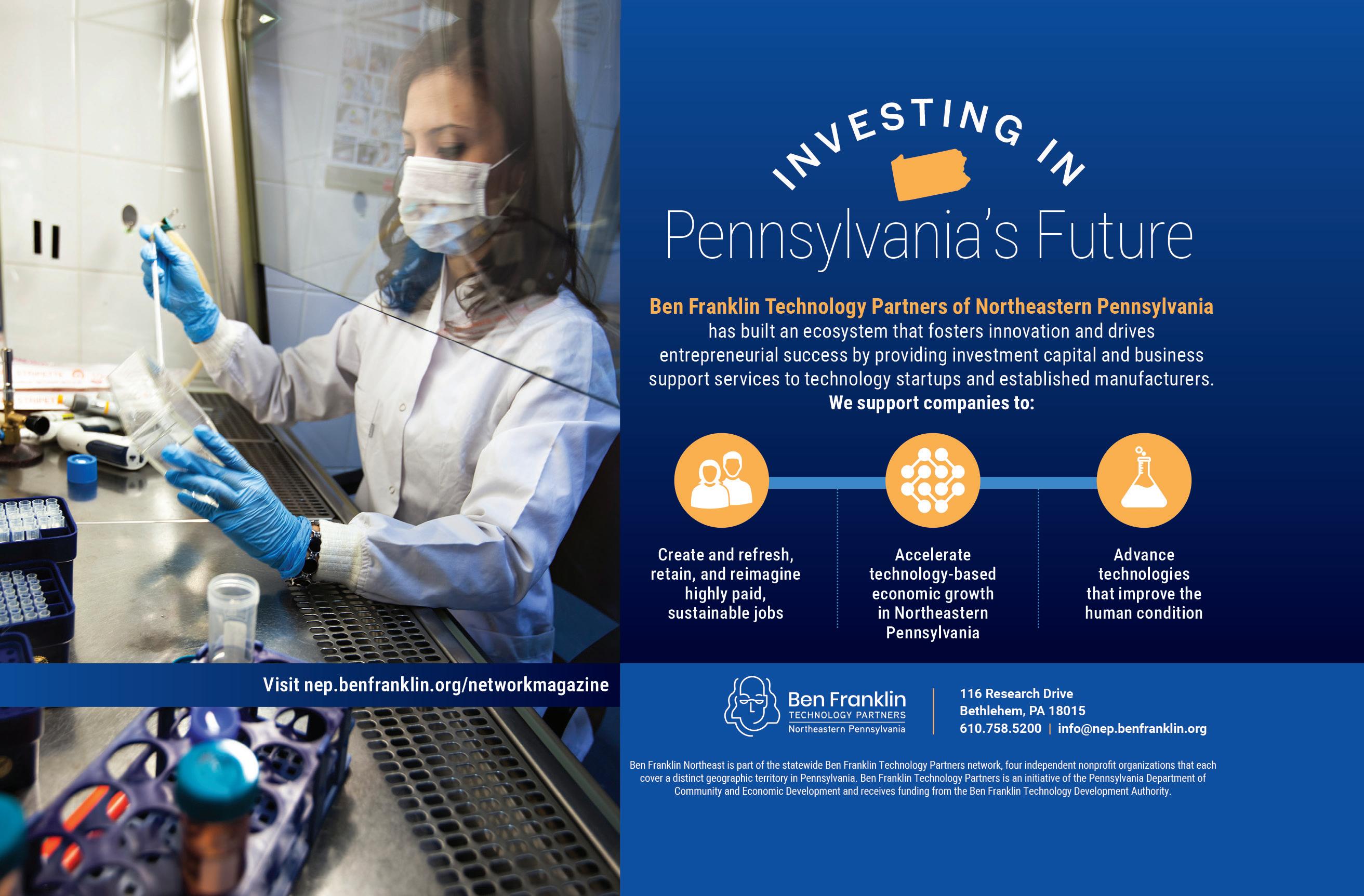
Ben Franklin Technology Partners of Northeastern Pennsylvania (Ben Franklin Northeast) is part of that ecosystem. We support technology-driven startups and early-stage manufacturers through early-stage capital, hands-on business support, and connections to partners and expertise that help accelerate commercialization. In Bethlehem, Ben Franklin TechVentures® provides a home base for early-stage companies, including life sciences startups that use our wet labs to support research, testing, and product development. We are currently working on an initiative to increase our lab space by over 50% to fuel the velocity of these startups in our area.
The life sciences sector is one where early support can materially change outcomes. The path to market is often complex and capital-intensive. Regulatory expectations, quality systems, clinical or technical validation, reimbursement considerations, cybersecurity requirements, and manufacturing
readiness can shape timelines, costs, and risk. Companies that address these realities early tend to build credibility faster with customers, partners, and investors. Companies that do not often encounter avoidable friction later, when course corrections are more expensive, and timelines are harder to control.
The upside is equally clear. Life sciences companies tend to create high-value jobs and attract follow-on investment. They also drive demand across legal, accounting, insurance, real estate, education, and workforce programs, as well as the manufacturing base that supports production, packaging, logistics, and specialized supply needs. When life sciences companies grow locally, the economic impact extends beyond the company itself and into the broader business community.
Companies that succeed in life sciences typically build a similar set of capabilities early. While the specifics vary by market and product category, the core needs are consistent:
• Milestone-based early capital to complete validation, prototyping, testing, and early customer discovery
• Commercial discipline including positioning, pricing logic, pipeline management, and repeatable go-to-market execution
• Operational and quality rigor including documentation habits, traceability, and systems that support regulated or high-reliability environments
• A connected network that links founders to manufacturers, research partners, service providers, and early customers
• A credible milestone plan that translates vision into near-term objectives that customers, partners, and investors recognize as measurable progress
Ben Franklin Northeast supports companies using a combination of capital, operating support, and network connectivity, with a focus on measurable advancement toward commercialization.
Ultimately, sustaining life sciences growth requires more than any one company or organization. It depends on the region’s ability to align capital, talent, facilities, and partnerships around measurable commercialization outcomes.
As our President and CEO, Angelo J. Valletta, describes the opportunity ahead: “Ben Franklin’s work is about helping the region refresh its innovation pipeline, retain high-potential companies and talent, and reimagine what growth can look like in the Lehigh Valley. When startups and early-stage
manufacturers can build and grow here, the impact shows up in jobs, new capabilities, and a stronger economic base for our communities.”
Ben Franklin’s commitment is straightforward. We will continue investing in companies building the next generation of life sciences products and technologies, helping founders strengthen the disciplines that make growth possible, and connecting partners across the region so progress accelerates and endures.
NETWORK MAGAZINE'S EXECUTIVE EDGE WITH KATELYN MACK | CEO, LINC
Is Fairness at Work a Value Worth Pursuing?
Fairness is one of those values most leaders champion without hesitation. Even if it is not explicit, it is implied in the way leaders describe their culture at work. After all, I've never heard an executive say they're aiming for unfair practices or policies, even if certain practices may unintentionally create that outcome.
Lately, I’ve been sitting with a more contemplative question: Is it worth valuing fairness at work as a core operating principle for how we run, recognize, and relate to others every day? And if the answer is “yes,” how do we reconcile fairness with the messy realities that make it difficult to deliver consistently?
That reflection crystallized for me during a recent LINC roundtable on the topic of fair-chance hiring, where the discussion illuminated that this approach is relevant for everyone in the workforce, not just those making hiring decisions.
Fair-Chance Hiring as a Case Study
Fair-chance hiring refers to strategies that expand candidate pools and remove unnecessary barriers for people impacted by the justice system. Nationally, one in three adults has a criminal record, which significantly impacts access to housing, education, and employment. Among formerly incarcerated individuals ages 25 to 44, 93% are working or want to work. Yet, unemployment still hovers around 30% for people with records.
In Lehigh Valley, PA, the effects are visible. Allentown’s own data shows a 12.1% prime-age employment gap in neighborhoods most affected by poverty and justice involvement.
Employment is one of the strongest predictors of successful reentry. The U.S. Chamber of Commerce published data in
2024 showing that individuals who secure employment after incarceration are less likely to return to prison over a 3-year period (16% vs. 52%).
For employers, implementing fair-chance policies and practices can be an immediate unlock for expanding the pool of candidates for open positions without lowering standards or increasing risk. Take a pretty standard practice: background checks. This nearly universal screening gives employers access to details of candidates’ criminal history regardless of its bearing on the job.
One of the first steps employers can take is to examine how background-check results are used. Are qualified candidates being screened out for issues unrelated to the role?
As Christopher Watler, Vice President at the Center for Employment Opportunities, shared during the roundtable: “Think about what the job is that you need done. What are the skills, and does the candidate match those skills?”
Still, many organizations hesitate to embrace fair-chance policies. Why?
One reason is the lack of awareness of the needs of justice-impacted individuals. For instance, a parole officer may require a same-day meeting without notice. An inflexible policy on paid time off or scheduling could jeopardize someone’s freedom and have nothing to do with poor performance. And these policies don’t just benefit a subset of employees. Flexible scheduling supports caregivers, working parents, and anyone navigating unexpected life events. It is not special treatment. It is a fair, predictable process.
Another reason is culture. Policies alone are not enough to make fair-chance hiring practices effective. The culture of work
teams determines whether inclusive policies stick. Trust is a critical ingredient. Inclusive leaders treat every employee as an asset and address behaviors that suggest otherwise.
This short case study illustrates that when we pursue fairness for one group, we often create better systems for everyone. It also shows that, while at times complicated, operationalizing fairness is worth it.
Zooming Out: Operationalizing Fairness
When I zoom out from hiring to the broader workplace, the research case for fairness is compelling. Perceived fairness is linked to higher job satisfaction, stronger commitment, better performance, and lower counterproductive behavior. Many studies find that how decisions are made matters just as much as what we decide.
Here are three practical steps to operationalize fairness across your workplace.
1. Standardize how decisions are made: Fairness flourishes when decision-making processes are transparent and consistent. Leaders can create clear, repeatable criteria for workload distribution, promotions, scheduling, project assignments, recognition, and conflict resolution.
Ambiguity is where bias hides. When people understand how decisions are reached, trust increases.
2. Build a culture that supports candor and trust: Fairness takes root when people trust one another at work. Leaders at any level can reinforce fairness through behavioral norms that cultivate psychological safety, which is the belief that it’s safe to speak up with ideas, questions, concerns, or mistakes. Leaders help cultivate this by modeling curiosity, generously giving credit, listening actively, and responding to feedback without defensiveness.
3. Use data to measure fairness: We can’t improve what we don’t measure. Leaders can use surveys, performance data, exit information, turnover patterns, and team climate measures to understand perceptions of fairness across the organization.
LINC is a Lehigh Valley-based nonprofit that envisions communities and workplaces where everyone feels welcome, gets rooted, and thrives. LINC partners with employers to attractandretaintalentfromdiversebackgroundsfromallover the world.
Tolearnmore,visitwww.linc-lv.org.
The Power of the Ask
ANNE CORLEY BAUM, FOUNDER, VISION
ACCOMPLISHED, LLC
Every single day, we deal with questions. Whether it’s answering or deciding how to ask them, questions help us navigate our world, learn something new, and create change. Yet one of the hardest decisions that hinders people from growth and success lies in the first step: making the ask.
So often, people will not ask for something because they’re afraid of the answer. Will the answer be no? Will they think it’s a dumb question? Will I look foolish? Almost every day, I’ll hear someone say, “They'll never do that,” or “I’m afraid of what they’ll say,” letting fear be the driver and allowing assumption to rule the decision.
In my career, I’ve had amazing opportunities present themselves when I simply asked the question. Asking has opened doors, fostered meaningful relationships, and built a life that would have been very different if I hadn’t made the ask. Change came from asking for what was important to me, and from asking questions that would have led me to say no to opportunities had I not asked. Asking for things that mattered to me created forward momentum that has brought me to where I am today. Even when the questions were difficult to ask, finding the courage to do so has taught me one very powerful lesson: if you don’t ask, the answer is guaranteed to be no.
Asking for change creates opportunity and invites exploration; whether it’s asking for a promotion or inquiring about a more efficient process at work, it opens the door for discussion. While the outcome after asking may still be a no, that doesn’t mean that you’ve reached the end of the road; it’s yet another opportunity to find a middle ground in advocating for change.
For example, if you’re asking your employer for something and they decline, the conversation doesn't have to end there. There is always another opportunity to create a plan to achieve results.
Here are a few questions to consider when met with a “no”:
• What would it take to make something like this happen?
• What skills will I need to learn to take the next step?
• What are areas in which I can improve?
The most important thing when faced with a “no” is not to shut down or give up; hold your head high and remember that you have the ability to create positive change in your life and your company.
Equally as important as having the courage to ask is having the courage to listen to and truly consider what is being asked. I challenge leaders to be open to receiving questions. Great ideas emerge from collaboration and conversation, so instead of immediately writing something off as "not possible," invite possibility into your mindset. If you have your mind made up when somebody asks you a question, you'll feel that impulse to automatically say no. But I encourage leaders to read between the lines, ask their own questions, and learn what inspired the person to ask the question. The idea presented may have merit with some additional discussion. Though it may not be totally right, that doesn't mean that the idea isn't worth exploring.
Here are a few questions for leaders to ask themselves when met with a question:
• What would need to exist to make this possible?
• If this idea isn’t feasible as is, is there a version of it that could exist?
• What might I do to support this concern in an alternative way?
Questions never guarantee outcomes, but they’re essential to progress, both for you personally and for your organization. They create opportunity, and whether you’re a leader or looking to grow into one, being open to change welcomes success and innovation.
Ask the question! Be open to transformation! Enjoy the positive results!
NETWORK MAGAZINE TECH TALK FOR SMBS
With
Eric DiFulvio, Co-CEO, MCIT
New Research Says AI Is Reshaping Your Team.
Here's How.
If you're a small business owner or an employee who's been treating AI as tomorrow's problem, two major research efforts want a word with you. A Harvard Business School working paper and a March 2026 report from Anthropic together paint the clearest picture yet of how AI is already reshaping the workforce — and what's at stake for those who don't respond.
THE SHIFT IS ALREADY UNDERWAY
The HBS team, led by Professor Suraj Srinivasan, analyzed nearly every U.S. job vacancy posted between 2019 and March 2025. Since ChatGPT launched in late 2022, job postings for roles dominated by structured, repetitive tasks dropped by 13 percent. Demand for roles where AI enhances the worker rather than replaces them grew by 20 percent. Finance and tech saw the steepest declines in automationprone postings.
Anthropic's report added a critical layer: a measure of which jobs are actually seeing AI automation in practice, not just in theory. Computer programmers top their exposure list at about 75 percent task coverage, followed by customer service reps at 70 percent, data entry keyers at 67 percent, and financial analysts at 57 percent. Meanwhile, cooks, mechanics, construction workers, and personal care aides have essentially zero AI task coverage today.
These aren't projections. They're measurements of what's already happening.
WHAT EMPLOYEES’ RISK BY STANDING STILL
Here's the uncomfortable part. The Anthropic researchers found that the workers most exposed to AI aren't on the warehouse floor. They're more likely to be female, college-educated, and earning nearly 50 percent more than workers in unexposed roles. People with graduate degrees are almost four times as common in the most-exposed group.
Credentials alone won't protect you.
There's no mass unemployment yet — the data shows no systematic increase in job losses among highly exposed workers so far. But the early warning signs are real. Hiring of workers aged 22 to 25 has slowed in exposed occupations, with a roughly 14 percent drop in job-finding rates since ChatGPT's release. No similar decline exists for workers over 25. If you're early in your career and sitting in a customer service, data entry, or analyst role without building AI-complementary skills, you're watching the ladder get pulled up while you stand on it.
And it's not just young workers who should be paying attention. The HBS study found that the number of skills required for automationprone roles is already shrinking, down 7 percent. That means the roles themselves are getting narrower, and the workers in them are becoming easier to replace. Every month you delay learning to work alongside AI tools is a month your value proposition gets thinner.
WHAT BUSINESS OWNERS’ RISK BY WAITING
Both studies converge on a critical point: businesses that treat AI as a tool to make their people better — not a reason to cut headcount — are the ones seeing demand for their roles grow. The 20 percent surge in AI-augmented job postings reflects companies that are already pairing their teams with AI to boost productivity and decision quality.
The flip side is what happens if you don't. If your competitors are using AI to make their customer service faster, their analysis sharper, and their marketing more targeted — while your team is doing everything manually — you're not standing still. You're falling behind. The cost isn't just efficiency. It's talent. Workers with AI skills will increasingly gravitate toward companies that give them the tools to do their best work. SMBs that ignore this will find themselves competing for a shrinking pool of candidates who haven't yet adapted either.
The HBS researchers were direct: firms should view generative AI as an augmentation tool, not merely a cost-cutting measure. But the inverse is also true. Firms that view AI as irrelevant to their workforce are making a bet against every trend in the data.
WHAT TO DO ABOUT IT
For employees: learn the tools. Get comfortable with ChatGPT, Claude, Copilot — whatever your industry uses. Develop the skills AI can't replicate: judgment, interpersonal communication, creative problem-solving. Don't wait for your employer to offer training. The workers who adapt first will have the most options.
For business owners: audit your workforce. Which roles are heavy on repetitive, structured tasks? Those are your highest-risk positions. Which blends those tasks with judgment and relationship management? Those are where AI investment will pay off. Make AI literacy a baseline expectation across your organization — not just in
IT. And invest in reskilling now, while it's a strategic choice rather than a crisis response.
THE BOTTOM LINE
Neither study predicts a jobs apocalypse. But both make clear that the labor market is in transition, and the line between displacement and opportunity runs through the decisions being made right now. The research shows what happens when businesses and workers lean into AI: roles grow, skills expand, and productivity rises. What it doesn't yet show — because we're still early — is the full cost of doing nothing.
But every leading indicator points in the same direction. The time to act was yesterday. The next best time is today.
NETWORK MAGAZINE FITNESS TALK FOR THE BUSY PROFESSIONALS
Summer Training Starts Now: Use Spring to Build Momentum, Strength, and a Body Ready for Summer
Spring is the secret weapon for the busy professional who wants to look and feel great by summer. If your calendar is packed with meetings, deadlines, and family commitments, waiting until June to “get serious” puts you behind. Starting in spring gives you the runway you need—without extreme diets or two-a-day workouts.
Here’s why spring is the smartest season to get in shape, and how to make it work with a demanding schedule.
1. You Have a Strategic Time Advantage
Getting in shape isn’t about crash programs. Sustainable fat loss and muscle tone typically happen at a rate of 1–2 pounds per week. Starting in March or April gives you 8–12 weeks before peak summer activities.
That timeline means:
• Gradual fat loss without tanking your energy at work
• Time to build visible muscle definition
• Space to form habits that stick
Busy professionals thrive on strategy. Think of spring training as a quarterly performance plan for your body.
2. Energy Naturally Increases
Longer daylight hours improve mood, sleep rhythms, and overall motivation. You’re more likely to:
• Wake up earlier for a workout
• Take walking meetings
• Spend time outdoors after work
After a winter of lower activity, spring feels like a reset. Instead of forcing discipline in January’s darkness, you’re aligning with rising energy and better weather.
3. You Avoid the Summer Panic Cycle
Every year, many professionals hit late May and attempt extreme fixes:
• Severe calorie cuts
• Excessive cardio
• Overtraining that leads to burnout or injury
This approach backfires. Energy crashes. Productivity suffers. Consistency disappears.
Starting in spring removes urgency and replaces it with control. You’re not scrambling—you’re executing.
4. Work Performance Improves Alongside Fitness
Exercise isn’t just about aesthetics. It improves:
• Cognitive clarity
• Stress resilience
• Decision-making speed
• Sleep quality
High-performing professionals often notice that regular training sharpens their focus during presentations, negotiations, and long strategy sessions. Spring is a perfect time to rebuild that edge after winter sluggishness.
RYAN DRURY, CEO, MADE OF MUSCLE TRAINING®
5. Spring Social Momentum Helps
Warmer weather means:
• Outdoor workouts
• Recreational sports leagues
• Networking events that involve activity
Instead of isolating yourself on a treadmill indoors, you can integrate movement into your social and professional life. That makes consistency far easier.
Summer bodies aren’t built in summer. They’re revealed in summer.
Spring gives you:
• Time to progress gradually
• Less stress
• Better adherence
• Improved professional performance
When June arrives, you won’t be starting—you’ll be refining.
For the busy professional, that’s the difference between reacting and leading.
Reach out to Ryan Drury, Owner, Made of Muscle Training® to get ready for Summer!
Candy Mountain & The Rise of Micro AVA Prestige
KIM MCCULLOUGH, OWNER, CELLAR BEAST WINEHOUSE
There is something distinct about standing on Candy Mountain at sunrise.
The air feels sharper. The wind moves differently across the slopes. When you walk the rows, you sense the tension in the fruit - the kind of concentration that only comes from a site that demands resilience from the vines.
At Cellar Beast, we believe great wine begins long before fermentation. It starts in the vineyard: in the soil, in pruning decisions, and in the conversations growers and winemakers have about yield, irrigation, and timing. That belief is why our team travels to Washington each year. We walk the vineyards. We meet with our growers. We taste berries and discuss the season, looking not just at the current harvest, but at the long-term trajectory of each site.
Candy Mountain AVA has become one of the places that consistently commands our attention.
Why Micro AVAs Matter
Candy Mountain is one of Washington’s smallest AVAs, situated beside Red Mountain but defined by its own character. Its southfacing slopes, nutrient-poor soils, and intense sun exposure produce fruit with remarkable structure and concentration. Berries tend to be smaller, skins thicker, and tannins more defined.
For decades, consumers primarily recognized broad regions. Today, many are seeking greater precision. They want to know not only the varietal or state, but the specific origin of the wine in their glass. Micro AVAs offer that level of identity and site expression.
For Cellar Beast, sourcing from Candy Mountain has never been about prestige for its own sake. It has always been about character.
We have worked with Cabernet Sauvignon and Malbec from the site for several years. These wines consistently show depth, dark fruit concentration, and a mineral backbone that brings structure and longevity. In the 2025 harvest, we expanded our commitment, sourcing Grenache and Mourvèdre as well. Rhône varieties grown in this environment develop a compelling balance of fruit and savory structure, adding complexity and tension to our blends.
Relationships Before Contracts
Success in micro-AVA sourcing depends on more than site selection. It depends on relationships.
Each year, our team travels west not simply as buyers, but as partners. We spend time at Pontin del Roza, visit Shaw’s vineyards on Red Mountain, and walk through The Rocks District, where cobblestone soils shape Syrah with unmistakable savory depth.
On Candy Mountain, our visits go beyond evaluating clusters. We discuss canopy management, water stress, heat spikes, and long-term vineyard strategy. We review what worked and what can be refined. These conversations build trust and alignment, which ultimately influence quality in the vineyard and consistency in the winery.
For me, that alignment is essential. When growers know we respect their land and their craft, they invest in the relationship just as deeply. That mutual commitment is reflected in the fruit and, ultimately, in the wine.
The Business Case for Small
From a business perspective, micro AVAs are both strategic and demanding. Production is limited. Yields are often lower. Fruit costs are higher.
But differentiation has become increasingly important. Consumers are more informed and more curious. They want authenticity, transparency, and a clear sense of place. Micro AVAs allow wineries to tell a deeper story - one rooted in geography, intention, and collaboration.
Candy Mountain fruit brings structure and focus to our cellar. It shapes our Cabernet-based wines, sharpens Rhône blends, and adds dimension to our portfolio. More broadly, it reflects a shift in the industry toward site-driven winemaking.
Walking Toward the Future
Every visit to these vineyards is a reminder that wine is both agricultural and relational. It is defined by soil and sun, but also by trust and shared vision.
Micro AVAs like Candy Mountain represent the future of premium wine: smaller sites, greater precision, and stronger partnerships between growers and producers. For Cellar Beast, they also represent a commitment to pursue excellence at its source.
Standing on Candy Mountain at sunrise makes that clear. Prestige is not about scale. It is about intention. And intention is what transforms a vineyard into something unforgettable.
Alaska in February: A Winter Wonderland of Flavor and Adventure
JENNIFER
DONCSECZ,
C.T.I.E., VTA PRESIDENT, VIP VACATIONS INC
CERTIFIED TRAVEL INDUSTRY EXECUTIVE
VERIFIED TRAVEL ADVISOR
While many travelers wait for the midnight sun of July to visit the Last Frontier, there is a quiet, shimmering magic that only reveals itself during the winter months. Traveling to Alaska during the heart of winter offers a perspective that summer tourists simply miss. Between the snow-dusted peaks surrounding Anchorage and the quirky, artistic charm of Talkeetna, a winter journey through Southcentral Alaska is a sensory feast of crisp air, surreal landscapes, exhilarating experiences, and legendary local flavors. After traveling to Alaska this past February, I have the perfect tour detailed below.
The Flavors of Anchorage
Anchorage serves as the ideal basecamp for a winter expedition. One of the best ways to get acquainted with the city is through a guided food tour. Food tastings include tearing into a warm, tangy loaf of legendary sourdough, which provides a literal taste of Alaskan resilience, as many starters date back to the gold rush. Next up, sample Alaska's world-renowned salmon and the many recipes that highlight this glorious pink staple.
To wash it all down, Anchorage boasts a thriving microbrewery scene. The tour also includes a drive along the Seward Highway, officially one of the most scenic routes in the United States. During my time in February, the Turnagain Arm was filled with dramatic ice floes that shift with the tide against a backdrop of jagged, white-capped mountains and low clouds, creating an almost mystical view. Pro tip: The driver/guide of Sites and Bites tours shared witty historical stories and insights into the delicious food scene, which created a memorable experience.
The Rail to Talkeetna
From Anchorage, the journey continues north via the historical Alaska Railroad. The train ride to Talkeetna is a masterclass in relaxation, offering panoramic views of the frozen Susitna River and skeletal birch forests. Elk, Moose, and other wildlife can be seen, as well as the stunning views of neighboring mountains and snow-covered lakes. Arriving in the one-road town of Talkeetna during their Ice Festival is a treat, as the town transforms into a gallery of frozen art. After walking over train tracks to view the pink mountains at sunset, the town’s Fairview Inn is the perfect spot for a nightcap and to listen to local bands.
The highlight of any Talkeetna visit is an epic flightseeing tour with K2 Aviation. Soaring around the massive granite shoulders of Mt. Denali, the tallest mountain in North America, provides a scale of beauty that is impossible to grasp from the ground. A flightseeing adventure is not only thrilling but also awe-inspiring. There is no better way to see Alaska's glaciers, mountains, and magnificent landscape. As night falls, the sky over this remote village becomes the perfect setting for viewing the Northern Lights, where green ribbons of aurora often dance above the quiet taverns.
Adventure in Eklutna
The journey then leads to Eklutna for a quintessential Alaskan experience: dog sledding. With Snow Hook Adventures, the power of a hushed team of Alaskan Huskies pulling a sled through the silty, snow-covered trails is fun and exhilarating. Between the friendly dogs, the comical guides, and the whooshing through the woods on sleds, this was by far one of the most enjoyable experiences. Snow Hook Adventures uses real Iditarod sleds, and many of their guides and dogs have competed in the Iditarod Race.
Nearby, Bluewater Basecamp offers a sanctuary in beautiful cabins that feel like a private slice of the wilderness. Bluewater Basecamp, near Chugach State Park, is perfectly situated to enjoy a fun morning of snowshoeing. The guides from Go Hike Alaska provide all the gear and escort you over icy Lake Eklutna. Trekking through the forests and walking over the foot of ice on Lake Eklutna was a great way to learn about the area, see wildlife, and enjoy the views of the famous Twin Peaks in the distance, After a morning of snowshoeing across the solid, turquoise-tinted expanse of Lake Eklutna, travel back to Anchorage enjoying the stunning sunset along the Tony Knowles Coastal Trail, specifically at Point Woronzof near the South Addition neighborhood which offer unobstructed views of Cook Inlet and the picture perfect Alaska Range.
A Sweet Farewell
Finally, the winter loop concludes back in Anchorage with a visit to the Alaska Native Heritage Center. This cultural hub provides essential context to the lands just traveled, sharing the stories and traditions of the Indigenous peoples who have thrived here for millennia. Before heading to the airport, a stop at Wild Scoops is mandatory. Their imaginative ice cream flavors, developed by a local science teacher, often feature local ingredients like sea salt or berries, and prove that it is never too cold for an ice cream cone in Alaska.
Want to experience this invigorating winter wonderland? Feel free to reach out to VIP Vacations Inc., www.vacationsbyip.com
Understand the Moment
LARRY HOLMES JR., FOUNDER, LEGENDS CIGAR BAR
A proper cigar review shouldn't feel like a checklist.
It should feel like a recommendation from someone who understands the setting — the leather chair, the low light, the pour in your hand, and the conversation across the table.
This month's selections aren't about intensity. They're about timing and presence.
Two are refined classics. One is a revived name with an inviting edge.
Each belongs in a well-run lounge — whether that's a private club or your own back patio at dusk.
Arturo Fuente
Hemingway Short Story
Body: Medium
Best Moment: Early evening or between commitments.
One of the most complete cigars you can smoke in under an hour.
The tapered foot starts focused, then opens into a steady, balanced burn.
Cedar leads. Warm toast follows. Roasted almond and a touch of cinnamon round it out. The smoke stays creamy and composed from beginning to end.
This isn't about power. It's about balance.
Arturo Fuente has spent generations refining that balance, and the Hemingway line remains one of its most recognizable expressions.
Ideal when you have 40 minutes and good company. Bourbon or espresso both fit naturally.
It burns cool. It finishes clean. It never overreaches.
Arturo Fuente Don Carlos
Body: Medium to Full
Best Moment: After dinner, when the room settles
If the Short Story is relaxed confidence, Don Carlos is precision.
The profile runs deeper and is more structured. Rich cedar anchors the experience, followed by espresso, dark cocoa, and warm baking spice that lingers into the final third.
The smoke feels silkier. The finish stays dry and deliberate.
Named in honor of Carlos Fuente Sr., this line reflects the discipline that built one of the most respected family legacies in cigar history.
This is not a quick cigar.
It's the one you light when you've decided to stay awhile.
A structured bourbon or bold red pairs well, but it doesn't need assistance.
Sarzedas by J.C. Newman
Body: Mild to Medium
Best Moment: Social evenings or introducing someone new to cigars
Sarzedas fills an important lane in a modern lounge. It's approachable without feeling artificial.
Originally introduced more than a century ago and once known as "The Aromatic Cigar," the brand has been revived with the same spirit of accessibility.
A subtly sweetened cap softens the first draw, while the tobacco remains the focus. Cream, honeyed cedar, light vanilla, and gentle spice define the experience.
This is the cigar you offer someone new to cigars. It's also the one a seasoned smoker may choose on a relaxed evening when balance matters more than strength.
It complements the space rather than dominating it.
That restraint is part of its appeal.
The Legends Standard
The best cigars were never about strength. They were always about intention.
The right cigar fits the moment. It respects the setting. It enhances conversation without competing with it.
How you smoke matters as much as what you smoke. Pace matters. Awareness matters.
What matters most is that the experience brings you back to the moment.