Since May 2007 PRESORT STANDARD US POSTAGE PAID CHARLESTON, SC PERMIT NO. 137 POSTAL PATRON
Volume 22 • Issue 4
FREE
February 20, 2026
Support for Seabrook Island Birders continues flying high
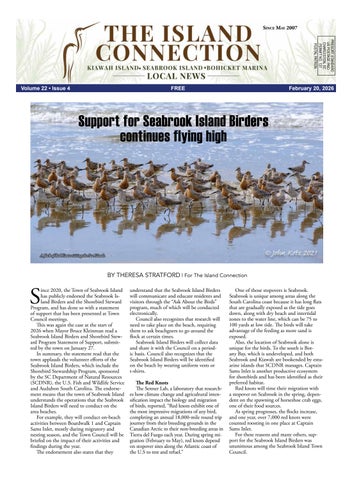
A flock of Red Knots visiting the Sea Islands.
BY THERESA STRATFORD | For The Island Connection
S
ince 2020, the Town of Seabrook Island has publicly endorsed the Seabrook Island Birders and the Shorebird Steward Program, and has done so with a statement of support that has been presented at Town Council meetings. This was again the case at the start of 2026 when Mayor Bruce Kleinman read a Seabrook Island Birders and Shorebird Steward Program Statement of Support, submitted by the town on January 27. In summary, the statement read that the town applauds the volunteer efforts of the Seabrook Island Birders, which include the Shorebird Stewardship Program, sponsored by the SC Department of Natural Resources (SCDNR), the U.S. Fish and Wildlife Service and Audubon South Carolina. The endorsement means that the town of Seabrook Island understands the operations that the Seabrook Island Birders will need to conduct on the area beaches. For example, they will conduct on-beach activities between Boardwalk 1 and Captain Sams Inlet, mostly during migratory and nesting season, and the Town Council will be briefed on the impact of their activities and findings during the year. The endorsement also states that they
understand that the Seabrook Island Birders will communicate and educate residents and visitors through the “Ask About the Birds” program, much of which will be conducted electronically. Council also recognizes that research will need to take place on the beach, requiring them to ask beachgoers to go around the flock at certain times. Seabrook Island Birders will collect data and share it with the Council on a periodic basis. Council also recognizes that the Seabrook Island Birders will be identified on the beach by wearing uniform vests or t-shirts. The Red Knots The Senner Lab, a laboratory that researches how climate change and agricultural intensification impact the biology and migration of birds, reported, “Red knots exhibit one of the most impressive migrations of any bird, completing an annual 18,000-mile round trip journey from their breeding grounds in the Canadian Arctic to their non-breeding areas in Tierra del Fuego each year. During spring migration (February to May), red knots depend on stopover sites along the Atlantic coast of the U.S to rest and refuel.”
One of those stopovers is Seabrook. Seabrook is unique among areas along the South Carolina coast because it has long flats that are gradually exposed as the tide goes down, along with dry beach and intertidal zones to the water line, which can be 75 to 100 yards at low tide. The birds will take advantage of the feeding as more sand is exposed. Also, the location of Seabrook alone is unique for the birds. To the south is Botany Bay, which is undeveloped, and both Seabrook and Kiawah are bookended by estuarine islands that SCDNR manages. Captain Sams Inlet is another productive ecosystem for shorebirds and has been identified as their preferred habitat. Red knots will time their migration with a stopover on Seabrook in the spring, dependent on the spawning of horseshoe crab eggs, one of their food sources. As spring progresses, the flocks increase, and one year, over 7,000 red knots were counted roosting in one place at Captain Sams Inlet. For these reasons and many others, support for the Seabrook Island Birders was unanimous among the Seabrook Island Town Council.