MyHVP Newsletter June 2015 | Issue 4 | Vol. 4
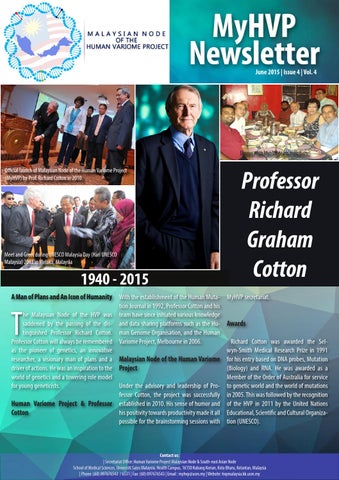
Dinner with MyHVP team members Official launch of Malaysian Node of the Human Variome Project (MyHVP) by Prof. Richard Cotton in 2010.
Meet and Greet during UNESCO Malaysia Day (Hari UNESCO Malaysia) 2013 in Melaka, Malaysia
1940 - 2015 A Man of Plans and An Icon of Humanity With the establishment of the Human Mutation Journal in 1992, Professor Cotton and his he Malaysian Node of the HVP was team have since initiated various knowledge saddened by the passing of the dis- and data sharing platforms such as the Hutinguished Professor Richard Cotton. man Genome Organisation, and the Human Professor Cotton will always be remembered Variome Project, Melbourne in 2006. as the pioneer of genetics, an innovative researcher, a visionary man of plans and a Malaysian Node of the Human Variome driver of actions. He was an inspiration to the Project world of genetics and a towering role model for young geneticists. Under the advisory and leadership of Professor Cotton, the project was successfully Human Variome Project & Professor established in 2010. His sense of humor and Cotton his positivity towards productivity made it all possible for the brainstorming sessions with
T
Professor Richard Graham Cotton MyHVP secretariat. Awards Richard Cotton was awarded the Selwyn-Smith Medical Research Prize in 1991 for his entry based on DNA probes, Mutation (Biology) and RNA. He was awarded as a Member of the Order of Australia for service to genetic world and the world of mutations in 2005. This was followed by the recognition of the HVP in 2011 by the United Nations Educational, Scientific and Cultural Organization (UNESCO).
Contact us: | Secretariat Office: Human Variome Project Malaysian Node & South-east Asian Node School of Medical Sciences, Universiti Sains Malaysia, Health Campus, 16150 Kubang Kerian, Kota Bharu, Kelantan, Malaysia | Phone :(60) 097676543 / 6531 | Fax: (60) 097676543 | Email : myhvp@usm.my | Website: hvpmalaysia.kk.usm.my
MyHVP Newsletter
Head’s Address
Board of Editors 2015 June 2015 Issue | Vol. 4
O
Editor in Chief Professor Dr. Zilfalil Alwi
n 14th June 2015, Professor Richard Graham Cotton, the founder of Human Variome Project (HVP), passed away in Melbourne following a stroke. He established HVP in 2006 which brought together geneticists from across the world to this global project with the aim of sharing their discovery of our genes, variants and phenotypes freely and openly. The HVP is a new chapter in the world of biomedical sciences, marking an evolution leading to speedier, better and cheaper diagnosis or treatment of genetic disorders, and better insight into the causes, severity and effect of common disease.
Managing Editor Assoc. Prof. Dr. Wan Zaidah Abdullah Editorial Board Members Prof. Ida Madieha binti Azmi Assoc. Prof. Dr. Endom Ismail Dr. Nik Norliza Bt Nik Hassan Dr. Muhammad Farid Johan Dr Rosnah Bahar Dr. Azlina bt Ahmad Annuar Mr. Abdul Halim Fikri Bin Hashim English Editor Amyzar Alwi
Contents
02 Head’s Address Report 06 HVP-SEA Node 03 Report Report 04 When a Geneti- 07 Postgraduate cist Writes 08 Photo Diary 05 EduVariome © All rights reserved. The information in this newsletter is provided by the Malaysian Node of the Human Variome Project (MyHVP) members including South-east Asian Node (HVPSEA Node) for educational / information purpose only. It is not a substitute for professional medical care and medical advice. The contents express the opinions of the authors who alone are responsible for their view expressed. MyHVP does not accept any legal responsibility for their contents.
Writers, Invited!
For the coming issue, we are going to invite the public from various fields and specialties in order to share with us, their experience in dealing with the issues of medicine or biomedicine. Writers may contribute their writing with these following criteria: 1. Length (Max. 1page A4 size, and it may be edited for our use) 2. The committee has the right to share your writing for further issues. 3. To suit the needs of the publication, and your writing won’t be returned 4. Emailed the article to myhvp@usm.my
One of the prestigious human genomic meetings in the world, the Human genome Organisation (HUGO) Human Genome Meeting (HGM), was held in Kuala Lumpur in March (14 - 17 March 2015). The HGM2015 was hosted by Malaysia through the Malaysian Node of the Human Variome Project (MyHVP), Universiti Sains Malaysia (USM), the Genetics Society of Malaysia (PGM), Malaysian Society of Human Genetics (MSHG) and Malaysia Convention & Exhibition Bureau (MyCeb). The HGM is a series of annual conference which has been held in various countries worldwide. The meeting HGM 2015 has successfully brought more than 380 delegates from 47 countries throughout the world. The theme “Transforming Human Genomics for A Sustainable Tomorrow” has laid foundations on the scientific dynamics in formulating future agenda in human genetics for the betterment of humankind. By taking MyHVP as a model to other southeast asia countries in developing the Human Variome Project country node, it is hoped that MyHVP is able to assist individuals and the lower and middle income countries (LMIC) build their capacity to address the genetics aspects of individual and global health.
The USM – MyHVP – Sengenics Laboratory completed the renovation of the lab on 18th June 2015 in the middle of year 2015. This lab signifies a smart partnership between a public and private institution. It will also boost the genomic profiling activities undertaken by members of MyHVP. MyHVP is very honoured to be involved as the co-chair of the HVP global initiative, the Global Globin 2020 Challenge or GG2020 Challenge. GG2020 Challenge is an initiative of the HVP aimed at building medical genetics and genomics capacity, particularly in low-and middle-income countries (LMIC). This global initiative will apply recent developments in human genomics involving the systematic collection and sharing of genetic variation data to fighting haemolytic anaemias with initial focus on Thalassaemia and Sickle Cell disease. The GG2020 Challenge hopes to build an evidence base for an efficient management of local treatment, care and eventually cure for these diseases by ensuring a sufficient local capacity to deliver services in these countries. By achieving this, it is hoped that the skills and expertise in genomic medicine is further honed to effectively tackle other health issues in these countries as well. I would like to thank the hardworking editorial board members for publishing this fourth publication of MyHVP Newsletter. I hope MyHVP will move forward in the line with the four areas of HVP which are: (i) setting normative function; (ii) behaving ethically; (iii) sharing knowledge; and (iv) building capacity. Thank you. Prof. Dr. Zilfalil Alwi Head, Malaysian Node of the Human Variome Project Universiti Sains Malaysia (Health Campus) MyHVP Newsletter | June 2015 | page 2
Report Report on The Human Genome Meeting 2015(HGM2015) Transforming Human Genomics for A sustainable Tomorrow
4 years. The theme for HGM 2015, “Transforming Human Genomics for a Sustainable Tomorrow”, set the agenda for the field of human genetics for the betterment of mankind.
14-17 March 2015, Kuala Lumpur Convention Centre, Malaysia The Opening Ceremony on 14th April 2015 began with speeches
by the President of HUGO and the Local Organising Chairman. The event was officially declared opened by the Deputy Vice Chancellor School of Medical Sciences, Universiti Sains Malaysia, Health Campus & MyHVP member (Research & Innovation), Universiti Sains Malaysia, Prof. Dato’ Muhe Human Genome Meeting (HGM) 2015 was held at the Kuala hammad Jantan. This was followed by performances of traditional Lumpur Convention Centre from the 14th till 17th April 2015 Malay dance by school children. The Opening Plenary was delivered attended by 386 participants which included 242 international by Tan Sri Zakri, Science Advisor to the Prime Minister of Malaysia. delegates from 47 countries and 16 faculty members comprising 9 invited speakers from Malaysia. A total of 161 posters and 30 papers The organising committee would like to thank the Kuala Lumpur Convention Centre and all sponsors for hosting the industry-sponwere presented at the HGM. sored symposia (including lunch talks) as well as other sponsors The first bid to host HGM was held on 14th March 2011 during the listed in the programme book for hosting the exhibition booths. We HGM in Dubai. Upon endorsement by the Human Genome Organi- thank our professional conference organiser, MCI (Geneva) for their sation (HUGO) in 2011, the Local Organising Committee led by Prof. expertise and members of MSHG, MGMS, GSM, MyHVP and MyCEB Zilfalil Alwi were entrusted with the task of planning and organis- for their support and participation. ing the 18th edition of HGM 2015 in Kuala Lumpur spanning over Prepared by Dr. Sarina Sulong
T
CONFERENCE INFORMATION Date : 14-17 March 2015 Venue : Kuala Lumpur Convention Centre, Kuala Lumpur, Malaysia Main organiser : Human Genome Organisation (HUGO) Local host : Universiti Sains Malaysia Co-hosted by : Malaysian Society of Human Genetics (MSHG), Genetics Society of Malaysia (GSM), Medical Genetics Society of Malaysia (MGSM), Malaysian Node of the Human Variome Project (MyHVP), Malaysia Convention & Exhibition Bureau (MyCEB). LOCAL ORGANISING COMMITTEE: Zilfalil Alwi, Universiti Sains Malaysia (CHAIR) Amir Feisal Merican bin. Aljunid Merican, University of Malaya Roziana Ariffin, Hospital Kuala Lumpur Rosline Hassan, Universiti Sains Malaysia Vijay Kumar, Universiti Malaysia Sabah Zarina Abdul Latiff, Universiti Kebangsaan Malaysia Muhammad Hamdi bin Mahmood, University Malaysia Sarawak Zahurin Mohamed, University of Malaya Maude E. Phipps, Monash University, Malaysia Rozita Rosli, Universiti Putra Malaysia Ashley Edward Roy A/L Soosay, Universiti Malaysia Sarawak Sarina Sulong, Universiti Sains Malaysia
Wan Rohani Wan Taib, Universiti Sultan Zainal Abidin Thong Meow Keong, University of Malaya Narazah Mohd Yusoff, Universiti Sains Malaysia Zubaidah Zakaria, Medical Research Institute CONFERENCE PROGRAMME Summary of programme: 6 Plenary Sessions 1 Special Session on HUGO-OECD Joint Session 1 Special Session on Distinguished Speakers 1 Special Session on Chen Award & HUGO-African Prize 1 Special Session on HVP Malaysia Session 9 Symposia 1 Lunch Symposium (sponsored by Bio-Rad) 1 Sponsored symposium by Pacific Biosciences 2 Sessions on Oral Presentation HUGO Members’ Meeting Exhibition & Poster session Oral (free paper) presentation *All the program photos are provided at the page 8.
MyHVP Newsletter | June 2015 | page 3
When a Geneticist Writes My first research in human genetics and encounter with the Human Variome Project Prepared by: Dr. Hjh Masrinawati Binti Hj Abdul Hamid Institute of Health Sciences, Universiti Brunei Darussalam
T
he year 2011 was significant for human genetics research at our Institute Health Sciences in Brunei Darussalam, and my interest in particular because I obtained a research funding from Universiti Brunei Darussalam that allowed me to start a project on a long standing interest in mutation analysis of BRCA1 and BRCA2 genes in breast cancer in Brunei Darussalam. The project generated great interest among my final year honours students and a research assistant with whom I had worked closely. The collaboration with The Brunei Cancer Centre was very important as breast cancer patients were recruited from the centre after getting ethical approval from the national Medical Health Research and Ethics Committee. Within the same year I was very fortunate to meet Professor Zilfalil Alwi from Universiti Sains Malaysia, Kota Bharu, Kelantan at an EU-ASEAN workshop on Bioinformatics in Kuala Lumpur, Malaysia. Subsequently, Professor Zilfalil introduced me to the Human Variome Project and the ASEAN member country nodes with whom we have developed friendship and plans for collaborative research projects. I have also been fortunate to have met so many other young enthusiastic researchers and senior scientists and academics at USM and other universities in Malaysia through my association with the South-east Asian HVP node. I hope to further develop human genetics research in Brunei Darussalam and strengthen our association with MyHVP and SEAHVP. Albeit slow, the BRCA1 and BRCA2 mutation analysis project has produced some genetic data for the Brunei breast cancer patient population. We will continue working on this project to collate data is of substantial quantity and quality to be shared. I hope that our association in SEA HVP will develop into a more significant partnership by collaborating in research projects that will further enrich our knowledge of the common genetics that we may have in this region either in health or disease. The suggestion to embark on research on hemoglobinopathies with HVP is an exciting thought and will bear significant and relevant information on the similarities and differences of the genotypes of this group of diseases in South-east Asia. I look forward to meeting friends and colleagues at the HVP session during the 10th APHGC in Hanoi, Vietnam, 16 to 18 September 2015.
Dr. Masrina with others HVP Southeast Asian Node during the Inaugural Meeting of the Human Variome Project Southeast Asian Node (HVPSEA Node) in Kota Bharu, Malaysia
Dr. Masrina (second from the left, front row) during the second meeting of HVPSEA Node in Kuala Lumpur, Malaysia
MyHVP Newsletter | June 2015 | page 4
EduVariome Report Genetic Day 2015 @ Sek. Men. Seri Puteri Cyberjaya Prepared by: Dr. Mohd Ismail Ibrahim
School of Medical Sciences, Universiti Sains Malaysia, Health Campus & Member of Malaysian Node of the Human Variome Project (MyHVP)
F
or the first time, all genetically related associations joined forces for the success of a program called Genetic Day 2015. The program was held at Sek Men Seri Puteri Cyberjaya. Numerous activities were conducted throughout the day to educate students on various branches of genetics such as genetic related to plant, animal genetics and human genetics. GMO-related information, which was delivered by Tan Sri Dr Salleh Mohd Nor from National Bioethics Council, received positive response from students. Professor Dr Sazaly Abu Bakar from TIDREC, UM shared his experience on relevant genetic studies of dengue in particular issues related to the disease which pose a threat to society at present. Activities conducted were aimed at bringing awareness to the public, especially to teenagers about the importance of screening for thalassemia before marriage. This is because the number of carriers of the disease are said to be on a constant increase every year. Marriage between carriers is likely to increase as much as 25% chances of a child born with Thalassemia disease and 50% of
a child born with a carrier state. Thalassemia has been identified as a disease that burdens the patient, his family and the government in the management of the disease. The costs for the treatments are expensive and require high commitment. Thus, early screening is a must, because knowing your own Thalassemia status as early as possible could prevent a person from suffering a prolonged difficulty. Among the activities conducted was a forum comprising panelists skilled in the relevant field. The forum focused on Thalassemia as human genetic disposition inherited disease was moderated by Dr Nik Norliza Nik Hassan and the panel lists include Prof Dr Thong Meow Keong, a pediatrician from UM, Dr Mohd Ismail Ibrahim, a public health specialist from USM and Madam Suhana Hashim, a patient. The session on Thalassemia was concluded with a quiz activity to gauge the students’ understanding of the issues discussed in the forum and information featured in a variety of health poster related to Thalassemia. Overall, Genetic Day 2015 was a success. Congratulations to all involved namely Sekolah Menengah Seri Puteri Cyberjaya, MyHVP & EduVariome committee of the School of Medical Sciences, USM, Genetics Society of Malaysia, National Bioethics Council and TIDREC, University of Malaya.
EduVariome Programme held at Sekolah Menengah Seri Puteri, Cyberjaya in conjunction with Genetic Day 2015 MyHVP Newsletter | June 2015 | page 5
HVPSEA Node Report The Global Globin 2020 Challenge (GG2020)
and expertise. 2. To enhance quality and quantity of curated inputs fro, low-and middle-income countries into internationally recognized genetic databases. 3. To align the sharing of all variant data between countries in accordance with interPrepared by Sarifah Hanafi, Noor Diana Abdul national best practice, protecting patients Rashid, Nurul Fatihah Azman, Abdul Halim Fikri and integrating all ethical and regulatory Hashim, Zilfalil bin Alwi frameworks and policies and established School of Medical Sciences, USM (Health Campus) & MyHVP procedures and biotechnical systems. members 4. To ensure long-term sustainability of storage, curation and sharing of DNA variation information, through an international nethe Global Globin 2020 Challenge (GG2020), work of professionals and for the good of is an initiative of the Human Variome Propatients and society. ject (HVP) - an international scientific NGO working with UNESCO and WHO to build mediThis HVP initiative will not duplicate or compete cal genetics and genomics capacity, particularly with the work of already established groups, in low - and middle - income countries (LMICs) agencies and organizations; rather it will seek - aimed at applying recent developments in to work with other partners in the field to add human genomics involving the systematic colvalue to and support their work in a sustainable lection and sharing of genetic variation data to way by providing the tools for good database fighting haemoglobinopathies (in particular, management, curation and knowledge sharing. thalassaemias and sickle cell disease).
T
By using the model of HVP Country Nodes in those countries where the variants related to haemoglobinopathies are found in high levels in the population, this will contribute to strengthening genomic capacity in those countries. Focus on these particular health conditions will be an entry point for expansion into other areas where genomic advances can improve health outcomes.
GG2020 Challenge Plan
The Initiative is planned to run over a five year period, in four stages. This carefully targeted initiative should stimulate activities and networks that have enough of their own momentum to be become sustainable.
Stage 1
Planning (2014 - 2016) focuses on assessing the availability of information and on establishing support by researchers, international bodies, The initiative has several closely related goals: NGOs and database curators, towards a general 1. To tackle haemoglobinopathies as a startassembly meeting and a firm work plan running ing point for wider-ranging improvements up to 2020. to national health-service infrastructures
Stage 2
National and International Development (2016 - 2019) focuses on delivery of targeted education programs in countries and development of necessary standards, procedures and related guidance.
Stage 3
Stepping up of the Global Project (2017- 2020) focuses on the expansion of the model to further LMICs identified during the course of the project and to deepen the collaboration between participating countries and partnering organizations.
Participating countries
Below are list of participating countries in the GG2020 Project: 1. Belgium 2. Brunei 3. China 4. Cyprus 5. Egypt 6. France 7. Italy 8. Malaysia 9. Mexico 10. Mozambique 11. Nepal 12. Netherlands 13. Nigeria 14. Portugal 15. South Africa 16. Venezuela 17. Vietnam
MyHVP Family Day 2015 Prepared by Dr. Nik Norliza Nik Hassan
School of Health Sciences, USM, Health Campus & MyHVP members
2
015 has been an exciting year for MyHVP Family as we successfully organized in augural family day at Duyong Marina Beach Resort, Pulau Duyong Terengganu from 29-30 May 2015.
Initially, the family day was scheduled in late December 2014. However, the event had to be postponed a few times due to the floods. Even with the participation of 35 members, MyHVP Family Day was a success. Thank you to all committee members for their hard work since October 2014. See page 8 | MyHVP Newsletter | June 2015 | page 6
Postgraduate Chinese Admixture in the Jah Hut Sub-Ethnic of Senoi Orang Asli Danny Koh Xuan Rong, PhD postgraduate under Assoc. Prof. Dr Endom Ismail supervision School of Bioscience and Biotechnology, Faculty of Science and Technology, Universiti Kebangsaan Malaysia, 43600 Selangor, Malaysia
T
halassemias are a heterogeneous group of autosomal diseases affecting production of one or more globin subunits of haemoglobin. In Southeast Asia (SEA), multi-ethnicity results in interesting and complex interaction of genotypes and phenotypes, posing great challenges in its molecular diagnosis. In Malaysia, research spanning more than 40 years have gained insights into main ethnic-specific spectrum of thalassemia mutations, but little is known for the Orang Asli.
ern China, we estimated that the “Chinese marriages” happened between the period of Japanese invasion (1941-1948) and the emergency declaration by the British during the Malayan Communist insurgence (19481960). During the aforementioned period, battles in the forests might have provided opportunities for “Chinese interaction” with the Jah Hut communities. However, we do not exclude other possibilities such as, HbCS allele originated from the “Town Chinese”, since many adopted forest sheltering during the war. Clearly, these mixed marriages happened Our first attempt at investigating this spectrum among all sub-ethnics before the implementation of the JKOA “out-of-the-jungle” relocation of the largest Orang Asli sub-group, i.e. Senoi resulted in a collection of program to centralize and modernize the Orang Asli by building them a nearly 500 blood samples. Routine blood tests and haemoglobin analysis permanent, all amenities equipped and accessible kind of villages. This were done in the Haematology Unit, Department of Diagnostic Laborato- “Chinese interaction” was supported by a United States anthropologist, ry Services, Universiti Kebangsaan Malaysia Medical Centre. Professor Dentan in his book about the history of West Peninsular’s Senoi and their interaction with the local Malay and Chinese communities over While our findings concur with the previous findings in two Senoi half a century ago. sub-ethnics, it was interesting to find exclusive Haemoglobin Constant Spring (HbCS) in Jah Hut. Cross-examination with their pedigree revealed In conclusion, the sole finding of HbCS, “Chinese variant” of G6PD and the the use of Chinese surnames among those born in between 1940’s to 50’s. Chinese surnames among the Jah Hut suggested their “Chinese mixed Subsequently, we also discovered a “Chinese variant” of glucose-6-phos- bloodline”. With this finding, we would like to suggest a proper identifiphate dehydrogenase (G6PD) in Jah Hut. Therefore, our results support cation of Orang Asli ethnicity, especially in their medical record for better the notion that HbCS were introduced into Jah Hut through their mixed health care and management, since established genetic origin is signifimarriages with the Chinese. cantly relevant to their survival. As HbCS was reportedly found across ASEAN countries, including South-
Single Nucleotide Polymorphism (SNP): an ancestry informative marker
Recently SNPs have been studied as the ancestry informative markers (AIMs) which can be defined as the genetic markers that exhibit marked allele frequency differences between populations. These SNPs markers can be used to predict the race or descendant of an individual with high probability. Ancestry informative markers can be found on any other DNA Padhilah Yahya , Zilfalil bin Alwi polymorphisms as long as the frequency of the allele show high differSchool of Medical Sciences, Universiti Sains Malaysia, Health Campus, ences between populations, however autosomal SNPs are the best choice 16150 Kubang Kerian, Kelantan since they are stably inherited, highly distributed and can be genotyped abundantly using techniques such as microarray. ingle nucleotide polymorphisms (SNP) can be found abundantly in the human genome. It refers to a single base sequence variation at a There are diseases that tend to be more prevalent in a particular ethnic particular point in the genome. Since most of the mutations that oc- compared to others such as hypertension, end-stage renal disease and cur in the human genome involves only single base changes, SNP mark- prostate cancer thus knowledge of ethnicity and substructure are vital ers are very often found in the human and can be found on the average in the proper designing of case-control association studies and identifyonce in every 100 to 300 bp, which means there are at least 10 million ing disease predisposing alleles that may differ across ethnic groups. The SNPs in the human genome. Single nucleotide polymorphisms play an study of the AIMs would ensure the effect of the admixture and populaimportant role in an individual susceptibility to most diseases and drugs tion stratification could be controlled when carry out genetic association metabolism and it is also said to be directly involved in determining the studies as such reducing false-positive associations and uncovering true phenotype of an individual such as eye color, hair and skin; facial mor- associations. Knowledge of the individual ancestry background also can phology and height, hence it has been tremendously explored for medi- help in the proper diagnosis and subsequent treatment of the particular cal research and the studies of gene associations decades ago. diseases.
S
MyHVP Newsletter | June 2015 | page 7
Photo Diary Continued from page 6
Among the MyHVP members participated in MyHVP Family Day 2015 at Duyong Marina Beach Resort, Terengganu.
Our journey started from Health Campus on May 29th at 10 a.m. with stops along the picturesque route to Pulau Duyong. We arrived and registered at the resort at about 2 pm. After a good rest, we went sightseeing at various popular tourist spots in Kuala Terengganu. In the evening, we sat down to a hearty dinner at the resort. The next day, we participated in numerous inter-
esting games aimed at strengthening the esprit de corps among MyHVP committee members. The success of this inaugural family day celebration marks the start of an activity which will be listed in MyHVP’s yearly activity calendar. Thank you to all the committee members involved and not forgetting Prof ZilFalil for the utmost support given making MyHVP Family Day a success.
Key events in the first half of 2015
Opening speech given by Prof. Zilfalil during Human Genome Meeting (HGM) 2015.
VIPs attended official launch of HGM 2015 held in KLCC, Kuala Lumpur, Malaysia.
Among the delegates during the Human Genome Meeting (HGM) 2015
Opening lecture by Tan Sri Zakri at the official launch of Speech by HUGO President during HGM2015 Faculty Post-conference HGM2015: BioGrid Australia workshop conducted by Maureen Turner of BioGrid Australia held Human Genome Meeting (HGM) 2015 dinner at Impiana Hotel, KLCC, Kuala Lumpur in Kuala Lumpur
Game activities during MyHVP Family Day 2015
Program EduVariome at Sek. Men. Sains Faris Petra, Pengkalan Chepa, Kelantan. MyHVP Newsletter | June 2015 | page 8