MyHVP Newsletter December 2015 | ISSUE 05 | VOLUME 05
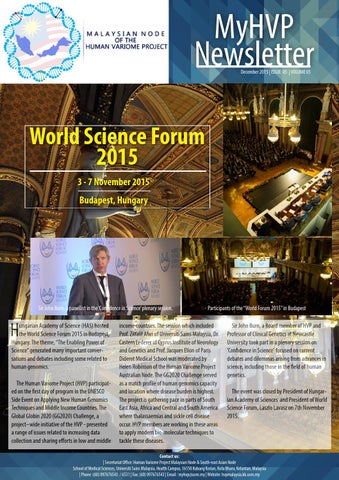
World Science Forum 2015 3 - 7 November 2015 Budapest, Hungary
Sir John Burn, a panellist in the ‘Confidence in Science’ plenary session.
H
ungarian Academy of Science (HAS) hosted the World Science Forum 2015 in Budapest, Hungary. The theme, “The Enabling Power of Science” generated many important conversations and debates including some related to human genomics. The Human Variome Project (HVP) participated on the first day of program in the UNESCO Side Event on Applying New Human Genomics Techniques and Middle Income Countries. The Global Globin 2020 (GG2020) Challenge, a project–wide initiative of the HVP - presented a range of issues related to increasing data collection and sharing efforts in low and middle
Participants of the “World Forum 2015” in Budapest
income countries. The session which included Prof. Zilfalil Alwi of Universiti Sains Malaysia, Dr. Castern Lederer of Cyprus Institute of Neorology and Genetics and Prof. Jacques Elion of Paris Diderot Medical School was moderated by Helen Robinson of the Human Variome Project Australian Node. The GG2020 Challenge served as a match profile of human genomics capacity and location where disease burden is highest. The project is gathering pace in parts of South East Asia, Africa and Central and South America where thalassaemias and sickle cell disease occur. HVP members are working in these areas to apply modern bio-molecular techniques to tackle these diseases.
Sir John Burn, a Board member of HVP and Professor of Clinical Genetics at Newcastle University took part in a plenary session on ‘Confidence in Science’ focused on current debates and dilemmas arising from advances in science, including those in the field of human genetics. The event was closed by President of Hungarian Academy of Sciences and President of World Science Forum, Laszlo Lavasz on 7th November 2015.
Contact us: | Secretariat Office: Human Variome Project Malaysian Node & South-east Asian Node School of Medical Sciences, Universiti Sains Malaysia, Health Campus, 16150 Kubang Kerian, Kota Bharu, Kelantan, Malaysia | Phone :(60) 097676543 / 6531 | Fax: (60) 097676543 | Email : myhvp@usm.my | Website: hvpmalaysia.kk.usm.my
MyHVP Newsletter
Head’s Address
Board of Editors 2015 December 2015 Issue | Vol. 5
2015
Editor in Chief Professor Dr. Zilfalil Alwi
was a great year for MyHVP. Established in 2010 with less than 50 members, it now has more than 70 members throughout Malaysia from various institutions and professional bodies. The major areas of activity for the MyHVP were designed to be in the line with Human Variome Project’s mission focusing efforts on the four key areas are: (i) setting normative function; (ii) behaving ethically; (iii) sharing knowledge; and (iv) building capacity.
Managing Editor Prof. Dr. Wan Zaidah Abdullah Editorial Board Members Prof. Ida Madieha binti Azmi Assoc. Prof. Dr. Endom Ismail Assoc. Prof. Dr Rosnah Bahar Dr. Nik Norliza Bt Nik Hassan Dr. Muhammad Farid Johan Dr. Azlina bt Ahmad Annuar Mr. Abdul Halim Fikri Bin Hashim English Editor Amyzar Alwi
Contents
02 Head’s Address 07 Postgraduate 03 Report 07 Calendar of 04 When a Geneti- Event cist Writes 08 Photo Diary © All rights reserved. The information in this newsletter is provided by the Malaysian Node of the Human Variome Project (MyHVP) members including South-east Asian Node (HVPSEA Node) for educational / information purpose only. It is not a substitute for professional medical care and medical advice. The contents express the opinions of the authors who alone are responsible for their view expressed. MyHVP does not accept any legal responsibility for their contents.
Writers, Invited!
For the coming issue, we are going to invite the public from various fields and specialties in order to share with us, their experience in dealing with the issues of medicine or biomedicine. Writers may contribute their writing with these following criteria: 1. Length (Max. 1page A4 size, and it may be edited for our use) 2. The committee has the right to share your writing for further issues. 3. To suit the needs of the publication, and your writing won’t be returned 4. Emailed the article to myhvp@usm.my
MyHVP is proud to announce that Universiti Sultan Zainal Abidin (UniSZA) has officially joined as an institution member of MyHVP. The launching ceremony was held at the Faculty of Medicine, Medical Campus, UniSZA (see the page 3). This marks a new horizon for genetics activities in Malaysia and contribution to the Human Variome Project through data sharing for the reduction of disease for a healthier population. By organising numerous national and international programs, MyHVP hopes to be a model to other South-East Asian countries in developing the Human Variome Project country node. With five (5) years of experience, MyHVP is now able to assist individuals and the lower and middle income countries (LMIC) build their capacity in genetics and genomics.
the systematic collection and sharing of genetic variation data to fighting haemolytic anaemias with initial focus on Thalassaemia and Sickle Cell disease. The GG2020 Challenge hopes to build an evidence base for an efficient management of local treatment, care and eventually cure for these diseases by ensuring a sufficient local capacity to deliver services in these countries. By achieving this, it is hoped that the skills and expertise in genomic medicine is further honed to effectively tackle other health issues in these countries as well. I would like to thank the hardworking editorial board members for publishing this fifth publication of MyHVP Newsletter. Last but not least, I invite all academics and researchers from institutions throughout Malaysia to join us in this exciting network of collaboration on a global scale. Thank you. Prof. Dr. Zilfalil Alwi Head, Malaysian Node of the Human Variome Project Universiti Sains Malaysia (Health Campus)
The most recent development of MyHVP is its involvement as the co-chair of the HVP global initiative Global Globin 2020 Challenge or GG2020 Challenge. GG2020 Challenge is an initiative of the HVP aimed at building medical genetics and genomics capacity, particularly in low-and middle-income countries (LMIC). This global initiative will apply recent developments in human genomics involving MyHVP Newsletter | Dec 2015 | page 2
Report ASEAN Congress on Medical Biotechnology and Molecular Biosciences 2015 8 - 9 October 2015, Bangkok Thailand Prepared by Nur Aisyah Edid
School of Medical Sciences, Universiti Sains Malaysia, Health Campus & MyHVP member
T
he ASEAN Congress on Medical Biotechnology and Molecular Biosciences 2015 (ACMM 2015) was held in the heart of Bangkok, with Mahidol University as the host. The two-day event in Arnoma Hotel, Bangkok, served as a platform to connect international researchers and physicians from all around the world to present their scientific discovery. The ACMM 2015 meeting was co-sponsored by the Institute of Emerging Disease and Innovative Therapies, Alternative Energies and Atomic Energy Commission (CEA), and the University of Paris 11, France. The main objectives of the Congress were to improve and break barriers among basic, translational, and clinical research in biomedicine, to enhance scientific exchange among researchers from different countries, and to accelerate the field of translational medicine. The event started with an opening ceremony and a welcome reception by the chairman, Udom Kachintorn and a Gala dinner to welcome the guests. The programs Representatives from MyHVP with Dr. Sissades Tongsima (second from left) during the conducted included two plenary lectures, two special lectures and ten parallel symWorkshop on variant discovery from next generation sequencing (NGS) post-processing data, Bangkok Thailand. posiums covering a wide range of topics including stem cells, cell and gene therapy, cancer, infectious diseases, vaccine development, genomic medicine, advanced technology in biomedicine, neuroscience, and biomedical engineering and nanomaterials; the applications of which have promised a great impact in medical biotechnology. There were 34 invited speakers from 13 different countries, comprising 12 locals and 22 internationals including 3 speakers from Malaysia. A total of 30 posters and 12 papers were presented at ACMM 2015. A one-day workshop on Variant Discovery from Next Generation Sequencing (NGS) Processing Data was held upon the conclusion of the Congress for registered participants. This workshop provided hands-on training through series of processing steps required to filter and identify candidate variants. | The Photo Diary is on page 8
Launching Ceremony of UniSZA as an Institution Member of MyHVP 14 September 2015, Faculty of Medicine, Universiti Sultan Zainal Abidin (UniSZA) Prepared by Abdul Halim Fikri Hahsim
School of Medical Sciences, Universiti Sains Malaysia, Health Campus & MyHVP member
O
n the 14th of September 2015, Universiti Sultan Zainal Abidin (UniSZA) officially joined MyHVP as an Institution member. It became the first IPTA to launch the ceremony. The launching ceremony was held at the Faculty of Medicine, Medical Campus, UniSZA. The ceremony was officiated by the Deputy Dean of Research Faculty of Medicine, UniSZA and was attended by the Head of MyHVP, Prof. Zilfalil Alwi, and staff of MyHVP Secretariat and UniSZA. The program started with a welcome address from Dr. Atif Amin Baig as the Head of Biomedical Cluster Faculty of Medicine, UniSZA and followed by the speech from Deputy Dean of Research Faculty of Medicine, UniSZA. During this program, Prof. Zilfalil presented an overview of the Malaysian Node of the Human Variome Project. The ceremony concluded with the signing of the plaque to officially mark the membership of UniSZA in MyHVP. It is hoped that with the launch of the MyHVP team, both parties are able to move forward in the line with the four areas of HVP which are: (i) setting normative function; (ii) behaving ethically; (iii) sharing knowledge; and (iv) building capacity.
A part of MyHVP members during the launching Ceremony at the Faculty of Medicine, UniSZA.
| The Photo Diary is on page 8
MyHVP Newsletter | Dec 2015 | page 3
When a Geneticist Writes The Non-Genomic Action of Anabolic Androgenic Steroid (AAS) on Skeletal Muscle Fibre Type Prepared by: Dr. Muhammad Hamdi Mahmood
Universiti Malaysia Sarawak (UNIMAS), Faculty of Medicine & Health Sciences (FMHS). Skeletal Muscle Structure and Function Skeletal muscle forms the bulk of body weight (~40-50%) and its main function is to provide the force required for postural maintenance and to power all joint movements. Macroscopically, skeletal muscles can be divided into red or slow and white or fast -muscle. Red muscle is rich in myoglobin and oxidative enzymes. Its fibres express a slow form of the contractile muscle protein, myosin, which splits ATP slowly. This type of muscle is used mainly to power slow repetitive movements. In contrast, white muscle consists mainly of fibres that express forms of myosin that split ATP rapidly. They are devoid of myoglobin and are rich in glycolytic enzymes. In the body, white muscle powers activities that require large amounts of energy for short periods of time. Muscle Fibre Types Adult mammalian skeletal muscles perform a wide variety of functions ranging from the maintenance of posture to bursts of rapid movements. As a result they are composed of a mixture of fibre types that differ in their metabolic capabilities, contractile properties, ultra-structural characteristics and fatigue resistance. On the basis of these characteristics adult mammalian skeletal muscle fibres have been classified as either fast-twitch (types 2A, 2B and 2X) or slow-twitch (type 1) (Larsson et al. 1991).
Figure 1: The schematic diagram shows switching of muscle fibre types with resistance exercise the fibre type shift into a more stronger contracting fibres 1→ 2A→2X/2B. On the other hand, with endurance exercise the fibre type shift into a more fatigue resistance fibres 2X/2b→ 2A→1. Loss of type 2 fibres occurs in aging muscle.
Each of these fibre types is the product of a multi-gene programme that is tightly regulated in a fibre-type specific manner (Liu et al., 2005) and in adult muscles can be rapidly switched from one type to another depending of the activity of the motor neurones innervating them and the physiological and biochemical demands imposed upon them, this is known as muscle plasticity. Hormone is one of the several factors affecting fibre type’s composition and hence the mechanism mediating these changes are still debatable. Another major determinant of muscle fibre composition is ageing which demonstrates loss of the fast twitch fibre types (see Figure 1). Furthermore, whether these changes can be reversed by drugs/hormones such as anabolic androgenic steroids is uncertain. Anabolic Androgenic Steroid (AAS) The term AAS refers to testosterone itself, all its derivatives that are used clinically or by athletes because of their anabolic /muscle building properties as well as a number of plant products that have anabolic properties (Bhasin et al. 2005). They are all structurally related and none of them is purely anabolic. Testosterone, the principle sex hormone in males, is a C19 steroid synthesised from cholesterol in Leydig cells of the male testes. In healthy young adult men, its plasma concentration ranges from 300 to 1000ngdl-1. In plasma, most of the testosterone is bound to either albumin (~54%) or the sex hormone-binding globulin (~44%) and only 2% (~1.5-20ngdl-1) is free (Evans, 2004). In certain target tissues such as the liver, brain, prostate and pubic skin testosterone is irreversibly converted to dihydrotestosterone (DHT) by the enzyme 5α-reductase.
MyHVP Newsletter | Dec 2015 | page 4
When a Geneticist Writes Both testosterone and DHT are lipid soluble hormones and can cross the cell membrane freely. Once inside the cell, they bind the androgen receptor (AR) leading to a conformational change in its tertiary structure, the release of the chaperones bound to it and exposure of nuclear localisation sequences (Heinlein & Chang, 2002). The hormone-receptor complex then translocates into the nucleus where it binds to the hormone responsive elements on the promoter regions of its target genes. Depending on the co-activators/co-repressors recruited, the hormone-receptor complex leads to either the activation or repression of these genes (see Figure 2). This mechanism of steroid action is known as the classical or genomic pathway and because it involves gene transcription and mRNA translation, its effects usually take several hours to days to be manifested (Heinlein & Chang, 2002). In addition to their genomic actions, it is now generally accepted that steroid hormones can also exert actions that are too rapid to be explained by the classical/genomic pathway (Heinlein & Chang, 2002). These actions occur within seconds to minutes after administration of the hormone and are generally insensitive to inhibitors of the androgen receptor; suggesting that they are regulated by cellular signalling pathways involving surface membrane receptors and second messengers (see Figure 2). This mechanism of steroid action is referred to as non genomic or non classical (Losel & Wehling, 2003).
Figure 2: A schematic diagram summarising the generalised mechanism thought to underlie the genomic actions of AAS (see text for details).
Although the non classical actions of other steroid hormones such as oestrogen, progesterone and aldosterone have received a lot of attention and their actions in many tissues are well characterised (for details see review by Losel & Wehling,. 2003), little is known about the non genomic actions of steroid hormones in adult mammalian skeletal muscles. Relatively recently, in this area of research, it has been shown that DHT is the more potent AAS than testosterone. In addition, it increases the contraction force of type 2 fibre type, which is mediated through non-genomic mechanism (Hamdi & Mutungi, 2010, Hamdi & Mutungi, 2011). However whether this finding provide a clue to practically reverse muscle aging is subject to further study. MyHVP Newsletter |Dec 2015 | page 5
When a Geneticist Writes
Figure 3: A schematic diagram summarising the generalised mechanisms thought to underlie the non-genomic actions of AAS. AAS binds to non-receptor tyrosine kinase such as c-src which activates MAPK pathway. In addition, binding of AAS to non-classical steroid receptor such as sex hormone binding globulin receptor (SHBGR) or plasma G-protein coupled receptor (GPCR) activates signal transduction cascades through activation of second messengers.
References Bhasin S, Woodhouse L, Casaburi R, Singh AB, Mac RP, Lee M, Yarasheski KE, Sinha-Hikim I, Dzekov C, Dzekov J, Magliano L & Storer TW. (2005). Older Men Are as Responsive as Young Men to the Anabolic Effects of Graded Doses of Testosterone on the Skeletal Muscle. J Clin Endocrinol Metab 90, 678688. Evans NA. (2004). Current concepts in anabolic-androgenic steroids. Am J Sports Med 32, 534-542. Heinlein CA & Chang C. (2002). The roles of androgen receptors and androgen-binding proteins in nongenomic androgen actions. Molecular Endocrinology 16, 2181-2187. Larsson L, Ansved T, Edstrรถm L, Gorza L & Schiaffino S. (1991). Effects of age on physiological, immunohistochemical and biochemical properties of fast-twitch single motor units in the rat. . J Physiol 443, 257-275. Liu Y, Shen T, Randall W & Schneider M. (2005). Signaling pathways in activity-dependent fiber type plasticity in adult skeletal muscle. Journal of Muscle Research and Cell Motility 26, 13-21. Losel R & Wehling M. (2003). Nongenomic actions of steroid hormones. Nat Rev Mol Cell Biol 4, 46-55. Hamdi M. M. & Mutungi, G. (2011). Dihydrotestosterone (DHT) stimulates amino acid uptake and the expression of LAT2 in mouse skeletal muscle fibres through an ERK1/2-dependent mechanism. May 23. The Journal of Physiology. 589 (3) 3623-3640. Hamdi M.M. & Mutungi, G. (2010). Dihydrotestosterone activates the MAPK pathway and modulates maximum isometric force through the EGF receptor in isolated intact mouse skeletal muscle fibres. 588 (3) The Journal of Physiology. 511-525. MyHVP Newsletter | Dec 2015 | page 6
Postgraduate GENETIC COUNSELLING
Sharifah Azween Syed Omar, Master of Science (Genetic Counselling), Cardiff University (shazween@ppukm.ukm.edu.my) Universiti Kebangsaan Malaysia Medical Centre, National University of Malaysia
G
enetic counselling is ‘the process of helping people understand and adapt to the medical, psychological and familial implications of genetic contributions to disease. This process integrates the following: 1. Interpretation of family and medical histories to assess the chance of disease occurrence or recurrence. 2. Education about inheritance, testing, management, prevention, resources and research. 3. Counselling to promote informed choices and adaptation to the risk or condition as defines by National Society of Genetic Counsellors.
This service is provided by a health professional known asas genetic counsellor. In certain countries, such as, the UK and the USA, genetic counsellors are deemed qualified with genetic counselling skills upon completion of a two-year Master course. During the course, they are trained to be equipped with knowledge of basic science including clinical and medical genetics, genetic risk assessment and epidemiological principles and counselling theory in order to provide services to clients and their families for adverse set of genetic or genomic indications. For countries , such as, the US, the American Board of Genetic Counselling is a regulator Board responsible for the certification of a genetic counselling training programme and licensing genetic counsellor. In the United Kingdom, the Genetic Counsellor of Regulator Board (GCRB) plays similar roles. Clinical Genetics Services in Malaysia which was established in 1994 under the purview of the Ministry of Health, provides paediatric and adult genetic services, for conditions such as metabolic conditions, haemoglobinopathies, familial cancer and reproductive genetics. However, at present, the availability of genetic counselling services provided by genetic counsellor is limited. There are only four genetic counsellors currently available in Malaysia and those who graduated from Master or postgraduate diploma in genetic counselling from the United Kingdom or Australia. Based on these figures, a ratio of one genetic counsellor per 7 million citizens (based on Malaysian population of 28 millions in 2013 statistics). At present, the Malaysian Medical Council (MMC) in its, Guideline for Medical Genetics and Genetics Service, in 2006, states that the definition of genetic counselling in Malaysia is “the provision of accurate, full and unbiased information in a caring, professional relationship that offers guidance but allows individuals and families to come to their own decisions�. Genetic counselling should essentially be provided by a medical geneticist or genetic counsellor. However, as the post of the professional genetic counsellor is not available under the Ministry of Health due to the lack of manpower, resources and budget issues, this service is provided mainly by the medical geneticists. Genetic counsellors where available serve as scientific officers or medical social workers have dual job responsibilities while fulfilling their role as genetic counsellors. Nevertheless, there are on-going efforts to create postd of genetic counsellor with formal recognition in the public health service, which will provide more specific job responsibilities as a genetic counsellor, including providing genetic counselling services to patients and families, and assisting them in coping with the implications of their genetic conditions. Universiti Kebangsaan Malaysia has taken its first step to create such post and started its Master programme in the field with its first cohort of genetic counsellors expected to graduate in 2017.
Calendar of Events 25 Feb 2016 | Seminar on Human Genetics in conjunction with the Annual General Meeting of Malaysian Society of Human Genetics (MSHG) 2016 Rimba Ilmu, Universiti Malaya, Kuala Lumpur, Malaysia 27 Feb - 28 Feb 2016 | Inaugural Neonatal Transport Workshop in Conjunction With the 8th National Paediatric Research Conference Pusat Perubatan Universiti Kebangsaan Malaysia, Kuala Lumpur 28 Feb - 2 March 2016 | Human Genome Meeting (HGM 2016) Houstan, United States 30 May 2016 | Global Globin 2020 Challenge (GG2020) Satellite - HVP6 UNESCO Headquarters, Paris, France 1 June - 3 June 2016 | The 6th Biennial Meeting of the Human Variome Project Consortium UNESCO Headquarters, Paris, France
MyHVP Newsletter |Dec 2015 | page 7
Photo Diary Key events in the second half of 2015 All photograps below were taken during September - December 2015
1
2
3
4
5
6
7
8
10
9
11
12
Photo 1 - 3
Photo 4 - 6
Photo 7 - 9
Photo10 - 12
ASEAN Congress on Medical Biotechnology and Molecular Biosciences 2015
Human Variome Project Satellite Event: LOVD Genetic Variant Database Curation Course
Launching Ceremony of Universiti Sultan Zainal Abidin (UniSZA) as a team in MyHVP
Prof. Zilfalil Alwi’s (Head of MyHVP) visit to Vietnam National Hospital of Pediatric
7 - 9 October 2015
16 September 2015
14 September 2015
29 Oktober 2015
Bangkok, Thailand
Hanoi, Vietnam
Terengganu, Malaysia
Hanoi, Vietnam MyHVP Newsletter | Dec 2015 | page 8