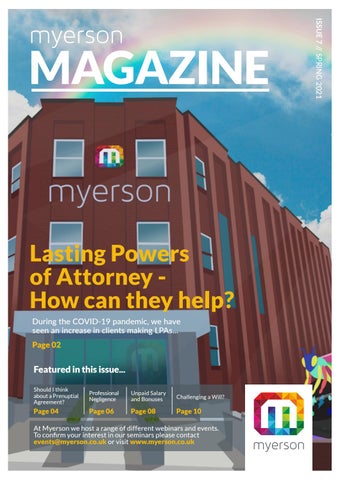
Lasting Powers of Attorney How can they help? During the COVID-19 pandemic, we have seen an increase in clients making LPAs... Page 02
Featured in this issue... Should I think about a Prenuptial Agreement?
Professional Negligence
Unpaid Salary and Bonuses
Challenging a Will?
Page 04
Page 06
Page 08
Page 10
At Myerson we host a range of different webinars and events. To confirm your interest in our seminars please contact events@myerson.co.uk or visit www.myerson.co.uk
ISSUE 7 // SPRING 2021
MAGAZINE
Lasting Powers of Attorney (LPAs) How can they help me? During the COVID-19 pandemic, we have seen an increase in clients with substantial assets or business interests making LPAs. LPAs are extremely useful documents and can help everyone.
02
ISSUE 7 // SPRING 2021
What are LPAs? LPAs are documents that allow you (the Donor) to appoint trusted individuals (Attorneys) to make decisions on your behalf when you cannot, and assist you with your affairs.
There are two types: 1. 1 Health and Welfare decisions (can only be used if you cannot make decisions yourself); and 2. 2 Property and Financial Affairs (can also be used at your request whilst you have mental capacity and therefore is very flexible).
Most common misconceptions Do only the elderly need LPAs?
How can LPAs help me?
Given that anyone can become ill at any time and with recent travel restrictions and lockdowns it may not be possible for you to be physically present to deal with a financial transaction or to sign paperwork. If you get stuck in quarantine abroad whilst your finances need managing at home, your attorneys can step in under an LPA.
If you feel that life is too short and you would like to spend more time doing the things you enjoy and looking after the people you care about, an LPA will enable you the freedom to manage your affairs in the way you would want to.
Do you just make an LPA when you lose mental capacity? An LPA must be made when an individual has mental capacity. This allows you to choose the best person(s) to make decisions on your behalf if you are unable to make them yourself. If you do not make an LPA and lose mental capacity, an individual will need to apply to the Court of Protection for a Deputyship Order, and it may not be the person you would have appointed. A Deputy is similar to the role of the Attorney, but the appointment will need to be made by the Court of Protection. This process can take 2-3 times longer and costs 2-3 times more than making an LPA.
If you make an LPA, do you lose control of your financial affairs? Whilst you retain mental capacity, only you can give your Attorney authority to act on the LPA. Once you have lost mental capacity, an Attorney has certain duties and legal obligations to abide by which include: • Keeping their money separate from yours
Having an LPA means you can: • Enjoy travel knowing your Attorneys can assist you on everyday matters in your temporary absence • Allow you to delegate the investment and management of your financial portfolios so that professionals can react to any changes in the market quickly • Give authority to selected individuals to assist with the running of your business • Have peace of mind if you lose mental capacity knowing that you and your family will be taken care of
Given the wide-ranging impacts of COVID-19, from shielding to unexpected illness, we recommend that everyone over the age of 18 with a substantial portfolio of assets or business interests, should make an LPA.
• Keeping records of all financial transactions which must be for your benefit and in your best interests • Gifts can only be made in limited circumstances and large gifts must be approved by the Court
Speak to one of our Wills Lawyers.
• The Attorney should do their best to allow you to make or to help you to make decisions (where possible)
Bik-ki Wong
Call us on 0161 941 4000 or email lawyers@myerson.co.uk Partner, and Head of Wills, Trusts and Probate.
ISSUE 7 // SPRING 2021
03
Should I think about a Prenuptial Agreement? If you have recently got engaged or your wedding plans are on hold due to COVID-19, you might benefit from using this time to consider and discuss the benefits of entering into a prenuptial agreement.
04
ISSUE 7 // SPRING 2021
A prenuptial agreement is a contract that a couple signs before getting married or entering a civil partnership to set out how they will deal with their financial arrangements if they later separate.
Are there benefits? It may not seem the most romantic subject, but a prenuptial agreement has its benefits, including: • Protecting your assets owned before the marriage • Protecting assets and inheritance planning for children/past relationships • Creating a solid plan for both yourself and your spouse for peace of mind • Minimise conflict surrounding how the assets are going to be divided should you later separate In England and Wales, prenuptial agreements are not strictly binding in the event of a later divorce or dissolution, but the agreement is likely to be upheld if certain criteria are met unless the agreements’ effect would be unfair.
The Courts have indicated that for a prenuptial agreement to be considered fair the following will be considered: • Did both parties receive independent legal advice? • Was there full financial disclosure?
A prenuptial agreement is a bespoke document tailored to suit your circumstances, so early planning is important. You should negotiate and agree on the terms of the prenuptial agreement as far in advance of the wedding as possible, and it should be finalised at least 28 days before the wedding. Getting together your financial disclosure and negotiating the terms of the agreement can take time, so it is important to obtain specialist legal advice as soon as possible to plan your prenuptial agreement well in advance of your wedding. Planning a wedding or civil partnership is an exciting time. It is also a time to think about your long-term future. Use this time to reflect on your financial position and whether a prenuptial agreement is something that may benefit you.
• Are the terms of the agreement substantially fair? • Was either party pressured? • Was there any fraud or misrepresentation? • Were legal contractual requirements followed?
Speak to one of our Family Lawyers. Call us on 0161 941 4000 or email lawyers@myerson.co.uk
Sarah Whitelegge Senior Associate in our Family Team.
ISSUE 7 // SPRING 2021
05
Professional Negligence Claims
What is professional negligence? Every professional has a legal duty of care to their client to carry out their work to a reasonable standard and with reasonable care. A professional will be negligent if he/she has failed to perform to the standard required of them, and as a result, their client suffers damage or loss. 06
ISSUE 7 // SPRING 2021
1
2
3
When does the professional breach that duty? The professional will breach the duty of care if he or she does not meet the standards which are expected by the law. For example, a solicitor dealing with a complex commercial property transaction or drafting a complex Will has to meet the same standard as a reasonably competent solicitor practising in those areas would meet. The law can be very complicated, and when we are instructed in connection with a professional negligence claim we can see quite quickly from the professionals’ files of papers how the problem has arisen. Sometimes it is simply not understanding what is required, sometimes it is a problem of not dealing with something in the time allowed particularly in litigation claims where claims can be struck out for failing to comply with Court orders.
Did you suffer a loss? Having established that the professional owes you a duty of care and has breached that duty, you also have to prove that you have suffered a loss, usually a financial loss and that the professionals breach of duty has caused the particular loss you have suffered. Some losses are indirect consequences of the mistake and may be too remote to be the professionals responsibility. Some losses may have occurred anyway. For example, a litigation claim which is struck out because the solicitor dealing with it failed to serve witness evidence in time. In that situation, a duty of care and breach of duty would be relatively easy to establish, but if the original litigation is going to be unsuccessful anyway, apart from some possible arguments about legal costs, the claimant has not lost the compensation he was seeking through the original litigation because he would have lost anyway.
These types of cases are quite common and known as “loss of chance” cases. In these situations, the Court assesses the percentage chances of success of the original litigation and applies that percentage to the damages which would have been awarded if the claim had proceeded and was successful.
Are there time limits? The law allows quite a long time to bring a claim for professional negligence. Generally, the time limit is 6 years from the date of the breach of contract or the date of loss. Different time limits can apply in other specific circumstances. For example, where you have suffered what is known as latent damage, that is hidden damage. Disputes and transactions can take many years and when we are instructed a large part of the 6-year time limit may already have passed. If you think that a piece of litigation or a transaction has been going on for a long period of time and does not appear to be going in the right direction, it is crucial to seek independent advice. The 6-year limitation clock stops running when a claim form is issued, or the parties reach an agreement known as a standstill agreement which “stops the clock running” for usually an agreed period of time.
Speak to one of our Dispute Resolution Team. Call us on 0161 941 4000 or email lawyers@myerson.co.uk
Tim Norman
Partner in our Dispute Resolution Team.
ISSUE 7 // SPRING 2021
07
Unpaid Salary and Bonuses
Unpaid Salary and Bonuses As businesses face an extended period of economic downturn and persistent uncertainty, many employers have forced reduced working weeks and/or reduced pay on their employees. Employers may also have withdrawn or deferred bonuses and other incentives.
An unpaid salary? Employers generally do not have a unilateral right to lay staff off, reduce their hours, or reduce their pay just because there is less work. If an employee is ready, willing and able to perform their full duties, the employer normally has an obligation to pay the employee their full contractual salary, unless there is a mutual agreement otherwise.
08
ISSUE 7 // SPRING 2021
It is a common misunderstanding that the Government’s ongoing furlough scheme afforded employers a right to reduce pay; that is only the case if the employee has agreed the arrangements.
An unpaid bonus? In recent times, we have seen many cases of employers withdrawing bonus schemes or other employee incentives or deferring payments and awards in response to economic downturn or uncertainty. A bonus or incentive is sometimes guaranteed by contractual terms, usually subject to achievement of certain performance criteria, such as an individual’s or business’s targets. A bonus scheme is more commonly expressed as discretionary and will typically provide
that there is no enforceable right to a bonus and that payments may be made (or not be made) at the employer’s discretion. However, there is a misconception that employers can withhold discretionary bonus payments without good reason and the Courts have held that an employer’s discretion is not completely unfettered. Where payment of a bonus is disputed, and the Courts will look at all relevant circumstances regarding the payments of bonuses including: • the wording of the contractual clause or bonus scheme; • the performance of the business and the employee; • historical bonuses; • treatment of the other employees; and • industry standards. Employers are bound by duties not to breach implied terms of trust and confidence, act honestly and in good faith and not exercise discretion in an ‘arbitrary, capricious or irrational’ way. In a well-known and rather extreme case involving a financial services business, Mr Clark had earned over £6.5m of profits for his employer working as an equities trader in the nine months prior to his dismissal. All traders, with the exception of Mr Clark received bonuses, including those who had earned less profit or no profit at all. The Courts found that no rational employer would have decided not to provide Mr Clark with a bonus and, therefore, its discretion had been exercised in an ‘irrational’ or perverse way. Mr Clark was therefore awarded his bonus.
Sometimes a bonus is not set out in a contract of employment or documented scheme at all but has been historically paid to an employee. In these cases, it may be argued that the entitlement to a bonus payment has become an implied term of the contract of employment through custom and practice and that the entitlement is enforceable.
Recovering unpaid amounts A salary deficit or unpaid bonus may be recoverable by way of a claim to an Employment Tribunal or other civil court. Claims may include claims for unlawful deductions from wages (i.e. unpaid wages or bonus), or breach of contract. In serious cases, employees may also consider resigning their position in order to additionally make claims of constructive unfair or wrongful dismissal. There are different legal processes and time limits to observe and varying compensation levels available depending on the losses suffered, type of claim made and whether the claims are made through the Employment Tribunal, County Court or High Court. If you require advice in relation to unpaid remuneration, you should look to contact an employment lawyer experienced in advising on rights to remuneration and recovering unpaid amounts.
To find out more speak to one of our Employment Team. Call us on 0161 941 4000 or email lawyers@myerson.co.uk
Jack Latham
Employment Solicitor.
ISSUE 7 // SPRING 2021
09
Challenging a Will? Over recent years there has been an increasing number of enquiries relating to challenges to a Will. It was reported in 2019 that one in four people said they would challenge a Will if they were unhappy with its contents. Whilst this may be music to litigators ears, it is a concern to those wanting to make Wills and rest assured that their estate will be distributed as they wish.
10
ISSUE 7 // SPRING 2021
How can a Will be challenged? Will challenges effectively fall into two categories: 1. 1 Claims under the Inheritance (Provision for Family and Dependants) Act 1975 and 2. 2 Challenges to the validity of a Will. Inheritance claims allow certain categories of people to seek financial provision from an estate where they have been excluded by a Will (or the intestacy rules where there is no Will) or insufficient provision has been made for them. The most common form of validity challenge is on the basis that the person making the Will did not have the mental capacity to make it. The effect of a successful challenge is that any prior Will becomes the last valid Will. If there is no prior Will, then the intestacy rules apply.
Why the increase? There are many reasons for this upsurge, including: • Family dynamics are more complex than they once were with nearly 1 in 10 people over 65 being a divorcee. • Over 31 million UK adults do not have a Will. The intestacy rules which apply in these circumstances can have undesirable and unexpected results. • An ageing population with diseases such as dementia becoming more and more prevalent. It is estimated that the number of people suffering with dementia will increase to over 1,000,000 by 2021 and over 2,000,000 by 2051.
Can a challenge to a Will be avoided? It is not possible to make a Will “bullet-proof”. There is always the possibility that a disgruntled family member will seek to challenge. However, it is possible to make a Will as robust as possible. If there is concern that a family member may bring an Inheritance claim, a carefully drafted “Letter of Wishes” accompanying the Will and explaining the reasons behind its terms can be very helpful. A solicitor with experience of Will disputes will be best placed to assist with the drafting. A Letter of Wishes is not a legally binding document, but it has evidential weight if a claim is made. If the validity of the Will is likely to be challenged, it is recommended that professional advice be sought in drafting the Will. A competent Will drafter ought to provide full and detailed attendance notes, addressing the circumstances surrounding the Will preparation and its execution which will be vital evidence if a challenge is made. If mental capacity may be an issue, for example if the person making the Will had early onset dementia, or was particularly
elderly or on heavy medication, a report from a medical professional as to whether they have testamentary capacity ought to be obtained.
Should I use free Will writing services? It is often the case that individuals prefer not to incur professional fees when dealing with the drafting of Wills, using instead various templates and free Will writing services available. Where there is an estate that is likely to be challenged however the likely fees of having a professionally drawn up Will, will pale into insignificance in comparison to the costs that would be incurred in dealing with a contested Will claim. In addition, many Will writers are not regulated or insured making disappointed beneficiary claims hard to pursue.
Costs consequences of a Will challenge The likely costs of a fully contested Will dispute, which proceeds all the way to trial would likely be over £100,000 per party. Costs are often paid out of the estate, meaning that beneficiaries lose out and do not receive the sums that were desired for them. There is also the risk that even if a claim fails, the applicant will not have the funds to meet any costs order and the estate and beneficiaries will not be able to recover their costs. The person making a Will would undoubtedly prefer funds to go to their family or friends as opposed to the pockets of lawyers. With that in mind a few hundred pounds on getting a Will drafted carefully and with supporting documentation is preferable to the costs of litigation.
Speak to one of our Contentious Probate Lawyers. Call us on 0161 941 4000 or email lawyers@myerson.co.uk
Jennifer McGuinness Senior Associate, Contentious Trusts and Probate.
ISSUE 7 // SPRING 2021
11
Because life is rarely black and white. Protect your wealth with a lawyer you can trust.
Call us today or visit our website 0161 941 4000 www.myerson.co.uk Myerson Solicitors award-winning law firm proudly ranked ‘Top Tier’ by The Legal 500.
Myerson Solicitors LLP Grosvenor House, 20 Barrington Road, Altrincham WA14 1HB Tel: 0161 941 4000 | lawyers@myerson.co.uk www.myerson.co.uk | @myersonllp