

West Valley City
More than a game: Where inclusion, not just winning, is the focus
Hunter High’s state championship highlights how unified sports brings students of all abilities together, onand off-the-court.
In a high school gym, the sounds are familiar balls bouncing, high tops squeaking on the court and teammates cheering.
But unified basketball is not just a game; it’s a space where students of all abilities come together as teammates, playing together on the floor to build friendships, confidence and community through sports. The focus isn’t only on winning, it’s on inclusion, sportsmanship and connection.
At Hunter High, the spirit carried all the way to the biggest moment of the season, as the team beat cross-valley rival Olympus High in the state championship for their division at the Delta Center. The victory was exciting, but for the players, it meant more than a title.
Hunter High senior Maelie Jorgensen loves “the good environment where everyone has fun playing and being together” while teammate sophomore Bentley Wright said the teammates’ friendships stretch into lunch tables and school dances. On the court, Wright, like Granger High’s freshman Jhanpeer Macha Dias, loves the celebration after a basket that comes with dance moves and cheers.
Jordan High also won its division for a state title, beating Highland High.
Jordan senior Alejandro Beltran Lopez played with pride and purpose.
“I want to continue my dad’s legacy in playing sports,” he said. “He taught me a little and coach taught me more; Dad’s happy for me.”
Beltran Lopez said unified sports helped pave friendships with his teammates, from
By Julie Slama | j.slama@mycityjournals.com
eating lunch together to watching the movie, “Elf.”
“We’ve had others at school support us too,” he said. “Unified soccer was fun; we wanted to beat Bingham at state championship (played at America First Field last fall), but it’s OK we lost because being a good sport means accepting defeat.”
His teammate, junior and peer tutor Sawyer Herzog, unified sports extends beyond the court.
“I love this,” he said. “We’ve become friends and I probably wouldn’t have met him if not. We’ve become genuine friends. We hang out, doing puzzles, watching Switch TV, talking, I help with math and ELA (English Language Arts). My whole family loves him.”
At Alta High, senior and peer leadership team member Macey Rockwood sees unified sports as something bigger.
“The goal of PLT is to make the community better, so through unified sports, we can support them,” she said. “Everyone deserves a community.”
Rockwood has refereed and ran the score table at unified tournaments and enjoys helping others succeed.
“It’s satisfying to help others have fun and have a sense of accomplishment,” she said.
For players like Corner Canyon sophomore Mia Lems, the competition still matters, but so does kindness.
“I like to take down the other team,” she said. “I’ve made friends with other teams too. I like to give them handshakes and clap and give high-fives for making good shots.”
Corner Canyon finished as state runners-up in their division at the state championship.
Lems’ teammate, senior Fisher Ghiz, didn’t realize how much unified basketball

would change him.
“It has taught me patience; it has taught me how to make friends with those different than me,” Ghiz said. “I used to be shy, but they’re so social, I’ve become more outward. This is awesome. I want to keep playing in college.”
Across Utah, with more than 250 Utah high school unified teams, players emphasize the game has given them friendship, growth and joy.
Murray High’s Parker May loves the game, especially shooting the ball, and playing with friends while teammate senior Hayden Gardner added he loves the confidence his teammates have gained over the season.
Murray High senior Ethan Teusher add-
ed: “There is simple joy in spending time together whether we’re playing basketball or a game of Uno.”
Nearby Copper Hills High and Skyline High finished second in their respective divisions at state while Herriman High won its division for the state title.
After West Jordan senior Robert West said he hoped his team would practice more early in the season, the Jaguars finished second at state in its division.
West Jordan senior Colton Reid refereed unified basketball last year, but decided to participate this year.
“It’s the greatest thing and something I didn’t want to miss out on,” Reid said. “I’ve made some good friends and great memories playing unified basketball.” l
Hunter wins the unified high school basketball state championship. (Julie Slama/City Journals)
A New Chapter for Pain-Free Living: Modern Joint Replacement at CommonSpirit
Tired of nagging joint pain dictating your life?
The good news: joint replacement surgery has made significant advancements in recent years. Forget the daunting tales of long hospital stays and arduous recoveries. Surgery today is all about quicker recovery, less pain, and a faster return to the activities you love. This isn’t just about fixing a joint; it’s about reclaiming your freedom, and CommonSpirit is at the forefront of this transformation.
What’s driving this revolution? Minimally invasive techniques. Imagine surgery with smaller incisions and less disruption to your muscles and tissues. This “less is more” approach translates directly into less post-operative pain, reduced blood loss, and significantly shorter hospital stays.
“Joint replacement surgery once meant a long, difficult recovery. Now, thanks to minimally invasive techniques, patients are getting back on their feet and regaining their independence far more quickly, significantly improving their quality of life,” said Michael Blatter, an orthopedic surgeon at Holy Cross Hospital – Davis.
This means you can get back to golfing, gardening, playing with grandkids with renewed vigor.
But the journey to rapid recovery begins even
before surgery. We believe in empowering our patients, and that’s why pre-operative education is a cornerstone of our approach. Our comprehensive classes walk you through every step, covering everything from physical therapy exercises and navigating stairs to home safety. We emphasize two crucial rules: no falls and no infections. Patients consistently tell us they feel better prepared and more confident heading into surgery, which dramatically improves their outcomes.
Our commitment to your well-being extends with Enhanced Recovery After Surgery (ERAS) protocols. This isn’t just about the surgery itself; it’s a carefully coordinated care pathway. ERAS focuses on preparing your body for a smoother recovery through optimized nutrition, multimodal pain management that reduces reliance on opioids, and getting you up and moving just hours after surgery. It all works together to reduce complications, enhance your comfort, and get you home safely and sooner.
And speaking of cutting-edge, robot-assisted surgery has become a game-changer. While a surgeon is always in control, robotic systems provide unparalleled precision, allowing for less invasive procedures, greater accuracy in implant
Nurture what’s next.
placement, and ultimately, quicker recovery times. This advanced technology ensures your joint replacement is tailored with remarkable exactness.
“Many joint replacement procedures can now be done same day. And with our current techniques and technologies, we are able to facilitate a quicker recovery and healing process for joint replacement. Our patients are able to get back to the activities they enjoy more quickly. For many of our patients, joint replacement is a game changer,” said Dr. Kevin Sagers, an orthopedic surgeon at Holy Cross Hospital – Jordan Valley.
At CommonSpirit, we understand that living with joint pain can feel limiting. But with these modern advancements, the path to renewed mobility and a significantly improved quality of life is clearer and more accessible than ever. We’re dedicated to providing not just exceptional medical care, but a supportive and empowering experience that truly makes a difference. If you’re ready to explore how modern joint replacement can transform your life, we invite you to discover the CommonSpirit difference – where your rapid recovery is our priority.
For more information or to find a provider visit mountain.commonspirit.org


Learn more about the services, care providers and mission-driven work of the Holy Cross hospitals and CommonSpirit Health at www.holycrossutah.org.

At CommonSpirit Health, we make the healing presence of God known in our world by improving the health of the people we serve, especially those who are vulnerable, while we advance social justice for all.

Women go through many changes in their lives. And we believe every milestone matters. Our health care experts can help you face your next phase with confidence – because each chapter deserves to be celebrated.
Find care near you at mountain.commonspirit.org.


COMMON GROUND
I can’t afford YOUR tax bill
Common Ground will be a column of rotating viewpoints that highlight specific feelings across the political spectrum, and it will always end with possible ways to come together.
Thousands of Utahns put down their phones from their doomscrolling and rage-baiting, to create vulgar poster boards and attend the No King rallies. Because Salt Lake City found it acceptable to shut down blocks of State Street, I watched the crowd waving their signs and chanting as they made their way to the State Capitol.
It was the weekend, and I wanted to be home. I had no desire to sit behind a police roadblock, watching people chanting and waving their signs. But I was working that day, or at least trying to work.
This was the end of a 60-hour work week for me, making sure we covered expenses and payroll for my business, trying to eke out just enough for me to get my bills covered. Then a question took over, a question that nearly every middle-aged, middle-income man finds themselves asking, “What am I doing here? Why am I working so hard?”
Could it be that I’m working so hard just to pay the bills of others?
Look at the facts. The national debt is $40 trillion. The Utah State Budget is over $31 billion. Salt Lake County increased property taxes by 14.65%, with a budget of over $2 billion.
How did we get here?
Let’s look close to home. Let’s start with Salt Lake County. We have a nine-member council, with five republicans, four democrats and a Democratic mayor.
Collectively (8-1), the council approved a $2 billion budget that significantly raised property taxes.
Earlier this year, Salt Lake County Council Members tried to cut the budget, proposing the shuttering of a county-operated senior center and child care facility. Then, all those who have had their hands out for
WEST VALLEY TEAM
The West Valley Journal is a monthly publication distributed directly to residents via the USPS as well as locations throughout West Valley. The views and opinions expressed in display advertisements do not necessarily reflect or represent the views and opinions held by Loyal Perch Media or the City Journals. This publication may not be reproduced in whole or in part without the express written consent of the owner.
© 2026 Loyal Perch Media, Inc.
John J. Walker Common Ground
years popped out of the cookie-jar, insisting they keep getting their subsidized child care or, in some instances, their jobs.
I watched the parents argue for continued services at below market rates, as if society and the taxpayers were somehow responsible for providing them with subsidized child care.
The same tiny violins were played throughout the legislative session earlier this year, with state legislators lined up to bring bills that would stick the Utah taxpayers with subsidizing or paying more money for child care, more money for property tax deferment/credits and more money for down payments for first-time home buyers, paying more money for Medicaid, more money for the homeless, more money for Title 1 schools, mental health treatments and food pantries.
Have we lost our conservative way of life here in Utah? Are we slowly drifting away from our base and sliding into the pit that California has become?
How much more can we afford? For me the answer is none.
Common Ground: In my late 20s, I asked a friend a question. What is the difference between a Republican and a Democrat? I will never forget his answer, “If you are a Republican in your 20s, you don’t have a heart; if you’re a Democrat in your 30s, you don’t have a brain.” At the time, it made sense; now that I’m in my 40s, it makes a whole lot less sense.
I like to think most of us have brains and hearts, all at the same time.
PUBLISHER
Bryan Scott | bryan.s@thecityjournals.com
EDITOR
Travis Barton | travis.b@thecityjournals.com
ADVERTISING EXECUTIVES
Mieka Sawatzki | mieka.s@thecityjournals.com
Marc Davis | marc.d@thecityjournals.com
CLIENT SERVICES
Lydia Rice | lydia.r@thecityjournals.com 385-557-1022
Big expenses for the general population are best paid for by taxes, such as the military or highways. I am happy to pay my share of taxes to build roads and bridges. I surely don’t want to pay fees at a toll booth.
Sometimes having a monopoly makes sense. I guess the city could stop collecting trash and each home could pay a company to pick up the trash from their home. But I would imagine that would be less efficient and more expensive.
I’m curious to know what residents feel is the purpose of local, county and state government. I think most would agree on roads, bridges, trash pick-up, dumps, water infrastructure and more. But how do we really feel about child care, senior centers, golf courses, zoos, museums, and theaters?
My fear is that when the economy is prospering, we vote yes on these expenses, but now that cost of living has increased and people are struggling more, we are less likely to support these governmental expenses. l
From the Publisher:
Last month the Journal launched Common Ground. Centered around normally divisive political topics, with a focus to bring the community together. With a goal to help community members better understand how fellow neighbors feel.
We had a large response from readers, with over 100 emails and several mailed letters, we are considering month one a success. Largely the responses were supportive of common ground, with supporting or dissenting comments on Peri’s first submission. Unfortunately we did have some readers who simply were not interested in hearing how their neighbors felt.
Peri submitted her opinion about lo-
cal immigration legislation that was proposed during the legislative session earlier this year.
The general tone of the dissenting readers was that Peri did not denote between legal and illegal immigrants. “First, let’s address the elephant in the room. Kinder’s commentary never used the words illegal immigrants… But illegal immigration is the issue the Utah legislature is trying to address.”
Other dissenting views included the large amounts of tax payment money that was spent each year supporting and aiding illegal immigrants.
Those who supported Peri’s comments were appreciative of having their views represented, they also commented about how immigration is the “American Way”, a nation built by immigrants. They also commented from a workforce perspective, stating that our economy needs immigrants and their general willingness to take less desirable jobs at lower wages. Others also supported immigration from the economic perspective that the fertility rates in the United States are decreasing and our economy is essentially centered on population growth.
Where people did agree was that congress needs to work together and create effective policies around immigration on a national law, and that those laws need to be consistently enforced and adhered from administration to administration. One reader said “this is the key to solving our immigration dilemma”.
Hopefully this fall as we select candidates to represent Utah in Congress we all remember that we need congress to fix the immigration issue.
— Bryan Scott
CIRCULATION COORDINATOR
Lindsay Andreasen | lindsay.a@thecityjournals.com Rack locations are also available on our website.
EDITORIAL & AD DESIGN
Stacey LaMont Ty Gorton
WEST VALLEY CITY JOURNAL 9500 South 500 West, Suite 205 Sandy, UT 84070
PHONE: 801-254-5974
MISSION STATEMENT
Our mission is to inform and entertain our community while promoting a strong local economy via relevant content presented across a synergetic network of print and digital media.
Designed, Published, & Distributed by


•
•
•
• AppleOne
• Danone North America
• Terraine Community Council
• Jack In the Box
• FlyLock Security Solutions - Salt Lake City
• Applebee’s Grill + BarWest Valley
• Utah Department of Corrections
• Maverik Center
• Mesa Moving and Storage
• PROG Foundation
• Elizabeth’s Custom Catering
• MTS Mobile Staffing
• Easton Salt Lake Archery Center
• Waterpocket Distillery
• Strong Law Accident and Injury Attorneys
• Pivo Web
• SLF Media Group
• The Christmas Box International
•
• Harmons-West Valley
• Your Employment Solutions- SLC










Copper Rock golf championship set for May 14-16
The road to the LPGA Tour begins with the Epson Tour, and again this month, 132 of the best female golfers on the planet will reconvene for the Copper Rock Championship May 14-16 in Hurricane, Utah. Golfers will compete for $250,000 in prize money and points in the season-long Epson Tour standings.
There were 15 players who gained LPGA status during last year’s Epson Tour season, and 13 of them finished in the top 30 at Copper Rock in 2025. Champion Gina Kim won twice on the Epson last season and is now playing on the LPGA Tour.
Exemptions this year went to four golfers:
Navy Hubbs is a junior at Salem Hills High School who has verbally committed to Boise State University. She started playing golf at the age of 12 and quickly developed a passion for the game. Since then, she has enjoyed competing in both local and national tournaments, gaining valuable experience and continually challenging herself against strong competition.
Hubbs is known for her calm presence on the course and the strong work ethic she brings to improving her game. She approaches competition with focus and determination while enjoying the process of learning and growing as a golfer and developing friendships with others on and off the course.
Maria Jose “MJ” Barragan is a standout collegiate golfer for Brigham Young University, known for her consistency, competitiveness and upward trajectory on the women’s golf scene. A native of Morelia, Mexico, Barragan has quickly become one of BYU’s most impactful players, combining sharp scoring with a calm mindset under pressure. She owns a career-low 18-hole score of 68 (4-under) and a lowest 54-hole score of 210 (−6), achieved at the 2024 Red Raider Invitational where she claimed her best finish with a victory. Barragan has also



Utah golf, recognized for her competitive excellence and advocacy for women’s golf. An inaugural member of the women’s golf team at Dixie State University (now Utah Tech), she was a two-time PacWest Conference Champion, Conference Player of the Year and an All-American.
She competed professionally on the Cactus Tour and is a seven-time Utah PGA Women’s Player of the Year (2019-25), a four-time Women’s Utah PGA Match Play Champion, and the 2025 Utah Section Assistant Professional of the Year. Her career includes numerous Utah Section victories, multiple top-10 finishes in both men’s and women’s events, and an overall championship at The Copper Club Open.
posted strong rounds in key events including the opening rounds of the 2025 San Diego State Classic and the 2025 Dr. Donnis Thompson Invitational, and she played a pivotal role in BYU’s 2025 USF Invitational win with a 72-73-69 (214) performance.
Off the course, Barragan is equally distinguished. She’s majoring in pre-business and has earned recognition for her academic achievements, being named to the 2025 CSC Academic All-District team. In amateur golf, she finished runner-up at the 2025 Women’s Mexico Amateur in a dramatic playoff and represented Mexico at the Pan American Games in Paraguay, showcasing her talent on the international stage.
Gabby Barker is a professional golfer known for her resilience, consistency and purpose-driven approach to the game. A standout junior and collegiate competitor, Barker built her foundation through

years of high-level tournament play before turning professional and committing fully to the grind of tour golf. Since turning pro, Barker has competed across multiple professional circuits, including the Epson Tour and various mini tours, steadily gaining experience at the highest levels of women’s golf.
Her career has been shaped by perseverance, adaptability and a deep belief in long-term growth — both on and off the course. In addition to her competitive career, Barker is the first female Native American professional golfer, a milestone she carries with pride and responsibility. She uses her platform to inspire younger athletes, advocate for representation in golf, and share the realities of pursuing a professional sports career.
Haley Sturgeon is an accomplished golf professional and respected leader in

There are always so many things to enjoy during and around the Copper Rock Championship. On Tuesday, May 12, RAM Aerospace presents the 2026 RAM Women’s Business Luncheon. The theme is “Rising Together: Personal Growth and Professional Influence.” Keynote speaker is Stephanie Palmer, Director of Radio Sales for KSL NewsRadio, FM 100.3, The Arrow and the KSL Sports Zone. Whitney Harris, Director of People and Culture at RAM Aviation, will join in that discussion. The luncheon will run from 11:15 a.m. to 1 p.m.
A free Junior Clinic will be held on Championship Saturday, May 16, at noon. Signups for the clinic and RSVP for the luncheon can be made at Copperrockchampionship.com. There will also be a free photo booth on Championship Saturday, and food trucks will be onsite including Corn Dog Company and Chicharos Tacos.
To get tickets to the tournament go to Copperrockchampionship.com and choose from General Admission, Club 17 or Copper Rock Club tickets, and the website details those options.
Copper Rock is located at 1567 W. Copper Rock Parkway in Hurricane. l

2025 Champion Gina Kim (Courtesy Copper Rock) Young golfers can participate in a free Junior Clinic on Championship Saturday at noon.
Haley Sturgeon Maria Jose “MJ” Barragan Gabby Barker Navy Hubbs

It’s all in the family when it comes to operating a preschool
A new child care facility in West Valley continues a tradition for the Quintana family as the daughter opens her location three decades after her mom.
By Tom Haraldsen t.haraldsen@mycityjournals.com
Youmight say taking care of children and helping them with early education is in Tezzy Quintana’s genes—and you’d be right. Her mother Isabelle Quintana started her Kidz Academy Preschool and ChildCare with the first of two locations in the Salt Lake Valley more than 30 years ago.
Now Tezzy has opened her own Kidz Academy at 4900 W. 3500 South in West Valley City. Following a ribbon-cutting ceremony in February, she’s welcoming students into her beautiful new facility.

“We decided to open a new location here last year,” Tezzy said. “We are a full-service licensed child care and preschool with children ages 0-12. I earned a degree from the University of Utah in human development and family studies, and this is something I’ve always been passionate about.”
Kidz Academy is open Monday through Friday from 6:30 a.m. to 6 p.m. It offers full-time care, part-time care, summer camps for school-age children ages
5 and up, and offers before-school and after-school transportation to and from neighboring elementary schools.
Tezzy said what sets Kidz Academy apart is “consistency. We never closed,
even during COVID, not a single day or even for one hour. We were open when a lot of other daycares were closed. We’re also bilingual, so a lot of our students leave the center speaking English and Spanish very well, and we do a dual-language preschool.”
“We make an impact by using positive guidance to teach our children the tools they need to be independent beings who enjoy life and learning,” she said. “We provide our families, and our community, with a safe environment where children will be cared for holistically.”
In addition to classroom work, children can play, rest, eat healthy balanced meals and practice life skills through structure and redirection as discipline.
She said cleanliness is “top tier. We get comments on that all the time. People comment that some other centers often have bad smells, but not here.”
Kidz Academy is licensed to serve up to 36 children and plans to turn an outdoor area into another classroom in the future as its growth continues. She said there are some openings for children at every age. Learn more at kidzacademyutah.org or call 801-840-4807. l
Holy Cross Hospital-West Valley aids patients with food needs
The hospital, with assistance from the Utah Food Bank, started the Meals to Go program.
By Darrell Kirby d.kirby@mycityjournals.com
Some patients at Holy Cross Hospital-West Valley have needs beyond the medical treatment they receive there. In their lives outside the hospital, they struggle to have enough food to eat each day.
That’s where Holy Cross Hospital steps in.
In March, the hospital, with assistance from the Utah Food Bank, launched an initiative called Meals to Go.
It provides needy patients with a bag containing five meals worth of food to help them get by for a few days to take that stress away while they recover from what brought them to the hospital in the first place. “If they have a spouse or kids, everybody can get one bag of five meals,” said Keesha Hardin, director of case management for the hospital. “The food consists of milk, cereal, applesauce, fruit snacks, beef jerky sticks, cheese sticks, things that are easy to carry around and put in backpacks,” she said. “We have a pretty high homeless patient population here, so it’s been pretty helpful.”
A grant enables the Utah Food Bank to purchase the food and deliver the items to Holy Cross Hospital when the latter requests it. The sustenance is sorted and put in bags by case management staff and volunteers for distribution to patients who indicate a need when they complete a screening questionnaire upon arriving at the hospital. “One of those questions is ‘in the last six months, have
you been worried that you would run out of food and not have money to purchase more?’” Hardin said.
Bags were handed out to 10 to 15 people a week in the early stages of Meals to Go. And the help doesn’t stop there. “We also put a flyer (in the bags) with a QR code they can scan to get more resources if they need it,” Hardin added.
Holy Cross Hospital-West Valley is so far the only one of the five medical centers in Utah- owned CommonSpirit Health that offers Meals to Go. “We’re hoping that it continues to go well and we can open them up at some of our other facilities,” Hardin said. l
Tezzy Quintana cuts the ribbon for her Kidz Academy in West Valley City. (Photo courtesy of Kidz Academy)
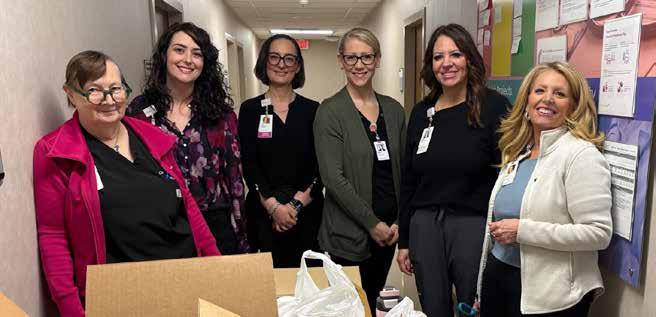
Staff members at Holy Cross Hospital-West Valley, led by Director of Case Management Keesha Hardin, second from right, help organize meals for needy patients. (Courtesy CommonSpirit Health)






Rally for Ukraine marks four painful years since war started
People assembled at the Utah Capitol to mark four years of war and hear stories of suffering and hope in the fight for democracy.
By Mimi Darley Dutton m.dutton@mycityjournals.com
Hundreds gathered at the Utah Capitol Saturday Feb. 28 to mark the four-year anniversary of Russia’s war on Ukraine. Bright yellow and blue Ukrainian flags flew alongside American flags while unique, specially-made flags featured a combination of the two. There were Utah flags on display as well and posters of support for the people of Ukraine. The Ukrainian and American national anthems were sung.
“We are gathered here once again to mark this somber occasion…a fourth year (since the war began). Uncertainty includes no more humanitarian aid from America,” said emcee Basil Newmerzhycky. He spoke of power being knocked out by Russian strikes leaving no electricity or heat for Ukrainian people in one of the coldest winters in decades. “But they continue to persevere. There is one certainty; Russia will not win this war,” he said.
Every speaker that followed spoke of the hell of war, but also of hope and solidarity.
Ukrainian pastor Oleg Kamanov offered a prayer. “We weep with those who weep. But even in darkness, these is hope. We believe peace is still possible,” he said.
Fewer people came to this year’s rally than years past. Some stayed home because they are Ukrainian refugees who fled but are now living in fear in America. “Refugees in Utah have expressed uncertainty of being deported back to a war zone,” Newmerzhycky said.
Karen Diehl from Cottonwood Heights came to the rally and noticed the smaller crowd. She expressed concern the Trump administration’s recent actions in Venezuela and El Salvador (and subsequent actions in Iran) could overshadow the ongoing war. “I’m afraid Ukraine and its people will be forgotten because of newer conflicts in the world,” she said.
Jonathan Freeman, Honorary Consul of Ukraine in Utah, addressed the crowd. Freedman said Ukraine is his adopted second home after having served a church mission there in the 1990s. “Along with you, my heart bleeds. We pray to keep the bond between Utah, the U.S. and Ukraine strong and thriving. Vladimir Putin completely misestimated he could take the capitol Kyiv in four days. We’ve seen grandmothers and children join the fight. I honor every single Ukrainian.”


Nathaniel Sanders rallied the crowd by running with flags he’d brought before approaching the podium. “Four long years and Ukraine is still here,” he said. His passion for the cause was contagious. Sanders, who works as a prosecutor in the Salt Lake County District Attorney’s office, established and serves as Executive Director of the nonprofit Utah for Ukraine. He has personally made trips to Ukraine with humanitarian aid as well as flags he’s had Utahns sign in support of the people there and he returns with flags signed by Ukrainians thanking Utahns for their support. Sanders spoke of the people he’s met in Ukraine with emotion in his voice. “It’s a huge amount of loss and pain. It’s that love of peace that makes them fight so hard…for their land and for their families,” Sanders said.
Jason Stout said the day marked 1,465 days since evacuating his home in Ukraine. He has set up the Responsibility Founda-
Freedman noted a young Utahn was recently killed in the war, 38-year old Trevor Crane from St. George. “He was fighting on behalf of this great cause,” Freedman said. He also identified Dell Loy Hansen, a Utahn with no prior connection to Ukraine who stepped up to build housing there for thousands of refugees whose homes have been destroyed. “He’s built, at his own expense, five different villages outside Kyiv, housing people from all over the country, because he recognized this is good versus evil,” Freedman said.
tion to help the people in his homeland. “In spite of everything, Ukraine has endured. But it’s not over yet. Putin is striking to stop power and electricity. People are freezing in their own homes. War is hell, but there’s still some good in this world today and it’s worth fighting for,” Stout said, choking up. “World War II seemed unwinnable until we won.
Ukraine is doing the heavy lifting for the entire free world,” Stout said.
Several Utah politicians came to the rally to express support for the fight for freedom. Legislative leaders and Gov. Spencer Cox held a press conference the week prior showing their support of Ukraine. “I’m so proud that here in Utah we stand for cherished values we share with Ukraine, including sovereignty,” Freedman said.
State Sen. Stephanie Pitcher said, “Like Ukraine, Utah understands faith, community and family. Utah must continue to support Ukraine.” Pitcher urged lawmakers to protect the lawful status of Ukrainian refugees.
Former Salt Lake County Mayor and U.S. Congressman Ben McAdams was the final speaker. McAdams recently declared he’s running for Congress again. While in the crowd, he met Riley Owen, a Republican who’s running against him. McAdams invited Owen to the podium as he began his remarks and he introduced Owen to the crowd. “We’re running against each oth-
er, but we agree the U.S. needs to support Ukraine,” McAdams said.
McAdams spoke about many Ukrainians who came to America legally, including Utah, to flee the war. He said they’re working and going to church and school, “but now their legal status is in jeopardy.”
Several speakers at the event encouraged people to warn fellow-Americans against Russian propaganda that has infiltrated the U.S. via the internet and various sources, to reach out to elected officials to call for a vote to punish countries buying Russian oil, and for the U.S. to send Russia’s frozen assets to rebuild Ukraine. McAdams specifically spoke in support of the Graham/Blumenthal bill and encouraged others to work to get it passed by contacting their congressional representatives.
“Russia invaded Ukraine. Vladimir Putin started this war. Ukraine didn’t choose war, but they stood up. To the Ukrainian people, thank you for defending democracies across the globe. This fight is over if force will overcome the law,” McAdams said. “We stand with Ukraine because it is the right thing for the U.S. to do. I believe when freedom is threatened, we cannot back down,”
Many resources exist to help Ukraine. Here is a sampling of a few: Utahukrainians.org, UtahforUkraine.org and Responsibilityfoundation.org. l
Rally attendees put their hands over their hearts as both the American and Ukrainian national anthems were sung. Fewer people attended the rally marking four years since the war began, some stayed home for fear of being deported. (Mimi Darley Dutton/City Journals)
Nathaniel Sanders established the nonprofit Utah for Ukraine. Sanders makes trips to Ukraine to deliver humanitarian aid and flags signed by Utahns showing their support of the people in the war-ravaged country. (Mimi Darley Dutton/City Journals)






LeafFilter came out on a Wednesday, gave me a quote and installed it the next day. Very reasonable price. The installers were professional and cleaned up after themselves. Very pleased with LeafFilter. -Je Farmer. Have been thinking about having gutter protection installed for a number of years since every year it becomes more of a pain to climb up on the roof and get the clean-out done. Called LeafFilter on a Thursday, the salesman came on Friday and the installation was done the next day. Easy-peasy. -Anthony. 100,000+ Reviews.


Monday, May 26, 2025 at 10:00 a.m.





Haylie Harper’s hard work pays off for Granger girls basketball
The Lancer senior is weighing several offers for college basketball according to her head coach.
By Brian Shaw b.shaw@mycityjournals.com
or Haylie Harper, doing what most would consider a daily grind was never much of a chore.
According to her head basketball coach Manny Taban-Taeoalii, it was Harper who constantly sent texts to his and others’ phones.
“She always wanted to get better! Always messaging the coaching staff about what she need to do to get better or wanting to get in the gym,” said the Granger coach.
One game stood out most to Taban-Taeoalii, in particular: versus Taylorsville at home, January 26 in a Region 4 showdown.
After a dominant first half in which Granger raced out to a 23-9 lead, the visiting Warriors stormed back.
But Harper was unfazed. Despite be-
ing “really sick” according to Taban-Taeoalii, Harper played through that pain, scoring 19 points on four three-point makes while leading the Lady Lancers to a 52-34 win over rival Taylorsville.
It marked Granger’s third win in four games, and set the tone for the rest of a season, one in which Granger reached the 5A state tournament for the first time since 2021.
Winning a single game was no easy task in Region 4: Five of those eight teams qualified for the 5A state basketball playoffs this past season, including Granger. Every league game was a battle, requiring the senior Harper and her teammates to find strength when times got tough.
It was also hard lessons learned over the past four years in which the Lady Lancers won two, three and six games in each of those seasons.
Granger upped that to an 11-13 record and an 8-6 mark in Region 4, thanks in no small part to work that Harper put in to improve as a player and teammate. Escalating from one point per game as a freshman to eight as a sophomore and junior was proof enough.
PROFESSIONAL PLUMBING
Harper nearly doubled her three-year average as a senior, netting 14 points, four rebounds, two steals and two assists as she helped lead Granger to a state tourney spot.
There couldn’t be more polar opposite places from West Valley City, than TVCC, which sits on plains near the Oregon-Idaho border about an hour west of Boise, and SWOCC that nearly hugs the coast of the Pacific Ocean.



“Haylie
has meant
a lot to the program. She came in daily and put in the work. She always wanted to push herself and her teammates.”
— Manny Taban-Taeoalii
Though the Granger senior has yet to commit to a school according to Taban-Taeoalii, Harper has received offers from Treasure Valley Community College in LaGrange, Oregon and Southwestern Oregon Community College in Coos Bay and Colorado Northwestern Community College.
Southwestern Oregon also holds a special meaning to Taban-Taeoalii and his wife; it’s where they met as students.
In addition to basketball, Harper also plays softball for the Lady Lancers that are currently in the middle of the Region 4 campaign, and is a three-year starter in that sport.
In the eyes of Taban-Taeoalii and his coaching staff, they couldn’t be more thrilled about the person Harper has become. As a team captain and bonafide leader on the court, the Granger senior always set an example at practices and games, and has helped pave what was an often difficult path for her and her teammates, for Lady Lancer teams to come.
“Haylie has meant a lot to the program,” Taban-Taeoalii said. “She came in daily and put in the work. She always wanted to push herself and her teammates.” l
Red Cross, West Valley team up for fire education
Smoke alarms, carbon monoxide alarms and evacuation plans were shared with residents.
Over 800 smoke alarms were installed throughout West Valley City in late March.
The crusade was organized by the American Red Cross of Utah and West Valley City as volunteers early on a Saturday morning at the Red Cross’s new humanitarian office in West Valley City. They ventured throughout the city to install over 500 smoke alarms and 300 carbon monoxide alarms.
Volunteers also spoke with residents about fire education and escape plans for each home.
“It’s always wonderful to see so many people come together with the simple goal of making our communities safer,” Jeremiah Lafranca, executive director of the American Red Cross Greater Salt Lake Chapter, said in a press release. “Additionally, this year’s partnership with Enbridge
Gas ensures we are protecting people from harmful gases in their homes as well while mitigating the risk of home fires.”
According to the release, the American Red Cross of Utah recently received a $60,000 grant and 300 carbon monoxide and natural gas combination detectors from Enbridge Gas Utah to support home fire safety and disaster preparedness efforts across the state. Detectors will be distributed throughout the year through the Red Cross free smoke alarm program.
Residents can schedule a free home visit at soundthealarm.org/Utah. Those visits include smoke alarm installation and creating specialized evacuation plans.
Working smoke alarms reduce the risk of dying in a home fire by 60% according to the National Fire Protection Agency.
The Red Cross press release said its Home Fire Campaign has helped save more than 2,550 lives nationwide since 2014 when it launched. In 2025, Red Cross volunteers in Utah installed more than 1,500 free smoke alarms to help protect families across the region. l
Small business SECTION

Opening a business in Salt Lake County? Your costs may depend on the city
By Peri Kinder | peri.k@thecityjournals.com
Ranging from $0 to more than $300 for a base license, business licensing fees differ across Salt Lake County.
For entrepreneurs looking to start a company in Salt Lake County, location can shape the cost of opening that business. Licensing fees vary drastically as cities determine costs and define regulations. Fees can fluctuate based on the type of business, number of employees, impact on city services and required inspections.
On one end of the scale is Riverton, which in 2018 became the first city in Utah to eliminate all business licensing fees. The move was orchestrated by the mayor at the time, Trent Staggs, who wanted to let companies know the city was open for business.
“He wanted Riverton to be a business-friendly community,” said Riverton Business Licensing Coordinator Angie Keller. “We’re also very user-friendly when it comes to getting a license. They click on our website and it guides them through the process. I don’t get many phone calls asking for help…I feel like Riverton has gone above and beyond, as far as pointing them in the right direction and giving them all the information they need.”
Draper’s base fee for a commercial license is $82, with additional fees for alcohol or firework sales, sexually-oriented businesses and solicitors. Murray charges $100 for a commercial license with regulatory fees on companies like auto towing, tobacco retailers, tattoo parlors and convalescent homes. Midvale has a base fee of $137 for commercial businesses with add-on charges for industries including bars, hotels, pawn shops and restaurants.
For companies in the county’s newly incorporated areas, including Kearns, Magna and Copperton, the Greater Salt Lake Municipal Services District administers those business licenses. The district charges a $150 base fee for commercial businesses and home-based locations that have customers coming to the home.
On the higher end of the scale, South Jordan charges $337 for a general business license application fee, with additional charges for hotels ($2,700), restaurants ($633), big box stores ($3,331) and entertainment/recreation facilities ($1,727).
Brian Preece serves as South Jordan’s Director of Planning and Economic Development. He said the city’s licensing fee structure wasn’t put together haphazardly, but was based on a feasibility study that determined the cost impact of specific businesses to the city. More fees are placed on businesses that have a higher volume of calls for police or fire services.
“We have a fire inspection for most businesses and that’s part of the [licensing] fees,” Preece said. “Even though Riverton doesn’t have a business licensing fee…it’s being paid for somewhere. The general fund is paying for it.”
South Jordan Public Information Officer Rachael Van Cleave added, “If we weren’t to charge these fees, taxpayer dollars would be subsidizing these costs for businesses. So the fees help to take that off the general taxpayer.”
For home-based businesses, Utah Code states that cities cannot charge a licensing fee unless the business impacts the neighborhood, such as having customers or an unusually high number

of home deliveries. However, several cities, including Taylorsville and South Salt Lake, charge administrative processing fees of $100 and $59, respectively, for home-based businesses.
Riverton requires every home-based business to have a license, but there is no fee. South Jordan does not require home-based businesses to have licenses unless they operate a daycare/preschool or if they have regular clients coming to the home.
“We made the decision to not charge for or even require a home license business,” Preece said. “If somebody wants one, then we’ll get you a license, but you have to go through the regular process, and that’s your choice.”
While getting a business license is certainly an important step in starting a business, it’s not the only step. Business owners need to make sure that the company is registered with the state and, if sales are involved, with the Utah State Tax Commission. Owners must ensure all licenses and inspections are complete before a business license can be issued. Most cities have license approval completed in two weeks or less.
The wide-ranging business licensing fees and processes across the county impact business owners and municipalities differently. For some entrepreneurs, that difference could be the deciding factor on where they ultimately locate their business.
Born during the height of World War II, Behunin Tree is still going strong
By Carl Fauver | c.fauver@mycityjournals.com
The founder of this venerable business is credited with “inventing” one of our most iconic holiday traditions: the Temple Square light display.
Have you ever seen a 1943 Lincoln head penny? They’re gray instead of brown, because they’re made of steel rather than copper. These are the only coins ever minted in the United States that can be picked up with a magnet.
How about a 1943 American-made automobile – ever seen one of those? No, you haven’t. Henry Ford and his competitors received Uncle Sam orders to construct tanks and other war apparatus that year, instead.
It seems that pivotal year in the history of our entire planet must have been a challenging, topsy-turvy time to launch a brand-new business. But that’s exactly what J. Leland Behunin did. And now, 83 years later, his daughter-in-law, grandson, granddaughter, great-granddaughter and great-grandson are continuing to operate Taylorsville-based Behunin Tree.
“My grandpa was pretty well retired by the time I was born in 1969,” Ben Behunin said. “But I worked the business side-byside with my dad (Ben Sr.) for well over 30 years. Dad was in his 80s when he passed away just three years ago. He continued to ride along in the truck with me to jobs until six weeks before he passed.”
Ben’s mother, Pauline, now owns Behunin Tree with her son. Pauline’s daughter Michelle is one of their employees, along with at least two of her grandkids, Korissa –and a third Ben.
“I grew up in Colorado and met Ben (Sr.) when we were students at BYU,” Pauline Behunin explains. “He was already focused on learning about plant physiology and tree diseases. We married in 1967, moved into our first home in this area in 1972 and built the house I still live in now, in 1977.”
The oldest of five siblings, Ben Jr. graduated from Taylorsville High in 1987. His
wife, Julianna, is a 1988 THS graduate.
“I had known Julianna since third grade at Vista Elementary, after her family moved to Utah from Nebraska; but we did not date in high school,” he explained. “We reconnected years later, after we had each served church missions. We were married in 1998.”
Their marriage came just a few years after a couple of life-changing things happened to Ben Jr., which drew him back into a tree trimming career he had loathed.
“As soon as I was out of elementary school, my dad didn’t force me to work for the company – but he did say I had to earn my own money to buy new school clothes,” Behunin said. “So, by the time I went to college – and then on to my mission – I really didn’t care for the family business and had no plans to rejoin it. But that changed in the summer of 1994, when my dad had a chainsaw accident. He cut his left arm three-quarters of the way through.”
In that instant, Behunin faced a key, life decision. He could either continue his BYU studies in accounting, which would likely force his father to sell the family business… or, Ben Jr. could turn his life’s plans on a dime and return to the tree trimming business he had absolutely sworn off.
Right at that most pivotal moment, Behunin says someone intervened. That person was, arguably, the most well-known businessman in Utah history.
“My dad had grown up in the same neighborhood as Larry Miller,” Behunin said. “I literally ran into Larry at a hospital elevator as I was going to visit my dad, right after he nearly lost his arm. Larry pulled me aside and said ‘Your dad really needs you now. If you will take over his family business, I promise you Behunin Tree will have all of the landscaping and tree trimming accounts for all of my properties.’ I took that conversation as a sign and agreed to go back into the tree trimming business.”
Behunin changed his BYU major from accounting to horticulture and never looked


back. Twenty years later, he also earned a graduate degree in horticulture through an online program. He’s not sure what course his life and career might have taken if not for that chance hospital meeting with Miller.
Behunin Tree would continue to be the exclusive provider of all tree trimming and landscape work on Miller Company properties up through Miller’s death in 2009.
“He was always very nice to us,” Ben added. “We got to sit with Larry many times down on the floor, front row, at Jazz games.”
Some 30 years before that career change – and even before Ben Jr. was born – Behunin Tree founder Leland Behunin is also credited with coming up with the original idea to illuminate Salt Lake Temple Square trees during the holiday season.
“My grandfather began trimming the Temple Square trees in the early 1940s,” Behunin explained. “That contract was one of the reasons why he started his business. Several years later, grandpa suggested the tree lighting idea; but the Temple Square head gardener had reservations about it. He was afraid the light bulbs might bring the trees out of their winter dormancy too early. This was all very experimental back then. They would string some lights, overload a circuit, make adjustments and try again, over and over. But my grandfather finally got it right. Behunin Trees put up and took down the Temple Square lights every year from 1964 to 1983.”
Behunin Tree now has five full-time employees and about a dozen more during their busiest season. Tree transplanting, pruning and removal still account for about 60% of their business. But they are also active now designing and building outdoor patio cooking areas as well as waterfalls, landscaping around swimming pools and other features. The company now enjoys gross revenues of about $1 million, annually.
“I am so proud of the way Ben (Jr.) has taken over the business,” co-owner Pauline Behunin said of her son. “He has faced some hard times; but has always pushed through the challenges so well. He has so much knowledge about tree diseases. And when he has a tree to cut down, he’s an expert at dropping it exactly where it needs to go to not cause any damage.”
Meantime, Ben Jr. says one of his biggest ongoing challenges is trying to find employees who understand the tree care business.
“I’m talking with Salt Lake Community College now about creating a tree pruning program because schools just aren’t teaching these skills anymore,” Behunin said. “One of our clients serves on the SLCC Board of Trustees. I provided him with an outline on how the school could establish a horticulture course. I also offered to be an instructor. I’m waiting to hear back from them.”
Finally, Ben Behunin is also excited one of his two daughters, Korissa, and his nephew (that third Ben, a Copper Hills High School student) are working with the company now, as fourth generation employees.
“When you devote so many years of your life to something like this, it becomes much more than a job,” Ben Behunin concluded. “It’s a big part of your heritage –something you take great pride in. When I go to work properties that I recall working with my dad years ago – back when I swore I would never do this for a living – I get very emotional, thinking about him and our time together. I get that feeling of loss all over again.”
To learn more about the now 83-year-old Behunin Tree – and to get tips on how best to care for your own trees, shrubs and other landscape plants – visit behunintree.com.
Korissa Behunin, her father Ben, cousin Ben and grandmother Pauline (L-R) represent three of the four generations that have operated Behunin Tree for some 83 years. (behunintree.com)
In addition to planting, pruning and removing trees, Behunin Tree also specializes in creating outdoor cooking and dining space. (behunintree.com)
Local resources support entrepreneurs
By Peri Kinder | peri.k@thecityjournals.com
Six ways to get help starting or growing your business.
Starting a new business can be a massive undertaking. Creating a business plan, obtaining loans and developing marketing strategies can feel overwhelming. But in Utah, several organizations want you to succeed and offer resources, mentoring and connections to help build a sustainable business. Here are six places to start.
Utah Small Business Development Center. Located at Salt Lake Community College Miller Campus in Sandy and in Kaysville at Davis Technical College, the SBDC offers free business consulting. Whether your business is just an idea or a built-out concept, working with SBDC professionals can increase your chance of success.
SBDC also provides information about financing, customer relations, employee management and business accounting through the Entrepreneur Academy, workshops and training classes. It also hosts networking events to build support so your business can thrive. To learn more, visit utahsbdc.org.
Suazo Business Center. Nearly 10% of Utah businesses are owned by Latino or Hispanic entrepreneurs. Suazo Business Center is often a first step for members of underserved communities to help them build and grow a thriving company. Bilingual consultants offer advising appointments to create an understanding of small business while providing guidance and mentorship.
With locations in Salt Lake and Ogden, Suazo Business Center has classes in Spanish and English to cover topics like QuickBooks, business development, legal structure, accounting and financing. It also
has a series of workshops to tackle issues from HR to government contracts. For more information, visit suazocenter.org.
SCORE Utah. With free business mentoring and low-cost educational workshops, SCORE Utah can help expand your network and grow your business. Its online courses allow entrepreneurs to explore all areas of business ownership, including e-commerce, customer service, crisis management and online marketing.
SCORE Academy premium courses offer inexpensive training in grant writing, AI for business or sales, and marketing strategy. Additionally, SCORE will provide a free mentor who will partner with you on your business journey. Mentors give advice and educate business owners to help them feel supported. To learn more, visit score.org/utah.
Utah Microloan Fund. For business owners who might have a low credit score or no access to collateral, the Utah Microloan Fund is a “lender of last resort” that can help entrepreneurs who can’t get traditional business loans. It can offer lending to higher-risk clients because its purpose is about creating impact, not profit.
For 35 years, the organization has funded microloans to help people build their dreams. By providing training and financing to businesses that don’t qualify for traditional funding, the Utah Microloan Fund is a resource for those who have been declined for a bank loan. The microloans are set at a fixed rate, with up to six years for repayment.
Plus, its popular Banking on Women program helps women create a business plan and apply for funding to make it a success. Visit utahmicroloanfund.org/orientation for more information.
Local Chambers of Commerce.

For advocacy and networking, the local Chamber of Commerce is a great place to connect with like-minded business owners, find opportunities for promotion and get your company involved with volunteer activities.
The Salt Lake Chamber is the biggest in Utah, while the South Valley Chamber represents many communities in Salt Lake County, including Sandy, Draper and Riverton. ChamberWest serves businesses in Taylorsville, West Valley, Kearns and West Jordan, and several smaller chambers serve individual cities, like Murray or South Salt Lake. The Davis Chamber is the primary organization for businesses in Davis County.
There are also specialized chambers, including the Utah Black Chamber, the Utah Hispanic Chamber, the Utah Asian Cham-
ber and the Utah LGBTQ+ Chamber. For a complete list of Chambers of Commerce, visit utahassociationofchambers.com.
Spice Kitchen Incubator. If you have an idea for a food truck or restaurant, but can’t invest in a truck or brick-and-mortar location, the Spice Kitchen Incubator is an answer to your prayers. Spice Kitchen provides hands-on learning for refugees and other disadvantaged community members interested in creating a food business.
Part of the incubation program includes access to affordable kitchen space, plus capital, operations development and technical assistance. Graduates of the program include Bhutan House, IndieGo Coffee, Wings on Wheels and Waterwheel Kitchen. To learn more, visit spicekitchenincubator.org.
Exhibit at Utah Cultural Celebration Center highlights American democracy
Learn about the story of democracy in the United States.
By Darrell Kirby d.kirby@mycityjournals.com
Abit of the Smithsonian Institution is in West Valley City. The world’s largest museum based in Washington, D.C., brings to the Utah Cultural Celebration Center a traveling exhibition titled “Voice and Votes: Democracy in America.” The exhibit runs through May.
The exhibit features “the ongoing story of democracy in the United States and the many ways people have shaped it over time,” according to the announcement about the display. It also features displays within the exhibit “that reflect the history and identity of West Valley City.” They include:
• 72 Voices | 72 Votes — The story of how our city came to be.
• America250 — work by internationally known Japanese-born artist Shu Yamamoto, who lives in Sandy. See the City Journal article on him here: www.sandyjournal. com/2018/05/15/173315/masterpieces-of-purrfection
• Campaign Buttons 1896-2024 — a historic collection from former West Valley City Mayor Mike Winder.
The exhibit is free and open to the public Monday through Thursday 8 a.m. to 6 p.m. and Friday and Sunday 9 a.m. to 4 p.m. until May 30. l
The Utah Cultural Celebration Center is hosting a Smithsonian Institution traveling exhibit, “Voices and Votes: Democracy in America,” featuring national and local displays, through May 30. (Darrell Kirby/City Journals)

Small business owners in Utah have many resources and organizations available to help make their dreams a reality. (Stock photo)
West Valley City, west side residents trail rest of county, state economically
Report is compiled ahead of new University of Utah hospital in West Valley City.
By Darrell Kirby d.kirby@mycityjournals.com
Residents in northwestern Salt Lake County are more economically challenged than their counterparts elsewhere in the county and Utah.
The latest fact sheet compiled by Kem C. Gardner Policy Institute at the University of Utah shows that households in the northwestern part of the county, comprised of West Valley City, Magna, Kearns, Magna, Taylorsville and western Salt Lake City, earn less than households in the rest of the county and state.
Median household income in the northwest part of the valley from 2019 to 2023 was about $11,000 below the county as a whole and $8,500 under the statewide average. These figures were derived as part of the effort to get a better profile of the population of the northwestern part of Salt Lake County ahead of the completion of the new University of Utah hospital now under construction in West Valley City, the first such major medical center on the county’s far west side.
The report shows that northwest county residents had a per capita income of $29,750 compared with $43,393 for the entire county, and $39,240 across all of Utah.
Median household income in northwestern Salt Lake County communities also lagged behind the rest of the
county and state. Households in western Salt Lake City earned $68,585 during the period of 2019-23, Kearns $83,335, Taylorsville $85,608, Magna $87,516, and West Valley City $88,604. Throughout the county, household earnings averaged $94,658. Statewide it was $91,750.
Poverty rates in northwestern cities ranged from 7.8% in Kearns to 12.4% on Salt Lake City’s west side. Countywide it was 8.4% and 8.6% throughout the state. Poverty among children was significantly higher in the west side communities.
Northwest valley residents 16 and older engaged in the labor force by either working or seeking employment was a relatively high 72.5% compared to 72.2% across Salt Lake County and 69.6% in Utah. West Valley City had the largest number of employed residents—42.6%—in the northwestern part of the county, not surprising since it is by far the largest city in the area and second most populous in the state.
These and other economic statistics compiled by the Kem C. Gardner Policy Institute in its most recent report will help form a general picture of area residents to shape expectations of who the university’s new Eccles Health Campus and Hospital at 3750 S. 5600 West will likely serve when it is scheduled to open in 2028. l
Early construction is underway for University of Utah’s Eccles Health Campus and Hospital in West Valley City. (Darrell Kirby/City Journals)







Granite School District faces a nearly $1 million school lunch debt
Local nonprofit jumps in to help, asking for donations.
By Peri Kinder peri.k@thecityjournals.com
Although Granite School District has some of the lowest school lunch fees in the state, the District’s lunch debt has grown to nearly $1 million. Schools on the west side seem to have been hit the hardest, with West Valley’s Granger High racking up nearly $73,000 and Beehive Elementary in Kearns approaching $15,000.
GSD Director of Child Nutrition Dana Canino oversees the District’s vast lunch program that provides 7,500 breakfasts and 24,500 lunches each day. Even with lunch debt, no child is denied a meal but Canino wants parents to know they can apply for free or reduced lunch anytime during the year. In fact, for the last decade, students who qualify for reduced lunch have been given meals at no charge.
“We were awarded grant funds to continue doing so through the state of Utah,” she said. “So we’re going to continue that program. We also provide universal free-of-charge breakfast to approximately 80% of our students.”
As GSD’s current school lunch debt exceeds $940,000, the Utah Lunch Debt Relief Foundation is bringing awareness to the problem and raising funds to help cover some of those costs. The organization just paid off lunch debt for its 41st school and paid off the entire debt for schools in Lehi with a $52,000 donation.
For UTLDR Executive Director DJ Bracken, the GSD situation hits close to home. As a Kearns resident, he discovered many schools in his community have thousands of dollars of lunch debt.
“I understand the incentive the schools have to get this money paid, because if they don’t, it’s the money for teachers, field trips and school supplies,” Bracken said. “That’s the money that ends up covering this debt. Literally, the money that’s paying people’s salaries. It’s not like they can just magically summon the money.”
GSD does have recourse to recoup some of those costs. Once a student leaves the District, the lunch debt is sent to a third-party debt collector, or if a student’s debt reaches $500, that is also turned over to a collector.
While it is true that seniors cannot walk during graduation if they have lunch debt, GSD uses donations to pay those students’ debts first, so they can walk with their class.
“For the last several years, our senior student balances have mostly been paid off through very generous donations,” Canino said. “When we take in nonspecific donations, donations that aren’t tied to a specific school or specific grade, we concentrate first on applying those to our graduating seniors to help them.”
GSD has some of the lowest school lunch

prices in the state, with daily fees costing $1.50 for elementary schools, $1.65 for junior high
doesn’t just count towards lunch, it can help the schools retain other funding. There are also also select a specific school for their donation. Bracken said another way to help is to
School lunch debt in Granite School District is more than $940, 000 and growing. Utah Lunch Debt Relief Foundation offers ways to address the problem. (Stock photo)
Brockbank Jr. High students use math to organize prom for Magna’s older adults

Budgeting skills were put to use planning for and decorating the dance as $6 remained in their account at the end.
By Zachary Smith z.smith@mycityjournals.com
On March 24, the Magna Senior Living Center threw a special masquerade prom for its residents, with special help from a local eighth-grade math class at Brockbank STEM Junior High. The event was a “service-learning project” that incorporated community service into education and applied both math and civic standards into a fun activity with a real-world impact.
As a part of the math curriculum, students were challenged to use their understanding of mathematics to organize an event for Magna’s older adults. The class was given a $500 budget to make the most of.
event for the older adults. When the preparations were finished, they had $6 remaining.
“There was a lot to consider,” said eighthgrade student Ricardo Fuentes. “We did a lot of teamwork. We made the tables look good, bought masks and necklaces, and made sure these seniors could have a good time.”
Students arrived an hour before the dance to set up and stayed until the end to mingle, dance, assist and have fun with the older adults. They gave the women handcrafted paper roses and joined them in classic dances such as the hokey-pokey.
“It was a great opportunity to help people, make connections and just have fun,” Fuentes said. “The elderly deserve to stay happy, and I’m glad I could help do something to make them smile.”
Another student, Mateo Marcos-Ramirez, saw it as a personal opportunity to show older adults that they are more valued than they know. “When I lost my grandma, I wished I could’ve spent more time with her while I had the chance,” he said. “I want the seniors to know that times like these are precious, and that nothing can stop them from keeping on celebrating and feeling like themselves.”


Magna Senior Living Center manager Amanda Anderson believes in the importance of getting younger generations involved in their communities, so when the school reached out to her, she was thrilled to give students and older adults an exciting opportunity. “It’s so great to see the multigenerational community come together,” she said. “The students get to see the great work that we do for our seniors, and they get to be a part of that.”
Students put their math skills to the test by measuring decorations and creating scale drawings to plan their decorating process. They organized refreshments, selected music and designed invitations and posters while carefully managing their budget. Managers from the center visited the classroom to help students know how to plan an enjoyable
This is the first time Brockbank students have volunteered at Salt Lake County senior centers, and according to Anderson, it won’t be the last. She looks forward to working with students more often in the future to plan similar events. “This is the plan moving forward,” she said. “This is going to be a great partnership.”
The 16 senior centers in Salt Lake County are always looking for volunteers to help organize and participate in enrichment events such as these. Salt Lake County residents who want to help enrich the lives of older adults can apply to volunteer at their local senior centers. l









Hunter softball shows it might be a force to be reckoned with, come playoff time
In Region 4, the Lady Wolverines sit near the top of the standings thanks to a ton of power at the plate.
By Brian Shaw b.shaw@mycityjournals.com
Led by a freshman at the plate and a sophomore on the pitcher’s circle, Hunter’s Lady Wolverines softball team is taking giant leaps and bounds in a number of ways.
Despite having only a short preseason to prepare for the upcoming year, Hunter is off to its best start since the 2022-23 season.
This was a team that went 9-15 overall, reached the 5A Super Regional last year and came back wanting to compete even better than their 3-6 record in a difficult Region 4 showed.
Did they get love back from Region 4 coaches going into this season? Not necessarily. The Lady Wolverines were picked to finish fourth out of eight teams. Did they take that personally, to coin a famous Michael Jordan phrase?
Maybe. Hunter has put those predictions to rest thus far by absolutely blasting the cowhide off the ball in games.
Freshman Isabella Mailo leads the team with five home runs thus far, and sophomore Leila Aiono isn’t far behind that number with four, respectively. It doesn’t end there for these Lady Wolverines though; they have five play-
ers that have hit at least a home run or more.
The other impressive stat here is that Mailo leads the state of Utah in on-base percentage—hers is .821 going into Spring Break. But, Aiono and senior Kenya Lapuaho are .740 and .700. All three girls also have a slugging percentage of over 1.000.
Hunter also has six girls that have already hit seven RBI or more this season, an unbelievable stat line in just eight games played. As a team, they’ve slammed 23 doubles and four triples, and tout a batting average of .439.
The Lady Wolverines have also scored a whopping 85 runs in the last six games, all Region 4 contests, and seem to have hit their stride though we’re not even at the halfway point in Region 4 action.
Perhaps the most impressive stat, however, is that Hunter has only left 33 runners on base, 17 below the national average.
On the mound might stand one of the biggest surprises of the year in sophomore Sydni Miller who is 2-0 thus far with 11 strikeouts. In addition, senior Jordyn Napoles is 1-1, and Aiono is 1-2 for Hunter, giving the Lady Wolverines a nice 1-2-3 punch on the pitcher’s circle.
To display that type of production eight games into a season is beyond impressive, really.
For the opposition it’s probably downright frightening, considering how much this Hunter

team could still grow over the next 20 games.
That sort of power is something you can’t coach and it is the kind of versatility that gives Hunter a real chance to not only capture a region crown but compete deep into the state tournament.
At 4-2 in Region 4 at press time, the Lady Wolverines are about halfway there in terms of games in league play. Hunter is currently ranked No. 14 in the 5A RPI.
From here on out, a handful of nonleague games will be sprinkled into Hunter’s regular season schedule.
DHL Express Service Point
ANTHONY AND SAMANTHA DIFEDERICO have been associated with DHL for two years. But now they have their own franchise with the global shipping company that has been a top name in the industry for more than 50 years. The Difedericos recently opened the first DHL Express Service Point in Utah and have spent the last six months building a reputation for service, reliability and quality. What products and services do you offer at DHL Express Service Point?
We provide international and domestic shipping, freight shipping, artwork shipping, custom
packing and boxes, mailbox rental, registered agent services, packing, package supplies, printing, large-format printing, package receiving, shredding, storage and fulfillment.
What sets your company apart from your competitors?
Our customer service really makes us stand out. We track each package until it is delivered. Often, we handle issues with foreign governments without the customer even knowing. We just take care of it. With our knowledge, especially when it comes to international shipping, we can’t be beat.

We have the best training and support team. DHL is the best international shipping company with the biggest footprint. We can generally get anywhere in the world within five days with unbeatable rates for the timeframe offered. We recently sent a package to Norway, which took a day-and-a-
half from the store to the front door!
Does your business solve a problem for your customers?
We solve many problems for our customers. If they have anything needing to be moved around the country or world, and need it there fast, DHL is the fastest. If you need any physical media for personal or business creation, a physical address for your home-based business, or your precious valuables professionally packed and shipped, we can do that. People often need to send paperwork to their home countries. We are the best, most timely and affordable.
Who is your ideal customer?
Anyone who needs to send goods worldwide, or overnight or 2-day shipping within the United States or missionary families sending items to their children.
How do potential clients choose between you and a competitor?
We provide the best knowledge and customer service while clients are in the store and

Games will continue through April and most of May before the state tournament begins on May 20.
The 2025-26 Hunter Lady Wolverines are: Sydni Miller, Abagail Dillingham, Kiana Pauni, Loiana Iongi, Alyssa Bates, Jordyn Napoles, Tosha Swanty, Alexa Olsen, Tupouaonuu Iongi, Destini Perez, Anna Kimball, Morgan Lapuaho, Stori Barker, Mele Taukafa, Nevaeh Tafuna, Isabella Mailo, Kenya Lapuaho and Leila Aiono. The team is coached by Heather Carlson, Gavin Carlson, Holli Fenstermaker and Quinn Downard. l
during their shipment. And our rates are great!
What is your best advice for someone considering doing business with you?
DO IT! You won’t get the level of service anywhere else. Our staff is amazing!
What factors should potential customers base their decision on?
They should understand the speed we can provide and the importance of their items being shipped. DHL has a reputation for fast service and we take care of our customers.
What is your service area?
We have people come anywhere from Cedar Hills to Logan, and everywhere in between. Stop in and visit with us. We can help you out.
What is your favorite product/service your company offers?
We provide custom packing and box making, along with international shipping. Also, not everyone knows we can ship domestically out of this DHL Express Service Point. It’s fun to see our customers get excited about that!

Hunter softball won four of its first six region games. (Photo courtesy Hunter softball)
Hunter senior Presley Castro named to three Academic All-State teams
Castro is the only three-time honoree among all five west side schools; others also garnered awards for their work.
By Brian Shaw b.shaw@mycityjournals.com
Formost kids in high school, being named to an All-State team means that they’ve done the right things athletically speaking.
But, there are kids that also garner honors off it.
Presley Castro has been doing both.
The Hunter High senior played three sports this past school year. For many, it would become far too difficult to maintain any sort of a courseload and still excel outside the classroom.
Not only did Castro thrive on the field, she did just as well maintaining a 4.0 GPA and achieved high ACT and SAT scores.
Though the Hunter senior was competing on the girls’ soccer team where Castro played fullback, and was on the cheer team where she performed regularly at games and competitions now that cheer is a sanctioned
high school sport—she was not done.
Castro also featured on the Lady Wolverines basketball team and got significant playing time, averaging two points, two rebounds and two fouls per game in two years of action. In other words, she was a tenacious defender for head coach Emily Brough’s squad that reached the second round of the 5A state tournament in 2026.
Castro joined a dozen other athletes across the west side, from I-215 to the Oquirrhs, that were all honored for their academic contributions simply for doing one thing: they entered their grades as required on RegisterMyAthlete, the clearinghouse for all athletics in the Utah High School Athletics and Activities Association—and the UHSAA did the rest, issuing Academic All-State honors to these deserving student-athletes.
Others were nearly as proficient as Hunter’s Castro in the classroom this past year as several other girls even received two honors. Amelia Okeson of Granger earned Academic All-State in girls wrestling and volleyball, as did Lancers Christy Nguyen and Grace Winder in girls swimming and tennis.
There were many girls receiving one Academic All-State nod as well. Hunter earned three more, as Isabelle Miller re-
ceived one in debate, Gracie Harding one in girls tennis and Madeleine Taylor another in girls cross country.
Cyprus garnered a number of honors as well. Riley Woodman got one on drill team, and in girls tennis, Lady Pirates Emily Albertsen and Gracie Hunter took home honors, while Brittany Mendez earned hers in girls soccer.
For the boys, Jimmy Nguyen of APA West Valley took home that school’s lone Academic All-State nod in music—though Nguyen also has the unique distinction of being named West Valley City’s only National Merit Scholar this past school year, an award he received at an assembly at the school in March.
For the Kearns Cougars, they were represented by boys swimmer Zackery Kahl while Cyprus’ Beckham Bayles became the only student-athlete on the west side of the valley to receive both an athletic All-State Honorable Mention in boys basketball for Class 5A’s top-five ranked Pirates and Academic All-State honors in that sport in the same school year.
The Pirates were also well represented in football, getting two boys on the list in Schuyler Garlitz and Owen Murphy. And,

Mason Brown of Cyprus rounded out an impressive list of Academic All-State honorees through the winter. Spring honors will be announced at the conclusion of the 2025-26 school year. l
FALL AND WINTER ACADEMIC ALL-STATE
Isabelle Miller, Hunter – debate
Jimmy Nguyen, APA West Valley –music
Amelia Okeson, Granger – girls wrestling and volleyball
Christy Nguyen and Grace Winder, Granger – girls swimming and tennis
Zackery Kahl, Kearns – boys swimming
Riley Woodman, Cyprus – drill team
Presley Castro, Hunter – cheer, girls basketball and soccer
Beckham Bayles, Cyprus – boys basketball
Emily Albertsen and Gracie Carter, Cyprus – girls tennis
Gracie Harding, Hunter – girls tennis
Brittany Mendez, Cyprus – girls soccer
Owen Murphy and Schuyler Garlitz, Cyprus – football
Madeleine Taylor, Hunter – girls cross country
Mason Brown, Cyprus – boys cross country



A system rethought: New director targets root causes of homelessness and incarceration
Anndrea Wild takes reins of SLCO Homelessness and Criminal Justice Reform office.
By Shaun Delliskave s.delliskave@mycityjournals.com
When Anndrea Wild reflects on her career path, she describes a steady shift from evaluating public systems to helping build them. That transition now places her at the center of Salt Lake County’s efforts to address two of its most complex and intertwined challenges: homelessness and criminal justice reform.
“I’m Anndrea Wild, and my career has focused on understanding and improving how public systems serve people,” she said.
Wild, who recently stepped into her role as Director of the Office of Homelessness and Criminal Justice Reform under Salt Lake County Mayor Jenny Wilson, brings experience from both policy analysis and direct program leadership. She began as a Legislative Performance Auditor, reviewing how state programs function in practice, before moving into a more hands-on role with the Utah Department of Corrections as Programming Director.
“That experience gave me a deep appreciation for both the strengths of our systems and the gaps that can leave individuals and communities without the support they need,” she said.
In her current position, Wild’s focus is on coordination—bringing together agencies, service providers and policymakers to address issues that often overlap but are traditionally handled separately.
“For me, this role is a meaningful opportunity to help drive real, lasting change for individuals and families who are experiencing homelessness, involved in the justice system, or both,” she said.
At the core of the office’s mission is collaboration. Wild oversees efforts that connect key groups such as the Criminal Justice Advisory Council and the Salt Lake Valley Coalition to End Homelessness. The goal, she said, is to align strategies, share data and ensure resources are used effectively.
“Our mission is to advance effective, data-driven criminal justice and homelessness solutions through strong partnerships, innovation and a focus on outcomes,” Wild said.
A major factor shaping that work is housing availability. According to data cited by the office, Utah faces a significant shortage of deeply affordable housing, with only three units available for every 100 households in need. In Salt Lake County alone, the deficit is estimated at 35,000 units.
“Housing is a foundational priority in this work,” Wild said. “We know that stable housing is one of the strongest predictors of positive outcomes.”

Wild emphasized that homelessness and criminal justice involvement often stem from shared underlying issues, including mental health conditions, substance use and housing instability. Those connections are increasingly visible in local data.
“Historically, about a quarter of our Salt Lake County jail population was homeless. Over the last few years, it has grown to nearly one-third,” she said.
Her office’s approach centers on addressing those root causes while maintaining accountability and public safety. That includes expanding diversion programs, increasing access to behavioral health services and ensuring individuals leaving incarceration have stable housing and support.
“It’s important to be clear: incarceration plays a critical role in holding individuals accountable and protecting public safety,” Wild said. “For many others…a system response centered primarily on incarceration is not the most effective path forward.”
One of the most immediate challenges Wild identified upon taking the role is the lack of coordination in crisis response systems. Currently, multiple agencies respond to mental health and substance use crises, which can result in inconsistent care and unnecessary reliance on law enforcement.
“Too often, law enforcement is the default first responder, even when a behavioral health response is more appropriate,” she said.
To address that, the county has launched a crisis response task force and is working to improve how emergency calls are routed, with the goal of directing individuals to appropriate treatment rather than jail or emergency departments.
Wild also highlighted prevention—particularly among youth—as a key priority. Expanded diversion programs, mentorship opportunities and school partnerships are part of a broader strategy to intervene early and reduce

long-term system involvement.
“We know that early intervention can change the trajectory of a young person’s life,” she said.
Looking ahead, Wild said her first year will focus on building a more connected system that better matches individuals with the care they need.
“Ultimately, long-term impact comes from building a system that is both effective and humane,” she said.
For Wild, the work is rooted in a simple but complex goal: creating systems that not only respond to crises but prevent them—while supporting both individuals and the broader community. l
Custom Solutions.


Anndrea Wild (center) meets with County Councilmember Carlos Moreno (back). (Photo courtesy Carlo Moreno)
Salt Lake County uses opioid settlement funds to fight addiction
Like many communities across the country, Salt Lake County has felt the impact of the opioid crisis. In recent years, hundreds of people have died from opioid-related overdoses with fentanyl playing a significant role. It has affected families, strained our healthcare and public safety systems, and left too many people searching for a path forward. Opioids have devastated countless lives.
Several years ago, states and local governments across the nation took legal action against pharmaceutical manufacturers, distributors and retailers for the role



they played in fueling the opioid epidemic. Those cases resulted in national settlements totaling more than $50 billion.
Starting in 2021, Salt Lake County expects to receive over $91 million from multiple settlements to help combat the opioid crisis locally. The funds will be distributed over a 17-year period.
Unlike traditional tax dollars, these funds are specifically designated for addressing the opioid crisis and must be used for evidence-based strategies and programs that support prevention, treatment and recovery.
There are formal agreements in place restricting how these funds can be spent, but counties are responsible for determining how to allocate them. In Salt Lake County,
the council works closely with the mayor’s office and a specialized opioid task force to evaluate and prioritize programs. Our goal is to invest in solutions that reduce reliance on the criminal justice system and create better long-term outcomes for those struggling with substance use disorders.
Last week, my colleagues and I approved a set of targeted programs designed to address this crisis in meaningful and measurable ways. These investments focus on what we know works and were shaped by input from public health experts, first responders and community organizations.
First, we are investing in prevention and education. This includes expanding school-based programs that help young people avoid substance use in the first place.
Second, we are strengthening treatment and recovery services. We approved funding to expand access to evidence-based care, including Medication-Assisted Treatment (MAT), as well as recovery support such as peer mentoring, housing assistance and connection to employment services to help prevent relapse.
Third, we are supporting life-saving efforts. This includes increasing access to naloxone, a medication that can reverse
overdoses, and funding outreach programs that connect individuals to services before a crisis turns fatal.
These efforts are part of a long-term strategy to address both the root causes and ongoing impacts of opioid misuse in our community. To improve outcomes, we are also strengthening coordination across systems. This includes better data sharing and tracking how people move through law enforcement, jails, courts and other community programs. This will help us identify opportunities to intervene earlier, connect people to treatment and reduce repeat offenses.
To ensure transparency and accountability, a public-facing dashboard will begin to roll out starting June 2026.
The opioid crisis did not happen overnight, and it will not be solved overnight. But this funding from the lawsuit settlement provides an important opportunity to respond more effectively and more compassionately. We are committed to using these resources responsibly to save lives, support recovery and strengthen Salt Lake County for years to come. This is about turning accountability into action and making sure these funds lead to real and measurable change.














Whenastronaut Neil Armstrong took those first steps on the moon, I had just celebrated my first birthday. I don’t remember either event, but the entire world held its breath as it watched Apollo 11 land, while I shoved my hands into a birthday cake.
That moon mission used less technology than your bathroom scale. It was basically human calculations, a slide rule and a Rand McNally paper map that guided those astronauts on the first lunar road trip.
We were told that space was the final frontier; space was the future. We learned that, like age and teenagers, space isn’t forgiving.
As a Murray High School senior, my home ec advisor wheeled a TV into the classroom to watch the Space Shuttle Challenger carry the first teacher, Christa McAuliffe, into space. We were speechless when the shuttle blew up at 46,000 feet. In February 2003, I watched the Space Shuttle Columbia disaster unfold as the spacecraft disintegrated on re-entry.
To say I was apprehensive watching the Artemis II mission launch to the moon would be an astronomical understatement.
On April 1, NASA perched the Orion space capsule atop a 300-foot rocket, one of the most powerful ever built. It launched a team of four astronauts 250,000 miles away from Earth, the farthest humans have ever traveled, discounting alien abductions, of course.
Unlike the catapulted station wagon that
Peri Kinder Life and Laughter
Copy, Moon Joy

somehow got us to the moon during Apollo missions, Orion uses autonomous navigation and extreme precision, carrying astronauts beyond low-Earth orbit for the first time in more than 50 years, traveling at speeds up to 25,000 mph.
It was the 10th manned moon exploration, or for conspiracy theorists, the 10th “faked” moon mission. The entire adventure was livestreamed so we could travel together.
Space exploration is equal parts wonder, technology and angst. During the 10-day moon trip, I endured galactic levels of anxiety. Launch sent my blood pressure soaring. My jaw clenched while they circled the moon on April 6, and my internal organs somersaulted during splashdown on April 10.
I was hyperaware that dreams explode and rockets fall apart.
Apollo missions were built on bravery, and America was racing to beat Russians to the moon. Now, Artemis is an international collaboration, one that should remind us we only sur-

vive this wild ride by working together.
In Greek mythology, Artemis is Apollo’s twin sister and goddess of the moon. It is an apt comparison: while the first moon missions had bro energy, the Artemis program continues the story in a wiser, more thoughtful way.
Women play key roles in the Artemis program. Besides the first female to fly on a moon mission, there are female science officers, mission leads and launch directors. In fact, for the first time in NASA’s history, the current astronaut class has more women than men.
If I could do math while enduring crushing g-forces and the stomach-dropping sensation of freefall, I would definitely have been in the space program. Instead, I appreciate the life of an astronaut from the comfort of my recliner.
Apollo gave us “One giant leap,” Challenger dropped us to our knees and Artemis refocused our gaze. These missions remind us to look to the stars, but also look to our beautiful, blue planet. We only have each other. We should start acting like it.
As I approach my next birthday, one I hope I remember, I raise a glass to the dreamers, the heroes, to the brilliant engineers in mission control and the fearless astronauts who explore new paths. It reminds us that even when the story goes wrong, we need to keep looking up.
Peri Kinder is an award-winning columnist and journalist who has written for The City Journals since 2004. She can be reached at peri.k@thecityjournals.com