
Tough love and personal responsibility are helping change the culture of Hunter baseball
By Brian Shaw | b.shaw@mycityjournals.com
Under new head coach Preston Vaccaro, the Wolverines are doing a lot of things differently—it’s already resulting in wins on the field and in the classroom.
Inside an office at Hunter High, Preston Vaccaro met school administration to go over a spending plan for his baseball team. The 60-year-old who had never been a high school head coach sat there in disbelief.
“They told me I had $1,300 and started telling me all the things I needed … flipping through a computer like it’s nobody’s business and telling me ‘you need about $20,000 to run this year,’” Vaccaro said. “I just about had a heart attack right there.”
Hunter’s new coach added he’d been coaching baseball for 35 years and spent time as a high school assistant.
What was Vaccaro supposed to do, though? As his dad often told him, when you commit to something, you put 100% into it. Coach Vaccaro did, spending 60 hours a week on his new team, in his estimation.
First things first: Vaccaro organized a


team meeting at Hunter’s baseball field that July and, alongside assistants Kaden Wilson and Sam Brito, picked up a pen and paper since he admittedly isn’t tech-savvy, and started asking the players and parents questions from the visiting dugout.
What did they need from this coaching staff? What does the team need?
The prospective players told Vaccaro they needed a coach who cares and develops them. They added they’d like matching batting helmets so they could look like all the other teams.
Their new coach said he’d see what he could do—but would need buy-in from them.
“I was told by the UHSAA the requirements to play were a 2.0 GPA and you can fail one class,” Vaccaro said. “I looked at them all … I had parents and kids there … and said, ‘that’s bull …’”
Vaccaro demanded kids get a 2.5 in the first quarter and keep it through the rest of the school year without failing a class. If not, they’d get a two-game suspension for every infraction. Perplexed, returning players asked
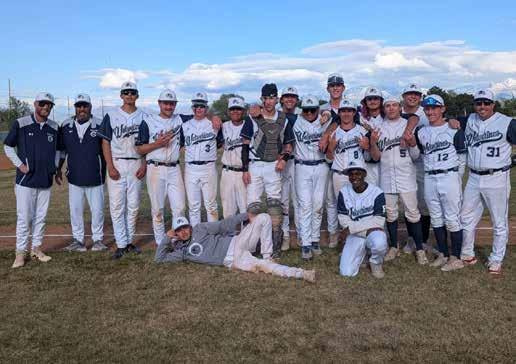


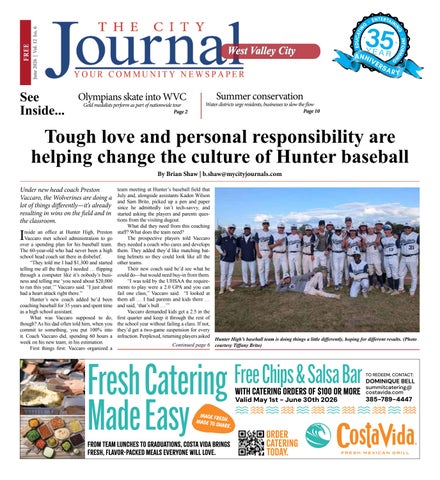
Hunter High’s baseball team is doing things a little differently, hoping for different results. (Photo courtesy Tiffany Brito)
Olympic gold medalists skate into Maverik Center
Olympic figure skaters brought their talents and personalities to the Maverik Center as part of the Stars on Ice Tour for 2026.
By Tom Haraldsen t.haraldsen@mycityjournals.com
The stars were out at the Maverik Center on May 14—literally. The 2026 Stifel Stars on Ice tour, featuring several U.S. Olympic figure skaters, came to West Valley City for a one-night performance. It’s the same ice where the U.S. Figure Skating Championships will be held Jan. 5-10, 2027.
Among those performing were gold medalists Alysa Liu (who won both a team and individual Olympic gold in Milan, Italy this year), Amber Glenn, Ilia Malinin, and pairs skaters Evan Bates and Madison Chock. They all delighted a small crowd of invited guests in a warm-up session held for the media.
Liu, Glenn and Malinin shared similar messages during short interviews with reporters; this exhibition was for fun and for the crowd, not for judges. It was easy for them to differentiate between the Games and this tour.
“Performing not competing: I’ve done a lot of shows and a lot of competitions, and I kinda view them the same way, but in shows we have a little bit more fun cuz there’s no rules,” Liu said. “There’s show lighting (spotlights) and there’s show numbers for Stars on Ice, and you get to skate with other athletes and not against them, so it’s really cool.”
“It’s definitely such a different atmosphere,” Malinin said. “Being around here with all these other skaters, we’re all just such an amazing family. Getting together to perform for a crowd without the judging but just for the general love and passion for the sport. We love it.”
“I was inspired by Sarah Hughes’ performance here in 2002,” Glenn said, “so it really is a full circle moment being here in Utah. I hope I can inspire young skaters like she inspired me.”
Their evening performance featured jumps, flips, spins and the athletic moves fans are used to seeing in figure skating, but also some dance numbers and a few other surprises. The atmosphere was relaxed and welcome after the grind they experienced leading up to and during the Winter Olympics earlier this year. They want the sport to remain fun and not so intense.
“I really hope that the Games being here in the U.S. can be a great experience for anyone competing,” Glenn said. “There are many things that I think about, but one of them will be trying to make it a safer place for the athletes. There’s a lot that goes into the events at the Olympics and a lot of times the cameras and the fanfare, it can get a bit extreme. We saw that get to some of the ath-
letes in Milan, and I think we really need to consider athletes’ mental health.
“In reality, we just need to go out there and skate our very best and meet our goals. We need to stop treating it as if it’s life or death. I get that that’s the job of some people but there needs to be human compassion in those moments. We’re not actors, we’re not movie stars, we’re not performing for cameras, we’re performing for judges and the audience and for ourselves. We definitely need to consider people’s well-being before TV entertainment.”
Liu and Malinin agreed that figure skating should be for more than just medals and accolades in the press.
“Honestly, just not being afraid to be different,” Malinin said. “That’s something that I always put out as a message to all my neighbors and everyone who supports me in the skating world. Don’t be afraid to stand out, don’t be afraid to be different. Really embrace what feels natural to you and share that to the world. As figure skaters, we all skate differently, we all perform differently. We all have incredible abilities that are different. It’s very important that everyone has that open mind, so that they can appreciate the whole environment of figure skating. It’s so diverse and so unique.”
“I don’t want to just inspire skaters,” Liu said. “I want people to go after what they want to go after. What I value the most as an athlete is sportsmanship, and as long as that is taught, I think everything will be good. I learned that you’ve really got to stay present, you’ve really got to enjoy everything. I really love life no matter where I am. I loved it two years ago, a year ago, and I love it now. You’ve really just have to find something you enjoy all the time. You’ve got to see the good in things. You have to get to know yourself to enjoy it.”
All three of them had been to Utah before, but not for some time. They said the Maverik Center venue for the nationals next year and the Winter Games in 2034 was nice, though maybe a bit smaller than many arenas where they’ve performed. Liu said, “it will be intimate.”
And each said they were looking forward to another experience—trying dirty soda. Liu said she was “ready for my Swig. My friends called me and said I had to try it and I will, though I really don’t like soda to be honest.”
What they and their fellow skaters did give the audience was a taste of Olympic stardom, achievement, and perhaps inspiration for others to make their own dreams come true, both on and off the ice. l


From left to right, Isabeau Levito, Amber Glenn and Jason Brown during their dress rehearsal performing “Golden” from “Kpop Demon Hunters”. (Cassie Goff/City Journals)
Alysa Liu shares how moved she’s been to hear stories from young adults about how inspired they’ve been by her to live as their authentic selves. (Cassie Goff/City Journals)
Summer festival season is here as WestFest starts June 17
Where and when you can find local parades, drone shows and fireworks throughout the valley this summer season.
By Travis Barton travis.b@thecityjournals.com
F rom the end of May until late August, cities throughout the Salt Lake Valley celebrate community spirit with parades and carnivals along with local traditions unique to each summer event. Check out this schedule of festival events and plan your summer fun.
WestFest - West Valley City
June 17-20, Centennial Park (3100 S. 5405 West) www.wvc-ut.gov/2034/WestFest
The annual celebration of West Valley City’s incorporation features a carnival, parade, talent showcase, a fun run and fireworks on both Friday and Saturday nights.
Taylorsville Dayzz
June 25-27, Valley Regional Park (5100 S. 2700 West) taylorsvilledayzz.com

marks the debut of Stampede Slugfest and Sundown at Ron Wood Park—a one-pitch, overnight softball tournament. July Fourth itself will bring the grand parade, K9 demo and fireworks among other events.
Murray Fun Days
July 4, Murray Park (296 E. Murray Park Ave.) www.murray.utah.gov/2115/ Murray-Fun-Days
It started in 1958 and continues to this day. The famous parade along State Street begins at 8:30 a.m. while the rest of the day features a 5K walk/run, children’s race, chalk art contest, plein art contest, games, car show, food trucks, balance bike race, “Harltey Road” concert and capped with fireworks at 10 p.m.
Freedom Fest Fourth of July –South Salt Lake
July 4, Fitts Park (3050 S. 500 East)
Western Stampede – West Jordan
July 2-4, Veterans Memorial Park (8000
It marks 30 years for Taylorsville’s special birthday bash which will feature a parade, petting zoo, carnival, food booths, concerts, 5K, car show and fireworks. Concerts will feature cover bands of Adele, Bee Gees and ABBA. And don’t forget about the skydivers on Saturday night.
SUPPORT YOUR LOCAL CHAMBER BUSINESSES
• Ayaque RENEWING MEMBERS:
• American United Federal Credit Union
• Neighborhood House
• Felicia Wright and Associates
• Hidden Peaks Coffee & Roasting Co
NEW MEMBERS:
• Emily Hayes Realty Team
• Grand Canyon University
• Prosegur Services Group, Inc.
• Trimlight Inc.
• West Valley City Living
• AAA
• Shiny Shell Car Wash
• Taffy Town
• Hilton Garden Inn Salt Lake City Airport
• Mountain America Credit Union
• Lucky’s Iron Door Roadhouse
• Exactitude Home Inspection
• Morgan May Public Affairs
• Prosegur Services Group, Inc.
• American United Federal Credit Union City of Kearns Civic Partnership

S. Redwood Road) Westernstampede.com
Independence Day weekend starts in style with West Jordan’s Western Stampede. Thursday marks the rodeo kickoff, carnival and outdoor movie of “National Treasure” followed by a Friday featuring a drone show and Taylor Swift tribute band. This year
Freedom Fest begins with a flag ceremony and special rendition of “The Star-Spangled Banner” followed immediately by the parade. This year’s theme commemorates the 250th anniversary of the country. The parade starts at 2280 S. 300 East and ends at Fitts Park where there will be food, entertainment, kid’s activities and more. l
WestFest, seen here, will feature carnival rides for kids of all ages. (File photo City Journals)
COMMON GROUND
Play Nice in the Sandbox
Common Ground will be a column of rotating viewpoints that highlight specific feelings across the political spectrum, and it will always end with possible ways to come together.
There once was a giant sandbox where everyone could play together. It had dump trucks, shovels, sandcastle molds and one corner filled with cigarette butts from the high school teens.
Big Brother (BB) controlled the sandbox. He carried a clipboard and whistle, and discouraged others from playing. Although it belonged to the entire community, BB would chase people away, saying, “That’s just the rules,” which he had made himself, of course.
But Little Brother (LB) wanted to play. He tried to convince BB to give him just a small part of the sandbox to build sculptures with his friends. “What about this spot?” he asked.
BB clutched his clipboard to his chest and gasped. “That’s a very important place. That’s my transportation corridor. You can’t have it.”
Every spot LB suggested, BB drew a new line in the sand and explained why it just wasn’t feasible. That spot was BB’s economic area, and another spot was an important waterway. Soon, all that was left was the ashtray corner, but BB wanted control over that, too.
LB went to find Mom (who represents voters, the judiciary and common sense). She explained to BB that the sandbox belonged to everyone and LB could have his share.
BB was furious and started throwing sand at Mom, calling her a bully. “You’re destroying the integrity of the sandbox!”
Peri Kinder Common Ground
he screamed. Then he spent the rest of the summer planning to steal back LB’s share.
Instead of a sandbox, we’re dealing with voting maps. Gerrymandering has shaped Utah’s leadership for decades, especially in creating congressional districts that look more like a sliced pizza than an equally divided constituency.
We can’t bury our heads in the sand and expect the majority leadership in our state to treat us fairly. In 2018, Utah voters tried to redraw the sandbox lines, approving a ballot initiative that would create an independent redistricting committee to create voting maps to avoid gerrymandering.
But Gov. Cox signed a different map into law that split Salt Lake County into four districts that could easily be controlled by Republicans. The new map ignored the committee’s recommendations, which would give Democrats a possibility of winning a Congressional seat.
Utah’s League of Women Voters filed a lawsuit, claiming the new map was a bunch of baloney. They won that case in 2024 when the Utah Supreme Court ruled that legislators could not override the voice of the people. But the majority leadership has been fighting for its maps
and sand toys ever since, trying to overturn the Court’s decision.
Common Ground: Gerrymandering should be illegal in every state because it skews voters’ rights and stacks the deck for whoever the majority party may be. Maybe instead of lawmakers crafting the voting maps, independent commissions can be tasked with creating fair districts for all states.
We’re told that every vote counts, but that’s not the case in gerrymandered states, on both sides of the aisle. Voters feel frustrated and unheard. I think we can agree our system is broken. Majority leaders in states, both Red and Blue, draw the voting maps, create the rules and decide which demographics get representation.
Could Utah take the high road and fix the system? Could we become a beacon of guidance and inspiration for the country in a time that feels heavy and dark? It’s a nice idea, we just need brave leaders willing to adopt meaningful change.
A diverse range of opinions creates effective solutions. Instead of one group deciding the laws, it strengthens our democracy to include voices from differing beliefs and experiences.
Gerrymandering eliminates divergent voices, creating a system of inbred and insipid decisions. That doesn’t sound like fair representation; that sounds like a power grab, no matter the party.
May Follow Up From Readers
In May, John J. Walker’s Common Ground article, “I can’t afford YOUR tax bill,” sparked a flurry of replies, including one from reader Christine. “I would agree that paying for infrastructure is important and it’s tough when your paycheck doesn’t go very far for all your hard-worked hours. I would disagree, however, about the derogatory generalization of Democrats being the brainless, doom-scrolling, rage-bating, vulgarity-writing party.”
Some commenters said they want their tax dollars spent on things like zoos, parks, and museums, and felt Mr. Walker’s column was “negative and angry.” Others felt people earning over $1 million should pay more into the system.
Readers expressed appreciation for the Common Ground concept, with the focus of bringing the community together, even when we disagree. However, reader Laura felt the tone of Mr. Walker’s op-ed didn’t fit that description. “I don’t see how the rudeness expressed in this article could achieve that goal,” she wrote.
A reader named Tyler summed up a prevailing sentiment when he wrote, “I think the [Common Ground] approach and voice is exactly what our community needs. I firmly believe that informing on political issues is a much-needed thing. I hope that the continued success of the column helps bring our community closer together!”
— City Journals Columnist Peri Kinder
WEST VALLEY TEAM
The West Valley Journal is a monthly publication distributed directly to residents via the USPS as well as locations throughout West Valley.
The views and opinions expressed in display advertisements do not necessarily reflect or represent the views and opinions held by Loyal Perch Media or the City Journals. This publication may not be reproduced in whole or in part without the express written consent of the owner.
© 2026 Loyal Perch Media, Inc.
PUBLISHER
Bryan Scott | bryan.s@thecityjournals.com
EDITOR
Travis Barton | travis.b@thecityjournals.com
ADVERTISING EXECUTIVES
Mieka Sawatzki | mieka.s@thecityjournals.com
Marc Davis | marc.d@thecityjournals.com
CLIENT SERVICES
Lydia Rice | lydia.r@thecityjournals.com 385-557-1022
CIRCULATION COORDINATOR
Lindsay Andreasen | lindsay.a@thecityjournals.com Rack locations are also available on our website.
EDITORIAL & AD DESIGN
Stacey LaMont Ty Gorton
WEST VALLEY CITY JOURNAL
9500 South 500 West, Suite 205 Sandy, UT 84070
PHONE: 801-254-5974
MISSION STATEMENT
Our mission is to inform and entertain our community while promoting a strong local economy via relevant content presented across a synergetic network of print and digital media.
Designed, Published, & Distributed by

Kids Café provides a free meal in a safe space
Six county libraries serve meals six days a week.
By Peri Kinder peri.k@thecityjournals.com
Library branches in Salt Lake County aren’t just places for books and reading. Local libraries offer a welcoming community with access to information, technology, lifelong learning and, in some cases, a free meal.
The County Library’s Kids Café program provides a meal to any person 18 and younger, no questions asked. With six locations, the Café serves hundreds of children during a time when food insecurity is rising.
“It’s important to us that children and teens have access to nutritious meals that can support their health and ability to focus and learn,” said The County Library Public Relations Coordinator Marissa Hodges. “It helps to address food insecurity in the community, it provides them a vital resource and it helps parents stretch their budgets a little bit.”
In partnership with the Utah Food Bank, the Kids Café is available Monday through Saturday at Midvale’s Tyler Library (8041 S. Wood Dr.), Hunter Library



said. “It’s a place where kids can put those unwanted items for anyone who needs or wants food. It’s available there for them to take. Many branches have started that and now community members contribute to it as well. It’s a way for us to offer food resources to folks beyond the 18 and under limit.”
Besides tracking inventory, staffing volunteers and breaking up the occasional food fight, the Kids Café program is an effective way to bring meals to children. It offers not only nourishment, but a safe place where kids feel a sense of belonging.
Hodges shared a story one of the librarians related to her, about a 12-year-old girl who wanted to give some of her food to a man in need.
in West Valley (4740 W. 4100 South), Kearns Library (4275 W. 5345 South), West Valley Library (2880 W. 3650 South), Magna Library (2675 S. 8950 West) and Granite Library (3331 S. 500 East) in South Salt Lake.
The Kids Café is open at different times at each location, and some libraries also offer breakfast. Hours of operation can change, so check the County Library web-
site at slcolibrary.org for details.
Hodges said librarians have received positive feedback on the program, but patrons are sometimes upset that the meals are not available to adults. To address that, Kids Cafés have added a “share bucket” so any community member can access food.
“Sometimes we have extra food and if there’s food that kids don’t want, we have started what we call a share bucket,” she












“The girl picked up a meal and turned to a nearby homeless man and said, ‘You can get some if you’re hungry,’ she said. We then had to explain to her that the program was only for kids up to age 18. The little girl stared hard into the librarian’s eyes, wordlessly daring her to stop her as she passed her meal to the man. It was very moving.”
Hodges said the program has also strengthened trust in local libraries, opening people’s eyes to the possibilities a library offers. “We really are more than just books and movies. We’re a complete community resource.” l


People 18 years and younger can get a free meal at six County Library locations, from Monday through Saturday. The Kids Café program has helped thousands of children over the years. (Jeffery Buydos/The County Library)
Vaccaro why grades mattered when it was the second quarter that determined whether they qualified academically to play.
“It matters, because it’s my rule,” recounted Hunter’s new coach. He’d be hard on them, put his arm around them when needed and go to bat for them any way he could.
“But, I’ll tell you right now … what you do in that building reflects on what you do out here (on the field),” said Vaccaro about numerous player inquiries. “If you can do the work in the building it proves to me right now that you can do the work out here.”
Sure enough, Vaccaro’s best players in year one were also his best students. They owned the batter’s box. They weren’t swinging at every pitch or worrying about striking out; instead, he said they were more disciplined, communicated with each other and didn’t look at a ball in the infield or outfield and think it was someone else’s responsibility.
Junior Thomas Woodruff hit .356 with a team-high five doubles. Sophomore Derek Kendall knocked in a team-high two triples and 14 RBI. Junior Brendan Brito had a teambest 6.92 ERA as a pitcher.
And, juniors Jayden Pacheco and Fabian Avila had big moments at the plate and on the mound, according to the coach.
Vaccaro also had someone else familiar who could be leaned upon: junior Noah Francom, a player he coached at age 7. Francom

dad—I’m now your coach … it’s always ‘yes, coach or no, coach.’ He’s done pretty good at it.”
All the kids did, according to the coach. He didn’t even feel a need to appoint captains; in their own ways, they all were. The new coach organized an intrasquad BlueWhite Game to be played before the season in which they auctioned off items that area businesses donated.
That game was a success, the money needed was raised, and the team got matching helmets. As a bonus, the coach was able to purchase custom batting gloves in the school’s spending plan.
Armed with a plan and purpose, Hunter finished with a 5-20 record, their best since 2019. They won their third game of the year at home versus Ben Lomond, and in Region 4 action swept rival Granger in a three-game series after having been 10run ruled in 13 of their 15 previous games, and won one against West to close out the season.
starred in basketball, was on the Honor Roll every quarter and now was being asked to do something he hadn’t done in quite some time—pitch.
“He had some challenges getting us into the late innings, but they hadn’t pitched him for the last two years,” Vaccaro said. Francom went 1-4 on the mound and had 22 strikeouts. He also hit .283 with 8 RBI.
The coach’s son, Trace Vaccaro, led the
team in hitting at .391. Was it a challenge coaching him?
“Yes and no,” said the coach, who liked to coach his kids when they were young—but let them receive other instruction as they grew into their teens. Trace was no different.
“There has always been an understanding with my three boys, when we step on the other side of this fence I’m no longer your
The biggest victory for this team, however, might have come inside the building.
As required, 13 kids came in and showed the coach screenshots of their midterm grades in the fall and so they were allowed to practice with the team. Four were above a 3.0 GPA, said Vaccaro.
“The next quarter hits, now I’ve got six kids above a 3.0 …,” he said. “Third quarter hits, I’ve got 12 kids above a 3.0.” l




Hunter High’s baseball team is doing things a little differently, hoping for different results.
(Photo courtesy Tiffany Brito)
ChamberWest President Barbara Riddle among top CEOs of the year

Membership has nearly doubled –and revenues have quadrupled – in the decade she has been running the busy organization.
By Carl Fauver c.fauver@mycityjournals.com
UtahBusiness magazine and website has named ChamberWest President Barbara Riddle one of its 25 CEOs of the year in our state. The honor comes 65 years after the westside business organization was first created, under a different name… and 10 years after Riddle took the reins.
“Each year, we celebrate Utah’s most accomplished professionals,” Utah Business explains on its website. “(These CEOs) have led their organizations with vision, courage and determination (and) have made it their mission to elevate the way business is done in Utah.”
On Jan. 20, 1961 John F. Kennedy was inaugurated as our 35th President of the United States, ushering in a new era of youth and optimism across the country. Just days later, a new business support organization was born on the Salt Lake Valley’s westside.
“In February 1961, many businessmen in the West Valley City area knew there was a need to build a strong alliance in order to grow as a community,” Riddle said. “About 20
men congregated for that initial meeting. This marked the beginning of (what was first called) the Granger-Hunter Chamber of Commerce. The name ChamberWest was made official in January 2001.”
Riddle reports, Taylorsville businesses joined the organization in 1968. Kearns merchants followed. More recently, ChamberWest has expanded to also include West Jordan and Magna businesses.
The ChamberWest office now has four full-time employees. In addition to President/ CEO Riddle, Monica Gayden is the organization’s senior director of business development & events… Makaila Kelso is business development director… and Gabby Viana, office coordinator. They are the three who nominated Riddle for her honor – and were just as excited as Riddle when they got the official word.
“I was on the phone when the email came in about the CEO of the year honor,” Riddle said. “My staff all came in, standing in front of my desk. I was quite curious about what was going on. It is a great honor. All four of us attended the luncheon where the 25 honorees were introduced.”
“Barbara Riddle is amazing; her work ethic is unmatched,” Taylorsville Mayor Kristie Overson said. “ChamberWest has so many events going on at the same time. I know when I answer a call from her, I will say ‘yes.’ Barbara can talk me into doing any-
thing. Our city is happy to do whatever we can to help ChamberWest.”
Since being named president and CEO in March 2016, Riddle says ChamberWest has nearly doubled its membership – and more than quadrupled annual revenue. The organization has far too many active committees and events to detail here. All of their activities are detailed at chamberwest.com.
Growing up, Riddle lived in several states as her father’s Bureau of Land Management job moved the family around. She graduated high school in Virginia – but began calling Utah home soon thereafter.
“I moved out here to attend Utah State and have lived in our state ever since,” she said. “I’m married, with two amazing kids, horses and dogs. We make our home in West Kaysville; but I most definitely live in the west Salt Lake Valley during the day.”
ChamberWest Board Chair Ryan D. Nelson is a senior VP for Avalon Health Care Management.
“The way Barbara conducts herself as CEO is incredible,” Nelson said. “She has an instinct for properly managing communication and relationships. She is a collector of good people – which is why her staff is also so strong. Barbara sets a very high bar of excellence.”
Nelson added, ChamberWest welcomed 96 new members last year alone and hosted 36 different events. l
The Cottages at Pearce Farm
As many Americans prioritize housing that supports independence, social connection and long-term financial stability, demand continues to grow. THE COTTAGES AT PEARCE FARM in West Valley City stand out as a unique offering. This active-adult, gated, maintenance-free community provides not only a simplified way of living but a rare level of flexibility.
Buyers can choose from three floor plans and place any of them on any of the 65 available homesites. Buyers can select their own interior finishes and color palettes, rather than being limited to pre-set packages, allowing for a personalized fit that reflects their style and preferences.
With decades of combined experience in the real estate industry, Gina Eborn, Pam Phillips, and Karen Curtis are dedicated to helping clients turn their vision into reality. Their focus is on active adult communities, working closely with 55+ buyers who are seeking more than just a home; they’re looking for a lifestyle shift that offers simplicity, connection and ease.
“We are selling homes in our new gated subdivision, where we’ve been intentional about creating a neighborhood that fits how people want to live in this next chapter,” Gina said. “Real estate lets us be part of someone’s life transition. It’s not just a transaction; it’s emotional, it’s personal and it matters.”
The Cottages at Pearce Farm are thoughtfully designed with convenience, safety, and connection in mind. Within its secure, private setting, homeowners can enjoy the freedom to focus on what matters most, whether that’s traveling, socializing, or embracing a more relaxed lifestyle.
A future clubhouse will further enhance the community experience, featuring a gathering area, kitchen, exercise room, and a pickleball court

for recreation and connection. Ideally located, The Cottages at Pearce Farm offers easy access to shopping, dining, medical facilities, and an abundance of walking trails.
The result is a cohesive neighborhood where details are tailored to the people who will live there. It’s about building a place where life feels easier, connected and perfectly suited for what comes next. The agents love being part of the process to help clients design a lifestyle that gives them more freedom.
“For many 55+ clients, we help with the emotional side of letting go of a long-time home,” Pam said. “We reduce stress and uncertainty by providing a clear and workable plan, coordinating timelines, or helping someone figure out how to transition from a large home into something smaller. We take those moving pieces and make them more manageable.”
Gina, Pam and Karen work closely with the buyer, designer and builder throughout the construction process, from lot selection, options, walkthroughs and closing. They guide clients through what can feel overwhelming by making it smoother and more enjoyable.
The team helps the buyer stay informed and confident every step of the way, offering a long-term perspective and helping clients make decisions to benefit them years down the road, while protecting the value of their home.
“We work hard to ensure a great experience and we communicate clearly, we follow through, and always put their best interest first,” Karen said. “Over time, that builds real trust, and many of our clients come back or refer friends and family.”
By educating clients, they avoid making decisions based on fearbased emotions. The agents slow things down to see the bigger picture and guide them to make choices not just for today, but for the future.
“We truly care about the people we work with, and when I say ‘we’ that includes everyone from our team, the developer, builder, and the designer,” Gina said. “This isn’t just a transaction for us; it’s about helping buyers make the right move for their life. That’s something we have all built our careers and reputations on.”
To learn more, stop by the daily open houses at The Cottages at Pearce Farm at 6755 W. 3500 South, or visit pearcefarm.com.
“People can come experience the homes and the lifestyle firsthand,” Pam said. “It’s a great way to explore what makes this community unique in a relaxed, no-pressure setting.”

ChamberWest CEO Barbara Riddle is among Utah Business magazine’s top CEOs of the year. (Photo courtesy Barbara Riddle)











Down payment assistance available for qualified first-time home buyers
Salt Lake Board of Realtors offers $10,000 grants.
By Darrell Kirby d.kirby@mycityjournals.com
First-time home buyers in West Valley City could get help in buying a home.
homeownership strengthens our communities and creates lasting stability for families,” said Scott Colemere, president of the Salt Lake Board of Realtors. “These grants not only provide financial assistance but also demonstrate the generosity and commitment of realtors to giving back.”
The grants come from $240,000 the board expects to award in 2026.
#1 gutter protection
The Salt Lake Board of Realtors is offering $10,000 in down-payment assistance to eligible applicants who work with a realtor who is a member of the organization. Prospective buyers must meet program requirements, including working with a realtor who is a member of the Salt Lake Board of Realtors, a credit score above 640, a household income of up to $141,400, and are selected through a random drawing, according to a press release from the Board of Realtors. Realtors can apply on behalf of their qualifying clients at slrealtors.com.
“Helping first-time buyers achieve

“We have been doing the grants since 2019,” said SLBR Director of Communications Dave Anderton. “Back then, the grants were $5,000 each. We recently raised the amount to $10,000 per grant to reflect higher housing costs. We have given out roughly $500,000 in grants prior to 2026.”
The board said “homeownership offers long-term financial advantages compared with renting, including the ability to build equity and benefit from home price appreciation over time. Research from the National Association of Realtors shows the typical homeowner has a net worth roughly 40 times greater than that of the renter.” l



First-time home buyers can apply for down payment assistance from the Salt Lake Board of Realtors. (Darrell Kirby/City Journals)

Produce and homemade crafts from local growers and artisans can be found at the weekly Farmers Markets that begin June 19. Shown here are Bets & Kate Toffee co-owners Betsy Tanner and Katie Jensen with their old- fashioned English toffee at the market in 2023. (File photo Peri Kinder/City Journals)
Farmers markets and more as summer comes to West Valley City
By Tom Haraldsen t.haraldsen@mycityjournals.com
Asschool winds down and summer kicks into full gear, so do a number of annual events and festivals for West Valley City.
The WestFest runs June 17-20 at Centennial Park, 5405 W. 3100 South. Before that happens, weekly Festival Markets will be held in the park each Thursday from 5 to 9 p.m.
Presented by Good4Life Markets, the event brings together produce growers and artisanal goods from farmers and makers in the community. Entertainment, games and other activities for everyone in the family will be offered during the markets, which run weekly through Oct. 8. You can learn more on the market Instagram page at www.

instagram.com/westvalley.farmersmarket/
The Healthy West Valley Committee will meet on June 10 at 3 p.m. at the Utah Cultural Celebration Center. The committee always plans a number of events each year.
The city’s Clean and Beautiful committee will also meet at the UCCC on June 24 at 5:30 p.m. Website information at www.wvcut.gov can supply more information.
Concerts will be held at the Utah First Credit Union Amphitheatre (they began on May 30 with Kesha) and run through Oct. 7.
The West Valley Performing Arts Center will have productions through the end of August as well.
And concerts plus other events are scheduled for the Maverik Center this summer.
Find a list of concerts in the Salt Lake Valley and local communities each month in the West Valley Journal. l



Parkinson’s Disease
WBeyond the Tremor: Unveiling the Invisible Struggle of Parkinson’s Disease
HEN YOU THINK OF PARKINSON’S DISEASE, a visible tremor might come to mind. However, the true experience often lies hidden beneath the surface – an “invisible struggle” impacting millions. This article highlights the complexities of Parkinson’s and advancements in care.
A common misconception is that all Parkinson’s patients experience tremors. This isn’t true; up to 20% do not. Additionally, Parkinson’s isn’t just an elderly condition. Young-Onset Parkinson’s Disease (YOPD) affects individuals under 50, with celebrity Michael J. Fox, diagnosed at 29, significantly raising awareness and funding for research.
As Dr. Sunil Rathore, a neurologist at Holy Cross Hospital – Salt Lake, emphasizes, “Many people believe Parkinson’s is solely a motor condition, defined by tremors and rigidity. However, that’s just one piece of a much larger and more complex puzzle. The non-motor symptoms – from sleep disturbances and anxiety to cognitive changes and chronic pain – can often be the most challenging aspects for our patients.”
The Hidden Realities: Non-Motor Symptoms and Daily Impact
The “invisible struggle” of Parkinson’s includes a wide array of non-motor symptoms impacting daily life, often appearing years before motor symptoms. These can include loss of smell (anosmia), REM sleep behavior disorder, constipation, depression, anxiety, cognitive changes, and debilitating fatigue. These realities profoundly affect well-being, turning simple tasks like dressing or driving into immense challenges and leading to social isolation.
Hope on the Horizon: Advancements in Treatment and Research
While there’s no cure, significant advancements are improving symptom management and quality of life. Levodopa remains a cornerstone medication, with ongoing developments to optimize its effectiveness. Advanced therapies like Deep Brain Stimulation (DBS) and focused ultrasound offer new hope by precisely targeting brain areas responsible for motor symptoms. Emerging research explores disease-modifying drugs, gene therapy, and biomarker discovery. The Michael J. Fox Foundation has raised over
Nurture what’s next.
$2.5 billion for research, accelerating the search for a cure.
Dr. Rebecca H. Reiser, a neurologist at Holy Cross Hospital – Jordan Valley, states, “The landscape of treatment and support is constantly evolving. We’re seeing incredible progress in understanding the disease at a molecular level, leading to more targeted therapies and a renewed sense of hope for better symptom control and ultimately, a cure. Our goal is to empower patients to live full and meaningful lives.”
Local Expertise and Support Available
Living with Parkinson’s is a journey best not taken alone. Our community offers local support groups, specialized exercise classes, and educational events for patients and caregivers. If you or a loved one are experiencing any concerning symptoms, please consult a provider. Early diagnosis and proactive management are key. For more information, visit: mountain.commonspirit.org.
For more information or to find a provider visit mountain.commonspirit.org


Learn more about the services, care providers and mission-driven work of the Holy Cross hospitals and CommonSpirit Health at www.holycrossutah.org.

At CommonSpirit Health, we make the healing presence of God known in our world by improving the health of the people we serve, especially those who are vulnerable, while we advance social justice for all.

Women go through many changes in their lives. And we believe every milestone matters. Our health care experts can help you face your next phase with confidence – because each chapter deserves to be celebrated.
Find care near you at mountain.commonspirit.org.

Report on housing shows West Valley with the most, Magna with the newest
The report is by the Kem C. Gardner Policy Institute at the U.
By Darrell Kirby d.kirby@mycityjournals.com
Northwestern Salt Lake County is home to one of every 10 Utah residents. And that portion of the state’s most populous county has 42% of the county’s overall homes and 16% of all housing stock in Utah.
Those are just some of the numbers derived from the latest fact sheet from the Kem C. Gardner Policy Institute at the University of Utah. The report focuses on housing in the northwest county cities of Kearns, Magna, western Salt Lake City, Taylorsville and West Valley City.
As of 2024, housing in northwest Salt Lake County included 68,472 single-family dwellings, 23,568 apartments, and 10,888 townhomes. Kearns had the highest percentage of single-family homes, apartments were most numerous on Salt Lake City’s west side, and Taylorsville and Magna had the largest share of condominiums and townhomes, respectively. West Valley City had the largest number of overall residential dwellings at more than 44,000.
Homes in Magna grew at the fastest rate in the northwest county at 23% between 2020 and 2024. Kearns and Taylorsville, with the least amount of available developable land saw its housing supply expand by only 1% during the same period.
Magna has the newest housing stock in
the northwest quadrant with a median build year of 1992. Westside Salt Lake City has the oldest with half of its housing constructed before 1973 and half of it after. In between are Kearns (1978), Taylorsville (1980) and West Valley City (1983).
The median rent was about the same in all northwestern cities. Taylorsville was the highest at $2,011 as of two years ago. The other municipalities ranged from $1,920 in western Salt Lake City to $1,979 in Magna.
Magna residents were the most cost-burdened when it comes to how much they spend on a place to live. Six in 10 Magna renters, or 59%, reported spending more than 30% of their income on housing, which is how “cost-burdened” is defined in this case. Kearns renters were the least cost-burdened with 44% exceeding the 30% threshold, which matches the statewide average.
The Gardner report also found that home prices in the northwest valley were lower on average than Salt Lake County and the state as a whole.
Finally, the fact sheet points out that 70% of northwest county people own their homes. The rest are renting. Kearns and Magna have the highest share of owner-occupied homes. Western Salt Lake City has the largest number of renters.
The fact sheet in northwest valley housing coincides with the early-stage construction of the University of Utah’s first off-campus hospital in West Valley City. The data in the report is “designed to inform local decision makers and community partners” as they prepare for the medical campus to be operated by University of Utah Health. l





A home under construction in West Valley City. (Darrell Kirby/City Journals)




Animal shelter makes some changes in fees for services
Some adoptions fees have been reduced, while other fees such as vaccinations have increased.
By Tom Haraldsen t.haraldsen@mycityjournals.com
Some changes have been made in relation to license fees for pets under the West Valley City Animal Control Division. While many costs have stayed the same, there have been a few changes and additions.
People age 60 and over will pay $1 to license their pets. All others will be under current charges depending on whether the pet is spayed or neutered. Additional license fees have been added for license transfer (up from $1 to $5 with current proof of license and rabies vaccination), ferrets $35 with a rabies certificate required, and pot-bellied pigs $35, with trimmed or removed tusks and sterilization required, along with a certificate of rabies vaccination. The pig cannot weigh over 150 pounds.
Adoption fees from the animal shelter include all cats and dogs microchipped, with rabies and other vaccinations. Fees can be discounted for special events. The fee for puppies (under one year old) is $100, down from $155, and for older dogs, $50, down from $85. For kittens under one year old, the fee is $75, down from $80, and for older cats,
it is $40, down from $55. Other animals like fowl, reptiles and small exotic animals can be adopted for a $30 fee, down from $50. Sterilization fees for redemption or impounded animals include a $75 sterilization deposit, up from $50. A sterilization deposit processing fee of $20 will be refunded if proof of sterilization is provided during a required time period.
Other fees:
• Rabies vaccination–$25, up from $15
• Other vaccinations or medications–$15 each, up from $10
• Microchip fee–$20, up from $10
• Euthanasia–$50 medical, $100 behavioral–up from $25
• Large animals unconfined, emergency call-outs, owner fees and property owner negligence are handled at a cost of $50/hour/person, with a minimum charge of $50.
• Trap rental is $2 per day, with a $75 deposit
• Pick up of dead animal from owner–fee is $50, or $25 for older adults
• Pick up of animal from owner for euthanasia–$50
• Licensed animal brought to shelter for turnover–$65, up from $20
• Unlicensed animal brought to shelter for turnover–$75, up from $40
• Annual kennel permits–$100 l



Fees for adoption and other services have changed at the West Valley Animal Shelter. (Darrell Kirby/City Journals)
Granite School District’s no-pet policy goes into effect
No animals allowed on school properties.
By Peri Kinder peri.k@thecityjournals.com
In the past, leashed pets were allowed on Granite School District properties, as long as owners removed waste and were respectful of the school grounds. But, in February, GSD officials changed the policy to prohibit most animals from district properties. People who bring dogs onto school property could face trespassing violations.
The policy reads, “Dogs and other animals brought onto school property for a reason other than an educational purpose shall not be on district property at any time, except for service animals for individuals with qualifying disabilities under the Americans with Disabilities Act.”
Luke Allen, GSD Associate Director of Communications and Community Outreach, said the policy was changed because schools were experiencing more issues and disruptions with dogs.
“We’ve had countless instances of students who get dog poop on their shoes or clothes and track that into the building,” he said. “Lots of our schools have to keep extra

In June, Granite School District will start implementing its no-pet policy, prohibiting animals of any kind on school properties at any time. (Stock photo)
clothes on hand so students can change when they get it on their clothes. We’ve also had a few instances of students being bitten by dogs during school hours.”
Some schools use discretionary funds to hire companies to remove dog waste, while cleaning costs inside school buildings are also increasing. With 83 schools spread from the Wasatch Mountains to the Oquirrhs, Allen said costs became unsustainable.
“Our board just felt that the disruptions from this have reached a point where they
needed to do something about it in policy,” he said.
Parents picking up students are asked to leave their dogs or other animals at home. People walking animals must stay on public sidewalks and walkways. Although the policy was adopted in February, GSD officials waited to implement it until signs were posted at all schools.
Many pet owners aren’t happy about the policy change. John (who asked to remain anonymous) likes to take his dog to a near-
by elementary school once or twice a week when school is out. With no dog parks nearby, he said it’s an option for his pet to run around a bit.
“The people who are there, who have pets, they’re very respectful. They have bags to pick up poop,” he said. “What I see at the schools, quite honestly, is a lot of garbage that the kids leave, lunch bags and sandwich bags and that type of thing. But I’ve never seen damage. I’ve never seen grass torn up, or playground equipment scratched or damaged in any way by pets.”
Enforcement of the new policy will be similar to what was done in the past. GSD officials will rely on signage to let people know the new rules but won’t have people actively patrolling properties.
“We’ll inform our law enforcement partners of the new policy, but this will still ultimately be a policy that when people see an issue, they’ll do something about it,” Allen said. “This will make it a little bit more black and white for either our school administrators or our law enforcement partners, when they do feel like they need to enforce it.”
By limiting disruptions caused by dogs and other pets on campus, the district hopes to promote a safe, clean environment for students. “The plan of this policy is to make sure our schools remain schools and don’t turn into dog parks,” Allen said. l

Cyprus Pirates girls golf was on track to make school history
Under the direction of new head coach Jordan Griffith and four senior team captains that lead the right way, Cyprus won the Region 4 championship.
By Brian Shaw b.shaw@mycityjournals.com
With three region girls’ golf tournaments having already been won by the Cyprus Pirates, other titles might be in their future, according to head coach Jordan Griffith.
Griffith was also part of a group of coaches that helped lead the boys to a Region 4 title in basketball during the winter and has seen how the rebuilt school in Magna at the foot of the Oquirrhs has breathed life into the whole student body.
“The new school is great! Brings a whole new vibe to Cyprus. Big new building with everything updated. Classrooms bring in more light and that’s the whole school in general. Doesn’t feel as dark, which is a big deal,” Griffith said. “New sports arenas with basketball courts, football fields, baseball and softball fields, eight-lane track and a new pool just gives life to the school. Beginning of this year kids had a new excitement coming into the year I feel.”
Down the road, a few blocks from the
old Cyprus High, the Copper Golf Club where the Pirates still practice offers them some familiarity, and that has helped as well. Seventeen kids came out for the team this season. From that group, four captains were chosen: juniors Taylor and Brooke Fresh— who are twins; and seniors Addison Youngdell and Shyla Kamakana.
While these four captains have consistently provided their counting scores to keep the Pirates at the No. 1 spot in their region, the success has been a total team effort according to Griffith.
“Three out of the four of these girls have won a region tournament this year and our JV girls stay after their rounds to walk the course and cheer on varsity, and the entire team waits at the final green until the final score is tallied to celebrate together. It is not a one man show here at Cyprus.”
That camaraderie has resulted in some outstanding scores of late, and the Pirates completely distancing themselves from the rest of their Region 4 competition. Not only have the four team captains shown that they can lead their peers, they also lead by example and posted the top four stroke averages going into the Region 4 Championships.
Led by Taylor Fresh at 87.5 strokes per 18 holes played, her sister Brooke isn’t too far behind that at 89.5. Meanwhile, Youngdell is at 92.3 while Kamakana is sitting at

99. At The Ridge on April 22, Taylor, Brooke and Youngdell finished 1-2-3. Kamakana was seventh, and Pirate Kate Howcroft, 10th.
“It is an exciting time for Cyprus girls golf. After serving as an assistant last year, I’ve taken over the program this season and the energy has been incredible,” Griffith said. “I came in and made a lot of changes with higher expectations of practice and time commitment to the game, and these girls have risen way above than what I ever imagined. We are currently having our best season in years.”
Prior to winning the Region 4 championship, Griffith told the Journal there were several heady goals he and his girls still hope to achieve—objectives that have never be-
fore been accomplished at Cyprus.
“Our focus has been on raising expectations and competing at a high level while maintaining support for each other in this individualized sport. Many of our players never picked up a club before high school, but their work ethic to improve has been inspiring.
“Our captains have done an incredible amount of behind-the-scenes work to make newcomers feel welcome. As we head into the final stretch of the season, we are aiming to make Cyprus history by securing our first ever day two appearance at the state tournament as a team. That we know at least,” Griffith said. “I am incredibly proud of this group. If there was ever a team to break through and make a mark at state, it’s this one.” l
Local water districts emphasize secondary water, conservation as drought intensifies
More water conservation information is available on district’s websites.
By Darrell Kirby d.kirby@mycityjournals.com
Arecord-low
snowpack along the Wasatch
Front this winter and spring has put the focus on summer water supplies and the need for conservation.
This comes as no surprise as Utah is stuck—with the exception of a couple of wet seasons—in a yearslong below-average dry spell, with 59% of the state in a “severe drought” right now, according to officials.
Area water districts are urging residents and businesses to slow the flow even more than usual, especially for outdoor watering.
The Magna Water District, which serves 35,000 customers in northwestern West Valley City and Magna, has issued the same message. However, MWD—one of the three water purveyors that serve the vast majority of West Valley City—has an advantage in its supply: secondary water.
Secondary water is minimally treated non-potable water that is delivered through separate lines for outdoor watering and irrigation. It helps conserve the typically more expensive
treated culinary water for drinking, cooking, bathing and other indoor purposes.
“It’s been important since we started the system,” said Clint Dilley, general manager of Magna Water District, of the secondary water. “It’s become a more substantial part of our deliveries.”
Dilley said about a third of the water delivered to customers is secondary water, keeping culinary water away from lawns, gardens and other outdoor uses. Secondary water comes to MWD through canals that carry water from Utah Lake and the Jordan River. Also, a large quantity of culinary water that goes down households drains returns to MWD where it is filtered and treated just enough at the agency’s wastewater treatment plan to be reused for irrigation needs. It is referred to as reuse water. “The drought really doesn’t affect this irrigation water because the supply is essentially already there,” Dilley said.
Dilley said MWD’s basic secondary water infrastructure was laid starting in 2004. It has been expanded to cover new development since then. Customers receiving the nonculinary water for outside use generally pay about one-third less overall for their water bills than those who have to use drinking water for their indoor and outdoor needs.

Magna Water District, which serves part of West Valley City, uses non-potable water for many customers’ outdoor watering to conserve more expensive treated drinking water. (Darrell Kirby/City Journals)
Kearns Improvement District and Granger-Hunter Improvement District, the other major water providers serving West Valley City, do not have secondary water systems in place.
Kearns general manager Greg Anderson appealed to his agency’s 14,500 customers to conserve the precious resource. “We are asking all residents to take immediate conservation measures. Specifically, we request that you do not begin outdoor watering until May 15. After that date, please limit watering to no more than
two times per week, and only during the hours of 8 p.m. to 8 a.m.” he wrote in a message included in billing notices. “A variety of helpful conservation tools and resources are available on our website at www.kidwater4ut.gov/. We invite you to review these tools and incorporate them into your daily water use.”
Likewise, Granger-Hunter Improvement District, which delivers water to central and eastern West Valley City, is pushing a 10% reduction in water consumption among its 28,000 households and businesses, as it has no secondary water system. “This year is different,” said general manager Jason Helm of the intensifying drought. Customers can explore “waterwise rebate programs through Slow the Flow (slowtheflow.org) and additional conservation tips” at ghid.gov, according to a statement from the district.
Despite the availability of secondary and reuse water, Magna Water District is encouraging conservation efforts including a voluntary 10% reduction in water use this season, or what the district refers to as “level one” conservation. More stringent mandatory measures are an option if needed as the summer wears on. Ideas and incentives for reducing and removing lawns and other thirsty landscaping can be found at utahwatersavers.com. l
Cyprus girls golf team. (Photo by Tanner Francom)
“I’ve noticed that
ers
By Zachary Smith z.smith@mycityjournals.com
Aroosh Kaleem, a graduating Utah Connections Academy senior from West Valley City, has already gone above and beyond. Recently, she qualified as a National Merit Scholarship Finalist for her high test scores and incredible extracurricular achievements.
The National Merit Scholarship Program is a highly prestigious academic competition that aims to recognize and honor academically talented American students. Students who enroll are selected based on their PSAT/NMSQT testing scores. Only students in the top 1% of scores qualify as semifinalists. Those students then move on to become finalists by submitting detailed applications demonstrating their academic
achievements. Aroosh was one of roughly 15,000 students to qualify as a 2026 National Merit Scholarship finalist.
Aroosh initially took the PSAT in her sophomore year before taking the qualifying test in her junior year. “That experience allowed me to understand what to expect on the exam,” she said. “I studied with a lot of practice tests, so being familiar with the format took away feelings of testing anxiety.”
While studying for the test over her summer break, Aroosh gained a deep appreciation for math. This helped her get a perfect score of 760 on the math section of the exam.
“I love math because of its intersectionality with creativity,” she said, citing her hobby of calligraphy as an example. “While most wouldn’t find these two things related, math played a big role in my calligraphy designs. The spacing between letters, thickness, height and other factors had me whipping out my calculator and ruler a lot more than I expected.”
In addition to being a math wizard, Aroosh is also a leader. Throughout all four years of high school, she has been a State Student Board member for SheTech, a Utah-based program that is currently the largest industry-led program created to inspire and support high school girls pursuing
STEM careers. She is also currently the president of the SheTech chapter at Utah Connections Academy. Her school’s SheTech club has been a great way for her to connect to her online school community.
“It required a lot of creative thinking to adapt the club to our online format,” she said, “but it became more than I could imagine. Through school outreach efforts, we’ve created the most amazing community that is enthusiastic about STEM.”



This year, Aroosh’s SheTech club is participating in the Conrad Challenge, a national STEM competition that challenges students to become entrepreneurs and create innovations to solve important problems. She and four of her peers are tackling the problem of food waste and its impact on the environment. Their Conrad Challenge project is “Spoiler Alert,” an app that tracks food inventory and sends timely notifications when expiring food needs attention based on fridge scans. The team’s goal is to help young adults and families reduce their waste and build sustainable habits.

Through SheTech, Aroosh and her peers have also participated in the High School Utah Entrepreneurship Challenge at the University of Utah, where they advanced to the final stage of the competition in 2025.
According to the National Science Foundation, only about 28% of jobs in STEM fields are held by women. Despite women making up nearly half of the U.S. workforce, they remain underrepresented in STEM. Aroosh hopes to see this change.
“This form of community, education and information is the best way to reduce the gender gap in STEM,” she said. “I’ve noticed that when high schoolers understand the world of options that STEM presents, they are more receptive to pursuing STEM careers. There truly is something for everyone in STEM.”
She also added that representation and encouragement are just as important for bringing more women into STEM careers, something that SheTech promotes by collaborating with industry mentors and providing role models for aspiring girls.
When asked what advice she would give to young women who are interested in STEM, she said, “Take the opportunities that come your way. There are so many resources out there, and by actively engaging with your communities, you would be surprised to learn how many cool experiences you can gain. So step out of your comfort zone and do things that are new or unfamiliar.”
Aroosh’s other achievements include placing first in the University of Utah Science and Engineering Fair for her research on Alzheimer’s disease in 2025, placing among nine winners of an art and essay contest hosted by the Martin Luther King Jr. Human Rights Commission, being a member of the National Honors Society, and representing Utah in the Scripps National Spelling Bee.
Aroosh plans to attend the University of Utah this fall as a biology major on the premed track. Her goal is to become a pediatrician. If she wins one of the 6,930 National Merit Scholarships that she has qualified for, she will earn a $2,500 scholarship and the title of Merit Scholar.
Aroosh Kaleem at the Utah State Capitol. (Photo courtesy Aroosh Kaleem)
Several
Student teams tackle real-life archaeology challenges
By Julie Slama j.slama@mycityjournals.com
Several local FIRST LEGO League teams earned invitations to national and international competitions after strong performances at the state contest this spring, showcasing months of innovation, coding and teamwork on this year’s “Unearthed” theme.
Among the teams advancing are Code Crusaders, a homeschool team from Sandy, headed to the FIRST World Championships in Houston; B4 from Beehive Academy in Sandy, competing at the Canada Cup of Robotics in Ontario; Kinetic Koalas of Riverton, traveling to the Georgia Ramblin’ Robots Invitational; Panda Bots from Taylorsville, invited to the WAFFLE Invitational in Massachusetts; and BeeSTAR from Beehive Academy, advancing to the American Robotics Invitational in New Jersey.
FIRST LEGO League introduces students, ages 5 to 16, to hands-on STEM learning through robotics, research and engineering challenges. Teams design and code LEGO-based robots to compete while also creating innovative projects tied to a yearly theme. This season, students explored archaeology and excavation-related issues, developing solutions for issues faced in the field.
The Panda Bots developed the “Pain Relief Sifter,” a portable device designed to reduce the strain archaeologists experience while sifting dirt for artifacts.
“It provides relief to the back, shoulders and neck,” said seventh-grader Jacob Fletcher. “Archeologists stand and shift dirt back and forth for hours; they lift buckets of dirt that weight about 20 pounds.”
Sixth-grader Parker Millington said the team consulted experts while developing the project.
“We talked to two archeologists and they both said that was one of the worst problems for archeologists so we worked on a way to improve it for them,” he said.
Seventh-grader Tanner Adams said they used engineering skills to help them while fourth-grader Rilynn Millington said they focused on portability with removable legs.
“We made the device portable, which is something they wanted,” she said.
Parker added: “There’s wheels on it so the archeologists can move it over different terrains. I’m glad we made something they can use.”
Teammate Byron Hospodarsky, a fifth grader, said he learned skills beyond engineering: “I’ve learned how to work together better by working with many people on our team.”
Students at Plymouth Elementary in Taylorsville designed a device that scans the ground for artifacts and collects them with a

scoop while recording locations for archaeologists to revisit later.
“We brainstormed ideas and then talked to archeologists” to come to the idea, said fifth-grader Ben Moss.
Academy Park’s “Artifacts” from West Valley City had earned first place at an early February competition to qualify for state.
Fifth-grader Ailynn Galeano said the project was “intriguing” while her teammate, fifth-grader Hailey Vera admitted building the robot wasn’t easy. She learned persistence from coding the team’s robot.
“We had to keeping trying over and over to get it right,” she said.
Eighth-grader Athena Meek, with St. John the Baptist Middle School in Draper, said she learned “a lot of patience and even if you go over things several times, things can still mess up.”
The “Sandworms” team created an RC car prototype to transport and sift dirt over rocky terrain.
“I like to use my brain so I like that FLL is more ‘brain enthusiastic,’” she said. “I like to research and use science so FLL is a good match.”
Olympus Junior High’s Skelexcavators consulted the Natural History Museum of Utah while refining multiple versions of their prototype.
“It’s been challenging, but I like solving problems,” eighth-grader Everett Sorenson said.
Eighth-grader Alden Webb added he enjoys his teammates: “I like the people on the team, who, like me, like coding and problem-solving.”
Butler Middle School’s eighth-grade Sean Olson, sixth-grader Conlan Pugh and seventh-grade Aymeric Barbier shared their team consulted historians to learn about
100,000 land mines remaining from both World War I and II in Asia, South America and Europe impact people’s lives yet today. So they created a blueprint to destroy those without ruining artifacts.
Eighth-grader Caspean Sciotto-Eggers said with little information, they had to re-
search their topic.
“The judges liked our project, because it was unique; not many people are talking about land mines,” she said. “It’s an interesting topic because you don’t think about how there are still landmines from the wars that make places unhabitable.”
Beehive Academy’s BeeSTAR team created a sunscreen and skin-protection lotion for archaeologists working long hours outdoors in dry conditions.
“Our project helps us to stand out,” seventh-grader Tucker Holt said. “With innovation projects, everyone expects something big and flashy. When we say, ‘we made sunscreen,’ it’s a bit hard to sell, but we also educate and sell that skincare is important.”
Teammate Ellenore Roberts, an eighth-grader, added the formula they developed and tested has a color factor in the sunscreen.
“So when it fades, it reminds you to reapply, so you don’t get burned,” she said.
Eighth-grader Poorri Nandiraju said the experience taught teamwork and leadership.
“Each one of us on our team has strengths and weaknesses,” she said. “I’ve learned from my different teammates, and I’ve liked learning different building and coding strategies. Each of us are a leader in our way.”
Panda Bots’ fourth-grader Tate Adams summed up his experience: “I like it all.”l



Granger soccer shares region title, earns top four seed at state
Photos by Travis Barton

Junior Chris Castro helped lead the way offensively for the Granger High boys soccer team tallying 20 goals and 13 assists in the regular season for the Lancers. The Lancers entered the playoffs as the No. 4 seed in 5A and a share of the Region 4 championship. After a 5-0 victory over West Field, Granger fell in the quarterfinals to Bountiful 2-0.





and the
finished the regular season 14-3 and 12-2 in region, good enough for a share of the region title with Hillcrest after the two teams split its season series. Both teams won on the road with the Huskies defeating Granger 4-1 in West Valley before the Lancers returned the favor with a 2-1 victory at Hillcrest.

and
finished the
Sophomore Joshua Bautista helped form a lethal attack for the Lancers, chipping in with eight goals and five assists.
Senior Jean Toro Troconis provided a thrust from the right wing for a Granger team that racked up 54 goals in the regular season.
Junior Romeo Brito
Lancer soccer team
Junior Ricardo Garcia was an ever steady presence in the Granger midfield, consistently winning tackles and forming the base from which the attack could thrive. The Lancers entered the playoffs as the No. 4 seed in 5A.
Junior Jorge Carranza Gonzalez
the Lancer soccer team
regular season 14-3 and 12-2 in region, good enough for a share of the region title with Hillcrest after the two teams split its season series. Both teams won on the road with the Huskies defeating Granger 4-1 in West Valley before the Lancers returned the favor with a 2-1 victory at Hillcrest.
Sophomore Denis Muganga was a constant menace up and down the sideline for opponents.

Lancer
Granger track athlete Trineris White Martinez sets school record in 3200 meter race
It wasn’t the first time
White Martinez has set an all-time mark at Granger.
By Brian Shaw b.shaw@mycityjournals.com
Mostof the time, the first time doing anything in a sport is often a learning experience.
For Granger sophomore Trineris White Martinez on April 18, it actually turned out to be the best time in school history.
“We’re really excited about what Trineris has accomplished so far this season.
“In the fall, during her first cross country season, she also set our school record in the 5000 meter, breaking the previous mark of 22:23.5 set by Rachel McAllister in 2022,” Livingston said. “To see that kind of progression across seasons speaks to her work ethic and commitment.”
White Martinez’ desire has been evident since the beginning of the track season in March, when she won her first-ever 3200 meter race at a Region 4 tri-meet featuring Hunter and Hillcrest in a time of 14:46.92. Since then, she has been shaving time off of her personal best, according to Livingston.
“One of the biggest things we’ve seen is how much her form and confidence have developed since she first started,” Livingston
Hillcrest Invitational she placed eighth in the girls mile and just missed her PR with a strong 5:53.68,” Livingston said. “She’s doing a great job finishing off her senior year on a high note.”
On the boys side of Granger’s distance running, two student-athletes have been standing out, according to Livingston.
“Sophomore Bridger Sorenson placed sixth in the boys 1600 meter and broke the five-minute barrier with a PR of 4:56.83. He’s been consistently pushing himself outside of his comfort zone all season, and his improvements reflect that effort,” Livingston said. “Team captain Wesley Johnson also had a great performance, leading our boys in the 3200 meter with a sixth-place finish and a PR of 11:05.72.”
What would Granger’s distance coach
exciting to see athletes like Trineris help set the tone for what’s possible,” the coach said. “We’re looking forward to seeing how she continues to develop this season and beyond.” l







Trineris White Martinez broke the school record in the 3200 meter race. (Photo courtesy Amelia Okeson)

Child abuse prevention starts with strong families
What if the most effective way to protect children isn’t just responding after harm occurs—but preventing that harm in the first place?
That question has guided much of my work over the past three and a half years, after Utah Gov. Spencer Cox asked me to help create Utah’s Office of Families. The mission was simple, but deeply important: strengthen families to improve outcomes for children.
At the beginning, I spent time listening to experts, advocates and families across our state. I wanted to understand what the data showed about strong families and how we could replicate those conditions more consistently.
I also had to acknowledge something personal. I grew up in a stable home with two loving parents. I didn’t experience abuse, food insecurity or instability. As a child, I assumed that was normal and that most homes looked like mine. As an adult, I learned that isn’t the case.
Research on Adverse Childhood Expe-

riences (ACEs) shows a clear pattern—the more trauma a child experiences, the more challenges they face later in life. Health outcomes, education and employment each can be affected. The data doesn’t just tell a story; it points to a path forward. If we want better outcomes, we must reduce trauma early.
That realization led me to one of the most promising, evidence-based solutions I’ve seen: home visiting programs.
Parenting is hard. For many families—

especially those facing economic stress, isolation or past trauma—it can feel overwhelming. Home visiting programs meet parents where they are, literally and figuratively. Trained professionals work directly with families, helping them build emotional regulation skills, develop healthy coping strategies, and strengthen relationships with their children.
Organizations like Salt Lake County Health Department and Prevent Child Abuse Utah are leading this work in our state. They serve hundreds of families each year, helping parents become the parents they want to be. And the results matter—these programs are proven to reduce child abuse and neglect.
The need is real. In 2025, Utah saw more than 51,000 reports of child abuse or neglect. One in seven children will experience sexual abuse before turning 18. And in the vast majority of cases, the harm comes from someone the child knows and trusts—often a parent or relative.
Those numbers are difficult to hear. But they also reinforce why prevention matters.
Years ago, I had the opportunity to serve on the board of Prevent Child Abuse Utah, where I saw another powerful prevention tool in action: school-based education. Through
age-appropriate lessons, elementary students are taught how to recognize, resist and report abuse. These simple but powerful principles give children something invaluable—a voice. And sometimes, that voice is what keeps them safe.
Thanks to changes in state law and the generosity of donors, these programs are reaching more children than ever before. But access is still not universal. Too many children are missing out on the education that could help protect them.
Prevention doesn’t happen by accident. It happens when communities decide to invest in it.
Strong families are not just a private matter—they are a public priority. When we support parents, teach children and invest in early intervention, we change the trajectory of lives. We reduce suffering before it starts.
Each of us has a role to play. Whether it’s giving, volunteering or simply sharing this work with others, small actions add up to meaningful change.
Because every child deserves to understand their worth, their boundaries and their voice. Every child deserves the chance to grow up safe from harm.










Asteachers pop the champagne and schedule full-body massages, mothers are slowly descending into madness. Summer break stretches ahead like a sunburned, melted-fudgesicle 10K, with lots of family time. So much family time.
As a young mother in the 20th century, summer vacation was a blur of wet towels, lost flip-flops, and popsicle sticks stuck to couch cushions. My daughters spent the days selling Kool-Aid to neighbors, watching hours of PBS’s “Arthur,” and fighting nonstop.
I tried to keep a schedule, but it flew out the window the first day, along with my common sense and sanity. Although we went to parks, pools, hiking trails, libraries, zoos and museums, my daughters were always “sooo bored!” It was like trying to fill a bottomless, thankless pit.
Looking back, I was so lucky. Not because I could spend so much “quality time” with my kids, but because I wasn’t working out of the home. It was absolutely exhausting, but I didn’t have to worry about what my kids would do during the summer.
The school calendar was not created for single mothers, full-time working parents or children who need snacks every five minutes. It was designed for farmers who churn their own butter and rise at dawn to feed chickens.
Today, moms are scrambling to find camps, sitters, daycare and programs to keep
Popsicles and pressure
Peri Kinder Life and Laughter

kids occupied during the summer break because many mothers have full-time jobs and can’t take the summer off.
People rarely ask fathers, “What will your kids do all summer? How will you balance your job and family?” Nope. Everything usually falls to moms, most of whom can’t afford camps or additional daycare costs.
I researched “Summer strategies for working moms” and was given ideas like 1) hire a summer nanny, 2) enroll in pricey camps early, or 3) rent children to an influencer.
Who do they think these mothers are? Kardashians? I added a fourth option: quit your job and live in a van by the river.
When my daughters were little, there were several working moms in the neighborhood and their kids would hang out with us all summer. They were part of the noisy, sticky clan, constantly bickering about who got grass in the blow-up pool.
Now, mothers are anxiously waiting for their lottery numbers to hit or a magical Mary

Poppins character to show up and take control of their unruly children. Barring that, there aren’t a lot of viable options, especially in this economy.
Grandparents and other family members alleviate some of the summer schedule strain, but with about 10 weeks of out-of-school time, mothers often resort to late-night spiraling and stress eating.
It’s not all hopeless. Companies are finally realizing they’ll have happier, healthier, more productive female employees if they offer flexibility.
Progressive CEOs provide summer childcare stipends or offer discounts to local camps. Work-from-home options, summer PTO bonuses, flexible start/end times and early-out Fridays would make a mother’s summer a gajillion times easier, as well as fathers who need
scheduling help for the school break.
Maybe that’s the answer! Instead of asking companies to make things easier for moms, let’s say the dads need help. Businesses will immediately build on-site splash pads, create kid-friendly office spaces and partner with local teams to host summer-long sports camps.
Somewhere along the way, summer break turned into a summer breakdown. Parents aren’t asking for luxury vacations, just a bit of time to sit by the pool, yell at kids to stop yelling and maybe even pop some champagne. We should be able to make that work.
Peri Kinder is an award-winning columnist and journalist who has written for The City Journals since 2004. She also hosts the Life & Laughter podcast. Peri can be reached at peri.k@thecityjournals.com.