

City officials voice support for The Ridge golf course
Both West Valley City golf courses are open for business, with new rates approved by city officials.
There was concern that one or perhaps both golf courses in West Valley City might be up for sale in the near future—but that’s not going to happen this year. In a message sent via email to patrons in January, golfers read “thank you for your patience as we waited for a decision on the fate of The Ridge Golf Club for 2026 and for the city council to study and approve rates. The great news is we are happy to announce The Ridge will be open for golfing this year!”
City officials completed an ALTA study last fall, looking at city-owned land and properties to determine their market value. That raised some eyebrows in the golfing community as concerns grew about the courses’ futures, particularly for The Ridge. But councilmembers approved new rates in January, and the issue is closed for now.
One exception to that “approval” is Councilmember Tom Huynh, who has advocated for the city selling the properties, along with the Maverik Center. In a statement he has issued, including to the City Journals, he said, “The Ridge Golf Course, the Stonebridge Golf Course, and the Maverik Center cost the city millions and millions of dollars over the years. They have consistently not broken even. Although the Maverik Center posted a modest profit last year, it is now over 30 years old and requires millions and millions of dollars of ongoing maintenance and future renovation.”
Huynh said the city is using taxpayer dollars to pay for the three venues year after year. He also said that since 2001, the city has allowed past and present city coun-
By Tom Haraldsen | t.haraldsen@mycityjournals.com

cilmembers “to have a free pass for playing golf for life. This matter has cost our taxpayers thousands and thousands of dollars over the years and sends an inappropriate message to the community. Unfortunately, some past candidates wanted to run for the city council because they wanted to have a free golf pass.” He said no other city in the
state offers councilmembers lifetime free golf privileges except West Valley City.
Recently, the city received a GRAMA request from a local TV station asking for records of golf rounds played at the two courses pertaining to city councilmembers. Spokesperson Sam Johnson said the request was fulfilled, showing that in
2025, zero rounds had been played by former councilmembers, and a total of 120 rounds (consisting of nine-hole rounds) were played by current councilmembers and guests. During 2025, a total of over 160,000 rounds were played by the public between the two courses.
“I just don’t think the council has the passion to want to sell them,” Johnson said.
According to Huynh, the Salt Lake County Assessor estimated the combined value of the three properties to be approximately $100 million.
“Selling these items would allow the city to invest the proceeds into long-term savings,” he said. “At a conservative 5% return, this investment could generate roughly $5 million annually.
“So, I want to sell these properties because the annual revenue could be used to beautify West Valley City, stabilize the budget during shortfalls, enhance public safety, and the most important thing is avoiding future property tax increases. Why did the city sell its Embassy Suite recently, but not these three properties? Something does not click here at all.”
For this season, the courses are offering a senior, military and junior rate every day of the week, which is new this year. They will also be offering discounted rates for West Valley City residents, also a new pricing policy.
The Player’s Pass will return for a 27th season this year offering discounts for frequent golfers, with pricing available online at www.golfstonebridgeutah.com/golf/players-pass. For the first time in 28 seasons, Stonebridge Golf Club will have a new Head Golf Professional. Cody Allard, longtime first assistant (19 seasons), has been promoted to Head Professional. Clark Garso will move over to The Ridge Golf Club. l
The Ridge Golf Course, along with Stonebridge Golf Course, are open for golf again this year in West Valley City. (Tom Haraldsen/City Journals)
Understanding Endometriosis: Helping Women Avoid Struggling in Silence
For many women, pelvic pain is dismissed as “normal” or “just part of being a woman.”
But sometimes that pain is a symptom of a chronic condition called endometriosis that affects millions. It’s a condition where tissue similar to the lining of the uterus grows outside the uterus, causing pain, infertility, and a range of other debilitating symptoms.
Endometriosis isn’t just about bad period cramps. It can lead to significant pain during menstruation, intercourse, bowel movements, and urination. It can also cause chronic pelvic pain, heavy bleeding, fatigue, and is a leading cause of infertility
“The emotional and psychological toll of endometriosis can be immense, especially for women who dismiss their pain and go undiagnosed. This condition han have a profound impact on their relationships, careers, and overall quality of life,” said Lisa Hill, certified nurse midwife at Holy Cross Hospital – West Valley
Endometriosis is surprisingly common. It affects an estimated 1 in 10 women of reproductive age globally. In our local community, this means thousands of women are likely living with endometriosis, many of whom may not even realize they have it. The delay in diagnosis is a critical concern,
with women often waiting an average of 7 to 10 years from the onset of symptoms to receive an accurate diagnosis. This delay can lead to the progression of the disease and increased severity of symptoms. Raising awareness is crucial to shorten this diagnostic journey for future generations.
“While there is currently no cure for endometriosis, effective treatments are available to manage symptoms and improve quality of life. Treatment approaches are highly individualized, depending on the severity of symptoms, the extent of the disease, and whether the woman desires to become pregnant,” said Dr. Christopher Hutchison, an OB/ GYN at Holy Cross Hospital – Jordan Valley Common treatment options include:
• Pain Management: Over-the-counter pain relievers (like NSAIDs) can help with mild pain, while stronger prescription medications may be necessary for severe pain.
• Hormonal Therapies: These treatments aim to slow the growth of endometrial tissue and prevent new implants by regulating or blocking the hormones that fuel their growth.
• Conservative Surgery: Laparoscopic surgery is a minimally invasive procedure where a surgeon can precisely locate and remove endo-
Nurture what’s next.
metrial implants while preserving reproductive organs. This can significantly reduce pain and improve fertility outcomes for some women.
• Hysterectomy and Oophorectomy: In severe cases where other treatments have failed and childbearing is complete, removal of the uterus (hysterectomy) and/or ovaries (oophorectomy) may be considered, though this is typically a last resort and does not guarantee complete relief from symptoms.
• Complementary Therapies: Many women find relief through complementary approaches such as acupuncture, physical therapy, dietary changes, and stress management techniques. If you or someone you know is experiencing persistent pelvic pain, unusually heavy periods, or difficulty conceiving, please don’t dismiss these symptoms. Talk to your doctor. Early diagnosis and a comprehensive treatment plan are key to managing endometriosis and living a healthier, more comfortable life. CommonSpirit Health is committed to supporting women’s health and offers resources for diagnosis and treatment of endometriosis.
For more information or to find a provider visit mountain.commonspirit.org


Learn more about the services, care providers and mission-driven work of the Holy Cross hospitals and CommonSpirit Health at www.holycrossutah.org.

At CommonSpirit Health, we make the healing presence of God known in our world by improving the health of the people we serve, especially those who are vulnerable, while we advance social justice for all.

Women go through many changes in their lives. And we believe every milestone matters. Our health care experts can help you face your next phase with confidence – because each chapter deserves to be celebrated.
Find care near you at mountain.commonspirit.org.









Report looks at health care needs of West Valley City, northwest county
Information gathered will help shape health care strategies and services for the area.
By Darrell Kirby d.kirby@mycityjournals.com
During the planning of the University of Utah hospital now under construction in West Valley City, various groups and representatives of northwest Salt Lake County communities that will be served by the hospital worked to determine the health care needs of area residents.
After several years of meetings and information gathering, including surveys, the Kem C. Gardner Policy Institute at the University of Utah has released a series of fact sheets titled “Northwest Valley Datapoints” which give a health care profile of the people who live in the area.
The fact sheets are “designed to inform local decision-makers and community partners,” according to the Institute.
More than one in six residents (in northwest Salt Lake County) report cost as a barrier to care, and 17.3% remain uninsured—nearly twice the county (9.0%) and state (8.0%) rates.
— Gardner Policy Institute
WEST VALLEY TEAM
The West Valley Journal is a monthly publication distributed directly to residents via the USPS as well as locations throughout West Valley. The views and opinions expressed in display advertisements do not necessarily reflect or represent the views and opinions held by Loyal Perch Media or the City Journals. This publication may not be reproduced in whole or in part without the express written consent of the owner.
© 2026 Loyal Perch Media, Inc.
The latest fact sheet details some of the “access barriers” to health care in the northwest part of the county and some of the health challenges experienced by a significant sector of the population.
For example, the Gardner Policy Institute report states, “Individuals experience better health outcomes and lower rates of preventable disease when they can afford and access health care.” However, “more than one in six residents (in northwest Salt Lake County) report cost as a barrier to care, and 17.3% remain uninsured— nearly twice the county (9.0%) and state (8.0%) rates. Young adults, low-income households and racial and ethnic minority residents face the greatest challenges to accessing care.”
West Valley City saw 17.9% of its residents and children without health insurance during the period of 2019 to 2023. Only the Glendale and Rose Park communities of western Salt Lake City had higher rates in the northwest county.
Obesity, which can be a contributing factor to a number of health ailments, affects a higher level of residents in West Valley City than the state as a whole. The report shows that 41.9% of people in the city from 2021 to 2023 were significantly overweight compared to 31.6% across Utah. West Valley City ranks third in obesity among northwest county communities, exceeded only by Kearns and Magna.
West Valley City fared better in the share of adults getting annual preventive medical exams at 69.5%, placing it third in the area. Kearns and Taylorsville were better.
Life expectancy among West Valley City residents trailed that of Utah and the entirety of Salt Lake County. City residents lived an average of 77.2 years, about

two fewer years than the state and county. At the other extreme, the life span of people in Glendale and Kearns was about two years shorter than West Valley City.
West Valley City, Glendale and Rose Park residents also reported the lowest levels of social and emotional support compared to the county and state at large.
These and other statistics included in the latest Gardner Policy Institute fact sheet as well as other information will help
shape health care strategies and services for northwest Salt Lake County leading up to and after the opening of the University of Utah medical campus in 2028.
The new hospital will fill a dearth of comprehensive medical facilities in the northwest corner of the Salt Lake Valley. Of the 12 hospitals operating in Salt Lake County, Holy Cross Hospital West Valley is the only full-service medical center on the far west side of the county. l
PUBLISHER
Bryan Scott | bryan.s@thecityjournals.com
EDITOR Travis Barton | travis.b@thecityjournals.com
ADVERTISING EXECUTIVES
Mieka Sawatzki | mieka.s@thecityjournals.com
Ryan Casper | ryan.c@thecityjournals.com Marc Davis | marc.d@thecityjournals.com
CLIENT SERVICES
Lydia Rice | lydia.r@thecityjournals.com 385-557-1022
Lindsay Andreasen | lindsay.a@thecityjournals.com Rack locations are also
Stacey LaMont Ty Gorton
WEST VALLEY CITY JOURNAL 9500 South 500 West, Suite 205 Sandy, UT 84070
PHONE: 801-254-5974

Construction is underway on the University of Utah Health hospital in West Valley City. The first phase is expected to open in 2028. (Darrell Kirby/City Journals)












Ribbon cut at new housing facility for disabled adults in West Valley
New ADA compliant apartments have been completed at the Redwood Grove Community center in West Valley, managed by Ability Inclusion Services.
By Tom Haraldsen t.haraldsen@mycityjournals.com
Whena plan comes together, and a community unites for a cause, amazing things can happen quickly. That’s the case for the new Ability Inclusion Services facility that cut the ribbon on Jan. 28.
The Redwood Grove Community center at 2574 S. Redwood Road in West Valley City was constructed in less than 10 months. Ground was broken on March 31, 2025, and with the help of a team of construction and management experts, the board members of AIS joined with ChamberWest ambassadors, West Valley City officials and friends/supporters to celebrate the achievement.
“This is a fully ADA compliant residential building,” said Executive Director Kristen Floyd. “Thanks to our supporters and generous donors, every element of this building is new and fully ADA compliant, and we can’t wait for residents to move into our 12 apartments.”
She said the new space represents years of dreaming, planning and saving. While those

children, the center changed its focus to assisting adults with disabilities.
In 1985, the center began to raise funds in order to build its own permanent facilities. With the help of Salt Lake County, West Valley City and South Salt Lake, that vision became a reality on June 30, 1988. Additional day locations were opened in the 1990s so that individuals with very significant disabilities could have community and sensory experiences. Transportation was then introduced in the 2000s and has since expanded to a fleet of a dozen accessible vehicles to meet the diverse needs of the population it serves. The center changed its name to Ability Inclusion Services in 2024.
in attendance saw a slide show covering each phase of construction from that groundbreaking to the ribbon cutting, Floyd thanked a long list of community members who worked to make the facility a reality.
“This facility helps us support those who don’t have a voice,” she said. It serves adults
with cognitive and developmental disabilities, continuing a mission that the center has had since its inception in 1958. Back then, it was formed by a group of parents whose children had disabilities, renting out a barracks at Fort Douglas for just $1 per year. When a public law passed in 1975 mandated education for all
At a West Valley City Council meeting in December, Development Director Karina McLellan said the residential program supports daily living skills, grocery shopping, community engagement and financial and medical case management. AIS is planning a Spring Fling Gala on April 16 at the Utah Cultural Celebration Center that will raise funds for its Community Day program and a new summer youth program for students with disabilities ages 1822. She said center initiatives strengthen longterm planning and stability for participants and their families.
West Valley City Mayor Karen Lang helped with the ribbon cutting, saying she was “excited to have this in our city.” l
ChamberWest celebrates 65th anniversary
The chamber gears up for the new year with a series of seminars and events.
By Tom Haraldsen t.haraldsen@mycityjournals.com
TheChamberWest Chamber of Commerce is beginning its 65th year in 2026, and members celebrated past achievements and future plans at the annual membership breakfast meeting held Jan. 27.
Chairman of the Board Ryan D. Nelson said the chamber is “in great position going forward. We added 96 new members in 2025, reviewed 157 bills that were before the Utah Legislature and offered 47 positions on those bills and hosted 36 events.”
Those included two golf tournaments and an international trip. He said the chamber also has plans for a trip to Greece this year.
President/CEO Barbara Riddle introduced the board of directors, who received unanimous approval from members in attendance. She also paid tribute to Connie Bailey, who recently retired after serving in the chamber office for 35 years.
Leaders then spoke about various committees they chair. Mikey Smith said the ambassadors helped welcome new business-

23 at Taylorsville High School. Bell said the Granite School District “is always very grateful for the support from the fair” and looks forward to the annual event.
Stephen Smith, who chairs the Legislative Institute, said the chamber is already following 91 bills that have been filed for lawmaker consideration, as well as attending subcommittee hearings. He said this year’s legislature agenda “looks as busy as any we’ve seen in the past.”
The Leadership Institute, chaired by Jason Helm, continues to coordinate a 10-month program for training and education for businesses. Along those lines, the Professional Development Series, chaired by Steve Pluim, works with personal development as well, inviting guest speakers in for training opportunities.
The Women in Business committee, chaired by Maggie Cline, continued to grow last year, offering eight events and being an integral part of the chamber’s spring conference.
es, conduct ribbon cuttings and attended groundbreakings. He said the chamber has 21 ambassadors.
Cameron Wilkins, chair of Friday Connections, said working with other chambers
continued to expand ChamberWest’s reach. He said one focus was helping promote nonprofit businesses with spotlight stories.
Chair Leslie Bell presented the date for the annual job fair, which will be held April
Five new board members were approved for two-year terms: B. Murphy from Anchor Financial Services; Mark Thorne from Thorne & Associates CPAs; Rick Clasby from the Utah Trucking Association; Ryan Perry from Rio Tinto; and Stephanie Lyon from Stratus HR. l
West Valley City Mayor Karen Lang, center, and AIS Executive Director Kristen Floyd cut the ribbon at the new Ability Inclusion Services Redwood Grove Community center on Jan. 28. (Tom Haraldsen/City Journals)
ChamberWest members raise a toast, with sparkling cider, to 2026 as they plan events for the new year. (Tom Haraldsen/City Journals)
Boosted by ‘Shark Tank,’ Crispy Cones opens doors in WVC
These sweet treats have been a longtime favorite in Europe.
By Tom Haraldsen t.haraldsen@mycityjournals.com
Anew business in West Valley City can trace its roots to ABC’s popular TV show “Shark Tank.” Actually, its roots go back 300 years before that.
Crispy Cones opened its doors on Feb. 6 at 2885 S. 5600 West. It’s the third store owned by Andrei Popa and his wife Khemia. It offers a sweet treat that has been a European favorite for more than three centuries, but it’s still a bit new to the United States. Crispy Cones offers a fresh dough cone, grilled rotisserie-style and covered with cinnamon and sugar or a specialty powder. It’s then filled with gourmet soft-serve ice cream that can be topped with fruit or a variety of favorites.
“Our company founder, Jeremy Carlson, first learned about the cones when he served as a missionary for The Church of Jesus Christ of Latter-day Saints in the Czech Republic,” said Andrei, who is a native of Romania. “He wanted to make the dessert over here.”
Carlson, who was a student at BYU at the time, began experimenting in the kitchen with his wife Kaitlyn. In 2018, they set up shop in
a canopy tent on the side of the road, selling grilled dough cones stuffed with fresh fruits. The turning point came when they added softserve ice cream, and the couple opened two storefronts in Logan and in Jeremy’s hometown of Rexburg, Idaho. The young couple were successful, but financially challenged in their early years of marriage.
“They took the idea to ‘Shark Tank’ in 2023,” Andrei said. “That’s when one of the sharks, Barbara Concoran, offered $200,000 for a 20% equity in the business.” From that point on, Crispy Cones expanded and began franchising locations. The Popas are franchisees for three stores, the other two in Provo and Draper.
“Everything we make in our store is done from scratch,” Andrei said. “We mix all the ingredients in a bowl, then roll it out on some dowels and wait for the dough to rise. Then we put them on our grills. It takes about an hour and half from start to finish, a lot of time but necessary to create these cones. We are a true bakery.”
Khemia, who grew up in the Salt Lake Valley and attended Brighton High, said the cones are a big hit with Utah families, especially young children who are fascinated by both the taste of the cones and ice cream, and their decorations.
The Crispy Cones franchise has grown

markedly, with more than 30 locations open or in the planning stages in 16 states. In addition to the Popa’s stores, there are two locations in Logan and Layton.
The Crispy Cones West Valley store is
open Monday through Thursday from noon to 11 p.m., and Fridays and Saturdays from noon to midnight. It’s closed on Sundays. You can find the menu at crispycones. com/westvalley. l
Canyon View Credit Union partners with Maverik Center for stage naming rights
Naming rights for the Maverik Center stage have been acquired by Canyon View Credit Union, a stage that will host a number of events in the months ahead.
By Tom Haraldsen t.haraldsen@mycityjournals.com
WestValley City’s Maverik Center hosts a lot of concerts and special events each year, and now it will have a sponsored venue with that venue.
Canyon View Credit Union announced naming rights for the arena stage at an event on Jan. 22. Members of the credit union board joined with city officials and Make-A-Wish Utah at the announcement ceremony celebrating the community partnership.
“Our mission has always been rooted in community,” said Jack Buttars, president of Canyon View Credit Union. “This partnership with the Maverik Center is about more than naming a stage, it’s about investing in a place where memories are made, stories are shared and our community comes together.”
The Maverik Center has a huge schedule of events in the months ahead. Aside from hosting both the Utah Grizzlies and Salt Lake Stars professional sports teams, the Maverik will be the site of the U.S. Synchronized Skating Championships and the Big 12 Gymnastics Championships, both in March; concerts and performances by Ricardo Arjona, Jeff Dunham,

Turnpike Troubadours, Warren Zeiders, Bush, Puscifer, Charlie Puth, Josh Groban with Jennifer Hudson, the Avett Brothers, Olivia Dean, Meghan Trainor, Ricardo Montaner, Doja Cat and Greg Gutfeld this year, plus other events and conferences yet to be announced.
The center will also be a venue for events during the 2034 Olympic Winter Games, as its visibility will continue to increase in the years leading up to the Games.
“At the Maverik Center, we seek partners who elevate the experience for our guests and align with our values,” said Jeff Davis, general manager for the center. “Partnering with Canyon View Credit Union allows us to combine world-class entertainment with a trusted financial institution that puts people first. We look forward to delivering engaging moments, unique experiences, exclusive benefits and community-focused programs that resonate far beyond event night.” l
Khemia and Andrei Popa joined with ChamberWest members to cut the ribbon at Crispy Cones in West Valley on Feb. 6. (Tom Haraldsen/City Journals)
Canyon View Credit Union has acquired the naming rights for the stage at the Maverik Center. (Photo courtesy of Maverik Center)
Nonprofit helps parents navigate special education
The IEP Student Center offers guidance and resources.
By Peri Kinder peri.k@thecityjournals.com
Managinga child’s education can be daunting. That’s made even more difficult when a child needs special education services. Parents often feel overwhelmed by the volume of red tape to get their child the help they need.
Students with special needs or disabilities are eligible for an Individualized Education Program that outlines support and instructions that a team of parents, professionals and educators follow to help children thrive. The plan sets goals, strategies and performance markers to help ensure students can succeed at school.
But what happens when the IEP blueprint isn’t followed? What if there’s a failure of services or a breakdown in communication? That’s when the IEP Student Center can make a difference.
Mark Adamson is an IEP attorney with a unique perspective. As someone who has autism and ADHD, he can see the situation through the child’s eyes to help find creative solutions.
“I’d say probably as many as 60% of my clientele have autism, ADHD or both,” he said. “It’s fascinating for me to be able to explain to parents what’s going on in their kids’ brains, and I can be a positive role model for them.”
Adamson helped establish the IEP Student Center in South Jordan (1682 W. Reunion Ave., Suite 4B), a nonprofit founded by attorneys, educators and parents to foster advocacy for children with special needs or disabilities.
The center provides representation, helps with conflict resolution, supports the rights of parents and students, and maintains accountability for schools to abide by IEP plans.
Adamson, a West Jordan resident, earned his law degree at the University of La Verne and worked with the Disability Rights Legal Center in Los Angeles. He said when a child’s education isn’t going the way it should, there are several options to advocate for students.
Most often, he is contacted when a child is expelled or suspended. If the behavior that got the student in trouble is a manifestation of their disability, Adamson starts a conversation with school officials to walk through the child’s IEP to make sure all issues are being addressed correctly. Often, he finds teachers are overworked, schools are underfunded and parents are ashamed.
“If you’re constantly getting called to the school, maybe your kid is hitting other kids, maybe your kid’s the bully, a parent ends up feeling like it’s a judgment on them,” Adamson said. “I try to strip that embarrassment away and not talk about the situation like it’s a moral judgment.”
He said IEP students are often considered less intelligent than mainstream kids, but his experience has proven that to be false. Adamson points to his own success as an attorney and to Ana Victoria Espino, who, in 2024, became the first person with Down syndrome to graduate with a law degree.
“So guess who’s in college now?” Adamson asked. “A bunch of people that were never going to be in college before because their moms didn’t take no for an answer. They were creative about every single thing that they could come up with, and now we have those kids that are graduating from college, and they’re going to law schools, they’re go-
Nominate a Utah Top Workplace for 2026
Great workplaces don’t happen by accident. They are nurtured and built to bring out the best in people. If you know of one, nominate it as a Utah Top Workplace.
For the 13th year, employers with outstanding workplace culture in the state will compete for Utah Top Workplaces recognition. This is the first year the award is in partnership with the Salt Lake Business Journal. Any organization with 35 or more employees in the state is eligible to compete for a Top Workplaces award. Standout companies will be honored this fall.
The nomination deadline is April 10. Anyone can nominate an outstanding employer: public, private, nonprofit, a school or even a government agency. To nominate an employer or for more information on the awards, just go to slenterprise.com/nominate or call (801) 803-6841.
There is no cost to participate. To qualify as a Utah Top Workplace, employees evaluate their workplace using a short 26-question survey that takes just a few minutes to complete. Companies will be surveyed through late June.
“As a people and culture leader, I know the strongest organizations invite honest feedback and use it to get better,” said Elizabeth Sweat, people and culture leader of the City Journals and Salt Lake Business Journal. “Utah Top Workplaces provides leaders with a meaningful way to measure culture, celebrate what’s working and identify opportunities to invest even more intentionally in their people.”
Energage, the Pennsylvania-based research partner for the project, conducts Top Workplaces surveys for media in 65 markets nationwide and surveyed more than 2 million employees at more than 8,000 organizations in the past year.
“Earning a Top Workplaces award is a celebration of excellence,” said Eric Rubino, CEO of Energage. “It serves as a reminder of the vital role a people-first workplace experience plays in achieving success.”
For the 2025 awards, more than 3,500 organizations in Utah were invited to survey their employees. Based on employee survey feedback, 154 earned recognition as Top Workplaces.

An Individualized Education Program is intended to support students with special needs or disabilities, but if there’s a failure in service, the IEP Student Center can provide resources to parents. (Adobe Stock)
ing to med schools.”
Adamson said the State of Utah is required to assess every student under the age of 20 to determine if they have special needs or a disability, and they’re required to educate them. It’s his job, and the job of the IEP Student Center, to make sure that’s happening.
To further help parents, Adamson is starting a podcast called “Ask an IEP Lawyer Show,” which should be launched this spring. For more information, visit IepStudentCenter.org. l
MARCH CALENDAR

March 4
U.S. Synchronized Skating Championships, 10 a.m.
March 5 U.S. Synchronized Skating Championships, 9 a.m.
March 6 U.S. Synchronized Skating Championships, 9:30 a.m.
March 7 U.S. Synchronized Skating Championships, 7:45 a.m.
All skating events at Maverik Center, 3200 Decker Lake Drive
March 8 Ricardo Arjona, 8 p.m., Maverik Center, 3200 Decker Lake Drive
March 12 Utah Grizzlies vs. Tulsa Oilers, 7:10 p.m., Maverik Center, 3200 Decker Lake Drive
March 13 Jeff Dunham, 7 p.m., Maverik Center, 3200 Decker Lake Drive
March 14 Utah Grizzlies vs. Tulsa Oilers, 7:10 p.m., Maverik Center, 3200 Decker Lake Drive
March 15 Utah Grizzlies vs. Tulsa Oilers, 3:10 p.m., Maverik Center, 3200 Decker Lake Drive
March 21 Big 12 Gymnastics Championship, Session 1 noon, Session 2 5 p.m., Maverik Center, 3200 Decker Lake Drive
March 24 Stars vs. Santa Cruz, 6 p.m., Maverik Center, 3200 Decker Lake Drive
March 26 Utah Grizzlies vs. Allen Americans, 7:10 p.m., Maverik Center, 3200 Decker Lake Drive
March 27 Turnpike Troubadours–Wild America Tour, 7 p.m., Maverik Center, 3200 Decker Lake Drive
March 28 Dinastia Tour by Peso Pluma & Friends, 8 p.m., Maverik Center, 3200 Decker Lake Drive
March 29 Utah Grizzlies vs. Allen Americans, 3:10 p.m., Maverik Center, 3200 Decker Lake Drive
Heart care is more than numbers on a screen. At Intermountain Health, heart care starts with getting to know what’s important to you and building a care plan together. From preventive screenings and lifestyle recommendations, to treating the most complex conditions with advanced technologies, our experts are with you through all of it. In other words, we’ve got your back — and your heart.





West Valley City begins work on new general plan
Twenty-year plan will guide city’s future growth, development and decision-making.
By Darrell Kirby d.kirby@mycityjournals.com
West Valley City is beginning the process of outlining its next 20 years.
A public meeting was held in January to introduce what will be a year to 18-month road to creating a 20-year general plan for the city.
The plan, which will take West Valley City into the mid to late 2040s, will provide a framework for nearly all aspects of the city’s decision making regarding its future growth and development in everything from its economy, housing, transportation, public safety, city services and more.
“A general plan is a road map, it’s a blueprint. The best way to think about it is a foundation for decision-making,” said John Houseal, co-founder of Houseal Lavigne, a Chicago-based urban planning firm which West Valley City hired to help it compile the updated general plan for its next generation.
“It will help elected officials make better decisions,” Houseal added. “It’s helpful for residents because residents will know what it is the city is trying to achieve over the next
decade or two.”
The introductory meeting in January is the first of many to be held over the coming months to help mold the general plan. “The process will engage the entire community. It will identify the needs, desires and aspirations of the community from broad visionary statements to very, very granular and specific actions on things the city should be doing,” Houseal said.
He then asked meeting attendees, made up of city residents of just a few years to more than five decades, what they would like to see addressed in the updated master plan for Utah’s second largest city by completing a four-item questionnaire.
Suggestions ranged, in no particular order, from better transportation routes and public transit, public safety, code enforcement, parks and recreational opportunities, walkability, affordable housing, neighborhood development, preservation of open spaces, and a better image for the city and better representation of the West Valley City’s diverse communities.

Residents, businesses, property owners, developers and others who have a stake in West Valley City will have additional chances to weigh in on the city’s future course through an online survey. It can be accessed, along with additional information about the general plan process, at www.wvc-ut.gov/450/General-Plan. West Valley City’s current general plan was last updated in 2015. The period since then has seen rapid commercial, industrial and residential growth.
Houseal said that the new general plan that emerges from the next year and a half has to be
produced by West Valley City for West Valley City. “Whatever gets recommended here has to work for West Valley City,” Houseal said. “It can’t be recommended solely because somebody else did it someplace else.” l



John Houseal of urban planning firm Houseal Lavigne explains process of developing West Valley City’s next generation plan at a public meeting. (Darrell Kirby/City Journals)

women’s SECTION
A publication covering local influential women in honor of International Women’s Day
The small team holding up the hope of change for Utah women
By Rebecca Olds | rebecca.o@thecityjournals.com
The Utah Women and Leadership Project, founded by Susan Madsen, is a research pumping machine with a goal of making Utah a better place by empowering women and removing obstacles.
A lone silhouette is a harsh contrast against the glare of a lit monitor.
Before the sun comes up, Susan Madsen sits at her computer: inbox and task list open for the day. While the house is quiet, her inbox starts to fill up for the day.
“Early morning…it’s been invaluable for me,” she said. “I always was up earlier than anybody, and it would be quiet, and I could make sense of the world.”
She uses the slow time to plan out her day and answer each email, following her team standard that “everyone deserves an answer.”
“I have a process of looking at my day, looking at my workload, figuring things out,” she said. “I reprioritize every single day.”
She might even reprioritize multiple times in a day. She’s constantly moving and pushing forward despite the odds and a small team.
Madsen, in addition to her professorship at Utah State University, is the founder of the Utah Women and Leadership Project, which has published 21 research-based white paper reports, 65 research snapshots and infographics, 68 research and policy briefs and hosted 45 “Think Tank” gatherings in Utah since 2010.
Madsen and four full-time employees — associate director Brie Sparks, local outreach and curriculum manager Deborah Lin, marketing and communications coordinator Emmalee Chastain, program assistant Kylie Hollingsworth — have

made a big push to raise awareness of the existing gaps in Utah for girls and women.
“Our work is having an impact across the state, and that is what motivates me,” Lin said. “In my role, I have visited 20 of our 29 Utah counties to get to know residents and build relationships to help with grassroots efforts to raise awareness and impact change around issues facing girls, women and families.”
“Everywhere I have been, men and women recognize the need for change.”
The “change” she is referring to encompasses topics like making more leadership opportunities available for more women, daycare options in the state, and homelessness resources for women.
Currently, the project involves close to 7,000 people statewide, with 500 partners and 300 leaders in different counties and cities, Madsen said.
Four counties and seven cities/towns have passed official resolutions to support the project’s initiative they call “A Bolder Way Forward.”
“Our efforts to equip Utah communities with the data and resources needed to help more girls, women and families thrive are just one piece of the way forward,” Sparks said. “Creating lasting change for future generations of girls and women requires a systems-based approach, and I’m honored to help build the strategic connections that make that possible.”
Madsen admits that it hasn’t been
easy for any of them, but she continues in her efforts because she feels called to help women through the best way she knows how: research.
“What has driven me for decades is research,” she said, “and getting it into the hands of people that are making decisions.”
And in the hands of decision makers it is.
Madsen, in addition to her professorship and affiliation with USU, considers herself an activist and encourages others to be too. She is frequently on Capitol Hill
advocating for change with her research and “works alongside legislators.”
“We should all be advocates and into the work of social justice,” she said. “If we care about other people, if we care about our communities, if we care about our state, if we care about our extended family, if we care about any of that, we should be in whatever topic connects with us.”
For the research and recommendations on how to get involved in UWLP for Salt Lake County or any other country in the state, visit www.usu.edu/uwlp/research/what-can-i-do.

(From left to right) Deborah Lin, local outreach and curriculum manager; Emmalee Chastain, marketing and communications coordinator; Brie Sparks, associate director; Kylie Hollingsworth, program assistant and Susan Madsen, director. (Photo courtesy of UWLP)
Sen. Luz Escamilla is presented with the Dr. Martin Luther King Jr. Civil Rights Award
By Peri Kinder | peri.k@thecityjournals.com
The senator was recognized for her work championing families and justice.
Each year, the Salt Lake NAACP recognizes a community leader who advocates for justice, equal opportunity and community empowerment. At the Dr. Martin Luther King Jr. Commemoration Luncheon in January, Utah Senate Democratic Leader Luz Escamilla was honored with this year’s Dr. Martin Luther King Jr. Civil Rights Award.
Escamilla was elected to the Utah Senate in 2008 and is now serving her fifth term, representing Senate District 10, which covers portions of Salt Lake City and West Valley. Escamilla serves as vice-chair of the Senate Ethics committee and champions policies she believes strengthen families, expand opportunity and protect the rights of all Utahns.
“Dr. King taught us that the greatest danger to justice is not loud hatred, but quiet acceptance,” she said. “Not just overt cruelty, but systems that institutionalize injustice. He warned us that injustice thrives when it is legalized, bureaucratized and justified as necessary. This lesson matters. It mattered then, and it matters now more
than ever, especially here in Utah.”
This year’s award theme, “The Fierce Urgency of Now,” reflects King’s call for action and accountability in the face of injustice. At the luncheon, Escamilla spoke out against a proposed 7,500-bed ICE detention center in Salt Lake and said Utah faces a moral crossroad where people must decide whether they choose fear or courage, whether they will learn from history or repeat harsh lessons from the past.
“As a woman of color and an immigrant, I carry this reality with me every day, and I feel for all the families and children who are fearful that you can’t believe in the power of the beloved community,” she said.
“Dr. King often reminded us that the law is not the same as justice. He challenged the idea that legality alone makes something right. He called on people of conscience to disrupt unjust systems even when they were politically inconvenient.”
Salt Lake NAACP President Jeanetta Williams said the Dr. Martin Luther King Jr. award recognizes individuals whose service and leadership advance the ideas of advocacy and a deep commitment to equity.
The organization is dedicated to en-
suring the political, educational, social and economic equality of rights for all persons and to eliminating discrimination based on race. Williams said Escamilla’s accomplishments include helping to establish the West High School medical clinic for students and fighting for social justice for people across all demographics.
“The award honors a Utah citizen whose work has advanced civil rights in our state through Dr. King’s legacy of nonviolence,” Williams said. “We looked at a lot of the legislative bills that Sen. Escamilla had worked on, some passed, some didn’t, but for the most part, the bills affected the entire state of Utah and followed the vision of Dr. King.”
Originally from Mexico, Escamilla became the first immigrant elected to the Utah Legislature and the first Latina elected to the Utah Senate. She said she’s committed to building community as a promise to protect each other, especially during times of fear.
“To everyone else: organizing and advocating and speaking out at this moment, you are carrying the legacy of Dr. King,” Escamilla said. “I accept this award, and I celebrate it in a personal way, but I’m also seeing it as a charge. A charge to speak the truth, to stand firm and not be afraid, and to

ensure that when history looks back on this moment, it will say that Utah did the right thing and that we choose justice, that we choose courage, and that we choose each other, with love.”
The Boob Bus makes mammograms accessible for all women
By Cassie Goff | c.goff@mycityjournals.com
“Let’s get all the girls together to go get dinner and mammograms!” is the vibe Rena Vanzo is going for with mammogram screenings on The Boob Bus.
One in every eight women will develop breast cancer in her lifetime. For every Utah woman, that translates to about a 12.5% chance of developing cancer.
“Every family, every community, every church group, every book club—all of them will be impacted. Prevention is the best medicine,” said CEO and co-founder of The Boob Bus Rena Vanzo.
The Boob Bus is a mobile unit that offers mammograms, health care screening, breast cancer assessment and other healthcare services to women locally. The main goal of The Boob Bus is to make mammograms more accessible and comfortable.
“Utah women are just not doing their mammograms. We’re way below the national average,” said Vanzo. In 2022, Utah was ranked 48th out of the 50 states in the nation for mammogram screening.
Vanzo and her team have been working to change that statistic by transforming typical health care screenings into modern experiences. The Boob Bus was fully customized as a health care space with neon pink lights and vaulted ceilings.
“On The Boob Bus, you can expect to
feel like an individual,” said driver and Patient Care Coordinator Kayla Pacheco. “Your history, your experiences and your fears are heard.”
An average visit to The Boob Bus begins by checking in to answer medical history questions. The data collected related to menstrual changes, hormones, breast density and personal medical history is used to calculate individual cancer risk.
“Breast density is really becoming more of a topic of conversation,” Vanzo said. “And it should be. Women with dense breasts do have a higher risk of breast cancer.”
Patients are offered heated pink robes instead of hospital gowns during their appointment. Individual women will meet with a licensed certified technologist privately in the mammogram suite for a screening.
Results are within one week. (Vanzo emphasizes that patients may be referred to a hospital for diagnostic screening depending on risk.) Patients leave The Boob Bus with branded lip balm, nail files and educational cards.
The entirely female Boob Bus team emphasizes the importance of destigmatizing women’s health with less shame and embarrassment through more conversation.
“I want to live in a world where even the men are saying to their partners ‘Hey, did you get your mammogram yet?’” Vanzo said.
Vanzo and her cofounders started The Boob Bus in 2022 after being personally impacted by individual family members battling cancer diagnoses. It took her two years to get The Boob Bus fully operational.
“I had to learn all of these extra things that are very useful in your life but you wouldn’t think they’d intersect in business,” Vanzo said.
Vanzo needed to get a CDL so she could drive the oversized custom bus. In preparation, she worked for UTA for six months to get trained as a driver in a structured environment.
“Rena is a superstar. I have never met anyone so driven to help others,” said Office and Billing Manager Jen Bartunek.
The Boob Bus primarily meets women for their mammograms all across Salt Lake, Utah and Davis Counties. Through their partnership with the Central Utah Health Department, The Boob Bus also travels to Central Utah.
The Boob Bus works with the Utah Breast and Cervical Cancer Program (UCCP) so uninsured women can still access their mammogram screenings through a voucher program.
El Programa de Detección del Cáncer de Mama y de Cuello Uterino es facilitado por el Departamento de Salud y Servicios Humanos de Utah y está financiado con fondos estatales y federales. El formulario de solicitud está disponible

The Boob Bus provides heated robes for mammogram appointments so it “feels more like a spa experience,” The Boob Bus founder Rena Vanzo said. (Photo courtesy of Rena Vanzo, The Boob Bus CEO and co-founder.)
en español a través de lo siguiente: www. cancer.utah.gov
Individual women can book appointments online (even same day) through The Boob Bus website: www.theboobbus.com. Organizations, businesses or school districts can email or call The Boob Bus team (866-747-BOOB) to set up a day for group appointments.
Utah State Sen. Luz Escamilla addresses those attending the Dr. Martin Luther King Jr. Commemoration Luncheon, where she received the Dr. Martin Luther King Jr. Civil Rights Award. (Photo courtesy of Luz Escamilla)
Utah Women’s Day in Sports empowers next generation of female athletes
By Julie Slama | j.slama@mycityjournals.com
More than 400 high school student-athletes from across the state gathered for a morning focused on teamwork, leadership, mental health and empowerment in girls’ sports.
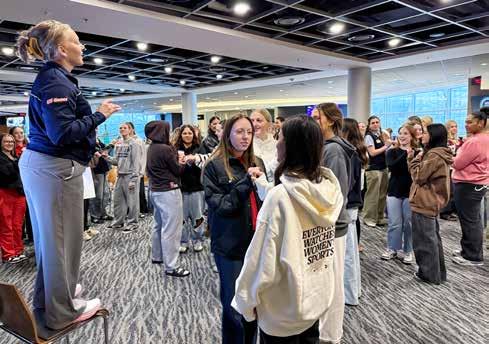
It began as a simple game of rock, paper, scissors, but quickly became a lesson in teamwork. Everyone played at first, then losers backed their opponents until only two players remained. Silence fell as they competed, then cheers erupted when the round ended in a tie. After four rounds, one girl finally emerged victorious.
The exercise wasn’t about winning, but about being a good teammate.
“How does it feel to be celebrated by your peers?” asked Poudre School District (Fort Collins, Colorado) health and physical education coordinator Jo Dixon, who emphasized that every player has a role — scorer, defender, supporter, teammate. “Being a part of someone else’s fan club is just as important and powerful as being in the spotlight, because lifting others up feels awesome.”
The interactive activity was part of a breakout session at the third annual Utah Women’s Day in Sports conference held Feb. 4 at the Delta Center, the day before National Girls & Women in Sports Day.
Dixon continued the partner activities designed to build unity. Student-athletes stood toe-to-toe and told each other: “Everyone is battling something in life, and I’m glad you’re battling with me.” Then, they stood back-to-back and said, “I’m so glad someone has my back — and I have yours.” The activity ended with a pinky promise and the words: “I pinky promise to help you unlock your greatness so the world can see it like I do.”
“We want you to be a good teammate from the inside out,” Dixon said.
The event’s origin began with Andee Bouwhuis, past president of Utah Interscholastic Athletic Administrators Association and Deseret Peak High School athletic director, along with Utah High School Activities Association Assistant Director Jan Whittaker and UIAAA communications coordinator and Cedar Valley High School Athletic Director Sharon Mardesich.
“Our goal is female empowerment; support our female athletes; grow leaders,” Bouwhuis said. “We’re letting these female athletes know that we hear them and we see them. We want them to be successful.”
More than 400 student-athletes statewide attended, supported by about 100 coaches and athletic directors. Participation from each school was limited to ensure broader representation.
“The athletes are charged to take back what they learned and teach it to their teammates,” she said.
Another breakout session focused on nutrition, led by Intermountain Health’s Josseline Kelley, who emphasized fueling, hydration and sleep.
“Our goal is to make sure that we’re eating something every three to four hours as athletes,” she said as she gave the student-athletes specific suggestions. “The worst thing you can do is go into a competition or training session without fueling. Under fueling can be very common in teens.”
University of Utah Assistant Director of Olympic Sport Performance Carly Fehler addressed competing in college athletics.
“Your whole life is going to change

overnight,” Fehler said. “Your city, your bed, your routine, your team and coach. Literally, everything changes. And are you prepared for that? Only nine percent of high school girls will go on to play in college. Two percent of all high school athletes will play Division I.”
While some student-athletes attended workshops, adults participated in a “Coach Beyond” session focused on supporting athlete mental health.
“I’ve been an athlete for my whole life, and I’ve seen the way mental health affects the performances of athletes,” said college athlete and presenter Makayla Pitcher. “Coaches are the front line, so it’s important for them to understand and help.”
Cottonwood High Principal and presenter Justin Pitcher emphasized the need for better training and resources for coaches.
“We need to do better by our athletes here in Utah, he said. “Our data shows over half of every female team has experienced significant sadness or depression. We look at our coaches and their training. Many of them were former athletes so they understand the game well, but they don’t always know how best to handle these tough situations that we’ve been put in.”
Speaker Amy Donaldson highlighted the origins of Title IX and opportunities it presented.
“They drafted a piece of legislation that was unlike today, with 37 words,” she said. “Even though everyone thought it was this little administrative adjustment…they had no idea of (the impact of) that law.”
Donaldson encouraged student-athletes to examine their journey, to be optimistic, to wire their brains for gratitude and forgiveness, to know “no accomplishment is an individual accomplishment.”
Karissa Niehoff, National Federation of State High School Association’s executive director and CEO, challenged the next generation to continue advancing opportunities for women.
“Look at the women who came before us, and look at where we are now, and look at the future of growth in women’s and girls’ sports,” she said. “We’ve come a long way. As a woman CEO in a sports world, I feel blessed, but I challenge you as a younger generation…to carry this forward. We have to be committed to working forward so we continue the growth we need in girls who play sports in Utah.”
UHSAA Assistant Director Jeff Cluff said the progress in girls sports, including expanded championships and the addition of girls wrestling, has helped to equalize opportunities.
“We’re trying to create equal opportunities for the girls that boys have been getting for years,” he said. “We have still more to do and more to change.”
Copper Hills High seniors Brynlee Morton and Kaysha Millet said the conference left a lasting impression.
“I love how inclusive it is,” Morton said. “Everyone has valuable knowledge, and they’re sharing their expertise with us.”
Millet added: “They’re spreading awareness and information; it’s empowering to us as women athletes.”
At the third annual Utah Women’s Day in Sports conference, presenter Jo Dixon motivated female high school student-athletes to become good teammates. (Julie Slama/City Journals)
Cottonwood Principal Justin Pitcher was a co-presenter of a coaches’ session at the Utah Women’s Day in Sports conference. (Julie Slama/City Journals)
Social skills competition brings out best in local students
Amazing Shake judges young people’s interactions with adult interviewers.
By Darrell Kirby d.kirby@mycityjournals.com
At a time where many young people are glued to their device screens with diminishing in-person interaction, a competition in February judged elementary and junior high school-age students on their social and communication skills in front of real people.
For the second consecutive year, Wallace Stegner Academy in West Valley City hosted the regional finals of Amazing Shake, a national program that originated at Ron Clark Academy in Atlanta that challenges students to demonstrate confidence, poise and adaptability in real world situations.
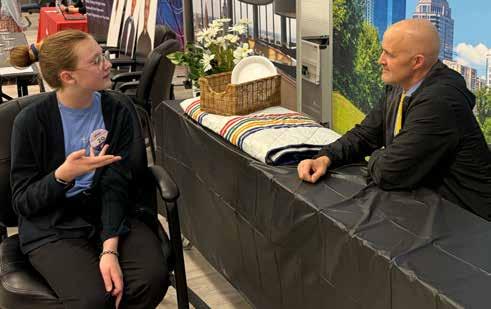
The scenarios in this case involved 24 students from the five area campuses of Stegner Academy and Hawthorn Academy in West Jordan and South Jordan circulating among booths to engage in brief conversations with representatives of local businesses and public agencies. The students interacted with people from entities like the West Valley City Police Department, Third District Juvenile Court, Zions Bank, Chickfil-A and Northrop Grumman, among others.
our students are lacking. This competition brings out those skills.”
Diaz says enhancing those skills now will help the young people in such endeavors as securing part-time jobs while in school, interviewing for college admissions and later for career positions.
“I think all the things I take from this I can take into the real world,” said Zealynd Betham, an eighth-grade student at Stegner Academy. “It was really hard at first and it got easier,” she added about the Amazing Shake experience.
Third District Juvenile Court Judge Aaron Flater was one of the judges at Amazing Shake. “Watching these young people interact and get out of their comfort zone, seeing them be mature in their conversations is so much fun,” he said. “I thoroughly enjoy it.”
Fifth-grader Fernando Torres expressed similar sentiments. “This is super fun interacting with different people and pretending like you’re in an actual interview because it probably will help you more in life.”
They were scored on how well they did at each stop.
“It’s really an interpersonal skills competition—everything from shaking hands, to greeting, to talking, to first impressions, to having a dialogue with people, skills that we
Say goodbye to clutter and frustration–wherever it lives. From kitchens and pantries to bathrooms and laundry rooms, ShelfGenie® custom pull-out shelves bring smart, accessible storage to every space in your home.


feel that students…are lacking in the United States in general,” said Erick Diaz, principal of grades five through eight at Wallace Stegner Academy. He said the absence of those abilities is more prevalent among lower-income students. “We feel that those skills for
Elena Smith, an eighth-grade student at Hawthorn Academy, ultimately had the highest score and will represent the region—comprised of Utah and other mountain states—in the global finals March 27-29 at the Ron Clark Academy in Atlanta. l



Brooklyn Hill, an eighth-grade student at Wallace Stegner Academy in West Valley City, converses with Third District Juvenile Judge Aaron Flater at the Amazing Shake regional competition at the school. (Darrell Kirby/City Journals)
The Cinderella Project brings affordable formal wear to Hunter High School students
Dresses and outfits for $20 or less help students feel empowered and reduce the financial burden on families.
By Zachary Smith z.smith@mycityjournals.com
Part of prom night is about looking your best, but the best prom fashion can cost a pretty penny. With exorbitantly high prices for fancy suits and dresses from retail stores, many West Valley students are not willing or able to pay. This is where a family-run Utah nonprofit group is making a difference.
On Jan. 24, in partnership with the Granite Education Foundation and the Hunter High Parent Teacher Student Association, The Cinderella Project hosted a sale at Hunter High School. The school’s gym was filled with displays and racks of stunning dresses as well as ties, shoes, corsages, boutonniéres, and everything else needed for excellent prom night fashion, all at affordable prices. Each dress was on sale for $20 or less, allowing any student to find something right for them.
“I was able to find a dress I really liked for a very affordable price,” said Hunter High student Evelyn Stoddard. “It’s nice to know that

these dresses are going to good homes instead of getting thrown out.”
The Cinderella Project Utah is a community-driven initiative with the mission of ensuring every Utah student can find their perfect suit or dress for school dances by making formal wear available and accessible for all. This is done by collecting donations of new or lightly used prom dresses and menswear to resell for prices that students can afford. All proceeds from the sales go to local Utah schools. The organization
is currently partnered with four Utah school districts, including Granite.
The Cinderella Project was founded in 2017 by Jim and Angela Miller. Although Angela passed away in 2024 after a battle with cancer, her family carries on her memory by continuing her work. In 2026, the project is the biggest it has ever been, receiving thousands of donations and hosting sales at schools throughout the valley.
Although this is the third year The
Cinderella Project has operated at Hunter High School, it is the first year it has been fully run through the Granite Education Foundation and the Hunter High PTSA’s partnership. Many parents and students in the PTSA volunteered at the event. Members of the Miller family were also present.
“We were privileged to have the family of The Cinderella Project come to guide us as we continue the legacy that they started,” said Hunter High PTSA president Chrissy Breeze. “The excitement from the students as they were able to find a dress or suit that they loved was priceless.”
Sales like the one at Hunter High helps to make formal school dances more inclusive while empowering West Valley City youth by allowing them to feel confident and special at any budget level. Affordable fashion promotes positive body image among teens and reduces financial burdens on families. The project also helps students “give back” by donating clothing, preventing it from going to waste.
Now, The Cinderella Project Utah is already planning next year’s sale, and they still accept donations of formal dresses, suits, shirts, ties, pants, shoes and accessories. Donations can be brought to Hunter High School or the Granite Education Foundation. l









The Cinderella Project sale at Hunter High School. (Zach Smith/City Journals)
Starting and running a successful business Part 1: Building a solid foundation
Thinking about launching a business? Two local businesswomen discuss getting off on the right foot and avoiding common mistakes.
By Elisa Eames e.eames@mycityjournals.com
In2010, Barack Obama said, “Small businesses are the backbone of our economy and the cornerstones of our communities.”
Around 70% of U.S. jobs are provided by small businesses, yet the Bureau of Labor Statistics reports that between 20% and 24% of new businesses fail within their first year. After five years, about half have closed, and after 10, nearly two-thirds are history.
However, the independence, personal fulfillment, flexibility, community impact and potential financial rewards of owning a business still persuade over 5 million U.S. entrepreneurs to take the plunge each year.
Though starting and running a company can be daunting, applying a few relatively simple fundamentals can help set you up for success. Founders and owners of Salt Lakebased Backyard Bookkeeper, Backyard Payroll and SPC Strategies, locals Julie DeLong and Alex Mic-Podar tackle tough questions affecting entrepreneurs today.
Specializing in bookkeeping system customization and clean up, DeLong has written several articles for Forbes Magazine and Intuit and was an adjunct bookkeeping professor for the University of Utah.
Mic-Podar has started a total of seven businesses and provides business coaching, executive coaching and consulting services. She is a board member with multiple nonprofits and was a 2023 recipient of the Utah 40 Over 40 award, which recognizes women over the age of 40 for professional success and business contributions.
This is the first in a four-part article series about how to start and grow your own business.
Q: What is the most important thing to know for current and prospective business owners? What are the first steps?
Mic-Podar: Number one: start by creating a limited liability company. If someone sues you, they can come for all your assets. But with an LLC, they can only take what the LLC has, not your personal belongings. So protect yourself from the beginning.
But don’t let the legal hoops get in the way of starting. It doesn’t have to be complicated. People think it takes a lot of money to start a business. It doesn’t.
If you aren’t sure of your business name, just register an LLC named after yourself or something else familiar—you can add business names later as doing business as, which will function as legal aliases for your existing entity.

DeLong: I once took an office management position and it included some accounting. I learned on the job and discovered I really liked it. One of the most important skills you can cultivate is the ability to learn, and if you’re constantly learning and constantly looking for things to learn, then you’ll eventually find something you really like.
There’s not necessarily going to be one answer. There will ultimately be multiple things you could do that would be worthwhile and could be profitable. You could end up doing multiple things like Alex.
Q: What are some guidelines for choosing a business name?
DeLong: You want something memorable, unique, catchy and that nobody else has used.
Mic-Podar: If you want to be found on Google, it’s important that your name has to do with your URL and that your name includes something about what you do. This is a keyword and helps with search engine optimization. If you are a consulting business, make sure your name has something to do with consulting. Or if you’re an e-commerce business, your name should say something about your product.
Q: Why should I choose an LLC? What about other business entities?
Number two: we’re bookkeepers, so we’re going to tell you to track your expenses from the very beginning. Whether you use a spreadsheet or something like QuickBooks doesn’t really matter starting out, but when you start making over $1,000 a month, seriously consider moving to adequate software.
Number three: think about the future of your finances. Educate yourself about why numbers matter. Numbers tell a story. This is the pitfall of any business within five years: when they start making money, they start spending more, but they’re not thinking about how much money they really have in the bank account.
Number four: this is the most important point—just start!
Q: What are some tips for creating a unique business idea that meets a market need?
DeLong: It has to be something you know enough about to be competent. It sits at the intersection of market need, interest and ability. It needs to be something you’re interested in and that you are physically capable of doing.
If you’re missing one of those ingredients, you’re doomed to fail because you’re either working in an arena where you don’t have enough experience, you aren’t personally invested or you’re providing a service nobody wants.
Know what you’re interested in, what you think you could be good at, and then start looking for areas in the marketplace where
there might be a demand for it.
Mic-Podar: A simple way to describe it is just to look around you at the world and ask yourself, “What’s missing?” Look for opportunities where the right business idea could come and make something more efficient or fill a need that no one has filled yet.
Q: How do you determine if there’s a demand for something?
DeLong: There’s research available, but sometimes it’s just hearsay. Talk to people around you. I will periodically hear about industries where service providers are a hot commodity. For example, I learned a few years ago that airplane mechanics are apparently hard to come by. There aren’t enough of them.
Ask yourself what would make things easier for people. Who is it hard to get an appointment with? What problem can I solve? Or what problem needs solving, even if it’s not you that solves it? Maybe you put some people together who know how to do what you want.
Mic-Podar: Think about what is missing and be the solution. If, for example, you think your mechanic is lacking and you know you can do better, identify how you can do better. What is the mechanic truly missing to be better? By identifying missing elements, you discover businesses you could start. Maybe you don’t even start a mechanic business. Maybe you start a consulting business that focuses on mechanics.
Q: What are some strategies for recognizing my skills and interests?
DeLong: A lot of people will set up partnerships, especially husband and wife partnerships. But any structure other than a single-member LLC will require its own separate tax return that is due a month earlier than your regular tax return on March 15, not April 15. The very simplest, cheapest, and easiest choice you can make is an LLC with one owner.
Even if you add a spouse to that LLC, it’s a partnership, and you need more complex bookkeeping. It needs to have its own tax return, whereas a single-member LLC is just a Schedule C on your personal return. Very easy.
If you need a partnership, even if it’s with a spouse, have a lawyer draw up a partnership agreement. You can try to do it yourself, but it’s bound to create problems.
I know two friends who owned their business 50/50. They created a contract, signed it, and everything. But there were big omissions and inevitably, disagreements. So in the end, even though it was a great idea and a great product, the business self-destructed, and they were left with nothing.
Corporations come with special rules, extra paperwork, extra returns and extra tax forms. So if you want anything that’s more complex, consult a certified public accountant beforehand.
It doesn’t matter how great the business idea is or how thorough you think you’ve been with your own contract. You don’t know what you don’t know.
Julie DeLong and Alex Mic-Podar founded Backyard Bookkeeper in 2008. (Photo courtesy Backyard Bookkeeper)

Using an LLC for your business protects personal assets and is the easiest option come tax time. (Image courtesy Pexels)
Q: How do I officially register my business with the government? How do I get an EIN from the IRS?
DeLong: You create your business entity at the state level. You can create an LLC online. It’s really easy in Utah and is less than $100. Go to corporations.utah.gov. The annual renewal is around $20. This creates a separate legal entity under the state of Utah, so it won’t be you earning the money—it will be the business.
If you have a physical location, you also need a business license. And, of course, depending on the industry, there may or may not be industry licenses you have to obtain.
An employer identification number is simply a tax ID number that identifies your business as a separate taxable entity to the IRS. All of the business’s revenue will be associated with the EIN. You can also set up the EIN online on the IRS website. It is free and easy to do.
Mic-Podar: But if you have the means, consult with a lawyer to make sure you are doing it correctly. There are many law offices that offer this service.
Q: Should I open a physical store location or stay online?
DeLong: It depends on the kind of business. Do you need a place that receives people in person? If so, you need a storefront or home office. Again, if you have a physical storefront or if customers come to your home, you need a business license. Always check with local authorities.
Even if you need a storefront, you don’t have to sign a five-year commercial lease. Especially if you’re brand new, avoid commercial leases because they lock you in. Unless you file bankruptcy, a lot of times you have to pay the entire value of all five years of monthly payments, even if you go under and aren’t using the space anymore. Don’t make that kind of financial commitment unless you really have to or you are very sure you have the income to support it.
A lot of places do month-to-month leases. There are co-working spaces. Or find someone who does have a commercial lease and see if they’ve got an empty office. Get creative.
Plenty of businesses don’t require a storefront, and there are a lot of creative solutions out there. If you’re in the e-commerce business, for example, some people can do fulfillment for you. You don’t have to rent your own warehouse and do your own packaging.
If you’re working from home for an online business, you do not need a city license.
Q: How do I create a marketing plan and develop my brand?
Mic-Podar: A brand comes with time and will evolve, so don’t focus too much on that yet. Also, don’t focus too much on marketing because it includes so many aspects: branding, colors, your website, employee uniforms etc. These days, you can go to ChatGPT and say, ‘this is what I’m selling. Create me a logo.’ You don’t need lots of software.
When you start, focus on your product or service and who your buyer is. Make a plan around your buyers. Sometimes people feel like they need large budgets for marketing, but you don’t. In today’s world, you have social media. You can create content and showcase it easily. There is so much free marketing.
When we started our business, we had no money for marketing, so I focused on free resources. Instead of buying ad space on a platform, I focused on who my clients were and how I could reach them. I looked for ads seeking bookkeepers and W2 employees and called them. That was my marketing strategy. I cold-called and asked if they’d consider outsourcing. One out of 10 said they’d be interested.
You can sign up on Wix to create a website. They’ll give you a URL, and AI will create it for you. ChatGPT will write the code, and you just copy and paste it. Or you can sign up for Google Sites if you don’t know how to make a website. It’s free.
DeLong: Plenty of businesses don’t even bother with a website. They just have a Facebook page.
Mic-Podar: The main point is don’t quit your full-time job tomorrow; start a business on the side, regardless if that is e-commerce or business to business. See where it takes you.
Then when you see the potential and you have cash flow, slowly step away from your full-time job and spend more time on your business. This is very important— spend time growing your business. Invest your time in it. Your time will be the most valuable asset your business has.
I know plenty of millionaires who have a full-time job and have hundreds of businesses on the side. There is no wrong way of doing things. Just get it going. l




















262300331, MN IR731804, MT 226192,




47304, NE
50145-23,
262300328, 262300329,
13VH09953900, NM 408693, NV 86990, NY H-19114, H-52229, OR 218294, PA 179643, 069383, RI GC-41354, TN 10981, UT 10783658-5501, VA 2705169445, WA LEAFFNW822JZ, WV WV056912.
Cyprus Pirate Jason Hayes named UHSAA Coach of the Month
Hayes guided the Pirates girls to a Region 4 championship, among other notables, at Kearns Aquatic Center this February.
By Brian Shaw b.shaw@mycityjournals.com
TheHayes name has been well known around these parts for decades in the sport of swimming.
Cyprus swim coach Jason Hayes received Coach of the Month honors from the Utah High School Athletics and Activities Association in partnership with the NFL’s Las Vegas Raiders recently.
Hayes starred at Cyprus as a swimmer, winning many honors for the Pirates along with his siblings. And yet it’s his work as a coach at CHS that might be just as memorable.
Hayes just led the Pirates girls to a Region 4 title this February at the Kearns Aquatics Center, and in so doing, defeated nearest competitor West by 54 points.
The Bucs wasted no time getting going in the 200-medley relay, winning that race by five seconds in a time of 1:59.13.
Mia Smith added to that by winning the 200 free in 2:00.74—a whopping eight seconds better than her closest competition.

Then, Tiffanie Palmer won her 200 individual medley in 2:20, another decisive victory.
Smith followed up her win in the 200 free with her second individual medal in the 100 butterfly, gliding across the pool in one minute flat.
Palmer then backed up her first place finish with another in the 100 backstroke in a time of 1:03.26, and then the Pirates wrapped up their firsts with one more in the 400 free relay, capturing that medal in 3:56.64.
For the Pirates girls that also got a second place finish from Charlotte Boothe in the 500 free (5:59.89), a third from her in the 200 free (2:09.97) and a third-place finish in the 100 free from Zoe Layton in a time of 1:01.80, it was an impressive showing from all the top finishers and from the team itself.
On the boys side, Cyprus finished third as a team at the Region 4 Championships behind West and champions Kearns, but still had some strong showings up the Bacchus
Highway and around the corner.
Chaz Keddington won the 100 butterfly in 52.85, a full two seconds faster than his closest competition. He’d also grab gold in the 100 backstroke, touching the wall in 53.23 seconds.
McKay Simons was another notable Pirate, finishing second in the 200 IM (2:03.78) and third in the 500 free, in a time of 5:01.95.
As a team, the Pirates boys also were third in the 400 free relay, working together and coming in just behind two other teams in 3:25.12.
To boot, Cyprus has clocked in some of the fastest times in the state—let alone Class 5A.
Smith has the 11th fastest time for a high school swimmer in a Utah pool in the 200 IM; that happened back in the Granite District Meet on Dec. 18. At the same event, Smith clocked Utah’s eighth fastest time in the 100 butterfly.
A Cyprus boys swimmer has also turned in the 13th best time in the state in the 100 butterfly (Chaz Keddington) and he’s also ninth best in the 100 backstroke, as a matter of fact.

What does all this mean?
Some of this success had to have rubbed off from their coach, and it just so happens they’ve got a pretty good one as they prepared for the 5A state swimming championships (after press deadline). l

Cyprus swimming won the girls Region 4 championship and the team’s coach, Jason Hayes, was named UHSAA coach of the month. (Stock photo)
From ashes to agency: Women find renewal through community
Beauty from Ashes nonprofit emphasizes empowerment for survivors of domestic abuse.
By Holly Curby hello@hollycurby.com
March carries a quiet promise. It’s the month when light stretches a little longer, winter begins to loosen its grip and renewal quietly takes root. For many women navigating trauma or abuse, healing unfolds in much the same way—gradual, unseen at first and requiring immense courage.
Lori Smithson knows this journey intimately. Widowed at 39 and later emerging from a destructive marriage marked by control, isolation and fear, she understands how disorienting trauma can be—especially when you don’t yet have the language to name what’s happening. “I just knew something was off,” she has shared, echoing the experience of countless women who sense danger long before they can articulate it.
Today, Smithson serves with Beauty from Ashes Ministries, a Utah-based nonprofit dedicated to walking alongside survivors of domestic abuse. Founded in 2019 after its director received a call from a woman hiding in her closet, the organization was born from a clear and urgent need:
long-term, compassionate support rooted in truth, dignity and hope.
The statistics are sobering. One in three women will experience abuse in her lifetime. Yet numbers fail to capture the bravery required to reach out for help. At Beauty from Ashes, the first goal is simple but profound—that every woman feels heard, believed and respected. There is no pressure to make immediate decisions, no imposed timelines and no shame. Survivors are met exactly where they are.
What distinguishes Beauty from Ashes is its emphasis on empowerment rather than rescue. Women are not told what to do; they are supported as they reclaim agency over their own lives. Trained advocates walk alongside survivors as they explore options, build safety plans and begin to trust their voices again. Support groups offer something many women have never experienced before: a space where their stories are met with understanding rather than doubt.
Healing often extends beyond emotional wounds. Trauma can fracture trust, relationships and even faith. For some survivors, spiritual manipulation or deep disappointment has made it difficult to reengage with God at all. Beauty from Ashes honors that complexity, allowing women to move at their own pace—whether that means studying scripture together or sim-
ply holding space for grief, anger and unanswered questions. Healing, as Smithson emphasizes, is not a race. It is a long, intentional process.
Hope, however, has a way of appearing in unexpected places. Smithson recalls women facing overwhelming odds—no financial support, limited community and ongoing hardship—
who nonetheless find stability, provision and renewed purpose through faith and connection. Many eventually give back, becoming advocates themselves. These stories are reminders that restoration is not theoretical. It is happening, one life at a time.
March also invites reflection. It asks what must be released for growth to occur. For survivors, that first step might be journaling to recognize patterns, seeking trauma-informed counseling, setting boundaries, or simply speaking the truth aloud. Truth, after all, is often where freedom begins.
Perhaps the most important message is this: no woman has to walk this path alone. Fear thrives in isolation, but healing grows in safe, supportive community. When women are believed, empowered, and surrounded by care, even the deepest wounds can give way to something new.
For those seeking support, or for individuals interested in volunteering or getting

Finding renewal through community. Holly Curby chats with Lori Smithson from Beauty from Ashes Ministries on Holly’s Highlights about hope, healing and connection.
involved, Beauty from Ashes Ministries welcomes connection. Help is available, and no one has to navigate abuse or healing alone. To learn more about services, request support or explore volunteer opportunities, visit www.BeautyfromAshesMinistries.org. To hear more stories like this and learn how women are reclaiming hope and purpose, listen to the Holly’s Highlights podcast wherever you stream podcasts and at www.hollycurby.com. l


Photo: Don Polo Photography



Casey Miller named new Utah Islanders offensive coordinator

As head coach, the former Cyprus High quarterback has guided several high schools to respectable records in part to innovative play calling.
By Brian Shaw b.shaw@mycityjournals.com
Anyone who knows Casey Miller knows he’s in this for the kids, and for the right reasons. If they haven’t realized it already, the Utah Islanders are about to find out why he’s so unique, now that Miller’s been named their new offensive coordinator.
Himself the son of a retired high school biology teacher, Miller followed in his father’s footsteps, teaching the same subject. It is that love for scientific rules, both written and unwritten, that led to one night at Jordan High School, four years ago this September.
Having just scored on a touchdown but missing the two-point conversion, the Cottonwood Colts team Miller was head coach of was trailing by the score of 2422. What he did next, however, went viral.
The fact he did so as a football independent in Miller’s last three years at Cottonwood, and even saw several players from various coaching stops go on to play Division I football, are reasons his recent hiring as Utah Islanders offensive coordinator is likely going to make for must-see football in these parts.
Miller’s offenses at Cottonwood were innovative—because they always had to be. Prior to his hiring, the Colts were severely shorthanded on players. After one season in charge, in which Miller went 0-10 in year one at Cottonwood, the football program nearly folded; Miller’s suggestion, along with a tough call from late Athletic Director Greg Southwick, to push Cottonwood into independence may have actually saved it.
In so doing, the next three years of independence saw Miller go 9-19 in charge of the Colts. His final year at Cottonwood resulted in a 2,100-yard passer, three 500plus yard receivers and a defense that collected 26 sacks, had eight interceptions and ran back a pick six. In addition, six Colts made the 2022 Academic All-State team, and of those, several moved on to top engineering colleges after graduation.














After forcing a three-and-out that pushed Jordan back to its own 5-yardline, coach Miller told his player to faircatch Jordan’s punt, leading to the utilization of a largely unknown rule and one of the most-talked-about plays in decades in the state of Utah.
“There were still 12 seconds on the clock,” said Miller to City Journals. “After the third down sack [to make it fourth down], I called timeout and asked the linesman if he had ever seen a fair-catchfree-kick, and he said no.
“I walked up to the white-hat and said, ‘Hey! I’m sending three guys back on this punt and they are going to be fair catching the ball and I’m gonna win this game with a free-kick!’ He laughed and couldn’t believe it. He said he’s never seen it, so I told him, ‘you are about to.’”
Miller sent his kickoff team onto the field, and then Cottonwood kicker Jacob Nielson blasted through the uprights a 45yard field goal with just 12 seconds left to pull off a one-of-a-kind 25-24 upset.
“My parents are yelling, trying to get me fired in the stands behind me for sending out the kickoff team after making them [Jordan] punt,” said Miller. “It goes in with 12 seconds left and we hold on for the win.”
Faced with the harsh realities of a team that often had to field anywhere from 20, on up to maybe 35 kids if it was a good week, Miller was always forced to rely upon all kinds of unique ways to keep those Colts competitive in his four seasons at the school.
Miller has also been prominent on the coaching circuit for several decades, even leading the formation of clinics that he held on Cottonwood’s campus while he coached that attracted renowned innovators of the sport such as Noel Mazzone and others. He is currently president of the Utah Coaches Association.
In his youth, Miller was an All-State quarterback at Cyprus High School, and he followed that up by playing four years of college football at Benedictine College in Kansas before spending over two decades in coaching and teaching in both California and in Utah.
The fit for Miller here is fairly obvious for those that know him and know what he did for kids at Cottonwood and Hillcrest: The Utah Islanders have been competing as a prep school for several seasons. It is the brainchild of several prominent area businessmen including ex-Utah Utes and NFLer Trevor Reilly, who serves as the team’s general manager. Its purpose is to be an academic and athletic bridge for student-athletes that aspire to compete in higher levels of college and pro football.
This past January also saw the Islanders sign former fellow Ute standout Brian Blechen as its new head coach. The Islanders finished with a 5-1 record this past fall, losing only to Snow College in their season opener. They notched victories against the St. George Eagles and Ogden Jets that play in the same league as the Islanders and pulled off an impressive win against Air Force Prep as well.
Casey Miller (left), seen here while coach of the Cottonwood football team, was named the Utah Islanders offensive coordinator. (File photo Casey Miller)
Girls wrestling from west side high schools might be catching up in Class 5A
One year after Cyprus’ Caroline Pastrana won a 5A state title at 105 pounds, Hunter’s Vanessa Carranza captured one at 170
By Brian Shaw b.shaw@mycityjournals.com
The west side of the Salt Lake Valley is known for having some tough, bluecollar types.
But, a few dozen girls on high school wrestling teams from West Valley City to Magna have now made it clear that any road to future championships might go through them.
This marked the second year in a row that a school from the west side had a girls high school wrestler win a 5A state title.
Last year, Caroline Pastrana of Cyprus won at 105 pounds, amassing a record of 27-5 on the way to a win by fall, over a wrestler from Salem Hills.
This year saw Vanessa Carranza out of Hunter avenge a second-place finish last year at state and capture a 5A title at 170 pounds by decision over her opponent from Hillcrest, wrapping up a 40-3 mark this past season.
It was such a solid 5A state tournament by Hunter, that the Wolverines finished in eighth place as a team—the best from any west side high school in the four years girls

wrestling has been sanctioned.
What it may have done more than anything else, however, was signal a changing of the guard in girls wrestling in Class 5A.
Wasatch have been the queens of the sport since it’s been sanctioned, but Salem Hills has just taken over that reign at the most recent state tournament.
With Hunter having no fewer than four wrestlers place in the top six at state in at

the championship match at 235 pounds; she wrapped up her season with a 10-3 record.
If you’re counting at home, the top two finishers from west side schools just completed their seasons with a combined 86% winning percentage.
That’s not all, though. Taylorsville had two finish in the top six at this state tournament, and Granger and Kearns each had one place, as well.
Out of 84 medals at this state tournament, a total of 11 were won by wrestlers from the west side schools; four came from the same 235-pound weight class.
Are the female wrestlers not only beginning to catch up to these other schools in 5A—but their male counterparts?
least three of 12 weight classes, though— two in one, nevertheless—there is an argument to be made that schools on the west side are beginning to catch up and possibly enter the annual fray.
In addition to the Wolverines having such a bountiful state tournament in 2026, Cyprus had three of its wrestlers place in the top six in three different weight classes. One of those (Kayla Mulitalo) lost only by fall in
There is an argument to be made there, as well; Bruce Walker of Hunter was the west side’s only wrestler out of 84 in 12 weight classes at this state tournament to make as much headway—he finished fourth, respectively, at 175 pounds.
Compared to the nine medals on the girls’ side the west won last year and the seven, back in 2024, it’s probably a valid argument.
Considering girls wrestling has only been sanctioned since 2023, it is a good representation from one area that it appears to be a sign there might be more to come from the west side of the valley. l
Looking to grow your savings this season? Spring into savings with Granite Credit Union’s Vanishing Auto Loans! We o er one of the lowest interest rates around but we don’t stop there. Only Granite o ers .05% rate discounts with every 3 months of on-time payments, saving you money over the life of your loan. The rate is fixed and will never go up. Keep making payments on time and watch your rate vanish.
Girls wrestling saw 11 5A medals won by west side schools at this year’s state championship meet. (Adobe Stock)
Four Simple Ways to Build a Happier Life
As a county councilmember, I spend a lot of time listening to concerns from constituents. I hear from parents who are stretched thin, seniors who feel lonely, young people who are anxious about the future, and workers who feel burned out even when they’re doing everything “right.” One thing is clear: many people are searching for happiness, but they aren’t sure where to find it.
Research from social scientists points to a clear answer. Happiness does not come from money alone, social media attention, or having an easier life. Arthur Brooks, a Harvard professor, social scientist and best-




selling author teaches the science of happiness. He says that happiness comes from four things: faith, family, friendship and meaningful work.
The first is faith. People are happier when they believe their lives matter and are part of something bigger than themselves. For some, this comes from faith or spiritual beliefs. For others, it comes from serving their community, caring for others or living by strong values. Faith gives people strength during hard times and helps them see challenges as part of a larger purpose. Even small habits—like volunteering, mentoring, or reflecting on what matters most—can build a deeper sense of meaning.
The second is family. Strong family relationships are one of the most reliable sources of long-term happiness. This doesn’t mean family life is easy. It takes
patience, forgiveness and time. But people who invest in their families tend to feel more supported and less alone. Family can mean parents and children, grandparents, chosen family or relatives who show up when it counts. Simple actions—shared meals, regular check-ins or family traditions—can make a big difference.
The third is friendship. Healthy friendships protect people from loneliness and stress. They give us someone to laugh with, talk to and lean on when life gets hard. Yet friendships often get pushed aside by busy schedules and screens. Reaching out, making time for face-to-face connection, and being present for others helps build trust and belonging. Often you will have to be the one to reach out and make this happen. Communities are stronger when neighbors know each other, not just online, but in real life. Do you know the people who live three houses on either side of you and across the street? If not, make it a point this year to get to know them better. It helps keep your neighborhood safe and builds connection when you can all look out for each other.
The fourth is meaningful work. This does not mean everyone has to love every part of their job. But people are happier when they feel useful and see how their
work helps someone else. Whether paid or unpaid, work gives people dignity and purpose. Parents raising children, volunteers, caregivers, students and workers all contribute value. When people feel needed, their confidence and happiness grow.
One important idea connects all four of these areas: happiness is not about chasing pleasure. Pleasure fades quickly. Real happiness builds slowly through effort, relationships and responsibility. It grows when we use things but care for people—not the other way around. Being “happy” doesn’t mean you will never have sadness, anger, frustration or problems. Everyone has hard times. But by focusing on the things that really matter, you increase your opportunities for better overall happiness.
As a community, we should make it easier for people to build these four foundations. That means supporting families, creating spaces for connection, valuing service and helping people find meaning in their lives. Happiness is not something government can give—but it is something we can support by strengthening the places where people live, work and belong. Make a goal this year to find ways you can help increase your own happiness.














Remember when you thought Mr. Monopoly wore a monocle, or you were convinced Curious George had a tail? Memory is a funny thing.
Or how about when NBC anchor Brian Williams “misremembered” being in a helicopter hit by anti-tank weapons in Iraq? His faulty memory got him suspended.
We all misremember things, but when an entire group does it, it’s called the Mandela Effect, a phenomenon that occurs when millions of people are confidently wrong. Like, remember when we all believed Vladimir Putin was a war criminal? LOL. Good times.
If you’re a Gen Xer, you might remember when the VHS tape got eaten by the VCR and you had to use brain surgeon-style techniques to carefully respool the video. But then the tape always had a wrinkled section where the movie would go wonky for a few seconds. That’s what my memory feels like most days: warped and staticky.
My husband is basically a human computer. He remembers everything. When we meet new people, he lights up like an exploding star. He’s curious about their background, hometown and their connection to any celebrity-type person.
Months later, he’ll say, “Remember at the Yankees game when we met that guy who was married to the cousin of a friend who knows Ryan Reynolds? I think his name was George.”
A Trip Down Memory Lane
Peri Kinder Life and Laughter

“No.”
“Yeah, you do. He owned a horse farm outside of Albany and loves the color orange.”
“What are you talking about?”
His memory recall is slightly unsettling. He’ll drop info like, “I remember the 1968 World Series when the Detroit Tigers came from behind to beat the Cardinals. They hadn’t won since 1945 and Mickey Lolich was the MVP.”
And then there’s me, having to watch a recap for a TV show I watched the night before. But then I remember random things, like when Sen. Mike Lee advocated for term limits. Hahahaha. The good ol’ days.
I was playing a “Frozen” matching game with my 9 year old granddaughter, trying to remember where the pair of Olafs were hiding. I kept turning over the same two cards, a Sven and an Elsa, convinced I’d finally cracked the code.
My granddaughter found it hilarious watching her doddering old granny lose a game. But there was a time I was the matching

game champ. At least that’s my recollection.
I can still sing Abba’s entire “Arrival” album from 1976 but I’m not quite sure I actually attended a single day of high school. I used to know dozens of phone numbers, but now I couldn’t call my daughters if the world were ending and I had to use a rotary phone.
When it comes to remembering the names of dogs I met at the dog park, I’ve got it down. But their owners’ names? No clue. I can make my mom’s mac and cheese by heart, but need to read the directions on a cake mix four times before I get it right.
It makes me second-guess my memory, like, do you recall when Gov. Spencer Cox took the side of trans kids? Or was that also the
Mandela Effect?
If you’ve ever had a sibling contradict your side of a story, or you can’t remember your eighth-grade science teacher, you’re not alone. Or maybe you had an existential crisis when you realized C-3PO’s lower right leg was silver, not gold.
Memory isn’t just fleeting, it’s fluid. When time blurs the moments we fell flat on our faces, it’s a reminder that our flashbacks are edited highlight reels, usually with a laugh track.
Peri Kinder is an award-winning columnist and journalist who has written for The City Journals since 2004. She can be reached at peri.k@thecityjournals.com


For 140 years, families have come to trust Larkin Mortuary as the leading funeral service provider along the Wasatch Front. Family owned and managed for seven generations, we are committed to providing meaningful, healing experiences for every family who turns to us for guidance.




For over 140 years, families have come to trust Larkin Mortuary as the leading funeral service provider along the Wasatch Front. Family owned and operated for seven generations, we are committed to providing meaningful, healing experiences for every family who turns to us for guidance. In partnership with University of Utah, we
Discover the peace of mind that comes with planning ahead. Learn about the benefits of advance funeral and cemetery planning, and why it makes sense for you and your family.

UPCOMING EVENTS:


and
3/13/25 Thursday @ 12 PM
3/17/26 Tuesday @ 12 PM
Larkin Sunset Lawn: 2350 E 1300 S, SLC, 84108
Larkin Sunset Lawn: 2350 E 1300 S, SLC
3/18/25 Tuesday @ 12 PM & 6 PM
3/18/26 Wednesday @ 12 PM
The Chateau at Le Jardin: 1910 E Dimple Dell Rd, Sandy
Larkin Riverton Funeral Home: 3688 W. 12600th S., Riverton
3/26/25 Wednesday @ 12 PM
3/25/26 Wednesday @ 12 PM
Elysium Legal: 1802 W South Jordan Pkwy, South Jordan
The Chateau at Le Jardin: 1910 E. Dimple Dell Rd., Sandy
3/27/25 Wednesday @ 12 PM
3/26/26 Thursday @ 12 PM
Elysium Legal: 1802 W South Jordan Pkwy, South Jordan
The Chateau at Le Jardin: 1910 E. Dimple Dell Rd., Sandy
RSVP: (801) 829-1772
Space is limited, so please RSVP now!
www. LARKINMORTUARY.com