

See Inside... Mural Fest returns
RSL promotes literacy
May 9 will see 10 new displays painted
Olene Walker students hosted pro players
9
18
Mayor outlines vision for a ‘City of Kindness’ at State of the City address
By Linda Petersen | l.petersen@mycityjournals.com
Mayor Cherie Wood emphasized that the city’s true strength lies in a commitment to dignity, inclusive public safety and proactive and supportive housing solutions.
Mayor Cherie Wood, currently serving in her fifth term as the mayor of South Salt Lake, delivered her annual State of the City address March 16 at the community center auditorium.
Instead of simply presenting a list of municipal infrastructure goals the city has achieved, Wood used the speech to present a vision of South Salt Lake as a “City of Kindness,” where the ultimate goal of every city endeavor—from police work to urban planning—is to foster a more compassionate and united society.
“South Salt Lake is committed to being a place where people feel supported, respected and able to thrive,” Wood said. “That commitment shows up in the policies we adopt, the partnerships we build, and the way we treat one another. It is the foundation of what we mean when we say we are a city of kindness.”
Wood emphasized that the city’s future is being forged by its residents.
“We are a city of kindness built on exceptional people who insist on a strong community and connection with one another; together, we forge our city’s future,” she said.
However, she was also quick to acknowledge the challenges facing many of her constituents.
“I want to acknowledge that while we have the luxury to feel comfortable and secure here tonight, there are many residents in our community who feel unsafe and uncertain, simply because they come from different backgrounds and cultures,” she said. “I believe everybody deserves to feel safe walking in our neighborhoods, sending their kids to school, and interacting with city services.”
Addressing public safety and the role of the local police, Wood said it is a priority to build trust with the city’s immi-
grant populations.
“I want to be clear that the role of our city and our police department is to protect our residents,” she continued. “They are not immigration officers, and they do not enforce federal immigration law. It is essential that all residents feel safe calling 911, reporting crimes and seeking help when they need it, without fear. Trust is essential to public safety, and I’m committed to building and maintaining that trust.”
This commitment to safety extends to the physical environment of the city, ensuring that the current planning strategy focuses on creating a “safe space for all” where every person feels a sense of belonging at the grocery store or the park, she said.
Wood framed the city’s growth as a deeply personal mission to better the lives of her neighbors.
“Every day, I am guided by the promise: what I wish for myself and my family, I wish for everyone in my community,” she said.
This philosophy is currently being applied to the housing crisis.
“Here in South Salt Lake, we are confronting that reality with practical tools, partnerships and long-term planning,” she said
These efforts include the establishment of a housing and transit reinvestment zone (HTRZ), which allows the city to capture a portion of future tax growth from the downtown area to reinvest directly back into housing, infrastructure and public amenities.
Recently, the city closed on its first HTRZ bond for $25 million. This funding is already facilitating major projects like the Market Center development on State Street, which is set to add 500 affordable residential units along with retail space and public amenities connected to nearby transit. With multiple developments now underway, the city is approaching nearly 2,000 new units in its housing inventory.
City officials are also working with partners on the Monroe Townhomes and the 300 Lofts to prioritize larger two- and
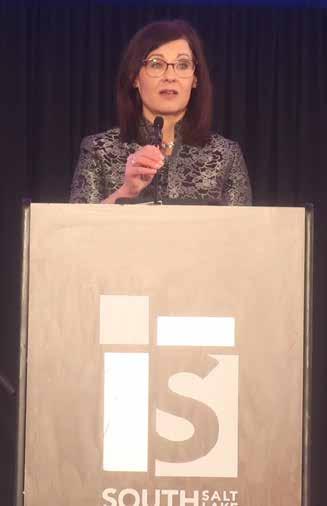


Mayor Cherie Wood gives the State of the City address at the South Salt Lake Community Center on March 16. (Linda Petersen/City Journals) continued page 8



A New Chapter for Pain-Free Living: Modern Joint Replacement at CommonSpirit
Tired of nagging joint pain dictating your life?
The good news: joint replacement surgery has made significant advancements in recent years. Forget the daunting tales of long hospital stays and arduous recoveries. Surgery today is all about quicker recovery, less pain, and a faster return to the activities you love. This isn’t just about fixing a joint; it’s about reclaiming your freedom, and CommonSpirit is at the forefront of this transformation.
What’s driving this revolution? Minimally invasive techniques. Imagine surgery with smaller incisions and less disruption to your muscles and tissues. This “less is more” approach translates directly into less post-operative pain, reduced blood loss, and significantly shorter hospital stays.
“Joint replacement surgery once meant a long, difficult recovery. Now, thanks to minimally invasive techniques, patients are getting back on their feet and regaining their independence far more quickly, significantly improving their quality of life,” said Michael Blatter, an orthopedic surgeon at Holy Cross Hospital – Davis.
This means you can get back to golfing, gardening, playing with grandkids with renewed vigor.
But the journey to rapid recovery begins even
before surgery. We believe in empowering our patients, and that’s why pre-operative education is a cornerstone of our approach. Our comprehensive classes walk you through every step, covering everything from physical therapy exercises and navigating stairs to home safety. We emphasize two crucial rules: no falls and no infections. Patients consistently tell us they feel better prepared and more confident heading into surgery, which dramatically improves their outcomes.
Our commitment to your well-being extends with Enhanced Recovery After Surgery (ERAS) protocols. This isn’t just about the surgery itself; it’s a carefully coordinated care pathway. ERAS focuses on preparing your body for a smoother recovery through optimized nutrition, multimodal pain management that reduces reliance on opioids, and getting you up and moving just hours after surgery. It all works together to reduce complications, enhance your comfort, and get you home safely and sooner.
And speaking of cutting-edge, robot-assisted surgery has become a game-changer. While a surgeon is always in control, robotic systems provide unparalleled precision, allowing for less invasive procedures, greater accuracy in implant
placement, and ultimately, quicker recovery times. This advanced technology ensures your joint replacement is tailored with remarkable exactness.
“Many joint replacement procedures can now be done same day. And with our current techniques and technologies, we are able to facilitate a quicker recovery and healing process for joint replacement. Our patients are able to get back to the activities they enjoy more quickly. For many of our patients, joint replacement is a game changer,” said Dr. Kevin Sagers, an orthopedic surgeon at Holy Cross Hospital – Jordan Valley.
At CommonSpirit, we understand that living with joint pain can feel limiting. But with these modern advancements, the path to renewed mobility and a significantly improved quality of life is clearer and more accessible than ever. We’re dedicated to providing not just exceptional medical care, but a supportive and empowering experience that truly makes a difference. If you’re ready to explore how modern joint replacement can transform your life, we invite you to discover the CommonSpirit difference – where your rapid recovery is our priority.
For more information or to find a provider visit mountain.commonspirit.org


Learn more about the services, care providers and mission-driven work of the Holy Cross hospitals and CommonSpirit Health at www.holycrossutah.org.

At CommonSpirit Health, we make the healing presence of God known in our world by improving the health of the people we serve, especially those who are vulnerable, while we advance social justice for all.

Women go through many changes in their lives. And we believe every milestone matters. Our health care experts can help you face your next phase with confidence – because each chapter deserves to be celebrated.
Find care near you at mountain.commonspirit.org.
COMMON GROUND
I can’t afford YOUR tax bill
Common Ground will be a column of rotating viewpoints that highlight specific feelings across the political spectrum, and it will always end with possible ways to come together.
Thousands of Utahns put down their phones from their doomscrolling and rage-baiting, to create vulgar poster boards and attend the No King rallies. Because Salt Lake City found it acceptable to shut down blocks of State Street, I watched the crowd waving their signs and chanting as they made their way to the State Capitol.
It was the weekend, and I wanted to be home. I had no desire to sit behind a police roadblock, watching people chanting and waving their signs. But I was working that day, or at least trying to work.
This was the end of a 60-hour work week for me, making sure we covered expenses and payroll for my business, trying to eke out just enough for me to get my bills covered. Then a question took over, a question that nearly every middle-aged, middle-income man finds themselves asking, “What am I doing here? Why am I working so hard?”
Could it be that I’m working so hard just to pay the bills of others?
Look at the facts. The national debt is $40 trillion. The Utah State Budget is over $31 billion. Salt Lake County increased property taxes by 14.65%, with a budget of over $2 billion.
How did we get here?
Let’s look close to home. Let’s start with Salt Lake County. We have a nine-member council, with five republicans, four democrats and a Democratic mayor.
Collectively (8-1), the council approved a $2 billion budget that significantly raised property taxes.
Earlier this year, Salt Lake County Council Members tried to cut the budget, proposing the shuttering of a county-operated senior center and child care facility. Then, all those who have had their hands out for
SOUTH SALT LAKE TEAM
The South Salt Lake Journal is a monthly publication distributed directly to residents via the USPS as well as locations throughout South Salt Lake. The views and opinions expressed in display advertisements do not necessarily reflect or represent the views and opinions held by Loyal Perch Media or the City Journals. This publication may not be reproduced in whole or in part without the express written consent of the owner.
© 2026 Loyal Perch Media, Inc.
John J. Walker Common Ground
years popped out of the cookie-jar, insisting they keep getting their subsidized child care or, in some instances, their jobs.
I watched the parents argue for continued services at below market rates, as if society and the taxpayers were somehow responsible for providing them with subsidized child care.
The same tiny violins were played throughout the legislative session earlier this year, with state legislators lined up to bring bills that would stick the Utah taxpayers with subsidizing or paying more money for child care, more money for property tax deferment/credits and more money for down payments for first-time home buyers, paying more money for Medicaid, more money for the homeless, more money for Title 1 schools, mental health treatments and food pantries.
Have we lost our conservative way of life here in Utah? Are we slowly drifting away from our base and sliding into the pit that California has become?
How much more can we afford? For me the answer is none.
Common Ground: In my late 20s, I asked a friend a question. What is the difference between a Republican and a Democrat? I will never forget his answer, “If you are a Republican in your 20s, you don’t have a heart; if you’re a Democrat in your 30s, you don’t have a brain.” At the time, it made sense; now that I’m in my 40s, it makes a whole lot less sense.
I like to think most of us have brains and hearts, all at the same time.
PUBLISHER
Bryan Scott | bryan.s@thecityjournals.com
EDITOR
Travis Barton | travis.b@thecityjournals.com
ADVERTISING EXECUTIVES
Mieka Sawatzki | mieka.s@thecityjournals.com
Ryan Casper | ryan.c@thecityjournals.com
Marc Davis | marc.d@thecityjournals.com
CLIENT SERVICES
Lydia Rice | lydia.r@thecityjournals.com 385-557-1022
Big expenses for the general population are best paid for by taxes, such as the military or highways. I am happy to pay my share of taxes to build roads and bridges. I surely don’t want to pay fees at a toll booth.
Sometimes having a monopoly makes sense. I guess the city could stop collecting trash and each home could pay a company to pick up the trash from their home. But I would imagine that would be less efficient and more expensive.
I’m curious to know what residents feel is the purpose of local, county and state government. I think most would agree on roads, bridges, trash pick-up, dumps, water infrastructure and more. But how do we really feel about child care, senior centers, golf courses, zoos, museums, and theaters?
My fear is that when the economy is prospering, we vote yes on these expenses, but now that cost of living has increased and people are struggling more, we are less likely to support these governmental expenses. l
From the Publisher:
Last month, the City Journals launched Common Ground. The column will tackle typically divisive political topics, with a focus to bring the community together. It’s our goal to help community members better understand how their neighbors feel.
We had a large response from readers. With over 100 emails, several mailed letters and phone calls, we consider month one a success. Peri submitted her opinion about local immigration legislation that was proposed during the 2026 legislative session earlier this year. The responses were largely favorable for the Common Ground article, with both supporting and dissenting comments on Peri’s first
submission. Unfortunately, we had some readers who simply were not interested in hearing how their neighbors felt.
The general tone of the dissenting readers was that Peri did not distinguish between legal and illegal immigrants. One commenter wrote, “First, let’s address the elephant in the room. Kinder’s commentary never used the words illegal immigrants…But illegal immigration is the issue the Utah legislature is trying to address.”
Other dissenting views included the large amounts of tax money spent each year supporting and aiding illegal immigrants.
Those who supported Peri’s comments were appreciative of having their views represented, they also commented about how immigration is the “American Way,” a nation built by immigrants. From a workforce perspective, they said our economy needs immigrants and their willingness to take less desirable jobs at lower wages. Others supported immigration from the perspective that fertility rates in the United States are decreasing and our economy is essentially centered on population growth.
Where people did agree was that Congress needs to work together to create effective policies around immigration on a national level, and that those laws need to be consistently enforced and adhered to from administration to administration. One reader wrote, “This is the key to solving our immigration dilemma.”
Hopefully, this fall as we select candidates to represent Utah in Congress, we all remember that we need Congress to fix the immigration issue.
— Bryan Scott
CIRCULATION COORDINATOR
Lindsay Andreasen | lindsay.a@thecityjournals.com Rack locations are also available on our website.
EDITORIAL & AD DESIGN
Stacey LaMont Ty Gorton
SOUTH SALT LAKE CITY JOURNAL
9500 South 500 West, Suite 205 Sandy, UT 84070
PHONE: 801-254-5974
MISSION STATEMENT
Our mission is to inform and entertain our community while promoting a strong local economy via relevant content presented across a synergetic network of print and digital media.
& Distributed by










Copper Rock golf championship set for May 14-16
The road to the LPGA Tour begins with the Epson Tour, and again this month, 132 of the best female golfers on the planet will reconvene for the Copper Rock Championship May 14-16 in Hurricane, Utah. Golfers will compete for $250,000 in prize money and points in the season-long Epson Tour standings.
There were 15 players who gained LPGA status during last year’s Epson Tour season, and 13 of them finished in the top 30 at Copper Rock in 2025. Champion Gina Kim won twice on the Epson last season and is now playing on the LPGA Tour.
Exemptions this year went to four golfers:
Navy Hubbs is a junior at Salem Hills High School who has verbally committed to Boise State University. She started playing golf at the age of 12 and quickly developed a passion for the game. Since then, she has enjoyed competing in both local and national tournaments, gaining valuable experience and continually challenging herself against strong competition.
Hubbs is known for her calm presence on the course and the strong work ethic she brings to improving her game. She approaches competition with focus and determination while enjoying the process of learning and growing as a golfer and developing friendships with others on and off the course.
Maria Jose “MJ” Barragan is a standout collegiate golfer for Brigham Young University, known for her consistency, competitiveness and upward trajectory on the women’s golf scene. A native of Morelia, Mexico, Barragan has quickly become one of BYU’s most impactful players, combining sharp scoring with a calm mindset under pressure. She owns a career-low 18-hole score of 68 (4-under) and a lowest 54-hole score of 210 (−6), achieved at the 2024 Red Raider Invitational where she claimed her best finish with a victory. Barragan has also



Utah golf, recognized for her competitive excellence and advocacy for women’s golf. An inaugural member of the women’s golf team at Dixie State University (now Utah Tech), she was a two-time PacWest Conference Champion, Conference Player of the Year and an All-American.
She competed professionally on the Cactus Tour and is a seven-time Utah PGA Women’s Player of the Year (2019-25), a four-time Women’s Utah PGA Match Play Champion, and the 2025 Utah Section Assistant Professional of the Year. Her career includes numerous Utah Section victories, multiple top-10 finishes in both men’s and women’s events, and an overall championship at The Copper Club Open.
posted strong rounds in key events including the opening rounds of the 2025 San Diego State Classic and the 2025 Dr. Donnis Thompson Invitational, and she played a pivotal role in BYU’s 2025 USF Invitational win with a 72-73-69 (214) performance.
Off the course, Barragan is equally distinguished. She’s majoring in pre-business and has earned recognition for her academic achievements, being named to the 2025 CSC Academic All-District team. In amateur golf, she finished runner-up at the 2025 Women’s Mexico Amateur in a dramatic playoff and represented Mexico at the Pan American Games in Paraguay, showcasing her talent on the international stage.
Gabby Barker is a professional golfer known for her resilience, consistency and purpose-driven approach to the game. A standout junior and collegiate competitor, Barker built her foundation through

years of high-level tournament play before turning professional and committing fully to the grind of tour golf. Since turning pro, Barker has competed across multiple professional circuits, including the Epson Tour and various mini tours, steadily gaining experience at the highest levels of women’s golf.
Her career has been shaped by perseverance, adaptability and a deep belief in long-term growth — both on and off the course. In addition to her competitive career, Barker is the first female Native American professional golfer, a milestone she carries with pride and responsibility. She uses her platform to inspire younger athletes, advocate for representation in golf, and share the realities of pursuing a professional sports career.
Haley Sturgeon is an accomplished golf professional and respected leader in

There are always so many things to enjoy during and around the Copper Rock Championship. On Tuesday, May 12, RAM Aerospace presents the 2026 RAM Women’s Business Luncheon. The theme is “Rising Together: Personal Growth and Professional Influence.” Keynote speaker is Stephanie Palmer, Director of Radio Sales for KSL NewsRadio, FM 100.3, The Arrow and the KSL Sports Zone. Whitney Harris, Director of People and Culture at RAM Aviation, will join in that discussion. The luncheon will run from 11:15 a.m. to 1 p.m.
A free Junior Clinic will be held on Championship Saturday, May 16, at noon. Signups for the clinic and RSVP for the luncheon can be made at Copperrockchampionship.com. There will also be a free photo booth on Championship Saturday, and food trucks will be onsite including Corn Dog Company and Chicharos Tacos.
To get tickets to the tournament go to Copperrockchampionship.com and choose from General Admission, Club 17 or Copper Rock Club tickets, and the website details those options.
Copper Rock is located at 1567 W. Copper Rock Parkway in Hurricane. l

2025 Champion Gina Kim (Courtesy Copper Rock)
Young golfers can participate in a free Junior Clinic on Championship Saturday at noon.
Haley Sturgeon Maria Jose “MJ” Barragan
Gabby Barker
Navy Hubbs

South Salt Lake earns Junior Jazz Program of the Year honors
The South Salt Lake Recreation Department received a $2,500 grant to support future seasons.
By Linda Petersen l.petersen@mycityjournals.com
TheSouth Salt Lake Recreation
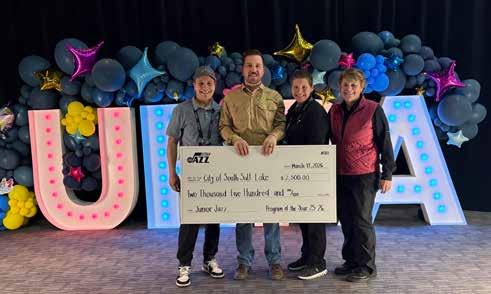
Department was recently named the 2025 Utah Junior Jazz Program of the Year during the annual Utah Recreation and Parks Association Conference in St. George. The award is a partnership between the URPA and the Utah Jazz Youth Programs and recognizes the city for hosting a youth basketball program that prioritizes community impact and sportsmanship. At the URPA conference South Salt Lake Recreation Coordinator Dustin Permann accepted the award and a $2,500 grant on behalf of the city.
“The South Salt Lake Junior Jazz program is successful because of the people working on the ground,” Permann said.
“The recognition means a lot,” he said. “Obviously, it comes with an award of $2,500, which we will use to pump up our youth sports budget, and it will be a good resource for our fiscal year next year to buy some newer supplies and just overall replenish that budget for all of our programs. But my staff are the ones that definitely deserve
this award. They’re the ones that are out there reffing all the games. They’re there every night talking with the families, meeting with people, and I think it’s good to see them get recognized for the quality of programming that we run.”
The South Salt Lake Junior Jazz program currently serves about 200 children across 16 teams. The league serves kids ages 4 to 12. Evening leagues run through the sixth grade, while older students in the sixth, seventh and eighth grades participate in programs held at Granite Park Junior High.
South Salt Lake has made a conscious effort to keep the program accessible prioritizing community over profit, Permann said. Registration starts at $25, with a $5 fee added for those living outside city limits. Permann noted that the national average cost to participate in youth sports can exceed $1,000 per child.
“We just want to be inclusive towards everyone,” Permann said. “We feel that that’s how it should be for especially recreational programs at this age, that it should be a community-based program where sometimes maybe the cities are footing the bill a little bit, but that’s only because we want to give everyone the chance to be a part of our programs. That I think is how most recreational programs should be run. It should be inclusive to all. It shouldn’t be pricing out somebody, or it shouldn’t exclude people that are

priced out, that can’t afford programs.”
To ensure no child is left on the sidelines, the city also offers scholarships and discounts for families who cannot afford the base registration fee.
The operation relies on a professional staff of four full-time and six part-time employees. Parents and community members fill the coaching roles, providing the mentorship and energy needed to sustain the league year after year, he said.
“Our volunteers are the backbone of our program,” Permann said. “We couldn’t run anything without people volunteering their time, their energy. And we’re lucky to retain a lot of coaches that coach from season to season and year to year, and they’re just the best. That’s where people have a really good experience, too, is I think we train up our coaches and give them the resources that they need to be successful.”
South Salt Lake City has also partnered
with the Utah Jazz to put on broader regional events, including three-point contests, “fun shot” competitions, and Junior Jazz parties held at the Delta Center.
“I feel like this was kind of a lifetime achievement award maybe for us, just because a lot of these times these awards go to the biggest programs or the ones that get the most press,” he said. “But I think the Jazz have recognized that we do a lot of quality work down here. I think they know they can count on us when they need somebody local to step up for them.”
As a bonus for their hard work, the staff members were also awarded tickets to Utah Jazz games.
“They gave the staff Jazz tickets which is, I think, well deserved,” Permann said. “Our staff work a lot of evenings, especially during the week, so we’ll try to strategically get them to some Jazz games next year where it’s not interfering with our own programming.”l


three-bedroom units for families.
Additionally, the city is actively acquiring and upgrading vacant homes to return them to the market as “affordable in perpetuity.” Through a partnership with Habitat for Humanity, the city is also funding critical home repairs to allow residents most in need to remain safely in their homes.
“We’re committed to ensuring that housing meets a variety of needs for all of our residents at every stage of life,” Wood said. “That commitment to dignity for all South Salt Lakers shapes how we’re approaching some of our community’s most complex challenges.”
Closing her address, Wood looked toward the future, describing the work being done today as a legacy for the next generation.
She noted that South Salt Lake is committed to a culture of generosity and invited every resident to take an active role in shaping a community that prioritizes respect.
“Let’s be the kind of neighbors and people we want in our community; let’s create a space where everyone feels welcome, safe and respected,” she said.
She also encouraged those present and all South Salt Lake City residents to take the city’s Dignity Pledge, “a commitment to treating each other with dignity and respect, even when we disagree,” she said l Continued from front page
The South Salt Lake Recreation Department was recently named the 2025 Utah Junior Jazz Program of the Year during the annual Utah Recreation and Parks Association Conference in St. George. (Photo courtesy South Salt Lake)

Visitors to Mural Fest 2026 in South Salt Lake on Saturday, May 9, can walk or bike through an extensive open-air gallery that features nearly 100 murals. (Photo courtesy of SSL)
Popular SSL Mural Fest returns May 9
World-famous muralists will add their colorful visions to the city.
By Peri Kinder peri.k@thecityjournals.com
F or Beto Conejo, South Salt Lake’s
Mural Fest 2026 presented him with a serendipitous opportunity. He was selected to work as a mural apprentice, helping Mississippi artist Birdcap paint a design at Woodrow Wilson Elementary.
Conejo attended the school from preschool to sixth grade and it’s the site of his first work of public art, where he painted a fire hydrant as a third-grade student. Organizers didn’t know of his connection to the school, but the experience will be a full-circle moment for the South Salt Lake artist.
“A lot of my foundations for art were built at that school,” Conejo said. “I turned the fire hydrant’s shape into a little mushroom. I gave it some cool little googly eyes and it’s literally in front of the mural wall that we’re going to be painting.”
The Woodrow Wilson mural, located at 2567 S. Main St., will be one of 10 new displays painted during SSL Mural Fest on Saturday, May 9, from 2-8 p.m. Local, national and international muralists will add their contributions to the growing number of public art displays in the city.
The Mural Fest has put SSL on the map, as organizers receive hundreds of artist applications each year. This year’s festival will feature Conejo and Birdcap, Sophie Nebeker (Salt Lake), Naomi Haverland (Florida), Shley (Salt Lake), Mauricio Ramirez (Wisconsin), Shaandin Powell (Salt Lake), Lucas Aoki (Argentina), Katie Green (Canada),
Curtis Hylton (United Kingdom) and Christin Apodaca (Texas).
“The world-renowned talent that we’re bringing into this event, and over the last nine years it’s been going on, has made a name for us in the international art community,” said Ben Keller, SSL Public Outreach Coordinator. “It’s put our small city on the map and it’s exciting to see how much the event has grown.”
Located in SSL’s Creative Industries Zone, Mural Fest incorporates messages of unity, inspiration, diversity and community. It’s the largest collection of street art in the state and will boast 89 murals at the conclusion of this year’s event.
Guests are invited to stroll or bike ride through the open-air gallery, using the interactive mural map at TheMuralFest.com to view the art and visit with the muralists. This year, a beer garden will be featured at the event headquarters, located at 151 W. Commonwealth Ave. There will also be street buskers, musicians, food, drinks and more.
“We’re coming up on 100 murals, which was the original goal of Mural Fest,” Keller said. “We’ll have a fun bus running to take people around to see all the new murals this year. We’re in the process of organizing some group bike rides as well, to get people out to see everything.”


Monday, May 26, 2025 at 10:00 a.m.
Conejo recently spent time in Mexico, painting murals across the country, and is excited to bring his talents back to his hometown.
“I grew up on West Temple, so I literally lived on the street where it all started,” he said. “This event is a little bit of a relief. I’ve been applying for [Mural Fest] since I was 18, and I’m 27 now. It feels like I’m getting home support from the city I grew up in. I’m just excited to see what comes next.” l





SSL Cares Coalition identifies high school dropout risks
By Peri Kinder peri.k@thecityjournals.com
Tobest address high school dropout rates, the South Salt Lake Cares Coalition has implemented a plan to gather information and identify risk factors. Each quarter, the SSL Cares Key Leaders group reviews reports from community leaders to help find partner organizations and offer advice.
In March, Promise SSL Deputy Director Bonnie Owens reported on social impacts that affect students, identifying extreme economic deprivation as a leading cause of high school dropout rates.
“Children who live in deteriorating neighborhoods, characterized by extreme poverty, poor living conditions and high unemployment rates, are more likely to experience alcohol and drug misuse, crime and delinquency, unplanned pregnancy and school dropout,” she said. “The data consistently suggests that economic deprivation in South Salt Lake is not driven by a single deficit, but by compounding structural stressors that are layered on family systems.”
Owens said families living below the federal poverty line, but also those living barely above it, face barriers for financial growth due to bureaucratic complexities and broken support systems. Without opportunities to gain financial traction, parents usually have several jobs and teens sometimes leave school in order to work and help pay for basic needs.
The early learning committee found a lack of access to key developmental screenings for young children, and parental knowledge gaps, directly impacted learning. Educating parents on how to get screenings for developmental delays

can increase the risk for teen pregnancy and school dropout.”
After conducting interviews with people including a probation officer, a faith leader and a junior high assistant principal, Pensari said aggressive behaviors can develop when there is a lack of structure or supervision.
By teaching conflict resolution skills, creating empathy curriculum and providing opportunities where kids know there are trusted adults around, Pensari hopes to create a sense of community and belonging, possibly keeping teens away from gang behavior.
The physical health committee noticed that a lack of safe transportation for physical activities leads to lower numbers of participants. While SSL has several after-school recreational programs, a student’s ability to get to these activities might be limited if parents aren’t available. Also, a lack of bilingual coaches directly affects student’s participation.
could help children get early diagnosis and assistance.
Family management also plays a key role in high school dropout rates. Leaving kids unsupervised, not creating or upholding expectations, and a lack of consequences or rewards make parenting ineffective. Teaching parents how family management skills can influence their teens could help students stay in school.
Nicholas Pensari from the Salt Lake County District Attorney’s Office spoke about how early-initiation into gang culture is a top risk factor for teen dropout rates.
“Children who are aggressive or who have trouble controlling their impulses are at a higher risk for alcohol and other drug use, delinquency and violent behavior,” Pensari said. “It




Promise SSL Coordinator Grace Hagen chairs the after-school alliance committee and said low commitment to school is a risk factor for dropout. She said students who attend class regularly tend to think homework and school attendance are valuable, making it more likely to graduate.
“A consistent theme across all of our interviews was unmet basic needs, and that was combined with a lack of awareness about available supports,” Hagen said. “Parents who work long hours or multiple jobs to meet basic needs can lead to relying on older children for household responsibilities.”
This is not to say parents are not supportive of their child’s education, but meeting basic needs becomes the priority.
The SSL Cares Key Leader group meets again in June to hear from committee chairs about their work on addressing key risk factors for dropout rates. To learn more about the SSL Cares Coalition, visit SSLC.gov. l







Getting teens involved in after-school activities is a key focus in helping to lower high school dropout rates. The South Salt Lake Cares Coalition is identifying ways to support programs that keep kids in school. (Photo courtesy of Promise SSL)

ON THE MOVE


Cherie Wood, Mayor
801-464-6757 mayor@sslc.gov
City Offices
Monday - Friday • 8 am to 5 pm
801-483-6000
220 E Morris Ave, SSL, UT 84115
City offices and community centers will be closed on May 25 in observance of Memorial Day.
Public Meetings
For more info: www.sslc.gov CITY COUNCIL
Wednesdays, May 13 & 27, 7 pm
PLANNING COMMISSION
Thursdays, May 7 & 21, 7 pm
CIVILIAN REVIEW BOARD
Monday, May 4, 6:30 pm
COMMUNITY CONNECT
Wednesday, May 20, 9 am
The Budget Public Hearing is an opportunity for residents to learn more about the 2026-2027 city budget, ask questions, and share feedback. The City Council will hold a public hearing on the budget in a June meeting. Learn more at sslc.gov.
Mayor Cherie Wood
Pedaling Forward: Celebrating Bike Month and a Mobile City
May marks the arrival of National Bike Month–an opportunity for us to highlight the many benefits to biking, walking, and mobility options outside of vehicles. For our community, mobility represents our broader vision for a city that is healthy, accessible, and deeply connected.
Susan B. Anthony said that the invention of the bicycle did more for the freedom of women than anything else in the world. In the early 20th century, bikes gave women a new control over where they went and when. Today, bikes give everyone the freedom to move in a way that is healthy, affordable, and safe.
We bike for health. South Salt Lake is a designated Healthy Utah Community and we are committed to improving the well-being and health of our residents. Walking, biking, and recreating on our trails helps to keep us active and connect us with our community and environment.
We bike for affordability. The current price of gas is hitting our pocketbooks and more people are turning to biking for transportation. By investing in more bike lanes throughout the city, we are helping create more affordable solutions for the public to travel around our neighborhoods and connect to surrounding communities.
We bike for safety. Safety is always a top concern when it comes to transportation in our city, which is why we are being proactive in creating safer roads for all modes of mobility. Residents deserve to feel safe while biking and walking around the city, and traffic safety projects will continue to be a top priority. If you have a specific idea for a traffic calming project in your neighborhood, you can submit it to our traffic safety committee through a form at sslc.gov.
This commitment to safety and access extends to our trail systems as well. Parley’s Trail is a critical bike route in our city, and we are working hard to make it even better.The Central Pointe Place segment will soon transform to include enhanced pedestrian safety measures, including a refuge island to ensure the public can cross one of our busiest streets with peace. And
eventually the Market Center development will integrate some retail and restaurant business storefront on the south side of the road.
These investments in our trails and streets are investments in our people. By linking our neighborhoods through projects like Parley’s Trail and a bike-friendly Main Street, we ensure that our city remains a place where everyone has the opportunity to thrive. I invite you to ride a bike to Mural Fest on May 9 to check out our ten new murals. Another great event to add to your calendar is the Ninth Annual Golden Spoke Ride on Saturday, May 16th. This event is a spectacular celebration of over 100 miles of connected trails across the Wasatch Front, with multiple starting points tailored to every skill level. The ride concludes with a festival right here in South Salt Lake at the Tracy Aviary Nature Center at Pia Okwai, featuring food trucks, music, community booths, and bird viewing. I look forward to seeing you out on the trails this May!


Save 6,000 Gallons of Water or More Each Month With a Water-Wise Landscape
Host a Block Party With Help from South Salt Lake
We know good neighborhoods start with good neighbors, which is why we are offering residents the opportunity to apply for a Neighborhood Block Party Grant. Block parties are a great way for neighbors to come together, build relationships, and engage in family-fun activities. Whether you want to host a potluck, cultural event, or neighborhood kids’ party, we are here to support you with grant funds and assistance with any city permits you may need. Learn more by scanning the QR code, or visiting sslc.gov.

Applications are now open for the 2026 Landscape Incentive Program. Earn up to $3 per square foot for converting water-hungry grass into water-wise landscaping. First thing first, do not remove your grass until you’ve scheduled a site visit with a technician. Secondly, don’t let the process overwhelm you. The Conservation Garden Park’s YouTube channel has so many wonderful videos to walk you through the steps, find the right plants, and help you build your new beautiful yard. Start the application process and find resources on all water rebates at SlowTheFlow.org.
Ask us your landscape questions. Visit sslc.gov/water to access water conservation resources, and to ask us your water-wise landscape questions.
Beautiful Yard Award Celebrates Vibrant, Waterwise Landscapes in South Salt Lake
South Salt Lake recognizes residents who go to great lengths to cultivate beautiful, waterefficient yards. Winners of the Beautiful Yard Award will receive an honorary yard sign, a gift card reward, and bragging rights that last all year long. Nominations are now open to recognize a friend, neighbor, or even yourself! Submit a nomination by visiting sslc.gov!


CITY COUNCIL




City News
COMMUNITY CLASSROOM
Real skills for real life
MONDAYS AT 5:30 PM MARCH 23 - JULY 6 RD TH
Topics Include: Visit sslc.gov to learn more
Budgeting Basics
Reducing Debt
Understanding AI

Reducing Food Waste
Mahjong 101
And more!

South Salt Lake Co-Op 2530 S. 500 E. SSL, UT




Adult Coed
Softball
Weekly games, June-August
$100 per team (5-7 players)
Visit sslc.gov or scan QR to learn more and sign up




Public Works Campus Phase 1 Complete
Promise SSL Summer
Soccer League Pairs Sport with Positive Choices
Young athletes face higher risk of opioid misuse due to the risks of injury from playing sports. The American Academy of Pediatrics found that people prescribed opioids during adolescence were 33% more likely to misuse opioids in early adulthood.
Promise South Salt Lake is helping youth stay in the game and make healthy choices by pairing their youth summer soccer program with opioid prevention lessons from the Positive Action Curriculum. This curriculum includes topics like safe warm up/cooling down, proper hydration and nutrition, opioid misuse prevention, injury prevention, meditation, and good sportsmanship.


Phase One of the new Public Works Campus construction is now complete! Phase one centered around the North Building, housing a wash bay, maintenance, and our Streets Division. This phase also included a vactor truck cleanout and a drying pad. Phase two of this project will include administrative offices, salt storage, our Water Division, and the public Water Tower Plaza on Oakland Ave. Phase two has begun, and is expected to complete in late 2027.
Once complete, our Public Works Campus will improve the efficiency and capacity of the Public Works Department, as well as all other departments who depend on a reliable fleet and strong city infrastructure. The Water Tower Plaza, included in this project, will provide a beautiful outdoor gathering space in our city’s downtown.

West Temple Construction
Throughout 2026
Starting in May and lasting through the end of the year, construction will take place along West Temple from approximately 3900 S to 2700 S to install a new water line. Traffic will be limited to one way northbound, and bike lanes will be closed. Please be safe by slowing down in construction zones and follow traffic control and detour signs. We will work with businesses to accommodate public access points and deliveries. See our new construction page for details and updates on all city construction projects.

Promise Summer Soccer leagues are open to all youth, ages 8-18. To register your child, please contact promise@sslc.gov or call 801-641-0820.

Spring Cleanup
Curbside pick up begins Monday, May 11. Available only to City garbage customers. Visit sslc.gov for more information about eligibility, accepted items, and pickup dates.
Construction of the North Building, Phase 1.
Rendering of the future Water Tower Plaza, planned for Phase 2 of the Public Works Campus construction.
Small business SECTION

By Peri Kinder
Ranging from $0 to more than $300 for a base license, business licensing fees differ across Salt Lake County.
For entrepreneurs looking to start a company in Salt Lake County, location can shape the cost of opening that business. Licensing fees vary drastically as cities determine costs and define regulations. Fees can fluctuate based on the type of business, number of employees, impact on city services and required inspections.
On one end of the scale is Riverton, which in 2018 became the first city in Utah to eliminate all business licensing fees. The move was orchestrated by the mayor at the time, Trent Staggs, who wanted to let companies know the city was open for business.
“He wanted Riverton to be a business-friendly community,” said Riverton Business Licensing Coordinator Angie Keller. “We’re also very user-friendly when it comes to getting a license. They click on our website and it guides them through the process. I don’t get many phone calls asking for help…I feel like Riverton has gone above and beyond, as far as pointing them in the right direction and giving them all the information they need.”
Draper’s base fee for a commercial license is $82, with additional fees for alcohol or firework sales, sexually-oriented businesses and solicitors. Murray charges $100 for a commercial license with regulatory fees on companies like auto towing, tobacco retailers, tattoo parlors and convalescent homes. Midvale has a base fee of $137 for commercial businesses with add-on charges for industries including bars, hotels, pawn shops and restaurants.
For companies in the county’s newly incorporated areas, including Kearns, Magna and Copperton, the Greater Salt Lake Municipal Services District administers those business licenses. The district charges a $150 base fee for commercial businesses and home-based locations that have customers coming to the home.
On the higher end of the scale, South Jordan charges $337 for a general business license application fee, with additional charges for hotels ($2,700), restaurants ($633), big box stores ($3,331) and entertainment/recreation facilities ($1,727).
Brian Preece serves as South Jordan’s Director of Planning and Economic Development. He said the city’s licensing fee structure wasn’t put together haphazardly, but was based on a feasibility study that determined the cost impact of specific businesses to the city. More fees are placed on businesses that have a higher volume of calls for police or fire services.
“We have a fire inspection for most businesses and that’s part of the [licensing] fees,” Preece said. “Even though Riverton doesn’t have a business licensing fee…it’s being paid for somewhere. The general fund is paying for it.”
South Jordan Public Information Officer Rachael Van Cleave added, “If we weren’t to charge these fees, taxpayer dollars would be subsidizing these costs for businesses. So the fees help to take that off the general taxpayer.”
For home-based businesses, Utah Code states that cities cannot charge a licensing fee unless the business impacts the neighborhood, such as having customers or an unusually high number

of home deliveries. However, several cities, including Taylorsville and South Salt Lake, charge administrative processing fees of $100 and $59, respectively, for home-based businesses.
Riverton requires every home-based business to have a license, but there is no fee. South Jordan does not require home-based businesses to have licenses unless they operate a daycare/preschool or if they have regular clients coming to the home.
“We made the decision to not charge for or even require a home license business,” Preece said. “If somebody wants one, then we’ll get you a license, but you have to go through the regular process, and that’s your choice.”
While getting a business license is certainly an important step in starting a business, it’s not the only step. Business owners need to make sure that the company is registered with the state and, if sales are involved, with the Utah State Tax Commission. Owners must ensure all licenses and inspections are complete before a business license can be issued. Most cities have license approval completed in two weeks or less.
The wide-ranging business licensing fees and processes across the county impact business owners and municipalities differently. For some entrepreneurs, that difference could be the deciding factor on where they ultimately locate their business.

Local resources support entrepreneurs
By Peri Kinder | peri.k@thecityjournals.com

a free mentor who will partner with you on your business journey. Mentors give advice and educate business owners to help them feel supported. To learn more, visit score.org/utah.


Utah Microloan Fund. For business owners who might have a low credit score or no access to collateral, the Utah Microloan Fund is a “lender of last resort” that can help entrepreneurs who can’t get traditional business loans. It can offer lending to higher-risk clients because its purpose is about creating impact, not profit.
For 35 years, the organization has funded microloans to help people build their dreams. By providing training and financing to businesses that don’t qualify for traditional funding, the Utah Microloan Fund is a resource for those who have been declined for a bank loan. The microloans are set at a fixed rate, with up to six years for repayment.
Plus, its popular Banking on Women program helps women create a business


plan and apply for funding to make it a success. Visit utahmicroloanfund.org/orientation for more information.
Local Chambers of Commerce. For advocacy and networking, the local Chamber of Commerce is a great place to connect with like-minded business owners, find opportunities for promotion and get your company involved with volunteer activities.
The Salt Lake Chamber is the biggest in Utah, while the South Valley Chamber represents many communities in Salt Lake County, including Sandy, Draper and Riverton. ChamberWest serves businesses in Taylorsville, West Valley, Kearns and West Jordan, and several smaller chambers serve individual cities, like Murray or South Salt Lake. The Davis Chamber is the primary organization for businesses in Davis County.
There are also specialized chambers, including the Utah Black Chamber, the Utah Hispanic Chamber, the Utah Asian Chamber and the Utah LGBTQ+ Chamber. For a complete list of Chambers of Commerce, visit utahassociationofchambers.com.
Spice Kitchen Incubator. If you have an idea for a food truck or restaurant, but can’t invest in a truck or brick-and-mortar location, the Spice Kitchen Incubator is an answer to your prayers. Spice Kitchen provides hands-on learning for refugees and other disadvantaged community members interested in creating a food business.
Part of the incubation program includes access to affordable kitchen space, plus capital, operations development and technical assistance. Graduates of the program include Bhutan House, IndieGo Coffee, Wings on Wheels and Waterwheel Kitchen. To learn more, visit spicekitchenincubator.org.

South Salt Lake honors outstanding residents and businesses at State of the City
Key honors were presented to Citizen of the Year Kevin Miller and the Finau family for their decades of local service.
By Linda Petersen l.petersen@mycityjournals.com
At her State of the City address at the South Salt Lake Community Center on March 16 Mayor Cherie Wood presented Best of the City awards to several individuals, groups and businesses.
“This is where we get to award and recognize some of the most amazing residents, businesses and community groups that are the special sauce to our city,” she said.
Citizen of the Year: Kevin Miller
The Citizen of the Year award was presented to Kevin Miller, a man Wood described as a quintessential “community builder.” Miller’s impact on the region spans decades, blending a professional life of service with a retirement dedicated to civic engagement, she said.
“Throughout his professional career, as well as now in retirement, he has focused his energy on building and strengthening relationships that contribute to the greater good,” Wood said.
For more than 20 years, Miller served in student services at Salt Lake Community College. During that time, he led critical efforts across diversity and multicultural affairs, as well as ADA coordination, ensuring that the college remained an inclusive space
for all, she said. His commitment to structural fairness followed him into his local civic life; when South Salt Lake launched its Civilian Review Board in 2020, Miller served as one of its founding members.
Beyond policy work, Miller is a constant presence at city functions, including Community Connect, mayoral events, city celebrations and public hearings. As a resident of District 3, he is known for his neighborly spirit.
“He is friends with all of his neighbors and values South Salt Lake’s ‘small town feel’ and frequently encourages others to get involved,” Wood said.
“Kevin is a shining example of the fact that you don’t have to run for office to effect change in your city,” she said. “Anyone can make a difference by attending public meetings, joining a board or commission, or simply staying informed.”
Legacy Family of the Year: The Lilo and Oto’ota Finau family
Wood also honored the deep roots of the Lilo and Oto’ota Finau family, naming them the Legacy Family of the Year. The Finaus moved to South Salt Lake in 1980, settling into a three-bedroom, one-bathroom house on Roberta Street. In that modest home, they raised nine children and instilled in each of them “a deep sense of service and community-mindedness,” according to Wood.
The family’s philosophy was simple. Their daughter, Myrna, recalled the household expectations: “If a neighbor’s fence was down, you fixed it. If a city event needed hands, you showed up.”
At Madison Elementary, Central Junior, Granite Park and Granite High School the Finau children represented their peers in student government, performed in music departments and competed in athletics. As adults, many transitioned into careers within the city government. This includes a seat on the Planning Commission formerly held by daughter Linda Brown, and the current Deputy Director of Recreation, Myrna Clark. Today, Brown and her husband Dave live in the original family home on Roberta Street, which remains the central gathering point for the entire family.
“Though Lilo and Oto’ota have since passed on, the values of service and community live on strongly through the whole family,” Wood said. “We are proud to be the city that the Finaus have chosen to call home, and grateful for the years of service that they have dedicated to helping their neighbors and building our community.” l

Following the keynote honors, Wood recognized a diverse group of leaders, educators and entrepreneurs who contribute to the city’s vibrant culture with special awards:
Aging with Pride: Donna Wagstaff
Young Leader of the Year: Ulises Alvarado Morales
Social Impact Champion: Vince Savaiinaea
Community Builder: The Larry and Terri Jensen family
Council Champion: Clarissa Williams, at-large representative
JustServe Hero Volunteer of the Year: Natalie Prince
Teacher of the Year: Reanna Cook
United Way and Promise SSL Partner of the Year: Utah After-school Network
Community Advocate: One Burton, a project by Abstract Development Group
Best Creative Business: Material Gallery
Best Small Business of the Year: Creole & Sliders
Employee of the Year: The COMMIT Community Impact Team
Kindness in Action Employees of the Year: Gualberto “Beto” Diaz and Ofaloto “Mo” Niu
Sustainability Leader: Tracy Aviary Nature Center at Pia Okwai
Members of the Finau family pose with South Salt Lake Mayor Cherie Wood after receiving the Legacy Family of the Year award. (Linda Petersen/City Journals)
South Salt Lake Mayor Cherie Wood congratulates Kevin Miller on receiving the Citizen of the Year award. (Linda Petersen/City Journals)
Real Salt Lake soccer stars give back to the community
RSL soccer players stopped in for a visit at Olene Walker Elementary to promote literacy and share what it takes to succeed at the next level.
By Collette Hayes c.hayes@mycityjournals.com
RealSalt Lake (RSL) soccer players teamed up with Granite School District kindergarten students from Olene Walker Elementary and the Cottonwood High School soccer team for an afternoon focused on strengthening skills in reading, leadership and personal growth.
The Tony Finau Literacy Center, in partnership with the Granite Education Foundation, provided an experience connecting students with professional athletes. RSL players shared their favorite picture books during a kindergarten read-aloud to promote the importance of reading. A question and answer session with the Cottonwood High School soccer team provided students with the opportunity to learn about teamwork, discipline and what it takes to succeed at the next level.

He also funds a portion of the books used in literacy centers across the District and provides professional development opportunities for teachers. The literacy center also provides after-school, pre-K, and family literacy programming, supporting 75-100 children daily, in addition to adult English Language Learner classes.
“Tony Finau grew up in Utah’s Rose Park area,” Kahn said. “After becoming a
English language learners.”
RSL defenders Justen Glad and Phillip Quinton kicked off the afternoon event by inviting two kindergarten classes onto the carpet in the literacy classroom. They shared the picture book “Dino-Soccer” by Lisa Wheeler and Barry Gott, a fast-paced rhyming story with bold illustrations. The dramatic reading placed students right in the center of the soccer game action.
than just playing on the field and that a sense of community is really essential as well.”
RSL Community Relations Director Kyle Schroeder opened up a question and answer session by having the players introduce themselves.
Glad is the longest tenured RSL player returning for his 13th season with the club. Kerkvliet, originally from Texas, is entering his second professional season after being selected by RSL with the 21st overall pick in the 2025 MLS SuperDraft. Quinton is entering his third season with RSL. The Ohio native played college soccer at Notre Dame between 2018-21 and midfielder Aria Nagai plays for the Utah Royals. She played three seasons at Princeton from 2021 to 2023.
The most engaging moments of the event were the personal ones—how the players felt during their first pro moments of playing soccer, or the advice they would give their 16-year-old selves now that they have made it to the pros. They talked about their own challenges, especially learning to handle the mental component of the sport.
“There is a huge mental side to this game. You have to learn not to beat yourself up and to stay positive,” Kerkvliet said. “My first game was rainy and cold, and it was played in the big Portland stadium. In the first five minutes of the game the other team took a free kick and banged it top corner. The rest of the game I was so focused on that I didn’t have a good game. When I play now, I’m more relaxed and excited to just play soccer.”
“Sometimes games just don’t go your way. You have to learn to accept that.” Quinton said.
One student asked, “What is the most important skill to practice?” In response, Glad said, “Spending time improving your weaknesses, but leading off with your strengths to give you confidence is important as well.”
“Maybe you can share with our players why it is important to play on club teams as well as a high school team,” Dan Fergusson, the head coach for the Cottonwood High School boys soccer team, said.
“Any time you can play on multiple teams, you are asked to play different roles on each of these teams,” Schroeder said. “On your high school team, you might be the superstar and asked to score goals all of the time; on your club team, you might be having to play center back. Playing in different positions makes a player more versatile. Maybe on one team you’re looked at as a superstar, but maybe on another team you’re going to learn what it’s like to grind and fight your way to success. I think these two different mentalities are important to have.”
Schroeder continued, “Most importantly, whatever team you’re on, whether it’s at work, for example, in business, or on the soccer field, ask yourself these questions: Can you do the job? Are you reliable? Are you giving good effort?”l
RSL players left to right: Goalkeeper Max Kerkvliet, defender Justen Glad, defender Phillip Quinton and midfielder Aria Nagai who plays for the Utah Royals. (Collette Hayes/City Journals)
SheTech inspires girls to explore STEM careers
Students met professionals working in STEM fields who shared how technology is used to tackle real-world challenges.
By Julie Slama j.slama@mycityjournals.com
More than 3,000 Utah students gathered to explore STEM careers at SheTech, where hands-on workshops, industry booths and inspirational leaders encouraged middle and high school girls to see themselves in fields where women are still underrepresented.
Michele Hollist, a senior chemical engineering analyst with Oxeon Energy, said her company participates because it wants student to see how science and engineering make an impact in both space and on Earth.
The company is working on technology that can create oxygen from carbon dioxide in the Martian atmosphere and converts biogas from food waste into renewable fuels on Earth.
“We’re trying to solve energy issues on Earth I know this generation cares about and our technology actually has operated on Mars, which I don’t think a lot of people know,” she said. “I’m hoping to get girls excited about the fact they can use their education to solve problems. A lot of the people we interview coming out of college are passionate about trying to make the world a better place and our new energy sources will last for generations.”
Nearby was a booth with programs Women who Succeed, Ken Garff Keys to Success and Ken Garff eSports, that support high school and college students, connecting females with

More than 3,000 middle and high school students learn about robotics and other STEM fields at SheTech. (Julie Slama/City Journals)
mentors, resources and scholarships.
“I want to help girls, especially in tech fields, have a place,” said Addie Huff, Women who Succeed program manager. “We want to help the next generation of leaders.”
Girls participated in hands-on challenges and networked with industries and colleges in the TechZone. More than 1,000 mentors from 250 companies and major universities took part in the free event, which was hosted by the Women Tech Council with the help of the SheTech student board.
Students spent the day discovering possibilities.
West Hills Junior High ninth-grader Leimomi Jensen was exploring career choices.
“I’m open to options, learning about these fields,” she said, adding she’d also like
to be a pro dirt bike rider.
Her classmate, Jesse Jones, said she was looking at opportunities to help her in a field, marine biology, she’d like to pursue.
“I’m taking the opportunity to learn new things,” Jones said.
Students took part in workshops ranging from programming and aerospace to biomedicine and cybersecurity.
Cottonwood High sophomore Avery Harmston appreciated the event for female students.
“SheTech is great because it can be intimidating in the male-dominated STEM fields so here we can learn about the industry from women who are in the tech field; it’s a good experience,” she said.
Her classmate Callye Linke liked the in-
teractive learning.
“It’s fun to learn about all this; I had an engineering-focused workshop,” she said. “I’ve learned at SheTech how AI can be used for good reasons.”
Juan Diego Catholic High junior Lei Harline used the experience to learn more about the health care industry.
“I want to be an anesthesiologist so I’m looking more at the medical field booths and workshops, but it’s fun to explore all the new technology,” she said.
Educators say the event leaves a lasting impact on students.
Corner Canyon High’s work-based learning coordinator Taylor Jesienouski brought 37 girls to the explorer day.
“It’s a great event, one of the best of the year for women empowerment,” she said. “We always feel women are strong and can do anything after this event; my girls absolutely love it.”
Two-time Olympic skiing freestyle medalist Shannon Bahrke, who just returned from watching the Olympics in Italy where she said women won 60% of the medals, was one of the event’s speakers. She encouraged students to try new things and pursue what inspires them.
“I challenge you today to make friends with all of these incredible girls around you, because they are your people,” Bahrke said. “Find something that you really love here, something that inspires you, something that intrigues you…and you will have your Olympic moment. It may not be on the world’s biggest stage, but it will be on your biggest stage. Work hard and be your best self, because your extraordinary starts here.l
Cottonwood track and field team shows it’s capable of meeting big moments
Under first-year coach Jiree Riding, the Colts are getting pushed beyond their limits, but the results show that hard work is working wonders.
By Brian Shaw b.shaw@mycityjournals.com
According to head coach Jiree Riding, Cottonwood track and field has picked up right where it left off from cross country season—improving.
With each run, throw and jump, the Colts are getting better—particularly on their distance team.
“At the Taylorsville Invitational on March 28, our distance team had a strong showing with 18 athletes hitting personal bests,” Riding said.
The biggest highlight of that meet?
Senior Grant Adams improved his time in the mile race by 33 seconds, shaving it all the way down to 4:37 from five minutes and 10 seconds.
It set a personal record for Adams, who
finished 40th overall at the 4A Divisionals in cross country back in November and just backed that up with a 17th place at Taylorsville against some of the top schools in 4A, 5A and 6A.
In the eyes of Riding though, that level of improvement is due in large part to a runner’s character.
“While that kind of jump can seem surprising, it’s a direct result of the consistency and hard work he’s put in,” said Riding, himself a former high school state champion.
“We also had several girls on the team run big personal bests, which was great to see and speaks to the progress the group is making.”
The girls setting records for themselves at Taylorsville included senior Aida Delaney in the 100 (15.90 seconds) and senior Sunny Evans (800, 2:57.55). In addition, sophomore Olivia Garrido set PBs in both the 200 (1:10.98) and the 1600 (6:41.77).
Meanwhile, Olivia’s older sister Paulina ran the mile at the same meet and finished in 25th place, best among all Colts girls, in a time of 15 minutes and 52 seconds. And,
freshman Eve Tapafua finished 37th in discus, throwing it 65 feet and nine inches.
At the Timpanogos Alpha Invitational April 4, the Colts boys and girls track stars weren’t done.
Senior Grant Adams led all Colts runners with a seventh place in the 800, running that in 1:58.73 at the foot of the Wasatch. Frosh Noah Anderson set a personal record as well at Timp, running his 100 race in 12.51, while senior Saul Borceguin set two PB’s, finishing the 1600 in 5:10.85 and the 3200 in 11:16.64.
Another underclassman (sophomore Logan Fogg) finished his 200 in 24.05, a best for him, and his teammate Alexis Garcia, a senior, flew across the finish line grabbing a PB in 12.13 in the 100, and 25.09 in the 200.
In all, the Cottonwood boys had dozens competing at the Alpha Invite. They got PBs from junior William Gardner and freshman Reece Hamel in the 3200 (13:07.87 and 11:59.20), Reece’s brother Turner in the 800 (2:10.60) along with frosh Dylan Merryweather (800, 2:24.50), and sophomore Paul
Navaravong (long jump, 16’ 10.75”).
On the girls side at Timpanogos April 4, Paulina Garrido shaved more time off her personal best, from 3:17 at Taylorsville to 3:07 in the 800, and then chopped off 12 seconds from her 1600 best at Taylorsville, from 7:05 to 6:53.
Freshman Leila Grace Rascon also introduced herself to the track and field world, with a personal best at Timp in the 400 (1:06.19 and also ran the 100 and 200), while another frosh (Sabine Sartawi) got 10’ 0.75” in the long jump, her best yet. For two Colts that had only run intrasquad meets, they also showed they’re plenty capable— limits Riding has stressed all of his athletes push since he arrived at Cottonwood back in late July.
“It’s a bigger meet and another opportunity for our athletes to compete, step outside their comfort zones and continue building confidence,” Riding said. “As a former runner, I really enjoy watching each athlete compete and seeing them push themselves to reach their potential.” l
all in the family for Cottonwood Colts boys swimmer Soren Alonso
The junior comes from a long line of Colts swim greats and showed as much, earning silver in the boys 50 free at state.
By Brian Shaw b.shaw@mycityjournals.com
To talk to Soren Alonso for two seconds flat is to understand that he’s still a work in progress.
The Cottonwood High junior came within two-tenths of a second of winning his first state title in the 50 free at the BYU Natatorium Feb. 14, and yet he seemed to have this feeling of relief when talking to City Journals for reasons you’re soon to read about.
“Despite not finishing first, I was glad I did way better than last year,” said Alonso after his silver at state in the 50 free. “Once I touched that wall and saw my time I felt super content with second place, as though I could die happy.”
With that performance, Alonso could look up at the wall at Cottonwood’s pool after doing a few laps and see his grandfather’s picture on a plaque smiling down on him after that silver and a fourth-place medal in the 100 free, according to his mom Corrie Alonso.
Neither result came easy.
When considering Alonso didn’t have a top eight finish at either race at state last year, going from nothing in hand to something to take with you forever would certainly make anyone feel pleased about their progress. Alonso wasn’t the only Colt to have had a top-eight finish—senior Jaxon Pendleton finished fourth in the 100 breaststroke and fifth in the 100 butterfly at state. As a team, the Colts were fourth in the 200 free relay and sixth in the 200 medley.
According to Alonso himself, the results from these Colts come courtesy of one man and his assistant coaches.
“It’s mostly Ron’s brutal swim practices, but all the coaches offer excellent advice that helps too,” said Alonso, giving a shout to Cottonwood’s head coach Ron Lockwood and staff that probably do seem a tad mean to these kids, particularly when they’re in the middle of the same ruthless workouts that helped mold Rhyan White (an AMES graduate) into an Olympic silver medalist and countless others into college swimmers.
On that, you can be certain that picture on that plaque would approve, for he was also a Cottonwood coaching legend—and Alonso’s late grandpa.
“Soren’s grandfather, coach Alton Clair Sorensen, had polio when he was young and was bedridden for over a year

when it opened in 1970, a title he held until he passed away in 1998.
“They honored his 28 years of coaching by dedicating the (Cottonwood) pool in his name. There is a picture of him and a plaque with his name that still hangs in the pool today,” Corrie Alonso said.
In all, three Sorensens, including Corrie, went on to become state swim champions and swam in college thanks to the tutelage of coach Alton Clair Sorensen. Along with grandchildren that include Alonso and his older sisters Natty and Elora, many have experienced successes in the pool according to Corrie Alonso. Of those with family ties, Alonso and his two sisters are coach Sorensen’s only grandkids to swim as Cottonwood Colts in the very pool where their late grandfather oversaw hundreds of student-athletes.
until he started swimming for therapy which led to his lifelong passion for swimming,” said Corrie Alonso. “He went on to swim for Utah State University back when they had a swim team and is in their Sports Hall of Fame.”
Having also swam with the U.S. Army for several years, Alton Clair Sorensen later became Cottonwood’s first swim coach

“We named Soren after him and are so proud to watch him carry on his legacy,” said Corrie Alonso, who added that she hopes these Colts boys can break the school record next year in the 200 free relay—they missed it this year by just .4 seconds.
Aside from that, Alonso’s next goal, according to his mom, is a big one, indeed.
“Next year, Soren will be trying his hardest to chase his Uncle Brian Sorensen’s—my brother—50 free school record that has been there since 1995.” l


Natty and Soren Alonso come from a long line of Colt swimmers. (Photo courtesy Corrie Alonso)
Cottonwood softball took off for its best start in years
Colts were 3-4 at spring break in Region 10, and were ranked No. 24 in Class 4A.
By Brian Shaw b.shaw@mycityjournals.com
With the season at the halfway point, this is usually the time that Cottonwood softball turns its attention to next season.
Not this year.
The Colts have broken through that barrier under head coach Natalie Wonnacott. After years of difficulty in winning even a single game, Cottonwood has now won five of the 11 games it has played going into spring break and is a serious threat to make the state tournament.
Cottonwood is also 3-4 in Region 10, the first time in years the Colts have been in the top half of the standings at this point in the season.
The signs were there that this team was due in region play when the Colts put up 28 runs March 10, but fell 38-28 to a good Park City squad. On March 20, that potential was realized when Cottonwood blasted Judge Memorial 15-0, just two days after it stunned Corner Canyon out of 6A in a nonleague game, 13-12.
In that four-inning win over Judge, Samanntha Rodriguez nuked a two-run home run over the right field wall and went threefor-four at the plate, and senior captain Tialer Mounts batted 1.000 with three RBI to lift Cottonwood. On the circle, senior Savannah Staheli went the distance for the Colts, allowing three and striking out seven.
Against Corner Canyon on March 18, the Colts posted nine runs in the first two innings at home, and then needed a four-run

seventh to pull off a narrow one-run win. Staheli again pitched the whole way, giving up 12 hits and fanning 11 batters. Rodriguez belted a home run and had four RBI, while juniors Jane Wonnacott and Breeya Busey each collected two hits.
When did momentum shift for Cottonwood softball?
Things seemed to change after the Colts pasted Summit Academy 23-4 in the season
opener. With Staheli in the fold as the Colts ace after having transferred to Cottonwood last summer, that has allowed the other girls—which include one recent college softball commit in Mounts to New Hampshire’s Keene State College—to focus more on their work in the field and at the plate.
That is important, considering that the Colts lost their last ace Gretta Lewis to graduation.
Since the point Staheli assumed that throne on the pitching circle, the Colts have been thriving. Save for a few tough setbacks against legitimate state title contenders in Murray, Juan Diego Catholic and Morgan, Cottonwood has been a team to watch.
The Colts bounced right back from those losses to beat Jordan 4-0 March 27 behind a one-hit, 16-strikeout outing from Staheli, in which junior Piper Wilking had two RBI and sophomore Cecilla Alonso scored twice.
On March 31, the Colts thumped Highland 16-1 as they were absolute terrors on the base paths, stealing 13 bases. Staheli struck out 10 earning the win in a game that was called for the 10-run rule after four innings.
That’s where Cottonwood stand as the school heads into spring break.
For the Colts, they’re getting a lot of help from the senior Staheli, who is 5-0 on the circle and also leads the team at the plate with a .409 batting average.
Two underclassmen are also standing out at the plate. Wilking—Cottonwood’s No. 2 pitcher who has two appearances—is hitting .357 with one home run and 10 RBI, while fellow junior Rodriguez is also at .357 for the season, knocking in two home runs and 11 RBI.
Wonnacott is batting .318 and has driven in eight runs, while Mounts (.292) leads the Colts in runs scored (17), RBI (12) and plate appearances (42). Also, Busey leads the Colts in doubles with three and has added 11 RBI.
For the first time in many years, Cottonwood was ranked in the top 24 at press time and if the season were to end today, the Colts would be going to the state tournament at No. 24. l
Cottonwood baseball regroups after a tough personal loss to win big
After a difficult start, the Colts have rebounded in a huge way, winning three of their last four to head into spring break.
By Brian Shaw b.shaw@mycityjournals.com
Cottonwood Colts baseball did not have the best start to its season.
To be fair, the program just lost one of their biggest supporters in Greg Southwick, Cottonwood’s longtime athletic director who passed away in late January.
That probably put a dent in the kids and coaches from a psychological perspective, and so they limped to an 0-7 start. But, give plenty of credit to head coach Travis Steed for getting the boys back on track—because this Colts bunch has bounced back in a big way.
It all started with a familiar former region foe in Stansbury, March 21. The Colts let the Stallions get out to a 4-1 lead going into the bottom of the fourth inning. That’s
when Cottonwood’s defense, its calling card for many years, kicked into action and the Colts galloped to a 6-5 win behind 11 hits and nine strikeouts from college baseball commit Milo Crayk, who went the distance in the victory.
Following that win, Cottonwood has won two of its last four games in Region 10 to make a serious push toward the top of the standings.
Cottonwood (4-9, 2-2 Region 10) really flexed its muscles against Highland on April 2, getting 11 hits in a 16-1 victory. This was a Highland team, mind you, that was flying going into the game having just handed Cottonwood an 8-3 defeat a day earlier, and so to get a big victory against a team that just beat you like that was not lost on Steed.
“The bats are heating up with 18 hits across the two games (versus Highland), and the boys showed grit to pull out a close one today,” said Cottonwood’s second-year coach of his team that handed Highland its first loss in region play.
Almost every game has been a tough slog for the Colts, who have needed their
defense to keep them in games—particularly the pitching of Crayk, who’s rebounded from a rocky start to go 2-1 with a 3.29 earned run average, tossing 16 strikeouts.
In addition to Crayk, much has been asked of senior captain Kingston Griffin who leads the team with a 2.80 ERA and has been effective in middle relief.
This defense extends to catcher, where junior Peyson Summers has been rock solid. His 1.000 fielding percentage ranks 15th in Utah, and his 55 putouts—including nine in that win over Stansbury March 21—make life difficult for opponents trying to get extra bases. Also, as a team Cottonwood is .902, defensively.
The Colts have long been a team that manufactures runs to win games. It’s a squad that has hit just two home runs as of spring break.
Thus, their mainstay has always been extra-base hits. As a team, Cottonwood’s hit 19 doubles and five triples. Senior Porter Stonebraker (.378 batting average) has hit a team-leading nine RBI, adding four doubles and two triples.
Once the Colts get galloping on the base paths, they tend to be a terror there, also. Junior Nolan Weaver (.390 leads team) has a team-high six stolen bases. Teamwise, the Colts have swiped 14.
Hitting, however, has been a good bit down from previous years. Cottonwood is only hitting .282, a number that has to rise if the Colts are to contend for another region title. The good news is that the Colts are batting .287 in their last four games played.
The other concern is that Cottonwood is currently sitting at No. 25 in the 4A RPI rankings that seeds teams for the state tournament. If it were to begin today, the Colts would find themselves out for the first time in over a decade.
So there is work to do for Cottonwood— but it is work they’re doing now to improve their standing.
Games outside of Region 10 play will also help test the Colts for the stretch run this April and include some of the schools they might have to face at state, such as Logan and Bear River. l
Piper Wilking is hitting .357 and part of an improved softball team this season. (Travis Barton/ City Journals)
Like many communities across the country, Salt Lake County has felt the impact of the opioid crisis. In recent years, hundreds of people have died from opioid-related overdoses with fentanyl playing a significant role. It has affected families, strained our healthcare and public safety systems, and left too many people searching for a path forward. Opioids have devastated countless lives.
Several years ago, states and local governments across the nation took legal action against pharmaceutical manufacturers, distributors and retailers for the role



they played in fueling the opioid epidemic. Those cases resulted in national settlements totaling more than $50 billion.
Starting in 2021, Salt Lake County expects to receive over $91 million from multiple settlements to help combat the opioid crisis locally. The funds will be distributed over a 17-year period.
Unlike traditional tax dollars, these funds are specifically designated for addressing the opioid crisis and must be used for evidence-based strategies and programs that support prevention, treatment and recovery.
Last week, my colleagues and I approved a set of targeted programs designed to address this crisis in meaningful and measurable ways. These investments focus on what we know works and were shaped by input from public health experts, first responders and community organizations.
First, we are investing in prevention and education. This includes expanding school-based programs that help young people avoid substance use in the first place.
Second, we are strengthening treatment and recovery services. We approved funding to expand access to evidence-based care, including Medication-Assisted Treatment (MAT), as well as recovery support such as peer mentoring, housing assistance and connection to employment services to help prevent relapse.
overdoses, and funding outreach programs that connect individuals to services before a crisis turns fatal.
There are formal agreements in place restricting how these funds can be spent, but counties are responsible for determining how to allocate them. In Salt Lake County, the council works closely with the mayor’s office and a specialized opioid task force to evaluate and prioritize programs. Our goal is to invest in solutions that reduce reliance on the criminal justice system and create better long-term outcomes for those struggling with substance use disorders.
These efforts are part of a long-term strategy to address both the root causes and ongoing impacts of opioid misuse in our community. To improve outcomes, we are also strengthening coordination across systems. This includes better data sharing and tracking how people move through law enforcement, jails, courts and other community programs. This will help us identify opportunities to intervene earlier, connect people to treatment and reduce repeat offenses.
To ensure transparency and accountability, a public-facing dashboard will begin to roll out starting June 2026.
The opioid crisis did not happen overnight, and it will not be solved overnight. But this funding from the lawsuit settlement provides an important opportunity to respond more effectively and more compassionately. We are committed to using these resources responsibly to save lives, support recovery and strengthen Salt Lake County for years to come. This is about turning accountability into action and making sure these funds lead to real and measurable change. Aimee Winder Newton
Third, we are supporting life-saving efforts. This includes increasing access to naloxone, a medication that can reverse


of NuWater
Appliances Perform Better & Last 37% Longer
Better Tasting Water, removed contaminates & Chlorine
Clothes are Cleaner, Brighter & Last Longer
Less Cleaning of Hard Water Build Up
Soaps & Detergent last 75% Longer
Improves your Health and Saves you Time & Money



When astronaut Neil Armstrong took those first steps on the moon, I had just celebrated my first birthday. I don’t remember either event, but the entire world held its breath as it watched Apollo 11 land, while I shoved my hands into a birthday cake.
That moon mission used less technology than your bathroom scale. It was basically human calculations, a slide rule and a Rand McNally paper map that guided those astronauts on the first lunar road trip.
We were told that space was the final frontier; space was the future. We learned that, like age and teenagers, space isn’t forgiving.
As a Murray High School senior, my home ec advisor wheeled a TV into the classroom to watch the Space Shuttle Challenger carry the first teacher, Christa McAuliffe, into space. We were speechless when the shuttle blew up at 46,000 feet. In February 2003, I watched the Space Shuttle Columbia disaster unfold as the spacecraft disintegrated on re-entry.
To say I was apprehensive watching the Artemis II mission launch to the moon would be an astronomical understatement.
On April 1, NASA perched the Orion space capsule atop a 300-foot rocket, one of the most powerful ever built. It launched a team of four astronauts 250,000 miles away from Earth, the farthest humans have ever traveled, discounting alien abductions, of course.
Unlike the catapulted station wagon that
Peri Kinder Life and Laughter
Copy, Moon Joy

somehow got us to the moon during Apollo missions, Orion uses autonomous navigation and extreme precision, carrying astronauts beyond low-Earth orbit for the first time in more than 50 years, traveling at speeds up to 25,000 mph.
It was the 10th manned moon exploration, or for conspiracy theorists, the 10th “faked” moon mission. The entire adventure was livestreamed so we could travel together.
Space exploration is equal parts wonder, technology and angst. During the 10-day moon trip, I endured galactic levels of anxiety. Launch sent my blood pressure soaring. My jaw clenched while they circled the moon on April 6, and my internal organs somersaulted during splashdown on April 10.
I was hyperaware that dreams explode and rockets fall apart.
Apollo missions were built on bravery, and America was racing to beat Russians to the moon. Now, Artemis is an international collaboration, one that should remind us we only sur-

vive this wild ride by working together.
In Greek mythology, Artemis is Apollo’s twin sister and goddess of the moon. It is an apt comparison: while the first moon missions had bro energy, the Artemis program continues the story in a wiser, more thoughtful way.
Women play key roles in the Artemis program. Besides the first female to fly on a moon mission, there are female science officers, mission leads and launch directors. In fact, for the first time in NASA’s history, the current astronaut class has more women than men.
If I could do math while enduring crushing g-forces and the stomach-dropping sensation of freefall, I would definitely have been in the space program. Instead, I appreciate the life of an astronaut from the comfort of my recliner.
Apollo gave us “One giant leap,” Challenger dropped us to our knees and Artemis refocused our gaze. These missions remind us to look to the stars, but also look to our beautiful, blue planet. We only have each other. We should start acting like it.
As I approach my next birthday, one I hope I remember, I raise a glass to the dreamers, the heroes, to the brilliant engineers in mission control and the fearless astronauts who explore new paths. It reminds us that even when the story goes wrong, we need to keep looking up.
Peri Kinder is an award-winning columnist and journalist who has written for The City Journals since 2004. She can be reached at peri.k@thecityjournals.com