
Arts center coming Built near the ball park, it will feature an 800-seat theater Page 10
Special Section
at business fees and a small business owner Page 11

Arts center coming Built near the ball park, it will feature an 800-seat theater Page 10
at business fees and a small business owner Page 11
By Julie Slama | j.slama@mycityjournals.com
Hand-painted birdhouses spark conversations, compassion and comfort across generations.
DebRowland may have walked away from South Jordan Community Center with an extra bounce in her step and a smile on her face. In her hand was a colorful birdhouse made by a pair of sixth-graders.
She had met American Academy of Innovation student Amya Redmiles after selecting a birdhouse crafted by Amya and her classmate; Rowland intended to give it to her adult daughter, who is battling cancer.
“I immediately thought this might be something she could hang outside her window; I love birds and I’m hoping to turn her into being a bird lover, too,” Rowland said. “There’s something calming about it.”
She chose one with colors and designs she liked and learned from the artist how the colors were blended into vibrant shades and then highlighted with black splatters. Amya also waterproofed the birdhouse.
“I enjoyed making it, and I hope your daughter loves the birdhouse,” Amya told Rowland. “It means a lot to me that you picked it and I hope it gives her some comfort.”
In the 19th century, nature was linked to improving mental and physical health. After a shift toward scientific medicine, interest returned during the COVID-19 pandemic as an accessible option to reduce stress. Birdwatching now is a hobby enjoyed by more than 70 million Americans.
A review in the “International Journal of Environmental Research and Public Health” found nature can lower blood pressure, improve immune function and reduce levels of cortisol, a hormone linked to stress.
May, recognized as National Mental Health Month since 1949, brings attention to the fact that one in four adults will experience a diagnosable mental disorder each year, according to John Hopkins Medicine. Researchers say birdwatching in backyards and parks is a simple, low-cost way to promote mindfulness
continued page 5




Daybreak’s newest destination spot on the lake! Where lake views, good food, brunch vibes, cocktails, and a stylish crowd all come together. From sunny lunches to golden hour drinks, it’s the spot to relax, cele brate, and soak in the atmosphere.























Common Ground will be a column of rotating viewpoints that highlight specific feelings across the political spectrum, and it will always end with possible ways to come together.
Thousands of Utahns put down their phones from their doomscrolling and rage-baiting, to create vulgar poster boards and attend the No King rallies. Because Salt Lake City found it acceptable to shut down blocks of State Street, I watched the crowd waving their signs and chanting as they made their way to the State Capitol.
It was the weekend, and I wanted to be home. I had no desire to sit behind a police roadblock, watching people chanting and waving their signs. But I was working that day, or at least trying to work.
This was the end of a 60-hour work week for me, making sure we covered expenses and payroll for my business, trying to eke out just enough for me to get my bills covered. Then a question took over, a question that nearly every middle-aged, middle-income man finds themselves asking, “What am I doing here? Why am I working so hard?”
Could it be that I’m working so hard just to pay the bills of others?
Look at the facts. The national debt is $40 trillion. The Utah State Budget is over $31 billion. Salt Lake County increased property taxes by 14.65%, with a budget of over $2 billion.
How did we get here?
Let’s look close to home. Let’s start with Salt Lake County. We have a nine-member council, with five republicans, four democrats and a Democratic mayor.
Collectively (8-1), the council approved a $2 billion budget that significantly raised property taxes.
Earlier this year, Salt Lake County Council Members tried to cut the budget, proposing the shuttering of a county-operated senior center and child care facility. Then, all those who have had their hands out for
SOUTH JORDAN TEAM
The South Jordan Journal is a monthly publication distributed directly to residents via the USPS as well as locations throughout South Jordan. The views and opinions expressed in display advertisements do not necessarily reflect or represent the views and opinions held by Loyal Perch Media or the City Journals. This publication may not be reproduced in whole or in part without the express written consent of the owner.
© 2026 Loyal Perch Media, Inc.
John J. Walker Common Ground
years popped out of the cookie-jar, insisting they keep getting their subsidized child care or, in some instances, their jobs.
I watched the parents argue for continued services at below market rates, as if society and the taxpayers were somehow responsible for providing them with subsidized child care.
The same tiny violins were played throughout the legislative session earlier this year, with state legislators lined up to bring bills that would stick the Utah taxpayers with subsidizing or paying more money for child care, more money for property tax deferment/credits and more money for down payments for first-time home buyers, paying more money for Medicaid, more money for the homeless, more money for Title 1 schools, mental health treatments and food pantries.
Have we lost our conservative way of life here in Utah? Are we slowly drifting away from our base and sliding into the pit that California has become?
How much more can we afford? For me the answer is none.
Common Ground: In my late 20s, I asked a friend a question. What is the difference between a Republican and a Democrat? I will never forget his answer, “If you are a Republican in your 20s, you don’t have a heart; if you’re a Democrat in your 30s, you don’t have a brain.” At the time, it made sense; now that I’m in my 40s, it makes a whole lot less sense.
I like to think most of us have brains and hearts, all at the same time.
PUBLISHER
Bryan Scott | bryan.s@thecityjournals.com
EDITOR
Travis Barton | travis.b@thecityjournals.com
ADVERTISING EXECUTIVES
Mieka Sawatzki | mieka.s@thecityjournals.com
Ryan Casper | ryan.c@thecityjournals.com
Marc Davis | marc.d@thecityjournals.com
CLIENT SERVICES
Lydia Rice | lydia.r@thecityjournals.com 385-557-1022
Big expenses for the general population are best paid for by taxes, such as the military or highways. I am happy to pay my share of taxes to build roads and bridges. I surely don’t want to pay fees at a toll booth.
Sometimes having a monopoly makes sense. I guess the city could stop collecting trash and each home could pay a company to pick up the trash from their home. But I would imagine that would be less efficient and more expensive.
I’m curious to know what residents feel is the purpose of local, county and state government. I think most would agree on roads, bridges, trash pick-up, dumps, water infrastructure and more. But how do we really feel about child care, senior centers, golf courses, zoos, museums, and theaters?
My fear is that when the economy is prospering, we vote yes on these expenses, but now that cost of living has increased and people are struggling more, we are less likely to support these governmental expenses. l
Last month, the City Journals launched Common Ground. The column will tackle typically divisive political topics, with a focus to bring the community together. It’s our goal to help community members better understand how their neighbors feel.
We had a large response from readers. With over 100 emails, several mailed letters and phone calls, we consider month one a success. Peri submitted her opinion about local immigration legislation that was proposed during the 2026 legislative session. earlier this year. The responses were largely favorable for the Common Ground article, with both supporting and dissenting comments on Peri’s first
submission. Unfortunately, we had some readers who simply were not interested in hearing how their neighbors felt.
The general tone of the dissenting readers was that Peri did not distinguish between legal and illegal immigrants. One commenter wrote, “First, let’s address the elephant in the room. Kinder’s commentary never used the words illegal immigrants…But illegal immigration is the issue the Utah legislature is trying to address.”
Other dissenting views included the large amounts of tax money spent each year supporting and aiding illegal immigrants.
Those who supported Peri’s comments were appreciative of having their views represented, they also commented about how immigration is the “American Way,” a nation built by immigrants. From a workforce perspective, they said our economy needs immigrants and their willingness to take less desirable jobs at lower wages. Others supported immigration from the perspective that fertility rates in the United States are decreasing and our economy is essentially centered on population growth.
Where people did agree was that Congress needs to work together to create effective policies around immigration on a national level, and that those laws need to be consistently enforced and adhered to from administration to administration. One reader wrote, “This is the key to solving our immigration dilemma.”
Hopefully, this fall as we select candidates to represent Utah in Congress, we all remember that we need Congress to fix the immigration issue.
— Bryan Scott
CIRCULATION COORDINATOR
Lindsay Andreasen | lindsay.a@thecityjournals.com Rack locations are also available on our website.
EDITORIAL & AD DESIGN
Stacey LaMont Ty Gorton
SOUTH JORDAN CITY JOURNAL
9500 South 500 West, Suite 205 Sandy, UT 84070
PHONE: 801-254-5974
MISSION STATEMENT
Our mission is to inform and entertain our community while promoting a strong local economy via relevant content presented across a synergetic network of print and digital media.
& Distributed by

The Kensington Theatre will be performing the musical comedy, “The 25th Annual Putnam County Spelling Bee.”
By Laura S. Crapo l.crapo@mycityjournals.com
“The25th Annual Putnam County Spelling Bee” is coming comedy fans’ way. Its last showing in South Jordan was in 2021 and is now back by popular demand. The show is a musical comedy. The music and lyrics are by William Finn with a book written by Rachel Sheinkin, and the play conceived by Rebecca Feldman. The show centers on a fictional spelling bee set in a geographically ambiguous Putnam Valley Middle School. The students are from various elementary schools. These six quirky adolescents compete in the Bee, run by three equally quirky grown-ups.
“It’s a hysterical musical performed by our comedy troupe,” said Kensington Theatre’s Producer, Choreographer, Technical Director and Costumer Toni Butler. “This same show is currently playing off-Broadway.”
This play was a modest production until earning good reviews and box-office success. The Tony Awards it received in 2005 caught
continued from front page
and reduce anxiety.
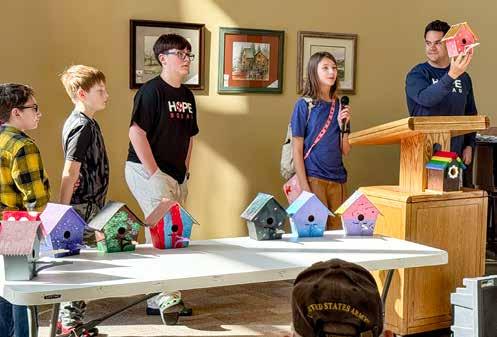
For American Academy of Innovation students, it also means building community. Secondary students recently met South Jordan seniors, who were nominated to receive birdhouses the students made and painted.
Jamie Anderson, the South Jordan Community Center manager for senior programs, said not only do seniors receive a birdhouse, but “they can put a face to the project and get to know each other.”
“Some people who received a birdhouse last year nominated others because ‘I want my friend to get one, too, and meet the student who made it,’” she said. “I like that it gives a lot of people hope and helps boost spirits of both the seniors and students.”
Teacher Landon Leak said he began the project last year and continued it after student response was enthusiastic.
“The best thing is the students learning that helping other people feels good,” he said. “Usually when we’re doing something in school, they aren’t all in. But when we’re talking about why we’re doing this, they’re actively excited, which is reducing student apathy. It’s reducing the ‘Why am I here? Why am I learning this?’ Now it’s, ‘I’m learning this to help other people.’”
Students applied math skills on real-world projects, met seniors and connected with nature in ways that support mental health. Leak said it may even spark lifelong hobbies.
Patron Art Linford chose a birdhouse

The show was previously performed by the theatre in 2021. (Photo courtesy Toni Butler)
people’s attention. It was nominated for six Tony Awards, winning two, including Best Book from a Musical. This show has spawned various other productions in the United States and even in other countries. This production is being sponsored by Salt Lake County ZAP funds, Now Playing Utah, Early Light Academy and Butler Tax and Accounting.
An unusual aspect of the show is that four real audience members are contacted and informed they’ll later be pulled into the production. They also have a live band with
with a natural look.
“You can tell the young man who made this took a lot of time and paid attention to detail, with the leaves and even bricks on the birds’ house,” he said. “I served for eight years training in special forces. We were preparing for nuclear war in the late 50s through the 60s. It was a stressful time, so I took to looking for an outlet when I could at camp, and often it was watching the birds. So this means a lot to me. I was looking forward to the students coming.”
Senior Joseph Long said he enjoyed talking to Linford.
“He definitely was ecstatic to have someone to talk to; it’s awesome I was able to brighten his day,” Long said.

Lauren Carter playing the synthesizer, Jennifer Hansen on keyboard, Angel Williams on percussion, Sierra Anderson playing the cello and Tanner Lindsay and Michelle Lyons on winds. The action and humor continue while the audience watches the show that’s a quarter improvisations and three quarters scripted.
“The 25th Annual Spelling Bee’s” cast will be played by the Kensington Theatre Improvinators. The cast will include Rebekah Price playing Rona Lisa Peretti; Maggie Scott as Rona’s Assistant; Jack Sheehan playing Chip Tolentino; Sayla Butler as Logianne Schwartzandgrubeniere; Tevan McPeak playing Leaf Coneybear; Logan Bingham as William Barfee; Kameryn Grose as Marcy Parks; Lydia Belvane playing Olive Ostrovsky; Rob Abney as Principal Douglas Panch; Seth Goldklang as Mitch Mahoney; and volunteers from the audience to be determined.
“This show will be in the little black box theater which holds just 58 people,” said Butler. Planning ahead to take advantage of the various dates is recommended.
• Performances: April 10, 11, 13, 17, 18, 20, May 1, 2 at 7:30 p.m. and May 2 at 2 p.m.
• Tickets: All Seats $15
• Age Recommendation: 10+
• Ticket Policy: No refunds, no one under 3 will be admitted in the theatre.l
Taking Leak’s class and providing service learning has made an impact on Long.
“I want to become a high school biology teacher. When I saw my peers struggling mentally, I joined the Hope Squad at the school and I’ve been reaching out to my friends. I realized a lot of them just need someone who cares. So I figured if I become a teacher, I can do this even more. I want to be like Mr. Leak, a fun teacher who cares and makes sure teenagers, who are going through a hard time in their life, have someone to help with them. Mr. Leak always makes you feel good and has a way of bringing people up. He’s who I want to become, and I want to do what he’s doing. When I’m a teacher, it would be cool to do a field trip just like this.” l


The road to the LPGA Tour begins with the Epson Tour, and again this month, 132 of the best female golfers on the planet will reconvene for the Copper Rock Championship May 14-16 in Hurricane, Utah. Golfers will compete for $250,000 in prize money and points in the season-long Epson Tour standings.
There were 15 players who gained LPGA status during last year’s Epson Tour season, and 13 of them finished in the top 30 at Copper Rock in 2025. Champion Gina Kim won twice on the Epson last season and is now playing on the LPGA Tour.
Exemptions this year went to four golfers:
Navy Hubbs is a junior at Salem Hills High School who has verbally committed to Boise State University. She started playing golf at the age of 12 and quickly developed a passion for the game. Since then, she has enjoyed competing in both local and national tournaments, gaining valuable experience and continually challenging herself against strong competition.
Hubbs is known for her calm presence on the course and the strong work ethic she brings to improving her game. She approaches competition with focus and determination while enjoying the process of learning and growing as a golfer and developing friendships with others on and off the course.
Maria Jose “MJ” Barragan is a standout collegiate golfer for Brigham Young University, known for her consistency, competitiveness and upward trajectory on the women’s golf scene. A native of Morelia, Mexico, Barragan has quickly become one of BYU’s most impactful players, combining sharp scoring with a calm mindset under pressure. She owns a career-low 18-hole score of 68 (4-under) and a lowest 54-hole score of 210 (−6), achieved at the 2024 Red Raider Invitational where she claimed her best finish with a victory. Barragan has also



Utah golf, recognized for her competitive excellence and advocacy for women’s golf. An inaugural member of the women’s golf team at Dixie State University (now Utah Tech), she was a two-time PacWest Conference Champion, Conference Player of the Year and an All-American.
She competed professionally on the Cactus Tour and is a seven-time Utah PGA Women’s Player of the Year (2019-25), a four-time Women’s Utah PGA Match Play Champion, and the 2025 Utah Section Assistant Professional of the Year. Her career includes numerous Utah Section victories, multiple top-10 finishes in both men’s and women’s events, and an overall championship at The Copper Club Open.
posted strong rounds in key events including the opening rounds of the 2025 San Diego State Classic and the 2025 Dr. Donnis Thompson Invitational, and she played a pivotal role in BYU’s 2025 USF Invitational win with a 72-73-69 (214) performance.
Off the course, Barragan is equally distinguished. She’s majoring in pre-business and has earned recognition for her academic achievements, being named to the 2025 CSC Academic All-District team. In amateur golf, she finished runner-up at the 2025 Women’s Mexico Amateur in a dramatic playoff and represented Mexico at the Pan American Games in Paraguay, showcasing her talent on the international stage.
Gabby Barker is a professional golfer known for her resilience, consistency and purpose-driven approach to the game. A standout junior and collegiate competitor, Barker built her foundation through

years of high-level tournament play before turning professional and committing fully to the grind of tour golf. Since turning pro, Barker has competed across multiple professional circuits, including the Epson Tour and various mini tours, steadily gaining experience at the highest levels of women’s golf.
Her career has been shaped by perseverance, adaptability and a deep belief in long-term growth — both on and off the course. In addition to her competitive career, Barker is the first female Native American professional golfer, a milestone she carries with pride and responsibility. She uses her platform to inspire younger athletes, advocate for representation in golf, and share the realities of pursuing a professional sports career.
Haley Sturgeon is an accomplished golf professional and respected leader in

There are always so many things to enjoy during and around the Copper Rock Championship. On Tuesday, May 12, RAM Aerospace presents the 2026 RAM Women’s Business Luncheon. The theme is “Rising Together: Personal Growth and Professional Influence.” Keynote speaker is Stephanie Palmer, Director of Radio Sales for KSL NewsRadio, FM 100.3, The Arrow and the KSL Sports Zone. Whitney Harris, Director of People and Culture at RAM Aviation, will join in that discussion. The luncheon will run from 11:15 a.m. to 1 p.m.
A free Junior Clinic will be held on Championship Saturday, May 16, at noon. Signups for the clinic and RSVP for the luncheon can be made at Copperrockchampionship.com. There will also be a free photo booth on Championship Saturday, and food trucks will be onsite including Corn Dog Company and Chicharos Tacos.
To get tickets to the tournament go to Copperrockchampionship.com and choose from General Admission, Club 17 or Copper Rock Club tickets, and the website details those options.
Copper Rock is located at 1567 W. Copper Rock Parkway in Hurricane. l


TMS therapy has been
By Peri Kinder peri.k@thecityjournals.com
Asa growing number of teens struggle with depression, some insurance companies are now providing coverage for transcranial magnetic stimulation, a technique proving to be more effective than antidepressant medications.
While the FDA initially approved TMS treatment for teens 15 and older in 2024, increased insurance coverage will allow doctors to help their younger patients in a meaningful way.
“It has been remarkable to see people of all ages find relief from depression and begin to enjoy life after treatment with TMS,” said Dr. Tom Rayner, a psychiatrist with NeuroHealth. “It has also been rewarding to watch them get better without the many debilitating side effects that medications can bring.”
NeuroHealth in South Jordan (10437 S. Temple Dr, Ste. 200) uses the NeuroStar TMS non-drug therapy to treat adult patients. As insurers expand TMS coverage to include teens dealing with depression, Rayner hopes to see young patients find lasting results.
TMS uses a magnetic pulse to activate neurons, increasing activity in the brain area to improve symptoms of depression. It is a non-invasive procedure, similar to an MRI. Many patients see results in less than one month of treatment.
Rayner said the treatment is safe with almost no side effects. Compared to the weight gain, sedation, fatigue, nausea and diarrhea that commonly occur with antidepressant use, TMS patients might experience a mild to moderate headache
during the first few sessions as the brain gets accustomed to the stimulation.
“Rates of depression and anxiety have increased among all ages, especially among teenagers and youth,” Rayner said. “TMS is specifically indicated for teens and other individuals suffering from major depressive disorder, a condition that contributes to said or irritable moods, feelings of guilt and worthlessness, poor energy, poor motivation, poor sleep and appetite, loss of hope and even suicidal ideations.”
Insurers that now allow adolescent TMS treatment in Utah are United Healthcare, Aetna, Cigna, BCBS Federal Employee Plan, Regence BCBS and Select Health. Other insurance companies are currently holding reviews, evaluations and evidence assessments to determine if their TMS coverage will be expanded to teens.
The health policy team at NeuroStar, a premier manufacturer and developer of TMS technology, continues to educate insurers across the country that have not yet added adolescent TMS coverage. NeuroStar officials said while they can’t provide a specific timeline for expansion, discussions are ongoing and progress is being made.
“Adolescent coverage has already been added to several policies as a direct result of the health policy team’s advocacy efforts,” said NeuroStar Practice Development Manager Jessica Brown. “Some insurers initially expressed hesitancy or indicated they would not move forward with coverage; however, with continued engagement and presentation of clinical evidence, decisions have evolved over time.”
Approval can’t come quickly enough for families of teens dealing with depression but Rayner is pleased insurance companies are seeing the benefits of TMS and providing assistance to cover the treatment. He advises parents to be

Insurance coverage expands to include TMS treatment for teens. TMS is a noninvasive therapy that uses magnetic pulses to stimulate nerve cells in the area of the brain that controls mood. (Photo
proactive in getting their teen into treatment, whether that’s TMS or counseling.
“Don’t wait,” he said. “Get help immediately. TMS, medications or therapy all work more effectively earlier in the course of illness. The longer the treatment is delayed, the more difficult it is to get good treatment responses.”
For more information, visit NeuroHealthUtah.com. l



Her painting “Emerald Lens” takes home the Senate Award.
By Peri Kinder peri.k@thecityjournals.com
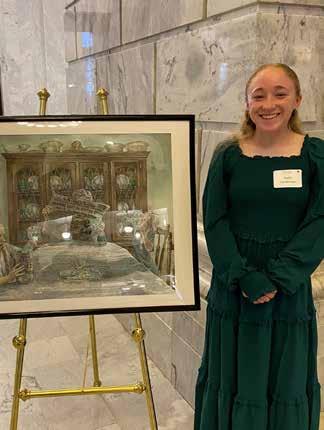
Herriman High senior and emerging artist, Sadie Henderson, took home one of the biggest awards at the Utah All-State High School Art Show. Her painting, “Emerald Lens,” was chosen by Utah senators to receive the prestigious Senate Award. Along with a $5,000 cash prize, Henderson’s painting will hang at the Utah State Capitol through the next school year.
“Emerald Lens” also won the Lyon Arts Studio Award and the USBE Purchase Award, while Henderson’s painting, “Home of the Heart,” earned her the Utah Watercolor Society Award.
Inspired by Norman Rockwell’s nostalgic paintings, Henderson took a historical approach to her “Emerald Lens” piece, centered around her grandmother’s China cabinet.
“She has all this beautiful green depression glass. I’ve always loved it. It’s my favorite thing,” Henderson said. “My grandma told me stories about the depression glass and how it was a little, small thing that they were trying to do to bolster the economy during the Great Depression…I wanted to connect it with finding hope when there are hard times.”
The Utah All-State High School Art Show is a statewide exhibition that celebrates the talent and creativity of Utah’s young artists. Hosted by the Springville Museum of Art, the show celebrated its 54th year, with more than 100 Utah high schools participating.
“There’s not really another state that does anything like this, on this kind of scope,” said the museum’s head of exhibi-

tions, Allison Pinegar. “It’s like the state championships for visual arts students. There are always sports championships and different things, but this acts as an opportunity to display their talents and skills on a professional level, to a bigger audience.”
Entries are divided into four categories: painting, drawing, 3D and mixed media, photography and digital. A 12-panel jury went through more than 1,000 entries to select the approximately 300 artworks chosen for the exhibition.
Pinegar said Henderson’s work stood out due to its technical execution, attention to detail and her acrylic technique that resembles watercolor.
“To have that limited palette and the restraint she used to make it read kind of monotone, and those thin layers of paint that she builds up, is really interesting,” Pinegar said. “What struck the jurors selecting the Senate Award was that level of skill in connection with her artist statement…It was thoughtful and provocative in terms of how she’s thinking about the world and her experiences, and how it might relate to others. Using symbols, items and objects from her childhood to comment on the larger world was really effective.”
Henderson, a South Jordan resident, earned a scholarship to BYU from its Department of Art, where she starts this fall. She will continue pursuing an art career, either doing design work for companies or creating gallery artwork. Henderson wants her art to inspire people to look for things that generate hope.
“Another thing that I focused on in my artwork is that when there were hard times, people tried to do something about it. They didn’t have a wish; they had action,” she said. “I know there’s nothing super big like the Great Depression, but everyone has their bad days. But there are always things to be hopeful about.” l
CALVIN PERFALL owns and operates three Scenthound locations in Salt Lake County. His focus is on building strong teams, delivering great customer experiences, and helping dog owners stay consistent with routine hygiene care.
How long have you been in business?
My first store opened three years ago, while my newest store just surpassed the one-year mark. We believe these Scenthound locations will be around for decades to come! I’ve enjoyed seeing the passion that employees have for the dogs at Scenthound. They truly live a Dog First lifestyle and it shows in their work.
What products/services do you offer?
Scenthound specializes in hygiene and wellness services designed to keep dogs clean, comfortable and healthy. Core services include bathing, ear cleaning, nail trimming, teeth brushing and other essentials that support a dog’s well-being, like shedding treatments and haircuts.
Our model centers on routine care. Dogs benefit more from frequent hygiene services than typical grooming schedules allow. Our services are designed to fill that gap. Membership programs make it easy for dog owners to maintain a consistent care routine for their pets.
What sets your company apart?
Scenthound’s unique focus on hygiene and preventative wellness for dogs. Pets benefit from consistent hygiene care. Our membership-based approach helps clients stay on schedule, which leads to healthier skin, coats and nails. Our team performs a wellness check each visit and communicates anything owners should be aware of, catching potential concerns early.
Who is your ideal customer?
An owner who wants to be proactive about their dog’s health and hygiene. Members care deeply about their pups and appreciate having a convenient way to maintain their dog’s care. We serve everyone, from first-time owners to dog breeders, from puppies to senior dogs.
How do clients choose between you and a competitor?
Dog owners want a place they can trust. Customers want continuity with staff and consistency with services. We take pride in having the same front desk staff greet the dogs and the same bathers providing services. Customers appreciate a trusted team that knows their dog and sees them regularly. Our members also appreciate that they can book appointments on the user-friendly Scenthound app. What factors should customers base their decision?
Choosing a team that is trained, attentive and focused on preventative care should be at the top of the customer’s mind. Cost is another consideration. At Scenthound, our pricing model allows the customer to pay only for what they need. Memberships include the Basic Hygiene (bath), and additional services can be added. Many owners add shedding treatments in the fall/spring.
What is your advice for someone considering doing business with you?
Think about your dog’s hygiene care as an ongoing routine rather than something that happens occasionally. Just like people benefit from consistent hygiene habits, dogs do as well. Finding a place you trust and visiting regularly makes a big difference in your dog’s comfort and long-term health.
What else should readers know about Scenthound?
We believe dogs live happier and healthier lives when their hygiene care is consistent. Our mission is to make that care accessible and stress-free. We’re proud to be part of the Salt Lake Valley community and grateful for the trust our members place in us to care for their dogs.
Are you running any specials or hosting events?
We run promotions and seasonal hygiene services throughout the year. We also participate in local community events and partner with other pet-focused businesses. We’ll soon offer 25% off Shedding Treatments and run a promo on first-time visits. Text/call us on our New Customer line at 385469-3272 to get info.
What is your favorite product/ service?
One of my favorite aspects is our membership program. It encourages dog owners to stay consistent with care to see the biggest improvements in their dogs’ comfort and health. I’ve seen dogs that come in weekly for over two years, and the changes in their demeanor and coat health are truly remarkable. I love seeing dogs that are so comfortable in our stores.









By Tom Haraldsen t.haraldsen@mycityjournals.com
Construction has begun on a new arts and cultural center in South Jordan. Thanks to a contribution of $25 million from the Larry H. and Gail Miller Family Foundation, the center to be named in their honor will join Salt Lake County’s portfolio of venues– including Maurice Abravanel Hall, Janet Quinney Lawson Capitol Theatre, George S. and Dolores Dore Eccles Theater, Mid-Valley Performing Arts Center, Rose Wagner Performing Arts Center and the Utah Museum of Contemporary Art.
At a groundbreaking ceremony held March 19, Salt Lake County Mayor Jenny Wilson said the new center “gives seasoned and emerging artists a space to share their talents while providing the community with a place to learn, grow creatively and be entertained.”
Plans for the new center, which will be approximately 89,000 square feet in size, include an 800-seat pro scenium theater, flexible performance and rehearsal spaces, an art gallery and classrooms. The Miller Arts Center has a projected budget of $90 million and is being built on three acres of land just south of The Ballpark at America First Square donated by the Larry H. Miller Real Estate Company. The remaining $65 million was proposed by Wilson and approved by the Salt Lake County Council.
“This arts center will be a beautiful addition not only to the South Jordan community, but to the many individuals across this area of the valley who will come to enjoy a per-
formance, participate in a class or experience arts in a new way,” said Gail Miller, who chairs the Miller Family Foundation and is co-founder of the Larry H. Miller Company. “We are proud to help create spaces like this where ideas can take shape, creativity can flourish and communities can gather.”
“South Jordan is excited to welcome the Larry H. & Gail Miller Arts Center to our city,” said South Jordan Mayor Dawn Ramsey. “We are strong supporters of the arts, and we’re grateful for Salt Lake County and the Miller Family Foundation who collaborated to turn a good idea into a great reality.”
Wilson said the idea for a performing arts center in the southwest part of the county has been floating around among leaders for some time, but said this groundbreaking has brought its fruition “about 10 years sooner than we thought.” It will become part of the rapidly growing Downtown Daybreak development that has included not just the ballpark but also entertainment venues, restaurants and new residential housing.
The groundbreaking ceremony took place on the roof terrace of the county’s Daybreak Library branch. Miller, Wilson and Ramsey were invited to put their touches on a color-by-number rendering of the new building. That portrait will be displayed permanently in the new center.
Construction is anticipated to be completed in 2028, with inaugural performances and programming expected to begin shortly thereafter. The center will also be conveniently located near the TRAX redline that features a stop by the complex. l

By Peri Kinder
Ranging from $0 to more than $300 for a base license, business licensing fees differ across Salt Lake County.
For entrepreneurs looking to start a company in Salt Lake County, location can shape the cost of opening that business. Licensing fees vary drastically as cities determine costs and define regulations. Fees can fluctuate based on the type of business, number of employees, impact on city services and required inspections.
On one end of the scale is Riverton, which in 2018 became the first city in Utah to eliminate all business licensing fees. The move was orchestrated by the mayor at the time, Trent Staggs, who wanted to let companies know the city was open for business.
“He wanted Riverton to be a business-friendly community,” said Riverton Business Licensing Coordinator Angie Keller. “We’re also very user-friendly when it comes to getting a license. They click on our website and it guides them through the process. I don’t get many phone calls asking for help…I feel like Riverton has gone above and beyond, as far as pointing them in the right direction and giving them all the information they need.”
Draper’s base fee for a commercial license is $82, with additional fees for alcohol or firework sales, sexually-oriented businesses and solicitors. Murray charges $100 for a commercial license with regulatory fees on companies like auto towing, tobacco retailers, tattoo parlors and convalescent homes. Midvale has a base fee of $137 for commercial businesses with add-on charges for industries including bars, hotels, pawn shops and restaurants.
For companies in the county’s newly incorporated areas, including Kearns, Magna and Copperton, the Greater Salt Lake Municipal Services District administers those business licenses. The district charges a $150 base fee for commercial businesses and home-based locations that have customers coming to the home.
On the higher end of the scale, South Jordan charges $337 for a general business license application fee, with additional charges for hotels ($2,700), restaurants ($633), big box stores ($3,331) and entertainment/recreation facilities ($1,727).
Brian Preece serves as South Jordan’s Director of Planning and Economic Development. He said the city’s licensing fee structure wasn’t put together haphazardly, but was based on a feasibility study that determined the cost impact of specific businesses to the city. More fees are placed on businesses that have a higher volume of calls for police or fire services.
“We have a fire inspection for most businesses and that’s part of the [licensing] fees,” Preece said. “Even though Riverton doesn’t have a business licensing fee…it’s being paid for somewhere. The general fund is paying for it.”
South Jordan Public Information Officer Rachael Van Cleave added, “If we weren’t to charge these fees, taxpayer dollars would be subsidizing these costs for businesses. So the fees help to take that off the general taxpayer.”
For home-based businesses, Utah Code states that cities cannot charge a licensing fee unless the business impacts the neighborhood, such as having customers or an unusually high number

of home deliveries. However, several cities, including Taylorsville and South Salt Lake, charge administrative processing fees of $100 and $59, respectively, for home-based businesses.
Riverton requires every home-based business to have a license, but there is no fee. South Jordan does not require home-based businesses to have licenses unless they operate a daycare/preschool or if they have regular clients coming to the home.
“We made the decision to not charge for or even require a home license business,” Preece said. “If somebody wants one, then we’ll get you a license, but you have to go through the regular process, and that’s your choice.”
While getting a business license is certainly an important step in starting a business, it’s not the only step. Business owners need to make sure that the company is registered with the state and, if sales are involved, with the Utah State Tax Commission. Owners must ensure all licenses and inspections are complete before a business license can be issued. Most cities have license approval completed in two weeks or less.
The wide-ranging business licensing fees and processes across the county impact business owners and municipalities differently. For some entrepreneurs, that difference could be the deciding factor on where they ultimately locate their business.
By Mimi Darley Dutton |
Sean Wilson has owned a Jazzercise franchise for 30 years, survived a recession and a pandemic, and she perseveres because of her passion for the program and its people.
As the Donna Summer song goes, “She works hard for the money.” In this case, that “she” is Seandra “Sean” Wilson, owner of Jazzercise Riverton Fitness Center, and she just celebrated 30 years in business.
Most of the money Wilson works hard for goes right back into the business. In addition to operating her Jazzercise studio, she also cleans houses. But it’s her passion for the fitness program and the people she’s met along the way that keep her working hard.
“I do it for the love of it. And no matter who you are or what phase of life you’re in, you have to exercise. For me, it’s almost healthcare at this point rather than self-care,” she said.
Rewind to 1989. Wilson was a young mom living in West Valley. “I was seeking out exercise after my first baby. Almost the first minute of the first class, I just knew I wanted to be an instructor.
I started saving something like $5 per paycheck for six years to come up with the $600 franchise fee. (Wilson explained you must purchase a franchise to use the Jazzercise name and choreography.) I was a customer first for six years,” she said. “Back in the day,” she remembers working out to the music of both Michael and Janet Jackson, Prince and others. (Now, it’s music by Pitbull, Usher and Taylor Swift.)
In 1994, Wilson and her family moved to Riverton. “There was no Jazzercise, there weren’t even gyms,” she said. She missed the camaraderie and community she’d found working out in West Valley.
Raised in Los Angeles as a child of character actors, Wilson became active with Riverton Community Theatre. Soon after arriving in Riverton, she had saved enough to establish a franchise and passed various certifications required of all Jazzercise instructors including CPR training, physiology, anatomy and choreography tests. She taught her first classes at Riverton Community Center. “I taught five to eight classes per week all by myself,” Wilson said.

and motivating and I feel better after class. I’m so glad my friend introduced me to Jazzercise,” Jacobson said.



Wilson has been active in the Riverton community from the start. In addition to community theatre, she volunteered with the Miss Riverton Scholarship Competition for 25 years. “It’s an educational process I think all young women should go through, teaching them poise, diction and interview skills,” she said. Only in recent years did she step away from volunteering in that capacity. “We have a lot of grandkids and my priorities shifted,” she said.
Fast forward three decades since her move to Riverton and several locations later to accommodate a growing clientele, Wilson now manages a Jazzercise studio with 25 independent contractor instructors offering nearly 50 classes seven days per week. Her customers range in age from 18-84. Along the way, her daughter Alexis also became an instructor.
Rebecca Parker of Herriman has been a customer for four years. Parker said she had foot surgery last year and gained weight as a result, but since returning to Jazzercise, she’s been able to lose the excess weight while adding muscle. “I feel strong and I think that’s key. This is different than going to a gym, there’s no judgment or competition. Sean and her team make the environment amazing. I feel loved and valued here,” Parker said.
Riverton resident Jill Jacobson has been going to the studio for more than three years. “The instructors are upbeat
Jazzercise was founded 57 years ago by Judi Sheppard Missett. “She invented group fitness. She’s now 82 and still teaches one day a week,” Wilson said. The company is headquartered in Carlsbad, California and has grown to a woman-led global fitness community with 300 studios (like Wilson’s) and 1,200 locations in 16 countries. Missett’s daughter Shanna Nelson currently serves as CEO and Chief Choreographer and Nelson’s daughter Skyla is a third-generation instructor. The program is deeply rooted in dance and designed to support women’s physical and mental well-being with added strength training and jumping to increase bone density. “Jazzercise isn’t stuck in the past. For more than five decades, it is continually renewing itself with current music and exercise science to give strategies to women through life’s stages,” Nelson said in a recent television interview.
Instructors are sent new routines from corporate every month to keep things fresh. Wilson said it can take 15 to 45 minutes just to get choreography down for one new routine. Every class features at least 15 routines designed to work different muscle groups. “When we learn choreography, we also learn the safety features of each movement to show and explain to our customers,” Wilson said. Instructors stand on a stage facing their class, allowing them to cue and demonstrate the moves, meaning they do every movement in a mirror-fashion. When the instructor says “go right” they’re actually going left. “That’s the hardest learning
curve for new instructors,” Wilson said. Wilson’s Jazzercise franchise survived the economic recession of 2008 and the upheaval of Covid, though the latter proved difficult to rebuild from. “Corporate allowed us to do videos from our homes during the pandemic, so I taught classes from my dining room and some instructors taught from their basements,” she said. As a small business owner, Wilson arranges for childcare at the studio, cleans the facility, pays the bills, does taxes and payroll, buys the supplies, schedules instructors for nearly 50 weekly classes, and texts the weekly schedule out to her customers. When necessary, she teaches two classes per day when an instructor calls out sick or has a conflict.
But Wilson’s love and appreciation for Jazzercise has only grown. “It’s not about legwarmers and leotards anymore…it was for a time because that was the trend, but trends change and so do we. Exercise science is so advanced these days. Instead of letting trends dictate how and what we do, it’s science-based. We have a physiologist on staff at corporate who reviews every movement for injury prevention and safety before it’s accepted into choreography,” Wilson said.
Wilson’s customers come from Alpine, Saratoga Springs, Bluffdale, Sandy, Draper, West Jordan, South Jordan, Herriman and Riverton, as far west as Magna and as far east as Cottonwood Heights. “We have more than 100 customers with room for many more,” she said.
The studio is located at 1716 W. 12600 South. If interested in a free trial, call or text 801-828-8694.
South Jordan Mayor Dawn Ramsey will be honored at the International City/County Management Association’s national conference in Philadelphia after being named one of America’s 250 Public Service Champions. She was one of three honorees from Utah, joining Millcreek City Manager Mike Winder and Kearns Police Chief Levi Hughes.
America’s 250 Public Service Champions is a national honor recognizing outstanding public servants across the country as part of the America 250 celebration. Presented by the National Academy of Public Administration and the LocalGov250 Coalition, the initiative highlights individuals who demonstrate excellence in public service and make a meaningful impact in their communities. Honorees were selected from hundreds of nominations spanning all 50 states and U.S. territories.
Ramsey, who served as President of the Utah League of Cities and Towns and currently serves as Chair of the Wasatch Front Regional Council and as a board member of the National Association of Regional Councils, was nominated by the WFRC for her leadership and commitment to regional collaboration, thoughtful growth and community engagement.
“Public service is about people working together to strengthen our communities and improve lives,” Ramsey said in a release. “I’m honored to be recognized alongside so many dedicated public servants and share this recognition with the teams and partners who make this work possible.”
“Mayor Ramsey exemplifies the spirit of collaboration and caring that makes local government work for its communities,” said Andrew Gruber, executive director of the WFRC. “As Chair of WFRC, she demonstrates what it means to think regionally and act locally, championing efforts that benefit not only South Jordan but the entire region. This recognition is a well-deserved honor for an exceptional public servant.”
“Mayor Ramsey is a local leader who has enhanced the quality of life of her residents and of all Utahns,” said ULCT Executive Director Cameron Diehl. “She collaborates with other elected officials at all levels of government, private sector leaders and residents to strengthen Utah’s economy, plan for our regional needs in transportation, open space, housing and water, and ensure government transparency and accountability.”
The 250 Champions represent a wide range of public service roles, from elected officials to public safety, public works and community services, highlighting the vital role local government plays in everyday life and in strengthening American democracy.
All honorees will be recognized at a national event preceding the ICMA National Conference in Philadelphia on May 12. l

Spring is all about renewal—and your home should be no exception. If you’re ready to refresh your current space or start brand new, we’re always there to help you clean up the decision-making process. Granite Credit Union o ers flexible options to help you access the equity in your home at a great, low rate. LowPay Home Equity o ers a budget consious way to get started on your next home improvement project.
+ + + 5-year draw period 10-year repayment period
Lower monthly payment
*Membership eligibility required. Loans offered on approved credit; not all applicants will qualify. Rates and terms may vary based on credit profile and credit union services used. Rates and terms subject to change without notice. No down payment required options available. Other terms and conditions may apply. Ask for details. Federally insured by NCUA.

By Julie Slama j.slama@mycityjournals.com
Beehive Science & Technology Academy’s The Hive is heading to the FIRST Tech Challenge robotics world championships.
As one of 32 teams that qualified for the state tournament, including teams from Holladay, Sandy, Riverton, Cottonwood Heights, Taylorsville, South Jordan, West Jordan, Midvale and other local communities, The Hive contributes much of their success to experience and resiliency. They received the “The Inspire Award,” which is an automatic bid to worlds, which will include more than 1,000 teams from 66 countries meeting April 29 to May 2 in Houston.
After hundreds of hours and four different versions of their robot, Topaz, and a qualifier win the week before, state didn’t go as planned for the 15-member team from Sandy.
“State was a super up and down day, more than any other competition,” senior Jonah Wood said. “Our first match, our robot disconnected. It wasn’t something we can really control, just bad luck. We lost the match because of that. The second match, a wire broke, so we lost that one. We did a super quick fix and got it working again, but it was stressful. And if you lose two out of your five, it was a little heartbreaking.”
Team captain and senior Neset Kablan continued: “We won the third and fourth matches, but we couldn’t score for most of the match because a gear on the robot came unscrewed, so we couldn’t shoot for the rest of the match. We played defense against the other robots, we won that match, but it was very disappointing.”
The week before the competition, Beehive hosted 10 schools for practice scrimmages.
“We were scoring over 200 points, way above state records. That helped other teams see we’re a promising team, and they could see the problems were outside of our control, but we picked ourselves back up – and that’s what helped when picking alliances,” Kablan said. “It was really disheartening, because if we could score, we would have done a lot better. It was a very rough day to go through.”
Before worlds, the team plans to rework wiring and build in more practice time to troubleshoot issues.
Experience has been key with 13 returning members.
“This season is the culmination we’ve had over the past three years our group has been together and we know what we’re doing, so we’ve been able to achieve a lot more,” Kablan said. “It makes a big difference when talking about team


productivity. Before, we had a lot of people who didn’t have previous experience in robotics, so it was teaching. But also, ‘how do you work together as a team?’ We made multiple iterations of the robot, because this is a shooter year where the robot shoots the balls whereas, like previous years, you’ve had to pick something up and place it. So, for all of us, including the coaches, it’s new.”
Wood said the team’s two-robot system, one for mechanical work, another for programming, accelerated their progress.
“This was one of the first years we had the resources to do that, material wise, but also experience-wise,” he said.
The season kicked off in September, when Wood was overseas. He watched the robot game reveal and immediately began sketching ideas.
“I started working on CAD for the robot,” he said. “When I got back, there were three days before our first competition.”
The Hive rapidly built and tested, often prototyping parts in wood before fabricating them in aluminum.
“We built a lot of these pieces individually out of wood before we actually ended up cutting it out of aluminum to make sure they worked and that our geometry is right, because sometimes the actual theory of a piece doesn’t work in practice,” Kablan said. “We spent most of our time testing, which means that this robot is a darn good robot. It has a very high potential.”
Since state, the team has been fundraising to pay for travel costs. Senior Leah Hammond said last summer’s threeweek robotics camp for 200 youth raised $14,000. It’s supplemented by food sales at the school’s fall festival, plus corporate donations and grants.
Hammond said the program teaches more than robotics.
“The most valuable thing in the program is learning how to work in a team,” she said. “It’s valuable to be able to work with other people, learn to delegate tasks and be able to communicate. Those are good skills that are valuable in any job.”
Wood agrees: “When you like think about robotics, you think of a bunch of nerdy introverts, which is what robotics is. And nerdy introverts suck at communicating, no engineer works alone. Everyone works in a team. I’ve met a ton of smart people, but if you can’t work in the team, you can’t use anything you know. Being able to communicate what you know and work with a team allows you to be so much more.”
Kablan, who comes from a family involved in robotics, said humility has been his biggest lesson.
“The hardest lesson I’ve learned is to strip that ego down and to learn from other people,” he said. “I have connected with tons of teams across the world, and some of those teams have been, performance-wise, worse than ours, but that doesn’t matter. They all have some kind of lesson to give and I have some kind of lesson to learn from them. That’s the most important lesson I’ve learned from robotics.”
Beehive’s robotics program has earned multiple state titles and under coach Annie Drennan, 13 teams have advanced to worlds.
“There’s a bit of pressure,” Hammond said. “At state, there were more than 30 teams from all around the world watching our Utah championship to see us make worlds. That’s not the mentality we have as a team, but there can be external pressure. At worlds, I hope we will have a better competition day, but also, meet teams from around the world and have fun.” l









DR. NICOLE STEWART and DR. KARA PETERSON, longtime members of the Wasatch Learning and Wellness team, began a new chapter earlier this year as the practice’s co-owners.
Dr. Stewart has over 20 years of clinical experience as well as many years of experience in schools supporting students with disabilities and other diverse needs. Dr. Stewart ensures high-quality, evidence-based services are consistently provided throughout the practice. Dr. Peterson’s clinical expertise includes psychological evaluations and therapy, with specialized experience in autism, ADHD, learning differences, anxiety, OCD, mood concerns and behavioral challenges.
Dr. Peterson, tell us about Wasatch Learning and Wellness.
Wasatch Learning and Wellness was founded in 2004 and has earned the trust of families, mental health providers, psychologists, and school professionals. We specialize in delivering comprehensive, high-quality evaluations and individualized therapy that have a meaningful impact for children, teens and adults.
Our psychological evaluations are thorough and peer-reviewed by another WLW psychologist before being finalized. This enhances diagnostic accuracy, clarity and real-world applicability. We assess and treat a wide range of concerns, including neurodivergence, learning
differences, ADHD, autism, mood disorders, OCD, and other mental health needs.
What sets you apart?
What sets us apart is our collaborative and specialized approach. We’re driven by a simple, powerful purpose: provide clear insight that leads to meaningful change for children, teens and adults. Our integrated care model shows how evaluation and therapy can work hand-in-hand within one cohesive clinical team. This allows for thoughtful recommendations that support real progress.
Does your business solve a problem for clients?
Absolutely! WLW exists to provide insight through accurate evaluations, expert therapy and compassionate, coordinated care. We help clients understand how they learn, how they experience the world around them, and what support they need to reach their full potential.
People come to us feeling uncertain or even hopeless about how to move forward. We work with them to uncover a clear path, providing guidance and tools to help them gain confidence, clarity, and solutions that make a difference.
Who is your ideal client?
Our ideal clients are seeking understanding and guidance to reach their full potential, regardless of age or the complexity of their chal-
lenges. Ideal clients are families and individuals seeking solutions to help themselves or loved ones thrive. For parents, this includes those who have concerns about their child’s development but aren’t sure where to turn. We also work with adolescents who struggle to keep up with academic demands or navigate complex social challenges or adults facing difficulties managing the demands of daily life.
What is your advice for someone considering working with you?
Our advice is simple: schedule a free, no-obligation intake call. This is a great opportunity to speak with one of our psychologists, ask questions and explore whether our services are the right fit.
What is the favorite service you offer?
My favorite service is our comprehensive evaluations, which provide deep insight into how an individual learns, processes information and navigates daily challenges. We’re honored when families return for continued support. We love providing therapy, consultation and guidance after an evaluation is complete, helping clients take the insights they gain and use them to find greater success and satisfaction.

What else do you want readers to know?
Our team is composed of Ph.D.-level psychologists, many with backgrounds in school psychology. This gives us a strong foundation in child development and expertise in navigating school systems and special education. We also offer speech and language assessments with our in-house speech-language pathologist.
In addition to psychological evaluations and individual therapy, WLW also provides group therapy, executive function coaching, parent training and behavior consultation. Our collaborative team includes clinicians with specialized expertise in autism, ADHD, anxiety, depression, OCD, emotional regulation and trauma.
Are you hosting any events?
We’re forming a new therapy group for neurodivergent women over 18. This online group is designed for women seeking connection, understanding and mindful strategies to navigate life. We’ll also be part of Sandy’s Farmers Market, where we can connect with community members to share information about our services. Finally, we are expanding our website to provide meaningful, accessible content for our community.

By Julie Slama j.slama@mycityjournals.com
Sixth-grader Harper Peterson has been waiting for this moment.
Cast as Fiona in Elk Meadows Elementary’s upcoming production of “Shrek Kids,” she said stepping into the spotlight is something she’s wanted to do since she first watched older students perform.
“I wanted to be part of this,” Harper said. “I watched these shows since second grade and it looked like they were having a good time. Now, I’m getting to sing and dance and have fun. These people are my family.”
She’s part of a cast of 60 fifth- and sixthgrade actors in the 50-minute musical, which will be performed at 6:30 p.m., May 5-7 at the school, 3448 W. 9800 South. The show is free.
It is being directed by Spencer Duncan, the school’s Beverley Taylor Sorenson teacher, with assistance from Jennifer Hayes, Cassidy Case and Judy Jensen. Choreographers are Baily Ulibarri and Hannah Hartzel, music director is Katie Snow and scenic director is Tricia Troester.
The production began with auditions in November, where actors sang and danced and those in the tech crew provided work samples.

“If they tried out and could commit to the time, they’d be in the show,” Duncan said. “Everyone makes it. It’s more for the experience of auditioning.”
Students were given input in the process, indicating which roles they were most interested in playing. That ownership carried into rehearsals, where students help each other.
“They do their best; kids are filling in for other kids. They’ve memorized each other’s parts and step up to volunteer,” he said.
Rehearsals are held twice per week, but for many students, they practice on their own. Duncan, who has taught some of the student-actors for years, said theater has become second nature to them.
“I’ve taught some of them since kindergarten so doing drama is norm for them,” he said. “They’re used to being goofy in front of each other and are willing to make people laugh.”

Students being at ease, Duncan said, translates into confidence both on stage and in the classroom.
“Resiliency is a big thing in public speaking. They’re comfortable to get in front of others. If they don’t know what to do, they’re capable of making it up until they figure it out,” he said.
As part of their preparation, students engage in character study, learning their motivations and back stories. Some helped design their costumes based on their interpretations.
“It’s an expansion of learning in the classroom,” Duncan said. “Here, they do pure musical theater. They get to use the skills they learn in class along with singing and dancing and tech.”
Troester said Duncan works with students.
“He wants their ideas and he values their input,” she said. “He’s all about the details


like including kazoos, tambourines, sunglasses, party hats that bring fun to the show.”
Duncan said one of the biggest surprises this year has been the students’ professionalism.
“You briefly mention something and they remember it forever. Then, they help everybody else with it,” he said. “The best part is working with these kids and seeing them be excited to be in the spotlight.”
He selected “Shrek Kids” as it carries a message that resonates with his students.
“At the end of the show, there’s a line, ‘What makes us special, makes us strong,’” he said. “I love the overall message that everybody deserves a happy ending and find people who care about them. I thought it was a good thing for kids.”
He added: “I have a bunch of comedians in the group so being with these kids is fun. I get to laugh a lot.l

ired of nagging joint pain dictating your life?
The good news: joint replacement surgery has made significant advancements in recent years. Forget the daunting tales of long hospital stays and arduous recoveries. Surgery today is all about quicker recovery, less pain, and a faster return to the activities you love. This isn’t just about fixing a joint; it’s about reclaiming your freedom, and CommonSpirit is at the forefront of this transformation.
What’s driving this revolution? Minimally invasive techniques. Imagine surgery with smaller incisions and less disruption to your muscles and tissues. This “less is more” approach translates directly into less post-operative pain, reduced blood loss, and significantly shorter hospital stays.
“Joint replacement surgery once meant a long, difficult recovery. Now, thanks to minimally invasive techniques, patients are getting back on their feet and regaining their independence far more quickly, significantly improving their quality of life,” said Michael Blatter, an orthopedic surgeon at Holy Cross Hospital – Davis.
This means you can get back to golfing, gardening, playing with grandkids with renewed vigor.
But the journey to rapid recovery begins even
before surgery. We believe in empowering our patients, and that’s why pre-operative education is a cornerstone of our approach. Our comprehensive classes walk you through every step, covering everything from physical therapy exercises and navigating stairs to home safety. We emphasize two crucial rules: no falls and no infections. Patients consistently tell us they feel better prepared and more confident heading into surgery, which dramatically improves their outcomes.
Our commitment to your well-being extends with Enhanced Recovery After Surgery (ERAS) protocols. This isn’t just about the surgery itself; it’s a carefully coordinated care pathway. ERAS focuses on preparing your body for a smoother recovery through optimized nutrition, multimodal pain management that reduces reliance on opioids, and getting you up and moving just hours after surgery. It all works together to reduce complications, enhance your comfort, and get you home safely and sooner.
And speaking of cutting-edge, robot-assisted surgery has become a game-changer. While a surgeon is always in control, robotic systems provide unparalleled precision, allowing for less invasive procedures, greater accuracy in implant
Women’s health care for every stage of
placement, and ultimately, quicker recovery times. This advanced technology ensures your joint replacement is tailored with remarkable exactness.
“Many joint replacement procedures can now be done same day. And with our current techniques and technologies, we are able to facilitate a quicker recovery and healing process for joint replacement. Our patients are able to get back to the activities they enjoy more quickly. For many of our patients, joint replacement is a game changer,” said Dr. Kevin Sagers, an orthopedic surgeon at Holy Cross Hospital – Jordan Valley.
At CommonSpirit, we understand that living with joint pain can feel limiting. But with these modern advancements, the path to renewed mobility and a significantly improved quality of life is clearer and more accessible than ever. We’re dedicated to providing not just exceptional medical care, but a supportive and empowering experience that truly makes a difference. If you’re ready to explore how modern joint replacement can transform your life, we invite you to discover the CommonSpirit difference – where your rapid recovery is our priority.
For more information or to find a provider visit mountain.commonspirit.org


Learn more about the services, care providers and mission-driven work of the Holy Cross hospitals and CommonSpirit Health at www.holycrossutah.org.

At CommonSpirit Health, we make the healing presence of God known in our world by improving the health of the people we serve, especially those who are vulnerable, while we advance social justice for all.

Women go through many changes in their lives. And we believe every milestone matters. Our health care experts can help you face your next phase with confidence – because each chapter deserves to be celebrated.
Find care near you at mountain.commonspirit.org.
Its 18th year featured paintings, drawings, photos and sculptures.
By Laura S. Crapo l.crapo@mycityjournals.com
Visitors at South Jordan’s art show that was held from March 16 to April 17 at the Gale Museum at 10300 Beckstead Lane could see the city’s appreciation of their historic and current creators. The museum has a model-T Ford car and displays that show examples of life in years past. This educates
visitors about vintage life in South Jordan. The most recent art show it hosted with beautiful and unique paintings, drawings, photos, sculpture and even stained glass was testament the city is alive and thriving.
“This is the 18th year we have done the Art Show and we take Salt Lake County Residents as applicants,” said South Jordan Arts Program Coordinator Tiffany Parker. “The South Jordan Arts Council judged the Art Show.”
The brackets in application for those displaying their pieces of art were: Youth from 6 to 12; Teen from 13 to 17; Amateur adult ages 18 and older; and Professional adult ages 18 and older. Gift cards with a cash value were given as prizes. These prizes were titled as First Place, Second Place and Best in Show in their categories.


“We had over 200 guests attend the artist reception, and the South Jordan City Council and Mayor Dawn Ramsey attended,”

said Parker. “The mayor presented the awards to the art show winners that evening.”
Ramsey has mentioned the museum location’s popularity and how the Gale Mu seum is commonly referred to as a ‘hidden gem.’ This museum is a place that combines history and discovery. It’s a place where curi osity and educational displays naturally lead visitors wanting to see more.
Friends, couples and families commonly visit the Gale Museum. The museum is avail able to all ages. It will be open for 30 scheduled hours from10 a.m. to 6 p.m. Tuesday to Thurs day, and 10 a.m. to 4 p.m. on Friday. Eye-catch ing and educational exhibits teach visitors about South Jordan’s back story. The museum also includes a free online presence with digital resources available for public access. l

When choosing a dog daycare, it’s important to look for more than just a place for your pup to play. You want an environment that prioritizes education, safety, socialization, and exercise.
One key thing to look for is how dogs are guided throughout the day. Practices like leash desensitization are important, as they allow staff to gently redirect behavior and reinforce positive habits in real time.
These types of practices are signs of a daycare that focuses on education, not just supervision. If you don’t see dogs being redirected or given opportunities to rest, it may be something to take a closer look at.
You should also expect to see structured rest. At Dogtopia, we use crates, what we call “home,” as a safe space for dogs to reset when needed. This helps dogs understand boundaries in a calm, consistent way.
In addition, we incorporate a daily nap time from 12–2 PM, which is essential for safe regulation. Just like children, dogs need time to rest and recharge. This routine helps prevent overstimulation and supports better behavior throughout the day.
Equally important is the team caring for your dog. At Dogtopia, our Canine Coaches are highly trained and certified, completing a full training course and shadowing between 5-10 sessions before leading a room on their own. IF YOU’RE LOOKING FOR A DAYCARE that
today. Go to www.dogtopia.com/location-finder
Students met professionals working in STEM fields who shared how technology is used to tackle real-world challenges.
By Julie Slama j.slama@mycityjournals.com
More than 3,000 Utah students gathered to explore STEM careers at SheTech, where hands-on workshops, industry booths and inspirational leaders encouraged middle and high school girls to see themselves in fields where women are still underrepresented.
Michele Hollist, a senior chemical engineering analyst with Oxeon Energy, said her company participates because it wants student to see how science and engineering make an impact in both space and on Earth.
The company is working on technology that can create oxygen from carbon dioxide in the Martian atmosphere and converts biogas from food waste into renewable fuels on Earth.
“We’re trying to solve energy issues on Earth I know this generation cares about and our technology actually has operated on Mars, which I don’t think a lot of people know,” she said. “I’m hoping to get girls excited about the fact they can use their education to solve problems. A lot of the people we interview coming out of college are passionate about trying to make the world a better place and our new en-
ergy sources will last for generations.”
Nearby was a booth with programs Women who Succeed, Ken Garff Keys to Success and Ken Garff eSports, that support high school and college students, connecting females with mentors, resources and scholarships.
“I want to help girls, especially in tech fields, have a place,” said Addie Huff, Women who Succeed program manager. “We want to help the next generation of leaders.”
Girls participated in hands-on challenges and networked with industries and colleges in the TechZone. More than 1,000 mentors from 250 companies and major universities took part in the free event, which was hosted by the Women Tech Council with the help of the SheTech student board.
Students spent the day discovering possibilities.
West Hills Junior High ninth-grader Leimomi Jensen was exploring career choices.
“I’m open to options, learning about these fields,” she said, adding she’d also like to be a pro dirt bike rider.
Her classmate, Jesse Jones, said she was looking at opportunities to help her in a field, marine biology, she’d like to pursue.
“I’m taking the opportunity to learn new things,” Jones said.
Students took part in workshops ranging from programming and aerospace to biomedicine and cybersecurity.
Could you be getting more out of your retirement? Discover a community that seamlessly blends comfort, elegance, and vibrant social living, chef-inspired cuisine, all-inclusive services, and a wealth of enriching activities specially designed to curate a fulfilling retirement lifestyle without the worry of long-term leases, hidden fees, or unpleasant surprises.

More than 3,000 middle and high school students learn about robotics and other STEM fields at SheTech. (Julie Slama/City Journals)
Cottonwood High sophomore Avery Harmston appreciated the event for female students.
“SheTech is great because it can be intimidating in the male-dominated STEM fields so here we can learn about the industry from women who are in the tech field; it’s a good experience,” she said.
Her classmate Callye Linke liked the interactive learning.
“It’s fun to learn about all this; I had an engineering-focused workshop,” she said. “I’ve learned at SheTech how AI can be used for good reasons.”
Juan Diego Catholic High junior Lei Harline used the experience to learn more
about the health care industry.
“I want to be an anesthesiologist so I’m looking more at the medical field booths and workshops, but it’s fun to explore all the new technology,” she said.
Educators say the event leaves a lasting impact on students.
Corner Canyon High’s work-based learning coordinator Taylor Jesienouski brought 37 girls to the explorer day.
“It’s a great event, one of the best of the year for women empowerment,” she said. “We always feel women are strong and can do anything after this event; my girls absolutely love it.”
Two-time Olympic skiing freestyle medalist Shannon Bahrke, who just returned from watching the Olympics in Italy where she said women won 60% of the medals, was one of the event’s speakers. She encouraged students to try new things and pursue what inspires them.
“I challenge you today to make friends with all of these incredible girls around you, because they are your people,” Bahrke said. “Find something that you really love here, something that inspires you, something that intrigues you…and you will have your Olympic moment. It may not be on the world’s biggest stage, but it will be on your biggest stage. Work hard and be your best self, because your extraordinary starts here.l

The IEP Student Center offers guidance and resources.
By Peri Kinder peri.k@thecityjoutnals.com
a child’s education can be daunting. That’s made even more difficult when a child needs special education services. Parents often feel overwhelmed by the volume of red tape to get their child the help they need.
Students with special needs or disabilities are eligible for an Individualized Education Program that outlines support and instructions that a team of parents, professionals and educators follow to help children thrive. The plan sets goals, strategies and performance markers to help ensure students can succeed at school.
But what happens when the IEP blueprint isn’t followed? What if there’s a failure of services or a breakdown in communication? That’s when the IEP Student Center can make a difference.
Mark Adamson is an IEP attorney with a unique perspective. As someone who has autism and ADHD, he can see the situation through the child’s eyes to help find creative solutions.
“I’d say probably as many as 60% of my clientele have autism, ADHD or both,” he said. “It’s fascinating for me to be able to explain to parents what’s going on in their kids’ brains, and I can be a positive role model for them.”
Adamson helped establish the IEP Student Center in South Jordan (1682 W. Reunion Ave., Suite 4B), a nonprofit founded by attorneys, educators and parents to foster advocacy for children with special needs or disabilities.
The center provides representation, helps with conflict
resolution, supports the rights of parents and students, and maintains accountability for schools to abide by IEP plans.
Adamson, a West Jordan resident, earned his law degree at the University of La Verne and worked with the Disability Rights Legal Center in Los Angeles. He said when a child’s education isn’t going the way it should, there are several options to advocate for students.
Most often, he is contacted when a child is expelled or suspended. If the behavior that got the student in trouble is a manifestation of their disability, Adamson starts a conversation with school officials to walk through the child’s IEP to make sure all issues are being addressed correctly. Often, he finds teachers are overworked, schools are underfunded and parents are ashamed.
“If you’re constantly getting called to the school, maybe your kid is hitting other kids, maybe your kid’s the bully, a parent ends up feeling like it’s a judgment on them,” Adamson said. “I try to strip that embarrassment away and not talk about the situation like it’s a moral judgment.”
He said IEP students are often considered less intelligent than mainstream kids, but his experience has proven that to be false. Adamson points to his own success as an attorney and to Ana Victoria Espino, who, in 2024, became the first person with Down syndrome to graduate with a law degree.
“So guess who’s in college now?” Adamson asked. “A bunch of people that were never going to be in college before because their moms didn’t take no for an answer. They were creative about every single thing that they could come up with, and now we have those kids that are graduating from college, and they’re going to law schools, they’re going to med schools.”
Adamson said the State of Utah is required to assess


An Individualized Education Program is intended to support students with special needs or disabilities, but if there’s a failure in service, the IEP Student Center can provide resources to parents. (Adobe Stock)
every student under the age of 20 to determine if they have special needs or a disability, and they’re required to educate them. It’s his job, and the job of the IEP Student Center, to make sure that’s happening.
To further help parents, Adamson is starting a podcast called “Ask an IEP Lawyer Show,” which should be launched this spring. For more information, visit IepStudentCenter.org. l





Herriman High’s unified basketball team wins state championship and shows how unified sports brings students of all abilities together, onand off-the-court
By Julie Slama j.slama@mycityjournals.com
Ina high school gym, the sounds are familiar — balls bouncing, high tops squeaking on the court and teammates cheering.
But unified basketball is not just a game; it’s a space where students of all abilities come together as teammates, playing together on the floor to build friendships, confidence and community through sports. The focus isn’t only on winning, it’s on inclusion, sportsmanship and connection.
At Herriman High, the spirit carried all the way to the biggest moment of the season, as the team beat Juab High in the state championship for their division at the Delta Center. Jordan School District’s Copper Hills High and West Jordan High were state runners-up in their respective divisions.
Across the valley, Jordan High also won its division for a state title, beating Highland High. Playing in the state championship was exciting, but for the players, it meant more than an opportunity for a title.
Jordan senior Alejandro Beltran Lopez played with pride and purpose.
“I want to continue my dad’s legacy in playing sports,” he said. “He taught me a little and coach taught me more; Dad’s happy for me.”
Beltran Lopez said unified sports helped pave friendships with his teammates, from eating lunch together to watching the movie, “Elf.”
“We’ve had others at school support us too,” he said. “Unified soccer was fun; we wanted to beat Bingham at state championship (played at America First Field last fall), but it’s OK we lost because being a good sport means accepting defeat.”
His teammate, junior and peer tutor Sawyer Herzog, said unified sports extends beyond the court.


“I love this,” he said. “We’ve become friends and I probably wouldn’t have met him if not. We’ve become genuine friends. We hang out, doing puzzles, watching Switch TV, talking, I help with math and ELA (English Language Arts). My whole family loves him.”
At Alta High, senior and peer leadership team member Macey Rockwood sees unified sports as something bigger.
“The goal of PLT is to make the community better, so through unified sports, we can support them,” she said. “Everyone deserves a community.”
Rockwood has refereed and ran the score table at unified tournaments and enjoys helping others succeed.
“It’s satisfying to help others have fun and have a sense of accomplishment,” she said.
For players like Corner Canyon sophomore Mia Lems, the competition still matters, but so does kindness.
“I like to take down the other team,” she said. “I’ve made friends with other teams too. I like to give them handshakes and clap and give high-5s for making good shots.”
Corner Canyon finished as state runners-up in their division at the state championship.
Lems’ teammate, senior Fisher Ghiz, didn’t realize how much unified basketball would change him.
“It has taught me patience; it has taught me how to make friends with those different than me,” Ghiz said. “I used to be shy, but they’re so social, I’ve become more outward. This is awesome. I want to keep playing in college.”
Across Utah, with more than 250 Utah high school unified teams, players emphasize the game has given them friendship, growth and joy.
Hunter High senior Maelie Jorgensen loves “the good environment where everyone has fun playing and being together” while teammate sophomore Bentley Wright said the teammates’ friendships stretch into lunch tables and school dances. On the court, Wright, like Granger High’s freshman Jhanpeer Macha Dias, loves the celebration after a basket that comes with dance moves and cheers.
Murray High’s Parker May loves the game, especially shooting the ball, and playing

Herriman High outscored Juab High to win the state unified title. (Photo courtesy Mike Haynes/Jordan Education Foundation)
with friends while teammate senior Hayden Gardner added he loves the confidence his teammates have gained over the season.
Murray High senior Ethan Teusher added: “There is simple joy in spending time together whether we’re playing basketball or a game of Uno.”
Nearby Skyline High finished second in its division at state.
After West Jordan senior Robert West said he hoped his team would practice more

early in the season, the Jaguars finished second at state in its division.
West Jordan senior Colton Reid refereed unified basketball last year, but decided to participate this year.
“It’s the greatest thing and something I didn’t want to miss out on,” Reid said. “I’ve made some good friends and great memories playing unified basketball.l


Grief is an individual journey with a path as unique as each one of us. To o er support and hope, we provide various Grief Support Services for those who are mourning a recent or past loss.







Unsure if networking can work for you? Local businesswomen Julie DeLong and Alex Mic-Podar demystify the art of simply making friends.
By Elisa Eames elisa@mycityjournals.com
The independence, flexibility and potential financial rewards of owning a business persuade over 5 million U.S. entrepreneurs to take the plunge each year. The founders and owners of Salt Lake-based Backyard Bookkeeper, Backyard Payroll and SPC Strategies, locals Julie DeLong and Alex Mic-Podar tackle tough questions affecting entrepreneurs today.
DeLong has written several articles for Intuit and Forbes Magazine and was an adjunct professor for the University of Utah. Mic-Podar has started a total of seven businesses and provides coaching and consulting services. She is a board member for multiple nonprofits and was a 2023 recipient of the Utah 40 Over 40 award.
This is the final article in a four-part series about how to start and grow a business.
What is networking exactly, and why is it important?
Mic-Podar: Networking is making connections and letting others know you exist. It is not necessarily picking up clients or customers, but it’s making friends who will recommend you to their friends because you’ve made an impression on them.
The word “networking” has “net” in it, and I compare it to a spider building its net. If you connect lots of dots, eventually the right bug will fly into it.
You need to be known in your community. If you are a business-to-consumer company, the right networking places help you meet distributors, fulfillment center owners, etc. If you are a business-to-business company, your potential clients will be in your community, and if people don’t know who you are, they can’t help you grow.
What do I need to understand about networking?
Mic-Podar: First, give more than you receive. Go meet people and become a solution in their lives, a support system, and they will reciprocate by recommending you to their friends and family. You’re the newbie. They don’t know you, so you need to prove yourself.
Second, don’t network to get clients. Lots of people go to a few networking events and give up. Networking takes time. Many from your industry also attend events to fish, not just you. Be the fisher who casts the net and waits for the fish to jump in. Make friends and show them why you’re different and how you give more than your competition.
Third, the idea that networking is not for everyone is a myth! Everything you do

Julie DeLong and Alex Mic-Podar founded Backyard Bookkeeper in 2008. (Photo courtesy Backyard Bookkeeper)
is networking. You could simply be going to a conference to educate yourself, but you’ll miss out if you don’t get to know the person sitting next to you.
When you first open your business, you’re also missing out if you don’t take each client to lunch, spend time getting to know them, or send a thank-you card for choosing you. That is networking, too.
You don’t have to look specifically for “networking events” because you’re networking every day as you run your business. Even if a prospective client went with the competition, it’s your job to make such an impression on them that they’ll remember you a few years later. For business owners, networking is your bread and butter.
DeLong: Networking is a long game. It rarely pays off in the short term. When it does, great! But otherwise, focus on making connections and becoming a person people look to for solutions and ideas, whether or not that results in sales. In the long term, you will create a network in which people provide significant value to each other, and this will eventually result in sales.
How do I get started? How do I find industry-specific events?
Mic-Podar: Easy! If you are not on LinkedIn, get on and find me! Direct message me, tell me what you’re looking for, and I’ll make some introductions. If you’re not on LinkedIn, you’re not serious about your business or career.
Then get an Eventbrite account. Industry-specific networking means attending industry-specific conferences. Utah has a lot of free events where you can get to know others in your industry or meet potential clients. Search your current or target industry on Eventbrite, and you’ll find a lot.
As soon as you start your business, put yourself out there. Offer to help others for free.
At your first event, tell everyone you’re new and would like to know about upcoming events. I guarantee you’ll leave with multiple options to attend each week. As stated in previous articles, you don’t need to spend a lot
on marketing. Get leads by gathering business cards at events from relevant people you talk to and including them in email marketing.
This is really the secret of networking: give and ask for support. Everyone was in your shoes or still is, and everyone loves to give advice. Be a good listener, and you’ll make friends quickly. And if you promise to attend something, show up. Be consistent.
What if I’m uncomfortable talking to strangers?
Mic-Podar: It’s not “if” you’re uncomfortable with strangers. You will be, so just start. Introduce yourself, and ask questions like, ‘what industry are you in? What brought you to this event? Do you know the organizers?’ Make it about the other person.
If you’re nervous about answering their questions, say something along the lines of “I haven’t practiced my elevator speech yet, but I’ve started a business in this industry.” Give yourself breathing time, and always always be honest.
With practice, it will be easier because your community is smaller than you think, and with time, you’ll find you already know lots of people at events, and conversation will be easy.
What should I do after I’ve met a contact at an event?
Mic-Podar: I always carry a pen, so when others give me their business cards, I make a small note on the card to help me remember who they are.
After the event, find all the people on LinkedIn whose business cards you collected. Add them and send a message. As soon as they accept your connection request, remind them where you met. Perhaps remind them of any advice they gave and thank them again.
I actually add people to my LinkedIn while I’m still at the event because I’m very visual, and if I see their profile picture, I know exactly what we talked about.
If someone could take your business to the next level or is a potential client, don’t be shy—ask them to lunch. It’s cheaper to buy lunch than spend 10 times that on online advertising and get no leads.
Remember, networking is just relationship building. Always, always move on your leads within 24 hours. If you don’t, they might not remember you.
DeLong: As Alex indicated, it’s extremely important to take notes about each person you meet. While it’s still fresh, write down details and keep them in mind when you follow up. Be someone who notices and remembers, whether it’s a particular milestone your contact is working toward or a recent health challenge for their parent.
The next time you talk to them, ask about the milestone or how their parent is doing. If you genuinely care, you’ll develop deep, meaningful relationships in your business community.
How do I network online?
Mic-Podar: As indicated above, online networking starts with LinkedIn. It’s where I do most of my networking. I recognize most of my LinkedIn contacts when I see them at events. We currently have over 600 clients, and more than half are clients because of LinkedIn. Don’t do any selling or spamming, but it’s important to comment on posts and engage with your contacts’ content. Whether you have a business or not, get on LinkedIn! It can help your business succeed and has answers for your next career move, but you don’t need to pay $60 a month to access benefits. I haven’t paid for the upgrade for years.
Mic-Podar: This is an unpopular opinion, but I don’t advise signing up for paid networking memberships that offer exclusivity. Trust me. In the long run, it’s not worth it. Exclusive clubs will become a waste of time, and you’ll only meet the same people over and over. It could be beneficial to use clubs for business advice, but they won’t help you with networking much. You’ll get more clients with Google or social media ads.
DeLong: Many networking groups, even paid ones, allow guests to visit for free at least once. Take advantage of that! This will help you get to know the community and get your name out there without making a risky financial commitment.
Should I join a chamber of commerce?
Mic-Podar: YES. Your local chamber of commerce is NOT an exclusive group promising you’ll be the only one from your industry. It is a club, but every business owner is welcome, and they have the best networking events. My favorite ones are the South Valley Chamber and the Davis County Chamber. I love the people and the members.
DeLong: Chamber events are often great networking opportunities. You don’t usually need to be a member to attend, but your ticket may be a bit pricier. Attend a few events to decide whether the chamber is right for you.
What are some other ways to find leads?
Mic-Podar: Think outside the box. Be creative. Talk to vendors at trade shows, home and garden shows, expos or even markets with local makers. If you’re in the business-to-business industry, every vendor is a prospective client or a prospective supplier. Turn any event into a networking opportunity by gathering people’s information and sending them a follow-up email.
Parting thoughts
Mic-Podar: Network, network, network. Build that spider web. You can do it. If I did it, you can, too. I believe in you. To connect with me, find me on LinkedIn as Alexandrina Mic-Podar. Shoot me a message, and if I have time, I’d love to help you set up your LinkedIn.l




























State legislative action is a good initial step from government to save the Great Salt Lake, but more conservation efforts and infusion of cash are critically needed.
By Tom Haraldsen t.haraldsen@mycityjournals.com
In mid-March, before the record heat wave in Utah, the Great Salt Lake was at 36.1% of its desired water level. That day, it was more than 6 feet below its minimum healthy water level of 4,198 feet. Over 53% of the lakebed was exposed (1,150 square miles), and its salinity was 11.9% (12-16% is considered ideal for brine shrimp).
In other words, the GSL was, and still is, in serious trouble. Reserving that trend and educating Utahns and the world about ways to prevent that pending disaster is Grow the Flow, a citizen-led movement that unites science with facts and civic action to address the issue. The team monitors all facets of the lake daily, continues to update its website (growtheflowutah.org) with latest developments, and seeks the public’s engagement in efforts to save the lake before it’s too late.
The GSL was a big topic of discussion during the recently completed Utah State Legislature, and the good news is that the Grow the Flow team was for the most part optimistic about this year’s session.
“By and large, it was the most productive session that I’ve been a part of,” said Jake Dreyfous, managing director of the organization. “Some of the biggest levels of
improvement came from focusing on making it easier for farmers to lease water to the Great Salt Lake and expediting that process.”
He pointed to two bills—HB 348 and HB 410—sponsored by Rep. Jill Koford (R-Ogden). The first addressed dedicated water amendments and the second water leasing agreements. Both passed and were sent to Gov. Spencer Cox for his signature.
“These bills create a process to file a dedicated water right and tell the state engineer that they need to prioritize the processing of change applications,” Dreyfous said. “Where before a single lease agreement could take six months or even a year to process, this cuts that down to six weeks and no more than three months. That’s a big step forward to make sure farmers can make informed decisions to lease their water and be financially compensated for a single irrigation season.”
He said large progress was also made with the increased engagement from the federal government.
“We saw President Trump proclaim his support for Great Salt Lake restoration,” Dreyfous said. “That led to the passing of a concurrent resolution from the state legislature on the last day that explicitly outlines the scope and scale of the problem and the impact it stands to have on the lake. It affects millions of Utah businesses and homes, public health from the increase in dust pollutants, the importance of this migratory bird flyway and ecosystem for 10 million migratory birds, and the role the lake plays in the production of critical minerals and food security. The extraction of things like potassium sulfate, lithium and magnesium
where, in a lot of cases, the Great Salt Lake is the only domestic source. We’ve made it clear to our federal delegation that we can’t solve this problem alone—we need federal support and coordination.”
Trump intimated a $200-million pledge from the federal government. The state of Utah will seek $1 billion from the feds for the lake. Neither action has been taken thus far.
Another huge achievement was the state’s acquisition of U.S. Magnesium in January, The approved $30-million purchase gives the state control over 4,500 acres of land and extensive water rights.
“That’s very massive in terms of both water quantity and air quality perspectives,” Dreyfous said. “Historically speaking, U.S. Mag has been the source of 20% of our winter inversion pollution in the Salt Lake Valley. The state’s purchased water rights, 40-60,000 acre feet of water, will now stay in the lake.”
He said the legislature’s approval of a settlement agreement between Utah and the federal government allowing transfer of Bear River Migratory Bird Refuge will net the state $60 million. That money is earmarked for GSL conservation efforts, $10 million available this year and the remaining $50 million that will require future appropriations from lawmakers. Dreyfous is confident that future money will be set aside for the lake.
But he added there were some missed opportunities this year on Capitol Hill, particularly on the municipal conservation front.
“We had really strong policies focused on limiting the use of thirsty grass landscapes in new development within the Great
Salt Lake Basin,” he said. “There were policies that would have mandated watering ordinances across the Basin, and set more aggressive water pricing to conserve. Where we took our eyes off the ball this year was to insure the growth of water wise programs to help us conserve.”
At this year’s Sundance Film Festival, a documentary from director, editor and cinematographer Abby Ellis, who now lives in Utah and was titled “The Lake,” centered on the challenges faced by the GSL. Its showings received standing ovations and it won the U.S. Documentary Special Jury Award for Impact for Change. It profiled three people: microbiologist Bonnie Baxter, ecologist and BYU associate professor Ben Abbott, and the state’s Great Salt Lake commissioner Brian Steed, and it painted a poignant picture of the lake’s pending demise if strong, aggressive action isn’t taken to preserve it. The film will be shown at other festivals around the country this year.
Dreyfous said community engagement is now more important than ever, and that large financial donations to clean up waters and expand leasing programs are critical to helping get more water into the lake.
“Investing in water conservation is investing in future growth and prosperity for your city or town,” he said. “Actions on the state level will trickle down to the local level. A common sense regulation from the state’s population, like waiting a few weeks before turning on our sprinklers and cutting down watering by maybe a third, would help. The most cost-effective proven solution that we can do as individuals is conservation.” l




Funeral arrangements are a deeply personal choice. Preplanning provides you with the time needed to make practical, detailed decisions that reflect your standards, lifestyle, taste and budget. And we assure you and your family that the choices you make will be carried out as planned.

Like many communities across the country, Salt Lake County has felt the impact of the opioid crisis. In recent years, hundreds of people have died from opioid-related over

crisis locally. The funds will be distributed over a 17-year period.
Unlike traditional tax dollars, these funds are specifically designated for address
the criminal justice system and create better long-term outcomes for those struggling with substance use disorders.
Last week, my colleagues and I ap












Whenastronaut Neil Armstrong took those first steps on the moon, I had just celebrated my first birthday. I don’t remember either event, but the entire world held its breath as it watched Apollo 11 land, while I shoved my hands into a birthday cake.
That moon mission used less technology than your bathroom scale. It was basically human calculations, a slide rule and a Rand McNally paper map that guided those astronauts on the first lunar road trip.
We were told that space was the final frontier; space was the future. We learned that, like age and teenagers, space isn’t forgiving.
As a Murray High School senior, my home ec advisor wheeled a TV into the classroom to watch the Space Shuttle Challenger carry the first teacher, Christa McAuliffe, into space. We were speechless when the shuttle blew up at 46,000 feet. In February 2003, I watched the Space Shuttle Columbia disaster unfold as the spacecraft disintegrated on re-entry.
To say I was apprehensive watching the Artemis II mission launch to the moon would be an astronomical understatement.
On April 1, NASA perched the Orion space capsule atop a 300-foot rocket, one of the most powerful ever built. It launched a team of four astronauts 250,000 miles away from Earth, the farthest humans have ever traveled, discounting alien abductions, of course.
Unlike the catapulted station wagon that

somehow got us to the moon during Apollo missions, Orion uses autonomous navigation and extreme precision, carrying astronauts beyond low-Earth orbit for the first time in more than 50 years, traveling at speeds up to 25,000 mph.
It was the 10th manned moon exploration, or for conspiracy theorists, the 10th “faked” moon mission. The entire adventure was livestreamed so we could travel together.
Space exploration is equal parts wonder, technology and angst. During the 10-day moon trip, I endured galactic levels of anxiety. Launch sent my blood pressure soaring. My jaw clenched while they circled the moon on April 6, and my internal organs somersaulted during splashdown on April 10.
I was hyperaware that dreams explode and rockets fall apart.
Apollo missions were built on bravery, and America was racing to beat Russians to the moon. Now, Artemis is an international collaboration, one that should remind us we only sur-

vive this wild ride by working together.
In Greek mythology, Artemis is Apollo’s twin sister and goddess of the moon. It is an apt comparison: while the first moon missions had bro energy, the Artemis program continues the story in a wiser, more thoughtful way.
Women play key roles in the Artemis program. Besides the first female to fly on a moon mission, there are female science officers, mission leads and launch directors. In fact, for the first time in NASA’s history, the current astronaut class has more women than men.
If I could do math while enduring crushing g-forces and the stomach-dropping sensation of freefall, I would definitely have been in the space program. Instead, I appreciate the life of an astronaut from the comfort of my recliner.
Apollo gave us “One giant leap,” Challenger dropped us to our knees and Artemis refocused our gaze. These missions remind us to look to the stars, but also look to our beautiful, blue planet. We only have each other. We should start acting like it.
As I approach my next birthday, one I hope I remember, I raise a glass to the dreamers, the heroes, to the brilliant engineers in mission control and the fearless astronauts who explore new paths. It reminds us that even when the story goes wrong, we need to keep looking up.
Peri Kinder is an award-winning columnist and journalist who has written for The City Journals since 2004. She can be reached at peri.k@thecityjournals.com