
School
mergers
pause
Tensions flare as 2027 budget passes first hurdle Page 10-11
Decision was tabled for comprehensive study Page 14

mergers
Tensions flare as 2027 budget passes first hurdle Page 10-11
Decision was tabled for comprehensive study Page 14
By Julie Slama | j.slama@mycityjournals.com
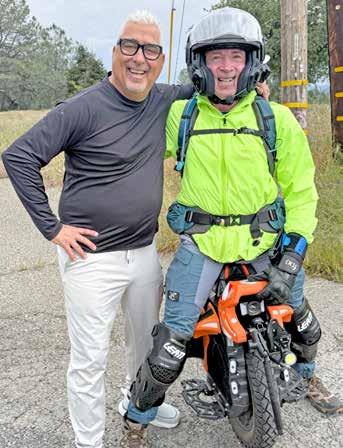
While most people celebrate turning 65 with cake, Sandy resident Kent Griffiths is celebrating by riding an electric unicycle across America to raise scholarship money for Hillcrest High students.
On May 2, Hillcrest High alumnus Kent Griffiths turned 65.
The Sandy resident celebrated by starting an epic cross country journey — not as a motorist nor cyclist and not even on foot. He is riding from California to Virginia on an electric unicycle, one of the first people to do so.
It wasn’t surprising to his former childhood neighbor, Craig Conder, who remembered watching him make 60 jumps skydiving for his 60th birthday. Both adventures help raise funds for Hillcrest High Alumni Association’s scholarship fund.
“I was someone who squeaked by with bad grades, but I had my breaks,” said the 1979 graduate, who added those came from the U.S. Army and later, his employer.
Griffiths’ daughter, he said, thrived at Hillcrest and now is studying medicine, but that raised the concern about those who need a hand-up, so he devoted both epic adventures to raising funds for scholarships.
“I get to have this experience of a lifetime, but I also get to make it about somebody else. That’s the motivator for me,” he said. “It doesn’t matter where help comes from as long as it comes at the right time.”
Less than one week after starting his trip, Griffiths reached the Utah border. While he carefully planned and tested his equipment, he misjudged one thing.
“I severely underestimated the importance of lotion on my hands,” he
Continued on page 6















































Common Ground will be a column of rotating viewpoints that highlight specific feelings across the political spectrum, and it will always end with possible ways to come together.
There once was a giant sandbox where everyone could play together. It had dump trucks, shovels, sandcastle molds and one corner filled with cigarette butts from the high school teens.
Big Brother (BB) controlled the sandbox. He carried a clipboard and whistle, and discouraged others from playing. Although it belonged to the entire community, BB would chase people away, saying, “That’s just the rules,” which he had made himself, of course.
But Little Brother (LB) wanted to play. He tried to convince BB to give him just a small part of the sandbox to build sculptures with his friends. “What about this spot?” he asked.
BB clutched his clipboard to his chest and gasped. “That’s a very important place. That’s my transportation corridor. You can’t have it.”
Every spot LB suggested, BB drew a new line in the sand and explained why it just wasn’t feasible. That spot was BB’s economic area, and another spot was an important waterway. Soon, all that was left was the ashtray corner, but BB wanted control over that, too.
LB went to find Mom (who represents voters, the judiciary and common sense). She explained to BB that the sandbox belonged to everyone and LB could have his share.
BB was furious and started throwing sand at Mom, calling her a bully. “You’re destroying the integrity of the sandbox!”
The Sandy Journal is a monthly publication distributed directly to residents via the USPS as well as locations throughout Sandy.
The views and opinions expressed in display advertisements do not necessarily reflect or represent the views and opinions held by Loyal Perch Media or the City Journals. This publication may not be reproduced in whole or in part without the express written consent of the owner.
© 2026 Loyal Perch Media, Inc.
he screamed. Then he spent the rest of the summer planning to steal back LB’s share.
Instead of a sandbox, we’re dealing with voting maps. Gerrymandering has shaped Utah’s leadership for decades, especially in creating congressional districts that look more like a sliced pizza than an equally divided constituency.
We can’t bury our heads in the sand and expect the majority leadership in our state to treat us fairly. In 2018, Utah voters tried to redraw the sandbox lines, approving a ballot initiative that would create an independent redistricting committee to create voting maps to avoid gerrymandering.
But Gov. Cox signed a different map into law that split Salt Lake County into four districts that could easily be controlled by Republicans. The new map ignored the committee’s recommendations, which would give Democrats a possibility of winning a Congressional seat.
Utah’s League of Women Voters filed a lawsuit, claiming the new map was a bunch of baloney. They won that case in 2024 when the Utah Supreme Court ruled that legislators could not override the voice of the people. But the majority leadership has been fighting for its maps
PUBLISHER
Bryan Scott | bryan.s@thecityjournals.com
EDITOR
Travis Barton | travis.b@thecityjournals.com
ADVERTISING EXECUTIVES
Mieka Sawatzki | mieka.s@thecityjournals.com
Ryan Casper | ryan.c@thecityjournals.com
Marc Davis | marc.d@thecityjournals.com
CLIENT SERVICES
Lydia Rice | lydia.r@thecityjournals.com 385-557-1022
and sand toys ever since, trying to overturn the Court’s decision.
Common Ground: Gerrymandering should be illegal in every state because it skews voters’ rights and stacks the deck for whoever the majority party may be. Maybe instead of lawmakers crafting the voting maps, independent commissions can be tasked with creating fair districts for all states.
We’re told that every vote counts, but that’s not the case in gerrymandered states, on both sides of the aisle. Voters feel frustrated and unheard. I think we can agree our system is broken. Majority leaders in states, both Red and Blue, draw the voting maps, create the rules and decide which demographics get representation.
Could Utah take the high road and fix the system? Could we become a beacon of guidance and inspiration for the country in a time that feels heavy and dark? It’s a nice idea, we just need brave leaders willing to adopt meaningful change.
A diverse range of opinions creates effective solutions. Instead of one group deciding the laws, it strengthens our democracy to include voices from differing beliefs and experiences.
Gerrymandering eliminates divergent voices, creating a system of inbred and insipid decisions. That doesn’t sound like fair representation; that sounds like a power grab, no matter the party.
In May, John J. Walker’s Common Ground article, “I can’t afford YOUR tax bill,” sparked a flurry of replies, including one from reader Christine. “I would agree that paying for infrastructure is important and it’s tough when your paycheck doesn’t go very far for all your hard-worked hours. I would disagree, however, about the derogatory generalization of Democrats being the brainless, doom-scrolling, rage-bating, vulgarity-writing party.”
Some commenters said they want their tax dollars spent on things like zoos, parks, and museums, and felt Mr. Walker’s column was “negative and angry.” Others felt people earning over $1 million should pay more into the system.
Readers expressed appreciation for the Common Ground concept, with the focus of bringing the community together, even when we disagree. However, reader Laura felt the tone of Mr. Walker’s op-ed didn’t fit that description. “I don’t see how the rudeness expressed in this article could achieve that goal,” she wrote.
A reader named Tyler summed up a prevailing sentiment when he wrote, “I think the [Common Ground] approach and voice is exactly what our community needs. I firmly believe that informing on political issues is a much-needed thing. I hope that the continued success of the column helps bring our community closer together!”
— City Journals Columnist Peri Kinder
CIRCULATION COORDINATOR
Lindsay Andreasen | lindsay.a@thecityjournals.com Rack locations are also available on our website.
EDITORIAL & AD DESIGN
Stacey LaMont
Ty Gorton
SANDY CITY JOURNAL
9500 South 500 West, Suite 205 Sandy, UT 84070
PHONE: 801-254-5974
MISSION STATEMENT
Our mission is to inform and entertain our community while promoting a strong local economy via relevant content presented across a synergetic network of print and digital media.
Designed, Published, & Distributed by


Students participated in the NASP® Western National Tournament in Sandy.
By Peri Kinder peri.k@thecityjournals.com
Student archers, educators and families came together for the 2026 Western National Tournament in April, held at the Mountain America Expo Center. The threeday event was organized by the National Archery in the Schools Program and brought in archers from across the country.
The competition provided a premier stage for nearly 2,500 fourth- through 12thgrade students in the western United States as they competed for spots at the world’s largest archery tournament in Florida in June: the NASP® Championships.
RaLynne Takeda works for the Utah Division of Wildlife Resources as the hunter education program coordinator. She also served as the NASP® coordinator in Utah for several years and said the event was a great success.
“We had several schools from Utah and a middle school down in Price actually took first place,” Takeda said. “We had a bullseye tournament and a 3D tournament. Bullseye is the bullseye target, and then in the 3D, they’re actually shooting at 3D animals.”
The bullseye event featured 2,400 archers, representing 289 schools across 25 states. The 3D tournament had 2,100 archers participating, representing 218 schools over 21 states. Student interest in archery continues to grow with NASP® providing inschool archery instruction to more than 1.2 million students in the United States.
Takeda said kids who devote time to archery have the opportunity to step onto
the national stage while developing lifelong skills and abilities.
“Archery is a great way for kids to learn focus and discipline,” she said. “There have been studies that show kids take what they learn in archery to become focused and apply it to their school work.”
NASP® teaches an 11-step process to help students find archery success. The steps include developing a strong stance, finding specific hand placements, drawing and anchoring the string, aiming, releasing and following through. The program allows students to build technique while learning important safety skills.
Schools are invited to incorporate NASP® into their curriculum by finding a teacher willing to lead the program. Once the teacher is trained, NASP® can help with grants so schools can get archery equipment. The organization also provides scholarships so students can pursue a college career.
“Even at our state event, we have scholarships for the students who win,” Takeda said. “That goes a long way. When you start in fourth grade and you’re doing well, and you win scholarships every year, by the time you get to college, you’re looking to have a good chunk of change.”
Along with the competition, the Western National Tournament has evolved into a family-friendly gathering where teams and participants exchange custom pins, take part in a scavenger hunt within the NASP® app, explore the vendors and interact with fellow competitors. Takeda said it’s a way for students to create connections and build friendships in the archery world.
Winners from this event will join top archers from the Eastern National Tournament to compete for championship titles. For more information, visit NASP®schools.org.l


said. “Even with leather gloves on, several of my fingertips are painfully split from the cold dry air. I’m buying some hand lotion tonight for sure.”
Griffiths reported all his “electronic gadgetry has pretty well worked as expected” although the rain hurt the range on his electric unicycle.
He already had met engaging people a man walking cross country as well as another who rides his unicycle while announcing acrobatic airshows — however, Griffiths learned crossing vast, empty miles can become monotonous.
“I also learned that you can mess with the heads of passing motorists on an electric unicycle when you pretend you are holding an invisible steering wheel and you swerve at them; anything to relieve the boredom,” he said.
Griffiths said the journey itself is part athletic feat, part social experiment and part, a rolling adventure documentary. He plans to ride about 125 to 150 miles per day through 11 states. He expects to be on the road by 9 a.m. to 5 p.m., 30 to 45 days, deciding his route as he rolls along.
Unlike traditional cyclists, Griffiths rides standing or seated atop a single oversized electric wheel, which weighs about 135 pounds with gear attached. The unicycle can travel more than 100 miles on a charge under ideal conditions.
Preparing for the ride has become a preoccupation the past year. Griffiths trained on rides throughout Utah, including a 75-mile dress rehearsal around Kamas while carrying his full backpack. He researched charging stations, weather patterns, repair tools and route routes.
He even consulted with Steve Maupin, who was the first to electric cycle across the states. Maupin’s stories and advice shaped much of Griffiths’ preparation, including his equipment list.
“He taught me both what to do and what not to do,” he said.
Griffiths trimmed unnecessary weight from his gear, right down to choosing a manual toothbrush over an electric one. He debated every item that made the final cut.
“I’ve put about every thought I can into minimizing weight,” Griffiths said, saying he chose electrical tape over duct tape for repairs for that reason.
His packing list includes items from tools (Allen wrenches, screwdrivers, pliers, tire sealant) to a two-pound drone to document the trip to a couple changes of clothing. He’s also carrying stickers with a QR code directing curious strangers to his fundraising website.
The website, “One Wheel, One Mission” (www.1wheel1mission.com), allows followers to track his GPS location and daily blog posts. He plans to upload videos and reflections from the road each night as long as he has internet access.



He wants to meet people across the country, not just “complete the mission.”
“I hope to be reinforced that people do inherently want to help when they see a stranger,” he said.
Griffiths expects plenty of opportunities for conversation while riding through small towns. On his agenda in Utah are scenic stops in Capitol Reef and Arches national parks.
He is riding in honor of family members. His unicycle is named Rex, after his late cousin who died a few months ago, as well as a derivative from the cycle’s model name Oryx. In honor of his mother, who was a lifelong fan of the television western, “Gunsmoke” Griffiths intends to scatter her ashes
in Dodge City as “a sort of homage” to her. He wants to experience America at a slower pace, connecting with people faceto-face instead of through social media and political arguments.
“If we can get off the internet and talk to people face to face in coffee shops and restaurants, we can accomplish a lot more than arguing with strangers on the internet,” Griffiths said.
• Be part of the ultimate team sport
• Build strength and edurance
• Make lifelong friends
• Recreational and Racing programs
• No tryouts / No cuts
• Financial assistance available
Recreational Rowing MWF June 1 - July 17, 8:45-10:45am


Along the route, friends and family will be supporting him from afar. His girlfriend, Susan, helped design and organize the website and drove him to California for the start of his trip. Friends volunteered to mow his lawn, take care of his cats and ship unicycle parts if something breaks. Others across the country have offered him hospitality.
Griffiths said his biggest challenge won’t be physical endurance.
“Barring sickness or injury, I don’t have any doubts I can do this,” he said before he left. “What I want to discover about myself is that I can enjoy every day for what it is. I want to be present for the experience, to take in the scenery and see the splendor of the places I’ve never been. I’ll get to see them in a way that maybe three people have, which is just me and nothing in front of me except perhaps my 360 camera. Can I do that and enjoy it? That’s going to be what I find out about myself.”
As a skydiver, an Army veteran and former marathoner, Griffiths likely will continue to roll along eastward on America’s back roads — perhaps pretending to steer a nonexistent steering wheel to confuse drivers — while raising money so future Hillcrest Huskies can chase dreams of their own. l
Voters would weigh in on a general bond to fund the new police station in November 2027 if lawmakers go through with its planned feasibility study.
By Giovanni Radtke g.radtke@mycityjournals.com
Sandy’s police department may soon get a new headquarters if city residents approve it.
The city council opened a bid on May 5 to hire a consultant to conduct a feasibility study for a new police station. If hired, Sandy’s elected leaders will review the advisor’s finished report and decide whether to put the question of issuing a bond to finance the project on next year’s ballot.
Consultants would determine whether a proposed 47,000-square-foot building meets Sandy’s police needs or if remodeling an existing building is sufficient. The study would also feature design plans and cost estimates for all the potential locations suggested by councilmembers, including the city’s recently purchased Arbor building.
Sandy police currently need nearly 10,000 square feet of additional space, according to an administrative report presented to the council in January.

Councilmember Kris Nicholl first proposed constructing a new police headquarters in a February memo. The councilmember’s project proposal suggested placing it in the westside parking lot of the Justice Court building. This would create a “Justice Campus,” serving as a “centralized hub for residents to oversee all public safety and legal matters in one recognizable location.”
Sandy lawmakers picked Arbor plaza as another location to study during May’s meeting despite administrators ruling out putting a police station in the office building when the city bought it in February.
“The Arbor building was purchased with the idea that we could move other departments in the Arbor building and free up other space we have access to for the police department to expand,” Council chair Brooke D’Sousa said in May. “If there’s this idea we’d like to move forward with a Justice Campus … and the Arbor building isn’t included in consideration, then we may have more space than we actually need.”
Sandy’s police operations are currently spread across three locations, with several facilities in need of additional space, including an evidence room and a
gear storage locker, according to Nicholl’s memo proposal.
A new headquarters, Nicholl argues, would also help retain and recruit cops. Since the station could be designed to prioritize police officers’ mental health.
“Some of the police department areas are very gloomy, and it is a very gloomy profession sometimes, so I think they deserve a space where they can have natural light and just relax,” Nicholl said when first presenting her proposal to the council on Feb. 10.
The councilmember also contends that establishing a new police station is preferable to seeking an existing building, as retrofitting a commercial property to meet law enforcement needs can become a “money pit.”
“Police departments require highly specific infrastructure—hardened exteriors, secure ‘sally ports’ for prisoner transport, specialized evidence ventilation, and secure IT server rooms,” Nicholl’s memo states. “A new building allows us to build to our exact specifications from day one, avoiding the ‘square peg in a round hole’ frustration of a retrofit that inevitably requires constant, expensive modifications.”
Sandy lawmakers will vote in June on whether to hire a consultant to conduct the feasibility analysis. A ballot question on a general obligation bond would be presented to voters in November 2027.l

The transitional housing program for older adults and the medically vulnerable helped 57 people find permanent housing or long-term care in 2024.
By Giovanni Radtke g.radtke@mycityjournals.com
From 2019 to 2023, the number of disabled Utahns experiencing chronic homelessness rose by 96%, according to a data report by Utah Office of Homeless Services.
Sandy City is helping tackle that problem.
The city council renewed its agreement on April 21 with a transitional housing facility for older adults and people with serious health problems.
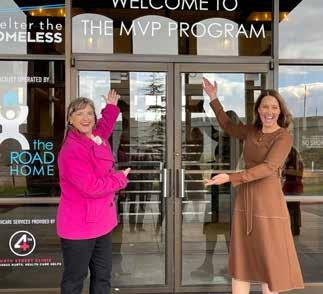
City leaders first signed a Memorandum of Understanding with Shelter the Homeless, Inc. in October 2023, establishing a framework for its Medically Vulnerable People (MVP) Interim Housing Program. The newly amended agreement recognizes that the shelter’s mobile clinic has moved indoors.
The onsite clinic offers medically vulnerable people experiencing homelessness with nursing services five days per week and care with a primary physician up to two days a week. The health center also began providing blood tests, medical devices and occupational therapy with student trainees in 2025.
“The one area that has been difficult is in nursing,” Trina Taylor, the Fourth Street Clinic’s outreach director, told the council in January. “Not only have we seen a shortage in the
than promised, according to Laurie Hopkins, executive director for Shelter the Homeless.
Shelter the Homeless operates the MVP program in partnership with Fourth Street Clinic and The Road Home. The nonprofits run the program out of the former Econo Lodge on 8955 S. Harrison Street, converting the hotel into an emergency shelter with recuperative care.
“In our MVP facility, it is a low-barrier shelter that helps…people who have disabling or chronic medical conditions that make staying in congregate shelters unsafe or inappropriate, and it’s a place for them to have that safety while they are looking for permanent housing back in our communities,” Jay Leonard, The Road Home’s grants and compliance officer, told the council in April.
Last year, the MVP program served 464 people, a 20% increase from 2024, according to an annual report presented to city lawmakers in January. The shelter also helped 57 individuals move into permanent housing or long-term care.
The amended agreement with Sandy also increases the frequency of Shelter the Homeless’s reports to the council from quarterly to semi-annual. Councilmember Marci Houseman wants those presentations to focus more on outcomes rather than services provided.
state, but we have seen a shortage of nurses across the nation.”
The shelter’s clinic, Taylor added, is currently recruiting for another nurse. However, the memorandum update indicates that the onsite clinic is providing more medical staff
“It doesn’t need to live within the MoU as long as we have this shared understanding of that when there is reporting to us, I’m really hungry and eager for outcomes-based data,” Houseman said.
Hopkins, with Shelter the Homeless, told Sandy lawmakers in April that she would be happy to make the next presentation more outcomes-focused. l





The Granite Community Council wants to put the question of city incorporation on the November ballot, but Sandy’s annexations of properties in the area might present an obstacle.
By Giovanni Radtke g.radtke@mycityjournals.com
Some Granite community members want to form their own town, but Sandy City lawmakers’ decision to annex land from the unincorporated area may stymie their efforts.
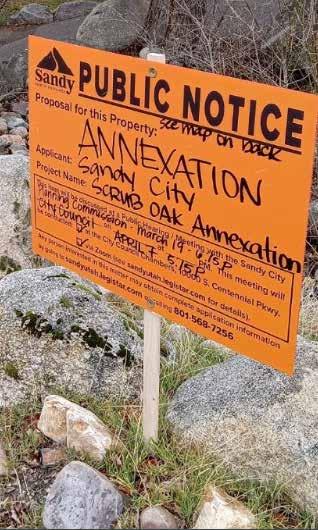
The Sandy City Council unanimously approved the annexation of 22 unincorporated parcels from the Granite region at two meetings in April. Granite residents expressed their opposition to the Sandy legislators’ decision to annex their properties into the city limits during public hearings.
Granite—located at the gateway to Little Cottonwood Canyon on Sandy’s eastern border—is a small community with about 1,000 inhabitants. Some Granite locals are worried that joining Sandy could impact the area’s rural feel.
“We happen to like our little community of Granite, we like the rural atmosphere,” Granite Community Councilmember Gorm
Klungervik said during public comment on April 7. “We like people to have their horses and their cows and their buffalos even, and when we get annexed into Sandy City, that all may change.”
Community leaders in the unincorporated area sponsored a feasibility study, which was released in mid-March. The report found that it was possible for Granite to incorporate, but it was based on maps that “may not reflect annexations that have and may occur in the near future.”
“The Granite Community Council has done everything they can to give us a real feasibility report so we can become our own city, and I believe this annexation is trying to thwart those efforts that they made,” Granite resident Jeremey Anderson said at the April 7 public hearing. “Because, quite frankly, if you guys annex one of these properties, then all the work done by the Granite Community Council will be null and void, and they would have to redraw all their maps.”
In 2024, the state legislature passed a law that would automatically absorb unincorporated areas into bordering cities in July 2027, unless residents living in unincorporated areas decide to establish their own municipality. The Granite advisory board wanted to bring incorporation up for a vote in Novem-
ber, but it may not have time to produce an updated map to make the ballot, Vaughn Cox, chairman of the Granite Community Council, said at the April 7 hearing.
“This meeting is not really about annexations; rather, it is about stopping the incorporation of the city of Granite,” he said. “Annexations are only a means to that end. The city of Granite is on track to be on the ballot for this November’s election, and Sandy City wants to stop it. It wants to stop a democratic election.”
Most of the property owners caught up in annexation signed water agreements with Sandy stipulating they would fall under the city’s jurisdiction at a later date. Some homeowners in Granite, however, told Sandy’s elected officials they had no alternative.
“You guys are a monopoly up in our area when it comes to water,” homeowner and former Sandy resident Douglas Knight said. “I have no other choice, I can’t go up to Mount Olympus and have them deliver thousands of gallons of water to me every week.”
“I don’t know how I feel about coming back to Sandy City or being in Granite, but my fundamental thing is I just want the choice,” Knight added. “We’re gonna vote as a community, and I’m willing to go for whatever the community votes for.” l
DR. DENNIS P. LAW, founder and physician at Progressive Primary Care, has worked as both a hospitalist and an in-home-based primary care provider for older adults. Those experiences gave him a deep appreciation for the importance of prevention, accessibility and strong doctor-patient relationships, all of which inspired him to open Progressive Primary Care in 2026. Progressive Primary Care is accepting new patients looking for comprehensive services through a direct Primary Care Membership model.
Tell us about you and the services you offer.

I earned my medical degree in 2009 and completed my residency in Internal Medicine at the University of Utah in 2012. At Progressive Primary Care, we provide services including preventive care, chronic disease management, sick visits, same- or next-day appointments when available, telemedicine and direct communication with the physician. We also offer non-member services such as sports and missionary physicals, weight-loss consultations and drop-in visits.
What sets your company apart?
Our model allows us to spend more time with patients and focus on relationships rather than volume. Because we don’t bill insurance for routine primary care, we can offer longer appointments, direct access and transparent pricing. Patients aren’t rushed through visits. They can communicate directly with their doctor, something many people feel is missing in healthcare today.
Does your business solve a problem for patients?
People feel frustrated by long waits, rushed appointments and difficulty accessing their doctor. Direct Primary Care simplifies the process by removing many barriers to care created by traditional insurance-based systems. Our goal is to make healthcare more accessible, personal and proactive so patients get care before small issues become bigger problems.
Who is your ideal client?
We care for people aged 16+ of all backgrounds. Our practice appeals to individuals and families who want personalized care and long-term healthcare relationships. We work well for patients with high-deductible insurance plans, uninsured patients, small business owners, self-employed individuals and anyone seeking a transparent healthcare experience.
How do clients choose between you and a competitor?
Patients today are looking for more time with their doctor, easier communication and less frustration navigating healthcare. Members can text me directly if they need a prescription refilled or if they wake up feeling sick.
What advice do you have for someone considering doing business with you?
Ask questions and make sure you understand how different healthcare models work. Direct Primary Care isn’t insurance; it’s a membership for your primary care needs. For
many patients, it provides a more supportive and connected healthcare experience. We also offer free meet-and-greet visits so people can decide whether the practice is a good fit.
What factors should potential customers base their decision on?
I encourage patients to look for a provider and care model that aligns with their values and healthcare goals. Access, communication, trust, transparency, and the ability to build a long-term relationship with your primary care provider are all incredibly important.
Are you running any specials or hosting upcoming events?
We offer free 15-minute meet-and-greet consultations for prospective patients who would like to learn more about the Direct Primary Care model and see whether the practice is a good fit for them. If you mention the City Journals when you become a member, we’ll waive your $100 one-time registration fee.
What’s the favorite service your company offers?
I value having the time to connect with patients. Longer appointments and direct access allow for better conversations, stronger trust and more proactive care. We offer a weight-loss program that’s very popular. I love that our members get to take advantage of that in addition to receiving unlimited primary care.
What else would you like readers to know about your business?
Progressive Primary Care is a locally-owned, family-run practice built around the belief that healthcare works best when patients feel heard, respected and genuinely cared for. We’re excited to be part of the community and look forward to building long-term relationships with the individuals and families we serve.


The council ended up adopting the mayor’s tentative budget without a briefing.
By Giovanni Radtke g.radtke@mycityjournals.com
Sandy’s mayor wanted to show the city’s governing body a video just shy of three minutes to present her budget proposal. The council chair refused, sparking a squabble among elected officials that lasted over 20 minutes.
“Happy for the mayor to release the video, the problem is that we have a very tight schedule tonight,” Council chair Cyndi Sharkey said at the May 5 meeting.
The chair would later add that the irony was not lost on her.
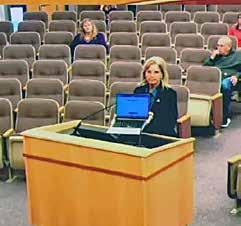
The back-and-forth culminated in Mayor Monica Zoltanski playing the video from a laptop during public comment. The audio from the 2-minute and 52-second video reverberated through a podium mic and was cut short by technical delays.
Zoltanski insisted on playing the video, citing a state law requiring city executives to present municipal councils with a
message outlining tentative budgets at the first May meeting.
“The budget message, including the video, is part of my duty,” Zoltanski said. “It is intentional, substantive import that the people of Sandy have this information as part of the official record of the mayor’s tentative budget and that it be included as part of the public record … and any attempt to restrict or alter this presentation interferes with my ability to carry out my statutory duty.”
Sharkey replied that the mayor could still convey the budget message verbally.
“We are not impeding you from your statutory duty,” Sharkey said. “In fact, we are inviting you to do so, and from what I’m hearing from our attorney, you don’t get to make the rules on how you do the presentation. The council gets to make those rules. It is called a city council meeting for a reason.”
The council’s attorney also noted that there is precedent for lawmakers receiving the budget message verbally because there have been “more than a hundred budget meetings in Sandy’s history,” and councilors have “not heard or seen a video up until this point.”
election when [the mayor’s salary] was a central issue to the campaign … and people made a choice,” Zoltanski said before council chair Sharkey interrupted, stressing that a discussion on November’s election was not on the agenda.
“It is on the agenda,” the mayor replied. “You cannot divorce it.”
At the budget meeting, however, Sharkey noted she had already turned down requests to play videos from other presenters earlier in the meeting.
“It’s really interesting because this is a fight over a couple of minutes in a video,” council attorney Tracy Cowdell added. “But I understand the council’s position isn’t so much about a video. It’s about separation of powers. And how important it is for both branches of government to stay in their lane.”
To speed things along, Councilmember at-large Aaron Dekeyzer moved to vote on watching the mayor’s budget message, but his attempt failed since the motion to proceed was not seconded by another councilor.
“If it’s just a matter of time, we have already exceeded that,” Dekeyzer said. “I’m not sure why we can’t show the video. This is silly.”
Tensions between the mayor and Sharkey appear to have worsened after a contentious mayoral campaign between them.
At a council meeting in January, Zoltanski asserted that a proposed measure to remove elected officials’ vehicle and phone allowances was politically motivated.
“Sandy residents spoke at the last
“Prior to being asked by the mayor’s staff, never the mayor, but by the mayor’s staff, to play this video, I had already turned down a request tonight by someone else to play a video,” the chair said. “I am not being inconsistent. There were three videos asked to be played tonight, and I said no to each one of them … in an effort to keep the meeting as short as possible.”
Councilmember at-large Brooke D’Sousa expressed disappointment in the mayor’s conduct, describing it as a “temper tantrum.”
“This is not the first time behavior like this has happened,” D’Sousa said at the meeting. “It usually happens in private meetings and conversations and emails that aren’t public, and the council, trying to be the adult in the room, usually gives in and relents some of our power in the process.”
“I do not appreciate the disparaging comments, and I am taking this job very seriously,” Zoltanski responded. “As the chief executive of the city, elected just months ago with a large majority, people are interested in the mayor’s message in Sandy. It is my job to produce it.”
Contrary to custom, the council adopted the tentative budget without receiving a briefing on its contents. Instead, the mayor’s finance team gave a 90-minute rundown of the spending plan after its unanimous approval. l




The budget proposes merging the Utilities department and Public Works and increasing funding for police and firefighters.
By Giovanni Radtke g.radtke@mycityjournals.com
The Sandy City Council adopted the mayor’s tentative budget for the 2027 fiscal year on May 5. The funding plan underscores local leaders’ focus on public safety, retaining city personnel and budget solvency.
“The FY2027 budget places a strong emphasis on efficiency and long-term financial sustainability,” Mayor Monica Zoltanski wrote in the budget overview. “While we continue to invest in key priorities, we are deliberately focusing on reducing duplication, maximizing existing resources and limiting future cost burdens.”
City administrators estimate a 2% net growth in Sandy’s tax base in 2027. Projected revenue from relatively slow growth and funding requests for the general budget and capital projects leave fiscal gaps of $2.5 million and $6 million, respectively.
“Sandy is more mature, built out, we are not seeing the heavy growth that we did in the ’90s [and] early 2000s,” Administrative Services Director Brian Kelley told the coun-
cil during a budget preview on April 7. “So that puts pressures on us financially.”
Sandy’s elected officials wanted to balance the budget without increasing property taxes. To do this, each department submitted budget scenarios with spending cuts ranging from 2% to 4%. However, Kelley said the city decided “not to do any across-the-board-cutting” and opted for a “more targeted approach.”
One notable shift in approach is the merging of the Public Works and Utilities depart-
ments. Merging the two divisions would allow the city to scrap rebuilding the Public Works’ vehicle maintenance storage unit, saving Sandy $11 million. Instead, the city will allocate $1 million to build additional office space to accommodate the reorganization.
The merger will also lead to staff reductions in June, reducing personnel costs.
“As the departments are able to crosstrain and work things out, see what’s working, we believe there will be even more posi-
tion savings,” Kelley said.
While the merger will net some personnel savings, staff turnover across all departments is one of Sandy’s key challenges. The city had a turnover rate of 10.6% in 2025, with voluntary departures as the main driver.
“We want to maintain a positive culture here as well as competitive pay so that [turnover] doesn’t happen because it is very costly to replace people,” Kelley said. “We lose a lot of institutional knowledge and expertise, and it has real costs associated with it.”
The budget proposal addresses employee attrition through a $2.7-million compensation plan, including a 2.5% Cost of Living Adjustment for all city employees. Police and firefighters will see an extra 2% on top of that.
Police and fire are also the only city agencies seeing budget increases overall, reflecting Sandy’s elected leaders designating community safety its number one budget priority for the upcoming fiscal year.
Law enforcement will receive technological tools and improvements, including software upgrades for drones and an artificial intelligence program to help fill out police reports. The fire department will see a fund increase to cover part-time staff and rising costs for dispatch fees, equipment and ambulance services.
Sandy lawmakers will likely finalize the 2027 budget by June 23.l
Since1977, Huntington Learning Center has helped students achieve academic success. Mandilyn Johansen operates the Draper location and assists any parents–especially those who have seen a decline in public education–who need help supporting their children academically.
“I am a success story of Huntington Learning Center,” Johansen said. “My siblings and I attended Huntington for ACT or SAT prep throughout our high school careers. I was able to raise my score and get into my dream college, the University of California San Diego, studying marine biology. My brothers got into the colleges they wanted or received scholarships. I wanted to help others reach their goals, so I came back to work here and now own it.” Johansen ended up graduating magna cum laude from the University of Utah with a double major in teaching and international relations.
The Huntington K-12 skill-building tutoring program begins with a comprehensive evaluation to gauge where each student needs assistance. Then, students receive a tailor-made plan to help them reach the appropriate grade level, or get ahead, in math, reading, writing and study skills.
“We ensure students have foundational skills to set them up for academic success and meet with parents regularly, so everything is transparent,” Johansen said. “We provide tutoring for most subjects, including math through college level, science, history, ELA, AP classes, etc.”
The test-prep program at Huntington offers training for the ACT, SAT, preACT or PSAT. It begins with an evaluation using a full-length ACT or SAT to provide a breakdown of the concepts that are missing. Then, instructors tailor the program to help students reach their goals.


For students working with the test-prep program, the average ACT score increase is six points, with an SAT score average increase of 229 points. Johansen said that can make the difference in getting into a dream college or earning a scholarship.
The individualized approach at Huntington is based on an original assessment that demonstrates the center’s commitment to its students. Instructors connect with schools and teachers, so what students learn corresponds to work in the classroom. The program also helps with homework and teaches kids study skills.
“If homework time is a dreaded part of the day or your child is bored in school and wants to get ahead, we take some of the burden off parents,” Johansen said. “Often, students hate school and lose motivation because it’s too difficult and they aren’t sure how they’ll catch up. We start students at a comfortable place to build confidence in their abilities.”
Students often enroll at Huntington after working with one of its competitors. Johansen said they don’t waste time on concepts students have already mastered, which is a common complaint she’s heard about some competitors. The K-12 students enrolled in the skill-building program move up an average of two grade levels in reading and math in three months.
“It’s good to get students in for tutoring as soon as you see the signs,” she said. “They start to lose confidence in their ability as school continues to get harder.”
Huntington works with students throughout the Salt Lake Valley and offers online tutoring for students who live further away. Tutoring can be done 100% virtual for any student, or hybrid programs can be created for students.
Huntington is accredited through the Middle States Association and the Western Association of Schools and Colleges. They must undergo the same accreditation process as other schools and universities, meaning they meet or exceed established standards of educational quality. l
Huntington Learning Center
684 E 11400 South, Ste. C 801-810-2759
huntingtonhelps.com
FB @HLCDraperUT
The charter school is proving its model works in shaping Utah students.
By Julie Slama j.slama@mycityjournals.com
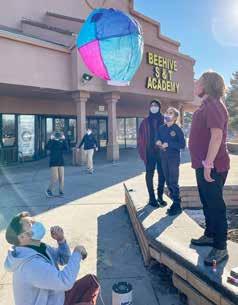
For20 years, Beehive Science & Technology Academy has been reshaping what education looks like in Utah.
What began in 2005 as a small, ambitious charter school focused on STEM has grown into a nationally recognized institution known for academic excellence, innovation and a sense of community. It’s a journey defined by vision, resilience and people.
When Beehive began, there were 65 students in seventh and eighth grades, operating out the basement of an office building in Salt Lake City. Physical education and science experiments took place in its parking garage and lunch was supplied from nearby fastfood restaurants.
The idea behind the school came from two doctorate students.
“They felt students, especially those of different backgrounds, entering the STEM fields were not prepared enough,” said Beehive Executive Director Hanifi Oguz, who has served the school 15 years. “They decided to start a school to help students go into the STEM fields.”
At a time when STEM education wasn’t yet a priority, Beehive was ahead of the curve. They were one of the early pioneers in Utah’s charter school movement, launching five years after charter schools were first introduced in the state.
“Beehive’s story is also a Utah charter school story — educators identifying a need, building something new and adding to a statewide community of schools committed to public options, strong outcome and continuous improvement,” said Molly Hart, Utah state superintendent of public instruction.
Growth came steadily, adding one grade level each year. Beehive moved to Murray in 2009, then graduated its first student in 2010. The school moved into Sandy, growing from under 100 students to 300 in a few years. The school faced the same challenge: space.
In 2022, after eight months of renova-

what makes the huge difference,” Oguz said.
Taha Abdallah, a 2016 graduate, agrees: “When I think about Beehive, I don’t just think about is rigorous STEM curriculum. I think about the people.”
Asim Kablan, class of 2022, agrees, feeling “at home” at Beehive.
“I learned a lot of teamworking skills, engineering skills, problem solving,” he said, recalling his years of doing robotics. “But really it was the community I enjoyed and having teachers who cared about me. Beehive prepared me for college, but it’s the people who support and uplift each other.”
Beehive Secondary School Principal Halis Kablan said that community, which includes members from 48 different countries, is unique.
“Beehive is diverse, bringing students from all these backgrounds into the STEM field,” he said. “We celebrate our cultures and connections.”
how to ask good questions. They’ll still need to know how to try something, how to fail and then how to try again. They’ll need to know how to think critically. And that’s what Beehive does so well.”
As Beehive enters its third decade, Oguz said they’re concentrating on what it does now and how it can serve students even better.
“We are well established with our programming so now we’re making sure our programs are meeting the needs of every part in the school so that we can further grow and provide these options to more students,” he said.
Oguz said leaders are initially exploring new pathways to help students graduate with industry-ready skills, possibly in computer science, engineering and health science.
tion, Beehive moved into a former Shopko building sitting on a 95,000-square-foot campus. The move included the addition of elementary grades, making Beehive Academy a kindergarten through 12th-grade school with 900 students.
Beehive’s approach has been hands-on. Students build, design, program and experiment — approaches used before they have been commonly adopted.
That methodology is most visible in its robotics program.
“They started these ideas with the robotics team,” Oguz said. “They traveled to other states because competition wasn’t here in Utah then. Now, our seven teams are imbedded in Utah robotics and they’re mentoring many teams, not only in the state, but out of state and out of country.”
He said the strength of the programs lies in the same force as the school: people. Teams are supported by a network of dedicated teachers, mentors, parents and community volunteers.
“That has been our great strength. The community is very much involved and that’s

In classrooms, that same hands-on, collaborative spirit extends across the school, from STEM labs and makerspaces to debate teams, art programs and more than 50 student clubs.
With funding from the Utah STEM Action Center, Beehive has invested in tools such as 3D printers, laser cutters and robotics equipment, ensuring all students, from elementary through high school and special education, are learning by doing. All the teachers have STEM training.
It has resulted in Beehive’s widespread recognition. The school has received multiple Best of State awards, named Charter School of the Year, earned Utah STEM school platinum designation and has been ranked No. 1 high school in Utah by U.S. News & World Report for five consecutive years.
Its Technology Student Association team has won more than 21 national medals while the robotics team has competed and placed in the world championships.
Oguz, again, points to success stemming from people.
“Once you have people who are really mission-driven and believing in what they are doing, bringing their best, our job is to guide them, support them, put a vision in front of them, with the tools, resources, trainings they need,” Oguz said. “That’s been our greatest strength.”
Teachers are given autonomy and trust, playing a central role in shaping curriculum and school direction. The staff collaborates to assess progress, identify gaps and set shared goals.
They instill the culture of ownership and collaboration to the students.
“Beehive’s focus on curiosity, problem solving and real growth thinking, that’s exactly the kind of foundation that carries Beehive forward,” said Marie Steffensen, interim executive director of the Utah State Charter School Board. “While the world will absolutely change…they’ll still need to know
Already, new programs are being piloted at Beehive including a course that teaches not just how to use artificial intelligence, but also, the science behind it. It complements other STEM offerings such as flight and space, game development and cyber defense principles and ethics.
Former board chair Calvin Zulich said Beehive also is exploring future expansion, possibly bring its model to more communities across Utah.
“Their model is successful,” he said. “Many more families and students and kids will benefit from their offerings.”
While the 20th anniversary was met with celebration — from a time capsule, cake and assembly to a community gala, Oguz said the milestone is more than looking back.
“It’s a celebration of vision, courage and our community,” he said. “Schools are not built by buildings or programs. They are built by people — people who believe in the possibilities, who invest in their time, their expertise and their hearts into creating opportunities for the next generation.” l
Student playwrights saw their works move from paper to performance during the school’s first production.
By Julie Slama j.slama@mycityjournals.com
Indian Hills Middle School students didn’t just act in a play this spring; they wrote them too.
The school’s newly formed Drama Squad brought four original student-written scripts to the stage in “Night of Nonsense,” a production featuring short comedies and mysteries created by students and performed by their classmates.
The afterschool program, founded by school counselor Samantha Panunto, featured “The Intern (National Spy)” written by eighth-grader Isaac Swan, “Spiders” by seventh-grader Kaitlyn Moreton, “The Very Hungry Caterpillar” by eighth-grader Elise Huey and “A Room Full of Vipers” by eighth-grader Emma Bendixen.
Panunto said the idea for the program began in spring 2025 when Principal Shelley Karren announced funding for an afterschool drama program.
“My hand flew in the air; I was so excited,” she said.
Although students know Panunto as a counselor, theater has been a big part of her life. She earned her bachelor’s degree in musical theater performance and spent much of her 20s performing professionally.
“My hope was I would eventually find
my way back to theater in some capacity,” she said.
Instead of producing a published play, Panunto decided to make the production student-written, avoiding expensive licensing fees while giving creative writing students a unique opportunity.
“I got this idea in my head of producing student-written scripts and how cool it would be for students who are passionate about writing to get to write a script and then we bring it to life in front of an audience,” she said.
Panunto partnered with creative writing teacher Gage Pulsifer, who incorporated script writing into his classes. Last fall, those students were told their scripts could potentially be selected for a production.
“A few months later, I had about 70 scripts to read because each students wrote two,” Panunto said. “It was a blast; can you imagine how hard I laughed with what they come up with?”
She narrowed it to four, resulting in the 45-minute “Night of Nonsense” production.
Isaac was surprised his script was selected.
“I thought if one of my scripts was going to be picked, it would be my first one,” he said. “I was surprised it was this one. Now that I’ve looked back at it, I realized this one made a better story.”
Isaac’s play follows two spies attempting to secure a package while an inexperienced intern accidentally saves the day.
“I like how my script snowballed from an assignment to a chosen script which is now a full-on 15-minute play being performed,” he said.

Kaitlyn wrote “Spiders,” after identifying most people’s common fear.
“I thought no one likes spiders, I should write about that,” she said. “Three of my friends got in my play; that’s fun.”
Her comedy centers around a family panicking over a spider in the house; with every adult refusing to help.
“The police end up scared and, on the couch,” Kaitlyn said. “The five-year-old daughter saves the day.”
Elise based her script loosely on “The
Very Hunger Caterpillar” by Eric Carle.
“I was thinking about ‘The Very Hungry Caterpillar’ and took off from there,” she said. “I started with the caterpillar, but I based it on the farmer and fruit. Now it’s this invasive caterpillar which comes and eats them. I’m curious to see how everyone interprets what I write.”
Emma’s murder-mystery, “A Room Full of Vipers,” involves a detective investigating the death of a disliked party guest.
“When I was writing it, I pictured adults performing in the 1900s,” she said. “I’m excited to see how it turns out.”
At Altara Elementary, students seemed to step straight out of the 1950s with boys in white T-shirts and jeans and girls with ponytails and wearing poodle skirts. The choir brought the era to life, delivering a lively lineup of 50’s nostalgic hits including “Splish Splash,” “La Bamba,” and “The Purple People Eater.” (Julie Slama/City Journals)

There also were student assistant directors for each of the plays: Gaby Edmonds, Callie Fellows, Colin Hansen and Jeann Parker.
Panunto said the theater program’s success is creating a welcoming place for students.
“My first priority for the Drama Squad is not to create a Broadway-caliber product although this is a production they can be part of and proud of, but rather it’s creating a space for students to be themselves, to create and play and belong,” she said.
When an initial meeting was announced, Panunto expected 30 students. Instead, about 100 attended.
“Imagine my shock; there’s interest and a real need at our school for this Drama Squad program,” she said.
For the student-writers, seeing their names on posters and watching student-actors interpret their ideas has been both exciting and surreal.
“It’s been a good opportunity for both the writers and actors,” Elise said.
Isaac said he’d like it to become a tradition: “It will be great for new creative writers next year to take on the challenge of writing a script and doing try to do their best so their scripts get chosen and see it in action.”l
Uncertainty continues for Sandy families as decision tabled for comprehensive district study of school feeder systems.
By Julie Slama j.slama@mycityjournals.com
Aftera year of uncertainty, many Sandy parents expected a decision about proposed school consolidations in early May, however, Canyons Board of Education members had second thoughts.
No final decision was made on the plan to merge Granite Elementary with Quail Hollow Elementary nor Park Lane Elementary with Willow Canyon Elementary. The school board tabled the decision and instead, chose to conduct a comprehensive districtwide study of elementary schools feeding into middle and high schools and will study enrollment trends and boundary impacts districtwide.
Board member Katie Dahle made the motion postponing the vote, indicating she wanted additional time to study how enrollment declines are affecting schools and feeder systems across the district rather than moving forward with individual school consolidations.
“It became more apparent this spring as we were talking about it; we knew this was an issue,” she said. “We knew we were going
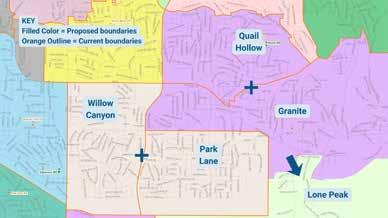
to have to look at this. Our goal was that we could sort of do these in layers, bit by bit; but as we went through it, nine schools connect, boundary-wise, that are facing declining enrollment, and they’re only a year or two behind where Granite, Park Lane and Willow Canyon are currently. So, we need to be sure we have the right decision for those schools.”
The comprehensive study is expected to take an additional year, which Dahle said created more frustration for some parents by not knowing their students’ future schools, yet relief for others that no hasty decision was made. Parents have been giving feedback to the Board on different proposals at lengthy public hearings and board meetings as well as
The possible school merger in Canyons School District was paused for the school board members to conduct a more comprehensive study. (Image courtesy of Canyons School District)
through phone calls, emails and online input.
“The Willow Canyon and Park Lane communities were glad we paused with this goal to provide a long-term plan our community can trust and be behind; that’s actually what they were asking for,” she said. “The Granite community was frustrated because they wanted to be done. I empathize, because this is a hard, long, emotional process. They want to be settled. I want them to be settled, but I don’t want to pull their chain and have something change in a couple years as we address neighboring schools.”
The proposals to merge schools comes from ongoing challenges in declining enrollment, lower birth rates and rising hous-
ing costs.
Board members said it’s best for schools with low enrollment to consolidate, but with additional time to ensure they’re making the best decision.
“It’s not like, we paused it indefinitely,” Dahle said. “I’m fully committed to putting all my effort into getting this done in an expeditious manner so we can find some resolve for these families. We have until December to make any final decisions for the ’27-’28 year. So, there’s still the possibility we could do something, but we need to make sure we know the next steps are also ready to go, and it all makes sense.”
The Board said it wants to be financially responsible with taxpayer money, however a couple board members expressed surprise about the motion.
“I did catch them off guard,” Dahle said. “I honestly went into that meeting thinking I was going to vote for the closure of Granite, not that I liked it, but this is what we’ve been working on. And it hit me to the point I was shaking; this is not the right decision. This is not the right long-term decision to do this in a vacuum after we’ve pulled off all these other pieces; we can’t do this in a vacuum. It’s important we get this right the first time, because its students’ and its families’ lives at stake, and it’s not fair to them to have uncertainty in the process.” l

The annual art night featured collaborative projects from art, theater, STEM and library programs.
By Julie Slama j.slama@mycityjournals.com
Lone Peak Elementary’s recent annual art show transformed the school into a fullscale celebration of creativity, learning and community connection by not only showcasing student artwork, but also the collaboration between teachers and Brain Booster specialists.
This year’s exhibit tied into the school PTA theme, “Flying High since 1985” showcased a collection of talent, with each space reflecting on different projects, artistic explorations and hands-on experiences, said school Beverley Taylor Sorenson Arts teacher Cassie Walker.
“We have a little bit of everything; we definitely have specific galleries and exhibitions, but it’s more of a blended show this year,” she said.
Visitors moved through the immersive, school-wide experience, which blended visual art, theater, STEM, library learning and physical education into one flowing exhibit. Some of the “mini worlds” featured students’ whimsical and playful creations, such as pop
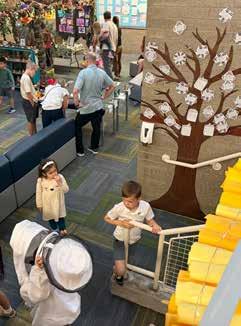
Lone Peak’s library transformed to showcase many students’ art pieces as well as an interactive beehive keepers’ experience.
(Julie Slama/City Journals)
art and colorful monsters, while others were closely tied to academic content and concepts, such as animal habitats, volcanoes and sound waves.
A powerful centerpiece of the show
was a surprise tribute to local artist Matthew “Billy Luber” Arnold, a former guest artist at the school. He previously introduced students to street art through live demonstrations, including spray painting and storytelling from his time working on projects with the “Diesel Brothers” TV show and the Utah Mammoth Zamboni design.
Walker said his work is being highlighted in a documentary under production, which includes his volunteer work dressing up as Spider-Man to visit children’s hospital.
“Every year, he volunteers to help set up the art show so we’re counting on that to surprise him,” she said. “We have a gallery of superhero-themed artwork, which also reinforces the theme of everyday heroes that are amongst us.”
Another standout feature was student projects focusing on bees, tied to the fact that Principal Shad DeMill is a beekeeper. For a month, students built interactive exhibits explaining how bee communities function, complete with student-made hive models and interactive learning activities.
“The library is half superheroes and half focused on nature things and within that, there will be a beekeeper section,” Walker said. “They can even dress up as a beekeeper.”
Within the “garden section,” visitors
checked out ceramic pumpkins, snake patterns and planter pots and leaves while student-made bees flew overhead of their honeycomb rubbings which lined the library wall.
Patrons felt the energy and effort put into the vast scope of the exhibits.
“It’s amazing to see the students’ creativity from superheroes to animal and nature projects,” parent Jordan Lee said.
Former student Tai Lee joined him to return to see the art show.
“You can see how much effort students put into this artwork; it’s amazing,” she said. “There is a lot of research involved with the ideas and creating the artwork and displays. Art was the best here. I still have the art I made here in my bedroom at home.”
DeMill said the show is more than a display; it’s a reflection how the arts are integrated with academic subjects.
“Our teachers, our Brain Booster specialists, our art teacher work collaboratively to reinforce what students are studying,” he said. “This is a celebration of their learning.”
As visitors exited the show through a hallway of students’ paper gabled-stoned relief homes, Walker hope they left inspired.
“I hope people walk away with a reminder how essential these experiences are for kids and childhood,” she said. “Art gives space and room for curiosity to grow.” l


Several teams advanced to national and international competitions.
By Julie Slama j.slama@mycityjournals.com
Several local FIRST LEGO League teams earned invitations to national and international competitions after strong performances at the state contest this spring, showcasing months of innovation, coding and teamwork on this year’s “Unearthed” theme.
Among the teams advancing are Code Crusaders, a homeschool team from Sandy, headed to the FIRST World Championships in Houston; B4 from Beehive Academy in Sandy, competing at the Canada Cup of Robotics in Ontario; Kinetic Koalas of Riverton, traveling to the Georgia Ramblin’ Robots Invitational; Panda Bots from Taylorsville, invited to the WAFFLE Invitational in Massachusetts; and BeeSTAR from Beehive Academy, advancing to the American Robotics Invitational in New Jersey.
grader, said he learned skills beyond engineering: “I’ve learned how to work together better by working with many people on our team.”
Eighth-grader Athena Meek, with St. John the Baptist Middle School in Draper, said she learned “a lot of patience and even if you go over things several times, things can still mess up.”
The “Sandworms” team created an RC car prototype to transport and sift dirt over rocky terrain.
“I like to use my brain so I like that FLL is more ‘brain enthusiastic,’” she said. “I like to research and use science so FLL is a good match.”
Butler Middle School’s eighth-grade Sean Olson, sixth-grader Conlan Pugh and seventh-grade Aymeric Barbier shared their team consulted historians to learn about 100,000 land mines remaining from both World War I and II in Asia, South America and Europe impact people’s lives yet today. So they created a blueprint to destroy those without ruining artifacts.




FIRST LEGO League introduces students, ages 5 to 16, to hands-on STEM learning through robotics, research and engineering challenges. Teams design and code LEGO-based robots to compete while also creating innovative projects tied to a yearly theme. This season, students explored archaeology and excavation-related issues, developing solutions for issues faced in the field.
The Panda Bots developed the “Pain Relief Sifter,” a portable device designed to reduce the strain archaeologists experience while sifting dirt for artifacts.
“It provides relief to the back, shoulders and neck,” said seventh-grader Jacob Fletcher. “Archeologists stand and shift dirt back and forth for hours; they lift buckets of dirt that weight about 20 pounds.”
Sixth-grader Parker Millington said the team consulted experts while developing the project.
“We talked to two archeologists and they both said that was one of the worst problems for archeologists so we worked on a way to improve it for them,” he said.
Seventh-grader Tanner Adams said they used engineering skills to help them while fourth-grader Rilynn Millington said they focused on portability with removable legs.
“We made the device portable, which is something they wanted,” she said.
Parker added: “There’s wheels on it so the archeologists can move it over different terrains. I’m glad we made something they can use.”
Teammate Byron Hospodarsky, a fifth
Eighth-grader Caspean Sciotto-Eggers said with little information, they had to research their topic.
“The judges liked our project, because it was unique; not many people are talking about land mines,” she said. “It’s an interesting topic because you don’t think about how there are still landmines from the wars that make places unhabitable.”
Beehive Academy’s BeeSTAR team created a sunscreen and skin-protection lotion for archaeologists working long hours outdoors in dry conditions.
“Our project helps us to stand out,” seventh-grader Tucker Holt said. “With innovation projects, everyone expects something big and flashy. When we say, ‘we made sunscreen,’ it’s a bit hard to sell, but we also educate and sell that skincare is important.”
Teammate Ellenore Roberts, an eighth-grader, added the formula they developed and tested has a color factor in the sunscreen.
“So when it fades, it reminds you to reapply, so you don’t get burned,” she said.
Eighth-grader Poorri Nandiraju said the experience taught teamwork and leadership.
“Each one of us on our team has strengths and weaknesses,” she said. “I’ve learned from my different teammates, and I’ve liked learning different building and coding strategies. Each of us are a leader in our way.”
Panda Bots’ fourth-grader Tate Adams summed up his experience: “I like it all.” l
Students and parents step into a magical night designed to spark a lifelong love of reading.
By Julie Slama j.slama@mycityjournals.com
AtPeruvian Park Elementary, families recently didn’t just walk into their school, they stepped into a magical storyland.
Welcomed by Dumbledore and Merlin, students led their parents through hallway displays cloaked in imagination featuring 1,600 student art projects and into engaging hands-on literacy activities.
Kindergartner Emmy Roner, anxious to start, said she was there because reading is “really fun.”
That’s exactly the point, said Sara Carter, PTA vice president over community, who organized the literacy and arts night.
“We want kids to feel like every time they open a book, a little magic falls out,” she said.
Held each spring, the event has become an anticipated school tradition for more than a decade. Once inspired by the Harry Potter series, it was recently reimagined to reach every reader, shifting from a competition with few winners to encouraging all 550 students to participate.
Each grade now explores its own fantasy series tailored to reading levels, from “The Magical Treehouse” and “The Land of Stories” to “Fablehaven” and Percy Jackson series.
The result, Carter said, builds excitement all year.
“I hear the students in the halls wondering what we’re going to do this year,” she said. “They come because they want to be a part of it.”
Fourth-grade teacher Heather McEntire said the impact

Dumbledore and Merlin welcome students and their families at Peruvian Park’s literacy and art night. (Julie Slama/ City Journals)
goes beyond one night.
“This brings so much joy and energy to literacy,” she said. “It’s not just ‘count your minutes.’ There’s magic behind it that makes kids want to read.”
The excitement carries on into the 21-day readathon. Students track their reading minutes through independent reading, being read to and audiobooks.
Carter said students logged 420,000 minutes under the first year of the revamped program. Last year, they surpassed that number with 534,000 minutes. With a goal of 500,000, students will be rewarded with a school escape room.
“There is a unity in this competition,” she said. “We’re also hoping it builds a habit, so they continue to love reading after March.”
McEntire said her students feel as if “they’re being transported to a new world” and teachers like “many of the books challenge students to read as it pushes them a little bit and maybe they wouldn’t have pushed themselves as much if they didn’t read it for literacy night.”
There’s even time in class to “drop everything and read,” sometimes with pajamas, pillows and snacks provided by the PTA, said Laura Miller, PTA president-elect.
“Every bit of this is magical,” she said. “They love the magic of the book they read together and the fun the night brings that goes along with it; it brings excitement.”
During the kick-off event, families searched for hidden clues, leading to a small reward — a whimsical gnome in a jar — further reinforcing the magical worlds students have been reading about. Along the way, students show their parents their art, inspired by the book their grade-level read — and to do activities together.
Parent Tara Roner, who enjoyed seeing her fourth-grade daughter, Juno, in a sneak preview of the school’s musical, “The Lion King”, appreciated the literacy and arts activities.
“It’s fun and we do all of them,” she said. “They like coming home with a little trinket that reminds them of the year’s theme.”
That may be the real story behind Peruvian Park’s literacy and arts night. In a world of screens, it reminds families books bring people together.
“Books are adventures to be shared,” Carter said. “And students are learning reading is the beginning of an adventure for the rest of their lives.”l




BIG COTTONWOOD CANYON is a relaxed atmosphere and beautiful setting for the Big Cottonwood Flea Market. The laidback mountain market is held every Sunday at Brighton Resort, from 10 a.m. to 5 p.m., through October 11. Running since 2017, the BCC Flea Market opens this year on Sunday, June 7th.
Tell us more about your concept.
My partner and I were longtime ski workers looking for a summer gig. We had previous experience working and vending at other markets and felt this would be a great opportunity to bring in local vendors, live music, good food and beer.
There’s also a focus on sustainability, with several vendors making things locally, and reusing and upcycling items from what’s already been produced. We wanted to give visibility to ski industry workers and budding artists who want to show their work.
What products and services do you offer?

We have more than 50 local vendors selling their crafts and items. We have a good variety of vintage, handmade crafts, art, jewelry, secondhand, vinyl records, rocks and gems, unusual finds, upcycled products and
farmers market items. There’s also free admission and free parking.
What sets your market apart from your competitors?
Our market is unique in its mountain setting, with cooler temps during the hot summer and spectacular views throughout the fall. With lots to do in the canyon and around Brighton Resort, we’re a great destination for families and people of all ages. We’re not just a market for professional vendors. This is what makes us unique from most of the other markets around the area.
Who is your ideal customer?
Our ideal clients are people who love the outdoors and support small local businesses. We’re growing thanks to our reputation, word-of-mouth and affordability.
By Julie Slama j.slama@mycityjournals.com
Like most students, Jordan Barlow had dropped off a poster for his date, inviting her to the dance. They dressed up and arrived at Siempre in Draper, where they danced with peers for hours that night.
His favorite song was “A boyfriend” by Justin Bieber.
“I liked the dance part (of the night),” said Barlow, a Life Skills Academy student. His mother, Mandy Barlow, said he and his friends in a hip-hop group choreographed a routine to it.
“They have a really cute dance to it,” she said. “They stole the show.”
March 19 was “A Night Full of Stars,” an all-abilities young adult prom, but one which welcomed all ages. Students in the adult transition programs from Canyons, Granite, Jordan, Alpine as well as some who aren’t enrolled in a program came to boogie down. Peers danced alongside them and even some parents joined in the fun.
Mandy Barlow said the goal was simple: create an experience that was special.
“I didn’t want it to be at a school gym

or at a church; I wanted these kids to have a beautiful experience,” she said. “They don’t get the opportunity to go to dances very often, so I wanted them to have a really nice, fun experience.”
Jordan’s mother began planning months in advance, teaming up with Anne Kimble, Sammy’s Buddy program executive director. Together, they combined community connections and volunteers for the event.
“I started reaching out and it all came together,” Mandy Barlow said. “A lot of people wanted to be involved.”
Kimble said the need for an event like


this becomes clear after students leave high school.
“Once these kids graduate from high school, they lose so much of the peer and community connection they’ve had,” she said. “They no longer have unified sports. They don’t have inclusive dances and those opportunities to connect with peers of all abilities on a regular basis. One of the needs we see so clearly is that young adults with disabilities often don’t have the consistent opportunities for social connection after they leave high school. They need spaces where they feel a sense of belonging, where they can build real friendship, and where they’re not simply included, but have the chance to be celebrated.”
Local businesses and people donated or discounted their services, making it a special night. Nearby CTEC cosmetology students provided hair styling and even community members donated formal wear. Volunteers, many of them attending Salt Lake Community College, University of Utah and Utah Valley University, helped organize, set up and run the event and danced alongside their peers.
“I love everybody was dancing, there’s no inhibition. Everyone’s happy. Everyone dances with everybody. Everyone’s included,” Mandy Barlow said.
She also appreciated that the DJ knew “not to play it as loud as what maybe he would play like at a high school dance because it can be overwhelming.”
A quiet room was set up, giving dancers a break and some options to make bracelets or color. Some of the young adults opted for cotton candy.
“People loved that and there were some cute cotton candy sculptures,” Mandy Barlow said.
For Kimble, the night showed what intentional inclusion can look like, not just inviting people in, but putting them at the center of the experience.
“I loved seeing these kids participating; they weren’t on the outside looking in. They were at the center of the whole experience, and they were creating memories in a space
that was specifically designed for them to enjoy, to shine,” she said.
The prom also gave many young adults a sense of independence. Some parents opted to step back, allowing participants to enjoy a night that was their own.
“This was the first all-abilities young adult prom we know of which supported young adults, and it created a place for them to connect and gain confidence and also continue developing independence. It allowed these young adults to feel independent and feel ‘This is my night out, my night to shine,’” Kimble said.
She said events such as this dance don’t just impact those who attend; they shape the broader community, helping volunteers and sponsors better understand what true inclusion feels like.
“One of the things I loved about it is how it was equally impactful for the broader community. We loved bringing in sponsors who were so excited to be a part of this, and it allowed us to show how when students of all abilities come together, barriers and misconceptions can fade,” Kimble said. “Peer mentors, volunteers and community members, who hadn’t experienced something like this before, walked away with a deeper understanding of true inclusion, not just as an idea, but something they experienced firsthand. It was joy from start to finish. I truly feel events like this can help shift culture when we prioritize belonging. This was just one night, but I feel like when we provide more opportunities like this, it can carry into everyday life. This all-abilities prom was so much more than a fun night; it was a powerful example of what happens when we intentionally create spaces and opportunities where everyone belongs.”
Mandy Barlow hopes this is just the beginning.
“I can see it getting even bigger next year as more people learned about it, more wanted to be a part of it — and it was amazing,” she said. “The word of the dance spread. In this community, having something adults can go to and have fun — it spreads like wildfire.” l
Author and illustrator Mike Lowery draws inspiration from doodles and quirky facts as he connects disciplines at Albion Middle.
By Julie Slama j.slama@mycityjournals.com
Astronautsgrow two inches taller in space; jellyfish can clone themselves; cats are allergic to humans and why a dinosaur is actually a terrible lizard.
That’s how New York Times bestselling illustrator and author Mike Lowery hooked the attention of Albion Middle School students — with quirky facts, quick sketches and a lesson how creativity can start with just about anything.
Lowery, known for his work on dozens of books for children and adults, including “Random Illustrated Facts” and Scholastic’s “The Everything Awesome” series, spent the day sharing his unique approach to storytelling, research and art in an interactive experience that blended creativity with science, history and literacy.
The visit began with student-musicians announcing his visit.
“Never once before has there been a school that’s heralded me,” said Lowery, who has traveled worldwide giving school presentations, adding he was impressed by the enthusiasm and preparation we saw throughout Albion’s halls.
Students had spent months preparing for his visit, incorporating a “Mike Lowery-esque” style into their classes. From illustrated maps and infographic posters, they created storyboards and incorporated their lessons, which


Author and illustrator Mike Lowery draws a self-portrait at Albion Middle School. (Julie Slama/City Journals)
ter-school drawing lesson. That’s where Lisa Fillmore and her sixth-grade son, Weston, were learning Lowery’s style.
“I like his doodles; I feel like anybody can do it,” Fillmore said as her son added he researched and created an Arches National Park infographic similar to Lowery’s artwork in the “Lonely Planet Kids America’s National Parks” book.
While Georgia-based Lowery has worked on a book series with the famed Jeopardy champion from Murray, Ken Jennings, Lowery let students know his current project, an imaginary character kid graphic novel series, will be released in January 2027.

were designed to reflect his signature blend of humor and facts. Even teachers took part, creating Mike Lowery-inspired vines, which were displayed alongside the student work.
During his morning presentation, Lowery gave students a glimpse into his creative process, emphasizing the importance of curiosity and daily practice.
“I love to draw and everywhere I go, I carry a sketchbook with me,” he said, showing students pictures of him from drawing in the Amazon to sketching at the Grand Canyon. “I draw because it helps me come up with ideas.”
Lowery said often those bursts of inspiration are pieced together to create his books. As he shared some of his favorite “weird facts,” like a chicken nugget shaped like George Washington which sold for $8,000, students laughed, but he showed how these quirky examples were researched and came together in engaging stories.
Students also participated in drawing activities, starting with giving him ideas of what to sketch from simple shapes. As imaginative characters quickly came into being, he asked questions, such as why is the character wearing sunglasses, what is in the box and who is the character and why are they there.
“This is how all my stories happen,” he said. “The goal is to take things in, talk to people, look around you. Write it down, make connections and start building them together for a story.”
Eighth-grader Gavin Riches found it inspiring.
“I drew the same random shapes and I tried to figure out where a face would go or what it was going to be and do,” he said. “I learned you can create art from pretty much anything.”
Parents joined students for an af-
The learning continued the next day as Albion students went to The Living Planet Aquarium, sketchbooks in hand, to observe animals and apply the drawing techniques they learned. Those sketches were the base of a science project where they created an infographic on the animal they studied combining art, writing and research.
“Mike’s presentations are modified to the needs of a school and we wanted to learn how he creates and how he researches these
books he makes,” said sixth-grade teacher Stephanie Kourianos, who coordinated his visit along with Bridget Rees, Albion teacher librarian and media specialist. “His research is credible research, and he ties into the project he’s working on. We’re teaching kids about credible research and how to use it when they do their own research. He also is going to focus on creativity; a lot of our students have fallen in love with his books.”
Lowery made a connection with students as he signed their books, many which were won in school contests or through positive behavior points. The books were made possible with a $1,000 Donors Choose grant, Rees said.
Mindy Robison, Canyons School District’s school performance director over middle schools, appreciated Lowery helping build the school culture around books.
“Bringing authors allows the school to build a culture based on literacy, but also enjoyment of reading and experiencing what it is to be successful when you go for your dream,” she said. “I love Mike Lowery’s focus on creativity and the arts. Watching the kids experience an artist doing it, was amazing, and then, taking them to the aquarium the next day to try it firsthand, with content and interdisciplinary projects around it, the kids are never going to forget this.” l






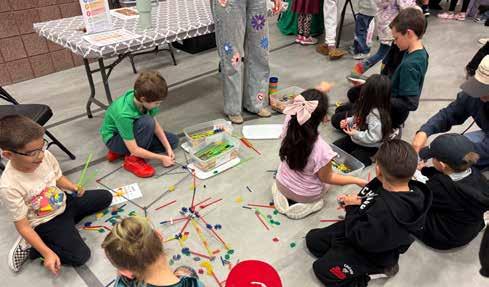
Many families were engaged in an evening of interactive learning.
By Julie Slama j.slama@mycityjournals.com
Excitement and curiosity arose as students and families explored hands-on activities at Sandy Elementary’s recent STEAM night.
Many students and their families rotated through a variety of interactive stations; from Tetris puzzles and K’Nex challenges to building circuits, experimenting with magnets and testing out the speed of Matchbox cars flying down the track on the stage steps, each was designed with purpose.
For example, Sandy Elementary Instructional Coach Leigh Anstadt oversaw one that focused on number sense.
“Here, they’re learning how to use visual cues to solve problems and how to work
together collaboratively,” she said.
At another station, third-grader Jayden Villalba was doing activities with his dad, Pabo. They rotated between stations so Jayden could fill his bingo card to earn a prize.
“We’re having fun, and I get to see friends, too,” he said.
Seeing friends was one of the initial reasons fourth-grader Jaxon Olsen came, said his mother, Ashley.
Once Jaxon was there, he wanted to try some of the activities.
“There’s a cool marble station we can try,” he said.
Beyond the opportunity to build community and spend time with family, Anstadt said students were building skills, such as critical thinking and problem solving.
“I appreciate the vertical alignment of concepts across grades,” she said. “It gives everyone opportunity.”l

June 2: Trey Anasasio and Jeff Tanski, Red Butte Garden
June 3: Pitbull, Utah First Amphitheatre
June 6: Brit Floyd–Pink Floyd Tribute, Maverik Center
June 7: The Moment at The Depot–Pride Afterparty, The Depot
June 9: Kittie with special guest Gore, The Depot
June 11: The Human League with Soft Cell and Alison Moyet, Red Butte Garden
June 12: Garry Allen, Sandy Amphitheater
June 13: Metric, Sandy Amphitheater
June 13: Kid Cudi, Utah First Amphitheatre
June 14: Nitty, Gritty Dirt Band, Sandy Amphitheater
June 15: Pussycat Dolls, Utah First Amphitheatre
June 16: Grace Potter, Red Butte Garden
June 17: Greensky Bluegrass, Red Butte Garden
June 17: Alex Warren, Utah First Amphitheatre
June 19: The Red South with Amigo the Devil, Sandy Amphitheater
June 19: Rod Stewart, Utah First Amphitheatre
June 19: DoKnow, The Depot
June 20: Watchhouse, Sandy Amphitheater
June 22: Corbyn Besson and Soulidified, The Depot
June 23: Ziggy Marley, Red Butte Garden
June 24: Brothers Osborne, Sandy Amphitheater
June 26: MGK with Wiz Khalifa, Utah First Amphitheatre
June 28: John Craigie and Blind Pilot, Red Butte Garden
Locations for concert venues:
Red Butte Garden–2188 Red Butte Canyon Road, Salt Lake City
Sandy Amphitheater–1245 E. 9400 South, Sandy
Utah First Credit Union Amphitheatre–5150 Upper Ridge Road, West Valley City
Maverik Center–3200 S. Decker Lake Drive, West Valley City
The Depot–13 N. 400 West, Salt Lake City
From paychecks to parents, eighth-graders get an eye-opening look into adulthood and choices that shape it.
By Julie Slama j.slama@mycityjournals.com
Middle eighth-graders recently got a glimpse into their future, trading their usual class schedule to learn about careers, bills, families and responsibilities during the school’s annual Reality Town.
The hands-on simulation transforms part of the school into a mini-city, where students role-played a month of adult life. They arrived with assigned careers, salaries and families, then had to make decisions about housing, transportation, health care, utilities, insurance, groceries and other financial choices.
Before their big day, a team, including school counselor Lynn Nelson, helps the eighth-graders prepare.
“They each get a booklet and we go through it and say, ‘This is a month of your life. You’re going to be 30 years old,’” said Nelson, who has overseen the mock town for 11 years. “We talk about needing to get housing, transportation, insurance and groceries. We go through what it says on their pay stub — how much they make, what the difference between gross and net is, taxes. We hope they get an idea of their future life and start planning.”
On Reality Town day, the Bobcat Den was buzzing as students move from booth to booth making real-world decisions with the help of parent volunteers and Hillcrest High School students, who run booths representing everything from banks to entertainment.

Grief is an individual journey with a path as unique as each one of us. To o er support and hope, we provide various Grief Support Services for those who are mourning a recent or past loss.



Parent Chris Martin volunteered as his daughter, Maya, was participating as a nurse practitioner. She already had an idea about Reality Town, he said, as her older brother, Dylan, learned from it last year.
“He bought a sports car, then he didn’t have enough money for a house, so he joined up with somebody else for housing,” Martin said. “He learned how life patterns can evolve depending on his wants and needs.”
Eighth-grader Adell Clark was eager to embrace her role as a surgeon with a family.
Adell followed the advice of the counseling team and planned her future. Using her salary of $5,772 per month, along with her husband contributing an additional $500 while still in school, she wanted to make sure ends met while raising
two children — George, 5, and Rachel, 3, and caring for their golden retriever named Zeke.
“My priorities are making sure we have healthy food and letting my kids do some activities they want to do. I want to make sure our family is good on money, that we’re not spending too much, but we’re still having fun,” she said.
To help manage costs, Adell said her family will share a home with another family and buy a minivan.
“The best part is getting to explore and getting a small idea of what it’s going to look like one day, but also to have fun as an eighth grader,” she said.
Seventeen Hillcrest students helped the younger students, but the high school’s work-based coordinator Cher Burbank said Reality Town benefits all students.
“What I love most about students coming over from the high school is they learn a lot more than even the eighth graders learn by being at the booth,” Burbank said. “They learn more about their services at the booth and what it takes to pay for entertainment or utilities or one of the many different things their parents are paying for, so it’s very beneficial for them.”
Burbank, who has helped with 64 Reality Towns over two decades, appreciates Reality Town’s impact.
“I hope they leave with a better picture of the world of work and what we do to provide for our families. It’s a good lesson to learn early on. I hope they learn they will need money to make ends meet through a good career and start focusing on taking classes that will help them,” she said.
For some students, the authenticity of the experience hits home.
“It gives them a reality check,” Nelson said. “Last year, a girl looked at me and asked, ‘Is this what it’s really like to be an adult?’ I said, ‘Absolutely.’” l





As a unified partner, Hillcrest High’s Abbi Clark says unified sports has taught her lessons in connection and leadership, leading to a lifelong purpose.
By Julie Slama j.slama@mycityjournals.com
Aslocal high schools prepare to send off another graduating class, Hillcrest High senior Abbi Clark leaves behind a lasting impact shaped not only by academics and athletics, but by connection and inclusion.
During her four high school years as a peer tutor and Special Olympics unified partner, Clark has helped build a community where students of all abilities belong and feel seen and, in the process, she has found her own path.
“I knew I wanted to be a teacher, but at Union Middle School, when I started peer tutoring, I started thinking about special education,” she said. “But definitely during my high school years, it’s confirmed this is what I want to do.”
That clarity didn’t happen in one single moment, but years of showing up, walking with students to classrooms, studying with one another, eating lunch and going to school dances together. Clark said it is a natural connection with the students she works with, rooted in trust and understanding.
“I feel I’m able to understand them more

and see what they’re getting at most of the time. I have an energy that is calming and they’re able to relax and know I’ll include them and not judge them,” she said.
The camaraderie extends to unified sports, where students with and without intellectual disabilities play side by side as teammates on the field and court. Clark, who also plays on the school’s girls varsity basketball and volleyball teams, said the experience reshaped what sports truly mean.
“In unified sports, it’s not about just the win, it’s about the experience and about the joy of the sport. The result, win or lose, doesn’t really matter as much as the opportunity to learn and play with friends,” she said.
Clark’s perspective has influenced how she plays and how she leads. As both a player and a student who helps run practices, she learned to prioritize patience and selflessness.
“You can’t expect quick results, and you can’t be selfish if you want to do this,” she said.
Unified sports statewide, as well as at Hillcrest, have grown during Clark’s time.
For example, across Utah high schools, unified basketball has grown to more than 250 Utah high school unified teams this year, up from 2023, when Clark was a freshman, when it had skyrocketed to a record 73 teams. Hillcrest grew from two unified teams to four playing soccer and three competing in basketball. Additionally, the high school played a season of flag football and another of track and field.
“We’ve had more teams, more partners and even more community support,” she said, adding Hillcrest’s band, student body officers, Latinos In Action student club, the Husky mascot and other classmates continue to cheer for the unified teams, which has brought smiles to the athletes. “We’ve had classes that come and clap us out as we get on our bus; it makes the kids feel extra special.”
Clark said those moments signify a deeper meaning; it is part of belonging.
“For them, it’s a great place to feel safe, especially in this world where not everybody accepts them. By having a place where they feel accepted and a place where they can succeed, it’s a great thing for them to feel that sense of belonging,” she said.
But Clark is quick to point out she’s learned just as much, if not more, from the students she supports.
“A lot of times, people think that unified sports is all the partners teaching and all the athletes learning, but it’s really the opposite,” she said. “The partners learn a lot about teamwork and about selflessness and patience.”
One of those influences is junior Javier Garcia, a teammate and friend.
“He’s taught me so much about how to live life to the fullest,” Clark said. “He’s so selfless and he loves so deeply.”
Through those friendships, Clark said

she’s learned to slow down and appreciate what really matters.
“I’ve learned from doing unified sports, it’s simple actions that are actually influential, and how impactful they are,” she said. “They’re so excited for each other when they score a goal or make a basket. It’s the simple things that mean a lot to them, and those bring a smile to everyone’s faces.”
That mindset has stayed through Clark’s athletic endeavors, serving as the student body secretary and taking concurrent enrollment college classes, all while maintaining a 3.95 GPA.
“It’s about deciding what’s most important and unified is one of my top priorities,” she said. “There’s little I won’t drop to go to unified.”
Hillcrest High special education teacher Rebecca Remy said Clark is one of the most inclusive peer tutors she has had in her 22 years of teaching.
“She has spearheaded all the unified events and activities,” Remy said. “I don’t ask her to do it; she just does it without taking any credit. She puts her heart into everything. Abbi forms genuine friendships with the students; she is passionate about inclusion and special education kids with disabilities.”
This summer, after graduation, Clark will serve a church mission in Gilbert, Arizona before returning to study special education at Utah Valley University.
Clark, who wants to stay involved with Special Olympics, doesn’t measure her high school experience in wins, but in relationships.
“Unified sports has taught me about living my life to the fullest,” she said. “It’s taught me to love others and how to include everyone. Unified sports has been my high-
light, and it’s been my rock through the ups and downs. All the amazing people who are in unified have helped me more than they know. Unified is something I never want to stop doing.”l
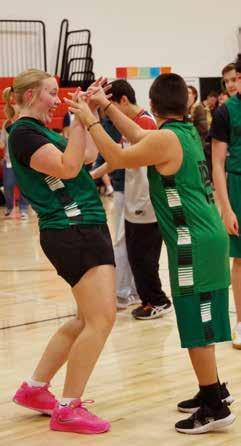

“At the beginning of the year, a lot of the girls on my team wanted to be a state champ. That was never a goal of mine.”
By Julie Slama
j.slama@mycityjournals.com
Eva Zimmerman never set out to win four state wrestling championships. Her goal was simpler: improve every day.
This past winter, Zimmerman closed out her high school wrestling career by winning her fourth consecutive state title, finishing an undefeated season and becoming the first wrestler in school history — girls or boys to achieve the feat.
“There’s about five girls in the state ever who have won all four years,” she said.
Girls wrestling was added about four years ago as its own sport, it grew from 250 girls competing against boys to about 2,000 girls participating with their own championship.
“I’m happy I won, but it also is a big relief,” Zimmerman said. “I tried not to put a ton of pressure on it, because it’s not fun that way, but there was building pressure all season since I hadn’t lost. It was never my goal since it wasn’t something I can control, but I’m glad I did it and can move on to the next stage.”
At the state meet, “the energy was electric, and the crowd was huge.”

“It was fun competing with my sister, too. Katie won this year, her second time winning; and my teammates, Caroline and Cassie Pastrana, won titles too,” Zimmerman said.
Zimmerman comes from a large family. She’s number six of 10 children; her older brother Zeke was “a really good wrestler” who competed at state and older sister, Eliza, who now helps coach the team, is a threetime state champion. Younger brother Isaiah is on Hillcrest’s team as well.
Even with enough to make their own team, Zimmerman said the living room doesn’t become a mat of competition.
“My dad owns a jiu jitsu gym so sometimes we’ll go there and work out; our family is really active,” she said.
Zimmerman took up wrestling, following the lead of older siblings.
“I started wrestling as a freshman. I wish I stared sooner, but I followed Zeke and Eliza. I look up to them,” she said. “Early on, they were like, ‘Eva, you could be really good; you’re athletic.’”
Her success came quickly.
“To come in and win state the first year of wrestling says a lot about how hard she works,” Hillcrest coach Nick Pappas said. “She was beating boys in the room in a very short time. Her learning curve is remarkable.”
But Zimmerman said the journey wasn’t easy. She recalls struggling through grueling practices.
“I wouldn’t say I hated wrestling, but my freshman and sophomore years, I would cry at least once a week at practice,” she said. “Wrestling is hard. You have to learn to love the grind.”
That mindset shift came after her junior year when she began competing more in the offseason.
“This last year when I went and did offseason, I competed nationally a ton and that was so much fun for me,” she said. “I started to trust myself.”
Pappas said that growth defined her senior season.
“This year, she loved the sport and process,” he said. “She was such a huge player in developing other girls’ technique on the team. She was even better at helping girls keep things in perspective and helping them develop into their best selves as well.”
Zimmerman served as a team captain, helping guide a Hillcrest squad that placed third at state with six finalists.
“It’s hard to have a positive mindset,” she said. “I helped them with that a ton. I drilled it into them: It doesn’t matter if you lost, let it go.”
While Zimmerman went undefeated, she was scored on two weeks before state at the Rockwell Rumble tournament.
“Heading into state, my mindset was ‘I’m going to wrestle. I’m just going to do my best’ because that’s all you can control,” she said. “At the beginning of the year, a lot of the girls
on my team wanted to be a state champ. That was never a goal of mine. Mine was I’m going to get better, and that’s what I focused on.”
She moved up a weight class for the state meet.
“I wasn’t actually 115, but 110 roughly,” she said. “I already had won at 100, 105 and 100 so I thought it would be cool to go with 115. Plus, Cassie was 110 and so it worked out she won that weight class.”
With her high school career complete, Zimmerman, with a 3.9 GPA, will contin -
ue wrestling at Grand Valley State University (Michigan).
“I cannot imagine being done with wrestling right now,” she said. “I’m grateful I have an opportunity to go and compete at college.”
Looking ahead, Zimmerman hasn’t ruled out bigger dreams.
“Being in the Olympics would be awesome,” she said. “It’s going to take a ton of work and I’m ready to put that work in, but my focus is still improving and trying my best because I can control those things.” l


Things have been egg-sploding at Glacier Hills Elementary. Students have been watching chicks and quail hatch in their classrooms, turning science lessons into egg-stra cute peep shows. Kindergartners, chirping egg-statically, drew shell-ebrating scenes of baby quail chicks pecking their way into the world, while older students, cracking in curiosity, scrambled to ask questions whether their chicks will be male or female, how they get their colors and even how they absorb the yolk before hatching. With every crack and chirp and fluffy arrival, Glacier Hills students, with im-peck-able egg-citement, are proving hands-on learning is egg-ceptional. (Julie Slama/City Journals)














From hopes of breaking records to building lasting friendships, Utah athletes prepare to compete against the best in the country.
By Julie Slama j.slama@mycityjournals.com
This June, athletes from across the state will represent Utah on a national stage at the 2026 Special Olympics USA Games. For many families, the journey is more than medals.
Held June 2026 in Minneapolis, the Games will bring together 3,000 athletes, 1,500 coaches and thousands of fans from all 50 states. The competition highlights inclusion, pairing athletes with and without intellectual disabilities and showcasing what’s possible through sport.
Team Utah will send 69 delegate members, including 46 athletes, ages 16 and up, and their unified partners, competing in eight of the 16 sports: athletics, bocce, bowling, golf, soccer, swimming, unified basketball (interscholastic) and unified flag football (intercollegiate), said Courtnie Worthen, Special Olympics Utah director of Unified Champion Schools.
Among those heading to Minnesota is swimmer Jordan Barlow, who has set a high goal.
“I want to set the record in the 50 freestyle; I’m going to swim hard,” said the Draper resident who attends Life Skills Academy in Can-
yons School District.
His mother, Mandy, said his goal is within reach.
“He’s right there with the USA Down Syndrome record around 29 seconds; the Special Olympics record is around 26,” she said. “If he gets in the 28s, we’ll be ecstatic.”
Barlow trains three to four days per week, balancing practices with his Special Olympics team, the Salt Lake Stars; Team Utah trainings and additional time in the pool with former high school swimmers, including his older sister who helps him with his starts, turns and technique.
He will compete in the 50-yard freestyle and 25-yard backstroke, events he qualified for at last June’s Utah Summer Games.
For his mother, watching her son compete on a national stage will be emotional, even as the Games encourage athlete independence.
“I’ll be there to watch; we’re already so proud of him,” she said. “He’ll fly with the team and will stay in the dorm, so he’s eating and sleeping with the team.”
That independence is a hallmark of Special Olympics as 35-year-old Draper resident Elizabeth Jensen prepares to compete at the USA Games.
She will represent Utah as one of four members in bowling. After winning a gold medal in the state tournament in August 2025, Jensen was selected through a lottery of other athletes who qualified. She also qualified


In August 2025, Elizabeth Jensen won the state tournament in bowling and will represent Utah at the Special Olympics USA Games. (Photo courtesy of Norma Jensen)
in swimming, but chose bowling, her favorite sport, and trains once or twice per week.
“I like throwing it fast,” Jensen said about her favorite part of bowling. “I’m excited to represent Team Utah in the USA Games.”
To prepare for the Games, she has been walking, lifting weights and pushing through physical challenges. Her father, Blayne, said his daughter has undergone multiple surgeries and has ongoing knee issues.
“Her kneecap will pop and slide off the front of her knee and she’ll fall down,” he said. “We’re looking to get a new brace to
see if it helps.”
That is just one of the obstacles Jensen has faced. Her mother, Norma, said her daughter wasn’t expected to live her first day after being life-flighted from a Bountiful hospital to Primary Children’s Hospital. She spent her first two months in the hospital, was nourished through a feeding tube until she was 5 and wasn’t expected to crawl or walk.
Jensen attended schools in West Valley City, where her mother said it wasn’t always easy.
“Sometimes kids were really rude, and even though some were nice, her brothers were there to help her out,” she said.
Jensen prevailed; she is now an accomplished athlete —recently winning the state silver medal in dance — and is an accomplished reader and talented in the arts, painting and playing piano and ukulele.
“She’s been flourishing; she’s shining,” her mother said, adding Special Olympics has provided her daughter a community where she belongs and the confidence to be her best. “Elizabeth has been able to do the things she loves to do through the Special Olympics and will compete at nationals; now, there’s opportunity. It’s gratifying seeing how people with disabilities can do so many things.”
Blayne Jensen sees how meaningful it is to his daughter: “For me, it’s great seeing her be able to do the things her brothers got to do growing up that she didn’t get to do; and to witness how excited she gets now having the chance to compete, it’s exciting.” l











By Travis Barton travis.b@thecityjournals.com
From the end of May until late August, cit-
ies throughout the Salt Lake Valley celebrate community spirit with parades and carnivals along with local traditions unique to each summer event. Check out this schedule of festival events and plan your summer fun.
SoJo Summerfest – South Jordan
June 2-6, Highland Park (6050 W. Lake Ave.), Mulligans Golf Course and North City Park (11000 S. Redwood Road) www. sjc.utah.gov/199/SoJo-Summerfest
This year’s festivities run almost all week and will feature a Kite Festival, food trucks, Mulligans mini golf and long drive competitions, root beer garden, chalk art, music festival, parade and fireworks.
“I’ve been coming to SoJo Summerfest for many, many years and it’s still one of my favorite traditions,” South Jordan Mayor Dawn Ramsey writes in the city’s Summerfest booklet. “Whether it’s your first time or you’ve been coming for years, there’s something special about being part of it togeth-

er. Nearly everything is free, thanks to our amazing sponsors, volunteers and staff who make it all happen.”
WestFest - West Valley City
June 17-20, Centennial Park (3100 S. 5405 West) www.wvc-ut.gov/2034/WestFest
The annual celebration of West Valley City’s incorporation features a carnival, parade, talent showcase, a fun run and fireworks on both Friday and Saturday nights.
Fort Herriman Towne Days
June 19-27, W&M Butterfield Park (6212 Butterfield Parkway) and J. Lynn Crane Park (5373 Main St.) www.herriman.gov/Towne-Days
of Riverton’s annual Town Days. Flag skydivers drop as the highly attended rodeo runs through the weekend. The following weekend features Town Days’ events and activities like a cornhole tournament, state entertainment, street hockey and fireworks.
Western Stampede – West Jordan
“Harltey Road” concert and capped with fireworks at 10 p.m.
Freedom Fest Fourth of July –South Salt Lake
July 4, Fitts Park (3050 S. 500 East)
Freedom Fest begins with a flag ceremony and special rendition of “The Star-Spangled Banner” followed immediately by the parade. This year’s theme commemorates the 250th anniversary of the country. The parade starts at 2280 S. 300 East and ends at Fitts Park where there will be food, entertainment, kid’s activities and more.
Draper Days
July 10-18, Draper City Park (12500 S. 1300 East) www.draperutah.gov/events-programs/community-events/draper-days
If it’s July, then it’s time for Draper Days. The annual event will feature a 5K race, rodeo, parade, car show, children’s bike parade, amphitheater movie night, horse pull, basketball tournament, pickleball tournament and a Strider bike race.
Butlerville Days – Cottonwood Heights
July 16-18, Butler Park (7500 S. 2700 East)
Rescheduled and no longer coinciding with Pioneer Day, Cottonwood Heights’ annual festival will still feature its parade down Bengal Boulevard, carnival rides, pickleball tournament, chalk art, stage entertainment, car show and fireworks.
Midvale Harvest Days



Herriman’s grand yearly festival starts Friday June 19 with a 70’s themed Skate the Park, then goes everyday (except Sunday, June 21) until June 27. The fun includes the Herriman Yeti Run, food trucks, car show, speed puzzling tournament, reptile experience, talent show, carnival, Dazzle Dogz, drone show, live music, wiffle ball tournament and fireworks.
Taylorsville Dayzz
June 25-27, Valley Regional Park (5100 S. 2700 West) taylorsvilledayzz.com
It marks 30 years for Taylorsville’s special birthday bash which will feature a parade, petting zoo, carnival, food booths, concerts, 5K, car show and fireworks. Concerts will feature cover bands of Adele, Bee Gees and ABBA. And don’t forget about the skydivers on Saturday night.
Riverton Town Days Rodeo
June 25-27, July 2-4 Riverton Rodeo Arena and Riverton City Park (12830 S. 1300 West) www.rivertonutah.gov/towndays
This three-day rodeo is part of the heart
July 2-4, Veterans Memorial Park (8000 S. Redwood Road) Westernstampede.com Independence Day weekend starts in style with West Jordan’s Western Stampede. Thursday marks the rodeo kickoff, carnival and outdoor movie of “National Treasure” followed by a Friday featuring a drone show and Taylor Swift tribute band. This year marks the debut of Stampede Slugfest and Sundown at Ron Wood Park—a one-pitch, overnight softball tournament. July Fourth itself will bring the grand parade, K9 demo and fireworks among other events.
Sandy City Fourth of July
July 4, South Towne Promenade (10000 S. Centennial Parkway) www.sandy.utah. gov/715/Fourth-of-July
It runs all day, starting with a flag raising and ending with a firework concert. Inbetween you’ll find a 5K race, fire truck water spray, police K9 show, youth craft fair, mini golf, carnival, BMX bike performers and community entertainment.
Murray Fun Days
July 4, Murray Park (296 E. Murray Park Ave.) www.murray.utah.gov/2115/ Murray-Fun-Days
It started in 1958 and continues to this day. The famous parade along State Street begins at 8:30 a.m. while the rest of the day features a 5K walk/run, children’s race, chalk art contest, plein art contest, games, car show, food trucks, balance bike race,
July 27-Aug. 1 Midvale City Park (425 W. 6th Avenue) engagemidvale.com/2026harvest-days
Neighborhood block parties kickstart the weeklong celebration on Monday and Tuesday. Wednesday sees the Midvale Arts Council take over with its Hall of Honors and Art Show. A Tyler Library Night comes Thursday before Friday and Saturday shift into top gear with a concert in the park, fun run, pancake breakfast, face painting, Battle Zone, trampoline show, parade and fireworks.
Bluffdale Old West Days
July 30-Aug. 8, Day Ranch Park (15345 S. Puma Mountain Way), Bluffdale City Park (14400 S. 2400 West)
While the Old West Days Rodeo will run July 16-18 at the Bluffdale Equestrian Park, the rest of the festival starts July 30 with the Bluffdale Arts’ production of “The Lightning Thief” until Aug. 3. The pickleball tournament starts July 31. The rest of the week brings a party in the park, youth night, senior dinner, car show, children’s entrepreneur fair, family concert, fireworks and the grand final parade on Aug. 8. l
Localscapes teaches homeowners how to adapt yards to Utah’s climate.
By Cassie Goff c.goff@mycityjournals.com
Gardening season is upon us! As questions about gardening and waterwise landscaping have emerged from Utah residents, Localscapes has stepped up with answers offering a variety of free gardening and landscaping classes. In partnership with the Central Utah Wasatch Conservancy District (CUWCD), Localscapes classes are specifically created around the challenges of Utah’s climate.
“Creating Your Ideal Utah Yard” has been one of their most well-attended community classes. Casey Finlinson, CUWCD Conservation Program Coordinator, taught this course to Cottonwood Heights residents on April 2 and to Sandy residents on May 24.
“Get some function and curb appeal out of the yard,” Finlinson said.
An average Sandy/Cottonwood Heights residential home typically has approximately .27 acres of yard-area. With a “traditional” Utah Landscape, 90% of that tends to be lawn/grass. If a resident is watering that lawn area with the 40 inches of water grass required per season, that’s about 176,250 gallons of water use per year.
Localspaces invites residents to consider redeveloping their yard’s landscaping so it isn’t so lawn/grass centric. By implementing some of their research-driven landscaping suggestions, homeowners can save water, lower their annual yard maintenance and irrigation, improve functionality of their yards, and improve the curb appeal of their home.
“Waterwise landscaping requires minimal maintenance,” said Water Education and Public Outreach Coordinator for Sandy City Nikki Wyman.
Residents who incorporate landscaping elements (like plant bed and hardscapes) to reduce their grass areas to 20% (instead of 90%) typically average out to save 110,000 gallons of water per year. (A 20% grass yards typically need 64,766 gallons per year.)
Specifically, Finlinson recommends keeping lawn/grass areas usable.
“Keep lawn off of steep slopes,” Finlinson said. “If you can’t sit on a lawn chair comfortably than it’s too steep to have a grass slope.”
When beginning a Localscapes landscaping journey, Finlinson recommends taking some time to analyze the area with a needs assessment. A Google Maps image of the area can help to identify specific areas like central open space.
Then, consider the desired functions of the yard. (Do you need privacy from neighbors? Do you need specific areas for kids to

play? Where do plants struggle? How sunny or shady are different parts of the yard? Where do you need more sun or shade? Where is wasted space? Do you need room for things like an RV pad?)
Finlinson recommends considering multiple gathering areas throughout the yard. For those gathering areas that do require grass, Finlinson and the Localscapes team suggest planning grass spaces of yards with sprinklers in mind. If landscapers are considering first how sprinklers will be using water, it makes the grass areas more usable without overwatering the lawn.
Finlinson mentioned how residents shouldn’t be planning to put grass in areas less than 8 feet because of guidance coming down from the State Legislature that will soon be written into new city ordinances.
Once central gathering spaces have been identified, consider where connective pathways need to be. Pathways should be designed to connect elements of the area.
“We don’t want to have blandscapes,” Finlinson joked. “Think about your gathering areas and how to connect space with some paths; anything leftover becomes planting beds.”
For pathways and area lines, Finlinson recommends material like pavers, flagstone, gravel and chat for the hardscape.
“Gravel gets kicked around and doesn’t compact very well so it’s challenging for pathways and creates tripping hazards,” said Wyman. “Chat has a binding agent in it and it compacts well enough that it’s hard for seeds to take root in it. If we see weeds coming up, it’s in the margins.”
Finlinson also recommends thinking through which paths needs to be primary and secondary. Primary paths should be built with hardscape material to be able to clear snow in the winter. Secondary paths won’t require snow removal so they can be as simple as bark.
“We don’t want lawn to be a pathway. It’s so much easier to have a hardscape material because then you don’t have to water or maintain it,” Finlinson said.
For aesthetics, Finlinson recommends planning to utilize contrasting and permanent materials.
“Make it look like it’s on purpose,” Finlinson said. “Make defined edges.”
Once gathering areas and pathways are mapped out, planting beds can begin to fill in additional open space and provide some privacy. Finlinson recommended planting annuals in pots and decorating all gathering areas with perennials.
“Don’t mix annuals and perennials in planting beds because they have different water needs,” he said. “Bulbs are considered water efficient with moisture and soil.”
Irrigation drip lines are recommended to water those planting beds, with inline drip holes measured 12 to 18 inches apart. Inline drips are measured by gallons per hour instead of gallons per minute like sprinklers.
“In Sandy soil, 12 inches apart is a must. Sandy soil goes straight down so you need the lines closer,” Finlinson said. “Water two days per week for 30 minutes for Sandy soil.,” Finlinson said.
During this class, Finlinson answered
a few resident-specific questions. Here’s a quick glance at the Q&A breakdown:
• Tree roots pop out of the lawn when they need more oxygen. The soil’s probably too wet.
• Bermuda grass is illegal in Utah. If you don’t know what kind of grass you have at home, it’s probably Kentucky bluegrass.
• Rotor sprinkles run twice as long as fixed-head sprinklers.
• Typically, most Utah homes have full sun areas on the south and west sides. Partial sun is to the east. Shade is generally on the north.
Want to learn more specifics for gardening beds? Come back nNext month when we, here at the City Journals,we’ll recap the “Creating a Plant Bed Design” Localscapes class.
Before digging, residents should remember to call Blue Stakes of Utah for a free utility line location service. Any digging in residential areas needs to be at least five feet away from a gas line for trees. Call 1-800-662-4111 or visit www.bluestakes. org. Local residents can also call 811. Sandy’s free Demonstration demonstration Garden garden currently has some eco-lawns on display. Visit Sego Lily Gardens at 1472 E. Sego Lily Drive.
To learn more about Localscapes and their classes, search their events through EventBrite or e-mail info@localscapes.com.
CUWCD’s office is located in Orem at 1426 E. 750 North. To review this course or view recordings of past classes, visit www. CUWCD.gov/classesl
Students met professionals working in STEM fields who shared how technology is used to tackle real-world challenges.
By Julie Slama j.slama@mycityjournals.com
More than 3,000 Utah students gathered to explore STEM careers at SheTech, where hands-on workshops, industry booths and inspirational leaders encouraged middle and high school girls to see themselves in fields where women are still underrepresented.
Michele Hollist, a senior chemical engineering analyst with OxEon Energy, said her company participates because it wants student to see how science and engineering make an impact in both space and on Earth.
The company is working on technology that can create oxygen from carbon dioxide in the Martian atmosphere and converts biogas from food waste into renewable fuels on Earth.
“We’re trying to solve energy issues on Earth I know this generation cares about and our technology actually has operated on Mars, which I don’t think a lot of people know,” she said. “I’m hoping to get girls excited about the fact they can use their ed-
ucation to solve problems. A lot of the people we interview coming out of college are passionate about trying to make the world a better place and our new energy sources will last for generations.”
Nearby was a booth with programs Women who Succeed, Ken Garff Keys to Success and Ken Garff eSports, that support high school and college students, connecting females with mentors, resources and scholarships.
“I want to help girls, especially in tech fields, have a place,” said Addie Huff, Women who Succeed program manager. “We want to help the next generation of leaders.”
Girls participated in hands-on challenges and networked with industries and colleges in the TechZone. More than 1,000 mentors from 250 companies and major universities took part in the free event, which was hosted by the Women Tech Council with the help of the SheTech student board.
Juan Diego Catholic High junior Lei Harline used the experience to learn more about the health care industry.
“I want to be an anesthesiologist so I’m looking more at the medical field booths and workshops, but it’s fun to explore all the new technology,” she said.
Educators say the event leaves a lasting impact on students.
“A
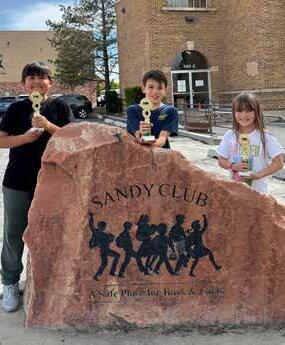

Corner Canyon High’s work-based learning coordinator Taylor Jesienouski brought 37 girls to the explorer day.
“It’s a great event, one of the best of the year for women empowerment,” she said. “We always feel women are strong and can do anything after this event; my girls absolutely love it.”
Two-time Olympic skiing freestyle medalist Shannon Bahrke, who just returned from watching the Olympics in Italy where she said women won 60% of the medals, was one of the event’s speakers.
She encouraged students to try new things and pursue what inspires them.
“I challenge you today to make friends with all of these incredible girls around you, because they are your people,” Bahrke said. “Find something that you really love here, something that inspires you, something that intrigues you…and you will have your Olympic moment. It may not be on the world’s biggest stage, but it will be on your biggest stage. Work hard and be your best self, because your extraordinary starts here.” l
Congratulations to our May Members of the Month: Cesar Palermo Andrade, Bentley Anderson, & Maddie!
Cesar is 10 years old: Cesar wants to become a chef or cook when he grows up, he has been attending the Sandy Club for 4 years, in that time he has learned to speak more to people and play soccer.
Bentley is 9 years old: he wants to become a youtuber, he has been attending for 5 years, in that time he has learned how to play chess.
Maddie is 7 years old: she wants to become a teacher, she has been attending for 2 years, and in that time, she has learned to be kind.
Congratulations once again, we are so proud of you all!

Enjoy exclusive offers from participating local businesses while supporting our Glow & Give Back initiative benefiting the
& Canyons School Districts Summer Food Programs.
Asteachers pop the champagne and schedule full-body massages, mothers are slowly descending into madness. Summer break stretches ahead like a sunburned, melted-fudgesicle 10K, with lots of family time. So much family time.
As a young mother in the 20th century, summer vacation was a blur of wet towels, lost flip-flops, and popsicle sticks stuck to couch cushions. My daughters spent the days selling Kool-Aid to neighbors, watching hours of PBS’s “Arthur,” and fighting nonstop.
I tried to keep a schedule, but it flew out the window the first day, along with my common sense and sanity. Although we went to parks, pools, hiking trails, libraries, zoos and museums, my daughters were always “sooo bored!” It was like trying to fill a bottomless, thankless pit.
Looking back, I was so lucky. Not because I could spend so much “quality time” with my kids, but because I wasn’t working out of the home. It was absolutely exhausting, but I didn’t have to worry about what my kids would do during the summer.
The school calendar was not created for single mothers, full-time working parents or children who need snacks every five minutes. It was designed for farmers who churn their own butter and rise at dawn to feed chickens.
Today, moms are scrambling to find camps, sitters, daycare and programs to keep

kids occupied during the summer break because many mothers have full-time jobs and can’t take the summer off.
People rarely ask fathers, “What will your kids do all summer? How will you balance your job and family?” Nope. Everything usually falls to moms, most of whom can’t afford camps or additional daycare costs.
I researched “Summer strategies for working moms” and was given ideas like 1) hire a summer nanny, 2) enroll in pricey camps early, or 3) rent children to an influencer.
Who do they think these mothers are? Kardashians? I added a fourth option: quit your job and live in a van by the river.
When my daughters were little, there were several working moms in the neighborhood and their kids would hang out with us all summer. They were part of the noisy, sticky clan, constantly bickering about who got grass in the blow-up pool.
Now, mothers are anxiously waiting for their lottery numbers to hit or a magical Mary

Poppins character to show up and take control of their unruly children. Barring that, there aren’t a lot of viable options, especially in this economy.
Grandparents and other family members alleviate some of the summer schedule strain, but with about 10 weeks of out-of-school time, mothers often resort to late-night spiraling and stress eating.
It’s not all hopeless. Companies are finally realizing they’ll have happier, healthier, more productive female employees if they offer flexibility.
Progressive CEOs provide summer childcare stipends or offer discounts to local camps. Work-from-home options, summer PTO bonuses, flexible start/end times and early-out Fridays would make a mother’s summer a gajillion times easier, as well as fathers who need
scheduling help for the school break.
Maybe that’s the answer! Instead of asking companies to make things easier for moms, let’s say the dads need help. Businesses will immediately build on-site splash pads, create kid-friendly office spaces and partner with local teams to host summer-long sports camps.
Somewhere along the way, summer break turned into a summer breakdown. Parents aren’t asking for luxury vacations, just a bit of time to sit by the pool, yell at kids to stop yelling and maybe even pop some champagne. We should be able to make that work.
Peri Kinder is an award-winning columnist and journalist who has written for The City Journals since 2004. She also hosts the Life & Laughter podcast. Peri can be reached at peri.k@thecityjournals.com.