
See Inside... Bond paid off
Scoring record broken
Still dancing forward
By Julie Slama | j.slama@mycityjournals.com
Longtime educator and Olympic choreographer Paul Winkelman, now living with ALS, is finding new ways to inspire students and hoping to return to the Olympic spotlight.
In eight years, Salt Lake will once again welcome the world as host of the XXVII Winter Olympic Games in 2034. For South Jordan resident Paul Winkelman, a longtime educator and counselor in Canyons School District, he hopes it will give him a repeat performance as the opening and closing ceremonies choreographer, a role he cherished during the 2002 Games.
“I’d love to do that,” Winkelman said simply, reflecting on one of his greatest experiences of his life.
In 2002, Winkelman was teaching at Alta High and coaching its nationally acclaimed ballroom dance team when dozens of people walked into the school commons after school, cameras rolling. Among them was a producer for the Salt Lake Organizing Committee.
After watching the boys’ portion of the rehearsal, Winkelman recalled being asked who he was and what group was practicing.
“I explained we were the Alta High School ballroom dance team,” Winkelman said. “He said, ‘I’ve never seen guys dance like this.’”
That chance encounter ultimately led to Winkelman being hired as the full-time choreographer of the Olympic opening and closing ceremonies. His students became the backbone of the Western Frontiers section, the largest segment of the ceremonies, first learning the choreography, then helping teach it to hundreds of performers who filled Rice-Eccles Stadium.
“I said many times, the Salt Lake

Olympics was heaven. It was unbelievable,” he said.
Eight years from now, however, if Winkelman returns to the Olympic stage, his approach will look different. In 2022, he was diagnosed with ALS, commonly known as Lou Gehrig’s disease, a progressive neurological disorder that attacks motor neurons in the brain and spinal cord, gradually robbing the body of voluntary muscle movement while leaving the mind intact.
“I teach a totally different way. It’s verbal. I’ll explain to my top couple what I want and they become my legs,” he said.
Even with the diagnosis, Winkelman hasn’t stepped away from his career, working with students.
“In 2022, I was diagnosed with ALS, but I knew there’s no way I’m quitting work because I love working with kids, and I wouldn’t know what to do with myself,” he said.
A life shaped by students and the arts
Helping students has been Winkelman’s lifelong passion. He began his career at East Midvale Elementary, where he spent seven years teaching third and fourth grade while building a drama program that quickly grew beyond expectations.
“I loved East Midvale,” he said. “We produced all-school productions where everyone from kindergarten through sixth grade could be involved. It was an af-
ter-school activity many students wanted to be a part of.”
Winkelman’s reputation led then Jordan School District to move him to an opening at Alta just one week before school started in 1992. There, he continued the school’s strong theater tradition and launched what would become one of the most successful ballroom programs in the country.
“We became national champions,” he said. “Of the 10 years I was there, eight times we were the national champions. Those kids worked so hard.”
Winkelman lived and breathed work.
“There were times I never went home.
continued page 4
Hillcrest High performing arts students as well as Beatles tribute band Sean’s Garage and Bingham High theater director David Martin came together to perform in a BeatALS concert to help the ALS Foundation. (Photo courtesy of Janal Williams)





























I slept on the floor of the auditorium when I was tired, but I loved what I was doing and the productions we did there were absolutely amazing. The students and the quality of their work was stunning,” he said.
After adding his master’s degree in psychology to his undergraduate education degree and master’s in theater, Winkelman pursued the counseling field, leaving Alta in 2003. He worked at Brighton High, Hillcrest High and Utah Valley University before returning to Brighton.
At Hillcrest, Winkelman helped sustain and elevate the school’s wellknown musical theater tradition for a decade, collaborating with choir director RaNae Dalgleish.
“Working with Paul at Hillcrest — I’ve never met a man with more passion and energy and talent,” she said. “He was demanding, but he also made it fun. Our musicals were phenomenal because they had the Paul touch.”
A moment that redefined his world Winkelman’s ALS diagnosis came after months of uncertainty, injuries and worsening weakness.
“When the fourth doctor told me, ‘You have ALS,’ I just sat there. I vividly remember I went right out of body like I was watching myself,” he said.
The disease takes a physical toll on Winkelman daily. He experiences tremors and painful muscle spasms, which he describes as “painful Charley horses in your whole body” and frequent falls.
cut open; I’ve had to have shoulder surgery because I ripped the rotator. It scares me to fall, because I know there’s no way to stop and, on my way, down, I wonder, how bad is this one going to be? It’s taught me the more invincible you think you are, the less you are. Life can be very fragile,” he said.
Even so, Winkelman’s outlook remains clear.
“My attitude from day one has been positive,” he said. “You can stay positive and contribute, or you can turn this into a negative and give up.”
Today, Winkelman is a parttime counselor at Entrada Adult High school, where the flexibility allows him to continue supporting students.
“I’m still working with them on careers and on getting them graduated,” he said. “If I get up one day and my body just says no, I can work with my disability much more easily.”
Winkelman continues to choreograph, judge competitions and mentor performers, recently coaching a group to the world championships. He also has produced Broadway stars, including Derek Hough of “Dancing with the Stars” and Ashley Bryant in “The Play That Goes Wrong,” and worked on the choreography for the movie, “High School Musical.”
“My mind can still see what the choreography needs to be,” he said.
BeatALS — music, meaning and community
research and awareness.
SANDY TEAM
The Sandy Journal is a monthly publication distributed directly to residents via the USPS as well as locations throughout Sandy.
For information about distribution please email hello@thecityjournals.com or call our offices. Rack locations are also available on our website.
The views and opinions expressed in display advertisements do not necessarily reflect or represent the views and opinions held by Loyal Perch Media or the City Journals. This publication may not be reproduced in whole or in part without the express written consent of the owner. © 2019 Loyal Perch Media, Inc.
“When I fall, my body freezes, and I’m like a piece of glass hitting the floor. My head has been
PUBLISHER
Bryan Scott | bryan.s@thecityjournals.com
EDITOR
Travis Barton | travis.b@thecityjournals.com
ADVERTISING EXECUTIVES
Mieka Sawatzki | mieka.s@thecityjournals.com
Lindsay Andreasen | lindsay.a@thecityjournals.com
Ryan Casper | ryan.c@thecityjournals.com
Marc Davis | marc.d@thecityjournals.com
“We had a night of wonderful music and celebration,” Dalgleish said. “We ended up earning about $5,700 for the ALS Foundation.”
Not only did Winkelman choreograph numbers for the program, he spent time talking with 50 students about music, dance and life. He also shared his journey with the audience during a pause in the concert.
“It was so much fun and the kids were awesome,” Winkelman said. “I heard some songs I didn’t know. I’m quickly becoming a Beatles fan.”
Dalgleish said the experience also impacted the students.
“The kids learned the songs, the history of the time and we had Beatles trivia every day and they learned to be thankful for every day,” she said. “The concert was beautiful. They danced, the orchestra played, the band played, the choir sang. It was stunning. It brought me to tears.”
Gratitude for every day
Winkelman credits his faith, family and friends for sustaining him.
“I’ve lived the life of at least five people,” he said. “I had many incredible opportunities in my life. I can’t be bitter. I just have to find a different way to do things.”
Brighton High recently honored Winkelman with a scholarship in his name for students pursuing ballroom dance at BYU, another reminder of the legacy he continues to build.
“I’m lucky and whether I get the opportunity to choreograph another Olympics or championship, I get up—even on rough days—and I find the positive light, hoping I can change somebody’s life,” he said. “That has been a beautiful blessing, and I’m thankful for every day.” l Continued from front page
His choreography was on full display recently at Hillcrest High during a BeatALS benefit concert honoring Winkelman. Supported by Dalgleish, he met Bingham High theater director David Martin and worked with Sean’s Garage, a Beatles tribute band, to raise funds for ALS
CIRCULATION COORDINATOR
Lydia Rice | lydia.r@thecityjournals.com 385-557-1022
Rack locations are also available on our website.
EDITORIAL & AD DESIGN
Stacey LaMont Ty Gorton
SANDY CITY JOURNAL
9500 South 500 West, Suite 205 Sandy, UT 84070
PHONE: 801-254-5974
MISSION STATEMENT
Our mission is to inform and entertain our community while promoting a strong local economy via relevant content presented across a synergetic network of print and digital media.
PUBLISHER
Designed, Published, & Distributed by

Hillcrest High choir director RaNae Dalgleish and guest choreographer Paul Winkelman work together on the recent BeatALS concert, which honored Winkelman. (Photo courtesy of Janal Williams)
Entrada counselor Paul Winkelman continues to make a big contribution to students, both in counseling and in the performing arts, while living with ALS. (Julie Slama/City Journals)



Everything’s coming up roses for Valentine’s Day at flower shop
Draper Flower Pros, one of the oldest florist shops in Draper, gets through the Valentine’s Day rush thanks to a team of hard-working, dedicated staff members—and thousands of roses.
By Katherine Weinstein k.weinstein@mycityjournals.com
The staff at Draper Flower Pros is getting ready for the Valentine’s Day rush. “Valentine’s Day is definitely one of the busiest times of the year,” shop owner James Belcher said, adding that things can get a little hectic at Mother’s Day and Memorial Day as well. The shop gets through the busy times of the year thanks to a tight-knit, dedicated team of workers putting in a lot of hours.
Draper Flower Pros is located at the intersection of 700 East and 12300 South in Draper. “There has been a flower shop at this location for about 20 years,” Sandy native Belcher said. “I’ve only owned it for about 10.” He opened his first flower shop in Lehi in 2003.
While he has taken some classes in floral design, Belcher explained that he learned his trade just by doing it, “like an apprentice,” he said. “I came to work at a florist shop and just learned.”
Having grown up in Sandy, he was happy to take ownership of the shop in Draper. “I’ve watched this whole area change,” he said, recalling some of the old businesses that used to be nearby such as Frank’s Food Town, Draper Drug and Draper Bank and Trust.
Belcher clearly loves his work. “I enjoy the creative outlet, it’s super fun and interesting,” he said. The social element is important too. “We’re all good friends here,” he added. “It’s like a family.”
“We have a core group of employees that’s been with us for a while,” Belcher said. As Valentine’s Day approaches, Draper Flower Pros has five floral designers putting together arrangements in addition to five or six additional staff members taking orders and answering the phone. He usually hires a few new people at this time of year. “It’s a lot trickier, training new people and dealing with volume that you’re not used to in a couple of days,” he said.
In addition to people seeking bouquets and floral arrangements for Valentine’s Day, high school students are placing orders for corsages and boutonnieres for the “sweetheart” dances held at this time of year. There is also ongoing demand for flowers for occasions such as weddings and funerals. Belcher explained that the key to managing all of this

world,” Belcher said. “A lot come from Ecuador and Colombia, also Holland and some from California.”
Red roses are by far the most popular, but Draper Flower Pros sells a variety of colors. Different colors of roses have different symbolic meanings. Red, for example, symbolizes romantic love while yellow symbolizes friendship and joy and white can represent purity. Belcher noted that many people nowadays aren’t aware of the symbolism and choose colors based on personal taste. “A dozen peach roses can just be a beautiful gift,” he said.
While a dozen red roses is the most common Valentine’s Day request, arrangements featuring a variety of flowers are popular too. Floral designer Calli Veenendaal first went to work at Draper Flower Pros when she was in high school. “James taught me quite a bit, and I turned it into a job. I managed a shop in Idaho for a while,” she said.
Veenendaal enjoys the creativity of her job most of all. “My favorite is doing weddings,” she said, explaining that a client might give her a color palette or descriptive word like “elegant” or “whimsical” to inspire the floral arrangements for the wedding. “Sometimes they have a specific vision,” Veenendaal said. “We can do just about everything creatively.”
She mentioned that during the Valentine’s Day crunch, she gets to work at 7 a.m. and stays until 6 or 7 p.m. “It’s physically taxing, you’re on your feet all day,” Veenendaal said, adding that working with flowers is hard on the hands and fingernails. “But I wouldn’t change jobs for anything,” she said.
comes down to good communication and having a system in place to process orders.
Having enough flowers, especially roses, is also essential. According to the Society of American Florists, roses make up 83% of all flowers sold on Valentine’s Day. “For a typical Valentine’s Day, I’ll order in 10,000 roses between both stores,” Belcher said.
He added that sales might be down slightly this year because Valentine’s Day falls on a Saturday during Presidents’ Day weekend. “People will be out of town,” he explained. “They also like to send flowers to their loved one at work.”
Approximately 250 million roses are produced annually for Valentine’s Day. The bulk of them are grown in South America. “Our flowers come from all over the
Draper Flower Pros is known to many in the Draper community for its sign inviting people with a specific name to come in for a free flower. Belcher explained that he saw a similar sign at a florist shop in Utah County years ago. “I always wanted to do that,” he said. “It’s a great way to get people into the store. Sometimes they buy something else. Little children get so excited—it’s a lot of fun.”
Belcher said that the names put up on the sign come from customers. “They can write a name down and put it in a jar,” he said. Some of the more unusual names posted on the sign come from customers requesting the name of a loved one for a specific date. “If you want your daughter’s name on the sign for her birthday, you can do that,” he said.
In addition to flowers and floral arrangements, Draper Flower Pros sells houseplants and gifts, including Jelly Cats plush animals. The shop is located at 12288 S. 700 East. For more information and to place an order, visit utahdraperflowerpro.com. l
James Belcher, seen here with one of his floral arrangements, has owned Draper Flower Pros for 10 years. (Photo courtesy of Kennith Best)
Draper Flower Pros is known in the community for its sign inviting people with a particular name to come in for a free flower. (Katherine Weinstein/City Journals)
The cooler at Draper Flower Pros holds hundreds of fresh flowers. (Katherine Weinstein/City Journals)
Elected officials take oath of office
Three councilmembers and the mayor took their oaths in early January to kick off their terms.
By Travis Barton travis.b@thecityjournals.com
Sandy’s newly elected officials took office in January after their respective swearing-in ceremonies.
Three councilmembers took their oaths at Sandy City Hall in the council chambers Jan. 5: Brooke Christensen in District 1, Kris Nicholl in District 3 and Brooke D’Sousa in an at-large seat.
This marks the return of Christensen and Nicholl to the Sandy City Council having previously served, while D’Sousa was reelected to her second term.
Councilmember Cyndi Sharkey, who officiated the councilmembers ceremony, noted the seasoned makeup of the council until the next election in two years.
“This year will have a veteran council made up of experienced members who have already shown commitment to public service in Sandy,” she said.
D’Sousa echoed that sentiment in her remarks saying she believes “these next two years will be really impactful.”
In addition to the presentation of colors by the Sandy Fire Department and a national anthem performed by Kate Barnes, each councilmember spoke of their gratitude to those around them and their focus for the next four years.
Christensen remembered feeling during her first term, which ended in 2021, a need to “create immediate change or somehow fix complex problems.” But after reflection, noted lasting progress comes from “consistently doing small and simple things well.”
She listed six simple principles she would commit to: listen to understand, be available and accessible, consider all perspectives, treat everyone with respect, work hard with her responsibilities and to be kind, even when conversations are difficult.
Nicholl highlighted her family as her support system, thanking both them and the voters of District 3. Her kids
grew up in Sandy and said she felt comforted they knew what a safe community it was.
She said her focus would be on safe neighborhoods, continual listening, accessibility and to serve with humility and integrity. “I remain committed to careful stewardship and problem solving.”
D’Sousa said she begins her second term “mindful of the responsibility it carries and grateful for the opportunity to continue serving our community.”
While expressing appreciation for city staff, she said her focus will be “making informed decisions, weighing impacts, exercising fiscal stewardship and governing with the long view in mind.”
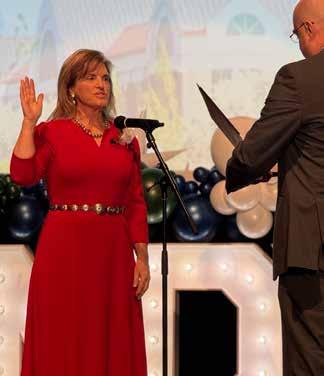
As the council began its swearing-in ceremony at City Hall, the mayoral swearing-in ceremony was just concluding across town at Alta High School where Mayor Monica Zoltanski’s oath of office event featured South Valley Chamber President Jay Francis, Sharlene Wells and the Alta High School madrigals.
Zoltanski spoke from the stage of the school’s performing arts center in front of a lighted signage of her Sandy motto “Sandy Rising,” describing it more as a philosophy than a slogan.
The mayor touched on her own gratitude, shared accomplishments from the past four years and what residents can expect in the next four years.
She thanked city volunteers, city staff, educators, retirees, past elected officials and business leaders. She recognized the people who invest in Sandy, the neighbors who look out for each other, public servants who put the mission first and students ready to be the next generation.
“It is the honor of my life to serve this community and to serve you,” she said.
The accomplishments she highlighted included added public safety personnel, modernizing city vehicles, a new fire station, public works garage, elevated resident engagement and millions in outside funding for the city’s bridges, intersections and roads.
It will also be a new era of sports entertainment in San-
dy, she said, as the Jazz practice facility comes to South Town and a new community recreation center is built.
“Second term is not a reset, it is continuity and building on our momentum but with deeper experience and greater understanding,” Zoltanski said.
Over the coming four years, she said the city can expect a stronger local economy, the Cairns center, new amenities, a pedestrian bridge over I-15, open space protection and new housing choices. Residents can expect a budget that is efficient, streamlines processes to avoid rate increases, low taxes with high quality services. l
Inclusion takes center stage at inaugural state unified dance competition
Local high school dancers made history earning top medals while promoting inclusion and showcasing talent.
By Julie Slama j.slama@mycityjournals.com
In the first state high school unified dance competition, three area schools swept the event.
Copper Hills High School won the unified dance team competition, with Highland High and Murray High in second and third places, respectively. Several students from each of the school placed in solo and duet categories.
Unified dance is a program that brings together students of all abilities together to promote inclusion, friendship and teamwork with an emphasis on movement and joy. The Special Olympics Utah competition was held in December at Highland High and featured a variety of dance styles and creative interpretations.
Students performed their routines on stage before receiving feedback from a panel of judges, including three who recently competed and won gold medals at the Special Olympics World Games. Much of the feedback was positive

Murray High dancers wore bright colors while Copper Hills performers sported matching shirts that said, “Inclusion is Cool.” Props from watering can to leis, adding creativity and personality to the routines.
Some students choreographed and practiced dances independently or together as an after-school club. At Copper Hills, teacher Anna Bay has instructed adaptive dance for three years.
“We have so many good kids who love to dance, so we wanted to give them more of a dance experience than what they could get in our mainstream classes,” she said. “With so many interested, we were able to open up a class just for the special ed kids. We have 20 special ed students in the class, plus 20 peer tutors. Then, we have aides who help.”
Bay said the benefits of unified dance go beyond learning choreography and dance technique.
and encouraging with comments such as “keep smiling and showing you’re having fun,” “you owned that stage,” “great techniques” and “good energy and choreography.”
Many of the performances included costumes and props.
“They’re learning social skills, how to be part of a team and about friendship. They’re listening and following directions, but we do it in a dance way, so it’s all by having fun. I teach them a lot of the same things I do in my ballroom classes from stretching to line dances. We’ve been working on learning choreography, which we were able to perform today,” she said. “They have so much fun, and I love their genuine smiles.” l
Mayor Monica Zoltanski takes the oath of office at Alta High School. The councilmembers were sworn in at City Hall. (City Journals)
Murray High student-dancer Bree Cox won first place for her solo at the state’s first high school unified dance competition. (Julie Slama/City Journals)
Celebrating Heart Month
heart by We know you
Heart care is more than numbers on a screen.
At Intermountain Health, heart care starts with getting to know what’s important to you and building a care plan together. From preventive screenings and lifestyle recommendations, to treating the most complex conditions with advanced technologies, our experts are with you through all of it. In other words, we’ve got your back — and your heart.

Learn more or schedule with a primary care provider
Hale Centre Theatre pays off municipal bond 17 years early
The co-founders of Hale Centre Theatre in Sandy have paid off a $33.5-million municipal construction bond they acquired from the city in 2015—a full 17 years before its maturity date.
By Tom Haraldsen t.haraldsen@mycityjournals.com
There’s probably no greater example of the importance of public-private partnerships than one celebrated in Sandy on Dec. 17. That was the day Hale Centre Theatre paid off the $33.5-million construction bond it obtained from Sandy City in 2015.
Sandy Mayor Monica Zoltanski officially handed over signed documents to HCT co-founders Mark and Sally Dietlein signifying the payoff. She also handed them the ceremonial pen used for those signatures, retiring the 30-year bond 17 years prior to its maturity date.
“On behalf of generations before, and future generations, thank you so much for what you’ve brought to Sandy, enhancing not only our community and our arts, but also our economy, our culture and our quality of life,” the mayor said. “It is my honor to present a satisfied deed to the theater.”
“For all the board and trustees and all the actors, this building would not be here were it not for Sandy City, and of course the help of many donors,” Mark Dietlein said. “The partnership that we have felt and experienced over the years….we cannot thank you enough and we’re very grateful. A huge thank you to the city council, to Mayor Zoltanski and your administration, and your predecessors. For the trust and vision that Mayor Tom Dolan had that was huge in making this happen. We could not be more grateful for this huge milestone day of celebration.”
“This amazing adventure started with a handshake over breakfast, and that trust level that we’ve had with Sandy City because of that handshake has proven true top to bottom,” Sally Dietlein said. “There are few places you can go where that type of integrity holds up.”
Zoltanski said the retirement of a bond so early is “unprecedented. It shows the success of joint efforts. HCT couldn’t have done this without Sandy City, and the city could not have welcomed a greater landmark cultural mecca on its own. We’re not in the theatre and arts business, but we know quality when we see it.”
She praised previous city leaders for having the foresight to bring the deal together, and thanked Mountain America Credit Union, one of HCT’s principal funding partners, for its support of the venue.
“Then, of course, is the community sup-

port, the success of the theatre, and the programming that made it possible for the Dietleins to pay off the bond so much earlier than anyone could have expected,” the mayor said. “It’s good for the city, because now it increases our bonding capacity for future projects. We’re looking to do more to build out our city center, our commercial center here with sports entertainment making the mark in Sandy. Our challenge is to pick the right businesses, the right partnerships and to set the tone that enhances the quality of life in Sandy.”
HCT’s reach extends well beyond its stage, Zoltanski said. Through robust school programs, volunteer initiatives, and community outreach, the theatre has added to the educational experience of students across Sandy and throughout Utah.
The theatre anticipates welcoming more than 700,000 patrons in the 2026 season. It will soon open another stage, The Beehive, for additional productions. HCT contributes over $14 million annually to the community through payroll and invests more than $15.75 million each year in locally sourced products and materials. The shared community event parking structure has also become a key infrastructure resource, providing convenient, covered access for theatre patrons and visitors coming to the district for business, dining and entertainment.
“Hale Centre Theatre is central to Sandy’s identity as the south valley’s entertainment capital,” Zoltanski said. “This early bond payoff reinforces the strength of our shared vision: creating a vibrant, welcoming city where arts and culture, education and economic opportunity flourish side by side.” l
Sally and Mark Dietlein, co-founders of Hale Centre Theatre, accept documents from Sandy Mayor Monica Zoltanski for retirement of a $33.5-million municipal construction bond, signifying payoff of the bond 17 years before its maturity date. (Tom Haraldsen/City Journals)
Give Yourself a Valentine This Year: Learn to Decode Messages from Your Heart
When we talk about heart disease, the usual suspects often come to mind: crushing chest pain, shortness of breath, radiating arm discomfort. While these classic symptoms demand immediate attention, your heart often speaks in a more subtle language, a series of whispers and quiet shouts that can easily be dismissed or attributed to other, less serious issues. During Heart Month this February, we want to empower you to become a skilled interpreter of your body’s unique signals, recognizing that early detection can be profoundly life-saving.
Many people are unaware that heart problems don’t always announce themselves with dramatic flair. “We frequently see patients who’ve ignored subtle signs for weeks or even months, often rationalizing them away,” explains Dr. Richard Gelb, a cardiologist at Holy Cross Hospital –Mountain Point. “Especially for women, symptoms can be incredibly nuanced and different from the textbook descriptions often associated with men.”
So, what are these often-overlooked indicators that your heart might be sending out an SOS?
Persistent, Unexplained Fatigue: This isn’t just being tired after a long day. If you
find yourself unusually exhausted after normal activities, or if a simple walk leaves you winded in a way it never did before, your heart might be working harder than it should to pump blood.
This can be a sign of various heart conditions, including heart failure or even blockages.
Discomfort Beyond the Chest: While chest pain is classic, heart-related discomfort can manifest in surprising places. This includes pain, pressure, or aching in your jaw, neck, back, or even your stomach.
“We’ve had cases where patients initially thought they had a bad toothache or indigestion, only to find it was their heart,” says Dr. Bruce Kenwood, a cardiologist at Holy Cross Hospital – Jordan Valley. “Pay particular attention if this discomfort appears during exertion and subsides with rest.

Swelling in Unusual Areas: Swollen feet, ankles, legs, or even your abdomen could be a sign of fluid retention, a common symptom of heart failure. If your heart isn’t pumping effectively, blood can back up in the veins, leading to fluid accumulation. Don’t dismiss persistent swelling, especially if it’s accompanied by weight gain.
Chronic Indigestion or Nausea: While often benign, persistent indigestion, heartburn, or nausea, particularly when coupled with exertion, can sometimes be a


heart attack symptom, especially in women. If antacids aren’t helping and the discomfort seems linked to physical activity, it’s worth investigating further.
Lightheadedness or Dizziness: Occasional lightheadedness can happen for many reasons, but if you frequently feel faint, dizzy, or lightheaded, it could indicate an arrhythmia (irregular heartbeat) or a problem with blood flow to your brain due to a compromised heart.
“By familiarizing yourself with these less obvious signs, you’re taking a proactive step in safeguarding your cardiovascular health. Your body is constantly communicating; the key is to learn its second language,” said Dr. Roja Mulamalla, a cardiologist at Holy Cross Hospital – Davis.
Call to Action: If any of these subtle symptoms resonate with you, or if you’re experiencing anything that just “doesn’t feel right” in your body, please don’t wait. Listen to your heart’s whispers. Schedule an appointment with your primary care physician to discuss your concerns, or if symptoms are sudden and severe, seek emergency medical care immediately. Early detection and intervention are crucial for positive heart health outcomes. Your heart speaks – are you listening?
For more information or to find a provider visit mountain.commonspirit.org


Learn more about the services, care providers and missiondriven work of the Holy Cross hospitals and CommonSpirit Health at www.holycrossutah.org.

At CommonSpirit Health, we make the healing presence of God known in our world by improving the health of the people we serve, especially those who are vulnerable, while we advance social justice for all.
minutes count, count on our
711).
Get to know us before you need us.
When you need emergency care fast, the closest emergency room is a smart thing to know. You never know the level of care you’ll need when an emergency happens and choosing the right ER can make all the difference. And a hospital ER comes with the confidence of additional services right on-site.
Congratulations to CommonSpirit Holy Cross Hospital – Jordan Valley for receiving the Leapfrog Hospital Safety Grade-A Accreditation for the fourth consecutive time. Leapfrog Hospital Safety Grades are determined based on a rigorous assessment of various safety measures.
Find emergency care close to you at mountain.commonspirit.org.
Making connection and sharing joy through music
Music filled Jordan Valley School as Hillcrest High School’s Vocal Ensemble performed for students with disabilities whose joy was expressed through movement and smiles, creating a moment of connection that went far beyond the songs.
By Julie Slama j.slama@mycityjournals.com
Hillcrest High School’s Vocal Ensemble recently brought the joy of music to Jordan Valley students, performing for an audience eager to clap, dance and move to the songs.
For Jordan Valley Music Therapist Hope Ward, the performance aligned with her goals in her first year.
“One of my biggest goals this year is outreach, so I invited a couple of different schools to come,” she said. “Hillcrest has been coming for years.”
In addition to Hillcrest, Corner Canyon High students sang at Jordan Valley in early December and Brighton High was on the schedule along with a private violin studio performance.
Jordan Valley students have severe multiple disabilities including autism, cerebral palsy, traumatic brain injury, seizure disorders, communication impairments, genetic disorders and syndromes, deafblindness and students who are extremely medically fragile. The goal at Jordan Valley School is to improve the quality of life for its 70 students, age 5 to adult, and their families.
Ward said bringing performances directly removes barriers.
“Our students love this. Sometimes we don’t have the access as other students to be able to do things like this so having them come to us is easier. Our students are obsessed
with music,” she said.
Ward said students express their excitement in their own ways.
“Many of our students are nonverbal so when they are excited, they move their bodies. Music makes them happy, so these students are expressing it through movements. Maybe they’re making some vocalizations that aren’t words, but they are clearly excited from their happy sounds,” she said.
As a music therapist, Ward works closely with students’ educational plans. She works with each of the 10 classes in group therapy sessions, then supports 20 students through their individualized education program through music.
“Maybe their goals are to increase motor dexterity so grasping something like a maraca is very motivating. When they shake it, they are increasing their grasp. It’s fun and that’s why it’s effective,” Ward explained.
Jordan Valley Principal Matt Nelson said these live performances are meaningful.
“It’s important to get this quality of music brought to our students where they’re comfortable and familiar so they can enjoy it,” he said. “We’ve had students dancing, clapping, jumping up and down, rocking back and forth. Engaging with music is another method our students can communicate. It’s a powerful medium.”
Hillcrest High senior John Hansen said performing for Jordan Valley students offers something unique as does performing in venues such as Gardner Hall, the Tabernacle and the capitol.
Hillcrest junior Laelia Raleigh said their visit was rewarding.
“I love talking to them,” she said. “I talked to a girl in the corner and she smiled at me and gave me the biggest hug. It just filled my heart with so much joy.”
THE SANDY CLUB

Congratulations to our January Members of the Month, Isabella Garcia, Julian De La Cruz, & Natalia Jimenez! Isabella is 11 years old: She wants to become a nail designer & vlogger when she grows up. Isabella has been attending the Sandy Club for 4 years, in that time she has learned how to be kind & responsible and also learned that not everything is about being popular or winning. Julian is 10 years old: he wants to become a firefighter, Julian has been attending for 1.5 years, in that time he has learned how to be kind. Natalia is 6 years old: she wants to become a doctor, she has been attending for 5 months, and in that time, she has learned how to make a snowman using sticks. CONGR ATUL ATIONS ONC E AGA IN, WE ARE SO P ROUD OF YOU A LL!

Hillcrest choir director RaNae Dalgleish said the tradition of performing at Jordan Valley began decades earlier under Hillcrest choir director Brian Bentley and one she has chosen to continue.
“Performing in our community strengthens students musically and personally,” she said about the synergy coming from 40 performances during the winter season. “Watching my students here, some of them have never had a chance to be with others who are disabled to the point where they can’t be in a typical classroom. They’re seeing how these kids respond to music, how they light up and they dance, they move and they vocalize. They’re learning the powerful impact of what they’re doing. When we talk as a team about our experiences and goals and what is worth our time, we come here. Bringing joy to Jordan Valley students is worth our time and investment.” l





Hillcrest High students share a moment with Jordan Valley students after their concert. (Julie Slama/City Journals)
Jordan High Book Club explores stories of purpose with local author
For members of Jordan High’s Book Club, reading “Scars Like Wings” took on a more meaningingful conversation about resilience and hope with author Erin Stewart.
By Julie Slama j.slama@mycityjournals.com
Abehind-the-sceneslook at an author’s writing journey paired with learning about the real-life inspiration behind the novel gave Jordan High’s Book Club members a rare opportunity.
Utah Valley author Erin Stewart, author of “The Words We Keep” and “Every Borrowed Beat,” spoke candidly about her path to becoming a published author and the themes of resilience, identity and community that run through her book, “Scars Like Wings.”
In the early 2002, while working as a journalist for the Deseret News, Stewart realized she missed creative writing. She traded in her quick reporter’s deadlines for the fiction world that included extensive research and hours of writing and revising.
She told students the novel, “Scars Like Wings” was inspired by several burn victims, including Marius Woodward, a Romanian burn survivor she met years before she started writing fiction. After a boiler explosion in his home killed his parents and left him with burns on more than 75% of his body, he became not only a lasting inspiration, but a source for Stewart’s writing.
“The idea just stayed with me” until she was ready to write a story about a teenage girl navigating a similar journey of recovery and self-acceptance. “Marius helped me understand this journey—physical, mental and emotional—and the
what I submitted to the publisher. I did revise some things they wanted me to go deeper,” she said, which was different from “Words We Keep,” which had a major overhaul. “That was an intense one as it’s much more based on my own experience with mental health.”
Through sharing the story, Stewart said she wanted students “to take away that they can do hard things and there’s hope” such as with the main character, Ava, her friend, Piper, her family and others.
“All of my books have this undertone, ‘we need each other.’ I didn’t do it on purpose. It has revealed itself as I write my books that there’s a theme in my life I am learning and putting it into my books, where we need people and people heal people. Particularly in this one, they discover you are enough, just the way you are with all your scars and flaws,” she said.
Stewart told students even though “Scars Like Wings” took her 18 months to write, it was more than that.
story has some of him in it.”
Stewart researched not just Marius’ journey, but other burn victims and their doctors.
“Many felt the story was ‘spot on,’” she said. “I wanted to make sure it was accurate, but also that it was told with respect and care. In fiction, most of the time we’re writing outside our experience, and it’s scary because you don’t want to do a disservice to anyone.”
Stewart did take the liberty to name some characters based on the “Wizard of Oz” because “it’s fun and I like to entertain myself while I’m writing”—and created the main character to be a female since she could relate better.
“The final draft that got published was pretty close to
Utah Professionals Come Together
Sandy emPower Breakfast is where Utah County entrepreneurs and professionals come together for powerful conversations, real connections, and a community that genuinely supports growth. We do it di erently: no memberships, no industry restrictions, and no sales pitches. Everyone gets a voice—from our content-rich Featured Speaker to 3-minute spotlights and meaningful table conversations. It’s fast, fun, and purposeful helping you start your day empowered.

Our breakfasts are hosted at Legends Pub & Grill in Southtown, owned by Lisa and Dave Forman, who built their pub from scratch with heart, great service, and a deep commitment to community.
10631 S. Holiday Park Drive, Sandy, UT
2nd Tuesday of every month – Doors open 7:10 am
Learn more or contact us: sandy.empowerbreakfast.org

“It took me four years to write another book that didn’t get published; it was terrible. So, I needed to write it to learn how to write a book before I wrote this one,” she said.
Her words resonated with students, many of whom, such as senior McKeltie Smith, are aspiring writers themselves.
“I thought her book was really good,” Smith said. “The characters speak a way she speaks and it showed a lot of realistic emotions and traits. I mean, Piper isn’t perfect, but a good person, and that was carefully constructed and how Ava struggles not only with her appearance, but also with her own survival.”
Stewart’s visit was part of Jordan High Book Club, a monthly program organized by school librarian Michelle Hakkarinen. The club meets throughout the school year, exploring a different genre every month. l

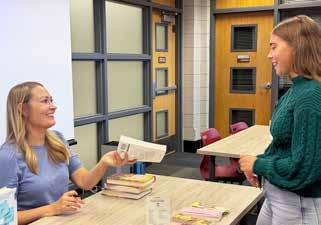
Utah County author Erin Stewart signs “Scars Like Wings” for a Jordan High student after sharing her writing experiences with the book club. (Julie Slama/City Journals)
WIGHTMAN LEGAL
Belgian Waffle & Omelet Inn serves up Christmas spirit
By Julie Slama j.slama@mycityjournals.com
The scent of waffles mixed with laughter and smiles from Jordan Valley School and Life Skills Academy students, honored as special guests, filled the Belgian Waffle & Omelet Inn. For more than 40 years, the Midvale restaurant has opened its doors and its heart and turned an ordinary meal into a holiday tradition, complete with a visit from Santa Claus.
“It wouldn’t be Christmas without Jordan Valley being here,” said owner Jeff Wilhelmsen, who has continued the tradition since 1983. “We’ve been happy to be able to do it.”
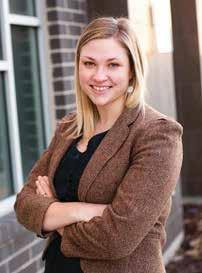
Rebekah Wightman, J.D.
Rebekah Wightman, J.D. is an experienced Estate Planning and Probate attorney. She takes pride in serving her clients and providing them a pleasant present and a peaceful future. Rebekah’s fun personality and commitment to her clients, make an often dreary experience “a-heck-of-a-lot-of-fun”!
Students at nearby Jordan Valley School have severe multiple disabilities, many who are extremely medically fragile. The goal at Jordan Valley is to improve the quality of life for its 70 students, age 5 to adult, and their families.
The holiday tradition began when Wilhelmsen partnered with the late Kerm Eskelson, Sr., who was the building’s landlord at the time.
“He said, ‘let’s do this to help these kids,’” Wilhelmsen said. “He covered 50% in cash, and I covered the rest. When he passed away, we continued doing it on our own. He was a real good guy.”
This year, more than 100 students and staff from Jordan Valley came as well as for the first time, about 50 students and staff from Life Skills Academy, Canyons School District’s post-high adult transition school which provides instruction and training to students with special needs who have aged out of traditional high school.
All the meals were fully paid for by the restaurant and Santa arrived with treat bags filled with juice boxes, candy canes, clementines and chocolate Christmas trees.



“They roll out the red carpet; they have so much love for our students,” said Jeff Honsvick, first-year assistant principal at both schools. “Talk about the spirit of Christmas, this is incredible.”
Honsvick said the experience goes far beyond a holiday party.
“I’ve worked 15 years at a school similar to this and I’ve seen the incredible outreach of the community before, but there’s something about a business welcoming the entire school that just gives me goosebumps,” he said. “Seeing the students be successful in the community is huge for me.”
For many students, eating at a restaurant is a rare opportunity.
“A lot of our students don’t get the chance to eat in a restaurant,” said Rachel Murphy, Jordan Valley administrative assistant who coordinated the school’s visit. “Some parents feel worried about people and crowds, so this gives them the experience to be in the community they don’t normal have.”
Life Skills Academy Principal Stacey Nofsinger said those experiences are hard to replicate at school.
“You can only teach so much in a class-



room,” she said. “So, they’re learning how to go to a restaurant, how to order, how to use their social skills.”
To help students be successful, Murphy said those who use devices to communicate, had preloaded choices and comments added so they could interact with the restaurant staff and when they met Santa.
“This helps them be more independent,” she said.
The place is familiar to some students, who come on a regular basis to learn practical skills. For years, Belgian Waffle has served as a job site for students.
“They fill salt and pepper shakers, wipe tables, wipe menus, bus tables, vacuum; they’re helping us and getting experience,” said Cheryl McCormick, a longtime staff member who has worked the event with Jordan Valley for 17 years as her mother did before her. “I love having them here. These are my kids. When they see Santa Claus, it makes my year.”
Nofsinger, too, enjoys the interaction: “Just seeing happiness, both my staff and students as well as the Belgian Waffle staff and how they love this, is fun for me.”
The restaurant remains open to the public during the holiday meal for the schools— and touches those patrons as well.
Matthew Smith, a sports videographer from Casper, Wyoming, who happened to stop in that day, said the party was “amazing.”
“Kids with disabilities almost never get out and it’s important they’re given these social interactions in these environments,” he said. “It’s what life is all about.”
For the Belgian Waffle staff, the purpose has never changed.
“This place is always open to these students,” Wilhelmsen said.
McCormick added: “And that makes my heart happy.” l
Jordan Valley students got a visit with Santa Claus while being treated to a holiday party at the Belgian Waffle & Omelet Inn. (Julie Slama/City Journals)
Books bring Alta students together
Alta High students are lining up for books, author visits and reading events that are making the library the school’s hub.
By Julie Slama j.slama@mycityjournals.com
Nearly 70 Alta High students filed in after school to welcome graphic novelist Joanna Taylor share insights into her first book, “The Ghostkeeper.”
It marked Taylor’s first school visit after months of coordination and planning with Alta librarian Amanda Siler, whose goal is to build a strong reading community through meaningful author connections.
Taylor’s graphic novel, which was released in July 2024, blends fantasy with mental-health themes and was inspired by Oscar Wilde’s “The Canterville Ghost.”
“I thought what if someone’s job was to go to haunted houses and ask the ghosts about their feelings,” Taylor said.
Siler summarized it as “the story of a therapist for ghosts who helps them cope with grief, death and regret, so they can move on to the next life while also grappling with his own mental health struggles.” She added the book “discusses coping skills, real therapeutic techniques and boundary-setting through a Victorian fantasy backdrop.”
Alta High sophomore Shelby Bennion said she “absolutely loved it,” especially how the story came together at the end.
Taylor took an unconventional path to becoming an author. Originally, pursuing animation at Brigham Young University with dreams of working for Pixar or Disney, she was forced to pivot following a repetitive strain injury. That led her toward illustration work and comics.
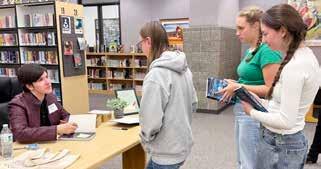
premise, and she showed with the characters how things can spiral out of control fast,” Boudruau said.
Siler said graphic novels have become one of the most popular formats in the library.
“There’s been a ton of research that shows graphic novels support visual literacy,” she said. “It supports storytelling; it supports narrative. It gives all the things we hope students obtain from reading, but in a more visual way.”
Taylor’s visit was part of Alta’s monthly book club meeting, which includes not only students, but staff. It’s a place of inclusion and creativity—and belonging.
During COVID-19, she saw a pitching event on Twitter. “I had a lot of time on my hands, so I decided I’m going to take a big swing,” she said.
That leap resulted in a book deal with Penguin. Taylor committed to the project by quitting her job and working on the book full time. She wrote and illustrated the book with Micah Myers serving as the book’s letterer.
After her book presentation, Taylor answered questions ranging from her writing process to the theme of healing. She revealed that initially she had her villain survive, but she knew he needed to die.
“He met his fate in a poetic way,” she said. “But I knew Dorian (the therapist) would survive and make amends. He needed to come to terms with the abuse and make some measure of peace. He learned he needed to do his part with a clear conscience, but the healing comes from within.”
Alta junior Taylor Boudruau said the book felt realistic in its portrayal of mental health. “It had a really unique

“Book club is my absolute favorite thing I do at school,” said junior Ainsley Gorringe. “You get free books and meet great people and it’s a community where everyone is welcome. It’s a place we can go and geek out and feel nerdy, and nobody is going to judge you.”
The club regularly hosts themed activities, such as creating ghosts around the library that were inspired by “The Ghostkeeper.”
Senior Afton Harrison said the club also encourages students to explore new genres. “Normally, I read fantasy and romance, but in book club, I read graphic novels and historical fiction and mystery—stuff I typically wouldn’t read.”
Senior Lucy Denzer adds that it’s not just books that expand horizons for some students: “It’s socially too. Some students are so quiet until they come and find common interests here.”
Siler said that fostering this environment is intentional. “One of my primary goals as a librarian is that students can have a positive experience with reading and in the library,” she said. “If I can get students excited about reading, have authors come and have fun engaging activities to make it a community, more students engage and see themselves as readers.” l



“The Ghostkeeper” author and illustrator Joanna Taylor talks with Alta High Book Club students. (Julie Slama/City Journals)
Alta View named National PTA School of Excellence
Alta View received the National PTA designation, recognizing the school’s ongoing effort to strengthen family engagement and support student success.
By Julie Slama j.slama@mycityjournals.com
lta View Elementary has been recognized as a National PTA School of Excellence, a designation awarded to schools that demonstrate strong family-school partnerships and a commitment to student success.
The National PTA School of Excellence program is a two-year initiative that guides schools through a process of gathering family and staff feedback, creating an action plan and reflecting on the progress. The goal is to strengthen communication, inclusion and shared decision-making between schools and families.
PTA President Dawn Davis said the recognition reflects years of consistent effort by parents, teachers and administration.
“We have a really active PTA at Alta View and we have for years,” she said. “I assumed that was normal until now that I’m more heavily involved and realize that it really isn’t. We’re lucky.”

The work that led to the award was spearheaded by Katie Rowley, last year’s PTA president and current membership officer. Rowley led the application, deploying surveys to families and staff, analyzing feedback, implementing improvements and submitting a final reflection to the National PTA.
“Our PTA is dedicated to emphasizing a strong home-school connection and student success,” she said. “It definitely was a community effort.”
Feedback from participants highlighted several key areas for growth, including the welcoming and inclusive school environment, two-way communication about student progress, support for learning at home, increased advocacy and opportunities for families to participate in decision-making. Language access and cultural representation also were identified as priorities, especially for Alta View’s Spanish dual immersion community.
With that input, the PTA established a two-year plan to foster inclusivity, to make improvements with efforts in enhancing communication through multiple platforms and to strengthen parent involvement in decision-making.
“We worked hard on educating people about what they could do for their voices to be heard: attend the PTA meetings, come to the SEC meetings, follow on Instagram,

read the newsletter on Parent Square, make sure that you are completing the surveys when they’re sent out; send a message to your child’s teacher—and even, here’s a list of questions that you can ask when you go to parent teacher conference,” Rowley said. “Again, our principal welcomes communication. He wants to be involved and help people so send him an email with questions.”
She said it resulted in parents having a better knowledge on the school and who to talk with about their concerns.
“When we sent a follow-up survey, they said, ‘Now I do know how to reach out. Now I do know how to get in contact with people. I know how to have my concerns heard. I know how to get something on the SEC agenda. I know how to bring something up with the PTA board. I know who to talk to in the classroom and the school,’” Rowley said. “I know sometimes as parents, we just go with the flow. But we’re here to help people have a voice and ask questions above and beyond to gain that understanding. We are here to empower and enable people to find their voice and know the different channels they can get information and ask questions they have.”
Alta View’s success also reflects a collaborative school culture where parents consistently volunteer their time, support schoolwide events

and partner with teachers to enhance learning opportunities from assemblies and field trips to family engagement activities.
Principal Scott Jameson said it’s the second time the school has received the honor in recent years.
A banner now hangs at Alta View recognizing the honor. Alta View was one of six schools in Utah to receive the recognition. Draper Elementary also earned the two-year designation. l






Alta View Elementary, a Sandy dual immersion school, was recently named a National PTA School of Excellence. (Julie Slama/City Journals)
Don’t ignore signs of the winter blues
Thousands of Utahns deal with Seasonal Affective Disorder.
By Peri Kinder peri.k@thecityjournals.com
For many people in Utah, the “winter blues” show up as exhaustion, a lack of motivation and low energy. While the dark nights and cold days can make anyone irritable, if symptoms of weariness or sadness last more than two weeks, it could be a sign of Seasonal Affective Disorder.
While the national SAD rate is around 5%, it’s estimated that 10% of Utahns experience SAD each year. Environmental factors like the annual inversion, limited sunlight and disrupted circadian rhythms contribute to an overall emotional slump.
Dr. Jason Hunziker, Division Chief of Adult Psychiatry at the University of Utah, said SAD is a type of depression affected by low light exposure that can heavily impact the way people function. It can show up as low motivation, a higher intake of carbohydrates, excessive sleeping or just feeling off.
“People get up in the morning and it’s dark; they come home from work and it’s dark, and it affects them,” Hunziker said. “It begins to interfere. You’re getting to work late, you’re not keeping up at work and you’re not getting to school. Your relationships are starting to become fragile, and there are more arguments or isolation. You start to feel hopeless.”
While brief periods of sadness are common, SAD symptoms lasting two weeks or more should be considered serious, and it might be time to talk with a professional, especially if the depression includes thoughts of self-harm or suicidal ideation.
Hunziker said one of the best ways to combat SAD is through movement, outside if possible. Moving the body releases endorphins that provide a sense of well-being and it can take the mind off worry or stress.
“One of the biggest things people forget to do in the winter is move,” he said. “Go out for a walk, go to the gym, run on the treadmill at home, just make sure you’re trying to do something. It’s best if you’re outside because the cold air and the sunlight, all of those things we need are outside.”
Light therapy is another effective way to treat SAD symptoms. Whether you take a 20-minute dog walk or sit in front of a light therapy lamp, the benefits will pay off in the long run.
Healthy eating plays a big role in how people feel in the colder months. Winter meals and snacks often contain carbheavy comfort foods but the more fresh produce that can be incorporated into a diet, the bigger the reward. Staying connected to loved ones is another way to improve mental health.
“We isolate in the wintertime but we need to make sure we’re meeting with family and friends, and reaching out to them all the time,” Hunziker said. “There are so many ways that we can help when things start to go the wrong direction. Let’s not let it get too far down the road before we do something.”
For people prone to SAD some pre-winter planning may help. Create an autumn toolkit to help avoid the deep depression associated with the disorder. Set up a therapy appointment in early September and plan on filling anti-depressant medication in early fall, so it has time to work.
Having things to look forward to can help alleviate SAD symptoms. Schedule fun events for the winter or plan a weekend getaway.
For those who need crisis help, key resources include the 988 Suicide & Crisis Lifeline number and the SafeUT

Walking outside is a top recommendation for alleviating symptoms of Seasonal Affective Disorder. Taking a proactive approach to seasonal depression can help those who struggle with mental health in the winter. (Adobe stock)
App, an app that allows students to call a licensed counselor for free, at any time of the day or night.
“If you don’t know where to start, start with your primary care doctor and let them know what’s happening,” Hunziker said. “Make sure you’re moving, make sure you’re getting light, make sure we’re taking care of our bodies and keeping our connections. Don’t ignore that stuff.” l
•
•





Brighton’s ‘most impressive two-sport athlete’ makes lasting impression
Not only does Sophie Nielsen excel on the field, she also is a 4.0 GPA student.
By Jerry S. Christensen j.christensen@mycityjournals.com
Brighton
athletics won’t soon forget Sophie Nielsen, a two-sport athlete making lasting marks in both basketball and lacrosse. The one-time freshman phenom is now the prolific senior who on Dec. 29, 2025 in a basketball game at home versus American Fork set the all-time scoring record for the 56 years of Brighton’s existence. The 1,322 career points scored by Vanessa Hudson Duerson (BHS ‘05) stood as the high-water mark for 20 years. Duerson was named Ms. Basketball for the state of Utah in 2005 and led the Bengals to back-to-back state championships.
When notified that her career scoring record had just been eclipsed, Duerson responded from her home in South Carolina. “I am both grateful and flattered, and I am very happy for Sophie Nielsen. Kudos to her for a wonderful achievement,” she said. Her 2005 Brighton coach, Jim Gresh, long since retired recalled that “Vanessa was a John Stockton-like point guard that could really score. Her basketball IQ was off the chart. She was exciting to coach and watch.” Duerson went

on to play collegiate basketball at BYU.
Nielsen, a 5-foot-9 guard/forward, is committed to play at the next level at Colorado Mesa University in 2026. She and her father realized last year when she scored her 1,000th career point as a junior that a new record might be within reach.
“My dad and I saw I was only about 300 points from breaking the school’s record. We joked about how cool it would be but it


was nothing serious. I didn’t truly believe it was an opportunity until a couple games into this season. I was playing well and putting in more work than I ever had before, and it seemed like my dream could finally come true. To me, breaking the record meant everything I had done was worth something. All of the extra hours in the gym after practice, missing out on opportunities with friends, it was all helping me become the best basketball player I could be,” Nielsen said.
“Sophie’s biggest strength is her work ethic. She constantly sets the example with the efforts she puts forth on and off the basketball course,” her current coach Kane Stokes is quick to point out. Her father, Doug Nielsen, quips, “A funny storyline is that since early this season when we saw the record possibility she wouldn’t eat junk food or soda until she broke the record. On the day of breaking the record she brought root beer and crap to celebrate and eat after the game.”
Nielsen is currently listed on the national MaxPreps website as the 20th most prolific scorer in 2026 girls basketball for the nation. Unintentionally, Nielsen eclipsed another record—the boys career scoring basketball record of 1,259 points set by Brandon Miller in 2013. With nine games left to play, she is likely to set high marks that may endure multiple decades for Brighton boys and girls basketball.
Speaking of high marks, besides being an elite athlete, Nielsen is a 4.0 GPA student with a near perfect ACT score. “Sophie is one of those student-athletes that doesn’t come along often. She sets a high bar because she not only excels in sports, but in everything else she does. Not everything has been
easy for Sophie, and I can honestly say that I have not seen someone who can overlook the challenges and focus on what matters more than Sophie. We’re so proud of her basketball accomplishments but more than that, we’re proud of the way she represents Brighton High School in all aspects of her life,” Brighton Principal Marielle Rawle said.
Nielsen is no less fierce on the lacrosse field than she is on the basketball court or in the classroom. Last year, as a junior, she was named All-American and All-American Academic and chosen to play on the Utah National Team (making her one of the best 20 girls lacrosse players in the state). Her excellence-demanding lacrosse coach Melissa Nash noted, “Sophie is a legend on Brighton’s basketball court and lacrosse field. She has added so much to our team—goals, assists, draw controls, ground balls and huge defensive stops. Not only an amazing player but she leads the team with her leadership, work ethic and kindness too.”
And as the basketball season draws to a close, she trades her No. 4 basketball jersey for No. 4 lacrosse jersey and a final high school sports season. “Sophie may be the most impressive two-sport athlete Brighton has ever produced,” said Brighton’s Athletic Director Garrett Wilson. Not coincidentally, she is one goal away from becoming the all-time scoring leader in Brighton girls lacrosse—she has 111 goals to her credit just behind Caroline Lee’s career mark of 112 goals. She has the potential to eclipse the boys lacrosse scoring record as well.
It could be another soda-free sports season. l
Sophie Nielsen set the record for career basketball scoring. (Photo courtesy Kane Stokes)
Sophie Nielsen has 111 goals in her Brighton lacrosse career. (Photo courtesy Melissa Nash)






















New report suggests half of Utah’s young students are unable to read at proper grade level
While the study can’t pinpoint a singular cause, it does stress the importance of students meeting age-appropriate standards as a means to ensure future success and economic prosperity.
By Lizzie Walje l.walje@mycityjournals.com
Anew report is spelling out an alarming reality for Utah’s youngest residents, as it indicates that half of them are unable to read at their corresponding grade level. This reality is not isolated to a few districts or schools within the state. Rather, the report shows glaring deficiencies at a statewide level.
The report was published by the Kem C. Gardner Policy Institute at the University of Utah, shortly after the beginning of the 2026 calendar year. It details some troubling information, revealing that a large percentage of K-3 students in Utah have failed to meet appropriate grade-level expectations. Per Utah’s state policy, a student is considered to have satisfied grade-level expectations if they meet or exceed a score of 405 on the end of year benchmark reading assessment. The study’s data showcases that just 50.3% of third graders are achieving appropriate proficiency.
Utah is seemingly not alone in this issue, and it’s not just young children who are currently affected. In September 2025, The Harvard Gazette reported that reading scores for high school seniors, released by the Nation’s Report Card, had fallen to their lowest level since 1992. It was the first year that high school seniors had taken the nationwide test since the Covid-19 pandemic, revealing a disturbing divide between the nation’s highest and lowest achieving students.
While some may argue this is a sensible conclusion given the challenges that plagued teachers and students during the height of the Covid-19 pandemic, research suggests that scores have been steadily declining, predating the pandemic.
According to Martin West, an academic dean and a professor of education at the Harvard Graduate School of Education and the deputy director of the Program on Education Policy and Governance at the Harvard Kennedy School, “American students’ literacy skills peaked in roughly the middle of the last decade and have fallen significantly since that time.”
When asked about why West believes this is happening, he could not offer a singular answer, as usually these types of issues are multifaceted and can occur due to a range of differing and intersecting factors. He did however say that “I don’t think we

have smoking gun evidence that the rise of screen-based childhood is a direct contributor to the literacy trends that we’re seeing. But I’m willing to put it very high on my list of potential suspects.”
In Utah, Andrea Thomas Brandley, the lead author of the Gardner Policy Institute’s report, explained why it’s so important that students meet the necessary benchmarks of literacy, especially when it concerns third graders in particular. “We look at third grade specifically as like a pivot point,” she said. “Prior to third grade, students are spending a lot of their time learning to read, and then after third grade, they’re doing a lot of reading to learn.”
While K-3 literacy issues have permeated schools and districts at the statewide level, there are a few interesting outliers. Notably, Salt Lake City School District is one of 17 districts that failed to reach proficiency in 50% of its students. Only one district in the state, Park City School District, was able to reach 70% proficiency, reporting 70.1% in 2025.
Other statistics further complicate the issue, with the study reporting that only 18% of third-grade students with limited English-language proficiency and 35.2% of economically disadvantaged students met grade-level expectations. Furthermore, reading proficiency varies widely, with English-language learners, students with disabilities, and Hispanic/Latino students also performing lower, on average, than their peers.
Literacy, or lack thereof, has very real
consequences that can impact a student’s life well into adulthood. Strong early literacy skills are proven to be foundational for future academic success and achievement, higher graduation rates, better employment prospects, and overall health and civic engagement. The study also emphasizes that early experiences are important. Of which, they cite language exposure, shared reading, and high-quality early learning environments as critical for a child’s readiness to read.
“Research indicates that nearly all children can learn to read with systematic, evidence-based instruction and targeted support,” a summarization of the study released by the Kem C. Gardner Policy Institute said.
In spite of the dire news expressed by the data, there were a few silver linings. Among them, some indication of advancement, with kindergarten proficiency actually improving, jumping to 53.3% in 2025 from 37.7% in 2021. The state also vows that they intend to respond aggressively to the issue with policy changes. Utah’s Early Literacy Outcomes Improvement Act (SB 127, 2022) aims to address these challenges by setting a statewide goal of 70% third-grade reading proficiency by 2027 and strengthening supports.
While policy design is important, the study’s summary affirmed, the study also highlighted the need for policy to be consistent and well implemented overtime. Policy should also be integrated to align with current curriculum and aided by teacher support. Furthermore, it is beneficial for the
issue to be recognized within the student as early as possible, with targeted interventions performed to help promote improvement.
One state in the union has shown marked improvement in elevating their literacy and reading rates is Mississippi. Ironically, Mississippi consistently ranks poorly when it comes to overall education outcomes. However, they’ve seemingly been able to target their own literacy issues successfully.
In 2013, fourth-grade students in Mississippi were ranking 49th overall in reading scores but had impressively managed to climb to ninth overall in 2024 thanks to what the Gardner report claimed was a “multi-year, coordinated approach and the state’s emphasis on implementation quality, rather than any individual reform acting alone.” The report specifically points to Mississippi as a point of reference for Utah to closely follow.
As for Brandley’s specific thoughts regarding how to improve the literacy issue, much like West, she acknowledges there is no one size fits all solution. However, she does believe in the importance of addressing these issues holistically.
“Particularly, when kids are 0-5 [years of age]. It’s the most rapid brain development we experience in our lives. While we don’t know the cause necessarily, I do think this is a critical time to make sure that students are exposed to language and books and conversations and storytelling with caregivers. That helps build a foundation for them to be ready more formally when they enter school.” l
The Kem C. Gardner Policy Institute at the University of Utah released a study that spells out literacy trouble for Utah’s youngest residents. (Adobe)
Business leaders forum discusses challenges with government regulations
Leaders gather to discuss the overregulation of their businesses during a forum sponsored by the Intermountain Business Alliance.
By Tom Haraldsen t.haraldsen@mycityjournals.com
Aside from the need for financial support and strength, there may be no larger challenge for businesses than government rules and regulations. That was the message shared by and with participants in the Utah Regulatory Reform Listen and Learn Forum held on Dec. 17 at the Salt Mine Productive Workspace in Sandy.
The forum was the third in a series of such meetings planned by the Intermountain Business Alliance, designed to bring Utah business leaders together to discuss real-world barriers and develop practical reforms to strengthen Utah’s economic competitiveness.
“The most terrifying words in the English language are ‘I’m from the government and I’m here to help you,’” said Trent Staggs, outgoing mayor of Riverton and now the U.S. Small Business Administration advocate for Region 8. “The cost of regulation in this country is staggering. The National As-
sociation of Manufacturing says it believes regulation alone is costing businesses $3 trillion a year. That’s almost 15% of our GNP.”
One example he pointed to is Form 941, the quarterly reports businesses are required to file with the IRS. Shifting that to an annual report, he said, could result in a $90 billion savings for businesses.
As mayor, and now in his role with the SBA, Staggs is advocating for less regulation and more common sense when it comes to the rules of the road in business. A strong advocate for President Trump, he praised Trump’s Executive Order 14192, which says that for any new regulation an agency wants to implement, it has to eliminate 10 others already on the books. He stated that another executive order from Trump charges all agency heads to look at current rules and identify those they feel might be unconstitutional.
“Just this summer, the National Small Business Association asked all businesses across the country what the most painful resource of regulations was, and they stated the federal government by far,” Staggs said.
“Rules that come from these federal agencies are by people not elected to their offices. Congress to a large degree, I believe, has abdicated much of its responsibility by delegating the rulemaking authority to these unelected bureaucrats. The net result of this overregulation is it keeps you from making
LOCAL
profits and hiring people. Deregulation will help the economy.”
Speakers at breakout sessions during the forum covered a wide range of areas where regulations have large impacts. Those include agriculture and agri-business, construction and infrastructure, tourism and hospitality, manufacturing and mining, technology, banking and finance, and health care and insurance.
Corinna Harris, president of the Intermountain Business Alliance, said its goal is to “ensure businesses stay in business, by driving meaningful regulatory reform and removing barriers to growth at every level of government.”
“We are holding two more forums in the next week, on Jan. 9 in Eagle Mountain and on Jan. 12 in Nephi,” she said. “We’re also publishing a newsletter with comments and suggestions shared at these forums.”
She wants to see a united effort by local business owners and government leaders to make meaningful changes in regulatory practices.
Staggs told attendees the list of most wanted issues concerning business owners can be found on the SBA website at advocacy.sba.gov. Harris said more information about the alliance, or suggestions for changes, can be sent to her at charris@intermountainbusinessalliance.com. l



Trent Staggs, U.S. Small Business Administration advocate for Region 8, discusses the problems that government regulation is causing businesses in Utah and throughout the nation. (Tom Haraldsen/ City Journals)
Local officer helps launch peer-led support group for first responders
The Watch will offer drop-in, peerled sessions intended to support first responders from across Salt Lake County.
By Shaun Delliskave s.delliskave@mycityjournals.com
Anewpeer-led support group aimed at first responders across Salt Lake County will begin meeting in Murray later this month, offering a confidential, non-clinical space for participants to talk with others who understand the unique pressures of the job.
The group, called The Watch, was founded by Murray City Police Officer Benjamin Gregoire, who said the idea grew out of both personal experience and conversations with colleagues across agencies.
A critical incident he experienced in the line of duty last year, Gregoire said, became a turning point and underscored for him how limited accessible, peer-based wellness resources are for first responders in Salt Lake County.
Gregoire said that beyond formal peer support teams, there are few places where first responders can speak openly with others who share similar experiences. He also
observed that first responder culture often operates in silos.
“Police tend to stay with police, fire with fire, dispatch with dispatch—even though we often carry very similar stressors and trauma,” he said. “The Watch grew out of a desire to create a shared space that breaks down those barriers.”
Unlike traditional mental health programs, The Watch is intentionally peer-led and non-clinical. Gregoire emphasized that the group is not designed to replace professional care.
“There are no clinicians, no diagnoses, no notes, and no treatment plans,” he said.
“It’s a space grounded in shared lived experience. While professional mental health care is critically important—and encouraged—The Watch is designed to complement those resources, not replace them.”
Sessions are structured to be low-pressure and accessible. Meetings will last one hour and are drop-in, meaning participants can attend as their schedules allow. At the start of each session, guidelines are reviewed to establish expectations and safety. From there, discussion is participant-led.
“If there’s a lull, a simple prompt— such as ‘What brought you here today?’— may be offered,” Gregoire said. “But there is never any pressure to speak. First-time attendees can expect a low-pressure envi-

ronment where listening is just as welcome as sharing.”
Confidentiality is a central principle of the group. Gregoire said participants verbally agree to keep what is shared within the group confidential and that rank does not factor into the space.
“Rank does not exist within the space—everyone is equal,” he said. “If administrators attend, they are held to the same standards as everyone else.” He added that the confidentiality protections outlined in Utah’s peer support statute apply and are communicated at each meeting.
Murray City has played a supporting role by approving the group, providing meeting space, administrative assistance, and help with outreach and marketing. Gregoire stressed, however, that The Watch remains independent.
“It is not a Murray City Police Department program, nor does it report back to any department,” he said. “Murray is hosting and endorsing the effort, but the group itself remains peer-driven and separate from departmental operations.”
Gregoire hopes the group will help address lingering stigma around seeking help, particularly for those who may feel overlooked.
“Dispatch and corrections professionals, in particular, are often overlooked in

Rotary Club of Sandy
WEEKLY MEETINGS: Wednesdays at 12:15 pm
LOCATION:
Canyons School District Offices 9361 S. 300 E., Sandy UT
“We impact our community to support the rising generation locally and around the world.”
TAKE ACTION WITH US!


wellness conversations despite facing significant cumulative stress,” he said. “The Watch aims to create a starting point—normalizing peer support and making it easier for people to show up without fear or judgment.”
The first meeting is scheduled for Jan. 14, and while no sessions have yet been held, Gregoire said early interest has been strong. “We’ve already received strong informal interest from a wide range of agencies and disciplines,” he said.
Looking ahead, Gregoire said success would mean broader cultural change. “Success, to me, would look like peer support becoming more normalized within first responder culture and administrations taking wellness more seriously as a core responsibility—not an afterthought,” he said. He added that he hopes similar groups will eventually form in other counties, noting that “Davis County Sheriff’s Office is beginning something along those lines, which suggests this is a need being felt beyond just Murray or Salt Lake County.” l




Officer Benjamin Gregorie takes the oath of a police officer. (Photo courtesy Murray Police)


Salt Lake County
justice reform bringing
solutions
Salt Lake County is responsible for many of the region’s core public safety functions, including jail operations and serving as the behavioral health authority. About 74% of the county’s general fund budget is dedicated to public safety. As the government agency responsible for these essential countywide services, we regularly evaluate our systems to ensure delivery of better outcomes for people, public safety and taxpayers.
That responsibility is what led Salt Lake County to partner with Judge Steve Leifman and The Leifman Group, nationally recognized leaders in behavioral health and criminal justice reform. In Miami-Dade County, Florida, Judge Leifman’s work helped establish one of the nation’s most successful diversion models, the “Miami Model.” The model redirects individuals with serious mental illness from jail into treatment and recovery. That approach led to dramatic reductions in arrests and recidivism, a significant drop in the jail population—saving millions of taxpayer dollars while improving public safety and enhancing lives throughout Miami-Dade County.
Over several months last fall, Salt



Lake County convened more than 100 leaders from across the state and region— including state leaders, city officials, courts, law enforcement, service providers, advocates and philanthropy— to learn from the Miami Model and identify ways to implement the model here at home.
This engagement builds on years of work already underway. In 2023, Salt Lake County partnered with the State of Utah and Salt Lake City to advance the Coordinated Homeless Services Plan. In 2024, Salt Lake County Mayor Jenny Wilson launched the County’s first five-year Human Services, Homelessness and Criminal Justice Reform Action Plan, prioritizing early intervention, service coordination and accountability across systems. We’ve

also partnered with Salt Lake City on the planning and implementation of their Public Safety Plan. These efforts reflect a shared understanding that fragmented systems lead to repeated crises—costly for families, communities and taxpayers.
The data drives the need for action. Today, the Salt Lake County jail functions as Utah’s largest mental health provider. Roughly 34% of people leaving the jail exit directly into homelessness. Jail is among the most expensive—and least effective— way to address untreated mental illness and substance use disorders. Diverting individuals with serious mental illness from repeated, low-level incarceration into structured treatment and supervision is not about leniency; it is about accountability, public safety and using public dollars wisely.
Salt Lake County recognizes that simply replicating another community’s model is not what’s needed. Instead, the county is applying proven principles through a local lens—recognizing our specific responsibilities, what our population needs and what will work here. What has emerged clearly is the strength already present here: committed service providers, engaged public safety partners and a
shared willingness to align around practices that work. The Leifman Group’s recommendations focus on better coordination, improved crisis response and using shared data to guide decisions and track what’s actually working.
This work is also about leadership. Because Salt Lake County bears such a large share of public safety costs, we have a strong incentive to lead system improvement. Communities are safer when fewer people cycle through jail and our criminal justice system. Additionally, families are more stable, and taxpayer dollars can be reinvested into solutions that prevent crises before they escalate and that create lasting positive change.
At its core, Salt Lake County’s criminal justice reform work reflects a simple truth: when systems function better, outcomes improve for individuals and for the community as a whole. By leading with data, coordination and evidence-based solutions, Salt Lake County is working to improve public safety, support families in crisis, hold systems and individuals accountable, and ensure public dollars are used effectively for the benefit of the entire community.













TheFirst Amendment now comes with footnotes. Instead of promising not to abridge the freedom of speech, government officials are quietly redlining your opinions like a ruthless book editor holding a grudge.
The erosion of our First Amendment rights should wake you up like a five-alarm fire.
Banned Media. Reporters have been barred from the White House, kicked out of the Pentagon and have lost access to the press secretary’s office. A Washington Post reporter had her house searched by the FBI, relabeling journalists from “democracy watchdogs” to “people of interest.”
The president threatens the media licenses of organizations that don’t paint him in a flattering light. He’s sued networks for billions, ordered shows to be canceled and got Jimmy Kimmel fired. When millions of people canceled Disney and HULU, Kimmel was put back on the air, so I guess free speech can now be bundled with your subscription.
Banned Words. This melting pot we call America has outlawed diversity, equity and inclusion. That’s like taking the heart out of the Tin Man or the soul out of Hozier.
The Head Start early childhood programs were told to remove a list of 200 words in grant applications or the Death Star would blow up their facilities. Words like “belong,” “disability,” and “mental health” will get funding denied, so now applicants have to do an interpre-
Don’t be left speechless
Peri Kinder Life and Laughter

tative dance, acting out “equality” or “diverse.” Government leaders go ballistic if we use pronouns or call a trans person by their chosen name, yet expect the entire country to salute the nonsensical renaming of the Gulf of America or the Trump-Kennedy Center. It costs nothing to respect someone’s pronouns, but rebranding the Department of War will cost taxpayers more than $1 billion.
Banned Books. Having a library card is now an act of defiance. Utah loves a good book ban because nothing prepares kids for real life more than hiding information that makes them feel uncomfortable.
Utah already ranks at the bottom of education funding, but yes, let’s make our kids dumber by discouraging them from learning critical thinking skills or empathy. Reading as exploration is forbidden. Curiosity becomes taboo.
But if kids want to read a book, they’ll find a way to read it. A ban adds extra enticement, like putting chocolate sprinkles on an ice cream

sundae. We’re all for letting 18 year olds carry a rifle into McDonald’s, but heaven forbid they read “The Hate U Give,” which talks about a teen affected by gun violence.
Banned criticism. The First Amendment gives us the right to criticize anyone, even the president. You can slap bumper stickers on your VW, write columns or even burn the flag.
However, professors are being fired for political beliefs, protestors are tear-gassed and shot, and university funding is cut unless courses fall in line with this administration’s doctrine. Freedom of speech is now an extreme sport.
Here’s what’s not free speech: incitement, threats, defamation, obscenity and perjury. The president has threatened talk show hosts, slan-
dered Democratic leaders and there’s strong evidence he’s perjured himself several times. He is also protected under the First Amendment, but the president walks a Sharpie-thin line between free speech and hateful rhetoric. TrumpActionTracker.info documented 264 actions (as of Jan. 16) taken by the president and his administration during the last year to control information or spread propaganda. He’s all for free speech, as long as it’s only his.
History shows that free speech is as durable as steel, with the propensity to outlast those who violate it. The First Amendment doesn’t promise pleasant agreement but a safe space for necessary debate. Freedom of speech is not silent, and we shouldn’t be either.