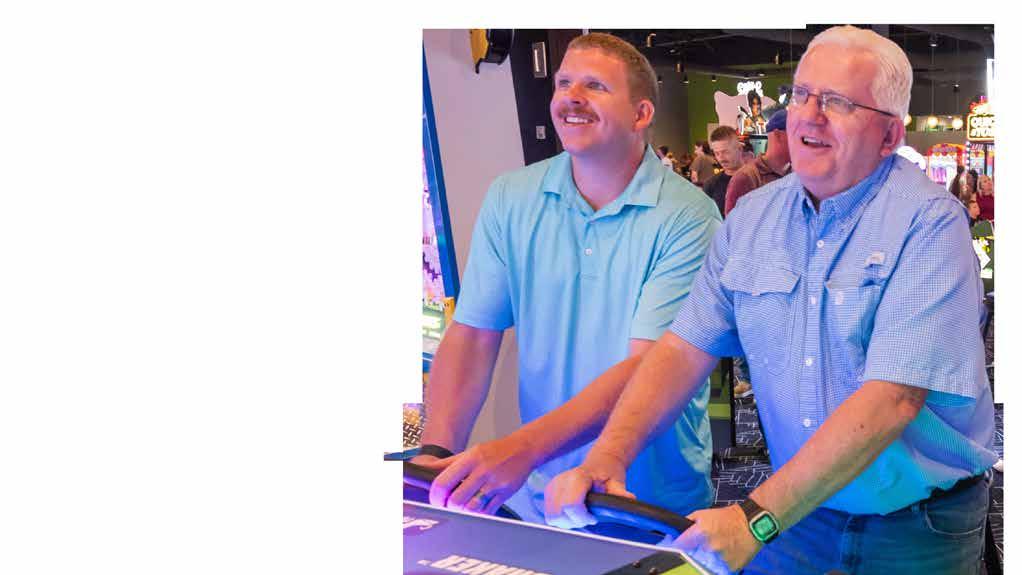
The FIFA World Cup soccer tournament that concluded on July 19 proved a great revenue generator for Utah businesses — especially bars and restaurants. Numbers are still to be finalized, but establishments statewide reported jampacked patios and extended hours for food and drink services during the sixweek event. (Tom Haraldsen/Salt Lake Business Journal)
Downtown SLC attracting the young, single and educated
Downtown Salt Lake City used to be just an exciting place to visit — go see the lights on Temple Square, take in a sporting event or maybe a Utah Symphony concert at Abravanel Hall, or spend more than you should for an anniversary dinner.
But that is rapidly changing, according to the Salt Lake City Downtown Alliance’s “2026 Economic Benchmark Report” published earlier this month. The alliance, a business partner of the Salt Lake Chamber, said that downtown is quickly evolving from a strictly business district to a genuine urban neighborhood.
In just over a year, between 2024 and 2025, the downtown residential population rose a full 9 percent, the report said. Even more stunning is that the city center’s residential population grew 63 percent between 2019 and 2025, reflecting a significant post-pandemic shift. Meanwhile, downtown office occupancy continues to lag behind pre-pandemic levels.
In its commentary on the study, the Downtown Alliance posits that this demographic shift is fundamentally changing downtown’s identity. Executive Director Dee Brewer describes the area as moving from a “vertical office park” to a true neighborhood where residents provide the consistent activity needed to support restaurants, grocery stores, retail shops, entertainment venues and public spaces around the clock, not just during business hours.
The Salt Lake City Downtown Alliance is a nonprofit organization founded in 1991 that represents more than 2,500 business and property owners. It promotes downtown as the region’s cultural and economic hub, coordinates the Downtown Street Ambassadors for public safety, and supports major community events like the Downtown Farmers Market.
And the change in downtown Salt Lake City may be just the beginning. The area is expecting as much as $10 billion in new investment over the next decade.
The Church of Jesus Christ of Latter-day Saints is spending millions to
prepare for next year’s open house of its overhauled Salt Lake Temple. The church is preparing the area around Temple Square for the anticipated “millions” of visitors — up to 20,000 per day between April 5 and the end of September. But the church’s spending is a drop in the bucket compared to the expected cost of preparation for the 2034 Winter Olympic and Paralympic Games, Ryan Smith’s revamp of a new sports and entertainment district surrounding the Delta Center, the renovation of the Salt Palace Convention Center and as many as 26 other downtown projects.
The Economic Benchmark Report describes the coming years as downtown’s “most consequential decade in more than 100 years.”
The report also offers a peek into who these folks are that are moving downtown. It says the new population is notably young and educated, with more than half under the age of 30 and a majority holding at least a bachelor’s degree. These demo-
see DOWNTOWN page 2
John Rogers Salt Lake Business Journal
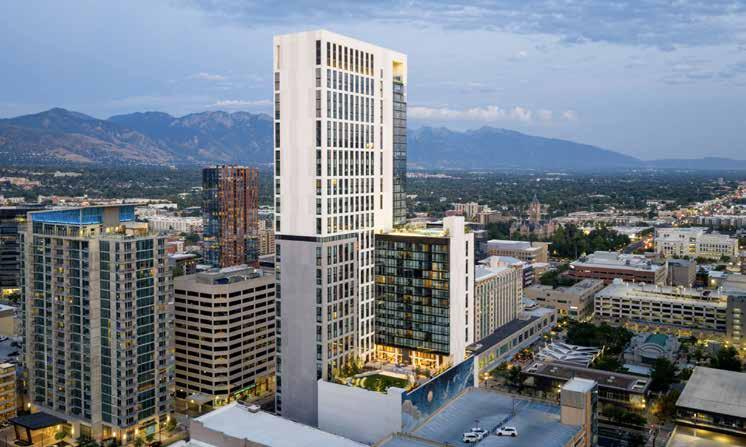
The Astra Tower on 200 South in downtown Salt Lake City (center) is one of many new residential options for people moving to the city’s center. Opened in 2024, the building has nearly 400 residential units as well as luxury amenities. The residential population of downtown grew 63 percent between 2019 and 2025, according to a new report from the Downtown Alliance. (Courtesy HKS Architects)
UIPA continues GSL preservation and economic development with $2.5 million investment
Kristina Walker
The City Journals
The Utah Inland Port Authority has announced a $2.5 million investment that raises its Great Salt Lake shoreline preservation and conservation funding to $7.5 million.
UIPA will work with the Utah Department of Natural Resources to support this preservation and evaluate opportunities to direct the funding to make the biggest impact.
“Salt Lake City’s relationship with the Great Salt Lake is personal,” said Salt Lake City Mayor Erin Mendenhall. “The lake shapes our air, our water, our wildlife, our economy and the daily lives of people across this region … especially in our westside communities. Protecting its shorelines and wetlands is one of the most
important ways we protect the health, resilience and future of the people who call this place home.”
Part of this preservation effort involves a buffer area between the edge of the GSL shoreline and further development.
“I do truly believe that this is a strong example of how economic development can coexist with land conservation, and we can all work together for a brighter future,” said Joel Ferry, the commissioner of the Department of Natural Resources.
Along with the investment, UIPA announced a new partnership with Utah Water Ways and discussed the draft of its Natural Resources Policy. This collaboration will pursue water-wise practices for future development in Utah.
These practices include helping Utahns choose the right plants, landscape designs and irrigation systems to help direct a healthier ecosystem, as well as creating
a new curriculum in schools to teach the water cycle and water infrastructure.
Utah Water Ways will work with UIPA to discuss responsible industry and growth — water will now be at the top of the list of things they consider before beginning development.
“This is exactly the type of partnership Utah needs as we plan for the future,” said Tage Flint, executive director of Utah Water Ways. “Water conservation cannot be an afterthought. By building water-wise practices into the front end of economic development, UIPA is helping set a stronger standard for how growth can happen responsibly in our state.”
UIPA’s focus on responsible development includes partnerships with Utah Clean Energy and Dark Sky Utah. These groups will aid in creating energy-efficient practices and lower the impact of light pollution in developing areas.
“Industrial growth creates economic opportunity, but it also creates real impacts,” said Ben Hart, UIPA executive director. “Our responsibility is to help communities plan for those impacts, reduce them where possible, and invest in solutions that create long-term value for Utah.”
Following this funding, UIPA will shift to a more consistent and collaborative approach to development, rather than individual planning. Officials say this new framework for area preparation will encourage businesses and communities to consider environmental impacts, including water use, when beginning to develop.
“This investment,” Hart said, “reflects the kind of responsible growth UIPA is committed to: growth that supports jobs, infrastructure and opportunity while also protecting the Great Salt Lake, conserving water and addressing impacts in the communities we serve.”
from page 1
graphics suggest continued demand for walkable neighborhoods, transit access, entertainment, dining and mixed-use development. The diverse population also strengthens downtown’s attractiveness to employers seeking to recruit highly educated workers.
The vast majority of the new downtowners commute less than 10 miles from home to work, the study found. Compared to other Wasatch Front residents, they’re more likely to not be married nor own a car.
According to the study, residential growth has also helped fuel broader economic gains. Consumers spent $2.1 billion on downtown shopping, restaurants, entertainment and accommodations during 2025 — a 6.1 percent increase over the previous year. Total customer activity reached 30.7 million customer days, reflecting stronger visitation by residents, workers and tourists alike. Attendance at ticketed events also climbed substantially, reinforcing downtown’s role as Utah’s cultural and entertainment center.
But the downtown excitement is not without challenges, and the report addresses some of them.
Office vacancy rates remain stubbornly high as hybrid work brought on by the pandemic continues to reshape demand for commercial space. The upcoming multi-year closure of the Salt Palace Convention Center for renovation will temporarily affect convention business and visitor traffic. The alliance also identifies a shortage of parks, trees and other green spaces — currently accounting for less than 2 percent of downtown’s land area — as a priority for future investment to make the area more inviting for residents and visitors alike.
The Economic Benchmark Report presents an overall optimistic outlook
for the alliance’s downtown contingency. The study suggests that long-term vitality will increasingly depend on building a place where people choose to live. The rapid growth in residential population is creating a more resilient downtown economy, one less dependent on the traditional nine-to-five workday and more capable of sustaining businesses, cultural institutions and public life throughout the year.
If the current trend continues, the report suggests that downtown Salt Lake City is well on its way to becoming one of the Intermountain West’s strongest examples of a mixed-use urban neighborhood.
UIPA’s executive director, Ben Hart, speaks about Great Salt Lake preservation investments. (Courtesy UIPA)
A drone photo of the Great Salt Lake, where UIPA on July 16 announced new funding for shoreline preservation and wetland conservation. (Courtesy UIPA)
Housing division in place in GOED
The Division of Housing and Community Development, created by HB68 during the 2026 legislative general session, is officially in place within the Governor’s Office of Economic Development. The division is charged with coordinating statewide housing programs and will back Gov. Spencer Cox’s push for more homebuilding.
The division will be led by Steve Waldrip, who will continue serving as senior advisor for housing strategy to Cox while assuming the additional responsibilities of state housing coordinator.
“Housing and economic opportunity are inseparable,” Waldrip said. “By bringing housing policy, programs and investments together under one roof, we can better support communities across Utah as they address local housing needs and advance the governor’s ambitious goals, including the governor’s goal of facilitating the construction of 35,000 starter homes for Utah families.”
As state housing coordinator, Waldrip will oversee Utah’s statewide housing strategy, coordinate housing-related programs and investments, and help ensure state housing initiatives align with broader economic and community development goals in alignment with the “Utah Elevated” economic development plan.
State government officials believe housing is one of the most pressing challenges
facing Utah, affecting economic competitiveness, workforce recruitment, and families’ ability to live in the communities they call home. The new division aims to strengthen coordination among state agencies, local governments and private-sector partners as Utah works to expand housing opportunities throughout the state.
The thinking is, consolidating existing and new housing programs and initiatives under a single division should better align housing policy, economic development and state investments.
“Housing is foundational to opportunity,” Cox said. “If young families, teachers, first responders and the people who keep our economy running can’t afford to live in the communities they serve, our long-term prosperity is at risk.
“This new division will help us better align state resources, local partnerships and private-sector innovation so we can build more homes, strengthen our neighborhoods and keep the Utah dream within reach for the next generation.”
Among the division’s duties are to administer several major housing programs
SLC Airport design in national contest
Public voting is now open for an art installation in Salt Lake City International Airport, which is up for the prestigious International CODAaward honoring outstanding commissioned art in interior, architectural and public spaces. To vote, visit https://codaworx.com/codaawards/top-100.
“River Tunnel” has been nominated among 100 specially selected works and is eligible for the People’s Choice CODAaward. Voting will be open through July 31. (Courtesy Jonathan Marder & Co.)
and funds, including the Olene Walker Housing Loan Fund and the Economic Revitalization and Investment Fund.
It will also support local communities through housing planning, technical assistance, and reporting on moderate-income housing.
The new division will also play a key role in implementing recent housing initiatives approved by the Legislature, including the $100 million State Housing Infrastructure Partnership Fund and its board, designed to help local communi-
ties finance infrastructure needed to support housing development.
“Utah’s continued economic success depends on our ability to ensure housing opportunities keep pace with our momentum,” said Jefferson Moss, GOED commissioner. “Aligning housing and community development efforts within GOED will strengthen coordination across state government and help communities make strategic investments that support both economic prosperity and long-term quality of life.”
Utah Championship returns to Ogden starting July 30
The Utah Championship presented by Zions Bank and Intermountain Health will return for its 35th edition July 30-Aug 2. The Korn Ferry Tour event takes place at the Ogden Golf & Country Club.
The Utah Championship is one of the original stops on the Korn Ferry Tour. Since its debut in 1990, the Utah Championship has produced a strong list of champions, including inaugural winner John Daly, Masters champion Zach Johnson, and Charles Schwab Cup titleholder Steven Alker.
The tournament is a community event that offers more than just profession-
al golf — it raises money for the tournament’s charitable partners and contributes to the PGA Tour’s unprecedented success in giving back to local charities. The Utah Championship has donated to various organizations throughout Utah, including the Tony Finau Foundation, Huntsman Cancer Institute, and For The Kids. Several local golfers traditionally play in the event, with the field to be announced in the days prior to its start.
For more information, visit UtahChampionship.com or follow Utah Championship on social media.
A row of homes soak in a sunset in West Haven in Weber County. The state has formed a Division of Housing and Community Development, hoping to see a boost in homebuilding in Utah. (Brice Wallace/Salt Lake Business Journal)
Former Davis High and BYU golfer Cole Ponich was among local golfers who played in the Utah Championship on the Korn Ferry Tour last year. The event returns to the Ogden Golf & Country Club July 30-Aug. 2. (Tom Haraldsen/Salt Lake Business Journal)
Steve Waldrip
Utah still a great place for relocation in ConsumerAffairs ranking
John Rogers Salt Lake Business Journal
If you’re considering leaving where you live for another state, you might think of Utah. After two years as the best state for relocation in the nation, Utah has fallen but still hangs on to the number two spot. That’s the opinion by analysts at online review platform and consumer news website ConsumerAffairs in their 2026 rankings.
Utah was dethroned from its two-year status as the best state for relocation in 2024 and 2025 by New Hampshire. Idaho, Virginia and Maine round out the top five.
The ranking is based on analysis of affordability, safety, economic strength, healthcare, education and quality of life metrics for all 50 states, according to Ella Gomes, a media relations specialist for ConsumerAffairs.
“In 2024 and 2025,” Gomes said, “Utah ranked as the number one best state to move to in the ConsumerAffairs report. This year, Utah has been dethroned by New Hampshire, which held the number two spot for the past two years.”
While still scoring high by ConsumerAffairs researchers in terms of economic strength, safety and affordability, the analysts found that Utah dropped slightly in areas of quality of life, healthcare and education metrics.
The ConsumerAffairs report still lists many factors that Beehive State residents can justifiably boast about, Gomes added.
In terms of economic strength, Utah rated number one in the ConsumerAffairs report. The analysts found that only 8.3 percent of Utahns live below the poverty level, lower than the national average of 12 percent; the state’s unemployment rate is at 3.8 percent, compared to the national average of 4.6 percent; and Utah’s jobs grew at a rate of 15.7 percent from 2019 to 2024.
Utah was also found to be among the safest states in the county, the report found. In recent years, Utah has recorded only 2.3 violent crimes and 14.09 property crimes per 1,000 residents. While that might sound like a lot, the national average is 3.6 violent crimes and 17.6 property crimes per 1,000 Americans.
Finally, Utah also scores in the top ten of U.S. states in terms of affordability.
The analysts report that living in Utah costs around 1 percent less than the national average, meaning that residents pay less for good and services than most Americans. Typical housing costs also account for 17.7 percent of the median household income for Utah families, just slightly exceeding the national average of 17.6 percent.
ConsumerAffairs is an American customer review and consumer news platform that provides information for major purchasing decisions. Founded in 1998, the company has been headquartered in Tulsa, Oklahoma, since 2010 and also has offices in Texas, the Philippines and Argentina.
New president named for Holy Cross Jordan Valley, West Valley hospitals
CommonSpirit Health has announced the appointment of Nathanael Budge as president of Holy Cross Hospital-Jordan Valley and Holy Cross Hospital-West Valley, effective July 19.
Budge will oversee the strategic direction, operations and continued growth of both facilities.
Budge, who most recently served as CommonSpirit Health’s Utah market vice president of strategy and growth, has also been acting as interim president of Holy Cross Hospital-West Valley since March. His extensive experience and proven leadership will be instrumental in advancing CommonSpirit Health’s mission in the Utah market, the company said.
“Nathanael’s deep understanding of
the Utah healthcare landscape, coupled with his strategic vision and dedication to patient care, makes him the ideal leader for these two vital hospitals,” Jeremy Bradshaw, CommonSpirit Health Utah market president, said in a release. “He has consistently demonstrated an exceptional ability to develop impactful strategies, foster growth and strengthen community relationships. We are confident that his leadership will be instrumental as we continue to expand our ministry
and enhance our services to meet the evolving needs of our communities.”
In his previous role as Utah market vice president of strategy and growth, Budge played a key role in developing comprehensive strategic plans for the Utah market, collaborating closely with market leadership, service line leaders and the physician enterprise. He also spearheaded and led the market Growth Council and was foundational in developing future plans for ambulatory expansion, including surgery centers, outpatient imaging, and free-standing emergency departments throughout Utah.
During his brief tenure as interim president of Holy Cross Hospital-West Valley, Budge worked with the leadership team to recruit new surgeons, en -
hance patient experience and quality measures, and fortify relationships within the community.
Budge’s career with CommonSpirit Health and its legacy organizations includes serving as administrator of Holy Cross Hospital-West Valley for four years, and prior to that, as chief operating officer for both Holy Cross Hospital-West Valley and Holy Cross Hospital-Jordan Valley for three years.
He holds a master’s degree in healthcare administration from Trinity University in San Antonio, Texas, and a bachelor’s degree in economics and business management from Brigham Young University. Budge is an active member of the American College of Healthcare Executives and ChamberWest.
New SLC ordinance aimed at regulating short-term rentals
July 1 marked the beginning of Salt Lake City’s crackdown on short-term rentals. On that day, a new ordinance went into effect that requires that units offered for rent on platforms such as Airbnb and Vrbo obtain city business licenses to continue renting to short-term occupants.
When the Salt Lake City Council passed the new rules, it said they would improve safety and reduce nuisances within the city. Under the ordinance, short-term rent-
als must be booked for a minimum of two nights, cannot be occupied for more than 200 nights per year and must provide at least one off-street parking space. Onenight bookings will no longer be allowed, in order to discourage house parties and reduce noise complaints
Buildings with 10 or fewer units are limited to one unit being offered for short-term rental, while larger buildings can only offer 10 percent of their units on a short-term basis.
The annual license fee under the new law is $198 for the first unit and $342 for each additional unit. If short-term rental owners are caught operating without a license, they could face a $1,000 fine for every seven days that a unit is rented.
The ordinance also requires that a local owner or manager be available and respond within two hours if contacted by the city about an issue with the rental.
Cities across the state are finding ways to
deal with short-term rentals. Between 2021 and 2023, short-term rentals ballooned by almost 40 percent statewide, according to data from the University of Utah’s Kem C. Gardner Policy Institute. Salt Lake County had nearly 5,000 short-term rental units in 2023, accounting for 1.1 percent of the county’s available housing.
Critics of the new ordinance say the changes could force some short-term rental owners out of the market entirely.
Although down a notch from the past two years, Utah still ranks as the second-best state in the nation for relocation. (Adobe Stock photo)
Nathanael Budge
AI program geared to simplify and expedite police reports
On average, a police officer can spend up to 40 percent of their time writing up reports, and they are often very similar to others, almost cookie-cutter in style. That can be a huge waste of valuable time, according to George Cheng.
It’s the reason he started his company, Code Four, and created Insight, an automated “detective” AI program built to streamline that reporting process.
“A case does not go cold because the lead was never there,” Cheng said. “It goes cold because the lead was buried. Detectives are still forced to study every case manually. With Insight, it can bring
all the information together. It does not replace the investigator, but it brings the information into focus, connects the evidence, shows the sources and prepares the case for review.”
He said modern investigations are buried across disconnected systems: records management systems, security cameras, body-worn camera footage, financial records, cell phone and tower dumps, and thousands of pages of unstructured reports.
“Insight can parse data from any RMS, and, without the need for integration, analyze video and documents, surface key connections, and identify timelines,” Cheng said. “That helps detectives find the signal inside overwhelming amounts of case information.”
The company began in May 2025 in
California, where Code Four is based, and is being used in over 120 departments nationwide. Utah has several departments where officers are using the program, including some officers in West Jordan, South Jordan, Taylorsville, Draper, Sandy, Midvale, Murray, Riverton. West Valley City, Millcreek, Herriman. Bountiful, Woods Cross, North Salt Lake, Centerville, Kaysville, Layton, South Salt Lake City, Eagle Mountain and Saratoga Springs.
“For officers, we offer a pretty lightweight patrol writing tool,” Cheng said. “It can take in the video and audio from an officer and write that up automatically into reports. We’ve spoken with many officers and asked them what they have needed. Then we created the program.”
Cheng believes that AI can help expedite the process and produce a report that offers cross-reference.
“There’s a lot of time-saving, but more importantly, savings from lawsuits that officers could be facing if they don’t write a good report,” Cheng said, “because reports that are inaccurately written can get torn apart by defense attorneys. We’re helping save officers’ careers. One reason I do this is that you can catch a criminal 10 times faster than if you are doing this by hand. We’re helping to work on unsolved crimes, and helping to keep cities safe.”
He said Insight can also be used by prosecutors and district attorney offices. More information can be found at codefour.com.
Over 120 departments in the nation have officers or detectives using the system to create their reports. (Courtesy Code Four)
Officers and detectives can spend up to 40 percent of their time writing up reports after an arrest, a process Code Four says it has simplified using AI.
Tom Haraldsen Salt Lake Business Journal
Utah receives settlement in Cash App fraud case
The Utah Department of Commerce’s Division of Consumer Protection, represented by the Office of the Utah Attorney General, has announced a $45 million multistate settlement with Block Inc., the company behind the popular peer-to-peer payments app Cash App.
The settlement resolves allegations that Block misled consumers about the safety of Cash App, failed to protect users from fraud on the platform, and didn’t provide the fraud protection and resolution that it promised, which was required by law. In short, the company failed to help people when things went wrong.
The state of Utah will receive $482,183 in the settlement with Block.
“This settlement marks a pivotal step in safeguarding Utah consumers. Block prioritized rapid expansion over essential security and customer support. It lured consumers with false promises of safety and preyed on vulnerable, low-income families who relied on Cash App for their financial stability, leaving them exposed to fraud without recourse,” said Katie Hass, director of the Division of Consumer Protection, in a department release. “By enforcing rigorous new standards for fraud protection, live customer support and honest marketing, we are holding the company accountable and ensuring that
Utahns finally have the reliable, protected financial services they were promised.”
Block told Cash App users their money was safe, implying that the app worked like a bank, with the same protections. At the same time, Block knew fraud on its platform was rising sharply, and instead of warning users or strengthening protections, it doubled down on marketing.
The department said that for years, Block actively promoted direct deposits of paychecks and government benefits into Cash App. It made a particular push to reach unbanked and underbanked consumers, people who would often rely on Cash App as their primary financial account, and who were especially vulnerable to fraud. Block grew its user base without making sure it could support those users when problems arose, the department said.
Block’s policies didn’t just fail to stop fraud. According to the department, in several ways, they made it easier:
Block’s sign-up process was designed to be fast and frictionless, with minimal identity verification. That made it easy for fraudsters to create accounts, not just legitimate users.
• For years, Cash App had no phone support. Users who needed help could message only through the app or on social media. People who got locked
out — or just wanted to talk to someone — searched online for a phone number and often ended up calling fake 1-800 numbers run by scammers posing as Cash App. Those scammers would then take over accounts or drain users’ other financial accounts. Block knew this was happening and didn’t warn users or set up a real phone line until years later.
• Block ran a social media promotion called Cash App Fridays, encouraging users to publicly post their $cashtag — a unique Cash App identifier — for a chance to win a weekly prize. Fraudsters would then contact those users, tell them they had won, and trick them into handing over their login information. Block knew about these scams and kept running the promotion anyway, for years.
The department release said Block’s failure to fulfill its promise to protect users from fraud had real consequences for real people. Innocent users who experience automated account locks for suspicious transactions were frequently locked out of their accounts for weeks without a way to access their money. Victims of fraud through the app were often left with no recourse, because delays made it impossible to get stolen money back from scammers, and
because Block failed to investigate unauthorized transactions and failed to issue refunds when required by law.
Under the settlement, Block has agreed to implement and maintain responsible practices to resolve these issues, including:
• Maintain customer support to resolve fraud complaints, account lockouts and other issues.
• Offer live support 24 hours a day, with a human available by phone at least 13.5 hours a day and by live chat at least 18 hours a day.
• Stop making false or misleading claims about Cash App’s safety and fraud protections.
• Discontinue marketing practices known to increase fraud on the platform.
• Educate consumers directly about common types of fraud.
• Fulfill its legal obligations to investigate fraud claims and reimburse users for unauthorized transactions.
Oregon and Texas led the investigation, securing relief for all 46 participating states. In Utah, the Division of Consumer Protection thanked the Office of the Attorney General, including Public Protection Deputy Attorney General Douglas Crapo and Assistant Attorney General Peishen Zhou, for their work on the settlement.
Chamberlain University to open Salt Lake City campus, begin classes this fall
Chicago-based Chamberlain University, touted as the nation’s largest school of nursing, has announced it will open a new campus in Salt Lake City.
The institution said the opening is a continuation of its national expansion strategy to address the U.S. healthcare workforce shortage. The university began accepting applications July 21 with pre-licensure bachelor of science in nursing (BSN) classes beginning Oct. 26.
Chamberlain University is owned and operated by Covista, formerly known as Adtalem Global Education. Covista is one of the largest healthcare educators in the U.S. and acts as the parent organization for Chamberlain and several other medical and healthcare-focused universities.
The announcement comes as the region
grapples with one of the most acute healthcare worker shortages in the nation. According to the Covista Care Capacity Monitor, conducted by Gallup, Utah has the lowest number of nurses per capita of any state, just seven per 1,000 residents, and the gap is widening. Salt Lake City records more than 24,000 open healthcare jobs each year, with more than five open positions for every available job seeker. Seventy-six percent of clinicians nationwide say that the shortage already compromises their ability to deliver high-quality care.
“Utah’s patients and communities feel that gap every day, and Chamberlain’s Salt Lake City campus is a step towards expanding the pool of healthcare professionals,” the school said in a statement announcing its move into Salt Lake City.
“People with a passion and talent for nursing are in every community, and Utah is no exception,” said Amelia Manning, president of Chamberlain University. “Chamberlain provides a path to a nursing career for those residents to achieve their ambition to become a nurse. We’re thrilled to expand the education capacity in a state deeply committed to growing its healthcare workforce and make it easier for the next generation of Utah nurses to train here, stay here, and step into this community, ready to care for the patients who need them.”
Chamberlain’s Salt Lake City campus will provide a way for students seeking a flexible pathway to becoming a registered nurse. Evening and weekend options mean students can pursue a BSN with-
out stepping away from their lives, their families or their communities, the institution said. “With a clear three-year path to graduation, every step of the journey is designed to move students forward with purpose.”
“The students we are welcoming this fall are not just starting a degree. They are stepping into a healthcare sector that is being supported and encouraged to grow at the local and state level,” said Trevor Scott, executive campus director for Chamberlain Salt Lake City. “It’s not just a great time to be entering the nursing field; it’s a great time to become a nurse in Utah. We’re committed to making sure every graduate is practice-ready, community-rooted and prepared for what healthcare looks like today and tomorrow.”
Herriman pizza tycoon is Papa Murphy’s largest owner in Utah
From an 18-year-old prep worker to the largest owner of Papa Murphy’s locations in Utah, Herriman resident Kyle McPhee’s entire life has been shaped by the popular pizza chain. It’s where he met his wife, and where all five of their children have worked at one time or another.
In July, McPhee opened his 15th Papa Murphy’s Utah location in Eagle Mountain, but this time with a business partner, his 20-year-old son, Aydon. “He’s a mini-me, so we get along really well,” McPhee said. Along with the 15 Utah locations, the West Jordan High grad also owns two Papa Murphy’s shops in Wyoming. His 25-year journey with the company has made him the eighth-largest brand owner in the country. He manages 140 employ-
ees, mostly teens working their first jobs, with a low turnover rate.
“I just manage the way I would want to be treated,” he said. “I’ve had jobs in the past and hated my bosses. I decided to manage the way I would want my boss to be. Most of my employees stay with me for three or four years until they go away to college.”
McPhee has faced many challenges over the years, including the COVID months when his high school employees at the Heber location were quarantined for two weeks. But employees’ families stepped up to cover shifts and eventually things went back to normal.
He said that’s an example of what happens when a business integrates into a community: There’s an ownership and dedication to helping the business succeed. It’s important to McPhee to have Papa Murphy’s involved with community organizations.
“We do a lot of fundraisers with el-
ementary schools, doing spirit nights, and a couple of our stores provide pizzas for charter schools in the area. We do the Oakley Rodeo every year,” he said. “We’re trying to support our actual employees, so if they’re involved in sports or cheerleading, we generally contribute to their fundraisers as well.”
McPhee feels a responsibility to his employees. For many of them, it’s their first job, and while he knows a starting position with Papa Murphy’s might not be a career path, he wants to set an example of a boss they should look for and be in the future.
Now, a second generation of employees is walking through his doors as the kids of former workers are asking to be hired. McPhee enjoys engaging with teenagers, often working alongside them during the day.
“I always joke that they keep me young, because I try to keep up with them,” he said. “I have teenagers myself, so it’s easy for me
to get along with them. It’s a lot of fun to work with them.”
Aydon McPhee is excited for the Eagle Mountain location opening, ready to bring his experience into a new chapter while building something special and shaping a future he can be proud of.
His dad told him to never limit his goals, to aim much higher than the original target. Aydon McPhee said even if he falls short of that higher goal, the results will still surpass original expectations.
“It’s such a motivating mindset, and it’s really stuck with me,” he said. “Over the next five years, my goal is to become the best at ownership and really master that side of things. … I want to be a familiar face, helping out around town, contributing at City Hall and really supporting growth. That way, as I help the community, the community can thrive and grow stronger together.”
Workers who don’t use AI are more likely to be laid off
A report posted on Fox Business said Gallup research found that 62 percent of workers who have been laid off were non-users of AI who used it once per year or less often. By contrast, only 50 percent of currently employed workers were non-users of AI, with 22 percent described as infrequent AI users who utilize it a few times per month or year. Among laid-off workers, 16 percent were infrequent AI users.
Currently, employed workers were also
more likely to report using AI on a daily basis or a few times per week, with 28 percent of current workers reporting that compared with 22 percent of laid-off workers in their prior role.
“This pattern holds even after accounting for age, education, type of industry and the length of time since being laid off, suggesting that workers who are AI non-users appear to have been more vulnerable in the job market,” the Gallup report said.
One particularly vulnerable group was tech workers who reported using AI on a monthly basis or less frequently, as they were three times more likely (18 percent) to have been laid off than tech workers who used AI at least monthly (6 percent).
Entrepreneur and “Shark Tank” investor Mark Cuban said “there are two types of companies: those great at AI, and those out of business.”
According to Forbes, the most common
uses for AI in business are customer service, cybersecurity and fraud management, digital personal assistants, customer relationship management, inventory management, software development, marketing, and for improving employee productivity. The same study showed that 52 percent of employees who responded are worried that AI will replace their jobs, and 83 percent of companies surveyed said using AI in their business strategies is a top priority.
Aydon McPhee, in younger days, partnered with his dad, Kyle McPhee, to open the family’s 15th Papa Murphy’s Utah location at Eagle Mountain. (Courtesy Kyle McPhee)
Aydon McPhee partnered with his dad, Kyle McPhee, to open the family’s 15th Papa Murphy’s Utah location at Eagle Mountain. (Courtesy Kyle McPhee)
Peri Kinder The City Journals
Gardner report: Utah Tech makes significant educational, economic contributions to Southern Utah
St. George’s Utah Tech University, formerly Dixie State University (UT), is a major educational and economic anchor for Southern Utah, according to a new report from the University of Utah’s Kem C. Gardner Policy Institute.
The report finds UT strengthens Utah’s and the Southwest Economic Region’s economies through university operations, capital and construction spending, and spending by nonresident students and visitors, while also delivering broad workforce and community benefits.
“The incredible work of the Kem C. Gardner Policy Institute confirms what we witness every day here at Utah Tech University — that investing in higher education strengthens our communities, drives economic growth and creates opportunities for generations to come,” said UT President Shane B. Smeed. “In addition to preparing our graduates to be workforce ready on Day 1, think critically and advance innovation, our hands-on approach to learning reaches well beyond the classroom by generating lasting societal benefits and driving economic opportunity and community prosperity for Southern Utah and beyond.”
“Utah Tech’s contribution is especially significant in the Southwest Economic Region because the university both anchors employment and brings spending into the local economy through students, visitors, operations and capital investment,” said Melanie Beagley, senior analyst at the Gardner Institute and lead author of the report. “The findings show a university whose influence extends well beyond campus, supporting local jobs and businesses today while helping prepare Utah’s future workforce.”
The study found that Utah Tech direct-
ly employs 2,200 individuals, making it the third-largest employer in Washington County and the fifth-largest employer in the Southwest Economic Region. UT supports more than 3,700 jobs in the region (including jobs produced through indirect and induced effects), representing 2.1 percent of jobs regionwide.
The university supported a total of $169 million in earnings, $244 million in gross domestic product (GDP) and $395 million in output (total sales) regionwide in fiscal year 2025. This activity constitutes 1.9 percent of regional earnings, 1.5 percent of regional GDP and 1.2 percent of total output in the Southwest Economic Region.
Last school year, Utah Tech enrolled more than 13,000 students across more than 75 undergraduate programs, 10 graduate programs and more than 80 certificate programs. The school awarded 4,696 degrees and certificates in 202425, with many remaining employed instate following graduation.
According to the Gardner study, Utah Tech attracts many out-of-region visitors for events such as athletics, campus tours and commencement. These visitors spent an estimated $1.1 million in the Southwest Economic Region, further boosting local economic activity.
In addition to the economic and educational benefits of Utah Tech, the study pointed to its societal benefits. UT benefits its students, employees and the broader community through workforce quality and development initiatives, student experience, community support and services, and research and commercialization.
The full report can be accessed through the Gardner Institute website at gardner. utah.edu.
Concept art shows what the Silo Park block of the
redevelopment might look like on a summer evening. Project developers have received a $45.8 million tax incentive for construction of the area. Developers will be required to retain and preserve a century-old grain silo structure on the property. (Courtesy MVE & Partners, designers of the project)
Developers
ask for $51M tax incentive, get $45.8M for
Granary District project
A pair of development firms had hoped to be able to collect $51 million in tax increment reimbursements from Salt Lake City as they develop a block in the Granary Park Redevelopment District in the city’s downtown. But they’ll settle for 90 percent of their request.
Blaser Ventures and Lowe Property Group have been chosen to rebuild a block in the massive downtown project known as Silo Park. The Salt Lake City Community Reinvestment Agency board voted 6-1 recently to approve a resolution approving the Silo Park Development Tax Increment Reimbursement Agreement term sheet requested by the developers — but for only $45.8 million, or 10 percent less than the initial request.
Salt Lake City Councilman Dan Dugan, chair of the Reinvestment Agency board, endorsed the project.
“It’s a beautiful project. It’s got a lot of amenities. It’s in a location that needed some love and development, so I appreciate all those efforts,” Dugan said.
The Silo Park project is estimated to cost $390 million for the redevelopment of 8.2 acres from 400 West to 500 West and 500 South to 600 South in the Granary District southwest of downtown. The plans call for about 1 million square feet
of developed space that will be built out in five phases.
The first two phases, with 200 residential units and a park, are already under construction. Silo Park will eventually contain 740 units, many designated as affordable housing. There will also be a hotel and 31,000 square feet of commercial space.
The project’s name comes from the six 100-year-old grain silos on the property that will be maintained.
The developers negotiated a few modifications in the tax incentive agreement, resulting in the reduction. Kristina Harrold, project manager for the Reinvestment Agency, said the board allowed the developers to waive two pieces of the sustainable development policy in exchange for a 10 percent cut in the incentives cap, leading to the $5.6 million reduction.
“The annual reimbursement will still be at 90 percent of the reimbursement rate for 25 years, but it just will mean the developer will hit this cap faster,” Harrold said.
Project developers also agreed to donate $5,000 to Salt Lake City’s Community Clean Energy Program for the energy it uses for its commercial spaces, parking garage and hotel.
Jobless rate ticks downward again in June
Utah’s unemployment rate continued its recent marginal decline in June, down one-tenth of a percentage point from May, which, in turn, was down one-tenth from April.
The June figure means about 66,000 Utahns are out of the workforce, according to the latest report from the Utah Department of Workforce Services (DWS).
According to the U.S. Bureau of Labor Statistics, the national jobless rate sat at 4.2 percent in June, also down one-tenth of a point from May.
Over the past year, Utah’s nonfarm payroll employment has increased an estimated 1.5 percent, with the state’s economy adding a cumulative 26,300 jobs since June 2025, the DWS said. The total number of state citizens holding jobs sits at 1,790,300.
“Utah’s economy remains resilient with strong job growth and low unemployment,” said Ben Crabb, chief economist with the Department of Work -
force Services. “We are seeing a natural re-balancing as retirements moderate labor force participation, while younger generations invest in education to meet the high-skill opportunities within our expanding industries.”
Utah’s June private-sector employment recorded a year-over-year expansion of 1.8 percent, or a 26,600-job increase. Seven of the 10 major private-sector industry groups posted net year-over-year job gains. The overall gains were led by professional and business services (up 11,800 jobs), education and health services (up 5,800 jobs) and construction (up 3,400 jobs). Declining sectors included information (down 1,100 jobs), manufacturing (down 400 jobs) and natural resources (down 300 jobs).
Additional information and analysis on Utah’s employment situation, including county-by-county statistics, are available at the DWS website, jobs. utah.gov.
Granary District
Down to Business DOWN TO BUSINESS
When things go south, find me a public
You may remember an incident at Chicago’s O’Hare airport a few years back when United Airlines needed to make room for “deadheading” employees on an overbooked flight. When no volunteers stepped forward, the airline selected four passengers at random to be “involuntarily deplaned’ and booked on a later flight.
Three went peacefully, if reluctantly, but a physician who said he had patients to see the following morning, refused to leave the plane. Then all hell broke loose. Security officers from the airport came aboard to physically remove the doctor. In the process, the security officers struck the passenger’s face against an armrest, then dragged him by his arms — bloodied, bruised and unconscious — down the aircraft aisle, passing rows of onlooking passengers.
The very first rattle out of United Airlines’ PR office talked about a “disruptive” and “belligerent” customer being “re-accommodated.”
What ensued, as you can imagine, was a public relations nightmare. The airline’s characterization of the affair flew in the face of first-hand accounts by fellow passengers and a viral smartphone video of the incident.
United stock fell almost 3 percent on Monday morning following the Sunday incident. Politicians jumped on the bandwagon and called for an investigation. The airline eventually reached an undisclosed settlement with the doctor, but the damage was done.
In my previous column, I wrote — somewhat tongue in cheek — about the exaggerated language used by profes -
sional public relations folks in modern press releases — how modifiers like “world-class,” “illustrious” and “once-in-a-generation” were used as if they were facts. We decided that truth is treated as a first draft.
But the rubber really hits the road for true public relations pros — I called them “artists” — when things go awry for their corporate bosses or agency clients. The flowery releases announcing mergers and acquisition, executive appointments or company innovation are child’s play compared to calming the flames of controversy or disaster.
PR flacks use diversionary strategies like euphemisms (“rightsizing” instead of “layoffs”), minimization (“It was an isolated incident”), deflection or blame-shifting, selective facts and overoptimism (“We’ll have the problem fixed in no time”).
But effective crisis communication follows a very different approach. “Artists” acknowledge what happened and accept responsibility where appropriate. The real public relations giants are able to get corporate leaders to buy into this strategy. Early communications following a negative incident must include a statement of what is known (and what isn’t), what concrete corrective actions are underway, and then, regular updates as new information becomes available. Research and decades of case studies show that transparency
relations ‘artist’
tends to preserve trust far better than attempts to reframe or minimize bad news. Maybe United Airlines should have simply taken blame for what happened and apologized to the passenger and those aboard the airplane who were traumatized by the incident. The outcome would likely have been much better.
United Airlines isn’t the only corporation to peddle PR garbage in recent memory:
• Does Deepwater Horizon ring a bell? A 2010 explosion on an oil rig in the Gulf of Mexico released millions of gallons of crude oil into the seas along the southern coast of Louisiana. Petroleum giant BP’s public relation geniuses initially massively understated the size of the spill and stressed how soon it would be cleaned up (globs of oil still wash ashore to this day). Worst of all, they insensitively quoted BP CEO Tony Hayward as saying, “I’d like to get my life back” as he dealt nonstop with the aftermath of the disaster.
• Then there was the Volkswagen diesel emissions scandal of 2015. The automaker initially characterized the issue as a technical irregularity before it became clear the company had intentionally installed software designed to cheat emissions tests.
• About 10 years ago, pressure on sales personnel to get new customers at banking behemoth Wells Fargo resulted in the opening of upwards of 3.5 million bogus accounts. Wells Fargo marketing sent out a release blaming “a small number of rogue employ -
ees.” The real number turned out to be in the thousands.
• And who can forget the massive Exxon Valdez oil spill in Alaska’s Prince William Sound? Curiously, it took Exxon more than two full days to even face reporters. And when they did, it was to focus on the technical details of the cleanup effort while being seemingly detached from the environmental disaster occurring in the bay’s pristine waters.
But there’s also the case of Johnson & Johnson’s response to the Tylenol murders more than 40 years ago. In an unsolved mystery, someone entered Chicago-area stores and laced capsules of the pain killer with lethal potassium cyanide, resulting in seven deaths.
Johnson & Johnson people handled the crisis the right way. They immediately warned the public, recalled millions of bottles of Tylenol and got tamper-resistant packaging on store shelves within 43 days. It was a true case of putting consumer safety ahead of shortterm profits. Public relations professionals from J&J were out front throughout the emergency, with no attempt to shift focus or blame.
Day-to-day corporate communications work can be a breeze. Spin can be an enjoyable competitive sport.
But when things go south, I want a true public-relations “artist” on my team. John Rogers is a 50-year veteran of Utah media. He retired as managing editor of the Salt Lake Business Journal in 2025 and is now a part-time contributor to the paper. He can be reached at john.r@ thecityjournals.com.
JOHN ROGERS
Green River Energy Center starts commercial operation, rPlus Energies says
Salt Lake City-based rPlus Energies has announced the successful start of commercial operations for its Green River Energy Center, a 400-megawatt (MW) solar and 400 MW/1,600 megawatt-hour battery energy storage project located in Emery County.
“As the largest solar and storage facility within PacifiCorp’s six-state service territory, Green River Energy Center highlights the growing role Utah continues to play in meeting the West’s increasing energy needs,” rPlus said in a statement.
In 2024, Gov. Spencer Cox announced Operation Gigawatt, an initiative aimed at doubling Utah’s energy production over the next 10 years. The project reflects Utah’s commitment to expanding reliable, affordable energy production through Operation Gigawatt, rPlus Energies said.
“Operation Gigawatt is about ensuring Utah has the reliable, homegrown energy needed to power opportunity for generations,” said Cox. “Green River Energy Center represents the kind of large-scale energy investment we need to deliver reliable energy, support rural Utah, and help power the next generation of prosperity across our state.”
“Meeting America’s growing energy needs will require an all-of-the-above approach, and Green River Energy Center is an important example of that effort
in action,” said U.S. Sen. John Curtis. “This investment strengthens our energy infrastructure; supports Utah workers and communities; and helps ensure reliable, affordable power for families and businesses across the West. I congratulate everyone who helped bring this project from vision to reality.”
Green River Energy Center will generate more than $55 million in property taxes for schools and public services, according to an analysis released by rPlus. During construction, the project employed hundreds of workers, including several local contractors for key components. Project partners committed $375,000 in scholarships for local students who plan to build their careers at home while strengthening the region’s long-term workforce in local and energy-related industries.
“This project represents years of collaboration and commitment from all of the project partners,” said Luigi Resta, rPlus Energies president and CEO. “Together, we believed in the vision and today Green River Energy Center is delivering reliable power and real value to families across the American West.”
The successful commercialization of the project was celebrated during an onsite ceremony held in June and attended by Cox, project partners and community members and leaders
During the commissioning ceremony, project partners announced that they donated $45,000 to the Ferron Fire Department, located near the project, in support of local emergency response services and community infrastructure.
The project has received both nation-
al and local recognition, including Project Finance International’s “Renewables Deal of the Year, Americas” and the Emery County Business Chamber’s 2024 “Energy Company of the Year” award, in recognition of the project’s long-term investment and impact in the region.
Callegra Technologies appoints Duane Harris president & COO
Callegra Technologies Inc., a Sandy-based communications technology company, has announced the appointment of Duane Harris as president and chief operating officer.
Harris joins Callegra to lead the company’s next phase of strategic growth, operational transformation and market expansion, according to the firm’s announcement release. He will oversee corporate operations, product strategy, customer success, cloud transformation, security and compliance initiatives, and go-to-market execution across both federal and commercial markets. His appointment comes as Callegra
Duane
Harris President and COO of Callegra Technologie Inc.
expands beyond its decades-long business model in secure unified communications into cloud-native communications, artificial intelligence, Edge AI and highly secure collaboration platforms designed for government agencies, healthcare organizations, enterprises and critical infrastructure.
“Duane brings a unique combination of operational leadership, technology vision and deep experience building secure, enterprise-class software organizations,” said Justin C. Reber, chairman and CEO of Callegra. “As organizations rapidly embrace AI, cloud computing and increasingly complex security requirements, we are positioning Callegra to lead that transformation. Duane’s leadership will help us scale our operations, strengthen our federal and commercial businesses, accelerate innovation, and execute our long-term vision of delivering intelligent, secure communications solutions for the AI era.”
“Callegra has built an exceptional reputation for solving complex communications challenges in some of the world’s most demanding environments,” said Harris in response to his appointment. “I’m excited to help lead the company into its next chapter as we build an AI-first, cloud-enabled future that combines intelligent automation, enterprise security and mission-critical communications.”
Founded in 1988, Callegra Technologies provides communications, cloud and AI-enabled business solutions for organizations across commercial and government sectors.
The Green River Energy Center solar generating project, developed in Emery County by rPlus Energies of Salt Lake City, has begun commercial power production. (rPlus Energies via Globe Newswire)
Packsize to acquire Italian packaging machine company
Packsize, a Salt Lake City-based maker of right-sized, on-demand packaging, has announced it has acquired the packaging business of Panotec, an Italian manufacturer of high- and low-automation, right-sized packaging machines.
Under the agreement, Packsize will grow its machine portfolio while expanding its combined installed customer base in over 50 countries throughout North America, Europe and beyond.
“This acquisition further aligns our go-to-market approach and strengthens our ability to offer more flexibility and choice to businesses looking to opti-
mize packaging operations while reducing waste and cost,” said Brian Reinhart, chief revenue officer of Packsize. “Just as importantly, it brings together teams that share a similar innovative vision for the future of right-sized packaging, making us better positioned to accelerate growth and deliver even greater value globally.”
The newest addition of Panotec to the Packsize portfolio builds upon the April 2025 acquisition of Sparck Technologies, which combined Packsize’s technology and service model with Sparck’s fit-to-size box systems and lid-and-tray systems.
“We’re excited about this acquisition and what it unlocks for Packsize and our customers,” said Kellen Frey, chief operating officer of Packsize. “This move strengthens our core technology capabilities and positions us to deliver even more scalable, efficient, right-sized packaging solutions. By combining talent, technology, and capacity, we continue to broaden our global capabilities with an emphasis on delivering best-inclass quality and service for our expanding customer base.”
“We look forward to leveraging the combined strengths of our companies
to provide an unparalleled product selection and service to the markets we serve,” said Carlo Capoia, vice president of Panotec.
The transaction is expected to close upon the satisfaction of customary closing conditions, including receipt of applicable regulatory approvals and completion of the required consultation process with applicable unions.
Packsize currently employs over 900 people globally in 28 countries, with major regional headquarters in Herford, Germany, and Enköping, Sweden, in addition to its Utah headquarters.
Smith succeeds Jackson as CEO of Visionary Homes
Visionary Homes, a privately held homebuilder based in Logan, has named Ryan Smith as CEO, effective Sept. 1.
Jeff Jackson, who co-founded the company in 2004 and has led it as CEO since, will become chairman of the board on Jan. 1.
Smith joined Visionary on June 15 and will work with Jackson through the summer before assuming the CEO role. Jackson will remain full-time through the end of the year to support the handover, then move to his new role as
chairman. The transition is part of a multiyear leadership succession the company has been preparing, a Visionary announcement said.
“I am honored to join Visionary Homes,” said Smith. “Jeff and the Visionary team have created a special organization. You can feel Visionary’s commitment to quality in everything they do by simply being around the team. It’s a values-based organization and the team consistently exemplifies those values. I am excited to work with Jeff and the Visionary team to build on
this legacy and serve more families in our markets.”
“From the first time I met Ryan, one thing was clear: He is a kind, driven leader people instinctively respect,” said Jackson. “He pushes hard for results while leading with humility — a rare combination. He is the right person to lead Visionary forward, and he has my full confidence and support.”
Smith has more than 20 years of experience scaling production homebuilding and master-planned communities across the Mountain West and Southwest. He
joins Visionary from Oakwood Homes, where he was president and chief operating officer. He previously ran Oakwood’s Utah and Arizona division from Salt Lake City and held division leadership roles at Beazer Homes and Shea Homes. He holds an MBA from the University of Southern California’s Marshall School of Business.
As chairman, Jackson will provide board leadership and governance, support the company’s long-term strategy, and steward its culture and values, the release said.
Indian firm acquires controlling stake in San Juan Co.’s GNG
AirLife Gases Private Limited of Pune, India, has agreed to acquire a controlling stake in GNG, a San Juan County-based helium gathering, processing and liquefaction infrastructure company.
GNG, formerly Green Natural Gas, operates from the Lisbon Valley Gas Processing Complex southwest of Moab.
AirLife said the acquisition continues its long-term strategy to build a fully integrated global helium supply chain by integrating upstream helium production, gathering, processing, helium liquefaction, global marketing and
end-mile distribution into a single platform. Upon recommissioning, the facility is expected to provide AirLife with an independent North American source of liquid helium.
GNG has established long-term gas gathering and processing agreements with multiple independent producers whose wells are connected through a gathering pipeline network to its processing facilities. The acquisition includes an existing helium processing plant, gas gathering infrastructure and a high-purity helium liquefaction facility. The assets have previously operated commercially and will now under-
go a comprehensive recommissioning program before returning to commercial production. Recommissioning is expected to take approximately four to six months before commercial production resumes.
“This transaction represents another transformational step in AirLife’s strategy to become one of the world’s leading fully integrated helium companies,” said Kiran Karnawat, chairman and CEO of AirLife. “By combining strategic gathering systems, processing assets, liquefaction infrastructure, exclusive commercialization rights, our recently acquired upstream helium
resources and AirLife’s global distribution platform, we are creating a differentiated helium platform with capabilities few independent companies can match.”
GNG owns and operates one of the largest independent helium and natural gas gathering systems in the Utah region, comprising more than 520 miles of gathering pipelines. The site also offers substantial potential for future helium storage and capacity expansion, further strengthening its position as a strategic North American helium infrastructure hub, AirLife’s news release said.
Company news information may be sent to brice.w@thecityjournals.com.
BANKING
• America First Credit Union and Meadows Bank have consummated a transaction in which America First purchased substantially all of the assets and assumed substantially all of the liabilities, including all of the deposits, of Meadows Bank. The combined institution has total assets of approximately $26.4 billion, $22.8 billion of deposits and will operate a total of 122 locations. America First has retained all Meadows Bank employees. Hovde Group served as financial advisor to America First, and Honigman LLP served as America First’s legal advisor. Janey Montgomery Scott LLC rendered a fairness opinion to Meadows Bank’s board of directors. Hunton Andrews Kurth LLP served as Meadows Bank’s legal advisor. Founded in 1939, America First is the sixth-largest credit union in the nation and serves 1.5 million members. Founded in 2008, Meadows Bank grew to $1.45 billion in assets with six locations across Nevada and Arizona.
CONTESTS
• Voting takes place until July 31 for the People’s Choice CODAaward, which honors outstanding commissioned art in interior, architectural and public spaces. The River Tunnel at Salt Lake City International Airport is among the art in the running for the award, nominated among 100 specially selected works. Voting takes place at https://codaworx.com/ codaawards/top-100.
Industry Briefs INDUSTRY BRIEFS
ECONOMIC INDICATORS
• Utah is ranked No. 7 on a list of places with “Soft-Adventure National Park Stays,” compiled on behalf of Dunhill Travel Deals. Dunhill analyzed overnight stay data from all 63 U.S. national parks to identify which states offer the best destinations for travelers seeking comfortable outdoor adventures. In Utah, 52.5 percent of all national park overnight stays occurred at in-park lodging or park-run RV campgrounds in 2025. Visitors logged a total of 634,003 overnight stays in Utah’s national parks in 2025. That’s up 2.6 percent between 2019 and 2025. Utah’s total national park stays at in-park lodging in 2025 was 132,651, with the park-run RV camp total reaching 200,226. Visitors logged about 9.7 million overnight stays across the nation’s 63 national parks in 2025, down 1.8 percent from 2019 and 10.6 percent below the recent peak of 10.8 million in 2016. Details are at https://www.dunhilltraveldeals.com/blog/soft-adventure-travel-national-parks.
• Three Utah locations are among U.S. tourist destinations were residents feel the greatest stress when peak-season visitors arrive, according to a survey commissioned by AMFM and carried out by Cherry Data Signals. They are Moab (No. 33 nationally), Park City (No. 48) and Springdale (No. 64), where residents reported feeling the strain of visitor traffic, crowds, noise, parking pressure, and disruption to everyday life. The “most-stressed” location is Charleston, South Carolina. Details are at https://amfmtreatment.com/blog/ pressure-in-paradise-seasonal-tourism-impacts-locals/.
• Two Utah locations are on a list of best independent BBQ stores in the U.S., compiled by MarketBeat and based on a survey. They are Outdoor Kitchen Concepts in Cottonwood Heights (ranked No. 83 nationally) and Casual Barbecue & Fireplace in Murray (No. 122). The top-ranked location nationally is All Things Barbecue in Wichita, Kansas. Details are at https:// www.marketbeat.com/articles/top-135-best-locally-owned-bbq-supply-stores-in-theus-according-to-survey/.
ENVIRONMENT
• Crown Burger recently transformed the landscape at its South Salt Lake location by removing more than 5,000 square feet of traditional turf and replacing it with a water-wise landscape designed to significantly reduce outdoor water use. The project, led by Imagine Landscape, included drought-tolerant trees, shrubs, ornamental grasses and perennials, along with a more efficient irrigation system. The goal is to demonstrate that commercial properties can conserve water while maintaining an attractive, welcoming appearance.
GOVERNMENT
• The Utah Department of Agriculture and Food has announced a streamlined application process for the LeRay McAllister Working Farm and Ranch Fund, which provides grants for the purchase of agricultural conservation easements. The streamlining aims to improve program clarity and better support the preservation of Utah’s most productive agricultural lands. Since its inception in 1999, the fund has awarded over $27 million in grants and preserved nearly 100,000 acres of land. By providing matching funds for conservation easements, the program leverages state appropriations to unlock federal and private sector funding, achieving a historical leverage ratio greater than 7:1. Among the changes in the 2026 funding cycle are simplified applications, an adapted Land Evaluation and Site Assessment (LESA) framework, objective scoring, and an annual review cycle. The 2026 program application deadline is Aug. 31, with award notifications Dec. 1. Details are at https://ag.utah.gov/conservation/leraymcallister-working-farm-and-ranch-fund/.
HEALTHCARE
• Intermountain Children’s Health has launched a pediatric asthma initiative designed to help children receive more timely, consistent and evidence-based care closer to home. The goal of the new initiative is to help kids breathe easier, avoid unnecessary hospitalizations, and return to the activities they love. The Intermountain initiative builds on proven asthma care practices at Intermountain Primary Children’s Hospital, where changes in emergency medicine treatment has helped avoid about one in four hospitalizations for children with asthma. Intermountain Children’s Health caregivers are now working to expand the same standard of care across other emergency departments at hospitals, urgent care clinics, and KidsCare clinics throughout Utah. Intermountain Children’s Health caregivers developed a standardized approach that helps care teams treat asthma symptoms quickly and consistently, regardless of where a child receives care. The initiative focuses on early treatment for children experiencing moderate to severe asthma attacks. Intermountain Health is partnering with local first responders, including South Davis Metro Fire, to begin treatment even before children arrive at the hospital.
• Renew Biotechnologies, based in Pleasant Grove, has consolidated the brands
Wasatch BioLabs and Resonant under the Renew Biotechnologies brand. It said the unified platform will advance sequencing-based diagnostics, translational research and clinical testing and give clients, partners, researchers and clinicians clearer access to Renew’s integrated capabilities across advanced sequencing, assay development, diagnostic product development and laboratory infrastructure. Renew Biotechnologies has always been the parent company of Wasatch BioLabs and Resonant.
INVESTMENTS
• Xenter Inc., a Draper-based company offering a healthcare intelligence platform for diagnostic evaluation and wireless medical devices, has closed its Series B financing, raising a total of $58.25 million. The financing attracted participation from existing shareholders, family offices and healthcare investors. Xenter said the proceeds will support commercial launch, continued development of Xenter’s proprietary technologies, manufacturing expansion, clinical and regulatory initiatives, and the acceleration of the company’s integrated TechMed platform. Xenter also announced the appointment of Linda Vega to its board of directors. Vega has decades of executive leadership in banking, finance, corporate governance and strategic capital planning. A former executive with Wachovia Bank, Vega has advised organizations ranging from emerging growth companies to multinational enterprises on financial strategy, capital formation, governance and long-term value creation.
MEDIA/MARKETING
• Hilary Reiter Azzaretti, founder of Redhead Marketing & PR, a Park Citybased communications firm, is a founding member of The Public Relations Collective, a new nationwide alliance offering organizations and agencies direct access to senior communications professionals through flexible teams, specialized expertise and efficient engagement structures. Members work independently or as customized teams, delivering agency-caliber capabilities through flexible engagement models, including project-based support, fractional leadership and full-service communications programs.
NONPROFITS
• The Mountain West School Mental Health Foundation has officially received federal 501(c)(3) public charity status. The foundation said the status allows it to accept tax-deductible charitable contributions; pursue competitive grant funding; and expand partnerships that increase access to high-quality mental and behavioral health services for children, youth and families for students across its Mountain West communities. The foundation was established to help schools and communities build sustainable systems that promote student well-being and improve access to prevention, early intervention and behavioral health services, particularly in rural and frontier communities where resources are often limited. The foundation will collaborate with school districts, universities, healthcare organizations, community agencies, philanthropic foundations and individual donors to expand access to effective school mental health programs and develop the workforce needed to meet growing behavioral health needs.
continued next page
Linda Vega
Company news information may be sent to brice.w@thecityjournals.com.
ARTS/ENTERTAINMENT
• Ballet West has appointed several people to its board of directors. Rachel Otto is a civic leader and attorney serving as chief of staff for Salt Lake City Corp. She previously served as director of government relations for the Utah League of Cities and Towns and held earlier legal roles as deputy city attorney for West Jordan and assistant city attorney for South Jordan. Otto holds a J.D. from the University of Utah S.J. Quinney College of Law. Kelley Rogge began her career in the performing arts, training with Ballet Austin as a child before earning a degree in theater and spending more than a decade at Houston’s Alley Theatre, where she held roles from company man-
PARTNERSHIPS
• Canary Speech, a Provo-based company focused on voice biomarker technology, and NeuroLexIQ, a company focused on brain injuries, have announced a strategic partnership to bring objective, voice-based concussion screening into the earliest moment of a personal injury case: the client’s first intake call. The collaboration integrates Canary Speech’s voice analysis directly into NeuroLexIQ’s client intake workflow. The move gives attorneys an objective marker captured at first contact, rather than relying solely on self-reported symptoms that can fade or become harder to substantiate over time. For clients, that means a faster, less invasive path to understanding whether further evaluation is warranted.
• HawkPartners, a Boston-based marketing consulting and strategic insights firm, and Data Quality Co-op, a Salt Lake City-based data quality clearinghouse, have announced a strategic partnership focused on advancing data quality transparency across HawkPartners’ data supply chain. The collaboration makes HawkPartners the first consulting firm to adopt DQC’s shared quality infrastructure. HawkPartners said the partnership reflects its commitment to quality assurance and transparency. HawkPartners has incorporated DQC’s independent quality intelligence into its quality framework, adding a shared view of respondent quality across the broader research ecosystem and complementing the technologies, processes and controls its supply chain partners already use.
• Filevine Inc., a Salt Lake City-based company offering a platform for legal teams to manage case files in one integrated system, has announced a strategic partnership with Codes Health, a new category of AI-native medical record retrieval designed specifically for law firms. Founded by graduates of MIT and Yale, Codes Health combines a proprietary facility database, AI-native verification of record requests and completeness, and a robust operations layer that follows up on every request until the records reach the law firm. Now available, the integration expands Filevine’s utility from
People on the Move PEOPLE ON THE MOVE
ager to assistant artistic director. During a decade in Washington, D.C., she remained active in nonprofit leadership as board chair of Metropolitan Nursery School and a supporter of organizations, including the Washington Ballet and the Corcoran Museum. Shelly Ruff is a former fifth-grade teacher turned corporate strategist at Adobe. Ruff is constantly looking for ways to support education and help teachers and women upskill into thriving careers. Katie Tozer divides her time between New York City and Park City. In New York, she is a residential real estate salesperson with Compass, along with owning and managing residential investment properties in New York. In Utah, Toz-
er is an active real estate investor and owner of residential, commercial and industrial properties. Mikaela Cook Wilson is an attorney and is also active in pro bono work, including nonprofit corporate matters, and teaches a course on the company life cycle at the Brigham Young University Law School as an adjunct professor. Wilson was a member of BYU’s Theatre Ballet as a student. She now owns Dance Works, a small retail dance shop with locations in American Fork and Provo.
HEALTHCARE
• Co-Diagnostics Inc., a Salt Lake Citybased molecular diagnostics company, has appointed Wes Lindsey as chief scientific officer. Lindsey has more than 20 years’ experience in molecular diagnostics. During his career, he has led assay development and research and development teams that produced more than a dozen FDA 510(k) submissions and CE-marked assays for sample-to-result in vitro diagnostic products.
NONPROFITS
• The HealthTree Foundation, a Salt Lake City-based nonprofit organization dedicated to advancing cures for multiple myeloma and other blood cancers, has appointed Lisa Gray to its board of directors. Gray has nearly 30 years of experience advancing philanthropy across national health and education organizations. Throughout her career, she has led initiatives and teams that strengthened mission-driven organizations and expanded their capacity to deliver patient care and drive scientific discovery. Gray most recently served as senior vice president for development at the Pancreatic Cancer Action Network, where she led the development program and staff. Prior to that, she held a senior vice president role at Blood Cancer United (formerly the Leukemia & Lymphoma Society), helping to drive revenue growth and deepen philanthropic support. Gray was diagnosed with multiple myeloma in 2023.
intake through resolution. For the first time, Filevine users can manage medical record retrieval with speed and quality, without ever leaving the platform, it said.
REAL ESTATE
• Eide Bailly, an accounting and business advisory firm, has relocated its Salt Lake City office to 650 Main, leasing 21,248 square feet in the building at Main Street and 600 South. Colliers represented Eide Bailly in the transaction. The Colliers team advising Eide Bailly on site selection and lease negotiations included Vic Galanis, Travis Yates and Alisha Knapp. Developed by Patrinely, 650 Main is a 10-story, 327,000-square-foot office tower.
• Newport National Corp. has completed the acquisition of Hobble Creek Business Park, a 31.6-acre industrial business park in Springville. The property currently consists of approximately 260,000 square feet across three buildings and is 98 percent leased. As part of the acquisition, Newport plans to begin construction on two additional industrial buildings totaling approximately 140,000 square feet later this summer, with another 90,000 square feet planned within the next 24 months. Upon completion, the development will total approximately 500,000 square feet across six buildings. Hobble Creek Business Park is designed to serve small businesses, contractors, logistics operators and light manufacturing users with flexible units as small as 6,000 to 8,000 square feet.
RECOGNITIONS
• Sorenson Communications, a Salt Lake City-based language services provider for the deaf, deafblind and hard-of-hearing communities, has been named to Time America’s Best Private Companies 2026 list. It recognizes 500 privately held companies in the United States that demonstrate outstanding performance across employee satisfaction. The list is based on independent surveys of more than 217,000 employees across the United States who were asked to evaluate employers on overall recommendation scores, workplace culture, working conditions, compensation, equality, and other workplace-related factors.
Rachel Otto
Shelly Ruff
Mikaela Cook Wilson
Wes Lindsey
Lisa Gray
Katie Tozer
Kelley Rogge
Calendar CALENDAR PUBLIC NOTICES
Information about upcoming events may be sent to brice.w@thecityjournals.com.
July 27, 12:30 p.m.
“Lunch Mobs: Let’s Do Lunch,” a West Jordan Chamber of Commerce event. Location is Spud Toddos, 7251 S. Plaza Center Drive, Suite 120, West Jordan. No registration required. Details are at westjordanchamber.com.
July 28, 11 a.m.-1 p.m.
Business Women’s Forum 2026, with the theme “Leading Through the Storm: How Women Leaders Navigate Challenge and Change.” Location is Salt Lake Marriott Downtown at City Creek, 75 S. West Temple, Salt Lake City. Cost is $50 for members and $70 for nonmembers. Details are at slchamber.com.
July 28, 11:30 a.m.-1 p.m.
Women in Business, an Ogden-Weber Chamber of Commerce event. Speaker Christina Myers of Myers Mortuary will discuss “Turning ‘What If’ Into ‘Why Not?’” Location is Jeremiah’s Lodge & Garden, 1329 W. 12th St., Marriott-Slaterville. Cost is $25 for members and firsttime guests, $35 for nonmembers. Details are at ogdenweberchamber.com.
July 28, 11:30 a.m.-1 p.m.
Professional Development Series/Patriotic Luncheon, a ChamberWest event. Speaker is Ross E. Marshall, a member of the Senior Executive Service, executive director, Air Force Sustainment Center, Air Force Materiel Command, Tinker Air Force Base, Oklahoma. Location is Conservation Garden Park, 8275 S. 1300 W., West Jordan. Details are at chamberwest. com.
July 30, 9 a.m.-3 p.m.
“The Elements of Leadership,” a program designed to equip attendees with the skills and insights needed to become an effective and inspiring leader. Presenter is Oliver Young, author of The Mountain Doesn’t Care. Location is Everest Lecture Hall, 613 W. 500 N., Layton. Cost is $250. Registration can be completed at https:// wkf.ms/49BKjYx.
July 30, 9-10 a.m.
“Global Business Briefing,” hosted by the Salt Lake Chamber and World Trade Center Utah and focusing on Australia, with insights into current market dynamics, emerging opportunities, and how Utah companies can engage. Event takes place online. Free (registration is required). Details are at slchamber.com.
July 30, noon-1:30 p.m.
“Sales Development in the AI Era,” presented by Silicon Slopes and TalkAI. Presenters are Dave Elkington, CEO and founder, Atonom; Brenda McIntosh, global business and sales development director, Lucid Software; Blake J. Harber, founder and GTM partner, Black Harber Consulting; and Treavor Peters, head of sales and business development, Dandy. Location is Silicon Slopes, 2600 W. Executive Parkway, Suite 140, Lehi. Details are at https:// luma.com/pyjdekg6?utm_source=ss.
Aug. 4-6
One Utah Summit, presented by Southern Utah University, the Governor’s Office of Economic Development, the Utah Inland Port Authority and the Utah Department of Natural Resources. Location is Southern Utah University’s America First Event Center in Cedar
City. Cost is $250. Details are at https:// oneutahsummit.utah.gov/.
Aug. 4, 9-10 a.m.
“Bites & Insights Breakfast,” a ULI (Urban Land Institute) Utah event. Location is Hunt Electric Technology Building, 1811 Alexander St., Salt Lake City. Details are at https://utah.uli.org/events-2.
Aug. 4, 10-11:30 a.m.
“Business 101: Essential Steps for New Entrepreneurs,” a Women’s Business Center of Utah event that takes place online. Free. Details are at wbcutah.org.
Aug. 4, noon-1:30 p.m.
“Starting Your Business 101,” a Small Business Development Center event that takes place online via Zoom. Details are at https://clients.utahsbdc.org/events.aspx.
Aug. 5, 11:30 a.m.-1 p.m.
Business Alliance, a Davis Chamber of Commerce event. Location is Boondocks Fun Center, 525 Deseret Drive, Kaysville. No RSVP needed. Free. Lunch available for purchase. Details are at davischamberofcommerce.com.
Aug. 5, 5-7 p.m.
“Driving Website Traffic for Free,” a Small Business Development Center event that takes place online. Details are at https://clients.utahsbdc.org/events.aspx.
Aug. 6, 9-10:30 a.m.
“Sweets & Strategies,” a Women’s Business Center of Utah event. Location is Roots Coffee, 774 S. 300 W., Salt Lake City. Free. Details are at wbcutah.org.
Aug. 6, 11 a.m.-1 p.m.
Business Women’s Forum featuring its inaugural service project in partnership with The Road Home. Location is Connie Crosby Family Resource Center, 529 W. 9th Ave., Midvale. Details are at slchamber.com.
Aug. 7, 11:30 a.m.-1 p.m.
Annual BioUtah/BYU Networking Luncheon, featuring networking, presentations about research being done at Brigham Young University, ways to connect with university resources, remarks by College of Life Sciences officials and a keynote by Seth Olson, former FDA regulatory counsel at the Center for Devices and Radiological Health and regulatory attorney with multiple firms. Location is BYU Life Science Building, Room 2142, 800 N. 580 E., Provo. Details are at https://bioutah.growthzoneapp.com/eventscalendar.
Aug. 11, 11 a.m.-1 p.m.
Professional Growth Series Luncheon, a ChamberWest event. Details to be announced at chamberwest.com.
Aug. 12, 10 a.m.-2 p.m.
Women in Leadership, presented by the Mountain West, South Jordan and West Jordan chambers of commerce. Theme is “Brand Camp: Build a Brand People Remember.” Location is Utah Disaster Kleenup, 13081 S. Minuteman Drive, Draper. Details are at https://sj-chamber.org/.
Aug. 12, 11:30 a.m.-1 p.m.
“Chamber Connections,” a Davis Chamber of Commerce event. Location is Davis Chamber of Commerce, 450 S. Simmons Way, Suite 220, Kaysville. Free. No RSVP required. Chamber membership required for continued attendance. Details are at davischamberofcommerce.com.