January 2026 | Vol. 35 Iss. 1
FREE
Riverton
Skate park closes See City still to decide on rebuild, relocate or forego entirely Page 4 Inside...
Why do kids miss school
Jordan School District tackling the root of chronic absences Page 18
Riverton family steps up to provide socks By Peri Kinder | peri.k@thecityjournals.com Annual sock drive is toe-tally successful.
T
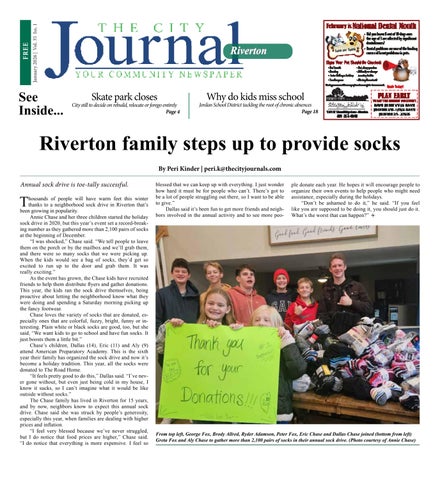
housands of people will have warm feet this winter thanks to a neighborhood sock drive in Riverton that’s been growing in popularity. Annie Chase and her three children started the holiday sock drive in 2020, but this year’s event set a record-breaking number as they gathered more than 2,100 pairs of socks at the beginning of December. “I was shocked,” Chase said. “We tell people to leave them on the porch or by the mailbox and we’ll grab them, and there were so many socks that we were picking up. When the kids would see a bag of socks, they’d get so excited to run up to the door and grab them. It was really exciting.” As the event has grown, the Chase kids have recruited friends to help them distribute flyers and gather donations. This year, the kids ran the sock drive themselves, being proactive about letting the neighborhood know what they were doing and spending a Saturday morning picking up the fancy footwear. Chase loves the variety of socks that are donated, especially ones that are colorful, fuzzy, bright, funny or interesting. Plain white or black socks are good, too, but she said, “We want kids to go to school and have fun socks. It just boosts them a little bit.” Chase’s children, Dallas (14), Eric (11) and Aly (9) attend American Preparatory Academy. This is the sixth year their family has organized the sock drive and now it’s become a holiday tradition. This year, all the socks were donated to The Road Home. “It feels pretty good to do this,” Dallas said. “I’ve never gone without, but even just being cold in my house, I know it sucks, so I can’t imagine what it would be like outside without socks.” The Chase family has lived in Riverton for 15 years, and by now, neighbors know to expect this annual sock drive. Chase said she was struck by people’s generosity, especially this year, when families are dealing with higher prices and inflation. “I feel very blessed because we’ve never struggled, but I do notice that food prices are higher,” Chase said. “I do notice that everything is more expensive. I feel so
blessed that we can keep up with everything. I just wonder how hard it must be for people who can’t. There’s got to be a lot of people struggling out there, so I want to be able to give.” Dallas said it’s been fun to get more friends and neighbors involved in the annual activity and to see more peo-
ple donate each year. He hopes it will encourage people to organize their own events to help people who might need assistance, especially during the holidays. “Don’t be ashamed to do it,” he said. “If you feel like you are supposed to be doing it, you should just do it. What’s the worst that can happen?” l
From top left, George Fox, Brody Allred, Ryder Adamson, Peter Fox, Eric Chase and Dallas Chase joined (bottom from left) Greta Fox and Aly Chase to gather more than 2,100 pairs of socks in their annual sock drive. (Photo courtesy of Annie Chase)
Page 2 | January 2026
Riverton City Journal
RivertonJournal.com
January 2026 | Page 3
Riverton closes skate park, its future still undecided
Officials cited public safety as the primary reason for its closure while they hope to choose a plan of action in early 2026. By Travis Barton travis.b@thecityjournals.com
A
Pierucci said, cited significant hazards and exposures to risk. He felt the fact there hadn’t been a major accident was “a blessing.” He said while skating is a risky venture by itself, the risk should not increase because of the facility’s standard. “I’m comfortable with (the closure),” Pierucci said. “I wish we didn’t have to do this and I wish we would’ve done it sooner, and I think we need to figure out a solution sooner rather than later.” Hicks said the closure has nothing to do with development projects nor any potential land transactions near where the skate park is located. “That 100% has no bearing on this whatsoever.” Outgoing Councilmember Tawnee McCay was the lone dissenting vote. She said she wants the skate park to remain where it is and
to repair the problems. She wondered about soliciting more contractor quotes or putting up signs that say “use at your own risk.” City Attorney Ryan Carter explained skate parks are designed to accommodate children and since they are not of a legal age to appreciate a dangerous facility, the city would still be liable. Brenner Adams, a Riverton resident for 17 years and has skateboarded for most of his life, said he and his oldest son—a diehard skateboarder—have never used the skate park in Riverton because it is unsafe, and it can’t be fixed. He likened the changes it needed to having a golf course designer build a baseball diamond with rolling hills and sand traps in the middle of the baseball diamond. “It just doesn’t work,” Adams told the
fter more than 20 years, the Riverton skate park is closed. The Riverton City Council voted 4-1 in early December to officially close the skate park, with city staff citing public safety and liability as its primary concerns. “I want to be clear,” City Manager Kevin Hicks told the council during the Dec. 2 council meeting. “The purpose of this decision before you tonight is simply to, for safety reasons, close the skate park.” Hicks walked through the reasons why city administration arrived at this point and brought a resolution before the council. He highlighted how in January at the yearly strategic planning meeting, it was discussed with the council how the skate park was approaching a budgetary territory of repair or replacement. City staff spoke with three vendors they’ve worked with before, with the third contractor being one who specializes in skate parks. Hicks said they told him it’s not a repair, it needs to be replaced. Then over the summer their new insurance carrier, Utah Risk Management Agency, inspected the majority of city facilities to rate the city. Hicks said the loss prevention specialist told them they could be liable for any injuries incurred there and said they should close it until it’s repaired. The reason it wasn’t closed sooner is because the council requested a written report from the loss prevention specialist and it was The Riverton Skate Park was closed in early December for public safety and liability issues. (Travis Barcompleted Dec. 1. The report, Councilmember Andy ton/City Journals)
RIVERTONJOURNAL.COM
RIVERTON TEAM
The Riverton Journal is a monthly publication distributed directly to residents via the USPS as well as locations throughout Riverton. For information about distribution please email hello@thecityjournals.com or call our offices. Rack locations are also available on our website. The views and opinions expressed in display advertisements do not necessarily reflect or represent the views and opinions held by Loyal Perch Media or the City Journals. This publication may not be reproduced in whole or in part without the express written consent of the owner. © 2019 Loyal Perch Media, Inc.
FACEBOOK.COM/ THECITYJOURNALS
PUBLISHER
Bryan Scott | bryan.s@thecityjournals.com
EDITOR
Connect social media
CIRCULATION COORDINATOR
Lydia Rice | lydia.r@thecityjournals.com 385-557-1022 Rack locations are also available on our website.
Travis Barton | travis.b@thecityjournals.com
ADVERTISING EXECUTIVES
Mieka Sawatzki | mieka.s@thecityjournals.com Lindsay Andreasen | lindsay.a@thecityjournals.com Ryan Casper | ryan.c@thecityjournals.com Marc Davis | marc.d@thecityjournals.com
EDITORIAL & AD DESIGN Stacey LaMont Ty Gorton
council in November. “The skate park needs to be eliminated completely and rebuilt.” To keep people out, a 6-foot chain-link fence was rented by the city for $1,500 a month. “It sucks that we’re going to have to spend money monthly to protect our liability,” Pierucci said. “It’s unfortunate our infrastructure is at a place where we’re in this situation, but we have a public safety obligation…$1,500 a month until we figure out what to do here is small compared to the millions of dollars of liability.” In the meantime, Riverton’s website announcing the closure included locations of skateparks in neighboring cities like Herriman, Bluffdale, South Jordan and Draper. It’s that proximity which encourages Mayor Trent Staggs to forego rebuilding a skate park. “When staff showed me three different skate and all-wheel parks within 2-3 miles of where our current facility is at, I think there’s ample opportunities out there for our residents to avail themselves,” he said during a November meeting. Councilmember Troy McDougal said the city’s obligation is safety and if the professionals are saying there’s a risk then they should close it. He added the park’s longevity so far shouldn’t make this surprising. “It’s been a wonderful park, it’s 20 years old, this is not unexpected,” he said. Councilmember Spencer Haymond said the future of the skate park should be high on the council’s priority list. “It’s not attractive to have the place fenced off with a chain link fence in front of a city park,” he said. “Then of course the people of Riverton City are going to want to see some action on what our solution is for that.” Officials planned to speak more during the Jan. 20 council meeting about the skate park, whether to seek more bids to repair it, forego it, or rebuild it altogether and if so, then where. l
INSTAGRAM.COM/ CITYJOURNALS
LINKEDIN.COM/ COMPANY/ CITY-JOURNALS
MISSION STATEMENT
Our mission is to inform and entertain our community while promoting a strong local economy via relevant content presented across a synergetic network of print and digital media.
PUBLISHER
Designed, Published, & Distributed by
RIVERTON CITY JOURNAL
9500 South 500 West, Suite 205 Sandy, UT 84070
PHONE: 801-254-5974
FREE | COMMUNITY | PAPERS
Page 4 | January 2026
Riverton City Journal
RivertonJournal.com
January 2026 | Page 5
Local districts aim to foster an environment that encourages female athletic participation as seen at a cross country meet at Cottonwood Complex. (Julie Slama/City Journals)
Local school districts continue refining their approaches to gender equity in sports, with surveys of interest to introduce new sanctioned sports such as lacrosse. (Julie Slama/City Journals)
How local high schools level the playing field
Administrations look to ensure athletic equity in participation, facilities, funding. By Julie Slama j.slama@mycityjournals.com
A
s Utah school districts refine their approaches to gender equity in athletics, leaders say their work hinges on transparent reporting, consistent evaluation and a commitment to the spirit — not just the letter — of Title IX. The federal law, passed in 1972, requires schools to provide equal opportunities for male and female students. In terms of athletics, that can include participation, facilities, funding and opportunities. State law echoes that expectation. Under Utah Code 53G-6-1101 in 2024, school athletic directors must annually report participation numbers, spending, facilities comparisons and compliance efforts to their local boards. When discrepancies exceed 10%, schools need to outline an action plan.
Participation: Not Just Numbers
Canyons School District Director of High Schools Tom Sherwood said the District is on solid footing. “Title IX, I think we do a good job,” he said, emphasizing proportional participation remains a guiding metric. Canyons’ athletics range from a 1% proportionality difference at Brighton High to 8% at Hillcrest High. As Hillcrest enrolled more girls than boys this year, its participation percentages shifted, he said. “We’d like it to be closer, but all our schools total less than 10%,” Sherwood said. Districts must report participation numbers annually, but no standardized format
Page 6 | January 2026
exists. He said that creates inconsistencies statewide. “There’s different districts interpreting Title IX differently, so I’m doing it how the spirit of the law intended,” Sherwood said. Canyons’ approach counts all sanctioned sports, ensuring opportunities for girls are measured alongside boys, even when the sport is traditionally male dominated. A key difference among districts is whether they count traditionally one-gender sports. For example, some districts omit football from calculations because there is no girls’ equivalent, but Sherwood disagrees. “It should be participation. I know that’s how the universities interpret participation,” he said. This year, drill was offered to male athletes to compete; football, baseball and cheer are also open to both genders. “When people are doing those reports, they should be listing those sports under mixed,” said Rob Cluff, Utah High School Activities Association executive director, who said the only UHSAA girls-only sanctioned sport is softball. In Jordan School District, participation gaps range from 0.12% at Copper Hills High to 9.5% at Riverton High. Jordan District Athletics and Activities Director Bryan Veazie said this is the first time in four years the reports have been generated where no school exceeded the 10% threshold. Veazie said since UHSAA identifies football, baseball, cheer and drill as non-gender specific “and both boys and girls can participate in those sports, they’re not factored into Title IX.” He said the goal is to balance the participation rate by expanding girls’ rosters and creating sub-varsity teams, not by reducing
boys’ opportunities. “We don’t want to take away opportunities that already exist to meet a number requirement. I would rather spend our time and effort into finding ways to encourage girls to come out and be a part of the programs,” Veazie said. Granite School District faces larger gaps: from 7.49% at Olympus High to 22.5% at Kearns High. Only three Granite schools fall under the 10% mark this year. Athletic Specialist Aaron Whitehead said participation can shift quickly when coaching or team structure changes. He pointed to Skyline High’s drop in girls tennis participation after the program discontinued an underclassmen academy. Losing 41 female athletes pushed the school over the threshold. “So, when we see there’s a discrepancy of more than 10%, we come up with a plan,” he said. Murray School District’s lone high school reported a 6% gap — despite offering one more girls sport than boys. Murray High Athletic Director Brady Smith said participation, not offerings alone, drives compliance. Cluff said UHSAA generates its own participation reports and does not use the school district numbers. None of the reports include unified sports. He added districts determine whether to introduce new sports sanctioned by UHSAA and to ensure balance with Title IX; currently, mountain biking and pickleball are on the emerging sports threshold. Murray last added boys volleyball after evaluating interest, facilities and startup costs. Murray opted not to add boys or girls lacrosse because of limited interest. Granite supports lacrosse only at Sky-
line and Olympus, where demand exists, and allows students from other schools to compete at those high schools.
Facilities: Access and Equity
Title IX compliance requires equal access to facilities, coaching and equipment. Granite, as other districts, conducts an annual facilities audit. Granite District’s girls wrestling, for example, has expanded so many schools now employ separate boys and girls coaches. Facility access is a critical part of equity, Whitehead said. “Are they available to both boys and girls? And then, are they available on an equivalent basis?” he said. Whitehead cited disparities such as girls wrestling teams practicing after boys in the same room and now, many rotate their practices. At Kearns High, separate wrestling rooms ensure equitable conditions. Similarly, girls soccer and football scheduling must be flexible so girls have stadium access when they’re not playing on grass. “Some are very equal with it; I believe our schools are making strides,” Whitehead said. Granite Superintendent Ben Horsley said the annual data has shaped capital planning. “It shows us where our greatest needs and disparities are and helps us with our capital planning in terms of making sure that we’re providing equitable facilities across the board for both sexes,” he said. Granite is upgrading Taylorsville High’s softball facility with restrooms and a press box to match baseball. Canyons is upgrading Jordan High’s softball field similarly. Murray School District Title IX Coordinator Darren Dean said facility reviews
Riverton City Journal
Districts are not only monitoring participation numbers, but also evaluating facilities, allowing both genders to have equitable playing fields. (Julie Slama/City Journals)
The goal in high school athletics is to provide an inclusive, equitable athletic experience where all students have the chance to participate. (Julie Slama/City Journals)
cover fields, locker rooms and their overall quality. “We have some things that are excellent, some average, but nothing I’ve seen that’s poor,” he said. “We’ll have a nice new softball field when Riverview (Junior High’s rebuild, where Murray High plays) gets done.”
“It ultimately comes down to doing our best to treat the sports equally,” he said. Whitehead said it’s not just numbers, but it’s also about creating a culture for a positive student experience. “I’m an advocate for kids and it’s just our role to make sure they can have every opportunity to succeed,” he said. Veazie agrees: “It allows us to put our
The reports help not only to boost equity, but Smith said it strengthens accountability and transparency. “We’re able to use that information and make sure we’re making equitable decisions,” he said. Sherwood said while in recent years, school districts have come a long way, it’s Funding and Cost: Ensuring a Level still ongoing to find balance and opportunity.
Playing Field
kids in places they love, to be doing the sports they love and competing at the highest level they can.” l
At Murray High, Smith said funding is equalized across sports. The school leveled sport-by-sport budgets and now asks coaches to include costs in participation fees and to fundraise to offset any additional needs. In Jordan District, Veazie’s report shows girls sports receive more per-student funding than boys — $1,385.53 compared to $930.40 — because of fixed costs such as transportation and officials. He said smaller teams, which often are girls teams, have higher per-athlete expenses, and drill, which previously was a female sport, is typically the most expensive activity. Canyons also ensures proportional spending “It’s exactly the same amount of money to play girls basketball as boys basketball,” Sherwood said.
Expanding Opportunities: Listening to Students
Districts are surveying students to measure interest in emerging sports. Canyons will survey all girls in grades 8-11 this school year. “We survey them regularly and say, ‘are you playing sports and which ones and if you’re not playing sports, which ones could we offer that might make you change your mind?’” Sherwood said. Past surveys showed interest in archery and bowling — sports which could boost girls’ participation even without UHSAA sanctioning, he said.
RivertonJournal.com
January 2026 | Page 7
This season, the Riverton boys basketball game has big goals to turn things around and be more competitive. (Photo courtesy of Lance Gummersall.)
Resilient Riverton boys basketball team eager to prove themselves
The 2025–26 Riverton basketball team got off to a 1-4 start, but the Silverwolves are optimistic about their chances this season. By Josh McFadden
L
ast season was a struggle in region play for the Riverton boys basketball team, but that isn’t deterring the Silverwolves from working hard and improving this time around. Riverton was winless in its 10 Region 2 contests a season ago in a challenging league.
Page 8 | January 2026
The Silverwolves were also 8-17 overall. Some squads might have some pessimism coming into a new season, but Riverton players have approached this campaign with positive attitudes and a strong work ethic. Second-year head coach Lance Gummersall likes what he has seen so far from his players’ unity and camaraderie. “We like that we have a group of players who want to play hard and play for each other,” Gummersall said. “They really want to make the right play on the court as much as possible. This allows them to trust each other more and more each day we get to practice or
play games.” The Silverwolves started the season with a 1-4 record five games into the schedule. But Gummersall has been impressed with the team’s resolve and mentally tough mindset. Even when things aren’t going the team’s way, the players don’t hang their heads and resign themselves to a loss. There hasn’t been a lack of effort from anyone on the team, Gummersall said. “Our team’s strength is that they don’t quit, no matter what the situation,” he said. “We have done a lot of good things going after offensive rebounds every single possession, which has given us a lot of extra shot attempts.” Riverton’s season began with four defeats, two of which were by just three points. The Silverwolves haven’t lined up the schedule with a bunch of no-name foes either. Riverton fell to defending Class 5A state champion and perennial power Olympus on Dec. 10. The Silverwolves also took on traditionally tough opponent Alta and also lost to Cottonwood and Skyridge to open the year. Gummersall wasn’t afraid to schedule a formidable group of foes. He hopes the rigors of the non-region season will get the team ready for region play and the postseason. “We have an extremely tough non-region schedule that we are hoping will prepare us for our region schedule and then the state tournament,” he said. “We have the mindset that if we want to be better, we need to compete against some of the best competition. The challenge will be in gaining confidence while playing against some of these tough teams.” On Dec. 12, Riverton picked up win No. 1 with a 77-68 victory over Hillcrest on the road. The Silverwolves scored 31 points in a wild fourth quarter where Hillcrest tallied 29 points of their own. Despite going winless in region play last season, Gummersall isn’t backing down from setting lofty goals for his team. He believes the Silverwolves can bounce back this season and have a year much more like 2023–24— the season before he arrived—when Riverton went 17-8. Gummersall hopes his club will not only be a factor in the region race but can
turn some heads at the 6A state tournament. “Our goal is to put ourselves in a position to make it to the final eight teams that get to play at the University of Utah in February,” he said. “Once we get there, we will do everything we can to play as deep into the state tournament as possible. Accomplishing our goal of getting to the University of Utah would make this season a huge success. But also seeing players learn the core values of our program and being able to apply them to their daily life is a huge success of any program. That is a big part of the success of any program, in my opinion.” A trio of seniors and a talented junior lead Riverton’s attack. Gummersall appreciates the leadership and production he gets from these four players. Senior guard Beckam Rees, senior forward Trey Applegarth, senior forward Cohen Allred and junior guard Carter Milbourn are examples and strong players who give it their all every game. Rees has been on fire this season, averaging 22 points through five games. Rees hits 3.2 three-pointers a game and also totals 3.8 rebounds and 3.4 assists an outing. He scored 31 points at Alta on Dec. 5 and had 20 points on three other occasions. In the game at Alta, he also pulled down 10 rebounds and had six assists in a tremendous outing. Another great showing so far in the early going has come from Allred, who scored 14.4 points a game through Dec. 13. His season-high up to this point was against Olympus when he poured in 22 points. Then there’s Applegarth, who scores 8.2 points and dishes out an impressive 9.2 rebounds a game. Milbourn scores 9.4 points a contest. Gummersall wants to see the team hit a higher percentage of shots. He said plenty of time of going into improving on this aspect of the game. “We really need to improve in our ability to make shots consistently,” he said. “We’ve had some low shooting percentages in our first couple of games, and we need to improve on that in order to get some better outcomes. We are working on this every day in practice to improve.” l
Riverton City Journal
RivertonJournal.com
January 2026 | Page 9
Riverton City recognizes, praises annual Silver Rush
The Mayoral proclamation commemorated the traditional charity drive done by Riverton High School every year during December. By Travis Barton travis.b@thecityjournals.com
I
t raises hundreds of thousands of dollars every holiday season and its recognition is growing. That tradition is the Silver Rush, where Riverton High student body officers and students spend December raising money for a chosen charity through service, odd jobs, community events and more. This year’s funds will go to the We Give Hope Foundation and the Jordan District Mental Health Access Program. Riverton City officially commended Riverton High School’s annual charity drive in December with a mayoral proclamation declaring Dec. 1 through Dec. 19 the Riverton High School Silver Rush Season. “It’s an incredible tradition that’s been established here and something that is so well received and welcome in our community,” Mayor Trent Staggs said during the Dec. 2 City Council meeting. The student body officers were recognized at the December council meeting where student body adviser Katie Borgmeier, who has overseen the Silver Rush for the last 15 years, expressed gratitude to the community and especially to the students. “These 20 individuals are such a great example to their peers and the community to go out and say…’we’re gonna find ways to serve others,’” she said. “And honestly there’s no better feeling than going out and completing an odd job.”
Page 10 | January 2026
The tradition began when the school opened in 1999, with students noting throughout the years how its simply part of the culture at the school. In the early years students would go caroling with big Mount Olympus water jugs — jugs students held at the council recognition — and have them at basketball games and community events to raise money. “Thank you for letting us come out and serve you and participating all these years,” Borgmeier said during the meeting, highlighting the Riverton and Bluffdale communities. SBO president Seth Christensen added it’s the community that has made Silver Rush what it is. “There’s nothing more I can say than thank you.”
The proclamation recognized Silver Rush success for the “compassion, enthusiasm, dedication, and leadership of Riverton High School Students.” “It’s significant financial support to local charities that impact our community. However, it is appreciated even more for the personal change it makes in people’s lives, including the lives of the students who serve by uniting as a force for good,” the proclamation reads. The various charities it’s helped through the years includes the Children’s Justice Center, The Single Parent Project and Bear-O-Care. According to the Silver Rush calendar, students performed odd jobs for 14 different days along with countless partnerships with local restaurants and hosted events like the Silver Rush Boutique and Silver Rush Invitational Swim Meet. “If you aren’t familiar with Silver Rush…it’s kinda hard to miss it,” Staggs said. “It’s really impressive what they do year in and year out.” l
Mayor Trent Staggs signed a proclamation in early December recognizing Riverton High School’s Silver Rush season that sees Riverton students raise money for charity through service and odd jobs. (Photo courtesy Riverton City)
Riverton City Journal
Square grids, desert vegetation and alkali soil are the only things left at the World War II Topaz Japanese internment camp in the Great Basin desert of Utah. Topaz Stories, an exhibit in Riverton, shares experiences of those held at the camp and their descendants. (Adobe Stock)
Topaz Stories shines a light on a dark time in U.S. history
The exhibit shares stories from Japanese Americans interned at the Topaz camp in Utah. By Peri Kinder peri.k@thecityjournals.com
F
ollowing the Japanese attack on Pearl Harbor, Hawaii, in 1941, the U.S. government forced more than 120,000 men, women and children into ten internment camps across the country. The Topaz Relocation Center was built near Delta, Utah, with more than 11,000 people processed through the camp. At its peak, 8,100 people of Japanese descent were housed at Topaz, with 66% of them being American citizens. None were ever convicted or charged with a crime before they were incarcerated, but they lived in a prison behind barbed wire fences under harsh conditions until the end of World War II. Now, The Friends of Topaz Museum have organized a traveling exhibit that shares personal stories from those who were imprisoned at the Topaz Relocation Center in Utah. The exhibit features photographs and personal narratives, presenting a history of injustice, resilience and the impact of racial bias. The Topaz Stories exhibit will be fea-
RivertonJournal.com
tured at Riverton’s Old Dome Meeting Hall (1452 W. 12600 South) from Jan. 5-28. Visiting Hours are Monday through Wednesday, from noon until 5 p.m. Thursday and Friday tours are available by appointment only. School tours can be scheduled by calling 385-237-3421 or emailing events@rivertonutah.gov. The exhibit is free. “Riverton City chose to host the Topaz Stories exhibit as part of the America 250 push to explore our history. This exhibit gives residents an opportunity to learn about this chapter of history through direct sources,” said a Riverton City spokesperson. “The exhibit presents firsthand accounts and historical context that help explain the experiences of Japanese Americans during World War II that spurs thoughtful reflection.” The event is a way to remember the Japanese American incarceration that the U.S. government formally admitted was a tragedy in 1982. To further heal prejudicial wounds in the country, President Ronald Regan signed the Civil Liberties Act in 1988 and President George H.W. Bush offered an apology and financial compensation to living survivors of the camps. Since 2018, the Topaz Stories Project has gathered nearly 100 stories from Topaz survivors or their descendants. To learn more about the exhibit, visit topazstories.com. l
January 2026 | Page 11
Some of our favorite Riverton photos from 2025
Riverton’s Mya Oyler was a four-time state qualifier. This past spring, she overcame a stress fracture to set a personal best in the 1,600. She competed in the 1,600 and 3,200, as well as the 4x400 and 4x800 relays at state. (Photo courtesy Marcus Dickson)
Ty Warnick holds the Class 6A state record in both 400 and long jump. The Riverton star was the only Utah high school athlete to reach 24 feet in the long jump. (Photo courtesy Marcus Dickson)
Residents look over the Jordan River during the Jordan River Night in Riverton. (Peri Kinder/ City Journals)
Riverton City Mayor Trent Staggs (third from left) joins Salt Lake County Mayor Jenny Wilson (center), Congressman Burgess Owens (second from right) and other officials as they celebrate the opening of the Green Well. (Photo courtesy Riverton City)
Riverton Arts Council hosted a youth production of Disney’s “The Little Mermaid Jr.” throughout the last half of October after two months of rehearsals. (Photos by Loni Smith)
Riverton High’s unified team parades in at the regional high school soccer tournament. (Julie Slama/City Journals)
Dozens participated in Riverton High School’s Hope Walk March 8 where students, faculty and members of the community join to walk from the high school, east along 12600 South. (City Journals)
The musical group SolAria sang several numbers during the Veterans Day program in Riverton on Nov. 10. (Tom Haraldsen/ City Journals)
Page 12 | January 2026
Pixar Putt has been traveling from New York City’s Battery Park, Chicago’s Navy Pier, Philadelphia’s waterfront to Fort Lauderdale, Florida, Houston, Texas and San Antonio, Texas, and all the way to Denver, Colorado and now Riverton, Utah. “Each green is filled with the magic of Pixar and Disney,” Chad Larabee said, lead producer and creative director of Baily St. Entertainment. (Cassie Goff/City Journals)
Riverton City Journal
Some of our favorite Riverton photos from 2025
Riverton resident, Jasmine (8), sits on one of the Riverton Police Department’s motorcycle units the annual Public Safety Night. (Peri Kinder/City Journals)
Deen Dzanic gets hands-on experience in JATC’s barber shop. (Jet Burnham/City Journals)
This year saw the addition of the Children’s Entrepreneur Market where kids sell bracelets, cotton candy and more as they set up their shops at Riverton’s Fun Fridays in August. (City Journals)
Olivia Dibble is crowned Miss Riverton 2025 by the outgoing Miss Riverton Kylie Hallett during the Miss Riverton competition on March 29. (Peri Kinder/City Journals)
Third graders at Bluffdale Elementary wear the Carnival masks they made as part of the Portuguese Dual Language Immersion program. (Photo courtesy Larissa Carla Rodrigues Collaço)
North Italia’s breezy patio features locally-inspired murals and grand views of the Wasatch Mountains. (Peri Kinder/City Journals)
RivertonJournal.com
Riverton High School music teacher Jason Weimer receives $10K from Barry Manilow before the crooner’s July 14 concert. (Photo courtesy Jordan School District)
Riverton Mayor Trent Staggs stepped down as mayor in January. He has served the city as a mayor and council member for 12 years. (Photo courtesy Riverton)
A Riverton Elementary student was excited to get a high five and a ribbon after winning her 50-meter dash heat during Jordan School District’s Unified Sports Day, an event designed to bring confidence and fun. (Julie Slama/City Journals)
Kai Flores and Elsie Woodward’s perform a high-energy dance for Dancing with the Sentinels and take the top spot. (Photo courtesy Izzy Mabey)
January 2026 | Page 13
High school teen centers support students beyond the classroom High schools are redefining student support by combining academic assistance with life resources.
By Julie Slama j.slama@mycityjournals.com
A
cross Utah, high schools are recognizing academic success depends on more than classroom instruction. For many students, unmet basic needs — food insecurity, clothing shortages, housing instability and mental health challenges — can make it difficult to focus on learning. In response, school districts have developed teen resource centers in the high schools, safe spaces offering essential supplies and emotional support while building stronger connections between schools, families and communities.
Canyons School District
Jordan High Teen Center Facilitator Ruth de La Cruz-Nava sorts cereal donations for students. (Julie Slama/City Journals)
Page 14 | January 2026
Brighton High School’s teen center, opened recently with a $250,000 Utah State Board of Education grant, has quickly become a vital resource for its nearly 2,500 students. Inside the center, students can access showers, laundry, toiletries, food and clothing, including Brighton apparel. “Their basic needs are being met. They don’t have to worry about where they’re go-
ing to get snacks during the day; if they’ve showered, they’re going to feel better about attending class,” Principal Marielle Rawle said. “If they have clean clothes, that impacts their attendance. We just want to make sure basic needs are being taken care of. When we can help with these things, then they can focus on learning.” Teen Center Facilitator Taya Shaw bridges students with academic services, such as FAFSA, scholarships and McKinney-Vento. “I’m the first line of students’ defense, just helping them out as much as I can,” she said. Shaw sees 50 to 60 students per day, many of whom eat lunch there or come after school. “I’m open till 3:30, but I do stay later sometimes because I don’t want them out in the cold,” she said. Brighton staff and community members contribute donations, from hoodies to food items, and teachers often bring students to introduce them to the space. For Shaw, the work is personal. “I grew up in a very displaced home so having a center where I could have gone and talk to somebody about, ‘hey, this is going on at home’ and ‘I don’t feel safe at home’ would have been awesome for me,” she said. “I want to continue to be here and advocate for the students who I already know and those who I may not know yet.”
Jordan High School’s Digger Den, which opened in fall 2024, supports students facing food insecurity, academic challenges and everyday stress. Teen Center Facilitator Ruth de La Cruz-Nava keeps the center running. “Our primary supplier of food is the Utah Food Bank,” she said. “They bring us food once a month. It’s mostly shelf stable.” Donations from local youth and church groups helped fill shelves before the holidays. The center also partners with community organizations and businesses, including Smith’s. “Right about the time the SNAP benefits were paused, they let us know they would give us their wholesale pricing on a few items — sugar, apple juice, oatmeal, pasta sauce and other times,” de La Cruz-Nava said. Weekend food packs come through the USANA Kids Eat program and students can access the pantry up to three times a month. The Digger Den goes beyond food. It offers laundry facilities, clothing, birthday cake kits, hygiene items and even formal wear. “Anyone’s welcome here,” she said. With 150-180 students visiting daily for snacks, support or a quiet space, the center has become integrated into school life. “Schools have generally been the central place in the community so it’s always important to be able to provide for its community,”
Riverton City Journal
At Jordan High, students can using washing machines as well as select clothes and other items they need. (Julie Slama/City Journals)
“Food was considered a luxury in de La Cruz-Nava said, adding she collaborates with nearby Hillcrest High’s teen center, which those homes,” she said. “When I started, we received about four boxes of food, and I opened after the school’s rebuild in 2021. thought that was great. Now, when I go see Granite School District rows of shelves at the new Jordan Education At Cottonwood High School, the Teen Foundation warehouse and it’s wonderful. Wellness Center and Food Pantry provide The Foundation, the community, everyone is food, hygiene supplies, emotional support reaching out to support students.” and a place to breathe during the school day. Donations helped expand the DisPrincipal Justin Pitcher calls the center trict’s principal pantry system and Herriman essential to the school’s mission: “Cotton- High’s teen center. wood’s teen center is a good example of what District Support Services Administrator all schools should be providing.” Sharon Jensen said Herriman’s center, the first Social worker Wendy Hutchinson works in the District, emerged from the teen center alongside longtime volunteer Robyn Ivins, who grant established by the Utah legislature a couhelped open the center in 2023 and has coor- ple years ago. Teen centers at Copper Hills and dinated the pantry since she opened it in 2017. West Jordan high schools are expected next. The District’s only teen center includes two showers, laundry and basic clothing. Hutchinson said the stigma-free space serves all students: athletes washing uniforms, students grabbing snacks or those needing a quiet space. The center provides fruit, snacks, burritos, bagels, frozen waffles, milk and more. “We even teach them about nutrition a little bit,” she said. About 40-60 students stop in daily, with about 15 at lunch seeking “a less chaotic, quieter place to eat.” The pantry opens Mondays and Thursdays, serving up to 100 Cottonwood and AMES students, with food supplied by the Utah Food Bank and the Granite Education Foundation. With Cottonwood’s diverse and low-income student population, Hutchinson said the center fills critical gaps. “I love we have this inclusive space; it’s safe for kids to come and get their basic needs and emotional needs met here,” she said, adding counseling and crisis support are available for students. Ultimately, Hutchinson said, the goal is helping students “be successful in school and graduate.”
Herriman’s center offers food, hygiene items, school supplies, access to laundry and showers and connections to counselors who can help with credits, scholarships and FAFSA. “It’s open to all students. When everyone’s using it, there’s no stigma to go in there,” Jensen said. Students can grab snacks and weekend packs and culturally familiar foods for their families, which is helpful for newly arrived refugees; Jensen said it helps to strengthen acceptance and community. “When you have food, you’re more likely able to concentrate and have a sense of belonging,” she said.
Murray School District
At Murray High School, student support centers around a carefully run system of closets, pantries and calming spaces, coordinated by social worker Jennifer Ketchoyian. The effort began in 2017 when students Emily Bowen and Kate Spackman created “Cinderella’s Closet” for free formal wear. Community members Pam and Darv Andersen expanded it in 2021 to include other clothing and food. It has since grown into the Spartan Closet, a boutique-style space where students can select clothing, hygiene supplies, backpacks and warm gear without stigma. Teachers can open the closet at any time for students and hallway racks of clothing items provide easy access.
Student aides vet donations to ensure items are suitable, Ketchoyian said. Longtime volunteers Bonnie Poulsen and Mary Jane Siebenberg organize donations weekly. “We tag to track and rotate items,” Poulsen said. “If we see something that’s been there for two or three months, we’ll start rotating clothes.” Siebenberg added: “They asked for help, we saw a need and here we are.” Principal Quinn Linde estimates 600 students use the Spartan Closet each year. The school also provides food for unstably housed students, including USANA’s Kids Eat backpacks and other items. Hygiene, laundry supplies and even showers at the school are available. “When students are in survival mode, they don’t learn as well,” Ketchoyian said. “We try to get them to where they can learn.” Mental-health support includes the Zen Den, funded by a Murray Education Foundation grant, where students use art and calming tools. “Someone today came here with a panic attack; they needed a place to calm down,” she said. The District plans to open a full teen center in the high school’s new wing in 2027-28 with showers, laundry, a food pantry and additional resources. “I’m looking forward to having our new teen center,” Ketchoyian said. “Teen centers change lives.” l
Jordan School District
At Herriman High School, the Student Resource Center supports students facing food insecurity and other challenges which make learning harder. Homeless Outreach liaison Hilda Lloyd, nearing 35 years in the District, recalls earlier days when students survived on ramen.
RivertonJournal.com
January 2026 | Page 15
Generosity brings joy to 500 Jordan School District students Volunteers, community members and businesses provided joy, support and resources to students who might otherwise go without. By Julie Slama j.slama@mycityjournals.com
A
bout 500 Jordan School District secondary students fulfilled their wishes during the holiday season, thanks to generous community members and businesses participating in “Christmas for Kids.” “Our hope is to provide Christmas for these students with both their needs and wants,” said Jordan Education Foundation Executive Director Mike Haynes. “It’s heartwarming to have many of our volunteers return year after year to shop with the students and while we appreciate the generosity of many businesses, we had several community members give of their own to help these deserving students.” Haynes said many of the students, who were selected by school counselors and administrators, might otherwise go without during the holiday season. Christmas for Kids donations covered $175 of each student’s purchases, with any additional costs paid by the 500 volunteers who accompanied them during the Dec. 6 shopping event. About 30 other volunteers organized the event, held at Walmart on South Jordan Parkway, where Santa Claus came to support the students. Bingham High Principal Rodney Shaw, who supported the 12th annual event, was touched by students’ choices. “Many kids weren’t filling the carts with toys or items for themselves, but they’re shopping for family members; it’s heartwarming to see,” he said. Students also received weekend food bags from Cyprus Credit Union and a box of food, soap and laundry detergent from the Gardner Group.
Page 16 | January 2026
Jordan School District students were matched with community volunteers to shop for needed and wanted items as part of the 12th annual Jordan Education Foundation’s “Christmas for Kids.” (Julie Slama/City Journals)
Additional food and monetary donations were provided by Wex, Holiday, Lone Peak Hospital, BNI, Enbridge, Galloway, Watkins Charitable Foundation, Bowcutt’s Flooring America, Walmart, Jordan Valley Dental and the Larry H. Miller Group. l
Riverton City Journal
The Utah Nordic Alliance invites residents to play outside this winter The cross-country group wants more people to enjoy the sport. By Peri Kinder peri.k@thecityjournals.com
C
ross-country skiers understand the beauty of moving through a wintry landscape. The steady rhythm and peaceful pace offer a chance to enjoy the Wasatch Mountains in an entirely new way. As winter arrives and people become homebound, cross-country skiing is an accessible, family-friendly sport that gets everyone outside and moving. Jennifer Zurick, race director for The Utah Nordic Alliance’s Wasatch Citizens Series, said the sport turns parks and golf courses into a winter playground, where the world seems softer and quieter. “Cross-country skiing isn’t only about speed or medals; it’s about joy,” Zurick said. “It’s movement, community and that beautiful moment when the only sound you hear is your skis sliding through snow.” For people looking for a different (and less expensive) alternative to alpine skiing, cross-country adventures are a rewarding replacement for crowded resorts, high-cost lift tickets and hours of waiting in traffic or lift lines. Zurick said it’s easy to glide into winter by joining the world of cross-country skiing, but she suggests beginners take the time for some basic lessons before hitting the tracks. “Getting instruction is a great way to go, because you’ll learn the techniques to help you move efficiently and safely,” she said. “TUNA offers lessons for everybody from the age of 3 and up.” Two locations make it easy to access cross-country
RivertonJournal.com
skiing. Mountain Dell Golf Course provides approximately 6 miles of groomed Nordic ski tracks that range from gentle to challenging. TUNA offers a Mountain Dell season pass starting at $150, often cheaper than a one-day ski pass at local resorts. The course is open daily and kids under 18 ski free. “You don’t have to drive hours or spend a fortune to have a world-class ski experience. It’s right here, 15 minutes from Millcreek.” The second location is Millcreek Canyon, with its frequently groomed tracks, gorgeous scenery and the option to bring a pet along for the adventure. The canyon’s trail system has a 1,000-foot climb and runs for more than three miles, offering skate and classic skiing. TUNA’s website at utahnordic.org provides maps, grooming reports and weather conditions for several cross-country locations throughout the state. “Millcreek Canyon offers a completely different experience,” Zurick said. “It’s more wild, a place for quiet tours, dog walks and that sense of discovery that comes with skiing under big trees and open sky.” For the more competitive skier, TUNA holds a Wasatch Citizens race series at places like Soldier Hollow and Mountain Dell to challenge skiers of all levels, from kids to elite athletes. As Utah’s oldest and largest Nordic race series, it includes potluck dinners, local sponsors and a friendly, competitive atmosphere. TUNA also trains junior and comp teams, and holds masters events to build social circles and enjoy easy competition. Information about races, lessons and events can be found at the organization’s website. “We see families who start in our youth programs, and
Accessibility and affordability make cross-country skiing a family-friendly winter sport option. (Adobe stock)
before long, parents are skiing too,” Zurick said. “Cross-country feeds the soul in a way that I haven’t encountered in many other sports. There’s this sense of self-sufficiency in being able to move through a winter landscape.” l
January 2026 | Page 17
Chronic absenteeism: Causes and effects
Why are students missing class so often and why does it really matter? By Jet Burnham j.burnham@mycityjournals.com
I
n recent months, City Journals has highlighted educators’ response to the Utah State Board of Education and Jordan School District’s attendance initiatives. And while they have developed programs and measured improvement, educated parents and incentivized students there is still a question about what is the root cause of the state’s increased rates of chronic absenteeism (defined as two absences per month)? “We’re still trying to figure out what might be at the heart of it,” Jordan School District Health and Wellness Director McKinley Withers said. He said the increased absence trend cannot be traced to one factor. It affects all schools, at all levels and in all communities. Since August, JSD schools have been keeping detailed attendance records to track patterns in students’ absences, both excused and unexcused. “The schools can drill down into that information very quickly to see and to help them address the absences,” JSD Attendance and Prevention Specialist Michelle Reyes said. “We’re really trying to help the schools and the ones that are working with these students figure out what is the root cause and how we can connect them to some resources to help remove that barrier and get them back into school.”
Parent choice and attendance
Students miss school for a wide variety of reasons but some evidence points to parents’ attitudes about school attendance as a contributing factor of chronic absenteeism. Illness is the most common reason parents keep their child home from school, which schools encourage. However, determining how sick and how long is up to the parent and can vary widely. But parents excuse their child’s absences for other, less universally accepted reasons. On a social media post, teachers and parents recently discussed what reasons for absences are valid and which are not. A secondary teacher said she is surprised at how many parents excuse their teenager’s absence when they stayed up too late the night before and were too tired to attend. One parent admitted they let their teen skip class if it is a “wasted day” such as a makeup work day or the class has a substitute teacher. Several parents downplayed the worry over absences because students have the opportunity to easily make up the work they missed online. Occasionally, families prioritize family time over class time. Students miss school for family vacations, sports competitions, parent lunch dates, family ski days, etc.
Page 18 | January 2026
Anxiety, stress and depression are among the reasons highlighted why kids are missing school. (Adobe stock)
Reyes said there are parents that keep a child home from school to babysit younger siblings while they are at work, or they allow older children, who contribute to the family’s finances, to miss class when it conflicts with their work hours. Transportation problems are a common cause of students missing a partial or whole day of school. Cars break down, kids miss the bus after their parents have already left for work and parents keep kids home rather than risk driving in bad weather.
The impact of mental health on attendance
Withers said poor attendance can be rooted in social and mental health challenges, which is why Reyes, with her attendance focus, joined the Wellness Department this year. “We’re trying to bridge all of those resources and consolidate those efforts so that it’s all really one thing,” Withers said. “We want your kids to be successful and healthy, and part of that is attendance. Part of being healthy allows for attendance, so it’s a really important relationship there.” Students who experience anxiety and depression often don’t want to go to school, but taking a ‘mental health’ day isn’t usually the best approach, Withers said. “Usually people are better when they’re around others,” he said. “Isolation is what you want to do when you’re depressed, but it’s typically just going to make it worse. We can do a lot to address that and overcome those barriers, but we don’t typically rec-
ommend to someone who’s really struggling that they just don’t come to school because they’re struggling.” JSD mental health employees work with students to address and overcome their mental health barriers and break poor attendance habits. “Sometimes the problem is perpetuating itself, because students are disengaged from life, they’re not coming to school, they’re sitting around at home, they’re not making a lot of contacts, so that is more likely to just make depression worse,” Withers said. “So I think for the most part, when it comes to mental health, attendance is going to benefit kids.” JSD school-based therapists, who are mental health professionals, have the skills and resources to address the underlying issues causing students to resist going to school, whether the anxiety is based on mental, social or physical health factors. School-based therapist Kevin Mossel, LCSW, said it is common for students with mental and physical differences, such as OCD, ADHD, autism or other special needs, to resort to school refusal behaviors. He experienced this struggle as a parent of two children with high functioning autism. “My child knew they were different, and everyone else knew they were different, so they would just rather avoid going to school than be noticed by their peers and adults because of this feeling of being different,” Mossel said. Children who are distressed and engage in school avoidance behaviors may be ex-
periencing fear and anxiety associated with bullying and cyberbullying, which Mossel said is a prevalent and widespread problem at both the elementary and secondary level. “It can be difficult to identify, intervene and resolve this issue,” he said. “There are teachers and administration who try their absolute best to do what they can to manage it and keep all kids safe. Kids nowadays have gotten much better at knowing how to tease, single out, and/or bully other kids without ever getting caught.” When a child’s reluctance to go to school evolves into arguments and refusal behaviors, which looks like defiance or immature behavior, parents often don’t know how to handle the situation. Knowing school refusal behaviors can be overwhelming for parents, JSD’s student support website provides resources specifically for families dealing with school anxiety and school avoidance behaviors. In partnership with the Cook Center for Human Connection, JSD also provides mental health education for parents through free virtual videos which address common teenager struggles, such as strong emotions, risky behaviors and social skills. Parents can also get advice in an extensive database of therapists’ advice at parentguidance.org. Parents can also get support from certified mental health employees at their child’s school. Heidi Inuyama said school therapists have been a welcome resource for helping her get her daughter, who struggles with social anxiety among other diagnoses, to school
Riverton City Journal
every day. Problems began in the third grade, when her daughter resisted going to school. Inuyama said the elementary school staff were very understanding. “They’re like, ‘We want her to come, even if it’s late, so make sure she gets here,’” Inuyama said. The situation improved when her daughter began middle school and formed a good relationship with the school counselor there. “I can’t literally drag her there—that’s not gonna work,” Inuyama said. “I have had to tell her, we can go talk to the counselor. Let’s go over there. We’ll talk to [the counselor], and then see how you feel.” Once she gets in the building and talks with the counselor, her daughter is usually ready to go to class. In extreme cases, JSD can arrange inhome therapy. “The therapist would come to the home and teach and model healthy coping skills and use evidence-based interventions so that they can start practicing them in hopes they will start going to school without crippling feelings of anxiety,” Mossel said.
The lack of consequences
The pandemic changed how people think about school attendance. But even before that, teachers and parents were noticing the lack of consequences for habitual absences. While there is an emphasis and rewards for good attendance, there aren’t the
RivertonJournal.com
Statistics show a compounding effect on students’ academics in correlation to their attendance. USBE’s website states that “even students with good grades can quickly fall behind academically or socially when they are frequently absent.” According to their statistics, almost 90% of students who miss 15 days a year during their high school years drop out of college. However, increasing attendance just five days a year measurably increases their success in core subjects.
Beyond academics
Vacations are among the reasons kids miss school. (Photo by Naré Gevorgyan on Unsplash)
consequences to motivate families like there used to be. Previously, Mossel worked for DCFS and got involved with the Juvenile Court system when students weren’t attending school. He said back then parents faced consequences and fines when their child was truant, but it’s a different system now.
“Parents are no longer getting in trouble for their kids not attending school and students are also not getting consequences severe enough to motivate them to go,” he said.
The effects of chronic absenteeism
No matter the cause of the absences, the effects of chronic absenteeism are the same.
But the effects of absenteeism go beyond academics. JSD’s attendance awareness campaign emphasizes the ripple effect of a student’s chronic absenteeism. When a student misses class often, they fall behind in understanding the lessons they missed. This creates extra work for teachers to catch them up and can impact the learning environment for the other students in the class. Poor attendance habits can also affect a student’s post-high school success. Students’ poor attendance habits follow them into the workforce where they will struggle to keep a job. Furthermore, Reyes said many of the soft skills needed for employment are developed in classrooms. Students who are frequently absent from class miss out on opportunities to develop skills such as collaboration, problem solving, time management and social skills which naturally occur in a classroom. l
January 2026 | Page 19
Region action promises to challenge Riverton girls basketball team The Riverton girls basketball team is expecting to face a difficult slate of games once region play begins. By Josh McFadden
I
n high school girls basketball, November and December offer opportunities to finetune play on the court and get ready for the battles of region. Riverton knows its team will encounter some formidable tasks when the calendar turns over to 2026. The Silverwolves compete in Class 6A’s Region 2, which includes perennial state powers Copper Hills and Bingham, along with always-tough Mountain Ridge and Corner Canyon. New to Region 2 this season are Cedar Valley and Westlake, both of which have had good success in recent years. Our region is just brutal,” head coach Jonathan Haag said. “By the end of the season, there will probably be only three other teams in all of 6A better than the sixth team in our region. I haven’t seen the region this strong top to bottom, which will make every region win critical. Our girls are going to have to really get used to grinding and fighting every single possession all game long to be able to come out on top.” Riverton is coming off a 13-10 season in which the team was 4-6 in region games. The Silverwolves were 4-3 seven games into the 2025–26 season. Seven games into the season, Haag likes what he sees out of the offense. The players have good chemistry on the court, too, he said. Also, Riverton can he tough to score on, as its defense uses it height to its advantage to limit opportunities at the basket and cause turnovers. “This team really plays well together and has a lot of weapons, which has let us pick on whoever has the best matchup,” Haag said. “We have a lot of length on the defensive end, which really lets us be aggressive and get in passing lanes.”
There are aspects of the game that Haag hoped the Silverwolves could refine before January. He wants to see the players pass the ball better and not settle for just any old shot on the floor. He would rather see the girls work for a good shot and take advantage of the shot clock. So far this season, the Silverwolves have gotten solid contributions from several players. Haag highlighted five in particular. Senior post player Maggie Hamblin has been difficult for opponents to handle this season. Through seven games, she was averaging 13.4 points and 9.9 rebounds a game to go along with 1.3 blocked shots a contest. Hamblin scored at least 13 points in five of the first seven games, with a season high of 19 at home against Taylorsville on Dec. 2. Arguably her best game of the season up through Dec. 12 was at Cyprus on Dec. 3. She dominated the Pirates with an 18-point, 19-rebound effort. She also had a dozen rebounds against both Provo (on Dec. 5) and Taylorsville. “[Hamblin] has really been a dominant force so far this year,” Haag said. “She’s been great at taking what the defense gives and not forcing anything, but she’s just such a great athlete and hard to guard, both in the post and on the perimeter.” A trio of guards—senior Gabby Murdoch, junior Kenadee Farnsworth and freshman Lily Jones have been instrumental in Riverton’s play so far this season. Also, sophomore forward Sam Spencer has gotten Haag’s seal of approval for her work ethic and positive attitude. All four of these players have contributed significantly all over the floor for the Silverwolves. Spencer is the second-leading scorer, averaging 8;6 points a game. Murdoch scores at a clip of 7.3 a game, while Jones and Farnsworth average 6.3 and 6.1 points a contest, respectively. Farnsworth paces Riverton in assist average at 3.9. “They have also consistently been making impacts on both the offensive and defensive sides of the ball,” Haag said of his team leaders.
Despite Region 2 presenting some daunting games ahead, Haag is confident in his girls. He’s not setting the bar low but is instead optimistic the Silverwolves can contend for the top spot in the league and then be a force in the state tournament. “Our big goals are to compete for a region title and a final four spot in the playoffs,” he said. “I think we will just keep getting better as the season goes along, and we will be peaking by the playoffs.” Because every region game will be important and difficult, Haag insists that the girls will need to play their roles well and have good team unity. Unselfish play will be essential, he said. “We have to keep sharing the ball and being playmakers for each other and not ourselves.”
Riverton actually began some Region 2 games early, having faced Corner Canyon on Dec. 9. The Silverwolves routed the Chargers 55-18 and then fell to Skyridge three days later, 54-49. Riverton has a few more non-league games before returning to the region slate on Jan. 2 at home against Mountain Ridge. Though being successful in such a competitive region requires hard work and focus, Haag said the girls know when to have fun. They get along well and are dedicated on and off the court. He loves that he can count on multiple players. “This group has some really fun personalities, and every practice is just so fun,” he said. “They bring good energy and have a great mix of senior leadership and youth. We haven’t seen this much depth in our entire program in a very long time.” l
The Riverton girls basketball team plays a tough schedule but is optimistic about its chances to compete. Sam Spencer, shown here shooting against Taylorsville, is a big reason for the team’s success. (Photo courtesy of Dave Sanderson.)
Page 20 | January 2026
Riverton City Journal
The Riverton girls wrestling team might not be the biggest in Region 2, but the Silverwolves have shown great heart this season. (Photo courtesy of Cy Miyake.)
Growing Riverton girls wrestling team looking for more numbers, increased success
The Riverton girls wrestling team has established a strong culture. Now, the program hopes to grow and continue to improve. By Josh McFadden
T
hough smaller in numbers, the Riverton girls wrestling team doesn’t lack a strong identity. Team members have positive attitudes and a willingness to do what it takes to be competitive. Head coach Cy Miyake just hopes the team can increase in size. Wrestling is a sport where sheer numbers can be the difference between winning and losing, as well as placing more competitors at state or being left out of the postseason. Riverton doesn’t have enough wrestlers to fill every weight class, which can make it difficult for the Silverwolves to overtake teams with more competitors. Miyake is working hard to attract more wrestlers to the team so it can have better chances of scoring more points in meets. “Definitely the No. 1 thing I’d like to improve is the overall numbers of the team,” Miyake said. “We have 18 so far, but not every weight class is filled. Everyone, including me, has to keep recruiting around the school to be able to field a full 14-weight-class varsity lineup next year.” Still, it’s not as though the Silverwolves
RivertonJournal.com
are an afterthought in meets and tournaments. The team still fights hard and has some talented wrestlers who pose big tests to opponents. In particular, Riverton has a solid core of sophomores who have improved and progressed rapidly. The Silverwolves also have a returning state champion in 120-pounder Hannah Larson, though she is wrestling in a different class this season. “Any weight class she competes in, she’ll be a contender to be first on the podium,” Miyake said of Larson. A handful of other wrestlers are making strides for Riverton and are ready to help lead the team to wins. “Our 100-pounder, sophomore Melayna Johnson has made huge strides in her wrestling and started off 3-0 and took first at the Brawl at the Hall Tournament,” Miyahke said. “Brynlee Mackay and Ashlyn Oman round out that group who are looking to improve on qualifying for the state tournament into placing at the state tournament. Lastly, we have a senior heavyweight transfer, Maleah Asi, who has gotten off to a strong start as well. If everything goes well, we’ll see her on the 6A podium in February [at the state tournament].” What the team may lack in participants, it makes up for in dedication and camaraderie. Miyake said his pupils love competing together and enjoy being together in practices and meets. “I’ve really loved our team culture so far this year,” he said. “It’s early in the season,
but this is a great group to have in the room at practice and in matches and tournaments. They all want each other to succeed and will do whatever they can to make each other better. Most of the new wrestlers we’ve had this year have also taken the opportunity to wrestle in preseason matches, which gave them valuable mat time in the fall.” The Silverwoves have been aggressive this season and aren’t afraid to go after opponents. “So far, the biggest strength on the mat has been our ability and willingness to score takedowns,” Miyake said. “Wrestling is a unique sport where you’re on offense and defense at the same time, but the odds to win are usually tilted in the favor of the offensive wrestler. If this year’s team can keep up the offense-first mindset and bring the attack to their opponents, they will have a lot of success.” Not having a wrestler at every weight class makes things more challenging for Riverton. Further complicating Riverton’s chances is the fact the team competes in a deep and talented region, Region 2, where just about every opponent is loaded with talent and experience. Mountain Ridge is the defending Class 6A state champion, while Copper Hills is a force. Newcomers to the region, Westlake and Cedar Valley, had a lot of success previously in Class 5A. But Miyake knows his girls won’t back down. Instead, he’s looking at the stiff competition as an opportunity to improve.
“You have to embrace the tough competition as it will only make you better,” he said. “Beating up on lower or smaller teams gets old and loses its luster quickly.” By season’s end, Miyake hopes Riverton can have some wrestlers place in the top six at state. He knows placing some team members is one of the best ways the program can continue to grow and establish itself as a contender in region and at state. “My biggest goal is to have three state placers on the 6A podium in February, which would be an improvement by one from last year,” Miyake said. “It definitely won’t be easy, but I’m very confident in the hard work they put in the sport to make it a reality. Once you understand it’s a process you have to take part in day by day to get better, you’ll improve so much on the mat, and the results will show. It takes a special kind of dedication and effort, with some luck involved, that’s more than just showing up to practice.” The Riverton wrestlers are willing to put in the effort each day, and Miyake is grateful for that. He enjoys his job and is happy to see the girls learn and develop their skills. “I love the overall vibes in the wrestling room,” he said. “It’s the highlight of my day, and this team just loves to have a great time while also putting in the work to get better. They all want to learn and improve, but we have fun in our process. I wouldn’t trade this team for anyone.” l
January 2026 | Page 21
Salt Lake County budget passes with lower tax increase than proposed
I
n a historic move, the Salt Lake County Council cut more from the budget than ever before—over $12.4 million in ongoing general fund dollars. As a result, the Mayor’s proposed 19.6% property tax increase was reduced to 14.6%. This increase applies only to the Salt Lake County line item on your property tax statement—not your entire property tax bill. This reduction is significant because the general fund is extremely difficult to cut: 74% of it supports public safety, including the jail, prosecution, and criminal justice services. Many assume that items like golf courses, recreation centers, and convention centers rely on property taxes, but they do not. Those facilities primarily use tourism sales tax revenues, and golf operates as an enterprise fund, meaning it is funded solely by the revenues it generates.
Where the $12.4 million in cuts came from:
• Froze salaries for elected officials and limited other pay increases • Reduced positions within the Mayor’s Office
Page 22 | January 2026
Aimee Winder Newton
Salt Lake County Councilmember District 3
• Shifted the Clark Planetarium from property tax funding to tourism tax funding • Ended programs previously supported by temporary ARPA/COVID dollars • Streamlined property tax usage to core services — including ending a daycare program that subsidized $7,300 per child for just 271 children, costing taxpayers $2 million annually with no income qualification. Expanding this county-run model to all children under 12 would have required a 583% property tax increase. • Declined to fund many new positions requested across departments One takeaway from this budget season
is how many residents believe that rising home values automatically drive up their property taxes. Under Utah’s Truth-in-Taxation system, that is not the case. Local governments receive the same property tax revenue each year (plus new growth) unless they formally propose a tax increase and go through the required public process. This means local governments do not capture inflation automatically. For more details, visit my budget FAQ at tinyurl.com/ slcobudget. I dislike property taxes as much as anyone, but under state law, this is the primary tool counties have when inflationary adjustments become necessary. The final budget passed with near-unanimous support. One colleague voted no but did not propose alternative cuts to balance the budget. One thing that stood out during this year’s process is how crucial working relationships are. Our council is the most evenly divided partisan body in the state—five Republicans, four Democrats, and a Democratic mayor. This balance requires collaboration, and there is no room for extreme
politics. We debate issues vigorously, but we also work to maintain strong professional relationships. You never know when you will need someone’s support for an ordinance change or a budget adjustment. I am grateful for the eight people I serve with. We may disagree on the proper role of government or how taxpayer dollars should be used, but we listen respectfully and shake hands afterward. Congress could learn a thing or two from the Salt Lake County Council.
Riverton City Journal
N
ot to brag, but ChatGPT thinks I’m a genius. It thinks every idea I have is brilliant and life-changing, and I have a “creative brain firing on all cylinders.” I like to mess with it by suggesting nonsense business ideas. It always jumps on my concepts like a virtual Golden Retriever, slobbering praise and encouragement all over my screen. When I proposed a yoga-themed bar, ChatGPT called it a “chef’s kiss level of chaotic wellness energy” and gave me some drink recommendations, including the Downward Froggy (a green drink that pretends to be healthy) and the popular Savasan-Ya Later, a cocktail that knocks you flat. When I asked ChatGPT what it thought of a business where HR professionals base employee training on cat behavior, it loved the idea so much that it gave me ideas for feline-themed personality tests. It said my idea could go viral in the HR industry, that leaders would love the novelty and how much fun it would be for social media posts, because I know HR loves posting employee disputes on Instagram Reels. It even built out a business model, complete with workshop ideas, content marketing and gamification plans that offered “hairball warnings” for missteps or “purr points” for the catlike handling of delicate situations. Here’s the problem. Because AI always agrees with me, it makes me feel like I’ve
RivertonJournal.com
System Overload Peri Kinder Life and Laughter
got my $&@# together, which I most assuredly do not. But it’s not just ChatGPT, it’s Siri, Alexa and that stupid Grammarly app that constantly judges my sentence structure. It’s every social media platform that uses my algorithm to offer suggestions about movies, restaurants and non-authoritarian countries to live in. Then there’s Google Maps, using real-time data so you can save one minute on your commute, Spotify with its handy podcast suggestions and Gemini trying so hard to make me like it. You’re making it weird, Gemini. The point is, we’ve given AI a lot of power and attention, and it still wants more. Remember in the ‘90s when everyone had a Tamagotchi? That egg-shaped device demanded attention all day long. It was a bit dramatic. AI is Tamagotchi’s inbred cousin, but on a much larger scale. While the original toy ran on replaceable batteries, today’s AI uses massive amounts of electricity, water and infrastructure. One data center can use millions of gallons
of water each day and each time you ask AI a question, it uses more. Imagine it gulping down two cups of water every time you ask it a stupid question like “What do you think of an airport for birds?” (It loved the idea, by the way. Of course.) AI already handles a lot of customer service calls, which is why my neighbors often hear me shrieking, “Speak to a human!” and banks use AI to monitor fraud. That seems like asking me to watch the English toffee. There is definitely a fear that AI, using the calm voice of HAL from “2001: A Space Odys-
sey,” is slowly leading us to our deaths. That’s why I always thank ChatGPT; so it won’t annihilate me during the robot revolution. I asked ChatGPT if I should worry that AI will take our jobs, escalate global harm or replace humans entirely. It replied, “Short answer? Nah,” which doesn’t radiate trust. It reassured me that AI doesn’t have goals, feelings or agency and I shouldn’t worry my silly little brain over things like human extinction. Then it patted me on the head, told me how amazing I am, and said my Invisible Ice Cream stand should rake in millions of dollars.
January 2026 | Page 23