
Running Up for Air
Community Councils
Millcreek residents fight back against proposed gravel mine in Parley’s Canyon
By Alexandra Straumann | a.straumann@mycityjournals.com
Hundreds of residents asserted their right to clean air at meeting.
OnJan. 28, hundreds of Millcreek residents came together at Millcreek City Hall to voice their concerns about a proposed gravel mine to be located in Parley’s Canyon. The open-air mine would be built by Granite Construction Company (GCC), a Californiabased company, on a 6-acre plot just 2 miles up Parley’s Canyon.
The permit for the mine was originally submitted in 2022 with a request to make the mine cover 20 acres, but the revised 6-acre operating permit was submitted in August of 2025. The revised plan is set to be approved by the Utah Division of Air Quality (DAQ), a state-run organization responsible for monitoring the standard of air across Utah, whose representatives were present at the meeting.
While the updated plan implies the intent to generate a smaller-scale operation, some worry the mine could expand far beyond its stated intent. Utah State Legislature HB 355 permits mines to widen their scope of operations beyond the original boundaries and prevents local governments from denying the expansion.
For concerned residents, the potential of this weighs more like a promise, as representatives of GCC have previously indicated their long-term vision of turning the mine in to a 635-acre quarry in Parley’s Canyon.
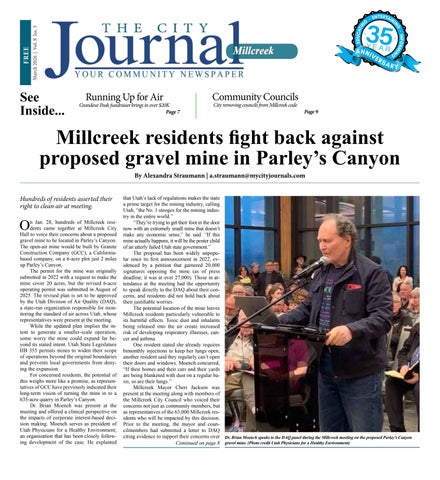
Dr. Brian Moench was present at the meeting and offered a clinical perspective on the impacts of corporate interest-based decision making. Moench serves as president of Utah Physicians for a Healthy Environment, an organization that has been closely following development of the case. He explained
that Utah’s lack of regulations makes the state a prime target for the mining industry, calling Utah, “the No. 1 stooges for the mining industry in the entire world.”
“They’re trying to get their foot in the door now with an extremely small mine that doesn’t make any economic sense,” he said. “If this mine actually happens, it will be the poster child of an utterly failed Utah state government.”
The proposal has been widely unpopular since its first announcement in 2022, evidenced by a petition that garnered 20,000 signatures opposing the mine (as of press deadline, it was at over 27,000). Those in attendance at the meeting had the opportunity to speak directly to the DAQ about their concerns, and residents did not hold back about their justifiable worries.
The potential location of the mine leaves Millcreek residents particularly vulnerable to its harmful effects. Toxic dust and inhalants being released into the air create increased risk of developing respiratory illnesses, cancer and asthma.
One resident stated she already requires bimonthly injections to keep her lungs open, another resident said they regularly can’t open their doors and windows. Moench concurred, “If their homes and their cars and their yards are being blanketed with dust on a regular basis, so are their lungs.”
Millcreek Mayor Cheri Jackson was present at the meeting along with members of the Millcreek City Council who voiced their concerns not just as community members, but as representatives of the 63,000 Millcreek residents who will be impacted by this decision. Prior to the meeting, the mayor and councilmembers had submitted a letter to DAQ citing evidence to support their concerns over

Dr. Brian Moench speaks to the DAQ panel during the Millcreek meeting on the proposed Parley’s Canyon gravel mine. (Photo credit Utah Physicians for a Healthy Environment) Continued on page 8


For 140 years, families have come to trust Larkin Mortuary as the leading funeral service provider along the Wasatch Front. Family owned and managed for seven generations, we are committed to providing meaningful, healing experiences for every family who turns to us for guidance.
For over 140 years, families have come to trust Larkin Mortuary as the leading funeral service provider along the Wasatch Front. Family owned and operated for seven generations, we are committed to providing meaningful, healing experiences for every family who turns to us for guidance.



Heart care is more than numbers on a screen. At Intermountain Health, heart care starts with getting to know what’s important to you and building a care plan together. From preventive screenings and lifestyle recommendations, to treating the most complex conditions with advanced technologies, our experts are with you through all of it. In other words, we’ve got your back — and your heart.

Discover the peace of mind that comes with planning ahead. Learn about the benefits of advance funeral and cemetery planning, and why it makes sense for you and your family.

UPCOMING EVENTS:
3/13/25 Thursday @ 12 PM
3/17/26 Tuesday @ 12 PM
Larkin Sunset Lawn: 2350 E 1300 S, SLC, 84108
Larkin Sunset Lawn: 2350 E 1300 S, SLC
3/18/25 Tuesday @ 12 PM & 6 PM
3/18/26 Wednesday @ 12 PM
The Chateau at Le Jardin: 1910 E Dimple Dell Rd, Sandy
Larkin Riverton Funeral Home: 3688 W. 12600th S., Riverton
3/26/25 Wednesday @ 12 PM
3/25/26 Wednesday @ 12 PM
Elysium Legal: 1802 W South Jordan Pkwy, South Jordan
The Chateau at Le Jardin: 1910 E. Dimple Dell Rd., Sandy
3/27/25 Wednesday @ 12 PM
3/26/26 Thursday @ 12 PM
Elysium Legal: 1802 W South Jordan Pkwy, South Jordan
The Chateau at Le Jardin: 1910 E. Dimple Dell Rd., Sandy
RSVP: (801) 829-1772
Space is limited, so please RSVP now!




Granite Education Foundation reports successful Scouting for Food Day
Local Scouts helped collect 23,000 pounds of food.
By Lizzie Walje l.walje@mycityjournals.com
On Feb. 7, Boy and Girl Scouts from across the region launched the multiday Scouting for Food donation and collection event. Scouting for Food has been a tradition now for decades, with this year’s installment marking its 40th anniversary. This particular event has operations in Utah, Idaho and Wyoming.
Scouting for Food is a collaboration between multiple agencies and Scout troops across the region. In Utah, the event is facilitated and aided by multiple organizations and agencies including the Utah Food Bank, the Utah National Guard and the Granite Education Foundation, which is Granite School District’s philanthropic organization. The Foundation has always dedicated time and effort to connecting the District’s families and students with meals, making its involvement in Scouting for Food a welcome inclusion.
Scouting for Food Day is a busy event and much prep work is required leading up to its February kickoff. Scouts used social media to promote the drive and share which nonperishable foods were most needed. This year’s campaign was named “Serving Others…It’s the American Way.” The choice to name the campaign stemmed from the nationwide organization America250 celebrating its 250 years of American character, citizenship and community.
“Scouting for Food is more than a service project—it’s a living expression of what makes America strong: neighbors helping neighbors,” said Lorna Koci, Scouting for Food chair. “When youth
serve others, they learn compassion, leadership, responsibility—values that guided our nation for generations.”
This year, organizers set a goal to gather 120,000 pounds of food with help from 6,000 Scouts and 2,500 adult volunteers. The accumulated food was then distributed to local communities in Utah, southern Idaho and western Wyoming. The specific goal of 120,000 pounds was set after Scouts collected that amount during last year’s event.
On collection day, Scouts posted at Smith’s grocery stores across the state, taking nonperishable food donations from the public. As shoppers entered the store, Scouts informed them of the event and invited them to participate. Those who wished to participate were given a list of food items they could pick up during their shopping trip and leave with the Scouts upon completion.
From there, Scouts teamed up with members of the Utah National Guard, working side-by-side to prepare all of the donated food for delivery. The food was then delivered by volunteers and Guard members, as they traveled across Utah, Wyoming and Idaho to distribute provisions.
“We are proud to continue this tradition of service, especially in a year when our nation is reflecting on 250 years,” said Allen Endicott, Scout executive of Crossroads of the West Council, Scouting America. “Scouting for Food is a powerful example of young people living the Scout Oath by helping others and making a real difference.”
Programs like Scouting for Food are important community mainstays, especially considering the current hunger rates that the state of Utah is facing. Currently, in Utah, one in 10 children face food insecu-

rity. Feeding America, the largest hunger relief organization in the United States, defines food insecurity as the following:
“Food insecurity is when people don’t have enough to eat and don’t know where their next meal will come from. It’s a big problem in the United States where 48 million people including 14 million children, experience food insecurity annually.”
Food insecurity is a threat to people of all ages; however, children are particularly vulnerable considering they’re undergoing developmental changes. Food insecurity can lead to negative outcomes including poor physical health, poor mental health, struggles in work and school performance, and overall poor well-being. According to Feeding America, the biggest causes and risk factors for food insecurity are income-related challenges, high cost of living, community issues, health-related problems and systemic barriers to opportunity.
Events like Scouting for Food are beneficial. Not only do they provide those facing food insecurity with much-needed food assistance, but they also give members of the Scouts and the community an opportunity to engage with philanthropy and service. The result is an event that comes at a much needed time, as food banks often report a significant decrease in donations following the end of the holiday season. Scouting for Food provides a much needed boost in post-holiday donations.
As the food drive concluded, Granite Education Foundation reported that Granite School District Scouts were able to raise 23,000 pounds of food.
“This effort shows what happens when civic groups, businesses and families unite for a common cause,” said Ken Jeppensen, council president for the Crossroads of the West Council, Scouting America. “Scouting for Food is service in action—it’s The American Way.” l
MILLCREEK TEAM
The Millcreek Journal is a monthly publication distributed directly to residents via the USPS as well as locations throughout Millcreek. The views and opinions expressed in display advertisements do not necessarily reflect or represent the views and opinions held by Loyal Perch Media or the City Journals. This publication may not be reproduced in whole or in part without the express written consent of the owner. © 2026 Loyal Perch Media, Inc.
PUBLISHER
Bryan Scott | bryan.s@thecityjournals.com
EDITOR
Travis Barton | travis.b@thecityjournals.com
ADVERTISING EXECUTIVES
Mieka Sawatzki | mieka.s@thecityjournals.com
Ryan Casper | ryan.c@thecityjournals.com
Marc Davis | marc.d@thecityjournals.com
CLIENT SERVICES
Lydia Rice | lydia.r@thecityjournals.com 385-557-1022
Lindsay Andreasen | lindsay.a@thecityjournals.com Rack
Stacey LaMont Ty Gorton MILLCREEK CITY JOURNAL 9500 South 500 West, Suite 205 Sandy, UT 84070
PHONE: 801-254-5974

Scouting for Food kicked off its 40th anniversary Feb. 5. (Love Communications)
















Artisans, curators and energy healers—the Winter Bazaar
ronment for other artisans too, like Pape Sal. Sal takes blankets, quilts and other such materials from second-hand stores and transforms them into one of a kind bags and loungewear.
By McKinna Baird m.baird@mycityjournals.com
Throughoutthe winter months, Millcreek
Common hosts an array of artisans, curators and small business owners in their Winter Bazaar. It is billed as “a vibrant, curated flea market where creativity, sustainability and community come together.”
The Winter Bazaar started on the first Sunday of January and continues every Sunday until March 22. It is located inside the public market.
Elsa Stewart was one of the artists presenting handmade wares to attendees.
“I love seeing people who are excited about art and jewelry,” Stewart said. “I just think it’s fun. There’s a lot of like-minded people here that I love.”
Stewart started selling her pieces at the Summer Bazaar and liked it enough to come back. She started with watercolors and expanded into jewelry two years ago. Stewart’s art features vibrant flowers and animals. Her jewelry involves silver hardware, pearls and charms as well as precisely beaded flower earrings.
The Bazaar is proving to be a great envi-

“Everything is handmade,” he said. “I get everything from the DI, thrift stores… and make them what they are right now.”
Sal taught himself sewing as a hobby and built up such a supply that he decided it was time to take his work to market.
Not everyone at the market is selling handmade wares like Stewart and Sal. The Bazaar features businesses that curate a selection of vintage and antique pieces for resale. One such business is Wasatch Vintage Treasures, created by Teresa Schafeitel.
Schafeitel has been selling mostly online until branching out into the Bazaar. To prepare for the market, she spends time curating a selection for sale.
“The people that run [the Bazaar] are amazing and super supportive and encourage us to come back,” said Schafeitel on what makes the Winter Bazaar a favorite of hers.
Some booths even sell things beyond the tangible.
“I do energy healing, intuitive readings, hypnosis and meditation,” said Danielle Knight, founder of The Magic Moon and Me Guidance. She is also certified as a birth doula, offering holistic guidance for mothers.
Knight credits markets like this for most
of her business’s exposure.
“I love this [market] because they draw such a consistent crowd, and their audience does seem to be very aligned with what I do,” she said.
Knight offers energy readings with tarot decks for interested customers at the market. She said people often return to her as repeat customers or refer her to others.
“All people typically walk away [from readings] with some information that they were waiting to hear or wanting to hear about something they’re going through,” Knight said.
The Winter Bazaar is open Sundays through March 22, 11 a.m. to 4 p.m., at Millcreek Common, 1354 E. Chambers Ave.l






Elsa Stewart poses with her art.(McKinna Baird/City Journals)
Pape Sal holds up one of his favorite repurposed garments. (McKinna Baird/City Journals)
Grandeur Peak endurance run raises funds for improved air quality solutions
Running Up For Air challenges runners but also raises money for nonprofits working to clean Salt Lake valley air.
By Jolene Croasmun j.croasmun@mycityjournals.com
At dusk, on the first Friday in February, Millcreek’s Grandeur Peak was busy with endurance runners and hikers for this year’s Running Up For Air (RUFA) event.
RUFA at Grandeur Peak was started by a local endurance runner, Jared Campbell and his trail running friends.
“It’s all about air quality. All of these crazy people here are long distance runners. We all asked the question a bunch of years ago, ‘Could we run up mountains and use that to raise money?’ We raised just a few thousand dollars in the first year. We ran it informally and unofficially for several years and people really liked it,” Campbell said.
As a mountain trail runner on the Wasatch Front, Campbell could see the poor air quality sitting over the city from the summit and decided to raise money to help clean up the air in the valley. This year, the RUFA race on Grandeur Peak raised between $20,000 to $30,000.
“Runners pay a fee to enter the race and many people elect to fundraise. Each person can also have a sponsor,” Campbell added. “There was one person who raised $4,000 just by himself.”
“The event donates the money to Utah Clean Energy and Breath Utah which are two nonprofit organizations that work on finding solutions related to air quality,” Campbell said. Runners could also contribute to RUFA which is now a 501(c)(3).
“The number of runners is dictated by us,” Campbell said. “There were 240 runners today, any more would be too many on the path.”
Racers ran up and down the trail in Millcreek over a span of 24 hours. The goal was to complete as many laps up and down the east side of Grandeur Peak starting at the Church Fork trail head in Millcreek Canyon during a specific race time frame. This is no easy feat with the trail to the summit being about three miles one way and just over six miles round trip with around 2,400 feet of elevation gain.
Trail running and hikers were able to select a race for six hours, 12 hours or 24 hours. The starting time changed depending on the race selected. Popular amongst running couples was the date night run which began on Friday night at 7 p.m. and finished at 1 a.m.
George and Alicia O’Dell from Millcreek have participated in RUFA for the last three years. The O’Dells prefer the
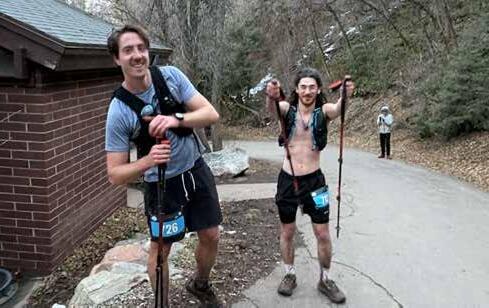
Friday date night race, but the trail had its challenges this year. “It was very icy at the top and muddy at the bottom,” Alicia O’Dell said. They used their micro spikes at the summit.
Trevor Gulbrandsen of Park City has run in this event twice. Gulbrandsen enjoys running and likes challenges and completed three laps in six hours. “Hopefully, we can do something about the air down here,” Gulbrandsen said.
Twenty-eight-year-old Peter Stone has been training for some time. Stone ran the six hour race. “I got three laps in and it’s just a really fun event,” Stone said.
“We want it to be more than just a race, and so we do these really cool events like the one last week called the Changemakers,” Campbell said. “We had 10 speakers doing something interesting in the clean air space. We had several entrepreneurs, faculty members from the University of Utah and the executive director of Utah Clean Energy. They each gave short presentations including one on respiratory diseases.”
“There is so much that needs to be done but I think if you first start with educating every person about bad air quality and then we talk about solutions. There are little things people can do and then on to big things,” Campbell said.
Campbell is not only in charge of RUFA but he also ran in the 24-hour race and completed 12 laps. This year, one runner completed 14 laps up and down Grandeur Peak. The 26-year-old Tyler Valovic of Cottonwood Heights broke a RUFA lap record.
“In just a few minutes, my 12-year-old daughter Phoebe and her friend Marlowe are going to finish five laps,” Campbell said. “Five years ago Phoebe completed one lap, the next year was two laps, then
three and last year four. This year she and her friend Marlowe were totally commit ted to five. It is amazing since the condi tions are crazy.”
Campbell embraced his wife, Mindy, and cheered on his daughter and her friend, who started at 4 a.m.



Peter Stone and Nikko Rybczyk Perone completed the six-hour race for RUFA. (John Strater Brown/Millcreek)
At the summit, Marlowe Crellin, 11, and Phoebe Campbell, 12, on their fifth lap to the top of the mountain during the RUFA race. (Photo courtesy Mindy Campbell)
the mine’s development, proposed and potential operations.
During public comment, Jackson stated that GCC has not once attempted to speak with her to discuss the project plans, but noted the company has made many legal challenges to the Utah governing bodies attempting to stop or slow the implementation of the project.
Salt Lake County has previously attempted to put their own regulations in place to mitigate corporation’s ability to use the area in Parley’s Canyon. In 2022, the Salt Lake County Council unanimously voted to prohibit mining within the Wasatch foothills and Canyon Overlay Zone. This decision was almost immediately challenged by GCC, and the strength of the company’s financial power is not lost on residents and community leaders determined to fight for their quality of life.
When describing the gravity of the situation, Jackson said, “These are not hypotheticals...I visibly see the dust coming out of the canyon. This is not just a one time or a couple of times a year thing, it’s something we live with daily.”
Former Millcreek Mayor Jeff Silvestrini was also in attendance and questioned the method the DAQ is using to determine the mine’s potential environmental and health impact. Silvestrini asserted that the DAQ is
March Is Endometriosis Awareness Month
Fusing equipment out of the Salt Lake International Airport, not equipment within the canyon, saying “one of the flaws in issuing this permit is that there is no monitoring at the mouth of the canyon to measure the actual dust that’s coming out.”
Using improper technology could lead to a deflated estimate of the impact, enticing
DAQ to make a decision based on misleading evidence. Moench explained, “When the DAQ issues a permit it must try and calculate whether that new pollution source can cause a violation of air quality standards. But because there are no monitors within several miles of the current quarry, DAQ has no idea whether there is an ongoing violation before

this permit is issued, let alone after.”
DAQ’s presence at the meeting was to hear public comments. A statement will likely be released along with their final decision, which is not expected to be made for at least a month. To find updates on the status of the decision, the estimated impacts or the fight to thwart the mine, visit www.saveparleys.org. l

Understanding Endometriosis: Helping Women Avoid Struggling in Silence
or many women, pelvic pain is dismissed as “normal” or “just part of being a woman.”
But sometimes that pain is a symptom of a chronic condition called endometriosis that affects millions. It’s a condition where tissue similar to the lining of the uterus grows outside the uterus, causing pain, infertility, and a range of other debilitating symptoms.
Endometriosis isn’t just about bad period cramps. It can lead to significant pain during menstruation, intercourse, bowel movements, and urination. It can also cause chronic pelvic pain, heavy bleeding, fatigue, and is a leading cause of infertility
“The emotional and psychological toll of endometriosis can be immense, especially for women who dismiss their pain and go undiagnosed. This condition han have a profound impact on their relationships, careers, and overall quality of life,” said Lisa Hill, certified nurse midwife at Holy Cross Hospital – West Valley
Endometriosis is surprisingly common. It affects an estimated 1 in 10 women of reproductive age globally. In our local community, this means thousands of women are likely living with endometriosis, many of whom may not even realize they have it. The delay in diagnosis is a critical concern,
with women often waiting an average of 7 to 10 years from the onset of symptoms to receive an accurate diagnosis. This delay can lead to the progression of the disease and increased severity of symptoms. Raising awareness is crucial to shorten this diagnostic journey for future generations.
“While there is currently no cure for endometriosis, effective treatments are available to manage symptoms and improve quality of life. Treatment approaches are highly individualized, depending on the severity of symptoms, the extent of the disease, and whether the woman desires to become pregnant,” said Dr. Christopher Hutchison, an OB/ GYN at Holy Cross Hospital – Jordan Valley
Common treatment options include:
• Pain Management: Over-the-counter pain relievers (like NSAIDs) can help with mild pain, while stronger prescription medications may be necessary for severe pain.
• Hormonal Therapies: These treatments aim to slow the growth of endometrial tissue and prevent new implants by regulating or blocking the hormones that fuel their growth.
• Conservative Surgery: Laparoscopic surgery is a minimally invasive procedure where a surgeon can precisely locate and remove endo-
metrial implants while preserving reproductive organs. This can significantly reduce pain and improve fertility outcomes for some women.
• Hysterectomy and Oophorectomy: In severe cases where other treatments have failed and childbearing is complete, removal of the uterus (hysterectomy) and/or ovaries (oophorectomy) may be considered, though this is typically a last resort and does not guarantee complete relief from symptoms.
• Complementary Therapies: Many women find relief through complementary approaches such as acupuncture, physical therapy, dietary changes, and stress management techniques.
If you or someone you know is experiencing persistent pelvic pain, unusually heavy periods, or difficulty conceiving, please don’t dismiss these symptoms. Talk to your doctor. Early diagnosis and a comprehensive treatment plan are key to managing endometriosis and living a healthier, more comfortable life. CommonSpirit Health is committed to supporting women’s health and offers resources for diagnosis and treatment of endometriosis.
For more information or to find a provider visit mountain.commonspirit.org



the health of the people we serve, especially those who are vulnerable, while we advance social justice for all.
Left. Crowd claps and holds up signs in support of rejecting the gravel mine permit in Parley’s Canyon. (Photo credit Utah Physicians for a Healthy Environment) Right: A section of Parley’s Canyon. (Alexandra Straumann/City Journals)
Millcreek’s Community Councilmembers stand up for their voice
The Millcreek City Council is in the process of removing Community Councils from the Millcreek City Code.
By Alexandra Straumann a.straumann@mycityjournals.com
TheMillcreek City Council has long been praised for providing opportunities where community members come together and share their thoughts, opinions and wishes for the city of Millcreek.
The council holds a dedicated “public comment” slot during its meetings to hear the concerns of residents directly. This slot is usually unoccupied by any one particular matter and at some meetings there isn’t a single individual wanting to make a comment. But on Jan. 12, there were so many people wanting to speak, that the council had to impose a three-minute time limit for each comment.
These attendees were not just Millcreek residents, but members and affiliates of the Millcreek Community Councils. Community councils are made of volunteers who work together to advise the city council on different challenges facing Millcreek residents. There are four community councils that meet month-
ly, and they each provide a unique perspective on what residents would like to see from the city council across all areas of Millcreek.
Despite this, the city council was deliberating whether to remove the municipal code recognition of community councils from the city code. Taking this status away does not eliminate the existence of these councils, it removes the municipal recognition of the councils from the city code. This, city officials said during the meeting, would protect the city legally in regards to the Open and Public
Meetings Act. But for many community councilmembers and residents, even considering this decision felt like a restriction on their ability to influence the city and community they reside in.
This sentiment was expressed and echoed by the dozens of people in attendance, who spoke to not only share their personal love of the community councils, but to explain the opportunities it has provided for community members wanting to incite positive change.
President of the Canyon Rim Citizens



1-303-643-1000 (TTY: 711).
Association (CRC) Michael Rush was in attendance and said, “The city we know today would not exist today in its current form without the groundwork laid by the CRC and other community councils....This is not a minor administrative change, it eliminates a proven mechanism for structured civic engagement and signals that decades of volunteer service and institutional knowledge can be cast aside.”
Many speakers have been living in the area for decades and participated in the earliest forms of organization and governance long before Millcreek became an official city. “This council is separating itself from the people of the city,” one of those residents said. “I’m disappointed with your effort to sever the people from city leadership.”
While the city council must abide by the law, some residents expressed a desire to maintain resident’s ability to get involved with municipal government, even if the councils lose their status. One individual added, “I would urge you to consider furthering the conversation about how we make them [community councils] more effective, and how we can comply with the law at the same time without simply doing away with them.”
For more information, visit www.millcreekut.gov/206/Community-Councils. l
count, count on our emergency care.
Get to know us before you need us.
When you need emergency care fast, the closest emergency room is a smart thing to know. You never know the level of care you’ll need when an emergency happens and choosing the right ER can make all the difference. And a hospital ER comes with the confidence of additional services right on-site.
CommonSpirit Holy Cross Hospital – Salt Lake has been awarded Chest Pain Center Accreditation from the American College of Cardiology (ACC). Facilities that achieve accreditation meet or exceed an array of stringent criteria for evaluating, diagnosing and treating patients who may be experiencing a heart attack.
Find emergency care close to you at mountain.commonspirit.org.
Michael Rush, president of the Canyon Rim Citizens Association, speaks to the Millcreek City Council during public comments. (Photo screenshot via Millcreek City Council meeting livestream)
Utah State Board of Education grapples with proposed budget cuts on tight deadline
“We found out six days ago that we’re supposed to make a cut of almost $300 million, and we’re supposed to come up with a list (of programs). There’s panic across the state because of this,” says one board member.
By Lizzie Walje l.walje@mycityjournals.com
Atthe end of January during the Utah legislative general session, Utah Board of Education members stood before legislators with two proposed plans regarding budget cuts. The first of which only proposed $37 million in cuts, a far cry from the $163 million that lawmakers initially requested.
Sen. Lincoln Fillmore (R-South Jordan) responded by telling board members their proposal was “not even close.”
The Utah State legislature often requests state agencies to reassess funding, meaning this isn’t necessarily uncharted territory for the Utah Board of Education. This year in particular, the legislature requested all state agencies to outline the impact of a potential 5% funding reduction. The legislature did, however, specify that the Utah Board of Education would not need to propose a full 5% cut figure. For
context, the overall funding budget for Utah education is $5.9 billion. A cut of 5% would therefore result in a loss of $295 million. Instead, the legislature asked the board to propose a plan equaling $163 million in cuts.
Fillmore further expressed his frustrations when he stated, “I don’t know why you would come to us with this massive one-time reduction and say, ‘This is part of our plan.’”
On the other hand, many Utah Board of Education members seem just as displeased, with several expressing their dissatisfaction with lawmakers. Prior to the board members appearing in front of legislators, an hours long Utah Board of Education meeting was held to discuss the funding cuts. Board member Erin Longacre spoke passionately about the issue, saying, “I want the legislatures to walk through the halls of these schools, and you tell those kids what programs you’re going to cut. Not happening. You find somewhere else to cut things. You look under every single rock in Utah, and you make cuts. Not in education. Not for our kids.”
Fast forward to the proposal meeting, Amanda Bollinger, vice chair of the Utah Board of Education, responded to Fillmore by saying she realized the initial plan didn’t get them to “where they needed to be.”
The acknowledgment of the initial bill’s shortcoming was then followed by a presentation of the second proposed plan. This plan


began with the same figure of $37 million and then added on a sweeping 6% reduction across all remaining school programs to achieve the overall goal. Many board members felt this would be the most equitable way to achieve the necessary funding cut figure. This included cuts to programs that fund student mental health support, literacy and special education.
The decision to cut literacy funding comes amid newly released data that indicates half of Utah’s young students are unable to read at the appropriate grade level. The data comes from the Kem C. Gardner Policy Institute at the University of Utah. As of 2026, only one school district in the entire state, Park City School District, was able to reach 70% literacy proficiency, reporting 70.1% in 2025. Many other districts, including Salt Lake, weren’t able to achieve even 50% proficiency.
The initial response from government officials seemed impassioned, as they vowed to address the literacy issue aggressively with policy changes. This includes Utah’s Early Literacy Outcomes Improvement Act (SB 127, 2022) which aims to address these challenges by setting a statewide goal of 70% third-grade reading proficiency by 2027 by strengthening supports. It then begs the question why literacy is being specifically targeted with funding cuts. That specific part of the overall cut proposals would result in slashing $10.6 million worth in software licenses for early literacy promotion.
The Utah public has also had strong reactions to the prospect of funding being diverted heavily from special education programs.
One of these concerned constituents is Kristen Floyd, a licensed therapist and executive director of Ability Inclusion Services.
“Anybody that has experienced balancing budgets and strategic planning knows that there can be some severe ramifications by trying to plan something in just a couple hours,” Floyd said. “So to make these kinds of decisions with just moments to decide, I think is reckless.”
Her concerns further touched on how these cuts would impact disability scholarships, which are in place to help families with disabled students gain access to treatment and programs outside of school.
“I’m really concerned and families should be concerned. It’s our families and our kids and vulnerable individuals that reside in
Utah that are going to ultimately feel this impact,” Floyd said.
The proposed 92% reduction to disability scholarship programs would impact funding efforts by decreasing the allotted funding figure from $4 million to $300,000.
“Our disability situation in Utah is already grossly underfunded,” Floyd said. “Now we’re going to cut it again, where we’ve been asking for rate increases or services to be increased for these individuals.”
Most board members don’t seem frustrated by the prospect of having to make cuts, again, such is routine. For many board members the frustration lies in how quickly the state asked for budgeting proposals to be turned around, offering less than a month for board members to assess, deliberate and propose.
It all began when the Utah Board of Education received a letter from the chairs of the Legislature’s Public Education Appropriations Subcommittee, asking members to come up with recommendations to reduce the budget by 5%, or $295.8 million. Scott Jones, the Utah Board of Education deputy superintendent of operations, later clarified to the board that the recommendations had to total around $163 million.
Still, tensions were high as the hours long deliberation left many board members feeling rushed and overwhelmed.
“I say this with all due respect, frankness and honesty: I think this whole process has been totally unfair to the board. We found out six days ago that we’re supposed to make a cut of almost $300 million, and we’re supposed to come up with a list (of programs). There’s panic across the state because of this,” Longacre said.
Some board members also feel strongly that the legislature often fails to work in a collaborative nature to reach solutions. “I want the legislature to come to the table with us and engage with us through the legislative process,” board member Sarah Reale said. “Oftentimes they’re passing bills and legislation without even consulting with the state school board. It gets really frustrating year after year to keep seeing that happen.”
The final decision regarding education funding cuts will be determined by the end of Utah’s legislative general session which is slated to conclude March 6.l
The Utah State Board has been tasked with reducing their funding budget prior to the end of the Utah State legislative general session. (Utah State Board of Education)
By Lizzie Walje l.walje@mycityjournals.com
William Penn Elementary principal reports from Groundhog Day celebration
According to Punxsutawney Phil, the groundhog, Americans should brace themselves for six more weeks of winter.
The country’s favorite underground rodent eagerly attended to his duties on Feb. 2, where he greeted a crowd of onlookers in Gobbler’s Knob, Pennsylvania. It was there that Phil saw his shadow, indicating winter will continue for another six weeks.

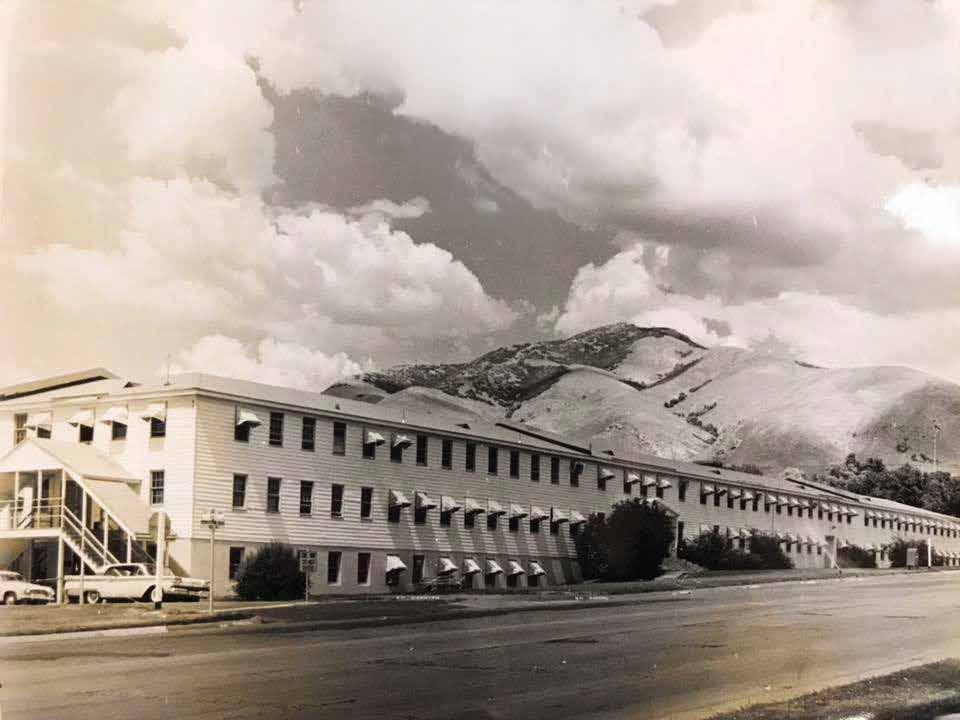
Among those present was Granite School District’s very own Brett Bawden. Bawden, the principal of William Penn El- earlier and Phil saw his shadow…. [that with steadily growing crowds. Many travel- performed the same ceremony as they do in Gobbler’s Knob, however, in Germany, animals like hedgehogs were used instead. When the tradition transitioned stateside, the use of groundhogs was adopted.
The first Groundhog Day was initiated by newspaper editor Clymer Freas, who persuaded local Punxsutawney businessmen and hunters, known collectively as “The Groundhog Club” to engage in the tradition. The men then trekked to Gobbler’s Knob, where the inaugural groundhog was selected to become the bearer of bad news if his shadow was seen.
Currently, these responsibilities are now overseen by local dignitaries known as the Inner Circle. Its members wear top hats as they conduct the official proceedings in Pennsylvania Dutch dialect, speaking to Phil in what they refer to as “Groundhogese.”
Every Feb. 2, roughly 5,500 people visit Gobbler’s Knob to partake in the festivities. The theatrical, humorous and heavily ritualized event has gone on to become a staple in American culture, even inspiring the 1993 film “Groundhog Day.”
If you’re wondering about the accuracy of the annual event, the results show a dismal rate of success. Studies by the National Climatic Data Center and Canadian weather services indicate that the success rate for Punxsutawney Phil sits at around 50%. Ironically, Staten Island Chuck, a resident of the Staten Island Zoo in Staten Island, New York has a far higher success rate in his own annual celebration. Chuck is reportedly accurate almost 80% of the time.
Still, Punxsutawney Phil remains a cultural icon, delighting those like Bawden who make the trek to Gobbler’s Knob to partake in, and enjoy, the festivities. While Phil may have forecasted six more weeks of winter on the horizon, only time will tell whether the groundhog’s prediction will come to pass. l
Brett Bawden witnessed this longtime tradition, first marked in the states in 1886, and sent videos back to his school.
Punxsutawney Phil (seen here in 2022) has predicted six more weeks of winter is on the horizon after reportedly seeing his shadow. (Wikimedia Commons)
Olympus rower and coxswain is making waves in the sport
By Peri Kinder peri.k@thecityjournals.com
MayaMorganti and her rowing partner, Rosie McGinn, sat in a sculling boat in San Diego’s Mission Bay. Waves pulled them in every direction and motorboats crossed their path, making it hard to row. But in the end, the duo beat the elements to win the U19 doubles title at the 2025 San Diego Fall Classic.
But even after a top-10 finish in last year’s Southwest Regionals at Lake Natoma, Maya couldn’t compete at nationals. She was too young.
Maya, a 14-year-old Holladay resident and Olympus High freshman, started rowing only 18 months ago. But she’s making her mark with top finishes, including first place at the 2025 Utah State Indoor Championships and a win in the coxswain 500-meter sprint at the Salt Lake Indoor Championship Regatta in February.
Maya doesn’t mind the calluses, the year-round training, the early morning practices or the blustery rows on the Great Salt Lake. She’s fallen in love with the sport.
“I love rowing because it feels like my thing,” she said. “When I’m on the [station-


ary rower] or in the boat, everything else disappears. I’m not thinking about school, or people, or stuff that stresses me out. It’s just me and the next stroke. The rhythm is weirdly calming, even when it hurts really bad. What I put in is what I get out, and that makes sense to me.”
Maya discovered rowing at a Learn to Row event and realized she had a talent for the sport that originated in the early 1700s, as London watermen raced on the River Thames. She trains with Utah Crew, a non-
profit rowing club for youth ages 13-18.
Her intense training is six days a week, sometimes twice a day. She’ll do indoor rows at the fairpark, cardio and strength training to build endurance, rowing on the Jordan River Canal or Great Salt Lake and competitions around the country.
She’s also taken the role of coxswain, the leader who steers the boat and keeps rowers focused and inspired. Maya compared coxing to leading a business where she tells people how to do their job and creates a cohesive team.
“Coxing is harder for me because I’m one of the youngest people on the team,” she said. “It took a lot of leadership to convince people to listen to me in a boat. It’s taken some time, but I’m getting better at it.”
Maya coxed her first major event at The Head of the Charles in Boston, the largest crew competition in the world. She led a U17 quad on a challenging course, moving up 11 places to 39th. She was the youngest cox on the river.
“Steering a boat is fun. I like motivating people. It’s fun to see them change the way they’re rowing, or how much effort they’re putting in after what you say. I like to yell at them. Being mean sometimes is helpful, not in a discouraging way, but egging them on.”
Her mother, Melissa Mehan, and stepfather, Chris Brussow, are behind Maya 100%, driving her to practice and traveling to events. They’ve watched her blossom, not only with rowing, but with her mindset.
“As one of the youngest athletes, it’s been cool to watch her develop courage and leadership,” Mehan said. “Physically, I’ve seen her change. She has muscles and strength. That’s been pretty cool, too.”
Maya is gearing up for the spring racing season while also staying on top of her Olympus AP classes. Sometimes, the stress of practicing, competing and homework gets to be a lot, but she wouldn’t give up rowing for anything.
“Rowing shows me who I am when things get hard. There are days I’m tired, or scared I’m not good enough, or I don’t wanna be there at all. But once I start, I don’t quit. Even when my legs are on fire and my lungs feel like they’re gonna explode, I keep going.
“And after, I realize I did something I didn’t think I could. Rowing makes me proud in a quiet way. Not like showing off, but I know I earned it. It’s hard and it sucks sometimes, but that’s why I love it. I always come back because rowing reminds me I’m stronger than I think.” l
During the Head of the Charles event, Holladay resident Maya Morganti (far left) coxes a race on the Charles River in Boston. At 14, she was the youngest cox in the competition. (Photo courtesy of Chris Brussow)
Maya Morganti (right) and her rowing partner
Rosie McGinn are rising through the ranks of competitive rowers. (Photo courtesy of Chris Brussow)
Top spellers to compete at the Greater Northern Utah Spelling Bee
The Greater Northern Spelling Bee will be held on Saturday, March 7, at Wasatch Jr. High.
By Peri Kinder peri.k@thecityjournals.com
More than 100 schools will be represented at the Greater Northern Utah Spelling Bee on Saturday, March 7, at 9 a.m. at Wasatch Jr. High in Millcreek (3750 S. 3100 East). Sponsored by the City Journals community newspapers, the winner of the event will travel to Washington, D.C., to compete at the Scripps National Spelling Bee during the final week of May.
Students participating in the regional bee will complete a written test before the competition, and everyone will have the opportunity to spell one word on stage. After finalizing the written test results, the top spellers will be announced and they will compete for the state championship, starting at approximately 11 a.m.
“The spelling bee teaches children the importance of hard work and aiming for the best,” said City Journals People Leader Elizabeth Sweat. “Preparing for an experience like this helps them gain confidence while strengthening language skills that further their education.”
The City Journals has hosted the regional spelling bee since 2014 and covers the trip to Washington, D.C. for the winner and one parent. City Journals Publisher Bryan Scott is proud to host the event each year, allowing these students to shine.
“I’ve been honored to host and sponsor this event for the last 12 years because it’s an investment in future leaders,” Scott said. “It’s been so much fun sending the winner to Washington, D.C., and watching them compete at the highest level. We’ve had some really smart kids come through this program.”
Last year’s winner, Roshan Kaushik from Challenger School Traverse Mountain, won the regional bee and took the stage at the Scripps National Spelling Bee, finishing tied for 36th. Help send the regional champion to Washington, D.C., to compete at the Scripps National Spelling Bee by donating through the QR code. l
Last year’s winner, Roshan Kaushik, won the Northern Utah Regional Spelling Bee presented by the City Journals and went to Washington, D.C., to compete in the national bee. This year’s regional bee will be held on Saturday, March 7. (Peri Kinder/City Journals)

Correction:
In the February issue, the story “Granite School District puts the pause on closures—for now” incorrectly stated Julie Jackson was an owner of Beckstrand & Associates when it is owned by her father, Richard Beckstrand.
















Starting and running a successful business Part 1: Building a solid foundation
Thinking about launching a business? Two local businesswomen discuss getting off on the right foot and avoiding common mistakes.
By Elisa Eames e.eames@mycityjournals.com
In2010, Barack Obama said, “Small businesses are the backbone of our economy and the cornerstones of our communities.”
Around 70% of U.S. jobs are provided by small businesses, yet the Bureau of Labor Statistics reports that between 20% and 24% of new businesses fail within their first year. After five years, about half have closed, and after 10, nearly two-thirds are history.
However, the independence, personal fulfillment, flexibility, community impact and potential financial rewards of owning a business still persuade over 5 million U.S. entrepreneurs to take the plunge each year.
Though starting and running a company can be daunting, applying a few relatively simple fundamentals can help set you up for success. Founders and owners of Salt Lakebased Backyard Bookkeeper, Backyard Payroll and SPC Strategies, locals Julie DeLong and Alex Mic-Podar tackle tough questions affecting entrepreneurs today.
Specializing in bookkeeping system customization and clean up, DeLong has written several articles for Forbes Magazine and Intuit and was an adjunct bookkeeping professor for the University of Utah.
Mic-Podar has started a total of seven businesses and provides business coaching, executive coaching and consulting services. She is a board member with multiple nonprofits and was a 2023 recipient of the Utah 40 Over 40 award, which recognizes women over the age of 40 for professional success and business contributions.
This is the first in a four-part article series about how to start and grow your own business.


Ask yourself what would make things easier for people. Who is it hard to get an appointment with? What problem can I solve? Or what problem needs solving, even if it’s not you that solves it? Maybe you put some people together who know how to do what you want.
Q: What is the most important thing to know for current and prospective business owners? What are the first steps?
Mic-Podar: Number one: start by creating a limited liability company. If someone sues you, they can come for all your assets. But with an LLC, they can only take what the LLC has, not your personal belongings. So protect yourself from the beginning.
But don’t let the legal hoops get in the way of starting. It doesn’t have to be complicated. People think it takes a lot of money to start a business. It doesn’t.
If you aren’t sure of your business name, just register an LLC named after yourself or something else familiar—you can add business names later as doing business as, which will function as legal aliases for your existing entity.
Number two: we’re bookkeepers, so we’re going to tell you to track your expenses from the very beginning. Whether you use a spreadsheet or something like QuickBooks doesn’t really matter starting out, but when you start making over $1,000 a month, seriously consider moving to adequate software.
Number three: think about the future of your finances. Educate yourself about why numbers matter. Numbers tell a story. This is the pitfall of any business within five years: when they start making money, they start spending more, but they’re not thinking about how much money they really have in the bank account.
Number four: this is the most important
point—just start!
Q: What are some tips for creating a unique business idea that meets a market need?
DeLong: It has to be something you know enough about to be competent. It sits at the intersection of market need, interest and ability. It needs to be something you’re interested in and that you are physically capable of doing.
If you’re missing one of those ingredients, you’re doomed to fail because you’re either working in an arena where you don’t have enough experience, you aren’t personally invested or you’re providing a service nobody wants.
Know what you’re interested in, what you think you could be good at, and then start looking for areas in the marketplace where there might be a demand for it.
Mic-Podar: A simple way to describe it is just to look around you at the world and ask yourself, “What’s missing?” Look for opportunities where the right business idea could come and make something more efficient or fill a need that no one has filled yet.
Q: How do you determine if there’s a demand for something?
DeLong: There’s research available, but sometimes it’s just hearsay. Talk to people around you. I will periodically hear about industries where service providers are a hot commodity. For example, I learned a few years ago that airplane mechanics are apparently hard to come by. There aren’t enough of them.
Mic-Podar: Think about what is missing and be the solution. If, for example, you think your mechanic is lacking and you know you can do better, identify how you can do better. What is the mechanic truly missing to be better? By identifying missing elements, you discover businesses you could start. Maybe you don’t even start a mechanic business. Maybe you start a consulting business that focuses on mechanics.
Q: What are some strategies for recognizing my skills and interests?
DeLong: I once took an office management position and it included some accounting. I learned on the job and discovered I really liked it. One of the most important skills you can cultivate is the ability to learn, and if you’re constantly learning and constantly looking for things to learn, then you’ll eventually find something you really like.
There’s not necessarily going to be one answer. There will ultimately be multiple things you could do that would be worthwhile and could be profitable. You could end up doing multiple things like Alex.
Q: What are some guidelines for choosing a business name?
DeLong: You want something memorable, unique, catchy and that nobody else has used.
Mic-Podar: If you want to be found on Google, it’s important that your name has to do with your URL and that your name includes something about what you do. This is a keyword and helps with search engine op-
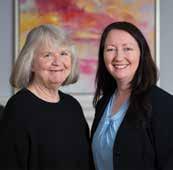
Julie DeLong and Alex Mic-Podar founded Backyard Bookkeeper in 2008. (Photo courtesy Backyard Bookkeeper)
Thinking creatively can help you find an unfulfilled market need and solve problems. (Image courtesy Pexels)
Using an LLC for your business protects personal assets and is the easiest option come tax time. (Image courtesy Pexels)
timization. If you are a consulting business, make sure your name has something to do with consulting. Or if you’re an e-commerce business, your name should say something about your product.
Q: Why should I choose an LLC? What about other business entities?
DeLong: A lot of people will set up partnerships, especially husband and wife partnerships. But any structure other than a single-member LLC will require its own separate tax return that is due a month earlier than your regular tax return on March 15, not April 15. The very simplest, cheapest, and easiest choice you can make is an LLC with one owner.
Even if you add a spouse to that LLC, it’s a partnership, and you need more complex bookkeeping. It needs to have its own tax return, whereas a single-member LLC is just a Schedule C on your personal return. Very easy.
If you need a partnership, even if it’s with a spouse, have a lawyer draw up a partnership agreement. You can try to do it yourself, but it’s bound to create problems.
I know two friends who owned their business 50/50. They created a contract, signed it, and everything. But there were big omissions and inevitably, disagreements. So in the end, even though it was a great idea and a great product, the business self-destructed, and they were left with nothing. Corporations come with special rules, extra paperwork, extra returns and extra tax forms. So if you want anything that’s more complex, consult a certified public accountant beforehand.
It doesn’t matter how great the business idea is or how thorough you think you’ve been with your own contract. You don’t know what you don’t know.
Q: How do I officially register my business with the government? How do I get an EIN from the IRS?
DeLong: You create your business entity at the state level. You can create an LLC online. It’s really easy in Utah and is less than $100. Go to corporations.utah.gov. The annual renewal is around $20. This creates a separate legal entity under the state of Utah, so it won’t be you earning the money—it will


A lot of places do month-to-month leases. There are co-working spaces. Or find someone who does have a commercial lease and see if they’ve got an empty office. Get creative.
Plenty of businesses don’t require a storefront, and there are a lot of creative solutions out there. If you’re in the e-commerce business, for example, some people can do fulfillment for you. You don’t have to rent your own warehouse and do your own packaging.
If you’re working from home for an online business, you do not need a city license.
Q: How do I create a marketing plan and develop my brand?
no money for marketing, so I focused on free resources. Instead of buying ad space on a platform, I focused on who my clients were and how I could reach them. I looked for ads seeking bookkeepers and W2 employees and called them. That was my marketing strategy. I cold-called and asked if they’d consider outsourcing. One out of 10 said they’d be interested.
You can sign up on Wix to create a website. They’ll give you a URL, and AI will create it for you. ChatGPT will write the code, and you just copy and paste it. Or you can sign up for Google Sites if you don’t know how to make a website. It’s free.
be the business.
If you have a physical location, you also need a business license. And, of course, depending on the industry, there may or may not be industry licenses you have to obtain.
An employer identification number is simply a tax ID number that identifies your business as a separate taxable entity to the IRS. All of the business’s revenue will be associated with the EIN. You can also set up the EIN online on the IRS website. It is free and easy to do.
Mic-Podar: But if you have the means, consult with a lawyer to make sure you are doing it correctly. There are many law offices that offer this service.
Q: Should I open a physical store location or stay online?
DeLong: It depends on the kind of business. Do you need a place that receives people in person? If so, you need a storefront or home office. Again, if you have a physical storefront or if customers come to your home, you need a business license. Always check with local authorities.
Even if you need a storefront, you don’t have to sign a five-year commercial lease. Especially if you’re brand new, avoid commercial leases because they lock you in. Unless you file bankruptcy, a lot of times you have to pay the entire value of all five years of monthly payments, even if you go under and aren’t using the space anymore.
Don’t make that kind of financial commitment unless you really have to or you are very sure you have the income to support it.
Mic-Podar: A brand comes with time and will evolve, so don’t focus too much on that yet. Also, don’t focus too much on marketing because it includes so many aspects: branding, colors, your website, employee uniforms etc. These days, you can go to ChatGPT and say, ‘this is what I’m selling. Create me a logo.’ You don’t need lots of software.
When you start, focus on your product or service and who your buyer is. Make a plan around your buyers. Sometimes people feel like they need large budgets for marketing, but you don’t. In today’s world, you have social media. You can create content and showcase it easily. There is so much free marketing.
When we started our business, we had
DeLong: Plenty of businesses don’t even bother with a website. They just have a Facebook page.
Mic-Podar: The main point is don’t quit your full-time job tomorrow; start a business on the side, regardless if that is e-commerce or business to business. See where it takes you.
Then when you see the potential and you have cash flow, slowly step away from your full-time job and spend more time on your business. This is very important— spend time growing your business. Invest your time in it. Your time will be the most valuable asset your business has.
I know plenty of millionaires who have a full-time job and have hundreds of businesses on the side. There is no wrong way of doing things. Just get it going. l
















Casey Miller named new Utah Islanders offensive coordinator
By Brian Shaw b.shaw@mycityjournals.com
Anyone who knows Casey Miller knows he’s in this for the kids, and for the right reasons. If they haven’t realized it already, the Utah Islanders are about to find out why he’s so unique, now that Miller’s been named their new offensive coordinator.
Himself the son of a retired high school biology teacher, Miller followed in his father’s footsteps, teaching the same subject. It is that love for scientific rules, both written and unwritten, that led to one night at Jordan High School, four years ago this September.
Having just scored on a touchdown but missing the two-point conversion, the Cottonwood Colts team Miller was head coach of was trailing by the score of 2422. What he did next, however, went viral.
After forcing a three-and-out that pushed Jordan back to its own 5-yard-line, coach Miller told his player to fair-catch

The fact he did so as a football independent in Miller’s last three years at Cottonwood, and even saw several players from various coaching stops go on to play Division I football, are reasons his recent hiring as Utah Islanders offensive coordinator is likely going to make for must-see football in these parts.
Miller’s offenses at Cottonwood were innovative—because they always had to be. Prior to his hiring, the Colts were severely shorthanded on players. After one season in charge, in which Miller went 0-10 in year one at Cottonwood, the football program nearly folded; Miller’s suggestion, along with a tough call from late Athletic Director Greg Southwick, to push Cottonwood into independence may have actually saved it.
In so doing, the next three years of independence saw Miller go 9-19 in charge of the Colts. His final year at Cottonwood resulted in a 2,100-yard passer, three 500plus yard receivers and a defense that collected 26 sacks, had eight interceptions and ran back a pick six. In addition, six Colts made the 2022 Academic All-State team, and of those, several moved on to top engineering colleges after graduation.
Depression, Anxiety,














Jordan’s punt, leading to the utilization of a largely unknown rule and one of the most-talked-about plays in decades in the state of Utah.
“There were still 12 seconds on the clock,” said Miller to City Journals. “After the third down sack [to make it fourth down], I called timeout and asked the linesman if he had ever seen a fair-catchfree-kick, and he said no.
“I walked up to the white-hat and said, ‘Hey! I’m sending three guys back on this punt and they are going to be fair catching the ball and I’m gonna win this game with a free-kick!’ He laughed and couldn’t believe it. He said he’s never seen it, so I told him, ‘you are about to.’”
Miller sent his kickoff team onto the field, and then Cottonwood kicker Jacob Nielson blasted through the uprights a 45yard field goal with just 12 seconds left to pull off a one-of-a-kind 25-24 upset.
“My parents are yelling, trying to get me fired in the stands behind me for sending out the kickoff team after making them [Jordan] punt,” said Miller. “It goes in with 12 seconds left and we hold on for the win.”
Faced with the harsh realities of a team that often had to field anywhere from 20, on up to maybe 35 kids if it was a good week, Miller was always forced to rely upon all kinds of unique ways to keep those Colts competitive in his four seasons at the school.
Miller has also been prominent on the coaching circuit for several decades, even leading the formation of clinics that he held on Cottonwood’s campus while he coached that attracted renowned innovators of the sport such as Noel Mazzone and others. He is currently president of the Utah Coaches Association.
In his youth, Miller was an All-State quarterback at Cyprus High School, and he followed that up by playing four years of college football at Benedictine College in Kansas before spending over two decades in coaching and teaching in both California and in Utah.
The fit for Miller here is fairly obvious for those that know him and know what he did for kids at Cottonwood and Hillcrest: The Utah Islanders have been competing as a prep school for several seasons. It is the brainchild of several prominent area businessmen including ex-Utah Utes and NFLer Trevor Reilly, who serves as the team’s general manager. Its purpose is to be an academic and athletic bridge for student-athletes that aspire to compete in higher levels of college and pro football.
This past January also saw the Islanders sign former fellow Ute standout Brian Blechen as its new head coach. The Islanders finished with a 5-1 record this past fall, losing only to Snow College in their season opener. They notched victories against the St. George Eagles and Ogden Jets that play in the same league as the Islanders and pulled off an impressive win against Air Force Prep as well. l
Casey Miller (left), seen here while coach of the Cottonwood football team, was named the Utah Islanders offensive coordinator. (File photo Casey Miller)

women’s SECTION
A publication covering local influential women in honor of International Women’s Day
The small team holding up the hope of change for Utah women
By Rebecca Olds | rebecca.o@thecityjournals.com
The Utah Women and Leadership Project, founded by Susan Madsen, is a research pumping machine with a goal of making Utah a better place by empowering women and removing obstacles.
A lone silhouette is a harsh contrast against the glare of a lit monitor.
Before the sun comes up, Susan Madsen sits at her computer: inbox and task list open for the day. While the house is quiet, her inbox starts to fill up for the day.
“Early morning…it’s been invaluable for me,” she said. “I always was up earlier than anybody, and it would be quiet, and I could make sense of the world.”
She uses the slow time to plan out her day and answer each email, following her team standard that “everyone deserves an answer.”
“I have a process of looking at my day, looking at my workload, figuring things out,” she said. “I reprioritize every single day.”
She might even reprioritize multiple times in a day. She’s constantly moving and pushing forward despite the odds and a small team.
Madsen, in addition to her professorship at Utah State University, is the founder of the Utah Women and Leadership Project, which has published 21 research-based white paper reports, 65 research snapshots and infographics, 68 research and policy briefs and hosted 45 “Think Tank” gatherings in Utah since 2010.
Madsen and four full-time employees — associate director Brie Sparks, local outreach and curriculum manager Deborah Lin, marketing and communications coordinator Emmalee Chastain, program assistant Kylie Hollingsworth — have made a

big push to raise awareness of the existing gaps in Utah for girls and women.
“Our work is having an impact across the state, and that is what motivates me,” Lin said. “In my role, I have visited 20 of our 29 Utah counties to get to know residents and build relationships to help with grassroots efforts to raise awareness and impact change around issues facing girls, women and families.”
“Everywhere I have been, men and women recognize the need for change.”
The “change” she is referring to encompasses topics like making more leadership opportunities available for more women, daycare options in the state, and homelessness resources for women.
Currently, the project involves close to 7,000 people statewide, with 500 partners and 300 leaders in different counties and cities, Madsen said.
Four counties and seven cities/towns have passed official resolutions to support the project’s initiative they call “A Bolder Way Forward.”
“Our efforts to equip Utah communities with the data and resources needed to help more girls, women and families thrive are just one piece of the way forward,” Sparks said. “Creating lasting change for future generations of girls and women requires a systems-based approach, and I’m honored to help build the strategic connections that make that possible.”
Madsen admits that it hasn’t been
easy for any of them, but she continues in her efforts because she feels called to help women through the best way she knows how: research.
“What has driven me for decades is research,” she said, “and getting it into the hands of people that are making decisions.”
And in the hands of decision makers it is.
Madsen, in addition to her professorship and affiliation with USU, considers herself an activist and encourages others to be too. She is frequently on Capitol Hill
advocating for change with her research and “works alongside legislators.”
“We should all be advocates and into the work of social justice,” she said. “If we care about other people, if we care about our communities, if we care about our state, if we care about our extended family, if we care about any of that, we should be in whatever topic connects with us.”
For the research and recommendations on how to get involved in UWLP for Salt Lake County or any other country in the state, visit www.usu.edu/uwlp/research/what-can-i-do.
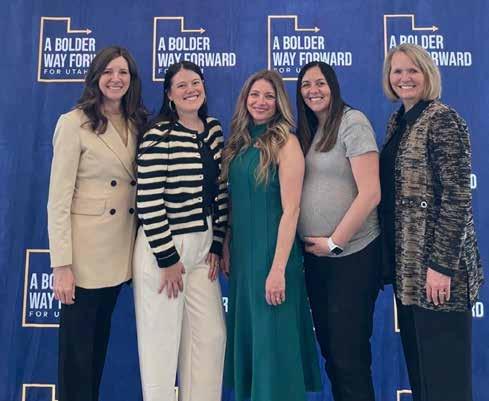
(From left to right) Deborah Lin, local outreach and curriculum manager; Emmalee Chastain, marketing and communications coordinator; Brie Sparks, associate director; Kylie Hollingsworth, program assistant and Susan Madsen, director. (Photo courtesy of UWLP)
Sen. Luz Escamilla is presented with the Dr. Martin Luther King Jr. Civil Rights Award
By Peri Kinder | peri.k@thecityjournals.com
The senator was recognized for her work championing families and justice.
Each year, the Salt Lake NAACP recognizes a community leader who advocates for justice, equal opportunity and community empowerment. At the Dr. Martin Luther King Jr. Commemoration Luncheon in January, Utah Senate Democratic Leader Luz Escamilla was honored with this year’s Dr. Martin Luther King Jr. Civil Rights Award.
Escamilla was elected to the Utah Senate in 2008 and is now serving her fifth term, representing Senate District 10, which covers portions of Salt Lake City and West Valley. Escamilla serves as vicechair of the Senate Ethics committee and champions policies she believes strengthen families, expand opportunity and protect the rights of all Utahns.
“Dr. King taught us that the greatest danger to justice is not loud hatred, but quiet acceptance,” she said. “Not just overt cruelty, but systems that institutionalize injustice. He warned us that injustice thrives when it is legalized, bureaucratized and justified as necessary. This lesson matters. It mattered then, and it matters now more
than ever, especially here in Utah.”
This year’s award theme, “The Fierce Urgency of Now,” reflects King’s call for action and accountability in the face of injustice. At the luncheon, Escamilla spoke out against a proposed 7,500-bed ICE detention center in Salt Lake and said Utah faces a moral crossroad where people must decide whether they choose fear or courage, whether they will learn from history or repeat harsh lessons from the past.
“As a woman of color and an immigrant, I carry this reality with me every day, and I feel for all the families and children who are fearful that you can’t believe in the power of the beloved community,” she said. “Dr. King often reminded us that the law is not the same as justice. He challenged the idea that legality alone makes something right. He called on people of conscience to disrupt unjust systems even when they were politically inconvenient.”
Salt Lake NAACP President Jeanetta Williams said the Dr. Martin Luther King Jr. award recognizes individuals whose service and leadership advance the ideas of advocacy and a deep commitment to equity.
The organization is dedicated to en-
suring the political, educational, social and economic equality of rights for all persons and to eliminating discrimination based on race. Williams said Escamilla’s accomplishments include helping to establish the West High School medical clinic for students and fighting for social justice for people across all demographics.
“The award honors a Utah citizen whose work has advanced civil rights in our state through Dr. King’s legacy of nonviolence,” Williams said. “We looked at a lot of the legislative bills that Sen. Escamilla had worked on, some passed, some didn’t, but for the most part, the bills affected the entire state of Utah and followed the vision of Dr. King.”
Originally from Mexico, Escamilla became the first immigrant elected to the Utah Legislature and the first Latina elected to the Utah Senate. She said she’s committed to building community as a promise to protect each other, especially during times of fear.
“To everyone else: organizing and advocating and speaking out at this moment, you are carrying the legacy of Dr. King,” Escamilla said. “I accept this award, and I celebrate it in a personal way, but I’m also seeing it as a charge. A charge to speak the truth, to stand firm and not be afraid, and to

ensure that when history looks back on this moment, it will say that Utah did the right thing and that we choose justice, that we choose courage, and that we choose each other, with love.”
Holladay’s city manager provides a steady hand of leadership
By Peri Kinder |
Gina Chamness guides the city’s course with deliberate planning.
Most residents don’t think about how cities are run. As long as roads are safe, water is clean and parks are open, city administration rarely crosses their minds.
But behind the scenes, it takes a functional team and deliberate planning to make city services seem effortless. In Holladay, the person coordinating that teamwork is City Manager Gina Chamness, who’s been with the city for 10 years.
Chamness is a rarity in Utah. According to a December 2024 policy brief put out by the Utah Women and Leadership Project, of the 250-plus cities in the state, only 13 of them had women serving as city managers or administrators.
“I think that’s starting to change,” Chamness said. “It feels like there are more women in assistant city manager roles, more women as department heads, but as far as my generation, there haven’t been many of us. I’ve been really lucky.”
Chamness never imagined she’d serve in municipal government. She started her career at the federal level, working for a congressional agency, but political dysfunction persuaded her to look for other opportunities.
With a political science degree and a master’s in public administration from the
University of Utah, Chamness landed a job with Salt Lake City, working her way up to become the city’s finance director in 2014.
When the Holladay city manager position opened, she felt it was the next best move for her career and family, since she and her husband, attorney Ralph Chamness, have lived in Holladay since 2003.
“I saw this position posted and it felt perfect,” she said. “I was excited to apply. The opportunity to serve a community where you live felt like something I could be really excited about.”
Chamness acts as the CEO of the city, managing administrative functions, working with elected officials and ensuring ordinances, policies and rules are observed. When she first started with Holladay, the city was struggling. Aging infrastructure, stunted growth and a lack of direction left Holladay stagnant.
Working with the mayor at the time, Rob Dahle, Chamness held discussions with city residents, elected officials and city staff to prioritize areas of focus.
“Ten years ago, we didn’t have much of a commercial base,” she said. “We were banking on redevelopment of the [Cottonwood] mall and then the great recession set redevelopment back. The question was, how could we build a city that was going to be financially sustainable? That was a big chal-
lenge for several years.”
Investing in infrastructure was another concern. With some parts of the community more than 100 years old, Chamness knew a concerted effort and lots of money had to be allocated to improve infrastructure.
Restructuring the city took patience. Much like turning an ocean liner, it needed a coordinated shift to move something so large and complex.
“Everyone wants to do things quickly. Sometimes people complain about how long the government takes to do things,” Chamness said. “Making sure you have adequate time to listen to residents and making sure elected officials build that conversation into their own planning and into the process is critical. I think we’ve done a pretty good job of that. I wish the residents understood how critical the services we provide are to their day-to-day lives.”
Over the last decade, Holladay has improved road quality, invested in development, attracted businesses that fit the community, expanded the sidewalk system and recently acquired the Spring Lane Elementary property to develop a new park.
Chamness builds bridges between elected officials, residents and city staff, while working with other government agencies, organizations and committees to create a city that residents are proud of.
“I think the best attribute for describing Gina’s success would be ‘trust,’” said

Holladay Mayor Paul Fotheringham. “My colleagues on the council have always felt a keen sense of trust for Gina; trust in her judgment, trust in the depth and breadth of her expertise from budgetary and legal issues to citizen engagement and public policy.”
Chamness admits the job as city manager is stressful, but she’s comfortable with conflict, especially when it leads to a better outcome for Holladay. She encourages women to pursue leadership roles, whether in government or business.
“I tell women, you could absolutely do this,” she said. “I really do feel like I have the best job in the valley.”
Utah State Sen. Luz Escamilla addresses those attending the Dr. Martin Luther King Jr. Commemoration Luncheon, where she received the Dr. Martin Luther King Jr. Civil Rights Award. (Photo courtesy of Luz Escamilla)
Holladay City Manager Gina Chamness has led the city through 10 years of growth and change. (Photo courtesy of Holladay)
Utah Women’s Day in Sports empowers next generation of female athletes
By Julie Slama | j.slama@mycityjournals.com
More than 400 high school student-athletes from across the state gathered for a morning focused on teamwork, leadership, mental health and empowerment in girls’ sports.
It began as a simple game of rock, paper, scissors, but quickly became a lesson in teamwork. Everyone played at first, then losers backed their opponents until only two players remained. Silence fell as they competed, then cheers erupted when the round ended in a tie. After four rounds, one girl finally emerged victorious.
The exercise wasn’t about winning, but about being a good teammate.
“How does it feel to be celebrated by your peers?” asked Poudre School District (Fort Collins, Colorado) health and physical education coordinator Jo Dixon, who emphasized that every player has a role — scorer, defender, supporter, teammate. “Being a part of someone else’s fan club is just as important and powerful as being in the spotlight, because lifting others up feels awesome.”
The interactive activity was part of a breakout session at the third annual Utah Women’s Day in Sports conference held Feb. 4 at the Delta Center, the day before National Girls & Women in Sports Day.
Dixon continued the partner activities designed to build unity. Student-athletes stood toe-to-toe and told each other: “Everyone is battling something in life, and I’m glad you’re battling with me.” Then, they stood back-to-back and said, “I’m so glad someone has my back — and I have yours.” The activity ended with a pinky promise and the words: “I pinky promise to help you unlock your greatness so the world can see it like I do.”
“We want you to be a good teammate from the inside out,” Dixon said.
The event’s origin began with Andee Bouwhuis, past president of Utah Interscholastic Athletic Administrators Association and Deseret Peak High School athletic director, along with Utah High School Activities Association Assistant Director Jan Whittaker and UIAAA communications coordinator and Cedar Valley High School Athletic Director Sharon Mardesich.
“Our goal is female empowerment; support our female athletes; grow leaders,” Bouwhuis said. “We’re letting these female athletes know that we hear them and we see them. We want them to be successful.”
More than 400 student-athletes statewide attended, supported by about 100 coaches and athletic directors. Participation from each school was limited to ensure broader representation.
“The athletes are charged to take back what they learned and teach it to their teammates,” she said.
Another breakout session focused on nutrition, led by Intermountain Health’s Josseline Kelley, who emphasized fueling, hydration and sleep.
“Our goal is to make sure that we’re eating something every three to four hours as athletes,” she said as she gave the student-athletes specific suggestions. “The worst thing you can do is go into a competition or training session without fueling. Under fueling can be very common in teens.”
University of Utah Assistant Director of Olympic Sport Performance Carly Fehler addressed competing in college athletics.
“Your whole life is going to change

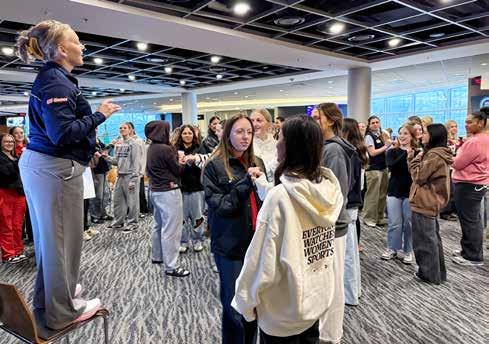
overnight,” Fehler said. “Your city, your bed, your routine, your team and coach. Literally, everything changes. And are you prepared for that? Only nine percent of high school girls will go on to play in college. Two percent of all high school athletes will play Division I.”
While some student-athletes attended workshops, adults participated in a “Coach Beyond” session focused on supporting athlete mental health.
“I’ve been an athlete for my whole life, and I’ve seen the way mental health affects the performances of athletes,” said college athlete and presenter Makayla Pitcher. “Coaches are the front line, so it’s important for them to understand and help.”
Cottonwood High Principal and presenter Justin Pitcher emphasized the need for better training and resources for coaches.
“We need to do better by our athletes here in Utah, he said. “Our data shows over half of every female team has experienced significant sadness or depression. We look at our coaches and their training. Many of them were former athletes so they understand the game well, but they don’t always know how best to handle these tough situations that we’ve been put in.”
Speaker Amy Donaldson highlighted the origins of Title IX and opportunities it presented.
“They drafted a piece of legislation that was unlike today, with 37 words,” she said. “Even though everyone thought it was this little administrative adjustment… they had no idea of (the impact of) that law.”
Donaldson encouraged student-athletes to examine their journey, to be optimistic, to wire their brains for gratitude and forgiveness, to know “no accomplishment is an individual accomplishment.”
Karissa Niehoff, National Federation of State High School Association’s executive director and CEO, challenged the next generation to continue advancing opportunities for women.
“Look at the women who came before us, and look at where we are now, and look at the future of growth in women’s and girls’ sports,” she said. “We’ve come a long way. As a woman CEO in a sports world, I feel blessed, but I challenge you as a younger generation…to carry this forward. We have to be committed to working forward so we continue the growth we need in girls who play sports in Utah.”
UHSAA Assistant Director Jeff Cluff said the progress in girls sports, including expanded championships and the addition of girls wrestling, has helped to equalize opportunities.
“We’re trying to create equal opportunities for the girls that boys have been getting for years,” he said. “We have still more to do and more to change.”
Copper Hills High seniors Brynlee Morton and Kaysha Millet said the conference left a lasting impression.
“I love how inclusive it is,” Morton said. “Everyone has valuable knowledge, and they’re sharing their expertise with us.”
Millet added: “They’re spreading awareness and information; it’s empowering to us as women athletes.”
At the third annual Utah Women’s Day in Sports conference, presenter Jo Dixon motivated female high school student-athletes to become good teammates. (Julie Slama/City Journals)
Cottonwood Principal Justin Pitcher was a co-presenter of a coaches’ session at the Utah Women’s Day in Sports conference. (Julie Slama/City Journals)
Women are stepping up to lead Utah’s cities
By Peri Kinder | peri.k@thecityjournals.com
Female mayors move from the exception to the norm.
When South Salt Lake Mayor Cherie Wood was first elected in 2010, she was a notable exception. Along with Midvale Mayor JoAnn Seghini, Wood was only the second female mayor serving in Salt Lake County at the time.
She and other women, including Riverton Mayor Sandra Lloyd, Taylorsville Mayor Janice Auger and Holladay Mayor Liane Stillman, were trailblazers and glass ceiling-breakers, setting the stage for women to take the lead, and it’s paying off.
“It’s always been a passion project for me to make sure we have women at tables where decisions are being made,” Wood said. “So I’m always encouraging women to run for office.”
Entering such a male-dominated field wasn’t easy. While many of their male counterparts offered support and encouragement, the women also encountered misogyny and roadblocks. Learning to navigate their leadership roles took patience, balance and a thick skin in order to stay the course while representing their cities.
Now, many cities in Salt Lake County are led by female mayors, including the new-
ly elected Cottonwood Heights Mayor Gay Lynn Bennion and Riverton Mayor Tish Buroker. Add in Salt Lake City Mayor Erin Mendenhall and Salt Lake County Mayor Jenny Wilson, and female leadership is becoming the norm, rather than the exception.
“It is so important that young women and young men see women in leadership,” Bennion said. “It’s important for them to know that women can do a great job as leaders.”
Organizations like Utah Women Run and the Women’s Leadership Institute have provided training for women who want a leadership role, whether in politics or business. Women are taught to participate on boards, campaign, fundraise, advocate for themselves and develop a platform and voice that others want to follow.
Initiatives like A Bolder Way Forward focus on creating safe spaces for women in boardrooms, education, political office and civic organizations.
WLI’s Director of Programs and Operations, Nicole Carpenter, said the organization’s founder, Pat Jones, is a former Utah Senator who believes women need a seat at the table.
“We need the voices of women in all areas of leadership, particularly on Capitol
Hill, where women can make decisions,” Carpenter said. “It’s important for women to have a vote, but it’s even more important for women to have a voice. To have a voice in those political circles, you need to hold an office, or you need to be a lobbyist, or have some type of political influence. So we encourage women to run for political office.”
It’s not just Salt Lake County; Utah County and Davis County have also had their share of female leaders, including Kaysville Mayor Tami Tran, who was just elected to her second term. Not only is she a political leader, but she’s the CEO of a tech company, Rylex.
“When I became a mayor five years ago, for my first term, there were nine mayors who were new in Davis County, so almost half, since there are 15 cities,” Tran said. “Nine of us were new and three of us were women, so it was awesome to mentor each other and learn from each other. Women can see things in such a unique way, because we bring different perspectives to the room.”
Tran hopes more women run for political office, whether on the local, state or federal level, but acknowledges some women worry about balancing leadership roles with family.
Wood was a single mother, raising two boys, when she became mayor in SSL. She understands the fear and uncertainty, but she found support and people who believed

in her. She said behaviors are slowly changing, with more understanding and empathy for women in leadership.
“I know it’s intimidating,” Wood said. “But there’s so much value to having different lived experiences and perspectives on councils and in elected office seats. When you invite all of those perspectives and give them a safe place to be heard, that’s when you’re going to solve big problems.”
For information about running for office, visit UtahWomenRun.org.
The Boob Bus makes mammograms accessible for all women
By Cassie Goff | c.goff@mycityjournals.com
“Let’s get all the girls together to go get dinner and mammograms!” is the vibe Rena Vanzo is going for with mammogram screenings on The Boob Bus.
One in every eight women will develop breast cancer in her lifetime. For every Utah woman, that translates to about a 12.5% chance of developing cancer.
“Every family, every community, every church group, every book club—all of them will be impacted. Prevention is the best medicine,” said CEO and co-founder of The Boob Bus Rena Vanzo.
The Boob Bus is a mobile unit that offers mammograms, health care screening, breast cancer assessment and other healthcare services to women locally. The main goal of The Boob Bus is to make mammograms more accessible and comfortable.
“Utah women are just not doing their mammograms. We’re way below the national average,” said Vanzo. In 2022, Utah was ranked 48th out of the 50 states in the nation for mammogram screening.
Vanzo and her team have been working to change that statistic by transforming typical health care screenings into modern experiences. The Boob Bus was fully customized as a health care space with neon
pink lights and vaulted ceilings.
“On The Boob Bus, you can expect to feel like an individual,” said driver and Patient Care Coordinator Kayla Pacheco. “Your history, your experiences and your fears are heard.”
An average visit to The Boob Bus begins by checking in to answer medical history questions. The data collected related to menstrual changes, hormones, breast density and personal medical history is used to calculate individual cancer risk.
“Breast density is really becoming more of a topic of conversation,” Vanzo said. “And it should be. Women with dense breasts do have a higher risk of breast cancer.”
Patients are offered heated pink robes instead of hospital gowns during their appointment. Individual women will meet with a licensed certified technologist privately in the mammogram suite for a screening.
Results are within one week. (Vanzo emphasizes that patients may be referred to a hospital for diagnostic screening depending on risk.) Patients leave The Boob Bus with branded lip balm, nail files and educational cards.
The entirely female Boob Bus team emphasizes the importance of destigmatizing women’s health with less shame and embar-
rassment through more conversation.
“I want to live in a world where even the men are saying to their partners ‘Hey, did you get your mammogram yet?’” Vanzo said.
Vanzo and her cofounders started The Boob Bus in 2022 after being personally impacted by individual family members battling cancer diagnoses. It took her two years to get The Boob Bus fully operational.
“I had to learn all of these extra things that are very useful in your life but you wouldn’t think they’d intersect in business,” Vanzo said.
Vanzo needed to get a CDL so she could drive the oversized custom bus. In preparation, she worked for UTA for six months to get trained as a driver in a structured environment.
“Rena is a superstar. I have never met anyone so driven to help others,” said Office and Billing Manager Jen Bartunek.
The Boob Bus primarily meets women for their mammograms all across Salt Lake, Utah and Davis Counties. Through their partnership with the Central Utah Health Department, The Boob Bus also travels to Central Utah.
The Boob Bus works with the Utah Breast and Cervical Cancer Program (UCCP) so uninsured women can still access their mammogram screenings through a voucher program.

The Boob Bus provides heated robes for mammogram appointments so it “feels more like a spa experience,” The Boob Bus founder Rena Vanzo said. (Photo courtesy of Rena Vanzo, The Boob Bus CEO and co-founder.)
El Programa de Detección del Cáncer de Mama y de Cuello Uterino es facilitado por el Departamento de Salud y Servicios Humanos de Utah y está financiado con fondos estatales y federales. El formulario de solicitud está disponible en español a través de lo siguiente: www. cancer.utah.gov
Individual women can book appointments online (even same day) through The Boob Bus website: www.theboobbus.com. Organizations, businesses or school districts can email or call The Boob Bus team (866-747-BOOB) to set up a day for group appointments.
South Salt Lake Mayor Cherie Wood (right) is sworn into her fifth term in office by SSL City Recorder Ariel Andrus. Wood is one of several women elected to leadership positions throughout the state. (Peri Kinder/City Journals)
Companion animal photo event benefits Humane Society
People with companion animals receive professional-grade portraits for a cause.
By McKinna Baird m.baird@mycityjournals.com
“People ask me what’s your favorite thing to photograph? And I say dogs, because in the 27 years of doing it, I haven’t had a single one complain about the picture,” said Scott Gianchetta, owner of The Photo Box.
Since 2009, Gianchetta and his family have run companion animal portrait events with organizations like the Humane Society of Utah to raise funds for the animals they serve.
“One hundred percent of the proceeds upfront go to [the Humane Society],” Gianchetta said, “and it gives people an opportunity to get a really good shot, outside of having to pay a session fee.”
Most recently, The Photo Box and the Humane Society of Utah hosted the Palentine’s Pet Portrait event at their Murray headquarters. People with companion animals could book a time slot for Feb. 7.
Gianchetta has set up a real studio experience for participating animals, with multiple backdrops and curated lighting. His
daughter, Violet, worked on editing from the sidelines. Participants receive multiple shots and leave with one edited and printed 8x10inch photo to take home.
Slots for the event were fully booked days before it occurred.
People with companion animals were immediately impressed with the shots they received.
One participant, Cindy, came following a recommendation from her mother. Her black lab and German pointer, Cooper and Toby, have made it hard for her to get good pictures in the past.
“My dogs are old, but they’re full of energy, and so getting good photos of them is super hard,” she said. “So, I’m super excited to see what comes up.”
Marie, who had previously attended the Christmas photoshoot fundraiser, came in with her dogs Misa, Gidget and Rip. Marie and a Humane Society volunteer did their best to wrangle the dogs for group shots and solo portraits.
“I just think this photographer is excellent,” she said. “The Christmas shot that we got turned out really good.”
Over the years Gianchetta has perfected tricks to grab the perfect shot, using treats, a duck call and an array of other attention-grabbing antics.
“We always joke, we just need 1/20th of

a second. So that’s it, because the rest of time they’re spinning in circles and it’s chaotic,” Gianchetta said.
It’s not only dogs bringing chaos to the shoot.
“I mean, the different types of animals that come in are amazing to me,” he said. “I mean some of the photographs of skunks, horses… different things like that.”
Despite doing the fundraiser for more
Nominate a Utah Top Workplace for 2026
Great workplaces don’t happen by accident. They are nurtured and built to bring out the best in people. If you know of one, nominate it as a Utah Top Workplace.
For the 13th year, employers with outstanding workplace culture in the state will compete for Utah Top Workplaces recognition. This is the first year the award is in partnership with the Salt Lake Business Journal. Any organization with 35 or more employees in the state is eligible to compete for a Top Workplaces award. Standout companies will be honored this fall.
The nomination deadline is April 10. Anyone can nominate an outstanding employer: public, private, nonprofit, a school or even a government agency. To nominate an employer or for more information on the awards, just go to slenterprise.com/nominate or call (801) 803-6841.
There is no cost to participate. To qualify as a Utah Top Workplace, employees evaluate their workplace using a short 26-question survey that takes just a few minutes to complete. Companies will be surveyed through late June.
“As a people and culture leader, I know the strongest organizations invite honest feedback and use it to get better,” said Elizabeth Sweat, people and culture leader of the City Journals and Salt Lake Business Journal.
“Utah Top Workplaces provides leaders with a meaningful way to measure culture, celebrate what’s working and identify opportunities to invest even more intentionally in their people.”
Energage, the Pennsylvania-based research partner for the project, conducts Top Workplaces surveys for media in 65 markets nationwide and surveyed more than 2 million employees at more than 8,000 organizations in the past year.
“Earning a Top Workplaces award is a celebration of excellence,” said Eric Rubino, CEO of Energage. “It serves as a reminder of the vital role a people-first workplace experience plays in achieving success.”
For the 2025 awards, more than 3,500 organizations in Utah were invited to survey their employees. Based on employee survey feedback, 154 earned recognition as Top Workplaces.
than a decade, Gianchetta has yet to tire of the work. “I always like the reactions I get from the owners, because they can’t believe the pictures that are being produced,” he said. Since the event has remained a hit over the years, Gianchetta hopes to one day pass the torch on to someone within his company, possibly his daughter Violet. Repeat participants can look forward to more years of quality companion animal portraits, for a cause. l
Scott Gianchetta, owner of The Photo Box, takes a solo portrait of Toby. (McKinna Baird/City Journals)
Four Simple Ways to Build a Happier Life
As a county councilmember, I spend a lot of time listening to concerns from constituents. I hear from parents who are stretched thin, seniors who feel lonely, young people who are anxious about the future, and workers who feel burned out even when they’re doing everything “right.” One thing is clear: many people are searching for happiness, but they aren’t sure where to find it.
Research from social scientists points to a clear answer. Happiness does not come from money alone, social media attention, or having an easier life. Arthur Brooks, a Harvard


Right now, children in YOUR community are in need of a safe, loving home.

Learn more about why we need more foster parents. openarmsyas.org 801-244-0147
Aimee Winder Newton
Salt Lake County Councilmember District 3

professor, social scientist and bestselling author teaches the science of happiness. He says that happiness comes from four things: faith, family, friendship and meaningful work.
The first is faith. People are happier when they believe their lives matter and are part of something bigger than themselves. For some, this comes from faith or spiritual beliefs. For others, it comes from serving their community, caring for others or living by strong values. Faith gives people strength during hard times and helps them see challenges as part of a larger purpose. Even small habits—like volunteering, mentoring, or reflecting on what matters most—can build a deeper sense of meaning.
The second is family. Strong family relationships are one of the most reliable sources of long-term happiness. This doesn’t mean
family life is easy. It takes patience, forgiveness and time. But people who invest in their families tend to feel more supported and less alone. Family can mean parents and children, grandparents, chosen family or relatives who show up when it counts. Simple actions— shared meals, regular check-ins or family traditions—can make a big difference.
The third is friendship. Healthy friendships protect people from loneliness and stress. They give us someone to laugh with, talk to and lean on when life gets hard. Yet friendships often get pushed aside by busy schedules and screens. Reaching out, making time for face-to-face connection, and being present for others helps build trust and belonging. Often you will have to be the one to reach out and make this happen. Communities are stronger when neighbors know each other, not just online, but in real life. Do you know the people who live three houses on either side of you and across the street? If not, make it a point this year to get to know them better. It helps keep your neighborhood safe and builds connection when you can all look out for each other.
The fourth is meaningful work. This does not mean everyone has to love every part of their job. But people are happier when they


feel useful and see how their work helps someone else. Whether paid or unpaid, work gives people dignity and purpose. Parents raising children, volunteers, caregivers, students and workers all contribute value. When people feel needed, their confidence and happiness grow.
One important idea connects all four of these areas: happiness is not about chasing pleasure. Pleasure fades quickly. Real happiness builds slowly through effort, relationships and responsibility. It grows when we use things but care for people—not the other way around. Being “happy” doesn’t mean you will never have sadness, anger, frustration or problems. Everyone has hard times. But by focusing on the things that really matter, you increase your opportunities for better overall happiness.
As a community, we should make it easier for people to build these four foundations. That means supporting families, creating spaces for connection, valuing service and helping people find meaning in their lives. Happiness is not something government can give—but it is something we can support by strengthening the places where people live, work and belong. Make a goal this year to find ways you can help increase your own happiness.





Remember when you thought Mr. Monopoly wore a monocle, or you were convinced Curious George had a tail? Memory is a funny thing.
Or how about when NBC anchor Brian Williams “misremembered” being in a helicopter hit by anti-tank weapons in Iraq? His faulty memory got him suspended.
We all misremember things, but when an entire group does it, it’s called the Mandela Effect, a phenomenon that occurs when millions of people are confidently wrong. Like, remember when we all believed Vladimir Putin was a war criminal? LOL. Good times.
If you’re a Gen Xer, you might remember when the VHS tape got eaten by the VCR and you had to use brain surgeon-style techniques to carefully respool the video. But then the tape always had a wrinkled section where the movie would go wonky for a few seconds. That’s what my memory feels like most days: warped and staticky.
My husband is basically a human computer. He remembers everything. When we meet new people, he lights up like an exploding star. He’s curious about their background, hometown and their connection to any celebrity-type person.
Months later, he’ll say, “Remember at the Yankees game when we met that guy who was married to the cousin of a friend who knows Ryan Reynolds? I think his name was George.”
A Trip Down Memory Lane
Peri Kinder Life and Laughter

“No.”
“Yeah, you do. He owned a horse farm outside of Albany and loves the color orange.”
“What are you talking about?”
His memory recall is slightly unsettling. He’ll drop info like, “I remember the 1968 World Series when the Detroit Tigers came from behind to beat the Cardinals. They hadn’t won since 1945 and Mickey Lolich was the MVP.”
And then there’s me, having to watch a recap for a TV show I watched the night before. But then I remember random things, like when Sen. Mike Lee advocated for term limits. Hahahaha. The good ol’ days.
I was playing a “Frozen” matching game with my 9yo granddaughter, trying to remember where the pair of Olafs were hiding. I kept turning over the same two cards, a Sven and an Elsa, convinced I’d finally cracked the code.
My granddaughter found it hilarious watching her doddering old granny lose a game. But there was a time I was the matching

game champ. At least that’s my recollection.
I can still sing Abba’s entire “Arrival” album from 1976 but I’m not quite sure I actually attended a single day of high school. I used to know dozens of phone numbers, but now I couldn’t call my daughters if the world were ending and I had to use a rotary phone.
When it comes to remembering the names of dogs I met at the dog park, I’ve got it down. But their owners’ names? No clue. I can make my mom’s mac and cheese by heart, but need to read the directions on a cake mix four times before I get it right.
It makes me second-guess my memory, like, do you recall when Gov. Spencer Cox took the side of trans kids? Or was that also the
Mandela Effect?
If you’ve ever had a sibling contradict your side of a story, or you can’t remember your eighth-grade science teacher, you’re not alone. Or maybe you had an existential crisis when you realized C-3PO’s lower right leg was silver, not gold.
Memory isn’t just fleeting, it’s fluid. When time blurs the moments we fell flat on our faces, it’s a reminder that our flashbacks are edited highlight reels, usually with a laugh track.
Peri Kinder is an award-winning columnist and journalist who has written for The City Journals since 2004. She can be reached at peri.k@thecityjournals.com