

Mayor’s 2026 State of the City highlights Millcreek’s advancements
Cheri Jackson discussed the city’s successes over the past year and reflected on Millcreek’s first 10 years as a city.
On Feb. 23, Mayor Cheri Jackson addressed Millcreek residents in a State of the City address, a speech designed to tell constituents about the state of their city.
The Millcreek City Hall was full that night. The evening began with an introduction from Scout Troop 410, who lead the council and audience in reciting the Pledge of Allegiance.
Following this, Jackson began her address. This speech was not only special because it was Jackson’s first, but also because 2026 marks Millcreek’s 10th anniversary as an incorporated city. Jackson’s address highlighted many of the advancements brought by the city’s development.
She discussed the increase in population and operating businesses Millcreek has experienced within its first 10 years.
By Alexandra Straumann | a.straumann@mycityjournals.com
Millcreek has grown to a population of nearly 65,000, making it the 12th largest city in the state of Utah.
Addressing the housing crisis is something Jackson has mentioned as a goal, and during her speech she stated that the city has issued building permits for over 3,200 new homes, “offering more families the opportunity to put down roots here,” something Jackson highlighted as a positive indication of Millcreek’s future.
She reflected on the creation of Millcreek, and how she, along with other Millcreek residents, came together to become the first official governmental body for the city.
In 2016, when Millcreek voters elected to incorporate, the five representatives were (at the time) Councilmembers Jackson, Silvia Catten, Bev Uipi, Dwight Marchant and Millcreek’s first mayor Jeff Silvestrini. This group worked closely together to establish a system of governance that was representative, and they worked
Continued on page 8


Millcreek Mayor Cheri Jackson delivers her State of the City address. (Alexandra Straumann/City Journals)






COMMON GROUND
Immigrants are not the enemy
Common Ground will be a column of rotating viewpoints that highlight specific feelings across the political spectrum, and it will always end with possible ways to come together.
While the 2025 FIFA Peace Prize winner bombs Iran and talks about invading Cuba, the Utah Legislature is fighting its own battles against immigrants and refugees.
Legislators introduced several zero-tolerance immigration bills addressing issues ranging from public education and driving privileges to the right to receive food from local pantries.
If these bills had passed, women, infants and children would have been barred from receiving vaccinations and treatment for communicable diseases. It seems the pro-measles group would also like to welcome back polio, meningitis and maybe a bit of scurvy, just for fun.
I keep saying, “We’re better than this,” but certain legislators (you know who you are) keep making that statement false.
These lawmakers say providing services to immigrants is a drain on taxpayers. There’s just one problem: immigrants pay taxes, too. They pay gas, income, sales and property tax. In fact, immigrants contribute more than $200 million to the state. Why shouldn’t they have access to public schools when they help fund them?
As a kind human, I want my tax dollars to assist those in need. I want families to have food and housing, basic human requirements everyone deserves. I’d much rather have my tax dollars go to immigrants than to pay legal fees fighting Prop 4.
Peri Kinder Common Ground
This year, a bill was introduced to add a 2% tax on international money transfers for those without approved IDs. That might not sound like much, but it could be the difference between sending money for rent or having grandma evicted. Immigrants often wire money to their families in other countries for food, medicine or housing, things our lawmakers obviously take for granted.
Immigrant driving privileges were also on the chopping block. Not only would the bill have revoked those cards, it also required police to contact ICE to turn in an undocumented person involved in a traffic accident.
Utah issues around 35,000 driving privilege cards each year. They allow people to have car insurance, drive to school or work, and navigate the two hazards of Utah roads: terrible drivers and whatever UDOT is tearing up this week.
Undocumented college-bound students were also targeted after a lawmaker introduced legislation to strip them of the right to access lower in-state tuition. Many of these students are on the path to citizenship. Don’t we want an educated populace? My guess is no.
All these initiatives seem to be based on selfishness. If we were really putting Utah first, wouldn’t we ensure that the people who lived here were healthy, fed, educated and safe?
Until recently, Utah leaders lauded the state’s programs designed to help immigrants and refugees learn English, get career training and become productive members of society. Now, the perfect immigrant is someone who doesn’t want education or food and who never sends money to grandpa for a new roof.
Immigrants are our neighbors, coworkers and friends. They deserve the right to dignity and respect. I’d love to see any lawmaker work as hard as the immigrants I know.
Luckily, these bills didn’t pass. But in this political climate, they will probably rise again. Like a case of measles in St. George.
Common Ground: Sometimes, those on the left act like we should open the borders and let the world flow through, while those on the right can’t build walls high enough. What if we all implore Congress to create sustainable immigration policies? Instead of punishing people who want to work and contribute, we need an immigration structure that makes sense. And thanks to the state legislators who voted down the harmful bills presented this year. We can do better. l
From the Publisher:
Thirty-five years ago the City Journals (South Valley Journal) were created with a vision to stay local and bring the community together. Thirteen years ago when I took over as publisher the name changed. but the vision did not. Today that vision is still true; we want the Journals to be hyperlocal and we want to bring the community together.
Over the last few years, as our nation continues to divide between the right and left, it has become harder and harder to feel like we are bringing our community together. If we write on something that is political, one side will be mad at us, and worse of all we may lose them as readers. This does not feel like we are bringing a community together.
This has left our editorial team in a tough position. Do we write on issues and upset our readers, or do we not write on the issues and move forward blind to the issues that are dividing our community.
Our solution: Common Ground. A monthly opinion column that will cover issues that we feel are dividing our communities. Each month one of two writers will present an opinion column, one that leans right and one that leans left.
This month Peri Kinder wrote about state legislation concerning immigration-related topics.
We hope that you have enjoyed the first Common Ground.
— Bryan Scott






Now accepting new heart patients
Across Salt Lake County
Our team is expanding to provide faster, more comprehensive care that’s close to you. We provide:
› Care for your heart: We diagnose and manage heart conditions including high cholesterol, high blood pressure, heart attacks, and more
› Echocardiograms: A safe, painless test that shows how your heart is working
› Stress testing: See how your heart performs when it’s working hard
› Heart Rhythm Monitoring: Find and treat problems with your heart’s electrical system
Life can change in a heartbeat. We want to help you keep it going.











Copper Rock offers great golf and vacation opportunities
Arrivingat Copper Rock, you might be torn as to what to do first. There’s the world-class golf course, voted best in Southern Utah for five straight years, with its lush fairways and greens weaving through the stunning red rocks.
There’s the beauty of the Hurricane Valley, with trails beckoning hikers or nature lovers anxious to watch a sunrise or sunset. And there’s the amazing resort itself, with a clubhouse grill, pools, golf pro shop and close proximity to Zion National Park.
With more than 300 days of sunshine each year, it’s become one of Southern Utah’s most desirable addresses for golfers and vacationers and part of a master-planned development that has redefined luxury living in the region.
In addition to amazing real estate options, Copper Rock is a source for luxury vacation rentals that are perfect for families or large groups offering short-term rentals, but also aim to build long-term relationships with those we serve by maintaining constant support before, during and after your stay. And in May, we will once again host the LPGA Epson Tour Copper Rock Championship, welcoming top rising stars in women’s professional golf. That event will be held May 14-16. It fills a hope that developers dreamt about—that Copper Rock would be more than just a golf course—it would be a destination.
“When we broke ground on Copper Rock nearly two decades ago, we carried with us a bold vision: to build a worldclass golf course in Southern Utah—a course that could not only showcase the beauty of our desert landscape but also stand proudly alongside some of the best in the country,” said Darcy Horman, director of operations at Copper Rock. “We imagined a destination for connection and shared experiences for our community and guests from around the world.”
Opened in 2020, Copper Rock has already established itself as a premier golf and resort community. What was once a vast expanse of farmland has now been thoughtfully transformed into a vibrant, 1,000-acre resort community centered around that award-winning 18-hole championship course. The 7,227-yard layout winds across natural sand dunes and native sagebrush, offering a challenging and exhilarating round of golf. The design integrates seamlessly with the rugged Copper Rock, and the surrounding area seals the deal.
“Everything about this course from start to finish was excellent,” one golfer wrote. “Service was great, tee box and fairway conditions were excellent, pure greens, interesting hole layouts with some challenging but fun blind shots and water hazards here and there, and landscape views that can’t be beat. I’ve played multiple top rated golf courses in Southern Utah and this one was my favorite by a long shot.”
Another wrote, “I enjoyed everything about the day. Pro shop staff were very helpful and worked with our threesome to alleviate a previous scheduling snafu. We were escorted to the practice facility and I have to say the practice facility was top
notch…putting green, chipping green and an excellent driving range. The course itself was in excellent condition. All aspects of course management were superior. The views on the course were just amazing.”
Just minutes from downtown Hurricane and less than 30 minutes from St. George, residents enjoy quick access to shopping, dining and healthcare, as well as Southern Utah’s endless outdoor recreation options. Those include boating and fishing at Sand Hollow Reservoir and mountain biking on the Gooseberry Mesa trails that are all within easy reach. And once you’ve returned to Copper Rock, you can enjoy golf lessons, a grill and pro shop, an online store and private spas.
“It’s a place where our community can come together,” Horman said. “A place that continues to grow and give back while showcasing the unique beauty and spirit of Southern Utah to the world.”
Freelance writer Michael Zuccarello who specializes in Utah sports businesses recalled his visit to the resort in an article published before last year’s Epson event.
“Evening falls on the 11th fairway at Copper Rock Golf Course, and the summer heat is making its peace with a soft evening breeze. Bullfrogs croak in the distance. The fading sunlight beams golden off the sandstone cliffs, backlighting the residences lining the right side of the fairway, while just left of the 11th green, the sun is about to plunge below the Pine Valley Mountains.
“This is what I see as I chip in my flip flops, trying to hold a quick green that demands a pre-meditated landing spot and the kind of precision execution that can be challenging for this 15-handicapper. It’s after 9 p.m. now, and my wife, “Callaway,” and I have a 7:20 a.m. tee time, but I want to finish with three close ones before I walk back through the neighborhood to the gleaming glass house on Torrey Pines Road, a place barely three years old with four bedrooms, five bathrooms, a pool table, and a private pool and spa.”
He said walking past modern, angular homes with huge glass windows, each home seemed to appeal to different groups for their next stay-and-play vacation.
“One home has a water slide, another a bowling alley, and still others have putting greens and basketball courts,” he wrote. “Every last one of them has a private pool. Copper Rock, truth be told, is as much a vision today as it is a living golf community.”
He said Copper Rock is “the place you and your golf friends come to play a course the pros play, with tee boxes as flat and smooth as pool tables, pristine fairways that reward accurate drives with generous rolls, and greens that roll true and fast. I have it on good authority that you can play your way out of the desert sand and sagebrush that line the fairways, just punishment indeed but not round-killing.”
“We’re really excited that the locals once again voted Copper Rock the best golf course in Southern Utah,” said Penny

James-Garcia, Copper Rock’s event coordinator. “Copper Rock was built to be a championship course, and golfers find it both highly challenging and highly playable.”
As Copper Rock continues to grow and evolve, the vision for the community includes expanded resort offerings, walking trails and enhanced hospitality experiences—all designed to elevate the lifestyle of every resident and guest. Whether you’re drawn by the championship golf, the stunning views, or the potential of owning in one of Utah’s most exciting new communities, Copper Rock is more than a place to live—it’s a place to thrive.
“We’re certainly excited about all our future amenities and developments,” Horman said, “but we understand the importance of realistic expectations. We’re lasered in on what makes Copper Rock special. At this moment, it’s a chance to stay in a beautifully equipped modern home and play at a premier championship golf course.”
Copper Rock is located at 1567 West Copper Rock Parkway in Hurricane, Utah. For tee times, vacation rentals, homesites, and stay and plays, visit copperrock.com. For more information on the Epson Tour stop in Southern Utah including tickets, go to copperrockchampionship.com. l
The 17th hole presents golfers with challenges and breathtaking scenery. (Courtesy Copper Rock)
Contemporary designs for homes and rental properties at Copper Rock offer amazing views. (Courtesy Copper Rock)
Vacation rentals offer both short-term and long-term Stay and Play options. (Courtesy Copper Rock)

to adequately assist resident’s concerns across the four districts.
In addition to the three original city councilmembers, many of the original administrative and operational employees working behind the scenes to keep City Hall running were hired during this time too. Jackson acknowledged those individuals and thanked them for all of the critical work provided by them over the past decade.
Since the establishment of Millcreek as a city, there has been a concentrated effort to fund investment into new parks,
playgrounds, sidewalks and public spaces. The council prides itself on making an effort to “meet the future with purpose,” as Jackson said, and ensuring the community has access to adequate outdoor recreation is a way of doing so. She noted that they have “preserved over 10 million square feet of pavement, expanded bike lanes and trails, [and] completed a new Jordan River parkway trailhead and boat launch.”
Providing Millcreek’s children with greater access to opportunity has been another long-standing focus of the council.
Jackson praised the Millcreek Promise Program and Millcreek Futures Program for providing children and teenagers with
resources to succeed in and outside of the classroom.
For Millcreek residents of all ages, the creation of the Millcreek Common has provided residents with a gathering place for community, sport and leisure. There are different events happening at Millcreek Common every month and seasonal events like winter holiday markets and daily ice skating provide opportunities for everyone to enjoy.
Jackson and the other councilmembers have consistently praised the residents of Millcreek for their generosity and ability to come together during times of need. Jackson specifically mentioned the fundraising
effort to support the 40 people displaced by the Willow Glenn Apartment fire in August 2025. “Through overwhelming generosity,” Jackson said, “more than $108,000 was distributed to help families rebuild their lives.”
The address was a celebration of the city’s past and provided encouragement for the future. In closing, she said, “our city is growing wiser, more capable, and more compassionate with each passing year. And if the first decade is any indication, Millcreek’s future is bright. Not just because of what we build, but because of who we are becoming, together.” l
How families can help students finish the school year strong
By Holly Curby hello@hollycurby.com
As the school year moves into its final stretch, many students find their motivation slipping. The excitement of the beginning of the year has faded, routines may feel stale, and both parents and kids can start to feel the weight of a long academic year. But according to educator and youth speaker Erin Tarr, this moment can actually be a powerful opportunity for a reset.
“Mid-year is the perfect time to pause, reflect and make small adjustments,” Tarr said. “You don’t need to overhaul everything. Often, a few intentional shifts can help students regain focus and confidence.”
For families wondering how to help their children finish the school year strong, Tarr offers practical strategies that focus on encouragement, structure and connection.
1. Start with Reflection.
Before jumping into solutions, Tarr recommends taking time to talk with your child about how the year is going. “Ask open-ended questions,” she says. “What’s been going well this year? What’s been challenging? What would make the rest of the year feel more manageable?” These conversations can help students feel heard while also helping parents understand what’s really happening beneath the surface. Sometimes the issue isn’t academic at all—it could be social stress, fatigue or simply feeling overwhelmed. Reflection also helps students recognize their progress. “Kids often forget how far they’ve come,” Tarr said. “Acknowledging their growth can rebuild confidence and motivation.”
2. Reset Goals for the Final Months
Once you’ve reflected on the year so far, the next step is setting realistic goals for the remaining months. Rather than focusing only on grades, Tarr suggests encouraging students to create goals that feel achievable and meaningful. For example:
• Completing homework consistently
• Improving organization

• Asking for help when needed
• Preparing earlier for tests and projects
“Goals don’t have to be huge,” Tarr notes. “Small wins build momentum.” Parents can help by breaking larger tasks into manageable steps and checking in periodically. The goal is to support—not pressure—students as they move toward the finish line.
3. Rebuild Healthy Routines
As the year progresses, routines sometimes start to slip. Bedtimes drift later, homework becomes rushed and activities pile up. “Structure is incredibly helpful for students,” Tarr said. “When routines are predictable, kids have more mental energy to focus on learning.”
Families can use a mid-year reset to revisit daily habits. This might include:
• Establishing a consistent homework time
• Creating a quiet study space
• Prioritizing sleep
• Limiting distractions during study hours
These adjustments don’t need to be
strict or rigid, but even small improvements can make a big difference in a student’s ability to stay on track.
4. Focus on Effort, Not Just Results
Another important shift, Tarr says, is focusing on effort rather than perfection. “Students often feel intense pressure to perform,” she said. “But when parents recognize effort, persistence and improvement, it changes the conversation.”
Instead of asking only about grades, parents can ask questions like:
• What did you work hardest on today?
• What was something challenging you pushed through?
• What are you proud of this week?
These kinds of conversations reinforce resilience and encourage students to keep trying, even when school feels difficult.
5. Stay Connected with Teachers
Communication between families and educators can also play a key role in helping students finish the year strong. “If a child is struggling, teachers often have helpful insight and strategies,” Tarr said. “Reach-
ing out early can prevent small issues from becoming bigger problems.” Many teachers appreciate when parents collaborate rather than wait until the end of the year to address concerns. A quick email or conference can provide clarity about expectations and opportunities for improvement.
6.
Don’t Forget Encouragement
Perhaps most importantly, Tarr emphasizes the power of encouragement. “Kids need to know their parents are in their corner,” she said. “Even when things aren’t perfect.” A simple reminder of “You’ve got this” can go a long way in helping students push through the final months of school. Celebrating milestones, finishing big projects or simply getting through a challenging week can reinforce a student’s sense of accomplishment. “Finishing strong isn’t about perfection,” Tarr said. “It’s about helping students believe in their ability to keep growing.”
These practical strategies can help families turn the mid-year slump into an opportunity, which can help students close out the school year with confidence, resilience and pride in how far they’ve come.
For more insights on how to help set your student up for success, listen to the full interview with Erin Tarr on Holly’s Highlights podcast season 4 episode 18 wherever you stream podcasts, and at www.HollyCurby.com.l

A student works through his homework beneath a sign reading “We Can Do Hard Things,” a reminder that perseverance and support are key parts of the learning process. (Photo courtesy Holly Curby)
Millcreek Common offers a free way to find community and move your body with Sunday yoga
Of all the events Millcreek has to offer, Sunday yoga classes may be the most grounding.
By McKinna Baird m.baird@mycityjournals.com
The winter series of free yoga classes are in full swing at Millcreek Common. On March 8, yoga instructor Leni led a full class through an hour-long flow.
Leni has been teaching yoga for 10 years and has taught free classes at Millcreek Common in their outdoor summer yoga series. This was her first time teaching the indoor winter class.
The free classes are brought to the space through Yoga Forward, a Salt Lake City based nonprofit that focuses on bringing opportunities to engage in yoga practices to vulnerable populations.
According to their website, Yoga Forward works with the training program Yoga Assets to engage instructors-in-training with what they call “yoga service.” They define this as “the intentional sharing of yoga practices with people who experience vulnerability or trauma at different points of their lives.”

intention based flow.”
Leni gently guided participants through the yoga flow, encouraging them to play with the movements. Her instruction was a mix of meditative breath and encouragement to feel strong in the body.
“I like for us to be able to move the body with the breath, so we don’t have to think so much about what we’re doing,” she said. “But, I want us to have intentional movement so there’s meaning behind the shapes.”
Leni said her favorite part of the event is being in the community yoga can create.
“I love being able to kind of help to create a space where people can just kind of move their bodies in unique ways they hadn’t before. So you get to know yourself in a different setting,” she said.
So far, the populations they choose to serve have included veterans, incarcerated individuals, people dealing with terminal illnesses and at-risk youth.
Though Leni didn’t complete her yoga training through Yoga Forward, she was still asked to come to support the work they do.
Her aim was to create a “very heart based,
The class takes place at 10 a.m., on the top floor of the Millcreek Commons building. The large room is encased in windows, giving attendees a view of the snowy mountains to the east. There is even a balcony space on which some students took advantage, breathing in crisp morning air after the yoga instruction.
These classes will continue every Sunday until the end of May. All skill levels are welcome.l
Log Haven Restaurant now under new ownership
After 32 years, a new trio takes the reins of the famous eatery up Millcreek Canyon.
By Tom Haraldsen t.haraldsen@mycityjournals.com
One of the Salt Lake Valley’s most iconic restaurants is under new ownership. Log Haven, in Millcreek Canyon, has been sold to new owners Brandon Hargett, Flynn Paulson and Teri Paulson.
Longtime owner Margo Provost, who purchased Log Haven in 1994, transitioned the ownership. General Manager Ian Campbell and Executive Chef Dave Jones were also bought out, though both will remain actively involved in continuity and mentorship as the restaurant moves into the future.
“For 32 years, Log Haven has been a labor of love and a true community gathering place,” Provost said in a release. “I’m deeply grateful to my partners, our extraordinary staff and the community who helped shape it, sustain it, and care for this special place — including the land that surrounds it. I’m excited to pass the torch to owners who share that sense of stewardship and
will carry Log Haven’s legacy forward with fresh energy and deep respect.”
The new ownership group shares experience in hospitality, operations and long-term business stewardship. Hargett, a veteran restaurateur, will oversee day-today leadership, while the Paulsons bring a long-standing focus on building durable business through financial systems, governance and operational support.
“This is not just the purchase of a restaurant; it is a responsibility to a legacy,” Hargett said in a release. “Log Haven is a rare place where food, land, history and community intersect. We are honored to become its stewards and are committed to protecting what makes it special while thoughtfully investing in its future. Places like Log Haven are increasingly rare, and protecting them — no, reinventing them — is the responsibility we take most seriously.”
Faith Scheffler, who will remain with Log Haven as a minority partner, said, “Log Haven is what it is today because of Margo’s vision, Ian’s leadership and Dave’s extraordinary culinary talent. Their influence is deeply woven into every corner of this place, and that foundation allows Log Haven to move forward with integrity.” l

Leni teaches a full class with the mountains as her background. (McKinna Baird/City Journals)
From left, Flynn Paulson, Teri Paulson and Brandon Hargett are new owners of Log Haven Restaurant in Millcreek Canyon. (Photo courtesy Log Haven)
Act FAST, Save a Life: Why Stroke Awareness is Everyone’s Business (No, Seriously, Everyone’s!)
When you hear the word “stroke,” what image comes to mind? For many, it’s an elderly relative, perhaps a grandfather, suddenly incapacitated. But local neurologists are clear: that outdated image is a dangerous myth. Strokes can strike anyone, at any age, and often without warning, making awareness and rapid response absolutely critical.
“The idea that strokes are an ‘old person’s disease’ is incredibly harmful,” says Dr. Mohammad Shoari, a neurologist at Holy Cross Hospital – Jordan Valley, Salt Lake and Mountain Point. “We are seeing strokes in younger adults, even teenagers, with increasing frequency. Lifestyle factors, genetics, and even certain medical conditions can put anyone at risk. This isn’t just about grandpas anymore; it’s about protecting our entire community.”
A stroke occurs when blood flow to part of the brain is interrupted, either by a clot (ischemic stroke) or a burst blood vessel (hemorrhagic stroke). When brain cells are deprived of oxygen, they begin to die, leading to potential long-term disability or even death. The good news? Many strokes are treatable, but time is brain.
This is why recognizing the warning signs is
paramount. Healthcare professionals use the acronym F.A.S.T. to help people remember:
SAFFace Drooping: Does one side of the face droop or is it numb? Ask the person to smile. Is the smile uneven?
Arm Weakness: Is one arm weak or numb? Ask the person to raise both arms. Does one arm drift downward?
Speech Difficulty: Is speech slurred, are they unable to speak, or are they hard to understand? Ask the person to repeat a simple sentence.
TTime to call 911: If someone shows any of these symptoms, even if the symptoms go away, call 911 immediately. Note the time when symptoms first appeared.
“Every minute counts when someone is having a stroke,” emphasizes Dr. Rebecca Reiser, a neurologist at Holy Cross Hospital – Jordan Valley.
“The quicker a patient receives specialized medical attention, the higher their chances of a full recovery. Don’t second-guess or wait for symptoms


to worsen. Call 911 immediately.”
Our hospitals are equipped with advanced treatments to combat stroke. For ischemic strokes, our team can administer clot-busting medications like TNK (tenecteplase) if the patient arrives within a critical time window. Holy Cross Hospital – Jordan Valley also offers thrombectomy, a procedure where a specialized device is used to physically remove large blood clots from the brain.
“Beyond immediate intervention, our comprehensive stroke centers focus on post-stroke care, including rehabilitation services that are crucial for regaining function and improving quality of life,” adds Dr. Reiser. “Our multidisciplinary teams work tirelessly to help patients navigate their recovery journey.”
From emergency response to rehabilitation, our community has vital resources. But the first line of defense is you. By understanding that stroke doesn’t discriminate by age and by remembering F.A.S.T., you can be the hero who helps save a life – perhaps even your own.
For more information or to find a provider visit mountain.commonspirit.org


Learn more about the services, care providers and mission-driven work of the Holy Cross hospitals and CommonSpirit Health at www.holycrossutah.org.

At CommonSpirit Health, we make the healing presence of God known in our world by improving the health of the people we serve, especially those who are vulnerable, while we advance social justice for all.
SPONSORED CONTENT
When you need emergency care fast, the closest emergency room is a smart thing to know. You never know the level of care you’ll need when an emergency happens and choosing the right ER can make all the difference. And a hospital ER comes with the confidence of additional services right on-site.
CommonSpirit Holy Cross Hospital – Salt Lake has been awarded Chest Pain Center Accreditation from the American College of Cardiology (ACC). Facilities that achieve accreditation meet or exceed an array of stringent criteria for evaluating, diagnosing and treating patients who may be experiencing a heart attack.
Find emergency care close to you at mountain.commonspirit.org.

EDUCATION SECTION
A publication covering local education around the Salt Lake Valley
Teaching more than music
By Julie Slama | j.slama@mycityjournals.com
National Federation of High Schools honors RaNae Dalgleish for four decades of shaping students hearts through harmonies.
When RaNae Dalgleish was 4 years old, her mother placed a violin in her small hands the last one her father had worked on before he died.
“This is yours,” her mother told her. Dalgleish remembers looking at it and saying, “This is the most wonderful thing I’ve ever seen in my life.”
In that moment, she knew music would always be part of her life.
Dalgleish’s father had been a violin maker, trained by German luthier Peter Prier, who first worked under her grandfather, a longtime band teacher in Provo who also opened Pearce Music Company.
Music was part of her upbringing. Her mother would accompany Dalgleish on piano during her early violin recitals and her grandfather would play for her,
symphonies and string quartets on his downstairs stereo system for hours.
“He introduced me to the world of classical music,” she said. “He was so knowledgeable and he had such a passion for it.”
Dalgleish’s introduction to music became a lifetime passion which she has shared with students for four decades. Recently, the National Federation of High Schools named Dalgleish as region seven’s Performing Arts Educator Award recipient of the year for her 40 years of dedication to music education.
The nomination itself came as a surprise. Former Canyons School District performing arts specialist Sheree Jorgensen submitted her name in November 2025 and it was in early February that Dalgleish learned she won the award, which as of press deadline, was yet to be presented to her.
“I was excited, humbled, honored and surprised,” she said. “I appreciate Sheree for noticing my work through the

years and thinking about nominating me for this award. It means a lot.”
After earning her degree in instrumental music education on full scholarship at the University of Utah, Dalgleish’s career began teaching elementary students string instruments. She then progressed to teach high school choir and eventually, nearly two decades at Hillcrest High directing orchestras and choirs.
Dalgleish directs highly esteemed ensembles, mentors teachers and organizes districtwide events. She is the musical director for many of Hillcrest’s award-winning musicals and has served on the Utah Music Educators Association. She has performed with the Utah Tabernacle Choir, the Salt Lake Symphony, the Salt Lake Vocal Artists and Salt Lake Symphonic Choir.
For Dalgleish, the heart of teaching was shaped early in her career. During her first year teaching at her alma mater, Olympus High, her student choir president was killed when, as a pedestrian, he was struck by a car.
“I learned the lesson that I needed to

For more than 40 years, Hillcrest High’s RaNae Dalgleish has shared her passion of music with students and recently was recognized with the National Federation of High Schools’ Performing Arts Educator Award. (Photo courtesy of RaNae Dalgleish)
love my kids more than I need to love music,” Dalgleish said. “They needed love and they needed music.”
That experience changed her priorities, which still guides her today. Festivals and ratings matter less than connection.
“I want them to understand music as a way to touch hearts that words can’t,” Dalgleish said. “Music is a service that you can help people to heal and to go through hard times. It helps to brighten spirits, to lift hearts that are heavy.”
She chooses repertoire with care, tailoring pieces to the students in her classes. Through COVID, through loss of family and through other circumstances, she chooses music with a message for her students to embrace and share.
“Every year, I need to know my students so I can make music meaningful for them,” Dalgleish said.
One beloved tradition is ending concerts with “Peace be with You,” an arrangement passed down through Hillcrest High choir directors Leo Dean to Brian Bentley and to Dalgleish. Alumni return to sing it in the final concert of each year, filling the stage alongside current students, creating a community through music and love she has helped build.
Music has given Dalgleish many opportunities beyond the school stage. From her first school bus trip to Vancouver, B.C. as a high school senior to performances across Europe and Asia, she has seen how music connects people. She shares that experience with her students, giving them opportunities to tour across the country, including singing in Nashville this spring. Through it all, Dalgleish still keeps that little girl’s sense of awe. The violin was her first love. Teaching became her life’s work. And whether conducting a choir or repairing a student’s bow, she continues to share the gift first placed in her hands, imparting music is an act of love.
“I love giving opportunity to my students and hearing them create music that speaks to the heart,” Dalgleish said.
Hillcrest High teacher RaNae Dalgleish, who has taught thousands of student-musicians throughout her career, is honored by the National Federation of High Schools with the Performing Arts Educator Award. (Photo courtesy of RaNae Dalgleish)
Bell-to-bell school cell phone ban passes in Utah legislature
By Lizzie Walje | l.walje@mycityjournals.com
SB 69 will ban cell phone use during school hours including lunch and in-between classes.
Utah public schools will more than likely enforce a bell-to-bell cell phone ban when students return to class at the end of this coming summer. The bill in question, Senate Bill 69, which calls for a complete cell phone ban during school hours, most recently passed the vote in the Utah legislature. SB 69 now goes to Gov. Spencer J. Cox, who will ultimately decide if it is to become law. For years now, Cox has expressed his desire to ban the usage of cell phones in schools. Cox was also an early vocal supporter of SB 69, meaning it’s almost all but guaranteed that he will sign off on the bill once it crosses his desk.
SB 69, sponsored by Sen. Lincoln Fillmore (R-South Jordan) further expands upon a 2025 bill, Senate Bill 178, that was eventually signed into law. SB 178 banned the usage of cell phones during school hours, however, it did have one caveat; students could still use phones during downtime like in-between classes or during lunch. SB 69 takes an even firmer stance, completely forbidding the usage of cell phones during the school day, including times when students
are not in the classroom.
While the bill does require all public schools to implement the bell-to-bell ban, how schools choose to enforce the ban, will be determined by their Local Education Agency (LEA). LEAs will be given the freedom to establish their own guiding parameters and policy, so long as they uphold the requirements laid out in SB 69. Should an LEA choose not to set their own policy, devices will not be permitted from bell-to-bell by default.
When SB 69 was first introduced, those who opposed it, largely residents and parents, expressed concerns over children not having access to their phones during emergency situations. However, the bill does allow for exceptions where students will be permitted to use their phones during threats or emergencies, to access the SafeUT crisis line, as part of accommodations outlined in a student’s IEP or Section 504 plan, or for medical necessity.
“Utah leads by putting students first, and this is the next step,” said Emily Bell McCormick, president of The Policy Project, a Utah nonprofit organization that defines itself as a “nonpartisan organization that acts as a policy accelerator to do real good for real people.” McCormick contin-
Open Enrollment
REDEEMER LUTHERAN SCHOOL
ued, “Bell-to-bell policies aren’t about restriction—they’re about creating learning environments built for focus, connection and success. We see calmer classrooms, stronger engagement and more meaningful learning when distractions are limited.”
To that point, a handful of Utah schools have already implemented their own versions of a bell-to-bell ban, among them, Granite School District’s Granger High School. A change that school officials report has yielded overwhelmingly positive outcomes. Luke Allen, the Associate Director of Communications for Granite School District, reported that student fights at Granger have decreased by 50% following their cell phone ban. He also mentioned that failure rates have dramatically improved.
“The first year of that policy at Granger High School, if you compare the student failure rate to the four years leading up to that, [Granger] had their lowest rates of those five years.” Allen said. “So, they had their lowest failure rates in five years, the first year they had that policy.”
Snow Canyon Middle School in St. George is another institution that enforced a ban on devices, a policy that they began enforcing at the beginning of the 2024-25 academic school year. While staff and teachers initially worried their students would push back strongly on such a ban, they were pleasantly surprised at the outcome.
“The students reacted far more willingly than we ever anticipated. There was very, very little parent resistance. We feel that creating a space where students are no longer distracted is one of the greatest gifts we have given them. We just wish we had done it years earlier,” said a staff member at Snow Canyon.
Cell phone bans are starting to take root at the national level. According to several national news outlets, as of early 2026, 26 states have now imposed complete bell-to-bell cell phone bans in K-12 schools. Among them are Florida, Alabama, Georgia, New York and Virginia. Additionally, it’s reported that 25 states have put in place some level of cell phone restrictions or guidelines to be observed during school hours.

Senate Bill 69, which bans the usage of cellphones completely during school hours, has passed in the Utah legislature and now faces final decision from Gov. Spencer J. Cox. (Pew Research Center)
the most widespread and well-known option available. As a matter of fact, Granger is among the schools currently utilizing Yondr’s technology. Many educators, administrators and staff like Yondr pouches, because they restrict students from using their cell phones, but still allow for the phone to remain on the student’s person.
As previously mentioned, Yondr pouches are controlled by magnetic locking technology. At the end of the school day hours, students can unlock their phones at various locking bases, which are usually strategically placed at exit points throughout the school. While Yondr pouches do prevent the usage of phones during school hours, they don’t block signals, meaning cell phones can still be used in case of emergency.
Yondr pouches, while incredibly effective, are still considered relatively expensive. This has caused concerns for certain districts and schools in Utah who feel they’re already being stretched thin financially due to budget cuts and insufficient funding. In response to this concern, Sen. Fillmore explained that schools will not need to use Yondr patches specifically, so long as their rules, whatever they are, reflect and enforce the totality of the bellto-bell ban.

As more schools report successful outcomes from outright cell phone bans, it is anticipated that other states will soon follow suit and put in effect their own bellto-bell bans. If you’re wondering how these bans are managing to be enforced during school hours, one company in particular has found a way to make such a prospect easily streamlined — Yondr pouches.

Yondr pouches are not the only magnetic locking cell phone pouch on the market, however, they’ve certainly emerged as
Now that the Utah general legislative session has concluded, and SB 29 has cleared Utah’s legislation, per Utah state law, Gov. Cox has 20 days to decide on the bill. If after those 20 days Cox has still not signed or vetoed the bill, it will, by default, automatically become law.
After solid preseason, Skyline soccer kicks
All photos: Travis Barton/City Journals







Junior Andrew Lipson (2) celebrates a finely crafted goal that proved the game winner against region and geographic rival Olympus. He threatened throughout the game, rattling the inside of the post off a shot in the first half before his eventual finish early in the second half.
Andrew Lipson and the Eagles won three of their first four games.
Grayson Hammer helps dictate the game from midfield. Skyline went 2-1 in preseason, falling to Skyridge 3-2 before dropping Fremont 2-1 and Lone Peak 3-2 behind a Hammer hat trick.
Grayson Orum is part of Skyline’s talented attack. The Eagles beat Olympus 1-0 on the day.
Millcreek Business Council announces 2026 top businesses
Nominations for awards were voted on by community members to ensure quality community impact from the businesses.
By Cassie Goff c.goff@mycityjournals.com
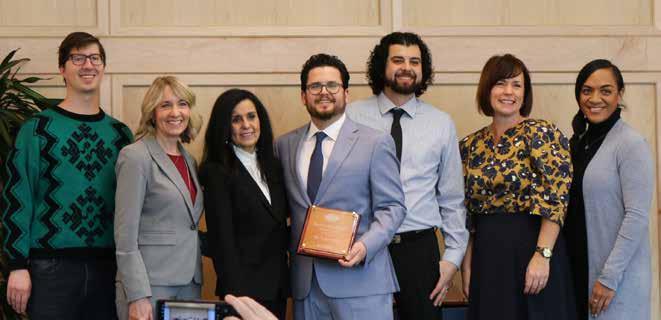
Millcreek recognized seven businesses making meaningful impacts in their community during the Millcreek Business Council Awards ceremony. Winners of the 2026 Community Choice Awards included Best Retail, Best Restaurant, Best Place to Work, Best Service and Best Nonprofit.
“We are the voice for the business leaders of Millcreek,” said Michael Gura, Millcreek Business Council executive chair.
Winners for the annual Millcreek Business Awards were acknowledged as outstanding businesses within the community. Local businesses were nominated and then voted on by residents, customers, local businesses and community members to ensure that above-and-beyond impact requisite.
“Millcreek started the Business Council as a way to lower the threshold so that all businesses can participate…and be able to give back in the community,” said Millcreek City Manager and Economic Development Director Mike Winder.
The 2026 Best Retail award went to Super Anime Store SLC (found at 2274 E. 3300 South and online at: www.superanimestore.com) They wrote:
“Super Anime Store SLC is a locally owned family business dedicated to creating a welcoming space for the anime community through collectibles, apparel and events. Being named Best Retail is an honor, and we’re incredibly grateful for the continued support from our customers and community.”
Maid Brigade of SLC won the Best Place to Work award. (Online through www.maidbrigade.com)
“Residential and commercial cleaning is very hard work. But we focus on making the job as fun and rewarding as possible for our team members….Family is very important to us…. We host an annual holiday party and several picnics or cookouts throughout the year so team members and their families can connect, build relationships and have fun together….The company also provides daily coffee and snacks, along with surprise celebrations such as pizza parties, ice cream socials and hot chocolate bars,” said Steven Connors, president and CEO of Maid Brigade SLC.
Best Service award went to Healing Feathers. (4578 Highland Dr., Suite 350 www.healingfeatherstherapy.com/)
“Healing Feathers is a nontraditional trauma-informed mental health practice dedicated to helping individuals move from survival to true healing (through modalities like EMDR, inner-child work and integrative therapies). Winning the award for Best Service is an incredible honor and a reflection of both our dedication clinical team and the community that continues to trust us with their stories,” said Ronda Davis, LCSW and clinical director.
btone FITNESS Brickyard won Business of the Year. (1295 Miller Ave. / www.btonefitness.com/locations/brickyard)
“We are so very honored to have received the prestigious 2026 Millcreek Business of the Year award. btone FITNESS Brickyard offers an approachable hybrid of Pilates-inspired movements and strength training, delivered in a 45-minute flow that packs a serious punch. Our signature method strengthens every major muscle group in your body by incorporating strength training, functional movement, balance and flexibility,” said Janeen McCormick, btone FITNESS Brickyard owner.
The Millcreek Pizza House (located at 1357 E. 3300 South) won the Best Restaurant award. They wrote to the Millcreek Business Council with the following:
“At Millcreek Pizza House, we are passionate about creating the best pizza in town. Our founder, Stacy, started working at
a pizzeria southeast of Chicago at 15 years of age. She has spent her life in the restaurant industry always dreaming of opening her own pizzeria with her family.”
Children Service Society of Utah (655 E. 4500 South) won the Best Nonprofit award. They wrote:
“Children’s Service Society of Utah is a long-established nonprofit dedicated to ensuring children grow up in safe, nurturing environments by empowering families, parents and caregivers. Founded in 1884, it stands as one of Utah’s oldest child welfare organizations, providing comprehensive support that meets each family’s unique needs.”
Fine Art Inn won the 2026 Millcreek Mayor’s Choice Award. They wrote with the following:
“Fine Art Inn is a long standing, family-owned art gallery and custom framing studio serving the Millcreek community for more than five decades. It offers a thoughtfully curated selection of original artwork along with expert custom framing for paintings, photographs, prints and memorabilia.”
Alongside his wife Josie, Tom Jennings opened Fine Art Inn on Highland Drive in 1969. Their sons, Thomas and David, took over running the gallery in 2010 (now located at 3344 S. 1300 East). Several of their select framed art pieces can be seen on display at Millcreek City Hall (1330 E. Chambers Ave.). l
















Fine Art Inn is the recipient of the Millcreek’s 2026 Mayor’s Choice Award. (Cassie Goff/City Journals)

Middle schoolers learn photography and MLK’s community principles with SLCC professors
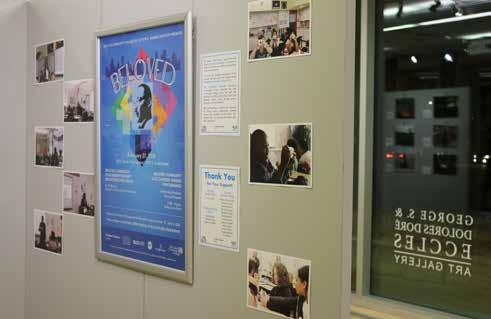
Their artwork was displayed in the Beloved Community exhibition in the George S. and Dolores Doré Eccles Art Gallery through the month of March.
By Cassie Goff
c.goff@mycityjournals.com
Photography created by local middle school students is on display at Salt Lake Community College’s South City campus. The images showcase what a “Beloved Community” means to the sixth-grade photographers from Whittier Elementary and seventh- and eighth-grade photographers from Glendale Middle School.
The ongoing Beloved Community Project exhibit is part of an annual collaboration between SLCC and K-12 schools (created in 2015). The program aims to connect faculty and students through in-class discussions and presentations to explore notions of community, connection and hope. And the SLCC faculty members bring cameras for the K-12 students to create their artwork with.
“This vision comes to life through the perspectives of local elementary and middle school students in SLCC’s annual Beloved Community Photography Project and exhibit,” said Josh Elstein, director for SLCC’s Center of Arts and Media.
This year, faculty from SLCC’s School of Arts, specializing in photography and communication, visited the elementary and middle school students to help them explore concepts from Martin Luther King Jr.’s vision of a beloved community.
Students navigated how to visually express what cooperation, unity and connection means in their own life.
The opening reception was held Feb. 27 with live musical performances from SLCC Chamber Singers.
The Beloved Community Photography Project will be on display until April 3 at SLCC’s South City campus in the George S. and Dolores Doré Eccles Art Gallery (1575 S. State Street).
The SLCC School of Arts is looking for sponsorships to

continue expanding the annual work of the Beloved Community project. Faculty hope to continue increasing the number of participating schools so they can work with more students across a wider range of grades, populations and socioeconomic backgrounds. Funding from sponsorships is intended to go toward project equipment and operational needs.
A corresponding film project, in collaboration with the nonprofit Brolly Arts, explores local voices sharing historic and contemporary viewpoints in connection to Martin Luther King Jr.’s concepts of social equity.
The film focuses on Martin Luther King Jr.’s ideas of possibilities to create civil, equitable and harmonious communities through nonviolent social change. Through addressing global issues with local relevance, the filmmakers ask viewers to consider what each individual can do to support social change. The 26-min video is available through their website at brollyarts.org/programming/beloved-community-project/.
To learn more about The Beloved Community projects including the photography exhibit and Brolly Arts film project, visit: www.slcc.edu/beloved/exhibits. l
The Beloved Community youth photography exhibit will be on display at SLCC’s South City campus until April 3. (Photos by Cassie Goff/City Journals)
The exhibit aims to celebrate art expressing individual voices and viewpoints.
Calls for exhibition proposal entries are now open for the George S. and Dolores Doré Eccles Art Gallery.
Millcreek City Council celebrates residents with Community Champion Awards
By Alexandra Straumann a.straumann@mycityjournals.com
Volunteerism and community-driven support are frequent topics of discussion within the Millcreek City Council.
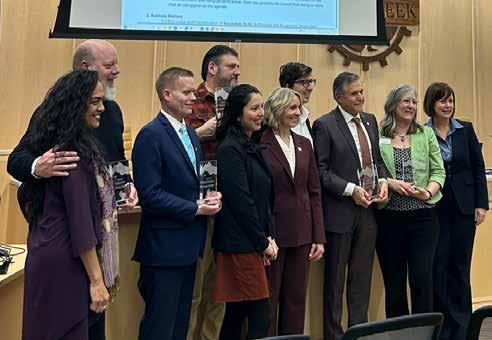
The council routinely celebrates and praises the efforts of volunteers and did so formally on Feb. 23 with the presentation of Millcreek’s Community Champion Awards. These awards are given to a resident of each city council district who has demonstrated exemplary volunteer efforts or community impact. Each councilmember presented their award to their chosen constituent, along with Millcreek Mayor Cheri Jackson, who also presented a Millcreek resident with an award.
District 1 representative and Councilmember Silvia Catten presented the award to Bishop Steven Black for his critical assistance and rapid response during the Willow Glenn Apartment Fire.
Catten explained that when the apart-
ment complex caught fire in August 2025, 40 families were displaced and lost everything. Black opened the doors of his church to al-
low the families to seek refuge and for the Red Cross to establish emergency services there. Black canceled scheduled services for his congregation to do this, and Catten praised his generosity and willingness to get involved.
Beating Afib Without Meds
Beating Afib Without Meds

Join Dr. John Day, a pioneer in AFib treatment , to learn how to achieve remission by identifying hidden triggers and leveraging modern treatments like pulsed field ablation. This session provides a clear roadmap to reduce reliance on long-term medications and regain control of your heart health.
Join Dr. John Day, a pioneer in AFib treatment , to learn how to achieve remission by identifying hidden triggers and leveraging modern treatments like pulsed field ablation. This session provides a clear roadmap to reduce reliance on long-term medications and regain control of your heart health.
Date: Time: Location: Thursday, May 7 5:30 pm - 6:30 pm
The District 2 award was presented to Khosrow Semnani by Councilmember Thom DeSirant. DeSirant said he chose Semnani for the award because of his work with the Maliheh Free Clinic. The clinic is a medical practice named after his grandmother that Semnani founded to provide free healthcare to those in need. Healthcare is consistently one of the most significant costs to American families, DeSirant noted, emphasizing the importance of Semnani’s work in Millcreek.
Your impact on the lives of your fellow Utahns can’t be overstated, and the ripple effects of your work will be felt in our community for generations.
- DeSirant
concern for health and wellness of our community, and she sees the library as a catalyst for building relationships and opportunity.”
The next award was presented by District 4 representative and Councilmember Bev Uipi to Ryan Lufkin. Lufkin is a longtime Millcreek resident and descendent of one of Millcreek’s first landowners, John Scott. In 2022, he was nominated to serve on Millcreek’s Historic Preservation Commission, and eventually became the commission’s chair, something Uipi explained has been critical to the board’s success.
Uipi championed his passion for Millcreek’s history, saying, “His efforts on the Historic Preservation Commission are extraordinary. Among many achievements, he has assisted with establishing new historic districts, updating essential codes and serves as a devoted advocate for Millcreek and its rich history.”
Date: Time: Location: Thursday, May 7 5:30 pm - 6:30 pm Attend virtually or in person at St. Mark’s Hospital, Lamb Auditorium
This seminar will cover:
Attend virtually or in person at St. Mark’s Hospital, Lamb Auditorium
How specific daily habits can act as powerful medicine for your heart. Identifying the environmental and dietary triggers unique to your routine.
How specific daily habits can act as powerful medicine for your heart. Identifying the environmental and dietary triggers unique to your routine.
How modern "pulsed" technology is helping patients reach remission without long-term drugs. Navigating the medical process of tapering off AFib medications under professional guidance.
Since the clinic opened in 2018, it has served over 270,000 people free of charge. Semnani was present to accept the award and expressed gratitude to his colleagues and those who supported him while he was founding the center. The audience clapped for Semnani to acknowledge this impact with DeSirant stating, “Your impact on the lives of your fellow Utahns can’t be overstated, and the ripple effects of your work will be felt in our community for generations.”
How modern "pulsed" technology is helping patients reach remission without long-term drugs.
Navigating the medical process of tapering off AFib medi i d r


District 3’s award went to Laura Renshaw, branch manager of the Millcreek Public Library, and was presented by Councilmember Nicole Handy. Renshaw is an active member of the Millcreek community and was given the award because of her work with the library and with Millcreek’s Promise Program. Renshaw consistently attends Millcreek City Council meetings to bring awareness to library resources and events. Handy said, “Her work is grounded in deep
The last award was presented by the mayor to Tim Bachman, for his extensive work building the Millcreek Community Emergency Response Team. Bachman serves as program manager and has worked for years within to recruit and train volunteers to assist in a wide variety of emergency preparedness situations.
Bachman collaborates with local emergency services and has ensured members of the community would be equipped to assist in an emergency situation. “His hands-on practical approach ensures participants leave not just informed, but confident and ready to help their families and neighbors,” said the mayor. Following his acceptance, he thanked his wife Rhonda, shouting her out as his fellow co-chair and saying he couldn’t have done any of it without her.
Following the presentation of these awards, one last award was presented by the American Public Works Association Utah chapter. The award was for “outstanding public works inspector of 2026,” and it was presented to Millcreek employee Ryan Bagshaw. Jackson applauded Bagshaw for his work within the city, saying that from the start if they have ever needed help, he has been happily able to assist. l Each councilmember and the mayor presented a constituent with an award and discussed why they had been chosen.
Millcreek City Council and Community Champion Award winners stand together. (Alexandra Straumann/City Journals)














Surgical
Aesthetic







Millcreek City Council hears Promise Program overview
By Alexandra Straumann a.straumann@mycityjournals.com
During the Feb. 9 city council meeting, members and associates of the Millcreek Promise Program spoke to the council to provide a quarterly update on the program.
The Millcreek Promise Program works to serve children and families through providing a variety of programs and resources to community members. Many resources center around education, something the Millcreek City Council has shown repeated interest in supporting.
Kelly Noorda is the Lead Partnership Director for Promise Partnership Utah, and she was at the meeting to speak about the graduation rates at Cottonwood High, Skyline High and Olympus High. Promise Partnership is a public-private collaboration working to improve education outcomes and close disparities for students of all ages. Currently, the Partnership has a goal for “100% of students in South Salt Lake and west Millcreek graduate high school with a career plan and have their basic needs met by 2028.”
For 2025, the schools produced graduation rates of 79%, 97% and 92%, respectively. Noorda explained that these rates were consistent with the graduation rates over the 2023-25 years, with Skyline trending up and Olympus slightly down. Cottonwood High has remained relatively stable, and Noorda stated that currently the majority of the program’s efforts were going toward raising the rate at Cottonwood. She added that a factor potentially impacting Cottonwood’s rate was the method through which the state of Utah tracks graduation rates. Cottonwood has a high rate of transience within its student pop-


ulation, but when students leave before completing their senior year it reflects in the numbers. Noorda said the program is working to combat this by keeping better record of the students who leave the high school before they graduate and how their academic journey pans out.
Peter Frost of the Asian Association of Utah (AAOU) was also present and provided the council with a mid-year grant report regarding the AAOU. Before the start of the 2025-26 school year, Frost spoke to the council to request funding to maintain the after-school programs sponsored by AAOU. After the cancellation and freezing of much federal funding, the AAOU and countless other organizations across the country were left without a way to know if they’d have resources to support their communities this school year.
During the report, Frost illustrated the importance of maintaining these programs, saying “so far this year we’ve served over 290 youth, compared to last year that’s almost a 100% increase.” Some of the enrichment activities offered at the programs center around sports, science,
chess and positive actions. Positive action is the Promise Program’s “evidence-based social emotional learning curriculum” and is taught twice a week. He said that the youth participating learn skills to assist them throughout their academic journey’s and in their lives outside of the classroom, “hopefully leading to better graduation rates down the line.”
Councilmember Silvia Catten asked how the program has handled the taking over the Moss Elementary after-school program from South Salt Lake’s jurisdiction. Frost said the transition has been good but, of course, included some challenges, namely regarding some differences in the amount of funding available through Millcreek being less than at South Salt Lake. “We’ve been able to be creative and work with the city to have volunteers and other individuals come in and support that program, so we’ve been able to support a similar number of kids...overall I think it’s been a great success.”







Following this, Kayla Meyers, the Director of Millcreek’s Promise Program, spoke to the council to highlight some of the Promise Program successes over the last quarter. Produce Pals collected 2,267 pounds of produce from July to October and distributed it to five sites around the city. Through Millcreek Futures, they brought 97 students from Utah International Charter Schools on a field trip around the city to tour local businesses. The visits provided students with the opportunity to learn about different career paths in a variety of fields, with trip stops including St. Mark’s Hospital and Millcreek City Hall.
Eventually, Meyers added, the program hopes to work with the businesses to provide internship opportunities to high school students in Millcreek. An internship program with the city of Millcreek for high
school students is also happening this year. Five students from Skyline and Olympus high schools will work as interns across economic development, communications, human resources and finance, and other departments within the city.
Meyers provided the council with an upcoming schedule with Promise Program events and what the community members can expect over the next few months. She said the Millcreek Youth Council applications will be closing April 10 and added that this program will hopefully continue to grow over the next few years. The council thanked Meyers along with Frost and Noorda for their consistent hard work and their dedication to the future of Millcreek’s youth. l
Promise Partnership Utah Lead Program Director Kelly Noorda speaks to the Millcreek City Council. (Screenshot via Millcreek City Council livestream)
Promise Program Director Kayla Meyers speaks to the Millcreek City Council. (Screenshot via Millcreek City Council livestream)













Four new books added to Utah’s list of banned titles
Utah now has a total of 27 books that are banned in public schools.
By Lizzie Walje l.walje@mycityjournals.com
As of March 2026, 27 books are now officially banned in Utah’s public schools. This newest figure reflects the recent banning of four books: “Breathless” by Jennifer Niven; “The Carnival at Bray” by Jessie Ann Foley; “The Handmaid’s Tale” by Margaret Atwood; and “Red Hood” by Elana K. Arnold.
These titles are the latest to join a growing list of books banned statewide in Utah, one that also includes “Wicked” by Gregory Maguire, “The Perks of Being a Wallflower” by Stephen Chbosky, and “Nineteen Minutes” by Jodi Picoult.
The four newest titles were officially banned in early March 2026, after three districts, Davis, Granite, and Washington County removed the titles from their institutions. Following their removal, a statewide ban was implemented after receiving further approval from the Utah State Board of Education.
The banning of certain books is a longstanding practice that has occurred in various societies and civilizations across the globe. According to Harvard University, the first book ban in the United States occurred in Quincy, Massachusetts circa 1637, when the Puritan government ordered the prohibition of “New England Cannan” by Thomas Morton. Morton was an early American colonist and a staunch opposer of Puritanism. The Puritan government claimed that Morton’s book was a harsh and heretical critique of the Puritan power structure and its customs.
Nearly four centuries later, book banning in the United States remains a highly contentious practice, with adversaries and supporters standing firmly on both sides of the issue. According to PEN America, an organization that defines itself as a nonprofit dedicated to defending free expression and “supporting persecuted authors,” during the 2024-25 academic school year it was reported that 22,810 instances of book banning had occurred in 45 states and 451 school districts since 2021. Multiple agencies have reported that Utah is among the states with the highest number of banned books in public schools, comparable to Florida, Texas and Missouri.
Given that decisions about removing books from schools are largely governed by state laws and local school district policies, each state operates under its own guidelines that influence which titles may be challenged or banned. Following the passing of HB 29 in early 2024, Utah state law now mandates a book’s removal from all public schools if at least three school districts (or two districts and five charter schools) determine the book to contain “objective sensitive material.” Utah law defines “objective sensitive ma-

Utah, alongside a handful of other states, now leads the nation in most books banned after four recent additions brought the total to 27. (Stock photo)
terial” as inherently pornographic or otherwise indecent that holds no “literary, artistic, political or scientific value for minors.” Back in 2024, opposers of HB 29 argued these parameters were intentionally vague. Furthermore, as a state with 163 school districts, many opposers felt that the threshold number of school districts required to ban a book demonstrated an inherent lack of balance.
“House Bill 29 infringes on parents’ rights to decide which books are best for their own children,” said Gretchen Zaitzeff in 2024, president of the Utah Educational Library Media Association. “And that infringes on a student’s right to exercise intellectual freedom and their constitutional right.”
Still, HB 29 had garnered widespread support by legislators, passing in both the Utah House of Representatives and the Utah Senate before it was ultimately signed into law by Gov. Spencer J. Cox. Most lawmakers seemed to agree that HB 29 was a step in the right direction, a law that would protect children by limiting their access to potentially graphic, non-age-appropriate material. Even so, certain lawmakers felt its reach was overbearing and infringed on individual liberties.
“This is the antithesis of local control,” said Rep. Carol Spackman Moss, D-Holladay, a former teacher. “With this bill, just a cou-
ple of individuals can take away the rights of parents statewide to make choices that best fit their children’s needs.”
Contrary to the beliefs of certain lawmakers and a vocal public opposition, most legislators in Utah believed the bill would protect children from indecent material and/ or descriptions of a sexual nature. However, many opposers argued that HB 29 could be weaponized to erase any depiction of LGBTQ+ identity. Many lawmakers pushed back on this claim, arguing that the overall goal was to keep X-rated material out of Utah schools and had nothing to do with furthering a specific agenda.
“Illicit pornography is often graphic, X-rated descriptions or depictions of sexual acts that are designed to arouse and excite people. We’re not trying to ban books simply because sexuality is mentioned or a sexual encounter is briefly described,” said. Sen. Todd Weiler, R-Woods Cross.
The latest banned books explore a wide range of themes and topics. Niven’s “Breathless” follows a soon-to-be high school graduate reconciling routine teenage challenges such as deciding where to attend college and navigating interpersonal relationships and family dynamics. Foley’s “The Carnival at Bray” is about a teenager whose life has been
uprooted when her family makes a move from Chicago to Ireland. “Red Hood” by Elana K. Arnold is a gritty retelling of the classic tale “Little Red Riding Hood.”
Perhaps the most well-known and controversial of all is “The Handmaid’s Tale” by Margaret Atwood. “The Handmaid’s Tale” has often been subject of intense scrutiny given its inherently political messaging. The story, classified as one of dystopian fiction, depicts a society that exists in the near-future, one where women are forced into reproductive slavery to offset a worldwide declining birthrate.
Atwood has long yielded complaints and criticisms over her literature, yet her response has remained consistent and she herself feels strongly about the practice of banning books. Atwood recently spoke out about book banning after “The Handmaid’s Tale” was recently banned in Alberta, Canada, a decision that was triggered by Alberta’s Education Ministry after it ordered the banning of any books containing “explicit sexual content.”
“You ban a book and it has a way of going underground,” Atwood stated on NPR’s “Up to Date” podcast. “So sure, it gets kicked out of schools and libraries, but that does not stop people from reading it if they go in search of it.” l




Did you know Driveology could save you an average of 25% on your auto insurance premium? Savings start immediately after you enroll, earning a 10 percent discount just for signing up. Contact me today to learn more about saving with Driveology®.


















County Council proposal expands childcare access without taxpayer subsidies
More daycare spots available without using tax dollars? That’s what the Salt Lake County Council voted unanimously to support last month when Councilmember Laurie Stringham and I brought forward a proposal to explore a new approach to childcare.
Last December, the council voted to close four county-run daycare centers as part of efforts to reduce the proposed property tax increase put forward by Salt Lake County Mayor Jenny Wilson. An extensive report highlighted the significant subsidy the county had been providing to a relatively small number of families. Taxpayers were contributing between $6,000 and $10,000 per child each year, covering roughly half of the tuition costs for 271 children enrolled in county-run programs.
Many residents who contacted me said they support helping families who are struggling financially afford childcare. That’s a reasonable and compassionate position. However, the county program had no income qualifications, meaning families earning above the median household income were also receiving subsidies funded
Aimee Winder Newton
Salt Lake County Councilmember
District 3

by taxpayers — including those living on fixed or lower incomes.
The report and audit findings also made it clear that while the county performs many important services well, operating childcare centers was not one of them. In addition to financial concerns, the program had operational challenges that raised questions about whether the county should be directly running childcare programs in the first place. Even if the program had worked perfectly, it would have been impossible for the county to provide daycare services to every family who might want them.
At the same time, the need for childcare in our community continues to grow.
Families across Salt Lake County are facing rising childcare costs and limited availability, making it difficult for many parents to remain in the workforce. Access to reliable childcare is not just a family issue — it is also an economic issue that affects employers and communities across the county.
As Stringham and I looked for alternatives, we began exploring whether the county could help expand childcare access without directly operating the programs or increasing taxes.
Our proposal is simple: allow nonprofit childcare providers to lease existing county childcare spaces and operate their own programs. These organizations would raise their own funding, hire their own staff, and manage their own operations. In return, they would receive discounted rent in exchange for prioritizing care for low-income and vulnerable families. The rent payments would cover the county’s operations and maintenance costs for the space, ensuring that taxpayers are not subsidizing the programs.
This type of partnership could create a win-win solution. Nonprofit providers gain
access to affordable space, families gain additional childcare options, and taxpayers are protected from ongoing subsidies.
The council unanimously approved our legislative intent, and our Parks and Recreation Department will now evaluate childcare spaces at the Magna, Kearns, and Northwest Recreation Centers to determine which facilities may be viable for leasing to childcare providers. We are also working with the Granite School District to explore a similar arrangement for the childcare space in Millcreek.
Councilmember Stringham and I recognize that this approach will not solve the childcare shortage overnight, but it represents a practical step forward. By working with community partners, Salt Lake County can help expand childcare availability while respecting the taxpayers who make these public facilities possible.
Families deserve more childcare options, and taxpayers deserve responsible stewardship of public funds. With creative partnerships and thoughtful planning, we can pursue both goals at the same time.
Suffering from Depression, Anxiety, or OCD?




With NeuroStar, you can live on your terms. Now FDA-cleared for depression in adolescents 15 and older!
“I had taken 11 different medications without any relief… NeuroStar treatment has helped me bring my life back with a happiness that I’ve never experienced before” ~TODD








Ifthere’s one thing that makes you question your life choices, it’s sitting at a child’s outdoor soccer game in April.
Clutching Stanley mugs filled with coffee, whisky, or both, parents and grandparents sit on wobbly camp chairs, huddled under musty blankets while trying not to be too conspicuous about checking the time.
The idea is sound: help kids understand the concepts of a sport and learn teamwork. In reality, it’s about which kid brought the best treats or if we’re going to catch pneumonia and die before the game ends.
Utah’s spring is a weather roulette that can have you freezing at 9 a.m. and sweltering by noon. The cold wind, constant trickle of rain and glacial temperatures give way to heat stroke and sunburn before halftime.
My four daughters played softball every spring for what felt like 75 consecutive years. Each year, we’d bundle up in coats, gloves, scarves and earmuffs to watch them play. We shoved handwarmers into pockets and told them to “Think warm thoughts.”
It was often torture. Not only do you watch your child strikeout, but strikeout in 45-degree weather. They’d hold the bat with frozen hands, waiting for the impact to snap their fingers off at the knuckles.
Now, my grandkids enjoy soccer, which is played no matter the weather, and everything is mud. The only thing running faster than my granddaughter is my nose. Except
The view from the sidelines
Peri Kinder Life and Laughter

when it’s treat time, then the whole team finds a burst of adrenaline to snatch up granola bars and Capri Suns. Don’t even think about bringing oranges or bananas. Who are you? Someone who hates kids?
Each spring, hope wears shin guards and batting helmets. It’s a fresh start, a chance to learn skills and an opportunity for new coaches to lower their expectations.
You can spot a new coach by their optimism. They come prepared with drills, practice schedules and intricate plays, but by the end of the season, they’re just happy to have players who can identify a soccer ball and run in the right direction.
They also have to deal with parents. There’s always that person who believes their child is the next Lionel Messi or Aaron Judge. They memorize the rule book and counter every official’s call. “Blue! Were you the lookout on the Titanic?” or “Hey, Ref! Are we keeping you awake?”
They scream at their child to “Run!” for 45 minutes straight and call their 6-year-old over

between innings to explain baseball defense.
Yet, even in drizzly, cold weather, spring sports thrive. There’s just something about watching a child finally hit the ball off a tee or score their first goal. We see coaches kindly redirect a player’s attention from doing cartwheels to protecting third base.
When your granddaughter makes a great pass, she looks to the sidelines to see if you saw it happen. You did.
Although we complain about the mud, the temperature, the uncomfortable seating and wonder if the other team altered the birth certificate of their star player, there’s something inherently human about watching young people navigate sportsmanship.
It’s not about winning. It’s about showing up for the kids you love. You watch them fall on their faces, sometimes literally, and get back up. You watch them strike out, kick the ball in the wrong goal or drop an easy fly ball, and wince along with them.
If there’s one thing that makes you question your life choices, it shouldn’t be watching a child you love run past you with a big grin on their face. Even wrapped in quilts, chugging espresso, you’re exactly where you’re supposed to be.
Peri Kinder is an award-winning columnist and journalist who has written for The City Journals since 2004. She can be reached at peri.k@thecityjournals.com