Law Focus | Salt Lake Business Journal | March 2026
BUSINESS JOURNAL Law Focus
Publisher
Bryan Scott
Editor-in-Chief
Rebecca Olds
Editor
Tom Haraldsen
Design
Stacey LaMont
Associate Publisher
David Gregersen
Senior Account Executive
Dale Dimond
Director of Marketing
Mieka Sawatzki
Editor’s
Letter
Dear readers,
Well, we heard you. Loud and clear.
I’m proud to present this new step to bring industry-specific content, yearly recaps and lists to you, so that you can do business better informed for better outcomes.
This Focus magazine is an extension of our Focus sections published in the newspaper that we’ve brought to the Wasatch Front for more than 50 years. While our weekly Salt Lake Business Journal covers the latest actionable business news, these magazines will be a good reference to look back on throughout the year as an expansion of our Book of Lists, published at the beginning of each year.
The law industry is one that has seen a lot of movement in the past year, which is why we started our focus here.
From adding new justices to our state courts, to AI increasing costs of litigation, to hiring requirements changing, and more, 2025 was a year of change.
AI and the progressive obsolescence of the transactional lawyer
(This article was originally published in the Fall 2025 issue of The Federal Lawyer and is reprinted with permission.)
“Hey, bro, remember that referral fee thing I was telling you about? I drafted up a quick contract for it. What sections is it missing?”
“Hey, Dominick, can you please look this service contract over and make adjustments as needed and then make it look pretty and professional?”
“One of my co-founders had some questions and feedback on the drafts you sent from his legal review. Will you take a look and respond?”
As a corporate and transactional lawyer who routinely interacts with entrepreneurs and scrappy startup companies, these sorts of questions and requests are becoming increasingly routine.
Armed with the inexpensive (or free) help of artificial intelligence (AI) tools like ChatGPT, Grok and their competitors, the smaller-company community can DIY contracts and legalmreview at a speed and sophistication that was unimaginable just a couple of years ago. (Well, maybe not unimaginable. But, a couple of years ago, you’d expect a whole lot more typos and formatting issues in a non-lawyer-produced first draft of a contract.)
Of course, in virtually all of the cases I’ve encountered in my practice, what the AI tool produced was close but not exactly the cigar sought by the user. The referral fee agreement involved two Arizona residents with no good reason for Wyoming law and venue to apply, plus it failed to address the
effect of termination on the obligation to pay a referral fee. The employment agreement template did not address company ownership of employee-created intellectual property and contained an overly vague non-solicitation provision. The services contract lacked detail as to the scope of the services to be provided and had loose payment terms (although, I thought it was “pretty” enough). The legal review of one of the governance documents reviewed by the co-founder correctly raised issues that would be troubling, except that another document in the set assuages assuaged the concerns raised completely.
At this stage of my career, I can identify these deficiencies and communicate them to a client. And, I think, when I do, the client sees the value-add of my independent assessment of the AI tool’s work product.
But just how value-add am I, or any of my transactional brethren? Sometimes, it’s hard to say.
As I have explained to some folks before, the AI-generated contracts and legal analyses are not necessarily bad; oftentimes, the AI tool’s work product just lacks depth and detail or nuance and style that is honed over time through experience. The legal ability of the AI tool, in terms of adequacy and accuracy, is more closely akin to the work product you might receive from a new lawyer fresh out of law school than a lawyer with several years of relevant training and experience. AI tools don’t yet possess meaningful wisdom.
As a lawyer who is closing in on a decade of full-time practice, do my comments and revisions to AI-generated contracts materially enhance my client’s position and protect their interests? In many cases, I think the answer is “yes.” I’m fairly
Dominick San Angelo - Gallagher & Kennedy PA
certain that if there’s a dispute over the referral fee contract mentioned above, that my friend will be happy not to have to litigate in Wyoming. And I think the value I add in these situations exceeds my cost to a client, more often than not.
At least, for now.
The reality is that usually the best outcome for any client is for the quality of their contract to never be tested. A poorly written and loose contract works just fine when the parties never end up in a dispute over its terms; absent a dispute, the hindsight value of changing Wyoming venue to Arizona is zero, at best. So, if you’re modeling out expected value-add, you have to place a value on the probability that the improved language will ever be tested and multiply that figure by the value of the improved language, and then compare that product to the cost of the legal services. This is hard to do in practice, but theoretically it’s the only way to economically justify hiring a transactional lawyer at a particular cost.
As any lawyer with a year or more of experience will tell you, practice doesn’t make perfect, but it certainly makes better. There is a reason you pay a law firm more for an experienced partner’s time than an inexperienced associate’s time. But even though the junior associates are cheaper, they’re still mostly a heck of a lot more expensive than even the premium versions of the leading AI products available to the masses. And the AI tools, like the junior lawyers, keep getting better with experience and training. In economic terms, the marginal comparative expected value-add of the human lawyer is diminishing and will eventually become de minimis or worse.
This value curve trends down because eventually the AI tools will simply be better transactional lawyers than the best of us, and there’s no reason to believe they’ll be overly expensive like many lawyers are. The AI tools can crunch more data than you or me, don’t need sleep, and don’t have a family or distractions from the tasks at hand. Someday (maybe a few years off, but eventually) the idea of employing a human to draft a contract for your small-business deal will feel a lot like riding in a horse-drawn carriage, washing clothes in a bucket of soap, or renting a DVD: People will do it only if they value nostalgia over efficiency.
For transactional lawyers not enticed by the financial prospects of anachronism, the challenge will be to remain a value-add as AI tools catch up to their abilities. (Transactional lawyers paying attention perhaps ought to feel a lot like 15th century scribes and manuscript copiers learning of the catching-on of the printing press.)
Much of what has led to the economic success of transactional lawyers as a profession has, in my view, been driven historically by the increasingly complex and technical nature of contracts and legalese, where the unwary and untrained are wont to hire someone with the knowledge and understanding of these complex documents and sentences to protect them.
My view is that the AI tools are in the process of diminishing whatever value transactional lawyers have historically enjoyed with respect to the technical side of the practice.
I don’t grieve the erosion of transaction costs even at the cost of my own skillset, however, because I think transactional lawyers still have some runway if they adapt. The democratization of the technical nature of contract drafting and analysis will tend to create conditions such that the key to the transactional lawyer’s survival will be to not try to be better at the rudimentary tasks of transactional law than the AI tools (e.g., contract drafting and editing). Instead, they will need to leverage AI use, such that deployment of AI tools to perform those tasks historically performed by lawyers commoditizes that aspect of the service. Put differently, transactional lawyers in coming years will not compete on or with AI tools or other lawyers on the basis of drafting and research capabilities; having the ability to quickly and cheaply generate sound, compliant legal documents, contracts, and the like will simply be table stakes. The differentiation and value-add will instead have to take the form of the lawyer serving as best he or she can in the lawyer’s most basic and non-technical role: as a good wise counselor.
To be a truly effective counselor — to help guide someone through a decision-making process, to weigh pros and cons, to help identify and understand the all-things-considered best approach to choosing among options, to appreciate risk and reward, to ultimately help clients achieve a sense of confidence that they are making an informed, mature decision — requires empathy, trust and genuine human connection. Less technical, more philosophical. Less talk about what the contract says and more about how it makes the client feel. It will take longer for the transactional lawyer as counselor to be displaced by AI tools. Perhaps not forever, but certainly longer.
The transactional lawyers who can use AI tools to do the technical work and use people skills to counsel clients will have enough time to keep a career going and earn a living adding real value for a while longer.
And when the AI tools get good at counseling clients, like real people? Well, few mourn the demise of the scribes and manuscript copiers.
Dominick San Angelo practices business and transactional law at the law firm of Gallagher & Kennedy PA, serves on the board of directors of RideNow Group Inc., and is an adjunct professor of business at Grand Canyon University in Phoenix, Arizona. He graduated with a Bachelor of Arts and a Bachelor of Science in Business Administration from the University of Arizona, as well as a Master of Arts in Philosophy from Duke University and a Juris Doctor from Duke Law. The views and opinions expressed in this article are the author’s only and do not necessarily represent any policy, position or view of any law firm, corporation, university or other organization with which the author is associated.
Kearns resident joins the 3rd District Court judiciary
By Peri Kinder | The City Journals
Surrounded by family, friends and colleagues from the legal community, Amanda Montague pledged to uphold the Constitution and serve the public with fairness and integrity as she was sworn into the Utah 3rd District Court judiciary.
Her addition comes before the Utah Legislature voted earlier this month to expand the number of judges in the state system, including adding nine new District Court judges over the next few months.
The Kearns resident previously served as a division director in the Utah attorney general’s office and spent nearly 10 years clerking for 3rd District Court judges. Her experience working with the Utah Board of Pardons and Parole; the Department of Corrections; the Interstate Compact Office; and the Sex, Kidnap and Child Abuse Offender Registry provides her with a comprehensive criminal justice understanding that she will apply to the cases that come before her on the bench.
Montague was appointed to the position by Gov. Spencer Cox in August 2025 and confirmed by the Utah Senate.
“Amanda has spent the last 20 years making sure our justice system works for real people, whether she’s helping the Board of Pardons weigh tough calls or guiding dozens of state agencies through the law,” Cox said in a media statement. “I’m grateful for her steady hand and clear-eyed compassion, and I’m confident she’ll serve the 3rd District with both.”
Montague earned her juris doctorate from BYU’s J. Reuben Clark Law School, where she served as managing editor of the BYU Journal of Public Law. As a member of the Utah 3rd Judicial District, Montague will oversee cases in Salt Lake, Summit and Tooele counties.
In November, she was sworn into the judiciary by Utah Supreme Court Justice Paige Peterson, who first met Montague when she came before the district court in Park City to argue a motion.
“I knew, watching her, that she was a standout and I thought,
Judge Amanda Montague will serve in the Utah 3rd District Court, overseeing cases in Salt Lake, Summit and Tooele counties. (Utah State Courts)
this person is excellent. She has what it takes. She has a bright future. She can do anything,” Peterson said. “So I am not surprised at all to see Amanda joining the District Court bench.”
Peterson encouraged Montague to be steady and consistent, especially during a time that feels chaotic, and advised her to take her oath seriously, without fear of retribution, even as threats are being leveled at judges across the country.
“When people come to the courthouse to have their case heard, it doesn’t matter if they’re powerful, doesn’t matter if they’re rich, doesn’t matter if they’re poor,” Peterson said. “We take an oath to treat everyone fairly, which means listening to their arguments, understanding their arguments and making a decision based solely on the law. I have every confidence that you will do that and you will fulfill the high standards that all of us, as judges, set for ourselves.”
Montague’s children, Porter and Louisa, assisted her with the robing ceremony, and she sent a shout-out to her son, Dallin, who is serving a mission for The Church of Jesus Christ of Latter-day Saints.
She thanked her family and colleagues for supporting her as she applied to the judiciary several times before finally being accepted. Montague also expressed gratitude for the women who mentored her and the people who believed in her ability.
“So many of you have watched me go through this journey and struggle, and have been nothing but hopeful and helpful to me, and I am so very appreciative of that,” Montague said. “I am lucky and blessed that I was selected for this. … I do take very seriously every decision that I have to make and I am still learning every day. I am so very grateful for how kind and welcoming the judiciary has been to me.”
Her husband, Joe Montague, said one thing he has admired most is watching his wife work incredibly hard during her career to reach her goals. He saw her set an example to their children by staying focused, being dedicated and retaining a good heart, even when her job sometimes showed her the worst of humanity.
“As Justice Ruth Bader Ginsburg said, real change, enduring change, happens one step at a time,” said Joe Montague. “Amanda has lived that truth by applying learning, serving and growing one step at a time, until she reached this moment today, and it will continue.”
Amanda Montague is sworn into the 3rd District Court judiciary by Utah Supreme Court Justice Paige Peterson at the Scott M. Matheson Courthouse. (Peri Kinder/City Journals)
Governor signs bill increasing number of Utah Supreme Court justices
By Becky Ginos | Salt Lake Business Journal
Although somewhat controversial among lawmakers, SB134 (Court Amendments) passed out of the Legislature and was signed by the governor Jan. 31.
The bill calls for “statutory provisions related to judges and justices for Utah Courts.”
SB134:
• Increases the number of Utah Supreme Court justices from five to seven.
• Increases the number of Utah Court of Appeals judges from seven to nine.
• Increases the number of Utah District Court judges, adding three judges in each District Court in Districts 3, 4 and 5.
• Amends provisions on the recruitment period for a judicial vacancy.
• Provides judicial support with additional law clerks, judicial assistants and staff to support the work of the judiciary.
“The only part that’s controversial about the bill is it added two Supreme Court judges to the courts,” said Sen. Todd Weiler, R-Woods Cross, who is an attorney. “Some say we don’t really need those. We wanted to expand the Supreme Court for a couple of reasons. First of all, we called for this, like, four years ago.”
A lot of people are saying the Legislature is trying to pack the court because they’re mad at the courts right now, he said. “All of our judges in the state have been appointed by Republican governors and confirmed by a supermajority of Republican senators, so I don’t really see it as court-packing.”
Some people are going to attack the Legislature for the timing, Weiler said. “That’s their prerogative. It’s because of the partisan gerrymandering issue, the abortion issue and the vouchers issue.”
A majority of states that are the size of Utah have seven justices, he said. “We’re one of the only states with five. We had five justices when we were a state of 400,000 people and now we’re a state of 3.6 million, and in 20 years we’re probably going to have over 5 million. As Utah’s population has grown and legal issues have become more complex, these courts are now managing significantly heavier caseloads. This has led to delays, backlogs and longer wait times for decisions that directly affect Utah families and businesses.”
SB134 was one of the first bills to pass through the Legislature this session. “We value the courts,” said Senate President J. Stuart Adams. “It’s an important issue.”
“I think it’s a great bill,” said Sen. Chris H. Wilson, R-Logan. “There was a lot of support from attorneys and judges. I think it’s a great step forward in getting much-needed resources. Looking at the number of filings, looking at the case complexity, it’s obvious in my opinion as we gather the evidence that it’s long overdue.”
The Utah House Democratic Caucus had a different opinion and issued the following statement Jan. 31 in response to Gov. Spencer Cox signing SB134 into law:
“The Utah House Democrats have serious concerns about SB134. Every member of our caucus voted against the bill on Friday (Jan. 30).
“The bill would unnecessarily expand the Utah Supreme Court by adding two justices at a significant and permanent cost, with no demonstrated need from the court and with opposition from the Utah State Bar. There is no meaningful backlog in the state Supreme Court or workload that justifies this expansion.
“We are left to interpret these changes as an attempt to undermine the independence of the judicial branch of government. The timing and speed with which this bill moved through the legislative process further limited the opportunity for thoughtful consideration.
“The Utah House Democrats will continue to advocate for targeted, responsible investments that strengthen the courts where Utahns need it most.”
The bill went into effect immediately. “So now they have to post the vacancies and they have to have a time period for people to apply and then the governor has to interview them,” Weiler said. “So we’re probably looking at three to four months, is my guess, at a minimum.”
Weiler said it wouldn’t shock him if they do the Supreme Court first then do the Court of Appeals. “You might have finalists for the Supreme Court that don’t make it but then they might want to turn around and apply for the Court of Appeals. Two of the last three vacancies we’ve had on the Supreme Court have been filled from the Court of Appeals.”
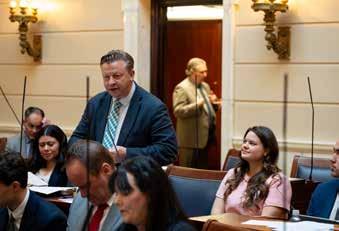
Sen. Todd Weiler, R-Woods Cross, speaks on the Senate floor. Weiler, who is an attorney, supported SB134 (Court Amendments) that passed on Jan. 30. (Courtesy Utah Senate)
Promotion is for new members, ages 18 and above only. You must open this account with a Financial Service Representative and mention this promotion for enrollment. Must meet membership requirements and a minimum balance of $10 must be maintained. With the exception of the mortgage loan bonus, eligibility for payouts is limited to 6 months from the primary savings open date. Contact us for more information, and full terms and conditions. Promotion cannot be combined with other new member offers and is valid thru 12/31/26. This offer is subject to change without notice, and other restrictions may apply. Fees could reduce earnings. Equal Housing Lender. NMLS #654272. Federally insured by NCUA.
1
LAW FIRMS
Ranked by Number of Utah Attorneys
Kirton McConkie 50 E. South Temple Ste. 400 SLC, UT 84111
2 Parsons Behle & Latimer 201 S. Main St. Ste. 1800 SLC, UT 84111
3 Ray Quinney & Nebeker PC 36 S. State St. Ste. 1400 SLC, UT 84111
4 Dentons Durham Jones Pinegar 111 S. Main St. Ste. 2400 SLC, UT 84111
5 Strong & Hanni Law Firm
102 S. 200 E. Ste. 800 SLC, UT 84111
6 Kirkland & Ellis LLP 95 S. State St. SLC, UT 84111
7 Holland & Hart
222 S. Main St. Ste. 2200 SLC, UT 84101
8 Parr Brown Gee & Loveless 101 S. 200 E. Ste. 700 SLC, UT 84111
9 Dorsey & Whitney LLP 111 S. Main St. 21st Floor SLC, UT 84111
801-328-3600 kirton mcconkie.com
801-532-1234 parsons behle.com
801-532-1500 rqn.com
801-415-3000 dentons.com 102*105*59*15*164*172
801-532-7080 strong andhanni.com 103062391722
801-877-8090 kirkland.com 983,5273312412
801-799-5800 holland andhart.com 9541451410214
801-532-7840 parrbrown.com 88059181291
801-933-7360 dorsey.com 70670411613622
equity and M&A, complex corporate transactions, investment funds and asset management, restructurings, commercial and intellectual property litigation, government, regulatory and internal investigations
litigation, corporate, environmental and natural resources
Business & finance, commercial litigation, bankruptcy workouts & creditors' rights, construction law services, employment law, entertainment, international services, natural resources law, real estate law, tax, technology
and private equity, securities and restructuring, litigation and white collar defense, natural resources and environmental, intellectual property,
C. Ferrin Director, Chairperson & CEO
UT 84101
L. Ahlstrom
T. Allen Michael S. Anderson
LAW FIRMS
Ranked by Number of Utah Attorneys
12
Workman Nydegger PC 60 E. South Temple Ste. 1000 SLC, UT 84111
13
801-533-9800 wnlaw.com
Spencer Fane 10 Exchange Place Ste. 1100 SLC, UT 84111 801-521-9000 spencer fane.com
14 Clyde Snow & Sessions
201 S. Main St. Ste. 2200 SLC, UT 84111
15 Maschoff Brennan 95 S. State St., Ste. 800 SLC, UT 84111
16
Cohne Kinghorn PC 111 E. Broadway 11th Floor SLC, UT 84111
17 TraskBritt 230 S. 500 E., Ste. 300 SLC, UT 84102
18 Ballard Spahr LLP 201 S. Main St. Ste. 800 SLC, UT 84111
19 Thorpe North & Western
8180 S. 700 E., Ste. 350 Sandy, UT 84070
20 Smith Hartvigsen 257 E. 200 S., Ste. 500 SLC, UT 84111
21 Richards Brandt Miller Nelson 111 E Broadway, Ste. 400 SLC, UT 84111
801-322-2516 clydesnow.com
801-297-1850 mabr.com
801-363-4300 cohne kinghorn.com 23014*133*1
801-532-1922 traskbritt.com
801-531-3000 ballard spahr.com
801-566-6633 tnw.com
801-413-1600 smith hartvigsen.com
801-531-2000 richards brandt.com
Litigation and trial practice, arbitration and mediation, corporate transactions and securities, bankruptcy, real estate and construction, tax and estate planning
Nicole C. Evans Mark R. Gaylord Steven P. Mehr Marcus Simon Melanie J. Vartabedian
Litigation and mediation, business and corporate law, natural resources and water, employment and government, estate and family law
Mark R. Sumsion, Shareholder & Workers' Compensation Chair 22 Gallian Welker & Associates 965 E. 700 S., Ste. 305 St. George, UT 84790 435-628-1682 stgeorge lawoffice.com
23
Babcock Scott & Babcock 370 E. South Temple 4th Floor SLC, UT 84111 801-531-7000 babcockscott. com
Russ Gallian
Mike Welker
Matt Ekins
Travis Barrick
Robert Babcock Brian Babcock Jason Robinson
PERSONAL INJURY LAW FIRMS
1 Siegfried & Jensen 5664 S. Green St. SLC, UT 84123
2
3 Cutt, Kendell, & Olson (Attorneys at Law) 215 S. State St., Ste. 900 SLC, UT 84111
4
5 The Advocates Injury Attorneys
E. Winchester St. SLC, UT 84107
6
7 Fielding Law 4179 S. Riverboat Rd. Taylorsville, UT 84123
8 Feller & Wendt LLC 4444 S. 700 E., Ste. 106 Millcreek, UT 84107
S. 960 E., Ste. 200 SLC, UT 84117
Guys
(Christensen & Hymas) 11693 S. 700 E., Ste. 100 Draper, UT 84020
theadvocates.com
fieldinglaw.com
fellerwendt.com
David A. Cutt Jordan P. Kendell
S. Olson
BUSINESS LITIGATION LAW FIRMS
1 Holland & Hart 222 S. Main St., Ste. 2200 SLC, UT 84101
2 Parr Brown Gee & Loveless 101 S. 200 E., Ste. 700 SLC, UT 84111
3 Snow, Jensen & Reece P.C. 912 W. 1600 S., Ste. B200 St. George, UT 84770
4 Freeman Lovell Business & Real Estate Lawyers 9980 S. 300
5 Scalley, Reading, Bates, Hansen & Rasmussen 15 W. South Temple, Ste. 600 SLC, UT 84101
6
7
ESTATE PLANNING LAW FIRMS
Ranked by Number of Utah Attorneys 2025
1 Pearson Butler 1802 South Jordan Pkwy. Ste. 200 South Jordan, UT 84095
2 York Howell 10610 South Jordan Gateway Ste. 200 South Jordan, UT 84095
3 Dexter & Dexter Attorneys at Law 1360 S. 740 E. Orem, UT 84097
4 Froerer & Miles 2661 Washington Blvd., Ste. 201 Ogden, UT 84401
5 Harward & Hawes 67 W. 13490 S. Draper, UT 84020
6 Cutler Riley 11681 S. 700 E., Ste. 150 Draper, UT 84020
801-658-3075 pearsonbutler.com
801-527-1040 yorkhowell.com
801-225-9900 dexterlaw.com
801-781-5741 froerer andmiles.com
801-506-3800 harwardlaw.com
801-823-0010 cutlerriley.com
7 Penniann J. Schumann PLLC 2150 S. 1300 E., Ste. 500 SLC, UT 84106 801-923-7397 estateplanning forutah.com
8 Morgan & Associates Attorneys at Law 211 E. Main St. Lehi, UT 84043
Estate Planning Attorneys 3387 W. Mayflower Ave. Ste. 220 Lehi, UT 84048
W. Executive Parkway, Ste. 112 Lehi, UT 84043
Asset protection, trusts and wills, tax and retirement planning, estate litigation and guardianship, special needs and Medicaid planning
Asset protection and legacy planning, elder law and guardianship, probate administration, charitable and nonprofit planning, tax planning and controversy
Living wills, trusts, power of attorney, inventory, wills, durable power of attorney, healthcare power of attorney
Family law, estate planning/ probate, real estate disputes, small business advising, guardianships, mediation, commercial litigation
law, wills, trusts, power of attorney
Carson M. Pearson Jeff Butler
David R. York
Andrew L. Howell
Dexter
INTELLECTUAL PROPERTY LAW FIRMS
Ranked by Number of Utah Attorneys 2025
Company
1 Fabian Vancott
95 S. State St., Ste. 2300 SLC, UT 84111
2 Workman Nydegger 60 E. South Temple, Ste. 1000 SLC, UT 84111
3 Kunzler, Bean & Adamson 50 W. Broadway, Ste. 1000 SLC, UT 84101
4 Maschoff Brennan
95 S. State St., Ste. 800 SLC, UT 84111
5 TraskBritt, P.C.
801-531-8900 fabianvancott.com
801-533-9800 wnlaw.com
801-994-4646 kba.law 2529162282
801-297-1850 mabr.com
230 S. 500 E., Ste. 300 SLC, UT 84102 801-532-1922 traskbritt.com
6 Morriss O'Bryant Compagni Cannon
4505 S. Wasatch Blvd., Ste. 270 SLC, UT 84124
7 Clayton Howarth, P.C. 6975 Union Park Center Ste. 600 Cottonwood Heights, UT 84047
8 Mohr Intellectual Property Solutions, P.C.
222 S. Main St., 5th Floor SLC, UT 8411
801-478-0071 mocclaw.com 505161
Corporate and venture capital, litigation and white collar defense, energy and environmental, labor and ERISA, intellectual property, real estate, tax and estate planning 1874
Patents, trademarks, copyright, litigation, E-commerce, trade secrets, licensing and transactional work, post-grant proceedings, IP counseling, international IP
and venture law, intellectual property law 2000
Bryant W. Jensen President & Director
801-255-5335 chcpat.com
385-429-9001 saltlakeiplaw.com
Thomas R. Vuksinick Senior Counsel
Wade O. Bean Jeremy Adamson Brain C. Kunnzler
Intellectual property and complex litigation 2011Kirk R. Harris
J.Jeffrey Gunn Shareholder
Patents, copyrights, trademarks, IP litigation 1999
David W. O’Bryant Frank W. Compagni Karl R. Cannon Ryan P. Gillan
Patents, trademarks and copyrights, trade secrets and employment, IP licensing and transactions, clearance and enforcement, patent and trademark appeals, technology and life sciences 1990 Grant R. Clayton Alan J. Howarth
Patents, trademarks, copyrights, IP revenue, IP management, litigation 2003Joseph Mohr 9 Western IP Law
110 S. Regent St., Ste. 200 SLC, UT 84111
10 Bateman IP Law Group 299 S. Main St., Ste. 1300 SLC, UT 84111
12 Dobbin IP Law 2250 S. Redwood Rd., Ste. 5 West Valley City, UT 84119
How to hire right Avoid small mistakes that lead to big problems
For small-business owners, hiring and onboarding employees often feels like a series of straightforward steps: Post the job, interview candidates, make an offer and get them started. But even minor missteps in this process can snowball into administrative headaches or even massive business-ending lawsuits. The worst part is that many small-business owners are going through this process alone, either because of a costly misunderstanding of Utah law or because it seems too expensive to do it right.
(Spoiler alert: It is WAY more expensive to deal with these issues later than it would be to do it right the first time.)
Understanding some common pitfalls and taking steps to address them upfront can save a business both time and money, and protect its reputation.
Offer letters shouldn’t be employment contracts
Utah is an at-will employment state, meaning either the employer or the employee can terminate employment at any time, for any (legal) reason, with or without notice. That said, the language used in offer letters can unintentionally create binding agreements, like specifying a set term of employment, outlining promised bonuses or committing to particular duties.
To illustrate, an informal offer letter might be a message from the employer stating, “We are excited to offer you the position and are eager to get you to work during the two years you are finishing up your degree.” While unintentional, this statement could reasonably be interpreted that the new employee can expect to work for all of those two years; potentially limiting the at-will nature of the relationship. The employee might be entitled to continued employment (which can be particularly expensive if the business needs to terminate employment).
Small-business owners should be careful about the wording in offer letters, ensuring they reflect the intended at-will relationship and do not accidentally create obligations they cannot meet.
Employment lawyers often review and draft offer letters, or give brief advice to strike the right balance between protecting the employer and providing enough clarity for the employee.
Don’t neglect background checks and employment history
A reasonable inquiry into a candidate’s history is expected to protect the workplace. Failing to conduct proper background or reference checks can expose your business to negligent hiring claims.
Diligence goes beyond avoiding physical threats: Businesses must also consider cultural fit, reliability and potential risks to operations or client relationships. Additionally, some Utah and federal laws regulate when and how you can ask about prior criminal histories.
Growing companies are good at moving fast, but consider slowing down to make sure a new hire isn’t going to cause more problems than solutions.
For small companies, one misstep can ripple across the team, causing disruptions or even legal exposure if the employee engages in misconduct. Employment lawyers routinely guide clients through developing compliant screening procedures, ensuring background checks are conducted consistently, documented properly and balanced with privacy and anti-discrimination obligations.
Actions don’t need to be huge changes to your standard practice; instead, business owners need to ensure that they are putting in the time and resources to reduce risk and support better hiring decisions.
Forget about “learn as we go” practices and policies
Many small business owners rely on informal rules, learning and adjusting policies as situations arise. While flexible, this approach can create serious legal vulnerability.
Inconsistent enforcement of policies is extremely dangerous to a budding business. Whether related to attendance, performance or workplace behavior, different treatment of employees can lead to discrimination claims, especially if employees perceive unequal treatment. Without documented, consistently applied procedures, defending against these claims becomes extremely difficult.
Good legal counsel helps small businesses avoid these pitfalls by drafting and refining employee handbooks (and other standard practices) tailored to the company’s specific operations and culture. A well-structured handbook provides a clear framework for workplace expectations, ensures consistent enforcement, and reduces the risk of disputes, protecting the employees and the business.
Bringing on new employees without ensuring compliance is like walking through a minefield; each step risks hidden disaster. Sure, it is possible to make it through OK, but why not do things right the first time?
Utah business owners are capable of avoiding common mistakes, which saves time, protects their teams and reduces the risk of costly litigation before it ever arises.
Parker Airmet is a labor and employment attorney at the Salt Lake City office of Holland & Hart LLP. Airmet regularly helps Utah companies resolve employment disputes and business litigation matters, allowing companies to concentrate on their core business operations. He graduated from the S.J. Quinney College of Law at the University of Utah with high honors, and is involved in various community and professional organizations in Utah. Airmet was recently recognized as a Utah Business “20 in their 20s” honoree.
Parker Airmet Holland & Hart LLP
mehaniq41 - stock.adobe.com
Understanding employers’ rights when ICE or DHS come to visit
By Tom Haraldsen | Salt Lake Business Journal
There’s a lot of talk these days about ICE, the Immigration and Customs Enforcement agency that’s part of the federal Department of Homeland Security. These ICE agents usually approach people outside of a business, but what legal rights do employers have if they come to your door?
Two things all employers should do these days: know your rights, and be prepared.
ICE and DHS visits can occur at worksites, but employers can require proper legal processes before allowing them into nonpublic areas. Those agents typically need a judicial warrant or the employer’s consent to enter a private office or employee-only space. That’s not true for common areas like a parking lot or a lobby. Employers can and should ask to see the warrant.
DHS has also given the U.S. Citizenship and Immigration Services (USCIS) law enforcement powers that allow its officers to investigate violations, make arrests, carry firearms and execute warrants. Typically, businesses won’t run into USCIS officers.
Employers do risk higher penalties if they don’t use I-9 verifications for employment verification. That can include paperwork errors, so be sure your HR department does its job
related to I-9s. The increased efforts by ICE should keep everyone keenly aware of rules and regulations.
But even with that increased activity, employers should exercise their rights. You must consent for ICE to enter nonpublic workplace areas if they don’t have a warrant. You can limit ICE access to records to what the warrant authorizes. You can consult attorneys before and during ICE visits, and you can challenge or negotiate the scope of the visit as well as the time of inspections. Just do it respectfully.
How to prepare in advance
Yes, there are several things a business should do before, during and after an ICE visit. In advance, form a team of your employers for responses. That might include in-house counsel, your HR contact, security leads, an executive to speak to the media and a communications lead. Train your reception and office managers to never say: “Sure, come on in,” or “Let me take you to the employee area.” They can truthfully say they aren’t authorized to grant access.
Look at the warrants to see what the agents are after, and there are different types of warrants. A judicial warrant comes
signed by a federal judge and you must comply. An administrative ICE warrant allows just for the arrest of a named person, not permission for ICE to go on a fishing mission. A Notice of Inspection allows for an I-9 audit for records only. The I-9 compliance is your biggest area of risk, so be sure you are in full compliance. Be certain your company has clear policies regarding access to records and areas of your business or office. And be sure your employees know they have the right to remain silent, not sign anything without a lawyer and are free to ask if they can leave.
During the visit
During an ICE visit, control the entry point, ask for documentation of who they are and why they are visiting your business, and don’t let them roam without permission. If necessary, call your legal representative. Your HR department should stay present but not interfere, and should note the time of the agents’ arrivals and their names and badge numbers. Don’t translate information for ICE, don’t provide opinions and don’t pull extra files because you want to be helpful. They should be trained to search for the info they need.
If ICE asks employees questions, you can tell those workers they have a choice of speaking or requesting a lawyer. For PR purposes, ready a response line like “We’re cooperating with authorities and reviewing the situation with counsel. We don’t comment on personnel matters.”
Afterwards
Determine quickly what ICE took, who was questioned, if anyone was arrested, and did the event disrupt operations. Discuss with your legal counsel any I-9 violations or other issues, note if any documents were destroyed or if a notice of suspected documents was issued (which could result in fines). Don’t gossip or speculate among staff about who was targeted or investigated, and mitigate fear and help boost morale as best you can.
If policies and procedures need to be adjusted for better compliance, handle them. Tighten your vendor or contractor verification, and, if needed, do a full I-9 audit with your legal counsel.
You want to emphasize respect for the law, but that goes both ways. ICE agents have a job to do, but as an employer so do you.
DEI facing increased focus by federal government
By Brice Wallace | Salt Lake Business Journal
Is DEI DOA?
After a several-years’ push in the public and private sectors to diversify workforces, the Trump administration and the federal Equal Employment Opportunity Commission have muddied the waters with executive orders and employment guidance, leaving many workplaces unsure how to approach matters related to diversity, equity and inclusion.
But a Parsons Behle & Latimer attorney recently told an audience that the touchstone remains a 2020 Supreme Court ruling. In Bostock v. Clayton County, the court, in a 6-3 decision, affirmed that LGBTQ+ employees nationwide are protected from workplace discrimination regarding hiring, firing and other employment actions. For example, an employer who fires a person based on their sexual orientation or gender identity violates Title VII of the Civil Rights Act of 1964.
“Even though the Trump administration has retreated from EEOC positions that have to do with LGBTQ+ protections, Bostock remains the law,” Elena Vetter, a member of PBL’s Employment Department, told the audience at the Salt Lake SHRM Employment Law Update in West Jordan.
Still, the Trump administration has issued several executive orders retreating from previous administrations’ and EEOC positions regarding treatment of LGBTQ+ employees, including those related to gender identity, gender ideology and affirmative action practices of federal contractors. For its part, the EEOC has been dismissing many of its charges against employers, and EEOC Chair Andrea Lucas has expressed interest in rooting out discrimination against white males. While the executive orders impact only federal government agencies, many of their concepts historically have carried over into the private sector, and they also portend EEOC priorities matching those of the president.
Vetter noted that executive orders are neither a legislative action nor case law. “This is something that dictates what the priorities for the executive branch are,” she said, cautioning that they nonetheless indicate what the EEOC is going to do next because the EEOC is staffed by the current president and will typically reflect the administration’s priorities.
“Even if the EEOC is dismissing its own suits, even if the executive branch is issuing executive orders that may indicate that the executive branch isn’t interested in continuing those protections, the case law remains,” Vetter said, referring to the Bostock ruling. Unless the Supreme Court changes its approach or Congress takes action, Bostock continues to protect employees from adverse actions based on sexual orientation or gender identity discrimination, she said.
As for legislative actions related to employee dress codes, restrooms and locker rooms, those depend on state locations.
Vetter said PBL guidance on DEI is simple: Treat your employees fairly and follow the mandates of case law, although EEOC guidance “may point you in a different direction.” For
Audience members take in presentations during the recent Salt Lake SHRM Employment Law Update in West Jordan, presented by SHRM and featuring attorneys from Parsons, Behle & Latimer. (Brice Wallace/Salt Lake Business Journal)
example, EEOC guidance issued last March indicates that an employer’s policies, programs and practices may be unlawful if they involve an employer taking employment action motivated by race, sex or another protected characteristic.
Vetter recommended three actions for employers considering implementing a DEI program. First, they should review their existing materials and programs to make sure they are legally compliant. Second, employers should refine their messaging, especially in public-facing materials. Rather than using words like “diversity” and “equity,” they might consider instead using “fairness,” “belonging,” “respect,” “tolerance” and “thoughtfulness,” Vetter said, “to get those same points across but to not be in the line of fire.”
Instead of saying, “DEI uplifts historically disadvantaged groups to ensure equal outcomes,” employers might instead consider “DEI enables people of all identities and backgrounds to feel welcome and do their best work.” Instead of “We use diversity hiring to recruit people from underrepresented racial and ethnic backgrounds,” a better option might be “While we strive for a diverse mix of candidates, all employment decisions are made without regard to race, sex or other protected characteristics” or “We look for candidates of any background who will advance our culture.”
Third, employers need to reconsider any resources, such as benefits or training, that are available only to members of certain protected classes, also called “affinity groups.” Employers should strive to make those groups inclusionary rather than exclusionary. “Focus,” Vetter said, “on bringing everyone to the table.”
The employment law update event also included presentations about company investigations of employment matters, recent Utah legislation, the Americans with Disabilities Act, and employees’ social media activities.