
Special section
Highlighting educational aspects around the valley Page 9
Gearing up
Preparedness fair to help neighbors be ready in case of disaster Page 20 The Eddie Kimball ball field
Highlighting educational aspects around the valley Page 9
Preparedness fair to help neighbors be ready in case of disaster Page 20 The Eddie Kimball ball field
By Peri Kinder | peri.k@thecityjournals.com
As a new baseball season gets underway in Holladay, the crack of a bat will soon echo across a ball field dedicated to the memory of Eddie Kimball.
On Sept. 8, 2022, Eddie was a few weeks shy of his seventh birthday when the vehicle he was traveling in was rear-ended by a tractor-trailer. Eddie didn’t survive the accident, leaving his family and community devastated.
“He is love incarnate. He was just the sweetest little boy and told me probably 10 times a day he loved me,” said his mom, Kristi Kimball. “He was everybody’s cheerleader. He loved to just include everybody.”
Eddie attended Driggs Elementary when he signed up with the Mt. Olympus Youth Baseball League, where his father, Quinn Kimball, was his coach, along with Judd Tolman. Eddie was put on a team with his school friends, affectionately called the Wolf Pack for their tight-knit friendship.
Batting was Eddie’s favorite baseball activity, but he always wanted to follow in his dad’s steps and learn how to play shortstop. Also, like his dad, Eddie was a devoted Chicago Cubs fan. Eddie’s passing not only affected his family but the entire community. Tolman’s son was Eddie’s best friend and his death hit him hard. As a way to honor the young boy, Tolman and his wife Becca offered to provide $25,000 to the city to name a Holladay ball field after Eddie.
“We have had multiple conversations with the Tolmans
and with other friends in the neighborhood, where we’ve talked about how our perspectives have been shifted about what’s most important in life,” Quinn said. “Judd felt that this was something important to him, important to us and to the community.”
The southwest baseball field at Holladay City Park (4580 S. 2300 East) will be named the Eddie Kimball Baseball Field and a plaque will be placed to dedicate the park to the little boy’s life and memory.
To the Kimballs, this is just another example of how the community has helped them heal and move forward over the past years. When Eddie died, neighbors tied hundreds of red ribbons in honor of his life, Driggs Elementary holds a Love Like Eddie event each year on his birthday and during the final game of a baseball tournament, both teams wore an “E” on their hats.
The Eddie Kimball Baseball Field will be the site for the game held each year on his birthday. All of the Kimball kids (except the oldest, Lila, who passed away in 2014) have played ball on the Holladay fields, making it a favorite spot for family and friends.
“We think the ball fields are an amazing sanctuary,” Kristi said. “I can’t think of a better way to keep Eddie there with us. Baseball season is coming up, and our youngest is going to play baseball again. It’s going to be sweet to see her get up to bat and have Eddie kind of right behind her.”
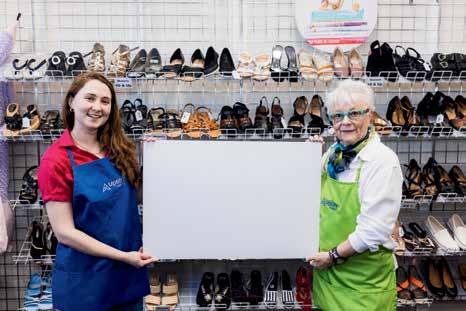
Although his time on the ball field ended far too soon, the diamond bearing his name will offer kids a place to play, compete and remember the joy he brought to the game.
“All the boys, all of his best buddies, know that they’re part of it, too,” Quinn said. “They all still live all around the park in Holladay and we thought it’d be a phenomenal way to keep them connected to Eddie and the community. No matter how far away they move in the future, they’ll always know that there’s a ball field named after their buddy that has their stamp on it as well.” l







When you hear the word “stroke,” what image comes to mind? For many, it’s an elderly relative, perhaps a grandfather, suddenly incapacitated. But local neurologists are clear: that outdated image is a dangerous myth. Strokes can strike anyone, at any age, and often without warning, making awareness and rapid response absolutely critical.
“The idea that strokes are an ‘old person’s disease’ is incredibly harmful,” says Dr. Mohammad Shoari, a neurologist at Holy Cross Hospital – Jordan Valley, Salt Lake and Mountain Point. “We are seeing strokes in younger adults, even teenagers, with increasing frequency. Lifestyle factors, genetics, and even certain medical conditions can put anyone at risk. This isn’t just about grandpas anymore; it’s about protecting our entire community.”
A stroke occurs when blood flow to part of the brain is interrupted, either by a clot (ischemic stroke) or a burst blood vessel (hemorrhagic stroke). When brain cells are deprived of oxygen, they begin to die, leading to potential long-term disability or even death. The good news? Many strokes are treatable, but time is brain.
This is why recognizing the warning signs is
paramount. Healthcare professionals use the acronym F.A.S.T. to help people remember:
SAFFace Drooping: Does one side of the face droop or is it numb? Ask the person to smile. Is the smile uneven?
Arm Weakness: Is one arm weak or numb? Ask the person to raise both arms. Does one arm drift downward?
Speech Difficulty: Is speech slurred, are they unable to speak, or are they hard to understand? Ask the person to repeat a simple sentence.
TTime to call 911: If someone shows any of these symptoms, even if the symptoms go away, call 911 immediately. Note the time when symptoms first appeared.
“Every minute counts when someone is having a stroke,” emphasizes Dr. Rebecca Reiser, a neurologist at Holy Cross Hospital – Jordan Valley.
“The quicker a patient receives specialized medical attention, the higher their chances of a full recovery. Don’t second-guess or wait for symptoms


to worsen. Call 911 immediately.”
Our hospitals are equipped with advanced treatments to combat stroke. For ischemic strokes, our team can administer clot-busting medications like TNK (tenecteplase) if the patient arrives within a critical time window. Holy Cross Hospital – Jordan Valley also offers thrombectomy, a procedure where a specialized device is used to physically remove large blood clots from the brain.
“Beyond immediate intervention, our comprehensive stroke centers focus on post-stroke care, including rehabilitation services that are crucial for regaining function and improving quality of life,” adds Dr. Reiser. “Our multidisciplinary teams work tirelessly to help patients navigate their recovery journey.”
From emergency response to rehabilitation, our community has vital resources. But the first line of defense is you. By understanding that stroke doesn’t discriminate by age and by remembering F.A.S.T., you can be the hero who helps save a life – perhaps even your own.
For more information or to find a provider visit mountain.commonspirit.org


Learn more about the services, care providers and mission-driven work of the Holy Cross hospitals and CommonSpirit Health at www.holycrossutah.org.

At CommonSpirit Health, we make the healing presence of God known in our world by improving the health of the people we serve, especially those who are vulnerable, while we advance social justice for all.
When minutes count, count on our emergency care. Get to know us before you need us.
When you need emergency care fast, the closest emergency room is a smart thing to know. You never know the level of care you’ll need when an emergency happens and choosing the right ER can make all the difference. And a hospital ER comes with the confidence of additional services right on-site.
CommonSpirit Holy Cross Hospital – Salt Lake has been awarded Chest Pain Center Accreditation from the American College of Cardiology (ACC). Facilities that achieve accreditation meet or exceed an array of stringent criteria for evaluating, diagnosing and treating patients who may be experiencing a heart attack.
Find emergency care close to you at mountain.commonspirit.org.
Common Ground will be a column of rotating viewpoints that highlight specific feelings across the political spectrum, and it will always end with possible ways to come together.
While the 2025 FIFA Peace Prize winner bombs Iran and talks about invading Cuba, the Utah Legislature is fighting its own battles against immigrants and refugees.
Legislators introduced several zero-tolerance immigration bills addressing issues ranging from public education and driving privileges to the right to receive food from local pantries.
If these bills had passed, women, infants and children would have been barred from receiving vaccinations and treatment for communicable diseases. It seems the pro-measles group would also like to welcome back polio, meningitis and maybe a bit of scurvy, just for fun.
I keep saying, “We’re better than this,” but certain legislators (you know who you are) keep making that statement false.
These lawmakers say providing services to immigrants is a drain on taxpayers. There’s just one problem: immigrants pay taxes, too. They pay gas, income, sales and property tax. In fact, immigrants contribute more than $200 million to the state. Why shouldn’t they have access to public schools when they help fund them?
As a kind human, I want my tax dollars to assist those in need. I want families to have food and housing, basic human requirements everyone deserves. I’d much rather have my tax dollars go to immigrants than to pay legal fees fighting Prop 4.
This year, a bill was introduced to add a 2% tax on international money transfers for those without approved IDs. That might not sound like much, but it could be the difference between sending money for rent or having grandma evicted. Immigrants often wire money to their families in other countries for food, medicine or housing, things our lawmakers obviously take for granted.
Immigrant driving privileges were also on the chopping block. Not only would the bill have revoked those cards, it also required police to contact ICE to turn in an undocumented person involved in a traffic accident.
Utah issues around 35,000 driving privilege cards each year. They allow people to have car insurance, drive to school or work, and navigate the two hazards of Utah roads: terrible drivers and whatever UDOT is tearing up this week.
Undocumented college-bound students were also targeted after a lawmaker introduced legislation to strip them of the right to access lower in-state tuition. Many of these students are on the path to citizenship. Don’t we want an educated populace? My guess is no.
All these initiatives seem to be based on selfishness. If we were really putting Utah first, wouldn’t we ensure that the people who lived here were healthy, fed, educated and safe?
Until recently, Utah leaders lauded the state’s programs designed to help immigrants and refugees learn English, get career training and become productive members of society. Now, the perfect immigrant is someone who doesn’t want education or food and who never sends money to grandpa for a new roof.
Immigrants are our neighbors, coworkers and friends. They deserve the right to dignity and respect. I’d love to see any lawmaker work as hard as the immigrants I know.
Luckily, these bills didn’t pass. But in this political climate, they will probably rise again. Like a case of measles in St. George.
Common Ground: Sometimes, those on the left act like we should open the borders and let the world flow through, while those on the right can’t build walls high enough. What if we all implore Congress to create sustainable immigration policies? Instead of punishing people who want to work and contribute, we need an immigration structure that makes sense. And thanks to the state legislators who voted down the harmful bills presented this year. We can do better. l
From the Publisher:
Thirty-five years ago the City Journals (South Valley Journal) were created with a vision to stay local and bring the community together. Thirteen years ago when I took over as publisher the name changed. but the vision did not. Today that vision is still true; we want the Journals to be hyperlocal and we want to bring the community together.
Over the last few years, as our nation continues to divide between the right and left, it has become harder and harder to feel like we are bringing our community together. If we write on something that is political, one side will be mad at us, and worse of all we may lose them as readers. This does not feel like we are bringing a community together.
This has left our editorial team in a tough position. Do we write on issues and upset our readers, or do we not write on the issues and move forward blind to the issues that are dividing our community.
Our solution: Common Ground. A monthly opinion column that will cover issues that we feel are dividing our communities. Each month one of two writers will present an opinion column, one that leans right and one that leans left.
This month Peri Kinder wrote about state legislation concerning immigration-related topics.
We hope that you have enjoyed the first Common Ground.
— Bryan Scott
HOLLADAY TEAM
The Holladay Journal is a monthly publication distributed directly to residents via the USPS as well as locations throughout Holladay. The views and opinions expressed in display advertisements do not necessarily reflect or represent the views and opinions held by Loyal Perch Media or the City Journals. This publication may not be reproduced in whole or in part without the express written consent of the owner.
© 2026 Loyal Perch Media, Inc.
PUBLISHER
Bryan Scott | bryan.s@thecityjournals.com
EDITOR
Travis Barton | travis.b@thecityjournals.com
ADVERTISING EXECUTIVES
Mieka Sawatzki | mieka.s@thecityjournals.com
Ryan Casper | ryan.c@thecityjournals.com
Marc Davis | marc.d@thecityjournals.com
CLIENT SERVICES
Lydia Rice | lydia.r@thecityjournals.com 385-557-1022
CIRCULATION COORDINATOR
Lindsay Andreasen | lindsay.a@thecityjournals.com Rack locations are also available on our website.
EDITORIAL & AD DESIGN
Stacey LaMont Ty Gorton
HOLLADAY CITY JOURNAL 9500 South 500 West, Suite 205 Sandy, UT 84070
PHONE: 801-254-5974
Our mission is to inform and entertain our community while promoting a strong local economy via relevant content presented across a synergetic network of print and digital media.
& Distributed by

By Julie Slama | j.slama@mycityjournals.com
Third grader captures his fourth state title with strategy, problem solving.
Thinking about his moves ahead of everyone else and humble enough not to brag, Ridgecrest third-grader Beckham Rawle quietly claimed his fourth state title at the Utah State Elementary Chess Championship.
Beckham captured his fourth consecutive state title, adding another trophy to his growing collection, however this year’s victory came with a challenge. After five rounds in the third-grade division, he and another girl both swept all their games, resulting in a tie break.
His mother, Rachel Rawle, was busy selling chess-themed T-shirts nearby and didn’t even realize the deciding match had ended.
“I didn’t know how he came out after the tie break,” she said. “He didn’t even come tell me, but he just started playing with his friends. Somebody else told me he won.”
Beckham finished with six victories to claim the title. His points also helped Ridgecrest place third in the team standings behind Waterford School of Sandy and American Preparatory Academy Draper 2.
“I’m happy,” he said about his fourth straight title.
That understated reaction is typical, his mother said.
“He’s super chill,” she said. “He has the same even kneel if he doesn’t win.”
Beckham’s chess journey began in kindergarten, when he set his sights on defeating his father, Jason, who coaches the Ridgecrest chess club. By first grade, Beckham was consistently beating his first teacher across the board.
His mother, who is the team’s chess manager, said Beckham studies the game,

concentrating and problem-solving to figure out strategies. Beckham likes testing himself and prepares for his matches.
“He’s patient and likes the challenge,” she said.
While Beckham enjoys chess, he balances his time with sports — soccer and basketball — and is a Chinese dual immersion student. He also is competing in the upcoming regional spelling bee. With money he has won at tournaments, he purchased Xbox controllers.
“We like he has a balance,” Rawle said. “At tournaments, we are more of the mindset that they’re already playing so much chess, their brain needs a break. So, in between games, we let them play with their friends, often it’s Minecraft, or four-player mini games they play with other kids.”
Beckham plays in several weekend tournaments — mostly in the open sections since his rating is so high — and is planning to compete in the Power Chess state tournament this spring and the Vegas International Chess Festival in June.
Chess is a family game. His brother, second-grader Max, finished third in his division at state while sister, kindergartner Poppy, placed fourth in her first tournament behind teammate Mickey Labrum.
Many Ridgecrest players competed for the first time.
“A lot of them, it was their first time competing at state and they did well,” Rawle said. “We had eight of our 12 kids get trophies. We want them to know, win or lose, you’re there to have fun, a good experience and trying your best is an accomplishment. We’re super proud of our kids.”
That was the sentiment of Granite Elementary coach Jacob Jensen, who said many of his 25 players were new to the game only months ago.

“Some of these kids didn’t even know how the pieces moved when we started,” he said. “To see them go to the state tournament and win a game, that was huge.”
Granite’s standout performer was his daughter, first-grader Sophia, who finished third in the first-grade division. She won five of her six matches to help Granite place 11th in team standings. She also recently competed in the girls’ state chess championships.
“She likes the mental challenge, the mental stimulation,” Jensen said. “She’s this tiny first grader and you see her as this cute little girl, but then she’s an assassin on the chessboard. She comes in and destroys you.”
The school recently held its own chess tournament and has started up
again with weekly chess meetings, with some new members.
“We had such a good success, it’s cool to see the kids in their progression over the course of a few months,” he said. “They’re learning the principles of chess. They’re learning how to apply them, and then they’re actually brave enough and willing enough to go there and compete at the state level.”
Top area schools’ placements: First Waterford, Sandy; Second APA Draper 2; Third Ridgecrest, Cottonwood Heights; Fourth Sunrise, Sandy; Fifth Brookwood, Sandy; Sixth Peruvian Park, Sandy; Ninth APA Draper 1; 11th Granite, Sandy; 15th North Star Academy, Bluffdale; 18th Channing Hall, Draper; 26th Quail Hollow, Sandy; 29th Draper; 39th Herriman; and 51st Bella Vista, Cottonwood Heights.







By Lizzie Walje | l.walje@mycityjournals.com
SB 69 would ban cell phone use during school hours including lunch and in-between classes.
Utah public schools will more than likely enforce a bell-to-bell cell phone ban when students return to class at the end of this coming summer. The bill in question, Senate Bill 69, which calls for a complete cell phone ban during school hours, most recently passed the vote in the Utah legislature. SB 69 now goes to Gov. Spencer J. Cox, who will ultimately decide if it is to become law. For years now, Cox has expressed his desire to ban the usage of cell phones in schools. Cox was also an early vocal supporter of SB 69, meaning it’s almost all but guaranteed that he will sign off on the bill once it crosses his desk.
SB 69, sponsored by Sen. Lincoln Fillmore (R-South Jordan) further expands upon a 2025 bill, Senate Bill 178, that was eventually signed into law. SB 178 banned the usage of cell phones during school hours, however, it did have one caveat; students could still use phones during downtime like in-between classes or during lunch. SB 69 takes an even firmer stance, completely forbidding the usage of cell phones during the school day, including times when students are not in the classroom.
While the bill does require all public schools to implement the bell-to-bell ban, how schools choose to enforce the ban, will be determined by their Local Education Agency (LEA). LEAs will be given the freedom to establish their own guiding parameters and policy, so long as they uphold the requirements laid out in SB 69. Should an LEA choose not to set their own policy, devices will not be permitted from bell-to-bell by default.
When SB 69 was first introduced, those who opposed it, largely residents and parents, expressed concerns over children not having access to their phones during emergency situations. However, the bill does allow for exceptions where students will be permitted to use their phones during threats or emergencies, to access the SafeUT crisis line, as part of accommodations outlined in a student’s IEP or Section 504 plan, or for medical necessity.
“Utah leads by putting students first, and this is the next step,” said Emily Bell McCormick, president of The Policy Project, a Utah nonprofit organization that defines itself as a “nonpartisan organization that acts as a policy accelerator to do real good for real people.” McCormick continued, “Bell-to-bell policies aren’t about restriction—they’re about creating learning environments built for focus,
connection and success. We see calmer classrooms, stronger engagement and more meaningful learning when distractions are limited.”
To that point, a handful of Utah schools have already implemented their own versions of a bell-to-bell ban, among them, Granite School District’s Granger High School. A change that school officials report has yielded overwhelmingly positive outcomes. Luke Allen, the Associate Director of Communications for Granite School District, reported that student fights at Granger have decreased by 50% following their cell phone ban. He also mentioned that failure rates have dramatically improved.
“The first year of that policy at Granger High School, if you compare the student failure rate to the four years leading up to that, [Granger] had their lowest rates of those five years.” Allen said. “So, they had their lowest failure rates in five years, the first year they had that policy.”
Snow Canyon Middle School in St. George is another institution that enforced a ban on devices, a policy that they began enforcing at the beginning of the 2024-25 academic school year. While staff and teachers initially worried their students would push back strongly on such a ban, they were pleasantly surprised at the outcome.
“The students reacted far more willingly than we ever anticipated. There was very, very little parent resistance. We feel that creating a space where students are no longer distracted is one of the greatest gifts we have given them. We just wish we had done it years earlier,” said a staff member at Snow Canyon.
Cell phone bans are starting to take root at the national level. According to several national news outlets, as of early 2026, 26 states have now imposed complete bell-to-bell cell phone bans in K-12 schools. Among them are Florida, Alabama, Georgia, New York and Virginia. Additionally, it’s reported that 25 states have put in place some level of cell phone restrictions or guidelines to be observed during school hours.
As more schools report successful outcomes from outright cell phone bans, it is anticipated that other states will soon follow suit and put in effect their own bell-to-bell bans. If you’re wondering how these bans are managing to be enforced during school hours, one company in particular has found a way to make such a prospect easily streamlined — Yondr pouches.
Yondr pouches are not the only magnetic locking cell phone pouch on the market, however, they’ve certainly emerged as the most widespread and

Senate Bill 69, which bans the usage of cellphones completely during school hours, has passed in the Utah legislature and now faces final decision from Gov. Spencer J. Cox. (Pew Research Center)
well-known option available. As a matter of fact, Granger is among the schools currently utilizing Yondr’s technology. Many educators, administrators and staff like Yondr pouches, because they restrict students from using their cell phones, but still allow for the phone to remain on the
student’s person.
As previously mentioned, Yondr pouches are controlled by magnetic locking technology. At the end of the school day hours, students can unlock their phones at various locking bases, which are usually strategically placed at exit points throughout the school. While Yondr pouches do prevent the usage of phones during school hours, they don’t block signals, meaning cell phones can still be used in case of emergency.
Yondr pouches, while incredibly effective, are still considered relatively expensive. This has caused concerns for certain districts and schools in Utah who feel they’re already being stretched thin financially due to budget cuts and insufficient funding. In response to this concern, Sen. Fillmore explained that schools will not need to use Yondr patches specifically, so long as their rules, whatever they are, reflect and enforce the totality of the bell-to-bell ban.
Now that the Utah general legislative session has concluded, and SB 29 has cleared Utah’s legislation, per Utah state law, Gov. Cox has 20 days to decide on the bill. If after those 20 days Cox has still not signed or vetoed the bill, it will, by default, automatically become law.



When you think of Holladay, you think of trees. Our city is one of the most abundantly wooded communities in Utah, and the beautiful, mature canopy is what drew many of us here. Holladay’s “tree identity” is no accident; it is the result of years of attention and effort. For over 15 years, Holladay has proudly carried the Tree City USA designation, a title maintained through the hard work and vision of Holladay City employees and the Holladay Tree Committee.
The Holladay Tree Committee is a volunteer advisory body that advocates for our urban forest. Comprised of seven voting members and supported by dedicated City employees, these residents serve three-year terms to ensure our trees remain a priority. Their mission is simple but vital: encourage the planting and preservation of trees, manage the city’s tree inventory, and ensure we meet the rigorous standards of the Tree City USA program.
The Committee meets on the first Thursday of every month at 4:00 p.m. at Holladay Library (during City Hall construction). These meetings are open to everyone and are a fantastic way to learn about trees and the Committee.
But, the Tree Committee does more than talk about
SALT LAKE CITY MARATHON
SATURDAY, APRIL 24, 2026
trees – they help you plant them! Several initiatives are available to help residents expand the canopy on their own property and beyond:
• Tree Voucher Program: This program provides financial assistance for planting new trees. Residents can apply for a Street Tree Voucher (for the public right-of-way) or an Open Voucher (for anywhere in private yards). Trees must be selected from the “Approved City of Holladay Tree List” and redeemed at participating nurseries.
• Holladay Tree Giveaway: This popular, bi-annual event allows residents to receive and plant a free tree. Watch for details of Tree Giveaway 2027!
• “Tree Talks”: Join us at the Holladay Library on the second Saturday of the month at 10 AM to discuss trees! On April 11 we will discuss proper pruning, and on May 8 will reprise the popular “Ask an Arborist” panel.
• Arbor Day Celebrations: Over the years, the Committee has planted Arbor Day Trees at most Holladay elementary schools. This year, the Committee will plant three new trees at the Wasatch Waldorf School on April 24.
To maintain our wooded character, the City Council,
The University of Utah Health Salt Lake City Marathon will be held April 24, 2026! It will feature a full marathon, half marathon, 5K, 10K run, 26-mile bike tour, and a 1K kids’ marathon.

The race will come through the City of Holladay starting at 3900 S. The route will follow 2300 E. southbound to Holladay Blvd and then loop back on itself. Major intersections will have a Traffic
Offi cer to facilitate cross-traffi c flow whenever there are breaks in runners and it is safe to do so.
However, please plan alternate routes of travel around the race as crossing through intersections will be extremely delayed.
2300 E. will be restricted to one direction of travel, northbound only, from Evergreen Ave. to Holladay Blvd. from approximately 6:00 a.m. to 1:00 p.m.
For a detailed map of the race course, volunteer information and more, go to saltlakecitymarathon.com
has established specific ordinances to protect and promote trees. For example, City ordinance requires a permit to remove “Protected Trees,” which include street trees, heritage trees, and those near waterways. If a protected tree must be removed, a Tree Canopy Sustainment Landscape Plan is often required to ensure the loss is replaced with appropriate trees.
Holladay is considering a draft ordinance requiring shade trees in new parking lot developments. This not only beautifies the city but mitigates “heat islands” caused by large, paved areas.
Whether you are looking for the “Approved Tree List” (categorized by size and drought tolerance), need the “Tree Removal Protection Guide,” or just want to learn more about trees, you can connect with the Holladay Tree Committee. Look for the Tree Committee page on the City’s website or reach out to our Tree Champions by email at trees@holladayut.gov.
You can also follow the committee’s efforts on the City’s social media sites.
Holladay’s own Community Emergency Response Team was revitalized early last year by the City’s Emergency Management Coordinator, Allison Jester. The team works not only to promote emergency preparedness, but to develop invaluable life-saving skills such as fire safety, search and rescue, radio comms, and first aid.

CERT hosts disaster simulation trainings where they practice these skills, and also host various radio drills and tabletop disaster exercises. The team is currently comprised of the following members: Shere Brunjes, Bravant “Has” Haslam, Dean Soukup, Kevin Carlson, Roy Avondet, Kari Burton, AJ, David McPhie, Kim Watson, Mark Eggen, Suzy Smith, Barry Smith, and Scott Snow.
Many of these volunteers engage in their own grassroots emergency preparedness efforts, helping their neighborhoods and engaging their talents to make our community better prepared. Thanks to their diligent work, we all feel a little more ready to face whatever the future may throw at us.

In spring 2024, the Spring Lane Adaptive Re-Use Plan presented the City of Holladay with a high-level set of options for transforming the former Spring Lane Elementary School campus into a public park, and the City Council selected a preferred concept plan. Throughout 2025, the City collaborated with Granite School District to secure a 30-year lease for the property and issued bond funding to support park development.

The City is now preparing a Bridging Document that will further refine the site plan and establish the groundwork for the project’s construction. As part of the fiscal year 2026–2027 budget process, the City Council will also determine a phasing plan and approve funding. Once the full City budget is approved in June 2026, Holladay will use the Bridging Document to issue a Design-Build RFP in late summer 2026 to select a contractor partner. Development of the Spring Lane property as a new public park will introduce facilities and activities designed to complement the surrounding neighborhood.
We Want to Hear from You!
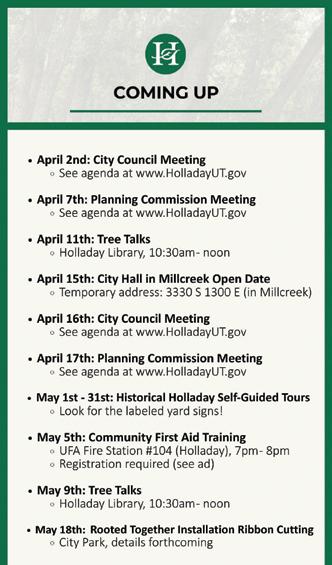
The project team will continue to examine the site and meet with residents this spring to refine the 2024 concept plan and create a meaningful space for Holladay residents. An online survey will be open in April followed by an open house on Wednesday April 15th from 4:00-6:00 pm at Holladay Library.
For more information, please visit https://bit.ly/springlane-park
Did you know that Myrtle spurge is considered a noxious weed? Beyond posing a threat to native vegetation, it is toxic to humans and wildlife alike. Myrtle spurge can cause skin irritation when handled, and nausea, vomiting, and diarrhea if ingested.
In efforts to mitigate its spread, Salt Lake County is working with contractors to treat the weeds with herbicides. These treatments will begin primarily in early April and will end June 15th.
The County asks that residents (and their pets) avoid areas where contractors are actively applying the treatment. Treated plants will have a blue dye on them that will dissipate a couple of weeks following application. They advise people to not touch plants once they’ve been treated (and especially to prevent children and pets from doing so as well) until the herbicide has dried.
The areas receiving treatment include: Mt. Olympus Trailhead and Old Mill Golf Course, Big Cottonwood Canyon, Emigration Canyon, Millcreek Canyon, Parley’s Pointe, Parley’s Canyon, and Dry Creek Canyon.
If you plan on visiting any of these areas following treatment,
please: pay attention to treatment signs, stay away from bluedyed areas, stay on trails, and keep pets on leashes.
You can visit www.SaltLakeCounty.gov/health/weeds/ to find maps of treatment areas, as well as more information on the herbicide mixes being used, and other safety tips.







CITY COUNCIL MEMBERS:
Paul Fotheringham, Mayor pfotheringham@holladayut.gov 801-424-3058
David Sundwall, District 1 dsundwall@holladayut.gov 801-633-5753
Matt Durham, District 2 mdurham@holladayut.gov 801-999-0781
Natalie Bradley, District 3 nbradley@holladayut.gov 801-243-1139
Drew Quinn, District 4 dquinn@holladayut.gov 801-860-6130
Emily Gray, District 5 egray@holladayut.gov 801-755-3477
Gina Chamness, City Manager gchamness@holladayut.gov
PUBLIC MEETINGS: City Council – rst and third Thursday of the month at 6 p.m. Planning Commission – rst and third Tuesday of the month at 6 p.m. CITY OFFICES:

With spring in full swing, many people are heading outside to enjoy warmer weather, longer days, and time in the neighborhood, parks, and local trails with their dogs. Before you head out, remember two simple essentials: a leash and poop bags.
Leash Laws
Salt Lake County Animal Services frequently hears from people who say their dog is friendly or behaves better off-leash. While that may be true, not everyone is comfortable encountering an off-leash dog—even a friendly one. Other pets may be reactive, and some people may simply feel uneasy around dogs they don’t know.
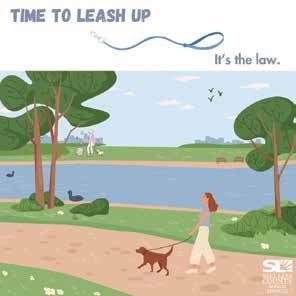
For these reasons, dogs must be kept on a leash in public areas unless they are in a designated offleash dog park. A leash is not just recommended—it’s required by law. Dogs found off-leash in non-designated areas may result in a citation and fine. Keeping your dog leashed helps ensure the safety of your pet, other animals, and members of the community.
Pack Out the Poop
Cleaning up after your dog is also required by law. Pet waste left behind in neighborhoods, parks, or along trails is considered a public nuisance and

may result in fines.
Bringing waste bags when you head out with your dog helps keep our shared spaces clean and enjoyable for everyone.
Know the Laws
Want to learn more about animal ordinances in your city or township? Visit AdoptUtahPets.com and check out the “Laws” section to view the regulations in your area.
To contact an Animal Control Officer, call dispatch at 801-840-4000.

From the Utah Department of Transportation
UDOT will be upgrading traffi c signal equipment and roadway lighting at various intersections throughout Salt Lake County. This project is part of a broader effort to improve signal operations and safety across the region.
The intersections impacted in Holladay are:
• SR-152 (Van Winkle) & Vine St (6100 South)
• SR-152 (Highland Dr) & 6200 South
• SR-152 (Highland Dr) & 6400 South
• SR-152 (Highland Dr) & I-215 WB Offramp
Work is projected to take place between now
and the end of June. Because multiple crews will be working cross the county, exact dates and times for each intersection are not yet finalized.
Traffic impacts are expected to be minimal, with access to homes and businesses being maintained. Law enforcement may briefly direct traffic in some locations while overhead equipment is being installed.
Please direct questions to the project team: Email: intersectionsimprovements@utah.gov Phone: 833 - 819 - 6776
You can also visit the project website for updates as work begins: publicinput.com/intersectionsimprovements


Administrations look to ensure athletic equity in participation, facilities, funding.
By Julie Slama j.slama@mycityjournals.com
As Utah school districts refine their approaches to gender equity in athletics, leaders say their work hinges on transparent reporting, consistent evaluation and a commitment to the spirit — not just the letter — of Title IX. The federal law, passed in 1972, requires schools to provide equal opportunities for male and female students. In terms of athletics, that can include participation, facilities, funding and opportunities.
State law echoes that expectation. Under Utah Code 53G-6-1101 in 2024, school athletic directors must annually report participation numbers, spending, facilities comparisons and compliance efforts to their local boards. When discrepancies exceed 10%, schools need to outline an action plan.
Participation: Not Just Numbers
Canyons School District Director of High Schools Tom Sherwood said the District is on solid footing.
“Title IX, I think we do a good job,” he said, emphasizing proportional participation remains a guiding metric.
Canyons’ athletics range from a 1% proportionality difference at Brighton High to 8% at Hillcrest High. As Hillcrest enrolled more girls than boys this year, its participation percentages shifted, he said.
“We’d like it to be closer, but all our schools total less than 10%,” Sherwood said.
Districts must report participation numbers annually, but no standardized format exists. He said that creates inconsistencies statewide.
“There’s different districts interpreting Title IX differently, so I’m doing it how the spirit of the law intended,” Sherwood said.
Canyons’ approach counts all sanctioned sports, ensuring opportunities for girls are measured alongside boys, even when the sport is traditionally male dominated.
A key difference among districts is whether they count traditionally one-gender sports. For example, some districts omit football from calculations because there is no girls’ equivalent, but Sherwood disagrees.
“It should be participation. I know that’s how the universities interpret participation,” he said.
This year, drill was offered to male athletes to compete; football, baseball and cheer are also open to both genders.
“When people are doing those reports, they should be listing those sports under mixed,” said Rob Cluff, Utah High School Activities Association executive director, who said the only UHSAA girls-only sanctioned sport is softball.
In Jordan School District, participation gaps range from 0.12% at Copper Hills High

softball facility with restrooms and a press box to match baseball. Canyons is upgrading Jordan High’s softball field similarly.
Murray School District Title IX Coordinator Darren Dean said facility reviews cover fields, locker rooms and their overall quality.
“We have some things that are excellent, some average, but nothing I’ve seen that’s poor,” he said. “We’ll have a nice new softball field when Riverview (Junior High’s rebuild, where Murray High plays) gets done.”
Funding and Cost: Ensuring a Level Playing Field
At Murray High, Smith said funding is equalized across sports. The school leveled sport-by-sport budgets and now asks coaches to include costs in participation fees and to fundraise to offset any additional needs.
In Jordan District, Veazie’s report shows girls sports receive more per-student funding than boys — $1,385.53 compared to $930.40 — because of fixed costs such as transportation and officials.
to 9.5% at Riverton High. Jordan District Athletics and Activities Director Bryan Veazie said this is the first time in four years the reports have been generated where no school exceeded the 10% threshold.
Veazie said since UHSAA identifies football, baseball, cheer and drill as non-gender specific “and both boys and girls can participate in those sports, they’re not factored into Title IX.”
He said the goal is to balance the participation rate by expanding girls’ rosters and creating sub-varsity teams, not by reducing boys’ opportunities.
“We don’t want to take away opportunities that already exist to meet a number requirement. I would rather spend our time and effort into finding ways to encourage girls to come out and be a part of the programs,” Veazie said.
Granite School District faces larger gaps: from 7.49% at Olympus High to 22.5% at Kearns High. Only three Granite schools fall under the 10% mark this year. Athletic Specialist Aaron Whitehead said participation can shift quickly when coaching or team structure changes.
He pointed to Skyline High’s drop in girls tennis participation after the program discontinued an underclassmen academy. Losing 41 female athletes pushed the school over the threshold.
“So, when we see there’s a discrepancy of more than 10%, we come up with a plan,” he said.
Murray School District’s lone high school reported a 6% gap — despite offering one more girls sport than boys. Murray High Athletic Director Brady Smith said participation, not offerings alone, drives compliance.
Cluff said UHSAA generates its own participation reports and does not use the school district numbers. None of the reports include unified sports.
He added districts determine whether to introduce new sports sanctioned by UHSAA and to ensure balance with Title IX; currently, mountain biking and pickleball are on the emerging sports threshold.
Murray last added boys volleyball after evaluating interest, facilities and startup costs. Murray opted not to add boys or girls lacrosse because of limited interest.
Granite supports lacrosse only at Skyline and Olympus, where demand exists, and allows students from other schools to compete at those high schools.
Facilities: Access and Equity
Title IX compliance requires equal access to facilities, coaching and equipment. Granite, as other districts, conducts an annual facilities audit. Granite District’s girls wrestling, for example, has expanded so many schools now employ separate boys and girls coaches.
Facility access is a critical part of equity, Whitehead said.
“Are they available to both boys and girls? And then, are they available on an equivalent basis?” he said.
Whitehead cited disparities such as girls wrestling teams practicing after boys in the same room and now, many rotate their practices. At Kearns High, separate wrestling rooms ensure equitable conditions.
Similarly, girls soccer and football scheduling must be flexible so girls have stadium access when they’re not playing on grass.
“Some are very equal with it; I believe our schools are making strides,” Whitehead said.
Granite Superintendent Ben Horsley said the annual data has shaped capital planning.
“It shows us where our greatest needs and disparities are and helps us with our capital planning in terms of making sure that we’re providing equitable facilities across the board for both sexes,” he said.
Granite is upgrading Taylorsville High’s
He said smaller teams, which often are girls teams, have higher per-athlete expenses, and drill, which previously was a female sport, is typically the most expensive activity.
Canyons also ensures proportional spending.
“It’s exactly the same amount of money to play girls basketball as boys basketball,” Sherwood said.
Expanding Opportunities: Listening to Students
Districts are surveying students to measure interest in emerging sports. Canyons will survey all girls in grades 8-11 this school year.
“We survey them regularly and say, ‘are you playing sports and which ones and if you’re not playing sports, which ones could we offer that might make you change your mind?’” Sherwood said.
Past surveys showed interest in archery and bowling — sports which could boost girls’ participation even without UHSAA sanctioning, he said.
The reports help not only to boost equity, but Smith said it strengthens accountability and transparency.
“We’re able to use that information and make sure we’re making equitable decisions,” he said.
Sherwood said while in recent years, school districts have come a long way, it’s still ongoing to find balance and opportunity.
“It ultimately comes down to doing our best to treat the sports equally,” he said.
Whitehead said it’s not just numbers, but it’s also about creating a culture for a positive student experience.
“I’m an advocate for kids and it’s just our role to make sure they can have every opportunity to succeed,” he said.
Veazie agrees: “It allows us to put our kids in places they love, to be doing the sports they love and competing at the highest level they can.” l
Participants are encouraged to become politically aware.
By Peri Kinder peri.k@thecityjournals.com
In a city better known for its tree-lined neighborhoods than for political activism, a grassroots movement is encouraging residents to speak truth to power and find common ground. The Holladay Resistance Group is a community of engaged residents who are standing against what they consider to be attacks on the county’s democracy by the current administration.
Although it started in Holladay, people from neighboring cities have begun participating on its Facebook page, attending monthly meetings and making calls to action. Becky Suchy is one of the founding members of the group, advocating for an informed populace and the protection of constitutional rights.
“In this environment, it can be easy to get discouraged and feel like there’s not a lot of hope, that you can’t make a difference in any way, and that’s a bad place to be,” Suchy said. “We wanted to find people who were like-minded about wanting to make the world a better place and making changes that matter.”
The idea seems to have resonated with people who feel frustrated with state and federal leadership. The Holladay Resistance Group is gaining traction by promoting civic engagement, encouraging peaceful protest and holding discussions about timely topics.
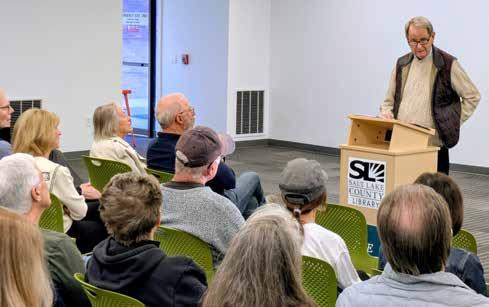
Dozens of residents attended a recent meeting at the Holladay Library, which featured Brigadier General and former state representative David Irvine. He discussed how the major political parties have changed over the last decade, the state’s nomination procedures
and gerrymandering, and how people can make a difference in today’s political landscape.
“James Madison wrote in ‘The Federalist Papers’ about this kind of legislative power grab,” Irvine said. “He said, ‘An elective despotism was not the government we fought for.’ I think that’s an apt piece of advice for us. Tyranny is tyranny, whether it’s the tyranny of the king, of the dictator, of a man, king, president, or of the legislature that is drunk with power and wants to control everything.”
The group has brought in other speakers, including Rep. Carol Spackman Moss and former Congressman Ben McAdams, to discuss topics of interest and to educate voters. Members of the group are encouraged to attend rallies and protests, to call their representatives and to support each other in their search for truth and justice.
Holladay resident Peter Grogan attended the meeting to get different people’s perspectives and to try to understand what he called the “political craziness” of the current situation.
“The country’s in trouble, our society is in trouble, democracy is in trouble and I think most of us are sleepwalking,” Grogan said. “We’ve got to start paying attention. I want to see where I can best spend my time and effort to help right the ship, because the ship is not upright now.”
For information about meetings, volunteer opportunities and calls to action, contact Suchy at becky@suchy.us or visit the Holladay Resistance Group Facebook page to join the private group.
“The lack of humanity that’s happening is not OK,” she said. “If we can find a community where people feel like they belong and they can make a difference, and not just sit around and be angry and frustrated and discouraged, if I can offer someone just a thread of hope, that makes me so happy.” l





Hundreds of miniature artworks are displayed at Tiny Art Show held at Holladay City Hall.
By Collette Hayes c.hayes@mycityjournals.com
An exhibition of miniature masterpieces filled Holladay City Hall March 6 through 12 as local artists unveiled tiny, treasured works in painting, 3D art and sculpture. The event provided an opportunity for attendees to appreciate the intricate skill and dedication required to create tiny artistic gems known as miniatures. These works show the impact artists can create in a limited space. Viewed through a magnifying glass, the pieces reveal details rivaling those in larger works. A 2- to 3-inch landscape, painted with a one-hair brush, can take as much time to execute as a full-sized canvas.
“There’s something magical about tiny paintings. They may be small, but they hold a whole world in a few brushstrokes,” said professional artist Charlotte Mortimer.
The Tiny Art Show is one of the most anticipated exhibits hosted by Holladay Arts. Held annually, this showcase highlights the talents of students, amateurs and professionals in
a noncompetitive display of tiny art. The show opened March 6 with light refreshments and an evening of live jazz by the State Street Stompers. And yes, there was dancing.
“The Art After Hours concert coincided with the Tiny Art Show’s opening, giving attendees first pick of tiny art,” said Holladay Arts and Culture Manager Megan Attermann. “It was a night to come for the music, move your feet, browse the art, and leave with a small original work you love.”
Several local professional artists, including Robert Fuerer, Charlotte Mortimer, Jeff Anderson, Pamela Robins, JoAn Coon, Susan McFarlane and Ilene Stowe, participated in this year’s show with works measuring 9 inches or less. Eighty percent of sales went directly to the artists, supporting their creative work and sustaining their businesses.
The exhibit offers an accessible way for many to begin an art collection and add original pieces to their offices or homes, even on a small budget. Smaller works are easier to place in homes and also make great gifts. According to Attermann, this year’s show included tiny pieces ranging from under $100 to several hundred for collector pieces by well-known artists.
Salt Lake art collector Cindy Cromer volunteered a few days before the show to hang

Our team is expanding to provide faster, more comprehensive care that’s close to you. We provide:
› Care for your heart: We diagnose and manage heart conditions including high cholesterol, high blood pressure, heart attacks, and more
› Echocardiograms: A safe, painless test that shows how your heart is working
› Stress testing: See how your heart performs when it’s working hard
› Heart Rhythm Monitoring: Find and treat problems with your heart’s electrical system
Life can change in a heartbeat. We want to help you keep it going.
451 paintings, including works by two friends she encouraged to enter. While setting up the art exhibit, she found a landscape by master artist Ilene Stowe. She was thrilled to find the small treasure.
“I collect landscapes,” Cromer said. “I received a beautiful photo taken in Millcreek Canyon by my dear friend and neighbor, who passed away last summer at 108. I was excited to find an Ilene Stowe landscape while hanging artwork for the show. I bought it minutes after
the show opened to hang beside the photo, creating a meaningful display of both artworks.”
The Art After Hours concert featuring Sydnie Keddington created a welcoming atmosphere for the final night of the Tiny Art Show. Her Americana rock and folk performance, featuring songs from the ’70s to today, highlighted her engaging stage presence. The event offered the community a memorable evening of creativity and connection through both visual and auditory art. l


Scan the QR code for more information appointment at one of five locations.
Cardiology Clinic at Intermountain Medical Center
5169 South Cottonwood Street, Ste. 520 Murray, Utah 84107
Cardiology Clinic at LDS Hospital
8th Avenue C Street, 6th Floor Salt Lake City, Utah 84103
Cardiology Clinic at Alta View Hospital
9450 South 1300 East, 4th Floor Sandy, Utah 84094
Cardiology Clinic at Riverton Hospital
3723 West 12600 South, Ste. 160A Riverton, Utah 84065
Cardiology Clinic at Salt Lake Clinic
389 South 900 East, 3rd Floor Salt Lake City, Utah 84102


The home was built in 1898 by pioneer settlers.
By Peri Kinder peri.k@thecityjournals.com
Formore than 125 years, the home of
Duncan Spears Casper has watched Holladay transform from a small pioneer community into a bustling city. Located at 2394 E. Murray Holladay Road, the “Casper Cottage” is one of the oldest homes in the area and was recently added to Holladay’s Historic Designation list.
Owner Ron Hilton connected with Adrienne White, founder and CEO of House Genealogy, to learn about the home’s history and significance to the city.
“It’s been a pretty fun experience to actually learn more about the house,” Hilton said. “We knew it was built in 1898 and that it was really hard to get insurance for it. Other than that, we didn’t know the history. But I’ve become more involved over that period of time and I’ve been a volunteer on the Holladay Historic Commission. It’s kind of a passion of mine. I’ve always been interested in local history, and I wanted to know more about our own house.”
Casper, along with his wife, Mathilda, and their three children, traveled to Utah with the John Hindley Company. The group consisted of
nearly 50 wagons that arrived in the Salt Lake Valley in September 1855.
In 1879, Casper bought seven acres of land, now located at the southeast corner of Holladay Boulevard and Murray Holladay Road. He built a two-room brick cottage on the property in 1898 and died that same year. The home remained in the family until 1916.
The single-story home is a cross-wing, shotgun cottage, a style common in the late 1800s and early 1900s. It features a covered porch and a facade with a brick “eyebrow” over the front window. Located near Spring Creek, where many early settlers built homes, the cottage was later improved to add square footage to the home, while leaving the original structure intact.
“This property is an example of the simple type of home most early residents of Holladay would have lived in,” said Kim Duffy, chair of the Holladay Historic Commission. “The Casper house is important because it’s an increasingly rare remaining type that should be preserved as we demolish historic properties to make way for new builds. This house evokes the ambience of another time and reminds us of a simpler way of life in rural Holladay.”
Recent amendments to the city’s Historic Designation process provide a way for owners to add their properties to Holladay’s list of historic sites. The site needs to be at least 50 years old, have historic significance to the city and
retain its integrity, meaning there have been no major alterations or additions.
Hilton hopes that getting the Casper Cottage listed on the historic sites will encourage other homeowners to preserve their property as well. He would like to see the entire neighborhood become a historic district.
“There are a number of these similar vintage homes in this area,” he said. “It’s kind of a historic bungalow district where there’s a lot of early 1900s homes. There’s one of them that’s already on the registry. I’d like to see, at some point, maybe this whole area get designated as a district, because I’d love to see it preserved.” l


Benefits of NuWater Water Treatment System
Appliances Perform Better & Last 37% Longer
Better Tasting Water, removed contaminates & Chlorine
Softer Skin & Hair
Clothes are Cleaner, Brighter & Last Longer
Less Cleaning of Hard Water Build Up
Soaps & Detergent last 75% Longer
Improves your Health and Saves you Time & Money NSF Certified 2.6 Million Gallons (estimated 30 years) Guaranteed!



Grief is an individual journey with a path as unique as each one of us. To o er support and hope, we provide various Grief Support Services for those who are mourning a recent or past loss.








This year’s event will be held April 24 at the Olympus Stake Center.
By Collette Hayes c.hayes@mycityjournals.com
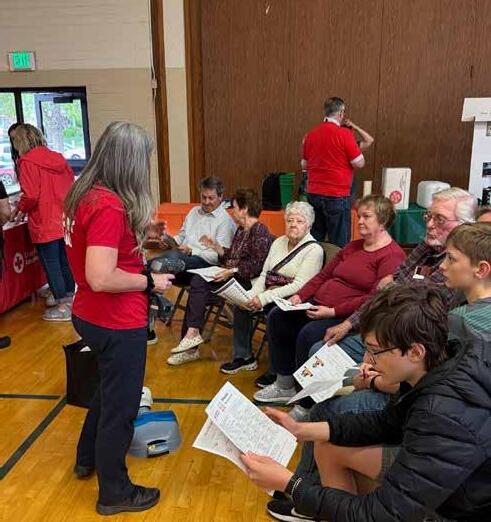
Manyimportant factors come into play when preparing for a local disaster. Creating an emergency preparedness plan ensures everyone in the community knows how to react, where to go, and how to communicate if systems fail. To enhance Holladay’s readiness for a disaster large or small, the annual Neighbors-Prepared Fair will be held Friday, April 24, at the Olympus Stake Center.
The fair is sponsored and organized by the Church of Jesus Christ of Latter-day Saints Olympus, Holladay and Holladay North Stakes, in partnership with the city of Holladay, Salt Lake County, Unified Police, Unified Fire and local religious organizations.
“Waiting until an emergency happens is too late to start planning,” event director Scott Snow shares on the Neighbors-Prepared.org website. “By taking simple steps now—like building a grab-and-go bag and learning essential skills—you can protect your family and face any situation with confidence. We help families and individuals prepare for emergencies through education and community support. Neighborhood volunteers help promote and host annual preparedness events to help the community stay ready.”
As of March 7, the Map of Utah Earthquakes Today website reports that Utah experienced one earthquake in the past 24 hours, six in the past seven days, 43 in the past 30 days, and 433 in the past 365 days. Earthquake magnitudes in early 2026 ranged from -0.4 to 3.5, with significant seismic activity near Fairview and Lehi, as well as a 3.5-magnitude event in West Valley City.
The Wasatch Fault Zone is a 240-milelong active normal fault and is considered one of the most dangerous in the U.S.—and by extension, the world. The Utah Seismic Safety Commission’s online survival guide, ‘Putting Down Roots in Earthquake Country,’ highlights that over 85% of Utah’s population lives within 15 miles of the Wasatch fault. In addition, 75% of Utah’s economy and most state facilities are near the fault line.
The Working Group on Utah Earthquake Probabilities, formed by the Utah Geological Survey, a Utah Department of Natural Resources division, recently evaluated the likelihood of significant earthquakes occurring in the Wasatch Front region. Their findings indicate a 57% probability that the Wasatch Front will experience an earthquake of magnitude 6.0 or greater within the next 50 years and a 43% probability of a quake reaching magnitude 6.75 or higher during that same timeframe.
What could a 6.75 earthquake potentially look like in Holladay City?
The Wasatch fault cuts directly through Holladay, threatening the area with catastrophic ground shifts. In the event of a major quake, devastating vertical offsets could severely impact certain neighborhoods. The steep slopes of the East Bench, a defining feature of the region, are susceptible to landslides. Liquefaction is more prevalent in the lower valley but remains a hazard in areas with elevated water tables. Essential utilities such as water, electricity, gas and sewer services are likely to be disrupted for extended periods. Water pipelines from the eastern mountains face a high risk of substantial damage. Holladay Emergency Management coordinator Allison Jester supports creating a strong and robust community to address potential disaster in Holladay City.
According to Jester, members of the community need to know and understand what an emergency response system looks like for them and know there’s a system in place in the event of disaster at the local level, county level, state level and national level. Jester said, “The Holladay community would survive a disaster. The key questions are: How would residents survive? And how would residents recover?”
“Preparedness is a cooperative activity,” Jester said. “Every individual, family and business that is prepared enhances the resiliency of our community so that we can respond and recover faster and better. These grassroots efforts, put on by amazing volunteers, are essential to that mission. Holladay City appreciates their partnership, vision, and community-based approach.”
Events to be held this year during the Neighbors-Prepared Fair
Dan Clark, one of the world’s top motivational speakers, will serve as master of ceremonies during the fair. Recognized in the Professional Speakers Hall of Fame and as a New York Times best-selling author of 37 books, he is an expert in decisive motivation, resilience, leading through change and story selling. In addition, a well-known guest speaker will share tips on preparedness for families and communities. Attendees can explore display booths featuring emergency preparedness information. The American Red Cross, Holladay City and the Great Utah Shake Out will each lead 15-minute breakout sessions for more in-depth learning. Many local community members are volunteering, including Ruth Barrett, who last year shared advice on food storage and offered samples to highlight the importance of keeping basic food supplies on hand.
“The fair is a valuable chance to learn and connect with your community,” Barrett said. “In an emergency, large or small, knowing our neighbors will be critical so we can be prepared to help each other. Presenters at this year’s fair will cover a wide range of topics and provide valuable resources. The fair will also help you to identify the supplies you already have and those you may still need as an individual or family, so you can ensure you are ready to provide your own food, water, heat and first aid.
We encourage you to attend and connect with your community to ensure you are as prepared as possible.”
This year’s fair will once again include commercial vendors providing information on topics such as food and water storage and earthquake-resistant home retrofit designs. The musical entertainment and light refreshments will create a fun, inviting atmosphere.
“At our recent fair events, we estimated that about 700 people attended,” said co-event director Merrill Brimhall. “Visitors received plenty of information at the booths, and it was clear they were excited about the topic and felt more connected to the community. Kids had fun while learning, and they also enjoyed some cotton candy.”
How will the relocation of Holladay City Hall to the temporary building location in Millcreek City impact the city’s disaster response capabilities?
According to Jester, when the city relocates to the temporary City Hall in April 2026, the same emergency response capabilities will still be readily available. There will be a few minor adjustments to internal operations.
“Our Emergency Coordination Center will come with us and is set up to be flexible
for a number of situations, including leaving the building on short notice,” Jester said. “Our wonderful first response partners will remain in Holladay and keep in close contact with city administration using established lines of communication.”
What role does the city play in supporting the community’s response and recovery during disasters such as earthquakes or severe flooding?
Holladay City primarily supports first response partners. Jester affirms its commitment by validating and sharing information, coordinating resources and providing policy direction to ensure the well-being of Holladay’s residents. The city takes a larger role in recovery by assessing community needs, spearheading a Recovery Task Force, and working with state and federal entities to secure funding and additional support as required.
Small or large, every disaster presents unique challenges and concerns. The Neighbors-Prepared Fair helps ensure the community is ready to respond swiftly and effectively when it matters most.
The Neighbors-Prepared Fair will be held at the Olympus Stake Center, 2675 E. 4430 South, on April 24 from 6:30-9 p.m. l
At Dogtopia, safety is at the core of everything we do. We create a safe, structured environment with trained Canine Coaches who understand dog behavior and supervise dogs throughout the day. Every dog begins with a Meet & Greet process to ensure they are a good fit for our open play environment. Our facilities are specifically designed for dogs to play safely all day, with thoughtful room placement based on size and temperament, and a focus on socialization, exercise, and rest.

to find the nearest location to you.




















More daycare spots available without using tax dollars? That’s what the Salt Lake County Council voted unanimously to support last month when Councilmember Laurie Stringham and I brought forward a proposal to explore a new approach to childcare.
Last December, the council voted to close four county-run daycare centers as part of efforts to reduce the proposed property tax increase put forward by Salt Lake County Mayor Jenny Wilson. An extensive report highlighted the significant subsidy the county had been providing to a relatively small number of families. Taxpayers were contributing between $6,000 and $10,000 per child each year, covering roughly half of the tuition costs for 271 children enrolled in county-run programs.
Aimee Winder Newton
Salt Lake County Councilmember
District 3

Families across Salt Lake County are facing rising childcare costs and limited availability, making it difficult for many parents to remain in the workforce. Access to reliable childcare is not just a family issue — it is also an economic issue that affects employers and communities across the county.
access to affordable space, families gain additional childcare options, and taxpayers are protected from ongoing subsidies.
The report and audit findings also made it clear that while the county performs many important services well, operating childcare centers was not one of them. In addition to financial concerns, the program had operational challenges that raised questions about whether the county should be directly running childcare programs in the first place. Even if the program had worked perfectly, it would have been impossible for the county to provide daycare services to every family who might want them.
At the same time, the need for childcare in our community continues to grow.
Many residents who contacted me said they support helping families who are struggling financially afford childcare. That’s a reasonable and compassionate position. However, the county program had no income qualifications, meaning families earning above the median household income were also receiving subsidies funded by taxpayers — including those living on fixed or lower incomes.
As Stringham and I looked for alternatives, we began exploring whether the county could help expand childcare access without directly operating the programs or increasing taxes.
Our proposal is simple: allow nonprofit childcare providers to lease existing county childcare spaces and operate their own programs. These organizations would raise their own funding, hire their own staff, and manage their own operations. In return, they would receive discounted rent in exchange for prioritizing care for low-income and vulnerable families. The rent payments would cover the county’s operations and maintenance costs for the space, ensuring that taxpayers are not subsidizing the programs.
This type of partnership could create a win-win solution. Nonprofit providers gain
The council unanimously approved our legislative intent, and our Parks and Recreation Department will now evaluate childcare spaces at the Magna, Kearns, and Northwest Recreation Centers to determine which facilities may be viable for leasing to childcare providers. We are also working with the Granite School District to explore a similar arrangement for the childcare space in Millcreek.
Councilmember Stringham and I recognize that this approach will not solve the childcare shortage overnight, but it represents a practical step forward. By working with community partners, Salt Lake County can help expand childcare availability while respecting the taxpayers who make these public facilities possible.
Families deserve more childcare options, and taxpayers deserve responsible stewardship of public funds. With creative partnerships and thoughtful planning, we can pursue both goals at the same time.







Ifthere’s one thing that makes you question your life choices, it’s sitting at a child’s outdoor soccer game in April.
Clutching Stanley mugs filled with coffee, whisky, or both, parents and grandparents sit on wobbly camp chairs, huddled under musty blankets while trying not to be too conspicuous about checking the time.
The idea is sound: help kids understand the concepts of a sport and learn teamwork. In reality, it’s about which kid brought the best treats or if we’re going to catch pneumonia and die before the game ends.
Utah’s spring is a weather roulette that can have you freezing at 9 a.m. and sweltering by noon. The cold wind, constant trickle of rain and glacial temperatures give way to heat stroke and sunburn before halftime.
My four daughters played softball every spring for what felt like 75 consecutive years. Each year, we’d bundle up in coats, gloves, scarves and earmuffs to watch them play. We shoved handwarmers into pockets and told them to “Think warm thoughts.”
It was often torture. Not only do you watch your child strikeout, but strikeout in 45-degree weather. They’d hold the bat with frozen hands, waiting for the impact to snap their fingers off at the knuckles.
Now, my grandkids enjoy soccer, which is played no matter the weather, and everything is mud. The only thing running faster than my granddaughter is my nose. Except

when it’s treat time, then the whole team finds a burst of adrenaline to snatch up granola bars and Capri Suns. Don’t even think about bringing oranges or bananas. Who are you? Someone who hates kids?
Each spring, hope wears shin guards and batting helmets. It’s a fresh start, a chance to learn skills and an opportunity for new coaches to lower their expectations.
You can spot a new coach by their optimism. They come prepared with drills, practice schedules and intricate plays, but by the end of the season, they’re just happy to have players who can identify a soccer ball and run in the right direction.
They also have to deal with parents. There’s always that person who believes their child is the next Lionel Messi or Aaron Judge. They memorize the rule book and counter every official’s call. “Blue! Were you the lookout on the Titanic?” or “Hey, Ref! Are we keeping you awake?”
They scream at their child to “Run!” for 45 minutes straight and call their 6-year-old over

between innings to explain baseball defense.
Yet, even in drizzly, cold weather, spring sports thrive. There’s just something about watching a child finally hit the ball off a tee or score their first goal. We see coaches kindly redirect a player’s attention from doing cartwheels to protecting third base.
When your granddaughter makes a great pass, she looks to the sidelines to see if you saw it happen. You did.
Although we complain about the mud, the temperature, the uncomfortable seating and wonder if the other team altered the birth certificate of their star player, there’s something inherently human about watching young people navigate sportsmanship.
It’s not about winning. It’s about showing up for the kids you love. You watch them fall on their faces, sometimes literally, and get back up. You watch them strike out, kick the ball in the wrong goal or drop an easy fly ball, and wince along with them.
If there’s one thing that makes you question your life choices, it shouldn’t be watching a child you love run past you with a big grin on their face. Even wrapped in quilts, chugging espresso, you’re exactly where you’re supposed to be.
Peri Kinder is an award-winning columnist and journalist who has written for The City Journals since 2004. She can be reached at peri.k@thecityjournals.com