

Tourism results in lower property taxes says mayor in State of City speech
By Mimi Darley Dutton | m.dutton@mycityjournals.com
Tourism and shopping locally fund city services while keeping property taxes lower for residents, but the mayor warns of budget shortfall if the legislature increases tax exemption.
Draper is a tourist destination. Who knew? That translates into lower property taxes for you.
In his annual State of the City speech, Mayor Troy Walker said cell phone data shows people from all 50 states set foot in Draper. Tourism results in sales tax revenue and translates into lower property taxes for residents. Pie charts of the city’s General Fund revenue showed $21.5 million comes from sales tax while $11 million comes from property taxes. Statistics show the Loveland Living Planet Aquarium had 922,000 visits and the Salt Lake County Flight Park had 258,000 visits in 2025.
“My message is shop in Draper. It goes right into our budget if you do. Go as often as you can. Out of those taxes, that’s how we fund our city operations,” Walker said.
The mayor’s tone is serious in speaking about the Utah Legislature, going so far as to
call the session “the Dark Times.” Walker is not a fan because he’s said the state has been trying to take away local control for years.
“Whenever that legislature gets in session, crazy stuff happens,” he said.
At the state level, Walker praised the work of former Draper Councilmember Cal Roberts who now represents District 46. At the federal level, the mayor said, “Congressman (Mike) Kennedy and Sen. (John) Curtis are very receptive to what we need in local government.”
Walker walked through statistics about the city including 317 acres of parks and 2,700 acres of open space. Current population is estimated at 56,236 made up primarily of 15,562 Gen Z residents (born between 1997-2012) and 15,001 millennials (1981-86) with 11,529 Gen X residents (1965-80). “We even have a fair number of babies,” he said.
Fifty-two percent of residents have a bachelor’s degree or higher and median income is $146,953. “I don’t think a lot of cities in the country have that…we’re a well-educated community and the median age of 34.7 is pretty young.”
Draper has 3,099 businesses. “That is not by accident. Our council has been interested in making business a big part of our community.”



City statistics show the median home price in Draper between $820,000 and $1 million. There are 17,496 total households made up of 10,650 single family homes, 4,658 apartments and 2,611 townhomes.
Walker explained the property tax breakdown on a home valued at $1 million. The state currently allows a tax-exempt discount of 45% meaning taxable value in that scenario is $550,000 at a rate of 0.000936, resulting in $514 taxes. Walker offered up his personal tax statement showing he paid $645 for city services such as police, fire, parks, water and sewer.
“That’s a lot of service for a very little amount of money. The money we’re taking in is what we need to provide the services you expect.” Walker warned of potential legislative action. “They’re talking about changing… that 45% exemption to 60%. If they do, that takes about $1.6 million out of our budget, and I don’t have $1.6 million laying around. It sounds great to lower taxes, but when you need that paramedic…we might not be able to afford it.”
The biggest expense is the city’s person-

Journals) Continued on page 4



“Tourism is actually a big deal for us. Draper attracted visitors from all 50 states,” Mayor Troy Walker said at his annual State of the City speech in January. (Mimi Darley Dutton/City









The
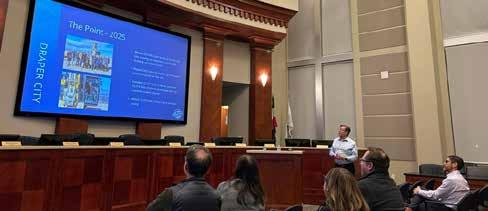
arterial streets when The Point is developed as well as water needed to support high density housing at the site in a state already lacking water. (Mimi Darley Dutton/City Journals)
ing 50 members who are equipped to respond to high-risk situations.

nel at $30 million. The city employs 319 people, 275 full time and 44 part time or seasonal including fire and police. Walker expressed the importance of competent employees. He shared accolades received by police and fire personnel including Draper Detective Bryce Okland named Utah Officer of the Year and an award for wildland/urban interface fire mitigation efforts to Parker Hansen of the Draper Fire Department.
Walker shared statistics indicating a decrease in crime in the city from 2022-25. “I want cops that I pay good that are quality and hard-working, that treat people with respect. Good people cost money. Paramedics are at a premium right now. Our fire department has saved our community several times including a fire near Draper Heights last year.” Draper partners with other cities in the area for a Police Special Enforcement Team. In 2025, that group seized 15 pounds of meth, 14 pounds of heroin, 200 pounds of marijuana, 960 grams of cocaine, 70,000 fentanyl pills and 87 firearms. They recovered 32 stolen vehicles and made 190 arrests. Draper’s Police Department also belongs to a SWAT team of area cities compris-
The city has had one property tax increase in 18 years. “We probably should have done a few in between. We’ve worked hard to keep the budget in line, but it’s getting more difficult because everything is going up in cost. But sales tax revenue…I’ve never seen it go down, but it did for the first time last year. That panics elected officials because of the chunk of the budget. I hate taxes just as much as you do, but we live in a community where we have things we like. When you need a cop, you need one,” he said.
Last year, Walker served as president of the Utah League of Cities and Towns, an organization that lobbies the legislature. “I hate the legislature but I spent most of my time there last session because that’s what the League president does…looking out for local government and community interests. It’s kinda nuts that you need a lobbying group like that, but you do,” he said. This year is his fourth and final year in League leadership, serving as past-president.
The Point, the 630 acres of state-owned land within city limits where the prison once stood, garnered the most questions from the
audience. Robert Lopez expressed concern over increased traffic as a result of The Point’s development, not just to the interstate, but to arterial streets in Draper.
“Don’t underestimate that. I think it’s going to be a ticking time bomb unless you really work that out,” he said. Lopez also noted the state’s population has nearly doubled since he moved here in 1990 and is projected to grow substantially in the next few decades. With high density housing planned for The Point, Lopez said, “At some point it’s going to hit a wall where there’s not enough water.”
Walker mentioned nearby Las Vegas where residents drink recycled and sanitized sewer water and have water police. “We haven’t gotten there yet, but we’re getting there,” Walker said.
Regarding the “Housing Crisis,” Walker has argued that term and “affordability” are vague. He pointed to the Ivory Homes development east of City Hall where one lot “for the dirt” sold for $920,000. “I think government has a narrow lane. We do police, fire and paramedics, garbage and roads well. But when you want government to make a house cost less or lower the cost of gas or food, I’m always suspect when I hear government officials say
DRAPER TEAM
The Draper Journal is a monthly publication distributed directly to residents via the USPS as well as locations throughout Draper.
The views and opinions expressed in display advertisements do not necessarily reflect or represent the views and opinions held by Loyal Perch Media or the City Journals. This publication may not be reproduced in whole or in part without the express written consent of the owner. © 2026 Loyal Perch Media, Inc.
PUBLISHER
Bryan Scott | bryan.s@thecityjournals.com
EDITOR
Travis Barton | travis.b@thecityjournals.com
ADVERTISING EXECUTIVES
Mieka Sawatzki | mieka.s@thecityjournals.com
Ryan Casper | ryan.c@thecityjournals.com
Marc Davis | marc.d@thecityjournals.com
CLIENT SERVICES
Lydia Rice | lydia.r@thecityjournals.com 385-557-1022
Lindsay Andreasen | lindsay.a@thecityjournals.com Rack locations are also available on our website.
EDITORIAL & AD DESIGN
Stacey LaMont Ty Gorton
DRAPER CITY JOURNAL
9500 South 500 West, Suite 205 Sandy, UT 84070
PHONE: 801-254-5974
Mayor Troy Walker showed taxes on a home valued at $1 million. The state currently exempts 45% of a home’s value from taxes. This legislature is discussing raising that exemption to 60%, something Walker warns would result in a $1.6 million budget shortfall for the city, threatening the funding of fire, police and other services. (Mimi Darley Dutton/City Journals)
they’ll do that because we live in a capitalistic economy. Home builders have no incentive to build a house that costs $150,000. Builders used to have to come to cities to get land use approved. Then, builders decided to spend their money on lobbyists (at the legislature). So to say the housing crisis is all on cities… by and large, the communities around here are all on board with creating the right houses, but we don’t build houses or set prices, that’s all the market. We’ve come a long way as local governments, but we also have you to listen to. You want to keep Draper like it was before you got here. That’s what we hear,” he said.
One thing Walker is certain of is this: “They (the legislature) won’t take land use authority away (from cities) this year because it’s an election year.”
Walker reiterated Draper’s City Council is a six-member council form of government, the most common in Utah. “I only vote if there’s a tie. We’re part time despite what it may feel like to us. These people love our community, and they’re invested. They work well together and they work hard. They’re the biggest reason our community is as good as it is.” To that he added, “Our future is as bright if not brighter than any other city in this state.” l
while promoting a strong local economy via relevant content presented across a synergetic network of print and digital media.

continued from front page
Point garnered the most questions at the mayor’s State of the City speech. Resident Robert Lopez expressed concerns over traffic congestion on the city’s
Suffering from Depression, Anxiety, or OCD?

• NOT medicine
• NOT shock therapy
• NOT invasive
• IS safe and effective
• IS COVERED by most insurance “I















back





Training from County Health Department, Draper City teaches the QPR method of suicide prevention
The QPR method of suicide prevention is to question the person in crisis, persuade them to seek help and refer them to resources for recovery.
By Mimi Darley Dutton m.dutton@mycityjournals.com
Draper
City’s Wellness initiative hosted a class with Salt Lake County focused on teaching the Question Persuade Refer (QPR) method in an effort to prevent suicide. County Health Educator Alyssa Burnham was the main presenter. She was joined by colleague Jen Osborne and Sergeant Mike Todd of the Draper Police Department. Todd facilitated a giveaway of gun safes because firearms are the leading means of suicide.
“Eighty-six percent of firearm deaths in Utah are suicide. It’s more likely your firearm is going to be used in a suicide situation than a home protection situation,” Burnham said. Noting suicide crises are often brief, Burnham said if a gun owner recognizes they’re personally at risk, she suggests asking someone to hold onto your firearm or putting the key to your gun safe in a cup of water and freezing it. “It’s like holding onto someone’s keys if they’ve been drinking,” she said. Todd said if you have no other means of safe firearm storage, the Police Department can do a “safe keep,” but it requires paperwork and the firearm stays with the police for a period of time.
Burnham explained QPR training is not counseling or treatment, instead it familiarizes people with suicide warning signs and teaches people to listen and connect at-risk individuals to help.
“You already have a community of people who care,” she said.
The state’s statistics are staggering. Utah ranks seventh in the nation for suicides and fifth for youth suicide deaths. Suicide is the sixth leading cause of death in Utah and the second leading cause for ages 10-17. Utah is in a region with higher rates of suicide partially because of higher levels of gun ownership. “There are more guns for people to use,” Burnham said. Rurality can be a factor with less access to behavioral health care and less connection to community. Asked if altitude is a factor, Burnham said she has not seen concrete evidence to support that. “Religion can go either way. It can protect some, but for others, if you aren’t accepted by the predominant culture of your family or neighborhood, that can be a risk factor,” she said.
“The biggest risk factors are feeling like a burden to others or feeling alone. The biggest protective factors against suicide are a sense of community and feeling like you have a purpose in life,” Burnham said.
Language surrounding suicide has evolved. It’s not appropriate to say “committed suicide,” but instead “died by suicide” or
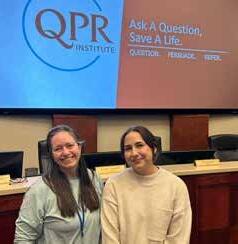
“Suicide is the most preventable kind of death and almost any positive action may save a life,” said Alyssa Burnham of Salt Lake County Health Department. Burnham (R) and colleague Jen Osborne hosted a QPR (Question, Persuade, Refer) suicide prevention information session in conjunction with Draper City. (Mimi Darley Dutton/City Journals)
“lost their life to suicide.” Rather than saying someone is “suicidal,” say “is thinking of suicide” or “has suicidal thoughts.” Rather than saying someone is schizophrenic, mentally ill or an addict, instead say living with schizophrenia, people with mental illness, or people addicted to substances. “There’s way more to a person than their diagnosis or what they’re going through, and those labels can be stigmatizing,” Burnham said.
There are usually clues and warning signs given by a person considering suicide. Verbal clues include phrases like “I wish I were dead” or “I just can’t go on.” Behavioral clues include acquiring a gun or stockpiling pills, putting personal affairs in order, aggression and irritability, or engaging in more risk-taking behavior. Situational clues include being fired from a job or expelled from school, loss of any major relationship, diagnosis of a serious or terminal illness, anticipated loss of financial security, or chronic pain.
“Often, they start giving away their stuff. That should be a big clue,” Todd said.
One of the biggest myths about suicide is talking about it will make a person angry or increase their risk. “Asking them about it isn’t going to make them do it. Instead, asking someone lowers anxiety and lowers the risk of a suicide attempt,” Burnham said
Three steps of QPR: Question, Persuade and Refer
QUESTION
Do: If in doubt, don’t wait! Talk to the person in a private setting, allow them to speak freely, and make sure you have time for the conversation and resource information handy. How you ask the question is less important
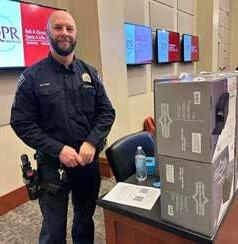
Draper Police Sergeant Mike Todd facilitated a gun safe giveaway at the suicide prevention training. Studies show putting time and distance between firearms and someone thinking about suicide is of utmost importance. Rates of suicide are higher in Utah partly because of higher levels of gun ownership. (Mimi Darley Dutton/ City Journals)
than that you ask it, particularly if you’re asking in a way that shows you care. A direct approach would be, “I’m worried about you. I wonder if you’re thinking about suicide?” A less direct approach would be “Do you ever wish you could go to sleep and never wake up?” or “Have you been so unhappy lately that you’re thinking about ending your life?” Often the response is something like, “No, I’m not, but thank you for caring.” If you cannot ask the question, find someone who can. Practice asking the question so you’re prepared when it’s necessary.
Don’t: Ask in a judgmental or shaming way such as “You’re not thinking about killing yourself, are you?” or “You wouldn’t do anything stupid, would you?”
PERSUADE
Do: Persuade the person to stay alive by listening to the problem and giving them your full attention, then ask “Will you go with me to get help?” “Will you let me help you get help?” or “What can we do to keep you safe for now?”
Don’t: Rush to judgement or try to solve the problem. “Sitting and talking and not rushing to judgement can be powerful,” Burnham said.
REFER
People living with suicidal thoughts often believe they cannot be helped, so it’s ideal to get the person immediate help by walking into a school counselor’s office or crisis center together, or calling the suicide and crisis line together. Second best is making arrangements to get them help including offering a ride to an appointment or offering childcare when they access care. Third best is to give referral
information and get a good faith commitment from the person they won’t attempt suicide. Offer encouragement with phrases such as “I want you to live, I’m on your side, or we’ll get through this.” If appropriate, enlist the help of others such as trusted family, friends, a faith leader or a physician.
Calling or texting 988, the free suicide and crisis line staffed by mental health professionals, is an excellent place to start. It operates nationwide. “I really like this as a first step for helping someone because they’ll do the assessment and determine if it requires an emergency room visit or just deep breathing,” Burnham said. That service can refer to help specifically designed for veterans, Spanish speaking persons or LGBTQ+ individuals.
Burnham strongly suggested everyone have a few resources (see list below) saved in their phone so they’re prepared to help in a crisis, particularly the 988 suicide and crisis line.
Todd said police can help, though the appearance of police can be triggering for some or make the person in crisis feel like they’re in trouble, so fire department personnel are also trained to help. “Fire does a dang good job talking to people,” Todd said.
Burnham said there is hope for recovery, and recovery is the norm. One slide she shared quoted Eduardo Vega, president and CEO of Dignity Recovery Action! International, “We are living among people who have faced the worst of personal pain and doubt and come through them to better lives.” l
RESOURCES
988 suicide and crisis line staffed by mental health professionals
Utah Warm Line 833-773-2588 (Peer support specialists for mental health or substance abuse struggles, 8 a.m.-11 p.m., free and confidential)
Thetrevorproject.org crisis lifeline for LGBTQ+ individuals, free and 24/7, call 1-866-488-7386 or text ‘START’ to 678-678
Help someone find a therapist starting with their insurance. Call 211 visit 211utah.org or findtreatment.gov.
SafeUT app for students, parents and educators, goes all the way through higher education
SafeUT Frontline for first responders including police, fire and frontline healthcare workers
Intermountain Health’s Behavioral Health navigation, adults 833-442-2211, teens 385-478-2400
National Alliance on Mental Illness www.namiut.org or NAMI Utah helpline 801-323-9900 Mon.-Fri., 9 a.m.-4:15 p.m.
American Foundation for Suicide Prevention afsp.org
Liveonutah.org



Loveland Living Planet Aquarium celebrates grand opening of the Sam & Aline Skaggs Science Learning Center
The center accommodates unique educational opportunities for students from preschool to college.
By Katherine Weinstein k.weinstein@mycityjournals.com
There is almost always something new happening at Loveland Living Planet Aquarium. The Aquarium kicked off 2026 with a new Chief Operating Officer and celebrated the grand opening of the Sam & Aline Skaggs Science Learning Center last month. The building includes spaces for special events, the new Expedition Asia habitat area, classrooms for educational programming and summer camps and the new Coral Cove Childcare Center.
“There’s no resting on our laurels,” Chief Operating Officer Ari Robinson said. “We’re always looking to grow our organization and our impact on the community.”
Robinson assumed his new role last December but has a long history at the Aquarium. He started out as a volunteer 28 years ago, taking the Aquavan to area schools to teach children about Earth’s diverse ecosystems. Robinson became an educator and later took on many different roles in various departments at the Aquarium. Most recently, he held the title of Senior Vice President of Operations.
“I absolutely love the Aquarium,” he said. “This place has been my life.”
As Senior Vice President, Robinson was involved in nearly every aspect of developing the Sam & Aline Skaggs Science Learning Center, from the overall building design to its decorative details.
The building has opened gradually, in phases, over the past year. A grand opening was held on Feb. 20 after the last of the animals from the original Expedition Asia space settled into their new habitats.
“Expedition Asia includes the clouded leopards, binturongs, Asian small-clawed otters, the tree kangaroo and new fish and birds,” Robinson said. “We have great new
habitats for them.”
The now-vacant area in the original building that once housed those animals will eventually be renovated into habitats for new species yet to be announced.
Approximately one third of the Sam & Aline Skaggs Science Learning Center is an event center which is available to the public for private and corporate events. “The ballroom can seat up to 2,000, depending on the configuration,” Robinson said, adding that the event center is a revenue generator for the Aquarium’s educational programming.
The opening of the Science Learning Center expands the Aquarium’s ongoing educational mission to inspire people to explore, discover and learn about Earth’s diverse ecosystems. The new building includes 11 classrooms and four laboratories, providing state-of-the-art facilities for elementary, secondary and university students.
Robinson discussed some of the ways in which the Aquarium has partnered with local universities to advance scientific research and offer educational opportunities for college students. For example, students at Utah Valley University conducted genetic mapping studies of the gentoo penguins at the Aquarium and discovered that the birds are not always monogamous. As genetic diversity is critical to maintaining healthy penguin colonies, this research was important for zoos and aquariums. “That study showed that how penguins are managed in captivity should change,” Robinson said.
Last year, Utah State University and the Aquarium formed a partnership, creating the state’s first marine biology program. Robinson explained that USU students can take coursework at the Aquarium to achieve a Bachelor of Marine Science degree. “Currently, we’re working with graduate students who are researching cuttlefish and bullfrogs,” he said, adding, “We’re giving students the opportunity to do veterinary work with more exotic species.” Students can get hands-on experience to research specific species and study aquatic
ecology.
The Aquarium’s educational mission also now extends from the university level to preschool. Coral Cove Childcare Center recently marked the one-year anniversary of its grand opening. Co-owner Juliana Lindsay explained, “We offer preschool as well as child care for ages 2 to 12. We are open to children of Aquarium employees and also the public.”
“Children at Coral Cove have daily access to the Aquarium,” she said. “We provide unique, hands-on learning opportunities that support curiosity, discovery and real-world learning.”
Coral Cove is licensed to accommodate 85 children and has 20 to 25 staff members. Parents have the option to enroll their children in either full- or half-day preschool. It is open from 7 a.m. to 6 p.m. Co-owner and operations manager Joanne Albrecht noted that they also do before- and after-school pick-ups. “It’s a pretty good project, and we love it!” she said.
“We follow a play-based learning approach,” Lindsay said, explaining that they use a pyramid model developed at USU. “It supports social and emotional development and helps build positive relationships.”
Albrecht explained that the children do
any activities that the Aquarium offers for visitors on a given day. Any time that an educator brings an animal out of its habitat to show to visitors, the children can get an up-close look. “We go to Nature Storytime and learn about the animals,” she said. “We also use the outside play area to learn more about nature.”
At the Nature Explore Outdoor Classroom, children can connect with the natural world through creative activities designed to appeal to the senses and the imagination.
“It really is a one of a kind educational experience,” Lindsay said. “We feel so proud to offer that to the community as well as to the children of our Aquarium families.”
“Our program includes childcare, preschool and summer camp and we’re actively enrolling now for the next preschool season which starts in September,” Albrecht said.
“We would love for families who are reading this article to come and see us,” Lindsay said. “Visit us if you’re here. We would love to show people what we are all about.”
Loveland Living Planet Aquarium is located at 12033 S. Lone Peak Pkwy. in Draper. To learn more about the Aquarium and Coral Cove Childcare Center, visit www. livingplanetaquarium.org. l



Rhu, the clouded leopard, will celebrate her birthday this month in her new habitat in the Sam & Aline Skaggs Science Learning Center. (Photo by Emily Weinstein)
Children at Coral Cove Childcare Center have daily access to the Aquarium. (Photo courtesy of Loveland Living Planet Aquarium)
Coral Cove Childcare Center, which is located in the new Sam & Aline Skaggs Science Learning Center, features a colorful and spacious classroom. (Photo courtesy of Loveland Living Planet Aquarium)
Call for entries for Draper Visual Arts Foundation’s 2026 Art Scholar Competition
Student art will be displayed at City Hall April 21-27.
By Katherine Weinstein k.weinstein@mycityjournals.com
High school seniors within the Canyons School District area are encouraged to start thinking early about submitting a work of art to Draper Visual Arts Foundation’s 2026 Art Scholar Competition. The competition will once again take place this April at Draper City Hall to encourage young artists to pursue education and practice their talents.
This year’s competition will be a special one as Draper Visual Arts Foundation marks 100 years of art collecting in Draper. In 1926, Principal Reid Beck at Draper’s Park School started a program in which students would choose and purchase a new piece of art every year. Today, some of those works of art may be seen at Draper Elementary.
Draper Visual Arts Foundation was founded over 30 years ago by three retired school teachers who sought to preserve that art collection. The foundation strives to conserve, promote and celebrate art in Draper. “Our aim is to give local artists an opportunity to show their work,” DVAF president Lowell Baum said.
Students participating in the Art Scholar Competition are eligible to win cash prizes that start at $100. One student will win the grand prize, the Jean Hendricksen Commemorative Award of $1,000.
The competition has three categories: two-dimensional art works such as paintings, drawings or prints; three-dimensional
March Is Endometriosis Awareness Month


Fpieces including woodworking, jewelry, pottery and sculpture; and photography and digital art. Students may enter up to two artworks in the competition.
All entries must be brought to Draper City Hall, 1020 E. Pioneer Road, on April 20 along with a completed entry form which is available on the Draper Visual Arts Foundation website. The online applications must be completed by midnight on April 18.
The student art will be displayed in the foyer of City Hall
April 21 through 27. The public is invited to view the exhibit when City Hall offices are open, weekdays from 8 a.m. to 5 p.m.
A panel of judges made up of local artists will select the prize winners on April 27. A reception, open to the public, will be held at 6 p.m. on that date in the Draper City Council room.
To see pictures of prize-winning works of art from past competitions and download an entry form, visit the Draper Visual Arts Foundation website at www.drapervisualarts foundation.org. l
Understanding Endometriosis: Helping Women Avoid Struggling in Silence
or many women, pelvic pain is dismissed as “normal” or “just part of being a woman.”
But sometimes that pain is a symptom of a chronic condition called endometriosis that affects millions. It’s a condition where tissue similar to the lining of the uterus grows outside the uterus, causing pain, infertility, and a range of other debilitating symptoms.
Endometriosis isn’t just about bad period cramps. It can lead to significant pain during menstruation, intercourse, bowel movements, and urination. It can also cause chronic pelvic pain, heavy bleeding, fatigue, and is a leading cause of infertility
“The emotional and psychological toll of endometriosis can be immense, especially for women who dismiss their pain and go undiagnosed. This condition han have a profound impact on their relationships, careers, and overall quality of life,” said Lisa Hill, certified nurse midwife at Holy Cross Hospital – West Valley
Endometriosis is surprisingly common. It affects an estimated 1 in 10 women of reproductive age globally. In our local community, this means thousands of women are likely living with endometriosis, many of whom may not even realize they have it. The delay in diagnosis is a critical concern,
with women often waiting an average of 7 to 10 years from the onset of symptoms to receive an accurate diagnosis. This delay can lead to the progression of the disease and increased severity of symptoms. Raising awareness is crucial to shorten this diagnostic journey for future generations.
“While there is currently no cure for endometriosis, effective treatments are available to manage symptoms and improve quality of life. Treatment approaches are highly individualized, depending on the severity of symptoms, the extent of the disease, and whether the woman desires to become pregnant,” said Dr. Christopher Hutchison, an OB/ GYN at Holy Cross Hospital – Jordan Valley
Common treatment options include:
• Pain Management: Over-the-counter pain relievers (like NSAIDs) can help with mild pain, while stronger prescription medications may be necessary for severe pain.
• Hormonal Therapies: These treatments aim to slow the growth of endometrial tissue and prevent new implants by regulating or blocking the hormones that fuel their growth.
• Conservative Surgery: Laparoscopic surgery is a minimally invasive procedure where a surgeon can precisely locate and remove endo-
metrial implants while preserving reproductive organs. This can significantly reduce pain and improve fertility outcomes for some women.
• Hysterectomy and Oophorectomy: In severe cases where other treatments have failed and childbearing is complete, removal of the uterus (hysterectomy) and/or ovaries (oophorectomy) may be considered, though this is typically a last resort and does not guarantee complete relief from symptoms.
• Complementary Therapies: Many women find relief through complementary approaches such as acupuncture, physical therapy, dietary changes, and stress management techniques.
If you or someone you know is experiencing persistent pelvic pain, unusually heavy periods, or difficulty conceiving, please don’t dismiss these symptoms. Talk to your doctor. Early diagnosis and a comprehensive treatment plan are key to managing endometriosis and living a healthier, more comfortable life. CommonSpirit Health is committed to supporting women’s health and offers resources for diagnosis and treatment of endometriosis.
For more information or to find a provider visit mountain.commonspirit.org



At CommonSpirit Health, we make the healing presence of God known in our world by improving the health of the people we serve, especially those who are vulnerable, while we advance social justice for all.
Grand prize winner Tinsley Smith was photographed with her painting, “Waiting for Tomorrow” at Draper Visual Arts Foundation’s 2025 Art Scholar Competition. (Photo by Kamette Harmer)
Aeris Lau, shown here with her painting, “Sixty,” received an Honorable Mention prize at Draper Visual Arts Foundation’s 2025 Art Scholar Competition. (Photo by Kamette Harmer)
Sing-along included in upcoming ‘Lamb of God’ production
Draper Philharmonic & Choral Society reprises its annual performances of Rob Gardner’s oratorio, “Lamb of God,” this month with an audience sing-along following the matinee.
By Katherine Weinstein k.weinstein@mycityjournals.com
The audience at a special sing-along performance of Draper Philharmonic & Choral Society’s production of “Lamb of God” sang some of their favorite songs from the oratorio in 2025. Director Sherri Jensen explained that there will be a singalong once again this year, following the matinee performance. “We are working on starting a tradition as has been established with Handel’s ‘Messiah’ where the audience sings some of the most beloved songs,” she said. These include pieces such as “Hosanna,” “Make Me Whole,” “Sometime We’ll Understand” and the “Resurrection.” “Lamb of God” was the first piece that Draper Philharmonic & Choral Society ever performed back in 2017. Since then, composer Rob Gardner’s dramatic musical portrayal of the final days of the life of Jesus has become an annual tradition. This year, Draper Philharmonic
& Choral Society will present “Lamb of God” on March 20 and 21 at 7 p.m. on the stage of Corner Canyon High School, 12943 S. 700 East in Draper. There is also a 3 p.m. matinee on the 21st followed by the sing-along. “We hope to fill the hall with our younger teen friends,” Jensen added. Church youth groups can receive discounted tickets to the matinee performance by reaching out to Draper Philharmonic & Choral Society via its website, www.draperphilharmonic.org. Tickets, which range from $12 to $30 may also be purchased on the website. l
Church youth groups can receive discounted tickets to the matinee performance by reaching out to Draper Philharmonic & Choral Society via its website, www.draperphilharmonic.org. Tickets, which range from $12 to $30 may also be purchased on the website. (Photo courtesy of Draper Philharmonic & Choral Society)


minutes count, count on our
1-303-643-1000 (TTY: 711).
Get to know us before you need us.
When you need emergency care fast, the closest emergency room is a smart thing to know. You never know the level of care you’ll need when an emergency happens and choosing the right ER can make all the difference. And a hospital ER comes with the confidence of additional services right on-site.
CommonSpirit Holy Cross Hospital – Salt Lake has been awarded Chest Pain Center Accreditation from the American College of Cardiology (ACC). Facilities that achieve accreditation meet or exceed an array of stringent criteria for evaluating, diagnosing and treating patients who may be experiencing a heart attack.
Find emergency care close to you at mountain.commonspirit.org.
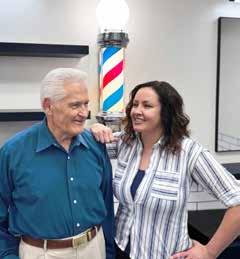
Bullseye Barbershop, which is owned and operated by barber Ron Francom and his family, recently celebrated their renovation and re-branding with a ribbon-cutting ceremony after 28 years in Draper.
By Katherine Weinstein k.weinstein@mycityjournals.com
After 28 years in business in Draper, Bullseye Barbershop is celebrating a new renovation and re-brand. Formerly known as the 9 to 9 Barber Shop, the business is owned and operated by barber Ron Francom and his family. Four generations of Francom’s family have been in the business of barbering.
Francom’s daughter and barbershop co-owner, Angela Cruz, said of the re-brand, “We’re getting it set up for the future, we have the long game in mind.” When her dad eventually retires, Cruz plans to keep Bullseye Barbershop open for decades to come in Draper.
The shop had a ribbon-cutting event with the South Valley Chamber of Commerce Jan. 22 to celebrate the renovation. “We re-did the floor, lighting fixtures and everything,”

Francom explained. “It has a whole new look and feel.”
When customers come into the shop, dart boards are immediately visible on the wall. “When our customers finish getting a haircut, we give them three darts,” Cruz explained. “If they get a bullseye, they get a free haircut.”
“When there’s a lot of customers, it





creates a fun environment,” she continued. “The guys get competitive, and everybody’s cheering when they win.”
The dart game, along with a big screen TV and a fridge stocked with cold drinks add to the shop’s welcoming atmosphere.
Framed black and white photos of Cruz’s
“We didn’t want false advertising,” he said. “That’s when we thought about rebranding the shop.”
“We still have the same barbers,” Francom added, “We have four total including myself and my daughter.”

“I’ve been cutting hair for 30 years,” Cruz said. “I’ve seen lots of styles through
Francom said that they can do everything from the “skin-tight fades” popular today to flat tops and even pompadours. “We’ve seen just about everything and we can do any type of haircut,” he said.
It is clear that both Francom and Cruz enjoy their careers. “I like the interaction with people,” Cruz said. “You get to know people on a real personal level. It’s been interesting over the years, seeing the seasons of life. We have customers here who came to us when they were kids and now they’re
“It’s an honest job,” Francom said. “It’s just a good, friendly place.”
Bullseye Barbershop is located at 826 E. 12300 South in Draper. For more information visit bullseyebarbershop.com. l


Last January, Bullseye Barbershop celebrated their renovation and re-brand with a ribbon-cutting event attended by the South Valley Chamber of Commerce. (Photo courtesy of Angela Cruz)
Bullseye Barbershop owners Ron Francom and his daughter Angela Cruz were photographed inside their newly renovated shop. (Photo courtesy of Angela Cruz)

women’s SECTION
A publication covering local influential women in honor of International Women’s Day
The small team holding up the hope of change for Utah women
By Rebecca Olds | rebecca.o@thecityjournals.com
The Utah Women and Leadership Project, founded by Susan Madsen, is a research pumping machine with a goal of making Utah a better place by empowering women and removing obstacles.
A lone silhouette is a harsh contrast against the glare of a lit monitor.
Before the sun comes up, Susan Madsen sits at her computer: inbox and task list open for the day. While the house is quiet, her inbox starts to fill up for the day.
“Early morning…it’s been invaluable for me,” she said. “I always was up earlier than anybody, and it would be quiet, and I could make sense of the world.”
She uses the slow time to plan out her day and answer each email, following her team standard that “everyone deserves an answer.”
“I have a process of looking at my day, looking at my workload, figuring things out,” she said. “I reprioritize every single day.”
She might even reprioritize multiple times in a day. She’s constantly moving and pushing forward despite the odds and a small team.
Madsen, in addition to her professorship at Utah State University, is the founder of the Utah Women and Leadership Project, which has published 21 research-based white paper reports, 65 research snapshots and infographics, 68 research and policy briefs and hosted 45 “Think Tank” gatherings in Utah since 2010.
Madsen and four full-time employees — associate director Brie Sparks, local outreach and curriculum manager Deborah Lin, marketing and communications coordinator Emmalee Chastain, program assistant Kylie Hollingsworth — have made a

big push to raise awareness of the existing gaps in Utah for girls and women.
“Our work is having an impact across the state, and that is what motivates me,” Lin said. “In my role, I have visited 20 of our 29 Utah counties to get to know residents and build relationships to help with grassroots efforts to raise awareness and impact change around issues facing girls, women and families.”
“Everywhere I have been, men and women recognize the need for change.”
The “change” she is referring to encompasses topics like making more leadership opportunities available for more women, daycare options in the state, and homelessness resources for women.
Currently, the project involves close to 7,000 people statewide, with 500 partners and 300 leaders in different counties and cities, Madsen said.
Four counties and seven cities/towns have passed official resolutions to support the project’s initiative they call “A Bolder Way Forward.”
“Our efforts to equip Utah communities with the data and resources needed to help more girls, women and families thrive are just one piece of the way forward,” Sparks said. “Creating lasting change for future generations of girls and women requires a systems-based approach, and I’m honored to help build the strategic connections that make that possible.”
Madsen admits that it hasn’t been
easy for any of them, but she continues in her efforts because she feels called to help women through the best way she knows how: research.
“What has driven me for decades is research,” she said, “and getting it into the hands of people that are making decisions.”
And in the hands of decision makers it is.
Madsen, in addition to her professorship and affiliation with USU, considers herself an activist and encourages others to be too. She is frequently on Capitol Hill
advocating for change with her research and “works alongside legislators.”
“We should all be advocates and into the work of social justice,” she said. “If we care about other people, if we care about our communities, if we care about our state, if we care about our extended family, if we care about any of that, we should be in whatever topic connects with us.”
For the research and recommendations on how to get involved in UWLP for Salt Lake County or any other country in the state, visit www.usu.edu/uwlp/research/what-can-i-do.
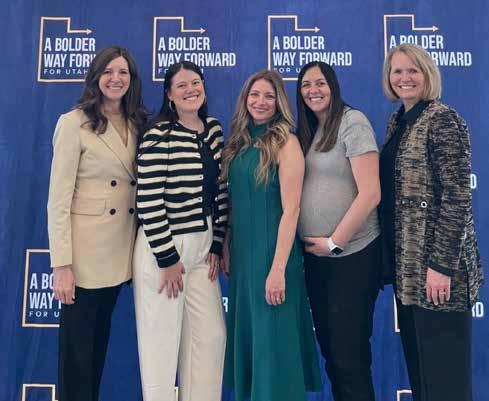
(From left to right) Deborah Lin, local outreach and curriculum manager; Emmalee Chastain, marketing and communications coordinator; Brie Sparks, associate director; Kylie Hollingsworth, program assistant and Susan Madsen, director. (Photo courtesy of UWLP)
Utah Women’s Day in Sports empowers next generation of female athletes
By Julie Slama | j.slama@mycityjournals.com
More than 400 high school student-athletes from across the state gathered for a morning focused on teamwork, leadership, mental health and empowerment in girls’ sports.
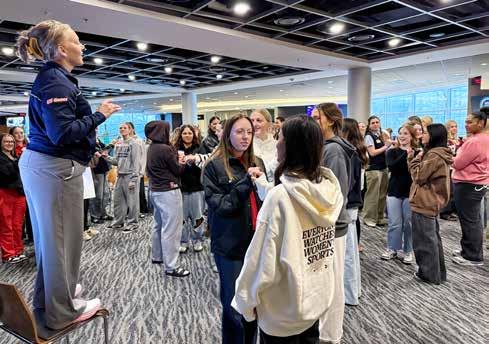
It began as a simple game of rock, paper, scissors, but quickly became a lesson in teamwork. Everyone played at first, then losers backed their opponents until only two players remained. Silence fell as they competed, then cheers erupted when the round ended in a tie. After four rounds, one girl finally emerged victorious.
The exercise wasn’t about winning, but about being a good teammate.
“How does it feel to be celebrated by your peers?” asked Poudre School District (Fort Collins, Colorado) health and physical education coordinator Jo Dixon, who emphasized that every player has a role — scorer, defender, supporter, teammate. “Being a part of someone else’s fan club is just as important and powerful as being in the spotlight, because lifting others up feels awesome.”
The interactive activity was part of a breakout session at the third annual Utah Women’s Day in Sports conference held Feb. 4 at the Delta Center, the day before National Girls & Women in Sports Day.
Dixon continued the partner activities designed to build unity. Student-athletes stood toe-to-toe and told each other: “Everyone is battling something in life, and I’m glad you’re battling with me.” Then, they stood back-to-back and said, “I’m so glad someone has my back — and I have yours.” The activity ended with a pinky promise and the words: “I pinky promise to help you unlock your greatness so the world can see it like I do.”
“We want you to be a good teammate from the inside out,” Dixon said.
The event’s origin began with Andee Bouwhuis, past president of Utah Interscholastic Athletic Administrators Association and Deseret Peak High School athletic director, along with Utah High School Activities Association Assistant Director Jan Whittaker and UIAAA communications coordinator and Cedar Valley High School Athletic Director Sharon Mardesich.
“Our goal is female empowerment; support our female athletes; grow leaders,” Bouwhuis said. “We’re letting these female athletes know that we hear them and we see them. We want them to be successful.”
More than 400 student-athletes statewide attended, supported by about 100 coaches and athletic directors. Participation from each school was limited to ensure broader representation.
“The athletes are charged to take back what they learned and teach it to their teammates,” she said.
Another breakout session focused on nutrition, led by Intermountain Health’s Josseline Kelley, who emphasized fueling, hydration and sleep.
“Our goal is to make sure that we’re eating something every three to four hours as athletes,” she said as she gave the student-athletes specific suggestions. “The worst thing you can do is go into a competition or training session without fueling. Under fueling can be very common in teens.”
University of Utah Assistant Director of Olympic Sport Performance Carly Fehler addressed competing in college athletics.
“Your whole life is going to change

overnight,” Fehler said. “Your city, your bed, your routine, your team and coach. Literally, everything changes. And are you prepared for that? Only nine percent of high school girls will go on to play in college. Two percent of all high school athletes will play Division I.”
While some student-athletes attended workshops, adults participated in a “Coach Beyond” session focused on supporting athlete mental health.
“I’ve been an athlete for my whole life, and I’ve seen the way mental health affects the performances of athletes,” said college athlete and presenter Makayla Pitcher. “Coaches are the front line, so it’s important for them to understand and help.”
Cottonwood High Principal and presenter Justin Pitcher emphasized the need for better training and resources for coaches.
“We need to do better by our athletes here in Utah, he said. “Our data shows over half of every female team has experienced significant sadness or depression. We look at our coaches and their training. Many of them were former athletes so they understand the game well, but they don’t always know how best to handle these tough situations that we’ve been put in.”
Speaker Amy Donaldson highlighted the origins of Title IX and opportunities it presented.
“They drafted a piece of legislation that was unlike today, with 37 words,” she said. “Even though everyone thought it was this little administrative adjustment… they had no idea of (the impact of) that law.”
Donaldson encouraged student-athletes to examine their journey, to be optimistic, to wire their brains for gratitude and forgiveness, to know “no accomplishment is an individual accomplishment.”
Karissa Niehoff, National Federation of State High School Association’s executive director and CEO, challenged the next generation to continue advancing opportunities for women.
“Look at the women who came before us, and look at where we are now, and look at the future of growth in women’s and girls’ sports,” she said. “We’ve come a long way. As a woman CEO in a sports world, I feel blessed, but I challenge you as a younger generation…to carry this forward. We have to be committed to working forward so we continue the growth we need in girls who play sports in Utah.”
UHSAA Assistant Director Jeff Cluff said the progress in girls sports, including expanded championships and the addition of girls wrestling, has helped to equalize opportunities.
“We’re trying to create equal opportunities for the girls that boys have been getting for years,” he said. “We have still more to do and more to change.”
Copper Hills High seniors Brynlee Morton and Kaysha Millet said the conference left a lasting impression.
“I love how inclusive it is,” Morton said. “Everyone has valuable knowledge, and they’re sharing their expertise with us.”
Millet added: “They’re spreading awareness and information; it’s empowering to us as women athletes.”
At the third annual Utah Women’s Day in Sports conference, presenter Jo Dixon motivated female high school student-athletes to become good teammates. (Julie Slama/City Journals)
Cottonwood Principal Justin Pitcher was a co-presenter of a coaches’ session at the Utah Women’s Day in Sports conference. (Julie Slama/City Journals)
Holladay’s city manager provides a steady hand of leadership
By Peri Kinder | peri.k@thecityjournals.com
University of Utah, Chamness landed a job with Salt Lake City, working her way up to become the city’s finance director in 2014.
lenge for several years.”
Most residents don’t think about how cities are run. As long as roads are safe, water is clean and parks are open, city administration rarely crosses their minds.
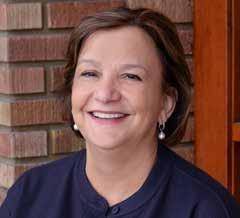
But behind the scenes, it takes a functional team and deliberate planning to make city services seem effortless. In Holladay, the person coordinating that teamwork is City Manager Gina Chamness, who’s been with the city for 10 years.
Chamness is a rarity in Utah. According to a December 2024 policy brief put out by the Utah Women and Leadership Project, of the 250-plus cities in the state, only 13 of them had women serving as city managers or administrators.
“I think that’s starting to change,” Chamness said. “It feels like there are more women in assistant city manager roles, more women as department heads, but as far as my generation, there haven’t been many of us. I’ve been really lucky.”
Chamness never imagined she’d serve in municipal government. She started her career at the federal level, working for a congressional agency, but political dysfunction persuaded her to look for other opportunities.
With a political science degree and a master’s in public administration from the
When the Holladay city manager position opened, she felt it was the next best move for her career and family, since she and her husband, attorney Ralph Chamness, have lived in Holladay since 2003.
“I saw this position posted and it felt perfect,” she said. “I was excited to apply. The opportunity to serve a community where you live felt like something I could be really excited about.”
Chamness acts as the CEO of the city, managing administrative functions, working with elected officials and ensuring ordinances, policies and rules are observed. When she first started with Holladay, the city was struggling. Aging infrastructure, stunted growth and a lack of direction left Holladay stagnant.
Working with the mayor at the time, Rob Dahle, Chamness held discussions with city residents, elected officials and city staff to prioritize areas of focus.
“Ten years ago, we didn’t have much of a commercial base,” she said. “We were banking on redevelopment of the [Cottonwood] mall and then the great recession set redevelopment back. The question was, how could we build a city that was going to be financially sustainable? That was a big chal-
Investing in infrastructure was another concern. With some parts of the community more than 100 years old, Chamness knew a concerted effort and lots of money had to be allocated to improve infrastructure.
Restructuring the city took patience. Much like turning an ocean liner, it needed a coordinated shift to move something so large and complex.
“Everyone wants to do things quickly. Sometimes people complain about how long the government takes to do things,” Chamness said. “Making sure you have adequate time to listen to residents and making sure elected officials build that conversation into their own planning and into the process is critical. I think we’ve done a pretty good job of that. I wish the residents understood how critical the services we provide are to their day-to-day lives.”
Over the last decade, Holladay has improved road quality, invested in development, attracted businesses that fit the community, expanded the sidewalk system and recently acquired the Spring Lane Elementary property to develop a new park.
Chamness builds bridges between elected officials, residents and city staff, while working with other government agencies, organizations and committees to create a city that residents are proud of.
“I think the best attribute for describing Gina’s success would be ‘trust,’” said
Holladay Mayor Paul Fotheringham. “My colleagues on the council have always felt a keen sense of trust for Gina; trust in her judgment, trust in the depth and breadth of her expertise from budgetary and legal issues to citizen engagement and public policy.”
Chamness admits the job as city manager is stressful, but she’s comfortable with conflict, especially when it leads to a better outcome for Holladay. She encourages women to pursue leadership roles, whether in government or business.
“I tell women, you could absolutely do this,” she said. “I really do feel like I have the best job in the valley.”
The Boob Bus makes mammograms accessible for all women
By Cassie Goff | c.goff@mycityjournals.com
“Let’s get all the girls together to go get dinner and mammograms!” is the vibe Rena Vanzo is going for with mammogram screenings on The Boob Bus.
One in every eight women will develop breast cancer in her lifetime. For every Utah woman, that translates to about a 12.5% chance of developing cancer.
“Every family, every community, every church group, every book club—all of them will be impacted. Prevention is the best medicine,” said CEO and co-founder of The Boob Bus Rena Vanzo.
The Boob Bus is a mobile unit that offers mammograms, health care screening, breast cancer assessment and other healthcare services to women locally. The main goal of The Boob Bus is to make mammograms more accessible and comfortable.
“Utah women are just not doing their mammograms. We’re way below the national average,” said Vanzo. In 2022, Utah was ranked 48th out of the 50 states in the nation for mammogram screening.
Vanzo and her team have been working to change that statistic by transforming typical health care screenings into modern experiences. The Boob Bus was fully customized as a health care space with neon pink lights and vaulted ceilings.
“On The Boob Bus, you can expect to feel like an individual,” said driver and Patient Care Coordinator Kayla Pacheco. “Your history, your experiences and your fears are heard.”
An average visit to The Boob Bus begins by checking in to answer medical history questions. The data collected related to menstrual changes, hormones, breast density and personal medical history is used to calculate individual cancer risk.
“Breast density is really becoming more of a topic of conversation,” Vanzo said. “And it should be. Women with dense breasts do have a higher risk of breast cancer.”
Patients are offered heated pink robes instead of hospital gowns during their appointment. Individual women will meet with a licensed certified technologist privately in the mammogram suite for a screening.
Results are within one week. (Vanzo emphasizes that patients may be referred to a hospital for diagnostic screening depending on risk.) Patients leave The Boob Bus with branded lip balm, nail files and educational cards.
The entirely female Boob Bus team emphasizes the importance of destigmatizing women’s health with less shame and embar-
rassment through more conversation.
“I want to live in a world where even the men are saying to their partners ‘Hey, did you get your mammogram yet?’” Vanzo said.
Vanzo and her cofounders started The Boob Bus in 2022 after being personally impacted by individual family members battling cancer diagnoses. It took her two years to get The Boob Bus fully operational.
“I had to learn all of these extra things that are very useful in your life but you wouldn’t think they’d intersect in business,” Vanzo said.
Vanzo needed to get a CDL so she could drive the oversized custom bus. In preparation, she worked for UTA for six months to get trained as a driver in a structured environment.
“Rena is a superstar. I have never met anyone so driven to help others,” said Office and Billing Manager Jen Bartunek.
The Boob Bus primarily meets women for their mammograms all across Salt Lake, Utah and Davis Counties. Through their partnership with the Central Utah Health Department, The Boob Bus also travels to Central Utah.
The Boob Bus works with the Utah Breast and Cervical Cancer Program (UCCP) so uninsured women can still access their mammogram screenings through a voucher program.

provides
for mammogram appointments so it “feels more like a spa experience,” The Boob Bus founder Rena Vanzo said. (Photo courtesy of Rena Vanzo, The Boob Bus CEO and co-founder.)
El Programa de Detección del Cáncer de Mama y de Cuello Uterino es facilitado por el Departamento de Salud y Servicios Humanos de Utah y está financiado con fondos estatales y federales. El formulario de solicitud está disponible en español a través de lo siguiente: www.cancer.utah.gov
Individual women can book appointments online (even same day) through The Boob Bus website: www.theboobbus.com. Organizations, businesses or school districts can email or call The Boob Bus team (866-747-BOOB) to set up a day for group appointments.
The Boob Bus
heated robes
Holladay City Manager Gina Chamness has led the city through 10 years of growth and change. (Photo courtesy of Holladay)
Gina Chamness guides the city’s course with deliberate planning.
City Hall lobby remodeled for safety reasons
The remodel will improve safety for city employees who interact with the public while doing their jobs.
By Mimi Darley Dutton m.dutton@mycityjournals.com
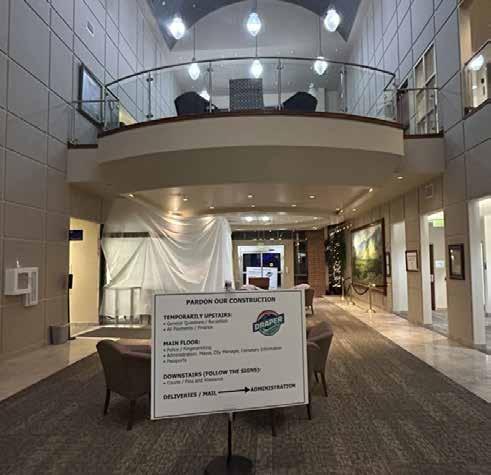
City Hall is undergoing a lobby remodel that’s a little bit about efficiency and primarily about security.
“We’re trying to balance the public’s access to service with our employees’ safety,” said City Manager Mike Barker.
The project is happening just inside the north entrance off of Pioneer Road. Until now, immediately to the right upon entering from the north, there was a window into the city’s Finance Department where people could pay bills. Beyond that was an information desk staffed by an employee to direct visitors to various city departments.
“Both of those functions will now be in one spot behind a secured area,” Barker said. He described the remodeled design as having a glass enclosure with a small window for the exchange of paperwork, similar to a bank.
Barker said the goals of the remodel were twofold: added security and better use of space within the Finance Department.
The redesign will allow for a new, enclosed office within Finance and the removal of a large counter within that department. “On the Finance side, we’re gaining an office and freeing up some space,” he said.
According to Barker, there were funds in the city’s facilities budget for the remodel. This was not something that required approval of the Draper City Council, but Barker said they’ve been kept apprised of the project. The total cost is anticipated to be approximately $260,000.
“New government buildings going up in Utah are, unfortunately, kind of walledoff in terms of security. You want to serve the public but you want your employees to be secure doing their jobs. We wanted to address that,” Barker said.
The remodel started the week of Jan. 5 and is projected to be completed in mid to late February. “It appears to be going along on schedule so I think we’ll make that goal,” Barker said. l
Just inside the north entrance off Pioneer Road, a portion of City Hall’s lobby and Finance Department are being remodeled for safety and efficiency. The project is expected to be completed at the end of February. (Mimi Darley Dutton/City Journals)
Rediscover






























Top spellers to compete at the Greater Northern Utah Spelling Bee
The Greater Northern Spelling Bee will be held on Saturday, March 7, at Wasatch Jr. High.
By Peri Kinder peri.k@thecityjournals.com
More than 100 schools will be represented at the Greater Northern Utah Spelling Bee on Saturday, March 7, at 9 a.m. at Wasatch Jr. High in Millcreek (3750 S. 3100 East). Sponsored by the City Journals community newspapers, the winner of the event will travel to Washington, D.C., to compete at the Scripps National Spelling Bee during the final week of May.
Students participating in the regional bee will complete a written test before the competition, and everyone will have the opportunity to spell one word on stage. After finalizing the written test results, the top spellers will be announced and they will compete for the state championship, starting at approximately 11 a.m.
“The spelling bee teaches children the importance of hard work and aiming for the best,” said City Journals People Leader Elizabeth Sweat. “Preparing for an experience like this helps them gain confidence while strengthening language skills that further their education.”
The City Journals has hosted the regional spelling bee since 2014 and covers the trip to Washington, D.C. for the winner and one parent. City Journals Publisher Bryan Scott is proud to host the event each year, allowing these students to shine.
“I’ve been honored to host and sponsor this event for the last 12 years because it’s an investment in future leaders,” Scott said. “It’s been so much fun sending the winner to Washington, D.C., and watching them compete at the highest level. We’ve had some really smart kids come through this program.”
Last year’s winner, Roshan Kaushik from Challenger School Traverse Mountain, won the regional bee and took the stage at the Scripps National Spelling Bee, finishing tied for 36th.
Help send the regional champion to Washington, D.C., to compete at the Scripps National Spelling Bee by donating through the QR code. l
Last year’s winner, Roshan Kaushik, won the Northern Utah Regional Spelling Bee presented by the City Journals and went to Washington, D.C., to compete in the national bee. This year’s regional bee will be held on Saturday, March 7. (Peri Kinder/City Journals)














Life Skills Academy students are learning independence and they’re documenting it through producing a monthly newsletter.
By Julie Slama j.slama@mycityjournals.com
Voice recorders in hand and cameras slung on their shoulders, Life Skills Academy students are stepping into roles familiar to any newsroom. They are brainstorming story ideas, interviewing staff, photographing classmates and drafting articles as part of the school’s journalism class.
The class produces a monthly, student-run newsletter that documents life at Life Skills Academy, a post-secondary transition program.
“We have a group of students who report and publish the newsletter each month,” said first-year Life Skills Academy Principal Stacey Nofsinger. “Their first one was in October and it’s a student-voice publication. They do every step of it from coming up with article ideas to interviewing, writing, taking photographs and laying it out. It’s great.”
The newsletter introduces readers to Life Skills Academy’s community members while giving students a platform to express themselves creatively.
“They like the variety,” Nofsinger said. “In one section, they’re introducing staff members and students; in another, they might include a word search or crossword puzzle. It’s what they determine should be published.”
For Nofsinger, the importance of student voice goes beyond producing a newsletter.
“It’s important for our students to use their voice and develop skills in writing, organization and talking to people,” she said. “They’re representing their peers and themselves versus just following directions from adults.”
Post high school
Life Skills Academy is a post-secondary program for about 75 students with disabilities ages 18-22 who have completed high school, but need additional time to develop life and job skills.
Nofsinger emphasized independence is the program’s central goal.
“We’re teaching money skills, self-advocacy, meal planning and boundaries, all of those things build independence, so students don’t rely on other people fully to handle those tasks,” she said.
While some students may eventually live on their own, Nofsinger said most will continue to need supervision or support, either at home or in a group home setting, but through hands-on lessons and internships, they’ll learn many skills needed for real life.
Students create their own schedules, typically taking six classes four days per week,
Learning life skills one article at a time

with one day reserved for community experiences where many will attend adaptive county library programs or try adaptive bowling.
Life Skills Academy integrates classroom learning with real-world experiences. Students spend part of their week in classes on topics such as home management, internet safety or cooking and part of it out in the community, learning shopping, dining and workplace skills.
Many, like Luke Hanks, also participate in job placements, taking public transportation.
“I go out in the community every week,” said Hanks, who previously attended Alta High. “Sometimes we go to lunch and shop after. I work at Sam’s Club organizing and throwing away empty containers.”
He recently was recognized there as the employee of the month.
Some opt to perform school-based learning opportunities, practicing stocking shelves, floral arranging, custodial work, nutrition planning and delivery or caring for the school’s hydro farm to gain skills.
The hands-on approach extends to future goals Nofsinger envisions for Life Skills Academy.
“I would love to have a fully functioning cafe, a bakery, even a laundromat-style space so students can practice real-life skills,” she said. “We want to them to learn to cook, clean and manage tasks independently.”
When students turn 22 and complete that year of schooling, many receive a post-secondary certificate of completion, acknowledging the additional four years of preparation for life beyond high school.
“This is continuing education,” Nofsinger said. “It’s a robust program designed to teach students what they need for life beyond high school.”
Students voice in action
Back in the journalism classroom, stu-
assignment; it’s an opportunity in gaining confidence and advocacy.
“I’m learning how I can write and make sense on my own and share what I know,” Hanks said.
His classmate, Jaxson Smith, said he has learned how to be more assertive.
“I’ve learned how to ask questions and get answers,” he said. “Sometimes, when I go into a big class, it takes a while to write them all down. Then, I find the best answers to use in the newsletter.”
Other students say they’ve also developed skills in technology, art and photography through producing the newsletter in addition to writing.
Every issue reinforces Life Skills Academy’s dual mission of developing essential life skills while giving students an opportunity to decide what is important and be heard.
dents like Hanks are discovering the power of their voice.
“I’m working on spotlights about the students and teachers,” he said. “I’m taking the important and interesting parts of the interviews for the spotlights.”
For him, the newsletter is more than an
“They’re adults,” journalism instructor Tessa Marrelli said. “Their opinions matter, and a lot of them are learning how to advocate for themselves in this new adult role. This allows them the opportunity to have a voice; they’re learning the skills and gaining the confidence they will use as they become more independent.”l
Life Skills Academy students show recent issues of the newsletter they write, photograph and produce. (Julie Slama/City Journals)
‘It is an honor to return’
Coach Casey Sutera returns to Corner Canyon to head football team
The former defensive coordinator spent the past four years at Brighton High.
By Jerry S. Christensen j.christensen@mycityjournals.com
CaseySutera came to Brighton High School as a first-time head football coach four years ago during the difficult pandemic years. He had a proven record as the defensive coordinator at Corner Canyon High School (CCHS) where he helped the Chargers win three 6A state championships. He began his high school coaching career at Jordan High School after playing collegiate football at the University of Utah. With long-time CCHS football coach Eric Kjar being called up to coach at Weber State, Canyons School District tapped Sutera to return to CCHS to take the reins of the premier 6A football program in the state.
“I learned under the best play caller in the state, Erik Kjar,” Sutera said. “It is an honor to return to Corner Canyon and continue the tradition of excellence entrusted to me. The Brighton community will always be in my heart because of the memories and great success that we had here.” Sutera notched a 35-14 record in the four years at the helm in Cottonwood Heights. He earned three Region 6 championships and took the teams to two Rice Eccles Stadium final-four appearances. He was named 2024 5A Coach of the Year.
“Casey Sutera represents everything a quality coach should be,” said Brighton Principal Marielle Rawle. “He knows the game of football and he can teach it by building a culture of hard work and resilience. But more than that, Casey understands the positive influence he can have over the young men on his team and he doesn’t take that responsibil-

“We learned to trust the process,” said Marshall Huber, who played all four years in the Sutera system and will continue at the next level with Air Force. “I remember a key game against Timpview which was a powerhouse team. We were behind in the second half but coach Sutera was calm and confident. He showed us character and resilience which became a hallmark of our team. That comeback win was a turning point and set our strategy.”
Bo Hill, a 2025 graduate, recalls Sutera as a players’ coach. “He’s very motivating and inspirational. He’s not afraid to show emotion at the right time. He’s the type of coach that creates a fun atmosphere on the field and in the weightroom. Coach Sutera teaches players to love the game and get better every day.”
When asked how he intends to approach the most storied current football program in the state at Corner Canyon, Sutera talks culture. “I have great coaches who are empowered to make the calls,” he said. “This allows me to focus on the players teaching them citizenship, competitiveness and courage.”
ity lightly. He teaches them respect, he holds them accountable and he loves them. It’s no wonder kids want to be part of his team. A quality coach who builds quality programs and the result is quality young men.”
Sutera’s former players recall him as a demanding coach who wanted the team to be known as the most physically strong and the fastest team. “He always pushed everyone in the weight room bringing the energy everyday which I believe is the best thing to do in a team environment. Definitely the smartest coach when it came to weightlifting and athletic performance,” said Landon Hill,
a state wrestler and four-year football player in Sutera’s program.
The “Casey culture” that he developed at Brighton includes citizenship, competitiveness and courage. He is an educator first and foremost. Melissa Nash, the celebrated girls lacrosse coach at Brighton and BYU, said, “I know Sutera had an impact on our football team on the field, but as a teacher and fellow coach, I really saw his impact off the field. His leadership and example changed the character of our football players (and school) for the better. Sutera was not just an advocate for his team, but all of Brighton’s teams and students. One of our players’ favorite practices was when Sutera would come to lead us in a football conditioning workout. The girls loved learning from him and we appreciated his time and energy during his offseason.”
Wrestling coach Burke Gappmayer recalls similar support for the wrestling teams over the years. Sutera encouraged his players to be multisport student-athletes and to be positive role models in the community.
And there was the sometimes controversial “Sutera strategy.” He recognized in 2024 that he had a core of potential in his 2025 team that could be refined and “battle tested” by challenging the best teams in the state. Sutera negotiated home and away games with the top teams of 6A, 5A and 4A and took the team on the road north and south. The battles were fierce and the scores were not favorable. But the outcome was palpable. The honed Bengal team dominated region play and finished “on the turf” at Rice Eccles Stadium.
Brighton’s Athletic Director Garrett Wilson summed up his thoughts. “The Sutera era at Brighton is characterized by more than just victories; his legacy instilled a competitive fire and a commitment to excellence that permeated the entire athletic department.

His dedication to developing student-athletes both on and off the gridiron leaves a profound void. While the transition marks a new chapter for both coach Sutera and Corner Canyon, the foundation he laid ensures that Brighton football is poised for continued success. The administration, faculty and entire Bengal community wish him the best as he embarks on this exciting new challenge.” l
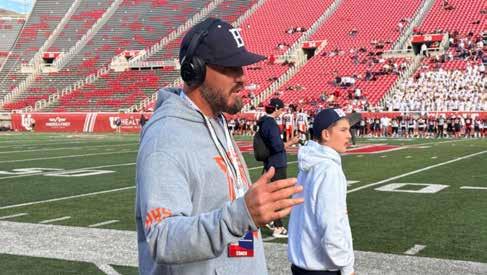
Coach Casey Sutera on the big stage at Rice Eccles stadium in 2025. No. 75 Marshall Huber leading the offensive line is an Air Force commit. (Jerry Christensen/City Journals)
Coach Casey Sutera on senior day with No. 14 Landon Hill. (Photo courtesy Brandy Hill)
Under the guidance of head coach Casey Sutera the Bengals earned a 35-14 record making it to the semifinals at Rice Eccles stadium in 2024-25 (Jerry Christensen/City Journals)

































For 140 years, families have come to trust Larkin Mortuary as the leading funeral service provider along the Wasatch Front. Family owned and managed for seven generations, we are committed to providing meaningful, healing experiences for every family who turns to us for guidance.
For over 140 years, families have come to trust Larkin Mortuary as the leading funeral service provider along the Wasatch Front. Family owned and operated for seven generations, we are committed to providing meaningful, healing experiences for every family who turns to us for guidance.



Discover the peace of mind that comes with planning ahead. Learn about the benefits of advance funeral and cemetery planning, and why it makes sense for you and your family.

UPCOMING EVENTS:


ULTIMATE SHINE AND SHIELD
SINGLE WASH $24
UNLIMITED WASH CLUB: $40/MONTH
3/13/25 Thursday @ 12 PM
3/17/26 Tuesday @ 12 PM
Larkin Sunset Lawn: 2350 E 1300 S, SLC, 84108
Larkin Sunset Lawn: 2350 E 1300 S, SLC
3/18/25 Tuesday @ 12 PM & 6 PM
3/18/26 Wednesday @ 12 PM
The Chateau at Le Jardin: 1910 E Dimple Dell Rd, Sandy
Larkin Riverton Funeral Home: 3688 W. 12600th S., Riverton
3/26/25 Wednesday @ 12 PM
3/25/26 Wednesday @ 12 PM
Elysium Legal: 1802 W South Jordan Pkwy, South Jordan
The Chateau at Le Jardin: 1910 E. Dimple Dell Rd., Sandy
3/27/25 Wednesday @ 12 PM
3/26/26 Thursday @ 12 PM
Elysium Legal: 1802 W South Jordan Pkwy, South Jordan
The Chateau at Le Jardin: 1910 E. Dimple Dell Rd., Sandy
RSVP: (801) 829-1772
Space is limited, so please RSVP now!
SINGLE WASH $12
UNLIMITED WASH CLUB: $22.50/MONTH
ULTIMATE SHINE
SINGLE WASH $20
UNLIMITED WASH CLUB: $35/MONTH DELUXE




Four Simple Ways to Build a Happier Life
As a county councilmember, I spend a lot of time listening to concerns from constituents. I hear from parents who are stretched thin, seniors who feel lonely, young people who are anxious about the future, and workers who feel burned out even when they’re doing everything “right.” One thing is clear: many people are searching for happiness, but they aren’t sure where to find it.
Research from social scientists points to a clear answer. Happiness does not come from money alone, social media attention, or having an easier life. Arthur Brooks, a Harvard professor, social scientist and bestselling author teaches the science of happiness. He says that happiness comes from four things: faith, family, friendship and meaningful work.
The first is faith. People are happier when they believe their lives matter and are part of something bigger than themselves. For some, this comes from faith or spiritual beliefs. For others, it comes from serving their community, caring for others or living by strong values. Faith gives people strength during hard times and helps them

patience, forgiveness and time. But people who invest in their families tend to feel more supported and less alone. Family can mean parents and children, grandparents, chosen family or relatives who show up when it counts. Simple actions—shared meals, regular check-ins or family traditions—can make a big difference.
The third is friendship. Healthy friendships protect people from loneliness and stress. They give us someone to laugh with, talk to and lean on when life gets hard. Yet friendships often get pushed aside by busy schedules and screens. Reaching out, making time for face-to-face connection, and being present for others helps build trust
neighborhood safe and builds connection when you can all look out for each other.
The fourth is meaningful work. This does not mean everyone has to love every part of their job. But people are happier when they feel useful and see how their work helps someone else. Whether paid or unpaid, work gives people dignity and purpose. Parents raising children, volunteers, caregivers, students and workers all contribute value. When people feel needed, their confidence and happiness grow.
One important idea connects all four of these areas: happiness is not about chasing pleasure. Pleasure fades quickly. Real happiness builds slowly through effort, relationships and responsibility. It grows when we use things but care for people—not the other way around. Being “happy” doesn’t mean you will never have sadness, anger, frustration or problems. Everyone has hard times. But by focusing on the things that really matter, you increase your opportunities for better overall happiness.
As a community, we should make it easier for people to build these four foundations. That means supporting families, cre-










Remember when you thought Mr. Monopoly wore a monocle, or you were convinced Curious George had a tail? Memory is a funny thing.
Or how about when NBC anchor Brian Williams “misremembered” being in a helicopter hit by anti-tank weapons in Iraq? His faulty memory got him suspended.
We all misremember things, but when an entire group does it, it’s called the Mandela Effect, a phenomenon that occurs when millions of people are confidently wrong. Like, remember when we all believed Vladimir Putin was a war criminal? LOL. Good times.
If you’re a Gen Xer, you might remember when the VHS tape got eaten by the VCR and you had to use brain surgeon-style techniques to carefully respool the video. But then the tape always had a wrinkled section where the movie would go wonky for a few seconds. That’s what my memory feels like most days: warped and staticky.
My husband is basically a human computer. He remembers everything. When we meet new people, he lights up like an exploding star. He’s curious about their background, hometown and their connection to any celebrity-type person.
Months later, he’ll say, “Remember at the Yankees game when we met that guy who was married to the cousin of a friend who knows Ryan Reynolds? I think his name was George.”
A Trip Down Memory Lane
Peri Kinder Life and Laughter

“No.”
“Yeah, you do. He owned a horse farm outside of Albany and loves the color orange.”
“What are you talking about?”
His memory recall is slightly unsettling. He’ll drop info like, “I remember the 1968 World Series when the Detroit Tigers came from behind to beat the Cardinals. They hadn’t won since 1945 and Mickey Lolich was the MVP.”
And then there’s me, having to watch a recap for a TV show I watched the night before. But then I remember random things, like when Sen. Mike Lee advocated for term limits. Hahahaha. The good ol’ days.
I was playing a “Frozen” matching game with my 9 year old granddaughter, trying to remember where the pair of Olafs were hiding. I kept turning over the same two cards, a Sven and an Elsa, convinced I’d finally cracked the code.
My granddaughter found it hilarious watching her doddering old granny lose a game. But there was a time I was the matching

game champ. At least that’s my recollection.
I can still sing Abba’s entire “Arrival” album from 1976 but I’m not quite sure I actually attended a single day of high school. I used to know dozens of phone numbers, but now I couldn’t call my daughters if the world were ending and I had to use a rotary phone.
When it comes to remembering the names of dogs I met at the dog park, I’ve got it down. But their owners’ names? No clue. I can make my mom’s mac and cheese by heart, but need to read the directions on a cake mix four times before I get it right.
It makes me second-guess my memory, like, do you recall when Gov. Spencer Cox took the side of trans kids? Or was that also the
Mandela Effect?
If you’ve ever had a sibling contradict your side of a story, or you can’t remember your eighth-grade science teacher, you’re not alone. Or maybe you had an existential crisis when you realized C-3PO’s lower right leg was silver, not gold.
Memory isn’t just fleeting, it’s fluid. When time blurs the moments we fell flat on our faces, it’s a reminder that our flashbacks are edited highlight reels, usually with a laugh track.
Peri Kinder is an award-winning columnist and journalist who has written for The City Journals since 2004. She can be reached at peri.k@thecityjournals.com