ournal THE CITY
Davis County
YOURCOMMUNITYNEWSPAPER
Women’s Day Page 26

Women’s Day Page 26
By Becky Ginos | becky.g@thecityjournals.com
Kendalyn Illu was diagnosed with a rare gastrointestinal disorder. She is a patient at Intermountain Health Primary Children’s Hospital.
Illu has spent her whole life in and out of the hospital but that hasn’t stopped her from being a happy, energetic 11-year-old. The Bluff Ridge Elementary school fifth grader was surprised at a special school assembly on Friday, Feb. 13, when she was told that she had been selected by Children’s Miracle Network as a National Champion. As National Champion she will represent 170 children’s hospitals nationwide in 2026.
Kendalyn is a patient at Intermountain Health Primary Children’s Hospital. She was diagnosed with chronic intestinal pseudo-obstruction (CIPO), a rare gastrointestinal disorder. Because she has complete intestinal failure Kendalyn can’t eat. She receives nutrition through a central line that helps her grow and live.
“This has been 11 years of her going to Primary Children’s,” said her mother, Karissa. “She’s had a lot of lows but far more highs. She is able to participate in so many things when she’s in the hospital.”
She does art therapy and dance therapy and music therapy, said Karissa. “They have child life specialists who come in and bring in a whole bunch of toys or whatever she wants to make her stay the best possible.”
Kendalyn has had a lot of long stays where she’s missing school and missing opportunities for a normal childhood. “But thanks to Primary’s and thanks to Children’s Miracle Network she’s able to still get her schooling done at the hospital.”
Karissa said Kendalyn is a positive, upbeat kid. “I honestly think when you go through a lot of hard things, you can either choose to make your life miserable or choose to make it really great. Thankfully she has chosen the path of finding the good in every situation.”
She’s just a really brave kid, said Karissa. “I think when you have a brave kid it also helps you as an adult.”
Kendalyn was selected because of her positive attitude and for being a good role model for other children, said
Shanelle Larsen, program director for Children’s Miracle Network. “We rely on our relationships with child life specialists and our music therapists and our nurses to identify families that they think would be willing to share their story.”
Being in the hospital as a child and as a family can be really difficult and a lot of people potentially don’t want to share their story, she said. “The Illus were willing to share their journey.”
As a National Champion, Kendalyn will be the face of a few different campaigns, Larsen said. “Locally, you’ll see her picture around the community with different corporate partners. Kendalyn will be the champion for a national Costco campaign for Children’s Miracle Network.”
That means her face will be in every single Costco in the United States, she said. “From May 1 to May 31 they’ll be sharing her story, her video, her photo.”
She was also chosen to be the patient champion for General Mills, said Larsen. “That means she gets to have her face on a General Mills cereal box. I feel like that’s a childhood dream for a lot of kids.”
Kendalyn is a wonderful representation of the patients that are treated at Primary Children’s, she said. “She is one of the bravest, sweetest children I have ever met. I’m grateful that Children’s Miracle Network saw that as well and wanted to recognize her at that national level.”
“This was a surprise,” said Kendalyn. “I almost cried.”
Kendalyn said she didn’t really know why she was selected. “Maybe they just thought that we were right for it. Not because they thought ‘oh she deserves it.’ I like to help advocate for other kids.”
Kendalyn is also a talented dancer and has performed in the “Nutcracker.” “I’ve been dancing ever since I was 3,” she said. “Last year was my second year. I was in the Chinese dance and I was a cookie and I’m hoping that I can be Clara, the main role.”
Reggie, a standard poodle, stays close to Kendalyn’s side helping her throughout the day. “I have IV nutrition and he helps alert me if it’s leaking or he helps me when my stomach’s hurting. I say ‘pressure’ and he’ll jump on my stomach and apply pressure on my stomach which makes it feel OK.”
“I don’t think I should probably say she is my example for doing good,” said Karissa. “But she is.” l







The roar of Nielsen’s patented double custard freezing machine is both the soundtrack and the secret to the family-run frozen custard business, which continues to grow decades after founder Steve Nielsen turned a dream of farming into a thriving custard empire.
By Gail Newbold andersennewbold@gmail.com
Nielsen’s Custard fans know if they want to eat the world’s best custard inside the diner, it won’t be to the sound of soothing music. Any indulging in a caramel brownie concrete and sizzling fries dipped in made-fresh-daily fry sauce comes with industrial-level pounding from the double custard freezing machine.
That pounding is the essence of the Neilsen’s Custard business. Any suggestion that the patented machine be hidden in the diner’s nether regions is met with steep resistance from Steve Nielsen, its proud inventor and CEO of Nielsen’s Custard.
“I would never consider hiding the machine,” said Nielsen. “The machine is something special. People say, ‘Can’t you quiet it down?’ But it’s the heart of our business. It is the business. It’s what makes the best custard in the world. Men’s Journal and USA Today named our frozen custard one of the 100 best things to eat in America.”
The line-up of cars at the Bountiful Nielsen’s drive-through window and a lobby bursting at the seams are evidence the double custard freezing machine is luring, not deterring customers. It operates from opening to closing, which ensures the custard served is never older than about 20 to 30 minutes.

Steve Nielsen, CEO of Nielsen’s Custard, inside his family’s Bountiful Diner. His favorite flavors of concretes are plain vanilla and chocolate with nuts. He’s also crazy about the diner’s pastrami burger.
Photo by Steve Nielsen
During a rare interview with The City Journal, Nielsen reflected on how he dreamed of owning a family farm and ended up with a custard empire.
First came his graduation from BYU, marriage to Debbie Arbuckle, four kids, and a job teaching seminary at three local high schools. About this time the couple felt ready to realize their dream of owning a farm or maybe a business that would involve the entire family and also teach their kids to work hard. Ice cream came to mind.
“I sought out advice from three influential old men whose families had been in the ice cream business,” said Nielsen, age 78.
“They were in their 80s so when I say old, I say it very lovingly, because these days I am them. They told me the history of frozen custard before the 1920s in Atlantic City. I’d never heard of it. I started trying to develop a machine to make it.” Eventually he succeeded and in 1983 patented his double custard freezing machine.
“Our fifth child was born in 1981, the same year we opened our first shop at what was then Crossroads Mall downtown Salt Lake,” he recalled. “We realized people wouldn’t know what frozen custard was, so our business model was sample, sample, sample. Once we got it in people’s mouths, the business grew. We stayed there five years before opening our store on Highland Drive. Our next stores were in St. George and Bountiful.”
Four new custard shops opening this year
There are currently 11 Nielsen’s Custard locations with plans for four new restaurants this year in West Point and Cottonwood Heights, Utah; the Denver suburbs; and Henderson, Nevada. “This is a very exciting year for us,” said Nielsen. The latter three new openings are franchises and the West Point shop is a partnership between the Nielsen family and Dave Murdock.
In the beginning, Nielsen didn’t plan to offer food, and many of his shops still only serve frozen custard. But he enjoys cooking and decided to make the Bountiful location a diner.
“I planned to build a normal looking restaurant building,” he said, “but I heard a news report that McDonald’s and Wendy’s planned to redo their interiors every seven years. I thought, ‘How can they afford that?’ That’s when I decided to build a diner because people will forgive you if it looks old.”
A photo of a pre-WWII art deco diner
inspired him to buy Naugahyde booths and tiles to fit the era. He also wanted a big cone sticking out of the roof. “It’s quite a landmark now,” said Nielsen. “I’m very proud of it.”
Difficult but delicious
He’s happy with the direction business is going, but said, “If you talk to me tomorrow, I might not be. The restaurant business is difficult no matter what you do.”
Maintaining food quality can be challenging with franchising. “One thing that helps is our custard ingredients are quite exclusive,” said Nielsen. “We buy our fudges, chocolate and caramels from a fourth or fifth generation family in Michigan. The fudge comes in pallets and it is really good stuff. Our custard mix is proprietary and made for us by dairies in surrounding states. All our shops use it along with my double custard freezing machine.”
Those funny quips on the Bountiful custard shop’s street side marquee? “I’ve written every one,” said Nielsen. He recalled one that got a huge reaction. “I taught my kids all their lives, ‘Don’t go into debt, no credit cards. Then the pandemic hit. Suddenly, we were so busy. Cars were lined up the road through the light because we had a drive-through and walk-up window. But we didn’t want to take cash.”
The marquee proclaimed: “Steve didn’t die. He just caved. Cards now accepted.”
In terms of day-to-day operations, the Nielsen kids and 16 grandkids have stepped up to the plate, allowing Debbie and Steve to take a step back. “I’m still very involved in the designs of the stores and our expansion,” said Nielsen.
He’s proud all of his kids are still in the business and now his grandkids. “I mean, how can you beat that?” he said. “I wanted a family farm and we got a family farm.” l
CITY JOURNAL TEAM
The City Journal is a monthly publication distributed directly to residents via the USPS and our Boutiful office.
The views and opinions expressed in display advertisements do not necessarily reflect or represent the views and opinions held by Loyal Perch Media or the City Journals. This publication may not be reproduced in whole or in part without the express written consent of the owner.
© 2026 Loyal Perch Media, Inc.
PUBLISHER
Bryan Scott | bryan.s@thecityjournals.com
EDITOR
Becky Ginos | becky.g@davisjournal.com
ADVERTISING EXECUTIVES
Mieka Sawatzki | mieka.s@thecityjournals.com
Ryan Casper | ryan.c@thecityjournals.com
Marc Davis | marc.d@thecityjournals.com
CIRCULATION COORDINATOR
Lindsay Andreasen | lindsay.a@thecityjournals.com Rack locations are also available on our website.
CLIENT SERVICES
Lydia Rice | lydia.r@thecityjournals.com
To subscribe to the weekly Davis Journal: subscribe.davisjournal.net
EDITORIAL & AD DESIGN Stacey LaMont Ty Gorton
CITY JOURNAL 9500 South 500 West, Suite 205 Sandy, UT 84070 PHONE: 801-254-5974










By Becky Ginos becky.g@thecityjournals.com
FACILITY—It was not a typical graduation ceremony that was held on Monday morning, Feb. 9. Instead of a stadium or college the graduates and their families were within the walls of the prison. Incarcerated men and women shook hands with Davis Technical College instructors and administrators and received their certificates of completion from their respective programs.
“This is more than a celebration,” said Davis Tech President Darin Brush. “It’s a milestone that marks your persistence and a celebration of your commitment. We celebrate your success – we’re here for you.”
To learn and grow is not easy, he said. “It’s not a single moment, it’s what you choose to do next. Choose to have hope. We’re proud of you.”
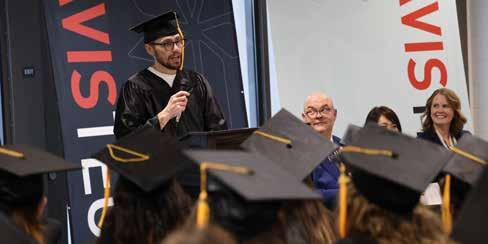
reer is building my identity.”
Dan Powers, Director of Rehabilitative Programs at Davis Technical College, helped him gain the confidence he needed, said Hansen. “He helped me get a job offer before I was released. He didn’t look at me like I was just an inmate but someone who could contribute something meaningful to society. But I ended up returning to prison.”
Hansen said he felt like he’d let Powers down. “Dan walked me back into the program. It’s his loyalty that I’ll never forget.”
abuse for years. “There were a lot of wasted opportunities. My family gave me second and third chances and endured the hell I put them through. With the Davis Tech recovery resource I’m ready to return to society. My fellow graduates, it’s not an easy road as inmates. It’s part of my journey and thanks for allowing me to be part of yours.”
I tried to push them away, they’re still here.”
People always ask kids what they want to be when they grow up, she said. “They say a doctor, teacher, etc. No one wanted to be in prison reduced to a number. I went to college but I was not motivated.”
Bringhurst said her teacher gave her a second chance but she flunked again. “I had no idea what I wanted to do. The decisions I made led me down this path. I had two options, sit and do nothing about the emotional and physical pain I caused or prove everyone wrong and get into school.”
The first day of instruction the teacher talked about “felon friendly” employers, she said. “I realized that was going to be a reality but I found my passion in this program. It’s something I could see myself doing for a long time.”
Student Jacob Selin performed an original poem about his experiences with incarceration. “I am in a substance abuse program,” he said. “I write about recovery to express myself. It’s something I believe I can do. I discovered the talent while I was in prison.”
“I’ve had the opportunity to become employable,” said Michael Hansen, a student in the Automotive Technology program. “I’ve spent 19 years incarcerated. Now I’ve put in over 61 clock hours (in the program) and have a 3.69 GPA. I’ve gained respect in the process. What’s far more important than a ca-
Bringhurst told the other graduates that it’s never too late to find their passion and purpose. “I’m trying my best,” she said. “I’m a better version of myself than yesterday. I’m healing in the UDC (Utah Department of Corrections). I’m not only making myself proud but my family proud. I’m not just a statistic. I’m not just a number.” l Ceremony
Hansen said he’s dealt with substance
“I never thought I’d be in a correctional facility,” said Web and Graphic Design & Automation Technology student Lindsay Bringhurst. “I didn’t think it was possible. My parents have stood with me even though

By Tom Haraldsen t.haraldsen@mycityjournals.com
The Feed Davis Annual Food Drive, benefitting local food pantries, is set for Saturday, March 14. Again this year, the Bountiful Food Pantry is coordinating the drive, which will provide much needed food to five community food pantries.
Coordinated with volunteers from The Church of Jesus Christ of Latter-day Saints and other community groups, collected food donations will go to the Bountiful Food Pantry, Open Doors in Layton, Fishes N’ Loaves, the Hope Center and the Center of Hope.
“This March food drive has been happening under various names for decades,” said Rebekah Anderson, executive director of the Bountiful Food Pantry. “In Davis County, we are great at coming together and helping our neighbors. This food drive helps local pantries prevent hunger, but it also gives community members a chance to be a part of something bigger than themselves. It gives them a chance to make a big, positive impact on their community.”
She said the five pantries in Davis County are working to make sure no one in Davis goes to bed hungry, adding, “It’s great to have such an awesome network of local organizations working together towards one goal.”
“So many families in this economy are struggling to meet their basic needs,” Jason Wilde from Open Doors said. “When everybody in the community comes together and gives a little, it goes a long way to transform a parent’s worry and despair into relief and hope. That’s what your food donation can do for your neighbors.”
Households throughout the county have had fliers hung to their front door handles with a QR code that can be used to learn more about drop off locations or to make monetary donations. Items should be left on front porches by 9 a.m. on March 14. Volunteers will then collect those items and take them to drop off locations. Individuals and families can also bring items to one of those locations,
which are listed below.
Bountiful Food Pantry, 480 East 150 North in Bountiful
Farmington LDS chapel, 347 South 200 West
Kaysville LDS chapel, 900 N. Main Street
Layton Open Doors Pantry, 875 East UT 193
Layton LDS chapel, 2160 W. Gordon Avenue
Hope Center Food Pantry, 795 N. Main Street in Clearfield
There will also be drop off locations at
LDS chapels in Woods Cross and Clinton. Those addresses will be announced on the Bountiful Food Pantry website or accessible with the OR code.
The most needed items are peanut butter, boxed meals, canned chili/soup, ramen noodles/pasta, baking supplies/mixes, canned meat, boxed cereal, canned tomatoes, and canned vegetables/fruit.
“In my opinion, Davis County is a great example to other counties on how to work together as a community for the common good,” Anderson said. “Davis County continually shows that we’re capable, and that we care.”
Use the QR code provided with this story or go to the pantry website for more information. l







McFadden believes that the connection and relationship with students comes first and then she builds from there.
By Becky Ginos becky.g@thecityjournals.com
Elementary
special education teacher Shaunee McFadden thought she was just taking her class to a school assembly Tuesday morning until Principal Jeri Thomas announced she was the recipient of the Heidi Martin Mighty Heart Educator of Excellence Award. McFadden walked to the podium in disbelief through a sea of children cheering and clapping.
Davis Education Foundation presented McFadden with a check for $10,000 that she can choose how to use to help the school and her students.
“I’m excited to be here because you have an amazing teacher in your school,” said Kara Toone, director of Davis Education Foundation. “Out of all the teachers in our whole school district – we have thousands of teachers – only one teacher can have this award.”
This award recognizes educators who lead with heart and determination, she said. “Shaunee McFadden’s commitment to her students and their families reflects the very spirit of this award.”
The Heidi Martin Mighty Heart Educator of Excellence Award is named in Heidi’s honor for her resilience and courage while facing significant health challenges.
Martin was born with only two chambers in her heart. When she was just three days old, she received her first heart transplant and went on to live 29 years. Martin had years of surgeries and hospital stays but despite that, she graduated from Weber State University with honors and became a registered nurse at McKay-Dee Hospital in Ogden, dedicating her life to caring for others, a Foundation release said.
Martin later underwent a combined heart and liver transplant, which was very rare at the time. In 2017, she passed away. This award is given in her name to educators who show the same strength and heart she had throughout her life.
“The teachers in Davis School District are pretty special,” said Superintendent Dr. Dan Linford. “We know the students are pretty special here too. You have amazing teachers who work so hard every day and we just simply are not very successful without amazing teachers who teach amazing kids.”
“She’s been working here for four years,” said Thomas. “But she went back to education as a second career.”
She loves the children, Thomas said. “She wants to help those who struggle to find their niche and to succeed and she’ll do what-
ever it takes. From sun up to sun down she’s here six days a week.”
“I never thought anything like this would happen,” said McFadden. “I’m a special education teacher so I’ve always looked for things that children and students would like and enjoy.”
The connection is first, she said. “The relationship is also first and then you build from there.”
McFadden was in health care administration before taking a different direction into education. “I had two children that had special needs,” she said. “One was in resource and the
other one ended up going through a learning center. He will be with us for a while.”
This is a second career, said McFadden. “It was because of my children.”
McFadden said she didn’t know yet what she would use the money for. “It will benefit the kids, 100 percent.”
“She’s been helping me with reading, math and everything else,” said sixth grader Ethan Wellings. “She’s been teaching for a while and I feel like she definitely deserves this. She’s focused on working. She doesn’t take many breaks and stuff. She’s kind and she works well with kids.” l


Kim Young, an RN at Intermountain Health Layton Hospital, suffered a massive heart attack but 18 months later completed a triathlon.
By Becky Ginos becky.g@thecityjournals.com
LAYTON—When Kim Young, a nurse at Intermountain Health Layton Hospital, got out of the pool after finishing her swimming workout she had some jaw pain. That was the beginning of a medical emergency that was totally unexpected. February was American Heart Month and Young encourages other people to know the signs of a heart attack.
“I had this weird left jaw pain,” said Young, who is 67 now but was 64 when it happened. “I thought ‘oh I must have held my jaw at a weird angle. I was kind of stressed.’ I went to put my shoes on and I had massive, crushing chest pain.”
Young said she thought she’d just go to the car and walk it off. “I got in and started the car and then I thought ‘ought oh’ and I got out and just threw up.”
It was really early in the morning, she said. “I was about half way between my house and the ER. I decided to go home to get my husband. We went back to the ER and I knew at that time it was like three elephants standing on my chest.”
Young said she walked into the ER and said she was in the middle of a massive STEMI (ST-elevation myocardial infarction). “They just got me right back and started all the interventions.”
Dr. Ellen Witala ordered nitroglycerin and anticlot medi-
cations. After doing an EKG they determined that she needed to be transferred to McKay-Dee Hospital.
“So they called the lights and sirens ambulance,” said Young. “From the time I walked into the door at Layton to McKay-Dee interventional radiology was 42 minutes which is really good. They took me to the cath lab to put a stint in because I had a complete left side occlusion – or the ‘Widowmaker.’”
Young said she learned how to swim in the 60s. “You just didn’t breathe unless you turned your head to the side and then I just held my breath the rest of the time. Come to find out from cardiac rehab that is very bad. Evidently that’s what had happened.”
Young said they checked all of her other arteries and nothing else was blocked. “It was the stress of holding my breath for an hour. I’ve never had any heart disease or high cholesterol – nothing.”
One year after the heart attack, she completed her first Olympic-distance triathlon. “I did the Spudman (triathlon) in Burley Idaho and I’m signed up to do the Sacramento full ironman in October.”
Young ran a marathon with her kids in 2014 and picked up swimming in 2022. “I’ve always been a long distance bike rider,” she said. “The triathlon I’ve signed up for is a 112 mile bike ride. A two and a half mile swim and a 112 mile biker ride then a full marathon, 26.2 miles.”
It will be good, said Young. “You’ve got to challenge yourself.”
Young encourages others to be smart about the signs and symptoms of a heart attack. “I think the classic signs I felt. But I was lucky because those aren’t the usual signs a woman would feel,” she said. “Nausea was and I had that. Quite often

women get nauseated when they’re having an MI (Myocardial infarction).”
Recognize that because that door to stint time is really important, said Young. “Time is tissue. Going home and getting my husband was probably not the best idea. I should have just laid down and let them call 911.”
Young said she knew the jaw pain was a symptom. “Oh the massive crushing chest pain – that’s not anxiety.”
Take the time to say something is wrong, she said. “You’re worth it. The fact that I did live, I’m just not going to take that for granted.” l




He calls it ‘Jeep Disease’ – and this Farmington man isn’t looking for a cure
Local man named 2025 Red Rock 4-Wheeler of the Year.
By Becky Ginos becky.g@thecityjournals.com
Graves hadn’t been involved with the Red Rock 4-Wheelers (RR4W) club until his twin brother invited him down to Moab to see what the club was all about. That was in the late 1990s and now the Farmington man is one of the leaders. Even his daughter Sarah has gotten into the action. Graves was recently honored by the club as the 2025 Red Rock 4-Wheeler of the Year.
“My wife and I were just getting married when he (brother) invited us down,” said Graves. “Just seeing the scenery of Moab and all that down there we went back in 1997, 1998 and 1999 and really enjoyed it. We skipped 2000 because my son was born, then went back in 2001-2002.”
Graves said he was with his wife on a trail and met some of the club members. “We said ‘hey we like helping people. We’d love to help out.’ That’s when I became an associate member. There are members of the club that don’t live in Moab.”
At that time they allowed only 350 associate members, he said. “I told one of the
Is Endometriosis Awareness Month
Fleaders that I would love to come down and help out with the trails or the club. He told me I had to apply to be in the club and then if there’s an open slot they’ll put me in.”
In 2002, there was an opening, said Graves. “I got in right away. That Labor Day was my first time helping as lead. From there it just snowballed.”
Graves became a trail gunner on Fins-NThings in 2004. “Let’s say you have 30 people on the trail, participants that show up for Jeep Safari,” he said. “They register, pay and sign up for a trail. A gunner is the leader. The leader is the first person on the trail and they will guide the whole group through the trail.”
There’s no specific trail that someone has to do, said Graves. “I lucked out. I just happened to be on Fins-N-Things. I was a gunner from 2004-2019. All those years I’d be down at the Easter Jeep Safari helping out.”
Graves has an off-road business and in 2008-2009 started going down during the Easter Jeep Safari for a vendor show. “So the whole week, 10 days before Easter there are trail runs every day. This is a huge event. I happen to be going down over the years little by little and I guess paid my dues, if you will. I love helping people so that’s why it was an easy fit for me to go help on the trails.”
The club needed some people to help organize and coordinate the Labor Day Campout event, he said. “I became co-committee

for the family, said Graves. “My 18-year-old daughter has been involved with it all of her life because we’ve gone down as a family to help out. But this year since my daughter is 18 she will be one of my gunners on one of the trails I lead over Easter week.”
So it’s a tradition, he said. “She has a jeep, I’ve got a jeep so it makes it easy.”
Graves drives monthly from Farmington to Moab to attend RR4W meetings. “I have no rhyme or reason why I’ve gone down so much,” he said. “I just happen to love the club and the associations. I have many friends down there and so for me to drive four hours is nothing to go spend an hour and a half for the meeting and then drive four hours back that night at one in the morning.”
The RR4W club wants to support the off-road industry, said Graves. “The club is a very, very big piece of that in Moab for off-roading.”
Graves said he’s only the second person to receive the honor who lives outside of Moab. “I didn’t expect it. I wasn’t looking for it. It was something that the club gives one person every year. I don’t need the recognition.”
chair. I’m now the committee chair for the club. So I’m down there at least two times a year.”
Easter Jeep Safari has been a huge event
It’s not going to change the work he does with the club, said Graves. “I’m always going to go down there until I die probably. I joke with people that I have this disease called Jeep. It’s incurable. Once it gets in your blood it never goes away.”l
or many women, pelvic pain is dismissed as “normal” or “just part of being a woman.”
But sometimes that pain is a symptom of a chronic condition called endometriosis that affects millions. It’s a condition where tissue similar to the lining of the uterus grows outside the uterus, causing pain, infertility, and a range of other debilitating symptoms.
Endometriosis isn’t just about bad period cramps. It can lead to significant pain during menstruation, intercourse, bowel movements, and urination. It can also cause chronic pelvic pain, heavy bleeding, fatigue, and is a leading cause of infertility
“The emotional and psychological toll of endometriosis can be immense, especially for women who dismiss their pain and go undiagnosed. This condition han have a profound impact on their relationships, careers, and overall quality of life,” said Lisa Hill, certified nurse midwife at Holy Cross Hospital – West Valley
Endometriosis is surprisingly common. It affects an estimated 1 in 10 women of reproductive age globally. In our local community, this means thousands of women are likely living with endometriosis, many of whom may not even realize they have it. The delay in diagnosis is a critical concern,
with women often waiting an average of 7 to 10 years from the onset of symptoms to receive an accurate diagnosis. This delay can lead to the progression of the disease and increased severity of symptoms. Raising awareness is crucial to shorten this diagnostic journey for future generations.
“While there is currently no cure for endometriosis, effective treatments are available to manage symptoms and improve quality of life. Treatment approaches are highly individualized, depending on the severity of symptoms, the extent of the disease, and whether the woman desires to become pregnant,” said Dr. Christopher Hutchison, an OB/ GYN at Holy Cross Hospital – Jordan Valley
Common treatment options include:
• Pain Management: Over-the-counter pain relievers (like NSAIDs) can help with mild pain, while stronger prescription medications may be necessary for severe pain.
• Hormonal Therapies: These treatments aim to slow the growth of endometrial tissue and prevent new implants by regulating or blocking the hormones that fuel their growth.
• Conservative Surgery: Laparoscopic surgery is a minimally invasive procedure where a surgeon can precisely locate and remove endo-
metrial implants while preserving reproductive organs. This can significantly reduce pain and improve fertility outcomes for some women.
• Hysterectomy and Oophorectomy: In severe cases where other treatments have failed and childbearing is complete, removal of the uterus (hysterectomy) and/or ovaries (oophorectomy) may be considered, though this is typically a last resort and does not guarantee complete relief from symptoms.
• Complementary Therapies: Many women find relief through complementary approaches such as acupuncture, physical therapy, dietary changes, and stress management techniques. If you or someone you know is experiencing persistent pelvic pain, unusually heavy periods, or difficulty conceiving, please don’t dismiss these symptoms. Talk to your doctor. Early diagnosis and a comprehensive treatment plan are key to managing endometriosis and living a healthier, more comfortable life. CommonSpirit Health is committed to supporting women’s health and offers resources for diagnosis and treatment of endometriosis.
For more information or to find a provider visit mountain.commonspirit.org


more about the services, care providers and mission-driven work of the Holy Cross hospitals and CommonSpirit Health at www.holycrossutah.org.

CommonSpirit Health, we make the healing presence of God known in our world by improving the health of the people we serve, especially those who are vulnerable, while we advance social justice for all.
By Tom Haraldsen t.haraldsen@mycityjournals.com
Lisa Street discovered her passion for creating handmade decor when she was just 8 years old, in her grandmother’s basement. She recalls collecting pinecones all summer and fall and they’d hand-wire each of them into a wreath for the holidays. Her passion has never left.
So in the late ‘80s, she opened her own gift shop/decorating studio, Squirrel Haven, on Bountiful’s Main Street. She loved it, but when downtown underwent a major reconstruction and Main Street was closed for a few months, several stores closed with it, including hers.
“I left to go into real estate full time,” she says. “I began selling homes, but also continued to make wreaths, particularly for the homes I’d sold. I have a degree in interior design and have always loved playing with colors and materials. People loved the wreaths and asked where they could get them for other professionals that they wanted to give a gift that was uniquely designed and handmade.”
She opened up her own Etsy stop seven years ago (lisastreetdesigns.etsy.com), and it’s done well. Last August a friend of hers asked if she wanted to go in with her on a pop-up boutique for part of Bountiful’s Sidewalk Days, and again they got a wonderful reception. Now,
both Lisa and her artist friend Kim Byrd (studioart_25) are still on Main Street with a small shop just a few yards away from where Lisa’s original store once stood. It’s part of the John Hepworth property…he is Kim’s father.
“We decided we’d keep the business open at least through Halloween, but customers kept coming, so that extended into the holidays, and now we’re still here,” Lisa says. The business doesn’t have a name on the building, but it’s easily identifiable by the bright red door, and neither Lisa or Kim know if they will remain there permanently. For now, customers are still coming in.
“People were receptive to Kim’s artwork and my custom work and we expanded it to include Lahna’s Chocolates, also created here in Bountiful, and sell them in store,” she says. Inside, customers can find seasonal decor for front doors, framed art of Kim’s originals in a variety of sizes, seasonal centerpieces, gift cards, a display of Lahna’s Chocolates, and a wall of ribbon so customers can choose their own patterns and colors. There’s also a photo op spot with different backgrounds so customers can take photos for the seasons.
Lisa is now planning and designing items around Easter. Her creations are always posted on her Etsy site and then moved into the store later on. Their business is open three days a week, Thursday 11 a.m. to 2 p.m. and Fridays/ Saturdays 10 a.m. to 2 p.m. or by appointment.
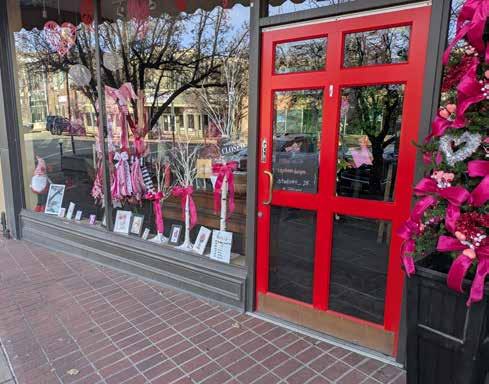
“We can do custom jobs for any customer,” Lisa says. “We’re the perfect place to pick up a quick gift, and we take pride in
wrapping everything. We love people who just wander in and find something they like. Kim and I love what we do.”l

care for every stage of you.
Women go through many changes in their lives. And we believe every milestone matters. Our health care experts can help you face your next phase with confidence – because each chapter deserves to be celebrated.
Find care near you at mountain.commonspirit.org.
The Centerville City Council has voted to approve the acquisition of a 0.89-acre parcel of hillside land donated by the Utah State Rifle and Pistol Association. The deal, which has been in the works for a year, ensures that a key piece of property adjacent to the city’s 160-acre open space remains in public hands.
By Linda Petersen l.petersen@mycityjournals.com
nearly one-acre parcel of hillside property near a popular Centerville trailhead is moving into city hands. The land is owned by the Utah State Rifle and Pistol Association who would like to donate it to the city, City Manager Brant Hanson told the city council on Jan. 20.
This parcel is situated in the Centerville hillside area, near the eastern edge of the city where the residential areas meet the open foothills. It is located adjacent to the Centerville City Hillside Trailhead, often associated with the Freedom Hills area or the Bonneville Shoreline Trail access points. The area is typically accessed via the eastern ends of 100 South or through the Freedom Hills Park trailhead near 2250
North Park Hills Drive.
Because the city is acquiring this land, it is designated to remain as protected open space. It serves as a buffer and a connective piece for the Bonneville Shoreline Trail and other local hiking paths like the Deuel Creek or Ford Canyon trails. Protecting this area ensures that hikers and residents will have uninterrupted access to these natural resources for years to come, Hanson said.
Hanson and City Attorney Lisa Romero have been meeting with association president Larry Scandlin over the past year to work out the details of this transfer. The city is currently completing a requirement for an environmental assessment to ensure no soil contamination exists – standard operating procedure for this type of acquisition – before the deed is officially signed.
The association is just asking for the city to help cover this year’s property taxes on the parcel, and city officials have agreed to pay $100.
“The $100 is basically to cover the recording fees and to ensure the tax liability is transferred properly,” Hanson explained to the council regarding the nominal cost. While technically a “sale” of $100 to cover the property taxes and recording fees, the land is essentially considered a donation.
While the parcel is currently just outside the city boundaries, since it lies adjacent to

160 acres owned by the city, the city may consider formally annexing it in the future, Hanson told the council.
“From what I’ve heard from people in the community, this access to our mountain
side seems to be a priority and for that reason I think this is a really generous donation and also a good one from the fact that it helps us to continue to maintain that people can access the open space,” he said. l



Great workplaces don’t happen by accident. They are nurtured and built to bring out the best in people. If you know of one, nominate it as a Utah Top Workplace.
For the 13th year, employers with outstanding workplace culture in the state will compete for Utah Top Workplaces recognition. This is the first year the award is in partnership with the Salt Lake Business Journal Any organization with 35 or more employees in the state is eligible to compete for a Top Workplaces award. Standout companies will be honored this fall.
The nomination deadline is April 10. Anyone can nominate an outstanding employer: public, private, nonprofit, a school or even a government agency. To nominate an employer or for more information on the awards, just go to slenterprise.com/nominate or call (801) 803-6841.
There is no cost to participate. To qualify as a Utah Top Workplace, employees evaluate their workplace using a short 26-question survey that takes just a few minutes to complete. Companies will be surveyed through late June.
“As a people and culture leader, I know the strongest organizations invite honest feedback and use it to get better,” said Elizabeth Sweat, people and culture leader of the City
Journals and Salt Lake Business Journal. “Utah Top Workplaces provides leaders with a meaningful way to measure culture, celebrate what’s working and identify opportunities to invest even more intentionally in their people.”
Energage, the Pennsylvania-based research partner for the project, conducts Top Workplaces surveys for media in 65 markets nationwide and surveyed more than 2 million employees at more than 8,000 organizations in the past year.
“Earning a Top Workplaces award is a celebration of excellence,” said Eric Rubino, CEO of Energage. “It serves as a reminder of the vital role a people-first workplace experience plays in achieving success.”
For the 2025 awards, more than 3,500 organizations in Utah were invited to survey their employees. Based on employee survey feedback, 154 earned recognition as Top Workplaces. l





Half of the 32 dancers are new this year.
By Becky Ginos becky.g@thecityjournals.com
FARMINGTON—It was a tough season for the Farmington High School drill team leading up to the State 6A Championship with injuries and other setbacks but all the hard work paid off when the Nixelles swept the competition Jan. 31 in Military, Show and Dance. The team even pulled off last minute changes to one of the routines but still came out shining.
“We have 32 dancers and half of our team is new this year,” said Head Coach Marci Hartvigsen. “It’s kind of been a fun topic for other teams thinking that Farmington wouldn’t be as strong as usual. We’ve really had to work extra hard with that many new dancers and from day one we’ve been sprinting.”
Sprinting to get these kids ready for state, she said. “In earlier competitions we had a bunch of setbacks. We had injuries, one of which was my own daughter, like torn ligaments and kids being taken out of routines.”
It was just nonstop struggles with the season, said Hartvigsen. “We were having to redo, re-space and spend time on top of having a new team.”
The kids had to be on point all the time, she said. “So ultimately our team just has been like no other team we’ve had in our eight years of coaching. We have so many new dancers and they’re just not as experienced.”
But at the end of the day it didn’t really matter, Hartvigsen said. “What mattered

is that they never stopped working. They never stopped trying to be their best. We’re just really happy that they got the reward at the end of the win.”
Hartvigsen said they felt rewarded anyway. “Honestly when we came off after the show at that point when you’ve done your best and you feel like the team has just reached their very best you almost don’t care in a sense what the judges decide. That’s where we were.”
So it was amazing, she said. “It was definitely my hardest year. When you have an injury, as a mother it’s devastating for your child and you but when you’re the coach it was like triple devastation so it was really hard.”
There are three routines at state, said Hartvigsen. “We do Military which we hit hard early on because again we had new dancers. With Military the kids do not do that style of dance until they get to drill. It’s just not the drill style that you’re doing in a studio growing up. So we really hit that one hard out the gate, knowing that if we couldn’t do well in Military it was going to really affect placement at state.”
After taking third place at Region Hartvigsen said they were all wondering what was going on. “We’d been doing so well. After the semi where we didn’t place first in Show I just kind of snapped and decided ‘you know what? We need to change choreography in Show to make it more
readable and cleaner and make sure that it can places well.’”
That was Thursday night before state, she said. “We redid multiple sections of that dance. It was taking a really big risk. I was thinking, ‘am I doing the right thing? Is it the right call?’ I knew it was do or die and it was like let’s risk it because if we don’t that could be the difference.”
So they did, said Hartvigsen. “That really pushed the dancers. It was more mental for Show than it has ever been. We had two practice periods from the time I reset this. The practice I reset it in and the next day Friday.”
Not one person forgot those changes, she said. “It was just amazing. I do think the path that we were led down just with disappointments throughout the season with injury and also prelim competitions being placed – maybe not in line – with what we thought we would place.”
It’s very subjective, said Hartvigsen. “Sometimes you don’t fully agree with what’s happening but that’s the dance world. We decided we’re just going to do what we know. Farmington is going to try and beat Farmington.”
Then to get a clean sweep was shocking for everybody, she said. “That was the most rewarding part, that we were able to do that with all of the things that were happening and different judges thinking that we weren’t as good as the next team, you know that plays into your psyche.”
All those things needed to happen for the team to end up where it did, said Hartvigsen. “We told the kids it’s part of the journey and we still have to do our best. The lessons that were learned by our team this year – they will take with them for the rest of their lives.” l
Centerville city officials met recently to outline their top goals for the year, focusing heavily on improving communication with residents and addressing critical infrastructure needs.
By Linda Petersen l.petersen@mycityjournals.com
among the Centerville City Council’s priorities for the coming year is transparency and trust, in particular improving communication regarding city fees, policy changes, zoning, and road construction.
“Transparency isn’t just a buzzword, it’s what trust is built on and how it’s maintained,” Councilmember Rick Bangerter said. “Residents want to understand what’s going on, why the city is doing what it’s do-
ing and how it affects them.”
“People shouldn’t have to guess what’s happening in their own neighborhoods,” he added. “Transparency also reinforces the role of us, the council. Residents want to know that the council is guiding the city, not the other way around.”
On Feb. 3 in a work session, the council discussed this and other priorities. Each council member had the opportunity to outline his or her priorities in the meeting.
Another priority for Centerville officials is infrastructure. Significant focus was placed on road maintenance, the need for a transportation utility fee, and improving storm drain ordinances. Water conservation is also important to this council. Council members agreed there is an urgent need for water conservation and suggested an inclining block rate structure and landscape rebate programs.
“We need to get that inclining block rate
structure in place so at least there’s kind of a thing where they get a little bit penalized if they’re watering during a time when we don’t need outdoor watering,” Councilmember Gina Hirst said.
Finding new cemetery space is also a priority since the city cemetery has almost reached capacity, but the city has struggled to identify a parcel it could purchase to achieve that goal.
On the planning side, the council would like to see a new general plan adopted this year.
“I think it is very important that we get the general plan adopted and in a reasonable amount of time,” Hirst said. “I think that needs to be a top priority this year.”
Looking at city operations, discussions included optimizing staff time (e.g., department heads attending only relevant meetings), utilizing interns and volunteers, and reviewing franchise agreements with tele-
communication companies regarding public utility easement damage.
Council members are also concerned that their meeting agendas are sometimes too packed and would like to see more flexibility to address issues brought up by the public.
“I feel like people bring us stuff, and they feel like we don’t act upon it, because our work meetings are already so planned out... I would like to be able to deal with what’s coming up,” Councilmember Robyn Mecham said.
At that meeting, some accomplishments were outlined. These included hiring a dedicated staff member to handle building maintenance, freeing up Parks and cemetery director Bruce Cox to focus on parks and recreation. The Tree and Conservation Board is proactively working on a three-to-five-year plan to identify trees requiring removal and planning replacements well in advance. l
For 140 years, families have come to trust Larkin Mortuary as the leading funeral service provider along the Wasatch Front. Family owned and managed for seven generations, we are committed to providing meaningful, healing experiences for every family who turns to us for guidance.
For over 140 years, families have come to trust Larkin Mortuary as the leading funeral service provider along the Wasatch Front. Family owned and operated for seven generations, we are committed to providing meaningful, healing experiences for every family who turns to us for guidance.



Discover the peace of mind that comes with planning ahead. Learn about the benefits of advance funeral and cemetery planning, and why it makes sense for you and your family.

3/13/25 Thursday @ 12 PM
3/17/26 Tuesday @ 12 PM
Larkin Sunset Lawn: 2350 E 1300 S, SLC, 84108
Larkin Sunset Lawn: 2350 E 1300 S, SLC
3/18/25 Tuesday @ 12 PM & 6 PM
3/18/26 Wednesday @ 12 PM
The Chateau at Le Jardin: 1910 E Dimple Dell Rd, Sandy
Larkin Riverton Funeral Home: 3688 W. 12600th S., Riverton
3/26/25 Wednesday @ 12 PM
3/25/26 Wednesday @ 12 PM
Elysium Legal: 1802 W South Jordan Pkwy, South Jordan
The Chateau at Le Jardin: 1910 E. Dimple Dell Rd., Sandy
3/27/25 Wednesday @ 12 PM
3/26/26 Thursday @ 12 PM
Elysium Legal: 1802 W South Jordan Pkwy, South Jordan
The Chateau at Le Jardin: 1910 E. Dimple Dell Rd., Sandy
Space is limited, so please RSVP now!

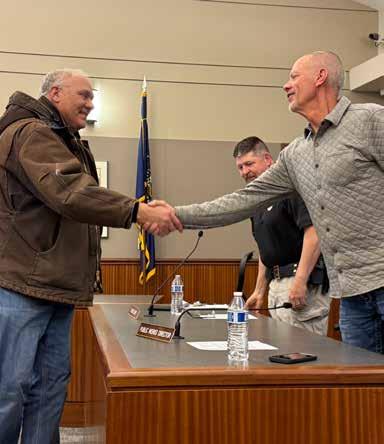
Since 2008, Alan Malan has been a part of West Bountiful’s planning commission. The former chairman stepped down in January 2026, leaving behind a legacy of fighting for land rights.
By Simon Mortensen s.mortensen@davisjournal.com
The priorities of a leader set directions for a city to follow. Throughout his 18 year tenure, former West Bountiful planning commission chairman Alan Malan focused his efforts on making calculated decisions that put the freedoms of residents first. Now in 2026, he’ll have the opportunity to witness the longevity of his legacy.
In January, Malan stepped down from a planning commission he’d been a part of since 2008.
Malan entered his role roughly 13 years after moving to West Bountiful. The brother of a planning commission member, he began attending meetings on a regular basis – as well as noticing flaws with actions that were being carried out.
“When I first saw the people on the planning commission, I was kind of taken aback by the lack of people there, and the lack of understanding of what the local politicians did,” said Malan. “There’s decisions being made, but they aren’t aware of what’s going on.”
Prior to joining the commission, Malan had been involved in a dispute with the city over how he could use his land when a stop was placed on a barn he built.

When former member of the planning commission and city council, James Bruhn, told Malan he’d be a good fit for a position on the board, instances like these informed his perspective.
Malan regularly worked in favor of land owners, believing that what they did with their property was their business. When working with residents who had an issue with what a neighbor was doing, he’d often say “nobody wants to see me in a Speedo, but it’s my right to stand out on the front porch in one.” Additionally, he believed this focus on rights was essential to maintaining the rural spirit of West Bountiful.
“The people of the city are what makes the city,” said Malan. “That was my biggest focus was trying to keep it so that West Bountiful was the citizens and trying to keep everybody remembering that on the commission, which they do a great job of because it’s the way our city is.”
Malan’s tenure on the commission ended at the request of Mayor Ken Romney, who was looking to add new perspectives to the administrative body. On Jan. 20, he was presented with an award from the city in recognition of his service.
In January, Robert Merrick took over the chairman position that Malan had occupied for approximately two years. Richmond Thornley, who ran for city council in November, filled the vacant spot on the commission.
Before departing, Malan told the planning commission to remember that they’re doing this work for the citizens – not to the citizens. Now retired from his former civic duty, he plans to spend more of his Tuesdays with his grandchildren. l





The Utah Department of Transportation and North Salt Lake have formalized the Highway 89 corridor agreement, setting plans for future traffic and transit related improvements along the section of Highway 89 in the city.
By Megan Fisher m.fisher@davisjournal.com
TheUtah Department of Transportation (UDOT) and the City of North Salt Lake have formalized an agreement regarding the Highway 89 corridor, or the area along the Highway from 500 South to 1100 North. The agreement is a planning document so that, in the words of North Salt Lake Community Development Director, Sherrie Page, “when improvements are made we have a plan, we know what we’re going to get…It wouldn’t work very well if we built things and later realized we should have built them 15 feet farther.”
As part of the project there is an interchange off of 1-15 planned from 500 South to 1100 North. The agreement is not a financial commitment for either UDOT or North Salt Lake, it merely puts into words what steps are going to be taken in order to manage traffic and plan for future needs in the city along Highway 89 so that both parties are on the same page.
The agreement touches upon street spacing, or the minimum driveway spacing allowed along Highway 89. The city hopes to consolidate driveways for future businesses so that there are less going onto the freeway. Along the entire corridor area the minimum street spacing is 200 feet and minimum driveway spacing in 100 feet.
UDOT and North Salt Lake have identified spots throughout the city that may need improvements for pedestrian safety and accessibility as the changes to traffic patterns come with the highway construction projects. These improvements include such things as new sidewalks, new traffic signals, improved lighting, sidewalk access to bus stops and pedestrian crossings near bus stops. Signage throughout North Salt Lake will be made more clear for drivers, and center medians will be built in places where there is an established need.
Both parties, UDOT and North Salt Lake, are excited to use various types of roadways along the corridor, including bike lanes, multi-use paths and planted medians. The construction project will see that dream come to fruition. There is no word on where those new types of roadways will be located at the present time.
Another action that will taken in hopes of improving traffic flow and improving pedestrian safety will be to reduce the speed limit through North Salt Lake’s Town Center, between Main Street and Odell Lane, to 35 miles per hour.
Additional rights of way will be required along the corridor, of the legal 110 foot width.
The Greenway between 350 North and 973 North has long been shared by UDOT and North Salt Lake, with rights of way belonging to the department and land owned by the city. All of the Greenway, however, was maintained by North Salt Lake. As part of the corridor agreement, UDOT agreed to the deed all of the land to the city. The North Salt Lake Planning Commission made plans to combine the four foot sidewalk and the four foot trail for a 10 foot multi-use trail, to be used for biking and nature walks.l
Better. Age Better. Live Fully.

We specialize in personalized care for:
• Hormone balance and metabolic health
• Fatigue, weight changes, and brain fog
• Joint pain and injury recovery
• Longevity, strength, and healthy aging
• Non-invasive aesthetic treatments Our approach blends advanced testing, evidence-based natural medicine, regenerative therapies, and modern technology to treat the root cause—not just the symptoms. Whether you are noticing changes in energy, strength, or appearance, our goal is to help you feel like yourself again.







A childhood classic in the making! Young Mole is a sweet story about woodland creatures whose adventures feel surprisingly close to real life. Mole stumbles, learns, and grows in ways kids and parents will recognize. The writing is warm and the illustrations are beautiful, but what I especially liked were the little pauses between chapters where Mole reflects.
• Prostate Issues
• Kidney Stones
• Bladder Problems
• Interstitial Cystitis
• Erectile Dysfunction
• Testosterone Treatment
• Vasectomy w/Sedation
• Cancer: Prostate, Kidney & Bladder






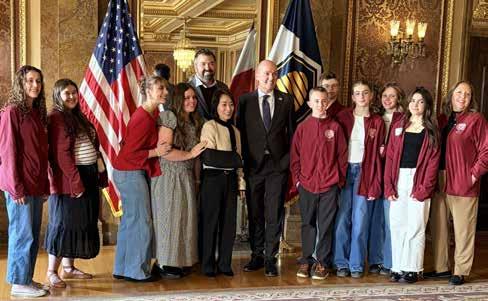
The Kaysville Youth City Council works hard to make a difference in the community. As part of their work, it is tradition for the YCC to visit the Utah State Capitol and take part in learning about the government process firsthand.
By Cindi Mansell c.mansell@mycityjournals.com
On Jan. 21, members of the Kaysville Youth City Council (YCC) attended the Utah League of Cities and Towns (ULCT) Local Officials Day at the Utah State Capitol. Youth councils from across the state took part in the annual event, which included meeting with legislators, learning about the legislative process, touring the Capitol, and taking part in mock floor debates.
The experience offers a chance to con-
nect with leaders and gain valuable insight into how government works. It helps encourage civic engagement and interest in public service. Experiences like this help inspire the next generation of civic leaders and foster a deeper understanding of public service.
Kaysville YCC students are selected based on their experience in leadership, community, and extracurricular activities, as well as how they can contribute to the YCC program overall. The city council appoints the new YCC group in April or May for the following school year.
Other items of focus for the youth are getting to know the city; job-shadowing departments, debate events, attending city council meetings and conducting mock city council meetings or mock elections (and most importantly, learning about government).
Kaysville Mayor Tamara Tran is excited for these students to have this great civic opportunity and grateful for their interest in the program. l


With Alan Malan’s departure from the planning commission, West Bountiful appointed Robert Merrick as the new chairman and Richmond Thornley as a new alternate member.
By Simon Mortensen s.mortensen@davisjournal.com
Adding to the various changes occurring in the city, West Bountiful’s new planning commission held their first meeting on Jan. 27.
The body – led by chairman Robert Merrick – features five incumbent members as well as one new individual in Richmond Thornley, who will serve as an alternate. It becomes the first commission in the city since 2008 to not include former chairman Alan Malan, who stepped down at the request of Mayor Ken Romney.
“The function of the planning commission isn’t really going to change,” said Thornley. “It’ll just take on a little bit of a different personality.”
Following Thornley’s swearing in, the commission discussed priority topics that affect goals addressed in the city’s general plan. Items on the agenda included adopting “graduated fee reductions for moderate-income housing projects,” drafting ordinances for detached accessory dwelling units and providing a density bonus to planned unit development projects that feature affordable housing.
In addition to discussing the direction of West Bountiful, the planning commission helped institute new business classification procedures with the city council during a Feb. 3 meeting. Informed by Senate Bill 179, the legislation better allows companies working in recently established industries to use commercial zones.
Prior to closing his final meeting, Malan – who received an award from Romney for his service – ended the session by reminding the commission that they’re doing this work for the citizens, not to the citizens. An individual who championed the rights of property owners to do what they pleased with their land, future actions by the committee will determine whether his philosophy aligns with their ambitions.
“When we come together as communities, we kind of have to balance that public good with property rights,” said Thornley. “Both are very valuable and important. That’s something I find very important, and many times actually have been kind of reminded of that often by former chair Malan. He often brought up his very strong beliefs on personal property rights, and I think that often serves as a good reminder to not get too overzealous.”
The planning commission’s changes add to ones that occurred on the city council. Following her success during November’s election cycle, Julie Thompson replaced former member Mark Preece – who had been on the council for 16 years.
West Bountiful’s planning commission meetings are held on the second and fourth Thursday of each month at City Hall on 550 N. 800 West.l
North Salt Lake welcomed a delegation of four county leaders from Novovorontsovka, Ukraine, who visited in order to receive guidance and support in developing their area in the midst of the Russian invasion.
By Megan Fisher m.fisher@davisjournals.com
The business of running a city doesn’t stop for a war. A delegation of government officials from the county of Novovorontsovka in Southern Ukraine arrived in Utah and spent five days meeting with officials from the state and various cities throughout Salt Lake, Davis and Utah County, looking to foster friendships with U.S. city leaders and receive guidance on how to best help their county to thrive and develop, even as the invasion by Russia enters its fourth year.
Novovorontsovka is located in the region of Kherson. Consisting mainly of farm land, the county is made up of 10 villages and had a pre-Invasion population of nearly 13,000 people. They are famed for their watermelons. It is located five miles from occupying Russian forces, and was itself occupied for seven months before being fully liberated in October of 2022. Still, the people of Novovorontsovka are under constant threat from Russian drones and citizens risk their lives to even shovel snow.
Despite the hardship, the leaders of Novovorontsovka are not content to sit and wait for the war to end in order for their country to grow and develop. In order to fulfill this goal, four members of the county government visited Utah for a five-day trip, from Feb. 9 – 12 and met with state government at the Utah State Capitol and the local city leaders of North Salt Lake, Bountiful, Sandy, West Jordan, Spanish Fork, and Nephi.
“This is really important to us,” said Andrii Seletskyi, head of Novovorontsovka’s Military Administration, of the
visit. “In Ukraine, some people have started thinking that the United States government has stopped helping Ukraine. We are seeing a different picture here, that people on the local level are still supporting Ukraine, are still thinking about Ukraine and are trying to do what they can do.”
The delegation is made up by Seletskyi, a former history teacher, who during the occupation, helped to deliver food and medicine to residents and evacuated around 1,200 people, all while being beaten, tortured, and even held at gunpoint by Russian soldiers. Alongside Seletskyi are Serhii Pylypenko, the Director of Novovorontsovka Public Utilities, Karyna Dobro volska, the Chief Specialist of Public Work and Investments, and Yulii Morozov, the Country Advisor and the CEO and founder of Shelter Plus, the co-founder of Recovery Center Hart, and Co-founder of the NGO Union of Responsible Citizens.
On Feb. 11, the Ukrainian delegation met with city lead ers of North Salt Lake at the North Salt Lake Public Works building, 10 E. Center Street, and built friendships and sat through presentations on the nuts and bolts bureaucracy of running a city government. Heidi Voordeckers, finance direc tor for North Salt Lake, gave a presentation on how the city handles its finances, including an explanation into how they collect property tax, sales tax and utility fees. Linda Hor rocks, communications manager for North Salt Lake, walked the group through how the city communicates with its citi zens and utilizes social media.
“With this start of communication with local govern ments,” said Seletskyi, “… we can start working in different fields, in the fields of education, public utilities, support, and other fields in the future…. We will take back the things we have learned today, such as how the government promotes their news to the public.”
At the end of the meeting Seletskyi presented the lead ers of North Salt Lake with a gift on behalf of the Ukrainian delegation; a wooden light box decorated with the painting of a watermelon, a symbol of Novovorontsovka. In return,
North Salt Lake gifted each of the Ukrainian leaders a blue tartan blanket.
Afterward, the group traveled to the site of a previous landslide in North Salt Lake and discussed the city’s response to the disaster. Seletskyi was hopeful that, in turn, the Ukrainians could teach Utah city leaders how to more efficiently respond to emergency situations and protect civilians. l


Centerville City is set to launch a streamlined new website this spring featuring enhanced navigation and a specialized “geo-fencing” tool for localized resident alerts.
By Linda Petersen l.petersen@mycityjournals.com
City is getting a new website. During a Dec. 16 work session, Administrative Services Director Bryce King gave the city council a look at the ongoing redesign of the website, which was slated to go live in late February (after this newspaper’s deadline).
The project involves a move to a new platform hosted by GHD, also known as Govstack – a provider currently used by other municipalities like Draper.


“We have a lot more control of how we control content on the site compared to the other platform,” King said.
The new site will be organized under five primary headings: Living Here, Recreation and Culture, Emergencies and Public Safety, Business and Development, and Your Government.
“The idea for me is to kind of simplify the ‘report a concern’ [feature],” King told the council. “Right now, the report a concern is very generic. The idea now is to change that to say, ‘What concern do you have? Is it public works? Is it water? Is it streets?’ and then it will go to where it needs to go.”
Council members weren’t sure they loved the “Living Here” header.
“Living here is just – it’s vague... I just want to know where my stuff is,” said Councilmember Gina Hirst who suggested a more direct label like “Resident Services.”
Councilmember Robyn Mecham also thought a “Contact Us” button placed prominently in the top right corner of the home
page would be a good idea.
“I personally would love to see [it] very prominently featured so I don’t have to drill down to try to figure out where to contact us,” she said.
Beyond a new look, the new platform offers advanced tools for targeted communication. King described a feature that would allow city staff to “geo-fence” specific neighborhoods to send localized alerts.
“If a water leak is happening in a neighborhood, not everybody and their dog needs to know about that,” he said. “The idea is to be able to just literally click on the houses and send the communication out to those residents through the software.”
The transition comes with a deadline, as the city’s current website contract was set to expire on Feb. 19. At that point King estimated the new site would launch around Feb 1. (He later told The City Journal the website would be ready toward the end of the month).
While city staff has had to migrate and update content from the old site, King views the hurdle as an opportunity for a “clean up.”
“It’s going to be a pain, but also it’s going to be very beneficial,” he said. “Even though we have to rewrite and redo these pages, it’s really a good opportunity to clean up our pages, some things just don’t transfer over.”
The redesign will also feature a live social media feed on the homepage, allowing residents to see current updates without needing personal Facebook or Instagram accounts.
City council members seemed to react positively to the new website and its features.
“It’s very inviting to me,” Councilmember Cheylynn Hayman said. “It feels more user friendly.”
King encouraged the council to share any feedback they receive from the public about the new site. l

By Cindi Mansell c.mansell@mycityjournals.com
Public Works Director Josh Belnap presented an updated Water Conservation Plan to the Kaysville City Council at a recent meeting that is required by state law to be reviewed every five years. The update builds on the city’s 2019 plan and aligns with recent state requirements tied to municipal general plans.
Belnap explained that Kaysville’s system is unique in that the city provides only culinary water, while three independent irrigation companies supply most outdoor water. As a result, the conservation plan focuses primarily on indoor water use, with coordination rather than regulation of irrigation providers.
Kaysville currently purchases just over 2,700 acre-feet of culinary water annually from the Weber Basin Water Conservancy District and typically uses about 2,400 acre-feet. Long-term growth projections show demand could exceed supply by mid-century, though an exchange agreement with Weber Basin reduces the projected shortfall to approximate-



ly 100 acre-feet. The city is also pursuing additional water rights using American Rescue Plan Act (ARPA) funding and has identified potential well sites to address the remaining gap. ARPA is the federal COVID-19 relief legislation passed in 2021 that provided funding to state and local governments for a range of uses, including infrastructure projects like water systems and public utilities.
The updated plan includes public education, water-wise landscaping requirements, ordinance updates, and efforts to reduce system losses. While regional conservation goals target overall reductions, Kaysville established local goals focused on indoor use, including a target of 60 gallons per capita per day and a 10 percent reduction in indoor consumption, largely through improved system efficiency.
Belnap noted that indoor use currently averages about 61 gallons per person per day and that irrigation use data will become available as metering is completed. He emphasized that additional wells and water rights will be the primary tools for addressing longterm supply deficits.

Council members discussed public outreach, irrigation metering, and coordination with irrigation companies. Bel-





nap stated that current supplies are sufficient through the 2030s and 2040s and that the city is proactively planning through conservation, water rights acquisition, and future well development. The 2025 Water Conservation Plan was adopted unanimously by the City Council. l






him. “He said ‘I’ve heard your story about joining our faith. I’ve heard about the troubles you’ve had. Just tell me more about yourself. Tell me some of your goals.’ He spent some time with me.”
By Becky Ginos becky.g@thecityjournals.com
LAKE CITY—Utah House Rep.
Jason Thompson, R-Cache County, is using his own life experiences to create the Legacy Forward Foundation. A nonprofit organization with a mission to establish leadership development opportunities for schools and districts.
“I was raised in Florida,” said Thompson. “By the time I was 16 I had moved 20 times. There were problems in my home and it wasn’t the most stable. So I grew up not really caring about school and quite frankly not believing that I could do good in school even if I wanted to.”
Thompson said he joined his church when he was 16. “I was kicked out of my home and I’ve lived on my own since then. Some remarkable things just started happening. People just started coming into my life and it almost seemed like the perfect time that they came into my life when I needed them to.They showed up for me.”
After moving from Florida to Texas, Thompson said a gentleman reached out to
The gentleman turned out to be a guy named Frank Gay, he said. “He was in his 80s at the time but he was Howard Hughs’ right hand man. Frank Gay just started meeting with me and helping me set goals and showed me what real leadership looked like.”
It was like he was showing up, said Thompson. “It was very intentional. He would set goals with me and call me frequently. I would check in with him every two weeks.”
By the time he graduated, Thompson said he’d attended five different high schools. “My guidance counselor wouldn’t let me fall through the cracks. She was determined that I was going to graduate and I did.”
Because of a mentor that was a true example of leadership and because of these people who started showing up in his life, Thompson said he started to believe in himself. “I ended up getting a 3.89 GPA at UVSC and transferred to BYU. I never thought I’d be accepted to BYU. I never took the ACT or the SAT. I went on a mission and then when I came home I did a graduate degree.”
Thompson said it was just crazy how



principles.”
Fast forward to 2023 and they sold the business, he said. “I had run for mayor just before we sold the company and was elected mayor of River Heights and then I ran for the legislature and now I’m trying to work to solve a tremendous number of problems that we have.”
these leaders spoke to him. “They so clearly spoke to my potential that I started to believe it.”
I started this pest control company, he said. “We were entrepreneurs and super eager and excited to start a company and grow a company. So we started digging into every leadership book that we could. From Stephen R. Covey books to John A. Maxwell books. You name it, if it was a leadership book we read it.”
After a while, Thompson said they started to call themselves a leadership company that just so happened to do pest control. “We would recruit college students that would go out and sell. We would teach people to be leaders and that was everything from showing up to having resilience, to being able to work together, to being able to have difficult conversations and work through conflict. We were hyper focused on these leadership
Thompson said one of the areas he’s focused on is education. “Some of our biggest problems leadership principles would solve. Showing up, connectedness. We have almost no connectedness and it wasn’t COVID.”
It started 10 to 15 years prior to COVID that people started disconnecting, he said. “We started having chronic absenteeism rates that went through the roof. So I’ve seen this decline in the use of true leadership principles.”
So why Legacy Forward? “Well because I asked Frank how I was going to repay him because he paid for my first year of college at UVSC. I will never forget what he told me. He said ‘Jason you will repay me by doing what I’m doing for you for someone else.’ That always stuck with me.”
Thompson said he wants to get the principles of leadership taught in schools. “I want to have more parents, administrators and teachers speaking about the potential of these kids to them. So much that they start believing in themselves just like I did.” l


Changes to Kaysville’s public records process aim to simplify requests and manage staff workload, as city officials say most GRAMA requests come from corporate entities.
By Cindi Mansell c.mansell@mycityjournals.com
Ata recent meeting, the Kaysville City Council adopted Utah’s Government Records Access and Management Act (GRAMA) into city code, eliminating locally written provisions that duplicated state law. City officials said the change simplifies administration and ensures city procedures remain consistent when state law is updated.
The update also places all GRAMA-related fees into the city’s consolidated fee schedule and adopts new fees for email requests and 9-1-1 call records.
Residents seeking government records from Kaysville City are still entitled to access public documents, but recent changes to city code clarify how requests are handled, how long responses may take and when fees may apply.
When records cannot be produced immediately, requesters must submit a written request using city-provided forms. Requests are time-stamped upon submission, and individuals seeking non-public records must verify

The city sometimes receives requests from out-ofstate companies seeking code enforcement records. In those cases, staff must often spend significant time reviewing and redacting private citizen information. Stock
their identity and status. In most cases, the city is required to respond to written public records requests within 10 business days, either by providing the records, denying the request, or issuing another response allowed under policy.
Residents raised concerns during public comments about the removal of local appeal provisions and the potential for increased fees to limit public access. City Attorney Nic Mills said state law already includes enforcement mechanisms and penalties for noncompliance, including sanctions against local governments.
Mills also explained that the changes eliminate the city council’s role as a local record’s appeals board. Instead, appeals would go directly to the state’s Director of Government
Records, an option allowed under state law. He said Kaysville has not previously received GRAMA appeals and that the state process is better equipped to handle them, reducing the burden on council members and city staff.
“The intent is not to discourage access to public records,” Mills said, noting that fees are meant to account for staff time and limited city resources. Fees are calculated using the lowest-paid qualified staff member available, as required by state law.
According to Mills, the majority of the city’s GRAMA requests – about 80 percent – come from corporate entities, particularly insurance companies requesting police reports and body or dash camera footage following traffic accidents. The city also receives requests from out-of-state companies seeking code enforcement records. In those cases, staff must often spend significant time reviewing and redacting private citizen information.
State law presumes records are public unless they fall into protected categories such as medical or mental health information, personal identifiers, financial data, or security-related records. Mills said the city does not believe it would be appropriate to release records classified by the state as private, protected, or controlled.
Council members discussed concerns about transparency and whether fee waivers are available. While state law allows for fee
waivers in certain circumstances, Mills said fees are intended to encourage more narrowly tailored requests and to offset the cost of broad or time-intensive requests, such as those spanning multiple years. He added that the city continues to subsidize much of the cost and that staff routinely work with requesters to clarify and narrow requests when possible.
Mayor Tami Tran asked whether staff had recommendations for improving how residents submit requests. Mills responded that city staff typically work collaboratively with residents to better understand their needs and expedite responses, often resulting in quicker access to records.
Councilmember John Adams highlighted the workload associated with reviewing police body camera footage, noting that staff must watch recordings in full to ensure minors or sensitive information are not disclosed. He said the process is time-consuming, cannot yet be reliably automated, and often falls on staff who also manage front desk duties. “Reasonable fees help ensure that costs are borne by those requesting the records rather than by taxpayers,” Adams said.
City officials said the overall goal of the changes is to improve communication, maintain transparency, and align local procedures and fees with state law while managing the impact of high-volume requests on city resources. l

S.B.
By Becky Ginos becky.g@thecityjournals.com
CAPITOL—Although somewhat controversial among lawmakers, S.B.134 Court Amendments passed out of the legislature and was signed by the governor Jan. 31, 2026. The bill calls for “statutory provisions related to judges and justices for Utah Courts.”
S.B. 134:
• Increases the number of Utah Supreme Court justices from five to seven
• Increases the number of Utah Court of Appeals judges from seven to nine
• Increases the number of Utah District Court judges, adding three judges in each District Court in Districts 3, 4 and 5
• Amends provisions on the recruitment period for a judicial vacancy.
• Provides judicial support with additional law clerks, judicial assistants and staff to support the work of the judiciary
“The only part that’s controversial about the bill is it added two Supreme Court judg-

es to the courts,” said Sen. Todd Weiler, R-Woods Cross who is an attorney. “Some say we don’t really need those. We wanted to expand the Supreme Court for a couple of reasons. First of all we called for this like four years ago.”
For a lot of people they’re saying the legislature is trying to pack the court because they’re mad at the courts right now, he said. “All of our judges in the state have been appointed by Republican governors and confirmed by a supermajority Republican senators so I don’t really see it as court packing.”
Some people are going to attack the legislature for the timing, said Weiler. “That’s their prerogative. It’s because of the partisan gerrymandering issue, the abortion issue and the vouchers issue.”
Other states that are the size of Utah the majority of them have seven justices, said Weiler. “We’re one of the only states with five. We had five justices when we were a state of 400,000 people and now we’re a state of 3.6 million and in 20 years we’re probably going to have over 5 million. As Utah’s population has grown and legal issues have become more complex, these courts are now managing significantly heavier caseloads. This has led to delays, backlogs and longer







wait times for decisions that directly affect Utah families and businesses.”
S.B. 134 is one of the first bills to pass through the legislature this session. “We value the courts,” said Senate President J. Stuart Adams. “It’s an important issue.”
“I think it’s a great bill,” said Sen. Chris H. Wilson, R-Logan. “There was a lot of support from attorneys and judges. I think it’s a great step forward in getting much needed resources. Looking at the number of filings, looking at the case complexity it’s obvious in my opinion as we gather the evidence that it’s long overdue.”
The Utah House Democratic Caucus had a different opinion and issued the following statement Jan. 31 in response to Gov. Spencer Cox signing S.B. 134 Court Amendments into law:
“The Utah House Democrats have serious concerns about S.B. 134. Every member of our caucus voted against the bill on Friday (Jan. 30, 2026).
The bill would unnecessarily expand the Utah Supreme Court by adding two justices at a significant and permanent cost, with no demonstrated need from the court and with opposition from the Utah State Bar. There is
no meaningful backlog in the state Supreme Court or workload that justifies this expansion. We are left to interpret these changes as an attempt to undermine the independence of the judicial branch of government. The timing and speed with which this bill moved through the legislative process further limited the opportunity for thoughtful consideration.
The Utah House Democrats will continue to advocate for targeted, responsible investments that strengthen the courts where Utahns need it most.”
The bill goes into effect immediately, said Weiler. “So now they have to post the vacancies and they have to have a time period for people to apply and then the governor has to interview them. So we’re probably looking at three to four months, is my guess at a minimum.”
Weiler said it wouldn’t shock him if they do the Supreme Court first then do the Court of Appeals. “You might have finalists for the Supreme Court that don’t make it but then they might want to turn around and apply for the Court of Appeals. Two of the last three vacancies we’ve had on the Supreme Court have been filled from the Court of Appeals.”l




with the county recorders. “We then used private sector tracking. So we’re using technologies that go behind the scenes and track these entities and these purchases to tie them back to restricted foreign entities.”
By Becky Ginos becky.g@thecityjournals.com
Utahns are not aware that the state has foreign adversaries that not only target the country but also the state. Gov. Spencer Cox, Department of Public Safety (DPS) Commissioner, Beau Mason and Rep. Candice Pierucci, R-Herriman, held a press conference during the session to discuss efforts to make the state more secure.
“Here in Utah we take national security very seriously,” said Cox. “Utah is not naive to the world around us and what is happening. We recognize that there are certain threats out there.”
Utah is home to critical military and intelligence infrastructure that matters to national security and protects the nation and allies as well, he said. “That means what happens in Utah matters far beyond the borders of our state.”
Mason said from there they work closely with federal partners to use their resources to go behind the scenes as well. “Through that process, we were able to determine that this Mitime was tied to the restricted foreign entity and in violation of Utah law.”
After that the DPS worked closely with the governor’s office and the attorney general’s office to issue a letter of divestment, he said. “The letter informed them they needed to divest the land and that they were in violation of Utah State law. From that, we’re excited to say, we saw swift results. Within a matter of a couple of months of moving through this process and issuing that letter that land has now been divested and is now in the hands of a domestic partner and back in Utah’s control.”
Intelligence is only the first step, said Mason. “Collaboration is really the key to ensuring that we can be successful in this realm. We apply the same analytical rigor to land security that we do to cyber crime or organized crime. We’re going to keep these threats out of Utah and stay one step ahead of these criminals.”
is not just another foreign investor, said Pierucci. “It is not a neutral economic actor. It’s a hostile, foreign adversary with a long term strategy to undermine the United States economically and technologically and militarily.”
This isn’t speculation, she said. “This is documented reality when we look at what they do with intellectual property, with land property and shell corporations. Which is why here in Utah we try to be proactive about this.”
Today is a really big win, Pierucci said. “The land that has just been transferred and purchased by a Utah company is located right next to the Tooele Army Depot and Utah Test and Training Range. It’s one of the most critical military testing areas in the United States where we test advanced weapons systems and military capabilities essential to our national defense. So you can see why it would be concerning that a CCP owned company has set up shop right next door.”
It’s not about fear, Cox said. “It’s certainly not about targeting people.This is about protecting Utah’s land, our water, our infrastructure and our service members. We welcome lawful investment and partnership but we will not allow our adversarial governments to leverage over these critical assets. We will continue doing our part to defend this country right here at home.” l Utah
Hill Air Force Base employs over 22,000 Utahns, the largest single site employer in the state, Cox said. “Aerospace and defense – these are rapidly growing sectors in our economy. We know Hill has some of the nation’s most sensitive military and intelligence operations. So when you protect Utah’s footprint, we’re also protecting America’s security footprint.”
There is some news to share today, he said. “It’s not just about the bills that are being run. But because of legislation that was passed over the past couple of years and the persistent work of the DPS, a Chinese company that owned property near one of our military installations has divested and recently sold that property.”
This a huge win for Utah, said Cox. “It’s a big win for the United States. It’s a win for our service members and it’s a win for national security. We’re not just reacting to yesterday’s threats – although we’re always doing that – We’re preparing for threats that could come in the future and trying to look around those corners.”
“I’m here to announce the divestment of a large piece of land that we were made aware of utilizing Rep. Pierucci’s statute that was put in place a couple of years ago and it’s being furthered this year,” said Mason. “That is Toole Motorsports complex. It was owned by Mitime (a Chinese owned company).”
This one in particular started with a tip, he said. “We also work very closely
The Chinese communist party (CCP)





By Rebecca Olds | rebecca.o@thecityjournals.com
The Utah Women and Leadership Project, founded by Susan Madsen, is a research pumping machine with a goal of making Utah a better place by empowering women and removing obstacles.
A lone silhouette is a harsh contrast against the glare of a lit monitor.
Before the sun comes up, Susan Madsen sits at her computer: inbox and task list open for the day. While the house is quiet, her inbox starts to fill up for the day.
“Early morning…it’s been invaluable for me,” she said. “I always was up earlier than anybody, and it would be quiet, and I could make sense of the world.”
She uses the slow time to plan out her day and answer each email, following her team standard that “everyone deserves an answer.”
“I have a process of looking at my day, looking at my workload, figuring things out,” she said. “I reprioritize every single day.”
She might even reprioritize multiple times in a day. She’s constantly moving and pushing forward despite the odds and a small team.
Madsen, in addition to her professorship at Utah State University, is the founder of the Utah Women and Leadership Project, which has published 21 research-based white paper reports, 65 research snapshots and infographics, 68 research and policy briefs and hosted 45 “Think Tank” gatherings in Utah since 2010.
Madsen and four full-time employees — associate director Brie Sparks, local outreach and curriculum manager Deborah Lin, marketing and communications coordinator Emmalee Chastain, program assistant Kylie Hollingsworth — have made a

big push to raise awareness of the existing gaps in Utah for girls and women.
“Our work is having an impact across the state, and that is what motivates me,” Lin said. “In my role, I have visited 20 of our 29 Utah counties to get to know residents and build relationships to help with grassroots efforts to raise awareness and impact change around issues facing girls, women and families.”
“Everywhere I have been, men and women recognize the need for change.”
The “change” she is referring to encompasses topics like making more leadership opportunities available for more women, daycare options in the state, and homelessness resources for women.
Currently, the project involves close to 7,000 people statewide, with 500 partners and 300 leaders in different counties and cities, Madsen said.
Four counties and seven cities/towns have passed official resolutions to support the project’s initiative they call “A Bolder Way Forward.”
“Our efforts to equip Utah communities with the data and resources needed to help more girls, women and families thrive are just one piece of the way forward,” Sparks said. “Creating lasting change for future generations of girls and women requires a systems-based approach, and I’m honored to help build the strategic connections that make that possible.”
Madsen admits that it hasn’t been
easy for any of them, but she continues in her efforts because she feels called to help women through the best way she knows how: research.
“What has driven me for decades is research,” she said, “and getting it into the hands of people that are making decisions.”
And in the hands of decision makers it is.
Madsen, in addition to her professorship and affiliation with USU, considers herself an activist and encourages others to be too. She is frequently on Capitol Hill
advocating for change with her research and “works alongside legislators.”
“We should all be advocates and into the work of social justice,” she said. “If we care about other people, if we care about our communities, if we care about our state, if we care about our extended family, if we care about any of that, we should be in whatever topic connects with us.”
For the research and recommendations on how to get involved in UWLP for Salt Lake County or any other country in the state, visit www.usu.edu/uwlp/research/what-can-i-do.

By Julie Slama | j.slama@mycityjournals.com
More than 400 high school student-athletes from across the state gathered for a morning focused on teamwork, leadership, mental health and empowerment in girls’ sports.
It began as a simple game of rock, paper, scissors, but quickly became a lesson in teamwork. Everyone played at first, then losers backed their opponents until only two players remained. Silence fell as they competed, then cheers erupted when the round ended in a tie. After four rounds, one girl finally emerged victorious.
The exercise wasn’t about winning, but about being a good teammate.
“How does it feel to be celebrated by your peers?” asked Poudre School District (Fort Collins, Colorado) health and physical education coordinator Jo Dixon, who emphasized that every player has a role — scorer, defender, supporter, teammate. “Being a part of someone else’s fan club is just as important and powerful as being in the spotlight, because lifting others up feels awesome.”
The interactive activity was part of a breakout session at the third annual Utah Women’s Day in Sports conference held Feb. 4 at the Delta Center, the day before National Girls & Women in Sports Day.
Dixon continued the partner activities designed to build unity. Student-athletes stood toe-to-toe and told each other: “Everyone is battling something in life, and I’m glad you’re battling with me.” Then, they stood back-to-back and said, “I’m so glad someone has my back — and I have yours.” The activity ended with a pinky promise and the words: “I pinky promise to help you unlock your greatness so the world can see it like I do.”
“We want you to be a good teammate from the inside out,” Dixon said.
The event’s origin began with Andee Bouwhuis, past president of Utah Interscholastic Athletic Administrators Association and Deseret Peak High School athletic director, along with Utah High School Activities Association Assistant Director Jan Whittaker and UIAAA communications coordinator and Cedar Valley High School Athletic Director Sharon Mardesich.
“Our goal is female empowerment; support our female athletes; grow leaders,” Bouwhuis said. “We’re letting these female athletes know that we hear them and we see them. We want them to be successful.”
More than 400 student-athletes statewide attended, supported by about 100 coaches and athletic directors. Participation from each school was limited to ensure broader representation.
“The athletes are charged to take back what they learned and teach it to their teammates,” she said.
Another breakout session focused on nutrition, led by Intermountain Health’s Josseline Kelley, who emphasized fueling, hydration and sleep.
“Our goal is to make sure that we’re eating something every three to four hours as athletes,” she said as she gave the student-athletes specific suggestions. “The worst thing you can do is go into a competition or training session without fueling. Under fueling can be very common in teens.”
University of Utah Assistant Director of Olympic Sport Performance Carly Fehler addressed competing in college athletics.
“Your whole life is going to change

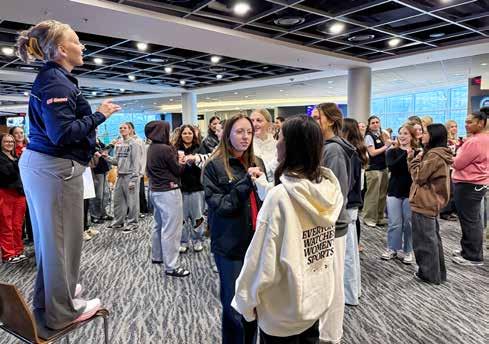
overnight,” Fehler said. “Your city, your bed, your routine, your team and coach. Literally, everything changes. And are you prepared for that? Only nine percent of high school girls will go on to play in college. Two percent of all high school athletes will play Division I.”
While some student-athletes attended workshops, adults participated in a “Coach Beyond” session focused on supporting athlete mental health.
“I’ve been an athlete for my whole life, and I’ve seen the way mental health affects the performances of athletes,” said college athlete and presenter Makayla Pitcher. “Coaches are the front line, so it’s important for them to understand and help.”
Cottonwood High Principal and presenter Justin Pitcher emphasized the need for better training and resources for coaches.
“We need to do better by our athletes here in Utah, he said. “Our data shows over half of every female team has experienced significant sadness or depression. We look at our coaches and their training. Many of them were former athletes so they understand the game well, but they don’t always know how best to handle these tough situations that we’ve been put in.”
Speaker Amy Donaldson highlighted the origins of Title IX and opportunities it presented.
“They drafted a piece of legislation that was unlike today, with 37 words,” she said. “Even though everyone thought it was this little administrative adjustment… they had no idea of (the impact of) that law.”
Donaldson encouraged student-athletes to examine their journey, to be optimistic, to wire their brains for gratitude and forgiveness, to know “no accomplishment is an individual accomplishment.”
Karissa Niehoff, National Federation of State High School Association’s executive director and CEO, challenged the next generation to continue advancing opportunities for women.
“Look at the women who came before us, and look at where we are now, and look at the future of growth in women’s and girls’ sports,” she said. “We’ve come a long way. As a woman CEO in a sports world, I feel blessed, but I challenge you as a younger generation…to carry this forward. We have to be committed to working forward so we continue the growth we need in girls who play sports in Utah.”
UHSAA Assistant Director Jeff Cluff said the progress in girls sports, including expanded championships and the addition of girls wrestling, has helped to equalize opportunities.
“We’re trying to create equal opportunities for the girls that boys have been getting for years,” he said. “We have still more to do and more to change.”
Copper Hills High seniors Brynlee Morton and Kaysha Millet said the conference left a lasting impression.
“I love how inclusive it is,” Morton said. “Everyone has valuable knowledge, and they’re sharing their expertise with us.”
Millet added: “They’re spreading awareness and information; it’s empowering to us as women athletes.”
By Kerry Angelbuer | k.angelbuer@mycityjournals.com
Many women in Utah feel they are not treated fairly in the workplace, but employers can tweak workplace culture to make a difference.
Although more than half of women in Utah choose to join the workforce, they make 27% less than men even though they do the same work and have the same skills and training. Over a career, Utah women are paid more than three quarters of a million dollars less than men. This wage gender gap is almost the worst in the nation. Although some jobs, like medical doctors, have similar pay scales, many other jobs don’t. Lisa Watts Baskin has been practicing law for 40 years and experienced a lot of difficulties and has seen some inadequate evolution. “Being a young lawyer, I had to make a choice,” said Baskin. “Having a family and working toward being a partner was not workable.” Baskin notes that some firms encourage their young fe-
male lawyers to freeze their eggs to put off starting a family until they make partner at about age 40.
Although the problem is huge, employers can help immensely by choosing to implement some women-friendly strategies. First, let go of the antiquated notion that women are not the breadwinners and so don’t need to be paid as much. In the days of non-traditional families, rising inflation in food and housing, women often also need to support their families. Additionally, transparency in how much all employees are making can help women see the unfairness and campaign for equal pay. “Making it illegal to ask how much money was made at a previous job” said Baskin, “can eliminate starting women at smaller salaries that are just above what they made before, but below what is traditional at the company.”
he gender pay gap needs to be closed, she said. “Making the criteria clear for
By Peri Kinder | peri.k@thecityjournals.com
When South Salt Lake Mayor Cherie Wood was first elected in 2010, she was a notable exception. Along with Midvale Mayor JoAnn Seghini, Wood was only the second female mayor serving in Salt Lake County at the time.
She and other women, including Riverton Mayor Sandra Lloyd, Taylorsville Mayor Janice Auger and Holladay Mayor Liane Stillman, were trailblazers and glass ceiling-breakers, setting the stage for women to take the lead, and it’s paying off.
“It’s always been a passion project for me to make sure we have women at tables where decisions are being made,” Wood said. “So I’m always encouraging women to run for office.”
Entering such a male-dominated field wasn’t easy. While many of their male counterparts offered support and encouragement, the women also encountered misogyny and roadblocks. Learning to navigate their leadership roles took patience, balance and a thick skin in order to stay the course while representing their cities.
Now, many cities in Salt Lake County are led by female mayors, including the newly elected Cottonwood Heights Mayor Gay Lynn Bennion and Riverton Mayor Tish Buroker. Add in Salt Lake City Mayor Erin Mendenhall and Salt Lake County Mayor Jenny Wilson, and female leadership is becoming the norm, rather than the exception.
“It is so important that young women and young men see women in leadership,” Bennion said. “It’s important for them to know that women can do a great job as leaders.”
Organizations like Utah Women Run and the Women’s Leadership Institute have provided training for women who want a leadership role, whether in politics or business. Women are taught to participate on boards, campaign, fundraise, advocate for themselves and develop a platform and voice that others want to follow.
Initiatives like A Bolder Way Forward focus on creating safe spaces for women in boardrooms, education, political office and civic organizations.
WLI’s Director of Programs and Operations, Nicole Carpenter, said the organization’s founder, Pat Jones, is a former Utah Senator who believes women need a seat at the table.
“We need the voices of women in all areas of leadership, particularly on Capitol Hill, where women can make decisions,” Carpenter said. “It’s important for women to have a vote, but it’s even more important for women to have a voice. To have a voice in those political circles, you need to hold an office, or you need to be a lobbyist, or have some type of political influence. So we encourage women to run for political office.”
It’s not just Salt Lake County; Utah County and Davis County have also had their share of female leaders, including Kaysville Mayor Tami Tran, who was just
climbing the ladder can make achieving the higher-paid positions fair and equitable.”
Child care is “exorbitantly expensive,” said Baskin, and providing in house or nearby options can be a huge benefit for working mothers. Similarly, allowing hybrid work that can be done both at home and in the workplace can ease this burden. Flexible schedules, even splitting a position between two people, can help anyone balance the needs of home and work. Attending a meeting remotely to allow for a sick child or elder care duties can be helpful. TRAX passes, snacks, meals with training meetings are other useful perks. Some employees supply funds to help with professional advancement like taking a client to lunch or attending conferences – these funds could also be used to defray the cost of child care. Women need to advocate for these lesser perks as well as standing firm on gender wage equity, said Baskin. “Save your daughters. Educate your daughters. Families thrive when women thrive and happier women boost the bottom line.”

elected to her second term. Not only is she a political leader, but she’s the CEO of a tech company, Rylex.
“When I became a mayor five years ago, for my first term, there were nine mayors who were new in Davis County, so almost half, since there are 15 cities,” Tran said. “Nine of us were new and three of us were women, so it was awesome to mentor each other and learn from each other. Women can see things in such a unique way, because we bring different perspectives to the room.”
Tran hopes more women run for political office, whether on the local, state or federal level, but acknowledges some women worry about balancing leadership roles with family.
Wood was a single mother, raising two boys, when she became mayor in SSL. She understands the fear and uncertainty, but she found support and people who believed in her. She said behaviors are slowly changing, with more understanding and empathy for women in leadership.
“I know it’s intimidating,” Wood said. “But there’s so much value to having different lived experiences and perspectives on councils and in elected office seats. When you invite all of those perspectives and give them a safe place to be heard, that’s when you’re going to solve big problems.”
For information about running for office, visit UtahWomenRun.org.
By Linda Petersen | l.petersen@mycityjournals.com
The Whitaker Museum in Centerville is launching a new exhibit for Women’s History Month that highlights the significant contributions of local women. Running throughout March, the exhibit aims to bring community history to life through the personal stories and experiences of the women who shaped the town.
Centerville’s history is getting a fresh voice for Women’s History Month as the Whitaker Museum launches a new exhibit dedicated to the women who shaped the community.
Since last summer organizers have been gathering the stories of local women who made significant contributions to Centerville.
The goal of the exhibit which will highlight more than 20 local women is to make the museum “come freshly alive with the women’s voices and their life experience,” said museum intern and project lead Fawn McArthur. The exhibit, which runs throughout the month of March, focuses on the contributions of women from the town’s early days through 1947.
The museum plans to highlight several main featured women – Elizabeth Whitaker, Hannah Waddoups Whitaker, Myrtle Butler Evans, Martha Rich, Elizabeth Waddoups, Mary Rockwood, Esther Rockwood Evelyn Engen who influenced the local ski economy, Eva Hancock, an advocate for social work and mental health, Elizabeth Waddoups, Mary Rockwood, Esther Rockwood, Helen Bavelas and local school teachers: Lucille Reading and Jennie P. Stewart – on large boards throughout the building.
It will also spotlight two long-standing community groups: a local quilting circle and a literary group, the Literature, Music, and Art Club of Centerville, originally started by Elizabeth Whitaker. Women from local families Tingey, Parrish, Streeper, Smedly and Porter will also be spotlighted.
Along with the posters the exhibit will include some local oral history. Visitors will be able to use their phones to scan QR codes and listen to audio clips of Martha Rich, a lifelong Centerville resident who celebrated her 90th birthday in February. In the recordings, Rich shares memories of her childhood, including what it was like to go to school and live in Centerville during World War II.
“She’s sharing little snippets of what it was like to be a child in Centerville... to play, to go to the grocery store,” McArthur said. “Just a really sweet capture of childhood in Centerville.”
Beyond the posters and audio tours, the museum will offer several tactile experiences. Judy Gunn, a local “spinster”– a
traditional term for a woman who spins wool – and several of her students will be onsite to demonstrate her craft during museum hours.
“She will be the one spinning wool, and she’ll also have that available for children or anyone coming into the museum to practice spinning wool and then make like a little bracelet out of it,” McArthur said.
Children will also have the chance to participate in a scavenger hunt and a tealeaf reading activity, inspired by Elizabeth Whitaker’s original literary group. Using dried mint or tea leaves in the bottom of a cup, children can practice the historical pastime of finding shapes and meanings in the leaves.
The museum will host a special free community event on Saturday, March 14, from 11 a.m. to 4 p.m. This event will feature even more interactive history, including butter making in the kitchen and food samples based on historical recipes used by Centerville women. Other hands-on activities will focus on the roles of nursing and midwifery in the early community.
As well as having photographs and small highlights of women throughout the museum – we’ll be bringing some of the images we have in our archives out into
the museum, whether we have the stories attached to them or not – in the hopes the faces of the women can tell something of their story or that some guests may recognize the ones we have not been able to identify,” McArthur said.
The research process headed by McArthur has been eye-opening, revealing how women built Centerville through everything from farming to social advocacy, she said. “Every different contribution... all of these women have just built up Centerville to be what it is today through their various contributions.”
The Whitaker Museum at 168 N. Main St., Centerville is open to the public on Tuesdays from 10 a.m. to 6 p.m. and Thursdays from 5 p.m. to 8 p.m. While the
The exhibit, which runs throughout the month of March, focuses on the contributions of women from the town’s early days through 1947.
March exhibit focuses on history up to the mid-20th century, organizers hope to eventually expand the project to capture the stories of Centerville women leading up to the present day.




In modern societies, especially the United States, many citizens assume that public opinion and justice should naturally align. This idea sounds reasonable: if most people believe something is right, then the system should follow that belief. However, this assumption does not understand the purpose of justice. Justice is designed not to mirror public feeling, but to apply consistent principles, protect rights, and prevent emotional reactions from overcoming fairness. In many current debates, the public increasingly treats popularity as proof of moral correctness. This shift is dangerous because in many cases, the public is simply wrong.
Justice systems, including courts such as the Supreme Court of the United States, are intentionally structured to resist sudden swings in public emotion. Laws and constitutional protections exist specifically so that decisions are made with rules in mind rather than momentary outrage. If justice followed opinion polls, legal outcomes would change whenever public anger or sympathy shifted.
Hyrum Elder
Davis Journal intern

That instability would make equal protection impossible.
One major reason public opinion diverges from justice is the speed of modern information. Social media headlines often present simplified narratives that frame events in emotional terms of heroes and villains. Once that framing spreads, many people form conclusions before evidence is fully examined. In contrast, courts must evaluate concrete facts, institutional fairness, and legal standards. What feels morally obvious to the public may not meet the standard required for lawful judgment. Justice demands proof;
public opinion demands satisfaction.
Another factor is that justice protects minorities and unpopular individuals. The foundational principle behind documents like the United States Constitution is that rights do not disappear when someone becomes disliked. Historically, crowds have supported wrongful convictions, discriminatory laws, and punishments later viewed as unjust. If popularity determined outcomes, these errors would not be corrected. Justice must therefore operate like a compass fixed to true north, not like a weather vane turning to every political wind.
It is also important to recognize that the public frequently confuses accountability with severity. Calls for the harshest possible punishment are often framed as “justice,” even when excessive penalties violate proportion or due process. True justice measures responsibility carefully. It does not ask what punishment feels satisfying, but what punishment is lawful, consistent, and defensible across all similar cases.
For these reasons, the growing belief that public sentiment should guide legal outcomes represents a misunderstanding of how justice functions. Public participation is essential in elections and legislation, but the courtroom must remain in a place where evidence outweighs emotion, and principles outweigh popularity. When society forgets this distinction, it risks replacing justice with collective impulse.
Ultimately, a fair system is not proven correct because the majority approves of it. It is proven correct because it applies the same rules even when doing so is unpopular. Justice, by its very design, must sometimes stand against the crowd. And when public opinion conflicts with legal fairness, it is not the system that has failed. More often than people want to admit, the public itself has.
Hyrum Elder is a senior at Woods Cross High School and working as an intern with the Davis Journal.
By Nelson Thibault, USN, Retired
An official citation read aloud at the State Capital on Thursday, Feb. 12, 2026 by Rep. Tyler Clancy honored Utah Vietnam veterans who were exposed to the toxic herbicide Agent Orange and similar chemical herbicides.
The extraordinary event took place on the floor of the House of Representatives, where about two dozen veterans along with family members were in attendance.
The heading of the citation, “In Recognition of Utah Veterans of the Vietnam War Affected by Agent Orange,” clearly indicates its immense scope. The document’s text goes on to acknowledge the tragic impact of the toxic chemical and pays tribute to those harmed by it.
That type of recognition is extremely meaningful and greatly appreciated. It’s certainly a far cry from the way Vietnam veterans were treated when they returned home from duty in Southeast Asia.
Over the years, attitudes about Vietnam veterans have slowly changed. They have reached a point where gratitude and respect have replaced ingratitude and disrespect. This change is largely due to veteran advocacy,
One very notable organization that has helped promote
such advocacy is the Utah Agent Orange Veterans Foundation, a Davis County nonprofit organization established in 2023 and chaired by Vietnam veteran Larry Kerr.
The foundation’s mission is to build a monument dedicated to veterans who were exposed to Agent Orange and similar toxic chemicals and to educate future generations about the impact of those chemicals.
One of the foundation’s board members is Hannah Turk. Hannah’s father is a Vietnam veteran who has dealt with the adverse effects of Agent Orange exposure for a number of years now and his health issues have significantly influenced Hannah’s advocacy efforts.
Hannah’s diligence and tenacity, for example, helped bring about the event at the Utah State Capital, where she was joined by members of The Rivetin’ Rosie’s Project.
Hannah is the organization’s vice president and cofounder. Like her, members of The Rivetin’ Rosie’s Project are also very keen and determined veteran advocates.
One of the most notable highlights of
the ceremony was a terribly somber speech given by Joseph Vigil. His words conveyed how being exposed to Agent Orange has adversely affected his health and caused the premature death of his uncle.
The gratitude expressed by Utah lawmakers at the historic event was overwhelming and the ceremony was a well-deserved tribute to veterans who sacrificed so much for their country.





Remember when you thought Mr. Monopoly wore a monocle, or you were convinced Curious George had a tail? Memory is a funny thing.
Or how about when NBC anchor Brian Williams “misremembered” being in a helicopter hit by anti-tank weapons in Iraq? His faulty memory got him suspended.
We all misremember things, but when an entire group does it, it’s called the Mandela Effect, a phenomenon that occurs when millions of people are confidently wrong. Like, remember when we all believed Vladimir Putin was a war criminal? LOL. Good times.
If you’re a Gen Xer, you might remember when the VHS tape got eaten by the VCR and you had to use brain surgeon-style techniques to carefully respool the video. But then the tape always had a wrinkled section where the movie would go wonky for a few seconds. That’s what my memory feels like most days: warped and staticky.
My husband is basically a human computer. He remembers everything. When we meet new people, he lights up like an exploding star. He’s curious about their background, hometown and their connection to any celebrity-type person.
Months later, he’ll say, “Remember at the Yankees game when we met that guy who was married to the cousin of a friend who knows Ryan Reynolds? I think his name was George.”

“No.”
“Yeah, you do. He owned a horse farm outside of Albany and loves the color orange.”
“What are you talking about?”
His memory recall is slightly unsettling. He’ll drop info like, “I remember the 1968 World Series when the Detroit Tigers came from behind to beat the Cardinals. They hadn’t won since 1945 and Mickey Lolich was the MVP.”
And then there’s me, having to watch a recap for a TV show I watched the night before. But then I remember random things, like when Sen. Mike Lee advocated for term limits. Hahahaha. The good ol’ days.
I was playing a “Frozen” matching game with my 9 year old granddaughter, trying to remember where the pair of Olafs were hiding. I kept turning over the same two cards, a Sven and an Elsa, convinced I’d finally cracked the code.
My granddaughter found it hilarious watching her doddering old granny lose a game. But there was a time I was the matching

game champ. At least that’s my recollection.
I can still sing Abba’s entire “Arrival” album from 1976 but I’m not quite sure I actually attended a single day of high school. I used to know dozens of phone numbers, but now I couldn’t call my daughters if the world were ending and I had to use a rotary phone.
When it comes to remembering the names of dogs I met at the dog park, I’ve got it down. But their owners’ names? No clue. I can make my mom’s mac and cheese by heart, but need to read the directions on a cake mix four times before I get it right.
It makes me second-guess my memory, like, do you recall when Gov. Spencer Cox took the side of trans kids? Or was that also the
Mandela Effect?
If you’ve ever had a sibling contradict your side of a story, or you can’t remember your eighth-grade science teacher, you’re not alone. Or maybe you had an existential crisis when you realized C-3PO’s lower right leg was silver, not gold.
Memory isn’t just fleeting, it’s fluid. When time blurs the moments we fell flat on our faces, it’s a reminder that our flashbacks are edited highlight reels, usually with a laugh track.
Peri Kinder is an award-winning columnist and journalist who has written for The City Journals since 2004. She can be reached at peri.k@thecityjournals.com