
Wall of Fame
Three inductees come from art, law, athletics Page 13
Pad Only open weekends with current drought conditions Page 15

Three inductees come from art, law, athletics Page 13
Pad Only open weekends with current drought conditions Page 15
By Julie Slama | j.slama@mycityjournals.com
Students track reading progress with paw prints to celebrate success at final gala.
Books, music, stuffed reading buddies, dinner and desserts made Bella Vista Elementary’s final Reading Gala a night students will remember. The elementary will close at the end of this school year.
The school celebrated its fifth and final gala with a DJ playing favorite songs and orchestrating fun dance contests for students after they ate, picked out free books and built their own Bella tiger mascot stuffies. Many students, some with sugar from doughnuts still on their lips, posed for photos together in a school photo booth.
Fifth-grader Victor Hernandez said this gala felt extra exceptional.
“This is our last gala here,” he said. “We’ve been here before and it was fun, but this one is special. We’re getting to make tiger stuffies and pick out free books. I hope they have a ‘Diary of a Wimpy Kid’ book; they’re my favorite.”
His younger sister, Daniella, already had a name for her stuffed tiger: Rosie.

“I like ‘Diary of a Wimpy Kid’ books, than reading minutes.
out with my kid by myself,” parent Rebec ca Allen said. “I’m getting to celebrate his






Common Ground will be a column of rotating viewpoints that highlight specific feelings across the political spectrum, and it will always end with possible ways to come together.
There once was a giant sandbox where everyone could play together. It had dump trucks, shovels, sandcastle molds and one corner filled with cigarette butts from the high school teens.
Big Brother (BB) controlled the sandbox. He carried a clipboard and whistle, and discouraged others from playing. Although it belonged to the entire community, BB would chase people away, saying, “That’s just the rules,” which he had made himself, of course.
But Little Brother (LB) wanted to play. He tried to convince BB to give him just a small part of the sandbox to build sculptures with his friends. “What about this spot?” he asked.
BB clutched his clipboard to his chest and gasped. “That’s a very important place. That’s my transportation corridor. You can’t have it.”
Every spot LB suggested, BB drew a new line in the sand and explained why it just wasn’t feasible. That spot was BB’s economic area, and another spot was an important waterway. Soon, all that was left was the ashtray corner, but BB wanted control over that, too.
LB went to find Mom (who represents voters, the judiciary and common sense). She explained to BB that the sandbox belonged to everyone and LB could have his share.
and sand toys ever since, trying to overturn the Court’s decision.
Instead of a sandbox, we’re dealing with voting maps. Gerrymandering has shaped Utah’s leadership for decades, especially in creating congressional districts that look more like a sliced pizza than an equally divided constituency.
We can’t bury our heads in the sand and expect the majority leadership in our state to treat us fairly. In 2018, Utah voters tried to redraw the sandbox lines, approving a ballot initiative that would create an independent redistricting committee to create voting maps to avoid gerrymandering.
But Gov. Cox signed a different map into law that split Salt Lake County into four districts that could easily be controlled by Republicans. The new map ignored the committee’s recommendations, which would give Democrats a possibility of winning a Congressional seat.
Utah’s League of Women Voters filed a lawsuit, claiming the new map was a bunch of baloney. They won that case in 2024 when the Utah Supreme Court ruled that legislators could not override the voice of the people. But the majority leadership has been fighting for its maps
BB was furious and started throwing sand at Mom, calling her a bully. “You’re destroying the integrity of the sandbox!” he screamed. Then he spent the rest of the summer planning to steal back LB’s share.
COTTONWOOD HEIGHTS TEAM
The Cottonwood Heights Journal is a monthly publication distributed directly to residents via the USPS as well as locations throughout Cottonwood Heights.
The views and opinions expressed in display advertisements do not necessarily reflect or represent the views and opinions held by Loyal Perch Media or the City Journals. This publication may not be reproduced in whole or in part without the express written consent of the owner.
© 2026 Loyal Perch Media, Inc.
PUBLISHER
Bryan Scott | bryan.s@thecityjournals.com
EDITOR
Travis Barton | travis.b@thecityjournals.com
ADVERTISING EXECUTIVES
Mieka Sawatzki | mieka.s@thecityjournals.com
Ryan Casper | ryan.c@thecityjournals.com Marc Davis | marc.d@thecityjournals.com
CLIENT SERVICES
Lydia Rice | lydia.r@thecityjournals.com 385-557-1022
Common Ground: Gerrymandering should be illegal in every state because it skews voters’ rights and stacks the deck for whoever the majority party may be. Maybe instead of lawmakers crafting the voting maps, independent commissions can be tasked with creating fair districts for all states.
We’re told that every vote counts, but that’s not the case in gerrymandered states, on both sides of the aisle. Voters feel frustrated and unheard. I think we can agree our system is broken. Majority leaders in states, both Red and Blue, draw the voting maps, create the rules and decide which demographics get representation.
Could Utah take the high road and fix the system? Could we become a beacon of guidance and inspiration for the country in a time that feels heavy and dark? It’s a nice idea, we just need brave leaders willing to adopt meaningful change.
A diverse range of opinions creates effective solutions. Instead of one group deciding the laws, it strengthens our democracy to include voices from differing beliefs and experiences.
Gerrymandering eliminates divergent voices, creating a system of inbred and insipid decisions. That doesn’t sound like fair representation; that sounds like a power grab, no matter the party.
In May, John J. Walker’s Common Ground article, “I can’t afford YOUR tax bill,” sparked a flurry of replies, including one from reader Christine. “I would agree that paying for infrastructure is important and it’s tough when your paycheck doesn’t go very far for all your hard-worked hours. I would disagree, however, about the derogatory generalization of Democrats being the brainless, doom-scrolling, rage-bating, vulgarity-writing party.”
Some commenters said they want their tax dollars spent on things like zoos, parks, and museums, and felt Mr. Walker’s column was “negative and angry.” Others felt people earning over $1 million should pay more into the system.
Readers expressed appreciation for the Common Ground concept, with the focus of bringing the community together, even when we disagree. However, reader Laura felt the tone of Mr. Walker’s op-ed didn’t fit that description. “I don’t see how the rudeness expressed in this article could achieve that goal,” she wrote.
A reader named Tyler summed up a prevailing sentiment when he wrote, “I think the [Common Ground] approach and voice is exactly what our community needs. I firmly believe that informing on political issues is a much-needed thing. I hope that the continued success of the column helps bring our community closer together!”
— City Journals Columnist Peri Kinder
CIRCULATION COORDINATOR Lindsay Andreasen | lindsay.a@thecityjournals.com Rack locations are also available on our website.
EDITORIAL & AD DESIGN
Stacey LaMont Ty Gorton
COTTONWOOD HEIGHTS CITY JOURNAL 9500 South 500 West, Suite 205 Sandy, UT 84070
PHONE: 801-254-5974
MISSION STATEMENT
Our mission is to inform and entertain our community while promoting a strong local economy via relevant content presented across a synergetic network of print and digital media.
Designed, Published, & Distributed by

The Cottonwood Heights City Council Voted against being part of the Utah Renewable Community

by Francisco Kjolseth
Every parent in the Salt Lake Valley knows the ritual. You look outside before your kids leave for school. You check the air quality app before soccer practice. You wonder whether today is a “stay inside” day.
The consequences are real:
More pollution.
More emissions trapped in our valley.
More days where children, seniors, and vulnerable residents are told to stay indoors.
Utahns have already shown they want a different future. Families across our state have invested in rooftop solar, cleaner vehicles, and energy efficiency because they care deeply about the air we all share.
Our community deserves leadership willing to move with the people — not against them.
Because clean air should not be a luxury.
And no child should grow up thinking it’s normal to check whether the air outside is safe to breathe.
Uncertainty continues for Sandy families as decision tabled for comprehensive district study of school feeder systems.
By Julie Slama j.slama@mycityjournals.com
After a year of uncertainty, many Sandy parents expected a decision about proposed school consolidations in early May, however, Canyons Board of Education members had second thoughts.
No final decision was made on the plan to merge Granite Elementary with Quail Hollow Elementary nor Park Lane Elementary with Willow Canyon Elementary. The school board tabled the decision and instead, chose to conduct a comprehensive districtwide study of elementary schools feeding into middle and high schools and will study enrollment trends and boundary impacts districtwide.
Board member Katie Dahle made the motion postponing the vote, indicating she wanted additional time to study how enrollment declines are affecting schools and feeder systems across the district rather than moving forward with individual school consolidations.
“It became more apparent this spring as we were talking about it; we knew this was an issue,” she said. “We knew we were going
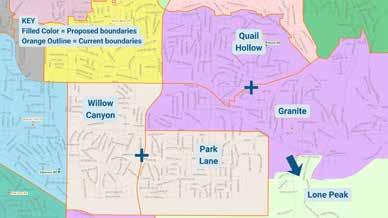
to have to look at this. Our goal was that we could sort of do these in layers, bit by bit; but as we went through it, nine schools connect, boundary-wise, that are facing declining enrollment, and they’re only a year or two behind where Granite, Park Lane and Willow Canyon are currently. So, we need to be sure we have the right decision for those schools.”
The comprehensive study is expected to take an additional year, which Dahle said created more frustration for some parents by not knowing their students’ future schools, yet relief for others that no hasty decision was made. Parents have been giving feedback to the Board on different proposals at lengthy public hearings and board meetings as well as
The possible school merger in Canyons School District was paused for the school board members to conduct a more comprehensive study. (Image courtesy of Canyons School District)
through phone calls, emails and online input.
“The Willow Canyon and Park Lane communities were glad we paused with this goal to provide a long-term plan our community can trust and be behind; that’s actually what they were asking for,” she said. “The Granite community was frustrated because they wanted to be done. I empathize, because this is a hard, long, emotional process. They want to be settled. I want them to be settled, but I don’t want to pull their chain and have something change in a couple years as we address neighboring schools.”
The proposals to merge schools comes from ongoing challenges in declining enrollment, lower birth rates and rising hous-
ing costs.
Board members said it’s best for schools with low enrollment to consolidate, but with additional time to ensure they’re making the best decision.
“It’s not like, we paused it indefinitely,” Dahle said. “I’m fully committed to putting all my effort into getting this done in an expeditious manner so we can find some resolve for these families. We have until December to make any final decisions for the ’27-’28 year. So, there’s still the possibility we could do something, but we need to make sure we know the next steps are also ready to go, and it all makes sense.”
The Board said it wants to be financially responsible with taxpayer money, however a couple board members expressed surprise about the motion.
“I did catch them off guard,” Dahle said. “I honestly went into that meeting thinking I was going to vote for the closure of Granite, not that I liked it, but this is what we’ve been working on. And it hit me to the point I was shaking; this is not the right decision. This is not the right long-term decision to do this in a vacuum after we’ve pulled off all these other pieces; we can’t do this in a vacuum. It’s important we get this right the first time, because its students’ and its families’ lives at stake, and it’s not fair to them to have uncertainty in the process.” l

Further discussion was held by the city council May 19, after press deadline. Information may have changed.
By Cassie Goff c.goff@mycityjournals.com
The Cottonwood Heights City Council has been deliberating on whether or not they should continue to be a participating member of the Utah Renewable Communities (URC) program. With an approaching deadline, that decision needs to be finalized by June 2 (unless URC pushes out that deadline).
“Public health is our responsibility as leaders in this community. Nothing is more important than something that helps to clean our air and control this temperature spike we are in,” said Councilmember Ellen Birrell.
Cottonwood Heights Planner Sheldon Howa has been providing overviews and updates to the URC program to the city council since January. URC’s primary goal is to make net-100% clean electricity available to homes and businesses in participating communities by 2030.
“URC is a coalition of 19 cities, including Cottonwood Heights as well, advocating for clean energy for homes and businesses in our communities,” Howa said.
Clean energy projects, through the URC program, must interconnect directly with the PacifiCorp transmission grid in Utah, Wyoming and Idaho.
“The grid covers six states so the energy could go to any of those six states,” noted Councilmember Suzanne Hyland.
Upon adoption, Rocky Mountain Power (RMP) customers will be automatically enrolled with an automatic $3-$4 per month increase onto their utility bill. Provisions for low-income households to participate in the program has been proposed to offset the cover costs of 70 cents. (The $4 per month fee proposal has been broken down to a flat-rate fee of $3.88 monthly program participation fee and a $0.12 monthly surcharge for a low-income program.)
“I am very much in favor of renewables,”

Council joined this agency when they unanimously passed Resolution 2019-66: Amending and Restating the Cottonwood Heights Sustainable Energy Policy on Oct. 15, 2019.
“The membership fee was just over $21,000,” Howa said. “That’s been budgeted and paid already.”
As of May 11, Salt Lake City, Park City, Summit County, Emigration Canyon, Springdale, Moab and Ogden all adopted ordinances to participate.
said Councilmember Matt Holton. “I do not believe that this is the way to achieve that. This is a way to absolutely guarantee that our residents are going to pay more for basic utility services.”
Holton continued saying he didn’t want five people (referencing the city council) to force that choice onto 30,000.
“Rocky Mountain did argue that they wanted to see a 10% increase to cover costs so they are trying to decide what is fair and equitable with this program,” Howa said.
RMP customers will have an option to individually opt-out within a six-month time period. But, opting-out beyond those six months is expected to come with an additional fee.
“If people could opt-in, I’d be 100% behind it,” Councilmember Shawn Newell. “The fact we’re going to tell residents you’re in this… and some of them don’t look at their bills that closely … it’s a trap. I’d rather have a program where residents have a true choice.”
Discussions to set the specific price-point for that fee are still ongoing. A minimum of $3$5 are being discussed to as much as a $30 to opt-out of the URC program.
“We should not tax basic services. This is a tax on basic services. The opt-out is an illusion of choice,” Hyland said. “There’s a penalty for opting out. How in the world can we justify a penalty for opting out?”
She further noted that the expectations are about 20% of residential customers will opt-out while nearly all commercial custom-
ers will opt-out.
Cottonwood Heights residents Matt Parsons, Dave Schoeneck, Melissa Fields, Chester France, and Shannon Hayley all spoke in support of the city joining the URC program during public comment sessions.
“Three dollars a month is a small price to pay for the air quality and health of the community,” Parsons said.
Benefits of joining this URC program, as summarized by Howa, includes: protecting resident health, safety and overall quality of life; addressing air quality and environmental challenges; responding to community interest in clearer energy choices; and building on Cottonwood Heights’s existing sustainability efforts.
“If we make the choice to vote no, we take this choice from our residents,” said Cottonwood Heights Mayor Gay Lynn Bennion.
The Community Renewable Energy Agency formed in response to a 2019 bill (HB 411), along with the Clean Air Act in 2019, which created a pathway for renewable energy for interested communities served by RMP.
“When this was passed by the legislature, it was passed with a strong majority, almost 50 members of the 75 voted in support,” said Bennion.
“The economics of energy has changed since 2019,” Hyland said. “We are now competing with data centers and that’s going to drive up the cost of what this program anticipated.”
The previous Cottonwood Heights City
Out of the 19 original communities, town of Castle Valley, Springdale town, Alta, Oakley, Francis, Coalville, Kearns, Millcreek, Midvale and Holladay are still deciding if they’d like to continue their participation as well. Hyland noted that Sandy and Draper have never been a part of this program.
If the council decides to adopt a participating ordinance, RMP customers will automatically support investment in clean energy, with the option to exit at any time.
“What I’m hearing from constituents all over Cottonwood Heights is ‘Don’t take away my choice,’” said Birrell. “It aligns with our Sustainability Plan.”
Cottonwood Heights will need to pay noticing fees through RMP. An initial round of paper notices and a secondary round of e-mail notices (though RMP’s paperless billing list) will cost the city an estimated $18,761.11.
Utah Renewable Communities noted RMP customers in participating communities won’t see notices until later in the year for 2026 or early 2027.
Cottonwood Heights held an open house to answer questions and hear from residents on May 13.
For more information, visit Cottonwood Heights’s website at: www.cottonwoodheights. utah.gov/community/sustainability Or visit URC’s website at: www.utahrenewablecommunities.org.
“I cannot imagine us being the first legislators in the county who establish a precedent that a government entity can vote to subscribe its residents to products or services in a publicly traded for-profit company,” Hyland said. l


“Plants are exciting, much more fun than grass,” said Casey Finlinson, CUWCD Conservation program coordinator.
By Cassie Goff c.goff@mycityjournals.com
Gardeningseason is upon us! As questions about gardening and waterwise landscaping have emerged from Utah residents, Localscapes has stepped up with answers offering a variety of free gardening and landscaping classes. In partnership with the Central Utah Wasatch Conservancy District (CUWCD), Localscapes classes are specifically created around the challenges of Utah’s climate.
“Creating Your Ideal Utah Yard” has been one of their most well-attended community classes. Casey Finlinson, CUWCD Conservation Program Coordinator, taught this course to Cottonwood Heights residents on April 2 and to Sandy residents on May 24.
“Get some function and curb appeal out of the yard,” Finlinson said.
An average Sandy/Cottonwood Heights residential home typically has approximately .27 acres of yard-area. With a “traditional” Utah Landscape, 90% of that tends to be lawn/ grass. If a resident is watering that lawn area with the 40 inches of water grass required per season, that’s about 176,250 gallons of water use per year.

Localspaces invites residents to consider redeveloping their yard’s landscaping so it isn’t so lawn/grass centric. By implementing some of their research-driven landscaping suggestions, homeowners can save water, lower their annual yard maintenance and irrigation, improve functionality of their yards, and improve the curb appeal of their home.
“Waterwise landscaping requires minimal maintenance,” said Water Education and Public Outreach Coordinator for Sandy City Nikki Wyman.
Residents who incorporate landscaping elements (like plant bed and hardscapes) to reduce their grass areas to 20% (instead of 90%) typically average out to save 110,000 gallons of water per year. (A 20% grass yards typically




need 64,766 gallons per year.)
Specifically, Finlinson recommends keeping lawn/grass areas usable.
“Keep lawn off of steep slopes,” Finlinson said. “If you can’t sit on a lawn chair comfortably than it’s too steep to have a grass slope.”
When beginning a Localscapes landscaping journey, Finlinson recommends taking some time to analyze the area with a needs assessment. A Google Maps image of the area can help to identify specific areas like central open space.
Then, consider the desired functions of the yard. (Do you need privacy from neighbors? Do you need specific areas for kids to play? Where do plants struggle? How sunny or shady are different parts of the yard? Where do you need more sun or shade? Where is wasted space? Do you need room for things like an RV pad?)
Finlinson recommends considering multiple gathering areas throughout the yard. For those gathering areas that do require grass, Finlinson and the Localscapes team suggest planning grass spaces of yards with sprinklers in mind. If landscapers are considering first how sprinklers will be using water, it makes the grass areas more usable without overwatering the lawn.
Finlinson mentioned how residents shouldn’t be planning to put grass in areas less than 8 feet because of guidance coming down from the State Legislature that will soon be written into new city ordinances.
Once central gathering spaces have been identified, consider where connective pathways need to be. Pathways should be designed to connect elements of the area.
“We don’t want to have blandscapes,” Finlinson joked. “Think about your gathering areas and how to connect space with some paths; anything leftover becomes planting beds.”
For pathways and area lines, Finlinson recommends material like pavers, flagstone, gravel and chat for the hardscape.
“Gravel gets kicked around and doesn’t compact very well so it’s challenging for pathways and creates tripping hazards,” said Wyman. “Chat has a binding agent in it and it compacts well enough that it’s hard for seeds to take root in it. If we see weeds coming up, it’s in the margins.”
Finlinson also recommends thinking through which paths needs to be primary and secondary. Primary paths should be built with hardscape material to be able to clear snow in the winter. Secondary paths won’t require snow removal so they can be as simple as bark.
“We don’t want lawn to be a pathway. It’s so much easier to have a hardscape material because then you don’t have to water or maintain it,” Finlinson said.
For aesthetics, Finlinson recommends planning to utilize contrasting and permanent materials.
“Make it look like it’s on purpose,” Finlinson said. “Make defined edges.”
Once gathering areas and pathways are mapped out, planting beds can begin to fill in additional open space and provide some privacy. Finlinson recommended planting annuals in pots and decorating all gathering areas with perennials.
“Don’t mix annuals and perennials in planting beds because they have different water needs,” he said. “Bulbs are considered water efficient with moisture and soil.”
Irrigation drip lines are recommended to water those planting beds, with in-line drip holes measured 12 to 18 inches apart. Inline drips are measured by gallons per hour instead of gallons per minute like sprinklers.
“In Sandy soil, 12 inches apart is a must. Sandy soil goes straight down so you need the lines closer,” Finlinson said. “Water two days per week for 30 minutes for Sandy soil.”
During this class, Finlinson answered a few resident-specific questions. Here’s a quick glance at the Q&A breakdown:
Tree roots pop out of the lawn when they need more oxygen. The soil’s probably too wet.
Bermuda grass is illegal in Utah. If you don’t know what kind of grass you have at home, it’s probably Kentucky bluegrass.
Rotor sprinkles run twice as long as fixedhead sprinklers.
Typically, most Utah homes have full sun areas on the south and west sides. Partial sun is to the east. Shade is generally on the north.
Want to learn more specifics for gardening beds? Next month we’ll recap the “Creating a Plant Bed Design” Localscapes class.
Before digging, residents should remember to call Blue Stakes of Utah for a free utility line location service. Any digging in residential areas needs to be at least five feet away from a gas line for trees. Call 1-800-662-4111 or visit www.bluestakes.org. Local residents can also call 811.
Sandy’s free demonstration garden currently has some eco-lawns on display. Visit Sego Lily Gardens at 1472 E. Sego Lily Drive.
To learn more about Localscapes and their classes, search their events through EventBrite or e-mail info@localscapes.com.
CUWCD’s office is located in Orem at 1426 E. 750 North. To review this course or view recordings of past classes, visit www.CUWCD.gov/classes l
The new coach spent over a decade at Park City High.
By Jerry S. Christensen j.christensen@mycityjournals.com
It was late September 2022 as the autumn cold began to set in. The Park City High School Miners football team descended to Cottonwood Heights looking for vengeance on Brighton High School for edging them out of the region title on the last game of the regular season last year.
Just before halftime, the Miners looked unstoppable with a 33-14 lead. It became a tale of two halves as Brighton’s defense stiffened to allow no more Miner scoring in the last 32 minutes of the game. The offense matched the defense’s intensity and scored the next 33 points to thrill the near-capacity crowd with a 47-33 win. The “Park City comeback” became the highlight of the year.
Fast forward to 2026 and Brighton has named Josh Montzingo, the longtime Park City coach from that game, as the new Bengal head football coach. Montzingo ushers in the next chapter for the Brighton program following the departure of Casey Sutera to Corner Canyon. Montzingo, a veteran coach with more than 20 years of experience, arrives with a strong track record of building competitive, high-character programs.
Montzingo spent 13 years with the Park City High School football program, the last
I’m excited to coach at this level at Brighton. I’ve played against Brighton in very competitive games with Brighton and Park City. I know how good this program is.
— Josh Montzingo
10 as head coach. He compiled an impressive 82-39 overall record, secured four region championships, and led the Miners to three playoff appearances at Rice-Eccles Stadium—including three state semifinals and one state finals berth. His teams successfully navigated classification changes from 3A to 4A and up to 5A while maintaining a championship-level standard. He developed dozens of college-bound players, sending 45 athletes on to play at the next level.
“I’m excited to coach at this level at Brighton,” Montzingo said. “I’ve played against Brighton in very competitive games

with Brighton and Park City. I know how good this program is.”
Prior to Park City, Montzingo coached in Nebraska and began his involvement as a student coach at Deerfield High School in Illinois. He played college football as a middle linebacker at North Park University (NCAA Division III) in Illinois.
Brighton Principal Marielle Rawle and Athletic Director Garrett Wilson expressed enthusiasm for Montzingo’s hire. “Coach Montzingo is commitment to developing student-athletes both on and off the field. His coaching history highlights his focus on stability, integrity, pride, discipline and accountability,” Wilson said.
Montzingo has a reputation for fostering a culture that extends beyond the gridiron. He values multisport participation and sees the benefits it brings to football players. “I enjoy seeing two-sport athletes hone their skills in other sports that make them better football players,” he said. He encourages players to be positive role models in the community while building resilience, hard work and strong character.
Community members and former players from Park City have praised Montzingo’s mentorship and the lasting impact he had on young men in the program. As he transitions to the brighter lights of the 5A landscape at Brighton, expectations are high for continued success in Cottonwood Heights.
Montzingo is already connecting with the Brighton community as a part of the teaching faculty at Brighton in the third trimester. He begins leading the gridiron Bengals this spring and summer in preparation for the upcoming season. l

Charge for Change focuses on the recycling of batteries. (Hailey Park)

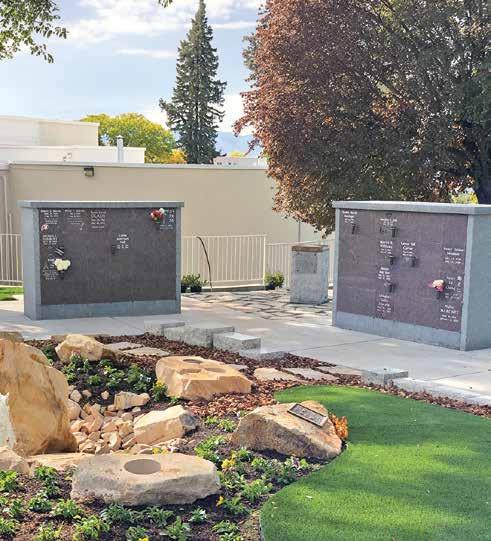
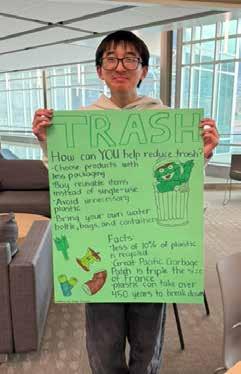
The Skyline-led student club and nonprofit organization has grown to 60 members and counting. (Hailey Park)
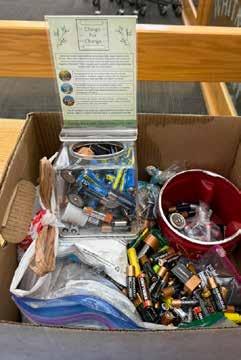
Charge for Change currently has four donation locations, with hopes to expand in the near future. (Hailey Park)
The local nonprofit maintains four battery drop boxes in the Cottonwood Heights/Millcreek areas with hopes for expansion.
By Lizzie Walje l.walje@mycityjournals.com
As summer settles into the Salt Lake valleFor Skyline High School student Hailey Park, an interest in environmentalism existed long before she conceptualized Charge for Change.
Park, currently a sophomore, is the daughter of two South Korean immigrants who own and operate a Salt Lake City restaurant called Mr. Shabu. Growing up around her family’s business, Park began to realize that the restaurant generated a substantial amount of battery waste. After encountering battery recycling stations at both the University of Utah and Salt Lake Community College, Park decided to take the initiative into her own hands, ultimately leading to the creation of Charge for Change.
Like many nonprofit organizations, Charge for Change emerged from humble beginnings. After drawing inspiration from her surroundings, Park channeled substantial energy into researching battery recycling. It was around this same time that she began collecting batteries from her friends and family, before dropping them off at one of Utah’s battery disposal centers. During those drop-offs, which Park herself would facilitate, she routinely inquired about the battery disposal and recycling process. Eventually, Park would use this new-
found knowledge as a foundational base for creating Charge for Change.
“It mostly started in December of 2024,” Park said. “That’s when I started actually collecting batteries, not just from the people I knew but from people that I didn’t know throughout the community. I started at the library by my house, at Whitmore Library, in Cottonwood Heights. That’s where I put my very first collection box and it became so much more popular than I thought it would. Just in the first week, we had [the donation box] filled up.”
Following this unexpected success, Park decided to establish additional donation stations at the Cottonwood Heights City Hall and the Cottonwood Heights Recreation Center. Park’s hard work was beginning to come to fruition; however, she soon realized the project was becoming unmanageable for one person alone. At the time, Park was unable to drive, making it difficult to oversee the logistics associated with the collection process. Her next move was founding a club at Skyline High School. In autumn of 2025, Charge for Change was officially born.
Charge for Change is almost exclusively student-run. For context, all clubs at Skyline are overseen by an adult advisor; in the case of Charge for Change, that advisor is science teacher Malia Groesbeck. However, despite Groesbeck’s support, Charge for Change is very much propelled by students, particularly those in leadership positions. Since the club’s formal registration as a nonprofit, they have recycled 1,270 pounds of batteries.
As of spring 2026, Park has retained her position as founder and president of Charge for Change. The club also features six addition-
al student leadership positions currently held by Lydia Bartholomew, Melanie Wang, Elijah Shen, Nathan Wilkerson Wong, Solomon Kim and Chloe Park. In a little over a year’s time, Charge for Change has grown to 60 students and counting, as it remains open enrollment for students interested in joining. Park stated that while Charge for Change is currently exclusive to Skyline students, the organization leaves the opportunity for students at other schools to establish clubs of their own.
Presently, Charge for Change is focused on a handful of different tasks, including managing their four current donation boxes. These donation boxes can be utilized by anyone in the community and are equipped to handle any type of battery, aside from alkaline batteries. Unlike other batteries, alkaline batteries require a different refinement process to become suitable for recycling. While some specialized facilities and hazardous waste programs in Utah are able to process alkaline batteries, the infrastructure for widespread alkaline battery recycling remains limited.
“We’ve talked with [the disposal centers] about recycling alkaline batteries and they’ve agreed to dispose of them in a way that mitigates risk and stops them from going into the landfill with everyone else. So right now, although those aren’t being fully recycled, they’re being disposed of in a way that is a little safer for the environment,” Park said.
Despite the limited availability of alkaline battery recycling in Utah, Park remains optimistic that such technology could become more accessible in the future. More broadly, Park hopes to see Utah strengthen its battery recycling initiatives through the addition of sup-
portive legislation. She pointed to California as an example with its extensive battery recycling protocols already in place. Park hopes to see similar legislation and infrastructure implemented in Utah.
“One thing we did recently, me and a few people from the Charge for Change team was go to the Cottonwood Heights City Hall and we had a meeting with the city’s planners and a few other people to talk about potential next steps. Steps for how we can continue to grow our program with them,” Park said. “So I’m hoping that soon in a few years after our program expands even more, we’ll be able to have a bigger impact by working with various city halls.” Park is fully committed to Charge for Change and intends to continue growing the program until she graduates. Park cannot say for certain whether she will maintain a position within the organization post-graduation, although she hopes to remain involved in some capacity. For now, Park is focused on ensuring the club is managed effectively while continuing to expand both her team and the number of donation boxes available.
Charge for Change battery donation stations are currently located at the Millcreek Community Library, Cottonwood Heights Recreation Center, Cottonwood Heights City Hall and Whitmore Library in Cottonwood Heights. All types of batteries, including larger batteries such as car batteries, can be donated at any Charge for Change box. The only batteries not accepted for recycling are alkaline batteries and leaking batteries of any kind. To learn more about Charge for Change and stay up to date on its operations, visit its Instagram page, @Charge.For.Change l
HEN YOU THINK OF PARKINSON’S DISEASE, a visible tremor might come to mind. However, the true experience often lies hidden beneath the surface – an “invisible struggle” impacting millions. This article highlights the complexities of Parkinson’s and advancements in care.
A common misconception is that all Parkinson’s patients experience tremors. This isn’t true; up to 20% do not. Additionally, Parkinson’s isn’t just an elderly condition. Young-Onset Parkinson’s Disease (YOPD) affects individuals under 50, with celebrity Michael J. Fox, diagnosed at 29, significantly raising awareness and funding for research.
As Dr. Sunil Rathore, a neurologist at Holy Cross Hospital – Salt Lake, emphasizes, “Many people believe Parkinson’s is solely a motor condition, defined by tremors and rigidity. However, that’s just one piece of a much larger and more complex puzzle. The non-motor symptoms – from sleep disturbances and anxiety to cognitive changes and chronic pain – can often be the most challenging aspects for our patients.”
The “invisible struggle” of Parkinson’s includes a wide array of non-motor symptoms impacting daily life, often appearing years before motor symptoms. These can include loss of smell (anosmia), REM sleep behavior disorder, constipation, depression, anxiety, cognitive changes, and debilitating fatigue. These realities profoundly affect well-being, turning simple tasks like dressing or driving into immense challenges and leading to social isolation.
While there’s no cure, significant advancements are improving symptom management and quality of life. Levodopa remains a cornerstone medication, with ongoing developments to optimize its effectiveness. Advanced therapies like Deep Brain Stimulation (DBS) and focused ultrasound offer new hope by precisely targeting brain areas responsible for motor symptoms. Emerging research explores disease-modifying drugs, gene therapy, and biomarker discovery. The Michael J. Fox Foundation has raised over


$2.5 billion for research, accelerating the search for a cure.
Dr. Rebecca H. Reiser, a neurologist at Holy Cross Hospital – Jordan Valley, states, “The landscape of treatment and support is constantly evolving. We’re seeing incredible progress in understanding the disease at a molecular level, leading to more targeted therapies and a renewed sense of hope for better symptom control and ultimately, a cure. Our goal is to empower patients to live full and meaningful lives.”
Living with Parkinson’s is a journey best not taken alone. Our community offers local support groups, specialized exercise classes, and educational events for patients and caregivers. If you or a loved one are experiencing any concerning symptoms, please consult a provider. Early diagnosis and proactive management are key. For more information, visit: mountain.commonspirit.org.
For more information or to find a provider visit mountain.commonspirit.org


Learn more about the services, care providers and mission-driven work of the Holy Cross hospitals and CommonSpirit Health at www.holycrossutah.org.

At CommonSpirit Health, we make the healing presence of God known in our world by improving the health of the people we serve, especially those who are vulnerable, while we advance social justice for all.
When minutes count, count on our emergency care.
When you need emergency care fast, the closest emergency room is a smart thing to know. You never know the level of care you’ll need when an emergency happens and choosing the right ER can make all the difference. And a hospital ER comes with the confidence of additional services right on-site.
CommonSpirit Holy Cross Hospital – Salt Lake has been awarded Chest Pain Center Accreditation from the American College of Cardiology (ACC). Facilities that achieve accreditation meet or exceed an array of stringent criteria for evaluating, diagnosing and treating patients who may be experiencing a heart attack.
Find emergency care close to you at mountain.commonspirit.org.
campaign encourages classmates to put away phones and engage more with classmates and activities.
By Julie Slama j.slama@mycityjournals.com
Agroup of Hillcrest High students are taking a stand against excessive screen time.
Members of the school’s Health Occupations Students of America (HOSA) chapter recently visited Brighton High School and Union Middle School to educate students about the effects of too much screen time and to encourage healthier habits.
The students also led awareness activities at Hillcrest during a “detox week,” hoping to inspire classmates to spend less time endlessly scrolling social media and more time connecting with others and participating in real-world activities. They said students, on average, spend three hours per day on social media.
Hillcrest High sophomore Ayushi Patel said the group wanted to focus on younger students because social media addiction often begins early.
“We’ve been trying to promote differ-

ent ways we can spread awareness about social media addiction and the causes behind it,” she said. “We also are teaching how to prevent it with future generations, especially among high school and middle

school students.”
The “Reboot Reality” team partnered with Zero Fatalities to create and distribute more than 800 bags designed to hold students’ phones to reduce distractions. Each

bag included candy, activity suggestions and reminders of ways students could stay engaged without screens.
Hillcrest Reboot Reality team member Benji Rigby said their goal is to help students become more mentally present.
“By bringing awareness of how much time people waste on social media, we want students to be more engaged,” he said. “Statistics show limiting screen time decreases anxiety so students should feel more positive and we’re hoping this also will help build more community amongst students.”
The outreach project is part of a larger effort the students planned to present at the state HOSA competition, where they were to showcase a 21-page portfolio detailing the impact they made in their community. Their message centered on balance, mindfulness and healthier lifestyles.
During Hillcrest’s detox week, the team, including members Leah Simon and Emma Riech, hosted lunchtime activities, contests and educational presentations, including a speaker from Brigham Young University discussing how social media platforms are designed to keep users hooked, said Hillcrest sophomore Reeya Sonawale.
Union Middle students responded positively to the high schooler’s campaign.
“It’s a good idea,” said sixth-grader Haylee Groberg. “When you’re on your phone, it makes your attention spin.”
Classmate McKinzlee Colungo adds: “If you stay on it for too long, then, your eyes and your brain hurts.”
Union student Lehi Norton said less time on phones is better.
“Phones hurt my neck when I look down,” Lehi said. “I use my cell to call or text Mom. I’d rather be outside in nature or scootering.”
Sixth-grader Rey Rico agrees: “Instead of being on your phone, you could do something like draw or go outside. I’d play soccer.”
Hillcrest sophomore Shreya Mehta said she’s already seen behaviors change at her own school.
“Before we made students aware of this initiative, they’d walk the hall, scrolling between classes,” she said. “Now, they’re off their phones, saying hi to each other. We want Union students to use these bags to put their phones in and engage in other hobbies instead of endless scrolling.”
During the lunch visit, many Union students already pledged they’d put down their phones and instead play soccer, volleyball, craft and even do their homework.


Mehta added a new law banning cell phones in schools aligns with the group’s message of reducing distractions, improving student engagement and learning that life beyond the screen can be healthier. l
The three inductees come from the fields of law, athletics and art.
By Jerry S. Christensen j.christensen@mycityjournals.com
Brighton High School announces its newest Wall of Fame inducts honoring excellence across law, athletics and the arts.
Brighton continues its tradition of recognizing distinguished alumni and community leaders whose achievements reflect the values and legacy of the Bengal community. The Brighton Wall of Fame, located prominently within the school, honors individuals who have excelled in their professions while maintaining strong ties to the school and community.
The 2026 inductees — Jared Bennett, Russ Lauber and Jim Rennert — represent a diverse cross-section of excellence in law, education, athletics and the arts. Each has built a career defined not only by professional distinction, but by leadership, mentorship and lasting community impact.
Jared Bennett: Legal excellence and global influence
Bennett has established himself as one of Utah’s leading jurists, combining academic distinction with a career marked by integrity and service. A 1993 graduate of Brighton High School, Bennett continued his education at the University of Utah, where he earned top honors and was inducted into the Order of the Coif, recognizing outstanding academic achievement in law.
Dave Chavis, who made the nomination to the Wall of Fame committee, knew Bennett as a scholar and an athlete at Brighton. Bennett was a high achieving wrestler who became an individual state champion. “Jared continued to come back to Brighton to help coach and men-



tor future state champions while he was in law school,” recalls Chavis. Bennett makes the audacious claim that “wrestling is the best preparation for life.”
Beyond his legal education, Bennett expanded his expertise with a Certificate in Environmental and Natural Resources Law and a Master of Public Administration. His career culminated in his 2020 appointment as a United States Magistrate Judge for the District of Utah, a role in which he has earned a reputation for fairness, precision and professionalism.
In addition to his judicial work, Bennett serves as an adjunct professor at the University of Utah’s S.J. Quinney College of Law, where he was recognized with a teaching award in 2022. His influence extends internationally as well, having trained prosecutors in Latin America and Asia and even contributing testimony before Mexico’s Senate Judiciary Committee on criminal procedure reform. Fluent in both Spanish and Portuguese, Bennett’s global engagement underscores the far-reaching impact of a Brighton education.
Russ Lauber: Architect of a dynasty and mentor of generations
Few individuals have shaped Brighton athletics as profoundly as coach Lauber. Joining Brighton High School in 1975 as a health science teacher, Lauber built the school’s swimming program from the ground up. He drew on his own background as a state champion swimmer at Kearns High. Over the next 21 years of coaching, Lauber transformed Brighton into the most dominant swimming program in the state.
Ted Paulsen, an early 1980’s swimmer at Brighton, said this of his coach as he nominated him: “Coach Lauber had a rare balance of caring deeply about each individual while demanding the best from us that led to Brighton first men’s swimming championship. Russ shaped my high school and collegiate swimming career, but more importantly he shaped me for life. I’ll never forget him telling me my success in life
was a foregone conclusion. Words like that stay with you when they come from someone you love and respect.”
Over a coaching tenure spanning more than two decades, Lauber led Brighton swimmers to extraordinary success. His girls teams captured 20 consecutive state championships from 1982 to 2001, a record unmatched in Utah high school swimming. His boys swimming program achieved similar sustained excellence completing 16 state titles, multiple region championships and many undefeated seasons.
Yet Lauber’s legacy extends far beyond medals and records. Known for his emphasis on discipline, teamwork and character development, he mentored countless student-athletes who carried those lessons into collegiate competition and professional life. His 39 years at Brighton in the classroom also reached beyond the high school through decades of leadership with the Cottonwood Heights Aquatics program.
He was recipient of multiple Utah Coach of the Year honors but the pinnacle came as he was recognized in 2001 by the National Federation of State High School Associations as “National Coach of the Year” not just for swimming but for all sports. Lauber is widely regarded as one of the most impactful coaches in Brighton history. To this recognition on the Brighton Wall of Fame, Lauber responds, “Of all the honors, Hall of Fames, etc., the one closest to my heart is that of former student-athletes thanking me for the personal effect I had in shaping their life…plaques, rings and trophies fade in time but the warmth of an athletes’ gratitude is truly a gift beyond measure. That is truly the measure of what sport means.”
Jim Rennert: From Brighton athlete to acclaimed sculptor
Rennert’s journey from Brighton High School athlete to internationally recognized sculptor highlights the diverse paths of Bengal success. A 1976 graduate, Rennert ex-
celled in both football and wrestling, earning a state wrestling championship and setting a record with 200 takedowns in a single season before continuing his athletic career at Brigham Young University.
Rennert responds to the nomination: “I feel so honored. Thank you very much. My ties to Brighton run deep. All of my children graduated there as well. And I was lucky enough to have Mr. Tunell, the jewelry teacher, who allowed me to use the facility to cast my work along with helping students learn to cast theirs on. What a wonderful thing. I give credit to Don Neff and Dave Chavis for that along with Jim Johnson one of my football coaches. What a great opportunity to be a Bengal and have such good fellow Bengals as friends.”
After a decade in the business world, Rennert transitioned to sculpture, where he would go on to achieve national acclaim. His figurative works, particularly the well-known “Everyman” series, depict suited professionals exploring themes of ambition, struggle and the human condition in modern society. His larger than life statues stand in prominent plazas around New York City.
Rennert’s sculptures have been exhibited widely across the United States, including prominent installations in New York City and Palm Beach and have been featured in dozens of publications. His election to the National Sculptural Society in 2008 further cemented his reputation as a leading figure in American sculpture. His Bengal sculpture is the centerpiece of the Brighton athletic campus and is the favored photo spot for graduates and alumni.
Continuing a tradition of inspiration
The Brighton Wall of Fame serves not only as recognition, but as inspiration for current students. By honoring individuals who have excelled in various fields, the school reinforces its commitment to developing well-rounded leaders prepared to make meaningful contributions. l
Several teams advanced to national and international competitions.
By Julie Slama j.slama@mycityjournals.com
Severallocal FIRST LEGO League teams earned invitations to national and international competitions after strong performances at the state contest this spring, showcasing months of innovation, coding and teamwork on this year’s “Unearthed” theme.
Among the teams advancing are Code Crusaders, a homeschool team from Sandy, headed to the FIRST World Championships in Houston; B4 from Beehive Academy in Sandy, competing at the Canada Cup of Robotics in Ontario; Kinetic Koalas of Riverton, traveling to the Georgia Ramblin’ Robots Invitational; Panda Bots from Taylorsville, invited to the WAFFLE Invitational in Massachusetts; and BeeSTAR from Beehive Academy, advancing to the American Robotics Invitational in New Jersey.
FIRST LEGO League introduces students, ages 5 to 16, to hands-on STEM learning through robotics, research and engineering challenges. Teams design and code LEGO-based robots to compete while also creating innovative projects tied to a yearly
theme. This season, students explored archaeology and excavation-related issues, developing solutions for issues faced in the field.
The Panda Bots developed the “Pain Relief Sifter,” a portable device designed to reduce the strain archaeologists experience while sifting dirt for artifacts.
“It provides relief to the back, shoulders and neck,” said seventh-grader Jacob Fletcher. “Archeologists stand and shift dirt back and forth for hours; they lift buckets of dirt that weight about 20 pounds.”
Sixth-grader Parker Millington said the team consulted experts while developing the project.
“We talked to two archeologists and they both said that was one of the worst problems for archeologists so we worked on a way to improve it for them,” he said.
Seventh-grader Tanner Adams said they used engineering skills to help them while fourth-grader Rilynn Millington said they focused on portability with removable legs.
“We made the device portable, which is something they wanted,” she said.
Parker added: “There’s wheels on it so the archeologists can move it over different terrains. I’m glad we made something they can use.”
Teammate Byron Hospodarsky, a fifth

GRIEF HAS NO TIMELINE
Grief is an individual journey with a path as unique as each one of us. To o er support and hope, we provide various Grief Support Services for those who are mourning a recent or past loss.



grader, said he learned skills beyond engineering: “I’ve learned how to work together better by working with many people on our team.”
Students at Plymouth Elementary in Taylorsville designed a device that scans the ground for artifacts and collects them with a scoop while recording locations for archaeologists to revisit later.
problem-solving.”
Butler Middle School’s eighth-grade Sean Olson, sixth-grader Conlan Pugh and seventh-grade Aymeric Barbier shared their team consulted historians to learn about 100,000 land mines remaining from both World War I and II in Asia, South America and Europe impact people’s lives yet today. So they created a blueprint to destroy those without ruining artifacts.

“We brainstormed ideas and then talked to archeologists” to come to the idea, said fifth-grader Ben Moss.
Academy Park’s “Artifacts” from West Valley City had earned first place at an early February competition to qualify for state.
Fifth-grader Ailynn Galeano said the project was “intriguing” while her teammate, fifth-grader Hailey Vera admitted building the robot wasn’t easy. She learned persistence from coding the team’s robot.
“We had to keeping trying over and over to get it right,” she said.
Eighth-grader Athena Meek, with St. John the Baptist Middle School in Draper, said she learned “a lot of patience and even if you go over things several times, things can still mess up.”
The “Sandworms” team created an RC car prototype to transport and sift dirt over rocky terrain.




“I like to use my brain so I like that FLL is more ‘brain enthusiastic,’” she said. “I like to research and use science so FLL is a good match.”
Olympus Junior High’s Skelexcavators consulted the Natural History Museum of Utah while refining multiple versions of their prototype.
“It’s been challenging, but I like solving problems,” eighth-grader Everett Sorenson said.
Eighth-grader Alden Webb added he enjoys his teammates: “I like the people on the team, who, like me, like coding and
Eighth-grader Caspean Sciotto-Eggers said with little information, they had to research their topic.
“The judges liked our project, because it was unique; not many people are talking about land mines,” she said. “It’s an interesting topic because you don’t think about how there are still landmines from the wars that make places unhabitable.”
Beehive Academy’s BeeSTAR team created a sunscreen and skin-protection lotion for archaeologists working long hours outdoors in dry conditions.
“Our project helps us to stand out,” seventh-grader Tucker Holt said. “With innovation projects, everyone expects something big and flashy. When we say, ‘we made sunscreen,’ it’s a bit hard to sell, but we also educate and sell that skincare is important.”
Teammate Ellenore Roberts, an eighth-grader, added the formula they developed and tested has a color factor in the sunscreen.
“So when it fades, it reminds you to reapply, so you don’t get burned,” she said.
Eighth-grader Poorri Nandiraju said the experience taught teamwork and leadership.
“Each one of us on our team has strengths and weaknesses,” she said. “I’ve learned from my different teammates, and I’ve liked learning different building and coding strategies. Each of us are a leader in our way.”
Panda Bots’ fourth-grader Tate Adams summed up his experience: “I like it all.” l
City leaders respond to the extreme drought conditions throughout the state.
By Cassie Goff c.goff@mycityjournals.com
The Cottonwood Heights City Council decided to limit the hours of the Mountview Park Splash Pad (1651 Fort Union Blvd.). The Splash Pad will only be open and running from 8 a.m. until 8 p.m. on Saturdays and Sundays.
“I’m concerned about the amount of water,” said Public Works Director Matthew Shipp. “We are definitely in a drought in the state. We are feeling it.”
He mentioned how some cities throughout Salt Lake County are currently implementing a $100 fine for letting water hit sidewalks.
The council came to this consensus during discussion in their council meeting May 5. The biggest deciding factors included water usage in a drought climate, the lifetime of the Splash Pad equipment, recreational opportunities for community members and budgeting.
“The biggest issue with the Splash Pad is its age and… it doesn’t circulate the water. It’s a one-time use for water,” said City Manager Jared Gerber.
The Mountview Splash Pad has been using 13 million gallons of water on average, each year for the past two years. That’s a $40,000 charge to the city’s budget.
“The water goes into the drainage,” Shipp said. “If it doesn’t evaporate, it’s in the sewer lines.”
Councilmember Matt Holton mentioned how he’s been working with the Parks, Trails and Open Space Committee (PTOS) and they’ve been working to start research for a Mountview Master Plan.


“(The Splash Pad) is past its lifetime,” Holton said. “Whoever installed it is surprised it’s even still working.”
The PTOS has already begin to consider a future water element to take place of the Splash Pad. Holton mentioned the much smaller water pump feature in Knudson Park (6293 Holladay Blvd.).
Gerber recommended to the councilmembers the Splash Pad be closed for the season or, at least, limited to certain days of the week.
“It’s a wonderful amenity, and I don’t like to see it not being used,” Shipp said. “People love it.”
The council ran through a few ideas including running the Splash Pad during a three- or four-hour period daily in the afternoons or a seven- or eight-hour block on only weekend days.
Holton was back and forth between shutting the Splash Pad down completely for the season or only having it open on Saturdays.
“Weekend use is probably the most anyway,” Holton said.
Councilmember Suzanne Hyland was in opposition of shutting the Splash Pad off completely. She encouraged some empathy for the families living across the street in the apartments who may not have other forms of recreation.
Hyland ran some quick math during the city council’s discussion. Running the Splash Pad for two days per week would equate to $11,600, based on the 2025 water rates.
The overall consensus was to leave the Splash Pad open on the weekends for two 12-hour blocks, with the understanding that the hours could be further limited depending on resident or state leadership guidance.
“We’ll track calls and see where this takes us,” Shipp said.

Gerber semi jokingly suggested they could put up a sign near the Splash Pad detailing surrounding free recreational water features for residents to check out.
The Mountview Park Splash Pad opened for the season after Memorial Day weekend.
Current Splash Pad hours may be even further limited throughout the summer season as the Cottonwood Heights Public Works Department will be monitoring usage and community response to running the Splash Pad strictly on the weekend. l














The new Museum of Utah opens June 27, offering a comprehensive look at the people, cultures and events that shaped the state.
By Julie Slama j.slama@mycityjournals.com
Along-awaited addition to Utah’s cultural landscape is getting its finishing touches to welcome the public.
The Museum of Utah will officially open its doors June 27, offering a free, comprehensive look at the state’s history — something Director Tim Glenn said has been missing until now.
“We haven’t had a state history museum that explores the whole history of the state of Utah,” he said. “We’ve got places that tell chunks of history so this will be the first time we’ll have that place.”
Located on the Capitol complex, the museum aims to complement existing institutions in the area, such as the Natural History Museum, Utah Museum of Fine Arts and the Pioneer Memorial Museum.
Rather than organizing the exhibits chronologically, the Museum of Utah is built around four themed galleries: Becoming Utah; Connecting Utah; Building Utah; and Inspiring Utah.

“Within those themes, there are all sorts of stories,” Glenn said. “We’ll talk about everything from the Jarvik heart to Philo T. Farnsworth to the Browning brothers, stories which don’t relate specifically to the themes of some of the other museums.”
Interactive exhibits will include experiences such as “Food is Love,” exploring Utah’s beloved traditions including fry sauce and funeral potatoes, and “Dance like

a Utahn,” highlighting dance as cultural expression. Visitors also can explore labor history, outdoor recreation as an industry and creative arts across communities.
The museum was born over many years, but this vision has been in progress the past four years as organizers gathered input across the state.
“It truly was a team effort,” he said. “We went out into the community to talk about this museum and to hear from people.”
From focus groups with educators and community members to consulting with all eight federal recognized tribes in Utah to collaborating with cultural organizations and local leaders, the goal was set: ensure every Utahn can see themselves reflected in the museum.
Dave Rust, a “boss bike” used in the Silver King mine, a mural preserved from the Intermountain Indian School; Olympic memorabilia, a pioneer handcart and Utah trivia, including a rubber chicken representing a Utah company that produces more than any other place in the world.
The museum also will contain folk art, fine art, performing art and cultural exhibits, with more than 800 objects displayed.
“What we heard from kids is they want to see artifacts,” Glenn said. “Everybody’s got access to information on their phones, but they don’t have access to is the artifacts.”
In addition to permanent galleries, the museum will include a temporary exhibition space which will rotate two or three times per year. The first exhibit, however, will remain for a full year and will bring together America 250 and then the peoples of Utah, a continuation of the original peoples bicentennial project.
“The idea is this museum would be living and always changing,” he said.
He said one of the biggest advantages of the museum is its accessibility with free admission, funded by the Utah Historical Society, and with extended hours for working families. The museum will be open on Mondays, 11 a.m. to 8 p.m.; Tuesdays through Thursdays, 9 a.m. to 8 p.m.; Friday and Saturday, 9 a.m. to 6 p.m. Research access to collections can be made by appointment.
I hope people will walk away feeling like they learned something new and are interested in diving deeper. Utah has a lot more stories than people think.
“If you are somebody who is a fifth generation Utahn or you’re somebody who moved here last year, you can find yourself in this space,” Glenn said.
However, with the museum spanning a limited 15,000 square feet, the final building of the original design Richard K.A. Kletting created for the Capitol complex, he said it’s tricky to tell the story in the space.
“When you think about the whole history of this state, the breadth and depth, and then, you try to fit that into a space about the size of a Trader Joe’s, it’s a huge challenge,” Glenn said.
Despite that, visitors will be able to explore a variety of artifacts and exhibits, including Utah’s first state flag; the land speed record car, the Mormon Meteor III; a canvas canoe used by Kanab legislator
— Tim Glenn
The museum also will serve as a resource for students. Fourth-grade and seventh-grade teachers, who instruct Utah history, already have been scheduling field trips for the upcoming year, he said.
Glenn, who graduated from West Jordan High and the University of Utah, has worked in the Utah cultural sector for more than 15 years. He said while the opening marks a major milestone, it’s just the beginning.
“We’re excited to see people in this space,” he said. “I love how all themes are totally different, but what they have in common is they are places where we come together as a community and gather and learn about ourselves.”
Ultimately, the museum’s goal is simple: spark curiosity, deepen understanding and connect Utahns to their shared history — all under one roof.
“I hope people walk away feeling like they learned something new and are interested in diving deeper,” Glenn said. “Utah has a lot more stories than people think.” l



DR. DENNIS P. LAW, founder and physician at Progressive Primary Care, has worked as both a hospitalist and an in-home-based primary care provider for older adults. Those experiences gave him a deep appreciation for the importance of prevention, accessibility and strong doctor-patient relationships, all of which inspired him to open Progressive Primary Care in 2026. Progressive Primary Care is accepting new patients looking for comprehensive services through a direct Primary Care Membership model.
Tell us about you and the services you offer.

I earned my medical degree in 2009 and completed my residency in Internal Medicine at the University of Utah in 2012. At Progressive Primary Care, we provide services including preventive care, chronic disease management, sick visits, same- or next-day appointments when available, telemedicine and direct communication with the physician. We also offer non-member services such as sports and missionary physicals, weight-loss consultations and drop-in visits.
What sets your company apart?
Our model allows us to spend more time with patients and focus on relationships rather than volume. Because we don’t bill insurance for routine primary care, we can offer longer appointments, direct access and transparent pricing. Patients aren’t rushed through visits. They can communicate directly with their doctor, something many people feel is missing in healthcare today.
Does your business solve a problem for patients?
People feel frustrated by long waits, rushed appointments and difficulty accessing their doctor. Direct Primary Care simplifies the process by removing many barriers to care created by traditional insurance-based systems. Our goal is to make healthcare more accessible, personal and proactive so patients get care before small issues become bigger problems.
Who is your ideal client?
We care for people aged 16+ of all backgrounds. Our practice appeals to individuals and families who want personalized care and long-term healthcare relationships. We work well for patients with high-deductible insurance plans, uninsured patients, small business owners, self-employed individuals and anyone seeking a transparent healthcare experience. How do clients choose between you and a competitor?
Patients today are looking for more time with their doctor, easier communication and less frustration navigating healthcare. Members can text me directly if they need a prescription refilled or if they wake up feeling sick.
What advice do you have for someone considering doing business with you?
Ask questions and make sure you understand how different healthcare models work. Direct Primary Care isn’t insurance; it’s a membership for your primary care needs. For
many patients, it provides a more supportive and connected healthcare experience. We also offer free meet-and-greet visits so people can decide whether the practice is a good fit.
What factors should potential customers base their decision on?
I encourage patients to look for a provider and care model that aligns with their values and healthcare goals. Access, communication, trust, transparency, and the ability to build a long-term relationship with your primary care provider are all incredibly important.
Are you running any specials or hosting upcoming events?
We offer free 15-minute meet-and-greet consultations for prospective patients who would like to learn more about the Direct Primary Care model and see whether the practice is a good fit for them. If you mention the City Journals when you become a member, we’ll waive your $100 one-time registration fee.
What’s the favorite service your company offers?
I value having the time to connect with patients. Longer appointments and direct access allow for better conversations, stronger trust and more proactive care. We offer a weight-loss program that’s very popular. I love that our members get to take advantage of that in addition to receiving unlimited primary care.
What else would you like readers to know about your business?
Progressive Primary Care is a locally-owned, family-run practice built around the belief that healthcare works best when patients feel heard, respected and genuinely cared for. We’re excited to be part of the community and look forward to
with the




By Jerry S. Christensen j.christensen@mycityjournals.com
The Brighton Bengals track and field program left no doubt who owns Region 6. Over two days of the region meet competition, the boys’ and girls’ teams combined for an impressive haul of region titles, consistent top placements, and state-qualifying performances, showcasing depth, talent and team unity.
Region Champions
Brighton’s elite athlete claim individual region championships in eight events:
• Bridget Smit (Sophomore): Girls 1600 m (first, 5:05.29) and Girls 3200 m (first)
• Whittaker Bettis (Sophomore): Boys 1600 m (first, 4:23.56)
• Abigail Platz (Freshman): Girls 100 m Hurdles (first)
• Calvin Hawkins (Senior): Boys 110 m Hurdles (first) and Boys 300 m Hurdles (first)
• Jaxon Nettleton (Senior): Boys Discus (first, 155-2.5)
• Audrey Kessinger (Senior): Girls Shot Put (first, 36-7.0)
• Marshall Huber (Senior): Boys Shot Put (first)
• Tayevion Manuel (Junior): Boys Long Jump (first)
These region champions, combined with strong contributions from the entire roster, secured the region championship for both the boys and girls teams.
Day One Highlights
The Bengals set the tone early. Bridget Smit and Anna Schmidt (Junior, third) powered the distance events in the Girls 1600 m. Whittaker Bettis took gold in the Boys 1600


m with a strong 4:23.56. In the throws, Jaxon Nettleton, Marshall Huber (fourth), and Rush Larsen (fifth) all reached the podium in Boys Discus. Audrey Kessinger claimed gold in Girls Shot Put, while Scarlett Green (Junior) leaped to second in Girls Long Jump.
In Boys High Jump, three Bengals — twins Jariko Cisneros (Junior) and Kairo Cisneros (Junior), along with Ryan Simmons (Sophomore) — tied for third at 5-7.0. Each earned a medal and scored valuable team points. The Girls 4x200 Relay team (Abby Platz, Sofia Crespin, Lydia Bell, Carolina Black) finished second and qualified for state.
The dominance continued on the second day as Abigail Platz won the Girls 100 m Hurdles as a freshman, while Calvin Hawkins swept both hurdle events. Sofia Crespin earned second-place finishes in both the 100 m and 200 m dashes. Teigan Black placed second in the Boys 200 m.
The distance crew stayed strong: Bridget Smit added a second in the Girls 800 m, Anna Schmidt took third, and the boys’ duo of Zac Ingles (second, 800 m) and Whittaker Bettis (third in 800 m, second in 3200 m) delivered again. Audrey Kessinger added a fourth in Girls Discus, and the throwers continued their excellence with Jaxon Nettleton (second, Shot) and Marshall Huber (fourth, Discus). Tayevion Manuel soared in the long jump, and multiple athletes contributed in the 4x100, 4x400, and 4x800 relays.
While the spotlight often falls on individual stars, the Bengals proved track and field is fundamentally a team sport. Every placement — from first to eighth — contributes to the final team score. Carolina Black stamped her final season taking fifth in the highs and sixth in the lows.
“Each athlete’s combined effort came together to win as a team,” said assistant coach
Annie Selander. “It often gets overlooked that Track and Field is a team sport. The Bengals redefined that this week. Through coach Merhish’s vision, we have cultivated a culture of camaraderie. In a sport that often shines the spotlight on the individual athletes, we have proven that our greatest strength lies in our unity; when one of us succeeds, we all succeed.”
With seniors providing leadership and underclassmen stepping up with breakout performances, Brighton demonstrated the perfect blend of experience and emerging talent. The program now turns its focus to the state meet, where multiple athletes and relays are poised to compete at the highest level.
The boys’ team head coach is Kirk Merhish. Annie Selander is assistant sprints coach. Coach Jenni Hancey-Larsen is girls’ head coach. Tara Summers coaches distance events. Sam Rew coaches jumps. Mason Brinkman, Ryan Bullet and Josh Huber coach throws. l


By Travis Barton travis.b@thecityjournals.com
From the end of May until late August, cit-
ies throughout the Salt Lake Valley celebrate community spirit with parades and carnivals along with local traditions unique to each summer event. Check out this schedule of festival events and plan your summer fun.
SoJo Summerfest – South Jordan
June 2-6, Highland Park (6050 W. Lake Ave.), Mulligans Golf Course and North City Park (11000 S. Redwood Road) www.sjc. utah.gov/199/SoJo-Summerfest
This year’s festivities run almost all week and will feature a Kite Festival, food trucks, Mulligans mini golf and long drive competitions, root beer garden, chalk art, music festival, parade and fireworks.
“I’ve been coming to SoJo Summerfest for many, many years and it’s still one of my favorite traditions,” South Jordan Mayor Dawn Ramsey writes in the city’s Summerfest booklet. “Whether it’s your first time or you’ve been coming for years, there’s something special about being part of it together. Nearly everything is free, thanks to our amazing sponsors, volunteers and staff who make it all happen.”
WestFest - West Valley City
June 17-20, Centennial Park (3100 S. 5405 West) www.wvc-ut.gov/2034/WestFest
The annual celebration of West Valley City’s incorporation features a carnival, parade, talent showcase, a fun run and fireworks on both Friday and Saturday nights.
Fort Herriman Towne Days
June 19-27, W&M Butterfield Park (6212 Butterfield Parkway) and J. Lynn Crane Park (5373 Main St.) www.herriman.gov/Towne-Days
Herriman’s grand yearly festival starts


Friday June 19 with a 70’s themed Skate the Park, then goes every day (except Sunday, June 21) until June 27. The fun includes the Herriman Yeti Run, food trucks, car show, speed puzzling tournament, reptile experience, talent show, carnival, Dazzle Dogz, drone show, live music, wiffle ball tournament and fireworks.
Taylorsville Dayzz
June 25-27, Valley Regional Park (5100 S. 2700 West) taylorsvilledayzz.com
It marks 30 years for Taylorsville’s special birthday bash which will feature a parade, petting zoo, carnival, food booths, concerts, 5K, car show and fireworks. Concerts will feature cover bands of Adele, Bee Gees and ABBA. And don’t forget about the skydivers on Saturday night.
Riverton Town Days Rodeo
June 25-27, July 2-4 Riverton Rodeo Arena and Riverton City Park (12830 S. 1300 West) www.rivertonutah.gov/towndays


This three-day rodeo is part of the heart of Riverton’s annual Town Days. Flag skydivers drop as the highly attended rodeo runs through the weekend. The following weekend features Town Days’ events and activities like a cornhole tournament, state entertainment, street hockey and fireworks.
Western Stampede – West Jordan
July 2-4, Veterans Memorial Park (8000 S. Redwood Road) Westernstampede.com
Independence Day weekend starts in style with West Jordan’s Western Stampede. Thursday marks the rodeo kickoff, carnival and outdoor movie of “National Treasure” followed by a Friday featuring a drone show and Taylor Swift tribute band. This year marks the debut of Stampede Slugfest and Sundown at Ron Wood Park—a one-pitch, overnight softball tournament. July Fourth itself will bring the grand parade, K9 demo and fireworks among other events.
Sandy City Fourth of July
July 4, South Towne Promenade (10000 S. Centennial Parkway) www.sandy.utah. gov/715/Fourth-of-July
It runs all day, starting with a flag raising and ending with a firework concert. Inbetween you’ll find a 5K race, fire truck water spray, police K9 show, youth craft fair, mini golf, carnival, BMX bike performers and community entertainment.
Murray Fun Days
July 4, Murray Park (296 E. Murray Park Ave.) www.murray.utah.gov/2115/Murray-Fun-Days
It started in 1958 and continues to this day. The famous parade along State Street begins at 8:30 a.m. while the rest of the
day features a 5K walk/run, children’s race, chalk art contest, plein art contest, games, car show, food trucks, balance bike race, “Harltey Road” concert and capped with fireworks at 10 p.m.
Freedom Fest Fourth of July –
South Salt Lake
July 4, Fitts Park (3050 S. 500 East)
Freedom Fest begins with a flag ceremony and special rendition of “The Star-Spangled Banner” followed immediately by the parade. This year’s theme commemorates the 250th anniversary of the country. The parade starts at 2280 S. 300 East and ends at Fitts Park where there will be food, entertainment, kid’s activities and more.
Draper Days
July 10-18, Draper City Park (12500 S. 1300 East) www.draperutah.gov/events-programs/community-events/draper-days
If it’s July, then it’s time for Draper Days. The annual event will feature a 5K race, rodeo, parade, car show, children’s bike parade, amphitheater movie night, horse pull, basketball tournament, pickleball tournament and a Strider bike race.
Butlerville Days – Cottonwood Heights
July 16-18, Butler Park (7500 S. 2700 East)
Rescheduled and no longer coinciding with Pioneer Day, Cottonwood Heights’ annual festival will still feature its parade down Bengal Boulevard, carnival rides, pickleball tournament, chalk art, stage entertainment, car show and fireworks.
July 27-Aug. 1 Midvale City Park (425 W. 6th Avenue) engagemidvale.com/2026harvest-days
Neighborhood block parties kickstart the weeklong celebration on Monday and Tuesday. Wednesday sees the Midvale Arts Council take over with its Hall of Honors and Art Show. A Tyler Library Night comes Thursday before Friday and Saturday shift into top gear with a concert in the park, fun run, pancake breakfast, face painting, Battle Zone, trampoline show, parade and fireworks.
Bluffdale Old West Days
July 30-Aug. 8, Day Ranch Park (15345 S. Puma Mountain Way), Bluffdale City Park (14400 S. 2400 West)
While the Old West Days Rodeo will run July 16-18 at the Bluffdale Equestrian Park, the rest of the festival starts July 30 with the Bluffdale Arts’ production of “The Lightning Thief” until Aug. 3. The pickleball tournament starts July 31. The rest of the week brings a party in the park, youth night, senior dinner, car show, children’s entrepreneur fair, family concert, fireworks and the grand final parade on Aug. 8. l





What if the most effective way to protect children isn’t just responding after harm occurs—but preventing that harm in the first place?
That question has guided much of my work over the past three and a half years, after Utah Gov. Spencer Cox asked me to help create Utah’s Office of Families. The mission was simple, but deeply important: strengthen families to improve outcomes for children.
At the beginning, I spent time listening to experts, advocates and families across our state. I wanted to understand what the data showed about strong families and how we could replicate those conditions more consistently.
I also had to acknowledge something personal. I grew up in a stable home with two loving parents. I didn’t experience abuse, food insecurity or instability. As a child, I assumed that was normal and that most homes looked like mine. As an adult, I learned that isn’t the case.
Research on Adverse Childhood Experiences (ACEs) shows a clear pattern—the
Salt Lake County
Councilmember District 3

more trauma a child experiences, the more challenges they face later in life. Health outcomes, education and employment each can be affected. The data doesn’t just tell a story; it points to a path forward. If we want better outcomes, we must reduce trauma early.
That realization led me to one of the most promising, evidence-based solutions I’ve seen: home visiting programs.
Parenting is hard. For many families— especially those facing economic stress, isolation or past trauma—it can feel overwhelming. Home visiting programs meet parents where they are, literally and figuratively. Trained professionals work directly with families, helping them build emotional




regulation skills, develop healthy coping strategies, and strengthen relationships with their children.
Organizations like Salt Lake County Health Department and Prevent Child Abuse Utah are leading this work in our state. They serve hundreds of families each year, helping parents become the parents they want to be. And the results matter— these programs are proven to reduce child abuse and neglect.
The need is real. In 2025, Utah saw more than 51,000 reports of child abuse or neglect. One in seven children will experience sexual abuse before turning 18. And in the vast majority of cases, the harm comes from someone the child knows and trusts— often a parent or relative.
Those numbers are difficult to hear. But they also reinforce why prevention matters.
Years ago, I had the opportunity to serve on the board of Prevent Child Abuse Utah, where I saw another powerful prevention tool in action: school-based education. Through age-appropriate lessons, elementary students are taught how to recognize,
resist and report abuse. These simple but powerful principles give children something invaluable—a voice. And sometimes, that voice is what keeps them safe.
Thanks to changes in state law and the generosity of donors, these programs are reaching more children than ever before. But access is still not universal. Too many children are missing out on the education that could help protect them.
Prevention doesn’t happen by accident. It happens when communities decide to invest in it.
Strong families are not just a private matter—they are a public priority. When we support parents, teach children and invest in early intervention, we change the trajectory of lives. We reduce suffering before it starts.
Each of us has a role to play. Whether it’s giving, volunteering or simply sharing this work with others, small actions add up to meaningful change.
Because every child deserves to understand their worth, their boundaries and their voice. Every child deserves the chance to grow up safe from harm.
Joyce University, a local nursing school, partnered with Swig to celebrate over 6,000 nurses on May 6, National Nurses Day.
National Nurses Week in May served not only a time to celebrate nurses, but a reminder of the pressures it faces across the country.
Joyce University, a nursing and health sciences school based in Draper, recently commissioned a survey of registered nurses that found 74% felt emotionally exhausted from work multiple times a week. More than half, 53%, said they have seriously considered leaving the profession on a monthly basis.
“Nurses and nursing students give so much of themselves in service to others, and National Nurses Day is an important opportunity to recognize that commitment,” said Tami Rogers, dean of nursing at Joyce University, in a press release.
The U.S. Chamber of Commerce reported in 2024 a significant nursing shortage with projected job openings per year until 2032 to be 193,100. But only 177,400 additional nurses are expected to enter the workforce during that same timespan, less than what is needed to fill one year of projected openings. The report stated burnout and an aging population as two of the reasons for the significant gap.

Joyce University honored 6,602 nurses and nursing students on May 6, National Nurses Day, by partnering with Swig to offer a free 24 oz. drink or cookie across the state.
To combat these challenges, Joyce University honored 6,602 nurses and nursing students on May 6, National Nurses Day, by partnering with Swig to offer a free 24 oz. drink or cookie across the state. The university also sent Starbucks gift cards to all regional students and delivered special gifts to its clinical partners, recognizing the broader
community that helps support and strengthen the next generation of nurses.
“We were proud to celebrate our nursing community this year and to show our appreciation not only to those already serving on the frontlines, but also to the students and clinical partners helping shape the future of healthcare,” Rogers said. l
As teachers pop the champagne and schedule full-body massages, mothers are slowly descending into madness. Summer break stretches ahead like a sunburned, melted-fudgesicle 10K, with lots of family time. So much family time.
As a young mother in the 20th century, summer vacation was a blur of wet towels, lost flip-flops, and popsicle sticks stuck to couch cushions. My daughters spent the days selling Kool-Aid to neighbors, watching hours of PBS’s “Arthur,” and fighting nonstop.
I tried to keep a schedule, but it flew out the window the first day, along with my common sense and sanity. Although we went to parks, pools, hiking trails, libraries, zoos and museums, my daughters were always “sooo bored!” It was like trying to fill a bottomless, thankless pit.
Looking back, I was so lucky. Not because I could spend so much “quality time” with my kids, but because I wasn’t working out of the home. It was absolutely exhausting, but I didn’t have to worry about what my kids would do during the summer.
The school calendar was not created for single mothers, full-time working parents or children who need snacks every five minutes. It was designed for farmers who churn their own butter and rise at dawn to feed chickens.
Today, moms are scrambling to find camps, sitters, daycare and programs to keep

kids occupied during the summer break because many mothers have full-time jobs and can’t take the summer off.
People rarely ask fathers, “What will your kids do all summer? How will you balance your job and family?” Nope. Everything usually falls to moms, most of whom can’t afford camps or additional daycare costs.
I researched “Summer strategies for working moms” and was given ideas like 1) hire a summer nanny, 2) enroll in pricey camps early, or 3) rent children to an influencer.
Who do they think these mothers are? Kardashians? I added a fourth option: quit your job and live in a van by the river.
When my daughters were little, there were several working moms in the neighborhood and their kids would hang out with us all summer. They were part of the noisy, sticky clan, constantly bickering about who got grass in the blow-up pool.
Now, mothers are anxiously waiting for their lottery numbers to hit or a magical Mary

Poppins character to show up and take control of their unruly children. Barring that, there aren’t a lot of viable options, especially in this economy.
Grandparents and other family members alleviate some of the summer schedule strain, but with about 10 weeks of out-of-school time, mothers often resort to late-night spiraling and stress eating.
It’s not all hopeless. Companies are finally realizing they’ll have happier, healthier, more productive female employees if they offer flexibility.
Progressive CEOs provide summer childcare stipends or offer discounts to local camps. Work-from-home options, summer PTO bonuses, flexible start/end times and early-out Fridays would make a mother’s summer a gajillion times easier, as well as fathers who need
scheduling help for the school break.
Maybe that’s the answer! Instead of asking companies to make things easier for moms, let’s say the dads need help. Businesses will immediately build on-site splash pads, create kid-friendly office spaces and partner with local teams to host summer-long sports camps.
Somewhere along the way, summer break turned into a summer breakdown. Parents aren’t asking for luxury vacations, just a bit of time to sit by the pool, yell at kids to stop yelling and maybe even pop some champagne. We should be able to make that work.
Peri Kinder is an award-winning columnist and journalist who has written for The City Journals since 2004. She also hosts the Life & Laughter podcast. Peri can be reached at peri.k@thecityjournals.com.