

Cottonwood Heights budget $3 million short
By Cassie Goff | c.goff@mycityjournals.com
Cottonwood Heights residents will likely see an increase to their property taxes next year. The rate of that property tax increase is still being deliberated by the Cottonwood Heights City Council. However, a final decision needs to be made before June in order to meet Utah State deadlines for the Truth in Taxation process.
This is one of the city council’s many attempts to try balancing the city’s budget for 2026-27 fiscal year as there is a projected $2.6 million operating deficit (after six-plus years of projected shortfalls).
“Expenses keep going up. Something that used to cost $100, is not $106 or $107 now; the cost is more like $110,” said Administrative Services and Finance Director Scott Jurges.
For comparison context, the city’s grand total expenses for the 2019-20 fiscal year’s budget were $1,299,715 (with grand total revenue being $1,863,822) while the 2024-25 fiscal year’s budget grand total expenses were $6,701,429 (with grand total revenue being $4,317,413).
Overall, the city pulls revenue from

dition to their annual day-long budget retreat in January, a follow-up budget retreat was held on March 24.
“It would not be unique for the city to do a property tax increase, especially after post-covid events,” said Councilmember Ellen Birrell.
She also mentioned how in retrospect she wishes they would’ve raised taxes, maybe 3%, each year of the last four years that she’s been serving on the city council, in order to change the situation the city is in now.
Councilmember Suzanne Hyland told the council she would be in favor of a more moderate tax increase, each year over a handful of years, so residents can assimilate. “If a property tax increase is something close to 13% like the one time the city raised property taxes, it feels like a gut punch,” she said.
Cottonwood Heights has only raised property taxes twice since the city’s incorporation: 2% in 2010 and 13% in 2018.
roughly 35 different funding sources including varying taxes, fees, grants, fines and service charges. However, many of those are inconsistent as at least eight of those funding sources are consistently fluctuating and grants are not guaranteed every year.
With increasing inflation and inconsis-
tent revenue, Cottonwood Heights (like many municipalities) is now in a position where the option to either implement a higher property tax increase now or a smaller rate each year (for the next three to five years) is pressing.
The city council has been meeting frequently since late last year to discuss this issue. In ad-
For comparison, the three surrounding cities have increased taxes more frequently. Sandy raised taxes by 1% in 2009, 7% in 2010, 4% in 2015, 33% in 2019 and 15% in 2023. Midvale raised taxes by 12% in 2008, 17% in 2010, 74% in 2016, 18% in 2020,













COMMON GROUND I can’t afford YOUR tax bill
Common Ground will be a column of rotating viewpoints that highlight specific feelings across the political spectrum, and it will always end with possible ways to come together.
Thousands of Utahns put down their phones from their doomscrolling and rage-baiting, to create vulgar poster boards and attend the No King rallies. Because Salt Lake City found it acceptable to shut down blocks of State Street, I watched the crowd waving their signs and chanting as they made their way to the State Capitol.
It was the weekend, and I wanted to be home. I had no desire to sit behind a police roadblock, watching people chanting and waving their signs. But I was working that day, or at least trying to work.
This was the end of a 60-hour work week for me, making sure we covered expenses and payroll for my business, trying to eke out just enough for me to get my bills covered. Then a question took over, a question that nearly every middle-aged, middle-income man finds themselves asking, “What am I doing here? Why am I working so hard?”
Could it be that I’m working so hard just to pay the bills of others?
Look at the facts. The national debt is $40 trillion. The Utah State Budget is over $31 billion. Salt Lake County increased property taxes by 14.65%, with a budget of over $2 billion.
How did we get here?
Let’s look close to home. Let’s start with Salt Lake County. We have a nine-member council, with five republicans, four democrats and a Democratic mayor.
Collectively (8-1), the council approved a $2 billion budget that significantly raised property taxes.
Earlier this year, Salt Lake County Council Members tried to cut the budget, proposing the shuttering of a county-operated senior center and child care facility. Then, all those who have had their hands out for
COTTONWOOD HEIGHTS TEAM
The Cottonwood Heights Journal is a monthly publication distributed directly to residents via the USPS as well as locations throughout Cottonwood Heights.
The views and opinions expressed in display advertisements do not necessarily reflect or represent the views and opinions held by Loyal Perch Media or the City Journals. This publication may not be reproduced in whole or in part without the express written consent of the owner. © 2026 Loyal Perch Media, Inc.
John J. Walker Common Ground
years popped out of the cookie-jar, insisting they keep getting their subsidized child care or, in some instances, their jobs.
I watched the parents argue for continued services at below market rates, as if society and the taxpayers were somehow responsible for providing them with subsidized child care.
The same tiny violins were played throughout the legislative session earlier this year, with state legislators lined up to bring bills that would stick the Utah taxpayers with subsidizing or paying more money for child care, more money for property tax deferment/credits and more money for down payments for first-time home buyers, paying more money for Medicaid, more money for the homeless, more money for Title 1 schools, mental health treatments and food pantries.
Have we lost our conservative way of life here in Utah? Are we slowly drifting away from our base and sliding into the pit that California has become?
How much more can we afford? For me the answer is none.
Common Ground: In my late 20s, I asked a friend a question. What is the difference between a Republican and a Democrat? I will never forget his answer, “If you are a Republican in your 20s, you don’t have a heart; if you’re a Democrat in your 30s, you don’t have a brain.” At the time, it made sense; now that I’m in my 40s, it makes a whole lot less sense.
I like to think most of us have brains and hearts, all at the same time.
PUBLISHER
Bryan Scott | bryan.s@thecityjournals.com
EDITOR
Travis Barton | travis.b@thecityjournals.com
ADVERTISING EXECUTIVES
Mieka Sawatzki | mieka.s@thecityjournals.com
Ryan Casper | ryan.c@thecityjournals.com
Marc Davis | marc.d@thecityjournals.com
CLIENT SERVICES
Lydia Rice | lydia.r@thecityjournals.com 385-557-1022
Big expenses for the general population are best paid for by taxes, such as the military or highways. I am happy to pay my share of taxes to build roads and bridges. I surely don’t want to pay fees at a toll booth.
Sometimes having a monopoly makes sense. I guess the city could stop collecting trash and each home could pay a company to pick up the trash from their home. But I would imagine that would be less efficient and more expensive.
I’m curious to know what residents feel is the purpose of local, county and state government. I think most would agree on roads, bridges, trash pick-up, dumps, water infrastructure and more. But how do we really feel about child care, senior centers, golf courses, zoos, museums, and theaters?
My fear is that when the economy is prospering, we vote yes on these expenses, but now that cost of living has increased and people are struggling more, we are less likely to support these governmental expenses. l
From the Publisher:
Last month, the City Journals launched Common Ground. The column will tackle typically divisive political topics, with a focus to bring the community together. It’s our goal to help community members better understand how their neighbors feel.
We had a large response from readers. With over 100 emails, several mailed letters and phone calls, we consider month one a success. Peri submitted her opinion about local immigration legislation that was proposed during the 2026 legislative session. earlier this year. The responses were largely favorable for the Common Ground article, with both supporting and dissenting comments on Peri’s first
submission. Unfortunately, we had some readers who simply were not interested in hearing how their neighbors felt.
The general tone of the dissenting readers was that Peri did not distinguish between legal and illegal immigrants. One commenter wrote, “First, let’s address the elephant in the room. Kinder’s commentary never used the words illegal immigrants…But illegal immigration is the issue the Utah legislature is trying to address.”
Other dissenting views included the large amounts of tax money spent each year supporting and aiding illegal immigrants.
Those who supported Peri’s comments were appreciative of having their views represented, they also commented about how immigration is the “American Way,” a nation built by immigrants. From a workforce perspective, they said our economy needs immigrants and their willingness to take less desirable jobs at lower wages. Others supported immigration from the perspective that fertility rates in the United States are decreasing and our economy is essentially centered on population growth.
Where people did agree was that Congress needs to work together to create effective policies around immigration on a national level, and that those laws need to be consistently enforced and adhered to from administration to administration. One reader wrote, “This is the key to solving our immigration dilemma.”
Hopefully, this fall as we select candidates to represent Utah in Congress, we all remember that we need Congress to fix the immigration issue.
— Bryan Scott
CIRCULATION COORDINATOR
Lindsay Andreasen | lindsay.a@thecityjournals.com Rack locations are also available on our website.
EDITORIAL & AD DESIGN
Stacey LaMont Ty Gorton
COTTONWOOD HEIGHTS CITY JOURNAL 9500 South 500 West, Suite 205 Sandy, UT 84070
PHONE: 801-254-5974
MISSION STATEMENT
Our mission is to inform and entertain our community while promoting a strong local economy via relevant content presented across a synergetic network of print and digital media.
Published, & Distributed by

7% in 2022, 3% in 2023, 12% in 2024 and 25% in 2025. Holladay raised taxes by 1% in 2008, 3% in 2010, 50% in 2021 and 15% in 2025.
This year, the council requested a Citizen Budget Committee to be created to provide some additional perspective. Seven residents applied to be part of the volunteer committee and have been working with city staff members to provide recommendations on how to balance the budget.
“The city needs a clear multiyear strategy that addresses facility and other longterm maintenance needs and eliminates expense creep. A property tax increase without addressing these issues is the equivalent of slapping a Band-Aid on a gushing wound,” wrote members of the Citizen Budget Committee.
Birrell would like the city council to consider implementing additional and/or increased impact fees in attempt to pull revenue from other sources. In addition to capturing additional revenues, the city council has been critically analyzing all city expenditures to reduce spending.
The city council asked all of the city’s departments to consider where to reduce at least 15% of their expenses. After a few months of scrutiny, $2,658,000 worth of varying city expenditures are now at risk of being cut.
At the top of the list, the decision has already been made to eliminate the culture manager ($110,000) and culture coordinator ($100,000) positions. Additional city staff positions being considered include: treasurer ($75,000), city planner ($100,000), staff engineer ($150,000), ROW inspector ($86,000), two detectives ($300,000) and an animal control/code enforcement officer ($75,000).
In the meantime, the city has implemented a hiring freeze for specific staff positions. The Cottonwood Heights Police Department is already down three
officers and won’t be filling at least two of those positions.
“It costs the city when we have to lose and rehire people,” said Mayor Gay Lynn Bennion. She was not in support of merit increases for city staff members this year.
Another previous expenditure item that will not be recurring includes specific items for the Butlerville Days annual holiday event (like the parade float at $55,000 and fireworks show). The city council is considering cutting other events like the CHaRM, Sustainability and Arts Council events ($10,000) as well.
“Remove all the “good to have” projects…This is the best way to gain back trust from our residents and we can start listening to them regarding what services they want to add back,” wrote members of the Citizen Budget Committee.
Some other expenditures in consideration for reduction include: parks maintenance ($60,000), training and professional services for city staff members ($45,000), legislative lobbying ($38,000), city council travel ($40,000), computer replacements and tech supplies ($46,000), Comcast services ($6,500) and the monthly city newsletter ($70,000) (not the City Journals, just the glossy newsletter wrapped around the newspaper).
discuss the city’s budget throughout May and June. Public comment sessions are open during every city council meeting, general ly held on Tuesday evenings beginning at 7 p.m. at Cottonwood Heights City Hall (2277 Bengal Blvd.). Double-check the city Coun cil Meeting Agendas under “Elected Offi cials” at: www.cottonwoodheights.utah.gov/ your-government.
visit the city’s website and navigate to the “Your Government” tab to find the “Budget & Financial Reporting” section: www.cot tonwoodheights.utah.gov.








The city’s parade float and its fireworks show are
year. (File photo Cassie Goff/City Journals)
Copper Rock golf championship set for May 14-16
The road to the LPGA Tour begins with the Epson Tour, and again this month, 132 of the best female golfers on the planet will reconvene for the Copper Rock Championship May 14-16 in Hurricane, Utah. Golfers will compete for $250,000 in prize money and points in the season-long Epson Tour standings.
There were 15 players who gained LPGA status during last year’s Epson Tour season, and 13 of them finished in the top 30 at Copper Rock in 2025. Champion Gina Kim won twice on the Epson last season and is now playing on the LPGA Tour.
Exemptions this year went to four golfers:
Navy Hubbs is a junior at Salem Hills High School who has verbally committed to Boise State University. She started playing golf at the age of 12 and quickly developed a passion for the game. Since then, she has enjoyed competing in both local and national tournaments, gaining valuable experience and continually challenging herself against strong competition.
Hubbs is known for her calm presence on the course and the strong work ethic she brings to improving her game. She approaches competition with focus and determination while enjoying the process of learning and growing as a golfer and developing friendships with others on and off the course.
Maria Jose “MJ” Barragan is a standout collegiate golfer for Brigham Young University, known for her consistency, competitiveness and upward trajectory on the women’s golf scene. A native of Morelia, Mexico, Barragan has quickly become one of BYU’s most impactful players, combining sharp scoring with a calm mindset under pressure. She owns a career-low 18-hole score of 68 (4-under) and a lowest 54-hole score of 210 (−6), achieved at the 2024 Red Raider Invitational where she claimed her best finish with a victory. Barragan has also



Utah golf, recognized for her competitive excellence and advocacy for women’s golf. An inaugural member of the women’s golf team at Dixie State University (now Utah Tech), she was a two-time PacWest Conference Champion, Conference Player of the Year and an All-American.
She competed professionally on the Cactus Tour and is a seven-time Utah PGA Women’s Player of the Year (2019-25), a four-time Women’s Utah PGA Match Play Champion, and the 2025 Utah Section Assistant Professional of the Year. Her career includes numerous Utah Section victories, multiple top-10 finishes in both men’s and women’s events, and an overall championship at The Copper Club Open.
posted strong rounds in key events including the opening rounds of the 2025 San Diego State Classic and the 2025 Dr. Donnis Thompson Invitational, and she played a pivotal role in BYU’s 2025 USF Invitational win with a 72-73-69 (214) performance.
Off the course, Barragan is equally distinguished. She’s majoring in pre-business and has earned recognition for her academic achievements, being named to the 2025 CSC Academic All-District team. In amateur golf, she finished runner-up at the 2025 Women’s Mexico Amateur in a dramatic playoff and represented Mexico at the Pan American Games in Paraguay, showcasing her talent on the international stage.
Gabby Barker is a professional golfer known for her resilience, consistency and purpose-driven approach to the game. A standout junior and collegiate competitor, Barker built her foundation through

years of high-level tournament play before turning professional and committing fully to the grind of tour golf. Since turning pro, Barker has competed across multiple professional circuits, including the Epson Tour and various mini tours, steadily gaining experience at the highest levels of women’s golf.
Her career has been shaped by perseverance, adaptability and a deep belief in long-term growth — both on and off the course. In addition to her competitive career, Barker is the first female Native American professional golfer, a milestone she carries with pride and responsibility. She uses her platform to inspire younger athletes, advocate for representation in golf, and share the realities of pursuing a professional sports career.
Haley Sturgeon is an accomplished golf professional and respected leader in

There are always so many things to enjoy during and around the Copper Rock Championship. On Tuesday, May 12, RAM Aerospace presents the 2026 RAM Women’s Business Luncheon. The theme is “Rising Together: Personal Growth and Professional Influence.” Keynote speaker is Stephanie Palmer, Director of Radio Sales for KSL NewsRadio, FM 100.3, The Arrow and the KSL Sports Zone. Whitney Harris, Director of People and Culture at RAM Aviation, will join in that discussion. The luncheon will run from 11:15 a.m. to 1 p.m.
A free Junior Clinic will be held on Championship Saturday, May 16, at noon. Signups for the clinic and RSVP for the luncheon can be made at Copperrockchampionship.com. There will also be a free photo booth on Championship Saturday, and food trucks will be onsite including Corn Dog Company and Chicharos Tacos.
To get tickets to the tournament go to Copperrockchampionship.com and choose from General Admission, Club 17 or Copper Rock Club tickets, and the website details those options.
Copper Rock is located at 1567 W. Copper Rock Parkway in Hurricane. l

2025 Champion Gina Kim (Courtesy Copper Rock)
Young golfers can participate in a free Junior Clinic on Championship Saturday at noon.
Haley Sturgeon Maria Jose “MJ” Barragan
Gabby Barker
Navy Hubbs

C ottonwood H eig H ts J ournal . C o M
Many opportunities on tap for businesses and entrepreneurs in Cottonwood Heights this year
A variety of workshops, events and classes are hosted by the South Valley Chamber of Commerce and the city.
By Cassie Goff c.goff@mycityjournals.com
Cottonwood Heights partnered with the South Valley Chamber of Commerce to provide members of the city’s business community opportunities and resources for growth and education. Their president and CEO, Jay Francis, presented the annual report, reflecting on the Chamber’s highlights from 2025 and forecasting plans for 2026, to the city council on April 4.
“Our theme is ‘Better Together.’ We connect, educate, advocate and grow…We do like to make sure we have a little bit of fun,” Francis said.
In 2025, the South Valley Chamber held five lunch events with 728 attendees, seven Grow and Connect events with over 600 attendees; five Meet the Member events with 396 attendees, three golf tournaments with over 400 participants and their annual Titan Awards to honor small businesses from the previous year. They also hold seminars, executive forums, legislative review events and Meet the Candidate nights.
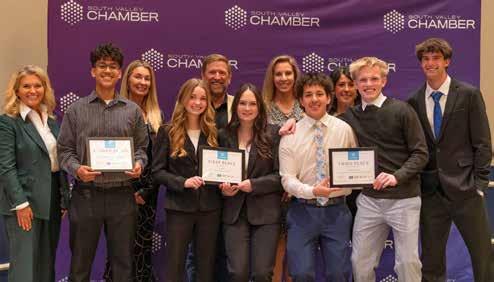
Each year, the South Valley Chamber sponsors a Junior Women in Business program. In 2025, 24 high school seniors from the Canyons and Jordan School districts participated. After attending business events, participating in personal mentoring and completing a service project, the 24 seniors graduated from the Junior Women in Business program, earning a $1,000 scholarship.
“They rub shoulders with the women in our Women in Business,” Francis said. “Our

Women in Business is off the charts.”
In addition to this program, the Chamber’s Women in Business Committee under Managing Director Jayme Jensen, held 10 different events in 2025 drawing 1,275 attendees. Other programs hosted by the South Valley Chamber provided opportunities to business leaders such as the Leadership South Valley program and Business Boot Camp.
“We have our Business Accelerators, which we call our mini MBA, which helps small businesses, after they’ve been in business for a year or two, really learn how to
grow and continue to launch,” Francis said.
South Valley Chamber’s Everyday Entrepreneur program grew in 2025 and will continue through 2026. The program leads aspiring business owners and entrepreneurs through a 10-week course to help them get ready to launch their business or product.
“Some of the best success we have is that some of them, by week five or six, say ‘um… yeah…maybe I’m not ready.’ We’ve saved them thousands of dollars,” Francis said.
Working with Sports Salt Lake for the Chamber’s Tourism Committee, 179,729 visitors were brought into the south end of the valley for sporting events during 2025.
“The economic impact of that brought to the south valley was $66 million…we invested less than $80,000 to make that happen,” Francis said.
The top four of those sporting events included the Western Nationals for the National Archery in the Schools Program; Triple Crown Western Invitational for Triple Crown Sports; Jam On It; and the Region One Championships and Development Program National Championships for USA Gymnastics.
“We are moving forward fast in 2026 already,” Francis said. “We are going to be focused, we are going to be strategic, and we are going to be purpose-driven.”
The South Valley Chamber held their own version of “Shark Tank” focusing on student entrepreneurs in March. Nine thousand and five hundred dollars was awarded to
10 students who pitched their business ideas.
“Truth be told, that’s what we awarded, but Brandon Fugal was one of the judges and he came with a little extra cash in his pocket and some of the (students) got a little Brandon Fugal money,” Francis said referring to the Utah businessman, real estate developer, venture capitalist, philanthropist and entrepreneur.
Abigail Elmer and Kellyn Hovi from Herriman High School won first place for the event; Aiden Leon from Alta High School won second place; Cash Christensen, Kolton Candelaria and Ayson Christensen from Riverton and Bingham high schools won third place.
“It continues to be one of my favorite events because regardless of what we hear about what’s going on in the community, what’s going on in the world, you go away from this event saying ‘OK, with youth like that we’re going to be OK,’” Francis said.
In 2026, the South Valley Chamber will be hosting at least five different Business Boot Camps with workshops on topics such as sales and marketing and Grow and Connect events every month. In May, they will be holding their monthly event in Cottonwood Heights at Eight Settlers Distillery & Restaurant (7321 Canyon Centre Pkwy.). They will also announce their Small Business Impact Awards on May 5 (same location).
“We have grown over the last five years as a chamber and now it’s important for us to retain and provide value,” Francis said. l
Twenty-four high school seniors who participated in the Junior Women in Business program received scholarships to their chosen university. (Photo courtesy of the South Valley Chamber)
Eleven student teams took the stage at South Valley Chamber’s “Shark Tank”-style event and presented their business ideas. (Photo courtesy of the South Valley Chamber)
Canyons District promotes from within as familiar face takes the helm
Longtime Canyons educator McKay Robinson steps into district’s top role in a rapid transition with Supt. Rick Robins’ retirement announcement.
By Julie Slama j.slama@mycityjournals.com
Aleadership change at one of Utah’s largest school districts is unfolding quickly, but for those in the district, it feels like a natural step.
On March 19, Canyons Board of Education appointed longtime educator McKay Robinson as the next Canyons School District superintendent, selecting a familiar face to guide the district through its pivotal period of proposed boundary changes and school closures as enrollment declines and at the same time, developing an innovation center to bring a new approach of education to students.
Robinson will succeed Supt. Rick Robins, who on March 6 announced his retirement effective June 30. Robins, who has been with the district since 2020, was unavailable for comment.
The appointment was made after what board leaders described as “careful consideration” and breaks from a traditional national search process. Instead, board members opted for continuity, elevating a leader who already is embedded in the district’s mission.
“As the board got talking, we were all on the same page,” Canyons Board of Education President Amber Shill said. “We thought, we have the best person internally, and he’s the right person for the job at the right time, so it all aligned. He’s already in tune with what’s happening. He knows our district inside and out, and he knows what our goals are and what we’re working on. He can hit the ground running on the first day.”
Robinson, a 25-year educator and current assistant superintendent, will become the fifth chief executive overseeing the district’s 47 schools and programs while continuing implementation of its long-term strategic plan.
“Dr. Robinson has the vision, relationships and community trust we need to build on our success,” Shill said.
For Robinson, the appointment 13 days after Robins’ retirement announcement came as a surprise.
“It did happen very quickly; this is totally unexpected,” he said.
His path to the top job has been shaped by decades in classrooms and school leadership, but also by an influential time in his own childhood.
“My parents divorced when I was 7 years old and going into third grade; fortunately for me, in that third-grade school year, I had a teacher, Mr. Miner, who knew my circumstance, knew what I was going through,”
Robinson said. “He truly became so much more than just a teacher. He became an advocate, a champion, one who was constantly pushing me to be the best that I could actually be.”
At the end of third grade, he knew he “was going to be Mr. Miner one day.”
“That ultimately became my goal, and I never deviated from that. I pursued that from the time I left third grade,” he said.
That experience continues to shape how he views his work.
“It’s a never-ending quest for me. I wouldn’t be here where I am today without the exceptional teachers throughout my life. Mr. Miner was that starting point, but there were so many more along the way, and I’ve always believed in providing that same type of opportunity,” he said.
Robinson holds an Associate’s degree from Snow College, a Bachelor’s degree in Elementary Education with a minor in Korean from Utah State University, a Master’s degree in Teaching from Grand Canyon University and a Master’s in Educational Leadership from Brigham Young University, and a Doctorate in K-12 Leadership and Policy from the University of Utah.
“I’ve graduated from the three major universities in the state,” he said. “I bleed red, always have, but I have a special place for the blue because of my experiences at Utah State
need to be successful. He genuinely loves this district; he’s our biggest champion, and at the same time, he’s the most humble, down-toearth, in-the-trenches person.”
Shill said those qualities along with his leadership with district plans such as Canyons’ COVID-19 response and strategic planning efforts made him the clear choice to lead upcoming initiatives, including the development of Canyons Innovation Center, potential boundary changes and ongoing enrollment challenges.
Robinson is ready to build on the foundation already in place, including that of the strategic plan and innovation center.
“The opportunities are endless in that regard, and so I’m really just trying to help carry that vision forward,” he said. “Dr. Robins did a great job.”
Robins’ six-year tenure was marked by both disruption and progress. Taking the helm in the summer of 2020, in the midst of the COVID-19 pandemic, he guided the district through unprecedented challenges while expanding employee supports, leading the creation of the district’s first strategic plan and overseeing several school construction and renovation projects.
and BYU.”
Robinson began his career teaching at Sprucewood Elementary in Sandy, then instructed at Butterfield Canyon in Herriman when it first opened. He then served as elementary principal at Sandy Elementary and Lone Peak Elementary, also in Sandy, and became Canyons’ director of elementary schools. He has received multiple awards as an outstanding administrator.
Colleagues say he’s a visible, approachable leader focused on students.
“He’s a great listener,” Principal Shad DeMill said. “He does a great job to be able to step back and see all different perspectives of parents, teachers and kids without being judgmental and making good decisions in that way. His focus is on kids and what they need most is right there at the forefront.”
Others emphasized his presence in schools and ability to connect.
“He shows up,” Eastmont Principal Stacy Kurtzhals said. “He supports what’s happening in schools and he calls people by name throughout the school district.”
Director of Elementary Schools’ Alice Meridth said his dedication extends to everyone throughout the district.
“McKay is truly rooted in making sure that everything we do is what is ultimately best for kids,” she said. “He’s committed to making sure that staff have the tools that they
“The vision of the innovation center is his idea,” Shill said. “We wanted a strategic plan, which Rick led us out on that. Our strategic plan is in place, and it’s not something that’s on the shelf; we’re continually using it. Rick has been a very collaborative leader who brought people together to make decisions. He cares about the district, the people.”
Colleagues say Robins’ leadership centered on listening and relationships.
“He listened,” Canyons Business Administrator and CFO Leon Wilcox said. “A lot of superintendents don’t listen like he did, and he made changes where he could wellness rooms, teen centers, employee daycare, pay raises. He did anything he could do to make life better for our kids and our employees.”
As the district prepares for its next chapter, Robinson said he hopes to carry that same focus forward.
“Dr. Robins genuinely cared about people. That’s something I hope to carry on,” he said. “I genuinely care about our people and want what’s best for them.”
With the transition underway, district leaders say the goal is clear: maintain momentum while continuing to put students at the center of every decision.
Robinson is an avid cyclist who has raced in the 200-mile Logan to Jackson, Wyoming (LoToJa) eight times, but now takes 30- to 100-mile weekend road rides with his wife, Dixie. During spring break, they were set to complete their goal to see every major league baseball team play in their home stadium. l
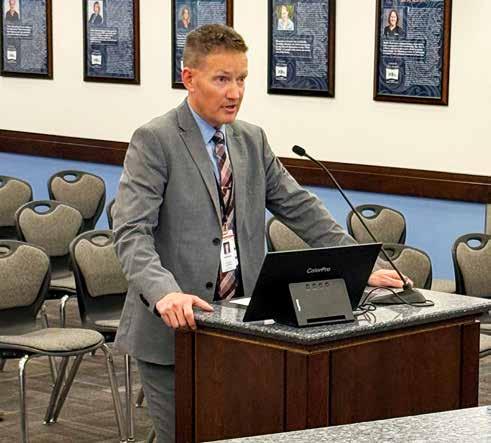
On March 19, Canyons Board of Education appointed longtime educator McKay Robinson as the next Canyons School District superintendent. (Julie Slama/City Journals)
Proposed elementary mergers raise questions about neighborhoods’ future
Canyons officials cite declining enrollment, but residents say closures could reshape neighborhoods.
By Julie Slama j.slama@mycityjournals.com
On May 5, Canyons Board of Trustees may — or may not — make final decisions about possible merging of Granite Elementary with Quail Hollow Elementary and also, Park Lane Elementary with Willow Canyon Elementary. If approved, the consolidations would take effect in the 2027-28 school year.
Canyons School District officials say schools under consideration are experiencing both immediate and long-term enrollment declines, driven largely by Utah’s declining birth rates and rising housing costs.
The proposals have been met with concern.
At the March 19 public hearing at Park Lane, one parent said closing both Granite and Park Lane would create a “four-mile radius that wouldn’t have any school for the people here.” She added closing a school “prematurely would weaken our community.”
Another parent focused on the long-term neighborhood impact.
“An empty school sitting unused for five or more years sends a troubling message that makes our area appear as though it’s declining or struggling, and that perception matters,” she said. “It can discourage young families from moving into our neighborhood, which ultimately impacts the long-term health of our entire feeder system.”
Local real estate trends reinforce those concerns.
Realtor Bruce Cockrell, of Realtypath Central in Sandy, said housing prices in the Salt Lake metro area have “skyrocketed over the past six to eight years.”
“That increase in cost is not conducive to most young families being able to afford real estate in some areas,” he said. “Those families are being replaced with home buyers who are older and more established in their lives and careers and whose children may have aged out of the school system. I suspect that if the trend continues and there is less enrollment in schools and schools close, that will expedite that trend because if parents with children don’t have a school to attend or they see a declining school system, they will not want to relocate to that area.”
Cockrell added limited housing turnover also is a factor.
“Those who currently own homes who have either been in their home for a while or those who have interest rates on their current home that are significantly lower than the current rates have a hard time justifying making a move,” he said.
“There’s no growth around us and there’s no place to have any growth,” said Eastmont Principal Stacy Kurtzhals, who added an estimated 80% of Alta View Elementary students in Eastmont’s boundary instead attend Mt. Jordan Middle to continue in the dual immersion program, further compounding the low enrollment issue.
The pattern carries into Jordan High, which has the lowest enrollment among Canyons’ five comprehensive high schools. Shill said a boundary change 10 years ago contributed to the shift.
“What ended up hurting Jordan was when we did the boundary change in 2016; that’s when Alta (High) had the low numbers around 1,800 while Jordan and the other schools had about 2,200 at that point. So, we, the board, voted to take a section west of the freeway where it was being developed new houses, and put that to Alta. But that move, over time, ended up hurting Jordan,” she said. “Hindsight is 20/20.”
Another recurring concern is timing. Proposed east-central Sandy school rebuilds are slated for 2029 and many parents urged the board not to consolidate schools only to return students to their original campuses a few years later.
“The main message I got was, ‘if we’re going to rebuild, wait to close us.’ That’s what I wrote down, time and time again,” Shill said.
Parents expressed appreciation for revisions made since the 2025 proposal, particularly ensuring special education students could remain with neighborhood peers. The earlier plan, to consolidate Granite and Park Lane, was not approved, though the merger of Bella Vista and Ridgecrest, both in Cottonwood Heights, passed unanimously.
The March 19 meeting was one of two public hearings during the 90-day public input period the board began on Jan. 20, allowing families to review the updated proposals for Sandy’s east-central area. The other hearing, held March 10 at Granite, where residents also voiced concerns, including those who chose the neighborhood for its walkable schools.
“When we were looking around here, people said ‘there are no kids here,’ but since moving in this area in ’21 we have seen so many families move into this area and have looked forward to our son attending Granite,” said Shannon McNeily, whose parents have lived in the area since 2012. “We moved here so he could walk to school in a safe neighborhood. He’s excited when he sees school buses; we walk to see kids going to school and he knows the crossing guards. With the proposal to close the school, it will take the heartbeat out of the neighborhood.”
Although Sandy City is adding more housing, district officials say the new develop-
ments are not located within the Granite and Park Lane boundaries.
Canyons business administrator and CFO Leon Wilcox also pointed out: “We looked at that; we don’t get a whole lot of kids from high-density apartments. We get roughly six to eight for every 100 units.”
Additionally, the board is suggesting boundary adjustments to better balance enrollment, particularly in the Jordan High feeder system. Those proposals also have been met with questions.
“People say, ‘Why don’t you look at the middle schools and high schools?’ Canyons Board of Education President Amber Shill said. “We are looking at that, especially for Eastmont (Middle School) and Jordan (High,) but that’s not where we’re having a problem. The problem is declining enrollment at elementary level, and that’s why we’re addressing that first.”
Enrollment challenges extend upward. Eastmont Middle has about 535 students, the district’s smallest middle school.
District leaders emphasize the issue goes beyond enrollment figures.
“Like many districts across the state, we’re trying to navigate that declining enrollment,” said McKay Robinson, current Canyons School District assistant superintendent who will take the top job July 1. “As I continue to look at that and think about it, I keep having to remind myself this isn’t simply just about numbers. It truly impacts our families and our communities and even the identity of our schools, so we have to be very mindful of that as we continue to look at the declining numbers. It’s unfortunate that our birth rate is as low as it is, as well as just the cost of living makes it hard for young families to build in our community, in our neighborhoods, but we’ll continue to try and look at that and remain in constant communication with our community members, listening to their feedback and looking at different options.”
Community members can continue to submit feedback comment and access updates at www.canyonsdistrict.org/boundarystudy. l
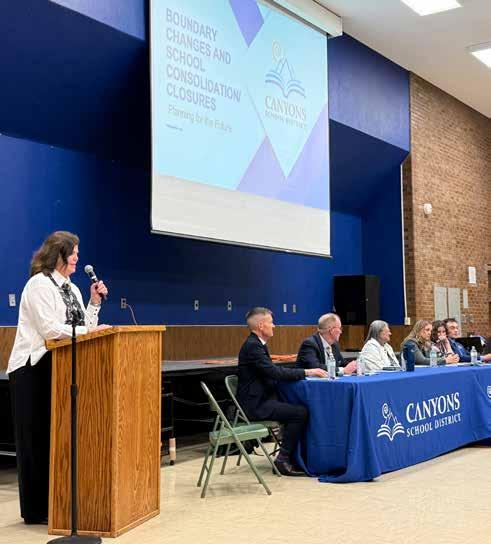
Canyons Board of Education President Amber Shill addresses patrons during the public hearing on possible school closures and boundary changes held at Granite Elementary.
(Julie Slama/City Journals)
Joint Replacement
TA New Chapter for Pain-Free Living: Modern Joint Replacement at CommonSpirit
ired of nagging joint pain dictating your life?
The good news: joint replacement surgery has made significant advancements in recent years. Forget the daunting tales of long hospital stays and arduous recoveries. Surgery today is all about quicker recovery, less pain, and a faster return to the activities you love. This isn’t just about fixing a joint; it’s about reclaiming your freedom, and CommonSpirit is at the forefront of this transformation.
What’s driving this revolution? Minimally invasive techniques. Imagine surgery with smaller incisions and less disruption to your muscles and tissues. This “less is more” approach translates directly into less post-operative pain, reduced blood loss, and significantly shorter hospital stays.
“Joint replacement surgery once meant a long, difficult recovery. Now, thanks to minimally invasive techniques, patients are getting back on their feet and regaining their independence far more quickly, significantly improving their quality of life,” said Michael Blatter, an orthopedic surgeon at Holy Cross Hospital – Davis.
This means you can get back to golfing, gardening, playing with grandkids with renewed vigor.
But the journey to rapid recovery begins even
before surgery. We believe in empowering our patients, and that’s why pre-operative education is a cornerstone of our approach. Our comprehensive classes walk you through every step, covering everything from physical therapy exercises and navigating stairs to home safety. We emphasize two crucial rules: no falls and no infections. Patients consistently tell us they feel better prepared and more confident heading into surgery, which dramatically improves their outcomes.
Our commitment to your well-being extends with Enhanced Recovery After Surgery (ERAS) protocols. This isn’t just about the surgery itself; it’s a carefully coordinated care pathway. ERAS focuses on preparing your body for a smoother recovery through optimized nutrition, multimodal pain management that reduces reliance on opioids, and getting you up and moving just hours after surgery. It all works together to reduce complications, enhance your comfort, and get you home safely and sooner.
And speaking of cutting-edge, robot-assisted surgery has become a game-changer. While a surgeon is always in control, robotic systems provide unparalleled precision, allowing for less invasive procedures, greater accuracy in implant


placement, and ultimately, quicker recovery times. This advanced technology ensures your joint replacement is tailored with remarkable exactness.
“Many joint replacement procedures can now be done same day. And with our current techniques and technologies, we are able to facilitate a quicker recovery and healing process for joint replacement. Our patients are able to get back to the activities they enjoy more quickly. For many of our patients, joint replacement is a game changer,” said Dr. Kevin Sagers, an orthopedic surgeon at Holy Cross Hospital – Jordan Valley.
At CommonSpirit, we understand that living with joint pain can feel limiting. But with these modern advancements, the path to renewed mobility and a significantly improved quality of life is clearer and more accessible than ever. We’re dedicated to providing not just exceptional medical care, but a supportive and empowering experience that truly makes a difference. If you’re ready to explore how modern joint replacement can transform your life, we invite you to discover the CommonSpirit difference – where your rapid recovery is our priority.
For more information or to find a provider visit mountain.commonspirit.org


Learn more about the services, care providers and mission-driven work of the Holy Cross hospitals and CommonSpirit Health at www.holycrossutah.org.

At CommonSpirit Health, we make the healing presence of God known in our world by improving the health of the people we serve, especially those who are vulnerable, while we advance social justice for all.
SPONSORED CONTENT
When minutes count, count on our emergency care.
Get to know us before you need us.
When you need emergency care fast, the closest emergency room is a smart thing to know. You never know the level of care you’ll need when an emergency happens and choosing the right ER can make all the difference. And a hospital ER comes with the confidence of additional services right on-site.
CommonSpirit Holy Cross Hospital – Salt Lake has been awarded Chest Pain Center Accreditation from the American College of Cardiology (ACC). Facilities that achieve accreditation meet or exceed an array of stringent criteria for evaluating, diagnosing and treating patients who may be experiencing a heart attack.
Find emergency care close to you at mountain.commonspirit.org
By Cassie Goff
Don’t trash it – recycle it!
c.goff@mycityjournals.com
Did you throw away your old used toothbrush? Don’t do that next time! Instead, bring it down to a CHaRM event along with your empty toothpaste tubes and empty floss containers.
The Utah Recycling Alliance will partner with the city of Cottonwood Heights to host a CHaRM (Collection of Hard to Recycle Materials) event on Saturday, June 6. Residents are invited to drop off their recyclable materials in the Hillside Plaza lot (2378 E. Fort Union Blvd.) from 10 a.m. until 1 p.m.
CHaRM pop-up events are intended to gather recyclable items from residents that may otherwise end up in the trash. In 2025, the Utah Recycling Alliance helped to collect over 34,000 pounds of materials through their statewide CHaRM events. In Cottonwood Heights, over 4,016 pounds of recyclable materials were collected. (To view our previous coverage of that event, visit the Cottonwood Heights Journal web-

site and search for the article titled “CHaRM event helps residents recycle hard-to-recycle items.”)
“CHaRM events empower people to do the right thing,” said URA Board Member and CHaRM Program Lead Robi Overson at the time. “Instead of asking residents to hunt down different recyclers for every item, we
Beating Afib Without Meds
Beating Afib Without Meds

Join Dr. John Day, a pioneer in AFib treatment , to learn how to achieve remission by identifying hidden triggers and leveraging modern treatments like pulsed field ablation. This session provides a clear roadmap to reduce reliance on long-term medications and regain control of your heart health.
Join Dr. John Day, a pioneer in AFib treatment , to learn how to achieve remission by identifying hidden triggers and leveraging modern treatments like pulsed field ablation. This session provides a clear roadmap to reduce reliance on long-term medications and regain control of your heart health.
Date: Time: Location: Thursday, May 7 5:30 pm - 6:30 pm Attend virtually or in person at St. Mark’s Hospital, Lamb Auditorium
Date: Time: Location: Thursday, May 7 5:30 pm - 6:30 pm Attend virtually or in person at St. Mark’s Hospital, Lamb Auditorium
This seminar will cover:
This seminar will cover:
How specific daily habits can act as powerful medicine for your heart. Identifying the environmental and dietary triggers unique to your routine.
How specific daily habits can act as powerful medicine for your heart. Identifying the environmental and dietary triggers unique to your routine.
How modern "pulsed" technology is helping patients reach remission without long-term drugs.
How modern "pulsed" technology is helping patients reach remission without long-term drugs.
Navigating the medical process of tapering off AFib medications under professional guidance.
make it easy by bringing them all together in one place — so you know exactly who’s taking your materials and that they’re being handled responsibly.”
Hard-to-recycle items that can be brought to this event for disposal include: plastic containers, batteries, carpet padding, lightbulbs, box springs, outdoor equipment, plastic bags, scrap metal, books, Styrofoam (hard compressed), plastic wrap, ink and toner cartridges, and bikes and their parts.
Electronic waste will be collected. That includes cellphones, chargers, computers, laptops, monitors, tablets, corded electronics, batteries, string lights, TVs and small appliances.
Residents can also give their old tires, tire tubes, mattresses and box springs to the Utah Recycling Alliance to dispose of for an extra fee ($15 each).
Volunteers will help residents sort their materials so they can be aggregated for disposal at responsible recycling facilities.
CHaRM events help in part to support Utah Recycling Alliance’s vision of a Zero Waste culture. The aim is to build successful models encouraging practices that promote reuse, recycling and resource conservation.
Their other programs, like Green Drinks gatherings, Trash Talk educational opportunities and community outreach initiatives, support this aim by promoting a culture where materials are valued and waste is minimized. To learn more about the Utah Recycling Alliance, visit: www.utahrecyclingalliance.org.
To help support the alliance’s efforts, residents aren’t only limited to taking part in CHaRM events. There are also many volunteer and donation opportunities available: volunteers are needed to help sort materials at CHaRM events, table at special events, and host clean-up events; donations can be submitted directly to the Utah Recycling Alliance website as a one-time or recurring donation.
To reserve a spot, find the “CHaRM Recycling Collection Event - Cottonwood Heights” event hosted by Utah Recycling Alliance through EventBrite (www. eventbrite.com).
Need to miss this event but still have items to recycle? The Utah Recycling Alliance has a handful of upcoming events this summer including CHaRM events at the Hogle Zoo and in Millcreek. l

Have been thinking about having gutter protection installed for a number of years since every year it becomes more of a pain to climb up on the roof and get the clean-out done. Called LeafFilter on a Thursday, the salesman came on Friday and the installation was done the next day. Easy-peasy. -Anthony.
Navigating the medical process of tapering off AFib medi i d r professional guidance.
To register, call (844) 630-5295 or visit www.stmarkshospital.com/AFib
To register, call (844) 630-5295 or visit www.stmarkshospital.com/AFib



Small business SECTION

world of local business around the Salt Lake Valley
Ranging from $0 to more than $300 for a base license, business licensing fees differ across Salt Lake County.
For entrepreneurs looking to start a company in Salt Lake County, location can shape the cost of opening that business. Licensing fees vary drastically as cities determine costs and define regulations. Fees can fluctuate based on the type of business, number of employees, impact on city services and required inspections.
On one end of the scale is Riverton, which in 2018 became the first city in Utah to eliminate all business licensing fees. The move was orchestrated by the mayor at the time, Trent Staggs, who wanted to let companies know the city was open for business.
“He wanted Riverton to be a business-friendly community,” said Riverton Business Licensing Coordinator Angie Keller. “We’re also very user-friendly when it comes to getting a license. They click on our website and it guides them through the process. I don’t get many phone calls asking for help…I feel like Riverton has gone above and beyond, as far as pointing them in the right direction and giving them all the information they need.”
Draper’s base fee for a commercial license is $82, with additional fees for alcohol or firework sales, sexually-oriented businesses and solicitors. Murray charges $100 for a commercial license with regulatory fees on companies like auto towing, tobacco retailers, tattoo parlors and convalescent homes. Midvale has a base fee of $137 for commercial businesses with add-on charges for industries including bars, hotels, pawn shops and restaurants.
For companies in the county’s newly incorporated areas, including Kearns, Magna and Copperton, the Greater Salt Lake Municipal Services District administers those business licenses. The district charges a $150 base fee for commercial businesses and home-based locations that have customers coming to the home.
On the higher end of the scale, South Jordan charges $337 for a general business license application fee, with additional charges for hotels ($2,700), restaurants ($633), big box stores ($3,331) and entertainment/recreation facilities ($1,727).
Brian Preece serves as South Jordan’s Director of Planning and Economic Development. He said the city’s licensing fee structure wasn’t put together haphazardly, but was based on a feasibility study that determined the cost impact of specific businesses to the city. More fees are placed on businesses that have a higher volume of calls for police or fire services.
“We have a fire inspection for most businesses and that’s part of the [licensing] fees,” Preece said. “Even though Riverton doesn’t have a business licensing fee…it’s being paid for somewhere. The general fund is paying for it.”
South Jordan Public Information Officer Rachael Van Cleave added, “If we weren’t to charge these fees, taxpayer dollars would be subsidizing these costs for businesses. So the fees help to take that off the general taxpayer.”
For home-based businesses, Utah Code states that cities cannot charge a licensing fee unless the business impacts the neighborhood, such as having customers or an unusually high number

of home deliveries. However, several cities, including Taylorsville and South Salt Lake, charge administrative processing fees of $100 and $59, respectively, for home-based businesses.
Riverton requires every home-based business to have a license, but there is no fee. South Jordan does not require home-based businesses to have licenses unless they operate a daycare/preschool or if they have regular clients coming to the home.
“We made the decision to not charge for or even require a home license business,” Preece said. “If somebody wants one, then we’ll get you a license, but you have to go through the regular process, and that’s your choice.”
While getting a business license is certainly an important step in starting a business, it’s not the only step. Business owners need to make sure that the company is registered with the state and, if sales are involved, with the Utah State Tax Commission. Owners must ensure all licenses and inspections are complete before a business license can be issued. Most cities have license approval completed in two weeks or less.
The wide-ranging business licensing fees and processes across the county impact business owners and municipalities differently. For some entrepreneurs, that difference could be the deciding factor on where they ultimately locate their business.
Slick City glides into utah as first dry-slide facility
By Peri Kinder | peri.k@thecityjournals.com
Indoor facility features 10 proprietary slides for riders of all levels.
The first indoor dry-slide recreation facility in the state is now open in Millcreek at 2330 E. 3300 South. Slick City Action Park took over the former Joann’s building, a 24,000-square-foot space that is now home to 10 slides, a dodgeball air court, a web crawler and a Junior Jungle for guests 5 and under.
Franchise owner Jordan Wade brought the experience to Utah after meeting the man who created the slides and trying it for himself. When he found out the heart-racing slides had been implemented into a Slick City Action Park franchise, he knew he wanted to be involved.
“It’s like a water park with no water,” Wade said. “Every one of these slides is inspired by an extreme slide, maybe that you’ve seen at a water park, but they’re coated in a proprietary slick material. Then we cover it with a silicone lubricant and then you go down on a mat. It can be pretty fast with lots of adrenaline.”
The patented slides create a high-energy experience. With 10 slides to choose from, visitors can start slow, with the 80-foot-long Cowabunga with banked curves and bumps, or they can go right to the Mega Launch, which thrills riders with a steep drop and an airborne landing.
Other attractions include the Fast Lane, a four-lane slide track built for racing; the Royal Flush, which swirls riders around before dumping them out of a massive bowl; the Python that features tight curves that wind guests through a fast-paced slide; and the Tailspin, a spiral ride good for first-time sliders.
Wade’s favorite slide is the Big Wave, which shoots rid-


ers into a giant half-pipe, where they glide back and forth.
“It combines my favorite parts of the slides,” he said. “There’s the initial speed, just the thrill of the drop. Plus, the fun of actually sliding down the slide, just the back and forth that you get after, it’s very fun. My second favorite is Riptide, our steepest one, and it’s just fast. You just go straight down.”
While some indoor recreation parks cater to children, Slick City Action invites adults to get involved. Wade said jumping on trampolines requires a degree of physical fitness, but at the slide park, besides climbing to the top, riders just have to sit and enjoy the experience.
Millcreek officials were on hand to welcome the slide park to the community during a grand opening in March, where they toured the facility, hosted a ribbon-cutting ceremony and encouraged residents to check out the new venue.
“This is exciting,” said Millcreek Mayor Cheri Jackson.

“We need more fun amenities like this in Millcreek. So having this open will be a really fun place for families, for teenagers, and just a great opportunity for everyone to do something,”
Custom murals line the walls at Slick City Action Park and the facility has two private rooms for hosting birthday parties or group events. There’s also a snack bar and arcade games. Wade hopes the park becomes a place where people can put down their phones, turn off their screens and interact with each other in a fun, safe environment.
“It’s becoming so easy to become a recluse at home,” he said. “Creating fun experiences is actually a mission for me. Getting people out of the house and interacting with people in real life is important…This is a super fun way to create memories with your kids, with your friends, with your coworkers, whatever. So that’s the broader mission. We just want people to get out and interact with each other.”
For more information, visit slickcity.com/ut-east-slc.





Slick City features slides for all age and adventure levels. (Peri Kinder/City Journals)
Bobby’s Burgers marks another step in growth for Holladay Hills development
By Collette Hayes | c.hayes@mycityjournals.com
“The halo effect in business could occur here. When a well-known brand with a large advertising budget moves in, it can encourage people to visit other nearby businesses too.”
Bobby’s Burgers by Bobby Flay just moved in around the corner from Trader Joe’s in the Holladay Hills shopping center. Bobby’s location is one of several spots for grabbing a bite after grocery shopping or before catching the latest blockbuster at the Megaplex Luxury Theatres at Cottonwood, located across the street.
A crowd, including Holladay City officials, staff, local business owners and community members, attended the March 27 ribbon-cutting ceremony for Bobby’s Burgers by Bobby Flay marking the official opening of the casual restaurant’s Holladay location.
Holladay Business Advisory Board organized the event under the direction of Economic Development and Housing Manager for the city of Holladay, Ann Francis Garcia.
“It’s always exciting when a business chooses to make Holladay their home,” Garcia said. “The city works hard to establish and maintain good relationships with existing and new businesses. My role as Economic Development and Housing Manager for the city of Holladay is creating a strong local economy by making sure our local businesses are resilient, thriving and feel supported. The Holladay Business Advisory Board helps us with this by making a concerted effort to build relationships with our business community and by providing opportunities to connect and network, like this ribbon cutting for Bobby’s Burgers. Working with Bobby’s team has been great. They were very excited to be a part of Holladay and wanted to engage with us right away.”
Local resident Jeni Bennion and a friend were caught by surprise by the
ribbon-cutting grand opening as they had just sat down in the restaurant to enjoy lunch.
“We had no idea the grand opening was today,” Bennion said. “We were looking for a new place to have lunch and decided to try Bobby’s. We’re happy we did. The onion rings are outstanding and the blue bacon burger is simply delicious. I would highly recommend it! The sauces and dips are great too! I love having the choice of picking up and taking it home or sitting and enjoying a meal here. We really love all the options for places to enjoy lunch in Holladay.”
Holladay City enjoys a balanced mix of small town and big city national chain businesses. Both necessary in maintaining the economic growth of the city.
“All the restaurants, small business shops, and movie theaters will benefit indirectly from having national chain businesses like Bobby’s Burgers in the area,” said Jason Woodland, a member of the Holladay Business Advisory Board. “The halo effect in business could occur here. When a well-known brand with a large advertising budget moves in, it can encourage people to visit other nearby businesses too. This includes The French Bakehouse and Four Lemons across the street, Magnolia’s next door, and Trader Joe’s around the corner. They will all support each other, helping both small and large businesses succeed.”
The president of Bobby’s Burgers, Michael McGill, expressed his thanks for the support of Holladay City and the warm welcome the franchise has received.
“We’re thrilled to be in Holladay and grateful for everyone who came out this morning for our opening,” McGill said.
“Our hope is to become the go-to burger spot where families celebrate and teams gather after games. We’re also looking forward to a visit from chef Bobby Flay in the near future. Bobby’s is an unbeatable

burger experience, and we’re happy to bring it to Holladay City.”
Mayor Paul Fotheringham provided the opening remarks during the event and shared his support and excitement of bringing a world class dining experience to the community while maintaining the unique and close-knit character of Holladay City.
“Bobby Flay is a name synonymous with excellence in culinary innovation,” Fotheringham said. “By selecting Holladay for his newest burger franchise, he is not only opening a restaurant but also investing in our vision of a vibrant, walkable and gathering-oriented community. To the management and staff, welcome to the Holladay community. We are excited to have you join us.”
According to a local press release, this new restaurant is the brand’s second location in the area. Joe Sample, franchise owner and founder of Crave Management Company, opened the first Utah location in Orem in 2024. Strong guest response in Orem led
to the decision to expand to Holladay.
“We really appreciate all of you for coming out to celebrate our opening,” Sample said. “What a warm welcome from the Holladay community. This is our second location, and we’re happy to be here in Holladay. I’ve recently relocated to Holladay, and I couldn’t be more thrilled and excited about this little town.”
Bobby’s Burgers offers signature items, such as the Bacon Crunchburger, topped with crispy potato chips and Bobby’s signature sauce. The menu also includes a variety of burgers, fries and spoon-bending shakes that reflect Flay’s recognized culinary style.
“For me, a great burger starts with great ingredients and layers of flavor,” Flay said in a statement. “That philosophy is at the heart of everything we do at Bobby’s Burgers. Our goal is to serve food that people crave and come back for again and again, and we’re excited to share that experience with the Holladay community.”


Mayor Paul Fotheringham, franchise owner Joe Sample, Bobby’s Burgers president Michael McGill, and Holladay City Councilmember Natalie Bradley cut the ribbon marking the official grand opening of Bobby’s Burgers by Bobby Flay. (Collette Hayes/City Journals)
Beehive students bound for robotics world championships
The Hive overcomes setbacks at state to secure a global stage berth.
By Julie Slama j.slama@mycityjournals.com
Beehive Science & Technology Academy’s The Hive is heading to the FIRST Tech Challenge robotics world championships.
As one of 32 teams that qualified for the state tournament, including teams from Holladay, Sandy, Riverton, Cottonwood Heights, Taylorsville, South Jordan, West Jordan, Midvale and other local communities, The Hive contributes much of their success to experience and resiliency. They received the “The Inspire Award,” which is an automatic bid to worlds, which will include more than 1,000 teams from 66 countries meeting April 29 to May 2 in Houston.
After hundreds of hours and four different versions of their robot, Topaz, and a qualifier win the week before, state didn’t go as planned for the 15-member team from Sandy.
“State was a super up and down day, more than any other competition,” senior Jonah Wood said. “Our first match, our robot disconnected. It wasn’t something we can really control, just bad luck. We lost the match because of that. The second match, a wire broke, so we lost that one. We did a super quick fix, and got it working again, but it was stressful. And if you lose two out of your five, it was a little heartbreaking.”
Team captain and senior Neset Kablan continued: “We won the third and fourth matches, but we couldn’t score for most of the match because a gear on the robot came unscrewed, so we couldn’t shoot for the rest of the match. We played defense against the other robots, we won that match, but it was very disappointing.”
The week before the competition, Beehive hosted 10 schools for practice scrimmages.
“We were scoring over 200 points, way above state records. That helped other teams see we’re a promising team, and they could see the problems were outside of our control, but we picked ourselves back up – and that’s what helped when picking alliances,” Kablan said. “It was really disheartening, because if we could score, we would have done a lot better. It was a very rough day to go through.”
Before worlds, the team plans to rework wiring and build in more practice time to troubleshoot issues.
Experience has been key with 13 returning members.
“This season is the culmination we’ve had over the past three years our group has been together and we know what we’re doing, so we’ve been able to achieve a lot

more,” Kablan said. “It makes a big difference when talking about team productivity. Before, we had a lot of people who didn’t have previous experience in robotics, so it was teaching. But also, ‘how do you work together as a team?’ We made multiple iterations of the robot, because this is a shooter year where the robot shoots the balls whereas, like previous years, you’ve had to pick something up and place it. So, for all of us, including the coaches, it’s new.”
Wood said the team’s two-robot system, one for mechanical work, another for programming, accelerated their progress.
“This was one of the first years we had the resources to do that, material-wise, but also experience-wise,” he said.
The season kicked off in September, when Wood was overseas. He watched the robot game reveal and immediately began sketching ideas.
“I started working on CAD for the robot,” he said. “When I got back, there were three days before our first competition.”
The Hive rapidly built and tested, often prototyping parts in wood before fabricating them in aluminum.
“We built a lot of these pieces individually out of wood before we actually ended up cutting it out of aluminum to make sure they worked and that our geometry is right, because sometimes the actual theory of a piece doesn’t work in practice,” Kablan said. “We spent most of our time testing, which means that this robot is a darn good robot. It has a very high potential.”
Since state, the team has been fundraising to pay for travel costs. Senior Leah Ham-
mond said last summer’s three-week robotics camp for 200 youth raised $14,000. It’s supplemented by food sales at the school’s fall festival, plus corporate donations and grants.
Hammond said the program teaches more than robotics.
“The most valuable thing in the program is learning how to work in a team,” she said. “It’s valuable to be able to work with other people, learn to delegate tasks and be able to communicate. Those are good skills that are valuable in any job.”
Wood agrees: “When you like think about robotics, you think of a bunch of nerdy introverts, which is what robotics is. And nerdy introverts suck at communicating, no engineer works alone. Everyone works in a team. I’ve met a ton of smart people, but if you can’t work in the team, you can’t use anything you know. Being able to communicate what you know and work with a team allows you to be so much more.”
Kablan, who comes from a family involved in robotics, said humility has been his biggest lesson.
“The hardest lesson I’ve learned is to strip that ego down and to learn from other people,” he said. “I have connected with tons of teams across the world, and some of those teams have been, performance-wise, worse than ours, but that doesn’t matter. They all have some kind of lesson to give, and I have some kind of lesson to learn from them. That’s the most important lesson I’ve learned from robotics.”
Beehive’s robotics program has earned multiple state titles and under coach Annie
Drennan, 13 teams have advanced to worlds.
“There’s a bit of pressure,” Hammond said. “At state, there were more than 30 teams from all around the world watching our Utah championship to see us make worlds. That’s not the mentality we have as a team, but there can be external pressure. At worlds, I hope we will have a better competition day, but also, meet teams from around the world and have fun.” l

Thirty-two teams competed at the state FIRST Tech Challenge contest for a berth to the world championships. (Julie Slama/City Journals)
Brighton Robotics was one of the local teams who competed at the state FIRST Tech Challenge championships. (Julie Slama/City Journals)
Cottonwood Heights Easter Egg Hunt draws crowds in search of eggs



Various prizes were filled in over 16,000 eggs scattered across the Butler Park fields for egg hunters to find. More than 2,000 people attended the Easter Egg
wood Heights celebrated 21 years of Easter egg hunts as the city continues to celebrate the holiday tradition. (Photos

Take the ElevateHERTM Challenge

Are you a business leader? At no cost, the ElevateHERTM Challenge is easy to accept and will benefit your company. Join businesses across Utah in our mission to elevate the stature of women’s leadership. Take the ElevateHERTM Challenge and stand with other businesses as we pledge to elevate women in senior leadership positions, in boardrooms, on management teams and on politcal ballots.

LEARN MORE: www.wliut.com/elevateher-challenge
Hunt at Butler Park. Cotton-
by Cassie Goff/City Journals)
Learning life skills one article at a time
Life Skills Academy students are learning independence and they’re documenting it through producing a monthly newsletter
By Julie Slama j.slama@mycityjournals.com
Voice recorders in hand and cameras slung on their shoulders, Life Skills Academy students are stepping into roles familiar to any newsroom. They are brainstorming story ideas, interviewing staff, photographing classmates and drafting articles as part of the school’s journalism class.
The class produces a monthly, student-run newsletter that documents life at Life Skills Academy, a post-secondary transition program.
“We have a group of students who report and publish the newsletter each month,” said first-year Life Skills Academy Principal Stacey Nofsinger. “Their first one was in October and it’s a student-voice publication. They do every step of it from coming up with article ideas to interviewing, writing, taking photographs and laying it out. It’s great.”
The newsletter introduces readers to Life Skills Academy’s community members while giving students a platform to express themselves creatively.
“They like the variety,” Nofsinger said. “In one section, they’re introducing staff members and students; in another, they might include a word search or crossword puzzle. It’s what they determine should be published.”
For Nofsinger, the importance of student voice goes beyond producing

a newsletter.
“It’s important for our students to use their voice and develop skills in writing, organization and talking to people,” she said. “They’re representing their peers and themselves versus just following directions from adults.”
Post high school
Life Skills Academy is a post-secondary program for about 75 students with dis-

abilities ages 18-22 who have completed high school, but need additional time to develop life and job skills.
Nofsinger emphasized independence is the program’s central goal.
“We’re teaching money skills, self-advocacy, meal planning and boundaries, all of those things build independence, so students don’t rely on other people fully to handle those tasks,” she said.
While some students may eventually live on their own, Nofsinger said most will continue to need supervision or support, either at home or in a group home setting, but through hands-on lessons and internships, they’ll learn many skills needed for real life.
Students create their own schedules, typically taking six classes four days per week, with one day reserved for community experiences where many will attend adaptive county library programs or try adaptive bowling.
Life Skills Academy integrates classroom learning with real-world experiences. Students spend part of their week in classes on topics such as home management, internet safety or cooking and part of it out in the community, learning shopping, dining and workplace skills.
Many, like Luke Hanks, also participate in job placements, taking public transportation.
“I go out in the community every week,” said Hanks, who previously attend-
ed Alta High. “Sometimes we go to lunch and shop after. I work at Sam’s Club organizing and throwing away empty containers.”
He recently was recognized there as the employee of the month.
Some opt to perform school-based learning opportunities, practicing stocking shelves, floral arranging, custodial work, nutrition planning and delivery or caring for the school’s hydro farm to gain skills.
The hands-on approach extends to future goals Nofsinger envisions for Life Skills Academy.
“I would love to have a fully functioning cafe, a bakery, even a laundromat-style space so students can practice real-life skills,” she said. “We want to them to learn to cook, clean and manage tasks independently.”
When students turn 22 and complete that year of schooling, many receive a post-secondary certificate of completion, acknowledging the additional four years of preparation for life beyond high school.
“This is continuing education,” Nofsinger said. “It’s a robust program designed to teach students what they need for life beyond high school.”
Students voice in action
Back in the journalism classroom, students like Hanks are discovering the power of their voice.
“I’m working on spotlights about the students and teachers,” he said. “I’m taking the important and interesting parts of the interviews for the spotlights.”
For him, the newsletter is more than an assignment; it’s an opportunity in gaining confidence and advocacy.
“I’m learning how I can write and make sense on my own and share what I know,” Luke said.
His classmate, Jaxson Smith, said he has learned how to be more assertive.
“I’ve learned how to ask questions and get answers,” he said. “Sometimes, when I go into a big class, it takes a while to write them all down. Then, I find the best answers to use in the newsletter.”
Other students say they’ve also developed skills in technology, art and photography through producing the newsletter in addition to writing.
Every issue reinforces Life Skills Academy’s dual mission of developing essential life skills while giving students an opportunity to decide what is important and be heard.
“They’re adults,” journalism instructor Tessa Marrelli said. “Their opinions matter, and a lot of them are learning how to advocate for themselves in this new adult role. This allows them the opportunity to have a voice; they’re learning the skills and gaining the confidence they will use as they become more independent.” l
Life Skills Academy’s Mitchell Burt practices stocking shelves as a valuable skill he can use toward a greater independence. (Julie Slama/City Journals)
Life Skills Academy students show recent issues of the newsletter they write, photograph and produce. (Julie Slama/City Journals)
More than a game: Where inclusion, not just winning, is the focus
Jordan High’s state championship highlights how unified sports brings students of all abilities together, on- and off-the-court
By Julie Slama j.slama@mycityjournals.com
In a high school gym, the sounds are familiar — balls bouncing, high tops squeaking on the court and teammates cheering.
But unified basketball is not just a game; it’s a space where students of all abilities come together as teammates, playing together on the floor to build friendships, confidence and community through sports. The focus isn’t only on winning, it’s on inclusion, sportsmanship and connection.
At Jordan High, the spirit carried all the way to the biggest moment of the season, as the team beat Highland High in the state championship for their division at the Delta Center. The victory was exciting, but for the players, it meant more than a title.
Jordan High senior Alejandro Beltran Lopez plays with pride and purpose.
“I want to continue my dad’s legacy in playing sports,” he said. “He taught me a little and coach taught me more; Dad’s happy for me.”
Beltran Lopez said unified sports helped pave friendships with his teammates, from eating lunch together to watching the movie, “Elf.”
“We’ve had others at school support us too,” he said. “Unified soccer was fun; we wanted to beat Bingham at state championship (played at America First Field last fall), but it’s OK we lost because being a good sport means accepting defeat.”
His teammate, junior and peer tutor Sawyer Herzog, said unified sports extends


beyond the court.
“I love this,” he said. “We’ve become friends and I probably wouldn’t have met him if not. We’ve become genuine friends. We hang out, doing puzzles, watching Switch TV, talking, I help with math and ELA (English Language Arts). My whole family loves him.”
At Alta High, senior and peer leadership team member Macey Rockwood sees unified sports as something bigger.
“The goal of PLT is to make the com-
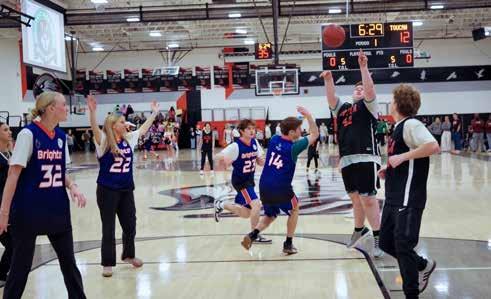
munity better, so through unified sports, we can support them,” she said. “Everyone deserves a community.”
Rockwood has refereed and ran the score table at unified tournaments and enjoys helping others succeed.
“It’s satisfying to help others have fun and have a sense of accomplishment,” she said.
For players like Corner Canyon sophomore Mia Lems, the competition still matters, but so does kindness.
“I like to take down the other team,” she said. “I’ve made friends with other teams too. I like to give them handshakes and clap and give high-fives for making good shots.”
Corner Canyon finished as state runners-up in their division at the state championship.
Lems’ teammate, senior Fisher Ghiz, didn’t realize how much unified basketball would change him.
“It has taught me patience; it has taught me how to make friends with those different than me,” Ghiz said. “I used to be shy, but they’re so social, I’ve become more outward. This is awesome. I want to keep playing in college.”
Across Utah, with more than 250 Utah high school unified teams, other players emphasize the game has given them friendship, growth and joy.
At Hunter High, senior Maelie Jorgensen loves “the good environment where everyone has fun playing and being to-
gether” while teammate sophomore Bentley Wright said the teammates’ friendships stretch into lunch tables and school dances. On the court, Wright, like Granger High’s freshman Jhanpeer Macha Dias, loves the celebration after a basket that comes with dance moves and cheers.
Hunter High also played at the state championships, beating Olympus High in its division. Skyline High also finished second at state in its division.
Murray High’s Parker May loves the game, especially shooting the ball, and playing with friends while teammate senior Hayden Gardner added he loves the confidence his teammates have gained over the season.
Murray High senior Ethan Teusher added: “There is simple joy in spending time together whether we’re playing basketball or a game of Uno.”
Nearby Copper Hills High finished second in its division at state while Herriman High won its division for the state title.
After West Jordan senior Robert West said he hoped his team would practice more early in the season, the Jaguars finished second at state in its division.
West Jordan senior Colton Reid refereed unified basketball last year, but he decided to participate this year.
“It’s the greatest thing and something I didn’t want to miss out on,” Reid said. “I’ve made some good friends and great memories playing unified basketball.” l
A Brighton unified player is congratulated from school cheerleaders after making a basket. (Julie Slama/City Journals)
An Alta unified pair were selected to hold the torch during Canyons School District’s unified tournament. (Julie Slama/City Journals)
Alta shoots over Brighton’s defense in a Canyons School District tournament game in February. (Julie Slama/City Journals)


Brighton taps decorated alumnus for head wrestling coach
Brayden Stevens received a lot of advice from legendary coaches, including his dad.
By Jerry Christensen j.christensen@mycityjournals.com
Brighton High School reached into its rich wrestling history for the appointment of a new boys head wrestling coach. Brayden Stevens, Brighton’s latest twotime state champion (2017-18) was signed to take the helm from four-year coach Burke Gappmayer.
The 26-year-old Stevens, who graduated Brighton in 2018 as an All-American wrestler, continues in the footsteps of a litany of legacy coaches who have produced 77 individual state champions and 14 team state championships. That Brighton tradition of wrestling excellence began with another newly appointed 26-year-old head coach 57 years ago in 1969—coach Don Neff, who was hired when Brighton opened.
Neff reacted to Stevens’ appointment with words of advice: “Building a wrestling program and winning a team wrestling title require a lot of detail work that many aren’t willing to do.”
Coach Chad Flook added, “Glory does not come quickly in this sport. It needs to be built over years and years of consistent dedication and leadership.”
Flook headed Brighton’s wrestling pro-
gram 2009-12. Coach Dave Chavis, who was assistant coach with Neff and then head coach from 1979-89, dropped his sage advice for the new coach: “Do something every day that makes the program better.” That consistency proved key to Chavis pushing the program to 14 state championships.
Stevens was a beneficiary of the Brighton’s wrestling program and became a contributor to its ongoing success. He reflected on his early experiences at Brighton.
“I remember the first day of school getting lost in the circles as a newly movedin student from Vernal. Two teachers, Mrs. Rawle and Mrs. Yee soon made me feel at home. They continue to play important mentorship roles in my life,” he said.
Stevens credits Brighton’s strong sense of community and caring staff as key influences on his development. He soon found success on the football field and glory on the wrestling mats as a three-time 5A AllStar. He was a four-time state-qualifying wrestler, a three-time state finalist and a two-time state wrestling champion.
While completing his college degree, Stevens has added “decorated wrestling referee” to his accolades. He was named USA Utah Official of the Year in 2023 and traveled nationwide to officiate tournaments. As an assistant wrestling coach at 6A Mountain Ridge High School he coached six state champion wrestlers, 43 state placers and the 2022 region championship team. In addition to adding head coach to that list,
Stevens joins the Brighton science faculty.
Coach Christine Yee, Brighton’s current girls wrestling coach, described Stevens as a hardworking, determined student who set ambitious goals and stayed disciplined in both training and academics.
“Brayden’s greatest strength is his ability to connect with all kinds of people, which helped build interest in wrestling and made him effective in roles like yearbook and leadership at Brighton. Over the years, I have seen him handle high-pressure situations—officiating games and running tournaments—with professionalism and composure. I love that Brayden loves Brighton and Brighton wrestling. That’s infectious. The kids are going to love it.”
Brayden Stevens is the second “coach Stevens” Brighton has had. Coach Mitch Stevens, Brayden’s father was head coach for six years from 2014-20.
His advice for his son’s first head coaching appointment: “Remember you are developing young men to be better people, better sons, better husbands, better fathers and better people in our society. Wrestlers will look up to you as an example setter and you want to set the right example for them. You can have success and do things the right way.”
Coach Ted Sierer, a two-time state wrestling state champion at Hillcrest who was Brighton’s head coach from 1998-2008, had this advice for the new coach Stevens: “Coaching the Brighton wrestling team is
such a great experience. There is such a strong legacy that comes with the program. I felt an instant connection with amazing coaches and wrestlers that were there before me. Coach Stevens needs to embrace that history and strive to build on it. When a sense of honor in being a Brighton wrestler is established by the coach amazing things can happen.”
Sierer, who later coached at Olympus, counts his time at Brighton as memorable with 14 individual state champions, a 2001 team state championship and hundreds of lives changed through wrestling.
A teammate from the Brighton teams is the late 2010s, Henry Barth, recognized Stevens’ potential.
“I thought Brayden was a great wrestler and leader for our team back in high school. He inspired me and taught me to be a better wrestler, and I have no doubts he will teach and inspire his new team as the head coach,” he said.
As the new head wrestling coach, Stevens emphasizes building character in student-athletes and fostering a culture of hard work, respect and success both on the mat and in life. “Leading the program at Brighton is the fulfillment of a long-held dream,” he said. “I feel honored to continue the legacy of successful coaches, including my father.”
Principal Marielle Rawle, who is also a returned Brighton alumnus giving back to Brighton with her career, cited the mantra: “Once a Bengal, always a Bengal.” l
Brighton’s original head wrestling coach Don Neff greets Brighton’s newly appointed head wrestling coach Brayden Stevens at 2025 Battle of the Axe. (Jerry Christensen/City Journals)
Brayden Stevens on top of the podium for a second year as 2018 state champion. (Photo Mitch Stevens)
Albion girls win third straight title in ‘Real March Madness’
Teams celebrate friendship and school pride while competing in school district intramural basketball tournament.
By Julie Slama j.slama@mycityjournals.com
Teammates rushed together in a swirl of hugs as Albion A’s eighth-grade girls claimed Canyons School District’s middle school intramural 3-on-3 basketball championship, capping their middle school careers with a third straight title.
Parents and friends cheered and rushed the court to snap photos of the team with a Hulk-style trophy – one hand gripping the rim and the other palming a basketball – capturing the energy of “The Real March Madness.”
The team said their final run was as much about friendship as continuity in winning.
“We all decided to play together; we play together on the comp team, Brighton Bengals Bantam, outside of school so this is our chance to play together for our school,” eighth-grader Lily Pohlman said.
Her teammate, Jane Kasteler, added: “We want to represent Albion; it’s been a fun three years playing for our school.”
While playing together has translated into strong on-court chemistry, Lexi Frye and her teammates were quick to credit the adults who coached them.
“Our coaches are supportive,” player Hana Alger said. “They’re always here, wanting the best for us.”
Teammate Harper Misik added: “Our coaches taught us different plays and helped us in practice; they make us better.”




“It’s great to get the kids out, meeting each other and creating the best memories,” she said. “3-on-3 doesn’t take a lot of time as an extracurricular with practicing only once per week, but they’re active, they’re bonding with each other and they’re having fun in the competition.”
This is the second time Harris had the same team win a title in every grade.
The championship also earned the Albion eight-graders a bonus reward. Principal Eric Gardner promised them root beer floats if they won their third title.
In the eighth-grade division, second place went to Indian Hills A, followed by Mt. Jordan A in third and Eastmont A in fourth.
In sixth-grade girls play, Draper Park A took first, with Albion B in second; Eastmont third; and Mt. Jordan, fourth. The seventh-grade girls bracket was won by Draper Park A, followed by Draper Park B, Midvale and Butler.
A memorable moment came during the sixth-grade boys tournament.
Those coaches include Brooke Harris, Dante Ross, Cory Christianson and “coach Ragdun.”
Even though the girls were excited to capture the title, Lily said it wasn’t the highlight.
“The best part definitely is getting to know each other better. We met in sixth grade, but now we’re not just teammates, we’re good friends,” she said.
Harris, who has coached intramurals for nine years, said making those connections is the heart of the program.


“Both the first- and second-place game and the thirdand fourth-place game where tied when the games ended so it went into sudden victory free throws,” said intramurals coordinator Taylor Hansen. “The first- and second-place game had to go four players deep until a basket was made and the third- and fourth-place game, three players deep.”
That resulted in Eastmont beating out Mt. Jordan for the championship and Draper Park claiming third place over Albion.
In boys seventh grade, Butler B won, followed by Draper Park B, Butler A and Mt. Jordan A. The eighth-grade boys bracket was won by Butler A, followed by Butler B, Albion and Draper Park B. l









Albion eighth-grade girls team won Canyons School District basketball titles each year in middle school. (Julie Slama/ City Journals)



Bengals win battle of state champs
In the battle of last year’s state champions, Brighton beat 6A power Corner Canyon.
By Jerry Christensen j.christensen@mycityjournals.com
Brighton boys lacrosse began the spring high school lacrosse season with a target on its back-to-back 5A state championships. The target for coach Chris O’Donnell is always the same: “Win the region and play for the state title” this time for a rare three-peat.

The target for every other 5A school is to beat Brighton.
The field for the region and state championship has intensified with both Park City and now Judge, which are 4A schools, playing up in the 5A category for lacrosse. Park City has lost to Brighton in the last two state championships and Judge was the 4A state champions. The new West Field Longhorns out of Taylor in Weber County also join the mix.
O’Donnell graduated a big class of seniors last year but retained the talents of All-American Gabe Carrera, who is committed to play next year at Stony Brook Univer-
sity in New York; Zac Anderson, who plays next year at Rensselaer Polytechnic Institute in New York; Landon Stosich, who committed to The College of Idaho; and Alex West playing next year at Utah State.
The first big test of the season came in mid-March when the reigning 6A champions Corner Canyon came to Brighton stadium in a battle of the 2025 5A and 6A champions. Two years ago Brighton eked out a win and both teams went on to win their respective divisions. Last year, Brighton lost at Corner Canyon but both teams went on to take state in 5A and 6A.
The game under the lights in March began as a defensive battle. The score was 4-4 in the second quarter before Corner Canyon took an edge at halftime 7-6. Brighton evened the score 11-11 as the crucial fourth quarter began. Defense tightened with a 1212 tie with a minute left.
Brighton’s senior goalie Stosich recalls “playing all four quarters, we were down 11-7 in third but we didn’t get down on each other instead we built each other up, so we could go on a 6 to 1 run to close the game out.” Brighton scored on the last minute to claim state supremacy for the week, a 13-12 win. l















Brighton lacrosse prepares for the Corner Canyon showdown. (Pho tos Brighton lacrosse)
When astronaut Neil Armstrong took those first steps on the moon, I had just celebrated my first birthday. I don’t remember either event, but the entire world held its breath as it watched Apollo 11 land, while I shoved my hands into a birthday cake.
That moon mission used less technology than your bathroom scale. It was basically human calculations, a slide rule and a Rand McNally paper map that guided those astronauts on the first lunar road trip.
We were told that space was the final frontier; space was the future. We learned that, like age and teenagers, space isn’t forgiving.
As a Murray High School senior, my home ec advisor wheeled a TV into the classroom to watch the Space Shuttle Challenger carry the first teacher, Christa McAuliffe, into space. We were speechless when the shuttle blew up at 46,000 feet. In February 2003, I watched the Space Shuttle Columbia disaster unfold as the spacecraft disintegrated on re-entry.
To say I was apprehensive watching the Artemis II mission launch to the moon would be an astronomical understatement.
On April 1, NASA perched the Orion space capsule atop a 300-foot rocket, one of the most powerful ever built. It launched a team of four astronauts 250,000 miles away from Earth, the farthest humans have ever traveled, discounting alien abductions, of course.
Unlike the catapulted station wagon that
Peri Kinder Life and Laughter
Copy, Moon Joy

somehow got us to the moon during Apollo missions, Orion uses autonomous navigation and extreme precision, carrying astronauts beyond low-Earth orbit for the first time in more than 50 years, traveling at speeds up to 25,000 mph.
It was the 10th manned moon exploration, or for conspiracy theorists, the 10th “faked” moon mission. The entire adventure was livestreamed so we could travel together.
Space exploration is equal parts wonder, technology and angst. During the 10-day moon trip, I endured galactic levels of anxiety. Launch sent my blood pressure soaring. My jaw clenched while they circled the moon on April 6, and my internal organs somersaulted during splashdown on April 10.
I was hyperaware that dreams explode and rockets fall apart.
Apollo missions were built on bravery, and America was racing to beat Russians to the moon. Now, Artemis is an international collaboration, one that should remind us we only sur-

vive this wild ride by working together.
In Greek mythology, Artemis is Apollo’s twin sister and goddess of the moon. It is an apt comparison: while the first moon missions had bro energy, the Artemis program continues the story in a wiser, more thoughtful way.
Women play key roles in the Artemis program. Besides the first female to fly on a moon mission, there are female science officers, mission leads and launch directors. In fact, for the first time in NASA’s history, the current astronaut class has more women than men.
If I could do math while enduring crushing g-forces and the stomach-dropping sensation of freefall, I would definitely have been in the space program. Instead, I appreciate the life of an astronaut from the comfort of my recliner.
Apollo gave us “One giant leap,” Challenger dropped us to our knees and Artemis refocused our gaze. These missions remind us to look to the stars, but also look to our beautiful, blue planet. We only have each other. We should start acting like it.
As I approach my next birthday, one I hope I remember, I raise a glass to the dreamers, the heroes, to the brilliant engineers in mission control and the fearless astronauts who explore new paths. It reminds us that even when the story goes wrong, we need to keep looking up.
Peri Kinder is an award-winning columnist and journalist who has written for The City Journals since 2004. She can be reached at peri.k@thecityjournals.com